
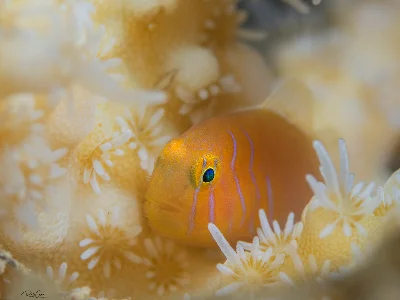
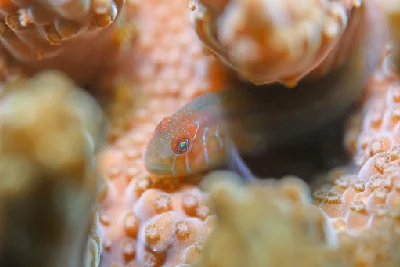
The Elongate Coralgoby, scientifically known as Gobiodon prolixus, is a small tropical fish found in marine environments, particularly associated with coral reefs. It inhabits depths ranging from 1 to 21 meters (approximately 3 to 69 feet) in the Indo-Pacific region. This species can grow up to a maximum length of 3.2 centimeters (about 1.26 inches).
One of the defining characteristics of this coralgoby is its appearance; it features five pale blue vertical stripes on its head and body, which contrast with a brown to pale brown background. The body of the Elongate Coralgoby is slim and somewhat tubular, a characteristic more pronounced in adults. More specifically, the body depth at the origin of the pelvic spine is 27-36% of the standard length, and the distance between the first dorsal-fin spine's base and the first pectoral-fin ray's base is 41.3-50.4% of the head length.
The Elongate Coralgoby is part of the genus characterized by facultative air-breathing, meaning that while it primarily breathes water like other fish, it has the ability to breathe air if necessary. Furthermore, it is a coral-commensal species, meaning it has a mutual relationship with coral, relying on it for shelter and possibly food.
In terms of its anatomical features, the Elongate Coralgoby possesses seven dorsal spines, ten dorsal soft rays, one anal spine, and eight anal soft rays. Occasionally, a short straight groove may be present between certain bones, though this feature can vary depending on the position of the suspensorium when the specimen is preserved.
The name "Gobiodon prolixus" is derived from the Latin word "gobius," meaning gudgeon, and the Greek word "odous," meaning teeth, alluding to its genus. The species name "prolixus," from Latin, refers to the elongated body of this species compared to its relatives.
Why it's threatened
Threat classification from the IUCN Red List.


