This genus is a good measure of how much of a reef nobody has looked at.
They are small, they live inside the rock, they come out at night, and they are found by pushing a light into cracks. That combination kept them almost unknown until divers started working caves deliberately and until deep reefs below normal diving range became reachable, and the result has been a steady run of new species: the genus has roughly doubled in the last few decades and new ones are still being described, several from this region.
The pattern says something general. The animals we know best are the ones that sit in open water in daylight where a person can see them, and the reef's actual diversity is concentrated in exactly the places that is not true: inside the framework, under rubble, in caves, and below forty meters. What is catalogued reflects where people can conveniently look.
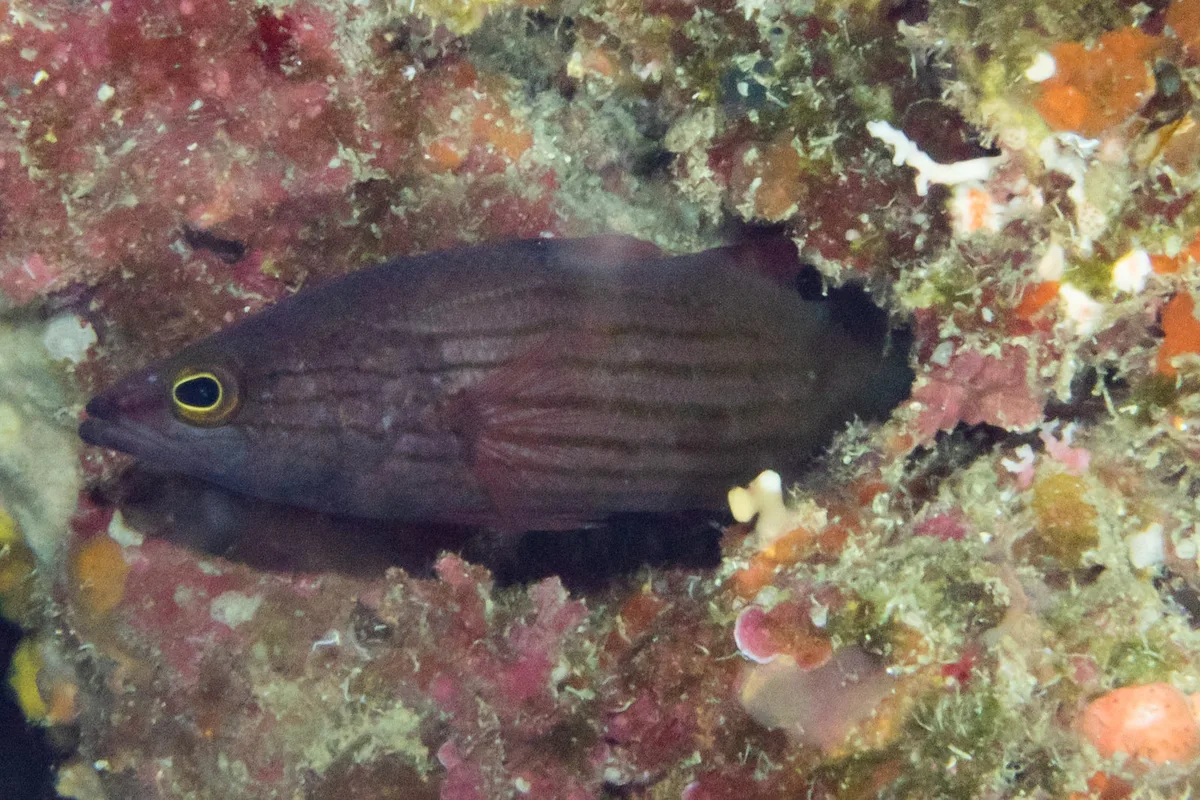
This one is a shallow cave species, pale brown with fine dark lines running the length of the body, under ten centimeters. If you want to find it, look under a ledge at night rather than on the reef by day.
The genus. Liopropoma Gill 1861 - leios (smooth) + propoma (preopercle). ETYFish
The species. Liopropoma susumi (Jordan & Seale 1906) - from Susu umi. ETYFish
- fine dark lines running the length of a pale brown body
- under 10 cm, with a rounded tail
- in caves and rubble, out only at night
- usually seen only in a torch beam
Why it's threatened
There are no known major threats to this species.
Threat classification from the IUCN Red List.