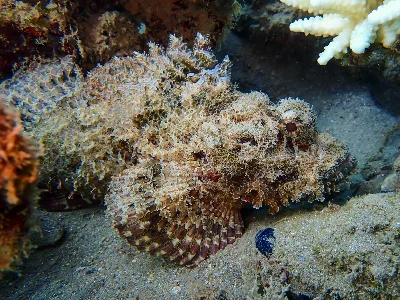
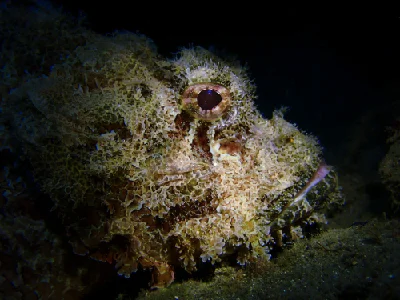
Scorpaenopsis barbata, commonly known as the bearded scorpionfish, is a venomous marine ray-finned fish belonging to the family Scorpaenidae, also known as scorpionfishes. This species is distributed across the 🇮🇳 Indian and 🌊 Pacific Oceans.
Originally described as Scorpaena barbata in 1838 by the German naturalist Eduard Rüppell, the type locality for this species was identified as Massawa in 🇪🇷 Eritrea. The specific epithet "barbata" refers to the "bearded" appearance, attributed to the fleshy tentacles on either side of the lower jaw.
Scorpaenopsis barbata can attain a maximum length of 27 centimeters. They exhibit bright coloration and pronounced camouflage. Characterized by a broad, spiny head, large mouth, and feathery fins, their body colors range from reddish-brown to dark brown with whitish and blackish blotches. The skin also features multiple fleshy outgrowths around the chin, giving rise to their common name. The species possesses twelve dorsal spines, nine dorsal soft rays, three anal spines, and five anal soft rays, with fin spines potentially bearing venom glands at the base.
This species primarily inhabits the 🌊 Western Indian Ocean, including the 🌊 Red Sea, the 🌊 Persian Gulf, the 🌊 Gulf of Aden, and the southern coast of the Arabian Peninsula. While Scorpaenopsis barbata may inhabit a wider range, identification challenges can complicate documentation of its presence. These tropical reef-associated fish reside in rocky coastlines, rubble, and sandy areas around coral patches up to a depth of 30 meters.
Scorpaenopsis barbata is an ambush predator, utilizing its camouflage to blend among algae and seaweed on the seabed. It preys mainly on crustaceans and small fish within its vicinity. When prey approaches, it is rapidly captured by the powerful jaws of the bearded scorpionfish. This species is oviparous, with eggs hatching into very small larvae approximately two days post-laying. The larvae remain near the surface until reaching a length of 5 centimeters (2.0 inches), at which point they settle onto the seabed.
Why it's threatened
Threat classification from the IUCN Red List.


