
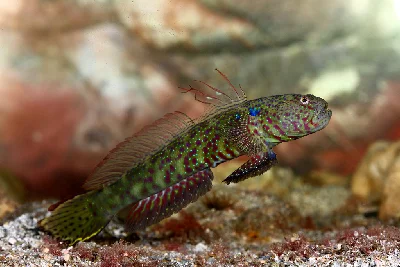
The Arabian Goby (Cryptocentroides arabicus) is a small fish found in tropical marine environments of the 🌊 Western Indian Ocean, from the 🌊 Red Sea to the 🌊 Persian Gulf. It typically inhabits muddy areas near mangroves and thrives in very shallow waters, at depths of less than 2 meters (6.6 feet). Measuring up to a maximum length of 13.5 centimeters (5.3 inches), this species is characterized by a body structure that includes seven dorsal spines and between eleven to twelve dorsal soft rays, along with one anal spine and eleven anal soft rays.
The Arabian Goby exhibits facultative air-breathing abilities, meaning it can breathe air when necessary, an adaptation that helps them survive in their burrowed habitats within the sediment. This behavior is thought to be beneficial in its association with alpheid shrimp, with whom it likely shares its environment. The scientific name, Cryptocentroides, is derived from Greek, where "kryptos" means hidden and "kentron" means sting, likely referring to some aspect of its distinctive and perhaps elusive nature.
Why it's threatened
Threat classification from the IUCN Red List.


