
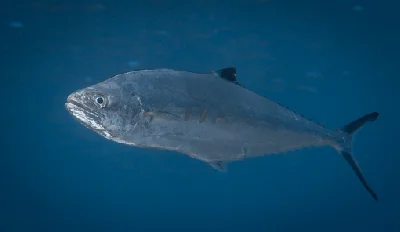
The doublespotted queenfish (Scomberoides lysan), belonging to the Carangidae family, is a tropical game fish closely associated with reef ecosystems and widely distributed across the 🇮🇳 Indian and 🌊 Pacific Oceans. It is known by several alternate names, including giant dart, large-mouthed leatherskin, and whitefish. In 🇯🇵 Japanese, it is referred to as イケカツオ (生鰹, Ikekatsuo).
The doublespotted queenfish is notable for reaching lengths of up to 110 cm and weights of approximately 11 kg (24.3 lb). Its appearance is predominantly silver, featuring dark markings on its dorsal and caudal fins, along with a distinctive row of dark spots along the lateral line. The species is characterized by its needle-like scales set in robust skin, with sharply lanceolate breast scales embedded below the lateral line, unlike some other fish in the jack family that possess scutes.
The range of this species extends from the 🌊 Red Sea and eastern Africa to Hawaii (🇺🇸 United States), the Marquesas, and the Tuamotu (🇵🇫 French Polynesia) Islands, reaching as far north as southern 🇯🇵 Japan and south to New South Wales and Rapa Iti. The doublespotted queenfish occupies clear waters from the surface to depths of approximately 100 meters (330 feet). Juvenile fish tend to inhabit shallow, nearshore environments, including brackish waters, while adults are more commonly found in association with reefs and display primarily solitary behavior.
In terms of diet, juveniles primarily consume the scales of schooling fish, whereas adults feed on a variety of fish and crustaceans. It is important to note that this species possesses venomous spines located on the dorsal and anal fins.
Why it's threatened
Threat classification from the IUCN Red List.


