# Red Sea Creatures — full catalogue
> Every category and species page of redseacreatures.com concatenated into one document,
> generated 2026-11-12T16:52:53.702Z. 165 categories, 1337 species
> 64 dive sites, 35 dive centres and 132 articles.
This is the long form of https://redseacreatures.com/llms.txt. Each section below is exactly what
https://redseacreatures.com/markdown/... serves for that page, and every section carries the canonical
URL of the HTML page it mirrors. Content usage: search=yes, ai-input=yes, ai-train=yes.
---
# Categories (165)
---
---
title: Algae
scientific_name:
common_name: Algae
published: 2024-11-19T18:41:51.573Z
updated: 2026-08-23T21:28:59.518Z
tags: Algae, Red Sea, Marine Life, Diving
url: https://redseacreatures.com/taxon/sea-plants/algae
---
# Algae
## Quick facts
- **Species listed here:** 1
## How to recognise this group
- rooted or attached to rocky substrates and dead coral
- immobile, swaying gently with water movement
- diverse colours, typically green, red, or olive to dark brown
Algae are not plants, and that is not a technicality. A seaweed has no roots, no vessels, no leaves and no flowers, and never had any. The pad that holds it to the rock is an anchor and nothing more, taking up neither water nor food; the whole body feeds itself out of the water it is sitting in. Nor are they one lineage. Green, red and brown seaweeds arrived at photosynthesis by different routes, and a brown alga runs its chloroplasts on machinery acquired second hand, from a red alga that one of its ancestors swallowed and kept.
The reef runs on them, which is easy to miss because a healthy reef looks as though it has almost no weed on it. The low fuzz on dead coral is turf algae, among the fastest-growing things in this sea, and it is eaten as fast as it appears by parrotfish, surgeonfish and urchins. Cage off a patch so nothing can graze it and within weeks it is shaggy. Lose the grazers across a whole reef and the same thing happens at that scale, with the coral losing the space it needs to settle.
Some of them are stone. Coralline algae lay calcium carbonate down inside their cell walls and grow as hard pink and purple crusts over dead coral and rubble. They are the mortar of the building: they cement loose pieces into a structure that holds against surf, and they carry the chemical cue that tells a drifting coral larva it has found somewhere worth settling. A reef stripped of its coralline crusts has trouble rebuilding itself.
Red algae reach deeper than anything else that photosynthesizes anywhere on Earth. Their accessory pigments capture the blue light that is all that survives at depth, and crusts of them grow far below the last living coral, on rock where a diver's torch is the only light that has been there in a long time.
## Species (1)
- [Bubble Algae (Valonia ventricosa)](https://redseacreatures.com/taxon/sea-plants/algae/bubble-algae)
---
*Source: [Red Sea Creatures](https://redseacreatures.com/taxon/sea-plants/algae)*
*Updated: August 23, 2026*
---
---
title: Angelfishes (Pomacanthidae)
scientific_name: Pomacanthidae
common_name: Angelfishes
rank: Family
published: 2024-11-19T18:41:51.573Z
updated: 2026-09-11T20:15:20.957Z
tags: Angelfishes, Pomacanthidae, Red Sea, Marine Life, Diving
url: https://redseacreatures.com/taxon/fishes/bony-fishes/angelfishes
---
# Angelfishes (*Pomacanthidae*)
## Quick facts
- **Rank:** Family
- **Scientific name:** Pomacanthidae
- **Body shape:** Disc - Round and flat as a plate, seen from the side - butterflyfishes, angelfishes.
- **Species listed here:** 7
## How to recognise this group
- disc-shaped body, deep and compressed
- prominent spine at lower gill cover
- bright, complex colour patterns
- juveniles with distinct colouration from adults
The name is about a spine, not about wings. At the lower back corner of the gill cover an angelfish carries a stout backward-pointing spike, and the family name means precisely that. It is the one reliable way to tell an angelfish from a butterflyfish, which is otherwise the same silhouette in the same place doing similar work, and it is not decoration: a fish that has backed into a crevice with that spine flared is a difficult thing to extract and an awkward thing to swallow.
Then there is what the big ones eat. Sponges make up much of the diet of the large angelfishes, and a sponge is designed to be inedible: the body is stiffened with needles of glass and loaded with chemicals whose whole purpose is to make an animal regret the mouthful. Almost nothing on a reef will touch one. Angelfish work through them with a small mouth full of brush teeth, along with sea squirts and the encrusting mat that covers everything else, which is about as narrow a living as a reef fish makes and the reason an angelfish in a home aquarium usually starves in slow motion.
They live in fixed arrangements rather than crowds. The large species go in pairs that hold the same stretch of reef for years and patrol it in a set circuit. The small ones live in harems, one male with a handful of females on a compact territory, and if that male disappears the largest female becomes him, which takes weeks and is permanent.
Seven species are listed here. Two of them, the Arabian angelfish and the yellowbar, belong to this corner of the world and are among the fish people come here to photograph, which is harder than it sounds: an angelfish that has decided you are watching it will keep a coral head between you and itself for as long as your air lasts.
## Species (7)
- [Arabian Angelfish (Pomacanthus asfur)](https://redseacreatures.com/taxon/fishes/bony-fishes/angelfishes/arabian-angelfish)
- [Emperor Angelfish (Pomacanthus imperator)](https://redseacreatures.com/taxon/fishes/bony-fishes/angelfishes/emperor-angelfish)
- [Manyspine Angelfish (Centropyge multispinis)](https://redseacreatures.com/taxon/fishes/bony-fishes/angelfishes/manyspine-angelfish)
- [Red Sea Angelfish (Apolemichthys xanthotis)](https://redseacreatures.com/taxon/fishes/bony-fishes/angelfishes/red-sea-angelfish)
- [Regal Angelfish (Pygoplites diacanthus)](https://redseacreatures.com/taxon/fishes/bony-fishes/angelfishes/regal-angelfish)
- [Yellowbar Angelfish (Pomacanthus maculosus)](https://redseacreatures.com/taxon/fishes/bony-fishes/angelfishes/yellowbar-angelfish)
- [Zebra Angelfish (Genicanthus caudovittatus)](https://redseacreatures.com/taxon/fishes/bony-fishes/angelfishes/zebra-angelfish)
---
*Source: [Red Sea Creatures](https://redseacreatures.com/taxon/fishes/bony-fishes/angelfishes)*
*Updated: September 11, 2026*
---
---
title: Annelid (Annelida)
scientific_name: Annelida
common_name: Annelid
rank: Phylum
published: 2024-11-19T18:41:51.573Z
updated: 2026-08-23T21:14:21.425Z
tags: Annelid, Annelida, Red Sea, Marine Life, Diving
url: https://redseacreatures.com/taxon/invertebrate/worms/annelid
---
# Annelid (*Annelida*)
## Quick facts
- **Rank:** Phylum
- **Scientific name:** Annelida
- **Body shape:** Invertebrate - Not a fish - coral, mollusc, crustacean, echinoderm and other invertebrate groups.
- **Species listed here:** 9
## How to recognise this group
- elongated body, distinctly segmented
- body often housed in a fixed tube
- feathery crown of colourful feeding tentacles
- rapid retraction of crown when disturbed
A segmented worm is built the way a train is built, out of one working unit repeated as many times as needed.
Each segment carries its own muscle blocks, its own knot of nerve, its own pair of bristle bundles, and its own share of the plumbing. Copy a unit that already works and stack it, and an animal can get longer, faster and stronger without inventing anything new. It is one of the most reused ideas in evolution: arrived at separately, it also produced the body of an insect and the vertebrae running down your back. Annelida means little rings, and on a live worm you can count them.
The showpieces on a reef are the ones that gave up walking. A Christmas tree worm is a tube sunk into living coral with almost nothing outside it but two spirals of feathered tentacles, which work as gills and plankton net in the same structure. The coral grows around the tube rather than over it, so worm and colony age together. Those spirals carry light-sensitive spots, and a shadow crossing them, a diver, a fish, is enough: the crown is gone into the tube before you register the movement, with a hard lid pulled shut behind it. Hang still and it comes back a little at a time.
The tubes themselves are masonry. A fan worm catches sand grains in its crown, sorts them by size in a pouch below the mouth, and cements them into the rim of its tube in courses, which is why a bare tube in the rubble looks manufactured.
One member of the group breaks the shape entirely. There is a small worm that lives inside a sponge, keeping a single head buried at the base while its body branches, and branches again, threading the sponge's canals until one animal ends in hundreds of separate tails. Almost nothing else in the animal kingdom is built that way.
## Species (9)
- [Aloni's Christmas Tree Worm (Spirobranchus aloni)](https://redseacreatures.com/taxon/invertebrate/worms/annelid/alonis-christmas-tree-worm)
- [Branching Sponge Worm (Ramisyllis multicaudata)](https://redseacreatures.com/taxon/invertebrate/worms/annelid/branching-sponge-worm)
- [Christmas Tree Worm (Spirobranchus giganteus)](https://redseacreatures.com/taxon/invertebrate/worms/annelid/christmas-tree-worm)
- [Crinoid Scale Worm (Paradyte crinoidicola)](https://redseacreatures.com/taxon/invertebrate/worms/annelid/crinoid-scale-worm)
- [Elat Coral Worm (Filogranella elatensis)](https://redseacreatures.com/taxon/invertebrate/worms/annelid/elat-coral-worm)
- [Feather Duster Worm (Sabellastarte spectabilis)](https://redseacreatures.com/taxon/invertebrate/worms/annelid/feather-duster-worm)
- [Horned Christmas Tree Worm (Spirobranchus corniculatus)](https://redseacreatures.com/taxon/invertebrate/worms/annelid/horned-christmas-tree-worm)
- [Red Fanworm (Protula bispiralis)](https://redseacreatures.com/taxon/invertebrate/worms/annelid/red-fanworm)
- [Red Sea Ribbon Worm (Mesochaetopterus rogeri)](https://redseacreatures.com/taxon/invertebrate/worms/annelid/red-sea-ribbon-worm)
---
*Source: [Red Sea Creatures](https://redseacreatures.com/taxon/invertebrate/worms/annelid)*
*Updated: August 23, 2026*
---
---
title: Anthias (Anthiinae)
scientific_name: Anthiinae
common_name: Anthias
rank: Subfamily
published: 2024-11-19T18:41:51.573Z
updated: 2026-09-11T20:17:24.616Z
tags: Anthias, Anthiinae, Red Sea, Marine Life, Diving
url: https://redseacreatures.com/taxon/fishes/bony-fishes/anthias
---
# Anthias (*Anthiinae*)
## Quick facts
- **Rank:** Subfamily
- **Scientific name:** Anthiinae
- **Body shape:** Elongate - Long and slender, but still fish-shaped - trumpetfishes, needlefishes, cornetfishes.
- **Species listed here:** 7
## How to recognise this group
- elongated body, small to medium size (5-20cm)
- forms dense aggregations hovering over reef slopes
- vibrant colours, often pinks, oranges, yellows
- prominent dorsal fins
The orange haze over a Red Sea drop-off is almost entirely female.
Anthias live in harems. One male holds a patch of current-swept reef and a group of females feeds above it, and he is the odd fish in every sense: bigger, magenta instead of gold, with one dorsal spine pulled out into a filament, spending the day patrolling his borders and fighting the male next door rather than eating. When he goes, the largest female in his group replaces him, color first and sex afterward, over a few weeks. The wrasse page has the mechanics of that. What matters here is the arithmetic: a cloud of several hundred anthias is not one shoal, it is a few dozen small kingdoms packed against each other with hard borders in between.
And they are groupers. Anthias sit inside Serranidae, the family of the giant fish that hangs under a coral head waiting for something to swim into its mouth. The body plan was kept and the scale was thrown away: this is a grouper the size of a finger, aimed at plankton instead of at fish, and multiplied until it colors the water.
The cloud is a reading of the current. Anthias eat what the water carries, so they mass exactly where it moves fastest, at the corner of a wall or the up-current end of a pinnacle, and every fish faces the same way. Pass a shadow over them and the whole cloud is inside the coral at once, then out again. That distance, the one they can cover before something reaches them, is the entire world of an individual anthias.
Seven species are listed for this sea. One of them is the fish in the photographs; the rest are deeper, scarcer, or at the far edge of their range, and the perchlets in the group are the opposite animal entirely, solitary bottom-sitters that almost nobody sees.
## Species (7)
- [Broadstriped Anthias (Pseudanthias taeniatus)](https://redseacreatures.com/taxon/fishes/bony-fishes/anthias/broadstriped-anthias)
- [Dwarf Perchlet (Plectranthias nanus)](https://redseacreatures.com/taxon/fishes/bony-fishes/anthias/dwarf-perchlet)
- [Lunate Anthias (Pseudanthias lunulatus)](https://redseacreatures.com/taxon/fishes/bony-fishes/anthias/lunate-anthias)
- [Lyretail Anthias (Pseudanthias squamipinnis)](https://redseacreatures.com/taxon/fishes/bony-fishes/anthias/lyretail-anthias)
- [Orangehead Anthias (Pseudanthias heemstrai)](https://redseacreatures.com/taxon/fishes/bony-fishes/anthias/orangehead-anthias)
- [Redblotched Perchlet (Plectranthias winniensis)](https://redseacreatures.com/taxon/fishes/bony-fishes/anthias/redblotched-perchlet)
- [Redstripe Anthias (Pseudanthias gibbosus)](https://redseacreatures.com/taxon/fishes/bony-fishes/anthias/redstripe-anthias)
---
*Source: [Red Sea Creatures](https://redseacreatures.com/taxon/fishes/bony-fishes/anthias)*
*Updated: September 11, 2026*
---
---
title: Barnacles (Cirripedia)
scientific_name: Cirripedia
common_name: Barnacles
rank: Subclass
published: 2024-11-19T18:41:51.573Z
updated: 2026-08-23T21:28:58.304Z
tags: Barnacles, Cirripedia, Red Sea, Marine Life, Diving
url: https://redseacreatures.com/taxon/invertebrate/crustaceans/barnacles
---
# Barnacles (*Cirripedia*)
## Quick facts
- **Rank:** Subclass
- **Scientific name:** Cirripedia
- **Body shape:** Invertebrate - Not a fish - coral, mollusc, crustacean, echinoderm and other invertebrate groups.
- **Species listed here:** 6
## How to recognise this group
- permanently attached to hard substrates or other organisms
- greyish-white or brownish structures
- encased in a ring of calcified plates forming a shell
- cone-shaped shell or body elevated on a flexible stalk
- rhythmic extension of feathery limbs from the shell opening
A barnacle looks like a small mollusc and it is nothing of the kind. It is a crustacean lying on its back inside a box of its own limestone plates, glued to the rock by the front of its head, kicking food into its mouth with its feet.
It starts as a swimming larva that spends days walking over surfaces on its antennules, testing texture, current and the presence of other barnacles, because this is a decision it makes once. When it commits it cements itself down head-first, builds the plates up around itself and never moves again. The feathery fan that sweeps out of the opening and curls closed is its legs. The old name for the group, Cirripedia, means feather-footed, and it is a literal description.
The glue is the reason people study them. Barnacle cement sets underwater, bonds to rock, steel, plastic, whale skin and turtle shell, and holds through years of surge; it is among the strongest adhesives any animal makes. On a ship's hull it costs real fuel, and surgeons would like something that behaves the same way on wet tissue.
Being cemented down creates one problem that armor cannot solve, which is finding a mate. The answer is reach. Most barnacles are hermaphrodites, and a barnacle extends a penis several times its own body length to feel around for neighbors, the longest in the animal kingdom relative to body size, and it rebuilds it to suit the site: short and thick on rock that takes a beating, long and thin in shelter. It is also why they settle in crowds, because a barnacle alone on a clean rock is a barnacle with no future.
One branch gave up the shell entirely. Sacculina and its relatives enter a crab as a larva, spread through it as a root system, stop it breeding and take over its behavior so completely that the crab tends the parasite's egg mass as if it were its own brood. Nothing about the adult looks like an animal, let alone a barnacle, until you look at the larva.
## Species (6)
- [Common Goose Barnacle (Lepas anatifera)](https://redseacreatures.com/taxon/invertebrate/crustaceans/barnacles/common-goose-barnacle)
- [Coral Barnacle (Nobia grandis)](https://redseacreatures.com/taxon/invertebrate/crustaceans/barnacles/coral-barnacle)
- [Giant Rock Barnacle (Megabalanus tintinnabulum)](https://redseacreatures.com/taxon/invertebrate/crustaceans/barnacles/giant-rock-barnacle)
- [Ribbed Rock Barnacle (Tetraclita squamosa)](https://redseacreatures.com/taxon/invertebrate/crustaceans/barnacles/ribbed-rock-barnacle)
- [Striped Barnacle (Amphibalanus amphitrite)](https://redseacreatures.com/taxon/invertebrate/crustaceans/barnacles/striped-barnacle)
- [Turtle Barnacle (Chelonibia testudinaria)](https://redseacreatures.com/taxon/invertebrate/crustaceans/barnacles/turtle-barnacle)
---
*Source: [Red Sea Creatures](https://redseacreatures.com/taxon/invertebrate/crustaceans/barnacles)*
*Updated: August 23, 2026*
---
---
title: Barracudas (Sphyraenidae)
scientific_name: Sphyraenidae
common_name: Barracudas
rank: Family
published: 2024-11-19T18:41:51.573Z
updated: 2026-09-11T20:17:47.739Z
tags: Barracudas, Sphyraenidae, Red Sea, Marine Life, Diving
url: https://redseacreatures.com/taxon/fishes/bony-fishes/barracudas
---
# Barracudas (*Sphyraenidae*)
## Quick facts
- **Rank:** Family
- **Scientific name:** Sphyraenidae
- **Body shape:** Torpedo - Streamlined and muscular, built for open-water speed - jacks, tunas, barracudas.
- **Species listed here:** 7
## How to recognise this group
- very long, slender, cylindrical body
- pointed head with prominent, projecting lower jaw
- prominent, visible canine teeth
- silvery body, often with dark vertical bars
- solitary or schooling in open water
The question people ask about barracudas has a dull answer, so here it is first. A barracuda hanging three meters off and watching you has no interest in you whatever. Recorded bites are rare, and almost all of them fall into the same two boxes: bad visibility, or something bright on a hand or a wrist near a speared fish. This is an animal built to commit to a flash of silver inside a fraction of a second without checking what it belongs to, and a watch catches light the same way a sardine does.
Everything else about the fish follows from that one movement. The body is a straight tube of pale muscle with the fins pushed out to the ends of it, a shape that accelerates hard and turns badly, so a barracuda does not run prey down. It positions itself, holds still, and crosses the last few meters in one go. The eye is large and the hunt is entirely visual, which is why clear open water suits it and why murky water is where the mistakes happen.
The mouth is worth studying while one holds still in front of you. The lower jaw juts past the upper, and the teeth come in two sizes: small ones for holding, and long flattened blades set so that each drops into a socket in the opposing jaw, letting the mouth close flush. Prey too large to swallow is cut in half, and the second half collected afterward.
There are two barracudas to meet here and they look like different animals. Small species and young fish travel in schools, sometimes packing into a slowly turning column that sits over the same corner all day. The large ones live alone, and the largest is the great barracuda, up to two meters of it, hanging motionless in midwater over a drop-off.
Seven species are listed for this sea.
## Species (7)
- [Bigeye Barracuda (Sphyraena forsteri)](https://redseacreatures.com/taxon/fishes/bony-fishes/barracudas/bigeye-barracuda)
- [Blackmargin Barracuda (Sphyraena qenie)](https://redseacreatures.com/taxon/fishes/bony-fishes/barracudas/blackmargin-barracuda)
- [Great Barracuda (Sphyraena barracuda)](https://redseacreatures.com/taxon/fishes/bony-fishes/barracudas/great-barracuda)
- [Iburi Barracuda (Sphyraena iburiensis)](https://redseacreatures.com/taxon/fishes/bony-fishes/barracudas/iburi-barracuda)
- [Midget Barracuda (Sphyraena chrysotaenia)](https://redseacreatures.com/taxon/fishes/bony-fishes/barracudas/midget-barracuda)
- [Pickhandle Barracuda (Sphyraena jello)](https://redseacreatures.com/taxon/fishes/bony-fishes/barracudas/pickhandle-barracuda)
- [Pondicherry Barracuda (Sphyraena obtusata)](https://redseacreatures.com/taxon/fishes/bony-fishes/barracudas/pondicherry-barracuda)
---
*Source: [Red Sea Creatures](https://redseacreatures.com/taxon/fishes/bony-fishes/barracudas)*
*Updated: September 11, 2026*
---
---
title: Bigeyes (Priacanthidae)
scientific_name: Priacanthidae
common_name: Bigeyes
rank: Family
published: 2024-11-19T18:41:51.573Z
updated: 2026-08-23T21:43:03.756Z
tags: Bigeyes, Priacanthidae, Red Sea, Marine Life, Diving
url: https://redseacreatures.com/taxon/fishes/bony-fishes/bigeyes
---
# Bigeyes (*Priacanthidae*)
## Quick facts
- **Rank:** Family
- **Scientific name:** Priacanthidae
- **Body shape:** Oval - Egg-shaped body, deeper than it is thick - damselfishes, surgeonfishes.
- **Species listed here:** 2
## How to recognise this group
- oval, deep, and compressed body
- conspicuously large eyes
- large, upward-angled mouth
- resting in caves or shaded ledges during the day
Put a torch into an overhang at night and two coals look back at you. A bigeye's eye takes up much of its head, and behind the retina sits a reflecting layer that sends back whatever light missed on the way in and gives it a second pass, the same device that makes a cat's eyes burn in headlights. It is an instrument for an animal that does its living in almost no light.
The mouth points up. It is hinged to open skyward, and that is where the hunting is done: a bigeye hangs beneath its prey and takes it against the last gray light coming down from the surface, because a fish looking up can still make out silhouettes long after a fish looking down sees nothing but black. Small crustaceans, small fish, anything that rises through the water column after dark.
By day it does nothing, and it does it alone. That is the difference between a bigeye and the sweepers that often share the same cave. Sweepers pack in by the hundred; bigeyes hang singly or a few scattered under a ledge, deep red and motionless, letting a diver come closer than seems reasonable before drifting a body length further back. The color is not fixed either. The pattern can run from solid red through blotched to pale silver while you are watching it.
The rest of the fish is armor. The scales are rough enough to feel like a file, and a spine sits on the rear edge of the cheek, which is what the name refers to: the genus means saw spine.
Two species are listed here. The crescent-tail bigeye is the one divers meet, and the two are told apart mainly by the shape of the tail, which is exactly as useful as it sounds on a fish sitting still in a hole.
## Species (2)
- [Crescent-tail Bigeye (Priacanthus hamrur)](https://redseacreatures.com/taxon/fishes/bony-fishes/bigeyes/crescent-tail-bigeye)
- [Peony Bigeye (Priacanthus blochii)](https://redseacreatures.com/taxon/fishes/bony-fishes/bigeyes/peony-bigeye)
---
*Source: [Red Sea Creatures](https://redseacreatures.com/taxon/fishes/bony-fishes/bigeyes)*
*Updated: August 23, 2026*
---
---
title: Black coral (Antipatharia)
scientific_name: Antipatharia
common_name: Black coral
rank: Order
published: 2024-11-19T18:41:51.573Z
updated: 2026-08-23T21:14:19.980Z
tags: Black coral, Antipatharia, Red Sea, Marine Life, Diving
url: https://redseacreatures.com/taxon/invertebrate/stinging/black-coral
---
# Black coral (*Antipatharia*)
## Quick facts
- **Rank:** Order
- **Scientific name:** Antipatharia
- **Body shape:** Invertebrate - Not a fish - coral, mollusc, crustacean, echinoderm and other invertebrate groups.
- **Species listed here:** 1
## How to recognise this group
- variable colony shape: whip-like, branching, fan-like, or coiled
- exposed skeleton typically dark brown or jet-black
- small polyps with six tentacles covering the skeleton
- polyps often brightly coloured: white, red, green, yellow, or brown
Black coral is not black. The living animal is white, orange, yellow or green; the black is underneath it, and you have to kill the colony and strip it to ever see the thing it is named after.
The skeleton is the oddity. Reef corals build in limestone; a black coral builds a hard rod of protein and chitin, dark and covered in small spines, which is why the group is also called thorn coral. Over it sits a thin layer of soft polyps carrying six tentacles each, not the eight of the soft corals and sea fans, and unlike an anemone they cannot pull those tentacles in.
The rod is laid down in layers around a core, like the rings of a tree, and it can be counted and dated the same way. The results rearranged what people thought a coral was. A deep-water colony from Hawaii came back at more than four thousand years old, which puts black corals among the oldest living animals ever measured. Nothing growing at that rate recovers from being cut.
It has been cut for a long time. Antipatharia is Greek for against suffering, from the amulets people made of it; the skeleton takes a hard gloss under polish and has been worked into jewelry for thousands of years, and the whole order is now listed under CITES.
Black corals want darkness, so they live under overhangs, in caves and down the deep walls, in water that keeps moving, and most of the group sits below the depths sport divers work at. What you actually meet on a Red Sea wall is the wire coral: one unbranched stem standing straight out of the rock in a long open spiral, usually with a small goby or a shrimp riding on it and nothing else for company.
## Species (1)
- [Spiral Wire Coral (Cirrhipathes cf. spiralis)](https://redseacreatures.com/taxon/invertebrate/stinging/black-coral/spiral-wire-coral)
---
*Source: [Red Sea Creatures](https://redseacreatures.com/taxon/invertebrate/stinging/black-coral)*
*Updated: August 23, 2026*
---
---
title: Bony fishes (Osteichthyes)
scientific_name: Osteichthyes
common_name: Bony fishes
rank: Class
published: 2024-11-19T18:41:51.573Z
updated: 2026-08-23T21:57:19.578Z
tags: Bony fishes, Osteichthyes, Red Sea, Marine Life, Diving
url: https://redseacreatures.com/taxon/fishes/bony-fishes
---
# Bony fishes (*Osteichthyes*)
## Quick facts
- **Rank:** Class
- **Scientific name:** Osteichthyes
- **Subcategories:** 87
## How to recognise this group
- gills covered by a single, bony operculum
- fins supported by visible bony rays
- body usually covered in overlapping scales
- holds position in mid-water without sinking
A bony fish does not usually bite its food. It inhales it.
In nearly every fish on the pages below this one, the upper jaw is not bolted to the skull. The premaxilla at the front of it rides on ligaments, so when the mouth opens the whole upper lip slides forward and the head briefly grows a short tube aimed at whatever is in front of it. At the same moment the floor of the mouth drops and the gill covers flare, the space inside the head expands faster than water can get out of the way, and the prey arrives on the inrush. The fish never crosses the last centimeter; the water does. That sliding jaw is the change most often credited with what followed, because it can be rebuilt into a beak, a scoop or a vacuum tube without altering anything else, and the group that has it holds roughly half of all vertebrate species alive.
The gill covers doing half of that work are the second piece. Each is a hinged bony plate with a skirt of membrane under it, and with the mouth it makes a two-stroke pump: the mouth draws water in, the opercular chamber pulls it through the gills and out the back, the strokes overlap, and the flow never stops or reverses. What the gill does with the water belongs to the page above. What the pump buys is stillness: a fish with an operculum breathes while wedged in a crack, buried in sand, or asleep under a ledge, and most of the animals in this catalogue live inside that permission.
Then there is the bag of gas. The swim bladder began as an outgrowth of the gut: filled to the right volume it makes the fish weigh nothing at that depth, so holding position costs nothing at all. Filling it against pressure is the hard part, and a gland backed with a knot of capillaries does it, forcing gas out of the blood. The bill comes due in the vertical: a fish weightless at thirty meters is not weightless at ten, and one hauled up fast arrives with its stomach pushed out of its mouth.
They also carry stones in their heads, three pairs in the inner ear, growing a layer at a time, thick in fed months and thin in lean ones. Slice the largest, count the rings, and you have the fish's age; read their chemistry and you have the water it grew up in. Almost everything known about how long reef fish live came out of those stones.
## Subcategories
- [Angelfishes (Pomacanthidae)](https://redseacreatures.com/taxon/fishes/bony-fishes/angelfishes)
- [Anthias (Anthiinae)](https://redseacreatures.com/taxon/fishes/bony-fishes/anthias)
- [Barracudas (Sphyraenidae)](https://redseacreatures.com/taxon/fishes/bony-fishes/barracudas)
- [Bigeyes (Priacanthidae)](https://redseacreatures.com/taxon/fishes/bony-fishes/bigeyes)
- [Boxfishes (Ostraciidae)](https://redseacreatures.com/taxon/fishes/bony-fishes/boxfishes)
- [Butterflyfishes (Chaetodontidae)](https://redseacreatures.com/taxon/fishes/bony-fishes/butterflyfishes)
- [Cardinals (Apogonidae)](https://redseacreatures.com/taxon/fishes/bony-fishes/cardinals)
- [Clingfishes (Gobiesocidae)](https://redseacreatures.com/taxon/fishes/bony-fishes/clingfishes)
- [Clownfishes (Amphiprioninae)](https://redseacreatures.com/taxon/fishes/bony-fishes/clownfishes)
- [Cobia (Rachycentridae)](https://redseacreatures.com/taxon/fishes/bony-fishes/cobia)
- [Combtooth blenny (Blenniidae)](https://redseacreatures.com/taxon/fishes/bony-fishes/combtooth-blenny)
- [Cornetfishes (Fistulariidae)](https://redseacreatures.com/taxon/fishes/bony-fishes/cornetfishes)
- [Cusk-eels (Ophidiidae)](https://redseacreatures.com/taxon/fishes/bony-fishes/cusk-eels)
- [Dartfishes (Ptereleotrinae)](https://redseacreatures.com/taxon/fishes/bony-fishes/dartfishes)
- [Dolphinfishes (Coryphaena)](https://redseacreatures.com/taxon/fishes/bony-fishes/dolphinfishes)
- [Dottyback (Pseudochromidae)](https://redseacreatures.com/taxon/fishes/bony-fishes/dottyback)
- [Dragonet (Callionymidae)](https://redseacreatures.com/taxon/fishes/bony-fishes/dragonet)
- [Eeltail catfishes (Plotosidae)](https://redseacreatures.com/taxon/fishes/bony-fishes/eeltail-catfishes)
- [Emperors (Lethrinidae)](https://redseacreatures.com/taxon/fishes/bony-fishes/emperors)
- [Filefishes (Monacanthidae)](https://redseacreatures.com/taxon/fishes/bony-fishes/filefishes)
- [Flatheads (Platycephalidae)](https://redseacreatures.com/taxon/fishes/bony-fishes/flatheads)
- [Flying gurnards (Dactylopteridae)](https://redseacreatures.com/taxon/fishes/bony-fishes/flying-gurnards)
- [Frogfishes (Antennariidae)](https://redseacreatures.com/taxon/fishes/bony-fishes/frogfishes)
- [Fusiliers (Caesionidae)](https://redseacreatures.com/taxon/fishes/bony-fishes/fusiliers)
- [Garden eels (Congridae)](https://redseacreatures.com/taxon/fishes/bony-fishes/garden-eels)
- [Ghost pipefishes (Solenostomus)](https://redseacreatures.com/taxon/fishes/bony-fishes/ghost-pipefishes)
- [Glassfishes (Ambassidae)](https://redseacreatures.com/taxon/fishes/bony-fishes/glassfishes)
- [Goatfishes (Mullidae)](https://redseacreatures.com/taxon/fishes/bony-fishes/goatfishes)
- [Gobies (Gobiidae)](https://redseacreatures.com/taxon/fishes/bony-fishes/gobies)
- [Groupers (Epinephelidae)](https://redseacreatures.com/taxon/fishes/bony-fishes/groupers)
- [Grunts (Haemulidae)](https://redseacreatures.com/taxon/fishes/bony-fishes/grunts)
- [Halfbeaks (Hemiramphidae)](https://redseacreatures.com/taxon/fishes/bony-fishes/halfbeaks)
- [Hawkfishes (Cirrhitidae)](https://redseacreatures.com/taxon/fishes/bony-fishes/hawkfishes)
- [Jacks, Amberjacks, Pompanos (Carangidae)](https://redseacreatures.com/taxon/fishes/bony-fishes/jacks-amberjacks-pompanos)
- [Jawfishes (Opistognathidae)](https://redseacreatures.com/taxon/fishes/bony-fishes/jawfishes)
- [Lanterneye fishes (Anomalopidae)](https://redseacreatures.com/taxon/fishes/bony-fishes/lanterneye-fishes)
- [Lefteye flounders](https://redseacreatures.com/taxon/fishes/bony-fishes/lefteye-flounders)
- [Lizardfishes (Synodontidae)](https://redseacreatures.com/taxon/fishes/bony-fishes/lizardfishes)
- [Longfins (Plesiopidae)](https://redseacreatures.com/taxon/fishes/bony-fishes/longfins)
- [Marlins (Istiophoridae)](https://redseacreatures.com/taxon/fishes/bony-fishes/marlins)
- [Milkfishes (Chanidae)](https://redseacreatures.com/taxon/fishes/bony-fishes/milkfishes)
- [Mojarra (Gerreidae)](https://redseacreatures.com/taxon/fishes/bony-fishes/mojarra)
- [Moonyfishes (Monodactylidae)](https://redseacreatures.com/taxon/fishes/bony-fishes/moonyfishes)
- [Moorish idols (Zanclidae)](https://redseacreatures.com/taxon/fishes/bony-fishes/moorish-idols)
- [Moray eel (Muraenidae)](https://redseacreatures.com/taxon/fishes/bony-fishes/moray-eel)
- [Mullets (Mugilidae)](https://redseacreatures.com/taxon/fishes/bony-fishes/mullets)
- [Needlefishes (Belonidae)](https://redseacreatures.com/taxon/fishes/bony-fishes/needlefishes)
- [Ocean Sunfishes (Molidae)](https://redseacreatures.com/taxon/fishes/bony-fishes/ocean-sunfishes)
- [Parrotfishes (Scaridae)](https://redseacreatures.com/taxon/fishes/bony-fishes/parrotfishes)
- [Pearlfish (Carapidae)](https://redseacreatures.com/taxon/fishes/bony-fishes/pearlfish)
- [Pegasuses (Pegasidae)](https://redseacreatures.com/taxon/fishes/bony-fishes/pegasuses)
- [Pinecone fishes (Monocentridae)](https://redseacreatures.com/taxon/fishes/bony-fishes/pinecone-fishes)
- [Pipefishes (Syngnathinae)](https://redseacreatures.com/taxon/fishes/bony-fishes/pipefishes)
- [Pomacentridae (Pomacentridae)](https://redseacreatures.com/taxon/fishes/bony-fishes/pomacentridae)
- [Porcupinefishes (Diodontidae)](https://redseacreatures.com/taxon/fishes/bony-fishes/porcupinefishes)
- [Puffers (Tetraodontidae)](https://redseacreatures.com/taxon/fishes/bony-fishes/puffers)
- [Rabbitfishes (Siganidae)](https://redseacreatures.com/taxon/fishes/bony-fishes/rabbitfishes)
- [Remoras (Echeneidae)](https://redseacreatures.com/taxon/fishes/bony-fishes/remoras)
- [Righteye flounders](https://redseacreatures.com/taxon/fishes/bony-fishes/righteye-flounders)
- [Sanddiver (Trichonotus)](https://redseacreatures.com/taxon/fishes/bony-fishes/sanddiver)
- [Sandperch (Pinguipedidae)](https://redseacreatures.com/taxon/fishes/bony-fishes/sandperch)
- [Scombridae (Scombridae)](https://redseacreatures.com/taxon/fishes/bony-fishes/scombridae)
- [Scorpionfishes (Scorpaenidae)](https://redseacreatures.com/taxon/fishes/bony-fishes/scorpionfishes)
- [Sea breams (Sparidae)](https://redseacreatures.com/taxon/fishes/bony-fishes/sea-breams)
- [Sea chub (Kyphosidae)](https://redseacreatures.com/taxon/fishes/bony-fishes/sea-chub)
- [Seahorses (Hippocampus)](https://redseacreatures.com/taxon/fishes/bony-fishes/seahorses)
- [Shrimpfishes (Centriscidae)](https://redseacreatures.com/taxon/fishes/bony-fishes/shrimpfishes)
- [Silverside (Atherinidae)](https://redseacreatures.com/taxon/fishes/bony-fishes/silverside)
- [Snake eels (Ophichthidae)](https://redseacreatures.com/taxon/fishes/bony-fishes/snake-eels)
- [Snappers (Lutjanidae)](https://redseacreatures.com/taxon/fishes/bony-fishes/snappers)
- [Soapfishes (Grammistini)](https://redseacreatures.com/taxon/fishes/bony-fishes/soapfishes)
- [Spadefishes (Ephippidae)](https://redseacreatures.com/taxon/fishes/bony-fishes/spadefishes)
- [Squirrelfishes (Holocentrinae)](https://redseacreatures.com/taxon/fishes/bony-fishes/squirrelfishes)
- [Stargazers (Uranoscopidae)](https://redseacreatures.com/taxon/fishes/bony-fishes/stargazers)
- [Stonefishes (Synanceiinae)](https://redseacreatures.com/taxon/fishes/bony-fishes/stonefishes)
- [Surgeonfishes (Acanthuridae)](https://redseacreatures.com/taxon/fishes/bony-fishes/surgeonfishes)
- [Sweepers (Pempheridae)](https://redseacreatures.com/taxon/fishes/bony-fishes/sweepers)
- [Threadfin breams (Nemipteridae)](https://redseacreatures.com/taxon/fishes/bony-fishes/threadfin-breams)
- [Threefin blenny (Tripterygiidae)](https://redseacreatures.com/taxon/fishes/bony-fishes/threefin-blenny)
- [Tigerperches (Terapontidae)](https://redseacreatures.com/taxon/fishes/bony-fishes/tigerperches)
- [Tilefishes (Malacanthidae)](https://redseacreatures.com/taxon/fishes/bony-fishes/tilefishes)
- [Toadfishes (Batrachoididae)](https://redseacreatures.com/taxon/fishes/bony-fishes/toadfishes)
- [Triggerfishes (Balistidae)](https://redseacreatures.com/taxon/fishes/bony-fishes/triggerfishes)
- [True soles (Soleidae)](https://redseacreatures.com/taxon/fishes/bony-fishes/true-soles)
- [Unicornfishes (Nasinae)](https://redseacreatures.com/taxon/fishes/bony-fishes/unicornfishes)
- [Velvetfishes (Aploactinidae)](https://redseacreatures.com/taxon/fishes/bony-fishes/velvetfishes)
- [Wrasse (Labridae)](https://redseacreatures.com/taxon/fishes/bony-fishes/wrasse)
---
*Source: [Red Sea Creatures](https://redseacreatures.com/taxon/fishes/bony-fishes)*
*Updated: August 23, 2026*
---
---
title: Box jellyfish (Cubozoa)
scientific_name: Cubozoa
common_name: Box jellyfish
rank: Class
published: 2024-11-19T18:41:51.573Z
updated: 2026-08-23T21:14:20.377Z
tags: Box jellyfish, Cubozoa, Red Sea, Marine Life, Diving
url: https://redseacreatures.com/taxon/invertebrate/stinging/box-jellyfish
---
# Box jellyfish (*Cubozoa*)
## Quick facts
- **Rank:** Class
- **Scientific name:** Cubozoa
- **Body shape:** Invertebrate - Not a fish - coral, mollusc, crustacean, echinoderm and other invertebrate groups.
- **Species listed here:** 1
## How to recognise this group
- distinct square or box-like bell
- translucent or pale coloration
- active, directional swimming via jet propulsion
- bell up to 20cm, tentacles up to 3m long
It can see you. A box jellyfish carries twenty-four eyes, in four clusters spaced around the bell, and two eyes in every cluster are not light-sensitive patches but proper eyes with a cornea, a lens and a retina, built on the same plan as your own. There is no brain behind them. Whatever those eyes resolve goes into a ring of nerve tissue and comes back out as steering.
Each cluster hangs off a short stalk with a weight at the bottom, so it swings like a plumb line. However the animal rolls or tilts, one lens eye in each set stays pointing straight up through the surface. A species in the mangroves of the Caribbean uses that upward view to hold its position under the canopy it feeds in, navigating by the shape of the trees above the water. This is a jellyfish reading the world in air.
The rest of the body is built to act on what the eyes deliver. The bell is square, with a bundle of tentacles trailing from each of the four bottom corners and a muscular rim that turns each pulse into a jet, so the animal swims a course instead of drifting one. Box jellyfish hunt prey that can see them coming, mostly small fish and shrimp, and they will turn away from an obstacle rather than blunder into it.
The question people arrive with is whether these are the ones that kill, and the honest answer is that the killers are not here. The Australian box jellyfish and the small Irukandji species responsible for deaths live in the Indo-Pacific from northern Australia, and neither is recorded in the Red Sea. What is recorded here is a smaller animal, seldom met in daylight, more likely near lights after dark, and its sting is savage out of proportion to the mark it leaves: burning that starts at once, and raised welts that can last weeks and scar.
That is why the boats carry vinegar. Flooding the skin with it stops the cells still sitting on you from firing, while rubbing the area or rinsing it with fresh water sets them off instead. Lift any tentacle off, keep the vinegar going, and treat anything beyond skin pain as a matter for a hospital rather than for the boat.
## Species (1)
- [Warty Sea Wasp (Tamoya gargantua)](https://redseacreatures.com/taxon/invertebrate/stinging/box-jellyfish/warty-sea-wasp)
---
*Source: [Red Sea Creatures](https://redseacreatures.com/taxon/invertebrate/stinging/box-jellyfish)*
*Updated: August 23, 2026*
---
---
title: Boxfishes (Ostraciidae)
scientific_name: Ostraciidae
common_name: Boxfishes
rank: Family
published: 2024-11-19T18:41:51.573Z
updated: 2026-08-23T21:43:03.109Z
tags: Boxfishes, Ostraciidae, Red Sea, Marine Life, Diving
url: https://redseacreatures.com/taxon/fishes/bony-fishes/boxfishes
---
# Boxfishes (*Ostraciidae*)
## Quick facts
- **Rank:** Family
- **Scientific name:** Ostraciidae
- **Body shape:** Box - Rigid, boxy or globe-like body that cannot bend - boxfishes, puffers, porcupinefishes.
- **Species listed here:** 5
## How to recognise this group
- rigid, box-like body outline
- small, paddle-like fins
- small, downturned mouth
- slow, deliberate swimming movement
Frighten a boxfish inside a bucket and everything in the bucket dies, including the boxfish. Under stress the skin releases pahutoxin, which is not a protein and not the tetrodotoxin the puffers carry but a soap-like molecule that pulls apart cell membranes and wrecks gill tissue. In open water it disperses and does nothing. In a confined volume it does not, which is why a boxfish is a catastrophe in a home aquarium and why a diver should never put one in a bag. Very few fish anywhere defend themselves by putting a chemical into the water rather than into a wound.
It needs something like that, because the body is a box. The plates of the head and trunk are fused into a rigid case with holes cut for the eyes, mouth, fins and tail, and a fish inside a case cannot flex, cannot bend into a turn, and has no escape burst in it at all. Every other reef fish answers a lunge by accelerating. This one cannot, so it pays for the armor with a chemical.
The shape has a second life on land. In 2005 Mercedes-Benz built a concept car around the outline of a yellow boxfish, on the understanding that the box was a low-drag, self-stabilizing form. Work on the living fish a decade later found close to the opposite: the keels on the carapace generate forces that push the body off course, and the boxfish holds a straight line by correcting continuously with those small fins. The shape is not stable. It is maneuverable, which is what an animal that spends its life at walking pace among coral heads actually needs.
Five species are listed here and three of them are cowfishes, carrying horns above the eyes and at the back corners. Sizes run from about fifteen centimeters to well under half a meter, colors change completely between juvenile and adult in some of them, and none of them are in any hurry. A boxfish will let you watch it from arm's length for as long as you have air, which is the compensation for everything the armor cost it.
## Species (5)
- [Bluetail Boxfish (Ostracion cyanurus)](https://redseacreatures.com/taxon/fishes/bony-fishes/boxfishes/bluetail-boxfish)
- [Camel Cowfish (Tetrosomus gibbosus)](https://redseacreatures.com/taxon/fishes/bony-fishes/boxfishes/camel-cowfish)
- [Longhorn Cowfish (Lactoria cornuta)](https://redseacreatures.com/taxon/fishes/bony-fishes/boxfishes/longhorn-cowfish)
- [Thornback Cowfish (Lactoria fornasini)](https://redseacreatures.com/taxon/fishes/bony-fishes/boxfishes/thornback-cowfish)
- [Yellow Boxfish (Ostracion cubicum)](https://redseacreatures.com/taxon/fishes/bony-fishes/boxfishes/yellow-boxfish)
---
*Source: [Red Sea Creatures](https://redseacreatures.com/taxon/fishes/bony-fishes/boxfishes)*
*Updated: August 23, 2026*
---
---
title: Brittle star (Ophiuroidea)
scientific_name: Ophiuroidea
common_name: Brittle star
rank: Class
published: 2024-11-19T18:41:51.573Z
updated: 2026-08-23T21:14:21.073Z
tags: Brittle star, Ophiuroidea, Red Sea, Marine Life, Diving
url: https://redseacreatures.com/taxon/invertebrate/echinoderms/brittle-star
---
# Brittle star (*Ophiuroidea*)
## Quick facts
- **Rank:** Class
- **Scientific name:** Ophiuroidea
- **Body shape:** Invertebrate - Not a fish - coral, mollusc, crustacean, echinoderm and other invertebrate groups.
- **Species listed here:** 6
## How to recognise this group
- distinct central disk
- five long, slender, whip-like arms
- arms sharply set off from disk
- crawls over seafloor using flexible arms
- often hidden in crevices or under rocks during day
A sea star crawls. A brittle star runs.
They look related because they are, but the machinery is different. In a brittle star the disk is the whole animal, holding the gut and the gonads, and the five arms attached to it are pure locomotion: a stack of ossicles joined like vertebrae, ball and socket, with muscle blocks between them. The tube feet along the arms have no suckers and do almost none of the walking. The animal shoves with two arms, pulls with the others, and covers ground faster than anything else in the phylum, which is worth waiting for if you have only ever seen a sea star move.
The name is honest. The arms break at preset fracture planes, and an animal handled roughly comes apart in your fingers, so they are best watched rather than picked up.
Most of them spend daylight jammed under a rock or buried in a sponge with a couple of arm tips out, tasting the water. At night they emerge. On the Red Sea reef flats one species lines up along the wave wash at low tide and sweeps the surface film for whatever floats in on it, arms hooked over the edge in the foam. The basket stars are the other extreme: a tight ball wedged in a gorgonian all day, unrolling after dark into a branching mesh of thousands of tips held across the current like a net.
Then there is the skeleton, which appears to be part of the sensory system. Every plate is a single crystal of calcite, and in some species the plates covering the arms carry thousands of microscopic domes sitting directly over nerve bundles. Researchers still argue about how much focusing those domes actually do, but the behavior is not in doubt: an animal with no eyes anywhere on it will pick out a dark shape and move into cover.
## Species (6)
- [Centipede Brittle Star (Ophiocoma scolopendrina)](https://redseacreatures.com/taxon/invertebrate/echinoderms/brittle-star/centipede-brittle-star)
- [Hedgehog Brittle Star (Ophiocoma erinaceus)](https://redseacreatures.com/taxon/invertebrate/echinoderms/brittle-star/hedgehog-brittle-star)
- [Long-Spined Brittle Star (Ophiothrix savignyi)](https://redseacreatures.com/taxon/invertebrate/echinoderms/brittle-star/long-spined-brittle-star)
- [Magpie Brittle Star (Breviturma pica)](https://redseacreatures.com/taxon/invertebrate/echinoderms/brittle-star/magpie-brittle-star)
- [Smooth Basket Star (Astroboa nuda)](https://redseacreatures.com/taxon/invertebrate/echinoderms/brittle-star/smooth-basket-star)
- [Superb Brittle Star (Ophiolepis superba)](https://redseacreatures.com/taxon/invertebrate/echinoderms/brittle-star/superb-brittle-star)
---
*Source: [Red Sea Creatures](https://redseacreatures.com/taxon/invertebrate/echinoderms/brittle-star)*
*Updated: August 23, 2026*
---
---
title: Butterfly ray (Gymnuridae)
scientific_name: Gymnuridae
common_name: Butterfly ray
rank: Family
published: 2024-11-19T18:41:51.573Z
updated: 2026-08-23T21:28:59.018Z
tags: Butterfly ray, Gymnuridae, Red Sea, Marine Life, Diving
url: https://redseacreatures.com/taxon/fishes/rays/butterfly-ray
---
# Butterfly ray (*Gymnuridae*)
## Quick facts
- **Rank:** Family
- **Scientific name:** Gymnuridae
- **Body shape:** Flattened - Pressed flat top-to-bottom, lies on the bottom - rays, flounders, crocodilefishes.
- **Species listed here:** 1
## How to recognise this group
- very wide, flattened disc
- disc width noticeably greater than its length
- blunt head broadly integrated into disc
- very short, slender tail
- often partially or fully buried in sand or mud
A pregnant butterfly ray is producing milk. There is no placenta and nothing resembling a mammal's gland: the wall of the uterus grows fields of fine filaments, and those filaments secrete a thick fluid heavy with fat and protein straight into the space the embryos are floating in. The pups burn through their yolk early in the pregnancy and spend the rest of it drinking, taking the fluid in through the mouth and the spiracles, and they are born as complete small rays able to feed themselves the same day.
The tail is the family's other oddity, and the name records it: Gymnuridae means naked tail. Almost every other ray trails a whip several times the length of its own body, and this one has a stub with no fin fold on it. Where the related families carry a serious serrated spine, some butterfly rays carry a small one and some carry none at all. This is the ray that put down the weapon and relies entirely on not being found, which is also part of why so little is known about it.
The mouth is different too. Instead of the pavement of fused plates that a shellfish-eating ray uses, the jaws hold bands of many small pointed teeth, because a good share of the diet is fish taken off the bottom, with shrimp and small crabs alongside.
One species is listed for this sea, the longtail butterfly ray, which is the exception that keeps a longer tail than its relatives. It lives on soft open bottom well away from coral, and most of what is known about it in this region comes from trawl catches and stranded animals rather than from anyone watching a live one. The divers who do find one generally find it by accident, as an outline in the sand that turns out to move.
## Species (1)
- [Longtail Butterfly Ray (Gymnura poecilura)](https://redseacreatures.com/taxon/fishes/rays/butterfly-ray/longtail-butterfly-ray)
---
*Source: [Red Sea Creatures](https://redseacreatures.com/taxon/fishes/rays/butterfly-ray)*
*Updated: August 23, 2026*
---
---
title: Butterflyfishes (Chaetodontidae)
scientific_name: Chaetodontidae
common_name: Butterflyfishes
rank: Family
published: 2024-11-19T18:41:51.573Z
updated: 2026-08-23T21:43:02.830Z
tags: Butterflyfishes, Chaetodontidae, Red Sea, Marine Life, Diving
url: https://redseacreatures.com/taxon/fishes/bony-fishes/butterflyfishes
---
# Butterflyfishes (*Chaetodontidae*)
## Quick facts
- **Rank:** Family
- **Scientific name:** Chaetodontidae
- **Body shape:** Disc - Round and flat as a plate, seen from the side - butterflyfishes, angelfishes.
- **Species listed here:** 15
## How to recognise this group
- deep, laterally compressed body
- small, brush-like mouth
- distinctive contrasting colour patterns
Much of this family eats coral, and eats it one polyp at a time. The snout ends in a brush of fine teeth, which is what the family name means, and the fish picks individual polyps out of the surface of a living colony or clips the crowns off tube worms, taking a fraction of a meal from a hundred colonies in a morning and killing none of them. It is the opposite of how anything else on the reef feeds.
Some species can switch to other food. Several cannot, and that turns them into an instrument. An obligate coral feeder has no fallback, so when the coral dies the fish goes even though the reef still looks like a reef: the skeleton stands, the shape is unchanged, and the butterflyfish are simply not there anymore. Survey teams count them for exactly that reason. The number drops before the structure does, and after a bleaching event the coral eaters thin out first while the generalists stay put.
They go in twos. A butterflyfish pair is not a courtship that ends; it can hold for years, and the two feed within a body length of each other, work the same ground day after day and search when they are separated. For an animal whose food is scattered in small fixed amounts across a territory, two fish that know every colony on it and can drive off an intruder together are worth more than either alone.
The family they get confused with is the angelfishes, and one mark settles it: an angelfish carries a spine at the lower corner of the cheek and a butterflyfish does not. Fifteen species are listed here and several of them, including the two you will see most, live here and nowhere else. Their young are worth a footnote: the larva swims in a case of bony plates over the head and shoulders, armor that no adult has and that it sheds when it settles onto a reef.
## Species (15)
- [Arabian Butterflyfish (Chaetodon melapterus)](https://redseacreatures.com/taxon/fishes/bony-fishes/butterflyfishes/arabian-butterflyfish)
- [Blackback Butterflyfish (Chaetodon melannotus)](https://redseacreatures.com/taxon/fishes/bony-fishes/butterflyfishes/blackback-butterflyfish)
- [Bluecheek Butterflyfish (Chaetodon semilarvatus)](https://redseacreatures.com/taxon/fishes/bony-fishes/butterflyfishes/bluecheek-butterflyfish)
- [Chevron Butterflyfish (Chaetodon trifascialis)](https://redseacreatures.com/taxon/fishes/bony-fishes/butterflyfishes/chevron-butterflyfish)
- [Crown Butterflyfish (Chaetodon paucifasciatus)](https://redseacreatures.com/taxon/fishes/bony-fishes/butterflyfishes/crown-butterflyfish)
- [Diagonal Butterflyfish (Chaetodon fasciatus)](https://redseacreatures.com/taxon/fishes/bony-fishes/butterflyfishes/diagonal-butterflyfish)
- [Exquisite Butterflyfish (Chaetodon austriacus)](https://redseacreatures.com/taxon/fishes/bony-fishes/butterflyfishes/exquisite-butterflyfish)
- [Lined Butterflyfish (Chaetodon lineolatus)](https://redseacreatures.com/taxon/fishes/bony-fishes/butterflyfishes/lined-butterflyfish)
- [Orangeface Butterflyfish (Chaetodon larvatus)](https://redseacreatures.com/taxon/fishes/bony-fishes/butterflyfishes/orangeface-butterflyfish)
- [Paleface Butterflyfish (Chaetodon mesoleucos)](https://redseacreatures.com/taxon/fishes/bony-fishes/butterflyfishes/paleface-butterflyfish)
- [Red Sea Bannerfish (Heniochus intermedius)](https://redseacreatures.com/taxon/fishes/bony-fishes/butterflyfishes/red-sea-bannerfish)
- [Schooling Bannerfish (Heniochus diphreutes)](https://redseacreatures.com/taxon/fishes/bony-fishes/butterflyfishes/schooling-bannerfish)
- [Somali Butterflyfish (Chaetodon leucopleura)](https://redseacreatures.com/taxon/fishes/bony-fishes/butterflyfishes/somali-butterflyfish)
- [Threadfin Butterflyfish (Chaetodon auriga)](https://redseacreatures.com/taxon/fishes/bony-fishes/butterflyfishes/threadfin-butterflyfish)
- [Yellow Longnose Butterflyfish (Forcipiger flavissimus)](https://redseacreatures.com/taxon/fishes/bony-fishes/butterflyfishes/yellow-longnose-butterflyfish)
---
*Source: [Red Sea Creatures](https://redseacreatures.com/taxon/fishes/bony-fishes/butterflyfishes)*
*Updated: August 23, 2026*
---
---
title: Cardinals (Apogonidae)
scientific_name: Apogonidae
common_name: Cardinals
rank: Family
published: 2024-11-19T18:41:51.573Z
updated: 2026-08-23T21:28:59.865Z
tags: Cardinals, Apogonidae, Red Sea, Marine Life, Diving
url: https://redseacreatures.com/taxon/fishes/bony-fishes/cardinals
---
# Cardinals (*Apogonidae*)
## Quick facts
- **Rank:** Family
- **Scientific name:** Apogonidae
- **Body shape:** Oval - Egg-shaped body, deeper than it is thick - damselfishes, surgeonfishes.
- **Species listed here:** 47
## How to recognise this group
- notably large eyes
- prominent mouth
- two distinct dorsal fins
- dense aggregations in reef crevices or caves during day
The male holds the eggs in his mouth, and for as long as he holds them he does not eat.
A cardinalfish clutch is not a loose scatter of eggs. They are bound to one another by fine threads into a single ball, and that is what makes the thing portable: the male takes it at spawning and carries it in his throat, rolling and reshuffling the mass so that clean water keeps moving through the middle of it. A brooding male is obvious once you know the shape. The jaw is distended, the head looks wrong, and he sits a little apart from the group with his mouth shut on a week or more of work.
The rest of the family's biology follows from that decision. A reef fish this size normally spawns into open water, releases eggs by the thousand and accepts that almost none of them come back; a cardinalfish makes a small clutch and guards nearly all of it through to hatching. The accounting is not sentimental. Males have been recorded swallowing part of a brood, and sometimes the whole of it, when the cost of the fast outweighs what the eggs are worth.
By day they are the easiest fish on the reef to find and the least rewarding to watch: a packed cloud of silver bodies under a ledge or inside a cave mouth, holding station in the shade, with an eye that takes up much of the head. The feeding is done in the dark, out over open reef, where divers are not.
Forty-seven species are listed here, and separating them is a real problem - a stripe through the eye, a spot at the base of the tail, a bar that comes and goes with mood. Several of them are known from this sea and nowhere else.
## Species (47)
- [Anklet Cardinalfish (Ostorhinchus pselion)](https://redseacreatures.com/taxon/fishes/bony-fishes/cardinals/anklet-cardinalfish)
- [Arabic Cardinalfish (Cheilodipterus arabicus)](https://redseacreatures.com/taxon/fishes/bony-fishes/cardinals/arabic-cardinalfish)
- [Banded Cardinalfish (Apogonichthyoides taeniatus)](https://redseacreatures.com/taxon/fishes/bony-fishes/cardinals/banded-cardinalfish)
- [Blackbelly Cardinalfish (Rhabdamia nigrimentum)](https://redseacreatures.com/taxon/fishes/bony-fishes/cardinals/blackbelly-cardinalfish)
- [Blackstriped Cardinalfish (Ostorhinchus nigrofasciatus)](https://redseacreatures.com/taxon/fishes/bony-fishes/cardinals/blackstriped-cardinalfish)
- [Bridled Cardinalfish (Pristiapogon fraenatus)](https://redseacreatures.com/taxon/fishes/bony-fishes/cardinals/bridled-cardinalfish)
- [Brown Cardinalfish (Nectamia fusca)](https://redseacreatures.com/taxon/fishes/bony-fishes/cardinals/brown-cardinalfish)
- [Bullseye Cardinalfish (Apogonichthyoides pharaonis)](https://redseacreatures.com/taxon/fishes/bony-fishes/cardinals/bullseye-cardinalfish)
- [Camouflage Cardinalfish (Apogonichthys perdix)](https://redseacreatures.com/taxon/fishes/bony-fishes/cardinals/camouflage-cardinalfish)
- [Campbell's Cardinalfish (Apogon campbelli)](https://redseacreatures.com/taxon/fishes/bony-fishes/cardinals/campbells-cardinalfish)
- [Cave Cardinalfish (Zapogon isus)](https://redseacreatures.com/taxon/fishes/bony-fishes/cardinals/cave-cardinalfish)
- [Cook’s Cardinalfish (Ostorhinchus cookii)](https://redseacreatures.com/taxon/fishes/bony-fishes/cardinals/cooks-cardinalfish)
- [Crosseyed Cardinalfish (Fowleria aurita)](https://redseacreatures.com/taxon/fishes/bony-fishes/cardinals/crosseyed-cardinalfish)
- [Dotted Cardinalfish (Fowleria isostigma)](https://redseacreatures.com/taxon/fishes/bony-fishes/cardinals/dotted-cardinalfish)
- [Eightspine Cardinalfish (Neamia octospina)](https://redseacreatures.com/taxon/fishes/bony-fishes/cardinals/eightspine-cardinalfish)
- [Five-lined Cardinalfish (Cheilodipterus quinquelineatus)](https://redseacreatures.com/taxon/fishes/bony-fishes/cardinals/five-lined-cardinalfish)
- [Flower Cardinalfish (Ostorhinchus fleurieu)](https://redseacreatures.com/taxon/fishes/bony-fishes/cardinals/flower-cardinalfish)
- [Gelatinous Cardinalfish (Pseudamia gelatinosa)](https://redseacreatures.com/taxon/fishes/bony-fishes/cardinals/gelatinous-cardinalfish)
- [Goldbelly Cardinalfish (Ostorhinchus apogonoides)](https://redseacreatures.com/taxon/fishes/bony-fishes/cardinals/goldbelly-cardinalfish)
- [Iridescent Cardinalfish (Pristiapogon kallopterus)](https://redseacreatures.com/taxon/fishes/bony-fishes/cardinals/iridescent-cardinalfish)
- [Lachner’s Cardinalfish (Cheilodipterus lachneri)](https://redseacreatures.com/taxon/fishes/bony-fishes/cardinals/lachners-cardinalfish)
- [Large-Toothed Cardinalfish (Cheilodipterus macrodon)](https://redseacreatures.com/taxon/fishes/bony-fishes/cardinals/large-toothed-cardinalfish)
- [Marbled Cardinalfish (Fowleria marmorata)](https://redseacreatures.com/taxon/fishes/bony-fishes/cardinals/marbled-cardinalfish)
- [Mottled Cardinalfish (Fowleria vaiulae)](https://redseacreatures.com/taxon/fishes/bony-fishes/cardinals/mottled-cardinalfish)
- [Narrowstripe Cardinalfish (Pristiapogon exostigma)](https://redseacreatures.com/taxon/fishes/bony-fishes/cardinals/narrowstripe-cardinalfish)
- [Oblique-Banded Cardinalfish (Apogon semiornatus)](https://redseacreatures.com/taxon/fishes/bony-fishes/cardinals/oblique-banded-cardinalfish)
- [Offshore Cardinalfish (Ostorhinchus bryx)](https://redseacreatures.com/taxon/fishes/bony-fishes/cardinals/offshore-cardinalfish)
- [Onespot Cardinalfish (Rhabdamia spilota)](https://redseacreatures.com/taxon/fishes/bony-fishes/cardinals/onespot-cardinalfish)
- [Orange-lined Cardinalfish (Taeniamia fucata)](https://redseacreatures.com/taxon/fishes/bony-fishes/cardinals/orange-lined-cardinalfish)
- [Orbicular Cardinalfish (Sphaeramia orbicularis)](https://redseacreatures.com/taxon/fishes/bony-fishes/cardinals/orbicular-cardinalfish)
- [Peppered Cardinalfish (Fowleria variegata)](https://redseacreatures.com/taxon/fishes/bony-fishes/cardinals/peppered-cardinalfish)
- [Red Sea Nymph Cardinalfish (Cercamia spio)](https://redseacreatures.com/taxon/fishes/bony-fishes/cardinals/red-sea-nymph-cardinalfish)
- [Redmouth Cardinalfish (Apogon erythrosoma)](https://redseacreatures.com/taxon/fishes/bony-fishes/cardinals/redmouth-cardinalfish)
- [Ringtail Cardinalfish (Nectamia annularis)](https://redseacreatures.com/taxon/fishes/bony-fishes/cardinals/ringtail-cardinalfish)
- [Ruby Cardinalfish (Apogon coccineus)](https://redseacreatures.com/taxon/fishes/bony-fishes/cardinals/ruby-cardinalfish)
- [Sidespot Cardinalfish (Apogonichthyoides heptastygma)](https://redseacreatures.com/taxon/fishes/bony-fishes/cardinals/sidespot-cardinalfish)
- [Springer's Cardinalfish (Pseudamiops springeri)](https://redseacreatures.com/taxon/fishes/bony-fishes/cardinals/springers-cardinalfish)
- [Swallowtail Cardinalfish (Verulux cypselurus)](https://redseacreatures.com/taxon/fishes/bony-fishes/cardinals/swallowtail-cardinalfish)
- [Talbot’s Cardinalfish (Apogon talboti)](https://redseacreatures.com/taxon/fishes/bony-fishes/cardinals/talbots-cardinalfish)
- [Threadfin Cardinalfish (Zoramia leptacantha)](https://redseacreatures.com/taxon/fishes/bony-fishes/cardinals/threadfin-cardinalfish)
- [Timor Cardinalfish (Apogonichthyoides timorensis)](https://redseacreatures.com/taxon/fishes/bony-fishes/cardinals/timor-cardinalfish)
- [Tubed Siphonfish (Siphamia tubifer)](https://redseacreatures.com/taxon/fishes/bony-fishes/cardinals/tubed-siphonfish)
- [Twoline Cardinalfish (Taeniamia bilineata)](https://redseacreatures.com/taxon/fishes/bony-fishes/cardinals/twoline-cardinalfish)
- [Twospot Cardinalfish (Cheilodipterus novemstriatus)](https://redseacreatures.com/taxon/fishes/bony-fishes/cardinals/twospot-cardinalfish)
- [Weedy Cardinalfish (Foa fo)](https://redseacreatures.com/taxon/fishes/bony-fishes/cardinals/weedy-cardinalfish)
- [Yellow-striped Cardinalfish (Ostorhinchus cyanosoma)](https://redseacreatures.com/taxon/fishes/bony-fishes/cardinals/yellow-striped-cardinalfish)
- [Zebra Cardinalfish (Nectamia zebrinus)](https://redseacreatures.com/taxon/fishes/bony-fishes/cardinals/zebra-cardinalfish)
---
*Source: [Red Sea Creatures](https://redseacreatures.com/taxon/fishes/bony-fishes/cardinals)*
*Updated: August 23, 2026*
---
---
title: Cephalopods (Cephalopoda)
scientific_name: Cephalopoda
common_name: Cephalopods
rank: Class
published: 2024-11-19T18:41:51.573Z
updated: 2026-08-23T20:40:37.972Z
tags: Cephalopods, Cephalopoda, Red Sea, Marine Life, Diving
url: https://redseacreatures.com/taxon/invertebrate/molluscs/cephalopods
---
# Cephalopods (*Cephalopoda*)
## Quick facts
- **Rank:** Class
- **Scientific name:** Cephalopoda
- **Body shape:** Invertebrate - Not a fish - coral, mollusc, crustacean, echinoderm and other invertebrate groups.
- **Species listed here:** 11
## How to recognise this group
- distinct head with prominent eyes
- eight to ten arms surrounding the mouth
- rapid changes in skin colour and texture
- jet propulsion for swimming or crawling locomotion
- releasing a cloud of dark ink when threatened
An octopus is a mollusc. So is a clam, and so is the snail on a garden wall, and that is the strangest fact in this catalogue: the most intelligent invertebrate on Earth belongs to the same group as an animal that spends its life filtering water between two shells.
Cephalopod means head-foot, and it describes the arrangement: a head with large eyes, and the foot of the ancestral snail split into arms around the mouth. The shell went inside and shrank into a stiffening blade, or into the buoyancy chamber a cuttlefish adjusts like a submarine, or vanished entirely, which is what an octopus did. Losing it bought them speed and the ability to pour a body the size of a football through a hole the width of their own eye, and it cost them all their armor. Everything they became since is a response to being soft, edible and hunted.
What they became is the best skin in the sea. It is covered in millions of pigment sacs, each with its own muscles and its own nerve, and the animal contracts them individually to repaint itself in a third of a second. Under that layer sit reflective cells for silver, blue and green, and over it a set of muscles that can raise the skin into spikes and flaps to change the texture as well. A cuttlefish can run a wave of color down its own body while hunting. The strangest part is that they are almost certainly colorblind, and how they match colors they cannot see is still argued over.
The wiring is unusual too. Two thirds of an octopus's neurons are in its arms rather than its head, so an arm can taste, feel and solve part of a problem without central instruction. The blood is blue, being copper-based rather than iron-based, and it runs through three hearts.
And almost all of them die young. Most cephalopods live one or two years, breed once, and die shortly after, which means every bit of that intelligence is assembled from scratch, alone, in a single short life, with nothing handed down.
## Species (11)
- [Big Blue Octopus (Octopus cyanea)](https://redseacreatures.com/taxon/invertebrate/molluscs/cephalopods/big-blue-octopus)
- [Bigfin Reef Squid (Sepioteuthis lessoniana)](https://redseacreatures.com/taxon/invertebrate/molluscs/cephalopods/bigfin-reef-squid)
- [Coconut Octopus (Amphioctopus marginatus)](https://redseacreatures.com/taxon/invertebrate/molluscs/cephalopods/coconut-octopus)
- [Hooded Cuttlefish (Sepia prashadi)](https://redseacreatures.com/taxon/invertebrate/molluscs/cephalopods/hooded-cuttlefish)
- [Indian Ocean Bobtail Squid (Euprymna stenodactyla)](https://redseacreatures.com/taxon/invertebrate/molluscs/cephalopods/indian-ocean-bobtail-squid)
- [Lilliput Longarm Octopus (Macrotritopus defilippi)](https://redseacreatures.com/taxon/invertebrate/molluscs/cephalopods/lilliput-longarm-octopus)
- [Mimic Octopus (Thaumoctopus mimicus)](https://redseacreatures.com/taxon/invertebrate/molluscs/cephalopods/mimic-octopus)
- [Mosaic Longarm Octopus (Abdopus abaculus)](https://redseacreatures.com/taxon/invertebrate/molluscs/cephalopods/mosaic-longarm-octopus)
- [Pharaoh Cuttlefish (Sepia pharaonis)](https://redseacreatures.com/taxon/invertebrate/molluscs/cephalopods/pharaoh-cuttlefish)
- [Tropical Bottletail Squid (Sepiadarium kochii)](https://redseacreatures.com/taxon/invertebrate/molluscs/cephalopods/tropical-bottletail-squid)
- [White-Spotted Octopus (Callistoctopus macropus)](https://redseacreatures.com/taxon/invertebrate/molluscs/cephalopods/white-spotted-octopus)
---
*Source: [Red Sea Creatures](https://redseacreatures.com/taxon/invertebrate/molluscs/cephalopods)*
*Updated: August 23, 2026*
---
---
title: Chitons (Polyplacophora)
scientific_name: Polyplacophora
common_name: Chitons
rank: Class
published: 2024-11-19T18:41:51.573Z
updated: 2026-08-23T21:14:20.704Z
tags: Chitons, Polyplacophora, Red Sea, Marine Life, Diving
url: https://redseacreatures.com/taxon/invertebrate/molluscs/chitons
---
# Chitons (*Polyplacophora*)
## Quick facts
- **Rank:** Class
- **Scientific name:** Polyplacophora
- **Body shape:** Invertebrate - Not a fish - coral, mollusc, crustacean, echinoderm and other invertebrate groups.
- **Species listed here:** 5
## How to recognise this group
- oval, flattened body outline
- dorsal shell with eight distinct, overlapping plates
- tough, muscular girdle surrounding the shell plates
- cryptic camouflage of browns, greys, greens or reds
- clings tightly to hard substrates like rocks and coral
A chiton grazes rock, and it wins. The teeth on its radula are capped with magnetite, an iron mineral, and they are the hardest biomineral any animal is known to make, harder than the limestone the animal is scraping. A chiton feeding on a coastal boulder cuts into the stone itself, and on shores where they are common they count among the animals that wear a rocky coast away.
The rest of the animal is built like a small tank. A chiton is a mollusc with a low oval body carrying eight overlapping shell plates set in a leathery ring of muscle called the girdle. The plates articulate, so the armor bends: a chiton can flatten itself onto an uneven rock with no gap anywhere around the edge for a beak or a claw to get into, and if something does work it loose, it rolls into a ball with the plates outward, the same trick a pillbug uses.
The plates are sense organs as well as armor. Thousands of fine channels run up through the shell and end in windows on its surface, and in some species those windows hold lenses of aragonite that form real images. It is an animal looking out through its own shell, with eyes by the hundred made of the same material they are set in. What they are good at is exactly what matters here: a shadow moving overhead, and the clamp comes down before the shadow arrives.
On this coast they are a shore animal more than a diving one. Five species are listed for the Red Sea, on rock and dead coral from the splash zone into shallow water, grazing at night and coming back afterward to the same patch, where years of return traffic wear a shallow scar in the rock that fits one animal exactly.
## Species (5)
- [Gem Chiton (Acanthopleura gemmata)](https://redseacreatures.com/taxon/invertebrate/molluscs/chitons/gem-chiton)
- [Pearly Chiton (Lucilina perligera)](https://redseacreatures.com/taxon/invertebrate/molluscs/chitons/pearly-chiton)
- [Red Sea Chiton (Onithochiton erythraeus)](https://redseacreatures.com/taxon/invertebrate/molluscs/chitons/red-sea-chiton)
- [Vaillant's Chiton (Acanthopleura vaillantii)](https://redseacreatures.com/taxon/invertebrate/molluscs/chitons/vaillants-chiton)
- [Yerbury's Chiton (Ischnochiton yerburyi)](https://redseacreatures.com/taxon/invertebrate/molluscs/chitons/yerburys-chiton)
---
*Source: [Red Sea Creatures](https://redseacreatures.com/taxon/invertebrate/molluscs/chitons)*
*Updated: August 23, 2026*
---
---
title: Clams (Bivalvia)
scientific_name: Bivalvia
common_name: Clams
rank: Class
published: 2024-11-19T18:41:51.573Z
updated: 2026-08-23T21:14:20.741Z
tags: Clams, Bivalvia, Red Sea, Marine Life, Diving
url: https://redseacreatures.com/taxon/invertebrate/molluscs/clams
---
# Clams (*Bivalvia*)
## Quick facts
- **Rank:** Class
- **Scientific name:** Bivalvia
- **Body shape:** Invertebrate - Not a fish - coral, mollusc, crustacean, echinoderm and other invertebrate groups.
- **Species listed here:** 10
## How to recognise this group
- body enclosed by two hinged shell valves
- typically sedentary, fixed to substrate or buried
- shells highly diverse in shape, texture, and size
A clam is a mollusc that gave up its head. There is no face inside the shell: no eyes at the front, no jaws, and no radula, the toothed ribbon that nearly every other mollusc feeds with. What a bivalve has instead is a pair of gills grown far past anything breathing requires, until they became the entire feeding system.
Water is drawn in through one opening and driven across sheets of gill by millions of beating hairs, which strip out everything edible on the way. Particles are caught in mucus, sorted, and rolled toward the mouth along ciliary tracks, and the cleaned water leaves through a second opening. It works well enough that the animal can sit still for its whole life. The cost is that a clam cannot chase anything and cannot run, so the shell has to be enough, and here it is: thick, ribbed, spined, cemented into coral or buried in sand, and held shut by a muscle you will not pull open.
They are not blind. Scallops and their relatives carry rows of small eyes along the edge of the mantle, and those eyes do not work the way yours do: each one focuses with a mirror behind the retina instead of a lens in front of it. The coral scallop wedged into a Porites head watches you come in with a line of them and shuts before your hand arrives.
The giant clams turned the mantle into a field. Their tissue is packed with single celled algae, and the clam does more than house them, because cells in the mantle scatter and filter the sunlight and pipe it down into the flesh, so the crop deeper inside gets usable light rather than burning at the surface. The blues and greens are part of that machinery. Ten species are listed for this coast, from giant clams built into the reef top with the hinge down and the mantle turned up at the sun, to pen shells standing on end in seagrass with only a thin edge of shell showing.
## Species (10)
- [Bag Pen Shell (Streptopinna saccata)](https://redseacreatures.com/taxon/invertebrate/molluscs/clams/bag-pen-shell)
- [Coral Scallop (Pedum spondyloideum)](https://redseacreatures.com/taxon/invertebrate/molluscs/clams/coral-scallop)
- [Fluted Giant Clam (Tridacna squamosa)](https://redseacreatures.com/taxon/invertebrate/molluscs/clams/fluted-giant-clam)
- [Giant Clam (Tridacna maxima)](https://redseacreatures.com/taxon/invertebrate/molluscs/clams/giant-clam)
- [Lazarus Jewel Box (Chama lazarus)](https://redseacreatures.com/taxon/invertebrate/molluscs/clams/lazarus-jewel-box)
- [Prickly Pen Shell (Pinna muricata)](https://redseacreatures.com/taxon/invertebrate/molluscs/clams/prickly-pen-shell)
- [Red Sea Giant Clam (Tridacna squamosina)](https://redseacreatures.com/taxon/invertebrate/molluscs/clams/red-sea-giant-clam)
- [Red Sea Thorny Oyster (Spondylus spinosus)](https://redseacreatures.com/taxon/invertebrate/molluscs/clams/red-sea-thorny-oyster)
- [Variable Thorny Oyster (Spondylus varius)](https://redseacreatures.com/taxon/invertebrate/molluscs/clams/variable-thorny-oyster)
- [Zebra Ark (Lamarcka ventricosa)](https://redseacreatures.com/taxon/invertebrate/molluscs/clams/zebra-ark)
---
*Source: [Red Sea Creatures](https://redseacreatures.com/taxon/invertebrate/molluscs/clams)*
*Updated: August 23, 2026*
---
---
title: Clingfishes (Gobiesocidae)
scientific_name: Gobiesocidae
common_name: Clingfishes
rank: Family
published: 2024-11-19T18:41:51.573Z
updated: 2026-08-23T21:57:20.022Z
tags: Clingfishes, Gobiesocidae, Red Sea, Marine Life, Diving
url: https://redseacreatures.com/taxon/fishes/bony-fishes/clingfishes
---
# Clingfishes (*Gobiesocidae*)
## Quick facts
- **Rank:** Family
- **Scientific name:** Gobiesocidae
- **Body shape:** Bottom-dwelling - Stocky, big-headed, sits on the reef or sand rather than swims - scorpionfishes, groupers, gobies.
- **Species listed here:** 2
## How to recognise this group
- very small size, typically 2-7 cm
- large sucking disc on chest
- smooth, scaleless body
- clings motionless to substrate
- cryptic coloration, often browns, greens, or reds
A clingfish sinks. It has no swim bladder, the gas-filled bag every ordinary fish uses to hold depth without working for it, and no scales either. In open water it is in trouble. It belongs against a surface, and it holds itself there with a disc on its chest rebuilt out of its pelvic fins, which the species pages take apart properly.
What that buys is an address nothing else can hold. Most of this family is not tropical at all: the bulk of the species live on cold rocky coasts, in the narrow strip of sea where waves break, under boulders and in pools that empty at low tide. That is the most physically violent habitat in the ocean and the one with the fewest fish in it, and a clingfish sits through it pressed flat to the rock, some species out of the water altogether until the tide comes back.
In warm water the same equipment was pointed at living surfaces instead. Tropical clingfishes turn up among the spines of urchins, in the arms of feather stars, on seagrass blades and under loose rubble, and several of them eat the animal they are sitting on. Both species listed here live that way, and both of their pages go into it.
Everything about them is small and plain: no longer than a finger, scaleless, flattened at the front and tapering behind, slippery to hold and effectively invisible in place. The eggs are laid in a single layer stuck to the underside of a rock, and the male stays over them.
Two are listed for this sea, which is honest for a family that mostly lives in colder water than this. Neither is found by searching the reef. They are found by looking very closely at other animals.
## Species (2)
- [Lined Clingfish (Rhinolepadichthys lineatus)](https://redseacreatures.com/taxon/fishes/bony-fishes/clingfishes/lined-clingfish)
- [Red Sea Clingfish (Lepadichthys erythraeus)](https://redseacreatures.com/taxon/fishes/bony-fishes/clingfishes/red-sea-clingfish)
---
*Source: [Red Sea Creatures](https://redseacreatures.com/taxon/fishes/bony-fishes/clingfishes)*
*Updated: August 23, 2026*
---
---
title: Clownfishes (Amphiprioninae)
scientific_name: Amphiprioninae
common_name: Clownfishes
rank: Subfamily
published: 2024-11-19T18:41:51.573Z
updated: 2026-08-23T21:43:04.018Z
tags: Clownfishes, Amphiprioninae, Red Sea, Marine Life, Diving
url: https://redseacreatures.com/taxon/fishes/bony-fishes/clownfishes
---
# Clownfishes (*Amphiprioninae*)
## Quick facts
- **Rank:** Subfamily
- **Scientific name:** Amphiprioninae
- **Body shape:** Oval - Egg-shaped body, deeper than it is thick - damselfishes, surgeonfishes.
- **Species listed here:** 3
## How to recognise this group
- oval body, deeper than long
- bold body bands of orange, red, yellow, or black
- bands often edged with white or blue
- always living within a host sea anemone
- small size, typically 7-15 cm
Every clownfish that matures does so as a male. The big fish in the anemone, the female, was one too.
A group in a single anemone is ranked by size: a breeding female at the top, one breeding male below her, and a line of smaller fish that breed with nobody. When the female dies, her partner changes sex and takes her place, permanently, and the next fish moves up into his. Nothing arrives from outside and nothing is contested. That is protandry, and it runs the opposite way to the sex change on the wrasse page, where fish start out female and the largest becomes male.
Both systems answer the same question, which is which sex gains most from being big, and the answers differ because the lives do. A large male wrasse holds a territory and gets more matings out of it. A clownfish cannot hold a territory; it has one anemone, one partner and nowhere else to be, so extra size buys it nothing as a male and buys it a great deal as a female, since the number of eggs a fish can carry climbs steeply with its body. The largest animal in the group should therefore be the one laying, and it is.
The fish below them keep themselves deliberately small, staying a clear step under the fish immediately above, because challenging that fish means being driven out of the anemone, and a clownfish in open water is not a clownfish for long. The anemone itself, and what each side gets out of the arrangement, is on the sea anemones page.
It also means the honest version of the film is a harder watch: with the mother gone, the father becomes the mother. Three species are listed for this sea, and the one nearly every diver here meets belongs to the Red Sea and the Gulf of Aden and to nowhere else on the planet.
## Species (3)
- [Oman Anemonfish (Amphiprion omanensis)](https://redseacreatures.com/taxon/fishes/bony-fishes/clownfishes/oman-anemonfish)
- [Red Sea Clownfish (Amphiprion bicinctus)](https://redseacreatures.com/taxon/fishes/bony-fishes/clownfishes/red-sea-clownfish)
- [Sebae Clownfish (Amphiprion sebae)](https://redseacreatures.com/taxon/fishes/bony-fishes/clownfishes/sebae-clownfish)
---
*Source: [Red Sea Creatures](https://redseacreatures.com/taxon/fishes/bony-fishes/clownfishes)*
*Updated: August 23, 2026*
---
---
title: Cobia (Rachycentridae)
scientific_name: Rachycentridae
common_name: Cobia
rank: Family
published: 2024-11-19T18:41:51.573Z
updated: 2026-08-23T21:43:03.743Z
tags: Cobia, Rachycentridae, Red Sea, Marine Life, Diving
url: https://redseacreatures.com/taxon/fishes/bony-fishes/cobia
---
# Cobia (*Rachycentridae*)
## Quick facts
- **Rank:** Family
- **Scientific name:** Rachycentridae
- **Body shape:** Torpedo - Streamlined and muscular, built for open-water speed - jacks, tunas, barracudas.
- **Species listed here:** 1
## How to recognise this group
- torpedo-shaped, muscular body
- broad, flattened head
- prominent dark lateral stripe from snout to tail
- large size, up to 2 meters
- often swims close to larger marine animals
There is one cobia. Not one in this sea, one on the planet: a single species that is the only member of its genus and the only member of its family, with no close look-alike anywhere.
The wild animal is a brown torpedo up to about two meters long, with a broad flattened head and a dark stripe running the length of the flank. Despite the open-water build it is not much of a fish chaser. Its older name is crab-eater and it earns it, coming up with a stomach full of swimming crabs, with shrimp, squid and whatever fish it can corner making up the rest. It works structure rather than empty blue: wrecks, buoys, channel markers, floating debris, anything that concentrates prey, and it will drop in behind a large ray or shark and use it as moving cover.
The second career is stranger. For a fish almost nobody sees, cobia is one of the species offshore aquaculture has settled on. It spawns in captivity without much persuasion, tolerates crowding, takes pellets, and puts on weight in a sea cage faster than nearly anything else farmed in salt water, so cages from Taiwan and Vietnam to Panama and the Caribbean are stocked with it. There is a decent chance that most cobia alive at this moment have never been in open water.
One species is listed here and encounters are uncommon. A cobia in the Red Sea is usually a single fish that appears at the edge of visibility over a wreck or a sand flat, reads for a second as something more alarming than it is, and keeps going.
## Species (1)
- [Cobia (Black Kingfish) (Rachycentron canadum)](https://redseacreatures.com/taxon/fishes/bony-fishes/cobia/cobia-black-kingfish)
---
*Source: [Red Sea Creatures](https://redseacreatures.com/taxon/fishes/bony-fishes/cobia)*
*Updated: August 23, 2026*
---
---
title: Comb jellies (Ctenophora)
scientific_name: Ctenophora
common_name: Comb jellies
rank: Phylum
published: 2026-08-10T14:14:16.611Z
updated: 2026-08-23T21:14:20.386Z
tags: Comb jellies, Ctenophora, Red Sea, Marine Life, Diving
url: https://redseacreatures.com/taxon/invertebrate/comb-jellies
---
# Comb jellies (*Ctenophora*)
## Quick facts
- **Rank:** Phylum
- **Scientific name:** Ctenophora
- **Body shape:** Invertebrate - Not a fish - coral, mollusc, crustacean, echinoderm and other invertebrate groups.
- **Species listed here:** 3
## How to recognise this group
- rows of tiny beating combs that split a torch beam into running rainbows
- transparent body with no bell pulsing and no stinging cells
- two long trailing tentacles in most species
- some are flat and creep over corals instead of swimming
It is not a jellyfish, and it is not a relative of one. Comb jellies are a phylum of their own, about as closely tied to a jellyfish as a starfish is, and on one reading of the animal family tree they split off before everything else alive, sponges included. The resemblance goes no further than being transparent and full of water. They have no stinging cells at all.
They swim by rowing. Eight rows of fused hairs run the length of the body like the teeth of eight combs, and they beat in waves from one end to the other. Beating hairs is how a single-celled animal in a drop of pond water gets around; comb jellies are the largest animals that still travel that way. Light striking those moving rows breaks into a band of color that runs down the flank, which is not a light the animal makes, just ordinary daylight or a torch beam split by a grating that happens to be moving. Many species do glow as well, but that is a separate blue light and only when something disturbs them.
What they use instead of stings is glue. Most trail two long tentacles hung with side branches, and those branches are covered in cells that burst on contact and hold, the way flypaper holds a fly, after which the tentacle wipes the catch across the mouth. For their size they are ruinous. A swarm can strip the plankton out of a body of water, which is what happened when one Atlantic species reached the Black Sea and the anchovy fishery went down behind it. One group skipped tentacles entirely: Beroe swims mouth first and eats other comb jellies whole.
The ones you are most likely to find in this sea are not swimming at all. The creeping comb jellies abandoned open water, flattened themselves and now crawl over soft corals, sponges, sea cucumbers and urchins. The adults lose their comb rows completely, so nothing about them looks like the group they belong to, and they sat among the flatworms for years before anyone worked out what they were. Look closely at the surface of a leather coral on this coast and you may already be looking at one.
## Species (3)
- [Creeping Comb Jelly (Coeloplana yulianicorum)](https://redseacreatures.com/taxon/invertebrate/comb-jellies/creeping-comb-jelly)
- [Forskal's Comb Jelly (Beroe forskalii)](https://redseacreatures.com/taxon/invertebrate/comb-jellies/forskals-comb-jelly)
- [Sea Walnut (Bolinopsis vitrea)](https://redseacreatures.com/taxon/invertebrate/comb-jellies/sea-walnut)
---
*Source: [Red Sea Creatures](https://redseacreatures.com/taxon/invertebrate/comb-jellies)*
*Updated: August 23, 2026*
---
---
title: Combtooth blenny (Blenniidae)
scientific_name: Blenniidae
common_name: Combtooth blenny
rank: Family
published: 2024-11-19T18:41:51.573Z
updated: 2026-08-23T21:28:59.914Z
tags: Combtooth blenny, Blenniidae, Red Sea, Marine Life, Diving
url: https://redseacreatures.com/taxon/fishes/bony-fishes/combtooth-blenny
---
# Combtooth blenny (*Blenniidae*)
## Quick facts
- **Rank:** Family
- **Scientific name:** Blenniidae
- **Body shape:** Bottom-dwelling - Stocky, big-headed, sits on the reef or sand rather than swims - scorpionfishes, groupers, gobies.
- **Species listed here:** 35
## How to recognise this group
- perches on reef or in crevices, often motionless
- prominent, blunt head with large eyes set high
- elongated, somewhat stocky body
- single dorsal fin extending along entire back
- small size, typically under 15 cm
The name is about the teeth, and the teeth are odd. A blenny carries a single row of many fine, closely set teeth across the front of each jaw, and unlike the teeth of most fish they are not anchored in the bone but attached to the flexible tissue of the lip, so the whole row gives as it is dragged. It works like a squeegee. What it is dragged over is not seaweed but the film: the low mat of algae, bacteria and trapped sediment that coats every hard surface on a reef and is the largest single food supply in the place for anything with the gear to harvest it.
Part of the family threw that away. The fangblennies grew a pair of long curved canines in the lower jaw, some of them grooved and backed by a venom gland, and gave up grazing rock entirely. They take pieces out of other fish instead, feeding on scales, skin and mucus, a diet almost nothing else in the sea attempts. The victim loses a divot and turns to find nothing there.
The mimicry inside this family runs both ways. Fangblennies copy the cleaner wrasse down to the stripes and the hovering dance, which is how they get close enough to bite the customer that came in to be cleaned. And because a fanged blenny is a fish that predators learn to leave alone, a harmless grazing blenny in this sea copies the fanged one, and does nothing with the costume except live quietly inside it.
Thirty-five species are listed here, in every shallow habitat there is, from rock that is only underwater half the time to reef at forty meters. They are also among the few fish that will not leave: a blenny in a hole withdraws a couple of centimeters, waits, and comes back out to look at you, which makes an animal the size of a finger one of the easiest photographs on the reef.
## Species (35)
- [Aden Blenny (Antennablennius adenensis)](https://redseacreatures.com/taxon/fishes/bony-fishes/combtooth-blenny/aden-blenny)
- [Arabian Blenny (Antennablennius hypenetes)](https://redseacreatures.com/taxon/fishes/bony-fishes/combtooth-blenny/arabian-blenny)
- [Arabian Fangblenny (Petroscirtes ancylodon)](https://redseacreatures.com/taxon/fishes/bony-fishes/combtooth-blenny/arabian-fangblenny)
- [Aron’s Blenny (Ecsenius aroni)](https://redseacreatures.com/taxon/fishes/bony-fishes/combtooth-blenny/arons-blenny)
- [Blackline Fangblenny (Meiacanthus nigrolineatus)](https://redseacreatures.com/taxon/fishes/bony-fishes/combtooth-blenny/blackline-fangblenny)
- [Bluestriped Fangblenny (Plagiotremus rhinorhynchos)](https://redseacreatures.com/taxon/fishes/bony-fishes/combtooth-blenny/bluestriped-fangblenny)
- [Bluethroat Blenny (Alloblennius pictus)](https://redseacreatures.com/taxon/fishes/bony-fishes/combtooth-blenny/bluethroat-blenny)
- [Brown Coral Blenny (Atrosalarias fuscus)](https://redseacreatures.com/taxon/fishes/bony-fishes/combtooth-blenny/brown-coral-blenny)
- [Bullethead Rockskipper (Blenniella periophthalmus)](https://redseacreatures.com/taxon/fishes/bony-fishes/combtooth-blenny/bullethead-rockskipper)
- [Chestnut Blenny (Cirripectes castaneus)](https://redseacreatures.com/taxon/fishes/bony-fishes/combtooth-blenny/chestnut-blenny)
- [Dentex Blenny (Ecsenius dentex)](https://redseacreatures.com/taxon/fishes/bony-fishes/combtooth-blenny/dentex-blenny)
- [False Cleanerfish (Aspidontus taeniatus)](https://redseacreatures.com/taxon/fishes/bony-fishes/combtooth-blenny/false-cleanerfish)
- [Filamentous Blenny (Cirripectes filamentosus)](https://redseacreatures.com/taxon/fishes/bony-fishes/combtooth-blenny/filamentous-blenny)
- [Fringed Blenny (Mimoblennius cirrosus)](https://redseacreatures.com/taxon/fishes/bony-fishes/combtooth-blenny/fringed-blenny)
- [Golden Blenny (Ecsenius midas)](https://redseacreatures.com/taxon/fishes/bony-fishes/combtooth-blenny/golden-blenny)
- [Highbrow Blenny (Hirculops cornifer)](https://redseacreatures.com/taxon/fishes/bony-fishes/combtooth-blenny/highbrow-blenny)
- [Highfin Fangblenny (Petroscirtes mitratus)](https://redseacreatures.com/taxon/fishes/bony-fishes/combtooth-blenny/highfin-fangblenny)
- [Jewelled Blenny (Salarias fasciatus)](https://redseacreatures.com/taxon/fishes/bony-fishes/combtooth-blenny/jewelled-blenny)
- [Lance Blenny (Aspidontus dussumieri)](https://redseacreatures.com/taxon/fishes/bony-fishes/combtooth-blenny/lance-blenny)
- [Leopard Blenny (Exallias brevis)](https://redseacreatures.com/taxon/fishes/bony-fishes/combtooth-blenny/leopard-blenny)
- [Magnus’ Blenny (Alticus magnusi)](https://redseacreatures.com/taxon/fishes/bony-fishes/combtooth-blenny/magnus-blenny)
- [Nalolo blenny (Ecsenius nalolo)](https://redseacreatures.com/taxon/fishes/bony-fishes/combtooth-blenny/nalolo-blenny)
- [Orangelined Rockskipper (Istiblennius rivulatus)](https://redseacreatures.com/taxon/fishes/bony-fishes/combtooth-blenny/orangelined-rockskipper)
- [Peters’ Blenny (Enchelyurus petersi)](https://redseacreatures.com/taxon/fishes/bony-fishes/combtooth-blenny/peters-blenny)
- [Piano Fangblenny (Plagiotremus tapeinosoma)](https://redseacreatures.com/taxon/fishes/bony-fishes/combtooth-blenny/piano-fangblenny)
- [Plain Rockskipper (Istiblennius unicolor)](https://redseacreatures.com/taxon/fishes/bony-fishes/combtooth-blenny/plain-rockskipper)
- [Red Sea Mimic Blenny (Ecsenius gravieri)](https://redseacreatures.com/taxon/fishes/bony-fishes/combtooth-blenny/red-sea-mimic-blenny)
- [Rippled Rockskipper (Istiblennius edentulus)](https://redseacreatures.com/taxon/fishes/bony-fishes/combtooth-blenny/rippled-rockskipper)
- [Slender Fangblenny (Adelotremus leptus)](https://redseacreatures.com/taxon/fishes/bony-fishes/combtooth-blenny/slender-fangblenny)
- [Smoothfin Blenny (Ecsenius frontalis)](https://redseacreatures.com/taxon/fishes/bony-fishes/combtooth-blenny/smoothfin-blenny)
- [Snakeblenny (Xiphasia setifer)](https://redseacreatures.com/taxon/fishes/bony-fishes/combtooth-blenny/snakeblenny)
- [Spot-Head Blenny (Parablennius cyclops)](https://redseacreatures.com/taxon/fishes/bony-fishes/combtooth-blenny/spot-head-blenny)
- [Townsend’s Fangblenny (Plagiotremus townsendi)](https://redseacreatures.com/taxon/fishes/bony-fishes/combtooth-blenny/townsends-fangblenny)
- [Yellowtail Rockskipper (Istiblennius flaviumbrinus)](https://redseacreatures.com/taxon/fishes/bony-fishes/combtooth-blenny/yellowtail-rockskipper)
- [Yellowthroat Blenny (Alloblennius jugularis)](https://redseacreatures.com/taxon/fishes/bony-fishes/combtooth-blenny/yellowthroat-blenny)
---
*Source: [Red Sea Creatures](https://redseacreatures.com/taxon/fishes/bony-fishes/combtooth-blenny)*
*Updated: August 23, 2026*
---
---
title: Corallimorpharia (Corallimorpharia)
scientific_name: Corallimorpharia
common_name: Corallimorpharia
rank: Order
published: 2024-11-19T18:41:51.573Z
updated: 2026-08-23T21:14:20.352Z
tags: Corallimorpharia, Corallimorpharia, Red Sea, Marine Life, Diving
url: https://redseacreatures.com/taxon/invertebrate/stinging/corallimorpharia
---
# Corallimorpharia (*Corallimorpharia*)
## Quick facts
- **Rank:** Order
- **Scientific name:** Corallimorpharia
- **Body shape:** Invertebrate - Not a fish - coral, mollusc, crustacean, echinoderm and other invertebrate groups.
- **Species listed here:** 5
## How to recognise this group
- broad, flat oral disc
- oral disc often wider than its column
- disc fringed with short, radiating tentacles
- solitary or dense, carpet-like aggregations
- attached to hard substrates or rubble
A corallimorph is a stony coral that does not make the stone. Same order of animal, same mouth in the middle of a ring of tentacles, and in most of them the same algae living in the tissue, but there is nothing hard underneath: the whole polyp is a soft disc pressed flat to the rock. Molecular work suggests they descend from skeleton builders that gave the skeleton up, which is why the group gets called the naked corals.
They are the animals nobody can put a name to underwater, because they sit exactly between a coral and an anemone. The disc is what tells them apart. A corallimorph is a lid: flat, round, wider than the short column beneath it, with the tentacles reduced to knobs, warts or rows of beads scattered across the whole surface instead of a fringe of long arms around a mouth. An anemone sits alone with its column wedged into a hole in the reef. A corallimorph spreads as a sheet of identical discs, identical because they are all the same animal split up again and again.
The largest one here is worth recognizing. The elephant ear grows into a shallow bowl with a pale collar around the rim, and small fish treat the bowl as shelter, which is the point of it. When one settles inside, the disc folds shut over the fish like a purse being pulled tight, and it is digested inside the fold. Divers who lay a hand flat on one describe the same thing happening to the hand.
Where they take ground they keep it. Corallimorph carpets grow out across dead coral and rubble and hold the space against anything trying to settle on it, and on damaged reefs elsewhere in the world these mats have taken over ground that used to be coral and stayed for years. On a healthy reef in this sea they are simply one of the ordinary sights of the shallows, in brown, green, purple and occasionally blue.
## Species (5)
- [Ball-tipped Corallimorph (Corynactis globulifera)](https://redseacreatures.com/taxon/invertebrate/stinging/corallimorpharia/ball-tipped-corallimorph)
- [Coin Mushroom Coral (Discosoma nummiforme)](https://redseacreatures.com/taxon/invertebrate/stinging/corallimorpharia/coin-mushroom-coral)
- [Elephant Ear Anemone (Amplexidiscus fenestrafer)](https://redseacreatures.com/taxon/invertebrate/stinging/corallimorpharia/elephant-ear-anemone)
- [Hairy Mushroom Coral (Rhodactis rhodostoma)](https://redseacreatures.com/taxon/invertebrate/stinging/corallimorpharia/hairy-mushroom-coral)
- [White Mushroom Coral (Discosoma album)](https://redseacreatures.com/taxon/invertebrate/stinging/corallimorpharia/white-mushroom-coral)
---
*Source: [Red Sea Creatures](https://redseacreatures.com/taxon/invertebrate/stinging/corallimorpharia)*
*Updated: August 23, 2026*
---
---
title: Cornetfishes (Fistulariidae)
scientific_name: Fistulariidae
common_name: Cornetfishes
rank: Family
published: 2024-11-19T18:41:51.573Z
updated: 2026-08-23T21:43:03.432Z
tags: Cornetfishes, Fistulariidae, Red Sea, Marine Life, Diving
url: https://redseacreatures.com/taxon/fishes/bony-fishes/cornetfishes
---
# Cornetfishes (*Fistulariidae*)
## Quick facts
- **Rank:** Family
- **Scientific name:** Fistulariidae
- **Body shape:** Elongate - Long and slender, but still fish-shaped - trumpetfishes, needlefishes, cornetfishes.
- **Species listed here:** 2
## How to recognise this group
- extremely elongated, cylindrical body
- long, tubular snout with a small terminal mouth
- dorsal and anal fins positioned far back on the body
- forked caudal fin with a single, extremely long central filament
- often hovers motionless or drifts slowly, sometimes head-down
A cornetfish is a close relative of the seahorse. That reads like a joke and it is the current shape of the family tree: cornetfish, trumpetfish, shrimpfish, pipefish, ghost pipefish and seahorses all sit in one order, and what holds that unlikely company together is the front of the head. In every one of them the bones between the eye and the mouth are drawn forward into a tube with a small mouth at the tip, and feeding is a suck rather than a bite. The mouth opens, the tube fills, and the prey arrives with the water. Take a seahorse, straighten it out, and run the body behind that snout to a meter and a half.
Everything else has been spent on length. The trunk of a full-grown cornetfish is barely thicker than a thumb, the dorsal and anal fins have migrated to the back and sit opposite one another, which is the arrangement of an animal that does not cruise so much as launch once, and there is no armor on it anywhere. It is a design with one move in it and no fallback. A cornetfish that decides you are a problem leaves in a straight line, faster than looks reasonable for something that thin, and small fish and shrimp go down whole.
The shape has also turned out to be portable. The smooth cornetfish went north through the Suez Canal out of this sea, was recorded in the eastern Mediterranean around the turn of the century, and inside a decade had been caught at the western end of it, one of the fastest range expansions ever documented for a marine fish. The population it set out from is the one you are diving over.
Two species are listed here: one common over reef and sand from the shallows down, usually noticed only when it turns and stops being a line, and one deeper, redder and living on soft bottoms, which divers almost never see.
## Species (2)
- [Red Cornetfish (Fistularia petimba)](https://redseacreatures.com/taxon/fishes/bony-fishes/cornetfishes/red-cornetfish)
- [Smooth Cornetfish (Fistularia commersoni)](https://redseacreatures.com/taxon/fishes/bony-fishes/cornetfishes/smooth-cornetfish)
---
*Source: [Red Sea Creatures](https://redseacreatures.com/taxon/fishes/bony-fishes/cornetfishes)*
*Updated: August 23, 2026*
---
---
title: Cownose rays (Rhinoptera)
scientific_name: Rhinoptera
common_name: Cownose rays
rank: Genus
published: 2024-11-19T18:41:51.573Z
updated: 2026-08-23T21:28:59.025Z
tags: Cownose rays, Rhinoptera, Red Sea, Marine Life, Diving
url: https://redseacreatures.com/taxon/fishes/rays/cownose-rays
---
# Cownose rays (*Rhinoptera*)
## Quick facts
- **Rank:** Genus
- **Scientific name:** Rhinoptera
- **Body shape:** Flattened - Pressed flat top-to-bottom, lies on the bottom - rays, flounders, crocodilefishes.
- **Species listed here:** 1
## How to recognise this group
- diamond-shaped body disc
- distinct head with two projecting cephalic fins
- squared-off, cow-like snout
- brown or olive back, white belly
- often seen in large schools
Cownose rays were blamed for the collapse of a shellfish fishery, and it took years of argument to establish that they had not done it. The chain sounded plausible: heavy fishing removed the large sharks, the rays those sharks ate multiplied unchecked, and the swollen ray population ate its way through the shellfish beds of an American estuary. A campaign told people to eat a ray to save the bay, and tournaments were organized to shoot them. Then somebody checked the arithmetic. A cownose ray produces a single pup after nearly a year of pregnancy and takes years to reach maturity, so its numbers cannot boom on any timescale that would fit the story, and the evidence that they had boomed was never there in the first place. The animal had been convicted on a plausible sentence.
They live in company, which is unusual in this group and is a large part of why they get noticed. Groups run from a handful of animals up to schools of hundreds moving in the same direction near the surface, wing tips breaking the water, and that is generally what gets called in as sharks.
The name is the head. The snout is squared off and notched into two soft lobes that hang below the front of the disc, and the pair of them work as a scoop, pushing sediment off buried clams that the ray then crushes. A school that has worked a shellfish bed leaves it looking plowed.
One species is listed for this sea, the shorttail cownose ray. It is a coastal animal of sand and seagrass rather than of reef, usually met as a group crossing open bottom or hanging in midwater near a drop-off, and it is poorly known here: it goes into fishery landings without ever being counted separately.
## Species (1)
- [Shorttail Cownose Ray (Rhinoptera jayakari)](https://redseacreatures.com/taxon/fishes/rays/cownose-rays/shorttail-cownose-ray)
---
*Source: [Red Sea Creatures](https://redseacreatures.com/taxon/fishes/rays/cownose-rays)*
*Updated: August 23, 2026*
---
---
title: Cowries (Cypraeidae)
scientific_name: Cypraeidae
common_name: Cowries
rank: Family
published: 2026-08-11T10:20:23.730Z
updated: 2026-08-23T21:14:20.759Z
tags: Cowries, Cypraeidae, Red Sea, Marine Life, Diving
url: https://redseacreatures.com/taxon/invertebrate/molluscs/cowries
---
# Cowries (*Cypraeidae*)
## Quick facts
- **Rank:** Family
- **Scientific name:** Cypraeidae
- **Body shape:** Invertebrate - Not a fish - coral, mollusc, crustacean, echinoderm and other invertebrate groups.
- **Species listed here:** 18
## How to recognise this group
- glossy egg-shaped shell with no visible spire
- long narrow toothed opening running the full length of the underside
- living animal wraps the shell in a fleshy mantle, often covered in papillae
- mantle withdraws in seconds when a light hits it
A cowrie shell is glossy because it is never left bare. The living animal spreads two flaps of mantle up and over the outside of the shell until they meet along the top, and those flaps keep laying down fresh enamel on the outer surface. The shell is being resurfaced from the outside for as long as the snail is alive, which is why nothing settles or grows on it and why scratches disappear. It is also why a cowrie at night looks like a wet lump studded with fleshy papillae, with no shell visible at all, until your light hits it and ten seconds later it is bare and polished.
The shape is a snail shell that swallowed itself. The last whorl wraps around all the earlier ones and buries the spire completely, and the opening is squeezed down to a long slit with teeth along both sides, too narrow for most things to get into. Young cowries look nothing like this: thin, pale, wide mouthed, closer to a bubble shell. At maturity the animal stops adding length, rolls the lip inward, cuts the teeth and thickens the whole shell. Growth ends there, and an adult cowrie never gets any bigger.
The surface has a word named after it. Italian traders called these shells porcellana, after the curved back of a little pig, and when a hard white glazed ceramic arrived from China that felt the same under a thumb, it inherited the shell's name. That is where porcelain comes from.
Two of the small ones were money. Cowries were shipped by the ton out of the Maldives to West Africa and across Asia and used as currency for centuries, in places that coins reached much later, which is how the money cowrie and the ring cowrie got their names. Both live on this coast, along with larger species that spend the day jammed into a crack under rock and come out after dark.
## Species (18)
- [Carnelian Cowrie (Lyncina carneola)](https://redseacreatures.com/taxon/invertebrate/molluscs/cowries/carnelian-cowrie)
- [Caurica Cowrie (Erronea caurica)](https://redseacreatures.com/taxon/invertebrate/molluscs/cowries/caurica-cowrie)
- [Grape Cowrie (Staphylaea staphylaea)](https://redseacreatures.com/taxon/invertebrate/molluscs/cowries/grape-cowrie)
- [Gray's Cowrie (Mauritia grayana)](https://redseacreatures.com/taxon/invertebrate/molluscs/cowries/grays-cowrie)
- [Honey Cowrie (Naria helvola)](https://redseacreatures.com/taxon/invertebrate/molluscs/cowries/honey-cowrie)
- [Isabelle Cowrie (Luria isabella)](https://redseacreatures.com/taxon/invertebrate/molluscs/cowries/isabelle-cowrie)
- [Kernel Cowrie (Nucleolaria nucleus)](https://redseacreatures.com/taxon/invertebrate/molluscs/cowries/kernel-cowrie)
- [Leviathan Cowrie (Lyncina leviathan)](https://redseacreatures.com/taxon/invertebrate/molluscs/cowries/leviathan-cowrie)
- [Lynx Cowrie (Lyncina lynx)](https://redseacreatures.com/taxon/invertebrate/molluscs/cowries/lynx-cowrie)
- [Milk Spot Cowrie (Lyncina vitellus)](https://redseacreatures.com/taxon/invertebrate/molluscs/cowries/milk-spot-cowrie)
- [Mole Cowrie (Talparia talpa)](https://redseacreatures.com/taxon/invertebrate/molluscs/cowries/mole-cowrie)
- [Money Cowrie (Monetaria moneta)](https://redseacreatures.com/taxon/invertebrate/molluscs/cowries/money-cowrie)
- [Ring Cowrie (Monetaria annulus)](https://redseacreatures.com/taxon/invertebrate/molluscs/cowries/ring-cowrie)
- [Sieve Cowrie (Cribrarula cribraria)](https://redseacreatures.com/taxon/invertebrate/molluscs/cowries/sieve-cowrie)
- [Swallow Cowrie (Bistolida hirundo)](https://redseacreatures.com/taxon/invertebrate/molluscs/cowries/swallow-cowrie)
- [Tapering Cowrie (Talostolida teres)](https://redseacreatures.com/taxon/invertebrate/molluscs/cowries/tapering-cowrie)
- [Thrush Cowrie (Naria turdus)](https://redseacreatures.com/taxon/invertebrate/molluscs/cowries/thrush-cowrie)
- [Zigzag Cowrie (Palmadusta ziczac)](https://redseacreatures.com/taxon/invertebrate/molluscs/cowries/zigzag-cowrie)
---
*Source: [Red Sea Creatures](https://redseacreatures.com/taxon/invertebrate/molluscs/cowries)*
*Updated: August 23, 2026*
---
---
title: Crabs (Brachyura)
scientific_name: Brachyura
common_name: Crabs
rank: Infraorder
published: 2024-11-19T18:41:51.573Z
updated: 2026-08-23T21:28:58.285Z
tags: Crabs, Brachyura, Red Sea, Marine Life, Diving
url: https://redseacreatures.com/taxon/invertebrate/crustaceans/crabs
---
# Crabs (*Brachyura*)
## Quick facts
- **Rank:** Infraorder
- **Scientific name:** Brachyura
- **Body shape:** Invertebrate - Not a fish - coral, mollusc, crustacean, echinoderm and other invertebrate groups.
- **Species listed here:** 28
## How to recognise this group
- broad, flattened body covered by hard carapace
- small abdomen tucked under body
- ten legs, first pair usually forming pincers
- walking sideways or forwards on bottom or reef
Being a crab is less a family than a solution, and the sea keeps arriving at it. At least five separate crustacean lineages have independently flattened the body, folded the tail underneath and finished up crab-shaped without being crabs at all: king crabs came out of the hermit crabs, porcelain crabs out of the squat lobsters. The animals in this section, the Brachyura, are the ones that got there first and never left.
The shape is better engineering than it looks. Tucking the abdomen flat under the body removes the long soft rear end that a lobster has to spend its life defending, and leaves a compact armored disc with nothing worth grabbing. The legs hinge in a single plane, which is why sideways is the efficient direction of travel: the leading legs pull, the trailing legs push, and the animal slides into a crack narrower than its own body length without having to turn around in it.
The claws are usually not a matched pair. On many reef species one is heavy and blunt-toothed for crushing shell and the other is finer and bladed for cutting and picking, and the animal uses them for different work. Size counts as much as function, because a claw held up is a statement about the animal behind it, and most arguments over a crevice are settled by display rather than by contact.
And nearly all of them are small. The heavy crabs get the attention, but the ones doing the work on a reef are a centimeter or two across and spend entire lives inside a single coral head, a sponge, a sea urchin or one strand of wire coral, never crossing open rock at all. Point a torch into a coral colony after dark and the number of crabs on that reef goes up sharply.
## Species (28)
- [Andreossy's Coral Crab (Cymo andreossyi)](https://redseacreatures.com/taxon/invertebrate/crustaceans/crabs/andreossys-coral-crab)
- [Banded Coral Crab (Tetralia cinctipes)](https://redseacreatures.com/taxon/invertebrate/crustaceans/crabs/banded-coral-crab)
- [Bandit Coral Crab (Tetralia nigrolineata)](https://redseacreatures.com/taxon/invertebrate/crustaceans/crabs/bandit-coral-crab)
- [Bearded Coral Crab (Chlorodiella barbata)](https://redseacreatures.com/taxon/invertebrate/crustaceans/crabs/bearded-coral-crab)
- [Black-fingered Coral Crab (Cymo melanodactylus)](https://redseacreatures.com/taxon/invertebrate/crustaceans/crabs/black-fingered-coral-crab)
- [Boxer Crab (Lybia caestifera)](https://redseacreatures.com/taxon/invertebrate/crustaceans/crabs/boxer-crab)
- [Brown Guard Crab (Trapezia digitalis)](https://redseacreatures.com/taxon/invertebrate/crustaceans/crabs/brown-guard-crab)
- [Common Box Crab (Calappa bicornis)](https://redseacreatures.com/taxon/invertebrate/crustaceans/crabs/common-box-crab)
- [Decorator Spider Crab (Camposcia retusa)](https://redseacreatures.com/taxon/invertebrate/crustaceans/crabs/decorator-spider-crab)
- [Electra Round Crab (Etisus electra)](https://redseacreatures.com/taxon/invertebrate/crustaceans/crabs/electra-round-crab)
- [Elegant Reef Crab (Lophozozymus pulchellus)](https://redseacreatures.com/taxon/invertebrate/crustaceans/crabs/elegant-reef-crab)
- [Felted Reef Crab (Actaeodes tomentosus)](https://redseacreatures.com/taxon/invertebrate/crustaceans/crabs/felted-reef-crab)
- [Fused-tooth Coral Crab (Chlorodiella cytherea)](https://redseacreatures.com/taxon/invertebrate/crustaceans/crabs/fused-tooth-coral-crab)
- [Harlequin Swimming Crab (Lissocarcinus orbicularis)](https://redseacreatures.com/taxon/invertebrate/crustaceans/crabs/harlequin-swimming-crab)
- [Horrid Elbow Crab (Daldorfia horrida)](https://redseacreatures.com/taxon/invertebrate/crustaceans/crabs/horrid-elbow-crab)
- [Nobili's Reef Crab (Neoliomera nobilii)](https://redseacreatures.com/taxon/invertebrate/crustaceans/crabs/nobilis-reef-crab)
- [Orchid Spider Crab (Hoplophrys oatesii)](https://redseacreatures.com/taxon/invertebrate/crustaceans/crabs/orchid-spider-crab)
- [Red Reef Crab (Liomera rubra)](https://redseacreatures.com/taxon/invertebrate/crustaceans/crabs/red-reef-crab)
- [Red-spotted Guard Crab (Trapezia tigrina)](https://redseacreatures.com/taxon/invertebrate/crustaceans/crabs/red-spotted-guard-crab)
- [Reef Box Crab (Calappa hepatica)](https://redseacreatures.com/taxon/invertebrate/crustaceans/crabs/reef-box-crab)
- [Rusty Guard Crab (Trapezia bidentata)](https://redseacreatures.com/taxon/invertebrate/crustaceans/crabs/rusty-guard-crab)
- [Sea Urchin Crab (Echinoecus pentagonus)](https://redseacreatures.com/taxon/invertebrate/crustaceans/crabs/sea-urchin-crab)
- [Showy Xanthid Crab (Pseudoliomera speciosa)](https://redseacreatures.com/taxon/invertebrate/crustaceans/crabs/showy-xanthid-crab)
- [Spiny Rock Crab (Actaea polyacantha)](https://redseacreatures.com/taxon/invertebrate/crustaceans/crabs/spiny-rock-crab)
- [Splendid Round Crab (Etisus splendidus)](https://redseacreatures.com/taxon/invertebrate/crustaceans/crabs/splendid-round-crab)
- [Spotted Coral Crab (Quadrella maculosa)](https://redseacreatures.com/taxon/invertebrate/crustaceans/crabs/spotted-coral-crab)
- [Spotted Guard Crab (Trapezia guttata)](https://redseacreatures.com/taxon/invertebrate/crustaceans/crabs/spotted-guard-crab)
- [Wire Coral Crab (Xenocarcinus tuberculatus)](https://redseacreatures.com/taxon/invertebrate/crustaceans/crabs/wire-coral-crab)
---
*Source: [Red Sea Creatures](https://redseacreatures.com/taxon/invertebrate/crustaceans/crabs)*
*Updated: August 23, 2026*
---
---
title: Crustaceans (Crustacea)
scientific_name: Crustacea
common_name: Crustaceans
rank: Subphylum
published: 2024-11-19T18:41:51.573Z
updated: 2026-08-23T21:28:58.234Z
tags: Crustaceans, Crustacea, Red Sea, Marine Life, Diving
url: https://redseacreatures.com/taxon/invertebrate/crustaceans
---
# Crustaceans (*Crustacea*)
## Quick facts
- **Rank:** Subphylum
- **Scientific name:** Crustacea
- **Subcategories:** 7
## How to recognise this group
- rigid outer shell
- body often visibly divided into segments
- multiple pairs of jointed legs and antennae
A crab, a spiny lobster, a barnacle on a wreck and the specks in a mouthful of seawater are all the same animal built to different specifications.
The specification is a row of segments, each carrying a pair of limbs made to one shared design, and evolution has spent half a billion years reassigning them. Toward the front one pair became jaws, the pair behind it became more jaws, then claws, then walking legs, then the paddles under a shrimp's tail, and the gills are limb branches too. Nothing gets invented; the same appendage is reissued with a new job. It is why the front of a lobster's mouth is a stack of six pairs of different tools, and why a barnacle feeds with what are anatomically its feet.
Two pairs of antennae is the giveaway. An insect has one pair, a spider none, a crustacean two, and if you can see two sets of feelers on a small animal in the sea you are almost certainly looking at one. The relationship runs the other way as well: the current evidence puts insects inside the crustacean family tree rather than beside it, which makes a fly something close to a crustacean that walked out of the water and stayed out.
The cost of the design is that armor cannot stretch, so growth happens in steps and there is no growing between them. The reach it buys is enormous: copepods too small to see, probably the most numerous animals on the planet, at one end, and crabs measured in meters across the legs at the other. Nearly all of them hatch as the same thing, a one-eyed larva called a nauplius, drifting in the plankton and resembling nothing it will become.
What a diver meets on this coast is a handful of branches off that tree: crabs wedged in coral heads, shrimps in every crevice, hermit crabs working the rubble at night, clawless spiny lobsters under the ledges, mantis shrimps watching from burrows, and barnacles cemented to anything hard that has been in the water long enough.
## Subcategories
- [Barnacles (Cirripedia)](https://redseacreatures.com/taxon/invertebrate/crustaceans/barnacles)
- [Crabs (Brachyura)](https://redseacreatures.com/taxon/invertebrate/crustaceans/crabs)
- [Hermit crabs (Paguroidea)](https://redseacreatures.com/taxon/invertebrate/crustaceans/hermit-crabs)
- [Lobsters (Achelata)](https://redseacreatures.com/taxon/invertebrate/crustaceans/lobsters)
- [Mantis shrimp (Stomatopoda)](https://redseacreatures.com/taxon/invertebrate/crustaceans/mantis-shrimp)
- [Shrimps (Caridea)](https://redseacreatures.com/taxon/invertebrate/crustaceans/shrimps)
- [Squat lobsters (Galatheidae)](https://redseacreatures.com/taxon/invertebrate/crustaceans/squat-lobsters)
---
*Source: [Red Sea Creatures](https://redseacreatures.com/taxon/invertebrate/crustaceans)*
*Updated: August 23, 2026*
---
---
title: Cusk-eels (Ophidiidae)
scientific_name: Ophidiidae
common_name: Cusk-eels
rank: Family
published: 2024-11-19T18:41:51.573Z
updated: 2026-08-23T21:57:20.341Z
tags: Cusk-eels, Ophidiidae, Red Sea, Marine Life, Diving
url: https://redseacreatures.com/taxon/fishes/bony-fishes/cusk-eels
---
# Cusk-eels (*Ophidiidae*)
## Quick facts
- **Rank:** Family
- **Scientific name:** Ophidiidae
- **Body shape:** Eel-like - Snake-shaped, no obvious tail fin - moray eels, snake eels.
- **Species listed here:** 1
## How to recognise this group
- elongated, snake-like body
- dorsal, anal, and caudal fins continuous
- tail fin pointed
- often peeking from burrows or crevices, especially at night
This fish keeps its hips under its chin. In a cusk-eel the pelvic fins have moved right forward to the throat and stopped working as fins: each is a pair of fine filaments trailed along the ground in front of the head and used to feel for what is buried in it. The species listed here goes further and adds barbels around the snout and lower jaw, which is why it collects names like bearded cusk and goatsbeard brotula. It reads the bottom by touch, after dark.
The other thing this family does is talk. Ophidiids carry one of the more elaborate sound rigs in any fish: muscles running onto the swim bladder, a stretchable window in the bladder wall, and in some species a small bone at its front end that rocks when the muscles pull. In several of them the whole apparatus belongs to adult males alone, so the sexes differ more inside than out and their calls differ to match. The calling happens at night and in the breeding season, from fish nobody can see. Drop a hydrophone over what looks like empty sand and there is a chorus on it.
The group as a whole is aimed at darkness rather than at depth in itself, although depth is where it holds its record and the species page has that. The same body works in a reef crevice at night, in a burrow in a sand flat, and on a continental slope in permanent black: long and tapering, with dorsal, tail and anal fins run together into one unbroken fringe, so the animal reverses into a hole as easily as it went in.
One species is listed here. On a night dive it is a head in a crack, or a slow brown shape crossing open sand and then not there.
## Species (1)
- [Large-Eye Brotula (Brotula multibarbata)](https://redseacreatures.com/taxon/fishes/bony-fishes/cusk-eels/large-eye-brotula)
---
*Source: [Red Sea Creatures](https://redseacreatures.com/taxon/fishes/bony-fishes/cusk-eels)*
*Updated: August 23, 2026*
---
---
title: Dartfishes (Ptereleotrinae)
scientific_name: Ptereleotrinae
common_name: Dartfishes
rank: Subfamily
published: 2024-11-19T18:41:51.573Z
updated: 2026-08-23T21:43:03.995Z
tags: Dartfishes, Ptereleotrinae, Red Sea, Marine Life, Diving
url: https://redseacreatures.com/taxon/fishes/bony-fishes/dartfishes
---
# Dartfishes (*Ptereleotrinae*)
## Quick facts
- **Rank:** Subfamily
- **Scientific name:** Ptereleotrinae
- **Body shape:** Elongate - Long and slender, but still fish-shaped - trumpetfishes, needlefishes, cornetfishes.
- **Species listed here:** 9
## How to recognise this group
- elongated, slender body outline
- deeply forked or crescent-shaped tail fin
- relatively large eyes
- hovers motionless a short distance above sandy or rubble substrate
- darts headfirst into a burrow when threatened
Everything in the goby lineage is built to hold onto the bottom. Dartfishes let go.
Their close relatives fuse the pelvic fins into a suction cup and stick to the reef; a dartfish keeps the fins separate and hangs in open water, a hand's width to a meter above the sand, facing into the current. The reason is food. Plankton drifting past a reef is a richer and far more reliable supply than anything a small fish can pick off rubble, but collecting it means standing clear of cover in front of everything that hunts by sight.
So the whole subfamily is a single compromise, and the compromise is vertical. A dartfish does not swim to shelter when something comes at it. It drops. The burrow is directly beneath the fish at all times, a hole in the rubble it dug or inherited, and the height it hovers at is set by nothing except how fast it can get back down that hole. Watch one for a while and you can see it adjusting the figure, rising as the water empties and sinking as something crosses the sand.
The variations are all on that theme. Most hover in pairs and share one entrance. The firefishes hold lowest and hardest to the bottom, flagging with a long first dorsal spine. The wormfishes gave the hovering up altogether: shaped like a piece of string, they work along just over the sand and go into it head first.
Nine species are listed here, and any count made by a moving diver is wrong. These are the fish that are gone before you arrive and back thirty seconds after you stop, so the only way to see one properly is to stop.
## Species (9)
- [Arabian Dartfish (Ptereleotris arabica)](https://redseacreatures.com/taxon/fishes/bony-fishes/dartfishes/arabian-dartfish)
- [Blackfin Dartfish (Ptereleotris evides)](https://redseacreatures.com/taxon/fishes/bony-fishes/dartfishes/blackfin-dartfish)
- [Blacktail Dartfish (Ptereleotris heteroptera)](https://redseacreatures.com/taxon/fishes/bony-fishes/dartfishes/blacktail-dartfish)
- [Elegant Firefish (Nemateleotris decora)](https://redseacreatures.com/taxon/fishes/bony-fishes/dartfishes/elegant-firefish)
- [Exquisite Firefish (Nemateleotris exquisita)](https://redseacreatures.com/taxon/fishes/bony-fishes/dartfishes/exquisite-firefish)
- [Onespot Wormfish (Gunnellichthys monostigma)](https://redseacreatures.com/taxon/fishes/bony-fishes/dartfishes/onespot-wormfish)
- [Rainbow Wormfish (Gunnellichthys irideus)](https://redseacreatures.com/taxon/fishes/bony-fishes/dartfishes/rainbow-wormfish)
- [Smallscale Dartfish (Ptereleotris microlepis)](https://redseacreatures.com/taxon/fishes/bony-fishes/dartfishes/smallscale-dartfish)
- [Zebra Dartfish (Ptereleotris zebra)](https://redseacreatures.com/taxon/fishes/bony-fishes/dartfishes/zebra-dartfish)
---
*Source: [Red Sea Creatures](https://redseacreatures.com/taxon/fishes/bony-fishes/dartfishes)*
*Updated: August 23, 2026*
---
---
title: Dolphinfishes (Coryphaena)
scientific_name: Coryphaena
common_name: Dolphinfishes
rank: Genus
published: 2024-11-19T18:41:51.573Z
updated: 2026-08-23T21:43:03.733Z
tags: Dolphinfishes, Coryphaena, Red Sea, Marine Life, Diving
url: https://redseacreatures.com/taxon/fishes/bony-fishes/dolphinfishes
---
# Dolphinfishes (*Coryphaena*)
## Quick facts
- **Rank:** Genus
- **Scientific name:** Coryphaena
- **Body shape:** Torpedo - Streamlined and muscular, built for open-water speed - jacks, tunas, barracudas.
- **Species listed here:** 1
## How to recognise this group
- single, long dorsal fin from head to tail base
- deeply forked caudal fin
- iridescent blue-green and golden-yellow body
- fast-swimming in open water, often near surface
A mahi-mahi that hatches this spring can be a spawning adult before the year is out, and a five-year-old is an old one. Almost nothing else in the open sea assembles a body that fast. A larva a few millimeters long becomes a meter of muscle inside twelve months, and every part of the design, the single fin running from above the eye to the tail, the flattened flank, the deeply forked tail, exists to turn a constant stream of small fish into more mahi-mahi as quickly as possible.
That only works if the food never stops, and in open ocean, where there is nothing to hide behind, life collects under anything that floats. A drifting mat of weed, a plank, a lost crate, a length of net: within days it has small fish under it, and the mahi-mahi arrives for them. It is the most dependable rule in blue water. Find something floating and the fish are beneath it. Commercial fleets work exactly this reflex, seeding the ocean with drifting and anchored rafts and returning for whatever has gathered.
The colors are the first thing anyone mentions and the first thing anyone loses. Alive, the fish is blue-green over gold and it flickers and shifts while it hunts. Out of the water the whole display drains to a flat gray within minutes, so the fish on the plate is not the animal that was on the line.
One species is listed here, and it is fair to say a Red Sea diver will not see it. This is an animal of open water, met from a boat over deep ground and around floating debris rather than on a reef, and the few that turn up near shore are passing through.
## Species (1)
- [Mahi-mahi (Coryphaena hippurus)](https://redseacreatures.com/taxon/fishes/bony-fishes/dolphinfishes/mahi-mahi)
---
*Source: [Red Sea Creatures](https://redseacreatures.com/taxon/fishes/bony-fishes/dolphinfishes)*
*Updated: August 23, 2026*
---
---
title: Dolphins (Delphinidae)
scientific_name: Delphinidae
common_name: Dolphins
rank: Family
published: 2024-11-19T18:41:51.573Z
updated: 2026-08-23T21:28:59.366Z
tags: Dolphins, Delphinidae, Red Sea, Marine Life, Diving
url: https://redseacreatures.com/taxon/mammals/dolphins
---
# Dolphins (*Delphinidae*)
## Quick facts
- **Rank:** Family
- **Scientific name:** Delphinidae
- **Body shape:** Torpedo - Streamlined and muscular, built for open-water speed - jacks, tunas, barracudas.
- **Species listed here:** 8
## How to recognise this group
- robust, torpedo-shaped body
- prominent dorsal fin
- grey upper body, lighter belly
- large size, over 1.3 meters long
- fast, agile swimming, often in social groups
A dolphin assembles the world out of sound. The clicks are made in the nasal passages under the blowhole, not in the throat, and are focused forward through the melon, the fatty dome of the forehead, which works as an acoustic lens. The returning echo is not collected by an outer ear, because there is none; it enters through a thin panel at the back of the lower jaw and travels to the inner ear through a channel of fat inside the jawbone itself.
Sound passes through soft tissue and bounces off hard surfaces and air spaces, so what comes back is not a silhouette. A dolphin scanning a sand flat locates fish buried underneath it, and there is good reason to think that scanning another animal registers its skeleton and the air in its lungs. Darkness and murky water cost a dolphin almost nothing, and a pod can hunt at night as well as it hunts at noon.
Each animal invents a whistle for itself in its first months and keeps that whistle for the rest of its life. Others learn to copy it, and playback work has shown that a dolphin hearing a copy of its own whistle answers, while it ignores copies of other whistles. That is about as close to a name as anything outside human language gets.
The killer whale is in this family. So is the false killer whale. Orca is the largest dolphin there is, and the whale in both names is a leftover from whalers who sorted animals by size rather than by kinship.
On this coast, spinner dolphins hunt offshore at night and spend the day resting inside a few shallow, sheltered lagoons, which is why a handful of named sites can more or less promise them while the rest of the sea cannot. Bottlenose are the ones that turn up along the reef walls and around boats. Whether an encounter happens is entirely the pod's decision, and a group that comes to the bow is usually there for the pressure wave rather than for the company.
## Species (8)
- [Common Bottlenose Dolphin (Tursiops truncatus)](https://redseacreatures.com/taxon/mammals/dolphins/common-bottlenose-dolphin)
- [False Killer Whale (Pseudorca crassidens)](https://redseacreatures.com/taxon/mammals/dolphins/false-killer-whale)
- [Indian Ocean Humpback Dolphin (Sousa plumbea)](https://redseacreatures.com/taxon/mammals/dolphins/indian-ocean-humpback-dolphin)
- [Indo-Pacific Bottlenose Dolphin (Tursiops aduncus)](https://redseacreatures.com/taxon/mammals/dolphins/indo-pacific-bottlenose-dolphin)
- [Killer Whale (Orcinus orca)](https://redseacreatures.com/taxon/mammals/dolphins/killer-whale-cosmopolitan)
- [Pantropical Spotted Dolphin (Stenella attenuata)](https://redseacreatures.com/taxon/mammals/dolphins/pantropical-spotted-dolphin)
- [Risso's Dolphin (Grampus griseus)](https://redseacreatures.com/taxon/mammals/dolphins/rissos-dolphin)
- [Spinner Dolphin (Stenella longirostris)](https://redseacreatures.com/taxon/mammals/dolphins/spinner-dolphin)
---
*Source: [Red Sea Creatures](https://redseacreatures.com/taxon/mammals/dolphins)*
*Updated: August 23, 2026*
---
---
title: Dottyback (Pseudochromidae)
scientific_name: Pseudochromidae
common_name: Dottyback
rank: Family
published: 2024-11-19T18:41:51.573Z
updated: 2026-09-11T19:04:05.096Z
tags: Dottyback, Pseudochromidae, Red Sea, Marine Life, Diving
url: https://redseacreatures.com/taxon/fishes/bony-fishes/dottyback
---
# Dottyback (*Pseudochromidae*)
## Quick facts
- **Rank:** Family
- **Scientific name:** Pseudochromidae
- **Body shape:** Elongate - Long and slender, but still fish-shaped - trumpetfishes, needlefishes, cornetfishes.
- **Species listed here:** 11
## How to recognise this group
- small, elongated body
- rapid, darting movements
- sheltering in reef crevices
- bright, often striking colours
The family is named after a mistake. Pseudochromis means false chromis, and a chromis is a damselfish: the first of these fish to reach a European desk was filed as a near miss for something already described, and the name stuck to the whole group. The resemblance turned out to be the most interesting thing about them.
A damselfish is a plant-eating nuisance that the reef's small fry learn to ignore. A dottyback is a predator, and a predator that reads as a damselfish gets closer before anything moves. In the Pacific, one species has been shown to switch between a yellow and a brown form to match whichever damselfish is common where it happens to be living, and to catch more young fish while wearing the local costume. Nothing that specific has been demonstrated for the species in this sea, and the text will not pretend otherwise. What is documented here is the second half of the family's living: they hunt inside the reef rather than over it.
That is what the shape is for. A dottyback is elongated and blunt-headed with one long unbroken dorsal fin, built to move through rock instead of through water, and it works the crevice zone on small crustaceans, worms and the newly settled young of other fish. That size class is produced by the reef continuously, in spaces that nothing large enough to be called a predator can enter. A dottyback is what lives in there with it.
Eleven species are listed for this sea and almost all of them are found here and nowhere else, which the species pages take apart properly. They are also among the most strongly marked fish on the reef and among the hardest to see, and the way to fix that is to stop at one broken rock face and watch it for a full minute while everybody else swims on.
## Species (11)
- [Bluestriped Dottyback (Pseudochromis springeri)](https://redseacreatures.com/taxon/fishes/bony-fishes/dottyback/bluestriped-dottyback)
- [Forktail Dottyback (Pseudochromis dixurus)](https://redseacreatures.com/taxon/fishes/bony-fishes/dottyback/forktail-dottyback)
- [Golden Dottyback (Chlidichthys auratus)](https://redseacreatures.com/taxon/fishes/bony-fishes/dottyback/golden-dottyback)
- [Lubbock’s Dottyback (Pectinochromis lubbocki)](https://redseacreatures.com/taxon/fishes/bony-fishes/dottyback/lubbocks-dottyback)
- [Olive Dottyback (Pseudochromis olivaceus)](https://redseacreatures.com/taxon/fishes/bony-fishes/dottyback/olive-dottyback)
- [Orchid Dottyback (Pseudochromis fridmani)](https://redseacreatures.com/taxon/fishes/bony-fishes/dottyback/orchid-dottyback)
- [Pale Dottyback (Pseudochromis pesi)](https://redseacreatures.com/taxon/fishes/bony-fishes/dottyback/pale-dottyback)
- [Redhead Dottyback (Chlidichthys rubiceps)](https://redseacreatures.com/taxon/fishes/bony-fishes/dottyback/redhead-dottyback)
- [Spotted Snakelet (Haliophis guttatus)](https://redseacreatures.com/taxon/fishes/bony-fishes/dottyback/spotted-snakelet)
- [Striped Dottyback (Pseudochromis sankeyi)](https://redseacreatures.com/taxon/fishes/bony-fishes/dottyback/striped-dottyback)
- [Sunrise Dottyback (Pseudochromis flavivertex)](https://redseacreatures.com/taxon/fishes/bony-fishes/dottyback/sunrise-dottyback)
---
*Source: [Red Sea Creatures](https://redseacreatures.com/taxon/fishes/bony-fishes/dottyback)*
*Updated: September 11, 2026*
---
---
title: Dragonet (Callionymidae)
scientific_name: Callionymidae
common_name: Dragonet
rank: Family
published: 2024-11-19T18:41:51.573Z
updated: 2026-08-23T21:57:19.991Z
tags: Dragonet, Callionymidae, Red Sea, Marine Life, Diving
url: https://redseacreatures.com/taxon/fishes/bony-fishes/dragonet
---
# Dragonet (*Callionymidae*)
## Quick facts
- **Rank:** Family
- **Scientific name:** Callionymidae
- **Body shape:** Bottom-dwelling - Stocky, big-headed, sits on the reef or sand rather than swims - scorpionfishes, groupers, gobies.
- **Species listed here:** 6
## How to recognise this group
- elongated, slightly flattened body
- large, upward-pointing eyes
- sits on substrate, hops with pectoral and pelvic fins
- camouflaged colouration
A dragonet has no scales anywhere. The whole fish is bare skin under a heavy coat of mucus, and in this family the mucus is the defense: bitter, strong-smelling and, in the better-studied members, toxic enough that an animal with no armor and no useful turn of speed is left alone anyway.
The second piece of equipment is a spine. Under each gill cover sits a large preopercular spine, hooked at the tip and usually barbed along the upper edge. It is the character the whole family is defined by, its exact shape is how species are told apart, and it is the thing a careless hand finds first.
Then there is the reason people book a dive at sunset. Dragonets spawn in the water column, at dusk, in pairs. The male raises his first dorsal fin like a flag through the approach, the two fish press together side by side, and they rise off the bottom together, release eggs and sperm at the top of the climb and drop back into the sand. In the Pacific this runs to a timetable, because the mandarinfish is a dragonet and guides sell the sunset slot on reefs where a colony is known. Nothing in this sea has that reputation.
The mandarinfish is worth one more sentence for how its blue is made. Nearly every blue animal produces the color by scattering light through fine structure; this one is among the very few known to manufacture a true blue pigment and carry it in cells built to hold it. That is a fact about the family rather than about the Red Sea.
The six listed here are sand-colored and small, wedge-headed with the eyes set high on top, and they do not really swim. They hop from one spot to the next on stiff pectoral and pelvic fins, on open sand between coral heads, and the way to find one is to watch for movement rather than for a fish.
## Species (6)
- [Blue-Spotted Dragonet (Diplogrammus infulatus)](https://redseacreatures.com/taxon/fishes/bony-fishes/dragonet/blue-spotted-dragonet)
- [Delicate Dragonet (Callionymus delicatulus)](https://redseacreatures.com/taxon/fishes/bony-fishes/dragonet/delicate-dragonet)
- [Filamentous Dragonet (Callionymus filamentosus)](https://redseacreatures.com/taxon/fishes/bony-fishes/dragonet/filamentous-dragonet)
- [Randall’s Dragonet (Diplogrammus randalli)](https://redseacreatures.com/taxon/fishes/bony-fishes/dragonet/randalls-dragonet)
- [Smallhead Dragonet (Callionymus erythraeus)](https://redseacreatures.com/taxon/fishes/bony-fishes/dragonet/smallhead-dragonet)
- [Yellow Dragonet (Callionymus flavus)](https://redseacreatures.com/taxon/fishes/bony-fishes/dragonet/yellow-dragonet)
---
*Source: [Red Sea Creatures](https://redseacreatures.com/taxon/fishes/bony-fishes/dragonet)*
*Updated: August 23, 2026*
---
---
title: Dugong (Dugongidae)
scientific_name: Dugongidae
common_name: Dugong
rank: Family
published: 2024-11-19T18:41:51.573Z
updated: 2026-08-23T21:28:59.396Z
tags: Dugong, Dugongidae, Red Sea, Marine Life, Diving
url: https://redseacreatures.com/taxon/mammals/dugong
---
# Dugong (*Dugongidae*)
## Quick facts
- **Rank:** Family
- **Scientific name:** Dugongidae
- **Body shape:** Torpedo - Streamlined and muscular, built for open-water speed - jacks, tunas, barracudas.
- **Species listed here:** 1
## How to recognise this group
- large torpedo-shaped body
- wide horizontal tail fluke
- two paddle-like front fins
- downward-pointing snout
The dugong's closest living relatives walk on land and have trunks. Sea cows and elephants come from the same ancestral stock, one branch taking to the water while the other stayed ashore, and the kinship is still legible in the mouth: the upper lip is a heavy muscular pad, worked much as an elephant works the end of its trunk, and the cheek teeth are replaced from behind, marching forward along the jaw as the ones in front grind away.
It is the only fully marine mammal that lives on plants alone. Everything else out here with warm blood is hunting something. A dugong grazes seagrass and takes the whole plant, rooting up the rhizome with that snout rather than cropping the blades, and it leaves the evidence behind: winding cleared furrows through the meadow, visible from the surface long after the animal has moved on.
Its bones are ballast. The ribs are solid and dense, with no marrow cavity, heavy enough to hold a grazing animal down on the meadow without swimming effort. A dugong feeds head down and rises only to breathe, which is why the usual sighting is of an animal ignoring you until it goes up for air.
Everything about its life is slow. Age can be read from growth layers in the tusks, and the answer runs to decades. Females produce a single calf at long intervals and keep it alongside for well over a year. A population that loses adults does not replace them quickly, and boat strikes and net entanglement take exactly the adults it can least afford.
In the Red Sea they are scarce and scattered, tied to the few shallow bays with enough seagrass to feed them, mostly along the Egyptian mainland coast. Meeting one is luck rather than a plan. A crowded dugong stops feeding and leaves, and for an animal that has to process this much low-value food every day, an interrupted meal is not a trivial cost.
## Species (1)
- [Dugong dugon (Dugong dugon)](https://redseacreatures.com/taxon/mammals/dugong/dugong-dugon)
---
*Source: [Red Sea Creatures](https://redseacreatures.com/taxon/mammals/dugong)*
*Updated: August 23, 2026*
---
---
title: Eagle ray (Myliobatidae)
scientific_name: Myliobatidae
common_name: Eagle ray
rank: Family
published: 2024-11-19T18:41:51.573Z
updated: 2026-08-23T21:28:58.970Z
tags: Eagle ray, Myliobatidae, Red Sea, Marine Life, Diving
url: https://redseacreatures.com/taxon/fishes/rays/eagle-ray
---
# Eagle ray (*Myliobatidae*)
## Quick facts
- **Rank:** Family
- **Scientific name:** Myliobatidae
- **Body shape:** Flattened - Pressed flat top-to-bottom, lies on the bottom - rays, flounders, crocodilefishes.
- **Species listed here:** 2
## How to recognise this group
- flattened, kite or diamond-shaped body
- long, whip-like tail
- distinct head with a pointed or shovel-like snout
- dark upper body, white belly
- active swimmers, often cruising mid-water
An eagle ray eats animals that are built not to be eaten, and its jaws are a mill. Instead of rows of points, the teeth are fused into wide flat bars laid across the jaw like paving, one interlocking set above and one below, pushed forward and replaced from behind as the working edge wears down. A clam that has spent its whole life inside a shell arrives intact and comes apart in one closing of the mouth.
Finding it is the harder half of the job. The ray works nose-down over sand, digging with the shovel-shaped snout and blowing jets of water from its mouth to blast a pit clear, then takes whatever the hole gives up: bivalves, snails, crabs, worms. Shell and meat go in together and are sorted inside the mouth, and the shell is spat back out. An eagle ray that has been feeding leaves a line of craters and a slick of crushed shell on the bottom behind it.
The rest of the animal is built for a different job entirely. The disc is long and pointed like a wing rather than round, the head stands clear of it with a blunt snout and eyes set on the sides, and the ray beats its way through open water in slow deep strokes, crossing ground between reefs rather than living on one. They will jump clear of the surface and land flat, hard enough to hear. Behind them trails a thin whip of a tail, several times the length of the disc, carrying one or more spines near its base.
Two species are listed here. The ocellated eagle ray is the one seen, dark with a scatter of white spots, usually cruising a wall or crossing sand alone or in loose company. The ornate eagle ray is among the rarest large rays anywhere in the world, patterned in dark bands and rings, and a sighting of one is worth reporting rather than just photographing.
## Species (2)
- [Ocellated Eagle Ray (Aetobatus ocellatus)](https://redseacreatures.com/taxon/fishes/rays/eagle-ray/ocellated-eagle-ray)
- [Ornate Eagle Ray (Aetomylaeus vespertilio)](https://redseacreatures.com/taxon/fishes/rays/eagle-ray/ornate-eagle-ray)
---
*Source: [Red Sea Creatures](https://redseacreatures.com/taxon/fishes/rays/eagle-ray)*
*Updated: August 23, 2026*
---
---
title: Echinoderms (Echinodermata)
scientific_name: Echinodermata
common_name: Echinoderms
rank: Phylum
published: 2024-11-19T18:41:51.573Z
updated: 2026-08-23T21:14:21.041Z
tags: Echinoderms, Echinodermata, Red Sea, Marine Life, Diving
url: https://redseacreatures.com/taxon/invertebrate/echinoderms
---
# Echinoderms (*Echinodermata*)
## Quick facts
- **Rank:** Phylum
- **Scientific name:** Echinodermata
- **Subcategories:** 5
## How to recognise this group
- body parts arranged radially around a central point
- no distinct head or tail
- body often covered with spines, plates, or leathery texture
- slow, deliberate movement along the substrate
Nothing else in the sea is built on five.
A sea star, a sea urchin, a sea cucumber, a brittle star and a feather star look like five different animals and are one animal rearranged: a body laid out in five identical parts around a center, with no head, no front and no left or right. Even the odd shapes keep the count. A sea cucumber is the same plan stretched along its axis and laid on one side, and the five rows of tube feet still run the length of it. None of them starts out that way, though. An echinoderm hatches as a small bilateral larva with a left and a right, swims in the plankton like anything else, and then settles, takes that body apart and rebuilds itself around a five-part axis. The animal you find on the reef is the second draft.
It runs on seawater. In place of blood there is a water vascular system: seawater enters through a sieve plate on the surface, the pale button you can see on the back of most sea stars, fills a ring canal around the mouth and branches into the arms, where it drives thousands of tube feet. Each foot is a hydraulic cylinder with a muscle bulb behind it. They are slow, they work in relays and they never tire, which is how an animal with no jaws opens a clam.
There is no brain, only a nerve ring around the mouth and a cord down each arm. Turn a sea star over and you can watch the arms disagree, pulling against each other until enough of them choose the same direction. The skin settles arguments of its own: echinoderm connective tissue shifts from rigid to nearly liquid and back under nervous control, without muscle, which is how a brittle star drops an arm cleanly and how a sea cucumber pours itself into a crack and then sets solid again.
All of them are marine. Not one species in the phylum has ever managed fresh water or dry land. And the group sits on an unexpected branch of the animal tree: the earliest divisions between animals are drawn by what the embryo does with its first opening, and by that test an urchin went the same way vertebrates did, while insects, crabs and snails all went the other. The five-part animal on the rock is on our side of that split.
## Subcategories
- [Brittle star (Ophiuroidea)](https://redseacreatures.com/taxon/invertebrate/echinoderms/brittle-star)
- [Sea cucumber (Holothuroidea)](https://redseacreatures.com/taxon/invertebrate/echinoderms/sea-cucumber)
- [Sea lilies (Crinoidea)](https://redseacreatures.com/taxon/invertebrate/echinoderms/sea-lilies)
- [Sea urchin (Echinoidea)](https://redseacreatures.com/taxon/invertebrate/echinoderms/sea-urchin)
- [Starfish (Asteroidea)](https://redseacreatures.com/taxon/invertebrate/echinoderms/starfish)
---
*Source: [Red Sea Creatures](https://redseacreatures.com/taxon/invertebrate/echinoderms)*
*Updated: August 23, 2026*
---
---
title: Eeltail catfishes (Plotosidae)
scientific_name: Plotosidae
common_name: Eeltail catfishes
rank: Family
published: 2024-11-19T18:41:51.573Z
updated: 2026-08-23T21:43:03.463Z
tags: Eeltail catfishes, Plotosidae, Red Sea, Marine Life, Diving
url: https://redseacreatures.com/taxon/fishes/bony-fishes/eeltail-catfishes
---
# Eeltail catfishes (*Plotosidae*)
## Quick facts
- **Rank:** Family
- **Scientific name:** Plotosidae
- **Body shape:** Eel-like - Snake-shaped, no obvious tail fin - moray eels, snake eels.
- **Species listed here:** 1
## How to recognise this group
- eel-like body outline, tapering to a point
- eight prominent barbels surrounding the mouth
- prominent dorsal and pectoral fin spines
This fish tastes with its skin. A catfish carries taste buds outside its mouth, thickest on the barbels around the jaws but scattered over the flanks and the belly and out onto the fins and the tail as well, so an animal working a sand flat in the dark is reading the bottom chemically with its entire surface and knows what it has just passed over as well as what lies ahead of it. Four pairs of barbels do the fine work. The eyes contribute very little at night, and it does not matter.
A catfish on a coral reef is an odd thing to begin with, because catfish are a freshwater group. Almost all of the thousands of species live in rivers, lakes and floodplains, and only a couple of families ever made a proper living in the sea. Doing it took extra hardware: this family carries a structure no other fish has, a branching, blood-rich organ behind the anus that dumps excess salt, and that is what lets an animal with a river ancestry hold its internal balance in water as salty as this.
It is also one of the genuinely dangerous animals of a shallow reef. The leading ray of the dorsal fin and of each pectoral fin is a serrated spine with venom glands at its base, the spines lock upright, and the sting is out of all proportion to the size of the fish. Deaths have been recorded. This is not something to handle, to net, or to push aside.
Juveniles are the ball, a dense rolling sphere of striped fish crossing open sand, and that is where the species page here starts. Adults take it apart. They turn nocturnal, spend the day packed in a heap under a ledge, and work the sand after dark alone or in small groups, which is why a flat that seemed to be full of them can look empty by daylight. One species is listed for this sea.
## Species (1)
- [Striped Eel Catfish (Plotosus lineatus)](https://redseacreatures.com/taxon/fishes/bony-fishes/eeltail-catfishes/striped-eel-catfish)
---
*Source: [Red Sea Creatures](https://redseacreatures.com/taxon/fishes/bony-fishes/eeltail-catfishes)*
*Updated: August 23, 2026*
---
---
title: Electric ray (Torpedinidae)
scientific_name: Torpedinidae
common_name: Electric ray
rank: Family
published: 2024-11-19T18:41:51.573Z
updated: 2026-08-23T21:28:58.977Z
tags: Electric ray, Torpedinidae, Red Sea, Marine Life, Diving
url: https://redseacreatures.com/taxon/fishes/rays/electric-ray
---
# Electric ray (*Torpedinidae*)
## Quick facts
- **Rank:** Family
- **Scientific name:** Torpedinidae
- **Body shape:** Flattened - Pressed flat top-to-bottom, lies on the bottom - rays, flounders, crocodilefishes.
- **Species listed here:** 4
## How to recognise this group
- broad, flattened, rounded or oval body disc
- small eyes on top of disc
- smooth-looking skin
- often partially buried in sand or silt
The two kidney-shaped organs behind a torpedo's eyes are a battery, and they are built the way a battery is built. Each one is a block of columns, and each column is a stack of flattened cells that were muscle before evolution took away the contraction and kept the electrical part. A single cell produces a fraction of a volt. Stack them face to face in series, hundreds deep, and the fractions add; run the columns side by side and you get the current to go with the voltage. What comes out is a pulse of a couple of hundred volts from an animal you could hold in two hands.
It hunts with it. This is a soft, slow ray with no barb and no teeth worth the name, lying half buried in silt, and its method is to rise over a fish and fire, hitting the prey's own muscles directly and then working the stunned fish into its mouth with the disc. The same discharge answers anything that leans on it, and it needs no contact at all, because the current travels through seawater. A hand put down near a buried torpedo is close enough.
People have been using that shock for a very long time. Scribonius Largus, a physician at the court of the emperor Claudius, wrote the prescription down: a patient with gout or a stubborn headache should stand on a live torpedo at the water's edge until the numbness climbed the leg. The Latin torpere, to go stiff, gave the fish its name, and the fish later gave its name to the naval weapon. It also gave up the chemistry of the nervous system. An electric organ is nothing but nerve-to-muscle junctions packed at enormous density, which made it the tissue in which the receptor those junctions use was first isolated, and much of what is known about how a nerve talks to a muscle was worked out on this animal.
Encounters are uncommon and almost always accidental. Torpedoes lie in silt and sand away from the coral, mostly active at night, and the leopard torpedo is the one usually found on this coast. Do not put a hand or a knee down on a patch of sand you have not looked at first.
## Species (4)
- [Ben-Tuvia’s Sleeper Ray (Heteronarce bentuviai)](https://redseacreatures.com/taxon/fishes/rays/electric-ray/ben-tuvias-sleeper-ray)
- [Gulf Torpedo (Torpedo sinuspersici)](https://redseacreatures.com/taxon/fishes/rays/electric-ray/gulf-torpedo)
- [Leopard Torpedo Ray (Torpedo panthera)](https://redseacreatures.com/taxon/fishes/rays/electric-ray/leopard-torpedo-ray)
- [Marbled Electric Ray (Torpedo marmorata)](https://redseacreatures.com/taxon/fishes/rays/electric-ray/marbled-electric-ray)
---
*Source: [Red Sea Creatures](https://redseacreatures.com/taxon/fishes/rays/electric-ray)*
*Updated: August 23, 2026*
---
---
title: Emperors (Lethrinidae)
scientific_name: Lethrinidae
common_name: Emperors
rank: Family
published: 2024-11-19T18:41:51.573Z
updated: 2026-08-23T21:43:03.711Z
tags: Emperors, Lethrinidae, Red Sea, Marine Life, Diving
url: https://redseacreatures.com/taxon/fishes/bony-fishes/emperors
---
# Emperors (*Lethrinidae*)
## Quick facts
- **Rank:** Family
- **Scientific name:** Lethrinidae
- **Body shape:** Oval - Egg-shaped body, deeper than it is thick - damselfishes, surgeonfishes.
- **Species listed here:** 12
## How to recognise this group
- deep, compressed, oval body
- single continuous dorsal fin
- distinctly forked caudal fin
- body colouration usually grey, brown, or silver
- solitary or small groups foraging over sand flats
Most of what an emperor eats is already hidden when it starts looking.
The family works the sand, the rubble and the seagrass beside a reef rather than the coral itself, and it is equipped for digging rather than for chasing. A long sloping face with the mouth at the end of it, thick lips, and a habit of nosing into the bottom and blowing a pit clear to see what comes up. The teeth match the job: canines at the front to grip, and behind them rounded molars set along the side of the jaw that crush a snail shell, a crab or the test of an urchin. The wreckage is spat out and the meat swallowed.
Most of this happens at dusk and through the night. By day emperors hang in loose company off the reef edge, and the sand flat they spent the night working looks empty.
They are also the fish most people give up on identifying. A dozen near-identical silver-bronze shapes, and the marks that separate them, a red patch on the gill cover, blue lines radiating from the eye, a yellow lip, sit on an animal that can switch its blotches and bars on and off in seconds with its mood. The one dependable family character is a negative: an emperor's cheek carries no scales, which is what tells it from the snapper it is otherwise easy to confuse with. Most of them begin life as females, so the biggest fish on a flat is usually a male that used to be one.
Twelve species are listed here, and they matter more to fishermen than to divers. Emperors are a staple catch the length of this coast, and the large ones are the first fish a net takes off a sand flat.
## Species (12)
- [Bigeye Emperor (Monotaxis grandoculis)](https://redseacreatures.com/taxon/fishes/bony-fishes/emperors/bigeye-emperor)
- [Blackspot Emperor (Lethrinus harak)](https://redseacreatures.com/taxon/fishes/bony-fishes/emperors/blackspot-emperor)
- [Bluelined Emperor (Gymnocranius grandoculis)](https://redseacreatures.com/taxon/fishes/bony-fishes/emperors/bluelined-emperor)
- [Longface Emperor (Lethrinus olivaceus)](https://redseacreatures.com/taxon/fishes/bony-fishes/emperors/longface-emperor)
- [Orange-Striped Emperor (Lethrinus obsoletus)](https://redseacreatures.com/taxon/fishes/bony-fishes/emperors/orange-striped-emperor)
- [Redspot Emperor (Lethrinus lentjan)](https://redseacreatures.com/taxon/fishes/bony-fishes/emperors/redspot-emperor)
- [Sky Emperor (Lethrinus mahsena)](https://redseacreatures.com/taxon/fishes/bony-fishes/emperors/sky-emperor)
- [Slender Emperor (Lethrinus variegatus)](https://redseacreatures.com/taxon/fishes/bony-fishes/emperors/slender-emperor)
- [Smalltooth Emperor (Lethrinus microdon)](https://redseacreatures.com/taxon/fishes/bony-fishes/emperors/smalltooth-emperor)
- [Snubnose Emperor (Lethrinus borbonicus)](https://redseacreatures.com/taxon/fishes/bony-fishes/emperors/snubnose-emperor)
- [Spangled Emperor (Lethrinus nebulosus)](https://redseacreatures.com/taxon/fishes/bony-fishes/emperors/spangled-emperor)
- [Yellowlip Emperor (Lethrinus xanthochilus)](https://redseacreatures.com/taxon/fishes/bony-fishes/emperors/yellowlip-emperor)
---
*Source: [Red Sea Creatures](https://redseacreatures.com/taxon/fishes/bony-fishes/emperors)*
*Updated: August 23, 2026*
---
---
title: Filefishes (Monacanthidae)
scientific_name: Monacanthidae
common_name: Filefishes
rank: Family
published: 2024-11-19T18:41:51.573Z
updated: 2026-09-11T19:38:47.893Z
tags: Filefishes, Monacanthidae, Red Sea, Marine Life, Diving
url: https://redseacreatures.com/taxon/fishes/bony-fishes/filefishes
---
# Filefishes (*Monacanthidae*)
## Quick facts
- **Rank:** Family
- **Scientific name:** Monacanthidae
- **Body shape:** Oval - Egg-shaped body, deeper than it is thick - damselfishes, surgeonfishes.
- **Species listed here:** 10
## How to recognise this group
- rhomboid body, laterally compressed
- single prominent dorsal spine
- small terminal mouth
One filefish here hides by smell. The longnose filefish eats nothing but the polyps of Acropora coral, and it takes on the chemical signature of what it eats closely enough that in trials a reef predator hunting by odor responded to the fish no more than it responded to the coral. It was the first vertebrate shown to disguise its smell rather than its outline, and the disguise is made entirely of dinner.
The bill for that specialization comes due when the coral does. A fish that eats one genus of coral has nowhere to go when a bleaching event takes it, and populations of these filefish drop out of reefs where the Acropora has died even though the reef structure is still standing. This sea has its own version of the animal, found here and nowhere else, alongside the wider Indo-Pacific one.
The family as a whole is triggerfishes with the armor taken off: same order, same body plan, thinner and more flexible. The skin has no ordinary scales, only minute bristles set into it, and the result is rough enough that dried filefish hides were used to smooth wood, which is where the English name comes from. The first dorsal spine locks upright, and the catch that holds it is described on one of the species pages. Below, the pelvis swings down a flap of skin that makes the fish abruptly twice as deep, so one that has reversed into a crevice is wedged there deliberately and cannot be pulled out by the tail.
The rest of the family eats what nothing else will: sponges, hydroids, seagrass, algae, gorgonian polyps, tunicates. They travel by rippling the dorsal and anal fins, tail folded away, which gives them a slow hover, the ability to reverse, and a habit of hanging head-down beside a coral head while working over it.
Ten species are listed here, from fish the length of a finger to one over a meter, and several are small, plain, brown and effectively unrecorded in this sea. Their eggs are laid on the bottom rather than released into the current, and in some species the male stays with them, which is unusual company for the group they belong to.
## Species (10)
- [Broom Filefish (Amanses scopas)](https://redseacreatures.com/taxon/fishes/bony-fishes/filefishes/broom-filefish)
- [Faintstripe Filefish (Paramonacanthus pusillus)](https://redseacreatures.com/taxon/fishes/bony-fishes/filefishes/faintstripe-filefish)
- [Fuzzy Filefish (Paramonacanthus nematophorus)](https://redseacreatures.com/taxon/fishes/bony-fishes/filefishes/fuzzy-filefish)
- [Honeycomb Filefish (Cantherhines pardalis)](https://redseacreatures.com/taxon/fishes/bony-fishes/filefishes/honeycomb-filefish)
- [Lozenge Filefish (Stephanolepis diaspros)](https://redseacreatures.com/taxon/fishes/bony-fishes/filefishes/lozenge-filefish)
- [Orange Spotted Filefish (Oxymonacanthus longirostris)](https://redseacreatures.com/taxon/fishes/bony-fishes/filefishes/orange-spotted-filefish)
- [Randall’s Filefish (Pervagor randalli)](https://redseacreatures.com/taxon/fishes/bony-fishes/filefishes/randalls-filefish)
- [Red Sea Longnose Filefish (Oxymonacanthus halli)](https://redseacreatures.com/taxon/fishes/bony-fishes/filefishes/red-sea-longnose-filefish)
- [Scrawled Filefish (Aluterus scriptus)](https://redseacreatures.com/taxon/fishes/bony-fishes/filefishes/scrawled-filefish)
- [Unicorn Filefish (Aluterus monoceros)](https://redseacreatures.com/taxon/fishes/bony-fishes/filefishes/unicorn-filefish)
---
*Source: [Red Sea Creatures](https://redseacreatures.com/taxon/fishes/bony-fishes/filefishes)*
*Updated: September 11, 2026*
---
---
title: Fireworms (Amphinomidae)
scientific_name: Amphinomidae
common_name: Fireworms
rank: Family
published: 2024-11-19T18:41:51.573Z
updated: 2026-08-23T21:14:21.432Z
tags: Fireworms, Amphinomidae, Red Sea, Marine Life, Diving
url: https://redseacreatures.com/taxon/invertebrate/worms/fireworms
---
# Fireworms (*Amphinomidae*)
## Quick facts
- **Rank:** Family
- **Scientific name:** Amphinomidae
- **Body shape:** Invertebrate - Not a fish - coral, mollusc, crustacean, echinoderm and other invertebrate groups.
- **Species listed here:** 4
## How to recognise this group
- elongated, segmented body
- paired tufts of white, needle-like bristles on sides of each segment
- variable colouration, often red, orange, yellow, or green
- slow crawling movement over substrate or within crevices
Yes, it hurts, and it goes on hurting long after the animal has crawled away.
The white tufts standing out along both sides of a fireworm are not hair. They are hollow needles of calcium carbonate, barbed along their length and held so loosely that brushing the worm is enough to transfer them. They snap off in the skin, stay there, and release an irritant as they go. The burn starts within a minute or so, runs for hours, and leaves a swollen patch that itches and prickles for days after the pain has gone.
The important part is what not to do. Rubbing the spot breaks the bristles shorter and works them deeper, which is the usual reason a sting lasts a week instead of an afternoon. Adhesive tape pressed onto the skin and pulled off lifts most of them out, tweezers get the stubborn ones, and it is worth clearing them before doing anything about the pain. A reaction that spreads beyond the contact area is a reason to get medical help rather than tough it out.
For all that, nothing here is aggressive. Fireworms are polychaetes, ordinary segmented worms that put their whole defense budget into not being swallowed, and they cannot chase, bite or aim. Essentially every injury is a hand put down blind on a ledge, a rope of something soft picked up out of the rubble, or a night diver kneeling in the sand. They are most active after dark, and a dead fish on the bottom will collect a knot of them.
By day most are wedged out of sight in a crevice. The bearded fireworm, the largest of the ones here, is the exception worth knowing: it works slowly over stony corals, gorgonians and anemones in the open, grazing the tips and leaving bleached stubs behind it. It looks slow, soft and entirely harmless, and it is neither of the last two.
## Species (4)
- [Bearded Fireworm (Hermodice carunculata)](https://redseacreatures.com/taxon/invertebrate/worms/fireworms/bearded-fireworm)
- [Common Fireworm (Eurythoe complanata)](https://redseacreatures.com/taxon/invertebrate/worms/fireworms/common-fireworm)
- [Golden Fireworm (Chloeia flava)](https://redseacreatures.com/taxon/invertebrate/worms/fireworms/golden-fireworm)
- [Red-gilled Mudworm (Chloeia bistriata)](https://redseacreatures.com/taxon/invertebrate/worms/fireworms/red-gilled-mudworm)
---
*Source: [Red Sea Creatures](https://redseacreatures.com/taxon/invertebrate/worms/fireworms)*
*Updated: August 23, 2026*
---
---
title: Fishes (Pisces)
scientific_name: Pisces
common_name: Fishes
published: 2024-11-19T18:41:51.573Z
updated: 2026-08-23T21:28:59.551Z
tags: Fishes, Pisces, Red Sea, Marine Life, Diving
url: https://redseacreatures.com/taxon/fishes
---
# Fishes (*Pisces*)
## Quick facts
- **Scientific name:** Pisces
- **Subcategories:** 3
## How to recognise this group
- fins for propulsion and steering
- gill openings behind the head, worked rhythmically to breathe
- locomotion primarily by swimming with body or fin movements
- paired eyes on the head
Fish is not one group of animals, and it never has been. The split between the sharks and rays on one side and the bony fishes on the other happened before there were trees on land, and it is older and deeper than the split between you and a bird. Everything in this part of the catalogue, from a goby shorter than a fingernail to a whale shark, sits somewhere inside that gap.
What they do share is the hard problem: pulling oxygen out of water. A given volume of water holds a small fraction of the oxygen the same volume of air does, and it is heavy and slow to move. The solution is to run the water one way across the gill filaments and the blood the other way through them. Because the two flows oppose, blood meets water that is always slightly richer in oxygen than the blood is, the whole length of the exchange, and a fish strips far more oxygen out of a mouthful of water than your lungs take from a breath of air. Lungs work by tidal in and out, and leave most of it behind.
They also have a sense you do not. A line of pores runs down each flank and branches over the head, opening onto hair cells that read water movement. It amounts to touch at a distance: the pressure wave bouncing off a wall, the wake of something approaching from behind, the exact position of the fish alongside. It is what lets a school of hundreds turn as one body with no leader and no lag, and it works in total darkness.
Nearly all of them run at the temperature of the water around them, which in a sea this warm means animals that are fast and hungry all year. The Red Sea holds well over a thousand species, and the striking thing about the list is how much of it is local: a large share of the reef fishes here live nowhere else, the legacy of a basin that has been repeatedly cut off at its southern end during ice ages and then refilled.
## Subcategories
- [Bony fishes (Osteichthyes)](https://redseacreatures.com/taxon/fishes/bony-fishes)
- [Rays (Batoidea)](https://redseacreatures.com/taxon/fishes/rays)
- [Sharks (Selachimorpha)](https://redseacreatures.com/taxon/fishes/sharks)
---
*Source: [Red Sea Creatures](https://redseacreatures.com/taxon/fishes)*
*Updated: August 23, 2026*
---
---
title: Flatheads (Platycephalidae)
scientific_name: Platycephalidae
common_name: Flatheads
rank: Family
published: 2024-11-19T18:41:51.573Z
updated: 2026-08-23T21:43:03.133Z
tags: Flatheads, Platycephalidae, Red Sea, Marine Life, Diving
url: https://redseacreatures.com/taxon/fishes/bony-fishes/flatheads
---
# Flatheads (*Platycephalidae*)
## Quick facts
- **Rank:** Family
- **Scientific name:** Platycephalidae
- **Body shape:** Flattened - Pressed flat top-to-bottom, lies on the bottom - rays, flounders, crocodilefishes.
- **Species listed here:** 3
## How to recognise this group
- head strongly flattened top-to-bottom
- eyes large, positioned on top of head
- elongated body profile
- lies motionless on sand or rubble
- cryptic camouflage matching seabed
There are two ways for a fish to end up flat, and this is the cheap one. A flounder lies on its side and has to rebuild its skull to do it. A flathead never turned over: it is an ordinary fish pressed down from above, the skull spread wide and flattened, the eyes carried up onto the roof of the head, the jaws still hinged the way any fish's jaws are hinged. Nothing had to be rearranged internally, which is why a flathead still looks like a fish and a flounder does not.
The head is the equipment. It is a bony wedge, ridged and spined like a piece of machinery, with spines on the gill covers that anyone who handles one finds out about, and it does two jobs at once. It holds the eyes up where they command the whole water column overhead, and it holds a mouth that opens upward. Anything crossing above is taken from below in a movement most people only register afterwards as a puff of settling sand.
The large ones are female. In the species that have been studied a flathead spends the first part of its adult life as a male and changes to female as it grows, so size and sex are the same variable: a meter of fish on the sand is a female with years behind her, and the smaller fish around her are males. That makes the standard fishery habit of keeping the biggest fish a way of removing the breeding females first, and flatheads are a serious commercial catch from the Gulf across to Australia.
Three species are listed here and they cover the family's range: one the size of a matchbox, one reaching a meter, and the crocodilefish that everybody photographs. None of them are coral animals. They belong to the open bottom beside the reef, on sand, rubble and seagrass, from the shallows down past the depth most dives end, and they hunt by staying exactly where they are until something passes over.
## Species (3)
- [Bartail Flathead (Platycephalus indicus)](https://redseacreatures.com/taxon/fishes/bony-fishes/flatheads/bartail-flathead)
- [Crocodilefish (Papilloculiceps longiceps)](https://redseacreatures.com/taxon/fishes/bony-fishes/flatheads/crocodilefish)
- [Two-spotted Flathead (Onigocia bimaculata)](https://redseacreatures.com/taxon/fishes/bony-fishes/flatheads/two-spotted-flathead)
---
*Source: [Red Sea Creatures](https://redseacreatures.com/taxon/fishes/bony-fishes/flatheads)*
*Updated: August 23, 2026*
---
---
title: Flatworms (Pseudocerotidae)
scientific_name: Pseudocerotidae
common_name: Flatworms
rank: Family
published: 2024-11-19T18:41:51.573Z
updated: 2026-08-23T21:14:21.418Z
tags: Flatworms, Pseudocerotidae, Red Sea, Marine Life, Diving
url: https://redseacreatures.com/taxon/invertebrate/worms/flatworms
---
# Flatworms (*Pseudocerotidae*)
## Quick facts
- **Rank:** Family
- **Scientific name:** Pseudocerotidae
- **Body shape:** Flattened - Pressed flat top-to-bottom, lies on the bottom - rays, flounders, crocodilefishes.
- **Species listed here:** 12
## How to recognise this group
- broad, flattened, oval body
- small size, typically 1 to 10 cm long
- prominent sensory folds (pseudotentacles) on anterior margin
Most of the flatworms photographed on this coast get labeled as nudibranchs, and they are not even distant relatives. A nudibranch is a snail: a mollusc with a head, a rasping tongue and a shell somewhere in its ancestry. A flatworm has none of that, and belongs to a phylum of its own.
It is close to the simplest an animal with a front end can be. No gills, no heart, no blood, no body cavity. Oxygen soaks in through the skin, and the only way that works is to stay thin, so the animal is a sheet a fraction of a millimeter thick, with a branched gut spreading through it like the veins of a leaf and doing the delivery job a bloodstream would otherwise do. There is a single opening on the underside; food goes in through it and what is left comes back out the same way.
Underwater the difference is easy once somebody points it out. A flatworm has nothing standing up off its back, no gill rosette and no pair of horns, and the two apparent tentacles at the front are just folds of the body margin. It glides with no visible effort on cilia too small to see, the outer edge rippling like a dropped scarf, and when it wants to leave the bottom it swims by flapping that edge. A nudibranch is thicker, carries its gills in a plume and its rhinophores on its head, and crawls.
Both animals are loud for the same reason: many polyclads are toxic or foul enough that one attempt teaches a fish everything it needs to know, and the pattern is the label on the bottle.
Every one is male and female at once, and they fight over which role to take. Two flatworms rear up and fence with paired stylets, each trying to stab through the other's skin and inject sperm directly. Whoever gets hit first is inseminated and carries the cost of making eggs; the other glides off having spent almost nothing. It is one of the few contests in the animal world where the loser becomes the mother.
## Species (12)
- [Divided Flatworm (Pseudoceros dimidiatus)](https://redseacreatures.com/taxon/invertebrate/worms/flatworms/divided-flatworm)
- [Fuchsia Flatworm (Pseudoceros ferrugineus)](https://redseacreatures.com/taxon/invertebrate/worms/flatworms/fuchsia-flatworm)
- [Glorious Flatworm (Pseudoceros scintillatus)](https://redseacreatures.com/taxon/invertebrate/worms/flatworms/glorious-flatworm)
- [Gold-speckled Flatworm (Thysanozoon nigropapillosum)](https://redseacreatures.com/taxon/invertebrate/worms/flatworms/gold-speckled-flatworm)
- [Gosliner's Flatworm (Pseudoceros goslineri)](https://redseacreatures.com/taxon/invertebrate/worms/flatworms/gosliners-flatworm)
- [Hancock's Flatworm (Pseudobiceros hancockanus)](https://redseacreatures.com/taxon/invertebrate/worms/flatworms/hancocks-flatworm)
- [Honeycomb Flatworm (Maritigrella fuscopunctata)](https://redseacreatures.com/taxon/invertebrate/worms/flatworms/honeycomb-flatworm)
- [Orange-frilled Flatworm (Pseudoceros sp)](https://redseacreatures.com/taxon/invertebrate/worms/flatworms/orange-frilled-flatworm)
- [Radiant Flatworm (Pseudobiceros fulgor)](https://redseacreatures.com/taxon/invertebrate/worms/flatworms/radiant-flatworm)
- [Red Dwarf Flatworm (Pseudoceros rubronanus)](https://redseacreatures.com/taxon/invertebrate/worms/flatworms/red-dwarf-flatworm)
- [Stella's Flatworm (Pseudobiceros stellae)](https://redseacreatures.com/taxon/invertebrate/worms/flatworms/stellas-flatworm)
- [Striped Flatworm (Pseudobiceros gratus)](https://redseacreatures.com/taxon/invertebrate/worms/flatworms/striped-flatworm)
---
*Source: [Red Sea Creatures](https://redseacreatures.com/taxon/invertebrate/worms/flatworms)*
*Updated: August 23, 2026*
---
---
title: Flying gurnards (Dactylopteridae)
scientific_name: Dactylopteridae
common_name: Flying gurnards
rank: Family
published: 2024-11-19T18:41:51.573Z
updated: 2026-08-23T21:57:19.996Z
tags: Flying gurnards, Dactylopteridae, Red Sea, Marine Life, Diving
url: https://redseacreatures.com/taxon/fishes/bony-fishes/flying-gurnards
---
# Flying gurnards (*Dactylopteridae*)
## Quick facts
- **Rank:** Family
- **Scientific name:** Dactylopteridae
- **Body shape:** Bottom-dwelling - Stocky, big-headed, sits on the reef or sand rather than swims - scorpionfishes, groupers, gobies.
- **Species listed here:** 1
## How to recognise this group
- robust body with large head, blunt snout, prominent eyes
- greatly enlarged, wing-like pectoral fins
- pectoral fins often with vibrant blue spots or bands
- fins spread for short glides just above substrate when disturbed
- modified pelvic fin rays used to 'walk' on seafloor
It does not fly. Nothing in this family has ever been recorded leaving the water, and the fins that earned it the name are fans rather than wings, too broad, too soft and too slow to do anything at all in air. The name came from the surface, from people who saw a wide-finned fish shoot out from under a boat and filed it alongside the flying fishes, which are a different group entirely and really do glide.
It is not a gurnard either. The true gurnards, the sea robins, sit in a separate family, and they also walk the bottom on separated fin rays, which is the interesting part: two unrelated lineages arrived at the same solution. Modern work puts this fish nowhere near them, out among the seahorses and the pipefishes instead.
What it actually has is one fin doing two jobs. Each pectoral is divided. The front section is short, its rays free and stiffened, and the fish walks on them, testing sand and turning rubble for crustaceans, worms and small molluscs. The rear section is the enormous spotted fan, carried folded flat against the flank while all that work goes on, and thrown open at anything that comes too close. The species page has that moment.
The rest of the animal is a box. The head is enclosed in heavy bony plates with a long spine running back from behind the gill cover, and the body behind it is armored and keeled. Nothing in the design suggests speed and the fish has none, which is the whole point of carrying a helmet and a bluff.
One species is listed for this sea. It lives out on sand and rubble below the reef proper, usually alone, and it is found by noticing that a lump of the bottom is walking.
## Species (1)
- [Oriental Flying Gurnard (Dactyloptena orientalis)](https://redseacreatures.com/taxon/fishes/bony-fishes/flying-gurnards/oriental-flying-gurnard)
---
*Source: [Red Sea Creatures](https://redseacreatures.com/taxon/fishes/bony-fishes/flying-gurnards)*
*Updated: August 23, 2026*
---
---
title: Frogfishes (Antennariidae)
scientific_name: Antennariidae
common_name: Frogfishes
rank: Family
published: 2024-11-19T18:41:51.573Z
updated: 2026-09-11T19:05:39.902Z
tags: Frogfishes, Antennariidae, Red Sea, Marine Life, Diving
url: https://redseacreatures.com/taxon/fishes/bony-fishes/frogfishes
---
# Frogfishes (*Antennariidae*)
## Quick facts
- **Rank:** Family
- **Scientific name:** Antennariidae
- **Body shape:** Irregular - No standard fish outline - seahorses, frogfishes, ghost pipefishes.
- **Species listed here:** 7
## How to recognise this group
- stocky, globular body, often with warty skin or flaps
- cryptic coloration, blending perfectly with surroundings
- modified limb-like pectoral fins used for 'walking'
- modified dorsal fin spine (lure) above mouth
- large, upward-pointing mouth
The lump on the sponge is an anglerfish. Not a lookalike and not a distant cousin: frogfishes sit inside Lophiiformes, the order that also holds the goosefish that comes up in trawls, the flattened batfishes that walk around on deep sand, the handfishes of Tasmania, and the black balloon with a lit lure that every documentary about the deep sea eventually reaches.
One bone holds that group together. In every anglerfish the first spine of the dorsal fin has migrated forward onto the snout, cut its connection to the fin behind it, and grown a bait on the tip. A frogfish waves a fleshy one; the deep-sea species light theirs with bacteria. What a frogfish does with that rod, and the strike that follows it, belongs to the species pages below.
The deep branch of the order does something no shallow one does, and it is worth knowing what your reef animal is related to. In many of those species the male is a fraction of the female's size, finds her in the dark, bites down and never lets go. The two bodies grow together, the blood systems join, and the male finishes as an attachment on her flank supplying sperm and nothing else. The genetics came out in 2020: the lineages that do this have dismantled much of their adaptive immune system, the machinery that would otherwise reject another animal's tissue on contact. They can fuse because they gave up the ability to tell self from other.
Frogfishes kept the immune system and stayed in the light, and they solved a different problem: how to move without being seen to move. The gill openings are reduced to two small tubes tucked in behind the pectoral fins, and a frogfish that wants distance takes a mouthful of water and blows it out of them, traveling on the jet with the body held still.
Seven are listed here, from a giant that fills two hands down to species a few centimeters long, plus the sargassum fish, which lives in drifting weed instead of on the bottom.
## Species (7)
- [Giant Frogfish (Antennarius commerson)](https://redseacreatures.com/taxon/fishes/bony-fishes/frogfishes/giant-frogfish)
- [Painted Frogfish (Antennarius pictus)](https://redseacreatures.com/taxon/fishes/bony-fishes/frogfishes/painted-frogfish)
- [Rosy Frogfish (Abantennarius rosaceus)](https://redseacreatures.com/taxon/fishes/bony-fishes/frogfishes/rosy-frogfish)
- [Sargassum Fish (Histrio histrio)](https://redseacreatures.com/taxon/fishes/bony-fishes/frogfishes/sargassum-fish)
- [Scarlet Frogfish (Abantennarius coccineus)](https://redseacreatures.com/taxon/fishes/bony-fishes/frogfishes/scarlet-frogfish)
- [Spotfin Frogfish (Abantennarius nummifer)](https://redseacreatures.com/taxon/fishes/bony-fishes/frogfishes/spotfin-frogfish)
- [Striated Frogfish (Antennarius striatus)](https://redseacreatures.com/taxon/fishes/bony-fishes/frogfishes/striated-frogfish)
---
*Source: [Red Sea Creatures](https://redseacreatures.com/taxon/fishes/bony-fishes/frogfishes)*
*Updated: September 11, 2026*
---
---
title: Fusiliers (Caesionidae)
scientific_name: Caesionidae
common_name: Fusiliers
rank: Family
published: 2024-11-19T18:41:51.573Z
updated: 2026-08-23T21:57:19.626Z
tags: Fusiliers, Caesionidae, Red Sea, Marine Life, Diving
url: https://redseacreatures.com/taxon/fishes/bony-fishes/fusiliers
---
# Fusiliers (*Caesionidae*)
## Quick facts
- **Rank:** Family
- **Scientific name:** Caesionidae
- **Body shape:** Torpedo - Streamlined and muscular, built for open-water speed - jacks, tunas, barracudas.
- **Species listed here:** 7
## How to recognise this group
- silvery body, often with yellow or blue stripes
- yellow markings on fins or tail base
- forming large, fast-moving schools in mid-water
A fusilier is a snapper that gave up hunting.
The family sits directly alongside the snappers, close enough that a fusilier is essentially one of them with the specification changed, and every change follows from a decision about food. A snapper takes one crab or one fish in a night off the bottom. A fusilier eats objects a millimeter across, out in the water, and needs thousands of them a day. Nothing about a heavy head with canines in it helps with that.
So the head was made light and the mouth small, and it shoots forward as a fine tube when it opens, with extra bone at the top of the jaw to support the movement. The body was narrowed into a spindle, the tail cut deep into two thin lobes, the scales made small and smooth. What comes out is a fish built for a whole day of cruising rather than for one strike, which is the opposite of the animal it came from and the reason the two families no longer look related.
That diet also sets the schedule. A fish living on plankton cannot stop and cannot lie up, so a fusilier school is in motion from first light to dusk, streaming along a wall or over a slope with the whole group turning together, feeding continuously the entire time. At dark they go into the reef, wedge into holes and cracks, and many come up blotched and reddened for the night before turning silver and blue again by morning.
The other thing they are is food. A fusilier school is what everything fast on the reef is looking for, and a wall that suddenly empties of them has usually just been visited. Elsewhere in the Indian Ocean they are netted by the ton as live bait for pole-and-line tuna boats, which is a rough measure of how much of the reef's energy passes up through this one family. Seven are listed here, separated by where the stripe sits, whether the back is yellow and what the tail lobes are doing, and one of them, the Red Sea fusilier, is found here and barely anywhere outside.
## Species (7)
- [Goldband Fusilier (Pterocaesio chrysozona)](https://redseacreatures.com/taxon/fishes/bony-fishes/fusiliers/goldband-fusilier)
- [Lunar Fusilier (Caesio lunaris)](https://redseacreatures.com/taxon/fishes/bony-fishes/fusiliers/lunar-fusilier)
- [Red Sea Fusilier (Caesio suevica)](https://redseacreatures.com/taxon/fishes/bony-fishes/fusiliers/red-sea-fusilier)
- [Scissortail Fusilier (Caesio caerulaurea)](https://redseacreatures.com/taxon/fishes/bony-fishes/fusiliers/scissortail-fusilier)
- [Striped Fusilier (Caesio striata)](https://redseacreatures.com/taxon/fishes/bony-fishes/fusiliers/striped-fusilier)
- [Yellowback Fusilier (Caesio xanthonota)](https://redseacreatures.com/taxon/fishes/bony-fishes/fusiliers/yellowback-fusilier)
- [Yellowlined Fusilier (Caesio varilineata)](https://redseacreatures.com/taxon/fishes/bony-fishes/fusiliers/yellowlined-fusilier)
---
*Source: [Red Sea Creatures](https://redseacreatures.com/taxon/fishes/bony-fishes/fusiliers)*
*Updated: August 23, 2026*
---
---
title: Garden eels (Congridae)
scientific_name: Congridae
common_name: Garden eels
rank: Family
published: 2024-11-19T18:41:51.573Z
updated: 2026-08-23T21:43:03.458Z
tags: Garden eels, Congridae, Red Sea, Marine Life, Diving
url: https://redseacreatures.com/taxon/fishes/bony-fishes/garden-eels
---
# Garden eels (*Congridae*)
## Quick facts
- **Rank:** Family
- **Scientific name:** Congridae
- **Body shape:** Eel-like - Snake-shaped, no obvious tail fin - moray eels, snake eels.
- **Species listed here:** 4
## How to recognise this group
- slender body, extends vertically from sandy bottom
- tail anchored within a self-dug burrow
- upper body sways gently with the current
- live colonially, forming 'gardens' of many individuals
- retracts swiftly into burrow when disturbed
A garden eel does not leave home, and the word is close to literal. It feeds from its burrow, fights from its burrow, courts and spawns from its burrow, and there is no good record of a healthy adult crossing open sand to take up another one. Everything it does, it does with its tail still in the hole.
The hole is the only thing it builds. The eel works backward into the sand and lines the shaft with mucus from glands in the skin of its tail, cementing the grains into a tube that keeps its shape, and then it keeps that address. What stands out of the top is the front half of an eel, turned into the current, picking single copepods out of the water as they arrive. In stronger flow it leans further out, and a whole colony leans the same way, because a whole colony is reading the same water.
Even breeding is done without letting go. Neighbors sit at roughly the distance two eels can reach, and everything social happens across that gap: males stretch out and fight mouth to mouth with both tails anchored, and a male who has reached the female beside him wraps around her and spawns intertwined, eggs and sperm going straight into the current before the pair drop back into their own sand. That reach is why a colony looks planted rather than gathered.
The family is Congridae, which is otherwise a family of ordinary eels: the congers, heavy free-swimming hunters that work the bottom at night, two of which are listed here as well. Garden eels are the branch that stopped moving. The common one in this sea, Gorgasia sillneri, is known from nowhere else, and it stands in colonies of hundreds on the sand at the foot of reef slopes. Getting near them is the whole problem, and the method is unglamorous: arrive low, arrive slowly, then stop and wait longer than feels sensible.
## Species (4)
- [Moustache Conger (Conger cinereus)](https://redseacreatures.com/taxon/fishes/bony-fishes/garden-eels/moustache-conger)
- [Red Sea Garden Eel (Gorgasia sillneri)](https://redseacreatures.com/taxon/fishes/bony-fishes/garden-eels/red-sea-garden-eel)
- [Sanzo’s Conger (Ariosoma sanzoi)](https://redseacreatures.com/taxon/fishes/bony-fishes/garden-eels/sanzos-conger)
- [Splendid Garden Eel (Gorgasia preclara)](https://redseacreatures.com/taxon/fishes/bony-fishes/garden-eels/splendid-garden-eel)
---
*Source: [Red Sea Creatures](https://redseacreatures.com/taxon/fishes/bony-fishes/garden-eels)*
*Updated: August 23, 2026*
---
---
title: Ghost pipefishes (Solenostomus)
scientific_name: Solenostomus
common_name: Ghost pipefishes
rank: Genus
published: 2024-11-19T18:41:51.573Z
updated: 2026-08-23T21:43:03.420Z
tags: Ghost pipefishes, Solenostomus, Red Sea, Marine Life, Diving
url: https://redseacreatures.com/taxon/fishes/bony-fishes/ghost-pipefishes
---
# Ghost pipefishes (*Solenostomus*)
## Quick facts
- **Rank:** Genus
- **Scientific name:** Solenostomus
- **Body shape:** Irregular - No standard fish outline - seahorses, frogfishes, ghost pipefishes.
- **Species listed here:** 2
## How to recognise this group
- highly compressed, elongated body
- upturned, pipette-like snout
- large, often fringed or tasseled fins
- hovers head-down or horizontally, swaying with currents
- mimicking floating debris, seagrass blades, or crinoid arms
In this family it is the female who carries the eggs. That is the reverse of the arrangement everybody knows from seahorses and pipefish, and it is the fastest way to grasp that these animals are not pipefish at all but a small separate family standing beside them. Her pelvic fins, which in most fishes are two unremarkable paddles under the chest, are enlarged and joined edge to edge into a basket held against the belly, and the eggs are carried inside it on fine threads with water pumped through them. Where you find two, the larger is the female and the small one keeping station behind her is the male.
A ghost pipefish is a visitor to the bottom rather than a resident of it. The young drift for a long stretch in open water, glassy and almost unpigmented, and settle late. Once down, an individual takes on the color and the broken outline of whatever it settled into, crinoid arms or dead weed or a seagrass blade, grows skin flaps to match, then pairs, breeds and is gone. The adult life is thought to be measured in months rather than years, which is why they behave like weather rather than like residents.
Head down is the working position. It hangs with the snout aimed at the bottom, tilted, riding the surge, and takes tiny crustaceans off the substrate and out of the water directly beneath it with a snout built for suction. It does not bolt when it is found. It tilts away and goes on hanging, and it will let a diver settle in close.
Two species are listed here. Both turn up seasonally and unpredictably, in ones and twos, and a site that held one last month usually holds nothing this month. Finding them is a matter of guides passing information along the coast rather than of knowing a reliable spot, and a ghost pipefish is the sighting that gets a phone call.
## Species (2)
- [Ornate Ghost Pipefish (Solenostomus paradoxus)](https://redseacreatures.com/taxon/fishes/bony-fishes/ghost-pipefishes/ornate-ghost-pipefish)
- [Robust Ghost Pipefish (Solenostomus cyanopterus)](https://redseacreatures.com/taxon/fishes/bony-fishes/ghost-pipefishes/robust-ghost-pipefish)
---
*Source: [Red Sea Creatures](https://redseacreatures.com/taxon/fishes/bony-fishes/ghost-pipefishes)*
*Updated: August 23, 2026*
---
---
title: Glassfishes (Ambassidae)
scientific_name: Ambassidae
common_name: Glassfishes
rank: Family
published: 2026-08-10T14:14:16.818Z
updated: 2026-08-23T21:43:04.030Z
tags: Glassfishes, Ambassidae, Red Sea, Marine Life, Diving
url: https://redseacreatures.com/taxon/fishes/bony-fishes/glassfishes
---
# Glassfishes (*Ambassidae*)
## Quick facts
- **Rank:** Family
- **Scientific name:** Ambassidae
- **Body shape:** Oval - Egg-shaped body, deeper than it is thick - damselfishes, surgeonfishes.
- **Species listed here:** 1
## How to recognise this group
- body so transparent the spine and gut show through
- silvery gut sac and large eye in an otherwise clear fish
- small, deep-bodied and rarely more than a hand long
- hangs in dense shoals in shade, under jetties and in caves
Not one permanent river reaches the Red Sea. No delta, no estuary, no year-round freshwater flow anywhere along either coast, which is a large part of why the water here is as salty and as clear as it is. That single geographical fact is why this category holds one species.
Glassfishes are a family of the boundary between sea and fresh water. Their center of gravity is Asia and Australia, in estuaries, mangrove creeks, coastal lagoons and rivers well inland, and a good number of them never see the sea at all. A coastline with nothing draining into it offers them almost nothing to work with. What the Red Sea has is a scattering of mangrove stands, some shallow sheltered lagoons and a few brackish seeps, and one species on this list.
Where they do occur they occur in quantity and in shade, packed under a jetty, inside a wreck or in the roof of a cave through the day and spreading out at dusk to feed on plankton. Being see-through is the whole of their protection and their species page explains what it does and does not cover.
The family is far better known to people who keep aquariums than to divers, and for an ugly reason. The painted glassfish sold in shops is a freshwater relative that has been injected with dye along the flanks, a procedure most of the fish do not survive for long. The animal itself has nothing on it to color in. That is the point of it.
## Species (1)
- [Dussumier's Glassfish (Ambassis dussumieri)](https://redseacreatures.com/taxon/fishes/bony-fishes/glassfishes/dussumiers-glassfish)
---
*Source: [Red Sea Creatures](https://redseacreatures.com/taxon/fishes/bony-fishes/glassfishes)*
*Updated: August 23, 2026*
---
---
title: Goatfishes (Mullidae)
scientific_name: Mullidae
common_name: Goatfishes
rank: Family
published: 2024-11-19T18:41:51.573Z
updated: 2026-08-23T21:57:19.612Z
tags: Goatfishes, Mullidae, Red Sea, Marine Life, Diving
url: https://redseacreatures.com/taxon/fishes/bony-fishes/goatfishes
---
# Goatfishes (*Mullidae*)
## Quick facts
- **Rank:** Family
- **Scientific name:** Mullidae
- **Body shape:** Elongate - Long and slender, but still fish-shaped - trumpetfishes, needlefishes, cornetfishes.
- **Species listed here:** 9
## How to recognise this group
- elongated body
- pair of long barbels protruding from chin
- two widely separated dorsal fins
- forked tail fin
- often probing sandy bottoms or crevices with barbels
A goatfish at work collects a crowd, and none of it is helping.
Watch one on a sand patch beside the reef: head down, tail up, driving into the bottom, and behind it a wrasse, then a second wrasse, then an emperor and a lizardfish holding station a body length back. Nothing in that line digs. They are there because the goatfish flushes animals out of the sediment that it does not always catch, and a shrimp that bolts into open water is a free meal for whoever is closest. Biologists call the digger a nuclear species and the crowd its followers, and on a Red Sea sand flat the goatfish is the most dependable nucleus there is. Some followers go further and simply take the item out of the barbels.
It can afford the tax because it is finding food that nothing else on the flat can find. The pair of barbels under the chin are chemical sensors, and what they do in sediment is on the species pages; the point for the family is that sand is not empty ground, it is a dense layer of worms, crustaceans and small mollusks with no way to be seen. A goatfish reads it by touch and taste and eats out of a larder that is closed to everything with only eyes. The cost is that it works with its face in the bottom, which is a poor way to watch for anything coming.
The family runs two shifts and two lifestyles. The Mulloidichthys goatfishes gather by day in yellow-striped clouds that hang motionless in the shade of a coral head doing nothing whatever, and disperse to feed after dark. The Parupeneus species mostly work alone and in daylight, one sand patch at a time. One of them, the goldsaddle, gave up sediment altogether and hunts fish instead, probing its barbels into holes to drive them out, sometimes in a pack.
They also change appearance faster than most people expect, switching between pale sand tones and heavy red blotching in seconds depending on whether they are feeding, resting or being chased, which is a good way to lose track of which species you photographed. Nine are listed here. And on a European menu these are the red mullets, which they are not: the real mullets are a separate family with a separate page in this catalogue and a completely different way of eating.
## Species (9)
- [Dotdash goatfish (Parupeneus barberinus)](https://redseacreatures.com/taxon/fishes/bony-fishes/goatfishes/dotdash-goatfish)
- [Goldsaddle Goatfish (Parupeneus cyclostomus)](https://redseacreatures.com/taxon/fishes/bony-fishes/goatfishes/goldsaddle-goatfish)
- [Por’s Goatfish (Upeneus pori)](https://redseacreatures.com/taxon/fishes/bony-fishes/goatfishes/pors-goatfish)
- [Red Sea Goatfish (Parupeneus forsskali)](https://redseacreatures.com/taxon/fishes/bony-fishes/goatfishes/red-sea-goatfish)
- [Redspot Goatfish (Parupeneus heptacanthus)](https://redseacreatures.com/taxon/fishes/bony-fishes/goatfishes/redspot-goatfish)
- [Rosy Goatfish (Parupeneus rubescens)](https://redseacreatures.com/taxon/fishes/bony-fishes/goatfishes/rosy-goatfish)
- [Striped Goatfish (Upeneus vittatus)](https://redseacreatures.com/taxon/fishes/bony-fishes/goatfishes/striped-goatfish)
- [Yellowfin Goatfish (Mulloidichthys vanicolensis)](https://redseacreatures.com/taxon/fishes/bony-fishes/goatfishes/yellowfin-goatfish)
- [Yellowstripe Goatfish (Mulloidichthys flavolineatus)](https://redseacreatures.com/taxon/fishes/bony-fishes/goatfishes/yellowstripe-goatfish)
---
*Source: [Red Sea Creatures](https://redseacreatures.com/taxon/fishes/bony-fishes/goatfishes)*
*Updated: August 23, 2026*
---
---
title: Gobies (Gobiidae)
scientific_name: Gobiidae
common_name: Gobies
rank: Family
published: 2024-11-19T18:41:51.573Z
updated: 2026-08-23T21:28:59.881Z
tags: Gobies, Gobiidae, Red Sea, Marine Life, Diving
url: https://redseacreatures.com/taxon/fishes/bony-fishes/gobies
---
# Gobies (*Gobiidae*)
## Quick facts
- **Rank:** Family
- **Scientific name:** Gobiidae
- **Body shape:** Bottom-dwelling - Stocky, big-headed, sits on the reef or sand rather than swims - scorpionfishes, groupers, gobies.
- **Species listed here:** 54
## How to recognise this group
- small size, typically under 10 cm
- often resting motionless on the substrate
- two separate dorsal fins
- elongate body
- pelvic fins often fused into a ventral disc
No family of marine fish has more species in it. More than two thousand gobies have been described, and the number moves every year, which is what happens to a group of animals that are small, sedentary and easily cut off from each other: a population on one patch of rubble does not mix much with the population on the next one, and given enough time it stops being the same fish.
The equipment that made that possible is under the chin. In a goby the two pelvic fins are fused into a shallow cup, and the cup works as a suction disc. Most of the family has also given up the swim bladder, so a goby does not hover; it holds on. That one change turns surfaces into addresses. A coral branch, the stem of a sea whip, the inside of a sponge, the roof of a cave, wave-hammered rock in the first meter of water: a goby can be stuck to any of them, in current that would roll an ordinary fish off the bottom.
Being small is the other half of it. A goby fits into spaces that are not habitat for anything else - a burrow dug and maintained by a snapping shrimp, the gap between the branches of one coral head it will never leave - and that is a whole living nobody else can take. The price is a short life at the bottom of the food chain, and the family answers by maturing early and breeding often.
Fifty-four species are listed here, and a diver notices perhaps three of them. The one everybody meets is a shrimpgoby posted at its burrow mouth on open sand, propped on its fins, dropping out of sight as you close the last meter. The rest are on the underside of things.
## Species (54)
- [Anomolous Goby (Coryogalops anomolus)](https://redseacreatures.com/taxon/fishes/bony-fishes/gobies/anomolous-goby)
- [Arabian Goby (Cryptocentroides arabicus)](https://redseacreatures.com/taxon/fishes/bony-fishes/gobies/arabian-goby)
- [Black Coral Goby (Bryaninops tigris)](https://redseacreatures.com/taxon/fishes/bony-fishes/gobies/black-coral-goby)
- [Broad-Barred Goby (Gobiodon histrio)](https://redseacreatures.com/taxon/fishes/bony-fishes/gobies/broad-barred-goby)
- [Brown-Red Coralgoby (Gobiodon fuscoruber)](https://redseacreatures.com/taxon/fishes/bony-fishes/gobies/brown-red-coralgoby)
- [Butterfly Goby (Amblygobius albimaculatus)](https://redseacreatures.com/taxon/fishes/bony-fishes/gobies/butterfly-goby)
- [Common Mudskipper (Periophthalmus kalolo)](https://redseacreatures.com/taxon/fishes/bony-fishes/gobies/common-mudskipper)
- [Common Sandgoby (Fusigobius neophytus)](https://redseacreatures.com/taxon/fishes/bony-fishes/gobies/common-sandgoby)
- [Diagonal Shrimpgoby (Amblyeleotris diagonalis)](https://redseacreatures.com/taxon/fishes/bony-fishes/gobies/diagonal-shrimpgoby)
- [Dusky Frillgoby (Bathygobius fuscus)](https://redseacreatures.com/taxon/fishes/bony-fishes/gobies/dusky-frillgoby)
- [Elongate Coralgoby (Gobiodon prolixus)](https://redseacreatures.com/taxon/fishes/bony-fishes/gobies/elongate-coralgoby)
- [Eyebar Goby (Gnatholepis anjerensis)](https://redseacreatures.com/taxon/fishes/bony-fishes/gobies/eyebar-goby)
- [Flagfin Shrimpgoby (Mahidolia mystacina)](https://redseacreatures.com/taxon/fishes/bony-fishes/gobies/flagfin-shrimpgoby)
- [Giant Goby (Gobius cobitis)](https://redseacreatures.com/taxon/fishes/bony-fishes/gobies/giant-goby)
- [Gorgeous Shrimpgoby (Amblyeleotris wheeleri)](https://redseacreatures.com/taxon/fishes/bony-fishes/gobies/gorgeous-shrimpgoby)
- [Horned Goby (Cerogobius petrophilus)](https://redseacreatures.com/taxon/fishes/bony-fishes/gobies/horned-goby)
- [Large Sandgoby (Fusigobius maximus)](https://redseacreatures.com/taxon/fishes/bony-fishes/gobies/large-sandgoby)
- [Lemon Coralgoby (Gobiodon citrinus)](https://redseacreatures.com/taxon/fishes/bony-fishes/gobies/lemon-coralgoby)
- [Loki Whipgoby (Bryaninops loki)](https://redseacreatures.com/taxon/fishes/bony-fishes/gobies/loki-whipgoby)
- [Luther's Shrimpgoby (Cryptocentrus lutheri)](https://redseacreatures.com/taxon/fishes/bony-fishes/gobies/luthers-shrimpgoby)
- [Magnus' Shrimpgoby (Amblyeleotris sungami)](https://redseacreatures.com/taxon/fishes/bony-fishes/gobies/magnus-shrimpgoby)
- [Mertens' Prawn-goby (Vanderhorstia mertensi)](https://redseacreatures.com/taxon/fishes/bony-fishes/gobies/mertens-prawn-goby)
- [Ninebar Shrimpgoby (Cryptocentrus cryptocentrus)](https://redseacreatures.com/taxon/fishes/bony-fishes/gobies/ninebar-shrimpgoby)
- [Nocturn Goby (Amblygobius nocturnus)](https://redseacreatures.com/taxon/fishes/bony-fishes/gobies/nocturn-goby)
- [Orange-Spotted Sandgoby (Fusigobius longispinus)](https://redseacreatures.com/taxon/fishes/bony-fishes/gobies/orange-spotted-sandgoby)
- [Ornate Prawn-goby (Vanderhorstia ornatissima)](https://redseacreatures.com/taxon/fishes/bony-fishes/gobies/ornate-prawn-goby)
- [Pepperminteye Dwarfgoby (Eviota oculopiperita)](https://redseacreatures.com/taxon/fishes/bony-fishes/gobies/pepperminteye-dwarfgoby)
- [Punyit Dwarfgoby (Eviota punyit)](https://redseacreatures.com/taxon/fishes/bony-fishes/gobies/punyit-dwarfgoby)
- [Red Sea Dwarfgoby (Eviota marerubrum)](https://redseacreatures.com/taxon/fishes/bony-fishes/gobies/red-sea-dwarfgoby)
- [Red Sea Eyebar Goby (Gnatholepis caudimaculata)](https://redseacreatures.com/taxon/fishes/bony-fishes/gobies/red-sea-eyebar-goby)
- [Red Sea Shrimpgoby (Cryptocentrus caeruleopunctatus)](https://redseacreatures.com/taxon/fishes/bony-fishes/gobies/red-sea-shrimpgoby)
- [Redeye Goby (Bryaninops natans)](https://redseacreatures.com/taxon/fishes/bony-fishes/gobies/redeye-goby)
- [Redhead Coral Goby (Paragobiodon echinocephalus)](https://redseacreatures.com/taxon/fishes/bony-fishes/gobies/redhead-coral-goby)
- [Reticulate Goby (Gobiodon reticulatus)](https://redseacreatures.com/taxon/fishes/bony-fishes/gobies/reticulate-goby)
- [Rock Goby (Gobius paganellus)](https://redseacreatures.com/taxon/fishes/bony-fishes/gobies/rock-goby)
- [Rubble Dwarfgoby (Eviota prasina)](https://redseacreatures.com/taxon/fishes/bony-fishes/gobies/rubble-dwarfgoby)
- [Sandy Shrimpgoby (Ctenogobiops feroculus)](https://redseacreatures.com/taxon/fishes/bony-fishes/gobies/sandy-shrimpgoby)
- [Scarlet Shrimpgoby (Ctenogobiops crocineus)](https://redseacreatures.com/taxon/fishes/bony-fishes/gobies/scarlet-shrimpgoby)
- [Shadow Goby (Yongeichthys nebulosus)](https://redseacreatures.com/taxon/fishes/bony-fishes/gobies/shadow-goby)
- [Silverlined Mudskipper (Periophthalmus argentilineatus)](https://redseacreatures.com/taxon/fishes/bony-fishes/gobies/silverlined-mudskipper)
- [Silverspot Shrimpgoby (Ctenogobiops maculosus)](https://redseacreatures.com/taxon/fishes/bony-fishes/gobies/silverspot-shrimpgoby)
- [Snoutspot Goby (Amblygobius esakiae)](https://redseacreatures.com/taxon/fishes/bony-fishes/gobies/snoutspot-goby)
- [Spikefin Goby (Discordipinna griessingeri)](https://redseacreatures.com/taxon/fishes/bony-fishes/gobies/flame-goby)
- [Sponge Goby (Bryaninops spongicolus)](https://redseacreatures.com/taxon/fishes/bony-fishes/gobies/sponge-goby)
- [Spotted Dwarfgoby (Eviota guttata)](https://redseacreatures.com/taxon/fishes/bony-fishes/gobies/spotted-dwarfgoby)
- [Spotted Frillgoby (Bathygobius cyclopterus)](https://redseacreatures.com/taxon/fishes/bony-fishes/gobies/spotted-frillgoby)
- [Starry Goby (Asterropteryx semipunctata)](https://redseacreatures.com/taxon/fishes/bony-fishes/gobies/starry-goby)
- [Steinhard’s Shrimpgoby (Cryptocentrus steinhardti)](https://redseacreatures.com/taxon/fishes/bony-fishes/gobies/steinhards-shrimpgoby)
- [Steinitz Shrimpgoby (Amblyeleotris steinitzi)](https://redseacreatures.com/taxon/fishes/bony-fishes/gobies/steinitz-shrimpgoby)
- [Triplespot Shrimpgoby (Amblyeleotris triguttata)](https://redseacreatures.com/taxon/fishes/bony-fishes/gobies/triplespot-shrimpgoby)
- [Two-Lined Coralgoby (Gobiodon bilineatus)](https://redseacreatures.com/taxon/fishes/bony-fishes/gobies/two-lined-coralgoby)
- [Whip Coral Goby (Bryaninops yongei)](https://redseacreatures.com/taxon/fishes/bony-fishes/gobies/whip-coral-goby)
- [Whitecap Goby (Lotilia graciliosa)](https://redseacreatures.com/taxon/fishes/bony-fishes/gobies/whitecap-goby)
- [Y-bar shrimp goby (Cryptocentrus fasciatus)](https://redseacreatures.com/taxon/fishes/bony-fishes/gobies/y-bar-shrimp-goby)
---
*Source: [Red Sea Creatures](https://redseacreatures.com/taxon/fishes/bony-fishes/gobies)*
*Updated: August 23, 2026*
---
---
title: Gorgonians (Subergorgiidae)
scientific_name: Subergorgiidae
common_name: Gorgonians
rank: Family
published: 2024-11-19T18:41:51.573Z
updated: 2026-08-23T21:14:19.964Z
tags: Gorgonians, Subergorgiidae, Red Sea, Marine Life, Diving
url: https://redseacreatures.com/taxon/invertebrate/stinging/gorgonians
---
# Gorgonians (*Subergorgiidae*)
## Quick facts
- **Rank:** Family
- **Scientific name:** Subergorgiidae
- **Body shape:** Invertebrate - Not a fish - coral, mollusc, crustacean, echinoderm and other invertebrate groups.
- **Species listed here:** 1
## How to recognise this group
- large, prominent colonies up to 1 meter in size
- tree-like or fan-shaped branching structures
- colonies in reds, oranges, yellows, browns, or purples
- small polyps extending from branches
A sea fan is a net, and the animal grew it in the right place.
The colony is flattened into a single plane and stands broadside to the prevailing current, so the water cannot get past without going through it. The branches are not decoration, they are the feeding surface, spaced to strain plankton out of the flow, and the polyps ranged along them carry eight tentacles each, the octocoral signature they share with the soft corals. Turn a fan side-on to the water and it would starve, which is why you find them lined up like satellite dishes on the same wall, all facing the same way.
What holds it up is not limestone. Through the middle of every branch runs a rod of gorgonin, a horn-like protein that bends. That is the whole trick: in surge and hard current a fan flexes over and springs back, where a rigid structure of the same size would break off at the base. It is the same solution a tree uses, arrived at independently by an animal.
The cost is time. A fan taller than the diver looking at it represents decades of growth, and it will not be replaced within a diving lifetime, which makes a careless fin stroke through one of them the most expensive accident on a reef. Fans are also somebody's furniture: longnose hawkfish perch out on the branches, brittle stars wrap their arms through the mesh, and crinoids climb up to use the same current the fan is using.
In the Red Sea the one you meet is the soft sea fan, on outer walls, drop-offs and the mouths of channels where the flow is steady. In ambient light it reads as a dull gray or brown lattice and disappears against the wall. Put a torch on it and the branches come up red.
## Species (1)
- [Soft Sea Fan Coral (Annella mollis)](https://redseacreatures.com/taxon/invertebrate/stinging/gorgonians/soft-sea-fan-coral)
---
*Source: [Red Sea Creatures](https://redseacreatures.com/taxon/invertebrate/stinging/gorgonians)*
*Updated: August 23, 2026*
---
---
title: Groupers (Epinephelidae)
scientific_name: Epinephelidae
common_name: Groupers
rank: Family
published: 2024-11-19T18:41:51.573Z
updated: 2026-08-23T21:28:59.907Z
tags: Groupers, Epinephelidae, Red Sea, Marine Life, Diving
url: https://redseacreatures.com/taxon/fishes/bony-fishes/groupers
---
# Groupers (*Epinephelidae*)
## Quick facts
- **Rank:** Family
- **Scientific name:** Epinephelidae
- **Body shape:** Bottom-dwelling - Stocky, big-headed, sits on the reef or sand rather than swims - scorpionfishes, groupers, gobies.
- **Species listed here:** 26
## How to recognise this group
- stocky, robust body
- large head and prominent thick lips
- variable mottled, spotted, or barred camouflage patterns
- often resting motionless on substrate or in crevices
A grouper's teeth are not for cutting. They are small, they curve backward, and their only job is to keep a fish that is already inside the mouth from getting out again. Nothing in the head reduces a meal to pieces. Everything a grouper eats goes down whole, which means the limit on its diet is not what it can catch but what will pass through its own throat, and that is why the family runs to enormous heads and very wide mouths. The strike is a gulp of water, over before it registers.
Then the fish goes back to its ledge and stays there. A grouper has no cruising gear and no business in open water: the body is built for one acceleration from a standing start, and the rest of the day is spent sitting somewhere with a view, which is also why one species here can afford to recruit moray eels to flush prey out of holes for it. Individual groupers hold the same few square meters of reef for years. Guides take visitors to a particular fish, and the same animal turns up in photographs a decade apart.
That combination is what makes them the first thing a reef loses. Groupers grow slowly, live for decades, begin life as females and turn male later, and several species gather at the same corner of the same reef on the same few days each year to spawn. A fishery that takes the big fish takes the males; one that finds the aggregation takes the entire breeding population in a week. A large grouper that sits in the open and lets you approach is telling you how that reef is managed.
Twenty-six species are listed here, from basslets the size of a thumb to the giant grouper at nearly three meters. Color is a poor guide to any of them: most shift between pale, barred and blotched within seconds, so the fish in your photograph may not match the plate in the book.
## Species (26)
- [Areolate Grouper (Epinephelus areolatus)](https://redseacreatures.com/taxon/fishes/bony-fishes/groupers/areolate-grouper)
- [Blacktip Grouper (Epinephelus fasciatus)](https://redseacreatures.com/taxon/fishes/bony-fishes/groupers/blacktip-grouper)
- [Brownspotted Grouper (Epinephelus geoffroyi)](https://redseacreatures.com/taxon/fishes/bony-fishes/groupers/brownspotted-grouper)
- [Camouflage Grouper (Epinephelus polyphekadion)](https://redseacreatures.com/taxon/fishes/bony-fishes/groupers/camouflage-grouper)
- [Comet Grouper (Epinephelus morrhua)](https://redseacreatures.com/taxon/fishes/bony-fishes/groupers/comet-grouper)
- [Coral Grouper (Cephalopholis miniata)](https://redseacreatures.com/taxon/fishes/bony-fishes/groupers/coral-grouper)
- [Epaulet Grouper (Epinephelus stoliczkae)](https://redseacreatures.com/taxon/fishes/bony-fishes/groupers/epaulet-grouper)
- [Fewspot Hind (Cephalopholis oligosticta)](https://redseacreatures.com/taxon/fishes/bony-fishes/groupers/fewspot-hind)
- [Giant Grouper (Epinephelus lanceolatus)](https://redseacreatures.com/taxon/fishes/bony-fishes/groupers/giant-grouper)
- [Goldblotch Grouper (Epinephelus costae)](https://redseacreatures.com/taxon/fishes/bony-fishes/groupers/goldblotch-grouper)
- [Greasy Grouper (Epinephelus tauvina)](https://redseacreatures.com/taxon/fishes/bony-fishes/groupers/greasy-grouper)
- [Halfspotted Hind (Cephalopholis hemistiktos)](https://redseacreatures.com/taxon/fishes/bony-fishes/groupers/halfspotted-hind)
- [Headband Basslet (Liopropoma mitratum)](https://redseacreatures.com/taxon/fishes/bony-fishes/groupers/headband-basslet)
- [Lyretail Grouper (Variola louti)](https://redseacreatures.com/taxon/fishes/bony-fishes/groupers/lyretail-grouper)
- [Malabar Grouper (Epinephelus malabaricus)](https://redseacreatures.com/taxon/fishes/bony-fishes/groupers/malabar-grouper)
- [Orange-Spotted Grouper (Epinephelus coioides)](https://redseacreatures.com/taxon/fishes/bony-fishes/groupers/orange-spotted-grouper)
- [Peacock Grouper (Cephalopholis argus)](https://redseacreatures.com/taxon/fishes/bony-fishes/groupers/peacock-grouper)
- [Pinstripe Basslet (Liopropoma susumi)](https://redseacreatures.com/taxon/fishes/bony-fishes/groupers/pinstripe-basslet)
- [Potato Grouper (Epinephelus tukula)](https://redseacreatures.com/taxon/fishes/bony-fishes/groupers/potato-grouper)
- [Redmouth Grouper (Aethaloperca rogaa)](https://redseacreatures.com/taxon/fishes/bony-fishes/groupers/redmouth-grouper)
- [Roving Coralgrouper (Plectropomus marisrubri)](https://redseacreatures.com/taxon/fishes/bony-fishes/groupers/roving-coralgrouper)
- [Sixblotch Grouper (Cephalopholis sexmaculata)](https://redseacreatures.com/taxon/fishes/bony-fishes/groupers/sixblotch-grouper)
- [Slender Grouper (Anyperodon leucogrammicus)](https://redseacreatures.com/taxon/fishes/bony-fishes/groupers/slender-grouper)
- [Squaretail Coralgrouper (Plectropomus areolatus)](https://redseacreatures.com/taxon/fishes/bony-fishes/groupers/squaretail-coralgrouper)
- [Summan Grouper (Epinephelus summana)](https://redseacreatures.com/taxon/fishes/bony-fishes/groupers/summan-grouper)
- [Tiger Grouper (Epinephelus fuscoguttatus)](https://redseacreatures.com/taxon/fishes/bony-fishes/groupers/tiger-grouper)
---
*Source: [Red Sea Creatures](https://redseacreatures.com/taxon/fishes/bony-fishes/groupers)*
*Updated: August 23, 2026*
---
---
title: Grunts (Haemulidae)
scientific_name: Haemulidae
common_name: Grunts
rank: Family
published: 2024-11-19T18:41:51.573Z
updated: 2026-09-11T19:05:58.167Z
tags: Grunts, Haemulidae, Red Sea, Marine Life, Diving
url: https://redseacreatures.com/taxon/fishes/bony-fishes/grunts
---
# Grunts (*Haemulidae*)
## Quick facts
- **Rank:** Family
- **Scientific name:** Haemulidae
- **Body shape:** Oval - Egg-shaped body, deeper than it is thick - damselfishes, surgeonfishes.
- **Species listed here:** 7
## How to recognise this group
- oval, compressed body
- medium to large size (20-80 cm)
- daytime aggregations resting under ledges or in caves
The young ones dance, and it is the strangest thing this family does.
A juvenile sweetlips is not a small version of the adult. It is boldly patterned in brown and white, sometimes in stripes and sometimes in large blotches, and it swims a few centimeters above the bottom with a lurching, fluttering, exaggerated motion that no other fish on the reef uses. Nothing about it reads as a fish trying to be inconspicuous. The usual explanation is that the pattern and the movement together imitate the toxic flatworms and sea slugs that patrol the same ground, animals that predators learn once and then leave alone. That reading is not proven, and this page will not pretend it is. What is not in question is that a small fish in the open, advertising itself and moving badly on purpose, is doing something that only pays if it is not worth eating.
Then it grows up and becomes a different animal. The pattern fades into fine spots or plain flanks, the dance stops, and the fish turns into a large, deep-bodied, unhurried gray or spotted thing hanging under a ledge. The two stages look so unlike each other that guidebooks print both pictures and readers still get it wrong.
The better name for the family is sweetlips, and it is descriptive: the lips are thick, fleshy and rubbery, and they get thicker with age until an old fish looks like it is pouting. Behind them the mouth is small and works as a tube for picking invertebrates off sand and rubble, mostly after dark. The name grunt records the noise they make by grinding the tooth plates at the back of the throat, with the swim bladder behind acting as the sounding box, and the species pages take that apart.
Seven are listed here, nearly all of them thicklips of the genus Plectorhinchus, and they are among the easiest large fish on a Red Sea reef to approach: a resting sweetlips will usually let you settle a couple of meters away and stay put. One of them lives in this sea and around Socotra and essentially nowhere else.
## Species (7)
- [Blackspotted Rubberlip (Plectorhinchus gaterinus)](https://redseacreatures.com/taxon/fishes/bony-fishes/grunts/blackspotted-rubberlip)
- [Giant Thicklip (Plectorhinchus albovittatus)](https://redseacreatures.com/taxon/fishes/bony-fishes/grunts/giant-thicklip)
- [Humpback Thicklip (Plectorhinchus gibbosus)](https://redseacreatures.com/taxon/fishes/bony-fishes/grunts/humpback-thicklip)
- [Minstrel Thicklip (Plectorhinchus schotaf)](https://redseacreatures.com/taxon/fishes/bony-fishes/grunts/minstrel-thicklip)
- [Painted Thicklip (Diagramma punctatum)](https://redseacreatures.com/taxon/fishes/bony-fishes/grunts/painted-thicklip)
- [Sordid Thicklip (Plectorhinchus sordidus)](https://redseacreatures.com/taxon/fishes/bony-fishes/grunts/sordid-thicklip)
- [Yellowspotted Thicklip (Plectorhinchus flavomaculatus)](https://redseacreatures.com/taxon/fishes/bony-fishes/grunts/yellowspotted-thicklip)
---
*Source: [Red Sea Creatures](https://redseacreatures.com/taxon/fishes/bony-fishes/grunts)*
*Updated: September 11, 2026*
---
---
title: Guitarfish (Rhinobatidae)
scientific_name: Rhinobatidae
common_name: Guitarfish
rank: Family
published: 2024-11-19T18:41:51.573Z
updated: 2026-08-23T21:28:58.984Z
tags: Guitarfish, Rhinobatidae, Red Sea, Marine Life, Diving
url: https://redseacreatures.com/taxon/fishes/rays/guitarfish
---
# Guitarfish (*Rhinobatidae*)
## Quick facts
- **Rank:** Family
- **Scientific name:** Rhinobatidae
- **Body shape:** Flattened - Pressed flat top-to-bottom, lies on the bottom - rays, flounders, crocodilefishes.
- **Species listed here:** 4
## How to recognise this group
- distinctive guitar or shovel-like outline
- flattened head and trunk tapering to an elongated body
- small, ray-like pectoral fins fused to head
- sandy to grey-brown dorsal surface, often with spots or patterns
- often resting partially buried in sand or mud
The outline is old. Rays shaped like this, a flat shovel of a head running back into a shark's body and tail, are in the fossil record from the Jurassic, laid down in the same fine European limestones that preserved the first birds, and they are recognizably the animal that crosses a sand flat today. Whatever the design is good at, it has been good at it for a very long time.
It is also not a halfway house between a shark and a ray, whatever it looks like. A guitarfish is a fully committed ray, with gill slits on the underside, pectoral fins joined to the head and eyes on top, that simply never gave up its back half. Two upright dorsal fins and a tail with a working lower lobe mean it swims like a shark, driven from behind, while the flattened front end does the steering and the digging. Most rays fly or ripple. This one is pushed.
The combination buys a particular life. A guitarfish can cross open ground faster than a stingray, work water shallow enough to leave its back nearly awash, then disappear by settling and shuffling sand over itself, and it feeds on crabs and buried shellfish it locates without ever seeing them. It belongs to sand flats, seagrass and turbid shallows rather than to coral, which is why divers ask about them and hardly ever meet one.
Four species are listed here, among them the bowmouth guitarfish, a heavy blue-gray animal with thorn ridges over its eyes. All of them are in trouble. Shallow soft bottom is exactly where inshore nets work, their fins are among the most valuable in the trade, and the family as a whole is now one of the most threatened groups of fishes in the sea. Records from this coast are thin, and most of what is known about the local species comes off fishing boats rather than from anyone watching one.
## Species (4)
- [Bowmouth Guitarfish (Rhina ancylostomus)](https://redseacreatures.com/taxon/fishes/rays/guitarfish/bowmouth-guitarfish)
- [Clubnose Guitarfish (Glaucostegus thouin)](https://redseacreatures.com/taxon/fishes/rays/guitarfish/clubnose-guitarfish)
- [Halavi Guitarfish (Glaucostegus halavi)](https://redseacreatures.com/taxon/fishes/rays/guitarfish/halavi-guitarfish)
- [Whitespotted Guitarfish (Rhinobatos punctifer)](https://redseacreatures.com/taxon/fishes/rays/guitarfish/whitespotted-guitarfish)
---
*Source: [Red Sea Creatures](https://redseacreatures.com/taxon/fishes/rays/guitarfish)*
*Updated: August 23, 2026*
---
---
title: Halfbeaks (Hemiramphidae)
scientific_name: Hemiramphidae
common_name: Halfbeaks
rank: Family
published: 2024-11-19T18:41:51.573Z
updated: 2026-08-23T21:43:03.444Z
tags: Halfbeaks, Hemiramphidae, Red Sea, Marine Life, Diving
url: https://redseacreatures.com/taxon/fishes/bony-fishes/halfbeaks
---
# Halfbeaks (*Hemiramphidae*)
## Quick facts
- **Rank:** Family
- **Scientific name:** Hemiramphidae
- **Body shape:** Elongate - Long and slender, but still fish-shaped - trumpetfishes, needlefishes, cornetfishes.
- **Species listed here:** 3
## How to recognise this group
- elongated, slender body
- very long, protruding lower jaw, short upper jaw
- dorsal and anal fins positioned far back
- often seen in schools near the surface
Almost nothing in open water eats plants. Grazing is a bottom job, done on reef and in seagrass by animals with something to hold on to, and the surface of the sea is not a pasture. Halfbeaks are the exception, and most swimmers here have gone past them without noticing. They work the top layer of the water for fragments of seagrass and algae torn loose by waves and left drifting there, along with the small animals riding the same water, and in several species that plant material is a real part of the diet rather than an accident. The gut is long for a fish of this shape, which is what a gut has to be if leaves are going through it.
Eating low in open water puts an animal at the bottom of the surface food chain and keeps it there in numbers. Halfbeaks are what the needlefish, the jacks and the terns are taking up there, and across the tropics they are netted at night under lights for food and for bait. A fish converting drifting weed into protein at the top of the water column is doing something nothing else over this reef does, in plain sight, at snorkeling depth, all day long.
The jaw everyone notices belongs to the species pages, which take it apart properly. What is worth adding at this level is where the rest of the family went with it: the freshwater halfbeaks of Southeast Asia, now separated into a family of their own, fertilize internally and give birth to live young, which is close to unheard of in this part of the fish tree.
Three species are listed for this sea, running from about 10 cm (4 in) to some 45 cm (18 in). They travel in loose schools over reef flats, inside harbors and along the drop, holding a few centimeters under the surface, and they are the fish that the most people here have seen the most often and looked at the least.
## Species (3)
- [Blackedge Halfbeak (Hemiramphus marginatus)](https://redseacreatures.com/taxon/fishes/bony-fishes/halfbeaks/blackedge-halfbeak)
- [Red Sea Halfbeak (Hyporhamphus gamberur)](https://redseacreatures.com/taxon/fishes/bony-fishes/halfbeaks/red-sea-halfbeak)
- [Spotted Halfbeak (Hemiramphus far)](https://redseacreatures.com/taxon/fishes/bony-fishes/halfbeaks/spotted-halfbeak)
---
*Source: [Red Sea Creatures](https://redseacreatures.com/taxon/fishes/bony-fishes/halfbeaks)*
*Updated: August 23, 2026*
---
---
title: Hammerhead sharks (Sphyrnidae)
scientific_name: Sphyrnidae
common_name: Hammerhead sharks
rank: Family
published: 2024-11-19T18:41:51.573Z
updated: 2026-08-23T21:28:58.628Z
tags: Hammerhead sharks, Sphyrnidae, Red Sea, Marine Life, Diving
url: https://redseacreatures.com/taxon/fishes/sharks/hammerhead-sharks
---
# Hammerhead sharks (*Sphyrnidae*)
## Quick facts
- **Rank:** Family
- **Scientific name:** Sphyrnidae
- **Body shape:** Torpedo - Streamlined and muscular, built for open-water speed - jacks, tunas, barracudas.
- **Species listed here:** 2
## How to recognise this group
- distinctive wide, flattened head (cephalofoil)
- eyes positioned at either end of wide head
- streamlined, muscular body typical of sharks
- large size, typically over 1.5 meters long
The head is not a hammer. It is a mounting bracket.
Everything a shark uses to find food sits on the front of its head, and a hammerhead has taken that front and pulled it sideways into a bar. The nostrils end up at opposite ends of it, sampling two points of water far apart, which lets the animal work up a scent trail the way you place a sound with two ears instead of one. The pores that read electrical fields are spread across the whole underside of the bar rather than crowded on a snout, so a hunting hammerhead sweeps it low over sand like a detector head, which is how a great hammerhead finds a stingray that is buried and completely out of sight. The eyes sit out on the tips, aimed outward but overlapping in front, so the animal has depth judgment ahead of it and, with one swing of the head, a view of very nearly everything around it. The bar is a wing as well: it gives lift at the front end and lets a heavy shark turn far tighter than its length suggests. And a great hammerhead will simply use it as a tool, pinning a ray flat to the bottom with the underside of its head before turning to bite.
Then there is the thing they do that no other large shark does. Scalloped hammerheads gather in daylight, dozens or hundreds of animals turning slowly into the current above an offshore seamount, and break up at night to hunt alone, which is the reverse of the usual arrangement. In this sea that happens at Daedalus in high summer, and it is why people book a boat a year in advance for one week in July.
Two species are on the Red Sea list, the scalloped and the great hammerhead. Both are listed as critically endangered worldwide, and the gathering is exactly what made them easy to take.
## Species (2)
- [Great Hammerhead (Sphyrna mokarran)](https://redseacreatures.com/taxon/fishes/sharks/hammerhead-sharks/great-hammerhead)
- [Scalloped Hammerhead (Sphyrna lewini)](https://redseacreatures.com/taxon/fishes/sharks/hammerhead-sharks/scalloped-hammerhead)
---
*Source: [Red Sea Creatures](https://redseacreatures.com/taxon/fishes/sharks/hammerhead-sharks)*
*Updated: August 23, 2026*
---
---
title: Hard corals (Scleractinia)
scientific_name: Scleractinia
common_name: Hard corals
rank: Order
published: 2024-11-19T18:41:51.573Z
updated: 2026-08-23T21:14:20.343Z
tags: Hard corals, Scleractinia, Red Sea, Marine Life, Diving
url: https://redseacreatures.com/taxon/invertebrate/stinging/hard-corals
---
# Hard corals (*Scleractinia*)
## Quick facts
- **Rank:** Order
- **Scientific name:** Scleractinia
- **Body shape:** Invertebrate - Not a fish - coral, mollusc, crustacean, echinoderm and other invertebrate groups.
- **Species listed here:** 13
## How to recognise this group
- diverse colony shapes: branching, massive, encrusting, plate-like
- surface covered by polyps, often with visible tentacles
- varied colours of brown, green, yellow, or pink
- tentacles often extended, more so during night feeding
The reef is a limestone building and the builders are animals a few millimeters across. Each polyp sits in a cup it made itself, laying calcium carbonate under its own base and climbing as that floor rises. Everything solid on a coral reef is the stacked cups of the dead; the living animal is a skin over the top of them. Break a piece off and the color stops within a millimeter of the surface; below that is nothing but rock.
A coral cannot go looking for a partner, so it works by appointment instead. Once a year, on nights set by the moon and the water temperature, colonies across a whole reef release their eggs and sperm inside the same hour, in packets that rise and break apart at the surface. Each species uses its own night and its own hour, which is what keeps the eggs of one from meeting the sperm of another in water that crowded. In this sea it happens in the warm months, a few nights after a full moon.
The building keeps records. Massive corals lay down one dense layer and one open layer every year, so a slab sawn from a boulder head and X-rayed reads like tree rings: count the pairs and you have its age, and the chemistry locked inside each band carries the temperature of the water that year. A head two meters across has been in the same spot for centuries, longer than anyone has been measuring anything in this sea.
Most of the energy for all this construction is not caught, it is grown. Single-celled algae live inside the coral's own tissue and hand over the sugar they make, which is why reef builders stop at the depth the light stops, and why a heat-stressed colony turns white: it has thrown the algae out and left clear tissue over bare limestone. Corals in the northern Red Sea are unusually hard to push that far. The population that founded these reefs came in through the hot southern strait and kept the tolerance it needed to get through, so the corals of the Gulf of Aqaba still sit well below the temperature that bleaches them.
Not all of them build reef. The cup corals under overhangs and inside caves carry no algae at all, stay shut through the day, and open after dark as sheets of orange or black flowers that hunt whatever the current brings.
## Species (13)
- [Black Sun Coral (Tubastraea micranthus)](https://redseacreatures.com/taxon/invertebrate/stinging/hard-corals/black-sun-coral)
- [Brain Root Coral (Lobophyllia corymbosa)](https://redseacreatures.com/taxon/invertebrate/stinging/hard-corals/brain-root-coral)
- [Bubble Coral (Plerogyra sinuosa)](https://redseacreatures.com/taxon/invertebrate/stinging/hard-corals/bubble-coral)
- [Hood Coral (Stylophora pistillata)](https://redseacreatures.com/taxon/invertebrate/stinging/hard-corals/hood-coral)
- [Lesser Valley Coral (Platygyra daedalea)](https://redseacreatures.com/taxon/invertebrate/stinging/hard-corals/lesser-valley-coral)
- [Mountainous Star Coral (Orbicella faveolata)](https://redseacreatures.com/taxon/invertebrate/stinging/hard-corals/mountainous-star-coral)
- [Orange Cup Coral (Tubastraea coccinea)](https://redseacreatures.com/taxon/invertebrate/stinging/hard-corals/orange-cup-coral)
- [Purple-Polyp Alveopora (Alveopora viridis)](https://redseacreatures.com/taxon/invertebrate/stinging/hard-corals/purple-polyp-alveopora)
- [Staghorn Coral (Acropora microclados)](https://redseacreatures.com/taxon/invertebrate/stinging/hard-corals/staghorn-coral)
- [Thick Tongue Coral (Ctenactis crassa)](https://redseacreatures.com/taxon/invertebrate/stinging/hard-corals/thick-tongue-coral)
- [Tongue Coral (Herpolitha limax)](https://redseacreatures.com/taxon/invertebrate/stinging/hard-corals/tongue-coral)
- [Wettstein's Cup Coral (Rhizopsammia wettsteini)](https://redseacreatures.com/taxon/invertebrate/stinging/hard-corals/wettsteins-cup-coral)
- [Yellow Scroll Coral (Turbinaria reniformis)](https://redseacreatures.com/taxon/invertebrate/stinging/hard-corals/yellow-scroll-coral)
---
*Source: [Red Sea Creatures](https://redseacreatures.com/taxon/invertebrate/stinging/hard-corals)*
*Updated: August 23, 2026*
---
---
title: Hawkfishes (Cirrhitidae)
scientific_name: Cirrhitidae
common_name: Hawkfishes
rank: Family
published: 2024-11-19T18:41:51.573Z
updated: 2026-08-23T21:43:04.005Z
tags: Hawkfishes, Cirrhitidae, Red Sea, Marine Life, Diving
url: https://redseacreatures.com/taxon/fishes/bony-fishes/hawkfishes
---
# Hawkfishes (*Cirrhitidae*)
## Quick facts
- **Rank:** Family
- **Scientific name:** Cirrhitidae
- **Body shape:** Bottom-dwelling - Stocky, big-headed, sits on the reef or sand rather than swims - scorpionfishes, groupers, gobies.
- **Species listed here:** 4
## How to recognise this group
- compact body with large head
- large eyes set high on head
- thick, separated lower pectoral fin rays
- perched motionless on corals or rocks
- mottled, barred, or spotted camouflage pattern
A longnose hawkfish sitting on a sea fan in the Red Sea is the same species as the one sitting on a sea fan off the Galapagos, and no adult ever made that crossing.
Adult hawkfish do not travel. They have no gas bladder to hold them up, so they sit, propped on the thickened lower rays of the pectoral fins, and they climb around a coral head rather than swim between them. Their species pages have what that posture is for. What it costs is mobility: a hawkfish holds one perch on one colony, defends it, and can spend a whole life inside a few meters of reef.
The eggs are the answer. Hawkfish spawn at dusk into open water and the young drift for a long stretch in the ocean before they find a reef and settle onto it, and that one stage in the life cycle carries the family across whole oceans. The result is a group that is simultaneously the most stationary fish on the reef and one of the most widely spread, with single species running from this sea to Hawaii, to Polynesia, and in one case to the coast of Central America.
The two names describe different things. The English one is about the hunting, which the species pages cover. The scientific one, Cirrhitidae, is about the tufts of fine filaments on the tips of the dorsal spines that give the group its family name and whose purpose nobody has settled.
Four are listed here, and each has its own address. One holds gorgonians and black coral bushes on deeper walls, one sits on top of branching coral heads, one lives in the surge where the reef meets air, and one is small and mottled and easy to miss. Look at the top of the coral head, not into it.
## Species (4)
- [Blackside Hawkfish (Paracirrhites forsteri)](https://redseacreatures.com/taxon/fishes/bony-fishes/hawkfishes/blackside-hawkfish)
- [Longnose Hawkfish (Oxycirrhites typus)](https://redseacreatures.com/taxon/fishes/bony-fishes/hawkfishes/longnose-hawkfish)
- [Pixie Hawkfish (Cirrhitichthys oxycephalus)](https://redseacreatures.com/taxon/fishes/bony-fishes/hawkfishes/pixie-hawkfish)
- [Stocky Hawkfish (Cirrhitus pinnulatus)](https://redseacreatures.com/taxon/fishes/bony-fishes/hawkfishes/stocky-hawkfish)
---
*Source: [Red Sea Creatures](https://redseacreatures.com/taxon/fishes/bony-fishes/hawkfishes)*
*Updated: August 23, 2026*
---
---
title: Hermit crabs (Paguroidea)
scientific_name: Paguroidea
common_name: Hermit crabs
rank: Superfamily
published: 2024-11-19T18:41:51.573Z
updated: 2026-08-23T21:28:58.310Z
tags: Hermit crabs, Paguroidea, Red Sea, Marine Life, Diving
url: https://redseacreatures.com/taxon/invertebrate/crustaceans/hermit-crabs
---
# Hermit crabs (*Paguroidea*)
## Quick facts
- **Rank:** Superfamily
- **Scientific name:** Paguroidea
- **Body shape:** Invertebrate - Not a fish - coral, mollusc, crustacean, echinoderm and other invertebrate groups.
- **Species listed here:** 13
## How to recognise this group
- invertebrate partly enclosed in a scavenged snail shell
- two pairs of walking legs visible outside the shell
- pair of prominent antennae extending from the front
- pair of claws (chelipeds), often one significantly larger
- larger claw used to block the shell entrance
A hermit crab is built around the shape of an object it did not make. Behind the armored front end the abdomen is soft, unmineralized and twisted into a spiral that matches the inside of a snail shell, ending in hooked legs that grip the central column and hold the animal in. Pull one out and you are not looking at a crab that lost its house, you are looking at an animal that cannot stand up.
Which makes shells the currency of the group. Every shell in circulation had to be built by a gastropod that then died, nobody is manufacturing them for the market, and the supply on a given rubble slope is finite. A hermit crab that finds an empty shell runs its claws over the outside, rolls it, feels the aperture, and moves only if the fit is right. Where shells are short, animals live in ones that are too small, grow more slowly and carry fewer eggs, and disputes are settled by pulling a smaller crab out of the shell you want.
The part worth telling somebody is what happens when a good shell appears. A crab that finds a vacancy too large for it will sit beside it and wait, and others gather and arrange themselves in a line by size, largest at the front. When an animal big enough for that shell finally arrives and moves in, its old shell goes to the next in the queue, whose shell goes to the one behind, and the whole column rehouses itself in a matter of minutes. Biologists borrowed a name for this from human housing markets, where one apartment freeing up at the top moves a dozen families: a vacancy chain.
On this coast they are the animal that makes a night dive on rubble worth doing, and they are also on the beach above it, where the land hermit crabs work the tideline after dark. Both feel the same shortage, which is a reason to leave empty shells where they are.
## Species (13)
- [Anemone Hermit Crab (Dardanus tinctor)](https://redseacreatures.com/taxon/invertebrate/crustaceans/hermit-crabs/anemone-hermit-crab)
- [Banded Hermit Crab (Clibanarius eurysternus)](https://redseacreatures.com/taxon/invertebrate/crustaceans/hermit-crabs/banded-hermit-crab)
- [Haig's Hermit Crab (Pagurixus haigae)](https://redseacreatures.com/taxon/invertebrate/crustaceans/hermit-crabs/haigs-hermit-crab)
- [Hairy Red Hermit Crab (Dardanus lagopodes)](https://redseacreatures.com/taxon/invertebrate/crustaceans/hermit-crabs/hairy-red-hermit-crab)
- [Hairy-handed Hermit Crab (Pagurus hirtimanus)](https://redseacreatures.com/taxon/invertebrate/crustaceans/hermit-crabs/hairy-handed-hermit-crab)
- [Halloween Hermit Crab (Ciliopagurus strigatus)](https://redseacreatures.com/taxon/invertebrate/crustaceans/hermit-crabs/halloween-hermit-crab)
- [Hidden Hermit Crab (Calcinus latens)](https://redseacreatures.com/taxon/invertebrate/crustaceans/hermit-crabs/hidden-hermit-crab)
- [Keiji's Hermit Crab (Pylopaguropsis keijii)](https://redseacreatures.com/taxon/invertebrate/crustaceans/hermit-crabs/keijis-hermit-crab)
- [Kosugei Hermit Crab (Catapagurus kosugei)](https://redseacreatures.com/taxon/invertebrate/crustaceans/hermit-crabs/kosugei-hermit-crab)
- [Red Hermit Crab (Pagurixus ruber)](https://redseacreatures.com/taxon/invertebrate/crustaceans/hermit-crabs/red-hermit-crab)
- [Red Sea Land Hermit Crab (Coenobita scaevola)](https://redseacreatures.com/taxon/invertebrate/crustaceans/hermit-crabs/red-sea-land-hermit-crab)
- [Rosy Hermit Crab (Calcinus rosaceus)](https://redseacreatures.com/taxon/invertebrate/crustaceans/hermit-crabs/rosy-hermit-crab)
- [Woodmason's Hermit Crab (Dardanus woodmasoni)](https://redseacreatures.com/taxon/invertebrate/crustaceans/hermit-crabs/woodmasons-hermit-crab)
---
*Source: [Red Sea Creatures](https://redseacreatures.com/taxon/invertebrate/crustaceans/hermit-crabs)*
*Updated: August 23, 2026*
---
---
title: Hydrozoans (Hydrozoa)
scientific_name: Hydrozoa
common_name: Hydrozoans
rank: Class
published: 2024-11-19T18:41:51.573Z
updated: 2026-08-23T21:14:19.926Z
tags: Hydrozoans, Hydrozoa, Red Sea, Marine Life, Diving
url: https://redseacreatures.com/taxon/invertebrate/stinging/hydrozoans
---
# Hydrozoans (*Hydrozoa*)
## Quick facts
- **Rank:** Class
- **Scientific name:** Hydrozoa
- **Species listed here:** 7
## How to recognise this group
- colonies appearing feathery, fern-like, or encrusting growths
- attached to hard substrates like reef, rock, or rubble
- colour translucent white, yellow, brown, or pink
- minute individual polyps with visible tentacles
The white feathery tuft growing on the wreck is not one animal. It is a few thousand of them, joined at the stomach.
A hydrozoan colony buds new polyps that stay attached and share one continuous gut, so food caught at one end of a branch feeds the whole structure. The strange part is what the polyps do with that freedom: they take up trades. Some feed and do nothing else. Some are armed and stand guard along the stem. Some exist only to reproduce and cannot eat at all. Each is a complete individual reduced to a single job, and the colony runs them the way a body runs its organs. The Portuguese man o' war is the far end of that idea, a float, a set of tentacles and a gut that are separate animals, none of which can survive alone.
Half the life cycle then swims away. Many hydrozoans bud small medusae off the colony, transparent bells that let go, drift into open water and spawn there, and the larva settles on rock and starts the colony again. The same species is a fixed, plant-like growth one month and plankton the next, which is why the hydroid and the jellyfish of a single species were often named separately before anyone connected them.
Fire coral is a hydrozoan in the wrong costume. Millepora lays down a hard limestone skeleton, branches into plates and antlers, and takes the mustard color and pale tips that make people file it with the stony corals. The surface gives it away: a stony coral is covered in cups where the polyps sit, and fire coral is smooth, pricked with pinholes of two different sizes, with hair-fine polyps standing out of them. It is common on shallow reef crests here, and the burn it is named for usually arrives several minutes after you have stopped touching it.
The rest of the group is easier to miss. White stinging plumes stand on wrecks and under overhangs, and the lace corals are small pink or violet crusts that also build in limestone, tucked into shaded cracks where nobody is looking.
## Species (7)
- [Blade Fire Coral (Millepora platyphylla)](https://redseacreatures.com/taxon/invertebrate/stinging/hydrozoans/blade-fire-coral)
- [Encrusting Fire Coral (Millepora exaesa)](https://redseacreatures.com/taxon/invertebrate/stinging/hydrozoans/encrusting-fire-coral)
- [Net Fire Coral (Millepora dichotoma)](https://redseacreatures.com/taxon/invertebrate/stinging/hydrozoans/net-fire-coral)
- [Shrubby Hydroid (Thyroscyphus fruticosus)](https://redseacreatures.com/taxon/invertebrate/stinging/hydrozoans/shrubby-hydroid)
- [Torres Hydroid (Thyroscyphus torresii)](https://redseacreatures.com/taxon/invertebrate/stinging/hydrozoans/torres-hydroid)
- [Violet Lace Coral (Distichopora violacea)](https://redseacreatures.com/taxon/invertebrate/stinging/hydrozoans/violet-lace-coral)
- [White Stinger (Macrorhynchia philippina)](https://redseacreatures.com/taxon/invertebrate/stinging/hydrozoans/white-stinger)
---
*Source: [Red Sea Creatures](https://redseacreatures.com/taxon/invertebrate/stinging/hydrozoans)*
*Updated: August 23, 2026*
---
---
title: Invertebrate
scientific_name:
common_name: Invertebrate
published: 2024-11-19T18:41:51.573Z
updated: 2026-08-23T21:28:59.560Z
tags: Invertebrate, Red Sea, Marine Life, Diving
url: https://redseacreatures.com/taxon/invertebrate
---
# Invertebrate
## Quick facts
- **Body shape:** Invertebrate - Not a fish - coral, mollusc, crustacean, echinoderm and other invertebrate groups.
- **Subcategories:** 8
## How to recognise this group
- highly diverse body shapes and symmetries
- absence of fins, scales, or fish-like head and tail
- body often soft, colonial, or with visible external hard parts
Invertebrate is a word for everything that is not us. It carries no biological content at all: it sorts animals by a bone they do not have, in the way that non-elephant would sort animals by a trunk they do not have. What it gathers up is more than thirty phyla, which is to say more than thirty fundamentally different ways of building an animal, sharing nothing except the absence.
The distances inside the category are enormous. A sponge, which has no organs and not one nerve cell, and an octopus, which solves puzzles and recognizes individual people, are filed together here. The gap between those two is far wider than the gap between a shark and a human, and yet the shark and the human end up on opposite sides of the line while the sponge and the octopus stay together. Vertebrates are one subgroup inside a single phylum, and nearly every animal species alive sits on the other side of the line.
With no frame inside the body, support had to be solved some other way, and each answer became a whole lineage. Anemones and worms use water: fluid held under pressure inside a muscular wall, which is why an anemone can stand up when full and slump when empty. Molluscs grow a shell from the outside, laid down by a sheet of tissue. Arthropods wear a jointed suit that has to be climbed out of and rebuilt every time the animal grows. Echinoderms carry a mesh of calcite plates under the skin.
On a reef the invertebrates are not the wildlife. They are the place. The rock itself is a skeleton, the color on the wall is animals, much of the sand is animals ground down, and the fish everybody comes to look at are moving through a structure that invertebrates built and are still building around them.
## Subcategories
- [Comb jellies (Ctenophora)](https://redseacreatures.com/taxon/invertebrate/comb-jellies)
- [Crustaceans (Crustacea)](https://redseacreatures.com/taxon/invertebrate/crustaceans)
- [Echinoderms (Echinodermata)](https://redseacreatures.com/taxon/invertebrate/echinoderms)
- [Molluscs (Mollusca)](https://redseacreatures.com/taxon/invertebrate/molluscs)
- [Sponge (Porifera)](https://redseacreatures.com/taxon/invertebrate/sponge)
- [Stinging (Cnidaria)](https://redseacreatures.com/taxon/invertebrate/stinging)
- [Tunicates (Tunicata)](https://redseacreatures.com/taxon/invertebrate/tunicates)
- [Worms](https://redseacreatures.com/taxon/invertebrate/worms)
---
*Source: [Red Sea Creatures](https://redseacreatures.com/taxon/invertebrate)*
*Updated: August 23, 2026*
---
---
title: Jacks, Amberjacks, Pompanos (Carangidae)
scientific_name: Carangidae
common_name: Jacks, Amberjacks, Pompanos
rank: Family
published: 2024-11-19T18:41:51.573Z
updated: 2026-08-23T21:28:59.899Z
tags: Jacks, Amberjacks, Pompanos, Carangidae, Red Sea, Marine Life, Diving
url: https://redseacreatures.com/taxon/fishes/bony-fishes/jacks-amberjacks-pompanos
---
# Jacks, Amberjacks, Pompanos (*Carangidae*)
## Quick facts
- **Rank:** Family
- **Scientific name:** Carangidae
- **Body shape:** Torpedo - Streamlined and muscular, built for open-water speed - jacks, tunas, barracudas.
- **Species listed here:** 30
## How to recognise this group
- streamlined, often compressed body
- deeply forked tail fin
- two dorsal fins, the first with short spines
- lateral line often armed with bony scutes near the tail
- generally silvery, grey, or brassy coloration
Almost every large fish on a reef has an address. A jack does not. This family belongs to the open water off the edge, and it comes in over the coral the way weather does: a bar of silver at the limit of visibility that is suddenly overhead, moving, and then gone toward the drop-off. Nothing else that size on the reef is so obviously a visitor.
The family gave its name to the way it swims. In carangiform swimming the front two thirds of the fish stays rigid and only the rear section and the tail move, which costs far less than the whole-body wriggle a reef fish uses and holds a line at speed. The tail stalk is narrow and stiffened along each side by a row of bony scutes, and the tail itself is a deep, stiff crescent, a propeller rather than a paddle. Tuna arrived at the same answer in a different family.
The hunting is timed. Trevally work the reef edge hardest in the twenty minutes around dusk, and again at first light, when the day fish are dropping into the coral, the animals that feed at night are not out yet, and the light has gone too poor for a small fish to see a large one coming while it is still good enough for the large one to see it. Groups split a school of fusiliers against the surface or against the reef wall, where a fish that turns has nowhere to turn to.
Thirty species are listed here, from scads the length of a hand to the giant trevally at 1.7 m (5.5 ft). If the reef in front of you goes quiet and the small fish compress into a ball against the coral, look out into the blue rather than at the reef.
## Species (30)
- [African Pompano (Alectis ciliaris)](https://redseacreatures.com/taxon/fishes/bony-fishes/jacks-amberjacks-pompanos/african-pompano)
- [Arabian Scad (Trachurus indicus)](https://redseacreatures.com/taxon/fishes/bony-fishes/jacks-amberjacks-pompanos/arabian-scad)
- [Barcheek Trevally (Carangoides plagiotaenia)](https://redseacreatures.com/taxon/fishes/bony-fishes/jacks-amberjacks-pompanos/barcheek-trevally)
- [Bigeye Scad (Selar crumenophthalmus)](https://redseacreatures.com/taxon/fishes/bony-fishes/jacks-amberjacks-pompanos/bigeye-scad)
- [Bigeye Trevally (Caranx sexfasciatus)](https://redseacreatures.com/taxon/fishes/bony-fishes/jacks-amberjacks-pompanos/bigeye-trevally)
- [Black Pomfret (Parastromateus niger)](https://redseacreatures.com/taxon/fishes/bony-fishes/jacks-amberjacks-pompanos/black-pomfret)
- [Blackbanded Jack (Seriolina nigrofasciata)](https://redseacreatures.com/taxon/fishes/bony-fishes/jacks-amberjacks-pompanos/blackbanded-jack)
- [Blacktip Jack (Caranx heberi)](https://redseacreatures.com/taxon/fishes/bony-fishes/jacks-amberjacks-pompanos/blacktip-jack)
- [Blue Trevally (Carangoides ferdau)](https://redseacreatures.com/taxon/fishes/bony-fishes/jacks-amberjacks-pompanos/blue-trevally)
- [Bluefin Trevally (Caranx melampygus)](https://redseacreatures.com/taxon/fishes/bony-fishes/jacks-amberjacks-pompanos/bluefin-trevally)
- [Coastal Trevally (Carangoides coeruleopinnatus)](https://redseacreatures.com/taxon/fishes/bony-fishes/jacks-amberjacks-pompanos/coastal-trevally)
- [Doublespotted Queenfish (Scomberoides lysan)](https://redseacreatures.com/taxon/fishes/bony-fishes/jacks-amberjacks-pompanos/doublespotted-queenfish)
- [Giant Trevally (Caranx ignobilis)](https://redseacreatures.com/taxon/fishes/bony-fishes/jacks-amberjacks-pompanos/giant-trevally)
- [Golden Trevally (Gnathanodon speciosus)](https://redseacreatures.com/taxon/fishes/bony-fishes/jacks-amberjacks-pompanos/golden-trevally)
- [Greater Amberjack (Seriola dumerili)](https://redseacreatures.com/taxon/fishes/bony-fishes/jacks-amberjacks-pompanos/greater-amberjack)
- [Herring Scad (Alepes vari)](https://redseacreatures.com/taxon/fishes/bony-fishes/jacks-amberjacks-pompanos/herring-scad)
- [Indian Threadfish (Alectis indica)](https://redseacreatures.com/taxon/fishes/bony-fishes/jacks-amberjacks-pompanos/indian-threadfish)
- [Longfin Trevally (Carangoides armatus)](https://redseacreatures.com/taxon/fishes/bony-fishes/jacks-amberjacks-pompanos/longfin-trevally)
- [Needlescaled Queenfish (Scomberoides tol)](https://redseacreatures.com/taxon/fishes/bony-fishes/jacks-amberjacks-pompanos/needlescaled-queenfish)
- [Orangespotted Trevally (Carangoides bajad)](https://redseacreatures.com/taxon/fishes/bony-fishes/jacks-amberjacks-pompanos/orangespotted-trevally)
- [Pilot fish (Naucrates ductor)](https://redseacreatures.com/taxon/fishes/bony-fishes/jacks-amberjacks-pompanos/pilot-fish)
- [Rainbow Runner (Elagatis bipinnulata)](https://redseacreatures.com/taxon/fishes/bony-fishes/jacks-amberjacks-pompanos/rainbow-runner)
- [Shortfin Scad (Decapterus macrosoma)](https://redseacreatures.com/taxon/fishes/bony-fishes/jacks-amberjacks-pompanos/shortfin-scad)
- [Shrimp Scad (Alepes djedaba)](https://redseacreatures.com/taxon/fishes/bony-fishes/jacks-amberjacks-pompanos/shrimp-scad)
- [Smallspotted Dart (Trachinotus baillonii)](https://redseacreatures.com/taxon/fishes/bony-fishes/jacks-amberjacks-pompanos/smallspotted-dart)
- [Snubnose Pompano (Trachinotus blochii)](https://redseacreatures.com/taxon/fishes/bony-fishes/jacks-amberjacks-pompanos/snubnose-pompano)
- [Talang Queenfish (Scomberoides commersonnianus)](https://redseacreatures.com/taxon/fishes/bony-fishes/jacks-amberjacks-pompanos/talang-queenfish)
- [Torpedo Scad (Megalaspis cordyla)](https://redseacreatures.com/taxon/fishes/bony-fishes/jacks-amberjacks-pompanos/torpedo-scad)
- [Yellowspotted Trevally (Carangoides fulvoguttatus)](https://redseacreatures.com/taxon/fishes/bony-fishes/jacks-amberjacks-pompanos/yellowspotted-trevally)
- [Yellowtail Scad (Atule mate)](https://redseacreatures.com/taxon/fishes/bony-fishes/jacks-amberjacks-pompanos/yellowtail-scad)
---
*Source: [Red Sea Creatures](https://redseacreatures.com/taxon/fishes/bony-fishes/jacks-amberjacks-pompanos)*
*Updated: August 23, 2026*
---
---
title: Jawfishes (Opistognathidae)
scientific_name: Opistognathidae
common_name: Jawfishes
rank: Family
published: 2024-11-19T18:41:51.573Z
updated: 2026-08-23T21:43:04.014Z
tags: Jawfishes, Opistognathidae, Red Sea, Marine Life, Diving
url: https://redseacreatures.com/taxon/fishes/bony-fishes/jawfishes
---
# Jawfishes (*Opistognathidae*)
## Quick facts
- **Rank:** Family
- **Scientific name:** Opistognathidae
- **Body shape:** Elongate - Long and slender, but still fish-shaped - trumpetfishes, needlefishes, cornetfishes.
- **Species listed here:** 3
## How to recognise this group
- elongate body, moderately compressed
- very large mouth extending past the eye
- hovers vertically above a self-made burrow
- burrow reinforced with small stones or shells
- rapid retreat into burrow when disturbed
The mouth that names this family is a digging tool. A jawfish's jaws run back well past the eye and open wider than the head is deep, and most of what they do is move sand: the fish bites a load out of the floor of its shaft, carries it up, and spits it clear of the entrance.
What it is building is a vertical burrow with a chamber at the bottom, propped at the rim with material chosen and carried in one piece at a time, which the species pages go into. It is not finished, ever. Sand runs, walls fall in, and a jawfish spends part of every day rebuilding the same hole. That work is the reason the animal behaves the way it does. The burrow, not the fish, is the territory, and everything a jawfish does happens within a body length or two of the top of it: feeding on what drifts past the entrance, displaying at the neighbors, and dropping out of sight when a shadow arrives.
So a sand flat that looks like empty ground between two pieces of reef is a settlement, laid out on a grid, spaced by how far apart the digging has to be. Divers swim over it at speed on the way to somewhere with coral on it.
The catch is that the investment cannot be moved. A shaft filled by a storm, an anchor or a careless fin has to be dug out again or written off, and the fish that lost it has to cross open sand it is not built to cross. Three species are listed for this sea, one of them known here and nowhere else and another from very few records, and all of them are found by hanging still over open sand and waiting for a head to come back up.
## Species (3)
- [Blackedged Jawfish (Opistognathus nigromarginatus)](https://redseacreatures.com/taxon/fishes/bony-fishes/jawfishes/blackedged-jawfish)
- [Blotched Jawfish (Stalix davidsheni)](https://redseacreatures.com/taxon/fishes/bony-fishes/jawfishes/blotched-jawfish)
- [Tailbeacon Jawfish (Opistognathus dipharus)](https://redseacreatures.com/taxon/fishes/bony-fishes/jawfishes/tailbeacon-jawfish)
---
*Source: [Red Sea Creatures](https://redseacreatures.com/taxon/fishes/bony-fishes/jawfishes)*
*Updated: August 23, 2026*
---
---
title: Jellyfishes (Scyphozoa)
scientific_name: Scyphozoa
common_name: Jellyfishes
rank: Class
published: 2024-11-19T18:41:51.573Z
updated: 2026-08-23T21:14:20.368Z
tags: Jellyfishes, Scyphozoa, Red Sea, Marine Life, Diving
url: https://redseacreatures.com/taxon/invertebrate/stinging/jellyfishes
---
# Jellyfishes (*Scyphozoa*)
## Quick facts
- **Rank:** Class
- **Scientific name:** Scyphozoa
- **Body shape:** Invertebrate - Not a fish - coral, mollusc, crustacean, echinoderm and other invertebrate groups.
- **Species listed here:** 8
## How to recognise this group
- gelatinous, often translucent, bell-shaped body
- rhythmic bell pulsations for movement or passive drifting
- multiple tentacles hanging from bell margin
- four or more frilly oral arms extending downwards
Nothing in the sea moves as cheaply as a jellyfish. The bell does not push water back the way a tail does; it squeezes, rolls a ring of water off its rim, and then stops working. The jelly springs back into its own shape by itself, and as it does, a second ring of water rolls in underneath and gives the animal a shove it never paid for. Gram for gram, no other swimmer covers ground on less energy, and it is done with one sheet of muscle laid over a slab of jelly.
Everything else about the body follows from having no blood. There is no heart, no gill and nothing to carry oxygen anywhere, so no living cell can sit far from seawater, and the tissue has to stay thin. The only way to be large under that rule is to be mostly water with a living film stretched over it, which is exactly what a bell is: the animal is the film and the rest is packing. Lift one into a bucket and it slumps into a puddle that dries to almost nothing.
This sea exported one of them. The nomad jellyfish is native here, and in the 1970s it turned up in the eastern Mediterranean, having gone north through the Suez Canal. It now swarms along the Levantine coast every summer in bands that run for kilometers, closing beaches and blocking the intake screens of power stations and desalination plants. Very few animals from this coast have had that much effect somewhere else.
And one of them gave up swimming. The upside-down jellyfish lies on its back on the floor of shallow lagoons and sheltered bays, bell down in the sand, frilled arms held up to the light, pulsing on the spot, so a bed of them reads as a patch of ragged brown coral until something moves. Swimmers over them often come out itching without having touched anything, because the animal lets small parcels of stinging cells go into the water around it. Of the ones that actually drift here, the mauve stinger is the one to recognize: small, purple, and painful out of all proportion to its size.
## Species (8)
- [Crown Jellyfish (Nausithoe punctata)](https://redseacreatures.com/taxon/invertebrate/stinging/jellyfishes/crown-jellyfish)
- [Crowned Jellyfish (Cephea cephea)](https://redseacreatures.com/taxon/invertebrate/stinging/jellyfishes/crowned-jellyfish)
- [Mauve Stinger (Pelagia noctiluca)](https://redseacreatures.com/taxon/invertebrate/stinging/jellyfishes/mauve-stinger)
- [Moon Jellyfish (Aurelia solida)](https://redseacreatures.com/taxon/invertebrate/stinging/jellyfishes/moon-jellyfish)
- [Nomad Jellyfish (Rhopilema nomadica)](https://redseacreatures.com/taxon/invertebrate/stinging/jellyfishes/nomad-jellyfish)
- [Orsini's Jellyfish (Crambionella orsini)](https://redseacreatures.com/taxon/invertebrate/stinging/jellyfishes/orsinis-jellyfish)
- [Purple Jellyfish (Thysanostoma loriferum)](https://redseacreatures.com/taxon/invertebrate/stinging/jellyfishes/purple-jellyfish)
- [Upside-down Jellyfish (Cassiopea andromeda)](https://redseacreatures.com/taxon/invertebrate/stinging/jellyfishes/upside-down-jellyfish)
---
*Source: [Red Sea Creatures](https://redseacreatures.com/taxon/invertebrate/stinging/jellyfishes)*
*Updated: August 23, 2026*
---
---
title: Lanterneye fishes (Anomalopidae)
scientific_name: Anomalopidae
common_name: Lanterneye fishes
rank: Family
published: 2024-11-19T18:41:51.573Z
updated: 2026-08-23T21:57:20.361Z
tags: Lanterneye fishes, Anomalopidae, Red Sea, Marine Life, Diving
url: https://redseacreatures.com/taxon/fishes/bony-fishes/lanterneye-fishes
---
# Lanterneye fishes (*Anomalopidae*)
## Quick facts
- **Rank:** Family
- **Scientific name:** Anomalopidae
- **Body shape:** Oval - Egg-shaped body, deeper than it is thick - damselfishes, surgeonfishes.
- **Species listed here:** 1
## How to recognise this group
- dark body colouration
- large, oval light organs below each eye
- intermittent flashing of suborbital light organs
- hides in deep caves or crevices during day
The light under the eye cannot be switched off, so the fish grew a lid. The organ burns without a pause, for reasons the species page gives, and a permanent lamp on a small fish in a dark cave is a liability rather than an asset. The family's entire design is the answer to it. In the genus that lives in this sea, a black membrane rises from below and draws across the organ like an eyelid. Other members of the family solve it the other way and rotate the whole organ downward into a pocket in the head. Neither is dimming a lamp. Both are putting a shutter across one.
Which turns a light into speech. Work on this species in the Red Sea found the blink rate climbing while a fish drove off another of its own kind, and found that it would attack an artificial light organ set at the mouth of its cave as readily as a real intruder. These fish hold territory in pairs at a cave entrance, in the dark, and they hold it with light, since display and color are worth nothing where they live.
The same shutter is the escape route. A flash, then black, then a hard turn: whatever was tracking the light keeps going along the line the light was traveling, and the fish is no longer on it.
One species is listed here, and there is a way to see it. It comes shallow on moonless nights and stays deep when the moon is up, so a night dive on a new moon, at a wall with cave mouths in it, is the realistic chance. What you are looking for is not a fish. It is a pair of small blue-green lamps working along a rock face, going out and coming back on.
## Species (1)
- [Indian Flashlight Fish (Photoblepharon steinitzi)](https://redseacreatures.com/taxon/fishes/bony-fishes/lanterneye-fishes/indian-flashlight-fish)
---
*Source: [Red Sea Creatures](https://redseacreatures.com/taxon/fishes/bony-fishes/lanterneye-fishes)*
*Updated: August 23, 2026*
---
---
title: Lefteye flounders
scientific_name:
common_name: Lefteye flounders
published: 2024-11-19T18:41:51.573Z
updated: 2026-08-23T21:57:19.936Z
tags: Lefteye flounders, Red Sea, Marine Life, Diving
url: https://redseacreatures.com/taxon/fishes/bony-fishes/lefteye-flounders
---
# Lefteye flounders
## Quick facts
- **Body shape:** Flattened - Pressed flat top-to-bottom, lies on the bottom - rays, flounders, crocodilefishes.
- **Species listed here:** 8
## How to recognise this group
- lying still, often partially buried, on substrate
- both eyes on left side of head
- camouflaged colour pattern matching substrate
A flounder is an ordinary fish lying on its side. That is the difference between a flatfish and a ray: a ray is pressed flat from above and rests on its belly, while a flounder is squeezed from the sides and has simply tipped over. The mottled surface you are looking at is its left flank, the white underside is its right, and the fin running along the top edge is still the dorsal fin. It has only been laid down.
Which way it tips is not a choice. In the fish collected under this heading the eyes finish on the left side and the animal lies on its right, and that is settled by descent rather than by circumstance: several families that agree on very little else agree on direction. Reversed individuals turn up rarely enough that they get written up as curiosities, and that reliability is why sidedness is one of the first questions an identification key asks about a fish that otherwise offers almost nothing to count.
What the arrangement buys is an ambush. A flounder settles, ripples the continuous fringe of fin that runs around its whole margin, and throws a layer of sand over its own back in a second or two, leaving a pair of eyes showing. In Bothus those eyes sit on short stalks that can be raised clear of the bottom and turned independently, so a buried fish watches two directions at once while moving nothing else. Shrimp, worms and small fish are taken upward, mostly after dark, and the largetooth flounder here carries the canine teeth to hold something that struggles.
Eight are listed here, from thumb-sized Engyprosopon to tonguesoles of 46 cm (18 in), the leaf-shaped ones with no separate tail fin at all. You do not spot the fish. You spot an outline, or the small cloud of sand where one has just left, glided a few body lengths and put itself away again.
## Species (8)
- [Fourlined Tonguesole (Cynoglossus bilineatus)](https://redseacreatures.com/taxon/fishes/bony-fishes/lefteye-flounders/fourlined-tonguesole)
- [Hureau's Flounder (Engyprosopon hureaui)](https://redseacreatures.com/taxon/fishes/bony-fishes/lefteye-flounders/hureaus-flounder)
- [Intermediate Flounder (Asterorhombus intermedius)](https://redseacreatures.com/taxon/fishes/bony-fishes/lefteye-flounders/intermediate-flounder)
- [Lachner's Tonguesole (Cynoglossus lachneri)](https://redseacreatures.com/taxon/fishes/bony-fishes/lefteye-flounders/lachners-tonguesole)
- [Largescale Dwarf Flounder (Engyprosopon macrolepis)](https://redseacreatures.com/taxon/fishes/bony-fishes/lefteye-flounders/largescale-dwarf-flounder)
- [Largescale Flounder (Engyprosopon grandisquama)](https://redseacreatures.com/taxon/fishes/bony-fishes/lefteye-flounders/largescale-flounder)
- [Largetooth Flounder (Pseudorhombus arsius)](https://redseacreatures.com/taxon/fishes/bony-fishes/lefteye-flounders/largetooth-flounder)
- [Panther Flounder (Bothus pantherinus)](https://redseacreatures.com/taxon/fishes/bony-fishes/lefteye-flounders/panther-flounder)
---
*Source: [Red Sea Creatures](https://redseacreatures.com/taxon/fishes/bony-fishes/lefteye-flounders)*
*Updated: August 23, 2026*
---
---
title: Lizardfishes (Synodontidae)
scientific_name: Synodontidae
common_name: Lizardfishes
rank: Family
published: 2024-11-19T18:41:51.573Z
updated: 2026-08-23T21:43:03.140Z
tags: Lizardfishes, Synodontidae, Red Sea, Marine Life, Diving
url: https://redseacreatures.com/taxon/fishes/bony-fishes/lizardfishes
---
# Lizardfishes (*Synodontidae*)
## Quick facts
- **Rank:** Family
- **Scientific name:** Synodontidae
- **Body shape:** Elongate - Long and slender, but still fish-shaped - trumpetfishes, needlefishes, cornetfishes.
- **Species listed here:** 6
## How to recognise this group
- slender, cylindrical body
- flattened, lizard-like head
- large, prominent mouth
- single dorsal fin mid-body, small adipose fin
- lies motionless, often partially buried on sand
It has teeth on its tongue. The jaws of a lizardfish are lined with them, the roof of the mouth carries more, and there is a patch on the tongue itself, so the entire inside of the mouth is a bed of needles. They also hinge. Pressure from the front folds them back and lets prey slide inward; pressure from behind sets them upright, and what has gone in does not come out. There is no cutting and no chewing anywhere in this: prey goes down whole and head first, and a lizardfish will take a fish that looks much too large for it.
A good deal of what it eats has only just arrived. A reef is restocked continuously by young fish coming in out of the plankton and settling on the bottom, and the lizardfish is what is waiting where they land, on the sand and rubble at the edge of the coral rather than in it. The attack is vertical. It leaves the bottom, takes the fish in the water above, and is back on the same patch of sand facing the same way.
Its own young drift for a long time before they do any of that. Lizardfish larvae are transparent, with a row of dark blotches inside the gut showing through the body, and they stay in the plankton long enough that the same species turns up on both sides of an ocean. One relative of theirs went a different way entirely and became food: Bombay duck, dried by the ton and sold across South Asia, is a lizardfish and has nothing to do with ducks or with Bombay poultry.
Six species are listed here. The reef species stop around twenty centimeters and the largest, living out on open sand and mud rather than beside coral, reaches about fifty. Telling them apart is genuinely hard and the useful marks are all on the head, so a photograph taken from in front is worth more than a photograph of the whole fish from the side.
## Species (6)
- [Brushtooth Lizardfish (Saurida undosquamis)](https://redseacreatures.com/taxon/fishes/bony-fishes/lizardfishes/brushtooth-lizardfish)
- [Indo-Pacific Blunt-Nose Lizardfish (Trachinocephalus trachinus)](https://redseacreatures.com/taxon/fishes/bony-fishes/lizardfishes/indo-pacific-blunt-nose-lizardfish)
- [Painted Lizardfish (Synodus jaculum)](https://redseacreatures.com/taxon/fishes/bony-fishes/lizardfishes/painted-lizardfish)
- [Sand Lizardfish (Synodus dermatogenys)](https://redseacreatures.com/taxon/fishes/bony-fishes/lizardfishes/sand-lizardfish)
- [Slender Lizardfish (Saurida gracilis)](https://redseacreatures.com/taxon/fishes/bony-fishes/lizardfishes/slender-lizardfish)
- [Variegated Lizardfish (Synodus variegates)](https://redseacreatures.com/taxon/fishes/bony-fishes/lizardfishes/variegated-lizardfish)
---
*Source: [Red Sea Creatures](https://redseacreatures.com/taxon/fishes/bony-fishes/lizardfishes)*
*Updated: August 23, 2026*
---
---
title: Lobsters (Achelata)
scientific_name: Achelata
common_name: Lobsters
rank: Infraorder
published: 2024-11-19T18:41:51.573Z
updated: 2026-08-23T21:28:58.276Z
tags: Lobsters, Achelata, Red Sea, Marine Life, Diving
url: https://redseacreatures.com/taxon/invertebrate/crustaceans/lobsters
---
# Lobsters (*Achelata*)
## Quick facts
- **Rank:** Infraorder
- **Scientific name:** Achelata
- **Body shape:** Invertebrate - Not a fish - coral, mollusc, crustacean, echinoderm and other invertebrate groups.
- **Species listed here:** 7
## How to recognise this group
- absence of large, prominent grasping claws
- tough, armoured exoskeleton
- antennae either long and whip-like or broad and plate-like
- cryptic colours, often mottled browns, reds, or greens
The lobsters on this coast have no claws. Achelata, the group name, means exactly that, and it separates the spiny and slipper lobsters under these ledges from the clawed lobster of cold northern water, which sits on a different branch entirely. One small red reef lobster filed here does carry true claws, and it is the exception that makes the rest obvious at a glance.
What stands in for claws is a pair of antennae as long as the body, spined down their length and swung like poles, behind a shell built as armor and a tail that fires the animal backward out of reach. A cornered spiny lobster turns to face the threat and fences with them. Slipper lobsters took the other road: the whip antennae are flattened into two broad plates, and the animal shoves through sand and rubble with them instead.
The part nobody sees is how they arrive. A lobster hatches as a phyllosoma, a flat transparent larva that is mostly legs, thin enough to read print through, and it does not settle for months. It drifts in open water, well offshore, in some species hitching a ride on a jellyfish, and only at the end of that swims down to a reef and turns into something recognizable. The lobster in that cave very likely did not come from that reef, which is also why protecting a single site does not restock it.
They feed at night, they share caves rather than defend them, and they are the first animal to vanish from a reef that people can reach easily. A dive site with big spiny lobsters sitting out under a ledge in the open is telling you something about how much pressure that site takes.
## Species (7)
- [Aesop Slipper Lobster (Scyllarides haanii)](https://redseacreatures.com/taxon/invertebrate/crustaceans/lobsters/aesop-slipper-lobster)
- [Clam-eating Slipper Lobster (Scyllarides tridacnophaga)](https://redseacreatures.com/taxon/invertebrate/crustaceans/lobsters/clam-eating-slipper-lobster)
- [Indo-Pacific Furry Lobster (Palinurellus wieneckii)](https://redseacreatures.com/taxon/invertebrate/crustaceans/lobsters/indo-pacific-furry-lobster)
- [Ornate Spiny Lobster (Panulirus ornatus)](https://redseacreatures.com/taxon/invertebrate/crustaceans/lobsters/ornate-spiny-lobster)
- [Painted Spiny Lobster (Panulirus versicolor)](https://redseacreatures.com/taxon/invertebrate/crustaceans/lobsters/painted-spiny-lobster)
- [Pronghorn Spiny Lobster (Panulirus penicillatus)](https://redseacreatures.com/taxon/invertebrate/crustaceans/lobsters/pronghorn-spiny-lobster)
- [Red Reef Lobster (Enoplometopus occidentalis)](https://redseacreatures.com/taxon/invertebrate/crustaceans/lobsters/red-reef-lobster)
---
*Source: [Red Sea Creatures](https://redseacreatures.com/taxon/invertebrate/crustaceans/lobsters)*
*Updated: August 23, 2026*
---
---
title: Longfins (Plesiopidae)
scientific_name: Plesiopidae
common_name: Longfins
rank: Family
published: 2024-11-19T18:41:51.573Z
updated: 2026-08-23T21:43:04.009Z
tags: Longfins, Plesiopidae, Red Sea, Marine Life, Diving
url: https://redseacreatures.com/taxon/fishes/bony-fishes/longfins
---
# Longfins (*Plesiopidae*)
## Quick facts
- **Rank:** Family
- **Scientific name:** Plesiopidae
- **Body shape:** Oval - Egg-shaped body, deeper than it is thick - damselfishes, surgeonfishes.
- **Species listed here:** 4
## How to recognise this group
- small, robust body, 5-15 cm long
- cryptic, mottled colouration with spots or stripes
- hovers head-down or upside-down under ledges
- inhabits caves, crevices, under ledges
You can read the size of the space a fish lives in off the shape of its fins.
A longfin is named for the ones that give it away: a broad soft dorsal and anal fin running most of the body, a rounded tail, long pelvic fins trailing under the throat. None of that is equipment for speed. A fish that crosses open water is stiff-bodied with a forked tail, arranged for going in a straight line and going fast. This is the opposite arrangement, built to turn inside its own length, back out of a dead end, and hold still against surge in a space narrow enough to touch on both sides. The body is a description of a hole.
The rest follows. Longfins hunt shrimp and small fish at dusk and through the night, from an entrance rather than in the open, which is what the large eye is for. Each one holds a crack or an overhang and stays with it. In a torch beam a longfin reads as a dark fish scattered with pale points, and it does not bolt so much as slide backward out of the light.
The family also bluffs. The best-known member of it turns itself into a moray eel when frightened, and the males sit with the eggs when there are eggs to sit with, both of which their own pages describe properly.
Plesiopidae is a small Indo-Pacific family, richest around Australia, and this sea holds four listed species, one of which would not reach the edge of a coin. They are not rare. They are unlooked for, and any diver who spends a few minutes with a light on the roof of a cave instead of on the reef face will start meeting them.
## Species (4)
- [Comet Longfin (Calloplesiops altivelis)](https://redseacreatures.com/taxon/fishes/bony-fishes/longfins/comet-longfin)
- [Moustache Longfin (Plesiops mystaxus)](https://redseacreatures.com/taxon/fishes/bony-fishes/longfins/moustache-longfin)
- [Red Sea Spiny Basslet (Acanthoplesiops cappuccino)](https://redseacreatures.com/taxon/fishes/bony-fishes/longfins/red-sea-spiny-basslet)
- [Redtipped Longfin (Plesiops coeruleolineatus)](https://redseacreatures.com/taxon/fishes/bony-fishes/longfins/redtipped-longfin)
---
*Source: [Red Sea Creatures](https://redseacreatures.com/taxon/fishes/bony-fishes/longfins)*
*Updated: August 23, 2026*
---
---
title: Mackerel sharks (Lamnidae)
scientific_name: Lamnidae
common_name: Mackerel sharks
rank: Family
published: 2024-11-19T18:41:51.573Z
updated: 2026-08-23T21:28:58.650Z
tags: Mackerel sharks, Lamnidae, Red Sea, Marine Life, Diving
url: https://redseacreatures.com/taxon/fishes/sharks/mackerel-sharks
---
# Mackerel sharks (*Lamnidae*)
## Quick facts
- **Rank:** Family
- **Scientific name:** Lamnidae
- **Body shape:** Torpedo - Streamlined and muscular, built for open-water speed - jacks, tunas, barracudas.
- **Species listed here:** 1
## How to recognise this group
- large torpedo-shaped body, typically 2-4 meters long
- crescentic (lunate) tail fin
- pointed, conical snout
- strong lateral keel on caudal peduncle
A fish is the temperature of the water around it. These are not.
Swimming muscle burns fuel and makes heat, and in an ordinary fish that heat is gone within seconds. Blood carries it to the gills, and the entire job of a gill is to hold a thin membrane between blood and seawater. A mackerel shark intercepts the heat before it gets there. Between the muscle and the gills sits a dense mesh of fine arteries and veins packed hard against one another, so warm blood on its way out runs alongside cold blood coming back in and hands its heat sideways. The heat never reaches the gills. It is carried back into the muscle it came from, and the core of the animal, along with the stomach, the eyes and the brain, sits well above the temperature of the sea.
Warm muscle contracts and resets faster, and a warm eye and brain keep working at full speed when the shark drops into cold water after something. The bill for this is enormous. An endothermic shark has to eat like a mammal to stay lit, it cannot loiter, and it cannot stop swimming at all, since the same body that holds heat in has no way to breathe standing still.
What the family built on top of that is essentially a tuna. The red swimming muscle has moved in off the flanks to lie against the spine, the body itself barely bends, and thrust comes from a stiff crescent tail on a narrow keel. Tunas reached the same design from an entirely different starting point, for the same reason.
Five species make up the family worldwide, the white shark among them, and one of them is on the Red Sea list: the shortfin mako, the fastest shark anyone has measured. It belongs to the open ocean and is a rare thing to see from a reef. The white shark is not part of the fauna here.
## Species (1)
- [Shortfin Mako Shark (Isurus oxyrinchus)](https://redseacreatures.com/taxon/fishes/sharks/mackerel-sharks/shortfin-mako-shark)
---
*Source: [Red Sea Creatures](https://redseacreatures.com/taxon/fishes/sharks/mackerel-sharks)*
*Updated: August 23, 2026*
---
---
title: Mammals (Mammalia)
scientific_name: Mammalia
common_name: Mammals
rank: Class
published: 2024-11-19T18:41:51.573Z
updated: 2026-08-23T21:28:59.324Z
tags: Mammals, Mammalia, Red Sea, Marine Life, Diving
url: https://redseacreatures.com/taxon/mammals
---
# Mammals (*Mammalia*)
## Quick facts
- **Rank:** Class
- **Scientific name:** Mammalia
- **Body shape:** Torpedo - Streamlined and muscular, built for open-water speed - jacks, tunas, barracudas.
- **Subcategories:** 3
## How to recognise this group
- streamlined, torpedo-shaped body
- horizontal tail flukes for propulsion
- pair of pectoral flippers
- regularly surfacing to breathe air
- smooth, typically hairless skin
Every marine mammal in this sea is descended from an animal that walked, and none of them ever finished undoing it. Inside a dolphin's flipper are the bones of a hand: an upper arm, a forearm, a wrist and five fingers, shortened and bound in tissue. A whale still carries a pelvis with nothing attached to it. They breathe air, they hold a fixed body temperature, they nurse their young, and they do all of it in water that pulls heat out of a body far faster than air can.
Breathing is a decision for them, not a reflex. Every breath is taken deliberately, which makes ordinary sleep lethal, and the answer is to shut down one half of the brain at a time with the opposite eye open and keep swimming. The nostrils have migrated to the top of the head, and the airway is plumbed straight through to the lungs past the throat, so a whale cannot breathe through its mouth at all and cannot choke on what it swallows.
Birth happens in open water, usually tail first, and the calf's first task is to reach the surface for a breath, often nudged up by the mother. Milk is taken from slits rather than exposed teats, in short bursts, and it is thick with fat, enough to hold together in water and enough to build a layer of blubber on a calf quickly.
Three lineages of them live here and they are not equally easy to meet. Dolphins are the real encounter: bottlenose along the reefs, spinner dolphins resting through the day in a few sheltered lagoons. Large whales are genuinely rare in this basin and are almost always a boat sighting rather than a dive. The dugong is rarer still, scattered across the seagrass bays of the mainland coast, and it is not a whale but a grazing animal from an entirely separate branch. There are no seals or sea lions in the Red Sea at all.
## Subcategories
- [Dolphins (Delphinidae)](https://redseacreatures.com/taxon/mammals/dolphins)
- [Dugong (Dugongidae)](https://redseacreatures.com/taxon/mammals/dugong)
- [Whales (Balaenopteridae)](https://redseacreatures.com/taxon/mammals/whales)
---
*Source: [Red Sea Creatures](https://redseacreatures.com/taxon/mammals)*
*Updated: August 23, 2026*
---
---
title: Mangrove
scientific_name:
common_name: Mangrove
published: 2024-11-19T18:41:51.573Z
updated: 2026-08-23T21:28:59.540Z
tags: Mangrove, Red Sea, Marine Life, Diving
url: https://redseacreatures.com/taxon/sea-plants/mangrove
---
# Mangrove
## Quick facts
- **Species listed here:** 1
## How to recognise this group
- dense thickets of woody plants
- thick, leathery green leaves, often with silvery undersides
- growing in shallow, sheltered muddy coastal areas
A mangrove is a tree standing in the sea. Nothing else with wood and leaves manages it. The trees at the seaward edge of a stand spend part of every day with their roots in salt water and the rest of it in mud with no oxygen in it, on a coast with no fresh water anywhere near. The salt is dealt with at the root and again at the leaf, and the roots send up shoots that break the surface to breathe, which leaves the other half of the problem: how a tree reproduces in a place where a dropped seed would rot or wash away before it did anything.
It barely uses seeds. The fruit germinates while it is still hanging on the branch, and what eventually falls is a live seedling with its root and first leaves already started. It floats, sometimes for weeks, carried on tides and currents until it grounds somewhere shallow enough to stand in, and then it anchors within days. A mangrove forest does not scatter seed and hope. It launches young trees.
What that founds is a structure rather than a plant. The root tangle takes the energy out of small waves and holds the mud they would otherwise carry off, so a stand slowly builds the ground it stands on. Inside it the water is shallow, cluttered and useless to anything large, which makes it the safest nursery on the coast, and juvenile fish that will later live out on the reef spend their first months in there. Leaves drop, get shredded, and the fragments feed the shallows around them.
Here it comes down to one species, Avicennia marina, growing at the limit of what is possible. With no rivers and almost no rain, the stands are small and low, confined to lagoons and the mouths of wadis where a little groundwater reaches the coast, and they thin out northward until the last of them stand on the Sinai shore. They are grazed as well: camels wade in to browse the leaves, which on a slow-growing stand in a place this dry is a real pressure rather than a curiosity.
## Species (1)
- [White Mangrove (Avicennia marina)](https://redseacreatures.com/taxon/sea-plants/mangrove/white-mangrove)
---
*Source: [Red Sea Creatures](https://redseacreatures.com/taxon/sea-plants/mangrove)*
*Updated: August 23, 2026*
---
---
title: Mantas and devil rays (Mobula)
scientific_name: Mobula
common_name: Mantas and devil rays
rank: Genus
published: 2024-11-19T18:41:51.573Z
updated: 2026-08-23T21:28:58.960Z
tags: Mantas and devil rays, Mobula, Red Sea, Marine Life, Diving
url: https://redseacreatures.com/taxon/fishes/rays/mantas-and-devil-rays
---
# Mantas and devil rays (*Mobula*)
## Quick facts
- **Rank:** Genus
- **Scientific name:** Mobula
- **Body shape:** Flattened - Pressed flat top-to-bottom, lies on the bottom - rays, flounders, crocodilefishes.
- **Species listed here:** 5
## How to recognise this group
- very large, flat, diamond-shaped body
- extremely long, wing-like pectoral fins
- two horn-shaped lobes extending from head
- dark upper side, white underside with dark markings
- often seen barrel-rolling or somersaulting in open water
A manta has the largest brain of any fish, and it keeps it warm. A dense mesh of blood vessels wraps the braincase and works as a heat exchanger, holding the brain above the temperature of the water around it, which matters because these animals dive. Rays of this genus have been tracked down past a thousand meters into cold black water and back up again, on trips that look deliberate rather than accidental.
The horns are the feeding gear. Those two lobes carried rolled up at the front of the head are the leading edge of the pectoral fins, split off and turned into a separate pair of fins, and a feeding animal unrolls them into a funnel that steers water into a mouth set at the front of the head instead of underneath. What happens next is the part worth knowing. The gill plates inside are not a sieve. Water crossing them meets a series of lobes and rolls into small vortices that throw plankton backward toward the throat while the water itself passes out through the gills, so the food never settles on the filter and the filter cannot block.
It is an expensive way to live and a slow one. A female carries a single pup for about a year and does not breed every year, so animals taken out are not replaced inside a working lifetime. That is what makes the trade in their gill plates so destructive. They are also predictable, which is worse: they queue at cleaning stations on reef pinnacles and hold position there, and that is exactly where a fishery finds them.
Mantas and devil rays now sit in one genus, Mobula, the separate genus Manta having been folded into it. In this sea they are an occasional encounter rather than a reliable one, most often a reef manta working a current line in the south, or devil rays offshore in a group. The two are not the same animal to meet: a manta will often circle a diver, and devil rays generally will not stay.
## Species (5)
- [Bentfin Devil Ray (Mobula thurstoni)](https://redseacreatures.com/taxon/fishes/rays/mantas-and-devil-rays/bentfin-devil-ray)
- [Chilean Devil Ray (Mobula tarapacana)](https://redseacreatures.com/taxon/fishes/rays/mantas-and-devil-rays/chilean-devil-ray)
- [Giant Oceanic Manta Ray (Mobula birostris)](https://redseacreatures.com/taxon/fishes/rays/mantas-and-devil-rays/giant-oceanic-manta-ray)
- [Reef Manta Ray (Mobula alfredi)](https://redseacreatures.com/taxon/fishes/rays/mantas-and-devil-rays/reef-manta-ray)
- [Shortfin Devil Ray (Mobula kuhlii)](https://redseacreatures.com/taxon/fishes/rays/mantas-and-devil-rays/shortfin-devil-ray)
---
*Source: [Red Sea Creatures](https://redseacreatures.com/taxon/fishes/rays/mantas-and-devil-rays)*
*Updated: August 23, 2026*
---
---
title: Mantis shrimp (Stomatopoda)
scientific_name: Stomatopoda
common_name: Mantis shrimp
rank: Order
published: 2024-11-19T18:41:51.573Z
updated: 2026-08-23T21:28:58.267Z
tags: Mantis shrimp, Stomatopoda, Red Sea, Marine Life, Diving
url: https://redseacreatures.com/taxon/invertebrate/crustaceans/mantis-shrimp
---
# Mantis shrimp (*Stomatopoda*)
## Quick facts
- **Rank:** Order
- **Scientific name:** Stomatopoda
- **Body shape:** Invertebrate - Not a fish - coral, mollusc, crustacean, echinoderm and other invertebrate groups.
- **Species listed here:** 7
## How to recognise this group
- elongated, somewhat flattened body
- large, independently moving stalked eyes
- prominent, powerful raptorial forelimbs held folded
- secretive, often peering from burrows or crevices
They are not shrimps. Stomatopods split from the rest of the crustaceans long before the animals we call shrimps existed, and almost nothing about them is borrowed: the folded raptorial arms, the burrow, the territorial temper, and above all the eyes.
The strike is the famous part, and the species pages below deal with it. The stranger part is what is watching. Each eye sits on its own stalk and is cut across the middle by a band of extra receptor rows, so one eye takes three views of the same point and judges distance by itself. A mantis shrimp with a single working eye can still range a target, and it can do that while the other eye reads something else entirely.
Inside that band sit a dozen or more classes of color receptor, where a human retina has three. The obvious conclusion, that they see colors we cannot imagine, turned out to be wrong. Tested properly, mantis shrimp are worse than we are at telling similar colors apart. The eye is not comparing channels the way ours does; it appears to sweep the band across a scene and read out what each channel reports, a scanner rather than a mixing desk, trading fine discrimination for speed. For an animal that has to decide in milliseconds whether the thing in front of it is food, a rival or a problem, that is the better bargain.
They read polarized light as well, including circular polarization, which no other animal is known to detect, and some species carry markings that only appear in it. It amounts to a private channel: signals legible to another mantis shrimp and invisible to everything else on the reef.
Here they live in burrows in rubble, sand and dead coral, and most sightings are a pair of eyes at a hole that withdraw as you settle. Some species pair for years and share one burrow, the male hunting and the female holding the eggs, so a hole with two sets of eyes in it is worth the wait.
## Species (7)
- [Caldwell's Mantis Shrimp (Gonodactylellus caldwelli)](https://redseacreatures.com/taxon/invertebrate/crustaceans/mantis-shrimp/caldwells-mantis-shrimp)
- [Rainbow Mantis Shrimp (Pseudosquilla ciliata)](https://redseacreatures.com/taxon/invertebrate/crustaceans/mantis-shrimp/rainbow-mantis-shrimp)
- [Sickle Mantis Shrimp (Gonodactylaceus falcatus)](https://redseacreatures.com/taxon/invertebrate/crustaceans/mantis-shrimp/sickle-mantis-shrimp)
- [Smashing Mantis Shrimp (Gonodactylus chiragra)](https://redseacreatures.com/taxon/invertebrate/crustaceans/mantis-shrimp/smashing-mantis-shrimp)
- [Smooth Mantis Shrimp (Gonodactylaceus glabrous)](https://redseacreatures.com/taxon/invertebrate/crustaceans/mantis-shrimp/smooth-mantis-shrimp)
- [Urchin Mantis Shrimp (Echinosquilla guerinii)](https://redseacreatures.com/taxon/invertebrate/crustaceans/mantis-shrimp/urchin-mantis-shrimp)
- [Zebra Mantis Shrimp (Lysiosquilla maculata)](https://redseacreatures.com/taxon/invertebrate/crustaceans/mantis-shrimp/zebra-mantis-shrimp)
---
*Source: [Red Sea Creatures](https://redseacreatures.com/taxon/invertebrate/crustaceans/mantis-shrimp)*
*Updated: August 23, 2026*
---
---
title: Marlins (Istiophoridae)
scientific_name: Istiophoridae
common_name: Marlins
rank: Family
published: 2024-11-24T08:57:37.597Z
updated: 2026-08-23T21:43:03.727Z
tags: Marlins, Istiophoridae, Red Sea, Marine Life, Diving
url: https://redseacreatures.com/taxon/fishes/bony-fishes/marlins
---
# Marlins (*Istiophoridae*)
## Quick facts
- **Rank:** Family
- **Scientific name:** Istiophoridae
- **Body shape:** Torpedo - Streamlined and muscular, built for open-water speed - jacks, tunas, barracudas.
- **Species listed here:** 1
## How to recognise this group
- streamlined torpedo-shaped body
- long, rigid, spear-like snout or bill
- prominent dorsal fin
- deeply forked tail fin
- dark blue to black back, silvery-white belly
The bill is not a spear, and it is not used point first. High-speed footage of sailfish working a ball of sardines shows the bill swung sideways through the school like a bat, tapping several fish on every pass, and the ones that come out of it stunned or damaged are the ones collected afterward. Skewering happens, but mostly by accident.
The surface is the point. The bill is bone grown forward out of the upper jaw, and it is not smooth: it carries small tooth-like denticles, so a pass through a packed school abrades as much as it strikes. It is also not essential equipment. Billfish that have snapped theirs off turn up fat and healthy, which says the bill improves a hunt rather than making one possible.
Sailfish do this in company, and the company is orderly. Several fish work one bait ball with only one or two attacking at a time while the rest hold station, and they trade places. Between passes the flanks light up in vertical bars that appear and vanish within a second, and the fish making the attack is usually the brightest one there, which appears to keep the others clear of a swinging bill. A heater behind the eye keeps eye and brain above the temperature of the water.
The other thing worth saying is what nobody knows. Sailfish are quoted everywhere as the fastest fish in the sea on the strength of one old estimate taken off a fishing reel, and the measurements made since have come nowhere near it. There is no reliable figure.
One member of the family reaches this sea, the Indo-Pacific sailfish, and it is an open-water animal. It is not a reef encounter. It is seen from boats offshore, in blue water, and by the people who fish for it.
## Species (1)
- [Indo-Pacific Sailfish (Istiophorus platypterus)](https://redseacreatures.com/taxon/fishes/bony-fishes/marlins/indo-pacific-sailfish)
---
*Source: [Red Sea Creatures](https://redseacreatures.com/taxon/fishes/bony-fishes/marlins)*
*Updated: August 23, 2026*
---
---
title: Milkfishes (Chanidae)
scientific_name: Chanidae
common_name: Milkfishes
rank: Family
published: 2024-11-19T18:41:51.573Z
updated: 2026-08-23T21:57:20.028Z
tags: Milkfishes, Chanidae, Red Sea, Marine Life, Diving
url: https://redseacreatures.com/taxon/fishes/bony-fishes/milkfishes
---
# Milkfishes (*Chanidae*)
## Quick facts
- **Rank:** Family
- **Scientific name:** Chanidae
- **Body shape:** Torpedo - Streamlined and muscular, built for open-water speed - jacks, tunas, barracudas.
- **Species listed here:** 1
## How to recognise this group
- torpedo-shaped body
- large size, up to 1.8 m
- deeply forked tail fin
- silvery sides, bluish-green or olive back
- often in large, fast-moving schools
People have farmed this fish for something like five hundred years, and for most of that time nobody could get it to breed.
Milkfish is one of the great food fishes of Asia, the national fish of the Philippines and a staple across Indonesia, raised in brackish coastal ponds since at least the fifteenth century. It was chosen because it eats nothing anybody has to buy. A milkfish grazes the mat of algae, cyanobacteria and detritus that grows on the floor of a warm shallow pond, so a pond of green scum turns into fish without a sack of feed being opened. It also tolerates water that would kill almost anything else worth farming: fresh, full-strength seawater, and saltier than the sea.
The bottleneck was the start of the cycle. Milkfish spawn offshore and would not do it in a pond, so the entire industry ran on wild young. Fry gatherers worked the shoreline with fine nets on the right tide, and the catch was counted out by hand, one transparent fish the length of a fingernail at a time, and sold on to the pond owners. That was how it worked for centuries. Captive milkfish were finally spawned in the 1970s, after adults had been held for years in floating cages, and hatcheries took over most of the supply from there.
None of which is what you meet here. In this sea the milkfish is a wild animal in shallow open water over sand and reef flats, uncommon, fast and giving no sign of any of the above. Its family tree is the better story: it looks like a tuna or a jack and is close to neither. Outside its own small order, the nearest living relatives of the milkfish are the carps and the catfishes.
## Species (1)
- [Milkfish (Chanos chanos)](https://redseacreatures.com/taxon/fishes/bony-fishes/milkfishes/milkfish)
---
*Source: [Red Sea Creatures](https://redseacreatures.com/taxon/fishes/bony-fishes/milkfishes)*
*Updated: August 23, 2026*
---
---
title: Mojarra (Gerreidae)
scientific_name: Gerreidae
common_name: Mojarra
rank: Family
published: 2024-11-19T18:41:51.573Z
updated: 2026-08-23T21:57:20.369Z
tags: Mojarra, Gerreidae, Red Sea, Marine Life, Diving
url: https://redseacreatures.com/taxon/fishes/bony-fishes/mojarra
---
# Mojarra (*Gerreidae*)
## Quick facts
- **Rank:** Family
- **Scientific name:** Gerreidae
- **Body shape:** Oval - Egg-shaped body, deeper than it is thick - damselfishes, surgeonfishes.
- **Species listed here:** 3
## How to recognise this group
- oval, laterally compressed body
- silvery body colour
- deeply forked tail fin
- highly protusible mouth, extended downwards like a tube when feeding
- often in schools, sifting sand or mud over the bottom
It takes a mouthful of the seabed and spits out everything that is not food. A mojarra drives its jaws into sand or soft mud, lifts a load of it up into the head, sorts it against the gill rakers and the throat teeth, and blows the sediment back out through the mouth and from under the gill covers. What stays behind is worms, small crustaceans and thin-shelled bivalves, animals that were buried and out of sight when the fish arrived.
The tube of a mouth that does the digging belongs to the species pages. The character that actually defines the family is the slot it goes back into: a bare groove running down the top of the head, into which the jaw folds as it retracts. Whether that groove is naked or crossed by a row of scales is one of the characters a taxonomist counts to tell mojarras apart, which gives you the measure of the problem.
The pits are the visible half. A feeding school leaves a sand flat pocked with small craters, and anything that turns the bottom over on a reef flat tends to collect an audience, with wrasses and other opportunists working in behind for whatever comes up and gets away. It is also a living with no cover in it: a fish out on open sand has nothing to hide behind, and the answers are a deeply forked tail, a tight school and room to use it.
Three are listed here, and separating them underwater is close to hopeless - same silver, same outline, differences that come down to snout length and the marking on the dorsal fin. The species pages take on the silver itself, which is better engineering than it looks, and the awkward fact that this is a family of estuaries living in a sea with no rivers.
## Species (3)
- [Blacktip Mojarra (Gerres oyena)](https://redseacreatures.com/taxon/fishes/bony-fishes/mojarra/blacktip-mojarra)
- [Longsnout Mojarra (Gerres longirostris)](https://redseacreatures.com/taxon/fishes/bony-fishes/mojarra/longsnout-mojarra)
- [Oblong Mojarra (Gerres oblongus)](https://redseacreatures.com/taxon/fishes/bony-fishes/mojarra/oblong-mojarra)
---
*Source: [Red Sea Creatures](https://redseacreatures.com/taxon/fishes/bony-fishes/mojarra)*
*Updated: August 23, 2026*
---
---
title: Molluscs (Mollusca)
scientific_name: Mollusca
common_name: Molluscs
rank: Phylum
published: 2024-11-19T18:41:51.573Z
updated: 2026-08-23T21:14:20.676Z
tags: Molluscs, Mollusca, Red Sea, Marine Life, Diving
url: https://redseacreatures.com/taxon/invertebrate/molluscs
---
# Molluscs (*Mollusca*)
## Quick facts
- **Rank:** Phylum
- **Scientific name:** Mollusca
- **Body shape:** Invertebrate - Not a fish - coral, mollusc, crustacean, echinoderm and other invertebrate groups.
- **Subcategories:** 9
## How to recognise this group
- unsegmented body, often appearing soft
- many carry an external shell of one or two pieces
- broad muscular foot used to crawl, burrow or cling
- movement slow, or none at all where the animal is fixed in place
An octopus, an oyster and a garden snail are the same kind of animal. Molluscs are the second largest group in the animal kingdom after the arthropods, and nothing about their shapes holds them together: a clam is a filter with no head, a cone snail is a venomous hunter, an octopus solves puzzles. What unites them is a set of parts, not a silhouette.
The first part is the mantle, a sheet of tissue draped over the body that secretes shell. A mollusc shell is not a skeleton and it is not shed and regrown like a crab's: it is added at the open edge, ring by ring, so the animal carries every stage of its own growth on its back and can never swap it for a bigger one. Break it and the mantle patches it from the inside.
The second part is the radula, and it is the invention that made the phylum. It is a ribbon of teeth on a conveyor, drawn over a stiff base and licked back and forth against food, with worn teeth falling off the front and new rows pushed up from behind for the whole of the animal's life. The shape of the teeth is the diet: rakes for scraping algae off rock, blades for cutting weed, a drill for boring through another mollusc's shell. The bivalves are the exception. They gave up the radula and the head with it, and let their gills do the feeding.
That toolkit produced a snail that fires harpoons, slugs that run on stolen chloroplasts, and animals with eyes set into their own armor. On a Red Sea reef most of them work at night: the shelled snails leave plowed tracks across the sand by morning, the slugs sit out on the algae they eat, and the clams are the ones you have already looked at without seeing, built into the coral with nothing showing but a line of colored mantle.
## Subcategories
- [Cephalopods (Cephalopoda)](https://redseacreatures.com/taxon/invertebrate/molluscs/cephalopods)
- [Chitons (Polyplacophora)](https://redseacreatures.com/taxon/invertebrate/molluscs/chitons)
- [Clams (Bivalvia)](https://redseacreatures.com/taxon/invertebrate/molluscs/clams)
- [Cowries (Cypraeidae)](https://redseacreatures.com/taxon/invertebrate/molluscs/cowries)
- [Nudibranch (Nudibranchia)](https://redseacreatures.com/taxon/invertebrate/molluscs/nudibranch)
- [Opisthobranchia (Opisthobranchia)](https://redseacreatures.com/taxon/invertebrate/molluscs/opisthobranchia)
- [Oysters (Ostreida)](https://redseacreatures.com/taxon/invertebrate/molluscs/oysters)
- [Prosobranchia (Prosobranchia)](https://redseacreatures.com/taxon/invertebrate/molluscs/prosobranchia)
- [Sap-sucking slugs (Sacoglossa)](https://redseacreatures.com/taxon/invertebrate/molluscs/sap-sucking-slugs)
---
*Source: [Red Sea Creatures](https://redseacreatures.com/taxon/invertebrate/molluscs)*
*Updated: August 23, 2026*
---
---
title: Moonyfishes (Monodactylidae)
scientific_name: Monodactylidae
common_name: Moonyfishes
rank: Family
published: 2024-11-19T18:41:51.573Z
updated: 2026-08-23T21:57:20.348Z
tags: Moonyfishes, Monodactylidae, Red Sea, Marine Life, Diving
url: https://redseacreatures.com/taxon/fishes/bony-fishes/moonyfishes
---
# Moonyfishes (*Monodactylidae*)
## Quick facts
- **Rank:** Family
- **Scientific name:** Monodactylidae
- **Body shape:** Disc - Round and flat as a plate, seen from the side - butterflyfishes, angelfishes.
- **Species listed here:** 1
## How to recognise this group
- disc-shaped body, very deep from top to bottom
- very tall dorsal and anal fins
- mostly silvery body colour
- often yellow or black markings, especially in juveniles
- form dense schools in shallow, sheltered waters
Most of this fish is fin, and the fins have scales on them. In nearly every other fish the scales stop where the fin starts and the fin itself is a membrane stretched on rays. In a moony they run out onto the tall dorsal and often onto the anal as well, so the two triangles that give the animal its outline are made of body rather than attached to it. Seen flat against the light it is a disc, sometimes taller than it is long, with a small head at one edge.
What is missing is underneath. The pelvic fins, which most fish use for braking and fine steering, are reduced in an adult to almost nothing. The family name reads as one finger, and the old English name is fingerfish, both of them pointing at those tall scaled fins.
This is not a reef animal. Moonies belong to the edge of the land: sheltered bays, harbor walls, tidal creeks and mangrove stands, in water shallow enough to stand in, usually as a loose school hanging against a vertical surface. They also move between salt, brackish and fresh water, which the species page takes apart properly.
That same flexibility is why this is a standard aquarium-shop fish worldwide, and one of the most reliably mishandled. A young mono is sold as a freshwater fish because a young mono tolerates fresh water. An adult is a marine fish, and the ones kept in a tropical community tank do not get to be adults.
One species is listed here, and it is the one fish in this stretch of the catalogue you are more likely to see from a jetty than from underneath it.
## Species (1)
- [Silver Mono (Monodactylus argenteus)](https://redseacreatures.com/taxon/fishes/bony-fishes/moonyfishes/silver-mono)
---
*Source: [Red Sea Creatures](https://redseacreatures.com/taxon/fishes/bony-fishes/moonyfishes)*
*Updated: August 23, 2026*
---
---
title: Moorish idols (Zanclidae)
scientific_name: Zanclidae
common_name: Moorish idols
rank: Family
published: 2024-11-19T18:41:51.573Z
updated: 2026-08-23T21:43:02.872Z
tags: Moorish idols, Zanclidae, Red Sea, Marine Life, Diving
url: https://redseacreatures.com/taxon/fishes/bony-fishes/moorish-idols
---
# Moorish idols (*Zanclidae*)
## Quick facts
- **Rank:** Family
- **Scientific name:** Zanclidae
- **Body shape:** Disc - Round and flat as a plate, seen from the side - butterflyfishes, angelfishes.
- **Species listed here:** 1
## How to recognise this group
- long, streaming dorsal fin filament
- broad black, white, and yellow vertical body bands
- prominent black spot below the eye
- small, pointed mouth
The same fish is on reefs from here to Mexico. One species, from the Red Sea and East Africa right across the Pacific to the Gulf of California, which is close to the largest range any reef fish has, and it is the same animal at both ends with no local forms worth arguing about.
The explanation is the young. A moorish idol drifts in the open ocean as a larva for months, far longer than most reef fish manage, and settles at a size at which many species have long since had to find bottom. A drift that long means no population is ever really cut off from the next one: larvae from one reef arrive at reefs an ocean away, the whole range stays stirred, and a fish that never gets isolated never splits into new species. The single species with no relatives and the enormous range are the same fact seen from two ends.
The face is a tool. The snout is drawn out into a tube with a small mouth and fine bristled teeth at the end of it, and it exists to reach into places a deep-bodied fish has no business in: cracks, undercuts, the gaps between coral branches. Young ones carry a pair of bony horns above the eyes that they lose as they grow, and those are what the scientific name refers to. The trailing dorsal filament goes the other way and keeps getting longer.
It is famous twice. Once as the aquarium fish that almost nobody keeps alive, because the diet is specialized enough that a tank cannot supply it, and once as a cartoon: the fish leading the escape in Finding Nemo is one of these. Here you meet it in ones and twos over a reef slope, and the fish people mistake for it is a bannerfish wearing the same white body and black bars without the snout.
## Species (1)
- [Moorish Idol (Zanclus cornutus)](https://redseacreatures.com/taxon/fishes/bony-fishes/moorish-idols/moorish-idol)
---
*Source: [Red Sea Creatures](https://redseacreatures.com/taxon/fishes/bony-fishes/moorish-idols)*
*Updated: August 23, 2026*
---
---
title: Moray eel (Muraenidae)
scientific_name: Muraenidae
common_name: Moray eel
rank: Family
published: 2024-11-19T18:41:51.573Z
updated: 2026-08-23T21:28:59.890Z
tags: Moray eel, Muraenidae, Red Sea, Marine Life, Diving
url: https://redseacreatures.com/taxon/fishes/bony-fishes/moray-eel
---
# Moray eel (*Muraenidae*)
## Quick facts
- **Rank:** Family
- **Scientific name:** Muraenidae
- **Body shape:** Eel-like - Snake-shaped, no obvious tail fin - moray eels, snake eels.
- **Species listed here:** 31
## How to recognise this group
- eel-like body shape
- no pectoral or pelvic fins
- continuous fin fringe along back and belly
- thick, scaleless skin, often cryptically patterned
- head often protruding from reef crevices, mouth agape
A moray has a second set of jaws, and they are not in its mouth. They sit back in the throat, and when the eel bites, they slide forward into the mouth cavity, take hold of whatever is being gripped there and drag it back down. No other vertebrate is known to feed this way, and it exists because of where a moray lives. Most fish swallow by suction: the mouth opens fast and a slug of water carries the prey inward. An animal wedged in a hole in the reef cannot pull that off, so the throat jaws do the transporting instead. The mechanism was only described in 2007.
The body handles anything too big to swallow. A moray with a grip on something large ties itself into a knot, works the knot down its own length until it comes up against the prey, and uses its coils as a brace to twist a piece off. Run the other way, the same trick levers the eel out of a hold.
The open mouth is not a threat display. A moray has none of the stiff gill covers other fish flare to drive water across the gills, only a small round opening on each side, so it pumps by working its jaws, continuously, whether or not you are there. It hunts by smell rather than sight, which is the part worth carrying with you: bites happen when hands go into holes and when people feed them, and the teeth rake backward, so an eel that has taken hold of something is not built to let go of it.
Thirty-one species are listed for this sea, from the giant moray at three meters to snake morays no thicker than a pencil that live inside rubble and are almost never seen whole. Most of them hunt at night, which is why a reef that looks like it holds two morays holds many more.
## Species (31)
- [Barred Moray (Echidna polyzona)](https://redseacreatures.com/taxon/fishes/bony-fishes/moray-eel/barred-moray)
- [Bayer’s Moray (Enchelycore bayeri)](https://redseacreatures.com/taxon/fishes/bony-fishes/moray-eel/bayers-moray)
- [Dwarf Brown Moray (Gymnothorax pindae)](https://redseacreatures.com/taxon/fishes/bony-fishes/moray-eel/dwarf-brown-moray)
- [Funnel-Nostril (Enchelycore schismatorhynchus)](https://redseacreatures.com/taxon/fishes/bony-fishes/moray-eel/funnel-nostril)
- [Geometric Moray (Gymnothorax griseus)](https://redseacreatures.com/taxon/fishes/bony-fishes/moray-eel/geometric-moray)
- [Giant Moray (Gymnothorax javanicus)](https://redseacreatures.com/taxon/fishes/bony-fishes/moray-eel/giant-moray)
- [Golani’s Snakemoray (Uropterygius golanii)](https://redseacreatures.com/taxon/fishes/bony-fishes/moray-eel/golanis-snakemoray)
- [Honeycomb Moray (Gymnothorax favagineus)](https://redseacreatures.com/taxon/fishes/bony-fishes/moray-eel/honeycomb-moray)
- [Largehead Snakemoray (Uropterygius macrocephalus)](https://redseacreatures.com/taxon/fishes/bony-fishes/moray-eel/largehead-snakemoray)
- [Largespotted Snakemoray (Uropterygius polyspilus)](https://redseacreatures.com/taxon/fishes/bony-fishes/moray-eel/largespotted-snakemoray)
- [Latticetail Moray (Gymnothorax buroensis)](https://redseacreatures.com/taxon/fishes/bony-fishes/moray-eel/latticetail-moray)
- [Longtail Moray (Strophidon sathete)](https://redseacreatures.com/taxon/fishes/bony-fishes/moray-eel/longtail-moray)
- [Mediterranean Moray (Muraena helena)](https://redseacreatures.com/taxon/fishes/bony-fishes/moray-eel/mediterranean-moray)
- [Molucca Moray (Gymnothorax moluccensis)](https://redseacreatures.com/taxon/fishes/bony-fishes/moray-eel/molucca-moray)
- [Peppered Moray (Gymnothorax pictus)](https://redseacreatures.com/taxon/fishes/bony-fishes/moray-eel/peppered-moray)
- [Phantom (Ghost) Moray (Gymnothorax phasmatodes)](https://redseacreatures.com/taxon/fishes/bony-fishes/moray-eel/phantom-ghost-moray)
- [Pharaoh's Moray (Gymnothorax pharaonis)](https://redseacreatures.com/taxon/fishes/bony-fishes/moray-eel/pharaohs-moray)
- [Plain Moray (Gymnothorax hepaticus)](https://redseacreatures.com/taxon/fishes/bony-fishes/moray-eel/plain-moray)
- [Randall’s Moray (Gymnothorax randalli)](https://redseacreatures.com/taxon/fishes/bony-fishes/moray-eel/randalls-moray)
- [Reticulate Moray (Gymnothorax reticularis)](https://redseacreatures.com/taxon/fishes/bony-fishes/moray-eel/reticulate-moray)
- [Reticulate Snakemoray (Uropterygius nagoensis)](https://redseacreatures.com/taxon/fishes/bony-fishes/moray-eel/reticulate-snakemoray)
- [Shortfin Snakemoray (Uropterygius micropterus)](https://redseacreatures.com/taxon/fishes/bony-fishes/moray-eel/shortfin-snakemoray)
- [Snowflake Moray (Echidna nebulosa)](https://redseacreatures.com/taxon/fishes/bony-fishes/moray-eel/snowflake-moray)
- [Spotted Moray (Gymnothorax punctatus)](https://redseacreatures.com/taxon/fishes/bony-fishes/moray-eel/spotted-moray)
- [Tiger Snakemoray (Scuticaria tigrina)](https://redseacreatures.com/taxon/fishes/bony-fishes/moray-eel/tiger-snakemoray)
- [Undulated Moray (Gymnothorax undulatus)](https://redseacreatures.com/taxon/fishes/bony-fishes/moray-eel/undulated-moray)
- [Unicolor Snake Moray (Uropterygius concolor)](https://redseacreatures.com/taxon/fishes/bony-fishes/moray-eel/unicolor-snake-moray)
- [Yellow-edged Moray (Gymnothorax flavimarginatus)](https://redseacreatures.com/taxon/fishes/bony-fishes/moray-eel/yellow-edged-moray)
- [Yellowhead Moray (Gymnothorax rueppelliae)](https://redseacreatures.com/taxon/fishes/bony-fishes/moray-eel/yellowhead-moray)
- [Yellowmouth Moray (Gymnothorax nudivomer)](https://redseacreatures.com/taxon/fishes/bony-fishes/moray-eel/yellowmouth-moray)
- [Zebra Moray (Gymnomuraena zebra)](https://redseacreatures.com/taxon/fishes/bony-fishes/moray-eel/zebra-moray)
---
*Source: [Red Sea Creatures](https://redseacreatures.com/taxon/fishes/bony-fishes/moray-eel)*
*Updated: August 23, 2026*
---
---
title: Mullets (Mugilidae)
scientific_name: Mugilidae
common_name: Mullets
rank: Family
published: 2024-11-19T18:41:51.573Z
updated: 2026-08-23T21:57:19.638Z
tags: Mullets, Mugilidae, Red Sea, Marine Life, Diving
url: https://redseacreatures.com/taxon/fishes/bony-fishes/mullets
---
# Mullets (*Mugilidae*)
## Quick facts
- **Rank:** Family
- **Scientific name:** Mugilidae
- **Body shape:** Elongate - Long and slender, but still fish-shaped - trumpetfishes, needlefishes, cornetfishes.
- **Species listed here:** 6
## How to recognise this group
- elongate, somewhat cylindrical body
- large, silvery scales
- two widely separated dorsal fins
- constantly sifting sand or grazing algae
Mullets eat the ground itself.
Almost every fish in this catalogue eats an animal or a plant. A mullet takes mouthfuls of the top millimeter of the bottom: sand, mud, the brown film of diatoms and bacteria growing on it, and the remains of everything that died upstream. That is the very bottom of the food chain, the material that is normally worked over by microbes and nothing larger, and mullets are one of the few vertebrates that have made a career of it. It is why a school of them moves across a shallow flat in a slow line with every head angled down and a haze of stirred sediment trailing behind.
The equipment is all downstream of that decision. The mouth carries almost no teeth worth the name, because nothing needs to be caught or cut. Behind it a fine filtering apparatus in the throat sorts what is worth keeping from the sand that came with it. Part of the stomach is a thick muscular chamber that mills the mouthful against the grit the fish swallowed on purpose, the same solution the surgeonfishes reached for algae, and the intestine that follows is several times the length of the fish, because food this poor has to be held a long time to be worth anything.
They are also indifferent to salt. The same species can be found in clear ocean water, in the wash of a harbor, in a lagoon at the top of a gulf that has evaporated to well above sea strength, and some distance up a freshwater creek, sometimes within one life. Gills that pump salt out in one of those places have to hold it in at another, and mullets switch between the two jobs as a matter of routine.
Living low on the chain has made them the world's pond fish. A mullet grows on what a pond produces by itself, with nothing added, which is why they have been farmed along this coast and in the Nile delta for a very long time. Their salted, pressed and dried roe, batarekh, is among the oldest preserved foods still sold in Egypt. Six are listed here, and they are the fish you see from a jetty rather than on a reef: blunt-headed, silver, two clearly separated dorsal fins, and in several species a transparent fatty eyelid grown partly across the eye.
## Species (6)
- [Bluespot Mullet (Crenimugil seheli)](https://redseacreatures.com/taxon/fishes/bony-fishes/mullets/bluespot-mullet)
- [Fringelip Mullet (Crenimugil crenilabis)](https://redseacreatures.com/taxon/fishes/bony-fishes/mullets/fringelip-mullet)
- [Golden Grey Mullet (Chelon auratus)](https://redseacreatures.com/taxon/fishes/bony-fishes/mullets/golden-grey-mullet)
- [Squaretail Mullet (Ellochelon vaigiensis)](https://redseacreatures.com/taxon/fishes/bony-fishes/mullets/squaretail-mullet)
- [Striped Mullet (Mugil cephalus)](https://redseacreatures.com/taxon/fishes/bony-fishes/mullets/striped-mullet)
- [Thicklip Mullet (Plicomugil labiosus)](https://redseacreatures.com/taxon/fishes/bony-fishes/mullets/thicklip-mullet)
---
*Source: [Red Sea Creatures](https://redseacreatures.com/taxon/fishes/bony-fishes/mullets)*
*Updated: August 23, 2026*
---
---
title: Needlefishes (Belonidae)
scientific_name: Belonidae
common_name: Needlefishes
rank: Family
published: 2024-11-19T18:41:51.573Z
updated: 2026-08-23T21:43:03.437Z
tags: Needlefishes, Belonidae, Red Sea, Marine Life, Diving
url: https://redseacreatures.com/taxon/fishes/bony-fishes/needlefishes
---
# Needlefishes (*Belonidae*)
## Quick facts
- **Rank:** Family
- **Scientific name:** Belonidae
- **Body shape:** Elongate - Long and slender, but still fish-shaped - trumpetfishes, needlefishes, cornetfishes.
- **Species listed here:** 4
## How to recognise this group
- extremely long, narrow, pointed jaws
- silvery body
- dorsal and anal fins set far back, opposite each other
- swimming near the water surface
Needlefish have killed people, and never once on purpose. The mechanism is a collision, not an attack. Startled at the surface, or drawn in by a light at night, a fish over a meter long comes out of the water and skitters across it at speed with a beak of solid bone leading, and it does not steer around what is in the way. The documented cases across the Indo-Pacific are night fishermen working under lamps, night divers and snorkelers, and people standing in shallow water holding a light: the beak enters a chest, a neck, an abdomen or an eye, and it sometimes snaps off inside. Deaths are rare. Punctures are not, and they are treated as serious because of how deep and how dirty they are.
The precaution costs nothing. At night, keep a light aimed down into the water rather than swept across the surface, do not swim at the surface with a lamp held up, and if a boat is working under lights, expect fish to arrive on deck.
The rest of the animal is a straightforward surface predator. Both jaws are drawn out into a long beak lined with fine sharp teeth, the dorsal and anal fins sit far back where they do the most good in a single burst, and the fish takes small silver prey with a sideways sweep of the head rather than a forward lunge, which is how something with a beak catches something wider than the beak. It lives in the top meter or two of water and rarely goes deeper.
It arrives at those jaws in stages. A young needlefish has its lower jaw running well ahead of the upper, so for a stretch of its growth it looks exactly like a halfbeak, and only later does the upper jaw catch up and match it.
In several members of the group the bones are green, sometimes strikingly so. The pigment is biliverdin, a breakdown product of blood that most animals get rid of and these deposit in the skeleton. It is harmless, and it has kept a good food fish off plates in places that could use it. Four species are listed here, the largest well over a meter.
## Species (4)
- [Flat Needlefish (Ablennes hians)](https://redseacreatures.com/taxon/fishes/bony-fishes/needlefishes/flat-needlefish)
- [Houndfish (Tylosurus crocodilus)](https://redseacreatures.com/taxon/fishes/bony-fishes/needlefishes/houndfish)
- [Keeltail Needlefish (Platybelone argalus platura)](https://redseacreatures.com/taxon/fishes/bony-fishes/needlefishes/keeltail-needlefish)
- [Red Sea Houndfish (Tylosurus choram)](https://redseacreatures.com/taxon/fishes/bony-fishes/needlefishes/red-sea-houndfish)
---
*Source: [Red Sea Creatures](https://redseacreatures.com/taxon/fishes/bony-fishes/needlefishes)*
*Updated: August 23, 2026*
---
---
title: Nudibranch (Nudibranchia)
scientific_name: Nudibranchia
common_name: Nudibranch
rank: Order
published: 2024-11-19T18:41:51.573Z
updated: 2026-08-23T20:40:37.956Z
tags: Nudibranch, Nudibranchia, Red Sea, Marine Life, Diving
url: https://redseacreatures.com/taxon/invertebrate/molluscs/nudibranch
---
# Nudibranch (*Nudibranchia*)
## Quick facts
- **Rank:** Order
- **Scientific name:** Nudibranchia
- **Body shape:** Invertebrate - Not a fish - coral, mollusc, crustacean, echinoderm and other invertebrate groups.
- **Species listed here:** 149
## How to recognise this group
- soft, shell-less body
- bright, varied colour patterns
- small size, usually under 10 cm
They are snails that threw away the shell.
A nudibranch is a marine gastropod, the same group as the garden snail and the cowrie, that abandoned its shell somewhere back in its evolutionary history and never rebuilt it. The name means naked gills, and it describes the plume or the rows of finger-like projections on the back that most of them breathe through, standing exposed where a shell would once have been. Most are between one and six centimeters long. A few reach thirty.
Giving up armor should have been suicide, and instead it produced some of the most conspicuous animals in the sea. The trick is that a nudibranch does not make its own weapons: it steals them. Species that eat hydroids and fire corals swallow the stinging cells intact, pass them undischarged through the gut, and park them in the tips of those projections on their backs, where they work exactly as they did in the animal that grew them. Species that eat sponges strip out the sponge's chemical defenses and store them in the skin. What you are looking at is an animal armed entirely with somebody else's equipment.
Once you can afford to be untouchable, hiding stops paying, and advertising starts. The colors are a warning label: orange and blue and white in patterns that no predator forgets after one attempt. This is why they crawl slowly across open rock in broad daylight while everything else on the reef is hiding.
And that is why photographers love them. A nudibranch does not flee, does not blink, and holds a pose. Every one is a small find rather than a sighting, guides on this coast build reputations on knowing where particular species turn up, and the same animal is spectacular at close range and invisible from a meter away. Each is also both male and female at once, which is why you sometimes find two pressed side by side, facing opposite ways.
## Species (149)
- [African Rainbow Dorid (Chromodoris africana)](https://redseacreatures.com/taxon/invertebrate/molluscs/nudibranch/african-rainbow-dorid)
- [Amphitrite Wart Slug (Phyllidiella amphitrite)](https://redseacreatures.com/taxon/invertebrate/molluscs/nudibranch/amphitrite-wart-slug)
- [Anemone-eating Nudibranch (Baeolidia moebii)](https://redseacreatures.com/taxon/invertebrate/molluscs/nudibranch/anemone-eating-nudibranch)
- [Angular Wart Slug (Phyllidiella zeylanica)](https://redseacreatures.com/taxon/invertebrate/molluscs/nudibranch/angular-wart-slug)
- [Banded Sand Aeolid (Cerberilla annulata)](https://redseacreatures.com/taxon/invertebrate/molluscs/nudibranch/banded-sand-aeolid)
- [Baqe Chromodoris (Chromodoris baqe)](https://redseacreatures.com/taxon/invertebrate/molluscs/nudibranch/baqe-chromodoris)
- [Barred Lacedragon (Marionia levis)](https://redseacreatures.com/taxon/invertebrate/molluscs/nudibranch/barred-lacedragon)
- [Barred Polycera (Polycera risbeci)](https://redseacreatures.com/taxon/invertebrate/molluscs/nudibranch/barred-polycera)
- [Beaded Soft Coral Eater (Phyllodesmium crypticum)](https://redseacreatures.com/taxon/invertebrate/molluscs/nudibranch/beaded-soft-coral-eater)
- [Black Doris (Dendrodoris nigra)](https://redseacreatures.com/taxon/invertebrate/molluscs/nudibranch/black-doris)
- [Black-horned Egg-eater (Favorinus tsuruganus)](https://redseacreatures.com/taxon/invertebrate/molluscs/nudibranch/black-horned-egg-eater)
- [Black-lined Thecacera (Thecacera picta)](https://redseacreatures.com/taxon/invertebrate/molluscs/nudibranch/black-lined-thecacera)
- [Black-spotted Polycera (Polycera melanosticta)](https://redseacreatures.com/taxon/invertebrate/molluscs/nudibranch/black-spotted-polycera)
- [Black-striped Hypselodoris (Hypselodoris nigrostriata)](https://redseacreatures.com/taxon/invertebrate/molluscs/nudibranch/black-striped-hypselodoris)
- [Blue Dragon (Pteraeolidia semperi)](https://redseacreatures.com/taxon/invertebrate/molluscs/nudibranch/blue-dragon)
- [Blue Sea Swallow (Glaucilla marginata)](https://redseacreatures.com/taxon/invertebrate/molluscs/nudibranch/blue-sea-swallow)
- [Blue-banded Pump Dorid (Trapania palmula)](https://redseacreatures.com/taxon/invertebrate/molluscs/nudibranch/blue-banded-pump-dorid)
- [Blue-margin Doriprismatica (Doriprismatica kyanomarginata)](https://redseacreatures.com/taxon/invertebrate/molluscs/nudibranch/blue-margin-doriprismatica)
- [Blue-ringed Rainbow Dorid (Goniobranchus geminus)](https://redseacreatures.com/taxon/invertebrate/molluscs/nudibranch/blue-ringed-rainbow-dorid)
- [Bolland's Tritonia (Tritonia bollandi)](https://redseacreatures.com/taxon/invertebrate/molluscs/nudibranch/bollands-tritonia)
- [Branched Kaloplocamus (Kaloplocamus ramosus)](https://redseacreatures.com/taxon/invertebrate/molluscs/nudibranch/branched-kaloplocamus)
- [Branched Soft Coral Eater (Phyllodesmium poindimiei)](https://redseacreatures.com/taxon/invertebrate/molluscs/nudibranch/branched-soft-coral-eater)
- [Broken-line Rainbow Dorid (Chromodoris strigata)](https://redseacreatures.com/taxon/invertebrate/molluscs/nudibranch/broken-line-rainbow-dorid)
- [Brown-blotched Pancake Dorid (Platydoris scabra)](https://redseacreatures.com/taxon/invertebrate/molluscs/nudibranch/brown-blotched-pancake-dorid)
- [Brown-edge Glossodoris (Glossodoris hikuerensis)](https://redseacreatures.com/taxon/invertebrate/molluscs/nudibranch/brown-edge-glossodoris)
- [Brown-spotted Halgerda (Halgerda brunneomaculata)](https://redseacreatures.com/taxon/invertebrate/molluscs/nudibranch/brown-spotted-halgerda)
- [Brown-spotted Sucking Dorid (Dendrodoris albobrunnea)](https://redseacreatures.com/taxon/invertebrate/molluscs/nudibranch/brown-spotted-sucking-dorid)
- [Cardinal Phyllidiopsis (Phyllidiopsis cardinalis)](https://redseacreatures.com/taxon/invertebrate/molluscs/nudibranch/cardinal-phyllidiopsis)
- [Charlotte's Goniobranchus (Goniobranchus charlottae)](https://redseacreatures.com/taxon/invertebrate/molluscs/nudibranch/charlottes-goniobranchus)
- [Clouded Sebadoris (Sebadoris nubilosa)](https://redseacreatures.com/taxon/invertebrate/molluscs/nudibranch/clouded-sebadoris)
- [Coleman's Phyllodesmium (Phyllodesmium colemani)](https://redseacreatures.com/taxon/invertebrate/molluscs/nudibranch/colemans-phyllodesmium)
- [Collingwood's Goniobranchus (Goniobranchus collingwoodi)](https://redseacreatures.com/taxon/invertebrate/molluscs/nudibranch/collingwoods-goniobranchus)
- [Contour-nosed Rainbow Dorid (Verconia sudanica)](https://redseacreatures.com/taxon/invertebrate/molluscs/nudibranch/contour-nosed-rainbow-dorid)
- [Creamy Goniobranchus (Goniobranchus fidelis)](https://redseacreatures.com/taxon/invertebrate/molluscs/nudibranch/creamy-goniobranchus)
- [Cryptic Lobe-margin Dorid (Miamira miamirana)](https://redseacreatures.com/taxon/invertebrate/molluscs/nudibranch/cryptic-lobe-margin-dorid)
- [Dappled Pump Dorid (Trapania euryeia)](https://redseacreatures.com/taxon/invertebrate/molluscs/nudibranch/dappled-pump-dorid)
- [Dark-nosed Pinstripe (Dermatobranchus albus)](https://redseacreatures.com/taxon/invertebrate/molluscs/nudibranch/dark-nosed-pinstripe)
- [Diamond-backed Sucking Dorid (Dendrodoris coronata)](https://redseacreatures.com/taxon/invertebrate/molluscs/nudibranch/diamond-backed-sucking-dorid)
- [Dotted Nudibranch (Jorunna funebris)](https://redseacreatures.com/taxon/invertebrate/molluscs/nudibranch/dotted-nudibranch)
- [Drab Pancake Dorid (Platydoris inornata)](https://redseacreatures.com/taxon/invertebrate/molluscs/nudibranch/drab-pancake-dorid)
- [Egg-eating Nudibranch (Favorinus japonicus)](https://redseacreatures.com/taxon/invertebrate/molluscs/nudibranch/egg-eating-nudibranch)
- [Electra Ardeadoris (Ardeadoris electra)](https://redseacreatures.com/taxon/invertebrate/molluscs/nudibranch/electra-ardeadoris)
- [Eye-spotted Eubranchus (Eubranchus ocellatus)](https://redseacreatures.com/taxon/invertebrate/molluscs/nudibranch/eye-spotted-eubranchus)
- [Eyespot Dorid (Actinocyclus verrucosus)](https://redseacreatures.com/taxon/invertebrate/molluscs/nudibranch/eyespot-dorid)
- [False Decorated Goniobranchus (Goniobranchus pseudodecorus)](https://redseacreatures.com/taxon/invertebrate/molluscs/nudibranch/false-decorated-goniobranchus)
- [Filigreed Plocamopherus (Plocamopherus ceylonicus)](https://redseacreatures.com/taxon/invertebrate/molluscs/nudibranch/filigreed-plocamopherus)
- [Fragile Dorid (Sebadoris fragilis)](https://redseacreatures.com/taxon/invertebrate/molluscs/nudibranch/fragile-dorid)
- [Freckled Soft Coral Eater (Phyllodesmium macphersonae)](https://redseacreatures.com/taxon/invertebrate/molluscs/nudibranch/freckled-soft-coral-eater)
- [Garland Pump Dorid (Pelagella joubini)](https://redseacreatures.com/taxon/invertebrate/molluscs/nudibranch/garland-pump-dorid)
- [Gem Doris (Dendrodoris krusensternii)](https://redseacreatures.com/taxon/invertebrate/molluscs/nudibranch/gem-doris)
- [Giant Sucking Dorid (Dendrodoris albopurpura)](https://redseacreatures.com/taxon/invertebrate/molluscs/nudibranch/giant-sucking-dorid)
- [Girdled Glossodoris (Glossodoris cincta)](https://redseacreatures.com/taxon/invertebrate/molluscs/nudibranch/girdled-glossodoris)
- [Green-gilled Lacedragon (Marionia cyanobranchiata)](https://redseacreatures.com/taxon/invertebrate/molluscs/nudibranch/green-gilled-lacedragon)
- [Hailstone Gobble Dorid (Gymnodoris okinawae)](https://redseacreatures.com/taxon/invertebrate/molluscs/nudibranch/hailstone-gobble-dorid)
- [Hurghada Hypselodoris (Hypselodoris ghardaqana)](https://redseacreatures.com/taxon/invertebrate/molluscs/nudibranch/hurghada-hypselodoris)
- [Impostor Dorid (Paradoris hypocrita)](https://redseacreatures.com/taxon/invertebrate/molluscs/nudibranch/impostor-dorid)
- [Kahlbrock's Glossodoris (Glossodoris kahlbrocki)](https://redseacreatures.com/taxon/invertebrate/molluscs/nudibranch/kahlbrocks-glossodoris)
- [Katalexis Mexichromis (Mexichromis katalexis)](https://redseacreatures.com/taxon/invertebrate/molluscs/nudibranch/katalexis-mexichromis)
- [Lemon Notodoris (Notodoris citrina)](https://redseacreatures.com/taxon/invertebrate/molluscs/nudibranch/lemon-notodoris)
- [Lemon-drop Longtail Dorid (Diversidoris flava)](https://redseacreatures.com/taxon/invertebrate/molluscs/nudibranch/lemon-drop-longtail-dorid)
- [Leon's Pinstripe (Dermatobranchus leoni)](https://redseacreatures.com/taxon/invertebrate/molluscs/nudibranch/leons-pinstripe)
- [Lilac-edged Pancake Dorid (Platydoris pulchra)](https://redseacreatures.com/taxon/invertebrate/molluscs/nudibranch/lilac-edged-pancake-dorid)
- [Lilac-spotted Tentacled Dorid (Discodoris cebuensis)](https://redseacreatures.com/taxon/invertebrate/molluscs/nudibranch/lilac-spotted-tentacled-dorid)
- [Lined Facelina (Facelina lineata)](https://redseacreatures.com/taxon/invertebrate/molluscs/nudibranch/lined-facelina)
- [Lined Pancake Dorid (Platydoris cruenta)](https://redseacreatures.com/taxon/invertebrate/molluscs/nudibranch/lined-pancake-dorid)
- [Lucky Pinstripe (Dermatobranchus fortunatus)](https://redseacreatures.com/taxon/invertebrate/molluscs/nudibranch/lucky-pinstripe)
- [Magnificent Lobe-margin Dorid (Miamira magnifica)](https://redseacreatures.com/taxon/invertebrate/molluscs/nudibranch/magnificent-lobe-margin-dorid)
- [Magnificent Soft Coral Eater (Phyllodesmium magnum)](https://redseacreatures.com/taxon/invertebrate/molluscs/nudibranch/magnificent-soft-coral-eater)
- [Many-lobed Ceratosoma (Ceratosoma tenue)](https://redseacreatures.com/taxon/invertebrate/molluscs/nudibranch/many-lobed-ceratosoma)
- [Maridadi Hypselodoris (Hypselodoris maridadilus)](https://redseacreatures.com/taxon/invertebrate/molluscs/nudibranch/maridadi-hypselodoris)
- [Miraculous Egg-eater (Favorinus mirabilis)](https://redseacreatures.com/taxon/invertebrate/molluscs/nudibranch/miraculous-egg-eater)
- [Mottled Pancake Dorid (Platydoris inframaculata)](https://redseacreatures.com/taxon/invertebrate/molluscs/nudibranch/mottled-pancake-dorid)
- [Neon Nudibranch (Limenandra barnosii)](https://redseacreatures.com/taxon/invertebrate/molluscs/nudibranch/neon-nudibranch)
- [Netted Lacedragon (Marionia glama)](https://redseacreatures.com/taxon/invertebrate/molluscs/nudibranch/netted-lacedragon)
- [Netted Wart Slug (Phyllidia multifaria)](https://redseacreatures.com/taxon/invertebrate/molluscs/nudibranch/netted-wart-slug)
- [Nun Wart Slug (Phyllidiopsis monacha)](https://redseacreatures.com/taxon/invertebrate/molluscs/nudibranch/nun-wart-slug)
- [Obsolete Goniobranchus (Goniobranchus obsoletus)](https://redseacreatures.com/taxon/invertebrate/molluscs/nudibranch/obsolete-goniobranchus)
- [Ocellated Plocamopherus (Plocamopherus ocellatus)](https://redseacreatures.com/taxon/invertebrate/molluscs/nudibranch/ocellated-plocamopherus)
- [Orange Gobble Dorid (Gymnodoris inornata)](https://redseacreatures.com/taxon/invertebrate/molluscs/nudibranch/orange-gobble-dorid)
- [Orange-edged Pump Dorid (Trapania vitta)](https://redseacreatures.com/taxon/invertebrate/molluscs/nudibranch/orange-edged-pump-dorid)
- [Orange-margin Pinstripe (Dermatobranchus gonatophorus)](https://redseacreatures.com/taxon/invertebrate/molluscs/nudibranch/orange-margin-pinstripe)
- [Orange-spotted Longtail Dorid (Diversidoris aurantionodulosa)](https://redseacreatures.com/taxon/invertebrate/molluscs/nudibranch/orange-spotted-longtail-dorid)
- [Orange-spotted Okenia (Okenia rhinorma)](https://redseacreatures.com/taxon/invertebrate/molluscs/nudibranch/orange-spotted-okenia)
- [Ornate Armina (Dermatobranchus ornatus)](https://redseacreatures.com/taxon/invertebrate/molluscs/nudibranch/ornate-armina)
- [Painted Goniobranchus (Goniobranchus tinctorius)](https://redseacreatures.com/taxon/invertebrate/molluscs/nudibranch/painted-goniobranchus)
- [Painted Hypselodoris (Hypselodoris infucata)](https://redseacreatures.com/taxon/invertebrate/molluscs/nudibranch/painted-hypselodoris)
- [Panther Jorunna (Jorunna pantherina)](https://redseacreatures.com/taxon/invertebrate/molluscs/nudibranch/panther-jorunna)
- [Pikachu Nudibranch (Thecacera pacifica)](https://redseacreatures.com/taxon/invertebrate/molluscs/nudibranch/pikachu-nudibranch)
- [Pink-eared Rainbow Dorid (Goniobranchus verrieri)](https://redseacreatures.com/taxon/invertebrate/molluscs/nudibranch/pink-eared-rainbow-dorid)
- [Plain Hallaxa (Hallaxa indecora)](https://redseacreatures.com/taxon/invertebrate/molluscs/nudibranch/plain-hallaxa)
- [Pockmarked Toothy Dorid (Aldisa zavorensis)](https://redseacreatures.com/taxon/invertebrate/molluscs/nudibranch/pockmarked-toothy-dorid)
- [Polka-dot Gobble Dorid (Gymnodoris ceylonica)](https://redseacreatures.com/taxon/invertebrate/molluscs/nudibranch/polka-dot-gobble-dorid)
- [Pretty Hypselodoris (Hypselodoris pulchella)](https://redseacreatures.com/taxon/invertebrate/molluscs/nudibranch/pretty-hypselodoris)
- [Purple Flabellina (Coryphellina rubrolineata)](https://redseacreatures.com/taxon/invertebrate/molluscs/nudibranch/purple-flabellina)
- [Purple-spotted Hypselodoris (Hypselodoris dollfusi)](https://redseacreatures.com/taxon/invertebrate/molluscs/nudibranch/purple-spotted-hypselodoris)
- [Pustulose Phyllidiella (Phyllidiella pustulosa)](https://redseacreatures.com/taxon/invertebrate/molluscs/nudibranch/pustulose-phyllidiella)
- [Pyjama Slug (Chromodoris quadricolor)](https://redseacreatures.com/taxon/invertebrate/molluscs/nudibranch/pyjama-slug)
- [Red Lacedragon (Marionia rubra)](https://redseacreatures.com/taxon/invertebrate/molluscs/nudibranch/red-lacedragon)
- [Red Pinstripe (Dermatobranchus rubidus)](https://redseacreatures.com/taxon/invertebrate/molluscs/nudibranch/red-pinstripe)
- [Red Sea Nembrotha (Nembrotha megalocera)](https://redseacreatures.com/taxon/invertebrate/molluscs/nudibranch/red-sea-nembrotha)
- [Red Sea Paradoris (Paradoris erythraeensis)](https://redseacreatures.com/taxon/invertebrate/molluscs/nudibranch/red-sea-paradoris)
- [Red-dotted Eubranchus (Eubranchus rubropunctatus)](https://redseacreatures.com/taxon/invertebrate/molluscs/nudibranch/red-dotted-eubranchus)
- [Red-ringed Bluntnose (Samla bilas)](https://redseacreatures.com/taxon/invertebrate/molluscs/nudibranch/red-ringed-bluntnose)
- [Ribboned Rainbow Dorid (Mexichromis lemniscata)](https://redseacreatures.com/taxon/invertebrate/molluscs/nudibranch/ribboned-rainbow-dorid)
- [Ridged Granulated Dorid (Atagema intecta)](https://redseacreatures.com/taxon/invertebrate/molluscs/nudibranch/ridged-granulated-dorid)
- [Ringed Carminodoris (Carminodoris estrelyado)](https://redseacreatures.com/taxon/invertebrate/molluscs/nudibranch/ringed-carminodoris)
- [Ringed Chromodoris (Goniobranchus annulatus)](https://redseacreatures.com/taxon/invertebrate/molluscs/nudibranch/ringed-chromodoris)
- [Ringed Pinstripe (Dermatobranchus semistriatus)](https://redseacreatures.com/taxon/invertebrate/molluscs/nudibranch/ringed-pinstripe)
- [Rüppell's Wart Slug (Phyllidia rueppelii)](https://redseacreatures.com/taxon/invertebrate/molluscs/nudibranch/ruppells-wart-slug)
- [Schupp's Wart Slug (Phyllidia schupporum)](https://redseacreatures.com/taxon/invertebrate/molluscs/nudibranch/schupps-wart-slug)
- [Sea Bunny (Jorunna cf. parva)](https://redseacreatures.com/taxon/invertebrate/molluscs/nudibranch/sea-bunny)
- [Simple Rainbow Dorid (Verconia simplex)](https://redseacreatures.com/taxon/invertebrate/molluscs/nudibranch/simple-rainbow-dorid)
- [Sinai Nudibranch (Phyllidiopsis sinaiensis)](https://redseacreatures.com/taxon/invertebrate/molluscs/nudibranch/sinai-nudibranch)
- [Smoky Sucking Dorid (Dendrodoris fumata)](https://redseacreatures.com/taxon/invertebrate/molluscs/nudibranch/smoky-sucking-dorid)
- [Snow Queen Lacedragon (Tritoniopsis elegans)](https://redseacreatures.com/taxon/invertebrate/molluscs/nudibranch/snow-queen-lacedragon)
- [Soft Coral Pump Dorid (Trapania lemnalioides)](https://redseacreatures.com/taxon/invertebrate/molluscs/nudibranch/soft-coral-pump-dorid)
- [Spanish Dancer (Hexabranchus sanguineus)](https://redseacreatures.com/taxon/invertebrate/molluscs/nudibranch/spanish-dancer)
- [Spiderweb Wart Slug (Phyllidiopsis dautzenbergi)](https://redseacreatures.com/taxon/invertebrate/molluscs/nudibranch/spiderweb-wart-slug)
- [Spitfire Tentacle Aeolid (Pruvotfolia rhodopos)](https://redseacreatures.com/taxon/invertebrate/molluscs/nudibranch/spitfire-tentacle-aeolid)
- [Spotted Hypselodoris (Hypselodoris maculosa)](https://redseacreatures.com/taxon/invertebrate/molluscs/nudibranch/spotted-hypselodoris)
- [Spotted Lacedragon (Marionia viridescens)](https://redseacreatures.com/taxon/invertebrate/molluscs/nudibranch/spotted-lacedragon)
- [Springbok Wrinkle Dorid (Tambja affinis)](https://redseacreatures.com/taxon/invertebrate/molluscs/nudibranch/springbok-wrinkle-dorid)
- [Star-tentacled Bornella (Bornella stellifera)](https://redseacreatures.com/taxon/invertebrate/molluscs/nudibranch/star-tentacled-bornella)
- [Starback Tentacled Dorid (Asteronotus cespitosus)](https://redseacreatures.com/taxon/invertebrate/molluscs/nudibranch/starback-tentacled-dorid)
- [Starburst Sucking Dorid (Dendrodoris elongata)](https://redseacreatures.com/taxon/invertebrate/molluscs/nudibranch/starburst-sucking-dorid)
- [Sunburst Ray Dorid (Cadlinella ornatissima)](https://redseacreatures.com/taxon/invertebrate/molluscs/nudibranch/sunburst-ray-dorid)
- [Sunrise Tentacle Aeolid (Caloria indica)](https://redseacreatures.com/taxon/invertebrate/molluscs/nudibranch/sunrise-tentacle-aeolid)
- [Sunset Knobbed Dorid (Aegires villosus)](https://redseacreatures.com/taxon/invertebrate/molluscs/nudibranch/sunset-knobbed-dorid)
- [Symmetrical Rainbow Dorid (Ardeadoris symmetrica)](https://redseacreatures.com/taxon/invertebrate/molluscs/nudibranch/symmetrical-rainbow-dorid)
- [Three-lobed T-bar Nudibranch (Ceratosoma trilobatum)](https://redseacreatures.com/taxon/invertebrate/molluscs/nudibranch/three-lobed-t-bar-nudibranch)
- [Tilesius' Plocamopherus (Plocamopherus tilesii)](https://redseacreatures.com/taxon/invertebrate/molluscs/nudibranch/tilesius-plocamopherus)
- [Tulip Longtail Dorid (Diversidoris crocea)](https://redseacreatures.com/taxon/invertebrate/molluscs/nudibranch/tulip-longtail-dorid)
- [Twinspot Rainbow Dorid (Mexichromis pusilla)](https://redseacreatures.com/taxon/invertebrate/molluscs/nudibranch/twinspot-rainbow-dorid)
- [Two-tone Bluntnose (Samla bicolor)](https://redseacreatures.com/taxon/invertebrate/molluscs/nudibranch/two-tone-bluntnose)
- [Variable Granulated Dorid (Sclerodoris tuberculata)](https://redseacreatures.com/taxon/invertebrate/molluscs/nudibranch/variable-granulated-dorid)
- [Varicose Phyllidia (Phyllidia varicosa)](https://redseacreatures.com/taxon/invertebrate/molluscs/nudibranch/varicose-phyllidia)
- [Warty Pinstripe (Dermatobranchus pustulosus)](https://redseacreatures.com/taxon/invertebrate/molluscs/nudibranch/warty-pinstripe)
- [Warty Sucking Dorid (Dendrodoris tuberculosa)](https://redseacreatures.com/taxon/invertebrate/molluscs/nudibranch/warty-sucking-dorid)
- [Wave Wart Slug (Phyllidia undula)](https://redseacreatures.com/taxon/invertebrate/molluscs/nudibranch/wave-wart-slug)
- [White Anemone Eater (Bulbaeolidia alba)](https://redseacreatures.com/taxon/invertebrate/molluscs/nudibranch/white-anemone-eater)
- [White Gobble Dorid (Gymnodoris alba)](https://redseacreatures.com/taxon/invertebrate/molluscs/nudibranch/white-gobble-dorid)
- [White Herviella (Herviella albida)](https://redseacreatures.com/taxon/invertebrate/molluscs/nudibranch/white-herviella)
- [White-patched Rainbow Dorid (Glossodoris pallida)](https://redseacreatures.com/taxon/invertebrate/molluscs/nudibranch/white-patched-rainbow-dorid)
- [White-ringed Rainbow Dorid (Verconia alboannulata)](https://redseacreatures.com/taxon/invertebrate/molluscs/nudibranch/white-ringed-rainbow-dorid)
- [White-speckled Sponge Dorid (Rostanga lutescens)](https://redseacreatures.com/taxon/invertebrate/molluscs/nudibranch/white-speckled-sponge-dorid)
- [White-streaked Doris (Doris immonda)](https://redseacreatures.com/taxon/invertebrate/molluscs/nudibranch/white-streaked-doris)
- [White-stripe Rainbow Dorid (Verconia norba)](https://redseacreatures.com/taxon/invertebrate/molluscs/nudibranch/white-stripe-rainbow-dorid)
- [Yellow-margin Rainbow Dorid (Thorunna africana)](https://redseacreatures.com/taxon/invertebrate/molluscs/nudibranch/yellow-margin-rainbow-dorid)
- [Yellow-speckled Carminodoris (Carminodoris grandiflora)](https://redseacreatures.com/taxon/invertebrate/molluscs/nudibranch/yellow-speckled-carminodoris)
---
*Source: [Red Sea Creatures](https://redseacreatures.com/taxon/invertebrate/molluscs/nudibranch)*
*Updated: August 23, 2026*
---
---
title: Nurse sharks (Ginglymostomatidae)
scientific_name: Ginglymostomatidae
common_name: Nurse sharks
rank: Family
published: 2024-11-19T18:41:51.573Z
updated: 2026-08-23T21:28:58.658Z
tags: Nurse sharks, Ginglymostomatidae, Red Sea, Marine Life, Diving
url: https://redseacreatures.com/taxon/fishes/sharks/nurse-sharks
---
# Nurse sharks (*Ginglymostomatidae*)
## Quick facts
- **Rank:** Family
- **Scientific name:** Ginglymostomatidae
- **Body shape:** Bottom-dwelling - Stocky, big-headed, sits on the reef or sand rather than swims - scorpionfishes, groupers, gobies.
- **Species listed here:** 1
## How to recognise this group
- broad, flattened head
- small mouth with prominent barbels
- two rounded dorsal fins set far back on body
- long, low caudal fin
- inactive during day, resting under ledges or in crevices
It does not chase anything. It pulls prey out of the reef with suction.
The mouth of a nurse shark is small and set well forward under a broad flat head, and behind it is a throat the animal can expand fast enough to drop the pressure inside its own mouth below the pressure of the water outside. Put that mouth over the opening of a crevice and the octopus wedged inside comes out whole. The suction a nurse shark generates is among the strongest measured in any fish, and it is applied with care rather than force: the shark will suck and spit the same mouthful several times, turning a crab end over end or working a shell loose before it swallows anything.
The rest of the animal is built around not needing to hurry. A pair of short fleshy barbels hangs beside the nostrils, which almost no other shark on this coast has, and it drags them over sand and rubble as feelers, testing holes it cannot see into. It also does not have to swim to breathe. It pumps water across its own gills while lying flat and motionless, which is how one of them spends an entire day parked under a ledge, often with others draped across it, and starts work only after dark.
The reputation for being harmless is mostly earned and comes with one caveat. A nurse shark will ignore a diver completely. A nurse shark that has been grabbed, sat on or pulled by the tail bites and then holds on, and the muscles that produce all that suction make it very difficult to get off again.
The family is small everywhere, and here it comes down to one species, the tawny nurse shark. It is not common in this sea, and it is an awkward animal to protect: slow, predictable, and findable in the same cave twice. It is listed as vulnerable across its range.
## Species (1)
- [Tawny Nurse Shark (Nebrius ferrugineus)](https://redseacreatures.com/taxon/fishes/sharks/nurse-sharks/tawny-nurse-shark)
---
*Source: [Red Sea Creatures](https://redseacreatures.com/taxon/fishes/sharks/nurse-sharks)*
*Updated: August 23, 2026*
---
---
title: Ocean Sunfishes (Molidae)
scientific_name: Molidae
common_name: Ocean Sunfishes
rank: Family
published: 2024-11-25T14:20:14.904Z
updated: 2026-08-23T21:57:20.325Z
tags: Ocean Sunfishes, Molidae, Red Sea, Marine Life, Diving
url: https://redseacreatures.com/taxon/fishes/bony-fishes/ocean-sunfishes
---
# Ocean Sunfishes (*Molidae*)
## Quick facts
- **Rank:** Family
- **Scientific name:** Molidae
- **Body shape:** Disc - Round and flat as a plate, seen from the side - butterflyfishes, angelfishes.
- **Species listed here:** 3
## How to recognise this group
- disc-shaped body, highly compressed
- truncated body outline, no obvious tail fin
- large, sculling dorsal and anal fins
- small, beak-like mouth, often agape
- often seen floating or swimming slowly near surface
A sunfish has no tail. The caudal fin and the skeleton that would carry it are lost during development, and the back of the animal finishes in a clavus: a stiff scalloped rudder built out of the rear ends of the dorsal and anal fins and edged with a row of small bony nubs. The vertebral column simply stops. What is left reads as a fish cut in half behind the head, which is where the old nickname of a swimming head comes from, while the Latin name means millstone.
It is a pufferfish. Molidae sit in the same order as the puffers, triggerfishes, filefishes and boxfishes, a group that traded speed away for other kinds of defense, and the sunfish inherited the family mouth: teeth fused into a parrot-like beak set in an opening that never fully closes.
And it does not lie at the surface because it likes the sun. Fish carrying temperature loggers turn out to be working animals, making repeated dives into cold water below the thermocline after siphonophores and jellies, then returning to the warm surface layer to put the heat back, and warming up far faster than they cooled down. The drifting sunbather is a fish between shifts. The food is thin stuff, too. Siphonophores and jellies are largely water, so a great deal of the sea has to go through the animal, and the dives run one after another through the day.
Three are listed here and none of them is a sighting anybody can arrange. These are animals of open ocean basins, and in this sea a mola is a story somebody tells for years afterward rather than something a dive site can be built around.
## Species (3)
- [Bumphead Sunfish (Mola alexandrini)](https://redseacreatures.com/taxon/fishes/bony-fishes/ocean-sunfishes/bumphead-sunfish)
- [Sharptail Mola (Masturus lanceolatus)](https://redseacreatures.com/taxon/fishes/bony-fishes/ocean-sunfishes/sharptail-mola)
- [Slender Sunfish (Ranzania laevis)](https://redseacreatures.com/taxon/fishes/bony-fishes/ocean-sunfishes/slender-sunfish)
---
*Source: [Red Sea Creatures](https://redseacreatures.com/taxon/fishes/bony-fishes/ocean-sunfishes)*
*Updated: August 23, 2026*
---
---
title: Opisthobranchia (Opisthobranchia)
scientific_name: Opisthobranchia
common_name: Opisthobranchia
rank: Subclass
published: 2024-11-19T18:41:51.573Z
updated: 2026-08-23T21:14:20.712Z
tags: Opisthobranchia, Opisthobranchia, Red Sea, Marine Life, Diving
url: https://redseacreatures.com/taxon/invertebrate/molluscs/opisthobranchia
---
# Opisthobranchia (*Opisthobranchia*)
## Quick facts
- **Rank:** Subclass
- **Scientific name:** Opisthobranchia
- **Species listed here:** 15
## How to recognise this group
- soft, shell-less body
- prominent paired sensory tentacles on head
- slow crawling movement on surfaces
This is a shelf, not a branch of the family tree. Opisthobranchia was the old name for the sea slugs, everything that looked like a snail with the shell gone or going, and the name says where the gills sit, behind the heart rather than in front of it. Then DNA showed that these animals do not all descend from one ancestor that gave up its shell, and taxonomists retired the group. It survives as a heading because what it collects is something you can see for yourself: a shell caught in the middle of vanishing.
Run through the group and the stages are all there. A bubble shell still has one, but thin and too small to pull into. A headshield slug carries the shell buried in its own flesh and uses a hardened wedge on its head to plow under sand without packing its gill chamber with grit. A sea hare keeps a flat plate of shell under the skin of its back, which you can feel through the tissue like a fingernail. The nudibranchs, on their own page here, finished the job.
Sea hares gave science something else. Their nerve cells are the largest known in any animal, big enough to see without a microscope and to record from one at a time, and it was on a sea hare that researchers first followed what physically changes inside a nerve cell when an animal learns something. That work took a Nobel Prize in 2000. A soft brown slug in the seagrass is one of the best understood nervous systems in biology.
Handle one roughly and it answers with ink. The purple comes from the red algae it has been eating, and it is fired together with a second, sticky secretion that clogs the taste and smell receptors of whatever is attacking, so the slug is not so much hidden as temporarily unfindable. Fifteen species are listed here: sea hares in the seagrass, headshield slugs cutting trails across sand at dusk, side-gilled slugs under rubble in the daylight.
## Species (15)
- [Blue-spot Sea Hare (Stylocheilus striatus)](https://redseacreatures.com/taxon/invertebrate/molluscs/opisthobranchia/blue-spot-sea-hare)
- [Brown-lined Paper Bubble (Hydatina physis)](https://redseacreatures.com/taxon/invertebrate/molluscs/opisthobranchia/brown-lined-paper-bubble)
- [Comb Jelly Eater (Philinopsis ctenophoraphaga)](https://redseacreatures.com/taxon/invertebrate/molluscs/opisthobranchia/comb-jelly-eater)
- [Eyespot Sea Hare (Aplysia oculifera)](https://redseacreatures.com/taxon/invertebrate/molluscs/opisthobranchia/eyespot-sea-hare)
- [Gaudy Headshield Slug (Philinopsis speciosa)](https://redseacreatures.com/taxon/invertebrate/molluscs/opisthobranchia/gaudy-headshield-slug)
- [Headshield Slug (Chelidonura livida)](https://redseacreatures.com/taxon/invertebrate/molluscs/opisthobranchia/headshield-slug)
- [Mosaic Headshield Slug (Odontoglaja mosaica)](https://redseacreatures.com/taxon/invertebrate/molluscs/opisthobranchia/mosaic-headshield-slug)
- [Orange Side-gilled Slug (Berthellina citrina)](https://redseacreatures.com/taxon/invertebrate/molluscs/opisthobranchia/orange-side-gilled-slug)
- [Orange-dotted Headshield Slug (Biuve fulvipunctata)](https://redseacreatures.com/taxon/invertebrate/molluscs/opisthobranchia/orange-dotted-headshield-slug)
- [Red Sea Translucent Sidegill Slug (Berthella sp. 1)](https://redseacreatures.com/taxon/invertebrate/molluscs/opisthobranchia/red-sea-translucent-sidegill-slug)
- [Ringed Sea Hare (Aplysia argus)](https://redseacreatures.com/taxon/invertebrate/molluscs/opisthobranchia/ringed-sea-hare)
- [Spotted Headshield Slug (Chelidonura punctata)](https://redseacreatures.com/taxon/invertebrate/molluscs/opisthobranchia/spotted-headshield-slug)
- [Tsuruga Headshield Slug (Mariaglaja tsurugensis)](https://redseacreatures.com/taxon/invertebrate/molluscs/opisthobranchia/tsuruga-headshield-slug)
- [Wedge Sea Hare (Dolabella auricularia)](https://redseacreatures.com/taxon/invertebrate/molluscs/opisthobranchia/wedge-sea-hare)
- [Yellow-lobed Headshield Slug (Chelidonura flavolobata)](https://redseacreatures.com/taxon/invertebrate/molluscs/opisthobranchia/yellow-lobed-headshield-slug)
---
*Source: [Red Sea Creatures](https://redseacreatures.com/taxon/invertebrate/molluscs/opisthobranchia)*
*Updated: August 23, 2026*
---
---
title: Oysters (Ostreida)
scientific_name: Ostreida
common_name: Oysters
rank: Order
published: 2026-08-04T10:47:54.552Z
updated: 2026-08-23T21:14:20.750Z
tags: Oysters, Ostreida, Red Sea, Marine Life, Diving
url: https://redseacreatures.com/taxon/invertebrate/molluscs/oysters
---
# Oysters (*Ostreida*)
## Quick facts
- **Rank:** Order
- **Scientific name:** Ostreida
- **Body shape:** Invertebrate - Not a fish - coral, mollusc, crustacean, echinoderm and other invertebrate groups.
- **Species listed here:** 14
## How to recognise this group
- two rough valves, the lower one cupped, the upper flatter
- fixed in place - cemented down or held by tough byssal threads
- margins often frilled, folded or meeting in a zigzag line
- shell grows to the shape of whatever it settled on
A pearl is a wound healing in the wrong place. The inside of an oyster shell is nacre, laid down by the mantle in sheets of aragonite tablets about as thick as a wavelength of light, which is exactly why it shines: the layers split the light passing through them and put it back together. If a fragment of that shell making tissue ends up inside the body, carried in by a parasite or an injury, it goes on doing its only job where it lands, walling itself into a sac and coating the inside of it. Given years, that is a pearl. None of it is intended.
The pearl banks of the southern Red Sea were worked for centuries by divers on ropes holding their breath, and the trade died out in the twentieth century when cultured pearls made natural ones ordinary. The animals are still here. Two pearl oysters are listed for this coast, along with winged and hammer oysters that hang from the same anchor: a beard of byssus threads, spun out as a liquid protein that sets hard underwater. Chemists have spent decades trying to copy that glue, because very little else will bond to a wet surface.
True oysters do not hang. The larva swims, picks a spot once, cements its lower valve to it and never moves again. The shell then grows into whatever it landed on, so a rock oyster is a slab, an oyster settled on a gorgonian branch grips the branch like a hand, and no two are the same shape. That is why they are so easy to swim past. What gives one away is not an oyster shape but a line: the frilled zigzag seam where two mismatched valves meet.
Fourteen species are listed here, from hooded oysters sitting exposed on shore rock at low tide to the giant honeycomb oyster on deep walls, whose thick layered shell becomes a lodging house for boring and encrusting animals long before the oyster inside it dies.
## Species (14)
- [Bean Tree Oyster (Isognomon legumen)](https://redseacreatures.com/taxon/invertebrate/molluscs/oysters/bean-tree-oyster)
- [Blacklip Pearl Oyster (Pinctada margaritifera)](https://redseacreatures.com/taxon/invertebrate/molluscs/oysters/blacklip-pearl-oyster)
- [Cock's Comb Oyster (Lopha cristagalli)](https://redseacreatures.com/taxon/invertebrate/molluscs/oysters/cocks-comb-oyster)
- [Coin Oyster (Hyotissa numisma)](https://redseacreatures.com/taxon/invertebrate/molluscs/oysters/coin-oyster)
- [Deep-sea Oyster (Neopycnodonte cochlear)](https://redseacreatures.com/taxon/invertebrate/molluscs/oysters/deep-sea-oyster)
- [Egyptian Winged Oyster (Pteria aegyptiaca)](https://redseacreatures.com/taxon/invertebrate/molluscs/oysters/egyptian-winged-oyster)
- [Giant Honeycomb Oyster (Hyotissa hyotis)](https://redseacreatures.com/taxon/invertebrate/molluscs/oysters/giant-honeycomb-oyster)
- [Hammer Oyster (Malleus regula)](https://redseacreatures.com/taxon/invertebrate/molluscs/oysters/hammer-oyster)
- [Hooded Oyster (Saccostrea cuccullata)](https://redseacreatures.com/taxon/invertebrate/molluscs/oysters/hooded-oyster)
- [Leaf Oyster (Dendostrea folium)](https://redseacreatures.com/taxon/invertebrate/molluscs/oysters/leaf-oyster)
- [Penguin Wing Oyster (Pteria penguin)](https://redseacreatures.com/taxon/invertebrate/molluscs/oysters/penguin-wing-oyster)
- [Plicate Oyster (Alectryonella plicatula)](https://redseacreatures.com/taxon/invertebrate/molluscs/oysters/plicate-oyster)
- [Rayed Pearl Oyster (Pinctada radiata)](https://redseacreatures.com/taxon/invertebrate/molluscs/oysters/rayed-pearl-oyster)
- [Tree Oyster (Isognomon isognomum)](https://redseacreatures.com/taxon/invertebrate/molluscs/oysters/tree-oyster)
---
*Source: [Red Sea Creatures](https://redseacreatures.com/taxon/invertebrate/molluscs/oysters)*
*Updated: August 23, 2026*
---
---
title: Parrotfishes (Scaridae)
scientific_name: Scaridae
common_name: Parrotfishes
rank: Family
published: 2024-11-19T18:41:51.573Z
updated: 2026-08-23T21:43:02.809Z
tags: Parrotfishes, Scaridae, Red Sea, Marine Life, Diving
url: https://redseacreatures.com/taxon/fishes/bony-fishes/parrotfishes
---
# Parrotfishes (*Scaridae*)
## Quick facts
- **Rank:** Family
- **Scientific name:** Scaridae
- **Body shape:** Oval - Egg-shaped body, deeper than it is thick - damselfishes, surgeonfishes.
- **Species listed here:** 18
## How to recognise this group
- robust, medium to large-sized body
- prominent, fused parrot-like beak
- characteristic scraping of reef surfaces
A reef is being taken apart at close to the rate it is being built, and parrotfish do most of the taking apart. Coral lays limestone down. Parrotfish bite it off again, all day, every day, and the difference between those two rates is whether a reef gains height, holds level, or slowly loses it. Nothing else on the reef removes rock on that scale.
The family does the job in three different ways, and the difference is the depth of the bite. Excavators, the heavy blunt-headed species, close the jaws at close to a right angle and take a real bite out of the substrate, leaving craters in dead limestone and sometimes in living heads. Scrapers, which covers most of the species a diver meets here, work at a shallower angle and lift the surface off without breaking far into it. Browsers barely touch stone at all, cropping fleshy weed and seagrass leaves and leaving the mineral part behind. Three fish that look like the same animal in different colors are running three separate quarries.
The rock does not leave the reef. Ground fine and passed as sediment, some of it ends up on the beach and some of it settles into the cavities inside the reef framework, where infill and cement are part of what turns a loose stack of coral skeletons into solid rock. What the bite leaves behind matters as much: bare, clean, grazed limestone is the kind of ground a coral larva can settle on.
Eighteen species are listed here. Reef scientists keep the whole thing as a budget, carbonate added against carbonate removed, and the excavators sit on both sides of it at once, which is why the answer is never obvious and why the biggest parrotfish, the slow ones that are easiest to fish out, matter more than their numbers suggest.
## Species (18)
- [Bicolor Parrotfish (Cetoscarus bicolor)](https://redseacreatures.com/taxon/fishes/bony-fishes/parrotfishes/bicolor-parrotfish)
- [Blue-barred Parrotfish (Scarus ghobban)](https://redseacreatures.com/taxon/fishes/bony-fishes/parrotfishes/blue-barred-parrotfish)
- [Bridled Parrotfish (Scarus frenatus)](https://redseacreatures.com/taxon/fishes/bony-fishes/parrotfishes/bridled-parrotfish)
- [Bullethead Parrotfish (Chlorurus sordidus)](https://redseacreatures.com/taxon/fishes/bony-fishes/parrotfishes/bullethead-parrotfish)
- [Candelamoa Parrotfish (Hipposcarus harid)](https://redseacreatures.com/taxon/fishes/bony-fishes/parrotfishes/candelamoa-parrotfish)
- [Common Parrotfish (Scarus psittacus)](https://redseacreatures.com/taxon/fishes/bony-fishes/parrotfishes/common-parrotfish)
- [Dusky Parrotfish (Scarus niger)](https://redseacreatures.com/taxon/fishes/bony-fishes/parrotfishes/dusky-parrotfish)
- [Ember Parrotfish (Scarus rubroviolaceus)](https://redseacreatures.com/taxon/fishes/bony-fishes/parrotfishes/ember-parrotfish)
- [Fivesaddle Parrotfish (Scarus scaber)](https://redseacreatures.com/taxon/fishes/bony-fishes/parrotfishes/fivesaddle-parrotfish)
- [Green Humphead Parrotfish (Bolbometopon muricatum)](https://redseacreatures.com/taxon/fishes/bony-fishes/parrotfishes/green-humphead-parrotfish)
- [Heavybeak Parrotfish (Chlorurus gibbus)](https://redseacreatures.com/taxon/fishes/bony-fishes/parrotfishes/heavybeak-parrotfish)
- [Malindi Parrotfish (Scarus viridifucatus)](https://redseacreatures.com/taxon/fishes/bony-fishes/parrotfishes/malindi-parrotfish)
- [Marbled Parrotfish (Leptoscarus vaigiensis)](https://redseacreatures.com/taxon/fishes/bony-fishes/parrotfishes/marbled-parrotfish)
- [Purple-brown Parrotfish (Scarus fuscopurpureus)](https://redseacreatures.com/taxon/fishes/bony-fishes/parrotfishes/purple-brown-parrotfish)
- [Purplestreak Parrotfish (Chlorurus genazonatus)](https://redseacreatures.com/taxon/fishes/bony-fishes/parrotfishes/purplestreak-parrotfish)
- [Red Sea Parrotfish (Scarus collana)](https://redseacreatures.com/taxon/fishes/bony-fishes/parrotfishes/red-sea-parrotfish)
- [Rusty Parrotfish (Scarus ferrugineus)](https://redseacreatures.com/taxon/fishes/bony-fishes/parrotfishes/rusty-parrotfish)
- [Viridescent Parrotfish (Calotomus viridescens)](https://redseacreatures.com/taxon/fishes/bony-fishes/parrotfishes/viridescent-parrotfish)
---
*Source: [Red Sea Creatures](https://redseacreatures.com/taxon/fishes/bony-fishes/parrotfishes)*
*Updated: August 23, 2026*
---
---
title: Pearlfish (Carapidae)
scientific_name: Carapidae
common_name: Pearlfish
rank: Family
published: 2024-11-19T18:41:51.573Z
updated: 2026-08-23T21:57:20.334Z
tags: Pearlfish, Carapidae, Red Sea, Marine Life, Diving
url: https://redseacreatures.com/taxon/fishes/bony-fishes/pearlfish
---
# Pearlfish (*Carapidae*)
## Quick facts
- **Rank:** Family
- **Scientific name:** Carapidae
- **Body shape:** Eel-like - Snake-shaped, no obvious tail fin - moray eels, snake eels.
- **Species listed here:** 2
## How to recognise this group
- elongated, slender, eel-like body
- small head
- seen emerging from or entering a host invertebrate
- enters or exits host invertebrates tail-first
A pearlfish gets shorter when it grows up.
It begins as a vexillifer, a plankton larva that carries a flag: the first ray of the dorsal fin drawn out into a streamer that rises just behind the head, sometimes longer than the fish itself and often hung with tabs and blotches of pigment. What the flag is for has never been settled. The flag then goes, and the animal enters a second larval stage, the tenuis, a transparent thread that keeps stretching until it is longer than the adult it will become. The tenuis finds a host, goes inside, and loses well over half its length in the transformation that follows before it starts growing again as a juvenile.
Where it goes and how it gets in are on the species pages below, together with the difference between the two ways of living in there. What belongs here is that the host is not silent. A pearlfish has sonic muscles running from the skull onto the swim bladder; they pull the front of the bladder tight and release it, setting a thin window in its wall vibrating. The result carries out through the body wall of the animal the fish is sitting inside, and it sounds like knocking, or a drum roll. In recordings it happens when more than one pearlfish is in the same host. Two lodgers in one sea cucumber have something to say to each other.
The name came from a different host. Pearlfish turn up inside pearl oysters, occasionally dead and sealed over in nacre, which is how a group of fish that almost nobody sees ended up named after a gemstone.
Two are listed here, and both are met by accident: a small head sticking out of a sea cucumber at night, and gone before the light settles on it.
## Species (2)
- [Silver Pearlfish (Encheliophis homei)](https://redseacreatures.com/taxon/fishes/bony-fishes/pearlfish/silver-pearlfish)
- [Slender Pearlfish (Encheliophis gracilis)](https://redseacreatures.com/taxon/fishes/bony-fishes/pearlfish/slender-pearlfish)
---
*Source: [Red Sea Creatures](https://redseacreatures.com/taxon/fishes/bony-fishes/pearlfish)*
*Updated: August 23, 2026*
---
---
title: Pegasuses (Pegasidae)
scientific_name: Pegasidae
common_name: Pegasuses
rank: Family
published: 2024-11-19T18:41:51.573Z
updated: 2026-08-23T21:57:20.003Z
tags: Pegasuses, Pegasidae, Red Sea, Marine Life, Diving
url: https://redseacreatures.com/taxon/fishes/bony-fishes/pegasuses
---
# Pegasuses (*Pegasidae*)
## Quick facts
- **Rank:** Family
- **Scientific name:** Pegasidae
- **Body shape:** Bottom-dwelling - Stocky, big-headed, sits on the reef or sand rather than swims - scorpionfishes, groupers, gobies.
- **Species listed here:** 1
## How to recognise this group
- broad, depressed body encased in bony plates
- long, flattened snout
- large, horizontal fan-like pectoral fins
- crawls or 'walks' slowly on the substrate
- cryptic, mottled brown, grey, or green colouration
It takes its skin off in one piece. A seamoth splits the outer layer of its skin and walks out of it, leaving a transparent copy of itself behind, snout and fins and all, and it does this often: a matter of days rather than seasons.
That is a strange habit for a fish, and it follows from the body. A seamoth has no scales to replace one at a time. The trunk is a single box of fused bony plates and the tail behind it is a stack of rigid rings, so the animal is a hard surface with no give in it anywhere. A hard surface belonging to something slow that lies on silt fouls quickly, with algae and diatoms and small growth, and it cannot be cleaned. A crab answers the same problem by throwing away the entire shell. The seamoth keeps the box and renews the covering.
Everything else follows from the box too. It cannot bend, so it cannot swim the way a fish swims. It goes over the bottom on the thickened rays of its pelvic fins, one side and then the other, with the pectorals held out flat, which the species page describes properly. The snout is a long flat spade with the mouth underneath it, and that mouth extends into a short tube to draw tiny animals out of the sediment, which is the family trade of its relatives the pipefishes and seahorses, done with a shorter pipe.
One species is listed for this sea and it is rarely found, on silty sand and rubble away from the coral. Elsewhere in the range the family has a different problem: seamoths are collected, dried and sold as curios and as traditional medicine, and an armored fish that walks instead of swimming is about the easiest thing in the sea to pick up.
## Species (1)
- [Little Dragonfish (Eurypegasus draconis)](https://redseacreatures.com/taxon/fishes/bony-fishes/pegasuses/little-dragonfish)
---
*Source: [Red Sea Creatures](https://redseacreatures.com/taxon/fishes/bony-fishes/pegasuses)*
*Updated: August 23, 2026*
---
---
title: Pinecone fishes (Monocentridae)
scientific_name: Monocentridae
common_name: Pinecone fishes
rank: Family
published: 2024-11-19T18:41:51.573Z
updated: 2026-08-23T21:57:20.355Z
tags: Pinecone fishes, Monocentridae, Red Sea, Marine Life, Diving
url: https://redseacreatures.com/taxon/fishes/bony-fishes/pinecone-fishes
---
# Pinecone fishes (*Monocentridae*)
## Quick facts
- **Rank:** Family
- **Scientific name:** Monocentridae
- **Body shape:** Oval - Egg-shaped body, deeper than it is thick - damselfishes, surgeonfishes.
- **Species listed here:** 1
## How to recognise this group
- compact, oval body with a rigid appearance
- body covered in large, stiff, spiny scales
- scales forming a distinctive pinecone-like pattern
- pair of glowing light organs on lower jaw
The dorsal spines point alternately left and right. Not upward: the row of stout spines along the back of a pineconefish leans one to this side, the next to that, so the top of the animal is a zigzag of hard points with no clean line for a mouth to close on. Underneath, each pelvic fin is a single spine about as long as the fish's head, hinged so it can be thrown out sideways and locked there, the same mechanism a stickleback uses. Fully deployed, the fish is a rigid object with pegs sticking out of it in four directions.
That is the whole strategy, and it accounts for the rest of the animal. It is cased in plate scales, which the species page deals with, and a body in a case cannot bend, and a body that cannot bend cannot swim the way most fish swim. So it does not. A pineconefish hovers and paddles, slowly, and never needed speed, because its answer to being attacked is to be impossible to swallow rather than to be somewhere else.
It comes from an old lineage of night fish, the one that also produced the squirrelfishes and soldierfishes of the reef and the roughies of deep water: big eyes, red and orange coloring, a working day that begins at dusk. The pineconefish is that group's armored extreme and it keeps the group's habits, spending daylight wedged into a cave or under a ledge on a deep slope and coming out after dark for small crustaceans, lit by the organs in its own lower jaw.
One species is listed here and it lives mostly below recreational diving. Encounters are rare, and they usually happen on the roof of a cave, at the far end of a dive light.
## Species (1)
- [Pineconefish (Monocentris japonica)](https://redseacreatures.com/taxon/fishes/bony-fishes/pinecone-fishes/pineconefish)
---
*Source: [Red Sea Creatures](https://redseacreatures.com/taxon/fishes/bony-fishes/pinecone-fishes)*
*Updated: August 23, 2026*
---
---
title: Pipefishes (Syngnathinae)
scientific_name: Syngnathinae
common_name: Pipefishes
rank: Subfamily
published: 2024-11-19T18:41:51.573Z
updated: 2026-08-23T21:43:03.402Z
tags: Pipefishes, Syngnathinae, Red Sea, Marine Life, Diving
url: https://redseacreatures.com/taxon/fishes/bony-fishes/pipefishes
---
# Pipefishes (*Syngnathinae*)
## Quick facts
- **Rank:** Subfamily
- **Scientific name:** Syngnathinae
- **Body shape:** Elongate - Long and slender, but still fish-shaped - trumpetfishes, needlefishes, cornetfishes.
- **Species listed here:** 19
## How to recognise this group
- elongated, slender body
- long tubular snout
- small, indistinct fins
- body encased in bony rings or plates
- cryptic mottled coloration
A pipefish wears its skeleton on the outside. The body is a chain of bony rings, ridged and interlocking, sitting where scales would be on any other fish, and the joints between them allow very little sideways bend. That matters more than it sounds, because a fish swims by throwing a wave down its own body. A pipefish cannot make that wave.
So it does something else. A small fin on the back beats fast enough to blur, the pectoral fins behind the head work as oars, and the animal hovers, reverses and holds against a current with nothing about it visibly moving. It is slow and it costs almost nothing, which is fortunate, because a pipefish has no stomach at all. Food goes from the throat into the intestine and out again, nothing is stored, and the fish picks small crustaceans off rubble and weed one at a time from first light until dark.
The male carries the eggs, and how he carries them is the most interesting thing in the group, because the pipefishes show the whole series at once. In some, the female glues her eggs to a bare strip of skin on his underside and they ride there in the open water. In others, folds of skin rise on either side and half cover them. In others again the folds meet and seal into a closed pocket that he opens only to release the young. Line those up and the seahorse stops being a special case: it is the far end of the same series, a pipefish that stood upright and shut the pouch completely.
Telling them apart is arithmetic more than art. The rings can be counted, the number along the trunk and the number along the tail are fixed for a species, and a photograph that shows the body cleanly will settle an identification that pattern and color cannot. Nineteen species are listed here, most of them between a matchstick and a pencil in size, lying against rubble or hooked into weed. Divers see few of them, and not because they are rare.
## Species (19)
- [Alligator Pipefish (Syngnathoides biaculeatus)](https://redseacreatures.com/taxon/fishes/bony-fishes/pipefishes/alligator-pipefish)
- [Banner’s Pipefish (Cosmocampus banneri)](https://redseacreatures.com/taxon/fishes/bony-fishes/pipefishes/banners-pipefish)
- [Blackchest Pipefish (Corythoichthys nigripectus)](https://redseacreatures.com/taxon/fishes/bony-fishes/pipefishes/blackchest-pipefish)
- [Blue-Spotted Pipefish (Hippichthys cyanospilos)](https://redseacreatures.com/taxon/fishes/bony-fishes/pipefishes/blue-spotted-pipefish)
- [Bluestripe Pipefish (Doryrhamphus excisus)](https://redseacreatures.com/taxon/fishes/bony-fishes/pipefishes/bluestripe-pipefish)
- [Broad-Banded Pipefish (Dunckerocampus boylei)](https://redseacreatures.com/taxon/fishes/bony-fishes/pipefishes/broad-banded-pipefish)
- [Duncker’s Pipefish (Halicampus dunckeri)](https://redseacreatures.com/taxon/fishes/bony-fishes/pipefishes/dunckers-pipefish)
- [Hairy Pygmy Pipehorse (Acentronura tentaculata)](https://redseacreatures.com/taxon/fishes/bony-fishes/pipefishes/hairy-pygmy-pipehorse)
- [Herre’s Pipefish (Siokunichthys herrei)](https://redseacreatures.com/taxon/fishes/bony-fishes/pipefishes/herres-pipefish)
- [Max Weber’s Pipefish (Cosmocampus maxweberi)](https://redseacreatures.com/taxon/fishes/bony-fishes/pipefishes/max-webers-pipefish)
- [Multibar Pipefish (Dunckerocampus multiannulatus)](https://redseacreatures.com/taxon/fishes/bony-fishes/pipefishes/multibar-pipefish)
- [Network Pipefish (Corythoichthys flavofasciatus)](https://redseacreatures.com/taxon/fishes/bony-fishes/pipefishes/network-pipefish)
- [Ornate Pipefish (Halicampus macrorhynchus)](https://redseacreatures.com/taxon/fishes/bony-fishes/pipefishes/ornate-pipefish)
- [Rock Pipefish (Phoxocampus belcheri)](https://redseacreatures.com/taxon/fishes/bony-fishes/pipefishes/rock-pipefish)
- [Samoan Pipefish (Halicampus mataafae)](https://redseacreatures.com/taxon/fishes/bony-fishes/pipefishes/samoan-pipefish)
- [Schultz's Pipefish (Corythoichthys schultzi)](https://redseacreatures.com/taxon/fishes/bony-fishes/pipefishes/schultzs-pipefish)
- [Shortnose Pipefish (Micrognathus andersonii)](https://redseacreatures.com/taxon/fishes/bony-fishes/pipefishes/shortnose-pipefish)
- [Shorttailed Pipefish (Trachyrhamphus bicoarctatus)](https://redseacreatures.com/taxon/fishes/bony-fishes/pipefishes/shorttailed-pipefish)
- [Thread Pipehorse (Kyonemichthys rumengani)](https://redseacreatures.com/taxon/fishes/bony-fishes/pipefishes/thread-pipehorse)
---
*Source: [Red Sea Creatures](https://redseacreatures.com/taxon/fishes/bony-fishes/pipefishes)*
*Updated: August 23, 2026*
---
---
title: Pomacentridae (Pomacentridae)
scientific_name: Pomacentridae
common_name: Pomacentridae
rank: Family
published: 2024-11-19T18:41:51.573Z
updated: 2026-08-23T21:28:59.923Z
tags: Pomacentridae, Pomacentridae, Red Sea, Marine Life, Diving
url: https://redseacreatures.com/taxon/fishes/bony-fishes/pomacentridae
---
# Pomacentridae (*Pomacentridae*)
## Quick facts
- **Rank:** Family
- **Scientific name:** Pomacentridae
- **Body shape:** Oval - Egg-shaped body, deeper than it is thick - damselfishes, surgeonfishes.
- **Species listed here:** 34
## How to recognise this group
- small, oval body, typically 5-15 cm long
- active, territorial on specific reef patches
- single dorsal fin running most of the back
- forked or notched tail fin
- bold single-colour bodies or sharply contrasting bands
Some damselfish are farmers, and they mean it. A gregory or a jewel damsel holds a patch of dead coral rock about a meter across, and it does not simply feed there, it weeds: the algae it does not want are bitten off and carried out of the plot, and the ones it does want are left to grow into a dense turf. In some gardens the crop is a red alga that is now found almost nowhere except inside them, kept going by the fish that eats it. Where the plot needs to be bigger, the farmer kills coral to make room, biting the polyps off in a line along the edge until the bare skeleton is ready for turf to move in.
Then it defends the whole thing against everything: other damselfish, wrasses, a mob of surgeonfish passing through, and you. Being charged in the mask by a brown fish the length of your finger is a standard Red Sea experience, and the fish is not confused about what it is doing. It is defending a food supply that took it months to build, against an animal a thousand times its size, and it usually wins, because you move on.
The other half of the family points the opposite way. Chromis hang in clouds above the coral heads, facing into the current and picking plankton out of it one item at a time, then drop into the branches at dusk; between them they work as a conveyor, moving open-water food onto the reef and leaving it there. Farmer and plankton-picker share one small oddity: a damselfish has a single nostril on each side of the snout, where nearly every other bony fish has two.
Thirty-five species are listed here, which makes them the most numerous fish on a Red Sea reef and the ones divers look at least. The anemonefishes belong to this family too, and are covered separately.
## Species (34)
- [Arabian Chromis (Chromis flavaxilla)](https://redseacreatures.com/taxon/fishes/bony-fishes/pomacentridae/arabian-chromis)
- [Black Damselfish (Neoglyphidodon melas)](https://redseacreatures.com/taxon/fishes/bony-fishes/pomacentridae/black-damselfish)
- [Blackbarred Damselfish (Amblypomacentrus annulatus)](https://redseacreatures.com/taxon/fishes/bony-fishes/pomacentridae/blackbarred-damselfish)
- [Blackbordered Dascyllus (Dascyllus marginatus)](https://redseacreatures.com/taxon/fishes/bony-fishes/pomacentridae/blackbordered-dascyllus)
- [Blackspot Sergeant (Abudefduf sordidus)](https://redseacreatures.com/taxon/fishes/bony-fishes/pomacentridae/blackspot-sergeant)
- [Bluegreen Chromis (Chromis viridis)](https://redseacreatures.com/taxon/fishes/bony-fishes/pomacentridae/bluegreen-chromis)
- [Bluntsnout Gregory (Stegastes punctatus)](https://redseacreatures.com/taxon/fishes/bony-fishes/pomacentridae/bluntsnout-gregory)
- [Chocolatedip Chromis (Pycnochromis dimidiatus)](https://redseacreatures.com/taxon/fishes/bony-fishes/pomacentridae/chocolatedip-chromis)
- [Dark Damselfish (Pomacentrus aquilus)](https://redseacreatures.com/taxon/fishes/bony-fishes/pomacentridae/dark-damselfish)
- [Dusky Gregory (Stegastes nigricans)](https://redseacreatures.com/taxon/fishes/bony-fishes/pomacentridae/dusky-gregory)
- [Duskytail Chromis (Chromis pelloura)](https://redseacreatures.com/taxon/fishes/bony-fishes/pomacentridae/duskytail-chromis)
- [Half-and-half Chromis (Pycnochromis iomelas)](https://redseacreatures.com/taxon/fishes/bony-fishes/pomacentridae/half-and-half-chromis)
- [Humbug Dascyllus (Dascyllus aruanus)](https://redseacreatures.com/taxon/fishes/bony-fishes/pomacentridae/humbug-dascyllus)
- [Indian Ocean Humbug (Dascyllus abudafur)](https://redseacreatures.com/taxon/fishes/bony-fishes/pomacentridae/indian-ocean-humbug)
- [Indo-Pacific Sergeant (Abudefduf vaigiensis)](https://redseacreatures.com/taxon/fishes/bony-fishes/pomacentridae/indo-pacific-sergeant)
- [Jewel Damselfish (Stegastes lacrymatus)](https://redseacreatures.com/taxon/fishes/bony-fishes/pomacentridae/jewel-damselfish)
- [Jordan’s Damselfish (Teixeirichthys jordani)](https://redseacreatures.com/taxon/fishes/bony-fishes/pomacentridae/jordans-damselfish)
- [Miry’s Damselfish (Neopomacentrus miryae)](https://redseacreatures.com/taxon/fishes/bony-fishes/pomacentridae/mirys-damselfish)
- [Onespot Damselfish (Chrysiptera unimaculata)](https://redseacreatures.com/taxon/fishes/bony-fishes/pomacentridae/onespot-damselfish)
- [Pale Damselfish (Amblyglyphidodon indicus)](https://redseacreatures.com/taxon/fishes/bony-fishes/pomacentridae/pale-damselfish)
- [Regal Damselfish (Neopomacentrus cyanomos)](https://redseacreatures.com/taxon/fishes/bony-fishes/pomacentridae/regal-damselfish)
- [Reticulated Damselfish (Pomacentrus trichourus)](https://redseacreatures.com/taxon/fishes/bony-fishes/pomacentridae/reticulated-damselfish)
- [Scissortail Sergeant (Abudefduf sexfasciatus)](https://redseacreatures.com/taxon/fishes/bony-fishes/pomacentridae/scissortail-sergeant)
- [Slender Damselfish (Pomacentrus leptus)](https://redseacreatures.com/taxon/fishes/bony-fishes/pomacentridae/slender-damselfish)
- [Sulphur Damselfish (Pomacentrus sulfureus)](https://redseacreatures.com/taxon/fishes/bony-fishes/pomacentridae/sulphur-damselfish)
- [Threeline Damselfish (Pomacentrus trilineatus)](https://redseacreatures.com/taxon/fishes/bony-fishes/pomacentridae/threeline-damselfish)
- [Threespot Dascyllus (Dascyllus trimaculatus)](https://redseacreatures.com/taxon/fishes/bony-fishes/pomacentridae/threespot-dascyllus)
- [Triplespot Chromis (Chromis trialpha)](https://redseacreatures.com/taxon/fishes/bony-fishes/pomacentridae/triplespot-chromis)
- [Weber's Chromis (Chromis weberi)](https://redseacreatures.com/taxon/fishes/bony-fishes/pomacentridae/webers-chromis)
- [Whitebar Damselfish (Plectroglyphidodon leucozona)](https://redseacreatures.com/taxon/fishes/bony-fishes/pomacentridae/whitebar-damselfish)
- [Whitetail Damselfish (Pomacentrus albicaudatus)](https://redseacreatures.com/taxon/fishes/bony-fishes/pomacentridae/whitetail-damselfish)
- [Yellow-Edge Chromis (Chromis pembae)](https://redseacreatures.com/taxon/fishes/bony-fishes/pomacentridae/yellow-edge-chromis)
- [Yellow-side Damselfish (Amblyglyphidodon flavilatus)](https://redseacreatures.com/taxon/fishes/bony-fishes/pomacentridae/yellow-side-damselfish)
- [Yellowtail Damselfish (Neopomacentrus flavicauda)](https://redseacreatures.com/taxon/fishes/bony-fishes/pomacentridae/yellowtail-damselfish)
---
*Source: [Red Sea Creatures](https://redseacreatures.com/taxon/fishes/bony-fishes/pomacentridae)*
*Updated: August 23, 2026*
---
---
title: Porcupinefishes (Diodontidae)
scientific_name: Diodontidae
common_name: Porcupinefishes
rank: Family
published: 2024-11-19T18:41:51.573Z
updated: 2026-08-23T21:43:03.104Z
tags: Porcupinefishes, Diodontidae, Red Sea, Marine Life, Diving
url: https://redseacreatures.com/taxon/fishes/bony-fishes/porcupinefishes
---
# Porcupinefishes (*Diodontidae*)
## Quick facts
- **Rank:** Family
- **Scientific name:** Diodontidae
- **Body shape:** Box - Rigid, boxy or globe-like body that cannot bend - boxfishes, puffers, porcupinefishes.
- **Species listed here:** 5
## How to recognise this group
- body covered in prominent, fixed or erectile spines
- robust, somewhat globe-like body capable of rapid inflation
- large, parrot-like beak formed by fused teeth
- absence of pelvic fins
- large eyes and often mottled brown/grey/yellow colour with dark spots
The spines are its scales. Every bony fish carries plates in the skin; this family rebuilt them into spikes, each one anchored on two or three roots buried under the surface so that it cannot simply be pulled out, and laid them in rows over the whole body. On a resting fish they lie flat and look like nothing much. There is only so much loose skin to go around, so when the body swells the rows are levered upright, and an animal that was soft and slow a second earlier is one nothing can close its mouth on.
The jaws are the other half of it. Diodontidae means two teeth, and again that is the count: where a puffer's plates are split into four, each jaw here is a single undivided plate, a parrot beak with no seam in it. That is a nutcracker. Sea urchins, thick-shelled snails and hermit crabs still in their shells go in whole, and the container is crushed along with the animal inside. The plates grow throughout life and the diet grinds them back.
The rest of the time this is one of the softest animals on the reef. Porcupinefish pass the day under a ledge, big-eyed and slack, and work the sand at night for anything with a shell on it. They let people get close, which is where the harm comes from: a fish lifted into the air gulps air instead of water, and one that cannot get it out again does not survive the photograph.
Five species are listed here, two of them burrfishes, whose spines are shorter and work differently; their own pages explain the difference. The largest gets close to a meter. Dried in the inflated state they have been sold as curios for well over a century, and in the Gilbert Islands warriors wore a whole porcupinefish skin as a helmet above armor woven from coconut fiber, which is the only case in this catalogue of a reef fish being issued as military equipment.
## Species (5)
- [Birdbeak Burrfish (Cyclichthys orbicularis)](https://redseacreatures.com/taxon/fishes/bony-fishes/porcupinefishes/birdbeak-burrfish)
- [Longspine Porcupinefish (Diodon holocanthus)](https://redseacreatures.com/taxon/fishes/bony-fishes/porcupinefishes/longspine-porcupinefish)
- [Shortspine Porcupinefish (Diodon liturosus)](https://redseacreatures.com/taxon/fishes/bony-fishes/porcupinefishes/shortspine-porcupinefish)
- [Spot-fin Porcupinefish (Diodon hystrix)](https://redseacreatures.com/taxon/fishes/bony-fishes/porcupinefishes/spot-fin-porcupinefish)
- [Spotbase Burrfish (Cyclichthys spilostylus)](https://redseacreatures.com/taxon/fishes/bony-fishes/porcupinefishes/spotbase-burrfish)
---
*Source: [Red Sea Creatures](https://redseacreatures.com/taxon/fishes/bony-fishes/porcupinefishes)*
*Updated: August 23, 2026*
---
---
title: Prosobranchia (Prosobranchia)
scientific_name: Prosobranchia
common_name: Prosobranchia
rank: Subclass
published: 2024-11-19T18:41:51.573Z
updated: 2026-08-23T21:14:20.731Z
tags: Prosobranchia, Prosobranchia, Red Sea, Marine Life, Diving
url: https://redseacreatures.com/taxon/invertebrate/molluscs/prosobranchia
---
# Prosobranchia (*Prosobranchia*)
## Quick facts
- **Rank:** Subclass
- **Scientific name:** Prosobranchia
- **Species listed here:** 13
## How to recognise this group
- most with a spirally coiled shell
- often with an operculum sealing shell opening
- crawling on a muscular foot
- pair of cephalic tentacles extended from head (many species)
Every shell you can name, the conch, the cone, the helmet, the murex spined like a crown, was built by an animal in this group. Prosobranchia is an old label, coined for gastropods whose gills sit in front of the heart, and modern work has taken it apart: it is not one branch of the family tree and no working biologist uses it as one. What it still describes is real enough, the sea snails that kept the coiled shell and, in most cases, the trapdoor that seals them into it.
Almost none of them are grazers. The shelled snails of a coral reef are hunters, and their weapon is the same toothed ribbon other molluscs use to scrape algae. A murex drills a neat round hole through the shell of another mollusc, softening the carbonate chemically and cutting with the radula until it can reach the flesh inside. A helmet shell hunts sea urchins. A triton's trumpet, which grows longer than your forearm, is one of the very few animals that will eat a crown of thorns starfish, spines and all.
The cone snails took it furthest. In a cone, one radular tooth has become a hollow barbed harpoon. The animal loads a single tooth into the tip of a stretchable proboscis and fires it into passing prey with venom running down the shaft, a mixture of dozens of small proteins tuned to shut a nervous system down in seconds. Some fish hunting species also release insulin into the water first, crashing the blood sugar of the fish before they strike. That venom is a pharmacy: one painkiller in hospital use today is a synthetic copy of a cone snail peptide. The larger fish hunters, the geography cone among them, have killed people, and every cone in this sea is a photograph rather than a souvenir.
Thirteen species are listed here, most of them nocturnal, most of them under the sand by day. What you usually meet is the evidence: a plowed track across a sand flat at first light, a drilled hole in an empty valve, or a big shell moving briskly in the wrong direction, which means a hermit crab owns it now.
## Species (13)
- [Geography Cone (Conus geographus)](https://redseacreatures.com/taxon/invertebrate/molluscs/prosobranchia/geography-cone)
- [Giant Spider Conch (Lambis truncata)](https://redseacreatures.com/taxon/invertebrate/molluscs/prosobranchia/giant-spider-conch)
- [Horned Helmet (Cassis cornuta)](https://redseacreatures.com/taxon/invertebrate/molluscs/prosobranchia/horned-helmet)
- [Humpbacked Conch (Gibberulus gibberulus)](https://redseacreatures.com/taxon/invertebrate/molluscs/prosobranchia/humpbacked-conch)
- [Livid Cone (Conus lividus)](https://redseacreatures.com/taxon/invertebrate/molluscs/prosobranchia/livid-cone)
- [Panther Cowry (Cypraea pantherina)](https://redseacreatures.com/taxon/invertebrate/molluscs/prosobranchia/panther-cowry)
- [Partridge Tun (Tonna perdix)](https://redseacreatures.com/taxon/invertebrate/molluscs/prosobranchia/partridge-tun)
- [Ramose Murex (Chicoreus ramosus)](https://redseacreatures.com/taxon/invertebrate/molluscs/prosobranchia/ramose-murex)
- [Terebellum Conch (Terebellum terebellum)](https://redseacreatures.com/taxon/invertebrate/molluscs/prosobranchia/terebellum-conch)
- [Textile Cone (Conus textile)](https://redseacreatures.com/taxon/invertebrate/molluscs/prosobranchia/textile-cone)
- [Three-knobbed Conch (Tricornis tricornis)](https://redseacreatures.com/taxon/invertebrate/molluscs/prosobranchia/three-knobbed-conch)
- [Trapezium Horse Conch (Pleuroploca trapezium)](https://redseacreatures.com/taxon/invertebrate/molluscs/prosobranchia/trapezium-horse-conch)
- [Triton's Trumpet (Charonia tritonis)](https://redseacreatures.com/taxon/invertebrate/molluscs/prosobranchia/tritons-trumpet)
---
*Source: [Red Sea Creatures](https://redseacreatures.com/taxon/invertebrate/molluscs/prosobranchia)*
*Updated: August 23, 2026*
---
---
title: Puffers (Tetraodontidae)
scientific_name: Tetraodontidae
common_name: Puffers
rank: Family
published: 2024-11-19T18:41:51.573Z
updated: 2026-09-11T19:06:27.580Z
tags: Puffers, Tetraodontidae, Red Sea, Marine Life, Diving
url: https://redseacreatures.com/taxon/fishes/bony-fishes/puffers
---
# Puffers (*Tetraodontidae*)
## Quick facts
- **Rank:** Family
- **Scientific name:** Tetraodontidae
- **Body shape:** Box - Rigid, boxy or globe-like body that cannot bend - boxfishes, puffers, porcupinefishes.
- **Species listed here:** 9
## How to recognise this group
- robust, rounded body outline
- small fins
- scaleless skin, smooth or with prickles
- ability to inflate body into a sphere
- slow, deliberate swimming
The poison in a puffer is not made by the puffer. Tetrodotoxin is built by bacteria, works its way up through the food chain, and is concentrated by the animals that eat it, ending up in the liver, the gonads and the skin. Fish farms proved it: puffers raised from the egg on clean feed grow up harmless, and turn toxic again when the toxin is put back into their diet. The fish is a container, not a factory.
What tetrodotoxin does is stop nerves from firing. It blocks the sodium channels a nerve signal runs on, so the body goes numb and then slack from the outside inward while the mind stays exactly where it was. Cooking does not break it down, there is no antidote, and hospital treatment means keeping the patient breathing until the body clears the toxin itself. It is a poison rather than a venom: this fish is dangerous to eat and harmless to meet.
Japan eats it anyway. Fugu is prepared by cooks who hold a license for that alone, sale of the liver is banned outright, and most poisonings on record involve somebody who cleaned their own catch at home. One of the puffers listed here has taken the problem somewhere new. The silver-cheeked toadfish went north through the Suez Canal, settled across the eastern Mediterranean, and has poisoned enough people there that several countries banned its sale.
The front end is a beak. Tetraodontidae means four teeth and that is the literal count: two above, two below, fused into plates that grow continuously and are ground back down on snails, hermit crabs, urchins and coral. Inflating is the famous part and the least of it. The beak is the tool a puffer actually lives by, and it is strong enough that fishermen keep their fingers away from one in a net.
Nine species are listed here, from tobies the length of a thumb to a starry puffer over a meter, and several of them are found in this sea and nowhere else. They are slow, unbothered and easy to approach, which is exactly the problem: a puffer does not run, so it is the fish that ends up handled.
## Species (9)
- [Blue-Spotted Toby (Canthigaster cyanospilota)](https://redseacreatures.com/taxon/fishes/bony-fishes/puffers/blue-spotted-toby)
- [Immaculate Puffer (Arothron immaculatus)](https://redseacreatures.com/taxon/fishes/bony-fishes/puffers/immaculate-puffer)
- [Masked Puffer (Arothron diadematus)](https://redseacreatures.com/taxon/fishes/bony-fishes/puffers/masked-puffer)
- [Pygmy Toby (Canthigaster pygmaea)](https://redseacreatures.com/taxon/fishes/bony-fishes/puffers/pygmy-toby)
- [Red Sea Toby (Canthigaster margaritata)](https://redseacreatures.com/taxon/fishes/bony-fishes/puffers/red-sea-toby)
- [Silver-cheeked Toadfish (Lagocephalus sceleratus)](https://redseacreatures.com/taxon/fishes/bony-fishes/puffers/silver-cheeked-toadfish)
- [Starry Puffer (Arothron stellatus)](https://redseacreatures.com/taxon/fishes/bony-fishes/puffers/starry-puffer)
- [Whitespotted Puffer (Arothron hispidus)](https://redseacreatures.com/taxon/fishes/bony-fishes/puffers/whitespotted-puffer)
- [Yellowspotted Puffer (Torquigener flavimaculosus)](https://redseacreatures.com/taxon/fishes/bony-fishes/puffers/yellowspotted-puffer)
---
*Source: [Red Sea Creatures](https://redseacreatures.com/taxon/fishes/bony-fishes/puffers)*
*Updated: September 11, 2026*
---
---
title: Rabbitfishes (Siganidae)
scientific_name: Siganidae
common_name: Rabbitfishes
rank: Family
published: 2024-11-19T18:41:51.573Z
updated: 2026-08-23T21:43:02.847Z
tags: Rabbitfishes, Siganidae, Red Sea, Marine Life, Diving
url: https://redseacreatures.com/taxon/fishes/bony-fishes/rabbitfishes
---
# Rabbitfishes (*Siganidae*)
## Quick facts
- **Rank:** Family
- **Scientific name:** Siganidae
- **Body shape:** Oval - Egg-shaped body, deeper than it is thick - damselfishes, surgeonfishes.
- **Species listed here:** 4
## How to recognise this group
- oval, compressed body
- small, puckered mouth
- prominent, sharp spines on dorsal, anal, and pelvic fins
- often seen grazing on algae
The better name for them is the other one. A rabbitfish is a spinefoot, and the foot is where the oddity sits: the pelvic fin carries a spine along both edges with the soft rays webbed between them, an arrangement no other fish has. Add thirteen more spines along the back and seven under the tail, every one of them grooved and glandular, and you have an animal that is difficult to pick up and worse to swallow.
That is the whole design, and it follows from how they live. A rabbitfish spends the entire day out in the open with its head down in the weed, which is the most exposed way of making a living on a reef. It cannot hide while it works, so it has become an object not worth attacking: small terminal mouth, high-set eyes, spines folded flat while it swims and up the instant it is cornered, and a body that turns blotchy and mottled within seconds when it is frightened or when it wedges into a hole for the night.
What they eat is what matters to the reef. Parrotfish and surgeonfish work the low turf; rabbitfish, along with a few of the unicornfishes, are browsers, and they take the material the turf grazers leave alone: fleshy macroalgae, leathery brown weed with chemical defenses in it, seagrass leaves. That is exactly the growth that takes over when a reef is in trouble, and browsers are the only fish that can eat a reef back out of it.
Four species are listed here, splitting into two habits, pairs that work a patch of reef and fast schools that sweep across open ground. Two of them went north through the Suez Canal and are now among the main grazers of the eastern Mediterranean, where a plain herbivore from this sea has cropped standing algal forests down to rock.
## Species (4)
- [Forktail Rabbitfish (Siganus argenteus)](https://redseacreatures.com/taxon/fishes/bony-fishes/rabbitfishes/forktail-rabbitfish)
- [Rivulated Rabbitfish (Siganus rivulatus)](https://redseacreatures.com/taxon/fishes/bony-fishes/rabbitfishes/rivulated-rabbitfish)
- [Squaretail Rabbitfish (Siganus luridus)](https://redseacreatures.com/taxon/fishes/bony-fishes/rabbitfishes/squretail-rabbitfish)
- [Stellate Rabbitfish (Siganus stellatus laqueus)](https://redseacreatures.com/taxon/fishes/bony-fishes/rabbitfishes/stellate-rabbitfish)
---
*Source: [Red Sea Creatures](https://redseacreatures.com/taxon/fishes/bony-fishes/rabbitfishes)*
*Updated: August 23, 2026*
---
---
title: Rays (Batoidea)
scientific_name: Batoidea
common_name: Rays
rank: Superorder
published: 2024-11-19T18:41:51.573Z
updated: 2026-08-23T21:28:58.930Z
tags: Rays, Batoidea, Red Sea, Marine Life, Diving
url: https://redseacreatures.com/taxon/fishes/rays
---
# Rays (*Batoidea*)
## Quick facts
- **Rank:** Superorder
- **Scientific name:** Batoidea
- **Body shape:** Flattened - Pressed flat top-to-bottom, lies on the bottom - rays, flounders, crocodilefishes.
- **Subcategories:** 9
## How to recognise this group
- flattened body, disc or diamond-shaped
- broad, wing-like pectoral fins fused to head
- gill slits visible on underside of body
- long, slender tail, often whip-like
A ray is a shark that took to lying down.
The materials are the same throughout: a skeleton of cartilage with no bone anywhere in it, no swim bladder, skin covered in tooth-shaped denticles, five gill slits on each side. What separates a ray is one structural change with consequences everywhere. The pectoral fins are fused to the sides of the head, running forward past the gills and usually past the eyes, so fin, head and body are a single disc with no neck and nothing that reads as a fish. Sharks get the attention, and there are more species of ray than there are of shark.
Flattening moved the gill slits onto the underside, which is awkward for an animal that spends its life resting on the exact surface it needs clean water from. The fix is a hole on top. Behind each eye sits a spiracle, a valved opening that takes water in, passes it over the gills and pushes it out below. A ray can bury itself completely, leave two eyes and two spiracles showing, and breathe for hours without taking in sand.
The eyes went up and the mouth stayed down, so a feeding ray cannot see what it is about to eat. It works by smell, by touch, and by reading the faint electrical fields of animals hidden under the bottom.
There are two ways to drive a disc, and they sort the group in front of you. Mantas and eagle rays flap: long slow beats of the wing tips, a stroke that carries an animal across open water for very little effort. Stingrays, torpedoes and butterfly rays undulate: a wave runs from the front edge of the disc to the back while the rest of the animal holds still, which is slower, far more precise, and works in water too shallow to swim in. Watch the edge of the disc and you can name the family before you have seen the tail.
## Subcategories
- [Butterfly ray (Gymnuridae)](https://redseacreatures.com/taxon/fishes/rays/butterfly-ray)
- [Cownose rays (Rhinoptera)](https://redseacreatures.com/taxon/fishes/rays/cownose-rays)
- [Eagle ray (Myliobatidae)](https://redseacreatures.com/taxon/fishes/rays/eagle-ray)
- [Electric ray (Torpedinidae)](https://redseacreatures.com/taxon/fishes/rays/electric-ray)
- [Guitarfish (Rhinobatidae)](https://redseacreatures.com/taxon/fishes/rays/guitarfish)
- [Mantas and devil rays (Mobula)](https://redseacreatures.com/taxon/fishes/rays/mantas-and-devil-rays)
- [Sawfish (Pristidae)](https://redseacreatures.com/taxon/fishes/rays/sawfish)
- [Wedgefish (Rhinidae)](https://redseacreatures.com/taxon/fishes/rays/wedgefish)
- [Whiptail stingray (Dasyatidae)](https://redseacreatures.com/taxon/fishes/rays/whiptail-stingray)
---
*Source: [Red Sea Creatures](https://redseacreatures.com/taxon/fishes/rays)*
*Updated: August 23, 2026*
---
---
title: Remoras (Echeneidae)
scientific_name: Echeneidae
common_name: Remoras
rank: Family
published: 2024-11-19T18:41:51.573Z
updated: 2026-08-23T21:43:03.738Z
tags: Remoras, Echeneidae, Red Sea, Marine Life, Diving
url: https://redseacreatures.com/taxon/fishes/bony-fishes/remoras
---
# Remoras (*Echeneidae*)
## Quick facts
- **Rank:** Family
- **Scientific name:** Echeneidae
- **Body shape:** Elongate - Long and slender, but still fish-shaped - trumpetfishes, needlefishes, cornetfishes.
- **Species listed here:** 3
## How to recognise this group
- oval suction disk on top of head
- elongated body with broad, flattened head
- drab grey to dark brown coloration
- typically attached to larger marine animals
Pull a remora forward and it comes away with one finger. Pull it backward and it does not come away at all.
The disc on top of the head is a fin, the first dorsal rebuilt, and it does not work the way a bathroom suction cup does. It is a shallow pad divided into rows of stiff movable slats. The fish lays the pad flat against the host and lifts the slats, dropping the pressure in the spaces between them, while the edge of each slat carries rows of tiny backward-pointing spines that bite into whatever it is lying on. After that the host does the work: drag pushes the remora back into its own slats and tightens the whole arrangement, so the faster the ride, the better the hold. To let go, the fish simply swims forward.
The grip is out of all proportion to the animal. Fishermen from the Caribbean to Mozambique and the Torres Strait fished with remoras, tying a line around the tail, dropping the fish near a turtle and hauling turtle and remora back in together. The chroniclers of Columbus described it in the Caribbean, and the practice was still in use into the twentieth century.
What the host gets out of the deal varies. Remoras take parasitic copepods off the skin, scraps from the host's meals, and its waste, and some of them are particular about the address: the white remora spends its life inside the gill chambers and mouths of mantas. The live sharksucker is the opposite, a generalist that will ride sharks, rays, turtles, boat hulls and, given the chance, a diver.
Three species are listed for this sea, and the sharksucker is the one you meet, usually already attached to a turtle.
## Species (3)
- [Common Remora (Remora remora)](https://redseacreatures.com/taxon/fishes/bony-fishes/remoras/common-remora)
- [Live Sharksucker (Remora) (Echeneis naucrates)](https://redseacreatures.com/taxon/fishes/bony-fishes/remoras/live-sharksucker-remora)
- [White Remora (Remora albescens)](https://redseacreatures.com/taxon/fishes/bony-fishes/remoras/white-remora)
---
*Source: [Red Sea Creatures](https://redseacreatures.com/taxon/fishes/bony-fishes/remoras)*
*Updated: August 23, 2026*
---
---
title: Reptiles (Reptilia)
scientific_name: Reptilia
common_name: Reptiles
rank: Class
published: 2024-11-19T18:41:51.573Z
updated: 2026-08-23T21:28:59.411Z
tags: Reptiles, Reptilia, Red Sea, Marine Life, Diving
url: https://redseacreatures.com/taxon/reptiles
---
# Reptiles (*Reptilia*)
## Quick facts
- **Rank:** Class
- **Scientific name:** Reptilia
- **Subcategories:** 2
## How to recognise this group
- regular surface trips to breathe air
- body covered in scales or hard bony scutes
- no fins; locomotion by flippers or sinuous body movements
A reptile that lives in the sea has one problem ahead of all the others: salt comes in with everything it eats, and a reptile kidney cannot make urine saltier than seawater. Drinking the sea is therefore not an option, and every marine reptile lineage had to grow a separate pump to get rid of the excess. In sea turtles it is a large gland behind each eye that drains into the corner of the socket, which is why a turtle on a nesting beach appears to be weeping. The tears are concentrated brine, and she sheds them at sea too, where nobody is watching.
Almost no reptile lineage ever managed the crossing at all. There are thousands of reptile species on land; the ones that went fully marine can be counted on a hand, and every one of them still breathes air. The sea's great reptiles are all in the fossil record instead: the fish-shaped ichthyosaurs, the long-necked plesiosaurs, the mosasaurs. What swims today is what is left.
The egg is the wall most of them could not get past. A reptile egg has a shell built to breathe air and it drowns in water. Sea snakes solved it by giving birth to live young and never coming ashore. Turtles never solved it, which is why every generation has to haul itself up a beach and dig, and why the future of a turtle population is settled on land rather than in the water.
None of them keeps its own temperature the way a dolphin does; a marine reptile runs at whatever the water runs at, which sets a hard limit on how cold a sea it can use and is part of why the warm, stable water here suits turtles so well.
In practice this class means turtles in the Red Sea. Green and hawksbill turtles are routine on the reefs, loggerheads appear, and the remaining two are strays. Sea snakes, common enough in the Gulf and off Oman, do not occur in this sea, and there are no marine crocodiles. A banded, snake-shaped animal on a night dive is a snake eel or a moray out hunting.
## Subcategories
- [Sea snakes (Hydrophiinae)](https://redseacreatures.com/taxon/reptiles/sea-snakes)
- [Sea turtles (Chelonioidea)](https://redseacreatures.com/taxon/reptiles/sea-turtles)
---
*Source: [Red Sea Creatures](https://redseacreatures.com/taxon/reptiles)*
*Updated: August 23, 2026*
---
---
title: Requiem shark (Carcharhinidae)
scientific_name: Carcharhinidae
common_name: Requiem shark
rank: Family
published: 2024-11-19T18:41:51.573Z
updated: 2026-08-23T21:28:58.614Z
tags: Requiem shark, Carcharhinidae, Red Sea, Marine Life, Diving
url: https://redseacreatures.com/taxon/fishes/sharks/requiem-shark
---
# Requiem shark (*Carcharhinidae*)
## Quick facts
- **Rank:** Family
- **Scientific name:** Carcharhinidae
- **Body shape:** Torpedo - Streamlined and muscular, built for open-water speed - jacks, tunas, barracudas.
- **Species listed here:** 13
## How to recognise this group
- pointed or rounded snout
- large, round eyes
- five gill slits on each side
- first dorsal fin notably larger than second
- dorsal fins without spines
A requiem shark is born attached to its mother.
Most sharks finish their investment early. The egg is packed with yolk, and whether it is laid in a case or carried inside the body until it hatches, the embryo lives on that yolk and nothing else. This family runs a pregnancy instead. When the yolk sac empties, its stalk fuses into the wall of the uterus and becomes a placenta, and the mother feeds the pup from her own bloodstream for the rest of the term. It is the solution mammals arrived at, reached separately, and almost nothing outside mammals does it. Pups come out fully formed and swimming, with a fresh umbilical scar on the belly that stays visible for weeks and lets a researcher put an age in days on a newborn shark. The tiger shark is the exception in this family and keeps its young on yolk to the end.
That kind of pregnancy takes most of a year or longer, produces a handful of large pups instead of a cloud of eggs, and is followed by years before those pups breed anything themselves. In a sea nobody is fishing it works beautifully. It is also why this family falls apart fastest under pressure: the oceanic whitetip, once among the most abundant large predators in the open ocean, is now listed as critically endangered.
These are the sharks you actually meet. Thirteen of them are on the Red Sea list and between them they cover every situation on this coast: blacktip reef sharks working a lagoon in water too shallow to cover them, reef sharks patrolling a wall in formation, silky and oceanic whitetip sharks hanging in the blue off the offshore reefs, and the tiger shark, which eats whatever there is. One body plan at every size, refined and then left alone. The shape anybody draws when told to draw a shark is this family's shape.
## Species (13)
- [Bignose Shark (Carcharhinus altimus)](https://redseacreatures.com/taxon/fishes/sharks/requiem-shark/bignose-shark)
- [Blacktip Reef Shark (Carcharhinus melanopterus)](https://redseacreatures.com/taxon/fishes/sharks/requiem-shark/blacktip-reef-shark)
- [Blacktip Shark (Carcharhinus limbatus)](https://redseacreatures.com/taxon/fishes/sharks/requiem-shark/blacktip-shark)
- [Dusky Shark (Carcharhinus obscurus)](https://redseacreatures.com/taxon/fishes/sharks/requiem-shark/dusky-shark)
- [Grey Reef Shark (Carcharhinus amblyrhynchos)](https://redseacreatures.com/taxon/fishes/sharks/requiem-shark/grey-reef-shark)
- [Oceanic Whitetip Shark (Carcharhinus longimanus)](https://redseacreatures.com/taxon/fishes/sharks/requiem-shark/oceanic-whitetip-shark)
- [Sandbar Shark (Carcharhinus plumbeus)](https://redseacreatures.com/taxon/fishes/sharks/requiem-shark/sandbar-shark)
- [Sicklefin Lemon Shark (Negaprion acutidens)](https://redseacreatures.com/taxon/fishes/sharks/requiem-shark/sicklefin-lemon-shark)
- [Silky Shark (Carcharhinus falciformis)](https://redseacreatures.com/taxon/fishes/sharks/requiem-shark/silky-shark)
- [Silvertip Shark (Carcharhinus albimarginatus)](https://redseacreatures.com/taxon/fishes/sharks/requiem-shark/silvertip-shark)
- [Spinner Shark (Carcharhinus brevipinna)](https://redseacreatures.com/taxon/fishes/sharks/requiem-shark/spinner-shark)
- [Tiger Shark (Galeocerdo cuvier)](https://redseacreatures.com/taxon/fishes/sharks/requiem-shark/tiger-shark)
- [Whitetip Reef Shark (Triaenodon obesus)](https://redseacreatures.com/taxon/fishes/sharks/requiem-shark/whitetip-reef-shark)
---
*Source: [Red Sea Creatures](https://redseacreatures.com/taxon/fishes/sharks/requiem-shark)*
*Updated: August 23, 2026*
---
---
title: Righteye flounders
scientific_name:
common_name: Righteye flounders
published: 2024-11-19T18:41:51.573Z
updated: 2026-08-23T21:57:19.950Z
tags: Righteye flounders, Red Sea, Marine Life, Diving
url: https://redseacreatures.com/taxon/fishes/bony-fishes/righteye-flounders
---
# Righteye flounders
## Quick facts
- **Body shape:** Flattened - Pressed flat top-to-bottom, lies on the bottom - rays, flounders, crocodilefishes.
- **Species listed here:** 2
## How to recognise this group
- flattened body, oval to diamond-shaped
- both eyes located on right side of head
- resting flat on sandy or silty bottom
- cryptic, camouflaged body patterns
One of the two species listed here is a flatfish that stopped halfway.
The Indian halibut belongs to the oldest branch of the flatfishes, the family that sits outside all the others on the tree, and it still carries equipment the rest of them threw away. There are true spines at the front of the dorsal and anal fins, where every other flatfish has nothing but soft rays. The dorsal fin starts behind the eye instead of running forward over the snout. The mouth is large and full of sharp teeth, and the migrating eye stops on the ridge of the head rather than coming round to sit beside its partner.
It has not committed to lying down either. This fish will swim upright like any ordinary fish, well clear of the bottom, and hunt that way after dark, which no sole and no true flounder does. Nor has the species settled on a direction: individuals turn up right-eyed and left-eyed in roughly equal numbers, which is what you would expect of a lineage that never standardized. It reaches 64 cm (25 in) and about 9 kg (20 lb), the largest flatfish anyone is likely to meet in this sea, and it is fished and eaten across its range.
The other fish here is the opposite animal. The cockatoo flounder is small, thin and right-eyed in the ordinary way, and the first few rays of its dorsal fin are drawn out into a crest that it holds up clear of the sand while the rest of it lies flat. What the crest is for has never been settled.
Two species is a thin heading, and the arithmetic explains it rather than the sea: most of the flatfish here are left-eyed, and the right-eyed ones are mostly soles, which have a page of their own.
## Species (2)
- [Cockatoo Flounder (Samaris cristatus)](https://redseacreatures.com/taxon/fishes/bony-fishes/righteye-flounders/cockatoo-flounder)
- [Indian Halibut (Psettodes erumei)](https://redseacreatures.com/taxon/fishes/bony-fishes/righteye-flounders/indian-halibut)
---
*Source: [Red Sea Creatures](https://redseacreatures.com/taxon/fishes/bony-fishes/righteye-flounders)*
*Updated: August 23, 2026*
---
---
title: Salps (Thaliacea)
scientific_name: Thaliacea
common_name: Salps
rank: Class
published: 2024-11-19T18:41:51.573Z
updated: 2026-08-23T21:14:21.454Z
tags: Salps, Thaliacea, Red Sea, Marine Life, Diving
url: https://redseacreatures.com/taxon/invertebrate/tunicates/salps
---
# Salps (*Thaliacea*)
## Quick facts
- **Rank:** Class
- **Scientific name:** Thaliacea
- **Body shape:** Invertebrate - Not a fish - coral, mollusc, crustacean, echinoderm and other invertebrate groups.
- **Species listed here:** 3
## How to recognise this group
- transparent, barrel-shaped or cylindrical bodies
- free-floating, pelagic lifestyle
- propulsion by pumping water
- solitary individuals or colonial chains/cylinders
Nothing multicellular grows faster than a salp. Under good conditions the body swells visibly from one day to the next, which is why a stretch of water that held nothing yesterday can be full of them today.
A salp is a tunicate that never settles down, an open-water relative of the sea squirt shaped like a transparent barrel with hoops of muscle wrapped around it. The muscle squeezes, water is forced in one end and out the other, and that single stroke does two jobs at once: it pushes the animal forward and it drags its food out of the water through an internal net of mucus. Feeding and swimming are the same action, which is a large part of why the growth rate is possible.
Then there is the chain. A solitary salp buds a string of clones off its own body, and they leave home still joined together, sometimes in ropes longer than a diver, all of them pumping in sequence. That generation reproduces sexually and produces solitary animals again, so the species alternates between being one body and being many. The chain is not a school. It is one individual's offspring, physically attached.
The consequence reaches well past the animal. Salps eat phytoplankton and pack what is left into dense pellets that sink fast, and when a swarm dies the bodies sink too. Carbon that would otherwise have stayed circulating in warm surface water drops into the deep instead, and salps are one of the quickest routes that carbon has out of the top of the ocean.
For a diver they are an occasional event rather than a fixture. They show up in blue water, often on a safety stop, as clear jelly barrels or long linked chains that catch the light and are easy to take for drifting plastic. Nothing in the group stings.
## Species (3)
- [Chain Salp (Pegea confoederata)](https://redseacreatures.com/taxon/invertebrate/tunicates/salps/chain-salp)
- [Common Salp (Thalia democratica)](https://redseacreatures.com/taxon/invertebrate/tunicates/salps/common-salp)
- [Giant Salp (Thetys vagina)](https://redseacreatures.com/taxon/invertebrate/tunicates/salps/giant-salp)
---
*Source: [Red Sea Creatures](https://redseacreatures.com/taxon/invertebrate/tunicates/salps)*
*Updated: August 23, 2026*
---
---
title: Sanddiver (Trichonotus)
scientific_name: Trichonotus
common_name: Sanddiver
rank: Genus
published: 2024-11-19T18:41:51.573Z
updated: 2026-08-23T21:43:03.145Z
tags: Sanddiver, Trichonotus, Red Sea, Marine Life, Diving
url: https://redseacreatures.com/taxon/fishes/bony-fishes/sanddiver
---
# Sanddiver (*Trichonotus*)
## Quick facts
- **Rank:** Genus
- **Scientific name:** Trichonotus
- **Body shape:** Elongate - Long and slender, but still fish-shaped - trumpetfishes, needlefishes, cornetfishes.
- **Species listed here:** 1
## How to recognise this group
- elongated, slender body
- prominent, protruding lower jaw
- eyes set high on the head
- pale body with cryptic patterns of spots or bars
- hovers just above sand, quickly retreats head-first into sand
It goes into the seabed at speed, head first, without slowing down. A sanddiver does not burrow the way a crab burrows; it swims into the bottom and keeps going, and a patch of sand with thirty fish hanging above it is bare a second later with no sign of where they went. They come back out the same way, nose first, and resume hovering as though nothing had happened.
That single trick is the whole living. A sanddiver feeds on small animals picked out of the water just above open sand, in a place with no coral, no ledge and nothing whatever to get behind. Every other small fish that feeds in the water column does it within a body length of something solid to bolt into. This one has no structure at all, so it carries its refuge underneath itself, and that is the reason it can occupy a habitat that is otherwise empty of fish its size.
The males are worth stopping for. The front rays of the dorsal fin are drawn out into long filaments, and a male raises them and works them at females while patrolling above the group, which hovers a hand's width off the bottom with everything facing into the current. The whole aggregation drops into the sand together when a shadow crosses it.
The bottom has to be right. These are fish of clean, coarse, current-swept sand, and they do not persist where the sediment has gone fine and silty or where the bottom is dredged and repeatedly anchored, so their presence says something specific about the ground they are on. The family is small, fewer than a dozen species across the Indo-Pacific, and one of them is listed here: a slender fish of about fifteen centimeters that most divers cross without ever registering, on the sand flats they are swimming over to get somewhere else.
## Species (1)
- [Red Sea Sand-diver (Trichonotus nikii)](https://redseacreatures.com/taxon/fishes/bony-fishes/sanddiver/red-sea-sand-diver)
---
*Source: [Red Sea Creatures](https://redseacreatures.com/taxon/fishes/bony-fishes/sanddiver)*
*Updated: August 23, 2026*
---
---
title: Sandperch (Pinguipedidae)
scientific_name: Pinguipedidae
common_name: Sandperch
rank: Family
published: 2024-11-19T18:41:51.573Z
updated: 2026-08-23T21:57:19.667Z
tags: Sandperch, Pinguipedidae, Red Sea, Marine Life, Diving
url: https://redseacreatures.com/taxon/fishes/bony-fishes/sandperch
---
# Sandperch (*Pinguipedidae*)
## Quick facts
- **Rank:** Family
- **Scientific name:** Pinguipedidae
- **Body shape:** Elongate - Long and slender, but still fish-shaped - trumpetfishes, needlefishes, cornetfishes.
- **Species listed here:** 2
## How to recognise this group
- elongated body
- long dorsal and anal fins
- eyes set high on head
- rests on seabed propped on widely spaced pelvic fins
On open sand there is nothing to hide behind, so a sandperch does not try.
It sits out in the middle of a bare patch with the front half of its body lifted clear of the bottom on stiff pelvic fins, which is the posture the species pages describe, and from a distance it looks like a fish that has not noticed you. It has. The head is flattened and the eyes are set high on top of it, so the whole hemisphere of water above is covered without the animal moving anything at all, and the danger on a sand flat is always overhead. The mouth points the other way, low and forward at the ground where the food is: small crustaceans, worms, brittle stars, the occasional small fish, taken in a single short dash from a standing start. A sandperch never cruises. It sits, it goes, it sits again a meter away.
The lips are thick and there are proper canine teeth behind them, which is more weaponry than a fish of this size normally carries and a good clue to what it is. Sandperches are ambush predators on ground that offers an ambush predator nothing, and the answer they found was to be visible and to be still.
Their social arrangement is the reef standard, run on sand: a male holds an area containing several females and patrols it, and when he is removed the largest female becomes the next male. The wrasse page has the mechanics of that change and the anthias page has the arithmetic of who owns what.
In practice they are misidentified constantly, usually as gobies or as lizardfishes, because all three sit on sand. A lizardfish lies flat with its belly on the bottom and a mouth full of needle teeth. A goby is smaller and holds on with a disc under its chin. A sandperch props itself up, watches upward, and has a face like a small grouper. Two are listed here, which is the whole of this heading: the family is much larger in the Pacific and this sea gets a fraction of it. The speckled sandperch is the one you will actually meet, and it is on almost every sand patch beside almost every reef.
## Species (2)
- [Robinson's Sandperch (Parapercis robinsoni)](https://redseacreatures.com/taxon/fishes/bony-fishes/sandperch/robinsons-sandperch)
- [Speckled Sandperch (Parapercis hexophtalma)](https://redseacreatures.com/taxon/fishes/bony-fishes/sandperch/speckled-sandperch)
---
*Source: [Red Sea Creatures](https://redseacreatures.com/taxon/fishes/bony-fishes/sandperch)*
*Updated: August 23, 2026*
---
---
title: Sap-sucking slugs (Sacoglossa)
scientific_name: Sacoglossa
common_name: Sap-sucking slugs
rank: Order
published: 2024-11-19T18:41:51.573Z
updated: 2026-08-23T21:14:20.722Z
tags: Sap-sucking slugs, Sacoglossa, Red Sea, Marine Life, Diving
url: https://redseacreatures.com/taxon/invertebrate/molluscs/sap-sucking-slugs
---
# Sap-sucking slugs (*Sacoglossa*)
## Quick facts
- **Rank:** Order
- **Scientific name:** Sacoglossa
- **Body shape:** Invertebrate - Not a fish - coral, mollusc, crustacean, echinoderm and other invertebrate groups.
- **Species listed here:** 16
## How to recognise this group
- drains algal cells and keeps the chloroplasts, so most are green
- small, typically 1-5 cm
- body form varies: side flaps, leaf-like cerata, or even a two-valved shell
- almost always sitting on the green alga it feeds from
These slugs run on sunlight using machinery they did not build. A sacoglossan feeds by punching a single tooth through the wall of an algal cell and drinking the contents, and rather than digesting everything it takes, it keeps the chloroplasts. They are moved into the lining of the gut, which branches through the whole body like a tree, and there they go on photosynthesizing, in some species for weeks. A well fed slug can then live a long time without eating anything, powered by an alga that is no longer alive. The group name, Sacoglossa, means sac tongue, for the pouch where the animal stores the teeth it has blunted instead of dropping them.
No other animal manages this. Corals and giant clams keep whole algal cells alive as lodgers, which is a very different thing from lifting out one organelle and running it yourself, because a chloroplast normally depends on a steady supply of proteins from the algal nucleus it has been separated from. How the slugs keep them working is still argued over. It is also why so much of this group is green: the color is the crop rather than the animal.
One of them can be beheaded and walk away from it. In a Japanese laboratory, individuals of Elysia marginata, a species listed on this coast, cut through their own necks, and the head crawled off and regrew a complete new body, heart included, in about three weeks. The old body went on moving for days. A head that can photosynthesize does not need a gut to stay alive while it builds one, which is the leading explanation.
Sixteen species are listed in this catalogue and almost every one is tied to a particular green alga, so finding them means searching the weed, Halimeda and Caulerpa and Bryopsis, from a few centimeters away. Some carry leaf shaped flaps and pass for a piece of the plant they are draining. One still has a real two valved shell and looks like a small clam that decided to crawl.
## Species (16)
- [Blunt Elysia (Elysia obtusa)](https://redseacreatures.com/taxon/invertebrate/molluscs/sap-sucking-slugs/blunt-elysia)
- [Decorated Thuridilla (Thuridilla decorata)](https://redseacreatures.com/taxon/invertebrate/molluscs/sap-sucking-slugs/decorated-thuridilla)
- [Dwarf Elysia (Elysia pusilla)](https://redseacreatures.com/taxon/invertebrate/molluscs/sap-sucking-slugs/dwarf-elysia)
- [Elegant Cyerce (Cyerce elegans)](https://redseacreatures.com/taxon/invertebrate/molluscs/sap-sucking-slugs/elegant-cyerce)
- [Exquisite Bivalved Snail (Julia exquisita)](https://redseacreatures.com/taxon/invertebrate/molluscs/sap-sucking-slugs/exquisite-bivalved-snail)
- [Green Lobiger (Lobiger viridis)](https://redseacreatures.com/taxon/invertebrate/molluscs/sap-sucking-slugs/green-lobiger)
- [Hairy Elysia (Elysia tomentosa)](https://redseacreatures.com/taxon/invertebrate/molluscs/sap-sucking-slugs/hairy-elysia)
- [Hooded Elysia (Elysia marginata)](https://redseacreatures.com/taxon/invertebrate/molluscs/sap-sucking-slugs/hooded-elysia)
- [Jordan's Oxynoe (Oxynoe jordani)](https://redseacreatures.com/taxon/invertebrate/molluscs/sap-sucking-slugs/jordans-oxynoe)
- [Kevin Lee's Placida (Placida kevinleei)](https://redseacreatures.com/taxon/invertebrate/molluscs/sap-sucking-slugs/kevin-lees-placida)
- [Mercier's Elysia (Elysia mercieri)](https://redseacreatures.com/taxon/invertebrate/molluscs/sap-sucking-slugs/merciers-elysia)
- [Ocellate Sap-sucking Slug (Plakobranchus ocellatus)](https://redseacreatures.com/taxon/invertebrate/molluscs/sap-sucking-slugs/ocellate-sap-sucking-slug)
- [Oriental Polybranchia (Polybranchia orientalis)](https://redseacreatures.com/taxon/invertebrate/molluscs/sap-sucking-slugs/oriental-polybranchia)
- [Shaun the Sheep Slug (Costasiella kuroshimae)](https://redseacreatures.com/taxon/invertebrate/molluscs/sap-sucking-slugs/shaun-the-sheep-slug)
- [Thompson's Elysia (Elysia thompsoni)](https://redseacreatures.com/taxon/invertebrate/molluscs/sap-sucking-slugs/thompsons-elysia)
- [Three-lobed Elysia (Elysia trilobata)](https://redseacreatures.com/taxon/invertebrate/molluscs/sap-sucking-slugs/three-lobed-elysia)
---
*Source: [Red Sea Creatures](https://redseacreatures.com/taxon/invertebrate/molluscs/sap-sucking-slugs)*
*Updated: August 23, 2026*
---
---
title: Sawfish (Pristidae)
scientific_name: Pristidae
common_name: Sawfish
rank: Family
published: 2024-11-19T18:41:51.573Z
updated: 2026-08-23T21:28:59.011Z
tags: Sawfish, Pristidae, Red Sea, Marine Life, Diving
url: https://redseacreatures.com/taxon/fishes/rays/sawfish
---
# Sawfish (*Pristidae*)
## Quick facts
- **Rank:** Family
- **Scientific name:** Pristidae
- **Body shape:** Flattened - Pressed flat top-to-bottom, lies on the bottom - rays, flounders, crocodilefishes.
- **Species listed here:** 1
## How to recognise this group
- long, flattened rostrum lined with peg-like teeth along both edges
- two prominent dorsal fins
- distinct shark-like caudal fin
- typically grey or brownish dorsal side, pale ventral side
- very large size, reaching up to 7.6 meters (25 feet) long
Some sawfish are born without a father. Researchers sampling young fish in a Florida river found healthy juveniles whose genes came from the mother alone, females having produced offspring with no mating involved at all. It had been seen before in captive sharks and rays, where a lone female has no other option, but this was the first time vertebrates were caught doing it in the wild. The likeliest explanation is also the least encouraging one: the population has thinned to the point where a female can go a season without meeting a male.
Sawfish have lost more of their former range than any other family of marine fishes. They were ordinary animals of shallow coasts, estuaries and river mouths right across the tropics, and they are now gone from most of the countries that had them, because a shallow-water animal carrying a toothed rostrum is caught by any net it touches. One species runs hundreds of kilometers up rivers and can spend years in fresh water, which did not save it either.
The young are born with the saw already full-sized, which is a mechanical problem the mother solves in advance. The rostral teeth are soft at birth and the whole rostrum is wrapped in a membrane that holds it flat and harmless until the pup is clear. Those teeth are not teeth, either. They are enlarged skin denticles set into the sides of the rostrum, and unlike the teeth in a shark's mouth they are not replaced: a sawfish that breaks one off has lost it permanently.
They are rays and not sharks, with gill slits underneath and pectoral fins joined to the head. One species is listed for this sea, the longcomb sawfish, historically present on shallow sand and seagrass along these coasts. Realistically it is gone from the water divers use, and a credible sighting anywhere in the region would now be news rather than a dive report.
## Species (1)
- [Longcomb sawfish (Pristis zijsron)](https://redseacreatures.com/taxon/fishes/rays/sawfish/longcomb-sawfish)
---
*Source: [Red Sea Creatures](https://redseacreatures.com/taxon/fishes/rays/sawfish)*
*Updated: August 23, 2026*
---
---
title: Scombridae (Scombridae)
scientific_name: Scombridae
common_name: Scombridae
rank: Family
published: 2024-11-19T18:41:51.573Z
updated: 2026-08-23T21:43:03.722Z
tags: Scombridae, Scombridae, Red Sea, Marine Life, Diving
url: https://redseacreatures.com/taxon/fishes/bony-fishes/scombridae
---
# Scombridae (*Scombridae*)
## Quick facts
- **Rank:** Family
- **Scientific name:** Scombridae
- **Body shape:** Torpedo - Streamlined and muscular, built for open-water speed - jacks, tunas, barracudas.
- **Species listed here:** 8
## How to recognise this group
- torpedo-shaped, streamlined body
- deeply forked caudal fin
- series of small finlets behind dorsal and anal fins
- distinct keel on caudal peduncle
- dark metallic blue or green back, silvery sides
Nothing sticks out. In a tuna the first dorsal fin folds down into a groove along the back, the pectorals lie into depressions in the flank, the pelvics fold flat, and the eye sits flush with the surface of the head. Behind the second dorsal and the anal fin runs a row of small separate finlets, and the tail is a stiff crescent on a peduncle so narrow it is almost a hinge, with a keel either side of it. The body barely bends. In most fish the whole animal flexes to swim; in a tuna the trunk stays rigid and the tail alone does the work, which is the most economical way anything has found to cover distance in water at speed.
Everything else is the bill for that machine. A tuna cannot pump water over its gills the way a resting fish does, so it swims from the day it hatches to the day it dies, and it burns fuel at a rate nothing else its size approaches. Several of them also run their swimming muscle warmer than the water around it, the same trick the mackerel sharks use.
The compensation is growth. Few large fish grow faster: a skipjack can be spawning within a year or so of hatching, a yellowfin within two, and very few of any of them reach ten years old. That turnover is the only reason the fishery has lasted as long as it has, and tuna is the most valuable wild-caught fish on earth, taken by purse seine in quantities that have pulled several stocks down to a fraction of what they were.
Eight species are listed here, and what a diver actually sees is the small end of the family: kawakawa and Spanish mackerel cutting along a drop-off, Indian mackerel in fast schools over shallow reef. A yellowfin passing a wall is an event rather than a sighting.
## Species (8)
- [Double-Lined Mackerel (Grammatorcynus bilineatus)](https://redseacreatures.com/taxon/fishes/bony-fishes/scombridae/double-lined-mackerel)
- [Frigate Tuna (Auxis thazard)](https://redseacreatures.com/taxon/fishes/bony-fishes/scombridae/frigate-tuna)
- [Indian Mackerel (Rastrelliger kanagurta)](https://redseacreatures.com/taxon/fishes/bony-fishes/scombridae/indian-mackerel)
- [Kawakawa (Euthynnus affinis)](https://redseacreatures.com/taxon/fishes/bony-fishes/scombridae/kawakawa)
- [Skipjack Tuna (Katsuwonus pelamis)](https://redseacreatures.com/taxon/fishes/bony-fishes/scombridae/skipjack-tuna)
- [Spanish Mackerel (Scomberomorus commerson)](https://redseacreatures.com/taxon/fishes/bony-fishes/scombridae/spanish-mackerel)
- [Striped Bonito (Sarda orientalis)](https://redseacreatures.com/taxon/fishes/bony-fishes/scombridae/striped-bonito)
- [Yellowfin Tuna (Thunnus albacares)](https://redseacreatures.com/taxon/fishes/bony-fishes/scombridae/yellowfin-tuna)
---
*Source: [Red Sea Creatures](https://redseacreatures.com/taxon/fishes/bony-fishes/scombridae)*
*Updated: August 23, 2026*
---
---
title: Scorpionfishes (Scorpaenidae)
scientific_name: Scorpaenidae
common_name: Scorpionfishes
rank: Family
published: 2024-11-19T18:41:51.573Z
updated: 2026-08-23T21:28:59.933Z
tags: Scorpionfishes, Scorpaenidae, Red Sea, Marine Life, Diving
url: https://redseacreatures.com/taxon/fishes/bony-fishes/scorpionfishes
---
# Scorpionfishes (*Scorpaenidae*)
## Quick facts
- **Rank:** Family
- **Scientific name:** Scorpaenidae
- **Body shape:** Bottom-dwelling - Stocky, big-headed, sits on the reef or sand rather than swims - scorpionfishes, groupers, gobies.
- **Species listed here:** 18
## How to recognise this group
- stocky, big-headed body
- mottled, cryptic coloration
- prominent, sharp fin spines
- typically motionless on substrate
The question people arrive with is how dangerous these fish are, and the answer is specific. The venom is defensive and it is in the spines: the row along the back, one in front of each pelvic fin, and three under the tail, each spine grooved and carrying a pair of venom glands under a thin sheath of skin. Standing on a spine or closing a hand around one pushes the sheath back and drives venom into the wound. None of it is offensive equipment. A scorpionfish will not come at you, and a lionfish that turns to face a diver with its fins spread is not attacking, it is aiming its spines at the problem.
A lionfish sting is severe pain, swelling and several bad hours, and it is very rarely more than that. The danger is where it happens, which may be twenty meters down or a long way from the boat. The venom is protein and heat breaks it down, so the first aid is hot water, as hot as the hand can take without scalding, about 45 C (113 F), for thirty to ninety minutes, then a doctor for the wound and for any fragment left in it. The stonefish is the one that puts people in hospital, and it belongs to a separate group with its own page here.
The other thing worth knowing is that these fish shed their skin. An animal that sits without moving for days would otherwise be overgrown by algae and hydroids, so a scorpionfish periodically peels off its outer layer and comes out clean, which is how the tassels and flaps that break up its outline go on looking like rock instead of like a fish wearing a garden.
Eighteen species are listed here, most of them not lionfish and most of them never noticed. The lionfish of this sea is Pterois miles, at home and held in check by predators and parasites that have had as long as it has, It is also the fish that went up through the Suez Canal and spread along the eastern Mediterranean, where it is now established, and it turns up as the minority partner in the aquarium-released lionfish invasion of the western Atlantic, most of which is its close relative. Nothing controls it in either place.
## Species (18)
- [Ambon Scorpionfish (Pteroidichthys amboinensis)](https://redseacreatures.com/taxon/fishes/bony-fishes/scorpionfishes/ambon-scorpionfish)
- [Bandedfin Scorpionfish (Scorpaenopsis vittapinna)](https://redseacreatures.com/taxon/fishes/bony-fishes/scorpionfishes/bandedfin-scorpionfish)
- [Barchin Scorpionfish (Sebastapistes strongia)](https://redseacreatures.com/taxon/fishes/bony-fishes/scorpionfishes/barchin-scorpionfish)
- [Bearded Scorpionfish (Scorpaenopsis barbata)](https://redseacreatures.com/taxon/fishes/bony-fishes/scorpionfishes/bearded-scorpionfish)
- [Clearfin Lionfish (Pteropterus cinctus)](https://redseacreatures.com/taxon/fishes/bony-fishes/scorpionfishes/clearfin-lionfish)
- [Common Lionfish (Pterois miles)](https://redseacreatures.com/taxon/fishes/bony-fishes/scorpionfishes/common-lionfish)
- [False Stonefish (Scorpaenopsis diabolus)](https://redseacreatures.com/taxon/fishes/bony-fishes/scorpionfishes/false-stonefish)
- [Golden Scorpionfish (Parascorpaena aurita)](https://redseacreatures.com/taxon/fishes/bony-fishes/scorpionfishes/golden-scorpionfish)
- [Guam Scorpionfish (Scorpaenodes guamensis)](https://redseacreatures.com/taxon/fishes/bony-fishes/scorpionfishes/guam-scorpionfish)
- [Hairy Scorpionfish (Scorpaenodes hirsutus)](https://redseacreatures.com/taxon/fishes/bony-fishes/scorpionfishes/hairy-scorpionfish)
- [Lowfin Scorpionfish (Scorpaenodes parvipinnis)](https://redseacreatures.com/taxon/fishes/bony-fishes/scorpionfishes/lowfin-scorpionfish)
- [Ocellated Waspfish (Apistus carinatus)](https://redseacreatures.com/taxon/fishes/bony-fishes/scorpionfishes/ocellated-waspfish)
- [Poss’ Scorpionfish (Scorpaenopsis possi)](https://redseacreatures.com/taxon/fishes/bony-fishes/scorpionfishes/poss-scorpionfish)
- [Raggy Scorpionfish (Scorpaenopsis venosa)](https://redseacreatures.com/taxon/fishes/bony-fishes/scorpionfishes/raggy-scorpionfish)
- [Red Sea Dwarf Lionfish (Neochirus hemprichi)](https://redseacreatures.com/taxon/fishes/bony-fishes/scorpionfishes/red-sea-dwarf-lionfish)
- [Steinitz’ Scorpionfish (Scorpaenodes steinitzi)](https://redseacreatures.com/taxon/fishes/bony-fishes/scorpionfishes/steinitz-scorpionfish)
- [Tasseled Scorpionfish (Scorpaenopsis oxycephala)](https://redseacreatures.com/taxon/fishes/bony-fishes/scorpionfishes/tasseled-scorpionfish)
- [Yellowspotted Scorpionfish (Sebastapistes cyanostigma)](https://redseacreatures.com/taxon/fishes/bony-fishes/scorpionfishes/yellowspotted-scorpionfish)
---
*Source: [Red Sea Creatures](https://redseacreatures.com/taxon/fishes/bony-fishes/scorpionfishes)*
*Updated: August 23, 2026*
---
---
title: Sea anemones (Actiniaria)
scientific_name: Actiniaria
common_name: Sea anemones
rank: Order
published: 2024-11-19T18:41:51.573Z
updated: 2026-08-23T20:40:37.964Z
tags: Sea anemones, Actiniaria, Red Sea, Marine Life, Diving
url: https://redseacreatures.com/taxon/invertebrate/stinging/sea-anemones
---
# Sea anemones (*Actiniaria*)
## Quick facts
- **Rank:** Order
- **Scientific name:** Actiniaria
- **Body shape:** Invertebrate - Not a fish - coral, mollusc, crustacean, echinoderm and other invertebrate groups.
- **Species listed here:** 19
## How to recognise this group
- soft, columnar body
- attached to hard surfaces or burrowed in sand
- oral disc at top with ring of tentacles
- tentacles typically expanded to capture prey
It looks like a flower and it is an animal, closely related to jellyfish and corals.
An anemone is a single polyp: a muscular column stuck to the rock, a ring of tentacles at the top, and a mouth in the middle. That is the whole body plan. A coral is the same polyp in the hundreds or thousands, sharing a stone skeleton they build together; a jellyfish is the same body upside down, drifting rather than attached. Take a jellyfish, turn it over, glue it to the reef and remove the swimming, and you have an anemone.
The tentacles are loaded. Each one carries thousands of stinging capsules, each holding a coiled thread under enormous internal pressure, and when the trigger is touched the capsule fires in well under a millisecond with an acceleration of millions of times gravity. It is one of the fastest movements known in any living cell. A prawn brushing a tentacle is harpooned in hundreds of places at once, held, and folded into the mouth. Most anemones cannot hurt human skin; a few can.
The famous exception is a deal. Clownfish live inside anemones that sting everything else, protected by a mucus layer that stops the capsules from firing, and they pay rent: they chase off the butterflyfish that eat anemone tentacles, they drop scraps, and their movement circulates water through the animal. Neither partner does well alone. Many anemones also farm algae inside their own tissue, which photosynthesizes and feeds them sugars, so a large anemone in sunlight is partly a predator and partly a garden.
One more thing worth knowing: nobody has established a natural lifespan for them. Individual anemones have been kept for over eighty years without showing signs of aging, and the ones on the reef simply keep going, splitting themselves in two when it suits. A large anemone with clownfish in it may well have been in that exact spot longer than anyone diving on it has been alive.
## Species (19)
- [Armed Burrowing Anemone (Scolanthus armatus)](https://redseacreatures.com/taxon/invertebrate/stinging/sea-anemones/armed-burrowing-anemone)
- [Bubble-tip Anemone (Entacmaea quadricolor)](https://redseacreatures.com/taxon/invertebrate/stinging/sea-anemones/bubble-tip-anemone)
- [Burrowing Sea Anemone (Edwardsianthus pudicus)](https://redseacreatures.com/taxon/invertebrate/stinging/sea-anemones/burrowing-sea-anemone)
- [Clubtip Anemone (Telmatactis sipunculoides)](https://redseacreatures.com/taxon/invertebrate/stinging/sea-anemones/clubtip-anemone)
- [Gigantic Carpet Anemone (Stichodactyla gigantea)](https://redseacreatures.com/taxon/invertebrate/stinging/sea-anemones/gigantic-carpet-anemone)
- [Gilbert's Burrowing Anemone (Edwardsianthus gilbertensis)](https://redseacreatures.com/taxon/invertebrate/stinging/sea-anemones/gilberts-burrowing-anemone)
- [Girdled Anemone (Triactis producta)](https://redseacreatures.com/taxon/invertebrate/stinging/sea-anemones/girdled-anemone)
- [Glass Anemone (Exaiptasia diaphana)](https://redseacreatures.com/taxon/invertebrate/stinging/sea-anemones/glass-anemone)
- [Haddon's sea anemone (Stichodactyla haddoni)](https://redseacreatures.com/taxon/invertebrate/stinging/sea-anemones/haddons-sea-anemone)
- [Hemprich's Anemone (Heterodactyla hemprichii)](https://redseacreatures.com/taxon/invertebrate/stinging/sea-anemones/hemprichs-anemone)
- [Hermit Crab Anemone (Calliactis polypus)](https://redseacreatures.com/taxon/invertebrate/stinging/sea-anemones/hermit-crab-anemone)
- [Leathery Sea Anemone (Radianthus crispa)](https://redseacreatures.com/taxon/invertebrate/stinging/sea-anemones/leathery-sea-anemone)
- [Magnificent Sea Anemone (Radianthus magnifica)](https://redseacreatures.com/taxon/invertebrate/stinging/sea-anemones/magnificent-sea-anemone)
- [Mertens' Carpet Anemone (Stichodactyla mertensii)](https://redseacreatures.com/taxon/invertebrate/stinging/sea-anemones/mertens-carpet-anemone)
- [Mini Carpet Anemone (Stichodactyla tapetum)](https://redseacreatures.com/taxon/invertebrate/stinging/sea-anemones/mini-carpet-anemone)
- [Night Anemone (Alicia pretiosa)](https://redseacreatures.com/taxon/invertebrate/stinging/sea-anemones/night-anemone)
- [Pizza Anemone (Cryptodendrum adhaesivum)](https://redseacreatures.com/taxon/invertebrate/stinging/sea-anemones/pizza-anemone)
- [Swimming Anemone (Boloceroides mcmurrichi)](https://redseacreatures.com/taxon/invertebrate/stinging/sea-anemones/swimming-anemone)
- [Wrapper Anemone (Nemanthus nitidus)](https://redseacreatures.com/taxon/invertebrate/stinging/sea-anemones/wrapper-anemone)
---
*Source: [Red Sea Creatures](https://redseacreatures.com/taxon/invertebrate/stinging/sea-anemones)*
*Updated: August 23, 2026*
---
---
title: Sea breams (Sparidae)
scientific_name: Sparidae
common_name: Sea breams
rank: Family
published: 2024-11-19T18:41:51.573Z
updated: 2026-08-23T21:57:19.619Z
tags: Sea breams, Sparidae, Red Sea, Marine Life, Diving
url: https://redseacreatures.com/taxon/fishes/bony-fishes/sea-breams
---
# Sea breams (*Sparidae*)
## Quick facts
- **Rank:** Family
- **Scientific name:** Sparidae
- **Body shape:** Oval - Egg-shaped body, deeper than it is thick - damselfishes, surgeonfishes.
- **Species listed here:** 8
## How to recognise this group
- oval to oblong body, deeper than thick
- silvery, grey, or reddish overall colouration
- single dorsal fin with prominent spines
- small mouth, set well away from eye
This is the family most people have already eaten.
Sparidae are the sea breams and porgies, and one of them is on nearly every fish counter in the Mediterranean world, sold as dorade or orata: the gilt-head, which is also one of the most farmed marine fish anywhere. That is the honest introduction to this heading, because on the Red Sea coast these are not reef animals and divers hardly meet them. They belong to the water that reefs do not explain: shallow rocky shore, surf and wash, seagrass, the mouths of estuaries, brackish shallows, the sheltered water inside a harbor. Eight are listed here, and most people who see one see it on a line or on ice.
Inside a single body outline, a deep silver oval with a steep face and a small mouth set low on it, the family runs an unusually wide set of diets. Some have jaws paved for crushing shells. Others carry a row of small cutting teeth at the front: the karanteen listed here works seagrass and weed, which makes it something rare in a family of shell breakers. Emperors solve the crushing problem in their own way and their page takes that up. What sparids do with it is spread across the whole range of coastal food at once, which is a large part of why the family is everywhere.
Sex is a stage of life rather than a fixed property here, and this is the family where the textbook examples come from. Some species begin as males and become females later; others run it the other direction; in others still an individual carries both kinds of tissue and never switches at all. The wrasse page has the female-first version, which is the one the reef runs on. The gilt-head is the opposite case, a fish that spawns as a male in its first seasons and as a female afterward.
Identification is a matter of marks rather than shape, since the shape is shared: dark bars across the head, fine gold lines along the scale rows, a blotch at the shoulder, yellow in the lower fins. This is a coastal Indian Ocean handful rather than a rich local fauna, and the interesting thing about the list is how much of it belongs to fishermen rather than to the reef.
## Species (8)
- [Doublebar Seabream (Acanthopagrus bifasciatus)](https://redseacreatures.com/taxon/fishes/bony-fishes/sea-breams/doublebar-seabream)
- [Gilt-head Seabream (Sparus aurata)](https://redseacreatures.com/taxon/fishes/bony-fishes/sea-breams/gilt-head-seabream)
- [Goldstriped Seabream (Rhabdosargus sarba)](https://redseacreatures.com/taxon/fishes/bony-fishes/sea-breams/goldstriped-seabream)
- [Haffara Seabream (Rhabdosargus haffara)](https://redseacreatures.com/taxon/fishes/bony-fishes/sea-breams/haffara-seabream)
- [Karanteen Seabream (Crenidens crenidens)](https://redseacreatures.com/taxon/fishes/bony-fishes/sea-breams/karanteen-seabream)
- [King Soldierbream (Argyrops spinifer)](https://redseacreatures.com/taxon/fishes/bony-fishes/sea-breams/king-soldierbream)
- [Picnic Seabream (Acanthopagrus berda)](https://redseacreatures.com/taxon/fishes/bony-fishes/sea-breams/picnic-seabream)
- [Red Sea Porgy (Diplodus noct)](https://redseacreatures.com/taxon/fishes/bony-fishes/sea-breams/red-sea-porgy)
---
*Source: [Red Sea Creatures](https://redseacreatures.com/taxon/fishes/bony-fishes/sea-breams)*
*Updated: August 23, 2026*
---
---
title: Sea chub (Kyphosidae)
scientific_name: Kyphosidae
common_name: Sea chub
rank: Family
published: 2024-11-19T18:41:51.573Z
updated: 2026-08-23T21:43:02.861Z
tags: Sea chub, Kyphosidae, Red Sea, Marine Life, Diving
url: https://redseacreatures.com/taxon/fishes/bony-fishes/sea-chub
---
# Sea chub (*Kyphosidae*)
## Quick facts
- **Rank:** Family
- **Scientific name:** Kyphosidae
- **Body shape:** Oval - Egg-shaped body, deeper than it is thick - damselfishes, surgeonfishes.
- **Species listed here:** 3
## How to recognise this group
- oval to oblong body, compressed
- small head and mouth
- silvery-grey to brownish body colour
- often in active schools
- cruising mid-water or near reef crest
Sea chubs live where the water hits. Along the reef crest, in the surge line where swell breaks and the water is going in two directions at once, there is often a group of plain gray fish holding position as though none of that were happening, and it is almost always these. Most reef fish keep out of that zone. The chub works it because the weed grows fastest there, and the animal is built for it: a deep muscular oval, a small mouth for cropping, and a stiff tail that holds a line in moving water.
The old name for the family is rudderfish, and it comes from the habit of following ships. A chub will attach itself to anything that floats and go with it, and the young of the family live far offshore inside drifting rafts of weed, feeding in the raft and hiding in it. That is how a fish of rocky coasts and reef crests ends up with a range that crosses oceans.
Telling one from another is a job for an expert, and for a long time it defeated the experts too. The three species in this sea are all the same silver-gray oval with faint bronze lines along the flank, separated on fin ray counts, tooth shape and small differences in the head, and the genus carried a long list of names that turned out to be a much smaller number of real fish, sorted out only when counts and genetics were put together. If you photograph one, photograph the fins.
Nothing about a chub is decorative, which is worth a minute of attention on a reef where everything else is competing for it. This is a generalist herbivore that can hold station in the surf, cross an ocean under a floating log and turn coarse seaweed into fish, and it is doing all of that in plain sight while divers swim past it toward the coral.
## Species (3)
- [Grey Chub (Kyphosus bigibbus)](https://redseacreatures.com/taxon/fishes/bony-fishes/sea-chub/grey-chub)
- [Lowfin Chub (Kyphosus vaigiensis)](https://redseacreatures.com/taxon/fishes/bony-fishes/sea-chub/lowfin-chub)
- [Topsail Chub (Kyphosus cinerascens)](https://redseacreatures.com/taxon/fishes/bony-fishes/sea-chub/topsail-chub)
---
*Source: [Red Sea Creatures](https://redseacreatures.com/taxon/fishes/bony-fishes/sea-chub)*
*Updated: August 23, 2026*
---
---
title: Sea cucumber (Holothuroidea)
scientific_name: Holothuroidea
common_name: Sea cucumber
rank: Class
published: 2024-11-19T18:41:51.573Z
updated: 2026-08-23T21:14:21.063Z
tags: Sea cucumber, Holothuroidea, Red Sea, Marine Life, Diving
url: https://redseacreatures.com/taxon/invertebrate/echinoderms/sea-cucumber
---
# Sea cucumber (*Holothuroidea*)
## Quick facts
- **Rank:** Class
- **Scientific name:** Holothuroidea
- **Body shape:** Invertebrate - Not a fish - coral, mollusc, crustacean, echinoderm and other invertebrate groups.
- **Species listed here:** 20
## How to recognise this group
- elongated cylindrical or sausage-shaped body
- retractable feeding tentacles around mouth
- sits or crawls slowly on substrate
A sea cucumber eats sand and gives it back clean.
It is an echinoderm, a relative of the sea star, built on the same five-part plan but stretched along its axis and lying on one side, so the five rows of tube feet run down the length of it instead of radiating. The skeleton is still there, reduced to microscopic plates scattered through the leathery skin like grit, and the shapes of those plates are how the species are told apart.
What it does all day is process sediment. A ring of branched tentacles around the mouth shovels sand in, the gut strips off the film of bacteria, diatoms and organic debris coating each grain, and the cleaned sand comes out the other end in neat coils you can find all over any lagoon floor. On a busy reef flat the entire top layer of sand passes through sea cucumbers repeatedly, which keeps it aerated and stops it from souring.
It also breathes through its anus. Two branched respiratory trees fill much of the body cavity and open into the hindgut, and the animal pumps water in and out through the anus to work them. Sit and watch a resting sea cucumber and you will see the opening dilate and close on a slow rhythm. The same opening does defensive duty. Threatened hard, some species fire a tangle of sticky white threads out of it, the Cuvierian tubules, which stretch and turn adhesive on contact with water and glue a crab's legs together. Others simply expel their internal organs and grow a replacement set over the following weeks.
None of that helps against a diver with a mesh bag. Dried and sold as beche-de-mer, sea cucumbers are the most heavily fished invertebrate in this region: they are slow, unarmed, shallow and easy to see, and a lagoon can be stripped in a season. Egypt closed its own fishery after the northern stocks collapsed. Recovery is slow, because they spawn into open water and a thinned-out population no longer has the density for the eggs to meet anything.
## Species (20)
- [Bannwarth's Sea Cucumber (Actinopyga bannwarthi)](https://redseacreatures.com/taxon/invertebrate/echinoderms/sea-cucumber/bannwarths-sea-cucumber)
- [Black Sea Cucumber (Holothuria atra)](https://redseacreatures.com/taxon/invertebrate/echinoderms/sea-cucumber/black-sea-cucumber)
- [Bottleneck Sea Cucumber (Holothuria impatiens)](https://redseacreatures.com/taxon/invertebrate/echinoderms/sea-cucumber/bottleneck-sea-cucumber)
- [Brown Sandfish (Bohadschia vitiensis)](https://redseacreatures.com/taxon/invertebrate/echinoderms/sea-cucumber/brown-sandfish)
- [Cousteau's Sea Cucumber (Bohadschia cousteaui)](https://redseacreatures.com/taxon/invertebrate/echinoderms/sea-cucumber/cousteaus-sea-cucumber)
- [Deepwater Redfish (Actinopyga echinites)](https://redseacreatures.com/taxon/invertebrate/echinoderms/sea-cucumber/deepwater-redfish)
- [False Warty Sea Cucumber (Stichopus pseudohorrens)](https://redseacreatures.com/taxon/invertebrate/echinoderms/sea-cucumber/false-warty-sea-cucumber)
- [Graeffe's Sea Cucumber (Pearsonothuria graeffei)](https://redseacreatures.com/taxon/invertebrate/echinoderms/sea-cucumber/graeffes-sea-cucumber)
- [Knobbly Sea Cucumber (Stichopus monotuberculatus)](https://redseacreatures.com/taxon/invertebrate/echinoderms/sea-cucumber/knobbly-sea-cucumber)
- [Lion's Paw Sea Cucumber (Euapta godeffroyi)](https://redseacreatures.com/taxon/invertebrate/echinoderms/sea-cucumber/lions-paw-sea-cucumber)
- [Pineapple Sea Cucumber (Thelenota ananas)](https://redseacreatures.com/taxon/invertebrate/echinoderms/sea-cucumber/pineapple-sea-cucumber)
- [Snake Sea Cucumber (Synapta maculata)](https://redseacreatures.com/taxon/invertebrate/echinoderms/sea-cucumber/snake-sea-cucumber)
- [Sponge Synaptid (Synaptula reciprocans)](https://redseacreatures.com/taxon/invertebrate/echinoderms/sea-cucumber/sponge-synaptid)
- [Steinitz's Sea Cucumber (Bohadschia steinitzi)](https://redseacreatures.com/taxon/invertebrate/echinoderms/sea-cucumber/steinitzs-sea-cucumber)
- [Surf Redfish (Actinopyga mauritiana)](https://redseacreatures.com/taxon/invertebrate/echinoderms/sea-cucumber/surf-redfish)
- [Tigertail Sea Cucumber (Holothuria hilla)](https://redseacreatures.com/taxon/invertebrate/echinoderms/sea-cucumber/tigertail-sea-cucumber)
- [Warty Sea Cucumber (Stichopus horrens)](https://redseacreatures.com/taxon/invertebrate/echinoderms/sea-cucumber/warty-sea-cucumber)
- [White Teatfish (Holothuria fuscogilva)](https://redseacreatures.com/taxon/invertebrate/echinoderms/sea-cucumber/white-teatfish)
- [White-threads Sea Cucumber (Holothuria leucospilota)](https://redseacreatures.com/taxon/invertebrate/echinoderms/sea-cucumber/white-threads-sea-cucumber)
- [Yellow-spotted Sea Cucumber (Holothuria flavomaculata)](https://redseacreatures.com/taxon/invertebrate/echinoderms/sea-cucumber/yellow-spotted-sea-cucumber)
---
*Source: [Red Sea Creatures](https://redseacreatures.com/taxon/invertebrate/echinoderms/sea-cucumber)*
*Updated: August 23, 2026*
---
---
title: Sea lilies (Crinoidea)
scientific_name: Crinoidea
common_name: Sea lilies
rank: Class
published: 2024-11-19T18:41:51.573Z
updated: 2026-08-23T21:14:21.056Z
tags: Sea lilies, Crinoidea, Red Sea, Marine Life, Diving
url: https://redseacreatures.com/taxon/invertebrate/echinoderms/sea-lilies
---
# Sea lilies (*Crinoidea*)
## Quick facts
- **Rank:** Class
- **Scientific name:** Crinoidea
- **Body shape:** Invertebrate - Not a fish - coral, mollusc, crustacean, echinoderm and other invertebrate groups.
- **Species listed here:** 8
## How to recognise this group
- small central body disc with many radiating arms
- long, highly branched, feathery arms
- arms typically held extended into water column for feeding
- highly variable, often vibrant colours and patterns
- some forms stalked and anchored, others free-moving and mobile
Every feather star on this reef spent its childhood on a stalk, cemented to the rock, and then broke off and walked away.
Crinoids are echinoderms, the same phylum as sea stars and urchins, and they are the group that never turned over. A sea star crawls mouth-down; a crinoid holds its mouth upward and its arms open into the current, which is why the whole animal reads as a plant. There is no stalk on the ones you see by day on the reef, just a small cup of a body clinging to a coral head or a gorgonian by a ring of hooked cirri, with ten to two hundred branched arms fanned out above it.
The stalked forms, the sea lilies proper, live deep, below the reef and down the walls, and for a long time they were taken to be fixed in place for life. Then submersible video caught one letting go, hauling itself across the bottom on its arm tips and dragging the stalk behind it like luggage. Slow, ungainly, and unmistakably going somewhere.
Feather stars move better than that. They crawl on their cirri, and when something disturbs them they swim, rowing with the arms in a rolling sequence, half of them beating while the other half recover, so the animal spirals upward before drifting back down to a new perch.
The feeding is done with the fan. Each arm carries rows of pinnules, each pinnule a line of tube feet flicking food particles into a groove that runs down to the mouth, the whole array angled across the current rather than into it. Many species stay balled up in a crevice all day and climb to the highest exposed point at dusk to open. Crinoids are also the oldest surviving echinoderm class by a wide margin, common enough in the fossil record that entire limestone beds are made of their broken stems.
## Species (8)
- [Indicated Featherstar (Stephanometra indica)](https://redseacreatures.com/taxon/invertebrate/echinoderms/sea-lilies/indicated-featherstar)
- [Many-rayed Feather Star (Capillaster multiradiatus)](https://redseacreatures.com/taxon/invertebrate/echinoderms/sea-lilies/many-rayed-feather-star)
- [Palmata Feather Star (Dichrometra palmata)](https://redseacreatures.com/taxon/invertebrate/echinoderms/sea-lilies/palmata-feather-star)
- [Savigny's Feather Star (Heterometra savignii)](https://redseacreatures.com/taxon/invertebrate/echinoderms/sea-lilies/savignys-feather-star)
- [Saw-toothed Feather Star (Oligometra serripinna)](https://redseacreatures.com/taxon/invertebrate/echinoderms/sea-lilies/saw-toothed-feather-star)
- [Schlegel's Feather Star (Comaster schlegelii)](https://redseacreatures.com/taxon/invertebrate/echinoderms/sea-lilies/schlegels-feather-star)
- [Wahlberg's Feather Star (Comanthus wahlbergii)](https://redseacreatures.com/taxon/invertebrate/echinoderms/sea-lilies/wahlbergs-feather-star)
- [Whip Feather Star (Dichrometra flagellata)](https://redseacreatures.com/taxon/invertebrate/echinoderms/sea-lilies/whip-feather-star)
---
*Source: [Red Sea Creatures](https://redseacreatures.com/taxon/invertebrate/echinoderms/sea-lilies)*
*Updated: August 23, 2026*
---
---
title: Sea pen (Pennatulacea)
scientific_name: Pennatulacea
common_name: Sea pen
rank: Order
published: 2024-11-19T18:41:51.573Z
updated: 2026-08-23T21:14:19.973Z
tags: Sea pen, Pennatulacea, Red Sea, Marine Life, Diving
url: https://redseacreatures.com/taxon/invertebrate/stinging/sea-pen
---
# Sea pen (*Pennatulacea*)
## Quick facts
- **Rank:** Order
- **Scientific name:** Pennatulacea
- **Species listed here:** 1
## How to recognise this group
- colonial organism anchored in soft substrate by a stalk
- upright central stalk with specialized polyps branching out
- retracts fully into the substrate when disturbed
A sea pen is planted, not attached.
Everything else in this part of the catalogue needs rock. A sea pen lives out on open sand and mud, where there is nothing to hold on to, and gets around it by driving a muscular bulb into the sediment and swelling it with water until the grains lock around it, the way a wall plug expands in a drilled hole. The animal can also let the water back out, pull free and reset itself somewhere better, which makes it one of very few colonial cnidarians that gets to change its mind about where it lives.
The stalk is a single animal. A sea pen begins as one larva that settles, grows out of all proportion and becomes the entire stem; every other polyp on the colony is budded off that founder and stays part of it. So the thing standing in the sand is not a stalk with animals attached to it. It is one animal that turned into a building, with its own offspring arranged in rows along the outside, feeding into a gut they all share.
Many of them make light. Touched in the dark, a sea pen sends waves of green running away from the point of contact along the colony, and the wave keeps traveling after your hand has gone. Nobody has settled what it is for, though a light that spreads outward from whatever bit you is a reasonable way to attract something bigger to deal with it.
This is a sand animal and not a reef one, and it is seldom seen here, partly because divers spend their time over coral and not over the flats. Some species withdraw into the sediment completely in daylight and leave nothing at the surface to find, so a night dive over sand is the way to meet them. The catalogue carries a single species.
## Species (1)
- [Djibouti Sea Pen (Scytaliopsis djiboutiensis)](https://redseacreatures.com/taxon/invertebrate/stinging/sea-pen/djibouti-sea-pen)
---
*Source: [Red Sea Creatures](https://redseacreatures.com/taxon/invertebrate/stinging/sea-pen)*
*Updated: August 23, 2026*
---
---
title: Sea plants
scientific_name:
common_name: Sea plants
published: 2024-11-19T18:41:51.573Z
updated: 2026-08-23T21:28:59.497Z
tags: Sea plants, Red Sea, Marine Life, Diving
url: https://redseacreatures.com/taxon/sea-plants
---
# Sea plants
## Quick facts
- **Subcategories:** 3
## How to recognise this group
- stationary, non-moving organisms
- attached to substrate or rooted in sediment
- predominantly green, brown, or red coloration
- growth forms include blade-like, filamentous, or branching structures
Sea plants is a gardening heading, not a biological one, and the things filed under it are not one kind of thing. The honest dividing line is plumbing. A seaweed has none: no roots, no vessels, no stem in any working sense, and every cell trades gas and nutrients straight with the water touching it. That is why a seaweed can be thin and flat, why it needs no soil, and why the pad at its base is glue rather than a root. Seagrasses and mangroves are true plants with pipes inside them, and pipes need an anchor and a rooting medium, which is why they grow in sand and mud while the algae grow on rock.
Everything here is governed by one physical fact: light does not last in water, and it does not fade evenly. Red is gone within the first few meters, then orange, then yellow, and what remains at depth is blue. Anything photosynthetic below the shallows needs pigments tuned to catch blue light, which is the real reason the sea's plant life is not uniformly green and why the deepest growth is a thin crust rather than a leafy thing.
This section is where the food on a reef starts. The parrotfish scraping rock, the surgeonfish shoal, the urchin under a ledge, the green turtle in a bay and the dugong on a meadow are all living directly on what grows here, and everything that eats them is living on it one step removed.
On this coast the three are not spread evenly, and none of them is abundant. Algae are everywhere and largely unnoticed, because they are cropped as fast as they grow. Seagrass forms real meadows only in sheltered sandy bays. Mangroves need still water and something more than bare desert shore, so they stand in scattered patches where wadis reach the sea. The Red Sea has no rivers and almost no rain, and that shortage sets the ceiling for all of it.
## Subcategories
- [Algae](https://redseacreatures.com/taxon/sea-plants/algae)
- [Mangrove](https://redseacreatures.com/taxon/sea-plants/mangrove)
- [Seagrass](https://redseacreatures.com/taxon/sea-plants/seagrass)
---
*Source: [Red Sea Creatures](https://redseacreatures.com/taxon/sea-plants)*
*Updated: August 23, 2026*
---
---
title: Sea snakes (Hydrophiinae)
scientific_name: Hydrophiinae
common_name: Sea snakes
rank: Subfamily
published: 2024-11-19T18:41:51.573Z
updated: 2026-08-23T21:28:59.476Z
tags: Sea snakes, Hydrophiinae, Red Sea, Marine Life, Diving
url: https://redseacreatures.com/taxon/reptiles/sea-snakes
---
# Sea snakes (*Hydrophiinae*)
## Quick facts
- **Rank:** Subfamily
- **Scientific name:** Hydrophiinae
- **Body shape:** Eel-like - Snake-shaped, no obvious tail fin - moray eels, snake eels.
- **Species listed here:** 1
## How to recognise this group
- long, slender, snake-like body
- distinctive vertically flattened paddle-like tail
- regularly surfaces for air
A sea snake is a cobra that moved into the water. They sit inside the elapids, the family of cobras, kraits and mambas, and the true sea snakes went further into the sea than any other living reptile: they mate, give birth and die without ever touching land, and a body built for swimming can barely drag itself across a beach. The venom is potent even by elapid standards, though bites happen almost only to people who pick one up.
The body is rebuilt from end to end. The tail is flattened sideways into an oar. The nostrils sit on top of the snout and close with valves. A single lung runs most of the length of the animal and doubles as a buoyancy tank it can adjust. Salt leaves through a gland under the tongue, flicked out with the tongue itself. And the skin takes up oxygen directly from the water, enough of the animal's requirement that a dive can run far longer than the lung alone would permit.
What they cannot do is drink. A sea snake is surrounded by water it cannot use, and it depends on rain: after heavy rainfall a lens of fresh water floats briefly on the surface, and that is when they drink. Between rains they go thirsty for long stretches, and thirst, rather than food or temperature, sets the edge of where some species can live.
None of this happens in the Red Sea. The one species listed in this section, the yellow-bellied sea snake, is the most widely distributed snake on Earth and still does not reach this basin, and the barrier appears to lie at the southern approaches. What divers here take for a sea snake is a banded snake eel or a moray out hunting in the open: an eel has gill openings, fins and no scales, and it never comes up to breathe.
## Species (1)
- [Yellow-bellied Sea Snake (Hydrophis platurus)](https://redseacreatures.com/taxon/reptiles/sea-snakes/yellow-bellied-sea-snake)
---
*Source: [Red Sea Creatures](https://redseacreatures.com/taxon/reptiles/sea-snakes)*
*Updated: August 23, 2026*
---
---
title: Sea squirts (Ascidiacea)
scientific_name: Ascidiacea
common_name: Sea squirts
rank: Class
published: 2024-11-19T18:41:51.573Z
updated: 2026-08-23T21:14:21.461Z
tags: Sea squirts, Ascidiacea, Red Sea, Marine Life, Diving
url: https://redseacreatures.com/taxon/invertebrate/tunicates/sea-squirts
---
# Sea squirts (*Ascidiacea*)
## Quick facts
- **Rank:** Class
- **Scientific name:** Ascidiacea
- **Body shape:** Irregular - No standard fish outline - seahorses, frogfishes, ghost pipefishes.
- **Species listed here:** 12
## How to recognise this group
- sessile, firmly attached to rocks or other substrates
- sac-like, blob-shaped, or forming encrusting colonies
- two distinct openings (siphons) on the surface
- often brightly coloured in reds, yellows, blues, or purples
- contract rapidly and squirt jets of water when disturbed
A sea squirt starts life able to swim and think, and then gets rid of both.
The larva is a tadpole with a muscular tail, a nerve cord, a light sensor and a tilt sensor, and it has hours rather than days to find somewhere to live. When it does, it lands head first and cements itself down by the front of its head, and then dismantles the equipment it will never need again. The tail is absorbed. The notochord goes. Most of the larval nervous system is broken down and recycled, and what remains of the brain is a single knot of nerve tissue sitting between the two siphons. It is a permanent trade: movement given up for a fixed address in a good current.
What is left is a bag with two holes. Water in through one siphon, through a perforated basket lined with mucus that strains everything edible out of it, and out through the other. Squeeze one, or walk over a colony at low tide, and both siphons fire at once. The name is entirely literal.
The blood is where it gets strange. Cells in many species collect vanadium, a metal present in seawater only in traces, and concentrate it to levels millions of times higher than the water they are pumping, storing it inside the cell at an acidity close to that of stomach acid. No one has settled what it is for. Defense is the usual guess, and it remains a guess.
Not all of them are single animals. Many are colonies: dozens of individuals a few millimeters across, embedded in one shared tunic and arranged in rings and stars around a shared exit hole, so that what looks like a painted crust on a wreck is a settlement with communal plumbing. On this coast they take the shaded, awkward, current-swept surfaces that corals leave alone.
## Species (12)
- [Black Colonial Ascidian (Botrylloides niger)](https://redseacreatures.com/taxon/invertebrate/tunicates/sea-squirts/black-colonial-ascidian)
- [Black-mouth Ascidian (Ascidia melanostoma)](https://redseacreatures.com/taxon/invertebrate/tunicates/sea-squirts/black-mouth-ascidian)
- [Blue Club Tunicate (Rhopalaea idoneta)](https://redseacreatures.com/taxon/invertebrate/tunicates/sea-squirts/blue-club-tunicate)
- [Brick Ascidian (Eusynstyela latericius)](https://redseacreatures.com/taxon/invertebrate/tunicates/sea-squirts/brick-ascidian)
- [Eilat Star Ascidian (Botryllus eilatensis)](https://redseacreatures.com/taxon/invertebrate/tunicates/sea-squirts/eilat-star-ascidian)
- [Manina's Ascidian (Metandrocarpa manina)](https://redseacreatures.com/taxon/invertebrate/tunicates/sea-squirts/maninas-ascidian)
- [Red-throated Ascidian (Herdmania momus)](https://redseacreatures.com/taxon/invertebrate/tunicates/sea-squirts/red-throated-ascidian)
- [Ridged Sea Squirt (Pyura gangelion)](https://redseacreatures.com/taxon/invertebrate/tunicates/sea-squirts/ridged-sea-squirt)
- [Rodrigues' Didemnum (Didemnum rodriguesi)](https://redseacreatures.com/taxon/invertebrate/tunicates/sea-squirts/rodrigues-didemnum)
- [Sheep's Foot Ascidian (Polycarpa mytiligera)](https://redseacreatures.com/taxon/invertebrate/tunicates/sea-squirts/sheeps-foot-ascidian)
- [Spiny Sea Squirt (Halocynthia spinosa)](https://redseacreatures.com/taxon/invertebrate/tunicates/sea-squirts/spiny-sea-squirt)
- [Turkish Ascidian (Rhodosoma turcicum)](https://redseacreatures.com/taxon/invertebrate/tunicates/sea-squirts/turkish-ascidian)
---
*Source: [Red Sea Creatures](https://redseacreatures.com/taxon/invertebrate/tunicates/sea-squirts)*
*Updated: August 23, 2026*
---
---
title: Sea turtles (Chelonioidea)
scientific_name: Chelonioidea
common_name: Sea turtles
rank: Superfamily
published: 2024-11-19T18:41:51.573Z
updated: 2026-08-23T21:28:59.427Z
tags: Sea turtles, Chelonioidea, Red Sea, Marine Life, Diving
url: https://redseacreatures.com/taxon/reptiles/sea-turtles
---
# Sea turtles (*Chelonioidea*)
## Quick facts
- **Rank:** Superfamily
- **Scientific name:** Chelonioidea
- **Species listed here:** 5
## How to recognise this group
- large, hard, dome-shaped or flattened carapace
- large paddle-like flippers, head and limbs cannot retract
- surfacing to breathe regularly, remaining submerged for long periods
- often resting motionless on reef ledges or sand patches
A female sea turtle lays her eggs on the beach where she hatched. Between those two events lie decades and, in some populations, an ocean crossed twice, and she still comes back to the same short stretch of sand. The genetics settled the argument before anyone could follow an animal that far: turtles nesting on beaches a modest distance apart belong to stocks that stay distinct, generation after generation.
She finds it magnetically. The Earth's field varies along a coastline in a way that gives each stretch a signature, hatchlings appear to record the signature of their own beach as they leave it, and adults use the field as compass and map together. Turtles held inside magnetic coils will swim in a new direction when the field around them is set to match a coast hundreds of kilometers from where they are.
The sex of a turtle is decided by temperature, not by chromosomes. Eggs in cooler sand come out male, eggs in warmer sand come out female, and the entire switch happens across a narrow band of a couple of degrees during the middle third of incubation. It is a design with no slack in it. At some of the world's major rookeries, warming beaches now produce clutches that are almost entirely female, and shade, rainfall and how deep a female digs have become the things that decide the next generation.
Nothing on a sea turtle pulls in. The shell is fused to a body built for distance swimming, the flippers do not fold away and the head cannot be withdrawn, so the defense is armor, size and a steady exit rather than hiding. They breathe air, but a resting turtle wedged under a ledge spends so little oxygen that it can stay down for hours.
Green turtles and hawksbills are the two you meet here, and they live differently: the green grazes seagrass in shallow bays, the hawksbill works reef walls and pulls sponges apart. Nesting on this coast is concentrated on a small number of quiet islands and undeveloped beaches, which is the part of a turtle's life that people affect most and see least.
## Species (5)
- [Green Sea Turtle (Chelonia mydas)](https://redseacreatures.com/taxon/reptiles/sea-turtles/green-sea-turtle)
- [Hawksbill Turtle (Eretmochelys imbricata)](https://redseacreatures.com/taxon/reptiles/sea-turtles/hawksbill-turtle)
- [Leatherback Turtle (Dermochelys coriacea)](https://redseacreatures.com/taxon/reptiles/sea-turtles/leatherback-turtle)
- [Loggerhead Turtle (Caretta caretta)](https://redseacreatures.com/taxon/reptiles/sea-turtles/loggerhead-turtle)
- [Olive Ridley Sea Turtle (Lepidochelys olivacea)](https://redseacreatures.com/taxon/reptiles/sea-turtles/olive-ridley-sea-turtle)
---
*Source: [Red Sea Creatures](https://redseacreatures.com/taxon/reptiles/sea-turtles)*
*Updated: August 23, 2026*
---
---
title: Sea urchin (Echinoidea)
scientific_name: Echinoidea
common_name: Sea urchin
rank: Class
published: 2024-11-19T18:41:51.573Z
updated: 2026-08-23T21:14:21.097Z
tags: Sea urchin, Echinoidea, Red Sea, Marine Life, Diving
url: https://redseacreatures.com/taxon/invertebrate/echinoderms/sea-urchin
---
# Sea urchin (*Echinoidea*)
## Quick facts
- **Rank:** Class
- **Scientific name:** Echinoidea
- **Body shape:** Irregular - No standard fish outline - seahorses, frogfishes, ghost pipefishes.
- **Species listed here:** 11
## How to recognise this group
- rigid, spherical to oval body
- body covered in movable spines
- often stationary or moving very slowly
The mouth is on the bottom, and it can chew stone.
Turn an urchin over and the pale five-part structure in the middle is Aristotle's lantern, named for the description he left of it, which compared the thing to a horn lantern. It is a muscular frame carrying five teeth that meet at a point, and they grow continuously from the top while the tips wear away, layered so that wear keeps the edge sharp rather than blunting it. Urchins use it to scrape algae off rock, and some use it on the rock itself: the common burrowing urchin of the reef flats grinds out a hollow in the limestone and spends its life in a socket it cut to fit.
The spines are not the fixed armor they look like. Each one sits in a ball and socket joint with its own collar of muscle, and the animal aims them. Pass a shadow over a long-spined urchin and the spines swing to point at it before you have finished moving. They are brittle and barbed in many species, which is why they snap off in a wound and stay there.
Between the spines is the part almost nobody notices. The surface is covered in pedicellariae, minute jaws on flexible stalks, usually three-bladed, that close on anything settling on the test: larvae, debris, the tube feet of a hunting sea star. In some species they carry venom glands and are the real defense, the spines being mostly a fence to slow an attacker down long enough for the jaws to reach it.
What the group does to a reef is grazing. Urchins crop the fast algae that would otherwise smother settling coral, and their value shows up clearly when they vanish: a disease that killed nearly every long-spined urchin across the Caribbean was followed by reefs there turning to weed. One local species goes about it while wearing its lunch, holding shell fragments and scraps of algae over itself with its tube feet.
## Species (11)
- [Banded Sea Urchin (Echinothrix calamaris)](https://redseacreatures.com/taxon/invertebrate/echinoderms/sea-urchin/banded-sea-urchin)
- [Burrowing Urchin (Echinometra mathaei)](https://redseacreatures.com/taxon/invertebrate/echinoderms/sea-urchin/burrowing-urchin)
- [Collector Urchin (Tripneustes gratilla)](https://redseacreatures.com/taxon/invertebrate/echinoderms/sea-urchin/collector-urchin)
- [Diadema Urchin (Echinothrix diadema)](https://redseacreatures.com/taxon/invertebrate/echinoderms/sea-urchin/diadema-urchin)
- [Imperial Pencil Urchin (Phyllacanthus imperialis)](https://redseacreatures.com/taxon/invertebrate/echinoderms/sea-urchin/imperial-pencil-urchin)
- [Long-spined Sea Urchin (Diadema paucispinum)](https://redseacreatures.com/taxon/invertebrate/echinoderms/sea-urchin/long-spined-sea-urchin)
- [Red Pencil Urchin (Heterocentrotus mamillatus)](https://redseacreatures.com/taxon/invertebrate/echinoderms/sea-urchin/red-pencil-urchin)
- [Red Sea Fire Urchin (Asthenosoma marisrubri)](https://redseacreatures.com/taxon/invertebrate/echinoderms/sea-urchin/red-sea-fire-urchin)
- [Rousseaui Seaurchin (Microcyphus rousseaui)](https://redseacreatures.com/taxon/invertebrate/echinoderms/sea-urchin/rousseaui-seaurchin)
- [Sculptured Urchin (Temnopleurus toreumaticus)](https://redseacreatures.com/taxon/invertebrate/echinoderms/sea-urchin/sculptured-urchin)
- [Ten-lined Urchin (Eucidaris metularia)](https://redseacreatures.com/taxon/invertebrate/echinoderms/sea-urchin/ten-lined-urchin)
---
*Source: [Red Sea Creatures](https://redseacreatures.com/taxon/invertebrate/echinoderms/sea-urchin)*
*Updated: August 23, 2026*
---
---
title: Seagrass
scientific_name:
common_name: Seagrass
published: 2024-11-19T18:41:51.573Z
updated: 2026-08-23T21:28:59.530Z
tags: Seagrass, Red Sea, Marine Life, Diving
url: https://redseacreatures.com/taxon/sea-plants/seagrass
---
# Seagrass
## Quick facts
- **Species listed here:** 2
## How to recognise this group
- plant with long, strap-like or ribbon-like green leaves
- forms dense underwater meadows or patches
- leaves anchored to soft sand or muddy bottom
- leaves gently swaying with water currents
A seagrass meadow is usually not a great many plants. It is a few plants, repeated. Seagrass spreads mainly by rhizome, a stem that creeps sideways under the sand and sends up new shoots as it goes, so a bed covering a large stretch of bay can be a handful of individuals cloned across it, genetically identical and physically connected below the surface. Clones of this kind are among the oldest living things anyone has managed to date.
That mat of rhizome and root is why a meadow matters out of proportion to its size. It binds sand that would otherwise move with every storm, and it slows the water passing through the blades enough that suspended silt drops out of it. A meadow does not sit on the seabed so much as build it, raising and holding ground that would otherwise be shifting sand.
Below the first centimeter or so, the sediment under a meadow is black and has no oxygen in it, and the plant lives there anyway by pumping oxygen down from its leaves through the stem to the roots. A little leaks out around each root tip, keeping a thin oxidized halo in mud that would otherwise poison the plant with sulfide. When water gets too warm and too still, that balance tips and meadows begin to die from underneath.
They flower underwater, and the pollen had to be rebuilt for it. A land plant makes small round grains that travel on air; a seagrass makes some of the longest pollen in the world, thread-like filaments released in sticky strands that tangle around anything they touch, which is the only way a grain finds a target in moving water. Some of it also travels by courier, on small animals working the flowers, which the species pages here go into.
On this coast the dense stands are mostly Thalassodendron ciliatum, stiff-bladed and tall, growing in sheltered sandy bays and on shallow flats. They are where the dugongs are and where green turtles feed, and they hold a great many reef fish through the stage of life when they are too small to survive out on the reef.
## Species (2)
- [Serrated ribbon seagrass (Cymodocea serrulata)](https://redseacreatures.com/taxon/sea-plants/seagrass/serrated-ribbon-seagrass)
- [Sickle-leaved Cymodocea (Thalassodendron ciliatum)](https://redseacreatures.com/taxon/sea-plants/seagrass/sickle-leaved-cymodocea)
---
*Source: [Red Sea Creatures](https://redseacreatures.com/taxon/sea-plants/seagrass)*
*Updated: August 23, 2026*
---
---
title: Seahorses (Hippocampus)
scientific_name: Hippocampus
common_name: Seahorses
rank: Genus
published: 2024-11-19T18:41:51.573Z
updated: 2026-08-23T21:43:03.415Z
tags: Seahorses, Hippocampus, Red Sea, Marine Life, Diving
url: https://redseacreatures.com/taxon/fishes/bony-fishes/seahorses
---
# Seahorses (*Hippocampus*)
## Quick facts
- **Rank:** Genus
- **Scientific name:** Hippocampus
- **Body shape:** Irregular - No standard fish outline - seahorses, frogfishes, ghost pipefishes.
- **Species listed here:** 4
## How to recognise this group
- distinct horse-like head and neck
- rigid body in upright, vertical posture
- body encased in segmented bony plates
- curled, prehensile tail used for clinging
- often with skin filaments or spines for camouflage
The male gets pregnant, and that is not a loose way of putting it. The female passes her eggs into a pouch on his belly and the pouch closes over them, and what follows is not storage. The pouch wall thickens and fills with blood vessels that deliver oxygen to the embryos and carry their waste away. The fluid inside is shifted across the pregnancy from something close to his own body fluid toward plain seawater, so the young are already matched to the sea before they meet it. His immune system has to be talked out of attacking tissue that is only half his. Birth is muscular and looks like work: hours of pumping, then the brood fired out in bursts.
The rest of the animal is a set of trades that make that possible. A seahorse has no tail fin. In every other fish the tail is the engine, and this one spent its engine on a hand: the tail tapers into a grip that wraps a seagrass blade, a gorgonian branch or a hydroid stem and holds, and in cross section it is square rather than round, which both grips better and survives being crushed better. What is left to swim with is a small fin on the back, so a seahorse travels upright at walking pace and would lose a race with almost anything in this sea. It does not need to win one. It is anchored.
Feeding is the one fast thing it does. The head sits at an angle to the body on what amounts to a neck, and it works as a spring: the head snaps up and forward, the snout sucks, and a copepod is inside the fish before the strike has registered. The range is a couple of centimeters. That is why a seahorse hunts by holding a spot where food comes to it rather than by going out to look.
Four species are listed for this sea and none of them is easy to find. The ones with real records here live in seagrass and rubble in shallow, unglamorous places, and the smallest is the size of a fingernail, known from a handful of sightings on deep soft coral. Seahorses everywhere are collected for dried medicine, curios and aquariums in volumes large enough that every species in the genus is listed under CITES. If a guide shows you one, note the spot and leave the animal where it is holding.
## Species (4)
- [Egyptian Seahorse (Hippocampus suezensis)](https://redseacreatures.com/taxon/fishes/bony-fishes/seahorses/egyptian-seahorse)
- [Jayakar's Seahorse (Hippocampus jayakari)](https://redseacreatures.com/taxon/fishes/bony-fishes/seahorses/jayakars-seahorse)
- [Softcoral Seahorse (Hippocampus debelius)](https://redseacreatures.com/taxon/fishes/bony-fishes/seahorses/softcoral-seahorse)
- [Spotted Seahorse (Hippocampus kuda)](https://redseacreatures.com/taxon/fishes/bony-fishes/seahorses/spotted-seahorse)
---
*Source: [Red Sea Creatures](https://redseacreatures.com/taxon/fishes/bony-fishes/seahorses)*
*Updated: August 23, 2026*
---
---
title: Sharks (Selachimorpha)
scientific_name: Selachimorpha
common_name: Sharks
rank: Superorder
published: 2024-11-19T18:41:51.573Z
updated: 2026-08-23T20:40:37.909Z
tags: Sharks, Selachimorpha, Red Sea, Marine Life, Diving
url: https://redseacreatures.com/taxon/fishes/sharks
---
# Sharks (*Selachimorpha*)
## Quick facts
- **Rank:** Superorder
- **Scientific name:** Selachimorpha
- **Body shape:** Torpedo - Streamlined and muscular, built for open-water speed - jacks, tunas, barracudas.
- **Subcategories:** 7
## How to recognise this group
- elongated, muscular body, typically tapering towards the tail
- five to seven distinct gill slits on each side of the head
- paired pectoral fins clearly separate from the head
- caudal fin with upper lobe visibly longer than lower lobe
- mouth positioned on the underside of the head
A shark has no bones. The entire skeleton is cartilage, the same material as the tip of your nose, which is lighter than bone and flexible enough that a shark can turn inside its own body length. It is also why the fossil record of sharks is almost entirely teeth: cartilage rots, enamel does not.
It has no swim bladder either. Every bony fish carries a gas-filled bag it inflates and deflates to hold depth without effort; a shark does not have one, and instead carries an enormous liver, up to a third of its body weight, filled with low-density oil. That gets it most of the way to neutral, and the rest comes from swimming. Many sharks must keep moving to stay off the bottom, and some must keep moving to breathe at all, forcing water over the gills by driving forward.
The skin is made of teeth. Under a lens, a shark's hide is covered in millions of tiny tooth-shaped scales called denticles, with the same enamel, dentine and pulp as the teeth in its mouth, all pointing backward. Stroked from head to tail it feels smooth; the other way it will take skin off your hand. The denticles also break up turbulence, and the shape has been copied into swimsuit fabric and aircraft skin. The teeth themselves sit in rows on a conveyor: as one is lost the next rotates forward, and a shark can go through tens of thousands in a lifetime.
And they read electricity. The snout is dotted with jelly-filled pores, the ampullae of Lorenzini, that detect fields down to a few billionths of a volt per centimeter, which is enough to find a fish buried in sand by the electrical activity of its own heartbeat. Nothing hides from that.
Sharks have been doing this for over four hundred million years, which means they are older than trees. About thirty species live in this sea, from meter-long reef sharks to the whale shark, and most of them are far more wary of you than the reverse.
## Subcategories
- [Hammerhead sharks (Sphyrnidae)](https://redseacreatures.com/taxon/fishes/sharks/hammerhead-sharks)
- [Mackerel sharks (Lamnidae)](https://redseacreatures.com/taxon/fishes/sharks/mackerel-sharks)
- [Nurse sharks (Ginglymostomatidae)](https://redseacreatures.com/taxon/fishes/sharks/nurse-sharks)
- [Requiem shark (Carcharhinidae)](https://redseacreatures.com/taxon/fishes/sharks/requiem-shark)
- [Thresher sharks (Alopiidae)](https://redseacreatures.com/taxon/fishes/sharks/thresher-sharks)
- [Whale sharks (Rhincodontidae)](https://redseacreatures.com/taxon/fishes/sharks/whale-sharks)
- [Zebra sharks (Stegostomatidae)](https://redseacreatures.com/taxon/fishes/sharks/zebra-sharks)
---
*Source: [Red Sea Creatures](https://redseacreatures.com/taxon/fishes/sharks)*
*Updated: August 23, 2026*
---
---
title: Shrimpfishes (Centriscidae)
scientific_name: Centriscidae
common_name: Shrimpfishes
rank: Family
published: 2024-11-19T18:41:51.573Z
updated: 2026-08-23T21:43:03.424Z
tags: Shrimpfishes, Centriscidae, Red Sea, Marine Life, Diving
url: https://redseacreatures.com/taxon/fishes/bony-fishes/shrimpfishes
---
# Shrimpfishes (*Centriscidae*)
## Quick facts
- **Rank:** Family
- **Scientific name:** Centriscidae
- **Body shape:** Elongate - Long and slender, but still fish-shaped - trumpetfishes, needlefishes, cornetfishes.
- **Species listed here:** 1
## How to recognise this group
- elongated, slender body
- razor-thin ventral edge
- long, tubular snout
- distinctive head-down swimming posture
- often silvery to transparent with a thin dark stripe
The spike at the back end of a shrimpfish is not its tail. It is the first spine of the dorsal fin, carried right at the rear of the body where the tail ought to be, and the real tail has been pushed down and forward underneath it, along with the soft dorsal and the anal fin, into a small cluster of fins on the underside of the hind corner. Everything other fish keep at the end, this one keeps below.
The body is a case. Thin bony plates, fused into a shell over the trunk and thin enough to be translucent, run down to a ventral edge sharp enough to have earned the family its other name, razorfish. Nothing in there bends. A shrimpfish is a blade with a spine on the back of it, which is an awkward mouthful for anything that tries, and the price of the armor is that the fish cannot flex to accelerate. The small clear fins do all the work and they do it slowly.
Slowly and vertically, snout toward the bottom, which is the thing everyone notices and the thing the species page here opens on. What is less well known is that the posture is not fixed. Pushed hard enough, a shrimpfish drops flat, runs horizontally like an ordinary fish for a few seconds, and is briefly unrecognizable as the same animal.
That terminal spine is also what splits the family in two. In the genus that lives in this sea it is jointed at its base and can be moved; in the other genus it is fused solid to the body, and that is the first thing checked by anyone trying to separate the two. One species is listed here, hand length including the snout, feeding the way its long-snouted relatives do, drawing single small animals up the tube into a mouth barely larger than they are.
## Species (1)
- [Speckled Shrimpfish (Aeoliscus punctulatus)](https://redseacreatures.com/taxon/fishes/bony-fishes/shrimpfishes/speckled-shrimpfish)
---
*Source: [Red Sea Creatures](https://redseacreatures.com/taxon/fishes/bony-fishes/shrimpfishes)*
*Updated: August 23, 2026*
---
---
title: Shrimps (Caridea)
scientific_name: Caridea
common_name: Shrimps
rank: Infraorder
published: 2024-11-19T18:41:51.573Z
updated: 2026-08-23T20:40:37.991Z
tags: Shrimps, Caridea, Red Sea, Marine Life, Diving
url: https://redseacreatures.com/taxon/invertebrate/crustaceans/shrimps
---
# Shrimps (*Caridea*)
## Quick facts
- **Rank:** Infraorder
- **Scientific name:** Caridea
- **Body shape:** Invertebrate - Not a fish - coral, mollusc, crustacean, echinoderm and other invertebrate groups.
- **Species listed here:** 49
## How to recognise this group
- small size, typically 1-8 cm body length
- slender, somewhat laterally compressed body
- prominent rostrum and stalked eyes
- two pairs of long antennae
- walking legs with small pincers, varied colour patterns
There is an animal on this reef that shoots with sound, and it is a shrimp.
A pistol shrimp has one claw grown out of proportion to the rest of it, built as a hammer and anvil rather than a pincer. When it snaps shut, the water jet leaves so fast that the pressure behind it drops below the vapor pressure of seawater and a bubble tears open in the liquid. The bubble collapses a fraction of a millisecond later, and the collapse produces a shockwave that stuns prey, a flash of light too brief to see, and a momentary temperature inside the bubble that has been measured in thousands of degrees. The sound is loud enough that colonies of these shrimps show up as permanent static on sonar, and they have interfered with submarine detection.
That is one shrimp. The group covers everything from that to the cleaner shrimp that will climb onto your hand and work at your cuticles, to species the size of a grain of rice living inside a single coral head.
What makes them worth looking for here is that most of them live with somebody else. A snapping shrimp digs and maintains a burrow and shares it with a goby that cannot dig but can see, and the shrimp keeps one antenna on the goby's tail as a tripwire while it works outside. Others live among the tentacles of anemones, immune to the stings, or between the spines of urchins, or inside sea cucumbers, or on a single species of coral and no other. Almost every conspicuous invertebrate on this coast has a shrimp somewhere on it.
They also have to shed their skeleton to grow. A shrimp splits its shell, backs out of it, and spends the next few hours soft and defenseless while the new one hardens, which is when most of them are eaten, and it is why so many of them do it inside a hole.
Macro photographers work this group harder than any other, because the shrimp does not run, the background is an anemone, and the subject is a centimeter long.
## Species (49)
- [Anemone Shrimp (Actinimenes inornatus)](https://redseacreatures.com/taxon/invertebrate/crustaceans/shrimps/anemone-shrimp)
- [Anker’s Whip Coral Shrimp (Pontonides ankeri)](https://redseacreatures.com/taxon/invertebrate/crustaceans/shrimps/ankers-whip-coral-shrimp)
- [Banded Cleaner Shrimp (Stenopus hispidus)](https://redseacreatures.com/taxon/invertebrate/crustaceans/shrimps/banded-cleaner-shrimp)
- [Basket Star Shrimp (Lipkemenes lanipes)](https://redseacreatures.com/taxon/invertebrate/crustaceans/shrimps/basket-star-shrimp)
- [Bignose Seagrass Shrimp (Latreutes pymoeus)](https://redseacreatures.com/taxon/invertebrate/crustaceans/shrimps/bignose-seagrass-shrimp)
- [Brown Grass Shrimp (Leander tenuicornis)](https://redseacreatures.com/taxon/invertebrate/crustaceans/shrimps/brown-grass-shrimp)
- [Bubble Coral Shrimp (Palaemonella philippinensis)](https://redseacreatures.com/taxon/invertebrate/crustaceans/shrimps/bubble-coral-shrimp)
- [Candycane shrimp (Parhippolyte misticia)](https://redseacreatures.com/taxon/invertebrate/crustaceans/shrimps/candycane-shrimp)
- [Caridean Shrimp (Coralliocaris superba)](https://redseacreatures.com/taxon/invertebrate/crustaceans/shrimps/caridean-shrimp)
- [Cave Cleaner Shrimp (Urocaridella pulchella)](https://redseacreatures.com/taxon/invertebrate/crustaceans/shrimps/cave-cleaner-shrimp)
- [Clear Cleaner Shrimp (Urocaridella antonbruunii)](https://redseacreatures.com/taxon/invertebrate/crustaceans/shrimps/clear-cleaner-shrimp)
- [Comanthus Crinoid Shrimp (Pontoniopsis comanthi)](https://redseacreatures.com/taxon/invertebrate/crustaceans/shrimps/comanthus-crinoid-shrimp)
- [Commensal Sponge Shrimp (Thaumastocaris streptopus)](https://redseacreatures.com/taxon/invertebrate/crustaceans/shrimps/commensal-sponge-shrimp)
- [Common Xenia Coral Shrimp (Alcyonohippolyte commensalis)](https://redseacreatures.com/taxon/invertebrate/crustaceans/shrimps/common-xenia-coral-shrimp)
- [Coral Snapping Shrimp (Alpheus lottini)](https://redseacreatures.com/taxon/invertebrate/crustaceans/shrimps/coral-snapping-shrimp)
- [Crinoid shrimp (Brucecaris tenuis)](https://redseacreatures.com/taxon/invertebrate/crustaceans/shrimps/crinoid-shrimp)
- [Djeddah Snapping Shrimp (Alpheus djeddensis)](https://redseacreatures.com/taxon/invertebrate/crustaceans/shrimps/djeddah-snapping-shrimp)
- [Egyptian prawn (Metapenaeopsis aegyptia)](https://redseacreatures.com/taxon/invertebrate/crustaceans/shrimps/egyptian-prawn)
- [Elegant Anemone Shrimp (Cuapetes elegans)](https://redseacreatures.com/taxon/invertebrate/crustaceans/shrimps/elegant-anemone-shrimp)
- [Emperor Shrimp (Zenopontonia rex)](https://redseacreatures.com/taxon/invertebrate/crustaceans/shrimps/emperor-shrimp)
- [Feather Shrimp (Microprosthema plumicorne)](https://redseacreatures.com/taxon/invertebrate/crustaceans/shrimps/feather-shrimp)
- [Fine-striped Shrimp (Alpheus ochrostriatus)](https://redseacreatures.com/taxon/invertebrate/crustaceans/shrimps/fine-striped-shrimp)
- [Flattened Coral Shrimp (Harpiliopsis depressa)](https://redseacreatures.com/taxon/invertebrate/crustaceans/shrimps/flattened-coral-shrimp)
- [Glass Anemone Shrimp (Ancylocaris brevicarpalis)](https://redseacreatures.com/taxon/invertebrate/crustaceans/shrimps/glass-anemone-shrimp)
- [Glass Shrimp (Cuapetes tenuipes)](https://redseacreatures.com/taxon/invertebrate/crustaceans/shrimps/glass-shrimp)
- [Green Marble Shrimp (Saron neglectus)](https://redseacreatures.com/taxon/invertebrate/crustaceans/shrimps/green-marble-shrimp)
- [Hairy Shrimp (Phycocaris simulans)](https://redseacreatures.com/taxon/invertebrate/crustaceans/shrimps/hairy-shrimp)
- [Harlequin Shrimp (Hymenocera picta)](https://redseacreatures.com/taxon/invertebrate/crustaceans/shrimps/harlequin-shrimp)
- [Hendersons Hingebeak Shrimp (Cinetorhynchus hendersoni)](https://redseacreatures.com/taxon/invertebrate/crustaceans/shrimps/hendersons-hingebeak-shrimp)
- [Hingebeak Shrimp (Rhynchocinetes durbanensis)](https://redseacreatures.com/taxon/invertebrate/crustaceans/shrimps/hingebeak-shrimp)
- [Japanese Night Shrimp (Hayashidonus japonicus)](https://redseacreatures.com/taxon/invertebrate/crustaceans/shrimps/japanese-night-shrimp)
- [Long-arm Cleaner Shrimp (Ancylomenes longicarpus)](https://redseacreatures.com/taxon/invertebrate/crustaceans/shrimps/long-arm-cleaner-shrimp)
- [Marble Shrimp (Saron marmoratus)](https://redseacreatures.com/taxon/invertebrate/crustaceans/shrimps/marble-shrimp)
- [Marbled Snapping Shrimp (Alpheus rapax)](https://redseacreatures.com/taxon/invertebrate/crustaceans/shrimps/marbled-snapping-shrimp)
- [Ornate Anemone Shrimp (Actinimenes ornatus)](https://redseacreatures.com/taxon/invertebrate/crustaceans/shrimps/ornate-anemone-shrimp)
- [Pinecone Marble Shrimp (Saron inermis)](https://redseacreatures.com/taxon/invertebrate/crustaceans/shrimps/pinecone-marble-shrimp)
- [Red-spotted Goby Shrimp (Alpheus rubromaculatus)](https://redseacreatures.com/taxon/invertebrate/crustaceans/shrimps/red-spotted-goby-shrimp)
- [Reticulated Hingebeak Shrimp (Cinetorhynchus reticulatus)](https://redseacreatures.com/taxon/invertebrate/crustaceans/shrimps/reticulated-hingebeak-shrimp)
- [Scarlet Cleaner Shrimp (Lysmata amboinensis)](https://redseacreatures.com/taxon/invertebrate/crustaceans/shrimps/scarlet-cleaner-shrimp)
- [Sea-urchin Snapping Shrimp (Arete indicus)](https://redseacreatures.com/taxon/invertebrate/crustaceans/shrimps/sea-urchin-snapping-shrimp)
- [Sexy Shrimp (Thor amboinensis)](https://redseacreatures.com/taxon/invertebrate/crustaceans/shrimps/sexy-shrimp)
- [Starfish Shrimp (Zenopontonia soror)](https://redseacreatures.com/taxon/invertebrate/crustaceans/shrimps/starfish-shrimp)
- [Striped Bumblebee Shrimp (Gnathophyllum americanum)](https://redseacreatures.com/taxon/invertebrate/crustaceans/shrimps/striped-bumblebee-shrimp)
- [Tiger Pistol Shrimp (Alpheus bellulus)](https://redseacreatures.com/taxon/invertebrate/crustaceans/shrimps/tiger-pistol-shrimp)
- [Translucent Gorgonian Shrimp (Manipontonia psamathe)](https://redseacreatures.com/taxon/invertebrate/crustaceans/shrimps/translucent-gorgonian-shrimp)
- [Western King Prawn (Penaeus latisulcatus)](https://redseacreatures.com/taxon/invertebrate/crustaceans/shrimps/western-king-prawn)
- [Whip Coral Shrimp (Anachlorocurtis occidentalis)](https://redseacreatures.com/taxon/invertebrate/crustaceans/shrimps/whip-coral-shrimp)
- [White-Spotted Ascidian Shrimp (Dactylonia ascidicola)](https://redseacreatures.com/taxon/invertebrate/crustaceans/shrimps/white-spotted-ascidian-shrimp)
- [Zanzibar Urchin Shrimp (Tuleariocaris zanzibarica)](https://redseacreatures.com/taxon/invertebrate/crustaceans/shrimps/zanzibar-urchin-shrimp)
---
*Source: [Red Sea Creatures](https://redseacreatures.com/taxon/invertebrate/crustaceans/shrimps)*
*Updated: August 23, 2026*
---
---
title: Silverside (Atherinidae)
scientific_name: Atherinidae
common_name: Silverside
rank: Family
published: 2024-11-19T18:41:51.573Z
updated: 2026-08-23T21:57:20.375Z
tags: Silverside, Atherinidae, Red Sea, Marine Life, Diving
url: https://redseacreatures.com/taxon/fishes/bony-fishes/silverside
---
# Silverside (*Atherinidae*)
## Quick facts
- **Rank:** Family
- **Scientific name:** Atherinidae
- **Body shape:** Elongate - Long and slender, but still fish-shaped - trumpetfishes, needlefishes, cornetfishes.
- **Species listed here:** 4
## How to recognise this group
- elongated, slender body
- small size, typically 5-15 cm
- translucent or pale body with prominent silvery stripe along flanks
- forming large, dense schools
- often near surface in shallow coastal waters
The fish under the jetty light is a close relative of the guppy. Silversides sit in Atherinomorpha, the branch that also holds the killifishes and guppies of fresh water and the halfbeaks, needlefishes and flying fishes of the open sea. It is a lineage of the top of the water: small animals living in the first meter of it, feeding at the surface film, eaten from above and below at the same time.
The body is assembled to match. Two small dorsal fins set far apart and well back, a small mouth, a nearly transparent body carrying one silvered stripe along each side, and no lateral line worth the name. That last one is worth stopping on. The lateral line is the pressure sense most schooling fish use to hold station on their neighbors, and this family has either lost it or reduced it to almost nothing, which leaves eyesight to do the work. The school is a visual structure, and darkness takes it apart. What the school does when it is working, and why a light after dark is where you go to watch one, are on the species pages.
The eggs are the family signature. An atherinomorph egg comes with long sticky threads growing off its envelope, so instead of joining the plankton it catches on weed, root, rope or netting and stays where it was laid. The American relatives push this as far as it goes: the grunion rides a night tide up a California beach, spawns in wet sand above the water line and leaves on the next wave.
Four are listed here. One of them occurs naturally in this sea and nowhere else and has nonetheless spread along much of the eastern Mediterranean, which the species pages take apart.
## Species (4)
- [Gudgeon Silverside (Hypoatherina temminckii)](https://redseacreatures.com/taxon/fishes/bony-fishes/silverside/gudgeon-silverside)
- [Hardyhead silverside (Atherinomorus forskalii)](https://redseacreatures.com/taxon/fishes/bony-fishes/silverside/hardyhead-silverside)
- [Red Sea Silverside (Hypoatherina golanii)](https://redseacreatures.com/taxon/fishes/bony-fishes/silverside/red-sea-silverside)
- [Robust Silverside (Atherinomorus lacunosus)](https://redseacreatures.com/taxon/fishes/bony-fishes/silverside/robust-silverside)
---
*Source: [Red Sea Creatures](https://redseacreatures.com/taxon/fishes/bony-fishes/silverside)*
*Updated: August 23, 2026*
---
---
title: Snake eels (Ophichthidae)
scientific_name: Ophichthidae
common_name: Snake eels
rank: Family
published: 2024-11-19T18:41:51.573Z
updated: 2026-08-23T21:43:03.450Z
tags: Snake eels, Ophichthidae, Red Sea, Marine Life, Diving
url: https://redseacreatures.com/taxon/fishes/bony-fishes/snake-eels
---
# Snake eels (*Ophichthidae*)
## Quick facts
- **Rank:** Family
- **Scientific name:** Ophichthidae
- **Body shape:** Eel-like - Snake-shaped, no obvious tail fin - moray eels, snake eels.
- **Species listed here:** 11
## How to recognise this group
- elongated, cylindrical body
- pectoral fins often small or absent
- dorsal and anal fins not reaching the tail tip
- pointed, hardened tail tip
- often partially buried in sand or mud
Every so often somebody opens a large predatory fish and finds an eel inside it, and not in the stomach where a swallowed fish belongs but out in the body cavity, coiled against the liver and dried to a mummy. It has happened often enough to have a scientific literature behind it, and the explanation is the tail. A snake eel that gets swallowed does what a snake eel does whenever anything goes wrong: it starts digging backward. The tail of one of these animals ends in a hard bare point with no fin on it, and it will work through sand, through mud and through the wall of a stomach. On the far side there is nowhere left to go. The eel cannot get out through the body wall, it dies in the cavity, and the host walls it off. More than one has been found in a single fish.
In its own habitat that tail is a door. A snake eel goes into open sand backward and is gone in seconds, which is the wrong direction for a fish and the reason so few divers have watched it happen. The rest of the body follows the same logic: no scales, a stiff cylinder, the dorsal and anal fins stopping well short of the tail so that nothing catches on the way in, and in several species no pectoral fins at all.
What shows above the sand is usually a head. Nostrils drawn out into short tubes, eyes set well forward, a mouth opening and closing, and no clue as to how much animal is underneath, which in some species is well over a meter of it. They hunt at night over sand and rubble, taking small fish and crabs, and a few move openly in daylight.
This is the largest family of eels there is, with more described species than any other, and much of what is known about them comes from animals dredged or dug up rather than watched. Eleven are listed here. Most people who have seen one have seen a head.
## Species (11)
- [Black-striped Snake Eel (Callechelys catostoma)](https://redseacreatures.com/taxon/fishes/bony-fishes/snake-eels/black-striped-snake-eel)
- [Blotched Snake Eel (Ophichthus erabo)](https://redseacreatures.com/taxon/fishes/bony-fishes/snake-eels/blotched-snake-eel)
- [Broadtail Worm Eel (Scolecenchelys laticaudata)](https://redseacreatures.com/taxon/fishes/bony-fishes/snake-eels/broadtail-worm-eel)
- [Fringelip Snake Eeel (Cirrhimuraena playfairii)](https://redseacreatures.com/taxon/fishes/bony-fishes/snake-eels/fringelip-snake-eeel)
- [Long-Nostril Snake Eel (Phyllophichthus xenodontus)](https://redseacreatures.com/taxon/fishes/bony-fishes/snake-eels/long-nostril-snake-eel)
- [Longfin Snake Eel (Pisodonophis cancrivorus)](https://redseacreatures.com/taxon/fishes/bony-fishes/snake-eels/longfin-snake-eel)
- [Marbled Snake Eel (Callechelys marmorata)](https://redseacreatures.com/taxon/fishes/bony-fishes/snake-eels/marbled-snake-eel)
- [Ringed Snake Eel (Myrichthys colubrinus)](https://redseacreatures.com/taxon/fishes/bony-fishes/snake-eels/ringed-snake-eel)
- [Spotted Snake Eel (Myrichthys maculosus)](https://redseacreatures.com/taxon/fishes/bony-fishes/snake-eels/spotted-snake-eel)
- [Stargazer Snake Eel (Brachysomophis cirrocheilos)](https://redseacreatures.com/taxon/fishes/bony-fishes/snake-eels/stargazer-snake-eel)
- [Thin Snake Eel (Yirrkala tenuis)](https://redseacreatures.com/taxon/fishes/bony-fishes/snake-eels/thin-snake-eel)
---
*Source: [Red Sea Creatures](https://redseacreatures.com/taxon/fishes/bony-fishes/snake-eels)*
*Updated: August 23, 2026*
---
---
title: Snappers (Lutjanidae)
scientific_name: Lutjanidae
common_name: Snappers
rank: Family
published: 2024-11-19T18:41:51.573Z
updated: 2026-09-11T19:07:13.473Z
tags: Snappers, Lutjanidae, Red Sea, Marine Life, Diving
url: https://redseacreatures.com/taxon/fishes/bony-fishes/snappers
---
# Snappers (*Lutjanidae*)
## Quick facts
- **Rank:** Family
- **Scientific name:** Lutjanidae
- **Body shape:** Oval - Egg-shaped body, deeper than it is thick - damselfishes, surgeonfishes.
- **Species listed here:** 15
## How to recognise this group
- stout, oval body shape, deeper than thick
- large mouth
- overall coloration often silvery, reddish, or yellowish
- some species with distinct blue stripes on head or body
- found solitary, in small groups, or large schools
For most of the year a snapper is spread thin along a coast. Then, in a particular week of a particular moon, it goes to a meeting. Fish arrive from far up and down the reef and collect at one promontory or one channel mouth in the thousands, spawn over a few nights, and scatter. The site is the one the species used last year, and the year before that. That reliability is the whole problem: an aggregation is a fixed address holding a region's entire breeding stock, and where a fleet has learned the address, the aggregation has usually stopped forming.
The rest of the year they are the most conspicuously idle fish on the reef, standing in the shade of a coral head in a packed school that faces the current and does nothing at all. That is the resting state. The work is done after dark and alone, out over sand and rubble, and the school is back at the same coral head by morning.
Nothing about the equipment is specialized. A heavy head, a mouth that opens straight forward, a pair of canines at the front of each jaw you can see from a meter away, and a diet of whatever fits: fish, crabs, octopus. It is a design that scales, which is why the family runs from slim species hunting open water off the wall to the mangrove snapper at a meter and a half.
Common, predictable and edible is a bad combination to be. Snappers are the backbone of most tropical reef fisheries, and they are also where the ciguatera problem sits, concentrated in the largest and oldest fish at the end of the longest food chains.
Fifteen species are listed here. Most divers meet the schooling ones first, blue-striped and humpback snappers stacked over a coral head in the middle of the day, and the big solitary reds later, under a ledge, watching.
## Species (15)
- [Bigeye Snapper (Lutjanus lutjanus)](https://redseacreatures.com/taxon/fishes/bony-fishes/snappers/bigeye-snapper)
- [Black Snapper (Macolor niger)](https://redseacreatures.com/taxon/fishes/bony-fishes/snappers/black-snapper)
- [Blue-striped Snapper (Lutjanus kasmira)](https://redseacreatures.com/taxon/fishes/bony-fishes/snappers/blue-striped-snapper)
- [Bluelined Snapper (Lutjanus coeruleolineatus)](https://redseacreatures.com/taxon/fishes/bony-fishes/snappers/bluelined-snapper)
- [Dory Snapper (Lutjanus fulviflamma)](https://redseacreatures.com/taxon/fishes/bony-fishes/snappers/dory-snapper)
- [Ehrenberg's Snapper (Lutjanus ehrenbergii)](https://redseacreatures.com/taxon/fishes/bony-fishes/snappers/ehrenbergs-snapper)
- [Emperor Snapper (Lutjanus sebae)](https://redseacreatures.com/taxon/fishes/bony-fishes/snappers/emperor-snapper)
- [Fusilier Snapper (Paracaesio sordida)](https://redseacreatures.com/taxon/fishes/bony-fishes/snappers/fusilier-snapper)
- [Green Jobfish (Aprion virescens)](https://redseacreatures.com/taxon/fishes/bony-fishes/snappers/green-jobfish)
- [Humpback Snapper (Lutjanus gibbus)](https://redseacreatures.com/taxon/fishes/bony-fishes/snappers/humpback-snapper)
- [Mangrove Snapper (Lutjanus argentimaculatus)](https://redseacreatures.com/taxon/fishes/bony-fishes/snappers/mangrove-snapper)
- [Onespot Snapper (Lutjanus monostigma)](https://redseacreatures.com/taxon/fishes/bony-fishes/snappers/onespot-snapper)
- [Smalltooth Jobfish (Aphareus furca)](https://redseacreatures.com/taxon/fishes/bony-fishes/snappers/smalltooth-jobfish)
- [Speckled Snapper (Lutjanus rivulatus)](https://redseacreatures.com/taxon/fishes/bony-fishes/snappers/speckled-snapper)
- [Twinspot Snapper (Lutjanus bohar)](https://redseacreatures.com/taxon/fishes/bony-fishes/snappers/twinspot-snapper)
---
*Source: [Red Sea Creatures](https://redseacreatures.com/taxon/fishes/bony-fishes/snappers)*
*Updated: September 11, 2026*
---
---
title: Soapfishes (Grammistini)
scientific_name: Grammistini
common_name: Soapfishes
rank: Tribe
published: 2024-11-19T18:41:51.573Z
updated: 2026-08-23T21:43:04.025Z
tags: Soapfishes, Grammistini, Red Sea, Marine Life, Diving
url: https://redseacreatures.com/taxon/fishes/bony-fishes/soapfishes
---
# Soapfishes (*Grammistini*)
## Quick facts
- **Rank:** Tribe
- **Scientific name:** Grammistini
- **Body shape:** Elongate - Long and slender, but still fish-shaped - trumpetfishes, needlefishes, cornetfishes.
- **Species listed here:** 4
## How to recognise this group
- elongated, robust body
- large mouth
- bold patterns of spots, stripes, or reticulations
- often hiding under ledges or in crevices
- secreting foamy, toxic mucus when stressed
Almost every chemical defense on the reef has to be delivered. A spine has to be stepped on, a tentacle has to be touched, a cone snail has to fire. A soapfish carries its on the outside, finished, at all times. The mucus on its skin is loaded with a bitter toxin, and anything that takes the fish into its mouth lets go of it immediately, which the goldenstriped soapfish's page describes at the moment of contact.
The effect that has on the animal's behavior is the reason the group is worth a page. A fish this size on a reef full of things that eat fish ought to be nervous. Soapfishes are not. They hang in the mouths of caves and under ledges in plain view, unhurried, and let a diver come closer than almost anything else of comparable size will.
They are groupers by descent, which makes the trade explicit. A grouper's usual answer to being edible is to keep growing until the things that hunt it cannot fit it in. Soapfishes stayed small, moved into the shade and bought the same result out of a gland, and they hunt the way the rest of the family does, sitting still until something small enough passes and taking it with one pull of an enormous mouth, mostly after dark.
The chemistry has a practical edge. Handle one and you will smell it on your hands; confine one in a bucket or a bag and the toxin can kill every fish in the water with it, including the soapfish. There is no reason to pick one up.
Four species are listed for this sea, all of them animals of the shade rather than of the open reef, and one of them adds gold lines to its flanks as it grows, so the number in its name is only right at one point in its life.
## Species (4)
- [Arrowhead Soapfish (Belonoperca chabanaudi)](https://redseacreatures.com/taxon/fishes/bony-fishes/soapfishes/arrowhead-soapfish)
- [Gold-Ribbon Soapfish (Aulacocephalus temminckii)](https://redseacreatures.com/taxon/fishes/bony-fishes/soapfishes/gold-ribbon-soapfish)
- [Goldenstriped Soapfish (Grammistes sexlineatus)](https://redseacreatures.com/taxon/fishes/bony-fishes/soapfishes/goldenstriped-soapfish)
- [Red Sea Soapfish (Diploprion drachi)](https://redseacreatures.com/taxon/fishes/bony-fishes/soapfishes/red-sea-soapfish)
---
*Source: [Red Sea Creatures](https://redseacreatures.com/taxon/fishes/bony-fishes/soapfishes)*
*Updated: August 23, 2026*
---
---
title: Soft Corals (Alcyonacea)
scientific_name: Alcyonacea
common_name: Soft Corals
rank: Order
published: 2024-11-19T18:41:51.573Z
updated: 2026-08-23T21:14:19.953Z
tags: Soft Corals, Alcyonacea, Red Sea, Marine Life, Diving
url: https://redseacreatures.com/taxon/invertebrate/stinging/soft-corals
---
# Soft Corals (*Alcyonacea*)
## Quick facts
- **Rank:** Order
- **Scientific name:** Alcyonacea
- **Body shape:** Invertebrate - Not a fish - coral, mollusc, crustacean, echinoderm and other invertebrate groups.
- **Species listed here:** 4
## How to recognise this group
- variable colony shapes: encrusting, lobed, branching, or whip-like
- fleshy, pliable, non-rigid colony structure
- colonies of polyps, each with eight feathery tentacles
- wide range of colours, from muted browns to vibrant pinks
A soft coral holds its shape with seawater.
Push a finger into a broccoli coral and there is nothing solid in there. Instead of the limestone cup a stony coral builds around itself, a soft coral carries thousands of microscopic limestone needles called sclerites scattered loose through its tissue, like gravel through wet concrete, and the rest of the stiffness is pressure. The colony pumps itself full of water and stands up. Every polyp on it has eight feathery tentacles, always eight, and that count is what puts soft corals in the octocorals alongside the sea fans and the sea pens.
It also makes them the only large animals on the reef that change size. A tree coral on a current-swept wall at night is full, bristling and standing well off the rock; by day the same colony has let the water out and hangs there as a slumped rag a fraction of the size, and divers regularly fail to recognize it as the thing they photographed twelve hours earlier.
One of them moves. The pulsating xenid opens and closes its eight tentacles over and over, every polyp beating on its own schedule, all day, without stopping and without going anywhere. Measurements on this species show the pulsing pays for itself: it stirs the thin film of still water sitting on the tissue and sweeps away the oxygen that photosynthesis keeps piling up there, and the algae living inside the coral work better for it. It is the only coral you can watch working.
Soft corals do much of the visual work on Red Sea reefs and are usually the thing in the foreground of somebody's photograph: leather corals spread flat over the shallows, broccoli coral in fields on sheltered slopes, and tree corals in pink and red on the walls where the current runs hardest.
## Species (4)
- [Broccoli Coral (Litophyton arboreum)](https://redseacreatures.com/taxon/invertebrate/stinging/soft-corals/broccoli-coral)
- [Hemprich's Tree Coral (Dendronephthya hemprichi)](https://redseacreatures.com/taxon/invertebrate/stinging/soft-corals/hemprichs-tree-coral)
- [Pulsating Xenid (Heteroxenia fuscescens)](https://redseacreatures.com/taxon/invertebrate/stinging/soft-corals/pulsating-xenid)
- [Sulphur Leather Coral (Rhytisma fulvum)](https://redseacreatures.com/taxon/invertebrate/stinging/soft-corals/sulphur-leather-coral)
---
*Source: [Red Sea Creatures](https://redseacreatures.com/taxon/invertebrate/stinging/soft-corals)*
*Updated: August 23, 2026*
---
---
title: Spadefishes (Ephippidae)
scientific_name: Ephippidae
common_name: Spadefishes
rank: Family
published: 2024-11-19T18:41:51.573Z
updated: 2026-08-23T21:43:02.866Z
tags: Spadefishes, Ephippidae, Red Sea, Marine Life, Diving
url: https://redseacreatures.com/taxon/fishes/bony-fishes/spadefishes
---
# Spadefishes (*Ephippidae*)
## Quick facts
- **Rank:** Family
- **Scientific name:** Ephippidae
- **Body shape:** Disc - Round and flat as a plate, seen from the side - butterflyfishes, angelfishes.
- **Species listed here:** 3
## How to recognise this group
- disc-shaped body, much deeper than long
- large eyes set high on head
- silvery to grey body colour
- often forming schools
A young batfish spends everything it has on height. It grows upward rather than forward, the dorsal and anal fins drawn out into two long blades, so that a small one is already far taller than it is long and most of that height is fin. The reason is arithmetic. Most reef predators swallow whole and can take only what fits across the gape, and the quickest way out of that window is not to get longer, it is to get taller. The very young of one species take it further and drift on their sides pretending to be a dead leaf.
The adult is the same trick finished. The fins stop extending while the body fills in behind them, and two sails become a disc: a silver plate up to 70 cm (28 in) tall, broad enough that almost nothing can bite it and thin enough to half disappear when it turns edge-on. It hangs rather than swims, holding position beside a wreck or under a mooring line with barely a fin moving, and it is one of the few large reef fish that will come and look at a diver instead of leaving.
The diet is stranger than the shape. Batfish eat jellyfish, along with salps and the other drifting soft-bodied animals most fish will not touch, and they also take algae, small crustaceans and whatever is growing on the structure they live beside. On one damaged Pacific reef where heavy brown seaweed had replaced the coral and none of the known herbivores would deal with it, the fish that ate the weed back was a batfish nobody had counted as a grazer at all.
Three species are listed here. The one you will meet is the longfin, in loose groups of a dozen at mid-depth beside a wreck, which is why so many wreck photographs from this coast have a row of silver discs standing in the background.
## Species (3)
- [African Spadefish (Tripterodon orbis)](https://redseacreatures.com/taxon/fishes/bony-fishes/spadefishes/african-spadefish)
- [Longfin Spadefish (Platax teira)](https://redseacreatures.com/taxon/fishes/bony-fishes/spadefishes/longfin-spadefish)
- [Orbicular Batfish (Platax orbicularis)](https://redseacreatures.com/taxon/fishes/bony-fishes/spadefishes/orbicular-batfish)
---
*Source: [Red Sea Creatures](https://redseacreatures.com/taxon/fishes/bony-fishes/spadefishes)*
*Updated: August 23, 2026*
---
---
title: Sponge (Porifera)
scientific_name: Porifera
common_name: Sponge
rank: Phylum
published: 2024-11-19T18:41:51.573Z
updated: 2026-08-23T21:14:21.437Z
tags: Sponge, Porifera, Red Sea, Marine Life, Diving
url: https://redseacreatures.com/taxon/invertebrate/sponge
---
# Sponge (*Porifera*)
## Quick facts
- **Rank:** Phylum
- **Scientific name:** Porifera
- **Species listed here:** 7
## How to recognise this group
- sessile, permanently attached to hard surfaces
- body lacking distinct organs, limbs, or sensory structures
- surface typically perforated by numerous small pores
- highly variable forms: encrusting, massive, branching, cup, or tube
A sponge is an animal with no organs. No gut, no heart, no nerves, no muscle, and by most definitions no true tissue either. It has cells, and it has plumbing, and that is the entire design.
The plumbing is the point. Water is pulled in through thousands of pores across the surface, driven along internal canals by cells that each beat a single whip inside a collar of filaments, and pushed back out through the large opening at the top. A sponge moves many times its own volume of water through itself every hour and strains out particles far smaller than any fish can catch, bacteria included. On a reef this is not a footnote: sponges are a large part of the reason the water is clear enough to see coral in.
Break one apart and it puts itself back together. In an experiment more than a century old, a sponge was pushed through fine cloth until it was nothing but a suspension of single cells; the cells crawled toward each other, sorted themselves by type, and rebuilt a working sponge. There is no brain, no plan and no supervisor anywhere in that process.
What gives a sponge its shape is either glass or rope. Most species grow spicules, needles of silica or of calcium carbonate, locked into a scaffold; others rely on spongin, a tough protein fiber. A bath sponge is the spongin skeleton of an animal with everything else washed out of it.
An animal that cannot run or hide has to be unpleasant instead, and sponge chemistry has turned out to be unusually valuable. Latrunculin, now a standard laboratory tool for freezing the internal skeleton of a living cell, came out of a red finger sponge on this coast and was first pulled apart by chemists at the northern end of the Red Sea. Fish that take a bite of that sponge do not take a second one.
## Species (7)
- [Arabian Crust-sponge (Hemimycale arabica)](https://redseacreatures.com/taxon/invertebrate/sponge/arabian-crust-sponge)
- [Barrel Sponge (Xestospongia testudinaria)](https://redseacreatures.com/taxon/invertebrate/sponge/barrel-sponge)
- [Colonial Tube-sponge (Callyspongia siphonella)](https://redseacreatures.com/taxon/invertebrate/sponge/colonial-tube-sponge)
- [Green Net Sponge (Ircinia atrovirens)](https://redseacreatures.com/taxon/invertebrate/sponge/green-net-sponge)
- [Honeycomb Sponge (Crella cyathophora)](https://redseacreatures.com/taxon/invertebrate/sponge/honeycomb-sponge)
- [Polyp Sponge (Mycale fistulifera)](https://redseacreatures.com/taxon/invertebrate/sponge/polyp-sponge)
- [Toxic Finger Sponge (Negombata magnifica)](https://redseacreatures.com/taxon/invertebrate/sponge/toxic-finger-sponge)
---
*Source: [Red Sea Creatures](https://redseacreatures.com/taxon/invertebrate/sponge)*
*Updated: August 23, 2026*
---
---
title: Squat lobsters (Galatheidae)
scientific_name: Galatheidae
common_name: Squat lobsters
rank: Family
published: 2024-11-19T18:41:51.573Z
updated: 2026-08-23T21:28:58.293Z
tags: Squat lobsters, Galatheidae, Red Sea, Marine Life, Diving
url: https://redseacreatures.com/taxon/invertebrate/crustaceans/squat-lobsters
---
# Squat lobsters (*Galatheidae*)
## Quick facts
- **Rank:** Family
- **Scientific name:** Galatheidae
- **Body shape:** Invertebrate - Not a fish - coral, mollusc, crustacean, echinoderm and other invertebrate groups.
- **Species listed here:** 1
## How to recognise this group
- small, flattened crustacean body
- lobster-like shape, tail tucked under body
- two very long, clawed front legs
- often found on host animals or in crevices
Find a feather star on a night dive, look into the middle of it, and there is usually something living in there with a pair of arms longer than the rest of it. It is a squat lobster, which is not a lobster at all: it belongs with the hermit crabs and the porcelain crabs, and the tail it is named for is not something it swims with: it is folded flat forward under the body and carried there, out of the way, which is why the animal looks like a crab that has been stretched.
The first pair of legs is most of the animal. The claws run several times the length of the body and are held out in front like a pair of dividers, used for reach, for sorting through debris and for arguments with other squat lobsters rather than for killing anything. At the other end of the row the fifth pair has shrunk to almost nothing and is kept tucked inside the shell, where its only job is combing silt off the gills.
Because nothing here is a hunter. Squat lobsters feed by straining: fine bristles on the mouthparts and legs comb particles out of the current and wipe them into the mouth. The species you meet on this coast has taken the obvious shortcut and moved onto an animal that is already fishing. A feather star spends the night with its arms open across the current, trapping plankton and walking it down grooves toward its mouth, and the squat lobster sits among those arms, matched to their color and banding so closely that individuals on differently marked hosts look like different species, taking its share off the conveyor.
The reef is a sideline for this group. Squat lobsters are mostly a deep-water animal, and on cold-water coral and seamount rock they pack the bottom in numbers, with new species still coming up unnamed. One deep-sea relative, the yeti crab of hydrothermal vents, farms bacteria on the hairs of its arms and eats them. Here you get one common species, and you find it by looking at crinoid arms rather than at the reef.
## Species (1)
- [Feather Star Squat Lobster (Allogalathea elegans)](https://redseacreatures.com/taxon/invertebrate/crustaceans/squat-lobsters/feather-star-squat-lobster)
---
*Source: [Red Sea Creatures](https://redseacreatures.com/taxon/invertebrate/crustaceans/squat-lobsters)*
*Updated: August 23, 2026*
---
---
title: Squirrelfishes (Holocentrinae)
scientific_name: Holocentrinae
common_name: Squirrelfishes
rank: Subfamily
published: 2024-11-19T18:41:51.573Z
updated: 2026-08-23T21:57:19.602Z
tags: Squirrelfishes, Holocentrinae, Red Sea, Marine Life, Diving
url: https://redseacreatures.com/taxon/fishes/bony-fishes/squirrelfishes
---
# Squirrelfishes (*Holocentrinae*)
## Quick facts
- **Rank:** Subfamily
- **Scientific name:** Holocentrinae
- **Body shape:** Oval - Egg-shaped body, deeper than it is thick - damselfishes, surgeonfishes.
- **Species listed here:** 12
## How to recognise this group
- oval, somewhat compressed body with very large eyes
- prominent red or reddish-pink body coloration
- spiny dorsal fin, often raised and fan-shaped
- inactive during day, hiding in reef crevices or under ledges
A squirrelfish spends the entire day in plain sight and gets away with it.
Almost every small reef fish solves daylight by disappearing into something. These sit at the mouth of a cave or under an overhang, facing out, in a loose row, with nothing between them and the open water. What they have instead of cover is armor. The scales carry toothed rear edges rough enough to catch on skin, the gill cover is finished with spines at the back corner, the first dorsal is a row of stiff points that locks upright, and there are more spines in the anal and pelvic fins. A predator that swallows one is committing to a mouthful of hooks, and in one genus the cheek spine is venomous as well, which the species pages take up. The result is a fish that does not need to run and mostly does not bother.
The eye is the other half of the design and it is a night instrument. It takes up a third of the head, it is packed for gathering light rather than for detail, and behind the retina is a reflective layer of the kind that makes a cat's eyes shine, so light that missed a cell on the way in gets a second chance on the way out. That is why a torch under a ledge comes back at you as a row of points before you can make out a single fish. Why the fish should be red in a place where there is no red light is on the species pages.
Underwater the useful skill is telling the two halves of the group apart, and it is not the color. Soldierfishes have a blunt rounded snout, an enormous eye, plain red flanks and usually a dark bar down the rear edge of the gill opening, and they hover in open water under the overhang in loose company. Squirrelfishes proper have a pointed snout, white or silver stripes running the length of a red body, and a long spine at the cheek, and they hold lower and closer to the rock. Which one you are looking at also tells you what it will eat after dark, and the species pages have that.
Twelve are listed here, and by day they are the most reliable fish on the reef: the same crack, the same animals, week after week. The interesting hours are the ones divers are not in the water for, when the whole row leaves the ledge and spreads out over reef and sand.
## Species (12)
- [Blotcheye Soldierfish (Myripristis murdjan)](https://redseacreatures.com/taxon/fishes/bony-fishes/squirrelfishes/blotcheye-soldierfish)
- [Crown Squirrellfish (Sargocentron diadema)](https://redseacreatures.com/taxon/fishes/bony-fishes/squirrelfishes/crown-squirrellfish)
- [Largescale Squirrelfish (Sargocentron cf. macrosquamis)](https://redseacreatures.com/taxon/fishes/bony-fishes/squirrelfishes/largescale-squirrelfish)
- [Longjawed Squirrelfish (Sargocentron spiniferum)](https://redseacreatures.com/taxon/fishes/bony-fishes/squirrelfishes/longjawed-squirrelfish)
- [Peppered Squirrelfish (Sargocentron punctatissimum)](https://redseacreatures.com/taxon/fishes/bony-fishes/squirrelfishes/peppered-squirrelfish)
- [Red Sea Squirrelfish (Sargocentron marisrubri)](https://redseacreatures.com/taxon/fishes/bony-fishes/squirrelfishes/red-sea-squirrelfish)
- [Redcoat Squirrelfish (Sargocentron rubrum)](https://redseacreatures.com/taxon/fishes/bony-fishes/squirrelfishes/redcoat-squirrelfish)
- [Sammara Squirrelfish (Neoniphon sammara)](https://redseacreatures.com/taxon/fishes/bony-fishes/squirrelfishes/sammara-squirrelfish)
- [Samurai Squirrelfish (Sargocentron ittodai)](https://redseacreatures.com/taxon/fishes/bony-fishes/squirrelfishes/samurai-squirrelfish)
- [Tailspot Squirrelfish (Sargocentron caudimaculatum)](https://redseacreatures.com/taxon/fishes/bony-fishes/squirrelfishes/tailspot-squirrelfish)
- [Yellowfin Soldierfish (Myripristis chryseres)](https://redseacreatures.com/taxon/fishes/bony-fishes/squirrelfishes/yellowfin-soldierfish)
- [Yellowtip Soldierfish (Myripristis xanthacra)](https://redseacreatures.com/taxon/fishes/bony-fishes/squirrelfishes/yellowtip-soldierfish)
---
*Source: [Red Sea Creatures](https://redseacreatures.com/taxon/fishes/bony-fishes/squirrelfishes)*
*Updated: August 23, 2026*
---
---
title: Starfish (Asteroidea)
scientific_name: Asteroidea
common_name: Starfish
rank: Class
published: 2024-11-19T18:41:51.573Z
updated: 2026-08-23T21:14:21.082Z
tags: Starfish, Asteroidea, Red Sea, Marine Life, Diving
url: https://redseacreatures.com/taxon/invertebrate/echinoderms/starfish
---
# Starfish (*Asteroidea*)
## Quick facts
- **Rank:** Class
- **Scientific name:** Asteroidea
- **Body shape:** Invertebrate - Not a fish - coral, mollusc, crustacean, echinoderm and other invertebrate groups.
- **Species listed here:** 17
## How to recognise this group
- star-shaped body with radial arms
- arms extending from a central disc
- body surface smooth, granular, or spiny
- moves slowly using hundreds of tube feet
- often found on reef slopes or sandy bottoms
A sea star eats by turning its stomach inside out.
It has no jaws and no teeth, so it takes the stomach to the food instead. The mouth is in the middle of the underside; the stomach pushes out through it, spreads over whatever is being eaten, digests it where it lies and is then hauled back in with the meal already dissolved. Against a clam this is a siege. Hundreds of tube feet grip both shells and pull in relays, no single foot working long enough to tire, until the muscle holding the shell shut gives up a fraction of a millimeter, which is all the room the stomach needs.
Losing an arm costs one less than you would think. Most species regrow a lost arm from the stump, and in some, a detached arm regrows everything else instead: for a while the animal is one long arm with four stubby ones behind it, a stage divers call a comet. A few species skip the accident entirely and simply split themselves in half to reproduce.
Everything in that toolkit is also what makes the crown-of-thorns dangerous. It is a sea star that has specialized in living coral, and it feeds the ordinary way, laying its stomach over a colony overnight and moving on at dawn, leaving a clean white patch of bare skeleton. One of them on a reef is a normal animal, part of the system. The problem is that their numbers periodically explode, and an aggregation of them can strip a reef faster than the coral can rebuild. The long venomous spines mean nothing much eats them.
The rest of the family here is quieter. Cushion stars swollen into pentagonal loaves with the arms nearly gone, sand stars that bury themselves and hunt buried mollusks, small red and orange species picking over the reef surface for the film of algae and debris on the rock.
## Species (17)
- [Arabian Cushion Star (Culcita coriacea)](https://redseacreatures.com/taxon/invertebrate/echinoderms/starfish/arabian-cushion-star)
- [Burton's Sea Star (Aquilonastra burtoni)](https://redseacreatures.com/taxon/invertebrate/echinoderms/starfish/burtons-sea-star)
- [Comb Sea Star (Astropecten polyacanthus)](https://redseacreatures.com/taxon/invertebrate/echinoderms/starfish/comb-sea-star)
- [Conand's Sea Star (Aquilonastra conandae)](https://redseacreatures.com/taxon/invertebrate/echinoderms/starfish/conands-sea-star)
- [Crown-of-thorns Starfish (Acanthaster planci)](https://redseacreatures.com/taxon/invertebrate/echinoderms/starfish/crown-of-thorns-starfish)
- [Cylindrical Sea Star (Dactylosaster cylindricus)](https://redseacreatures.com/taxon/invertebrate/echinoderms/starfish/cylindrical-sea-star)
- [Egyptian Sea Star (Gomophia egyptiaca)](https://redseacreatures.com/taxon/invertebrate/echinoderms/starfish/egyptian-sea-star)
- [Granulated Sea Star (Choriaster granulatus)](https://redseacreatures.com/taxon/invertebrate/echinoderms/starfish/granulated-sea-star)
- [Hurghada Sea Star (Fromia ghardaqana)](https://redseacreatures.com/taxon/invertebrate/echinoderms/starfish/hurghada-sea-star)
- [Leach's Sea Star (Leiaster leachi)](https://redseacreatures.com/taxon/invertebrate/echinoderms/starfish/leachs-sea-star)
- [Mammillated Sea Star (Pentaceraster mammillatus)](https://redseacreatures.com/taxon/invertebrate/echinoderms/starfish/mammillated-sea-star)
- [Multipore Sea Star (Linckia multifora)](https://redseacreatures.com/taxon/invertebrate/echinoderms/starfish/multipore-sea-star)
- [Nail-armed Sea Star (Mithrodia clavigera)](https://redseacreatures.com/taxon/invertebrate/echinoderms/starfish/nail-armed-sea-star)
- [Nodose Sea Star (Fromia nodosa)](https://redseacreatures.com/taxon/invertebrate/echinoderms/starfish/nodose-sea-star)
- [Spiny Cushion Star (Culcita schmideliana)](https://redseacreatures.com/taxon/invertebrate/echinoderms/starfish/spiny-cushion-star)
- [Striated Sea Star (Valvaster striatus)](https://redseacreatures.com/taxon/invertebrate/echinoderms/starfish/striated-sea-star)
- [Warty Sea Star (Echinaster callosus)](https://redseacreatures.com/taxon/invertebrate/echinoderms/starfish/warty-sea-star)
---
*Source: [Red Sea Creatures](https://redseacreatures.com/taxon/invertebrate/echinoderms/starfish)*
*Updated: August 23, 2026*
---
---
title: Stargazers (Uranoscopidae)
scientific_name: Uranoscopidae
common_name: Stargazers
rank: Family
published: 2024-11-19T18:41:51.573Z
updated: 2026-08-23T21:57:20.009Z
tags: Stargazers, Uranoscopidae, Red Sea, Marine Life, Diving
url: https://redseacreatures.com/taxon/fishes/bony-fishes/stargazers
---
# Stargazers (*Uranoscopidae*)
## Quick facts
- **Rank:** Family
- **Scientific name:** Uranoscopidae
- **Body shape:** Bottom-dwelling - Stocky, big-headed, sits on the reef or sand rather than swims - scorpionfishes, groupers, gobies.
- **Species listed here:** 1
## How to recognise this group
- mostly buried in sand or mud
- large, broad, flattened head
- eyes on top of head, pointing upwards
- large, upward-facing mouth
- cryptic sandy or mottled colouration
Everything on this fish has been moved to the top of its head.
A stargazer is built around a single direction. The eyes sit flat on the upper surface of a broad, boxy skull and look straight up. The mouth is close to vertical, opening at the sky rather than forward, and its lips are fringed to keep sand out of it. Water for breathing is drawn in through the nostrils rather than through the mouth, which is what lets a buried fish keep breathing clean water with its face in the sediment. The pectoral fins are wide and shovel-like, for digging in rather than for swimming. There is no swim bladder, because there is nothing to hold depth for. The whole animal is an instrument aimed at the thin layer of water directly above it. Lying buried with only the face showing, and the lure it grows inside its mouth, belong to the species page.
The other thing in this family is electricity. Two genera of stargazers carry an electric organ in a pouch behind each eye, and in one of them it is built out of the muscles that in every other fish move the eyeball. Electricity has been invented independently several times in fishes, by the torpedo rays, the electric eel, the elephantfishes and the electric catfish, and those organs are almost always rebuilt out of muscle somewhere in the body or the tail. Eye muscle is a starting material nothing else has used. Their discharge is weak by those standards, no hazard to a person, and is thought to work as a defense and possibly as a way of feeling for prey in the dark.
There is venom as well, in the ordinary way: two grooved spines above the pectoral fins, each with a gland behind it. Do not pick one up.
One species is listed for this sea, on sand and silt near reef, and almost nobody sees it. What people find is a face.
## Species (1)
- [Rosette-Spotted Stargazer (Uranoscopus rosette)](https://redseacreatures.com/taxon/fishes/bony-fishes/stargazers/rosette-spotted-stargazer)
---
*Source: [Red Sea Creatures](https://redseacreatures.com/taxon/fishes/bony-fishes/stargazers)*
*Updated: August 23, 2026*
---
---
title: Stinging (Cnidaria)
scientific_name: Cnidaria
common_name: Stinging
rank: Phylum
published: 2024-11-19T18:41:51.573Z
updated: 2026-08-23T21:14:20.329Z
tags: Stinging, Cnidaria, Red Sea, Marine Life, Diving
url: https://redseacreatures.com/taxon/invertebrate/stinging
---
# Stinging (*Cnidaria*)
## Quick facts
- **Rank:** Phylum
- **Scientific name:** Cnidaria
- **Subcategories:** 12
## How to recognise this group
- body typically with radial symmetry
- central mouth opening surrounded by tentacles
- tentacles that sting on contact
- either a polyp fixed to the reef or a free-swimming bell
A coral, a sea anemone and a jellyfish are one animal built two ways up. The body is a bag with a single opening: food goes in through the mouth and what is left of it comes back out the same way, because there is no second hole. The wall of that bag is two layers of cells with a jelly filling between them. No heart, no blood, no gills, no brain; the nervous system is a net spread evenly through the tissue with no head to run it, and nothing in the group has a front or a left side, only a middle and an outside.
The two ways up are called the polyp and the medusa. A polyp is fixed down with its mouth facing the water and its tentacles held out around it, which is a coral, an anemone, a hydroid, a zoanthid. A medusa hangs the other way, mouth and tentacles trailing under a swimming bell, which is a jellyfish. Turn either one over and you are looking at the plan of the other.
Many species are both, one after the other. A moon jelly starts as a larva that settles on the underside of a rock and grows into a polyp a few millimeters tall, no more impressive than a speck of fuzz. It can hold there for years. When the water tells it to, that polyp divides crossways into a stack of discs like saucers in a cupboard, and the discs peel off the top one at a time and swim away as small jellyfish. Corals and anemones gave up the swimming stage altogether and stay polyps for life; the true jellyfish kept both halves of the arrangement.
All of them are armed, which is what the phylum is named for, and it is the reason a group with no jaws, no speed and no brain was not simply eaten out of the sea. The arrangement has held for more than half a billion years, which is longer than there have been fish. Here it also built the ground itself: the reef is the skeleton of one cnidarian order, and everything from a fire coral on a wreck to a bell drifting past the boat is a variation on the same two-layer bag.
## Subcategories
- [Black coral (Antipatharia)](https://redseacreatures.com/taxon/invertebrate/stinging/black-coral)
- [Box jellyfish (Cubozoa)](https://redseacreatures.com/taxon/invertebrate/stinging/box-jellyfish)
- [Corallimorpharia (Corallimorpharia)](https://redseacreatures.com/taxon/invertebrate/stinging/corallimorpharia)
- [Gorgonians (Subergorgiidae)](https://redseacreatures.com/taxon/invertebrate/stinging/gorgonians)
- [Hard corals (Scleractinia)](https://redseacreatures.com/taxon/invertebrate/stinging/hard-corals)
- [Hydrozoans (Hydrozoa)](https://redseacreatures.com/taxon/invertebrate/stinging/hydrozoans)
- [Jellyfishes (Scyphozoa)](https://redseacreatures.com/taxon/invertebrate/stinging/jellyfishes)
- [Sea anemones (Actiniaria)](https://redseacreatures.com/taxon/invertebrate/stinging/sea-anemones)
- [Sea pen (Pennatulacea)](https://redseacreatures.com/taxon/invertebrate/stinging/sea-pen)
- [Soft Corals (Alcyonacea)](https://redseacreatures.com/taxon/invertebrate/stinging/soft-corals)
- [Tube-dwelling anemone (Ceriantharia)](https://redseacreatures.com/taxon/invertebrate/stinging/tube-dwelling-anemone)
- [Zoanthids (Zoantharia)](https://redseacreatures.com/taxon/invertebrate/stinging/zoanthids)
---
*Source: [Red Sea Creatures](https://redseacreatures.com/taxon/invertebrate/stinging)*
*Updated: August 23, 2026*
---
---
title: Stonefishes (Synanceiinae)
scientific_name: Synanceiinae
common_name: Stonefishes
rank: Subfamily
published: 2024-11-19T18:41:51.573Z
updated: 2026-08-23T21:43:03.087Z
tags: Stonefishes, Synanceiinae, Red Sea, Marine Life, Diving
url: https://redseacreatures.com/taxon/fishes/bony-fishes/stonefishes
---
# Stonefishes (*Synanceiinae*)
## Quick facts
- **Rank:** Subfamily
- **Scientific name:** Synanceiinae
- **Body shape:** Bottom-dwelling - Stocky, big-headed, sits on the reef or sand rather than swims - scorpionfishes, groupers, gobies.
- **Species listed here:** 4
## How to recognise this group
- rock-like or rubble-like camouflage
- broad, flattened head
- large, upward-pointing eyes
- warty, bumpy skin covered in detritus
- motionless on seabed, often partly buried
The most venomous fish in the sea has no way of using that on anything bigger than itself. The venom sits in the spines along the back, each one a stiff needle with a pair of glands at its base under a sheath of skin, and the whole apparatus is passive. Nothing is aimed and nothing is decided. Weight pushes the sheath down the spine, the glands compress, and the dose goes in under the pressure of whatever stood on it. Press harder and you get more of it. The spines are stiff enough to go through the sole of a beach shoe.
A sting is immediate, severe pain far out of proportion to a wound that may be two small punctures, spreading up the limb, with swelling that can last weeks. Bad cases bring vomiting, breathing trouble and a drop in blood pressure, and they belong in a hospital. The main toxins are large proteins, which is why heat is the first move: hot water, as hot as the hand can stand, while somebody arranges the transport. This is also the only fish sting anywhere with an antivenom behind it, made from horse serum since the 1950s and given in a hospital, not on a beach.
None of it is aggression and none of it is about you. The fish has no swim bladder, it spends its life on the bottom, and it does not leave when something comes near, because leaving was never the plan: whatever arrives from above is supposed to meet the spines and reconsider. A person's foot was not in the design.
So the injuries happen where people walk rather than where people dive: reef flats, the shallows off a beach, the few meters between the shore and the boat. Shuffle instead of stepping, keep something on your feet, and look before you put a hand down for a photograph. Four species are listed here and two of them are not Synanceia at all, including a small stingfish that lives half buried in soft mud and the devil scorpionfish, which walks on two free rays under each pectoral fin and flashes bright color in them when something pushes it too far.
## Species (4)
- [Devil Scorpionfish (Inimicus filamentosus)](https://redseacreatures.com/taxon/fishes/bony-fishes/stonefishes/devil-scorpionfish)
- [Dwarf Stonefish (Synanceia nana)](https://redseacreatures.com/taxon/fishes/bony-fishes/stonefishes/dwarf-stonefish)
- [Reef Stonefish (Synanceia verrucosa)](https://redseacreatures.com/taxon/fishes/bony-fishes/stonefishes/reef-stonefish)
- [Rough-Head Stingfish (Minous trachycephalus)](https://redseacreatures.com/taxon/fishes/bony-fishes/stonefishes/rough-head-stingfish)
---
*Source: [Red Sea Creatures](https://redseacreatures.com/taxon/fishes/bony-fishes/stonefishes)*
*Updated: August 23, 2026*
---
---
title: Surgeonfishes (Acanthuridae)
scientific_name: Acanthuridae
common_name: Surgeonfishes
rank: Family
published: 2024-11-19T18:41:51.573Z
updated: 2026-09-11T20:14:45.816Z
tags: Surgeonfishes, Acanthuridae, Red Sea, Marine Life, Diving
url: https://redseacreatures.com/taxon/fishes/bony-fishes/surgeonfishes
---
# Surgeonfishes (*Acanthuridae*)
## Quick facts
- **Rank:** Family
- **Scientific name:** Acanthuridae
- **Body shape:** Oval - Egg-shaped body, deeper than it is thick - damselfishes, surgeonfishes.
- **Species listed here:** 7
## How to recognise this group
- oval, deeper than thick body
- sharp, retractable scalpel-like spine(s) on caudal peduncle
- small mouth
Algae are a poor living and a hard one to digest. Plant material is bulky, low in energy and locked up in molecules almost no animal makes the enzymes for, so a surgeonfish farms the work out. It crops turf all day, and in most of the family the front of the gut is a thick-walled grinding chamber that works the mouthful over against grit the fish swallows with its food. Behind that sits a fermentation gut full of microbes that do the actual digestion and hand back the products. The fish is a small ruminant with fins.
One of those microbes was found here. In the gut of a brown surgeonfish from the Gulf of Aqaba, biologists described a bacterium so large you can see it without a microscope, bigger than many single-celled animals and thousands of times the volume of an ordinary bacterium. It does not divide in two the way bacteria are supposed to: it grows daughter cells inside itself and releases them alive. For years it was the largest bacterium known to science, and it has never been found anywhere except in the guts of surgeonfishes.
The blade at the base of the tail is where the name and the reputation come from, a scalpel that folds into a groove and swings out sideways when the fish is cornered, and it shapes the family's social arrangements as much as its defense. Some species hold a feeding territory and fight for it. Others have abandoned territories entirely and roam in schools, which is how a crowd of grazers gets into ground a single fish would be driven out of.
Seven species are listed here, and the unicornfishes are surgeonfishes too, listed separately here because they solved the same problem with different equipment. What the family has in common is the gut. The blade, the territory, the schooling and the endless grazing all follow from being an animal that made a living on food nobody else wanted.
## Species (7)
- [Bluelined Surgeonfish (Acanthurus mata)](https://redseacreatures.com/taxon/fishes/bony-fishes/surgeonfishes/bluelined-surgeonfish)
- [Brown Surgeonfish (Acanthurus nigrofuscus)](https://redseacreatures.com/taxon/fishes/bony-fishes/surgeonfishes/brown-surgeonfish)
- [Desjardin's Sailfin Tang (Zebrasoma desjardinii)](https://redseacreatures.com/taxon/fishes/bony-fishes/surgeonfishes/desjardins-sailfin-tang)
- [Lined Bristletooth (Ctenochaetus striatus)](https://redseacreatures.com/taxon/fishes/bony-fishes/surgeonfishes/lined-bristletooth)
- [Red Sea Surgeonfish (Acanthurus gahhm)](https://redseacreatures.com/taxon/fishes/bony-fishes/surgeonfishes/red-sea-surgeonfish)
- [Sohal Surgeonfish (Acanthurus sohal)](https://redseacreatures.com/taxon/fishes/bony-fishes/surgeonfishes/sohal-surgeonfish)
- [Yellowtail Tang (Zebrasoma xanthurum)](https://redseacreatures.com/taxon/fishes/bony-fishes/surgeonfishes/yellowtail-tang)
---
*Source: [Red Sea Creatures](https://redseacreatures.com/taxon/fishes/bony-fishes/surgeonfishes)*
*Updated: September 11, 2026*
---
---
title: Sweepers (Pempheridae)
scientific_name: Pempheridae
common_name: Sweepers
rank: Family
published: 2024-11-19T18:41:51.573Z
updated: 2026-08-23T21:43:03.748Z
tags: Sweepers, Pempheridae, Red Sea, Marine Life, Diving
url: https://redseacreatures.com/taxon/fishes/bony-fishes/sweepers
---
# Sweepers (*Pempheridae*)
## Quick facts
- **Rank:** Family
- **Scientific name:** Pempheridae
- **Body shape:** Oval - Egg-shaped body, deeper than it is thick - damselfishes, surgeonfishes.
- **Species listed here:** 7
## How to recognise this group
- oval, deep-bodied, laterally compressed
- typically silvery body coloration
- very large eyes
- short dorsal fin and long anal fin
- dense schools in caves or under overhangs
Some sweepers glow, and the odd part is where the chemistry comes from. Parapriacanthus, two species of which are listed here, does not build its own light. It eats ostracods, tiny crustaceans that make light for their own reasons, and takes out of them not only the fuel but the working enzyme that burns it, intact, transferred into the fish's own light organs. Animals that glow either manufacture the chemistry themselves or keep bacteria that do it for them. Borrowing a functioning enzyme from dinner was not known anywhere until this fish was looked at properly.
A sweeper is small, deep across the chest and thin from the side, shaped like a wedge with an eye set high on the head and far too large for daylight, and it spends the day in the dark. A cave, the underside of a big overhang, the hold of a wreck. The school packs into that space and holds formation inside it, the same overhang year after year, facing one way in light barely sufficient to see by. This is not idling. The spacing between fish is maintained continuously, which is the only reason several hundred animals in a confined space can move at once without touching.
At dusk the whole thing empties. The school breaks up over open reef and open water and spends the night picking plankton out of the dark one item at a time, and is back inside before it is properly light. A coral reef sits in water with very little in it, and sweepers are one of the pipes: food caught out in the blue after dark ends up as waste on the roof of a cave where the reef can use it.
Seven species are listed for this sea and telling them apart underwater is close to hopeless, a dark edge on the anal fin, a spot on the dorsal, a difference of tone between copper and silver.
## Species (7)
- [African Silver Sweeper (Pempheris tominagai)](https://redseacreatures.com/taxon/fishes/bony-fishes/sweepers/african-silver-sweeper)
- [Goldhead Sweeper (Parapriacanthus guentheri)](https://redseacreatures.com/taxon/fishes/bony-fishes/sweepers/goldhead-sweeper)
- [Nesogallica Sweeper (Pempheris nesogallica)](https://redseacreatures.com/taxon/fishes/bony-fishes/sweepers/nesogallica-sweeper)
- [Red Sea Sweeper (Pempheris rhomboidea)](https://redseacreatures.com/taxon/fishes/bony-fishes/sweepers/red-sea-sweeper)
- [Sharm Sweeper (Parapriacanthus sharm)](https://redseacreatures.com/taxon/fishes/bony-fishes/sweepers/sharm-sweeper)
- [Vanikoro Sweeper (Pempheris vanicolensis)](https://redseacreatures.com/taxon/fishes/bony-fishes/sweepers/vanikoro-sweeper)
- [Yellowtail Sweeper (Pempheris adusta)](https://redseacreatures.com/taxon/fishes/bony-fishes/sweepers/yellowtail-sweeper)
---
*Source: [Red Sea Creatures](https://redseacreatures.com/taxon/fishes/bony-fishes/sweepers)*
*Updated: August 23, 2026*
---
---
title: Threadfin breams (Nemipteridae)
scientific_name: Nemipteridae
common_name: Threadfin breams
rank: Family
published: 2024-11-19T18:41:51.573Z
updated: 2026-08-23T21:57:19.644Z
tags: Threadfin breams, Nemipteridae, Red Sea, Marine Life, Diving
url: https://redseacreatures.com/taxon/fishes/bony-fishes/threadfin-breams
---
# Threadfin breams (*Nemipteridae*)
## Quick facts
- **Rank:** Family
- **Scientific name:** Nemipteridae
- **Body shape:** Elongate - Long and slender, but still fish-shaped - trumpetfishes, needlefishes, cornetfishes.
- **Species listed here:** 4
## How to recognise this group
- elongate body, moderately compressed
- silvery, pinkish, or reddish body colours
- often with stripes or spots
- over sandy or rubbly bottoms adjacent to reefs
Most of the fish in this family are caught by boats that never see them until they land on deck.
Threadfin breams live over open sand and mud away from the reef, in the depth band a trawl works, in numbers, and that combination has made the genus Nemipterus one of the most heavily fished groups in tropical Asia. A large part of the catch never appears as a fish at all: it goes into surimi, the washed white paste behind imitation crab sticks and fish balls. One of the four listed here, the Japanese threadfin bream, is a mainstay of exactly that trade. It is a strange thing to know about an animal almost no diver has looked at.
The same habits explain why divers do not. Bare sand at depth is empty-looking ground that nobody plans a dive around, and the fish that live there are small, pale and quick to keep a distance. They are also short-lived and fast-growing, maturing early and turning over quickly, which is the profile of an animal that can absorb heavy fishing pressure for a while and then fail suddenly.
The ones you do meet are the monocle breams, Scolopsis, and they behave differently: single fish hovering a hand's width above rubble and sand at the foot of the reef, holding still, moving off in a short dash and settling again. The family's other name is spinecheeks, and the reason is a small backward-pointing spine on the bone below the eye. The thread that names the group, a filament drawn out of the upper lobe of the tail, is on the Nemipterus species and is dealt with on its page; most of the fish here do not have one.
Four are listed here, and they are the sort of fish that gets logged as a small emperor or a young bream and forgotten. The shape is right for that mistake: a plain silver-pink oval with stripes or a dark streak, a single unbroken dorsal fin, and nothing dramatic about it at all. This is a small heading in this catalogue and a large one in the world's fish markets.
## Species (4)
- [Blackstreak Bream (Scolopsis taeniata)](https://redseacreatures.com/taxon/fishes/bony-fishes/threadfin-breams/blackstreak-bream)
- [Dotted Bream (Scolopsis ghanam)](https://redseacreatures.com/taxon/fishes/bony-fishes/threadfin-breams/dotted-bream)
- [Japanese Threadfin Bream (Nemipterus japonicus)](https://redseacreatures.com/taxon/fishes/bony-fishes/threadfin-breams/japanese-threadfin-bream)
- [Whitecheek Monocle Bream (Scolopsis curite)](https://redseacreatures.com/taxon/fishes/bony-fishes/threadfin-breams/whitecheek-monocle-bream)
---
*Source: [Red Sea Creatures](https://redseacreatures.com/taxon/fishes/bony-fishes/threadfin-breams)*
*Updated: August 23, 2026*
---
---
title: Threefin blenny (Tripterygiidae)
scientific_name: Tripterygiidae
common_name: Threefin blenny
rank: Family
published: 2024-11-19T18:41:51.573Z
updated: 2026-08-23T21:43:04.000Z
tags: Threefin blenny, Tripterygiidae, Red Sea, Marine Life, Diving
url: https://redseacreatures.com/taxon/fishes/bony-fishes/threefin-blenny
---
# Threefin blenny (*Tripterygiidae*)
## Quick facts
- **Rank:** Family
- **Scientific name:** Tripterygiidae
- **Body shape:** Bottom-dwelling - Stocky, big-headed, sits on the reef or sand rather than swims - scorpionfishes, groupers, gobies.
- **Species listed here:** 5
## How to recognise this group
- small size, typically under 6 cm
- dorsal fin split into three distinct parts
- large, often fan-like pectoral fins
- typically perches on reef or rocks
Most of the fish flesh eaten on a coral reef comes from fish that no diver has ever noticed.
Triplefins are one of the families supplying it. A grown one is a couple of centimeters of fish sitting on a rock, and it lives the way that implies: it matures in weeks, breeds again and again through the year, and is eaten by more or less everything with a mouth, from a hawkfish to a young grouper to a shrimp. When biologists traced where the flesh in a reef food web actually comes from, it was not the visible fish. It was this hidden size class, present in small quantities at any one moment and replaced constantly, feeding the reef the way grass feeds a pasture. Their larvae add to it: rather than going offshore, they stay near the reef they were spawned on, so the replacement supply is local.
The family takes its name from the only feature that separates it cleanly from the other small fish on the same rock, three separate dorsal fins in a row along the back where almost everything else has one or two. That is a photograph's diagnosis rather than a diver's. In the water what you have is a stub of fish on a vertical face, propped on its front fins, moving in short hops and never leaving the rock.
Five species are listed for this sea, some of them named only in the last few decades, because a fish this size has to be collected on purpose before anyone can describe it. The number is not a measure of what is down there. It is a measure of how many people have gone looking at that scale.
## Species (5)
- [Abel’s Triplefin (Enneapterygius abeli)](https://redseacreatures.com/taxon/fishes/bony-fishes/threefin-blenny/abels-triplefin)
- [Crimson Triplefin (Enneapterygius qirmiz)](https://redseacreatures.com/taxon/fishes/bony-fishes/threefin-blenny/crimson-triplefin)
- [Minute Triplefin (Enneapterygius pusillus)](https://redseacreatures.com/taxon/fishes/bony-fishes/threefin-blenny/minute-triplefin)
- [Pale Triplefin (Enneapterygius pallidus)](https://redseacreatures.com/taxon/fishes/bony-fishes/threefin-blenny/pale-triplefin)
- [Red Triplefin (Helcogramma steinitzi)](https://redseacreatures.com/taxon/fishes/bony-fishes/threefin-blenny/red-triplefin)
---
*Source: [Red Sea Creatures](https://redseacreatures.com/taxon/fishes/bony-fishes/threefin-blenny)*
*Updated: August 23, 2026*
---
---
title: Thresher sharks (Alopiidae)
scientific_name: Alopiidae
common_name: Thresher sharks
rank: Family
published: 2024-11-19T18:41:51.573Z
updated: 2026-08-23T21:28:58.643Z
tags: Thresher sharks, Alopiidae, Red Sea, Marine Life, Diving
url: https://redseacreatures.com/taxon/fishes/sharks/thresher-sharks
---
# Thresher sharks (*Alopiidae*)
## Quick facts
- **Rank:** Family
- **Scientific name:** Alopiidae
- **Body shape:** Torpedo - Streamlined and muscular, built for open-water speed - jacks, tunas, barracudas.
- **Species listed here:** 1
## How to recognise this group
- extremely long upper lobe of tail fin, often as long as body
- large shark, 3-6 meters total length
- metallic blue-grey to brownish-grey back, white belly
- solitary, typically in offshore waters near drop-offs or seamounts
It hunts with its tail, and it swings it forward over its own head.
The upper lobe of a thresher's tail is as long as the entire rest of the animal, which reads as decoration until you watch it work. The shark drives into a school of small fish, brakes hard with its pectoral fins, pitches the front of its body down and throws the tail overhead like an axe. The tip moves fast enough that the water cannot close in behind it: the strike leaves a trail of collapsing bubbles, and fish that were never touched are stunned or killed outright by the pressure wave. Several drop at once. The shark turns around and picks them up at leisure.
This was suspected for a long time before anybody saw it. The evidence was indirect and slightly comic: threshers kept coming up on longlines hooked through the tail, which is hard to explain unless the animal had struck the bait with it. Underwater video off the Philippines finally caught the full sequence in 2013, and what stood out was how deliberate it is, aimed and finished inside a fraction of a second, with the shark braking first so the tail has something to swing against.
Everything else about the family is quiet by comparison. Litters are tiny, usually two pups, each born well over a meter long, and the embryos spend the pregnancy eating a supply of unfertilized eggs the mother keeps producing for them.
One thresher is on the Red Sea list, the pelagic thresher, and it is not an animal anyone here plans a dive around. It lives offshore and deep, comes up along the outer reefs around first light, sometimes to be worked over by cleaner fish, and is gone within seconds of noticing you. It is listed as endangered, largely through being caught by fleets that were not aiming at it.
## Species (1)
- [Pelagic Thresher Shark (Alopias pelagicus)](https://redseacreatures.com/taxon/fishes/sharks/thresher-sharks/pelagic-thresher-shark)
---
*Source: [Red Sea Creatures](https://redseacreatures.com/taxon/fishes/sharks/thresher-sharks)*
*Updated: August 23, 2026*
---
---
title: Tigerperches (Terapontidae)
scientific_name: Terapontidae
common_name: Tigerperches
rank: Family
published: 2024-11-19T18:41:51.573Z
updated: 2026-08-23T21:57:19.651Z
tags: Tigerperches, Terapontidae, Red Sea, Marine Life, Diving
url: https://redseacreatures.com/taxon/fishes/bony-fishes/tigerperches
---
# Tigerperches (*Terapontidae*)
## Quick facts
- **Rank:** Family
- **Scientific name:** Terapontidae
- **Body shape:** Oval - Egg-shaped body, deeper than it is thick - damselfishes, surgeonfishes.
- **Species listed here:** 4
## How to recognise this group
- small to medium size, up to 30 cm
- silvery body with dark vertical bars or spots
- single long dorsal fin with a distinct notch
- found singly or in small groups
This is an Australian freshwater family that got out.
Most terapontids live in rivers, floodplains and waterholes across Australia and New Guinea, where they are known as grunters and where almost the whole family stayed. A small minority never left salt water, and it is that handful, the terapons and their relatives, that spread along the coasts of the Indian and Pacific Oceans and reached this one. Four are listed here, which is a fair reflection of a group whose center of gravity is a continent away and inland.
The ones that travel are built to tolerate almost anything. They are small, silver, marked with dark stripes or arcs, omnivorous to the point of eating whatever the tide left, and comfortable in water that swings between fresh, salt and warmer and saltier than either. That is the profile of a colonist, and it explains both how far they got and where you find them: the sandy surf line, the mouth of a lagoon, a harbor wall, the shallow silty water inside a bay. None of that is reef, which is why divers on this coast almost never see them and anyone wading does.
They are noisy fish, and this family makes its sound a different way from the grunts. Rather than grinding tooth plates in the throat, a terapontid has muscles attached to the wall of the swim bladder that contract fast enough to drum it, and the result is loud enough that fishermen name the animals after it. Hold one out of water and it complains.
The young of one of them do something worth knowing: juvenile crescent grunters have been recorded taking scales and pieces of fin off larger fish, a living the reef's fangblennies make a full-time profession of. They grow out of it. And one of the four here, the fiveband flagtail, is not a terapontid at all but a member of a neighboring family, filed alongside them because it lives in the same broken water and looks the part.
## Species (4)
- [Crescent Grunter (Terapon jarbua)](https://redseacreatures.com/taxon/fishes/bony-fishes/tigerperches/crescent-grunter)
- [Fiveband Flagtail (Kuhlia mugil)](https://redseacreatures.com/taxon/fishes/bony-fishes/tigerperches/fiveband-flagtail)
- [Fourline Terapon (Pelates quadrilineatus)](https://redseacreatures.com/taxon/fishes/bony-fishes/tigerperches/fourline-terapon)
- [Three-Lined Grunter (Terapon puta)](https://redseacreatures.com/taxon/fishes/bony-fishes/tigerperches/three-lined-grunter)
---
*Source: [Red Sea Creatures](https://redseacreatures.com/taxon/fishes/bony-fishes/tigerperches)*
*Updated: August 23, 2026*
---
---
title: Tilefishes (Malacanthidae)
scientific_name: Malacanthidae
common_name: Tilefishes
rank: Family
published: 2024-11-19T18:41:51.573Z
updated: 2026-08-23T21:57:20.015Z
tags: Tilefishes, Malacanthidae, Red Sea, Marine Life, Diving
url: https://redseacreatures.com/taxon/fishes/bony-fishes/tilefishes
---
# Tilefishes (*Malacanthidae*)
## Quick facts
- **Rank:** Family
- **Scientific name:** Malacanthidae
- **Body shape:** Elongate - Long and slender, but still fish-shaped - trumpetfishes, needlefishes, cornetfishes.
- **Species listed here:** 2
## How to recognise this group
- elongate body
- long dorsal and anal fins
- frequently hovering above self-dug burrows
- found on sandy and rubble slopes adjacent to reefs
The family is named after a fish that the United States believed it had watched die out over a single winter.
In 1882 ships crossing the shelf off New England ran for days through floating dead tilefish. A cold intrusion had reached the narrow strip of warm water on the outer shelf where the great northern tilefish lived, a species described only three years earlier, and the estimated kill ran past a billion animals. The fish was written off. It reappeared roughly a decade later and the population rebuilt itself, and the episode is still the clearest statement anyone has of what a tilefish is: an animal with one address and nowhere else to be.
That is the thread through the whole family. A tilefish lives in shelter it made itself, in ground that offers none, whether that is a burrow cut into shelf clay or a mound of broken rubble carried out onto open sand one piece at a time. The two species here do the second version, out on the flats below the reef, and their own pages take the building and the exposure apart.
The body is built for the trip home. It is elongate, with a long unbroken dorsal and anal fin and a single spine on the gill cover, and it swims in straight lines. A sand tilefish hovers a body length above its entrance picking small animals out of the current, and every decision it makes is measured against the distance back down the hole. They are long-lived for the size, too: the northern species has been aged past forty years from the growth rings in its ear bones.
Two are listed here. On an open sand flat they are usually the only fish in sight, which is a good deal less comfortable than it sounds.
## Species (2)
- [Blue Sandtilefish (Malacanthus latovittatus)](https://redseacreatures.com/taxon/fishes/bony-fishes/tilefishes/blue-sandtilefish)
- [Flagtail Sandtilefish (Malacanthus brevirostris)](https://redseacreatures.com/taxon/fishes/bony-fishes/tilefishes/flagtail-sandtilefish)
---
*Source: [Red Sea Creatures](https://redseacreatures.com/taxon/fishes/bony-fishes/tilefishes)*
*Updated: August 23, 2026*
---
---
title: Toadfishes (Batrachoididae)
scientific_name: Batrachoididae
common_name: Toadfishes
rank: Family
published: 2024-11-19T18:41:51.573Z
updated: 2026-08-23T21:43:03.122Z
tags: Toadfishes, Batrachoididae, Red Sea, Marine Life, Diving
url: https://redseacreatures.com/taxon/fishes/bony-fishes/toadfishes
---
# Toadfishes (*Batrachoididae*)
## Quick facts
- **Rank:** Family
- **Scientific name:** Batrachoididae
- **Body shape:** Bottom-dwelling - Stocky, big-headed, sits on the reef or sand rather than swims - scorpionfishes, groupers, gobies.
- **Species listed here:** 1
## How to recognise this group
- stocky body with a broad, flattened head
- eyes positioned on top of the head
- large mouth, often with barbels or dermal flaps
- smooth, scaleless body
- often partially buried or hidden on the substratum
The whole family comes down to one species in this sea, and it is not a fish anyone finds on purpose. That thinness is the interesting part, because toadfishes are numerous elsewhere. Their home ground is estuaries, harbors, mud flats and river mouths, water that goes warm, still, brackish and short of oxygen, and a family built for those conditions has very little reason to be on a coral reef.
The build is unmistakable. A toadfish is mostly head: a broad flattened skull, eyes set on top of it, a mouth that opens nearly the width of the body, no scales, and a fringe of fleshy tags along the jaw. It does not pursue anything. It takes a cavity, under a rock or inside a shell or a discarded can, fills the entrance with its face and waits for something to come within a body length.
They are also among the hardest fish in the sea to kill, in the least glamorous sense of that. They tolerate handling, transport, filthy water and long spells stranded out of it, which is how one of them, the oyster toadfish of the American Atlantic coast, became a standard laboratory animal, and why toadfish have been carried into orbit on the space shuttle so that their balance organs could be used to work out why astronauts get motion sick.
The family's real distinction is noise, and the species page here covers it: toadfish call with the swim bladder, using the fastest muscle in any animal with a backbone. What the calling is for is a nest. A male occupies a cavity and hums from inside it, sometimes for weeks; females that come in leave a single layer of large eggs stuck to the roof, and he stays behind with them, guarding, fanning and still calling.
The one that lives here is seen mostly at night or as a face in a hole under coral, and any encounter with it is worth recording. Some members of the family carry venom in the dorsal and gill-cover spines, and the safe assumption with a fish this poorly known is that yours might.
## Species (1)
- [Fringed Toadfish (Barchatus cirrhosa)](https://redseacreatures.com/taxon/fishes/bony-fishes/toadfishes/fringed-toadfish)
---
*Source: [Red Sea Creatures](https://redseacreatures.com/taxon/fishes/bony-fishes/toadfishes)*
*Updated: August 23, 2026*
---
---
title: Triggerfishes (Balistidae)
scientific_name: Balistidae
common_name: Triggerfishes
rank: Family
published: 2024-11-19T18:41:51.573Z
updated: 2026-08-23T21:43:02.824Z
tags: Triggerfishes, Balistidae, Red Sea, Marine Life, Diving
url: https://redseacreatures.com/taxon/fishes/bony-fishes/triggerfishes
---
# Triggerfishes (*Balistidae*)
## Quick facts
- **Rank:** Family
- **Scientific name:** Balistidae
- **Body shape:** Oval - Egg-shaped body, deeper than it is thick - damselfishes, surgeonfishes.
- **Species listed here:** 11
## How to recognise this group
- oval, robust body
- large head, small, strong mouth
- large, prominent first dorsal spine that can be locked upright
- propulsion often by undulation of dorsal and anal fins
- bright, often geometric colour patterns
The family is named after a lock. The first dorsal spine stands up like a mast, and a second, much smaller spine slides in behind its base and jams it there, so the big spine cannot be folded back down by anything pulling from outside. Release the small one and the whole thing drops flat. A triggerfish uses this to make itself impossible to remove: it backs into a hole, raises the spine against the roof and locks, and a pelvic spine braces it from below. You can pull the tail off one before you get it out.
It swims like nothing else on the reef. The dorsal and anal fins ripple in opposite phase along the back and belly, driving the fish forward, backward or nowhere at all with the tail folded away and held in reserve for a sprint. That buys precision at the cost of speed, which suits an animal whose food does not run away: short jaws, chisel teeth set in heavy bone, and a diet of the armored half of the reef, urchins and crabs and snails, taken shell and all.
The question divers actually arrive with is about the titan triggerfish, and it has a specific answer. In the breeding season a female digs a crater in the sand and stays with it, and the water she defends is not the circle you can see on the bottom: it stands over the nest and widens upward, so a diver who reacts by swimming up is climbing further into it. Move away horizontally, low and level, fins toward the fish. She warns first, turning side on and standing head down over the nest, and the bite that follows comes from a mouth built to break sea urchins.
Everything about the family is armor and independence: leathery skin with plate scales set in it, no true pelvic fins, and small high-set eyes that rotate separately from each other. Eleven species are listed here, and two of them have given up shells entirely to hang in the current picking plankton.
## Species (11)
- [Blue Triggerfish (Pseudobalistes fuscus)](https://redseacreatures.com/taxon/fishes/bony-fishes/triggerfishes/blue-triggerfish)
- [Bluethroat Triggerfish (Sufflamen albicaudatus)](https://redseacreatures.com/taxon/fishes/bony-fishes/triggerfishes/bluethroat-triggerfish)
- [Indian Triggerfish (Melichthys indicus)](https://redseacreatures.com/taxon/fishes/bony-fishes/triggerfishes/indian-triggerfish)
- [Largescale Triggerfish (Canthidermis macrolepis)](https://redseacreatures.com/taxon/fishes/bony-fishes/triggerfishes/largescale-triggerfish)
- [Masked Triggerfish (Sufflamen fraenatum)](https://redseacreatures.com/taxon/fishes/bony-fishes/triggerfishes/masked-triggerfish)
- [Orange-striped Triggerfish (Balistapus undulatus)](https://redseacreatures.com/taxon/fishes/bony-fishes/triggerfishes/orange-striped-triggerfish)
- [Picasso Triggerfish (Rhinecanthus assasi)](https://redseacreatures.com/taxon/fishes/bony-fishes/triggerfishes/picasso-triggerfish)
- [Redtooth Triggerfish (Odonus niger)](https://redseacreatures.com/taxon/fishes/bony-fishes/triggerfishes/redtooth-triggerfish)
- [Starry Triggerfish (Abalistes stellatus)](https://redseacreatures.com/taxon/fishes/bony-fishes/triggerfishes/starry-triggerfish)
- [Titan Triggerfish (Balistoides viridescens)](https://redseacreatures.com/taxon/fishes/bony-fishes/triggerfishes/titan-triggerfish)
- [Yellowmargin Triggerfish (Pseudobalistes flavimarginatus)](https://redseacreatures.com/taxon/fishes/bony-fishes/triggerfishes/yellowmargin-triggerfish)
---
*Source: [Red Sea Creatures](https://redseacreatures.com/taxon/fishes/bony-fishes/triggerfishes)*
*Updated: August 23, 2026*
---
---
title: True soles (Soleidae)
scientific_name: Soleidae
common_name: True soles
rank: Family
published: 2024-11-19T18:41:51.573Z
updated: 2026-08-23T21:57:19.984Z
tags: True soles, Soleidae, Red Sea, Marine Life, Diving
url: https://redseacreatures.com/taxon/fishes/bony-fishes/true-soles
---
# True soles (*Soleidae*)
## Quick facts
- **Rank:** Family
- **Scientific name:** Soleidae
- **Body shape:** Flattened - Pressed flat top-to-bottom, lies on the bottom - rays, flounders, crocodilefishes.
- **Species listed here:** 4
## How to recognise this group
- flattened, oval to elongated body outline
- both eyes on one side of the head
- lies motionless on sand or rubble bottom
- cryptic mottled brown or grey patterns
- small size, typically under 30 cm long
The best known fish in this family is a sole from this sea that defends itself with chemistry. At the base of every dorsal and anal fin ray the finless sole carries a pore, and each pore leaks a milky fluid that foams in seawater when the animal is bitten or squeezed. A shark that takes one into its mouth lets go at once. That experiment, run here in the 1970s, belongs to the species page.
What the family page can add is what became of the milk. Its active ingredient is pardaxin, a short peptide that slots itself into a cell membrane and opens a hole in it, working alongside steroid compounds that are closer to soap than to venom. Nobody ever turned the mixture into the shark repellent divers were promised, because it takes more material than an animal can carry and the sea washes it away, but the molecule left the fish and is still worked on in laboratories, tested against bacteria and against tumor cells.
Chemistry is a reasonable answer for this body. A sole has no speed, no spines, no cover and no way to threaten anything at all. It is a thin oval with both eyes on the right side and a fringe of fin running unbroken around the whole margin, and it is under the sand within a second of landing.
The head is the other thing worth a look. The mouth is small, set low and twisted toward the blind side, and the blind side of the head carries a beard of short fleshy filaments. A sole does not ambush anything. It works the sediment face down, reading it by touch and by smell for worms and small crustaceans, mostly at night, and it never needs to see any of them. Four are listed here, none of them longer than a hand.
## Species (4)
- [Dor’s Sole (Soleichthys dori)](https://redseacreatures.com/taxon/fishes/bony-fishes/true-soles/dors-sole)
- [Finless Sole (Pardachirus marmoratus)](https://redseacreatures.com/taxon/fishes/bony-fishes/true-soles/finless-sole)
- [Long-Nose Sole (Aseraggodes macronasus)](https://redseacreatures.com/taxon/fishes/bony-fishes/true-soles/long-nose-sole)
- [Steinitz Sole (Aseraggodes steinitzi)](https://redseacreatures.com/taxon/fishes/bony-fishes/true-soles/steinitz-sole)
---
*Source: [Red Sea Creatures](https://redseacreatures.com/taxon/fishes/bony-fishes/true-soles)*
*Updated: August 23, 2026*
---
---
title: Tube-dwelling anemone (Ceriantharia)
scientific_name: Ceriantharia
common_name: Tube-dwelling anemone
rank: Order
published: 2024-11-19T18:41:51.573Z
updated: 2026-08-23T21:14:19.992Z
tags: Tube-dwelling anemone, Ceriantharia, Red Sea, Marine Life, Diving
url: https://redseacreatures.com/taxon/invertebrate/stinging/tube-dwelling-anemone
---
# Tube-dwelling anemone (*Ceriantharia*)
## Quick facts
- **Rank:** Order
- **Scientific name:** Ceriantharia
- **Body shape:** Invertebrate - Not a fish - coral, mollusc, crustacean, echinoderm and other invertebrate groups.
- **Species listed here:** 2
## How to recognise this group
- tentacle crown emerging from soft sediment
- two distinct tentacle whorls, outer long and widely spread
- smaller, upright inner tentacles near central mouth
- rapid withdrawal into buried fibrous tube when disturbed
- visible colours often translucent white, brown, or purple
The animal weaves itself a sleeve and lives inside it, and it is not an anemone at all.
Tube-dwelling anemones sit on their own branch of the cnidarians, some way off from the true anemones they were named after. There is no foot to glue down with. The body is long, soft and worm-like, and it lives buried upright in sediment with only the top showing: two rings of tentacles doing two different jobs, a wide outer skirt of long ones spread flat across the sand to catch whatever drifts in, and a short inner tuft around the mouth that takes the food off them and passes it down.
The tube is built from a cell type found in no other animal. Ptychocysts are capsules that discharge a long, pleated, sticky thread, and the animal fires them by the million and mats the threads together into a felt, layer on layer, worked through with mucus and sand. The result is a soft fabric sleeve that runs deeper into the sediment than the animal itself is long, and it keeps patching and extending that sleeve for the whole of its life. Nothing else in the sea builds this way.
The sleeve is also the escape hatch, which is why these are so hard to find. The whole animal drops down it at the first shadow, faster than you can register the movement, and what is left on the surface is a rim of gray felt that looks like nothing at all. Approach one carelessly and you will never know it was there.
They belong to the sand rather than the reef: flats, rubble and seagrass off the edge of the coral, from shallow water down well past the good light. Night is when they are out, tentacles spread and motionless, and they often fluoresce, so a blue torch will pick one out of the sediment from meters away when white light shows you an empty bottom.
## Species (2)
- [Banded Tube Dwelling Anemone (Pachycerianthus maua)](https://redseacreatures.com/taxon/invertebrate/stinging/tube-dwelling-anemone/banded-tube-dwelling-anemone)
- [Lilith's Tube Anemone (Arachnanthus lilith)](https://redseacreatures.com/taxon/invertebrate/stinging/tube-dwelling-anemone/liliths-tube-anemone)
---
*Source: [Red Sea Creatures](https://redseacreatures.com/taxon/invertebrate/stinging/tube-dwelling-anemone)*
*Updated: August 23, 2026*
---
---
title: Tunicates (Tunicata)
scientific_name: Tunicata
common_name: Tunicates
rank: Subphylum
published: 2024-11-19T18:41:51.573Z
updated: 2026-08-23T21:14:21.446Z
tags: Tunicates, Tunicata, Red Sea, Marine Life, Diving
url: https://redseacreatures.com/taxon/invertebrate/tunicates
---
# Tunicates (*Tunicata*)
## Quick facts
- **Rank:** Subphylum
- **Scientific name:** Tunicata
- **Body shape:** Invertebrate - Not a fish - coral, mollusc, crustacean, echinoderm and other invertebrate groups.
- **Subcategories:** 2
## How to recognise this group
- two distinct siphons for water intake and expulsion
- diverse forms: solitary, colonial mats, or amorphous masses
- sessile on hard substrates or free-drifting in water column
The bag of jelly stuck to the underside of that ledge is a closer relative of yours than anything else in this catalogue.
Tunicates are chordates, the same phylum as fish, frogs, birds and you. The adult hides it thoroughly, but the larva does not: a sea squirt hatches as something very like a tadpole, with a muscular swimming tail, a stiff rod running down its back called a notochord, and a nerve cord above it. Those are the defining features of the phylum you belong to, present for a few hours in an animal that will spend the rest of its life as a sac on a rock. Molecular work has since placed tunicates closer to the vertebrates than any other living group, which makes this the nearest branch of the tree to our own.
The name comes from the coat. Every one of them secretes a tunic around itself, leathery in some species and glass-clear in others, and the main structural material in it is cellulose, the stuff of paper and plant cell walls. Animals are not supposed to be able to make cellulose. This group is the exception, and it appears to have acquired the machinery early and kept it.
They live in two entirely different ways. Sea squirts cement themselves to hard bottom and never move again, either as single animals or as colonies of tiny individuals sharing one tunic. Salps and their relatives never touch the bottom at all, drifting through open water as transparent barrels that pump themselves along.
Both eat identically. Water enters through one siphon and leaves through the other, and in between it passes through a basket perforated with slits and coated in a sheet of mucus fine enough to catch bacteria. Those slits are the same structure as the gill slits of a fish, which is the other half of the family resemblance.
## Subcategories
- [Salps (Thaliacea)](https://redseacreatures.com/taxon/invertebrate/tunicates/salps)
- [Sea squirts (Ascidiacea)](https://redseacreatures.com/taxon/invertebrate/tunicates/sea-squirts)
---
*Source: [Red Sea Creatures](https://redseacreatures.com/taxon/invertebrate/tunicates)*
*Updated: August 23, 2026*
---
---
title: Unicornfishes (Nasinae)
scientific_name: Nasinae
common_name: Unicornfishes
rank: Subfamily
published: 2024-11-19T18:41:51.573Z
updated: 2026-08-23T21:43:02.855Z
tags: Unicornfishes, Nasinae, Red Sea, Marine Life, Diving
url: https://redseacreatures.com/taxon/fishes/bony-fishes/unicornfishes
---
# Unicornfishes (*Nasinae*)
## Quick facts
- **Rank:** Subfamily
- **Scientific name:** Nasinae
- **Body shape:** Oval - Egg-shaped body, deeper than it is thick - damselfishes, surgeonfishes.
- **Species listed here:** 5
## How to recognise this group
- laterally compressed, oval body
- horn-like projection or bony bump on the forehead in several species
- two fixed bladed spines on each side of caudal peduncle
- large body size, up to 70 cm
- adults often solitary or in pairs
Nobody has explained the horn. It grows forward off the forehead as the fish matures, in some species out past the tip of the mouth, and it is not a weapon: unicornfish fight with the blades on the tail and no one has recorded the horn doing anything at all. It is not a digging tool, it is not a lever, and it is not restricted to males, which rules out the tidiest answer available. The standing guesses are a signal within the species and some effect on the way water moves over the head, and neither has been settled. Several species never grow one and get by perfectly well.
In at least one of them the horn arrives with a change of profession. Young lined unicornfish crop weed off the bottom; adults, once the horn is out past the snout, feed on plankton in midwater instead. Whether the horn causes the switch or simply happens alongside it is unknown, though a forward-pointing spike is awkward equipment for working a flat surface.
They are surgeonfishes, and the tail says so with a difference. A surgeonfish carries a single folding blade that lies hidden in a groove until it is needed. A unicornfish carries a pair of fixed bony keels on each side of the tail base that never fold away at all, usually outlined in bright blue. There is no sheathing them, so they are advertised instead, and they are used the same way, in a sideways swipe delivered in passing.
Five species are listed here, up to about 70 cm (28 in). Some have left the reef surface entirely and hang off drop-offs and in channels where current runs, gray crowds facing into the flow and picking it over; others stayed with the weed and are among the few fish that will eat the tough leathery algae nothing else bothers with.
## Species (5)
- [Bluespine Unicornfish (Naso unicornis)](https://redseacreatures.com/taxon/fishes/bony-fishes/unicornfishes/bluespine-unicornfish)
- [Elegant Unicornfish (Naso elegans)](https://redseacreatures.com/taxon/fishes/bony-fishes/unicornfishes/elegant-unicornfish)
- [Lined Unicornfish (Naso brevirostris)](https://redseacreatures.com/taxon/fishes/bony-fishes/unicornfishes/lined-unicornfish)
- [Sleek Unicornfish (Naso hexacanthus)](https://redseacreatures.com/taxon/fishes/bony-fishes/unicornfishes/sleek-unicornfish)
- [Whitemargin Unicornfish (Naso annulatus)](https://redseacreatures.com/taxon/fishes/bony-fishes/unicornfishes/whitemargin-unicornfish)
---
*Source: [Red Sea Creatures](https://redseacreatures.com/taxon/fishes/bony-fishes/unicornfishes)*
*Updated: August 23, 2026*
---
---
title: Velvetfishes (Aploactinidae)
scientific_name: Aploactinidae
common_name: Velvetfishes
rank: Family
published: 2024-11-19T18:41:51.573Z
updated: 2026-08-23T21:43:03.128Z
tags: Velvetfishes, Aploactinidae, Red Sea, Marine Life, Diving
url: https://redseacreatures.com/taxon/fishes/bony-fishes/velvetfishes
---
# Velvetfishes (*Aploactinidae*)
## Quick facts
- **Rank:** Family
- **Scientific name:** Aploactinidae
- **Body shape:** Bottom-dwelling - Stocky, big-headed, sits on the reef or sand rather than swims - scorpionfishes, groupers, gobies.
- **Species listed here:** 2
## How to recognise this group
- flattened, elongated body outline
- thick, soft, velvet-like skin
- mottled, cryptic coloration
- resting motionless on seabed
- large, fan-shaped pectoral fins
This family has around fifty species worldwide, most of them in Australian waters, and two of them reach the Red Sea. That is the whole group here, both of them under ten centimeters, and between them they account for a handful of records. One was described from this sea and carries the name of Heinz Steinitz, the zoologist whose name the marine laboratory at Eilat still bears, which tells you what sort of animal this is: easier to trace through the people who found it than through sightings of it.
A velvetfish is a scorpionfish relative shrunk to the size of a matchbox and rebuilt. The spiny part of the dorsal fin starts far forward, in some species right above the eye, and rises into a crest that locks upright. The pectoral fins are broad and stiff enough to prop the animal up like a pair of hands. The mouth points upward, the eyes sit high, and there are no scales anywhere on it; the skin is what gives the family its name and its own species page here goes into it.
Everything about that outline says scorpionfish, so the reasonable question is whether it can hurt you. No venom has ever been demonstrated anywhere in the family, and the animal is the length of a thumb, so the honest answer is that nobody knows and it does not matter much. Its own food is small crustaceans and worms, taken from the surface of silt with a short lunge from a standing start.
It lives on the unglamorous bottom: silt, mud and rubble beside the reef rather than the coral itself, in the depth range every dive passes through without looking. Soft bottom is the least surveyed habitat on this coast, and this family is part of what is down there. A photograph of one with a date and a depth attached is worth something to the record, which is not true of most animals in this catalogue.
## Species (2)
- [Crested Velvetfish (Ptarmus gallus)](https://redseacreatures.com/taxon/fishes/bony-fishes/velvetfishes/crested-velvetfish)
- [Steinitz’ Velvetfish (Cocotropus steinitzi)](https://redseacreatures.com/taxon/fishes/bony-fishes/velvetfishes/steinitz-velvetfish)
---
*Source: [Red Sea Creatures](https://redseacreatures.com/taxon/fishes/bony-fishes/velvetfishes)*
*Updated: August 23, 2026*
---
---
title: Wedgefish (Rhinidae)
scientific_name: Rhinidae
common_name: Wedgefish
rank: Family
published: 2024-11-19T18:41:51.573Z
updated: 2026-08-23T21:28:58.993Z
tags: Wedgefish, Rhinidae, Red Sea, Marine Life, Diving
url: https://redseacreatures.com/taxon/fishes/rays/wedgefish
---
# Wedgefish (*Rhinidae*)
## Quick facts
- **Rank:** Family
- **Scientific name:** Rhinidae
- **Body shape:** Flattened - Pressed flat top-to-bottom, lies on the bottom - rays, flounders, crocodilefishes.
- **Species listed here:** 2
## How to recognise this group
- flattened head and broad pectoral disc
- robust, shark-like body posterior to disc
- two large, distinct dorsal fins
- strong, crescent-shaped tail fin
- grey to olive-brown body, often with pale spots or bars
The largest animal living on the open sand in this region is a ray that most people would report as a shark. A wedgefish grows past three meters, and from above and behind that is exactly what it looks like: a heavy body, two tall dorsal fins, a deep forked tail with a strong upper lobe. Only the front end gives it away. The head is flattened into a wedge, the eyes sit on top of it, the mouth is a straight line underneath, and the gill slits are on the belly, which no shark has.
Front and back do different jobs. The flat head is a bottom tool, put down on sand and rubble for crabs, shrimp and buried shellfish that are crushed between ridged pavements of teeth. The tail is a shark's and it is fast, so unlike a stingray this animal can also run down fish in open water instead of waiting for them to arrive. The whole upper surface is armed with rows of large thorns, over the eyes, across the shoulders and down the midline, and the arrangement of those thorns and of the white spots on the back is how the species are told apart.
They carry no sting. What a big wedgefish does when a diver arrives is lift off the sand and go, without any hurry, at a speed that ends the encounter.
That encounter has become very unlikely. Wedgefish live in shallow coastal water, use bays and flats as nurseries and grow slowly, which puts them in front of inshore fisheries for their entire lives, and the family is now listed as Critically Endangered across its range. Two species are on the list for this sea, and records from this coast are now few enough that a photograph of the spot pattern is worth more than a sighting on its own. This is one of the animals the catalogue documents partly because it may not be here much longer.
## Species (2)
- [Bottlenose Wedgefish (Rhynchobatus australiae)](https://redseacreatures.com/taxon/fishes/rays/wedgefish/bottlenose-wedgefish)
- [Whitespotted Wedgefish (Rhynchobatus djiddensis)](https://redseacreatures.com/taxon/fishes/rays/wedgefish/whitespotted-wedgefish)
---
*Source: [Red Sea Creatures](https://redseacreatures.com/taxon/fishes/rays/wedgefish)*
*Updated: August 23, 2026*
---
---
title: Whale sharks (Rhincodontidae)
scientific_name: Rhincodontidae
common_name: Whale sharks
rank: Family
published: 2024-11-19T18:41:51.573Z
updated: 2026-08-23T21:28:58.634Z
tags: Whale sharks, Rhincodontidae, Red Sea, Marine Life, Diving
url: https://redseacreatures.com/taxon/fishes/sharks/whale-sharks
---
# Whale sharks (*Rhincodontidae*)
## Quick facts
- **Rank:** Family
- **Scientific name:** Rhincodontidae
- **Body shape:** Torpedo - Streamlined and muscular, built for open-water speed - jacks, tunas, barracudas.
- **Species listed here:** 1
## How to recognise this group
- extremely large size, often over 5 meters
- broad, flattened head
- very large, wide, terminal mouth
- dark body with distinctive pale spots and stripes
- slow, steady swimming near the surface
Every whale shark that has been photographed properly has a file, a history, and usually a name.
The spots behind the gills are set before birth and never change, and the pattern on one flank is as individual as a fingerprint. Since the early 2000s that has been used to build a global register, and the matching is done with software borrowed from astronomy: an algorithm written to line up star fields between telescope images turned out to work just as well on a field of spots on a shark. Anyone can feed it a photograph. Aim at the flank just behind the gills and above the pectoral fin, the left side by convention, upload the frame, and the library will tell you whether that individual has been seen before and where. Sharks logged this way have been re-photographed thousands of kilometers from the first encounter, and that library is the reason anyone knows anything about where these animals go.
The other thing worth knowing is how it eats. It is a suction filter feeder rather than a strainer. Water crosses the filter pads at an angle instead of being forced through them, so food is swept back toward the throat and the mesh does not clog, and when it does clog the shark coughs, a visible backwash that blows the pads clean. It can also hang vertically in the water column and gulp at a dense patch of eggs or krill instead of swimming through it. The thousands of tiny teeth in its mouth do nothing at all.
The family holds a single species. In the Red Sea it is a seasonal visitor and not a resident, turning up most often from spring into early summer, and an encounter on the Egyptian coast is luck rather than itinerary; the one dependable gathering in this sea is on the Saudi side, near Al Lith. The species is listed as endangered.
## Species (1)
- [Whale Shark (Rhincodon typus)](https://redseacreatures.com/taxon/fishes/sharks/whale-sharks/whale-shark)
---
*Source: [Red Sea Creatures](https://redseacreatures.com/taxon/fishes/sharks/whale-sharks)*
*Updated: August 23, 2026*
---
---
title: Whales (Balaenopteridae)
scientific_name: Balaenopteridae
common_name: Whales
rank: Family
published: 2024-11-19T18:41:51.573Z
updated: 2026-08-23T21:28:59.383Z
tags: Whales, Balaenopteridae, Red Sea, Marine Life, Diving
url: https://redseacreatures.com/taxon/mammals/whales
---
# Whales (*Balaenopteridae*)
## Quick facts
- **Rank:** Family
- **Scientific name:** Balaenopteridae
- **Body shape:** Torpedo - Streamlined and muscular, built for open-water speed - jacks, tunas, barracudas.
- **Species listed here:** 4
## How to recognise this group
- horizontal tail flukes
- very large size, typically over 5 meters long
- smooth body, no scales or external limbs
- characteristic spout of water or air from top of head
A rorqual eats by swallowing the sea. It accelerates into a krill swarm or a packed ball of small fish, opens its jaws past a right angle, and the pleated skin running from chin to navel unfolds like a bellows until the animal has taken in a volume of water that in the largest species weighs about as much as the whale itself. Then the mouth shuts and the throat squeezes the water back out.
What holds the food back is baleen: rows of plates hanging from the upper jaw, frayed along the inner edge into a coarse mat. It is not bone and not tooth. It is keratin, the same material as your fingernails and hair, and like a fingernail it grows continuously from the base because the working end wears away.
A lunge is fast, violent and effectively blind, and rorquals carry an instrument for it that no other animal has. In the joint at the tip of the lower jaw, where the two halves meet, sits a dense bundle of nerve endings that senses how far the jaw and the throat pleats have opened, feeding back the timing of the closure. It was only described in 2012, which is a fair measure of how little of a large whale has been watched from the inside.
Lunge feeding is expensive. It only pays where prey is packed densely enough to be worth the effort of the lunge, and it pays better the larger the mouth, which is the accepted explanation for why this family contains the largest animals that have ever lived.
This is not their sea. The Red Sea is narrow, warm and short of the dense cold-water swarms a lunge feeder needs, and records here are few and scattered. Bryde's whale is the most likely of them; Omura's whale, a small rorqual, was only recognized as a separate species in 2003 and remains barely known anywhere. Encounters come from boats in open water, not from dives. The dwarf sperm whale filed alongside them is not a rorqual at all but a small toothed whale, known here mostly from strandings.
## Species (4)
- [Bryde's Whale (Balaenoptera edeni)](https://redseacreatures.com/taxon/mammals/whales/brydes-whale)
- [Dwarf Sperm Whale (Kogia sima)](https://redseacreatures.com/taxon/mammals/whales/dwarf-sperm-whale)
- [Humpback Whale (Megaptera novaeangliae)](https://redseacreatures.com/taxon/mammals/whales/humpback-whale)
- [Omura's Whale (Balaenoptera omurai)](https://redseacreatures.com/taxon/mammals/whales/omuras-whale)
---
*Source: [Red Sea Creatures](https://redseacreatures.com/taxon/mammals/whales)*
*Updated: August 23, 2026*
---
---
title: Whiptail stingray (Dasyatidae)
scientific_name: Dasyatidae
common_name: Whiptail stingray
rank: Family
published: 2024-11-19T18:41:51.573Z
updated: 2026-08-23T21:28:58.947Z
tags: Whiptail stingray, Dasyatidae, Red Sea, Marine Life, Diving
url: https://redseacreatures.com/taxon/fishes/rays/whiptail-stingray
---
# Whiptail stingray (*Dasyatidae*)
## Quick facts
- **Rank:** Family
- **Scientific name:** Dasyatidae
- **Body shape:** Flattened - Pressed flat top-to-bottom, lies on the bottom - rays, flounders, crocodilefishes.
- **Species listed here:** 10
## How to recognise this group
- flattened disc-shaped body
- long, whip-like tail much longer than body
- tail without dorsal or caudal fins
The sting is a tooth. It is a dermal denticle, the same structure as the scales that make a ray's skin rough, grown long and flat and mounted on the top of the tail, with backward-pointing serrations along both edges and a shallow groove running down each face. Venom-producing tissue sits in those grooves under a thin sheath of skin. Nothing is injected under pressure: the sheath tears as the spine goes in, and the venom goes in with it.
The spine points backward, which tells you what it is for. A stingray cannot use it on anything in front of it. The strike is a whip of the tail up and over the animal's own back, aimed at whatever has come down on top of it, and in practice that is a foot. People are stung in the shallows, standing on a buried ray they never saw. Divers hovering over one are looking at an animal that would much rather leave. Shuffling your feet through the sand instead of stepping down is the whole of the prevention.
The wound is worse than a puncture, because the serrations tear on the way back out and fragments of sheath and denticle stay behind. The venom is protein and heat breaks it down, so the standard treatment is to put the limb in water as hot as it can be borne without scalding and keep it there while help is arranged. The pain drops within minutes; the wound still needs cleaning, checking for retained fragments and antibiotics, and infection is what usually causes the trouble afterward. Deaths are rare and involve the chest or the abdomen rather than a limb.
Everything else about this family is mild. These are the rays divers actually meet on this coast, from a bluespotted ribbontail the size of a dinner plate wedged under a coral head to a blackblotched stingray close to two meters across lying on open sand with the edges of its disc rippling. The tails run whip-thin, several times the length of the animal in some species. The spine breaks off and grows back, and the ray has no interest at all in spending it on you.
## Species (10)
- [Blackblotched Stingray (Taeniurops meyeni)](https://redseacreatures.com/taxon/fishes/rays/whiptail-stingray/blackblotched-stingray)
- [Bluespotted Ribbontail Ray (Taeniura lymma)](https://redseacreatures.com/taxon/fishes/rays/whiptail-stingray/bluespotted-ribbontail-ray)
- [Broad Stingray (Bathytoshia lata)](https://redseacreatures.com/taxon/fishes/rays/whiptail-stingray/broad-stingray)
- [Fantail Stingray (Pastinachus sephen)](https://redseacreatures.com/taxon/fishes/rays/whiptail-stingray/fantail-stingray)
- [Leopard Whipray (Himantura leoparda)](https://redseacreatures.com/taxon/fishes/rays/whiptail-stingray/leopard-whipray)
- [Mangrove Whipray (Urogymnus granulatus)](https://redseacreatures.com/taxon/fishes/rays/whiptail-stingray/mangrove-whipray)
- [Pink Whipray (Pateobatis fai)](https://redseacreatures.com/taxon/fishes/rays/whiptail-stingray/pink-whipray)
- [Porcupine Ray (Urogymnus asperrimus)](https://redseacreatures.com/taxon/fishes/rays/whiptail-stingray/porcupine-ray)
- [Reticulate Whipray (Himantura uarnak)](https://redseacreatures.com/taxon/fishes/rays/whiptail-stingray/reticulate-whipray)
- [Scaly Whipray (Brevitrygon walga)](https://redseacreatures.com/taxon/fishes/rays/whiptail-stingray/scaly-whipray)
---
*Source: [Red Sea Creatures](https://redseacreatures.com/taxon/fishes/rays/whiptail-stingray)*
*Updated: August 23, 2026*
---
---
title: Worms
scientific_name:
common_name: Worms
published: 2024-11-19T18:41:51.573Z
updated: 2026-08-23T21:14:21.403Z
tags: Worms, Red Sea, Marine Life, Diving
url: https://redseacreatures.com/taxon/invertebrate/worms
---
# Worms
## Quick facts
- **Subcategories:** 3
## How to recognise this group
- soft-bodied invertebrates, no hard outer skeleton
- often hidden in sand, rubble, or rock crevices
- some species display colourful feathery crowns
Worm is a body shape, not a family.
The animals filed under this heading are not close relatives. A flatworm and a Christmas tree worm sit in separate phyla, which is a wider gap than the one between you and a shark; you and the shark are at least both chordates, while those two worms parted company near the base of the animal tree. Keeping them on one page is a habit of language rather than of biology, and the catalogue keeps it because it is how people go looking for them.
What they share is a solution to the same problem. Long, soft, symmetrical down the middle, no limbs, a gut running end to end: that layout has been invented over and over in unrelated lineages because it is the best way to get through sand, mud, and the honeycombed interior of a reef. Anything that has to move through a solid instead of over it tends to end up worm-shaped.
Which is why almost all of it is out of sight. The bulk of the worm life on a coral reef is inside the rock, under rubble, or buried in sediment, and a square meter of reef framework holds more of it than the visible surface suggests. The ones divers actually see are the ones forced to put something into open water in order to eat: the fans and spirals of the tube worms, which serve as gills and plankton nets at once. They are also the quickest animals on the reef to vanish, and a passing shadow is enough.
Three groups sit here. Flatworms are thin bright sheets that glide over coral and are constantly mistaken for sea slugs. Annelids are the segmented worms, including the feather dusters and the Christmas tree worms embedded in living coral. Fireworms are segmented worms too, and they are the ones that will hurt you.
## Subcategories
- [Annelid (Annelida)](https://redseacreatures.com/taxon/invertebrate/worms/annelid)
- [Fireworms (Amphinomidae)](https://redseacreatures.com/taxon/invertebrate/worms/fireworms)
- [Flatworms (Pseudocerotidae)](https://redseacreatures.com/taxon/invertebrate/worms/flatworms)
---
*Source: [Red Sea Creatures](https://redseacreatures.com/taxon/invertebrate/worms)*
*Updated: August 23, 2026*
---
---
title: Wrasse (Labridae)
scientific_name: Labridae
common_name: Wrasse
rank: Family
published: 2024-11-19T18:41:51.573Z
updated: 2026-08-23T20:40:37.982Z
tags: Wrasse, Labridae, Red Sea, Marine Life, Diving
url: https://redseacreatures.com/taxon/fishes/bony-fishes/wrasse
---
# Wrasse (*Labridae*)
## Quick facts
- **Rank:** Family
- **Scientific name:** Labridae
- **Body shape:** Elongate - Long and slender, but still fish-shaped - trumpetfishes, needlefishes, cornetfishes.
- **Species listed here:** 61
## How to recognise this group
- elongate, somewhat compressed body
- often vibrant colours and intricate patterns
- protrusible mouth
- single dorsal fin along most of the back
Wrasses are the second largest family of fish in the sea, and the range inside it is absurd: from a five-centimeter possum wrasse hiding in rubble to the humphead wrasse at over two meters and two hundred kilograms, with several hundred species in between. Parrotfish are wrasses too, specialized for biting rock. If you cannot place a colorful reef fish, the odds are good it is one of these.
They all row. A wrasse swims with its pectoral fins, beating them like oars and keeping the tail folded for emergencies, which gives the family its unmistakable bustling flight and lets them hold position precisely while picking at something.
Most of them change sex. A wrasse matures as a female, and the largest fish in a group converts to male, rebuilding its gonads and repainting itself into a terminal-phase pattern so different from the female that many species were originally described twice, once for each phase. Remove that male and the biggest remaining female starts the change within days.
The cleaner wrasse is the one to watch. A small blue and black species sets up shop at a fixed spot on the reef and other fish queue for it, including predators that could swallow it, and hold still with their gills flared and mouths open while it works over their skin and inside their mouth removing parasites. The station is a genuine institution: clients from all over the reef, regular hours, and roughly two thousand visits a day for a busy cleaner. It also has a con artist's problem, because a cleaner would rather eat the client's mucus than its parasites, and clients that get bitten leave or chase the cleaner, so the cleaners behave better in front of an audience of waiting customers. That work made this small fish one of the most-studied animals in behavioral biology.
At night many wrasses bury themselves in sand or spin a mucus envelope to sleep in.
## Species (61)
- [Abudjubbe Wrasse (Cheilinus abudjubbe)](https://redseacreatures.com/taxon/fishes/bony-fishes/wrasse/abudjubbe-wrasse)
- [African Coris (Coris cuvieri)](https://redseacreatures.com/taxon/fishes/bony-fishes/wrasse/african-coris)
- [Axilspot Hogfish (Bodianus axillaris)](https://redseacreatures.com/taxon/fishes/bony-fishes/wrasse/axilspot-hogfish)
- [Blackeye Thicklip Wrasse (Hemigymnus melapterus)](https://redseacreatures.com/taxon/fishes/bony-fishes/wrasse/blackeye-thicklip-wrasse)
- [Blackstripe Wrasse (Oxycheilinus arenatus)](https://redseacreatures.com/taxon/fishes/bony-fishes/wrasse/blackstripe-wrasse)
- [Bluelined Wrasse (Stethojulis albovittata)](https://redseacreatures.com/taxon/fishes/bony-fishes/wrasse/bluelined-wrasse)
- [Bluespotted Wrasse (Anampses caeruleopunctatus)](https://redseacreatures.com/taxon/fishes/bony-fishes/wrasse/bluespotted-wrasse)
- [Bluestreak Cleaner Wrasse (Labroides dimidiatus)](https://redseacreatures.com/taxon/fishes/bony-fishes/wrasse/bluestreak-cleaner-wrasse)
- [Broomtail Wrasse (Cheilinus lunulatus)](https://redseacreatures.com/taxon/fishes/bony-fishes/wrasse/broomtail-wrasse)
- [Checkerboard Wrasse (Halichoeres hortulanus)](https://redseacreatures.com/taxon/fishes/bony-fishes/wrasse/checkerboard-wrasse)
- [Cheek-lined Wrasse (Oxycheilinus digramma)](https://redseacreatures.com/taxon/fishes/bony-fishes/wrasse/cheek-lined-wrasse)
- [Chiseltooth Wrasse (Pseudodax moluccanus)](https://redseacreatures.com/taxon/fishes/bony-fishes/wrasse/chiseltooth-wrasse)
- [Cigar Wrasse (Cheilio inermis)](https://redseacreatures.com/taxon/fishes/bony-fishes/wrasse/cigar-wrasse)
- [Clark’s Wrasse (Pteragogus clarkae)](https://redseacreatures.com/taxon/fishes/bony-fishes/wrasse/clarks-wrasse)
- [Clown Coris (Coris aygula)](https://redseacreatures.com/taxon/fishes/bony-fishes/wrasse/clown-coris)
- [Cocktail Wrasse (Pteragogus flagellifer)](https://redseacreatures.com/taxon/fishes/bony-fishes/wrasse/cocktail-wrasse)
- [Crescent-tail Hogfish (Bodianus sepiacaudus)](https://redseacreatures.com/taxon/fishes/bony-fishes/wrasse/crescent-tail-hogfish)
- [Cryptic Wrasse (Pteragogus cryptus)](https://redseacreatures.com/taxon/fishes/bony-fishes/wrasse/cryptic-wrasse)
- [Cutribbon Wrasse (Stethojulis interrupta)](https://redseacreatures.com/taxon/fishes/bony-fishes/wrasse/cutribbon-wrasse)
- [Dapple Coris (Coris variegata)](https://redseacreatures.com/taxon/fishes/bony-fishes/wrasse/dapple-coris)
- [Dark Side Wrasse (Halichoeres iridis)](https://redseacreatures.com/taxon/fishes/bony-fishes/wrasse/dark-side-wrasse)
- [Diana's Hogfish (Bodianus diana)](https://redseacreatures.com/taxon/fishes/bony-fishes/wrasse/dianas-hogfish)
- [Double Bar Wrasse (Wetmorella bifasciata)](https://redseacreatures.com/taxon/fishes/bony-fishes/wrasse/double-bar-wrasse)
- [Dusky Wrasse (Halichoeres marginatus)](https://redseacreatures.com/taxon/fishes/bony-fishes/wrasse/dusky-wrasse)
- [Eight-striped Flasher Wrasse (Paracheilinus octotaenia)](https://redseacreatures.com/taxon/fishes/bony-fishes/wrasse/eight-striped-flasher-wrasse)
- [Fivefinger Razorfish (Iniistius pentadactylus)](https://redseacreatures.com/taxon/fishes/bony-fishes/wrasse/fivefinger-razorfish)
- [Fourline Wrasse (Larabicus quadrilineatus)](https://redseacreatures.com/taxon/fishes/bony-fishes/wrasse/fourline-wrasse)
- [Green Birdmouth Wrasse (Gomphosus caeruleus)](https://redseacreatures.com/taxon/fishes/bony-fishes/wrasse/green-birdmouth-wrasse)
- [Klunzinger's Wrasse (Thalassoma rueppellii)](https://redseacreatures.com/taxon/fishes/bony-fishes/wrasse/klunzingers-wrasse)
- [Lined Wrasse (Anampses lineatus)](https://redseacreatures.com/taxon/fishes/bony-fishes/wrasse/lined-wrasse)
- [Longfin Fairy Wrasse (Cirrhilabrus rubriventralis)](https://redseacreatures.com/taxon/fishes/bony-fishes/wrasse/longfin-fairy-wrasse)
- [Lyretail Hogfish (Bodianus anthioides)](https://redseacreatures.com/taxon/fishes/bony-fishes/wrasse/lyretail-hogfish)
- [Mental Wrasse (Oxycheilinus mentalis)](https://redseacreatures.com/taxon/fishes/bony-fishes/wrasse/mental-wrasse)
- [Moon Wrasse (Thalassoma lunare)](https://redseacreatures.com/taxon/fishes/bony-fishes/wrasse/moon-wrasse)
- [Morse Hogfish (Bodianus rubrisos)](https://redseacreatures.com/taxon/fishes/bony-fishes/wrasse/morse-hogfish)
- [Napoleon Wrasse (Cheilinus undulatus)](https://redseacreatures.com/taxon/fishes/bony-fishes/wrasse/napoleon-wrasse)
- [Nebulous Wrasse (Halichoeres nebulosus)](https://redseacreatures.com/taxon/fishes/bony-fishes/wrasse/nebulous-wrasse)
- [Oriental Wrasse (Oxycheilinus orientalis)](https://redseacreatures.com/taxon/fishes/bony-fishes/wrasse/oriental-wrasse)
- [Pastel Ringwrasse (Hologymnosus doliatus)](https://redseacreatures.com/taxon/fishes/bony-fishes/wrasse/pastel-ringwrasse)
- [Peacock Razorfish (Iniistius pavo)](https://redseacreatures.com/taxon/fishes/bony-fishes/wrasse/peacock-razorfish)
- [Purple-boned Wrasse (Cirrhilabrus blatteus)](https://redseacreatures.com/taxon/fishes/bony-fishes/wrasse/purple-boned-wrasse)
- [Queen Coris (Coris formosa)](https://redseacreatures.com/taxon/fishes/bony-fishes/wrasse/queen-coris)
- [Red Sea Bird Wrasse (Gomphosus klunzingeri)](https://redseacreatures.com/taxon/fishes/bony-fishes/wrasse/red-sea-bird-wrasse)
- [Red Sea Vermiculate Wrasse (Macropharyngodon marisrubri)](https://redseacreatures.com/taxon/fishes/bony-fishes/wrasse/red-sea-vermiculate-wrasse)
- [Red-breasted Wrasse (Cheilinus quinquecinctus)](https://redseacreatures.com/taxon/fishes/bony-fishes/wrasse/red-breasted-wrasse)
- [Red-striped Hogfish (Bodianus opercularis)](https://redseacreatures.com/taxon/fishes/bony-fishes/wrasse/red-striped-hogfish)
- [Ring Wrasse (Hologymnosus annulatus)](https://redseacreatures.com/taxon/fishes/bony-fishes/wrasse/ring-wrasse)
- [Robust Tuskfish (Choerodon robustus)](https://redseacreatures.com/taxon/fishes/bony-fishes/wrasse/robust-tuskfish)
- [Rockmover Wrasse (Novaculichthys taeniourus)](https://redseacreatures.com/taxon/fishes/bony-fishes/wrasse/rockmover-wrasse)
- [Seagrass Wrasse (Novaculoides macrolepidotus)](https://redseacreatures.com/taxon/fishes/bony-fishes/wrasse/seagrass-wrasse)
- [Sixbar Thicklip Wrasse (Hemigymnus sexfasciatus)](https://redseacreatures.com/taxon/fishes/bony-fishes/wrasse/sixbar-thicklip-wrasse)
- [Sixline Wrasse (Pseudocheilinus hexataenia)](https://redseacreatures.com/taxon/fishes/bony-fishes/wrasse/sixline-wrasse)
- [Slingjaw Wrasse (Epibulus insidiator)](https://redseacreatures.com/taxon/fishes/bony-fishes/wrasse/slingjaw-wrasse)
- [Spot-tail Wrasse (Coris caudimacula)](https://redseacreatures.com/taxon/fishes/bony-fishes/wrasse/spot-tail-wrasse)
- [Spotted Wrasse (Anampses meleagrides)](https://redseacreatures.com/taxon/fishes/bony-fishes/wrasse/spotted-wrasse)
- [Striated Wrasse (Pseudocheilinus evanidus)](https://redseacreatures.com/taxon/fishes/bony-fishes/wrasse/striated-wrasse)
- [Surge Wrasse (Thalassoma purpureum)](https://redseacreatures.com/taxon/fishes/bony-fishes/wrasse/surge-wrasse)
- [Threespot Wrasse (Pteragogus trispilus)](https://redseacreatures.com/taxon/fishes/bony-fishes/wrasse/threespot-wrasse)
- [Twospot Hogfish (Bodianus bimaculatus)](https://redseacreatures.com/taxon/fishes/bony-fishes/wrasse/twospot-hogfish)
- [Yellow-breasted Wrasse (Anampses twistii)](https://redseacreatures.com/taxon/fishes/bony-fishes/wrasse/yellow-breasted-wrasse)
- [Zigzag Wrasse (Halichoeres scapularis)](https://redseacreatures.com/taxon/fishes/bony-fishes/wrasse/zigzag-wrasse)
---
*Source: [Red Sea Creatures](https://redseacreatures.com/taxon/fishes/bony-fishes/wrasse)*
*Updated: August 23, 2026*
---
---
title: Zebra sharks (Stegostomatidae)
scientific_name: Stegostomatidae
common_name: Zebra sharks
rank: Family
published: 2024-11-19T18:41:51.573Z
updated: 2026-08-23T21:28:58.664Z
tags: Zebra sharks, Stegostomatidae, Red Sea, Marine Life, Diving
url: https://redseacreatures.com/taxon/fishes/sharks/zebra-sharks
---
# Zebra sharks (*Stegostomatidae*)
## Quick facts
- **Rank:** Family
- **Scientific name:** Stegostomatidae
- **Body shape:** Elongate - Long and slender, but still fish-shaped - trumpetfishes, needlefishes, cornetfishes.
- **Species listed here:** 1
## How to recognise this group
- cylindrical body with very long, low caudal fin
- resting motionless on sand or in caves, propped on pectoral fins
- adults pale with dark spots; juveniles boldly banded
- five ridges running the length of the back and sides
- small mouth set well forward, with short barbels
The striped shark and the spotted shark are the same animal at two different ages.
A young zebra shark is dark brown with pale bars running across it, and that is where the name came from. Somewhere under a meter long the bars break apart into a scatter of dark spots on pale tan, and the adult looks like a different species altogether, which is why a good part of the world calls the grown animal a leopard shark instead. The two forms were originally described as separate animals, and the tangle that created has only recently been straightened out; the scientific name of this shark changed within the last few years as a result.
It is also one of the few large sharks here that lays eggs rather than giving birth. The case is a dark leathery purse about the size of a hand, and it comes with an anchoring system: tufts of fine fibers along the outside catch on coral and rock and hold it against the surge for the months the pup needs to develop and cut its way out.
And it does not strictly require a male. A female at an Australian aquarium bred normally with a partner for years, was separated from him, and then, after several seasons alone, laid eggs that hatched. The pups carried her DNA and nobody else's. Virgin birth has since been recorded in other sharks, but she was the first known to switch to it after a career of ordinary reproduction, which raises an uncomfortable question about populations fished down to scattered females.
One species, and it is uncommon here: a slow bottom shark that spends the day lying motionless on sand at the foot of a reef. It is listed as endangered, and it is also the first shark anyone has tried to put back, with aquarium-bred pups hatched and released into the wild in Indonesia.
## Species (1)
- [Zebra Shark (Stegostoma tigrinum)](https://redseacreatures.com/taxon/fishes/sharks/zebra-sharks/zebra-shark)
---
*Source: [Red Sea Creatures](https://redseacreatures.com/taxon/fishes/sharks/zebra-sharks)*
*Updated: August 23, 2026*
---
---
title: Zoanthids (Zoantharia)
scientific_name: Zoantharia
common_name: Zoanthids
rank: Order
published: 2026-08-10T14:14:16.079Z
updated: 2026-08-23T21:14:20.359Z
tags: Zoanthids, Zoantharia, Red Sea, Marine Life, Diving
url: https://redseacreatures.com/taxon/invertebrate/stinging/zoanthids
---
# Zoanthids (*Zoantharia*)
## Quick facts
- **Rank:** Order
- **Scientific name:** Zoantharia
- **Body shape:** Invertebrate - Not a fish - coral, mollusc, crustacean, echinoderm and other invertebrate groups.
- **Species listed here:** 3
## How to recognise this group
- flat mats of small polyps carpeting rock, all the same height
- polyps joined by a common fleshy base, not standing separately
- body wall stiff with sand grains built into it
- a ring of short tentacles around a slit mouth
A zoanthid builds its own body out of sand. It has no skeleton and nothing hard of its own, so it takes grains of sand, fragments of shell and the glass needles it strips out of sponges and cements them into its own body wall. The animal ends up feeling like fine sandpaper and tough enough to hold a place in the surge zone, on rock that is washed twice a second, where anything soft would be torn off.
They are colonial relatives of the anemones, and they grow as a paving rather than as individuals. Each polyp is a short column with a crown of tentacles set in two rings around the rim of its disc, and all of them are joined at the base by a shared sheet of tissue, so the colony pulls in as one thing when a shadow crosses it. That is the tell. An anemone sits by itself. A corallimorph is a flat lid with knobs on it. A zoanthid is hundreds of identical small polyps tiled across the rock, opening and closing together.
The group carries a warning that is worth knowing before you handle one. Some of them contain palytoxin, among the most poisonous substances known that is not a protein, and Hawaiian tradition holds that a particular colony in a particular tide pool was the source of a poison put on spear points. The modern cases are duller and closer to home: they come from people handling colonies bare-handed with cuts on their fingers, and from aquarium keepers scrubbing or boiling live rock in a kitchen and breathing what comes off it, which has put whole households in hospital.
In the water none of that applies. Zoanthids will not sting a diver going past, there is nothing here to avoid, and the gray-brown mats of Palythoa that cover the shallowest reef flats on this coast are among the least dramatic things on the reef until you know what you are looking at. They are simply not animals to pick up, and they are a good argument for leaving live rock in the sea rather than carrying it home.
## Species (3)
- [Button Polyp (Zoanthus sansibaricus)](https://redseacreatures.com/taxon/invertebrate/stinging/zoanthids/button-polyp)
- [Encrusting Sea Mat (Palythoa mutuki)](https://redseacreatures.com/taxon/invertebrate/stinging/zoanthids/encrusting-sea-mat)
- [Sand Zoanthid (Palythoa tuberculosa)](https://redseacreatures.com/taxon/invertebrate/stinging/zoanthids/sand-zoanthid)
---
*Source: [Red Sea Creatures](https://redseacreatures.com/taxon/invertebrate/stinging/zoanthids)*
*Updated: August 23, 2026*
---
# Species (1337)
---
---
title: Abel’s Triplefin (Enneapterygius abeli)
scientific_name: Enneapterygius abeli
common_name: Abel’s Triplefin
taxon: Threefin blenny
conservation_status: LC - Least Concern
published: 2024-11-15T20:27:55.213Z
updated: 2026-08-18T08:34:01.569Z
tags: Abel’s Triplefin, Enneapterygius abeli, Threefin blenny, Red Sea, Marine Life, Diving
url: https://redseacreatures.com/taxon/fishes/bony-fishes/threefin-blenny/abels-triplefin
---
# Abel’s Triplefin (*Enneapterygius abeli*)
## Quick facts
- **Group:** Threefin blenny (*Tripterygiidae*)
- **Size:** 2.5 cm
- **Depth:** 1-14 m
- **Diet:** Carnivore
- **Activity:** Diurnal
- **Rarity:** Uncommon
- **Habitat:** Coral and rock on shallow reef
- **Reproduction:** Egg layer
- **Conservation status:** LC - Least Concern
## How to recognise it
- three separate dorsal fins in a row along the back
- under three centimeters, perched on coral rather than swimming
- females and non-breeding fish pale with reddish bars
- breeding males with the head and forebody blackened
- up to 2.5 cm
A breeding male triplefin is a different animal from the fish that was sitting on the same rock last week.
Outside the season these are small, pale, barred fish that would not stop anyone. When a male takes a territory he blackens: the head and the front half of the body go dark, sometimes to near-solid black against a red rear, and he sits at the highest point of his patch of coral and displays at everything that passes. Rival males get a raised-fin confrontation. Females get a rapid quivering dance and a tour of the rock he has cleaned for eggs.
He then guards the clutch. Triplefin eggs are stuck to the rock in a flat patch and the male stays with them, fanning and driving off anything that approaches, and he keeps the color for as long as he is defending something.
This is one of the smallest of them, two and a half centimeters, on shallow coral in the top fifteen meters. The three separate dorsal fins are the family's giveaway, and once you have registered them you start noticing triplefins everywhere, because they were always there.
## Also known as
- **English:** yellow triplefin
## Scientific synonyms
- *Helcogramma abeli* (Klausewitz, 1960)
- *Tripterygion abeli* Klausewitz, 1960
- *Trypterygium abeli* Klausewitz, 1960
## Range
Indian Ocean, Seychelles, South Africa
---
*Source: [Red Sea Creatures](https://redseacreatures.com/taxon/fishes/bony-fishes/threefin-blenny/abels-triplefin)*
*Updated: August 18, 2026*
---
---
title: Abudjubbe Wrasse (Cheilinus abudjubbe)
scientific_name: Cheilinus abudjubbe
common_name: Abudjubbe Wrasse
taxon: Wrasse
conservation_status: LC - Least Concern
published: 2023-12-30T23:09:30.232Z
updated: 2026-08-14T10:06:37.018Z
tags: Abudjubbe Wrasse, Cheilinus abudjubbe, Wrasse, Red Sea, Marine Life, Diving
url: https://redseacreatures.com/taxon/fishes/bony-fishes/wrasse/abudjubbe-wrasse
---
# Abudjubbe Wrasse (*Cheilinus abudjubbe*)
## Quick facts
- **Group:** Wrasse (*Labridae*)
- **Size:** up to 25 cm
- **Depth:** 1-30 m
- **Diet:** Carnivore
- **Activity:** Diurnal
- **Rarity:** Common
- **Habitat:** Coral-rich reef and rubble in shallow water
- **Reproduction:** Broadcast spawner, Protogynous hermaphrodite
- **Endemic:** Endemic to the Red Sea
- **Conservation status:** LC - Least Concern
## How to recognise it
- males dark green with a purple-red throat and fine pale scale margins
- females and young mottled brown with pale blotches
- steep forehead and thick lips
- length up to 25 cm
A stocky green wrasse with a purple-red throat, endemic to this sea and the Gulf of Aden. It is one of the fish that makes a Red Sea reef look like a Red Sea reef, and almost nobody outside the region has heard of it.
It hunts across rubble and coral for crabs, snails and small fish, using the heavy jaws and crushing throat plates the genus is built around. Where a broomtail wrasse turns stones, this one works the gaps between them.
Males hold territories over several females and display with the throat, which flushes deep red-purple when another male comes close. Females are mottled brown and easy to mistake for a different species entirely.
Twenty-five centimeters (10 in). Its close relative the Red-breasted Wrasse shares the reef and the general shape; the throat color and the pale scale margins separate them, and both are worth learning as local fish rather than as generic wrasses.
## Also known as
- **English:** abudjubbe, Abudjubbe’s Splendor Wrasse, Abudjubbe Wrasse
- **Hebrew:** תפאר ים-סופי
- **German:** Abudjubbes Prachtlippfisch
- **Spanish:** Maorí de Abudjubbe
- **Portuguese:** Bodião-de-Abudjubbe
- **Chinese:** 絲尾唇魚
- **Russian:** Хейлин Абуджубба
## Range
Red Sea
---
*Source: [Red Sea Creatures](https://redseacreatures.com/taxon/fishes/bony-fishes/wrasse/abudjubbe-wrasse)*
*Updated: August 14, 2026*
---
---
title: Aden Blenny (Antennablennius adenensis)
scientific_name: Antennablennius adenensis
common_name: Aden Blenny
taxon: Combtooth blenny
conservation_status: LC - Least Concern
published: 2024-11-18T09:12:40.327Z
updated: 2026-08-17T10:40:25.026Z
tags: Aden Blenny, Antennablennius adenensis, Combtooth blenny, Red Sea, Marine Life, Diving
url: https://redseacreatures.com/taxon/fishes/bony-fishes/combtooth-blenny/aden-blenny
---
# Aden Blenny (*Antennablennius adenensis*)
## Quick facts
- **Group:** Combtooth blenny (*Blenniidae*)
- **Size:** 5 cm
- **Depth:** 1-2 m
- **Diet:** Omnivore
- **Activity:** Diurnal
- **Rarity:** Uncommon
- **Habitat:** Surge-washed rock in the top two meters
- **Reproduction:** Egg layer
- **Conservation status:** LC - Least Concern
## How to recognise it
- small gray fish crossed by about eight purplish bars
- rows of bright dots across the cheeks
- a pair of branched tentacles above the eyes
- in the top two meters over rock, in the surge
- up to 5 cm
This fish lives in the last two meters of water before the shore, which is most of the reason nobody has seen it. Divers pass through that layer on the way to somewhere else, and it is the worst place on a reef to be holding a camera: surge, backwash, and rock a meter from the port.
Blennies do well there. This one has no swim bladder, like the rest of its family, so it is not fighting to stay down. It sits on the rock propped on its pelvic fins, lets the water wash over it, ducks into a hole when the surge comes through and is back out immediately afterwards.
The tentacles above the eyes are what the genus is named for, and most of the family carries some version of them: branched flaps over the eye, sometimes on the nape as well. They are not dramatic sensors. They break up the outline of a head sitting in a tuft of algae, which for a five-centimeter fish in bright shallow water is worth a great deal.
The eggs go into a crevice, stuck down on a pad of filaments, and the male stays with them until they hatch.
## Also known as
- **English:** Aden Blenny
---
*Source: [Red Sea Creatures](https://redseacreatures.com/taxon/fishes/bony-fishes/combtooth-blenny/aden-blenny)*
*Updated: August 17, 2026*
---
---
title: Aesop Slipper Lobster (Scyllarides haanii)
scientific_name: Scyllarides haanii
common_name: Aesop Slipper Lobster
taxon: Lobsters
conservation_status: LC - Least Concern
published: 2026-08-07T11:51:31.084Z
updated: 2026-08-20T17:09:46.131Z
tags: Aesop Slipper Lobster, Scyllarides haanii, Lobsters, Red Sea, Marine Life, Diving
url: https://redseacreatures.com/taxon/invertebrate/crustaceans/lobsters/aesop-slipper-lobster
---
# Aesop Slipper Lobster (*Scyllarides haanii*)
## Quick facts
- **Group:** Lobsters (*Achelata*)
- **Size:** up to 50 cm
- **Depth:** 5-100 m
- **Diet:** Carnivore
- **Activity:** Nocturnal
- **Rarity:** Rare
- **Habitat:** Caves and deep ledges on reef walls
- **Conservation status:** LC - Least Concern
## How to recognise it
- flattened body with no antennae, only broad flat plates at the front
- reddish brown, the shell rough and pitted
- large size, up to 50 cm
- wedged deep in a cave, rarely in the open
A slipper lobster to about 50 cm (20 in) and the largest crustacean many divers here will ever see. In place of the whip antennae of a spiny lobster it carries two broad flat plates like a pair of shovels - modified second antennae, used for digging and for wedging the animal into a crack. The body is flattened, reddish brown, and the shell rough and pitted enough that a motionless animal reads as part of the rock.
It keeps to caves and deep ledges on reef walls from about 5 m down to 100 m (16 to 330 ft), well back from the entrance by day, and emerges at night to feed on bivalves and other slow prey pried open with its legs. Sightings are uncommon and almost always inside a cave with a torch. Slipper lobsters are prized as food and slow to mature, a combination that has emptied accessible sites elsewhere in its range; here it survives mostly because the animals sit deeper than a free diver can comfortably reach.
## Also known as
- **English:** Aesop slipper lobster
- **Japanese:** kobu semi-ebi, コブセミエビ
- **Chinese:** 韓氏擬扇蝦
- **Russian:** Рак-медведка Хаана
- **KO:** 매미새우
## Scientific synonyms
- *Scyllarides haani* (De Haan, 1841)
- *Scyllarus haanii* De Haan, 1841
## Range
Indian Ocean, Japan, New Zealand, South Pacific Ocean
---
*Source: [Red Sea Creatures](https://redseacreatures.com/taxon/invertebrate/crustaceans/lobsters/aesop-slipper-lobster)*
*Updated: August 20, 2026*
---
---
title: African Coris (Coris cuvieri)
scientific_name: Coris cuvieri
common_name: African Coris
taxon: Wrasse
conservation_status: LC - Least Concern
published: 2024-10-28T16:06:09.864Z
updated: 2026-08-13T08:11:43.367Z
tags: African Coris, Coris cuvieri, Wrasse, Red Sea, Marine Life, Diving
url: https://redseacreatures.com/taxon/fishes/bony-fishes/wrasse/african-coris
---
# African Coris (*Coris cuvieri*)
## Quick facts
- **Group:** Wrasse (*Labridae*)
- **Size:** up to 38 cm
- **Depth:** 2-50 m
- **Diet:** Carnivore
- **Activity:** Diurnal
- **Rarity:** Common
- **Habitat:** Sand and rubble beside reef, buried in sand at night
- **Reproduction:** Broadcast spawner, Protogynous hermaphrodite
- **Conservation status:** LC - Least Concern
## How to recognise it
- adults green-blue with a dark bar behind the head and pink lines on the face
- juveniles orange-red with white saddles edged in black - a different-looking fish
- dives head-first into sand and vanishes when alarmed
- length up to 38 cm
Adults are green-blue with pink lines across the face and a dark bar behind the head; juveniles are orange-red with black-edged white saddles. They look nothing alike, and the young fish was long taken for a different species - a running theme in the wrasses, where a single animal can pass through three complete color schemes on the way up.
It disappears into the ground. Alarmed, the fish dives head-first into open sand and is gone in a second, and it does the same thing every night, burying itself to sleep with only the sand disturbed above it. That habit means a wrasse-rich reef looks empty at dusk.
Hunting is done by turning things over. It flips small rocks and rubble with its jaws to get at crabs, worms, brittle stars and molluscs, and crushes them with plates in the throat; other fish follow it for what the digging exposes.
All of them start as females. The largest become males, keep a territory with several females, and are the brightest fish in the group - so the most photogenic individual on the reef is always the oldest one there.
## Also known as
- **English:** African Coris, African Wrasse, False Clownwrasse
- **French:** Coris à Points Bleus, Clarisse africain
- **Spanish:** Doncella Africana
## Scientific synonyms
- *Coris africana* Smith, 1957
- *Coris cuvieri* (Bennett, 1831)
- *Coris gaimard africana* Smith, 1957
- *Julis cuvieri* Bennett, 1831
- *Julis stellatus* Valenciennes, 1839
---
*Source: [Red Sea Creatures](https://redseacreatures.com/taxon/fishes/bony-fishes/wrasse/african-coris)*
*Updated: August 13, 2026*
---
---
title: African Pompano (Alectis ciliaris)
scientific_name: Alectis ciliaris
common_name: African Pompano
taxon: Jacks, Amberjacks, Pompanos
conservation_status: LC - Least Concern
published: 2024-11-08T23:01:46.950Z
updated: 2026-08-13T07:10:49.617Z
tags: African Pompano, Alectis ciliaris, Jacks, Amberjacks, Pompanos, Red Sea, Marine Life, Diving
url: https://redseacreatures.com/taxon/fishes/bony-fishes/jacks-amberjacks-pompanos/african-pompano
---
# African Pompano (*Alectis ciliaris*)
## Quick facts
- **Group:** Jacks, Amberjacks, Pompanos (*Carangidae*)
- **Size:** up to 1.3 m
- **Weight:** 22.9 Kg
- **Depth:** 1-100 m
- **Diet:** Carnivore
- **Activity:** Diurnal
- **Rarity:** Rare
- **Habitat:** Open water over sand and reef, juveniles drifting near the surface
- **Reproduction:** Broadcast spawner, Gonochoric
- **Hazard:** Poisonous
- **Conservation status:** LC - Least Concern
## How to recognise it
- deep, extremely compressed silver body with a steep blunt forehead
- juveniles trail long thread-like filaments from the dorsal and pelvic fins
- adults lose the threads and look like a plain silver plate on edge
- length up to 1.3 m
An adult is a silver plate on edge: deep, flattened almost to a blade, with a steep forehead and a body so compressed it disappears when it turns toward you. Up to 1.3 m (4.3 ft) in open water over sand.
The young are a different animal. Juveniles trail filaments from the dorsal and pelvic fins several times the length of the body, drifting near the surface, and the resemblance to a small jellyfish trailing tentacles is close enough that predators leave them alone. They lose the threads as they grow and settle to the bottom, and anyone who finds one assumes it is a rare species rather than a young common one.
Adults hunt over sand, taking crabs and small fish, often by nosing the bottom rather than chasing in open water - the body is built to turn rather than to sprint.
The name is misleading twice: it is neither African nor a pompano, but a jack found in warm water worldwide. Large individuals carry ciguatera in some regions, which is the usual tax on long-lived reef-associated predators.
## Also known as
- **English:** African pompano, Indian Threadfin Trevally, Ciliated Thread-fish
- **Arabic:** Khait
- **French:** Aile ronde, Carangue échevelée, Cordonnier fil
- **Spanish:** pámpano de hebra, Corcoba de Plana, Corcobado de Pluma
- **Japanese:** イトヒキアジ, Itohikiaji
## Scientific synonyms
- *Alectes ciliaris* (Bloch, 1787)
- *Alectis breviventralis* Wakiya, 1924
- *Alectis cilaris* (Bloch, 1787)
- *Alectis cilliaris* Bloch, 1787
- *Alectis crinitus* (Mitchill, 1826)
- *Alectis indica* (Cuvier, 1833)
- *Alectis temmincki* Wakiya, 1924
- *Blepharichthys crinitus* (Mitchill, 1826)
- *Blepharis ciliaris* (Bloch, 1787)
- *Blepharis crinitus* (Mitchill, 1826)
- *Blepharis fasciatus* Rüppell, 1830
- *Blepharis indicus* Cuvier, 1833
- *Blepharis major* Cuvier, 1833
- *Blepharis sutor* Cuvier, 1833
- *Carangoides ajax* Snyder, 1904
- *Caranx ajax* (Snyder, 1904)
- *Gallus virescens* Lacepède, 1802
- *Hynnis cubensis* Poey, 1860
- *Hynnis hopkinsi* Jordan & Starks, 1895
- *Scyris analis* Poey, 1868
- *Zeus ciliaris* Bloch, 1787
- *Zeus crinitus* Mitchill, 1826
- *Zeus gallus* Linnaeus, 1758
## Range
Comoros, Djibouti, Eritrea, Federal Republic of Somalia, Gulf of Mexico, Indian Ocean, Kenya, Madagascar, Mozambique, North Atlantic Ocean, Red Sea, Seychelles, South Africa, Tanzania
---
*Source: [Red Sea Creatures](https://redseacreatures.com/taxon/fishes/bony-fishes/jacks-amberjacks-pompanos/african-pompano)*
*Updated: August 13, 2026*
---
---
title: African Rainbow Dorid (Chromodoris africana)
scientific_name: Chromodoris africana
common_name: African Rainbow Dorid
taxon: Nudibranch
published: 2026-08-24T11:00:27.197Z
updated: 2026-08-24T11:07:45.458Z
tags: African Rainbow Dorid, Chromodoris africana, Nudibranch, Red Sea, Marine Life, Diving
url: https://redseacreatures.com/taxon/invertebrate/molluscs/nudibranch/african-rainbow-dorid
---
# African Rainbow Dorid (*Chromodoris africana*)
## Quick facts
- **Group:** Nudibranch (*Nudibranchia*)
- **Size:** up to 7 cm
- **Diet:** Spongivore
- **Activity:** Diurnal
- **Rarity:** Uncommon
- **Habitat:** Sponge-covered reef and rubble, in the open by day
- **Reproduction:** Simultaneous hermaphrodite, Egg layer
- **Hazard:** Poisonous
## How to recognise it
- white back crossed by three wide black stripes running head to tail
- broad orange margin all the way around the mantle
- orange rhinophores and gill plume
- large for a chromodorid, up to 7 cm
Several unrelated slugs on this reef wear the same coat, and that is the point of it.
White ground, wide black stripes running the length of the back, an orange rim: the pattern belongs to this species, to the blue-lined chromodoris already in this catalogue, and to a handful of others scattered across the Indian and Pacific oceans. They are not close relatives dressed alike by descent. They are separate species that arrived at one uniform because all of them are foul to eat, and a predator that learns the uniform once avoids every animal wearing it.
That arrangement has a name. When several genuinely defended species converge on a single warning pattern, each one is spending less on teaching predators than it would alone, and the lesson sticks harder because it is being taught from more directions. The alternative, where a harmless animal copies a defended one, is the arrangement everyone hears about first, and this is the other and more cooperative half of the idea.
The defense behind the label is stolen. Chromodorids eat sponges, take the compounds the sponge made to keep from being eaten, move them through the body without harm and store them along the mantle rim, which is the part a fish bites first.
This is the largest of the striped ones here at seven centimeters, and the widest-ranging, running from this sea down the East African coast. Told from its relatives by stripe count and by how far the orange margin runs onto the foot.
## Also known as
- **English:** African Rainbow Dorid, African Chromodorid
- **Hebrew:** זרית אפריקאית
- **French:** Doris africain
- **Japanese:** タイヘイヨウイロウミウシ
- **Russian:** Хромодорис африканский
## Scientific synonyms
- *Chromodoris elisabethina var. africana* Eliot, 1904
## Range
Mozambique, Red Sea, South Africa, Tanzania
---
*Source: [Red Sea Creatures](https://redseacreatures.com/taxon/invertebrate/molluscs/nudibranch/african-rainbow-dorid)*
*Updated: August 24, 2026*
---
---
title: African Silver Sweeper (Pempheris tominagai)
scientific_name: Pempheris tominagai
common_name: African Silver Sweeper
taxon: Sweepers
published: 2024-11-14T13:19:41.941Z
updated: 2026-08-31T08:53:54.157Z
tags: African Silver Sweeper, Pempheris tominagai, Sweepers, Red Sea, Marine Life, Diving
url: https://redseacreatures.com/taxon/fishes/bony-fishes/sweepers/african-silver-sweeper
---
# African Silver Sweeper (*Pempheris tominagai*)
## Quick facts
- **Group:** Sweepers (*Pempheridae*)
- **Size:** up to 13.6 cm
- **Depth:** 1-10 m
- **Diet:** Planktivore
- **Activity:** Nocturnal
- **Rarity:** Common
- **Habitat:** shaded overhangs, swim-throughs and wrecks in shallow water
- **Reproduction:** Broadcast spawner
## How to recognise it
- Black base to the anal fin
- Tail usually yellowish
- Wedge shape with a keeled belly and a long anal fin base
- Very large eye, short dorsal fin set well forward
- up to 13.6 cm
Until 2014 this fish had no name of its own. Silver sweepers across the Indian and Pacific Oceans were all filed as Pempheris schwenkii, and when the material was finally examined properly the Indian Ocean population turned out to be a separate species. It was described that year and named for Yoshiaki Tominaga, the Japanese ichthyologist who spent a career on this family. The two are sister species that do not overlap: this one from the Red Sea east to northwest Australia, schwenkii in the Pacific. Every Red Sea photograph of a silver sweeper taken before 2014 carried the wrong label.
They are still hard. This sea holds several Pempheris that at a glance are one fish, and you separate them on small marks. This one has a black base to the anal fin and a tail that is usually yellowish. The one with a large black spot on the dorsal fin is a different animal, and so is the one with a black dorsal tip and pink paired fins.
The shape is unmistakable even when the species is not. A sweeper is a wedge: a deep, blunt front end tapering sharply to a thin tail stalk, a keeled belly, a short dorsal fin set well forward, and an anal fin whose base runs along most of the underside. The eye is enormous, which is the whole design brief.
These are night fish. By day they hang in the shade in tight groups under overhangs, in swim-throughs and inside wrecks, facing into the current and shifting as a block when you come close. After dark the school breaks up and spreads over the reef to feed on drifting zooplankton. Shallow water suits them, from about 1 m down to 10 m.
The regional guide gives 13.6 cm for fish from here. FishBase records 11.7 cm, but that is a standard length, measured to the base of the tail rather than its tip, so the two figures agree better than they look.
## Also known as
- **English:** Yellowtail Sweeper
- **Portuguese:** Papudinha-de-Tominaga
---
*Source: [Red Sea Creatures](https://redseacreatures.com/taxon/fishes/bony-fishes/sweepers/african-silver-sweeper)*
*Updated: August 31, 2026*
---
---
title: African Spadefish (Tripterodon orbis)
scientific_name: Tripterodon orbis
common_name: African Spadefish
taxon: Spadefishes
published: 2024-11-23T21:24:09.452Z
updated: 2026-08-23T14:20:28.930Z
tags: African Spadefish, Tripterodon orbis, Spadefishes, Red Sea, Marine Life, Diving
url: https://redseacreatures.com/taxon/fishes/bony-fishes/spadefishes/african-spadefish
---
# African Spadefish (*Tripterodon orbis*)
## Quick facts
- **Group:** Spadefishes (*Ephippidae*)
- **Size:** up to 75 cm
- **Depth:** 40-70 m
- **Diet:** Omnivore
- **Activity:** Diurnal
- **Rarity:** Uncommon
- **Habitat:** Deeper reef, drop-offs and isolated structure, mostly below forty meters
- **Reproduction:** Egg layer
## How to recognise it
- tall silver disc with faint dark bars, deeper-bodied than the batfishes
- not a Platax: the snout is blunter and the fins less drawn out
- deeper than the other spadefishes, usually below forty meters
- up to 75 cm
Put anything solid in open water and within a season it will have fish around it.
The effect is strong enough that fisheries build on it deliberately: a raft, a buoy, a log or a sunken hull anchored in blue water accumulates first small fish, then the things that eat them, and within months there is a community around an object that provides no food at all. Nobody fully agrees on why. A reference point in featureless water, shade, a place to school without drifting apart, shelter from current, and simple familiarity have all been proposed and none of them explains the whole thing.
Spadefishes are among the most reliable of the fish that do this. They hang in loose groups beside wrecks, pinnacles and mooring lines, tall silver discs turning slowly on the spot, and they will come to a diver for the same reason they came to the wreck.
This species is the deep one and the odd one out, not a Platax at all but the single member of its own genus, deeper-bodied and blunter in the face, usually below forty meters. It runs from here east to the Andamans and it is uncommon everywhere in that range.
## Also known as
- **English:** African spadefish, John dory
- **Spanish:** Paguala Barrada
- **Portuguese:** Peixe-enxada-sul-africano
- **Russian:** Капский эфипп
- **DA:** Afrikansk spadefisk
## Scientific synonyms
- *Tripterodon ornis* Playfair, 1867
## Range
Arabian Sea, Bay of Bengal, Federal Republic of Somalia, Kenya, Mozambique, South Africa, Tanzania
---
*Source: [Red Sea Creatures](https://redseacreatures.com/taxon/fishes/bony-fishes/spadefishes/african-spadefish)*
*Updated: August 23, 2026*
---
---
title: Alligator Pipefish (Syngnathoides biaculeatus)
scientific_name: Syngnathoides biaculeatus
common_name: Alligator Pipefish
taxon: Pipefishes
conservation_status: LC - Least Concern
published: 2024-10-30T14:43:12.954Z
updated: 2026-08-20T17:09:45.217Z
tags: Alligator Pipefish, Syngnathoides biaculeatus, Pipefishes, Red Sea, Marine Life, Diving
url: https://redseacreatures.com/taxon/fishes/bony-fishes/pipefishes/alligator-pipefish
---
# Alligator Pipefish (*Syngnathoides biaculeatus*)
## Quick facts
- **Group:** Pipefishes (*Syngnathinae*)
- **Size:** 20 - 29 cm
- **Depth:** 1-5 m
- **Conservation status:** LC - Least Concern
The alligator pipefish, also known as double-ended pipefish (Syngnathoides biaculeatus), is a distinguished species within the family Syngnathidae. It stands as the sole representative of the genus Syngnathoides. This species inhabits the shallow waters of the tropical and subtropical Indo-Pacific regions, with its distribution spanning from East Africa to Northern Australia. The alligator pipefish predominantly resides in seagrass and seaweed habitats, employing a vertical orientation amidst similarly colored vegetation to camouflage effectively. Its elongated, well-camouflaged body can grow up to 29 cm (11 in), though it typically measures around 20 cm (8 in). This species feeds by suction, drawing in its prey.
The alligator pipefish features a distinctive narrow head with a snout adorned with short tentacles. Its body is elongated and tetrahedral, and it possesses a dorsal fin comprising 38 to 48 soft rays alongside anal fins with four soft rays. The tail is notably long, tapering, and prehensile, devoid of a tail fin, which the fish employs to secure itself to vegetation. The coloration of the alligator pipefish generally aligns with its surrounding environment, exhibiting shades of green, brown, or gray, with females sometimes displaying blotches or a white zigzag line along the abdomen.
Geographically, the alligator pipefish is distributed throughout the tropical and subtropical Indian and Pacific Oceans, with its presence recorded from South Africa and the East Coast of Africa, extending through the Red Sea, India, Japan, Indonesia, the Philippines, New Guinea, and various Pacific Islands. In Australia, its range extends from Geraldton in Western Australia across the coastlines of the Northern Territory and Queensland to Batemans Bay in New South Wales. The species thrives in varied aquatic environments, including lagoons, reef flats, bays, estuaries, seagrass meadows, and floating algae masses, typically at depths under 5 meters (16 ft).
Characterized by inefficient swimming, the alligator pipefish navigates through an undulating movement of its pectoral and dorsal fins. Its diet comprises zooplankton and small aquatic organisms, including amphipods, mysids, shrimps, other benthic invertebrates, and small fish. Exhibiting sexual dimorphism, males are larger and reach maturity at approximately 180 mm (7 in). Breeding occurs during the summer months in Moreton Bay, Queensland, although it can take place year-round in Papua New Guinea. Females produce between 60 and 200 eggs, which the male then incubates in a brood pouch on his abdomen until they hatch. The species displays monogamous tendencies, with all developing eggs at the same stage, presumably originating from a single female.
The dried alligator pipefish holds significance in traditional Chinese medicine under the name "hailong." The species is also a commodity in the pet trade for aquarium enthusiasts and is maintained in public aquariums for educational and research purposes. Currently, no comprehensive studies have been conducted on the population trends of this species, leaving the International Union for Conservation of Nature with limited information regarding the sources of traded specimens. Consequently, it remains unclear whether these individuals are wild-captured, originate from dedicated fisheries, are bycatch, or are captive-reared. Due to these uncertainties, the IUCN has classified the alligator pipefish as "data deficient" concerning its conservation status. In Australia, it is recognized as a listed marine species under the Environment Protection and Biodiversity Conservation Act 1999.
## Also known as
- **English:** alligator pipefish, Painted Flute Mouth, Double-end Pipehorse
- **French:** Longue-flûte
- **Italian:** Pesce ago alligatore
- **Czech:** jehla špičatá
- **Japanese:** トゲヨウジ, Togeyoji, Togeyôji
- **Chinese:** 拟海龙, 擬海龍, 棘海龍
- **Russian:** Игловидный морской конёк
- **AF:** Kaaiman-pypvis
- **DA:** Grøn tangnål
- **FI:** Alligaattorineula
- **JAV:** Undup Buaya
- **MAH:** Hilitasi-tasi
- **MAL:** Pulchala, പുല്ചാള
- **MSA:** Tangkur Buaya, Tongkur Buaya, Undok-undok buaya
- **TH:** ปลาจิ้มฟันจระเข้ท้องคม, ปลาจิ้มฟันจระเข้เขียว
- **VI:** Cá Chìa Vôi
## Scientific synonyms
- *Stigmatophora unicolor* Castelnau, 1875
- *Syngnathoides bicauleatus* (Bloch, 1785)
- *Syngnathoides biculeatus* (Bloch, 1785)
- *Syngnathoides blochii* Bleeker, 1851
- *Syngnathus biaculeatus* Bloch, 1785
- *Syngnathus tetragonus* Thunberg, 1776
## Range
Indian Ocean, Kenya, Madagascar, Mozambique, Seychelles, South Africa
---
*Source: [Red Sea Creatures](https://redseacreatures.com/taxon/fishes/bony-fishes/pipefishes/alligator-pipefish)*
*Updated: August 20, 2026*
---
---
title: Aloni's Christmas Tree Worm (Spirobranchus aloni)
scientific_name: Spirobranchus aloni
common_name: Aloni's Christmas Tree Worm
taxon: Annelid
published: 2026-08-10T14:05:19.351Z
updated: 2026-08-20T17:09:46.551Z
tags: Aloni's Christmas Tree Worm, Spirobranchus aloni, Annelid, Red Sea, Marine Life, Diving
url: https://redseacreatures.com/taxon/invertebrate/worms/annelid/alonis-christmas-tree-worm
---
# Aloni's Christmas Tree Worm (*Spirobranchus aloni*)
## Quick facts
- **Group:** Annelid (*Annelida*)
- **Size:** crowns up to 3.5 cm across
- **Depth:** 1-30 m
- **Diet:** Filter feeder
- **Activity:** Diurnal
- **Rarity:** Common
- **Habitat:** Embedded in live coral heads
- **Reproduction:** Broadcast spawner, Gonochoric
## How to recognise it
- two spiral crowns rising from a live coral head
- crowns in a single color - blue, orange, yellow or white
- vanishes into the coral instantly when a shadow passes
- crowns up to 3.5 cm across
Two bright spiral crowns rising from the surface of a live coral head, each a helix of feathery filaments about 3.5 cm (1.4 in) across, in blue, orange, yellow or white. The worm itself is never seen: it lives in a calcareous tube built into the coral, and only the crowns are outside.
Those crowns do two jobs at once, straining plankton from the water and taking up oxygen, and they withdraw in a fraction of a second when a shadow crosses them - which is why photographing one means approaching slowly and waiting for the crown to reopen. A trapdoor called an operculum seals the tube behind it. This species was described from this sea in 2012, split off from the widespread Christmas tree worm on the strength of that trapdoor's shape, so what older guides here call Spirobranchus giganteus is frequently this animal instead.
## Also known as
- **English:** Delicate Christmas Tree Worm
- **Russian:** Спиробранхус Алони
## Range
Red Sea
---
*Source: [Red Sea Creatures](https://redseacreatures.com/taxon/invertebrate/worms/annelid/alonis-christmas-tree-worm)*
*Updated: August 20, 2026*
---
---
title: Ambon Scorpionfish (Pteroidichthys amboinensis)
scientific_name: Pteroidichthys amboinensis
common_name: Ambon Scorpionfish
taxon: Scorpionfishes
conservation_status: LC - Least Concern
published: 2024-10-30T20:32:04.628Z
updated: 2026-08-14T19:12:36.574Z
tags: Ambon Scorpionfish, Pteroidichthys amboinensis, Scorpionfishes, Red Sea, Marine Life, Diving
url: https://redseacreatures.com/taxon/fishes/bony-fishes/scorpionfishes/ambon-scorpionfish
---
# Ambon Scorpionfish (*Pteroidichthys amboinensis*)
## Quick facts
- **Group:** Scorpionfishes (*Scorpaenidae*)
- **Size:** up to 12 cm
- **Depth:** 7-43 m
- **Diet:** Carnivore
- **Activity:** Nocturnal
- **Rarity:** Rare
- **Habitat:** Silty sand and rubble slopes, among weed and debris
- **Reproduction:** Broadcast spawner, Gonochoric
- **Hazard:** Dangerous, Venomous
- **Conservation status:** LC - Least Concern
## How to recognise it
- long branched tentacles over each eye, often longer than the eye itself
- shaggy skin flaps along the jaw and body, in yellow, pink, purple or brown
- hairy, weed-like outline with no clean edge anywhere
- length up to 12 cm
Twelve centimeters (5 in) of fish disguised as a clump of weed, with branched tentacles over the eyes longer than the eyes themselves. It is one of the great prizes of muck diving, and finding one is entirely a matter of a guide who knows the individual animal.
The disguise has a maintenance problem: anything sitting still on a silty slope gets colonized. Algae, hydroids and diatoms settle on it, and after a few weeks the fish is genuinely overgrown. So it molts. Every couple of weeks the whole outer skin comes off in one piece, taking the growth with it, and a clean animal walks out - which is also why the same fish can look purple one month and yellow the next.
It walks rather than swims, stepping across the bottom on thickened lower pectoral rays, and hunts by waiting for something small to pass within a body length.
The dorsal spines are venomous like the rest of the family's. Nobody is stung by one under water; the risk is a hand placed on silty bottom that turns out to be occupied. Hot water at 45 C (113 F) and a doctor if it happens.
## Also known as
- **English:** Ambon Scorpionfish, Godfrey's Scorpionfish
- **Spanish:** Pez Escorpión de Godfrey
- **Czech:** paropušnice proměnlivá
- **Japanese:** ツノカサゴ, Tsunokasago
- **Chinese:** 安朋狹簑鮋, 安汶狹蓑鮋, 安邦狹蓑鮋
- **Russian:** Амбоинский птероидихт
## Scientific synonyms
- *Pteroidichthys godfreyi* (Whitley, 1954)
- *Rhinopias godfreyi* Whitley, 1954
---
*Source: [Red Sea Creatures](https://redseacreatures.com/taxon/fishes/bony-fishes/scorpionfishes/ambon-scorpionfish)*
*Updated: August 14, 2026*
---
---
title: Amphitrite Wart Slug (Phyllidiella amphitrite)
scientific_name: Phyllidiella amphitrite
common_name: Amphitrite Wart Slug
taxon: Nudibranch
published: 2026-08-28T13:47:38.876Z
updated: 2026-08-28T13:50:00.824Z
tags: Amphitrite Wart Slug, Phyllidiella amphitrite, Nudibranch, Red Sea, Marine Life, Diving
url: https://redseacreatures.com/taxon/invertebrate/molluscs/nudibranch/amphitrite-wart-slug
---
# Amphitrite Wart Slug (*Phyllidiella amphitrite*)
## Quick facts
- **Group:** Nudibranch (*Nudibranchia*)
- **Size:** up to 2.8 cm
- **Diet:** Spongivore
- **Activity:** Diurnal
- **Rarity:** Rare
- **Habitat:** Sponge-covered reef and rubble
- **Reproduction:** Simultaneous hermaphrodite, Egg layer
- **Hazard:** Poisonous
- **Endemic:** Endemic to the Red Sea
## How to recognise it
- rhinophores black, with no paler tip
- pustules low and flat rather than standing up as domes
- tubercles fused into ridges, which is what separates Phyllidiella from Phyllidia
- under three centimeters, and almost never recorded
This is the least recorded animal in this entire section, and possibly in the catalogue.
It was described in 2020. The public occurrence databases hold exactly one record for it in the world, from Egypt, and the largest photographic community for sea slugs has not a single observation of it. What exists is the original description, a handful of images in the regional book, and that one logged sighting. An animal nearly three centimeters long, on a shallow reef, in one of the most heavily dived seas on the planet.
Which says something about the group rather than about this species. Wart slugs all wear versions of one black, white and yellow warning scheme, on purpose, because a shared signal is cheaper to teach a predator than six separate ones. The consequence for anyone with a camera is that they get photographed constantly and identified as whichever species is already familiar. A new one can sit inside that crowd for decades before somebody counts the bumps properly, which is what Nathalie Yonow did here.
Two characters separate it. The rhinophores are black with no paler tip, and the pustules are low and flat rather than raised into domes. Beyond that it is a Phyllidiella, meaning the tubercles run together into ridges along the back instead of standing apart, which is the genus mark.
The rest is family standard: no gill plume, breathing under the mantle rim, toxins through the whole body, and no reason to hurry.
## Also known as
- **Russian:** Филлидиелла амфитрита
## Range
Egyptian part of the Red Sea
---
*Source: [Red Sea Creatures](https://redseacreatures.com/taxon/invertebrate/molluscs/nudibranch/amphitrite-wart-slug)*
*Updated: August 28, 2026*
---
---
title: Andreossy's Coral Crab (Cymo andreossyi)
scientific_name: Cymo andreossyi
common_name: Andreossy's Coral Crab
taxon: Crabs
published: 2026-08-08T21:11:47.684Z
updated: 2026-08-08T21:54:40.745Z
tags: Andreossy's Coral Crab, Cymo andreossyi, Crabs, Red Sea, Marine Life, Diving
url: https://redseacreatures.com/taxon/invertebrate/crustaceans/crabs/andreossys-coral-crab
---
# Andreossy's Coral Crab (*Cymo andreossyi*)
## Quick facts
- **Group:** Crabs (*Brachyura*)
- **Size:** up to 1.5 cm
- **Depth:** 1-20 m
- **Diet:** Detritivore
- **Activity:** Cathemeral
- **Rarity:** Common
- **Habitat:** Among the branches of Pocillopora corals
- **Reproduction:** Brooder, Gonochoric
## How to recognise it
- rounded hairy shell, pale with reddish mottling
- claw tips dark but not solidly black
- shares coral heads with guard crabs, sitting lower down
- width up to 1.5 cm
A rounded, hairy little crab, pale with reddish mottling and dark rather than solidly black claw tips, about 1.5 cm (0.6 in) across. It shares Pocillopora heads with the guard crabs, keeping lower in the colony where the branches thicken.
A single coral head is a stack of tenancies: a pair of guard crabs near the top defending the colony, one or more of these lower down taking mucus, a coral goby among the branches, sometimes a shrimp and a barnacle embedded in the skeleton. Working out who benefits and who merely takes has occupied reef ecologists for decades, and the honest summary is that the guard crabs earn their keep and the rest are somewhere between lodgers and mild pests. Any branching coral examined closely with a torch will show several of these residents at once.
## Also known as
- **Japanese:** ヒメキモガニ/ヒメサイモガニ
- **Russian:** Кримо Андреосси
## Scientific synonyms
- *Cymo andreossii* (Audouin, 1826)
- *Cymo andreossyi var. maculata* Klunzinger, 1913
- *Pilumnus andreossyi* Audouin, 1826
## Range
Comoros, Federal Republic of Somalia, Indian Ocean, Madagascar, Mozambique, Mozambique Channel, New Caledonian Exclusive Economic Zone, Red Sea, Republic of Mauritius, Seychelles, South Pacific Ocean, Tanzania
---
*Source: [Red Sea Creatures](https://redseacreatures.com/taxon/invertebrate/crustaceans/crabs/andreossys-coral-crab)*
*Updated: August 8, 2026*
---
---
title: Anemone Hermit Crab (Dardanus tinctor)
scientific_name: Dardanus tinctor
common_name: Anemone Hermit Crab
taxon: Hermit crabs
published: 2023-12-26T14:13:44.352Z
updated: 2026-08-17T14:15:06.958Z
tags: Anemone Hermit Crab, Dardanus tinctor, Hermit crabs, Red Sea, Marine Life, Diving
url: https://redseacreatures.com/taxon/invertebrate/crustaceans/hermit-crabs/anemone-hermit-crab
---
# Anemone Hermit Crab (*Dardanus tinctor*)
## Quick facts
- **Group:** Hermit crabs (*Paguroidea*)
- **Size:** 10 cm
- **Depth:** 1-30 m
- **Diet:** Omnivore
- **Activity:** Nocturnal
- **Rarity:** Common
- **Habitat:** Reef flats, rubble & sand
## How to recognise it
- hairy red legs and claws with pale tips
- eyes on long stalks, ringed with blue
- shell usually carrying one or more sea anemones
- left claw larger than the right
- up to 10 cm
The anemones on this crab's shell did not settle there. The crab put them there.
When it changes shell it goes back for them. It strokes and taps the base of each anemone with its claws and legs until the anemone lets go - which it does willingly, softening its grip in response to that particular handling and to very little else - then lifts it across and holds it against the new shell until it takes hold. Moving a full set can take an hour or more, and the crab will spend that hour rather than leave them behind.
The trade is straightforward. The anemone gets carried to new feeding ground and picks up the crab's scraps. The crab gets a shell covered in stinging cells, and an octopus that would otherwise work the shell open goes and finds something easier.
It is a large hermit crab, up to about ten centimeters, red and hairy-legged with blue-ringed eyes on long stalks, and it works over reef flats, rubble and sand at night for carrion, algae and anything small enough to take.
## Also known as
- **English:** Red Sea Anemone Hermit Crab
- **Hebrew:** נזירן השושנים
- **French:** Bernard-l'ermite de mer Rouge
- **German:** Anemonenträger
- **Russian:** Анемоновый рак-отшельник (Дарданус обыкновенный)
## Scientific synonyms
- *Cancer tinctor* Forskål, 1775
- *Dardanus varipes* (Heller, 1861)
- *Pagurus brevipes* Bonnier & Pérez, 1902
- *Pagurus tinctor* (Forskål, 1775)
- *Pagurus varipes* Heller, 1861
## Range
Eritrea, Red Sea, Republic of Mauritius, Tanzania
---
*Source: [Red Sea Creatures](https://redseacreatures.com/taxon/invertebrate/crustaceans/hermit-crabs/anemone-hermit-crab)*
*Updated: August 17, 2026*
---
---
title: Anemone Shrimp (Actinimenes inornatus)
scientific_name: Actinimenes inornatus
common_name: Anemone Shrimp
taxon: Shrimps
published: 2024-11-28T09:01:09.814Z
updated: 2026-08-19T12:12:07.882Z
tags: Anemone Shrimp, Actinimenes inornatus, Shrimps, Red Sea, Marine Life, Diving
url: https://redseacreatures.com/taxon/invertebrate/crustaceans/shrimps/anemone-shrimp
---
# Anemone Shrimp (*Actinimenes inornatus*)
## Quick facts
- **Group:** Shrimps (*Caridea*)
- **Size:** 2 cm
- **Diet:** Omnivore
- **Activity:** Diurnal
- **Rarity:** Common
- **Habitat:** On sea anemones, among and under the tentacles
- **Reproduction:** Brooder
## How to recognise it
- small, almost transparent, with fine white and brown markings
- walks over anemone tentacles without being stung
- usually a pair on one anemone
- up to 2 cm
Immunity to an anemone is not something these animals are born with. It is something they build, and it takes hours.
A shrimp moving into a new anemone starts by touching it briefly with the tips of its legs and antennae, pulling back, and going in again, over and over, extending the contact each time. What it is doing is accumulating a coat of the anemone's own mucus, and possibly adjusting its own, until the surface it presents no longer reads as prey to the stinging cells. Wash a settled shrimp in clean water for long enough and it loses the protection and has to start again.
So the relationship is maintained rather than given, and an animal separated from its host is in real trouble until it repeats the process.
This is one of the smallest of the anemone shrimp here, two centimeters and near transparent, usually in pairs on a single host. It picks food from the anemone's tentacles and cleans the surface, and it lives on a carpet of stinging cells it renegotiates with continuously.
## Also known as
- **English:** Anemone Shrimp
- **Japanese:** ホシナシカクレエビ
## Scientific synonyms
- *Periclimenes (Ancylocaris) inornatus* Kemp, 1922
- *Periclimenes inornatus* Kemp, 1922
- *Periclimenes paraornatus* Bruce, 1979
---
*Source: [Red Sea Creatures](https://redseacreatures.com/taxon/invertebrate/crustaceans/shrimps/anemone-shrimp)*
*Updated: August 19, 2026*
---
---
title: Anemone-eating Nudibranch (Baeolidia moebii)
scientific_name: Baeolidia moebii
common_name: Anemone-eating Nudibranch
taxon: Nudibranch
published: 2026-08-26T12:52:27.554Z
updated: 2026-08-26T14:56:20.222Z
tags: Anemone-eating Nudibranch, Baeolidia moebii, Nudibranch, Red Sea, Marine Life, Diving
url: https://redseacreatures.com/taxon/invertebrate/molluscs/nudibranch/anemone-eating-nudibranch
---
# Anemone-eating Nudibranch (*Baeolidia moebii*)
## Quick facts
- **Group:** Nudibranch (*Nudibranchia*)
- **Size:** up to 7 cm
- **Diet:** Carnivore
- **Activity:** Nocturnal
- **Rarity:** Rare
- **Habitat:** Sand, rubble and reef flats where small anemones grow
- **Reproduction:** Simultaneous hermaphrodite, Egg layer
- **Hazard:** Venomous
## How to recognise it
- large for an aeolid, with the back completely covered in short flattened cerata
- cerata carrying yellowish markings near the tips
- broad body and broad foot, built to sit on a surface rather than climb a branch
- found on or beside an anemone, and often only after the anemone is noticed
Consider what this animal has to do to eat. A sea anemone is a column of muscle whose entire surface is loaded with stinging capsules that fire on contact, and the aeolidiids feed by climbing onto one and staying there, chewing into the column while the anemone does everything it can to the animal on top of it.
They get away with it because of what happens to the capsules afterward. The stinging cells are swallowed whole and unfired, carried through the gut without being triggered, and pushed out into sacs at the tips of the cerata on the slug's back. The anemone's weapons become the slug's weapons, and the slug goes back for more. Aeolids across the group do this with hydroids and corals; the aeolidiids are the branch that took on the biggest and best armed target available.
This is one of the larger ones, seven centimeters (2.8 in), and it is shaped for the job rather than for climbing. The body is broad, the foot is broad, and the back is packed edge to edge with short flattened cerata marked yellowish near their tips, so the animal reads as a bristling pad rather than as the delicate, finger-fringed thing most people picture when they hear aeolid.
Search for it the way you would search for its food. Anemones on sand and rubble flats are conspicuous and stationary; a large gray-brown slug sitting on one, at night, is not.
## Also known as
- **English:** Moebius' Big Aeolid, Multicoloured Anemone Eater, Anemone-eating Nudibranch
- **French:** Baéolidien de Möbius
- **Spanish:** Gran Eólido de Moebius
- **Japanese:** ワグシミノウミウシ
- **Russian:** Беолидия Мёбиуса
## Scientific synonyms
- *Baeolidia major amakusana* Baba, 1937
- *Berghia major* (Eliot, 1903)
- *Spurilla major* (Eliot, 1903)
## Range
Mozambique, South Africa
---
*Source: [Red Sea Creatures](https://redseacreatures.com/taxon/invertebrate/molluscs/nudibranch/anemone-eating-nudibranch)*
*Updated: August 26, 2026*
---
---
title: Angular Wart Slug (Phyllidiella zeylanica)
scientific_name: Phyllidiella zeylanica
common_name: Angular Wart Slug
taxon: Nudibranch
published: 2026-08-25T09:20:21.717Z
updated: 2026-08-25T10:10:53.901Z
tags: Angular Wart Slug, Phyllidiella zeylanica, Nudibranch, Red Sea, Marine Life, Diving
url: https://redseacreatures.com/taxon/invertebrate/molluscs/nudibranch/angular-wart-slug
---
# Angular Wart Slug (*Phyllidiella zeylanica*)
## Quick facts
- **Group:** Nudibranch (*Nudibranchia*)
- **Size:** up to 8 cm
- **Diet:** Spongivore
- **Activity:** Diurnal
- **Rarity:** Uncommon
- **Habitat:** Sponge-covered reef and rubble
- **Reproduction:** Simultaneous hermaphrodite, Egg layer
- **Hazard:** Poisonous
## How to recognise it
- pink ridges outlined in black, the black running between them rather than over them
- rhinophores pink
- ridges arranged in rows down the back rather than as scattered lumps
- up to 8 cm
Three genera of wart slug live on this reef and they are told apart by their bumps.
It sounds like hair-splitting and it is the only thing that works. Phyllidia carries tubercles standing separately, often capped in yellow, with the ridges broken between them. Phyllidiella has the tubercles fused into continuous ridges running the length of the back, and the black pigment lies in the grooves between the ridges rather than on top of them. Phyllidiopsis is smoother again, with the pattern in lines rather than in lumps. Once seen side by side the three are obvious; from memory they are not.
This is a Phyllidiella: pink ridges outlined in black, the black sitting in the channels between, with pink rhinophores. Up to eight centimeters, which makes it one of the larger slugs anyone will photograph here.
The rest is the family. No gill plume on the back, a firm body that holds its shape, chemistry carried through the whole animal rather than only at the margin, and no reason at all to hide, which is why they are among the easiest sea slugs to find and photograph on a reef where most of the others are two centimeters long and under a rock.
## Also known as
- **English:** Angular Wart Slug
- **Russian:** Филлидиелла цейлонская
## Scientific synonyms
- *Phyllidia catena* Pruvot-Fol, 1956
- *Phyllidia seriata* Pruvot-Fol, 1957
- *Phyllidia zeylanica* Kelaart, 1858
- *Phyllidia zeylanicus* Kelaart, 1858
## Range
Mozambique, Red Sea, South Africa
---
*Source: [Red Sea Creatures](https://redseacreatures.com/taxon/invertebrate/molluscs/nudibranch/angular-wart-slug)*
*Updated: August 25, 2026*
---
---
title: Anker’s Whip Coral Shrimp (Pontonides ankeri)
scientific_name: Pontonides ankeri
common_name: Anker’s Whip Coral Shrimp
taxon: Shrimps
published: 2024-11-03T14:41:01.174Z
updated: 2026-08-13T13:37:57.186Z
tags: Anker’s Whip Coral Shrimp, Pontonides ankeri, Shrimps, Red Sea, Marine Life, Diving
url: https://redseacreatures.com/taxon/invertebrate/crustaceans/shrimps/ankers-whip-coral-shrimp
---
# Anker’s Whip Coral Shrimp (*Pontonides ankeri*)
## Quick facts
- **Group:** Shrimps (*Caridea*)
- **Size:** up to 1.5 cm
- **Depth:** 15-60 m
- **Diet:** Planktivore
- **Activity:** Cathemeral
- **Rarity:** Uncommon
- **Habitat:** On black coral whips and sea whips, never off them
- **Reproduction:** Brooder, Gonochoric
## How to recognise it
- transparent shrimp banded to match the polyps of the whip it sits on
- body pressed flat against the stem, usually a pair to a whip
- hard to see until it moves along the stem
- length up to 1.5 cm
A transparent shrimp barely 1.5 cm (0.6 in), banded to match the polyps of the whip coral it lives on, pressed flat against the stem. Pairs hold one whip and stay on it, which means the search is not for the shrimp but for the coral.
The copy is exact and specific. Individuals on a white-polyped whip are banded white; those on an orange one are orange - the shrimp matches its own host rather than the species in general, and a pair moved to a different colony would be conspicuous.
It feeds on plankton taken from the water passing the whip and on mucus from the host, and it moves along the stem in short runs, always keeping the coral between itself and whatever is watching - which is why photographs of it are usually taken by someone rotating slowly around a whip while the shrimp rotates the other way.
It was described in 2008, which is recent for an animal on reefs this heavily dived, and it is a fair illustration of what macro photography has done for taxonomy: several of these tiny commensals were found by photographers before biologists.
## Also known as
- **English:** Anker's Whip Coral Shrimp, Barred Wire Coral Shrimp
- **French:** Crevette des antipathaires
- **Italian:** Gamberetto del corallo nero a frusta di Anker
- **Japanese:** ムチカラマツエビ
- **Chinese:** 安氏擬隱蝦(海鞭珊瑚蝦)
## Range
Southern Vietnam
---
*Source: [Red Sea Creatures](https://redseacreatures.com/taxon/invertebrate/crustaceans/shrimps/ankers-whip-coral-shrimp)*
*Updated: August 13, 2026*
---
---
title: Anklet Cardinalfish (Ostorhinchus pselion)
scientific_name: Ostorhinchus pselion
common_name: Anklet Cardinalfish
taxon: Cardinals
published: 2024-11-08T20:29:31.627Z
updated: 2026-08-20T16:17:04.180Z
tags: Anklet Cardinalfish, Ostorhinchus pselion, Cardinals, Red Sea, Marine Life, Diving
url: https://redseacreatures.com/taxon/fishes/bony-fishes/cardinals/anklet-cardinalfish
---
# Anklet Cardinalfish (*Ostorhinchus pselion*)
## Quick facts
- **Group:** Cardinals (*Apogonidae*)
- **Size:** 4 cm
- **Depth:** 10-43 m
- **Diet:** Planktivore
- **Activity:** Nocturnal
- **Rarity:** Uncommon
- **Habitat:** Reef slopes and coral heads at moderate depth
- **Reproduction:** Mouthbrooder
- **Endemic:** Endemic to the Red Sea
## How to recognise it
- small translucent fish with a dark band around the tail base like an anklet
- fine dark line through the eye
- up to 4 cm
The male opens his mouth and the family's investment ends there.
After a week or two of carrying, fanning and not eating, a brooding cardinalfish releases a cloud of newly hatched larvae into the water at night, and from that moment the parents have nothing further to do with them. The larvae are a few millimeters long, transparent, and immediately part of the plankton, where they will spend somewhere between two and six weeks drifting before settling onto a reef.
That pelagic phase is the part nobody sees and it decides almost everything. It determines how far a species can spread and how quickly a damaged reef gets repopulated, and it is where the overwhelming majority of every generation dies. A pair that produces several hundred eggs a season is doing well if two of them survive to breed.
Which puts the male's week of starvation in context. Mouthbrooding does not make the odds good. It makes them survivable, by getting a few hundred larvae to the plankton instead of a few dozen.
This one is four centimeters, translucent, with a dark band around the tail base that gives it its name.
## Also known as
- **English:** Anklet Cardinalfish
- **Portuguese:** Cardeal-de-Suez
## Scientific synonyms
- *Apogon pselion* Randall, Fraser & Lachner, 1990
---
*Source: [Red Sea Creatures](https://redseacreatures.com/taxon/fishes/bony-fishes/cardinals/anklet-cardinalfish)*
*Updated: August 20, 2026*
---
---
title: Anomolous Goby (Coryogalops anomolus)
scientific_name: Coryogalops anomolus
common_name: Anomolous Goby
taxon: Gobies
conservation_status: LC - Least Concern
published: 2024-11-22T17:58:39.308Z
updated: 2026-08-25T08:14:38.426Z
tags: Anomolous Goby, Coryogalops anomolus, Gobies, Red Sea, Marine Life, Diving
url: https://redseacreatures.com/taxon/fishes/bony-fishes/gobies/anomolous-goby
---
# Anomolous Goby (*Coryogalops anomolus*)
## Quick facts
- **Group:** Gobies (*Gobiidae*)
- **Size:** up to 5.8 cm
- **Depth:** 1-16 m
- **Diet:** Carnivore
- **Activity:** Diurnal
- **Rarity:** Rare
- **Habitat:** silty sand, rubble and seagrass
- **Reproduction:** Egg layer
- **Conservation status:** LC - Least Concern
## How to recognise it
- mottled whitish body with brown bars
- rounded tail, shorter than the head
- pelvic fins joined only at the base
- sits still on open sediment rather than on the reef
- up to 5.8 cm
The scientific name on this page looks like a spelling mistake, and in a sense it is one. J.L.B. Smith named the fish anomolus in 1958; the Latin word he was reaching for is anomalus. Zoological naming does not allow later authors to tidy that up, so the original spelling stands and the fish carries it forever, while the English name is usually written the other way. If the two look inconsistent to you, they are, and both are correct.
Underneath the name is a small mottled goby of the places divers swim over. Silty sand, rubble edges, thin seagrass, from about a meter down to 16, from the Red Sea south to Tanzania and east into the Persian Gulf. It is whitish, blotched and barred with brown, with a rounded tail shorter than its own head and pelvic fins that join only at the base rather than forming the full cup most gobies have.
Size is one of the things the sources disagree on. FishBase gives a maximum of 5.8 centimeters total length; the regional guide for this sea puts the animal at 3. Either way it is small, and either way it is the same color as the sediment it sits on.
Seeing one is a matter of technique rather than luck. It does not flee across open ground the way a sandgoby does; it holds still and relies on matching the bottom, so a diver kicking past creates nothing to catch the eye. The way to find it is to stop over a patch of silty sand or a seagrass edge, get low, and give the ground a minute.
Its genus is still being sorted out. Coryogalops species are separated on things a few millimeters across - whether a tentacle stands above the eye, what shape the nostrils take - and new ones have been described from the Red Sea within the last decade. Fish like this one are why the sea's goby list keeps getting longer.
## Also known as
- **English:** Anomolous Goby
- **Arabic:** قوبيون شاذ
## Scientific synonyms
- *Coryogalops sufensis* Goren, 1979
## Range
Tanzania
---
*Source: [Red Sea Creatures](https://redseacreatures.com/taxon/fishes/bony-fishes/gobies/anomolous-goby)*
*Updated: August 25, 2026*
---
---
title: Arabian Angelfish (Pomacanthus asfur)
scientific_name: Pomacanthus asfur
common_name: Arabian Angelfish
taxon: Angelfishes
conservation_status: LC - Least Concern
published: 2024-10-28T09:49:17.803Z
updated: 2026-08-13T21:24:54.703Z
tags: Arabian Angelfish, Pomacanthus asfur, Angelfishes, Red Sea, Marine Life, Diving
url: https://redseacreatures.com/taxon/fishes/bony-fishes/angelfishes/arabian-angelfish
---
# Arabian Angelfish (*Pomacanthus asfur*)
## Quick facts
- **Group:** Angelfishes (*Pomacanthidae*)
- **Size:** up to 40 cm
- **Depth:** 3-30 m
- **Diet:** Omnivore
- **Activity:** Diurnal
- **Rarity:** Uncommon
- **Habitat:** Coral-rich reef with caves, often in silty inshore areas
- **Reproduction:** Broadcast spawner, Protogynous hermaphrodite
- **Endemic:** Endemic to the Red Sea
- **Conservation status:** LC - Least Concern
## How to recognise it
- dark blue body crossed by one broad bright yellow bar
- yellow tail, blue-edged fins
- juveniles black with fine blue and white bars
- length up to 40 cm
Deep blue with a single broad yellow bar across the middle and a yellow tail - one of the two large angelfish that belong to this sea, and one of the most photographed fish on any Red Sea reef.
Its range is the Red Sea and the Gulf of Aden, and that is all. A fish this conspicuous, this popular in the aquarium trade and this narrowly distributed is exactly the kind that a catalogue should flag: there is no reserve population elsewhere to draw on.
It shares the reef with the Yellowbar Angelfish, and the two are told apart at a glance once you know - the bar here is broad and vertical, on the yellowbar it is a curved crescent tapering to the belly.
It eats sponges and tunicates, works cave mouths and overhangs, and holds a territory in pairs. Juveniles are a different animal: black with fine blue and white bars, hidden in shallow rubble, and cleaning parasites off larger fish while they grow.
## Also known as
- **English:** Arabian angelfish
- **French:** Poisson-ange demi-lune
- **Italian:** Pesce angelo semilunare
- **German:** Halbmond-Kaiserfisch
- **Spanish:** Pez ángel árabe
- **Portuguese:** Peixe-anjo-árabe
- **Dutch:** Blauwe Bruid van de Zee
- **Czech:** pomec půlměsíčitý
- **Russian:** Арабский ангел
- **CA:** Peix àngel àrab
- **DA:** Arabisk Kejserfisk
## Scientific synonyms
- *Arusetta asfur* (Forsskål, 1775)
- *Chaetodon asfur* Forsskål, 1775
## Range
Djibouti, Eritrea, Federal Republic of Somalia, Red Sea, Tanzania
---
*Source: [Red Sea Creatures](https://redseacreatures.com/taxon/fishes/bony-fishes/angelfishes/arabian-angelfish)*
*Updated: August 13, 2026*
---
---
title: Arabian Blenny (Antennablennius hypenetes)
scientific_name: Antennablennius hypenetes
common_name: Arabian Blenny
taxon: Combtooth blenny
conservation_status: LC - Least Concern
published: 2024-11-18T09:23:54.926Z
updated: 2026-08-12T08:12:12.157Z
tags: Arabian Blenny, Antennablennius hypenetes, Combtooth blenny, Red Sea, Marine Life, Diving
url: https://redseacreatures.com/taxon/fishes/bony-fishes/combtooth-blenny/arabian-blenny
---
# Arabian Blenny (*Antennablennius hypenetes*)
## Quick facts
- **Group:** Combtooth blenny (*Blenniidae*)
- **Size:** up to 6.5 cm
- **Depth:** 0-10 m
- **Diet:** Omnivore
- **Activity:** Diurnal
- **Rarity:** Common
- **Habitat:** Shallow rocky shores and algae-covered rock, close inshore
- **Reproduction:** Egg layer, Gonochoric
- **Conservation status:** LC - Least Concern
## How to recognise it
- small mottled brown fish resting on the bottom, propped on its pelvic fins
- a branched tentacle above each eye, held up like an eyebrow
- long continuous dorsal fin running almost the whole back
- length up to 6.5 cm
A small mottled brown fish, 6.5 cm (2.6 in), sitting on the bottom propped on its pelvic fins with a branched tentacle raised above each eye. It has no swim bladder and does not hover: a blenny either rests on something or darts to the next thing to rest on.
It lives in water most divers never enter - the shallow rocky edge, the first meter or two, where surge breaks over algae-covered rock. That habitat is why the species is under-photographed despite being common from this sea into the Gulf.
The eyes move independently, and a blenny watching a diver will keep one on the intruder and one on the food, which is the source of the comic expressions in every photograph of the family.
Eggs are laid in a crevice or an empty shell, stuck down by an adhesive pad at the base, and guarded by the male until they hatch into larvae that drift out into the plankton. The male stays with the nest, fans it and chases off anything that approaches - which for a fish this size includes creatures many times its size.
## Also known as
- **English:** Arabian Blenny
## Scientific synonyms
- *Blennius hypenetes* Klunzinger, 1871
## Range
Mozambique
---
*Source: [Red Sea Creatures](https://redseacreatures.com/taxon/fishes/bony-fishes/combtooth-blenny/arabian-blenny)*
*Updated: August 12, 2026*
---
---
title: Arabian Butterflyfish (Chaetodon melapterus)
scientific_name: Chaetodon melapterus
common_name: Arabian Butterflyfish
taxon: Butterflyfishes
conservation_status: LC - Least Concern
published: 2024-10-28T00:56:22.092Z
updated: 2026-08-13T14:54:00.616Z
tags: Arabian Butterflyfish, Chaetodon melapterus, Butterflyfishes, Red Sea, Marine Life, Diving
url: https://redseacreatures.com/taxon/fishes/bony-fishes/butterflyfishes/arabian-butterflyfish
---
# Arabian Butterflyfish (*Chaetodon melapterus*)
## Quick facts
- **Group:** Butterflyfishes (*Chaetodontidae*)
- **Size:** up to 13 cm
- **Depth:** 1-20 m
- **Diet:** Corallivore
- **Activity:** Diurnal
- **Rarity:** Uncommon
- **Habitat:** Coral-rich shallow reef, always near live colonies
- **Reproduction:** Broadcast spawner, Gonochoric
- **Endemic:** Endemic to the Red Sea
- **Conservation status:** LC - Least Concern
## How to recognise it
- bright yellow-orange body with a black mask through the eye
- black rear third: dorsal, anal and tail fins all dark, cutting the fish in two
- always in a pair, moving between coral heads together
- length up to 13 cm
A small butterflyfish cut in two by color: bright yellow-orange in front, the whole rear third black including the fins, with a black mask through the eye. Up to 13 cm (5 in), and effectively always in a pair.
It is a regional fish, living in this sea, the Gulf of Aden and around into the Persian Gulf and nowhere else - one of the endemics that make this fauna distinct from the wider Indo-Pacific, where a dozen similar butterflyfishes take its place.
It eats coral polyps and almost nothing else. The small protruding mouth picks tissue and mucus off live hard coral, which means the fish cannot exist without it: butterflyfish counts drop within months of a bleaching event, and this species is used as a health indicator for exactly that reason.
Pairs are long-term and defend a shared feeding range, moving between colonies in a fixed circuit. A fish seen alone is usually one whose partner has died, and it will not feed as efficiently until it finds another.
## Also known as
- **English:** Arabian butterflyfish, Black-finned Melon Butterflyfish, Blackfin Butterflyfish
- **Italian:** Pesce farfalla arabo
- **German:** Arabischer Falterfisch
- **Spanish:** Pez Mariposa Arábica
- **Portuguese:** Peixe-borboleta-árabe
- **Czech:** klipka černoploutvá
- **Russian:** Аравийская рыба-бабочка
- **CA:** Peix papallona àrab
- **DA:** Arabisk fanefisk
## Scientific synonyms
- *Chaetodon melanopterus* Playfair, 1867
- *Chaetodon trifasciatus arabica* Steindachner, 1899
- *Choetodon melapterus* Guichenot, 1863
## Range
Djibouti, Eritrea, Indian Ocean, Red Sea, Seychelles
---
*Source: [Red Sea Creatures](https://redseacreatures.com/taxon/fishes/bony-fishes/butterflyfishes/arabian-butterflyfish)*
*Updated: August 13, 2026*
---
---
title: Arabian Chromis (Chromis flavaxilla)
scientific_name: Chromis flavaxilla
common_name: Arabian Chromis
taxon: Pomacentridae
conservation_status: VU - Vulnerable
published: 2024-11-14T15:44:23.540Z
updated: 2026-08-25T20:56:31.865Z
tags: Arabian Chromis, Chromis flavaxilla, Pomacentridae, Red Sea, Marine Life, Diving
url: https://redseacreatures.com/taxon/fishes/bony-fishes/pomacentridae/arabian-chromis
---
# Arabian Chromis (*Chromis flavaxilla*)
## Quick facts
- **Group:** Pomacentridae (*Pomacentridae*)
- **Size:** up to 7 cm
- **Depth:** 1-18 m
- **Diet:** Planktivore
- **Activity:** Diurnal
- **Rarity:** Common
- **Habitat:** Branching coral heads on shallow reef slopes
- **Reproduction:** Egg layer
- **Conservation status:** VU - Vulnerable
## How to recognise it
- olive-brown body with dark scale edges, gray below
- orange-yellow patch in the pectoral armpit, showing when the fin lifts
- blue margins on the spiny dorsal, the anal fin and the front of the pelvic fins
- pale tail with a broad black band in each lobe
- up to 7 cm
One of the most numerous fish on an Egyptian reef had no name until 1994. Arabian chromis were being looked at, photographed and swum through for decades before John Randall separated them out and described the species in a paper on two new damselfishes from Arabian waters.
The name points at the mark: flavaxilla, yellow armpit. There is a bright orange-yellow patch in the axil of the pectoral fin, and it shows when the fin lifts. The rest is an olive-brown fish with dark scale edges that give the flank a fine lattice, blue margins along the spiny dorsal fin, the anal fin and the leading edge of the pelvics, and a pale tail carrying a broad black band in each lobe. That tail is usually the first thing you see.
Watch a coral head on any shallow slope and the behavior is the whole story. A loose cloud of them hangs half a meter to a meter above the branches, each fish facing into the current and picking individual plankton animals out of it, and when a jack or a lizardfish comes through, the cloud drops into the coral as a single unit and is gone. Thirty seconds later they are back out, one at a time, at the same height above the same colony.
They stay with that colony. The coral is shelter, spawning site and address, and a group works the same head for as long as it stands.
Breeding is demersal and the male keeps the nest. He cleans a patch of hard surface, the female lays eggs that glue to it, and he guards and fans them until they hatch. The species runs from the northern Red Sea round to the Persian Gulf and nowhere else.
## Also known as
- **English:** Arabian Chromis
- **French:** Castagnole à aisselles jaunes
- **Italian:** Castagnola araba
- **Portuguese:** Donzela-de-Dahlak
- **Dutch:** Geelokseljuffertje
- **CA:** Castanyoleta de Dahlak
## Range
Djibouti, Eritrea, Red Sea
---
*Source: [Red Sea Creatures](https://redseacreatures.com/taxon/fishes/bony-fishes/pomacentridae/arabian-chromis)*
*Updated: August 25, 2026*
---
---
title: Arabian Crust-sponge (Hemimycale arabica)
scientific_name: Hemimycale arabica
common_name: Arabian Crust-sponge
taxon: Sponge
published: 2023-12-30T17:53:06.333Z
updated: 2026-08-29T12:44:23.142Z
tags: Arabian Crust-sponge, Hemimycale arabica, Sponge, Red Sea, Marine Life, Diving
url: https://redseacreatures.com/taxon/invertebrate/sponge/arabian-crust-sponge
---
# Arabian Crust-sponge (*Hemimycale arabica*)
## Quick facts
- **Group:** Sponge (*Porifera*)
- **Size:** up to 20 cm
- **Diet:** Filter feeder
- **Activity:** Cathemeral
- **Rarity:** Common
- **Habitat:** dead coral and reef rock
- **Endemic:** Endemic to the Red Sea
## How to recognise it
- dark blue crust spreading over dead coral
- tissue underneath the blue surface is yellow
- smooth surface with vents scattered across the whole crust
- soft, thick and easily cut
- patches up to 20 cm across
The blue is only the outside. This sponge spreads over dead coral as a dark blue crust, and the tissue underneath that skin is yellow, so any place where the surface has been nicked shows a different color from the sponge around it. The describers recorded exactly that in 2004: dark blue alive on the exterior, yellow within.
It grows as an encrusting sheet thickening into low irregular masses, creeping over dead coral and reef rock, its surface smooth rather than warty, with vents scattered across the whole crust instead of gathered into chimneys. The texture is soft and it cuts easily. Patches reach about 20 cm (8 in) across.
What is doing the growing is an animal with no organs. There is no mouth, no gut and no nerves; a sponge is cells arranged around plumbing. Water enters through thousands of pinhole pores over the surface, is driven through internal chambers by cells with beating whips, and leaves through the vents, and each cell captures its own food, bacteria and particles far smaller than anything a fish could eat. A sponge this size processes many times its own volume of water every hour.
Most sponges cannot be named from a photograph. What separates the species is the skeleton, in this case a loose mesh of slender spicule tracts with a dense matted layer at the surface, and reading it means a slide and a microscope. This one is easier than most because of the color pair, but a blue crust on its own is not enough: check for the yellow underneath before you commit.
It is known only from this sea, the type material coming from the northern and central Red Sea and records reaching the head of the Gulf of Aqaba, and it was not described at all until 2004. Chemists have since pulled a set of hydantoin alkaloids out of it, one of many Red Sea sponges being worked through for compounds worth developing.
## Also known as
- **English:** Arabian Crust Sponge
---
*Source: [Red Sea Creatures](https://redseacreatures.com/taxon/invertebrate/sponge/arabian-crust-sponge)*
*Updated: August 29, 2026*
---
---
title: Arabian Cushion Star (Culcita coriacea)
scientific_name: Culcita coriacea
common_name: Arabian Cushion Star
taxon: Starfish
published: 2026-08-06T16:37:23.079Z
updated: 2026-08-20T17:12:14.433Z
tags: Arabian Cushion Star, Culcita coriacea, Starfish, Red Sea, Marine Life, Diving
url: https://redseacreatures.com/taxon/invertebrate/echinoderms/starfish/arabian-cushion-star
---
# Arabian Cushion Star (*Culcita coriacea*)
## Quick facts
- **Group:** Starfish (*Asteroidea*)
- **Size:** up to 25 cm
- **Depth:** 1-30 m
- **Diet:** Omnivore
- **Activity:** Cathemeral
- **Rarity:** Common
- **Habitat:** Coral rubble and hard bottom on sheltered reef
- **Reproduction:** Broadcast spawner, Gonochoric
## How to recognise it
- smooth leathery cushion, no obvious spines
- dull brown to olive, sometimes with pale blotches
- pentagonal outline with rounded corners
- diameter up to 25 cm
The plainer of the two cushion stars here, reaching about 25 cm (10 in): a smooth leathery pentagon in dull brown or olive, without the studded spines of its relative, sometimes marked with paler blotches. Where the two occur together the surface texture settles the identification faster than color, which varies in both.
It keeps to coral rubble and hard bottom on sheltered reef from about 1 m to 30 m (3 to 100 ft), and its range centers on this sea and the Arabian peninsula rather than spreading across the whole Indo-Pacific. Feeding is the standard cushion star method: the stomach is pushed out through the mouth and laid over algal film, detritus or a coral surface, so the animal digests its meal externally and absorbs the result. Under the flat underside there is a maze of grooves lined with tube feet, and lifting one out of curiosity tears those feet loose from the substrate - a good reason to photograph rather than turn it over.
## Also known as
- **English:** Arabian Cushion Star
- **Italian:** Stella cuscino araba
- **Portuguese:** Estrela-almofada-de-couro
- **Russian:** Аравийская звезда-подушка
## Range
Eastern Africa & Madagascar, Mozambique, Red Sea
---
*Source: [Red Sea Creatures](https://redseacreatures.com/taxon/invertebrate/echinoderms/starfish/arabian-cushion-star)*
*Updated: August 20, 2026*
---
---
title: Arabian Dartfish (Ptereleotris arabica)
scientific_name: Ptereleotris arabica
common_name: Arabian Dartfish
taxon: Dartfishes
conservation_status: LC - Least Concern
published: 2026-08-08T14:32:23.430Z
updated: 2026-08-20T17:12:14.440Z
tags: Arabian Dartfish, Ptereleotris arabica, Dartfishes, Red Sea, Marine Life, Diving
url: https://redseacreatures.com/taxon/fishes/bony-fishes/dartfishes/arabian-dartfish
---
# Arabian Dartfish (*Ptereleotris arabica*)
## Quick facts
- **Group:** Dartfishes (*Ptereleotrinae*)
- **Size:** up to 12 cm
- **Depth:** 3-30 m
- **Diet:** Planktivore
- **Activity:** Diurnal
- **Rarity:** Uncommon
- **Habitat:** Sand and rubble patches beside reef
- **Reproduction:** Egg layer, Gonochoric
- **Conservation status:** LC - Least Concern
## How to recognise it
- slender pale blue-gray body with a darker tail
- hovers in pairs a little above the bottom
- dives into a burrow head-first when approached
- length up to 12 cm
A slender, pale blue-gray fish that hovers in pairs just above sand and rubble beside the reef, tail slightly darker than the body, reaching about 12 cm (5 in). It faces into the current and picks plankton out of it, holding position with small fin adjustments rather than swimming.
Every dartfish keeps a burrow within a body length or two, and the reaction to a diver is always the same: a pause, a shimmy, and then a head-first dive that empties the water column instantly. Approach slowly and stop when they stop, and a pair will usually settle back within a minute. The burrow itself is often not theirs - dartfishes regularly move into holes dug by shrimp or other fish. The species is largely confined to this sea and the Arabian region, which makes it one of the more local fishes a diver can put a name to on open sand.
## Also known as
- **English:** Arabian Dartfish
- **Portuguese:** Peixe-dardo-árabe
- **Russian:** Аравийский бычок-стрелка
---
*Source: [Red Sea Creatures](https://redseacreatures.com/taxon/fishes/bony-fishes/dartfishes/arabian-dartfish)*
*Updated: August 20, 2026*
---
---
title: Arabian Fangblenny (Petroscirtes ancylodon)
scientific_name: Petroscirtes ancylodon
common_name: Arabian Fangblenny
taxon: Combtooth blenny
conservation_status: LC - Least Concern
published: 2024-11-16T04:43:07.278Z
updated: 2026-08-18T07:31:33.256Z
tags: Arabian Fangblenny, Petroscirtes ancylodon, Combtooth blenny, Red Sea, Marine Life, Diving
url: https://redseacreatures.com/taxon/fishes/bony-fishes/combtooth-blenny/arabian-fangblenny
---
# Arabian Fangblenny (*Petroscirtes ancylodon*)
## Quick facts
- **Group:** Combtooth blenny (*Blenniidae*)
- **Size:** up to 11.5 cm
- **Diet:** Omnivore
- **Activity:** Diurnal
- **Rarity:** Uncommon
- **Habitat:** Seagrass, weedy ground and around floating objects
- **Reproduction:** Egg layer
- **Conservation status:** LC - Least Concern
## How to recognise it
- slender pale body with a dark stripe from the snout through the eye
- tall front dorsal fin
- pair of long curved canines in the lower jaw
- in seagrass and under drifting weed rather than on coral
- up to 11.5 cm
It travels by hitchhiking. This blenny lives in seagrass and weedy shallows and spends a good part of its time around anything drifting: mats of torn algae, floating fronds, planks, plastic. Small fish that cannot swim across open water get carried across it instead, and a raft of weed moving with the current is a working vessel with food, shade and cover attached.
That is how a weak-swimming, hole-dwelling animal ends up with a range running from the northern Red Sea to the Persian Gulf, and how it turns up in places nothing walked to. It also explains why this species keeps appearing in new locations: rafting is one of the main ways coastal fish extend a range, and it has become considerably easier since the sea filled up with floating debris that does not rot.
The fangs are real and the venom is not. Like the rest of Petroscirtes it carries a pair of long lower canines with no glands behind them, borrowing the reputation of the venomous fangblennies it resembles.
On the bottom it is a seagrass animal, pale with a dark eye stripe, and it nests in whatever hollow object it can find.
## Also known as
- **English:** Arabian Fangblenny
- **Hebrew:** דלגן
- **French:** Blennie à dents de sabre d'Arabie
- **Greek:** Σπαθόδοντη σαλιάρα
- **Turkish:** horozbina
- **Czech:** slizoun arabský
- **FI:** arabianluikero
## Scientific synonyms
- *Petroskirtes ancylodon* Rüppell, 1835
## Range
Eritrea, Mediterranean Sea - Eastern Basin
---
*Source: [Red Sea Creatures](https://redseacreatures.com/taxon/fishes/bony-fishes/combtooth-blenny/arabian-fangblenny)*
*Updated: August 18, 2026*
---
---
title: Arabian Goby (Cryptocentroides arabicus)
scientific_name: Cryptocentroides arabicus
common_name: Arabian Goby
taxon: Gobies
conservation_status: LC - Least Concern
published: 2024-11-22T22:02:46.242Z
updated: 2026-08-25T08:33:49.769Z
tags: Arabian Goby, Cryptocentroides arabicus, Gobies, Red Sea, Marine Life, Diving
url: https://redseacreatures.com/taxon/fishes/bony-fishes/gobies/arabian-goby
---
# Arabian Goby (*Cryptocentroides arabicus*)
## Quick facts
- **Group:** Gobies (*Gobiidae*)
- **Size:** up to 13.5 cm
- **Depth:** 0-2 m
- **Diet:** Carnivore
- **Activity:** Diurnal
- **Rarity:** Rare
- **Habitat:** mangrove mud and brackish creeks
- **Reproduction:** Egg layer
- **Conservation status:** LC - Least Concern
## How to recognise it
- two dark bands running the body in a zigzag
- yellowish dorsal, pectoral and tail fins
- head and body without spots
- large for its build, in water too shallow to dive
- up to 13.5 cm
Gmelin named this fish in 1789 from the coast of Jeddah. That makes it one of the oldest scientific names on the Red Sea fish list, older than most of the reef animals a diver can recite, and it belongs to an animal that almost nobody in this sea has seen.
The reason is the address. It lives in soft mud around mangroves, in water shallower than two meters and usually shallower than one, in the sort of turbid backwater where there is nothing to dive and nothing to see if you did. It burrows into the sediment, and like its relatives among the shrimp gobies it is thought to share the hole with an alpheid shrimp, though nobody has published the partner species.
In 2021 it turned up somewhere no marine goby was expected. A survey of Wadi Al-Bahayes, a shallow creek running out of the mountains about 35 kilometers north of Muscat, collected 85 of them between 55 and 95 millimeters long. The water there is fed from underground and runs from nearly fresh to weakly brackish, and the fish were living alongside killifish, a cyprinid, and introduced sailfin mollies. It was the first record of the species outside fully marine water, and it means the animal tolerates a range that would kill most reef fish in an afternoon.
At up to 13.5 centimeters it is a substantial goby. The dorsal, pectoral and tail fins are yellowish, the head and body carry no spots, and two dark bands run along the flank in a zigzag rather than as straight bars. That combination separates it from its Pacific relative C. insignis, which is spotted blue all over.
Set expectations low. On the Red Sea coast this is a mangrove and estuary animal, not a reef one, and the photograph in the regional guide for this sea was taken in Kenya.
## Also known as
- **English:** Arabian Goby
- **Arabic:** قوبيون عربي
## Scientific synonyms
- *Gobius arabicus* Gmelin, 1789
---
*Source: [Red Sea Creatures](https://redseacreatures.com/taxon/fishes/bony-fishes/gobies/arabian-goby)*
*Updated: August 25, 2026*
---
---
title: Arabian Scad (Trachurus indicus)
scientific_name: Trachurus indicus
common_name: Arabian Scad
taxon: Jacks, Amberjacks, Pompanos
conservation_status: VU - Vulnerable
published: 2024-11-11T22:02:25.189Z
updated: 2026-08-08T21:28:44.180Z
tags: Arabian Scad, Trachurus indicus, Jacks, Amberjacks, Pompanos, Red Sea, Marine Life, Diving
url: https://redseacreatures.com/taxon/fishes/bony-fishes/jacks-amberjacks-pompanos/arabian-scad
---
# Arabian Scad (*Trachurus indicus*)
## Quick facts
- **Group:** Jacks, Amberjacks, Pompanos (*Carangidae*)
- **Size:** 35 cm
- **Depth:** 20-250 m
- **Conservation status:** VU - Vulnerable
The Arabian scad (Trachurus indicus) is a species of jack mackerel belonging to the family Carangidae, indigenous to the Western Indian Ocean.
Morphologically, the Arabian scad exhibits an elongated and slightly compressed body, with symmetrical upper and lower profiles. The species features a moderately large eye, mostly covered by a developed adipose eyelid, leaving a centrally located vertical oval for the pupil. The upper jaw is relatively broad, extending to beneath the anterior segment of the eye, and the oral cavity contains small teeth arranged in a single row per jaw. Distinguishing features include two separate dorsal fins, the first with 8 spines and the second with a single spine alongside 28 to 35 soft rays. The anal fin is preceded by 2 detached spines, followed by a single spine and 24 to 30 soft rays. The pectoral fins are at least as long as the head. The lateral line scales are enlarged and form scutes. A black spot can be identified on the upper margin of the operculum, with the dorsal region exhibiting dark dusky shades transitioning to nearly black or greenish-blue hues, contrasting with the silvery to white flanks and belly. The fins are uncolored, and the species can achieve a maximum total length of 35 centimeters (14 inches).
The Arabian scad inhabits the western Indian Ocean, from the Red Sea and Somalia across the Persian Gulf to Pakistan, extending southward to the Saya de Malha Bank. Notably, its presence was first documented in the Mediterranean Sea in 2004, off the coast of Turkey.
Ecologically, the Arabian scad is a semi-pelagic, demersal fish that forms schools in nearshore waters at depths ranging from 20 to 250 meters (66 to 820 feet), although it predominantly occurs at depths of less than 100 meters (330 feet). The species is absent in environments where the water temperature falls below 20 °C (68 °F) or where the oxygen saturation level is under 30%. Sexual maturity is achieved within the first year at a length of 11 centimeters (4.3 inches), although in Omani waters, maturity occurs at approximately 16.3 centimeters (6.4 inches) in males and 17.4 centimeters (6.9 inches) in females. Spawning in the Gulf of Oman spans from August to November, peaking in September and October. The species has a lifespan of at least seven years, with an estimated generation length of three and a half years. Its diet primarily comprises fish fry and small crustaceans.
In terms of fisheries, the Arabian scad is frequently caught as bycatch and is often discarded due to its low commercial value. It, alongside two related species, is specifically targeted by purse-seine fisheries within the Gulf of Suez, while subsistence and artisanal fisheries pursue it in Somalia.
## Also known as
- **English:** Arabian scad, Indian scad
- **Arabic:** طرخورة عربي
- **French:** Chinchard d'Arabie
- **Portuguese:** Carapau-de-Saya-de-Malha
- **Czech:** kranas arabský
- **Chinese:** 印度竹筴魚
- **Russian:** Индийская ставрида
## Scientific synonyms
- *Trachurus mediterraneus indicus* Nekrasov, 1966
## Range
Djibouti, Eritrea, Federal Republic of Somalia, Kenya, Red Sea, Seychelles
---
*Source: [Red Sea Creatures](https://redseacreatures.com/taxon/fishes/bony-fishes/jacks-amberjacks-pompanos/arabian-scad)*
*Updated: August 8, 2026*
---
---
title: Arabic Cardinalfish (Cheilodipterus arabicus)
scientific_name: Cheilodipterus arabicus
common_name: Arabic Cardinalfish
taxon: Cardinals
published: 2024-11-08T14:15:02.192Z
updated: 2026-08-15T13:34:00.121Z
tags: Arabic Cardinalfish, Cheilodipterus arabicus, Cardinals, Red Sea, Marine Life, Diving
url: https://redseacreatures.com/taxon/fishes/bony-fishes/cardinals/arabic-cardinalfish
---
# Arabic Cardinalfish (*Cheilodipterus arabicus*)
## Quick facts
- **Group:** Cardinals (*Apogonidae*)
- **Size:** up to 18 cm
- **Depth:** 3-25 m
- **Diet:** Carnivore
- **Activity:** Nocturnal
- **Rarity:** Common
- **Habitat:** Coral-rich reef and lagoon
- **Reproduction:** Mouthbrooder, Gonochoric
## How to recognise it
- silver with several dark stripes, the middle one running onto the tail
- tail base without a distinct round spot, unlike its relatives
- canine teeth present but small
- length up to 18 cm
A striped silver cardinalfish of the Red Sea and Arabian coasts, eighteen centimeters (7 in), and one of a group that is genuinely hard to sort out underwater.
Four striped cardinalfish share this reef, and they differ mainly in what the tail base does: a black spot, two spots, a spot ringed in yellow, or a stripe running through onto the fin. That detail is the whole identification, it is at the back of the fish, and it is the part a photographer usually crops. Get the tail in frame and the group becomes easy.
It hangs in the shade by day, hunts small fish and crustaceans at night, and broods in the mouth like the others.
Regional species like this one are worth naming carefully. A visitor with an Indo-Pacific field guide will key it out to something else entirely, because the book covers a fauna that starts where this one ends.
## Also known as
- **English:** Tiger Cardinalfish, dogtooth cardinalfish, lined cardinalfish
- **Portuguese:** Cardeal-de-Jeddah
- **Czech:** parmovec psí
- **Japanese:** アヤコショウダイ
## Scientific synonyms
- *Centropomus arabicus* (Gmelin, 1789)
- *Cheilodipterus caninus* Smith, 1949
- *Cheilodipterus lineatus* (Forsskål, 1775)
- *Perca arabica* Gmelin, 1789
- *Perca lineata* Forsskål, 1775
---
*Source: [Red Sea Creatures](https://redseacreatures.com/taxon/fishes/bony-fishes/cardinals/arabic-cardinalfish)*
*Updated: August 15, 2026*
---
---
title: Areolate Grouper (Epinephelus areolatus)
scientific_name: Epinephelus areolatus
common_name: Areolate Grouper
taxon: Groupers
conservation_status: LC - Least Concern
published: 2024-11-07T00:08:18.963Z
updated: 2026-08-21T19:51:41.845Z
tags: Areolate Grouper, Epinephelus areolatus, Groupers, Red Sea, Marine Life, Diving
url: https://redseacreatures.com/taxon/fishes/bony-fishes/groupers/areolate-grouper
---
# Areolate Grouper (*Epinephelus areolatus*)
## Quick facts
- **Group:** Groupers (*Epinephelidae*)
- **Size:** up to 47 cm
- **Weight:** 1.4 Kg
- **Depth:** 6-200 m
- **Diet:** Carnivore
- **Activity:** Diurnal
- **Rarity:** Uncommon
- **Habitat:** Sand, rubble and reef edges, often deeper than the reef proper
- **Reproduction:** Egg layer, Protogynous hermaphrodite
- **Conservation status:** LC - Least Concern
## How to recognise it
- white body covered in rounded orange-yellow polygonal spots
- narrow white margin along the rear edge of the tail
- slimmer than most groupers of the same length
- up to 47 cm
Every grouper you see above a certain size is male, and every one of them used to be female.
Groupers are protogynous. A fish matures as a female, spawns as a female for several years, and then, if it grows large enough and the social situation calls for it, rebuilds its gonads and becomes male for the rest of its life. There is no separate male line: males are made out of the oldest and biggest females in the population.
That arrangement collapses under fishing pressure in a way that is easy to miss. Fishing takes the largest fish first, and in a grouper population the largest fish are the males. Remove them faster than females can convert and the population runs short of males, so spawning drops even while there are still plenty of fish on the reef. The stock looks healthy right up until it does not reproduce. It is one of the main reasons groupers collapse faster than their numbers suggest they should.
This one is a slimmer, mid-sized species, white with rounded orange-yellow spots packed over the whole body and a narrow white edge to the tail. It works sand and rubble at the edges of the reef rather than the coral itself.
## Also known as
- **English:** areolate grouper, Yellow Spot Rock Cod, Areolate Rock Cod
- **Arabic:** هامور ذو الهالات, Hamoor, Hamour
- **French:** Loche aréolée, Merou areole, Mérou aréolé
- **Spanish:** Mero Areolado
- **Portuguese:** garoupa-areolada
- **Czech:** kanic dvorcový
- **Japanese:** オオモンハタ, Omon-hata, Omonhata
- **Chinese:** 寶石石斑魚, 流氓格仔, 白尾鱠
- **Russian:** Жёлто-белый групер
- **KO:** 대문바리
- **TGL:** Sigapo
- **TH:** ปลากะรังลายหางตัด, ปลากะรังลายเม็ดพริกไทย
## Scientific synonyms
- *Bodianus melanurus* Geoffroy Saint-Hilaire, 1817
- *Ephinephelus areolatus* (Forsskål, 1775)
- *Epinephelus angularis* (Valenciennes, 1828)
- *Epinephelus craspedurus* Jordan & Richardson, 1910
- *Epinephelus waandersii* (Bleeker, 1858)
- *Perca areolata* Forsskål, 1775
- *Serranus angularis* Valenciennes, 1828
- *Serranus celebicus* Bleeker, 1851
- *Serranus glaucus* Day, 1871
- *Serranus waandersii* Bleeker, 1858
## Range
Djibouti, East Africa, Eritrea, Federal Republic of Somalia, Kenya, Mozambique, Red Sea, Seychelles, South Africa, Tanzania
---
*Source: [Red Sea Creatures](https://redseacreatures.com/taxon/fishes/bony-fishes/groupers/areolate-grouper)*
*Updated: August 21, 2026*
---
---
title: Armed Burrowing Anemone (Scolanthus armatus)
scientific_name: Scolanthus armatus
common_name: Armed Burrowing Anemone
taxon: Sea anemones
published: 2026-08-08T15:47:14.133Z
updated: 2026-08-08T17:31:33.099Z
tags: Armed Burrowing Anemone, Scolanthus armatus, Sea anemones, Red Sea, Marine Life, Diving
url: https://redseacreatures.com/taxon/invertebrate/stinging/sea-anemones/armed-burrowing-anemone
---
# Armed Burrowing Anemone (*Scolanthus armatus*)
## Quick facts
- **Group:** Sea anemones (*Actiniaria*)
- **Size:** up to 8 cm tall
- **Depth:** 1-20 m
- **Diet:** Carnivore
- **Activity:** Nocturnal
- **Rarity:** Rare
- **Habitat:** Buried in sand and fine rubble
- **Reproduction:** Broadcast spawner, Gonochoric
- **Hazard:** Venomous
## How to recognise it
- slender crown rising from sand, tentacles in two whorls
- pale translucent tentacles with darker flecks
- no visible column, body buried
- crown up to 4 cm across
A slender burrowing anemone whose tentacles rise from the sand in two whorls, pale and translucent with darker flecks. As with the other sand-dwellers the body is a buried tube and only the crown is on show, up to about 4 cm (1.6 in) across.
Burrowing anemones of this family anchor with a swollen tip at the base of the column rather than with the flat foot a reef anemone uses, which is what lets them hold position in loose sediment where nothing solid exists to grip. Feeding happens at night, on small crustaceans and worms that blunder into the crown. Records here are few, but that says as much about how these animals are found - by torchlight, on sand, by somebody moving slowly - as it does about how many there are.
## Also known as
- **Russian:** Вооружённая роющая актиния
## Scientific synonyms
- *Edwardsia armata* Carlgren, 1931
## Range
Australia, Singapore
---
*Source: [Red Sea Creatures](https://redseacreatures.com/taxon/invertebrate/stinging/sea-anemones/armed-burrowing-anemone)*
*Updated: August 8, 2026*
---
---
title: Aron’s Blenny (Ecsenius aroni)
scientific_name: Ecsenius aroni
common_name: Aron’s Blenny
taxon: Combtooth blenny
conservation_status: LC - Least Concern
published: 2024-11-19T07:36:48.557Z
updated: 2026-08-14T16:34:33.411Z
tags: Aron’s Blenny, Ecsenius aroni, Combtooth blenny, Red Sea, Marine Life, Diving
url: https://redseacreatures.com/taxon/fishes/bony-fishes/combtooth-blenny/arons-blenny
---
# Aron’s Blenny (*Ecsenius aroni*)
## Quick facts
- **Group:** Combtooth blenny (*Blenniidae*)
- **Size:** up to 6 cm
- **Depth:** 10-37 m
- **Diet:** Omnivore
- **Activity:** Diurnal
- **Rarity:** Uncommon
- **Habitat:** Coral and rock on deeper reef, in small holes
- **Reproduction:** Egg layer, Gonochoric
- **Endemic:** Endemic to the Red Sea
- **Conservation status:** LC - Least Concern
## How to recognise it
- small blenny, pale with a dark stripe from the snout through the eye onto the body
- yellowish tinge on the head in some fish
- deeper than the other small blennies, usually below 10 m
- length up to 6 cm
A small striped blenny of deeper reef, another one that belongs to this sea alone, sitting in a hole with its head out between ten and forty meters.
The Red Sea has a striking number of these little endemic blennies - several species in the same genus, each with a slightly different depth band and habitat preference, all descended from populations that got isolated here when the sea was repeatedly cut off from the Indian Ocean. This one took the deeper end.
It eats algae and small invertebrates picked off the rock around its hole, and like its relatives it has no swim bladder: movement is hopping and darting, never cruising.
Six centimeters (2.4 in). Not rare, but small, deep and stationary, which together mean most divers have never consciously seen one.
## Also known as
- **English:** Aron's blenny
- **German:** Arons Kammzähner
- **Spanish:** Blenio de Aron
- **Dutch:** Arons Kamtandslijmvis
- **Czech:** slizoun Aronův
## Range
Red Sea
---
*Source: [Red Sea Creatures](https://redseacreatures.com/taxon/fishes/bony-fishes/combtooth-blenny/arons-blenny)*
*Updated: August 14, 2026*
---
---
title: Arrowhead Soapfish (Belonoperca chabanaudi)
scientific_name: Belonoperca chabanaudi
common_name: Arrowhead Soapfish
taxon: Soapfishes
conservation_status: LC - Least Concern
published: 2026-08-11T10:12:03.821Z
updated: 2026-08-11T10:18:42.226Z
tags: Arrowhead Soapfish, Belonoperca chabanaudi, Soapfishes, Red Sea, Marine Life, Diving
url: https://redseacreatures.com/taxon/fishes/bony-fishes/soapfishes/arrowhead-soapfish
---
# Arrowhead Soapfish (*Belonoperca chabanaudi*)
## Quick facts
- **Group:** Soapfishes (*Grammistini*)
- **Size:** up to 15 cm
- **Depth:** 5-50 m
- **Diet:** Carnivore
- **Activity:** Nocturnal
- **Rarity:** Uncommon
- **Habitat:** Caves, ledges and steep walls, hanging in shade
- **Reproduction:** Broadcast spawner, Gonochoric
- **Hazard:** Poisonous
- **Conservation status:** LC - Least Concern
## How to recognise it
- black spot at the base of the dorsal fin, ringed pale
- arrow-shaped head and body, dark brown speckled with fine blue dots
- yellow patch on the tail base
- hovers motionless in a cave, head slightly down
A dark, arrow-shaped fish hanging motionless in the mouth of a cave, brown speckled with fine blue points, with a black spot ringed in pale at the base of the dorsal fin and a yellow smudge on the tail base. It holds position with the head tilted slightly down and moves only when it has to, which is why photographers find it before it finds them.
Soapfishes get their name from what happens when they are handled: the skin releases a bitter toxin called grammistin that foams in water like soap. It is a defense that works on predators the way a mouthful of detergent works on anyone, and it is the reason this family is left alone by fish that eat everything else its size.
Hunting happens after dark, on small fish and crustaceans taken from the water column at the cave mouth. By day the same individual is usually in the same crack, so a wall dive with a good hole in it will produce the same fish on repeat visits, which is unusual enough to be worth remembering.
## Also known as
- **English:** Arrowhead Soapfish, Arrow-head soapfish, Arrow-headed Soapfish
- **French:** Poisson-savon de Chabanaud
- **Spanish:** Pez jabón punta de flecha
- **Portuguese:** Peixe-sabão-cabeça-de-flecha
- **Czech:** kanic šípohlavý
- **Japanese:** ヤミスズキ, Yamisuzuki
- **Chinese:** 卡斑諾針鮨, 查氏鱵鱸, 箭頭肥皂魚
- **Russian:** Мыльная рыба-стрела
- **CA:** Peix sabó cap de fletxa
## Scientific synonyms
- *Belonoperca chaubanaudi* Fowler & Bean, 1930
## Range
Comoros, Federal Republic of Somalia, Indian Ocean, Mozambique, Seychelles, South Africa
---
*Source: [Red Sea Creatures](https://redseacreatures.com/taxon/fishes/bony-fishes/soapfishes/arrowhead-soapfish)*
*Updated: August 11, 2026*
---
---
title: Axilspot Hogfish (Bodianus axillaris)
scientific_name: Bodianus axillaris
common_name: Axilspot Hogfish
taxon: Wrasse
conservation_status: LC - Least Concern
published: 2024-01-01T12:37:59.527Z
updated: 2026-08-14T10:03:13.474Z
tags: Axilspot Hogfish, Bodianus axillaris, Wrasse, Red Sea, Marine Life, Diving
url: https://redseacreatures.com/taxon/fishes/bony-fishes/wrasse/axilspot-hogfish
---
# Axilspot Hogfish (*Bodianus axillaris*)
## Quick facts
- **Group:** Wrasse (*Labridae*)
- **Size:** up to 20 cm
- **Depth:** 2-100 m
- **Diet:** Carnivore
- **Activity:** Diurnal
- **Rarity:** Uncommon
- **Habitat:** Caves, overhangs and steep drop-offs
- **Reproduction:** Broadcast spawner, Protogynous hermaphrodite
- **Conservation status:** LC - Least Concern
## How to recognise it
- adults with a dark front half and a pale rear, split cleanly down the middle
- black spot at the base of the pectoral fin
- juveniles black with bold white spots, hovering under overhangs
- length up to 20 cm
An adult split down the middle - dark in front, pale behind - with a black mark in the armpit that gives it the name. Twenty centimeters (8 in), and usually found near the roof of a cave rather than out on the reef.
The juvenile is unmistakable and completely different: black with large round white spots, and it hovers under overhangs picking parasites off other fish. Young hogfish work as cleaners, which buys a small vulnerable animal safe conduct among larger ones, and they drop the trade as they grow.
Adults hunt hard-shelled prey on the reef - crabs, brittle stars, small molluscs - with the heavy canines the group is named for.
It is a deep-water fish as much as a shallow one, recorded to a hundred meters, and the ones divers see are at the shallow end of that range. Look for the juveniles first: at overhangs, in shade, spotted, and busy.
## Also known as
- **English:** axilspot hogfish, Axil Pigfish, Axil hogfish
- **Hebrew:** הדורית נקודת-ארבע
- **French:** Labre à tache pectorale, Labre bicolore, Tamarin
- **Italian:** Pesce porco puntinato
- **German:** Zweifleck-Schweinslippfisch
- **Spanish:** Doncella Bicolor
- **Portuguese:** Bodião-axilar
- **Czech:** ostnatec pažďoskvrnný
- **Japanese:** スミツキベラ, Sumitsukibera
- **Chinese:** 三齒仔, 日本婆仔, 紅娘仔
- **Russian:** Пятнистопазушный бодиан
- **CA:** Làbrid bicolor
- **DA:** Treplettet læbefisk
- **DIV:** Hikaa
- **TAH:** po'ou
- **TH:** ปลานกขุนทองหน้าหมูจุดดำ
## Scientific synonyms
- *Cossyphus octomaculatus* Liénard, 1891
- *Crossyphus octomaculatus* Sauvage, 1891
- *Labrus axillaris* Bennett, 1832
- *Lepidaplois albomaculatus* Smith, 1957
- *Lepidaplois axillaris* (Bennett, 1832)
## Range
East Africa, Federal Republic of Somalia, Indian Ocean, Kenya, Mozambique, Red Sea, Seychelles, South Africa
---
*Source: [Red Sea Creatures](https://redseacreatures.com/taxon/fishes/bony-fishes/wrasse/axilspot-hogfish)*
*Updated: August 14, 2026*
---
---
title: Bag Pen Shell (Streptopinna saccata)
scientific_name: Streptopinna saccata
common_name: Bag Pen Shell
taxon: Clams
published: 2026-08-11T07:40:36.453Z
updated: 2026-08-11T08:41:49.264Z
tags: Bag Pen Shell, Streptopinna saccata, Clams, Red Sea, Marine Life, Diving
url: https://redseacreatures.com/taxon/invertebrate/molluscs/clams/bag-pen-shell
---
# Bag Pen Shell (*Streptopinna saccata*)
## Quick facts
- **Group:** Clams (*Bivalvia*)
- **Size:** up to 20 cm
- **Depth:** 2-25 m
- **Diet:** Filter feeder
- **Activity:** Diurnal
- **Rarity:** Uncommon
- **Habitat:** Wedged in crevices in coral and rock
- **Reproduction:** Broadcast spawner, Gonochoric
## How to recognise it
- shell growing out of a crevice rather than out of sand
- irregular, bag-like outline that follows the shape of the hole
- thin translucent shell, often with a wavy gaping edge
- shell to 20 cm
A pen shell that gave up on sand. This one grows out of a crevice in coral or rock, and because the shell forms around whatever space is available, no two look alike: the outline is irregular and bag-like, thin, translucent, with a wavy gaping edge, up to 20 cm (8 in) long.
Growing to fit is a real strategy rather than an accident. Wedged in a hole, the animal needs no anchor line and no burrow, and it is far harder for a fish to reach than one standing exposed in a meadow. The cost is that it can never move, and that its shape is dictated by a crack it settled in as a larva.
What shows underwater is the gape, a wavy dark line with the mantle just inside it, usually surrounded by growth. It closes slowly and reopens slowly, and if the crevice is tight the two valves may not meet at all - the shell simply grew to the shape of its cell.
## Also known as
- **English:** baggy pen shell
- **Japanese:** カゲロウガイ
- **Chinese:** 袋狀江珧蛤
- **Russian:** Пинна мешковидная
- **KO:** 굵은주름키조개
---
*Source: [Red Sea Creatures](https://redseacreatures.com/taxon/invertebrate/molluscs/clams/bag-pen-shell)*
*Updated: August 11, 2026*
---
---
title: Ball-tipped Corallimorph (Corynactis globulifera)
scientific_name: Corynactis globulifera
common_name: Ball-tipped Corallimorph
taxon: Corallimorpharia
published: 2026-08-05T19:16:40.761Z
updated: 2026-08-20T17:11:25.961Z
tags: Ball-tipped Corallimorph, Corynactis globulifera, Corallimorpharia, Red Sea, Marine Life, Diving
url: https://redseacreatures.com/taxon/invertebrate/stinging/corallimorpharia/ball-tipped-corallimorph
---
# Ball-tipped Corallimorph (*Corynactis globulifera*)
## Quick facts
- **Group:** Corallimorpharia (*Corallimorpharia*)
- **Size:** 1-2 cm
- **Depth:** 3-40 m
- **Diet:** Planktivore
- **Activity:** Nocturnal
- **Rarity:** Uncommon
- **Habitat:** Shaded walls, caves and overhangs
## How to recognise it
- tentacles ending in tiny round knobs
- very small - disc barely 2 cm across
- clustered on shaded rock, often brightly colored
A tiny corallimorph, the disc barely 1 to 2 cm (0.4 to 0.8 in) across, recognized by its tentacles: each ends in a small round knob, so a cluster looks like a patch of beaded pins. Every knob is a cluster of stinging cells - the same equipment carried by any coral or anemone, sized here for plankton rather than for anything that might touch it. The species name records the shape: globulifera, bearing little globes. Color is often vivid where the light reaches, running to pink, orange and translucent white against dark rock.
Unlike the mushroom corallimorphs it avoids sunlight and carries no symbiotic algae, so it must catch everything it eats: clusters sit on shaded walls, cave roofs and the undersides of overhangs between about 3 and 40 m (10 and 130 ft), tentacles extended into passing current for zooplankton. Animals multiply by splitting and form patches of genetically identical individuals, which is why they appear as tight colonies of matching color. Hemprich and Ehrenberg described the species from Red Sea material in 1834. Size is what makes it easy to miss: a colony covers no more than a palm, and on an unlit wall it reads as a patch of texture until a torch picks out the beaded tentacles - the same reason it is far better represented in photographs of cave walls than in dive logs.
## Also known as
- **Russian:** Коринактис шароносный
## Scientific synonyms
- *Actinia (Ectacmaea) globulifera* Hemprich & Ehrenberg in Ehrenberg, 1834
- *Actinia (Entacmaea) globulifera* H. & Ehrenb.
- *Ectacmaea globulifera* (Hemprich & Ehrenberg in Ehrenberg, 1834)
- *Pseudocorynactis globulifera* (Ehrenberg, 1834)
## Range
Djibouti, Tanzania
---
*Source: [Red Sea Creatures](https://redseacreatures.com/taxon/invertebrate/stinging/corallimorpharia/ball-tipped-corallimorph)*
*Updated: August 20, 2026*
---
---
title: Banded Cardinalfish (Apogonichthyoides taeniatus)
scientific_name: Apogonichthyoides taeniatus
common_name: Banded Cardinalfish
taxon: Cardinals
conservation_status: LC - Least Concern
published: 2026-08-09T21:03:20.136Z
updated: 2026-08-09T21:26:13.165Z
tags: Banded Cardinalfish, Apogonichthyoides taeniatus, Cardinals, Red Sea, Marine Life, Diving
url: https://redseacreatures.com/taxon/fishes/bony-fishes/cardinals/banded-cardinalfish
---
# Banded Cardinalfish (*Apogonichthyoides taeniatus*)
## Quick facts
- **Group:** Cardinals (*Apogonidae*)
- **Size:** up to 9 cm
- **Depth:** 1-25 m
- **Diet:** Carnivore
- **Activity:** Nocturnal
- **Rarity:** Uncommon
- **Habitat:** Silty sand, seagrass and sheltered rubble
- **Reproduction:** Mouthbrooder, Gonochoric
- **Conservation status:** LC - Least Concern
## How to recognise it
- two broad dark bars across a pale brown body
- dark blotch below the second dorsal fin
- on silty bottoms rather than on coral
- length up to 9 cm
A cardinalfish of soft bottoms rather than coral: pale brown crossed by two broad dark bars, with a dark blotch below the second dorsal fin, reaching about 9 cm (3.5 in). The pattern varies with mood and background and can fade almost to nothing on a pale sand flat.
It keeps to silty sand, seagrass and sheltered rubble, often in the kind of murky bay divers pass over on the way somewhere else, and hunts small crustaceans after dark. Males mouthbrood, as in the rest of the family. Because the species tolerates poor visibility and low-energy water, it turns up in harbours and lagoons where reef fishes do not, which makes it a useful indicator of what a sheltered bottom can support.
## Also known as
- **English:** Two-belt Cardinal, Twobelt Cardinalfish, Twobelt cardinal
- **Arabic:** سمك الكاردينال ذو الحزامين
- **French:** Apogon à deux selles
- **Portuguese:** Cardeal-ocelado
- **Czech:** parmovec dvoupruhý
- **Russian:** Кардинал полосатый
- **FI:** puoliraitakardinaaliahven
## Scientific synonyms
- *Apogon (Nectamia) taeniatus* Cuvier, 1828
- *Apogon bifasciatus* Rüppell, 1838
- *Apogon taeniata* Cuvier, 1828
- *Apogon taeniatus* Cuvier, 1828
## Range
East Africa, Red Sea
---
*Source: [Red Sea Creatures](https://redseacreatures.com/taxon/fishes/bony-fishes/cardinals/banded-cardinalfish)*
*Updated: August 9, 2026*
---
---
title: Banded Cleaner Shrimp (Stenopus hispidus)
scientific_name: Stenopus hispidus
common_name: Banded Cleaner Shrimp
taxon: Shrimps
published: 2023-12-24T16:02:12.561Z
updated: 2026-08-15T08:33:51.177Z
tags: Banded Cleaner Shrimp, Stenopus hispidus, Shrimps, Red Sea, Marine Life, Diving
url: https://redseacreatures.com/taxon/invertebrate/crustaceans/shrimps/banded-cleaner-shrimp
---
# Banded Cleaner Shrimp (*Stenopus hispidus*)
## Quick facts
- **Group:** Shrimps (*Caridea*)
- **Size:** up to 6 cm
- **Depth:** 1-210 m
- **Diet:** Carnivore
- **Activity:** Nocturnal
- **Rarity:** Common
- **Habitat:** Caves, overhangs and ledges, at fixed cleaning stations
- **Reproduction:** Egg layer, Gonochoric
## How to recognise it
- red and white banded body and legs, three white bands across the tail
- very long white antennae, waved constantly from the entrance of a hole
- almost always in a pair, hanging upside down under a ledge
- length up to 6 cm
Red and white bands and a pair of antennae twice the length of the animal, waving from under a ledge. Six centimeters (2.4 in), and it runs a business.
The antennae are the sign over the door. A cleaner shrimp advertises from a fixed address, fish come to it, and the shrimp works over their skin, gills and mouth for parasites, dead tissue and food scraps. Big predators queue and hold still with their mouths open; the shrimp walks inside and comes out again. The arrangement holds because a cleaner is worth more alive than eaten, and it is one of the clearest cases of an animal trading a service for safety.
They pair for life. A male and a female hold one station together, and pairs are territorial about it - two pairs in one cave will fight until one leaves.
Because it is nocturnal as well, the same ledge that looks empty by day has the pair out in the open at night. Recorded down to 210 m, which for an animal this conspicuous is unexpected.
## Also known as
- **English:** banded coral shrimp, redbanded coral shrimp, spiny shrimp
- **French:** Grande crevette nettoyeuse
- **Italian:** Gambero meccanico a bande, Gambero pulitore a bande
- **German:** Gebänderte Scherengarnele
- **Spanish:** Camarón boxeador
- **Portuguese:** Camarão-palhaço
- **Polish:** krewetka paskowana
- **Czech:** kreveta drsná
- **Japanese:** オトヒメエビ
- **Chinese:** 猬蝦, 蝟蝦(櫻花蝦)
- **Russian:** Поясковая креветка-боксер
- **AF:** Skoonmakergarnaal
- **KO:** 청소새우
## Scientific synonyms
- *Astacus muricatus* Olivier, 1791
- *Cancer (Astacus) longipes* Herbst, 1793
- *Embryocaris stylicauda* Ortmann, 1893
- *Palaemon hispidus* Olivier, 1811
- *Penaeus borealis* Latreille, 1803
- *Squilla groenlandica* Seba, 1759
- *Stenopus tenuirostris var. intermedia* De Man, 1902
## Range
Antigua and Barbuda, Caribbean Sea, Chilean Exclusive Economic Zone (Easter Island), Circumtropical, Comoros, East Africa, FAO fishing area 34, FAO fishing area 47, Fatu Hiva, Gulf of Mexico, Haiti, Hao, Indian Ocean, Lesser Antilles, Madagascar, Makatea, Mare, Marquesas Islands, Mozambique, Mozambique Channel, New Caledonian Exclusive Economic Zone, New Zealand, North Atlantic Ocean, Nuku Hiva, Raraka, Raroia Atoll, Saint Croix, South Africa, South Pacific Ocean, Statia, Tahuata, Trinidad and Tobago, Tuamotu Islands, Ua Pou Island, Venezuela
---
*Source: [Red Sea Creatures](https://redseacreatures.com/taxon/invertebrate/crustaceans/shrimps/banded-cleaner-shrimp)*
*Updated: August 15, 2026*
---
---
title: Banded Coral Crab (Tetralia cinctipes)
scientific_name: Tetralia cinctipes
common_name: Banded Coral Crab
taxon: Crabs
published: 2026-08-08T21:11:47.363Z
updated: 2026-08-08T21:56:20.761Z
tags: Banded Coral Crab, Tetralia cinctipes, Crabs, Red Sea, Marine Life, Diving
url: https://redseacreatures.com/taxon/invertebrate/crustaceans/crabs/banded-coral-crab
---
# Banded Coral Crab (*Tetralia cinctipes*)
## Quick facts
- **Group:** Crabs (*Brachyura*)
- **Size:** up to 1.5 cm
- **Depth:** 1-20 m
- **Diet:** Detritivore
- **Activity:** Cathemeral
- **Rarity:** Uncommon
- **Habitat:** Between the branches of Acropora corals
- **Reproduction:** Brooder, Gonochoric
## How to recognise it
- flattened pale body with dark banding on the legs
- lives in Acropora, not in Pocillopora
- moves sideways along a branch rather than backing away
- width up to 1.5 cm
A flattened pale crab with dark bands across the legs, living between the branches of Acropora. About 1.5 cm (0.6 in) across, it slides sideways along a branch when approached rather than dropping deeper into the colony the way its Pocillopora-dwelling relatives do.
The division is worth knowing: crabs of this genus keep to Acropora, Trapezia to Pocillopora and Stylophora, and finding one tells you which coral you are looking at as surely as the coral tells you which crab to expect. Both act as bodyguards, driving off coral predators and clearing sediment from the branches, and both are paid in mucus. A colony without its crabs suffers measurably more damage from crown-of-thorns and smothering silt, which makes these animals a good example of a partnership that is easy to overlook and hard to replace.
## Also known as
- **Russian:** Тетралия полосатоногая
## Scientific synonyms
- *Tetralia glaberrima f. pullidactyla* Patton, 1966
- *Tetralia glaberrima pullidactyla* Garth, 1971
## Range
East China Sea, Indian Ocean, Mozambique Channel, New Caledonian Exclusive Economic Zone, South Pacific Ocean
---
*Source: [Red Sea Creatures](https://redseacreatures.com/taxon/invertebrate/crustaceans/crabs/banded-coral-crab)*
*Updated: August 8, 2026*
---
---
title: Banded Hermit Crab (Clibanarius eurysternus)
scientific_name: Clibanarius eurysternus
common_name: Banded Hermit Crab
taxon: Hermit crabs
published: 2025-09-24T11:36:35.378Z
updated: 2026-08-08T16:03:10.627Z
tags: Banded Hermit Crab, Clibanarius eurysternus, Hermit crabs, Red Sea, Marine Life, Diving
url: https://redseacreatures.com/taxon/invertebrate/crustaceans/hermit-crabs/banded-hermit-crab
---
# Banded Hermit Crab (*Clibanarius eurysternus*)
## Quick facts
- **Group:** Hermit crabs (*Paguroidea*)
- **Size:** 0.5 cm
- **Depth:** 1-3 m
- **Diet:** Omnivore
- **Reproduction:** Gonochoric
The Banded Hermit Crab, scientifically known as Clibanarius eurysternus, is a small marine creature reaching about 0.5 cm in size. It is recognized by its dark brown stripes that traverse its pale-yellow body and carapace, and this distinctive pattern continues onto its eyestalks and limbs, enhancing its banded appearance.
These crabs are found in tropical regions within shallow waters, inhabiting depths ranging from the tide line down to 3 meters (10 feet). They typically dwell in coral reefs, rocky shores, and sandy or muddy areas. The species has a penchant for snail shells from the Conidae family, which they use as mobile homes for protection and mobility.
Ecologically, the Banded Hermit Crab plays a vital role as a scavenger or "reef caretaker," feeding on small animals and detritus. This omnivorous diet helps maintain the ecological balance by recycling nutrients within its habitat.
Reproduction in Banded Hermit Crabs involves a unique mating process typical of their order, Decapoda. The species is gonochoric, meaning individuals are distinctly male or female. Mating behavior includes a precopulatory courtship ritual, usually involving olfactory and tactile signals, followed by indirect sperm transfer. Females lay their fertilized eggs inside their shells, with specialized studies shedding light on their reproductive biology and egg development.
In the grand classification of life, these hermit crabs belong to the Animal Kingdom, within the Arthropod Phylum, Class Malacostraca, and Order Decapoda. They are members of the Diogenidae Family, with their genus name being Clibanarius.
Occasionally referred to as the Black-striped Clibanarius, the Banded Hermit Crab is an essential component of its ecosystem, not only for its scavenging habits but also for its unique adaptation to life in shallow marine environments.
## Also known as
- **English:** Banded Hermit Crab
- **French:** Pagure rayé
- **Japanese:** イモガイヨコバサミ
- **Chinese:** 寬胸細螯寄居蟹
- **LT:** Raudonkrūtis krabas atsiskyrėlis
## Scientific synonyms
- *Pagurus (Clibanarius) eurysternus* Hilgendorf, 1879
## Range
Federal Republic of Somalia, Halmahera, Indian Ocean, Kenya, Madagascar, Mozambique, Mozambique Channel, New Caledonian Exclusive Economic Zone, South Pacific Ocean
---
*Source: [Red Sea Creatures](https://redseacreatures.com/taxon/invertebrate/crustaceans/hermit-crabs/banded-hermit-crab)*
*Updated: August 8, 2026*
---
---
title: Banded Sand Aeolid (Cerberilla annulata)
scientific_name: Cerberilla annulata
common_name: Banded Sand Aeolid
taxon: Nudibranch
published: 2026-08-26T00:18:06.375Z
updated: 2026-08-26T08:50:26.246Z
tags: Banded Sand Aeolid, Cerberilla annulata, Nudibranch, Red Sea, Marine Life, Diving
url: https://redseacreatures.com/taxon/invertebrate/molluscs/nudibranch/banded-sand-aeolid
---
# Banded Sand Aeolid (*Cerberilla annulata*)
## Quick facts
- **Group:** Nudibranch (*Nudibranchia*)
- **Size:** up to 7 cm
- **Diet:** Carnivore
- **Activity:** Nocturnal
- **Rarity:** Rare
- **Habitat:** Open sand and silt flats, buried below the surface by day
- **Reproduction:** Simultaneous hermaphrodite, Egg layer
- **Hazard:** Venomous
## How to recognise it
- dense cerata over the whole back, each with a yellow and a black band near the tip
- very broad flat foot with two long tentacles reaching forward from its front corners
- found on open sand, not on the reef
- usually seen as a track ending in a mound, with the animal underneath
Everything else in this section lives on a hard surface. This one lives inside the sand.
Aeolid sea slugs are built to climb over hydroids and soft corals, and this genus took the same body onto a flat, featureless bottom and rebuilt the underside for it. The foot is enormously widened, and its front corners are pulled out into two long tentacles that reach ahead like a pair of feelers on a plough. The animal drives through the top layer of sand rather than over it, and by day it is completely buried, which is why a seven-centimeter (2.8 in) slug in a busy bay can go years without being photographed.
What it is looking for down there are burrowing anemones, the ones that sit with only a ring of tentacles showing and pull out of sight the moment a shadow crosses them. Hunting from below solves that. It also means the slug is eating an animal made of stinging cells, and like other aeolids it keeps them: the cells pass through the gut without firing and are stored live in sacs at the tips of the cerata, so a defenseless burrower comes up armed with somebody else's weapons.
The cerata are the identification. They cover the whole back in dense rows, and each one carries a yellow band and a black band near the tip, which on an animal this size reads as a distinct pattern rather than a wash of color.
Look for it at night on the sand flats where the reef gives out, and look for the track first. A shallow furrow ending in a raised mound is the usual way anyone finds one at all.
## Also known as
- **Japanese:** マエダカスミミノウミウシ
- **Russian:** Церберилла кольчатая
## Scientific synonyms
- *Eolidia annulata* Quoy & Gaimard, 1832
---
*Source: [Red Sea Creatures](https://redseacreatures.com/taxon/invertebrate/molluscs/nudibranch/banded-sand-aeolid)*
*Updated: August 26, 2026*
---
---
title: Banded Sea Urchin (Echinothrix calamaris)
scientific_name: Echinothrix calamaris
common_name: Banded Sea Urchin
taxon: Sea urchin
published: 2024-01-03T05:34:59.421Z
updated: 2026-08-15T19:10:55.219Z
tags: Banded Sea Urchin, Echinothrix calamaris, Sea urchin, Red Sea, Marine Life, Diving
url: https://redseacreatures.com/taxon/invertebrate/echinoderms/sea-urchin/banded-sea-urchin
---
# Banded Sea Urchin (*Echinothrix calamaris*)
## Quick facts
- **Group:** Sea urchin (*Echinoidea*)
- **Size:** up to 25 cm
- **Depth:** 1-70 m
- **Diet:** Herbivore
- **Activity:** Nocturnal
- **Rarity:** Common
- **Habitat:** Reef and rubble, wedged under ledges by day
- **Reproduction:** Broadcast spawner, Gonochoric
- **Hazard:** Dangerous, Venomous
## How to recognise it
- two kinds of spines: long banded black-and-white ones, and short fine dark ones between them
- dark test often visible through the spines, with a pale anal sac at the top
- shrimps and cardinalfish sheltering among the spines
- spines to 25 cm
Banded black and white spines up to twenty-five centimeters long, with a second set of much finer, darker ones packed between them - and that second set is the dangerous one. The long spines are blunt and mostly structural; the short fine ones are barbed and venomous, and they are what a hand actually meets.
The pale sac visible at the top between the spines is the anal sac, and it is often the easiest way to identify the species from above.
What lives in there is the other half of the card. A single urchin can shelter cardinalfish, shrimps, small crabs and juvenile fish, all of them keeping the spines between themselves and everything else, and rotating around the animal as a diver circles it. Some of those species live nowhere else. An urchin is not just an animal, it is an address.
By day it wedges under a ledge; at night it moves out to graze algae, and a reef flat that looked empty at sunset is covered in them by full dark.
## Also known as
- **English:** banded sea urchin, Double Spined Urchin, banded urchin, Double-spined sea urchin
- **French:** Oursin à doubles piquants
- **Italian:** Riccio diadema a bande
- **German:** Calamaris-Seeigel
- **Czech:** ježovka pruhovaná
- **Japanese:** トックリガンガゼモドキ
- **Chinese:** 環刺棘海膽
- **Russian:** Эхинотрикс кальмаровый
- **TH:** เม่นดาวหนามขาว, เม่นทะเลดำหนามสั้น
## Scientific synonyms
- *Astropyga calamaria* (Pallas, 1774)
- *Astropyga desorii* L. Agassiz in L. Agassiz & Desor, 1846
- *Cidaris calamaria* (Pallas, 1774)
- *Cidaris calamaris* (Pallas, 1774)
- *Cidarites calamaria* (Pallas, 1774)
- *Diadema calamare* (Pallas, 1774)
- *Diadema calamaria* (Pallas, 1774)
- *Diadema calamarium* (Pallas, 1774)
- *Diadema desori* (L. Agassiz in L. Agassiz & Desor, 1846)
- *Diadema frappieri* (Michelin, 1862)
- *Echinothrix aequalis* (Gray, 1855)
- *Echinothrix annellata* Peters, 1853
- *Echinothrix aperta* A. Agassiz, 1863
- *Echinothrix clavata* (Gray, 1855)
- *Echinothrix desori* (L. Agassiz in L. Agassiz & Desor, 1846)
- *Echinothrix desorii* (L. Agassiz in L. Agassiz & Desor, 1846)
- *Echinothrix scutata* A. Agassiz, 1863
- *Echinotrix calamaris* (Pallas, 1774)
- *Echinus calamaris* Pallas, 1774
- *Echinus calamarus* Pallas, 1774
- *Garelia aequalis* Gray, 1855
- *Garelia clavata* Gray, 1855
- *Savignya frappieri* Michelin, 1862
## Range
East Indies, Eastern Africa & Madagascar, Federal Republic of Somalia, Indian Ocean, Kenya, Madagascar, Maldives, Mozambique, Philippines, Red Sea, Republic of Mauritius, Seychelles, South Africa, South Andaman Islands, Tanzania
---
*Source: [Red Sea Creatures](https://redseacreatures.com/taxon/invertebrate/echinoderms/sea-urchin/banded-sea-urchin)*
*Updated: August 15, 2026*
---
---
title: Banded Tube Dwelling Anemone (Pachycerianthus maua)
scientific_name: Pachycerianthus maua
common_name: Banded Tube Dwelling Anemone
taxon: Tube-dwelling anemone
published: 2023-12-31T08:41:40.524Z
updated: 2026-08-23T20:25:08.482Z
tags: Banded Tube Dwelling Anemone, Pachycerianthus maua, Tube-dwelling anemone, Red Sea, Marine Life, Diving
url: https://redseacreatures.com/taxon/invertebrate/stinging/tube-dwelling-anemone/banded-tube-dwelling-anemone
---
# Banded Tube Dwelling Anemone (*Pachycerianthus maua*)
## Quick facts
- **Group:** Tube-dwelling anemone (*Ceriantharia*)
- **Size:** crown up to 30 cm across
- **Depth:** 5-30 m
- **Diet:** Planktivore
- **Activity:** Nocturnal
- **Rarity:** Uncommon
## How to recognise it
- two sets of tentacles: a long outer ring and a short inner ring around the mouth
- banded tentacles, brown and cream
- rises from a soft tube buried in sand, and vanishes into it instantly
- out at night, closed by day
Its larva drifts in open water for months and was, for a long time, classified as a completely different animal.
Tube anemones have a planktonic stage so unlike the adult, and so long-lived, that early naturalists described these larvae as their own genera with their own names. They are transparent, tentacled, and they swim in the open ocean for weeks or months while the adults spend decades in a single hole in the sand, which is roughly the opposite of what most sedentary animals do with their larvae. Some of them even reproduce while still in the larval form.
The adult is a night animal. By day the tube in the sediment holds nothing visible; after dark the crown comes up, a ring of long banded tentacles with a second short ring around the mouth, and it fishes for plankton drifting past. Touch the sand anywhere near it and the whole thing is gone before you register the movement, drawn into the tube by a muscle that runs its length.
It looks like an anemone and is not one, and it lives where anemones cannot: soft sediment, with no rock to attach to, held in place by a tube it built itself.
## Also known as
- **Japanese:** ネッタイハナギンチャク
## Scientific synonyms
- *Cerianthus mana*
- *Cerianthus maua* Carlgren, 1900
- *Cerianthus maúa* Carlgren, 1900
- *Pachycerianthus mana*
## Range
Kokotoni
---
*Source: [Red Sea Creatures](https://redseacreatures.com/taxon/invertebrate/stinging/tube-dwelling-anemone/banded-tube-dwelling-anemone)*
*Updated: August 23, 2026*
---
---
title: Bandedfin Scorpionfish (Scorpaenopsis vittapinna)
scientific_name: Scorpaenopsis vittapinna
common_name: Bandedfin Scorpionfish
taxon: Scorpionfishes
conservation_status: LC - Least Concern
published: 2024-10-30T21:26:19.760Z
updated: 2026-08-14T20:13:10.442Z
tags: Bandedfin Scorpionfish, Scorpaenopsis vittapinna, Scorpionfishes, Red Sea, Marine Life, Diving
url: https://redseacreatures.com/taxon/fishes/bony-fishes/scorpionfishes/bandedfin-scorpionfish
---
# Bandedfin Scorpionfish (*Scorpaenopsis vittapinna*)
## Quick facts
- **Group:** Scorpionfishes (*Scorpaenidae*)
- **Size:** up to 9 cm
- **Depth:** 2-30 m
- **Diet:** Carnivore
- **Activity:** Nocturnal
- **Rarity:** Uncommon
- **Habitat:** Rubble and dead coral on shallow reef
- **Reproduction:** Broadcast spawner, Gonochoric
- **Hazard:** Dangerous, Venomous
- **Conservation status:** LC - Least Concern
## How to recognise it
- very small scorpionfish, mottled brown with banded pectoral fins
- skin flaps over the eyes and along the jaw
- sits openly on rubble, relying entirely on not being recognized
- length up to 9 cm
Nine centimeters (3.5 in) of scorpionfish on open rubble, banded across the pectoral fins and otherwise indistinguishable from the bottom it is sitting on.
At this size the animal is prey as much as predator, and everything about it is aimed at not being identified: skin flaps that break every straight line, a color that shifts to match the substrate over days, and total stillness. A fish this small cannot afford to be found by a grouper.
It hunts at night, taking shrimps, amphipods and fish larvae with a strike that is over in milliseconds - the same mechanism as its 40 cm relatives, scaled down.
The spines carry the same venom. The sting from a fish this size is painful rather than dangerous, but it is delivered from a rock that a hand came down on, which is how almost all of them happen.
## Also known as
- **English:** Bandfin Scorpionfish, Bigmouth Scorpionfish
- **Czech:** paropušnice pruhoploutvá
- **Japanese:** コガタオニカサゴ, Kogataonikasago
- **Chinese:** 沙薑虎, 石崇, 石狗公
- **FIJ:** delasiga
## Scientific synonyms
- *Scorpaenopsis vittipinna* Randall & Eschmeyer, 2002
---
*Source: [Red Sea Creatures](https://redseacreatures.com/taxon/fishes/bony-fishes/scorpionfishes/bandedfin-scorpionfish)*
*Updated: August 14, 2026*
---
---
title: Bandit Coral Crab (Tetralia nigrolineata)
scientific_name: Tetralia nigrolineata
common_name: Bandit Coral Crab
taxon: Crabs
published: 2024-09-23T15:50:52.164Z
updated: 2026-08-15T16:49:01.603Z
tags: Bandit Coral Crab, Tetralia nigrolineata, Crabs, Red Sea, Marine Life, Diving
url: https://redseacreatures.com/taxon/invertebrate/crustaceans/crabs/bandit-coral-crab
---
# Bandit Coral Crab (*Tetralia nigrolineata*)
## Quick facts
- **Group:** Crabs (*Brachyura*)
- **Size:** up to 2 cm
- **Depth:** 1-25 m
- **Diet:** Omnivore
- **Activity:** Nocturnal
- **Rarity:** Common
- **Habitat:** Between the branches of Acropora table corals
- **Reproduction:** Egg layer, Gonochoric
## How to recognise it
- small flat crab, pale cream with a dark bandit mask across the eyes
- smooth shell, wider than long, with no spines
- always in an Acropora colony, moving on the underside of the branches
- width up to 2 cm
A pale crab with a dark band across the eyes, living on the underside of an Acropora table and moving with the colony rather than on it.
It is one of the two guard crabs on this reef, and it works a different coral from the other. *Trapezia* holds the branching Pocillopora heads; *Tetralia* lives on the flat plate corals, wedged in the narrow space between branches that a table coral leaves.
The job is the same. The crab defends its colony against the animals that eat it - crown-of-thorns starfish, coral-eating snails, nudibranchs - and it clears sediment that would smother the tissue underneath. Colonies with resident crabs come out of a starfish attack alive; colonies without them do not.
In exchange it eats the coral's fatty mucus and the particles caught in it, and never leaves. Two centimeters (0.8 in) of crab tied to one colony for life, and dying with it when the coral does.
## Also known as
- **English:** Bandit coral crab
- **French:** Crabe bandit des coraux
- **Chinese:** 黑線擬梯形蟹
## Scientific synonyms
- *Tetralia glaberrima f. nigrolineata* Serène & Pham, 1957
- *Tetralia glaberrima f. obscura* Patton, 1966
- *Tetralia glaberrima obscura* Serène, 1984
## Range
East China Sea, New Caledonian Exclusive Economic Zone, South Pacific Ocean
---
*Source: [Red Sea Creatures](https://redseacreatures.com/taxon/invertebrate/crustaceans/crabs/bandit-coral-crab)*
*Updated: August 15, 2026*
---
---
title: Banner’s Pipefish (Cosmocampus banneri)
scientific_name: Cosmocampus banneri
common_name: Banner’s Pipefish
taxon: Pipefishes
conservation_status: LC - Least Concern
published: 2024-10-30T10:04:44.758Z
updated: 2026-08-15T12:48:14.658Z
tags: Banner’s Pipefish, Cosmocampus banneri, Pipefishes, Red Sea, Marine Life, Diving
url: https://redseacreatures.com/taxon/fishes/bony-fishes/pipefishes/banners-pipefish
---
# Banner’s Pipefish (*Cosmocampus banneri*)
## Quick facts
- **Group:** Pipefishes (*Syngnathinae*)
- **Size:** up to 6 cm
- **Depth:** 2-30 m
- **Diet:** Carnivore
- **Activity:** Diurnal
- **Rarity:** Rare
- **Habitat:** Rubble, coral and sponge on shallow reef
- **Reproduction:** Brooder, Gonochoric
- **Conservation status:** LC - Least Concern
## How to recognise it
- tiny pipefish, barely longer than a matchstick
- pale with reddish blotches and a short blunt snout
- deep in rubble or against sponge, rarely in the open
- length up to 6 cm
Six centimeters (2.4 in) - barely longer than a matchstick and about as thick, lying against sponge or deep in rubble.
Fish this small are found in one of two ways: by somebody working a patch of reef with a torch and a magnifier for an hour, or by rubble being collected and sorted in a laboratory. Both are how the small end of a reef fauna gets described at all, and it is why the species lists of well-studied reefs keep growing without anyone finding anything large.
It eats copepods and amphipods, one at a time, through the family's pipette snout - at this size, a single copepod is a meaningful meal.
The male carries the eggs. In a fish this small the clutch is a dozen or two, which is a reminder of the trade the whole family made: enormous parental care, very few young, and a population that recovers slowly from anything that goes wrong.
## Also known as
- **English:** roughridge pipefish, Banner's Pipefish, Rough-ridge Pipefish
- **Czech:** jehla Bannerova
- **Japanese:** ヒナヨウジ, Hinayoji
- **Chinese:** 斑氏环宇海龙, 斑氏環宇海龍, 海龍
- **AF:** Ruwerif Pypvis
## Scientific synonyms
- *Syngnathus banneri* Herald & Randall, 1972
## Range
Indian Ocean, Republic of Mauritius, Seychelles, South Africa
---
*Source: [Red Sea Creatures](https://redseacreatures.com/taxon/fishes/bony-fishes/pipefishes/banners-pipefish)*
*Updated: August 15, 2026*
---
---
title: Bannwarth's Sea Cucumber (Actinopyga bannwarthi)
scientific_name: Actinopyga bannwarthi
common_name: Bannwarth's Sea Cucumber
taxon: Sea cucumber
conservation_status: DD - Data Deficient
published: 2026-08-05T23:57:33.524Z
updated: 2026-08-07T14:55:19.000Z
tags: Bannwarth's Sea Cucumber, Actinopyga bannwarthi, Sea cucumber, Red Sea, Marine Life, Diving
url: https://redseacreatures.com/taxon/invertebrate/echinoderms/sea-cucumber/bannwarths-sea-cucumber
---
# Bannwarth's Sea Cucumber (*Actinopyga bannwarthi*)
## Quick facts
- **Group:** Sea cucumber (*Holothuroidea*)
- **Size:** up to 24 cm
- **Depth:** 0-30 m
- **Diet:** Detritivore
- **Activity:** Nocturnal
- **Rarity:** Uncommon
- **Habitat:** Sand and rubble patches beside reef
- **Conservation status:** DD - Data Deficient
## How to recognise it
- dark brown body, paler underneath
- five small anal teeth around the vent
- short conical papillae scattered over the back
- length up to 24 cm
A stout, dark brown sea cucumber reaching about 24 cm (9 in), with a paler underside and short conical papillae scattered across the back. Like every member of its genus it carries five small calcareous teeth around the vent, which is the reliable way to separate an Actinopyga from the superficially similar Holothuria beside it. The body wall is thick and leathery, and sand grains usually stick to the upper surface.
It lives on sand and rubble patches beside reef, from the shallows to about 30 m (100 ft), and spends daylight tucked under coral slabs or ledges with only part of the body showing. At night it works across open sand, sweeping detritus and organic film into its mouth with short tentacles and passing clean sand out behind - a single animal processes several kilograms of sediment a year, which is why this family matters far more to a reef than its slow, uneventful appearance suggests. The species was described in 1944 from material collected in this sea, and its known range runs from here south to Madagascar. Unlike several of its relatives it has no Cuvierian tubules, so a handled animal produces no sticky white threads.
## Also known as
- **Russian:** Актинопига Баннварта
## Scientific synonyms
- *Actinopyga serratidens bannwarthi* Panning, 1944
## Range
Madagascar, Red Sea
---
*Source: [Red Sea Creatures](https://redseacreatures.com/taxon/invertebrate/echinoderms/sea-cucumber/bannwarths-sea-cucumber)*
*Updated: August 7, 2026*
---
---
title: Baqe Chromodoris (Chromodoris baqe)
scientific_name: Chromodoris baqe
common_name: Baqe Chromodoris
taxon: Nudibranch
published: 2026-08-24T11:00:27.209Z
updated: 2026-08-24T11:17:50.937Z
tags: Baqe Chromodoris, Chromodoris baqe, Nudibranch, Red Sea, Marine Life, Diving
url: https://redseacreatures.com/taxon/invertebrate/molluscs/nudibranch/baqe-chromodoris
---
# Baqe Chromodoris (*Chromodoris baqe*)
## Quick facts
- **Group:** Nudibranch (*Nudibranchia*)
- **Size:** up to 5 cm
- **Diet:** Spongivore
- **Activity:** Diurnal
- **Rarity:** Rare
- **Habitat:** Sponge-covered reef and rubble
- **Reproduction:** Simultaneous hermaphrodite, Egg layer
- **Hazard:** Poisonous
- **Endemic:** Endemic to the Red Sea
## How to recognise it
- yellowish body with an orange margin and scattered black spots
- spots rather than the stripes its close relatives carry
- found in the Red Sea and nowhere else
- up to 5 cm
A five-centimeter animal in bright yellow and orange, crawling in the open on one of the most heavily dived coasts on Earth, and nobody gave it a name until 2020.
That is not an oversight so much as a measure of how chromodorid taxonomy works. The genus is full of species separated by the width of a colored band or the number of spots, characters that vary between individuals and fade in preserved animals, so for most of a century the whole complex was sorted into a few catch-all names. Untangling it needed genetics, and the recent revisions have been splitting long-accepted species into several, each with a smaller range. This one came out of that work, and its range is this sea alone.
What it means for a diver is that a photograph is now worth something. Old records of the common names are unreliable because nobody knows which of the newly separated species was in front of the camera, so a dated, located photograph of a Red Sea chromodorid genuinely adds to the map.
The animal itself: yellowish, with an orange band around the mantle edge and black spots scattered over the back, where its striped relatives carry unbroken lines. Like all of them it feeds on sponges and keeps the sponge's chemistry in the rim of its own mantle.
It is rare in the records, though that may say more about how recently anyone has been looking for it under this name.
## Also known as
- **Russian:** Хромодорис баке
---
*Source: [Red Sea Creatures](https://redseacreatures.com/taxon/invertebrate/molluscs/nudibranch/baqe-chromodoris)*
*Updated: August 24, 2026*
---
---
title: Barcheek Trevally (Carangoides plagiotaenia)
scientific_name: Carangoides plagiotaenia
common_name: Barcheek Trevally
taxon: Jacks, Amberjacks, Pompanos
conservation_status: LC - Least Concern
published: 2024-11-11T11:37:04.647Z
updated: 2026-08-20T17:09:45.340Z
tags: Barcheek Trevally, Carangoides plagiotaenia, Jacks, Amberjacks, Pompanos, Red Sea, Marine Life, Diving
url: https://redseacreatures.com/taxon/fishes/bony-fishes/jacks-amberjacks-pompanos/barcheek-trevally
---
# Barcheek Trevally (*Carangoides plagiotaenia*)
## Quick facts
- **Group:** Jacks, Amberjacks, Pompanos (*Carangidae*)
- **Size:** 30 - 50 cm
- **Depth:** 1-200 m
- **Diet:** Carnivore
- **Conservation status:** LC - Least Concern
The Barcheek Trevally (Carangoides plagiotaenia), commonly referred to as the barcheek kingfish, shortridge trevally, or oblique-banded trevally, is a member of the Carangidae family, known for its moderate size among marine fishes. This species is predominantly found in the tropical waters of the Indo-west Pacific region, with a distribution range extending from South Africa to Japan, Australia, and several central Pacific islands. Its preferred habitats include inshore and offshore waters, particularly along lagoon slopes and deeper reefs of the continental shelf, where it primarily feeds on small fish and benthic crustaceans.
Identifiable by its maximum recorded length of 50 cm, the Barcheek Trevally features distinctive physical characteristics such as a slightly protruding lower jaw and dark opercular banding. Within the genus Carangoides, it is distinguished by these traits, alongside its compressed, oblong body shape typical of the group. The species exhibits a silvery hue, transitioning from gray on the dorsal side to paler shades below, and occasionally displays dusky oblique bands above the midline. Notably, large adults may exhibit small yellow spots on their flanks.
Geographically, the Barcheek Trevally is distributed across tropical and subtropical regions of the Indian and Western Pacific Oceans. Its range extends from South Africa to the Red Sea, sparsely encompassing the Persian Gulf, and reaching as far east as India, Southeast Asia, and the Pacific islands of the Marshall Islands, Fiji, and Samoa, with the northernmost observation recorded near southern Japan. This species is typically associated with lagoon and reef environments, residing in both shallow and deeper offshore coral and rocky reef areas.
As a predatory fish, the Barcheek Trevally is known for its agility, primarily preying on small fish and benthic crustaceans. Despite its broad distribution, there is limited knowledge regarding its reproductive and growth patterns. From an economic perspective, the Barcheek Trevally holds minimal significance in fisheries, primarily captured as bycatch or within small-scale artisanal operations. It is caught using various methods, including trawling, hook and line techniques, and inshore netting practices. Occasionally, it is sought by recreational anglers in reef environments.
## Also known as
- **English:** Barcheek Trevally, obliquebanded trevally, Oblique-banded Trevally
- **French:** Carangue grimée
- **Spanish:** Jurel Maquillado
- **Japanese:** インドカイワリ
## Scientific synonyms
- *Carangoides compressus* (Day, 1871)
- *Carangoides plagiotaenia* Bleeker, 1857
- *Caranx brevicarinatus* Klunzinger, 1871
- *Caranx compressus* Day, 1871
- *Caranx plagiotaenia* (Bleeker, 1857)
- *Caranx vomerinus* Playfair, 1867
---
*Source: [Red Sea Creatures](https://redseacreatures.com/taxon/fishes/bony-fishes/jacks-amberjacks-pompanos/barcheek-trevally)*
*Updated: August 20, 2026*
---
---
title: Barchin Scorpionfish (Sebastapistes strongia)
scientific_name: Sebastapistes strongia
common_name: Barchin Scorpionfish
taxon: Scorpionfishes
conservation_status: LC - Least Concern
published: 2024-10-30T21:40:27.118Z
updated: 2026-08-14T20:11:29.816Z
tags: Barchin Scorpionfish, Sebastapistes strongia, Scorpionfishes, Red Sea, Marine Life, Diving
url: https://redseacreatures.com/taxon/fishes/bony-fishes/scorpionfishes/barchin-scorpionfish
---
# Barchin Scorpionfish (*Sebastapistes strongia*)
## Quick facts
- **Group:** Scorpionfishes (*Scorpaenidae*)
- **Size:** up to 10 cm
- **Depth:** 1-37 m
- **Diet:** Carnivore
- **Activity:** Nocturnal
- **Rarity:** Uncommon
- **Habitat:** Inside branching coral heads, especially Pocillopora
- **Reproduction:** Broadcast spawner, Gonochoric
- **Hazard:** Dangerous, Venomous
- **Conservation status:** LC - Least Concern
## How to recognise it
- small pale scorpionfish with a dark bar across the chin
- fine dark speckling over the body, no bright spots
- wedged among coral branches rather than on open rock
- length up to 10 cm
Ten centimeters (4 in) of pale speckled scorpionfish living inside a branching coral head, with a dark bar across the chin that gives it its name.
It shares that address with the yellowspotted scorpionfish, and the two are the reef's coral-dwelling ambushers - a niche that solves both halves of the problem at once, since nothing large can reach in and the prey comes to the coral anyway.
The cost is that the fish is tied to living coral. Where colonies bleach and die, the branches fill with algae and sediment and the residents go with them, which makes this group one of the quieter casualties of a bad summer.
It hunts small shrimps and fish among the branches at night. The spines are venomous like the family's, and the sting scenario is the usual one: a hand grabbing a coral head in current.
## Also known as
- **English:** barchin scorpionfish, Banda Scorpionfish, brownbanded stingfish
- **French:** Poisson-scorpion à menton barré
- **Portuguese:** Peixe-pedra-de-bochecha-marcada
- **Czech:** paropušnice měnlivá, ropušnice papuánská
- **Japanese:** マダラフサカサゴ, Madarafusakasago
- **Chinese:** 班達圓鱗鮋, 眉鬚鱗頭鮋, 石狗公
- **Russian:** Коричневополосый шиповатый окунь
- **FI:** kaunoskorpionisimppu
## Scientific synonyms
- *Kantapus oglinus* Smith, 1947
- *Phenacoscorpius nebulosus* Smith, 1958
- *Scorpaena oglinus* (Smith, 1947)
- *Scorpaena strongia* Cuvier, 1829
- *Scorpaena tristis* Klunzinger, 1870
- *Sebastapistes oglinus* (Smith, 1947)
- *Sebastapistes tristis* (Klunzinger, 1870)
## Range
Indian Ocean, Kenya, Madagascar, Mozambique, Republic of Mauritius, Seychelles, South Africa
---
*Source: [Red Sea Creatures](https://redseacreatures.com/taxon/fishes/bony-fishes/scorpionfishes/barchin-scorpionfish)*
*Updated: August 14, 2026*
---
---
title: Barred Lacedragon (Marionia levis)
scientific_name: Marionia levis
common_name: Barred Lacedragon
taxon: Nudibranch
published: 2026-08-27T13:14:51.676Z
updated: 2026-08-27T20:03:41.309Z
tags: Barred Lacedragon, Marionia levis, Nudibranch, Red Sea, Marine Life, Diving
url: https://redseacreatures.com/taxon/invertebrate/molluscs/nudibranch/barred-lacedragon
---
# Barred Lacedragon (*Marionia levis*)
## Quick facts
- **Group:** Nudibranch (*Nudibranchia*)
- **Size:** up to 4 cm
- **Diet:** Corallivore
- **Activity:** Nocturnal
- **Rarity:** Rare
- **Habitat:** Soft coral colonies at night, reef crevices by day
- **Reproduction:** Simultaneous hermaphrodite, Egg layer
## How to recognise it
- brown lines running across the back, not along it
- white to light brown ground color
- gills as a row of branched tufts down each side, not a plume on the back
- four centimeters, on soft coral after dark
There are now five of these on this reef and they are separated almost entirely by what is drawn on the back, because everything else about them is the same animal.
The shared design is the tritoniid one. No gill rosette; instead a row of branched tufts down each flank. A veil across the front of the head, divided into fine branches and packed with chemical sensors, used to find soft corals in the dark. Nocturnal, crevice-bound by day, feeding polyp by polyp through the night on colonies that most grazers will not touch because of the chemistry in them.
Given that, the back is the key. This one carries brown lines running transversely, across the body rather than down it, on a white to light brown ground. Its relatives here carry a raised net between tubercles, symmetrical dark spots with a pale center, green gills and green rhinophores, or simply size. Read the bars and you have this one.
At four centimeters (1.6 in) it is at the small end of the group, which on this reef runs up to twelve and a half.
One note on the label. Taxonomists have moved the species into the genus Marioniopsis. The regional book and the photographic databases still carry it as Marionia, which is the name to search on and the reason it appears that way here.
## Also known as
- **English:** Barred Lacedragon
- **Russian:** Мариония гладкая
## Scientific synonyms
- *Marionia levis* Eliot, 1904
- *Marioniopsis fulvicola* C. Ávila, Kelman, Kashman & Benahayu, 1999
---
*Source: [Red Sea Creatures](https://redseacreatures.com/taxon/invertebrate/molluscs/nudibranch/barred-lacedragon)*
*Updated: August 27, 2026*
---
---
title: Barred Moray (Echidna polyzona)
scientific_name: Echidna polyzona
common_name: Barred Moray
taxon: Moray eel
conservation_status: LC - Least Concern
published: 2024-10-25T18:08:04.265Z
updated: 2026-08-17T22:29:07.191Z
tags: Barred Moray, Echidna polyzona, Moray eel, Red Sea, Marine Life, Diving
url: https://redseacreatures.com/taxon/fishes/bony-fishes/moray-eel/barred-moray
---
# Barred Moray (*Echidna polyzona*)
## Quick facts
- **Group:** Moray eel (*Muraenidae*)
- **Size:** up to 72 cm
- **Depth:** 0-20 m
- **Diet:** Durophage
- **Activity:** Nocturnal
- **Rarity:** Uncommon
- **Habitat:** Shallow reef flats and rubble, often in the top few meters
- **Reproduction:** Broadcast spawner
- **Conservation status:** LC - Least Concern
## How to recognise it
- young boldly banded in dark brown and white
- bands break up and fade with age; old adults are almost uniformly dark
- blunt snout, short head, no long fangs
- up to 72 cm
A young one is unmistakable and an old one is anonymous, and it is the same fish.
Juveniles are ringed in hard-edged dark and pale bands from head to tail. As the eel grows the bands widen, blur, and break into fragments, and a large adult can be almost uniformly dark brown with only a ghost of the pattern left near the tail. Anyone identifying morays from photographs runs into this constantly: two animals that look like different species turn out to be one at different ages.
Like the zebra moray it belongs to the branch of the family that eats hard-shelled animals. The teeth are short and blunt, the snout is stubby, and it works crabs and shrimp out of the rubble rather than hunting fish.
It lives shallow, often in water you could stand in, on reef flats and rubble, and it hides in the sort of small hole nobody thinks to look into. That combination - abundant, shallow, and invisible - is why it is one of the commonest morays here that almost nobody has seen.
## Also known as
- **English:** barred moray, Many Banded Moray Eel, Girdled Reef Eel
- **French:** Murène à barres, Congre noir
- **Italian:** Murena barrata, Murena fasciata
- **German:** Ringelmuräne
- **Spanish:** Morena Barrada
- **Portuguese:** Moreia listrada
- **Czech:** Muréna mnohopásá
- **Japanese:** シマアラシウツボ, Shima-arashi-utsubo, Shimaarashiutsubo
- **Chinese:** 多帶蛇鱔(多帶海鱔), 多環蝮鯙, 節仔鰻
- **AF:** Balk-bontpaling
- **DA:** Båndmuræne
- **FI:** Vyömureena
- **FIJ:** Bonu
- **TGL:** Payangitan
- **TH:** ปลาหลดหินลายเหลือง
- **VI:** Cá Chình
## Scientific synonyms
- *Echidna fascigula* (Peters, 1855)
- *Echidna leihala* Jenkins, 1903
- *Muraena fascigula* Peters, 1855
- *Muraena polyzona* Richardson, 1845
- *Poecilophis pikei* Bliss, 1883
## Range
Comoros, Eritrea, Federal Republic of Somalia, Indian Ocean, Madagascar, Mozambique, Red Sea, Republic of Mauritius, Seychelles, South Africa
---
*Source: [Red Sea Creatures](https://redseacreatures.com/taxon/fishes/bony-fishes/moray-eel/barred-moray)*
*Updated: August 17, 2026*
---
---
title: Barred Polycera (Polycera risbeci)
scientific_name: Polycera risbeci
common_name: Barred Polycera
taxon: Nudibranch
published: 2026-08-27T11:01:03.280Z
updated: 2026-08-27T11:38:48.909Z
tags: Barred Polycera, Polycera risbeci, Nudibranch, Red Sea, Marine Life, Diving
url: https://redseacreatures.com/taxon/invertebrate/molluscs/nudibranch/barred-polycera
---
# Barred Polycera (*Polycera risbeci*)
## Quick facts
- **Group:** Nudibranch (*Nudibranchia*)
- **Size:** up to 0.8 cm
- **Diet:** Carnivore
- **Activity:** Cathemeral
- **Rarity:** Rare
- **Habitat:** Encrusting bryozoan growth on rubble and dead coral
- **Reproduction:** Simultaneous hermaphrodite, Egg layer
## How to recognise it
- brownish body crossed by dark transverse lines, running across rather than along
- a row of finger-like processes along the front edge of the head
- gills standing exposed at the rear, flanked by more processes
- eight millimeters, which is small even by the standards of this page
Eight millimeters. That is the length of this animal, and it is the first thing to understand about it, because at that size the question is not what it looks like but whether you would ever resolve it as an animal at all.
The genus is a bryozoan specialist. Bryozoans are the fine lacy mats and branching tufts encrusting rubble and dead coral, colonies of thousands of tiny animals each sitting in its own calcareous box, and grazing them means rasping out one occupant at a time. It is slow food, it is everywhere, and almost nobody looks at it.
The family signature is on the head. A row of soft finger-like processes stands along the front edge, with more of them flanking the gills at the back. Polycerids cannot pull the gill plume down into a pocket the way most dorids can, so those processes are what they carry instead of one.
This species is the barred one: a brownish body crossed by dark transverse lines that run across the animal rather than down it. Its relative here is translucent white clouded with gray and dotted black, so once you have either of them in focus they do not confuse.
It is named for Jean Risbec, who worked on the sea slugs of New Caledonia in the 1920s and 1930s. Half the small animals in this section carry the name of somebody who spent a career on a group most people have never heard of.
## Also known as
- **Japanese:** チャイロオウカンウミウシ
- **Chinese:** 瑞氏多角海蛞蝓
- **Russian:** Полицера Рисбека
## Scientific synonyms
- *Polycera lessoni* Risbec, 1928
- *Polycera pruvotae* Risbec, 1953
## Range
Australia
---
*Source: [Red Sea Creatures](https://redseacreatures.com/taxon/invertebrate/molluscs/nudibranch/barred-polycera)*
*Updated: August 27, 2026*
---
---
title: Barrel Sponge (Xestospongia testudinaria)
scientific_name: Xestospongia testudinaria
common_name: Barrel Sponge
taxon: Sponge
published: 2025-01-24T19:49:41.523Z
updated: 2026-08-12T23:04:29.797Z
tags: Barrel Sponge, Xestospongia testudinaria, Sponge, Red Sea, Marine Life, Diving
url: https://redseacreatures.com/taxon/invertebrate/sponge/barrel-sponge
---
# Barrel Sponge (*Xestospongia testudinaria*)
## Quick facts
- **Group:** Sponge (*Porifera*)
- **Size:** up to 1.5 m across
- **Depth:** 5-60 m
- **Diet:** Filter feeder
- **Activity:** Cathemeral
- **Rarity:** Common
- **Habitat:** Reef slopes and walls with current
- **Reproduction:** Broadcast spawner, Budding, Gonochoric
## How to recognise it
- large barrel or vase with a wide open top, brown to red-brown
- surface ridged and grooved into a rough network, hard and brittle to touch
- usually standing alone on a slope, sometimes with a fish sheltering inside
- up to 1.5 m across
A barrel of an animal, up to 1.5 m (5 ft) across, brown and ridged, standing open-topped on a reef slope. It is hard and brittle rather than soft, and it is one of the few animals on a reef that a diver will mistake for furniture.
It is a pump. Water is drawn in through millions of pores across the surface by beating flagella, stripped of bacteria and organic particles, and pushed out of the opening at the top - and a large sponge processes many times its own volume every hour, thousands of liters in a day. On a reef with enough of them, the whole water column is filtered repeatedly.
Most of what it eats is too small to see. Sponges of this family live on bacteria and dissolved organic matter and then release the carbon they capture as a rain of shed cells, which other animals eat - the sponge loop, a pathway that only got its name in 2013 and turned out to be one of the main ways a reef recycles what would otherwise be lost.
They grow slowly and live for centuries; large individuals on Caribbean reefs have been aged at over two thousand years, which makes the barrel sponge one of the oldest living things a diver will ever swim past.
## Also known as
- **English:** barrel sponge, Indo-Pacific Giant Barrel Sponge, large barrel sponge, turtleshell bath sponge
- **French:** Éponge-barrique
- **Italian:** Spugna barile gigante
- **German:** Badewannenschwamm, Großer Vasenschwamm
- **Spanish:** Esponja gigante de barril
- **TH:** ฟองน้ำครก
## Scientific synonyms
- *Alcyonium testudinarium* Lamarck, 1815
- *Petrosia testudinaria* (Lamarck, 1815)
- *Petrosia testudinaria var. fistulophora* Wilson, 1925
- *Reniera crateriformis* Carter, 1882
- *Reniera testudinaria* (Lamarck, 1815)
- *Xestospongia testudinaria var. fistulophora* (Wilson, 1925)
## Range
Andaman Sea Coral Coast, Andaman and Nicobar Islands, Andaman and Nicobar Islands Exclusive Economic Zone, Arafura Sea, Banda Sea, Central and Southern Great Barrier Reef, Eastern Philippines, Exmouth to Broome, Gulf of Thailand, Gulf of Tonkin, India, Kenya, Malacca Strait, New Caledonia, Singapore, South China Sea Oceanic Islands, Southern Vietnam
---
*Source: [Red Sea Creatures](https://redseacreatures.com/taxon/invertebrate/sponge/barrel-sponge)*
*Updated: August 12, 2026*
---
---
title: Bartail Flathead (Platycephalus indicus)
scientific_name: Platycephalus indicus
common_name: Bartail Flathead
taxon: Flatheads
conservation_status: DD - Data Deficient
published: 2024-10-31T17:41:21.102Z
updated: 2026-08-13T21:14:21.275Z
tags: Bartail Flathead, Platycephalus indicus, Flatheads, Red Sea, Marine Life, Diving
url: https://redseacreatures.com/taxon/fishes/bony-fishes/flatheads/bartail-flathead
---
# Bartail Flathead (*Platycephalus indicus*)
## Quick facts
- **Group:** Flatheads (*Platycephalidae*)
- **Size:** up to 100 cm
- **Depth:** 1-100 m
- **Diet:** Carnivore
- **Activity:** Nocturnal
- **Rarity:** Common
- **Habitat:** Sand and silt, half-buried in the open
- **Reproduction:** Broadcast spawner, Protandrous hermaphrodite
- **Hazard:** Dangerous, Venomous
- **Conservation status:** DD - Data Deficient
## How to recognise it
- head flattened top to bottom, body tapering to a narrow tail
- eyes on top of the head with a fringed flap over each pupil
- sandy brown with faint bars, and dark bands across the tail
- lies in the open on sand, motionless, and lets divers pass
- length up to 100 cm
A meter (3 ft) of fish pressed flat against the sand with its eyes on top of its head, lying in the open, relying entirely on not being recognized as a fish. Most divers swim over one every dive and see none.
The eyes carry a detail worth looking for: a fringed flap of tissue hangs over each pupil, breaking up the round black shape that would otherwise give the animal away, and it can be raised or lowered. An ambush predator's last problem is always its own eye, and this is one of the neater solutions to it.
It eats by waiting. Small fish and shrimps pass, the mouth opens, and the strike is over before anything registers - no chase, no pursuit, nothing that costs energy.
It also changes sex, but the other way round from most reef fish here: flatheads start male and become female as they grow, so the large individuals are the ones producing eggs. It is a commercial food fish across its range, and the fishery takes the big ones first - which in this arrangement means the females.
## Also known as
- **English:** Indian flathead, Bartail Flathead, Bar-tailed Flathead
- **Arabic:** مسطح الرأس شريطي الذيل, Ohara, Wahar
- **Hebrew:** שטח-ראש הודי, תנינון הודי
- **French:** Platycéphale Indien
- **Spanish:** Chato Indico
- **Greek:** Platykefalopsaro
- **Portuguese:** Sapateiro do Indico, Hlekende, Nyatshendze
- **Dutch:** Indische platkopvis
- **Swedish:** Kochi
- **Polish:** Plaskoglów indyjski
- **Czech:** zploštělec indický
- **Japanese:** ミナミマゴチ, Kochi, Minamimagochi
- **Chinese:** 印度牛尾魚, 印度鯒, 牛尾
- **Russian:** Indiyskiy ploskogolov, Индийский плоскоголов
- **AF:** Balkstert platkop, Vleistokvis
- **DA:** Indisk fladhovedulk
- **FI:** pyrstölättäsimppu
- **KO:** 양태
- **MSA:** Bebaji
- **TH:** ปลาหางควายหางแถบ, ปลาหางควายอันดามัน, Hangkhwai
- **VI:** cá chai
## Scientific synonyms
- *Callionymus indicus* Linnaeus, 1758
- *Cottus insidiator* Forsskål, 1775
- *Cottus madagascariensis* Lacepède, 1801
- *Platycephalus insidiator* (Forsskål, 1775)
## Range
Djibouti, Eritrea, Federal Republic of Somalia, Kenya, Madagascar, Mediterranean Sea - Eastern Basin, Mozambique, North Atlantic Ocean, Red Sea, Seychelles, South Africa, Tanzania
---
*Source: [Red Sea Creatures](https://redseacreatures.com/taxon/fishes/bony-fishes/flatheads/bartail-flathead)*
*Updated: August 13, 2026*
---
---
title: Basket Star Shrimp (Lipkemenes lanipes)
scientific_name: Lipkemenes lanipes
common_name: Basket Star Shrimp
taxon: Shrimps
published: 2024-11-03T14:32:08.877Z
updated: 2026-08-19T13:57:18.470Z
tags: Basket Star Shrimp, Lipkemenes lanipes, Shrimps, Red Sea, Marine Life, Diving
url: https://redseacreatures.com/taxon/invertebrate/crustaceans/shrimps/basket-star-shrimp
---
# Basket Star Shrimp (*Lipkemenes lanipes*)
## Quick facts
- **Group:** Shrimps (*Caridea*)
- **Size:** 1 cm
- **Diet:** Omnivore
- **Activity:** Nocturnal
- **Rarity:** Rare
- **Habitat:** On basket stars, in current
- **Reproduction:** Brooder
## How to recognise it
- one centimeter, brown with pale banding matching the host's arms
- clings to the branched arms of a basket star
- invisible while the host is folded up
- up to 1 cm
Its host is a ball by day and a net by night, and the shrimp lives on both.
A basket star spends daylight folded into a tight knot wedged in the reef, and after dark unrolls into a filigree of thousands of branching arms held across the current, catching plankton. That is a huge structure appearing and disappearing on a twelve-hour cycle, and a one-centimeter shrimp living in it goes from being inside a fist to being on an open lattice a meter across.
Which means the animal has to do two completely different jobs. Folded, it is buried inside the tangle and utterly safe. Unfolded, it is out in the current on a moving surface, in the dark, with the host doing the feeding - and it takes its share directly from the arms.
That is why nobody sees it. Basket stars are only open at night, they are only in current, and the shrimp is a centimeter of brown banding on a brown banded arm.
Find a basket star on a night dive and look along the thicker arms near the center.
## Also known as
- **English:** Basket Star Shrimp
- **Chinese:** 海花籃蝦
## Scientific synonyms
- *Periclimenes (Periclimenes) lanipes* Kemp, 1922
- *Periclimenes lanipes* Kemp, 1922
---
*Source: [Red Sea Creatures](https://redseacreatures.com/taxon/invertebrate/crustaceans/shrimps/basket-star-shrimp)*
*Updated: August 19, 2026*
---
---
title: Bayer’s Moray (Enchelycore bayeri)
scientific_name: Enchelycore bayeri
common_name: Bayer’s Moray
taxon: Moray eel
conservation_status: LC - Least Concern
published: 2024-10-25T18:09:27.782Z
updated: 2026-08-17T22:47:38.589Z
tags: Bayer’s Moray, Enchelycore bayeri, Moray eel, Red Sea, Marine Life, Diving
url: https://redseacreatures.com/taxon/fishes/bony-fishes/moray-eel/bayers-moray
---
# Bayer’s Moray (*Enchelycore bayeri*)
## Quick facts
- **Group:** Moray eel (*Muraenidae*)
- **Size:** up to 70 cm
- **Depth:** 1-64 m
- **Diet:** Piscivore
- **Activity:** Nocturnal
- **Rarity:** Rare
- **Habitat:** Reef and rocky ground, deep in crevices
- **Reproduction:** Broadcast spawner
- **Hazard:** Dangerous
- **Conservation status:** LC - Least Concern
## How to recognise it
- jaws strongly curved, so the mouth never fully closes and the teeth stay in view
- long, slender, needle-like teeth, several rows of them
- dark body, often with pale flecking on the head
- up to 70 cm
Its mouth does not shut. The jaws in this genus are bowed outward like a pair of calipers, so even at rest they meet only at the tip and the teeth stay permanently exposed - long, thin, backward-raked needles in several rows, including a row down the roof of the mouth.
That is not a defect. A moray that eats fish has one problem above all others: holding onto something slippery and thrashing in a space too tight to maneuver. Curved jaws that cannot close mean the teeth are already in position at every angle, and prey that touches them is caught before the bite finishes. The trade is that the animal wears its weapons in the open.
It makes this a moray to leave alone. FishBase classes the species as traumatogenic, meaning capable of a serious injury, which for a seventy-centimeter eel means a hand that went where it should not have.
It is genuinely rare here and it goes deeper than most, recorded past sixty meters, so encounters are few and almost always a head in a crack with a mouthful of visible teeth.
## Also known as
- **English:** Bowmouth Moray, Bayer's Moray, Hookjaw Moray
- **French:** Murène de Bayer
- **Spanish:** Morena de Bayer
- **Czech:** muréna Bayerova
- **Japanese:** ヤシャウツボ, Yashautsubo
## Scientific synonyms
- *Gymnothorax bayeri* Schultz, 1953
## Range
Republic of Mauritius
---
*Source: [Red Sea Creatures](https://redseacreatures.com/taxon/fishes/bony-fishes/moray-eel/bayers-moray)*
*Updated: August 17, 2026*
---
---
title: Beaded Soft Coral Eater (Phyllodesmium crypticum)
scientific_name: Phyllodesmium crypticum
common_name: Beaded Soft Coral Eater
taxon: Nudibranch
published: 2026-08-27T13:14:51.699Z
updated: 2026-08-27T17:04:16.294Z
tags: Beaded Soft Coral Eater, Phyllodesmium crypticum, Nudibranch, Red Sea, Marine Life, Diving
url: https://redseacreatures.com/taxon/invertebrate/molluscs/nudibranch/beaded-soft-coral-eater
---
# Beaded Soft Coral Eater (*Phyllodesmium crypticum*)
## Quick facts
- **Group:** Nudibranch (*Nudibranchia*)
- **Size:** up to 5 cm
- **Diet:** Corallivore
- **Activity:** Diurnal
- **Rarity:** Rare
- **Habitat:** On pulsing Xenia soft coral colonies
- **Reproduction:** Simultaneous hermaphrodite, Egg layer
## How to recognise it
- cerata knobbly along their length with toothed-looking edges, not smooth fingers
- translucent white, taking its color from what is behind it
- found on the coral itself and effectively invisible on it
- five centimeters, and you will still walk past it
The name is a warning about what you are in for. Crypticum: the hidden one, and among a genus that is already built around not being seen, somebody thought this species deserved the label.
It lives on Xenia, the soft coral whose polyps open and close in a slow continuous rhythm all day long, and it eats it. The disguise is structural rather than painted. The cerata are not smooth fingers; they are knobbly along their length with edges that look serrated, and held up among the divided, feathery arms of a Xenia polyp they stop being a different kind of object. The body is translucent white and takes its color from whatever is behind it. Five centimeters (2 in) of animal sitting in the open on a colony, and the reliable way to find one is to look at a colony that seems to have slightly too many polyps.
What this genus does not have is weapons. Every other aeolid on the reef eats stinging animals and keeps the unfired capsules in its cerata; this whole line abandoned that. There is nothing on its back that will sting anything. Camouflage is not one of its defenses. It is the defense.
With the four already on this page, that makes five of these on one reef, and between them they cover the entire range of what the genus does: one with no protection at all, one that farms algae for sunlight, and three that have made themselves into pieces of their own food.
## Also known as
- **English:** Beaded Soft Coral Eater
- **Russian:** Филлодесмиум скрытный
## Range
Mozambique, South Africa
---
*Source: [Red Sea Creatures](https://redseacreatures.com/taxon/invertebrate/molluscs/nudibranch/beaded-soft-coral-eater)*
*Updated: August 27, 2026*
---
---
title: Bean Tree Oyster (Isognomon legumen)
scientific_name: Isognomon legumen
common_name: Bean Tree Oyster
taxon: Oysters
published: 2026-08-04T10:47:54.578Z
updated: 2026-08-20T17:09:45.835Z
tags: Bean Tree Oyster, Isognomon legumen, Oysters, Red Sea, Marine Life, Diving
url: https://redseacreatures.com/taxon/invertebrate/molluscs/oysters/bean-tree-oyster
---
# Bean Tree Oyster (*Isognomon legumen*)
## Quick facts
- **Group:** Oysters (*Ostreida*)
- **Size:** up to 8 cm
- **Depth:** 0-10 m
- **Diet:** Filter feeder
- **Activity:** Cathemeral
- **Rarity:** Uncommon
- **Habitat:** Crevices and undersides of rocks on shallow reef flats
## How to recognise it
- flat, elongated pod-shaped shell
- hinge with a row of parallel grooves like a comb
- several animals packed into one crevice
A flat, elongated bivalve shaped like a flattened pod, which is what legumen records. The shell is thin, dull gray to purplish brown outside and partly nacreous within, and the hinge carries a distinctive row of short parallel grooves set like the teeth of a comb - the feature that identifies the tree oysters even from a broken fragment. Length reaches about 8 cm (3 in). Growth is shaped by the space available, so animals from tight crevices come out narrow and bent.
It lives byssally attached in crevices, in dead coral and under boulders on shallow reef flats, usually several packed together in the same gap with their gapes lined up along the opening, from the low tide line down to about 10 m (33 ft). Feeding is by filtration. Because the animals sit inside the reef rather than on it, they are found mainly by looking into cracks, and the flat comb-hinged valves are more often met loose in rubble than in place. The byssus is strong enough that a live animal tears before it lets go, which is why beachworn shells almost always come from dead colonies rather than storm-torn ones. Tree oysters are among the few Red Sea bivalves that tolerate the brackish, silty water of sheltered inlets, and they turn up in mangrove channels where reef species do not.
## Also known as
- **English:** pod tree oyster, Irregular Toothed Oyster
- **Hebrew:** מרית רחבת-שוליים
- **Japanese:** シロアオリ
- **Chinese:** 白障泥蛤, 莢豆鉗蛤
- **Russian:** Древесная устрица-стручок
## Scientific synonyms
- *Isognomon vulsella* (Lamarck, 1819)
- *Malleoperna intricata* Iredale, 1939
- *Malleoperna intricata debilitata* Iredale, 1939
- *Malleoperna paucidentata* Iredale, 1939
- *Ostrea legumen* Gmelin, 1791
- *Perna caudata* Reeve, 1858
- *Perna dactylus* Bory de Saint-Vincent, 1827
- *Perna laticostata* Reeve, 1858
- *Perna lentiginosa* Reeve, 1858
- *Perna linguaeformis* Reeve, 1858
- *Perna maillardi* Deshayes, 1863
- *Perna spengleri* Lynge, 1909
- *Perna torva* A. A. Gould, 1850
- *Perna vulsella* Lamarck, 1819
## Range
Indian Ocean, Madagascar, Singapore Strait
---
*Source: [Red Sea Creatures](https://redseacreatures.com/taxon/invertebrate/molluscs/oysters/bean-tree-oyster)*
*Updated: August 20, 2026*
---
---
title: Bearded Coral Crab (Chlorodiella barbata)
scientific_name: Chlorodiella barbata
common_name: Bearded Coral Crab
taxon: Crabs
published: 2025-09-26T15:20:17.811Z
updated: 2026-08-30T10:16:26.180Z
tags: Bearded Coral Crab, Chlorodiella barbata, Crabs, Red Sea, Marine Life, Diving
url: https://redseacreatures.com/taxon/invertebrate/crustaceans/crabs/bearded-coral-crab
---
# Bearded Coral Crab (*Chlorodiella barbata*)
## Quick facts
- **Group:** Crabs (*Brachyura*)
- **Size:** up to 2 cm
- **Depth:** 1-10 m
- **Diet:** Omnivore
- **Activity:** Nocturnal
- **Rarity:** Common
- **Habitat:** Among the branches of shallow coral heads
- **Reproduction:** Egg layer, Gonochoric
- **Hazard:** Poisonous
## How to recognise it
- small dark crab with a smooth shell and black-tipped claws
- fringe of fine hair along the legs and the front of the shell
- inside branching coral, especially in shallow surge
- width up to 2 cm
A small dark crab living inside shallow coral heads, fringed along the legs with fine hair that gives it its name.
It is one of the residents of a branching colony rather than one of its guards. Where *Trapezia* and *Tetralia* defend their coral and are rewarded with mucus, this one is a lodger: it takes shelter and eats detritus, algae and whatever the water brings, without doing the coral any particular service.
A single coral head can hold a dozen species living at once on that spectrum - defenders, lodgers, predators and the fish that eat them - which is the reason a colony is worth looking into rather than at.
It tolerates surge better than most, and it is common in the shallow, wave-washed corals where few other crabs bother to live. Two centimeters (0.8 in), and a xanthid, with the family's usual warning against eating anything of the kind.
## Scientific synonyms
- *Chlorodius barbatus* Borradaile, 1900
## Range
Indian Ocean, Madagascar, Mozambique Channel, New Caledonian Exclusive Economic Zone, South Pacific Ocean
---
*Source: [Red Sea Creatures](https://redseacreatures.com/taxon/invertebrate/crustaceans/crabs/bearded-coral-crab)*
*Updated: August 30, 2026*
---
---
title: Bearded Fireworm (Hermodice carunculata)
scientific_name: Hermodice carunculata
common_name: Bearded Fireworm
taxon: Fireworms
published: 2026-08-10T14:05:19.168Z
updated: 2026-08-10T14:25:41.346Z
tags: Bearded Fireworm, Hermodice carunculata, Fireworms, Red Sea, Marine Life, Diving
url: https://redseacreatures.com/taxon/invertebrate/worms/fireworms/bearded-fireworm
---
# Bearded Fireworm (*Hermodice carunculata*)
## Quick facts
- **Group:** Fireworms (*Amphinomidae*)
- **Size:** up to 15 cm
- **Depth:** 0-40 m
- **Diet:** Carnivore
- **Activity:** Nocturnal
- **Rarity:** Uncommon
- **Habitat:** Coral rubble and under stones, out over coral at night
- **Reproduction:** Broadcast spawner, Gonochoric
- **Hazard:** Dangerous, Venomous
## How to recognise it
- flattened segmented body with white bristle tufts down both sides
- green to reddish brown, gills red between the bristle tufts
- moves slowly and openly over coral after dark
- length up to 15 cm
A flattened segmented worm to about 15 cm (6 in), green to reddish brown, with a tuft of brilliant white bristles on every segment along both sides and red gills between them. The bristles look soft and are anything but: they are hollow glass-like chaetae that break off in skin at a touch and release a toxin, producing a burning that lasts hours and an itch that lasts days.
Removing them takes tape rather than fingers, and rubbing drives them deeper. The worm feeds on coral, anemones and anything dead it finds, working over the reef openly after dark - one of the few animals here that can eat fire coral and stinging hydroids without difficulty. It is slow, entirely uninterested in divers, and dangerous only through contact, which makes it a good argument for keeping hands off the reef at night. Torn pieces regenerate, so a worm cut in half becomes a problem twice.
## Also known as
- **English:** Bearded Fireworm, green fireworm, green bristle worm, Beaded Fireworm
- **Hebrew:** זכוכיתית אדומת זימים
- **French:** Ver de feu
- **Italian:** verme di fuoco, verme di mare, vermocane
- **German:** Grüner Feuerwurm, Bart-Feuerborstenwurm, Feuerwurm
- **Spanish:** gusano de fuego
- **Greek:** Σκουλήκι της φωτιάς, Πολύχαιτος, Σκουλόπετρα
- **Portuguese:** Verme-de-fogo
- **Dutch:** Vuurworm, brandworm
- **Czech:** hermodice ohnivá
- **Japanese:** ウミケムシ
- **Russian:** Бородатый огненный червь
- **CA:** cuc de foc
- **DA:** Koralspisende ildorm
- **HR:** Vatreni crv
- **HU:** tűzféreg
## Scientific synonyms
- *Amphibranchus didymobranchiatus* (Baird, 1864)
- *Amphibranchus occidentalis* Kinberg, 1867
- *Amphinome carunculata* (Pallas, 1766)
- *Amphinome didymobranchiata* Baird, 1864
- *Aphrodita carunculata* Pallas, 1766
- *Hermodice carunculata didymobranchiata* (Baird, 1864)
- *Hermodice didymobranchiata* (Baird, 1864)
- *Hermodice nigrolineata* Baird, 1868
- *Millepeda marina amboinensis* Seba, 1734
- *Nereis gigantea* Linnaeus, 1758
- *Pleione carunculata* (Pallas, 1766)
- *Terebella carunculata* (Pallas, 1766)
## Range
Greece, Gulf of Mexico, North Atlantic Ocean, Red Sea
---
*Source: [Red Sea Creatures](https://redseacreatures.com/taxon/invertebrate/worms/fireworms/bearded-fireworm)*
*Updated: August 10, 2026*
---
---
title: Bearded Scorpionfish (Scorpaenopsis barbata)
scientific_name: Scorpaenopsis barbata
common_name: Bearded Scorpionfish
taxon: Scorpionfishes
conservation_status: LC - Least Concern
published: 2024-09-08T20:40:44.882Z
updated: 2026-08-14T19:29:17.707Z
tags: Bearded Scorpionfish, Scorpaenopsis barbata, Scorpionfishes, Red Sea, Marine Life, Diving
url: https://redseacreatures.com/taxon/fishes/bony-fishes/scorpionfishes/bearded-scorpionfish
---
# Bearded Scorpionfish (*Scorpaenopsis barbata*)
## Quick facts
- **Group:** Scorpionfishes (*Scorpaenidae*)
- **Size:** up to 27 cm
- **Depth:** 1-29 m
- **Diet:** Carnivore
- **Activity:** Nocturnal
- **Rarity:** Uncommon
- **Habitat:** Coral rock and rubble on shallow reef
- **Reproduction:** Broadcast spawner, Gonochoric
- **Hazard:** Dangerous, Venomous
- **Endemic:** Endemic to the Red Sea
- **Conservation status:** LC - Least Concern
## How to recognise it
- dense fringe of skin flaps along the lower jaw, like a beard
- mottled red-brown to gray, matching whatever it sits on
- large pectoral fins spread flat against the rock
- length up to 27 cm
A heavy mottled scorpionfish with a fringe of skin flaps hanging off its lower jaw, sitting on coral rock and not moving. Twenty-seven centimeters (11 in), and it belongs to this sea and the Gulf of Aden alone.
The beard is camouflage where camouflage is hardest. A straight jaw line is the one edge that reads as an animal against textured rock, and the flaps break it up completely; the same trick appears in the fringes over its eyes and along its flanks.
It hunts by absolute stillness, which is unusual even among ambush predators. A scorpionfish will let a diver approach to within centimeters rather than move, because moving is what gives it away - and that is why so many stings are to hands and knees rather than to anything else.
The strike takes about fifteen milliseconds. The mouth opens, the head expands, and a small fish that was swimming past is inside before its nervous system has registered a change. Everything else about this animal is arranged around that one movement.
## Also known as
- **English:** Bearded Scorpionfish
## Scientific synonyms
- *Scorpaena barbata* Rüppell, 1838
- *Scorpaenopsis barbatus* (Rüppell, 1838)
## Range
Federal Republic of Somalia, Red Sea
---
*Source: [Red Sea Creatures](https://redseacreatures.com/taxon/fishes/bony-fishes/scorpionfishes/bearded-scorpionfish)*
*Updated: August 14, 2026*
---
---
title: Ben-Tuvia’s Sleeper Ray (Heteronarce bentuviai)
scientific_name: Heteronarce bentuviai
common_name: Ben-Tuvia’s Sleeper Ray
taxon: Electric ray
conservation_status: DD - Data Deficient
published: 2024-11-04T11:24:02.450Z
updated: 2026-08-07T21:06:44.012Z
tags: Ben-Tuvia’s Sleeper Ray, Heteronarce bentuviai, Electric ray, Red Sea, Marine Life, Diving
url: https://redseacreatures.com/taxon/fishes/rays/electric-ray/ben-tuvias-sleeper-ray
---
# Ben-Tuvia’s Sleeper Ray (*Heteronarce bentuviai*)
## Quick facts
- **Group:** Electric ray (*Torpedinidae*)
- **Size:** 19 cm
- **Depth:** 80-200 m
- **Reproduction:** Live-bearer
- **Hazard:** Dangerous
- **Endemic:** Endemic to the Red Sea
- **Conservation status:** DD - Data Deficient
Heteronarce bentuviai, a member of the Narkidae family within the order of electric rays, represents a distinctive species of cartilaginous fish known for its benthic habitat. This species is characterized by its large, flattened pectoral and pelvic fins, which form a disc-like shape, and a distinct tail with two dorsal fins. Notably, Heteronarce bentuviai possesses the ability to generate an electric current, an adaptation that supports its lifestyle within the tropical waters of the western Indian Ocean, specifically as an endemic species of the Gulf of Aqaba. These rays are typically located at depths ranging from 80 to 200 meters, residing on sandy or muddy substrates.
The species exhibits pectoral fins that form an oval, round, or pear-shaped disc, and its scaleless skin adds to its streamlined form. The snout of the ray is elongated and broadly rounded, with a cartilaginous structure that is reduced to a thin medial rod. The nostrils, positioned directly in front of the mouth, are linked by a broad groove and surrounded by extended skin folds that coalesce to form a central flap partially covering the mouth.
Additionally, spiracles are situated behind the eyes, and the distinctive electric organs, kidney-shaped and visible through the skin, extend along the body from the pectoral fins to the disc's periphery. The maximum recorded length for Heteronarce bentuviai is 19.2 cm. The species displays a sandy-brown dorsal surface adorned with paired dark brown spots above the electric organs, as well as similar pigmentation at the base of the pectoral fins and on the first dorsal and caudal fins.
Heteronarce bentuviai engages in ovoviviparous reproduction, with embryos developing from eggs within the maternal body, nourished by both yolk and histotroph. This reproductive strategy further aligns the species with its specialized benthic marine lifestyle.
## Also known as
- **English:** Eilat Sleeper Ray, Elat Electric Ray
- **Spanish:** Raya Electrica de Elat
- **Czech:** narcina izraelská
- **FI:** täplätorkkurausku
## Scientific synonyms
- *Heteronarce bentuvai* (Baranes & Randall, 1989)
- *Narcine bentuviai* Baranes & Randall, 1989
---
*Source: [Red Sea Creatures](https://redseacreatures.com/taxon/fishes/rays/electric-ray/ben-tuvias-sleeper-ray)*
*Updated: August 7, 2026*
---
---
title: Bentfin Devil Ray (Mobula thurstoni)
scientific_name: Mobula thurstoni
common_name: Bentfin Devil Ray
taxon: Mantas and devil rays
conservation_status: CR - Critically Endangered
published: 2024-01-03T03:52:49.260Z
updated: 2026-08-20T17:09:45.032Z
tags: Bentfin Devil Ray, Mobula thurstoni, Mantas and devil rays, Red Sea, Marine Life, Diving
url: https://redseacreatures.com/taxon/fishes/rays/mantas-and-devil-rays/bentfin-devil-ray
---
# Bentfin Devil Ray (*Mobula thurstoni*)
## Quick facts
- **Group:** Mantas and devil rays (*Mobula*)
- **Size:** 1.9 m
- **Weight:** 54 kg
- **Depth:** 1-110 m
- **Reproduction:** Live-bearer, Gonochoric
- **CITES:** Appendix I
- **Conservation status:** CR - Critically Endangered
The bentfin devil ray (Mobula thurstoni), also known as the lesser devil ray, smoothtail devil ray, smoothtail mobula, or Thurston's devil ray, is a species of ray belonging to the family Mobulidae. It can be found in tropical, subtropical, and warm temperate oceans across the globe, with numerous sightings in locations such as Australia, Brazil, Chile, Costa Rica, Ecuador, Egypt, El Salvador, Eritrea, Guatemala, Honduras, India, Indonesia, Ivory Coast, Japan, Malaysia, Maldives, Mexico, Myanmar, Nicaragua, Oman, Pakistan, Peru, the Philippines, Saudi Arabia, Senegal, South Africa, Sri Lanka, Thailand, United Arab Emirates, United States (specifically California), Uruguay, Vanuatu, as well as throughout the central and western Pacific. It is probable that this species also occurs in many other areas within tropical, subtropical, and warm temperate oceans, both offshore and near the coast.
The adult bentfin devil ray can reach a noteworthy disc width of 189 cm (6.2 ft) and weigh approximately 54 kg (120 lb). The length of the disc is around 1.95 times its width. The front edge of the disc is nearly straight near the snout, but gracefully curves as it extends towards the broad, triangular pectoral fins. The back edge is concave, which gradually straightens as it approaches the tail. The ray possesses cephalic flaps on either side of its snout, with the mouth located on the underside of its head. The dorsal fin is about 80% as tall as it is long. The tail length ranges between half of the disc width and the entirety of the disc width, with the tail not bearing a spine. The upper surface of this ray typically exhibits colors ranging from dark gray to olive-gray, while the under surface is white. The rear of the tip of the pectoral fins is black, contrasting with the white front edge of these fins. The tip of the dorsal fin is also white.
Mobula thurstoni demonstrates global distribution, encompassing tropical and subtropical waters throughout the Atlantic Ocean, Indian Ocean, and Pacific Ocean. While it is primarily pelagic in inshore waters, it is uncommon for it to venture beyond depths of 100 m (330 ft).
Similar to other closely related species, the bentfin devil ray sustains itself on a diet consisting primarily of plankton. As it swims, it funnels water into its mouth, subsequently filtering plankton from the water using its gill rakers. In the Gulf of California, the most prevalent item in its diet is Nyctiphanes simplex, a species of krill. However, this ray also feeds seasonally on opossum shrimps.
Mobula thurstoni is a large fish that matures relatively late and has a low reproductive rate, producing only one offspring at a time. Although it has a widespread distribution, it is subject to fishing activities in certain regions and falls victim to incidental capture in gill nets and trawling practices in others. Reports indicate that it is frequently landed in Indonesia, the Philippines, Mexico, and Brazil, with the likelihood that landings occur in other areas such as West Africa. In eastern Asia, the gill rakers of this species are also highly valued in addition to its flesh. The population trend of the bentfin devil ray remains unknown, although it is considered uncommon. Consequently, the International Union for Conservation of Nature has designated its conservation status as "endangered".
## Also known as
- **English:** smoothtail mobula, Bentfin Devil Ray, Lesser Devil Ray
- **Arabic:** شفنين الشيطان منحني الزعنفة, شفنين الشيطان ناعم الذيل, شيطان البحر الناعم الذيل
- **French:** Diable de Bentfin, Mante Vampire, Petite manta
- **Italian:** Mobula di Thurtston
- **German:** Thurstons Teufelsrochen
- **Spanish:** manta doblada, Cubana de lomo azul, Chupa Sangre
- **Portuguese:** Manta-vampira
- **Dutch:** Gladstaartduivelsrog
- **Czech:** manta Thurstonova
- **Japanese:** ヒメイトマキエイ, Himeitomakiei
- **Russian:** Гладкохвостая мобула
- **AF:** Gladdestert-mobula
- **DA:** Glathalet djævlerokke
- **FI:** silopaholaisrausku
- **TH:** ปลากระเบนราหูครีบโค้ง
## Scientific synonyms
- *Dicerobatis thurstoni* Lloyd, 1908
- *Mobula lucasana* Beebe & Tee-Van, 1938
## Range
Eritrea, South Africa
---
*Source: [Red Sea Creatures](https://redseacreatures.com/taxon/fishes/rays/mantas-and-devil-rays/bentfin-devil-ray)*
*Updated: August 20, 2026*
---
---
title: Bicolor Parrotfish (Cetoscarus bicolor)
scientific_name: Cetoscarus bicolor
common_name: Bicolor Parrotfish
taxon: Parrotfishes
conservation_status: LC - Least Concern
published: 2024-11-15T13:49:01.563Z
updated: 2026-08-20T16:17:04.186Z
tags: Bicolor Parrotfish, Cetoscarus bicolor, Parrotfishes, Red Sea, Marine Life, Diving
url: https://redseacreatures.com/taxon/fishes/bony-fishes/parrotfishes/bicolor-parrotfish
---
# Bicolor Parrotfish (*Cetoscarus bicolor*)
## Quick facts
- **Group:** Parrotfishes (*Scaridae*)
- **Size:** up to 80 cm
- **Weight:** 2.4 Kg
- **Depth:** 1-30 m
- **Diet:** Herbivore
- **Activity:** Diurnal
- **Rarity:** Common
- **Habitat:** Coral-rich outer reef and slopes
- **Reproduction:** Broadcast spawner, Protogynous hermaphrodite
- **Endemic:** Endemic to the Red Sea
- **Conservation status:** LC - Least Concern
## How to recognise it
- males green with pink-edged scales and a pink band across the snout
- females dark brown-black in front, bright yellow behind, with a dusted head
- juveniles white with a broad orange band and a black eye spot
- length up to 80 cm
Three animals in one species. The juvenile is white with a broad orange band and a black spot on the dorsal fin. The female is dark brown in front and bright yellow behind, head dusted with dark speckles. The male is green with pink-edged scales and a pink stripe across the snout, and reaches 80 cm (32 in).
They are stages, not sexes and species. A fish grows through the juvenile pattern into a female, and a proportion of females later become males, changing color completely as they do - which is why old guidebooks list the phases as separate species and why photographs of the three are still mislabeled.
The beak grinds coral for the algae inside it, and what comes out the other end is sand: parrotfish are the reason a reef has a beach. A large adult processes several hundred kilos of it a year.
At night it wedges into a crevice and secretes a bag of mucus around itself - a sleeping bag that masks its scent from hunting morays and blocks parasites. Half an hour to build, abandoned every morning.
## Also known as
- **English:** bicolour parrotfish, Bicolor Parrotfish, Bumphead Parrotfish
- **Arabic:** Ghabban
- **Hebrew:** תוכידג דו-גוני
- **French:** Perroquet à points rouges, Perroquet bicolore, Poisson-perroquet Baleine
- **Italian:** Pesce pappagallo bicolore
- **German:** Masken-Papageifisch
- **Spanish:** Loro de Manchas Rojas, Loro bicolor
- **Portuguese:** Papagaio Bicolor, Papagaio-bicolor, Peixe-papagaio-bicolor
- **Polish:** Papugoryba dwubarwna
- **Czech:** ploskozubec dvoubarevný
- **Japanese:** Irobudai, イロブダイ
- **Chinese:** 双色鲸鹦嘴鱼, 菜仔魚(雌), 蠔魚
- **Russian:** Двухцветная рыба-попугай
- **CA:** Peix lloro bicolor
- **DA:** Tofarvet papegøjefisk
- **FIJ:** soqo
- **MSA:** Perencong
- **SW:** Pono
- **TGL:** Isdang loro, Luro, Lutiin
- **TH:** ปลานกแก้วสองสี
## Scientific synonyms
- *Bolbometopon bicolor* (Rüppell, 1829)
- *Callyodon pulchellus* (Rüppell, 1835)
- *Cetoscarus bicolour* (Rüppell, 1829)
- *Cetoscarus pulchellus* (Rüppell, 1835)
- *Chlorurus bicolor* (Rüppell, 1829)
- *Chlorurus pulchellus* (Rüppell, 1835)
- *Pseudoscarus nigripinnis* Günther, 1867
- *Scarus bicolor* Rüppell, 1829
- *Scarus pulchellus* Rüppell, 1835
## Range
Federal Republic of Somalia, Indian Ocean, Kenya, Mozambique, Red Sea, Seychelles
---
*Source: [Red Sea Creatures](https://redseacreatures.com/taxon/fishes/bony-fishes/parrotfishes/bicolor-parrotfish)*
*Updated: August 20, 2026*
---
---
title: Big Blue Octopus (Octopus cyanea)
scientific_name: Octopus cyanea
common_name: Big Blue Octopus
taxon: Cephalopods
conservation_status: LC - Least Concern
published: 2023-12-26T16:23:19.806Z
updated: 2026-08-23T20:49:02.922Z
tags: Big Blue Octopus, Octopus cyanea, Cephalopods, Red Sea, Marine Life, Diving
url: https://redseacreatures.com/taxon/invertebrate/molluscs/cephalopods/big-blue-octopus
---
# Big Blue Octopus (*Octopus cyanea*)
## Quick facts
- **Group:** Cephalopods (*Cephalopoda*)
- **Size:** 22 cm (80 cm)
- **Weight:** 6 Kg
- **Depth:** 1-150 m
- **Diet:** Carnivore
- **Activity:** Diurnal
- **Rarity:** Common
- **Habitat:** Coral reef and rubble, in a den marked by a midden of empty shells
- **Reproduction:** Egg layer, Gonochoric, Semelparous
- **Conservation status:** LC - Least Concern
## How to recognise it
- a midden of empty crab and shell fragments outside a hole in the coral
- skin that changes color and texture in front of you, including raised spikes
- arms spread into a web and dropped over a coral head while hunting
- mantle to 22 cm, arms to 80 cm
The common daytime octopus of the reef: a mantle to 22 cm (9 in) and arms to 80 cm (31 in), usually found not as an animal but as a pile of empty shells outside a hole in the coral. That midden is the reliable way to locate one, because the octopus itself will be whatever texture and color the rock behind it is.
The camouflage runs on hardware no other animal has. Millions of pigment sacs in the skin are wired directly to the brain and open or close in milliseconds, while separate muscles raise the skin into spikes and ridges to change its texture. One study counted an animal changing appearance around a thousand times in seven hours. It does all this while being, as far as anyone can tell, colorblind.
One display is hunting rather than hiding. When a crab freezes rather than fleeing, the octopus runs a dark band across its own body toward the prey, over and over, like a shadow passing. The crab breaks and runs, and running is fatal. This trick, called the passing cloud, is one of the few known cases of an animal using a moving image on its own skin as a tool.
Unlike most of its relatives it hunts by day, especially at dawn and dusk, walking over the reef with its arms spread in a web and dropping the whole membrane over a coral head to trap whatever is inside. It lives about a year, breeds once, and dies.
## Also known as
- **English:** big blue octopus, Cyane's octopus, day octopus
- **German:** Großer Blauer Krake
- **Japanese:** ワモンダコ
- **Chinese:** Lán-Xiāo, 土婆, 藍章
## Scientific synonyms
- *Callistoctopus magnocellatus* Taki, 1964
- *Octopus cyanea var. gracilis* G. C. Robson, 1929
- *Octopus glaber* Wülker, 1920
- *Octopus herdmani* Hoyle, 1904
- *Octopus horsti* Joubin, 1898
- *Octopus marmoratus* Hoyle, 1885
- *Sepia barffi* Curtiss, 1938
## Range
Comoros, Eritrea, Federal Republic of Somalia, Indian Ocean, Kenya, Madagascar, Mozambique, New Zealand, Red Sea, Republic of Mauritius, Seychelles, South Pacific Ocean, Tanzania
---
*Source: [Red Sea Creatures](https://redseacreatures.com/taxon/invertebrate/molluscs/cephalopods/big-blue-octopus)*
*Updated: August 23, 2026*
---
---
title: Bigeye Barracuda (Sphyraena forsteri)
scientific_name: Sphyraena forsteri
common_name: Bigeye Barracuda
taxon: Barracudas
conservation_status: LC - Least Concern
published: 2024-11-01T13:54:51.582Z
updated: 2026-08-17T19:24:59.917Z
tags: Bigeye Barracuda, Sphyraena forsteri, Barracudas, Red Sea, Marine Life, Diving
url: https://redseacreatures.com/taxon/fishes/bony-fishes/barracudas/bigeye-barracuda
---
# Bigeye Barracuda (*Sphyraena forsteri*)
## Quick facts
- **Group:** Barracudas (*Sphyraenidae*)
- **Size:** 69 cm
- **Depth:** 1-274 m
- **Diet:** Piscivore
- **Activity:** Nocturnal
- **Rarity:** Common
- **Habitat:** Lagoons and outer reef slopes, in dense daytime schools
- **Reproduction:** Broadcast spawner
- **Hazard:** Dangerous
- **Conservation status:** LC - Least Concern
## How to recognise it
- slim silver body with a dark line along the back and no bars on the side
- very large eye, larger than in the other barracudas here
- usually in a dense stationary school by day
- up to 69 cm
A barracuda school hanging motionless over a slope is not hunting. It is waiting for dark.
This species spends daylight packed into a dense, slowly rotating shoal, sometimes hundreds strong, doing nothing at all, and breaks up at dusk to hunt alone or in small groups through the night. The eye is the giveaway and the reason: it is noticeably larger than in the other barracudas here, which is what a fish that does its serious work in the dark needs.
Telling the barracudas apart is worth ten seconds. This one is plain, slim and silver with a dark line along the back and no markings on the flank. The pickhandle carries thick dark blotches down the side and a yellow tail. The great barracuda, the big one, has scattered black smudges low on the body and a much heavier build. Size alone will mislead you, because a young great barracuda and an adult bigeye overlap.
It goes deep, recorded past two hundred and seventy meters, but the fish divers meet are in the top thirty.
On ciguatera: this species appears in poisoning reports, like most large reef predators here, and the risk rises with size.
## Also known as
- **English:** bigeye barracuda, Big-eye Sea-pyke, Black-spot Barracuda
- **Arabic:** باراكودا كبيرة العين, Aqam, Edwailmy
- **French:** Bécune de Forster
- **German:** Brustfleck-Barrakuda, Großaugen-Barrakuda
- **Spanish:** Baracuda
- **Portuguese:** Barracuda-olho-de-vidro
- **Czech:** soltýn Forsterův
- **Japanese:** オオメカマス, Omekamasu
- **Chinese:** 大眼金梭魚, 大眼魣, 巴拉庫答
- **Russian:** Белобрюхая барракуда
- **DA:** Storøjet barracuda
- **FIJ:** Dulutoga
- **MSA:** Kucul, Lambana, Pengaluan
- **SMO:** Sapatu
- **SOM:** Zub-saalim
- **SW:** Msusa
- **TGL:** Balyos, Batig, Tursilyo
- **TH:** ปลาน้ำดอกไม้ตาโต
## Scientific synonyms
- *Callosphyraena toxeuma* (Fowler, 1904)
- *Sphyraena forsteni* Cuvier, 1829
- *Sphyraena toxeuma* Fowler, 1904
## Range
Djibouti, Federal Republic of Somalia, Mozambique, Republic of Mauritius, Seychelles, Tanzania
---
*Source: [Red Sea Creatures](https://redseacreatures.com/taxon/fishes/bony-fishes/barracudas/bigeye-barracuda)*
*Updated: August 17, 2026*
---
---
title: Bigeye Emperor (Monotaxis grandoculis)
scientific_name: Monotaxis grandoculis
common_name: Bigeye Emperor
taxon: Emperors
conservation_status: LC - Least Concern
published: 2024-11-13T21:52:40.564Z
updated: 2026-08-13T20:30:23.874Z
tags: Bigeye Emperor, Monotaxis grandoculis, Emperors, Red Sea, Marine Life, Diving
url: https://redseacreatures.com/taxon/fishes/bony-fishes/emperors/bigeye-emperor
---
# Bigeye Emperor (*Monotaxis grandoculis*)
## Quick facts
- **Group:** Emperors (*Lethrinidae*)
- **Size:** up to 60 cm
- **Weight:** 5.9 Kg
- **Depth:** 1-100 m
- **Diet:** Carnivore
- **Activity:** Nocturnal
- **Rarity:** Common
- **Habitat:** Sand and rubble beside reef, resting in groups by day
- **Reproduction:** Broadcast spawner, Gonochoric
- **Hazard:** Poisonous
- **Conservation status:** LC - Least Concern
## How to recognise it
- silver body, steep forehead, very large eye set high
- bright yellow around the eye and inside the pectoral fin base
- juveniles boldly barred in black and white
- small resting groups facing into current beside a coral head
- length up to 60 cm
A silver fish with a steep head and a very large eye, resting in a loose group beside a coral head in the middle of the day and not going anywhere. Sixty centimeters (24 in) at its largest.
The head is built around what it eats. Behind those unremarkable lips sit heavy molar-like teeth in the throat, and the fish makes its living crushing shells - snails, hermit crabs, urchins, brittle stars - which it picks off the sand at night and mills into fragments. Where they feed you can find the spat-out shell debris in small piles.
The eye follows from the same habit. Night hunting over sand, in animals that do not chase anything fast, rewards light-gathering over speed, and this is the emperor that took that furthest.
Juveniles are barred black and white and behave differently, keeping to shallow rubble on their own. Adults are common enough to be background on any dive; the reason to look twice is the yellow ring around the eye, which is the field mark that separates them from every other silver fish resting on the same patch of sand.
## Also known as
- **English:** bigeye emperor, roundtoothed large-eyed bream, humpnose big-eye bream
- **French:** Brème aux gros yeux, Dorade à Gros Yeux, Capitaine Bossu
- **Spanish:** Emperador Jorobado
- **Japanese:** ヨコシマクロダイ, Yokoshimakurodai
- **Chinese:** 单列齿鲷, 單列齒鯛, 大眼黑鯛
- **TAH:** mu
## Scientific synonyms
- *Lethrinus grandoculis* (Forsskål, 1775)
- *Lethrinus latidens* Valenciennes, 1830
- *Monotaxis grandocculis* (Forsskål, 1775)
- *Monotaxis grandocularis* (Forsskål, 1775)
- *Monotaxis grandoculus* (Forsskål, 1775)
- *Monotaxis indica* Anonymous [Bennett], 1830
- *Sciaena grandoculis* Forsskål, 1775
## Range
Comoros, Djibouti, Eritrea, Federal Republic of Somalia, Indian Ocean, Kenya, Madagascar, Mozambique, Red Sea, Seychelles, South Africa, Tanzania
---
*Source: [Red Sea Creatures](https://redseacreatures.com/taxon/fishes/bony-fishes/emperors/bigeye-emperor)*
*Updated: August 13, 2026*
---
---
title: Bigeye Scad (Selar crumenophthalmus)
scientific_name: Selar crumenophthalmus
common_name: Bigeye Scad
taxon: Jacks, Amberjacks, Pompanos
conservation_status: LC - Least Concern
published: 2024-11-11T21:55:32.412Z
updated: 2026-08-13T19:40:56.273Z
tags: Bigeye Scad, Selar crumenophthalmus, Jacks, Amberjacks, Pompanos, Red Sea, Marine Life, Diving
url: https://redseacreatures.com/taxon/fishes/bony-fishes/jacks-amberjacks-pompanos/bigeye-scad
---
# Bigeye Scad (*Selar crumenophthalmus*)
## Quick facts
- **Group:** Jacks, Amberjacks, Pompanos (*Carangidae*)
- **Size:** up to 70 cm
- **Depth:** 0-170 m
- **Diet:** Carnivore
- **Activity:** Nocturnal
- **Rarity:** Common
- **Habitat:** Open water over reef and lagoon, in dense schools by day
- **Reproduction:** Broadcast spawner, Gonochoric
- **Conservation status:** LC - Least Concern
## How to recognise it
- slender silver fish with an eye far too large for its head
- dark spot on the edge of the gill cover
- scutes forming a keel along the rear half of the lateral line
- in tight schools that turn as one and hang almost motionless by day
- length up to 70 cm, most fish around 25 cm
A silver fish with an eye that takes up half its head, in a school that hangs in mid-water like a suspended cloud and turns as one animal. Up to 70 cm (28 in) in theory, around 25 in practice.
The eye is the whole design. This is a night feeder in a family of daytime hunters: after dark the schools break up and spread into open water to pick copepods and larvae out of the dark, one at a time, which needs light-gathering rather than speed. By day the fish reassemble and do nothing, which is when divers see them.
That is also why the schools are so tight. A fish that is not feeding has nothing to gain from spreading out and everything to gain from being one shape among thousands. Watch a jack make a pass and the school opens around it and closes behind, without a single fish leaving.
It is one of the most important small food fishes in the tropics, caught by the ton at night with lights - which works precisely because the eye that finds plankton in the dark also finds a lamp.
## Also known as
- **English:** bigeye scad, Big Eye Scad, Bigeye Scad Atulai
- **French:** sélar à grandes paupières, Chinchard à gros yeux, Maquereau gros veux
- **Spanish:** charrito ojón, Jurel de Ojo Grande, Sabalo de Ojo Grande
- **Portuguese:** Carapau Preto, Charro Preto, Chicharro Olho-grande
- **Japanese:** メアジ, Me-aji, Meaji
- **Russian:** большеглазая ставрида, Селар
## Scientific synonyms
- *Caranx blochii* Cuvier, 1833
- *Caranx crumenophtalmus* (Bloch, 1793)
- *Caranx crumenophthalmus* (Bloch, 1793)
- *Caranx daubentonii* Lacepède, 1801
- *Caranx macrophthalmus* Rüppell, 1830
- *Caranx mauritianus* Quoy & Gaimard, 1825
- *Caranx plumieri* (Bloch, 1793)
- *Caranx torvus* Jenyns, 1841
- *Scomber balantiophthalmus* Bloch & Schneider, 1801
- *Scomber crumenophthalmus* Bloch, 1793
- *Scomber plumieri* Bloch, 1793
- *Selar crumenophtalmus* (Bloch, 1793)
- *Selar crumenopthalmus* (Bloch, 1793)
- *Selar crumenthalmops* (Bloch, 1793)
- *Trachiurops crumenophthalmus* (Bloch, 1793)
- *Trachurops brachychirus* Gill, 1862
- *Trachurops crumenophthalmus* (Bloch, 1793)
- *Trachurops crumenophthalmus crockeri* Nichols, 1935
- *Trachurus crumenophthalmus* (Bloch, 1793)
## Range
Comoros, Djibouti, Eritrea, Federal Republic of Somalia, Gulf of Mexico, Indian Ocean, Kenya, Madagascar, Mozambique, North Atlantic Ocean, Red Sea, Republic of Mauritius, Seychelles, South Africa, Tanzania
---
*Source: [Red Sea Creatures](https://redseacreatures.com/taxon/fishes/bony-fishes/jacks-amberjacks-pompanos/bigeye-scad)*
*Updated: August 13, 2026*
---
---
title: Bigeye Snapper (Lutjanus lutjanus)
scientific_name: Lutjanus lutjanus
common_name: Bigeye Snapper
taxon: Snappers
conservation_status: LC - Least Concern
published: 2024-11-12T22:10:00.279Z
updated: 2026-08-13T15:24:50.783Z
tags: Bigeye Snapper, Lutjanus lutjanus, Snappers, Red Sea, Marine Life, Diving
url: https://redseacreatures.com/taxon/fishes/bony-fishes/snappers/bigeye-snapper
---
# Bigeye Snapper (*Lutjanus lutjanus*)
## Quick facts
- **Group:** Snappers (*Lutjanidae*)
- **Size:** up to 35 cm
- **Depth:** 1-96 m
- **Diet:** Carnivore
- **Activity:** Nocturnal
- **Rarity:** Common
- **Habitat:** Reef and wrecks, in schools by day, sand at night
- **Reproduction:** Broadcast spawner, Gonochoric
- **Conservation status:** LC - Least Concern
## How to recognise it
- silver-yellow fish with a broad yellow stripe along the middle of the flank
- large eye set high, mouth reaching to below it
- hangs in loose schools beside structure, all facing into the current
- length up to 35 cm
A pale silver snapper with a yellow stripe along the flank and an eye noticeably large for its head, hanging beside a wreck or a coral head in a loose school that faces into the current all day.
The eye explains the day. Snappers of this kind feed at night, spreading over sand and seagrass to hunt small fish, shrimps and crabs, and returning to the same structure before dawn. The daytime school is a resting formation, and disturbing it costs the fish energy it planned to spend after dark.
They are among the most commonly caught reef fish in the region, and this species is a mainstay of small-boat fisheries throughout the Indian Ocean - not spectacular, not rare, and landed by the tonne.
Juveniles use seagrass and mangrove shallows as a nursery before moving out to the reef, which puts them in exactly the habitat most likely to be dredged or filled - a pattern that repeats through this catalogue often enough to be the single most useful thing a reader can take from it.
## Also known as
- **English:** bigeye snapper, Red Sea Lined Snapper, Golden Striped Snapper
- **Arabic:** نهاش ذو العين الكبيرة, نهاش الكبير, Gaizawan
- **French:** Lutjan à lignes jaunes, Vivaneau gros yeux, Madras Jaune
- **German:** Großaugenschnapper
- **Spanish:** Pargo de Madras, Pargo ojón amarillo
- **Portuguese:** Caranha-amarela
- **Czech:** chňapal obecný
- **Japanese:** キンセンフエダイ, Kinsenfuedai
- **Chinese:** 正笛鯛, 線紋笛鯛, 赤筆仔
- **Russian:** Обыкновенный луциан
- **FA:** Sorkhoo Cheshm Dorosht
- **TH:** ปลากะพงข้างเหลือง, ปลากะพงเหลืองขมิ้น
## Scientific synonyms
- *Diacope lineolata* Rüppell, 1829
- *Lutianus lineolatus* (Rüppell, 1829)
- *Lutianus lutianus* Bloch, 1790
- *Lutianus lutjanus* Bloch, 1790
- *Lutjanus blochii* Lacepède, 1802
- *Lutjanus lineolatus* (Rüppell, 1829)
- *Mesoprion caroui* Cuvier, 1828
- *Mesoprion erythrognathus* Valenciennes, 1831
- *Mesoprion xanthopterygius* Bleeker, 1849
- *Rhomboplitoides megalops* Fowler, 1918
- *Serranus nouleny* Valenciennes, 1828
## Range
Comoros, Djibouti, Eritrea, Federal Republic of Somalia, Kenya, Madagascar, Mozambique, Red Sea, Seychelles, South Africa, Tanzania
---
*Source: [Red Sea Creatures](https://redseacreatures.com/taxon/fishes/bony-fishes/snappers/bigeye-snapper)*
*Updated: August 13, 2026*
---
---
title: Bigeye Trevally (Caranx sexfasciatus)
scientific_name: Caranx sexfasciatus
common_name: Bigeye Trevally
taxon: Jacks, Amberjacks, Pompanos
conservation_status: LC - Least Concern
published: 2024-11-11T18:56:23.251Z
updated: 2026-08-08T21:28:40.222Z
tags: Bigeye Trevally, Caranx sexfasciatus, Jacks, Amberjacks, Pompanos, Red Sea, Marine Life, Diving
url: https://redseacreatures.com/taxon/fishes/bony-fishes/jacks-amberjacks-pompanos/bigeye-trevally
---
# Bigeye Trevally (*Caranx sexfasciatus*)
## Quick facts
- **Group:** Jacks, Amberjacks, Pompanos (*Carangidae*)
- **Size:** 60 - 120 cm
- **Weight:** 18 Kg
- **Depth:** 1-146 m
- **Diet:** Piscivore
- **Activity:** Nocturnal
- **Conservation status:** LC - Least Concern
The Bigeye Trevally, scientifically known as Caranx sexfasciatus and often called the bigeye jack or dusky jack, is a notable marine fish from the family Carangidae. This species is predominantly found in the warm tropical waters of the Indian and Pacific Oceans. Its range spans from the western coast of South Africa and Madagascar across to Southeast Asia, north to Japan, and south to Australia. In the Pacific, it is also present from California and Mexico's southwestern coast all the way to Ecuador and the Galapagos Islands.
The fish is recognized for its distinctive appearance, including a dark second dorsal fin with a white-tipped lobe and a small dark spot on its gill cover. Adult Bigeye Trevallies exhibit silvery olive to blue-green coloring on their upper body, shifting to silvery olive or whitish below. Juveniles, in contrast, are marked by silvery yellow to brown hues with noticeable vertical bands.
A member of the Caranx genus, the Bigeye Trevally has a compressed, oblong body with a more convex dorsal profile than its ventral side, a pointed snout, and a strong two-part dorsal fin. It can reach a maximum length of 120 cm (about 3.9 feet) and a weight of up to 18 kg (approximately 40 lbs), although common lengths are around 60 cm (about 2 feet).
The species is versatile in habitat preference, dwelling in both coastal and offshore waters linked to coral and rocky reefs, down to depths of 146 meters (about 479 feet). It also enters estuaries and can be found in rivers during its juvenile stage. The adults form large schools during the day and become more solitary and active at night, feeding primarily on fish and supplementing with squids and crustaceans.
The Bigeye Trevally is of moderate economic importance, particularly to artisanal fisheries, due to its commercial and recreational value. It is typically caught using methods such as hook-and-line, gill nets, and purse seines. While it is considered good for consumption - available fresh, dried, salted, or frozen - there have been instances of ciguatera poisoning reported, which is important for consumer awareness.
Sexual maturity is reached when individuals are about 42 cm (16.5 inches) in length, with spawning occurring in large groups from July to March. Not only does this species contribute economically, but it also plays a significant ecological role as a predator of smaller fish and invertebrates, while also being prey for larger marine animals. Its adaptability to various environments and prominent schooling behavior make the Bigeye Trevally a fascinating subject of study in marine biology.
## Also known as
- **English:** bigeye trevally, Horse mackerel trevally, Big-eye Trevally
- **Arabic:** شيم كبير العين, Hamam Ghufdhara, Bayad
- **Hebrew:** דפדוף שש-פסי
- **French:** Carangue vorace, Carangue
- **Italian:** Carangide occhi grossi
- **German:** Großaugen-Makrele
- **Spanish:** jurel voraz, Jurel ojo colorado, Jurel ojo grande
- **Portuguese:** Xaréu-olhudo
- **Polish:** karanks smugowy
- **Czech:** kranas šestipruhý
- **Japanese:** ギンガメアジ, Gingameaji
- **Chinese:** 六帶鰺
- **Russian:** Каранкс шестиполосый, Шестиполосый каранкс
- **DA:** Storøjet trevalle
- **FI:** Siniraitapiikkimakrilli
- **KAN:** ಗೊಂಡ್ಲು
- **KO:** 줄전갱이
- **MAL:** Kuluvel, കുലുവെല്
- **MSA:** Bagat mamong, Ikan puteh, Berkas
- **SW:** Karambazi
- **TAH:** 'omuri
- **TGL:** Maliputo, Manitis, Talakitok
- **TH:** ปลากะมงตาแดง, ปลาสีขนผี
## Scientific synonyms
- *Carangoides sexfasciatus* (Quoy & Gaimard, 1825)
- *Carangus elacate* Jordan & Evermann, 1903
- *Carangus marginatus* Gill, 1863
- *Carangus rhabdotus* Jenkins, 1903
- *Caranx belengerii* Cuvier, 1833
- *Caranx butuanensis* Seale, 1910
- *Caranx elacate* (Jordan & Evermann, 1903)
- *Caranx flavocoeruleus* Temminck & Schlegel, 1844
- *Caranx forsteri* Cuvier, 1833
- *Caranx fosteri* Cuvier, 1833
- *Caranx marginatus* (Gill, 1863)
- *Caranx oshimai* Wakiya, 1924
- *Caranx paraspistes* Richardson, 1848
- *Caranx peronii* Cuvier, 1833
- *Caranx sexfaciatus* Quoy & Gaimard, 1825
- *Caranx sexfaciatus elacate* (Jordan & Evermann, 1903)
- *Caranx sexfaciatus marginatus* (Gill, 1863)
- *Caranx tapeinosoma* Bleeker, 1856
- *Caranx thompsoni* Seale, 1905
- *Caranx xanthopygus* Cuvier, 1833
## Range
Comoros, Djibouti, Eritrea, Federal Republic of Somalia, Indian Ocean, Kenya, Madagascar, Mozambique, Red Sea, Republic of Mauritius, Seychelles, South Africa, Tanzania, Western Indian Ocean
---
*Source: [Red Sea Creatures](https://redseacreatures.com/taxon/fishes/bony-fishes/jacks-amberjacks-pompanos/bigeye-trevally)*
*Updated: August 8, 2026*
---
---
title: Bigfin Reef Squid (Sepioteuthis lessoniana)
scientific_name: Sepioteuthis lessoniana
common_name: Bigfin Reef Squid
taxon: Cephalopods
conservation_status: DD - Data Deficient
published: 2024-11-02T22:33:47.032Z
updated: 2026-08-11T19:10:24.574Z
tags: Bigfin Reef Squid, Sepioteuthis lessoniana, Cephalopods, Red Sea, Marine Life, Diving
url: https://redseacreatures.com/taxon/invertebrate/molluscs/cephalopods/bigfin-reef-squid
---
# Bigfin Reef Squid (*Sepioteuthis lessoniana*)
## Quick facts
- **Group:** Cephalopods (*Cephalopoda*)
- **Size:** 40 cm
- **Weight:** 0.6 - 1.8 Kg
- **Depth:** 1-100 m
- **Diet:** Carnivore
- **Activity:** Cathemeral
- **Rarity:** Common
- **Habitat:** Mid-water beside reef and over sand, often near the surface
- **Reproduction:** Egg layer, Gonochoric, Semelparous
- **Conservation status:** DD - Data Deficient
## How to recognise it
- broad oval fins running the entire length of the mantle
- translucent body that flushes with color in fractions of a second
- hangs in mid-water in small groups, often at the safety stop
- length to 40 cm
The squid divers actually meet: 40 cm (16 in) of translucent body with broad oval fins running the full length of the mantle, hanging in mid-water in small groups near the reef, usually at the safety stop. The fins make it look like a cuttlefish, but it swims like a squid and it watches you the whole time.
It grows faster than almost any animal in the sea. A hatchling can reach 600 g (1.3 lb) in four months, and the entire life is over in under a year: hatch, grow at a rate that consumes a third of its body weight in food per day, breed once, die. That pace is why squid populations recover quickly from fishing while shark populations do not, and it is one of the clearest examples of two completely different bets on the same ocean.
Color is conversation. Chromatophores under direct nervous control let the animal run patterns down its body in fractions of a second, and courting males hold one display toward a female and another toward a rival at the same time. Groups keep a spacing that looks like schooling but is closer to a negotiation.
Eggs are laid in white finger-like capsules attached to rock, coral or a wreck, in clusters that several females contribute to. The hatchlings are miniature adults and hunt within a day.
## Also known as
- **English:** bigfin reef squid
- **German:** Großflossen-Riffkalmar, Großflossen-Sepiakalmar
## Scientific synonyms
- *Sepioteuthis arctipinnis* A. A. Gould, 1852
- *Sepioteuthis brevis* R. Owen, 1881
- *Sepioteuthis dorensis* A. Férussac, 1835
- *Sepioteuthis guinensis* Quoy & Gaimard, 1832
- *Sepioteuthis hemprichii* Ehrenberg, 1831
- *Sepioteuthis indica* E. S. Goodrich, 1896
- *Sepioteuthis krempfi* G. C. Robson, 1928
- *Sepioteuthis lunulata* Quoy & Gaimard, 1832
- *Sepioteuthis malayana* Wülker, 1913
- *Sepioteuthis mauritiana* Quoy & Gaimard, 1832
- *Sepioteuthis neoguinaica* Pfeffer, 1884
- *Sepioteuthis sieboldi* Joubin, 1898
- *Sepioteuthis sinensis* A. d'Orbigny, 1848
## Range
Eritrea, Federal Republic of Somalia, New Zealand, Red Sea, South Africa, South Pacific Ocean
---
*Source: [Red Sea Creatures](https://redseacreatures.com/taxon/invertebrate/molluscs/cephalopods/bigfin-reef-squid)*
*Updated: August 11, 2026*
---
---
title: Bignose Seagrass Shrimp (Latreutes pymoeus)
scientific_name: Latreutes pymoeus
common_name: Bignose Seagrass Shrimp
taxon: Shrimps
published: 2024-11-28T22:05:42.687Z
updated: 2026-08-19T14:57:19.121Z
tags: Bignose Seagrass Shrimp, Latreutes pymoeus, Shrimps, Red Sea, Marine Life, Diving
url: https://redseacreatures.com/taxon/invertebrate/crustaceans/shrimps/bignose-seagrass-shrimp
---
# Bignose Seagrass Shrimp (*Latreutes pymoeus*)
## Quick facts
- **Group:** Shrimps (*Caridea*)
- **Size:** up to 2 cm
- **Depth:** 1-8 m
- **Diet:** Omnivore
- **Activity:** Diurnal
- **Rarity:** Uncommon
- **Habitat:** Seagrass beds and weedy shallows
- **Reproduction:** Brooder
## How to recognise it
- tall blade-shaped rostrum, deep and toothed along the edge
- green to brown body matching the grass
- hangs along a blade rather than sitting on the bottom
- up to 2 cm
The nose is a leaf.
The rostrum on this shrimp is not the usual thin spike. It is deep, flattened and toothed along the edge, and held out in front so that the whole animal, clinging lengthwise to a seagrass blade, presents the outline of a narrower blade lying against a wider one. Green to brown to match, and it hangs along the grass rather than sitting under it.
Seagrass is a demanding place to hide. It is a habitat made almost entirely of long straight parallel lines, which is bad news for anything with a body that is not a long straight line, and the animals that succeed there have all been reshaped by it: pipefish, razorfish, this shrimp, and the seahorses that wrap themselves around the blades.
The meadow repays the effort. It is one of the most productive habitats on this coast and one of the least visited, and a slow swim over seagrass with a torch turns up animals that simply are not on the reef.
## Also known as
- **French:** Crevette à gros nez des herbiers
## Scientific synonyms
- *Latreutes pygmaeus* Nobili, 1904
## Range
New Caledonian Exclusive Economic Zone
---
*Source: [Red Sea Creatures](https://redseacreatures.com/taxon/invertebrate/crustaceans/shrimps/bignose-seagrass-shrimp)*
*Updated: August 19, 2026*
---
---
title: Bignose Shark (Carcharhinus altimus)
scientific_name: Carcharhinus altimus
common_name: Bignose Shark
taxon: Requiem shark
conservation_status: NT - Near Threatened
published: 2024-11-03T21:19:13.830Z
updated: 2026-08-14T11:57:51.003Z
tags: Bignose Shark, Carcharhinus altimus, Requiem shark, Red Sea, Marine Life, Diving
url: https://redseacreatures.com/taxon/fishes/sharks/requiem-shark/bignose-shark
---
# Bignose Shark (*Carcharhinus altimus*)
## Quick facts
- **Group:** Requiem shark (*Carcharhinidae*)
- **Size:** 2.8 - 3 m
- **Weight:** 168 Kg
- **Depth:** 25-430 m
- **Diet:** Carnivore
- **Activity:** Nocturnal
- **Rarity:** Very Rare
- **Habitat:** Deep water along the shelf edge, rising shallower at night
- **Reproduction:** Live-bearer
- **Hazard:** Dangerous
- **CITES:** Appendix II
- **Conservation status:** NT - Near Threatened
## How to recognise it
- long broad snout with conspicuous flaps of skin at the nostrils
- tall triangular upper teeth
- ridge of skin between the two dorsal fins
- plain gray, no markings, and almost always deep
A large plain gray shark of 2.8 to 3 m (9 to 10 ft) with a long broad snout, conspicuous flaps of skin over the nostrils, tall triangular upper teeth and a ridge of skin running between the two dorsal fins. Nothing about it is decorative, and it is one of the hardest requiem sharks to identify from a photograph.
It lives deeper than divers go. The usual range is 90 to 430 m (300 to 1,400 ft) along the edge of the shelf, where it hunts near the bottom for fish, small sharks and squid, and it moves up into shallower water only at night. Records from recreational depths are rare enough to be worth reporting.
The nasal flaps are a clue to how it works. Sharks smell in stereo, comparing the time a scent arrives at one nostril against the other, and the flaps channel water through the nasal sacs as the animal swims. In a species that hunts in near darkness along the bottom, that channeling is doing more work than eyesight.
The reproductive arithmetic is the usual one for a deep, slow shark: ten months of gestation, a handful of pups, and late maturity. It is caught as longline bycatch throughout its range and used entirely, and populations have declined where anyone has looked. Listed as Near Threatened.
## Also known as
- **English:** bignose shark, Knopp's Shark
- **Hebrew:** כריש גדול-שן
- **French:** Requin babosse
- **Italian:** Squalo nasuto di Knopp, Squalo naso grande
- **German:** Großnasenhai, Grossnasenhai
- **Spanish:** picoto, tiburón baboso, tiburón narizón
- **Greek:** Μεγαλόρυγχος καρχαρίνος
- **Turkish:** iriburun camgöz
- **Portuguese:** Tubarão-baboso
- **Dutch:** Grootsnuithaai
- **Czech:** žralok madagaskarský
- **Japanese:** ハビレ
- **Chinese:** 大沙, 大鼻白眼鮫, 大鼻真鯊
- **Russian:** Большеносая акула
- **FI:** isokuonohai
- **HU:** Nagyorrú cápa
- **TH:** ปลาฉลามจมูกโต
## Scientific synonyms
- *Carcharhinus radamae* Fourmanoir, 1961
- *Carcharinus altimus* (Springer, 1950)
- *Carcharinus radamae* Fourmanoir, 1961
- *Eulamia altima* Springer, 1950
## Range
Gulf of Mexico, Madagascar, Mediterranean Sea - Eastern Basin, Mozambique, North Atlantic Ocean, Red Sea, South Africa
---
*Source: [Red Sea Creatures](https://redseacreatures.com/taxon/fishes/sharks/requiem-shark/bignose-shark)*
*Updated: August 14, 2026*
---
---
title: Birdbeak Burrfish (Cyclichthys orbicularis)
scientific_name: Cyclichthys orbicularis
common_name: Birdbeak Burrfish
taxon: Porcupinefishes
conservation_status: LC - Least Concern
published: 2024-11-01T23:04:27.705Z
updated: 2026-08-17T17:37:01.306Z
tags: Birdbeak Burrfish, Cyclichthys orbicularis, Porcupinefishes, Red Sea, Marine Life, Diving
url: https://redseacreatures.com/taxon/fishes/bony-fishes/porcupinefishes/birdbeak-burrfish
---
# Birdbeak Burrfish (*Cyclichthys orbicularis*)
## Quick facts
- **Group:** Porcupinefishes (*Diodontidae*)
- **Size:** 30 cm
- **Depth:** 9-170 m
- **Diet:** Durophage
- **Activity:** Nocturnal
- **Rarity:** Uncommon
- **Habitat:** Sheltered reef with sponges, over sand and mud; often inside large sponges by day
- **Reproduction:** Broadcast spawner
- **Hazard:** Poisonous
- **Conservation status:** LC - Least Concern
## How to recognise it
- short stout spines on triangular bases, standing up permanently
- brown to gray body with clusters of black spots on the back and sides
- beak-like fused teeth and large eyes
- often wedged inside a large sponge during the day
- up to 30 cm
Its spines are already up. That is the difference between a burrfish and the porcupinefishes it shares the reef with: theirs fold flat until the animal inflates, and this one's are short, thick, three-sided at the base and permanently erect, so the fish is prickly whether or not it has bothered to swell.
The trade is mobility for readiness. Permanent spines cost drag every time it swims, and a burrfish is a slow, deliberate mover that sculls with its pectoral fins and does not go far. In exchange it is never caught unprepared.
By day it wedges itself into something - a large sponge, a crevice, the underside of a ledge - and waits. After dark it comes out over sand and rubble and eats things with shells, crushing them with teeth fused into a solid beak, which is where the family name comes from.
It goes deep for a reef fish, recorded down past a hundred and fifty meters, and juveniles look like a different animal: covered in black spots, drifting in open water long before they settle.
## Also known as
- **English:** birdbeak burrfish, Fixed Spine Porcupinefish, Orbicular Burrfish
- **Arabic:** Buqmah Hajar
- **French:** Poisson porc-épic orbiculaire, Porc-épic bécard, Porc-épine Bécard
- **Italian:** Pesce istrice spine corte
- **German:** Kurzstachel-Igelfisch
- **Spanish:** Puercoespin Pajarito
- **Portuguese:** Baiacu-de-espinho-orbicular
- **Czech:** ježík oblý
- **Japanese:** メイタイシガキフグ, Meitaishigakifugu
- **Chinese:** 刺規, 圓點圓刺魨, 氣瓜仔
- **Russian:** Птичий циклихт
- **CA:** Peix eriçó orbicular
- **DA:** Næbpindsvinefisk
- **SOM:** Qaruumbo-maanyo
- **SW:** Bunju nungu, Bunju
- **TGL:** Botiting laot, Buteteng laot, Buktit
- **TH:** ปลาปักเป้าหนามทุเรียนหนามสั้น
## Scientific synonyms
- *Atinga orbicularis* (Bloch, 1785)
- *Atinga orbicularis coeruleus* (Quoy & Gaimard, 1824)
- *Chilomycterus orbicularis* (Bloch, 1785)
- *Chilomycterus parcomaculatus* von Bonde, 1923
- *Diodon caeruleus* Quoy & Gaimard, 1824
- *Diodon orbicularis* Bloch, 1785
## Range
Federal Republic of Somalia, Kenya, Mozambique, South Africa, Tanzania
---
*Source: [Red Sea Creatures](https://redseacreatures.com/taxon/fishes/bony-fishes/porcupinefishes/birdbeak-burrfish)*
*Updated: August 17, 2026*
---
---
title: Black Colonial Ascidian (Botrylloides niger)
scientific_name: Botrylloides niger
common_name: Black Colonial Ascidian
taxon: Sea squirts
published: 2026-08-08T18:49:37.767Z
updated: 2026-08-08T19:09:31.852Z
tags: Black Colonial Ascidian, Botrylloides niger, Sea squirts, Red Sea, Marine Life, Diving
url: https://redseacreatures.com/taxon/invertebrate/tunicates/sea-squirts/black-colonial-ascidian
---
# Black Colonial Ascidian (*Botrylloides niger*)
## Quick facts
- **Group:** Sea squirts (*Ascidiacea*)
- **Size:** colonies to 20 cm across
- **Depth:** 0-20 m
- **Diet:** Filter feeder
- **Activity:** Cathemeral
- **Rarity:** Common
- **Habitat:** Encrusting harbour walls, wrecks and shaded rock
- **Reproduction:** Brooder, Budding, Simultaneous hermaphrodite
## How to recognise it
- dark encrusting sheet with animals in meandering double rows
- black to deep purple, sometimes with orange siphon rims
- surface smooth and slightly glossy when submerged
- colonies up to 20 cm across
A dark encrusting colony - black through deep purple, sometimes with orange around the siphons - in which the animals are laid out in meandering double rows rather than the neat stars of its relative. It covers shaded rock, wreck plating and harbour walls in sheets up to about 20 cm (8 in).
This is one of the world's more successful hitchhikers, carried between ports on hulls and now established well outside its original range, which is why identifying it anywhere involves the question of where it actually came from. Unlike most ascidians it broods its larvae inside the colony and releases them ready to settle within hours, so a fouled hull seeds a new harbour quickly. On natural reef here it takes shaded, sheltered surfaces, and a colony overgrowing dead coral will sometimes be found being eaten by a nudibranch specialised on exactly this prey.
## Also known as
- **English:** black synascidia
- **French:** synascidie noire
- **Russian:** Ботриллоидес чёрный
## Scientific synonyms
- *Botrylloides chazaliei* Sluiter, 1898
- *Botrylloides nigrum* Herdman, 1886
- *Botryllus niger* (Herdman, 1886)
- *Botryllus nigrum* (Herdman, 1886)
- *Metrocarpa nigrum* (Herdman, 1886)
## Range
South Atlantic Ocean
---
*Source: [Red Sea Creatures](https://redseacreatures.com/taxon/invertebrate/tunicates/sea-squirts/black-colonial-ascidian)*
*Updated: August 8, 2026*
---
---
title: Black Coral Goby (Bryaninops tigris)
scientific_name: Bryaninops tigris
common_name: Black Coral Goby
taxon: Gobies
conservation_status: LC - Least Concern
published: 2024-11-21T09:19:55.179Z
updated: 2026-08-17T16:33:31.844Z
tags: Black Coral Goby, Bryaninops tigris, Gobies, Red Sea, Marine Life, Diving
url: https://redseacreatures.com/taxon/fishes/bony-fishes/gobies/black-coral-goby
---
# Black Coral Goby (*Bryaninops tigris*)
## Quick facts
- **Group:** Gobies (*Gobiidae*)
- **Size:** 2.5 cm
- **Depth:** 15-53 m
- **Diet:** Planktivore
- **Activity:** Diurnal
- **Rarity:** Uncommon
- **Habitat:** Black coral colonies on current-swept outcrops, 15 m and deeper
- **Reproduction:** Egg layer
- **Conservation status:** LC - Least Concern
## How to recognise it
- two and a half centimeters, the upper part of the body transparent
- six or seven narrow yellow to red bars, each with a small spot above it
- white line along the spine, showing through the body
- clinging to a black coral in current, in small groups
- up to 2.5 cm
This fish lives for about a year. The animal it lives on can live for thousands.
Black corals grow at a fraction of a millimeter a year, and colonies have been dated at over four thousand years old, which makes them among the longest-lived animals on earth. They are not black in the water: the skeleton is, under a thin living tissue that is usually orange, white or gray, and they grow as wire and bush shapes on current-swept outcrops where nothing else takes hold.
The goby is two and a half centimeters and transparent over its upper half, so what you see against the coral is a row of narrow bars and a white line where the spine is. It clings on and faces the current, taking small planktonic animals as they come past, and it does not leave the colony. A pair clears a patch of polyps and lays its eggs on the bare branch.
It is a deeper animal than most reef gobies, from about fifteen meters down past fifty, and in this sea it was first confirmed from underwater photographs taken off Hurghada.
## Also known as
- **English:** Black Coral Goby, Antipatharia Goby, Black-coral Goby
- **French:** Gobie de corail noir
- **Portuguese:** Góbio-imitador
- **Japanese:** スジグロガラスハゼ, Sujigurogarasuhaze
## Range
Republic of Mauritius
---
*Source: [Red Sea Creatures](https://redseacreatures.com/taxon/fishes/bony-fishes/gobies/black-coral-goby)*
*Updated: August 17, 2026*
---
---
title: Black Damselfish (Neoglyphidodon melas)
scientific_name: Neoglyphidodon melas
common_name: Black Damselfish
taxon: Pomacentridae
conservation_status: LC - Least Concern
published: 2024-11-14T21:57:33.692Z
updated: 2026-08-13T07:10:49.671Z
tags: Black Damselfish, Neoglyphidodon melas, Pomacentridae, Red Sea, Marine Life, Diving
url: https://redseacreatures.com/taxon/fishes/bony-fishes/pomacentridae/black-damselfish
---
# Black Damselfish (*Neoglyphidodon melas*)
## Quick facts
- **Group:** Pomacentridae (*Pomacentridae*)
- **Size:** up to 18 cm
- **Depth:** 1-36 m
- **Diet:** Corallivore
- **Activity:** Diurnal
- **Rarity:** Common
- **Habitat:** Coral-rich reef and lagoons, close to soft corals
- **Reproduction:** Egg layer, Gonochoric
- **Conservation status:** LC - Least Concern
## How to recognise it
- adults uniformly sooty black, sometimes with a faint blue sheen on the fins
- juveniles bright yellow with electric blue lines over the head and back
- usually within a body length of a soft coral colony
- length up to 18 cm
An adult is a plain sooty black damselfish with a faint blue sheen. A juvenile is bright yellow with electric blue lines across the head and back, and looks so unlike the adult that the two were long assumed to be different species. The change is gradual and a half-grown fish shows both patterns at once.
It eats soft coral. Where most damselfish farm algae or pick plankton, this one bites the polyps off leathery soft corals - a food nothing much competes for, because those corals are loaded with defensive compounds. That is also why the fish is always found within a body length of a colony.
Juveniles are territorial and conspicuous; adults are territorial and drab, which is the usual damselfish trajectory - the bright pattern advertises to rivals when the fish is small enough to need it and becomes a liability once it is worth eating.
Eggs are laid on a cleaned patch of hard surface and guarded by the male, who fans them and attacks anything that approaches, divers included. He will not hurt you; he will not stop trying either.
## Also known as
- **English:** Bowtie Damselfish, Blue And Gold Damsel-fish, Blue and Gold Damselfish
- **Hebrew:** דפדופון משחיר
- **French:** Boeteur Noir, Demoiselle noire
- **German:** Schwarzer Riffbarsch
- **Spanish:** Damisela negra
- **Portuguese:** Donzela-de-gravata
- **Czech:** útesník černý
- **Japanese:** クロスズメダイ, Kurosuzumedai
- **Chinese:** 黑新刻齒雀鯛
- **Russian:** Чёрная леопольдита
- **CA:** Damisel·la de corbata
- **TH:** ปลาตะกรับหัวเหลือง
## Scientific synonyms
- *Abudefduf melanopus* (Bleeker, 1856)
- *Abudefduf melas* (Cuvier, 1830)
- *Abudefduf rhomaleus* Snyder, 1911
- *Abudefduf xanthonotus* (Bleeker, 1859)
- *Glyphisodon ater* Cuvier, 1830
- *Glyphisodon melanopus* Bleeker, 1856
- *Glyphisodon melas* Cuvier, 1830
- *Glyphisodon xanthonotus* Bleeker, 1859
- *Paraglyphidodon melanopus* (Bleeker, 1856)
- *Paraglyphidodon melas* (Cuvier, 1830)
- *Paraglyphipodon melas* (Cuvier, 1830)
## Range
Kenya, Mozambique, Seychelles
---
*Source: [Red Sea Creatures](https://redseacreatures.com/taxon/fishes/bony-fishes/pomacentridae/black-damselfish)*
*Updated: August 13, 2026*
---
---
title: Black Doris (Dendrodoris nigra)
scientific_name: Dendrodoris nigra
common_name: Black Doris
taxon: Nudibranch
published: 2026-08-25T09:20:21.748Z
updated: 2026-08-25T13:13:32.592Z
tags: Black Doris, Dendrodoris nigra, Nudibranch, Red Sea, Marine Life, Diving
url: https://redseacreatures.com/taxon/invertebrate/molluscs/nudibranch/black-doris
---
# Black Doris (*Dendrodoris nigra*)
## Quick facts
- **Group:** Nudibranch (*Nudibranchia*)
- **Size:** up to 8 cm
- **Diet:** Spongivore
- **Activity:** Nocturnal
- **Rarity:** Uncommon
- **Habitat:** Sponge-covered rock, rubble and harbor structures
- **Reproduction:** Simultaneous hermaphrodite, Egg layer
- **Hazard:** Poisonous
## How to recognise it
- dark blue, deep brown or black, often with fine red or white speckling
- white tips to the rhinophores
- soft and smooth, with a wavy mantle edge, unlike the firm ridged wart slugs
- up to 8 cm
This slug has no teeth. Not worn down, not reduced: the entire rasping ribbon that every other snail and slug feeds with is gone.
A mollusc eats with a radula, a belt of teeth that scrapes food into the mouth, and it is one of the defining structures of the phylum. Dendrodoris dispensed with it. Instead the animal presses its mouth against a sponge, floods it with digestive fluid, and sucks the tissue back up already broken down, digesting its food outside its own body before swallowing it. The English name the databases give the genus records exactly that: sucking dorids.
What you see is a soft dark animal with a wavy mantle edge, dark blue to black, often finely speckled, with white tips on the rhinophores. Up to eight centimeters and easy to overlook against dark rock, which is where it usually is.
It is also one of the most widely distributed slugs in this catalogue, recorded from New Zealand to Mozambique, and it has come through the Suez Canal into the eastern Mediterranean off Israel, joining the long list of Red Sea animals now established up there.
Juveniles are often paler and more strongly speckled than the adults, which is why a small spotted one and a large black one on the same rock can be the same species.
## Also known as
- **English:** White-spotted Sucking Dorid, Black Doris, Starry Nudibranch
- **French:** Dendrodoris noire
- **Japanese:** ホンクロシタナシウミウシ
- **Chinese:** 黑枝鰓海蛞蝓
- **Russian:** Дендродорис чёрный
## Scientific synonyms
- *Actinodoris australis* Angas, 1864
- *Dendrodoris australiensis* (Abraham, 1877)
- *Dendrodoris melaena* J. K. Allan, 1932
- *Dendrodoris montrouzieri* (Crosse, 1875)
- *Doridopsis australiensis* Abraham, 1877
- *Doridopsis macfarlandi* Ostergaard, 1955
- *Doridopsis mollis* Risbec, 1928
- *Doridopsis nigra* (W. Stimpson, 1855)
- *Doriopsis nigra* (W. Stimpson, 1855)
- *Doriopsis nigra var. brunnea* Bergh, 1890
- *Doriopsis nigra var. coerulea* Bergh, 1880
- *Doriopsis nigra var. luteopunctata* Bergh, 1905
- *Doriopsis nigra var. nigerrima* Bergh, 1888
- *Doris atroviridis* Kelaart, 1858
- *Doris debilis* Pease, 1871
- *Doris mariei* Crosse, 1875
- *Doris nigra* W. Stimpson, 1855
- *Doris rubrilineata* Pease, 1871
- *Doris sordida* Pease, 1871
- *Goniodoris montrouzieri* Crosse, 1875
- *Hexabranchus nebulosus* Pease, 1860
## Range
Mozambique, New Zealand, North Atlantic Ocean, Persian Gulf, South Africa
---
*Source: [Red Sea Creatures](https://redseacreatures.com/taxon/invertebrate/molluscs/nudibranch/black-doris)*
*Updated: August 25, 2026*
---
---
title: Black Pomfret (Parastromateus niger)
scientific_name: Parastromateus niger
common_name: Black Pomfret
taxon: Jacks, Amberjacks, Pompanos
conservation_status: LC - Least Concern
published: 2024-11-11T21:49:10.211Z
updated: 2026-08-20T17:09:45.363Z
tags: Black Pomfret, Parastromateus niger, Jacks, Amberjacks, Pompanos, Red Sea, Marine Life, Diving
url: https://redseacreatures.com/taxon/fishes/bony-fishes/jacks-amberjacks-pompanos/black-pomfret
---
# Black Pomfret (*Parastromateus niger*)
## Quick facts
- **Group:** Jacks, Amberjacks, Pompanos (*Carangidae*)
- **Size:** 30 - 75 cm
- **Depth:** 15-105 m
- **Conservation status:** LC - Least Concern
The black pomfret (Parastromateus niger) represents a significant species within the Carangidae family, primarily inhabiting the reefs of the Indian Ocean and the western Pacific Ocean. This species holds considerable importance to local fisheries and is distinctive as the sole member of its genus.
First described scientifically by Marcus Elieser Bloch in his seminal work, "Allgemeine Naturgeschichte der Fische," the etymology of Parastromateus niger stems from the Greek "Para" (beside) and "stromateus" (a fish with a flattened, colorful body).
The black pomfret is characterized by its compressed, deep body with equally convex dorsal and ventral profiles. Its small, dark gray scales cover the entire body. The standard fork length of this species is typically around 30 cm, with some specimens reaching up to 75 cm.
According to the Food and Agriculture Organization of the United Nations, the black pomfret exhibits singular rows of conical teeth, with its gill openings being non-restrictive both laterally and ventrally. The dorsal fins consist of four to five short spines, which become indistinct in adulthood, alongside two additional spines on the anal fins. The second dorsal and anal fins share an almost identical profile with broad rounded anterior lobes, and pelvic fins are absent in specimens exceeding 10 centimeters. Adult black pomfrets display colors ranging from silvery-gray to bluish-brown. Occasionally, they appear yellowish-brown due to the absence of deciduous scales. The fins bear dark edges, while juveniles feature dark vertical bars and elongated black jugular pelvic fins.
Geographically, the black pomfret is dispersed across regions such as South Africa, Mozambique, Kenya, the Arabian Sea, Bay of Bengal, Persian Gulf, Indonesia, the Philippines, China, southern Japan, and Australia. This pelagic species typically inhabits depths between 15-40 meters but can also be found as deep as 105 meters, residing on the seafloor during daylight and surfacing at night.
The dietary habits of the black pomfret are diverse. Research conducted by Steven Dadzie from Kuwait University highlights that in Kuwaiti waters, their diet comprises mainly Bacillariophyceae, fish eggs and larvae, and crustaceans. The latter group includes copepods, brachyuran zoeae, shrimp post-larvae, and penaeids.
Black pomfrets are vulnerable to parasites, notably the isopod Cymothea eremita, which adversely impacts their growth, diet, and overall health. Furthermore, they are occasionally affected by Saddleback Syndrome, a deformity of the dorsal fin, with potential causes being pollution, nutritional deficiency, or genetic mutation, though conclusive evidence is yet to be determined.
While the reproductive habits and lifespan of the black pomfret remain largely unexplored, estimates suggest a lifespan of up to seven years. However, more research is required to ascertain their maximum age and reproductive characteristics.
Culinary-wise, the black pomfret is esteemed for its mild flavor and minimal bones, making it suitable for various cooking methods including steaming, poaching, deep frying, pan frying, grilling, smoking, barbecuing, pickling, or serving raw. Remarkably popular in Asia, it was reported that 74,607 tonnes of black pomfret were harvested in 2016.
## Also known as
- **English:** black pomfret, Black Batfish, Blue Skate
- **Arabic:** زبيدي أسود, Halwayuh
- **French:** Castagnoline noire
- **Spanish:** Palometa Negra
- **Portuguese:** Pampo-eclipse
- **Czech:** kranas plachtoploutvý
- **Japanese:** クロアジモドキ, Kuroajimodoki
- **Chinese:** 烏鯧, 烏鰺
- **Russian:** Рыба-ворон
- **ID:** Bawal Hitam
- **KO:** 병치매가리
- **TH:** ปลาจะละเม็ดดำ
## Scientific synonyms
- *Apolectus niger* (Bloch, 1795)
- *Citula halli* Evermann & Seale, 1907
- *Formio niger* (Bloch, 1795)
- *Pampus niger* (Bloch, 1795)
- *Parastromaeus niger* Bloch, 1795
- *Stromateus niger* Bloch, 1795
- *Temnodon inornatus* Kuhl & van Hasselt, 1851
## Range
Comoros, Federal Republic of Somalia, Indian Ocean, Kenya, Madagascar, Mozambique, Seychelles, South Africa, Tanzania
---
*Source: [Red Sea Creatures](https://redseacreatures.com/taxon/fishes/bony-fishes/jacks-amberjacks-pompanos/black-pomfret)*
*Updated: August 20, 2026*
---
---
title: Black Sea Cucumber (Holothuria atra)
scientific_name: Holothuria atra
common_name: Black Sea Cucumber
taxon: Sea cucumber
conservation_status: LC - Least Concern
published: 2023-12-24T22:37:18.777Z
updated: 2026-08-13T16:15:21.822Z
tags: Black Sea Cucumber, Holothuria atra, Sea cucumber, Red Sea, Marine Life, Diving
url: https://redseacreatures.com/taxon/invertebrate/echinoderms/sea-cucumber/black-sea-cucumber
---
# Black Sea Cucumber (*Holothuria atra*)
## Quick facts
- **Group:** Sea cucumber (*Holothuroidea*)
- **Size:** up to 60 cm
- **Depth:** 0-20 m
- **Diet:** Detritivore
- **Activity:** Nocturnal
- **Rarity:** Common
- **Habitat:** Sand and rubble in shallow lagoons, often in numbers
- **Reproduction:** Broadcast spawner, Fission
- **Hazard:** Poisonous
- **Conservation status:** LC - Least Concern
## How to recognise it
- smooth jet-black body, usually dusted with a coat of sand
- no visible spines or papillae, unlike the knobbly species
- often lying in the open in bright shallow water
- releases a red fluid when handled
- length up to 60 cm
A black sausage lying in the open on bright sand, up to 60 cm (24 in), usually with a coat of sand stuck to its back. The sand is deliberate. Black in shallow tropical water overheats, and the animal covers itself with sediment as shade, keeping bare only the parts it needs.
It is a sediment processor, and the scale is worth stating. It takes in sand at one end, strips the film of bacteria, algae and detritus off every grain, and passes the cleaned sand out at the other. A dense population turns over tons of the lagoon floor in a year, which is one reason sea cucumber fisheries change the places they empty out.
Some of them do not bother with sex. This species can reproduce by dividing: the body constricts across the middle and pulls itself into two, and each half regrows what it lacks. A population can be largely clones of a few individuals.
Handled or attacked, it releases a red fluid carrying holothurin - a saponin, toxic to small fish and thoroughly unwelcome in an eye. Harmless on skin. Wash your hands before touching your mask, and put the animal back the way you found it rather than upside down.
## Also known as
- **English:** Lollyfish, Black sea cucumber, lolly fish
- **Arabic:** Sherman
- **French:** Holothurie noire de Mer Rouge, Holothurie à ocelles noires
- **Japanese:** クロナマコ
- **Chinese:** 黑海参, 黑海參
- **Russian:** Голотурия чёрная
- **BIS:** Lolifis
- **FIJ:** Loliloli
- **MLG:** Stylo noir
- **SW:** Kichupa
- **TAM:** Kuchii attai
- **TH:** ปลิงทะเลดำ
- **TON:** Loli
- **VI:** Ñia maùu, Ñia ñen
## Scientific synonyms
- *Halodeima atra* (Jaeger, 1933)
- *Holothuria (Halodeima) atra* Jaeger, 1833
- *Holothuria (Halodeima) atra amboinensis* Théel, 1886
- *Holothuria (Holothuria) atra* Jaeger, 1833
- *Holothuria (Microthele) affinis* Brandt, 1835
- *Holothuria amboinensis* Semper, 1868
- *Holothuria radackensis* Chamisso & Eysenhardt, 1821
- *Holothuria sanguinolenta* Saville-Kent, 1893
---
*Source: [Red Sea Creatures](https://redseacreatures.com/taxon/invertebrate/echinoderms/sea-cucumber/black-sea-cucumber)*
*Updated: August 13, 2026*
---
---
title: Black Snapper (Macolor niger)
scientific_name: Macolor niger
common_name: Black Snapper
taxon: Snappers
conservation_status: LC - Least Concern
published: 2024-11-12T22:40:47.265Z
updated: 2026-08-13T20:30:23.743Z
tags: Black Snapper, Macolor niger, Snappers, Red Sea, Marine Life, Diving
url: https://redseacreatures.com/taxon/fishes/bony-fishes/snappers/black-snapper
---
# Black Snapper (*Macolor niger*)
## Quick facts
- **Group:** Snappers (*Lutjanidae*)
- **Size:** up to 75 cm
- **Depth:** 2-90 m
- **Diet:** Carnivore
- **Activity:** Nocturnal
- **Rarity:** Uncommon
- **Habitat:** Steep outer reef and drop-offs, usually in current
- **Reproduction:** Broadcast spawner, Gonochoric
- **Conservation status:** LC - Least Concern
## How to recognise it
- adults uniform sooty gray-black, deep-bodied, in slow groups off the wall
- juveniles black and white in bold blotches, with enormous trailing pelvic fins
- adult head profile steep, the eye set high
- length up to 75 cm
Two fish in one card. The adult is a sooty gray-black slab hanging off a wall in a slow group of a dozen, unremarkable except for how dark it is against the blue. The juvenile is a black and white harlequin with pelvic fins so long they trail behind it like streamers, drifting alone over coral, and nothing about the two suggests a relationship.
That difference does work. A young fish standing out in bold black and white, with fins that break its outline into pieces, is not trying to hide - it is advertising that it is not worth chasing, and it moves slowly enough to make the point. As it grows the pattern is dropped and the fish joins a group, which is a different defense with the same purpose.
Adults feed at night on the plankton and small fish that the current brings up a wall, which is why they hold on the outer reef where water moves. By day they idle, facing into the flow, and let divers approach closer than most snappers will.
They are long-lived and slow to mature, and where spearfishing is heavy the big groups are the first thing to go.
## Also known as
- **English:** black and white snapper, Black and White Seaperch, Black Beauty
- **Arabic:** Hamrah
- **French:** Perche blanche et noire, Perche de minuit noire, Lutjan Noir
- **Italian:** Azzannatore nero
- **German:** Schwarzer Schnapper, Schwarzweiß-Schnapper
- **Spanish:** Pargo Blanco y Negro, Pargo domino
- **Portuguese:** Macolor-do-sul
- **Dutch:** Zwarte Snapper
- **Czech:** chňapal černobílý
- **Japanese:** マダラタルミ, Madaratarumi
- **Chinese:** 琉球黑毛, 黑加脊, 黑加誌
- **Russian:** Чёрный маколор
- **DA:** Sort og hvid snapper
## Scientific synonyms
- *Diacope macolor* Lesson, 1827
- *Macolor macolor* (Lesson, 1827)
- *Macolor typus* Bleeker, 1860
- *Sciaena nigra* Forsskål, 1775
## Range
Comoros, Djibouti, East Africa, Eritrea, Federal Republic of Somalia, Indian Ocean, Kenya, Madagascar, Mozambique, Red Sea, Republic of Mauritius, Seychelles, South Africa, Tanzania
---
*Source: [Red Sea Creatures](https://redseacreatures.com/taxon/fishes/bony-fishes/snappers/black-snapper)*
*Updated: August 13, 2026*
---
---
title: Black Sun Coral (Tubastraea micranthus)
scientific_name: Tubastraea micranthus
common_name: Black Sun Coral
taxon: Hard corals
published: 2024-08-01T14:26:34.196Z
updated: 2026-08-20T17:09:45.139Z
tags: Black Sun Coral, Tubastraea micranthus, Hard corals, Red Sea, Marine Life, Diving
url: https://redseacreatures.com/taxon/invertebrate/stinging/hard-corals/black-sun-coral
---
# Black Sun Coral (*Tubastraea micranthus*)
## Quick facts
- **Group:** Hard corals (*Scleractinia*)
- **Size:** 1-2 cm (polyp diameter)
- **Depth:** 5-40 m
- **Diet:** Planktivore
- **Activity:** Cathemeral
- **Rarity:** Occasional
- **Habitat:** Reef overhangs, caves, deep crevices in shaded, low-light environments
- **Reproduction:** Broadcast spawner, Budding
- **CITES:** Appendix II
## How to recognise it
- dense, bushy colonies
- dark green to black polyps
- polyp diameter 1-2 cm
- tentacles arranged radially
Tubastraea micranthus, known as the Black Sun Coral, forms dense, bushy colonies often exceeding 1 meter (3.3 ft) in diameter. Its robust polyps, dark green to black, extend fully and can reach 1 to 2 cm (0.4-0.8 in) in diameter. Each polyp has numerous tentacles arranged radially, giving them a flower-like appearance. The genus name Tubastraea refers to the tubular shape of its corallites. Its common name "Sun Coral" refers to the radial arrangement of tentacles which can resemble a sunburst, though T. micranthus lacks the typical yellow and orange colors of its relatives.
This azooxanthellate coral lacks symbiotic algae and therefore inhabits shaded, low-light environments. It commonly attaches to reef overhangs, inside caves, and in deep crevices, typically at depths of 5 to 40 meters (16-130 ft). As a heterotrophic feeder, it captures plankton and other small particles from the water column with its extended polyps, which are usually open during the day and night. Its presence provides habitat and shelter for various small marine creatures, including fish and invertebrates. However, when established in dense colonies, it can be competitive and sometimes overshadow other coral species.
Reproduction occurs both sexually, through the release of gametes into the water column, and asexually, via budding. Asexual budding allows new polyps to form directly from the parent, contributing to the growth of large, contiguous colonies.
## Also known as
- **English:** black cup coral, black sun coral, black tube coral
- **German:** Schwarze Kelchkoralle
- **Russian:** Тубастрея зеленая
## Scientific synonyms
- *Coenopsammia aequiserialis* Milne Edwards & Haime, 1848
- *Coenopsammia micranthus* (Ehrenberg, 1834)
- *Coenopsammia nigrescens* (Dana, 1846)
- *Coenopsammia viridis* Milne Edwards & Haime, 1848
- *Dendrophyllia aequiserialis* (Milne Edwards & Haime, 1848)
- *Dendrophyllia equiserialis* (Milne Edwards & Haime, 1848)
- *Dendrophyllia micrantha* (Ehrenberg, 1834)
- *Dendrophyllia micrantha var. grandis* Crossland, 1952
- *Dendrophyllia micranthus* (Ehrenberg, 1834)
- *Dendrophyllia micranthus var. grandis* Crossland, 1952
- *Dendrophyllia nigrescens* Dana, 1846
- *Dendrophyllia viridis* Milne Edwards & Haime, 1848
- *Enallopsammia micranthus* (Ehrenberg, 1834)
- *Oculina micranthus* Ehrenberg, 1834
- *Tubastraea micrantha* (Ehrenberg, 1834)
- *Tubastrea micrantha* (Ehrenberg, 1834)
## Range
South Pacific Ocean
---
*Source: [Red Sea Creatures](https://redseacreatures.com/taxon/invertebrate/stinging/hard-corals/black-sun-coral)*
*Updated: August 20, 2026*
---
---
title: Black-fingered Coral Crab (Cymo melanodactylus)
scientific_name: Cymo melanodactylus
common_name: Black-fingered Coral Crab
taxon: Crabs
published: 2026-08-08T21:11:47.679Z
updated: 2026-08-09T05:50:58.250Z
tags: Black-fingered Coral Crab, Cymo melanodactylus, Crabs, Red Sea, Marine Life, Diving
url: https://redseacreatures.com/taxon/invertebrate/crustaceans/crabs/black-fingered-coral-crab
---
# Black-fingered Coral Crab (*Cymo melanodactylus*)
## Quick facts
- **Group:** Crabs (*Brachyura*)
- **Size:** up to 1.5 cm
- **Depth:** 1-20 m
- **Diet:** Detritivore
- **Activity:** Cathemeral
- **Rarity:** Common
- **Habitat:** Between the branches of Acropora and Pocillopora
- **Reproduction:** Brooder, Gonochoric
## How to recognise it
- small hairy crab with distinctly black claw tips
- shell covered in short bristles that collect sediment
- deep between coral branches, close to the base
- width up to 1.5 cm
A small bristly crab, about 1.5 cm (0.6 in), with black claw tips and a shell covered in short hairs that trap sediment until the animal matches the coral base it sits on. It lives deeper in the colony than the guard crabs, close to the branch bases where light does not reach.
Its standing is more ambiguous than that of the guard crabs it shares corals with. It takes mucus and tissue from the host and does not defend the colony, and where numbers build up on a stressed coral the crabs feed on the dying tissue directly - which has led to arguments about whether they cause damage or simply follow it. A healthy colony carries a few and is none the worse; a bleaching one can carry many. Either way they are among the most abundant animals inside branching corals, and a torch shone into a colony usually catches one moving.
## Also known as
- **English:** Black-fingered Coral Clinger
- **French:** Crabe corail à doigts noirs
- **Japanese:** キモガニ, キモガニ/サイモガニ, サイモガニ
- **Chinese:** 黑指波紋蟹
- **Russian:** Кримо чернопалый
## Scientific synonyms
- *Cancer (Cymo) meladactylus* De Haan, 1833
- *Cymo melanodactylus savaiiensis* Ward, 1939
- *Cymo melanodactylus var. purus* Chen, 1933
## Range
Comoros, East China Sea, Indian Ocean, Madagascar, Mozambique Channel, New Caledonian Exclusive Economic Zone, South Pacific Ocean
---
*Source: [Red Sea Creatures](https://redseacreatures.com/taxon/invertebrate/crustaceans/crabs/black-fingered-coral-crab)*
*Updated: August 9, 2026*
---
---
title: Black-horned Egg-eater (Favorinus tsuruganus)
scientific_name: Favorinus tsuruganus
common_name: Black-horned Egg-eater
taxon: Nudibranch
published: 2026-08-27T11:01:03.219Z
updated: 2026-08-27T11:25:13.056Z
tags: Black-horned Egg-eater, Favorinus tsuruganus, Nudibranch, Red Sea, Marine Life, Diving
url: https://redseacreatures.com/taxon/invertebrate/molluscs/nudibranch/black-horned-egg-eater
---
# Black-horned Egg-eater (*Favorinus tsuruganus*)
## Quick facts
- **Group:** Nudibranch (*Nudibranchia*)
- **Size:** up to 3 cm
- **Diet:** Molluscivore
- **Activity:** Cathemeral
- **Rarity:** Uncommon
- **Habitat:** Reef and rubble, on the egg ribbons of other sea slugs
- **Reproduction:** Simultaneous hermaphrodite, Egg layer
## How to recognise it
- cerata tipped black, which the other egg-eater here does not have
- rhinophores carrying three swellings rather than two
- three centimeters, larger than most of the genus
- sitting on a coiled egg ribbon rather than on sponge or coral
Start with the horns, because they place the genus before anything else does. Every aeolid has a pair of rhinophores standing up at the front; on Favorinus they are strung with swellings along their length, like beads on a cord, and nothing else on this reef carries that shape.
What the genus does is eat eggs. Sea slugs lay their spawn as coiled ribbons stuck to rock or sponge, thousands of embryos in a rope of jelly, abandoned in the open with no parent anywhere near, and these animals specialize in exactly that. It is food that never has to be chased and never fights back, and it comes with a consequence: an egg ribbon contains no stinging cells, so unlike almost every other aeolid these come away from a meal completely unarmed.
That also gives you the search method. You do not look for the slug. You look for spawn, and then you look at the spawn closely.
This species is the black-tipped one. The cerata carry dark apices, and the rhinophores have three swellings rather than the two or three of its relative here, whose cerata instead change color to match whichever eggs it has been eating. At three centimeters (1.2 in) this is also the larger of the two.
It was described in 1964 by Kikutaro Baba, who spent six decades working through the sea slugs of Japan and whose name sits on a startling number of the animals in this section.
## Also known as
- **English:** Black-horned Egg-eater
- **Portuguese:** Lesma-do-mar-peluda-de-pontas-pretas
- **Japanese:** ツルガチゴミノウミウシ
- **Chinese:** 敦賀灰翼海蛞蝓
- **Russian:** Фаворинус цуруганский
## Range
Japanese part of the Japan Sea, Mozambique, New Zealand, South Africa
---
*Source: [Red Sea Creatures](https://redseacreatures.com/taxon/invertebrate/molluscs/nudibranch/black-horned-egg-eater)*
*Updated: August 27, 2026*
---
---
title: Black-lined Thecacera (Thecacera picta)
scientific_name: Thecacera picta
common_name: Black-lined Thecacera
taxon: Nudibranch
published: 2026-08-25T21:57:47.756Z
updated: 2026-08-25T23:39:06.063Z
tags: Black-lined Thecacera, Thecacera picta, Nudibranch, Red Sea, Marine Life, Diving
url: https://redseacreatures.com/taxon/invertebrate/molluscs/nudibranch/black-lined-thecacera
---
# Black-lined Thecacera (*Thecacera picta*)
## Quick facts
- **Group:** Nudibranch (*Nudibranchia*)
- **Size:** up to 2 cm
- **Diet:** Carnivore
- **Activity:** Cathemeral
- **Rarity:** Rare
- **Habitat:** Rubble and silty slopes carrying encrusting bryozoans
- **Reproduction:** Simultaneous hermaphrodite, Egg layer
## How to recognise it
- white with fine black lines running along the body
- orange tips on the rhinophores and on the raised lobes at the back
- a pair of lobes standing up on either side of the gill plume
- rhinophores sit in raised collars they can pull down into
The genus name is a piece of anatomy. Thecacera comes from the Greek for sheath and horn, and it refers to the raised collars around the base of the rhinophores, which the animal can draw those horns down into. Rhinophores are chemical sensors and they are the most exposed thing a slug carries, so a pocket to put them in is worth having.
The rest of the body has the opposite problem. Most dorids can pull the gill plume down into a hole in the back and close it; the polycerids, this animal's family, cannot. The gills stand out permanently, and instead of a pocket the animal grows two lobes flanking them, raised on either side like fenders. That is the outline that makes a Thecacera recognizable from any angle, and the same shape carried in bright orange on this one's famous cousin, the Pikachu nudibranch, is what launched an entire branch of dive tourism.
This one is the version nobody put on a poster: white, drawn over with fine black lines, orange only at the tips. Two centimeters (0.8 in).
It lives on bryozoans, the flat lacy mats encrusting rubble and dead coral that most divers scan straight past. They are colonies of thousands of tiny animals in shared calcareous boxes, and grazing them is a slow business of rasping out one occupant at a time. The reef's most photogenic slugs almost all make their living somewhere in that overlooked film of encrusting life, which is a reasonable argument for looking at the rubble.
## Also known as
- **French:** Thécacère peinte
- **Portuguese:** Lesma-do-mar-rainha
- **Japanese:** ツノザヤウミウシ
- **Chinese:** 彩繪多角海蛞蝓
- **Russian:** Текацера расписная
---
*Source: [Red Sea Creatures](https://redseacreatures.com/taxon/invertebrate/molluscs/nudibranch/black-lined-thecacera)*
*Updated: August 25, 2026*
---
---
title: Black-mouth Ascidian (Ascidia melanostoma)
scientific_name: Ascidia melanostoma
common_name: Black-mouth Ascidian
taxon: Sea squirts
published: 2026-08-08T18:49:37.743Z
updated: 2026-08-20T17:09:46.422Z
tags: Black-mouth Ascidian, Ascidia melanostoma, Sea squirts, Red Sea, Marine Life, Diving
url: https://redseacreatures.com/taxon/invertebrate/tunicates/sea-squirts/black-mouth-ascidian
---
# Black-mouth Ascidian (*Ascidia melanostoma*)
## Quick facts
- **Group:** Sea squirts (*Ascidiacea*)
- **Size:** up to 8 cm tall
- **Depth:** 2-30 m
- **Diet:** Filter feeder
- **Activity:** Cathemeral
- **Rarity:** Uncommon
- **Habitat:** Under ledges and in crevices on reef
- **Reproduction:** Broadcast spawner, Simultaneous hermaphrodite
## How to recognise it
- translucent gray-green body with dark rims to both siphons
- soft tunic that collapses when the animal is touched
- tucked into crevices rather than standing in the open
- height up to 8 cm
A soft translucent sea squirt, gray-green, with both siphons rimmed in dark pigment - the black mouth of the name. It reaches about 8 cm (3 in) and tucks itself under ledges and into crevices rather than standing exposed, and the tunic is soft enough that the whole animal deflates when touched.
That reaction is where the English name of the group comes from: lifted out of water, a sea squirt contracts and fires a jet from its siphons. Underwater the same contraction is a defense against anything probing at the openings. Solitary ascidians like this one live a few years, filtering continuously, and each is a hermaphrodite releasing eggs and sperm into the water - timed to avoid self-fertilisation, since the larvae need to be someone else's. Ascidians of this family are the ones that concentrate vanadium in their blood cells, at levels thousands of times higher than the surrounding seawater and for reasons still not settled. The dark siphon rims make it identifiable in a group where most identifications need dissection.
## Also known as
- **Russian:** Асцидия черноротая
## Range
Central Indo-Pacific
---
*Source: [Red Sea Creatures](https://redseacreatures.com/taxon/invertebrate/tunicates/sea-squirts/black-mouth-ascidian)*
*Updated: August 20, 2026*
---
---
title: Black-spotted Polycera (Polycera melanosticta)
scientific_name: Polycera melanosticta
common_name: Black-spotted Polycera
taxon: Nudibranch
published: 2026-08-26T12:52:27.522Z
updated: 2026-08-26T13:41:56.469Z
tags: Black-spotted Polycera, Polycera melanosticta, Nudibranch, Red Sea, Marine Life, Diving
url: https://redseacreatures.com/taxon/invertebrate/molluscs/nudibranch/black-spotted-polycera
---
# Black-spotted Polycera (*Polycera melanosticta*)
## Quick facts
- **Group:** Nudibranch (*Nudibranchia*)
- **Size:** up to 1 cm
- **Diet:** Carnivore
- **Activity:** Cathemeral
- **Rarity:** Uncommon
- **Habitat:** Bugula bryozoan tufts on rubble, ropes, mooring lines and jetty structure
- **Reproduction:** Simultaneous hermaphrodite, Egg layer
## How to recognise it
- a row of finger-like processes standing along the front edge of the head
- translucent white with gray-brown patches and small black spots
- one centimeter, almost always on a tuft of fine branching bryozoan
- gills standing exposed at the rear, flanked by more processes
This slug eats one thing, and that one thing is why a centimeter-long animal is recorded from the Red Sea, from Australia and from New Zealand.
Its food is Bugula, a bryozoan that grows as fine branching tufts and is one of the classic fouling organisms of the sea. It colonizes ropes, mooring lines, buoys, pontoon floats, jetty piles and hulls, anywhere with a hard surface and moving water, and it does this in every warm harbor in the world. A specialist that lives on Bugula therefore lives on things that travel. It is not the only explanation for a range like this one, but it is the obvious one, and it is a reminder that some of the animals in this catalogue got where they are by being attached to something people built.
The front of the head carries the family's signature: a row of soft finger-like processes standing up along the leading edge, with more of them flanking the gills at the back. Polycerids cannot pull the gill plume down into a pocket the way most dorids can, and the processes are what they carry instead of one.
The body is translucent white, clouded with gray-brown and dotted with small black spots, on an animal a centimeter (0.4 in) long sitting in a tuft of branching bryozoan that is itself only a few centimeters high. It has been photographed at Marsa Shagra and in the Gulf of Aqaba, which tells you it is findable here, and that finding it is a matter of examining the fouling growth rather than the reef.
## Also known as
- **Russian:** Полицера черноточечная
## Range
New Zealand Exclusive Economic Zone, Tasman Sea
---
*Source: [Red Sea Creatures](https://redseacreatures.com/taxon/invertebrate/molluscs/nudibranch/black-spotted-polycera)*
*Updated: August 26, 2026*
---
---
title: Black-striped Hypselodoris (Hypselodoris nigrostriata)
scientific_name: Hypselodoris nigrostriata
common_name: Black-striped Hypselodoris
taxon: Nudibranch
published: 2026-08-28T06:34:10.816Z
updated: 2026-08-28T11:57:31.559Z
tags: Black-striped Hypselodoris, Hypselodoris nigrostriata, Nudibranch, Red Sea, Marine Life, Diving
url: https://redseacreatures.com/taxon/invertebrate/molluscs/nudibranch/black-striped-hypselodoris
---
# Black-striped Hypselodoris (*Hypselodoris nigrostriata*)
## Quick facts
- **Group:** Nudibranch (*Nudibranchia*)
- **Size:** up to 4 cm
- **Diet:** Spongivore
- **Activity:** Diurnal
- **Rarity:** Rare
- **Habitat:** Sponge-covered reef and rubble, in the open by day
- **Reproduction:** Simultaneous hermaphrodite, Egg layer
- **Hazard:** Poisonous
## How to recognise it
- rhinophores and gills bright orange, which is the mark that carries at a distance
- yellow lines forming an irregular network on a blue-violet ground
- each yellow line edged in dark blue, which is what the name records
- a yellow band around the mantle margin
The name says striped and the animal is not. Look at the back and the yellow does not run in parallel lines; it branches, meets itself and encloses areas, forming an irregular network over a blue-violet ground, with every yellow line edged in dark blue. Those dark edges are the nigrostriata of the label, and they are a border rather than the pattern itself.
What actually names this animal across three meters of water is the orange. The rhinophores and the gill plume are bright orange, and against a blue and yellow body that is the strongest signal it carries. This is the useful habit with the whole genus: identify a Hypselodoris by the rhinophores and gills rather than by the body pattern, because the pattern varies between individuals and reefs while the color of those two organs holds steady.
There is a reason those organs are marked and it is not decoration. They are the most exposed parts of the animal, the first thing a fish would take, and both can be pulled down out of reach in an instant. A conspicuous, retractable, brightly colored target on an animal loaded with sponge toxins is a system, not an accident.
Four centimeters (1.6 in), crawling in the open in daylight. Records run across the Indian Ocean from Kenya to Sri Lanka and up into the Gulf of Oman.
## Also known as
- **English:** Black-striped Split-tooth Dorid
- **Russian:** Гипселодорис чернополосый
## Scientific synonyms
- *Chromodoris nigrostriata* Eliot, 1904
## Range
Mozambique, South Africa, Tanzania
---
*Source: [Red Sea Creatures](https://redseacreatures.com/taxon/invertebrate/molluscs/nudibranch/black-striped-hypselodoris)*
*Updated: August 28, 2026*
---
---
title: Black-striped Snake Eel (Callechelys catostoma)
scientific_name: Callechelys catostoma
common_name: Black-striped Snake Eel
taxon: Snake eels
conservation_status: LC - Least Concern
published: 2024-10-25T18:50:28.705Z
updated: 2026-08-07T21:03:44.133Z
tags: Black-striped Snake Eel, Callechelys catostoma, Snake eels, Red Sea, Marine Life, Diving
url: https://redseacreatures.com/taxon/fishes/bony-fishes/snake-eels/black-striped-snake-eel
---
# Black-striped Snake Eel (*Callechelys catostoma*)
## Quick facts
- **Group:** Snake eels (*Ophichthidae*)
- **Size:** 85 cm
- **Depth:** 1-32 m
- **Conservation status:** LC - Least Concern
Callechelys catostoma, commonly referred to as the black-striped snake eel or dark band snake eel, belongs to the family Ophichthidae, which includes worm and snake eels. This species was first described by Johann Gottlob Theaenus Schneider and Johann Reinhold Forster in 1801. It is a tropical marine eel prevalent in the Indo-Pacific region, with its range extending to the Red Sea, East Africa, the Society Islands, the Ryukyu Islands, and Lord Howe Island. The black-striped snake eel typically inhabits reef environments and can be found at depths ranging from 1 to 32 meters. It demonstrates a behavior of burrowing into loose gravel and sand. The males of this species can attain a maximum total length of 85 centimeters (33 inches).
## Also known as
- **English:** Dark Band Snake Eel, Black-striped Snake Eel, Blackstriped Snake Eel
- **Japanese:** ヒモウミヘビ, Himoumihebi
## Scientific synonyms
- *Callechelys catostomus* (Schneider, 1801)
- *Callechelys melanotaenia* Bleeker, 1864
- *Callechelys melanotaenius* Bleeker, 1864
- *Callechelys striata* Smith, 1958
- *Callechelys striatus* Smith, 1958
- *Leptenchelys pinnaceps* Schultz, 1953
- *Sphagebranchus catostomus* Schneider, 1801
## Range
Indian Ocean, Mozambique, Seychelles
---
*Source: [Red Sea Creatures](https://redseacreatures.com/taxon/fishes/bony-fishes/snake-eels/black-striped-snake-eel)*
*Updated: August 7, 2026*
---
---
title: Blackback Butterflyfish (Chaetodon melannotus)
scientific_name: Chaetodon melannotus
common_name: Blackback Butterflyfish
taxon: Butterflyfishes
conservation_status: LC - Least Concern
published: 2024-10-28T00:46:10.872Z
updated: 2026-08-29T00:30:26.262Z
tags: Blackback Butterflyfish, Chaetodon melannotus, Butterflyfishes, Red Sea, Marine Life, Diving
url: https://redseacreatures.com/taxon/fishes/bony-fishes/butterflyfishes/blackback-butterflyfish
---
# Blackback Butterflyfish (*Chaetodon melannotus*)
## Quick facts
- **Group:** Butterflyfishes (*Chaetodontidae*)
- **Size:** up to 18 cm
- **Depth:** 2-20 m
- **Max age:** 20 yrs
- **Diet:** Corallivore
- **Activity:** Diurnal
- **Rarity:** Uncommon
- **Habitat:** soft coral patches and staghorn thickets
- **Reproduction:** Broadcast spawner, Gonochoric
- **Conservation status:** LC - Least Concern
## How to recognise it
- white body with fine dark diagonal lines
- black saddle across the base of the tail
- yellow snout, dorsal and anal fins
- back turns black with two white patches at night or when alarmed
- up to 18 cm
Find this fish asleep at night and it is wearing different clothes. The back that was white by day has gone black, broken only by two white patches, and the change also comes on in daylight if the fish is badly frightened. Divers who have photographed the same individual an hour apart have come back with what looks like two species.
By day it is white with fine dark diagonal lines, a yellow snout and yellow dorsal and anal fins, a black bar through the eye and a black saddle across the base of the tail. The saddle is the mark to look for, and it holds up in a poor photograph.
What it eats was worked out on the reef flat at Sharm El-Sheikh, and the answer is unusual. Nearly all of its bites, over ninety five percent, went into soft corals rather than stony ones, mostly Sinularia and Litophyton, with a clear preference for the pulsing Heteroxenia and a clear refusal of Sarcophyton and Lobophytum despite both being right there. It fed at about forty bites every five minutes and held a territory averaging roughly five hundred square meters.
Soft corals are chemically defended, which is why most fish leave them alone, and this one has evidently solved that problem. It also means the fish is not chained to the same food as the strict stony-coral feeders on the same reef. When a bleaching event kills the Acropora and those species disappear, this one has something left to eat. Soft corals are not immune to heat either, so this is an advantage rather than a rescue.
Adults are usually alone or in a pair, in the top 20 m, over patches of soft coral and among staghorn thickets. Juveniles stay inshore.
## Also known as
- **English:** blackback butterflyfish, Black-back Butterflyfish, Black-backed Coralfish
- **French:** Chétodon à dos noir, Papillon à dos noir, Pavillon à dos noir
- **Polish:** Ustnik ciemnopregi
- **Japanese:** アケボノチョウチョウウオ, Akebono-chôchô-uo, Akebonochochouo
- **Chinese:** 太陽蝶, 曙色蝶, 黑背蝴蝶魚
- **DA:** Sortrygget fanefisk
- **VI:** Cá Bướm hai chấm
## Scientific synonyms
- *Chaetodon abhortani* Cuvier, 1831
- *Chaetodon dorsalis* Rüppell, 1829
- *Chaetodon marginatus* Cuvier, 1831
- *Chaetodon melanotus* Cuvier, 1831
- *Chaetodon reinwardti* Günther, 1860
- *Chaetodon reinwardtii* Günther, 1860
- *Mesochaetodon strongylochaetodon melannotus* (Bloch & Schneider, 1801)
- *Tetragonoptrus dorsalis* (Rüppell, 1829)
- *Tetragonoptrus melanotus* (Bloch & Schneider, 1801)
## Range
East Africa, Indian Ocean, Kenya, Madagascar, Mozambique, Red Sea, Republic of Mauritius, Seychelles, South Africa
---
*Source: [Red Sea Creatures](https://redseacreatures.com/taxon/fishes/bony-fishes/butterflyfishes/blackback-butterflyfish)*
*Updated: August 29, 2026*
---
---
title: Blackbanded Jack (Seriolina nigrofasciata)
scientific_name: Seriolina nigrofasciata
common_name: Blackbanded Jack
taxon: Jacks, Amberjacks, Pompanos
conservation_status: LC - Least Concern
published: 2024-11-12T10:11:49.753Z
updated: 2026-08-20T17:09:45.372Z
tags: Blackbanded Jack, Seriolina nigrofasciata, Jacks, Amberjacks, Pompanos, Red Sea, Marine Life, Diving
url: https://redseacreatures.com/taxon/fishes/bony-fishes/jacks-amberjacks-pompanos/blackbanded-jack
---
# Blackbanded Jack (*Seriolina nigrofasciata*)
## Quick facts
- **Group:** Jacks, Amberjacks, Pompanos (*Carangidae*)
- **Size:** 50 - 70 cm
- **Weight:** 5.2 Kg
- **Depth:** 20-150 m
- **Diet:** Planktivore
- **Conservation status:** LC - Least Concern
The black-banded trevally, scientifically known as Seriolina nigrofasciata, is a member of the carangid family found across the Indian Ocean, the western Pacific Ocean, and along the Atlantic coast of southeastern South Africa. This tropical species is associated with marine and brackish environments, primarily inhabiting reef and rocky bottom habitats at depths ranging from 20 to 150 meters (66 to 492 feet).
The species can attain a total length of up to 70 centimeters (28 inches), with a common length of approximately 50 centimeters. The maximum recorded weight for this species is 5.2 kilograms (11 pounds). Unlike schooling fish, the black-banded trevally exhibits a solitary lifestyle. Juvenile specimens are often found under floating weed rafts, while adults are occasionally observed alongside larger planktivores such as whale sharks. The diet of adult trevally consists primarily of demersal fish, cephalopods, and shrimp.
The coloration of the black-banded trevally features a bluish-gray to black dorsal area, transitioning to a white or dusky coloration below. Juveniles display 5 to 7 dark oblique bands or blotches, which fade as the fish matures. In larger adults, the posterior spines of the dorsal fin may be minute or embedded, and the first anal spine is typically embedded. The gill rakers are largely rudimentary, with grooves present on both the dorsal and ventral sides of the caudal peduncle. The maxilla extends below the rear margin of the eyes.
Regarded as an excellent food source, the black-banded trevally is marketed both fresh and dried salted. Its geographical distribution spans the Indo-West Pacific region, including the Red Sea, East Africa, Japan, Australia, and the Solomon Islands, as well as the southeastern Atlantic coast of South Africa.
## Also known as
- **English:** blackbanded trevally, Black-banded Kingfish, blackbanded amberjack
- **French:** Amoureuse petite, Sériole amourez
- **Spanish:** Medregal Listado
- **Japanese:** アイブリ, Aiburi
## Scientific synonyms
- *Nomeus nigrofasciatus* Rüppell, 1829
- *Seriola intermedia* Temminck & Schlegel, 1845
- *Seriola nigrofasciata* (Rüppell, 1829)
- *Seriolina nigrofasciatus* (Rüppell, 1829)
- *Zonichthys nigrofasciata* (Rüppell, 1829)
## Range
Comoros, Djibouti, Eritrea, Federal Republic of Somalia, Indian Ocean, Kenya, Madagascar, Mozambique, Red Sea, Seychelles, South Africa, Tanzania
---
*Source: [Red Sea Creatures](https://redseacreatures.com/taxon/fishes/bony-fishes/jacks-amberjacks-pompanos/blackbanded-jack)*
*Updated: August 20, 2026*
---
---
title: Blackbarred Damselfish (Amblypomacentrus annulatus)
scientific_name: Amblypomacentrus annulatus
common_name: Blackbarred Damselfish
taxon: Pomacentridae
conservation_status: LC - Least Concern
published: 2024-11-14T21:14:59.337Z
updated: 2026-08-25T21:45:09.794Z
tags: Blackbarred Damselfish, Amblypomacentrus annulatus, Pomacentridae, Red Sea, Marine Life, Diving
url: https://redseacreatures.com/taxon/fishes/bony-fishes/pomacentridae/blackbarred-damselfish
---
# Blackbarred Damselfish (*Amblypomacentrus annulatus*)
## Quick facts
- **Group:** Pomacentridae (*Pomacentridae*)
- **Size:** up to 8 cm
- **Depth:** 1-2 m
- **Diet:** Omnivore
- **Activity:** Diurnal
- **Rarity:** Rare
- **Habitat:** Shallow seagrass and sand flats with small coral heads
- **Reproduction:** Egg layer
- **Conservation status:** LC - Least Concern
## How to recognise it
- white to silvery body crossed by broad black bars, one running through the eye
- black pelvic fins
- in a meter or two of water over weed and sand, not on the reef proper
- small and boldly banded, unlike any other damselfish in that habitat
- up to 8 cm
This damselfish lives in seagrass and does not eat it. Somebody checked: a study on the reef flat of the Grand Recif of Toliara in Madagascar went through stomach contents and ran stable isotopes on the tissue, and found an omnivore living mostly on algal turf with benthic and planktonic invertebrates behind it. The grass is a house, not a meal, and moving into it puts the fish outside the competition on the reef itself.
It is easy to name if you ever get to see it. The body is white to silvery and crossed by broad black bars, one of them running straight through the eye, and the pelvic fins are black. Nothing else on a weed flat is patterned like a referee. It reaches 8 cm.
Seeing it is the problem. This is a fish of the top one to two meters, over sand and weed flats with scattered small coral heads, often close to mangroves, and nobody puts on a tank to dive in a meter and a half of water. It goes into the sightings record as rare when what it really is, is out of the way. A snorkeler working a sheltered shallow bay has better odds than any diver.
Breeding follows the family pattern: eggs glued to a cleaned patch of hard surface, guarded and fanned by the male until they hatch, with the larvae going up into open water for a few weeks afterward.
One name change to know about. It has been listed for decades as Chrysiptera annulata, and most guides still print that, but it now sits in Amblypomacentrus, a small genus of heavily banded damselfishes from silty and sheltered habitats, which is exactly where this one has always lived.
## Also known as
- **English:** footballer demoiselle, Footballer
## Scientific synonyms
- *Abudefduf annulatus* (Peters, 1855)
- *Chrysiptera annulata* (Peters, 1855)
- *Chrysoptera annulata* (Peters, 1855)
- *Glyphidodon westermani* Bleeker, 1863
- *Pomacentrus annulatus* Peters, 1855
---
*Source: [Red Sea Creatures](https://redseacreatures.com/taxon/fishes/bony-fishes/pomacentridae/blackbarred-damselfish)*
*Updated: August 25, 2026*
---
---
title: Blackbelly Cardinalfish (Rhabdamia nigrimentum)
scientific_name: Rhabdamia nigrimentum
common_name: Blackbelly Cardinalfish
taxon: Cardinals
published: 2024-11-08T21:15:00.151Z
updated: 2026-08-18T22:11:36.037Z
tags: Blackbelly Cardinalfish, Rhabdamia nigrimentum, Cardinals, Red Sea, Marine Life, Diving
url: https://redseacreatures.com/taxon/fishes/bony-fishes/cardinals/blackbelly-cardinalfish
---
# Blackbelly Cardinalfish (*Rhabdamia nigrimentum*)
## Quick facts
- **Group:** Cardinals (*Apogonidae*)
- **Size:** 5.5 cm
- **Depth:** 6-12 m
- **Diet:** Planktivore
- **Activity:** Nocturnal
- **Rarity:** Uncommon
- **Habitat:** Coral heads on sheltered reef, in schools
- **Reproduction:** Mouthbrooder
## How to recognise it
- small, translucent, with a dark patch on the chin and belly
- dark spot at the tail base
- in dense schools over and around coral heads
- up to 5.5 cm
A school is not a crowd of fish hiding behind each other. It is a single object that behaves in ways individual fish cannot.
Three things happen when hundreds of small fish pack together. A predator has to pick one target out of a mass of identical moving shapes, and the picking is measurably slower and less accurate than against a single fish. The group has hundreds of pairs of eyes, so the odds that something is spotted early are far better than for any individual. And when the attack comes, the school splits and reforms around the attacker, which repeatedly costs the predator the target it had chosen.
The cost is that a school is easy to find. What it buys is that finding it and eating from it are different problems.
These cardinalfish do it over coral heads on sheltered reef, in dense clouds by day that break apart at dusk when the fish spread out to feed. The individual is five centimeters of translucent fish with a dark chin, which is not much; several hundred of them together is something else.
## Also known as
- **Czech:** parmovec pestrý
## Scientific synonyms
- *Bentuviaichthys nigrimentum* Smith, 1961
## Range
Eritrea, Red Sea
---
*Source: [Red Sea Creatures](https://redseacreatures.com/taxon/fishes/bony-fishes/cardinals/blackbelly-cardinalfish)*
*Updated: August 18, 2026*
---
---
title: Blackblotched Stingray (Taeniurops meyeni)
scientific_name: Taeniurops meyeni
common_name: Blackblotched Stingray
taxon: Whiptail stingray
conservation_status: VU - Vulnerable
published: 2024-11-04T20:24:37.295Z
updated: 2026-08-12T10:55:48.764Z
tags: Blackblotched Stingray, Taeniurops meyeni, Whiptail stingray, Red Sea, Marine Life, Diving
url: https://redseacreatures.com/taxon/fishes/rays/whiptail-stingray/blackblotched-stingray
---
# Blackblotched Stingray (*Taeniurops meyeni*)
## Quick facts
- **Group:** Whiptail stingray (*Dasyatidae*)
- **Size:** up to 1.8 m across
- **Weight:** 150 Kg
- **Depth:** 1-200 m
- **Diet:** Carnivore
- **Activity:** Nocturnal
- **Rarity:** Uncommon
- **Habitat:** Sand and rubble beside reef, resting under coral heads
- **Reproduction:** Live-bearer, Gonochoric
- **Hazard:** Dangerous, Venomous
- **Conservation status:** VU - Vulnerable
## How to recognise it
- huge round disc, gray-black mottled and blotched, with a pale underside
- short tail with a broad fin fold beneath, ending behind one or two barbs
- small tubercles down the middle of the back, felt rather than seen
- disc up to 1.8 m across
A disc of a ray up to 1.8 m (6 ft) across and 150 kg (330 lb), gray-black and marbled, with a short tail carrying one or two serrated barbs. It rests under coral heads by day with the disc edges rippling, and it is the largest ray most divers here will meet on a reef.
The barb is a defense, not a hunting tool. It sits partway down the tail, backed by venom glands, and it is used with a whip of the tail at whatever is above the animal - the reason that stings happen to people who corner a resting ray or drop onto one in the sand, and effectively never to a diver keeping a meter of water between them.
Feeding is done by excavation. The ray drops onto the sand and pumps water through the mouth to blow a crater in it, exposing crabs, shrimps and buried fish, and the pits left behind are a good sign of a ray working a flat the night before.
It gives birth to live young, nourished inside the mother by a milky secretion rather than a placenta, and produces perhaps seven pups after a long gestation. It is fished across its range and listed as Vulnerable.
## Also known as
- **English:** Blotched Fantail Ray, Giant Reef Ray, round ribbontail ray
- **Arabic:** شفنين شريطي الذيل المستدير, شفنين الحيد الكبير
- **Hebrew:** מחבטן עגול
- **French:** Pastenague à taches noires, Raie à tache noire, Raie à taches noires
- **Italian:** Pastinaca a macchie nere, Trigone a macchie nere
- **German:** Schwarzflecken-Stechrochen, Schwarzpunktrochen, Schwarztüpfel-Stechrochen
- **Spanish:** Raya sartén
- **Portuguese:** Raia-de-manchas-pretas-de-recife
- **Dutch:** Gespikkelde waaierstaartpijlstaartrog
- **Czech:** trnucha indonéská
- **Japanese:** マダラエイ, Madaraei
- **Chinese:** 邁氏擬條尾魟
- **FI:** naamiokeihäsrausku
- **TH:** ปลากระเบนตกกระ, ปลากระเบนหลังดำ
## Scientific synonyms
- *Dasyatis melanospilos* (Bleeker, 1853)
- *Taeniura melanospila* Bleeker, 1853
- *Taeniura melanospilos* Bleeker, 1853
- *Taeniura meyemi* Müller & Henle, 1841
- *Taeniura meyeni* Müller & Henle, 1841
- *Taeniura mortoni* MacLeay, 1883
---
*Source: [Red Sea Creatures](https://redseacreatures.com/taxon/fishes/rays/whiptail-stingray/blackblotched-stingray)*
*Updated: August 12, 2026*
---
---
title: Blackbordered Dascyllus (Dascyllus marginatus)
scientific_name: Dascyllus marginatus
common_name: Blackbordered Dascyllus
taxon: Pomacentridae
conservation_status: LC - Least Concern
published: 2024-11-14T17:25:24.897Z
updated: 2026-08-15T14:13:53.280Z
tags: Blackbordered Dascyllus, Dascyllus marginatus, Pomacentridae, Red Sea, Marine Life, Diving
url: https://redseacreatures.com/taxon/fishes/bony-fishes/pomacentridae/blackbordered-dascyllus
---
# Blackbordered Dascyllus (*Dascyllus marginatus*)
## Quick facts
- **Group:** Pomacentridae (*Pomacentridae*)
- **Size:** up to 6 cm
- **Depth:** 1-15 m
- **Diet:** Omnivore
- **Activity:** Diurnal
- **Rarity:** Common
- **Habitat:** Branching Porites and Acropora heads in shallow water
- **Reproduction:** Egg layer, Protogynous hermaphrodite
- **Endemic:** Endemic to the Red Sea
- **Conservation status:** LC - Least Concern
## How to recognise it
- pale yellow-brown body with a black margin along the dorsal fin
- small - the smallest damselfish of its genus here
- in tight groups inside a single coral head
- length up to 6 cm
A small pale damselfish with a black-edged dorsal fin, in a tight group inside a branching coral head, and one that lives in this sea and the Gulf of Aden and nowhere else.
Six centimeters (2.4 in) makes it the smallest of its genus here, and the size fits the habit: it lives deeper inside the branches than its striped relatives, and it rarely leaves the colony at all. A group of them in a Porites head is effectively a population living in a single organism.
That dependence is total. These fish do not relocate as adults, so a colony that dies takes its residents with it - and the coral benefits in turn from the nutrients they release and the water they keep moving through the branches. Both sides lose when one goes.
Like its relatives it lives in a size-ordered group with one breeding pair, and males guard eggs laid on a cleaned patch at the base of the coral.
## Also known as
- **English:** blackbordered dascyllus, Grey Humbug, Red Sea Dascyllus
- **Hebrew:** אלמוגית שוליים
- **French:** Demoiselle de mer Rouge
- **Italian:** Damigella del Mar Rosso, Damigella bordata
- **Spanish:** Damisela del Mar Rojo
- **Portuguese:** Dascyllus-do-Mar-Vermelho, Dascyllus-papagaio
- **Dutch:** Rode Zee-juffertje
- **Czech:** komorník arabský
- **Russian:** Серый дасцилл
- **CA:** Dascyllus del Mar Roja
- **TH:** ปลาสลิดหินหน้าสั้น
## Scientific synonyms
- *Dascyllus marginatus marginatus* (Rüppell, 1829)
- *Pomacentrus marginatus* Rüppell, 1829
## Range
Mozambique, Red Sea
---
*Source: [Red Sea Creatures](https://redseacreatures.com/taxon/fishes/bony-fishes/pomacentridae/blackbordered-dascyllus)*
*Updated: August 15, 2026*
---
---
title: Blackchest Pipefish (Corythoichthys nigripectus)
scientific_name: Corythoichthys nigripectus
common_name: Blackchest Pipefish
taxon: Pipefishes
conservation_status: LC - Least Concern
published: 2024-10-30T09:37:55.012Z
updated: 2026-08-15T11:14:54.388Z
tags: Blackchest Pipefish, Corythoichthys nigripectus, Pipefishes, Red Sea, Marine Life, Diving
url: https://redseacreatures.com/taxon/fishes/bony-fishes/pipefishes/blackchest-pipefish
---
# Blackchest Pipefish (*Corythoichthys nigripectus*)
## Quick facts
- **Group:** Pipefishes (*Syngnathinae*)
- **Size:** up to 11 cm
- **Depth:** 5-30 m
- **Diet:** Carnivore
- **Activity:** Diurnal
- **Rarity:** Uncommon
- **Habitat:** Rubble and coral on reef slopes
- **Reproduction:** Brooder, Gonochoric
- **Conservation status:** LC - Least Concern
## How to recognise it
- slender pale body with fine dark bars and a dark patch on the chest
- snout marked with a network of fine lines, different on every animal
- usually in a pair, moving over rubble
- length up to 11 cm
A slim pale pipefish with a dark chest, working rubble on a reef slope, eleven centimeters (4.5 in) long and never in a hurry.
The snout carries a net of fine lines, and in this genus that pattern is different on every individual - stable over time and unique, so researchers photograph the head and use it to tell animals apart the way manta rays are told apart by their bellies. Individuals stay on the same few square meters for months, which is what makes that possible.
They pair up and stay paired. The two fish greet each other every morning, feed within a meter of each other, and a female transfers eggs only to her own partner - a monogamy that is unusual among fish and thoroughly documented in this family.
It eats tiny crustaceans, sucked in one at a time through a snout that works as a pipette. There are no teeth and no jaws to speak of: the mouth at the end of the tube opens, the water rushes in, and the copepod goes with it.
## Also known as
- **English:** Black-breasted Pipefish, Red Sea Pipefish
- **French:** Syngnathe à poitrine noire
- **Italian:** Pesce ago dal petto nero
- **German:** Schwarzbrust-Seenadel
- **Czech:** jehla oranžová
- **Chinese:** 黑胸冠海龍, 黑胸冠海龙
- **FI:** Mustarintaneula
## Range
Red Sea
---
*Source: [Red Sea Creatures](https://redseacreatures.com/taxon/fishes/bony-fishes/pipefishes/blackchest-pipefish)*
*Updated: August 15, 2026*
---
---
title: Blackedge Halfbeak (Hemiramphus marginatus)
scientific_name: Hemiramphus marginatus
common_name: Blackedge Halfbeak
taxon: Halfbeaks
conservation_status: LC - Least Concern
published: 2024-11-06T13:24:49.074Z
updated: 2026-08-23T10:38:21.194Z
tags: Blackedge Halfbeak, Hemiramphus marginatus, Halfbeaks, Red Sea, Marine Life, Diving
url: https://redseacreatures.com/taxon/fishes/bony-fishes/halfbeaks/blackedge-halfbeak
---
# Blackedge Halfbeak (*Hemiramphus marginatus*)
## Quick facts
- **Group:** Halfbeaks (*Hemiramphidae*)
- **Size:** up to 30 cm
- **Diet:** Omnivore
- **Activity:** Diurnal
- **Rarity:** Uncommon
- **Habitat:** Surface water over shallow reef and open coast
- **Reproduction:** Egg layer
- **Conservation status:** LC - Least Concern
## How to recognise it
- blue back with a bright silver stripe along the middle of the side
- dark edge to the upper lobe of the tail
- beak shorter than in the spotted halfbeak
- up to 30 cm
Flying fish came out of this body plan, and you can see how from here.
Halfbeaks, needlefish and flyingfish are one lineage, and the halfbeaks sit closest to the starting point: a slim surface fish with an elongated lower jaw, a tail whose lower lobe is longer than the upper, and the habit of escaping by skittering along the surface rather than diving. That asymmetric tail is the key piece. It lets the fish keep driving while the body is already out of the water, and it is the same equipment a flyingfish uses to taxi before it launches.
From there the change is mostly one of degree. Enlarge the pectoral fins into wings, lengthen the lower tail lobe further, and the skitter becomes a glide of a hundred meters or more. Several halfbeak groups have gone part of the way independently, with enlarged pectorals and short glides, which is what an intermediate stage looks like when it is still in use.
This one is the blue-backed halfbeak with a bright silver stripe along the side and a dark edge to the upper tail lobe, in open surface water rather than in the sheltered bays its larger relative prefers.
## Also known as
- **English:** barred halfbeak
## Scientific synonyms
- *Esox marginatus* Forsskål, 1775
- *Hemirhamphus marginatus* (Forsskål, 1775)
## Range
Red Sea, Seychelles
---
*Source: [Red Sea Creatures](https://redseacreatures.com/taxon/fishes/bony-fishes/halfbeaks/blackedge-halfbeak)*
*Updated: August 23, 2026*
---
---
title: Blackedged Jawfish (Opistognathus nigromarginatus)
scientific_name: Opistognathus nigromarginatus
common_name: Blackedged Jawfish
taxon: Jawfishes
conservation_status: LC - Least Concern
published: 2024-10-27T15:25:43.160Z
updated: 2026-08-23T10:41:27.530Z
tags: Blackedged Jawfish, Opistognathus nigromarginatus, Jawfishes, Red Sea, Marine Life, Diving
url: https://redseacreatures.com/taxon/fishes/bony-fishes/jawfishes/blackedged-jawfish
---
# Blackedged Jawfish (*Opistognathus nigromarginatus*)
## Quick facts
- **Group:** Jawfishes (*Opistognathidae*)
- **Size:** up to 18 cm
- **Depth:** 2-17 m
- **Diet:** Carnivore
- **Activity:** Diurnal
- **Rarity:** Uncommon
- **Habitat:** Sand and rubble slopes with material to build a burrow
- **Reproduction:** Mouthbrooder
- **Conservation status:** LC - Least Concern
## How to recognise it
- dark margin along the dorsal fin
- large head and a huge mouth on a body that tapers away behind it
- large eyes set high and close to the top of the head
- up to 18 cm, the largest jawfish here
The whole animal is arranged around looking out of a hole.
The eyes sit high on the head, close together and near the top, so that a fish holding station at the mouth of a vertical shaft can see the entire hemisphere above it while showing almost nothing of itself. They also move independently, which means it can watch a threat on one side and a passing meal on the other at the same time without turning. On most fish the eyes are set on the sides of a body that has to be aimed; on a jawfish they are set on a periscope.
That is what the rest of the shape follows from. The head is broad and blunt, the body tapers away behind it into something that fits down a shaft, and the fish reverses into the hole tail-first rather than turning around, so that it is facing out at all times. It rarely crosses open sand, and when it does it is nervous and fast.
This is the largest of the local jawfishes, up to eighteen centimeters with a dark margin along the dorsal fin, on sand and rubble slopes where there is enough loose material to build with.
## Also known as
- **English:** Bridled jawfish, Birdled jawfish, Moustached Jawfish
- **Portuguese:** Bocão-borboleta
- **Czech:** studnař černolemý
- **AF:** Gesnorde grootbekvis
- **TH:** ปลาปากกว้างขอบปากดำ
## Scientific synonyms
- *Opisthognathus cuvieri* Valenciennes, 1840
- *Opisthognathus macrostomus* Smith, 1935
- *Opisthognathus nigromarginatus* Rüppell, 1830
- *Opisthognathus ocellatus* Ehrenberg, 1836
- *Opisthognathus sonneratii* Valenciennes, 1836
- *Opisthognatus ocellatus* Ehrenberg, 1836
- *Opistognathus macrostomus* Rüppell, 1830
- *Opistognathus sonneratii* Cuvier, 1816
## Range
Seychelles, South Africa, Tanzania
---
*Source: [Red Sea Creatures](https://redseacreatures.com/taxon/fishes/bony-fishes/jawfishes/blackedged-jawfish)*
*Updated: August 23, 2026*
---
---
title: Blackeye Thicklip Wrasse (Hemigymnus melapterus)
scientific_name: Hemigymnus melapterus
common_name: Blackeye Thicklip Wrasse
taxon: Wrasse
conservation_status: LC - Least Concern
published: 2024-01-23T10:25:29.036Z
updated: 2026-08-20T07:48:02.153Z
tags: Blackeye Thicklip Wrasse, Hemigymnus melapterus, Wrasse, Red Sea, Marine Life, Diving
url: https://redseacreatures.com/taxon/fishes/bony-fishes/wrasse/blackeye-thicklip-wrasse
---
# Blackeye Thicklip Wrasse (*Hemigymnus melapterus*)
## Quick facts
- **Group:** Wrasse (*Labridae*)
- **Size:** up to 40 cm
- **Depth:** 1-40 m
- **Diet:** Carnivore
- **Activity:** Diurnal
- **Rarity:** Common
- **Habitat:** Reef, rubble and adjacent sand
- **Reproduction:** Protogynous hermaphrodite
- **Conservation status:** LC - Least Concern
## How to recognise it
- very thick fleshy lips, obvious at any distance
- adults with a pale front half and an abruptly dark rear half
- juveniles with a white rear body and a yellow tail
- up to 40 cm
The lips do the work, and they are the first thing anyone notices: thick, rubbery, and pushed forward, on a fish that otherwise looks like an ordinary large wrasse.
They are a seal. This wrasse feeds by taking a mouthful of sand and rubble, closing those lips around it, and processing the load inside the mouth - sorting the animals out, spitting the sediment through the gills, and swallowing the rest. Doing that with thin lips would mean losing half the mouthful on the way in. Fleshy ones let it take a proper bite of the bottom and keep it.
So it works ground that other reef fish give up on: coarse sand, broken rubble, the mixed stuff at the base of the reef where things are buried rather than sitting in the open.
The two halves of an adult do not match. The front is pale gray-green and the rear is abruptly much darker, as though the fish was dipped, and juveniles carry a completely different arrangement with a white rear body and a yellow tail.
## Also known as
- **English:** blackeye thicklip, Blackedge Thicklip Wrasse, thicklip wrasse
- **Hebrew:** עב-שפה בהיר-ראש
- **French:** Labre à grosses lèvres, Mamselle Adèle, Tamarin bicolore
- **Italian:** Labride labbra spesse, Labride occhio nero, Tordo labbra spesse
- **German:** Zweifarben-Bannerlippfisch
- **Spanish:** Tamarin verde
- **Portuguese:** Tamarino verde, Bodião-beiçudo-bicolor
- **Czech:** kněžík tlustopyský
- **Japanese:** タレクチベラ, Tarekuchi-bera, Tarekuchibera
- **Chinese:** 垂口倍良, 垂口鸚鯛, 闊嘴郎
- **Russian:** Губан чернопёрый толстогубый
- **DIV:** Hikaa
- **FIJ:** ilava ki vuaka
- **SMO:** Sugale-lupe
- **SW:** Pono
- **TGL:** Isdang bato, Bankilan, Bungat
- **TH:** ปลานกขุนทองบั้งตรง, ปลานกขุนทองปากหนา, ปลานกขุนทองสองสี
## Scientific synonyms
- *Cheilolabrus magnilabris* Alleyne & Macleay, 1877
- *Halichoeres melapterus* (Bloch, 1791)
- *Hamigymnus melapterus* (Bloch, 1791)
- *Hemigymnus melanopterus* Günther, 1862
- *Hemigymnus melapturus* (Bloch, 1791)
- *Julis beraber* Montrouzier, 1857
- *Julis boryii* Lesson, 1831
- *Labrichthys bicolor* Day, 1871
- *Labrus malapterus* Bloch, 1792
- *Labrus melampterus* Bloch & Schneider, 1801
- *Labrus melapterus* Bloch, 1791
- *Sparus niger* Lacepède, 1802
- *Tautoga dimidiatus* Bleeker, 1849
## Range
Federal Republic of Somalia, Indian Ocean, Kenya, Mozambique, Red Sea, Seychelles
---
*Source: [Red Sea Creatures](https://redseacreatures.com/taxon/fishes/bony-fishes/wrasse/blackeye-thicklip-wrasse)*
*Updated: August 20, 2026*
---
---
title: Blackfin Dartfish (Ptereleotris evides)
scientific_name: Ptereleotris evides
common_name: Blackfin Dartfish
taxon: Dartfishes
conservation_status: LC - Least Concern
published: 2024-11-23T14:20:37.382Z
updated: 2026-08-08T21:28:53.587Z
tags: Blackfin Dartfish, Ptereleotris evides, Dartfishes, Red Sea, Marine Life, Diving
url: https://redseacreatures.com/taxon/fishes/bony-fishes/dartfishes/blackfin-dartfish
---
# Blackfin Dartfish (*Ptereleotris evides*)
## Quick facts
- **Group:** Dartfishes (*Ptereleotrinae*)
- **Size:** 14 cm
- **Depth:** 1-30 m
- **Diet:** Planktivore
- **Conservation status:** LC - Least Concern
The Blackfin Dartfish (Ptereleotris evides) is a small marine fish found in tropical regions, primarily associated with coral reefs. It occupies a depth range of 1 to 30 meters (3 to 98 feet), but is most commonly found between 2 to 15 meters (6 to 49 feet). They can grow up to a maximum length of 14 cm (about 5.5 inches).
This species is characterized by its distinct coloration and markings. The body is light bluish-gray with darker shades toward the back. The snout is blackish, and the operculum, or gill cover, displays iridescent blue lines. The first dorsal fin is yellowish, while the second dorsal and anal fins are primarily blackish. The caudal fin has blackish to dark reddish lobes with a broad central area that appears whitish to yellowish. Juveniles have a notable black oval spot at the lower base of the caudal fin, which is larger than the eye.
The Blackfin Dartfish features seven dorsal spines, followed by 23 to 26 dorsal soft rays, one anal spine, and 23 to 26 anal soft rays. It has 26 vertebrae. These fish are often seen hovering 1 to 2 meters (3 to 6.5 feet) above the seabed, feeding on zooplankton.
They are usually found in pairs as adults, exhibiting monogamous behavior, while juveniles form small groups. This fish is generally observed swimming in the outer slopes of coral reefs, lagoons, and bays. When threatened, it prefers to swim away rather than hide in a burrow.
The Blackfin Dartfish has a wide distribution across the Indo-Pacific region, ranging from the Red Sea and East Africa to the Line and Society Islands, extending north to Japan's Ryukyu and Ogasawara Islands, and south to New South Wales, Lord Howe Island, and Rapa. The genus name, Ptereleotris, is derived from the Greek words "pteron," meaning wing or fin, and "eleotris," a name for a Nile fish, which reflects their graceful and streamlined appearance.
## Also known as
- **English:** blackfin dartfish, Arrow Dart-goby, Arrow Dartgoby
- **French:** Gobie Queue en Ciseaux, Poisson-fléchette à nageoires noires, Poisson-fléchette à trois couleurs
- **Italian:** Pesce freccia pinne nere
- **German:** Scherenschwanz-Torpedogrundel
- **Portuguese:** Peixe-dardo-veleiro
- **Czech:** hlaváčovec černoploutvý
- **Japanese:** クロユリハゼ, Kuroyurihaze
- **Chinese:** 黑尾凹尾塘鱧, 黑尾凹尾塘鱧(瑰麗鰭塘鱧), 黑尾鰭塘鱧
- **Russian:** Коричневоплавниковый птерэлеотрис
- **SMO:** Ma'ulu
- **TH:** ปลาบู่นีออน
## Scientific synonyms
- *Encaeura evides* Jordan & Hubbs, 1925
- *Ptereleotris dispersus* Herre, 1927
- *Ptereleotris evidens* (Jordan & Hubbs, 1925)
- *Ptereleotris microlepis sakurai* (Schmidt, 1931)
- *Ptereleotris tricolor* Smith, 1957
- *Pterelossus evides* (Jordan & Hubbs, 1925)
- *Pteroeleotris evides* (Jordan & Hubbs, 1925)
- *Vireosa sakurai* Schmidt, 1931
## Range
Comoros, Federal Republic of Somalia, Indian Ocean, Kenya, Madagascar, Mozambique, Republic of Mauritius, Seychelles, South Africa, Tanzania
---
*Source: [Red Sea Creatures](https://redseacreatures.com/taxon/fishes/bony-fishes/dartfishes/blackfin-dartfish)*
*Updated: August 8, 2026*
---
---
title: Blackline Fangblenny (Meiacanthus nigrolineatus)
scientific_name: Meiacanthus nigrolineatus
common_name: Blackline Fangblenny
taxon: Combtooth blenny
conservation_status: LC - Least Concern
published: 2024-11-16T04:23:57.140Z
updated: 2026-08-14T11:36:01.827Z
tags: Blackline Fangblenny, Meiacanthus nigrolineatus, Combtooth blenny, Red Sea, Marine Life, Diving
url: https://redseacreatures.com/taxon/fishes/bony-fishes/combtooth-blenny/blackline-fangblenny
---
# Blackline Fangblenny (*Meiacanthus nigrolineatus*)
## Quick facts
- **Group:** Combtooth blenny (*Blenniidae*)
- **Size:** up to 6 cm
- **Depth:** 7-55 m
- **Diet:** Carnivore
- **Activity:** Diurnal
- **Rarity:** Uncommon
- **Habitat:** Coral reef and drop-offs, in open water near other fish
- **Reproduction:** Egg layer, Gonochoric
- **Hazard:** Venomous
- **Conservation status:** LC - Least Concern
## How to recognise it
- very small slender blenny with a single dark line along a pale body
- hovers in midwater with the tail curled slightly downward
- shelters in abandoned worm tubes, head out
- length up to 6 cm
Six centimeters (2.4 in) of thin, pale, dark-lined fish hovering off a wall - the smallest of the three fangblennies here and the one most divers never notice.
It makes its living the same way as its relatives: approach a larger fish from behind at speed, take a bite of mucus, scale or fin, and be gone before anything turns around. The fangs and the venom gland come as standard in this genus, and the venom is again a getaway tool rather than a weapon.
Home is a hole it did not make - an abandoned worm tube, a hole left by a boring bivalve, a gap in dead coral. The fish reverses in tail-first and watches from the entrance, and that head sticking out of a tube is how it is usually photographed.
It is described from this sea and lives in a narrow range around it, which makes a small brown fish rather more interesting than it looks.
## Also known as
- **English:** blackline blenny, Blackline Fangblenny
- **Hebrew:** ארסנית כחולה
- **Spanish:** Blenio Dientón de Línea Negra
- **Portuguese:** Blênio-cardinal-do-Mar-Vermelho
- **Czech:** slizoun černopásý
## Range
Red Sea
---
*Source: [Red Sea Creatures](https://redseacreatures.com/taxon/fishes/bony-fishes/combtooth-blenny/blackline-fangblenny)*
*Updated: August 14, 2026*
---
---
title: Blacklip Pearl Oyster (Pinctada margaritifera)
scientific_name: Pinctada margaritifera
common_name: Blacklip Pearl Oyster
taxon: Oysters
published: 2026-08-04T10:47:54.574Z
updated: 2026-08-20T17:09:45.821Z
tags: Blacklip Pearl Oyster, Pinctada margaritifera, Oysters, Red Sea, Marine Life, Diving
url: https://redseacreatures.com/taxon/invertebrate/molluscs/oysters/blacklip-pearl-oyster
---
# Blacklip Pearl Oyster (*Pinctada margaritifera*)
## Quick facts
- **Group:** Oysters (*Ostreida*)
- **Size:** up to 30 cm
- **Depth:** 1-40 m
- **Diet:** Filter feeder
- **Activity:** Cathemeral
- **Rarity:** Uncommon
- **Habitat:** Coral rock, drop-offs and lagoon patch reefs
## How to recognise it
- flat, rounded shell with a straight hinge line
- dark green-black exterior with pale radial rays
- interior brilliant nacre, dark band around the margin
A flat, roughly circular oyster with a straight hinge line and a shell built in overlapping layers rather than solid folds. The outside is dark green to black with pale radial rays and rows of flattened scales along the growth edges; the inside is thick, brilliant nacre, ringed by the dark band around the margin that gives the species both its English name and margaritifera, pearl-bearing. Width reaches about 30 cm (12 in), though most animals on the reef are half that. A tuft of byssal threads anchors it, so it can be detached without breaking the shell.
It attaches to coral rock, drop-offs, lagoon patch reefs and wreck structure between about 1 and 40 m (3 and 130 ft), usually singly and often tucked into a crevice with only the gape showing. Feeding is by filtration. Pearls form when a foreign particle lodges in the mantle and is walled off in nacre, and this species supported the historic Red Sea pearl fishery centered on the Dahlak Archipelago and the Farasan Islands - a trade that ran for centuries before cultured pearls ended it in the twentieth century.
## Also known as
- **English:** black-lip pearl oyster, black-lip pearl shell, black-lipped pearl oyster
- **Hebrew:** פנינית מרגליות
- **French:** Huître perlière
- **Italian:** Ostrica perlifera labbra nere
- **German:** Große Seeperlmuschel, Gemeine Perlmuschel, Schwarzlippige Perlmuschel
- **Spanish:** Madre perla labiada
- **Czech:** perlotvorka mořská
- **Japanese:** クロチョウガイ
- **Chinese:** 黑蝶珍珠蛤, 黑蝶真珠蛤
- **Russian:** Чёрногубая жемчужница
- **SLK:** perlotvorka morská
## Scientific synonyms
- *Avicula cumingii* Reeve, 1857
- *Margarita sinensis* Leach, 1814
- *Margaritifera fimbriata* Bryan, 1915
- *Margaritifera margaritifera* (Linnaeus, 1758)
- *Margaritifera margaritifera var. zanzibarensis* Jameson, 1901
- *Margaritiphora communis* Megerle von Mühlfeld, 1811
- *Meleagrina margaritifera* (Linnaeus, 1758)
- *Meleagrina nigromarginata* Saville-Kent, 1893
- *Mytilus margaritiferus* Linnaeus, 1758
- *Pinctada foliacea* Röding, 1798
- *Pteria (Margaritifera) margaritifera* (Linnaeus, 1758)
- *Pteria (Margaritifera) margaritifera var. zanzibarensis* Jameson, 1901
- *Pteria margaritifera* (Linnaeus, 1758)
## Range
Bismarck Sea, Coral Sea, Fiji, Indian Ocean, Kenya, Mozambique, Ningaloo, North Pacific Ocean, Persian Gulf, Republic of Mauritius, Solomon Islands, South Africa, South Pacific Ocean, Sudan, Sulawesi Sea/Makassar Strait, Taiwan, Tanzania, Tonga, Vietnam
---
*Source: [Red Sea Creatures](https://redseacreatures.com/taxon/invertebrate/molluscs/oysters/blacklip-pearl-oyster)*
*Updated: August 20, 2026*
---
---
title: Blackmargin Barracuda (Sphyraena qenie)
scientific_name: Sphyraena qenie
common_name: Blackmargin Barracuda
taxon: Barracudas
conservation_status: LC - Least Concern
published: 2024-11-01T15:14:16.807Z
updated: 2026-08-13T19:23:11.144Z
tags: Blackmargin Barracuda, Sphyraena qenie, Barracudas, Red Sea, Marine Life, Diving
url: https://redseacreatures.com/taxon/fishes/bony-fishes/barracudas/blackmargin-barracuda
---
# Blackmargin Barracuda (*Sphyraena qenie*)
## Quick facts
- **Group:** Barracudas (*Sphyraenidae*)
- **Size:** up to 170 cm
- **Depth:** 0-100 m
- **Diet:** Carnivore
- **Activity:** Diurnal
- **Rarity:** Uncommon
- **Habitat:** Current-swept drop-offs and offshore reefs
- **Reproduction:** Broadcast spawner, Gonochoric
- **Hazard:** Dangerous, Poisonous
- **Conservation status:** LC - Least Concern
## How to recognise it
- silver with about twenty faint dark bars, and a dark trailing edge on the tail
- tail lobes with white tips
- lower jaw projecting, teeth visible at rest
- hundreds of fish in a slowly rotating column or tornado by day
- length up to 170 cm
The barracuda that forms the tornado. Hundreds of fish stack into a slowly rotating column over a current-swept corner and stay there through the day, packed and almost motionless, letting the water do the work.
The school is not hunting. Barracuda hunt alone or in small groups at dawn and dusk, and a school this size is a defensive arrangement against the sharks and big jacks that patrol the same corners. It is also site-loyal: the same headlands and offshore pinnacles hold a column year after year, which is why dive guides can promise them.
Telling it from the Great Barracuda matters and is easy once you know: this species has a dark trailing edge on the tail and white tips on the lobes, and it schools; the great barracuda hangs alone under a boat and has scattered black blotches on the flank.
It reaches 170 cm (5.6 ft). Nothing about it is a threat to a diver - the famous attacks involve speared fish and shiny objects at the surface - but large individuals in some regions carry ciguatoxins, which is what the flag on this card means. Old, big barracuda from anywhere with a history of it are not a fish to eat.
## Also known as
- **English:** blackfin barracuda, Blacktail barracuda, Chevron barracuda
- **Arabic:** باراكودا الزعنفة السوداء
- **Hebrew:** אספירנה שחורת-סנפירים
- **French:** Barracuda à nageoires noires
- **German:** Dunkelflossen-Barrakuda
- **Portuguese:** Barracuda-crioula
- **Dutch:** Donkervinbarracuda
- **Czech:** soltýn modropruhý
- **Japanese:** タツカマス, Tatsukamasu
- **Chinese:** 巴拉庫答, 暗鰭金梭魚, 暗鰭魣
- **DA:** Sortfinnet barracuda
- **FIJ:** toutou
- **SMO:** Sapatu
- **TGL:** Balyos
## Scientific synonyms
- *Sphyraena genie* Klunzinger, 1870
- *Sphyraena nigripinnis* Temminck & Schlegel, 1843
- *Sphyraena tessera* Smith, 1956
## Range
Federal Republic of Somalia, Mozambique, Red Sea, Seychelles, South Africa
---
*Source: [Red Sea Creatures](https://redseacreatures.com/taxon/fishes/bony-fishes/barracudas/blackmargin-barracuda)*
*Updated: August 13, 2026*
---
---
title: Blackside Hawkfish (Paracirrhites forsteri)
scientific_name: Paracirrhites forsteri
common_name: Blackside Hawkfish
taxon: Hawkfishes
conservation_status: LC - Least Concern
published: 2023-12-26T18:21:57.388Z
updated: 2026-08-24T15:20:11.876Z
tags: Blackside Hawkfish, Paracirrhites forsteri, Hawkfishes, Red Sea, Marine Life, Diving
url: https://redseacreatures.com/taxon/fishes/bony-fishes/hawkfishes/blackside-hawkfish
---
# Blackside Hawkfish (*Paracirrhites forsteri*)
## Quick facts
- **Group:** Hawkfishes (*Cirrhitidae*)
- **Size:** 22 cm
- **Depth:** 1-35 m
- **Diet:** Carnivore
- **Activity:** Diurnal
- **Rarity:** Common
- **Habitat:** Seaward reef slopes, perched on coral heads
- **Reproduction:** Protogynous hermaphrodite
- **Conservation status:** LC - Least Concern
## How to recognise it
- sits motionless on top of coral, propped on thickened lower pectoral rays
- broad black to dark brown band along the rear half of the body
- pale gray head and forebody speckled with red-brown
- small tufts on the tips of the dorsal spines
- up to 22 cm
Hawkfish are named for how they hunt. This one sits on top of a coral head, propped up on the thickened lower rays of its pectoral fins, and waits; when a small fish or shrimp passes below, it drops on it. It has no swim bladder, so staying in place costs it nothing at all - the moment it stops swimming it settles onto the coral.
Look at the tips of the dorsal spines and you will find small tufts. Every hawkfish has them, and nobody has established what they are for.
Every one of these fish is born female. They live in small harems, one large male with several females, and if the male is removed the largest female changes sex and takes his place within days. The change runs one way only.
Color varies more than in most reef fish. The constant is the broad dark band down the rear half of the body against a pale, red-speckled front end; juveniles can be reddish or olive-green above depending on where in the Indo-Pacific they grew up.
## Also known as
- **English:** blackside hawkfish, Forster's Hawkfish, Freckled Hawkfish
- **French:** Poisson Faucon à Taches de Rousseur, Poisson-faucon à taches de rousseur, Épervier à Bande Noire
- **Italian:** Pesce falco di Forster
- **German:** Gestreifter Korallenwächter
- **Spanish:** Halcón de Forster
- **Portuguese:** Peixe-falcão-pontilhado, Peixe-gavião-pintado
- **Dutch:** Slanke Koraalklimmer
- **Czech:** štětičkovec Forsterův
- **Japanese:** ホシゴンベ, Hoshigombe
- **Chinese:** 福氏副䱵
- **Russian:** Крупночешуйный кудрепёр Форстера
- **DA:** Fregnet falkefisk
- **DIV:** Gaa boa
- **FIJ:** bika vatu
- **SMO:** Lausiva
- **TAH:** Patu'I
- **TH:** ปลาเหยี่ยวหน้าจุด
## Scientific synonyms
- *Grammistes forsteri* Schneider, 1801
- *Paracirrhites fosteri* (Schneider, 1801)
- *Paracirrhites typee* Randall, 1963
## Range
Federal Republic of Somalia, Indian Ocean, Kenya, Madagascar, Mozambique, Red Sea, Seychelles, South Africa, Tanzania
---
*Source: [Red Sea Creatures](https://redseacreatures.com/taxon/fishes/bony-fishes/hawkfishes/blackside-hawkfish)*
*Updated: August 24, 2026*
---
---
title: Blackspot Emperor (Lethrinus harak)
scientific_name: Lethrinus harak
common_name: Blackspot Emperor
taxon: Emperors
conservation_status: LC - Least Concern
published: 2024-11-13T17:38:00.264Z
updated: 2026-08-31T07:22:03.830Z
tags: Blackspot Emperor, Lethrinus harak, Emperors, Red Sea, Marine Life, Diving
url: https://redseacreatures.com/taxon/fishes/bony-fishes/emperors/blackspot-emperor
---
# Blackspot Emperor (*Lethrinus harak*)
## Quick facts
- **Group:** Emperors (*Lethrinidae*)
- **Size:** up to 55 cm
- **Weight:** 2.9 Kg
- **Depth:** 1-20 m
- **Max age:** 15 yrs
- **Diet:** Carnivore
- **Activity:** Nocturnal
- **Rarity:** Common
- **Habitat:** shallow sand, seagrass and lagoon floors beside reef
- **Reproduction:** Protogynous hermaphrodite, Broadcast spawner
- **Conservation status:** LC - Least Concern
## How to recognise it
- Large dark oval blotch on the flank below the lateral line
- Long sloping forehead running to a pointed snout
- Cheek without scales, thick lips that push out
- Reddish tail, pinkish white paired fins
- up to 55 cm
This fish carries an Arabic name into the scientific literature. Working the Red Sea coast in the 1760s, Peter Forsskal wrote down what fishermen there called it, Abu m'harrak, and when his notes were published after his death in 1775 the second word became the species name. Almost every animal in this catalogue is named in Latin or Greek. This one is named in the language spoken on the shore it came from.
The mark is a thumbprint: a large dark oval blotch on the flank just below the lateral line, one on each side, often rimmed with yellow. The rest is standard emperor. A long sloping forehead runs down to a pointed snout, the cheek carries no scales, the tail is reddish, and the thick-lipped mouth pushes forward when it feeds. Inside it are canines at the front for seizing and rows of blunt teeth behind for crushing.
That equipment is for a particular job. It works shallow sand, coral rubble, lagoon floors and seagrass, mostly at night, hunting animals that are already buried: worms, crabs, snails, brittle stars and small fish tucked into the sediment. Meanwhile the pattern is not fixed. The blotch fades and returns and the whole fish can go from pale to boldly barred fast enough that two photographs a minute apart look like two species.
It is one of the emperors a Red Sea diver reliably meets, alone or in small groups over sand near the reef, usually in well under 20 m. Seagrass beds are the nursery. Adults hold home ranges whose size is settled by fights with their own kind, so the bigger the fish, the bigger the patch it keeps.
FishBase records 55 cm and 15 years, with 30 cm about ordinary; the regional guide gives 45 cm for this sea. Like most emperors it is thought to begin as a female and change to male. In Palau it has been recorded spawning in large aggregations during the first five days of each lunar month.
## Also known as
- **English:** blackspot emperor, Black Blotch Emperor, thumbprint emperor
- **Hebrew:** שורי הכתם
- **French:** Empereur Saint Pierre, Bossu d'herbe, Bossu taché
- **Italian:** Pesce imperatore macchia nera
- **German:** Schwarzfleck-Straßenkehrer
- **Spanish:** Emperador San Pedro
- **Portuguese:** Imperador-manchado
- **Dutch:** Zwartvlekstraatveger
- **Czech:** cejnovka černoskvrnná
- **Japanese:** マトフエフキ, Matofuefuki
- **Chinese:** 單斑龍占, 單斑龍占魚, 黑點裸頰鯛
- **Russian:** Краснопёрый летрин
- **MSA:** Pelandok
## Scientific synonyms
- *Lethrinus azureus* Valenciennes, 1830
- *Lethrinus bleekeri* Klunzinger, 1884
- *Lethrinus bonhamensis* Günther, 1874
- *Lethrinus johnii* Castelnau, 1873
- *Lethrinus papuensis* Alleyne & MacLeay, 1877
- *Lethrinus rhodopterus* Bleeker, 1852
- *Sciaena harak* Forsskål, 1775
## Range
Comoros, Djibouti, East Africa, Eritrea, Federal Republic of Somalia, Indian Ocean, Kenya, Madagascar, Mozambique, Red Sea, Republic of Mauritius, Seychelles, South Africa, Tanzania, Western Indian Ocean
---
*Source: [Red Sea Creatures](https://redseacreatures.com/taxon/fishes/bony-fishes/emperors/blackspot-emperor)*
*Updated: August 31, 2026*
---
---
title: Blackspot Sergeant (Abudefduf sordidus)
scientific_name: Abudefduf sordidus
common_name: Blackspot Sergeant
taxon: Pomacentridae
conservation_status: LC - Least Concern
published: 2024-11-14T17:32:25.748Z
updated: 2026-08-15T13:54:13.752Z
tags: Blackspot Sergeant, Abudefduf sordidus, Pomacentridae, Red Sea, Marine Life, Diving
url: https://redseacreatures.com/taxon/fishes/bony-fishes/pomacentridae/blackspot-sergeant
---
# Blackspot Sergeant (*Abudefduf sordidus*)
## Quick facts
- **Group:** Pomacentridae (*Pomacentridae*)
- **Size:** up to 24 cm
- **Depth:** 0-5 m
- **Diet:** Omnivore
- **Activity:** Diurnal
- **Rarity:** Common
- **Habitat:** Surge zone and shallow rocky shorelines
- **Reproduction:** Egg layer, Gonochoric
- **Conservation status:** LC - Least Concern
## How to recognise it
- heavy-bodied sergeant with dark bars and a black spot at the top of the tail base
- yellowish tinge on the back in adults
- in white water on the reef crest, rarely deeper than a few meters
- length up to 24 cm
The largest sergeant here, twenty-four centimeters (9.5 in), and the one that lives where the waves break.
Surge is a habitat with few residents and few predators, and the fish built for it are heavy-bodied with strong pectoral fins - the same solution the surge wrasse arrived at. It grazes algae off rock, takes small invertebrates, and holds position in water that would push most reef fish off the crest.
Males nest in the same zone, on rock cleaned to bare stone, and guard eggs through conditions that would tear a nest apart anywhere less solid. A guarding male in surge is one of the more impressive sights on a reef flat: he does not leave the patch, whatever comes over it.
It is also one of the few reef fish that a snorkeler meets before a diver does, since the first two meters of water are where it lives and the last place anyone with a tank goes.
## Also known as
- **English:** blackspot sergeant, blackspot sergeant major, Black-spot Sergeant
- **Hebrew:** דפדוף הכתם
- **French:** Sergent à tache noire, Sergent-major à tache noire, Boeteur Roche
- **Italian:** Pesce sergente macchia nera
- **German:** Feldwebelfisch
- **Spanish:** Sargento mayor de mancha negra
- **Portuguese:** Sargento-de-pinta-preta
- **Czech:** útesník černoskvrnný
- **Japanese:** シマスズメダイ, Shimasuzumedai
- **Chinese:** 厚殼仔, 梭地豆娘魚, 梭地雀鯛
- **Russian:** Чернополосый aбудефдуф
- **AF:** Kolnooientjie
- **CA:** Sergent de punt negre
- **DA:** Sortplettet sergentfisk
- **KO:** 줄자돔
- **TAH:** pa'e'e
- **TH:** ปลาสลิดหินจุดดำ
## Scientific synonyms
- *Abudefduf tridentatus* Clark, 1938
- *Chaetodon sordidus* Forsskål, 1775
- *Glyphidodon adenensis* Günther, 1867
- *Glyphidodon leucopleura* Day, 1877
- *Glyphisodon geant* Liénard, 1829
- *Glyphisodon géant* Liénard, 1829
- *Glyphisodon gigas* Allen, 1991
- *Glyphisodon sordidus*
## Range
Djibouti, Federal Republic of Somalia, Indian Ocean, Kenya, Madagascar, Mozambique, Red Sea, Republic of Mauritius, Seychelles, South Africa, Tanzania
---
*Source: [Red Sea Creatures](https://redseacreatures.com/taxon/fishes/bony-fishes/pomacentridae/blackspot-sergeant)*
*Updated: August 15, 2026*
---
---
title: Blackspotted Rubberlip (Plectorhinchus gaterinus)
scientific_name: Plectorhinchus gaterinus
common_name: Blackspotted Rubberlip
taxon: Grunts
conservation_status: LC - Least Concern
published: 2023-12-24T14:18:29.229Z
updated: 2026-08-15T23:05:48.271Z
tags: Blackspotted Rubberlip, Plectorhinchus gaterinus, Grunts, Red Sea, Marine Life, Diving
url: https://redseacreatures.com/taxon/fishes/bony-fishes/grunts/blackspotted-rubberlip
---
# Blackspotted Rubberlip (*Plectorhinchus gaterinus*)
## Quick facts
- **Group:** Grunts (*Haemulidae*)
- **Size:** 50 cm
- **Depth:** 5-55 m
- **Diet:** Carnivore
- **Activity:** Nocturnal
- **Rarity:** Common
- **Habitat:** Coastal reefs, slopes and sand banks; juveniles in seagrass
- **Reproduction:** Broadcast spawner
- **Conservation status:** LC - Least Concern
## How to recognise it
- silvery body covered in even rows of black spots, yellowish below
- yellow fins, also spotted
- thick fleshy lips and a small mouth
- juveniles striped, not spotted, until about 10 cm
- up to 50 cm
The family is called the grunts, and the name is literal. These fish grind the tooth plates at the back of the throat, and the swim bladder sitting right behind works as a sounding box, so the noise carries. Land one and it will grunt in your hands.
By day they do almost nothing. Thirty or forty hang under a ledge or against the reef slope, evenly spaced, facing into the current, and they will let a diver come close. The work happens after dark, when the school breaks up and the fish spread onto sand and seagrass after small fish and crustaceans.
Juveniles look like a different animal: silver-gray with five to seven brown stripes running the length of the body. At around 10 to 12 cm the stripes break apart into the rows of black spots the adult carries for life.
The name came off a Red Sea dock. Forsskal collected the fish on the Arabian coast in the 1760s, and gaterinus is gaterin, what the local fishermen called it. It is still caught and sold fresh, though nobody rates it: the flesh carries a faint iodine taste.
## Also known as
- **English:** blackspotted grunt, Blackspotted Rubberlip, blackspotted rubberlips
- **Arabic:** Hilali
- **French:** Poisson jaune et noir, Diagramme moucheté
- **Italian:** Grugnitore a macchie nere
- **German:** Schwarzpunkt-Süßlippe, Schwarztupfen-Süßlippe
- **Spanish:** Bakoko de manchas negras
- **Portuguese:** Peixe-arlequim-de-pintas-pretas
- **Russian:** Чернопятнистый сладкогуб
- **CA:** Bakoko lloro
- **DA:** Plettet gryntefisk
## Scientific synonyms
- *Gaterin gaterinus* (Forsskål, 1775)
- *Plectorhynchus gaterinus* (Forsskål, 1775)
- *Plectorinchus gaterinus* (Forsskål, 1775)
- *Sciaena abumgaterin* Forsskål, 1775
- *Sciaena gaterina* Forsskål, 1775
## Range
Comoros, Djibouti, Federal Republic of Somalia, Indian Ocean, Kenya, Madagascar, Mozambique, Red Sea, South Africa, Tanzania
---
*Source: [Red Sea Creatures](https://redseacreatures.com/taxon/fishes/bony-fishes/grunts/blackspotted-rubberlip)*
*Updated: August 15, 2026*
---
---
title: Blackstreak Bream (Scolopsis taeniata)
scientific_name: Scolopsis taeniata
common_name: Blackstreak Bream
taxon: Threadfin breams
conservation_status: LC - Least Concern
published: 2024-11-13T22:14:11.476Z
updated: 2026-08-31T08:36:31.704Z
tags: Blackstreak Bream, Scolopsis taeniata, Threadfin breams, Red Sea, Marine Life, Diving
url: https://redseacreatures.com/taxon/fishes/bony-fishes/threadfin-breams/blackstreak-bream
---
# Blackstreak Bream (*Scolopsis taeniata*)
## Quick facts
- **Group:** Threadfin breams (*Nemipteridae*)
- **Size:** up to 36 cm
- **Depth:** 20-50 m
- **Diet:** Carnivore
- **Activity:** Diurnal
- **Rarity:** Rare
- **Habitat:** deeper reef edges and the sand beside them
- **Reproduction:** Broadcast spawner
- **Conservation status:** LC - Least Concern
## How to recognise it
- Narrow dark streak above the lateral line, back to the tail stalk
- Olive green above, white below, pale line along the dorsal fin base
- Blue line from the eye forward to the upper jaw
- Blue line from behind the eye to a blue spot at the pectoral base
- up to 36 cm
One dark line along the back is the whole identification. It begins under the third or fourth dorsal spine, runs above the lateral line, and stops at the tail stalk: narrow, brown to black, set against an olive green upper body that pales to white below. A thin whitish stripe follows the base of the dorsal fin just above it. On the head a bright blue line runs from the eye forward to the upper jaw, and a second runs back from the eye to the pectoral fin base and finishes in a blue spot.
Its family splits cleanly in two. The threadfin breams proper, the genus Nemipterus, are trawl fish of open sand and mud, hauled up in bulk and named for the filament drawn out of the upper lobe of the tail. The monocle breams, Scolopsis, live on and around reefs and are what a diver sees. This one is a Scolopsis that lives at the depth where the two habits meet, and that is the honest reason you are unlikely to find it.
FishBase puts it between 20 and 50 m. The regional guide illustrates it with a photograph taken outside this sea, which says something about how often it is met on a Red Sea dive. It is a western Indian Ocean fish: the Red Sea, the Gulf of Aden, the Gulf of Oman, the Persian Gulf, the Arabian Sea and the Gulf of Mannar off Sri Lanka.
The genus mark is a small spine on the bone under the eye. In this species there is no forward-pointing one, the lower arm of the gill cover is scaly, the head scales run forward to the front of the eyes, and the pelvic fins reach back to the vent. Those characters are what separate it from the other Scolopsis of this region, and they are also why its name has been a mess: earlier authors published this fish as Scolopsis vosmeri and as Scolopsis frenatus.
It reaches 36 cm, with 20 cm ordinary, and takes bottom animals off sand and rubble at the foot of the reef.
## Also known as
- **English:** Blackstreaked Monocle Bream, black-streaked monocle bream
## Scientific synonyms
- *Scolopsides taeniatus* Cuvier, 1830
- *Scolopsis nototaenia* Playfair, 1867
- *Scolopsis taeniatus* (Cuvier, 1830)
---
*Source: [Red Sea Creatures](https://redseacreatures.com/taxon/fishes/bony-fishes/threadfin-breams/blackstreak-bream)*
*Updated: August 31, 2026*
---
---
title: Blackstripe Wrasse (Oxycheilinus arenatus)
scientific_name: Oxycheilinus arenatus
common_name: Blackstripe Wrasse
taxon: Wrasse
conservation_status: LC - Least Concern
published: 2024-10-28T13:11:21.075Z
updated: 2026-08-20T08:08:45.828Z
tags: Blackstripe Wrasse, Oxycheilinus arenatus, Wrasse, Red Sea, Marine Life, Diving
url: https://redseacreatures.com/taxon/fishes/bony-fishes/wrasse/blackstripe-wrasse
---
# Blackstripe Wrasse (*Oxycheilinus arenatus*)
## Quick facts
- **Group:** Wrasse (*Labridae*)
- **Size:** 21 cm
- **Depth:** 11-90 m
- **Diet:** Carnivore
- **Activity:** Diurnal
- **Rarity:** Uncommon
- **Habitat:** Deep reef slopes and rubble, mostly below 30 m
- **Reproduction:** Broadcast spawner
- **Conservation status:** LC - Least Concern
## How to recognise it
- slender pale wrasse with a dark stripe from the snout along the body
- pointed head and a slightly forked tail
- on deep slopes rather than reef top
- up to 21 cm
Below thirty meters the wrasse fauna changes over, and most divers never notice because they have turned around by then.
The shallow reef here carries the bright, fast, conspicuous wrasses: bird wrasse, flashers, the striped Halichoeres working rubble. Go down the slope and those thin out and a different set takes over - slimmer, paler, plainer fish that hold position over rubble in dim light and are not competing with anything above them. This is one of them, recorded from eleven meters down to ninety and genuinely common in the band where recreational diving stops.
That band matters more than its photographs suggest. It is cooler than the reef top, it bleaches less, it is fished less, and it holds populations of species that also live shallow. Whether it can reseed the reef above it after a bad summer is an open and important question.
The fish itself is unremarkable to look at: pale, slender, with a dark stripe running back from the snout. Which is roughly why nobody has photographed it here.
## Also known as
- **English:** speckled maori wrasse, Thin-line maori wrasse, Arenatus wrasse
- **French:** Labre moucheté
- **Portuguese:** Bodião-salpicado
- **Czech:** pyskoun arénový
- **Japanese:** ヒイロモチノウオ, Hiiromochinouo
- **Chinese:** 斑點尖唇魚, 斑點鸚鯛, 斑點龍
- **TGL:** Mameng
## Scientific synonyms
- *Cheilinus arenatus* Valenciennes, 1840
- *Cheilinus notophthalmus* Bleeker, 1853
- *Cheillio arenatus* (Valenciennes, 1840)
- *Oxycheilinus notophthalmus* (Bleeker, 1853)
## Range
Indian Ocean, Republic of Mauritius, Seychelles
---
*Source: [Red Sea Creatures](https://redseacreatures.com/taxon/fishes/bony-fishes/wrasse/blackstripe-wrasse)*
*Updated: August 20, 2026*
---
---
title: Blackstriped Cardinalfish (Ostorhinchus nigrofasciatus)
scientific_name: Ostorhinchus nigrofasciatus
common_name: Blackstriped Cardinalfish
taxon: Cardinals
conservation_status: LC - Least Concern
published: 2024-11-08T20:35:50.492Z
updated: 2026-08-18T17:55:06.177Z
tags: Blackstriped Cardinalfish, Ostorhinchus nigrofasciatus, Cardinals, Red Sea, Marine Life, Diving
url: https://redseacreatures.com/taxon/fishes/bony-fishes/cardinals/blackstriped-cardinalfish
---
# Blackstriped Cardinalfish (*Ostorhinchus nigrofasciatus*)
## Quick facts
- **Group:** Cardinals (*Apogonidae*)
- **Size:** up to 10 cm
- **Depth:** 3-50 m
- **Diet:** Planktivore
- **Activity:** Nocturnal
- **Rarity:** Common
- **Habitat:** Coral and rubble on reef slopes
- **Reproduction:** Mouthbrooder
- **Conservation status:** LC - Least Concern
## How to recognise it
- pale body crossed lengthwise by two or three hard black stripes
- black spot on the tail base
- stripes continue straight through the eye
- up to 10 cm
Hard black stripes on a pale fish, running from snout to tail and straight through the eye.
Stripes like that do two jobs at once and both matter to a shoaling fish. The first is the eye: a line drawn through it hides the one feature a predator can always find, which is why so many reef fish carry a bar or a stripe across the face. The second is the school. A fish trying to stay with its neighbors in poor light needs to read their position and heading fast, and a bold horizontal line does that better than any body shape - it shows which way the fish is pointing and how far away it is, at a glance, in conditions where color has already failed.
That second job is the one that matters here. Cardinalfish work at night and at dusk, and a shoal holding formation in near-darkness over a reef is doing it on lines rather than on shapes.
The rest is standard for the family: small, big-eyed, out at night for zooplankton, and the male carries the eggs in his mouth until they hatch.
## Also known as
- **English:** Blackstripe Cardinalfish, Black-striped Cardinalfish, Blackbanded Soldierfish
- **French:** Apogon à rayures noires, Poisson-cardinal à rayures noires
- **Italian:** Pesce cardinale fasce nere, Pesce cardinale lineato bruno
- **Portuguese:** Cardeal-riscas-de-chocolate
- **Czech:** parmovec černopruhý
- **Japanese:** ミナミフトスジイシモチ, Minamifutosujiishimochi
- **Chinese:** 大目側仔, 大面側仔, 黑带鹦天竺鲷
- **TAH:** 'upaparu
## Scientific synonyms
- *Apogon nigrofasciatus* Lachner, 1953
---
*Source: [Red Sea Creatures](https://redseacreatures.com/taxon/fishes/bony-fishes/cardinals/blackstriped-cardinalfish)*
*Updated: August 18, 2026*
---
---
title: Blacktail Dartfish (Ptereleotris heteroptera)
scientific_name: Ptereleotris heteroptera
common_name: Blacktail Dartfish
taxon: Dartfishes
conservation_status: LC - Least Concern
published: 2024-11-23T14:27:43.554Z
updated: 2026-08-08T21:28:54.196Z
tags: Blacktail Dartfish, Ptereleotris heteroptera, Dartfishes, Red Sea, Marine Life, Diving
url: https://redseacreatures.com/taxon/fishes/bony-fishes/dartfishes/blacktail-dartfish
---
# Blacktail Dartfish (*Ptereleotris heteroptera*)
## Quick facts
- **Group:** Dartfishes (*Ptereleotrinae*)
- **Size:** 14 cm
- **Depth:** 5-80 m
- **Diet:** Planktivore
- **Conservation status:** LC - Least Concern
The Blacktail Dartfish, scientifically known as Ptereleotris heteroptera, is a vibrant, small reef-associated fish found in warm tropical marine waters. Typically residing at depths of 5 to 15 meters (16 to 49 feet), but capable of reaching depths up to 80 meters (262 feet), this species is part of the colorful biodiversity of coral reefs.
The Blacktail Dartfish can grow up to a maximum length of 14 centimeters (about 5.5 inches). Its coloring ranges from light blue to pale bluish-gray, featuring a distinct dark spot on its caudal (tail) fin. Its dorsal fin structure includes 7 spines and 29 to 33 soft rays, while its anal fin is composed of 1 spine and 27 to 30 soft rays, along with 26 vertebrae. A standout feature is the iridescent blue band divided into two sections found along the upper edge of the operculum (the bony flap covering the gills). The caudal fin often has a yellowish hue, sometimes marked by an orangish streak extending from the spot. Additionally, the base of the pectoral fin is usually marked with a blue-edged salmon-pink spot.
These dartfish are typically found in lagoons, bays, reef passes, or along outer reef slopes, preferring areas with hard substrates as well as rubble or sand patches at the base of the reef. Adult Blacktail Dartfish are usually seen in pairs, sharing burrows under rubble or coral slabs, and are known for their monogamous behavior. They feed on zooplankton carried by ocean currents, venturing up to 3 meters (about 10 feet) above their burrows, while maintaining close proximity of 1 to 2 meters (3 to 6.5 feet) to each other. Juvenile dartfish, in contrast, form large schools that can consist of up to 500 individuals.
This species is widely distributed across the Indo-Pacific region, from the Red Sea and East Africa to the Hawaiian Islands, and as far south as Lord Howe Island. They are also found in the Pacific archipelagos such as the Mariana, Caroline, and Marshall Islands, and are known to inhabit areas as north as the Ryukyu Islands. The genus name "Ptereleotris" comes from Greek, with "pteron" meaning wing or fin, and "eleotris," referencing a type of fish from the Nile River.
## Also known as
- **English:** blacktail goby, indigo hover goby, Indigo Dartfish
- **French:** Poisson-fléchette à tache caudale
- **Japanese:** オグロクロユリハゼ, Ogurokuroyurihaze
- **Chinese:** 尾斑凹尾塘鱧, 尾斑鰭塘鱧
## Scientific synonyms
- *Eleotris heteropterus* Bleeker, 1855
- *Ptereleotris heteropterus* (Bleeker, 1855)
- *Pteroeleotris heteroptera* (Bleeker, 1855)
## Range
Indian Ocean, Republic of Mauritius, Seychelles, South Africa
---
*Source: [Red Sea Creatures](https://redseacreatures.com/taxon/fishes/bony-fishes/dartfishes/blacktail-dartfish)*
*Updated: August 8, 2026*
---
---
title: Blacktip Grouper (Epinephelus fasciatus)
scientific_name: Epinephelus fasciatus
common_name: Blacktip Grouper
taxon: Groupers
conservation_status: LC - Least Concern
published: 2024-11-07T00:14:32.574Z
updated: 2026-08-20T17:09:45.298Z
tags: Blacktip Grouper, Epinephelus fasciatus, Groupers, Red Sea, Marine Life, Diving
url: https://redseacreatures.com/taxon/fishes/bony-fishes/groupers/blacktip-grouper
---
# Blacktip Grouper (*Epinephelus fasciatus*)
## Quick facts
- **Group:** Groupers (*Epinephelidae*)
- **Size:** 22 - 40 cm
- **Weight:** 2 Kg
- **Depth:** 4-160 m
- **Conservation status:** LC - Least Concern
The blacktip grouper, scientifically designated as Epinephelus fasciatus, also referred to by various alternate names such as redbanded grouper and black-tipped rockcod, is a significant species within the marine ray-finned fish category. This grouper belongs to the Epinephelinae subfamily under the larger Serranidae family, which encapsulates species like anthias and sea basses. The blacktip grouper is predominantly native to the tropical Indo-Pacific region and serves as the type species for the Epinephelus genus.
This species can reach a total length of up to 40 centimeters (16 inches), though the more frequently observed length is approximately 22 centimeters (8.7 inches), accompanied by a weight of 2.0 kilograms (4.4 pounds).
Morphologically, the blacktip grouper exhibits a body whose standard length is about 2.8 to 3.3 times its depth. The interorbital area is flat with a convex dorsal head profile. Key features include a finely serrated rear margin on its rounded preopercle, with more pronounced serrations at the bottom. The gill cover's upper edge maintains a straight line. The dorsal fin consists of 11 spines and 15-17 soft rays, while the anal fin has 3 spines and 8 soft rays. The dorsal fin's spiny membranes are notably indented, and the caudal fin is moderately rounded, with 49-75 scales present along the lateral line. The species' color varies from pale greenish-gray to scarlet, often featuring 5 or 6 faint dark bars across the body. A distinct checked pattern emerges from the scales on the upper body due to pale centers and dark rear margins. Particularly in Western Australian specimens, the outer membrane of the spiny dorsal fin appears black or dark red, punctuated by a pale yellow or white spot at the tip of each spine.
In terms of distribution, the blacktip grouper boasts a wide presence across the Indo-Pacific. Its range extends from the Red Sea to South Africa and as far east as the Pitcairn Islands, reaching northward to southern Japan and Korea, and southward to New Caledonia and Australia. The species is also prevalent in areas like Madagascar, the Mascarenes, Comoros, and the Seychelles. Within Australia, it is found from the Houtman Abrolhos in Western Australia, stretching around the tropical coastline to Port Hacking in New South Wales. Furthermore, it inhabits reefs in the Coral Sea, Elizabeth Reef, around Lord Howe Island in the Tasman Sea, and on Christmas Island. Notably, a single occurrence was documented in 2012 off the coast of Lebanon in the eastern Mediterranean Sea.
Biologically, smaller individuals of this species may exhibit simultaneous hermaphroditism, while larger specimens typically lose female reproductive capabilities.
The dietary habits of the blacktip grouper include ambushing crustaceans and smaller fish. Their habitat comprises coral reefs at depths ranging from 4 meters (more commonly starting at 15 meters) to 160 meters, within both marine and brackish waters, occasionally forming groups of 10-15 individuals. Juvenile groupers may utilize mangrove swamps for shelter.
The blacktip grouper is fished by the Bedouin in the Red Sea region and is occasionally linked to ciguatera poisoning.
Parasites documented in association with the blacktip grouper include Pseudorhabdosynochus species (diplectanid Monogeneans) located on the gills. Additionally, the philometrid nematode Philometra fasciati is parasitic within the ovaries of female fish, with the adult female parasite appearing as a red worm reaching lengths of up to 40 centimeters but with a diameter of merely 1.6 millimeters. The males are considerably smaller. Another parasite, Raphidascaris (Ichthyascaris) fasciati, a nematode measuring 20 mm in length, inhabits the intestine and was identified in 2020, named in relation to this grouper species.
The blacktip grouper was initially classified as Perca fasciata in 1775 by explorer Peter Forsskål, with the type locality cited as Ras Muhammad in southern Sinai Peninsula, Egypt. The naturalist Marcus Elieser Bloch later established the genus Epinephelus by describing E. marginalis in 1793, which is now recognized as synonymous with Perca fasciata, making this species the foundational type species for the genus.
## Also known as
- **English:** blacktip grouper, Banded Reed Cod, Banded Rock Cod
- **Arabic:** Hamoor, Hamour
- **Hebrew:** דקר חישוקים
- **French:** mérou oriflamme, Merou A Capuchon, Rouge De Cote
- **Italian:** cernia rossa fasciata, cernia dorata
- **German:** Baskenmützen-Zackenbarsch
- **Spanish:** Mero Banderilla, Mero Escarlata, falso abadejo
- **Greek:** Στήρα
- **Turkish:** lahoz
- **Portuguese:** Garoupa-de-faixas-vermelhas
- **Dutch:** gouden grouper, alpinotandbaars
- **Polish:** granik obrzeżek
- **Czech:** kanic proužkatý
- **Japanese:** アカハタ, Akahata
- **Chinese:** 條紋鮨, 横条石斑鱼, 橫帶石斑魚
- **Russian:** Полосатый групер
- **DA:** Gylden havaborre
- **FI:** raitameriahven
- **KO:** 홍바리
- **MSA:** Kerapu bara, Kerapu karang, Kerapu merah
- **SQI:** kerni i artë
- **TGL:** Lapu-lapung lupot, Alatan, Kaltang
- **TH:** ปลากะรังแดง
## Scientific synonyms
- *Cerna alexandrina* (Valenciennes, 1828)
- *Epinephalus alexandrinus* (Valenciennes, 1828)
- *Epinephalus fasciatus* (Forsskål, 1775)
- *Epinephelus alexandrinus* (Valenciennes, 1828)
- *Epinephelus emoryi* Schultz, 1953
- *Epinephelus marginalis* Bloch, 1793
- *Epinephelus tsirimenara* (Temminck & Schlegel, 1842)
- *Epinephelus variolosus* (Valenciennes, 1828)
- *Epinephelus zapyrus* Seale, 1906
- *Epinephilus fasciatus* (Forsskål, 1775)
- *Holocentrus erythraeus* Bloch & Schneider, 1801
- *Holocentrus forskael* Lacepède, 1802
- *Holocentrus marginatus* Lacepède, 1802
- *Holocentrus oceanicus* Lacepède, 1802
- *Holocentrus rosmarus* Lacepède, 1802
- *Perca fasciata* Forsskål, 1775
- *Perca maculata* Forster, 1844
- *Plectropoma fasciata* (Forsskål, 1775)
- *Serranus alexandrinus* Valenciennes, 1828
- *Serranus cruentus* De Vis, 1884
- *Serranus fasciatus* (Forsskål, 1775)
- *Serranus geometricus* De Vis, 1884
- *Serranus marginalis* (Bloch, 1793)
- *Serranus oceanicus* (Lacepède, 1802)
- *Serranus subfasciatus* De Vis, 1884
## Range
Comoros, Djibouti, Eritrea, Federal Republic of Somalia, Indian Ocean, Kenya, Madagascar, Mediterranean Sea - Eastern Basin, Mozambique, Red Sea, Republic of Mauritius, Seychelles, South Africa, Tanzania
---
*Source: [Red Sea Creatures](https://redseacreatures.com/taxon/fishes/bony-fishes/groupers/blacktip-grouper)*
*Updated: August 20, 2026*
---
---
title: Blacktip Jack (Caranx heberi)
scientific_name: Caranx heberi
common_name: Blacktip Jack
taxon: Jacks, Amberjacks, Pompanos
conservation_status: LC - Least Concern
published: 2024-11-11T11:48:23.702Z
updated: 2026-08-20T17:09:45.350Z
tags: Blacktip Jack, Caranx heberi, Jacks, Amberjacks, Pompanos, Red Sea, Marine Life, Diving
url: https://redseacreatures.com/taxon/fishes/bony-fishes/jacks-amberjacks-pompanos/blacktip-jack
---
# Blacktip Jack (*Caranx heberi*)
## Quick facts
- **Group:** Jacks, Amberjacks, Pompanos (*Carangidae*)
- **Size:** 80 - 100 cm
- **Weight:** 12.5 Kg
- **Conservation status:** LC - Least Concern
The blacktip trevally (Caranx heberi), also known as the blacktip kingfish or yellowtail kingfish, is a species of large marine fish classified in the jack family Carangidae. The blacktip trevally is distributed throughout the tropical to subtropical Indian and West Pacific Oceans, ranging from South Africa in the west to Fiji, Japan and northern Australia in the east. It inhabits coastal waters throughout its range, preferring moderately deep clear waters over rocky and coral reefs. The blacktip trevally is easily distinguished by its yellow fins and a dark upper caudal fin lobe which gives the species its common name, as well as a host of other anatomical features. The species is known to reach a maximum size of 1 m. It is a benthopelagic predator, commonly forming small shoals where it takes a variety of fishes, cephalopods and crustaceans as prey. Little is known of reproduction in the species, and spawning is assumed to take place in more tropical regions of its range, with juveniles known to inhabit bays and large estuaries. Blacktip trevally are often caught using hook and line and various nets in commercial fisheries although don't make up a large part of the market. They are also popular with anglers due to their fighting ability and decent table qualities.
The blacktip trevally is classified within the genus Caranx, one of a number of groups known as the jacks or trevallies. Caranx itself is part of the larger jack and horse mackerel family Carangidae, which in turn is part of the order Carangiformes.
The blacktip trevally is distributed throughout the tropical and subtropical waters of the Indian and West Pacific Oceans. In the western part of its range, the species ranges from South Africa and Madagascar north along the east African coast up to the Persian Gulf and Red Sea. Its distribution continues eastward through India, South East Asia and the Indonesian Archipelago. Its range extends south to northern Australia, north to Japan, and to Fiji in the east.
The blacktip trevally is predominantly an inshore species, frequenting clean open coastal waters as an adult, with juveniles also found in large bays and estuaries. Adults are often found over moderately deep rocky reefs and pinnacles as well as open sandy areas.
The blacktip trevally is a large fish, growing to a maximum recorded size of 1 m in length and 12.5 kg in weight. It is similar to most other jacks in having a compressed, oblong body, with the dorsal profile much more convex than the ventral profile, particularly anteriorly.
The blacktip trevally's coloration is distinctive, with the upper body being dark bronze to yellow green while the lower body fades to silvery white below. The caudal fin is bright to olive yellow, with the top half normally black to dark, giving the species its common name. Other fins range from bright yellow to dusky with little yellow at all. The species also lacks the dark spot on the opercular margin that many related species possess.
The blacktip trevally travels in both small shoals and individually throughout its habitat, with juveniles more commonly found in shoals. They appear to be migratory, with South Africa recording influxes of the species in summer, while in India they arrive after the monsoons and continue their inhabitance through the cold months. The species is a benthopelagic predator, taking its prey from the sea floor and higher in the water column. Prey items include a variety of fish, cephalopods, and crustaceans including shrimps, mantis shrimps, crabs and crayfish. Reproduction in the species is poorly understood, although observations indicate it spawns in the more tropical regions of its range, with sexual maturity reached at 50 cm.
The blacktip trevally is of minor importance to commercial fisheries throughout its range, taken by hook and line and various netting methods, from where it is sold fresh, salted or dried at market. The species is considered a good gamefish and can be taken by fish or squid baits as well as various patterns of lure and fly. When taken from the water, the fish often 'grunt' in similar manner to a young pig. They are considered an excellent table fish despite being known to be a host to parasitic infection in some regions.
## Also known as
- **English:** blacktip trevally, Blacktip kingfish
- **Arabic:** شيم أسود الطرف, Jash Farro, Sall
- **French:** Carangue à pointe noire, Carangue cocole
- **Spanish:** Jurel de Aleta Negra, Jurel Cocoli
- **Portuguese:** Xaréu-galha-preta
- **Czech:** kranas černocípý
- **Japanese:** イトウオニヒラアジ, Itoonihiraaji
- **Chinese:** 希伯氏鰺
- **Russian:** Каранкс чернохвостый
- **DA:** Sorttippet trevalle
- **MSA:** Kerepoh
- **TH:** ปลาสีขนหางขลิบดำ
## Scientific synonyms
- *Caranx sem* Cuvier, 1833
- *Caranx williamsi* Smith, 1968
- *Carnax heberi* (Bennett, 1830)
- *Scomber heberi* Bennett, 1830
## Range
Djibouti, Federal Republic of Somalia, Indian Ocean, Kenya, Madagascar, Mozambique, South Africa, Tanzania
---
*Source: [Red Sea Creatures](https://redseacreatures.com/taxon/fishes/bony-fishes/jacks-amberjacks-pompanos/blacktip-jack)*
*Updated: August 20, 2026*
---
---
title: Blacktip Mojarra (Gerres oyena)
scientific_name: Gerres oyena
common_name: Blacktip Mojarra
taxon: Mojarra
conservation_status: LC - Least Concern
published: 2024-11-13T09:15:19.410Z
updated: 2026-08-22T15:49:12.394Z
tags: Blacktip Mojarra, Gerres oyena, Mojarra, Red Sea, Marine Life, Diving
url: https://redseacreatures.com/taxon/fishes/bony-fishes/mojarra/blacktip-mojarra
---
# Blacktip Mojarra (*Gerres oyena*)
## Quick facts
- **Group:** Mojarra (*Gerreidae*)
- **Size:** up to 30 cm
- **Depth:** 1-20 m
- **Diet:** Carnivore
- **Activity:** Diurnal
- **Rarity:** Common
- **Habitat:** Shallow sand, lagoons and mangrove edges
- **Reproduction:** Egg layer
- **Conservation status:** LC - Least Concern
## How to recognise it
- black tip on the dorsal fin
- silver, smaller and slimmer than the other mojarras here
- shallow lagoons, sand flats and mangrove edges, often in small schools
- up to 30 cm
This family is built for estuaries, and this sea has none.
Mojarras across the world are fish of river mouths and brackish lagoons. They tolerate a wide range of salinity, they feed on the invertebrates of soft muddy bottom, and in most tropical regions they are among the first fish you meet where fresh water meets salt. The Red Sea has no rivers at all. Nothing flows in; it loses more water to evaporation than it receives, which is why it is saltier than the open ocean.
So the family lives here without the habitat it is designed around, and the substitutes are the shallow sheltered places that behave a little like estuaries without being fed by any river: lagoons behind the reef, sand flats, the edges of mangrove stands, khors and sheltered bays where the water sits warm and still.
This is the one you are most likely to meet in them, small for the family and often in loose schools over shallow sand, with a black tip on the dorsal fin that separates it from its relatives at a glance.
It is a good reminder that a species list tells you about the coast as much as about the fish.
## Also known as
- **English:** common silver-biddy, Blacktip Silver Biddy, slenderspine mojarra
- **Arabic:** فضي الجسم أسود الطرف, فضي الجسم جزيرة دارنلي, فضي الجسم طويل الذيل
- **Hebrew:** שרבב נובר
- **French:** Blanche à dorsale noire, Blanche commune, Breton blanc
- **Italian:** Gerreide comune
- **German:** Schwarzspitzen-Silberling
- **Spanish:** Mojarra Plateada de Punta Negra, Mojarra Común
- **Portuguese:** Mojarra-do-Kiribati
- **Czech:** ostnušíček štíhlý
- **Japanese:** ミナミクロサギ, Minamikurosagi
- **Chinese:** 奥奈银鲈, 奧奈銀鱸, 奧奈鑽嘴魚
- **Russian:** Полосатая мохарра
- **KO:** 남방게레치
- **TH:** ปลาดอกหมากเรียว
## Scientific synonyms
- *Cichla argyrea* Forster, 1801
- *Diapterus kapas* (Bleeker, 1851)
- *Diapterus oyena* (Forsskål, 1775)
- *Gerreomorpha rostrata* Alleyne & MacLeay, 1877
- *Gerres argyreus* (Forster, 1801)
- *Gerres australis* Castelnau, 1875
- *Gerres carinatus* Alleyne & MacLeay, 1877
- *Gerres kapas* Bleeker, 1851
- *Gerres oynea* (Forsskål, 1775)
- *Gerres socotranus* Steindachner, 1902
- *Gerres splendens* De Vis, 1884
- *Gerres vaigiensis* Quoy & Gaimard, 1824
- *Labrus oeyena* Forsskål, 1775
- *Labrus oyena* Forsskål, 1775
- *Labrus öyena* Forsskål, 1775
- *Smaris oyena* (Forsskål, 1775)
- *Xystaema kapas* (Bleeker, 1851)
- *Xystaema oyena* (Forsskål, 1775)
## Range
Djibouti, East Africa, Federal Republic of Somalia, Kenya, Madagascar, Mozambique, Red Sea, Republic of Mauritius, Seychelles, South Africa, Tanzania
---
*Source: [Red Sea Creatures](https://redseacreatures.com/taxon/fishes/bony-fishes/mojarra/blacktip-mojarra)*
*Updated: August 22, 2026*
---
---
title: Blacktip Reef Shark (Carcharhinus melanopterus)
scientific_name: Carcharhinus melanopterus
common_name: Blacktip Reef Shark
taxon: Requiem shark
conservation_status: VU - Vulnerable
published: 2024-11-03T22:11:49.740Z
updated: 2026-08-14T11:57:51.028Z
tags: Blacktip Reef Shark, Carcharhinus melanopterus, Requiem shark, Red Sea, Marine Life, Diving
url: https://redseacreatures.com/taxon/fishes/sharks/requiem-shark/blacktip-reef-shark
---
# Blacktip Reef Shark (*Carcharhinus melanopterus*)
## Quick facts
- **Group:** Requiem shark (*Carcharhinidae*)
- **Size:** 1.6 - 2 m
- **Weight:** 13.6 Kg
- **Depth:** 1-75 m
- **Diet:** Carnivore
- **Activity:** Cathemeral
- **Rarity:** Common
- **Habitat:** Reef flats, lagoons and shallow sand, often in very shallow water
- **Reproduction:** Live-bearer
- **Hazard:** Dangerous
- **CITES:** Appendix II
- **Conservation status:** VU - Vulnerable
## How to recognise it
- jet-black tip on the first dorsal fin, outlined in white
- slim gray body, all fins black-tipped
- often in water shallow enough to expose the dorsal fin
- length to about 1.6 m
The shark of the shallows: 1.6 m (5 ft) of slim gray body with a jet-black tip on the first dorsal fin, outlined in white and often visible above the surface as the animal works a lagoon in half a meter of water. Every fin is black-tipped, and the first dorsal marking is the clearest of any reef shark here.
It barely goes anywhere. Tracking studies find individuals holding home ranges of less than a square kilometer and returning to the same stretch of reef for years, sometimes for their whole adult life. A blacktip reef shark seen on a house reef is very likely the same animal seen there last season, and that fidelity is why local populations do not recover when a lagoon is fished out: nothing swims in to replace them.
Juveniles use the shallowest water available, sometimes in a few centimeters over a sand flat, where nothing large enough to eat them can follow. The adults hunt small fish, octopus and crabs across the reef flat at the top of the tide.
It is timid to the point of being difficult to photograph, and it accounts for almost no incidents beyond bites on the legs of people wading through schooling bait. The species is Vulnerable, and it is the shark most non-divers here will actually see.
## Also known as
- **English:** blacktip reef shark, Black Tip Shark, Black-tip Reef Shark
- **Arabic:** قرش الشعاب أسود الطرف, قرش الزعانف السوداء, Jarjur
- **Hebrew:** כריש שחור-סנפירים
- **French:** Requin à pointes noires, Requin pointe noire, Requin pointes noires
- **Italian:** Squalo pinna nera del reef, Squalo pinne nere di scogliera
- **German:** Schwarzspitzen-Riffhai
- **Spanish:** Tiburón de puntas negras, Tiburón Punta Negra
- **Turkish:** Siyah Uçlu Resif Köpek Balığı, kopek baligi, camgoz
- **Portuguese:** Tubarão negro, Fungu, Tubarão-galha-preta-de-recife
- **Dutch:** Zwartpuntrifhaai
- **Czech:** Žralok černoploutvý
- **Japanese:** ツマグロ, Tsumaguro
- **Chinese:** 大沙, 汙翅真鯊, 污翅白眼鮫
- **Russian:** Мальгашская ночная акула, Черноперая рифовая акула, Чернопёрая рифовая акула
- **DA:** Sorttippet revhaj
- **FI:** Mustaevähai
- **HU:** feketeúszójú szirticápa
- **ID:** Hiu karang sirip hitam
- **KO:** 흑기흉상어
- **MSA:** Yu punai
- **SL:** črnoplavuti morski pes
- **SLK:** Žralok čiernohrotý
- **SQI:** peshkaqeni pendëzi, Peshkaqen
- **TAH:** ma'o mauri
- **TAM:** பெருந்தலை சுறா
- **TH:** ปลาฉลามครีบดำ, ปลาฉลามหูดำ
## Scientific synonyms
- *Carcharhinus melanoptures* (Quoy & Gaimard, 1824)
- *Carcharhinus melanoterus* (Quoy & Gaimard, 1824)
- *Carcharias commersoni* (Blainville, 1816)
- *Carcharias elegans* Ehrenberg, 1871
- *Carcharias marianensis* Engelhardt, 1912
- *Carcharias melanopterus* Quoy & Gaimard, 1824
- *Carcharias playfairii* Günther, 1870
- *Carcharinus melanoptera* (Quoy & Gaimard, 1824)
- *Carcharinus melanopterus* (Quoy & Gaimard, 1824)
- *Hypoprion playfairi* (Günther, 1870)
- *Squalus carcharias minor* Forsskål, 1775
- *Squalus commersonii* Blainville, 1816
- *Squalus ustus* Duméril, 1824
## Range
Comoros, Djibouti, Eritrea, Federal Republic of Somalia, Indian Ocean, Kenya, Madagascar, Mediterranean Sea - Eastern Basin, Mozambique, North Atlantic Ocean, Red Sea, Republic of Mauritius, Seychelles, South Africa, Tanzania, Western Indian Ocean
---
*Source: [Red Sea Creatures](https://redseacreatures.com/taxon/fishes/sharks/requiem-shark/blacktip-reef-shark)*
*Updated: August 14, 2026*
---
---
title: Blacktip Shark (Carcharhinus limbatus)
scientific_name: Carcharhinus limbatus
common_name: Blacktip Shark
taxon: Requiem shark
conservation_status: VU - Vulnerable
published: 2024-11-03T22:02:12.105Z
updated: 2026-08-14T11:57:51.022Z
tags: Blacktip Shark, Carcharhinus limbatus, Requiem shark, Red Sea, Marine Life, Diving
url: https://redseacreatures.com/taxon/fishes/sharks/requiem-shark/blacktip-shark
---
# Blacktip Shark (*Carcharhinus limbatus*)
## Quick facts
- **Group:** Requiem shark (*Carcharhinidae*)
- **Size:** 1.5 - 2.8 m
- **Weight:** 123 Kg
- **Depth:** 1-30 m
- **Diet:** Piscivore
- **Activity:** Diurnal
- **Rarity:** Uncommon
- **Habitat:** Shallow coastal water, bays and lagoons over sand
- **Reproduction:** Live-bearer
- **Hazard:** Dangerous
- **CITES:** Appendix II
- **Conservation status:** VU - Vulnerable
## How to recognise it
- black tips on pectoral, dorsal and lower tail fins
- clear white band along the flank
- pointed snout and long gill slits
- in loose groups in shallow coastal water
A stocky gray shark of 1.5 to 2 m (5 to 6.5 ft), sometimes larger, with a pointed snout, a white band along the flank and black tips on the pectoral, dorsal and lower tail fins. It is fast, nervous and social, and it moves in loose groups through shallow coastal water rather than along the reef wall.
Like its close relative the Spinner Shark it feeds by charging vertically through schools of small fish and leaving the water, though it turns fewer times in the air. It is a specialist on sardines, herring and other schooling prey, which puts it wherever bait is concentrated and makes it excitable around speared fish. Away from food it keeps its distance.
This species produced the first confirmed case of virgin birth in a shark. A female kept without any male for years produced a pup whose DNA contained nothing but hers, ruling out stored sperm and proving that a shark egg can develop from the mother's genetic material alone. Several species have since been shown to do it. The offspring carry half the genetic diversity of a normal pup, so it is a last resort rather than a strategy, but it means an isolated female is not necessarily a dead end.
Slow reproduction, coastal nurseries and heavy fishing across the range leave it Vulnerable.
## Also known as
- **English:** blacktip shark, Common Blacktip Shark, Oceanic Blacktip Shark
- **Arabic:** قرش ذو الزعانف السوداء, قرش أسود الطرف, قرش الساحل
- **Hebrew:** כריש שחור-שוליים
- **French:** Mangeur d'hommes, Requin blanc, Requin bordé
- **Italian:** Squalo pinne nere, Squalo orlato
- **German:** kleiner Schwarzspitzenhai, kleiner atlantischer Schwarzspitzenhai, Großer Schwarzspitzenhai
- **Spanish:** jaquetón manchado, tiburón macuira, tiburón volador
- **Greek:** Μελανόακρος καρχαρίνος
- **Turkish:** kopek baligi, köpek balığı, camgoz
- **Portuguese:** Corta-garoupa, Galha-preta, Marracho-de-pontas-negras
- **Dutch:** Zwartpunthaai
- **Polish:** Zarlacz czarnopletwy, żarłacz czarnopłetwy
- **Czech:** žralok černocípý
- **Japanese:** カマストガリザメ, Kamasutogarizame
- **Chinese:** 黑邊鰭真鯊
- **Ukrainian:** Акула сіра чорнопера, Акула чорнопера
- **Russian:** Чернопёрая акула
- **DA:** Sorttippet haj
- **FI:** Mustapilkkahai
- **HU:** feketevégű cápa
- **ID:** Hiu sirip hitam
- **LT:** mažasis juodapelekis ryklys
- **SR:** Psina ljudozder
- **TAH:** oihe
- **TH:** ปลาฉลามหูดำเล็ก
## Scientific synonyms
- *Carcharhinus aethalorus* (Jordan & Gilbert, 1882)
- *Carcharhinus natator* Meek & Hildebrand, 1923
- *Carcharhinus pleurotaenia* (Bleeker, 1852)
- *Carcharias abbreviatus* Klunzinger, 1871
- *Carcharias aethalorus* Jordan & Gilbert, 1882
- *Carcharias ehrenbergi* Klunzinger, 1871
- *Carcharias limbatus* Valenciennes, 1839
- *Carcharias maculipinna* Günther, 1868
- *Carcharias microps* Lowe, 1841
- *Carcharias muelleri* Steindachner, 1867
- *Carcharias phorcys* Jordan & Evermann, 1903
- *Carcharias pleurotaenia* Bleeker, 1852
- *Carcharinus limbatus* (Valenciennes, 1839)
- *Eulamia aethalorus* (Jordan & Gilbert, 1882)
- *Eulamia pleurotaenia* (Bleeker, 1852)
- *Gymnorhinus abbreviatus* (Klunzinger, 1871)
## Range
Comoros, Djibouti, Eritrea, Federal Republic of Somalia, Gulf of Mexico, Indian Ocean, Kenya, Madagascar, Mediterranean Sea - Eastern Basin, Mozambique, North Atlantic Ocean, Red Sea, Seychelles, South Africa, Tanzania
---
*Source: [Red Sea Creatures](https://redseacreatures.com/taxon/fishes/sharks/requiem-shark/blacktip-shark)*
*Updated: August 14, 2026*
---
---
title: Blade Fire Coral (Millepora platyphylla)
scientific_name: Millepora platyphylla
common_name: Blade Fire Coral
taxon: Hydrozoans
conservation_status: EN - Endangered
published: 2026-08-08T08:16:55.382Z
updated: 2026-08-20T17:09:46.307Z
tags: Blade Fire Coral, Millepora platyphylla, Hydrozoans, Red Sea, Marine Life, Diving
url: https://redseacreatures.com/taxon/invertebrate/stinging/hydrozoans/blade-fire-coral
---
# Blade Fire Coral (*Millepora platyphylla*)
## Quick facts
- **Group:** Hydrozoans (*Hydrozoa*)
- **Size:** colonies to 1 m across
- **Depth:** 0-20 m
- **Diet:** Planktivore
- **Activity:** Cathemeral
- **Rarity:** Common
- **Habitat:** Exposed reef fronts and upper slopes
- **Reproduction:** Broadcast spawner, Budding
- **Hazard:** Dangerous, Venomous
- **CITES:** Appendix II
- **Conservation status:** EN - Endangered
## How to recognise it
- upright blades and plates, mustard to yellow-brown
- surface smooth with pale growing edges, no visible polyps
- fine hair-like tentacles when looked at closely
- colonies up to 1 m across
Mustard to yellow-brown plates standing upright from the reef, often arranged in overlapping blades that meet at angles, with pale growing margins along the top edge. The surface looks deceptively smooth: unlike a stony coral there are no cup-shaped polyps to see, only pinprick pores from which fine hair-like tentacles emerge.
Those hairs are the problem. Fire corals are not corals at all but colonial hydroids, closer relatives of jellyfish, and their stinging cells fire through skin on contact. The result is immediate burning, a red welt within minutes and itching that can last for days; on a wrist or the back of a hand it is one of the most common injuries on these reefs. Wetsuits and gloves stop it. Its CITES Appendix II listing surprises people: it is not a judgement on this species, but a blanket listing covering every reef-builder that lays down a limestone skeleton, meant to control the ornamental trade in coral. The colonies favor exposed reef fronts with strong water movement and grow into the shape that current allows, so the same species can look like a plate, a blade or an encrusting sheet depending on where it sits.
## Also known as
- **English:** sheet fire coral, Plate Fire Coral, Fire Coral
- **Italian:** Corallo di fuoco a piastra, Corallo di fuoco laminare indo-pacifico
- **German:** Brettartige Feuerkoralle, Platten-Feuerkoralle
- **Czech:** žahavka lupenitá
- **Japanese:** イタアナサンゴモドキ
- **Chinese:** 板葉千孔珊瑚
- **Russian:** Огненный коралл пластинчатый
- **LT:** Plokščioji ugninukė
- **TH:** ปะการังไฟแผ่น
## Scientific synonyms
- *Millepora ehrenbergi* Milne Edwards, 1860
- *Millepora incrassata* Milne Edwards, 1860
- *Millepora insignis* Verrill, 1864
- *Millepora platyphylla var. truncata* Dana, 1846
- *Millepora platyphylla var. verrucosa* Milne Edwards, 1860
- *Millepora porulosa* Ehrenberg, 1834
- *Millepora squarrosa incrassata* Milne Edwards, 1860
- *Millepora truncata* Dana, 1846
- *Millepora verrucosa* Milne Edwards, 1860
## Range
Fiji, Indian Ocean, Indo-Pacific, Marshall Islands, North Pacific Ocean, Seychelles, Sharm El Sheikh, South Africa, South Pacific Ocean, United States
---
*Source: [Red Sea Creatures](https://redseacreatures.com/taxon/invertebrate/stinging/hydrozoans/blade-fire-coral)*
*Updated: August 20, 2026*
---
---
title: Blotched Jawfish (Stalix davidsheni)
scientific_name: Stalix davidsheni
common_name: Blotched Jawfish
taxon: Jawfishes
conservation_status: DD - Data Deficient
published: 2024-10-27T15:28:07.806Z
updated: 2026-08-23T10:44:39.505Z
tags: Blotched Jawfish, Stalix davidsheni, Jawfishes, Red Sea, Marine Life, Diving
url: https://redseacreatures.com/taxon/fishes/bony-fishes/jawfishes/blotched-jawfish
---
# Blotched Jawfish (*Stalix davidsheni*)
## Quick facts
- **Group:** Jawfishes (*Opistognathidae*)
- **Size:** up to 3.6 cm
- **Diet:** Carnivore
- **Activity:** Diurnal
- **Rarity:** Rare
- **Habitat:** Fine sand and silt in sheltered bays
- **Reproduction:** Mouthbrooder
- **Endemic:** Endemic to the Red Sea
- **Conservation status:** DD - Data Deficient
## How to recognise it
- tiny, under 4 cm, pale with dark blotches
- hovers just above a vertical hole in fine sand
- known from only a handful of places in this sea
- found in the Red Sea and nowhere else
For years this fish was known from one bay.
It was described from Nuweiba, in the Gulf of Aqaba, and for a long time that was the entire recorded distribution of the species: a single stretch of sheltered sandy bottom, on a planet with three hundred and sixty million square kilometers of sea. Then somebody found it at Abu Dabab, several hundred kilometers south on the Egyptian coast, and the map acquired a second dot.
That is not really a statement about the fish. It is a statement about where people look. This animal is under four centimeters, it lives in a hole in fine sand in sheltered bays, and it drops out of sight when a diver approaches. The habitat it needs is unglamorous, nobody runs boats to it, and the species is small enough that a survey can pass over a colony without registering it. Almost certainly it lives in many places between the two known ones.
A good part of what looks like extreme rarity in the catalogue is this: not scarce animals, but scarce observers. It takes one person with a camera lying in the sand for an hour to move a species from one dot to two.
## Also known as
- **English:** Aqaba Jawfish, Bandfin Jawfish
- **Portuguese:** Bocão-de-Aqaba
- **Czech:** studnař rudomořský
---
*Source: [Red Sea Creatures](https://redseacreatures.com/taxon/fishes/bony-fishes/jawfishes/blotched-jawfish)*
*Updated: August 23, 2026*
---
---
title: Blotched Snake Eel (Ophichthus erabo)
scientific_name: Ophichthus erabo
common_name: Blotched Snake Eel
taxon: Snake eels
conservation_status: LC - Least Concern
published: 2024-11-05T21:34:50.965Z
updated: 2026-08-07T21:06:55.566Z
tags: Blotched Snake Eel, Ophichthus erabo, Snake eels, Red Sea, Marine Life, Diving
url: https://redseacreatures.com/taxon/fishes/bony-fishes/snake-eels/blotched-snake-eel
---
# Blotched Snake Eel (*Ophichthus erabo*)
## Quick facts
- **Group:** Snake eels (*Ophichthidae*)
- **Size:** 72 cm
- **Depth:** 1-155 m
- **Conservation status:** LC - Least Concern
Ophichthus erabo, commonly known as the blotched snake-eel, is a marine species of eel belonging to the family Ophichthidae. This subtropical eel is found in the Indo-Pacific region, with its range extending to South Africa, Japan, and Taiwan.
Characterized by its pale yellow coloration adorned with prominent rich brown semicircular spots, the pattern is more concentrated and frequent on the head of the eel.
The blotched snake-eel resides primarily on reefs and is adapted to a benthic lifestyle, typically forming burrows in the sand. It thrives at depths reaching up to 155 meters. Male individuals of this species can attain a maximum total length of 72 centimeters.
## Also known as
- **English:** Blotched Snake-eel, Blotched Snake Eel, Fowler's Snake Eel
- **Spanish:** Tieso pintado
- **Portuguese:** Falsa-moréia-insular
- **Czech:** hadař erabo
- **Japanese:** モンガラドオシ, Mongaradoshi
- **Chinese:** 斑紋蛇鰻, 硬骨仔, 硬骨篡
## Scientific synonyms
- *Microdonophis erabo* Jordan & Snyder, 1901
- *Ophichthus retifer* Fowler, 1935
## Range
South Africa
---
*Source: [Red Sea Creatures](https://redseacreatures.com/taxon/fishes/bony-fishes/snake-eels/blotched-snake-eel)*
*Updated: August 7, 2026*
---
---
title: Blotcheye Soldierfish (Myripristis murdjan)
scientific_name: Myripristis murdjan
common_name: Blotcheye Soldierfish
taxon: Squirrelfishes
conservation_status: LC - Least Concern
published: 2024-10-27T13:34:22.046Z
updated: 2026-08-22T09:08:35.366Z
tags: Blotcheye Soldierfish, Myripristis murdjan, Squirrelfishes, Red Sea, Marine Life, Diving
url: https://redseacreatures.com/taxon/fishes/bony-fishes/squirrelfishes/blotcheye-soldierfish
---
# Blotcheye Soldierfish (*Myripristis murdjan*)
## Quick facts
- **Group:** Squirrelfishes (*Holocentrinae*)
- **Size:** up to 27 cm
- **Depth:** 1-50 m
- **Diet:** Planktivore
- **Activity:** Nocturnal
- **Rarity:** Common
- **Habitat:** Caves and overhangs by day, open water above the reef at night
- **Reproduction:** Egg layer
- **Hazard:** Poisonous
- **Conservation status:** LC - Least Concern
## How to recognise it
- narrow dark bar across the upper edge of the gill opening
- outer part of the first dorsal fin red
- very large eye, silver-red body
- hanging in loose groups inside caves during the day
- up to 27 cm
This fish hears better than almost anything else on the reef, and you can see the reason from the outside if you know what you are looking at: the eye is enormous, but the real equipment is behind it.
The front of the swim bladder is drawn out into a pair of horns that run forward and press directly against the inner ear. A swim bladder is a gas-filled bag, so it vibrates when a sound wave passes; connect it to the ear and the fish stops sensing only particle motion and starts hearing pressure, the way we do. It extends the range upward by more than an octave and improves sensitivity by an order of magnitude.
Which matters because these fish talk. Soldierfish produce grunts, knocks and staccato bursts by contracting muscles against the swim bladder, and they use them in territorial disputes and alarm inside the caves where they spend the day. A cave full of them is not quiet; it is simply pitched and quiet enough that a diver's own bubbles drown it.
By day they hang in loose groups under overhangs, silver-red with a huge eye and a narrow dark bar across the top of the gill opening. At night they move out over the reef to feed on plankton.
## Also known as
- **English:** blotcheye soldierfish, Big-eye Soldierfish, pinecone soldierfish
- **Hebrew:** אדמון שחור-עין, ברקניים
- **French:** Marignan Pomme de zpin, Marignan pomme de pin, Cardinal Gros Ecailles
- **Italian:** Pesce scoiattolo cremisi, Pesce scoiattolo viola, Pesce soldato viola
- **German:** Weißsaum-Soldatenfisch
- **Spanish:** Candil carmesí, Candil piñon
- **Portuguese:** Soldado-pinhão
- **Dutch:** Rode Soldatenvis
- **Czech:** pruhatec okatý
- **Japanese:** ヨゴレマツカサ, Yogorematsukasa
- **Chinese:** 厚殼仔, 大目仔, 瀾公妾
- **Russian:** Солдат-мурджан
- **CA:** Peix soldat comú
- **DA:** Storøjet soldaterfisk
- **TH:** ปลาข้าวเม่าน้ำลึกขอบขาว
## Scientific synonyms
- *Holocentrum melanophrys* Swainson, 1839
- *Myripristis axillaris* Valenciennes, 1831
- *Myripristis bowditchae* Woods, 1953
- *Myripristis intermedius* Günther, 1874
- *Myripristis maculatus* Steindachner, 1861
- *Myripristis melanophrys* (Swainson, 1839)
- *Myripristis murdjan intermedia* Günther, 1874
- *Myripristis parvidens* Cuvier, 1829
- *Ostichthys murdjan* (Forsskål, 1775)
- *Ostichthys parvidens* (Cuvier, 1829)
- *Perca murdjan* (Forsskål, 1775)
- *Sciaena murdjan* Forsskål, 1775
## Range
Comoros, Djibouti, East Africa, Eritrea, Federal Republic of Somalia, Indian Ocean, Kenya, Madagascar, Mozambique, Red Sea, Republic of Mauritius, Seychelles, South Africa, Tanzania
---
*Source: [Red Sea Creatures](https://redseacreatures.com/taxon/fishes/bony-fishes/squirrelfishes/blotcheye-soldierfish)*
*Updated: August 22, 2026*
---
---
title: Blue Club Tunicate (Rhopalaea idoneta)
scientific_name: Rhopalaea idoneta
common_name: Blue Club Tunicate
taxon: Sea squirts
published: 2026-08-08T18:49:37.721Z
updated: 2026-08-20T17:09:46.411Z
tags: Blue Club Tunicate, Rhopalaea idoneta, Sea squirts, Red Sea, Marine Life, Diving
url: https://redseacreatures.com/taxon/invertebrate/tunicates/sea-squirts/blue-club-tunicate
---
# Blue Club Tunicate (*Rhopalaea idoneta*)
## Quick facts
- **Group:** Sea squirts (*Ascidiacea*)
- **Size:** up to 8 cm tall
- **Depth:** 3-40 m
- **Diet:** Filter feeder
- **Activity:** Cathemeral
- **Rarity:** Uncommon
- **Habitat:** Shaded reef walls and overhangs
- **Reproduction:** Broadcast spawner, Simultaneous hermaphrodite
## How to recognise it
- translucent blue vase-shaped body with two openings
- grows singly or in small clusters, not as a sheet
- internal structures visible through the tunic
- height up to 8 cm
A translucent blue vase standing from shaded rock, up to about 8 cm (3 in) tall, with two openings at the top - a larger one that draws water in and a smaller that sends it out. The body wall is clear enough that the internal basket shows through, which is what makes this species worth a close photograph.
A sea squirt is a far closer relative of a fish than of anything else on the reef. Its larva is a tadpole with a notochord, a nerve cord and a tail, and it swims until it finds a surface, cements itself head-down and then digests most of its own brain, since a sessile animal has little use for one. What remains is a pump: water in through the big siphon, food strained out on a mucus net, water out through the small one. The blue color comes from pigment in the tunic rather than from anything living inside, unlike the corals surrounding it.
## Also known as
- **Hebrew:** אסציד שקוף
- **Russian:** Асцидия голубая
## Range
Red Sea
---
*Source: [Red Sea Creatures](https://redseacreatures.com/taxon/invertebrate/tunicates/sea-squirts/blue-club-tunicate)*
*Updated: August 20, 2026*
---
---
title: Blue Dragon (Pteraeolidia semperi)
scientific_name: Pteraeolidia semperi
common_name: Blue Dragon
taxon: Nudibranch
published: 2023-12-25T10:14:00.575Z
updated: 2026-08-11T22:12:35.773Z
tags: Blue Dragon, Pteraeolidia semperi, Nudibranch, Red Sea, Marine Life, Diving
url: https://redseacreatures.com/taxon/invertebrate/molluscs/nudibranch/blue-dragon
---
# Blue Dragon (*Pteraeolidia semperi*)
## Quick facts
- **Group:** Nudibranch (*Nudibranchia*)
- **Size:** up to 10 cm
- **Depth:** 1-25 m
- **Diet:** Carnivore
- **Activity:** Diurnal
- **Rarity:** Common
- **Habitat:** Reef and rubble in good light, on hydroid-covered rock
- **Reproduction:** Egg layer, Simultaneous hermaphrodite
- **Hazard:** Venomous
## How to recognise it
- long slender body carrying dense rows of finger-like cerata along both sides
- cerata brown to blue-purple, often with pale bands near the tips
- banded rhinophores held high, body raised off the bottom in the light
- length up to 10 cm
A long, slim aeolid up to 10 cm (4 in), its back and sides carrying dense rows of finger-like cerata in brown, blue and purple, with banded rhinophores held up at the front. Older animals are darker than young ones, and the difference is not age but cargo.
It farms. The slug eats hydroids, and from them it takes the single-celled algae that live inside them, moving the cells into its own digestive branches inside the cerata and keeping them alive there. Those algae photosynthesize, and the sugar goes to the slug: a well-stocked adult gets a large part of its energy from sunlight and can survive long periods without eating at all. That is why it sits in the open in bright light with its cerata spread, and why the browner animals are the older ones.
The second theft is the stinging cells. Like other aeolids it moves undischarged nematocysts from its hydroid prey into the tips of its own cerata and fires them at anything that bothers it. Handled, this species can raise a welt on thin skin - one of very few slugs here that can sting a person at all.
The name changed recently. What every guidebook calls *Pteraeolidia ianthina* turned out to be several species, and the animal in this ocean is *semperi*.
## Also known as
- **English:** Blue Dragon Nudibranch, Chinese Dragon Nudibranch, Blue dragon
- **French:** Dragon bleu
- **Italian:** Dragone blu
- **Japanese:** ムカデミノウミウシ
- **Chinese:** 紫灰翼海蛞蝓
- **Russian:** Синий дракон
## Scientific synonyms
- *Flabellina scolopendrella* Risbec, 1928
- *Flabellina semperi* Bergh, 1870
## Range
New Zealand
---
*Source: [Red Sea Creatures](https://redseacreatures.com/taxon/invertebrate/molluscs/nudibranch/blue-dragon)*
*Updated: August 11, 2026*
---
---
title: Blue Sandtilefish (Malacanthus latovittatus)
scientific_name: Malacanthus latovittatus
common_name: Blue Sandtilefish
taxon: Tilefishes
conservation_status: LC - Least Concern
published: 2024-10-31T21:34:34.271Z
updated: 2026-08-23T20:24:16.021Z
tags: Blue Sandtilefish, Malacanthus latovittatus, Tilefishes, Red Sea, Marine Life, Diving
url: https://redseacreatures.com/taxon/fishes/bony-fishes/tilefishes/blue-sandtilefish
---
# Blue Sandtilefish (*Malacanthus latovittatus*)
## Quick facts
- **Group:** Tilefishes (*Malacanthidae*)
- **Size:** up to 45 cm
- **Depth:** 5-65 m
- **Diet:** Carnivore
- **Activity:** Diurnal
- **Rarity:** Uncommon
- **Habitat:** Open sand and rubble slopes beside reef
- **Reproduction:** Egg layer
- **Conservation status:** LC - Least Concern
## How to recognise it
- long blue-gray body with a broad black stripe running from the eye to the tail
- swims well clear of the bottom in the open, unlike most sand fish
- juveniles black and white and much more slender
- up to 45 cm
It lives in the open on bare sand, which is the most exposed address on the site, and it does not hide.
Most sand-dwelling fish solve that problem by burying themselves, matching the sediment, or staying within a body length of a hole. This one is blue-gray with a broad black stripe from eye to tail, swims well clear of the bottom in plain view, and covers ground. Its defense is speed and distance: it sees a threat coming across open bottom long before the threat arrives, and it has a burrow it can reach.
Open sand is not empty. It is a habitat with its own specialists, and the reason it looks lifeless to a diver is that most of what lives there is either buried, hovering above a hole, or a long way off before you noticed it. The fish that work it in the open are few, and they are all fast.
This is the largest of them here at forty-five centimeters, usually in pairs on sand slopes beside reef, from about five meters down to sixty-five.
The juveniles look like a different species: black and white, much more slender, and often mistaken for something else entirely.
## Also known as
- **English:** blue blanquillo, Blue Tilefish, striped blanquillo
- **French:** Malacanthe bleu
- **Italian:** Pesce piastrella blu
- **German:** Blaukopf-Torpedobarsch
- **Portuguese:** Peixe-torpedo-índigo
- **Czech:** štíhlice modrá
- **Japanese:** キツネアマダイ, Kitsuneamadai
- **Chinese:** 側條弱棘魚, 軟棘魚, 黑帶軟棘魚
- **Russian:** Синий малакант
- **DA:** Blå teglfisk
## Scientific synonyms
- *Labrus latovittatus* Lacepède, 1801
- *Malacanthus taeniatus* Valenciennes, 1839
- *Malacanthus urichthys* Fowler, 1904
- *Oceanops latovittatus* (Lacepède, 1801)
- *Taenianotus latovittatus* (Lacepède, 1802)
## Range
Comoros, Federal Republic of Somalia, Indian Ocean, Kenya, Madagascar, Mozambique, Red Sea, Republic of Mauritius, Seychelles, South Africa
---
*Source: [Red Sea Creatures](https://redseacreatures.com/taxon/fishes/bony-fishes/tilefishes/blue-sandtilefish)*
*Updated: August 23, 2026*
---
---
title: Blue Sea Swallow (Glaucilla marginata)
scientific_name: Glaucilla marginata
common_name: Blue Sea Swallow
taxon: Nudibranch
published: 2026-08-26T00:18:06.345Z
updated: 2026-08-26T08:09:39.816Z
tags: Blue Sea Swallow, Glaucilla marginata, Nudibranch, Red Sea, Marine Life, Diving
url: https://redseacreatures.com/taxon/invertebrate/molluscs/nudibranch/blue-sea-swallow
---
# Blue Sea Swallow (*Glaucilla marginata*)
## Quick facts
- **Group:** Nudibranch (*Nudibranchia*)
- **Size:** up to 2 cm
- **Diet:** Carnivore
- **Activity:** Cathemeral
- **Rarity:** Rare
- **Habitat:** The open sea surface, drifting upside down in the film of water at the very top
- **Reproduction:** Simultaneous hermaphrodite, Egg layer
- **Hazard:** Dangerous, Venomous
## How to recognise it
- silver-white underside and deep blue upper side, and it floats with the blue side down
- cerata arranged in several fan-shaped clusters on each side
- never on the reef: only at the surface in blue water, or washed up on a beach
- two centimeters, and stinging out of all proportion to that
This one is not on the reef and never will be. It lives in the top few centimeters of the open ocean, upside down, hanging from the underside of the water surface, and it gets around by letting the wind push it.
It stays up there by swallowing air. A bubble held in a pouch of the stomach makes the animal buoyant, the foot spreads against the surface film from below, and the whole two-centimeter (0.8 in) animal drifts at the mercy of the weather with a community of other blue drifters: by-the-wind sailors, blue buttons, and the Portuguese man o' war. Those are also its food.
Eating a man o' war means eating one of the most heavily armed animals in the sea, and this slug does it without setting the weapons off. The stinging cells pass through the gut unfired, and the slug sorts them: the largest and most powerful types are selected out and stacked into the tips of the cerata on its back. The result is that a two-centimeter slug carries a concentrated version of the sting of an animal many times its size. People are stung by these on beaches, from bodies washed up and apparently dead, which is worth knowing before picking up something small and beautiful in the wrack line.
The coloring is a two-sided solution to living at the surface. The upper side, which faces down into the water, is silver-white and vanishes against the glare above. The lower side, which faces the sky, is deep blue and vanishes against the sea. Seen from below, nothing; seen from above, nothing. A bird and a fish are equally out of luck.
In this sea it is a chance encounter on a blue-water safety stop or after a hard onshore blow, when a whole drifting fleet can be pushed against a coast at once.
## Also known as
- **Russian:** Глауцилла окаймлённая
## Scientific synonyms
- *Glaucilla briareus* Reinhardt & Bergh, 1861
- *Glaucilla marginata* Reinhardt & Bergh, 1861
- *Glaucus marginatus* (Reinhardt & Bergh, 1864)
---
*Source: [Red Sea Creatures](https://redseacreatures.com/taxon/invertebrate/molluscs/nudibranch/blue-sea-swallow)*
*Updated: August 26, 2026*
---
---
title: Blue Trevally (Carangoides ferdau)
scientific_name: Carangoides ferdau
common_name: Blue Trevally
taxon: Jacks, Amberjacks, Pompanos
conservation_status: LC - Least Concern
published: 2024-11-10T20:34:41.549Z
updated: 2026-08-08T12:52:19.280Z
tags: Blue Trevally, Carangoides ferdau, Jacks, Amberjacks, Pompanos, Red Sea, Marine Life, Diving
url: https://redseacreatures.com/taxon/fishes/bony-fishes/jacks-amberjacks-pompanos/blue-trevally
---
# Blue Trevally (*Carangoides ferdau*)
## Quick facts
- **Group:** Jacks, Amberjacks, Pompanos (*Carangidae*)
- **Size:** 30 - 70 cm
- **Weight:** 8 Kg
- **Depth:** 1-60 m
- **Diet:** Carnivore
- **Conservation status:** LC - Least Concern
The blue trevally (Carangoides ferdau), also known by several other names such as the banded trevally, barred trevally, Ferdau's trevally, and Forskaal's jackfish, is a prevalent species of pelagic marine fish belonging to the jack family, Carangidae. This species is distributed across the tropical and subtropical waters of the Indo-Pacific and central Pacific regions, extending from South Africa in the west to Hawaii in the east. The blue trevally is a moderately large fish, reaching a maximum recorded length of 70 cm, with distinctive features such as the number of rays in the second dorsal fin and its coloration aiding in its identification. Typically residing at depths of up to 60 meters, the blue trevally frequents reefs, beaches, lagoons, and sandy substrates. It is a predatory species, feeding on fish, prawns, crabs, and mollusks, although its reproductive biology remains largely undiscovered. The blue trevally holds varying degrees of importance to fisheries across its distribution range, with some regions reporting high catch volumes. It is also considered a gamefish and is prized for its culinary qualities.
This species is a member of the genus Carangoides, which includes a variety of fish commonly referred to as jacks and trevallies. Carangoides is a part of the Carangidae family, which falls under the order Carangiformes.
Characteristically, the blue trevally has a compressed, oblong body, with a dorsal profile that is more convex compared to the ventral profile. It differs from most other members of Carangoides by having a bluntly rounded snout similar to that of pompanos from the genus Trachinotus, accompanied by notably fleshy lips in adults.
In terms of appearance, the body of the blue trevally exhibits a blue-green to yellow-green color on the dorsal side, turning silvery beneath. Adults typically display five or six dusky vertical bands, which notably persist after death, and inconspicuous golden spots often adorn the sides, particularly above the pectoral fin area. The soft dorsal and anal fins present a pale yellowish-green hue, with anterior lobes displaying white to blue tips. The caudal fin is yellow-green, characterized by dark edges and tips, while the pelvic fins range from whitish to hyaline.
The distribution of the blue trevally covers wide swathes of the Indian, West Pacific, and Central Pacific Oceans. Its range extends from the western reaches of South Africa, along the East African coast to the Red Sea, continuing eastward to India, Southeast Asia, and further down to Australia and Indonesia. Further distribution includes regions up to Japan, Hawaii, and numerous Pacific islands such as Micronesia, New Caledonia, and Tonga.
This species occupies coastal waters at depths reaching 60 meters, preferring environments over reefs, beaches, lagoons, and sandy substrates. It is primarily pelagic, allowing the species to traverse between islands and atolls, while its presence is uncommon in estuarine environments, indicating low salinity tolerance.
The biological and ecological attributes of the blue trevally are not thoroughly understood, with existing data primarily focused on its dietary habits. It is a swift predator that often forms small schools, preying on various small fish - including mackerel and filefish - along with crustaceans like prawns and crabs, sea lice, soft mollusks, and other soft-bodied prey. In Hawaii, observations indicate that they may follow foraging bonefish or goatfish, scavenging any uncovered edibles. This species appears to maintain a consistent abundance throughout the year, yet ripe individuals are seldom reported. Precise data on reproduction and growth remain unavailable, although the appearance of larvae off the Taiwan coast in February suggests a possible December spawning period. Juvenile blue trevallies have occasionally been seen seeking refuge among the tentacles of large pelagic jellyfish.
The blue trevally holds commercial significance in several regions due to its abundance, often being captured incidentally in major fisheries. Specific catch statistics for blue trevally are rarely maintained as it is generally grouped with other trevallies. Primary capture methods include hook and line, gill nets, and various types of traps. Notably, in South Africa, it is regarded as a popular gamefish amongst anglers, who achieve optimal catches during dawn and dusk, often utilizing small baits. While acclaimed for its culinary merit, rare instances of ciguatera poisoning have been associated with this species.
## Also known as
- **English:** Blue Trevally, yellowspotted crevalle, Banded Trevally
- **Arabic:** Bayad, Hamam, Sall
- **French:** Carangue rayée, Carangue tachetée, Jurel Manchado
- **Japanese:** クロヒラアジ
## Scientific synonyms
- *Carangoides ferdan* (Forsskål, 1775)
- *Carangoides ferdau* (Fabricius, 1775)
- *Carangoides gilberti* (Jordan & Seale, 1906)
- *Carangoides hemigymnostethus* Bleeker, 1851
- *Carangoides laticaudis* (Alleyne & MacLeay, 1877)
- *Caranx ferdau* (Fabricius, 1775)
- *Caranx gilberti* Jordan & Seale, 1906
- *Caranx hemigymnostethus* (Bleeker, 1851)
- *Caranx laticaudis* Alleyne & MacLeay, 1877
- *Ferdauia lindemanensis* Whitley, 1951
- *Scomber ferdau* Fabricius, 1775
---
*Source: [Red Sea Creatures](https://redseacreatures.com/taxon/fishes/bony-fishes/jacks-amberjacks-pompanos/blue-trevally)*
*Updated: August 8, 2026*
---
---
title: Blue Triggerfish (Pseudobalistes fuscus)
scientific_name: Pseudobalistes fuscus
common_name: Blue Triggerfish
taxon: Triggerfishes
conservation_status: LC - Least Concern
published: 2023-12-29T13:08:27.358Z
updated: 2026-08-31T20:24:47.435Z
tags: Blue Triggerfish, Pseudobalistes fuscus, Triggerfishes, Red Sea, Marine Life, Diving
url: https://redseacreatures.com/taxon/fishes/bony-fishes/triggerfishes/blue-triggerfish
---
# Blue Triggerfish (*Pseudobalistes fuscus*)
## Quick facts
- **Group:** Triggerfishes (*Balistidae*)
- **Size:** up to 55 cm
- **Depth:** 1-50 m
- **Diet:** Durophage
- **Activity:** Diurnal
- **Rarity:** Uncommon
- **Habitat:** Sand and rubble patches beside reef, at a nest crater in season
- **Reproduction:** Egg layer, Gonochoric
- **Hazard:** Dangerous
- **Conservation status:** LC - Least Concern
## How to recognise it
- heavy dark brown-blue body with yellow-edged fins
- juveniles patterned with bright blue wavy lines on yellow-brown, fading as they grow
- digs a crater up to a meter across and hangs above it
- other fish follow it for what the digging exposes
- up to 55 cm
This fish rearranges the sea floor to eat. It blows water at the bottom to strip the sand off whatever is buried, picks stones up in its teeth and carries them aside, and digs craters that can be a meter across to reach urchins, molluscs and crabs, which it then crushes in a jaw built for exactly that. Other fish trail it for what the excavation exposes, the same way they trail a goatfish.
The crater becomes the nest, and that is when the digging stops being a spectacle and starts being a problem. The nest is a shallow crater in sand or rubble, and the territory the female defends stands on it as a cone that widens toward the surface. Swimming up keeps you inside that cone the whole way, and swimming up and away puts you further in rather than further out. Leave sideways, stay low, keep the fish in sight, and put your fins between the two of you. At 55 cm (22 in) she is large enough to make the point.
Out of season it is a heavy, slow, dark brown-blue animal with yellow-edged fins working sand and rubble beside the reef rather than the coral itself. The juveniles look like something else entirely - yellow-brown, ruled with bright blue wavy lines that fade as the fish grows - and are regularly reported as a different species.
The trigger of the name is a lock. The first dorsal spine raises and is held there by a second, smaller spine behind it, so a fish that has wedged itself into a hole cannot be pulled back out until it releases the catch itself.
## Also known as
- **English:** blue triggerfish, Yellowspotted Triggerfish, yellow-spotted triggerfish
- **Hebrew:** רב-נצרן שחום
- **French:** Baliste jaune et bleu, Baliste à rides bleues, Baliste basané
- **Italian:** Pesce balestra blu, pesce balestra marezzato
- **German:** Blaustreifen-Drückerfisch
- **Spanish:** Ballesta Esplendido
- **Portuguese:** Cangulo-azul
- **Dutch:** Blauwe Trekkervis
- **Czech:** ostenec modrý
- **Japanese:** イソモンガラ, Isomongara
- **Chinese:** 黃點砲彈, 黑副板機魨, 黑副鱗魨
- **Russian:** Коричневый псевдобалихт
- **CA:** Ballesta elegant
- **DA:** Blåstribet aftrækkerfisk
- **GL:** Peixe porco elegante
- **TGL:** Papakol
## Scientific synonyms
- *Balistes caerulescens* Rüppell, 1829
- *Balistes fuscus* Bloch & Schneider, 1801
- *Balistes reticulatus* Hollard, 1854
- *Balistes rivulatus* Rüppell, 1837
## Range
Federal Republic of Somalia, Indian Ocean, Kenya, Mozambique, Red Sea, Republic of Mauritius, Seychelles, South Africa, Western Indian Ocean
---
*Source: [Red Sea Creatures](https://redseacreatures.com/taxon/fishes/bony-fishes/triggerfishes/blue-triggerfish)*
*Updated: August 31, 2026*
---
---
title: Blue-banded Pump Dorid (Trapania palmula)
scientific_name: Trapania palmula
common_name: Blue-banded Pump Dorid
taxon: Nudibranch
published: 2026-08-28T16:32:59.155Z
updated: 2026-08-28T16:51:21.130Z
tags: Blue-banded Pump Dorid, Trapania palmula, Nudibranch, Red Sea, Marine Life, Diving
url: https://redseacreatures.com/taxon/invertebrate/molluscs/nudibranch/blue-banded-pump-dorid
---
# Blue-banded Pump Dorid (*Trapania palmula*)
## Quick facts
- **Group:** Nudibranch (*Nudibranchia*)
- **Size:** up to 0.8 cm
- **Diet:** Carnivore
- **Activity:** Cathemeral
- **Rarity:** Rare
- **Habitat:** Sponges and hydroid stems carrying colonies of entoprocts
- **Reproduction:** Simultaneous hermaphrodite, Egg layer
## How to recognise it
- blue bands on the four extra appendages, which nothing else here has
- oral tentacles tipped yellow
- one long process on each side beside the gills, and a second pair beside the rhinophores
- eight millimeters, on a sponge rather than on the reef
Eight millimeters (0.3 in), and it is carrying blue.
The genus is placed by its appendages: a long process sticking out on each side beside the gill plume, and a second pair standing beside the rhinophores at the front. Four extra processes in two pairs, and no other dorid on this reef has them. On this species those appendages are banded blue, and the oral tentacles are tipped yellow, which is the fastest separation from its relatives here: one is pale yellow blotched brown, another is white with orange tips.
What the whole genus does for a living is eat entoprocts. These are minute stalked animals growing in colonies on sponges and hydroid stems, each a goblet on a stem driving a water current through a ring of tentacles. Essentially nothing else in the sea will touch them, so an animal under a centimeter long has an entire food supply to itself.
That also fixes how you find one. Scanning reef is pointless. You find the fuzz of entoprocts on a sponge, and then you examine that patch closely, and the slug is on it or it is nowhere near.
It was described in 2008 in the same paper as one of its neighbors here, and it has been photographed in the Gulf of Aqaba.
## Also known as
- **English:** Blue-banded Pump Dorid
- **French:** Trapanie large
- **Japanese:** アオモンツガルウミウシ
- **Russian:** Трапания лопастная
## Range
Mozambique, Philippine Exclusive Economic Zone
---
*Source: [Red Sea Creatures](https://redseacreatures.com/taxon/invertebrate/molluscs/nudibranch/blue-banded-pump-dorid)*
*Updated: August 28, 2026*
---
---
title: Blue-barred Parrotfish (Scarus ghobban)
scientific_name: Scarus ghobban
common_name: Blue-barred Parrotfish
taxon: Parrotfishes
conservation_status: LC - Least Concern
published: 2024-11-15T13:49:01.563Z
updated: 2026-08-20T22:42:58.581Z
tags: Blue-barred Parrotfish, Scarus ghobban, Parrotfishes, Red Sea, Marine Life, Diving
url: https://redseacreatures.com/taxon/fishes/bony-fishes/parrotfishes/blue-barred-parrotfish
---
# Blue-barred Parrotfish (*Scarus ghobban*)
## Quick facts
- **Group:** Parrotfishes (*Scaridae*)
- **Size:** up to 75 cm
- **Depth:** 1-90 m
- **Diet:** Herbivore
- **Activity:** Diurnal
- **Rarity:** Common
- **Habitat:** Reef, rubble and adjacent sand, often in turbid water
- **Reproduction:** Protogynous hermaphrodite
- **Conservation status:** LC - Least Concern
## How to recognise it
- initial phase yellowish with four or five broad blue-green bars
- terminal males blue-green with salmon-pink scale edges and a blue chin
- steep blunt head and a heavy beak
- up to 75 cm
One species, two fish, and for a long time the literature carried them as separate species.
Parrotfish live in two color phases. Young fish and most females wear the initial phase: in this species yellowish with four or five broad blue-green bars, unremarkable and easy to overlook. A few become terminal males, and a terminal male of this species is blue-green with salmon-pink edges to every scale and a blue chin, half a meter or more, patrolling a territory. Nothing about the two suggests one animal.
The switch is not only color. A female changing into a terminal male rebuilds her gonads, grows, changes her behavior from grazing in a loose group to holding ground and courting, and does the whole thing in weeks.
What triggers it is social. Remove the terminal male from a group and the largest initial-phase fish begins the change within days, which means the population carries a standing reserve of replacements and the reef never runs short of them.
This one tolerates murky water and river-influenced coast better than most parrotfish, so it turns up on ground where the rest of the family thins out.
## Also known as
- **English:** blue-barred parrotfish, Blue Trim Parrotfish, bluechin parrotfish
- **Hebrew:** תוכינון
- **French:** Perroquet à Bord Bleu, Perroquet à Ecailles Jaunes, Perroquet à bandes bleues
- **Spanish:** loro barbazul, Loro de Escamas Amarillas, Loro Barba Azul
- **Portuguese:** Papagaio de Escamas Amarelas, Nyabugui Senene, Papagaio
- **Japanese:** ヒブダイ, Hibudai
- **Chinese:** 紅蠔魚(雌), 紅衫, 藍點鸚哥魚
## Scientific synonyms
- *Callyodon apridentatus* Smith, 1956
- *Callyodon dussumieri* (Valenciennes, 1840)
- *Callyodon fuscocuneus* Fowler, 1935
- *Callyodon ghobban* (Forsskål, 1775)
- *Callyodon guttatus* (Bloch & Schneider, 1801)
- *Callyodon speigleri* Smith, 1956
- *Hemistoma reticulata* (Swainson, 1839)
- *Pseudoscarus californiensis* Pellegrin, 1901
- *Pseudoscarus cantori* Bleeker, 1861
- *Pseudoscarus flavipinnis* De Vis, 1885
- *Pseudoscarus garretti* Günther, 1909
- *Pseudoscarus natalensis* Gilchrist & Thompson, 1909
- *Pseudoscarus nudirostris* Alleyne & MacLeay, 1877
- *Pseudoscarus papuensis* MacLeay, 1883
- *Scarus apridentatus* Smith
- *Scarus azureus* Meek & Hildebrand, 1928
- *Scarus dussumieri* Valenciennes, 1840
- *Scarus fehlmanni* Schultz, 1969
- *Scarus ghoban* Forsskål, 1775
- *Scarus guttatus* Bloch & Schneider, 1801
- *Scarus haridoides* Bleeker, 1855
- *Scarus lacerta* Valenciennes, 1840
- *Scarus maculosus* Lacepède, 1802
- *Scarus magrathii* Bennett, 1841
- *Scarus noyesi* Heller & Snodgrass, 1903
## Range
Djibouti, Federal Republic of Somalia, Indian Ocean, Kenya, Mediterranean Sea - Eastern Basin, Mozambique, Red Sea, Republic of Mauritius, Seychelles, South Africa, Tanzania
---
*Source: [Red Sea Creatures](https://redseacreatures.com/taxon/fishes/bony-fishes/parrotfishes/blue-barred-parrotfish)*
*Updated: August 20, 2026*
---
---
title: Blue-margin Doriprismatica (Doriprismatica kyanomarginata)
scientific_name: Doriprismatica kyanomarginata
common_name: Blue-margin Doriprismatica
taxon: Nudibranch
published: 2026-08-24T11:00:27.225Z
updated: 2026-08-24T11:58:00.597Z
tags: Blue-margin Doriprismatica, Doriprismatica kyanomarginata, Nudibranch, Red Sea, Marine Life, Diving
url: https://redseacreatures.com/taxon/invertebrate/molluscs/nudibranch/blue-margin-doriprismatica
---
# Blue-margin Doriprismatica (*Doriprismatica kyanomarginata*)
## Quick facts
- **Group:** Nudibranch (*Nudibranchia*)
- **Size:** up to 4 cm
- **Diet:** Spongivore
- **Activity:** Diurnal
- **Rarity:** Uncommon
- **Habitat:** Sponge-covered reef and rubble
- **Reproduction:** Simultaneous hermaphrodite, Egg layer
- **Hazard:** Poisonous
- **Endemic:** Endemic to the Red Sea
## How to recognise it
- four bands at the mantle edge: cream center, diffuse yellow, sky blue, then black at the rim
- cream back covered in a fine brown network
- found in the Red Sea and nowhere else
- up to 4 cm
Read this animal from the outside in, because the margin is where everything happens.
The rim carries four zones in sequence: a black outer edge, a sky blue band inside it, then a wide diffuse yellow one, then the cream back with its fine brown network. That is not decoration and it is not camouflage. Chromodorid slugs concentrate the chemistry they take from sponges in glands packed along the mantle edge, so the most strongly defended part of the animal is the part a fish reaches first, and the banding is the label on it.
Which explains the behavior. An animal built this way has no reason to hide and every reason to be seen clearly, so it feeds on open rock in daylight and moves slowly enough to photograph with no technique at all. Bright color on a slow soft animal almost always means the same thing.
The name is a description rather than a person: kyano for blue, marginata for the margin. It was described in 2018 from Red Sea material, one of a set of species pulled out of older catch-all names during a revision of the group, and so far it is known from this sea alone, on the Egyptian and Saudi coasts.
Four centimeters, on sponge-covered rock, and easier to name than most of its relatives because that band sequence is unmistakable once you have seen it once.
## Also known as
- **Russian:** Дориприсматика синекаймовая
## Range
Egyptian part of the Red Sea, Saudi Arabia
---
*Source: [Red Sea Creatures](https://redseacreatures.com/taxon/invertebrate/molluscs/nudibranch/blue-margin-doriprismatica)*
*Updated: August 24, 2026*
---
---
title: Blue-ringed Rainbow Dorid (Goniobranchus geminus)
scientific_name: Goniobranchus geminus
common_name: Blue-ringed Rainbow Dorid
taxon: Nudibranch
published: 2026-08-24T11:00:27.239Z
updated: 2026-08-24T13:10:30.593Z
tags: Blue-ringed Rainbow Dorid, Goniobranchus geminus, Nudibranch, Red Sea, Marine Life, Diving
url: https://redseacreatures.com/taxon/invertebrate/molluscs/nudibranch/blue-ringed-rainbow-dorid
---
# Blue-ringed Rainbow Dorid (*Goniobranchus geminus*)
## Quick facts
- **Group:** Nudibranch (*Nudibranchia*)
- **Size:** up to 3.5 cm
- **Diet:** Spongivore
- **Activity:** Nocturnal
- **Rarity:** Uncommon
- **Habitat:** Shaded rock, caves and overhangs
- **Reproduction:** Simultaneous hermaphrodite, Egg layer
- **Hazard:** Poisonous
## How to recognise it
- yellowish back covered in round dark blue spots, each ringed
- in shade rather than in the open: caves, overhangs, the undersides of ledges
- small, up to 3.5 cm
- orange-tipped gills and rhinophores
A slug this conspicuous ought to be sitting in the open, and this one is not. It works the shaded ground: cave mouths, the undersides of overhangs, ledges where the light stops.
That is worth thinking about, because the bright pattern only functions as a warning if predators can see it. Blue rings on yellow in a dark overhang are a signal nobody is reading. The likeliest explanation is the food: the sponges this genus eats grow best out of direct light, and a slug tied to one sponge goes where the sponge is and takes the lighting that comes with it. The color is then doing its work in the moments the animal is exposed, and doing nothing the rest of the time.
It is a small animal, three and a half centimeters, yellowish, covered in round dark blue spots each set in a paler ring, with orange tips to the gills and the rhinophores. Nothing else here looks like it.
The chemistry is the usual chromodorid arrangement, taken from the sponge and concentrated at the mantle rim, so the animal has no reason to flee and does not: it will keep feeding while a camera is a hand's width away.
It runs from this sea down the East African coast, and the regional guide notes what most divers find, which is that you meet it by putting a light into a hole rather than by scanning open rock.
## Also known as
- **English:** Blue-ringed Rainbow Dorid, Gem Sea Slug
- **French:** Chromodoris jumeau
- **Russian:** Гониобранхус двойчатый
## Scientific synonyms
- *Chromodoris geminus* Rudman, 1987
## Range
Mozambique, South Africa
---
*Source: [Red Sea Creatures](https://redseacreatures.com/taxon/invertebrate/molluscs/nudibranch/blue-ringed-rainbow-dorid)*
*Updated: August 24, 2026*
---
---
title: Blue-spot Sea Hare (Stylocheilus striatus)
scientific_name: Stylocheilus striatus
common_name: Blue-spot Sea Hare
taxon: Opisthobranchia
published: 2026-08-11T12:13:44.751Z
updated: 2026-08-11T12:18:01.220Z
tags: Blue-spot Sea Hare, Stylocheilus striatus, Opisthobranchia, Red Sea, Marine Life, Diving
url: https://redseacreatures.com/taxon/invertebrate/molluscs/opisthobranchia/blue-spot-sea-hare
---
# Blue-spot Sea Hare (*Stylocheilus striatus*)
## Quick facts
- **Group:** Opisthobranchia (*Opisthobranchia*)
- **Size:** up to 6 cm
- **Depth:** 0-10 m
- **Diet:** Herbivore
- **Activity:** Cathemeral
- **Rarity:** Common
- **Habitat:** Shallow sand and rubble with cyanobacterial mats
- **Reproduction:** Egg layer, Simultaneous hermaphrodite
- **Hazard:** Poisonous
## How to recognise it
- small slug striped lengthwise in brown, with blue spots ringed dark
- body covered in fine branched papillae
- often in dense aggregations on mats of cyanobacteria
- length up to 6 cm
Small, striped lengthwise in fine brown lines, sprinkled with blue spots in dark rings and covered in branched papillae that blur its outline into the mat it sits on. Rarely more than 6 cm (2.4 in), and almost never alone: where there is one there are usually dozens.
The food explains the crowds. This sea hare specializes in cyanobacterial mats, the slick dark films that spread over sand and dead coral in warm still water, and a bloom of the mat is followed by a bloom of the animal. Reefs with a cyanobacteria problem often have a temporary population of these grazing it back.
That diet has consequences. The cyanobacteria are loaded with defensive toxins, and the sea hare stores them rather than breaking them down, which makes it distasteful and makes it a well-studied source of interesting molecules. Eating the inedible and wearing it as armor is a strategy this whole group has committed to.
## Also known as
- **English:** Spiky Sea Hare
- **Russian:** Стилохейлус полосатый
## Scientific synonyms
- *Aplysia striata* Quoy & Gaimard, 1832
- *Notarchus lineolatus* W. Stimpson, 1855
- *Notarchus stimpsoni* Pilsbry, 1896
- *Stylocheilus lineolatus* A. A. Gould, 1852
- *Stylocheilus quercinus* A. A. Gould, 1852
## Range
Cape Verde, Caribbean Sea, Gulf of Mexico, Jamaica, Lesser Antilles, Mozambique, North Atlantic Ocean, Puerto Rican Exclusive Economic Zone, South Africa
---
*Source: [Red Sea Creatures](https://redseacreatures.com/taxon/invertebrate/molluscs/opisthobranchia/blue-spot-sea-hare)*
*Updated: August 11, 2026*
---
---
title: Blue-Spotted Dragonet (Diplogrammus infulatus)
scientific_name: Diplogrammus infulatus
common_name: Blue-Spotted Dragonet
taxon: Dragonet
published: 2024-11-19T17:16:59.540Z
updated: 2026-08-30T09:40:35.228Z
tags: Blue-Spotted Dragonet, Diplogrammus infulatus, Dragonet, Red Sea, Marine Life, Diving
url: https://redseacreatures.com/taxon/fishes/bony-fishes/dragonet/blue-spotted-dragonet
---
# Blue-Spotted Dragonet (*Diplogrammus infulatus*)
## Quick facts
- **Group:** Dragonet (*Callionymidae*)
- **Size:** up to 12 cm
- **Depth:** 1-20 m
- **Diet:** Carnivore
- **Activity:** Diurnal
- **Rarity:** Uncommon
- **Habitat:** shallow sand, weed and tide pools near reef
- **Reproduction:** Broadcast spawner, Gonochoric
## How to recognise it
- blue lines radiating down from below the eye
- black area at the rear of the tall first dorsal fin in males
- row of dark blue spots along the flank of a golden, silver-mottled male
- loose fold of skin running along the lower side of the body
- up to 12 cm
A dragonet has no scales anywhere on it. What covers the fish instead is bare skin under a heavy coat of mucus, and in this family that mucus is bitter and carries compounds that make the animal unpleasant to swallow. A predator that takes one usually spits it out again.
The second family trait is a weapon you have to look for. On the rear edge of the gill cover sits a stout spine, barbed along its length, and every dragonet in the world has one. The number and direction of its hooks differ from species to species, which is why every identification key for the group opens with it.
This one sits in Diplogrammus, a small genus separated from the ordinary dragonets by a loose fold of skin that runs along the lower side of the body from behind the head almost to the tail. On the head, look for blue lines radiating down and out from below the eye. Males are golden above with silver mottling, dark speckles and a row of dark blue spots along the flank, and carry a black area at the back of the tall first dorsal fin. Females are plain buff.
It lives on shallow sand, in weed and in tide pools, from just under the surface to about 20 m, and it barely swims. It walks, propped on thick pelvic fins, shuffling over the bottom and picking small crustaceans and worms out of the sediment.
That bottom is the entire world of this fish except for a few seconds at a time. A pair courts toward dusk, the male raising his first dorsal fin at the female like a flag, and then the two rise together off the sand, release eggs and milt at the top of the climb, and drop straight back down. The short vertical trip is the only time the fish leaves the sea floor.
## Also known as
- **English:** sawspine dragonet
- **French:** Dragonnet de sable
- **Portuguese:** Mandarim-sabre
- **Russian:** Колючая диплограмма
## Range
Indian Ocean, Madagascar, Mozambique, Seychelles
---
*Source: [Red Sea Creatures](https://redseacreatures.com/taxon/fishes/bony-fishes/dragonet/blue-spotted-dragonet)*
*Updated: August 30, 2026*
---
---
title: Blue-Spotted Pipefish (Hippichthys cyanospilos)
scientific_name: Hippichthys cyanospilos
common_name: Blue-Spotted Pipefish
taxon: Pipefishes
conservation_status: LC - Least Concern
published: 2024-10-30T10:38:33.456Z
updated: 2026-08-15T11:10:44.795Z
tags: Blue-Spotted Pipefish, Hippichthys cyanospilos, Pipefishes, Red Sea, Marine Life, Diving
url: https://redseacreatures.com/taxon/fishes/bony-fishes/pipefishes/blue-spotted-pipefish
---
# Blue-Spotted Pipefish (*Hippichthys cyanospilos*)
## Quick facts
- **Group:** Pipefishes (*Syngnathinae*)
- **Size:** up to 16 cm
- **Depth:** 0-10 m
- **Diet:** Carnivore
- **Activity:** Diurnal
- **Rarity:** Uncommon
- **Habitat:** Seagrass, estuaries and brackish creeks
- **Reproduction:** Brooder, Gonochoric
- **Conservation status:** LC - Least Concern
## How to recognise it
- brown to olive body with rows of small blue spots along the flank
- short snout for a pipefish, body ringed in bony plates
- in seagrass and brackish water rather than on coral
- length up to 16 cm
A pipefish of seagrass and estuaries rather than of coral, sixteen centimeters (6 in), marked with rows of small blue spots along a brown body.
Its genus is the one that leaves the sea. These are the pipefishes of brackish creeks and river mouths, and some populations live in water that is entirely fresh - which for an animal with a marine ancestry is an expensive adjustment, and one reason they are found where no other pipefish is.
The body is a chain of bony rings, not a flexible fish, so it swims with the dorsal fin alone, rippling it while the rest holds rigid. That is slow, and it is the price of being a piece of grass rather than a fish.
As in every pipefish and seahorse, the male is the one that gets pregnant. The female transfers eggs to a brood area on his belly, he carries them until they hatch, and the young leave as miniature adults. What differs across the family is only the plumbing: a full sealed pouch in some, an open glued strip in others.
## Also known as
- **English:** blue-spotted pipefish, Bluespeckled Pipefish, Ward's Pipefish
- **Japanese:** ハクテンヨウジ, Hakuten-yoji, Hakuten-yôji
- **Chinese:** 海龍, 蓝海龙, 蓝点多环海龙
- **AF:** Blouspikkelde-pypvis
- **MAL:** Undok-undok bintik biru
- **MSA:** Korek telinga, Kuda laut, Tangkur kuda
- **VI:** Cá Chìa vôi xanh
## Scientific synonyms
- *Doryichthys spaniaspis* Jordan & Seale, 1907
- *Hippichthys cyanospilus* (Bleeker, 1854)
- *Hippicthys cyanospilus* (Bleeker, 1854)
- *Parasyngnathus wardi* Whitley, 1948
- *Syngnathus cyanospilos* Bleeker, 1854
- *Syngnathus cyanospilus* Bleeker, 1854
- *Syngnathus kuhlii* Kaup, 1856
- *Syngnathus mossambicus* Peters, 1855
- *Syngnathus wardi* (Whitley, 1948)
## Range
Federal Republic of Somalia, Kenya, Madagascar, Mozambique, Tanzania
---
*Source: [Red Sea Creatures](https://redseacreatures.com/taxon/fishes/bony-fishes/pipefishes/blue-spotted-pipefish)*
*Updated: August 15, 2026*
---
---
title: Blue-Spotted Toby (Canthigaster cyanospilota)
scientific_name: Canthigaster cyanospilota
common_name: Blue-Spotted Toby
taxon: Puffers
conservation_status: LC - Least Concern
published: 2023-12-26T17:12:10.052Z
updated: 2026-08-20T16:17:03.986Z
tags: Blue-Spotted Toby, Canthigaster cyanospilota, Puffers, Red Sea, Marine Life, Diving
url: https://redseacreatures.com/taxon/fishes/bony-fishes/puffers/blue-spotted-toby
---
# Blue-Spotted Toby (*Canthigaster cyanospilota*)
## Quick facts
- **Group:** Puffers (*Tetraodontidae*)
- **Size:** 10.4 cm
- **Depth:** 3-80 m
- **Diet:** Omnivore
- **Activity:** Diurnal
- **Rarity:** Common
- **Habitat:** Seaward reefs with sand and rubble patches
- **Reproduction:** Egg layer
- **Hazard:** Poisonous
- **Endemic:** Endemic to the Red Sea
- **Conservation status:** LC - Least Concern
## How to recognise it
- small pear-shaped puffer with a pointed snout
- tan body with three oblique brown saddles
- dense bright blue spots and short lines over the head and body
- blue lines running the length of the tail, green cast on the snout
- up to 10 cm
A puffer the size of your thumb, and one that only got its own name in 2008. Before that everyone here photographed it as the spotted toby, Canthigaster solandri, until Randall and colleagues separated the Indian Ocean fish and called it cyanospilota, the blue-spotted one.
Sharpnose puffers are slow and lightly built, without the heavy body armor of their larger relatives. What they have instead is chemistry: tetrodotoxin in the skin and organs, which the fish does not make itself but accumulates from bacteria that arrive with its food, plus a bitter skin mucus that makes a mouthful unpleasant well before it becomes fatal. A predator that tries one does not try a second.
It works alone over sand and rubble at the edge of the reef, picking at whatever is small and attached - sponges, tunicates, algae, worms, small crustaceans - with a beak of four fused teeth strong enough to crack shell.
Up close it is worth a stop. The blue markings are dense over the head and body, the tail carries blue lines along its length, and the snout usually shows green above.
## Also known as
- **English:** Blue-spotted Toby
- **Hebrew:** פנינון האוכפים
- **French:** Canthigaster à points bleus
- **Spanish:** Tamborín de puntos azules
- **Portuguese:** Baiacu-anão-de-pintas-azuis
- **CA:** Peix bola nan indi
---
*Source: [Red Sea Creatures](https://redseacreatures.com/taxon/fishes/bony-fishes/puffers/blue-spotted-toby)*
*Updated: August 20, 2026*
---
---
title: Blue-striped Snapper (Lutjanus kasmira)
scientific_name: Lutjanus kasmira
common_name: Blue-striped Snapper
taxon: Snappers
conservation_status: LC - Least Concern
published: 2023-12-29T08:28:28.409Z
updated: 2026-08-12T12:37:16.412Z
tags: Blue-striped Snapper, Lutjanus kasmira, Snappers, Red Sea, Marine Life, Diving
url: https://redseacreatures.com/taxon/fishes/bony-fishes/snappers/blue-striped-snapper
---
# Blue-striped Snapper (*Lutjanus kasmira*)
## Quick facts
- **Group:** Snappers (*Lutjanidae*)
- **Size:** up to 40 cm
- **Depth:** 3-265 m
- **Diet:** Carnivore
- **Activity:** Nocturnal
- **Rarity:** Common
- **Habitat:** Reef and wrecks, in stationary schools by day
- **Reproduction:** Broadcast spawner, Gonochoric
- **Conservation status:** LC - Least Concern
## How to recognise it
- bright yellow fish with four horizontal blue stripes edged in black
- pale belly, sometimes with faint gray lines below the blue ones
- hangs in a motionless school beside a coral head or a wreck all day
- length up to 40 cm
Yellow, with four blue stripes edged in black, hanging in a school that does not appear to be doing anything. Those standing schools beside a coral head or a wreck are the fish's daytime state, and they can hold the same position for years.
The work happens after dark. The school breaks up at dusk and the fish spread onto sand and seagrass to hunt small fish and crustaceans, returning to the same structure before dawn - so a snapper school is not a feeding aggregation but a dormitory with a view.
That habit made it a case study in what not to do. Hawaii introduced this species in the 1950s to build a fishery; the fish spread across the whole archipelago, the fishery never materialized because nobody wanted to eat it, and it now competes with native species on reefs that never had it. It is the standard example of a well-intentioned marine introduction going wrong.
Here it belongs, and a good school is one of the easier photographs on the reef: the fish tolerate a slow approach and reform behind a diver who passes through them.
## Also known as
- **English:** common bluestripe snapper, Yellow and Blue Seaperch, Blue-banded Sea Perch
- **French:** Lutjan à quatre bandes bleues, Perche à raies bleues, Vivaneau à raies bleues
- **Italian:** Azzannatore striato
- **German:** Blaustreifen-Schnapper, Blaustreifenschnapper, Kaschmirschnapper
- **Spanish:** Pargo común de rayas azules, Pargo de Rayas Azules
- **Portuguese:** Caranha-de-linhas-azuis
- **Dutch:** Blauwgestreepte Snapper
- **Polish:** lucjan kaszmirowy
- **Czech:** chňapal modropruhý
- **Japanese:** ヨスジフエダイ, Yosujifuedai
- **Chinese:** 四帶笛鯛, 四帶笛鳚, 四線
- **Russian:** Кашмирский луциан
- **DA:** Blåbåndet snapper
- **TAH:** ta'ape
- **TH:** ปลากะพงลายสี่แถบ
## Scientific synonyms
- *Lutianus kasmira* (Forsskål, 1775)
- *Mesoprion etaape* Lesson, 1831
- *Perca lineata* Gronow, 1854
- *Sciaena kasmira* Forsskål, 1775
## Range
Comoros, Djibouti, Eritrea, Federal Republic of Somalia, Indian Ocean, Kenya, Madagascar, Mozambique, New Zealand, Red Sea, Republic of Mauritius, Seychelles, South Africa, Tanzania
---
*Source: [Red Sea Creatures](https://redseacreatures.com/taxon/fishes/bony-fishes/snappers/blue-striped-snapper)*
*Updated: August 12, 2026*
---
---
title: Bluecheek Butterflyfish (Chaetodon semilarvatus)
scientific_name: Chaetodon semilarvatus
common_name: Bluecheek Butterflyfish
taxon: Butterflyfishes
conservation_status: LC - Least Concern
published: 2023-12-22T22:33:06.661Z
updated: 2026-09-27T09:36:31.445Z
tags: Bluecheek Butterflyfish, Chaetodon semilarvatus, Butterflyfishes, Red Sea, Marine Life, Diving
url: https://redseacreatures.com/taxon/fishes/bony-fishes/butterflyfishes/bluecheek-butterflyfish
---
# Bluecheek Butterflyfish (*Chaetodon semilarvatus*)
## Quick facts
- **Group:** Butterflyfishes (*Chaetodontidae*)
- **Size:** up to 23 cm
- **Depth:** 3-20 m
- **Diet:** Corallivore
- **Activity:** Diurnal
- **Rarity:** Common
- **Habitat:** Coral-rich reef, hanging under table corals by day
- **Reproduction:** Broadcast spawner, Gonochoric
- **Endemic:** Endemic to the Red Sea
- **Conservation status:** LC - Least Concern
## How to recognise it
- deep lemon-yellow body ruled with fine orange vertical lines
- blue-gray patch behind and below the eye instead of a black eye bar
- almost always in a pair, and often several pairs together under one coral
- length up to 23 cm
Lemon-yellow, ruled with fine orange lines, with a blue-gray patch over the cheek where most butterflyfishes wear a black bar through the eye. Up to 23 cm (9 in), and one of the signature fish of this sea: it lives here and in the Gulf of Aden, and almost nowhere else.
It is nearly always in a pair. Pairs are long-term and travel together over a shared range, and a solitary individual is usually a fish that has lost its partner. Groups of pairs hang in the shade under table corals through the middle of the day, doing nothing much, which is when photographers find them stacked like plates.
It eats coral. The small protruding mouth is built to pick polyps and mucus off hard coral, plus small invertebrates, and that diet ties the fish to reef health directly - butterflyfish counts are a standard proxy for how much live coral a reef has left.
The blue cheek patch is worth a second look at night: it darkens and the whole fish takes on a blotched nocturnal pattern, so a torch beam finds an animal that looks nothing like the daytime one.
## Also known as
- **English:** bluecheek butterflyfish, Addis Butterflyfish, masked butterflyfish
- **Arabic:** Moscht
- **Hebrew:** פרפרון אפור-לחי
- **French:** Poisson-papillon jaune de mer Rouge, Chaetodon à demi masquè
- **Italian:** Pesce farfalla del Mar Rosso, Pesce farfalla mascherato
- **German:** Gelber Rotmeer-Falterfisch, Masken-Falterfisch
- **Spanish:** Pez Mariposa Enmascarado
- **Portuguese:** Peixe-borboleta-mascarado
- **Dutch:** Gele Koraalvlinder
- **Swedish:** Rödahavsfjärilsfisk
- **Czech:** klipka pološkrabošková
- **Russian:** Масковая рыба-бабочка
- **CA:** Peix papallona emmascarat
- **DA:** Blåkindet fanefisk
## Scientific synonyms
- *Chaetodon melanopoma* Playfair, 1867
## Range
Djibouti, Eritrea, Federal Republic of Somalia, Red Sea
---
*Source: [Red Sea Creatures](https://redseacreatures.com/taxon/fishes/bony-fishes/butterflyfishes/bluecheek-butterflyfish)*
*Updated: September 27, 2026*
---
---
title: Bluefin Trevally (Caranx melampygus)
scientific_name: Caranx melampygus
common_name: Bluefin Trevally
taxon: Jacks, Amberjacks, Pompanos
conservation_status: LC - Least Concern
published: 2024-11-11T18:43:17.574Z
updated: 2026-08-12T23:17:35.731Z
tags: Bluefin Trevally, Caranx melampygus, Jacks, Amberjacks, Pompanos, Red Sea, Marine Life, Diving
url: https://redseacreatures.com/taxon/fishes/bony-fishes/jacks-amberjacks-pompanos/bluefin-trevally
---
# Bluefin Trevally (*Caranx melampygus*)
## Quick facts
- **Group:** Jacks, Amberjacks, Pompanos (*Carangidae*)
- **Size:** up to 1.1 m
- **Weight:** 43.5 Kg
- **Depth:** 1-190 m
- **Diet:** Piscivore
- **Activity:** Diurnal
- **Rarity:** Common
- **Habitat:** Reef edges, drop-offs and lagoons, hunting in open water
- **Reproduction:** Broadcast spawner, Gonochoric
- **Hazard:** Poisonous
- **Conservation status:** LC - Least Concern
## How to recognise it
- silver body speckled with small black spots, electric blue fins
- steep forehead and a deeply forked tail
- flushes almost black while hunting, then pales again
- length up to 1.1 m
Silver, speckled black, with fins in a blue so saturated they look artificial. Up to 1.1 m (43 in), and a fish that arrives suddenly, crosses a reef at speed and is gone.
It hunts by following. Bluefin trevally shadow octopus, morays and other bottom hunters, taking the fish that bolt out of holes as the forager works through them, and they will follow a diver for the same reason. The partnership is one-sided but real: the trevally catches more this way than alone, and the forager loses nothing it could have caught.
Color is a hunting tool. The fish flushes dark, almost black, during an attack and pales again afterward within seconds; the change appears to signal intent to other trevally rather than to the prey, and hunting groups coordinate with it.
It is a prized game and food fish, and large individuals carry ciguatera in parts of its range - a common tax on reef predators that live long enough to accumulate it. The blue fins fade almost immediately after death, which is why a fish on ice never looks like the animal in the water.
## Also known as
- **English:** bluefin trevally, Blue-fin Trevally, Blue-finned Trevally
- **Arabic:** Bayad, Dibsy, Girim
- **French:** Carangue Aîle Bleue, Carangue bleue
- **Italian:** Carangide pinne blu
- **German:** Blauflossen-Makrele
- **Spanish:** jurel aleta azul, Jurel de Aleta Azul
- **Portuguese:** Xaréu-de-barbatana-azul
- **Czech:** kranas modroploutvý
- **Japanese:** カスミアジ, Kasumiaji
- **Chinese:** 藍鰭鰺, 黑尻鰺
- **Russian:** Синепёрый каранкс
- **BIS:** Blukarong
- **DA:** Blåfinnet trevalle
- **MAL:** Kuluvel, കുലുവെല്
- **MAR:** शिताप
- **MLG:** Kikao manga
- **MSA:** Kerepoh
- **SW:** Karambazi
- **TGL:** Maliputo, Manitis, Talakitok
- **TH:** ปลากะมงครีบฟ้า
## Scientific synonyms
- *Carangichthys melampygus* (Cuvier, 1833)
- *Carangus melampygus* (Cuvier, 1833)
- *Caranx bixanthopterus* Rüppell, 1836
- *Caranx medusicola* Jordan & Starks, 1895
- *Caranx melampyges* Cuvier, 1833
- *Caranx stellatus* Eydoux & Souleyet, 1850
- *Caranx valenciennei* Castelnau, 1873
- *Carynx melampygus* (Cuvier, 1833)
- *Xurel malampygus* (Cuvier, 1833)
## Range
Comoros, Djibouti, Eritrea, Federal Republic of Somalia, Indian Ocean, Kenya, Madagascar, Mozambique, Red Sea, Republic of Mauritius, Seychelles, South Africa, Tanzania, Western Indian Ocean
---
*Source: [Red Sea Creatures](https://redseacreatures.com/taxon/fishes/bony-fishes/jacks-amberjacks-pompanos/bluefin-trevally)*
*Updated: August 12, 2026*
---
---
title: Bluegreen Chromis (Chromis viridis)
scientific_name: Chromis viridis
common_name: Bluegreen Chromis
taxon: Pomacentridae
conservation_status: LC - Least Concern
published: 2023-12-30T21:16:06.759Z
updated: 2026-08-15T14:08:07.344Z
tags: Bluegreen Chromis, Chromis viridis, Pomacentridae, Red Sea, Marine Life, Diving
url: https://redseacreatures.com/taxon/fishes/bony-fishes/pomacentridae/bluegreen-chromis
---
# Bluegreen Chromis (*Chromis viridis*)
## Quick facts
- **Group:** Pomacentridae (*Pomacentridae*)
- **Size:** up to 10 cm
- **Depth:** 1-20 m
- **Diet:** Carnivore
- **Activity:** Diurnal
- **Rarity:** Common
- **Habitat:** Above branching coral heads in shallow lagoons
- **Reproduction:** Egg layer, Gonochoric
- **Conservation status:** LC - Least Concern
## How to recognise it
- brilliant blue-green, almost luminous in sunlight
- in a cloud of dozens to hundreds above one coral head
- the whole group drops into the coral at once when threatened
- length up to 10 cm
The blue-green cloud over a coral head in shallow water - hundreds of small fish facing into the current, picking plankton out of it one item at a time, and the first thing most people photograph on a reef.
Watch what happens when a shadow passes. The entire cloud drops into the branches of the coral below it simultaneously, the head swallows them, and the water is empty. Half a minute later they filter back out. That coral is not decoration: the fish live above it precisely because it is a shelter they can all fit into at once, and a colony that dies takes its cloud with it.
They feed all day and return the favor. The nutrients the fish release fertilize the coral they shelter in, and colonies with a resident group grow measurably faster than colonies without one.
Males clean a patch of dead coral at the base, court females over it, and guard the eggs until they hatch - the family's standard arrangement, run at the bottom of the same coral head the cloud lives above.
## Also known as
- **English:** blue-green damselfish, Green Chromis, Blue Green Chromis
- **Hebrew:** כרומית ירקרקת
- **French:** Chromis vert, Demoiselle Bleue, Demoiselle bleu-vert
- **Italian:** Castagnola blu verde
- **German:** Grünes Schwalbenschwänzchen
- **Spanish:** Castañuela verde azul
- **Portuguese:** Donzela-esverdeada
- **Dutch:** Blauwgroen juffertje
- **Polish:** garbik zielony
- **Czech:** sapín zelený
- **Japanese:** デバスズメダイ, Debasuzumedai
- **Chinese:** 厚殼仔, 水銀燈, 蓝绿光鳃鱼
- **Russian:** Зелено-голубой хромис
- **CA:** Castanyoleta blau verdós
- **DA:** Blågrøn jomfrufisk
- **FIJ:** sara
- **MSA:** Gombing
- **TAH:** 'atoti
## Scientific synonyms
- *Dascyllus cyanurus* Rüppell, 1838
- *Glyphisodon bandanensis* Bleeker, 1851
- *Heliases frenatus* Cuvier, 1830
- *Heliases lepisurus* Cuvier, 1830
- *Pomacentrus viridis* Cuvier, 1830
## Range
Comoros, Federal Republic of Somalia, Indian Ocean, Kenya, Madagascar, Republic of Mauritius, Seychelles
---
*Source: [Red Sea Creatures](https://redseacreatures.com/taxon/fishes/bony-fishes/pomacentridae/bluegreen-chromis)*
*Updated: August 15, 2026*
---
---
title: Bluelined Emperor (Gymnocranius grandoculis)
scientific_name: Gymnocranius grandoculis
common_name: Bluelined Emperor
taxon: Emperors
conservation_status: LC - Least Concern
published: 2024-11-13T21:23:42.273Z
updated: 2026-08-31T08:23:43.109Z
tags: Bluelined Emperor, Gymnocranius grandoculis, Emperors, Red Sea, Marine Life, Diving
url: https://redseacreatures.com/taxon/fishes/bony-fishes/emperors/bluelined-emperor
---
# Bluelined Emperor (*Gymnocranius grandoculis*)
## Quick facts
- **Group:** Emperors (*Lethrinidae*)
- **Size:** up to 80 cm
- **Weight:** 5.5 Kg
- **Depth:** 20-170 m
- **Diet:** Carnivore
- **Activity:** Nocturnal
- **Rarity:** Uncommon
- **Habitat:** sand and rubble off the reef, juveniles in inshore bays
- **Reproduction:** Broadcast spawner
- **Conservation status:** LC - Least Concern
## How to recognise it
- Wavy blue lines on cheek, snout and gill cover
- Very large eye set high on a steep forehead
- Dark diagonal bars that come and go within seconds
- Forked tail with pointed lobes and an orange margin
- up to 80 cm
The blue lines on the cheek are drawn, not dotted. Wavy, irregular and unbroken, they wander across the cheek, snout and gill cover of an otherwise golden brown fish. The spangled emperor carries blue on its face too, but those streaks radiate from the eye in straight lines; these do not. It matters, because the blue lines are the only part of this animal that stays put. Dark diagonal bars rise across the body and vanish again within seconds, so it can look barred in one photograph and blank in the next.
The genus name covers the other half. Gymnocranius means naked skull, for the scaleless cheek, and grandoculis means large-eyed, which is the first thing anyone notices. The eye sits high on the head against a steep forehead and is almost as long as the snout. A bony ridge crosses the nape, a bony shelf sits over the front of the eye, and the forked tail ends in pointed lobes with an orange edge.
Emperors are largely night feeders over soft ground and this one is built for it: canines at the front of the jaws for seizing, blunter teeth behind for crushing, and a diet of bottom invertebrates and small fish taken off sand, mud and rubble. It is usually alone or in a small group.
Where you meet it depends on its age. Juveniles and subadults come into shallow inshore bays over mud and seagrass, which is where most Red Sea photographs of the species are taken. Adults move out and down. FishBase gives a range of 20 to 170 m, and the regional guide puts it in seagrass areas usually below 20 m. On an ordinary reef dive it is an uncommon fish.
It reaches 80 cm and 5.5 kg, with 64 cm a common adult size. Its range runs from the Red Sea and South Africa east to the Tuamotus and north to Japan, and bottom longlines and trawls take it throughout.
## Also known as
- **English:** blue-lined large-eye bream, Robinson's sea bream, Robinson's Seabream
- **French:** Bec de cane à gros yeux, Bossu blanc grosse race, Capitaine Tatoué
- **Japanese:** サザナミダイ, Sazanamidai, タマメイチ
## Scientific synonyms
- *Cantharus grandoculis* Valenciennes, 1830
- *Dentex lethrinoides* Bleeker, 1850
- *Dentex rivulatus* Rüppell, 1838
- *Dentex robinsoni* Gilchrist & Thompson, 1909
- *Gymnocranium grandoculis* (Valenciennes, 1830)
- *Gymnocranius grandocculis* (Valenciennes, 1830)
- *Gymnocranius grandoculus* (Valenciennes, 1830)
- *Gymnocranius lethrinoides* (Bleeker, 1850)
- *Gymnocranius olivaceus* Fourmanoir, 1961
- *Gymnocranius rivulatus* (Rüppell, 1838)
- *Gymnocranius robinsoni* (Gilchrist & Thompson, 1909)
- *Gymnocranius ruppellii* Smith, 1941
- *Paradentex marshalli* Whitley, 1936
- *Pentapus curtus* Guichenot, 1863
- *Pentapus dux* Valenciennes, 1862
## Range
Comoros, Djibouti, Eritrea, Federal Republic of Somalia, Indian Ocean, Kenya, Madagascar, Mozambique, Red Sea, Seychelles, South Africa, Tanzania
---
*Source: [Red Sea Creatures](https://redseacreatures.com/taxon/fishes/bony-fishes/emperors/bluelined-emperor)*
*Updated: August 31, 2026*
---
---
title: Bluelined Snapper (Lutjanus coeruleolineatus)
scientific_name: Lutjanus coeruleolineatus
common_name: Bluelined Snapper
taxon: Snappers
conservation_status: LC - Least Concern
published: 2024-11-12T21:30:18.524Z
updated: 2026-08-08T21:28:55.839Z
tags: Bluelined Snapper, Lutjanus coeruleolineatus, Snappers, Red Sea, Marine Life, Diving
url: https://redseacreatures.com/taxon/fishes/bony-fishes/snappers/bluelined-snapper
---
# Bluelined Snapper (*Lutjanus coeruleolineatus*)
## Quick facts
- **Group:** Snappers (*Lutjanidae*)
- **Size:** 20 - 44 cm
- **Weight:** 882 g
- **Depth:** 10-275 m
- **Conservation status:** LC - Least Concern
The Bluelined Snapper (Lutjanus coeruleolineatus) is a tropical, marine species associated with coral reef environments, typically found at depths ranging from 10 to 275 meters. The species exhibits sexual dimorphism, with males reaching a maximum length of 37.1 cm total length (TL) and females reaching up to 44.2 cm. The common length for this species is approximately 20 cm, and the maximum recorded weight is 882 grams.
Morphologically, the Bluelined Snapper has a somewhat pointed snout and a moderately sloped dorsal head profile. Its preorbital bone is slightly narrower than the eye diameter, and it features a poorly developed preopercular notch and knob. The scale rows on its back rise obliquely above the lateral line. In terms of coloration, the species is generally yellow with a darker hue on the back, gradually transitioning to a whitish ventral surface. Distinctive features include seven or eight narrow blue longitudinal stripes on the sides, a large blackish spot on the lateral line beneath the anterior section of the soft dorsal rays, and blue spots and broken lines on the head.
Bluelined Snappers are typically found inhabiting clear, coastal coral reefs, usually either singly or in small groups. Their distribution in the Indian Ocean includes the seas surrounding the Arabian Peninsula, with the exception of the northern Red Sea and the Persian Gulf.
This species is primarily marketed in fresh form.
## Also known as
- **English:** blueline snapper, Blue Line Snapper
- **French:** vivaneau strié
- **German:** Vielstreifen-Schnapper
- **Spanish:** Pargo lunarejo de líneas azules, pargo estriado
- **Portuguese:** Caranha-borboleta
- **Czech:** chňapal modropásý
- **Chinese:** 藍線笛鯛
- **Russian:** Синеполосый луциан
## Scientific synonyms
- *Diacope coeruleolineata* Rüppell, 1838
- *Lutjanus caeruleolineatus* (Rüppell, 1838)
## Range
Djibouti, Eritrea, Federal Republic of Somalia, Red Sea
---
*Source: [Red Sea Creatures](https://redseacreatures.com/taxon/fishes/bony-fishes/snappers/bluelined-snapper)*
*Updated: August 8, 2026*
---
---
title: Bluelined Surgeonfish (Acanthurus mata)
scientific_name: Acanthurus mata
common_name: Bluelined Surgeonfish
taxon: Surgeonfishes
conservation_status: LC - Least Concern
published: 2024-11-01T10:43:41.523Z
updated: 2026-08-13T21:24:54.631Z
tags: Bluelined Surgeonfish, Acanthurus mata, Surgeonfishes, Red Sea, Marine Life, Diving
url: https://redseacreatures.com/taxon/fishes/bony-fishes/surgeonfishes/bluelined-surgeonfish
---
# Bluelined Surgeonfish (*Acanthurus mata*)
## Quick facts
- **Group:** Surgeonfishes (*Acanthuridae*)
- **Size:** up to 50 cm
- **Depth:** 5-100 m
- **Diet:** Carnivore
- **Activity:** Diurnal
- **Rarity:** Uncommon
- **Habitat:** Deeper slopes and drop-offs, in open water
- **Reproduction:** Broadcast spawner, Gonochoric
- **Hazard:** Dangerous
- **Conservation status:** LC - Least Concern
## How to recognise it
- blue-gray body with fine wavy blue lines along the flank
- yellow patch behind the eye
- single folding blade in a socket on each side of the tail base
- in loose midwater groups off the slope
- length up to 50 cm
A large blue-gray surgeonfish with fine wavy lines, hanging in open water off a slope rather than grazing on it. Fifty centimeters (20 in), and the one surgeonfish here that mostly eats animals - it takes zooplankton from midwater, which is why the groups are always up off the bottom and facing into the flow.
It changes shade in seconds. A fish that has been feeding calmly in pale blue-gray goes almost black when it is chased or when it moves down onto the reef, and back again - a genuine, rapid switch rather than a trick of the light.
Like every surgeonfish it carries a folding scalpel on each side of the tail base, lying in a socket and swung out by flexing the tail. Divers do not get cut. People handling fish do, and the wounds are deep and slow to heal.
It is a schooling fish that thins out where it is speared, and on unfished reefs the groups can be large.
## Also known as
- **English:** blue-lined surgeonfish, Elongate Surgeonfish, Bleeker's Surgeonfish
- **Arabic:** Anfoos, Fardh, Faridh
- **French:** Poisson Docteur à Queue Blanche, Grand Picot de Récif, Chirurgien pâle
- **Italian:** Pesce chirurgo a strisce blu, Pesce chirurgo rigato di blu, Pesce chirurgo maschera gialla
- **German:** Grauer Doktorfisch
- **Spanish:** Pez Cirujano Alargado
- **Portuguese:** Cirurgião de Bleeker, Cirurgião Comprido, Cirurgião-alongado
- **Czech:** bodlok žlutočelý
- **Japanese:** ヒラニザ, Hiraniza, Osuji-kurohagi
- **Chinese:** 後刺尾鯛
- **AF:** Lang doktervis
- **CA:** Peix cirurgià blau ratllat
- **DA:** Aflang Kirurgfisk
- **FIJ:** Balagi nawa, Balagi, dridri
- **MAH:** Bekiru
- **MAL:** പല, പാള, Pala
- **MSA:** Buntana, Debam, Dengkis
- **SW:** Kangaja
- **TAH:** para'i oturi, Para'I
- **TGL:** Dabahita, Labahita, Samarel
- **TH:** ปลาขี้ตังเบ็ดหน้าเหลือง
## Scientific synonyms
- *Acanthurus aurolineatus* Day, 1876
- *Acanthurus bleekeri* Günther, 1861
- *Acanthurus weberi* Ahl, 1923
- *Chaetodon mata* Cuvier, 1829
- *Chaetodon meta* Cuvier, 1829
- *Hepatus weberi* Ahl, 1923
## Range
Federal Republic of Somalia, Kenya, Mozambique, Seychelles, South Africa
---
*Source: [Red Sea Creatures](https://redseacreatures.com/taxon/fishes/bony-fishes/surgeonfishes/bluelined-surgeonfish)*
*Updated: August 13, 2026*
---
---
title: Bluelined Wrasse (Stethojulis albovittata)
scientific_name: Stethojulis albovittata
common_name: Bluelined Wrasse
taxon: Wrasse
conservation_status: LC - Least Concern
published: 2024-10-28T18:50:17.689Z
updated: 2026-08-19T16:23:34.098Z
tags: Bluelined Wrasse, Stethojulis albovittata, Wrasse, Red Sea, Marine Life, Diving
url: https://redseacreatures.com/taxon/fishes/bony-fishes/wrasse/bluelined-wrasse
---
# Bluelined Wrasse (*Stethojulis albovittata*)
## Quick facts
- **Group:** Wrasse (*Labridae*)
- **Size:** up to 14 cm
- **Depth:** 2-15 m
- **Diet:** Carnivore
- **Activity:** Diurnal
- **Rarity:** Common
- **Habitat:** Shallow reef flats and rubble
- **Reproduction:** Broadcast spawner, Protogynous hermaphrodite
- **Conservation status:** LC - Least Concern
## How to recognise it
- males with three or four bright blue lines along a green body and a red patch behind the eye
- females plain brown with fine white speckling and a white belly
- small, fast, and never still
- length up to 14 cm
Males are green with bright blue lines and a red patch behind the eye; females are plain brown with white speckles. Same species, and a diver photographing both goes home thinking they found two.
Fourteen centimeters (5.5 in) of fish that never stops moving, working shallow rubble in quick loops for small crustaceans and worms. Getting a photograph is a matter of prefocusing and waiting rather than following.
The change from one form to the other is a sex change with a complete rebuild of the color scheme, and it happens when the dominant male of a group disappears - the largest female takes over and starts growing the blue lines within days.
They are shallow-water fish, mostly above fifteen meters, and they are one of the small species that make a reef flat worth a slow swim rather than a crossing.
## Also known as
- **English:** bluelined wrasse, Blue-lined Wrasse, scarletbanded ribbonfish
- **French:** Girelle paon
## Scientific synonyms
- *Labrus albovittatus* Bonnaterre, 1788
- *Labrus koelreuteri* Walbaum, 1792
- *Stethojulis albovittatus* (Bonnaterre, 1788)
## Range
Federal Republic of Somalia, Indian Ocean, Kenya, Mozambique, Red Sea, Seychelles, South Africa
---
*Source: [Red Sea Creatures](https://redseacreatures.com/taxon/fishes/bony-fishes/wrasse/bluelined-wrasse)*
*Updated: August 19, 2026*
---
---
title: Bluespine Unicornfish (Naso unicornis)
scientific_name: Naso unicornis
common_name: Bluespine Unicornfish
taxon: Unicornfishes
conservation_status: LC - Least Concern
published: 2024-11-23T22:39:06.575Z
updated: 2026-08-13T21:24:54.560Z
tags: Bluespine Unicornfish, Naso unicornis, Unicornfishes, Red Sea, Marine Life, Diving
url: https://redseacreatures.com/taxon/fishes/bony-fishes/unicornfishes/bluespine-unicornfish
---
# Bluespine Unicornfish (*Naso unicornis*)
## Quick facts
- **Group:** Unicornfishes (*Nasinae*)
- **Size:** up to 70 cm
- **Depth:** 1-80 m
- **Max age:** 55 yrs
- **Diet:** Herbivore
- **Activity:** Diurnal
- **Rarity:** Common
- **Habitat:** Reef edges and surge zones with heavy algal growth
- **Reproduction:** Broadcast spawner, Gonochoric
- **Hazard:** Dangerous, Poisonous
- **Conservation status:** LC - Least Concern
## How to recognise it
- blunt horn projecting from the forehead in adults
- two bright blue fixed blades on each side of the tail base
- olive-gray body, tail with long trailing filaments in males
- length up to 70 cm
A heavy olive surgeonfish with a horn on its forehead and a pair of bright blue blades on each side of the tail base. Seventy centimeters (28 in), and the largest of the unicornfishes here.
The blades are not spines that fold away, as in the true surgeonfishes - they are fixed, permanently erect, and edged like scalpels. The fish uses them by swimming past an opponent and flicking its tail sideways, and the same movement in a net or a pair of hands opens a hand to the bone. That is the entire reason for the flag on this card.
The horn is stranger and less understood. It grows with age, it is present in both sexes, it is not used as a weapon, and no convincing explanation exists for it beyond signaling. Young fish have no horn at all.
It grazes leathery brown algae in surge zones where few other herbivores work, which makes it one of the reef's more important lawnmowers. It is heavily speared across its range and large fish in some regions carry ciguatoxins.
## Also known as
- **English:** Blue-spine nosefish, bluespine unicornfish, Blue-spine unicornfish
- **French:** Nason à Eperons Bleus, Nason à éperons bleus, Nason Vert
- **Spanish:** Barbero de Aguijón Azul, Berbero de Aguijon Azul
- **Portuguese:** Rufia Espigão Azul
- **Swedish:** Noshörningsfisk
- **Japanese:** テングハギ, Tenguhagi
- **Russian:** однорогая рыба носорог, Рыба-единорог
- **DA:** Blåpigget Næsehornsfisk
- **MSA:** Debam
## Scientific synonyms
- *Acanthurus unicornis* (Forsskål, 1775)
- *Chaetodon unicornis* Forsskål, 1775
- *Naso unicornus* (Forsskål, 1775)
## Range
Comoros, Federal Republic of Somalia, Indian Ocean, Kenya, Madagascar, Mozambique, Red Sea, Seychelles, South Africa, Tanzania, Western Indian Ocean
---
*Source: [Red Sea Creatures](https://redseacreatures.com/taxon/fishes/bony-fishes/unicornfishes/bluespine-unicornfish)*
*Updated: August 13, 2026*
---
---
title: Bluespot Mullet (Crenimugil seheli)
scientific_name: Crenimugil seheli
common_name: Bluespot Mullet
taxon: Mullets
published: 2024-10-26T21:59:19.543Z
updated: 2026-08-07T21:03:51.594Z
tags: Bluespot Mullet, Crenimugil seheli, Mullets, Red Sea, Marine Life, Diving
url: https://redseacreatures.com/taxon/fishes/bony-fishes/mullets/bluespot-mullet
---
# Bluespot Mullet (*Crenimugil seheli*)
## Quick facts
- **Group:** Mullets (*Mugilidae*)
- **Size:** 60 cm
- **Diet:** Herbivore
The Bluespot Mullet, scientifically known as *Crenimugil seheli*, is a species of mullet found in the warm coastal waters of the Indo-Pacific region, including the Red Sea. This species is well-known for its adaptability to various environments ranging from brackish estuaries to fully marine environments. In the Red Sea, it inhabits shallow coastal waters, often found around lagoons, coral reefs, and seagrass beds.
Bluespot Mullets are identified by their elongated, silvery bodies which are accentuated by a series of bluish spots along their lateral line, a feature that gives them their common name. They typically reach lengths of up to 60 cm, although most individuals are smaller. Their robust bodies and forked tails enable them to be agile swimmers, capable of thriving in the dynamic and sometimes harsh conditions of the Red Sea.
These fish are primarily herbivorous, feeding on microalgae and detritus, although they can occasionally consume small invertebrates. Their diet plays a crucial role in the ecosystem by helping to control algal growth and recycle nutrients. The Bluespot Mullet is also a key species for local fisheries and is often caught using nets or traps for its economic value; its flesh is considered to be of good quality.
In the context of the Red Sea's biodiversity, the Bluespot Mullet contributes to the rich tapestry of marine life that is supported by this region, which is known for its unique environmental conditions and high levels of endemism. Conservation efforts in the Red Sea focus on maintaining healthy populations of species like the Bluespot Mullet, balancing the demands of fishing with the need to protect marine biodiversity.
Overall, the Bluespot Mullet is an important species both ecologically and economically, and it continues to be a subject of interest for studies related to marine biology, ecology, and conservation in the Red Sea region.
## Also known as
- **English:** Bluespot mullet, blue-spot mullet
- **Japanese:** タイワンメナダ
## Scientific synonyms
- *Aphanius chantrei* (Gaillard, 1895)
- *Cyprinodon chantrei* Gaillard, 1895
- *Liza caeruleomaculatus* (Lacepède, 1803)
- *Liza seheli* (Forsskål, 1775)
- *Moolgarda delicata* (Alleyne & MacLeay, 1877)
- *Moolgarda pura* Whitley, 1945
- *Moolgarda seheli* (Fabricius, 1775)
- *Mugil axillaris* Valenciennes, 1836
- *Mugil bleekeri* Günther, 1861
- *Mugil borbonicus* Valenciennes, 1836
- *Mugil caeruleomaculata* Lacepède, 1803
- *Mugil caeruleomaculatus* Lacepède, 1803
- *Mugil caeruleornaculatus* Lacepède, 1803
- *Mugil caruleomaculatus* Lacepède, 1803
- *Mugil coeruleomaculatus* Lacepède, 1803
- *Mugil crenilabis seheli* Fabricius, 1775
- *Mugil cylindricus* Valenciennes, 1836
- *Mugil decemradiatus* Günther, 1861
- *Mugil delicatus* Alleyne & Macleay, 1877
- *Mugil seheh* (Forsskål, 1775)
- *Mugil seheli* (Forsskål, 1775)
- *Mullus malabaricus* Shaw, 1804
- *Valamugil delicata* (Alleyne & MacLeay, 1877)
- *Valamugil seheli* (Forsskål, 1775)
---
*Source: [Red Sea Creatures](https://redseacreatures.com/taxon/fishes/bony-fishes/mullets/bluespot-mullet)*
*Updated: August 7, 2026*
---
---
title: Bluespotted Ribbontail Ray (Taeniura lymma)
scientific_name: Taeniura lymma
common_name: Bluespotted Ribbontail Ray
taxon: Whiptail stingray
conservation_status: LC - Least Concern
published: 2023-12-29T21:33:26.650Z
updated: 2026-09-27T09:36:22.128Z
tags: Bluespotted Ribbontail Ray, Taeniura lymma, Whiptail stingray, Red Sea, Marine Life, Diving
url: https://redseacreatures.com/taxon/fishes/rays/whiptail-stingray/bluespotted-ribbontail-ray
---
# Bluespotted Ribbontail Ray (*Taeniura lymma*)
## Quick facts
- **Group:** Whiptail stingray (*Dasyatidae*)
- **Size:** up to 35 cm across
- **Weight:** 5 Kg
- **Depth:** 0-30 m
- **Diet:** Carnivore
- **Activity:** Nocturnal
- **Rarity:** Common
- **Habitat:** Sand and rubble around reef, under ledges by day
- **Reproduction:** Live-bearer, Gonochoric
- **Hazard:** Dangerous, Venomous
- **Conservation status:** LC - Least Concern
## How to recognise it
- oval yellow-brown disc scattered with bright electric-blue spots
- two blue stripes running the length of the tail
- thick tail with a deep fin fold underneath, carrying one or two barbs near the tip
- disc up to 35 cm across
A yellow-brown oval disc up to 35 cm (14 in) across, scattered with electric-blue spots, with two blue stripes down a thick tail. It is the ray everyone photographs, usually while it is wedged under a coral head with the tail sticking out.
The tail is armed. One or two serrated barbs sit near the tip, backed by venom glands in a groove, and the ray uses them by whipping the tail overhead - a defense aimed upward, at something pinning it down. Stings on divers happen almost exclusively when someone corners a ray under a ledge or stands on one in the shallows; the wound is deep, the venom causes severe pain and the barb often breaks off inside.
It feeds at night on sand flats, hunting worms, shrimps and small fish by pumping water through the mouth to blow them out of the sediment. By day it hides, which is why the species looks solitary but gathers in numbers on a night dive.
Unlike most rays it rarely buries itself, relying on the blue spots to break up its outline instead - a warning pattern rather than camouflage, which fits an animal that carries a weapon.
## Also known as
- **English:** reef stingray, Bluespotted Lagoon Ray, ribbontail stingray
- **Arabic:** شفنين مروحي الذيل أزرق النقاط, لما
- **Hebrew:** מחבטן הספירים
- **French:** Raie pastenague à points bleus, Raie pastenague à taches bleues
- **Italian:** Pastinaca a macchie blu, Trigone a macchie blu
- **German:** Blauflecken-Stechrochen, Blaupunktrochen
- **Spanish:** raya de arrecife
- **Portuguese:** Raia de pintas azuis
- **Dutch:** Blauwgespikkelde Pijlstaartrog
- **Polish:** Patelnica Niebieskoplama
- **Czech:** trnucha modroskvrnná
- **Japanese:** アオマダラエイ
- **Chinese:** 藍斑條尾魟
- **Russian:** Тэниура-лимма
- **DA:** Blåplettet pigrokke
- **FI:** täpläkeihäsrausku
- **HU:** kékpettyes tüskésrája
- **MSA:** Pari lalat
- **TH:** ปลากระเบนทอง
## Scientific synonyms
- *Raja lymma* Fabricius, 1775
- *Taeniura lymna* (Fabricius, 1775)
- *Trygon ornatus* Gray, 1830
## Range
Djibouti, East Africa, Eritrea, Federal Republic of Somalia, Kenya, Madagascar, Mozambique, Red Sea, Seychelles, South Africa, Tanzania
---
*Source: [Red Sea Creatures](https://redseacreatures.com/taxon/fishes/rays/whiptail-stingray/bluespotted-ribbontail-ray)*
*Updated: September 27, 2026*
---
---
title: Bluespotted Wrasse (Anampses caeruleopunctatus)
scientific_name: Anampses caeruleopunctatus
common_name: Bluespotted Wrasse
taxon: Wrasse
conservation_status: LC - Least Concern
published: 2024-01-01T11:32:04.595Z
updated: 2026-08-20T10:25:39.377Z
tags: Bluespotted Wrasse, Anampses caeruleopunctatus, Wrasse, Red Sea, Marine Life, Diving
url: https://redseacreatures.com/taxon/fishes/bony-fishes/wrasse/bluespotted-wrasse
---
# Bluespotted Wrasse (*Anampses caeruleopunctatus*)
## Quick facts
- **Group:** Wrasse (*Labridae*)
- **Size:** 42 cm
- **Depth:** 3-30 m
- **Diet:** Carnivore
- **Activity:** Diurnal
- **Rarity:** Uncommon
- **Habitat:** Exposed reef and surge-swept rock
- **Reproduction:** Protogynous hermaphrodite
- **Conservation status:** LC - Least Concern
## How to recognise it
- large wrasse, far bigger than any other in its genus
- each scale carrying a single small blue spot
- big males with a broad pale vertical bar behind the head and a green head
- up to 42 cm
It is four times the size it has any business being. The genus is a set of small, neat, twenty-centimeter fish that pick single animals off rubble with tweezer teeth, and this one reaches forty-two centimeters, which makes it a heavy fish by wrasse standards and by far the largest of its kind.
Growing that big changed what it can do. It works exposed reef and surge-swept rock rather than sheltered rubble, it takes larger and harder prey, and a big male develops a green head and a broad pale bar behind the gill cover that no small individual carries.
The blue spots are the constant. Every scale carries one, which on a dark body reads at a distance as a fine blue dusting, and it is the one mark that survives the enormous change in appearance between a juvenile, a female and a terminal male.
Like the rest of the family it starts female. Unlike most, the fish it turns into is big enough to hold ground on the reef front, which is the most physically demanding address available.
## Also known as
- **English:** bluespotted wrasse, Blue Spotted Tamarin Wrasse, Mauritius Green Wrasse
- **Arabic:** Muesy
- **Hebrew:** מרגנון כחול-פסים
- **French:** Labre à points bleus, Labre Bleu, Labre Constellé
- **German:** Diamant-Junker
- **Portuguese:** Bodião Pintalgado, Bodião-diamante
- **Czech:** kněžík modroskvrnný
- **Japanese:** ブチススキベラ, Buchi-susukibera, Buchisusukibera
- **Chinese:** 娘仔魚, 青威, 青斑阿南魚
- **Russian:** Двузубый губан
- **AF:** Blougespikkelde tamarin
- **CA:** Donzella diamant
- **DA:** Blåplettet gylte
- **DIV:** Dielahikkae
- **FIJ:** koli ni wai
- **MAH:** Alle
- **MAL:** Vayittukadiyan, വായിട്ടുക്കടിയന്, വൈട്ടുകദിയന്
- **MLG:** Varavarana
- **MSA:** Nuri bintik biru, Keling batik, Bayan
- **SMO:** Sugale-mafalaugutu
- **TAH:** po'ou
- **TGL:** Isdang bato, Bankilan, Bungat
## Scientific synonyms
- *Anampses caeruleopunclatus* Rüppell, 1829
- *Anampses chlorostigma* Valenciennes, 1840
- *Anampses coeruleopunctatus* Rüppell, 1829
- *Anampses diadematus* Rüppell, 1835
- *Anampses lineolatus* Bennett, 1836
- *Anampses pulcher* Regan, 1913
- *Anampses rubroviridis* Liénard, 1891
- *Anampses taeniatus* Liénard, 1891
- *Anampses tinkhami* Fowler, 1946
- *Anampses viridis* Valenciennes, 1840
## Range
Eritrea, Federal Republic of Somalia, Indian Ocean, Kenya, Madagascar, Mozambique, New Zealand, Red Sea, Republic of Mauritius, Seychelles, South Africa, Tanzania
---
*Source: [Red Sea Creatures](https://redseacreatures.com/taxon/fishes/bony-fishes/wrasse/bluespotted-wrasse)*
*Updated: August 20, 2026*
---
---
title: Bluestreak Cleaner Wrasse (Labroides dimidiatus)
scientific_name: Labroides dimidiatus
common_name: Bluestreak Cleaner Wrasse
taxon: Wrasse
conservation_status: LC - Least Concern
published: 2024-10-28T18:14:41.746Z
updated: 2026-08-12T11:38:13.427Z
tags: Bluestreak Cleaner Wrasse, Labroides dimidiatus, Wrasse, Red Sea, Marine Life, Diving
url: https://redseacreatures.com/taxon/fishes/bony-fishes/wrasse/bluestreak-cleaner-wrasse
---
# Bluestreak Cleaner Wrasse (*Labroides dimidiatus*)
## Quick facts
- **Group:** Wrasse (*Labridae*)
- **Size:** up to 14 cm
- **Depth:** 1-40 m
- **Diet:** Cleaner
- **Activity:** Diurnal
- **Rarity:** Common
- **Habitat:** A fixed cleaning station on the reef, held for years
- **Reproduction:** Egg layer, Protogynous hermaphrodite
- **Conservation status:** LC - Least Concern
## How to recognise it
- small slim fish, white in front shading to blue, with a black stripe widening to the tail
- swims with an exaggerated up-and-down dance to advertise
- always at the same spot, with a queue of larger fish waiting
- length up to 14 cm
A slim fish with a black stripe that widens toward the tail, dancing up and down over the same square meter of reef year after year. That dance is an advertisement, and the queue in front of it is the business.
Client fish arrive, hold still, spread their fins and open their mouths and gill covers, and the wrasse goes over them removing parasites and dead tissue - including inside the mouth of predators that would eat it in any other context. Reefs where cleaners were experimentally removed lost fish diversity within months: the service is load-bearing for the whole community.
It cheats, and the cheating is why the species is so studied. A cleaner prefers client mucus to parasites, and taking a bite of healthy mucus makes the client jolt and leave. So cleaners cheat less with clients that have somewhere else to go, more with captive ones, and behave better when other fish are watching them work - reputation management in a fish, tested experimentally many times over.
It also passed a mirror mark test in 2019: an individual with a mark placed where it can only be seen in a mirror tried to scrape it off. Whether that means self-recognition is argued about, loudly, and this animal is at the center of it.
## Also known as
- **English:** bluestreak cleaner wrasse, Blue-streak Cleaner Wrasse, cleaner wrasse
- **Hebrew:** נקאי אילתי
- **French:** Labre nettoyeur à rayure bleue, Nettoyeur à bande bleue, Labre nettoyeur commun
- **Italian:** Labride pulitore
- **German:** Gewöhnlicher Putzerlippfisch
- **Spanish:** Lábrido Limpiador Común
- **Portuguese:** Bodião-limpador-comum
- **Dutch:** Gewone Poetslipvis
- **Polish:** Wargatek Sanitarnik
- **Czech:** pyskoun rozpůlený
- **Japanese:** ホンソメワケベラ, Hon-somewakebera, Honsomewakebera
- **Chinese:** 半帶擬隆鯛, 柳冷仔, 漂漂
- **Russian:** Голубой губанчик
- **AF:** Bloustreep-skoonmakertjie
- **DA:** Pudsefisk
- **FI:** Puhdistaja
- **KO:** 청줄청소놀래기
- **TAH:** po'ou
- **TGL:** Bunak, Mameng
- **TH:** ปลาพยาบาล
## Scientific synonyms
- *Cossyphus dimidiatus* Valenciennes, 1839
- *Fissilabrus dimidiatus* (Valenciennes, 1839)
- *Labroides dimidatus* (Valenciennes, 1839)
## Range
Comoros, Federal Republic of Somalia, Indian Ocean, Kenya, Madagascar, Mozambique, Red Sea, Republic of Mauritius, Seychelles, South Africa, Tanzania
---
*Source: [Red Sea Creatures](https://redseacreatures.com/taxon/fishes/bony-fishes/wrasse/bluestreak-cleaner-wrasse)*
*Updated: August 12, 2026*
---
---
title: Bluestripe Pipefish (Doryrhamphus excisus)
scientific_name: Doryrhamphus excisus
common_name: Bluestripe Pipefish
taxon: Pipefishes
conservation_status: LC - Least Concern
published: 2024-10-30T14:48:21.470Z
updated: 2026-08-08T21:24:36.651Z
tags: Bluestripe Pipefish, Doryrhamphus excisus, Pipefishes, Red Sea, Marine Life, Diving
url: https://redseacreatures.com/taxon/fishes/bony-fishes/pipefishes/bluestripe-pipefish
---
# Bluestripe Pipefish (*Doryrhamphus excisus*)
## Quick facts
- **Group:** Pipefishes (*Syngnathinae*)
- **Size:** 7 cm
- **Conservation status:** LC - Least Concern
Doryrhamphus excisus, commonly referred to as the blue-striped pipefish or blue-and-orange cleaner pipefish, is a distinguished species of flagtail pipefish within the genus Doryrhamphus. This species is widely distributed across much of the Indo-Pacific region as well as the tropical Eastern Pacific.
Characterized by its distinct bluish mid-lateral stripe set against an orange or reddish body, Doryrhamphus excisus is further notable for its fan-shaped tail. The caudal fin is rounded with a white outline and predominantly black interior. The species exhibits an elongated snout, with males featuring a series of bumps and hooks on the upper surface, whereas females possess a smooth snout. Both males and females typically attain a length of approximately 7 cm, with males reaching maturity at around 31 mm.
Doryrhamphus excisus boasts a broad geographic range, spanning from the Persian Gulf to the coastlines of Central and South America. The species inhabits reef crevices in the Indo-Pacific and Western Pacific and has also been identified within tidal pools.
In ecological interactions, Doryrhamphus excisus engages in symbiotic relationships by inspecting larger fish for parasites. Males of the species may engage in competitive interactions, and they often hover in pairs. This pair activity is characterized by undulating swimming motions above the substrate, likely serving to attract larger fish for cleaning. Observations have noted these pipefish removing parasites from moray eels.
Reproductive behaviors include females depositing eggs into the male's brooding pouch, located on the underside of the male. This pouch provides the eggs with necessary oxygen and nutrients during development.
The diet of the blue-and-orange cleaner pipefish primarily comprises zooplankton, benthic invertebrates, and parasites collected from other fish species. Its specialized tube-like snout facilitates efficient feeding by allowing the rapid intake of water, capturing prey within.
## Also known as
- **English:** bluestripe pipefish, Pacific Blue-stripe Pipefish, fantail pipefish
- **French:** Aiguille de mer à bande bleue, Syngnathe à bande bleue
- **Spanish:** pez pipa chico
- **Portuguese:** Peixe-cachimbo-de-linha-azul
- **Czech:** jehla harlekýnská
- **Japanese:** ヒバシヨウジ
- **Chinese:** 波斯灣矛吻海龍, 海龍, 藍帶矛吻海龍
- **Russian:** Синеполосая игла-дорирамф
- **TAH:** tia'i pape
## Scientific synonyms
- *Doryhamphus excises* Kaup, 1856
- *Doryhamphus excises excises* Kaup, 1856
- *Doryichthys californiensis* (Gill, 1862)
- *Doryichthys excisus* (Kaup, 1856)
- *Doryichthys melanopleura* (Bleeker, 1858)
- *Doryichthys pleurotaenia* Günther, 1880
- *Doryramphus excisus* (Kaup, 1856)
- *Doryrhamhus melanopleura* (Bleeker, 1858)
- *Doryrhamphus californiensis* Gill, 1862
- *Doryrhamphus excisus excisus* Kaup, 1856
- *Doryrhamphus melanopleura* (Bleeker, 1858)
- *Doryrhamphus melanopleura cooki* Weed & Woods, 1953
- *Doryrhamphus melanopleura melanopleura* (Bleeker, 1858)
- *Doryrhamphus melanopleura pleurotaenia* (Günther, 1880)
- *Doryrhamphus pleurotaenia* (Günther, 1880)
- *Microphis extensus* Snyder, 1911
- *Microphis mayottae* Fourmanoir, 1955
- *Microphis melanopleura* (Bleeker, 1858)
- *Microphis pleurotaenia* (Günther, 1880)
- *Syngnathus melanopleura* Bleeker, 1858
## Range
Comoros, Eritrea, Indian Ocean, Kenya, Mozambique, Red Sea, Republic of Mauritius, Seychelles, South Africa, Tanzania
---
*Source: [Red Sea Creatures](https://redseacreatures.com/taxon/fishes/bony-fishes/pipefishes/bluestripe-pipefish)*
*Updated: August 8, 2026*
---
---
title: Bluestriped Dottyback (Pseudochromis springeri)
scientific_name: Pseudochromis springeri
common_name: Bluestriped Dottyback
taxon: Dottyback
conservation_status: LC - Least Concern
published: 2024-11-07T21:26:14.714Z
updated: 2026-08-21T11:40:58.668Z
tags: Bluestriped Dottyback, Pseudochromis springeri, Dottyback, Red Sea, Marine Life, Diving
url: https://redseacreatures.com/taxon/fishes/bony-fishes/dottyback/bluestriped-dottyback
---
# Bluestriped Dottyback (*Pseudochromis springeri*)
## Quick facts
- **Group:** Dottyback (*Pseudochromidae*)
- **Size:** 5.5 cm
- **Depth:** 2-60 m
- **Diet:** Carnivore
- **Activity:** Diurnal
- **Rarity:** Common
- **Habitat:** Branching corals and reef crevices
- **Reproduction:** Egg layer
- **Endemic:** Endemic to the Red Sea
- **Conservation status:** LC - Least Concern
## How to recognise it
- black body with bright blue lines along the head and forebody
- one of the smallest fish you will notice on the reef, under 6 cm
- always within a body length of a hole
- up to 5.5 cm
Five and a half centimeters, and it will see off a fish ten times its size.
Dottybacks are among the most aggressive fish on a reef relative to their weight, and this one is at the small end of the family. It holds a crevice, a few branches of coral and the water immediately above them, and it defends that against damselfish, wrasses, other dottybacks and anything else that comes within about a body length, by charging directly at the face.
The bluff works because of what is behind it. The fish never fights more than a flick away from a hole it can fit into and the intruder cannot, so the worst case for the dottyback is a fast retreat, while the worst case for the intruder is being bitten in the eye. Anything larger does the arithmetic and leaves.
It is black with bright blue lines drawn along the head and the front of the body, which is unmistakable when you get close and nearly invisible when you do not, because at any distance it reads as a small dark shape vanishing into coral.
Like almost all its relatives here, it lives in the Red Sea and nowhere else.
## Also known as
- **English:** bluestriped dottyback, Blue-striped Dottyback, Livid Dottyback
- **French:** Pseudochromis à rayures bleues
- **German:** Springers Zwergbarsch
- **Spanish:** Perca enana de Springer
- **Portuguese:** Pseudodonzela-de-linhas-neon
- **Czech:** sapínovec Springerův
- **Chinese:** 斯氏擬雀鯛
- **ET:** Springeri tilluahven
## Range
Red Sea
---
*Source: [Red Sea Creatures](https://redseacreatures.com/taxon/fishes/bony-fishes/dottyback/bluestriped-dottyback)*
*Updated: August 21, 2026*
---
---
title: Bluestriped Fangblenny (Plagiotremus rhinorhynchos)
scientific_name: Plagiotremus rhinorhynchos
common_name: Bluestriped Fangblenny
taxon: Combtooth blenny
conservation_status: LC - Least Concern
published: 2024-11-17T21:07:36.956Z
updated: 2026-08-14T11:36:01.697Z
tags: Bluestriped Fangblenny, Plagiotremus rhinorhynchos, Combtooth blenny, Red Sea, Marine Life, Diving
url: https://redseacreatures.com/taxon/fishes/bony-fishes/combtooth-blenny/bluestriped-fangblenny
---
# Bluestriped Fangblenny (*Plagiotremus rhinorhynchos*)
## Quick facts
- **Group:** Combtooth blenny (*Blenniidae*)
- **Size:** up to 12 cm
- **Depth:** 1-40 m
- **Diet:** Carnivore
- **Activity:** Diurnal
- **Rarity:** Common
- **Habitat:** Coral reef, hovering in open water near cleaning stations
- **Reproduction:** Egg layer, Gonochoric
- **Hazard:** Venomous
- **Conservation status:** LC - Least Concern
## How to recognise it
- slender body with two blue-black stripes, colors switchable between blue, orange and black
- hovers in open water rather than perching, unlike most blennies
- swims with a wriggling, back-and-forth motion copied from the cleaner wrasse
- length up to 12 cm
The reef's most accomplished fraud. This blenny copies the cleaner wrasse - the blue and black stripes, the hovering, even the little dancing motion cleaners use to advertise themselves - and it works well enough that fish queue up for it.
Then it bites. Instead of picking off parasites it takes a mouthful of mucus, skin or fin from the customer and bolts. Fish that have been robbed learn to avoid the pattern, so the blenny switches: individuals change color to match whatever cleaner or damselfish is common locally, and a population under pressure shifts its whole appearance.
The teeth are the equipment. Two enormous curved fangs sit in the lower jaw, grooved and connected to a venom gland - and the venom is not for killing. It contains opioid-like peptides that drop the victim's blood pressure and disorient it, so the bitten fish loses interest in chasing rather than being harmed. A predator that swallows the blenny gets the same dose and spits it out.
Twelve centimeters (5 in) of fish that lives entirely on other fish's tolerance, and one of the very few venoms on this reef used for escape rather than for attack.
## Also known as
- **English:** bluestriped blenny, Cleaner Mimic, bluestriped fangblenny
- **French:** Blennie à bandes bleues
- **Japanese:** ミナミギンポ, Minamigimpo
## Scientific synonyms
- *Aspidontus rhinorhynchops* (Bleeker, 1852)
- *Aspidontus rhinorhynchos* (Bleeker, 1852)
- *Petroscirtes amblyrhynchos* Bleeker, 1857
- *Petroscirtes amblyrhynchus* Bleeker, 1857
- *Petroscirtes rhinorhynchos* Bleeker, 1852
- *Petroscirtes rhinorhynchus* Bleeker, 1852
- *Petroscirtes rhynorhynchus* Bleeker, 1852
- *Petroskirtes amblyrhynchos* Bleeker, 1857
- *Petroskirtes rhinorhijnchos* Bleeker, 1852
- *Petroskirtes rhinorhynchos* Bleeker, 1852
- *Plagiotremus rhinorhynchus* (Bleeker, 1852)
- *Plagiotremus rhinorhyncos* (Bleeker, 1852)
- *Plagiotremus rhynorhynchus* (Bleeker, 1852)
- *Plagiotremus rhynorhyncus* (Bleeker, 1852)
- *Runula amblyrhynchus* (Bleeker, 1857)
- *Runula rhinorhynchos* (Bleeker, 1852)
## Range
Indian Ocean, Kenya, Madagascar, Mozambique, Red Sea, Seychelles, South Africa
---
*Source: [Red Sea Creatures](https://redseacreatures.com/taxon/fishes/bony-fishes/combtooth-blenny/bluestriped-fangblenny)*
*Updated: August 14, 2026*
---
---
title: Bluetail Boxfish (Ostracion cyanurus)
scientific_name: Ostracion cyanurus
common_name: Bluetail Boxfish
taxon: Boxfishes
published: 2023-12-28T19:47:42.764Z
updated: 2026-08-20T14:28:43.483Z
tags: Bluetail Boxfish, Ostracion cyanurus, Boxfishes, Red Sea, Marine Life, Diving
url: https://redseacreatures.com/taxon/fishes/bony-fishes/boxfishes/bluetail-boxfish
---
# Bluetail Boxfish (*Ostracion cyanurus*)
## Quick facts
- **Group:** Boxfishes (*Ostraciidae*)
- **Size:** up to 15 cm
- **Depth:** 3-50 m
- **Diet:** Omnivore
- **Activity:** Diurnal
- **Rarity:** Common
- **Habitat:** Coral and rubble, close to holes and overhangs
- **Reproduction:** Broadcast spawner, Gonochoric
- **Hazard:** Poisonous
## How to recognise it
- males brilliant blue on the sides with a yellow-brown back
- females and juveniles dull olive with dark brown spots and a blue tail only
- rigid box with holes cut for the eyes, mouth, fins and tail
- sculls with tiny fins and hovers rather than swims
- up to 15 cm
A small armored box, fifteen centimeters, that comes in two versions. Males are brilliant blue on the sides with a yellow-brown back; females and juveniles are dull olive spotted with dark brown and carry only a blue tail. They are the same species, and photographs of the two circulate as if they were not.
Its range is narrow without being confined to this sea: Red Sea, Gulf of Aden and on into the Persian Gulf, and nothing beyond that. Species with that particular footprint are common here and they say something about the region - this is a warm, salty, semi-enclosed corner of the Indian Ocean, and a fish adapted to it can spread along the Arabian coast and still get no further.
The body is a shell of fused plates with holes for the eyes, mouth, fins and tail. Nothing bends, so the fish sculls with fins that look far too small and hovers rather than swims, and it never travels far from a hole.
The defense is chemical and worth respecting in a closed space: stressed boxfish release ostracitoxin from the skin, which is lethal to other fish in a confined volume and is a well-known way to lose an aquarium. In open water it does nothing to anyone, and the fish's habit of hanging motionless a meter away makes it one of the easiest subjects on the reef.
## Also known as
- **English:** bluetail trunkfish, Bluetail Boxfish
- **Arabic:** Sandook Al-Bahar
- **Hebrew:** קופסינון סגול
- **French:** Poisson-coffre à points bleus
- **Italian:** Pesce scatola coda blu
- **German:** Arabischer Kofferfisch
- **Spanish:** Cofre Azul
- **Portuguese:** Peixe-cofre-de-cauda-azul
- **Dutch:** Blauwe Koffervis
- **Czech:** havýš modrý
- **Russian:** Аравийский кузовок
- **CA:** Peix cofre àrab
- **DA:** Blåhalet kuffertfisk
## Range
Red Sea
---
*Source: [Red Sea Creatures](https://redseacreatures.com/taxon/fishes/bony-fishes/boxfishes/bluetail-boxfish)*
*Updated: August 20, 2026*
---
---
title: Bluethroat Blenny (Alloblennius pictus)
scientific_name: Alloblennius pictus
common_name: Bluethroat Blenny
taxon: Combtooth blenny
conservation_status: LC - Least Concern
published: 2024-11-17T21:49:22.909Z
updated: 2026-08-20T16:17:04.205Z
tags: Bluethroat Blenny, Alloblennius pictus, Combtooth blenny, Red Sea, Marine Life, Diving
url: https://redseacreatures.com/taxon/fishes/bony-fishes/combtooth-blenny/bluethroat-blenny
---
# Bluethroat Blenny (*Alloblennius pictus*)
## Quick facts
- **Group:** Combtooth blenny (*Blenniidae*)
- **Size:** 2.6 cm
- **Diet:** Omnivore
- **Activity:** Diurnal
- **Rarity:** Uncommon
- **Habitat:** Shallow rock and coral rubble
- **Reproduction:** Egg layer
- **Endemic:** Endemic to the Red Sea
- **Conservation status:** LC - Least Concern
## How to recognise it
- under three centimeters, pale with fine dark markings
- blue wash on the throat in males
- short branched tentacle above each eye
- up to 2.6 cm
It started life in the wrong genus, which happens more often than the tidy names on a card suggest.
The fish was originally described in Rhabdoblennius and later moved to Alloblennius, and moves like that are the normal condition of taxonomy rather than an embarrassment. A genus is a hypothesis about who is related to whom, built when the describer had a few preserved specimens and a hand lens. When someone later counts vertebrae properly, or looks at the head pores, or runs the DNA, the hypothesis often fails, and the species changes address.
Which is why the scientific name of an animal is not a fixed label but a statement of current opinion, and why this catalogue records the naming authority in brackets: it tells you who made the claim and when. Brackets around the author, incidentally, mean exactly this - that the species has been moved out of the genus it was first put in.
The fish is under three centimeters, pale, finely marked, with a blue throat in males and a small branched tentacle over each eye, and it lives on shallow rock like most of its relatives.
## Also known as
- **English:** Bluebelly Blenny, Bluebell Blenny
## Scientific synonyms
- *Rhabdoblennius pictus* Lotan, 1970
## Range
Djibouti
---
*Source: [Red Sea Creatures](https://redseacreatures.com/taxon/fishes/bony-fishes/combtooth-blenny/bluethroat-blenny)*
*Updated: August 20, 2026*
---
---
title: Bluethroat Triggerfish (Sufflamen albicaudatus)
scientific_name: Sufflamen albicaudatus
common_name: Bluethroat Triggerfish
taxon: Triggerfishes
published: 2023-12-29T15:38:34.458Z
updated: 2026-09-03T21:21:24.502Z
tags: Bluethroat Triggerfish, Sufflamen albicaudatus, Triggerfishes, Red Sea, Marine Life, Diving
url: https://redseacreatures.com/taxon/fishes/bony-fishes/triggerfishes/bluethroat-triggerfish
---
# Bluethroat Triggerfish (*Sufflamen albicaudatus*)
## Quick facts
- **Group:** Triggerfishes (*Balistidae*)
- **Size:** 22 cm
- **Depth:** 2-20 m
- **Diet:** Carnivore
- **Activity:** Diurnal
- **Rarity:** Common
- **Habitat:** Shallow lagoons and coral reef with sand patches
- **Reproduction:** Egg layer
- **Hazard:** Dangerous
## How to recognise it
- brown body with a white bar at the base of the tail
- males with a blue throat
- small upturned mouth on a steep blunt head
- swims by rippling the dorsal and anal fins, tail held still
- up to 22 cm
Triggerfish nest in a crater in the sand, and the female guards it. What matters to a diver is the shape of what she is guarding: it is not a circle on the bottom, it is a cone, standing on the nest and widening upward toward the surface. Swim up to get clear and you stay inside it the whole way. Swim horizontally, low and away, and you are out of it in a few meters.
That rule matters most with the big titan triggerfish, which is three times this size and will follow a diver a long way. This one is twenty-two centimeters, and the worst it will realistically do is charge, turn away, and make you jump.
Its range is small but not local: the Red Sea, the Gulf of Oman and the Arabian Sea, and nothing beyond. It works shallow reef and lagoons with sand patches to dig in, and it is one of the commoner triggerfish on this coast.
Watch how it swims. Triggerfish move by rippling the dorsal and anal fins against each other and keep the tail folded and unused, which gives them fine control at low speed. The tail is held in reserve, and it comes out only when the fish needs to be somewhere else immediately.
## Also known as
- **English:** Bluethroat Triggerfish
- **Russian:** Белохвостый суффламен
## Scientific synonyms
- *Balistes albicaudatus* Rüppell, 1829
- *Sufflamen albicaudatus* (Rüppell, 1829)
- *Sufflamen albicaudus* (Rüppell, 1829)
---
*Source: [Red Sea Creatures](https://redseacreatures.com/taxon/fishes/bony-fishes/triggerfishes/bluethroat-triggerfish)*
*Updated: September 3, 2026*
---
---
title: Blunt Elysia (Elysia obtusa)
scientific_name: Elysia obtusa
common_name: Blunt Elysia
taxon: Sap-sucking slugs
published: 2026-08-07T16:29:44.223Z
updated: 2026-08-20T17:09:46.291Z
tags: Blunt Elysia, Elysia obtusa, Sap-sucking slugs, Red Sea, Marine Life, Diving
url: https://redseacreatures.com/taxon/invertebrate/molluscs/sap-sucking-slugs/blunt-elysia
---
# Blunt Elysia (*Elysia obtusa*)
## Quick facts
- **Group:** Sap-sucking slugs (*Sacoglossa*)
- **Size:** up to 3 cm
- **Depth:** 0-15 m
- **Diet:** Herbivore
- **Activity:** Diurnal
- **Rarity:** Rare
- **Habitat:** Green algae on shallow rubble
- **Reproduction:** Egg layer, Simultaneous hermaphrodite
## How to recognise it
- short rounded flaps with a blunt rear end
- olive to brown-green, sparsely speckled
- smaller and plainer than the marked elysias
- length up to 3 cm
A plain olive to brown-green sacoglossan of about 3 cm (1.2 in), its flaps short and rounded and the rear end blunt - the shape that names it, and nearly the only thing to go on, since it lacks the colored margins that make its relatives easy.
It lives on green algae over shallow rubble and feeds as the family does, puncturing cells and retaining the chloroplasts. Plain coloring and small size make it easy to overlook and hard to name from a photograph; several similar animals in this genus are separated on details of the radula, which needs a specimen. That is worth knowing before recording it - a green Elysia without markings on this coast is best photographed from directly above, with the flaps visible, and left as a question until someone with a microscope answers it.
## Also known as
- **Japanese:** オトメミドリガイ
- **Russian:** Элизия тупая
- **KO:** 무딘날씬이갯민숭이붙이
---
*Source: [Red Sea Creatures](https://redseacreatures.com/taxon/invertebrate/molluscs/sap-sucking-slugs/blunt-elysia)*
*Updated: August 20, 2026*
---
---
title: Bluntsnout Gregory (Stegastes punctatus)
scientific_name: Stegastes punctatus
common_name: Bluntsnout Gregory
taxon: Pomacentridae
conservation_status: LC - Least Concern
published: 2024-11-14T15:22:03.391Z
updated: 2026-08-15T13:54:13.650Z
tags: Bluntsnout Gregory, Stegastes punctatus, Pomacentridae, Red Sea, Marine Life, Diving
url: https://redseacreatures.com/taxon/fishes/bony-fishes/pomacentridae/bluntsnout-gregory
---
# Bluntsnout Gregory (*Stegastes punctatus*)
## Quick facts
- **Group:** Pomacentridae (*Pomacentridae*)
- **Size:** up to 13 cm
- **Depth:** 1-8 m
- **Diet:** Herbivore
- **Activity:** Diurnal
- **Rarity:** Common
- **Habitat:** Shallow rock and dead coral, in defended territories
- **Reproduction:** Egg layer, Gonochoric
- **Hazard:** Dangerous
- **Conservation status:** LC - Least Concern
## How to recognise it
- stocky dark brown fish with a blunt rounded snout
- juveniles with a bright blue line along the back and a dark spot on the dorsal fin
- hovers over one patch of rock and returns to it constantly
- length up to 13 cm
A stocky, blunt-faced damselfish holding a patch of shallow rock and rarely straying more than a meter from it.
A territory in this genus is an asset with a value. It contains a food supply the fish maintains, a hole to sleep in, and a cleaned patch of rock where eggs will be laid, and the size and quality of that patch decides whether a male gets to breed at all. Fish fight over them, inherit them, and are evicted from them; a good territory changes hands rather than disappearing.
The eggs are laid on the cleaned rock and guarded by the male, who fans them, picks out dead ones and attacks anything that comes near for the several days it takes them to hatch. That is the other half of what the territory is for.
Juveniles look nothing like the adults - a bright blue line along the back and a dark eyespot on the fin - and hold their own small territories from the day they settle. Thirteen centimeters (5 in) of fish that spends its life on a few square meters.
## Also known as
- **English:** Bluntsnout Gregory, Blunt-snout Gregory, Farmerfish
- **French:** Grégoire ponctué, Poisson-fermier
- **Italian:** Pesce damigella
- **Spanish:** Chopita del Mar Rojo
- **Portuguese:** Donzela-reticulada
- **Japanese:** ハナナガスズメダイ, Hananagasuzumedai
- **CA:** Damisel·la reticulada
- **TAH:** 'Atoti, 'at
## Scientific synonyms
- *Eupomacentrus kumkum* (Montrouzier, 1857)
- *Pomacentrus cyanospilos* Bleeker, 1853
- *Pomacentrus cyanospilus* Bleeker, 1853
- *Pomacentrus kumkum* Montrouzier, 1857
- *Pomacentrus obscurus* Thiollière, 1857
- *Pomacentrus prosopotaenioides* Bleeker, 1852
- *Pomacentrus punctatus* Quoy & Gaimard, 1825
---
*Source: [Red Sea Creatures](https://redseacreatures.com/taxon/fishes/bony-fishes/pomacentridae/bluntsnout-gregory)*
*Updated: August 15, 2026*
---
---
title: Bolland's Tritonia (Tritonia bollandi)
scientific_name: Tritonia bollandi
common_name: Bolland's Tritonia
taxon: Nudibranch
published: 2026-08-27T13:14:51.667Z
updated: 2026-08-27T15:41:33.890Z
tags: Bolland's Tritonia, Tritonia bollandi, Nudibranch, Red Sea, Marine Life, Diving
url: https://redseacreatures.com/taxon/invertebrate/molluscs/nudibranch/bollands-tritonia
---
# Bolland's Tritonia (*Tritonia bollandi*)
## Quick facts
- **Group:** Nudibranch (*Nudibranchia*)
- **Size:** up to 8.8 cm
- **Diet:** Corallivore
- **Activity:** Nocturnal
- **Rarity:** Rare
- **Habitat:** Soft coral colonies at night, crevices and overhangs by day
- **Reproduction:** Simultaneous hermaphrodite, Egg layer
## How to recognise it
- an unusually long row of gill tufts down each side, more than its relatives carry
- a branched veil across the front of the head
- large and heavy-bodied, approaching nine centimeters
- on soft coral after dark, not on the reef surface
Count the gills. Tritoniids do not carry a plume on the back the way a dorid does; they carry a row of separate branched tufts running down each flank, and on this species that row is long and closely set, more tufts than its relatives on this reef manage. On a nine-centimeter (3.5 in) animal it gives the whole flank a fringed look, as though the sides of the slug were unravelling.
Breaking the breathing surface into a row rather than gathering it into one rosette has an obvious advantage. A dorid that loses its plume to a fish has lost all of it. This arrangement can lose several tufts and keep going.
The front of the head carries the family's other signature, a veil divided into fine branches and covered in chemical sensors, used to feel out soft corals in the dark. It looks exactly like a piece of the thing it is hunting for, which is a convenient accident.
It grazes soft corals through the night, polyp by polyp, and spends daylight pushed into a crevice or under an overhang. Almost every record comes from a night dive.
The name honors Robert Bolland, an American who spent decades diving the same stretch of Okinawan coast at night, documenting sea slugs nobody else was looking at, and turning up species that turned out to be new. A large share of the animals in this section were first noticed by people doing exactly that.
## Also known as
- **Russian:** Тритония Болланда
---
*Source: [Red Sea Creatures](https://redseacreatures.com/taxon/invertebrate/molluscs/nudibranch/bollands-tritonia)*
*Updated: August 27, 2026*
---
---
title: Bottleneck Sea Cucumber (Holothuria impatiens)
scientific_name: Holothuria impatiens
common_name: Bottleneck Sea Cucumber
taxon: Sea cucumber
conservation_status: DD - Data Deficient
published: 2026-08-05T23:57:33.626Z
updated: 2026-08-08T16:04:40.290Z
tags: Bottleneck Sea Cucumber, Holothuria impatiens, Sea cucumber, Red Sea, Marine Life, Diving
url: https://redseacreatures.com/taxon/invertebrate/echinoderms/sea-cucumber/bottleneck-sea-cucumber
---
# Bottleneck Sea Cucumber (*Holothuria impatiens*)
## Quick facts
- **Group:** Sea cucumber (*Holothuroidea*)
- **Size:** up to 30 cm
- **Depth:** 0-25 m
- **Diet:** Detritivore
- **Activity:** Nocturnal
- **Rarity:** Common
- **Habitat:** Crevices and under rocks on rubble bottoms
- **Conservation status:** DD - Data Deficient
## How to recognise it
- narrow neck behind the head, bottle-shaped outline
- rough warty skin, mottled brown and cream
- body usually hidden with only the head out
- length up to 30 cm
A rough-skinned sea cucumber to about 30 cm (12 in), mottled brown and cream, with an outline no other local species shares: the front narrows into a distinct neck behind the feeding tentacles, giving a bottle-shaped profile. The skin is warty and gritty to the touch, thanks to a dense layer of calcareous ossicles just beneath the surface.
It lives pressed into crevices and beneath rocks on rubble bottoms from the shallows down to about 25 m (80 ft), and is far more often seen as a head and neck protruding from a hole than as a whole animal. Feeding happens after dark, when the tentacles work the sediment around the entrance while the body stays anchored inside. Forsskål described it in 1775 from material collected on this coast, and the epithet - impatient - refers to how quickly it withdraws when touched. It is genuinely common on broken ground, but easily overlooked precisely because the part on show is small and the rest is out of sight.
## Also known as
- **English:** Slender Sea Cucumber, Brown spotted Sea Cucumber, Impatient Sea Cucumber
- **French:** Holothurie bouteille
- **Spanish:** Holoturia cuello de botella
- **Japanese:** イサミナマコ
- **Russian:** Голотурия нетерпеливая
- **ID:** Pulut
## Scientific synonyms
- *Fistularia impatiens* Forsskål, 1775
- *Holothuria (Thymiosycia) impatiens bicolor* Clark, 1938
- *Holothuria (Thymiosycia) impatiens concolor* Clark, 1921
- *Holothuria (Thymiosycia) impatiens lutea* Clark, 1921
- *Holothuria (Thymiosycia) impatiens pulchra* Clark, 1921
- *Holothuria (Thymiosycia) impatiens var. bicolor* Clark, 1938
- *Holothuria (Thymiosycia) impatiens var. concolor* Clark, 1921
- *Holothuria (Thymiosycia) impatiens var. lutea* Clark, 1921
- *Holothuria (Thymiosycia) impatiens var. pulchra* Clark, 1921
- *Holothuria botellus* Selenka, 1867
- *Holothuria fulva* Quoy & Gaimard, 1834
- *Holothuria impatiens* (Forsskål, 1775)
- *Holothuria impatiens var. bicolor* Clark, 1938
- *Holothuria impatiens var. concolor* Clark, 1921
- *Holothuria impatiens var. lutea* Clark, 1921
- *Holothuria impatiens var. pulchra* Clark, 1921
- *Holothuria ophidiana* Quoy & Gaimard, 1834
## Range
Belize, Caribbean Sea, Colombia, Cuba, Djibouti, Eastern Africa & Madagascar, Eastern Caribbean, Federal Republic of Somalia, Greece, Gulf of Mexico, Indian Ocean, Kenya, Lesser Antilles, Madagascar, Mediterranean Sea, Mexico, Mozambique, North Pacific Ocean, Puerto Rican Exclusive Economic Zone, Red Sea, Republic of Mauritius, Seychelles, South Africa, Tanzania, Trinidad and Tobago, Venezuela
---
*Source: [Red Sea Creatures](https://redseacreatures.com/taxon/invertebrate/echinoderms/sea-cucumber/bottleneck-sea-cucumber)*
*Updated: August 8, 2026*
---
---
title: Bottlenose Wedgefish (Rhynchobatus australiae)
scientific_name: Rhynchobatus australiae
common_name: Bottlenose Wedgefish
taxon: Wedgefish
conservation_status: CR - Critically Endangered
published: 2024-11-04T13:19:35.083Z
updated: 2026-08-23T14:11:26.839Z
tags: Bottlenose Wedgefish, Rhynchobatus australiae, Wedgefish, Red Sea, Marine Life, Diving
url: https://redseacreatures.com/taxon/fishes/rays/wedgefish/bottlenose-wedgefish
---
# Bottlenose Wedgefish (*Rhynchobatus australiae*)
## Quick facts
- **Group:** Wedgefish (*Rhinidae*)
- **Size:** up to 3 m
- **Depth:** 1-60 m
- **Diet:** Carnivore
- **Activity:** Cathemeral
- **Rarity:** Very Rare
- **Habitat:** Sand and rubble flats in shallow coastal water
- **Reproduction:** Live-bearer, Gonochoric
- **CITES:** Appendix II
- **Conservation status:** CR - Critically Endangered
## How to recognise it
- rounded snout, blunter than in the whitespotted wedgefish
- white spots over the back with a dark blotch above each pectoral fin
- lies on sand and moves off with the tail rather than the disc
- up to 3 m
It bears live young, a few at a time, and that is the whole problem.
A female carries her embryos internally, nourishes them after the yolk runs out, and gives birth to a small litter of fully formed animals around forty-five centimeters long. She does that after taking several years to mature, and she may repeat it every other year. Over a lifetime that is a few dozen offspring, not a few million.
It is the same arithmetic that runs through every large shark and ray, and it is why they cannot be fished like bony fish. A grouper answers heavy fishing by producing more eggs; an animal with this reproductive rate has no such lever. Take the adults faster than they can be replaced and the population goes down and stays down, sometimes for decades after the fishing stops.
Everything that makes a wedgefish easy to catch also applies: it is large, it lives in shallow coastal water on sand, and its fins are valuable. Most of the Indo-Pacific has lost it.
Here it still turns up, rarely, on sand flats near reef, a three-meter ray with a blunt rounded snout that swims like a shark and leaves like one.
## Also known as
- **English:** Bottlenose Wedgefish, White-spotted Shovelnose Ray, White-spotted Shovelnosed Guitarfish
- **Arabic:** سمكة الوتد ذات الأنف القاروري, قيثارات البحر بيضاء النقط
- **French:** raie guitare
- **Italian:** Pesce chitarra a macchie bianche, Pesce violino a macchie bianche
- **German:** Weißgefleckter Geigenrochen, Weißflecken-Gitarrenrochen
- **Portuguese:** Raia-viola-de-pintas-brancas
- **Dutch:** Australische kegrog
- **Japanese:** トンガリサカタザメ, Tongarisakatazame
- **Chinese:** 南方龍紋鱝
- **TH:** ปลาโรนันจุดขาว
## Scientific synonyms
- *Rhynchobatus djiddensis australiae* Whitley, 1939
---
*Source: [Red Sea Creatures](https://redseacreatures.com/taxon/fishes/rays/wedgefish/bottlenose-wedgefish)*
*Updated: August 23, 2026*
---
---
title: Bowmouth Guitarfish (Rhina ancylostomus)
scientific_name: Rhina ancylostomus
common_name: Bowmouth Guitarfish
taxon: Guitarfish
conservation_status: CR - Critically Endangered
published: 2024-11-04T11:52:16.725Z
updated: 2026-08-14T11:57:51.068Z
tags: Bowmouth Guitarfish, Rhina ancylostomus, Guitarfish, Red Sea, Marine Life, Diving
url: https://redseacreatures.com/taxon/fishes/rays/guitarfish/bowmouth-guitarfish
---
# Bowmouth Guitarfish (*Rhina ancylostomus*)
## Quick facts
- **Group:** Guitarfish (*Rhinobatidae*)
- **Size:** up to 2.7 m
- **Weight:** 135 Kg
- **Depth:** 3-90 m
- **Diet:** Carnivore
- **Activity:** Nocturnal
- **Rarity:** Very Rare
- **Habitat:** Sand and rubble near reef, resting on the bottom by day
- **Reproduction:** Live-bearer, Gonochoric
- **CITES:** Appendix II
- **Conservation status:** CR - Critically Endangered
## How to recognise it
- shark's body and tail on a broad flattened ray-like head
- heavy ridges of thorns over the eyes and along the back
- gray-blue with white spots, and a pair of dark bars over the pectoral fins
- length up to 2.7 m
An animal that looks assembled from parts: the head and front of a ray, flattened and broad with a rounded mouth, running back into the body and tail of a shark. Up to 2.7 m (9 ft), gray-blue with white spots and heavy ridges of thorns over the eyes and along the spine.
It is a ray, and the shape is the oldest part of the story: guitarfishes sit near the base of the ray family tree, and this is roughly what a ray looked like before rays flattened completely. The thorn ridges are defensive, and they are the only weapon it has - no sting, no barb.
The mouth is a mill. Rows of low ridged teeth crush crabs, molluscs and bottom-dwelling fish, and the animal hunts by nosing along sand at night, spending the day resting motionless on the bottom.
It is Critically Endangered, and the reason is unglamorous: it lives in exactly the shallow coastal water that trawlers and gillnets work, its fins are among the most valuable in the trade, and it produces few young after a long gestation. It has disappeared from large parts of its range within living memory, and a sighting here is exceptional.
## Also known as
- **English:** Bowmouth Guitarfish, Mud Skate, Shark Ray
- **Arabic:** الحريري ذو الفم المقوس
- **Turkish:** gitar baligi
- **Japanese:** シノノメサカタザメ, Shinonomesakatazame
## Scientific synonyms
- *Rhina anclyostoma* Bloch & Schneider, 1801
- *Rhina ancylostoma* Bloch & Schneider, 1801
- *Rhina cyclostomus* Swainson, 1839
- *Rhynchobatis ancylostomus* Bloch & Schneider, 1801
- *Squatina ancyclostoma* (Bloch & Schneider, 1801)
---
*Source: [Red Sea Creatures](https://redseacreatures.com/taxon/fishes/rays/guitarfish/bowmouth-guitarfish)*
*Updated: August 14, 2026*
---
---
title: Boxer Crab (Lybia caestifera)
scientific_name: Lybia caestifera
common_name: Boxer Crab
taxon: Crabs
published: 2026-08-08T21:11:47.661Z
updated: 2026-08-09T05:49:42.113Z
tags: Boxer Crab, Lybia caestifera, Crabs, Red Sea, Marine Life, Diving
url: https://redseacreatures.com/taxon/invertebrate/crustaceans/crabs/boxer-crab
---
# Boxer Crab (*Lybia caestifera*)
## Quick facts
- **Group:** Crabs (*Brachyura*)
- **Size:** up to 1.5 cm
- **Depth:** 1-25 m
- **Diet:** Detritivore
- **Activity:** Nocturnal
- **Rarity:** Uncommon
- **Habitat:** Under stones and coral rubble in the shallows
- **Reproduction:** Brooder, Gonochoric
## How to recognise it
- a small anemone gripped in each claw, held out in front
- pale shell with a fine dark mosaic pattern
- walks with the claws raised, never using them to pinch
- width up to 1.5 cm
A crab barely 1.5 cm (0.6 in) across, its pale shell patterned in a fine dark mosaic, and a small anemone held in each claw like a pair of gloves. The claws are too small to fight with and are never used for it: they exist to carry the weapon, and the crab waves the anemones at anything that comes close.
The anemone is usually Triactis producta, and the arrangement is one-sided. The crab wipes its anemones across the substrate and eats what sticks to them, so the anemone loses part of every meal and stays small. Deprived of one, a crab will tear the remaining anemone in half and wait for both pieces to regrow - which is where the aquarium trade's supply comes from. Females carry eggs under the abdomen and continue to hold the anemones throughout. Look under stones in shallow rubble at night; the crab itself is almost invisible, but the two pale dots it holds up are not.
## Also known as
- **Japanese:** ヒメキンチャクガニ
- **Russian:** Краб-боксёр
## Scientific synonyms
- *Melia caestifer* Alcock, 1898
## Range
South Pacific Ocean
---
*Source: [Red Sea Creatures](https://redseacreatures.com/taxon/invertebrate/crustaceans/crabs/boxer-crab)*
*Updated: August 9, 2026*
---
---
title: Brain Root Coral (Lobophyllia corymbosa)
scientific_name: Lobophyllia corymbosa
common_name: Brain Root Coral
taxon: Hard corals
conservation_status: VU - Vulnerable
published: 2024-01-02T19:10:21.942Z
updated: 2026-08-17T13:50:00.234Z
tags: Brain Root Coral, Lobophyllia corymbosa, Hard corals, Red Sea, Marine Life, Diving
url: https://redseacreatures.com/taxon/invertebrate/stinging/hard-corals/brain-root-coral
---
# Brain Root Coral (*Lobophyllia corymbosa*)
## Quick facts
- **Group:** Hard corals (*Scleractinia*)
- **Size:** up to 50 cm
- **Depth:** 1-40 m
- **Diet:** Photosynthetic
- **Activity:** Nocturnal
- **Rarity:** Common
- **Habitat:** Upper reef slopes
- **Reproduction:** Broadcast spawner
- **CITES:** Appendix II
- **Conservation status:** VU - Vulnerable
## How to recognise it
- fleshy lobes 15 to 30 cm long, joined at their bases
- flat sheets or a hemispherical dome, often over half a meter across
- prickly stony ridges on the wall of each cup
- polyps pulled in by day, tentacles out at night
- up to 50 cm and larger here than in most of its range
Corals fight. They cannot move, so the war for space is chemical and digestive: a colony that meets a competitor pushes mesenterial filaments, the same tissue it uses to digest food, out through its own body wall and onto the neighbor, and dissolves the tissue where the two touch. Some species also grow long sweeper tentacles specifically to reach across a gap and sting. The bare strip you sometimes see between two colonies is not empty ground. It is where both sides have killed each other's tissue and neither can advance.
This is one of the large-polyp corals, and the scale makes it easy to see what a coral actually is. Each fleshy lobe, fifteen to thirty centimeters long, is essentially one enormous polyp sitting in its own stony cup, and the whole animal is a set of those lobes joined at the base. By day the polyps are withdrawn and the coral looks like folded brain tissue.
The color, bluish, greenish-gray or yellow-brown, is not really the animal's. It comes from the zooxanthellae in its tissue, and so does most of its food.
The Red Sea is where the species was first described, and colonies here run larger than almost anywhere else.
## Also known as
- **English:** brain coral, Brain Root Coral, lobed cactus coral, lobed cup coral
- **German:** Faltenbecherkoralle, Falten-Becherkoralle, Gelappte Becherkoralle
- **Czech:** rifovník obecný
- **Japanese:** マルハナガタサンゴ
- **Chinese:** 束瓣葉珊瑚
- **Russian:** Лобофиллия щитковая
- **LT:** Kaktusinis skiautenis
- **TH:** ปะการังสมองหยาบรูปถ้วย
## Scientific synonyms
- *Caryophyllia corymbosa* (Forskål, 1775)
- *Lobophyllia corymbosa var. cactus* (Dana, 1846)
- *Lobophyllia corymbosa var. ringens* Milne Edwards & Haime, 1849
- *Lobophyllia eydouxi* Milne Edwards & Haime, 1849
- *Lobophyllia eydouxii* Milne Edwards & Haime, 1849
- *Lobophyllia fistulosa* Milne Edwards & Haime, 1849
- *Lobophyllia ringens* Milne Edwards & Haime, 1849
- *Lobophyllia rudis* Milne Edwards & Haime, 1849
- *Madrepora corymbosa* Forskål, 1775
- *Mussa cactus* Dana, 1846
- *Mussa corymbosa* (Forskål, 1775)
- *Mussa eydouxi* (Milne Edwards & Haime, 1849)
- *Mussa fistulosa* (Milne Edwards & Haime, 1849)
- *Mussa glomerata* Haime & Milne Edwards, 1857
- *Mussa ringens* (Milne Edwards & Haime, 1849)
- *Mussa rudis* (Milne Edwards & Haime, 1849)
## Range
Ashmore-Cartier Is., Australia, Fiji, India, Indian Ocean, Indonesia, Madagascar, Marshall Islands, Mozambique, North Pacific Ocean, Papua New Guinea, Red Sea, Saudi Arabia, Seychelles, South Pacific Ocean, United States
---
*Source: [Red Sea Creatures](https://redseacreatures.com/taxon/invertebrate/stinging/hard-corals/brain-root-coral)*
*Updated: August 17, 2026*
---
---
title: Branched Kaloplocamus (Kaloplocamus ramosus)
scientific_name: Kaloplocamus ramosus
common_name: Branched Kaloplocamus
taxon: Nudibranch
published: 2026-08-25T21:57:47.761Z
updated: 2026-08-25T23:50:45.829Z
tags: Branched Kaloplocamus, Kaloplocamus ramosus, Nudibranch, Red Sea, Marine Life, Diving
url: https://redseacreatures.com/taxon/invertebrate/molluscs/nudibranch/branched-kaloplocamus
---
# Branched Kaloplocamus (*Kaloplocamus ramosus*)
## Quick facts
- **Group:** Nudibranch (*Nudibranchia*)
- **Size:** up to 2.5 cm
- **Diet:** Carnivore
- **Activity:** Nocturnal
- **Rarity:** Rare
- **Habitat:** Rubble, sand and algae-covered rock, out after dark
- **Reproduction:** Simultaneous hermaphrodite, Egg layer
## How to recognise it
- translucent white body with scattered orange spots
- short branched appendages standing along each side of the body
- the branching is the identification: nothing else small and white here is shaggy
- gills exposed at the back, unable to retract
This slug was named in 1835 from the Mediterranean, and it also lives here, and off the Azores, and off South Africa, and around New Zealand and Tasmania. That is an enormous range for an animal two and a half centimeters (1 in) long that crawls, and it means one of two things: either its larvae stay in the plankton long enough to cross oceans, or what we currently call one species is going to turn out to be several. Both answers are common in sea slugs, and this one is not yet settled.
What you see at night is a translucent white animal flecked with orange, carrying a row of short, branched appendages down each side. Ramosus means branched, and the shagginess is the fastest way to name it.
Those appendages do something. In this family they contain light-producing tissue, and a disturbed animal can flash from the tips of them, one of a very small number of sea slugs anywhere known to make their own light. For an animal that would otherwise be a silent white smear on the rubble, a sudden glow in a predator's face is a real defense, and a startling thing to trigger accidentally with a dive light.
Its food is bryozoans, the encrusting lace on dead coral and rock. It grazes them after dark and spends the day out of sight, which together with its size is why a slug found on four continents is still one most divers here have never seen.
## Also known as
- **Japanese:** エダウミウシ
- **Russian:** Калоплокамус ветвистый
## Scientific synonyms
- *Doris fimbriata* Delle Chiaje, 1841
- *Doris ramosa* Cantraine, 1835
- *Euplocamus atlanticus* Bergh, 1892
- *Euplocamus croceus* R. A. Philippi, 1836
- *Euplocamus frondosus* R. A. Philippi, 1839
- *Kaloplocamus atlanticus* (Bergh, 1892)
- *Kaloplocamus aureus* Odhner, 1932
- *Kaloplocamus filosus* Cattaneo-Vietti & Sordi, 1988
## Range
Adriatic Sea, North Atlantic Ocean, South Africa
---
*Source: [Red Sea Creatures](https://redseacreatures.com/taxon/invertebrate/molluscs/nudibranch/branched-kaloplocamus)*
*Updated: August 25, 2026*
---
---
title: Branched Soft Coral Eater (Phyllodesmium poindimiei)
scientific_name: Phyllodesmium poindimiei
common_name: Branched Soft Coral Eater
taxon: Nudibranch
published: 2026-07-17T15:53:26.952Z
updated: 2026-08-16T07:37:22.428Z
tags: Branched Soft Coral Eater, Phyllodesmium poindimiei, Nudibranch, Red Sea, Marine Life, Diving
url: https://redseacreatures.com/taxon/invertebrate/molluscs/nudibranch/branched-soft-coral-eater
---
# Branched Soft Coral Eater (*Phyllodesmium poindimiei*)
## Quick facts
- **Group:** Nudibranch (*Nudibranchia*)
- **Size:** up to 50 mm
- **Depth:** 1-30 m
- **Diet:** Corallivore
- **Activity:** Diurnal
- **Rarity:** Rare
- **Habitat:** On soft corals such as Telesto and Carijoa, on reef and in channels
- **Reproduction:** Simultaneous hermaphrodite, Egg layer
## How to recognise it
- translucent white to bluish body with fine white spots
- smooth finger-like cerata with coiled or spiraled tips
- yellowish branching digestive gland visible inside each ceras
- up to 50 mm
Aeolid sea slugs are famous for stealing weapons. They eat animals with stinging cells, pass the cells through the gut without firing them, and store them live in sacs at the tips of the cerata on their back, so a slug that eats a hydroid ends up armed with the hydroid's sting.
This one does not. It has no cnidosacs at all. Nor does it do the other trick this genus is known for - some of its relatives farm symbiotic algae in their cerata and run partly on sunlight - and it has none of those either. It feeds on soft corals, Telesto and Carijoa, scraping them with a small radula, and it comes away with no defense whatsoever.
What it does instead is give away a piece of itself. Attacked, by a swimming crab for instance, it sheds cerata, and the discarded ones go on writhing where they fell while the slug walks off in the other direction. They grow back.
It is a delicate, nearly transparent animal with spiral-tipped cerata and a branching yellow gland showing inside each one, and it lives about a year.
## Also known as
- **English:** Branched Soft Coral Eater, Poindimie's Phyllodesmium, Sea slug
- **Japanese:** ハナビラミノウミウシ
- **Russian:** Ветвистый пожиратель мягких кораллов
## Scientific synonyms
- *Aeolidia poindimiei* Risbec, 1928
- *Phidiana tenuis* Eliot, 1905
## Range
Mozambique, South Africa
---
*Source: [Red Sea Creatures](https://redseacreatures.com/taxon/invertebrate/molluscs/nudibranch/branched-soft-coral-eater)*
*Updated: August 16, 2026*
---
---
title: Branching Sponge Worm (Ramisyllis multicaudata)
scientific_name: Ramisyllis multicaudata
common_name: Branching Sponge Worm
taxon: Annelid
published: 2026-08-10T14:05:19.439Z
updated: 2026-08-10T15:28:07.950Z
tags: Branching Sponge Worm, Ramisyllis multicaudata, Annelid, Red Sea, Marine Life, Diving
url: https://redseacreatures.com/taxon/invertebrate/worms/annelid/branching-sponge-worm
---
# Branching Sponge Worm (*Ramisyllis multicaudata*)
## Quick facts
- **Group:** Annelid (*Annelida*)
- **Size:** body branching through the host sponge
- **Depth:** 3-30 m
- **Diet:** Filter feeder
- **Activity:** Cathemeral
- **Rarity:** Rare
- **Habitat:** Inside the canals of living sponges
- **Reproduction:** Broadcast spawner, Gonochoric
## How to recognise it
- never seen whole - only tail ends showing at sponge openings
- one head buried at the sponge base, hundreds of branching ends
- pale, thread-thin body inside the host's canals
- found only by cutting a sponge open
An animal that cannot be seen. One head sits at the base of a living sponge and the body branches repeatedly through the host's internal canals, filling them like a root system, until a single worm ends in hundreds of tails - each capable of reaching an opening in the sponge surface.
Branching bodies are almost unknown among animals: this genus and one relative are the only segmented worms built that way, and how a nervous system and a gut cope with repeated forking is still being worked out. The worm appears to take food from water passing through the sponge and does the host no obvious harm. For reproduction it grows specialised swimming segments at the tips of branches, packed with eggs or sperm, which detach and swim off on their own. Nothing about it is visible on a dive, which is precisely why it belongs in a catalogue: the reef contains animals that no amount of looking will show you.
## Also known as
- **Russian:** Ветвящийся червь
## Range
Darwin Harbour
---
*Source: [Red Sea Creatures](https://redseacreatures.com/taxon/invertebrate/worms/annelid/branching-sponge-worm)*
*Updated: August 10, 2026*
---
---
title: Brick Ascidian (Eusynstyela latericius)
scientific_name: Eusynstyela latericius
common_name: Brick Ascidian
taxon: Sea squirts
published: 2026-08-08T18:49:37.782Z
updated: 2026-08-20T17:11:26.026Z
tags: Brick Ascidian, Eusynstyela latericius, Sea squirts, Red Sea, Marine Life, Diving
url: https://redseacreatures.com/taxon/invertebrate/tunicates/sea-squirts/brick-ascidian
---
# Brick Ascidian (*Eusynstyela latericius*)
## Quick facts
- **Group:** Sea squirts (*Ascidiacea*)
- **Size:** colonies to 10 cm across
- **Depth:** 2-30 m
- **Diet:** Filter feeder
- **Activity:** Cathemeral
- **Rarity:** Uncommon
- **Habitat:** Shaded rock and dead coral on reef slopes
- **Reproduction:** Brooder, Budding, Simultaneous hermaphrodite
## How to recognise it
- brick-red to orange colony of separate rounded animals joined at the base
- each animal keeps its own pair of siphons
- surface bumpy rather than smooth-sheeted
- colonies up to 10 cm across
A brick-red to orange colony in which each animal keeps its own rounded body and its own pair of siphons, all joined at the base by a shared tunic. The result is a bumpy cluster rather than the smooth sheet of the star ascidians, up to about 10 cm (6 in) across.
That arrangement sits halfway between the solitary and the truly colonial sea squirts, and the group as a whole covers the full range - single animals, loose clusters, and sheets where dozens share one outlet. All of them filter the same way and all are hermaphrodites; what differs is how much of the body is held in common. Color makes this one findable on a shaded slope, where red reads as dark gray to the eye at depth and only returns under a torch.
## Also known as
- **Russian:** Асцидия кирпичная
## Scientific synonyms
- *Eusynstyela imthurni* (Herdman, 1906)
- *Gynandrocarpa imthurni* Herdman, 1906
- *Gynandrocarpa latericius* Sluiter, 1904
- *Polyandrocarpa latericius* (Sluiter, 1904)
- *Polyandrocarpa latericuis* (Sluiter, 1904)
## Range
Australia, Coral Sea, Indian Ocean, Queensland, South Pacific Ocean, Western Australia
---
*Source: [Red Sea Creatures](https://redseacreatures.com/taxon/invertebrate/tunicates/sea-squirts/brick-ascidian)*
*Updated: August 20, 2026*
---
---
title: Bridled Cardinalfish (Pristiapogon fraenatus)
scientific_name: Pristiapogon fraenatus
common_name: Bridled Cardinalfish
taxon: Cardinals
conservation_status: LC - Least Concern
published: 2024-11-08T20:42:17.170Z
updated: 2026-08-18T18:12:31.462Z
tags: Bridled Cardinalfish, Pristiapogon fraenatus, Cardinals, Red Sea, Marine Life, Diving
url: https://redseacreatures.com/taxon/fishes/bony-fishes/cardinals/bridled-cardinalfish
---
# Bridled Cardinalfish (*Pristiapogon fraenatus*)
## Quick facts
- **Group:** Cardinals (*Apogonidae*)
- **Size:** 11 cm
- **Depth:** 3-50 m
- **Diet:** Planktivore
- **Activity:** Nocturnal
- **Rarity:** Common
- **Habitat:** Coral reef and ledges, in caves and under overhangs by day
- **Reproduction:** Mouthbrooder
- **Conservation status:** LC - Least Concern
## How to recognise it
- silvery body with a fine dark stripe running from the snout through the eye to the tail
- distinct black spot on the tail base, on the upper half rather than centered
- large eye and a blunt snout
- up to 11 cm
The black spot at the base of the tail is worth understanding, because half the cardinalfish on this reef have one and it is doing real work.
A spot at the wrong end of a fish is a deflection mark. A predator striking at what it takes to be the head commits to the tail instead, and the fish accelerates away from the strike rather than into it. It is the same trick as the false eyespots on butterflyfish, and it works because an attack has to be aimed somewhere and the aiming is done fast on a small number of cues.
For a diver it is also the identification. Cardinalfish are a genus of near-identical silvery fish with big eyes, and the differences that matter are exactly this granular: whether the tail spot is centered or high, whether the stripe runs through the eye or stops at it, whether it reaches the tail. This one has a fine stripe from snout to tail and the spot placed on the upper half of the tail base.
It is a common fish of ledges and cave mouths, out at night over the reef for plankton.
## Also known as
- **English:** Bridled Cardinalfish, Spiny-eye Cardinalfish, Spiny-eyed Cardinal-fish
- **French:** Apogon bridé, Bouski Canal, Bengali
- **Portuguese:** Cardeal-mascarado
- **Czech:** parmovec zářivý
- **Japanese:** ヒトスジイシモチ, Hitosujiishimochi
- **Chinese:** 棘眼鋸天竺鯛
- **TAH:** 'upaparu
- **TH:** ปลาอมไข่หนาม
## Scientific synonyms
- *Amia frenata* (Valenciennes, 1832)
- *Apogon fraenatus* Valenciennes, 1832
- *Apogon frenatus* Valenciennes, 1832
- *Apogon vittiger* Bennett, 1833
- *Ostorhinchus fraenatus* (Valenciennes, 1832)
- *Pristiapogon frenatus* (Valenciennes, 1832)
## Range
Mozambique, Red Sea, Seychelles
---
*Source: [Red Sea Creatures](https://redseacreatures.com/taxon/fishes/bony-fishes/cardinals/bridled-cardinalfish)*
*Updated: August 18, 2026*
---
---
title: Bridled Parrotfish (Scarus frenatus)
scientific_name: Scarus frenatus
common_name: Bridled Parrotfish
taxon: Parrotfishes
conservation_status: LC - Least Concern
published: 2024-11-15T13:49:01.563Z
updated: 2026-08-20T22:56:49.682Z
tags: Bridled Parrotfish, Scarus frenatus, Parrotfishes, Red Sea, Marine Life, Diving
url: https://redseacreatures.com/taxon/fishes/bony-fishes/parrotfishes/bridled-parrotfish
---
# Bridled Parrotfish (*Scarus frenatus*)
## Quick facts
- **Group:** Parrotfishes (*Scaridae*)
- **Size:** 47 cm
- **Depth:** 1-25 m
- **Diet:** Herbivore
- **Activity:** Diurnal
- **Rarity:** Common
- **Habitat:** Exposed reef fronts and coral-rich slopes
- **Reproduction:** Protogynous hermaphrodite
- **Conservation status:** LC - Least Concern
## How to recognise it
- males dark green with a fine lavender vermiculate pattern on the head and forebody
- females with pinkish-red dorsal, anal and pelvic fins
- dark bridle-like line across the cheek in initial-phase fish
- up to 47 cm
At dusk this fish wraps itself in a sleeping bag it makes out of its own mucus.
Glands behind the gill covers produce a transparent envelope that takes about half an hour to build and completely encloses the animal, open at each end for water to pass. The fish sleeps inside it, wedged in a crevice, and abandons it at dawn.
What it is for took a long time to establish, and the best-supported answer is smell. Moray eels hunt at night largely by scent, and a parrotfish inside a cocoon does not leak its own into the water. Fish removed from their cocoons in experiments were found by eels far more often than fish left in them. The envelope may also carry some defense against parasites, which cannot get through it.
So the animal that spends its day as the loudest thing on the reef, biting rock in the open, spends its night sealed in a bag of slime and undetectable.
The males are the dark green ones with a fine lavender scribble across the head; females carry pinkish-red fins and a dark line across the cheek that gives the species its name.
## Also known as
- **English:** bridled parrotfish, Six-banded Parrot-fish, Six-banded Parrotfish
- **Hebrew:** תוכינון אדום-סנפיר
- **French:** Perroquet à six bandes, Perroquet bridé
- **Italian:** pesce pappagallo dalle briglie
- **German:** Grünbürzel-Papageifisch
- **Spanish:** Loro de Seis Bandas
- **Portuguese:** Papagaio de Seis Linhas, Peixe-papagaio-de-bico-afiado
- **Czech:** ploskozubec uzdičkový
- **Japanese:** アミメブダイ, Amimebudai
- **Chinese:** 網紋鸚哥魚, 網紋鸚嘴魚, 网纹鹦嘴鱼
- **Russian:** Шестиполосый скар
- **CA:** Peix lloro de cua blava
- **FIJ:** soqo
- **MSA:** Kalat, Ketarap, Perencong
- **TGL:** Isdang loro, Yapot
- **TH:** ปลานกแก้วเกล็ดด่าง
## Scientific synonyms
- *Callyodon frenatus* (Lacepède, 1802)
- *Callyodon sexvittatus* (Rüppell, 1835)
- *Callyodon upolensis* Jordan & Seale, 1906
- *Callyodon vermiculatus* Fowler & Bean, 1928
- *Scarus randalli* Schultz, 1958
- *Scarus sexvittatus* Rüppell, 1835
- *Scarus vermiculatus* (Fowler & Bean, 1928)
## Range
Federal Republic of Somalia, Indian Ocean, Kenya, Mozambique, Red Sea, Republic of Mauritius, Seychelles
---
*Source: [Red Sea Creatures](https://redseacreatures.com/taxon/fishes/bony-fishes/parrotfishes/bridled-parrotfish)*
*Updated: August 20, 2026*
---
---
title: Broad Stingray (Bathytoshia lata)
scientific_name: Bathytoshia lata
common_name: Broad Stingray
taxon: Whiptail stingray
conservation_status: VU - Vulnerable
published: 2024-11-04T19:50:08.081Z
updated: 2026-08-17T16:52:52.150Z
tags: Broad Stingray, Bathytoshia lata, Whiptail stingray, Red Sea, Marine Life, Diving
url: https://redseacreatures.com/taxon/fishes/rays/whiptail-stingray/broad-stingray
---
# Broad Stingray (*Bathytoshia lata*)
## Quick facts
- **Group:** Whiptail stingray (*Dasyatidae*)
- **Size:** disc up to 1.5 m across
- **Weight:** 56 Kg
- **Depth:** 15-200 m
- **Diet:** Carnivore
- **Activity:** Nocturnal
- **Rarity:** Rare
- **Habitat:** Sand and mud flats near reef edges, mostly deeper than 15 m
- **Reproduction:** Live-bearer
- **Hazard:** Dangerous, Venomous
- **Conservation status:** VU - Vulnerable
## How to recognise it
- large plain olive to brown diamond, white below
- a row of enlarged tubercles down the midline of the disc and along the tail
- tail longer than the disc, with a fold underneath and none on top
- snout projecting past the leading edge of the disc
- disc up to 1.5 m across
A big plain ray with no markings to work from, which is why the bumps matter. Run your eye down the midline of the disc and onto the tail: an irregular row of enlarged tubercles, coarse and clearly raised, is the field mark. On a large individual it is visible from several meters and it is the difference between naming this animal and shrugging at a brown diamond.
It is a night worker. Tracking studies put its nocturnal range at roughly seven times its daytime range, with activity peaking a couple of hours after sunset and again before dawn, and the daylight hours spent lying half buried and doing nothing. It hunts by excavation, blowing and digging buried crustaceans, worms and small fish out of soft bottom, and jacks follow it around to take whatever escapes.
Here it is genuinely uncommon and mostly deep: it has been photographed at Eilat, at the northern end of the Gulf of Aqaba, and it lives well below the depths most divers work.
The IUCN lists it as Vulnerable. It is a slow-breeding animal that gives birth to a handful of live young, and it lives on exactly the soft inshore bottom that gets trawled.
It is not aggressive and will move off if approached, but it carries a serrated venomous spine on the tail and the usual rules apply: shuffle on sand, do not corner one, and never approach from directly above.
## Also known as
- **English:** Brown Stingray, Black Skate, Black Stingaree
- **French:** Pastenague épineuse, Raie brune
- **Italian:** Pastinaca coda di spine
- **German:** Brauner Stechrochen
- **Spanish:** Pastinaca áspera
- **Greek:** Τρυγόνα
- **Portuguese:** Raia-gigante-havaiana
- **Dutch:** Zwarte pijlstaartrog, Koepijlstaartrog
- **Czech:** trnucha jihoafrická, trnucha mikawská, trnucha široká
- **Japanese:** ウシエイ, Ushiei
- **FI:** leveäkeihäsrausku
- **MRI:** Whai repo
- **TH:** ปลากระเบนหางหนามสีน้ำตาล
## Scientific synonyms
- *Dasyatis lata* (Garman, 1880)
- *Dasyatis latus* (Garman, 1880)
- *Dasyatis lubricus* Smith, 1957
- *Dasyatis sciera* Jenkins, 1903
- *Dasyatis thetidis* Ogilby, 1899
- *Dasyatis ushiei* (Jordan & Hubbs, 1925)
- *Dasyatis ushieri* (Jordan & Hubbs, 1925)
- *Dasybatis agulhensis* Barnard, 1925
- *Dasybatis ushiei* Jordan & Hubbs, 1925
- *Dasybatus agulhensis* Barnard, 1925
- *Trygon lata* Garman, 1880
---
*Source: [Red Sea Creatures](https://redseacreatures.com/taxon/fishes/rays/whiptail-stingray/broad-stingray)*
*Updated: August 17, 2026*
---
---
title: Broad-Banded Pipefish (Dunckerocampus boylei)
scientific_name: Dunckerocampus boylei
common_name: Broad-Banded Pipefish
taxon: Pipefishes
conservation_status: LC - Least Concern
published: 2024-10-30T14:52:09.056Z
updated: 2026-08-15T10:45:48.385Z
tags: Broad-Banded Pipefish, Dunckerocampus boylei, Pipefishes, Red Sea, Marine Life, Diving
url: https://redseacreatures.com/taxon/fishes/bony-fishes/pipefishes/broad-banded-pipefish
---
# Broad-Banded Pipefish (*Dunckerocampus boylei*)
## Quick facts
- **Group:** Pipefishes (*Syngnathinae*)
- **Size:** up to 16 cm
- **Depth:** 20-95 m
- **Diet:** Carnivore
- **Activity:** Diurnal
- **Rarity:** Rare
- **Habitat:** Deep reef, caves and overhangs below 20 m
- **Reproduction:** Brooder, Gonochoric
- **Conservation status:** LC - Least Concern
## How to recognise it
- bold dark red-brown bands on a white body, broader than in its relatives
- red and white paddle-shaped tail fin
- deeper than 20 m, in caves and under overhangs
- length up to 16 cm
A banded pipefish of deep reef, sixteen centimeters (6 in), hovering under an overhang below twenty meters with its red and white tail fanned.
The banded pipefishes are the family's cleaners. They set up at a station, wave that paddle tail as a signal, and pick parasites and dead tissue off fish that come to them - the same trade the cleaner wrasse runs, done by an animal that cannot swim properly. Fish hold still for them, which for a slow, defenseless stick of a fish is remarkable.
This species stays deep - twenty to ninety-five meters, well past where most divers work - which is why it is rare in photographs and common in the records of technical divers.
Males brood the eggs under the tail. Pairs stay together, and both members of a pair often clean at the same station, which is worth watching for: two banded pipefish at one overhang is usually a couple rather than a crowd.
## Also known as
- **English:** Broad-banded Pipefish
- **French:** Syngnathe à larges bandes
- **German:** Breitband-Seenadel
- **Portuguese:** Peixe-cachimbo-de-Boyle
- **Czech:** jehla širokopásá
- **FI:** Punavyöneula
## Range
Republic of Mauritius
---
*Source: [Red Sea Creatures](https://redseacreatures.com/taxon/fishes/bony-fishes/pipefishes/broad-banded-pipefish)*
*Updated: August 15, 2026*
---
---
title: Broad-Barred Goby (Gobiodon histrio)
scientific_name: Gobiodon histrio
common_name: Broad-Barred Goby
taxon: Gobies
conservation_status: LC - Least Concern
published: 2024-12-09T19:48:13.279Z
updated: 2026-08-17T09:41:14.161Z
tags: Broad-Barred Goby, Gobiodon histrio, Gobies, Red Sea, Marine Life, Diving
url: https://redseacreatures.com/taxon/fishes/bony-fishes/gobies/broad-barred-goby
---
# Broad-Barred Goby (*Gobiodon histrio*)
## Quick facts
- **Group:** Gobies (*Gobiidae*)
- **Size:** 3.5 cm
- **Depth:** 2-15 m
- **Diet:** Omnivore
- **Activity:** Diurnal
- **Rarity:** Uncommon
- **Habitat:** Among the branches of Acropora, especially Acropora nasuta
- **Reproduction:** Egg layer
- **Hazard:** Poisonous
- **Conservation status:** LC - Least Concern
## How to recognise it
- green body crossed by red to violet lines, sometimes broken into spots
- four or five reddish bars across the head
- no scales; blunt head and a steep forehead
- deep inside a branching Acropora colony, alone or in pairs
- up to 3.5 cm
The coral calls this fish for help, and the fish comes.
When a strand of toxic seaweed drifts against an Acropora and touches it, the coral releases a chemical signal into the water. Within minutes the gobies living in that colony arrive at the contact point and trim the seaweed away. The experiment that showed this was published in 2012: researchers put the seaweed on corals with gobies and on corals without, and only the occupied colonies got cleaned. Water taken from a damaged coral and squirted onto a healthy one brought the gobies out too, so the signal is chemical and it is specific.
This species eats the seaweed rather than just cutting it, and afterwards its own skin mucus becomes more toxic. It takes the coral's defense problem and turns it into its own defense.
The rest of the arrangement is straightforward: the fish is a poor swimmer, everything eats it, and the coral is the only place it is safe. The coral, for its part, has hired a gardener that never leaves.
## Also known as
- **English:** Blue-spotted Coralgoby, Broad-barred Maori Goby, Green clown goby
- **Portuguese:** Góbio-do-coral-maori
- **Czech:** hlaváč širokopruhý
- **Japanese:** ベニサシコバンハゼ, Benisashikobanhaze
- **Chinese:** 寬紋葉鰕虎魚
- **TGL:** Bia
## Scientific synonyms
- *Gobiodon verticalis* Alleyne & MacLeay, 1877
- *Gobius histrio* Valenciennes, 1837
---
*Source: [Red Sea Creatures](https://redseacreatures.com/taxon/fishes/bony-fishes/gobies/broad-barred-goby)*
*Updated: August 17, 2026*
---
---
title: Broadstriped Anthias (Pseudanthias taeniatus)
scientific_name: Pseudanthias taeniatus
common_name: Broadstriped Anthias
taxon: Anthias
conservation_status: LC - Least Concern
published: 2024-11-06T16:31:42.002Z
updated: 2026-08-07T21:07:09.250Z
tags: Broadstriped Anthias, Pseudanthias taeniatus, Anthias, Red Sea, Marine Life, Diving
url: https://redseacreatures.com/taxon/fishes/bony-fishes/anthias/broadstriped-anthias
---
# Broadstriped Anthias (*Pseudanthias taeniatus*)
## Quick facts
- **Group:** Anthias (*Anthiinae*)
- **Size:** 10 - 13 cm
- **Depth:** 10-40 m
- **Conservation status:** LC - Least Concern
The Broadstriped Anthias (*Pseudanthias taeniatus*) is a marine species primarily associated with coral reef ecosystems. It is typically found at depths ranging from 10 to 40 meters, with a more common occurrence between 20 to 40 meters. This tropical fish thrives in water temperatures between 22°C and 27°C. The species can attain a maximum length of 13 cm, with a more commonly observed length around 10 cm.
Male Broadstriped Anthias are distinguished by their two prominent red stripes. These fish are usually observed in aggregations near coral outcrops and along reef drop-offs.
## Also known as
- **English:** Red Sea Anthias, striped anthias
- **Hebrew:** פזית פסוסה
- **French:** Anthias clown
- **German:** Rotmeer-Fahnenbarsch
- **Spanish:** Anthias del Mar Rojo
- **Portuguese:** Anthias-do-Mar-Vermelho
- **Czech:** bradáč páskovaný
- **Chinese:** 史紋帶擬花鮨
- **CA:** Anthias del Mar Roja
## Scientific synonyms
- *Anthias taeniatus* Klunzinger, 1884
---
*Source: [Red Sea Creatures](https://redseacreatures.com/taxon/fishes/bony-fishes/anthias/broadstriped-anthias)*
*Updated: August 7, 2026*
---
---
title: Broadtail Worm Eel (Scolecenchelys laticaudata)
scientific_name: Scolecenchelys laticaudata
common_name: Broadtail Worm Eel
taxon: Snake eels
conservation_status: LC - Least Concern
published: 2024-10-26T17:58:49.526Z
updated: 2026-08-07T21:03:47.616Z
tags: Broadtail Worm Eel, Scolecenchelys laticaudata, Snake eels, Red Sea, Marine Life, Diving
url: https://redseacreatures.com/taxon/fishes/bony-fishes/snake-eels/broadtail-worm-eel
---
# Broadtail Worm Eel (*Scolecenchelys laticaudata*)
## Quick facts
- **Group:** Snake eels (*Ophichthidae*)
- **Size:** 35 cm
- **Depth:** 1-26 m
- **Conservation status:** LC - Least Concern
The Broadtail Worm Eel (Scolecenchelys laticaudata), also referred to as the pearlbelly snake-eel or redfin worm-eel, is a species within the Ophichthidae family known for its resemblance to worms and snakes.
First described by James Douglas Ogilby in 1897, the species was initially categorized under the genus Myropterura.
This marine, tropical eel is predominantly found in the Indo-Pacific and southeastern Atlantic Ocean regions, encompassing areas such as the Red Sea, parts of East and South Africa, Ducie Island, and Lord Howe Island.
The species typically inhabits depths ranging from 1 to 26 meters (3.3 to 85.3 feet) and is commonly found in lagoons and reefs, where it forms colonies within sand sediments in confined regions.
Notably, males of the species can attain a maximum total length of 35 centimeters (14 inches).
## Also known as
- **English:** Redfin Worm Eel, Pearlbelly Snake-eel, redfin worm-eel
- **Czech:** hadař šíroocasý
- **Japanese:** フトミミズアナゴ, Futo-mimizu-anago, Futomimizuanago
- **TAH:** Puhi houone
## Scientific synonyms
- *Muraenichthys laticaudata* (Ogilby, 1897)
- *Muraenichthys laticaudatus* (Ogilby, 1897)
- *Myropterura laticaudata* Ogilby, 1897
---
*Source: [Red Sea Creatures](https://redseacreatures.com/taxon/fishes/bony-fishes/snake-eels/broadtail-worm-eel)*
*Updated: August 7, 2026*
---
---
title: Broccoli Coral (Litophyton arboreum)
scientific_name: Litophyton arboreum
common_name: Broccoli Coral
taxon: Soft Corals
published: 2023-12-30T15:52:29.977Z
updated: 2026-08-20T17:09:44.989Z
tags: Broccoli Coral, Litophyton arboreum, Soft Corals, Red Sea, Marine Life, Diving
url: https://redseacreatures.com/taxon/invertebrate/stinging/soft-corals/broccoli-coral
---
# Broccoli Coral (*Litophyton arboreum*)
## Quick facts
- **Group:** Soft Corals (*Alcyonacea*)
- **Size:** 80 cm
Litophyton arboreum, or broccoli coral, is a widespread soft coral species found in the Red Sea through to the Western Pacific. It typically grows up to 80 cm and is commonly seen on reef slopes or hard substrates. The coloration of Litophyton arboreum varies, ranging from pale olive-green to yellow or gray. This species belongs to the anthozoans in the order Alcyonacea, within the family Nephtheidae. Initially classified by Peter Forsskål in 1775, the entire genus Litophyton underwent reclassification in 2016 based on phylogenetic data, in contrast to its original morphological classification.
In the Red Sea, Litophyton arboreum is commonly found. A reef transect study conducted in 1997 revealed that octocorals, including Litophyton arboreum, account for less than 20% of soft coral coverage on reef flats and upper fore-reefs in the Gulf of Eilat off the East coast of the Sinai Peninsula. The dominant octocorals in this area are typically represented by a few species forming carpet-like colonies. Litophyton arboreum, although not usually a dominant octocoral, can make up to 36% of living soft coral coverage in the Gulf of Eilat Nature Reserve. In other locations within the Red Sea, such as the South and Center Muqebla regions, Litophyton arboreum may only compose around 3% of the soft coral coverage.
The settlement space available on the reef, along with physical factors like wave action, temperature fluctuations, salinity, and light, as well as biological factors such as competition, predation, and disease, play crucial roles in limiting the success and prevalence of Litophyton arboreum colonies. Predation and competition for space can disrupt the continuous growth of Red Sea soft coral communities, resulting in patchy distributions across the reef. However, the coexistence of stony corals, soft corals, and algae in the Gulf of Eilat indicates that no single component has distinct competitive dominance. Instead, different species exhibit competitive dominance in various locations based on their unique ecological niches. The competitive hierarchy of Litophyton arboreum within and between other coral species is currently unknown.
In some areas, like the Gulf of Aqaba off the Jordanian coast, Litophyton arboreum is found in well-developed reefs. These reefs in the Gulf of Aqaba lack spur and groove patterns on the fore-reef, which is likely due to the relatively calm waters of the area. The absence of significant wind and wave action eliminates the necessary force for the formation of spur and groove structures. The Aqaba reefs are biogenic in origin, similar to the majority of reefs worldwide, and are well-developed around capes. These capes are distinct and separated by sandy embayments that correspond to past dried river beds. Additionally, shallow bays containing seagrass beds fringe the Aqaba reefs, leading into the reefs themselves. The reefs feature wide, built coral formations, most abundant at a depth of 20 meters, with reef flats being most prevalent at 60 meters. The spatial distribution of corals in the Aqaba community suggests that ecological succession, primarily driven by geological and ecological forces, shapes the topography of the reef. The existing Aqaba reefs exhibit high diversity, but their further expansion is constrained by steep shelf inclines. Given the benthic topography of the existing reefs, major reef expansion in this area is highly unlikely.
Similar to other marine organisms dwelling on reefs, Litophyton arboreum possesses potential applications in the medical field, many of which remain undiscovered. A study conducted in 2006 demonstrated that 83% of Alcyonacean corals in the Red Sea exhibit antimicrobial activity against various marine bacteria found in the surrounding environment. As a defense mechanism against microbial attacks, Red Sea Alcyonacean corals employ antibiotic compounds. In 2018, a specific study conducted on Litophyton arboreum successfully identified and isolated a pseudoguaiane-type sesquiterpene compound called litopharbol. This organic molecule exhibits both antimicrobial and anticancer activities, showcasing direct implications for medicinal applications.
## Also known as
- **English:** Broccoli Coral
- **French:** Alcyonaire arborescent
- **German:** Broccoli-Bäumchen
- **Russian:** Литофитон древовидный
## Scientific synonyms
- *Ammothea arborea* (Forskål, 1775)
- *Ammothea virescens* Savigny, 1816
- *Lithophytum arboreum* Forskål, 1775
- *Nephthea laevis* sensu Verseveldt, 1974
- *Nephthya virescens* (Savigny, 1816)
## Range
Red Sea, Yemen
---
*Source: [Red Sea Creatures](https://redseacreatures.com/taxon/invertebrate/stinging/soft-corals/broccoli-coral)*
*Updated: August 20, 2026*
---
---
title: Broken-line Rainbow Dorid (Chromodoris strigata)
scientific_name: Chromodoris strigata
common_name: Broken-line Rainbow Dorid
taxon: Nudibranch
published: 2026-08-24T15:38:43.706Z
updated: 2026-08-24T21:52:16.183Z
tags: Broken-line Rainbow Dorid, Chromodoris strigata, Nudibranch, Red Sea, Marine Life, Diving
url: https://redseacreatures.com/taxon/invertebrate/molluscs/nudibranch/broken-line-rainbow-dorid
---
# Broken-line Rainbow Dorid (*Chromodoris strigata*)
## Quick facts
- **Group:** Nudibranch (*Nudibranchia*)
- **Size:** up to 5 cm
- **Diet:** Spongivore
- **Activity:** Diurnal
- **Rarity:** Uncommon
- **Habitat:** Sponge-covered reef and rubble
- **Reproduction:** Simultaneous hermaphrodite, Egg layer
- **Hazard:** Poisonous
## How to recognise it
- white back with about five black lines running head to tail, usually broken into dashes
- narrow orange to yellow margin
- orange rhinophores and gills
- up to 5 cm
Counting the stripes is the obvious way to name a striped chromodorid, and it is the way that fails.
This species carries about five black lines down a white back, and on most individuals they are not lines at all: they break into dashes, run together in places, stop short of the head or the tail, and differ between two animals on the same piece of rock. The blue-lined slug in this catalogue has continuous lines and blue between them. The African one has three wide black bands and a broad orange rim. All three are white with black markings and an orange edge, and a photograph taken from above at arm's length will not separate them.
What does separate them is the edge and the ends. How far the orange runs onto the underside, whether the lines reach the margin, the color of the rhinophores against the color of the gills. Photograph the animal from the side as well as the top, and the identification becomes possible.
Why they look alike at all is the interesting part. All of them are chemically defended, all of them advertise it, and a predator that learns one pattern avoids the others, so there is a steady advantage in converging on a shared uniform rather than each species teaching its own lesson.
Five centimeters, on sponge-covered rock, out in daylight, and entirely unbothered by being watched.
## Also known as
- **English:** Broken-line Rainbow Dorid, Streaked Chromodoris, Strigate Chromodoris
- **French:** Doris ombre nacrée
- **Japanese:** シボリイロウミウシ
- **Chinese:** 條紋多彩海蛞蝓
- **Russian:** Хромодорис полосатый
## Range
Central and Southern Great Barrier Reef, Mozambique, Red Sea, South Africa
---
*Source: [Red Sea Creatures](https://redseacreatures.com/taxon/invertebrate/molluscs/nudibranch/broken-line-rainbow-dorid)*
*Updated: August 24, 2026*
---
---
title: Broom Filefish (Amanses scopas)
scientific_name: Amanses scopas
common_name: Broom Filefish
taxon: Filefishes
conservation_status: LC - Least Concern
published: 2024-01-02T10:31:43.989Z
updated: 2026-08-29T22:35:17.939Z
tags: Broom Filefish, Amanses scopas, Filefishes, Red Sea, Marine Life, Diving
url: https://redseacreatures.com/taxon/fishes/bony-fishes/filefishes/broom-filefish
---
# Broom Filefish (*Amanses scopas*)
## Quick facts
- **Group:** Filefishes (*Monacanthidae*)
- **Size:** up to 20 cm
- **Depth:** 1-18 m
- **Max age:** 12 years
- **Diet:** Corallivore
- **Activity:** Diurnal
- **Rarity:** Uncommon
- **Habitat:** coral-rich coastal and outer reefs with rubble patches
- **Reproduction:** Egg layer, Gonochoric
- **Conservation status:** LC - Least Concern
## How to recognise it
- deep, flattened brown body with 8 to 12 narrow dark bars
- pale to yellow soft dorsal and anal fins, dark tail
- males with long quills on the side of the tail base, females with a brush of bristles
- tiny mouth, one long spine standing over the eye
- up to 20 cm
You can sex this fish by what it carries on the side of its tail. Males grow five or six long, stiff, backward-pointing quills there. Females grow a dense pad of bristles in the same place that looks like the head of a worn toothbrush. The Latin name records it: scopas means broom.
Both structures are made of the same stuff as the rest of the skin. Filefishes are covered in minute scale spinules, rough enough under a fingertip that the family is named for a woodworking tool, and on the tail base of this species that roughness is drawn out into either spikes or a scrub brush. It is the only fish in its genus.
Look for a deep, flattened, almost disc-shaped body in dark brown, crossed by eight to twelve narrow darker bars, with pale to yellow soft dorsal and anal fins and a dark tail. The mouth is tiny and sits at the front of a short snout. One long spine stands over the eye and folds flat into a groove on the back. It reaches 20 cm.
That spine is the family's real defense, and it is the same device the triggerfishes use. A second, much smaller spine drops in behind it and jams it upright. A broom filefish that has backed into a hole with the spine locked and the flap of skin under its belly spread is wedged in place: pull on the tail and the fish tears before it moves.
It feeds on coral polyps, alone or in pairs, over clear coastal and outer reefs where coral heads sit among rubble and gutters, from just under the surface to about 18 m. It is shy and it does not wait around, so most Red Sea divers meet it as a dark shape sliding behind a coral head. Regular here without being numerous, and noticed far more often than it is photographed.
Forty-two of them were aged from their ear stones in the Solomon Islands and the oldest was twelve years, which is a long life for a fish that stops growing at 20 cm.
## Also known as
- **English:** broom filefish, Broom Leatherjacket, Brush-sided Leatherjacket
- **Hebrew:** אניצן זהוב-סנפיר
- **French:** Poisson-lime balai
- **Italian:** Pesce lima spazzola
- **German:** Bürsten-Feilenfisch
- **Portuguese:** Peixe-porco-chocolate
- **Czech:** pilníkotrn tmavý
- **Japanese:** アザミカワハギ, Azamikawahagi
- **Chinese:** 剝皮魚, 美單棘魨, 美尾棘魨
- **Russian:** Амансес
- **CA:** Peix llima cua d'escombra
- **SMO:** Falala
- **TAH:** 'o'iri ma'ima'i
## Scientific synonyms
- *Amnases scopas* (Cuvier, 1829)
- *Anameses scopas* (Cuvier, 1829)
- *Anamses scopas* (Cuvier, 1829)
- *Balistes scopas* Cuvier, 1829
- *Monacanthus scopas* (Cuvier, 1829)
- *Thamnaconus penicularius* Fourmanoir, 1955
## Range
Federal Republic of Somalia, Indian Ocean, Mozambique, Red Sea, Seychelles, Tanzania
---
*Source: [Red Sea Creatures](https://redseacreatures.com/taxon/fishes/bony-fishes/filefishes/broom-filefish)*
*Updated: August 29, 2026*
---
---
title: Broomtail Wrasse (Cheilinus lunulatus)
scientific_name: Cheilinus lunulatus
common_name: Broomtail Wrasse
taxon: Wrasse
conservation_status: LC - Least Concern
published: 2024-01-01T16:08:13.442Z
updated: 2026-08-14T09:25:27.147Z
tags: Broomtail Wrasse, Cheilinus lunulatus, Wrasse, Red Sea, Marine Life, Diving
url: https://redseacreatures.com/taxon/fishes/bony-fishes/wrasse/broomtail-wrasse
---
# Broomtail Wrasse (*Cheilinus lunulatus*)
## Quick facts
- **Group:** Wrasse (*Labridae*)
- **Size:** up to 50 cm
- **Depth:** 2-30 m
- **Diet:** Carnivore
- **Activity:** Diurnal
- **Rarity:** Common
- **Habitat:** Coral-rich reef and lagoon with rubble patches
- **Reproduction:** Broadcast spawner, Protogynous hermaphrodite
- **Conservation status:** LC - Least Concern
## How to recognise it
- large wrasse with a tail that frays into separate stiff filaments with age
- males blue-green with fine dark scale outlines and a yellow-orange throat
- females and young duller, with a plain rounded tail
- length up to 50 cm
A big blue-green wrasse whose tail has come apart. The rear edge frays into stiff separate rays with age, so an old male trails something closer to a broom than a fin, and the effect gets more pronounced the older the fish is.
It hunts hard-shelled animals - crabs, snails, urchins, brittle stars - and takes them apart with heavy conical teeth and a set of crushing plates in the throat. Watch one work a rubble patch and it will pick a stone up in its mouth, carry it aside, and go through what was underneath.
That habit makes it worth following on a dive. Wrasses of this size turn over a lot of bottom, and goatfish, small wrasses and jacks tag along to take whatever escapes - a feeding broomtail usually has a retinue.
Like nearly every wrasse it starts female and turns male, and the biggest, gaudiest fish on a patch of reef was once a plain brown one. This species belongs to the Red Sea and the western Indian Ocean; the Pacific has other, similar fish that are not this one.
## Also known as
- **English:** broomtail wrasse
- **Arabic:** سمك الرأس ذيل المكنسة, Rabadia
- **Hebrew:** תפאר סהרוני
- **French:** Labre à frange, Vieille balayette
- **Italian:** Tordo dalla coda festonata
- **German:** Besenschwanz-Prachtlippfisch
- **Spanish:** Maorí cola de escoba, Vieja escobera
- **Portuguese:** Bodião-cauda-de-escova
- **Dutch:** Bezemstaartlipvis
- **Czech:** pyskoun střapcový
- **Chinese:** 雀尾唇魚
- **Russian:** Перистохвостый хейлин
- **DA:** Kostehalet gylte
- **FA:** زمردماهی دمجارویی, Zomorrod-mahi-e-domjaroobi
## Scientific synonyms
- *Labrus lunulatus* Forsskål, 1775
## Range
Djibouti, Eritrea, Federal Republic of Somalia, Red Sea, Seychelles
---
*Source: [Red Sea Creatures](https://redseacreatures.com/taxon/fishes/bony-fishes/wrasse/broomtail-wrasse)*
*Updated: August 14, 2026*
---
---
title: Brown Cardinalfish (Nectamia fusca)
scientific_name: Nectamia fusca
common_name: Brown Cardinalfish
taxon: Cardinals
conservation_status: LC - Least Concern
published: 2024-11-08T19:51:13.322Z
updated: 2026-08-15T13:10:39.852Z
tags: Brown Cardinalfish, Nectamia fusca, Cardinals, Red Sea, Marine Life, Diving
url: https://redseacreatures.com/taxon/fishes/bony-fishes/cardinals/brown-cardinalfish
---
# Brown Cardinalfish (*Nectamia fusca*)
## Quick facts
- **Group:** Cardinals (*Apogonidae*)
- **Size:** up to 11 cm
- **Depth:** 1-20 m
- **Diet:** Carnivore
- **Activity:** Nocturnal
- **Rarity:** Common
- **Habitat:** Lagoon coral heads and sheltered reef
- **Reproduction:** Mouthbrooder, Gonochoric
- **Conservation status:** LC - Least Concern
## How to recognise it
- plain brown-bronze body with a faint dark bar through the eye
- dark saddle on the tail base rather than a round spot
- in small groups inside branching coral in shallow water
- length up to 11 cm
A plain brown cardinalfish in a lagoon coral head, eleven centimeters (4.5 in), with almost nothing to describe - which is itself the point of this card.
Most of the individual fish on a reef belong to species like this: abundant, unremarkable, ignored by cameras, and structurally essential. Cardinalfish as a group are one of the main routes by which food gets from open water into the reef, because they feed out over sand at night and are themselves eaten by everything larger during the day. Remove them and the reef loses a conveyor belt.
Identification comes down to the tail base again: a dark saddle here rather than a round spot or a ring.
The male broods in the mouth, fasting for the week it takes. In a shallow lagoon colony you can find one on most dives if you look for the fish sitting slightly apart with its jaw full.
## Also known as
- **English:** Ghost Cardinalfish, Dusky Cardinal, Dusky Cardinalfish
- **French:** Apogon basané
- **Portuguese:** Cardeal-insular
- **Czech:** parmovec guamský, parmovec šedý
- **Japanese:** ホソスジナミダテンジクダイ, Hososujinamidatenjikudai
- **Chinese:** 大目側仔, 大面側仔, 棕色聖竺鯛
- **TAH:** 'upaparu
## Scientific synonyms
- *Apogon fuscus* Quoy & Gaimard, 1825
- *Apogon guamensis* Valenciennes, 1832
- *Apogon nubilus* Garman, 1903
- *Apogon ocellatus* Fourmanoir & Crosnier, 1964
- *Apogon spongicolus* (Smith, 1965)
- *Ostorhinchus nubilus* (Garman, 1903)
- *Ostorhynchus nubilus* (Garman, 1903)
- *Ostorhynchus spongicolus* Smith, 1965
---
*Source: [Red Sea Creatures](https://redseacreatures.com/taxon/fishes/bony-fishes/cardinals/brown-cardinalfish)*
*Updated: August 15, 2026*
---
---
title: Brown Coral Blenny (Atrosalarias fuscus)
scientific_name: Atrosalarias fuscus
common_name: Brown Coral Blenny
taxon: Combtooth blenny
conservation_status: LC - Least Concern
published: 2024-11-18T11:59:16.435Z
updated: 2026-08-18T08:09:24.833Z
tags: Brown Coral Blenny, Atrosalarias fuscus, Combtooth blenny, Red Sea, Marine Life, Diving
url: https://redseacreatures.com/taxon/fishes/bony-fishes/combtooth-blenny/brown-coral-blenny
---
# Brown Coral Blenny (*Atrosalarias fuscus*)
## Quick facts
- **Group:** Combtooth blenny (*Blenniidae*)
- **Size:** 14.5 cm
- **Depth:** 2-14 m
- **Diet:** Herbivore
- **Activity:** Diurnal
- **Rarity:** Uncommon
- **Habitat:** Inside branching coral heads on sheltered reef
- **Reproduction:** Egg layer
- **Conservation status:** LC - Least Concern
## How to recognise it
- stout dark brown to almost black body
- juveniles bright yellow, turning dark as they grow
- always among the branches of a coral head, rarely in the open
- up to 14.5 cm
A yellow juvenile and a near-black adult, and everything in between, all inside the same coral head.
This blenny picks a branching coral colony and stays in it. It grazes algae off the dead bases and the surrounding rock, retreats into the branches at any disturbance, and can spend its entire adult life within a couple of meters of where it settled. At fourteen centimeters it is large for a blenny, and a big dark one wedged deep among branches is easy to miss entirely: what you see is a shadow between coral fingers that turns out to have an eye.
The color change with age is real and confuses people. Juveniles are a clean bright yellow, conspicuous against the coral, and as the fish grows the yellow is replaced from the head backward by dark brown until the adult is almost black. Nobody has established what the yellow is for; the usual suggestion is that a small conspicuous fish inside a coral head is advertising that it is not worth chasing into the branches.
It is a fish of sheltered reef in the top dozen meters, and it goes with the coral: no branching colonies, no coral blennies.
## Also known as
- **English:** Black Blenny, Brown Coral Blenny, dusky blenny
- **French:** Blennie coraline d'Érythrée
- **Portuguese:** Blênio-arisco
- **Czech:** slizoun tmavý
- **Russian:** Тёмная атросалария
## Scientific synonyms
- *Astrosalarias fuscus*
- *Astrosalarias fuscus fuscus* (Rüppell, 1838)
- *Atrisalarias fuseus* (Rüppell, 1838)
- *Atrosalarias fuscus fuscus* (Rüppell, 1838)
- *Atrosalarius fuscus*
- *Salarias fuscus* Rüppell, 1838
---
*Source: [Red Sea Creatures](https://redseacreatures.com/taxon/fishes/bony-fishes/combtooth-blenny/brown-coral-blenny)*
*Updated: August 18, 2026*
---
---
title: Brown Grass Shrimp (Leander tenuicornis)
scientific_name: Leander tenuicornis
common_name: Brown Grass Shrimp
taxon: Shrimps
published: 2024-11-28T16:55:40.938Z
updated: 2026-08-19T13:48:06.799Z
tags: Brown Grass Shrimp, Leander tenuicornis, Shrimps, Red Sea, Marine Life, Diving
url: https://redseacreatures.com/taxon/invertebrate/crustaceans/shrimps/brown-grass-shrimp
---
# Brown Grass Shrimp (*Leander tenuicornis*)
## Quick facts
- **Group:** Shrimps (*Caridea*)
- **Size:** 2.5 cm
- **Depth:** 1-71 m
- **Diet:** Omnivore
- **Activity:** Diurnal
- **Rarity:** Uncommon
- **Habitat:** Floating weed and seagrass, offshore and inshore
- **Reproduction:** Brooder
## How to recognise it
- slender brown to olive body matching weed
- long thin rostrum with fine teeth
- clings to floating algae rather than to the bottom
- up to 2.5 cm
It lives on things that are going somewhere.
Mats of torn seaweed and floating seagrass drift across open water for weeks, and they carry a full community with them: shrimp, crabs, small fish, juvenile turtles, snails and the animals that eat all of those. It is one of the few genuinely mobile habitats in the sea, and for the animals living on it the surrounding open ocean is a desert with a raft moving through it.
This shrimp is one of the residents, colored to match brown weed, slender and clinging. Where the raft goes, it goes, and mats crossing between coasts carry populations of shrimp and crabs to places their own swimming could never take them. That is how many coastal invertebrates got where they are.
It is also why the same species turns up in the top few meters and at seventy: the animal is not choosing a depth, it is choosing a piece of drifting weed, and the weed goes where the water takes it.
## Also known as
- **English:** brown glass shrimp, brown grass shrimp
- **French:** crevette à rostre étroit
- **Spanish:** Camarón de coral
- **Japanese:** マイヒメエビ
- **Chinese:** 細腳瘦蝦
## Scientific synonyms
- *Astacus locusta* Fabricius, 1781
- *Leander erraticus* Desmarest, 1849
- *Leander natator* H. Milne Edwards, 1837
- *Palaemon latirostris* De Haan, 1844
- *Palaemon mauritii* Spamer & Bogan, 1992
- *Palaemon mexicanus* Spamer & Bogan, 1992
- *Palaemon tenuicornis* Say, 1818
- *Palaemon torensis* Paulson, 1875
- *Palemon natator* H. Milne Edwards, 1837
- *Penaeus adspersus* Tilesius, 1819
- *Penaeus punctatissimus* Bosc, 1801
## Range
Anegada, Antigua and Barbuda, Caribbean Sea, Coral Sea, East Atlantic, FAO fishing area 34, FAO fishing area 47, Guana Island, Gulf of Mexico, Haiti, Indian Ocean, Indo-Pacific, Lesser Antilles, Mediterranean Sea, Mozambique, New Caledonian Exclusive Economic Zone, North Atlantic Ocean, Red Sea, Saint Thomas, Seychelles, South Africa, Southern Caribbean, Tortola, Venezuela, Virgin Gorda, West Atlantic
---
*Source: [Red Sea Creatures](https://redseacreatures.com/taxon/invertebrate/crustaceans/shrimps/brown-grass-shrimp)*
*Updated: August 19, 2026*
---
---
title: Brown Guard Crab (Trapezia digitalis)
scientific_name: Trapezia digitalis
common_name: Brown Guard Crab
taxon: Crabs
published: 2024-06-23T10:34:02.547Z
updated: 2026-08-30T09:47:10.189Z
tags: Brown Guard Crab, Trapezia digitalis, Crabs, Red Sea, Marine Life, Diving
url: https://redseacreatures.com/taxon/invertebrate/crustaceans/crabs/brown-guard-crab
---
# Brown Guard Crab (*Trapezia digitalis*)
## Quick facts
- **Group:** Crabs (*Brachyura*)
- **Size:** up to 2 cm
- **Depth:** 0-40 m
- **Diet:** Corallivore
- **Activity:** Cathemeral
- **Rarity:** Common
- **Habitat:** between the branches of live Pocillopora and Acropora colonies
- **Reproduction:** Brooder, Gonochoric
## How to recognise it
- chocolate brown carapace, from light tan in small ones to almost black
- brownish claws and legs carrying a faint network pattern
- pink eyes
- found in pairs deep in the branches of a live coral head
- up to 2 cm across the carapace
Most guard crabs are locked to one kind of coral and will live nowhere else. This is the loose one. Trapezia digitalis turns up in Pocillopora, in Acropora and in Pavona, which for a genus built on strict host fidelity makes it the generalist, and it is the reason you can meet the same brown crab in coral heads that look nothing alike.
It is a guard crab, and the job is literal. The coral grows fatty, lipid-rich tissue at the tips of its polyp tentacles and the crab grazes it, along with mucus and the scraps caught between the branches. In exchange, when a crown-of-thorns starfish or a coral-eating snail arrives, the crab comes out and works on it with its claws until it goes away. Corals stripped of their guard crabs have been eaten overnight in experiments where neighboring defended colonies were untouched. The crabs also shovel out the sediment that drifts down between the branches, which on its own can kill a colony.
On the animal, look for a carapace between light tan and near black, claws and legs of the same brown carrying a faint network pattern, and pink eyes. It is about 2 cm across, and it will back deeper into the coral rather than leave it.
Colonies hold one male and one female, and the pair keeps other adults of their species out. The female carries her eggs under her folded abdomen until they hatch into larvae that go up into the plankton, and the ones that survive have to find a coral head of their own.
Growing means shedding the entire skeleton, claws included. For a few hours after that the crab is soft, cannot pinch anything, and is worth nothing to the coral it defends, so it waits it out at the base of the branches.
## Also known as
- **English:** brown guard crab
- **Italian:** Granchio guardiano bruno
- **Spanish:** Cangrejo Paladín Chocolate
- **Portuguese:** Caranguejo-cardinal-tímido
- **Japanese:** クロサンゴガニ
## Scientific synonyms
- *Trapezia digitalis var. typica* Borradaile, 1902
- *Trapezia fusca* Hombron & Jacquinot, 1846
- *Trapezia leucodactyla* Rüppell, 1830
- *Trapezia nigrofusca* Stimpson, 1860
- *Trapezia nigro-fusca* Stimpson, 1860
## Range
East China Sea, Indian Ocean, Mozambique Channel, New Caledonian Exclusive Economic Zone, North Pacific Ocean, Red Sea, Seychelles, South Pacific Ocean
---
*Source: [Red Sea Creatures](https://redseacreatures.com/taxon/invertebrate/crustaceans/crabs/brown-guard-crab)*
*Updated: August 30, 2026*
---
---
title: Brown Sandfish (Bohadschia vitiensis)
scientific_name: Bohadschia vitiensis
common_name: Brown Sandfish
taxon: Sea cucumber
conservation_status: DD - Data Deficient
published: 2026-08-05T23:57:33.591Z
updated: 2026-08-07T21:12:47.911Z
tags: Brown Sandfish, Bohadschia vitiensis, Sea cucumber, Red Sea, Marine Life, Diving
url: https://redseacreatures.com/taxon/invertebrate/echinoderms/sea-cucumber/brown-sandfish
---
# Brown Sandfish (*Bohadschia vitiensis*)
## Quick facts
- **Group:** Sea cucumber (*Holothuroidea*)
- **Size:** up to 30 cm
- **Depth:** 0-25 m
- **Diet:** Detritivore
- **Activity:** Cathemeral
- **Rarity:** Uncommon
- **Habitat:** Sheltered sand flats and lagoon floors
- **Hazard:** Poisonous
- **Conservation status:** DD - Data Deficient
## How to recognise it
- pale brown with darker blotches, sand-encrusted
- smooth body wall, no anal teeth
- sticky white threads released when disturbed
- length up to 30 cm
A pale brown sea cucumber growing to about 30 cm (12 in), marked with darker blotches and usually so thickly coated in adhering sand that the pattern only shows where the animal has recently moved. The skin is smooth and slightly sticky to the touch, without papillae or anal teeth.
It lives on sheltered sand flats and lagoon floors from the shallows to roughly 25 m (80 ft), lying fully exposed and feeding continuously, a slow conveyor turning sediment over. Handled or attacked, it discharges Cuvierian tubules - white threads that lengthen dramatically in water and glue themselves to anything they touch. The threads regenerate over several weeks, which makes casual provocation an expensive nuisance for the animal. Juveniles of this species look nothing like the adults: they are boldly patterned in dark bands and are easily mistaken for a different species entirely, a change that has caused repeated confusion in the literature. Records from this coast are scattered but consistent, mostly from calm sandy bays rather than exposed reef.
## Also known as
- **English:** Brown Sandfish
- **French:** Holothurie des Fidji
- **Italian:** Oloturia di sabbia bruna, Oloturia bruna
- **Japanese:** チズナマコ, フタスジナマコ
- **Russian:** Богадшия песчаная
- **TH:** ปลิงสีทอง
## Scientific synonyms
- *Bohadschia bivittata* (Mitsukuri, 1912)
- *Bohadschia similis* (Semper, 1868)
- *Bohadschia tenuissima* (Semper, 1868)
- *Holothuria bivittata* Mitsukuri, 1912
- *Holothuria clemens* Ludwig, 1875
- *Holothuria similis* Semper, 1868
- *Holothuria tenuissima* Semper, 1868
- *Holothuria vitiensis* Semper, 1868
## Range
Kenya, Madagascar, Viti Levu
---
*Source: [Red Sea Creatures](https://redseacreatures.com/taxon/invertebrate/echinoderms/sea-cucumber/brown-sandfish)*
*Updated: August 7, 2026*
---
---
title: Brown Surgeonfish (Acanthurus nigrofuscus)
scientific_name: Acanthurus nigrofuscus
common_name: Brown Surgeonfish
taxon: Surgeonfishes
conservation_status: LC - Least Concern
published: 2024-11-01T11:37:57.560Z
updated: 2026-08-13T22:32:59.760Z
tags: Brown Surgeonfish, Acanthurus nigrofuscus, Surgeonfishes, Red Sea, Marine Life, Diving
url: https://redseacreatures.com/taxon/fishes/bony-fishes/surgeonfishes/brown-surgeonfish
---
# Brown Surgeonfish (*Acanthurus nigrofuscus*)
## Quick facts
- **Group:** Surgeonfishes (*Acanthuridae*)
- **Size:** up to 21 cm
- **Depth:** 0-25 m
- **Diet:** Herbivore
- **Activity:** Diurnal
- **Rarity:** Common
- **Habitat:** Shallow reef flats and slopes, everywhere there is turf
- **Reproduction:** Broadcast spawner, Gonochoric
- **Hazard:** Dangerous
- **Conservation status:** LC - Least Concern
## How to recognise it
- plain brown body with fine blue lines, easy to overlook
- yellow smudge at the base of the pectoral fin
- folding blade on each side of the tail base
- in loose grazing groups that sweep across the reef together
- length up to 21 cm
The plain brown fish that is everywhere and that nobody photographs. On many reefs it is the single most numerous fish present, and the reason the coral is not buried in algae.
Algal turf grows fast enough to smother a reef within weeks. Surgeonfish crop it continuously, and this species does it in roving groups of dozens - which is not sociability but tactics. Damselfish farm their own algal patches and defend them furiously against any single grazer; a group of twenty brown surgeonfish simply swamps the farmer, feeds through the territory and moves on. A lone fish gets driven out, a mob does not.
Each carries the family scalpel at the tail base, folded into a socket until needed.
Twenty-one centimeters (8 in) at most, brown, common, and structurally important. A reef where these disappear becomes an algal reef within a season, which is exactly what has happened in places where herbivores are fished out.
## Also known as
- **English:** brown surgeonfish, Blackspot Surgeonfish, Brown surgeon
- **Arabic:** Juneh, Keen
- **Hebrew:** בתרן שחום
- **French:** Chirurgien brun, Chirurgien brun-noir
- **Italian:** Pesce chirurgo guance maculate
- **German:** Brauner Doktorfisch
- **Spanish:** Pez Cirujano Marrón
- **Portuguese:** Cirurgião Castanho
- **Czech:** bodlok temný
- **Japanese:** ナガニザ, Naganiza
- **Chinese:** 褐斑刺尾鯛
- **Russian:** Бурый хирург
- **AF:** Bruin doktervis
- **CA:** Peix cirurgià cua porpra
- **DA:** Brun Kirurgfisk
- **ET:** Kuldtups-kirurgkala
- **FI:** Keltapilkkuvälskäri
- **FIJ:** Balagi
- **LT:** Rudasis jūrų chirurgas
- **MAL:** നെയ് ത്തള, നെയ്തല, പല
- **MSA:** Debam perang, Barat-barat, Debam
- **TAH:** ma'aua
- **TGL:** Surahan
## Scientific synonyms
- *Acanthurus fuliginosus* Lesson, 1831
- *Acanthurus lineolatus* Valenciennes, 1835
- *Acanthurus matoides* Valenciennes, 1835
- *Acanthurus rubropunctatus* Rüppell, 1829
- *Acronurus lineolatus* Klunziger, 1871
- *Chaetodon nigrofuscus* Forsskål, 1775
- *Ctenodon rubropunctatus* (Rüppell, 1829)
- *Hepatus fuliginosus* (Lesson, 1831)
- *Hepatus lineolatus* (Valenciennes, 1835)
- *Hepatus lucillae* Fowler, 1938
- *Teuthis lucillae* (Fowler, 1938)
## Range
Eritrea, Federal Republic of Somalia, Indian Ocean, Kenya, Mozambique, Red Sea, Seychelles, South Africa
---
*Source: [Red Sea Creatures](https://redseacreatures.com/taxon/fishes/bony-fishes/surgeonfishes/brown-surgeonfish)*
*Updated: August 13, 2026*
---
---
title: Brown-blotched Pancake Dorid (Platydoris scabra)
scientific_name: Platydoris scabra
common_name: Brown-blotched Pancake Dorid
taxon: Nudibranch
published: 2026-08-26T12:52:27.547Z
updated: 2026-08-26T14:51:16.826Z
tags: Brown-blotched Pancake Dorid, Platydoris scabra, Nudibranch, Red Sea, Marine Life, Diving
url: https://redseacreatures.com/taxon/invertebrate/molluscs/nudibranch/brown-blotched-pancake-dorid
---
# Brown-blotched Pancake Dorid (*Platydoris scabra*)
## Quick facts
- **Group:** Nudibranch (*Nudibranchia*)
- **Size:** up to 10 cm
- **Diet:** Spongivore
- **Activity:** Nocturnal
- **Rarity:** Uncommon
- **Habitat:** Under slabs and in cracks by day, on open rock at night
- **Reproduction:** Simultaneous hermaphrodite, Egg layer
- **Hazard:** Poisonous
## How to recognise it
- broad irregular dark-brown bands across a gray-brown ground
- the bands run across the animal rather than along it, breaking the oval into pieces
- flat, stiff and pressed hard against the rock
- ten centimeters, and still not obviously an animal
Look at how the pattern is arranged, because it is doing something different from almost everything else in this section.
Most of the sea slugs here are painted to be recognized. Rings, rims, stripes and spots on a clean ground, colors that stay the same from one reef to the next, because the whole point is that a fish should see the pattern, remember the bad experience that went with it, and leave the next one alone. Those animals want a clear outline.
This one is painted to be lost. Broad irregular bands of dark brown run across a gray-brown ground, cutting the animal into sections at angles that have nothing to do with its own shape, and they run over the margin so the edge of the slug and the edge of a dark band are the same line. From above, a ten-centimeter (4 in) oval stops being an oval. That is disruptive coloration, the same principle as a warship's dazzle paint, and it works on shape rather than on color.
The body suits it. Platydoris are the flattest and hardest of the dorids, and this one holds itself pressed down against the rock with no raised edge anywhere, which is both difficult to bite and difficult to see as something separate from the surface it is on.
It is the largest of its genus here and among the older names in this catalogue, described by Cuvier in 1804. It spends the day wedged under slabs and in cracks that a thicker animal could not enter, and grazes sponges on open rock after dark.
## Also known as
- **English:** Brown-blotched Pancake Dorid
- **French:** Platydoris rugueuse
- **Japanese:** カミヤスリウミウシ
- **Russian:** Платидорис шершавый
## Scientific synonyms
- *Doris scabra* Cuvier, 1804
- *Platydoris eurychlamys* Bergh, 1877
- *Platydoris iredalei* J. K. Allan, 1932
- *Platydoris noumeae* Risbec, 1928
## Range
Mozambique
---
*Source: [Red Sea Creatures](https://redseacreatures.com/taxon/invertebrate/molluscs/nudibranch/brown-blotched-pancake-dorid)*
*Updated: August 26, 2026*
---
---
title: Brown-edge Glossodoris (Glossodoris hikuerensis)
scientific_name: Glossodoris hikuerensis
common_name: Brown-edge Glossodoris
taxon: Nudibranch
published: 2026-07-03T13:34:18.998Z
updated: 2026-08-30T10:30:21.321Z
tags: Brown-edge Glossodoris, Glossodoris hikuerensis, Nudibranch, Red Sea, Marine Life, Diving
url: https://redseacreatures.com/taxon/invertebrate/molluscs/nudibranch/brown-edge-glossodoris
---
# Brown-edge Glossodoris (*Glossodoris hikuerensis*)
## Quick facts
- **Group:** Nudibranch (*Nudibranchia*)
- **Size:** 140 mm
- **Depth:** 1-30 m
- **Diet:** Spongivore
- **Activity:** Diurnal
- **Rarity:** Uncommon
- **Habitat:** Coral reefs, rocky slopes
- **Reproduction:** Simultaneous hermaphrodite, Egg layer
- **Hazard:** Poisonous
## How to recognise it
- ruffled mantle edge with white, grayish-black, brownish-white bands
- dorsum with dense opaque white speckles
- rhinophores with solid white vertical line
Glossodoris hikuerensis is a dorid nudibranch reaching up to 30 mm (1.2 in) in length. Its mantle edge is highly ruffled, displaying a distinctive multi-banded pattern: an outermost white border, followed by a stark grayish-black submarginal line, and then a paler brownish-white band. The central dorsum has a tan or light brown base, densely packed with tiny, opaque white speckles that create an almost textured, sandy appearance. Its translucent rhinophores feature a solid white vertical line along their anterior and posterior midlines. The relatively simple branchial plume at the rear is also translucent, with faint brownish-gray edges. This contrasting black and white banding around the mantle serves as an aposematic warning to potential predators.
This species inhabits coral reefs and rocky substrates at depths from 0 to 25 meters (0-82 ft). Like other members of its genus, Glossodoris hikuerensis is a highly specialized sponge feeder. It uses a radula, a tongue-like structure covered in microscopic teeth, to scrape away at specific toxic sponges on the reef. Lacking a protective shell, the nudibranch sequesters toxic metabolites from its sponge diet, storing these chemical defenses in specialized glands located within the heavily ruffled mantle edge. This strategy renders the animal highly unpalatable.
## Also known as
- **English:** Pastel Rainbow Dorid, Brown-edge Glossodorid, Hikueru Glossodoris
- **French:** Doris à bord gris
- **Dutch:** Grijsgerande Doris
- **Japanese:** タヌキイロウミウシ
- **Chinese:** 希吉努多彩海牛, 海奎拉舌海蛞蝓
## Scientific synonyms
- *Rosodoris hikuerensis* Pruvot-Fol, 1954
## Range
Mozambique, South Africa
---
*Source: [Red Sea Creatures](https://redseacreatures.com/taxon/invertebrate/molluscs/nudibranch/brown-edge-glossodoris)*
*Updated: August 30, 2026*
---
---
title: Brown-lined Paper Bubble (Hydatina physis)
scientific_name: Hydatina physis
common_name: Brown-lined Paper Bubble
taxon: Opisthobranchia
published: 2026-08-11T13:46:58.951Z
updated: 2026-08-11T14:12:55.104Z
tags: Brown-lined Paper Bubble, Hydatina physis, Opisthobranchia, Red Sea, Marine Life, Diving
url: https://redseacreatures.com/taxon/invertebrate/molluscs/opisthobranchia/brown-lined-paper-bubble
---
# Brown-lined Paper Bubble (*Hydatina physis*)
## Quick facts
- **Group:** Opisthobranchia (*Opisthobranchia*)
- **Size:** up to 6 cm
- **Depth:** 0-20 m
- **Diet:** Carnivore
- **Activity:** Nocturnal
- **Rarity:** Uncommon
- **Habitat:** Shallow sand and rubble flats, often near seagrass
- **Reproduction:** Egg layer, Simultaneous hermaphrodite
## How to recognise it
- thin rounded white shell ruled with dense fine brown-black spiral lines
- huge cream body edged with a wavy pink-white frill, far too big for the shell
- no rhinophores standing up, only a flat shield over the head
- length up to 6 cm
A thin white shell ruled with dense brown-black spiral lines, carried by a cream body so large it cannot possibly fit back inside, edged all around with a wavy frill in pink and white. Up to 6 cm (2.4 in) of it crossing open sand at night, and one of the most photographed animals on any Red Sea night dive that includes a sand flat.
The flat shield over the head is what the group is named for and what it is for: a plow. Headshield slugs burrow just under the surface, and the shield keeps sand out of the mantle cavity while the animal moves through it, which is why none of them have the standing rhinophores that make a nudibranch look like a rabbit. Everything about the body is built to slide.
It hunts worms. The prey are burrowing bristle worms, tracked through the sand and swallowed, and the search is chemical: this slug reads the water and the sediment through a groove along the front of the head rather than looking for anything. The eyes are two black dots buried in the tissue and see little more than light and shade.
## Also known as
- **English:** brown-line paperbubble, green paperbubble, green-lined paperbubble
- **German:** Meeresrose
- **Russian:** Гидатина полосатая
## Scientific synonyms
- *Bulla atrolineata* Schröter, 1804
- *Bulla physis* Linnaeus, 1758
- *Bulla quoyana* A. d'Orbigny, 1841
- *Bulla staminea* Menke, 1853
- *Hydatina filosa* Schumacher, 1817
## Range
Angola, Cape Verde, Coral Sea, Fiji, Gabon, Indian Ocean, Lord Howe and Norfolk Islands, Madagascar, Mozambique, New Caledonian Exclusive Economic Zone, New Zealand, North Atlantic Ocean, Republic of Mauritius, South Africa, Tanzania, Tasman Sea, Vanuatu, Vietnam
---
*Source: [Red Sea Creatures](https://redseacreatures.com/taxon/invertebrate/molluscs/opisthobranchia/brown-lined-paper-bubble)*
*Updated: August 11, 2026*
---
---
title: Brown-Red Coralgoby (Gobiodon fuscoruber)
scientific_name: Gobiodon fuscoruber
common_name: Brown-Red Coralgoby
taxon: Gobies
conservation_status: LC - Least Concern
published: 2024-12-04T20:28:31.344Z
updated: 2026-08-07T21:11:03.302Z
tags: Brown-Red Coralgoby, Gobiodon fuscoruber, Gobies, Red Sea, Marine Life, Diving
url: https://redseacreatures.com/taxon/fishes/bony-fishes/gobies/brown-red-coralgoby
---
# Brown-Red Coralgoby (*Gobiodon fuscoruber*)
## Quick facts
- **Group:** Gobies (*Gobiidae*)
- **Size:** 3.7 cm
- **Conservation status:** LC - Least Concern
The Brown-Red Coralgoby, scientifically named Gobiodon fuscoruber, is a small tropical fish that inhabits the vibrant marine reefs of the Indo-West Pacific, including regions like the Red Sea, Japan, and Australia's Great Barrier Reef. It grows to a maximum length of 3.7 centimeters (approximately 1.5 inches) and is uniquely adapted to live among Acropora corals. While it prefers Acropora selago, it also resides on other species such as Acropora acuminata and Acropora hyacinthus.
Distinctive for its deep and strongly compressed body, the Brown-Red Coralgoby features a slender caudal peduncle and a noticeable groove between its throat and the lower gill cover. Adults exhibit a steep, slightly hump-backed profile, while juveniles have a rounded head. Both the head and body are without scales, making them 'naked' by scientific classification.
The fish's coloration is a rich, dark reddish-brown with a subtle greenish sheen along its back. Its median fins are either plain or possess a pale margin, depending on the geographical location. The iris of the fish can vary in appearance, being either plain light blue or adorned with red-brown dots around the outer edge. The species is also equipped with specific fin and vertebrae structures: it has 7 dorsal spines, 10 dorsal soft rays, 1 anal spine, and 8 anal soft rays, along with 26 vertebrae in total.
Interestingly, the Brown-Red Coralgoby can engage in facultative air-breathing, though it primarily resides in less exposed parts of reef flats, crests, and upper reef slopes. Its vivid coloration and unique physical features align with its scientific name, which combines Latin and Greek roots to describe its physical characteristics and tooth structure. Despite regional variations in its appearance, the Brown-Red Coralgoby maintains a consistent brown-red hue across its wide distribution.
## Also known as
- **English:** Brown-red Coralgoby, Plain Coral Goby
- **Portuguese:** Góbio-do-coral-chocolate
- **Japanese:** ムジコバンハゼ, Mujikobanhaze
---
*Source: [Red Sea Creatures](https://redseacreatures.com/taxon/fishes/bony-fishes/gobies/brown-red-coralgoby)*
*Updated: August 7, 2026*
---
---
title: Brown-spotted Halgerda (Halgerda brunneomaculata)
scientific_name: Halgerda brunneomaculata
common_name: Brown-spotted Halgerda
taxon: Nudibranch
published: 2026-08-25T15:20:34.652Z
updated: 2026-08-25T16:36:07.711Z
tags: Brown-spotted Halgerda, Halgerda brunneomaculata, Nudibranch, Red Sea, Marine Life, Diving
url: https://redseacreatures.com/taxon/invertebrate/molluscs/nudibranch/brown-spotted-halgerda
---
# Brown-spotted Halgerda (*Halgerda brunneomaculata*)
## Quick facts
- **Group:** Nudibranch (*Nudibranchia*)
- **Size:** up to 2.5 cm
- **Diet:** Spongivore
- **Activity:** Nocturnal
- **Rarity:** Rare
- **Habitat:** Sponge-covered rock, walls and overhangs
- **Reproduction:** Simultaneous hermaphrodite, Egg layer
- **Hazard:** Poisonous
## How to recognise it
- network of low ridges standing up over the back
- black or dark brown spots in the hollows between the ridges, not on them
- small, up to 2.5 cm
- translucent white ground between the markings
The ridges on a Halgerda look like a skeleton showing through, and the effect is deliberate enough to be the genus's signature.
The back carries a raised network of low ridges, usually pale, running between shallow hollows. On this species the dark spots sit in the hollows rather than on the ridges, so the pattern reads as a pale lattice with something dark showing underneath it. That distinction, spots between the ridges rather than along them, is what separates the Halgerda species from each other, and it is the kind of character that only works from a photograph taken close and from above.
They are small, this one at two and a half centimeters, and they are among the more sought-after slugs on a reef because the geometry photographs so well: hard-edged, symmetrical, and unlike the soft blobs most of their relatives present.
What they eat is sponges, like most dorids, and what they do about predators is the usual arrangement of stored chemistry advertised by pattern. They work shaded rock, walls and overhangs and are mostly out at night.
Several undescribed Halgerda are known from this sea and appear in the regional guide as numbered forms rather than names, so a photograph of one here is worth keeping: the genus is still being sorted out.
## Also known as
- **French:** Halgerda à taches brunes
- **Japanese:** テンテンウミウシ
- **Russian:** Хальгерда буропятнистая
---
*Source: [Red Sea Creatures](https://redseacreatures.com/taxon/invertebrate/molluscs/nudibranch/brown-spotted-halgerda)*
*Updated: August 25, 2026*
---
---
title: Brown-spotted Sucking Dorid (Dendrodoris albobrunnea)
scientific_name: Dendrodoris albobrunnea
common_name: Brown-spotted Sucking Dorid
taxon: Nudibranch
published: 2026-08-27T21:09:40.954Z
updated: 2026-08-27T21:20:15.024Z
tags: Brown-spotted Sucking Dorid, Dendrodoris albobrunnea, Nudibranch, Red Sea, Marine Life, Diving
url: https://redseacreatures.com/taxon/invertebrate/molluscs/nudibranch/brown-spotted-sucking-dorid
---
# Brown-spotted Sucking Dorid (*Dendrodoris albobrunnea*)
## Quick facts
- **Group:** Nudibranch (*Nudibranchia*)
- **Size:** up to 7 cm
- **Diet:** Spongivore
- **Activity:** Nocturnal
- **Rarity:** Rare
- **Habitat:** Sponge-covered rock and rubble, out after dark
- **Reproduction:** Simultaneous hermaphrodite, Egg layer
- **Hazard:** Poisonous
## How to recognise it
- cream to gray ground scattered with many small brown spots
- soft and smooth, with no hard tubercles or ridges anywhere
- mantle skirt wide and thin, lying flat against the rock
- seven centimeters, out at night
This genus has no teeth, and the interesting part is what that lets it eat.
Every other snail and slug feeds with a radula, a belt of teeth that scrapes material into the mouth. Dendrodoris lost it entirely. Instead the animal presses its mouth against a sponge, floods it with digestive fluid, and sucks back the tissue already dissolved.
A sponge is not a straightforward meal. Most of them are reinforced with a skeleton of glass needles packed through the flesh, which is exactly the problem a rasping mouth runs into: scrape the sponge and you are eating the glass with it. This method sidesteps the whole difficulty. The fluid breaks down the soft tissue, the slug drinks that, and the mineral skeleton is left standing where it was. The animal takes the food and leaves the packaging.
Which also explains the body. There is no hard structure anywhere on it, no tubercles, no ridges, nothing stiffened. It is a soft flat oval, seven centimeters (2.8 in) across, cream to gray and scattered with small brown spots, lying against the rock with its thin mantle skirt spread out. Nothing about it needs to be rigid, because nothing about how it feeds involves force.
Its protection is chemical and, unusually for this reef, homemade: this genus builds its own defensive compounds rather than sequestering them from its food. It comes out at night and spends the day under slabs.
## Also known as
- **Russian:** Дендродорис бело-бурый
## Range
North Pacific Ocean
---
*Source: [Red Sea Creatures](https://redseacreatures.com/taxon/invertebrate/molluscs/nudibranch/brown-spotted-sucking-dorid)*
*Updated: August 27, 2026*
---
---
title: Brownspotted Grouper (Epinephelus geoffroyi)
scientific_name: Epinephelus geoffroyi
common_name: Brownspotted Grouper
taxon: Groupers
conservation_status: LC - Least Concern
published: 2024-11-07T09:48:58.407Z
updated: 2026-08-20T16:17:04.148Z
tags: Brownspotted Grouper, Epinephelus geoffroyi, Groupers, Red Sea, Marine Life, Diving
url: https://redseacreatures.com/taxon/fishes/bony-fishes/groupers/brownspotted-grouper
---
# Brownspotted Grouper (*Epinephelus geoffroyi*)
## Quick facts
- **Group:** Groupers (*Epinephelidae*)
- **Size:** up to 75 cm
- **Depth:** 3-32 m
- **Diet:** Carnivore
- **Activity:** Diurnal
- **Rarity:** Common
- **Habitat:** Rubble and seagrass beside reef, often on open bottom
- **Reproduction:** Broadcast spawner, Protogynous hermaphrodite
- **Endemic:** Endemic to the Red Sea
- **Conservation status:** LC - Least Concern
## How to recognise it
- pale body covered evenly in small round brown spots, no blotches or bars
- spots on the head smaller and denser than on the flank
- tail slightly rounded with a pale rear margin
- length up to 40 cm
A small pale grouper covered evenly in round brown spots, sitting on rubble in the open rather than hiding in a hole. Forty centimeters (16 in), and the grouper a diver here sees most often without registering it as one.
Its name is recent. For decades these fish were filed under the wide-ranging *Epinephelus chlorostigma*, and only later work separated the Red Sea and Arabian populations as a species of their own - which is why older books here use the other name and why the two are still confused in fish markets.
It hunts small fish and crustaceans over open bottom, and unlike the big groupers it does not depend on a cave: it rests on sand or rubble, moves off a few meters when approached, and settles again. That habit makes it easy to photograph and easy to spear, and it is heavily fished across the region.
Like its relatives it starts female and changes to male with size. In a species this small, that transition happens at a length that fishing regularly removes, which is a quieter problem than it looks.
## Also known as
- **English:** Red Sea Spotted Grouper
- **Portuguese:** Garoupa-de-Klunzinger
- **Chinese:** 喬氏石斑魚
## Scientific synonyms
- *Serranus assabensis* Giglioli, 1889
- *Serranus geoffroyi* Klunzinger, 1870
## Range
Red Sea
---
*Source: [Red Sea Creatures](https://redseacreatures.com/taxon/fishes/bony-fishes/groupers/brownspotted-grouper)*
*Updated: August 20, 2026*
---
---
title: Brushtooth Lizardfish (Saurida undosquamis)
scientific_name: Saurida undosquamis
common_name: Brushtooth Lizardfish
taxon: Lizardfishes
conservation_status: LC - Least Concern
published: 2026-08-11T09:21:55.193Z
updated: 2026-08-11T09:45:08.952Z
tags: Brushtooth Lizardfish, Saurida undosquamis, Lizardfishes, Red Sea, Marine Life, Diving
url: https://redseacreatures.com/taxon/fishes/bony-fishes/lizardfishes/brushtooth-lizardfish
---
# Brushtooth Lizardfish (*Saurida undosquamis*)
## Quick facts
- **Group:** Lizardfishes (*Synodontidae*)
- **Size:** up to 50 cm
- **Depth:** 10-120 m
- **Diet:** Carnivore
- **Activity:** Diurnal
- **Rarity:** Uncommon
- **Habitat:** Sand and mud away from reef, often deeper than the reef lizardfishes
- **Reproduction:** Broadcast spawner, Gonochoric
- **Conservation status:** LC - Least Concern
## How to recognise it
- larger and heavier than the reef lizardfishes, to 50 cm
- bands of fine brush-like teeth rather than single rows
- plain sandy body with faint darker saddles
- lies on open sand or mud, usually deeper than 10 m
The heavyweight of the family, reaching 50 cm (20 in) where the reef species stop around 20, and living on open sand and mud rather than beside coral. The body is plain sandy with faint saddles, built to disappear against the bottom it lies on.
The name comes from the teeth. Instead of the single rows most lizardfishes carry, this genus has bands of fine teeth like the bristles of a brush, arranged so that anything seized is held across a wide surface. The result is the same as with its relatives: prey goes in and does not come out.
This is also a fish with a second life in the fishery records. It moved through the Suez Canal into the eastern Mediterranean decades ago and became one of the commonest predators there, which makes it a standard example of Lessepsian migration - the one-way traffic of species from this sea into a colder one that had no defense ready for them.
## Also known as
- **English:** Brushtooth Lizardfish, Checkered Lizardfish, Grey Saury
- **Arabic:** Shijeeah
- **Hebrew:** אופירית נודדת
- **French:** Anoli à Grandes Ecailles, Anoli à grandes écailles, Poisson-lézard à Grandes Ecailles
- **Spanish:** Lagarto escamoso, Lagarto
- **Greek:** Λεπτοσκαρμός
- **Turkish:** zurna baligi, Iskarmoz, iskamroz
- **Portuguese:** Lagarto-escamudo
- **Polish:** Sauryda wielkoluska
- **Japanese:** ツケアゲエソ, Tsukeageeso
- **Chinese:** 狗母, 狗母梭, 花斑蛇鯔
- **Russian:** Саурида чешуйчатая
- **FA:** Kijar-e-manghoot
- **SQI:** peshku hardhucë dhëmbëjashtë
## Scientific synonyms
- *Saurida grandisquamis* Günther, 1864
- *Saurida undosquamia* (Richardson, 1848)
- *Saurida undosquammis* (Richardson, 1848)
- *Saurus undosquamis* Richardson, 1848
## Range
Djibouti, Federal Republic of Somalia, Greece, Kenya, Mediterranean Sea - Eastern Basin, Mozambique, North Atlantic Ocean, Red Sea, Seychelles, South Africa, Tanzania
---
*Source: [Red Sea Creatures](https://redseacreatures.com/taxon/fishes/bony-fishes/lizardfishes/brushtooth-lizardfish)*
*Updated: August 11, 2026*
---
---
title: Bryde's Whale (Balaenoptera edeni)
scientific_name: Balaenoptera edeni
common_name: Bryde's Whale
taxon: Whales
conservation_status: LC - Least Concern
published: 2026-08-05T11:30:33.678Z
updated: 2026-08-14T11:57:50.754Z
tags: Bryde's Whale, Balaenoptera edeni, Whales, Red Sea, Marine Life, Diving
url: https://redseacreatures.com/taxon/mammals/whales/brydes-whale
---
# Bryde's Whale (*Balaenoptera edeni*)
## Quick facts
- **Group:** Whales (*Balaenopteridae*)
- **Size:** up to 15 m
- **Weight:** 12-25 tonnes
- **Depth:** 0-300 m
- **Max age:** up to 50+ yrs
- **Diet:** Filter feeder
- **Activity:** Cathemeral
- **Rarity:** Very Rare
- **Habitat:** Warm open water over the shelf and near upwellings
- **Reproduction:** Live-bearer, Gonochoric
- **CITES:** Appendix I
- **Conservation status:** LC - Least Concern
## How to recognise it
- three parallel ridges along the top of the head, unique among rorquals
- tall hooked fin appearing at the same moment as the blow
- does not raise its tail when diving
- length up to 15 m
A rorqual to 15 m (49 ft), dark above and pale below, with a tall hooked fin that breaks the surface almost at the same moment as the blow. The identification is on the head: three parallel ridges run from the blowholes forward, where every other rorqual has one.
It is the tropical member of the family and the only one that stays put. The rest migrate between cold feeding grounds and warm breeding grounds; this one lives its whole life in warm water and feeds wherever an upwelling concentrates its food, which means its movements follow productivity rather than the calendar.
Feeding is the largest single action in the animal world. The whale accelerates into a school, opens a jaw the width of its body and takes in a volume of water heavier than itself, the pleated throat ballooning out to hold it; then the mouth closes and the water is forced back out through the baleen, leaving the fish behind. One lunge costs an enormous amount of energy and has to pay for itself, which is why these whales feed only on dense patches and ignore thin ones.
The taxonomy is unsettled. What is called Bryde's whale is at least two forms, a large offshore one and a smaller coastal one, and they may prove to be separate species.
## Also known as
- **English:** coastal form Bryde's whale, Eden's whale, Kochi whale
- **Arabic:** حوت بريدي الجنوبي, حوت بريدي الشائع, حوت بريدي القزم
- **Hebrew:** לווייתן עדני, לויתן טרופי
- **French:** rorqual de Bryde, Baleinoptère de Bryde, Rorqual de Sittang
- **Italian:** balenottera di Bryde, balenottera di Eden
- **German:** Edenwal, Brydes Wal, Bryde-Wal
- **Spanish:** ballena arenquera, ballena caribena, ballena de Bryde
- **Greek:** Φάλαινα του Eden, Φάλαινα του Εντεν
- **Turkish:** Cüce Bryde balinası, Bryde balinası, Eden balinası
- **Portuguese:** Baleia-de-bryde
- **Dutch:** Bryde's vinvis, Edens vinvis, Brydevinvis
- **Swedish:** Edens fenval
- **Polish:** Płetwal tropikalny, płetwal równikowy
- **Czech:** plejtvák Brydeův
- **Japanese:** katsuo kuzira, nitari kujira, ogasawara-kuzira
- **Chinese:** 小布氏鲸, 布氏鯨, 布氏鲸
- **Ukrainian:** Смугастик Брайда
- **Russian:** Полосатик Брайда
- **AF:** Bryde se Walvis, Bryde-walvis
- **DA:** Brydeshval
- **FI:** Tropiikinvalas, tropiikkivalas
- **HU:** Trópusi bálna, Bryde-bálna
- **KO:** beuraideu-gorae, 브라이드고래
- **LT:** Braido nykštukinis ruožuotis
- **MLG:** trozon'i Bryde, trozon'i tropika
- **NO:** Dvergbrydehval, brydehval
- **SL:** Bridov kit, Brydov kit
- **TH:** plawan sittang, วาฬบรูด้า, วาฬแกลบสามสัน
## Scientific synonyms
- *Baloenoptera brydei* Cadenat, 1957
## Range
Comoros, Federal Republic of Somalia, Gulf of Martaban, Gulf of Mexico, Indian Ocean, Kenya, Madagascar, Mediterranean Sea, Mozambique, New Zealand, North Atlantic Ocean, Republic of Mauritius, Seychelles, Tanzania, Western Indian Ocean
---
*Source: [Red Sea Creatures](https://redseacreatures.com/taxon/mammals/whales/brydes-whale)*
*Updated: August 14, 2026*
---
---
title: Bubble Algae (Valonia ventricosa)
scientific_name: Valonia ventricosa
common_name: Bubble Algae
taxon: Algae
published: 2023-12-25T23:39:52.372Z
updated: 2026-08-12T09:22:09.342Z
tags: Bubble Algae, Valonia ventricosa, Algae, Red Sea, Marine Life, Diving
url: https://redseacreatures.com/taxon/sea-plants/algae/bubble-algae
---
# Bubble Algae (*Valonia ventricosa*)
## Quick facts
- **Group:** Algae
- **Size:** up to 5 cm across
- **Depth:** 0-80 m
- **Rarity:** Common
- **Habitat:** Reef and rubble, in cracks and on dead coral
- **Reproduction:** Fragmentation
## How to recognise it
- shiny dark green to almost black sphere, like a wet marble on the reef
- smooth mirror surface that reflects a torch beam
- grows singly or in loose clusters wedged in cracks
- up to 5 cm across
A dark green sphere the size of a marble, so smooth and reflective that it throws back a torch beam like polished glass. It sits wedged in cracks and on dead coral and is one of the few reef organisms that looks manufactured.
Each bubble is a single cell. This is one of the largest single-celled organisms on Earth, and a specimen 5 cm (2 in) across is one continuous membrane holding one enormous cytoplasm - a structure that ought not to work, since a cell that size cannot move materials around by diffusion. It gets away with it by having thousands of nuclei distributed through the cytoplasm rather than one, so no part of the cell is far from its own control center.
That unusual construction made it a laboratory animal. Because the cell is big enough to insert an electrode into by hand, Valonia was used in the foundational work on how cells move ions across membranes, and a good deal of what is understood about the electrical behavior of cell walls started here.
Pop one and you have not killed it. Fragments regenerate into new bubbles, which is why it is a persistent nuisance in aquariums and why scrubbing a rock spreads it.
## Also known as
- **English:** bubble algae, Sea Pearl, sailor’s eyeball
- **Hebrew:** נאדית הכדורים
- **French:** Valonie-perle
- **Italian:** Occhio di Sailor, Perla di mare, Alga bolla
- **German:** Blasenalge
- **Spanish:** Alga perla
- **Russian:** Валония
## Scientific synonyms
- *Ventricaria ventricosa* (J.Agardh) J.L.Olsen & J.A.West, 1988
## Range
Kenya
---
*Source: [Red Sea Creatures](https://redseacreatures.com/taxon/sea-plants/algae/bubble-algae)*
*Updated: August 12, 2026*
---
---
title: Bubble Coral (Plerogyra sinuosa)
scientific_name: Plerogyra sinuosa
common_name: Bubble Coral
taxon: Hard corals
conservation_status: LC - Least Concern
published: 2024-01-02T19:46:27.431Z
updated: 2026-08-14T11:57:50.867Z
tags: Bubble Coral, Plerogyra sinuosa, Hard corals, Red Sea, Marine Life, Diving
url: https://redseacreatures.com/taxon/invertebrate/stinging/hard-corals/bubble-coral
---
# Bubble Coral (*Plerogyra sinuosa*)
## Quick facts
- **Group:** Hard corals (*Scleractinia*)
- **Size:** colonies to 1 m; bubbles 2-3 cm
- **Depth:** 3-40 m
- **Diet:** Planktivore
- **Activity:** Cathemeral
- **Rarity:** Common
- **Habitat:** Shaded reef, under overhangs and on protected slopes
- **Reproduction:** Broadcast spawner, Budding, Gonochoric
- **Hazard:** Venomous
- **CITES:** Appendix II
- **Conservation status:** LC - Least Concern
## How to recognise it
- clusters of grape-sized translucent bubbles, inflated by day
- bubbles deflate at night and long stinging tentacles come out between them
- grows in shaded places rather than in bright sun
- bubbles 2 to 3 cm across
Clusters of translucent grape-sized bubbles, inflated by day into a mound that looks nothing like a stony coral and hides one underneath. Each bubble is a fluid-filled sac of tissue on a hard skeleton, and it is a solar panel.
The cycle explains the shape. Bubbles swell in daylight to spread the coral's symbiotic algae into the light across the largest possible surface; after dark they shrink and long stinging tentacles come out between them to catch plankton. So the animal alternates between farming and hunting on a twelve-hour clock, and the daytime bubbles and the night-time tentacles are the same colony.
It grows in the shade, on protected slopes and under overhangs, because too much light bleaches it - which is why it turns up in exactly the places divers look for macro subjects.
And it is inhabited. Bubble corals regularly host a small transparent shrimp that lives nowhere else, plus commensal crabs, and the shrimp is easier to find than to photograph: it sits between the bubbles and moves as they do. A colony that looks empty rarely is.
## Also known as
- **English:** bubble coral, grape coral, rounded bubblegum coral
- **French:** Corail à bulles sinueux
- **Italian:** Corallo a bolle
- **German:** Blasenkoralle
- **Czech:** turbinatka lištovitá
- **Japanese:** ミズタマサンゴ
- **Chinese:** 卷曲氣泡珊瑚
- **Ukrainian:** Плерогіра пухирчаста
- **Russian:** Плерогира извилистая
- **TH:** ปะการังลูกโป่งใหญ่
## Scientific synonyms
- *Euphyllia cultrifera* Dana, 1846
- *Euphyllia sinuosa* Dana, 1846
- *Plerogyra cultrifera* (Dana, 1846)
- *Plerogyra excavata* Milne Edwards & Haime, 1848
- *Plerogyra laxa* Milne Edwards & Haime, 1848
## Range
Ashmore-Cartier Is., Australia, East Africa, East Indies, Indian Ocean, Kenya, Madagascar, Maldives, Mozambique, North Pacific Ocean, Papua New Guinea, Red Sea, Republic of Mauritius, South Pacific Ocean
---
*Source: [Red Sea Creatures](https://redseacreatures.com/taxon/invertebrate/stinging/hard-corals/bubble-coral)*
*Updated: August 14, 2026*
---
---
title: Bubble Coral Shrimp (Palaemonella philippinensis)
scientific_name: Palaemonella philippinensis
common_name: Bubble Coral Shrimp
taxon: Shrimps
published: 2024-11-27T22:19:35.200Z
updated: 2026-08-16T08:19:35.512Z
tags: Bubble Coral Shrimp, Palaemonella philippinensis, Shrimps, Red Sea, Marine Life, Diving
url: https://redseacreatures.com/taxon/invertebrate/crustaceans/shrimps/bubble-coral-shrimp
---
# Bubble Coral Shrimp (*Palaemonella philippinensis*)
## Quick facts
- **Group:** Shrimps (*Caridea*)
- **Size:** 1.5 cm
- **Depth:** 7-30 m
- **Diet:** Omnivore
- **Activity:** Cathemeral
- **Rarity:** Uncommon
- **Habitat:** On bubble coral (Plerogyra sinuosa), between the vesicles
- **Reproduction:** Brooder
## How to recognise it
- glass-clear body, visible mainly as the markings on its limbs
- purple-white bands on the legs and along the claw arms
- long slender claws held out in front
- found on bubble coral and effectively nowhere else
- up to 1.5 cm
This shrimp lives on one thing, and that thing changes shape twice a day.
Bubble coral spends daylight inflated: the polyps push out grape-like vesicles full of water, spreading their symbiotic algae into the light until the whole colony looks like a heap of wet bubbles. After dark the bubbles go down and long feeding tentacles come out instead, and the coral turns into something with a completely different outline. The shrimp lives on that surface through both states, walking between the vesicles in daylight and among the tentacles at night, picking up mucus and scraps.
It is essentially invisible. The body is clear glass, and what you actually see, if you see anything, is a set of purple-white bands apparently walking on their own across the bubbles. Photographers find them by looking for the bands, not the shrimp.
It used to be filed in the genus Vir, and older books and dive guides still call it that.
## Also known as
- **English:** Bubble Coral Shrimp
- **French:** Crevette du corail bulle
- **Italian:** Gamberetto del corallo a bolle orientale
- **Japanese:** アカヒゲカクレエビ
- **Chinese:** 氣泡珊瑚蝦
## Scientific synonyms
- *Vir philippinensis* Bruce & Svoboda, 1984
---
*Source: [Red Sea Creatures](https://redseacreatures.com/taxon/invertebrate/crustaceans/shrimps/bubble-coral-shrimp)*
*Updated: August 16, 2026*
---
---
title: Bubble-tip Anemone (Entacmaea quadricolor)
scientific_name: Entacmaea quadricolor
common_name: Bubble-tip Anemone
taxon: Sea anemones
published: 2026-08-08T15:47:14.076Z
updated: 2026-08-20T17:11:26.008Z
tags: Bubble-tip Anemone, Entacmaea quadricolor, Sea anemones, Red Sea, Marine Life, Diving
url: https://redseacreatures.com/taxon/invertebrate/stinging/sea-anemones/bubble-tip-anemone
---
# Bubble-tip Anemone (*Entacmaea quadricolor*)
## Quick facts
- **Group:** Sea anemones (*Actiniaria*)
- **Size:** up to 30 cm across
- **Depth:** 1-40 m
- **Diet:** Carnivore
- **Activity:** Cathemeral
- **Rarity:** Common
- **Habitat:** Crevices and coral heads on reef slopes
- **Reproduction:** Broadcast spawner, Fission, Gonochoric
- **Hazard:** Venomous
## How to recognise it
- tentacle tips swollen into bubbles below the point
- green, brown or red-tipped tentacles, rarely all one color
- base wedged deep in a crevice, only tentacles showing
- usually with clownfish in residence
The anemone most divers here meet first, and almost always by its tenants rather than by itself: this is the host of the two-banded clownfish on these reefs. Tentacles are tipped with a swelling just below the point, giving the bubbles behind the name - though a hungry or stressed animal drops them and reverts to plain taper, which confuses people expecting a permanent feature. Color runs green through brown to red, and the disc reaches about 30 cm (12 in).
The base is jammed into a crevice or under coral, so what shows is the crown alone; a large individual may sit deep enough that only the tentacle tips are visible. It catches plankton and small fish with stinging cells, and takes energy from symbiotic algae in its own tissues as well. Colonies build by splitting: an animal divides down the middle and both halves regrow, which is why a single crevice can hold a dozen clones with their own clownfish groups. The sting is harmless to a diver but not to bare fingers held against it, and the resident fish will make their objection clear long before that becomes an issue.
## Also known as
- **English:** bubble tip sea anemone, Rose Bubble Tip Anemone, bubble-tip anemone, bulb tentacle sea anemone
- **French:** Anémone à bouts renflés
- **Italian:** anemone a bulbi
- **German:** Blasenanemone, Rote Riesenaktinie, Knubbelanemone, Kupferanemone
- **Portuguese:** anêmona-bolha
- **Czech:** sasanka čtyřbarevná
- **Japanese:** ウスカワイソギンチャク, サンゴイソギンチャク, タマイタダキイソギンチャク
- **Chinese:** 四色蓬錐海葵, 奶嘴海葵
- **Russian:** Пузырчатая актиния
- **AF:** Borrelanemoon
- **FI:** Kuplavuokko
- **HU:** hólyagos anemóna
- **KO:** 큰산호말미잘
## Scientific synonyms
- *Actinia (Entacmaea) adhaerens* Hemprich & Ehrenberg in Ehrenberg, 1834
- *Actinia (Entacmaea) helianthus* Hemprich & Ehrenberg in Ehrenberg, 1834
- *Actinia (Entacmaea) quadricolor* Leuckart in Rüppell & Leuckart, 1828
- *Actinia (Isacmaea) erythrosoma* Hemprich & Ehrenberg in Ehrenberg, 1834
- *Actinia (Taractostephanus) quadricolor* Leuckart in Rüppel & Leuckart, 1828
- *Actinia (Tristephanus) ehrenbergii* Brandt, 1835
- *Actinia ehrenbergii* Brandt, 1835
- *Actinia erythrosoma*
- *Actinia quadricolor* Leuckart in Rüppel & Leuckart, 1828
- *Actinia quatricolor*
- *Actinia vas*
- *Actinia vasa* Quoy & Gaimard: de Blainville, 1830
- *Actinia vasum*
- *Anemonia adhaerens* Ehrenberg
- *Anemonia adherens*
- *Anemonia erythrosoma* Ehrenberg
- *Anemonia kwoiam* Haddon & Shackleton, 1893
- *Anemonia ramsayi* (Haddon & Shackleton, 1893)
- *Antheopsis carlgreni* Lager, 1911
- *Aulactinia gelam* (Haddon & Shackleton)
- *Cereactis quadricolor* Leuckart
- *Condylactis erythrosoma* (Hemprich & Ehrenberg in Ehrenberg, 1834)
- *Condylactis ramsayi* Haddon & Shackleton, 1893
- *Corynactis quadricolor* Leuckart
- *Corynactis vas* Quoy & Gaimard
## Range
Andaman Sea, Australia, Egypt, Fiji, Indonesia, Israel, Japan, North Pacific Ocean, Papua New Guinea, Singapore, South Pacific Ocean, Vietnam
---
*Source: [Red Sea Creatures](https://redseacreatures.com/taxon/invertebrate/stinging/sea-anemones/bubble-tip-anemone)*
*Updated: August 20, 2026*
---
---
title: Bullethead Parrotfish (Chlorurus sordidus)
scientific_name: Chlorurus sordidus
common_name: Bullethead Parrotfish
taxon: Parrotfishes
conservation_status: LC - Least Concern
published: 2023-12-24T14:08:06.280Z
updated: 2026-08-20T22:42:26.968Z
tags: Bullethead Parrotfish, Chlorurus sordidus, Parrotfishes, Red Sea, Marine Life, Diving
url: https://redseacreatures.com/taxon/fishes/bony-fishes/parrotfishes/bullethead-parrotfish
---
# Bullethead Parrotfish (*Chlorurus sordidus*)
## Quick facts
- **Group:** Parrotfishes (*Scaridae*)
- **Size:** 40 cm
- **Depth:** 1-50 m
- **Diet:** Herbivore
- **Activity:** Diurnal
- **Rarity:** Common
- **Habitat:** Coral reef, rubble and reef flats
- **Reproduction:** Protogynous hermaphrodite
- **Hazard:** Poisonous
- **Conservation status:** LC - Least Concern
## How to recognise it
- blunt rounded snout, no forehead hump
- pale green patch at the base of the tail in terminal males
- females and initial-phase fish gray-brown, often with a pale band across the body
- the second common name, daisy parrotfish, belongs to this same species
- up to 40 cm
Behind the beak, in the throat, sits a second set of jaws. Plates of fused teeth grind every mouthful of coral rock to powder before it goes any further, and what comes out the other end is sand.
A parrotfish this size processes a few hundred kilograms of reef a year and voids it as clean carbonate grains. On many tropical coasts most of the beach was manufactured this way, one bite at a time, by fish. Stand behind a feeding one and you will see it happen: a puff of fine white cloud, several times a minute, drifting down onto the reef.
The mill runs constantly because the food is poor. What the fish is after is algae growing in and on the rock, and to reach it, it eats the rock. The grinding plates wear out and are replaced continuously from behind, a conveyor of new teeth moving forward through the throat.
One warning attaches to this species that does not attach to most of its relatives: it appears in ciguatera records. The toxin comes from dinoflagellates at the bottom of the food chain, accumulates upward, survives cooking, and cannot be detected by looking at the fish. It is a reason to leave it in the water, which is where it is doing something useful anyway.
It is the blunt-headed one, up to forty centimeters, with a pale green patch at the base of the tail in terminal males. Books also print it as the daisy parrotfish; the two names are one fish.
## Also known as
- **English:** Bullethead Parrotfish, Indian Bullethead Parrotfish, Burnt Parrotfish
- **Arabic:** سمكة الببغاء خضراء الزعانف, Gen, Ghabban
- **Hebrew:** תוכינון ירוק-קווים
- **French:** Kakatoi Vert, Perroquet Vert, Perroquet grenat
- **Italian:** Pesce pappagallo testa di proiettile occidentale, Pesce pappagallo margherita occidentale
- **German:** Kugelkopf-Papageifisch
- **Portuguese:** Papagaio Margarida, Peixe-papagaio-de-barbatana-verde
- **Czech:** ploskozubec tupohlavý
- **Japanese:** Hagebudai, ハゲブダイ
- **Chinese:** 蓝头绿鹦嘴鱼, 藍頭綠鸚哥魚, 藍頭綠鸚嘴魚
- **Russian:** Грязная рыба-попугай
- **CA:** Peix lloro esvelt
- **DA:** Rundhovedet papegøjefisk
- **MSA:** Kalat, Ketarap, Perencong
- **TGL:** Isdang loro, Luro, Lutiin
- **TH:** ปลานกแก้วหัวมน
---
*Source: [Red Sea Creatures](https://redseacreatures.com/taxon/fishes/bony-fishes/parrotfishes/bullethead-parrotfish)*
*Updated: August 20, 2026*
---
---
title: Bullethead Rockskipper (Blenniella periophthalmus)
scientific_name: Blenniella periophthalmus
common_name: Bullethead Rockskipper
taxon: Combtooth blenny
conservation_status: LC - Least Concern
published: 2024-11-18T12:14:45.870Z
updated: 2026-08-14T11:36:02.086Z
tags: Bullethead Rockskipper, Blenniella periophthalmus, Combtooth blenny, Red Sea, Marine Life, Diving
url: https://redseacreatures.com/taxon/fishes/bony-fishes/combtooth-blenny/bullethead-rockskipper
---
# Bullethead Rockskipper (*Blenniella periophthalmus*)
## Quick facts
- **Group:** Combtooth blenny (*Blenniidae*)
- **Size:** up to 14 cm
- **Depth:** 0-5 m
- **Diet:** Herbivore
- **Activity:** Diurnal
- **Rarity:** Common
- **Habitat:** Intertidal rock and reef crest, in very shallow water
- **Reproduction:** Egg layer, Gonochoric
- **Conservation status:** LC - Least Concern
## How to recognise it
- rounded bullet-shaped head with a steep vertical front
- mottled gray-brown, males with a raised crest on the head
- in a few centimeters of water on the reef flat
- length up to 14 cm
A blunt, bullet-headed blenny of the reef flat, living in water so shallow that it is regularly left in a puddle when the tide drops.
That is not an accident. Rockskippers work the intertidal because almost nothing else can: the food is a thick algal turf nobody competes for, and the predators that would eat a 14 cm fish cannot follow into ten centimeters of water. The price is a habitat that heats, dries and disappears twice a day, and the fish deals with it by knowing exactly where the holes are.
Males develop a raised crest on the head and defend a crevice, and the eggs are laid inside it and guarded by the male.
They move by hopping - a flick of the body against the tail - and they do it as readily on wet rock as in water. Watch a reef flat at low tide for a few minutes and the rock starts moving.
## Also known as
- **English:** blue-dashed rockskipper, Blue-dashed Blenny, Blue-streaked Blenny
- **French:** Blennie périophtalme
- **Italian:** Bavosa perioftalmo, Falso perioftalmo
- **Spanish:** Blenio Punteado
- **Portuguese:** Blênio-perioftalmo
- **Czech:** slizoun modroskvrnný
- **Japanese:** ハナカエルウオ, Hana kaeru uo, Hanakaeruuo
- **Chinese:** 圍眼蛙鳚
- **AF:** Koeëlkop-klipspringer
- **MAH:** Jibalan, Kudrakel
- **MAL:** Kakkadan, Mandian, കക്കാടന്
## Scientific synonyms
- *Alticops periophthalmus* (Valenciennes, 1836)
- *Istiblennius biseriatus* (Valenciennes, 1836)
- *Istiblennius periophthalmus* (Valenciennes, 1836)
- *Istiblennius periophthalmus biseriatus* (Valenciennes, 1836)
- *Salarias biseriatus* Valenciennes, 1836
- *Salarias muscarus* Snyder, 1908
- *Salarias percophthalmus* Valenciennes, 1836
- *Salarias periophthalmus* Valenciennes, 1836
- *Salarias schultzei* Bleeker, 1859
## Range
Comoros, Eritrea, Indian Ocean, Kenya, Madagascar, Mozambique, Red Sea, Republic of Mauritius, Seychelles, South Africa, Tanzania
---
*Source: [Red Sea Creatures](https://redseacreatures.com/taxon/fishes/bony-fishes/combtooth-blenny/bullethead-rockskipper)*
*Updated: August 14, 2026*
---
---
title: Bullseye Cardinalfish (Apogonichthyoides pharaonis)
scientific_name: Apogonichthyoides pharaonis
common_name: Bullseye Cardinalfish
taxon: Cardinals
conservation_status: LC - Least Concern
published: 2024-11-08T12:57:28.639Z
updated: 2026-08-18T18:44:53.041Z
tags: Bullseye Cardinalfish, Apogonichthyoides pharaonis, Cardinals, Red Sea, Marine Life, Diving
url: https://redseacreatures.com/taxon/fishes/bony-fishes/cardinals/bullseye-cardinalfish
---
# Bullseye Cardinalfish (*Apogonichthyoides pharaonis*)
## Quick facts
- **Group:** Cardinals (*Apogonidae*)
- **Size:** up to 10 cm
- **Depth:** 1-50 m
- **Diet:** Carnivore
- **Activity:** Nocturnal
- **Rarity:** Uncommon
- **Habitat:** Sheltered reef, rubble and seagrass
- **Reproduction:** Mouthbrooder
- **Conservation status:** LC - Least Concern
## How to recognise it
- deep-bodied brown fish with a large dark ocellus on the side, ringed pale
- dark bar through the eye
- solitary rather than in groups, low over rubble
- up to 10 cm
The bullseye on its flank is the whole card. A large dark spot with a pale ring around it, sitting well back on the body, is one of the most repeated designs in fish, and there are two explanations that both hold.
The first is deflection: an attack aimed at the mark misses the head. The second is intimidation, because a round dark spot with a light ring is, to a small predator's visual system, an eye - and specifically an eye belonging to something bigger than itself. Fish presented with eyespots hesitate, and hesitation is all a prey animal needs.
The species name is a local one. Pharaonis was given because the fish was described from this sea, and it sits alongside gahhm, hamrur, bohar and qirmiz in the catalogue - a small set of Red Sea names that survived into scientific Latin from the coast rather than from a European collection.
It is a solitary, deep-bodied brown fish, unlike the shoaling cardinalfish it shares the reef with, and it works low over rubble and seagrass at night for small crustaceans.
## Also known as
- **English:** Pharaoh Cardinalfish
- **Hebrew:** אפוגון פרעוני
- **French:** Apogon pharaon
- **Greek:** Καρδινάλιος του Φαραώ
- **Portuguese:** Cardeal-faraó
- **Czech:** parmovec faraonský
## Scientific synonyms
- *Apogon pharaonis* Bellotti, 1874
## Range
Aegean Sea, Greece, Mediterranean Sea - Eastern Basin
---
*Source: [Red Sea Creatures](https://redseacreatures.com/taxon/fishes/bony-fishes/cardinals/bullseye-cardinalfish)*
*Updated: August 18, 2026*
---
---
title: Bumphead Sunfish (Mola alexandrini)
scientific_name: Mola alexandrini
common_name: Bumphead Sunfish
taxon: Ocean Sunfishes
published: 2024-11-25T14:26:52.781Z
updated: 2026-08-23T10:59:59.805Z
tags: Bumphead Sunfish, Mola alexandrini, Ocean Sunfishes, Red Sea, Marine Life, Diving
url: https://redseacreatures.com/taxon/fishes/bony-fishes/ocean-sunfishes/bumphead-sunfish
---
# Bumphead Sunfish (*Mola alexandrini*)
## Quick facts
- **Group:** Ocean Sunfishes (*Molidae*)
- **Size:** up to 3.3 m
- **Weight:** 2,744 Kg
- **Depth:** 1-480 m
- **Diet:** Planktivore
- **Activity:** Diurnal
- **Rarity:** Very Rare
- **Habitat:** Open water, from the surface down to several hundred meters
- **Reproduction:** Egg layer
## How to recognise it
- enormous disc of a body ending abruptly, with no true tail
- bump on the forehead and a bulge on the chin in adults
- dorsal and anal fins long and paddle-like, sculled together
- up to 3.3 m and over two tonnes
This is the heaviest bony fish in the world. The record individual weighed two thousand seven hundred and forty-four kilograms, about the same as a large car, and it was this species rather than the common mola that turned out to hold the title once the two were properly separated in 2017.
Everything about the body is unusual. There is no tail: the rear of the fish ends in a stiff rudder-like structure formed from the back ends of the dorsal and anal fin rays, and propulsion comes from those two fins beating together like wings. The skeleton is largely cartilage, the skin is several centimeters of tough collagen, and adults carry a bump on the forehead and another on the chin.
It eats gelatinous plankton, mostly salps and jellyfish, which is thin food, and it covers a lot of water and a lot of depth to get enough, diving to several hundred meters and returning to the surface to warm up.
Here it is a genuine rarity. The first photograph of this species in the Red Sea was taken in 2004 at Small Brother, which for an animal three meters across says something about how much open water goes unwatched.
## Also known as
- **English:** Ramsay's Ocean Sunfish, Short Ocean Sunfish, Southern Ocean Sunfish
- **Arabic:** سمكة الشمس ناتئة الرأس, سمكة الشمش المحيطة الجنوبي, سمكة الشمس القصيرة
- **Hebrew:** דג שמש דרומי
- **French:** Poisson-lune à bosse
- **Italian:** Pesce luna meridionale
- **Spanish:** Pez Luna meridional, Pez luna gigante
- **Portuguese:** Peixe-lua, Peixe-lua-de-Ramsay, Peixe-lua-do-sul
- **Japanese:** ウシマンボウ, Ushimambo
- **Chinese:** 拉氏翻車魨, 花紋翻車魨
- **Russian:** Короткая луна-рыба
- **CA:** Peix lluna meridional
- **KO:** 혹개복치
- **NO:** kjempemånefisk
## Scientific synonyms
- *Mola ramsayi* (Giglioli, 1883)
- *Orthagoriscus eurypterus* Philippi, 1892
- *Orthragoriscus alexandrini* Ranzani, 1839
- *Orthragoriscus eurypterus* Philippi, 1892
- *Orthragoriscus ramsayi* Giglioli, 1883
---
*Source: [Red Sea Creatures](https://redseacreatures.com/taxon/fishes/bony-fishes/ocean-sunfishes/bumphead-sunfish)*
*Updated: August 23, 2026*
---
---
title: Burrowing Sea Anemone (Edwardsianthus pudicus)
scientific_name: Edwardsianthus pudicus
common_name: Burrowing Sea Anemone
taxon: Sea anemones
published: 2023-12-30T14:43:40.782Z
updated: 2026-08-17T10:04:09.162Z
tags: Burrowing Sea Anemone, Edwardsianthus pudicus, Sea anemones, Red Sea, Marine Life, Diving
url: https://redseacreatures.com/taxon/invertebrate/stinging/sea-anemones/burrowing-sea-anemone
---
# Burrowing Sea Anemone (*Edwardsianthus pudicus*)
## Quick facts
- **Group:** Sea anemones (*Actiniaria*)
- **Size:** 5 cm
- **Depth:** 20 m
- **Diet:** Carnivore
- **Activity:** Nocturnal
- **Rarity:** Uncommon
- **Habitat:** Buried in sand and fine rubble, only the crown showing
- **Reproduction:** Broadcast spawner, Gonochoric
- **Hazard:** Venomous
## How to recognise it
- crown of tentacles rising straight from the sand
- no visible column - the body is a buried tube
- withdraws below the surface when approached
- crown up to 5 cm across
What you find is a crown of tentacles standing straight out of the sand with no animal attached to it. There is no column, no visible body, nothing to suggest where it ends.
Burrowing anemones are built as a buried tube. The body is a long soft cylinder pushed down into the sediment and anchored there by a swollen tip rather than by the adhesive disc that a reef anemone uses to grip rock, and only the last centimeter or two, the crown, ever comes above the surface. Threatened, the animal contracts the whole tube and pulls the crown under, and the patch of sand it was in becomes indistinguishable from the sand around it.
It feeds the way anemones do, on whatever drifts within reach of the tentacles and is small enough to be stung and folded into the mouth in the middle, and it does most of that at night.
Carl Benjamin Klunzinger described it in 1877. He was a German doctor posted to Quseir on the Egyptian coast as a quarantine officer, and he spent his spare hours describing the animals of the reef in front of the town, hundreds of them, in the work that still underpins a good part of Red Sea zoology.
## Scientific synonyms
- *Edwardsia adenensis* Faurot, 1895
- *Edwardsia bocki* Carlgren, 1931
- *Edwardsia pudica* Klunzinger, 1877
- *Edwardsia rakaiyae* Bourne, 1916
- *Edwardsia rekaiyae* Bourne, 1916
- *Edwardsia stephensoni* Carlgren, 1950
- *Edwardsia vermiformis* Bourne, 1916
- *Edwardsianthus pudica* (Klunzinger, 1877)
- *Edwardsianthus pudicua* (Klunzinger, 1877)
- *Edwardsiella pudica* (Klunzinger, 1877)
---
*Source: [Red Sea Creatures](https://redseacreatures.com/taxon/invertebrate/stinging/sea-anemones/burrowing-sea-anemone)*
*Updated: August 17, 2026*
---
---
title: Burrowing Urchin (Echinometra mathaei)
scientific_name: Echinometra mathaei
common_name: Burrowing Urchin
taxon: Sea urchin
published: 2023-12-29T09:23:35.800Z
updated: 2026-08-15T18:57:08.484Z
tags: Burrowing Urchin, Echinometra mathaei, Sea urchin, Red Sea, Marine Life, Diving
url: https://redseacreatures.com/taxon/invertebrate/echinoderms/sea-urchin/burrowing-urchin
---
# Burrowing Urchin (*Echinometra mathaei*)
## Quick facts
- **Group:** Sea urchin (*Echinoidea*)
- **Size:** up to 8 cm
- **Depth:** 0-20 m
- **Diet:** Herbivore
- **Activity:** Nocturnal
- **Rarity:** Common
- **Habitat:** Shallow reef rock and rubble, each animal in its own burrow
- **Reproduction:** Broadcast spawner, Gonochoric
- **Hazard:** Venomous
## How to recognise it
- short stout spines, usually purple-brown with pale tips
- oval rather than round outline
- sits in a socket in the rock that fits it exactly
- test up to 8 cm across
The urchin that eats rock. It settles on limestone as a juvenile and starts grinding - with its spines and with the five teeth of its jaw apparatus - until it sits in a socket that fits its own body, and it can spend years in that one hole, leaving only to graze the algae within reach and returning to the same spot.
The effect at scale is enormous. Dense populations of boring urchins remove kilograms of limestone per square meter per year, and on shallow reefs they are among the main agents of bioerosion - the process that turns reef rock back into sand. Where predators that eat urchins are fished out, the population explodes and the reef erodes faster than it grows.
The jaw apparatus is worth knowing on its own: five teeth arranged in a lantern-shaped frame, self-sharpening, and strong enough to work stone. Aristotle described it, and the structure still carries his name.
Spines are sharp and break off in the wound. The sting is minor by urchin standards, but a hand pushed into a shallow crevice usually finds one of these before it finds anything else.
## Also known as
- **English:** rock-boring urchin, Indo-Pacific Rock-boring Urchin, Burrowing Urchin
- **Hebrew:** סגלגלית שוניות
- **French:** Oursin de roche, Oursin perforant
- **Italian:** Riccio scavatore indo-pacifico
- **German:** Matheus' Seeigel
- **Portuguese:** Ouriço-do-mar-corrosivo
- **Czech:** ježovka Mathaeova
- **Japanese:** Hon-nagauni, ナガウニ
- **Chinese:** 梅氏長海膽
- **Russian:** Морской еж - скаловерт
- **KO:** 만두성게
- **TH:** เม่นหนามเขียว
## Scientific synonyms
- *Echinometra brunea* A. Agassiz, 1864
- *Echinometra heteropora* L. Agassiz in L. Agassiz & Desor, 1846
- *Echinometra megastoma* M'Clelland, 1840
- *Echinometra microtuberculata* A. Agassiz, 1863
- *Echinometra picta* A. Agassiz & H.L. Clark, 1907
- *Echinus mathaei* Blainville, 1825
- *Ellipsechinus decaryi* Lambert, 1933
- *Ellipsechinus matheyi*
- *Ellipsechinus pictus* (A. Agassiz & H.L. Clark, 1907)
## Range
Eastern Africa & Madagascar, Egypt, Federal Republic of Somalia, Indian Ocean, Kenya, Madagascar, Maldives, Mozambique, New Zealand, Philippines, Red Sea, Republic of Mauritius, Seychelles, South Africa, Tanzania, Western Indian Ocean
---
*Source: [Red Sea Creatures](https://redseacreatures.com/taxon/invertebrate/echinoderms/sea-urchin/burrowing-urchin)*
*Updated: August 15, 2026*
---
---
title: Burton's Sea Star (Aquilonastra burtoni)
scientific_name: Aquilonastra burtoni
common_name: Burton's Sea Star
taxon: Starfish
published: 2026-08-06T16:37:23.128Z
updated: 2026-08-20T17:02:40.137Z
tags: Burton's Sea Star, Aquilonastra burtoni, Starfish, Red Sea, Marine Life, Diving
url: https://redseacreatures.com/taxon/invertebrate/echinoderms/starfish/burtons-sea-star
---
# Burton's Sea Star (*Aquilonastra burtoni*)
## Quick facts
- **Group:** Starfish (*Asteroidea*)
- **Size:** up to 2 cm
- **Depth:** 0-15 m
- **Diet:** Detritivore
- **Activity:** Nocturnal
- **Rarity:** Common
- **Habitat:** Undersides of stones and rubble in the shallows
- **Reproduction:** Fission, Broadcast spawner
## How to recognise it
- tiny star, rarely more than 2 cm across
- arms usually unequal, some regrowing
- mottled gray-green to brown
- found clinging under stones, not in the open
A star small enough to sit on a fingernail, rarely exceeding 2 cm (0.8 in), mottled gray-green to brown, and almost always found with arms of unequal length. That asymmetry is the signature: this species splits itself in two to reproduce, tearing across the disc and regrowing the missing half, so most individuals are caught partway through rebuilding.
It lives clamped to the undersides of stones and rubble in the shallows down to about 15 m (50 ft), grazing the film of algae and detritus there, and a single turned stone can reveal a dozen. Splitting means a population can build quickly from one animal, and it also means the tiny stars under one rock are frequently clones.
Anyone lifting a stone to look should put it back the same way up - the animals under it live in the dark, and an overturned slab kills the whole community on its underside within a day.
## Also known as
- **Chinese:** 伯頓海燕
- **Russian:** Звезда Бёртона
## Scientific synonyms
- *Asterina burtoni* Gray, 1840
- *Asterina burtoni burtoni* Gray, 1840
- *Asterina wega* Valenciennes (MS) in Perrier, 1869
- *Asteriscus wega* Valenciennes (MS) in Perrier, 1869
---
*Source: [Red Sea Creatures](https://redseacreatures.com/taxon/invertebrate/echinoderms/starfish/burtons-sea-star)*
*Updated: August 20, 2026*
---
---
title: Butterfly Goby (Amblygobius albimaculatus)
scientific_name: Amblygobius albimaculatus
common_name: Butterfly Goby
taxon: Gobies
conservation_status: LC - Least Concern
published: 2023-12-28T21:06:58.670Z
updated: 2026-08-16T06:46:15.963Z
tags: Butterfly Goby, Amblygobius albimaculatus, Gobies, Red Sea, Marine Life, Diving
url: https://redseacreatures.com/taxon/fishes/bony-fishes/gobies/butterfly-goby
---
# Butterfly Goby (*Amblygobius albimaculatus*)
## Quick facts
- **Group:** Gobies (*Gobiidae*)
- **Size:** 18 cm
- **Depth:** 1-20 m
- **Diet:** Carnivore
- **Activity:** Diurnal
- **Rarity:** Common
- **Habitat:** Sand and seagrass in shallow water, in pairs over a burrow
- **Reproduction:** Egg layer
- **Conservation status:** LC - Least Concern
## How to recognise it
- hovers just above the sand, almost always in pairs
- takes mouthfuls of sand and blows the cleaned grains out through the gill covers
- males with three dark spots at the base of the second dorsal fin
- females with a brown-edged band from the upper lip to the gill cover
- up to 18 cm
It eats sand. Not what is lying on the sand, the sand itself: the goby takes a full mouthful, sorts it inside, swallows the worms, crustaceans and organic scraps, and blows the cleaned grains back out through the gill openings in a small cloud. Then it does it again, and again, all day.
A pair working one patch turns over a remarkable amount of seabed that way, and sand-sifting gobies are part of the reason sediment around a reef stays turned and aerated instead of going stagnant.
They live in pairs and the pairing holds. Two fish share one burrow dug under a rock or a slab of rubble, excavated mouthful by mouthful the same way they feed, and they hover a few centimeters above the entrance where they can drop into it the moment anything approaches.
The sexes are marked differently, which is unusual enough in gobies to be useful: the male carries three dark spots at the base of the second dorsal fin, the female a brown-edged band running from her upper lip to the top of the gill cover.
## Also known as
- **English:** butterfly goby, Whitelined Goby, tailspot goby
- **Arabic:** قوبيون بقعة الذيل
- **German:** Grüne Höhlengrundel, Grüne Höhlengrundel
- **Dutch:** Staartvlekgrondel
- **Czech:** hlaváč běloskvrnný
- **Japanese:** Sarasahaze
- **Chinese:** 白条钝鰕虎鱼, 白條鈍鰕虎魚
- **Russian:** Пятнистохвостый рифовый бычок
- **AF:** Vlinder-dikkop
- **FI:** Perhostokko
- **TAH:** 'O'opu
- **TGL:** Bia
- **TH:** ปลาบู่ปะการัง
## Scientific synonyms
- *Gobius albimaculatus* Rüppell, 1830
- *Gobius albomaculatus* (Rüppell, 1830)
- *Gobius papilio* Valenciennes, 1837
- *Gobius quinqueocellatus* Valenciennes, 1837
- *Gobius vonbondei* Smith, 1936
## Range
Kenya, Mozambique, Red Sea, Seychelles, South Africa, Tanzania
---
*Source: [Red Sea Creatures](https://redseacreatures.com/taxon/fishes/bony-fishes/gobies/butterfly-goby)*
*Updated: August 16, 2026*
---
---
title: Button Polyp (Zoanthus sansibaricus)
scientific_name: Zoanthus sansibaricus
common_name: Button Polyp
taxon: Zoanthids
published: 2026-08-10T20:57:59.065Z
updated: 2026-08-10T21:09:25.071Z
tags: Button Polyp, Zoanthus sansibaricus, Zoanthids, Red Sea, Marine Life, Diving
url: https://redseacreatures.com/taxon/invertebrate/stinging/zoanthids/button-polyp
---
# Button Polyp (*Zoanthus sansibaricus*)
## Quick facts
- **Group:** Zoanthids (*Zoantharia*)
- **Size:** polyps to 1 cm, colonies to 1 m across
- **Depth:** 0-12 m
- **Diet:** Filter feeder
- **Activity:** Diurnal
- **Rarity:** Common
- **Habitat:** Shallow reef flats and rock, often where the surge is strong
- **Reproduction:** Broadcast spawner, Budding, Gonochoric
- **Hazard:** Poisonous
## How to recognise it
- dense carpet of small button-like polyps touching one another
- green, brown or blue-green discs with a contrasting mouth
- no sand grains in the body wall, so the surface looks smooth
- reef flats in shallow, surgy water
A dense carpet of small polyps pressed against one another like buttons on a cushion, green through brown to blue-green, each with a contrasting slit of a mouth at the center. Unlike the sand-stiffened zoanthids next to them on the same rock, these have smooth body walls, and the colony feels soft rather than gritty.
They hold ground in the surgiest, brightest water on the reef flat, where corals are broken and macroalgae are grazed off. Growth is by budding along the shared base, so a colony spreads outward as a widening mat and can cover a square meter of rock with what is, genetically, one animal repeated a thousand times.
Aquarium keepers know them better than divers do: these are the reef tank trade's "zoas", sold in a hundred color morphs with names to match. What the trade rarely mentions is the palytoxin the family can carry, which is why the same species is both a beginner's coral and a recurring case in poison-center reports.
## Also known as
- **English:** Violet Zoanthids
- **Portuguese:** Botão-do-mar-multicolorido
- **Japanese:** キクマメスナギンチャク
- **Russian:** Зоантус занзибарский
## Scientific synonyms
- *Zoanthus cavernarum* Pax & Müller, 1957
- *Zoanthus cyanoides* Pax & Müller, 1957
- *Zoanthus erythrochloros* Pax & Müller, 1957
- *Zoanthus gnophodes* Pax & Müller, 1957
- *Zoanthus zansibaricus* Carlgren, 1900
## Range
Indian Ocean, Japan, Mozambique, South Africa, Tanzania
---
*Source: [Red Sea Creatures](https://redseacreatures.com/taxon/invertebrate/stinging/zoanthids/button-polyp)*
*Updated: August 10, 2026*
---
---
title: Caldwell's Mantis Shrimp (Gonodactylellus caldwelli)
scientific_name: Gonodactylellus caldwelli
common_name: Caldwell's Mantis Shrimp
taxon: Mantis shrimp
published: 2026-08-06T11:09:24.472Z
updated: 2026-08-20T17:09:46.059Z
tags: Caldwell's Mantis Shrimp, Gonodactylellus caldwelli, Mantis shrimp, Red Sea, Marine Life, Diving
url: https://redseacreatures.com/taxon/invertebrate/crustaceans/mantis-shrimp/caldwells-mantis-shrimp
---
# Caldwell's Mantis Shrimp (*Gonodactylellus caldwelli*)
## Quick facts
- **Group:** Mantis shrimp (*Stomatopoda*)
- **Size:** up to 5 cm
- **Depth:** 1-15 m
- **Diet:** Carnivore
- **Activity:** Diurnal
- **Rarity:** Rare
- **Habitat:** Small cavities in coral rubble
## How to recognise it
- very small, under 5 cm
- mottled green body with pale banding on the legs
- occupies pencil-width holes in rubble
- club-shaped smashing claws
A miniature smasher, mature at around 5 cm (2 in), mottled green with pale banding on the legs, living in holes barely wider than a pencil. Everything the larger species do is here at a fraction of the scale, including the club strike, which loses none of its speed with size - a small mantis shrimp accelerates its weapon just as violently, it simply delivers less energy at the end.
It occupies cavities in coral rubble from about 1 m to 15 m (3 to 50 ft) and is active by day, though seeing one takes deliberate looking at broken ground rather than a casual glance. The species was described in 1998 and honours Roy Caldwell, whose work on stomatopod behavior is the reason much of what this page says about strikes and burrow contests is known at all. Records from this sea rest on photographs rather than collected specimens, so the regional identification is provisional - within this genus the reliable characters are on the tail plate and need a specimen in the hand, which makes a sharp photograph of the tail genuinely useful.
## Also known as
- **Russian:** Рак-богомол Колдуэлла
---
*Source: [Red Sea Creatures](https://redseacreatures.com/taxon/invertebrate/crustaceans/mantis-shrimp/caldwells-mantis-shrimp)*
*Updated: August 20, 2026*
---
---
title: Camel Cowfish (Tetrosomus gibbosus)
scientific_name: Tetrosomus gibbosus
common_name: Camel Cowfish
taxon: Boxfishes
conservation_status: LC - Least Concern
published: 2024-07-04T21:28:29.103Z
updated: 2026-08-20T14:28:43.571Z
tags: Camel Cowfish, Tetrosomus gibbosus, Boxfishes, Red Sea, Marine Life, Diving
url: https://redseacreatures.com/taxon/fishes/bony-fishes/boxfishes/camel-cowfish
---
# Camel Cowfish (*Tetrosomus gibbosus*)
## Quick facts
- **Group:** Boxfishes (*Ostraciidae*)
- **Size:** up to 30 cm
- **Depth:** 2-110 m
- **Diet:** Carnivore
- **Activity:** Diurnal
- **Rarity:** Uncommon
- **Habitat:** Seagrass, silty sand and rubble away from coral
- **Reproduction:** Broadcast spawner, Gonochoric
- **Hazard:** Poisonous
- **Conservation status:** LC - Least Concern
## How to recognise it
- triangular in cross section, with a sharp keel along the back
- tall spine or hump rising from the keel, especially in juveniles
- pale yellow-brown with fine blue-white spots
- sculls with tiny fins, hovering rather than swimming
- length up to 30 cm
A fish built as a triangular box with a hump on the ridge, sculling slowly over seagrass with fins that look far too small for it. Every part of the shape is a compromise the animal made in exchange for armor.
The body is a rigid case of fused bony plates. Nothing bends, so it cannot flex its way through the water and instead drives itself with the fins alone, hovering and pivoting like a small machine. That makes it slow, obvious and easy to approach, and it can afford to be, because a predator that bites one gets a mouthful of bone and a mouthful of poison.
Under stress it releases ostracitoxin from the skin, a soap-like poison that destroys the gills of other fish in a confined volume. In the sea it is diluted to nothing. In a bucket or a tank it kills everything present, including the cowfish.
It has also traveled. This is one of the Lessepsian migrants that went north through Suez, and it is now recorded across the eastern Mediterranean - an armored, poisonous, slow-moving box quietly extending its range through a canal.
Regional guides print it as the humpback turretfish, which describes it better than cowfish does: the spine on the ridge is the feature, and there are no horns on the head at all.
## Also known as
- **English:** humpback turret, blackclotched turretfish, Humpback turretfish, thornback trunkfish
- **Arabic:** Sandooq Al Bahar, Samak Yunis
- **Hebrew:** שיריונון משולש
- **French:** Coffre Bossu
- **Spanish:** Cofre Jorobado
- **Japanese:** ラクダハコフグ, Rakudahakofugu
- **Russian:** Горбатый кузовок
## Scientific synonyms
- *Ostracion gibbosus* Linnaeus, 1758
- *Ostracion turritus* Forsskål, 1775
- *Rhinesomus gibbosus* (Linnaeus, 1758)
- *Tertrosomus gibbosus* (Linnaeus, 1758)
- *Tetrasoma gibbosus* (Linnaeus, 1758)
- *Tetrasomus gibbosus* (Linnaeus, 1758)
- *Tetrosomus gibosus* (Linnaeus, 1758)
## Range
Indian Ocean, Madagascar, Mediterranean Sea - Eastern Basin, Red Sea, Seychelles, South Africa
---
*Source: [Red Sea Creatures](https://redseacreatures.com/taxon/fishes/bony-fishes/boxfishes/camel-cowfish)*
*Updated: August 20, 2026*
---
---
title: Camouflage Cardinalfish (Apogonichthys perdix)
scientific_name: Apogonichthys perdix
common_name: Camouflage Cardinalfish
taxon: Cardinals
conservation_status: LC - Least Concern
published: 2024-11-08T11:17:22.374Z
updated: 2026-08-18T22:26:26.071Z
tags: Camouflage Cardinalfish, Apogonichthys perdix, Cardinals, Red Sea, Marine Life, Diving
url: https://redseacreatures.com/taxon/fishes/bony-fishes/cardinals/camouflage-cardinalfish
---
# Camouflage Cardinalfish (*Apogonichthys perdix*)
## Quick facts
- **Group:** Cardinals (*Apogonidae*)
- **Size:** 6 cm
- **Depth:** 1-65 m
- **Diet:** Carnivore
- **Activity:** Nocturnal
- **Rarity:** Uncommon
- **Habitat:** Rubble, seagrass and dead coral; often inside empty shells
- **Reproduction:** Mouthbrooder
- **Conservation status:** LC - Least Concern
## How to recognise it
- mottled brown and cream, broken up like a piece of rubble
- no stripes, no tail spot, nothing regular in the pattern
- solitary, sitting on the bottom rather than hovering
- up to 6 cm
Every other cardinalfish in this catalogue is silvery, big-eyed and in a group. This one went the other way entirely.
It is mottled brown and cream in an irregular pattern with nothing repeating in it, it sits on the bottom instead of hovering, it is solitary, and it lives in rubble, seagrass and dead coral, often tucked inside an empty shell. Put it next to the yellow-striped and threadfin cardinalfish and the family resemblance is only in the head: the same blunt snout and outsized eye.
That is two solutions to the same problem. A small nocturnal fish can defend itself by being one of five hundred identical fish in open water, or by being indistinguishable from the bottom. Both work, and a family that has produced dozens of species in one sea has had room to try both.
The eye still gives away what it is. Cardinalfish eyes are built for the dark, and even on a cryptic bottom-sitting species they are far larger than the head really wants, which is the one thing that stays constant across the whole family.
## Also known as
- **English:** perdix cardinalfish, Camouflage Cardinalfish, Flores Cardinalfish
- **French:** Apogon perdrix
- **Portuguese:** Cardeal-camaleão
- **Czech:** parmovec olivový
- **Japanese:** ナンヨウマトイシモチ, ハワイマトイシモチ
- **Chinese:** 大目側仔, 大面側仔, 鳩斑原天竺鯛
## Scientific synonyms
- *Apogon perdix* (Bleeker, 1854)
- *Apogonichthys waikiki* Jordan & Evermann, 1903
- *Mionurus waikiki* (Jordan & Evermann, 1903)
## Range
Indian Ocean, Kenya, Mozambique, Red Sea, Republic of Mauritius, Seychelles, South Africa, Tanzania
---
*Source: [Red Sea Creatures](https://redseacreatures.com/taxon/fishes/bony-fishes/cardinals/camouflage-cardinalfish)*
*Updated: August 18, 2026*
---
---
title: Camouflage Grouper (Epinephelus polyphekadion)
scientific_name: Epinephelus polyphekadion
common_name: Camouflage Grouper
taxon: Groupers
conservation_status: VU - Vulnerable
published: 2024-11-07T10:17:51.339Z
updated: 2026-08-21T15:41:25.092Z
tags: Camouflage Grouper, Epinephelus polyphekadion, Groupers, Red Sea, Marine Life, Diving
url: https://redseacreatures.com/taxon/fishes/bony-fishes/groupers/camouflage-grouper
---
# Camouflage Grouper (*Epinephelus polyphekadion*)
## Quick facts
- **Group:** Groupers (*Epinephelidae*)
- **Size:** 90 cm
- **Depth:** 1-50 m
- **Max age:** 42 yrs
- **Diet:** Carnivore
- **Activity:** Diurnal
- **Rarity:** Uncommon
- **Habitat:** Coral-rich reef and lagoons, near shelter
- **Reproduction:** Egg layer, Protogynous hermaphrodite
- **Hazard:** Poisonous
- **Conservation status:** VU - Vulnerable
## How to recognise it
- head and body covered in close-set dark brown spots and blotches
- heavy-bodied, up to 90 cm
- usually motionless beside a coral head or in the mouth of a cave
- large mouth set at an upward angle
A grouper does not chase anything down. It sits still, sometimes for an hour, and then the water in front of it disappears.
The strike is a suction event. The fish drops its lower jaw, flares its gill covers and expands the floor of its mouth all at once, and the volume inside the head increases so fast that water is pulled in through the open mouth at high speed, carrying whatever was in front of it. The whole thing takes about twenty milliseconds. A prey fish that has begun to react is already inside.
That is why the mouth on these fish is so large and why the head looks oversized in proportion to the body: the mouth is not a pair of jaws for gripping, it is the aperture of a pump, and how much water it can move sets how big a meal it can take. It also explains the sitting: the pump has a range of about one body length, so everything depends on the prey coming to the grouper rather than the other way around.
This one is built for exactly that, dark brown spots over the whole body and head, up to ninety centimeters, waiting beside coral. Large groupers concentrate ciguatera and this species appears in the records, so it is best left where it is.
## Also known as
- **English:** camouflage grouper, Smooth Flowery Rock-cod, small toothed rockcod
- **Arabic:** Hamoor
- **French:** Loche crasseuse, Loche marbrée, Mérou camouflage
- **German:** Getarnter Zackenbarsch, Marmor-Zackenbarsch
- **Spanish:** Mero Marmoleado Enano, Mero Disfrazado
- **Portuguese:** garoupa-mascarada
- **Dutch:** Gemarmerde Tandbaars
- **Japanese:** マダラハタ, Madarahata
- **Chinese:** 清水石斑魚, 石斑, 罔仔
- **TGL:** Lapu-lapung lupot, Alatan, Kaltang
- **TH:** ปลากะรังลายพราง
## Scientific synonyms
- *Epinephelus dispar* (Playfair, 1867)
- *Epinephelus goldmani* (Bleeker, 1855)
- *Epinephelus microdon* (Bleeker, 1856)
- *Epinephelus polyhekadion* (Bleeker, 1849)
- *Epinephelus polyphekaidon* (Bleeker, 1849)
- *Serranus dispar var. b* Playfair, 1867
- *Serranus goldmanni* Bleeker, 1855
- *Serranus microdon* Bleeker, 1856
- *Serranus polyphekadion* Bleeker, 1849
## Range
Djibouti, Federal Republic of Somalia, Madagascar, Mozambique, Red Sea, Republic of Mauritius, Seychelles, Tanzania
---
*Source: [Red Sea Creatures](https://redseacreatures.com/taxon/fishes/bony-fishes/groupers/camouflage-grouper)*
*Updated: August 21, 2026*
---
---
title: Campbell's Cardinalfish (Apogon campbelli)
scientific_name: Apogon campbelli
common_name: Campbell's Cardinalfish
taxon: Cardinals
published: 2026-08-09T21:03:20.069Z
updated: 2026-08-09T21:31:17.349Z
tags: Campbell's Cardinalfish, Apogon campbelli, Cardinals, Red Sea, Marine Life, Diving
url: https://redseacreatures.com/taxon/fishes/bony-fishes/cardinals/campbells-cardinalfish
---
# Campbell's Cardinalfish (*Apogon campbelli*)
## Quick facts
- **Group:** Cardinals (*Apogonidae*)
- **Size:** up to 5 cm
- **Depth:** 3-30 m
- **Diet:** Carnivore
- **Activity:** Nocturnal
- **Rarity:** Uncommon
- **Habitat:** Caves and overhangs, in loose groups by day
- **Reproduction:** Mouthbrooder, Gonochoric
## How to recognise it
- small pinkish body with a dark spot at the tail base
- large eye set high in the head
- hangs motionless in shade by day
- length up to 5 cm
A small pinkish cardinalfish of about 5 cm (2 in) with the oversized eye and blunt head typical of the family, and a dark spot at the base of the tail. It hangs motionless in caves and under overhangs through the day, in loose groups that scatter and re-form as a diver passes.
Cardinalfishes hunt at night, spreading out over sand and rubble for small crustaceans and then returning to the same shelter before dawn. The family's real distinction is what the males do with the eggs: the female passes the clutch to him and he holds it in his mouth until the young hatch, going without food for the whole period and rolling the mass periodically to keep it aerated. A brooding male is recognisable by a visibly distended throat and a reluctance to close his jaws, which is worth knowing before assuming a fish is deformed.
## Also known as
- **Czech:** parmovec Campbellův
- **Russian:** Кардинал Кэмпбелла
---
*Source: [Red Sea Creatures](https://redseacreatures.com/taxon/fishes/bony-fishes/cardinals/campbells-cardinalfish)*
*Updated: August 9, 2026*
---
---
title: Candelamoa Parrotfish (Hipposcarus harid)
scientific_name: Hipposcarus harid
common_name: Candelamoa Parrotfish
taxon: Parrotfishes
conservation_status: LC - Least Concern
published: 2024-11-15T13:49:01.563Z
updated: 2026-08-20T23:08:10.994Z
tags: Candelamoa Parrotfish, Hipposcarus harid, Parrotfishes, Red Sea, Marine Life, Diving
url: https://redseacreatures.com/taxon/fishes/bony-fishes/parrotfishes/candelamoa-parrotfish
---
# Candelamoa Parrotfish (*Hipposcarus harid*)
## Quick facts
- **Group:** Parrotfishes (*Scaridae*)
- **Size:** up to 75 cm
- **Weight:** 2.5 Kg
- **Depth:** 1-25 m
- **Diet:** Herbivore
- **Activity:** Diurnal
- **Rarity:** Common
- **Habitat:** Sand and rubble beside reef, often in loose schools
- **Reproduction:** Protogynous hermaphrodite
- **Conservation status:** LC - Least Concern
## How to recognise it
- long sloping snout, noticeably more pointed than any Scarus here
- pale gray-pink body, terminal males greener with a blue-edged tail
- often in loose schools moving over sand
- up to 75 cm
It is the parrotfish with a nose. Where the Scarus species have blunt, steep, almost vertical foreheads, this genus draws the snout out into a long slope, and once you have registered the profile you can pick it out of a mixed group at distance.
The shape follows the work. A blunt-headed parrotfish bites down into rock at close to a right angle, which is what you want for excavating. A long snout works at a shallower angle, better for scraping surfaces and picking at flatter ground, and this species spends much of its time over sand and rubble beside the reef rather than on the coral itself.
It also schools. Loose groups of several dozen move across open bottom together, which is unusual in a family where most species work alone or in small harems, and a passing school of pale pink parrotfish over white sand is one of the better sights on a shallow dive here.
The regional guide prints it as the Indian longnose parrotfish, which is a better description of the animal than the name it carries here.
## Also known as
- **English:** Candelamoa parrotfish, Indian Ocean Longnose Parrotfish, longnose parrotfish
- **Hebrew:** תוכינון חד-ראש
- **French:** Kakatoi Blanc, Perroquet candelamoa, Poisson-perroquet Chevalin
- **Italian:** pesce pappagallo muso lungo indiano
- **German:** Indische Langnase
- **Spanish:** Loro Candelamoa
- **Portuguese:** Papagaio Candelamoa, Peixe-papagaio-de-focinho-comprido-indiano
- **Dutch:** Langsnuitpapegaaivis
- **Czech:** ploskozubec harid
- **Russian:** Харид
- **CA:** Peix lloro de nas llarga indi
- **DIV:** Landaa
- **SW:** Pono
- **TH:** ปลานกแก้วจมูกยาว
## Scientific synonyms
- *Callyodon harid* (Forsskål, 1775)
- *Hipposcarus harid vexillus* Smith, 1959
- *Pseudoscarus harid* (Forsskål, 1775)
- *Scarus cyanurus* Valenciennes, 1840
- *Scarus harid* Forsskål, 1775
## Range
Djibouti, Eritrea, Federal Republic of Somalia, Kenya, Madagascar, Mozambique, Red Sea, Republic of Mauritius, Seychelles
---
*Source: [Red Sea Creatures](https://redseacreatures.com/taxon/fishes/bony-fishes/parrotfishes/candelamoa-parrotfish)*
*Updated: August 20, 2026*
---
---
title: Candycane shrimp (Parhippolyte misticia)
scientific_name: Parhippolyte misticia
common_name: Candycane shrimp
taxon: Shrimps
published: 2024-11-30T13:18:51.108Z
updated: 2026-08-19T13:17:25.405Z
tags: Candycane shrimp, Parhippolyte misticia, Shrimps, Red Sea, Marine Life, Diving
url: https://redseacreatures.com/taxon/invertebrate/crustaceans/shrimps/candycane-shrimp
---
# Candycane shrimp (*Parhippolyte misticia*)
## Quick facts
- **Group:** Shrimps (*Caridea*)
- **Size:** up to 4 cm
- **Diet:** Omnivore
- **Activity:** Nocturnal
- **Rarity:** Uncommon
- **Habitat:** Caves, overhangs and deep crevices
- **Reproduction:** Brooder
## How to recognise it
- bold red and white banding along the body and legs
- long white antennae
- deep in caves by day, out on the reef at night
- up to 4 cm
Look into a cave with a torch and count how many of the animals in it are banded red and white. The shrimp, the squirrelfish, several of the crabs: the same two colors, over and over, in the same place.
It is not coincidence and it is not mimicry. Red is invisible below a few meters, so red pigment is a cheap way to be dark. White breaks the outline into pieces. Put them in bands and you get an animal that, in the dim blue light of a cave mouth, reads as a set of disconnected pale fragments against black rock, which is close to the best result available. Under a torch the same animal is a candy stick, which is a problem for the shrimp and a gift to photographers.
The cave itself is the other half. It is dark, current-fed, predator-poor and permanently available, and the animals that specialize in it converge on the same solutions from completely different families.
This one is a four-centimeter banded shrimp that spends the day deep in the rock and comes out over the reef after dark.
## Also known as
- **English:** candycane shrimp
- **Japanese:** リュウグウモエビ
## Scientific synonyms
- *Koror misticius* Clark, 1989
---
*Source: [Red Sea Creatures](https://redseacreatures.com/taxon/invertebrate/crustaceans/shrimps/candycane-shrimp)*
*Updated: August 19, 2026*
---
---
title: Cardinal Phyllidiopsis (Phyllidiopsis cardinalis)
scientific_name: Phyllidiopsis cardinalis
common_name: Cardinal Phyllidiopsis
taxon: Nudibranch
published: 2026-08-26T21:12:46.392Z
updated: 2026-08-26T22:46:42.873Z
tags: Cardinal Phyllidiopsis, Phyllidiopsis cardinalis, Nudibranch, Red Sea, Marine Life, Diving
url: https://redseacreatures.com/taxon/invertebrate/molluscs/nudibranch/cardinal-phyllidiopsis
---
# Cardinal Phyllidiopsis (*Phyllidiopsis cardinalis*)
## Quick facts
- **Group:** Nudibranch (*Nudibranchia*)
- **Size:** up to 6.5 cm
- **Diet:** Spongivore
- **Activity:** Diurnal
- **Rarity:** Uncommon
- **Habitat:** Sponge-covered reef and rubble, crawling in the open
- **Reproduction:** Simultaneous hermaphrodite, Egg layer
- **Hazard:** Poisonous
## How to recognise it
- red-brown ground color, which no other wart slug here carries
- tubercles compound: each raised area is a cluster of smaller bumps, not one dome
- rhinophores greenish, and greenish spots scattered around the mantle edge
- hard-looking, ridged, with no gill plume showing on the back
Wart slugs have no gill plume. The rosette that nearly every other large sea slug carries on its back is gone in this family, and they breathe instead through a row of small leaflets tucked under the mantle rim, out of sight. Everything you see from above is defense: a firm, rubbery, spicule-loaded body studded with tubercles, carrying sponge-derived toxins spread through the whole animal. That combination is why they crawl in the open in daylight without hurrying and why nothing touches them.
They are also hard to tell apart, because half a dozen species here share the same black, yellow and white scheme on purpose. A warning pattern is cheaper to teach a predator once than six separate times.
This one opts out of the uniform. The ground color is red-brown, which nothing else in the family here carries, and that alone will usually name it across a two-meter gap.
Up close the tubercles are the confirmation. On most wart slugs each raised bump is a single dome. Here they are compound: every raised area is a cluster of smaller bumps grouped together, giving the back a texture like coarse gravel rather than like studded leather. The rhinophores are greenish, and a scatter of greenish spots runs around the mantle edge.
At six and a half centimeters (2.6 in) it is among the larger wart slugs on the reef, and like the rest of them it is a slow, entirely untroubled animal that will let you photograph it for as long as you have air.
## Also known as
- **English:** Gorgeous Wart Slug, Cardinal Phyllidiopsis
- **French:** Phyllidiopsis rouge
- **Japanese:** アデヤカイボウミウシ
- **Russian:** Филлидиопсис кардинальский
## Scientific synonyms
- *Phyllidia tuberculata* Risbec, 1928
## Range
Mozambique, South Africa, Tonga
---
*Source: [Red Sea Creatures](https://redseacreatures.com/taxon/invertebrate/molluscs/nudibranch/cardinal-phyllidiopsis)*
*Updated: August 26, 2026*
---
---
title: Caridean Shrimp (Coralliocaris superba)
scientific_name: Coralliocaris superba
common_name: Caridean Shrimp
taxon: Shrimps
published: 2024-11-03T13:48:05.506Z
updated: 2026-08-19T12:38:13.457Z
tags: Caridean Shrimp, Coralliocaris superba, Shrimps, Red Sea, Marine Life, Diving
url: https://redseacreatures.com/taxon/invertebrate/crustaceans/shrimps/caridean-shrimp
---
# Caridean Shrimp (*Coralliocaris superba*)
## Quick facts
- **Group:** Shrimps (*Caridea*)
- **Size:** 1 cm
- **Depth:** 1-28 m
- **Diet:** Omnivore
- **Activity:** Diurnal
- **Rarity:** Common
- **Habitat:** Among the branches of Acropora and other branching corals
- **Reproduction:** Brooder
## How to recognise it
- one centimeter, green to olive with white markings
- deep inside branching coral, never in the open
- claws large for the body
- up to 1 cm
It lives inside a coral head in moving water, and the problem that solves everything else is grip.
The walking legs of these shrimp end in hooks: sharp, strongly curved dactyls that catch on the coral surface and hold. That sounds minor and it is not. A one-centimeter animal inside a branching Acropora in surge is subjected to water moving back and forth several times a minute, and anything that loses its footing is out in the open and gone. With hooks it can sit through it and even walk against it.
The rest of the arrangement follows. It never leaves the colony, it eats mucus and the material the coral traps, and it does not need camouflage in open water because it is never in open water.
So the shrimp is effectively a part of the coral, and if the colony bleaches and dies the shrimp does not relocate. Surveys after bleaching events find the coral-obligate crustaceans disappearing along with their hosts, which is a quiet part of what a reef loses in a hot summer.
## Also known as
- **English:** Superb coral shrimp
- **Japanese:** モシオエビ
## Scientific synonyms
- *Oedipus dentirostris* Paulson, 1875
- *Oedipus superbus* Dana, 1852
## Range
Andaman and Nicobar Islands, Bismarck Sea, Central and Southern Great Barrier Reef, Cocos-Keeling/Christmas Island, East African Coral Coast, East China Sea, Fiji Islands, Gulf of Tonkin, Halmahera, Lesser Sunda, Maldives, Mariana Islands, Marshall Islands, Mascarene Islands, New Caledonia, Northern and Central Red Sea, Ogasawara Islands, Palawan/North Borneo, Papua, Samoa Islands, Seychelles, Society Islands, South China Sea Oceanic Islands, South Kuroshio, Southern China, Southern Red Sea, Southern Vietnam, Tonga Islands, Torres Strait Northern Great Barrier Reef, Tweed-Moreton, West Caroline Islands, Western and Northern Madagascar
---
*Source: [Red Sea Creatures](https://redseacreatures.com/taxon/invertebrate/crustaceans/shrimps/caridean-shrimp)*
*Updated: August 19, 2026*
---
---
title: Carnelian Cowrie (Lyncina carneola)
scientific_name: Lyncina carneola
common_name: Carnelian Cowrie
taxon: Cowries
published: 2026-08-29T19:05:36.377Z
updated: 2026-08-29T19:21:20.228Z
tags: Carnelian Cowrie, Lyncina carneola, Cowries, Red Sea, Marine Life, Diving
url: https://redseacreatures.com/taxon/invertebrate/molluscs/cowries/carnelian-cowrie
---
# Carnelian Cowrie (*Lyncina carneola*)
## Quick facts
- **Group:** Cowries (*Cypraeidae*)
- **Size:** up to 6.6 cm
- **Diet:** Omnivore
- **Activity:** Nocturnal
- **Rarity:** Uncommon
- **Habitat:** Reef and rubble, under ledges and in crevices by day
- **Reproduction:** Egg layer, Gonochoric
## How to recognise it
- orange-brown shell crossed by paler bands, with no spots at all
- the slot underneath is violet, and so are the teeth along it
- mantle mottled reddish-brown
- up to six and a half centimeters
The color that settles this one is on the part you have to turn over.
The upper side is orange-brown crossed by broad paler bands, plain and unspotted, which puts it in a small group of similar shells. The underside is where it separates: the long narrow slot running the length of the shell is violet, and the rows of fine teeth along both its edges are violet too. Nothing else here has that. The old English name for the species is the purple-mouthed cowrie and it is the more useful of the two.
Alive, none of this shows. Cowries carry two flaps of mantle that rise from the foot, fold up over the back and meet along the middle, wrapping the shell completely, and on this species the mantle is mottled reddish-brown. That mantle also builds the shell from the outside as the animal grows and keeps it polished, which is why a live one gleams and a beach shell goes dull.
Six and a half centimeters (2.6 in), out at night, wedged under a ledge or deep in a crevice through the day.
It has a large relative on this reef that looks almost the same and is simply bigger, so on a shell of this size in the middle range, check the violet before deciding.
## Also known as
- **English:** Carnelian Cowry, purple-mouthed cowry
- **Hebrew:** פי-כושי אזור
- **French:** Porcelaine carnée
- **Italian:** Ciprea corniola
- **Czech:** zavinutec karneolový
- **Japanese:** クチムラサキダカラ
- **Chinese:** 紫口寶螺
- **Russian:** Ципрея сердоликовая
- **KO:** 홍옥수개오지
- **TH:** หอยเบี้ยขาวแดง
## Scientific synonyms
- *Cypraea (Lyncina) carneola* Linnaeus, 1758
- *Cypraea (Lyncina) carneola var. aurea* Coen, 1949
- *Cypraea (Lyncina) carneola var. pretiosa* Coen, 1949
- *Cypraea aureola* Schröter, 1804
- *Cypraea carneola* Linnaeus, 1758
- *Cypraea carneola crassa* Gmelin, 1791
- *Cypraea carneola f. minor* Dautzenberg, 1923
- *Cypraea carneola sowerbyi* Anton, 1838
- *Cypraea carneola var. adonis* Rous, 1905
- *Cypraea carneola var. halmaja* Melvill, 1888
- *Cypraea carneola var. rubiola* Kenyon, 1902
- *Cypraea crassa* Gmelin, 1791
- *Cypraea isabella var. limpida* Melvill, 1888
- *Cypraea loebbeckeana* Weinkauff, 1881
- *Cypraea marmorata* Blainville, 1826
- *Cypraea sowerbyi* Anton, 1838
- *Ponda carneola* (Linnaeus, 1758)
- *Ponda carneola thepalea* Iredale, 1939
## Range
Red Sea
---
*Source: [Red Sea Creatures](https://redseacreatures.com/taxon/invertebrate/molluscs/cowries/carnelian-cowrie)*
*Updated: August 29, 2026*
---
---
title: Caurica Cowrie (Erronea caurica)
scientific_name: Erronea caurica
common_name: Caurica Cowrie
taxon: Cowries
published: 2026-08-11T10:33:39.620Z
updated: 2026-08-11T10:52:41.389Z
tags: Caurica Cowrie, Erronea caurica, Cowries, Red Sea, Marine Life, Diving
url: https://redseacreatures.com/taxon/invertebrate/molluscs/cowries/caurica-cowrie
---
# Caurica Cowrie (*Erronea caurica*)
## Quick facts
- **Group:** Cowries (*Cypraeidae*)
- **Size:** up to 7 cm
- **Depth:** 0-15 m
- **Diet:** Herbivore
- **Activity:** Nocturnal
- **Rarity:** Common
- **Habitat:** Shallow rubble, reef flats and seagrass
- **Reproduction:** Egg layer, Gonochoric
## How to recognise it
- elongated creamy shell crossed by pale brown bands
- dark spots scattered along the thickened margins
- narrower and longer than the round cowries beside it
- shell to 7 cm
An elongated cowrie, creamy with pale brown transverse bands and a scatter of dark spots along the thickened margins, up to 7 cm (2.8 in). The stretched outline is the quickest separation from the rounder species sharing the same rubble.
It is one of the commonest cowries on shallow reef flats here, grazing algae at night and packing itself under rubble by day, often several under one slab. Broken and worn shells wash up constantly, which is why it is usually the first cowrie anyone picks up on a beach and the last one they see alive.
Cowrie shells are also the reason a handful of small animals kept turning up in graves and hoards thousands of kilometers inland. The trade moved them from the Indian Ocean to the Sahel, to the Baltic, to the Americas, and archaeologists use them as a marker of long-distance contact - a snail from this reef flat as a dating tool for somebody else's history.
## Also known as
- **English:** thick-edged cowry
- **Russian:** Ципрея каурика
## Scientific synonyms
- *Cypraea caurica* Linnaeus, 1758
- *Cypraea lurica* [sic]
- *Erronea (Erronea) caurica* (Linnaeus, 1758)
- *Ovatipsa caurica* (Linnaeus, 1758)
## Range
East Africa, Tanzania
---
*Source: [Red Sea Creatures](https://redseacreatures.com/taxon/invertebrate/molluscs/cowries/caurica-cowrie)*
*Updated: August 11, 2026*
---
---
title: Cave Cardinalfish (Zapogon isus)
scientific_name: Zapogon isus
common_name: Cave Cardinalfish
taxon: Cardinals
published: 2024-11-08T21:55:19.497Z
updated: 2026-08-19T09:10:36.260Z
tags: Cave Cardinalfish, Zapogon isus, Cardinals, Red Sea, Marine Life, Diving
url: https://redseacreatures.com/taxon/fishes/bony-fishes/cardinals/cave-cardinalfish
---
# Cave Cardinalfish (*Zapogon isus*)
## Quick facts
- **Group:** Cardinals (*Apogonidae*)
- **Size:** 5.6 cm
- **Depth:** 6-20 m
- **Diet:** Carnivore
- **Activity:** Nocturnal
- **Rarity:** Uncommon
- **Habitat:** Caves and deep overhangs, often near the roof
- **Reproduction:** Mouthbrooder
- **Endemic:** Endemic to the Red Sea
## How to recognise it
- pale pinkish body with a dark bar through the eye
- hangs under cave roofs and deep in overhangs, often upside down
- very large eye for the head
- up to 5.6 cm
It lives on the ceiling.
Cave cardinalfish hang under the roofs of caves and deep overhangs, frequently inverted, in permanent shade a few meters from bright sunlight. That is a real habitat with its own rules: no algae, because there is no light for it; no current to speak of; a constant rain of organic material from the reef outside; and, crucially, very few predators, because a cave roof is a dead end and hunting fish avoid dead ends.
What it selects for is what you see in the animal. Enormous eyes, because the light budget is tiny. Pale, almost colorless bodies, because in permanent dimness there is nothing to hide from and nothing to signal to. And a willingness to orient any way at all, since up and down stop meaning much when you spend your life against a roof.
The same cave-roof community turns up wherever there are caves on this coast: soldierfish, bigeyes, glassfish and this small pale cardinalfish, all with the same oversized eyes and the same reluctance to come out.
It lives in this sea and nowhere else, between about six and twenty meters.
## Also known as
- **English:** Grapefruit Cardinalfish
- **Portuguese:** Cardeal-toranja
- **Czech:** parmovec rudomořský
## Scientific synonyms
- *Apogon isus* Randall & Böhlke, 1981
---
*Source: [Red Sea Creatures](https://redseacreatures.com/taxon/fishes/bony-fishes/cardinals/cave-cardinalfish)*
*Updated: August 19, 2026*
---
---
title: Cave Cleaner Shrimp (Urocaridella pulchella)
scientific_name: Urocaridella pulchella
common_name: Cave Cleaner Shrimp
taxon: Shrimps
published: 2024-11-27T22:31:53.894Z
updated: 2026-08-19T12:04:36.528Z
tags: Cave Cleaner Shrimp, Urocaridella pulchella, Shrimps, Red Sea, Marine Life, Diving
url: https://redseacreatures.com/taxon/invertebrate/crustaceans/shrimps/cave-cleaner-shrimp
---
# Cave Cleaner Shrimp (*Urocaridella pulchella*)
## Quick facts
- **Group:** Shrimps (*Caridea*)
- **Size:** 2.4 - 6 cm
- **Depth:** 1-20 m
- **Diet:** Carnivore
- **Activity:** Cathemeral
- **Rarity:** Common
- **Habitat:** Caves, overhangs and deep crevices
- **Reproduction:** Brooder
## How to recognise it
- translucent body with red and white banding and long white antennae
- rocks its body back and forth on the spot
- in caves and under overhangs, often several together
- up to 6 cm
A cleaner shrimp does not wait to be noticed. It advertises.
Sitting at the mouth of a cave, it rocks its whole body side to side on the spot and waves a pair of long white antennae well out in front of itself. That display is a signal with a specific meaning, and reef fish read it correctly: a fish that wants service swims up, stops, and holds a pose - often head-down, mouth open, gill covers lifted - which tells the shrimp it may board.
What follows is a genuine transaction. The shrimp walks over the fish, picks parasites, dead skin and infected tissue out of the wounds, and works inside the mouth and gill chamber of animals that could swallow it without noticing. Fish queue for it. Predators that eat shrimp all day do not eat this one while it is working.
The display is also what makes them findable. Look into any cave with a torch and check the shadows for something small rocking rhythmically. If it is rocking, it is a cleaner.
## Also known as
- **Russian:** Пещерная креветка-чистильщик
## Range
Aegean Sea, Ionian Sea, Mediterranean Sea - Eastern Basin
---
*Source: [Red Sea Creatures](https://redseacreatures.com/taxon/invertebrate/crustaceans/shrimps/cave-cleaner-shrimp)*
*Updated: August 19, 2026*
---
---
title: Centipede Brittle Star (Ophiocoma scolopendrina)
scientific_name: Ophiocoma scolopendrina
common_name: Centipede Brittle Star
taxon: Brittle star
published: 2026-08-04T21:32:44.567Z
updated: 2026-08-20T17:09:45.877Z
tags: Centipede Brittle Star, Ophiocoma scolopendrina, Brittle star, Red Sea, Marine Life, Diving
url: https://redseacreatures.com/taxon/invertebrate/echinoderms/brittle-star/centipede-brittle-star
---
# Centipede Brittle Star (*Ophiocoma scolopendrina*)
## Quick facts
- **Group:** Brittle star (*Ophiuroidea*)
- **Size:** up to 18 cm
- **Depth:** 0-3 m
- **Diet:** Detritivore
- **Activity:** Diurnal
- **Rarity:** Common
- **Habitat:** Intertidal crevices and surge channels
## How to recognise it
- mottled gray-green disc, arms faintly banded
- lives wedged in tide-zone crevices
- sweeps the water surface with two or three arms
A brittle star of the tide zone with a mottled gray-green disc and five arms that are faintly banded rather than boldly patterned, reaching about 18 cm (7 in) across. The arms carry rows of flattened spines and move in the rippling, many-legged way that gives the species its name - scolopendrina, after the centipede. The body itself stays wedged in a crevice; usually only arms are visible.
The feeding behavior is what sets it apart. Animals anchor in a crack in the intertidal rock and extend two or three arms onto the surface of the water at high tide or in surge, sweeping the surface film sideways to skim off floating organic particles, then curling the arm back to the mouth. It is one of the few echinoderms that feeds at the air-water boundary, and the sweeping is done in daylight, unlike most of its relatives. Depth is effectively zero to 3 m (10 ft): this is a shoreline animal, and a rocky Red Sea shore at high water often has dozens working within a few meters of each other.
## Also known as
- **English:** Lagoon Brittle Star
- **French:** Ophiocome scolopendrin, Ophiure scolopendrine
- **Italian:** Ofiura scolopendrina
- **German:** Riffdach-Schlangenstern
- **Portuguese:** Ofiúro-de-laguna
- **Czech:** hadice rifová
- **Japanese:** ウデフリクモヒトデ
- **Chinese:** 蜈蚣櫛蛇尾
- **Russian:** Офиокома сколопендровая
## Scientific synonyms
- *Ophiocoma alternans* von Martens, 1870
- *Ophiocoma lubrica* Koehler, 1898
- *Ophiocoma molaris* Lyman, 1861
- *Ophiocoma variabilis* Grube, 1857
- *Ophiura scolopendrina* Lamarck, 1816
## Range
Comoros, Coral Sea, Eastern Africa & Madagascar, Federal Republic of Somalia, Indian Ocean, Kenya, Madagascar, Mozambique, Red Sea, Republic of Mauritius, Seychelles, South Africa, Tanzania
---
*Source: [Red Sea Creatures](https://redseacreatures.com/taxon/invertebrate/echinoderms/brittle-star/centipede-brittle-star)*
*Updated: August 20, 2026*
---
---
title: Chain Salp (Pegea confoederata)
scientific_name: Pegea confoederata
common_name: Chain Salp
taxon: Salps
published: 2026-08-10T20:57:59.097Z
updated: 2026-08-10T21:19:57.865Z
tags: Chain Salp, Pegea confoederata, Salps, Red Sea, Marine Life, Diving
url: https://redseacreatures.com/taxon/invertebrate/tunicates/salps/chain-salp
---
# Chain Salp (*Pegea confoederata*)
## Quick facts
- **Group:** Salps (*Thaliacea*)
- **Size:** up to 10 cm
- **Depth:** 0-200 m
- **Diet:** Filter feeder
- **Activity:** Cathemeral
- **Rarity:** Rare
- **Habitat:** Open water
- **Reproduction:** Broadcast spawner, Budding, Simultaneous hermaphrodite
## How to recognise it
- large soft transparent barrel, up to 10 cm
- body wall thin and slack rather than firm
- chains of linked individuals, sometimes a meter long
- only ever in open water, never on the reef
A big soft salp, up to 10 cm (4 in) long, with a body wall so slack and clear that a diver's torch passes straight through it. Chains of linked individuals can run a meter or more, drifting as a loose transparent rope in midwater.
Salps alternate between two forms, and this is where the chains come from. A solitary animal buds off a string of clones that stay joined and travel together; those in turn produce solitary young, and the cycle repeats. It is a way to go from one animal to thousands while the food lasts, without waiting for a mate.
Despite the jellyfish look, salps are tunicates, and their larvae have a notochord - the stiffening rod that defines our own phylum. This drifting bag of water is a closer relative of the diver watching it than of anything it drifts among.
## Also known as
- **French:** Salpe Pégée, Salpe enroulée
- **German:** Salpe
- **Portuguese:** Salpa-da-Califórnia, ascídia
- **Japanese:** モモイロサルパ
- **Russian:** Сальпа цепочная
## Scientific synonyms
- *Biphora confoederata* (Forskål, 1775)
- *Pegea confederata* (Forskål, 1775)
- *Pegea octofora* (Cuvier, 1804)
- *Salpa (Pegea) confoederata* Forskål, 1775
- *Salpa confoederata* Forskål, 1775
- *Salpa dolium* Quoy & Gaimard, 1834
- *Salpa femoralis* Quoy & Gaimard, 1833
- *Salpa informis* Quoy & Gaimard, 1824
- *Salpa octofora* Cuvier, 1804
- *Salpa quadrata* Herdman, 1888
- *Salpa scutigera* Cuvier, 1804
- *Salpa vivipara* Péron & Lesueur, 1807
## Range
Mediterranean Sea, Mediterranean Sea - Eastern Basin, New Zealand, North Atlantic Ocean
---
*Source: [Red Sea Creatures](https://redseacreatures.com/taxon/invertebrate/tunicates/salps/chain-salp)*
*Updated: August 10, 2026*
---
---
title: Charlotte's Goniobranchus (Goniobranchus charlottae)
scientific_name: Goniobranchus charlottae
common_name: Charlotte's Goniobranchus
taxon: Nudibranch
published: 2026-08-24T11:00:27.217Z
updated: 2026-08-24T11:52:58.753Z
tags: Charlotte's Goniobranchus, Goniobranchus charlottae, Nudibranch, Red Sea, Marine Life, Diving
url: https://redseacreatures.com/taxon/invertebrate/molluscs/nudibranch/charlottes-goniobranchus
---
# Charlotte's Goniobranchus (*Goniobranchus charlottae*)
## Quick facts
- **Group:** Nudibranch (*Nudibranchia*)
- **Size:** up to 6 cm
- **Diet:** Spongivore
- **Activity:** Diurnal
- **Rarity:** Uncommon
- **Habitat:** Sponge-covered reef, walls and overhangs
- **Reproduction:** Simultaneous hermaphrodite, Egg layer
- **Hazard:** Poisonous
- **Endemic:** Endemic to the Red Sea
## How to recognise it
- reddish-brown back scattered with pale rings
- three bands around the mantle margin
- juveniles patterned differently from adults, which causes confusion
- up to 6 cm
The rings on this slug are not spots. Each one is a pale circle with the body color showing through the middle, and that difference is the whole identification.
Spots and rings sound like a distinction only a specialist would care about, and on a chromodorid they are exactly what separates species that are otherwise the same animal in the same colors. This one is reddish-brown, scattered with those circles, with three bands running around the mantle edge. The juvenile looks like something else again, which is why the regional guide prints a young one beside the adult.
It lives in this sea and nowhere else, and it was named for a person rather than for a feature, which is common in this group: the species were described one or two at a time by a small number of workers, and the names carry their colleagues, their students and occasionally the diver who found the animal.
The rest is chromodorid. It eats sponges and keeps what the sponge made to defend itself, concentrating it in glands along the mantle rim. The bright pattern advertises that, which is why the animal crawls about in daylight on open rock instead of hiding, and why photographing one requires no stealth at all.
Look on walls and under overhangs where sponges grow thickly, and look for circles rather than dots.
## Also known as
- **Russian:** Гониобранхус Шарлотты
## Scientific synonyms
- *Chromodoris charlottae* (Schrödl, 1999)
- *Glossodoris charlottae* Schrödl, 1999
---
*Source: [Red Sea Creatures](https://redseacreatures.com/taxon/invertebrate/molluscs/nudibranch/charlottes-goniobranchus)*
*Updated: August 24, 2026*
---
---
title: Checkerboard Wrasse (Halichoeres hortulanus)
scientific_name: Halichoeres hortulanus
common_name: Checkerboard Wrasse
taxon: Wrasse
conservation_status: LC - Least Concern
published: 2024-10-28T17:28:48.506Z
updated: 2026-08-14T10:55:31.666Z
tags: Checkerboard Wrasse, Halichoeres hortulanus, Wrasse, Red Sea, Marine Life, Diving
url: https://redseacreatures.com/taxon/fishes/bony-fishes/wrasse/checkerboard-wrasse
---
# Checkerboard Wrasse (*Halichoeres hortulanus*)
## Quick facts
- **Group:** Wrasse (*Labridae*)
- **Size:** up to 27 cm
- **Depth:** 1-40 m
- **Diet:** Carnivore
- **Activity:** Diurnal
- **Rarity:** Common
- **Habitat:** Sand and rubble patches between coral heads
- **Reproduction:** Broadcast spawner, Protogynous hermaphrodite
- **Conservation status:** LC - Least Concern
## How to recognise it
- white body with a bold black checkerboard grid over the flank
- yellow patch on the back, green head with pink lines
- juveniles white with black blotches and a false eyespot on the dorsal fin
- length up to 27 cm
A white wrasse with a black grid over its flank, working the sand between coral heads at a steady pace. The pattern is unmistakable and the behavior is characteristic: it moves, stops, tips down, blows into the sand and picks something out.
That is how it lives. It takes mouthfuls of sediment, sorts small crustaceans, worms and molluscs out inside the mouth, and expels the clean sand through the gills - the same technique the sifting gobies use, done by a much larger fish.
It also follows. Rays, larger wrasses and goatfish that dig get a checkerboard in tow, taking whatever is uncovered and missed.
Juveniles are white with black blotches and a false eyespot on the dorsal fin, which points a predator at the wrong end. Adults reach 27 cm (11 in), and the biggest fish on a patch is a male that used to be female.
## Also known as
- **English:** checkerboard wrasse, Chequerboard Wrasse, Four-spot wrasse
- **Arabic:** Muesy
- **Hebrew:** יפעתן משובץ
- **French:** Arc en ciel jaune, Girelle échiquier, Labre damier
- **Italian:** Tordo scacchiera
- **German:** Schachbrett-Junker
- **Spanish:** Señorita tablero de ajedrez, Lalo ajearezado
- **Portuguese:** Bodião axedrezado, Bodião-mármore
- **Dutch:** Schaakbordlipvis
- **Czech:** kněžík šachovnicovitý
- **Japanese:** トカラベラ, Tokarabera
- **Chinese:** 四點儒艮鯛, 四齒仔, 方斑儒艮鯛
- **Russian:** Индоокеанский тамарин
- **DA:** Ternet gylte
- **FIJ:** drividrivi
- **MAL:** Nihola, നിഹോള
- **TAH:** po'ou
- **TGL:** Isdang bato, Bankilan, Bunak
- **TH:** ปลานกขุนทองตารางหมากรุก, ปลานกขุนทองลายเหลื่อม
## Scientific synonyms
- *Halichoeres centiquadrus* (Lacepède, 1801)
- *Halichoeres centriquadrus* (Lacepède, 1801)
- *Halichoeres eximius* Rüppell, 1835
- *Halichoeres hortulans* (Lacepède, 1801)
- *Halichoeres hortulanus centiquadrus* (Lacepède, 1801)
- *Halichoeres hortulanus centriquadrus* (Lacepède, 1801)
- *Halichoeres notophthalmus* (Bleeker, 1856)
- *Hemitautoga centiquadrus* (Lacepède, 1801)
- *Labrus centiquadrus* Lacepède, 1801
- *Labrus hortulanus* Lacepède, 1801
- *Tautoga notophthalmus* Bleeker, 1856
## Range
Comoros, Federal Republic of Somalia, Indian Ocean, Kenya, Madagascar, Mozambique, Red Sea, Republic of Mauritius, Seychelles, South Africa, Tanzania
---
*Source: [Red Sea Creatures](https://redseacreatures.com/taxon/fishes/bony-fishes/wrasse/checkerboard-wrasse)*
*Updated: August 14, 2026*
---
---
title: Cheek-lined Wrasse (Oxycheilinus digramma)
scientific_name: Oxycheilinus digramma
common_name: Cheek-lined Wrasse
taxon: Wrasse
conservation_status: LC - Least Concern
published: 2024-02-26T22:15:04.430Z
updated: 2026-08-14T10:59:56.079Z
tags: Cheek-lined Wrasse, Oxycheilinus digramma, Wrasse, Red Sea, Marine Life, Diving
url: https://redseacreatures.com/taxon/fishes/bony-fishes/wrasse/cheek-lined-wrasse
---
# Cheek-lined Wrasse (*Oxycheilinus digramma*)
## Quick facts
- **Group:** Wrasse (*Labridae*)
- **Size:** up to 40 cm
- **Depth:** 3-60 m
- **Diet:** Carnivore
- **Activity:** Diurnal
- **Rarity:** Common
- **Habitat:** Coral-rich reef and slopes
- **Reproduction:** Broadcast spawner, Protogynous hermaphrodite
- **Conservation status:** LC - Least Concern
## How to recognise it
- olive to reddish body with fine dark lines radiating back from the eye
- pointed head and a large mouth for a wrasse of its size
- changes shade rapidly, from pale to almost brick red
- length up to 40 cm
A pointed-headed wrasse with fine lines fanning back from the eye, cruising the reef at a deliberate pace and changing color as it goes - pale one minute, brick red the next.
That color shift is part of how it hunts. This is a predator that follows other predators, shadowing groupers and larger wrasses to catch whatever they flush out, and the ability to change shade lets it slip into a hunting party without being obvious about it. Wrasses of this genus have been recorded pairing with groupers for whole hunting bouts.
It takes small fish and crustaceans with a mouth that is large for a wrasse, and it is quick enough to make its own catches when nothing else is working the area.
Forty centimeters (16 in), common, and easy to overlook because it never does anything dramatic - it just keeps arriving where something else is hunting.
## Also known as
- **English:** Bandcheek Wrasse, Cheek-lined Maori wrasse, Cheeklined Maori wrasse
- **French:** Vieille barbe noire
- **Portuguese:** Bodião barbanegra
- **Japanese:** ホホスジモチノウオ, Hohosujimochinouo, Hôsuji-mochino-uo
- **Russian:** Полосощекий хейлин
## Scientific synonyms
- *Cheilinus coccineus* Rüppell, 1828
- *Cheilinus commersoni* Bennett, 1832
- *Cheilinus commersonii* Bennett, 1832
- *Cheilinus diagramma* (Lacepède, 1801)
- *Cheilinus diagrammus* Valenciennes, 1840
- *Cheilinus digramma* (Lacepède, 1801)
- *Cheilinus digrammas* (Lacepède, 1801)
- *Cheilinus digrammus* (Lacepède, 1801)
- *Cheilinus lacrymans* Valenciennes, 1840
- *Cheilinus radiatus* Valenciennes, 1840
- *Cheilinus roseus* Valenciennes, 1840
- *Labrus digramma* Lacepède, 1801
- *Oxycheilinus diagramma* (Lacepède, 1801)
- *Oxycheilinus diagrammus* (Lacepède, 1801)
- *Oxycheilinus digrammus* (Lacepède, 1801)
- *Sparus radiatus* Bloch & Schneider, 1801
---
*Source: [Red Sea Creatures](https://redseacreatures.com/taxon/fishes/bony-fishes/wrasse/cheek-lined-wrasse)*
*Updated: August 14, 2026*
---
---
title: Chestnut Blenny (Cirripectes castaneus)
scientific_name: Cirripectes castaneus
common_name: Chestnut Blenny
taxon: Combtooth blenny
conservation_status: LC - Least Concern
published: 2024-11-18T12:40:24.306Z
updated: 2026-08-14T11:36:02.129Z
tags: Chestnut Blenny, Cirripectes castaneus, Combtooth blenny, Red Sea, Marine Life, Diving
url: https://redseacreatures.com/taxon/fishes/bony-fishes/combtooth-blenny/chestnut-blenny
---
# Chestnut Blenny (*Cirripectes castaneus*)
## Quick facts
- **Group:** Combtooth blenny (*Blenniidae*)
- **Size:** up to 13 cm
- **Depth:** 0-15 m
- **Diet:** Herbivore
- **Activity:** Diurnal
- **Rarity:** Common
- **Habitat:** Shallow reef and surge-swept rock
- **Reproduction:** Egg layer, Gonochoric
- **Conservation status:** LC - Least Concern
## How to recognise it
- chestnut-brown body, darker in front, with fine pale spots on the head
- fringe of short filaments across the nape
- wedged into a hole with only the head showing when disturbed
- length up to 13 cm
A chestnut-brown blenny of shallow surge-swept rock, spotted on the head and fringed across the nape, thirteen centimeters (5 in) long and almost always somewhere it can vanish into within one hop.
Blennies have no swim bladder. That single fact explains almost everything about how they live: they cannot hover, they sink when they stop, and swimming any distance is expensive - so they perch, hop, dart, and organize their whole lives around a hole they can reach in one movement.
This one grazes algal turf off rock in fast pecks, holding position in surge that would push a similar-sized fish off the reef, using thickened pelvic fins as feet.
When it does retreat, it reverses in tail-first and blocks the entrance with its head, which is both a door and a viewing position. That head sticking out of a hole is what most photographs of blennies are.
## Also known as
- **English:** chestnut blenny, Muzzled Rockskipper, chestnut eyelash-blenny
- **Italian:** Bavosa castagna
- **German:** Kastanien-Kammzähner
- **Spanish:** Blenio Vede
- **Portuguese:** Blênio-do-coral-castanho
- **Dutch:** Kastanjekamtand-slijmvis
- **Czech:** slizoun hnědý
- **Japanese:** タテガミカエルウオ, Tategamikaeruuo
- **Chinese:** 頰紋頸鬚䲁
- **FIJ:** lokuca
## Scientific synonyms
- *Cirrhipectes castaneus* (Valenciennes, 1836)
- *Cirripectes gibbifrons* Smith, 1947
- *Cirripectes reticulatus* Fowler, 1946
- *Cirripectus castaneus* (Valenciennes, 1836)
- *Cirripectus gibbifrons* Smith, 1947
- *Salarias castaneus* Valenciennes, 1836
## Range
Comoros, Indian Ocean, Kenya, Madagascar, Mozambique, New Zealand, Red Sea, Republic of Mauritius, Seychelles, South Africa, Tanzania
---
*Source: [Red Sea Creatures](https://redseacreatures.com/taxon/fishes/bony-fishes/combtooth-blenny/chestnut-blenny)*
*Updated: August 14, 2026*
---
---
title: Chevron Butterflyfish (Chaetodon trifascialis)
scientific_name: Chaetodon trifascialis
common_name: Chevron Butterflyfish
taxon: Butterflyfishes
conservation_status: NT - Near Threatened
published: 2024-10-28T01:05:38.660Z
updated: 2026-08-29T00:34:54.181Z
tags: Chevron Butterflyfish, Chaetodon trifascialis, Butterflyfishes, Red Sea, Marine Life, Diving
url: https://redseacreatures.com/taxon/fishes/bony-fishes/butterflyfishes/chevron-butterflyfish
---
# Chevron Butterflyfish (*Chaetodon trifascialis*)
## Quick facts
- **Group:** Butterflyfishes (*Chaetodontidae*)
- **Size:** up to 18 cm
- **Depth:** 1-30 m
- **Diet:** Corallivore
- **Activity:** Diurnal
- **Rarity:** Uncommon
- **Habitat:** table and staghorn Acropora on sheltered slopes
- **Reproduction:** Broadcast spawner, Gonochoric
- **Conservation status:** NT - Near Threatened
## How to recognise it
- pale body covered in dark chevrons that point forward
- black tail with a yellow rear margin
- black band through the eye with pale edges
- juveniles black with a yellow tail base and pectoral fins
- up to 18 cm
This is the most specialized butterflyfish in the ocean, and the specialization has a name: Acropora. It feeds on the polyps and mucus of table and staghorn corals, above all the big flat tables, and it does not do well on anything else. Find a healthy table coral on a sheltered slope and you have found the only place to look for it.
It does not share. A single fish claims a colony or a cluster of them and drives off other coral-feeding butterflyfishes and its own species alike; males hold larger territories than females and pick more fights over them. On a good reef the slope is a mosaic of these claims, each one a fish and its table.
The pattern is unmistakable once you have it. The body is pale and covered in dark lines that bend forward into a stack of chevrons, the tail is black with a yellow rear margin, and a black band edged in pale runs through the eye. Juveniles look nothing like that, being largely black with a yellow tail base and yellow pectoral fins, and they hide inside coral branches.
The cost of the specialization comes due in a warm year. Tabular Acropora are among the first corals to bleach and die, and when they go this fish goes with them. After mass bleaching in the western Indian Ocean it disappeared from reef flats altogether, and declines of a fifth to a third have been reported across parts of the Indo-Pacific. The IUCN lists it as Near Threatened, which is unusual in a family where nearly everything is Least Concern.
It is a normal Red Sea fish rather than a rare one, but it is only as common as its coral, so you will see it over live Acropora between 1 and 30 m and nowhere else. Some authors take it out of Chaetodon and put it in a genus of its own, Megaprotodon; the world register still keeps it where it is.
## Also known as
- **English:** chevron butterflyfish, Acropora Butterfly, Chevroned Butterflyfish
- **Arabic:** Moscht
- **Hebrew:** פרפרון שחור-זנב
- **French:** Chaetodon à chevrons, Papillon à chevrons, Poisson-papillon à chevrons
- **Italian:** Pesce farfalla gallonato
- **German:** Sparren-Falterfisch
- **Spanish:** Pez mariposa Chevrón
- **Portuguese:** Peixe-borboleta-do-coral
- **Dutch:** Chevron koraalvlinder
- **Czech:** klipka krokvicová
- **Japanese:** ヤリカタギ, Yarikatagi
- **Chinese:** 三紋蝴蝶魚, 三纹蝴蝶鱼, 巛紋蝴蝶魚
- **Russian:** Бабочка-шеврон
- **CA:** Peix papallona coral·lí
- **DA:** Vinkel-fanefisk
- **FIJ:** daliga ragutu
- **TAH:** paraharaha
- **TH:** ปลาผีเสื้อก้างปลา
## Scientific synonyms
- *Chaetodon bifascialis* Cuvier, 1829
- *Chaetodon leachii* Cuvier, 1831
- *Chaetodon striangulus* Cuvier, 1831
- *Chaetodon strigangulus* Lay & Bennett, 1839
- *Chaetodon tearlachi* Curtiss, 1938
- *Chaetodon triangularis* Rüppell, 1829
- *Eteira taunayi* Kaup, 1860
- *Megapotodon trifascialis* (Quoy & Gaimard, 1825)
- *Megaprotodon strigangulus* (Cuvier, 1831)
- *Megaprotodon trifascialis* (Quoy & Gaimard, 1825)
## Range
Federal Republic of Somalia, Indian Ocean, Kenya, Madagascar, Mozambique, Red Sea, Seychelles, South Africa, Tanzania
---
*Source: [Red Sea Creatures](https://redseacreatures.com/taxon/fishes/bony-fishes/butterflyfishes/chevron-butterflyfish)*
*Updated: August 29, 2026*
---
---
title: Chilean Devil Ray (Mobula tarapacana)
scientific_name: Mobula tarapacana
common_name: Chilean Devil Ray
taxon: Mantas and devil rays
conservation_status: CR - Critically Endangered
published: 2024-11-05T18:25:15.690Z
updated: 2026-08-20T17:09:45.271Z
tags: Chilean Devil Ray, Mobula tarapacana, Mantas and devil rays, Red Sea, Marine Life, Diving
url: https://redseacreatures.com/taxon/fishes/rays/mantas-and-devil-rays/chilean-devil-ray
---
# Chilean Devil Ray (*Mobula tarapacana*)
## Quick facts
- **Group:** Mantas and devil rays (*Mobula*)
- **Size:** 2 - 3.7 m
- **Weight:** 400 Kg
- **Depth:** 1-1896 m
- **Reproduction:** Live-bearer, Gonochoric
- **CITES:** Appendix I
- **Conservation status:** CR - Critically Endangered
The Chilean devil ray (Mobula tarapacana), also referred to as the box ray, greater Guinean mobula, sicklefin devil ray, or the spiny mobula, is a distinguished species within the Mobulidae family. This ray is frequently observed worldwide, often positioned just below the ocean surface in tropical, subtropical, and warm temperate seas, with occasional appearances near coastal areas. It is notable for its impressive disc width, reaching up to 3.7 meters (12 feet), and can weigh up to 400 kilograms. Although the exact lifespan is unknown, it is estimated to be at least 15 years.
The species is characterized by an olive-green or brown dorsal surface, with gray ventral shading on the posterior margin of its pectoral fins, transitioning to white anteriorly. A distinctive zigzag margin separates these two colors. The tail is notably shorter than the disc width and is covered in scales. A pronounced ridge along the dorsal midline is a defining feature, as are the medium to large gill plates featuring fused lobes and a rounded terminal lobe with a pronounced midline ridge. These plates exhibit a distinctive bicoloration at the midpoint, with white inner lobes and black outer lobes.
Initially thought to reside primarily at the surface, the Mobula tarapacana has been found to forage at depths reaching 1,896 meters (6,220 feet), making it one of the deepest-diving oceanic animals. This deep diving typically follows a stepwise pattern, wherein the ray descends deeply before progressively resurfacing through a series of incremental ascents. Sonar observations indicate that these levels correlate with denser prey layers, suggesting a foraging strategy.
The ray exhibits two specific deep-dive behaviors: one involves a stepwise descent to maximum depths, resurfacing after 60 to 90 minutes, typically performed once every 24 hours, while the other, less frequent, entails dives reaching up to 1,000 meters for as long as 11 hours, potentially linked to travel rather than feeding.
The diving behavior of the ray may be facilitated by an organ known as the retia mirabilia, found in rays and deep-diving great white sharks. This network of blood vessels aids in maintaining brain temperature at colder depths. Observations reveal that rays linger near warmer surface waters for a minimum of an hour before and after deep dives, indicating a period of thermal preparation and recovery from the cooler sub-surface temperatures.
## Also known as
- **English:** sicklefin devil ray, Greater Guinean Devil Ray, Chilean Devil Ray
- **French:** Diable Géant De Guinée, Diable de mer chilien, Raie diable faucille
- **Italian:** Mobula cilena
- **German:** Sichelflossen-Teufelsrochen
- **Spanish:** manta cornuda, Diabolo Gigante De Guinea, Manta Cornuada
- **Portuguese:** Jamanta, Jamanta-chilena, Manta-chilena
- **Dutch:** Sikkelvinduivelsrog
- **Czech:** Manta poloměsíčit, manta chilská
- **Japanese:** タイワンイトマキエイ, Taiwanitomakiei, ヒメイトマキエイ
- **Chinese:** 台灣蝠魟, 智利蝠魟, 臺灣蝠魟
- **AF:** Gestekelde Mobula
- **DA:** Chilensk djævlerokke
- **ET:** Sirpuim-merisarvik
- **FI:** tropiikinpaholaisrausku
- **FIJ:** Vai mataitalia
- **JAV:** Pari Cawang
- **SL:** Srpastokrila manta
- **TH:** ปลากระเบนปีศาจหางเคียว, ปลากระเบนราหูครีบแหลม
## Scientific synonyms
- *Cephaloptera tarapacana* Philippi, 1892
- *Mobula coilloti* Cadenat & Rancurel, 1960
- *Mobula formosana* Teng, 1962
- *Mobula tarapanaca* (Philippi, 1892)
## Range
Gulf of Mexico, North Atlantic Ocean, South Africa
---
*Source: [Red Sea Creatures](https://redseacreatures.com/taxon/fishes/rays/mantas-and-devil-rays/chilean-devil-ray)*
*Updated: August 20, 2026*
---
---
title: Chiseltooth Wrasse (Pseudodax moluccanus)
scientific_name: Pseudodax moluccanus
common_name: Chiseltooth Wrasse
taxon: Wrasse
conservation_status: LC - Least Concern
published: 2024-10-28T19:17:58.470Z
updated: 2026-08-19T15:59:20.228Z
tags: Chiseltooth Wrasse, Pseudodax moluccanus, Wrasse, Red Sea, Marine Life, Diving
url: https://redseacreatures.com/taxon/fishes/bony-fishes/wrasse/chiseltooth-wrasse
---
# Chiseltooth Wrasse (*Pseudodax moluccanus*)
## Quick facts
- **Group:** Wrasse (*Labridae*)
- **Size:** up to 30 cm
- **Depth:** 3-60 m
- **Diet:** Carnivore
- **Activity:** Diurnal
- **Rarity:** Uncommon
- **Habitat:** Coral-rich reef and drop-offs
- **Reproduction:** Broadcast spawner, Protogynous hermaphrodite
- **Conservation status:** LC - Least Concern
## How to recognise it
- dark blue-black body with a bright yellow tail base
- two blue lines running along the head
- chisel-shaped front teeth, visible at close range
- length up to 30 cm
A dark blue wrasse with a yellow tail base and, at the front, something no other wrasse here has: a pair of broad chisel-shaped incisors, more like a rodent's than a fish's.
They are for scraping. Where its relatives crush shells with throat plates, this fish shaves encrusting animals, algae and coral polyps off hard surfaces, and the flat cutting edge is exactly the tool for it. Juveniles use the same teeth for a different trade: they work as cleaners, picking parasites off larger fish.
It is the only member of its genus - one species, no close relatives, and an anatomy that sits oddly among the wrasses.
Thirty centimeters (12 in), usually alone, and more often seen on steep drop-offs than on shallow reef. Approach slowly and look at the mouth; nothing else on the reef has that face.
## Also known as
- **English:** chiseltooth wrasse, Chisel-tooth wrasse
- **French:** Labre des Moluques, Vieille ciseau
- **Spanish:** Vieja cuchilla
- **Portuguese:** Bodião tesoura
- **Japanese:** ブダイベラ, Budaibera
- **TAH:** po'ou
## Scientific synonyms
- *Odax moluccanus* Valenciennes, 1840
- *Pseudodax mollucanus* (Valenciennes, 1840)
- *Pseudodax molluccanus* (Valenciennes, 1840)
- *Pseudodax molucanus* (Valenciennes, 1840)
- *Pseudodax moluccans* (Valenciennes, 1840)
## Range
Federal Republic of Somalia, Indian Ocean, Kenya, Mozambique, Red Sea, Seychelles, South Africa
---
*Source: [Red Sea Creatures](https://redseacreatures.com/taxon/fishes/bony-fishes/wrasse/chiseltooth-wrasse)*
*Updated: August 19, 2026*
---
---
title: Chocolatedip Chromis (Pycnochromis dimidiatus)
scientific_name: Pycnochromis dimidiatus
common_name: Chocolatedip Chromis
taxon: Pomacentridae
published: 2026-08-09T21:03:20.228Z
updated: 2026-08-20T17:09:46.544Z
tags: Chocolatedip Chromis, Pycnochromis dimidiatus, Pomacentridae, Red Sea, Marine Life, Diving
url: https://redseacreatures.com/taxon/fishes/bony-fishes/pomacentridae/chocolatedip-chromis
---
# Chocolatedip Chromis (*Pycnochromis dimidiatus*)
## Quick facts
- **Group:** Pomacentridae (*Pomacentridae*)
- **Size:** up to 6 cm
- **Depth:** 1-15 m
- **Diet:** Planktivore
- **Activity:** Diurnal
- **Rarity:** Common
- **Habitat:** Shallow coral heads and reef flats
- **Reproduction:** Egg layer, Gonochoric
## How to recognise it
- front half dark brown, rear half and tail white
- division between the two colors sharp and vertical
- in groups over branching coral in the shallows
- length up to 6 cm
A small chromis divided cleanly in two: the front half dark chocolate brown, the rear half and tail white, with the boundary running vertically down the body. About 6 cm (2.4 in), and unmistakable at a glance in a family where most species are gray.
It lives in groups over branching coral on shallow reef flats and upper slopes, feeding on plankton and dropping into the coral when threatened - the whole group vanishing into the branches at once and reappearing a few seconds later. Eggs are laid on a cleared patch of hard bottom and guarded by the male. The species is common in the shallows here and often shares a coral head with damselfishes of several other species, all of them keeping their own vertical band of water above the same colony.
## Also known as
- **English:** Red Sea Half-and-half Chromis, Bicolor Damselfish, chocolatedip chromis
- **Hebrew:** כרומית דו-גונית
- **French:** Chromis bicolore de Mer Rouge
- **Italian:** Castagnola bipartita
- **German:** Zweifarben-Riffbarsch
- **Portuguese:** Donzela-bicolor-do-Mar-Vermelho
- **Dutch:** Bruinwit juffertje
- **Czech:** sapín dvoubarevný
- **Russian:** Хромис двухцветный
- **CA:** Castanyoleta bicolor del Mar Roja
- **DA:** Chokolade-jomfrufisk
- **TH:** ปลาสลิดหินตาโต
## Scientific synonyms
- *Chromis dimidata* (Klunzinger, 1871)
- *Chromis dimidiata* (Klunzinger, 1871)
- *Chromis dimidiate* (Klunzinger, 1871)
- *Chromis dimidiatus* (Klunzinger, 1871)
- *Heliastes dimidiatus* Klunzinger, 1871
---
*Source: [Red Sea Creatures](https://redseacreatures.com/taxon/fishes/bony-fishes/pomacentridae/chocolatedip-chromis)*
*Updated: August 20, 2026*
---
---
title: Christmas Tree Worm (Spirobranchus giganteus)
scientific_name: Spirobranchus giganteus
common_name: Christmas Tree Worm
taxon: Annelid
published: 2023-12-24T05:17:35.893Z
updated: 2026-09-26T21:33:49.669Z
tags: Christmas Tree Worm, Spirobranchus giganteus, Annelid, Red Sea, Marine Life, Diving
url: https://redseacreatures.com/taxon/invertebrate/worms/annelid/christmas-tree-worm
---
# Christmas Tree Worm (*Spirobranchus giganteus*)
## Quick facts
- **Group:** Annelid (*Annelida*)
- **Size:** crowns 2 cm across; worm to 4 cm
- **Depth:** 1-30 m
- **Diet:** Filter feeder
- **Activity:** Diurnal
- **Rarity:** Common
- **Habitat:** Embedded in living hard coral, mostly Porites heads
- **Reproduction:** Broadcast spawner, Gonochoric
## How to recognise it
- a pair of spiral crowns rising from a coral head, in almost any color
- vanishes instantly if a shadow or a hand comes near, then reappears
- the worm itself is never visible - only the crowns and a small trapdoor
- crowns about 2 cm across
Two spiral crowns rising out of a living coral head, in orange, blue, white, yellow or all of them at once. What is visible is a fraction of the animal: a tube worm sits in a calcareous tube built into the coral, and only the crowns come out.
The spirals do two jobs at once. They are gills, and they are a net - fine branches lined with beating hairs that trap plankton and move it down grooves to the mouth. The spiral shape packs the maximum filter area into the minimum diameter, which matters when the animal has to fit its whole apparatus back down one small hole.
The disappearing act is a reflex, not a decision. Light and pressure sensors in the crowns fire directly into the muscle, the worm is inside in a few milliseconds, and it seals the tube behind it with a plug tipped with spines. Divers who wait a minute and stay still get the second show, which is the crowns unfolding again.
The color means nothing. Crowns come in orange, blue, white, yellow, brown and combinations of them, and the variation is individual: it does not mark sex, age, health or the species of coral underneath. Two worms a centimeter apart on the same head are routinely different colors, and the assumption that blue ones are males is folklore.
Sexes are separate and impossible to tell apart from the outside. Everything sexual happens in the abdominal segments deep inside the tube; in a worm removed from its tube the ripe gametes show through the body wall, pinkish in females and pale in males, and that is the only way anyone can tell. Spawning is done blind and into open water: both sexes release gametes through pores near the crown, fertilization happens in the water column, and the larvae drift for a week or two before settling. A larva that settles on live coral is the one that survives - the colony then grows up around the young tube, which is why a head studded with a dozen crowns is a partnership decades old, and why they die when it does.
## Also known as
- **English:** Christmas tree worm, Horned Feather Worm, spiral-gilled tubeworm
- **German:** Bunter Spiralröhrenwurm, Spiralröhrenwurm, Tannenbäumchen-Röhrenwurm
- **Japanese:** イバラカンザシ
- **Russian:** Спиробранхус гигантский
## Scientific synonyms
- *Cymospira bicornis* (Abildgaard, 1789)
- *Cymospira cervina* Quatrefages, 1866
- *Cymospira gigantea* (Pallas, 1766)
- *Cymospira megasoma* Quatrefages, 1866
- *Cymospira rubus* Quatrefages, 1866
- *Olga elegantissima* Jones, 1962
- *Penicillum marinum* Seba, 1758
- *Pomatoceros oerstedi* Voss & Voss, 1955
- *Serpula (Cymospira) gigantea* Pallas, 1766
- *Serpula (Galeolaria) gigantea* (Pallas, 1776)
- *Serpula bicornis* (Abildgaard, 1789)
- *Serpula gigantea* Pallas, 1766
- *Spirobranchus (Cymospira) giganteus* (Pallas, 1776)
- *Spirobranchus giganteus giganteus* (Pallas, 1766)
- *Spirobranchus giganteus microceras* Mörch, 1863
- *Spirobranchus giganteus tricornis* Mörch, 1863
- *Spirobranchus megasoma* (Quatrefages, 1866)
- *Spirobranchus tricornis* Mörch, 1863
- *Terebella bicornis* Abildgaard, 1789
## Range
Caribbean Sea, Gulf of Mexico, Hispaniola, Indian Ocean, Mozambique, Red Sea
---
*Source: [Red Sea Creatures](https://redseacreatures.com/taxon/invertebrate/worms/annelid/christmas-tree-worm)*
*Updated: September 26, 2026*
---
---
title: Cigar Wrasse (Cheilio inermis)
scientific_name: Cheilio inermis
common_name: Cigar Wrasse
taxon: Wrasse
conservation_status: LC - Least Concern
published: 2024-01-01T17:21:34.209Z
updated: 2026-08-19T11:13:12.550Z
tags: Cigar Wrasse, Cheilio inermis, Wrasse, Red Sea, Marine Life, Diving
url: https://redseacreatures.com/taxon/fishes/bony-fishes/wrasse/cigar-wrasse
---
# Cigar Wrasse (*Cheilio inermis*)
## Quick facts
- **Group:** Wrasse (*Labridae*)
- **Size:** up to 50 cm
- **Depth:** 1-30 m
- **Diet:** Carnivore
- **Activity:** Diurnal
- **Rarity:** Common
- **Habitat:** Seagrass beds and weedy shallows
- **Reproduction:** Broadcast spawner, Protogynous hermaphrodite
- **Hazard:** Poisonous
- **Conservation status:** LC - Least Concern
## How to recognise it
- extremely elongated cigar-shaped body with a pointed snout
- color from brown-green to bright yellow, changeable
- hangs motionless among seagrass blades, aligned with them
- length up to 50 cm
It stopped looking like a wrasse. Wrasses are deep-bodied fish that row along with their pectoral fins, and this one is half a meter of cylinder with the head drawn out to a point - a shape that costs it the family's maneuverability and buys the ability to lie among seagrass blades at their exact angle and read as one of them.
The color is adjustable on top of that. The same individual can be brown, olive, mottled or bright yellow, shifting to match the bed it is sitting in, and a yellow fish in yellowing grass is invisible until it moves.
It hunts small crustaceans, molluscs and fish with a quick strike from a body that was, a second earlier, doing nothing at all.
Look in seagrass rather than on coral. Large individuals in some regions carry ciguatoxins, so the flag on this card is about eating it, not about meeting it.
## Also known as
- **English:** cigar wrasse, Sharp-nosed rainbowfish
- **French:** Labre cigare, Longue girelle, Pêche madame
- **Spanish:** Julia larguirucha
- **Portuguese:** Madonoli
- **Japanese:** カマスベラ, Kamasubera
- **Chinese:** 管唇魚
- **Russian:** Длинный губан
- **TAH:** po'ou 'ava'ava
## Scientific synonyms
- *Cheilinus inermis* (Forsskål, 1775)
- *Cheilio auratus* Lacepède, 1802
- *Cheilio bicolor* Bianconi, 1857
- *Cheilio cyanochloris* Valenciennes, 1839
- *Cheilio cyano-chloris* Valenciennes, 1839
- *Cheilio enermis* (Forsskål, 1775)
- *Cheilio forskalii* Valenciennes, 1839
- *Cheilio fuscus* Lacepède, 1802
- *Cheilio hemichrysos* Valenciennes, 1839
- *Cheilio innermis* (Forsskål, 1775)
- *Cheilio microstoma* Valenciennes, 1839
- *Cheilio ramosus* Jenyns, 1842
- *Cheilio udanad* Montrouzier, 1857
- *Cheilio viridis* Valenciennes, 1839
- *Cheillio inermis* (Forsskål, 1775)
- *Cheilo inermis* (Forsskål, 1775)
- *Chelio inermis* (Forsskål, 1775)
- *Labrus fusiformis* Rüppell, 1835
- *Labrus hassek* Lacepède, 1801
- *Labrus inermis* Forsskål, 1775
## Range
Djibouti, Federal Republic of Somalia, Indian Ocean, Kenya, Madagascar, Mozambique, Red Sea, Republic of Mauritius, Seychelles, South Africa
---
*Source: [Red Sea Creatures](https://redseacreatures.com/taxon/fishes/bony-fishes/wrasse/cigar-wrasse)*
*Updated: August 19, 2026*
---
---
title: Clam-eating Slipper Lobster (Scyllarides tridacnophaga)
scientific_name: Scyllarides tridacnophaga
common_name: Clam-eating Slipper Lobster
taxon: Lobsters
conservation_status: LC - Least Concern
published: 2026-08-07T11:51:31.089Z
updated: 2026-08-08T21:49:38.193Z
tags: Clam-eating Slipper Lobster, Scyllarides tridacnophaga, Lobsters, Red Sea, Marine Life, Diving
url: https://redseacreatures.com/taxon/invertebrate/crustaceans/lobsters/clam-eating-slipper-lobster
---
# Clam-eating Slipper Lobster (*Scyllarides tridacnophaga*)
## Quick facts
- **Group:** Lobsters (*Achelata*)
- **Size:** up to 30 cm
- **Depth:** 3-40 m
- **Diet:** Molluscivore
- **Activity:** Nocturnal
- **Rarity:** Rare
- **Habitat:** Reef caves and rubble near giant clams
- **Conservation status:** LC - Least Concern
## How to recognise it
- flattened slipper-lobster body, no whip antennae
- sandy brown to reddish, smaller than its relatives
- shovel-shaped plates at the front of the head
- length up to 30 cm
A slipper lobster of about 30 cm (12 in), sandy brown to reddish, smaller and less craggy than the Aesop slipper lobster it shares caves with. The build is the same: a flattened body, no whip antennae, and two shovel-like plates at the front that do the work of digging and bracing.
The name is a description of its diet - tridacnophaga means clam-eater - and it refers to giant clams. The lobster works at the shell edge with its legs until the mantle can be reached, feeding on an animal most predators cannot open at all. It shelters in reef caves and rubble by day, within reach of the clam beds it depends on, from about 3 m to 40 m (10 to 130 ft), and moves at night. It was described in 1967 from material collected in this sea, and remains known from very few records anywhere - both because it is genuinely uncommon and because a slipper lobster deep in a cave looks like every other lump of rock. A photograph of one is worth keeping.
## Also known as
- **English:** clamkiller slipper lobster
- **Hebrew:** כפן הצדפות
- **Portuguese:** Lagosta-sapata-quebra-concha
- **Russian:** Рак-медведка тридакновый
- **TH:** กั้งกระดานหอยมือเสือ
## Range
FAO fishing area 51, FAO fishing area 57, Federal Republic of Somalia, Gulf of Aden, Gulf of Aqaba, Kenya, Red Sea, South Pacific Ocean
---
*Source: [Red Sea Creatures](https://redseacreatures.com/taxon/invertebrate/crustaceans/lobsters/clam-eating-slipper-lobster)*
*Updated: August 8, 2026*
---
---
title: Clark’s Wrasse (Pteragogus clarkae)
scientific_name: Pteragogus clarkae
common_name: Clark’s Wrasse
taxon: Wrasse
published: 2024-10-28T15:04:15.111Z
updated: 2026-08-20T09:48:24.078Z
tags: Clark’s Wrasse, Pteragogus clarkae, Wrasse, Red Sea, Marine Life, Diving
url: https://redseacreatures.com/taxon/fishes/bony-fishes/wrasse/clarks-wrasse
---
# Clark’s Wrasse (*Pteragogus clarkae*)
## Quick facts
- **Group:** Wrasse (*Labridae*)
- **Size:** up to 11 cm
- **Depth:** 1-20 m
- **Diet:** Carnivore
- **Activity:** Diurnal
- **Rarity:** Uncommon
- **Habitat:** Weed, algae and rubble in shallow water
- **Reproduction:** Protogynous hermaphrodite
- **Endemic:** Endemic to the Red Sea
## How to recognise it
- small mottled brown wrasse with a shaggy, broken outline
- front dorsal spines drawn out into short filaments
- sits still in weed instead of cruising in the open
- up to 8 cm
Wrasses are the fish that never stop. They row along on their pectoral fins all day, cover ground constantly, and a wrasse holding still is usually a wrasse that is about to be somewhere else.
This one hides. It is small, mottled brown, shaggy along the back where the front dorsal spines are drawn into filaments, and it spends its time sitting in weed and algae with its outline broken up, moving in short darts between one clump and the next. Put it next to a bird wrasse and you would not guess they were in the same family.
That is a rare choice in this group and it has costs: a fish that does not cruise cannot cover much ground, so it has to make a living from whatever is in its own small patch of weed.
It is also why the species is barely photographed. It does not come out, it is eight centimeters, and it looks like a piece of algae with eyes. The best way to find one is to watch a weedy patch of rubble and wait for a bit of it to move sideways.
## Also known as
- **English:** Clark's Wrasse
- **Portuguese:** Bodião-de-Clark
---
*Source: [Red Sea Creatures](https://redseacreatures.com/taxon/fishes/bony-fishes/wrasse/clarks-wrasse)*
*Updated: August 20, 2026*
---
---
title: Clear Cleaner Shrimp (Urocaridella antonbruunii)
scientific_name: Urocaridella antonbruunii
common_name: Clear Cleaner Shrimp
taxon: Shrimps
published: 2023-12-24T21:10:47.158Z
updated: 2026-08-19T12:11:07.119Z
tags: Clear Cleaner Shrimp, Urocaridella antonbruunii, Shrimps, Red Sea, Marine Life, Diving
url: https://redseacreatures.com/taxon/invertebrate/crustaceans/shrimps/clear-cleaner-shrimp
---
# Clear Cleaner Shrimp (*Urocaridella antonbruunii*)
## Quick facts
- **Group:** Shrimps (*Caridea*)
- **Size:** up to 3 cm
- **Depth:** 2-60 m
- **Diet:** Cleaner
- **Activity:** Nocturnal
- **Rarity:** Common
- **Habitat:** Cave mouths and overhangs, at a cleaning station
- **Reproduction:** Brooder, Gonochoric
## How to recognise it
- glass-clear body with red and white bands on the legs and a red-spotted back
- hovers in open water at a cave mouth rather than sitting on the rock
- rocks its body back and forth when a fish approaches
- length up to 3 cm
A transparent shrimp, 3 cm (1.2 in), hovering in the mouth of a cave with red and white banded legs and a scatter of red spots on the back. Groups of a dozen hang in the water together, which is unusual for a shrimp - almost everything else in the family sits on rock.
They advertise by dancing. When a client fish approaches, the shrimp rock the body rapidly back and forth, and experiments have shown the dance is a real signal: shrimp dance more when they are hungry, fish choose dancing shrimp over still ones, and the dance rate predicts whether a fish will stop.
Cleaning is the trade - parasites, dead tissue and mucus taken off fish that hold still and open their mouths and gills for it. Client fish return repeatedly to a station and appear to remember it.
The transparency is protection. A shrimp hanging in open water at a cave mouth is exposed to everything hunting there, and being nearly invisible is what makes the position survivable, along with a truce that even hunting predators observe while being cleaned.
## Also known as
- **English:** clear cleaner shrimp
- **Russian:** Прозрачная креветка-чистильщик
## Scientific synonyms
- *Leandrites longipes* Liu, Liang & Yan, 1990
- *Periclimenes antonbruunii* Bruce, 1967
## Range
Comoros, Indian Ocean, Kenya, Mozambique Channel, New Caledonian Exclusive Economic Zone, Pacific Ocean, Red Sea, Seychelles
---
*Source: [Red Sea Creatures](https://redseacreatures.com/taxon/invertebrate/crustaceans/shrimps/clear-cleaner-shrimp)*
*Updated: August 19, 2026*
---
---
title: Clearfin Lionfish (Pteropterus cinctus)
scientific_name: Pteropterus cinctus
common_name: Clearfin Lionfish
taxon: Scorpionfishes
published: 2023-12-28T09:00:42.414Z
updated: 2026-08-18T15:39:58.992Z
tags: Clearfin Lionfish, Pteropterus cinctus, Scorpionfishes, Red Sea, Marine Life, Diving
url: https://redseacreatures.com/taxon/fishes/bony-fishes/scorpionfishes/clearfin-lionfish
---
# Clearfin Lionfish (*Pteropterus cinctus*)
## Quick facts
- **Group:** Scorpionfishes (*Scorpaenidae*)
- **Size:** up to 16 cm
- **Depth:** 1-30 m
- **Diet:** Carnivore
- **Activity:** Nocturnal
- **Rarity:** Common
- **Habitat:** Sandy bottoms in or near coral reefs.
- **Reproduction:** Broadcast spawner, Gonochoric
- **Hazard:** Dangerous, Venomous
- **Endemic:** Endemic to the Red Sea
## How to recognise it
- brownish-red body with whitish lips
- diagonal reddish-brown band from supraocular tentacle to preoperculum
- five rusty flank bands with forking white stripes
- long soft rays on dorsal and anal fins with translucent membranes
A lionfish does not chase. It drifts up to a small fish with its pectoral fins spread into two wide fans and walks it slowly backwards into a corner - a rock face, a coral head, the roof of a cave - and when there is nowhere left to go, it strikes. The strike itself takes a fraction of a second.
There is a refinement to it that was only described relatively recently. Lionfish blow a directed jet of water at the prey they are stalking, and the jet turns the small fish to face them. Prey taken head first goes down more easily and has less chance of breaking away sideways, so the trick raises the hit rate, and the fish does it before most strikes.
The spines have nothing to do with any of that. The dorsal, pelvic and anal spines carry venom in grooves along their length, and while a sting from a fish this size will not kill a healthy adult, people describe the pain as the worst they have experienced, lasting hours.
This species belongs to the Red Sea and the Gulf of Aden and lives nowhere else, standing in for its Indo-Pacific twin throughout this sea. It rests in the open or in a crevice by day, over sand near reef, and hunts after dark.
## Also known as
- **Russian:** Лучистая крылатка
## Scientific synonyms
- *Pterois cincta* Rüppell, 1838
---
*Source: [Red Sea Creatures](https://redseacreatures.com/taxon/fishes/bony-fishes/scorpionfishes/clearfin-lionfish)*
*Updated: August 18, 2026*
---
---
title: Clouded Sebadoris (Sebadoris nubilosa)
scientific_name: Sebadoris nubilosa
common_name: Clouded Sebadoris
taxon: Nudibranch
published: 2026-08-25T15:20:34.637Z
updated: 2026-08-25T15:59:08.999Z
tags: Clouded Sebadoris, Sebadoris nubilosa, Nudibranch, Red Sea, Marine Life, Diving
url: https://redseacreatures.com/taxon/invertebrate/molluscs/nudibranch/clouded-sebadoris
---
# Clouded Sebadoris (*Sebadoris nubilosa*)
## Quick facts
- **Group:** Nudibranch (*Nudibranchia*)
- **Size:** up to 20 cm
- **Diet:** Spongivore
- **Activity:** Nocturnal
- **Rarity:** Rare
- **Habitat:** Shallow rock and rubble, under stones by day
- **Reproduction:** Simultaneous hermaphrodite, Egg layer
- **Hazard:** Poisonous
## How to recognise it
- grey with dark cloudy patches
- covered in long conical tubercles rather than low bumps
- large, up to 20 cm
- shallow water, under stones by day
Most dorids cannot swim. This one can, and it does it at night.
The dorid body is built for clamping to rock: a broad flat foot, a heavy mantle, no fins and no obvious way to move through water. A few species have found a way around that anyway, and this is one of them. Disturbed after dark, it lifts off and swims by flexing the whole body from side to side, which for an animal twenty centimeters long is a startling thing to watch and completely unlike how it behaves the rest of the time.
Why it bothers is not settled. Escaping a predator that has found it on open rock is the obvious answer, and moving between feeding patches without crawling is another; a slug that can cross open sand in a few seconds instead of an hour has options a crawling one does not.
The animal is grey with dark cloudy blotches, which is what the name records, and covered in long conical tubercles rather than the low bumps most dorids carry. It works shallow water, under stones during the day and out on rock at night.
At twenty centimeters it is among the largest slugs here, and the size makes the swimming easier to see rather than harder to believe.
## Also known as
- **French:** Sebadoris nuageuse
- **Japanese:** オオトゲツヅレウミウシ, クモガカリウミウシ
- **Chinese:** 雲斑盤海牛
- **Russian:** Себадорис облачный
## Scientific synonyms
- *Archidoris nubilosa* (Pease, 1871)
- *Argus indicus* O'Donoghue, 1932
- *Diaulula gigantea* Bergh, 1905
- *Doris nubilosa* Pease, 1871
- *Thordisa crosslandi* Eliot, 1904
---
*Source: [Red Sea Creatures](https://redseacreatures.com/taxon/invertebrate/molluscs/nudibranch/clouded-sebadoris)*
*Updated: August 25, 2026*
---
---
title: Clown Coris (Coris aygula)
scientific_name: Coris aygula
common_name: Clown Coris
taxon: Wrasse
conservation_status: LC - Least Concern
published: 2024-01-01T20:18:09.338Z
updated: 2026-08-14T09:42:10.610Z
tags: Clown Coris, Coris aygula, Wrasse, Red Sea, Marine Life, Diving
url: https://redseacreatures.com/taxon/fishes/bony-fishes/wrasse/clown-coris
---
# Clown Coris (*Coris aygula*)
## Quick facts
- **Group:** Wrasse (*Labridae*)
- **Size:** up to 120 cm
- **Depth:** 2-30 m
- **Diet:** Carnivore
- **Activity:** Diurnal
- **Rarity:** Uncommon
- **Habitat:** Reef flats and rubble slopes with open sand
- **Reproduction:** Broadcast spawner, Protogynous hermaphrodite
- **Conservation status:** LC - Least Concern
## How to recognise it
- adult males dark green-black with a pale band and a bulging forehead hump
- juveniles white with black blotches and two bright orange saddles
- large adults heavy-bodied and blunt-faced
- length up to 120 cm
The second largest wrasse in this sea after the Napoleon - a meter and twenty (4 ft) of dark green fish with a bulging forehead, cruising a rubble slope and turning stones over as it goes.
The juvenile is a different animal entirely: white with black blotches and two orange saddles, small, and moving in nervous darts. Divers photograph the young ones constantly and the adults rarely, and few connect the two.
Adults eat armored things - crabs, urchins, molluscs - and deal with them by force. A fish this size can pick up a sea urchin, carry it into open sand, and hammer it against the bottom until it breaks. Rocks are moved the same way, in the mouth, and the excavations are obvious once you know what made them.
It sleeps buried. Like other members of its genus it dives into sand at dusk and stays under until morning, which is also its escape response - a startled coris disappears into the bottom rather than swimming away.
## Also known as
- **English:** clown wrasse, Clown coris, False clownwrasse
- **Hebrew:** יולית ים-סופית
- **French:** Coris à points bleus, Girelle à tache orange, Clarisse clown
- **Italian:** Labride pagliaccio testa gobba, Labro pagliaccio testa gobba, Tordo pagliaccio testa gobba
- **German:** Spiegelfleck-Junker
- **Spanish:** Coris Napoleón de Manchas Rojas, Doncella circense
- **Portuguese:** Caralete circense, Bodião-corcunda
- **Dutch:** Oranjevleklipvis
- **Czech:** kněžík hranatý
- **Japanese:** カンムリベラ, Kammuribera, Kanmuribera
- **Chinese:** 柳冷仔, 白龍, 紅喉盔魚
- **Russian:** Корис-клоун
- **DA:** Dobbeltplettet gylte
- **FIJ:** koli ni wai
- **SW:** Pono
- **TAH:** po'ou pataitai
- **TGL:** Isdang bato, Bankilan, Bungat
## Scientific synonyms
- *Coris angulata* Lacepède, 1801
- *Coris angulatus* Lacepède, 1801
- *Coris cyanea* MacLeay, 1883
- *Coris imbris* Tanaka, 1918
- *Coris variegata* Ramsay & Ogilby, 1887
- *Hemicoris cingulum* (Lacepède, 1801)
- *Julis aygula* (Lacepède, 1801)
- *Julis cingulum* (Lacepède, 1801)
- *Julis coris* Valenciennes, 1839
- *Julis gibbifrons* Quoy & Gaimard, 1834
- *Julis ruppelii* Bennett, 1831
- *Julis semipunctatus* Rüppell, 1835
- *Labrus aureomaculatus* Bennett, 1830
- *Labrus cingulum* Lacepède, 1801
## Range
Federal Republic of Somalia, Indian Ocean, Kenya, Mozambique, Red Sea, Republic of Mauritius, Seychelles, South Africa, Tanzania, Western Indian Ocean
---
*Source: [Red Sea Creatures](https://redseacreatures.com/taxon/fishes/bony-fishes/wrasse/clown-coris)*
*Updated: August 14, 2026*
---
---
title: Clubnose Guitarfish (Glaucostegus thouin)
scientific_name: Glaucostegus thouin
common_name: Clubnose Guitarfish
taxon: Guitarfish
conservation_status: CR - Critically Endangered
published: 2024-11-04T13:32:49.877Z
updated: 2026-08-23T09:29:01.041Z
tags: Clubnose Guitarfish, Glaucostegus thouin, Guitarfish, Red Sea, Marine Life, Diving
url: https://redseacreatures.com/taxon/fishes/rays/guitarfish/clubnose-guitarfish
---
# Clubnose Guitarfish (*Glaucostegus thouin*)
## Quick facts
- **Group:** Guitarfish (*Rhinobatidae*)
- **Size:** up to 3 m
- **Depth:** 1-60 m
- **Diet:** Carnivore
- **Activity:** Cathemeral
- **Rarity:** Very Rare
- **Habitat:** Shallow sand and mud, inshore and near river mouths elsewhere in its range
- **Reproduction:** Live-bearer, Gonochoric
- **CITES:** Appendix II
- **Conservation status:** CR - Critically Endangered
## How to recognise it
- very large, to three meters, with a broad wedge-shaped snout
- blunt rounded tip to the snout, which is what the name refers to
- shark-like tail with two well-developed dorsal fins
- on open sand rather than reef
Its family is, by most measures, the most threatened group of marine fishes on Earth.
Giant guitarfishes and wedgefishes have the misfortune of carrying the most valuable fins in the shark fin trade. They are large, slow-growing, shallow, coastal, and they produce few young, which is the exact combination that cannot absorb fishing pressure. Almost every species in the group is now Critically Endangered, and several have not been recorded anywhere in decades.
The declines are not gradual. Surveys along parts of the Indian Ocean coast that once landed these animals routinely now find none at all, and the group has effectively vanished from large parts of its former range within a single human generation. The pattern repeats because the fishery is not selective: the animals are taken in trawls and gillnets set for everything else, and the fins are worth enough that nothing is released.
This species reaches three meters and is named for the blunt club-like tip of its snout. It lives on open sand in shallow water, which is where the nets are, and here it is a very rare animal that most divers will never see.
## Also known as
- **English:** Clubnose Guitarfish, Thouin Ray
- **Arabic:** سمك القيثارة أنف الهراوة
- **Portuguese:** Raia-viola-focinho-de-colher
- **Czech:** pilohřbet rudomořský
- **FI:** karttukitararausku
- **TH:** ปลาโรนันหัวจิ้งจก
## Scientific synonyms
- *Raja thouin* Anonymous [Lacepède], 1798
- *Rhinobatos thouin* (Anonymous [Lacepède], 1798)
- *Rhinobatos thouini* (Anonymous [Lacepède], 1798)
- *Rhinobatus thouini* (Anonymous [Lacepède], 1798)
---
*Source: [Red Sea Creatures](https://redseacreatures.com/taxon/fishes/rays/guitarfish/clubnose-guitarfish)*
*Updated: August 23, 2026*
---
---
title: Clubtip Anemone (Telmatactis sipunculoides)
scientific_name: Telmatactis sipunculoides
common_name: Clubtip Anemone
taxon: Sea anemones
published: 2026-08-09T06:00:11.424Z
updated: 2026-08-20T17:09:46.516Z
tags: Clubtip Anemone, Telmatactis sipunculoides, Sea anemones, Red Sea, Marine Life, Diving
url: https://redseacreatures.com/taxon/invertebrate/stinging/sea-anemones/clubtip-anemone
---
# Clubtip Anemone (*Telmatactis sipunculoides*)
## Quick facts
- **Group:** Sea anemones (*Actiniaria*)
- **Size:** up to 15 cm tall
- **Depth:** 3-30 m
- **Diet:** Carnivore
- **Activity:** Nocturnal
- **Rarity:** Uncommon
- **Habitat:** Deep in crevices and under coral heads
- **Reproduction:** Broadcast spawner, Gonochoric
- **Hazard:** Venomous
## How to recognise it
- tentacles thickened into clubs at the tips
- only the crown visible, body hidden in a crack
- brown to gray with paler tentacle tips
- height up to 15 cm, mostly concealed
An anemone that shows only its crown: the body sits deep in a crevice or under a coral head, and what a diver sees is a ring of tentacles thickened into distinct clubs at the tips, brown to gray with paler ends. Fully extended the animal reaches about 15 cm (6 in), but almost all of that stays out of sight.
The clubbed tentacles are the identifying feature and the working end: they are packed with stinging cells and used to catch small animals that pass the entrance at night. By day the crown withdraws and the crack looks empty. Anemones of this genus are common on reefs worldwide and almost never noticed, because looking for them means putting a torch into holes rather than scanning surfaces - the same habit that turns up the reef lobsters and the wart slugs.
## Also known as
- **Russian:** Актиния булавовидная
## Scientific synonyms
- *Phellia sipunculoides* Haddon & Shackleton, 1893
## Range
Japan, South Pacific Ocean
---
*Source: [Red Sea Creatures](https://redseacreatures.com/taxon/invertebrate/stinging/sea-anemones/clubtip-anemone)*
*Updated: August 20, 2026*
---
---
title: Coastal Trevally (Carangoides coeruleopinnatus)
scientific_name: Carangoides coeruleopinnatus
common_name: Coastal Trevally
taxon: Jacks, Amberjacks, Pompanos
conservation_status: LC - Least Concern
published: 2024-11-10T20:26:16.962Z
updated: 2026-08-20T17:09:45.328Z
tags: Coastal Trevally, Carangoides coeruleopinnatus, Jacks, Amberjacks, Pompanos, Red Sea, Marine Life, Diving
url: https://redseacreatures.com/taxon/fishes/bony-fishes/jacks-amberjacks-pompanos/coastal-trevally
---
# Coastal Trevally (*Carangoides coeruleopinnatus*)
## Quick facts
- **Group:** Jacks, Amberjacks, Pompanos (*Carangidae*)
- **Size:** 25 - 40 cm
- **Depth:** 1-60 m
- **Conservation status:** LC - Least Concern
The coastal trevally, scientifically known as Carangoides coeruleopinnatus and commonly referred to as the onion trevally, Japanese trevally, or bluefin kingfish, is a marine species belonging to the jack family, Carangidae. This species is distributed throughout the tropical and subtropical regions of the Indian and western Pacific Oceans, ranging from South Africa to Japan and New Caledonia, and extending as far south as Australia. Typically found on deep coastal reefs, the coastal trevally can be observed both in solitary and in groups, feeding on small midwater organisms such as crustaceans, small fish, and cephalopods. Although often caught as bycatch in various fisheries within its habitat range, it holds minimal commercial value. Nonetheless, it is highly regarded as a quality table fish. A typographical error in the original classification by Eduard Rüppell introduced the variant Carangoides caeruleopinnatus, which has been inaccurately perpetuated in some scientific literature.
The species belongs to the genus Carangoides, within the family Carangidae, further classified under the order Carangiformes - a group that includes several species commonly referred to as jacks and trevallies. It is predominantly recognized by names such as 'coastal trevally' or 'coastal kingfish', along with 'onion trevally', 'Japanese trevally', 'bluefin kingfish', 'shortfin kingfish', and 'diverse trevally' among English-speaking communities.
The coastal trevally exhibits morphological characteristics similar to other jack species, including a nearly ovate, strongly compressed body with a dorsal profile that is more convex than the ventral profile and a moderately curved nape. The species can grow up to a maximum size of 40 cm, though it is more commonly encountered at approximately 25 cm in length. In appearance, the coastal trevally displays a bluish-green coloration dorsally, transitioning to a silvery gray on the ventral side. The body is adorned with numerous small yellow spots, complemented by a distinct dark blotch on the upper margin of the opercle. The dorsal, anal, and caudal fins are typically dusky, with the latter occasionally exhibiting a yellowish hue, whereas the pectoral fins are pale yellow, and the pelvic fins range from hyaline to gray. Juveniles display dark vertical bands that fade with maturity and become indistinct as they grow larger.
Geographically, the coastal trevally is broadly distributed across the tropical and subtropical waters of the Indian and western Pacific Oceans. Its western boundary extends along the east coast of Africa, from South Africa and Madagascar northward to the Red Sea and the Persian Gulf. Its habitat encompasses the coastal regions of India, including Sri Lanka, and extends across the Asian coastline to territories such as China and Thailand, spanning the Southeast Asian and Indonesian archipelagos to northern Australia. In the Pacific, its range reaches north to Taiwan and Japan, and eastward to various island groups including Tonga, Samoa, and New Caledonia. While coastal trevally are seldom encountered nearshore, adult specimens are predominantly associated with deep coastal reef ecosystems and are hypothesized to display a pelagic lifestyle. Juveniles have been observed in Natal estuaries and shallow bays in northern Australia, though details regarding their movement patterns remain insufficiently understood. Similar to other jack species, the coastal trevally is known to aggregate around fish attracting devices (FADs), where it is occasionally captured by recreational anglers.
The biology and ecology of the coastal trevally remain inadequately studied, leading to limited information in these domains. The species is known to exist in small shoals or individually, and its feeding habits classify it as planktonivorous, primarily consuming small midwater organisms including krill, mantis shrimp, small fish, and squid. The coastal trevally's soft mouth and weak teeth constrain its ability to capture larger prey, contributing to its relatively sluggish demeanor compared to other Carangidae members. Knowledge regarding the reproductive behavior and migration patterns of this species remains lacking.
From a fisheries perspective, the coastal trevally holds limited significance across its distribution, mainly encountered as bycatch in finfish and prawn fishing operations utilizing techniques such as hook and line, gill nets, and various traps. Due to its affinity for deep reef habitats, the species is of minor interest to sport anglers and is infrequently targeted by them. Despite its marginal commercial value, particularly in Asia, the coastal trevally is esteemed as a beneficial fish for culinary use.
## Also known as
- **English:** Coastal Trevally, bluefin kingfish, Onion Trevally
- **Arabic:** Jesh, Sall
- **French:** Carangue côtière, Carangue oignon
- **Spanish:** Jurel Costero
- **Japanese:** マルヒラアジ
## Scientific synonyms
- *Carangoides altissimus* (Jordan & Seale, 1905)
- *Carangoides caeruleopinnatus* (Rüppell, 1830)
- *Carangoides coeruleopinnatus* (Rüppell, 1830)
- *Carangoides uii* (Wakiya, 1924)
- *Caranx altissimus* Jordan & Seale, 1905
- *Caranx coeruleopinnatus* Rüppell, 1830
- *Caranx formosanus* Jordan & Snyder, 1908
- *Caranx uii* Wakiya, 1924
- *Citula coeruleopinnata* (Rüppell, 1830)
- *Citula diversa* Whitley, 1940
---
*Source: [Red Sea Creatures](https://redseacreatures.com/taxon/fishes/bony-fishes/jacks-amberjacks-pompanos/coastal-trevally)*
*Updated: August 20, 2026*
---
---
title: Cobia (Black Kingfish) (Rachycentron canadum)
scientific_name: Rachycentron canadum
common_name: Cobia (Black Kingfish)
taxon: Cobia
conservation_status: LC - Least Concern
published: 2024-11-25T15:46:25.769Z
updated: 2026-08-23T08:43:39.333Z
tags: Cobia (Black Kingfish), Rachycentron canadum, Cobia, Red Sea, Marine Life, Diving
url: https://redseacreatures.com/taxon/fishes/bony-fishes/cobia/cobia-black-kingfish
---
# Cobia (Black Kingfish) (*Rachycentron canadum*)
## Quick facts
- **Group:** Cobia (*Rachycentridae*)
- **Size:** up to 200 cm
- **Weight:** 68 Kg
- **Depth:** 1-1200 m
- **Max age:** 15 yrs
- **Diet:** Piscivore
- **Activity:** Diurnal
- **Rarity:** Rare
- **Habitat:** Open water over reef and sand, often alongside large animals
- **Reproduction:** Egg layer
- **Conservation status:** LC - Least Concern
## How to recognise it
- long dark brown body with a broad pale stripe along the side
- flat broad head, protruding lower jaw, shark-like at a distance
- row of short separate spines in front of the dorsal fin
- usually escorting a ray, shark or turtle
- up to 2 m
If you meet one, it will probably be following something larger.
This fish shadows big animals: rays, sharks, turtles, sunfish, and boats and divers when nothing better is available. It swims just above or beside the host, matching its speed for hours, and takes what the host disturbs off the bottom or misses in the water. Remoras do the same thing by attaching; this one does it by keeping station, and remoras are its closest relatives.
At distance the resemblance to a shark is close enough to cause a moment: two meters of dark brown fish with a flat head, a protruding lower jaw and a pale stripe along the side, moving in the same unhurried way. Divers have reported sharks that turned out to be this, and it is harmless.
It is also the only species in its family, with no close relatives beyond the remoras, and one of the fastest-growing large fish in the sea, which is why it has become a major aquaculture animal: it puts on several kilograms in its first year and takes readily to captivity.
Here it is a rare open-water visitor rather than a resident, most often seen escorting something else.
## Also known as
- **English:** cobia, Black King Fish, Black King
- **Hebrew:** קוביה כל-ימית
- **French:** cobia, Cobio, mafou
- **German:** Cobia, Offiziersfisch
- **Spanish:** cobia, Bonito Negro, Peje Palo
- **Portuguese:** Bacalhau, Beijo-pirá, Beijupirá
- **Dutch:** cobia
- **Polish:** Rachica
- **Japanese:** スギ, Sugi
- **FI:** Okakala
## Scientific synonyms
- *Apolectus niger* (Bloch, 1793)
- *Centronotus gardenii* Lacepède, 1801
- *Centronotus spinosus* Mitchill, 1815
- *Elacate atlantica* Cuvier, 1832
- *Elacate bivittata* Cuvier, 1832
- *Elacate canada* (Linnaeus, 1766)
- *Elacate falcipinnis* Gosse, 1851
- *Elacate malabarica* Cuvier, 1832
- *Elacate motta* Cuvier, 1829
- *Elacate nigerrima* Swainson, 1839
- *Elacate nigra* (Bloch, 1793)
- *Elacate pondiceriana* Cuvier, 1832
- *Gasterosteus canadus* Linnaeus, 1766
- *Meladerma nigerrima* (Swainson, 1839)
- *Naucrates niger* (Bloch, 1793)
- *Rachicentron canadum* (Linnaeus, 1766)
- *Rachycentrodon canadum* (Linnaeus, 1766)
- *Rachycentron canadus* (Linnaeus, 1766)
- *Rachycentron typus* Kaup, 1826
- *Rachycentrum canadum* (Linnaeus, 1766)
- *Rhynchocentron canadus* (Linnaeus, 1766)
- *Scomber niger* Bloch, 1793
- *Thynnus canadensis* Gronow, 1854
## Range
Djibouti, Federal Republic of Somalia, Gulf of Mexico, Kenya, Madagascar, Mediterranean Sea - Eastern Basin, Mozambique, North Atlantic Ocean, Republic of Mauritius, Seychelles, South Africa, Tanzania
---
*Source: [Red Sea Creatures](https://redseacreatures.com/taxon/fishes/bony-fishes/cobia/cobia-black-kingfish)*
*Updated: August 23, 2026*
---
---
title: Cock's Comb Oyster (Lopha cristagalli)
scientific_name: Lopha cristagalli
common_name: Cock's Comb Oyster
taxon: Oysters
published: 2026-08-04T10:47:54.560Z
updated: 2026-08-20T17:12:14.415Z
tags: Cock's Comb Oyster, Lopha cristagalli, Oysters, Red Sea, Marine Life, Diving
url: https://redseacreatures.com/taxon/invertebrate/molluscs/oysters/cocks-comb-oyster
---
# Cock's Comb Oyster (*Lopha cristagalli*)
## Quick facts
- **Group:** Oysters (*Ostreida*)
- **Size:** up to 10 cm
- **Depth:** 1-30 m
- **Diet:** Filter feeder
- **Activity:** Cathemeral
- **Rarity:** Common
- **Habitat:** Coral rock, overhangs and gorgonian bases
## How to recognise it
- valves meet in a deep zigzag of interlocking teeth
- shell folded into a few large radial plaits
- purple-brown to dull red, usually overgrown
A thin-shelled oyster whose valves close along a deep zigzag of interlocking triangular teeth - the feature behind both the common name and cristagalli, Latin for cock's crest. The shell is roughly triangular and folded into a few large radial plaits, so the outline is coarsely toothed rather than smooth. Color runs from purple-brown through dull red to gray, though living animals are usually masked by encrusting sponge, algae and bryozoans, and the zigzag gape is often the only part left visible. Width reaches about 10 cm (4 in).
Individuals cement the left valve to coral rock, dead coral heads and the bases of gorgonians, favoring vertical faces and overhangs where sediment cannot settle on them. Groups of several animals often grow side by side on the same patch of rock. Like all oysters it feeds by filtering plankton and organic particles from the water, and the valves close the moment a shadow or a surge passes. It is one of the more frequently seen oysters on Red Sea reefs, from just below the surface down to about 30 m (100 ft), and its empty valves - still recognisable by the toothed margin - turn up regularly in reef rubble.
## Also known as
- **English:** cockscomb oyster, Cock's Comb Oyster, cock's-comb oyster, coxcomb oyster
- **Hebrew:** אוסטראה כרבולתית
- **French:** Huître zigzag, huître crete-de-coq
- **Italian:** Ostrica cresta di gallo
- **German:** Hahnenkammauster, Hahnenkamm-Auster
- **Portuguese:** Ostra-crista-de-galo
- **Czech:** ústřice hřebenová
- **Japanese:** トサカガキ
- **Chinese:** 鋸齒牡蠣
- **Russian:** Устрица петушиный гребень
- **SLK:** ustrica zubatá
- **TH:** หอยมือผี
## Scientific synonyms
- *Alectryonia rara* Fischer von Waldheim, 1807
- *Crassostrea cristagalli* (Linnaeus, 1758)
- *Mytilus cristagalli* Linnaeus, 1758
- *Ostrea cristagalli* (Linnaeus, 1758)
- *Ostrea townsendi* Melvill, 1898
## Range
Indian Ocean, Republic of Mauritius, South Africa
---
*Source: [Red Sea Creatures](https://redseacreatures.com/taxon/invertebrate/molluscs/oysters/cocks-comb-oyster)*
*Updated: August 20, 2026*
---
---
title: Cockatoo Flounder (Samaris cristatus)
scientific_name: Samaris cristatus
common_name: Cockatoo Flounder
taxon: Righteye flounders
conservation_status: LC - Least Concern
published: 2024-11-24T15:35:49.316Z
updated: 2026-08-23T19:51:18.190Z
tags: Cockatoo Flounder, Samaris cristatus, Righteye flounders, Red Sea, Marine Life, Diving
url: https://redseacreatures.com/taxon/fishes/bony-fishes/righteye-flounders/cockatoo-flounder
---
# Cockatoo Flounder (*Samaris cristatus*)
## Quick facts
- **Group:** Righteye flounders
- **Size:** up to 22 cm
- **Weight:** 54.05 g
- **Depth:** 20-114 m
- **Diet:** Carnivore
- **Activity:** Nocturnal
- **Rarity:** Uncommon
- **Habitat:** Silty sand or mud bottoms
- **Reproduction:** Egg layer
- **Conservation status:** LC - Least Concern
## How to recognise it
- first few dorsal fin rays drawn out into long trailing filaments, which is the cockatoo crest
- both eyes on the right side, lying on the left flank
- deeper than most local flatfish, from about twenty meters down
- up to 22 cm
A flatfish begins life as an ordinary fish, and then one of its eyes travels across its skull.
The larva is symmetrical, upright, and swims in open water like anything else. Then it begins to lean, and over a few days to a few weeks one eye migrates over the top of the head to join the other on what will become the upper side. The skull twists, the jaws and nostrils rearrange, the pigment shuts down on the side that will face the bottom, and the fish lies down and never stands up again. Nothing else among the vertebrates rebuilds its own head this way.
What it buys is the perfect flat ambush position with two working eyes on top, rather than one eye pressed uselessly into the sand.
There is a second solution on the same sand. Flatheads and stargazers are flattened from above instead, keeping their symmetry and putting the eyes on top of the head. Two different lineages, the same problem, and two entirely different answers, which you can see side by side on one patch of bottom here.
This species is the one with a crest: the first few rays of the dorsal fin are drawn out into long filaments that trail forward over the head. It lies deeper than most, from about twenty meters down.
## Also known as
- **English:** cockatoo righteye flounder, crested flounder
- **Japanese:** ハタタテガレイ, Hatatategarei
- **Russian:** Хохлатый самарис
## Scientific synonyms
- *Arnoglossus cacatuae* Ogilby, 1910
- *Samaris cacatuae* (Ogilby, 1910)
- *Samaris cristata* Gray, 1831
- *Samaris delagoensis* von Bonde, 1925
- *Samaris ornatus* von Bonde, 1922
- *Samariscus cristatus* (Gray, 1831)
- *Somaris cristatus* Gray, 1831
## Range
Federal Republic of Somalia, Kenya, Mozambique, Red Sea, South Africa, Tanzania
---
*Source: [Red Sea Creatures](https://redseacreatures.com/taxon/fishes/bony-fishes/righteye-flounders/cockatoo-flounder)*
*Updated: August 23, 2026*
---
---
title: Cocktail Wrasse (Pteragogus flagellifer)
scientific_name: Pteragogus flagellifer
common_name: Cocktail Wrasse
taxon: Wrasse
conservation_status: LC - Least Concern
published: 2024-10-28T15:12:48.202Z
updated: 2026-08-13T09:57:30.251Z
tags: Cocktail Wrasse, Pteragogus flagellifer, Wrasse, Red Sea, Marine Life, Diving
url: https://redseacreatures.com/taxon/fishes/bony-fishes/wrasse/cocktail-wrasse
---
# Cocktail Wrasse (*Pteragogus flagellifer*)
## Quick facts
- **Group:** Wrasse (*Labridae*)
- **Size:** 20 cm
- **Depth:** 2-78 m
- **Conservation status:** LC - Least Concern
The Indo-West Pacific region extends from the Red Sea to South Africa and Papua New Guinea, reaching northward to southern Japan and southward to Australia. This marine, reef-associated species inhabits depths ranging from 2 to 78 meters, frequently residing among algal patches on coral or rocky reefs, as well as on weedy substrates.
The first dorsal fin is characterized by four elongated spines. Known for its cryptic nature and outstanding camouflage abilities, this species is particularly challenging to detect. Males exhibit territorial behavior, and reproduction is oviparous with distinct pairing observed during the breeding season.
While the species is edible, it is generally considered to lack desirable flavor.
## Also known as
- **English:** Cocktail Wrasse, Cocktail fish, Flagfin wrasse
- **Japanese:** イトヒキオハグロベラ, Itohikiohagurobera, Ohagurobera
---
*Source: [Red Sea Creatures](https://redseacreatures.com/taxon/fishes/bony-fishes/wrasse/cocktail-wrasse)*
*Updated: August 13, 2026*
---
---
title: Coconut Octopus (Amphioctopus marginatus)
scientific_name: Amphioctopus marginatus
common_name: Coconut Octopus
taxon: Cephalopods
conservation_status: LC - Least Concern
published: 2024-10-03T22:37:40.145Z
updated: 2026-08-29T10:47:17.805Z
tags: Coconut Octopus, Amphioctopus marginatus, Cephalopods, Red Sea, Marine Life, Diving
url: https://redseacreatures.com/taxon/invertebrate/molluscs/cephalopods/coconut-octopus
---
# Coconut Octopus (*Amphioctopus marginatus*)
## Quick facts
- **Group:** Cephalopods (*Cephalopoda*)
- **Size:** 15 cm
- **Depth:** 3-50 m
- **Diet:** Carnivore
- **Activity:** Cathemeral
- **Rarity:** Rare
- **Habitat:** Open sand and silt, sheltered bays
- **Reproduction:** Egg layer, Gonochoric, Semelparous
- **Conservation status:** LC - Least Concern
## How to recognise it
- dark branching veins over the mantle and a bright yellow siphon
- skin densely covered in small pale papillae, giving a beaded texture
- carries shell halves or a coconut shell under its arms, or sits inside a large empty gastropod shell
- walks on two arms with the body held clear, a stiff stilting gait
- about 15 cm including arms, always on bare sand or silt
A small octopus, about 15 cm (6 in) including arms, sandy brown with dark branching veins across the mantle and a bright yellow siphon. The skin is covered in small pale papillae that give it a beaded look up close. It lives on open sand and silt where there is nothing to hide in, which is the problem its behavior solves.
It carries a shelter with it. This octopus collects coconut half-shells, and where those are absent, bivalve shells or bottles, cleans them out with jets of water, and stacks them one inside the other. It then walks across the sand on two arms with the load held under the others - a stiff, comic gait known as stilt-walking - and when threatened, pulls the halves shut around itself like a clam. Where a large empty gastropod shell is lying about, it will simply move into that instead and look out of the opening.
That is genuine tool use, and it was the first case recorded in an invertebrate. The distinction matters: carrying an object that is useless while it is being carried, at a real cost in speed and exposure, purely for a benefit that comes later, is exactly what separates a tool from an opportunistic shelter. The 2009 paper describing it forced a rewrite of what cognitive scientists thought a mollusc could plan.
Its presence here is worth stating plainly, because the record is thin. This is an Indo-Malayan animal: of roughly seven hundred logged sightings worldwide, Indonesia and the Philippines account for the great majority, and the public databases hold none at all from this sea. The regional guide to Red Sea marine life does not carry the species. The photographs on this page were nevertheless taken here, at one site, on more than one occasion, and the identification was confirmed on the spot by a marine biologist running the dive center. Formally that still falls short of a published record; practically it means the animal is here, in small numbers, and that anyone working silty sand at night should know to look.
The rest is standard for the genus: crabs and bivalves for food, a clutch of very small eggs guarded by the female, and death shortly after they hatch. On a night dive on silty sand, a coconut shell that moves is the whole show.
## Also known as
- **English:** Sand Bird Octopus, Coconut Octopus, Veined Octopus
- **Arabic:** أخطبوط جوز الهند, أخطبوط طير الرمل, أخطبوط معرق
- **Hebrew:** תמנון הווריד
- **French:** Pieuvre noix de coco, Poulpe des sables, Pieuvre veinée
- **Italian:** Polpo del cocco
- **German:** Kokosnuss-Krake
- **Spanish:** Pulpo reticulado, Pulpo venoso
- **Turkish:** Hindistancevizi Ahtapotu
- **Portuguese:** Polvo do coco, Polvo venoso
- **Dutch:** Geaderde octopus, Kokosnootoctopus
- **Czech:** Chobotnice žilkovaná
- **Japanese:** メジロダコ
- **Chinese:** Tiáo-Wén-Xiāo, 條紋章魚, 條紋蛸
- **TH:** ปลาหมึกสายดำ
## Scientific synonyms
- *Octopus marginatus* Taki, 1964
- *Octopus striolatus* Z.-Z. Dong, 1976
---
*Source: [Red Sea Creatures](https://redseacreatures.com/taxon/invertebrate/molluscs/cephalopods/coconut-octopus)*
*Updated: August 29, 2026*
---
---
title: Coin Mushroom Coral (Discosoma nummiforme)
scientific_name: Discosoma nummiforme
common_name: Coin Mushroom Coral
taxon: Corallimorpharia
published: 2026-08-05T19:16:40.757Z
updated: 2026-08-20T17:11:25.955Z
tags: Coin Mushroom Coral, Discosoma nummiforme, Corallimorpharia, Red Sea, Marine Life, Diving
url: https://redseacreatures.com/taxon/invertebrate/stinging/corallimorpharia/coin-mushroom-coral
---
# Coin Mushroom Coral (*Discosoma nummiforme*)
## Quick facts
- **Group:** Corallimorpharia (*Corallimorpharia*)
- **Size:** 3 - 6 cm across
- **Depth:** 0-20 m
- **Diet:** Omnivore
- **Activity:** Diurnal
- **Rarity:** Common
- **Habitat:** Reef rock, overhangs and lagoon boulders
## How to recognise it
- smooth flat disc, no branched outgrowths
- surface finely warted, edge slightly ruffled
- small groups on rock, discs rarely touching
A small corallimorph with a smooth, flat, coin-shaped disc - the shape behind nummiforme, from the Latin for coin. Unlike the hairy species it carries no branched outgrowths: the surface is finely warted at most, and the rim is only slightly ruffled. Diameter runs from 3 to 6 cm (1 to 2.5 in). Color is variable and often striking - brown, olive, blue-gray or purplish, sometimes with radiating streaks running out from the central mouth.
Animals attach to reef rock, boulders and the ceilings of overhangs from the shallows down to about 20 m (65 ft), usually in loose groups of a few individuals rather than the continuous mats their relatives form. They carry zooxanthellae and sit with the disc spread flat to the light, contracting into a low knob when touched. Rüppell and Leuckart described the species in 1828 from material collected in this sea, and it remains one of the corallimorphs most often met on shallow rock here. Corallimorphs are worth a second look precisely because they are so easily walked past: no skeleton means no coral shape, and a group of flat discs on a boulder reads as staining on the rock until you notice the mouths.
## Also known as
- **Japanese:** イソギンチャクモドキ
- **Russian:** Дискосома монетовидная
## Scientific synonyms
- *Actinodiscus nummiformis*
- *Discosoma nummiforma* Rüppell & Leuckart, 1828
- *Discostoma nummiforme* Rüppell & Leuckart, 1828
## Range
Cambodia, Djibouti, Japan, Tanzania
---
*Source: [Red Sea Creatures](https://redseacreatures.com/taxon/invertebrate/stinging/corallimorpharia/coin-mushroom-coral)*
*Updated: August 20, 2026*
---
---
title: Coin Oyster (Hyotissa numisma)
scientific_name: Hyotissa numisma
common_name: Coin Oyster
taxon: Oysters
published: 2026-08-04T10:47:54.574Z
updated: 2026-08-20T17:11:25.898Z
tags: Coin Oyster, Hyotissa numisma, Oysters, Red Sea, Marine Life, Diving
url: https://redseacreatures.com/taxon/invertebrate/molluscs/oysters/coin-oyster
---
# Coin Oyster (*Hyotissa numisma*)
## Quick facts
- **Group:** Oysters (*Ostreida*)
- **Size:** up to 6 cm
- **Depth:** 5-40 m
- **Diet:** Filter feeder
- **Activity:** Cathemeral
- **Rarity:** Uncommon
- **Habitat:** Shaded reef walls, caves and overhangs
## How to recognise it
- small, round and flat - coin-shaped outline
- chalky honeycombed shell like a miniature Hyotissa hyotis
- usually on shaded rock under overhangs
A small honeycomb oyster with a round, flat shell that gave it the name numisma, Latin for coin. Structurally it is a miniature of the giant honeycomb oyster - the same chalky, cavity-filled shell wall - but the outline is nearly circular, the profile low, and the radial ribbing much finer, with a shallowly crimped rather than deeply toothed margin. Diameter reaches about 6 cm (2.4 in). Color is off-white to pale brown, usually hidden under a film of algae or encrusting sponge.
It cements to shaded rock: the roofs and side walls of overhangs, the entrances of caves, and undercut faces on reef walls, generally between 5 and 40 m (16 and 130 ft). The preference for low light means it is often overlooked, and a torch held into an overhang finds far more of them than an unlit swim past. Feeding is by filtration, and the small, evenly gaping shell is easier to identify by its circular outline than by color or sculpture, both of which are usually obscured. Several animals commonly occupy the same shaded patch, and where the giant honeycomb oyster shares the wall the two are told apart on size and profile alone: this one stays flat and coin-sized, the other grows deep and massive.
## Also known as
- **English:** Flattened Oyster, coin oyster
- **Japanese:** ヒラガキ
- **Russian:** Монетная устрица
- **KO:** 둥근동전굴
## Scientific synonyms
- *Crassostrea inaequivalvis* (G. B. Sowerby II, 1871)
- *Dendostrea inaequivalvis* (G. B. Sowerby II, 1871)
- *Ostraea cerata* G. B. Sowerby II, 1871
- *Ostraea hanleyana* G. B. Sowerby II, 1871
- *Ostraea inaequivalvis* G. B. Sowerby II, 1871
- *Ostraea lentiginosa* G. B. Sowerby II, 1871
- *Ostrea hanleyi* [sic]
- *Ostrea numisma* Lamarck, 1819
- *Ostrea procles* Iredale, 1939
- *Ostrea thaanumi* Dall, Bartsch & Rehder, 1938
- *Ostrea violacea* Deshayes, 1863
- *Parahyotissa numisma* (Lamarck, 1819)
- *Pycnodonta numisma* (Lamarck, 1819)
## Range
Indian Ocean, South Africa
---
*Source: [Red Sea Creatures](https://redseacreatures.com/taxon/invertebrate/molluscs/oysters/coin-oyster)*
*Updated: August 20, 2026*
---
---
title: Coleman's Phyllodesmium (Phyllodesmium colemani)
scientific_name: Phyllodesmium colemani
common_name: Coleman's Phyllodesmium
taxon: Nudibranch
published: 2026-08-26T11:10:34.414Z
updated: 2026-08-26T11:40:43.573Z
tags: Coleman's Phyllodesmium, Phyllodesmium colemani, Nudibranch, Red Sea, Marine Life, Diving
url: https://redseacreatures.com/taxon/invertebrate/molluscs/nudibranch/colemans-phyllodesmium
---
# Coleman's Phyllodesmium (*Phyllodesmium colemani*)
## Quick facts
- **Group:** Nudibranch (*Nudibranchia*)
- **Size:** up to 2 cm
- **Diet:** Corallivore
- **Activity:** Diurnal
- **Rarity:** Rare
- **Habitat:** On living organ-pipe coral colonies
- **Reproduction:** Simultaneous hermaphrodite, Egg layer
## How to recognise it
- found only on organ-pipe coral, and effectively never anywhere else
- translucent body with long slender cerata that match the coral's polyps
- two centimeters, and shaped to disappear into the polyp field
- look for it among expanded polyps in daylight, not at night
To find this one you have to know its coral, and its coral is the strangest thing in its own group.
Organ-pipe coral, Tubipora musica, is a soft coral that decided to build. Its colony is a stack of vertical crimson tubes joined at intervals by flat horizontal platforms, the whole structure a deep brick red, and most people who have seen it have seen it dead: a lump of red pipes washed up or sold on a shelf. Alive, none of that shows. The skeleton is buried under a layer of tissue with grey-green polyps standing up out of it, and the colony looks like an ordinary patch of soft coral.
This slug lives on that patch and eats it. Two centimeters (0.8 in), translucent, with long slender cerata held up off the back in exactly the density and length of the polyps around it. It is not colored like the coral so much as shaped like it, and among expanded polyps it stops being visible as a separate animal at all.
That specialization is total, and it makes the search simple. There is no point scanning reef for a two-centimeter slug. You find organ-pipe coral, which is uncommon enough here to be worth noting on its own, and then you go over that one colony properly. The animal will be on it or it will not be anywhere.
## Also known as
- **English:** Coleman's Phyllodesmium
- **Japanese:** シロブチクセニアウミウシ
- **Russian:** Филлодесмиум Коулмана
---
*Source: [Red Sea Creatures](https://redseacreatures.com/taxon/invertebrate/molluscs/nudibranch/colemans-phyllodesmium)*
*Updated: August 26, 2026*
---
---
title: Collector Urchin (Tripneustes gratilla)
scientific_name: Tripneustes gratilla
common_name: Collector Urchin
taxon: Sea urchin
published: 2024-01-09T06:57:16.960Z
updated: 2026-08-12T13:12:48.456Z
tags: Collector Urchin, Tripneustes gratilla, Sea urchin, Red Sea, Marine Life, Diving
url: https://redseacreatures.com/taxon/invertebrate/echinoderms/sea-urchin/collector-urchin
---
# Collector Urchin (*Tripneustes gratilla*)
## Quick facts
- **Group:** Sea urchin (*Echinoidea*)
- **Size:** up to 15 cm across
- **Depth:** 1-30 m
- **Diet:** Herbivore
- **Activity:** Cathemeral
- **Rarity:** Common
- **Habitat:** Seagrass beds, rubble and reef flats
- **Reproduction:** Broadcast spawner, Gonochoric
- **Hazard:** Dangerous, Venomous
## How to recognise it
- short blunt white to purple spines over a dark test, never long needles
- usually carrying seagrass blades, shells and rubbish on its back
- bands of tube feet visible between the spines
- up to 15 cm across
A round urchin to 15 cm (6 in) with short blunt spines, almost always wearing something: seagrass blades, shell fragments, bits of rubble held over the back by its tube feet. The habit is what the name records, and the animal collects continuously.
Why it does it is not fully settled. The load shades the urchin from ultraviolet light, breaks up its outline, and may weigh it down against surge; individuals in bright shallow water carry more than those in the shade, which supports the sunshade explanation over the others.
The spines are short and hollow and carry mild venom, along with small pincer organs between them that grip and inject anything soft that lands on the test. Stepping on one is unpleasant rather than dangerous, but the spine tips break off in the skin.
It is one of the most important grazers on any reef flat. Where these urchins are removed, algae take over the seagrass and rubble within months, and they are farmed and released as a biological control on algae in several countries - an animal whose main value is that it eats constantly and indiscriminately.
## Also known as
- **English:** Bischofsmützenseeigel, collector urchin, Parson's hat sea urchin
- **French:** Oursin-bonnet de prêtre
- **Italian:** riccio collezionista
- **German:** Gift-Seeigel, Pfaffenhut-Seeigel
- **Portuguese:** Ouriço-do-mar-decorador
- **Czech:** ježovka křehká
- **Japanese:** シラヒゲウニ
- **Chinese:** 白棘三列海膽 (花膽 馬糞海膽), 白棘三列海膽, 馬糞海膽
- **Russian:** Трипнеустес
- **KO:** 흰수염성게
- **TH:** เม่นแต่งตัว
## Scientific synonyms
- *Cidaris angulosa* Leske, 1778
- *Cidaris variegata* Leske, 1778
- *Echinus (Tripneustes) sardica* auct.
- *Echinus fasciatus* Lamarck, 1816
- *Echinus gratilla* Linnaeus, 1758
- *Echinus inflatus* Blainville, 1825
- *Echinus pentagonus* Lamarck, 1816
- *Echinus peronii* Blainville, 1825
- *Echinus subcaeruleus* Lamarck, 1816
- *Echinus variegatus* (Leske, 1778)
- *Echinus virgatus* Des Moulins, 1837
- *Hipponoe nigricans* A. Agassiz, 1863
- *Hipponoe sardica* (L. Agassiz in L. Agassiz & Desor, 1846)
- *Hipponoe variegata* (Leske, 1778)
- *Hipponoe variegata var. alba* Tenison-Woods, 1883
- *Hipponoe violacea* A. Agassiz, 1863
- *Tripneustes (Hipponoe) variegasta* (Leske, 1778)
- *Tripneustes angulosus* (Leske, 1778)
- *Tripneustes bicolor* Perrier, 1869
- *Tripneustes fuscus* Michelin, 1862
- *Tripneustes garatilla*
- *Tripneustes grabella*
- *Tripneustes lorioli* Lambert & Thiéry, 1914
- *Tripneustes pentagonus* (Lamarck, 1816)
- *Tripneustes sardicus* L. Agassiz in L. Agassiz & Desor, 1846
## Range
Cape Howe, Eastern Africa & Madagascar, Egypt, Federal Republic of Somalia, Indian Ocean, Kenya, Madagascar, Maldives, Mozambique, New Zealand, Northeastern New Zealand, Philippines, Red Sea, Republic of Mauritius, Seychelles, South Africa, Tanzania, Western Indian Ocean
---
*Source: [Red Sea Creatures](https://redseacreatures.com/taxon/invertebrate/echinoderms/sea-urchin/collector-urchin)*
*Updated: August 12, 2026*
---
---
title: Collingwood's Goniobranchus (Goniobranchus collingwoodi)
scientific_name: Goniobranchus collingwoodi
common_name: Collingwood's Goniobranchus
taxon: Nudibranch
published: 2026-08-28T06:34:10.808Z
updated: 2026-08-28T08:17:48.607Z
tags: Collingwood's Goniobranchus, Goniobranchus collingwoodi, Nudibranch, Red Sea, Marine Life, Diving
url: https://redseacreatures.com/taxon/invertebrate/molluscs/nudibranch/collingwoods-goniobranchus
---
# Collingwood's Goniobranchus (*Goniobranchus collingwoodi*)
## Quick facts
- **Group:** Nudibranch (*Nudibranchia*)
- **Size:** up to 4.4 cm
- **Diet:** Spongivore
- **Activity:** Diurnal
- **Rarity:** Rare
- **Habitat:** Sponge-covered reef and rubble, in the open by day
- **Reproduction:** Simultaneous hermaphrodite, Egg layer
- **Hazard:** Poisonous
## How to recognise it
- four zones from the edge inward: violet margin, ring of yellow-orange spots, ring of dark purple spots, red-brown center
- the red-brown center is dusted all over with small white dots
- gill plume large and spreading, held well up off the back
- the spots are separate and countable, not merged into bands
Read this one from the outside in, because it is built in rings and the order is the identification.
The outer edge is violet, sometimes with a paler line beyond it. Inside that sits a ring of yellow to orange spots. Inside that, a second ring of dark purple spots. And inside both, the central field of the back is red-brown, dusted all over with small opaque white dots. Four zones, concentric, with the spots staying separate rather than running together into bands. No other chromodorid on this reef is assembled that way.
The gills are the other thing you notice. They are large for the size of the animal and held well up off the back in a spreading plume, which on a four-centimeter (1.7 in) slug reads almost as a crest.
It eats sponges and keeps their chemistry the way the family does, concentrating the compounds toward the mantle rim, which is why an animal this conspicuous can graze in the open in daylight without hurrying.
One caution if you are comparing against printed descriptions. The regional book gives the central tubercles as bluish; photographs of the species consistently show them white against the red-brown ground. Either the color varies or the printed line is loose, so go by the ring structure rather than by that detail.
## Also known as
- **English:** Collingwood's Goniobranchus
- **French:** Doris de Collingwood
- **Japanese:** アカネコモンウミウシ
- **Chinese:** 科氏多彩海蛞蝓
- **Russian:** Гониобранхус Коллингвуда
## Scientific synonyms
- *Chromodoris collingwoodi* Rudman, 1987
## Range
Red Sea
---
*Source: [Red Sea Creatures](https://redseacreatures.com/taxon/invertebrate/molluscs/nudibranch/collingwoods-goniobranchus)*
*Updated: August 28, 2026*
---
---
title: Colonial Tube-sponge (Callyspongia siphonella)
scientific_name: Callyspongia siphonella
common_name: Colonial Tube-sponge
taxon: Sponge
published: 2023-12-30T16:15:56.228Z
updated: 2026-08-29T12:30:35.113Z
tags: Colonial Tube-sponge, Callyspongia siphonella, Sponge, Red Sea, Marine Life, Diving
url: https://redseacreatures.com/taxon/invertebrate/sponge/colonial-tube-sponge
---
# Colonial Tube-sponge (*Callyspongia siphonella*)
## Quick facts
- **Group:** Sponge (*Porifera*)
- **Size:** up to 60 cm
- **Depth:** 5-35 m
- **Diet:** Filter feeder
- **Activity:** Cathemeral
- **Rarity:** Common
- **Habitat:** reef slopes and walls
## How to recognise it
- cluster of upright tubes rising from a shared base
- each tube open at the top through one wide vent
- surface finely meshed, soft and slightly springy
- pale lavender to pink or purplish brown
- clusters up to 60 cm tall
A sponge has no organs at all. No mouth, no gut, no nerves, no muscles, no front end: it is a colony of cells built around plumbing. Water is pulled in through thousands of pinhole pores in the surface, driven along internal canals by chambers of whip-bearing cells, and pushed out through the large vents. Each cell catches its own food, bacteria and particles far too small for anything with a mouth, and a sponge of this size moves many times its own volume of water every hour.
This one grows as a cluster of upright tubes rising from a shared base, each tube ending in a single wide vent at the top, the whole stand reaching about 60 cm (24 in). The surface is finely meshed and soft to the touch, without the rasp of a spicule-stiffened sponge, and the color runs from pale lavender through pink to a purplish brown.
Be honest about identification: most sponges cannot be named from a photograph, because what separates the species is the skeleton, and that means a slide and a microscope. A stand of tubes of this shape and color on a northern Red Sea slope is one of the safer calls, but it is still a call.
It is common along reef slopes and walls in the Gulf of Aqaba and the Gulf of Suez, mostly deeper than 5 m and recorded down to about 35 m (115 ft).
An animal that cannot move, hide or bite defends itself chemically, and this species is one of the best studied cases in the sea. It makes sipholane triterpenoids, and one of them, sipholenol A, reverses in cultured tumor cells the pump that those cells use to throw chemotherapy drugs back out, which is why it keeps appearing in cancer research. The chemistry is not even uniform along the coast: sponges from the Gulf of Aqaba and from the Dahlak archipelago carry measurably different mixtures. Older papers file all of this under its former name, Siphonochalina siphonella.
## Also known as
- **English:** Colonial Tube Sponge, tube sponge
- **French:** Éponge tubulaire lavande
- **German:** Röhrenschwamm
- **Czech:** houba dýmkovitá
---
*Source: [Red Sea Creatures](https://redseacreatures.com/taxon/invertebrate/sponge/colonial-tube-sponge)*
*Updated: August 29, 2026*
---
---
title: Comanthus Crinoid Shrimp (Pontoniopsis comanthi)
scientific_name: Pontoniopsis comanthi
common_name: Comanthus Crinoid Shrimp
taxon: Shrimps
published: 2024-11-27T11:07:45.720Z
updated: 2026-08-19T14:46:00.502Z
tags: Comanthus Crinoid Shrimp, Pontoniopsis comanthi, Shrimps, Red Sea, Marine Life, Diving
url: https://redseacreatures.com/taxon/invertebrate/crustaceans/shrimps/comanthus-crinoid-shrimp
---
# Comanthus Crinoid Shrimp (*Pontoniopsis comanthi*)
## Quick facts
- **Group:** Shrimps (*Caridea*)
- **Size:** 0.7 cm
- **Depth:** 4-25 m
- **Diet:** Omnivore
- **Activity:** Nocturnal
- **Rarity:** Uncommon
- **Habitat:** On crinoids, among the arms and cirri
- **Reproduction:** Brooder
## How to recognise it
- seven millimeters, dark with pale stripes matching the host's arms
- deep among the arms rather than out on them
- up to 0.7 cm
Seven millimeters, which is small enough that a single crinoid is a landscape.
A feather star carries a whole household, and the tenants divide it up by position. Some live out on the feeding arms, colored to match whichever ray they sit on. Some stay down among the cirri, the short curling legs that grip the rock. Some occupy the central disc. Shrimp, squat lobsters, tiny crabs, clingfish and worms, on one animal the size of a dinner plate, and most of them will die if separated from it.
The host matters more than the reef does. These commensals match their particular crinoid's color, follow it when it walks - crinoids do walk, slowly, on their cirri - and follow its schedule, which on most species means folding up by day and opening into the current at night.
This one is among the smallest of them, seven millimeters of dark shrimp with pale stripes, deep in among the arms rather than out where a camera can reach. Finding one means looking into a crinoid rather than at it.
## Also known as
- **Japanese:** チビウミシダエビ
## Range
East China Sea, Kenya, New Caledonian Exclusive Economic Zone, Red Sea, Seychelles, Tanzania
---
*Source: [Red Sea Creatures](https://redseacreatures.com/taxon/invertebrate/crustaceans/shrimps/comanthus-crinoid-shrimp)*
*Updated: August 19, 2026*
---
---
title: Comb Jelly Eater (Philinopsis ctenophoraphaga)
scientific_name: Philinopsis ctenophoraphaga
common_name: Comb Jelly Eater
taxon: Opisthobranchia
published: 2026-08-11T13:46:59.037Z
updated: 2026-08-11T14:25:11.338Z
tags: Comb Jelly Eater, Philinopsis ctenophoraphaga, Opisthobranchia, Red Sea, Marine Life, Diving
url: https://redseacreatures.com/taxon/invertebrate/molluscs/opisthobranchia/comb-jelly-eater
---
# Comb Jelly Eater (*Philinopsis ctenophoraphaga*)
## Quick facts
- **Group:** Opisthobranchia (*Opisthobranchia*)
- **Size:** up to 4 cm
- **Depth:** 2-25 m
- **Diet:** Carnivore
- **Activity:** Cathemeral
- **Rarity:** Rare
- **Habitat:** Sand and rubble near soft corals, on and around crawling comb jellies
- **Reproduction:** Egg layer, Simultaneous hermaphrodite
## How to recognise it
- pale translucent body mottled brown and cream, often barely visible
- usually found sitting on or beside a flat crawling comb jelly
- blunt swollen shape typical of the genus, no external shell
- length up to 4 cm
A pale mottled slug up to 4 cm (1.6 in), so unremarkable in itself that the reliable way to find one is to find its food first. It sits on or beside a crawling comb jelly, and the two are usually spotted together or not at all.
The name means comb jelly eater, and it is literal. This slug feeds on benthic ctenophores of the genus Coeloplana - the flat, transparent animals that spread themselves over soft corals and sea whips - biting pieces out of a living animal that is itself mostly water and almost impossible to see. It is one of the very few predators known to specialize on them.
Gosliner named the species in 2011 after the feeding behavior, which is unusual: most slugs are named for their color. It is also a good illustration of how thin our knowledge of this sea still is, since both the predator and its prey are common enough to photograph and were nevertheless nameless until the last twenty years.
## Also known as
- **Japanese:** クリイロキセワタ
- **Russian:** Филинопсис гребневикоед
---
*Source: [Red Sea Creatures](https://redseacreatures.com/taxon/invertebrate/molluscs/opisthobranchia/comb-jelly-eater)*
*Updated: August 11, 2026*
---
---
title: Comb Sea Star (Astropecten polyacanthus)
scientific_name: Astropecten polyacanthus
common_name: Comb Sea Star
taxon: Starfish
published: 2026-08-06T16:37:23.113Z
updated: 2026-08-20T17:09:46.102Z
tags: Comb Sea Star, Astropecten polyacanthus, Starfish, Red Sea, Marine Life, Diving
url: https://redseacreatures.com/taxon/invertebrate/echinoderms/starfish/comb-sea-star
---
# Comb Sea Star (*Astropecten polyacanthus*)
## Quick facts
- **Group:** Starfish (*Asteroidea*)
- **Size:** up to 20 cm
- **Depth:** 0-40 m
- **Diet:** Carnivore
- **Activity:** Nocturnal
- **Rarity:** Common
- **Habitat:** Open sand flats, often buried
- **Reproduction:** Broadcast spawner, Gonochoric
- **Hazard:** Poisonous
## How to recognise it
- flat five-pointed star with straight-edged arms
- white, elongated spines along the arm margins - the identifying character
- sandy gray to beige, matching the bottom
- usually buried by day, leaving a faint star-shaped outline in the sand
- diameter up to 20 cm
A flat, neatly geometric star to about 20 cm (8 in), sandy gray to beige, its straight-edged arms fringed with rows of comb-like marginal spines. Everything about it is built for sand: the flattened profile, the pointed tube feet that have no suckers and work as diggers rather than grippers, and the color that matches whatever bottom it is crossing.
It lives on open sand flats from the shallows to about 40 m (130 ft) and spends most daylight buried, leaving a faint star-shaped outline in the surface that a slow diver learns to spot. Feeding sets it apart from reef stars: instead of everting its stomach onto a surface, it swallows small snails and bivalves whole, digests them internally and ejects the empty shells. Where the sand is rich the animals can be numerous, and a night dive over a flat bottom often turns up a dozen plowing along in the open. It carries tetrodotoxin in its tissues, which deters most predators but poses no risk to a diver who does not eat it.
## Also known as
- **English:** Sand Sifting Sea Star, Brown-spotted Sand Star, Comb Sea Star
- **French:** Étoile piquante
- **Italian:** Stella pettine indo-pacifica
- **Spanish:** Estrella de mar arenera
- **Portuguese:** Estrela-pente-do-Indo-Pacífico
- **Czech:** hvězdice mnohotrnná
- **Japanese:** トゲモミジガイ
- **Chinese:** 多棘槭海星
- **Russian:** Гребенчатая песчаная звезда
- **KO:** 가시불가사리
- **MRI:** Pekapeka
- **TH:** ดาวทรายหนาม
## Scientific synonyms
- *Astropecten chinensis* Grube, 1866
- *Astropecten edwardsi* Verrill, 1867
- *Astropecten ensifer* Grube, 1866
- *Astropecten hystrix* Müller & Troschel, 1842
- *Astropecten samoensis* Perrier, 1869
## Range
Coral Sea, Eastern Africa & Madagascar, Indian Ocean, Kenya, Mozambique, New Caledonian Exclusive Economic Zone, New Zealand, North Pacific Ocean, Persian Gulf, Red Sea, Republic of Mauritius, Seychelles, South Pacific Ocean, Tanzania
---
*Source: [Red Sea Creatures](https://redseacreatures.com/taxon/invertebrate/echinoderms/starfish/comb-sea-star)*
*Updated: August 20, 2026*
---
---
title: Comet Grouper (Epinephelus morrhua)
scientific_name: Epinephelus morrhua
common_name: Comet Grouper
taxon: Groupers
published: 2026-08-04T21:32:44.567Z
updated: 2026-08-20T17:09:45.891Z
tags: Comet Grouper, Epinephelus morrhua, Groupers, Red Sea, Marine Life, Diving
url: https://redseacreatures.com/taxon/fishes/bony-fishes/groupers/comet-grouper
---
# Comet Grouper (*Epinephelus morrhua*)
## Quick facts
- **Group:** Groupers (*Epinephelidae*)
- **Size:** up to 90 cm
- **Depth:** 15-370 m
- **Diet:** Piscivore
- **Activity:** Diurnal
- **Rarity:** Rare
- **Habitat:** Deep rocky slopes and drop-offs
## How to recognise it
- dark band running from the eye back along the flank
- pale body broken into blotches and dark saddles
- deep water - rarely above 30 m
A large, slender-bodied grouper marked by a dark band that runs back from the eye along the upper flank, breaking into blotches towards the tail. The ground color is pale gray to brown, overlaid with irregular dark saddles and pale patches, and the pattern changes with mood and depth - fish photographed at the surface after capture often look nothing like the same animal on the reef. Length reaches about 90 cm (35 in). Juveniles are more strongly patterned than adults.
This is a deep-water species: it occupies rocky slopes, drop-offs and ledges from about 15 m down to 370 m (50 to 1,200 ft), and is only occasionally seen within recreational limits, usually on deep walls with cold water pushing up. It hunts fish and large crustaceans, taking prey with a fast lunge and the suction of a rapidly opened mouth. Sightings on Red Sea reefs are rare enough to be worth logging, and most records from the region come from deep drop-offs in the north. Like other groupers it begins adult life as a female and changes sex later, so the largest animals on a site are males - and removing them costs a population more than the numbers suggest. Some guides list the species under Mycteroperca, a genus of Atlantic and eastern Pacific groupers it does not belong to.
## Also known as
- **English:** comet grouper, Snakesking sea bass, Banded-cheek Reef-cod
- **Arabic:** Hamoor, Hamour
- **French:** Loche peau de serpent, Loche à bandes noires, Cabot de fond
- **Spanish:** More Cometa
- **Portuguese:** garoupa-cometa
- **Czech:** kanic kometový
- **Japanese:** ホウキハタ, Hokihata
- **Chinese:** 吊橋石斑魚, 弓斑石斑魚, 弧紋石斑魚
- **Russian:** Групер-комета
- **MSA:** Kertang
- **TGL:** Kulapo
- **TH:** ปลากะรังลายด่าง
## Scientific synonyms
- *Cephalopholis morrhua* (Valenciennes, 1833)
- *Epinephelus cometae* Tanaka, 1927
- *Serranus morrhua* Valenciennes, 1833
## Range
Comoros, Djibouti, Eritrea, Federal Republic of Somalia, Indian Ocean, Kenya, Madagascar, Mozambique, Red Sea, Republic of Mauritius, Seychelles, South Africa, Tanzania
---
*Source: [Red Sea Creatures](https://redseacreatures.com/taxon/fishes/bony-fishes/groupers/comet-grouper)*
*Updated: August 20, 2026*
---
---
title: Comet Longfin (Calloplesiops altivelis)
scientific_name: Calloplesiops altivelis
common_name: Comet Longfin
taxon: Longfins
conservation_status: LC - Least Concern
published: 2024-11-07T22:09:24.806Z
updated: 2026-08-23T09:18:53.232Z
tags: Comet Longfin, Calloplesiops altivelis, Longfins, Red Sea, Marine Life, Diving
url: https://redseacreatures.com/taxon/fishes/bony-fishes/longfins/comet-longfin
---
# Comet Longfin (*Calloplesiops altivelis*)
## Quick facts
- **Group:** Longfins (*Plesiopidae*)
- **Size:** 20 cm
- **Depth:** 3-110 m
- **Diet:** Carnivore
- **Activity:** Nocturnal
- **Rarity:** Uncommon
- **Habitat:** Caves, overhangs and reef crevices
- **Reproduction:** Egg layer
- **Conservation status:** LC - Least Concern
## How to recognise it
- black-brown body covered in small white spots, like a night sky
- large ocellus at the rear of the dorsal fin
- enormous rounded fins that double the apparent size of the fish
- up to 20 cm
Frighten this fish and it turns into a moray eel.
The display is precise. It pushes its head into a hole and leaves the back half of its body outside, spreading the dorsal, anal and tail fins into one continuous dark surface. The false eye at the rear of the dorsal fin becomes the eye of the eel; the pale-spotted dark fins become the head and open jaws of a whitemouth moray, right down to the pattern; and the whole assembly is held facing the intruder. What is looking at you is the wrong end of a twenty-centimeter fish, and it looks exactly like the business end of something that will bite.
What makes it convincing is that the model lives in the same holes. A predator working the reef meets real morays in exactly these places, and any hesitation is enough, because the fish only needs a second to be gone into the rock.
The rest of the time it is one of the more beautiful things in a cave: deep black-brown scattered with small white spots, with fins so large and rounded that the animal appears twice its actual size drifting slowly along the ceiling.
It spends the day inside and comes out at night to hunt small fish and crustaceans.
## Also known as
- **English:** comet, Marine Betta
- **Hebrew:** שחמי מפרשן
- **French:** Comète à grandes nageoires, Cométe à Grandes Nageoires, Poisson-comète à grandes nageoires
- **Italian:** Betta marina, Pesce cometa
- **German:** Mirakelfisch
- **Spanish:** Pez cometa de aletas grandes
- **Portuguese:** Assessor-cometa-indiano
- **Dutch:** Rifwachter
- **Czech:** oblohlav divukrásný
- **Japanese:** シモフリタナバタウオ, Shimofuri-tanabata-uo, Shimofuritanabatauo
- **Chinese:** 孔雀七夕魚, 海水鬥魚, 珍珠麗七夕魚
- **Russian:** Белоточечный каллоплезиопс
- **AF:** Komeet
- **DA:** Kometbars, Mirakelfisk
- **ET:** Silmlaik-komeetahven, Silmlaik-ümarpeaahven
- **MSA:** Merakan
- **TH:** ปลากัดทะเล, ปลาครีบยาวจุดขาว
- **VI:** Cá Sao chổi
## Scientific synonyms
- *Barrosia barrosi* Smith, 1952
- *Callopresiops altivelis* (Steindachner, 1903)
- *Plesiops altivelis* Steindachner, 1903
## Range
Indian Ocean, Mozambique, Red Sea, Seychelles
---
*Source: [Red Sea Creatures](https://redseacreatures.com/taxon/fishes/bony-fishes/longfins/comet-longfin)*
*Updated: August 23, 2026*
---
---
title: Commensal Sponge Shrimp (Thaumastocaris streptopus)
scientific_name: Thaumastocaris streptopus
common_name: Commensal Sponge Shrimp
taxon: Shrimps
published: 2024-11-27T11:27:06.908Z
updated: 2026-08-19T13:59:23.956Z
tags: Commensal Sponge Shrimp, Thaumastocaris streptopus, Shrimps, Red Sea, Marine Life, Diving
url: https://redseacreatures.com/taxon/invertebrate/crustaceans/shrimps/commensal-sponge-shrimp
---
# Commensal Sponge Shrimp (*Thaumastocaris streptopus*)
## Quick facts
- **Group:** Shrimps (*Caridea*)
- **Size:** 1.5 cm
- **Depth:** 1-141 m
- **Diet:** Omnivore
- **Activity:** Cathemeral
- **Rarity:** Uncommon
- **Habitat:** Inside sponges, from shallow reef to great depth
- **Reproduction:** Brooder
## How to recognise it
- small, translucent, with fine red or brown banding
- inside the cavity of a sponge, visible through the opening
- usually more than one in a sponge
- up to 1.5 cm
A sponge is a pump, and this shrimp has moved into it.
The animal filters continuously, drawing water in through thousands of tiny pores and driving it out through the large openings on top, and a shrimp sitting in that internal cavity is inside a permanent current of clean, oxygenated, food-carrying water it does not have to generate. The walls are structural. The entrances are too small for anything that eats shrimp. The rent is nothing.
It is such a good arrangement that sponges on a reef are full of tenants: shrimp, brittle stars, worms, small fish, sometimes hundreds of individuals in one sponge, and in one branch of the snapping shrimp the arrangement went further than anywhere else in the sea and produced true colonies with a single breeding queen, like an insect hive.
This species is a small translucent shrimp with fine banding, usually several to a sponge, and it has been recorded from shallow reef down past four hundred meters, which the sponge makes possible: inside one, the outside world matters much less.
## Also known as
- **English:** Commensal Sponge Shrimp
- **Japanese:** クシノハカクレエビ
- **Chinese:** 鍊狀奇異蝦(海棉共生蝦)
## Range
Bismarck Sea, East African Coral Coast, East China Sea, Eastern Philippines, Gulf of Aden, New Caledonia, Northern and Central Red Sea, Palawan/North Borneo, South Kuroshio, Southern Vietnam, West Caroline Islands, Western and Northern Madagascar
---
*Source: [Red Sea Creatures](https://redseacreatures.com/taxon/invertebrate/crustaceans/shrimps/commensal-sponge-shrimp)*
*Updated: August 19, 2026*
---
---
title: Common Bottlenose Dolphin (Tursiops truncatus)
scientific_name: Tursiops truncatus
common_name: Common Bottlenose Dolphin
taxon: Dolphins
conservation_status: LC - Least Concern
published: 2024-11-02T09:24:24.662Z
updated: 2026-08-14T11:57:50.799Z
tags: Common Bottlenose Dolphin, Tursiops truncatus, Dolphins, Red Sea, Marine Life, Diving
url: https://redseacreatures.com/taxon/mammals/dolphins/common-bottlenose-dolphin
---
# Common Bottlenose Dolphin (*Tursiops truncatus*)
## Quick facts
- **Group:** Dolphins (*Delphinidae*)
- **Size:** up to 4 m
- **Weight:** 150 - 650 Kg
- **Depth:** 0-300 m
- **Max age:** 60 yrs
- **Diet:** Piscivore
- **Activity:** Cathemeral
- **Rarity:** Uncommon
- **Habitat:** Open coast and offshore water, occasionally over reef
- **Reproduction:** Live-bearer, Gonochoric
- **CITES:** Appendix II
- **Conservation status:** LC - Least Concern
## How to recognise it
- robust gray body with a short thick beak set off from the melon by a crease
- tall curved dorsal fin, often nicked - the nicks identify individuals
- larger and plainer than the Indo-Pacific Bottlenose, with no belly spotting
- length up to 4 m
The dolphin everyone pictures: robust, gray, 2 to 4 m (6.5 to 13 ft), with a short thick beak, a tall curved dorsal fin and a permanent half-smile that is an accident of jaw shape and means nothing.
Each one has a name. In the first months of life a calf invents a signature whistle of its own and keeps it for decades, using it to announce itself and hearing it used by others to address it. Dolphins copy the signature of an absent animal to call it, respond to their own whistle played back through a speaker, and remember the whistles of companions they have not met for twenty years. It is the closest thing to a personal name documented in any animal outside our own species.
The rest of the behavior is built on the same social machinery: hunting is coordinated, prey is driven against sandbanks or into tight balls, and techniques are learned from the mother rather than instinctive, so neighboring groups do things differently.
Dorsal fins collect nicks and scars, and no two are alike, which is why photographs of fins are the standard census tool. A shot of a fin from a dive boat is genuinely useful data, and a shot of an animal's face is not.
**We do not support keeping dolphins in captivity.** These are animals that travel tens of kilometers a day, hunt in coordinated groups, hold societies with their own dialects, and stay with their families for life. A show pool reproduces none of it, and the noise, the chlorine and the boredom are not details - they are what kills them early. Many of the animals performing today were taken from the sea, and the drive hunts that supply them continue because the tickets sell. So do not buy one. No dolphinarium, swim-with-dolphins program or hotel show survives without paying visitors, and every one of them ends the day people stop coming.
## Also known as
- **English:** black porpoise, Common Bottlenose Dolphin, bottlenose dolphin, bottlenose porpoise
- **Arabic:** delfin kabir, دلفين قاروري الأنف الشائع, دلفين قاروري الأنف
- **Hebrew:** dolphinan yam hatichon, דולפינן ים תיכוני, דולפינן ים-התיכון
- **French:** dauphin à gros nez, dauphin nesarnak, grand dauphin
- **Italian:** delfino maggiore, Delfini hundëshishe, delfino soffiatore, tursio
- **German:** grosser Tümmler, GroRer Tummler, Großtümmler, hochcöpliger Tümmler
- **Spanish:** bufeo, Delfín nariz de botella, delfin de las islas, delfín mular
- **Greek:** Ρινοδέλφινο (Rinodélfino), rinodélfino, Ρινοδέλφινο
- **Turkish:** Şişe Burunlu Yunus, afale, Afalina
- **Portuguese:** Golfinho-bico-de-garrafa, Golfinho-roaz, boto-da-tainha
- **Dutch:** Tuimelaar
- **Swedish:** öresvin, atlantiskt öresvin, delfin
- **Polish:** butlonos zwyczajny
- **Czech:** delfín skákavý
- **Japanese:** bando iruka, handa iruka, ハンドウイルカ
- **Chinese:** 宽吻海豚, 樽鼻海豚, 瓶鼻海豚
- **Ukrainian:** Афаліна, Афаліна звичайна, Афаліна чорноморська
- **Russian:** afalina (in Black Sea), bolshoi delfin, chernyi delfin
- **AF:** stompneusdolfyn, stumpneusdolfyn
- **BG:** afаlа, Афала
- **CA:** dofí mular, molar
- **CYM:** Dolffiniaid Trwyn Potel, dolffin trwyn potel, dolffin trwynbwl
- **DA:** Øresvin
- **EU:** izurde handia
- **FI:** Pullokuonodelfiini
- **FRY:** Tûmel-dolfyn
- **GL:** Arroaz
- **GLA:** muc bhiorach, mucan biorach, buthag
- **HR:** dobri dupin
- **HU:** palackorrú delfin
- **ID:** lumba-lumba hidung botol
- **IS:** Dettir, Höfrungur, Stökkull
- **KAL:** nezarnak
- **KO:** keun-dolgorae, 큰돌고래
- **LIM:** Tummeleer
- **LV:** Pudeļdeguna delfīns, lielaa-iuras-tsuuka
- **MLG:** lambondriaka aman'oron-tavoahangy
- **MLT:** delfin geddumu qasir
- **MRI:** Terehu
- **NNO:** tumlar
- **NO:** tumler, tandthöije
- **SL:** Velika pliskavka, velika pliskovka
- **SQI:** Delfin I Madh
- **TAM:** ongil (dolphins in general), odan, ongole
- **TEL:** gadamu
- **TH:** โลมาปากขวดธรรมดา
## Scientific synonyms
- *Delphinus (Tursio) cymodoce* Burmeister, 1867
- *Delphinus compressicauda* Lesson, 1828
- *Delphinus erebennus* Cope, 1865
- *Delphinus metis* Gray, 1846
- *Delphinus nesarnack* Lacépède, 1804
- *Delphinus nesarnak* Reichenback, 1846
- *Delphinus parvimanus* Lutken, 1887
- *Delphinus troncatus* F. Cuvier, 1836
- *Delphinus truncatus* Montagu, 1821
- *Delphinus tursio* Bonnaterre, 1789
- *Delphinus tursio obtusus* Schlegel, 1862
- *Tursio cymodice* Figueira, 1894
- *Tursio metis* Gray, 1868
- *Tursio truncatus* Gray, 1843
- *Tursiops gephyreus* Lahille, 1908
- *Tursiops gilli* Dall, 1873
- *Tursiops gillii* Scammon, 1874
- *Tursiops maugeanus* Iredale & Troughton, 1934
- *Tursiops nuuanu* Andrews, 1911
- *Tursiops parvimanus* Van Beneden, 1886
- *Tursiops subridens* Flower, 1884
- *Tursiops truncantus* Montagu, 1821
- *Tursiops truncatus gilli* Tomilin, 1962
- *Tursiops truncatus gillii* Tomilin, 1957
- *Tursiops tursio* Gervais, 1855
## Range
Adriatic Sea, Belgium, Eritrea, Federal Republic of Somalia, Gulf of Mexico, Ionian Sea, Ireland, Kenya, Madagascar, Mediterranean Sea, Mediterranean Sea - Eastern Basin, Mozambique, New Zealand, North Atlantic Ocean, North Pacific Ocean, North Sea, Pacific Ocean, Seychelles, Southern Ocean, Tanzania, World Oceans
---
*Source: [Red Sea Creatures](https://redseacreatures.com/taxon/mammals/dolphins/common-bottlenose-dolphin)*
*Updated: August 14, 2026*
---
---
title: Common Box Crab (Calappa bicornis)
scientific_name: Calappa bicornis
common_name: Common Box Crab
taxon: Crabs
published: 2026-08-08T21:11:47.382Z
updated: 2026-08-09T05:47:45.398Z
tags: Common Box Crab, Calappa bicornis, Crabs, Red Sea, Marine Life, Diving
url: https://redseacreatures.com/taxon/invertebrate/crustaceans/crabs/common-box-crab
---
# Common Box Crab (*Calappa bicornis*)
## Quick facts
- **Group:** Crabs (*Brachyura*)
- **Size:** up to 7 cm
- **Depth:** 2-40 m
- **Diet:** Durophage
- **Activity:** Nocturnal
- **Rarity:** Uncommon
- **Habitat:** Sand and silty bottoms, buried by day
- **Reproduction:** Brooder, Gonochoric
## How to recognise it
- domed shell with winged rear corners, drawn out into points
- claws fold flat across the front like shutters
- buried in sand with only the eyes exposed
- width up to 7 cm
A box crab with a domed shell whose rear corners are drawn out into two points, and claws so shaped that they fold flat across the front and close the animal into a smooth box - the posture that names the group and leaves no soft part exposed. Width reaches about 7 cm (3 in).
It spends the day buried in sand with only the eyes showing and hunts at night, and the right claw carries a tooth used as a tin-opener: the crab grips a snail shell and peels the whorls away in a spiral until the animal inside can be reached. Empty shells cut in that pattern are a reliable sign one is working the area even when the crab itself is out of sight. Sandy bottoms beside reef are the place to look, on a night dive, at the base of the slope where shells accumulate.
## Also known as
- **English:** Two-horn Box Crab
- **Portuguese:** Caranguejo-cofre-crioulo
- **Japanese:** フタバカラッパ
- **Russian:** Краб-коробочка двурогий
## Scientific synonyms
- *Calappa gallus var. bicornis* Miers, 1884
## Range
Indian Ocean, Seychelles
---
*Source: [Red Sea Creatures](https://redseacreatures.com/taxon/invertebrate/crustaceans/crabs/common-box-crab)*
*Updated: August 9, 2026*
---
---
title: Common Fireworm (Eurythoe complanata)
scientific_name: Eurythoe complanata
common_name: Common Fireworm
taxon: Fireworms
published: 2026-08-10T14:05:19.321Z
updated: 2026-08-10T14:31:04.219Z
tags: Common Fireworm, Eurythoe complanata, Fireworms, Red Sea, Marine Life, Diving
url: https://redseacreatures.com/taxon/invertebrate/worms/fireworms/common-fireworm
---
# Common Fireworm (*Eurythoe complanata*)
## Quick facts
- **Group:** Fireworms (*Amphinomidae*)
- **Size:** up to 24 cm
- **Depth:** 0-30 m
- **Diet:** Scavenger
- **Activity:** Nocturnal
- **Rarity:** Common
- **Habitat:** Under stones and coral rubble in the shallows
- **Reproduction:** Broadcast spawner, Gonochoric
- **Hazard:** Dangerous, Venomous
## How to recognise it
- long pale segmented body, flatter and paler than the bearded fireworm
- dense white bristles along both flanks, no red gill tufts
- found under stones by day, on open rubble at night
- length up to 24 cm
A long, pale, flattened worm reaching about 24 cm (9 in), with dense white bristles down both flanks and none of the red gill tufts that mark its bearded relative. It is the fireworm most people actually meet, because it lives under stones in the shallows exactly where hands go.
The bristles work the same way: brittle, hollow, and loaded with a compound that produces burning and swelling for hours after the worm itself is gone. Divers get stung turning rocks, waders get stung standing on them. The species is a scavenger rather than a coral eater, arriving in numbers wherever something has died, and it is one of the reliable animals of any night dive over rubble. Like the rest of the family it regenerates readily - a fragment of a few segments can rebuild a whole worm.
## Also known as
- **English:** Orange Bristle Worm, Orange Fire Worm, fireworm
- **French:** Ver de feu orange
- **German:** Feuerwurm
- **Spanish:** Gusano de fuego
- **Portuguese:** verme-de-fogo
- **Japanese:** ハナオレウミケムシ
- **Chinese:** 扁猶帝蟲
- **Russian:** Огненный червь обыкновенный
## Scientific synonyms
- *Amphinome (Eurythoe) pacifica* (Kinberg, 1857)
- *Amphinome (Pleione) alcyonia* [auct. misspelling of 'alcyonea']
- *Amphinome complanata* (Pallas, 1766)
- *Amphinome jamaicensis* Schmarda, 1861
- *Amphinome macrotricha* Schmarda, 1861
- *Amphinome pacifica* (Kinberg, 1857)
- *Aphrodita complanata* Pallas, 1766
- *Blenda armata* Kinberg, 1867
- *Eurythoe albosetosa* Kinberg, 1867
- *Eurythoe alcyonia* [auct. misspelling of alcyonea]
- *Eurythoe assimilis* McIntosh, 1924
- *Eurythoe capensis* Kinberg, 1857
- *Eurythoe corallina* Kinberg, 1857
- *Eurythoe ehlersi* Kinberg, 1867
- *Eurythoe havaica* Kinberg, 1867
- *Eurythoe indica* Kinberg, 1867
- *Eurythoe kamehameha* Kinberg, 1857
- *Eurythoe macrotricha* (Schmarda, 1861)
- *Eurythoe pacifica* Kinberg, 1857
- *Eurythoe pacifica levukaensis* McIntosh, 1885
- *Lycaretus neocephalicus* Kinberg, 1867
- *Pleione alcyonea* Lamarck, 1818
## Range
Caribbean Sea, Cuba, Gulf of Mexico, Madagascar, Mediterranean Sea - Eastern Basin, Mozambique, North Atlantic Ocean, Puerto Rican Exclusive Economic Zone, Red Sea, South Africa, Tyrrhenian Sea
---
*Source: [Red Sea Creatures](https://redseacreatures.com/taxon/invertebrate/worms/fireworms/common-fireworm)*
*Updated: August 10, 2026*
---
---
title: Common Goose Barnacle (Lepas anatifera)
scientific_name: Lepas anatifera
common_name: Common Goose Barnacle
taxon: Barnacles
published: 2026-08-11T06:47:06.973Z
updated: 2026-08-11T07:14:42.699Z
tags: Common Goose Barnacle, Lepas anatifera, Barnacles, Red Sea, Marine Life, Diving
url: https://redseacreatures.com/taxon/invertebrate/crustaceans/barnacles/common-goose-barnacle
---
# Common Goose Barnacle (*Lepas anatifera*)
## Quick facts
- **Group:** Barnacles (*Cirripedia*)
- **Size:** stalk up to 20 cm
- **Depth:** 0-5 m
- **Diet:** Filter feeder
- **Activity:** Cathemeral
- **Rarity:** Uncommon
- **Habitat:** Driftwood, floating plastic, hulls and anything adrift at the surface
- **Reproduction:** Broadcast spawner, Simultaneous hermaphrodite
## How to recognise it
- bluish-white plates on a long rubbery stalk
- hangs in clusters from anything floating
- stalk up to 20 cm, plates about 5 cm
- never on the reef - only on drifting objects
Five bluish-white plates on a long rubbery stalk, hanging in clusters from driftwood, floating plastic, a ship's hull or a lost fender. It belongs to the surface rather than the reef, and divers usually meet it on something that washed up rather than on something they swam to.
The stalk is the head. As with every barnacle the animal is attached by its front end, and here that end is drawn out into a flexible column that lets the plates swing into the current. Feeding is the same rhythmic sweep of feathery legs, and a raft of goose barnacles in a good current opens and closes like a field of small hands.
The name preserves a medieval mistake worth keeping. Before migration was understood, barnacle geese appeared in Europe each winter with nobody ever finding their nests, and the clusters of stalked barnacles on driftwood were taken for the birds' early stage - beak, feathers and all. The goose was named for the barnacle, and the barnacle for the goose, and both names outlived the theory by centuries.
## Also known as
- **English:** Common Goose Barnacle, Smooth Goose-neck Barnacle, duck barnacle
- **French:** Pouce-pied (Le), anatife commun, anatife
- **Italian:** Lepade liscia, Lepade pelagica
- **German:** Gemeine Entenmuschel, Glatte Entenmuschel, Entenmuschel
- **Spanish:** Percebe ganso
- **Greek:** Μπαλτάς
- **Portuguese:** Lepas-pelágica
- **Dutch:** Gewone eendenmossel, gewone eendemossel, Grote eendenmossel
- **Czech:** vilejš stvolnatý
- **Japanese:** エボシガイ
- **Chinese:** 茗荷
- **Russian:** Морская уточка
- **BRE:** Garili
- **DA:** Glat langhals
- **GL:** Percebe da madeira
- **KO:** 민조개삿갓
- **NNO:** svartstilkandeskjel
- **NO:** svartstilkandeskjell
- **SQI:** gaforre me guaskë sqeprose
- **TH:** เพรียงคอห่าน
## Scientific synonyms
- *Lepas anatifera* Linnaeus, 1758
## Range
North Atlantic Ocean
---
*Source: [Red Sea Creatures](https://redseacreatures.com/taxon/invertebrate/crustaceans/barnacles/common-goose-barnacle)*
*Updated: August 11, 2026*
---
---
title: Common Lionfish (Pterois miles)
scientific_name: Pterois miles
common_name: Common Lionfish
taxon: Scorpionfishes
conservation_status: LC - Least Concern
published: 2023-12-27T23:18:40.366Z
updated: 2026-09-26T20:15:01.303Z
tags: Common Lionfish, Pterois miles, Scorpionfishes, Red Sea, Marine Life, Diving
url: https://redseacreatures.com/taxon/fishes/bony-fishes/scorpionfishes/common-lionfish
---
# Common Lionfish (*Pterois miles*)
## Quick facts
- **Group:** Scorpionfishes (*Scorpaenidae*)
- **Size:** up to 43 cm
- **Depth:** 1-85 m
- **Diet:** Carnivore
- **Activity:** Nocturnal
- **Rarity:** Common
- **Habitat:** Reef, caves and wrecks, hanging under overhangs by day
- **Reproduction:** Broadcast spawner, Gonochoric
- **Hazard:** Dangerous, Venomous
- **Conservation status:** LC - Least Concern
## How to recognise it
- long fanned pectoral fins held spread, banded red-brown and white
- row of long venomous spines along the back, each with a loose skin sheath
- pair of fleshy tentacles above the eyes
- length up to 43 cm
A fish that looks like a display: banded red-brown and white, pectoral fins fanned into wings, eighteen venomous spines standing along the back and a pair of fleshy tentacles over the eyes. Up to 43 cm (17 in), and in no hurry at any point.
The fins are hunting equipment. A lionfish herds small fish by spreading the pectorals into a wall and walking them backwards into a corner, then takes them with a strike too fast to follow - and it can do this in the open because nothing wants to bite something covered in spines. Some of the herding is done by blowing a jet of water at the prey, which turns the fish to face the lionfish, and a fish that is facing you is easier to swallow head-first.
The venom is defensive only. Each dorsal, pelvic and anal spine has glandular tissue in a groove, delivered when something presses down on the sheath; the sting is intensely painful, swells hard, and is treated with water as hot as the victim can stand, around 45 C, because the toxin is protein and breaks down with heat. Deaths are extremely rare, hospital visits are not.
Here it is an ordinary reef fish that belongs. In the Caribbean and the western Atlantic, where it arrived through the aquarium trade in the 1980s, the same animal has become the most damaging marine invasion on record - no predators, no parasites, a female spawning about two million eggs a year, and reef fish that have never learned to avoid the shape.
## Also known as
- **English:** devil firefish, Mile's Fire Fish, Common Lionfish
- **Arabic:** سمك الأسد الشائع, سمك الأسد الهندي, سمك النار الشيطان
- **Hebrew:** זהרון הדור, זהרון
- **French:** Rascasse volante de l'océan Indien, Rascasse volante commune, Poisson Scorpion
- **Italian:** Pesce cobra occidentale, Pesce leone occidentale, Pesce scorpione occidentale
- **German:** Indischer Rotfeuerfisch, Rotfeuerfisch
- **Spanish:** Pez León Común, Pez león
- **Greek:** Λιονταρόψαρο
- **Turkish:** Şeytan aslan balığı
- **Portuguese:** Peixe-fogo Diabo, Peixe-leão-indiano
- **Dutch:** grote Indische koraalduivel, Indische koraalduivel
- **Polish:** Ognica Wachlarzopłetwa, Skrzydlica wachlarzopletwa
- **Czech:** Perutýn žoldnéř, perutýn ďábelský
- **Chinese:** 斑鰭蓑鮋
- **Russian:** Обыкновенная крылатка
- **AF:** Duiwel-vuurvis
- **DA:** Indisk dragefisk
- **ET:** India tiibkala
- **FI:** paholaissiipisimppu
- **HAT:** Laffe volant
- **HU:** közönséges tűzhal
- **SL:** rdečemorska plamenka
- **TH:** ปลาสิงโตครีบแดง, ปลาสิงโตธรรมดา
## Scientific synonyms
- *Pterois muricata* Cuvier, 1829
- *Scorpaena miles* Bennett, 1828
## Range
Comoros, Federal Republic of Somalia, Indian Ocean, Kenya, Madagascar, Mozambique, Republic of Mauritius, Seychelles, South Africa, Tanzania
---
*Source: [Red Sea Creatures](https://redseacreatures.com/taxon/fishes/bony-fishes/scorpionfishes/common-lionfish)*
*Updated: September 26, 2026*
---
---
title: Common Mudskipper (Periophthalmus kalolo)
scientific_name: Periophthalmus kalolo
common_name: Common Mudskipper
taxon: Gobies
conservation_status: LC - Least Concern
published: 2026-08-08T14:32:23.463Z
updated: 2026-08-20T17:09:46.362Z
tags: Common Mudskipper, Periophthalmus kalolo, Gobies, Red Sea, Marine Life, Diving
url: https://redseacreatures.com/taxon/fishes/bony-fishes/gobies/common-mudskipper
---
# Common Mudskipper (*Periophthalmus kalolo*)
## Quick facts
- **Group:** Gobies (*Gobiidae*)
- **Size:** up to 12 cm
- **Depth:** 0-1 m
- **Diet:** Carnivore
- **Activity:** Diurnal
- **Rarity:** Uncommon
- **Habitat:** Mangrove roots and rocky tidal shores
- **Reproduction:** Egg layer, Gonochoric
- **Conservation status:** LC - Least Concern
## How to recognise it
- smaller and stockier than the silverlined mudskipper
- brown with faint pale flecks, no clear silver lines
- climbs onto mangrove roots and rock above the waterline
- length up to 12 cm
A smaller, stockier mudskipper of about 12 cm (5 in), plain brown with faint pale flecks and none of the silvery streaking that names its relative. It works mangrove roots and rocky tidal shores, and climbs - a mudskipper found half a meter above the waterline on a root is normally this species.
Mudskippers hold territory on the flats and settle disputes by display: dorsal fins go up, the animals face off, and the loser retreats without contact. They feed on small crabs, insects and worms taken from the surface of the mud, snapping them up with a mouthful of water that acts as a tongue, since a fish out of water cannot swallow dry. Tidal shorelines with mangrove are the place to look, at low water, from land. Both mudskippers here sit at the edge of what a marine catalogue covers, which is exactly what makes them worth including.
## Also known as
- **English:** common mudskipper, Kalolo Mudskipper, African Mudhopper
- **Arabic:** نطاط الطين الشائع
- **French:** Périophthalme à joue noire
- **Spanish:** Saltarín del fango Común
- **Chinese:** 卡路彈塗魚
- **Ukrainian:** Стрибун звичайний
- **Russian:** Илистый прыгун обыкновенный
- **DA:** Almindelig dyndspringer
## Scientific synonyms
- *Periophthalmus africana* Eggert, 1935
- *Periophthalmus africanus* Eggert, 1935
- *Periophthalmus koelreuteri africanus* Eggert, 1935
## Range
Indian Ocean, Kenya, Madagascar, Mozambique, Seychelles, South Africa, Tanzania
---
*Source: [Red Sea Creatures](https://redseacreatures.com/taxon/fishes/bony-fishes/gobies/common-mudskipper)*
*Updated: August 20, 2026*
---
---
title: Common Parrotfish (Scarus psittacus)
scientific_name: Scarus psittacus
common_name: Common Parrotfish
taxon: Parrotfishes
conservation_status: LC - Least Concern
published: 2024-11-15T13:49:01.563Z
updated: 2026-08-13T12:48:51.779Z
tags: Common Parrotfish, Scarus psittacus, Parrotfishes, Red Sea, Marine Life, Diving
url: https://redseacreatures.com/taxon/fishes/bony-fishes/parrotfishes/common-parrotfish
---
# Common Parrotfish (*Scarus psittacus*)
## Quick facts
- **Group:** Parrotfishes (*Scaridae*)
- **Size:** up to 43 cm
- **Weight:** 1.8 Kg
- **Depth:** 2-25 m
- **Diet:** Herbivore
- **Activity:** Diurnal
- **Rarity:** Common
- **Habitat:** Shallow reef and rubble, in loose feeding groups
- **Reproduction:** Broadcast spawner, Protogynous hermaphrodite
- **Hazard:** Poisonous
- **Conservation status:** LC - Least Concern
## How to recognise it
- males blue-green with a pink-orange patch on the cheek and a pale snout
- females plain gray-brown with a pale belly, often in small groups
- beak pale, worn smooth, scraping visibly at rock
- length up to 43 cm
The parrotfish a diver sees most and photographs least: males blue-green with a pale snout and a pink cheek patch, females plain gray-brown, both grazing shallow rock in loose groups. Up to 43 cm (17 in).
Parrotfish do not eat coral for the coral. The beak scrapes the thin film of algae and cyanobacteria growing on dead limestone, taking rock with it, and a throat mill grinds the mouthful before digestion. That grazing is what stops a reef being smothered: on reefs where parrotfish have been fished out, algae take over within a few seasons and coral larvae have nowhere clean to settle.
The by-product is sand. Everything scraped off is passed as fine white grains, and a single fish produces hundreds of kilos a year, so the beaches around a healthy reef are largely parrotfish output.
Like the rest of the family it sleeps in a mucus cocoon, changes sex and color on the way up the hierarchy, and is spear-fished heavily at night, when a sleeping fish in a crevice is trivially easy to take.
## Also known as
- **English:** common parrotfish, Batavian Parrotfish, palenose parrotfish
- **Arabic:** سمكة الببغاء الشائعة, Ghabban
- **French:** Perroquet à gros ventre, Perroquet Prairie, Perroquet commun
- **Italian:** Pesce pappagallo guance rosa
- **German:** Fahlnasen-Papageifisch
- **Portuguese:** Papagaio Vulgar, Peixe-papagaio-de-bochecha-rosada
- **Czech:** Ploskozubec papouščí
- **Japanese:** オウムブダイ, Omubudai, Ômubudai
- **Chinese:** 棕吻鸚哥魚, 棕吻鸚嘴魚, 棕吻鹦嘴鱼
- **CA:** Peix lloro arc de Sant Martí comú
- **MSA:** Kalat, Ketarap, Perencong
- **TGL:** Isdang loro, Luro, Lutiin
## Scientific synonyms
- *Callyodon bataviensis* (Bleeker, 1857)
- *Callyodon erythacus* Jordan & Seale, 1906
- *Callyodon forsteri* (Valenciennes, 1840)
- *Callyodon hornbosteli* Fowler, 1925
- *Pseudocarus oktodon* Bleeker, 1861
- *Pseudoscarus filholi* Sauvage, 1880
- *Pseudoscarus forskalii* Klunzinger, 1871
- *Pseudoscarus labiosus* MacLeay, 1883
- *Scarus balinensis* Bleeker, 1849
- *Scarus bataviensis* Bleeker, 1857
- *Scarus brunneus* Jenkins, 1901
- *Scarus forskalii* (Klunzinger, 1871)
- *Scarus forsteri* Valenciennes, 1840
- *Scarus galena* Jordan, 1925
- *Scarus gilberti* Jenkins, 1901
- *Scarus hertit* Valenciennes, 1840
- *Scarus jenkinsi* Jordan & Evermann, 1903
- *Scarus oktodon* (Bleeker, 1861)
- *Scarus taeniurus* Valenciennes, 1840
- *Scarus venosus* Valenciennes, 1840
- *Xanothon bataviensis* (Bleeker, 1857)
- *Xanothon carifanus* Smith, 1956
- *Xanothon oktodon* (Bleeker, 1861)
- *Xanothon parvidens* Smith, 1956
- *Xanothon venosus* (Valenciennes, 1840)
## Range
Federal Republic of Somalia, Indian Ocean, Kenya, Mozambique, Red Sea, Republic of Mauritius, Seychelles, South Africa
---
*Source: [Red Sea Creatures](https://redseacreatures.com/taxon/fishes/bony-fishes/parrotfishes/common-parrotfish)*
*Updated: August 13, 2026*
---
---
title: Common Remora (Remora remora)
scientific_name: Remora remora
common_name: Common Remora
taxon: Remoras
conservation_status: LC - Least Concern
published: 2024-10-27T23:04:41.884Z
updated: 2026-08-13T20:27:14.694Z
tags: Common Remora, Remora remora, Remoras, Red Sea, Marine Life, Diving
url: https://redseacreatures.com/taxon/fishes/bony-fishes/remoras/common-remora
---
# Common Remora (*Remora remora*)
## Quick facts
- **Group:** Remoras (*Echeneidae*)
- **Size:** up to 86 cm
- **Depth:** 0-200 m
- **Diet:** Carnivore
- **Activity:** Diurnal
- **Rarity:** Uncommon
- **Habitat:** Attached to sharks, rays, turtles and boats
- **Reproduction:** Broadcast spawner, Gonochoric
- **Conservation status:** LC - Least Concern
## How to recognise it
- flat oval sucking disc on top of the head, ridged like a shoe sole
- dark uniform brown-gray body, slim and firm
- attached upside down under a shark, or swimming free in short bursts
- length up to 86 cm
The fish stuck to the underside of a shark, usually upside down, riding for free. Eighty-six centimeters (34 in) at its largest and a fine piece of engineering at any size.
The disc on its head is a dorsal fin. Not a modified sucker that happens to sit there - the spines of the first dorsal fin flattened, split and rotated over millions of years into rows of movable slats. The remora slides backward to seat it, the slats lift to make the seal, and the harder the host pulls away the tighter the grip becomes. Measured attachment forces run to many times the fish's own weight, and researchers have spent years copying the design for underwater robots.
It is not a parasite. It eats scraps from the host's meals, plankton, and the parasitic copepods off the host's skin - which is a service, not a theft - and it detaches to feed and reattaches at will.
Remoras will try a diver, a boat hull, and each other. Being ridden by one is harmless and briefly alarming, and the fish is easier to discourage by moving into open water than by pulling at it, since pulling is precisely what its disc is built to defeat.
## Also known as
- **English:** Brown remora, common remora, Offshore remora
- **Hebrew:** רמורה רמורה
- **French:** rémora noir, Rémora des Requins, Rémora commun
- **German:** Gemeiner Schiffshalter
- **Spanish:** rémora tiburonera, Sapito Común, Rémora
- **Greek:** Ρεμόρα
- **Turkish:** klavuz baligi, vantuz
- **Portuguese:** Peixe-agarrador, Peixe-pegador, Peixe-pegajoso
- **Swedish:** sugfisk, remora
- **Polish:** Remora
- **Czech:** štítovec lodní
- **Japanese:** ナガコバン, Nagakoban
- **Chinese:** 短印仔魚, 短印魚, 短鮣
- **Russian:** акулья ремора, Обыкновенная рыба-прилипало
- **DA:** Almindelig sugefisk
- **IS:** Dvalfiskur
- **MLT:** Remora komuni, Buwahhal, Pixxitmun
- **NNO:** sugefisk
- **NO:** sugefisk
- **SL:** Prilep
- **SQI:** peshku me ventuzë, Peshk venduze
- **TAH:** ti'aiti'auri
## Scientific synonyms
- *Echeneis borboniensis* Guichenot, 1863
- *Echeneis bourboniensis* Duméril, 1858
- *Echeneis nubifera* Tanaka, 1915
- *Echeneis parva* Gronow, 1854
- *Echeneis postica* Poey, 1860
- *Echeneis remeligo* Guichenot, 1863
- *Echeneis remiligo* Guichenot, 1863
- *Echeneis remora* Linnaeus, 1758
- *Echeneis remoroides* Bleeker, 1855
- *Echeneis squalipeta* Daldorff, 1793
## Range
Comoros, Gulf of Mexico, Indian Ocean, Madagascar, Mediterranean Sea - Eastern Basin, New Zealand, North Atlantic Ocean, Seychelles, South Africa
---
*Source: [Red Sea Creatures](https://redseacreatures.com/taxon/fishes/bony-fishes/remoras/common-remora)*
*Updated: August 13, 2026*
---
---
title: Common Salp (Thalia democratica)
scientific_name: Thalia democratica
common_name: Common Salp
taxon: Salps
published: 2026-08-10T20:57:59.088Z
updated: 2026-09-26T20:17:08.388Z
tags: Common Salp, Thalia democratica, Salps, Red Sea, Marine Life, Diving
url: https://redseacreatures.com/taxon/invertebrate/tunicates/salps/common-salp
---
# Common Salp (*Thalia democratica*)
## Quick facts
- **Group:** Salps (*Thaliacea*)
- **Size:** up to 2 cm, chains far longer
- **Depth:** 0-100 m
- **Diet:** Filter feeder
- **Activity:** Cathemeral
- **Rarity:** Uncommon
- **Habitat:** Open water, drifting in the blue
- **Reproduction:** Broadcast spawner, Budding, Simultaneous hermaphrodite
## How to recognise it
- small transparent barrel with two projections at the rear
- dark gut visible as a knot inside a clear body
- often in chains of linked individuals
- individuals about 2 cm
A transparent barrel about 2 cm (0.8 in) long with a dark knot of gut showing through, drifting in open water and pumping itself along by squeezing water through its own body. Most encounters are with a chain rather than an individual: dozens linked end to end, moving as one ribbon in the blue.
The species was described by Forsskål from this sea in 1775, and it is one of the fastest-growing multicellular animals known. In a bloom it can double its population in under a day, stripping the phytoplankton out of a patch of ocean and then vanishing as abruptly as it appeared.
That speed matters far beyond the animal. Salps package what they eat into dense pellets that sink fast, and a bloom pumps carbon from the surface to the deep sea faster than almost anything else in the plankton. A drifting animal that looks like a discarded piece of plastic is, at scale, part of how the ocean breathes.
## Also known as
- **English:** Common Salp, salp
- **French:** Salpe démocratique
- **Portuguese:** Salpa-do-Indo-Pacífico, ascídia
- **Japanese:** ホンヒメサルパ
- **Chinese:** 雙尾薩利亞
- **Russian:** Сальпа обыкновенная
## Scientific synonyms
- *Biphora democratica* (Forskål, 1775)
- *Biphora mucronata* (Forskål, 1775)
- *Dubreuillia cirrhosa* Lesson, 1831
- *Salpa (Thalia) democratica* Forskål, 1775
- *Salpa caboti* Desor, 1848
- *Salpa democratica* Forskål, 1775
- *Salpa democratica-mucronata* Forskål, 1775
- *Salpa mucronata* Forskål, 1775
- *Salpa spinosa* Otto, 1823
- *Thalia democratica f. typica* Sewell, 1953
- *Thalia lingulata* Blumenbach, 1798
- *Thalia mucronata* (Forskål, 1775)
## Range
Canada, FAO fishing area 67, Greece, Gulf of Mexico, Kenya, Mediterranean Sea, New Zealand, North Atlantic Ocean, North East Pacific, North Pacific Ocean, Red Sea
---
*Source: [Red Sea Creatures](https://redseacreatures.com/taxon/invertebrate/tunicates/salps/common-salp)*
*Updated: September 26, 2026*
---
---
title: Common Sandgoby (Fusigobius neophytus)
scientific_name: Fusigobius neophytus
common_name: Common Sandgoby
taxon: Gobies
conservation_status: LC - Least Concern
published: 2024-12-04T17:44:10.016Z
updated: 2026-08-20T17:09:45.640Z
tags: Common Sandgoby, Fusigobius neophytus, Gobies, Red Sea, Marine Life, Diving
url: https://redseacreatures.com/taxon/fishes/bony-fishes/gobies/common-sandgoby
---
# Common Sandgoby (*Fusigobius neophytus*)
## Quick facts
- **Group:** Gobies (*Gobiidae*)
- **Size:** 7 cm
- **Depth:** 1-10 m
- **Conservation status:** LC - Least Concern
The Common Sandgoby, scientifically known as Fusigobius neophytus and also referred to as the Neophyte Goby or Sand Goby, is a small marine fish found in shallow waters, typically at depths ranging from 1 to 10 meters (approximately 3 to 33 feet). This fish reaches a maximum size of about 7 centimeters (2.8 inches) in length. It is commonly found in reef-associated environments, particularly areas with sand and rubble.
The Common Sandgoby has a distinctive translucent grayish appearance, with small white and brown spots adorning its head and body. It features short, dark bands slanting along its back and has a small black spot at the front of its dorsal fin, as well as on the tail base. These markings help it blend in with its sandy and rocky surroundings.
## Also known as
- **English:** Common Fusegoby, African Fusegoby, Fine-spotted Sand-goby
- **French:** Gobie néophyte
- **Japanese:** サンカクハゼ, Sankakuhaze
- **TAH:** 'o'opu
## Scientific synonyms
- *Coryphopterus neophytus* (Günther, 1877)
- *Eviota woolacottae* Whitley, 1958
- *Fusigobius africanus* Smith, 1959
- *Fusigobius neophyta* (Günther, 1877)
- *Fusigobius neophytus africanis* Smith, 1959
- *Fusigobius neophytus africanus* Smith, 1959
- *Gobius neophytus* Günther, 1877
- *Thalassogobius corallinus* Herre, 1953
## Range
Kenya
---
*Source: [Red Sea Creatures](https://redseacreatures.com/taxon/fishes/bony-fishes/gobies/common-sandgoby)*
*Updated: August 20, 2026*
---
---
title: Common Xenia Coral Shrimp (Alcyonohippolyte commensalis)
scientific_name: Alcyonohippolyte commensalis
common_name: Common Xenia Coral Shrimp
taxon: Shrimps
published: 2024-11-28T14:04:56.169Z
updated: 2026-08-15T09:43:04.981Z
tags: Common Xenia Coral Shrimp, Alcyonohippolyte commensalis, Shrimps, Red Sea, Marine Life, Diving
url: https://redseacreatures.com/taxon/invertebrate/crustaceans/shrimps/common-xenia-coral-shrimp
---
# Common Xenia Coral Shrimp (*Alcyonohippolyte commensalis*)
## Quick facts
- **Group:** Shrimps (*Caridea*)
- **Size:** up to 2 cm
- **Depth:** 1-30 m
- **Diet:** Omnivore
- **Activity:** Diurnal
- **Rarity:** Common
- **Habitat:** On pulsing xeniid soft corals
- **Reproduction:** Egg layer, Gonochoric
## How to recognise it
- small translucent shrimp with white and brown markings
- sits among the pulsing polyps of a xenia colony
- sways with the colony rather than holding still
- length up to 2 cm
Two centimeters (0.8 in) of translucent shrimp living on a xenia - the soft coral whose polyps open and close in a slow, continuous pulse, one of the strangest things to watch on a reef.
The shrimp does not fight the movement. It sways with the colony, matching the rhythm, which is what makes it invisible: an animal holding still on a moving background is far more obvious than one moving with it. Divers stare at pulsing xenia for minutes without seeing the shrimp on it.
It feeds on mucus and trapped particles from the host and cleans debris off the polyps, an arrangement that costs the coral almost nothing.
Why xenia pulses at all is still argued: the best evidence is that the motion sweeps away oxygen building up around the tissue, which improves the photosynthesis of the algae living inside it. The shrimp is simply a passenger on a very unusual machine.
## Scientific synonyms
- *Alcyonohippolyte brachycarpus* Marin & Chan, 2012
- *Alcyonohippolyte commensalis* (Kemp, 1925)
- *Alcyonohippolyte maculata* Marin, Chan & Okuno, 2011
- *Alcyonohippolyte tenuicarpus* Marin, 2011
- *Alcyonohippolyte tubiporae* Marin, 2011
---
*Source: [Red Sea Creatures](https://redseacreatures.com/taxon/invertebrate/crustaceans/shrimps/common-xenia-coral-shrimp)*
*Updated: August 15, 2026*
---
---
title: Conand's Sea Star (Aquilonastra conandae)
scientific_name: Aquilonastra conandae
common_name: Conand's Sea Star
taxon: Starfish
published: 2026-08-06T16:37:23.131Z
updated: 2026-08-15T18:41:42.228Z
tags: Conand's Sea Star, Aquilonastra conandae, Starfish, Red Sea, Marine Life, Diving
url: https://redseacreatures.com/taxon/invertebrate/echinoderms/starfish/conands-sea-star
---
# Conand's Sea Star (*Aquilonastra conandae*)
## Quick facts
- **Group:** Starfish (*Asteroidea*)
- **Size:** up to 2 cm
- **Depth:** 0-15 m
- **Diet:** Detritivore
- **Activity:** Nocturnal
- **Rarity:** Uncommon
- **Habitat:** Under rocks and rubble in shallow water
- **Reproduction:** Fission, Broadcast spawner
## How to recognise it
- tiny flat star, usually with six or seven arms rather than five
- arms often unequal - the animal is regrowing half of itself
- mottled gray-green, under stones rather than on them
- diameter up to 2 cm
A sea star the size of a fingernail, living under stones, and usually visibly lopsided - which is the point of the card.
This genus reproduces by tearing itself in half. The animal splits across the disc, the two pieces move apart, and each regrows the arms it lacks; a population can be almost entirely clones produced this way, with sexual reproduction happening rarely or not at all in some places. That is why the arms are never even, and why the number of them varies from five to eight in animals that are otherwise identical.
It was described in 2007 and named for Chantal Conand, whose work on the echinoderms of the western Indian Ocean is a large part of why the small ones here can be identified at all.
Turn over a stone in shallow water and look for something small, flat and asymmetric moving very slowly. Put the stone back the way it was - the underside is a habitat, and it dies when it dries.
## Also known as
- **Russian:** Звезда Конан
---
*Source: [Red Sea Creatures](https://redseacreatures.com/taxon/invertebrate/echinoderms/starfish/conands-sea-star)*
*Updated: August 15, 2026*
---
---
title: Contour-nosed Rainbow Dorid (Verconia sudanica)
scientific_name: Verconia sudanica
common_name: Contour-nosed Rainbow Dorid
taxon: Nudibranch
published: 2026-08-26T11:10:34.421Z
updated: 2026-08-26T11:47:37.601Z
tags: Contour-nosed Rainbow Dorid, Verconia sudanica, Nudibranch, Red Sea, Marine Life, Diving
url: https://redseacreatures.com/taxon/invertebrate/molluscs/nudibranch/contour-nosed-rainbow-dorid
---
# Contour-nosed Rainbow Dorid (*Verconia sudanica*)
## Quick facts
- **Group:** Nudibranch (*Nudibranchia*)
- **Size:** up to 2 cm
- **Diet:** Spongivore
- **Activity:** Diurnal
- **Rarity:** Rare
- **Habitat:** Sponge-covered reef and rubble
- **Reproduction:** Simultaneous hermaphrodite, Egg layer
- **Hazard:** Poisonous
## How to recognise it
- translucent white body with a single yellow-orange line around the margin
- no spots, no second band, no internal lines: the plain rim is the identification
- the darker mass of the internal organs shows through the middle of the back
- two centimeters, low and soft-edged
This is a small white slug with one orange line around it, and in a section this crowded that plainness is the whole diagnosis.
The reef carries at least half a dozen small pale chromodorids with a colored rim, and the way through them is to count and to look at what else is on the back. This one has nothing else. No spots, no inner band, no lines running fore and aft: a translucent white mantle with a single yellow-orange margin, and that is the animal. The white is thin enough that the darker mass of the viscera shows through the center of the back, which is a good confirmation once you are close.
Its name is a piece of history that is quietly falling apart. It was described in 1985 from material collected off Sudan, and for years it was treated as a Red Sea species. Records since have come from Madagascar, Mozambique and South Africa, which makes it a western Indian Ocean animal that happened to be found here first. That pattern is common in this fauna: a species is described from wherever a specialist happened to be diving, and the name records the collector's itinerary rather than the animal's range.
It is a sponge feeder, it holds the sponge's chemistry in the mantle like the rest of its family, and it crawls in the open in daylight because it can afford to.
## Also known as
- **English:** Contour-nosed Rainbow Dorid
- **Russian:** Веркония суданская
## Scientific synonyms
- *Noumea sudanica* Rudman, 1985
## Range
Red Sea, South Africa
---
*Source: [Red Sea Creatures](https://redseacreatures.com/taxon/invertebrate/molluscs/nudibranch/contour-nosed-rainbow-dorid)*
*Updated: August 26, 2026*
---
---
title: Cook’s Cardinalfish (Ostorhinchus cookii)
scientific_name: Ostorhinchus cookii
common_name: Cook’s Cardinalfish
taxon: Cardinals
conservation_status: LC - Least Concern
published: 2024-11-08T20:19:25.121Z
updated: 2026-08-15T13:10:39.862Z
tags: Cook’s Cardinalfish, Ostorhinchus cookii, Cardinals, Red Sea, Marine Life, Diving
url: https://redseacreatures.com/taxon/fishes/bony-fishes/cardinals/cooks-cardinalfish
---
# Cook’s Cardinalfish (*Ostorhinchus cookii*)
## Quick facts
- **Group:** Cardinals (*Apogonidae*)
- **Size:** up to 10 cm
- **Depth:** 1-10 m
- **Diet:** Carnivore
- **Activity:** Nocturnal
- **Rarity:** Common
- **Habitat:** Very shallow reef flats and rocky shorelines
- **Reproduction:** Mouthbrooder, Gonochoric
- **Conservation status:** LC - Least Concern
## How to recognise it
- pale body with several fine dark stripes and a dark spot on the tail base
- stripes finer and more numerous than in the five-lined species
- in very shallow water, often under rocks on a reef flat
- length up to 10 cm
A finely striped cardinalfish of very shallow water - reef flats, rock pools, the first couple of meters where surge makes photography difficult and most fish are juveniles.
Ten centimeters (4 in), and it lives there as an adult. Shallow water is a hard address for a small nocturnal fish: it heats, it moves, and everything visible in it is exposed. What it offers is holes, food, and few competitors of this kind, and cardinalfish are equipped for the last part - they only need somewhere dark to spend the day.
It hunts small crustaceans over the flat at night, and males brood the eggs in the mouth like the rest of the family.
For a snorkeler this is one of the more likely cardinalfish to meet, and for a diver one of the least. The family is usually associated with caves and ledges, and this species is a reminder that the same body plan works in a rock pool.
## Also known as
- **English:** Cook's Cardinalfish, Blackbanded Cardinal, Blackbanded Cardinalfish
- **Hebrew:** אפוגון חמש-קו
- **Portuguese:** Cardeal-de-Cook
- **Czech:** parmovec Cookův
- **Japanese:** スジイシモチ, Sujiishimochi
- **Chinese:** 大目側仔, 大面側仔, 庫氏天竺鯛
## Scientific synonyms
- *Amia robusta* Smith & Radcliffe, 1911
- *Apogon cooki* Macleay, 1881
- *Apogon cookie* MacLeay, 1881
- *Apogon cookii* MacLeay, 1881
- *Apogon melanotaenia* Regan, 1905
- *Apogon robusta* (Smith & Radcliffe, 1911)
- *Apogon robustus* (Smith & Radcliffe, 1911)
---
*Source: [Red Sea Creatures](https://redseacreatures.com/taxon/fishes/bony-fishes/cardinals/cooks-cardinalfish)*
*Updated: August 15, 2026*
---
---
title: Coral Barnacle (Nobia grandis)
scientific_name: Nobia grandis
common_name: Coral Barnacle
taxon: Barnacles
published: 2026-08-07T11:51:31.098Z
updated: 2026-08-07T21:13:10.979Z
tags: Coral Barnacle, Nobia grandis, Barnacles, Red Sea, Marine Life, Diving
url: https://redseacreatures.com/taxon/invertebrate/crustaceans/barnacles/coral-barnacle
---
# Coral Barnacle (*Nobia grandis*)
## Quick facts
- **Group:** Barnacles (*Cirripedia*)
- **Size:** up to 1.5 cm
- **Depth:** 1-25 m
- **Diet:** Filter feeder
- **Activity:** Diurnal
- **Rarity:** Common
- **Habitat:** Embedded in living coral colonies
## How to recognise it
- small slit or hole set flush into the surface of a live coral
- feathery legs sweeping out and snapping back
- shell almost entirely buried, only the opening visible
- opening under 1.5 cm across
A barnacle that lives inside a coral. Only the opening shows - a small slit set flush into the colony surface, under 1.5 cm (0.6 in) across - and from it a fan of feathery legs sweeps out, curls closed and withdraws, over and over, combing plankton from the water. Anyone who has hovered over a coral head and noticed something flicking in and out has probably watched one without knowing what it was.
The shell itself is buried in the coral skeleton. A settling larva takes hold on a live colony and the coral grows around it, while the barnacle keeps pace by extending its own tube upward, so the two build together for as long as both live. That leaves the animal permanently housed, fed by the same currents the coral uses, and safe from anything that cannot break calcium carbonate. Barnacles are crustaceans, not molluscs, despite the shell - the giveaway is those legs, which are the same limbs a shrimp swims with, repurposed into a net. They are cemented head-down for life, filtering with their feet.
## Also known as
- **Japanese:** オオウスサンゴフジツボ
- **Chinese:** 雄偉貴藤壺
- **Russian:** Коралловый усоногий рак
## Scientific synonyms
- *Pyrgoma grande* (Sowerby)
---
*Source: [Red Sea Creatures](https://redseacreatures.com/taxon/invertebrate/crustaceans/barnacles/coral-barnacle)*
*Updated: August 7, 2026*
---
---
title: Coral Grouper (Cephalopholis miniata)
scientific_name: Cephalopholis miniata
common_name: Coral Grouper
taxon: Groupers
conservation_status: LC - Least Concern
published: 2023-12-26T23:17:55.043Z
updated: 2026-08-12T08:50:20.489Z
tags: Coral Grouper, Cephalopholis miniata, Groupers, Red Sea, Marine Life, Diving
url: https://redseacreatures.com/taxon/fishes/bony-fishes/groupers/coral-grouper
---
# Coral Grouper (*Cephalopholis miniata*)
## Quick facts
- **Group:** Groupers (*Epinephelidae*)
- **Size:** up to 50 cm
- **Depth:** 2-150 m
- **Diet:** Carnivore
- **Activity:** Diurnal
- **Rarity:** Common
- **Habitat:** Coral-rich reef and drop-offs, perched on a coral head
- **Reproduction:** Broadcast spawner, Protogynous hermaphrodite
- **Conservation status:** LC - Least Concern
## How to recognise it
- bright orange-red body covered in small blue spots ringed darker
- rounded tail, rounded fins, no spines showing in outline
- sits on a perch and watches, rather than cruising
- length up to 50 cm
Orange-red and dusted with small blue spots, up to 50 cm (20 in), perched on a coral head with the whole body angled to watch. It is the most conspicuous grouper on a healthy reef here and the easiest to approach, which is why almost every diver has a photograph of one.
It recruits help. Groupers of this species and the related roving corals have been filmed swimming to a resting giant moray and shaking their heads at it in a rapid, unmistakable signal, then leading it to prey hidden in a crevice - and they do it more often when the prey is somewhere they cannot reach themselves. Once at the hole, the grouper can hold a headstand pointing at the spot, which is as close to pointing as anything outside the great apes gets. The work that established this was done on these reefs.
A male holds a territory containing several females and defends it against other males, and every one of them started as a female. Sex change happens on the way up the size ladder, which means the largest fish in a group is always the last one it can afford to lose.
It takes small fish and crustaceans in short ambush rushes from the perch, mostly in the first and last hours of daylight.
## Also known as
- **English:** coral grouper, bluespot rockcod, coral hind
- **French:** Vieille de corail
- **Czech:** kanic modroskvrnný
- **Japanese:** ユカタハタ, Yukatahata
- **Chinese:** 條舅, 石斑, 紅格仔
- **Russian:** Коралловая гарупа
## Scientific synonyms
- *Cephalopholis boninius* Jordan & Thompson, 1914
- *Cephalopholis formosanus* Tanaka, 1911
- *Cephalopholis maculatus* Seale & Bean, 1907
- *Cephalopholis miniatus* (Forsskål, 1775)
- *Cephalopolis miniatus* (Forsskål, 1775)
- *Epinephelus miniatus* (Forsskål, 1775)
- *Perca miniata* Forsskål, 1775
- *Pomacentrus burdi* Lacepède, 1802
- *Serranus cyanostigmatoides* Bleeker, 1849
- *Serranus miniatus* (Forsskål, 1775)
- *Serranus perguttatus* De Vis, 1884
## Range
Comoros, Djibouti, Eritrea, Federal Republic of Somalia, Indian Ocean, Kenya, Madagascar, Mozambique, Red Sea, Republic of Mauritius, Seychelles, South Africa, Tanzania
---
*Source: [Red Sea Creatures](https://redseacreatures.com/taxon/fishes/bony-fishes/groupers/coral-grouper)*
*Updated: August 12, 2026*
---
---
title: Coral Scallop (Pedum spondyloideum)
scientific_name: Pedum spondyloideum
common_name: Coral Scallop
taxon: Clams
published: 2023-12-29T12:00:09.305Z
updated: 2026-08-15T22:30:25.132Z
tags: Coral Scallop, Pedum spondyloideum, Clams, Red Sea, Marine Life, Diving
url: https://redseacreatures.com/taxon/invertebrate/molluscs/clams/coral-scallop
---
# Coral Scallop (*Pedum spondyloideum*)
## Quick facts
- **Group:** Clams (*Bivalvia*)
- **Size:** up to 6 cm
- **Depth:** 1-30 m
- **Diet:** Filter feeder
- **Activity:** Diurnal
- **Rarity:** Common
- **Habitat:** Embedded in living massive Porites coral heads
- **Reproduction:** Broadcast spawner, Gonochoric
## How to recognise it
- a narrow slit in a living coral head, edged in bright blue-green mantle
- row of tiny blue eyes along the mantle edge
- closes instantly when a shadow passes
- shell up to 6 cm, almost entirely buried
The blue-green slit in a living coral head is a scallop. It settles on a Porites colony as a larva and the coral grows around it, leaving a slot through which the animal filters water, so that an adult is permanently embedded in a living rock that keeps growing over it.
The arrangement is mutual. The scallop gets a fortress no predator can open. The coral gets a defender: when a crown-of-thorns starfish climbs onto a colony, the scallop claps its shell shut hard enough to fire a jet of water at it, repeatedly, and colonies carrying scallops suffer measurably less damage from starfish than colonies without them.
Along the mantle edge is a row of small blue eyes. A scallop's eye works on a mirror rather than a lens - a concave layer of guanine crystals that focuses light back onto the retina, the same principle as a reflecting telescope - and it is good enough to detect a shadow moving overhead, which is all the animal needs.
A hand passing above one will close it. Wait a minute and it opens again.
## Also known as
- **English:** Iridescent Scallop
- **Hebrew:** צדפת-סדקים אלמוגית
- **French:** Huître corallicole
- **Italian:** Ostrica corallina iridescente, Pettine corallino iridescente, Ostrica corallina
- **German:** Korallen-Kammuschel
- **Dutch:** Koraal Kamoester
- **Japanese:** ウミギクモドキ
- **Chinese:** 海菊海扇蛤
- **Russian:** Гребешок коралловый
- **TH:** หอยแมลงภู่ปะการัง
## Scientific synonyms
- *Ostrea pedum* Röding, 1798
- *Ostrea spondyloidea* Gmelin, 1791
- *Pedum pedum* (Röding, 1798)
- *Pedum pedum intensum* Iredale, 1939
## Range
Indo-Pacific, Republic of Mauritius, South Africa
---
*Source: [Red Sea Creatures](https://redseacreatures.com/taxon/invertebrate/molluscs/clams/coral-scallop)*
*Updated: August 15, 2026*
---
---
title: Coral Snapping Shrimp (Alpheus lottini)
scientific_name: Alpheus lottini
common_name: Coral Snapping Shrimp
taxon: Shrimps
published: 2023-12-24T20:48:02.199Z
updated: 2026-08-16T07:58:27.397Z
tags: Coral Snapping Shrimp, Alpheus lottini, Shrimps, Red Sea, Marine Life, Diving
url: https://redseacreatures.com/taxon/invertebrate/crustaceans/shrimps/coral-snapping-shrimp
---
# Coral Snapping Shrimp (*Alpheus lottini*)
## Quick facts
- **Group:** Shrimps (*Caridea*)
- **Size:** 2.7 cm
- **Depth:** 1-60 m
- **Max age:** 10 yrs
- **Diet:** Omnivore
- **Activity:** Nocturnal
- **Rarity:** Common
- **Habitat:** Inside branching Pocillopora heads, one pair per colony
- **Reproduction:** Brooder
## How to recognise it
- lives deep inside branching Pocillopora, in a male and female pair
- translucent body under reddish-brown mottling
- one claw enlarged into a snapping claw, the other small
- a coral head with shrimp in it clicks continuously
- up to 2.7 cm
Look into a living Pocillopora head and you will usually find them: one male and one female snapping shrimp, and alongside them a pair of small crabs. They are not lodgers. They are the reason the coral is still standing.
When a crown-of-thorns starfish climbs onto a coral that has its guards, the crabs go for its tube feet and spines while the shrimp snaps at it, and the starfish gives up and moves to an easier colony. Work on Pacific reefs during outbreaks found guarded Pocillopora colonies surviving while unguarded ones a meter away were stripped to bare skeleton. The shrimp gets shelter and a share of the coral's mucus; the coral gets a standing army of four.
The pair holds one colony and defends it against other shrimp of its own kind as fiercely as against the starfish. They can live ten years in there, which for an animal under three centimeters long is a remarkable run, and it is the same coral for most of it.
## Also known as
- **English:** coral snapping shrimp, Lottin's Snapping Shrimp
- **French:** Crevette pistolet de Lottin
- **Spanish:** Camarón Pistola de Coral, Camarón pistola del coral, Camaron chasqueador
- **Japanese:** サンゴテッポウエビ
- **Chinese:** 珊瑚鼓蝦
- **Russian:** Синепятнистый щелкун
## Scientific synonyms
- *Alpheus laevis* Randall, 1840
- *Alpheus rouxii* Guérin-Méneville, 1857
- *Alpheus sublucanus* (Forsskål, 1775)
- *Alpheus thetis* White, 1847
- *Alpheus ventrosus* H. Milne Edwards, 1837
- *Cancer sublucanus* Forskål, 1775
- *Crangon latipes* Banner, 1953
## Range
Indian Ocean, Madagascar, Mozambique, Mozambique Channel, New Caledonian Exclusive Economic Zone, Red Sea, Seychelles, South Pacific Ocean
---
*Source: [Red Sea Creatures](https://redseacreatures.com/taxon/invertebrate/crustaceans/shrimps/coral-snapping-shrimp)*
*Updated: August 16, 2026*
---
---
title: Cousteau's Sea Cucumber (Bohadschia cousteaui)
scientific_name: Bohadschia cousteaui
common_name: Cousteau's Sea Cucumber
taxon: Sea cucumber
conservation_status: LC - Least Concern
published: 2026-08-05T23:57:33.580Z
updated: 2026-08-20T17:09:45.970Z
tags: Cousteau's Sea Cucumber, Bohadschia cousteaui, Sea cucumber, Red Sea, Marine Life, Diving
url: https://redseacreatures.com/taxon/invertebrate/echinoderms/sea-cucumber/cousteaus-sea-cucumber
---
# Cousteau's Sea Cucumber (*Bohadschia cousteaui*)
## Quick facts
- **Group:** Sea cucumber (*Holothuroidea*)
- **Size:** up to 22 cm
- **Depth:** 2-30 m
- **Diet:** Detritivore
- **Activity:** Cathemeral
- **Rarity:** Uncommon
- **Habitat:** Open sand near coral heads
- **Hazard:** Poisonous
- **Conservation status:** LC - Least Concern
## How to recognise it
- highly variable color, often mottled brown on cream
- smooth body wall without large papillae
- sticky white threads released when disturbed
- length up to 22 cm
A smooth-skinned sea cucumber reaching about 22 cm (9 in), with coloring so variable that two animals side by side can look like different species - commonly mottled brown over cream, sometimes almost uniformly pale, sometimes dark. The body wall lacks the large papillae of Stichopus and the anal teeth of Actinopyga, and feels soft rather than leathery.
It lies openly on sand between coral heads from about 2 m down to 30 m (7 to 100 ft), feeding day and night by shovelling sediment with a fan of short tentacles. Disturb one and it fires Cuvierian tubules from the rear: fine white threads that swell, turn intensely sticky on contact and can immobilise a small predator entirely. They carry saponins and are worth keeping away from the eyes, but the animal itself is harmless to a diver who leaves it alone, and it pays for the display by having to regrow the lost tissue. Described in 1954 and named for Jacques-Yves Cousteau, it is known from this sea south to Kenya and Madagascar.
## Also known as
- **Russian:** Богадшия Кусто
## Range
Kenya, Madagascar, Red Sea
---
*Source: [Red Sea Creatures](https://redseacreatures.com/taxon/invertebrate/echinoderms/sea-cucumber/cousteaus-sea-cucumber)*
*Updated: August 20, 2026*
---
---
title: Creamy Goniobranchus (Goniobranchus fidelis)
scientific_name: Goniobranchus fidelis
common_name: Creamy Goniobranchus
taxon: Nudibranch
published: 2026-08-24T15:38:43.790Z
updated: 2026-08-24T23:41:09.050Z
tags: Creamy Goniobranchus, Goniobranchus fidelis, Nudibranch, Red Sea, Marine Life, Diving
url: https://redseacreatures.com/taxon/invertebrate/molluscs/nudibranch/creamy-goniobranchus
---
# Creamy Goniobranchus (*Goniobranchus fidelis*)
## Quick facts
- **Group:** Nudibranch (*Nudibranchia*)
- **Size:** up to 3 cm
- **Diet:** Spongivore
- **Activity:** Diurnal
- **Rarity:** Uncommon
- **Habitat:** Sponge-covered reef, walls and overhangs
- **Reproduction:** Simultaneous hermaphrodite, Egg layer
- **Hazard:** Poisonous
## How to recognise it
- cream back inside a wavy red band that runs around the margin
- rhinophores and gills black, which is unusual in this family
- the red band undulates rather than running straight
- up to 3 cm
This animal has at least four English names in circulation and nobody uses any of them, which is the argument for scientific names in one example.
Databases carry it as the creamy, the faithful, the reliable and the fiesta, all built on the epithet fidelis or on the color, all applied to the same slug, and none of them said out loud on a boat. The Latin binomial is the only label that means one thing to everyone, which is why it is what gets written on a photograph.
The animal is cream inside a red band that runs around the mantle margin in waves rather than in a straight line, and the rhinophores and gills are black. Black is unusual in this family, where those parts are almost always colored to match the margin, and here it makes the plume at the back stand out sharply against the cream.
The regional guide is unusually direct about the defense: toxic glands are distributed through the body tissue, and the coloration is a warning to predators. That is the family arrangement stated plainly, and it explains the behavior, which is to crawl in the open in daylight and ignore an approaching diver entirely.
Three centimeters, on sponge-covered rock, walls and the shaded sides of overhangs. It runs across the Indo-Pacific and is nowhere abundant.
## Also known as
- **English:** Faithful Sea Slug, Fiesta Rainbow Dorid, Creamy Goniobranchus
- **French:** Doris fidèle
- **Japanese:** フジナミウミウシ
- **Chinese:** 信實多彩海蛞蝓, 信實多彩海麒麟
- **Russian:** Гониобранхус верный
## Scientific synonyms
- *Chromodoris fidelis* (Kelaart, 1858)
- *Chromodoris flammulata* Bergh, 1905
- *Chromodoris krishna* Rudman, 1973
- *Chromodoris lactea* Bergh, 1905
- *Doris fidelis* Kelaart, 1858
- *Glossodoris fidelis* (Kelaart, 1858)
## Range
Mozambique, South Africa
---
*Source: [Red Sea Creatures](https://redseacreatures.com/taxon/invertebrate/molluscs/nudibranch/creamy-goniobranchus)*
*Updated: August 24, 2026*
---
---
title: Creeping Comb Jelly (Coeloplana yulianicorum)
scientific_name: Coeloplana yulianicorum
common_name: Creeping Comb Jelly
taxon: Comb jellies
published: 2026-08-10T14:15:29.410Z
updated: 2026-08-20T17:09:46.574Z
tags: Creeping Comb Jelly, Coeloplana yulianicorum, Comb jellies, Red Sea, Marine Life, Diving
url: https://redseacreatures.com/taxon/invertebrate/comb-jellies/creeping-comb-jelly
---
# Creeping Comb Jelly (*Coeloplana yulianicorum*)
## Quick facts
- **Group:** Comb jellies (*Ctenophora*)
- **Size:** up to 3.2 cm
- **Depth:** 3-30 m
- **Diet:** Carnivore
- **Activity:** Nocturnal
- **Rarity:** Very rare
- **Habitat:** The surface of living soft corals
- **Reproduction:** Broadcast spawner, Simultaneous hermaphrodite
## How to recognise it
- flat translucent sheet lying flush on a soft coral, easily mistaken for a flatworm
- two long sticky tentacles trailed out and reeled back in
- body color matches the coral it sits on
- length up to 3.2 cm
A flat, almost transparent sheet lying flush against the surface of a living soft coral, up to 3.2 cm (1.3 in) long and colored like whatever it is sitting on. Nearly every diver who finds one files it as a flatworm, which is the single most misleading thing about the animal: this is a comb jelly, a member of a phylum with no close relatives among anything else on the reef.
Its swimming ancestors move on eight rows of beating combs. This one gave that up, flattened itself and took to crawling, keeping the two long tentacles that comb jellies hunt with. They are trailed out across the coral like fishing lines, studded with sticky cells rather than stinging ones, and reeled back in when something small blunders into them. Amphipods are the usual catch, and a feeding animal shows red where its prey shows through the transparent body.
The species was described in 2015 from Eilat, at the northern tip of this sea, which makes it one of the most recently named animals in the catalogue. Records are very few, and finding one is a matter of looking at the surface of a leather coral rather than at the water above it.
## Also known as
- **Russian:** Ползающий гребневик
## Range
Red Sea
---
*Source: [Red Sea Creatures](https://redseacreatures.com/taxon/invertebrate/comb-jellies/creeping-comb-jelly)*
*Updated: August 20, 2026*
---
---
title: Crescent Grunter (Terapon jarbua)
scientific_name: Terapon jarbua
common_name: Crescent Grunter
taxon: Tigerperches
conservation_status: LC - Least Concern
published: 2024-10-27T15:32:56.972Z
updated: 2026-08-13T15:12:57.678Z
tags: Crescent Grunter, Terapon jarbua, Tigerperches, Red Sea, Marine Life, Diving
url: https://redseacreatures.com/taxon/fishes/bony-fishes/tigerperches/crescent-grunter
---
# Crescent Grunter (*Terapon jarbua*)
## Quick facts
- **Group:** Tigerperches (*Terapontidae*)
- **Size:** up to 36 cm
- **Depth:** 0-20 m
- **Diet:** Carnivore
- **Activity:** Cathemeral
- **Rarity:** Common
- **Habitat:** Very shallow sand, surf zone and brackish lagoons
- **Reproduction:** Broadcast spawner, Gonochoric
- **Conservation status:** LC - Least Concern
## How to recognise it
- silver body with three or four curved dark stripes arching from head to tail
- black blotches on the tail lobes and the spiny dorsal fin
- in the wash of the shoreline, in water sometimes a few centimeters deep
- length up to 36 cm
A silver fish crossed by three or four curved dark stripes that arch from the head to the tail like drawn bows, with black blotches on the tail lobes. Up to 36 cm (14 in), and it lives where nothing else does: the wash at the edge of a beach, sometimes in a few centimeters of water.
It talks. The name grunter is literal - muscles vibrate against the swim bladder and produce a grunt audible in air when the fish is landed, used in disputes and when alarmed.
Young fish are partly scale-eaters. Juveniles approach larger fish and strike the flank to knock scales loose and eat them, a habit shared with the queenfish and a handful of unrelated families, before switching to whole prey as they grow.
It handles fresh and brackish water well enough to run up rivers, and it is one of the first fish to recolonize a lagoon after a flood. That toughness, plus a taste for shallow disturbed water, makes it a common catch off beaches everywhere in the warm Indo-Pacific and an easy fish to see without a boat.
## Also known as
- **English:** Jarbua terapon, Tiger Perch, Crescent Grunter
- **French:** Violon jarbua, Relégué
- **German:** Grunzender Tigerbarsch, Bogenstreifen-Tigerbarsch, Dreistreifen-Tigerbarsch
- **Spanish:** Trompetero media luna
- **Dutch:** tijgerbaars
- **Czech:** bručoun křivopruhý
- **Japanese:** コトヒキ, Kotohiki
- **Chinese:** 細鱗鯻 彎紋釘公 花身雞魚, 花身雞魚, 花身鯻
- **Russian:** Трёхполосый терапон
- **AF:** Doornvis
- **DA:** Jarbua
- **ID:** Kerong-Kerong
- **KO:** 살벤자리
- **TGL:** Gagaong
- **TH:** ปลาข้างตะเภาลายโค้ง
- **VI:** Cá Ong
## Scientific synonyms
- *Coius trivittatus* Hamilton, 1822
- *Grammistes servus* (Bloch, 1790)
- *Holocentrus jarbua* (Forsskål, 1775)
- *Holocentrus servus* Bloch, 1790
- *Pterapon trivittatus* Gray, 1846
- *Sciaena jarbua* Forsskål, 1775
- *Stereolepis inoko* Schmidt, 1931
- *Terapon servus* (Bloch, 1790)
- *Terapon timorensis* Quoy & Gaimard, 1824
- *Therapon farna* Bleeker, 1879
- *Therapon jarboa* (Forsskål, 1775)
- *Therapon jarbua* (Forsskål, 1775)
- *Therapon servus* (Bloch, 1790)
## Range
Comoros, Djibouti, Federal Republic of Somalia, Indian Ocean, Kenya, Madagascar, Mozambique, Red Sea, Seychelles, South Africa, Tanzania
---
*Source: [Red Sea Creatures](https://redseacreatures.com/taxon/fishes/bony-fishes/tigerperches/crescent-grunter)*
*Updated: August 13, 2026*
---
---
title: Crescent-tail Bigeye (Priacanthus hamrur)
scientific_name: Priacanthus hamrur
common_name: Crescent-tail Bigeye
taxon: Bigeyes
conservation_status: LC - Least Concern
published: 2023-12-25T12:22:58.873Z
updated: 2026-08-15T23:06:03.138Z
tags: Crescent-tail Bigeye, Priacanthus hamrur, Bigeyes, Red Sea, Marine Life, Diving
url: https://redseacreatures.com/taxon/fishes/bony-fishes/bigeyes/crescent-tail-bigeye
---
# Crescent-tail Bigeye (*Priacanthus hamrur*)
## Quick facts
- **Group:** Bigeyes (*Priacanthidae*)
- **Size:** up to 45 cm
- **Depth:** 8-250 m
- **Diet:** Carnivore
- **Activity:** Nocturnal
- **Rarity:** Common
- **Habitat:** Outer reef slopes, overhangs and wrecks by day
- **Reproduction:** Broadcast spawner
- **Conservation status:** LC - Least Concern
## How to recognise it
- very large eye that flares in a torch beam
- deep, flat-sided body, solid red or silver with red bars
- tail cut into a crescent, the corners drawn out
- oblique mouth with a jutting lower jaw
- up to 45 cm
Red is the first color the sea takes away. Below about 15 m there is no red light left to reflect, so a red fish looks black, and at 40 m a bigeye is a shadow with an eye in it. It is the cheapest camouflage in the ocean, and this fish can switch it off in about a second: solid red, silver with broad red bars, or blotched, all on the same animal within a few breaths.
The eye is the other half of the design. It is enormous, packed with rod cells and backed by a reflective layer that bounces light back through the retina for a second pass, which is why a torch catches it as a bright coin from ten meters away. The fish hunts after dark on small fish, shrimp, crabs and squid.
By day it hangs alone or in loose groups on outer slopes, under overhangs and around wrecks, usually between 30 and 50 m, though the species goes down past 200. It hovers slightly nose-up and moves only when you get too close.
The tail is the identification. Here the rear margin is cut into a crescent with the corners drawn out; the similar bigeyes have a tail that is rounded or barely concave.
## Also known as
- **English:** goggle-eye, Bigeye snapper, moontail bullseye
- **Arabic:** Hamrah
- **Hebrew:** חכליל הדמדומים
- **French:** Beauclaire lanterne, Beauclaire miroir, Gros-yeux commun
- **Italian:** perchia dai grandi occhi
- **German:** Gewöhnlicher Großaugenbarsch, Riff-Großaugenbarsch
- **Portuguese:** Catalufa-rabo-de-lua, Olho-de-cão-cauda-crescente
- **Dutch:** Rifgrootoogbaars
- **Czech:** očař obecný
- **Japanese:** ホウセキキントキ, Hosekikintoki
- **Chinese:** 嚴公仔, 寶石大眼鯛, 紅目鰱
- **Russian:** Бычеглаз хамрур
- **AF:** Sekelstert grootoog
- **DA:** Månehalet storøjefisk
- **FI:** sirppisuurisilmä
- **MSA:** Barau-barau laut, Lolong bara, Mata besar
- **TGL:** Bisugo
- **TH:** ปลาตาหวานหางวงเดือน
## Scientific synonyms
- *Anthias macrophthalmus* Bloch, 1792
- *Boops asper* Gronow, 1854
- *Priacanthias hamrur* (Forsskål, 1775)
- *Priacanthus dubius* Temminck & Schlegel, 1842
- *Priacanthus fax* Valenciennes, 1831
- *Priacanthus hamrua* (Forsskål, 1775)
- *Priacanthus hamrus* (Forsskål, 1775)
- *Priacanthus hanirur* (Forsskål, 1775)
- *Priacanthus longipinnis* Borodin, 1932
- *Priacanthus schlegelii* Hilgendorf, 1879
- *Priacanthus speculum* Valenciennes, 1831
- *Sciaena hamrur* Forsskål, 1775
## Range
Comoros, Djibouti, East Africa, Federal Republic of Somalia, Indian Ocean, Madagascar, Mozambique, Red Sea, Seychelles, South Africa, Tanzania
---
*Source: [Red Sea Creatures](https://redseacreatures.com/taxon/fishes/bony-fishes/bigeyes/crescent-tail-bigeye)*
*Updated: August 15, 2026*
---
---
title: Crescent-tail Hogfish (Bodianus sepiacaudus)
scientific_name: Bodianus sepiacaudus
common_name: Crescent-tail Hogfish
taxon: Wrasse
conservation_status: DD - Data Deficient
published: 2024-01-01T16:31:38.771Z
updated: 2026-08-19T21:37:05.952Z
tags: Crescent-tail Hogfish, Bodianus sepiacaudus, Wrasse, Red Sea, Marine Life, Diving
url: https://redseacreatures.com/taxon/fishes/bony-fishes/wrasse/crescent-tail-hogfish
---
# Crescent-tail Hogfish (*Bodianus sepiacaudus*)
## Quick facts
- **Group:** Wrasse (*Labridae*)
- **Size:** up to 9 cm
- **Depth:** 20-75 m
- **Diet:** Carnivore
- **Activity:** Diurnal
- **Rarity:** Rare
- **Habitat:** Steep deep reef and drop-offs below 20 m
- **Reproduction:** Broadcast spawner, Protogynous hermaphrodite
- **Conservation status:** DD - Data Deficient
## How to recognise it
- small hogfish, white with a broad red-orange stripe along the upper body
- dark crescent across the tail
- hovers close to the wall, below 20 m
- length up to 9 cm
A hogfish the size of your finger. The genus runs to fifty centimeters and more, and this one matures at nine, which is what tends to happen to fish that specialize in deep walls: food arrives in small pieces, competition is thin, and there is no advantage in being big.
It works the wall and the rubble at its base, picking crustaceans off one at a time, and like the rest of the family it starts female and changes to male later.
White and red-orange with a dark crescent across the tail, which is the mark to look for and the reason for the name.
For a diver it is a deep-stop animal: below twenty meters, on a steep wall, usually alone and usually gone before the camera is ready. It was described only in 2010, which says less about the fish than about how rarely anyone spends bottom time at that depth looking at nine-centimeter animals.
## Also known as
- **English:** Crescent-tail Hogfish, Red candy hogfish, crescent-tailed hogfish
- **Portuguese:** Bodião-doce
- **Russian:** Полосатый бодиан
---
*Source: [Red Sea Creatures](https://redseacreatures.com/taxon/fishes/bony-fishes/wrasse/crescent-tail-hogfish)*
*Updated: August 19, 2026*
---
---
title: Crested Velvetfish (Ptarmus gallus)
scientific_name: Ptarmus gallus
common_name: Crested Velvetfish
taxon: Velvetfishes
conservation_status: LC - Least Concern
published: 2023-12-29T09:35:36.014Z
updated: 2026-08-20T16:17:04.053Z
tags: Crested Velvetfish, Ptarmus gallus, Velvetfishes, Red Sea, Marine Life, Diving
url: https://redseacreatures.com/taxon/fishes/bony-fishes/velvetfishes/crested-velvetfish
---
# Crested Velvetfish (*Ptarmus gallus*)
## Quick facts
- **Group:** Velvetfishes (*Aploactinidae*)
- **Size:** up to 10 cm
- **Depth:** 2-30 m
- **Diet:** Carnivore
- **Activity:** Nocturnal
- **Rarity:** Rare
- **Habitat:** Silty rubble and weedy bottom beside reef
- **Reproduction:** Broadcast spawner, Gonochoric
- **Endemic:** Endemic to the Red Sea
- **Conservation status:** LC - Least Concern
## How to recognise it
- leaf-shaped body, flattened side to side, with a tall crest over the head
- velvety skin with no visible scales
- rocks slowly back and forth in the surge like a drifting leaf
- length up to 10 cm
A fish shaped like a dead leaf, with skin like velvet and a crest rising over its head, rocking gently on silty bottom. Almost nobody finds one, and the ones who do are usually looking for something else.
The skin is the name. Velvetfishes have no scales; the surface is covered in tiny prickles that give it a matte, dusty texture, and things settle on it - silt, algae, diatoms - so an old fish is genuinely overgrown and looks like debris rather than an animal.
The act is completed by the movement. Rather than holding still, it sways with the surge at the rhythm of the water around it, which is exactly what a waterlogged leaf does, and predators looking for the stillness that gives away a hiding fish find motion instead.
It eats small crustaceans, taken with a quick gulp from a fish that otherwise barely moves. Muck sites and silty rubble slopes are where to look, at night, slowly, and mostly in vain.
## Also known as
- **English:** Crested Velvetfish, cock scorpionfish
- **Czech:** sametovec rudomořský
- **Russian:** Петушиная птарма
## Scientific synonyms
- *Tetraroge gallus* Kossmann & Räuber, 1877
## Range
East Africa
---
*Source: [Red Sea Creatures](https://redseacreatures.com/taxon/fishes/bony-fishes/velvetfishes/crested-velvetfish)*
*Updated: August 20, 2026*
---
---
title: Crimson Triplefin (Enneapterygius qirmiz)
scientific_name: Enneapterygius qirmiz
common_name: Crimson Triplefin
taxon: Threefin blenny
conservation_status: LC - Least Concern
published: 2024-11-15T20:55:48.466Z
updated: 2026-08-20T16:17:04.193Z
tags: Crimson Triplefin, Enneapterygius qirmiz, Threefin blenny, Red Sea, Marine Life, Diving
url: https://redseacreatures.com/taxon/fishes/bony-fishes/threefin-blenny/crimson-triplefin
---
# Crimson Triplefin (*Enneapterygius qirmiz*)
## Quick facts
- **Group:** Threefin blenny (*Tripterygiidae*)
- **Size:** up to 1.7 cm
- **Depth:** 0-9 m
- **Diet:** Carnivore
- **Activity:** Diurnal
- **Rarity:** Uncommon
- **Habitat:** Shallow reef and rubble, in the top few meters
- **Reproduction:** Egg layer
- **Endemic:** Endemic to the Red Sea
- **Conservation status:** LC - Least Concern
## How to recognise it
- brilliant red, and under two centimeters long
- three separate dorsal fins
- males redder and darker than females
- up to 1.7 cm
Seventeen millimeters of bright red fish, and the name says so in Arabic: qirmiz is crimson, the same root that gave English the word kermes and, by a long route, crimson itself.
Naming a Red Sea fish in Arabic rather than Latin or Greek is a small courtesy and a rare one. Most species here carry names built from classical roots or from the surnames of European collectors, and a name taken from the language actually spoken on the coast where the animal lives stands out.
The fish is small enough to be a genuine problem to photograph and it lives in the top nine meters, on rubble and rock, where it perches in the open and is passed over as a speck of color. Red is a useful thing to be at that size: below a few meters there is no red light left to reflect, so a red animal reads as black, and a black speck on dark rock is not worth a predator's attention.
The three separate dorsal fins are the family mark, and on an animal this size they take a macro lens to see at all.
## Also known as
- **English:** Crimson Triplefin
---
*Source: [Red Sea Creatures](https://redseacreatures.com/taxon/fishes/bony-fishes/threefin-blenny/crimson-triplefin)*
*Updated: August 20, 2026*
---
---
title: Crinoid Scale Worm (Paradyte crinoidicola)
scientific_name: Paradyte crinoidicola
common_name: Crinoid Scale Worm
taxon: Annelid
published: 2026-08-10T14:05:19.449Z
updated: 2026-08-20T17:09:46.563Z
tags: Crinoid Scale Worm, Paradyte crinoidicola, Annelid, Red Sea, Marine Life, Diving
url: https://redseacreatures.com/taxon/invertebrate/worms/annelid/crinoid-scale-worm
---
# Crinoid Scale Worm (*Paradyte crinoidicola*)
## Quick facts
- **Group:** Annelid (*Annelida*)
- **Size:** up to 1.4 cm
- **Depth:** 3-40 m
- **Diet:** Detritivore
- **Activity:** Nocturnal
- **Rarity:** Uncommon
- **Habitat:** On the arms and among the cirri of feather stars
- **Reproduction:** Broadcast spawner, Gonochoric
## How to recognise it
- flattened body covered in overlapping scales
- color and banding copy the host feather star exactly
- walks along an arm rather than swimming
- length up to 1.4 cm
A small flattened worm, under 1.4 cm (0.6 in), its back covered in overlapping scales and colored to match the feather star it lives on - banded when the host is banded, dark when it is dark. It walks along the arms and among the grasping cirri underneath, and is found nowhere else.
Feather stars carry a whole household of small animals that copy them: this worm, a squat lobster, shrimps and clingfish, each matched to its host and each nearly impossible to see until it moves. The worm takes particles the crinoid has caught and gives nothing in return, though it costs so little that the arrangement persists. Finding one means picking a feather star, waiting for it to unfurl at dusk, and watching the arms rather than the animal as a whole.
## Also known as
- **Russian:** Чешуйчатый червь лилий
## Scientific synonyms
- *Adyte crinoidicola* (Potts, 1910)
- *Polynoe (Lepidonotus) longicirra* Schmarda, 1861
- *Polynoe crinoidicola* Potts, 1910
- *Scalisetosus (Polynoe) crinoidicola* (Potts, 1910)
- *Scalisetosus crinoidicola* (Potts, 1910)
- *Scalisetosus longicirrus* Day, 1962 (non Schmarda, 1861)
## Range
North Atlantic Ocean
---
*Source: [Red Sea Creatures](https://redseacreatures.com/taxon/invertebrate/worms/annelid/crinoid-scale-worm)*
*Updated: August 20, 2026*
---
---
title: Crinoid shrimp (Brucecaris tenuis)
scientific_name: Brucecaris tenuis
common_name: Crinoid shrimp
taxon: Shrimps
published: 2024-11-03T13:13:40.917Z
updated: 2026-08-15T08:29:42.163Z
tags: Crinoid shrimp, Brucecaris tenuis, Shrimps, Red Sea, Marine Life, Diving
url: https://redseacreatures.com/taxon/invertebrate/crustaceans/shrimps/crinoid-shrimp
---
# Crinoid shrimp (*Brucecaris tenuis*)
## Quick facts
- **Group:** Shrimps (*Caridea*)
- **Size:** up to 3 cm
- **Depth:** 10-40 m
- **Diet:** Omnivore
- **Activity:** Nocturnal
- **Rarity:** Uncommon
- **Habitat:** Among the arms of feather stars
- **Reproduction:** Egg layer, Gonochoric
## How to recognise it
- slender shrimp banded in the exact colors of its host feather star
- long thin legs, walking along the arms rather than swimming
- usually deep in the middle of the crinoid, near the disc
- length up to 3 cm
A shrimp painted in the colors of the feather star it lives on - black and yellow on a black and yellow crinoid, red on a red one - and the pattern follows the host so closely that photographs of the same species from two reefs look like two animals.
That is the arrangement across a whole guild of small animals here: shrimps, squat lobsters, clingfish and brittle stars, each living on a crinoid and each matching it. A feather star is a bad thing to eat - stiff, spiny, chemically defended - so anything that can pass for part of one is safe.
It walks along the arms rather than swimming, feeds on the particles the crinoid collects and on its mucus, and stays near the middle where the disc gives cover.
Three centimeters (1.2 in). The way to find one is to stop at a feather star, look at the base of the arms, and wait for a leg to move. Nothing about the shape helps until then.
## Also known as
- **Japanese:** ホソウミシダヤドリエビ
## Scientific synonyms
- *Periclimenes tenuis* Bruce, 1969
---
*Source: [Red Sea Creatures](https://redseacreatures.com/taxon/invertebrate/crustaceans/shrimps/crinoid-shrimp)*
*Updated: August 15, 2026*
---
---
title: Crocodilefish (Papilloculiceps longiceps)
scientific_name: Papilloculiceps longiceps
common_name: Crocodilefish
taxon: Flatheads
conservation_status: LC - Least Concern
published: 2023-12-28T10:27:58.348Z
updated: 2026-08-12T14:03:41.129Z
tags: Crocodilefish, Papilloculiceps longiceps, Flatheads, Red Sea, Marine Life, Diving
url: https://redseacreatures.com/taxon/fishes/bony-fishes/flatheads/crocodilefish
---
# Crocodilefish (*Papilloculiceps longiceps*)
## Quick facts
- **Group:** Flatheads (*Platycephalidae*)
- **Size:** up to 70 cm
- **Depth:** 1-30 m
- **Diet:** Carnivore
- **Activity:** Cathemeral
- **Rarity:** Common
- **Habitat:** Sand, rubble and coral bases, lying still in the open
- **Reproduction:** Broadcast spawner, Gonochoric
- **Hazard:** Venomous
- **Conservation status:** LC - Least Concern
## How to recognise it
- long flattened head with the eyes on top, body tapering to a normal tail
- elaborate branched lappet hanging over each pupil, like a lace curtain
- mottled sand, brown and white, matching whatever it lies on
- length up to 70 cm
Seventy centimeters (28 in) of flattened fish lying in plain sight on sand or rubble, head broad and depressed with the eyes on top, body mottled to match the bottom exactly. Divers swim over one every dive and see one every tenth.
The eyes are the thing to photograph. Each pupil is covered by a branched, lacy flap of tissue that hangs down over it like a curtain, breaking up the one part of a camouflaged animal that cannot be disguised - a dark, wet, perfectly round pupil. It cuts glare and it hides the eye, and no other fish here has anything like it.
Hunting is done by not moving. The fish settles, waits, and takes small fish and crustaceans with a fast upward gulp when they pass over the head; the wide flat skull is a suction chamber that opens in one motion.
It has venomous spines on the gill covers - not a serious hazard but a reason not to handle it - and it will let a diver approach within centimeters, which is why the species is one of the most photographed fish in this sea and why the flash of hundreds of cameras is a real cost to an animal that hunts by lying still.
## Also known as
- **English:** tentacled flathead, Indian Ocean Crocodilefish
- **Hebrew:** תמסחן ראשתן
- **French:** Poisson-crocodile tapis
- **Italian:** pesce coccodrillo indiano
- **German:** Gemeiner Krokodilsfisch
- **Spanish:** Pez cocodrilo del Océano Índico
- **Portuguese:** Peixe-crocodilo-indiano
- **Dutch:** Gewone Krokodilvis
- **Czech:** zploštělec dlouhohlavý
- **Russian:** Щупальцевый плоскоголов, рыба крокодил
- **FI:** nystykrokotiilisimppu
## Scientific synonyms
- *Papilloculiceps grandidieri* (Sauvage, 1873)
- *Platycephalus grandidieri* Sauvage, 1873
- *Platycephalus longiceps* Cuvier, 1829
- *Platycephalus papilloculus* Fowler, 1935
- *Platycephalus tentaculatus* Rüppell, 1838
- *Rogadius tentaculatus* (Rüppell, 1838)
## Range
Djibouti, Eritrea, Federal Republic of Somalia, Kenya, Madagascar, Mediterranean Sea - Eastern Basin, Mozambique, Red Sea, Seychelles, South Africa, Tanzania
---
*Source: [Red Sea Creatures](https://redseacreatures.com/taxon/fishes/bony-fishes/flatheads/crocodilefish)*
*Updated: August 12, 2026*
---
---
title: Crosseyed Cardinalfish (Fowleria aurita)
scientific_name: Fowleria aurita
common_name: Crosseyed Cardinalfish
taxon: Cardinals
conservation_status: LC - Least Concern
published: 2024-11-08T16:02:26.264Z
updated: 2026-08-19T09:05:53.036Z
tags: Crosseyed Cardinalfish, Fowleria aurita, Cardinals, Red Sea, Marine Life, Diving
url: https://redseacreatures.com/taxon/fishes/bony-fishes/cardinals/crosseyed-cardinalfish
---
# Crosseyed Cardinalfish (*Fowleria aurita*)
## Quick facts
- **Group:** Cardinals (*Apogonidae*)
- **Size:** 9 cm
- **Depth:** 1-37 m
- **Diet:** Carnivore
- **Activity:** Nocturnal
- **Rarity:** Uncommon
- **Habitat:** Rubble, dead coral and seagrass in sheltered water
- **Reproduction:** Mouthbrooder
- **Conservation status:** LC - Least Concern
## How to recognise it
- dark ocellus on the gill cover, ringed pale, sitting well behind the real eye
- mottled brown body with no stripes
- sits on the bottom in cover rather than hovering
- up to 9 cm
There is a second eye on the gill cover, and it is the mark of the whole genus.
A dark spot ringed in pale, set well behind the real eye near the rear edge of the gill plate, gives the fish a doubled, cross-eyed look that the common name refers to. Every Fowleria carries one, and its position and size are among the few reliable ways to separate species that are otherwise a set of mottled brown fish.
What it does is the usual work of a false eye. A predator deciding where the front of a fish is has two candidates instead of one, and if it picks the wrong one it commits its strike toward the tail. The real eye, meanwhile, is buried in mottling and a dark bar and is genuinely hard to pick out.
The rest of the genus follows the same plan: no stripes, no schooling, no hovering. These are bottom-sitting cardinalfish of rubble, dead coral and seagrass that rely on being hard to see rather than hard to catch, and they are among the least-photographed fish on the reef despite being common.
The male broods, like all cardinalfish, and at nine centimeters this is the largest of the group here.
## Also known as
- **English:** crosseyed cardinalfish, Aurita Cardinalfish, Crosseye Cardinalfish
- **French:** Petite Rouge
- **Portuguese:** Cardeal-de-olho-cruzado
- **Czech:** parmovec pruhooký
## Scientific synonyms
- *Amia aurita* (Valenciennes, 1831)
- *Apogon auritus* Valenciennes, 1831
- *Apogonichthys auritus* (Valenciennes, 1831)
- *Papillapogon aurita* (Valenciennes, 1831)
- *Papillapogon auritus* (Valenciennes, 1831)
## Range
Comoros, Djibouti, Indian Ocean, Kenya, Madagascar, Mozambique, Red Sea, Republic of Mauritius, Seychelles, South Africa
---
*Source: [Red Sea Creatures](https://redseacreatures.com/taxon/fishes/bony-fishes/cardinals/crosseyed-cardinalfish)*
*Updated: August 19, 2026*
---
---
title: Crown Butterflyfish (Chaetodon paucifasciatus)
scientific_name: Chaetodon paucifasciatus
common_name: Crown Butterflyfish
taxon: Butterflyfishes
conservation_status: LC - Least Concern
published: 2023-12-22T22:15:09.082Z
updated: 2026-08-15T23:05:15.658Z
tags: Crown Butterflyfish, Chaetodon paucifasciatus, Butterflyfishes, Red Sea, Marine Life, Diving
url: https://redseacreatures.com/taxon/fishes/bony-fishes/butterflyfishes/crown-butterflyfish
---
# Crown Butterflyfish (*Chaetodon paucifasciatus*)
## Quick facts
- **Group:** Butterflyfishes (*Chaetodontidae*)
- **Size:** 14 cm
- **Depth:** 1-30 m
- **Diet:** Omnivore
- **Activity:** Diurnal
- **Rarity:** Common
- **Habitat:** Coral-rich reef flats and slopes, usually in pairs
- **Reproduction:** Broadcast spawner
- **Endemic:** Endemic to the Red Sea
- **Conservation status:** LC - Least Concern
## How to recognise it
- white body crossed by fine black chevrons
- orange-red wash over the rear body and the back of the dorsal and anal fins
- black cap on the nape edged in white, and a black bar through the eye
- red bar across the tail fin
- up to 14 cm
The butterflyfish you meet most often here, and one you cannot meet anywhere else. Apart from the Gulf of Aden, this species lives in the Red Sea and nowhere else on earth.
What keeps it common is that it is not a specialist. Many butterflyfish eat coral polyps and almost nothing else, and after a bleaching event those species disappear from a reef along with the coral. This one takes polyps, but also algae, polychaete worms and small crustaceans, and reef surveys through repeated bleaching have watched the generalists hold their numbers while the coral-only feeders crash.
They move in pairs, and the pairs are long term. Two fish work the same stretch of reef side by side for years, and a fish that loses its partner gets pushed around by the neighbors until it finds another.
The black cap over the head with its white edge is the quickest mark, and the orange-red wash across the back half of the body separates it from every other butterflyfish in this sea.
## Also known as
- **English:** crown butterflyfish, Red Sea Chevron Butterflyfish, Eritrean butterflyfish
- **Arabic:** Moscht
- **Hebrew:** פרפרון האודם
- **French:** Poisson-papillon orange
- **Italian:** Pesce farfalla eritreo
- **German:** Rotfleck-Falterfisch
- **Spanish:** Pez Mariposa Real
- **Portuguese:** Peixe-borboleta-da-Eritreia
- **Dutch:** Kroonkoraalvlinder
- **Czech:** klipka rudoskvrnná
- **Russian:** Красноспинная рыба-бабочка
- **CA:** Peix papallona reina
- **DA:** Eritrea-fanefisk
## Scientific synonyms
- *Chaetodon chrysurus paucifasciatus* Ahl, 1923
- *Exornator rhombochaetodon paucifasciatus* (Ahl, 1923)
## Range
Djibouti, Eritrea, Federal Republic of Somalia, Red Sea
---
*Source: [Red Sea Creatures](https://redseacreatures.com/taxon/fishes/bony-fishes/butterflyfishes/crown-butterflyfish)*
*Updated: August 15, 2026*
---
---
title: Crown Jellyfish (Nausithoe punctata)
scientific_name: Nausithoe punctata
common_name: Crown Jellyfish
taxon: Jellyfishes
published: 2023-12-27T10:25:51.401Z
updated: 2026-08-31T20:38:16.100Z
tags: Crown Jellyfish, Nausithoe punctata, Jellyfishes, Red Sea, Marine Life, Diving
url: https://redseacreatures.com/taxon/invertebrate/stinging/jellyfishes/crown-jellyfish
---
# Crown Jellyfish (*Nausithoe punctata*)
## Quick facts
- **Group:** Jellyfishes (*Scyphozoa*)
- **Size:** bell up to 2 cm
- **Depth:** 1-100 m
- **Diet:** Planktivore
- **Activity:** Cathemeral
- **Rarity:** Uncommon
- **Habitat:** Open water; the polyp stage lives embedded in sponges
- **Reproduction:** Broadcast spawner, Budding, Gonochoric
- **Hazard:** Venomous
## How to recognise it
- tiny transparent bell with a deep groove separating the top from the rim
- sixteen short marginal lobes with eight tentacles between them
- dark brown or reddish gonads showing through the bell
- bell up to 2 cm across
The jellyfish is the disposable half of this animal. The half that lasts lives inside a sponge.
The polyp stage of a crown jellyfish is a colony of tiny polyps in horny tubes embedded in sponge tissue, drawing water from the sponge's own current and taking food out of it. For years those tubes were described as part of the sponge itself rather than as a second animal living in it. From there the colony buds off young medusae, which is why a sponge can suddenly release a cloud of them.
The medusa lives a few weeks, spawns and dies. The colony inside the sponge persists for years. So the drifting bell a diver notices is the short-lived, expendable part, sent out to breed, and the animal proper is somewhere behind, inside something else.
What you see is a transparent bell barely 2 cm (0.8 in) across with a deep groove running around it, splitting the top from a fringe of sixteen small lobes with eight tentacles between them. That groove is what gives the crown jellyfishes their name and separates them from every other small medusa in the plankton. Dark brown or reddish gonads show through the tissue.
The sting is negligible on human skin. Whether the sponge gains anything from the arrangement, or merely tolerates it, has never been settled - which is a fair summary of most partnerships this small.
## Also known as
- **English:** crown jellyfish
- **Hebrew:** מדוזת-ספוגים נקודה
- **French:** Nausithoé
- **Italian:** Medusa delle spugne
- **German:** Kronenqualle
- **Spanish:** Medusa corona
- **Czech:** korunovka pobřežní
- **Japanese:** エフィラクラゲ
## Scientific synonyms
- *Stephanoscyphistoma mirabilis* (Allman, 1874)
- *Stephanoscyphus mirabilis* Allman, 1874
## Range
Gulf of Mexico, New Zealand, North Atlantic Ocean, South China Sea
---
*Source: [Red Sea Creatures](https://redseacreatures.com/taxon/invertebrate/stinging/jellyfishes/crown-jellyfish)*
*Updated: August 31, 2026*
---
---
title: Crown Squirrellfish (Sargocentron diadema)
scientific_name: Sargocentron diadema
common_name: Crown Squirrellfish
taxon: Squirrelfishes
conservation_status: LC - Least Concern
published: 2023-12-26T23:52:28.034Z
updated: 2026-08-22T09:13:37.724Z
tags: Crown Squirrellfish, Sargocentron diadema, Squirrelfishes, Red Sea, Marine Life, Diving
url: https://redseacreatures.com/taxon/fishes/bony-fishes/squirrelfishes/crown-squirrellfish
---
# Crown Squirrellfish (*Sargocentron diadema*)
## Quick facts
- **Group:** Squirrelfishes (*Holocentrinae*)
- **Size:** up to 17 cm
- **Depth:** 1-60 m
- **Diet:** Carnivore
- **Activity:** Nocturnal
- **Rarity:** Common
- **Habitat:** Caves and overhangs by day, open sand and rubble at night
- **Reproduction:** Broadcast spawner, Gonochoric
- **Hazard:** Venomous
- **Conservation status:** LC - Least Concern
## How to recognise it
- red body ruled with clean white horizontal stripes
- tall spiny dorsal fin marked with a dark red band and white tips
- very large eye; hangs under a ledge facing out
- length up to 17 cm
Red, ruled with white stripes, with an eye far too big for a fish of 17 cm (7 in) and a tall spiny dorsal fin banded dark red. By day it hangs under a ledge facing out, in a group, and a torch beam finds a row of them looking back.
The eye and the color are one adaptation. Squirrelfishes hunt after dark on open sand, and the retina is built for it - rod-dense, backed by a reflective layer that gives light a second pass. Red is the first color to disappear with depth, so a red fish in the dark is effectively invisible, and the same animal that looks garish under a torch is unlit and unseen the rest of the night.
They talk. Muscles attached to the swim bladder produce grunts and staccato clicks used in disputes and alarm, and a cave full of squirrelfish at dusk is audible from outside it.
The cheek spine carries venom, which is unusual in the family and worth knowing: it is a defensive weapon aimed at whatever grabs the fish, and a sting from one is painful out of proportion to the size of the animal.
## Also known as
- **English:** crown squirrelfish, Crowned Squirrel-fish, Crowned Squirrelfish
- **Hebrew:** ברקן הנזר
- **French:** Écureuil de Mer, Marignan Lion-parasol, Poisson-écureuil diadème
- **Italian:** Pesce scoiattolo coronato
- **German:** Diademhusar
- **Portuguese:** Peixe-esquilo-coroado
- **Czech:** pruhatec královský
- **Japanese:** ニジエビス, Nijiebisu
- **Chinese:** 瀾公妾, 金鱗甲, 鐵甲兵
- **Russian:** Адиорикс-диадема
- **CA:** Peix esquirol coronat
- **DA:** Kroneegernfisk
- **MSA:** Lolong bara
- **TAH:** 'araoe 'ute'ute
## Scientific synonyms
- *Adioryx diadema* (Lacepède, 1802)
- *Holocentre diadème* Commerson & Lacepède, 1801
- *Holocentrum diadema* Lacepède, 1802
- *Holocentrus diadema* Lacepède, 1802
- *Perca pulchella* Bennett, 1827
- *Sargocentrum diadema* (Lacepède, 1802)
## Range
Comoros, Federal Republic of Somalia, Indian Ocean, Kenya, Madagascar, Mozambique, Republic of Mauritius, Seychelles, South Africa, Tanzania
---
*Source: [Red Sea Creatures](https://redseacreatures.com/taxon/fishes/bony-fishes/squirrelfishes/crown-squirrellfish)*
*Updated: August 22, 2026*
---
---
title: Crown-of-thorns Starfish (Acanthaster planci)
scientific_name: Acanthaster planci
common_name: Crown-of-thorns Starfish
taxon: Starfish
published: 2024-01-02T12:54:04.676Z
updated: 2026-08-13T15:56:35.925Z
tags: Crown-of-thorns Starfish, Acanthaster planci, Starfish, Red Sea, Marine Life, Diving
url: https://redseacreatures.com/taxon/invertebrate/echinoderms/starfish/crown-of-thorns-starfish
---
# Crown-of-thorns Starfish (*Acanthaster planci*)
## Quick facts
- **Group:** Starfish (*Asteroidea*)
- **Size:** up to 40 cm
- **Depth:** 1-60 m
- **Max age:** 7 - 8 yrs
- **Diet:** Carnivore
- **Activity:** Nocturnal
- **Rarity:** Uncommon
- **Habitat:** Live coral, especially branching and table Acropora
- **Reproduction:** Broadcast spawner, Gonochoric
- **Hazard:** Dangerous, Venomous, Poisonous
## How to recognise it
- flat disc with 12 to 21 arms, far more than any other sea star here
- covered in long sharp spines, up to 5 cm
- color from gray-green to purple and orange-red
- sits on a coral head with a white feeding scar spreading under it
- diameter up to 40 cm
A disc of up to twenty-one arms under a coat of five-centimeter spines, sitting on a coral head that is turning white beneath it. Forty centimeters (16 in) across at its largest, and the most destructive animal on this reef.
It eats by turning itself inside out. The stomach is pushed out through the mouth, spread over the coral like a cloth, and the polyps are digested where they sit; the star moves on and leaves bare white skeleton behind. A single adult clears something like its own area of living coral every day. At normal densities that is part of how a reef renews itself. In an outbreak - and outbreaks happen - it strips whole reefs.
The arithmetic behind an outbreak is the problem. One female releases tens of millions of eggs in a season, and the larvae do well when the water is rich in nutrients, which is what runoff from land provides. Kill one by cutting it up and the pieces regenerate; the only reliable field method is a single injection of bile salts or vinegar per animal.
The spines are venomous, brittle, and break off in the wound, where they keep releasing toxin - the tissue carries saponins, the same soap-like poison sea cucumbers use. Stings hurt for hours and swell for days, and a fragment left inside is a matter for a doctor. Its most effective natural predator is a snail: the Triton's Trumpet, which is why taking those shells has consequences nobody sees for years.
## Also known as
- **English:** crown-of-thorns, Crown of thorns starfish, Long-spined Crown-of-Thorns Sea Star
- **Hebrew:** כיפת קוצים קטלנית
- **French:** Acanthaster du Pacifique, Couronne d'épines, acanthaster pourpre
- **Italian:** Stella corona di spine indiana, Stella corona di spine viola
- **German:** Dornenkronenseestern
- **Spanish:** Estrella de mar corona de espinas, Corona de espinas
- **Portuguese:** Coroa-de-espinhos
- **Polish:** korona cierniowa
- **Czech:** hvězdice trnová koruna
- **Japanese:** オニヒトデ
- **Chinese:** 棘冠海星
- **Russian:** Терновый венец
- **HU:** Töviskoronás tengericsillag
- **TH:** ดาวมงกุฎหนาม
## Scientific synonyms
- *Acanthaster echinites* (Ellis & Solander, 1786)
- *Acanthaster echinus* Gervais, 1841
- *Acanthaster ellisi* (Gray, 1840)
- *Acanthaster ellisi pseudoplanci* Caso, 1962
- *Acanthaster pseudoplanci* Caso, 1962
- *Acanthaster solaris* (Schreber, 1793)
- *Asterias echinites* Ellis & Solander, 1786
- *Asterias echinus* Gervais, 1841
- *Asterias planci* Linnaeus, 1758
- *Asterias solaris* Schreber, 1793
- *Echinaster ellisi* Gray, 1840
- *Echinaster solaris* (Schreber, 1793)
- *Echinities solaris* (Schreber, 1793)
- *Stellonia echinites* L. Agassiz, 1836
## Range
Eastern Africa & Madagascar, Goa, Indian Ocean, Kenya, Madagascar, Maldives, Mozambique, New Zealand, North Pacific Ocean, Pacific Ocean, Palau, Red Sea, Republic of Mauritius, Seychelles, South Africa, Tanzania, Western Indian Ocean
---
*Source: [Red Sea Creatures](https://redseacreatures.com/taxon/invertebrate/echinoderms/starfish/crown-of-thorns-starfish)*
*Updated: August 13, 2026*
---
---
title: Crowned Jellyfish (Cephea cephea)
scientific_name: Cephea cephea
common_name: Crowned Jellyfish
taxon: Jellyfishes
published: 2024-11-03T10:49:57.637Z
updated: 2026-08-31T21:00:31.872Z
tags: Crowned Jellyfish, Cephea cephea, Jellyfishes, Red Sea, Marine Life, Diving
url: https://redseacreatures.com/taxon/invertebrate/stinging/jellyfishes/crowned-jellyfish
---
# Crowned Jellyfish (*Cephea cephea*)
## Quick facts
- **Group:** Jellyfishes (*Scyphozoa*)
- **Size:** up to 60 cm across
- **Depth:** 0-40 m
- **Diet:** Planktivore
- **Activity:** Cathemeral
- **Rarity:** Uncommon
- **Habitat:** Open water, drifting in from offshore in swarms
- **Reproduction:** Broadcast spawner, Budding, Gonochoric
- **Hazard:** Venomous
## How to recognise it
- brown-purple bell with a raised knobbly crown on top, like a cauliflower
- dense bunch of frilly mouth arms below, trailing thread-like filaments
- pulses steadily and makes real headway instead of drifting
- usually carries juvenile fish riding under the arms
- bell up to 60 cm across
Every large bell carries passengers. Juvenile jacks and drums, sometimes small crabs, travel inside the curtain of arms, using a stinging animal as a moving shelter in open water where there is nothing else to hide behind. They stay with the bell as it drifts rather than leaving it, and looking under a jellyfish is one of the more reliable ways to see a fish you would otherwise never find.
The host is a heavy brown-purple animal up to 60 cm (24 in) across, its bell raised into the knobbly crown that gives the group its name, with a dense bunch of frilly arms underneath trailing fine filaments. It pulses steadily and makes real headway, which most jellyfish do not.
The sting comes from those filaments rather than from the bell, and it is mild on most skin and unpleasant on the face and neck. A swarm crossing a dive site is a nuisance rather than a hazard, although a diver who surfaces through one tends to remember it. It is mild enough that the species is fished for food in Japan and China, and turtles eat it whole.
Like other true jellyfish it alternates generations. The medusa spawns, the larva settles on hard bottom as a tiny polyp, and that polyp clones itself and buds off young medusae later - so a swarm reflects conditions on the seabed months earlier rather than a sudden explosion of adults.
## Also known as
- **English:** Cauliflower Jelly, Cauliflower Jellyfish, Crown Jellyfish
- **French:** Céphée
- **Portuguese:** Água-viva-imperador
- **Japanese:** イボクラゲ
- **TH:** แมงกะพรุนหัวมงกุฎ
## Scientific synonyms
- *Cephea forskalea* Haeckel, 1880
- *Cephea rhizostomoidea* Péron & Lesueur, 1810
- *Diplopilus Couthouyi* Agassiz, 1862
- *Medusa cephea* Forskål, 1775
- *Perirhiza nematophora* Kishinouye, 1902
## Range
Eastern Central Atlantic, South China Sea, South Pacific Ocean
---
*Source: [Red Sea Creatures](https://redseacreatures.com/taxon/invertebrate/stinging/jellyfishes/crowned-jellyfish)*
*Updated: August 31, 2026*
---
---
title: Cryptic Lobe-margin Dorid (Miamira miamirana)
scientific_name: Miamira miamirana
common_name: Cryptic Lobe-margin Dorid
taxon: Nudibranch
published: 2026-08-26T12:52:27.478Z
updated: 2026-08-26T13:03:24.570Z
tags: Cryptic Lobe-margin Dorid, Miamira miamirana, Nudibranch, Red Sea, Marine Life, Diving
url: https://redseacreatures.com/taxon/invertebrate/molluscs/nudibranch/cryptic-lobe-margin-dorid
---
# Cryptic Lobe-margin Dorid (*Miamira miamirana*)
## Quick facts
- **Group:** Nudibranch (*Nudibranchia*)
- **Size:** up to 7.5 cm
- **Diet:** Spongivore
- **Activity:** Diurnal
- **Rarity:** Rare
- **Habitat:** Sponge-covered reef and rubble, sitting on its food
- **Reproduction:** Simultaneous hermaphrodite, Egg layer
- **Hazard:** Poisonous
## How to recognise it
- mantle margin thrown into a zigzag rather than running as a smooth curve
- color anything from greenish to red-brown, and matching whatever it is sitting on
- raised, ridged, lumpy body, not the flat oval of a normal chromodorid
- large: seven centimeters and still hard to see
The other Miamira on this reef solves the problem of being a soft animal in daylight by looking like reef growth. This one goes further: it looks like the particular sponge it happens to be sitting on.
Individuals turn up anywhere from greenish through olive to deep red-brown, and the color tracks the sponges around them. It is not a switch thrown on demand, the way an octopus changes in seconds. It follows what the animal has been eating and living on, and it means color is useless for identifying this species. Two photographs of the same slug from two different reefs can look like two different animals.
So you read the shape instead. The mantle edge is not a smooth curve; it runs in a distinct zigzag, a series of shallow points around the whole outline, and the back is raised and ridged rather than flat. Seen against an encrusting sponge, the zigzag margin breaks the last thing that would otherwise give the animal away: a clean edge. Nothing that grows on a reef has a clean edge.
At seven and a half centimeters (3 in) it is one of the larger slugs in this section, and that is not a contradiction. Among these animals size tends to run with strategy. The bright, conspicuous, chemically defended ones stay small and let their pattern do the work; the ones that get big usually do it by not being seen at all.
It eats sponges and holds their chemistry the way the rest of the family does, so it is protected either way. This one just prefers not to have the argument.
## Also known as
- **English:** Pancake Lobe-margin Dorid
- **French:** Miamirana
- **Japanese:** スソヒダウミウシ
- **Russian:** Миамира миамирская
## Scientific synonyms
- *Ceratosoma miamiranum* (Bergh, 1875)
- *Fracassa tuberculosa* Eliot, 1904
- *Orodoris miamirana* Bergh, 1875
## Range
Mozambique
---
*Source: [Red Sea Creatures](https://redseacreatures.com/taxon/invertebrate/molluscs/nudibranch/cryptic-lobe-margin-dorid)*
*Updated: August 26, 2026*
---
---
title: Cryptic Wrasse (Pteragogus cryptus)
scientific_name: Pteragogus cryptus
common_name: Cryptic Wrasse
taxon: Wrasse
conservation_status: LC - Least Concern
published: 2024-01-01T16:17:43.188Z
updated: 2026-08-20T09:20:00.384Z
tags: Cryptic Wrasse, Pteragogus cryptus, Wrasse, Red Sea, Marine Life, Diving
url: https://redseacreatures.com/taxon/fishes/bony-fishes/wrasse/cryptic-wrasse
---
# Cryptic Wrasse (*Pteragogus cryptus*)
## Quick facts
- **Group:** Wrasse (*Labridae*)
- **Size:** 9.5 cm
- **Depth:** 2-67 m
- **Diet:** Carnivore
- **Activity:** Diurnal
- **Rarity:** Uncommon
- **Habitat:** Seagrass, weed and shallow reef
- **Reproduction:** Protogynous hermaphrodite
- **Conservation status:** LC - Least Concern
## How to recognise it
- small mottled reddish-brown wrasse with a shaggy outline
- dark spot on the gill cover and a pale band behind the eye
- front dorsal spines drawn into short filaments
- up to 9.5 cm
Three species of this genus live on this coast and they are a genuine problem to tell apart. All three are small, mottled brown, shaggy along the back, and all three sit in weed instead of swimming in the open, which is the opposite of what wrasses usually do.
What separates them is fine: the position of a dark spot on the gill cover, the length of the filaments on the first dorsal spines, the pattern of bars behind the eye, and how big the fish gets. This one reaches nine and a half centimeters, carries a distinct dark opercular spot, and has a pale band running back from the eye.
That is worth knowing because they are frequently photographed and almost as frequently misfiled, including in older literature, where the whole genus was a mess until it was worked through in the 1980s.
It lives in seagrass and weedy shallow reef, holds still with its outline broken up, and darts between clumps. It also goes far deeper than most people would guess for a fish of the shallows, recorded down to nearly seventy meters.
## Also known as
- **Russian:** Таинственный птерогогус
## Scientific synonyms
- *Pterogogus cryptus* Randall, 1981
## Range
Red Sea
---
*Source: [Red Sea Creatures](https://redseacreatures.com/taxon/fishes/bony-fishes/wrasse/cryptic-wrasse)*
*Updated: August 20, 2026*
---
---
title: Cutribbon Wrasse (Stethojulis interrupta)
scientific_name: Stethojulis interrupta
common_name: Cutribbon Wrasse
taxon: Wrasse
conservation_status: LC - Least Concern
published: 2024-10-28T18:59:15.065Z
updated: 2026-08-20T13:29:58.483Z
tags: Cutribbon Wrasse, Stethojulis interrupta, Wrasse, Red Sea, Marine Life, Diving
url: https://redseacreatures.com/taxon/fishes/bony-fishes/wrasse/cutribbon-wrasse
---
# Cutribbon Wrasse (*Stethojulis interrupta*)
## Quick facts
- **Group:** Wrasse (*Labridae*)
- **Size:** up to 15 cm
- **Depth:** 1-20 m
- **Diet:** Carnivore
- **Activity:** Diurnal
- **Rarity:** Common
- **Habitat:** Shallow reef flats and rubble
- **Reproduction:** Protogynous hermaphrodite
- **Conservation status:** LC - Least Concern
## How to recognise it
- males with a blue line along the side that breaks off partway down the body
- females plain brown with fine white speckling
- never stops moving, working shallow rubble in fast loops
- up to 15 cm
The line stops halfway, and the name is about that break.
A continuous stripe along a fish is a formation signal, useful for holding position in a school. A broken one does something else. On an animal moving fast, high-contrast markings that start and stop make it hard for an eye to track speed and direction accurately: the edges give a pursuing predator conflicting information about where the fish is and how quickly it is going, and a strike computed on bad information lands behind. Zebras are the famous example and small fast reef fish are the underwater version.
This is a fish that never stops. It works shallow rubble in continuous fast loops, feeding as it goes, and getting a photograph is a matter of prefocusing on a patch and waiting for it to cross rather than following it.
Males carry the blue line and a good deal of color; females are plain brown with fine speckles, and the two are logged as different species regularly.
## Also known as
- **English:** cutribbon wrasse, Cut-ribbon Wrasse, Broken-lined Wrasse
- **French:** Labre-ruban interrompu
- **Portuguese:** Bodião-de-listra-cortada
- **Czech:** kněžík světlý
- **Japanese:** Kaminaribera
- **Chinese:** 断带紫胸鱼, 斷線紫胸魚
- **TGL:** Mameng
- **TH:** ปลานกขุนทองเส้นเดียว
## Scientific synonyms
- *Julis interruptus* Bleeker, 1851
- *Julis kallasoma* Bleeker, 1852
- *Julis kalosoma* Bleeker, 1852
- *Stethojulis kallosoma* (Bleeker, 1852)
- *Stethojulis kalosoma* (Bleeker, 1852)
- *Stethojulis zatima* Jordan & Seale, 1905
- *Stetholulis interrupta* (Bleeker, 1851)
## Range
East Africa, Federal Republic of Somalia, Indian Ocean, Kenya, Mozambique, Red Sea, Seychelles, South Africa
---
*Source: [Red Sea Creatures](https://redseacreatures.com/taxon/fishes/bony-fishes/wrasse/cutribbon-wrasse)*
*Updated: August 20, 2026*
---
---
title: Cylindrical Sea Star (Dactylosaster cylindricus)
scientific_name: Dactylosaster cylindricus
common_name: Cylindrical Sea Star
taxon: Starfish
published: 2026-08-06T16:37:23.121Z
updated: 2026-08-20T17:11:25.980Z
tags: Cylindrical Sea Star, Dactylosaster cylindricus, Starfish, Red Sea, Marine Life, Diving
url: https://redseacreatures.com/taxon/invertebrate/echinoderms/starfish/cylindrical-sea-star
---
# Cylindrical Sea Star (*Dactylosaster cylindricus*)
## Quick facts
- **Group:** Starfish (*Asteroidea*)
- **Size:** up to 20 cm
- **Depth:** 1-25 m
- **Diet:** Detritivore
- **Activity:** Nocturnal
- **Rarity:** Rare
- **Habitat:** Under coral slabs and in rubble
- **Reproduction:** Broadcast spawner, Gonochoric
## How to recognise it
- five straight cylindrical arms of even thickness
- upper surface tiled with neat rows of flat plates
- reddish brown to gray, often mottled
- diameter up to 20 cm
A star of about 20 cm (8 in) built from five straight cylindrical arms of near-even thickness along their length, the upper surface tiled with neat longitudinal rows of flat plates. Color runs reddish brown to gray, usually mottled, and the tidy plating is the character to look for - it gives the animal a segmented, almost machined appearance quite different from the granular or warty species around it.
It shelters under coral slabs and in rubble from about 1 m to 25 m (3 to 80 ft), coming out at night to graze surface film. Daytime records are few and the species is genuinely hard to find here, though it is widespread across the Indo-Pacific; most sightings on this coast come from divers turning a torch into overhangs rather than from open ground. Lamarck named it in 1816, in the first great wave of echinoderm description, and the name simply records the shape of the arms.
## Also known as
- **Japanese:** ヌメリユビヒトデ
- **Russian:** Цилиндрическая звезда
- **TH:** ดาวแขนกระบอก
## Scientific synonyms
- *Asterias cylindricus* Lamarck, 1816
- *Linckia cylindrica* von Martens, 1866
- *Ophidiaster asperulus* Lutken, 1871
- *Ophidiaster cylindricus* (Lamarck, 1816)
## Range
Eastern Africa & Madagascar, Indian Ocean, Mozambique, Red Sea, Seychelles
---
*Source: [Red Sea Creatures](https://redseacreatures.com/taxon/invertebrate/echinoderms/starfish/cylindrical-sea-star)*
*Updated: August 20, 2026*
---
---
title: Dapple Coris (Coris variegata)
scientific_name: Coris variegata
common_name: Dapple Coris
taxon: Wrasse
conservation_status: LC - Least Concern
published: 2024-10-28T15:55:37.807Z
updated: 2026-08-20T14:35:49.223Z
tags: Dapple Coris, Coris variegata, Wrasse, Red Sea, Marine Life, Diving
url: https://redseacreatures.com/taxon/fishes/bony-fishes/wrasse/dapple-coris
---
# Dapple Coris (*Coris variegata*)
## Quick facts
- **Group:** Wrasse (*Labridae*)
- **Size:** 20 cm
- **Depth:** 1-10 m
- **Diet:** Durophage
- **Activity:** Diurnal
- **Rarity:** Uncommon
- **Habitat:** Shallow reef, rubble and sand
- **Reproduction:** Protogynous hermaphrodite
- **Endemic:** Endemic to the Red Sea
- **Conservation status:** LC - Least Concern
## How to recognise it
- olive to brown body dappled with pale blotches
- females and juveniles patterned differently from males
- works shallow rubble at a steady pace
- up to 20 cm
Whether this fish exists depends on which authority you ask, and that is worth understanding rather than glossing over.
The regional guide to this sea lists it as a Red Sea endemic reaching twenty centimeters, feeding on crabs and snails on shallow rubble. The world register of marine species does not accept the name at all: it treats it as a synonym of the clown coris, a widespread Indo-Pacific fish that grows to over a meter.
Both positions are defensible and the disagreement is ordinary. A species is a hypothesis about which animals belong together, and hypotheses are revised. Specialists working a single basin see local populations closely and tend to split; specialists working a whole ocean see the range of variation across it and tend to lump. Neither is being careless.
What that means in practice is that a dappled twenty-centimeter coris on shallow Red Sea rubble is a real animal you can watch, whatever it is eventually called. It works the bottom steadily, turning over small stones for crabs and gastropods, and males, females and juveniles are all patterned differently.
## Also known as
- **English:** Dapple Coris
## Scientific synonyms
- *Coris variegatus* (Rüppell, 1835)
- *Halichoeres variegatus* Rüppell, 1835
---
*Source: [Red Sea Creatures](https://redseacreatures.com/taxon/fishes/bony-fishes/wrasse/dapple-coris)*
*Updated: August 20, 2026*
---
---
title: Dappled Pump Dorid (Trapania euryeia)
scientific_name: Trapania euryeia
common_name: Dappled Pump Dorid
taxon: Nudibranch
published: 2026-08-25T21:57:47.768Z
updated: 2026-08-25T23:55:50.612Z
tags: Dappled Pump Dorid, Trapania euryeia, Nudibranch, Red Sea, Marine Life, Diving
url: https://redseacreatures.com/taxon/invertebrate/molluscs/nudibranch/dappled-pump-dorid
---
# Dappled Pump Dorid (*Trapania euryeia*)
## Quick facts
- **Group:** Nudibranch (*Nudibranchia*)
- **Size:** up to 1 cm
- **Diet:** Carnivore
- **Activity:** Cathemeral
- **Rarity:** Rare
- **Habitat:** Sponges and hydroid stems carrying colonies of entoprocts
- **Reproduction:** Simultaneous hermaphrodite, Egg layer
## How to recognise it
- a long process on each side beside the gills, and another pair beside the rhinophores
- those four extra processes identify the genus and nothing else here has them
- pale yellow with large brown patches speckled with tiny yellow dots
- one centimeter, which is the real reason it goes unrecorded
Everything about this animal follows from what it eats, and what it eats is a group of animals most divers have never heard of.
Entoprocts are minute stalked creatures that grow in colonies on sponges, hydroids and worm tubes. Each one is a goblet on a stem with a ring of tentacles around the rim, and it feeds by driving a water current through that ring and pulling out particles. They are ancient, they are everywhere on a reef once you know to look, and almost nothing eats them. Trapania is the exception. The whole genus lives on entoprocts, which is why a slug this small has a stable place in the world at all.
That diet sets the search. You will not find one by scanning the reef; you find one by finding the fuzz of entoprocts on a sponge and then examining it. At one centimeter (0.4 in), pale yellow with brown patches and a dusting of yellow dots, the slug is barely a mark on the surface it lives on.
The genus is easy once you have the animal in frame. Beside the gill plume, one long process sticks out on each side, and there is a second pair beside the rhinophores at the front. Four extra appendages, arranged in two pairs, and no other dorid on this reef carries them.
It was described in 2008 from material collected in the western Indian Ocean and the Red Sea. Small, specialized, tied to a food source nobody photographs: it is the kind of species that gets named late and stays poorly known afterwards.
## Also known as
- **English:** Dappled Pump Dorid
- **Russian:** Трапания пятнистая
## Range
Bismarck Sea, Mozambique, New Caledonia, South Africa
---
*Source: [Red Sea Creatures](https://redseacreatures.com/taxon/invertebrate/molluscs/nudibranch/dappled-pump-dorid)*
*Updated: August 25, 2026*
---
---
title: Dark Damselfish (Pomacentrus aquilus)
scientific_name: Pomacentrus aquilus
common_name: Dark Damselfish
taxon: Pomacentridae
conservation_status: EN - Endangered
published: 2024-11-14T23:08:03.277Z
updated: 2026-08-08T21:29:57.577Z
tags: Dark Damselfish, Pomacentrus aquilus, Pomacentridae, Red Sea, Marine Life, Diving
url: https://redseacreatures.com/taxon/fishes/bony-fishes/pomacentridae/dark-damselfish
---
# Dark Damselfish (*Pomacentrus aquilus*)
## Quick facts
- **Group:** Pomacentridae (*Pomacentridae*)
- **Size:** 12 cm
- **Depth:** 1-15 m
- **Conservation status:** EN - Endangered
The Dark Damselfish, scientifically known as Pomacentrus aquilus, is a fascinating species that thrives in the warm, tropical marine waters of the Western Indian Ocean. Found primarily in the non-aggressive environment of inshore coral reefs, this species benefits from the rich biodiversity these reefs offer. Known to inhabit waters ranging from the Red Sea and Persian Gulf down south to Madagascar and along the east African coast to at least Kenya, these damselfish prefer staying within a depth range of 1 to 15 meters.
Reaching a maximum length of 12 centimeters, the Dark Damselfish is adapted to life in the vibrant underwater ecosystems that coral reefs provide. Unlike some fish species, it does not migrate, finding all it needs for survival and reproduction in its local environment. The reproductive habits of the Dark Damselfish are particularly interesting; they are oviparous, meaning they lay eggs rather than live-bearing their young. During the breeding season, these fish engage in distinct pairing behavior. The eggs they produce are demersal, meaning they sink and adhere securely to the reef substrate. An important role falls to the males, who vigilantly guard and aerate the eggs, ensuring their development in the bustling underwater community.
This characteristic behavior and adaptability underscore the important role the Dark Damselfish plays in the delicate balance of reef ecosystems. Their presence is a testament to the intricate and interdependent relationships that marine life forms share within the reef environment. Whether it is their contribution to the biodiversity of the reefs or their visual appeal to divers and marine enthusiasts, the Dark Damselfish stands out as a vital species within its natural habitat.
## Also known as
- **English:** sombre damselfish, Dark Damsel, Sombre Damsel
- **Italian:** Castagnola cupa, Damigella cupa
- **German:** Braune Demoiselle
- **Spanish:** Damita sombría
- **Portuguese:** Donzela-de-Aqaba
- **Czech:** sapín temný
- **CA:** Damisel·la crepuscular
## Range
Kenya, Madagascar, Red Sea
---
*Source: [Red Sea Creatures](https://redseacreatures.com/taxon/fishes/bony-fishes/pomacentridae/dark-damselfish)*
*Updated: August 8, 2026*
---
---
title: Dark Side Wrasse (Halichoeres iridis)
scientific_name: Halichoeres iridis
common_name: Dark Side Wrasse
taxon: Wrasse
conservation_status: LC - Least Concern
published: 2024-10-28T18:11:49.834Z
updated: 2026-08-20T08:19:18.776Z
tags: Dark Side Wrasse, Halichoeres iridis, Wrasse, Red Sea, Marine Life, Diving
url: https://redseacreatures.com/taxon/fishes/bony-fishes/wrasse/dark-side-wrasse
---
# Dark Side Wrasse (*Halichoeres iridis*)
## Quick facts
- **Group:** Wrasse (*Labridae*)
- **Size:** 11.5 cm
- **Depth:** 6-43 m
- **Diet:** Carnivore
- **Activity:** Diurnal
- **Rarity:** Uncommon
- **Habitat:** Rubble and sand on deeper slopes
- **Reproduction:** Protogynous hermaphrodite
- **Conservation status:** LC - Least Concern
## How to recognise it
- orange-red front half shading abruptly to dark on the rear body
- small size, under twelve centimeters
- over rubble on slopes below fifteen meters rather than on shallow flats
- up to 11.5 cm
Its genus is a shallow-water genus. Halichoeres wrasses are the small striped fish that work rubble in the top ten meters, dive into the sand when frightened, and sleep buried; there are dozens of them and they are among the first fish anyone learns.
This one went down. It lives on slopes from about six meters to over forty, is more common in the deeper half of that, and is built accordingly: smaller, plainer at the back end, and far less inclined to cross open ground.
What happens on a slope is that everything gets thinner. Less light, less algae, fewer of the small crustaceans that a rubble wrasse eats, and a longer distance between good patches. A fish moving into that band trades abundance for having it to itself, and species that make the move usually end up smaller than their shallow relatives.
The name is about the color break: an orange-red front half that turns abruptly dark behind, which on a small fish in deep blue light reads as half a fish.
## Also known as
- **English:** Rainbow Wrasse
- **German:** Gelbkopf-Junker
- **Portuguese:** Bodião-de-cabeça-dourada
## Range
Indian Ocean, Madagascar, Republic of Mauritius, Seychelles, South Africa
---
*Source: [Red Sea Creatures](https://redseacreatures.com/taxon/fishes/bony-fishes/wrasse/dark-side-wrasse)*
*Updated: August 20, 2026*
---
---
title: Dark-nosed Pinstripe (Dermatobranchus albus)
scientific_name: Dermatobranchus albus
common_name: Dark-nosed Pinstripe
taxon: Nudibranch
published: 2026-08-28T20:38:36.913Z
updated: 2026-08-28T21:16:50.565Z
tags: Dark-nosed Pinstripe, Dermatobranchus albus, Nudibranch, Red Sea, Marine Life, Diving
url: https://redseacreatures.com/taxon/invertebrate/molluscs/nudibranch/dark-nosed-pinstripe
---
# Dark-nosed Pinstripe (*Dermatobranchus albus*)
## Quick facts
- **Group:** Nudibranch (*Nudibranchia*)
- **Size:** up to 1.5 cm
- **Diet:** Carnivore
- **Activity:** Nocturnal
- **Rarity:** Rare
- **Habitat:** Sand and rubble beside soft corals and sea pens
- **Reproduction:** Simultaneous hermaphrodite, Egg layer
- **Hazard:** Poisonous
## How to recognise it
- sharp longitudinal ridges running the length of a pale body
- orange line around the margin
- rhinophores darker than the body, which is what the English name records
- fifteen millimeters, the smallest of the seven here
Nothing on the back of this animal is a gill, and that is the first thing to know about the whole group.
Arminids look like dorids and are built differently. There is no feathery plume standing up behind: the breathing surfaces are folded away underneath, in the groove between the mantle skirt and the foot, running down both sides of the body. Seen from above the back is a closed, ridged surface with nothing projecting from it at all, which is why these animals read as flat and finished where a dorid reads as decorated.
What the back does carry is ridges. Fine, sharp, parallel, running the length of the body, and on this species they stand out clearly on a pale ground with an orange line drawn around the margin. That ribbing is the family signature and the reason the whole genus is called pinstripe in English.
This is the small one, fifteen millimeters (0.6 in) against relatives here that reach eight centimeters, and the mark that separates it is at the front: the rhinophores are noticeably darker than the body behind them.
Like the rest of the genus it lives on sand and rubble beside octocorals, spending daylight buried or tucked under something and coming out after dark to feed. Of the seven arminids in this catalogue it is one of the few with confirmed sightings from this sea.
## Also known as
- **English:** Dark-nosed Pinstripe
- **French:** Dermatobranche blanc
- **Japanese:** キシマオトメウミウシ
- **Russian:** Дерматобранхус белый
## Scientific synonyms
- *Pleuroleura alba* Eliot, 1904
## Range
Indonesia, Mozambique, South Africa
---
*Source: [Red Sea Creatures](https://redseacreatures.com/taxon/invertebrate/molluscs/nudibranch/dark-nosed-pinstripe)*
*Updated: August 28, 2026*
---
---
title: Decorated Thuridilla (Thuridilla decorata)
scientific_name: Thuridilla decorata
common_name: Decorated Thuridilla
taxon: Sap-sucking slugs
published: 2026-08-07T16:29:44.182Z
updated: 2026-08-20T17:09:46.265Z
tags: Decorated Thuridilla, Thuridilla decorata, Sap-sucking slugs, Red Sea, Marine Life, Diving
url: https://redseacreatures.com/taxon/invertebrate/molluscs/sap-sucking-slugs/decorated-thuridilla
---
# Decorated Thuridilla (*Thuridilla decorata*)
## Quick facts
- **Group:** Sap-sucking slugs (*Sacoglossa*)
- **Size:** up to 3 cm
- **Depth:** 1-20 m
- **Diet:** Herbivore
- **Activity:** Diurnal
- **Rarity:** Uncommon
- **Habitat:** Algal turf on shallow reef rock
- **Reproduction:** Egg layer, Simultaneous hermaphrodite
## How to recognise it
- dark body with bright orange and blue-white lines along the flaps
- flaps held upright and close together, not spread flat
- small, up to 3 cm
- crawls openly over algal turf in daylight
A small, boldly marked sacoglossan to about 3 cm (1.2 in): a dark body ruled with bright orange and blue-white lines, the flaps carried upright and close together rather than spread flat as in Elysia. It crawls openly over algal turf in daylight, and at that size the color is what catches the eye.
Bright markings on an animal that makes no attempt to hide usually mean it is not worth eating, and that holds here - sacoglossans carry compounds taken from the algae they drain. Feeding is the group's standard method: a one-toothed radula punctures a cell, the contents are sucked out, and the chloroplasts are kept alive inside the slug. Almost all records of this species come from this sea and its immediate surrounds, which makes it a local speciality among a group otherwise spread across the Indo-Pacific.
## Also known as
- **Russian:** Туридилла украшенная
## Scientific synonyms
- *Elysia decorata* Heller & T. E. Thompson, 1983
---
*Source: [Red Sea Creatures](https://redseacreatures.com/taxon/invertebrate/molluscs/sap-sucking-slugs/decorated-thuridilla)*
*Updated: August 20, 2026*
---
---
title: Decorator Spider Crab (Camposcia retusa)
scientific_name: Camposcia retusa
common_name: Decorator Spider Crab
taxon: Crabs
published: 2026-08-08T21:11:47.371Z
updated: 2026-08-09T05:46:09.357Z
tags: Decorator Spider Crab, Camposcia retusa, Crabs, Red Sea, Marine Life, Diving
url: https://redseacreatures.com/taxon/invertebrate/crustaceans/crabs/decorator-spider-crab
---
# Decorator Spider Crab (*Camposcia retusa*)
## Quick facts
- **Group:** Crabs (*Brachyura*)
- **Size:** up to 4 cm
- **Depth:** 3-40 m
- **Diet:** Omnivore
- **Activity:** Nocturnal
- **Rarity:** Uncommon
- **Habitat:** Rubble and sponge-covered rock, out after dark
- **Reproduction:** Brooder, Gonochoric
## How to recognise it
- body and legs completely covered in attached sponge and algae
- very long thin legs, the animal itself barely visible
- moves slowly and stops dead when watched
- body up to 4 cm across
A spider crab that disappears under its own decoration. The shell and legs are covered in hooked setae, and the animal attaches sponge, hydroid and algal fragments to them until nothing of the crab shows - what moves across the rubble is a walking piece of the reef with long thin legs underneath. The body reaches about 4 cm (1.6 in).
The decoration is deliberate and maintained: a crab moved to a different substrate strips its old covering and re-dresses to match within a day or two. Pieces are trimmed to size with the claws before being pressed onto the hooks. It feeds at night on detritus and small animals, and by day sits motionless in a crevice, indistinguishable from its surroundings. Divers usually find one by noticing that a lump of sponge is in the wrong place, and then that it has stopped moving because it noticed them first.
## Also known as
- **English:** Blunt Decorator Crab, Reef Decorator Crab, Spider Decorator Crab
- **French:** Crabe décorateur, Crabe déguisé
- **Italian:** Granchio decoratore
- **Japanese:** モクズショイ, モクズセオイ, モクズセオイ/モクズショイ
- **Chinese:** 鈍額曲毛蟹
- **Russian:** Краб-декоратор
## Scientific synonyms
- *Maia retuja* Latreille, 1829
- *Maia retusa* Latreille, 1829
## Range
Central Kuroshio Current, Indian Ocean, Mozambique, Mozambique Channel, New Caledonian Exclusive Economic Zone, Red Sea, Seychelles, South Africa, South Pacific Ocean, Southern China
---
*Source: [Red Sea Creatures](https://redseacreatures.com/taxon/invertebrate/crustaceans/crabs/decorator-spider-crab)*
*Updated: August 9, 2026*
---
---
title: Deep-sea Oyster (Neopycnodonte cochlear)
scientific_name: Neopycnodonte cochlear
common_name: Deep-sea Oyster
taxon: Oysters
published: 2026-08-04T10:47:54.574Z
updated: 2026-08-20T17:09:45.816Z
tags: Deep-sea Oyster, Neopycnodonte cochlear, Oysters, Red Sea, Marine Life, Diving
url: https://redseacreatures.com/taxon/invertebrate/molluscs/oysters/deep-sea-oyster
---
# Deep-sea Oyster (*Neopycnodonte cochlear*)
## Quick facts
- **Group:** Oysters (*Ostreida*)
- **Size:** up to 8 cm
- **Depth:** 40-500 m
- **Diet:** Filter feeder
- **Activity:** Cathemeral
- **Rarity:** Rare
- **Habitat:** Deep walls and hard bottoms below the recreational range
## How to recognise it
- thin, brittle, spoon-shaped shell
- concentric growth lamellae, no radial ribs
- grows in stacked clusters on deep rock
A thin, brittle, spoon-shaped oyster - cochlear is Latin for spoon - with a lower valve drawn out into a curved scoop and a flat upper valve. The surface carries fine concentric growth lamellae and no radial ribs, so it looks smoother and more delicate than the reef oysters. Shells are white to pale yellow with a pearly interior, and reach about 8 cm (3 in). Animals grow in stacked clusters, each generation cementing onto the last, building up into small reef-like masses on hard bottoms.
This is a deep-water species, found from around 40 m down to several hundred meters worldwide, and in the Red Sea it belongs to the walls and hard bottoms below the recreational range rather than the reef proper. It filters plankton and suspended organic matter from cold, slow-moving water, and the clusters it forms provide shelter for brittle stars, worms and small crustaceans. Growth is slow and individuals long-lived: shells of this species have been used to reconstruct past ocean temperatures from their growth banding, in the same way tree rings are read on land. Divers meet it only on the deepest walls, and most records come from dredging, submersibles and material washed up after storms.
## Also known as
- **English:** Deepwater Foam Oyster, Deepsea Oyster, Spoon Oyster
- **Italian:** Ostrica variabile
- **Spanish:** Ostra de panal
- **Greek:** Κουτάλι
- **Dutch:** lepeloester, Lepel-oester
- **Czech:** ústřice vraková
- **Japanese:** ベッコウガキ
- **Russian:** Глубоководная устрица
- **KO:** 주름꼬마굴
## Scientific synonyms
- *Gryphaea (Pycnodonta) cochlear* (Poli, 1795)
- *Gryphaea cochlear* (Poli, 1795)
- *Gryphaea navicula* Monterosato, 1884
- *Neopycnodonte musashiana* (Yokoyama, 1920)
- *Ostraea lima* G. B. Sowerby II, 1871
- *Ostrea alveatula* Jousseaume, 1925
- *Ostrea cochlear* Poli, 1795
- *Ostrea cochlearis* Locard, 1886
- *Ostrea crocea* Dufo, 1840
- *Ostrea cucullina* Deshayes, 1863
- *Ostrea excavata* Lamarck, 1819
- *Ostrea hiranoi* F. Baker & Spicer, 1930
- *Ostrea italica* Defrance, 1821
- *Ostrea kauaia* Dall, Bartsch & Rehder, 1938
- *Ostrea laterostrata* Fenaux, 1942
- *Ostrea laysana* Dall, Bartsch & Rehder, 1938
- *Ostrea musashiana* Yokoyama, 1920
- *Pycnodonta cochlear* (Poli, 1795)
- *Pycnodonta floribunda* Monterosato, 1915
- *Pycnodonta laticardo* Monterosato, 1915
## Range
Aegean Sea, Belgium, Gulf of Mexico, Malta, Mediterranean Sea, North Atlantic Ocean, Sea of Marmara, South Africa, Spain, Tunisia
---
*Source: [Red Sea Creatures](https://redseacreatures.com/taxon/invertebrate/molluscs/oysters/deep-sea-oyster)*
*Updated: August 20, 2026*
---
---
title: Deepwater Redfish (Actinopyga echinites)
scientific_name: Actinopyga echinites
common_name: Deepwater Redfish
taxon: Sea cucumber
conservation_status: VU - Vulnerable
published: 2026-08-05T23:57:33.567Z
updated: 2026-08-20T17:09:45.958Z
tags: Deepwater Redfish, Actinopyga echinites, Sea cucumber, Red Sea, Marine Life, Diving
url: https://redseacreatures.com/taxon/invertebrate/echinoderms/sea-cucumber/deepwater-redfish
---
# Deepwater Redfish (*Actinopyga echinites*)
## Quick facts
- **Group:** Sea cucumber (*Holothuroidea*)
- **Size:** up to 35 cm
- **Depth:** 0-30 m
- **Diet:** Detritivore
- **Activity:** Nocturnal
- **Rarity:** Common
- **Habitat:** Sandy lagoon floors and seagrass margins
- **Conservation status:** VU - Vulnerable
## How to recognise it
- beige to rusty brown, often coated in sand
- about 20 stubby feeding tentacles
- five anal teeth
- length up to 35 cm
A heavy-bodied holothurian growing to roughly 35 cm (14 in), beige through rusty brown, with a thick wrinkled body wall that is nearly always dusted with adhering sand. Around twenty stubby tentacles ring the mouth, and five hard teeth guard the vent at the other end. Despite the English name it is not a deepwater animal at all - the name comes from the trade, not the habitat.
It favors sandy lagoon floors and the margins of seagrass, from wading depth down to about 30 m (100 ft), lying half-buried by day and feeding through the night. Sediment goes in at one end, is stripped of its organic film, and comes out the other as clean castings; this constant turnover aerates the top few centimetres of sand and slows the build-up of decaying matter. That same abundance made it a target: it is among the most heavily fished sea cucumbers across its range, and populations near settled coasts have thinned markedly. Divers here still meet it often enough on sheltered sand, usually as a motionless brown log that turns out, on a second look, to be steadily eating.
## Also known as
- **English:** Deep Water Redfish, Hedgehog Sea Cucumber, Brown Beauty
- **French:** Holothurie brune, Le Rouge
- **Japanese:** トゲクリイロナマコ
- **Chinese:** 棘輻肛參
- **Russian:** Актинопига колючая
- **FIJ:** Dri tabua
- **HIN:** Pal attai
- **ID:** Kapok, Kunyi, Ladu-ladu
- **MLG:** Trokena
- **TAM:** Goma attaya
- **TON:** Telehea loloto
- **VI:** Hải sâm mít
## Scientific synonyms
- *Actinopyga caroliniana* Tan Tiu, 1981
- *Actinopyga plebeja* (Selenka, 1867)
- *Holothuria (Holothuria) echinites* Jaeger, 1833
- *Muelleria echinites* Jaeger, 1833
- *Muelleria plebeja* Selenka, 1867
## Range
East Africa, Eastern Africa & Madagascar, Federal Republic of Somalia, Indian Ocean, Kenya, Madagascar, Red Sea, Republic of Mauritius, Seychelles, Tanzania
---
*Source: [Red Sea Creatures](https://redseacreatures.com/taxon/invertebrate/echinoderms/sea-cucumber/deepwater-redfish)*
*Updated: August 20, 2026*
---
---
title: Delicate Dragonet (Callionymus delicatulus)
scientific_name: Callionymus delicatulus
common_name: Delicate Dragonet
taxon: Dragonet
conservation_status: LC - Least Concern
published: 2024-11-19T18:23:17.932Z
updated: 2026-08-30T09:18:19.485Z
tags: Delicate Dragonet, Callionymus delicatulus, Dragonet, Red Sea, Marine Life, Diving
url: https://redseacreatures.com/taxon/fishes/bony-fishes/dragonet/delicate-dragonet
---
# Delicate Dragonet (*Callionymus delicatulus*)
## Quick facts
- **Group:** Dragonet (*Callionymidae*)
- **Size:** up to 7 cm
- **Depth:** 1-28 m
- **Diet:** Carnivore
- **Activity:** Diurnal
- **Rarity:** Rare
- **Habitat:** shallow open sand in lagoons and back reef
- **Reproduction:** Broadcast spawner, Gonochoric
- **Conservation status:** LC - Least Concern
## How to recognise it
- row of small pale blue marks down the middle of the male's side, each set in a patch of darker brown
- females plain, without the line
- tail drawn out into a long point
- speckling that matches coarse sand grain by grain
- sits on open sand and walks on thick pelvic fins
- up to 7 cm
Everything about this fish is the sand it lies on. The speckling matches the grain, the body is flattened against the bottom, and it holds still while divers swim over it. What gives it away is a line of small marks down the middle of its side.
That row is the identification, and it belongs to the male. Each mark sits in a patch of darker brown, and in a live fish the dots themselves come up pale blue rather than black. Females are plain and carry no line at all. The first dorsal fin is small and holds four spines, the second holds eight soft rays, the anal fin has seven rays and no spines, and the tail is drawn out into a long point.
Like every dragonet it is scaleless. Bare skin over the whole body, and over the skin a thick bitter mucus that makes it foul to swallow, is what it has instead of armor. The single hard defense is a barbed spine on the rear edge of the gill cover, the character the family is built around.
It does not really swim. The pelvic fins are thick and set forward like short legs, and the fish walks on them across open sand from 1 m down to about 28 m, stopping to take small crustaceans and worms out of the sediment.
Almost nobody logs it. Fewer than a dozen sightings of the species sit in the public observation databases for the whole stretch from the Red Sea to Indonesia, and that is not because it is deep or fragile. It is 7 cm long and it lives on bare sand, away from anything worth pointing a camera at.
Toward dusk a male displays at a female with his fin raised, and if she takes him the two press together, rise off the sand into open water, release eggs and milt at the top of the climb, and drop back down. That is the only time either fish leaves the bottom.
## Also known as
- **English:** Delicate Dragonet, Delicate Ruddertail Dragonet
- **Portuguese:** Mandarim-de-Salomão
- **Czech:** vřeténka jemná
## Scientific synonyms
- *Pseudocalliurichthys delicatulus* (Smith, 1963)
## Range
Republic of Mauritius
---
*Source: [Red Sea Creatures](https://redseacreatures.com/taxon/fishes/bony-fishes/dragonet/delicate-dragonet)*
*Updated: August 30, 2026*
---
---
title: Dentex Blenny (Ecsenius dentex)
scientific_name: Ecsenius dentex
common_name: Dentex Blenny
taxon: Combtooth blenny
conservation_status: LC - Least Concern
published: 2024-11-19T07:42:58.751Z
updated: 2026-08-14T11:36:01.928Z
tags: Dentex Blenny, Ecsenius dentex, Combtooth blenny, Red Sea, Marine Life, Diving
url: https://redseacreatures.com/taxon/fishes/bony-fishes/combtooth-blenny/dentex-blenny
---
# Dentex Blenny (*Ecsenius dentex*)
## Quick facts
- **Group:** Combtooth blenny (*Blenniidae*)
- **Size:** up to 5 cm
- **Depth:** 0-10 m
- **Diet:** Herbivore
- **Activity:** Diurnal
- **Rarity:** Common
- **Habitat:** Shallow coral and rock, in small holes
- **Reproduction:** Egg layer, Gonochoric
- **Endemic:** Endemic to the Red Sea
- **Conservation status:** LC - Least Concern
## How to recognise it
- tiny blenny, gray-brown above and paler below, with a dark stripe through the eye
- sits with only the head out of a hole
- no tentacles over the eyes, unlike the rockskippers
- length up to 5 cm
Five centimeters (2 in) of blenny living in a hole the size of a pencil, with only its head showing - and found here and nowhere else.
The genus it belongs to has given up swimming almost entirely. These fish have no swim bladder, they perch, hop and dart, and they never leave a hole by more than a body length; a shadow puts one back inside instantly. What looks like a bare patch of coral rock is usually a street of occupied holes, one head each.
It grazes algae and detritus off the rock immediately around its home, so a resident cleans a small circle and stays inside it.
Endemic to the Red Sea, common on shallow reef, and completely overlooked - which is the general condition of the blennies. Slow down over a dead coral head and watch for a head that withdraws as your shadow crosses it.
## Also known as
- **English:** Red Sea Combtooth Blenny, Dentex Blenny
- **Hebrew:** קרנונית ים-סוף
- **Dutch:** Rode Zee-kamtandslijmvis
---
*Source: [Red Sea Creatures](https://redseacreatures.com/taxon/fishes/bony-fishes/combtooth-blenny/dentex-blenny)*
*Updated: August 14, 2026*
---
---
title: Desjardin's Sailfin Tang (Zebrasoma desjardinii)
scientific_name: Zebrasoma desjardinii
common_name: Desjardin's Sailfin Tang
taxon: Surgeonfishes
conservation_status: LC - Least Concern
published: 2024-07-05T21:35:04.435Z
updated: 2026-08-13T22:44:55.685Z
tags: Desjardin's Sailfin Tang, Zebrasoma desjardinii, Surgeonfishes, Red Sea, Marine Life, Diving
url: https://redseacreatures.com/taxon/fishes/bony-fishes/surgeonfishes/desjardins-sailfin-tang
---
# Desjardin's Sailfin Tang (*Zebrasoma desjardinii*)
## Quick facts
- **Group:** Surgeonfishes (*Acanthuridae*)
- **Size:** up to 40 cm
- **Depth:** 3-40 m
- **Diet:** Herbivore
- **Activity:** Diurnal
- **Rarity:** Common
- **Habitat:** Coral-rich reef and lagoon
- **Reproduction:** Broadcast spawner, Gonochoric
- **Conservation status:** LC - Least Concern
## How to recognise it
- enormous dorsal and anal fins that raise the fish into a near-circle
- dark body with pale vertical bars breaking into spots on the head
- juveniles bright yellow with bold bars
- length up to 40 cm
A tang that unfolds. At rest it is a tall dark fish with pale bars; threatened, it raises a dorsal and an anal fin so large that the outline becomes a disc nearly twice its resting height, and whatever was thinking about eating it has to reconsider the size of the mouthful.
The display is aimed at predators and at other tangs, and a pair squaring up over a patch of algae will hold their fins fully spread and circle for a minute at a time.
This is the Indian Ocean and Red Sea species; the Pacific has a near-twin, and the two hybridize where their ranges meet in Indonesia. Ours is the one with the more broken, spotted head pattern.
It grazes leafy algae on reef and lagoon, and it works alone or in pairs rather than in mobs. Juveniles are bright yellow with bold bars and live in shallow rubble, looking so unlike the adult that they were once described separately.
## Also known as
- **English:** Indian Sailfin Tang, Desjardin's Sailfin Tang, Indian Sailfin Surgeonfish
- **Russian:** Зебрасома-парусник
## Scientific synonyms
- *Acanthurus desjardinii* Bennett, 1836
- *Zebrasoma desjardini* (Bennett, 1836)
## Range
United States
---
*Source: [Red Sea Creatures](https://redseacreatures.com/taxon/fishes/bony-fishes/surgeonfishes/desjardins-sailfin-tang)*
*Updated: August 13, 2026*
---
---
title: Devil Scorpionfish (Inimicus filamentosus)
scientific_name: Inimicus filamentosus
common_name: Devil Scorpionfish
taxon: Stonefishes
conservation_status: LC - Least Concern
published: 2023-12-30T00:02:01.045Z
updated: 2026-08-13T16:23:04.455Z
tags: Devil Scorpionfish, Inimicus filamentosus, Stonefishes, Red Sea, Marine Life, Diving
url: https://redseacreatures.com/taxon/fishes/bony-fishes/stonefishes/devil-scorpionfish
---
# Devil Scorpionfish (*Inimicus filamentosus*)
## Quick facts
- **Group:** Stonefishes (*Synanceiinae*)
- **Size:** up to 25 cm
- **Weight:** up to 0.48 kg
- **Depth:** 5-45 m
- **Diet:** Carnivore
- **Activity:** Nocturnal
- **Rarity:** Uncommon
- **Habitat:** Sand and silt beside reef, half-buried
- **Reproduction:** Broadcast spawner, Gonochoric
- **Hazard:** Dangerous, Venomous
- **Conservation status:** LC - Least Concern
## How to recognise it
- knobbly upturned face with eyes and mouth pointing up
- dull brown, gray or rust, usually under a layer of sand
- two lowest pectoral rays on each side separate, used as legs
- flashes brilliant orange, yellow and black fin undersides when disturbed
- length up to 25 cm
A knobbly, upturned face lying in the sand with everything else buried - eyes up, mouth up, and no outline a person can resolve. Twenty-five centimeters (10 in) of ambush.
It walks. The two lowest rays of each pectoral fin are detached from the rest of the fin and thickened into fingers, and the fish uses them as legs, creeping across the bottom one step at a time. It is not swimming and it is not crawling on its belly - it is walking, slowly, in a way that stirs up nothing and looks like nothing.
If that fails, it does the other thing. The dull fish opens its pectoral fins and their undersides are brilliant - orange, yellow, black bands, entirely hidden a second earlier. The display is a warning, and behind it stand grooved venomous spines along the back.
A sting from any member of this family is a hot-water case: the venom is protein, and 45 C (113 F) for 30 to 90 minutes breaks it down, then a doctor. Nothing about this animal is aggressive. Every injury is a hand or a knee that came down on a patch of sand that turned out not to be sand.
## Also known as
- **English:** two-stick stingfish, Barred ghoul, Filament-finned stinger
- **Hebrew:** אבנונית מרתיעה
- **French:** Marcheur de mer Rouge, Poisson pierre béquillard, Rascasse à filaments
- **German:** Indischer Walkman
- **Spanish:** Pez piedra muletero
- **Dutch:** Filament Duivelsvis
- **Czech:** inimikus vláknitý
- **Chinese:** 絲狀鬼鮋
- **Russian:** Нитеперая бородавчатка
- **DA:** Sadelhovedet djævlefisk
## Scientific synonyms
- *Inimicus dactylus* Cornic, 1987
- *Pelor didactylum* Regan, 1908
- *Pelor filamentosum* Cuvier, 1829
- *Pelor filamentosus* Cuvier, 1829
## Range
Indian Ocean, Madagascar, Red Sea, Seychelles, Tanzania
---
*Source: [Red Sea Creatures](https://redseacreatures.com/taxon/fishes/bony-fishes/stonefishes/devil-scorpionfish)*
*Updated: August 13, 2026*
---
---
title: Diadema Urchin (Echinothrix diadema)
scientific_name: Echinothrix diadema
common_name: Diadema Urchin
taxon: Sea urchin
published: 2024-01-09T20:21:07.408Z
updated: 2026-08-15T19:25:34.828Z
tags: Diadema Urchin, Echinothrix diadema, Sea urchin, Red Sea, Marine Life, Diving
url: https://redseacreatures.com/taxon/invertebrate/echinoderms/sea-urchin/diadema-urchin
---
# Diadema Urchin (*Echinothrix diadema*)
## Quick facts
- **Group:** Sea urchin (*Echinoidea*)
- **Size:** up to 20 cm
- **Depth:** 1-70 m
- **Diet:** Herbivore
- **Activity:** Nocturnal
- **Rarity:** Common
- **Habitat:** Reef and rubble, under ledges by day
- **Reproduction:** Broadcast spawner, Gonochoric
- **Hazard:** Dangerous, Venomous
## How to recognise it
- uniformly dark spines with no banding, often with a green or purple sheen
- spines all much the same length, unlike its banded relative
- blue-green iridescent spots on the dark test
- spines to 20 cm
A black urchin with an iridescent sheen and no banding on the spines - which is what separates it from the two long-spined urchins it shares the reef with.
The trio is worth learning as a group. The true *Diadema* has very long, needle-thin spines and blue spots on the test; the banded *Echinothrix* has two clearly different spine types, long and banded plus short and fine; this one has a single set of uniform dark spines with a metallic gloss. All three are nocturnal grazers, all three are venomous, and all three shelter other animals.
Grazing is what they are for. Urchins are the reef's other lawnmower alongside the herbivorous fish, and where fish are overfished, urchins take over the job entirely - which works until something happens to the urchins.
Spines break off in a wound and dissolve slowly. Hot water helps the pain; a fragment near a joint or deep in a hand is a matter for a doctor.
## Also known as
- **English:** blue-black urchin, Schwarzer Diademseeigel
- **French:** Oursin diadème à gros piquants, Oursin bleu-noir
- **Italian:** Riccio diadema nerazzurro
- **German:** Diadem-Seeigel
- **Japanese:** ガンガゼモドキ
- **Chinese:** 冠刺棘海膽
- **Russian:** Эхинотрикс-диадема
## Scientific synonyms
- *Astropyga spinosissima* (Lamarck, 1816)
- *Astropyga subularis* (Lamarck, 1816)
- *Centrostephanus subularis* (Lamarck, 1816)
- *Cidaris araneiformis* Leske, 1778
- *Cidaris coronalis* Leske, 1778
- *Cidarites spinosissima* Lamarck, 1816
- *Cidarites subularis* Lamarck, 1816
- *Diadema desjardinsii* Michelin, 1845
- *Diadema spinosissimum* (Lamarck, 1816)
- *Diadema subulare* (Lamarck, 1816)
- *Echinothrix cincta* (A. Agassiz, 1863)
- *Echinothrix petersii* Bölsche, 1865
- *Echinothrix spinosissima* (Lamarck, 1816)
- *Echinothrix spinosissimum* (Lamarck, 1816)
- *Echinothrix subularis* (Lamarck, 1816)
- *Echinothrix turcarum* Peters, 1853
- *Echinus coronalis* (Leske, 1778)
- *Echinus diadema* Linnaeus, 1758
- *Garelia cincta* A. Agassiz, 1863
- *Garelia subularis* (Lamarck, 1816)
## Range
Eastern Africa & Madagascar, Federal Republic of Somalia, Indian Ocean, Kenya, Madagascar, Maldives, Philippines, Red Sea, Republic of Mauritius, Seychelles, South Africa, South Andaman Islands
---
*Source: [Red Sea Creatures](https://redseacreatures.com/taxon/invertebrate/echinoderms/sea-urchin/diadema-urchin)*
*Updated: August 15, 2026*
---
---
title: Diagonal Butterflyfish (Chaetodon fasciatus)
scientific_name: Chaetodon fasciatus
common_name: Diagonal Butterflyfish
taxon: Butterflyfishes
conservation_status: LC - Least Concern
published: 2023-12-22T22:41:22.161Z
updated: 2026-08-20T17:09:44.903Z
tags: Diagonal Butterflyfish, Chaetodon fasciatus, Butterflyfishes, Red Sea, Marine Life, Diving
url: https://redseacreatures.com/taxon/fishes/bony-fishes/butterflyfishes/diagonal-butterflyfish
---
# Diagonal Butterflyfish (*Chaetodon fasciatus*)
## Quick facts
- **Group:** Butterflyfishes (*Chaetodontidae*)
- **Size:** up to 25 cm
- **Depth:** 1-25 m
- **Diet:** Corallivore
- **Activity:** Diurnal
- **Rarity:** Common
- **Habitat:** Coral-rich reef slopes and lagoons
- **Endemic:** Endemic to the Red Sea
- **Conservation status:** LC - Least Concern
## How to recognise it
- yellow body crossed by dark diagonal stripes
- black bar through the eye, white band behind it
- tail base plain yellow - no black blotch
A deep-bodied yellow butterflyfish crossed by a series of dark, slightly diagonal stripes running up and back across the flanks. A black bar drops through the eye, bordered behind by a clean white band, and a black band runs along the base of the dorsal fin and around the rear of the body. The upper edge of the dorsal fin is orange-red, and the tail base stays plain yellow. Length reaches about 25 cm (10 in), large for the family.
The species is endemic here, one of the fish a diver can see on nearly every Red Sea reef and nowhere else on earth. Adults pair for life and patrol coral-rich slopes and lagoons from just below the surface to about 25 m (80 ft), feeding through the day on coral polyps, small invertebrates and algae. Pairs stay within sight of one another and will circle back if separated. At night the fish retreat into the reef and take on a dull blotched pattern that makes them hard to recognize by torchlight. Dive guides and older checklists often call it the raccoon butterflyfish, borrowing the name of a similar Indo-Pacific species, Chaetodon lunula, which does not reach this sea - the black blotch on the tail base of that one separates the two at a glance.
## Also known as
- **English:** diagonal butterflyfish, Red Sea Butter Flyfish, striped butterflyfish
- **Arabic:** Moscht
- **Hebrew:** פרפרון לבן-מצח
- **French:** Poisson-papillon raton laveur de mer Rouge, Papillon rayé
- **Italian:** Pesce farfalla mascherato del Mar Rosso, Pesce farfalla procione del Mar Rosso
- **German:** Tabak-Falterfisch
- **Spanish:** Pez Mariposa Mapache del Mar Rojo, Pez mariposa diagonal
- **Portuguese:** Peixe-borboleta-diagonal
- **Dutch:** Masker Koraalvlinder
- **Czech:** klipka páskovaná
- **Russian:** Диагональная рыба-бабочка
- **CA:** Peix papallona mapache del Mar Roja
- **DA:** Rødehavsfanefisk
## Scientific synonyms
- *Chaetodon flavus* Bloch & Schneider, 1801
- *Rabdophorus linophora fasciatus* (Forsskål, 1775)
## Range
Djibouti, Eritrea, Kenya, Red Sea
---
*Source: [Red Sea Creatures](https://redseacreatures.com/taxon/fishes/bony-fishes/butterflyfishes/diagonal-butterflyfish)*
*Updated: August 20, 2026*
---
---
title: Diagonal Shrimpgoby (Amblyeleotris diagonalis)
scientific_name: Amblyeleotris diagonalis
common_name: Diagonal Shrimpgoby
taxon: Gobies
conservation_status: LC - Least Concern
published: 2024-11-20T11:27:08.480Z
updated: 2026-08-17T09:41:14.208Z
tags: Diagonal Shrimpgoby, Amblyeleotris diagonalis, Gobies, Red Sea, Marine Life, Diving
url: https://redseacreatures.com/taxon/fishes/bony-fishes/gobies/diagonal-shrimpgoby
---
# Diagonal Shrimpgoby (*Amblyeleotris diagonalis*)
## Quick facts
- **Group:** Gobies (*Gobiidae*)
- **Size:** 11 cm
- **Depth:** 6-40 m
- **Diet:** Carnivore
- **Activity:** Diurnal
- **Rarity:** Uncommon
- **Habitat:** Sand and rubble slopes from the coast to outer reef
- **Reproduction:** Egg layer
- **Conservation status:** LC - Least Concern
## How to recognise it
- whitish body with five wide brown bars and scattered brown spots
- two thin dark bars running at an angle across the snout and cheek
- yellow anal fin with a blue margin
- never more than a body length or two from the burrow mouth
- up to 11 cm
The hole this fish lives in is not a hole. It is a system: a main shaft, side chambers, more than one entrance, and a lining of coral fragments and shell that the shrimp packs into the walls to stop them falling in.
And it is always falling in. A burrow in loose sand collapses continuously, which is why the shrimp is out at the entrance every few minutes pushing another load of spoil into the open, and why the excavation never actually finishes. Over weeks the whole structure migrates across the sand as one end is abandoned and the other extended.
At dusk both animals go in and the entrance is sealed from the inside, and the sand flat that was full of small barred fish at four in the afternoon looks empty an hour later.
The goby's part of the deal costs it the reef. It has a burrow and a bodyguard, and in exchange it spends its entire adult life within a body length or two of one hole in the sand.
## Also known as
- **English:** Diagonal Shrimp Goby, Diagonal Bar Prawn Goby, Diagonal Shrimp-goby
- **Portuguese:** Góbio-diagonal
- **Japanese:** ハチマキダテハゼ, Hachimakidatehaze
- **Chinese:** 斜帶鈍塘鱧
## Range
Kenya, Madagascar, Red Sea
---
*Source: [Red Sea Creatures](https://redseacreatures.com/taxon/fishes/bony-fishes/gobies/diagonal-shrimpgoby)*
*Updated: August 17, 2026*
---
---
title: Diamond-backed Sucking Dorid (Dendrodoris coronata)
scientific_name: Dendrodoris coronata
common_name: Diamond-backed Sucking Dorid
taxon: Nudibranch
published: 2026-08-27T21:09:41.008Z
updated: 2026-08-27T21:32:34.477Z
tags: Diamond-backed Sucking Dorid, Dendrodoris coronata, Nudibranch, Red Sea, Marine Life, Diving
url: https://redseacreatures.com/taxon/invertebrate/molluscs/nudibranch/diamond-backed-sucking-dorid
---
# Diamond-backed Sucking Dorid (*Dendrodoris coronata*)
## Quick facts
- **Group:** Nudibranch (*Nudibranchia*)
- **Size:** up to 4.5 cm
- **Diet:** Spongivore
- **Activity:** Nocturnal
- **Rarity:** Rare
- **Habitat:** Under shallow rocks and rubble slabs
- **Reproduction:** Simultaneous hermaphrodite, Egg layer
- **Hazard:** Poisonous
## How to recognise it
- back densely covered in lumpy tubercles, each carrying a black dot
- translucent yellowish ground color
- found underneath shallow rocks rather than out on the reef
- under five centimeters, and reading as a piece of the rock it is on
The other members of this genus are smooth. This one is not, and the difference is what it uses to disappear.
The back is packed with lumpy irregular tubercles, and every one of them carries a black dot. On a translucent yellowish body, that produces a surface of bumps and dark specks that reads exactly like the encrusted underside of a shallow rock: uneven, blotched, and not obviously alive. Which is where it lives. Turn a slab in the shallows and this is one of the animals on the underside, four and a half centimeters (1.8 in) of it, already looking like the slab.
Underneath the texture it is a Dendrodoris and it eats the way the rest of them do, which is without any teeth at all. There is no rasping belt of teeth in this genus. The animal presses its mouth to a sponge, releases digestive fluid, and sucks back the tissue already dissolved, so the whole apparatus that every other snail feeds with has simply been dispensed with.
Its defenses are homemade. Most chemically protected slugs on this reef are carrying compounds taken out of their food; this genus builds its own from scratch, which is one of the few genuine exceptions in the section.
And the usual request, since this is a species you find by lifting things: put the rock back the way it was. The community on that underside is there because it is dark.
## Also known as
- **English:** Diamond-backed Sucking Dorid
- **French:** Doris couronnée
- **Japanese:** カッパウミウシ
- **Russian:** Дендродорис коронованный
## Range
Hawaii, Mozambique
---
*Source: [Red Sea Creatures](https://redseacreatures.com/taxon/invertebrate/molluscs/nudibranch/diamond-backed-sucking-dorid)*
*Updated: August 27, 2026*
---
---
title: Diana's Hogfish (Bodianus diana)
scientific_name: Bodianus diana
common_name: Diana's Hogfish
taxon: Wrasse
conservation_status: LC - Least Concern
published: 2024-01-01T01:17:27.108Z
updated: 2026-08-20T07:49:57.549Z
tags: Diana's Hogfish, Bodianus diana, Wrasse, Red Sea, Marine Life, Diving
url: https://redseacreatures.com/taxon/fishes/bony-fishes/wrasse/dianas-hogfish
---
# Diana's Hogfish (*Bodianus diana*)
## Quick facts
- **Group:** Wrasse (*Labridae*)
- **Size:** 17 cm
- **Depth:** 6-80 m
- **Diet:** Durophage
- **Activity:** Diurnal
- **Rarity:** Uncommon
- **Habitat:** Reef slopes and rubble, often below 15 m
- **Reproduction:** Protogynous hermaphrodite
- **Conservation status:** LC - Least Concern
## How to recognise it
- reddish-brown body with white blotches and dark spots along the dorsal fin base
- pointed snout with visible canines at the front
- juveniles black with white spots and yellow fins
- up to 17 cm
Hogfish are named for what they do with their faces. This one roots: it puts its pointed snout into rubble and coarse sand, shoves material aside, and takes out the shelled animals underneath - snails, small crabs, urchins, brittle stars - which it then crushes with plates in its throat.
That combination of a digging snout and a crushing mill is the family's living, and it is why the front teeth are canines that stick out rather than the neat rows a plankton picker would carry. A hogfish working over a rubble patch leaves it visibly disturbed.
The young are a different proposition entirely: black with white spots and yellow fins, small, conspicuous, and often working as part-time cleaners on other fish - a job the adult drops completely.
Adults go deep. This species is recorded down past eighty meters and is more common below fifteen than above it, so the fish most divers meet here is a small one on a slope rather than a big one on the reef top.
## Also known as
- **English:** Diana's hogfish, Indian Diana's Hogfish, Diana's Pigfish
- **Hebrew:** הדורית דיאנה
- **French:** Vieille Diane queue, Labre Diane, Tamarin
- **German:** Diana-Schweinslippfisch
- **Spanish:** Doncella Diana, Vieja Diana
- **Portuguese:** Bodião Diana, Bodião-de-Diana
- **Japanese:** Montsukibera
- **Chinese:** 三齒仔, 對斑寒鯛, 對斑狐鯛
- **Russian:** Бодиан Дианы
- **DIV:** Hikaa
- **KO:** 얼룩사당놀래기
- **SMO:** Sugale
- **TGL:** Isdang bato, Bankilan, Bunak
- **TH:** ปลานกขุนทองหน้าหมูตัวแดง
## Scientific synonyms
- *Bodiana diana* (Lacepède, 1801)
- *Labrus diana* Lacepède, 1801
- *Lepidaplois aldabrensis* Smith, 1956
- *Lepidaplois diana* (Lacepède, 1801)
## Range
East Africa, Federal Republic of Somalia, Kenya, Mozambique, Red Sea, Republic of Mauritius, Seychelles, South Africa, Tanzania
---
*Source: [Red Sea Creatures](https://redseacreatures.com/taxon/fishes/bony-fishes/wrasse/dianas-hogfish)*
*Updated: August 20, 2026*
---
---
title: Divided Flatworm (Pseudoceros dimidiatus)
scientific_name: Pseudoceros dimidiatus
common_name: Divided Flatworm
taxon: Flatworms
published: 2023-12-27T01:06:11.207Z
updated: 2026-09-26T22:51:09.669Z
tags: Divided Flatworm, Pseudoceros dimidiatus, Flatworms, Red Sea, Marine Life, Diving
url: https://redseacreatures.com/taxon/invertebrate/worms/flatworms/divided-flatworm
---
# Divided Flatworm (*Pseudoceros dimidiatus*)
## Quick facts
- **Group:** Flatworms (*Pseudocerotidae*)
- **Size:** up to 8 cm
- **Depth:** 1-30 m
- **Diet:** Carnivore
- **Activity:** Diurnal
- **Rarity:** Uncommon
- **Habitat:** Reef and rubble, in the open in daylight
- **Reproduction:** Egg layer, Simultaneous hermaphrodite
- **Hazard:** Poisonous
## How to recognise it
- flat oval body, black with a bold orange-yellow median stripe and margin
- no visible organs, no segments - a sheet of tissue a millimeter thick
- swims by rippling the whole body edge like a flamenco skirt
- length up to 8 cm
A sheet of black and orange tissue about a millimeter thick, gliding over coral in broad daylight, with no shell, no spines and nothing between it and anything that wants to eat it.
It survives by being poisonous and saying so. Flatworms of this group carry potent toxins in the skin - in some species tetrodotoxin, the pufferfish poison - taken up from the prey they eat, and the bold pattern is the label. Fish that try one do not try a second.
When it needs to leave, it swims. The entire margin of the body ripples in waves and the animal lifts off the bottom and travels through open water like a flamenco skirt, which is startling the first time you see it.
And it is a simultaneous hermaphrodite with a habit worth knowing: two flatworms meeting fence with their penises, each trying to inject sperm into the other while avoiding being injected, because carrying the eggs is the expensive job. The loser bears the young.
## Also known as
- **English:** divided flatworm, symmetrical flatworm, tiger flatworm
- **French:** Ver plat tigre
- **Italian:** Platelminta giallonero, Platelminta tigre
- **German:** Symmetrischer Strudelwurm, Tiger-Plattwurm
- **Russian:** Тигровый псевдоцерос
---
*Source: [Red Sea Creatures](https://redseacreatures.com/taxon/invertebrate/worms/flatworms/divided-flatworm)*
*Updated: September 26, 2026*
---
---
title: Djeddah Snapping Shrimp (Alpheus djeddensis)
scientific_name: Alpheus djeddensis
common_name: Djeddah Snapping Shrimp
taxon: Shrimps
published: 2024-11-29T09:19:38.270Z
updated: 2026-08-19T11:29:50.093Z
tags: Djeddah Snapping Shrimp, Alpheus djeddensis, Shrimps, Red Sea, Marine Life, Diving
url: https://redseacreatures.com/taxon/invertebrate/crustaceans/shrimps/djeddah-snapping-shrimp
---
# Djeddah Snapping Shrimp (*Alpheus djeddensis*)
## Quick facts
- **Group:** Shrimps (*Caridea*)
- **Size:** 5 cm
- **Depth:** 1-5 m
- **Diet:** Omnivore
- **Activity:** Nocturnal
- **Rarity:** Common
- **Habitat:** Shallow reef flats, rubble and seagrass, in burrows
- **Reproduction:** Brooder
## How to recognise it
- one claw hugely enlarged, the other small
- banded or mottled body, usually only the claw showing from a hole
- audible before it is visible
- up to 5 cm
Put your head underwater near a rubble bottom and listen. That constant crackle, like fat in a pan or rain on a roof, is not water moving. It is snapping shrimp, thousands of them, and in shallow tropical and temperate seas it is the loudest continuous sound in the ocean.
It was loud enough to matter. During the Second World War, submarines discovered that shrimp beds jammed sonar completely, and both sides learned to hide in them: a boat sitting over a shrimp bottom was effectively inaudible. The US Navy funded serious research into the noise, which is how a small burrowing crustacean ended up in the acoustics literature.
The sound is not the claw striking itself. The claw slams shut fast enough to fire a jet of water that boils from sheer speed, and the collapse of that bubble is the crack. One shrimp is a sharp click. A reef flat of them is weather.
This species is named for Jeddah, on this coast, and lives in the top few meters in burrows in rubble and seagrass.
## Also known as
- **English:** Djedda Snapping Shrimp
- **French:** Crevette pistolet de Djeddah, Crevette bulldozer
- **Japanese:** モンツキテッポウエビ
## Range
Northern and Central Red Sea, Southern Red Sea
---
*Source: [Red Sea Creatures](https://redseacreatures.com/taxon/invertebrate/crustaceans/shrimps/djeddah-snapping-shrimp)*
*Updated: August 19, 2026*
---
---
title: Djibouti Sea Pen (Scytaliopsis djiboutiensis)
scientific_name: Scytaliopsis djiboutiensis
common_name: Djibouti Sea Pen
taxon: Sea pen
published: 2026-08-08T19:41:08.753Z
updated: 2026-08-08T20:10:05.045Z
tags: Djibouti Sea Pen, Scytaliopsis djiboutiensis, Sea pen, Red Sea, Marine Life, Diving
url: https://redseacreatures.com/taxon/invertebrate/stinging/sea-pen/djibouti-sea-pen
---
# Djibouti Sea Pen (*Scytaliopsis djiboutiensis*)
## Quick facts
- **Group:** Sea pen (*Pennatulacea*)
- **Size:** up to 40 cm tall
- **Depth:** 5-50 m
- **Diet:** Planktivore
- **Activity:** Nocturnal
- **Rarity:** Rare
- **Habitat:** Soft sand and silt, anchored by a buried stalk
- **Reproduction:** Broadcast spawner, Budding, Gonochoric
## How to recognise it
- slender feather-like colony standing upright from bare sand
- polyps arranged along the sides of a central stalk
- withdraws into the sediment when touched or lit
- height up to 40 cm
A slender feather standing upright from bare sand at night, its polyps arranged along both sides of a central stalk. The lower part of that stalk is buried and swollen into an anchor, and the whole colony can pull itself down into the sediment - a lit or touched animal deflates and disappears, leaving no sign of where it stood.
A sea pen is not one animal but a colony with a division of labour: one founding polyp grows into the stalk, and everything else buds from it, some polyps feeding, others doing nothing but pumping water to keep the structure inflated. Many species glow when disturbed, a wave of green light running along the colony. Gravier described this one in 1906 from Djibouti, at the southern entrance to this sea, and records anywhere are very few - sea pens live on the sort of featureless night-time sand that divers cross rather than search.
## Also known as
- **Russian:** Морское перо джибутийское
## Range
Indian Ocean, South Africa
---
*Source: [Red Sea Creatures](https://redseacreatures.com/taxon/invertebrate/stinging/sea-pen/djibouti-sea-pen)*
*Updated: August 8, 2026*
---
---
title: Dor’s Sole (Soleichthys dori)
scientific_name: Soleichthys dori
common_name: Dor’s Sole
taxon: True soles
conservation_status: DD - Data Deficient
published: 2024-11-24T15:58:15.585Z
updated: 2026-08-07T21:10:09.848Z
tags: Dor’s Sole, Soleichthys dori, True soles, Red Sea, Marine Life, Diving
url: https://redseacreatures.com/taxon/fishes/bony-fishes/true-soles/dors-sole
---
# Dor’s Sole (*Soleichthys dori*)
## Quick facts
- **Group:** True soles (*Soleidae*)
- **Size:** 10.6 cm
- **Depth:** 1-10 m
- **Diet:** Carnivore
- **Habitat:** Shallow marine seabed
- **Conservation status:** DD - Data Deficient
## How to recognise it
- evenly dark bars
- snout longer than eye diameter
Dor’s Sole (Soleichthys dori) is a small, right-eyed flatfish with an oval, highly compressed body, reaching a maximum length of 10.6 centimeters (4.2 inches). The ocular (upper) side exhibits a distinct pattern of evenly spaced, dark transverse bars against a lighter background. Its snout is noticeably longer than the diameter of its eye. This species can be differentiated from Soleichthys heterorhinos, originally described from Ambon, Indonesia, by these appearance and anatomical characteristics. It is further distinguished from a similar undescribed species from Micronesia by possessing 98 to 115 lateral-line scales and 50 or 51 vertebrae. Differences in coloration and specific anatomical details also separate it from Soleichthys multifasciatus (India) and Soleichthys nigrostriolatus (Fiji).
This sole inhabits shallow marine environments, typically occurring on sandy bottoms or mixed sand and rubble patches near reef structures at depths of 1 to 10 meters (3 to 33 feet). It employs camouflage to blend with the substrate. Its diet consists primarily of benthic invertebrates, consuming small animals found on or within the seabed. The genus name Soleichthys combines Latin and Greek roots meaning "sandal fish," referring to its flattened body. The species name dori honors Menahem Dor for his significant contributions to the study of the Red Sea fish fauna, including recording the first specimen of this species from the area.
## Also known as
- **English:** Dor's Sole
---
*Source: [Red Sea Creatures](https://redseacreatures.com/taxon/fishes/bony-fishes/true-soles/dors-sole)*
*Updated: August 7, 2026*
---
---
title: Dory Snapper (Lutjanus fulviflamma)
scientific_name: Lutjanus fulviflamma
common_name: Dory Snapper
taxon: Snappers
conservation_status: LC - Least Concern
published: 2024-11-12T21:39:45.046Z
updated: 2026-08-13T15:36:53.371Z
tags: Dory Snapper, Lutjanus fulviflamma, Snappers, Red Sea, Marine Life, Diving
url: https://redseacreatures.com/taxon/fishes/bony-fishes/snappers/dory-snapper
---
# Dory Snapper (*Lutjanus fulviflamma*)
## Quick facts
- **Group:** Snappers (*Lutjanidae*)
- **Size:** up to 50 cm
- **Depth:** 1-35 m
- **Diet:** Carnivore
- **Activity:** Nocturnal
- **Rarity:** Common
- **Habitat:** Reef, and mangrove creeks and estuaries as a juvenile
- **Reproduction:** Broadcast spawner, Gonochoric
- **Hazard:** Poisonous
- **Conservation status:** LC - Least Concern
## How to recognise it
- big black blotch on the upper side, mostly above the lateral line
- six to eight golden-yellow stripes along a silver body
- yellow fins, the tail plain and slightly forked
- usually in a loose stationary group under a table coral or an overhang by day
- length up to 50 cm, most fish around 30 cm
A silver snapper with six to eight golden stripes and one blunt black blotch on the upper side, up to 50 cm (20 in) though most are nearer 30. By day it hangs in a loose, motionless group in the shade of a table coral or an overhang, and the group is the giveaway: whatever else is under there, the fish with the spot are these.
That spot is worth learning properly, because three snappers here wear one and divers mix them up constantly. On this fish the blotch is large and sits mostly above the lateral line, just brushing it. On Ehrenberg's Snapper it is smaller and centered on the line, spilling below it. And the Bigeye Snapper has no blotch at all - one broad yellow stripe down the middle and an eye far too big for its head. Spot position, then eye size: that is the whole key.
It begins life somewhere no reef fish is supposed to be. The young live in mangrove creeks and estuaries, and they push up into the lower reaches of rivers, into water fresh enough that most reef species would not last an hour. They spend months there among the roots, then move out to the reef as they grow - which is one reason a mangrove cut down inland shows up as fewer snappers on the reef years later.
The day group is not feeding. It disperses after dark, and the fish hunt small fish, crabs and shrimps across sand and rubble through the night, coming back to the same shade by morning. Big enough to be worth catching, and large individuals in some regions have caused ciguatera poisoning - which is why the flag on this card is about the table rather than about the reef.
## Also known as
- **English:** blackspot snapper, Black-spot Sea Perch, dory snapper
- **French:** Daurade à Tache Noire, Dorade à Tache Noire, Vivaneau gibelot
- **Spanish:** Pargo Tintero
- **Japanese:** ニセクロホシフエダイ, Nisekurohoshifuedai
- **Chinese:** 火斑笛鯛, 紅雞仔, 赤筆仔
## Scientific synonyms
- *Centropomus hober* Lacepède, 1802
- *Lutianus fulviflamma* (Forsskål, 1775)
- *Lutjanus fulviflama* (Forsskål, 1775)
- *Lutjanus fulviflammus* (Forsskål, 1775)
- *Lutjanus unimaculatus* Quoy & Gaimard, 1824
- *Mesoprion aureovittatus* MacLeay, 1879
- *Mesoprion aurolineatus* Cuvier, 1829
- *Mesoprion terubuan* Montrouzier, 1857
- *Sciaena fulviflamma* Forsskål, 1775
## Range
Comoros, East Africa, Federal Republic of Somalia, Indian Ocean, Kenya, Madagascar, Mozambique, Red Sea, Seychelles, Tanzania
---
*Source: [Red Sea Creatures](https://redseacreatures.com/taxon/fishes/bony-fishes/snappers/dory-snapper)*
*Updated: August 13, 2026*
---
---
title: Dotdash goatfish (Parupeneus barberinus)
scientific_name: Parupeneus barberinus
common_name: Dotdash goatfish
taxon: Goatfishes
conservation_status: LC - Least Concern
published: 2025-01-16T15:28:54.673Z
updated: 2026-08-12T09:39:57.169Z
tags: Dotdash goatfish, Parupeneus barberinus, Goatfishes, Red Sea, Marine Life, Diving
url: https://redseacreatures.com/taxon/fishes/bony-fishes/goatfishes/dotdash-goatfish
---
# Dotdash goatfish (*Parupeneus barberinus*)
## Quick facts
- **Group:** Goatfishes (*Mullidae*)
- **Size:** up to 60 cm
- **Depth:** 1-100 m
- **Diet:** Carnivore
- **Activity:** Diurnal
- **Rarity:** Common
- **Habitat:** Open sand and rubble beside reef
- **Reproduction:** Broadcast spawner, Gonochoric
- **Conservation status:** LC - Least Concern
## How to recognise it
- pale body with a black stripe from the snout through the eye to a black spot at the tail base
- a pair of long barbels under the chin, folded away when not in use
- digs snout-down in sand, usually with small wrasses in attendance
- length up to 60 cm
A pale goatfish to 60 cm (2 ft) with a black stripe running from the snout through the eye to a dark spot at the base of the tail. Most of the time it is a plain fish over plain sand; the interesting part is folded under its chin.
Goatfish hunt with a pair of barbels, mobile whiskers packed with taste and touch receptors, which they flick out and drive into sand to find buried worms, crustaceans and small fish. The fish tastes the sediment before it digs. When not in use the barbels fold into a groove under the jaw and vanish.
Digging feeds other animals too. Wrasses, jacks and small groupers follow a working goatfish to take whatever bolts out of the excavation, and a goatfish with three followers is a normal sight - the same arrangement that forms around a foraging octopus or a ray.
Color is not fixed: the same fish can flush red or pale within seconds, mostly around feeding and resting, which is why photographs of one species look like several.
## Also known as
- **English:** dash-and-dot goatfish, Dot And Dash Goat-fish, Half and half goatfish
- **French:** Poisson-chèvre à bande noire, Barbet rayé, Barbillon rayé
- **Italian:** Pesce capra linea e punto, Triglia linea e punto
- **German:** Rote Meerbarbe, Strichpunkt-Meerbarbe
- **Portuguese:** Salmonete barberino
- **Polish:** Sultanka barberyna
- **Czech:** parmice pruhooká
- **Japanese:** オオスジヒメジ, Osujihimeji, Ôsuji-himeji
- **Chinese:** 單帶海緋鯉, 大條, 條斑副緋鯉
- **Russian:** Темнополосая зубатая барабуля
- **AF:** Streepkol-bokvis
- **FI:** mustajuovamullo
- **FIJ:** iosi
- **MAH:** Jerrobe, Motal, Tiau-atse
- **MAL:** Manakkam, മണക്കം
- **MLT:** Trilja ta' Lvant
- **MSA:** Biji nangka ekor tompok, Biji nangka karang, Biji nangka
- **SMO:** Tusia
- **SOM:** Fangalaato
- **SW:** Mkundaji
- **TAH:** Ahuru tore, 'Ahuru, Ahuru
- **TGL:** Dalagang bukid, Saging saging, Saramulyeteng hato
- **VI:** Cá Phèn hong, Cá Phèn hồng
## Scientific synonyms
- *Mullus barberinus* Lacepède, 1801
- *Parupenaeus barberinus* (Lacepède, 1801)
- *Parupeneus barbinus* (Lacepède, 1801)
- *Parupeneus berberinus* (Lacepède, 1801)
- *Pseudopeneus barberinus* (Lacepède, 1801)
- *Pseudupeneus barberinus* (Lacepède, 1801)
## Range
Federal Republic of Somalia, Indian Ocean, Kenya, Madagascar, Mozambique, Republic of Mauritius, Seychelles, South Africa, Tanzania
---
*Source: [Red Sea Creatures](https://redseacreatures.com/taxon/fishes/bony-fishes/goatfishes/dotdash-goatfish)*
*Updated: August 12, 2026*
---
---
title: Dotted Bream (Scolopsis ghanam)
scientific_name: Scolopsis ghanam
common_name: Dotted Bream
taxon: Threadfin breams
conservation_status: LC - Least Concern
published: 2024-11-13T22:02:33.944Z
updated: 2026-08-31T08:30:55.753Z
tags: Dotted Bream, Scolopsis ghanam, Threadfin breams, Red Sea, Marine Life, Diving
url: https://redseacreatures.com/taxon/fishes/bony-fishes/threadfin-breams/dotted-bream
---
# Dotted Bream (*Scolopsis ghanam*)
## Quick facts
- **Group:** Threadfin breams (*Nemipteridae*)
- **Size:** up to 30 cm
- **Depth:** 1-20 m
- **Diet:** Carnivore
- **Activity:** Diurnal
- **Rarity:** Common
- **Habitat:** shallow sand beside coral reef
- **Reproduction:** Broadcast spawner
- **Conservation status:** LC - Least Concern
## How to recognise it
- Rows of dark dots reading as broken stripes with white gaps
- Pearly white bar from below the eye to the top of the pectoral base
- Long pelvic fins reaching back to the vent
- Moves in short jerks a hand's width off the sand
- up to 30 cm
The family this fish belongs to is mostly caught, not seen. The threadfin breams proper, the genus Nemipterus, live over open sand and mud away from the reef, come up by the ton in Indo-Pacific trawls, and take their name from the long filament drawn out of the upper lobe of the tail. The monocle breams, Scolopsis, went the other way. They stayed on the reef edge, and they are the half of the family a diver actually meets.
The dotted bream is the one you will meet most often here. It holds a hand's width off shallow sand next to coral, alone or in loose groups, and it does not so much swim as jerk: a short burst, a stop, a tilt of the head toward the bottom, another burst. Watch one long enough and it will drop onto the sand and take something out of it.
The pattern is the name. Rows of dark brown to black dots run the length of the flank, packed closely enough to read as broken stripes with white gaps between them, and a pearly white bar runs from below the eye back to the top of the pectoral fin base. The pelvic fins are long, reaching to the vent. Juveniles are marked quite differently and are worth a second look before you decide what you are holding a photograph of.
Under the eye, on the bone that carries it, sits a small blade of a spine. That spine is the genus mark, and in this species it does not point forward, which is one of the characters used to sort the Red Sea Scolopsis out from each other. What it hunts with the rest of its head is crustaceans, mollusks, brittle stars and small fish.
FishBase gives 30 cm as the maximum with 12 cm ordinary, and the regional guide records 18 cm here. It lives between 1 and 20 m across the western Indian Ocean, from the Red Sea and the Gulf out to Madagascar and the Andaman Islands.
## Also known as
- **English:** Arabian monocle bream, Arabian Spinecheek, palebanded spinecheek
- **Arabic:** أبرميس المونوكل العربي, شوكي الخد العربي
- **Hebrew:** חוחן נקוד
- **French:** Mamila arabe, Scolopsis arabe
- **Italian:** Abramide arabo
- **German:** Arabischer Scheinschnapper
- **Portuguese:** Peixe-arco-íris-árabe
- **Dutch:** Arabische Pseudosnapper
- **Czech:** špičatník arabský
- **Russian:** Сколопс-ганам
- **CA:** Peix coral·lí àrab
- **DA:** Arabisk monokelbrasen
- **TGL:** Tagisang lawin, Buruba, Tingin
## Scientific synonyms
- *Sciaena ghanam* Forsskål, 1775
- *Scolopsis ocularis* Ehrenberg, 1828
## Range
Comoros, Djibouti, Eritrea, Federal Republic of Somalia, Kenya, Madagascar, Mozambique, Red Sea, Tanzania
---
*Source: [Red Sea Creatures](https://redseacreatures.com/taxon/fishes/bony-fishes/threadfin-breams/dotted-bream)*
*Updated: August 31, 2026*
---
---
title: Dotted Cardinalfish (Fowleria isostigma)
scientific_name: Fowleria isostigma
common_name: Dotted Cardinalfish
taxon: Cardinals
conservation_status: LC - Least Concern
published: 2024-11-08T16:29:12.750Z
updated: 2026-08-18T22:40:38.912Z
tags: Dotted Cardinalfish, Fowleria isostigma, Cardinals, Red Sea, Marine Life, Diving
url: https://redseacreatures.com/taxon/fishes/bony-fishes/cardinals/dotted-cardinalfish
---
# Dotted Cardinalfish (*Fowleria isostigma*)
## Quick facts
- **Group:** Cardinals (*Apogonidae*)
- **Size:** 7 cm
- **Depth:** 1-30 m
- **Diet:** Carnivore
- **Activity:** Nocturnal
- **Rarity:** Uncommon
- **Habitat:** Rubble, dead coral and seagrass
- **Reproduction:** Mouthbrooder
- **Conservation status:** LC - Least Concern
## How to recognise it
- mottled brown with scattered dark dots
- ocellus on the gill cover, small and low
- sits in cover on the bottom
- up to 7 cm
Five species of this genus live in this sea and they are, to the eye, the same fish.
All of them are mottled brown, bottom-sitting, nocturnal, between five and nine centimeters, and all of them carry the false eye on the gill cover. Telling them apart underwater is close to impossible and telling them apart from a photograph is not much better. The characters that work are the size and exact position of the ocellus, the arrangement of speckling, and, reliably, counts of fin rays and gill rakers that require the fish in the hand.
The useful thing to do with a group like this is to know it as a group. A mottled brown bottom-sitting cardinalfish with a spot on the gill cover, in rubble or seagrass, is a Fowleria, and that identification is solid. Which of the five it is usually is not, and a catalogue that pretends otherwise is selling confidence it does not have.
This one carries small scattered dark dots and a low, small ocellus, and lives the same life as the other four: still by day, out over the bottom at night, the male carrying the eggs.
## Also known as
- **English:** Dotted Cardinalfish
- **Portuguese:** Cardeal-rajado
- **Czech:** parmovec apianský
- **Japanese:** ナハマトイシモチ, Nahamatoishimochi
- **Russian:** Пунктирнопятнистая фаулерия
- **FIJ:** tina
## Scientific synonyms
- *Apogonichthys isostigma* Jordan & Seale, 1906
---
*Source: [Red Sea Creatures](https://redseacreatures.com/taxon/fishes/bony-fishes/cardinals/dotted-cardinalfish)*
*Updated: August 18, 2026*
---
---
title: Dotted Nudibranch (Jorunna funebris)
scientific_name: Jorunna funebris
common_name: Dotted Nudibranch
taxon: Nudibranch
published: 2026-08-25T09:20:21.742Z
updated: 2026-09-26T20:00:46.571Z
tags: Dotted Nudibranch, Jorunna funebris, Nudibranch, Red Sea, Marine Life, Diving
url: https://redseacreatures.com/taxon/invertebrate/molluscs/nudibranch/dotted-nudibranch
---
# Dotted Nudibranch (*Jorunna funebris*)
## Quick facts
- **Group:** Nudibranch (*Nudibranchia*)
- **Size:** up to 15 cm
- **Diet:** Spongivore
- **Activity:** Nocturnal
- **Rarity:** Uncommon
- **Habitat:** Sponge-covered reef, walls and overhangs
- **Reproduction:** Simultaneous hermaphrodite, Egg layer
- **Hazard:** Poisonous
## How to recognise it
- white back marked with large grey to black ring-shaped blotches
- velvety surface, not smooth: covered in minute stiffened papillae
- large for a dorid, up to 15 cm
- gill plume and rhinophores dark
The velvet on this animal is not fur and not skin. It is thousands of tiny stiffened papillae, each one propped upright by a bundle of mineral spicules, and each one carrying sensory cells at the tip.
They are called caryophyllidia, and they are what gives this whole group the look people describe as fuzzy. Run a light across the back at an angle and the surface breaks into rows of minute posts, each ringed by spicules like a tiny crown. They stiffen the skin against being bitten and they give the animal a sense of what is touching it, which matters for a slug that cannot see and cannot move quickly.
The same structures are why the small yellow relative already in this catalogue is sold to the internet as a sea bunny: the fuzz and the two upright rhinophores read as fur and ears. This is the large version of the same design, up to fifteen centimeters, white with big grey ring-shaped blotches, and among the biggest sea slugs anyone will find here.
It is out mostly at night on sponge-covered rock, and it eats one particular blue sponge across much of its range. English names for it are a small industry: dotted, funeral, mourning, panda. The Latin one is the only label everyone agrees on.
## Also known as
- **English:** Ringed Velvet Dorid, Dotted Nudibranch, Funeral Nudibranch
- **French:** Jorunna funèbre
- **Japanese:** ゼニガタウミウシ, ブチウミウシ
- **Chinese:** 煙囪壺型海蛞蝓, 煙囪弧型盤海牛, 煙囪盤海蛞蝓
- **Russian:** Джорунна траурная
- **TH:** ทากเปลือยขาวจุดดำ, ทากเปลือยลายจุด
## Scientific synonyms
- *Discodoris whitleyi* J. K. Allan, 1932
- *Doris funebris* Kelaart, 1858
- *Jorunna zania* Ev. Marcus, 1976
- *Kentrodoris annuligera* Bergh, 1876
- *Kentrodoris funebris* (Kelaart, 1858)
- *Kentrodoris gigas* Bergh, 1876
- *Kentrodoris maculosa* Eliot, 1906
## Range
Mozambique
---
*Source: [Red Sea Creatures](https://redseacreatures.com/taxon/invertebrate/molluscs/nudibranch/dotted-nudibranch)*
*Updated: September 26, 2026*
---
---
title: Double Bar Wrasse (Wetmorella bifasciata)
scientific_name: Wetmorella bifasciata
common_name: Double Bar Wrasse
taxon: Wrasse
published: 2024-10-28T14:54:31.493Z
updated: 2026-08-20T15:15:54.443Z
tags: Double Bar Wrasse, Wetmorella bifasciata, Wrasse, Red Sea, Marine Life, Diving
url: https://redseacreatures.com/taxon/fishes/bony-fishes/wrasse/double-bar-wrasse
---
# Double Bar Wrasse (*Wetmorella bifasciata*)
## Quick facts
- **Group:** Wrasse (*Labridae*)
- **Size:** 7 cm
- **Depth:** 3-40 m
- **Diet:** Carnivore
- **Activity:** Nocturnal
- **Rarity:** Rare
- **Habitat:** Caves, overhangs and deep crevices
- **Reproduction:** Protogynous hermaphrodite
- **Endemic:** Endemic to the Red Sea
## How to recognise it
- seven centimeters, dark red-brown with two pale bars across the body
- long trailing filaments on the dorsal and anal fins
- hangs in caves and under overhangs, often upside down
- up to 7 cm
This may be the hardest wrasse on the coast to see. It is seven centimeters long, dark, and it does not come out: it lives deep in caves and under overhangs, hangs at odd angles including upside down, and retreats further in when a light arrives.
The fins are the giveaway when you do find one. The dorsal and anal fins are drawn out into long trailing filaments that catch the torch beam before the body does, and the two pale bars across a dark red-brown body are the marks the name refers to.
It also sits in an odd place in the records. The regional guide to this sea carries it - Red Sea and Gulf of Aden, seven centimeters, in caves and overhangs - and the global databases do not have the name at all. That happens with fish that are described in regional works and rarely collected: the animal is well known to the people who dive here and effectively invisible to a database compiled from the primary literature of a whole ocean.
So the practical answer is to trust the people who have looked, and to note that the paperwork has not caught up.
---
*Source: [Red Sea Creatures](https://redseacreatures.com/taxon/fishes/bony-fishes/wrasse/double-bar-wrasse)*
*Updated: August 20, 2026*
---
---
title: Double-Lined Mackerel (Grammatorcynus bilineatus)
scientific_name: Grammatorcynus bilineatus
common_name: Double-Lined Mackerel
taxon: Scombridae
conservation_status: LC - Least Concern
published: 2024-11-01T18:24:52.252Z
updated: 2026-08-31T06:38:13.688Z
tags: Double-Lined Mackerel, Grammatorcynus bilineatus, Scombridae, Red Sea, Marine Life, Diving
url: https://redseacreatures.com/taxon/fishes/bony-fishes/scombridae/double-lined-mackerel
---
# Double-Lined Mackerel (*Grammatorcynus bilineatus*)
## Quick facts
- **Group:** Scombridae (*Scombridae*)
- **Size:** up to 100 cm
- **Weight:** 3.5 Kg
- **Depth:** 15-50 m
- **Diet:** Piscivore
- **Activity:** Diurnal
- **Rarity:** Uncommon
- **Habitat:** outer reef walls and clear-water drop-offs
- **Reproduction:** Broadcast spawner
- **Conservation status:** LC - Least Concern
## How to recognise it
- Two lateral lines, the lower one looping along the belly
- Dark spot just behind the gill cover
- Small mouth and large eye for a mackerel
- Finlets behind the dorsal and anal fins, keeled tail stalk
- up to 100 cm
Run a finger down this fish and you cross the lateral line twice. Below the first dorsal fin the line forks: one branch keeps to the back and runs straight to the tail, the other drops to the belly, follows it, and climbs back up to the tail stalk. No other mackerel or tuna is built that way, and it is where the name comes from.
Everything else is standard scombrid engineering, which means nothing sticks out. The first dorsal folds flat into a groove along the back, the pelvic fins tuck into a hollow, and behind the second dorsal and anal fins a row of small separate finlets runs down to a tail stalk carrying a hard keel on each side. The tail itself is a stiff crescent. Most fish in this family have also lost the ability to pump water across their gills: they breathe by swimming, and stopping suffocates them.
This is one of the few in the family a Red Sea diver has a real chance of meeting. It keeps to outer reef walls and clear-water drop-offs, mostly between 15 and 50 m, usually in schools, and it will come past a hanging safety stop. Look for the dark spot just behind the gill cover, a mouth that is small for the size of the fish, and a notably large eye.
The small mouth is honest advertising. It hunts sardines, anchovies and other small schooling fish, along with crustaceans, and takes triggerfish and young barracuda when it can. FishBase records 100 cm and 3.5 kg; in this sea 65 cm is a big one.
Until 1983 this fish and the Australian shark mackerel, Grammatorcynus bicarinatus, were treated as a single species. They are the only two in the genus, and the double lateral line belongs to both.
## Also known as
- **English:** Double-lined Mackerel, Doublelined Mackerel, Shark Mackerel
- **Arabic:** سمكة الماكريل ذات الخطين
- **French:** Thazard kusara, Thazard-kusara
- **Spanish:** carite cazón pintado, Carite-cazón Pintado
- **Turkish:** iki cizgili uskumru
- **Portuguese:** Cavala-de-meia-água, Serra-cação-pintada
- **Czech:** makrela dvoupásá
- **Japanese:** ニジョウサバ, Kusarah, Nijosaba
- **Chinese:** 大眼雙線鮁, 大眼雙線鯖, 煙仔魚
- **Russian:** обыкновенная двухлинейная макрель
- **TH:** ปลาอินทรีปากเหม็น, ปลาอินทรีแกลบ
## Scientific synonyms
- *Grammatocrynus bilineatus* (Rüppell, 1836)
- *Grammatorcynos bilineatus* (Rüppell, 1836)
- *Grammatorcyus bilineatus* (Rüppell, 1836)
- *Grammatorycnus bilineatus* (Rüppell, 1836)
- *Nesogrammus piersoni* Evermann & Seale, 1907
- *Thynnus bilineatus* Rüppell, 1836
---
*Source: [Red Sea Creatures](https://redseacreatures.com/taxon/fishes/bony-fishes/scombridae/double-lined-mackerel)*
*Updated: August 31, 2026*
---
---
title: Doublebar Seabream (Acanthopagrus bifasciatus)
scientific_name: Acanthopagrus bifasciatus
common_name: Doublebar Seabream
taxon: Sea breams
conservation_status: LC - Least Concern
published: 2024-11-13T14:55:12.657Z
updated: 2026-08-13T08:24:48.914Z
tags: Doublebar Seabream, Acanthopagrus bifasciatus, Sea breams, Red Sea, Marine Life, Diving
url: https://redseacreatures.com/taxon/fishes/bony-fishes/sea-breams/doublebar-seabream
---
# Doublebar Seabream (*Acanthopagrus bifasciatus*)
## Quick facts
- **Group:** Sea breams (*Sparidae*)
- **Size:** up to 60 cm
- **Depth:** 1-30 m
- **Diet:** Durophage
- **Activity:** Diurnal
- **Rarity:** Common
- **Habitat:** Rocky coast, harbors and shallow reef, often in turbid water
- **Reproduction:** Broadcast spawner, Protogynous hermaphrodite
- **Conservation status:** LC - Least Concern
## How to recognise it
- silver body with two black bars on the head, one through the eye and one behind it
- yellow pelvic and anal fins, dark tail
- steep forehead with thick lips and heavy molars behind them
- length up to 60 cm
A silver seabream to 60 cm (24 in) with two black bars across the head - one through the eye, one behind it - and yellow lower fins. It lives from this sea into the Gulf of Aden and the Persian Gulf, and it is one of the few reef-associated fish that thrives around harbors, jetties and turbid inshore water.
The jaw is the reason. Behind conical front teeth sit rows of blunt molars, and the fish crushes barnacles, mussels, urchins and crabs - the fouling community that grows on any hard surface people put in the sea. A species built to eat what grows on rock does well when we add more rock.
It changes sex on the way up, maturing as a female and switching later, so the largest fish on a jetty is an old male that spent years as something else.
It is a favorite of shore anglers throughout the region and a common food fish. Anyone fishing off a corniche in this part of the world has probably caught one, which is a decent claim to fame for a fish most divers never bother to name.
## Also known as
- **English:** doublebar bream, Two-bar Seabream, twobar seabream, Two-banded Porgy
- **Arabic:** Bint Al-Nokhetha, Faskar, Shanak-donavari
- **Hebrew:** דו-פס אילתי
- **French:** Sar à deux bandes, Pagre double bande
- **Italian:** Pagro bifasciato
- **German:** Doppelband-Meerbrasse
- **Portuguese:** Pargo-palhaço-do-norte
- **Dutch:** Dubbelbandzeebrasem
- **Czech:** mořan dvoupruhý
- **Chinese:** 雙帶棘鯛
- **Russian:** Чернополосый морской карась
## Scientific synonyms
- *Chaetodon bifasciatus* Forsskål, 1775
- *Chrysophrys bifasciata* (Forsskål, 1775)
- *Chysophrys bifasciatus* (Forsskål, 1775)
- *Holocentrus rabaji* Lacepède, 1802
- *Mylio bifasciatus* (Forsskål, 1775)
- *Sparus bifasciatus* (Forsskål, 1775)
## Range
Djibouti, Eritrea, Federal Republic of Somalia, Indian Ocean, Kenya, Madagascar, Mozambique, Red Sea, South Africa, Tanzania
---
*Source: [Red Sea Creatures](https://redseacreatures.com/taxon/fishes/bony-fishes/sea-breams/doublebar-seabream)*
*Updated: August 13, 2026*
---
---
title: Doublespotted Queenfish (Scomberoides lysan)
scientific_name: Scomberoides lysan
common_name: Doublespotted Queenfish
taxon: Jacks, Amberjacks, Pompanos
conservation_status: LC - Least Concern
published: 2024-11-12T10:45:45.036Z
updated: 2026-08-08T21:28:49.662Z
tags: Doublespotted Queenfish, Scomberoides lysan, Jacks, Amberjacks, Pompanos, Red Sea, Marine Life, Diving
url: https://redseacreatures.com/taxon/fishes/bony-fishes/jacks-amberjacks-pompanos/doublespotted-queenfish
---
# Doublespotted Queenfish (*Scomberoides lysan*)
## Quick facts
- **Group:** Jacks, Amberjacks, Pompanos (*Carangidae*)
- **Size:** 110 cm
- **Weight:** 11 Kg
- **Depth:** 1-100 m
- **Conservation status:** LC - Least Concern
The doublespotted queenfish (Scomberoides lysan), belonging to the Carangidae family, is a tropical game fish closely associated with reef ecosystems and widely distributed across the Indian and Pacific Oceans. It is known by several alternate names, including giant dart, large-mouthed leatherskin, and whitefish. In Japanese, it is referred to as イケカツオ (生鰹, Ikekatsuo).
The doublespotted queenfish is notable for reaching lengths of up to 110 cm and weights of approximately 11 kg (24.3 lb). Its appearance is predominantly silver, featuring dark markings on its dorsal and caudal fins, along with a distinctive row of dark spots along the lateral line. The species is characterized by its needle-like scales set in robust skin, with sharply lanceolate breast scales embedded below the lateral line, unlike some other fish in the jack family that possess scutes.
The range of this species extends from the Red Sea and eastern Africa to Hawaii, the Marquesas, and the Tuamotu Islands, reaching as far north as southern Japan and south to New South Wales and Rapa Iti. The doublespotted queenfish occupies clear waters from the surface to depths of approximately 100 meters (330 feet). Juvenile fish tend to inhabit shallow, nearshore environments, including brackish waters, while adults are more commonly found in association with reefs and display primarily solitary behavior.
In terms of diet, juveniles primarily consume the scales of schooling fish, whereas adults feed on a variety of fish and crustaceans. It is important to note that this species possesses venomous spines located on the dorsal and anal fins.
## Also known as
- **English:** doublespotted queenfish, St. Peter's Leatherskin, Double-spotted Queenfish
- **Arabic:** سمك الملكة مزدوج النقاط, سمك الملكة الصغير, قفّاز سَيْف
- **French:** Carangue leurre, Maquereau chevalier, Sauteur sabre
- **Italian:** Carangide regina a due macchie, Carango regina a due macchie, Carangide regina minore
- **Spanish:** Jurel Sable
- **Portuguese:** Palombleta-pintada
- **Czech:** kranas temnoskvrnný
- **Japanese:** イケカツオ, Ikekatsuo
- **Chinese:** 逆鈎鰺, 逆鉤鰺, 長頜似鰺
- **Russian:** Ставрида-стрела
- **DA:** Dobbeltplettet dronningfisk
- **MLG:** Ampandro
- **TAH:** rai
- **TH:** ปลาสีเสียด
## Scientific synonyms
- *Chironemus moadeata* (Cuvier, 1832)
- *Chorinemus lysan* (Forsskål, 1775)
- *Chorinemus mauritianus* Cuvier, 1832
- *Chorinemus moadetta* Cuvier, 1832
- *Chorinemus orientalis* Temminck & Schlegel, 1844
- *Chorinemus sanctipetri* Cuvier, 1832
- *Chorinemus tolooparah* (Rüppell, 1829)
- *Lichia lysan* (Forsskål, 1775)
- *Lichia moadetta* Cuvier, 1831
- *Lichia tolooparah* Rüppell, 1829
- *Scomber forsteri* Schneider & Forster, 1801
- *Scomber lysan* Forsskål, 1775
- *Scomberoides iysan* (Forsskål, 1775)
- *Scomberoides moadetta* (Cuvier, 1832)
- *Scomberoides orientalis* (Temminck & Schlegel, 1844)
- *Scomberoides sanctipetri* (Cuvier, 1832)
- *Scomberoides tolooparah* (Rüppell, 1829)
## Range
Comoros, Djibouti, Eritrea, Federal Republic of Somalia, Indian Ocean, Kenya, Madagascar, Mozambique, Red Sea, Republic of Mauritius, Seychelles, South Africa, Tanzania
---
*Source: [Red Sea Creatures](https://redseacreatures.com/taxon/fishes/bony-fishes/jacks-amberjacks-pompanos/doublespotted-queenfish)*
*Updated: August 8, 2026*
---
---
title: Drab Pancake Dorid (Platydoris inornata)
scientific_name: Platydoris inornata
common_name: Drab Pancake Dorid
taxon: Nudibranch
published: 2026-08-28T06:34:10.867Z
updated: 2026-08-28T13:16:51.902Z
tags: Drab Pancake Dorid, Platydoris inornata, Nudibranch, Red Sea, Marine Life, Diving
url: https://redseacreatures.com/taxon/invertebrate/molluscs/nudibranch/drab-pancake-dorid
---
# Drab Pancake Dorid (*Platydoris inornata*)
## Quick facts
- **Group:** Nudibranch (*Nudibranchia*)
- **Size:** up to 4 cm
- **Diet:** Spongivore
- **Activity:** Nocturnal
- **Rarity:** Rare
- **Habitat:** Under slabs and in cracks by day, on open rock at night
- **Reproduction:** Simultaneous hermaphrodite, Egg layer
- **Hazard:** Poisonous
## How to recognise it
- gills white with brown dots on them, which the body does not have
- tan ground color with scattered brown spots
- flat, stiff and leathery, held pressed to the rock
- four centimeters, small for the genus
Somebody looked at this animal in 2002 and called it unadorned, and then in the same genus there is one that got called beautiful. Both are on this reef, both are in this catalogue, and the pair is a decent illustration of how much of taxonomy is one person's opinion written into a permanent record.
The unadorned one is tan with scattered brown spots, four centimeters (1.6 in), flat and stiff. What is worth checking is not the body but the gills: they are white with brown dots on them, and the dots are on the plume rather than on the mantle. Marks on the gills and a plain back is an unusual arrangement, and on a genus where the body pattern does most of the identification it is the fastest character here.
The rest is what Platydoris are. The mantle is thin, hard, packed with mineral spicules, and pressed flat against the rock with no raised edge to grip, which is a physical defense to go with the chemical one that the sponge diet supplies. Being flat lets it spend daylight inside cracks and under slabs that thicker animals cannot enter, and it grazes sponges on open rock after dark.
It was described from Indo-Pacific material, and the world's records for it are thin: a couple of dozen logged sightings, most from New Caledonia and the Philippines.
## Also known as
- **English:** Drab Pancake Dorid
- **Japanese:** マダラクモガタウミウシ
- **Russian:** Платидорис неукрашенный
## Range
Mozambique
---
*Source: [Red Sea Creatures](https://redseacreatures.com/taxon/invertebrate/molluscs/nudibranch/drab-pancake-dorid)*
*Updated: August 28, 2026*
---
---
title: Dugong dugon (Dugong dugon)
scientific_name: Dugong dugon
common_name: Dugong dugon
taxon: Dugong
conservation_status: VU - Vulnerable
published: 2023-12-24T05:27:01.685Z
updated: 2026-08-14T11:57:50.624Z
tags: Dugong dugon, Dugong dugon, Dugong, Red Sea, Marine Life, Diving
url: https://redseacreatures.com/taxon/mammals/dugong/dugong-dugon
---
# Dugong dugon (*Dugong dugon*)
## Quick facts
- **Group:** Dugong (*Dugongidae*)
- **Size:** up to 4 m
- **Weight:** 400-600 kg
- **Depth:** 1-40 m
- **Max age:** 70 yrs
- **Diet:** Herbivore
- **Activity:** Cathemeral
- **Rarity:** Rare
- **Habitat:** Shallow seagrass beds in sheltered bays and lagoons
- **Reproduction:** Live-bearer, Gonochoric
- **CITES:** Appendix I
- **Conservation status:** VU - Vulnerable
## How to recognise it
- heavy gray body with a whale-like horizontal tail fluke, not a rounded paddle
- blunt downturned snout with stiff bristles, kept to the bottom while feeding
- surfaces nose-first for a few seconds, then rolls under without showing the tail
- length up to 4 m
A heavy gray animal up to 4 m (13 ft) and around 400 kg (880 lb), with a blunt downturned snout and a horizontal tail fluke like a whale's - the detail that separates it from the paddle-tailed manatees of the Atlantic. It surfaces nose-first, breathes for a few seconds and rolls under without showing the tail.
It is the only marine mammal on Earth that eats plants and nothing else. Everything about it follows from that: the snout is turned down because the food is on the bottom, the upper lip is a muscular disc that grips seagrass, and the gut is long and slow because seagrass is poor fuel. A feeding animal leaves a clean furrow in the meadow, and the trails are how surveys count a population nobody can see.
The grazing is closer to farming than to browsing. Dugongs return to the same patches and crop them repeatedly, which favors the fast-growing, nutritious seagrasses over the tough ones, so a meadow with dugongs in it is a different meadow from one without.
The arithmetic is what makes this animal fragile. A female is not mature until she is around ten, carries one calf for over a year, nurses it for eighteen months, and may raise three or four in a life that can run to seventy years. A population cannot absorb boat strikes, net entanglement or being followed by swimmers. In this sea the animals are counted in individuals and known by name, and each one that stops using a bay is not replaced.
## Also known as
- **English:** dugong, Dugong mudip, Sea Cow
- **Arabic:** Baghr al-Bahr, بقر البحر, أطوم
- **Hebrew:** תחש המשכן
- **French:** Dugong
- **Italian:** Dugongo
- **German:** Dugong, Gabelschwanzseekuh, Seekuh
- **Spanish:** Dugon, Dugón
- **Greek:** Ντιγκόνγκ, Ντουγκόνγκ
- **Turkish:** dugong
- **Dutch:** Indische Zeekoe, Doejong
- **Polish:** Diugoń przybrzeżny, Diugoń, Piersiopławka
- **Czech:** dugong indický
- **Japanese:** ジュゴン
- **Chinese:** 儒艮
- **Ukrainian:** Морська корова (дюгонь), Дюгонь
- **Russian:** Дюгонь
- **AF:** Doegong
- **BEL:** Дзюгонь
- **DA:** Dygong
- **FI:** dugongi
- **ID:** Duyong, Duyung
- **KO:** 듀공
- **MSA:** Babi Laut, Lembu Laut
- **TH:** พะยูน
## Scientific synonyms
- *Halicore dugong* (Gmelin) Illiger, 1811
- *Halicore halicore* Hilmy, 1949
- *Trichechus dugon* Müller, 1776
- *Trichechus dugong* Gmelin, 1788
## Range
Comoros, Eritrea, Federal Republic of Somalia, Indo-Pacific, Kenya, Madagascar, Mozambique, Tanzania, Western Indian Ocean
---
*Source: [Red Sea Creatures](https://redseacreatures.com/taxon/mammals/dugong/dugong-dugon)*
*Updated: August 14, 2026*
---
---
title: Duncker’s Pipefish (Halicampus dunckeri)
scientific_name: Halicampus dunckeri
common_name: Duncker’s Pipefish
taxon: Pipefishes
conservation_status: LC - Least Concern
published: 2024-10-30T10:11:38.659Z
updated: 2026-08-07T21:05:01.142Z
tags: Duncker’s Pipefish, Halicampus dunckeri, Pipefishes, Red Sea, Marine Life, Diving
url: https://redseacreatures.com/taxon/fishes/bony-fishes/pipefishes/dunckers-pipefish
---
# Duncker’s Pipefish (*Halicampus dunckeri*)
## Quick facts
- **Group:** Pipefishes (*Syngnathinae*)
- **Size:** 15 cm
- **Depth:** 1-25 m
- **Diet:** Carnivore
- **Reproduction:** Live-bearer
- **Conservation status:** LC - Least Concern
The Halicampus dunckeri, commonly referred to as Duncker's pipefish or ridgenose pipefish, is a species within the family Syngnathidae.
Duncker's pipefish is a small fish, reaching a maximum length of 15 cm. It features a slender, elongated body with reduced and hard-to-distinguish fins. Its coloration is notably variable, ranging from creamy white to dark brown, and includes shades of reddish to yellowish hues. The dorsal part of the body is adorned with numerous small whitish skin growths and irregular pale bars. Its head is relatively small, featuring large eyes and a short snout that is distinctively marked with a whitish tip.
This species is extensively distributed throughout the tropical and subtropical regions of the Indo-West Pacific, extending from the eastern coast of Africa (including the Red Sea) to the Solomon Islands, and from southern Japan to the Great Barrier Reef. The ridgenose pipefish typically inhabits depths from the surface down to 25 meters, favoring environments such as reefs, sandy bottoms, or coral rubble areas with algae or debris, which provide effective camouflage.
Similar to its relatives within the pipefish family, the Duncker's pipefish exhibits a benthic lifestyle and is ovoviviparous. Reproduction involves a unique courtship where the female transfers her eggs to the male's ventral surface, where skin folds form a protective pouch. The male fertilizes and incubates the eggs in this pouch. Being a carnivorous species, the Duncker's pipefish primarily feeds on small crustaceans and other invertebrates, which it captures with its tubular snout.
The species is named in honor of Georg Duncker (1870-1953), a distinguished ichthyologist from the Zoological Museum Hamburg, renowned for his revision of the pipefish family in 1915.
## Also known as
- **English:** Duncker's pipefish, Dusky pipefish, Nose-ridge pipefish
- **Italian:** Pesce ago dal muso crestato
- **Czech:** jehla ambonská
- **Japanese:** ヒメホソウミヤッコ, Himehosomiyakko, Hoso-umiyakko
- **Chinese:** 海龍, 邓氏海蠋鱼, 鄧氏海蠋魚
- **AF:** Donker pypvis
## Scientific synonyms
- *Micrognathus dunckeri* Chabanaud, 1929
## Range
South Africa
---
*Source: [Red Sea Creatures](https://redseacreatures.com/taxon/fishes/bony-fishes/pipefishes/dunckers-pipefish)*
*Updated: August 7, 2026*
---
---
title: Dusky Frillgoby (Bathygobius fuscus)
scientific_name: Bathygobius fuscus
common_name: Dusky Frillgoby
taxon: Gobies
conservation_status: LC - Least Concern
published: 2024-11-20T19:22:57.585Z
updated: 2026-08-17T15:46:05.977Z
tags: Dusky Frillgoby, Bathygobius fuscus, Gobies, Red Sea, Marine Life, Diving
url: https://redseacreatures.com/taxon/fishes/bony-fishes/gobies/dusky-frillgoby
---
# Dusky Frillgoby (*Bathygobius fuscus*)
## Quick facts
- **Group:** Gobies (*Gobiidae*)
- **Size:** 12 cm
- **Depth:** 1-6 m
- **Diet:** Omnivore
- **Activity:** Diurnal
- **Rarity:** Common
- **Habitat:** Tide pools, rocky intertidal, rubble and shallow reef
- **Reproduction:** Egg layer
- **Conservation status:** LC - Least Concern
## How to recognise it
- pale yellow-brown with large irregular dark blotches
- rows of small pale blue spots, one to a scale
- yellow outer edge to the dorsal and tail fins
- in tide pools and the shallowest rocky ground, often out of the water's reach at low tide
- up to 12 cm
This fish can jump from one tide pool to the next without being able to see where it is going, and it does not do it by luck.
The experiments that showed how are old and famous. A frillfin goby trapped in a pool at low tide will leap accurately into the neighboring pool, one it cannot see from the water it is in. Take a fish that has never been over that stretch of rock and it will not jump at all. The animal learns the layout at high tide, when the whole shelf is submerged and it can swim over the pools and register where the depressions are, and it keeps that map for weeks. At low tide it jumps from memory.
That is a decent piece of spatial learning for a twelve-centimeter fish, and it exists because the intertidal is brutal: a pool can overheat, go salty, or run out of oxygen in an afternoon, and the fish that can leave has an option the fish that cannot does not.
It lives in exactly that band, in tide pools and shallow rocky ground, and it eats close to everything: detritus, crustaceans, algae, small fish.
## Also known as
- **English:** dusky frill-goby, Brown Frillfin, dusky frillfin goby
- **Arabic:** قوبيون مهدب قاتم, قوبيون بني, قوبيون شائع
- **French:** Gobie moucheté
- **Portuguese:** Góbio-de-estuário-do-Mar-Vermelho
- **Japanese:** クモハゼ, Kumohaze
- **Chinese:** 深鰕虎, 深鰕虎魚, 褐深鰕虎
- **KO:** 무늬망둑
- **MAH:** Jibalan
- **MAL:** Mannunni, മന്നുണ്ണി
## Scientific synonyms
- *Bathygobius fuscus fuscus* Ruppell, 1830
- *Bathygobius samberanoensis* (Bleeker, 1867)
- *Bathygobius sambiranoensis* (Bleeker, 1867)
- *Bathygobius vergeri* (Bleeker, 1867)
- *Gobius darnleyensis* Alleyne & MacLeay, 1877
- *Gobius fuscus* Rüppell, 1830
- *Gobius fuscus fuscus* Rüppell, 1830
- *Gobius marginalis* De Vis, 1884
- *Gobius nebulopunctatus* Valenciennes, 1837
- *Gobius nigripinnis* Alleyne & MacLeay, 1877
- *Gobius obscurus* Peters, 1855
- *Gobius punctillatus* Rüppell, 1830
- *Gobius samberanensis* Bleeker, 1867
- *Gobius samberanoensis* Bleeker, 1867
- *Gobius sambiranoensis* Bleeker, 1867
- *Gobius vergeri* Bleeker, 1867
- *Stenogobius vergeri* (Bleeker, 1867)
## Range
Comoros, Indian Ocean, Kenya, Madagascar, Mozambique, Red Sea, Republic of Mauritius, Seychelles
---
*Source: [Red Sea Creatures](https://redseacreatures.com/taxon/fishes/bony-fishes/gobies/dusky-frillgoby)*
*Updated: August 17, 2026*
---
---
title: Dusky Gregory (Stegastes nigricans)
scientific_name: Stegastes nigricans
common_name: Dusky Gregory
taxon: Pomacentridae
conservation_status: LC - Least Concern
published: 2024-11-14T14:55:30.160Z
updated: 2026-08-15T13:54:13.608Z
tags: Dusky Gregory, Stegastes nigricans, Pomacentridae, Red Sea, Marine Life, Diving
url: https://redseacreatures.com/taxon/fishes/bony-fishes/pomacentridae/dusky-gregory
---
# Dusky Gregory (*Stegastes nigricans*)
## Quick facts
- **Group:** Pomacentridae (*Pomacentridae*)
- **Size:** up to 14 cm
- **Depth:** 1-12 m
- **Diet:** Herbivore
- **Activity:** Diurnal
- **Rarity:** Common
- **Habitat:** Shallow reef flats and dead coral, in defended territories
- **Reproduction:** Egg layer, Gonochoric
- **Hazard:** Dangerous
- **Conservation status:** LC - Least Concern
## How to recognise it
- dusky brown-gray body, darker toward the tail, with a pale-edged dark spot at the rear of the dorsal fin
- always over a patch of long algal turf that stands out from the reef around it
- attacks anything entering the patch, including divers
- length up to 14 cm
A drab brown fish that runs a farm and will fight a diver over it.
The patch of long, untidy algal turf on a reef flat is not neglect - it is cultivated. This damselfish weeds it: it bites out the algal species it does not want and spits them over the boundary, and what is left is a near-monoculture of one or two soft red algae that grow nowhere else on the reef because nothing else lets them. Remove the fish and the crop is grazed away within days by everything that has been waiting.
Defending it is a full-time job. The fish drives off parrotfish and surgeonfish many times its size, chases urchins out, and will charge and bite a diver who kneels in the wrong place. Fourteen centimeters (5.5 in) of very serious intent.
The farms also shelter other animals - small shrimps, gobies and worms live inside them under the fish's protection, which makes each one a little island of a different community on the reef. It is one of the clearest cases of an animal engineering its own habitat.
## Also known as
- **English:** black damselfish, Dusky Gregory, dusky farmerfish
- **French:** Poisson-fermier à tache noire, Grégoire Noir, Négrillon
- **Italian:** Damigella scura
- **German:** Schwarzer Georg
- **Spanish:** Chopita negra
- **Portuguese:** Donzela-escura
- **Czech:** sapín bojovný
- **Japanese:** クロソラスズメダイ, Kurosorasuzumedai
- **Chinese:** 厚殼仔, 黑眶鋸雀鯛, 黑眶锯雀鲷
- **CA:** Damisel·la de Lacépède
- **TAH:** 'atoti
## Scientific synonyms
- *Abudefduf tamaii* Aoyagi, 1941
- *Abudefduf tsamaii* Aoyagi, 1941
- *Eupomacentrus nigricans* (Lacepède, 1802)
- *Holocentrus nigricans* Lacepède, 1802
- *Parapomacentrus nigricans* (Lacepède, 1802)
- *Pomacentrus nigricans* (Lacepède, 1802)
- *Pomacentrus scolopseus* Quoy & Gaimard, 1825
- *Pomacentrus scolopsis* Günther, 1862
- *Pomacentrus subniger* De Vis, 1885
- *Pomacentrus taeniops* Cuvier, 1830
- *Segastes nigricans* (Lacepède, 1802)
## Range
Comoros, Djibouti, Eritrea, Federal Republic of Somalia, Indian Ocean, Kenya, Madagascar, Mozambique, Red Sea, Republic of Mauritius, Seychelles
---
*Source: [Red Sea Creatures](https://redseacreatures.com/taxon/fishes/bony-fishes/pomacentridae/dusky-gregory)*
*Updated: August 15, 2026*
---
---
title: Dusky Parrotfish (Scarus niger)
scientific_name: Scarus niger
common_name: Dusky Parrotfish
taxon: Parrotfishes
conservation_status: LC - Least Concern
published: 2024-11-15T13:49:01.563Z
updated: 2026-08-20T23:00:24.126Z
tags: Dusky Parrotfish, Scarus niger, Parrotfishes, Red Sea, Marine Life, Diving
url: https://redseacreatures.com/taxon/fishes/bony-fishes/parrotfishes/dusky-parrotfish
---
# Dusky Parrotfish (*Scarus niger*)
## Quick facts
- **Group:** Parrotfishes (*Scaridae*)
- **Size:** up to 44 cm
- **Weight:** 2 Kg
- **Depth:** 2-30 m
- **Diet:** Herbivore
- **Activity:** Diurnal
- **Rarity:** Common
- **Habitat:** Coral-rich reef and slopes
- **Reproduction:** Egg layer, Protogynous hermaphrodite
- **Conservation status:** LC - Least Concern
## How to recognise it
- males with a green ear-spot edged in dark, just behind the gill cover
- terminal males dark green, initial-phase fish browner
- juveniles with a translucent tail and rows of bluish dots
- up to 44 cm, usually well under that
The mark to look for sits just behind the gill cover: a green spot with a dark edge, on the side of the head, carried by males. On a family where almost every species has two color phases and a dozen near-identical relatives, a spot in a fixed place is worth more than any amount of general green.
It is also a fish with a naming problem. Regional guides print it as the swarthy parrotfish; the name dusky is attached both to this one and, as dusky-cap, to a different species on the same reef. Common names in this family were handed out independently in a dozen places, and the scientific name is the only stable handle.
What it does is what the family does: bites algae-covered rock all day, grinds it, and puts out sand. It works coral-rich reef and slopes and is one of the commoner mid-sized parrotfish here.
The young are worth a look if you find them: translucent-tailed, with rows of small bluish dots along the body, and nothing about them suggesting the heavy green adult.
## Also known as
- **English:** dusky parrotfish, Black Parrotfish, Swarthy Parrotfish
- **Arabic:** Ghabban
- **Hebrew:** תוכינון שחום
- **French:** Kakatoi Brisant, Perroquet brun, Perroquet dorade
- **Italian:** Pesce pappagallo scuro
- **German:** Schwarzer Papageifisch
- **Spanish:** Loro oscuro
- **Portuguese:** Papagaio Escuro, Peixe-papagaio-moreno
- **Dutch:** Zwarte Papegaaivis
- **Czech:** ploskozubec tmavý
- **Japanese:** ブチブダイ, Buchibudai
- **Chinese:** 蠔魚(雌), 青蠔魚, 青衫(雄)
- **Russian:** Тёмный скар
- **AF:** Donker papegaaivis
- **CA:** Peix lloro fosc
- **DA:** Mørk papegøjefisk
- **DIV:** Landaa
- **ET:** Must papagoikala
- **FIJ:** soqo
- **MAL:** കറുതാ ചാണ്ടി, കറൂത്ത ചണ്ടി, Karutha-chandi
- **MLG:** Lemy
- **MSA:** Bayan hitam, Bayan, Kakatua
- **SMO:** Fuga-pala, Laea-pala
- **TAH:** 'Opara, Aa
- **TGL:** Loro, Luro, Lutiin
- **TH:** ปลานกแก้วปากส้ม
## Scientific synonyms
- *Callyodon lineolabiatus* Fowler & Bean, 1928
- *Callyodon madagascariensis* (Steindachner, 1887)
- *Callyodon maoricus* Jordan & Seale, 1906
- *Callyodon niger* (Forsskål, 1775)
- *Callyodon nuchipunctatus* (Valenciennes, 1840)
- *Pseudoscarus flavomarginatus* Kner, 1865
- *Pseudoscarus godeffroyi* Günther, 1909
- *Pseudoscarus madagascariensis* Steindachner, 1887
- *Pseudoscarus niger viridis* Klunzinger, 1871
- *Scarus chadri* Lacepède, 1802
- *Scarus limbatus* Valenciennes, 1840
- *Scarus lineolabiatus* (Fowler & Bean, 1928)
- *Scarus makaravar* Montrouzier, 1857
- *Scarus nigar* Forsskål, 1775
- *Scarus nuchipunctatus* Valenciennes, 1840
## Range
Federal Republic of Somalia, Indian Ocean, Kenya, Mozambique, Red Sea, Seychelles, South Africa
---
*Source: [Red Sea Creatures](https://redseacreatures.com/taxon/fishes/bony-fishes/parrotfishes/dusky-parrotfish)*
*Updated: August 20, 2026*
---
---
title: Dusky Shark (Carcharhinus obscurus)
scientific_name: Carcharhinus obscurus
common_name: Dusky Shark
taxon: Requiem shark
conservation_status: EN - Endangered
published: 2024-11-03T22:25:26.224Z
updated: 2026-08-14T11:57:50.916Z
tags: Dusky Shark, Carcharhinus obscurus, Requiem shark, Red Sea, Marine Life, Diving
url: https://redseacreatures.com/taxon/fishes/sharks/requiem-shark/dusky-shark
---
# Dusky Shark (*Carcharhinus obscurus*)
## Quick facts
- **Group:** Requiem shark (*Carcharhinidae*)
- **Size:** 4 m
- **Weight:** 350 Kg
- **Depth:** 10-400 m
- **Diet:** Carnivore
- **Activity:** Cathemeral
- **Rarity:** Rare
- **Habitat:** Coastal and offshore water over the shelf, down to deep water
- **Reproduction:** Live-bearer
- **Hazard:** Dangerous
- **CITES:** Appendix II
- **Conservation status:** EN - Endangered
## How to recognise it
- short rounded snout and long sickle-shaped pectoral fins
- ridge of skin between the dorsal fins
- faintly dusky fin tips, otherwise plain
- large and heavy-bodied, over 4 m
A big, plain, streamlined shark reaching over 4 m (13 ft) and 350 kg (770 lb), gray-bronze above with faintly dusky fin tips, a short rounded snout and long sickle pectoral fins. There is no single field mark: it is identified by proportion, and by the ridge of skin between its dorsal fins.
It is one of the slowest-living sharks in the sea. Females mature at about twenty years old, carry their pups for 22 to 24 months - a gestation matched among vertebrates only by elephants and a few deep-water sharks - and then rest a full year before breeding again. That is a three-year cycle producing perhaps ten pups, from an animal that has to survive two decades to start.
Do the arithmetic and the conservation story writes itself. A population fished at even a modest rate cannot replace itself, and recovery, once collapsed, takes generations rather than years: stocks in the western Atlantic protected since the 1990s are still measured in fractions of their former size. The species is Endangered.
Adults range from the coast out over the shelf and down to 400 m (1,300 ft), migrating with temperature, eating almost anything, including other sharks. Encounters with divers are uncommon and usually well offshore.
## Also known as
- **English:** dusky shark, Brown common gray shark, Black Whaler Shark
- **Hebrew:** כריש עפרורי
- **French:** requin obscur, Requiem de sable, Requin de sable
- **Italian:** Squalo bruno, Squalo scuro
- **German:** düsterer Hai, Blauhai, Schwarzhai
- **Spanish:** jaquetón lobo, Tiburón lobo, tiburón arenero, tiburón gambuso
- **Greek:** Σκοτεινόχρωμος καρχαρίνος
- **Turkish:** esmer köpekbalığı
- **Portuguese:** Tubarão-faqueta
- **Dutch:** Schemerhaai
- **Polish:** Zarlacz ciemnoskóry, żarłacz ciemnoskóry
- **Czech:** žralok velrybář
- **Japanese:** ドタブカ, Dotabuka
- **Chinese:** 大沙, 灰真鯊(暗體真鯊), 灰色白眼鮫
- **Russian:** Сумеречная акула, Тёмная акула
- **AF:** Gryshaai
- **DA:** Mørkhaj
- **FI:** Sumuhai
- **LT:** baltapelekis pilkasis ryklys
- **TH:** ปลาฉลามสีหมึก
## Scientific synonyms
- *Carcharhinus iranzae* Fourmanoir, 1961
- *Carcharhinus obscurella* Deng, Xiong & Zhan, 1981
- *Carcharias macrurus* Ramsay & Ogilby, 1887
- *Carcharinus iranzae* Fourmanoir, 1961
- *Carcharinus obscurus* (Lesueur, 1818)
- *Eulamia obscura* (Lesueur, 1818)
- *Galeolamna eblis* Whitley, 1944
- *Galeolamna greyi* Owen, 1853
- *Galeolamna macrurus* (Ramsay & Ogilby, 1887)
- *Prionodon obvelatus* Valenciennes, 1844
- *Squalus obscurus* Lesueur, 1818
## Range
Djibouti, Gulf of Mexico, Madagascar, Mediterranean Sea - Eastern Basin, Mozambique, New Zealand, North Atlantic Ocean, South Africa
---
*Source: [Red Sea Creatures](https://redseacreatures.com/taxon/fishes/sharks/requiem-shark/dusky-shark)*
*Updated: August 14, 2026*
---
---
title: Dusky Wrasse (Halichoeres marginatus)
scientific_name: Halichoeres marginatus
common_name: Dusky Wrasse
taxon: Wrasse
conservation_status: LC - Least Concern
published: 2024-10-28T17:44:28.536Z
updated: 2026-08-19T15:33:48.534Z
tags: Dusky Wrasse, Halichoeres marginatus, Wrasse, Red Sea, Marine Life, Diving
url: https://redseacreatures.com/taxon/fishes/bony-fishes/wrasse/dusky-wrasse
---
# Dusky Wrasse (*Halichoeres marginatus*)
## Quick facts
- **Group:** Wrasse (*Labridae*)
- **Size:** up to 18 cm
- **Depth:** 0-30 m
- **Diet:** Carnivore
- **Activity:** Diurnal
- **Rarity:** Common
- **Habitat:** Shallow rocky reef and rubble, often in surge
- **Reproduction:** Broadcast spawner, Protogynous hermaphrodite
- **Conservation status:** LC - Least Concern
## How to recognise it
- males dark green with a vertical pale bar behind the pectoral fin
- bright orange spot ringed in blue at the top of the gill cover
- juveniles with a black eyespot on the dorsal fin
- length up to 18 cm
A dark green wrasse of shallow rocky reef, with an orange spot ringed in blue high on the gill cover and a pale bar down the flank. Eighteen centimeters (7 in), and constantly busy in water too shallow for most divers to bother with.
Juveniles carry a black eyespot on the dorsal fin - a false eye at the wrong end of the animal, so a predator aiming for the head takes a mouthful of fin and the fish leaves in the other direction. It is one of the most common defenses on a reef and one of the least noticed.
Adults hunt small crustaceans, worms and brittle stars across rock and rubble, and males hold territories they patrol all day.
Like the rest of the family it starts female. A large green male with the bar and the orange spot was, at some point, one of the plain brown fish it now chases off.
## Also known as
- **English:** splendid rainbow wrasse, Dusky Wrasse, Red Sea Dusky Wrasse
- **Arabic:** سماك قوس قزح المرقط
- **French:** Labre obscur de mer Rouge, Girelle arc-en-ciel, Labre bordé
- **Italian:** Labro scuro
- **German:** Prachtregenbogenlippfisch
- **Portuguese:** Bodião-sombrio
- **Czech:** kněžík temný
- **Japanese:** Kanokobera, カノコベラ
- **Chinese:** 白雪儒艮鯛, 綠鰭儒艮鯛, 緣鰭海豬魚
- **FIJ:** drividrivi
- **TAH:** po'ou
- **TGL:** Isdang bato, Bankilan, Bunak
## Scientific synonyms
- *Halichoeres ianthinus* Fourmanoir, 1955
- *Halichoeres lamarii* (Valenciennes, 1839)
- *Halichoeres notopsis* (Valenciennes, 1839)
- *Halichoeres virescens* Fourmanoir & Guézé, 1961
- *Julis lamarii* Valenciennes, 1839
- *Julis notopsis* Valenciennes, 1839
## Range
Federal Republic of Somalia, Indian Ocean, Kenya, Mozambique, Red Sea, Republic of Mauritius, Seychelles
---
*Source: [Red Sea Creatures](https://redseacreatures.com/taxon/fishes/bony-fishes/wrasse/dusky-wrasse)*
*Updated: August 19, 2026*
---
---
title: Duskytail Chromis (Chromis pelloura)
scientific_name: Chromis pelloura
common_name: Duskytail Chromis
taxon: Pomacentridae
published: 2024-11-14T15:51:17.344Z
updated: 2026-08-25T21:06:04.725Z
tags: Duskytail Chromis, Chromis pelloura, Pomacentridae, Red Sea, Marine Life, Diving
url: https://redseacreatures.com/taxon/fishes/bony-fishes/pomacentridae/duskytail-chromis
---
# Duskytail Chromis (*Chromis pelloura*)
## Quick facts
- **Group:** Pomacentridae (*Pomacentridae*)
- **Size:** up to 14 cm
- **Depth:** 30-50 m
- **Diet:** Planktivore
- **Activity:** Diurnal
- **Rarity:** Very Rare
- **Habitat:** Steep outer slopes below 30 m in the Gulf of Aqaba
- **Reproduction:** Egg layer
- **Endemic:** Endemic to the Red Sea
## How to recognise it
- large for a chromis, light gray to bluish overall
- dark, dusky tail with a broad black bar across its base
- black spot in the armpit at the base of the pectoral fin
- deep water on steep drop-offs, singly or in small loose groups
- up to 14 cm
Everything known about this fish comes from the top of one gulf. The duskytail chromis has been recorded from the northern Gulf of Aqaba and from nowhere else on earth, which makes a range of a few dozen kilometers of coastline the entire world of the species.
Randall and Allen described it in 1982. It lives on steep outer slopes between about 30 and 50 m, hanging above the drop-off alone or in small loose groups and picking zooplankton out of the water. That depth is the reason most divers have never seen one: the top of its range is the bottom of a normal recreational dive, and the fish is not common even where it belongs.
It is a big chromis, up to 14 cm, and pale rather than brown: light gray with a bluish cast, a black spot in the armpit of the pectoral fin, and a dark tail with a broad black bar across its base. That tail is what the name is about and, at 40 m with the red gone out of the light, it is the mark that carries.
A species with one population and no second one anywhere is a fragile arrangement, and the coast it depends on holds a commercial port, two cities and a heavily used dive industry. It was written up in the Threatened Fishes of the World series on exactly that ground.
The breeding biology is the usual damselfish one: eggs laid on a cleaned patch of hard bottom, stuck in place, guarded and fanned by the male until they hatch. What is not known is how much of the Saudi and Egyptian side of the northern Red Sea has been searched at that depth, which is where any additional population would turn up.
## Also known as
- **English:** duskytail chromis, Dusky Chromis
- **Spanish:** Castañuela lúgubre
- **Portuguese:** Donzela-cinzenta-do-golfo
- **Czech:** sapín rudomořský
- **CA:** Castanyoleta d'Àqaba
## Range
Red Sea
---
*Source: [Red Sea Creatures](https://redseacreatures.com/taxon/fishes/bony-fishes/pomacentridae/duskytail-chromis)*
*Updated: August 25, 2026*
---
---
title: Dussumier's Glassfish (Ambassis dussumieri)
scientific_name: Ambassis dussumieri
common_name: Dussumier's Glassfish
taxon: Glassfishes
conservation_status: LC - Least Concern
published: 2026-08-10T14:15:29.422Z
updated: 2026-08-20T17:09:46.581Z
tags: Dussumier's Glassfish, Ambassis dussumieri, Glassfishes, Red Sea, Marine Life, Diving
url: https://redseacreatures.com/taxon/fishes/bony-fishes/glassfishes/dussumiers-glassfish
---
# Dussumier's Glassfish (*Ambassis dussumieri*)
## Quick facts
- **Group:** Glassfishes (*Ambassidae*)
- **Size:** up to 12 cm
- **Depth:** 0-10 m
- **Diet:** Planktivore
- **Activity:** Nocturnal
- **Rarity:** Uncommon
- **Habitat:** Sheltered shallows, mangrove edges and brackish lagoons
- **Reproduction:** Egg layer, Gonochoric
- **Conservation status:** LC - Least Concern
## How to recognise it
- body transparent enough to show the spine through the side
- silvery gut sac and large eye standing out in an otherwise clear fish
- small and deep-bodied, in slow dense shoals in the shade
- length up to 12 cm
A small, deep-bodied fish whose flesh is clear enough to show its own spine through the side, so that a shoal reads as a shimmer with a scatter of silver gut sacs and eyes hanging in it. Transparency is the whole defense: in open water with nothing to hide behind, the fish that cannot be resolved is the fish that is not eaten.
Shoals hang in the shade through the day - under a jetty, inside a wreck, in the roof of a shallow cave - packed tight and barely moving, then spread out at dusk to pick zooplankton out of the water. The species tolerates brackish water better than most reef fishes, so mangrove creeks and lagoon edges hold it in numbers, and it can turn up where the salinity swings with the tide.
The family is better known from aquarium shops than from the sea, and not to its credit. The garish "painted" glassfish sold there is an ordinary transparent fish injected with dye, a practice that kills most of the fish it is done to and fades on the survivors. Nothing in this animal is colored; it is worth seeing precisely because it is not.
## Also known as
- **English:** Malabar Glassy Perchlet, Bare-headed Perchlet, Barehead Glassfish
- **French:** Ambache de Dussumier
- **Czech:** okouníček Dussumierův
- **Russian:** Стеклянный окунь Дюссюмье
## Scientific synonyms
- *Ambassis bleekeri* Maugé, 1984
## Range
Republic of Mauritius, Seychelles, South Africa
---
*Source: [Red Sea Creatures](https://redseacreatures.com/taxon/fishes/bony-fishes/glassfishes/dussumiers-glassfish)*
*Updated: August 20, 2026*
---
---
title: Dwarf Brown Moray (Gymnothorax pindae)
scientific_name: Gymnothorax pindae
common_name: Dwarf Brown Moray
taxon: Moray eel
conservation_status: LC - Least Concern
published: 2024-10-25T18:25:05.415Z
updated: 2026-08-17T18:19:05.775Z
tags: Dwarf Brown Moray, Gymnothorax pindae, Moray eel, Red Sea, Marine Life, Diving
url: https://redseacreatures.com/taxon/fishes/bony-fishes/moray-eel/dwarf-brown-moray
---
# Dwarf Brown Moray (*Gymnothorax pindae*)
## Quick facts
- **Group:** Moray eel (*Muraenidae*)
- **Size:** 30 cm
- **Depth:** 1-30 m
- **Diet:** Carnivore
- **Activity:** Nocturnal
- **Rarity:** Occasional
- **Habitat:** Coral reefs, crevices, under rocks, coral rubble
- **Reproduction:** Broadcast spawner, Gonochoric
- **Hazard:** Dangerous, Poisonous
- **Conservation status:** LC - Least Concern
## How to recognise it
- small brown moray, light brown to yellowish with faint darker mottling
- pale eye standing out against the head
- usually only the head showing, in rubble or under a rock
- up to 34 cm
Start with the question everyone asks, because this is a good animal to answer it on.
A moray holding its mouth open at you is not threatening you. It has no gill covers to pump water with, so it has to open and close its jaws continuously to drive water over the gills. The gape is breathing. A moray that means it pulls its head back into the hole first, in an S, the way a snake does.
Morays bite two kinds of people: those who put a hand into a hole they cannot see into, and those who hand-feed. The second is the one that puts divers in clinics, because a fed moray learns to come out at the sight of a wetsuit and its eyesight is poor enough that it cannot tell a finger from the sausage that came before it.
The damage is not about force. The teeth point backward, so the animal cannot easily let go and tends to pull back with the hand still attached, and the wound is a ragged puncture full of the bacteria that live in a fish's mouth. Moray bites get infected as a matter of course. Wash it out, do not close it, and see a doctor.
This particular moray is thirty centimeters of shy brown eel that hides in coral rubble and is barely ever seen whole. It could not do serious harm if it tried.
## Also known as
- **English:** pinda moray
- **Hebrew:** ניבן שחור-סנפיר
- **Portuguese:** Moréia-marrom-claro
- **Czech:** muréna mozambická
- **Japanese:** ノコギリウツボ, Nokogiriutsubo
- **Chinese:** 平氏裸胸鱔, 平達裸胸鯙, 薯鰻
## Range
Indian Ocean, Mozambique, Republic of Mauritius, Seychelles
---
*Source: [Red Sea Creatures](https://redseacreatures.com/taxon/fishes/bony-fishes/moray-eel/dwarf-brown-moray)*
*Updated: August 17, 2026*
---
---
title: Dwarf Elysia (Elysia pusilla)
scientific_name: Elysia pusilla
common_name: Dwarf Elysia
taxon: Sap-sucking slugs
published: 2026-08-07T16:29:44.172Z
updated: 2026-08-30T13:36:57.992Z
tags: Dwarf Elysia, Elysia pusilla, Sap-sucking slugs, Red Sea, Marine Life, Diving
url: https://redseacreatures.com/taxon/invertebrate/molluscs/sap-sucking-slugs/dwarf-elysia
---
# Dwarf Elysia (*Elysia pusilla*)
## Quick facts
- **Group:** Sap-sucking slugs (*Sacoglossa*)
- **Size:** up to 3.5 cm
- **Depth:** 0-15 m
- **Diet:** Herbivore
- **Activity:** Diurnal
- **Rarity:** Uncommon
- **Habitat:** On Halimeda algae in shallow water
- **Reproduction:** Egg layer, Simultaneous hermaphrodite
## How to recognise it
- green, with fine white lines and white-tipped rhinophores
- body shape follows the segment shape of its own Halimeda plant
- sits flat along a segment, not on the coral
- found by searching the weed rather than by spotting the animal
- up to 3.5 cm
This slug is shaped by the plant it lives on. On Halimeda species with broad flattened segments it is flattened too, and the effect is strongest in the larger animals. On Halimeda with cylindrical segments the same slug is rounded to match. It is not copying a general idea of the weed, it is copying its own plant.
Halimeda is a calcified green alga, stiff with lime and chemically defended, which is why almost nothing grazes it. Getting anything out of it takes a specialist. The slug sets a single tooth against one cell wall, punctures it and drinks the contents, then moves to the next. There is no chewing and no visible damage, which is another reason the animals are hard to find.
What it drinks includes chloroplasts, and these are kept alive in its own tissue for a while. Measurements put this species among the short holders: photosynthesis in a starved animal fell away inside about two weeks, against months for the sand-dwelling Plakobranchus ocellatus. The stolen machinery has to be topped up constantly, which is one more reason this slug never leaves its weed.
The puzzle underneath that is still open. A chloroplast needs a stream of proteins encoded in the algal nucleus to keep running, the slug does not carry those genes, and how the borrowed organelles keep working at all, whether for two weeks or ten months, is argued over in the literature.
Look for green with fine white lines and white-tipped rhinophores, usually under a centimeter although the regional guide records 35 mm. The practical method is to pick a rubble slope with plenty of Halimeda, hold one plant and look along the segments. Several animals can be sitting within a hand's width of each other, all of them invisible until one moves.
## Also known as
- **English:** Halimeda Taco Slug
- **French:** Elysie naine
- **Spanish:** Elysia plana
- **Japanese:** ウチワミドリガイ
- **Chinese:** 微小平鰓海天牛
- **Russian:** Элизия малая
## Scientific synonyms
- *Elysia halimedae* Macnae, 1954
- *Elysiella pusilla* Bergh, 1872
## Range
Singapore
---
*Source: [Red Sea Creatures](https://redseacreatures.com/taxon/invertebrate/molluscs/sap-sucking-slugs/dwarf-elysia)*
*Updated: August 30, 2026*
---
---
title: Dwarf Perchlet (Plectranthias nanus)
scientific_name: Plectranthias nanus
common_name: Dwarf Perchlet
taxon: Anthias
conservation_status: LC - Least Concern
published: 2024-11-06T15:37:31.199Z
updated: 2026-08-07T21:07:06.539Z
tags: Dwarf Perchlet, Plectranthias nanus, Anthias, Red Sea, Marine Life, Diving
url: https://redseacreatures.com/taxon/fishes/bony-fishes/anthias/dwarf-perchlet
---
# Dwarf Perchlet (*Plectranthias nanus*)
## Quick facts
- **Group:** Anthias (*Anthiinae*)
- **Size:** 4 cm
- **Conservation status:** LC - Least Concern
Plectranthias nanus, commonly referred to as the brownband perchlet or dwarf perchlet, is a species of fish belonging to the Serranidae family. Its geographic distribution extends from the Red Sea to Hawaii. This species attains a maximum length of approximately 4 cm (1.6 inches).
## Also known as
- **English:** Brownband Perchlet, Dwarf perchlet, Midget seaperch
## Scientific synonyms
- *Plectranthias nanus* Randall, 1980
---
*Source: [Red Sea Creatures](https://redseacreatures.com/taxon/fishes/bony-fishes/anthias/dwarf-perchlet)*
*Updated: August 7, 2026*
---
---
title: Dwarf Sperm Whale (Kogia sima)
scientific_name: Kogia sima
common_name: Dwarf Sperm Whale
taxon: Whales
conservation_status: LC - Least Concern
published: 2026-08-05T11:30:33.680Z
updated: 2026-08-14T11:57:50.769Z
tags: Dwarf Sperm Whale, Kogia sima, Whales, Red Sea, Marine Life, Diving
url: https://redseacreatures.com/taxon/mammals/whales/dwarf-sperm-whale
---
# Dwarf Sperm Whale (*Kogia sima*)
## Quick facts
- **Group:** Whales (*Balaenopteridae*)
- **Size:** up to 2.7 m
- **Weight:** 136 to 272 kg
- **Depth:** 0-300 m
- **Max age:** 23 yrs
- **Diet:** Carnivore
- **Activity:** Nocturnal
- **Rarity:** Very Rare
- **Habitat:** Deep water beyond the shelf edge, seen at the surface only when resting
- **Reproduction:** Live-bearer, Gonochoric
- **CITES:** Appendix II
- **Conservation status:** LC - Least Concern
## How to recognise it
- small blunt-headed whale, shark-like in profile, with a pale crescent behind the eye
- tall dorsal fin set at the middle of the back, unlike the Pygmy Sperm Whale's small one
- lies motionless at the surface with the head down, and does not flee
- length up to 2.7 m
A blunt-headed whale barely 2.7 m (9 ft) long with a squared-off snout, a tall central fin and a pale crescent behind the eye that looks enough like a gill slit to have earned it the nickname false gill. The whole profile is oddly shark-like, which is not a coincidence anyone has explained.
It releases ink. A sac in the lower intestine holds over ten liters of reddish-brown fluid, and a startled animal voids it into the water and disappears behind the cloud - the same defense a squid uses, in a mammal, and the only case of it. In young animals the cloud is proportionally enormous.
It hunts squid in deep water, mostly at night, and spends the day lying motionless at the surface with the head low and the tail hanging - a habit that makes it easy to approach, easy to hit with a boat and easy to overlook entirely. Most of what is known about the species comes from strandings rather than sightings.
How common it is nobody knows. It is rarely seen anywhere, and the few records from this region are consistent with an animal that lives past the drop-off and surfaces without being noticed.
## Also known as
- **English:** cachalote anão, dwarf sperm whale, snub-nosed cachalot
- **French:** cachalot nain
- **Italian:** cogia di Owen, cogia
- **German:** kleiner Zwergpottwal, kleiner Pottwal, Kleinstpottwal
- **Spanish:** cachalote enano
- **Greek:** Νάνος φυσητήρας
- **Turkish:** cüce ispermecet balinası, cüce sperm balinası
- **Portuguese:** cachalote anao
- **Dutch:** Kleinste potvis
- **Polish:** kogia płaskonosa
- **Japanese:** ogawa komakko kujira, オガワコマッコウ
- **Chinese:** 侏儒抹香鯨, 侏抹香鲸
- **Ukrainian:** Кашалот малий карликовий, Малий карликовий кашалот
- **Russian:** Карликовый кашалот
- **AF:** dwergpotvis, Miniatuurpotvis
- **ID:** paus lodan kecil
- **KO:** soe-hyang-gorae
- **LT:** mažasis nykštukinis kašalotas
- **SL:** pritlikavi glavač
- **TEL:** wonga
- **TH:** plawan hua thui khrae
## Scientific synonyms
- *Callignathus simus* Gill, 1871
- *Kogia simus* (Owen, 1866)
- *Physeter (Euphyseter) simus* Owen, 1866
- *Physeter simus* Owen, 1866
## Range
Gulf of Mexico, New Zealand, North Atlantic Ocean
---
*Source: [Red Sea Creatures](https://redseacreatures.com/taxon/mammals/whales/dwarf-sperm-whale)*
*Updated: August 14, 2026*
---
---
title: Dwarf Stonefish (Synanceia nana)
scientific_name: Synanceia nana
common_name: Dwarf Stonefish
taxon: Stonefishes
conservation_status: LC - Least Concern
published: 2024-10-31T20:48:04.598Z
updated: 2026-08-13T09:51:45.821Z
tags: Dwarf Stonefish, Synanceia nana, Stonefishes, Red Sea, Marine Life, Diving
url: https://redseacreatures.com/taxon/fishes/bony-fishes/stonefishes/dwarf-stonefish
---
# Dwarf Stonefish (*Synanceia nana*)
## Quick facts
- **Group:** Stonefishes (*Synanceiinae*)
- **Size:** up to 13.5 cm
- **Depth:** 3-18 m
- **Diet:** Carnivore
- **Activity:** Nocturnal
- **Rarity:** Uncommon
- **Habitat:** Rock and rubble on shallow reef, half-buried and motionless
- **Reproduction:** Gonochoric
- **Hazard:** Dangerous, Venomous
- **Conservation status:** LC - Least Concern
## How to recognise it
- stonefish shape in miniature, never longer than a hand
- warty skin under a mucus layer that collects sand and algae
- eyes set high on a broad head, mouth angled upward
- 14 dorsal spines with dark edges
- length up to 13.5 cm
The smallest stonefish there is, 13.5 cm (5.3 in) against the 40 cm of its famous cousin, and the one you are most likely to be standing next to without knowing. Same warty skin under a coat of mucus that collects sand and algae, same high-set eyes, same habit of sitting still on rubble in three to eighteen meters of water.
It was described in 1973, from a bay on the Sinai coast of the Gulf of Aqaba - this sea is its type locality, and it lives here, in the Gulf and along the northwest Indian Ocean, and nowhere else. The name *nana* simply means dwarf.
Small does not mean mild. Fourteen dorsal spines carry the same paired venom glands and the same verrucotoxin as the Reef Stonefish, and they work the same way: the spines rise when the fish is disturbed, and downward weight compresses the glands and drives the venom up the shaft. A sting from this species is a hospital matter exactly like a sting from the larger one, and the first aid is the same - the limb into water as hot as the patient can stand, around 45 C (113 F), because the toxin is a protein and heat takes it apart.
What makes it worth respecting is the size. A 40 cm stonefish is at least a shape on the bottom once you know what to look for. This one is the size of a stone among stones, in the shallow rubble where people stand up, adjust a fin or put a hand down to steady themselves.
## Also known as
- **English:** Dwarf Scorpionfish, Red Sea Stonefish
- **French:** Poisson-pierre arabe
- **Italian:** Pesce pietra del Mar Rosso, Pesce pietra arabo, Pesce pietra nano
- **German:** Arabischer Steinfisch
- **Spanish:** Pez Piedra del Mar Rojo
- **Portuguese:** Peixe-pedra-do-mar-vermelho
- **Czech:** odranec malý
---
*Source: [Red Sea Creatures](https://redseacreatures.com/taxon/fishes/bony-fishes/stonefishes/dwarf-stonefish)*
*Updated: August 13, 2026*
---
---
title: Egg-eating Nudibranch (Favorinus japonicus)
scientific_name: Favorinus japonicus
common_name: Egg-eating Nudibranch
taxon: Nudibranch
published: 2026-08-25T21:57:47.730Z
updated: 2026-08-25T22:26:25.232Z
tags: Egg-eating Nudibranch, Favorinus japonicus, Nudibranch, Red Sea, Marine Life, Diving
url: https://redseacreatures.com/taxon/invertebrate/molluscs/nudibranch/egg-eating-nudibranch
---
# Egg-eating Nudibranch (*Favorinus japonicus*)
## Quick facts
- **Group:** Nudibranch (*Nudibranchia*)
- **Size:** up to 2 cm
- **Diet:** Molluscivore
- **Activity:** Cathemeral
- **Rarity:** Uncommon
- **Habitat:** Reef and rubble, almost always on the egg ribbon of another sea slug
- **Reproduction:** Simultaneous hermaphrodite, Egg layer
## How to recognise it
- rhinophores carry two or three bulbous swellings along their length, which no other slug here has
- small, slim, with opaque white markings on the back and along the cerata
- cerata color varies between individuals depending on what they have been eating
- found sitting on a coiled egg mass rather than on a sponge or coral
Look at the horns first. Every aeolid has a pair of rhinophores standing up at the front end; on this genus they are strung with two or three swellings along their length, like beads on a cord. Nothing else on the reef has them, and once you know the shape you can name the animal from a bad photograph.
What it does is stranger than what it looks like. It eats eggs. Sea slugs lay their spawn in coiled ribbons stuck to rock, sponge or algae, thousands of embryos in a jelly rope left out in the open with no parent anywhere near it, and this species specializes in exactly that. Ribbons of other nudibranchs, ribbons of sea hares: a fixed, defenseless package of yolk that never has to be chased.
That gives divers the most reliable search method in this whole section. You do not look for the slug. You look for spawn, and then you look at the spawn closely, because a two-centimeter (0.8 in) animal sitting on a white coil is easy to walk straight past.
The diet shows on the outside. The color of the cerata on its back tracks the color of the eggs it has been working through, so the same species can be seen pale, orange or pinkish depending on whose nursery it found. It also explains what this animal does not have. Its relatives eat hydroids and anemones and keep the stinging cells from their prey as stolen weapons at the tips of the cerata. An egg ribbon carries no stinging cells. This one eats well and comes away unarmed.
## Also known as
- **English:** Egg-eating Nudibranch, White-diamond Egg-eater
- **French:** Favorinus japonisant
- **Portuguese:** Nudibrânquio-devorador-de-ovos
- **Japanese:** チゴミノウミウシ
- **Chinese:** 日本灰翼海蛞蝓
- **Russian:** Фаворинус японский
## Range
Mozambique, North Pacific Ocean, Sagami Bay, South Africa, Tanzania
---
*Source: [Red Sea Creatures](https://redseacreatures.com/taxon/invertebrate/molluscs/nudibranch/egg-eating-nudibranch)*
*Updated: August 25, 2026*
---
---
title: Egyptian prawn (Metapenaeopsis aegyptia)
scientific_name: Metapenaeopsis aegyptia
common_name: Egyptian prawn
taxon: Shrimps
published: 2024-11-30T20:16:22.668Z
updated: 2026-08-15T09:42:58.587Z
tags: Egyptian prawn, Metapenaeopsis aegyptia, Shrimps, Red Sea, Marine Life, Diving
url: https://redseacreatures.com/taxon/invertebrate/crustaceans/shrimps/egyptian-prawn
---
# Egyptian prawn (*Metapenaeopsis aegyptia*)
## Quick facts
- **Group:** Shrimps (*Caridea*)
- **Size:** up to 8 cm
- **Depth:** 13-62 m
- **Diet:** Detritivore
- **Activity:** Nocturnal
- **Rarity:** Uncommon
- **Habitat:** Sand and mud bottom away from reef
- **Reproduction:** Broadcast spawner, Gonochoric
## How to recognise it
- typical prawn shape with a long toothed rostrum between the eyes
- sandy brown with fine speckling, translucent when fresh
- buried in sand by day, out over open bottom at night
- length up to 8 cm
A plain sandy prawn of open bottom, eight centimeters (3 in), spending the day buried and the night walking over sand and mud eating detritus. Nothing about it is decorative, and it is in this catalogue as a contrast.
Every other shrimp in this batch is a reef animal that lays a clutch of eggs, carries them under its body until they hatch, and produces young that settle almost immediately. Penaeid prawns do the opposite: they release eggs freely into the water, tens of thousands at a time, and the larvae go through a long series of stages drifting in the plankton before they settle. It is the strategy of an animal that lives on open bottom with nothing to guard.
That difference is also why penaeids are the prawns of the fishing industry and reef shrimps are not - a population that spawns in those numbers can be harvested, and a shrimp that guards fifty eggs under a ledge cannot.
Described from Egyptian waters, which is where the name comes from.
## Scientific synonyms
- *Metapenaeopsis judaensis* Por, 1989
## Range
Aegean Sea, Greece, Indo-Pacific, Japan, Levantine Sea, Madagascar, Maldives, Mediterranean Sea, Mediterranean Sea - Eastern Basin, New Caledonian Exclusive Economic Zone, North Atlantic Ocean, Red Sea, Seychelles, Sri Lanka
---
*Source: [Red Sea Creatures](https://redseacreatures.com/taxon/invertebrate/crustaceans/shrimps/egyptian-prawn)*
*Updated: August 15, 2026*
---
---
title: Egyptian Sea Star (Gomophia egyptiaca)
scientific_name: Gomophia egyptiaca
common_name: Egyptian Sea Star
taxon: Starfish
published: 2023-12-26T16:03:06.830Z
updated: 2026-08-13T21:02:54.631Z
tags: Egyptian Sea Star, Gomophia egyptiaca, Starfish, Red Sea, Marine Life, Diving
url: https://redseacreatures.com/taxon/invertebrate/echinoderms/starfish/egyptian-sea-star
---
# Egyptian Sea Star (*Gomophia egyptiaca*)
## Quick facts
- **Group:** Starfish (*Asteroidea*)
- **Size:** up to 30 cm
- **Depth:** 2-80 m
- **Diet:** Carnivore
- **Activity:** Nocturnal
- **Rarity:** Uncommon
- **Habitat:** Rubble and reef, in the open at night
- **Reproduction:** Broadcast spawner, Gonochoric
- **Hazard:** Poisonous
## How to recognise it
- five stout arms covered in blunt rounded knobs, red-orange on cream
- knobs arranged in regular rows along each arm
- arms often unequal - regrowing after damage
- diameter up to 30 cm
A knobbly five-armed star in orange and cream, out on the rubble at night, with the knobs arranged in neat rows down each arm. Thirty centimeters (12 in) across, and the reef's most obvious example of a body that treats its own parts as replaceable.
Arms are expendable. A star caught by a predator sheds the arm it is held by and walks away, and regrows it over months - which is why so many individuals have arms of four different lengths at once. The animal is doing accounting we would find alarming: losing a fifth of the body is cheaper than losing all of it.
Underneath, hundreds of tube feet run in grooves along each arm, driven by a hydraulic system that has no heart, no brain and no blood - just seawater pumped through a network of canals. There is no head, and no front: the star moves in whichever direction an arm decides to lead.
It feeds at night on sponges, encrusting animals and detritus, digesting some prey by pushing its stomach out over it. Like other sea stars it carries saponins in the body wall, so the same rule applies as for sea cucumbers: hands off the face, and put it back the way you found it.
## Also known as
- **English:** Egyptian Sea Star
- **Hebrew:** שביטן מצרי
- **French:** Etoile de mer égyptienne
- **Japanese:** トガリアライボヒトデ
- **Russian:** Египетская звезда
## Scientific synonyms
- *Linckia aegyptiaca* von Martens, 1866
- *Linckia desjardinsi* (Michelin, 1844)
- *Nardoa aegyptiaca* Sladen, 1889
- *Oreaster desjardinsi* Michelin, 1844
- *Scytaster aegyptiaca* (Gray, 1840)
- *Scytaster zodiacalis* Müller & Troschel, 1842
## Range
Eastern Africa & Madagascar, Indian Ocean, New Caledonian Exclusive Economic Zone, Palau, Red Sea
---
*Source: [Red Sea Creatures](https://redseacreatures.com/taxon/invertebrate/echinoderms/starfish/egyptian-sea-star)*
*Updated: August 13, 2026*
---
---
title: Egyptian Seahorse (Hippocampus suezensis)
scientific_name: Hippocampus suezensis
common_name: Egyptian Seahorse
taxon: Seahorses
published: 2023-12-27T00:57:26.222Z
updated: 2026-08-24T08:30:04.465Z
tags: Egyptian Seahorse, Hippocampus suezensis, Seahorses, Red Sea, Marine Life, Diving
url: https://redseacreatures.com/taxon/fishes/bony-fishes/seahorses/egyptian-seahorse
---
# Egyptian Seahorse (*Hippocampus suezensis*)
## Quick facts
- **Group:** Seahorses (*Hippocampus*)
- **Size:** up to 22 cm
- **Depth:** 1-30 m
- **Diet:** Carnivore
- **Activity:** Diurnal
- **Rarity:** Rare
- **Habitat:** Seagrass, algae and rubble, anchored by the tail
- **Reproduction:** Brooder, Gonochoric
- **CITES:** Appendix II
## How to recognise it
- upright body ringed with bony plates, head held at an angle to it
- prehensile tail wrapped around a holdfast, no tail fin at all
- eyes move independently, snout used as a pipette
- length up to 14 cm
This card is a taxonomic argument with a fish in the middle of it.
The animal was described from Suez in 1940 and named for it. The regional guide still treats it as a good species, brown with pale dots, reaching about twenty-two centimeters, and records it from this sea east to Pakistan. WoRMS does not: it makes the name a junior synonym of Hippocampus kelloggi, a much larger Indo-Pacific seahorse. FishBase keeps it separate again. Three authorities, three answers, and no way to settle it from a photograph.
What makes that more than a filing problem is that the Red Sea has a second smooth-bodied seahorse, long called Hippocampus fuscus and now folded into Hippocampus kuda, which lives in the same shallow weedy sand and looks much the same. Most smooth seahorses photographed on this coast turn out to belong there rather than here, which is why this card has no pictures on it: the ones it used to carry were moved to the other card once the animals in them were measured against the spiny Jayakar's seahorse beside them.
So the honest description is a short one. A seahorse of seagrass and rubble, larger than the local kuda, without sharp spines, anchored by a tail that has no fin on it. Everything else worth saying about how a seahorse lives is on the pages of its two relatives here, and both of those animals are easier to find.
If you photograph a smooth seahorse in this sea, the useful measurements are its length and the number of body rings. That is what would settle which of the two it is.
## Also known as
- **Russian:** Суэтский морской конек
## Scientific synonyms
- *Hippocampus suezensis* Duncker, 1940
## Range
Tanzania
---
*Source: [Red Sea Creatures](https://redseacreatures.com/taxon/fishes/bony-fishes/seahorses/egyptian-seahorse)*
*Updated: August 24, 2026*
---
---
title: Egyptian Winged Oyster (Pteria aegyptiaca)
scientific_name: Pteria aegyptiaca
common_name: Egyptian Winged Oyster
taxon: Oysters
published: 2026-08-04T10:47:54.575Z
updated: 2026-08-29T11:40:22.607Z
tags: Egyptian Winged Oyster, Pteria aegyptiaca, Oysters, Red Sea, Marine Life, Diving
url: https://redseacreatures.com/taxon/invertebrate/molluscs/oysters/egyptian-winged-oyster
---
# Egyptian Winged Oyster (*Pteria aegyptiaca*)
## Quick facts
- **Group:** Oysters (*Ostreida*)
- **Size:** up to 10 cm
- **Depth:** 5-40 m
- **Diet:** Filter feeder
- **Activity:** Cathemeral
- **Rarity:** Common
- **Habitat:** sea whips, gorgonians and black coral on reef slopes
- **Reproduction:** Broadcast spawner
- **Endemic:** Endemic to the Red Sea
## How to recognise it
- hinge drawn out into a long backswept wing
- hangs from a sea whip, sea fan or black coral by byssal threads
- brown to purplish black with a darker reticulate pattern
- interior lined with nacre
- up to 10 cm including the wing
This oyster never touches the bottom. It spends its whole life clamped to a sea whip, a gorgonian branch or a black coral bush, well clear of the reef and out in the current, and that position is the identification: nothing else here is a bivalve sitting on a living cnidarian.
The shell is oblique and flattened, with the hinge drawn out at one end into a long backswept spur, the wing that gives the genus its name from the Greek pteron. The outside is brown to purplish black with a darker reticulate pattern, usually furred with algae and encrusting growth; the inside is nacre. Length is about 10 cm (4 in) including the wing. A tuft of byssal threads does the holding, not cement, so the animal can be lifted off its branch intact, and empty valves stay gripped to the branch for months after the animal has died.
Getting off the bottom is the entire point. An animal that eats what drifts past needs moving water, and the outer branches of a sea fan are the windiest place on the reef. Several oysters often share one colony, each with its gape turned into the flow. The host takes no direct damage, but it is competing for the same drifting food, and a well loaded sea whip bends visibly.
What is inside the shell is a mollusc that gave up its head. There is no face and no jaws: the gills, which in most molluscs only breathe, do the feeding here, combing particles out of the water with cilia and passing them to the mouth in mucus strings. Eggs and sperm go straight into the water, and the larvae drift for weeks before they have to find a branch to settle on.
Dillwyn described it in 1817 from Egyptian material, which the name records. The regional guide treats it as a Red Sea endemic; records from further out in the Indian Ocean exist but are scattered and easy to confuse with the other winged oysters.
## Also known as
- **English:** Egyptian Wing Oyster
- **Hebrew:** פנינית-כנף מצרית
- **French:** Avicule de mer Rouge
- **Italian:** Ostrica ala di pinguino del Mar Rosso, Ostrica ala di pinguino egiziana, Ostrica alata del Mar Rosso
- **Dutch:** Rode Zeevleugeloester
- **Russian:** Египетская птерия
## Scientific synonyms
- *Avicula aegyptiaca* Pallary, 1926
- *Avicula savignyi* Deshayes, 1830
- *Mytilus hirundo var. aegyptiaca* Dillwyn, 1817
- *Pteria savignyi* (Deshayes, 1830)
---
*Source: [Red Sea Creatures](https://redseacreatures.com/taxon/invertebrate/molluscs/oysters/egyptian-winged-oyster)*
*Updated: August 29, 2026*
---
---
title: Ehrenberg's Snapper (Lutjanus ehrenbergii)
scientific_name: Lutjanus ehrenbergii
common_name: Ehrenberg's Snapper
taxon: Snappers
conservation_status: LC - Least Concern
published: 2024-11-12T21:35:28.091Z
updated: 2026-08-08T21:28:56.512Z
tags: Ehrenberg's Snapper, Lutjanus ehrenbergii, Snappers, Red Sea, Marine Life, Diving
url: https://redseacreatures.com/taxon/fishes/bony-fishes/snappers/ehrenbergs-snapper
---
# Ehrenberg's Snapper (*Lutjanus ehrenbergii*)
## Quick facts
- **Group:** Snappers (*Lutjanidae*)
- **Size:** 20 - 35 cm
- **Depth:** 5-20 m
- **Conservation status:** LC - Least Concern
Ehrenberg's Snapper (Lutjanus ehrenbergii) is a tropical, marine, and brackish water species known for its association with reef environments, typically found at depths ranging from 5 to 20 meters. The species can reach a maximum length of 35 cm, with a common length around 20 cm.
Characterized by its dark brown coloration on the back and upper sides, this fish features a whitish belly with a silver sheen. It typically exhibits a series of 4-5 narrow yellow stripes along its sides below the lateral line, accompanied by a distinctive round black spot located on the back beneath the posterior part of the spinous dorsal fin.
Adult specimens primarily inhabit very shallow coastal areas, often aggregating in large schools near freshwater run-offs. Juveniles are frequently found in intertidal zones, over substrates comprising sand, silt, or coral rubble, and occasionally in mangrove-lined streams and estuaries. They have been known to enter freshwater zones to feed on small fish and invertebrates.
Geographically, this species is distributed across the Indo-West Pacific region, from the Red Sea and East Africa to the Solomon and Mariana Islands.
Ehrenberg's Snapper plays a significant role in subsistence fisheries and is commonly available in local markets. It is mainly captured using handlines, traps, and gill nets, and is predominantly sold in fresh form.
## Also known as
- **English:** blackspot snapper, Black-spot Snapper, Ehrenberg's Seaperch
- **French:** Vivaneau Carpe, Vivaneau encrier
- **Spanish:** Pargo manchado
- **Japanese:** ミナミフエダイ, Minamifuedai
## Scientific synonyms
- *Lutianus ehrenbergi* (Peters, 1869)
- *Lutianus ehrenbergii* (Peters, 1869)
- *Lutjanus ehrenbergi* (Peters, 1869)
- *Lutjanus ehrevbergi* (Peters, 1869)
- *Lutjanus oligolepis* Bleeker, 1873
- *Mesoprion ehrenbergii* Peters, 1869
## Range
Comoros, Djibouti, East Africa, Eritrea, Federal Republic of Somalia, Kenya, Madagascar, Mozambique, Red Sea, Seychelles, South Africa, Tanzania
---
*Source: [Red Sea Creatures](https://redseacreatures.com/taxon/fishes/bony-fishes/snappers/ehrenbergs-snapper)*
*Updated: August 8, 2026*
---
---
title: Eight-striped Flasher Wrasse (Paracheilinus octotaenia)
scientific_name: Paracheilinus octotaenia
common_name: Eight-striped Flasher Wrasse
taxon: Wrasse
conservation_status: LC - Least Concern
published: 2024-10-28T14:11:35.080Z
updated: 2026-08-19T23:21:33.488Z
tags: Eight-striped Flasher Wrasse, Paracheilinus octotaenia, Wrasse, Red Sea, Marine Life, Diving
url: https://redseacreatures.com/taxon/fishes/bony-fishes/wrasse/eight-striped-flasher-wrasse
---
# Eight-striped Flasher Wrasse (*Paracheilinus octotaenia*)
## Quick facts
- **Group:** Wrasse (*Labridae*)
- **Size:** up to 9 cm
- **Depth:** 5-40 m
- **Diet:** Planktivore
- **Activity:** Diurnal
- **Rarity:** Common
- **Habitat:** Rubble slopes and reef edges with current
- **Reproduction:** Protogynous hermaphrodite
- **Endemic:** Endemic to the Red Sea
- **Conservation status:** LC - Least Concern
## How to recognise it
- small slender wrasse with fine orange and blue stripes along the body
- males with the dorsal fin raised into a tall flag during display
- in loose groups just above rubble, feeding into the current
- up to 9 cm
For about a second before sunset, this fish becomes something else.
Male flasher wrasses display at dusk, and the display is exactly what the name says: the fish accelerates upward, throws every fin open, and floods its body with color - reds, blues and violets far more intense than anything it wears the rest of the day - holds it for a fraction of a second, and switches it off. Then it does it again. A male in season will flash dozens of times in a few minutes, at every female in range, and the whole performance is over by dark.
The speed is the point. Color that intense is expensive and dangerous, because everything that hunts by sight can see it too, so the fish wears it only in bursts, in the last minutes of light, when the females are watching and the predators are changing shift.
Divers almost never see it, because it happens at the exact time everyone is back on the boat.
It lives in this sea and nowhere else, in loose groups over rubble slopes, picking plankton out of the current.
## Also known as
- **English:** eightline wrasse, Red Sea Eightline Flasher Wrasse, Red Sea Flasher Wrasse
- **Hebrew:** הדורנית תמן-קווית
- **Spanish:** Labrido intermitente del Mar Rojo de ocho líneas
- **Portuguese:** Bodião-do-paraíso-do-Mar-Vermelho
- **Czech:** pyskoun osmipásý
- **Chinese:** 八線副唇魚
## Range
Red Sea
---
*Source: [Red Sea Creatures](https://redseacreatures.com/taxon/fishes/bony-fishes/wrasse/eight-striped-flasher-wrasse)*
*Updated: August 19, 2026*
---
---
title: Eightspine Cardinalfish (Neamia octospina)
scientific_name: Neamia octospina
common_name: Eightspine Cardinalfish
taxon: Cardinals
conservation_status: LC - Least Concern
published: 2024-11-08T17:05:26.736Z
updated: 2026-08-19T09:11:15.960Z
tags: Eightspine Cardinalfish, Neamia octospina, Cardinals, Red Sea, Marine Life, Diving
url: https://redseacreatures.com/taxon/fishes/bony-fishes/cardinals/eightspine-cardinalfish
---
# Eightspine Cardinalfish (*Neamia octospina*)
## Quick facts
- **Group:** Cardinals (*Apogonidae*)
- **Size:** 7 cm
- **Depth:** 3-5 m
- **Diet:** Carnivore
- **Activity:** Nocturnal
- **Rarity:** Uncommon
- **Habitat:** Shallow reef and rubble
- **Reproduction:** Mouthbrooder
- **Conservation status:** LC - Least Concern
## How to recognise it
- eight spines in the first dorsal fin, where cardinalfish normally have six or seven
- pale body with fine dark speckling
- large eye and a blunt head
- up to 7 cm
It is named for a count, which tells you something about how fish get identified.
Cardinalfish normally carry six or seven spines in the first dorsal fin. This one has eight, and that single extra spine was distinctive enough to name a genus and a species around. To a diver it is invisible; to a taxonomist with a specimen and a lens it is a hard, countable, non-negotiable fact, and hard facts are scarce in a family of small silvery fish that all look alike.
Spine counts matter because they are fixed early and do not change with age, sex, diet or mood, unlike color, pattern, and everything else visible underwater. A fish that has faded, been preserved for a century, or is known only from a photograph of a juvenile still has the same number of spines.
What the spines do, incidentally, is simple: they lock upright to make the fish harder to swallow, and a predator that has taken one in the throat learns the lesson.
The animal itself is a small pale speckled cardinalfish of shallow reef and rubble, nocturnal like the rest, with the male carrying the eggs.
## Also known as
- **English:** eightspine cardinalfish, Eight-spine Cardinalfish, Eight-spined Cardinalfish
- **Portuguese:** Cardeal-de-oito-espinhos
- **Czech:** parmovec osmitrnný
- **Japanese:** ヤツトゲテンジクダイ, Yatsutogetenjikudai
- **Chinese:** 八棘扁天竺鯛, 大目側仔, 大面側仔
- **Russian:** Жёлтая неамия
## Scientific synonyms
- *Apogon sphenurus* Klunzinger, 1884
- *Apogonichthys coggeri* Whitley, 1964
- *Neamia sphenurus* (Klunzinger, 1884)
## Range
Indian Ocean, Mozambique, Seychelles
---
*Source: [Red Sea Creatures](https://redseacreatures.com/taxon/fishes/bony-fishes/cardinals/eightspine-cardinalfish)*
*Updated: August 19, 2026*
---
---
title: Eilat Star Ascidian (Botryllus eilatensis)
scientific_name: Botryllus eilatensis
common_name: Eilat Star Ascidian
taxon: Sea squirts
published: 2026-08-08T18:49:37.759Z
updated: 2026-08-20T17:12:14.445Z
tags: Eilat Star Ascidian, Botryllus eilatensis, Sea squirts, Red Sea, Marine Life, Diving
url: https://redseacreatures.com/taxon/invertebrate/tunicates/sea-squirts/eilat-star-ascidian
---
# Eilat Star Ascidian (*Botryllus eilatensis*)
## Quick facts
- **Group:** Sea squirts (*Ascidiacea*)
- **Size:** colonies to 15 cm across
- **Depth:** 1-25 m
- **Diet:** Filter feeder
- **Activity:** Cathemeral
- **Rarity:** Uncommon
- **Habitat:** Encrusting shaded rock, dead coral and wrecks
- **Reproduction:** Broadcast spawner, Budding, Simultaneous hermaphrodite
## How to recognise it
- flat encrusting sheet with animals arranged in star-shaped clusters
- each star shares one central opening
- color varies - orange, purple, gray with paler stars
- colonies up to 15 cm across
A colonial sea squirt that encrusts shaded rock as a flat sheet, its individual animals arranged in star-shaped clusters of six to a dozen, each cluster sharing one central outlet while every animal keeps its own inlet. The pattern is unmistakable once seen, and colonies reach about 15 cm (6 in).
The colony grows by budding, so every animal in it is a clone, and it can regenerate an entire colony from a fragment. That makes the genus a laboratory favorite for work on regeneration and on immune recognition: when two colonies meet, they either fuse into one or reject each other along a visible line, using a system that resembles vertebrate tissue matching. This species was described from the northern end of this sea, and the star pattern makes it one of the few colonial ascidians a diver can name underwater.
## Also known as
- **Russian:** Ботриллус эйлатский
## Range
Red Sea
---
*Source: [Red Sea Creatures](https://redseacreatures.com/taxon/invertebrate/tunicates/sea-squirts/eilat-star-ascidian)*
*Updated: August 20, 2026*
---
---
title: Elat Coral Worm (Filogranella elatensis)
scientific_name: Filogranella elatensis
common_name: Elat Coral Worm
taxon: Annelid
published: 2026-08-10T14:05:19.461Z
updated: 2026-08-10T15:38:01.860Z
tags: Elat Coral Worm, Filogranella elatensis, Annelid, Red Sea, Marine Life, Diving
url: https://redseacreatures.com/taxon/invertebrate/worms/annelid/elat-coral-worm
---
# Elat Coral Worm (*Filogranella elatensis*)
## Quick facts
- **Group:** Annelid (*Annelida*)
- **Size:** colonies to 10 cm across
- **Depth:** 3-30 m
- **Diet:** Filter feeder
- **Activity:** Diurnal
- **Rarity:** Uncommon
- **Habitat:** Shaded rock and dead coral, in tangled tube colonies
- **Reproduction:** Broadcast spawner, Budding, Gonochoric
## How to recognise it
- tangle of fine white calcareous tubes, like a mat of straws
- tiny crowns emerging from each tube, translucent
- colonies grow on shaded rock and dead coral
- colonies to 10 cm across
A colony of fine white calcareous tubes tangled together like a mat of straws, spreading across shaded rock and dead coral, with a tiny translucent crown emerging from each tube. Colonies reach about 10 cm (4 in) and read as a mineral crust rather than as animals until the crowns are out.
Most tube worms are solitary; this genus builds colonies by budding, so a mat is the descendants of one settler as much as a gathering of separate individuals. The crowns are small enough that a colony in full filter looks fuzzy rather than feathery, and they withdraw all at once at a shadow, turning the mat back into stone. The species was described from the northern end of this sea and is one of a handful of local names that carry the town of Eilat - which is where a good deal of the region's marine biology has been done.
## Also known as
- **English:** Delicate Tube Worm
- **French:** Salmacine
- **Japanese:** オオシライトゴカイ
- **Russian:** Филогранелла эйлатская
---
*Source: [Red Sea Creatures](https://redseacreatures.com/taxon/invertebrate/worms/annelid/elat-coral-worm)*
*Updated: August 10, 2026*
---
---
title: Electra Ardeadoris (Ardeadoris electra)
scientific_name: Ardeadoris electra
common_name: Electra Ardeadoris
taxon: Nudibranch
published: 2026-08-24T15:38:43.735Z
updated: 2026-08-24T21:51:59.078Z
tags: Electra Ardeadoris, Ardeadoris electra, Nudibranch, Red Sea, Marine Life, Diving
url: https://redseacreatures.com/taxon/invertebrate/molluscs/nudibranch/electra-ardeadoris
---
# Electra Ardeadoris (*Ardeadoris electra*)
## Quick facts
- **Group:** Nudibranch (*Nudibranchia*)
- **Size:** up to 4 cm
- **Diet:** Spongivore
- **Activity:** Diurnal
- **Rarity:** Uncommon
- **Habitat:** Sponge-covered reef and rubble
- **Reproduction:** Simultaneous hermaphrodite, Egg layer
- **Hazard:** Poisonous
## How to recognise it
- white back with a clean yellow margin and no other pattern
- yellow rhinophores and gill tips
- opaque white specks visible along the mantle edge in good light
- up to 4 cm
Look at the mantle edge in good light and you will see opaque white flecks in it. Those are organs, and they are the reason the animal can afford to be white.
Chromodorid slugs store the chemistry they take from sponges in structures called mantle dermal formations: glands packed into the rim of the mantle, arranged in a line or a ring, and often visible from the outside as chalky spots. Where they sit is not arbitrary. Work on this family has shown the compounds sorted as they move outward, with the mildest kept back in the digestive gland and the most repellent pushed to the margin, so the concentration rises toward exactly the tissue a fish reaches first.
That is a real anatomical answer to a question the bright colors only hint at. The pattern says the animal is defended; the flecks are where the defense is kept.
This one is plain white with a clean yellow band around the edge, yellow rhinophores and yellow gill tips, up to four centimeters. It is the yellow-margined counterpart of the red-margined species on the neighboring page, and the two are separated by margin color and nothing else.
What it eats has not been recorded in this sea, which is ordinary for the group: the sponge diets of most chromodorids are known from a handful of observations, and a diver who photographs one actually feeding is contributing something.
## Also known as
- **French:** Doris d'ambre
- **Portuguese:** Nudibrânquio-branco-de-contorno-amarelo
- **Japanese:** エレクトラウミウシ
- **Russian:** Ардеадорис электра
## Scientific synonyms
- *Glossodoris electra* Rudman, 1990
---
*Source: [Red Sea Creatures](https://redseacreatures.com/taxon/invertebrate/molluscs/nudibranch/electra-ardeadoris)*
*Updated: August 24, 2026*
---
---
title: Electra Round Crab (Etisus electra)
scientific_name: Etisus electra
common_name: Electra Round Crab
taxon: Crabs
published: 2026-08-08T21:11:47.674Z
updated: 2026-08-20T17:09:46.485Z
tags: Electra Round Crab, Etisus electra, Crabs, Red Sea, Marine Life, Diving
url: https://redseacreatures.com/taxon/invertebrate/crustaceans/crabs/electra-round-crab
---
# Electra Round Crab (*Etisus electra*)
## Quick facts
- **Group:** Crabs (*Brachyura*)
- **Size:** up to 4 cm
- **Depth:** 1-25 m
- **Diet:** Durophage
- **Activity:** Nocturnal
- **Rarity:** Uncommon
- **Habitat:** Coral rubble and dead coral heads
- **Reproduction:** Brooder, Gonochoric
- **Hazard:** Poisonous
## How to recognise it
- shell divided into distinct raised lobes
- cream to pale brown with darker markings between the lobes
- black-tipped claws, the larger one noticeably stouter
- width up to 4 cm
A smaller relative of the splendid crab, about 4 cm (1.6 in) across, with a shell divided into raised lobes separated by clear grooves - a sculpted look quite different from the smooth dome of its larger cousin. Cream to pale brown with darker markings in the grooves, and the usual black claw tips of the family.
It lives in rubble and dead coral, hiding by day and feeding at night on hard-shelled prey. Xanthid crabs are the largest family of crabs in the world and the hardest to identify, separated on the arrangement of lobes and teeth rather than on color, so a photograph of the shell from directly above is worth far more than a portrait. As with the rest of the family, the flesh may carry toxins and the animal should be left where it is.
## Also known as
- **Japanese:** ヒメヒヅメガニ
- **Russian:** Краб Электра
## Scientific synonyms
- *Actaeodes frontalis* Paulson, 1875
- *Cancer electra* Herbst, 1801
- *Cancer metis* Herbst, 1801
- *Chlorodius dentifrons* Stimpson, 1858
- *Chlorodius samoensis* Miers, 1875
- *Etisodes electra* (Herbst, 1801)
- *Etisodes sculptilis* Heller, 1861
- *Etisus rugosus* Hombron & Jacquinot, 1846
## Range
Federal Republic of Somalia, Indian Ocean, Kenya, Madagascar, Mozambique, New Caledonian Exclusive Economic Zone, Red Sea, Republic of Mauritius, Seychelles, South Africa, South Pacific Ocean
---
*Source: [Red Sea Creatures](https://redseacreatures.com/taxon/invertebrate/crustaceans/crabs/electra-round-crab)*
*Updated: August 20, 2026*
---
---
title: Elegant Anemone Shrimp (Cuapetes elegans)
scientific_name: Cuapetes elegans
common_name: Elegant Anemone Shrimp
taxon: Shrimps
published: 2024-11-28T11:45:06.688Z
updated: 2026-08-19T12:32:14.151Z
tags: Elegant Anemone Shrimp, Cuapetes elegans, Shrimps, Red Sea, Marine Life, Diving
url: https://redseacreatures.com/taxon/invertebrate/crustaceans/shrimps/elegant-anemone-shrimp
---
# Elegant Anemone Shrimp (*Cuapetes elegans*)
## Quick facts
- **Group:** Shrimps (*Caridea*)
- **Size:** 2 - 3 cm
- **Diet:** Omnivore
- **Activity:** Nocturnal
- **Rarity:** Common
- **Habitat:** On anemones, corals and sea cucumbers
- **Reproduction:** Brooder
## How to recognise it
- glassy transparent body with fine white lines and dots
- long slender claws held forward
- on the column or underside of a host rather than on the tentacles
- up to 3 cm
Half a dozen shrimp species can live on the same anemone without meeting, because they are not using the same anemone.
One works the tentacle crown. One stays on the column, below the tentacles, where the stinging cells are sparser. One lives underneath, on the foot and the rock immediately around it. One is out only at night, when the daytime residents have settled. Add the crabs and the fish, and a single large anemone supports a stack of tenants that overlap physically and barely overlap ecologically.
This is the same partitioning that lets a hundred species of small fish share a coral head, and it is the reason a host animal on a reef is better thought of as an address than as an individual.
This one is a glassy, near-invisible shrimp with fine white lines, catholic about its host - anemones, corals, sea cucumbers - and mostly active at night, which is a partition of its own. Photographers find it by the white markings, because the animal itself does not register.
## Also known as
- **Japanese:** シオダマリカクレエビ
## Scientific synonyms
- *Anchistia elegans* Paulson, 1875
- *Kemponia elegans* (Paulson, 1875)
- *Periclimenes (Falciger) dubius* Borradaile, 1915
- *Periclimenes elegans* (Paulson, 1875)
## Range
Andaman and Nicobar Islands, Arafura Sea, Arnhem Coast to Gulf of Carpenteria, Banda Sea, Bismarck Sea, Bonaparte Coast, Central and Southern Great Barrier Reef, East China Sea, Exmouth to Broome, Fiji Islands, Gulf of Oman, Gulf of Thailand, Gulf of Tonkin, Halmahera, Hawaii, Lesser Sunda, Malacca Strait, Maldives, Mariana Islands, Marshall Islands, New Caledonia, Northern and Central Red Sea, Palawan/North Borneo, Rapa-Pitcairn, Seychelles, Society Islands, South China Sea Oceanic Islands, South India and Sri Lanka, South Kuroshio, Southern China, Southern Red Sea, Sulawesi Sea/Makassar Strait, Tuamotus, West Caroline Islands, Western and Northern Madagascar
---
*Source: [Red Sea Creatures](https://redseacreatures.com/taxon/invertebrate/crustaceans/shrimps/elegant-anemone-shrimp)*
*Updated: August 19, 2026*
---
---
title: Elegant Cyerce (Cyerce elegans)
scientific_name: Cyerce elegans
common_name: Elegant Cyerce
taxon: Sap-sucking slugs
published: 2026-08-07T16:29:44.188Z
updated: 2026-08-30T14:51:57.616Z
tags: Elegant Cyerce, Cyerce elegans, Sap-sucking slugs, Red Sea, Marine Life, Diving
url: https://redseacreatures.com/taxon/invertebrate/molluscs/sap-sucking-slugs/elegant-cyerce
---
# Elegant Cyerce (*Cyerce elegans*)
## Quick facts
- **Group:** Sap-sucking slugs (*Sacoglossa*)
- **Size:** up to 5 cm
- **Depth:** 1-20 m
- **Diet:** Herbivore
- **Activity:** Nocturnal
- **Rarity:** Rare
- **Habitat:** Halimeda beds and algal turf on sheltered reef
- **Reproduction:** Egg layer, Simultaneous hermaphrodite
## How to recognise it
- back covered in flat leaf-shaped cerata instead of side flaps
- cerata translucent with a network of radiating white bands
- often an iridescent blue-green spot at the base of each ceras
- cerata come away at a touch
- up to 5 cm
Every slug on this page runs on stolen chloroplasts except this one.
When researchers measured photosynthesis across the sacoglossans, species by species, Cyerce came out at effectively nothing. The group's famous trick, piercing an algal cell and keeping the chloroplasts alive afterwards, stops at this genus. It drains cells like the rest of them and then digests what it takes. Whatever the leaves on its back are for, it is not solar power.
They are for defense. Instead of two side flaps this animal carries a crowd of flat leaf-shaped cerata over the whole body, and they come away at a touch. A predator that grabs one is left holding a twitching leaf while the slug crawls off, and the leaves grow back. In its relative Cyerce nigricans, which has been studied properly, small glands around the ceratal margin produce compounds called cyercenes that make the mucus foul to fish, and shed cerata are replaced in eight to ten days.
The animal is worth the look regardless. The cerata are translucent, crossed by a network of radiating white lines, often with an iridescent blue-green spot near the base of each one, and the whole slug can be nearly colorless or dark reddish-brown depending on where it has been feeding. At up to 5 cm it reads more like a bunch of petals than like a mollusk.
It is a night animal of sheltered rubble and Halimeda beds, down to about 20 m, and it is genuinely rare here. Of the 154 records of the species in the public observation databases, one is from this sea and the rest are scattered across the Indo-Pacific. A photograph of an undamaged animal is worth taking carefully, because the leaves start coming off the moment you crowd it.
## Also known as
- **English:** Elegant Sapsucking Slug
- **French:** Cyerce élégante
- **Japanese:** ミヤビウロコウミウシ
- **Chinese:** 秀麗美葉海蛞蝓
- **Russian:** Циерце изящная
## Range
Bismarck Sea, Hawaii, Maldives, Palau Exclusive Economic Zone, Philippines
---
*Source: [Red Sea Creatures](https://redseacreatures.com/taxon/invertebrate/molluscs/sap-sucking-slugs/elegant-cyerce)*
*Updated: August 30, 2026*
---
---
title: Elegant Firefish (Nemateleotris decora)
scientific_name: Nemateleotris decora
common_name: Elegant Firefish
taxon: Dartfishes
conservation_status: LC - Least Concern
published: 2024-11-23T09:42:08.991Z
updated: 2026-08-08T21:28:52.709Z
tags: Elegant Firefish, Nemateleotris decora, Dartfishes, Red Sea, Marine Life, Diving
url: https://redseacreatures.com/taxon/fishes/bony-fishes/dartfishes/elegant-firefish
---
# Elegant Firefish (*Nemateleotris decora*)
## Quick facts
- **Group:** Dartfishes (*Ptereleotrinae*)
- **Size:** 9 cm
- **Depth:** 25-100 m
- **Conservation status:** LC - Least Concern
The Elegant Firefish, also known as the Exquisite Dartfish (Nemateleotris decora), is a striking marine fish that inhabits tropical reef environments. Typically found at depths between 25 and 70 meters (82 and 230 feet), these fish can dive as deep as 100 meters (328 feet). They have a maximum length of about 9 centimeters (3.5 inches).
Characterized by its beautiful yellowish sides and vibrant red and purple fins, this species has distinct features including 7 dorsal spines, 27-32 dorsal soft rays, 1 anal spine, and 28-31 anal soft rays.
The Elegant Firefish is commonly seen on the deeper edges of coastal reefs, especially at drop-off zones where currents range from moderate to strong. They are typically found over hard, open sea floors and areas covered with sand and rubble, often living in pairs. These monogamous fish engage in both obligatory and social mating behaviors.
Their diet consists mainly of zooplankton, particularly copepods and crustacean larvae. When faced with threats, they quickly retreat into nearby crevices.
The species is primarily distributed across the Indo-Pacific region, from Mauritius to Samoa, extending north to the Ryukyu Islands and southwards to New Caledonia. Historically, populations in the Indian Ocean and Red Sea were considered a separate species, N. exquisita.
The name Nemateleotris decora is derived from Greek and Latin, with 'nemat' meaning thread, the eleotrid genus Eleotris, and 'decora' meaning elegant and beautiful.
## Also known as
- **English:** elegant firefish, Purple Fire Goby, Decorated Dartfish
- **French:** Gobie de feu décoré, Eleotris Décoré, Gobie-flamme Maquillé
- **Italian:** Ghiozzo di fuoco decorato, Ghiozzo di fuoco elegante
- **German:** Dekor-Schwertgrundel, Veilchenschwanz-Flügelgrundel
- **Spanish:** Gobio de Fuego Elegante, Gobio de fuego exquisito
- **Portuguese:** Peixe-fogo-de-KwaZulu-Natal, Peixe-fogo-de-Natal, Peixe-fogo-elegante
- **Czech:** hlaváčovec nádherný
- **Japanese:** アケボノハゼ, Akebonohaze
- **Russian:** Красноплавниковый нематэлеотрис
- **DA:** Violet ildhalekutling
- **DIV:** Dhidha funna, ފަރި ދިދަފުންނަ
- **ET:** Kirev kiudmudil, Dekoor-ussmudil
- **FI:** Korunuolikko
- **KO:** 퍼플고비
- **SMO:** Mano'o-sugale
- **SR:** Ватрена риба
## Range
Republic of Mauritius
---
*Source: [Red Sea Creatures](https://redseacreatures.com/taxon/fishes/bony-fishes/dartfishes/elegant-firefish)*
*Updated: August 8, 2026*
---
---
title: Elegant Reef Crab (Lophozozymus pulchellus)
scientific_name: Lophozozymus pulchellus
common_name: Elegant Reef Crab
taxon: Crabs
published: 2026-08-08T21:11:47.701Z
updated: 2026-08-09T05:40:25.843Z
tags: Elegant Reef Crab, Lophozozymus pulchellus, Crabs, Red Sea, Marine Life, Diving
url: https://redseacreatures.com/taxon/invertebrate/crustaceans/crabs/elegant-reef-crab
---
# Elegant Reef Crab (*Lophozozymus pulchellus*)
## Quick facts
- **Group:** Crabs (*Brachyura*)
- **Size:** up to 3 cm
- **Depth:** 1-25 m
- **Diet:** Detritivore
- **Activity:** Nocturnal
- **Rarity:** Uncommon
- **Habitat:** Coral rubble and dead coral heads
- **Reproduction:** Brooder, Gonochoric
- **Hazard:** Poisonous
## How to recognise it
- shell patterned in a fine reticulated network
- cream to pink ground with darker mesh lines
- flattened profile for slipping into narrow cracks
- width up to 3 cm
A flattened crab of about 3 cm (1.2 in), its shell patterned in a fine reticulated mesh of darker lines over a cream or pink ground - a network fine enough to look printed. The low profile lets it slip into cracks too narrow for a rounder animal.
This genus includes the crab responsible for the best-documented crab poisonings anywhere: a related species in the Indo-Pacific carries paralytic shellfish toxin and tetrodotoxin together, in quantities lethal to a person, and cooking does nothing. Whether this particular species is as dangerous is not established, and that uncertainty is exactly the reason to treat the whole family as inedible. Underwater it is harmless, nocturnal and secretive, and the pattern makes it one of the more attractive crabs to photograph among rubble.
## Also known as
- **French:** Crabe rond mignon
- **Japanese:** ベニヒロバオウギガニ
- **Russian:** Лофозозимус изящный
## Range
Indian Ocean, New Caledonian Exclusive Economic Zone, Red Sea, Seychelles, South Pacific Ocean, Tanzania
---
*Source: [Red Sea Creatures](https://redseacreatures.com/taxon/invertebrate/crustaceans/crabs/elegant-reef-crab)*
*Updated: August 9, 2026*
---
---
title: Elegant Unicornfish (Naso elegans)
scientific_name: Naso elegans
common_name: Elegant Unicornfish
taxon: Unicornfishes
conservation_status: LC - Least Concern
published: 2023-12-25T22:31:48.306Z
updated: 2026-08-13T22:27:17.062Z
tags: Elegant Unicornfish, Naso elegans, Unicornfishes, Red Sea, Marine Life, Diving
url: https://redseacreatures.com/taxon/fishes/bony-fishes/unicornfishes/elegant-unicornfish
---
# Elegant Unicornfish (*Naso elegans*)
## Quick facts
- **Group:** Unicornfishes (*Nasinae*)
- **Size:** up to 45 cm
- **Depth:** 5-40 m
- **Diet:** Herbivore
- **Activity:** Diurnal
- **Rarity:** Common
- **Habitat:** Coral-rich reef and slopes with algal turf
- **Reproduction:** Broadcast spawner, Gonochoric
- **Hazard:** Dangerous
- **Conservation status:** LC - Least Concern
## How to recognise it
- no horn at all, despite the name
- bright orange dorsal fin and orange lips
- two orange-ringed blades on each side of the tail base
- black mask across the face, yellow above the eye
- length up to 45 cm
A unicornfish with no horn: this species never grows one, and its name comes from the group rather than from the animal. What it does have is the best face on the reef - a black mask, yellow above the eye, orange lips, and a tall orange dorsal fin it raises when it is annoyed.
It belongs to this sea and the western Indian Ocean, and it does not occur in the Pacific, where an almost identical fish replaces it. The two were treated as one species for a long time; the split matters here because ours is the orange one.
The blades on the tail base are ringed in orange and permanently erect, and the warning is deliberate - a fish carrying fixed knives advertises them.
It grazes leafy brown algae, working the same patches daily, often in pairs. Divers see it constantly and photograph it badly, because it keeps turning side-on and moving off just as the camera comes up.
## Also known as
- **English:** Elegant Unicornfish, Indian Orange-spine Unicornfish, Indian orange-spine Unicorn
- **Hebrew:** קרנפון ססגוני
- **French:** Nason à éperons orange de l'océan Indien, Nasique à Eperons Oranges, Nasique à éperons oranges
- **Italian:** Pesce unicorno spine arancioni occidentale, Pesce unicorno arancione occidentale, Pesce unicorno elegante occidentale
- **German:** Indischer Gelbklingen-Nasendoktor, Gelbklingen-Nashornfisch
- **Spanish:** Pez Unicornio Elegante
- **Portuguese:** Rufia Espigão Laranja, Peixe-unicórnio-elegante
- **Czech:** bodlok půvabný
- **Russian:** Изящная рыба-носорог
- **AF:** Oranje stekel-eenhoringvis
- **CA:** Peix unicorn d'espina taronja indi
## Scientific synonyms
- *Aspisurus elegans* Rüppell, 1829
---
*Source: [Red Sea Creatures](https://redseacreatures.com/taxon/fishes/bony-fishes/unicornfishes/elegant-unicornfish)*
*Updated: August 13, 2026*
---
---
title: Elephant Ear Anemone (Amplexidiscus fenestrafer)
scientific_name: Amplexidiscus fenestrafer
common_name: Elephant Ear Anemone
taxon: Corallimorpharia
published: 2026-08-11T10:12:03.881Z
updated: 2026-08-11T10:31:44.642Z
tags: Elephant Ear Anemone, Amplexidiscus fenestrafer, Corallimorpharia, Red Sea, Marine Life, Diving
url: https://redseacreatures.com/taxon/invertebrate/stinging/corallimorpharia/elephant-ear-anemone
---
# Elephant Ear Anemone (*Amplexidiscus fenestrafer*)
## Quick facts
- **Group:** Corallimorpharia (*Corallimorpharia*)
- **Size:** up to 40 cm across
- **Depth:** 3-25 m
- **Diet:** Carnivore
- **Activity:** Cathemeral
- **Rarity:** Uncommon
- **Habitat:** Sheltered reef and lagoon floors, on rock and dead coral
- **Reproduction:** Broadcast spawner, Fission, Gonochoric
- **Hazard:** Venomous
## How to recognise it
- huge flat disc up to 40 cm across, far larger than other corallimorphs
- surface covered in short blunt tentacles like felt
- pale ring around the mouth, body brown to gray-green
- edges can fold inward like a closing purse
A flat disc up to 40 cm (16 in) across, brown to gray-green, its surface covered in short blunt tentacles that give it the texture of felt, with a pale ring around the central mouth. Corallimorphs sit between anemones and stony corals - the anatomy of a coral polyp without the skeleton - and this is by far the largest of them here.
The innocent look is a trap. When a small fish settles onto the disc, the margins fold inward and close over it like a purse being drawn shut, and the animal digests what it caught. Aquarium keepers know the behavior well, because a tank with one of these acquires it as a permanent hazard for anything small enough to fit.
It spreads by splitting rather than spawning: a disc grows, stretches and tears into two, and a rock can end up carpeted by identical clones of one founder. That is also why a colony looks so uniform - it is not a crowd, it is a single animal that kept dividing.
## Also known as
- **English:** giant elephant's ear mushroom coral, elephant ear anemone, giant cup mushroom coral, giant disc anemone, giant elephant's ear anemone
- **French:** Anémone-oreille d'éléphant
- **German:** Großes Elefantenohr
- **Portuguese:** Cogumelo-do-mar-gigante
- **Czech:** korálovník bariérový
- **Japanese:** オオイソギンチャクモドキ
- **Russian:** Дискоактиния слоновье ухо
- **TH:** เห็ดทะเลถ้วย, เห็ดหูช้าง
## Scientific synonyms
- *Discosoma fenestrafera* (Dunn & Hamner, 1980)
## Range
Central Indo-Pacific, Indonesia, Papua New Guinea
---
*Source: [Red Sea Creatures](https://redseacreatures.com/taxon/invertebrate/stinging/corallimorpharia/elephant-ear-anemone)*
*Updated: August 11, 2026*
---
---
title: Elongate Coralgoby (Gobiodon prolixus)
scientific_name: Gobiodon prolixus
common_name: Elongate Coralgoby
taxon: Gobies
conservation_status: LC - Least Concern
published: 2024-12-09T20:20:20.641Z
updated: 2026-08-07T21:11:04.951Z
tags: Elongate Coralgoby, Gobiodon prolixus, Gobies, Red Sea, Marine Life, Diving
url: https://redseacreatures.com/taxon/fishes/bony-fishes/gobies/elongate-coralgoby
---
# Elongate Coralgoby (*Gobiodon prolixus*)
## Quick facts
- **Group:** Gobies (*Gobiidae*)
- **Size:** 3.2 cm
- **Depth:** 1-21 m
- **Conservation status:** LC - Least Concern
The Elongate Coralgoby, scientifically known as Gobiodon prolixus, is a small tropical fish found in marine environments, particularly associated with coral reefs. It inhabits depths ranging from 1 to 21 meters (approximately 3 to 69 feet) in the Indo-Pacific region. This species can grow up to a maximum length of 3.2 centimeters (about 1.26 inches).
One of the defining characteristics of this coralgoby is its appearance; it features five pale blue vertical stripes on its head and body, which contrast with a brown to pale brown background. The body of the Elongate Coralgoby is slim and somewhat tubular, a characteristic more pronounced in adults. More specifically, the body depth at the origin of the pelvic spine is 27-36% of the standard length, and the distance between the first dorsal-fin spine's base and the first pectoral-fin ray's base is 41.3-50.4% of the head length.
The Elongate Coralgoby is part of the genus characterized by facultative air-breathing, meaning that while it primarily breathes water like other fish, it has the ability to breathe air if necessary. Furthermore, it is a coral-commensal species, meaning it has a mutual relationship with coral, relying on it for shelter and possibly food.
In terms of its anatomical features, the Elongate Coralgoby possesses seven dorsal spines, ten dorsal soft rays, one anal spine, and eight anal soft rays. Occasionally, a short straight groove may be present between certain bones, though this feature can vary depending on the position of the suspensorium when the specimen is preserved.
The name "Gobiodon prolixus" is derived from the Latin word "gobius," meaning gudgeon, and the Greek word "odous," meaning teeth, alluding to its genus. The species name "prolixus," from Latin, refers to the elongated body of this species compared to its relatives.
## Also known as
- **English:** Elongate Coralgoby, Oblong Goby
- **Portuguese:** Góbio-do-coral-vietnamita
- **Japanese:** アワイロコバンハゼ, Awairokobanhaze
---
*Source: [Red Sea Creatures](https://redseacreatures.com/taxon/fishes/bony-fishes/gobies/elongate-coralgoby)*
*Updated: August 7, 2026*
---
---
title: Ember Parrotfish (Scarus rubroviolaceus)
scientific_name: Scarus rubroviolaceus
common_name: Ember Parrotfish
taxon: Parrotfishes
conservation_status: LC - Least Concern
published: 2024-11-15T19:33:48.985Z
updated: 2026-08-20T22:41:52.462Z
tags: Ember Parrotfish, Scarus rubroviolaceus, Parrotfishes, Red Sea, Marine Life, Diving
url: https://redseacreatures.com/taxon/fishes/bony-fishes/parrotfishes/ember-parrotfish
---
# Ember Parrotfish (*Scarus rubroviolaceus*)
## Quick facts
- **Group:** Parrotfishes (*Scaridae*)
- **Size:** 70 cm
- **Depth:** 1-36 m
- **Max age:** 20 yrs
- **Diet:** Herbivore
- **Activity:** Diurnal
- **Rarity:** Common
- **Habitat:** Outer reef slopes and coral-rich ground
- **Reproduction:** Protogynous hermaphrodite
- **Conservation status:** LC - Least Concern
## How to recognise it
- large males with a bulging hump on the forehead and a crescent tail
- males often two-toned, the rear half brighter than the front
- females reddish brown broken by pale patches
- rows with the pectoral fins, tail held still
- up to 70 cm
Watch one move and you will notice it is not using its tail. A parrotfish swims by rowing with its pectoral fins, one stroke after another, the way an oarsman works a boat, and the tail stays folded and unused.
That is a deliberate trade. Rowing is slow but it is precise: the fish can hold station against surge, back up, turn on the spot and keep its head exactly where it wants it while biting rock. An animal that has to place a bite accurately on a hard surface all day needs control far more than it needs speed.
The tail is kept in reserve. When something goes wrong the fish switches to it and leaves at several times the cruising speed, which is why a parrotfish that has ignored you for ten minutes can be gone in a second. Wrasses, the family parrotfish came out of, swim exactly the same way.
This is the largest parrotfish on the coast, up to seventy centimeters. Big males carry a distinct hump on the forehead and a crescent-shaped tail, and are often two-toned, with the rear half brighter than the front; females are reddish brown broken by pale patches.
## Also known as
- **English:** bicolor parrotfish, Half & half Parrotfish, ember parrotfish
- **French:** Perroque Lie-de-vin, Perroquet Prairie, Perroquet Rouge-Violet
- **Italian:** Pesce pappagallo labbra rosse
- **German:** Nasenhöcker-Papageifisch
- **Spanish:** loro bicolor, Loro Violáceo, Loro
- **Portuguese:** Papagaio de Brasa, Peixe-papagaio-brasa
- **Czech:** ploskozubec červenofialový
- **Japanese:** ナガブダイ, Naga-budai, Nagabudai
- **Chinese:** 紅海蜇(雌), 紅紫鸚哥魚, 紅紫鸚哥魚(鈍頭鸚哥魚)
- **Russian:** Маргаритодон
- **CA:** Peix lloro brasa
- **DA:** Rødlæbet papegøjefisk
- **DIV:** Landaa
- **FIJ:** soqo
- **MSA:** Kalat, Ketarap, Perencong
- **TGL:** Isdang loro, Luro, Lutiin
- **TH:** ปลานกแก้วหางยาว
## Scientific synonyms
- *Callyodon africanus* Smith, 1955
- *Callyodon jordani* (Jenkins, 1901)
- *Callyodon ruberrimus* Jordan & Seale, 1906
- *Callyodon rubrovidaceus* (Bleeker, 1847)
- *Callyodon rubroviolaceus* (Bleeker, 1847)
- *Margaritodon africanus* (Smith, 1955)
- *Pseudoscarus jordani* Jenkins, 1901
- *Scarops jordani* (Jenkins, 1901)
- *Scarops rubroviolaceus* (Bleeker, 1847)
- *Scarus jordani* (Jenkins, 1901)
## Range
Federal Republic of Somalia, Indian Ocean, Kenya, Mozambique, Seychelles, South Africa
---
*Source: [Red Sea Creatures](https://redseacreatures.com/taxon/fishes/bony-fishes/parrotfishes/ember-parrotfish)*
*Updated: August 20, 2026*
---
---
title: Emperor Angelfish (Pomacanthus imperator)
scientific_name: Pomacanthus imperator
common_name: Emperor Angelfish
taxon: Angelfishes
conservation_status: LC - Least Concern
published: 2023-12-18T22:34:25.914Z
updated: 2026-08-13T14:47:41.795Z
tags: Emperor Angelfish, Pomacanthus imperator, Angelfishes, Red Sea, Marine Life, Diving
url: https://redseacreatures.com/taxon/fishes/bony-fishes/angelfishes/emperor-angelfish
---
# Emperor Angelfish (*Pomacanthus imperator*)
## Quick facts
- **Group:** Angelfishes (*Pomacanthidae*)
- **Size:** up to 40 cm
- **Depth:** 1-70 m
- **Diet:** Omnivore
- **Activity:** Diurnal
- **Rarity:** Common
- **Habitat:** Coral-rich reef with caves and overhangs, on the slope
- **Reproduction:** Broadcast spawner, Protogynous hermaphrodite
- **Conservation status:** LC - Least Concern
## How to recognise it
- adults ruled with 25 or more diagonal yellow and blue lines, black mask through the eye
- juveniles deep blue with white concentric rings and semicircles - a different fish entirely
- yellow tail in adults, black-edged gill spine at the cheek
- length up to 40 cm
An adult is ruled with diagonal yellow and blue lines from head to tail and wears a black mask across the eye. A juvenile is deep blue with white concentric rings and semicircles, and looks so unlike the adult that the two were described as separate species in the nineteenth century. The change takes about two years and passes through a stage that looks like neither.
The rings probably keep the young alive. A juvenile angelfish lives in a small cave in shallow rubble and is treated as a non-competitor by adults, which are otherwise strongly territorial; the pattern seems to work as a badge that says small, harmless and not worth chasing.
Adults are noisy. Angelfishes drum by vibrating muscles against the swim bladder, and this species produces a low thump audible to a diver several meters away, used in disputes and when startled.
Diet is sponges and tunicates, which are chemically defended and largely unavailable to other fish - the reason the family can afford a slow, conspicuous life in the open. Pairs hold a territory and spawn at dusk, rising into the water column together.
## Also known as
- **English:** emperor angelfish, Emperor Angel-fish, Imperial Angelfish
- **Arabic:** سمك الملاك الامبراطوري, Anfouz Imbrator, Moscht
- **Hebrew:** קיסר הדור
- **French:** Ange de mer impérial, Poisson ange impérial, Holacanthe empereur
- **Italian:** Pesce angelo imperatore
- **German:** Imperator-Kaiserfisch, Kaiserfisch
- **Spanish:** Pez ángel emperador
- **Portuguese:** Lebre imperador, Peixe-anjo-imperador
- **Dutch:** Keizersvis
- **Swedish:** Äkta Kejsarfisk
- **Polish:** Ustniczek cesarski
- **Czech:** pomec císařský
- **Japanese:** タテジマキンチャクダイ, Tatejima-kinchakudai, Tatejimakinchakudai
- **Chinese:** 主刺盖鱼, 主刺蓋魚, 大花臉(幼魚)
- **Russian:** Императорская рыба-ангел
- **AF:** Keiserengelvis
- **CA:** Peix àngel emperador
- **DA:** Ægte Kejserfisk
- **DIV:** Kokaa
- **ET:** Imperaator-ingelkala
- **FIJ:** lati ni daveta
- **HU:** Színváltó császárhal
- **MLG:** Lafidaja Vola
- **MSA:** Taring-pelanduk jalur kuning, Ayam hutan, Ikan babi
- **TGL:** Paru-parang dagat, Baro-baro, Paro-paro
- **TH:** ปลาสินสมุทรจักรพรรดิ
- **VI:** Cá Chim Hoàng đế, Cá Bướm đế
## Scientific synonyms
- *Acanthochaetodon imperator* (Bloch, 1787)
- *Acanthochaetodon nicobariensis* (Bloch & Schneider, 1801)
- *Chaetodon imperator* Bloch, 1787
- *Chaetodon nicobariensis* Bloch & Schneider, 1801
- *Holacanthus bishopi* Seale, 1901
- *Holacanthus imperator* (Bloch, 1787)
- *Holacanthus nicobariensis* (Bloch & Schneider, 1801)
- *Pomacanthodes imperator* (Bloch, 1787)
- *Pomacanthodes nicobariensis* Schn., 1801
- *Pomacanthus imperatur* (Bloch, 1787)
- *Pomacanthus nicobariensis* (Bloch & Schneider, 1801)
## Range
Comoros, Federal Republic of Somalia, Indian Ocean, Kenya, Madagascar, Mozambique, Red Sea, Republic of Mauritius, Seychelles, South Africa, Tanzania
---
*Source: [Red Sea Creatures](https://redseacreatures.com/taxon/fishes/bony-fishes/angelfishes/emperor-angelfish)*
*Updated: August 13, 2026*
---
---
title: Emperor Shrimp (Zenopontonia rex)
scientific_name: Zenopontonia rex
common_name: Emperor Shrimp
taxon: Shrimps
published: 2024-11-27T22:39:12.863Z
updated: 2026-08-20T17:09:45.624Z
tags: Emperor Shrimp, Zenopontonia rex, Shrimps, Red Sea, Marine Life, Diving
url: https://redseacreatures.com/taxon/invertebrate/crustaceans/shrimps/emperor-shrimp
---
# Emperor Shrimp (*Zenopontonia rex*)
## Quick facts
- **Group:** Shrimps (*Caridea*)
- **Size:** up to 3 cm
- **Depth:** 1-40 m
- **Diet:** Omnivore
- **Activity:** Cathemeral
- **Rarity:** Uncommon
- **Habitat:** On sea cucumbers, sea stars and large nudibranchs
- **Reproduction:** Brooder, Gonochoric
## How to recognise it
- small shrimp riding on the back of a sea cucumber, sea star or big nudibranch
- orange-red body with a broad white saddle, colors varying with the host
- purple-tipped claws and walking legs
- length up to 3 cm
A shrimp barely 3 cm (1.2 in), orange-red with a white saddle and purple-tipped claws, riding on the back of a sea cucumber. Finding one is a matter of checking every cucumber and nudibranch on a muck site rather than searching the water.
It matches its host. Individuals on different hosts differ in color and pattern, and the same animal moved to a new host will shift over subsequent molts, which is why guides can often tell which species of cucumber a shrimp came off by looking at the shrimp.
The arrangement costs the host almost nothing. The shrimp eats particles stirred up as the host plows through the sediment and picks at the mucus and detritus on its skin, taking transport and protection in exchange for a cleaning service nobody has proven the host needs.
They live in pairs, and the pairs are stable: two shrimp on one cucumber are almost always male and female, with the larger female carrying eggs under her tail. A host with three or more is usually a large sea cucumber that has room for two households.
## Also known as
- **English:** emperor shrimp
- **French:** Crevette nettoyeuse impériale
- **Italian:** Gamberetto imperatore
- **German:** Imperator-Garnele, Verwandlungs-Partnergarnele
- **Spanish:** Camarón rey
- **Polish:** krewetka cesarska
- **Czech:** kreveta císařská
- **Japanese:** ウミウシカクレエビ
- **Chinese:** 霸王異蝦
## Scientific synonyms
- *Periclimenes (Periclimenes) rex* Kemp, 1922
- *Periclimenes imperator* Bruce, 1967
- *Periclimenes rex* Kemp, 1922
---
*Source: [Red Sea Creatures](https://redseacreatures.com/taxon/invertebrate/crustaceans/shrimps/emperor-shrimp)*
*Updated: August 20, 2026*
---
---
title: Emperor Snapper (Lutjanus sebae)
scientific_name: Lutjanus sebae
common_name: Emperor Snapper
taxon: Snappers
conservation_status: LC - Least Concern
published: 2024-11-12T22:30:15.286Z
updated: 2026-08-13T20:30:23.834Z
tags: Emperor Snapper, Lutjanus sebae, Snappers, Red Sea, Marine Life, Diving
url: https://redseacreatures.com/taxon/fishes/bony-fishes/snappers/emperor-snapper
---
# Emperor Snapper (*Lutjanus sebae*)
## Quick facts
- **Group:** Snappers (*Lutjanidae*)
- **Size:** up to 116 cm
- **Weight:** 32.7 Kg
- **Depth:** 5-180 m
- **Diet:** Carnivore
- **Activity:** Nocturnal
- **Rarity:** Uncommon
- **Habitat:** Deeper reef and rubble slopes; juveniles shallow, near urchins
- **Reproduction:** Broadcast spawner, Gonochoric
- **Hazard:** Poisonous
- **Conservation status:** LC - Least Concern
## How to recognise it
- three broad red-brown bands on white in young fish, fading to plain deep red with age
- large heavy body, steep forehead
- juveniles sheltering among the spines of sea urchins
- length up to 116 cm
A big deep-red snapper to 116 cm (46 in) on a rubble slope, and one of the reef's clearest demonstrations that a fish is not one thing for life.
The young are white with three broad chocolate bands and are among the most striking small fish in the sea, which is exactly their problem: they are collected for aquariums by the thousand, sold at a few centimeters, and end up in tanks that a meter-long adult will never fit. The bands blur with age, the white goes pink, and an old fish is plain deep red with barely a trace of the pattern left.
Young fish live shallow and often shelter among the spines of sea urchins - a hard thing to look at without wanting to photograph, and the reason the juveniles are seen far more often than the adults.
Adults are deep-water fish that come up at night to hunt crustaceans and small fish across sand and rubble. They grow slowly, live long, and are heavily fished; large ones in some regions carry ciguatoxins, hence the flag.
## Also known as
- **English:** emperor red snapper, Red Emperor Snapper, Emperor Snapper
- **Arabic:** Hamrah
- **French:** Empereur Rouge, Vivaneau bourgeois, Bourgeois
- **German:** Kaiserschnapper
- **Spanish:** Pargo emperador, Pargo imperial
- **Portuguese:** Caranha-imperador
- **Czech:** chňapal císařský
- **Japanese:** センネンダイ, Sennendai
- **Chinese:** 千年笛鯛, 厚唇仔, 嗑頭
- **Russian:** Трёхполосый луциан
- **DA:** Kejsersnapper
- **TH:** ปลากะพงแดงหน้าตั้ง
## Scientific synonyms
- *Diacope civis* Valenciennes, 1831
- *Diacope sebae* Cuvier, 1816
- *Diacope siamensis* Valenciennes, 1830
- *Genyoroge regia* De Vis, 1884
- *Lutianus sebae* (Cuvier, 1816)
## Range
Comoros, Djibouti, Eritrea, Federal Republic of Somalia, Indian Ocean, Kenya, Madagascar, Mozambique, Red Sea, Seychelles, South Africa, Tanzania
---
*Source: [Red Sea Creatures](https://redseacreatures.com/taxon/fishes/bony-fishes/snappers/emperor-snapper)*
*Updated: August 13, 2026*
---
---
title: Encrusting Fire Coral (Millepora exaesa)
scientific_name: Millepora exaesa
common_name: Encrusting Fire Coral
taxon: Hydrozoans
conservation_status: EN - Endangered
published: 2026-08-08T08:16:55.405Z
updated: 2026-08-20T17:09:46.315Z
tags: Encrusting Fire Coral, Millepora exaesa, Hydrozoans, Red Sea, Marine Life, Diving
url: https://redseacreatures.com/taxon/invertebrate/stinging/hydrozoans/encrusting-fire-coral
---
# Encrusting Fire Coral (*Millepora exaesa*)
## Quick facts
- **Group:** Hydrozoans (*Hydrozoa*)
- **Size:** colonies to 50 cm across
- **Depth:** 0-25 m
- **Diet:** Planktivore
- **Activity:** Cathemeral
- **Rarity:** Common
- **Habitat:** Overgrowing dead coral and rock on reef slopes
- **Reproduction:** Broadcast spawner, Fragmentation, Budding
- **Hazard:** Dangerous, Venomous
- **CITES:** Appendix II
- **Conservation status:** EN - Endangered
## How to recognise it
- smooth mustard-colored crust following the shape of whatever it covers
- knobby or lumpy surface, sometimes with short stubby lobes
- pale edge where the colony is still spreading
- no visible polyp cups
An encrusting fire coral that takes the shape of whatever it grows over - dead coral, rock, an old anchor - rather than standing up in plates. The surface is smooth to lumpy, mustard yellow through tan to greenish-brown, sometimes pushed into short stubby lobes a few centimetres high, with a pale margin where the colony is spreading. There are no polyp cups to see: the genus name means "thousand pores", and the openings its feeding and stinging polyps emerge from are barely visible without a lens.
That smoothness is exactly what makes it dangerous. A blade of fire coral is obvious and avoidable; a crust that has taken over a dead coral head reads as bare rock, and divers steady themselves on it. The sting comes through on contact and raises the same burning welt as its upright relatives. It lives on reef crests, upper slopes and lagoons from the shallows to about 25 m (80 ft), catching zooplankton with those stinging cells and drawing the rest of its energy from symbiotic algae in its tissues. Colonies spawn into open water and also spread by fragmentation, a broken piece cementing itself and growing on. Like all Millepora it is a hydroid rather than a true coral, and it builds a limestone skeleton anyway - which is why it carries a CITES Appendix II listing, applied across every reef-builder with a skeleton to control the curio trade rather than because this animal is at risk.
## Also known as
- **English:** Fire Coral
- **Czech:** žahavka uzlovitá
- **Japanese:** カンボクアナサンゴモドキ
- **Chinese:** 平滑千孔珊瑚
- **Russian:** Огненный коралл обрастающий
- **LT:** Gumbuotoji ugninukė
## Scientific synonyms
- *Millepora alcicornis var. nodosa* Esper, 1790
- *Millepora exaesa var. incrustans* Klunzinger, 1877
- *Millepora gonagra* Milne Edwards, 1860
- *Millepora nodosa* Esper, 1790
- *Millepora tuberculosa* Milne Edwards, 1857
- *Millepora tuberosa* Boschma, 1966
## Range
Indian Ocean, Marshall Islands, South Pacific Ocean
---
*Source: [Red Sea Creatures](https://redseacreatures.com/taxon/invertebrate/stinging/hydrozoans/encrusting-fire-coral)*
*Updated: August 20, 2026*
---
---
title: Encrusting Sea Mat (Palythoa mutuki)
scientific_name: Palythoa mutuki
common_name: Encrusting Sea Mat
taxon: Zoanthids
published: 2026-08-10T20:57:58.983Z
updated: 2026-08-10T21:05:34.999Z
tags: Encrusting Sea Mat, Palythoa mutuki, Zoanthids, Red Sea, Marine Life, Diving
url: https://redseacreatures.com/taxon/invertebrate/stinging/zoanthids/encrusting-sea-mat
---
# Encrusting Sea Mat (*Palythoa mutuki*)
## Quick facts
- **Group:** Zoanthids (*Zoantharia*)
- **Size:** polyps to 1 cm, colonies to 50 cm across
- **Depth:** 0-15 m
- **Diet:** Filter feeder
- **Activity:** Diurnal
- **Rarity:** Common
- **Habitat:** Shallow rock and reef flats in strong light
- **Reproduction:** Broadcast spawner, Budding, Gonochoric
- **Hazard:** Poisonous
## How to recognise it
- polyps standing slightly apart, each on its own short column
- brown to olive, opening as flat discs with short tentacles
- sandy, gritty body wall
- shallow rock in bright light
Brown to olive polyps, each about a centimeter across, standing slightly apart on short columns and joined by a thin shared base - looser than the solid carpets its relatives form, so the rock shows between them. Open polyps look like flat discs fringed with short tentacles.
Most of the food comes from inside. Symbiotic algae packed into the tissue photosynthesize and pass over sugars, which is why colonies grow where light is strong and why they close up and look like nothing much when the sun goes. Plankton caught by the tentacles is a supplement rather than the meal.
The genus is the one to know about for the wrong reasons. Palythoa gave its name to palytoxin, one of the deadliest non-protein compounds known, discovered in a Hawaiian species used to poison spear tips. Poisonings today come from aquarium keepers scrubbing colonies in warm water and breathing the aerosol, not from divers - in the sea it is simply a mat on a rock, and looking costs nothing.
## Also known as
- **Russian:** Палитоа мутуки
## Scientific synonyms
- *Gemmaria arenacea* Wilsmore, 1909
- *Palythoa (Gemmaria) mutuki* (Haddon & Shackleton, 1891)
## Range
Japan
---
*Source: [Red Sea Creatures](https://redseacreatures.com/taxon/invertebrate/stinging/zoanthids/encrusting-sea-mat)*
*Updated: August 10, 2026*
---
---
title: Epaulet Grouper (Epinephelus stoliczkae)
scientific_name: Epinephelus stoliczkae
common_name: Epaulet Grouper
taxon: Groupers
conservation_status: LC - Least Concern
published: 2024-11-07T15:04:32.371Z
updated: 2026-08-12T08:12:12.120Z
tags: Epaulet Grouper, Epinephelus stoliczkae, Groupers, Red Sea, Marine Life, Diving
url: https://redseacreatures.com/taxon/fishes/bony-fishes/groupers/epaulet-grouper
---
# Epaulet Grouper (*Epinephelus stoliczkae*)
## Quick facts
- **Group:** Groupers (*Epinephelidae*)
- **Size:** up to 38 cm
- **Depth:** 5-50 m
- **Diet:** Carnivore
- **Activity:** Diurnal
- **Rarity:** Uncommon
- **Habitat:** Coral and rubble slopes, often on isolated coral heads
- **Reproduction:** Broadcast spawner, Protogynous hermaphrodite
- **Conservation status:** LC - Least Concern
## How to recognise it
- brown body densely covered in small pale spots, with a pale saddle at the tail base
- dark blotch behind the gill cover, the epaulet of the name
- smaller and slimmer than the reef groupers it shares ground with
- length up to 38 cm
A small brown grouper to 38 cm (15 in), speckled all over with pale dots, with a dark blotch behind the gill cover that gives it its name and a pale saddle at the base of the tail. It sits on isolated coral heads on rubble slopes and rarely moves far from one.
It is a regional fish. The range runs from this sea and the Gulf of Aden into the Arabian Sea and no further, which makes it one of a small group of groupers a diver can only see in this corner of the world - most of its relatives here are spread across the whole Indo-Pacific.
The confusion is with the Halfmoon Grouper, which shares the shape and the general brown. The separations are the shoulder blotch and the finer, denser spotting; older references frequently mix the two, and range maps for both should be read with that in mind.
It hunts small fish and crustaceans by day from a perch, and like the rest of the genus it starts as a female and changes sex on the way up.
## Also known as
- **English:** epaulet grouper, Epaulette Grouper, sand grouper
- **Arabic:** هامور الكتفية, Hamour
- **French:** Merou epaulette
- **Spanish:** Mero Hombrero
- **Portuguese:** Garoupa-epaulette
- **Czech:** kanic arabský
- **Chinese:** 肩飾石斑魚
- **Russian:** Аравийский групер
## Scientific synonyms
- *Serranus stoliczkae* Day, 1875
## Range
Djibouti, Eritrea, Federal Republic of Somalia, Red Sea
---
*Source: [Red Sea Creatures](https://redseacreatures.com/taxon/fishes/bony-fishes/groupers/epaulet-grouper)*
*Updated: August 12, 2026*
---
---
title: Exquisite Bivalved Snail (Julia exquisita)
scientific_name: Julia exquisita
common_name: Exquisite Bivalved Snail
taxon: Sap-sucking slugs
published: 2026-08-07T16:29:44.210Z
updated: 2026-08-20T17:09:46.280Z
tags: Exquisite Bivalved Snail, Julia exquisita, Sap-sucking slugs, Red Sea, Marine Life, Diving
url: https://redseacreatures.com/taxon/invertebrate/molluscs/sap-sucking-slugs/exquisite-bivalved-snail
---
# Exquisite Bivalved Snail (*Julia exquisita*)
## Quick facts
- **Group:** Sap-sucking slugs (*Sacoglossa*)
- **Size:** up to 8 mm
- **Depth:** 0-10 m
- **Diet:** Herbivore
- **Activity:** Nocturnal
- **Rarity:** Rare
- **Habitat:** On Caulerpa in sheltered shallows
- **Reproduction:** Egg layer, Simultaneous hermaphrodite
## How to recognise it
- a snail inside a two-part shell, like a tiny green clam
- shell translucent green, matching the weed
- under 1 cm, on Caulerpa fronds
- hinged shell opens like a bivalve
A snail that looks like a clam. Under 8 mm (0.3 in), it lives inside a translucent green shell of two hinged halves that open and close exactly as a bivalve's do - and yet the animal inside is a gastropod, a sea slug relative that drains algal cells with a single-toothed radula.
The family carrying this arrangement was known from fossils and empty shells long before anyone found a living one, and the shells were filed as small clams for decades; the discovery that they belonged to a snail rearranged a chunk of the textbook. The shell grows as two valves from a single larval coil, so the resemblance is convergent rather than inherited. It lives on Caulerpa, color-matched to the frond, and at this size on green weed it is effectively invisible - most records come from sorting algae in a tray rather than from spotting one underwater.
## Also known as
- **Japanese:** ユリヤガイ
- **Russian:** Юлия изящная
- **SLK:** júlia lastúrnatá
## Scientific synonyms
- *Julia borbonica* (Deshayes, 1863)
- *Prasina borbonica* Deshayes, 1863
## Range
Hawaiian Islands, New Zealand
---
*Source: [Red Sea Creatures](https://redseacreatures.com/taxon/invertebrate/molluscs/sap-sucking-slugs/exquisite-bivalved-snail)*
*Updated: August 20, 2026*
---
---
title: Exquisite Butterflyfish (Chaetodon austriacus)
scientific_name: Chaetodon austriacus
common_name: Exquisite Butterflyfish
taxon: Butterflyfishes
conservation_status: LC - Least Concern
published: 2024-10-27T23:53:56.859Z
updated: 2026-08-29T00:18:26.830Z
tags: Exquisite Butterflyfish, Chaetodon austriacus, Butterflyfishes, Red Sea, Marine Life, Diving
url: https://redseacreatures.com/taxon/fishes/bony-fishes/butterflyfishes/exquisite-butterflyfish
---
# Exquisite Butterflyfish (*Chaetodon austriacus*)
## Quick facts
- **Group:** Butterflyfishes (*Chaetodontidae*)
- **Size:** up to 14 cm
- **Depth:** 1-15 m
- **Diet:** Corallivore
- **Activity:** Diurnal
- **Rarity:** Common
- **Habitat:** shallow coral-rich reef flats and slopes
- **Reproduction:** Broadcast spawner, Gonochoric
- **Endemic:** Endemic to the Red Sea
- **Conservation status:** LC - Least Concern
## How to recognise it
- orange-yellow body with about fourteen fine dark stripes
- black tail and black anal fin, both rimmed with yellow
- dark band through the eye, black chin and lips
- always over living stony coral, nearly always in a pair
- up to 14 cm
This fish eats coral and nothing else, and it eats it a few polyps at a time. It takes bite after bite, many of them in a few minutes, keeps it up through the daylight hours, and spreads the work across many colonies so that no single coral head is stripped. A morning of this fish's feeding is several thousand small wounds on the reef, none of them fatal.
That diet is a trap. A strict coral feeder cannot be switched to anything else, which is why these fish die in aquariums no matter what is put in front of them, and why counts of them are used as a measure of reef condition. Where the coral goes, they go, and they go fast.
They are also picky within their one food. In the northern Red Sea they take mainly Acropora, Pocillopora, Montipora and Stylophora, prefer big colonies to small ones, and avoid heads that already have coral gobies living in the branches. Those little gobies carry a bitter toxin in their skin, and a butterflyfish that has once bitten into a branch with one in it does not come back.
The body is orange-yellow with about fourteen fine dark stripes, a dark band across the head and through the eye, a black chin, and a black tail and anal fin that are both rimmed in bright yellow. That rim matters: the Arabian butterflyfish of the Gulf of Oman and the Persian Gulf has the same shape and the same black fins, but without the yellow edge.
This species belongs to the Red Sea and the Gulf of Aden and is found nowhere else in the world. It lives shallow, mostly in the top 15 m, in pairs that hold a feeding territory and stay together year-round, and it releases its eggs into open water at dusk with no further care.
## Also known as
- **English:** blacktail butterflyfish, Red Sea Melon Butterflyfish, exquisite butterflyfish
- **Arabic:** Moscht
- **Hebrew:** פרפרון שחור-שת
- **French:** Poisson-papillon côtelé de la mer Rouge
- **Italian:** Pesce farfalla ovale del Mar Rosso, Pesce farfalla coda nera, Pesce farfalla ovale occidentale
- **German:** Polypen-Falterfisch, Rotmeer-Rippenfalterfisch
- **Spanish:** Pez Mariposa de Cola Negra
- **Portuguese:** Peixe-borboleta-oval-do-Mar-Vermelho
- **Dutch:** Zwartstaartkoraalvlinder
- **Czech:** klipka rudomořská
- **Russian:** Чернохвостая бабочка-щёголь
- **CA:** Peix papallona de cua negra
- **DA:** Sorthalet fanefisk
## Scientific synonyms
- *Chaetodon klunzingeri* Kossman & Räuber, 1877
- *Chaetodon trifasciatus austriacus* Rüppell, 1836
- *Chaetodon trifasciatus klunzingeri* Kossman & Räuber, 1877
- *Citharoedus austriacus* (Rüppell, 1836)
- *Mesochaetodon corallochaetodon austriacus* (Rüppell, 1836)
## Range
Eritrea, Federal Republic of Somalia, Red Sea
---
*Source: [Red Sea Creatures](https://redseacreatures.com/taxon/fishes/bony-fishes/butterflyfishes/exquisite-butterflyfish)*
*Updated: August 29, 2026*
---
---
title: Exquisite Firefish (Nemateleotris exquisita)
scientific_name: Nemateleotris exquisita
common_name: Exquisite Firefish
taxon: Dartfishes
published: 2026-08-08T14:32:23.412Z
updated: 2026-08-20T17:09:46.342Z
tags: Exquisite Firefish, Nemateleotris exquisita, Dartfishes, Red Sea, Marine Life, Diving
url: https://redseacreatures.com/taxon/fishes/bony-fishes/dartfishes/exquisite-firefish
---
# Exquisite Firefish (*Nemateleotris exquisita*)
## Quick facts
- **Group:** Dartfishes (*Ptereleotrinae*)
- **Size:** up to 8 cm
- **Depth:** 25-70 m
- **Diet:** Planktivore
- **Activity:** Diurnal
- **Rarity:** Rare
- **Habitat:** Rubble and sand at the foot of deep reef slopes
- **Reproduction:** Egg layer, Gonochoric
## How to recognise it
- very tall first dorsal spine held up like a flag
- pale head shading to orange-red at the tail
- hovers just above the bottom, facing into the current
- length up to 8 cm
A small fish that hovers a hand's width above rubble with a single greatly elongated dorsal spine raised like a flag, flicking it in a steady rhythm. The body shades from pale gray at the head through orange to deep red at the tail, and adults reach about 8 cm (3 in).
It keeps to the foot of deep slopes, typically below 25 m (80 ft), which puts it at the edge of recreational range and explains why it is far less familiar than the shallower firefish. Pairs hold station side by side, picking plankton from the current, and both drop into a rubble hole at the first sign of a shadow - the flag goes down and the fish is simply gone. The species was separated from the widespread fire dartfish only in 2013, on color and fin proportions, with the populations of this sea and the western Indian Ocean belonging to it. Older photographs from this coast are therefore filed under the wrong name.
## Also known as
- **Russian:** Огненный бычок изысканный
---
*Source: [Red Sea Creatures](https://redseacreatures.com/taxon/fishes/bony-fishes/dartfishes/exquisite-firefish)*
*Updated: August 20, 2026*
---
---
title: Eye-spotted Eubranchus (Eubranchus ocellatus)
scientific_name: Eubranchus ocellatus
common_name: Eye-spotted Eubranchus
taxon: Nudibranch
published: 2026-08-26T11:10:34.434Z
updated: 2026-08-26T12:25:28.804Z
tags: Eye-spotted Eubranchus, Eubranchus ocellatus, Nudibranch, Red Sea, Marine Life, Diving
url: https://redseacreatures.com/taxon/invertebrate/molluscs/nudibranch/eye-spotted-eubranchus
---
# Eye-spotted Eubranchus (*Eubranchus ocellatus*)
## Quick facts
- **Group:** Nudibranch (*Nudibranchia*)
- **Size:** up to 2 cm
- **Diet:** Carnivore
- **Activity:** Cathemeral
- **Rarity:** Uncommon
- **Habitat:** On single hydroid colonies on rock, wreck structure and jetty pilings
- **Reproduction:** Simultaneous hermaphrodite, Egg layer
- **Hazard:** Venomous
## How to recognise it
- cerata swollen toward the tip and ringed with brown
- body almost transparent, with the gut visible as a branching line inside
- always on a hydroid colony, usually several animals on the same one
- two centimeters at most, and normally much less
For this animal a single hydroid colony is not a feeding station. It is the entire world.
Hydroids are the fine branching growths that fur over wreck plating, jetty pilings and any rock left standing in current. Each one is a colony of clones with the work divided up between them: polyps that catch food, polyps that do nothing but reproduce, and in some groups polyps that exist only to sting. They look like plants and they are colonial predators.
A two-centimeter (0.8 in) slug living on one of these has everything it needs in one place. It eats the polyps. It shelters among the branches, transparent enough that the branch shows through it. It meets other members of its species there, because they are all on the same colony for the same reason. It lays its eggs on the stems, in small coiled ribbons, and the young end up on the colony their parents fed on. A patch of hydroid growth the size of a hand can hold a whole population going through its full life cycle.
It also arms itself there. The colony's stinging cells pass through the slug's gut without firing and are stored in the swollen tips of the cerata, which is what those inflated, brown-ringed clubs on its back are for.
Which is the argument for slowing down at the ugly parts of a dive site. The fuzz on a piling is a whole habitat, and the animals living in it are small, transparent and worth the stop.
## Also known as
- **English:** Eye-spotted eubranchus, Spotted Roundhead
- **French:** Eubranchus ocellé
- **Japanese:** マトミノウミウシ
- **Russian:** Эубранхус глазчатый
## Scientific synonyms
- *Dunga ocellata* (Alder & Hancock, 1864)
- *Eolis ocellata* Alder & Hancock, 1864
## Range
Mozambique
---
*Source: [Red Sea Creatures](https://redseacreatures.com/taxon/invertebrate/molluscs/nudibranch/eye-spotted-eubranchus)*
*Updated: August 26, 2026*
---
---
title: Eyebar Goby (Gnatholepis anjerensis)
scientific_name: Gnatholepis anjerensis
common_name: Eyebar Goby
taxon: Gobies
conservation_status: LC - Least Concern
published: 2024-11-20T08:57:12.883Z
updated: 2026-08-17T15:46:05.941Z
tags: Eyebar Goby, Gnatholepis anjerensis, Gobies, Red Sea, Marine Life, Diving
url: https://redseacreatures.com/taxon/fishes/bony-fishes/gobies/eyebar-goby
---
# Eyebar Goby (*Gnatholepis anjerensis*)
## Quick facts
- **Group:** Gobies (*Gobiidae*)
- **Size:** 8.4 cm
- **Depth:** 1-46 m
- **Diet:** Carnivore
- **Activity:** Diurnal
- **Rarity:** Common
- **Habitat:** Silty sand with sparse algae or seagrass, in bays and estuaries
- **Reproduction:** Egg layer
- **Conservation status:** LC - Least Concern
## How to recognise it
- dark vertical bar running down through the eye
- small orange spot just above the base of the pectoral fin
- pale body with rows of dark speckles along the flank
- alone or in loose groups on open silty sand
- up to 8.4 cm
The bar through the eye is the point of this fish, and it is the most reused disguise in the sea.
A predator hunting by sight looks for an eye. It is the one part of a camouflaged animal that cannot be patterned away: round, dark, wet, and always in the same place relative to the mouth. So an enormous number of fish paint a dark stripe straight down through it, running from the top of the head to the jaw, which breaks the outline of the eye into a piece of a larger pattern and buys the animal the half second it needs. Butterflyfish do it, wrasse do it, and this small goby does it as plainly as anything on the reef.
The second mark is a small orange spot just above the pectoral fin base, which is what separates it from its near relatives.
It lives where the water is not clear: silty sand and thin seagrass in bays and estuaries, alone or in loose scattered groups, picking small animals and organic scraps out of the sediment. Undemanding, abundant, and almost never noticed.
## Also known as
- **English:** Eye-bar Goby, Anjer Eye-bar Goby, Orange Ear Goby
- **French:** Gobie des lagons, Cabot sauteur
- **Japanese:** オオモンハゼ, Omonhaze, アデオオモンハゼ
- **Chinese:** 頜鱗鰕虎, 頜鱗鰕虎魚
- **Russian:** Серый гнатолепис
- **MAH:** Jibalan
## Scientific synonyms
- *Gnatholepis deltoides* (Seale, 1901)
- *Gobius anjerensis* Bleeker, 1851
- *Gobius capistratus* Peters, 1855
- *Gobius deltoides* Seale, 1901
## Range
Comoros, Indian Ocean, Kenya, Madagascar, Republic of Mauritius, Seychelles, Tanzania
---
*Source: [Red Sea Creatures](https://redseacreatures.com/taxon/fishes/bony-fishes/gobies/eyebar-goby)*
*Updated: August 17, 2026*
---
---
title: Eyespot Dorid (Actinocyclus verrucosus)
scientific_name: Actinocyclus verrucosus
common_name: Eyespot Dorid
taxon: Nudibranch
published: 2026-08-26T12:52:27.563Z
updated: 2026-08-26T15:37:17.766Z
tags: Eyespot Dorid, Actinocyclus verrucosus, Nudibranch, Red Sea, Marine Life, Diving
url: https://redseacreatures.com/taxon/invertebrate/molluscs/nudibranch/eyespot-dorid
---
# Eyespot Dorid (*Actinocyclus verrucosus*)
## Quick facts
- **Group:** Nudibranch (*Nudibranchia*)
- **Size:** up to 6 cm
- **Diet:** Spongivore
- **Activity:** Cathemeral
- **Rarity:** Uncommon
- **Habitat:** Shallow reef and rubble with encrusting sponges
- **Reproduction:** Simultaneous hermaphrodite, Egg layer
## How to recognise it
- pale tubercles each carrying a dark tip, so the back reads as a field of small rings
- color of the body itself highly variable and not usable for identification
- six centimeters, on shallow reef rather than deep
- the only member of its family you will meet here
Do not try to identify this one by color. The species runs through so many shades that two individuals side by side can look unrelated, and any description that starts with the ground color is describing one animal rather than the species. Go to the texture instead.
The back is covered in low pale tubercles, and every one of them carries a dark tip. At any distance that reads as a field of small dark-centered rings scattered over the whole animal, which is a texture rather than a pattern and stays constant whatever color the individual happens to be. Once you have seen it you will not confuse it with the granular discodorids or the smooth chromodorids around it.
The family is the other thing worth noting, because you will not meet it often. Actinocyclidae is a small group that sits between the big dorid families and gets a paragraph in the literature where the chromodorids get chapters, and this is effectively its representative on this reef. Six centimeters (2.4 in), on shallow reef, grazing encrusting sponges, in no hurry and not hiding.
The name at the end of the label goes back to Ehrenberg in 1831, from the collections the Prussian expeditions brought out of this sea in the 1820s. A surprising share of the animals in this catalogue were first written up from that one burst of collecting, by people who never saw any of them alive underwater.
## Also known as
- **Japanese:** カワハダウミウシ
- **Chinese:** 凸疣輻環海牛
- **Russian:** Актиноциклус бородавчатый
## Scientific synonyms
- *Actinocyclus laevis* (Bergh, 1890)
- *Sphaerodoris laevis* Bergh, 1890
## Range
Red Sea
---
*Source: [Red Sea Creatures](https://redseacreatures.com/taxon/invertebrate/molluscs/nudibranch/eyespot-dorid)*
*Updated: August 26, 2026*
---
---
title: Eyespot Sea Hare (Aplysia oculifera)
scientific_name: Aplysia oculifera
common_name: Eyespot Sea Hare
taxon: Opisthobranchia
published: 2026-08-11T12:13:44.695Z
updated: 2026-08-11T12:46:00.762Z
tags: Eyespot Sea Hare, Aplysia oculifera, Opisthobranchia, Red Sea, Marine Life, Diving
url: https://redseacreatures.com/taxon/invertebrate/molluscs/opisthobranchia/eyespot-sea-hare
---
# Eyespot Sea Hare (*Aplysia oculifera*)
## Quick facts
- **Group:** Opisthobranchia (*Opisthobranchia*)
- **Size:** up to 8 cm
- **Depth:** 0-10 m
- **Diet:** Herbivore
- **Activity:** Nocturnal
- **Rarity:** Common
- **Habitat:** Shallow algae beds, seagrass and rubble
- **Reproduction:** Egg layer, Simultaneous hermaphrodite
- **Hazard:** Poisonous
## How to recognise it
- soft slug-like body with a pair of rolled rhinophores like rabbit ears
- small dark rings scattered over the body
- two flaps along the back that can lift and flap when disturbed
- length up to 8 cm
A soft, earless rabbit of a mollusc: a slug up to 8 cm (3.1 in) with a pair of rolled rhinophores standing up like ears, scattered dark rings over the body, and two fleshy flaps along the back that lift and wave when the animal is pushed. The shell is still there, reduced to a thin plate buried in the tissue.
Color comes from lunch. Sea hares take pigment out of the red and green algae they graze and use it in their own skin, so an animal's shade is a record of what it has been eating rather than a fixed species trait. That is also why the same species can look olive on one reef and wine-red on the next.
The defense is chemical and comes in two colors. A disturbed sea hare releases purple ink from one gland and a milky white secretion from another; together they cloud the water, jam a predator's sense of smell and taste foul enough to end the attempt. Handling one is harmless to a diver, but it costs the animal a defense it then has to rebuild.
## Also known as
- **English:** South African Spotted Seahare, Eyed Sea Hare, Spotted Sea Hare
- **Hebrew:** ארנב-ים עינוני
- **Portuguese:** Lebre-do-mar-sul-africana
- **Japanese:** ミドリアメフラシ
- **Chinese:** 眼斑海鹿
- **Russian:** Морской заяц глазчатый
- **AF:** Gevlekte Seehaas
- **KO:** 안경무늬군소
## Scientific synonyms
- *Aplysia lineolata* A. Adams & Reeve, 1850
- *Aplysia nodifera* A. Adams & Reeve, 1850
- *Tethys hirasei* Baba, 1936
## Range
Australia, Hawaii, Indian Ocean, Japan, Mauritian Coast, Mozambique, Red Sea, South Africa
---
*Source: [Red Sea Creatures](https://redseacreatures.com/taxon/invertebrate/molluscs/opisthobranchia/eyespot-sea-hare)*
*Updated: August 11, 2026*
---
---
title: Faintstripe Filefish (Paramonacanthus pusillus)
scientific_name: Paramonacanthus pusillus
common_name: Faintstripe Filefish
taxon: Filefishes
conservation_status: LC - Least Concern
published: 2024-11-24T20:33:39.700Z
updated: 2026-08-29T22:52:51.366Z
tags: Faintstripe Filefish, Paramonacanthus pusillus, Filefishes, Red Sea, Marine Life, Diving
url: https://redseacreatures.com/taxon/fishes/bony-fishes/filefishes/faintstripe-filefish
---
# Faintstripe Filefish (*Paramonacanthus pusillus*)
## Quick facts
- **Group:** Filefishes (*Monacanthidae*)
- **Size:** up to 15 cm
- **Depth:** 1-79 m
- **Diet:** Omnivore
- **Activity:** Diurnal
- **Rarity:** Uncommon
- **Habitat:** sand and seagrass in sheltered bays, and deeper soft bottom
- **Reproduction:** Egg layer, Gonochoric
- **Conservation status:** LC - Least Concern
## How to recognise it
- deep, strongly compressed, leaf-shaped body
- faint pale stripes along the flank, often barely visible
- small mouth at the front, first dorsal spine over the eye
- over sand and seagrass rather than on coral
- up to 15 cm
Two sets of records describe this fish and they do not sound like the same animal. The scientific literature has it from trawl grounds, on mud and sand between 28 and 79 m, coming up as bycatch. The regional dive guide photographs it in a protected bay at Dahab, over sand and seagrass, in water shallow enough to snorkel. Both are right. It is a soft-bottom fish, and soft bottom exists at both depths.
Rueppell described it from Red Sea material in 1829, so this is one of the sea's long-known fishes, and it still goes largely unseen, because the places it likes are the places most dives skip: sheltered bays, sand flats, seagrass. There is no structure there to hold divers.
At around 15 cm it is the largest of the small filefishes on this coast. The body is deep and strongly compressed, almost leaf-shaped from the side and nearly edge-on invisible from the front. The faint stripes that give it its name run along the flank and are often so weak they vanish in a photograph. The mouth is small and set at the front, and the first dorsal spine stands over the eye and folds into a groove on the back.
That spine is the family's insurance. It locks upright when a small second spine drops in behind it, exactly as in the triggerfishes, and a filefish jammed into cover with the spine up and its belly flap spread does not come back out. The skin is the other half of the family name: covered in minute spinules and rough as a file.
Over seagrass it hangs among the blades, drifting rather than swimming, and its pattern settles toward whatever it is standing in. Feeding is small work, invertebrates and plant material taken off the bottom and out of the weed.
The range runs from the Red Sea to South Africa, northern Australia and southern Japan. Here it is better called overlooked than rare, and the way to find one is to spend a dive somewhere with nothing on it.
## Also known as
- **English:** Faintstripe Filefish, Japanese Leatherjacket, Sinhalese Leatherjacket
- **Portuguese:** Peixe-porco-cingalês
- **Japanese:** ツラナガハギ, Tsuranagahagi
- **Chinese:** 剝皮魚, 布希勒副單棘魨, 布希勒副單角魨
- **Russian:** Чернополосый парамонакант
- **CA:** Peix llima cingalès
## Scientific synonyms
- *Laputa cingalensis* Fraser-Brunner, 1941
- *Laputa umgazi* Smith, 1949
- *Monacanthus pusillus* Rüppell, 1829
- *Paramonacanthus cingalensis* (Fraser-Brunner, 1941)
- *Paramonacanthus falcatus* Kotthaus, 1979
- *Pseudomonacanthus pusillus* (Rüppell, 1829)
- *Rudarius virgulatus* Nalbant & Mayer, 1975
---
*Source: [Red Sea Creatures](https://redseacreatures.com/taxon/fishes/bony-fishes/filefishes/faintstripe-filefish)*
*Updated: August 29, 2026*
---
---
title: False Cleanerfish (Aspidontus taeniatus)
scientific_name: Aspidontus taeniatus
common_name: False Cleanerfish
taxon: Combtooth blenny
conservation_status: LC - Least Concern
published: 2024-11-16T04:02:30.517Z
updated: 2026-08-17T10:40:25.085Z
tags: False Cleanerfish, Aspidontus taeniatus, Combtooth blenny, Red Sea, Marine Life, Diving
url: https://redseacreatures.com/taxon/fishes/bony-fishes/combtooth-blenny/false-cleanerfish
---
# False Cleanerfish (*Aspidontus taeniatus*)
## Quick facts
- **Group:** Combtooth blenny (*Blenniidae*)
- **Size:** 11.5 cm
- **Depth:** 1-25 m
- **Diet:** Carnivore
- **Activity:** Diurnal
- **Rarity:** Uncommon
- **Habitat:** Lagoons, reef flats and outer slopes, near cleaning stations
- **Reproduction:** Egg layer
- **Conservation status:** LC - Least Concern
## How to recognise it
- black stripe on a pale blue body, the same as the cleaner wrasse
- mouth underslung, opening below the snout; the wrasse's opens at the tip
- swims by undulating the whole body, where the wrasse rows with its pectoral fins
- usually near a cleaning station worked by the real thing
- up to 11.5 cm
There is a fish on this reef that counterfeits another fish, and it counterfeits the one everything trusts.
The [bluestreak cleaner wrasse](/taxon/fishes/bony-fishes/wrasse/bluestreak-cleaner-wrasse) runs a service station. Fish queue at it, hold still, open their mouths and lift their gill covers, and let the wrasse pick parasites off them. Almost nothing eats a cleaner wrasse, and its black stripe is one of the safest patterns in the ocean.
This blenny copies it: the pale blue body, the stripe, and the wrasse's bobbing dance that invites a client to pose. A fish comes in, sets itself, and instead of being cleaned has a piece taken out of a fin. The copy is careful enough that where the local cleaner wrasse population wears a different color form, the local false cleanerfish matches that form as well.
It works mostly on the young. Adults that have been bitten learn the difference and drive it off, which is why you occasionally see a large fish charging a small striped one that appears to have done nothing at all.
The tell is the mouth. The wrasse's is at the tip of the snout. This one's opens underneath, because it is built to bite rather than to pick.
## Also known as
- **English:** mimic blenny, False Cleanerfish, Cleaner Mimic Blenny
- **French:** Faux labre nettoyeur, Blennie mimétique, Faux nettoyeur
- **Italian:** Falso labride pulitore
- **German:** Falscher Putzerfisch
- **Spanish:** Blenio Falso Limpiador
- **Portuguese:** Falso-limpador-do-Indo-Pacífico
- **Czech:** slizoun dravý
- **Japanese:** ニセクロスジギンポ, Nisekurosujigimpo
- **Russian:** Синебрюхий аспидонт
- **DA:** Falsk pudsefisk
## Scientific synonyms
- *Aspidontus filamentosus* (Valenciennes, 1836)
- *Aspidontus taeniatus taeniatus* Quoy & Gaimard, 1834
- *Aspidontus taeniatus tractus* Fowler, 1903
- *Aspidontus tractus* Fowler, 1903
- *Aspinodontus taeniatus* Quoy & Gaimard, 1834
- *Blennechis filamentosus* Valenciennes, 1836
- *Petrocirtes taeniatus* (Quoy & Gaimard, 1834)
## Range
Indian Ocean, Mozambique, Red Sea, Seychelles, South Africa
---
*Source: [Red Sea Creatures](https://redseacreatures.com/taxon/fishes/bony-fishes/combtooth-blenny/false-cleanerfish)*
*Updated: August 17, 2026*
---
---
title: False Decorated Goniobranchus (Goniobranchus pseudodecorus)
scientific_name: Goniobranchus pseudodecorus
common_name: False Decorated Goniobranchus
taxon: Nudibranch
published: 2026-08-24T11:00:27.244Z
updated: 2026-08-24T13:16:03.477Z
tags: False Decorated Goniobranchus, Goniobranchus pseudodecorus, Nudibranch, Red Sea, Marine Life, Diving
url: https://redseacreatures.com/taxon/invertebrate/molluscs/nudibranch/false-decorated-goniobranchus
---
# False Decorated Goniobranchus (*Goniobranchus pseudodecorus*)
## Quick facts
- **Group:** Nudibranch (*Nudibranchia*)
- **Size:** up to 1.6 cm
- **Diet:** Spongivore
- **Activity:** Diurnal
- **Rarity:** Rare
- **Habitat:** Sponge-covered rubble and reef
- **Reproduction:** Simultaneous hermaphrodite, Egg layer
- **Hazard:** Poisonous
- **Endemic:** Endemic to the Red Sea
## How to recognise it
- orange margin with white patches breaking it
- very small, under 2 cm, which is most of why it is missed
- found in the Red Sea and nowhere else
- up to 1.6 cm
The name says what happened: somebody had already used decorus for another slug, this one looks like it, and it is not it.
That is the ordinary condition of this genus. Species separated by a band width and a spot count were lumped for decades under whichever name was published first, and the revisions of the last ten years have been pulling them apart again, which is why so many recent names begin with pseudo or end in a person. This one was described in 2018 from Red Sea material and is known from this sea alone.
At sixteen millimeters it is the smallest chromodorid in this catalogue, and the size is most of the reason nobody photographs it. An orange margin broken by white patches is unmistakable at close range and invisible from half a meter away, which on a reef means it is passed over by everybody who is not specifically hunting slugs.
Everything else is standard for the family: it feeds on sponges, keeps the sponge's defensive chemistry and concentrates it in the rim of the mantle, and therefore does not run, does not hide and does not react much to a light.
If you photograph a small orange-rimmed slug in this sea, the picture is worth keeping and dating. This is a species with very few records, and most of what is known about where it lives comes from a handful of divers who happened to look closely at the right piece of rubble.
## Also known as
- **Russian:** Гониобранхус ложноукрашенный
## Range
Egyptian part of the Red Sea, Saudi Arabia
---
*Source: [Red Sea Creatures](https://redseacreatures.com/taxon/invertebrate/molluscs/nudibranch/false-decorated-goniobranchus)*
*Updated: August 24, 2026*
---
---
title: False Killer Whale (Pseudorca crassidens)
scientific_name: Pseudorca crassidens
common_name: False Killer Whale
taxon: Dolphins
conservation_status: NT - Near Threatened
published: 2024-11-02T09:25:39.543Z
updated: 2026-08-14T11:57:50.787Z
tags: False Killer Whale, Pseudorca crassidens, Dolphins, Red Sea, Marine Life, Diving
url: https://redseacreatures.com/taxon/mammals/dolphins/false-killer-whale
---
# False Killer Whale (*Pseudorca crassidens*)
## Quick facts
- **Group:** Dolphins (*Delphinidae*)
- **Size:** up to 6 m
- **Weight:** 2,300 kg
- **Depth:** 0-500 m
- **Diet:** Carnivore
- **Activity:** Cathemeral
- **Rarity:** Rare
- **Habitat:** Deep open water, occasionally close to steep coasts
- **Reproduction:** Live-bearer, Gonochoric
- **CITES:** Appendix II
- **Conservation status:** NT - Near Threatened
## How to recognise it
- slender all-black body with a small rounded head and no beak
- S-shaped bend on the leading edge of the flippers, unique to this species
- tall fin set at the middle of the back, often flopped or nicked
- length up to 6 m
Slender, uniformly black, up to 6 m (20 ft), with a small rounded head, no beak and a flipper whose leading edge carries a distinct S-shaped bend - the one feature nothing else shares. It is not a whale and not closely related to the killer whale it is named after; the resemblance is in the skull.
It shares food. Individuals in a group pass a caught fish from mouth to mouth before anyone eats, including to animals that took no part in the hunt, and the behavior has been filmed often enough to be considered routine rather than anecdotal. Very few animals hand over a meal they are holding.
The other side of the same sociability is the strandings. False killer whales live in large tight groups and follow each other closely enough that when one animal goes wrong, the rest follow it ashore - mass strandings of over a hundred are on record. Their bonds are strong enough to kill them.
They are fast, curious, and quite capable of taking large prey: tuna, other dolphins, and fish off longlines, which is where most of their conflict with people comes from.
**We do not support keeping dolphins in captivity.** These are animals that travel tens of kilometers a day, hunt in coordinated groups, hold societies with their own dialects, and stay with their families for life. A show pool reproduces none of it, and the noise, the chlorine and the boredom are not details - they are what kills them early. Many of the animals performing today were taken from the sea, and the drive hunts that supply them continue because the tickets sell. So do not buy one. No dolphinarium, swim-with-dolphins program or hotel show survives without paying visitors, and every one of them ends the day people stop coming.
## Also known as
- **English:** blackfish, False Pilot Whale, bubble, false killer whale
- **Arabic:** حوت قاتل زائف, حوت قاتل كاذب, حوت قاتل مزيف
- **Hebrew:** עבשן קטלני, עבשן
- **French:** faux-orque, Fausse orque, pseudorque
- **Italian:** pseudorca
- **German:** kleiner Mörder, kleiner Schwertwal, schwarzer Schwertwal
- **Spanish:** delfin chato, falsa orca comun, orca bastarda
- **Greek:** Ψευδόρκα
- **Turkish:** yalancı katil balina
- **Portuguese:** falsa orca, galha torta, Falsa-orca
- **Dutch:** Kleine zwaardwalvis, Zwarte zwaardwalvis, zwarte schijnorka
- **Swedish:** halvspäckhuggare, falsk späckhuggare
- **Polish:** Orka karłowata, Szablogrzbiet waleniożerny, szablogrzbiet
- **Czech:** kosatka černá
- **Japanese:** okigondo kujira, kyuri-gondo, oiokui
- **Chinese:** 伪虎鲸, 偽虎鯨
- **Ukrainian:** Косатка мала, мала косатка
- **Russian:** или черная косатка, chornaya kasatka, малая
- **AF:** valsmoordvis
- **CA:** orca falsa
- **CYM:** Coegleiddiaid, coegleiddiad
- **DA:** Halvspækhugger
- **FI:** pikkumiekkavalas
- **HU:** Kis kardszárnyúdelfin
- **ID:** paus pemangsa palsu, Paus-pembunuh Palsu, temu blaa
- **IS:** Háhyrningsbróðir
- **KO:** heuk-beom-gorae, 흑범고래
- **LT:** juodoji orka
- **NNO:** halvspekkhoggar, falsk spekkhoggar
- **NO:** halvspekkhogger, falsk spekkhogger
- **SIN:** komadwa
- **SL:** mala orka
- **TAM:** thimingalam
- **TH:** plawan phechakhat dam, วาฬเพชรฆาตดำ
## Scientific synonyms
- *Globicephalus grayi* Burmeister, 1867
- *Orca crassidens* Gray, 1846
- *Orca destructor* Cope, 1866
- *Orca meridionalis* Flower, 1865
- *Phocaena crassidens* Owen, 1846
- *Pseudorca crassidens meridionalis* Deraniyagala, 1945
- *Pseudorca grayi* Burmeister, 1872
- *Pseudorca mediterranea* Giglioli, 1882
- *Pseudorca meridionalis* Gray, 1866
## Range
Comoros, Eritrea, Federal Republic of Somalia, Greece, Gulf of Mexico, Indian Ocean, Kenya, Madagascar, Mediterranean Sea, Mozambique, New Zealand, North Atlantic Ocean, Seychelles, Southern Ocean, Tanzania, Western Indian Ocean, World Oceans
---
*Source: [Red Sea Creatures](https://redseacreatures.com/taxon/mammals/dolphins/false-killer-whale)*
*Updated: August 14, 2026*
---
---
title: False Stonefish (Scorpaenopsis diabolus)
scientific_name: Scorpaenopsis diabolus
common_name: False Stonefish
taxon: Scorpionfishes
conservation_status: LC - Least Concern
published: 2024-10-30T21:05:27.067Z
updated: 2026-08-13T23:29:35.833Z
tags: False Stonefish, Scorpaenopsis diabolus, Scorpionfishes, Red Sea, Marine Life, Diving
url: https://redseacreatures.com/taxon/fishes/bony-fishes/scorpionfishes/false-stonefish
---
# False Stonefish (*Scorpaenopsis diabolus*)
## Quick facts
- **Group:** Scorpionfishes (*Scorpaenidae*)
- **Size:** up to 30 cm
- **Depth:** 1-70 m
- **Diet:** Carnivore
- **Activity:** Nocturnal
- **Rarity:** Common
- **Habitat:** Rubble and coral rock, sitting in the open
- **Reproduction:** Broadcast spawner, Gonochoric
- **Hazard:** Dangerous, Venomous
- **Conservation status:** LC - Least Concern
## How to recognise it
- humped back with a deep dip behind the head, unlike the flat-backed true stonefish
- flashes bright orange and black pectoral fin undersides when it moves
- skin flaps and warts over a mottled brown body
- eyes on the sides of the head, not on top
- length up to 30 cm
The fish people think is a stonefish, and the confusion is worth clearing up in both directions: this one is dangerous too, just less so, and it gives itself away in a way a real stonefish never does.
When it moves, it flashes. The undersides of the pectoral fins are bright orange with black bands, hidden completely at rest and shown deliberately as the fish shifts position - a warning display aimed at whatever disturbed it. No true stonefish does this. The profile helps as well: this species has a humped back with a distinct dip behind the head, where a stonefish is flat and lumpen throughout.
The venom is the family's, delivered by grooved dorsal spines under downward pressure, and a sting is severe without being in the same class as *Synanceia*. Treatment is identical - hot water at about 45 C (113 F) to break down the protein, then a doctor.
It sits on rubble in the open rather than burying itself, waits for small fish and crustaceans to pass, and takes them with a strike measured in milliseconds. Thirty centimeters (12 in) of fish that looks like a piece of the reef until it opens its fins.
## Also known as
- **English:** devil scorpionfish, False Scorpionfish, false stonefish
- **French:** Poisson Pierre Faux, Poisson-scorpion diable
- **Japanese:** ニライカサゴ, Niraikasago
- **Chinese:** 毒擬鮋, 沙薑虎, 沙薑鱠仔
- **TAH:** nohu tarao
## Scientific synonyms
- *Scorpaena diabolis* (Cuvier, 1829)
- *Scorpaena diabolus* Cuvier, 1829
- *Scorpaenopsis catocala* Jordan & Evermann, 1903
- *Scorpaenopsis diabola* (Cuvier, 1829)
- *Scorpaenopsis diabolis* (Cuvier, 1829)
## Range
Comoros, Indian Ocean, Kenya, Madagascar, Mozambique, Red Sea, Seychelles, South Africa
---
*Source: [Red Sea Creatures](https://redseacreatures.com/taxon/fishes/bony-fishes/scorpionfishes/false-stonefish)*
*Updated: August 13, 2026*
---
---
title: False Warty Sea Cucumber (Stichopus pseudohorrens)
scientific_name: Stichopus pseudohorrens
common_name: False Warty Sea Cucumber
taxon: Sea cucumber
conservation_status: DD - Data Deficient
published: 2026-08-05T23:57:33.648Z
updated: 2026-08-20T17:09:46.005Z
tags: False Warty Sea Cucumber, Stichopus pseudohorrens, Sea cucumber, Red Sea, Marine Life, Diving
url: https://redseacreatures.com/taxon/invertebrate/echinoderms/sea-cucumber/false-warty-sea-cucumber
---
# False Warty Sea Cucumber (*Stichopus pseudohorrens*)
## Quick facts
- **Group:** Sea cucumber (*Holothuroidea*)
- **Size:** up to 50 cm
- **Depth:** 2-30 m
- **Diet:** Detritivore
- **Activity:** Nocturnal
- **Rarity:** Uncommon
- **Habitat:** Sand and rubble at the reef base
- **Conservation status:** DD - Data Deficient
## How to recognise it
- brownish body with sharply pointed papillae
- papillae taller and more pointed than in the warty species
- squarish cross-section
- length up to 50 cm
A brownish sea cucumber reaching about 50 cm (20 in), noticeably larger than the warty species it was long confused with, and separated from it by the papillae: here they are tall and sharply pointed rather than blunt knobs. The cross-section is squarish, the body wall soft, and the general coloring dull enough that the outline does most of the identifying.
It lives on sand and rubble at the base of reef, from about 2 m to 30 m (7 to 100 ft), sheltering by day and moving out to feed at night. Cherbonnier described it in 1967, and the name says exactly what the problem had been - specimens had been filed under the older species for years. Confusion of this kind runs right through the family, because preserved animals shrink and lose color, and the skeletal ossicles that settle the question require a microscope. For a diver the practical approach is to photograph the papillae in profile, which is the character that separates the two at a glance.
## Also known as
- **English:** Tubercule sea cucumber
- **Japanese:** ムチイボナマコ
- **Russian:** Стихопус ложнобородавчатый
- **ID:** Teripang duri
## Scientific synonyms
- *Stichopus pseudhorrens* Cherbonnier, 1967
---
*Source: [Red Sea Creatures](https://redseacreatures.com/taxon/invertebrate/echinoderms/sea-cucumber/false-warty-sea-cucumber)*
*Updated: August 20, 2026*
---
---
title: Fantail Stingray (Pastinachus sephen)
scientific_name: Pastinachus sephen
common_name: Fantail Stingray
taxon: Whiptail stingray
conservation_status: NT - Near Threatened
published: 2024-11-04T21:24:44.646Z
updated: 2026-08-17T16:59:54.621Z
tags: Fantail Stingray, Pastinachus sephen, Whiptail stingray, Red Sea, Marine Life, Diving
url: https://redseacreatures.com/taxon/fishes/rays/whiptail-stingray/fantail-stingray
---
# Fantail Stingray (*Pastinachus sephen*)
## Quick facts
- **Group:** Whiptail stingray (*Dasyatidae*)
- **Size:** 1.8 m (3 m)
- **Weight:** 250 Kg
- **Depth:** 1-60 m
- **Diet:** Carnivore
- **Activity:** Cathemeral
- **Rarity:** Uncommon
- **Habitat:** Sand flats and coastal shallows near reef, sometimes into estuaries
- **Reproduction:** Live-bearer
- **Hazard:** Dangerous, Venomous
- **Conservation status:** NT - Near Threatened
## How to recognise it
- tall flag-like fold running under the tail, two to three times the tail's own height
- thick oval disc, plain gray-brown above, white below
- no fold on top of the tail, and the tail tip drawn out to a filament
- usually half buried on sand with only the eyes showing
- disc up to 1.8 m across
The tail is the identification and it is also the weapon. This ray carries a deep flag of skin along the underside of its tail, two or three times as tall as the tail itself, which fans out when the animal swims and gives it the cowtail name.
The spine sits further back, and it is not a tooth or a claw. It is a modified skin denticle, the same structure as the rough scales that cover a shark, grown into a serrated blade with grooves down each side that carry venom. It points backward, and the strike is upward: a ray that gets stepped on drives the tail up and over, which is why the wound is almost always on a foot, an ankle or a shin.
Which also gives you the answer. Shuffle your feet on sand instead of stepping. A ray that feels you coming leaves, and the ones that sting are the ones that were landed on while buried.
If it happens: get out, and put the limb in water as hot as can be tolerated without scalding, around forty-five degrees, for thirty to ninety minutes. The venom is protein and heat breaks it down, and the relief is dramatic. Then a doctor regardless, because the barb is serrated and fragments break off inside the wound routinely.
## Also known as
- **English:** Cowtail Ray, Banana-tail ray, Cowtail stingray
- **Arabic:** راي لساع ذو ذيل البقر الواسع, سفن
- **Hebrew:** טריגון כנוף-זנב
- **French:** Pastenague à queue de vache, Pastenague plumetée
- **Italian:** Pastinaca coda di vacca occidentale
- **German:** Federschwanz-Stechrochen, Kuhschwanzrochen
- **Portuguese:** Raia-cauda-de-vaca
- **Dutch:** Veerstaartpijlstaartrog
- **Czech:** trnucha jemenská
- **Japanese:** ツカエイ
- **Russian:** Широкохвостый хвостокол
- **FI:** lehmänhäntärausku
- **MAR:** पकात
- **MSA:** Pari tanjung
- **TH:** ปลากระเบนชายธง, ปลากระเบนธง
## Scientific synonyms
- *Dasyatis gruveli* (Chabanaud, 1923)
- *Dasyatis sephen* (Forsskål, 1775)
- *Dasybatus gruveli* Chabanaud, 1923
- *Dasybatus sephen* (Forsskål, 1775)
- *Hypolophus sephen* (Forsskål, 1775)
- *Pastinachus gruveli* (Chabanaud, 1923)
- *Pastinachus sephen ater* (MacLeay, 1883)
- *Raia sancur* Hamilton, 1822
- *Raja sancur* Hamilton, 1822
- *Raja sephen* Forsskål, 1775
- *Trigon forskalii* Rüppell, 1829
- *Trygon sephen* (Forsskål, 1775)
## Range
Federal Republic of Somalia, Indian Ocean, Seychelles, South Africa
---
*Source: [Red Sea Creatures](https://redseacreatures.com/taxon/fishes/rays/whiptail-stingray/fantail-stingray)*
*Updated: August 17, 2026*
---
---
title: Feather Duster Worm (Sabellastarte spectabilis)
scientific_name: Sabellastarte spectabilis
common_name: Feather Duster Worm
taxon: Annelid
published: 2023-12-24T04:54:19.777Z
updated: 2026-08-20T17:09:44.928Z
tags: Feather Duster Worm, Sabellastarte spectabilis, Annelid, Red Sea, Marine Life, Diving
url: https://redseacreatures.com/taxon/invertebrate/worms/annelid/feather-duster-worm
---
# Feather Duster Worm (*Sabellastarte spectabilis*)
## Quick facts
- **Group:** Annelid (*Annelida*)
- **Size:** crown up to 10 cm across
- **Depth:** 1-25 m
- **Diet:** Filter feeder
- **Activity:** Diurnal
- **Rarity:** Common
- **Habitat:** Sheltered sand and rubble, lagoons and jetty pilings
- **Reproduction:** Broadcast spawner, Gonochoric
## How to recognise it
- wide feathery crown banded brown and cream
- soft leathery tube of mucus and sediment, not a hard limy one
- crown folds away in one movement when a shadow passes
- crown up to 10 cm across
A wide feathery crown banded in brown and cream, up to 10 cm (4 in) across, rising straight out of the sediment on what looks like nothing at all. The fan is two spirals of branched tentacles called radioles, and it is a filter and a gill at once: cilia drive water through it, edible particles are sorted by size on the way past, and the smallest are graded down to the mouth while sand grains are shunted aside to be built into the tube.
That tube is the animal's whole house, and it is made of mucus mixed with sediment rather than lime, so it stays soft and slightly flexible. This is the practical difference from the christmas tree worms cemented into coral: a fanworm's tube can be pulled apart, and once the crown is withdrawn the worm has nothing but depth of burial between it and a hungry wrasse.
The crown does not retreat so much as vanish. A shadow crossing it, a diver's fin wash, a fish turning nearby, and the whole fan folds and drops out of sight in well under a second, then eases back out over the following minute if nothing further happens. Photographers learn to approach from below and wait. Lost crowns regrow within weeks, which is just as well, because fish crop them regularly.
The species has spent two centuries under two names. Savigny described it in 1822 as Sabellastarte indica, Grube described it again in 1878 as S. spectabilis, and the two were eventually recognized as one animal - the older name is the one you will still find in most dive guides, and the newer one is the one that stands.
## Also known as
- **Russian:** Сабелластарте
## Scientific synonyms
- *Eurato notata* (Grube, 1878)
- *Sabella grandis* Savigny, 1822
- *Sabella indica* Savigny, 1822
- *Sabella notata* Grube, 1878
- *Sabella spectabilis* Grube, 1878
- *Sabellastarte indica* (Savigny, 1822)
- *Sabellastarte indica quinquevalens* Willey, 1905
## Range
Gulf of Mexico
---
*Source: [Red Sea Creatures](https://redseacreatures.com/taxon/invertebrate/worms/annelid/feather-duster-worm)*
*Updated: August 20, 2026*
---
---
title: Feather Shrimp (Microprosthema plumicorne)
scientific_name: Microprosthema plumicorne
common_name: Feather Shrimp
taxon: Shrimps
published: 2024-11-30T20:30:36.864Z
updated: 2026-08-19T14:55:54.544Z
tags: Feather Shrimp, Microprosthema plumicorne, Shrimps, Red Sea, Marine Life, Diving
url: https://redseacreatures.com/taxon/invertebrate/crustaceans/shrimps/feather-shrimp
---
# Feather Shrimp (*Microprosthema plumicorne*)
## Quick facts
- **Group:** Shrimps (*Caridea*)
- **Size:** up to 5 cm
- **Depth:** 10-40 m
- **Diet:** Carnivore
- **Activity:** Nocturnal
- **Rarity:** Rare
- **Habitat:** Caves, crevices and sponge cavities
- **Reproduction:** Brooder
## How to recognise it
- third pair of legs much larger than the others, carried forward
- banded body with feathery tufts on the antennae and legs
- in crevices and under ledges, usually in pairs
- up to 5 cm
Most of the animals on this page are carideans. This one is not, and the difference is older than it looks.
The boxer shrimp lineage split from the true shrimp a very long time ago and kept a different body plan: the third pair of walking legs is enlarged into the main claws, rather than the first or second, which is why a boxer shrimp appears to be holding its weapons in the wrong hands. The abdomen does not fold in the same way, the gills are built differently, and the group is a separate branch that happens to look shrimp-like because that shape works.
So the word shrimp on this site covers several lineages that converged, in the same way that crab covers a set of animals that independently became crab-shaped.
This one is a small, feathery, banded stenopodid of caves and crevices, usually in pairs like most of its family, and it is rarely found because it is nocturnal, tiny, and lives in exactly the holes people do not put their lights into.
## Also known as
- **Italian:** Gambero soldato piumato
- **Portuguese:** Camarão-soldado-plumoso
## Scientific synonyms
- *Stenopusculus plumicornis* Richters, 1880
---
*Source: [Red Sea Creatures](https://redseacreatures.com/taxon/invertebrate/crustaceans/shrimps/feather-shrimp)*
*Updated: August 19, 2026*
---
---
title: Feather Star Squat Lobster (Allogalathea elegans)
scientific_name: Allogalathea elegans
common_name: Feather Star Squat Lobster
taxon: Squat lobsters
published: 2024-01-02T16:54:41.128Z
updated: 2026-08-20T17:11:25.848Z
tags: Feather Star Squat Lobster, Allogalathea elegans, Squat lobsters, Red Sea, Marine Life, Diving
url: https://redseacreatures.com/taxon/invertebrate/crustaceans/squat-lobsters/feather-star-squat-lobster
---
# Feather Star Squat Lobster (*Allogalathea elegans*)
## Quick facts
- **Group:** Squat lobsters (*Galatheidae*)
- **Size:** 2 cm
- **Depth:** 1-146 m
- **Diet:** Filter feeder
- **Activity:** Nocturnal
- **Rarity:** Uncommon
- **Habitat:** On feather stars, matching the host's color
## How to recognise it
- tiny, under 2 cm, living among the arms of a feather star
- color and striping match the host crinoid
- long slender claws held forward
- flattened body that slips between the arms
Allogalathea elegans, known as the feather star squat lobster, crinoid squat lobster, or elegant squat lobster, has a droplet-shaped cephalothorax and a dorsally flattened, elongated, triangular rostrum positioned on each side of its stalked eyes. Its first pair of legs, the chelipeds, bear pincers and extend longer than the body, while the last pair of legs is reduced. The body and legs are covered with small hairs. Females are typically larger, but individuals never exceed 2 cm (0.8 in) in total length. Coloration is highly variable, ranging from dark red, blackish-purple, orange, to brown, often marked with longitudinal stripes of differing thickness and tint. Despite its common name, this species is more closely related to hermit crabs than to true lobsters.
This squat lobster lives in commensal association with crinoids, particularly feather stars, from which it gains protection against predators such as fish and access to an ideal feeding substrate. While capable of living independently, individuals lacking a host typically experience a shorter lifespan due to increased predator exposure. It occurs from the surface to depths of 146 m (479 ft). Allogalathea elegans is a planktotrophic feeder, strategically benefiting from its crinoid host, which shares the same diet and positions itself to filter plankton optimally. Individuals may be found solitary or in large aggregations, always in close proximity to or directly on crinoids. It is widespread in the Indo-Pacific, with its range extending from eastern Africa to the Fiji Islands, and from Japan to southern Australia.
Reproduction involves precopulatory rituals that employ various sensory cues. Females are multiple spawners, typically undergoing three or four reproductive cycles during a breeding season, with synchronized gonadal development and breeding. Eggs hatch into larvae, which pass through four zoeal stages lasting a total of 13 to 16 days. The subsequent megalopal stage closely resembles a smaller adult before individuals mature.
## Also known as
- **English:** Elegant Squat Lobster
- **French:** Galathée des comatules, Galathée des crinoïdes, Galathée élégante
- **Spanish:** Langosta en cuclillas elegante
- **Japanese:** コマチコシオリエビ
- **Chinese:** 美麗異鎧蝦
- **Russian:** Изящная галатея
- **KO:** 긴이마새우붙이
## Scientific synonyms
- *Galathea deflexifrons* Haswell, 1882
- *Galathea elegans* Adams, 1847
- *Galathea grandirostris* Stimpson, 1858
- *Galathea longirostris* Dana, 1852
## Range
East China Sea, Indian Ocean, Mascarene Islands, New Caledonian Exclusive Economic Zone, New Zealand
---
*Source: [Red Sea Creatures](https://redseacreatures.com/taxon/invertebrate/crustaceans/squat-lobsters/feather-star-squat-lobster)*
*Updated: August 20, 2026*
---
---
title: Felted Reef Crab (Actaeodes tomentosus)
scientific_name: Actaeodes tomentosus
common_name: Felted Reef Crab
taxon: Crabs
published: 2025-09-26T14:24:54.222Z
updated: 2026-08-30T10:00:46.080Z
tags: Felted Reef Crab, Actaeodes tomentosus, Crabs, Red Sea, Marine Life, Diving
url: https://redseacreatures.com/taxon/invertebrate/crustaceans/crabs/felted-reef-crab
---
# Felted Reef Crab (*Actaeodes tomentosus*)
## Quick facts
- **Group:** Crabs (*Brachyura*)
- **Size:** up to 2 cm
- **Depth:** 1-100 m
- **Diet:** Omnivore
- **Activity:** Nocturnal
- **Rarity:** Occasional
- **Habitat:** crevices in rock and dead coral on shallow reef
- **Reproduction:** Brooder, Gonochoric
- **Hazard:** Poisonous
## How to recognise it
- rounded, heavy carapace in opaque violet to dull purple
- red dots on the carapace near the eyes
- short dense hair over shell and legs that holds a film of sediment
- unequal claws, one thick and blunt, the other finer
- up to 2 cm across the carapace
Eating this crab can kill you. Its flesh carries tetrodotoxin, the same nerve poison that makes a pufferfish lethal, along with saxitoxin, and cooking destroys neither. In a survey of reef crabs at Kenting in southern Taiwan, close to half the Actaeodes tomentosus tested came back toxic.
The crab does not manufacture any of it. It takes the poison up through what it eats and stores it, and its blood carries a protein that binds saxitoxin, which may be part of how it survives carrying its own cargo. None of this is a threat in the water. It cannot inject anything, and picking one up will get you a pinch and nothing worse. The danger begins only if it goes into a mouth.
It is a small animal, about 2 cm across a rounded, heavily built carapace, opaque violet to dull purple with red dots near the eyes. The species name means felted, and it refers to the short dense hair over the shell and legs, which collects a film of sediment and turns the crab into a lump of the reef; the regional guide describes the shell as smooth, which is how a clean one photographs. The two claws are not a matched pair. One is thick and blunt for crushing, the other finer for picking apart what the first one breaks.
By day it is wedged into a crevice in rock or dead coral, and it is recorded from the intertidal down to 100 m, though almost every one you meet will be shallow. It comes out after dark to work over algae, detritus and anything small enough to hold.
Growing means backing out of its entire skeleton in one piece. For hours after that the new shell is soft, the claws will not close on anything, and the crab stays hidden until it hardens.
## Also known as
- **Japanese:** ビロウドアワツブガニ, ビロードアワツブガニ
- **Chinese:** 絨毛仿銀杏蟹
## Scientific synonyms
- *Actaea tomentosa* (H. Milne Edwards, 1834)
- *Zozymus tomentosus* H. Milne Edwards, 1834
## Range
Federal Republic of Somalia, Indian Ocean, Indo-Pacific, Kenya, Madagascar, Mozambique, Mozambique Channel, New Caledonian Exclusive Economic Zone, Red Sea, Seychelles, South Africa, South Pacific Ocean, Tanzania
---
*Source: [Red Sea Creatures](https://redseacreatures.com/taxon/invertebrate/crustaceans/crabs/felted-reef-crab)*
*Updated: August 30, 2026*
---
---
title: Fewspot Hind (Cephalopholis oligosticta)
scientific_name: Cephalopholis oligosticta
common_name: Fewspot Hind
taxon: Groupers
conservation_status: LC - Least Concern
published: 2024-11-06T22:44:21.434Z
updated: 2026-08-21T20:06:46.155Z
tags: Fewspot Hind, Cephalopholis oligosticta, Groupers, Red Sea, Marine Life, Diving
url: https://redseacreatures.com/taxon/fishes/bony-fishes/groupers/fewspot-hind
---
# Fewspot Hind (*Cephalopholis oligosticta*)
## Quick facts
- **Group:** Groupers (*Epinephelidae*)
- **Size:** up to 30 cm
- **Depth:** 15-50 m
- **Diet:** Carnivore
- **Activity:** Diurnal
- **Rarity:** Uncommon
- **Habitat:** Coral reef and rocky slopes, mostly below fifteen meters
- **Reproduction:** Egg layer, Protogynous hermaphrodite
- **Endemic:** Endemic to the Red Sea
- **Conservation status:** LC - Least Concern
## How to recognise it
- orange to orange-red body with a scattering of small blue spots on the upper half
- only a few spots, unlike the heavily spotted hinds
- small for a grouper, up to 30 cm
- found in the Red Sea and nowhere else
Watch one long enough and it will change color in front of you.
Groupers repaint themselves in seconds. Pigment cells in the skin are pulled tight or spread wide under nerve control, and a fish that was plain orange goes blotched, or pale, or throws a set of dark bars across itself, faster than you can change a camera setting. They do it for camouflage against a new background, and they do it as signaling: a courting male, a fish defending a hole and a fish being cleaned all wear different patterns, and the pattern changes as the situation does.
It makes identification harder than the books admit. The same individual can look like two species over the course of a dive, which is why field marks that survive the change - the shape of the tail, the number and placement of spots, the size - are worth more than a general impression of color.
This one is a small hind, orange to orange-red with only a few blue spots scattered over the upper body, and it lives in the Red Sea and nowhere else. It sits deeper than most of its relatives, generally below fifteen meters.
## Also known as
- **English:** vermilion grouper, Vermilion Hind, roughcheek hind
- **French:** Vieille De La Mer Rouge
- **Spanish:** Mero Carmesí del Mar Rojo, Cherna Del Mar Rojo
- **Portuguese:** Garoupa-monarca
- **Czech:** kanic máloskvrnný
- **Chinese:** 少點九棘鱸
## Range
Eritrea, Red Sea
---
*Source: [Red Sea Creatures](https://redseacreatures.com/taxon/fishes/bony-fishes/groupers/fewspot-hind)*
*Updated: August 21, 2026*
---
---
title: Filamentous Blenny (Cirripectes filamentosus)
scientific_name: Cirripectes filamentosus
common_name: Filamentous Blenny
taxon: Combtooth blenny
conservation_status: LC - Least Concern
published: 2024-11-18T12:32:45.790Z
updated: 2026-08-14T11:36:02.063Z
tags: Filamentous Blenny, Cirripectes filamentosus, Combtooth blenny, Red Sea, Marine Life, Diving
url: https://redseacreatures.com/taxon/fishes/bony-fishes/combtooth-blenny/filamentous-blenny
---
# Filamentous Blenny (*Cirripectes filamentosus*)
## Quick facts
- **Group:** Combtooth blenny (*Blenniidae*)
- **Size:** up to 8 cm
- **Depth:** 0-20 m
- **Diet:** Herbivore
- **Activity:** Diurnal
- **Rarity:** Uncommon
- **Habitat:** Shallow reef and rubble with algal turf
- **Reproduction:** Egg layer, Gonochoric
- **Conservation status:** LC - Least Concern
## How to recognise it
- dark blenny with a row of fine filaments across the nape, like a fringe
- red-brown with pale speckles, darker head
- perches on coral rock, propped on its pelvic fins
- length up to 8 cm
A dark little blenny with a fringe of fine filaments running across the back of its head like a comb - the field mark of the whole genus, and the only reliable way to name one underwater.
Eight centimeters (3 in) of algal grazer, scraping turf off rock with comb teeth in fast downward pecks. Its territory is a few square meters and it knows every hole in it.
Males guard the eggs. The female lays a sheet of them on the roof or the floor of a crevice, and the male stays with the clutch, fanning it and driving off anything that comes close, until they hatch - which is the standard blenny arrangement and one of the reasons these fish sit tight instead of fleeing.
It is the sort of species a diver swims past a hundred times. Once you start looking at the nape rather than the body, the genus becomes findable.
## Also known as
- **English:** filamentous blenny, Collared Blenny, Dusky Blenny
- **Portuguese:** Blênio-do-coral-do-Indo-Pacífico
- **Czech:** slizoun vláknitý
- **Japanese:** オボロゲタテガミカエルウオ, Oborogetategamikaeruuo
## Scientific synonyms
- *Cirripectes indrambaryae* Smith, 1934
- *Salarias cruentipinnis* Day, 1888
- *Salarias filamentosus* Alleyne & MacLeay, 1877
## Range
Eritrea, Kenya, Madagascar, Republic of Mauritius, Seychelles
---
*Source: [Red Sea Creatures](https://redseacreatures.com/taxon/fishes/bony-fishes/combtooth-blenny/filamentous-blenny)*
*Updated: August 14, 2026*
---
---
title: Filamentous Dragonet (Callionymus filamentosus)
scientific_name: Callionymus filamentosus
common_name: Filamentous Dragonet
taxon: Dragonet
conservation_status: LC - Least Concern
published: 2024-11-19T18:12:39.406Z
updated: 2026-08-30T09:02:34.419Z
tags: Filamentous Dragonet, Callionymus filamentosus, Dragonet, Red Sea, Marine Life, Diving
url: https://redseacreatures.com/taxon/fishes/bony-fishes/dragonet/filamentous-dragonet
---
# Filamentous Dragonet (*Callionymus filamentosus*)
## Quick facts
- **Group:** Dragonet (*Callionymidae*)
- **Size:** up to 20 cm
- **Depth:** 2-350 m
- **Diet:** Carnivore
- **Activity:** Diurnal
- **Rarity:** Uncommon
- **Habitat:** open sand and mud, shallow water to deep shelf
- **Reproduction:** Broadcast spawner, Gonochoric
- **Conservation status:** LC - Least Concern
## How to recognise it
- light brown body speckled and blotched with blackish
- dark brown spots across the fins
- black markings on the male's first dorsal fin; in females a single black blotch on the third membrane
- largest of the local dragonets, up to 20 cm
This is one of the fish that walked out of the Red Sea and into Europe. It is native here. Since the Suez Canal opened a corridor north it has settled into the eastern Mediterranean and become a resident of a sea it had no way of reaching before, one of the long list of Red Sea species that made the same trip. The move shows in the pictures: most photographs of this fish in the public observation databases come from Cyprus, Greece and Turkey, and almost none from the sea it is native to.
It is also the biggest dragonet you are likely to meet on this coast, up to 20 cm against the 7 or 10 cm of the others, and the one with by far the widest depth range: recorded from 2 m down to 350 m, though most of them sit between 5 and 100 m. The body is light brown, speckled and blotched with blackish, and the fins are spotted dark brown. Males carry black markings on the first dorsal fin; females carry a single black blotch on its third membrane. The spine on the gill cover has a convex lower edge, which is what separates it from its relatives in the hand.
That gill-cover spine is the family badge. Dragonets have no scales anywhere on the body, and in place of them a heavy coat of bitter mucus that makes the fish unpleasant to swallow, so the barbed spine is the only hard thing on the animal.
On the bottom it walks rather than swims, propped on thick pelvic fins, working over open sand and mud and taking small crustaceans and worms out of the sediment.
It leaves that bottom to breed and for nothing else. A male displays with the first dorsal fin raised, the pair rises off the sand together, eggs and milt go into the water at the top of the climb, and both fish drop back down to the sediment they came from.
## Also known as
- **English:** blotchfin dragonet
- **Hebrew:** שפריר החוט
- **French:** Dragonnet à tache noire
- **Italian:** Dragoncello filamentoso
- **Greek:** Φυλλοειδής καλλιώνυμος
- **Turkish:** uzgun baligi
- **Portuguese:** Mandarim-de-Sulawesi
- **Czech:** vřeténka vláknoploutvá
- **Chinese:** 單絲, 狗圻, 絲鰭
- **FI:** rihmamerikokki
- **MSA:** Bebaji
- **TH:** ปลามังกรน้อยครีบเส้น
## Scientific synonyms
- *Callionymus filentosus* Valenciennes, 1837
- *Callionymus haifae* Fowler & Steinitz, 1956
- *Callionymus stigmapteron* Smith, 1963
- *Calliurichthys filamentosus* (Valenciennes, 1837)
- *Repomucenus filamentosus* (Valenciennes, 1837)
## Range
Mediterranean Sea - Eastern Basin, Mozambique, North Atlantic Ocean
---
*Source: [Red Sea Creatures](https://redseacreatures.com/taxon/fishes/bony-fishes/dragonet/filamentous-dragonet)*
*Updated: August 30, 2026*
---
---
title: Filigreed Plocamopherus (Plocamopherus ceylonicus)
scientific_name: Plocamopherus ceylonicus
common_name: Filigreed Plocamopherus
taxon: Nudibranch
published: 2026-08-28T15:21:43.753Z
updated: 2026-08-28T16:22:48.733Z
tags: Filigreed Plocamopherus, Plocamopherus ceylonicus, Nudibranch, Red Sea, Marine Life, Diving
url: https://redseacreatures.com/taxon/invertebrate/molluscs/nudibranch/filigreed-plocamopherus
---
# Filigreed Plocamopherus (*Plocamopherus ceylonicus*)
## Quick facts
- **Group:** Nudibranch (*Nudibranchia*)
- **Size:** up to 2 cm
- **Diet:** Carnivore
- **Activity:** Nocturnal
- **Rarity:** Rare
- **Habitat:** Sand and rubble at the reef edge, out after dark
- **Reproduction:** Simultaneous hermaphrodite, Egg layer
- **Hazard:** Poisonous
## How to recognise it
- shaggy outline: appendages and gills divided into fine fronds, so the edge never reads as a line
- mottled brown and tan, the color of the sand it sits on
- stalked clubs along the sides, as in the rest of the genus
- two centimeters, small for a Plocamopherus
The other two members of this genus on the reef are large animals that solve their problems by flashing light. This one is two centimeters (0.8 in) long and solves them by not being found.
The whole outline is broken up. The lateral appendages and the gills are divided into fine fronds, the body is mottled brown and tan, and the animal sits on sand and rubble looking like a scrap of algae or a piece of detritus that has not settled properly. There is no clean edge anywhere on it, which is the point: an outline is what an eye locks onto, and this one does not have one.
The genus signature is still there under the camouflage. Stalked clubs stand along the sides of the body, and in this family they contain light-producing tissue and can flash when the animal is disturbed. Very few sea slugs anywhere make their own light. The clubs also detach, so a strike aimed at a flash lands on a part the animal can spare.
It grazes bryozoans, the encrusting lace on rubble and dead coral, and it does it after dark.
Kelaart described it from Sri Lanka in 1858, which is what the species name records, and it has been photographed at the northern end of this sea.
## Also known as
- **English:** Filigreed Lightbulb Dorid, Hairy leopard nudibranch
- **Japanese:** ニンジンヒカリウミウシ
- **Chinese:** 錫蘭卷髮海蛞蝓
- **Russian:** Плокамоферус цейлонский
## Scientific synonyms
- *Polycera ceylanica* Kelaart, 1858
## Range
Indonesia, Mozambique
---
*Source: [Red Sea Creatures](https://redseacreatures.com/taxon/invertebrate/molluscs/nudibranch/filigreed-plocamopherus)*
*Updated: August 28, 2026*
---
---
title: Fine-striped Shrimp (Alpheus ochrostriatus)
scientific_name: Alpheus ochrostriatus
common_name: Fine-striped Shrimp
taxon: Shrimps
published: 2024-11-29T22:51:18.952Z
updated: 2026-08-19T11:10:44.837Z
tags: Fine-striped Shrimp, Alpheus ochrostriatus, Shrimps, Red Sea, Marine Life, Diving
url: https://redseacreatures.com/taxon/invertebrate/crustaceans/shrimps/fine-striped-shrimp
---
# Fine-striped Shrimp (*Alpheus ochrostriatus*)
## Quick facts
- **Group:** Shrimps (*Caridea*)
- **Size:** 5 cm
- **Depth:** 1-5 m
- **Diet:** Omnivore
- **Activity:** Diurnal
- **Rarity:** Common
- **Habitat:** Sand and rubble beside reef, in a burrow shared with a goby
- **Reproduction:** Brooder
## How to recognise it
- pale body with fine orange-brown stripes along its length
- constantly pushing loads of sand out of a burrow entrance
- one enlarged snapping claw
- up to 5 cm
Its trade name is bulldozer shrimp, and the arithmetic is worth doing.
A burrowing alpheid pushes several loads of sediment out of its hole every minute during working hours, every day, for years. Studies that have bothered to weigh it put a single burrow's output in the kilograms per year, and a sand flat carries burrows every half meter. The whole layer gets turned, aerated and mixed by shrimp, and the animals that eat the things living in that sediment depend on it staying loose.
What it looks like underwater is a shrimp reversing out of a hole with a bulldozer blade of sand in front of it, pushing it clear, and going straight back in. It does this while nearly blind, with a goby standing sentry at the door.
This is the species that partners the gorgeous shrimpgoby on this coast, pale with fine orange-brown stripes. It also spent years in the literature under the wrong name, as Alpheus thompsoni, which is worth knowing if you go looking for it in older books.
---
*Source: [Red Sea Creatures](https://redseacreatures.com/taxon/invertebrate/crustaceans/shrimps/fine-striped-shrimp)*
*Updated: August 19, 2026*
---
---
title: Finless Sole (Pardachirus marmoratus)
scientific_name: Pardachirus marmoratus
common_name: Finless Sole
taxon: True soles
conservation_status: LC - Least Concern
published: 2024-11-24T16:11:50.032Z
updated: 2026-08-17T11:14:32.719Z
tags: Finless Sole, Pardachirus marmoratus, True soles, Red Sea, Marine Life, Diving
url: https://redseacreatures.com/taxon/fishes/bony-fishes/true-soles/finless-sole
---
# Finless Sole (*Pardachirus marmoratus*)
## Quick facts
- **Group:** True soles (*Soleidae*)
- **Size:** up to 26 cm
- **Depth:** 1-15 m
- **Diet:** Carnivore
- **Activity:** Cathemeral
- **Rarity:** Uncommon
- **Habitat:** Shallow coastal sandy and muddy bottoms
- **Hazard:** Poisonous
- **Conservation status:** LC - Least Concern
## How to recognise it
- oval flat body with no obvious pectoral fins
- both eyes on the right side of the head, small mouth at the front
- mottled brown, gray and cream, usually dusted with sand
- a row of pores along the bases of the dorsal and anal fins
- up to 26 cm
In the 1970s Eugenie Clark put one of these soles into a tank with sharks in this sea, and the sharks would not eat it. A shark that took the fish into its mouth let go at once, jaws locked open, and swam off shaking its head.
The cause is a milky secretion squeezed out of pores along the bases of the dorsal and anal fins. Its active component was named pardaxin after the genus, and it works on several fronts at once: it is bitter, it breaks up cell membranes, and it acts directly on the soft tissue of a predator's mouth and gills. It was investigated for years as a candidate shark repellent, and it remains one of very few substances a shark reliably refuses.
The rest of the animal is unremarkable in the best possible way. It is a small flatfish, mottled brown and cream, lying on sand in shallow water with a film of sediment over it, and it does not move.
The name has a story attached: Moses parting the sea and the fish with it, which is offered as the reason a sole has both eyes on one side. It is a good story and it is not why.
## Also known as
- **English:** finless sole, Red Sea Moses Sole, moses sole
- **Arabic:** سمك موسى البحر الأحمر, سمك موسى عديم الزعانف, سمك موسى المبقع
- **Hebrew:** סוליינית רעילה
- **French:** Sole de lait
- **Italian:** Sogliola di Mosè
- **German:** Moses-Seezunge
- **Spanish:** Lenguado de leche
- **Portuguese:** Língua de leite
- **Dutch:** Mozes Zeetong
- **Russian:** Мраморная павлинья солея
- **AF:** Gespikkelde tongvis
- **DA:** Marmoreret tunge
- **FI:** Mooseksenantura
- **SOM:** Sheer-sheerto
- **SW:** Gala-gala, Gayo-gayo, Wayo
## Scientific synonyms
- *Achirus barbatus* Lacepède, 1802
- *Achirus marmoratus* Lacepède, 1802
- *Achirus punctatus* Desjardins, 1837
- *Paradachirus marmoratus* (Lacepède, 1802)
- *Solea marmoratus* (Lacepède, 1802)
## Range
East Africa, Eritrea, Federal Republic of Somalia, Indian Ocean, Kenya, Madagascar, Mozambique, Red Sea, Seychelles, South Africa, Tanzania
---
*Source: [Red Sea Creatures](https://redseacreatures.com/taxon/fishes/bony-fishes/true-soles/finless-sole)*
*Updated: August 17, 2026*
---
---
title: Five-lined Cardinalfish (Cheilodipterus quinquelineatus)
scientific_name: Cheilodipterus quinquelineatus
common_name: Five-lined Cardinalfish
taxon: Cardinals
conservation_status: LC - Least Concern
published: 2023-12-28T22:46:41.888Z
updated: 2026-08-15T13:26:01.045Z
tags: Five-lined Cardinalfish, Cheilodipterus quinquelineatus, Cardinals, Red Sea, Marine Life, Diving
url: https://redseacreatures.com/taxon/fishes/bony-fishes/cardinals/five-lined-cardinalfish
---
# Five-lined Cardinalfish (*Cheilodipterus quinquelineatus*)
## Quick facts
- **Group:** Cardinals (*Apogonidae*)
- **Size:** up to 13 cm
- **Depth:** 0-40 m
- **Diet:** Carnivore
- **Activity:** Nocturnal
- **Rarity:** Common
- **Habitat:** Coral heads, ledges and urchins by day; open reef at night
- **Reproduction:** Mouthbrooder, Gonochoric
- **Conservation status:** LC - Least Concern
## How to recognise it
- silver body with five dark stripes running the length of it
- yellow tail base with a black spot in the middle of it
- hovers in loose groups under coral heads by day
- length up to 13 cm
The cardinalfish a diver sees most: silver with five dark stripes and a black spot on a yellow tail base, hanging in the shade under a coral head with a dozen others, doing nothing at all until dark.
The male carries the eggs in his mouth. The female produces a clutch, he takes it in, and for the week or so until they hatch he holds it there - rolling and rotating the mass to keep it oxygenated, and eating nothing whatsoever. A brooding male is visible if you look: his jaw is distended and slightly open, and he refuses food a diver would expect any fish to take.
That is the whole family's arrangement, and it explains the rest of them. Few eggs, enormous parental investment, no larval free-for-all - a strategy for a small fish in a crowded place.
At night the group breaks up and the fish spread over the reef to hunt small crustaceans and fish in the dark. By morning they are back under the same coral head.
## Also known as
- **English:** fivelined cardinalfish, Five-lined Cardinalfish, Fiveband Cardinalfish
- **French:** Apogon à cinq lignes
- **Japanese:** ヤライイシモチ, Yaraiishimochi
- **Chinese:** 五带巨牙天竺鲷, 五帶巨牙天竺鯛, 五線巨齒天竺鯛
- **Russian:** Пятилинейный хилодиптер
- **TAH:** 'upaparu
## Scientific synonyms
- *Cheilodipterus popur* Montrouzier, 1857
- *Cheilodipterus quenquelineatus* Cuvier, 1828
- *Cheilodipterus quinquelineata* Cuvier, 1828
- *Cheliodipterus quinquelineatus* Cuvier, 1828
- *Ostorhinchus popur* (Montrouzier, 1857)
- *Paramia quinquelineata* (Cuvier, 1828)
## Range
Comoros, Eritrea, Indian Ocean, Kenya, Madagascar, Mozambique, Red Sea, Republic of Mauritius, Seychelles, Tanzania
---
*Source: [Red Sea Creatures](https://redseacreatures.com/taxon/fishes/bony-fishes/cardinals/five-lined-cardinalfish)*
*Updated: August 15, 2026*
---
---
title: Fiveband Flagtail (Kuhlia mugil)
scientific_name: Kuhlia mugil
common_name: Fiveband Flagtail
taxon: Tigerperches
conservation_status: LC - Least Concern
published: 2026-08-04T21:32:44.568Z
updated: 2026-08-20T17:09:45.899Z
tags: Fiveband Flagtail, Kuhlia mugil, Tigerperches, Red Sea, Marine Life, Diving
url: https://redseacreatures.com/taxon/fishes/bony-fishes/tigerperches/fiveband-flagtail
---
# Fiveband Flagtail (*Kuhlia mugil*)
## Quick facts
- **Group:** Tigerperches (*Terapontidae*)
- **Size:** up to 32 cm
- **Depth:** 0-10 m
- **Diet:** Carnivore
- **Activity:** Diurnal
- **Rarity:** Uncommon
- **Habitat:** Surge zones and rocky shorelines
- **Conservation status:** LC - Least Concern
## How to recognise it
- forked tail with five bold black bands
- bright silver body, large eye
- fast-moving shoals in white water near rocks
A bright silver fish whose name sits in its tail: the deeply forked caudal fin carries five bold black bands - one along each lobe margin, one through the center of each lobe, and one across the base - a marking visible from well back even in broken water. The body is compressed and oval with a large eye, and the back is greenish silver. Length reaches about 32 cm (13 in), though most fish seen are half that.
Shoals work the surge zone along rocky shorelines, headlands and reef edges in the top few meters, holding position in white water that most reef fish avoid and darting out to take small fish, crustaceans and insects washed off the rocks. The large eye also serves at dusk, when feeding picks up. In the Red Sea the species turns up along exposed coasts and around jetties rather than on sheltered coral slopes, so divers meet it mostly on entry and exit through the surf rather than on the reef itself. Juveniles tolerate brackish water and run some distance up coastal creeks, which is unusual for a fish otherwise tied to open, wave-beaten rock.
## Also known as
- **English:** barred flagtail, Five-bar Flagtail, Fiveband Flagtail
- **French:** Doule à queue rubanée
- **Italian:** Coda a bandiera barrato
- **German:** Fünfband-Fahnenschwanz
- **Spanish:** dara bandera
- **Portuguese:** Kuhila-de-cauda-listrada
- **Czech:** praporkovec cípalovitý
- **Japanese:** ギンユゴイ, Gin-yugoi
- **Chinese:** 銀湯鯉, 銀湯鯉(鯔形湯鯉), 鯔形湯鯉
- **Russian:** Пятиполосый флагохвост
- **AF:** Bontstertjie
- **DA:** Båndflaghale
- **KO:** 은잉어
## Scientific synonyms
- *Dules argenteus* (Bennett, 1830)
- *Dules bennetti* Bleeker, 1853
- *Dules taeniura* Cuvier, 1829
- *Dules taeniurus* Cuvier, 1829
- *Dules taeniurus malpeloensis* Fowler, 1944
- *Kuhila mugil* (Forster, 1801)
- *Kuhlia arge* Jordan & Bollman, 1890
- *Kuhlia sterneckii* Steindachner, 1898
- *Kuhlia taehimura* (Cuvier, 1829)
- *Kuhlia taeniura* (Cuvier, 1829)
- *Perca argentea* Bennett, 1830
- *Sciaena mugil* Forster, 1801
## Range
Comoros, Federal Republic of Somalia, Indian Ocean, Kenya, Madagascar, Mozambique, New Zealand, Republic of Mauritius, Seychelles, South Africa, Tanzania
---
*Source: [Red Sea Creatures](https://redseacreatures.com/taxon/fishes/bony-fishes/tigerperches/fiveband-flagtail)*
*Updated: August 20, 2026*
---
---
title: Fivefinger Razorfish (Iniistius pentadactylus)
scientific_name: Iniistius pentadactylus
common_name: Fivefinger Razorfish
taxon: Wrasse
conservation_status: LC - Least Concern
published: 2024-10-28T19:37:19.937Z
updated: 2026-08-14T09:56:30.265Z
tags: Fivefinger Razorfish, Iniistius pentadactylus, Wrasse, Red Sea, Marine Life, Diving
url: https://redseacreatures.com/taxon/fishes/bony-fishes/wrasse/fivefinger-razorfish
---
# Fivefinger Razorfish (*Iniistius pentadactylus*)
## Quick facts
- **Group:** Wrasse (*Labridae*)
- **Size:** up to 25 cm
- **Depth:** 5-60 m
- **Diet:** Carnivore
- **Activity:** Diurnal
- **Rarity:** Uncommon
- **Habitat:** Silty sand and rubble flats, often deeper than its relatives
- **Reproduction:** Broadcast spawner, Protogynous hermaphrodite
- **Conservation status:** LC - Least Concern
## How to recognise it
- blade-shaped body, pale with a red-brown blotch behind the pectoral fin
- first dorsal rays separated and often held up like fingers
- steep forehead with a straight profile
- length up to 25 cm
A razorfish of silty flats, paler and slighter than the peacock, with the first few dorsal rays separated from the rest of the fin and raised like fingers - which is where the name comes from.
It uses the same escape as every razorfish: a head-first dive into the bottom, and a short swim through the sediment before it stops. The blade-thin body and the vertical face are the reason it works, and on silt it is even more effective than on clean sand, because the cloud it raises hides the exit.
It lives deeper than its relative, usually below five meters and down to sixty, on the kind of featureless bottom divers cross rather than explore. Small crustaceans and worms are the diet, sorted out of the sediment.
Twenty-five centimeters (10 in). The two razorfish here are separated by habitat as much as by markings: peacock on clean coarse sand near reef, this one on the silty flats beyond.
## Also known as
- **English:** Fivefinger Razorfish, Red-spot razor wrasse, Five-finger Razorfish
- **Hebrew:** להבי נקוד
- **French:** Labre-rasoir à points rouges, Rason ocellé
- **Spanish:** Cuchilla ocelada, Cuchillo pastel
- **Portuguese:** Bodião-limonada
- **Czech:** pyskoun pětiprstý
- **Japanese:** ヒラベラ, Hirabera
- **Chinese:** 五指楔鯛, 五指連鰭唇魚, 五指離鰭鯛
- **TAH:** po'ou
## Scientific synonyms
- *Coryphaena pentadactyla* Linnaeus, 1758
- *Hemipteronotus pentadactylus* (Linnaeus, 1758)
- *Novacula sexmaculata* Valenciennes, 1840
- *Novocula sexmaculata* Valenciennes, 1840
- *Xirichthys cyanirostris* Guérin-Méneville, 1829
- *Xirichtys cyanirostris* Guérin-Méneville, 1829
- *Xyrichthys virens* Valenciennes, 1840
- *Xyrichtys pentadactylos* (Linnaeus, 1758)
- *Xyrichtys pentadactylus* (Linnaeus, 1758)
- *Xyrichtys virens* Valenciennes, 1840
---
*Source: [Red Sea Creatures](https://redseacreatures.com/taxon/fishes/bony-fishes/wrasse/fivefinger-razorfish)*
*Updated: August 14, 2026*
---
---
title: Fivesaddle Parrotfish (Scarus scaber)
scientific_name: Scarus scaber
common_name: Fivesaddle Parrotfish
taxon: Parrotfishes
conservation_status: LC - Least Concern
published: 2024-11-15T13:49:01.563Z
updated: 2026-08-20T22:48:37.720Z
tags: Fivesaddle Parrotfish, Scarus scaber, Parrotfishes, Red Sea, Marine Life, Diving
url: https://redseacreatures.com/taxon/fishes/bony-fishes/parrotfishes/fivesaddle-parrotfish
---
# Fivesaddle Parrotfish (*Scarus scaber*)
## Quick facts
- **Group:** Parrotfishes (*Scaridae*)
- **Size:** 37 cm
- **Weight:** 900 g
- **Depth:** 1-20 m
- **Diet:** Herbivore
- **Activity:** Diurnal
- **Rarity:** Uncommon
- **Habitat:** Shallow coral reef and rubble
- **Reproduction:** Protogynous hermaphrodite
- **Conservation status:** LC - Least Concern
## How to recognise it
- row of five pale saddles along the back in initial-phase fish
- dark cap over the top of the head, which the book names it for
- fused white beak, often chipped
- up to 37 cm
The beak is the family in one piece of anatomy. The teeth are not separate: they are fused into a pair of solid plates, upper and lower, forming a hard cutting edge that grows continuously from behind as the front wears away.
It has to. Biting rock destroys teeth, and a parrotfish takes tens of thousands of bites a day. A conventional set of teeth would be gone in a season. A beak that renews itself from the base is the only way to make a living from stone, and the enamel-like material at its tip is among the stiffest biological substances measured in any animal.
The scars are how you read a reef. Look at any large coral head here and you will find pale oval bite marks in rows across it, each one a mouthful. They heal over months, and on a reef with a healthy parrotfish population they are everywhere.
This species is a smaller shallow-water parrotfish with a row of five pale saddles along the back and a dark cap over the head, which is what the regional guide names it for: dusky-cap.
## Also known as
- **English:** five-saddle parrotfish, Dusky-capped Parrotfish, Fivesaddle parrotfish
- **French:** Perroquet à cinq selles, Kakatoi Vert, Perroquet Sale
- **Italian:** Pesce pappagallo a cinque selle
- **German:** Fünfsattel-Papageifisch
- **Portuguese:** Papagaio de Cinco Selas, Peixe-papagaio-das-Mascarenhas
- **Czech:** ploskozubec čepičkatý
- **Chinese:** 横带鹦嘴鱼
- **CA:** Peix lloro de les Illes Mascarenyes
- **TH:** ปลานกแก้วบั้งทแยง
## Scientific synonyms
- *Callyodon pectoralis* (Valenciennes, 1840)
- *Callyodon scaber* (Valenciennes, 1840)
- *Scarus pectoralis* Valenciennes, 1840
## Range
Federal Republic of Somalia, Indian Ocean, Kenya, Mozambique, Republic of Mauritius, Seychelles, South Africa
---
*Source: [Red Sea Creatures](https://redseacreatures.com/taxon/fishes/bony-fishes/parrotfishes/fivesaddle-parrotfish)*
*Updated: August 20, 2026*
---
---
title: Flagfin Shrimpgoby (Mahidolia mystacina)
scientific_name: Mahidolia mystacina
common_name: Flagfin Shrimpgoby
taxon: Gobies
conservation_status: LC - Least Concern
published: 2026-08-12T18:10:26.992Z
updated: 2026-08-12T22:09:48.344Z
tags: Flagfin Shrimpgoby, Mahidolia mystacina, Gobies, Red Sea, Marine Life, Diving
url: https://redseacreatures.com/taxon/fishes/bony-fishes/gobies/flagfin-shrimpgoby
---
# Flagfin Shrimpgoby (*Mahidolia mystacina*)
## Quick facts
- **Group:** Gobies (*Gobiidae*)
- **Size:** up to 8 cm
- **Depth:** 2-25 m
- **Diet:** Carnivore
- **Activity:** Diurnal
- **Rarity:** Uncommon
- **Habitat:** Silty sand and mud slopes, at a burrow shared with a shrimp
- **Reproduction:** Egg layer, Gonochoric
- **Conservation status:** LC - Least Concern
## How to recognise it
- tall first dorsal fin with a large dark blotch and a yellow margin, raised like a flag
- gray-brown body with pale bars and blue-white speckles on the cheek
- a shrimp working at the burrow entrance beneath it
- length up to 8 cm
A gray-brown goby with a big first dorsal fin it raises like a flag, dark-blotched and edged in yellow, on silty sand where the visibility is usually poor. Up to 8 cm (3.1 in), and permanently stationed at the mouth of a burrow it did not dig.
The burrow belongs to a snapping shrimp, and the arrangement is one of the best-known partnerships on the reef: the shrimp digs and maintains the tunnel for both of them, the goby stands guard. The shrimp is nearly blind, so it keeps one long antenna in contact with the fish at all times while it works, and a flick of the goby's tail sends both of them underground.
The signals are more specific than they look. Different tail movements mean approach, threat and retreat, the shrimp responds correctly to each, and pairings are consistent enough that particular goby species keep company with particular shrimp species. Neither animal does well alone: the shrimp will not leave a burrow without a partner, and the goby has no way to build one.
## Also known as
- **English:** Flagfin Prawn Goby, Smiling Goby
- **Japanese:** カスリハゼ, Kasurihaze
- **Russian:** Бычок-флаг
## Scientific synonyms
- *Gobius mystacina* Valenciennes, 1837
- *Gobius mystacinus* Valenciennes, 1837
- *Gobius pulverulentus* Kuhl & van Hasselt, 1837
- *Mahidiolia duque* Smith, 1947
- *Mahidiolia normani* Smith & Koumans, 1932
- *Mahidolia duque* Smith, 1947
- *Mahidolia mystacinus* (Valenciennes, 1837)
- *Mahidolia normani* Smith & Koumans, 1932
- *Mahidoria mystacina* (Valenciennes, 1837)
- *Waitea buchanani* Rao, 1972
- *Waitea mystacina* (Valenciennes, 1837)
## Range
Mozambique
---
*Source: [Red Sea Creatures](https://redseacreatures.com/taxon/fishes/bony-fishes/gobies/flagfin-shrimpgoby)*
*Updated: August 12, 2026*
---
---
title: Flagtail Sandtilefish (Malacanthus brevirostris)
scientific_name: Malacanthus brevirostris
common_name: Flagtail Sandtilefish
taxon: Tilefishes
conservation_status: LC - Least Concern
published: 2024-10-31T21:40:51.590Z
updated: 2026-08-23T20:20:12.977Z
tags: Flagtail Sandtilefish, Malacanthus brevirostris, Tilefishes, Red Sea, Marine Life, Diving
url: https://redseacreatures.com/taxon/fishes/bony-fishes/tilefishes/flagtail-sandtilefish
---
# Flagtail Sandtilefish (*Malacanthus brevirostris*)
## Quick facts
- **Group:** Tilefishes (*Malacanthidae*)
- **Size:** up to 32 cm
- **Depth:** 5-60 m
- **Diet:** Carnivore
- **Activity:** Diurnal
- **Rarity:** Uncommon
- **Habitat:** Open sand and rubble, always near its own rubble mound
- **Reproduction:** Egg layer
- **Conservation status:** LC - Least Concern
## How to recognise it
- pale slender body with a dark streak in the middle of the tail
- hovers just above the sand and drops into a hole under a pile of rubble
- usually in pairs over open bottom
- up to 32 cm
It builds its own house, piece by piece, out of material it carries in its mouth.
A sandtilefish excavates a burrow in open sand and then roofs and armors it with rubble: broken coral, shell fragments and small stones, collected one at a time and carried back, sometimes from several meters away. The result is a low mound with a tunnel underneath, and a pair may work on the same one for a long period, adding to it and repairing what current and storms take off.
The mound is not only theirs. A pile of stable rubble on open sand is rare and valuable, and gobies, shrimps, brittle stars and small crabs move into the structure, so one fish's construction ends up housing a small community. Animals that build things other species use are called ecosystem engineers, and on a sand flat, where nothing else provides structure at all, the effect is out of proportion to the animal.
Above ground it is a slim pale fish hovering a hand's width off the bottom, usually in pairs, feeding on small animals in the water and dropping straight down the hole when anything approaches.
The dark streak in the middle of the tail is what it is named for.
## Also known as
- **English:** quakerfish, Flagtail Blanquillo, Banded Blanquillo
- **French:** Poisson couvreur à rostre court, Poisson-couvreur à rostre court, Matajuel nez-court
- **German:** Gestreifter Torpedobarsch
- **Spanish:** blanquillo bandera
- **Portuguese:** Peixe-torpedo-de-cauda-marcada
- **Czech:** štíhlice krátkorypá
- **Japanese:** ヤセアマダイ, Yaseamadai
- **Chinese:** 短吻弱棘魚, 短吻弱棘鱼, 短吻軟棘魚
- **Russian:** Короткорылый малакант
- **AF:** Streepstert-teëlvis
- **DA:** Halestribet teglfisk
- **TAH:** 'ava'ava
## Scientific synonyms
- *Dikellorhynchus incredibilis* Smith, 1956
- *Malacanthus hoedti* Bleeker, 1859
- *Malacanthus hoedtii* Bleeker, 1859
- *Malacanthus parvipinnis* Vaillant & Sauvage, 1875
## Range
Federal Republic of Somalia, Indian Ocean, Madagascar, Mozambique, New Zealand, Red Sea, Seychelles, South Africa
---
*Source: [Red Sea Creatures](https://redseacreatures.com/taxon/fishes/bony-fishes/tilefishes/flagtail-sandtilefish)*
*Updated: August 23, 2026*
---
---
title: Flat Needlefish (Ablennes hians)
scientific_name: Ablennes hians
common_name: Flat Needlefish
taxon: Needlefishes
conservation_status: LC - Least Concern
published: 2024-11-06T12:10:35.060Z
updated: 2026-08-13T20:12:56.737Z
tags: Flat Needlefish, Ablennes hians, Needlefishes, Red Sea, Marine Life, Diving
url: https://redseacreatures.com/taxon/fishes/bony-fishes/needlefishes/flat-needlefish
---
# Flat Needlefish (*Ablennes hians*)
## Quick facts
- **Group:** Needlefishes (*Belonidae*)
- **Size:** up to 140 cm
- **Weight:** 4.8 Kg
- **Depth:** 0-10 m
- **Diet:** Carnivore
- **Activity:** Diurnal
- **Rarity:** Uncommon
- **Habitat:** Surface water over reef and lagoon
- **Reproduction:** Egg layer, Gonochoric
- **Hazard:** Dangerous
- **Conservation status:** LC - Least Concern
## How to recognise it
- extremely long thin body, flattened side to side rather than round
- long beak of a jaw, both halves the same length, full of needle teeth
- silver with faint dark bars on the flank
- hangs motionless just under the surface, often mistaken for a floating stick
- length up to 140 cm
A meter and a half (5 ft) of silver wire hanging just under the surface, so thin from above that it disappears entirely and so still that snorkelers swim past without registering it. The body is flattened side to side, which is what separates this species from the round-bodied houndfishes.
It hunts by lying in the surface film and taking small fish from below with a sideways sweep of the beak. The jaws are studded with fine teeth angled backwards; nothing that goes in comes out again.
The danger flag on this card is not about the teeth. Needlefish leap when startled, they leap toward light, and at that speed a fish this size is a spear driven by its own tail. Injuries and deaths on record across the tropics involve night fishing, lamps and open boats - never a diver on a reef in daylight. If you are on the surface at night with a torch, keep the beam out of the water and keep it away from your body.
They are a surface species through and through: they spawn among floating weed, gluing eggs to it with fine filaments, and the young live in the drifting rafts until they are big enough to hold station.
## Also known as
- **English:** flat needlefish, Barred Needle Fish, Barred Long-tom
- **Arabic:** سمك الإبرة المسطح, سمك الإبرة المقلم, Musaffaha
- **French:** Orphie coutelas, Orphie plate
- **Spanish:** agujón sable, sauro atlántico
- **Portuguese:** agulha, agulha-da-areia, agulha-lisa
- **Czech:** jehlice obecná
- **Japanese:** ハマダツ, Hamadatsu
- **Chinese:** 倒吊學, 學仔, 扁鶴鱵
- **Russian:** Лентовидный сарган, плоскотелый сарган, пятнистый сарган
- **DA:** Flad hornfisk
- **KO:** 물동갈치
- **TH:** ปลากระทุงเหวบั้ง, ปลาเต็กเล้ง
## Scientific synonyms
- *Ablenes hians* (Valenciennes, 1846)
- *Ablennes hians pacificus* Walford, 1936
- *Ablennes pacificus* Walford, 1936
- *Athlennes hians* (Valenciennes, 1846)
- *Belone hians* Valenciennes, 1846
- *Belone maculata* Poey, 1860
- *Belone melanostigma* Valenciennes, 1846
- *Belone schismatorhynchus* Bleeker, 1850
- *Blennes hians* (Valenciennes, 1846)
- *Mastaccembelus melanostigma* (Valenciennes, 1846)
- *Mastacembelus fasciatus* Bleeker, 1872
- *Tylosurus caeruleofasciatus* Stead, 1908
- *Tylosurus hians* (Valenciennes, 1846)
- *Tylosurus schismatorhynchus* (Bleeker, 1850)
## Range
Comoros, Federal Republic of Somalia, Gulf of Mexico, Indian Ocean, Kenya, Madagascar, Mozambique, New Zealand, North Atlantic Ocean, Seychelles, South Africa, Tanzania
---
*Source: [Red Sea Creatures](https://redseacreatures.com/taxon/fishes/bony-fishes/needlefishes/flat-needlefish)*
*Updated: August 13, 2026*
---
---
title: Flattened Coral Shrimp (Harpiliopsis depressa)
scientific_name: Harpiliopsis depressa
common_name: Flattened Coral Shrimp
taxon: Shrimps
published: 2024-11-03T14:23:23.802Z
updated: 2026-08-15T09:42:36.316Z
tags: Flattened Coral Shrimp, Harpiliopsis depressa, Shrimps, Red Sea, Marine Life, Diving
url: https://redseacreatures.com/taxon/invertebrate/crustaceans/shrimps/flattened-coral-shrimp
---
# Flattened Coral Shrimp (*Harpiliopsis depressa*)
## Quick facts
- **Group:** Shrimps (*Caridea*)
- **Size:** up to 3 cm
- **Depth:** 1-30 m
- **Diet:** Omnivore
- **Activity:** Nocturnal
- **Rarity:** Common
- **Habitat:** Deep among the branches of Pocillopora and Stylophora heads
- **Reproduction:** Egg layer, Gonochoric
## How to recognise it
- body flattened top to bottom, unusually so for a shrimp
- transparent with brown or reddish stripes along the back
- always inside a branching coral, never in the open
- length up to 3 cm
A shrimp flattened from above rather than from the sides, which is unusual, and the shape is the whole explanation: it lives pressed into the gaps between coral branches, where a normally built shrimp would not fit.
Branching coral heads are small cities. The same colony holds guard crabs that fight off crown-of-thorns starfish, coral gobies, a scorpionfish or two, and several species of shrimp including this one - all of them living on the coral's mucus, on trapped particles, and on each other's leftovers, and all of them dependent on the colony staying alive.
That is the fragile part. When branching corals bleach and die, this whole community goes with them, and the loss is invisible from outside: the skeleton is still standing.
Three centimeters (1.2 in), transparent with stripes. Torch into the middle of a Pocillopora head and something will move.
## Also known as
- **English:** flattened shrimp
- **Japanese:** タテジマモシオエビ
## Scientific synonyms
- *Anchistia gracilis* Dana, 1852
- *Anchistia notata* Heller, 1865
- *Harpilius depressus* Stimpson, 1860
- *Pelias notatus* Heller, 1862
- *Periclimenes pusillus* Rathbun, 1906
## Range
Andaman and Nicobar Islands, Banda Sea, Bismarck Sea, Central and Southern Great Barrier Reef, Chagos, Clipperton, Cocos Islands, Coral Sea, Cortezian, Delagoa, East African Coral Coast, Eastern Galapagos Islands, Eastern Philippines, Fiji Islands, Gilbert/Ellis Islands, Gulf of Aden, Hawaii, Line Islands, Lord Howe and Norfolk Islands, Maldives, Mariana Islands, Marquesas, Marshall Islands, Mascarene Islands, Mexican Tropical Pacific, New Caledonia, Nicoya, Northern and Central Red Sea, Palawan/North Borneo, Panama Bight, Revillagigedos, Samoa Islands, Seychelles, Society Islands, South China Sea Oceanic Islands, South India and Sri Lanka, South Kuroshio, Southern China, Southern Red Sea, Southern Vietnam, Torres Strait Northern Great Barrier Reef, Tuamotus, Western Galapagos Islands, Western and Northern Madagascar
---
*Source: [Red Sea Creatures](https://redseacreatures.com/taxon/invertebrate/crustaceans/shrimps/flattened-coral-shrimp)*
*Updated: August 15, 2026*
---
---
title: Flower Cardinalfish (Ostorhinchus fleurieu)
scientific_name: Ostorhinchus fleurieu
common_name: Flower Cardinalfish
taxon: Cardinals
conservation_status: LC - Least Concern
published: 2024-11-08T20:25:51.158Z
updated: 2026-08-15T13:30:54.611Z
tags: Flower Cardinalfish, Ostorhinchus fleurieu, Cardinals, Red Sea, Marine Life, Diving
url: https://redseacreatures.com/taxon/fishes/bony-fishes/cardinals/flower-cardinalfish
---
# Flower Cardinalfish (*Ostorhinchus fleurieu*)
## Quick facts
- **Group:** Cardinals (*Apogonidae*)
- **Size:** up to 14 cm
- **Depth:** 1-97 m
- **Diet:** Carnivore
- **Activity:** Nocturnal
- **Rarity:** Common
- **Habitat:** Sheltered reef and lagoon, sometimes in silty water
- **Reproduction:** Mouthbrooder, Gonochoric
- **Conservation status:** LC - Least Concern
## How to recognise it
- pale bronze body with a dark line through the eye and a dark spot on the tail base
- large eye, typical of the family
- in loose groups in the shade by day
- length up to 14 cm
A bronze cardinalfish with a dark line through the eye, in the shade under a ledge by day, fourteen centimeters (5.5 in).
At dusk it leaves. Cardinalfish make a nightly commute off the reef into open water and over sand to feed, and return before light - a movement that happens on every reef, every night, and that transfers a great deal of food from open water back into the reef in the form of fish that eat out and come home. On a night dive the water above the sand is full of them.
The big eye is the equipment for that. Everything about this family is built for working in low light: large eyes, a reflective layer behind the retina, and colors that read as black at night.
It is a mouthbrooder like the rest, and the males fast while they carry. Where a colony is big enough, a diver can find a brooding male on almost any dive - look for the fish with the swollen jaw sitting apart from the group.
## Also known as
- **English:** Flower Cardinalfish, Bullseye cardinalfish, Gold Cardinalfish
- **Italian:** Cardinale fiore
- **Portuguese:** Cardeal-indo-malaio
- **Czech:** parmovec mělčinový
- **Japanese:** コンゴウテンジクダイ, Kongotenjikudai
- **Chinese:** 大目側仔, 大面側仔, 斑柄天竺鯛
- **TH:** ปลาอมไข่ดอกไม้
## Scientific synonyms
- *Apogon fleurieu* (Lacepède, 1802)
- *Ostorhynchus fleurieu* Lacepède, 1802
---
*Source: [Red Sea Creatures](https://redseacreatures.com/taxon/fishes/bony-fishes/cardinals/flower-cardinalfish)*
*Updated: August 15, 2026*
---
---
title: Fluted Giant Clam (Tridacna squamosa)
scientific_name: Tridacna squamosa
common_name: Fluted Giant Clam
taxon: Clams
conservation_status: LC - Least Concern
published: 2023-12-29T10:12:26.668Z
updated: 2026-08-14T11:57:50.780Z
tags: Fluted Giant Clam, Tridacna squamosa, Clams, Red Sea, Marine Life, Diving
url: https://redseacreatures.com/taxon/invertebrate/molluscs/clams/fluted-giant-clam
---
# Fluted Giant Clam (*Tridacna squamosa*)
## Quick facts
- **Group:** Clams (*Bivalvia*)
- **Size:** up to 40 cm
- **Depth:** 1-20 m
- **Diet:** Photosynthetic
- **Activity:** Diurnal
- **Rarity:** Uncommon
- **Habitat:** Reef flats and slopes, resting on the bottom rather than bored in
- **Reproduction:** Broadcast spawner, Protandrous hermaphrodite
- **CITES:** Appendix II
- **Conservation status:** LC - Least Concern
## How to recognise it
- shell with four to six ranks of tall projecting flutes
- sits on the bottom or in a hollow, not embedded in rock
- mantle patterned in blue, green and brown
- shell to 40 cm
A giant clam with tall fluted scales rising off the shell in ranks, up to 40 cm (16 in), sitting loose on the reef rather than sunk into it. The flutes are the field mark: its common neighbor, the Small Giant Clam, bores itself into coral rock and shows only a slot of mantle.
The mantle is a farm. Inside it live symbiotic algae, and the clam has evolved a lens system to feed them - iridescent cells that scatter incoming light sideways and downward so it reaches the algae at survivable intensities instead of burning them. The colors a diver photographs are the optics of that arrangement, and no two clams carry the same pattern.
The algae supply most of the clam's food, which is why giant clams live in clear shallow water and cannot be moved deeper. Filtering is a supplement rather than a livelihood.
It starts male and becomes female with size, so the large individuals in a population are the ones producing eggs - the ones fisheries take first. Every giant clam is listed on CITES Appendix II, and populations here are thin compared to what the reefs once held.
## Also known as
- **English:** fluted clam, giant fluted clam, fluted giant clam, giant clam
- **French:** Bénitier
- **German:** Schuppen-Riesenmuschel, Schuppige Riesenmuschel
- **Portuguese:** Bivalve
- **Japanese:** ヒレシャコガイ
- **Russian:** Гигантская чешуйчатая тридакна
## Scientific synonyms
- *Tridacna (Chametrachea) squamosa* Lamarck, 1819
- *Tridacna lamarcki* Hidalgo, 1903
## Range
Indian Ocean, Madagascar, Mozambique, Republic of Mauritius, South Africa, Tanzania
---
*Source: [Red Sea Creatures](https://redseacreatures.com/taxon/invertebrate/molluscs/clams/fluted-giant-clam)*
*Updated: August 14, 2026*
---
---
title: Forktail Dottyback (Pseudochromis dixurus)
scientific_name: Pseudochromis dixurus
common_name: Forktail Dottyback
taxon: Dottyback
conservation_status: LC - Least Concern
published: 2024-11-07T20:40:08.647Z
updated: 2026-08-12T08:39:13.722Z
tags: Forktail Dottyback, Pseudochromis dixurus, Dottyback, Red Sea, Marine Life, Diving
url: https://redseacreatures.com/taxon/fishes/bony-fishes/dottyback/forktail-dottyback
---
# Forktail Dottyback (*Pseudochromis dixurus*)
## Quick facts
- **Group:** Dottyback (*Pseudochromidae*)
- **Size:** up to 9 cm
- **Depth:** 5-60 m
- **Diet:** Carnivore
- **Activity:** Diurnal
- **Rarity:** Common
- **Habitat:** Caves, overhangs and silty rock, close to shelter
- **Reproduction:** Egg layer, Gonochoric
- **Endemic:** Endemic to the Red Sea
- **Conservation status:** LC - Least Concern
## How to recognise it
- slim gray-brown fish with a deeply forked tail drawn out into long points
- yellow tail in young fish, darkening with age
- never far from a hole, and reverses into it rather than turning
- length up to 9 cm
A slim gray-brown fish to 9 cm (3.5 in) whose tail is its signature: deeply forked and drawn out into two long points, yellow in young fish and darkening with age. It lives against rock, in caves and under overhangs, and is one of the fish a diver sees a hundred times without ever getting a clean photograph.
It lives nowhere else. This is a Red Sea endemic, and along with a handful of relatives it fills the role that dottybacks of other species fill across the Indo-Pacific - a small, quick, aggressive predator of the crevice zone.
The behavior is all about the hole. It hovers a body length from cover, snaps at zooplankton and small crustaceans passing in the current, and reverses into the crack rather than turning around when anything approaches. Males hold a territory and defend it against fish several times their size.
Eggs are laid as a ball bound with fine threads and guarded in the crevice by the male until they hatch, which is the standard arrangement in the family and the reason those crevices are worth fighting for.
## Also known as
- **English:** forktail dottyback, Fork-tail Dottyback, Lyretail dottyback
- **German:** Gabelschwanz-Zwergbarsch
- **Portuguese:** Pseudodonzela-cauda-de-lira
- **Czech:** sapínovec lyroocasý
## Range
Red Sea
---
*Source: [Red Sea Creatures](https://redseacreatures.com/taxon/fishes/bony-fishes/dottyback/forktail-dottyback)*
*Updated: August 12, 2026*
---
---
title: Forktail Rabbitfish (Siganus argenteus)
scientific_name: Siganus argenteus
common_name: Forktail Rabbitfish
taxon: Rabbitfishes
conservation_status: LC - Least Concern
published: 2024-10-31T22:28:04.165Z
updated: 2026-08-13T22:55:03.556Z
tags: Forktail Rabbitfish, Siganus argenteus, Rabbitfishes, Red Sea, Marine Life, Diving
url: https://redseacreatures.com/taxon/fishes/bony-fishes/rabbitfishes/forktail-rabbitfish
---
# Forktail Rabbitfish (*Siganus argenteus*)
## Quick facts
- **Group:** Rabbitfishes (*Siganidae*)
- **Size:** up to 40 cm
- **Depth:** 0-40 m
- **Diet:** Herbivore
- **Activity:** Diurnal
- **Rarity:** Common
- **Habitat:** Reef flats, lagoons and open slopes, in schools
- **Reproduction:** Broadcast spawner, Gonochoric
- **Hazard:** Dangerous, Venomous
- **Conservation status:** LC - Least Concern
## How to recognise it
- silver-blue body with fine yellow lines, deeply forked tail
- no bold spots or blotches
- in fast-moving schools, unlike the paired reef rabbitfishes
- length up to 40 cm
The rabbitfish that schools. Where the reef species move in pairs, this one gathers in fast silver schools that sweep across open bottom and lagoon, cropping algae as they go and rarely stopping.
That difference is worth knowing because it changes what you are looking at: a lone rabbitfish beside coral is one of the paired species, and a school of a hundred moving over sand is this one. It is also the rabbitfish most often caught for food across the region, precisely because it can be netted in numbers.
Every spine on it is venomous - thirteen in the dorsal fin, seven in the anal, four in the pelvics, all grooved and connected to venom glands. The fish is harmless in the water and dangerous in a net, which is the pattern for the whole family.
Like its squaretail relative it went north through the Suez Canal, and it is now established in the eastern Mediterranean, where the two together have stripped algal forests from long stretches of coast.
## Also known as
- **English:** forktail rabbitfish, Schooling Rabbit-fish, streamlined spinefoot
- **Hebrew:** סיכן פצול-זנב
- **French:** Poisson-lapin argenté, Sigan vermiculé, Vrai picot
- **Italian:** Pesce coniglio coda a forbice, Pesce coniglio argentato
- **German:** Silber-Kaninchenfisch
- **Portuguese:** Peixe-coelho-prateado
- **Dutch:** Zilveren Konijnvis
- **Czech:** králíčkovec stříbřitý
- **Japanese:** ハナアイゴ, Hanaaigo
- **Chinese:** 銀臭肚魚
- **CA:** Gitano platejat
- **DA:** Gaffelhalet kaninfisk
- **FI:** Kuviokaniinikala
- **FIJ:** nuqa roro
- **MSA:** Ketang lada, Belaris, Belibas
- **TAH:** marava
- **TGL:** Alama, Balawis, Indongan
- **TH:** ปลาใบขนุนสีเงิน
## Scientific synonyms
- *Amphacanthus argenteus* Quoy & Gaimard, 1825
- *Amphacanthus mertensii* Valenciennes, 1835
- *Amphacanthus rostratus* Valenciennes, 1835
- *Siganas rostrata* (Valenciennes, 1835)
- *Siganus argebteys* (Quoy & Gaimard, 1825)
- *Siganus rostratus* (Valenciennes, 1835)
- *Siganus vitianus* (Sauvage, 1882)
- *Teuthis argentea* (Quoy & Gaimard, 1825)
- *Teuthis oligosticta* Kner, 1868
- *Teuthis rostrata* (Valenciennes, 1835)
- *Teuthis rostratus* (Valenciennes, 1835)
- *Teuthis rostrytus* (Valenciennes, 1835)
- *Teuthis vitianus* Sauvage, 1882
## Range
Federal Republic of Somalia, Indian Ocean, Kenya, Madagascar, Mozambique, Red Sea, Republic of Mauritius, Seychelles, Tanzania
---
*Source: [Red Sea Creatures](https://redseacreatures.com/taxon/fishes/bony-fishes/rabbitfishes/forktail-rabbitfish)*
*Updated: August 13, 2026*
---
---
title: Forskal's Comb Jelly (Beroe forskalii)
scientific_name: Beroe forskalii
common_name: Forskal's Comb Jelly
taxon: Comb jellies
published: 2026-08-10T20:57:59.106Z
updated: 2026-08-10T21:14:08.826Z
tags: Forskal's Comb Jelly, Beroe forskalii, Comb jellies, Red Sea, Marine Life, Diving
url: https://redseacreatures.com/taxon/invertebrate/comb-jellies/forskals-comb-jelly
---
# Forskal's Comb Jelly (*Beroe forskalii*)
## Quick facts
- **Group:** Comb jellies (*Ctenophora*)
- **Size:** up to 15 cm
- **Depth:** 0-100 m
- **Diet:** Carnivore
- **Activity:** Cathemeral
- **Rarity:** Rare
- **Habitat:** Open water
- **Reproduction:** Broadcast spawner, Simultaneous hermaphrodite
## How to recognise it
- cone or thimble-shaped body with a huge mouth at the wide end
- no tentacles at all
- eight comb rows running the length, splitting light into color
- up to 15 cm
A transparent cone with an enormous mouth at the wide end and no tentacles anywhere - which, in a group defined by hunting with sticky tentacles, is the whole story. This one hunts by swallowing.
It eats other comb jellies, and it does it by opening the mouth wide enough to engulf prey nearly its own size, then closing on it with rows of interlocking cilia that work like teeth. A feeding animal is worth watching precisely once: the shape simply widens, the prey is inside, and the outline goes back to normal.
The eight comb rows that drive it run the full length of the body, and in a torch beam they scatter light into a rolling band of color that is the easiest way to find one at night. The name honors Peter Forsskål, who died young on the 1761 expedition that first described much of the life in this sea, and whose name sits on dozens of local species.
## Also known as
- **English:** Flattened Helmet/Beroe Comb Jelly
- **French:** Béroé de Forskal
- **Spanish:** Ctenóforo de Forskál
- **Portuguese:** Ctenóforo
- **Czech:** žebrovka Forskalova
- **Japanese:** アミガサクラゲ
- **Russian:** Берое Форскаля
## Range
Gulf of Mexico, Mediterranean Sea, New Zealand, North Atlantic Ocean, North Pacific Ocean, Southern Ocean
---
*Source: [Red Sea Creatures](https://redseacreatures.com/taxon/invertebrate/comb-jellies/forskals-comb-jelly)*
*Updated: August 10, 2026*
---
---
title: Fourline Terapon (Pelates quadrilineatus)
scientific_name: Pelates quadrilineatus
common_name: Fourline Terapon
taxon: Tigerperches
conservation_status: LC - Least Concern
published: 2024-10-27T21:29:16.982Z
updated: 2026-08-08T21:23:35.516Z
tags: Fourline Terapon, Pelates quadrilineatus, Tigerperches, Red Sea, Marine Life, Diving
url: https://redseacreatures.com/taxon/fishes/bony-fishes/tigerperches/fourline-terapon
---
# Fourline Terapon (*Pelates quadrilineatus*)
## Quick facts
- **Group:** Tigerperches (*Terapontidae*)
- **Size:** 8 - 15 cm
- **Depth:** 1-20 m
- **Diet:** Carnivore
- **Conservation status:** LC - Least Concern
Pelates quadrilineatus, commonly referred to as the trumpeter perch or fourlined terapon, is a species within the family Terapontidae, known as the grunters. This species is indigenous to the western Indo-Pacific region and has also established a presence in the eastern Mediterranean Sea, likely migrating via the Suez Canal.
Typically, Pelates quadrilineatus achieves a maximum length of 15 cm (6 in), though more commonly reaches lengths between 8 to 10 cm (3 to 4 in). The species is characterized by evenly proportioned jaws and an oblique mouth orientation. It features a front row of large, flattened teeth with distinctive brown tips. The body presents a laterally compressed and moderately deep form. The dorsal fin of Pelates quadrilineatus comprises twelve to thirteen spines and nine to eleven soft rays, while the anal fin is equipped with three spines and nine to ten soft rays. The fish is distinguished by a silvery coloration accentuated by four to six dark longitudinal stripes that do not extend to the caudal fin, which can appear either pale or dusky. Additionally, there may be a conspicuous dark marking behind the head and another in front of the dorsal fin.
Geographically, Pelates quadrilineatus inhabits the western Indo-Pacific region, from the eastern coastline of Africa and the Red Sea to northern Australia, New Guinea, and Japan, and has also penetrated the eastern Mediterranean, potentially through the Suez Canal. The species is typically found in reef environments within coastal waters at depths of up to 20 meters (66 feet), and is commonly present in estuaries and brackish waters. Juvenile specimens are frequently found in seagrass meadows and within mangrove habitats.
Pelates quadrilineatus is known for its schooling behavior and predatory habits, primarily consuming invertebrates and smaller fish. Notably, when extracted from its aquatic environment, the fish emits a characteristic croaking noise. The male is responsible for parental care, diligently guarding the eggs and fanning them to ensure adequate oxygenation.
## Also known as
- **English:** fourlined terapon, Fourline Striped Grunter, Four-line Trumpeter
- **Hebrew:** טורפן קוקוי
- **French:** Violon crépuscule
- **Spanish:** Trompetero de cuatro líneas, Baraonga aurora
- **Turkish:** Ispinoz baligi, cizgili isparoz
- **Polish:** Pelates indyjski
- **Czech:** bručoun čtyřpruhý
- **Japanese:** ヨスジシマイサキ, Yosujishimaisaki
- **Chinese:** 四帶牙鯻, 四線列牙鯻
- **Russian:** Четырёхлинейный пятнистый терапон
- **FI:** neliviiruahven
- **TGL:** Agaak
- **TH:** ปลาข้างตะเภาลายสี่เส้น
## Scientific synonyms
- *Holocentrus quadrilineatus* Bloch, 1790
- *Pelates quadrillneatus* (Bloch, 1790)
- *Pelatus quadrilineatus* (Bloch, 1790)
- *Pleates quadrilineatus* (Bloch, 1790)
- *Pristipoma sexlineatum* Quoy & Gaimard, 1824
- *Therapon quadrilineatus* (Bloch, 1790)
## Range
Federal Republic of Somalia, Kenya, Madagascar, Mediterranean Sea - Eastern Basin, Mozambique, North Atlantic Ocean, Republic of Mauritius, South Africa, Tanzania
---
*Source: [Red Sea Creatures](https://redseacreatures.com/taxon/fishes/bony-fishes/tigerperches/fourline-terapon)*
*Updated: August 8, 2026*
---
---
title: Fourline Wrasse (Larabicus quadrilineatus)
scientific_name: Larabicus quadrilineatus
common_name: Fourline Wrasse
taxon: Wrasse
conservation_status: DD - Data Deficient
published: 2024-10-28T18:38:55.150Z
updated: 2026-08-19T23:12:59.515Z
tags: Fourline Wrasse, Larabicus quadrilineatus, Wrasse, Red Sea, Marine Life, Diving
url: https://redseacreatures.com/taxon/fishes/bony-fishes/wrasse/fourline-wrasse
---
# Fourline Wrasse (*Larabicus quadrilineatus*)
## Quick facts
- **Group:** Wrasse (*Labridae*)
- **Size:** 11.5 cm
- **Depth:** 1-15 m
- **Diet:** Corallivore
- **Activity:** Diurnal
- **Rarity:** Common
- **Habitat:** Coral-rich shallow reef
- **Reproduction:** Protogynous hermaphrodite
- **Endemic:** Endemic to the Red Sea
- **Conservation status:** DD - Data Deficient
## How to recognise it
- juveniles dark blue with four bright blue stripes, working as cleaners
- adults green-brown, heavier, without the stripes
- small mouth with the lips drawn forward
- up to 11.5 cm
It changes career halfway through.
Juveniles are dark blue with four electric blue stripes, and they clean. They set up on a coral head, advertise, and pick parasites off fish that come in and hold still for them, in direct competition with the cleaner wrasse that everyone knows. The stripes are the trade uniform, and they work for the same reason the cleaner wrasse's stripe does: clients recognize the pattern rather than the species.
Then they grow up and stop. The adult loses the stripes, turns a heavy green-brown, and switches to eating coral polyps, which is about as far from cleaning as a reef fish can get - from a service that other fish queue for to a diet that damages the reef they live on.
Very few animals make that big a switch. It means the juvenile and the adult are effectively different fish sharing one body, and it is why the two were once taken for different species.
The whole genus is one species, and it lives here and in the Gulf of Aden and nowhere else.
## Also known as
- **English:** Fourline Wrasse
## Scientific synonyms
- *Labrus quadrilineatus* Rüppell, 1835
- *Larabicus quadrilineatus* (Rüppell, 1835)
---
*Source: [Red Sea Creatures](https://redseacreatures.com/taxon/fishes/bony-fishes/wrasse/fourline-wrasse)*
*Updated: August 19, 2026*
---
---
title: Fourlined Tonguesole (Cynoglossus bilineatus)
scientific_name: Cynoglossus bilineatus
common_name: Fourlined Tonguesole
taxon: Lefteye flounders
published: 2026-08-03T15:29:55.353Z
updated: 2026-08-20T17:09:45.712Z
tags: Fourlined Tonguesole, Cynoglossus bilineatus, Lefteye flounders, Red Sea, Marine Life, Diving
url: https://redseacreatures.com/taxon/fishes/bony-fishes/lefteye-flounders/fourlined-tonguesole
---
# Fourlined Tonguesole (*Cynoglossus bilineatus*)
## Quick facts
- **Group:** Lefteye flounders
- **Size:** up to 46 cm
- **Depth:** 10-200 m
- **Diet:** Carnivore
- **Activity:** Nocturnal
- **Rarity:** Rare
- **Habitat:** Sand and mud bottoms
## How to recognise it
- long, tapering leaf-shaped body
- both eyes on the left, small and close together
- no separate tail fin - fins run to a point
The Fourlined Tonguesole (Cynoglossus bilineatus) is a flatfish reaching up to 46 cm (18 in) in length, with a long, tapering body shaped like a leaf. Its head is rounded, and it lacks a distinct caudal fin, with the dorsal and anal fins merging into a pointed tail. Both eyes are small and set close together on the left side of its head. The eyed side displays a uniform brownish or grayish-brown color, while the blind side is whitish. It possesses two lateral lines on its eyed side and two on its blind side, which gives it its common name; the species epithet bilineatus, however, refers specifically to the two lines on its eyed side. The genus name Cynoglossus translates to "dog tongue" from Greek, referencing its elongated shape.
This species inhabits sandy or muddy bottoms in coastal waters, often near reef systems or in lagoons, typically at depths from 10 to 120 meters (33-394 ft) in the Red Sea. During daylight hours, it remains buried in the substrate, with only its eyes occasionally exposed, making it rarely seen by divers. It emerges after dark to forage actively on the seabed, primarily consuming small benthic invertebrates such as crustaceans and worms, supplemented by small fish. Its nocturnal activity means that during day dives, its presence is most often indicated by a shallow depression in the sand where it has rested.
## Also known as
- **English:** fourlined tonguesole, fourlin tonguesole, twolin tonguesole
- **Japanese:** オオウシノシタ, オオシタビラメ
- **Russian:** Четырёхполосый морской язык
## Scientific synonyms
- *Achirus bilineatus* Lacepède, 1802
- *Arelia bilineata* (Lacepède, 1802)
- *Cynoglossus bilinetaus* (Lacepède, 1802)
## Range
Kenya, Mozambique, Seychelles
---
*Source: [Red Sea Creatures](https://redseacreatures.com/taxon/fishes/bony-fishes/lefteye-flounders/fourlined-tonguesole)*
*Updated: August 20, 2026*
---
---
title: Fragile Dorid (Sebadoris fragilis)
scientific_name: Sebadoris fragilis
common_name: Fragile Dorid
taxon: Nudibranch
published: 2026-08-26T21:12:46.423Z
updated: 2026-08-26T23:08:46.433Z
tags: Fragile Dorid, Sebadoris fragilis, Nudibranch, Red Sea, Marine Life, Diving
url: https://redseacreatures.com/taxon/invertebrate/molluscs/nudibranch/fragile-dorid
---
# Fragile Dorid (*Sebadoris fragilis*)
## Quick facts
- **Group:** Nudibranch (*Nudibranchia*)
- **Size:** up to 6 cm
- **Diet:** Spongivore
- **Activity:** Nocturnal
- **Rarity:** Uncommon
- **Habitat:** Under dead coral slabs in shallow water
- **Reproduction:** Simultaneous hermaphrodite, Egg layer
- **Hazard:** Poisonous
## How to recognise it
- gray-brown with irregular darker patches and no bright color anywhere
- body soft and slack, holding no firm outline
- found underneath dead coral slabs in the shallows, not out on the reef
- six centimeters, and shaped like the underside it was sitting on
The name is a warning about handling, and it is accurate. Sebadoris are among the softest dorids on the reef: no stiff spicule-packed mantle, no firm edge, nothing holding the body in shape. Picked up, the animal slumps and tears. This is the opposite solution to the one the pancake dorids reached, where the mantle is stiffened into a hard flat disc that a predator cannot grip. These went the other way entirely and simply stay where nothing has to grip them.
Which is under things. This species lives in the shallows on the undersides of dead coral slabs, in the dark wet gap between the rock and the sand, and it is one of the reliable finds if you look there. Gray-brown, blotched darker, six centimeters (2.4 in) of soft animal that reads as a smear on the underside of a rock rather than as a slug.
A note on how to look, because this is the habitat where divers do damage without meaning to. If you turn a slab over, turn it back the same way up. Everything living on that underside - this slug, the sponges it grazes, the tunicates, the brittle stars - is there because it is dark and sheltered, and a slab left upside down kills the lot of them in a day of sunlight.
The genus also contains one of the few dorids that can swim, which is a strange thing to share a genus with an animal this reluctant to leave the underside of a rock.
## Also known as
- **English:** Fragile dorid
- **French:** Sebadoris fragile
- **Japanese:** オオツヅレウミウシ
- **Chinese:** 割裂圓盤海蛞蝓
- **Russian:** Себадорис хрупкий
## Scientific synonyms
- *Alloiodoris hedleyi* O'Donoghue, 1924
- *Discodoris fragilis* (Alder & Hancock, 1864)
- *Discodoris morphaea* Bergh, 1877
- *Discodoris notiperda* Risbec, 1956
- *Discodoris vanikoro* Pruvot-Fol, 1934
- *Doris (Dendrodoris) granulata* Ehrenberg, 1831
- *Doris fragilis* Alder & Hancock, 1864
- *Doris granulata* Ehrenberg, 1831
- *Doris sordida* Quoy & Gaimard, 1832
- *Doris sordidata* Abraham, 1877
- *Doris stragulata* Abraham, 1877
## Range
Indonesia, Mozambique, South India and Sri Lanka
---
*Source: [Red Sea Creatures](https://redseacreatures.com/taxon/invertebrate/molluscs/nudibranch/fragile-dorid)*
*Updated: August 26, 2026*
---
---
title: Freckled Soft Coral Eater (Phyllodesmium macphersonae)
scientific_name: Phyllodesmium macphersonae
common_name: Freckled Soft Coral Eater
taxon: Nudibranch
published: 2026-08-27T13:14:51.718Z
updated: 2026-08-27T17:11:04.607Z
tags: Freckled Soft Coral Eater, Phyllodesmium macphersonae, Nudibranch, Red Sea, Marine Life, Diving
url: https://redseacreatures.com/taxon/invertebrate/molluscs/nudibranch/freckled-soft-coral-eater
---
# Freckled Soft Coral Eater (*Phyllodesmium macphersonae*)
## Quick facts
- **Group:** Nudibranch (*Nudibranchia*)
- **Size:** up to 2 cm
- **Diet:** Corallivore
- **Activity:** Diurnal
- **Rarity:** Rare
- **Habitat:** On soft coral colonies on reef and in channels
- **Reproduction:** Simultaneous hermaphrodite, Egg layer
## How to recognise it
- almost completely transparent, with fine brown dots as the only marking
- the gut shows through the body as a branching line inside each ceras
- two centimeters, the smallest of its genus here
- on a soft coral colony rather than on rock
This is the transparent one. Two centimeters (0.8 in), and so nearly clear that the only thing printed on it is a scatter of fine brown dots, with the branches of its own gut visible running up inside each ceras like a diagram of itself.
Being see-through is a serious strategy on a reef, and it is more common in open water than on the bottom, because a transparent animal on a patterned surface still casts a shadow and still bends the light behind it. What makes it work here is that the animal sits on a soft coral whose polyps are themselves translucent and full of the same branching internal lines. Against that, a transparent slug with brown freckles is one more polyp.
The genus is the one that gave up stealing weapons. Every other aeolid eats stinging animals and keeps the unfired capsules at the tips of its cerata; this whole line abandoned the practice. What is left is looking like the food, and shedding cerata when something grips them.
It was described from Australia in 1962 by Robert Burn, who worked through the sea slugs of Victoria over a fifty-year career, and named for Hope Macpherson, curator of molluscs at the museum in Melbourne and one of the first women to lead scientific fieldwork on that coast.
Here it turns up in the channels and on the reef, on colonies, and it is the smallest of the five in its genus on this page.
## Also known as
- **English:** Freckled Soft Coral Eater
- **French:** Phyllodesmium de Macpherson
- **Japanese:** ムロトミノウミウシ
- **Chinese:** 麥福森沒藥灰翼海牛, 麥福森灰翼海蛞蝓
- **Russian:** Филлодесмиум Макферсон
- **KO:** 연보라하늘소갯민숭이
## Scientific synonyms
- *Cratena macphersonae* Burn, 1962
## Range
Mozambique, South Africa
---
*Source: [Red Sea Creatures](https://redseacreatures.com/taxon/invertebrate/molluscs/nudibranch/freckled-soft-coral-eater)*
*Updated: August 27, 2026*
---
---
title: Frigate Tuna (Auxis thazard)
scientific_name: Auxis thazard
common_name: Frigate Tuna
taxon: Scombridae
conservation_status: LC - Least Concern
published: 2024-11-01T17:52:34.455Z
updated: 2026-08-13T20:07:21.251Z
tags: Frigate Tuna, Auxis thazard, Scombridae, Red Sea, Marine Life, Diving
url: https://redseacreatures.com/taxon/fishes/bony-fishes/scombridae/frigate-tuna
---
# Frigate Tuna (*Auxis thazard*)
## Quick facts
- **Group:** Scombridae (*Scombridae*)
- **Size:** up to 65 cm
- **Depth:** 0-50 m
- **Diet:** Carnivore
- **Activity:** Diurnal
- **Rarity:** Uncommon
- **Habitat:** Open water, often just off the reef edge
- **Reproduction:** Broadcast spawner, Gonochoric
- **Conservation status:** LC - Least Concern
## How to recognise it
- small tuna with a wide gap between the two dorsal fins
- band of scales over the shoulder ending in a narrow strip along the flank
- dark oblique wavy markings on the back, above a scaleless silver side
- hunts in fast churning packs at the surface
- length up to 65 cm
A tuna the size of a forearm, 65 cm (26 in), hunting in packs that boil the surface for a minute and are gone. Small enough to be prey for everything larger and fast enough that most of it fails.
The scales are the field mark. A frigate tuna is naked except for a corselet of scales over the shoulder, which then narrows into a thin strip running back along the flank. Its near-twin, the bullet tuna, has the same corselet without the strip - and that is the difference, on two fish that are otherwise identical at a glance.
It eats small fish, squid and crustaceans, and it is itself the staple of nearly everything bigger. Where you see a pack of these working the surface, expect larger predators underneath and birds above; a frigate tuna school is a signal rather than a sight.
For divers it is an edge-of-visibility fish, a burst of silver against the blue over a drop-off. For fisheries across the Indian Ocean it is a major catch in its own right and the bait that catches everything else.
## Also known as
- **English:** frigate mackerel, Bullet Mackerel, frigate tuna
- **Arabic:** Deraiga, Sadah, Symfoglosa
- **French:** auxide
- **Italian:** Motella Mediterranea, Pizzu d'anatra, Scurmi veri
- **German:** unechter Bonito, Fregattmakrele
- **Spanish:** melva, Barrilete Negro, Barrileto Negro
- **Greek:** Kopani-kopanaki
- **Turkish:** Tombik baliği, Gobene
- **Portuguese:** Judeu-liso e judeu, Albacora, Albacora-bandolim
- **Dutch:** fregatmakreel
- **Swedish:** Auxid
- **Polish:** Tavrokefalos
- **Japanese:** Hirasôda, Soazo, Soda-gatsuo
- **Russian:** ауксида, Макрелевый тунец, обыкновенная макрель-фрегат
- **DA:** Auxide
- **NO:** Auxid
- **VI:** Cá ngừ chù
## Scientific synonyms
- *Auxis hira* Kishinouye, 1915
- *Auxis tapeinosoma* Bleeker, 1854
- *Auxis thazard thazard* (Lacepède, 1800)
- *Auxis thazzard* (Lacepède, 1800)
- *Scomber taso* Cuvier, 1832
- *Scomber thazard* Lacepède, 1800
## Range
Belgium, Djibouti, Eritrea, Federal Republic of Somalia, Greece, Gulf of Mexico, Kenya, Madagascar, Mozambique, New Zealand, North Atlantic Ocean, North Pacific Ocean, Red Sea, Seychelles, South Africa, Tanzania
---
*Source: [Red Sea Creatures](https://redseacreatures.com/taxon/fishes/bony-fishes/scombridae/frigate-tuna)*
*Updated: August 13, 2026*
---
---
title: Fringed Blenny (Mimoblennius cirrosus)
scientific_name: Mimoblennius cirrosus
common_name: Fringed Blenny
taxon: Combtooth blenny
conservation_status: LC - Least Concern
published: 2024-11-19T12:51:38.914Z
updated: 2026-08-18T09:11:24.118Z
tags: Fringed Blenny, Mimoblennius cirrosus, Combtooth blenny, Red Sea, Marine Life, Diving
url: https://redseacreatures.com/taxon/fishes/bony-fishes/combtooth-blenny/fringed-blenny
---
# Fringed Blenny (*Mimoblennius cirrosus*)
## Quick facts
- **Group:** Combtooth blenny (*Blenniidae*)
- **Size:** 5.4 cm
- **Depth:** 1-25 m
- **Diet:** Herbivore
- **Activity:** Diurnal
- **Rarity:** Uncommon
- **Habitat:** Algae-covered rock and rubble on shallow reef
- **Reproduction:** Egg layer
- **Conservation status:** LC - Least Concern
## How to recognise it
- branched tentacles over the eyes, on the nostrils and along the nape
- mottled brown and cream, broken up by the fringes
- sits in algal turf and is invisible until it moves
- up to 5.4 cm
It is mostly fringe. Tentacles over the eyes, tentacles on the nostrils, a row of them along the nape, and a mottled brown and cream body behind, and the effect is that the fish has no outline at all.
That is the specific problem being solved. An eye scanning a reef is not looking for a fish, it is looking for a fish-shaped edge: a smooth continuous line where the animal stops and the background starts. Color patterns hide the surface, but they do not hide the edge. Fringes do, by pushing bits of the background across the boundary and breaking the line into fragments, and a blenny sitting in algal turf with its cirri up is a piece of turf until it moves.
So the trick only works in the right place. This animal is committed to algae-covered rock and rubble, and on bare sand or clean coral the same fringes make it more visible, not less.
At five centimeters it grazes the film it hides in, and it is one of those species that a photographer finds by noticing that a piece of the reef blinked.
## Also known as
- **English:** Fringed Blenny
---
*Source: [Red Sea Creatures](https://redseacreatures.com/taxon/fishes/bony-fishes/combtooth-blenny/fringed-blenny)*
*Updated: August 18, 2026*
---
---
title: Fringed Toadfish (Barchatus cirrhosa)
scientific_name: Barchatus cirrhosa
common_name: Fringed Toadfish
taxon: Toadfishes
published: 2024-10-26T21:05:33.744Z
updated: 2026-08-17T18:26:22.001Z
tags: Fringed Toadfish, Barchatus cirrhosa, Toadfishes, Red Sea, Marine Life, Diving
url: https://redseacreatures.com/taxon/fishes/bony-fishes/toadfishes/fringed-toadfish
---
# Fringed Toadfish (*Barchatus cirrhosa*)
## Quick facts
- **Group:** Toadfishes (*Batrachoididae*)
- **Size:** 35 cm
- **Depth:** 1-5 m
- **Diet:** Carnivore
- **Activity:** Nocturnal
- **Rarity:** Uncommon
- **Habitat:** Rocky crevices, rubble and sand in the top few meters
- **Reproduction:** Egg layer
- **Hazard:** Dangerous, Venomous
- **Endemic:** Endemic to the Red Sea
## How to recognise it
- broad flattened head with a wide mouth and small high-set eyes
- skin fringes and flaps along the head and jaw
- mottled brown, green and gray, usually under a rock or half buried
- venomous spines in front of the dorsal fin
- up to 35 cm
Toadfish sing, and they do it with the fastest muscle in any animal with a backbone.
The swim bladder is wrapped in a pair of sonic muscles that contract and relax hundreds of times a second, faster than a hummingbird's wing, faster than a rattlesnake's rattle, faster than anything else measured in a vertebrate. Drumming them against the bladder produces a hum, a grunt or a long boat-whistle note, loud enough to carry through a hull and to be heard from a jetty. Males call from under rocks to bring females in to spawn, and where toadfish are common the sound is a nuisance to people trying to sleep on moored boats.
This one lives here and in the Gulf of Aden and nowhere else, in the top few meters, jammed under a rock or half buried, with skin fringes breaking up the outline of a head that is mostly mouth. It waits, and it takes whatever comes within a body length in one gulp.
The danger is entirely to hands and feet. There are venomous spines in front of the dorsal fin, and the fish is so well camouflaged and so shallow that the standard way to get stung is to put a hand down on one. Treat it like any fish sting: hot water, as hot as can be tolerated, and a doctor.
## Also known as
- **English:** Red Sea Toadfish
## Scientific synonyms
- *Barchatus cirrhosa* (Klunzinger, 1871)
- *Batrachus cirrhosus* Klunzinger, 1871
- *Thalassothia cirrhosa* (Klunzinger, 1871)
- *Thalassothia cirrhosus* (Klunzinger, 1871)
---
*Source: [Red Sea Creatures](https://redseacreatures.com/taxon/fishes/bony-fishes/toadfishes/fringed-toadfish)*
*Updated: August 17, 2026*
---
---
title: Fringelip Mullet (Crenimugil crenilabis)
scientific_name: Crenimugil crenilabis
common_name: Fringelip Mullet
taxon: Mullets
published: 2024-10-26T21:12:33.355Z
updated: 2026-08-07T21:03:51.042Z
tags: Fringelip Mullet, Crenimugil crenilabis, Mullets, Red Sea, Marine Life, Diving
url: https://redseacreatures.com/taxon/fishes/bony-fishes/mullets/fringelip-mullet
---
# Fringelip Mullet (*Crenimugil crenilabis*)
## Quick facts
- **Group:** Mullets (*Mugilidae*)
- **Size:** 60 cm
The Crenimugil crenilabis, commonly known as the fringelip mullet, is a species of ray-finned fish belonging to the Mugilidae family. This species is distributed extensively across the Indo-Pacific Ocean. The fringelip mullet is capable of attaining a standard length of up to 60.0 centimeters (23.6 inches).
## Also known as
- **English:** Fringelip Mullet, thicklip mullet, wartynosed mullet
- **French:** Mulet à lèvre frangée, Mulet boxeur
- **Japanese:** フウライボラ
## Scientific synonyms
- *Chelon crenilabis* (Forsskål, 1775)
- *Crenimugil crenilabis* (Forsskål, 1775)
- *Crenimugil crenilabris* (Forsskål, 1775)
- *Crenimugli crenilabris* (Forsskål, 1775)
- *Liza crenilabis* (Forsskål, 1775)
- *Liza lauvergnii* (Eydoux & Souleyet, 1850)
- *Mugil cirrhostomus* Forster, 1801
- *Mugil crenilabis* Forsskål, 1775
- *Mugil crenilabris* Forsskål, 1775
- *Mugil fasciatus* Valenciennes, 1836
- *Mugil lauvergnii* Eydoux & Souleyet, 1850
- *Mugil macrocheilos* Bleeker, 1854
- *Mugil macrocheilus* Bleeker, 1854
- *Mugil neocaledonicus* Castelnau, 1873
- *Mugil neocalidonicus* Castelnau, 1873
- *Mugil rueppellii* Günther, 1861
- *Mugil ruppellii* Günther, 1861
- *Oedalechilus cirrhostomus* (Forster, 1801)
- *Querimana crenilabis* (Forsskål, 1775)
---
*Source: [Red Sea Creatures](https://redseacreatures.com/taxon/fishes/bony-fishes/mullets/fringelip-mullet)*
*Updated: August 7, 2026*
---
---
title: Fringelip Snake Eeel (Cirrhimuraena playfairii)
scientific_name: Cirrhimuraena playfairii
common_name: Fringelip Snake Eeel
taxon: Snake eels
conservation_status: LC - Least Concern
published: 2024-10-25T18:50:10.818Z
updated: 2026-08-08T21:22:48.822Z
tags: Fringelip Snake Eeel, Cirrhimuraena playfairii, Snake eels, Red Sea, Marine Life, Diving
url: https://redseacreatures.com/taxon/fishes/bony-fishes/snake-eels/fringelip-snake-eeel
---
# Fringelip Snake Eeel (*Cirrhimuraena playfairii*)
## Quick facts
- **Group:** Snake eels (*Ophichthidae*)
- **Size:** 39 cm
- **Conservation status:** LC - Least Concern
The fringelip snake-eel (Cirrhimuraena playfairii) is a species within the Ophichthidae family, commonly referred to as worm or snake eels. This species was first described by the renowned ichthyologist Albert Günther in 1870. It inhabits marine tropical environments within the Indo-Pacific region, with recorded locations including Zanzibar, Tanzania, Kosi Bay in South Africa, and the Hawaiian Islands. While primarily benthic in nature, the fringelip snake-eel occasionally exhibits pelagic behavior. Its coloration is predominantly olive brown, with a lighter ventral region. Male specimens of this species have been observed to attain a maximum total length of 39 centimeters (15 inches).
## Also known as
- **English:** fringelip snake-eel
- **Czech:** hadař zanzibarský
- **Japanese:** ショウキウミヘビ, Shokiumihebi
## Scientific synonyms
- *Jenkinsiella playfairi* (Günther, 1870)
- *Jenkinsiella playfairii* (Günther, 1870)
- *Microdonophis macgregori* Jenkins, 1903
- *Ophichthys arenicola* Klunzinger, 1871
- *Ophichthys playfairii* Günther, 1870
## Range
Mozambique, Seychelles, South Africa, Tanzania
---
*Source: [Red Sea Creatures](https://redseacreatures.com/taxon/fishes/bony-fishes/snake-eels/fringelip-snake-eeel)*
*Updated: August 8, 2026*
---
---
title: Fuchsia Flatworm (Pseudoceros ferrugineus)
scientific_name: Pseudoceros ferrugineus
common_name: Fuchsia Flatworm
taxon: Flatworms
published: 2026-08-10T21:29:09.375Z
updated: 2026-08-10T21:55:43.623Z
tags: Fuchsia Flatworm, Pseudoceros ferrugineus, Flatworms, Red Sea, Marine Life, Diving
url: https://redseacreatures.com/taxon/invertebrate/worms/flatworms/fuchsia-flatworm
---
# Fuchsia Flatworm (*Pseudoceros ferrugineus*)
## Quick facts
- **Group:** Flatworms (*Pseudocerotidae*)
- **Size:** up to 6 cm
- **Depth:** 1-30 m
- **Diet:** Carnivore
- **Activity:** Diurnal
- **Rarity:** Common
- **Habitat:** Coral reef, often out in the open by day
- **Reproduction:** Egg layer, Simultaneous hermaphrodite
- **Hazard:** Poisonous
## How to recognise it
- deep red to maroon body dusted with white spots
- bright orange or yellow band right at the margin
- up to 6 cm, out in the open in daylight
- two folded pseudotentacles raised at the leading edge
Deep red to maroon, dusted with white spots and finished with a bright orange band at the very edge, up to 6 cm (2.4 in) long. This is the flatworm divers actually photograph, because unlike most of its relatives it crosses open reef in daylight, apparently untroubled by every fish in sight.
That confidence is chemistry. The skin holds toxins strong enough that experienced predators leave it alone, and the color scheme exists to be memorized after one bad experience. The pattern is loud in the wavelengths that survive at depth, and it repeats across unrelated species in the same waters - a shared uniform that costs each of them less than teaching every fish separately would.
Underneath is a branching gut, a mouth halfway along the belly, and nothing that could be called a head. It feeds mostly on sea squirts, pressing the pharynx out over the prey and digesting it where it sits. Nudibranchs are often confused with it, but a flatworm has no gills on its back and no rhinophores on its front - and it is thin, whereas a nudibranch has body to it.
## Also known as
- **English:** Fuchsia Flatworm
- **French:** Ver plat fuchsia
- **Japanese:** アデヤカニセツノヒラムシ
- **Chinese:** 銹色偽角扁蟲
- **Russian:** Плоский червь ржавый
## Scientific synonyms
- *Pseudobiceros ferrugineus* (Hyman, 1959)
---
*Source: [Red Sea Creatures](https://redseacreatures.com/taxon/invertebrate/worms/flatworms/fuchsia-flatworm)*
*Updated: August 10, 2026*
---
---
title: Funnel-Nostril (Enchelycore schismatorhynchus)
scientific_name: Enchelycore schismatorhynchus
common_name: Funnel-Nostril
taxon: Moray eel
conservation_status: LC - Least Concern
published: 2024-10-25T20:03:42.887Z
updated: 2026-08-18T06:57:10.051Z
tags: Funnel-Nostril, Enchelycore schismatorhynchus, Moray eel, Red Sea, Marine Life, Diving
url: https://redseacreatures.com/taxon/fishes/bony-fishes/moray-eel/funnel-nostril
---
# Funnel-Nostril (*Enchelycore schismatorhynchus*)
## Quick facts
- **Group:** Moray eel (*Muraenidae*)
- **Size:** up to 120 cm
- **Depth:** 5-35 m
- **Diet:** Carnivore
- **Activity:** Nocturnal
- **Rarity:** Rare
- **Habitat:** Reef and rocky ground, in crevices
- **Reproduction:** Broadcast spawner
- **Conservation status:** LC - Least Concern
## How to recognise it
- front nostrils drawn out into long tubes at the tip of the snout
- jaws curved so the mouth does not fully close, teeth in view
- pale to yellowish body, sometimes with dark mottling
- up to 120 cm
Look at the tip of a moray's snout and you will find two short tubes sticking forward. They are nostrils, and in this species they are drawn out into pronounced funnels, which is what the name is about.
The arrangement is a working nose and it is worth understanding. Water enters through the front tubes, passes over a folded sheet of sensory tissue inside the head, and leaves through a second pair of openings near the eyes. The flow is continuous, driven by the same jaw pumping that moves water over the gills, so a moray sitting in a hole with its mouth working is not just breathing - it is smelling, constantly, on a running current.
That is the sense the animal actually lives by. Moray eyesight is poor, and experiments have shown they can find food by scent alone in complete darkness while ignoring it in plain view. The tubes at the front are a design for sampling water ahead of the head before the head commits to a hole.
This is a large, pale, rarely recorded moray with the curved unclosing jaws of its genus, and it goes deeper than most of the shallow species here.
## Also known as
- **English:** White-margined Moray, Brown moray Eel, Bentjaw Moray
- **French:** Murène bordée de blanc, Murène à bordé blanc
- **German:** Weißrandmuräne
- **Spanish:** Morena de Margen Blanco
- **Czech:** muréna světlooká
- **Japanese:** ヒダウツボ, Hida-utsubo, Hidautsubo
- **Chinese:** 咖啡色鰻, 糬鰻, 紡車索
- **Russian:** Белоглазая энхеликора
## Scientific synonyms
- *Gymnothorax schismatorhynchus* (Bleeker, 1853)
- *Muraena hemprichii* Klunzinger, 1871
- *Muraena schismatorhynchus* Bleeker, 1853
## Range
Republic of Mauritius
---
*Source: [Red Sea Creatures](https://redseacreatures.com/taxon/fishes/bony-fishes/moray-eel/funnel-nostril)*
*Updated: August 18, 2026*
---
---
title: Fused-tooth Coral Crab (Chlorodiella cytherea)
scientific_name: Chlorodiella cytherea
common_name: Fused-tooth Coral Crab
taxon: Crabs
published: 2025-09-26T15:40:14.443Z
updated: 2026-08-30T10:04:05.137Z
tags: Fused-tooth Coral Crab, Chlorodiella cytherea, Crabs, Red Sea, Marine Life, Diving
url: https://redseacreatures.com/taxon/invertebrate/crustaceans/crabs/fused-tooth-coral-crab
---
# Fused-tooth Coral Crab (*Chlorodiella cytherea*)
## Quick facts
- **Group:** Crabs (*Brachyura*)
- **Size:** up to 2.5 cm
- **Depth:** 1-5 m
- **Diet:** Omnivore
- **Activity:** Nocturnal
- **Rarity:** Common
- **Habitat:** dead coral heads and rubble in the shallows
- **Reproduction:** Brooder, Gonochoric
## How to recognise it
- claw fingers hollowed out at the tips into small spoons
- brown, low, rounded carapace
- teeth along the front side edge so low and close they nearly run into one continuous rim
- grips coral so hard it has to be dug out rather than pulled
- up to 2.5 cm across the carapace
The tips of its claws are hollowed out into a pair of small spoons. That is the mark of the group this crab belongs to, and it is a tool rather than an ornament: the crab works the spooned fingers across dead coral and rock, scraping off the algal film and the fine debris caught in it, the way you would clean a plate with the back of a teaspoon.
The legs are built to hold. In this group the last joint of each walking leg folds back against the segment before it and catches there, a mechanical lock, so a crab clamped into a coral branch does not come out when pulled. Pull hard enough and you get the leg: like all crabs it can shed a limb at a preset joint and grow it back over the next few molts.
On the animal itself, look for a low rounded brown carapace about 2.5 cm across, with the teeth along its front side edges so low and so close together that they nearly run into one continuous rim. That near-fused edge is the quickest way to separate it from the other brown rubble crabs on the same reef.
It lives in dead coral heads and rubble from the shoreline down to about 5 m, and by day it is not visible at all. Crabs of this group are among the most abundant animals in reef rubble by sheer weight, and almost none of that is ever seen, because it is all under something. Turn a slab of dead coral over and several will run for cover.
Growing means shedding the whole skeleton, spoons and leg locks and all, and for a few hours after that the new shell is soft, the grip does not work, and the crab is defenseless. It spends that time as deep inside the rubble as it can get.
## Also known as
- **Japanese:** ヒメテナガオウギガニ
## Scientific synonyms
- *Chlorodius (Chlorodius) cytherea* Dana, 1852
- *Chlorodius cytherea* Dana, 1852
## Range
Comoros, Federal Republic of Somalia, Indian Ocean, Madagascar, Mozambique Channel, Red Sea, South Pacific Ocean
---
*Source: [Red Sea Creatures](https://redseacreatures.com/taxon/invertebrate/crustaceans/crabs/fused-tooth-coral-crab)*
*Updated: August 30, 2026*
---
---
title: Fusilier Snapper (Paracaesio sordida)
scientific_name: Paracaesio sordida
common_name: Fusilier Snapper
taxon: Snappers
conservation_status: LC - Least Concern
published: 2024-11-12T20:53:33.334Z
updated: 2026-09-11T20:13:23.243Z
tags: Fusilier Snapper, Paracaesio sordida, Snappers, Red Sea, Marine Life, Diving
url: https://redseacreatures.com/taxon/fishes/bony-fishes/snappers/fusilier-snapper
---
# Fusilier Snapper (*Paracaesio sordida*)
## Quick facts
- **Group:** Snappers (*Lutjanidae*)
- **Size:** up to 48 cm
- **Depth:** 5-100 m
- **Diet:** Planktivore
- **Activity:** Diurnal
- **Habitat:** Midwater along deep reef slopes and drop-offs
- **Reproduction:** Broadcast spawner, Gonochoric
- **Conservation status:** LC - Least Concern
## How to recognise it
- reddish dorsal and tail fins on an otherwise plain gray-brown body
- slimmer and smaller-scaled than the reef snappers
- in midwater off a deep slope rather than over the coral
- up to 48 cm
The name says what happened to it. Paracaesio means beside Caesio, which is the fusilier genus - and that is exactly what this animal is: a snapper that gave up the family trade and took up the fusiliers' living instead.
The rest of the snappers here hang beside structure by day and hunt fish and crustaceans off the bottom after dark. This one feeds on plankton in open water, in big schools along deep reef slopes, and the body has followed: slimmer than a reef snapper, smaller-scaled, without the heavy head and obvious canines the family is built around.
It also lives deeper than the rest of them. Records run to 200 m, and although the band where the fish actually is runs from about 5 to 100, most of that is below where a diver goes - so on this coast it is a fish of the wall, seen as a cloud well out from the reef rather than as an animal beside it.
What identifies it is the fins. The body is a plain gray-brown that says nothing, and the dorsal and the tail are reddish.
## Also known as
- **English:** Dirty Ordure Snapper, Dusky snapper, Fusilier Snapper
- **French:** Vivanette Bleu, Vivanette bleue
- **Spanish:** Panchote Azul
- **Japanese:** ヨゴレアオダイ, Yogoreaodai
## Scientific synonyms
- *Paracaesio soldidus* Abe & Shinohara, 1962
- *Paracaesio sordidus* Abe & Shinohara, 1962
## Range
Indian Ocean, South Africa
---
*Source: [Red Sea Creatures](https://redseacreatures.com/taxon/fishes/bony-fishes/snappers/fusilier-snapper)*
*Updated: September 11, 2026*
---
---
title: Fuzzy Filefish (Paramonacanthus nematophorus)
scientific_name: Paramonacanthus nematophorus
common_name: Fuzzy Filefish
taxon: Filefishes
conservation_status: DD - Data Deficient
published: 2024-11-24T20:25:11.454Z
updated: 2026-08-29T22:46:54.545Z
tags: Fuzzy Filefish, Paramonacanthus nematophorus, Filefishes, Red Sea, Marine Life, Diving
url: https://redseacreatures.com/taxon/fishes/bony-fishes/filefishes/fuzzy-filefish
---
# Fuzzy Filefish (*Paramonacanthus nematophorus*)
## Quick facts
- **Group:** Filefishes (*Monacanthidae*)
- **Size:** up to 10 cm
- **Depth:** 1-45 m
- **Diet:** Omnivore
- **Activity:** Diurnal
- **Rarity:** Uncommon
- **Habitat:** weedy rubble and broken bottom beside reefs
- **Reproduction:** Egg layer, Gonochoric
- **Conservation status:** DD - Data Deficient
## How to recognise it
- short, deep, strongly flattened diamond of a body
- slightly concave snout profile, tiny mouth at the front
- pale gray to olive brown with darker mottling and faint bars
- first dorsal spine standing over the eye
- up to 10 cm
The trick this fish uses is not being worth a second look. It is under 10 cm, mottled brown and olive, and it lives over weedy rubble and broken bottom rather than clean coral, which is the part of the dive nobody is photographing.
It is a filefish, and the family name is literal: the skin is covered in minute scale spinules and is rough as a file. Filefishes also carry the locking spine their triggerfish relatives are famous for: the long first dorsal spine folds into a groove on the back, and a small second spine drops in behind it and jams it upright. Backed into a crevice with the spine locked and the belly flap flared, the fish cannot be pulled out.
Identify it by shape, not by color. The body is a short, deep, strongly flattened diamond, the snout profile is slightly concave, and the mouth is tiny and sits right at the front. The first dorsal spine sits above the eye. Ground color runs pale gray to olive brown with darker mottling and faint bars, but filefishes shift pattern quickly, so work from the outline and the snout, not from a remembered color.
The species name means thread-bearing. Paramonacanthus is a genus built on the differences between the sexes: males run to longer snouts, drawn-out front lobes on the second dorsal and anal fins and patches of enlarged spinules on the tail base, while females stay plainer. Two fish of one species can look like two species.
It is a western Indian Ocean animal, recorded from the Red Sea south to Zanzibar and out to the Seychelles; the guide's Red Sea photograph was taken in Naama Bay. No published depth range exists for it and nobody has studied what it eats: it sits among the small omnivores taking invertebrates and algae off the bottom.
Be honest about your chances. This is less a rare fish than an unnoticed one, and most people who have swum past one here logged it as a small brown something over the rubble.
## Also known as
- **English:** Fuzzy Filefish
- **Portuguese:** Peixe-porco-do-Zanzibar
- **CA:** Peix llima d'aleta fràgil
## Scientific synonyms
- *Monacanthus cirrosus* Kossmann & Räuber, 1877
- *Monacanthus nematophorus* Günther, 1870
## Range
Seychelles
---
*Source: [Red Sea Creatures](https://redseacreatures.com/taxon/fishes/bony-fishes/filefishes/fuzzy-filefish)*
*Updated: August 29, 2026*
---
---
title: Garland Pump Dorid (Pelagella joubini)
scientific_name: Pelagella joubini
common_name: Garland Pump Dorid
taxon: Nudibranch
published: 2026-08-28T16:32:59.138Z
updated: 2026-08-28T17:10:33.279Z
tags: Garland Pump Dorid, Pelagella joubini, Nudibranch, Red Sea, Marine Life, Diving
url: https://redseacreatures.com/taxon/invertebrate/molluscs/nudibranch/garland-pump-dorid
---
# Garland Pump Dorid (*Pelagella joubini*)
## Quick facts
- **Group:** Nudibranch (*Nudibranchia*)
- **Size:** up to 1.2 cm
- **Diet:** Carnivore
- **Activity:** Cathemeral
- **Rarity:** Rare
- **Habitat:** Encrusting bryozoan and ascidian growth on rubble and rock
- **Reproduction:** Simultaneous hermaphrodite, Egg layer
## How to recognise it
- mantle margin thick and raised, standing out as a rim around the body
- brownish ground scattered with tiny white spots
- yellow areas breaking up the brown
- twelve millimeters, on encrusting growth rather than on the reef face
The margin is what you look at. On most small dorids the mantle edge is a thin skirt lying flat; here it is thick and raised, standing up around the body like a rim on a dish, and on a twelve-millimeter (0.5 in) animal that is the character which survives a bad photograph.
The rest of the pattern is a brownish ground broken up by yellow areas and scattered with tiny opaque white spots. Against the encrusting film of bryozoans and sea squirts that coats rubble and dead coral, which is where it lives and feeds, that combination reads as more crust.
This family are the specialists on colonial encrusting animals, the ones that spend their lives on growths most divers never resolve as living things at all. It is a large and reliable food supply that almost nothing else competes for, which is how animals this small hold a place.
One thing to know before searching for photographs. The regional book prints this species as Goniodoris joubini, and that is the name to look up in the book; everywhere else, including the databases and the photographic sites, it now sits in the genus Pelagella. Search under Pelagella joubini and there are a couple of hundred images. Search under the printed name and you will find very little.
Risbec described it in 1928 from New Caledonia.
## Also known as
- **English:** Garland Pump Dorid
- **Russian:** Пелагелла Жубена
## Scientific synonyms
- *Goniodoris glabra* Baba, 1937
- *Goniodoris joubini* Risbec, 1928
## Range
Mozambique, South Africa
---
*Source: [Red Sea Creatures](https://redseacreatures.com/taxon/invertebrate/molluscs/nudibranch/garland-pump-dorid)*
*Updated: August 28, 2026*
---
---
title: Gaudy Headshield Slug (Philinopsis speciosa)
scientific_name: Philinopsis speciosa
common_name: Gaudy Headshield Slug
taxon: Opisthobranchia
published: 2026-08-11T13:46:58.990Z
updated: 2026-08-11T14:36:37.787Z
tags: Gaudy Headshield Slug, Philinopsis speciosa, Opisthobranchia, Red Sea, Marine Life, Diving
url: https://redseacreatures.com/taxon/invertebrate/molluscs/opisthobranchia/gaudy-headshield-slug
---
# Gaudy Headshield Slug (*Philinopsis speciosa*)
## Quick facts
- **Group:** Opisthobranchia (*Opisthobranchia*)
- **Size:** up to 10 cm
- **Depth:** 0-20 m
- **Diet:** Carnivore
- **Activity:** Cathemeral
- **Rarity:** Uncommon
- **Habitat:** Sand and rubble flats, often plowing just below the surface
- **Reproduction:** Egg layer, Simultaneous hermaphrodite
## How to recognise it
- large heavy-bodied slug, dark purple-black with bright yellow or orange margins
- body swollen and blunt, with no external shell visible
- leaves a shallow furrow in the sand where it has passed
- length up to 10 cm
A big blunt slug in dark purple-black with bright yellow or orange edging, up to 10 cm (4 in) and heavy with it. The shell is still there, reduced to a thin plate inside the body, so what a diver sees is a moving lobe of color with no hard parts at all - and often only the furrow it left in the sand.
It eats other headshield slugs. Most of this family have given up the radula entirely, and instead of rasping they engulf: the front of the body opens, the prey is sucked in whole with a mouthful of sand, and digestion sorts it out afterward. Bubble snails, shell included, go down the same way.
Color in this species is unreliable enough to have caused decades of confusion, with dark, pale, striped and spotted forms described repeatedly under different names before genetics tied them together. It is a good reminder that in this group the reliable characters are internal, and that a photograph is a starting point rather than an identification.
## Also known as
- **English:** Blue-margin Headshield Slug, Beautiful Swallowtail, slipper slug
- **Hebrew:** דו-זנבית כחולה
- **French:** Philinopsis à lignes bleues
- **Japanese:** カノコキセワタ, カラスキセワタ, カラスキセワタガイ
- **Chinese:** 豔麗似海牛
- **Russian:** Филинопсис нарядный
## Scientific synonyms
- *Aglaja cyanea* (E. von Martens, 1879)
- *Aglaja iwasai* S. Hirase, 1936
- *Doridium cyaneum* E. von Martens, 1879
- *Doridium cyaneum var. vittatum* E. von Martens, 1880
- *Doridium guttatum* E. von Martens, 1880
- *Doridium marmoratum* E. A. Smith, 1884
- *Philinopsis cyanea* (E. von Martens, 1879)
## Range
Hawaiian Islands, Mozambique, South Africa
---
*Source: [Red Sea Creatures](https://redseacreatures.com/taxon/invertebrate/molluscs/opisthobranchia/gaudy-headshield-slug)*
*Updated: August 11, 2026*
---
---
title: Gelatinous Cardinalfish (Pseudamia gelatinosa)
scientific_name: Pseudamia gelatinosa
common_name: Gelatinous Cardinalfish
taxon: Cardinals
conservation_status: LC - Least Concern
published: 2024-11-08T22:18:15.471Z
updated: 2026-08-19T09:48:56.102Z
tags: Gelatinous Cardinalfish, Pseudamia gelatinosa, Cardinals, Red Sea, Marine Life, Diving
url: https://redseacreatures.com/taxon/fishes/bony-fishes/cardinals/gelatinous-cardinalfish
---
# Gelatinous Cardinalfish (*Pseudamia gelatinosa*)
## Quick facts
- **Group:** Cardinals (*Apogonidae*)
- **Size:** 11 cm
- **Depth:** 1-64 m
- **Diet:** Carnivore
- **Activity:** Nocturnal
- **Rarity:** Uncommon
- **Habitat:** Caves, crevices and rubble; deep in cover by day
- **Reproduction:** Mouthbrooder
- **Conservation status:** LC - Least Concern
## How to recognise it
- soft, flabby, pale body with no obvious pattern
- rounded tail and a large mouth
- deep in a crevice by day, out over rubble at night
- up to 11 cm
The name is about the texture. These are soft, loose-bodied fish with flabby flesh, thin skin and none of the firm muscular build of a cardinalfish that spends its life holding station in current.
That is what happens when an animal stops needing to swim. This one lives inside the reef: caves, crevices, the spaces under rubble, moving short distances over the bottom at night and never crossing open water at speed. Muscle is expensive tissue to build and to keep, and a fish that does not sprint can put the savings elsewhere. The same softness turns up again and again in animals that live in holes.
The cost is that it is helpless in the open. A gelatinous cardinalfish flushed out of cover in daylight is one of the easier meals on the reef, which is why it does not come out.
At eleven centimeters it is a decent-sized fish that almost no diver has seen, pale, unpatterned and blunt, working the bottom in the dark and back inside the rock before the light returns.
## Also known as
- **English:** gelatinous cardinalfish, Jelly Cardinal, Jelly Cardinalfish
- **French:** Cardinal Gélatineux
- **Portuguese:** Cardeal-espátula-gelatinoso
- **Czech:** parmovec nízkotělý
- **Japanese:** ヌメリテンジクダイ, Numeritenjikudai
- **Chinese:** 大目側仔, 大面側仔, 犬牙擬天竺鯛
- **Russian:** Желатинообразная псевдамия
- **FIJ:** tina
## Scientific synonyms
- *Pseudamia gelantinosa* Smith, 1956
## Range
Djibouti, Indian Ocean, Kenya, Madagascar, Mozambique, Red Sea, Republic of Mauritius, Seychelles, South Africa
---
*Source: [Red Sea Creatures](https://redseacreatures.com/taxon/fishes/bony-fishes/cardinals/gelatinous-cardinalfish)*
*Updated: August 19, 2026*
---
---
title: Gem Chiton (Acanthopleura gemmata)
scientific_name: Acanthopleura gemmata
common_name: Gem Chiton
taxon: Chitons
published: 2026-08-11T06:47:06.991Z
updated: 2026-08-11T06:53:05.398Z
tags: Gem Chiton, Acanthopleura gemmata, Chitons, Red Sea, Marine Life, Diving
url: https://redseacreatures.com/taxon/invertebrate/molluscs/chitons/gem-chiton
---
# Gem Chiton (*Acanthopleura gemmata*)
## Quick facts
- **Group:** Chitons (*Polyplacophora*)
- **Size:** up to 10 cm
- **Depth:** 0-2 m
- **Diet:** Herbivore
- **Activity:** Nocturnal
- **Rarity:** Common
- **Habitat:** Intertidal rock, clamped in place by day
- **Reproduction:** Broadcast spawner, Gonochoric
## How to recognise it
- oval body armored with eight overlapping plates
- thick girdle around the plates, bristly and dark
- clamped hard onto intertidal rock, usually in a shallow home scar
- length up to 10 cm
An oval slab of armor on the rocks at the waterline: eight overlapping plates surrounded by a tough bristly girdle, up to 10 cm (4 in) long, clamped down so hard that a finger cannot shift it. Chitons are molluscs built like nothing else, and the segmented shell lets the animal bend over an uneven surface where a limpet's single cone would leak.
It grazes algae at night and returns to the same spot before dawn, over generations wearing a shallow home scar into the rock that fits its outline exactly. The scraping is done with a radula tipped in magnetite - the animal grows iron oxide into its teeth, giving it one of the hardest biological materials known, and it needs it: this is a herbivore whose food grows as a film on stone.
The plates carry something stranger still. Chitons of this group have hundreds of tiny eyes embedded in the shell itself, each with a lens of aragonite, so the animal sees through its own armor. They resolve shapes well enough to trigger a clamp-down before a shadow becomes a predator.
## Also known as
- **English:** Jewelled Chiton
- **Italian:** Chitone gioiello
- **Japanese:** オニヒザラガイ
- **Chinese:** 鬼石鱉
- **Russian:** Хитон самоцветный
## Scientific synonyms
- *Acanthopleura balansae* Rochebrune, 1882
- *Acanthopleura bergenhayni* Leloup, 1937
- *Acanthopleura gemmata maudensis* Ashby, 1928
- *Acanthopleura gemmata queenslandica* Ashby, 1923
- *Acanthopleura glareosa* E. A. Smith, 1884
- *Acanthopleura rawakiana* Rochebrune, 1882
- *Acanthopleura spicifera* [sic]
- *Acanthopleura spiniger* (G. B. Sowerby II, 1839)
- *Acanthozostera virens* Ang, 1967
- *Chiton gemmatus* Blainville, 1825
- *Chiton macgillivrayi* A. Adams, 1855
- *Chiton spiniger* G. B. Sowerby II, 1839
## Range
Marquesas Islands, Mediterranean Sea - Eastern Basin, Mozambique Channel
---
*Source: [Red Sea Creatures](https://redseacreatures.com/taxon/invertebrate/molluscs/chitons/gem-chiton)*
*Updated: August 11, 2026*
---
---
title: Gem Doris (Dendrodoris krusensternii)
scientific_name: Dendrodoris krusensternii
common_name: Gem Doris
taxon: Nudibranch
published: 2026-08-26T00:18:06.398Z
updated: 2026-08-26T10:13:45.603Z
tags: Gem Doris, Dendrodoris krusensternii, Nudibranch, Red Sea, Marine Life, Diving
url: https://redseacreatures.com/taxon/invertebrate/molluscs/nudibranch/gem-doris
---
# Gem Doris (*Dendrodoris krusensternii*)
## Quick facts
- **Group:** Nudibranch (*Nudibranchia*)
- **Size:** up to 6 cm
- **Diet:** Spongivore
- **Activity:** Nocturnal
- **Rarity:** Uncommon
- **Habitat:** Sponge-covered rock and rubble, out after dark
- **Reproduction:** Simultaneous hermaphrodite, Egg layer
- **Hazard:** Poisonous
## How to recognise it
- very dark body, near black to deep maroon, scattered with electric blue spots
- the blue spots are the identification and nothing else here has them
- margin often edged in orange or red
- soft and smooth to look at, with no hard tubercles
Almost every defended sea slug on this reef is carrying somebody else's chemistry. They eat sponges, they hold on to the compounds the sponge made, and the poison in the slug is a poison with a supplier. This genus is one of the exceptions: its defensive compounds are built by the animal itself, from scratch, and they have been traced in the mantle and in the egg masses of species that had no chance to collect them from a meal.
That independence fits the rest of how it lives. Dendrodoris has no rasping ribbon of teeth at all, so it cannot be tied to a food it has to scrape; it presses its mouth to a sponge, releases digestive fluid, and drinks the tissue back up already dissolved. No teeth, no borrowed poison, and a soft body with nothing hard in it anywhere.
What you see on a night dive is a small black slab lit up with electric blue spots, often with an orange or red line around the edge. Six centimeters (2.4 in), no tubercles, no ridges, and a color scheme that under a torch beam looks like something switched on. The blue is the whole identification. Nothing else in this section is dark with blue spots.
The name honors Adam Johann von Krusenstern, who took the first Russian expedition around the world at the start of the nineteenth century. A great deal of what ended up in European museums, and a great many of the names attached to it, came back in the holds of voyages like that one, and this slug is one of them.
## Also known as
- **Russian:** Дендродорис Крузенштерна
## Scientific synonyms
- *Actinodoris krusensternii* J. E. Gray, 1850
- *Dendrodoris clavulata* (Alder & Hancock, 1864)
- *Dendrodoris denisoni* (Angas, 1864)
- *Dendrodoris gemmacea* (Alder & Hancock, 1864)
- *Dendrodoris gunnamatta* J. K. Allan, 1932
- *Doridopsis clavulata* Alder & Hancock, 1864
- *Doridopsis gemmacea* Alder & Hancock, 1864
- *Doris denisoni* Angas, 1864
---
*Source: [Red Sea Creatures](https://redseacreatures.com/taxon/invertebrate/molluscs/nudibranch/gem-doris)*
*Updated: August 26, 2026*
---
---
title: Geography Cone (Conus geographus)
scientific_name: Conus geographus
common_name: Geography Cone
taxon: Prosobranchia
conservation_status: LC - Least Concern
published: 2025-12-06T14:08:04.305Z
updated: 2026-08-30T10:16:27.169Z
tags: Geography Cone, Conus geographus, Prosobranchia, Red Sea, Marine Life, Diving
url: https://redseacreatures.com/taxon/invertebrate/molluscs/prosobranchia/geography-cone
---
# Geography Cone (*Conus geographus*)
## Quick facts
- **Group:** Prosobranchia (*Prosobranchia*)
- **Size:** up to 16.6 cm
- **Depth:** 0-40 m
- **Diet:** Carnivore
- **Activity:** Nocturnal
- **Rarity:** Uncommon
- **Habitat:** Sand and rubble on shallow reef flats and lagoons, buried by day
- **Reproduction:** Egg layer, Gonochoric
- **Hazard:** Dangerous, Venomous
- **Conservation status:** LC - Least Concern
## How to recognise it
- broad low cone with a flat spire, not the tall narrow shape of most cones
- fine brown mesh over cream, broken by two darker cloudy bands
- living shell covered by a thin brown furry layer that hides the pattern
- long white siphon and a wide unfolding mouth, shell to 16.6 cm
The most dangerous snail in the sea, and one that looks like a souvenir. The shell is a broad, low cone up to 16.6 cm (6.5 in), patterned in fine brown mesh over cream with darker cloudy bands - the map-like markings that give it its name. It lies buried in sand and rubble on shallow reef flats by day and hunts at night.
Everything about the hunt is built for fish. Where most cone snails harpoon prey and hold on, this species first releases insulin into the water, crashing the blood sugar of any fish nearby and leaving it too sluggish to flee. Then it engulfs the stunned fish with a mouth that unfolds into a wide net, and only then fires the harpoon. It is the only known case of an animal weaponizing insulin.
That harpoon is a hollow, barbed tooth loaded with venom, fired from a proboscis that can reach anywhere on the shell, including the broad end that looks safe to hold. There is no safe way to pick one up, no reliable warning pain, and no antivenom anywhere in the world.
## What a sting does
- **First minutes** - a jab like a wasp sting, sometimes almost painless, with numbness spreading around the wound.
- **10 to 30 minutes** - the numbness climbs the limb, then reaches the lips and face.
- **30 minutes to 2 hours** - weakness, drooping eyelids, double vision, trouble swallowing and speaking.
- **1 to 5 hours** - the breathing muscles fail. This is what kills.
The victim stays conscious throughout. Conotoxins block the signal from nerve to muscle and leave the mind untouched, so a person who stops breathing is fully aware of it.
The treatment is equally simple and equally brutal: keep the patient breathing. There is no antidote, because the venom is not one toxin but a hundred or more short peptides, each tuned to a different nerve channel and each unique to the species. A diver who reaches a ventilator survives, usually without lasting damage, once the peptides clear. First aid is a pressure bandage on the limb, complete stillness to keep the venom from spreading, and the fastest possible evacuation.
Around thirty human deaths have been recorded from cone snails worldwide, and most of them belong to this species. Every documented case involves someone who picked up a live shell - off the sand, out of a rock pool, or into a pocket while wading. The nickname "cigarette snail", meaning you have time to smoke one before you die, is folklore rather than medicine, but the instruction behind it is sound: this is a shell to photograph, never to hold.
The same venom is the reason the animal is studied so intensely. Cone snail peptides are precision tools for nerve research, and one of them, from a related Pacific species, became ziconotide, an approved painkiller for patients that morphine cannot reach.
## Also known as
- **English:** geographer cone, geographic cone, geography cone
- **German:** Landkartenkegel, Landkarten-Kegelschnecke
- **Russian:** Географический конус
## Scientific synonyms
- *Conus (Gastridium) geographus* Linnaeus, 1758
- *Gastridium geographus* (Linnaeus, 1758)
## Range
Indian Ocean, Madagascar, Mozambique, Red Sea, Tanzania
---
*Source: [Red Sea Creatures](https://redseacreatures.com/taxon/invertebrate/molluscs/prosobranchia/geography-cone)*
*Updated: August 30, 2026*
---
---
title: Geometric Moray (Gymnothorax griseus)
scientific_name: Gymnothorax griseus
common_name: Geometric Moray
taxon: Moray eel
conservation_status: LC - Least Concern
published: 2023-12-29T22:42:01.465Z
updated: 2026-08-15T23:25:18.195Z
tags: Geometric Moray, Gymnothorax griseus, Moray eel, Red Sea, Marine Life, Diving
url: https://redseacreatures.com/taxon/fishes/bony-fishes/moray-eel/geometric-moray
---
# Geometric Moray (*Gymnothorax griseus*)
## Quick facts
- **Group:** Moray eel (*Muraenidae*)
- **Size:** 65 cm
- **Depth:** 1-40 m
- **Diet:** Carnivore
- **Activity:** Nocturnal
- **Rarity:** Common
- **Habitat:** Shallow reef, rubble and rocky ground
- **Reproduction:** Broadcast spawner, Gonochoric
- **Conservation status:** LC - Least Concern
## How to recognise it
- pale lilac-gray body under a dense stipple of fine dark dots
- head marked with lines of black dots rather than scattered ones
- no pectoral or pelvic fins; the dorsal fin runs from behind the head to the tail
- shallow rubble and rock rather than deep reef
- up to 65 cm
A small pale moray, lilac-gray under a dense stipple of dark dots, with the marks on the head lining up into rows. That is where the name comes from.
The interesting thing about morays is what they do when they catch something too big to swallow whole. They have no limbs, no claws, and a head too narrow to shake prey apart. So they tie themselves in a knot. The eel loops its own tail into an overhand knot, slides the loop forward along the body until it presses against the prey, and then hauls its head backward through the loop. The knot gives it the bracing that a bigger animal gets from a paw, and the chunk comes away. The same trick runs in reverse to pull itself out of a grip, which is why a moray that has taken hold of a spear is so hard to get back.
At 65 cm this is one of the small ones, and it lives shallow - rubble, rock and reef edge from a meter down. It hunts after dark, mostly small fish and crustaceans, and spends the day with its head out of a hole and its jaws working, which is breathing rather than threat.
## Also known as
- **English:** Geometric Moray, Grey moray, Peppered Moray
- **Arabic:** Musaf taneem
- **Hebrew:** ניבן אפור
- **French:** Murène tatouée
- **Italian:** Murena grigia
- **German:** Graue Muräne, Pünktchenmuräne
- **Spanish:** Morena gris
- **Portuguese:** Moréia-cinzenta
- **Dutch:** Grijze Murene
- **Czech:** Muréna šedá
- **Russian:** Перечная мурена
- **DA:** Geometrisk muræne
## Scientific synonyms
- *Muraena bilineata* Rüppell, 1838
- *Muraena geometrica* Rüppell, 1830
- *Muraenophis grisea* Lacepède, 1803
- *Siderea grisea* (Lacepède, 1803)
- *Siderea schonlandi* Smith, 1949
---
*Source: [Red Sea Creatures](https://redseacreatures.com/taxon/fishes/bony-fishes/moray-eel/geometric-moray)*
*Updated: August 15, 2026*
---
---
title: Giant Clam (Tridacna maxima)
scientific_name: Tridacna maxima
common_name: Giant Clam
taxon: Clams
conservation_status: LC - Least Concern
published: 2023-12-29T10:28:42.817Z
updated: 2026-08-14T11:57:50.831Z
tags: Giant Clam, Tridacna maxima, Clams, Red Sea, Marine Life, Diving
url: https://redseacreatures.com/taxon/invertebrate/molluscs/clams/giant-clam
---
# Giant Clam (*Tridacna maxima*)
## Quick facts
- **Group:** Clams (*Bivalvia*)
- **Size:** up to 35 cm
- **Depth:** 0-20 m
- **Max age:** 100 yrs
- **Diet:** Photosynthetic
- **Activity:** Diurnal
- **Rarity:** Common
- **Habitat:** Bored into coral rock on shallow reef flats
- **Reproduction:** Broadcast spawner, Protandrous hermaphrodite
- **CITES:** Appendix II
- **Conservation status:** LC - Least Concern
## How to recognise it
- shell sunk into the rock, only the mantle edge visible
- mantle in electric blue, green or gold with fine speckling
- shell ribs low, without the tall flutes of its fluted relative
- shell to 35 cm
The clam whose mantle is the blue-green thing everyone photographs on a shallow reef flat, wedged into the rock so deep that only the opening shows. Thirty-five centimeters (14 in) of shell, most of it out of sight.
The name misleads: *maxima* is the smallest of the giant clams, not the largest. It earns its place another way - it is the most widespread of them, and the one that colonizes hard reef rock by grinding itself in. A young clam settles on the surface and rasps and rocks its way down over years until the shell sits in a socket of its own making, safe from anything that would pry it out.
Being embedded costs it something. It cannot close fully around a mantle that has to stay spread in the light, and the animals living inside that mantle are the reason: symbiotic algae that supply most of its food. In return the clam gives them a lit, protected greenhouse and pumps water past them all day.
Because they are permanently open, they are also easy to take, and this is the clam that vanished first around inhabited coasts. CITES Appendix II covers the whole family. On the reef the rule is simple: they respond to a shadow by closing, and repeatedly making one close costs the animal energy it spent all day collecting.
## Also known as
- **English:** elongate clam, elongated clam, small giant clam
- **French:** Bénitier
- **German:** Kleine Riesenmuschel, Längliche Riesenmuschel
- **Portuguese:** Bivalve
- **Japanese:** シラナミガイ
- **Chinese:** 長硨磲蛤
- **Russian:** Гигантская тридакна (Тридакна большая)
## Scientific synonyms
- *Tridachnes maxima* Röding, 1798
- *Tridacna (Chametrachea) maxima* (Röding, 1798)
- *Tridacna acuticostata* G. B. Sowerby III, 1912
- *Tridacna compressa* Reeve, 1862
- *Tridacna detruncata* Bianconi, 1869
- *Tridacna elongata* Lamarck, 1819
- *Tridacna fossor* Hedley, 1921
- *Tridacna imbricata* (Röding, 1798)
- *Tridacna lanceolata* G. B. Sowerby II, 1884
- *Tridacna maxima var. fossor* Hedley, 1921
- *Tridacna mutica* Lamarck, 1819
- *Tridacna reevei* Hidalgo, 1903
- *Tridacna rudis* Reeve, 1862
## Range
Indian Ocean, Republic of Mauritius
---
*Source: [Red Sea Creatures](https://redseacreatures.com/taxon/invertebrate/molluscs/clams/giant-clam)*
*Updated: August 14, 2026*
---
---
title: Giant Frogfish (Antennarius commerson)
scientific_name: Antennarius commerson
common_name: Giant Frogfish
taxon: Frogfishes
conservation_status: LC - Least Concern
published: 2023-12-16T15:56:05.553Z
updated: 2026-08-21T21:41:21.993Z
tags: Giant Frogfish, Antennarius commerson, Frogfishes, Red Sea, Marine Life, Diving
url: https://redseacreatures.com/taxon/fishes/bony-fishes/frogfishes/giant-frogfish
---
# Giant Frogfish (*Antennarius commerson*)
## Quick facts
- **Group:** Frogfishes (*Antennariidae*)
- **Size:** up to 40 cm
- **Depth:** 1-45 m
- **Diet:** Carnivore
- **Activity:** Cathemeral
- **Rarity:** Uncommon
- **Habitat:** Reef and rubble, sitting still on sponges and hard bottom
- **Reproduction:** Broadcast spawner, Gonochoric
- **Conservation status:** LC - Least Concern
## How to recognise it
- lumpy stalked body sitting on arm-like pectoral fins, not swimming
- a fishing rod folded back between the eyes, tipped with a wormlike lure
- texture and color match whatever it is sitting on, including sponges
- length up to 40 cm
A lump of sponge with a mouth: up to 40 cm (16 in) of loose warty skin over a globe of a body, propped on thick pectoral fins that work as arms rather than fins. It does not swim if it can help it, and it does not run away, which is why divers walk past it and photographers who know what to look for do not.
It fishes. The first dorsal spine has been rebuilt into a rod carried folded back between the eyes, tipped with a fleshy lure that the fish waves in front of its own mouth in the exact rhythm of a swimming worm. Small fish come to eat it, and the lure keeps twitching until they are close enough.
The strike is the fastest feeding movement measured in any fish. The mouth expands to twelve times its resting volume in about six milliseconds and the prey is pulled in with the inrush of water before it can register the movement. The stomach then stretches to hold animals as large as the frogfish itself.
Color is not fixed. Over weeks an individual can shift between yellow, black, red and mottled cream to match the sponge it has chosen, and the skin grows filaments and lumps to complete the disguise. Two frogfish sitting a meter apart on different sponges can look like two different species.
## Also known as
- **English:** Giant Frogfish, Black Angler, Commerson's Frogfish
- **Japanese:** オオモンカエルアンコウ
- **TAH:** nohu
## Scientific synonyms
- *Antennarius bivertex* Commerson, 1798
- *Antennarius caudimaculatus* (Rüppell, 1838)
- *Antennarius commerson* (Latreille, 1804)
- *Antennarius commersoni* (Latreille, 1804)
- *Antennarius commersonii* (Cuvier, 1817)
- *Antennarius goramensis* Bleeker, 1864
- *Antennarius lateralis* Tanaka, 1917
- *Antennarius lutescens* Seale, 1906
- *Antennarius moluccensis* Bleeker, 1855
- *Antennarius rubrofuscus* (Garrett, 1863)
- *Chironectes caudimaculatus* Rüppell, 1838
- *Chironectes commersonii* Cuvier, 1817
- *Chironectes rubrofuscus* Garrett, 1863
- *Lophie commerson* Lacepède, 1798
- *Lophiocharon goramensis* (Bleeker, 1864)
- *Lophius commerson* Latreille, 1804
- *Lophius commersonii* Shaw, 1804
## Range
Seychelles, South Africa
---
*Source: [Red Sea Creatures](https://redseacreatures.com/taxon/fishes/bony-fishes/frogfishes/giant-frogfish)*
*Updated: August 21, 2026*
---
---
title: Giant Goby (Gobius cobitis)
scientific_name: Gobius cobitis
common_name: Giant Goby
taxon: Gobies
conservation_status: LC - Least Concern
published: 2024-12-04T17:52:11.976Z
updated: 2026-08-20T17:11:25.872Z
tags: Giant Goby, Gobius cobitis, Gobies, Red Sea, Marine Life, Diving
url: https://redseacreatures.com/taxon/fishes/bony-fishes/gobies/giant-goby
---
# Giant Goby (*Gobius cobitis*)
## Quick facts
- **Group:** Gobies (*Gobiidae*)
- **Size:** 12 - 14 cm
- **Depth:** 10-35 m
- **Diet:** Omnivore
- **Reproduction:** Egg layer
- **Conservation status:** LC - Least Concern
The Giant Goby (Gobius cobitis) is a fish species that lives in coastal marine and brackish waters across the eastern Atlantic, Mediterranean Sea, and Black Sea, typically at depths ranging from 10 to 35 meters (33 to 115 feet). In the UK, it is found only on the southern coast, especially between Wembury in southwest Devon and the Isles of Scilly. The species is more commonly found from the western English Channel to Morocco, throughout the Mediterranean, in the Black Sea, and even in the Gulf of Suez, likely migrating through the Suez Canal.
This goby usually measures about 12 cm (4.7 inches), but dominant males can reach up to 14 cm (5.5 inches). It has a bicolored body that is predominantly maroon and beige with additional maroon mottling. The fish's appearance can vary from grayish to olive-brown and features 'pepper and salt' markings, particularly noticeable in younger fish. Male gobies tend to be darker during breeding, and the body is covered in small scales. The species has small eyes and a short tail stalk.
In terms of habitat, the giant goby is often found in rock pools located high up in the intertidal zones on sheltered shores. These pools are characterized by freshwater inputs, making the water brackish. The goby takes shelter under boulders within these pools. Its diet reflects its omnivorous tendencies with a carnivorous slant, feeding on a variety of foods including polychaete worms, green algae from the genus Ulva, amphipods, crabs, and insects.
Giant gobies are typically solitary creatures and do not defend territories, although they can show aggression towards other species. They reproduce by laying eggs on exposed substrates.
There have been concerns about the species' vulnerability to human disturbances due to recreational pressures on their natural shore habitats. While not currently considered endangered in the UK, giant gobies were thought to be in decline after disappearing from certain historic ranges in the early 1990s but were later rediscovered. In response to conservation concerns, the giant goby was added to Schedule 5 of the UK Wildlife and Countryside Act 1981, making it illegal to kill, injure, take, or sell these fish, or to harm their habitats. This fish also benefits from being part of English Nature's Species Recovery Program.
## Also known as
- **English:** giant goby
- **Hebrew:** קברנון ענק
- **French:** Gobie à Grosse Tête, Gobie céphalote
- **Italian:** Ghiozzo testone
- **German:** Riesengrundel, Riesengundel
- **Spanish:** Cabo de Roca, Gobito de Roca, Gobio gigante
- **Greek:** Γωβιός Μεγαλοκέφαλος, Κωβιός, Χοντρογωβιός
- **Turkish:** Büyük Kaya Balığı, kayabaligi
- **Portuguese:** Caboz-cabeçudo
- **Dutch:** Reuzengrondel
- **Polish:** Babka olbrzymia
- **Czech:** hlaváč velký
- **Ukrainian:** Бичок звичайний великий, Бичок-кругляш, Бичок кругляш
- **Russian:** Бычок кругляш, Бычок-кругляш
- **CA:** Gobi de roca
- **CYM:** Gobïod Mawr, gobi mawr
- **DA:** Kæmpekutling
- **FI:** Isotokko
- **GL:** Mógaro cabezudo
- **HR:** Glavoč pločar
- **LT:** Gyvatinis grundalas
- **MLT:** Mazzun kbir, Mazzun, Seracin
- **SL:** Skalni glavač
- **SQI:** Burdullak
## Scientific synonyms
- *Gobius algarbiensis* de Brito Capello, 1880
- *Gobius exanthematosus gibbosus* Ninni, 1938
- *Gobius guttatus* Valenciennes, 1837
- *Gobius limbatus* Valenciennes, 1837
- *Gobius spilogonurus* Cocco, 1885
- *Macrogobius cobitis* (Pallas, 1814)
## Range
Black Sea, Ireland, Mediterranean Sea - Eastern Basin, North Atlantic Ocean, United Kingdom
---
*Source: [Red Sea Creatures](https://redseacreatures.com/taxon/fishes/bony-fishes/gobies/giant-goby)*
*Updated: August 20, 2026*
---
---
title: Giant Grouper (Epinephelus lanceolatus)
scientific_name: Epinephelus lanceolatus
common_name: Giant Grouper
taxon: Groupers
conservation_status: DD - Data Deficient
published: 2024-11-07T10:09:04.871Z
updated: 2026-08-11T21:34:35.945Z
tags: Giant Grouper, Epinephelus lanceolatus, Groupers, Red Sea, Marine Life, Diving
url: https://redseacreatures.com/taxon/fishes/bony-fishes/groupers/giant-grouper
---
# Giant Grouper (*Epinephelus lanceolatus*)
## Quick facts
- **Group:** Groupers (*Epinephelidae*)
- **Size:** 180 - 270 cm
- **Weight:** 400 Kg
- **Depth:** 1-100 m
- **Diet:** Carnivore
- **Activity:** Cathemeral
- **Rarity:** Rare
- **Habitat:** Caves, wrecks and ledges on the reef, juveniles in shallow rubble
- **Reproduction:** Broadcast spawner, Protogynous hermaphrodite
- **Conservation status:** DD - Data Deficient
## How to recognise it
- enormous, thick-bodied, gray-brown with darker blotches
- mouth wide enough to take a small shark
- juveniles boldly marbled black and yellow, unlike the adults
- usually resident in one cave or wreck
The largest bony fish on any coral reef: up to 2.7 m (9 ft) and 400 kg (880 lb), a slab-sided gray-brown grouper mottled with dark blotches, with a mouth wide enough to take a small shark. Juveniles look nothing like the adults, being boldly marbled in black and yellow.
It does not chase anything. The entire body is a pump: the grouper drops its lower jaw and flares the gill covers so fast that the volume of the mouth cavity multiplies in a fraction of a second, and the resulting inrush of water carries prey in whole. Reef sharks, rays, turtles and large crustaceans have all been recorded going down that way. There is nothing to bite through, so nothing has to be chewed.
One of these tends to become a landmark. They are territorial, extremely long-lived and attached to a single structure, so a wreck or a particular cave will have its resident giant grouper for decades, and the fish is known individually by every guide on that site. That habit is also why the species is Vulnerable: an animal that lives at a known address, grows slowly, matures late and is worth a great deal of money is not hard to remove.
Like most groupers it starts female and changes sex later, though the details for this species are poorly documented. It is farmed commercially, and the hybrid with the tiger grouper is now one of the most widely grown food fish in Asia.
## Also known as
- **English:** giant grouper, Mottled-brown sea bass, Brindle Bass
- **Arabic:** Hamour
- **Hebrew:** דקר ענק
- **French:** Loche géante, Mérou géant, Mérou lancéolé
- **German:** Riesen-Zackenbarsch
- **Spanish:** Mero Gigante de Queensland, Mero Lanceolade, Mero lanceolado
- **Turkish:** dev orfoz
- **Portuguese:** Garoupa fajardo, Garoupa-gigante
- **Dutch:** Donkere reuzentandbaars
- **Polish:** Itajara olbrzymia
- **Japanese:** タマカイ, Tamakai
- **Chinese:** 倒吞鱟, 槍頭石斑魚, 過魚
- **Russian:** Индоокеанский малоглазый групер
- **AF:** Briekwabaars
- **DA:** Queensland-bars
- **ET:** Suur kivikoha
- **FIJ:** 'Avu, Kavu
- **GUJ:** Wekhali, Wekhru
- **HU:** óriás fűrészes sügér
- **ID:** Kerapu lumpur
- **KAN:** Kolaji
- **KO:** 대왕바리
- **MAL:** Varaya kalawa, കലവ മീന്, വരയന് കലവ
- **MAR:** Gobra, Hekru, गोबरा
- **MLG:** Alovy
- **MSA:** Kerapu pertang, Kertang
- **SIN:** Hali valan kossa, Sellan kossa
- **SMO:** Ata'ata-uli, Vaolo
- **SW:** Chewa
- **TAH:** Hapuu reru, hapu'u rehu
- **TAM:** Komari kaleva, ௨ல்டா கலவா, Kalava
- **TEL:** Bontoo
- **TGL:** Kerapo, Puol
- **TH:** ปลาหมอทะเล
- **VI:** Ca mu song, Cá Mú song
## Scientific synonyms
- *Batrachus gigas* Günther, 1869
- *Holocentrus lanceolatus* Bloch, 1790
- *Oligorus goliath* De Vis, 1882
- *Oligorus terraereginae* Ramsay, 1880
- *Oligorus terrae-reginae* Ramsay, 1880
- *Promicrops lanceolatus* (Bloch, 1790)
- *Serranus abdominalis* Peters, 1855
- *Serranus geographicus* Valenciennes, 1828
- *Serranus goliath* Peters, 1855
- *Serranus lanceolatus* (Bloch, 1790)
- *Serranus phaeostigmaeus* Fowler, 1907
- *Stereolepoides thompsoni* Fowler, 1923
## Range
Djibouti, Eritrea, Federal Republic of Somalia, Indian Ocean, Kenya, Madagascar, Mozambique, New Zealand, Seychelles, South Africa, Tanzania
---
*Source: [Red Sea Creatures](https://redseacreatures.com/taxon/fishes/bony-fishes/groupers/giant-grouper)*
*Updated: August 11, 2026*
---
---
title: Giant Honeycomb Oyster (Hyotissa hyotis)
scientific_name: Hyotissa hyotis
common_name: Giant Honeycomb Oyster
taxon: Oysters
published: 2026-08-04T10:47:54.574Z
updated: 2026-08-20T17:09:45.804Z
tags: Giant Honeycomb Oyster, Hyotissa hyotis, Oysters, Red Sea, Marine Life, Diving
url: https://redseacreatures.com/taxon/invertebrate/molluscs/oysters/giant-honeycomb-oyster
---
# Giant Honeycomb Oyster (*Hyotissa hyotis*)
## Quick facts
- **Group:** Oysters (*Ostreida*)
- **Size:** up to 30 cm
- **Depth:** 3-50 m
- **Diet:** Filter feeder
- **Activity:** Cathemeral
- **Rarity:** Common
- **Habitat:** Reef walls, drop-offs and coral heads
## How to recognise it
- very large and heavy - the biggest oyster on the reef
- shell wall chalky and honeycombed with tiny cavities
- coarse radial ribs ending in broad rounded teeth
The largest oyster found on coral reefs, reaching about 30 cm (12 in) and weighing several kilograms. The shell wall is thick and chalky, and a broken edge shows the structure the name refers to: the calcite is riddled with tiny gas- and fluid-filled cavities, giving it a honeycombed, foam-like texture. Outside, coarse radial ribs end in broad rounded teeth where the valves meet, so the closed gape runs in a heavy wavy line. Live animals are almost always overgrown by sponge, coralline algae and ascidians, and the mantle edge showing in the gape is dark brown to purple-black.
Individuals cement themselves into reef walls, drop-offs and the flanks of coral heads, often set so deeply into the surrounding growth that only the gape is visible - which is how most are found. Depth runs from about 3 m down to 50 m (165 ft), with the larger animals deeper. It filters plankton and organic particles and can close with enough force to hold shut against a prying blade. Growth is slow and individuals are long-lived, so the biggest shells on a Red Sea reef represent decades in the same spot.
## Also known as
- **English:** giant honeycomb oyster, Giant Foam Oyster, Coxcomb Foam Oyster
- **Italian:** Ostrica a nido d'ape, Ostrica del reef, Ostrica favo gigante
- **German:** Große Zackenauster, Riesen-Zackenauster
- **Spanish:** Ostión de Piedra, Ostra de panal
- **Czech:** ústřice lamelová
- **Japanese:** シャコガキ
- **Chinese:** 硨磲牡蠣
- **Russian:** Гигантская сотовая устрица
- **KO:** 벌집굴
## Scientific synonyms
- *Mytilus hyotis* Linnaeus, 1758
- *Ostrea hyotis* (Linnaeus, 1758)
- *Ostrea radiata* Lamarck, 1819
- *Pycnodonta hyotis* (Linnaeus, 1758)
- *Pycnodonte hyotis* (Linnaeus, 1758)
## Range
Belize, Caribbean Sea, Gulf of Mexico, Lesser Antilles, Puerto Rican Exclusive Economic Zone, Republic of Mauritius, South Africa
---
*Source: [Red Sea Creatures](https://redseacreatures.com/taxon/invertebrate/molluscs/oysters/giant-honeycomb-oyster)*
*Updated: August 20, 2026*
---
---
title: Giant Moray (Gymnothorax javanicus)
scientific_name: Gymnothorax javanicus
common_name: Giant Moray
taxon: Moray eel
conservation_status: LC - Least Concern
published: 2023-12-29T22:58:47.531Z
updated: 2026-08-17T18:18:03.142Z
tags: Giant Moray, Gymnothorax javanicus, Moray eel, Red Sea, Marine Life, Diving
url: https://redseacreatures.com/taxon/fishes/bony-fishes/moray-eel/giant-moray
---
# Giant Moray (*Gymnothorax javanicus*)
## Quick facts
- **Group:** Moray eel (*Muraenidae*)
- **Size:** up to 3 m
- **Depth:** 1-50 m
- **Diet:** Carnivore
- **Activity:** Nocturnal
- **Rarity:** Common
- **Habitat:** Reef, in a hole by day with only the head showing
- **Reproduction:** Broadcast spawner, Gonochoric
- **Hazard:** Dangerous, Venomous, Poisonous
- **Conservation status:** LC - Least Concern
## How to recognise it
- massive brown eel with black leopard blotches, densest behind the head
- head held out of a hole with the mouth opening and closing
- no pectoral fins, no gill covers, just a round gill opening behind the head
- length up to 3 m
The heaviest moray in the sea: up to 3 m (10 ft) and 30 kg (66 lb), brown with black leopard blotches that crowd together behind the head. By day only the head shows, jaws working - not a threat display but breathing, since a moray has no gill covers to pump water and must open its mouth to move it.
It hunts with groupers, and the arrangement was worked out here. A grouper that has chased prey into a crevice swims to a resting moray and shakes its head rapidly in front of it; the moray follows it back to the hole and goes in. Whatever tries to escape into the reef is taken by the eel, and whatever bolts into open water is taken by the grouper. The signal is a genuine invitation, the grouper can indicate the hiding place by pointing its body at it, and the two hunt together more successfully than either does alone. It is one of very few cases of coordinated hunting between species that are not related.
The second set of jaws is real. Inside the throat sits a mobile pharyngeal jaw that shoots forward into the mouth to grip prey and drag it back - the only vertebrate known to move food this way, and the reason an eel with no ability to suck can swallow something large.
Bites happen when a hand goes into a hole or when someone feeds them. The teeth are backward-curved and the animal cannot let go quickly, which is why a moray bite is a tearing wound rather than a puncture. The flesh carries ciguatera and should never be eaten.
## Also known as
- **English:** giant moray, Giant Moray Eel, Java Moray Eel
- **Hebrew:** ניבן ענקי
- **French:** Murène De Java, Murène géante, Murène javanaise
- **Italian:** Murena gigante, Múrena gigante
- **German:** Riesenmuräne
- **Spanish:** Morena gigante
- **Portuguese:** Moreia-gigante
- **Dutch:** Reuzenmurene
- **Polish:** Murena olbrzymia
- **Czech:** muréna jávská
- **Japanese:** ドクウツボ, Dokuutsubo
- **Chinese:** 爪哇裸胸鯙, 爪哇裸胸鱔, 爪哇裸胸鳝
- **Russian:** Гигантская мурена (Яванский гимноторакс)
- **DA:** Kæmpemuræne
- **TH:** ปลาหลดหินยักษ์, ปลาไหลมอเรย์ยักษ์
## Scientific synonyms
- *Gymnothorax javonica* (Bleeker, 1859)
- *Lycodontis javanicus* (Bleeker, 1859)
- *Muraena javanica* Bleeker, 1859
## Range
Federal Republic of Somalia, Indian Ocean, Kenya, Madagascar, Mozambique, Red Sea, Republic of Mauritius, Seychelles, Tanzania
---
*Source: [Red Sea Creatures](https://redseacreatures.com/taxon/fishes/bony-fishes/moray-eel/giant-moray)*
*Updated: August 17, 2026*
---
---
title: Giant Oceanic Manta Ray (Mobula birostris)
scientific_name: Mobula birostris
common_name: Giant Oceanic Manta Ray
taxon: Mantas and devil rays
conservation_status: EN - Endangered
published: 2024-01-03T04:15:19.460Z
updated: 2026-08-14T11:57:51.057Z
tags: Giant Oceanic Manta Ray, Mobula birostris, Mantas and devil rays, Red Sea, Marine Life, Diving
url: https://redseacreatures.com/taxon/fishes/rays/mantas-and-devil-rays/giant-oceanic-manta-ray
---
# Giant Oceanic Manta Ray (*Mobula birostris*)
## Quick facts
- **Group:** Mantas and devil rays (*Mobula*)
- **Size:** up to 7 m across
- **Weight:** 3000 kg
- **Depth:** 0-1000 m
- **Diet:** Filter feeder
- **Activity:** Diurnal
- **Rarity:** Very Rare
- **Habitat:** Open water and offshore reefs, at cleaning stations and feeding aggregations
- **Reproduction:** Live-bearer, Gonochoric
- **CITES:** Appendix I
- **Conservation status:** EN - Endangered
## How to recognise it
- enormous diamond-shaped disc, black above with a white shoulder pattern
- a pair of horn-like cephalic fins rolled up beside the mouth, unrolled while feeding
- mouth at the front of the head, not underneath as in a devil ray
- disc up to 7 m across
The largest ray in the world: a diamond of a body up to 7 m (23 ft) across and 1,500 kg, black above with a white shoulder pattern and a mouth carried at the front of the head rather than underneath. The two horns beside it are rolled-up fins.
Unrolled, those cephalic fins funnel water into the mouth, and the manta filters plankton through a mesh of gill plates that works like nothing else in the sea: the water spirals through and the particles are flicked back into the throat without ever touching the filter, which is why it does not clog. Engineers have copied the geometry for industrial filtration.
It has the largest brain of any fish by a wide margin, most of it the regions handling learning, coordination and social behavior. Mantas pass mirror tests in a way that suggests self-recognition, visit the same cleaning stations for decades and appear to recognize individual divers.
Every animal is identifiable. The pattern of dark spots on the pale belly is unique and fixed for life, and photographs of it feed global identification databases - which is how researchers know an individual seen off one coast can turn up 1,500 km away. The species is Endangered, killed for its gill plates.
## Also known as
- **English:** Oceanic Manta Ray, Giant Manta, Giant Ocean Manta Ray
- **Arabic:** شيطان البحر المحيطي الضخم, شيطان البحر المحيطي
- **Hebrew:** מנטה ענק
- **French:** Diable de mer, Raie manta géante, Raie manta océanique
- **Italian:** Manta gigante indo-pacifica, Manta gigante oceanica
- **German:** Mantarochen, Riesenmanta
- **Spanish:** Manta Cornuda, Manta Diablo, Manta Raya
- **Turkish:** manta vatozu
- **Portuguese:** Manta Oceânica, Jamanta
- **Dutch:** Reuzen manta, Reuzenmanta
- **Polish:** diabeł morski
- **Czech:** Manta obrovská, Rejnok manta
- **Japanese:** オニイトマキエイ, Oniitomakiei
- **Chinese:** 雙吻前口蝠鱝, 飛魴仔, 鬼蝠魟
- **Ukrainian:** Манта
- **Russian:** Манта, гигантский морской дьявол
- **AF:** Duiwelvis
- **CYM:** manta
- **DA:** Djævlerokke
- **FI:** paholaisrausku
- **HU:** atlanti ördögrája
- **LT:** didžioji manta
- **NO:** Djevlerokke
- **SL:** orjaška manta
- **TH:** ปลากระเบนราหูยักษ์
## Scientific synonyms
- *Brachioptilon hamiltoni* Hamilton & Newman, 1849
- *Cephaloptera stelligera* Günther, 1870
- *Cephalopterus manta* Bancroft, 1829
- *Cephalopterus vampyrus* Mitchill, 1824
- *Ceratoptera ehrenbergi* Müller & Henle, 1841
- *Ceratoptera ehrenbergii* Müller & Henle, 1841
- *Ceratoptera johnii* Müller & Henle, 1841
- *Manta americana* Bancroft, 1829
- *Manta birostris* (Walbaum, 1792)
- *Manta brevirostris* (Walbaum, 1792)
- *Manta ehrenbergii* (Müller & Henle, 1841)
- *Manta hamiltoni* (Hamilton & Newman, 1849)
- *Manta raya* Baer, 1899
- *Raja birostris* Walbaum, 1792
- *Raja manatia* Bloch & Schneider, 1801
---
*Source: [Red Sea Creatures](https://redseacreatures.com/taxon/fishes/rays/mantas-and-devil-rays/giant-oceanic-manta-ray)*
*Updated: August 14, 2026*
---
---
title: Giant Rock Barnacle (Megabalanus tintinnabulum)
scientific_name: Megabalanus tintinnabulum
common_name: Giant Rock Barnacle
taxon: Barnacles
published: 2026-08-11T06:47:06.965Z
updated: 2026-08-11T07:19:17.296Z
tags: Giant Rock Barnacle, Megabalanus tintinnabulum, Barnacles, Red Sea, Marine Life, Diving
url: https://redseacreatures.com/taxon/invertebrate/crustaceans/barnacles/giant-rock-barnacle
---
# Giant Rock Barnacle (*Megabalanus tintinnabulum*)
## Quick facts
- **Group:** Barnacles (*Cirripedia*)
- **Size:** up to 5 cm tall
- **Depth:** 0-30 m
- **Diet:** Filter feeder
- **Activity:** Cathemeral
- **Rarity:** Common
- **Habitat:** Wrecks, pilings, buoys and wave-washed rock
- **Reproduction:** Broadcast spawner, Simultaneous hermaphrodite
## How to recognise it
- large volcano-shaped shell, pink to purple with white ribs
- up to 5 cm tall, growing in dense clusters
- feathery legs sweeping out of the opening in the current
- on wrecks, pilings and buoys more than on reef
The big one, up to 5 cm (2 in) tall, pink to purple with pale ribs, packed in clusters on wrecks, pilings, mooring buoys and any hard surface that takes a beating from the surge. On a shipwreck they carpet the windward plates and turn a hull into something with texture.
Watch the opening rather than the shell. A feeding barnacle sweeps a fan of feathery legs out into the water in a steady rhythm and folds it back in, straining plankton on every stroke. Those legs are the animal's actual feet: a barnacle is a crustacean that glued its head to the substrate as a larva and now kicks food into its mouth for the rest of its life.
Being cemented in place makes mating awkward, and the solution is famous. Barnacles are hermaphrodites with the longest penis relative to body size in the animal kingdom, several times the shell's width, so a stationary animal can reach a neighbor without leaving home. That is also why they settle in crowds rather than alone.
## Also known as
- **English:** Titan Acorn Barnacle
- **Spanish:** Percebe bellota
- **Dutch:** Zeetulp
- **Czech:** svijonožec přílipkový
- **Chinese:** 鐘巨藤壺
- **Russian:** Мегабаланус колокольчатый
- **KO:** 종빨강따개비
## Scientific synonyms
- *Balanus tintinnabulum* (Linnaeus, 1758)
- *Lepas tintinnabulum* Linnaeus, 1758
## Range
Australia, Belgium, Greece, Gulf of Mexico, North Atlantic Ocean, South Atlantic Ocean
---
*Source: [Red Sea Creatures](https://redseacreatures.com/taxon/invertebrate/crustaceans/barnacles/giant-rock-barnacle)*
*Updated: August 11, 2026*
---
---
title: Giant Salp (Thetys vagina)
scientific_name: Thetys vagina
common_name: Giant Salp
taxon: Salps
published: 2026-08-08T19:41:08.727Z
updated: 2026-08-20T17:09:46.444Z
tags: Giant Salp, Thetys vagina, Salps, Red Sea, Marine Life, Diving
url: https://redseacreatures.com/taxon/invertebrate/tunicates/salps/giant-salp
---
# Giant Salp (*Thetys vagina*)
## Quick facts
- **Group:** Salps (*Thaliacea*)
- **Size:** up to 30 cm
- **Depth:** 0-200 m
- **Diet:** Filter feeder
- **Activity:** Cathemeral
- **Rarity:** Rare
- **Habitat:** Open water, drifting in the blue
- **Reproduction:** Broadcast spawner, Budding, Simultaneous hermaphrodite
## How to recognise it
- transparent barrel drifting in open water, gut visible as a dark knot
- two soft projections at the rear end
- often in chains of linked individuals meters long
- length up to 30 cm
A transparent barrel drifting in open water, up to 30 cm (12 in) long and the largest salp in the world, with two soft projections trailing from the rear and a dark knot of gut visible through the body wall. Divers meet it in the blue rather than over the reef, usually as something that looks like a discarded plastic bag until it pulses.
Movement and feeding are the same act: muscular bands squeeze water through the body and out the back, driving the animal forward while a mucus net strains out everything edible. The life cycle alternates between a solitary animal and a chain - the solitary form buds off a string of clones that stay linked and swim together, sometimes for meters, and those in turn produce solitary young. Salps are tunicates, so despite the jellyfish appearance this is a closer relative of a fish than of anything it drifts among. Blooms of them can strip the plankton from a patch of ocean in days, and their fast-sinking pellets carry carbon to the seabed.
## Also known as
- **English:** thetys salp, Twin-sailed Salp, Vagina salp
- **French:** Grande Thetys, Salpe Thétys
- **Italian:** salpa maggiore
- **Spanish:** Sálpido vagina
- **Turkish:** Çifte Yelkenli Salp
- **Portuguese:** Salpa-rabo-de-peixe, ascídia
- **Dutch:** schedesalp
- **Japanese:** オオサルパ
- **Russian:** Гигантская сальпа
## Scientific synonyms
- *Salpa (Thetys) vagina* Tilesius, 1802
- *Salpa costata* Quoy & Gaimard, 1825
- *Salpa herculea* Dall, 1872
- *Salpa neapolitana* Della Chiaje, 1841
- *Salpa tilesii* Cuvier, 1804
- *Tetys costata*
- *Tetys tilesii*
- *Thetys costata* (Quoy & Gaimard, 1825)
- *Thetys tilesii* (Cuvier, 1804)
## Range
Canada, FAO fishing area 67, Mediterranean Sea, New Zealand, North Atlantic Ocean, North East Pacific, North Pacific Ocean
---
*Source: [Red Sea Creatures](https://redseacreatures.com/taxon/invertebrate/tunicates/salps/giant-salp)*
*Updated: August 20, 2026*
---
---
title: Giant Spider Conch (Lambis truncata)
scientific_name: Lambis truncata
common_name: Giant Spider Conch
taxon: Prosobranchia
published: 2026-08-11T15:43:16.967Z
updated: 2026-08-11T16:34:28.188Z
tags: Giant Spider Conch, Lambis truncata, Prosobranchia, Red Sea, Marine Life, Diving
url: https://redseacreatures.com/taxon/invertebrate/molluscs/prosobranchia/giant-spider-conch
---
# Giant Spider Conch (*Lambis truncata*)
## Quick facts
- **Group:** Prosobranchia (*Prosobranchia*)
- **Size:** up to 33 cm
- **Depth:** 0-25 m
- **Diet:** Herbivore
- **Activity:** Nocturnal
- **Rarity:** Uncommon
- **Habitat:** Sand and seagrass beds beside reef
- **Reproduction:** Egg layer, Gonochoric
## How to recognise it
- massive shell with six long curved spines fanned out from the lip
- spire flattened at the top, cut off rather than pointed
- notch beside the front of the aperture where one eye looks out
- shell to 33 cm
A massive shell with six long curved spines fanned out from the lip like fingers, up to 33 cm (13 in), and a spire that looks cut off flat at the top - the truncata of the name. Empty ones sit on shelves all over the world; live ones sit half-buried on sand and seagrass beside the reef, covered in algae and easy to walk past.
A conch does not glide like other snails. The foot is narrow and ends in a hard claw-shaped operculum, which the animal jams into the sand and uses as a pole vault, throwing itself forward in a series of lurches. Watching one flee is a lesson in how little a snail resembles the animal in the diagram, and it is fast enough to be startling.
And it watches back. Each eye sits at the end of a thick stalk, with a real lens and enough resolution to react to a shape moving overhead, poking out through a notch in the shell lip built for exactly that purpose. If a stalk is bitten off - and they often are - the animal grows a new one.
## Also known as
- **English:** giant spider conch, wild-vine root
- **German:** Gemeine Spinnenschnecke, Große Teufelskralle
- **Russian:** Лямбис усечённый
## Scientific synonyms
- *Lambis (Lambis) truncata* ([Lightfoot], 1786)
- *Lambis bryonia* (Gmelin, 1791)
- *Pterocera bryonia* (Gmelin, 1791)
- *Pyrula bengalina* Grateloup, 1840
- *Strombus bryonia* Gmelin, 1791
- *Strombus truncatus* [Lightfoot], 1786
## Range
Chagos, Indian Ocean, Mascarene Islands, South Africa, Tanzania
---
*Source: [Red Sea Creatures](https://redseacreatures.com/taxon/invertebrate/molluscs/prosobranchia/giant-spider-conch)*
*Updated: August 11, 2026*
---
---
title: Giant Sucking Dorid (Dendrodoris albopurpura)
scientific_name: Dendrodoris albopurpura
common_name: Giant Sucking Dorid
taxon: Nudibranch
published: 2026-08-27T21:09:40.999Z
updated: 2026-08-27T21:26:26.633Z
tags: Giant Sucking Dorid, Dendrodoris albopurpura, Nudibranch, Red Sea, Marine Life, Diving
url: https://redseacreatures.com/taxon/invertebrate/molluscs/nudibranch/giant-sucking-dorid
---
# Giant Sucking Dorid (*Dendrodoris albopurpura*)
## Quick facts
- **Group:** Nudibranch (*Nudibranchia*)
- **Size:** up to 15 cm
- **Diet:** Spongivore
- **Activity:** Nocturnal
- **Rarity:** Rare
- **Habitat:** Sponge-covered rock and rubble, out after dark
- **Reproduction:** Simultaneous hermaphrodite, Egg layer
- **Hazard:** Poisonous
## How to recognise it
- very large: fifteen centimeters, among the biggest sea slugs on this reef
- gray, covered in pale pustules with dark tips
- gills set unusually far apart from the rhinophores, well back on the body
- soft throughout, holding no firm shape
Fifteen centimeters (6 in) of soft, boneless animal. Only a handful of sea slugs on this reef get bigger, and every one of them is doing something to earn the size.
Here the size comes from the way the genus feeds. Dendrodoris has no rasping teeth at all, which every other snail and slug uses; instead the animal presses its mouth to a sponge, floods it with digestive fluid and drinks the tissue back already broken down, leaving the mineral skeleton behind. That is a low-effort way to eat and it scales well. There is no scraping to be done, no wear on any structure, and nothing limiting how much a large animal can process except how much sponge it can cover.
The body has nothing hard in it anywhere. It is gray, studded with pale pustules that carry dark tips, and it flows rather than holds a shape, which at this size makes it look less like a slug than like something spilled onto the rock.
The gills are the identification. On most dorids the plume sits reasonably close behind the rhinophores. Here they are set far apart, the gills pushed well back toward the rear of the mantle with a long stretch of bare back between, and on a fifteen-centimeter animal that gap is obvious from above.
It is out at night. In daylight something this soft and this large is under a ledge.
## Also known as
- **Japanese:** イボナマコウミウシ
- **Russian:** Дендродорис бело-пурпурный
---
*Source: [Red Sea Creatures](https://redseacreatures.com/taxon/invertebrate/molluscs/nudibranch/giant-sucking-dorid)*
*Updated: August 27, 2026*
---
---
title: Giant Thicklip (Plectorhinchus albovittatus)
scientific_name: Plectorhinchus albovittatus
common_name: Giant Thicklip
taxon: Grunts
conservation_status: LC - Least Concern
published: 2024-11-13T10:47:29.399Z
updated: 2026-08-20T17:09:45.431Z
tags: Giant Thicklip, Plectorhinchus albovittatus, Grunts, Red Sea, Marine Life, Diving
url: https://redseacreatures.com/taxon/fishes/bony-fishes/grunts/giant-thicklip
---
# Giant Thicklip (*Plectorhinchus albovittatus*)
## Quick facts
- **Group:** Grunts (*Haemulidae*)
- **Size:** 100 cm
- **Depth:** 2-50 m
- **Conservation status:** LC - Least Concern
Plectorhinchus albovittatus, commonly referred to as the two-striped sweetlips or giant sweetlips, represents a marine ray-finned fish within the sweetlips category of the subfamily Plectorhinchinae, belonging to the grunt family Haemulidae. This species inhabits the Indian Ocean and the western Pacific Ocean, typically residing at depths ranging from 2 to 50 meters.
The physical characteristics of Plectorhinchus albovittatus include notably fleshy lips that grow more pronounced with age. The fish's chin is marked by six pores, although it lacks a central pit. The dorsal fin is equipped with 12 to 13 spines - most commonly 13 - and 16 to 20 soft rays, while the anal fin features 3 spines and 7 soft rays. Juveniles display a brown coloration, lighter on the lower body, with three slender white bands: one running down the snout, another extending from the nape to the tail, and a third positioned on the upper portion of the dorsal fin. The spined section of the dorsal fin is pale brown or cream, outlined by a thin dark brown margin, whereas the soft-rayed section is dark brown with a defining pale horizontal stripe and a thinner upper stripe, extending to the dorsal fin's rear margin. The caudal fin presents a dark brown hue below and white above, marked by darker tips and an oblique dark brown band on its upper lobe. The anal fin appears dark brown with paler rear rays, while the pectoral fins range from hyaline to very light brown, and the pelvic fins exhibit sooty brown tips. Adults are predominantly gray to gray-brown on the upper body and flanks, with blackish pectoral, pelvic, and anal fins. The caudal fin's lower lobe and upper tip are black, alongside the black front portion of the soft-rayed dorsal fin, and the spined section is dusky to black. The lower lip and chin are white, while the abdomen is silvery gray to white. This species can reach a maximum standard length of 100 cm (39 in).
Geographically, Plectorhinchus albovittatus is distributed across the Indo-West Pacific, spanning from East Africa and the Red Sea to Polynesia, reaching north to Japan and southward to New South Wales, Australia.
Plectorhinchus albovittatus primarily inhabits clear lagoons and seaward reefs, with juveniles occasionally found in brackish water or shallow, turbid coastal areas. Adults typically exhibit solitary behavior, though occasional pairings and presence on deep reefs or near sea mounts are noted. In regions such as Palau, this species is known to aggregate for spawning annually around the new moon in April or May. This oviparous species spawns in distinct pairs and is known to seek shelter within the deeper sections of surge channels through the reef during daylight hours.
First formally described by German naturalist Eduard Rüppell in 1838 as Diagramma albovittatum, the species was attributed the type locality of Massawa, Eritrea. The species epithet "albovittatus" translates to "white striped," referencing the distinctive juvenile patterning.
Plectorhinchus albovittatus is commonly harvested using handlines and spearfishing techniques. Larger specimens are sold fresh, while a minor portion of the catch is preserved through salting.
## Also known as
- **English:** two-stripe sweetlips, Giant Sweetlips, Giant Thicklip
- **German:** Riesen-Süßlippe
- **Spanish:** Bakoko gigante negro, Bakoko Goliat
- **Portuguese:** Peixe-arlequim-gigante
- **Czech:** chrochtal dvoupruhý, chrochtal velký
- **Japanese:** ダイダイコショウダイ, Daidaikoshodai
- **Chinese:** 厚嘴仔, 打鐵婆, 白帶石鱸
- **CA:** Bakoko gegant
- **TH:** ปลาสร้อยนกเขาแดง
## Scientific synonyms
- *Diagramma albovittatum* Rüppell, 1838
- *Diagramma giganteum* Günther, 1879
- *Gaterin albovittatus* (Ruppell, 1838)
- *Gaterin harrawayi* Smith, 1952
- *Plectorhinchus harrawayi* (Smith, 1952)
- *Plectorinchus albovittatus* (Rüppell, 1838)
---
*Source: [Red Sea Creatures](https://redseacreatures.com/taxon/fishes/bony-fishes/grunts/giant-thicklip)*
*Updated: August 20, 2026*
---
---
title: Giant Trevally (Caranx ignobilis)
scientific_name: Caranx ignobilis
common_name: Giant Trevally
taxon: Jacks, Amberjacks, Pompanos
conservation_status: LC - Least Concern
published: 2024-11-11T18:10:43.639Z
updated: 2026-08-13T12:29:46.446Z
tags: Giant Trevally, Caranx ignobilis, Jacks, Amberjacks, Pompanos, Red Sea, Marine Life, Diving
url: https://redseacreatures.com/taxon/fishes/bony-fishes/jacks-amberjacks-pompanos/giant-trevally
---
# Giant Trevally (*Caranx ignobilis*)
## Quick facts
- **Group:** Jacks, Amberjacks, Pompanos (*Carangidae*)
- **Size:** up to 1.7 m
- **Weight:** 80 Kg
- **Depth:** 1-190 m
- **Diet:** Piscivore
- **Activity:** Cathemeral
- **Rarity:** Uncommon
- **Habitat:** Reef edges, drop-offs and lagoons, hunting across open water
- **Reproduction:** Broadcast spawner, Gonochoric
- **Hazard:** Poisonous
- **Conservation status:** LC - Least Concern
## How to recognise it
- heavy silver fish with a steep blunt forehead and a deeply forked tail
- males turn near-black with age; females stay silver
- no scales along most of the flank, just a row of hard scutes before the tail
- length up to 1.7 m
The heaviest jack in the sea: up to 1.7 m (5.5 ft) and 80 kg (176 lb), silver, blunt-headed, built like a shield on edge. Old males turn almost black, which is why a big dark one and a big silver one on the same reef are the same species at different stages.
It hunts by arriving. A giant trevally accelerates from open water into a school with enough force to knock fish out of the water, and it will take prey in centimeters of surge, run up onto sand chasing it, and hunt through the wash of a breaking wave. Birds are on the menu: the species has been filmed catching terns in flight, tracking a bird's speed and angle from below the surface and intercepting it - which requires correcting for refraction.
It also works with other predators. Trevally follow reef sharks, morays and octopus to take what they flush out, and groups of them coordinate to drive schools against a wall, taking turns rather than colliding.
It is a prized game fish, slow-growing, late-maturing and easily fished out of a reef where it aggregates to spawn. Large individuals carry ciguatera in parts of its range.
## Also known as
- **English:** giant trevally
## Scientific synonyms
- *Carangus hippoides* Jenkins, 1903
- *Caranx ekala* Cuvier, 1833
- *Caranx ignoblis* (Forsskål, 1775)
- *Caranx lessonii* Lesson, 1831
- *Caranx sansun* (Forsskål, 1775)
- *Scomber ignobilis* Forsskål, 1775
- *Scomber sansum* Forsskål, 1775
- *Scomber sansun* Forsskål, 1775
## Range
Comoros, Djibouti, Eritrea, Federal Republic of Somalia, Indian Ocean, Kenya, Madagascar, Mozambique, Red Sea, Republic of Mauritius, Seychelles, South Africa, Tanzania
---
*Source: [Red Sea Creatures](https://redseacreatures.com/taxon/fishes/bony-fishes/jacks-amberjacks-pompanos/giant-trevally)*
*Updated: August 13, 2026*
---
---
title: Gigantic Carpet Anemone (Stichodactyla gigantea)
scientific_name: Stichodactyla gigantea
common_name: Gigantic Carpet Anemone
taxon: Sea anemones
published: 2026-08-08T15:47:14.101Z
updated: 2026-08-08T21:50:17.451Z
tags: Gigantic Carpet Anemone, Stichodactyla gigantea, Sea anemones, Red Sea, Marine Life, Diving
url: https://redseacreatures.com/taxon/invertebrate/stinging/sea-anemones/gigantic-carpet-anemone
---
# Gigantic Carpet Anemone (*Stichodactyla gigantea*)
## Quick facts
- **Group:** Sea anemones (*Actiniaria*)
- **Size:** up to 50 cm across
- **Depth:** 0-20 m
- **Diet:** Carnivore
- **Activity:** Diurnal
- **Rarity:** Uncommon
- **Habitat:** Shallow sand and rubble flats, often near seagrass
- **Reproduction:** Broadcast spawner, Gonochoric
- **Hazard:** Dangerous, Venomous
## How to recognise it
- dense carpet of short tentacles covering the whole disc
- surface distinctly bumpy, tentacles of uneven length
- usually on shallow sand, not on the reef itself
- disc up to 50 cm across
A carpet anemone of the shallows: the disc is covered edge to edge in short, closely packed tentacles, giving a surface like dense pile with an uneven, bumpy texture. Diameter reaches about 50 cm (20 in), and the animal lies flat on sand or rubble rather than climbing coral.
The short tentacles are not a weaker weapon than long ones - carpet anemones have the strongest sting in the group, and this species is one of the few that can raise a welt on human skin. Contact through a wetsuit is nothing; a forearm laid across one is not. It hosts clownfish, which are immune, and the fish will defend the anemone against a diver's hand well before the anemone gets a chance to. Shallow, sunlit ground suits it because much of its energy comes from symbiotic algae, and the flat wide disc is essentially a solar collector with a stomach underneath.
## Also known as
- **English:** giant anemone, giant carpet anemone, gigantic sea anemone
- **Italian:** Anemone tappeto gigante
- **German:** Mertens Anemone, Nessellose Riesenanemone, Riesenanemone
- **Portuguese:** Anêmona-carpete-gigante
- **Japanese:** ハタゴイソギンチャク
- **Chinese:** 巨型列指海葵
- **Russian:** Гигантская ковровая актиния
## Scientific synonyms
- *Actinia amethystina* Quoy & Gaimard, 1833
- *Actinia brevitentacula* Quoy & Gaimard
- *Actinia gigantea* (Forskål, 1775)
- *Actinia Gigas* Bruguière, 1798
- *Actinia gigas* [Renier], [1804]
- *Actinia gygas* Bruguière, 1789
- *Actinia parvitentaculata* Quoy & Gaimard, 1833
- *Discosoma gigantea*
- *Discosoma giganteum*
- *Discosoma kenti* Haddon & Shackleton, 1893
- *Isacmaea gigantea* Hemprich & Ehrenberg
- *Polyparium ambulans* Korotneff, 1886
- *Priapus giganteus* Forsskål, 1775
- *Radianthus parvitentaculata* (Quoy & Gaimard, 1833)
- *Radianthus parvitentaculatus* (Quoy & Gaimard, 1833)
- *Stichodactyla kenti* (Haddon & Shackleton, 1893)
- *Stoichactis (Priapus) giganteum* (Forsskål, 1775)
- *Stoichactis gigantea* (Forsskål, 1775)
- *Stoichactis giganteum* (Forsskål, 1775)
- *Stoichactis giganteus* (Forsskål, 1775)
- *Stoichactis gigantium*
- *Stoichactis intermedia* Lager, 1911
- *Stoichactis kenti* Haddon & Shackleton, 1893
## Range
Australia, Indonesia, Japan, Papua New Guinea, Singapore, South Pacific Ocean
---
*Source: [Red Sea Creatures](https://redseacreatures.com/taxon/invertebrate/stinging/sea-anemones/gigantic-carpet-anemone)*
*Updated: August 8, 2026*
---
---
title: Gilbert's Burrowing Anemone (Edwardsianthus gilbertensis)
scientific_name: Edwardsianthus gilbertensis
common_name: Gilbert's Burrowing Anemone
taxon: Sea anemones
published: 2026-08-08T15:47:14.127Z
updated: 2026-08-08T18:03:59.943Z
tags: Gilbert's Burrowing Anemone, Edwardsianthus gilbertensis, Sea anemones, Red Sea, Marine Life, Diving
url: https://redseacreatures.com/taxon/invertebrate/stinging/sea-anemones/gilberts-burrowing-anemone
---
# Gilbert's Burrowing Anemone (*Edwardsianthus gilbertensis*)
## Quick facts
- **Group:** Sea anemones (*Actiniaria*)
- **Size:** up to 10 cm tall
- **Depth:** 1-25 m
- **Diet:** Carnivore
- **Activity:** Nocturnal
- **Rarity:** Uncommon
- **Habitat:** Buried in sand, only the crown exposed
- **Reproduction:** Broadcast spawner, Gonochoric
- **Hazard:** Venomous
## How to recognise it
- crown of tentacles emerging straight from bare sand, no visible body
- tentacles translucent with fine banding
- withdraws completely into the sand when approached
- crown up to 6 cm across
An anemone that shows nothing but a crown of translucent, faintly banded tentacles emerging from bare sand - the column is a long buried tube, and there is no visible body at all. Approach too fast and the whole animal withdraws below the surface in an instant, leaving no trace of where it was.
That vanishing act is the practical problem with photographing burrowing anemones, and the reason most divers never register them: a crown on open sand reads as debris until it disappears. It feeds at night on small animals drifting near the bottom, stinging and folding them inward. Unlike the reef anemones it carries few or no symbiotic algae, since a buried animal in dim sand gets little use from them, so everything it needs comes from what it catches. Look on sheltered sand flats after dark, and drift rather than swim.
## Also known as
- **Russian:** Актиния Гилберта
## Scientific synonyms
- *Edwardsia gilbertensis* Carlgren, 1931
## Range
Japan
---
*Source: [Red Sea Creatures](https://redseacreatures.com/taxon/invertebrate/stinging/sea-anemones/gilberts-burrowing-anemone)*
*Updated: August 8, 2026*
---
---
title: Gilt-head Seabream (Sparus aurata)
scientific_name: Sparus aurata
common_name: Gilt-head Seabream
taxon: Sea breams
conservation_status: LC - Least Concern
published: 2024-11-13T16:46:35.237Z
updated: 2026-08-11T21:10:25.593Z
tags: Gilt-head Seabream, Sparus aurata, Sea breams, Red Sea, Marine Life, Diving
url: https://redseacreatures.com/taxon/fishes/bony-fishes/sea-breams/gilt-head-seabream
---
# Gilt-head Seabream (*Sparus aurata*)
## Quick facts
- **Group:** Sea breams (*Sparidae*)
- **Size:** 35 - 70 cm
- **Weight:** 17.2 Kg
- **Depth:** 1-150 m
- **Diet:** Carnivore
- **Activity:** Diurnal
- **Rarity:** Very Rare
- **Habitat:** Sand and seagrass in sheltered coastal water, mainly in the north
- **Reproduction:** Protandrous hermaphrodite
- **Conservation status:** LC - Least Concern
## How to recognise it
- gold band running between the eyes
- dark blotch at the shoulder, above the gill cover
- deep silver body with a steep forehead
- over sand and seagrass, mainly in the north
A deep-bodied silver fish of 35 to 70 cm (14 to 28 in) with a steep forehead, a dark blotch at the shoulder and one unmistakable mark: a gold band running between the eyes, which is what the name records in both Latin and English.
It got here the wrong way down a one-way street. Since the Suez Canal opened, something like a hundred species have moved north through it from this sea into the Mediterranean, a flood large enough to have its own name - Lessepsian migration, after the canal's builder. Traffic in the other direction is a trickle: colder, less salty Mediterranean water and a fauna adapted to it make the southbound trip much harder. This bream is one of the few that managed it, and it is now established in the Gulf of Aqaba, which makes it an anti-Lessepsian migrant - a category with perhaps a dozen members against the hundred going the other way.
It is born male and stays that way for two or three years. Around 30 cm (12 in), a proportion of the population reverses sex and finishes life as females, the opposite of the pattern in wrasses and groupers. That single fact shapes an entire industry: this is one of the most intensively farmed marine fish in the world, and a farm without older stock has no eggs.
The teeth explain where it lives. Rows of blunt molars at the back of the jaw crush mussels, clams and urchins whole, so the fish works sand, seagrass and anything encrusted rather than open reef - and in aquaculture the same jaw makes it notorious for chewing through nets.
## Also known as
- **English:** gilthead, Gilt-head Seabream, gilt-head bream, gilthead seabream
- **Hebrew:** ספרוס זהוב
- **French:** daurade royale, Daurade, dorade royale
- **Italian:** orata
- **German:** Goldbrasse, Goldbrassen
- **Spanish:** dorada, Dorada Del Pacífico, Zapata Morisca
- **Greek:** Τσιπούρα
- **Turkish:** Cipura
- **Portuguese:** Dourada
- **Dutch:** Goudbrasem, Goud brasem
- **Swedish:** guldsparid, Guldbraxen
- **Polish:** Dorada
- **Ukrainian:** Спар золотистий
- **Russian:** Золотистый спар
- **CA:** daurada, moixarra, orada
- **COS:** dorata, palmata
- **CYM:** Merfogiaid Eurben, merfog eurben
- **DA:** Guldbrasen
- **EU:** urraburu
- **FI:** Kultaotsa-ahven
- **GL:** dourada
- **MLT:** Denci awrata, Awrata, Dorata
- **NO:** gyllen havkaruss
- **RO:** Dorada, doradă
- **SL:** zlatobrov
- **SQI:** spari kokëpraruar, Koce, kocja
- **SR:** Komarca, Ovrata
## Scientific synonyms
- *Aurata aurata* (Linnaeus, 1758)
- *Chrysophrys aurata* (Linnaeus, 1758)
- *Chrysophrys aurathus* (Linnaeus, 1758)
- *Chrysophrys auratus* (Linnaeus, 1758)
- *Chrysophrys crassirostris* Valenciennes, 1830
- *Pagrus auratus* (Linnaeus, 1758)
- *Sparus auratus* Linnaeus, 1758
## Range
Belgium, Black Sea, France, Greece, Mediterranean Sea - Eastern Basin, New Zealand, North Sea, Sweden
---
*Source: [Red Sea Creatures](https://redseacreatures.com/taxon/fishes/bony-fishes/sea-breams/gilt-head-seabream)*
*Updated: August 11, 2026*
---
---
title: Girdled Anemone (Triactis producta)
scientific_name: Triactis producta
common_name: Girdled Anemone
taxon: Sea anemones
published: 2026-08-08T15:47:14.137Z
updated: 2026-08-20T17:09:46.406Z
tags: Girdled Anemone, Triactis producta, Sea anemones, Red Sea, Marine Life, Diving
url: https://redseacreatures.com/taxon/invertebrate/stinging/sea-anemones/girdled-anemone
---
# Girdled Anemone (*Triactis producta*)
## Quick facts
- **Group:** Sea anemones (*Actiniaria*)
- **Size:** up to 2 cm across
- **Depth:** 1-20 m
- **Diet:** Carnivore
- **Activity:** Cathemeral
- **Rarity:** Uncommon
- **Habitat:** Coral rubble, and carried in the claws of boxer crabs
- **Reproduction:** Broadcast spawner, Fission
- **Hazard:** Venomous
## How to recognise it
- tiny, under 2 cm, with knobbed tentacle clusters
- often seen gripped in the claws of a small crab
- translucent brown with white-tipped clusters
- free individuals sit in rubble crevices
A small anemone, under 2 cm (0.8 in), with tentacles gathered into knobbed clusters - and the animal at the center of one of the better double acts on the reef. Boxer crabs carry one in each claw and hold them out like pom-poms, using the anemone's stinging cells as a weapon they do not have to grow themselves.
The arrangement is not a partnership of equals. The crab feeds by wiping the anemones over the substrate and taking what sticks to them, so the anemone loses part of its catch, and a crab deprived of one will tear its remaining anemone in two rather than go without - both halves regrow, which is where new anemones for the trade come from. Free-living individuals do exist, in rubble crevices, and a diver more often finds them that way than by spotting the crab, which is nocturnal and secretive. Stinging power is out of all proportion to size, and that is exactly why the crab wants it.
## Also known as
- **English:** crab anemone
- **German:** Krabbenanemone
- **Russian:** Актиния краба-боксёра
## Scientific synonyms
- *Actinia prehensa* Moebius
- *Buneodopsis prehensa* (Andr.)
- *Bunodeopsis prehensa* (Möbius, 1880)
- *Hoplophoria cincta* (Haddon & Shackleton)
- *Phyllodiscus cincta* (Haddon & Shackleton, 1893)
- *Phyllodiscus cinctus* (Haddon & Shackleton, 1893)
- *Phyllodiscus indicus* Stephenson, 1921
- *Sagartia prehensa* Moebius
- *Sagartia pugnax* Verrill, 1928
- *Triactis cincta* (Haddon & Schackleton, 1893)
- *Viatrix cincta* Haddon & Shackleton, 1893
## Range
Djibouti, Indian Ocean, Israel, Japan, Marshall Islands, Red Sea, Saudi Arabia, South Pacific Ocean, United States
---
*Source: [Red Sea Creatures](https://redseacreatures.com/taxon/invertebrate/stinging/sea-anemones/girdled-anemone)*
*Updated: August 20, 2026*
---
---
title: Girdled Glossodoris (Glossodoris cincta)
scientific_name: Glossodoris cincta
common_name: Girdled Glossodoris
taxon: Nudibranch
published: 2026-08-16T17:51:42.037Z
updated: 2026-08-16T18:04:49.456Z
tags: Girdled Glossodoris, Glossodoris cincta, Nudibranch, Red Sea, Marine Life, Diving
url: https://redseacreatures.com/taxon/invertebrate/molluscs/nudibranch/girdled-glossodoris
---
# Girdled Glossodoris (*Glossodoris cincta*)
## Quick facts
- **Group:** Nudibranch (*Nudibranchia*)
- **Size:** up to 6 cm
- **Depth:** 3-30 m
- **Diet:** Spongivore
- **Activity:** Cathemeral
- **Rarity:** Uncommon
- **Habitat:** Sponge-covered reef, rubble and slopes
- **Reproduction:** Simultaneous hermaphrodite, Egg layer
- **Hazard:** Poisonous
## How to recognise it
- broad frilled mantle skirt carried well out beyond the foot and rippling as it moves
- three bands around the margin: a sky-blue outer rim, a dark band inside it, then a broad green band
- cream center covered in low granules and a fine rust-red network, with rust-brown patches
- dark red-brown rhinophores and gills, speckled with white
- up to 6 cm
The frilled skirt around this slug is not decoration and it is not swimming gear. It is the weapon, and the bright bands running around it are the label.
Chromodorid slugs eat sponges, and sponges are full of defensive chemistry that almost nothing else will touch. This one takes those compounds, moves them through its own body without being harmed, and concentrates them in glands packed along the outer rim of the mantle. In this genus the sorting has been measured: the milder precursor compounds stay back in the digestive gland, while the most potent ones are pushed out to the margin. The slug is not just storing a poison, it is refining it and putting the strongest version exactly where a fish would take the first bite.
The banding says so. A predator that has bitten one of these has learned a very specific edge: sky blue at the rim, a dark band inside it, then a broad green one. The pattern is worth more to the slug than any attempt at hiding, which is why it makes no effort to be inconspicuous and crawls over open sponge-covered rock in daylight with the skirt held wide.
Everything about the animal is built around that margin. The mantle is far broader than the foot underneath it, so what you see is mostly overhang, and when it is disturbed it flaps the edge in slow waves.
Underneath the frill it is a fairly plain animal: a cream to pale green back, low granules, a fine rust-red network, a pair of dark red-brown rhinophores at the front and a rosette of gills at the back, both of which fold away in an instant if anything touches them.
Like every nudibranch it is a hermaphrodite, carrying both sets of equipment and mating side by side, right flank to right flank, with each partner passing sperm to the other. The eggs go down in a coiled ribbon stuck to the rock, usually right beside the sponge the adults have been feeding on.
One caution on the name. Specialists treat the animals of this ocean as the cincta group rather than as one confirmed species, because the width and shade of those marginal bands vary from place to place and more than one species is probably hiding in there. If it is ever split, the animal on this page may end up under a different name.
## Also known as
- **English:** Girdled Glossodoris, Powdered Nudibranch
- **French:** Glossodoris à liseré
- **Japanese:** チャイロウミウシ, モンジャウミウシ
- **Chinese:** 腰帶多彩海牛, 腰帶多彩海蛞蝓
- **Russian:** Глоссодорис опоясанный
- **TH:** ทากเปลือยลิ้นแดง
## Scientific synonyms
- *Casella cincta* Bergh, 1888
- *Casella foxi* O'Donoghue, 1929
---
*Source: [Red Sea Creatures](https://redseacreatures.com/taxon/invertebrate/molluscs/nudibranch/girdled-glossodoris)*
*Updated: August 16, 2026*
---
---
title: Glass Anemone (Exaiptasia diaphana)
scientific_name: Exaiptasia diaphana
common_name: Glass Anemone
taxon: Sea anemones
published: 2026-08-08T15:47:14.123Z
updated: 2026-08-08T18:18:43.656Z
tags: Glass Anemone, Exaiptasia diaphana, Sea anemones, Red Sea, Marine Life, Diving
url: https://redseacreatures.com/taxon/invertebrate/stinging/sea-anemones/glass-anemone
---
# Glass Anemone (*Exaiptasia diaphana*)
## Quick facts
- **Group:** Sea anemones (*Actiniaria*)
- **Size:** up to 5 cm tall
- **Depth:** 0-15 m
- **Diet:** Carnivore
- **Activity:** Cathemeral
- **Rarity:** Common
- **Habitat:** Sheltered hard surfaces, harbour walls and rubble
- **Reproduction:** Broadcast spawner, Fragmentation, Gonochoric
- **Hazard:** Venomous
## How to recognise it
- small, translucent brown, with a slender column
- long thin tentacles, far fewer than a carpet anemone
- grows in crowds on sheltered hard surfaces
- height up to 5 cm
A small translucent anemone on a slender column, up to about 5 cm (2 in) tall, with long thin tentacles and a brownish tint from the algae living inside it. It grows in crowds on sheltered hard surfaces - harbour walls, jetty legs, rubble in still water - rather than on open reef.
It spreads by leaving pieces of itself behind: as the animal creeps, fragments of the foot tear off and each grows into a new anemone, so one individual becomes a colony without ever spawning. That, plus a tolerance for poor water, has made it a pest in aquariums worldwide and a laboratory workhorse. Because it hosts the same symbiotic algae as reef corals but is easy to keep and quick to grow, most of what is known about how coral bleaching works at the cellular level was learned from this unremarkable little animal.
## Also known as
- **Russian:** Стеклянная актиния
## Scientific synonyms
- *Actinia diaphana* Rapp, 1829
- *Adamsia diaphana*
- *Aipstasia pulchella*
- *Aiptasia agassizii* Andres, 1883
- *Aiptasia californica* Carlgren, 1952
- *Aiptasia diaphana* (Rapp, 1829)
- *Aiptasia inula* (Duchassaing & Michelotti, 1864)
- *Aiptasia leiodactyla* Pax, 1910
- *Aiptasia mimosa* (Duchassaing & Michelotti, 1864)
- *Aiptasia minuta* (Verrill, 1867)
- *Aiptasia pallida* (Agassiz in Verrill, 1864)
- *Aiptasia pulchella* Carlgren, 1943
- *Aiptasia saxicola* Andrès, 1881
- *Aiptasia tagetes* (Duchassaing & Michelotti, 1864)
- *Aiptasioides pallida*
- *Aiptasiomorpha diaphana* (Rapp, 1829)
- *Aiptasiomorpha leiodactyla* (Pax, 1910)
- *Aiptasiomorpha minuta* (Verrill, 1867)
- *Bartholomea inula* Duchassaing & Michelotti, 1864
- *Bartholomea tagetes* Duchassaing & Michelotti, 1864
- *Cribrina diaphana* (Rapp, 1829)
- *Disactis mimosa*
- *Dysactis mimosa* Duchassaing de Fombressin & Michelotti, 1864
- *Dysactis minuta* Verril, 1867
- *Dysactis pallida* Agassiz in Verrill, 1864
## Range
Caribbean Sea, South Pacific Ocean
---
*Source: [Red Sea Creatures](https://redseacreatures.com/taxon/invertebrate/stinging/sea-anemones/glass-anemone)*
*Updated: August 8, 2026*
---
---
title: Glass Anemone Shrimp (Ancylocaris brevicarpalis)
scientific_name: Ancylocaris brevicarpalis
common_name: Glass Anemone Shrimp
taxon: Shrimps
published: 2024-11-03T13:37:14.358Z
updated: 2026-08-15T09:01:49.921Z
tags: Glass Anemone Shrimp, Ancylocaris brevicarpalis, Shrimps, Red Sea, Marine Life, Diving
url: https://redseacreatures.com/taxon/invertebrate/crustaceans/shrimps/glass-anemone-shrimp
---
# Glass Anemone Shrimp (*Ancylocaris brevicarpalis*)
## Quick facts
- **Group:** Shrimps (*Caridea*)
- **Size:** up to 4 cm
- **Depth:** 1-20 m
- **Diet:** Omnivore
- **Activity:** Diurnal
- **Rarity:** Common
- **Habitat:** On the oral disc and tentacles of large sea anemones
- **Reproduction:** Egg layer, Gonochoric
## How to recognise it
- transparent body with a few large white blotches and orange-ringed black spots on the tail fan
- walks on the tentacles of an anemone, never on rock
- females much larger than males, often with a pair on one anemone
- length up to 4 cm
A transparent shrimp with white blotches and orange-ringed spots on its tail, walking across the tentacles of an anemone that would kill anything else its size.
How it gets away with that is the same problem clownfish solve, and probably the same answer: a coat of mucus that either does not trigger the anemone's stinging cells or masks the shrimp chemically. Animals moved away from their host and returned later have to reacquire the protection, which suggests the shrimp is wearing something rather than being immune to something.
What the anemone gets is unclear and probably very little. The shrimp takes scraps from its host's meals, cleans debris off the tentacles, and occasionally picks parasites off visiting fish - a lodger more than a partner.
Four centimeters (1.6 in), usually in twos, and one of the reliable subjects on any anemone worth photographing. Look at the tail: the orange-ringed spots are the field mark, and they are the only part of the animal that is not see-through.
## Also known as
- **English:** Peacock-tail Anemone Shrimp, pepperoni shrimp
- **French:** Crevette queue de paon
- **Italian:** Gamberetto coda di pavone
- **German:** Salami-Garnele
- **Japanese:** イソギンチャクエビ, イソギンチャクエビ/イソギンチャクカクレエビ, イソギンチャクカクレエビ
- **Chinese:** 短腕岩蝦
- **KO:** 꼬리점유령새우
## Scientific synonyms
- *Ancylocaris hermitensis* (Rathbun, 1914)
- *Harpilius latirostris* Lenz, 1905
- *Palaemonella aberrans* Nobili, 1904
- *Palaemonella amboinensis* Zehntner, 1894
- *Periclimenes brevicarpalis* (Schenkel, 1902)
- *Periclimenes hermitensis* Rathbun, 1914
- *Periclimenes potina* Nobili, 1905
## Range
East China Sea
---
*Source: [Red Sea Creatures](https://redseacreatures.com/taxon/invertebrate/crustaceans/shrimps/glass-anemone-shrimp)*
*Updated: August 15, 2026*
---
---
title: Glass Shrimp (Cuapetes tenuipes)
scientific_name: Cuapetes tenuipes
common_name: Glass Shrimp
taxon: Shrimps
published: 2024-11-28T11:54:07.704Z
updated: 2026-08-13T21:02:54.582Z
tags: Glass Shrimp, Cuapetes tenuipes, Shrimps, Red Sea, Marine Life, Diving
url: https://redseacreatures.com/taxon/invertebrate/crustaceans/shrimps/glass-shrimp
---
# Glass Shrimp (*Cuapetes tenuipes*)
## Quick facts
- **Group:** Shrimps (*Caridea*)
- **Size:** up to 3 cm
- **Depth:** 1-40 m
- **Diet:** Detritivore
- **Activity:** Nocturnal
- **Rarity:** Uncommon
- **Habitat:** On anemones, corals and soft corals as a commensal
- **Reproduction:** Egg layer, Gonochoric
## How to recognise it
- body entirely transparent apart from fine white and purple markings
- internal organs and gut visible through the shell
- always on a host - anemone, soft coral or urchin
- length up to 3 cm
A shrimp you can read a text through. Three centimeters (1.2 in) of glass with a few white and violet lines, sitting on an anemone or a soft coral, its gut and eggs the only clearly visible parts of it.
Transparency is a defense with a cost. It works well in open water where there is nothing to cast a shadow against, and much less well on a host - which is why these shrimps also spend their lives on animals nothing wants to bite. Between the two, the shrimp is effectively unreachable.
Finding one is a matter of looking at hosts rather than at the reef. Work over an anemone slowly with a torch and the shape resolves out of the background: first the eyes, then the gut, then the animal. This is the group macro photographers spend whole dives on, and it is why the same coral head repays a second visit.
It feeds on detritus and mucus from the host and takes parasites off it, which puts it somewhere between a lodger and a cleaner - one of the many small arrangements a reef runs on that nobody notices until they go looking.
## Also known as
- **English:** Red-claw Cuapetes Shrimp, Glass shrimp
- **French:** Péricliménès à longues pinces
- **Japanese:** ロングクローシュリンプ
## Scientific synonyms
- *Kemponia tenuipes* (Borradaile, 1898)
- *Periclimenes (Falciger) kolumadulensis* Borradaile, 1915
- *Periclimenes borradailei* Rathbun, 1904
- *Periclimenes tenuipes* Borradaile, 1898
## Range
Indian Ocean, Mozambique Channel, New Caledonian Exclusive Economic Zone, South Pacific Ocean
---
*Source: [Red Sea Creatures](https://redseacreatures.com/taxon/invertebrate/crustaceans/shrimps/glass-shrimp)*
*Updated: August 13, 2026*
---
---
title: Glorious Flatworm (Pseudoceros scintillatus)
scientific_name: Pseudoceros scintillatus
common_name: Glorious Flatworm
taxon: Flatworms
published: 2026-08-10T21:29:09.401Z
updated: 2026-08-10T22:24:43.398Z
tags: Glorious Flatworm, Pseudoceros scintillatus, Flatworms, Red Sea, Marine Life, Diving
url: https://redseacreatures.com/taxon/invertebrate/worms/flatworms/glorious-flatworm
---
# Glorious Flatworm (*Pseudoceros scintillatus*)
## Quick facts
- **Group:** Flatworms (*Pseudocerotidae*)
- **Size:** up to 2 cm
- **Depth:** 1-20 m
- **Diet:** Carnivore
- **Activity:** Diurnal
- **Rarity:** Uncommon
- **Habitat:** Live coral and rubble in bright shallow water
- **Reproduction:** Egg layer, Simultaneous hermaphrodite
- **Hazard:** Poisonous
## How to recognise it
- black body covered in yellow-green spots ringed with darker haloes
- orange margin around the whole outline
- small, only about 2 cm
- moves in daylight over live coral
Small and absurdly bright: about 2 cm (0.8 in) of black body covered in yellow-green spots, each ringed by a darker halo, the whole outline finished in orange. At that size it is easy to swim past, and easy to mistake for a nudibranch at a glance, which several photographers have.
The difference is in the profile. A nudibranch stands up off the rock with gills on its back and a pair of rhinophores in front; this is a sheet, and everything it does happens at the margin. Watch the leading edge and you will see the two small folded pseudotentacles that carry its chemical senses, raised like a cat testing the air.
Color this loud on an animal this defenseless is a claim of toxicity, and in polyclads the claim is usually backed. What varies is how much: the pattern of this species is famously variable across its range, and populations that look quite different from each other still read, to a fish, as the same bad idea.
## Also known as
- **English:** Brilliant Flatworm
- **French:** Ver plat étincellant
- **Italian:** Platelminta scintillante
- **Chinese:** 彩艷偽角扁蟲
- **Russian:** Плоский червь искрящийся
## Range
Maldives, Queensland
---
*Source: [Red Sea Creatures](https://redseacreatures.com/taxon/invertebrate/worms/flatworms/glorious-flatworm)*
*Updated: August 10, 2026*
---
---
title: Golani’s Snakemoray (Uropterygius golanii)
scientific_name: Uropterygius golanii
common_name: Golani’s Snakemoray
taxon: Moray eel
conservation_status: DD - Data Deficient
published: 2024-10-25T18:47:52.352Z
updated: 2026-08-15T00:06:57.624Z
tags: Golani’s Snakemoray, Uropterygius golanii, Moray eel, Red Sea, Marine Life, Diving
url: https://redseacreatures.com/taxon/fishes/bony-fishes/moray-eel/golanis-snakemoray
---
# Golani’s Snakemoray (*Uropterygius golanii*)
## Quick facts
- **Group:** Moray eel (*Muraenidae*)
- **Size:** up to 45 cm
- **Depth:** 0-10 m
- **Diet:** Carnivore
- **Activity:** Nocturnal
- **Rarity:** Rare
- **Habitat:** Shallow rubble and rock, deep inside crevices
- **Reproduction:** Broadcast spawner, Gonochoric
- **Conservation status:** DD - Data Deficient
## How to recognise it
- slender brown eel with almost no visible fin at all
- tail tip blunt and rounded, without the fin fringe of a true moray
- nostrils in short tubes at the tip of the snout
- length up to 45 cm
A thin brown eel with no fins to speak of, living so deep inside rubble that it is almost never seen whole. Forty-five centimeters (18 in).
The snakemorays gave up the fin that runs along a normal moray's back and tail, keeping only a trace of it at the very end. What is left is a smooth cylinder, and that is the point: an animal shaped like a rope can push through gaps in rubble that no finned eel could enter, hunting small fish and crustaceans inside the reef itself rather than out on it.
They are also among the eels that can survive out of water for extended periods, breathing through the skin, which matters in the shallow rubble and intertidal zones where they live.
Named for Daniel Golani, who has spent a career on the fishes of this region and the Lessepsian migrants moving through Suez. Finding one is a matter of turning rubble, which is why it is best not to look for it.
## Also known as
- **English:** Golani's Snakemoray
- **Czech:** muréna jubalská
## Range
Red Sea
---
*Source: [Red Sea Creatures](https://redseacreatures.com/taxon/fishes/bony-fishes/moray-eel/golanis-snakemoray)*
*Updated: August 15, 2026*
---
---
title: Gold-Ribbon Soapfish (Aulacocephalus temminckii)
scientific_name: Aulacocephalus temminckii
common_name: Gold-Ribbon Soapfish
taxon: Soapfishes
conservation_status: LC - Least Concern
published: 2024-10-31T21:15:54.890Z
updated: 2026-08-17T18:57:03.051Z
tags: Gold-Ribbon Soapfish, Aulacocephalus temminckii, Soapfishes, Red Sea, Marine Life, Diving
url: https://redseacreatures.com/taxon/fishes/bony-fishes/soapfishes/gold-ribbon-soapfish
---
# Gold-Ribbon Soapfish (*Aulacocephalus temminckii*)
## Quick facts
- **Group:** Soapfishes (*Grammistini*)
- **Size:** up to 40 cm
- **Depth:** 20-604 m
- **Diet:** Carnivore
- **Activity:** Nocturnal
- **Rarity:** Rare
- **Habitat:** Rocky reef, in caves and under overhangs; down to great depth
- **Reproduction:** Broadcast spawner
- **Hazard:** Poisonous
- **Conservation status:** LC - Least Concern
## How to recognise it
- deep blue body with one bold yellow stripe from snout through the eye to the tail base
- stripe runs along the back rather than down the middle of the flank
- in caves and under overhangs, rarely in the open
- up to 40 cm
Blue with a single yellow ribbon down the back, which is a striking thing to find in a cave and the reason most divers who see one remember it.
And a cave is where you find it, if at all. This fish lives under overhangs and inside crevices, comes out at night, and its depth range runs from about twenty meters down past six hundred, which puts most of the species' actual population far below where anyone will ever see it. What divers encounter in the northern Red Sea is the shallow edge of a mostly deep animal.
It is a soapfish, so it carries grammistin in the skin, the bitter lathering toxin that makes the family inedible, and production of it ramps up sharply when the fish is stressed or handled. That is the whole of its danger: nothing is injected and nothing is aimed at you.
It hunts fish and crustaceans, alone, and it is uncommon enough here that a sighting is worth a note in the logbook.
The name honors Coenraad Jacob Temminck, the Dutch zoologist who ran the Leiden museum in the first half of the nineteenth century and whose name is attached to several dozen animals he never saw alive.
## Also known as
- **English:** Goldribbon soapfish, Gold ribbon grouper, Goldribbon cod
- **French:** Le roi la boue, Poisson-savon à ligne d'or, Savon à bande jaune
- **Japanese:** ルリハタ, Rurihata
## Scientific synonyms
- *Aulacocephalus saponaceus* (Valenciennes, 1862)
- *Aulacocephalus schlegeli* Günther, 1859
- *Aulacocephalus schlegelii* Günther, 1859
- *Aulacocephalus temmincki* Bleeker, 1855
- *Centropristes savonaceus* Valenciennes, 1862
- *Centropristis saponaceus* Valenciennes, 1862
## Range
New Zealand
---
*Source: [Red Sea Creatures](https://redseacreatures.com/taxon/fishes/bony-fishes/soapfishes/gold-ribbon-soapfish)*
*Updated: August 17, 2026*
---
---
title: Gold-speckled Flatworm (Thysanozoon nigropapillosum)
scientific_name: Thysanozoon nigropapillosum
common_name: Gold-speckled Flatworm
taxon: Flatworms
published: 2026-08-10T21:29:09.418Z
updated: 2026-08-10T21:36:05.009Z
tags: Gold-speckled Flatworm, Thysanozoon nigropapillosum, Flatworms, Red Sea, Marine Life, Diving
url: https://redseacreatures.com/taxon/invertebrate/worms/flatworms/gold-speckled-flatworm
---
# Gold-speckled Flatworm (*Thysanozoon nigropapillosum*)
## Quick facts
- **Group:** Flatworms (*Pseudocerotidae*)
- **Size:** up to 3 cm
- **Depth:** 1-25 m
- **Diet:** Carnivore
- **Activity:** Diurnal
- **Rarity:** Common
- **Habitat:** Reef flats and slopes, frequently swimming in midwater
- **Reproduction:** Egg layer, Simultaneous hermaphrodite
- **Hazard:** Poisonous
## How to recognise it
- black back covered in papillae with bright yellow tips
- brilliant white margin, undulating as it swims
- up to 3 cm, often seen swimming clear of the bottom
- underside plain and pale
Black, covered in soft papillae tipped with bright yellow, and finished with a brilliant white margin, up to 3 cm (1.2 in) long. Of all the flatworms here this is the one divers remember, because it spends so much time off the bottom: it swims freely in midwater with slow waves running along both edges, looking like a piece of animated silk.
The papillae are extensions of the gut, and they add surface where a thicker animal would need lungs or gills. Everything about the body plan follows from having no way to move oxygen internally - stay flat, stay thin, and let physics do the delivery.
Swimming in the open in daylight is a bold habit for something soft and edible, and it works for the same reason the colors do. The skin is toxic, the pattern is memorable, and a fish that has tried one does not repeat it. The species is also one of the few flatworms common enough that a diver can expect to meet it rather than hope to.
## Also known as
- **Russian:** Плоский червь золотистокрапчатый
## Scientific synonyms
- *Acanthozoon nigropapillosum* Hyman, 1959
- *Acanthozoon nigropapillosus* Hyman, 1959
## Range
Singapore
---
*Source: [Red Sea Creatures](https://redseacreatures.com/taxon/invertebrate/worms/flatworms/gold-speckled-flatworm)*
*Updated: August 10, 2026*
---
---
title: Goldband Fusilier (Pterocaesio chrysozona)
scientific_name: Pterocaesio chrysozona
common_name: Goldband Fusilier
taxon: Fusiliers
conservation_status: LC - Least Concern
published: 2024-11-12T23:23:24.161Z
updated: 2026-08-08T21:29:06.338Z
tags: Goldband Fusilier, Pterocaesio chrysozona, Fusiliers, Red Sea, Marine Life, Diving
url: https://redseacreatures.com/taxon/fishes/bony-fishes/fusiliers/goldband-fusilier
---
# Goldband Fusilier (*Pterocaesio chrysozona*)
## Quick facts
- **Group:** Fusiliers (*Caesionidae*)
- **Size:** 21 cm
- **Depth:** 5-35 m
- **Conservation status:** LC - Least Concern
The gold-band fusilier (Pterocaesio chrysozona), also referred to as the yellow-band fusilier or black-tipped fusilier, is a marine ray-finned fish classified under the family Caesionidae. This species is prevalent in reef environments across the Indo-West Pacific region.
Initially described in 1830 by French zoologist Georges Cuvier as Caesio chrysozona, the type locality was identified as the "Archipel des Indes," now known as Indonesia. In 1987, Kent E. Carpenter's comprehensive review of the Caesionidae family categorized this species within the subgenus Pisinnicaesio, where it serves as the type species. The specific epithet, chrysozona, translates to "gold band," alluding to the species' distinctive yellow stripe along its flanks.
The gold-band fusilier exhibits a fusiform and elongated body that is moderately laterally compressed. It features small conical teeth in both its jaws and on the vomer and palatines. The dorsal fin is composed of 10-11 spines and 14-16 soft rays, while the anal fin includes 3 spines and 11-13 soft rays. Scales are present on both the dorsal and anal fins, and the pectoral fins contain 17-20 rays. This species reaches a maximum total length of 21 cm (8.3 in) and is characterized by a pale blue to brownish coloration, fading to pinkish or white on the ventral side with a prominent yellow band along the flanks beneath the lateral line.
Geographically, the gold-band fusilier inhabits the tropical Indian and Western Pacific Oceans, ranging from Mozambique along Africa's eastern coast to the Red Sea, and extending eastward across the Indian Ocean. It is notably absent from the northern Arabian Sea and the Persian Gulf but extends east in the Pacific Ocean to the Solomon Islands, north to the Yaeyama Islands, and south to Australian waters. In Australia, this species is found from the Dampier Archipelago in Western Australia to Sydney, residing at depths of 5 to 35 meters (16 to 115 feet) amidst coral reefs, seagrasses, outer reef slopes, and around pinnacles within deep lagoons.
Gold-band fusiliers are non-migratory and form schools during daylight, dispersing at night to seek shelter within reefs. These schools primarily forage for zooplankton in midwater. As an oviparous species, the gold-band fusilier produces numerous small, pelagic eggs.
In commercial fisheries, the gold-band fusilier holds minor significance. In the Philippines, they are occasionally caught and sold fresh using traps and drive-in nets. Additionally, in regions such as the Laccadives, Maldives, and the Western Pacific, they are utilized as baitfish in pole and line tuna fisheries.
## Also known as
- **English:** goldband fusilier, Yellow-band Fusilier, Yellow-stripe Fusilier
- **Hebrew:** כחלי זהוב-קו
- **French:** Caesio à ceinture d'or
- **Italian:** Fuciliere dalla banda d'oro
- **German:** Goldstreifen-Füsilier
- **Spanish:** Fusilero cinta dorada
- **Portuguese:** Fuzileiro-brilhante
- **Dutch:** Geelbandfuselier
- **Czech:** chňapálek žlutopásý
- **Chinese:** 烏尾冬仔, 金帶梅鯛, 金帶烏尾鮗
- **Russian:** Золотистый цезий
- **TGL:** Dalagang bukid
- **TH:** ปลากล้วยแดง, ปลากล้วยแถบทอง
## Scientific synonyms
- *Caesio chrysozoma* Cuvier, 1830
- *Caesio chrysozona* Cuvier, 1830
- *Caesio chrysozonus* Cuvier, 1830
- *Pristipomoides aurolineatus* Day, 1868
## Range
Djibouti, Eritrea, Federal Republic of Somalia, Kenya, Madagascar, Mozambique, Red Sea, Republic of Mauritius, Seychelles
---
*Source: [Red Sea Creatures](https://redseacreatures.com/taxon/fishes/bony-fishes/fusiliers/goldband-fusilier)*
*Updated: August 8, 2026*
---
---
title: Goldbelly Cardinalfish (Ostorhinchus apogonoides)
scientific_name: Ostorhinchus apogonoides
common_name: Goldbelly Cardinalfish
taxon: Cardinals
conservation_status: LC - Least Concern
published: 2024-11-08T20:02:24.427Z
updated: 2026-08-18T21:13:35.410Z
tags: Goldbelly Cardinalfish, Ostorhinchus apogonoides, Cardinals, Red Sea, Marine Life, Diving
url: https://redseacreatures.com/taxon/fishes/bony-fishes/cardinals/goldbelly-cardinalfish
---
# Goldbelly Cardinalfish (*Ostorhinchus apogonoides*)
## Quick facts
- **Group:** Cardinals (*Apogonidae*)
- **Size:** up to 10 cm
- **Depth:** 3-60 m
- **Diet:** Planktivore
- **Activity:** Nocturnal
- **Rarity:** Common
- **Habitat:** Reef slopes and drop-offs
- **Reproduction:** Mouthbrooder
- **Conservation status:** LC - Least Concern
## How to recognise it
- translucent body with a bright silver-gold belly
- fine dark line along the flank
- large eye, dark bar through it
- up to 10 cm
The belly is a mirror, and that is the point.
A fish hanging in midwater is lit from above, which means its underside is in shadow and shows as a dark shape to anything looking up at it from below. Countershading fixes that by making the belly pale, and the extreme version of pale is silver: a mirrored surface reflects the water around it and effectively cancels the animal's outline from underneath. Herring do it, sardines do it, and so does this cardinalfish, whose belly carries a bright silver-gold sheen against an otherwise translucent body.
It matters most at exactly the hours this fish works. At dusk and through the night, when the surface still carries some light and the water below is black, a predator hunting from beneath is looking at a bright ceiling with silhouettes on it. A mirrored belly is the difference between being one of those silhouettes and not.
By day it holds under ledges and along drop-offs in loose groups, at night it spreads into the water column for zooplankton, and the male broods the eggs in his mouth.
## Also known as
- **English:** Short-tooth Cardinal, Diamond Cardinal, Goldbelly Cardinalfish
- **French:** Apogon au ventre doré, Apogon à ventre doré, Cardinal Masqué
- **Portuguese:** Cardeal-australiano
- **Czech:** parmovec zlatobřichý
- **Japanese:** アオハナテンジクダイ, Aohanatenjikudai
- **Chinese:** 大目側仔, 大面側仔, 短牙鸚竺鯛
- **Russian:** Мелкозубый апогон
- **TAH:** 'upaparu
## Scientific synonyms
- *Apogon apogonides* (Bleeker, 1856)
- *Apogon apogonoides* (Bleeker, 1856)
- *Apogon enigmaticus* (Smith, 1961)
- *Apogonichthyoides enigmaticus* Smith, 1961
- *Cheilodipterus apogonides* Bleeker, 1856
- *Cheilodipterus apogonoides* Bleeker, 1856
- *Cheilodipterus apogonoïdes* Bleeker, 1856
- *Ostorhinchus apogonides* (Bleeker, 1856)
- *Ostorhynchus apogonides* (Bleeker, 1856)
---
*Source: [Red Sea Creatures](https://redseacreatures.com/taxon/fishes/bony-fishes/cardinals/goldbelly-cardinalfish)*
*Updated: August 18, 2026*
---
---
title: Goldblotch Grouper (Epinephelus costae)
scientific_name: Epinephelus costae
common_name: Goldblotch Grouper
taxon: Groupers
published: 2023-12-26T22:23:08.283Z
updated: 2026-08-08T19:44:03.082Z
tags: Goldblotch Grouper, Epinephelus costae, Groupers, Red Sea, Marine Life, Diving
url: https://redseacreatures.com/taxon/fishes/bony-fishes/groupers/goldblotch-grouper
---
# Goldblotch Grouper (*Epinephelus costae*)
## Quick facts
- **Group:** Groupers (*Epinephelidae*)
- **Size:** 50-70 cm
- **Depth:** 10-60 m
The Goldblotch grouper (Epinephelus costae) is a visually stunning fish species found in the Red Sea. It is a member of the grouper family and is highly sought after by divers and snorkelers for its vibrant colors and unique patterns.
The Goldblotch grouper has a stocky and robust body, with a large mouth armed with sharp teeth. It can reach lengths of up to 70 centimeters and weigh up to 15 kilograms, making it one of the larger species of groupers found in the area.
One of the most remarkable features of the Goldblotch grouper is its striking coloration. It has a dark gray to olive-green body with small, gold-colored blotches scattered all over it. These distinctive blotches give the fish its common name and make it easily recognizable among other marine species. Additionally, its fins are often beautifully contrasting shades of blue and yellow.
The Goldblotch grouper is primarily a solitary species, preferring to inhabit coral and rocky reefs in depths ranging from 10 to 60 meters. It can often be found lurking among crevices and ledges, using its excellent camouflage to blend in with its surroundings. This behavior allows it to ambush unsuspecting prey, mainly consisting of small fish and crustaceans.
Due to its popularity among divers and photographers, encountering a Goldblotch grouper in the Red Sea is considered a highlight of any underwater excursion. However, the species faces certain conservation challenges, primarily due to overfishing and habitat destruction. Efforts are being made to protect their populations and raise awareness about their ecological importance as part of the delicate coral reef ecosystem.
In conclusion, the Goldblotch grouper is a visually enchanting fish species found in the Red Sea, known for its intricate gold-colored blotches and vividly colored fins. While its population is facing threats, encountering this magnificent fish in its natural habitat is an unforgettable experience for any underwater enthusiast.
## Also known as
- **English:** goldblotch grouper, Golden Grouper
- **Hebrew:** דקר אלכסנדרוני
- **French:** badèche, Merou Badeche, mérou badèche
- **Italian:** cernia dorata
- **German:** gestreifter Zackenbarsch, Alexanderbarsch, Spitzkopf-Zackenbarsch
- **Spanish:** falso abadejo, Mero Dorado Moteado, Falso Abade
- **Greek:** stira, Στύρα
- **Turkish:** altın benekli lahoz, kara lahoz
- **Portuguese:** Falso-badejo, Garoupa-do-Mediterrâneo
- **Dutch:** Gestreepte zaagbaars
- **Polish:** Granik smugowy
- **Czech:** kanic podélnopruhý
- **Chinese:** 棕線石斑魚
- **Russian:** Александрийский мероу
- **CA:** anfós bord, anfós llis, mero ratllat
- **FI:** kultakylkimeriahven
- **HR:** kirnja zlatica
## Scientific synonyms
- *Cerna catalonica* Gibert, 1913
- *Cerna chrysotaenia* Döderlein, 1882
- *Epinephelus chrysotaenia* (Döderlein, 1882)
- *Epinephelus zaslavskii* Poll, 1949
- *Mycteroperca costae* (Steindachner, 1878)
- *Plectropoma fasciatus* Costa, 1844
- *Serranus chrysotaenia* (Döderlein, 1882)
- *Serranus costae* Steindachner, 1878
## Range
Mediterranean Sea - Eastern Basin, North Atlantic Ocean
---
*Source: [Red Sea Creatures](https://redseacreatures.com/taxon/fishes/bony-fishes/groupers/goldblotch-grouper)*
*Updated: August 8, 2026*
---
---
title: Golden Blenny (Ecsenius midas)
scientific_name: Ecsenius midas
common_name: Golden Blenny
taxon: Combtooth blenny
conservation_status: LC - Least Concern
published: 2024-11-19T10:37:50.589Z
updated: 2026-08-14T11:36:01.991Z
tags: Golden Blenny, Ecsenius midas, Combtooth blenny, Red Sea, Marine Life, Diving
url: https://redseacreatures.com/taxon/fishes/bony-fishes/combtooth-blenny/golden-blenny
---
# Golden Blenny (*Ecsenius midas*)
## Quick facts
- **Group:** Combtooth blenny (*Blenniidae*)
- **Size:** up to 13 cm
- **Depth:** 2-40 m
- **Diet:** Omnivore
- **Activity:** Diurnal
- **Rarity:** Uncommon
- **Habitat:** Drop-offs and slopes with anthias schools
- **Reproduction:** Egg layer, Gonochoric
- **Conservation status:** LC - Least Concern
## How to recognise it
- slender golden-orange blenny with a forked tail
- swims up in the water column among anthias, not perched on rock
- blunt blenny face gives it away at close range
- length up to 13 cm
A golden blenny that has joined the anthias. It leaves the bottom, swims up into a school of them, matches their color and their forked-tail shape, and feeds in the water column alongside them - which is not blenny behavior at all.
The imitation is good enough to fool a diver and, more importantly, the anthias. A blenny that would be conspicuous alone becomes one orange fish among two hundred, and predators that hunt anthias schools have to solve a target-selection problem before they can single it out.
It takes plankton with the school, and it also does what its family does - grazes algae off rock - so the disguise buys it a second way of feeding rather than replacing the first.
Thirteen centimeters (5 in). Look for a fish in an anthias school that has a blunt face and a slightly different swimming rhythm; once you see it, you cannot unsee it.
## Also known as
- **English:** midas blenny, Midas Combtooth Blenny, Persian blenny
- **French:** Blennie de Midas, Blennie midas
- **Italian:** Bavosa coda a lira
- **German:** Goldener Schleimfisch
- **Portuguese:** Blênio-pérsico
- **Dutch:** Midaskamtandslijmvis
- **Czech:** slizoun midas
- **Japanese:** ハナダイギンポ, Hanadaigimpo, Kaeru-uo
- **AF:** Goue blennie
- **DA:** Midas-slimfisk
- **DIV:** Reendhoo funna
- **ET:** Midase nobelimakala, Neoonsilm-kiiklimakala
- **FI:** Kultaluikero
- **HIN:** मिडास ब्लनी
- **TH:** ปลาตั๊กแตนหินแปลงสีส้ม
## Range
Comoros, Indian Ocean, Red Sea, Republic of Mauritius, Seychelles, South Africa
---
*Source: [Red Sea Creatures](https://redseacreatures.com/taxon/fishes/bony-fishes/combtooth-blenny/golden-blenny)*
*Updated: August 14, 2026*
---
---
title: Golden Dottyback (Chlidichthys auratus)
scientific_name: Chlidichthys auratus
common_name: Golden Dottyback
taxon: Dottyback
conservation_status: LC - Least Concern
published: 2024-11-07T21:51:10.977Z
updated: 2026-08-21T12:31:06.684Z
tags: Golden Dottyback, Chlidichthys auratus, Dottyback, Red Sea, Marine Life, Diving
url: https://redseacreatures.com/taxon/fishes/bony-fishes/dottyback/golden-dottyback
---
# Golden Dottyback (*Chlidichthys auratus*)
## Quick facts
- **Group:** Dottyback (*Pseudochromidae*)
- **Size:** up to 4.5 cm
- **Depth:** 2-30 m
- **Diet:** Carnivore
- **Activity:** Diurnal
- **Rarity:** Uncommon
- **Habitat:** Ceilings of small caves and overhangs
- **Reproduction:** Egg layer
- **Endemic:** Endemic to the Red Sea
- **Conservation status:** LC - Least Concern
## How to recognise it
- bright golden yellow, no markings
- swims upside down along cave ceilings
- shy, but comes back to look at you
- up to 4.5 cm
It swims upside down, and it is not confused.
Fish that live on the ceilings of caves orient to the surface above them rather than to gravity, so this one spends most of its life belly-up against the rock, moving along the roof of an overhang as if it were the floor. Cardinalfish, some gobies and several cave-dwelling groupers do the same thing, and the arrangement makes sense: the ceiling is a surface with a wall of open water beneath it, so the fish gets cover overhead, an escape route in every direction and food drifting past below.
The golden color, which reads as unmissable in a torch beam, is nearly invisible without one. Yellow disappears at about twenty meters, and in a shaded cave much shallower than that this fish looks like a pale gray smudge until you light it.
What it does next is the memorable part, and the regional guide notes it too: it retreats when you approach, then comes back out to look at you. Wait without moving and it will be out again in under a minute, hanging upside down a hand's width away, studying the dome port.
It lives in the Red Sea and nowhere else.
## Also known as
- **English:** golden dottyback
- **Portuguese:** Pseudodonzela-dourada
- **Czech:** sapínovec zlatavý
## Scientific synonyms
- *Pseudoplesiops auratus* (Lubbock, 1975)
## Range
Red Sea
---
*Source: [Red Sea Creatures](https://redseacreatures.com/taxon/fishes/bony-fishes/dottyback/golden-dottyback)*
*Updated: August 21, 2026*
---
---
title: Golden Fireworm (Chloeia flava)
scientific_name: Chloeia flava
common_name: Golden Fireworm
taxon: Fireworms
published: 2026-08-10T14:05:19.339Z
updated: 2026-08-10T14:33:48.607Z
tags: Golden Fireworm, Chloeia flava, Fireworms, Red Sea, Marine Life, Diving
url: https://redseacreatures.com/taxon/invertebrate/worms/fireworms/golden-fireworm
---
# Golden Fireworm (*Chloeia flava*)
## Quick facts
- **Group:** Fireworms (*Amphinomidae*)
- **Size:** up to 8 cm
- **Depth:** 1-40 m
- **Diet:** Scavenger
- **Activity:** Nocturnal
- **Rarity:** Uncommon
- **Habitat:** Soft sediment, burrowing by day
- **Reproduction:** Broadcast spawner, Gonochoric
- **Hazard:** Dangerous, Venomous
## How to recognise it
- oval flattened body, much broader than other fireworms
- golden to olive with a dark stripe and paired dark spots down the back
- long white bristles fanning out from both sides
- length up to 8 cm
A broad, oval fireworm, golden to olive, patterned with a dark median stripe and a row of paired dark spots down the back, with long white bristles fanning from both sides. At about 8 cm (3 in) it is shorter than its relatives but far wider, and the pattern makes it one of the more striking worms on sand.
It burrows in soft sediment by day and comes out at night to scavenge, sometimes swimming with an undulating motion that no other fireworm here manages. The bristles sting on the same principle - hollow, brittle and toxin-loaded - and the display of them when the animal is disturbed is worth reading as the warning it is. Because this species lives on open sediment rather than in rubble, it turns up on night dives over sand where nothing else seems to be happening.
## Also known as
- **Japanese:** ウミケムシ
- **Chinese:** 黃斑海毛蟲
- **Russian:** Золотистый огненный червь
- **KO:** 노란풀양목갯지렁이
## Scientific synonyms
- *Amphinome capillata* Bruguière, 1789
- *Aphrodita flava* Pallas, 1766
- *Chloeia capillata* (Bruguière, 1789)
- *Chloeia ceylonica* Grube, 1874
- *Chloeia natalensis* Day, 1951
- *Chloeia zeylonica* [auct. misspelling for ceylonica]
- *Thesmia flava* (Pallas, 1766)
---
*Source: [Red Sea Creatures](https://redseacreatures.com/taxon/invertebrate/worms/fireworms/golden-fireworm)*
*Updated: August 10, 2026*
---
---
title: Golden Grey Mullet (Chelon auratus)
scientific_name: Chelon auratus
common_name: Golden Grey Mullet
taxon: Mullets
conservation_status: NT - Near Threatened
published: 2024-10-26T22:24:09.885Z
updated: 2026-08-20T17:09:45.162Z
tags: Golden Grey Mullet, Chelon auratus, Mullets, Red Sea, Marine Life, Diving
url: https://redseacreatures.com/taxon/fishes/bony-fishes/mullets/golden-grey-mullet
---
# Golden Grey Mullet (*Chelon auratus*)
## Quick facts
- **Group:** Mullets (*Mugilidae*)
- **Size:** 60 cm
- **Weight:** 1.5 Kg
- **Conservation status:** NT - Near Threatened
The golden gray mullet (Chelon auratus) is a fish species belonging to the family Mugilidae. This fish is characterized by its hydrodynamic and slender cylindrical body, paired with a robust tail-fin. Its coloration features a dark gray back transitioning into a silver-white belly, adorned with several gray horizontal stripes, and a distinctive golden spot on the gill covers. The species can reach a maximum length of approximately 60 centimeters (24 inches) and weigh around 1.5 kilograms (3 pounds 5 ounces); however, the average specimen is typically smaller, measuring about 30 centimeters (12 inches) in length.
Reproduction occurs in the sea from July to November. The golden gray mullet is found in the Eastern Atlantic, ranging from Scotland to Cape Verde, including the Mediterranean and Black Sea. It is also present in coastal waters from southern Norway and Sweden (excluding the Baltic) to Morocco, though it is rare off the Mauritania coast. Additionally, it has been introduced into the Caspian Sea.
As a neritic species, the golden gray mullet typically resides inshore, frequenting lagoons, ports, and estuaries, and seldom venturing into freshwater environments. It feeds on small benthic organisms, detritus, and occasionally insects and plankton. The species is found from shallow waters to depths of about 20 meters (70 feet), with a preference for depths between 1-10 meters (0-30 feet). It favors sandy bottoms covered in vegetation and smaller rocks, which provide sustenance and protection from predators such as larger eels, European sea bass, and Common dentex.
In many regions, there is a regulatory minimum size limit of 20 centimeters (7.9 inches) for catching golden gray mullet. In some estuaries, it is a primary target for both commercial fisheries and recreational fishing enthusiasts. Commercial capture employs specialized nets designed to catch mullet specimens that leap above the first net line. Annually, the average catch of golden gray mullet in Croatian waters is approximately 50 tonnes (49 long tons; 55 short tons). In sport and recreational fishing, this species is frequently captured using rod and reel setups with rigs featuring floats and hooks baited with a paste of flour, cheese, and fish guts, though it may also take bread, cheese, and similar baits.
The flesh of the golden gray mullet is white, soft, and tender, with flavor notes that vary based on its fishing location. The fish is often pan-fried, particularly smaller individuals, and when barbecued with olive oil, lemon juice, and parsley, it is considered a delicacy. Furthermore, it can be incorporated into mixed fish stews.
## Also known as
- **English:** Golden Grey Mullet
- **Arabic:** البوري الذهبي
- **Hebrew:** קיפון זהוב
- **French:** Mulet doré
- **Italian:** cefalo dorato, Lotregano
- **German:** Gold-Meeräsche, Goldmeeräsche
- **Spanish:** lisa dorada, galupe
- **Greek:** Μυξινάρι
- **Turkish:** altinbas kefal, altinbas kefali, altınbaş kefali
- **Portuguese:** Tainha, taínha
- **Dutch:** Goudharder
- **Swedish:** guldmulte
- **Polish:** cefal złocisty, cefal złotogłowy, singil
- **Ukrainian:** Кефаль сингіль, кефаль, сингіль
- **Russian:** Кефаль сингиль, сингиль
- **BG:** Платерина
- **BRE:** lenket, meilh
- **CA:** llissa galta-roja, galta-roig
- **CYM:** hyrddyn aur
- **DA:** Guldmulte
- **EU:** dabeta korrokoi
- **FI:** Kultakeltti
- **HR:** Cipal zlatac
- **KAT:** ოქროსფერი კეფალი
- **LT:** auksinė kefalė
- **MLT:** Mulett Taċ-Ċarruta Safra
- **NO:** gullmulte
- **RO:** Chefal
- **SL:** zlati cipelj
- **SQI:** gasturi, veshari, veshflorini
- **SR:** Cipol zlatac
## Scientific synonyms
- *Chelon aurata* (Risso, 1810)
- *Liza aurata* (Risso, 1810)
- *Liza auratus* (Risso, 1810)
- *Mugil auratus* Risso, 1810
- *Mugil breviceps* Valenciennes, 1836
- *Mugil cryptocheilos* Valenciennes, 1836
- *Mugil cryptochilus* Valenciennes, 1836
- *Mugil lotreganus* Nardo, 1847
- *Mugil maderensis* Lowe, 1839
- *Mugil octoradiatus* Günther, 1861
- *Planiliza aurata* (Risso, 1810)
---
*Source: [Red Sea Creatures](https://redseacreatures.com/taxon/fishes/bony-fishes/mullets/golden-grey-mullet)*
*Updated: August 20, 2026*
---
---
title: Golden Scorpionfish (Parascorpaena aurita)
scientific_name: Parascorpaena aurita
common_name: Golden Scorpionfish
taxon: Scorpionfishes
conservation_status: LC - Least Concern
published: 2024-10-30T16:59:03.131Z
updated: 2026-08-13T23:38:44.998Z
tags: Golden Scorpionfish, Parascorpaena aurita, Scorpionfishes, Red Sea, Marine Life, Diving
url: https://redseacreatures.com/taxon/fishes/bony-fishes/scorpionfishes/golden-scorpionfish
---
# Golden Scorpionfish (*Parascorpaena aurita*)
## Quick facts
- **Group:** Scorpionfishes (*Scorpaenidae*)
- **Size:** up to 15 cm
- **Depth:** 3-20 m
- **Diet:** Carnivore
- **Activity:** Nocturnal
- **Rarity:** Uncommon
- **Habitat:** Shallow rock and rubble, often in surge
- **Reproduction:** Broadcast spawner, Gonochoric
- **Hazard:** Dangerous, Venomous
- **Conservation status:** LC - Least Concern
## How to recognise it
- small scorpionfish, golden to red-brown with fine dark mottling
- large fan-shaped pectoral fins spread flat against the bottom
- fringed skin flaps along the jaw
- length up to 15 cm
A small golden-brown scorpionfish pressed against rock in the shallows, usually in the surge zone where nobody looks for anything. Fifteen centimeters (6 in), and one of the most overlooked fish in this catalogue.
Its camouflage is textural rather than colored. Fringed flaps of skin along the jaw and over the eyes break the outline where a straight edge would give it away, and the wide pectoral fins are held flat against the rock so no shadow forms underneath. In surge it rocks with the water like a piece of weed.
It hunts by sitting still and swallowing whatever comes within a body length - small fish, shrimps, anything that fits. The strike is one of the fastest movements in any fish, and the fish moves nothing else while doing it.
The dorsal spines are venomous like the rest of the family's. It is small enough that a sting is unlikely to be serious, and it is still hot water at about 45 C (113 F) and a doctor if it happens.
## Also known as
- **English:** Golden Scorpionfish, Byno Scorpionfish
- **Czech:** ropušnice zlatavá
- **Japanese:** チブルネッタイフサカサゴ, Chiburunettaifusakasago
- **Chinese:** 金圓鱗鮋
- **Russian:** Золотистая параскорпена
## Scientific synonyms
- *Parascorpaena bynoensis* (Richardson, 1845)
- *Scorpaena aurita* Rüppell, 1838
- *Scorpaena bellicosa* Castelnau, 1875
- *Scorpaena burra* Richardson, 1842
- *Scorpaena bynoensis* Richardson, 1845
- *Scorpaena stokesii* Richardson, 1846
- *Sebastapistes bynoensis* (Richardson, 1845)
## Range
Indian Ocean, Mozambique, Red Sea, Seychelles
---
*Source: [Red Sea Creatures](https://redseacreatures.com/taxon/fishes/bony-fishes/scorpionfishes/golden-scorpionfish)*
*Updated: August 13, 2026*
---
---
title: Golden Trevally (Gnathanodon speciosus)
scientific_name: Gnathanodon speciosus
common_name: Golden Trevally
taxon: Jacks, Amberjacks, Pompanos
conservation_status: LC - Least Concern
published: 2024-05-20T16:48:06.642Z
updated: 2026-08-13T19:41:55.568Z
tags: Golden Trevally, Gnathanodon speciosus, Jacks, Amberjacks, Pompanos, Red Sea, Marine Life, Diving
url: https://redseacreatures.com/taxon/fishes/bony-fishes/jacks-amberjacks-pompanos/golden-trevally
---
# Golden Trevally (*Gnathanodon speciosus*)
## Quick facts
- **Group:** Jacks, Amberjacks, Pompanos (*Carangidae*)
- **Size:** up to 120 cm
- **Weight:** up to 15 kg
- **Depth:** 0-80 m
- **Diet:** Carnivore
- **Activity:** Diurnal
- **Rarity:** Uncommon
- **Habitat:** Sand and rubble beside reef; juveniles alongside large animals
- **Reproduction:** Broadcast spawner, Gonochoric
- **Conservation status:** LC - Least Concern
## How to recognise it
- juveniles bright gold with black bars, adults silver with the bars fading to spots
- rubbery protrusible mouth with no teeth in the adult
- juveniles swimming right at the nose or flank of a shark, ray or grouper
- length up to 120 cm
The small gold fish with black bars that swims at the nose of a shark, a ray or a big grouper, matching its every turn - that is this species as a juvenile, and it is the reason most divers have photographed one without knowing what it was.
The arrangement is a piggyback. Riding the bow wave of a large animal costs the little fish almost nothing in swimming effort, keeps it under an escort no predator wants to approach, and puts it exactly where prey is flushed out of the sand. It will do this with a nurse shark, a stingray, a turtle, and, given the chance, with a diver.
The adult is a different animal in every way. It loses the gold, the bars fade to a row of dark blotches on silver, and the mouth turns into a rubbery tube it can push out and retract. There are no teeth in it. The fish feeds by plowing into sand and sucking, working out shellfish and buried worms, and a feeding adult leaves a trail of craters.
It reaches 120 cm (4 ft), and large ones travel alone. Same species, two lives, and almost nothing in common between them.
## Also known as
- **English:** golden trevally, Golden Toothless Trevally, Banded Trevally
- **Arabic:** تريفلي ذهبي, زريدي ذهبي, Kefdar
- **French:** Carangue royale jaune, Carangue Royale, Carangue dorée
- **Italian:** Carango indopacifico
- **German:** Königsmakrele
- **Spanish:** jurel dorado, mojarra dorada
- **Portuguese:** Xaréu-dourado
- **Dutch:** Gouden Makreel
- **Czech:** kranas zlatý
- **Japanese:** コガネシマアジ, Koganeshimaaji
- **Chinese:** 無齒鰺, 黃鸝無齒鰺
- **Russian:** Золотой каранг
- **DA:** Gul hestemakrel
- **FA:** Guishe-talae
- **KAN:** ಗೊಂಡ್ಲು
- **MLG:** Kikao mavo
- **MSA:** Ikan puteh
- **TAH:** pa'aihere manini
- **TAM:** தேங்கா பாரை, வென்னை பாரை, Parai
- **TGL:** Talakitok
- **TH:** ปลาตะคองเหลือง
## Scientific synonyms
- *Caranx cives* De Vis, 1884
- *Caranx edentulus* Alleyne & MacLeay, 1877
- *Caranx panamensis* Gill, 1863
- *Caranx speciosus* (Forsskål, 1775)
- *Gnathandon speciosus* (Forsskål, 1775)
- *Gnathanodon specious* (Forsskål, 1775)
- *Gnathodon speciosus* (Forsskål, 1775)
- *Gnathonodon speciosus* (Forsskål, 1775)
- *Scomber speciosus* Forsskål, 1775
## Range
Comoros, Djibouti, Federal Republic of Somalia, Indian Ocean, Kenya, Madagascar, Mozambique, Republic of Mauritius, Seychelles, South Africa, Tanzania
---
*Source: [Red Sea Creatures](https://redseacreatures.com/taxon/fishes/bony-fishes/jacks-amberjacks-pompanos/golden-trevally)*
*Updated: August 13, 2026*
---
---
title: Goldenstriped Soapfish (Grammistes sexlineatus)
scientific_name: Grammistes sexlineatus
common_name: Goldenstriped Soapfish
taxon: Soapfishes
conservation_status: LC - Least Concern
published: 2024-07-02T08:49:25.172Z
updated: 2026-08-17T18:50:48.948Z
tags: Goldenstriped Soapfish, Grammistes sexlineatus, Soapfishes, Red Sea, Marine Life, Diving
url: https://redseacreatures.com/taxon/fishes/bony-fishes/soapfishes/goldenstriped-soapfish
---
# Goldenstriped Soapfish (*Grammistes sexlineatus*)
## Quick facts
- **Group:** Soapfishes (*Grammistini*)
- **Size:** 30 cm
- **Depth:** 1-40 m
- **Diet:** Carnivore
- **Activity:** Nocturnal
- **Rarity:** Uncommon
- **Habitat:** Rocky and coral reef, in crevices and caves by day
- **Reproduction:** Broadcast spawner
- **Hazard:** Poisonous
- **Conservation status:** LC - Least Concern
## How to recognise it
- dark brown body with up to six white to yellow horizontal lines
- juveniles spotted rather than lined; lines appear as the fish grows
- the oldest fish break the lines back up into dashes and dots
- solitary, wedged into a crevice by day
- up to 30 cm
The name is not a metaphor. Handle one and the skin releases a mucus that foams in water like lather, and the substance in it, grammistin, is a bitter toxin that a predator spits out immediately.
What that means in the open sea is a fish nothing wants to eat. What it means in a confined volume is a disaster: a stressed soapfish in a bucket or a small tank releases enough grammistin to kill every other fish in the water, itself included. Aquarium keepers know the species for exactly this, and fishermen who land one usually throw it back, since the flesh tastes of the same bitterness.
The lines are a clock. A juvenile is dark with white spots. At around two centimeters the spots begin joining into lines, at five centimeters there are three, and by eight centimeters the full six that the name refers to. In an old fish nearing thirty centimeters they break down again into dashes and dots, so a soapfish tells you its rough age from across the water.
It is solitary and nocturnal, wedged into a crevice by day and out over the reef after dark for fish and crustaceans, and it is common on this coast without being often noticed.
## Also known as
- **English:** goldenstriped soapfish, Black and white striped soapfish, White-lined rock cod
- **Hebrew:** בוריתן קווקווי
- **French:** Feuille de canne à sucre, Mérou à rayures d'or, Poisson-savon à six lignes
- **German:** Sechsstreifen-Seifenbarsch
- **Spanish:** pez jabón de seis líneas
- **Portuguese:** Peixe-sabão-de-linhas-douradas
- **Dutch:** Zwart-witgestreepte Zeepvis
- **Czech:** kanic zlatopruhý
- **Japanese:** ヌノサラシ, Nunosarashi
- **Chinese:** 六带线纹鱼, 六帶線紋魚, 六線黑鱸
- **Russian:** Шестиполосый граммистес
- **CA:** Peix sabó ràdio
- **DA:** Gulstribet sæbefisk
- **TH:** ปลากะรังหกเส้น
## Scientific synonyms
- *Grammistes orientalis* Bloch & Schneider, 1801
- *Perca sexlineata* Thunberg, 1792
- *Sciaena vittata* Lacepède, 1802
- *Scianea vittata* Lacepède, 1802
## Range
Comoros, Federal Republic of Somalia, Indian Ocean, Kenya, Madagascar, Mozambique, New Zealand, Red Sea, Seychelles, South Africa, Tanzania
---
*Source: [Red Sea Creatures](https://redseacreatures.com/taxon/fishes/bony-fishes/soapfishes/goldenstriped-soapfish)*
*Updated: August 17, 2026*
---
---
title: Goldhead Sweeper (Parapriacanthus guentheri)
scientific_name: Parapriacanthus guentheri
common_name: Goldhead Sweeper
taxon: Sweepers
published: 2024-11-14T13:05:56.626Z
updated: 2026-08-31T08:40:40.096Z
tags: Goldhead Sweeper, Parapriacanthus guentheri, Sweepers, Red Sea, Marine Life, Diving
url: https://redseacreatures.com/taxon/fishes/bony-fishes/sweepers/goldhead-sweeper
---
# Goldhead Sweeper (*Parapriacanthus guentheri*)
## Quick facts
- **Group:** Sweepers (*Pempheridae*)
- **Size:** up to 6.5 cm
- **Diet:** Planktivore
- **Activity:** Nocturnal
- **Rarity:** Common
- **Habitat:** caves, overhangs and wrecks by day
- **Reproduction:** Broadcast spawner
- **Endemic:** Endemic to the Red Sea
## How to recognise it
- Orange gold head on a nearly transparent body
- Hatchet shape: deep in front, tapering hard to a thin tail
- Very large eye, short dorsal fin set well forward
- Anal fin base running along most of the underside
- up to 6.5 cm
A Japanese relative of this fish glows with a protein it did not build. Parapriacanthus ransonneti carries light organs near its throat, and when the enzyme running them was purified it proved identical to the luciferase of Cypridina noctiluca, the ostracod crustacean the fish eats. A genome sequence has since answered the obvious question: the fish has no luciferase gene at all. It swallows sea fireflies, moves their intact working protein out of its gut and into its light organs, and shines with it. It was the first known case of an animal running on a functional protein taken from its food.
The goldhead sweeper is in that genus and carries light organs of the same kind. The chemistry has not been worked out for this species, so take the story as the genus's rather than this fish's own.
What you see underwater is a small orange gold head on a body so pale it is nearly see-through, packed by the hundred into a cave. Sweepers are built like a hatchet: deep and blunt in front, tapering hard to a narrow tail, with a very short dorsal fin set forward, an anal fin whose base runs along most of the underside, and an eye far too big for the size of the animal. The eye is the point. They spend the day jammed under overhangs and inside wrecks, and come out over the reef at night to pick plankton out of the water.
It is prey for anything quick enough. In the Red Sea it has been found in the stomachs of the halfspotted hind and the coral hind, two groupers that hunt exactly the ledges it shelters under.
One honest warning: you cannot identify it from a photograph. The Sharm sweeper, Parapriacanthus sharm, was described from Sharm el Sheikh in 2016 and looks the same, and it was one of five species pulled out of western Indian Ocean material that used to carry this one's name. As currently understood this one belongs to the Red Sea and nowhere else, at about 6.5 cm.
## Also known as
- **English:** Guenther's Sweeper
- **Hebrew:** גרזנית עדינה
- **Portuguese:** Papudinha-de-focinho-dourado
- **Russian:** Параприакантус Гюнтера
## Scientific synonyms
- *Parapriacanthus gunetheri* (Klunzinger, 1871)
- *Pempherichthys guentheri* Klunzinger, 1871
## Range
Kenya, Red Sea
---
*Source: [Red Sea Creatures](https://redseacreatures.com/taxon/fishes/bony-fishes/sweepers/goldhead-sweeper)*
*Updated: August 31, 2026*
---
---
title: Goldsaddle Goatfish (Parupeneus cyclostomus)
scientific_name: Parupeneus cyclostomus
common_name: Goldsaddle Goatfish
taxon: Goatfishes
conservation_status: LC - Least Concern
published: 2024-05-20T23:09:17.750Z
updated: 2026-08-08T21:22:04.466Z
tags: Goldsaddle Goatfish, Parupeneus cyclostomus, Goatfishes, Red Sea, Marine Life, Diving
url: https://redseacreatures.com/taxon/fishes/bony-fishes/goatfishes/goldsaddle-goatfish
---
# Goldsaddle Goatfish (*Parupeneus cyclostomus*)
## Quick facts
- **Group:** Goatfishes (*Mullidae*)
- **Size:** 50 cm
- **Depth:** 1-95 m
- **Conservation status:** LC - Least Concern
Parupeneus cyclostomus, commonly referred to as the gold-saddle goatfish, blue goatfish, or yellowsaddle goatfish, is a species of goatfish native to the Indo-Pacific region. This species holds commercial significance and is also targeted for recreational fishing. However, it is important to note that it has been reported to carry the ciguatera toxin. Additionally, Parupeneus cyclostomus is available within the aquarium trade.
Typically, this species exhibits a coloration of yellow with a bluish sheen on the dorsal side, though a golden yellow variant exists. It can attain a total length of up to 50 cm (20 inches), although the majority of individuals do not exceed 35 cm (14 inches).
Parupeneus cyclostomus is commonly found either solitarily or in groups across all areas of coral reefs and detrital bottom zones, ranging from depths of 1 to 95 meters. Utilizing its barbels, the species probes holes and extracts prey. Geographically, it inhabits a wide range extending from the Red Sea to South Africa, the Hawaiian Islands, and the Ryukyu Islands.
## Also known as
- **English:** gold-saddle goatfish, Golden spotted goatfish, yellowsaddle goatfish
- **Arabic:** سمك الماعز أصفر السرج, سمك الماعز ذهبي السرج, سمك الماعز مشرق السرج
- **Hebrew:** בינתן עגול-פה
- **French:** Barbet à selle d'or, Barbillon à selle jaune, Poisson-chèvre à selle jaune
- **Italian:** Pesce capra coda gialla, Triglia a coda gialla, Pesce capra giallo
- **German:** Gelbe Meerbarbe, Gelbsattel-Meerbarbe
- **Portuguese:** Salmonete dourado
- **Dutch:** Citroenbarbeel
- **Czech:** parmice žlutosedlá
- **Japanese:** マルクチヒメジ, Marukuchi-himeji, Marukuchihimeji
- **Chinese:** 圓口副緋鯉, 圓口海緋鯉, 頭帶副緋鯉
- **Russian:** Золотистая зубатая барабуля
- **AF:** Goudsaal-bokvis
- **DA:** Guldsaddelmulle
- **DIV:** Reedhoo kalhu-oh
- **FIJ:** iosi damu, iosi
- **ID:** Ikan jangut, Jenggot kuning
- **JAV:** Kakunir, Kunir, Kuniran
- **MAH:** Jerabwe, Jerrobe
- **MAL:** മഞ്ഞല് മണക്കം, മഞ്ഞള് മണക്കം, Manjalmanakkam
- **MSA:** Biji nangka emas, Biji nangka karang, Biji nangka
- **SMO:** Moana
- **SOM:** Fangalaato
- **TAH:** Ahuru haravai, Haravai
- **TGL:** Dalagang bukid, Saging saging, Saramulyeteng hato
- **TH:** ปลาแพะหลากสี
## Scientific synonyms
- *Mullus chryserydros* Lacepède, 1801
- *Mullus cyclostomus* Lacepède, 1801
- *Mullus microps* Bliss, 1883
- *Mullus radiatus* Shaw, 1803
- *Parapeneus luteus* (Valenciennes, 1831)
- *Parupenaeus cyclostomus* (Lacepède, 1801)
- *Parupeneus chryserydros* (Lacepède, 1801)
- *Parupeneus luteus* (Valenciennes, 1831)
- *Parupeneus lutues* (Valenciennes, 1831)
- *Parupeneus xanthospilurus* Bleeker, 1875
- *Psedupeneus cyclostomus* (Lacepède, 1801)
- *Pseudupeneus aurantiacus* Seale, 1906
- *Pseudupeneus chryseredros* (Lacepède, 1801)
- *Pseudupeneus chryserydros* (Lacepède, 1801)
- *Pseudupeneus cyclostomus* (Lacepède, 1801)
- *Upeneus chryserythrus* Günther, 1873
- *Upeneus immaculatus* Bennett, 1831
- *Upeneus luteus* Valenciennes, 1831
- *Upeneus oxycephalus* Bleeker, 1856
- *Upeneus saffordi* Seale, 1901
## Range
Federal Republic of Somalia, Indian Ocean, Kenya, Mozambique, Red Sea, Republic of Mauritius, Seychelles, South Africa
---
*Source: [Red Sea Creatures](https://redseacreatures.com/taxon/fishes/bony-fishes/goatfishes/goldsaddle-goatfish)*
*Updated: August 8, 2026*
---
---
title: Goldstriped Seabream (Rhabdosargus sarba)
scientific_name: Rhabdosargus sarba
common_name: Goldstriped Seabream
taxon: Sea breams
conservation_status: LC - Least Concern
published: 2024-11-13T16:46:23.082Z
updated: 2026-08-13T12:14:22.462Z
tags: Goldstriped Seabream, Rhabdosargus sarba, Sea breams, Red Sea, Marine Life, Diving
url: https://redseacreatures.com/taxon/fishes/bony-fishes/sea-breams/goldstriped-seabream
---
# Goldstriped Seabream (*Rhabdosargus sarba*)
## Quick facts
- **Group:** Sea breams (*Sparidae*)
- **Size:** up to 80 cm
- **Weight:** 12 Kg
- **Depth:** 1-60 m
- **Diet:** Durophage
- **Activity:** Diurnal
- **Rarity:** Common
- **Habitat:** Shallow coast, harbors and estuaries, over sand and rock
- **Reproduction:** Broadcast spawner, Protandrous hermaphrodite
- **Conservation status:** LC - Least Concern
## How to recognise it
- silver body with fine gold lines running along the scale rows
- yellow pelvic and anal fins, dark edge to the tail
- small mouth with strong molars behind, often nosing at the bottom
- length up to 80 cm
A silver seabream to 80 cm (31 in) with fine gold lines along the scale rows and yellow lower fins. It works shallow rocky coast, harbors and estuary mouths, which is where most people meet it - on a line rather than on a dive.
It crushes for a living. Behind small front teeth sit rows of heavy molars that open barnacles, mussels, urchins and crabs, so the fish thrives on exactly the fouling community that grows on breakwaters, pontoons and pilings.
Sex runs the other way from most reef fish. This species is protandrous: fish mature as males and the larger ones become females later, which is the opposite of the wrasses and groupers and means the biggest fish in the population are the egg producers. Fishing that takes the largest individuals therefore removes the females.
It tolerates low salinity well enough to enter estuaries and lagoons, and juveniles use them as nurseries - one of the reasons this species holds up around developed coast where more reef-bound fish disappear.
## Also known as
- **English:** goldlined seabream, Gold-line Sea Bream, yellowfin bream
- **French:** Brème de mer, Gueule pavée, Sargue doré
- **German:** Gelbflossenbrasse, Teerweine
- **Spanish:** Sargo Dorado
- **Portuguese:** Sargo-de-Kwazulu-Natal, Sargo-de-Natal
- **Czech:** mořan žlutoploutvý
- **Japanese:** ヘダイ, Hedai
- **Chinese:** 平鯛, 平鲷, 枋頭
- **Russian:** Желтопёрый тупорыл
- **AF:** Natalse Stompneus
- **DA:** Guldlinjet havrude
- **KO:** 청돔
## Scientific synonyms
- *Austrosparus sarba* (Forsskål, 1775)
- *Chrysophrys aries* Temminck & Schlegel, 1843
- *Chrysophrys chrysargyra* Valenciennes, 1830
- *Chrysophrys natalensis* Castelnau, 1861
- *Chrysophrys sarba* (Forsskål, 1775)
- *Diplodus auriventris* (Peters, 1855)
- *Diplodus sarba* (Forsskål, 1775)
- *Rhabdosargus auriventris* (Peters, 1855)
- *Rhadosarga sarda* Forsskål, 1775
- *Roughleyia tarwhine* Whitley, 1931
- *Sargus auriventris* Peters, 1855
- *Sparus aries* (Temminck & Schlegel, 1843)
- *Sparus bufonites* Lacepède, 1802
- *Sparus natalensis* (Castelnau, 1861)
- *Sparus psittacus* Lacepède, 1802
- *Sparus sarba* Forsskål, 1775
## Range
Djibouti, Eritrea, Federal Republic of Somalia, Kenya, Madagascar, Mozambique, Red Sea, Republic of Mauritius, Seychelles, South Africa, Tanzania, Western Indian Ocean
---
*Source: [Red Sea Creatures](https://redseacreatures.com/taxon/fishes/bony-fishes/sea-breams/goldstriped-seabream)*
*Updated: August 13, 2026*
---
---
title: Gorgeous Shrimpgoby (Amblyeleotris wheeleri)
scientific_name: Amblyeleotris wheeleri
common_name: Gorgeous Shrimpgoby
taxon: Gobies
conservation_status: LC - Least Concern
published: 2024-11-20T11:52:52.621Z
updated: 2026-08-17T09:41:14.195Z
tags: Gorgeous Shrimpgoby, Amblyeleotris wheeleri, Gobies, Red Sea, Marine Life, Diving
url: https://redseacreatures.com/taxon/fishes/bony-fishes/gobies/gorgeous-shrimpgoby
---
# Gorgeous Shrimpgoby (*Amblyeleotris wheeleri*)
## Quick facts
- **Group:** Gobies (*Gobiidae*)
- **Size:** 10 cm
- **Depth:** 5-40 m
- **Diet:** Carnivore
- **Activity:** Diurnal
- **Rarity:** Common
- **Habitat:** Sand and rubble slopes, sharing a burrow with a snapping shrimp
- **Reproduction:** Egg layer
- **Conservation status:** LC - Least Concern
## How to recognise it
- whitish to pale yellow body with seven red-brown bars
- blue spots scattered over the head and body, red speckles near the mouth
- rounded tail fin, slightly longer than the head
- at a burrow mouth with a shrimp working behind it
- up to 10 cm
The shrimp that shares this fish's burrow is nearly blind, so the goby has to tell it what is happening, and the two of them have a working signal system.
The shrimp keeps one antenna resting on the goby's body or tail whenever it is out of the hole. The goby's tail does the talking. A small flick means an alert and the shrimp stops what it is doing. A hard, whole-body flick means go, and the shrimp is underground immediately. The fish also signals all clear, which is what lets the shrimp resume digging rather than sitting in the burrow for the rest of the day.
The details were worked out over decades of patient observation, much of it by Ilan Karplus in the northern Red Sea, watching pairs through glass and interfering with them in careful ways to see what each signal was actually carrying.
The fish itself is one of the prettier shrimpgobies here, barred red-brown on white with blue speckles across the head, and it will let you approach if you settle onto the sand and stop moving.
## Also known as
- **English:** Gorgeous Prawn-goby, Burgundy Shrimp Goby, Redbarred Shrimp Goby
- **French:** Gobie splendide
- **Italian:** Ghiozzo barrato di borgogna, Ghiozzo barrato di rosso, Ghiozzo di Wheeler
- **German:** Wheelers Partnergrundel
- **Portuguese:** Góbio-vistoso
- **Czech:** hlaváč Wheelerův
- **Japanese:** クビアカハゼ, Kubiakahaze
- **Chinese:** 威氏鈍塘鱧, 紅紋鈍塘鱧
## Scientific synonyms
- *Cryptocentrus wheeleri* Polunin & Lubbock, 1977
## Range
Indian Ocean, Red Sea, South Africa
---
*Source: [Red Sea Creatures](https://redseacreatures.com/taxon/fishes/bony-fishes/gobies/gorgeous-shrimpgoby)*
*Updated: August 17, 2026*
---
---
title: Gosliner's Flatworm (Pseudoceros goslineri)
scientific_name: Pseudoceros goslineri
common_name: Gosliner's Flatworm
taxon: Flatworms
published: 2026-08-10T21:29:09.387Z
updated: 2026-08-10T22:07:38.594Z
tags: Gosliner's Flatworm, Pseudoceros goslineri, Flatworms, Red Sea, Marine Life, Diving
url: https://redseacreatures.com/taxon/invertebrate/worms/flatworms/gosliners-flatworm
---
# Gosliner's Flatworm (*Pseudoceros goslineri*)
## Quick facts
- **Group:** Flatworms (*Pseudocerotidae*)
- **Size:** up to 7 cm
- **Depth:** 3-30 m
- **Diet:** Carnivore
- **Activity:** Nocturnal
- **Rarity:** Uncommon
- **Habitat:** Reef slopes, walls and overhangs
- **Reproduction:** Egg layer, Simultaneous hermaphrodite
- **Hazard:** Poisonous
## How to recognise it
- cream body mottled with orange over the middle
- purple to violet band at the margin
- up to 7 cm, broad and thin
- found on walls and under overhangs more than on open rubble
A broad cream sheet mottled with orange across the middle and edged in purple, up to 7 cm (2.8 in) long. The margin color is the quickest way to name it: several local flatworms are cream and orange, and almost none of them finish in violet.
Walls and overhangs suit it better than open rubble, and it is more often found upside down under a ledge than out on top of the reef. Sea squirts growing in the same shade are the usual prey, taken by everting the pharynx over them - the worm digests its meal outside its body and absorbs what is left.
The species is named after Terrence Gosliner, whose work on sea slugs and their relatives ran through the same waters and the same decades. The name arrived in 1994, which is recent for an animal this conspicuous, and a reminder of how much of this group was still being sorted out while people were already photographing it.
## Also known as
- **French:** Ver plat de Gosliner
- **Japanese:** ハナアカリニセツノヒラムシ
- **Chinese:** 嘉氏偽角扁蟲, 柯氏偽角扁蟲
- **Russian:** Плоский червь Гослинера
## Range
Australia, British Indian Ocean Territory, India, Indian Ocean, Indonesia, Maldives, Papua New Guinean Exclusive Economic Zone, Tanzania
---
*Source: [Red Sea Creatures](https://redseacreatures.com/taxon/invertebrate/worms/flatworms/gosliners-flatworm)*
*Updated: August 10, 2026*
---
---
title: Graeffe's Sea Cucumber (Pearsonothuria graeffei)
scientific_name: Pearsonothuria graeffei
common_name: Graeffe's Sea Cucumber
taxon: Sea cucumber
conservation_status: LC - Least Concern
published: 2026-08-05T23:57:33.634Z
updated: 2026-11-11T07:39:38.016Z
tags: Graeffe's Sea Cucumber, Pearsonothuria graeffei, Sea cucumber, Red Sea, Marine Life, Diving
url: https://redseacreatures.com/taxon/invertebrate/echinoderms/sea-cucumber/graeffes-sea-cucumber
---
# Graeffe's Sea Cucumber (*Pearsonothuria graeffei*)
## Quick facts
- **Group:** Sea cucumber (*Holothuroidea*)
- **Size:** up to 45 cm
- **Depth:** 2-30 m
- **Diet:** Detritivore
- **Activity:** Diurnal
- **Rarity:** Common
- **Habitat:** Hard reef surfaces and coral rubble
- **Conservation status:** LC - Least Concern
## How to recognise it
- about 24 black flower-like tentacles
- cream to gray body with dark speckling
- feeds openly in daylight on hard bottom
- juveniles white with black and yellow bands
A distinctive sea cucumber to about 45 cm (18 in), cream to pale gray with dark speckling, and unmistakable when feeding: around twenty-four black tentacles open like small flowers at the mouth and dab methodically at the surface in front of it. Unlike most of the family it works in daylight, and it feeds on hard bottom rather than sand, wiping the algal film off coral rock.
The young are a separate spectacle. Juveniles are boldly patterned in white with black and yellow markings, closely resembling the toxic nudibranchs of the genus Phyllidia that crawl the same reefs - a mimicry that buys a soft, slow-moving animal some protection until it is large enough to be a poor mouthful. The resemblance fades as the animal grows and the adult coloring takes over. It is common on reef along this coast, usually met draped across coral rubble in the open, and is one of the few sea cucumbers a daytime diver can reliably expect to see actually feeding rather than lying inert.
## Also known as
- **English:** Blackmouth Sea Cucumber, Blackspotted Sea Cucumber, Graeffe's Sea Cucumber
- **Arabic:** Shoab
- **Hebrew:** חקיין-חשופיות יבלתי
- **French:** Holothurie léopard, Holothurie rayée, Holothurie tiretée
- **Italian:** Oloturia a chiazze nere, Oloturia a macchie nere, Oloturia di Graeffe
- **Japanese:** クロエリナマコ, クロテナマコ, クロテナマコ/クロエリナマコ
- **Chinese:** 格皮氏海參
- **Russian:** Голотурия Грефе
- **BIS:** Flaoasis
- **HIN:** Nool attai
- **ID:** Bintik merah, Gomboyok
- **MLG:** Zanga somotse, Tigre
- **TH:** ปลิงทะเลขาวจุดดำ
- **VI:** Ñoät daûi ñaù, Daâu ñaù, Ñoät daûi
## Scientific synonyms
- *Bohadschia drachi* Cherbonnier, 1954
- *Bohadschia graeffei* (Semper, 1868)
- *Holothuria Gräffei* Semper, 1868
- *Stichopus troschelii* Müller, 1854
## Range
Comoros, Kenya, Madagascar, Red Sea
---
*Source: [Red Sea Creatures](https://redseacreatures.com/taxon/invertebrate/echinoderms/sea-cucumber/graeffes-sea-cucumber)*
*Updated: November 11, 2026*
---
---
title: Granulated Sea Star (Choriaster granulatus)
scientific_name: Choriaster granulatus
common_name: Granulated Sea Star
taxon: Starfish
published: 2026-08-06T16:37:23.011Z
updated: 2026-08-20T17:09:46.068Z
tags: Granulated Sea Star, Choriaster granulatus, Starfish, Red Sea, Marine Life, Diving
url: https://redseacreatures.com/taxon/invertebrate/echinoderms/starfish/granulated-sea-star
---
# Granulated Sea Star (*Choriaster granulatus*)
## Quick facts
- **Group:** Starfish (*Asteroidea*)
- **Size:** up to 27 cm
- **Depth:** 1-40 m
- **Diet:** Detritivore
- **Activity:** Cathemeral
- **Rarity:** Common
- **Habitat:** Reef slopes and rubble beside coral
- **Reproduction:** Broadcast spawner, Gonochoric
## How to recognise it
- thick swollen arms, five of them, blunt at the tips
- pale pink to cream body, granular surface
- brown patch around the central mouth area
- diameter up to 27 cm
An unmistakably fat sea star to about 27 cm (11 in) across, pale pink through cream, with five short swollen arms rounded at the tips and a surface of fine granules that feels like wet suede. Bigger animals look inflated rather than star-shaped, and a brownish patch usually marks the underside around the mouth.
It lives on reef slopes and the rubble beside coral from about 1 m to 40 m (3 to 130 ft), moving slowly over hard bottom and feeding by everting its stomach onto the surface film of algae, detritus and dead tissue - digestion happens outside the body, and what returns through the mouth is already liquid. That habit makes it a cleaner of sorts, working over surfaces that other grazers ignore. It is one of the easiest large stars to find on these reefs, often out in daylight in plain view, and its bulk and color separate it at a glance from every other species here. Handling costs it: the granular skin bruises, and a star out of water loses the internal pressure it moves by.
## Also known as
- **English:** Grainy Cushion Star, Granulated Sea Star, Granulated Star
- **Hebrew:** גרגירן מגושם
- **French:** Etoile-coussin granuleuse
- **Italian:** Stella cuscino granulata
- **German:** Gekörnter Kissenstern, Walzenseestern, Walzenstern
- **Japanese:** カワテブクロ
- **Chinese:** 粒皮瘤海星
- **Russian:** Гранулированная звезда
## Scientific synonyms
- *Bothriaster primigenius* Döderlein, 1916
- *Choriaster niassensis* (Sluiter, 1895)
- *Culcita niassensis* Sluiter, 1895
## Range
East Africa, Indian Ocean, Indonesia, New Caledonian Exclusive Economic Zone, Palau, Red Sea, Seychelles
---
*Source: [Red Sea Creatures](https://redseacreatures.com/taxon/invertebrate/echinoderms/starfish/granulated-sea-star)*
*Updated: August 20, 2026*
---
---
title: Grape Cowrie (Staphylaea staphylaea)
scientific_name: Staphylaea staphylaea
common_name: Grape Cowrie
taxon: Cowries
published: 2026-08-29T13:34:47.493Z
updated: 2026-08-29T15:24:55.436Z
tags: Grape Cowrie, Staphylaea staphylaea, Cowries, Red Sea, Marine Life, Diving
url: https://redseacreatures.com/taxon/invertebrate/molluscs/cowries/grape-cowrie
---
# Grape Cowrie (*Staphylaea staphylaea*)
## Quick facts
- **Group:** Cowries (*Cypraeidae*)
- **Size:** up to 2.9 cm
- **Diet:** Herbivore
- **Activity:** Nocturnal
- **Rarity:** Uncommon
- **Habitat:** Shallow reef and rubble, under stones by day
- **Reproduction:** Egg layer, Gonochoric
## How to recognise it
- shell finely pustulose, covered in small raised bumps rather than polished smooth
- bluish gray to red-brown, with both ends orange
- small and squat, under three centimeters
- the only cowrie here you can identify by touch
Every other cowrie on this reef is smooth. This one is covered in bumps, and that alone identifies it.
The reason it is remarkable takes a moment. A cowrie shell is polished because the animal's mantle folds up over it from both sides and lays down new material from the outside, working the surface as it goes. Almost every species in the family ends up mirror-smooth as a result. Here the same process produces a surface densely covered in fine raised pustules, like a cluster of grapes, which is what staphylaea means and what the English name records.
The rest of the shell is bluish gray to red-brown with both ends orange, and at under three centimeters (1.1 in) it is small and squat, more of a pebble than the long oval most cowries make.
It lives shallow, under stones by day, out grazing after dark, and it is the one member of the family you could sort out of a handful in the dark by feel alone.
Linnaeus named it in 1758, using the same word twice for the genus and the species, which is his way of saying this was the animal the group was built around.
## Also known as
- **English:** grape cowrie
- **Portuguese:** Búzio-uva
- **Japanese:** サメダカラ
- **Russian:** Ципрея виноградная
- **KO:** 흰점진보라개오지
- **TH:** หอยเบี้ยองุ่น
## Scientific synonyms
- *Cypraea (Staphylaea) staphylaea* Linnaeus, 1758
- *Cypraea staphylaea* Linnaeus, 1758
- *Cypraea staphylaea var. expallescens* Dautzenberg & Bouge, 1933
- *Staphylaea staphylaea consobrina var. grisea* Coen, 1949
- *Staphylaea staphylaea consobrina var. lactea* Coen, 1949
- *Staphylaea staphylaea var. nitida* Coen, 1949
---
*Source: [Red Sea Creatures](https://redseacreatures.com/taxon/invertebrate/molluscs/cowries/grape-cowrie)*
*Updated: August 29, 2026*
---
---
title: Gray's Cowrie (Mauritia grayana)
scientific_name: Mauritia grayana
common_name: Gray's Cowrie
taxon: Cowries
published: 2026-08-11T10:33:39.628Z
updated: 2026-08-11T11:08:36.990Z
tags: Gray's Cowrie, Mauritia grayana, Cowries, Red Sea, Marine Life, Diving
url: https://redseacreatures.com/taxon/invertebrate/molluscs/cowries/grays-cowrie
---
# Gray's Cowrie (*Mauritia grayana*)
## Quick facts
- **Group:** Cowries (*Cypraeidae*)
- **Size:** up to 8 cm
- **Depth:** 1-20 m
- **Diet:** Omnivore
- **Activity:** Nocturnal
- **Rarity:** Uncommon
- **Habitat:** Reef and rubble, in crevices and under coral by day
- **Reproduction:** Egg layer, Gonochoric
## How to recognise it
- heavy shell with a network of fine brown lines over white
- dark brown base, unlike the pale undersides of most local cowries
- margins thickened and squared off
- shell to 8 cm
A heavy, squared-off cowrie patterned with a network of fine brown lines over white, and - the mark that settles it - a dark brown underside where most local cowries are pale. Up to 8 cm (3.1 in), and built noticeably thicker than the reef-flat species.
This is a western Indian Ocean animal that reaches from these reefs to Pakistan and no further, so it is one of the cowries a diver here can find and a diver in the Pacific cannot. It stays in crevices and under coral by day and grazes at night, and like the other large species it has been thinned by collecting wherever people can reach.
Schilder described it in 1930, in the middle of a decades-long effort to sort the family out; cowries have been split, lumped and renamed more than almost any other group of shells, which is why an old shell book and a current database can disagree completely about what to call the animal in your hand.
## Also known as
- **English:** Gray's Arabica Cowry
- **Hebrew:** פי-כושי רשתי
- **Japanese:** グレーヤクシマダカラ
- **Russian:** Ципрея Грея
## Scientific synonyms
- *Cypraea grayana* (F. A. Schilder, 1930)
- *Mauritia arabica grayana* F. A. Schilder, 1930
## Range
Red Sea
---
*Source: [Red Sea Creatures](https://redseacreatures.com/taxon/invertebrate/molluscs/cowries/grays-cowrie)*
*Updated: August 11, 2026*
---
---
title: Greasy Grouper (Epinephelus tauvina)
scientific_name: Epinephelus tauvina
common_name: Greasy Grouper
taxon: Groupers
conservation_status: DD - Data Deficient
published: 2024-11-07T15:16:13.616Z
updated: 2026-08-13T12:53:42.013Z
tags: Greasy Grouper, Epinephelus tauvina, Groupers, Red Sea, Marine Life, Diving
url: https://redseacreatures.com/taxon/fishes/bony-fishes/groupers/greasy-grouper
---
# Greasy Grouper (*Epinephelus tauvina*)
## Quick facts
- **Group:** Groupers (*Epinephelidae*)
- **Size:** up to 1 m
- **Depth:** 1-100 m
- **Diet:** Carnivore
- **Activity:** Cathemeral
- **Rarity:** Uncommon
- **Habitat:** Coral and rubble, resting in caves and under ledges
- **Reproduction:** Broadcast spawner, Protogynous hermaphrodite
- **Hazard:** Poisonous
- **Conservation status:** DD - Data Deficient
## How to recognise it
- pale gray-brown body covered in orange-brown spots, evenly sized
- five faint dark bars that show when the fish is disturbed
- no dark saddle on the tail stalk, which separates it from its lookalikes
- length up to 1 m
A pale grouper covered in evenly sized orange-brown spots, up to 1 m (3 ft), resting under a ledge or in the mouth of a cave with its head out. It is one of a knot of similar spotted groupers that even guides argue about, and the useful negative is the tail stalk: this one has no dark saddle on it.
It is an ambush predator with a suction strike, taking fish and crustaceans in a single lunge from cover, and it holds a home range it will occupy for years.
Like the rest of the genus it matures as a female and changes sex later, so the biggest fish on a reef is the male, and spear fishing that targets size removes the breeding males first. Recovery then depends on females converting, which takes years.
It is farmed across Asia and heavily fished throughout its range. Large individuals carry ciguatera in some regions, which is a recurring problem for a fish this valuable at market.
## Also known as
- **English:** greasy grouper, Estuary Rock-cod, Giant Grouper
- **French:** Loche Mouchetee, Loche mouchetée, Merou Loutre
- **Spanish:** Mero Lutria
- **Japanese:** ヒトミハタ, Hitomihata
- **Chinese:** Ju-shi-ban-yu, Zhu-gao-ban, 巨石斑魚
- **TAH:** faroa
## Scientific synonyms
- *Cephalopholis tauvina* (Forsskål, 1775)
- *Epinephalus tauvina* (Forsskål, 1775)
- *Epinephelus chewa* Morgans, 1966
- *Epinephelus elongatus* Schultz, 1953
- *Holocentrus pantherinus* Lacepède, 1802
- *Perca tauvina* Forsskål, 1775
- *Serranus goldiei* MacLeay, 1882
- *Serranus jansenii* Bleeker, 1857
- *Serranus pantherinus* (Lacepède, 1802)
## Range
Comoros, Djibouti, Eritrea, Federal Republic of Somalia, Indian Ocean, Kenya, Madagascar, Mozambique, Red Sea, Republic of Mauritius, Seychelles, South Africa, Tanzania
---
*Source: [Red Sea Creatures](https://redseacreatures.com/taxon/fishes/bony-fishes/groupers/greasy-grouper)*
*Updated: August 13, 2026*
---
---
title: Great Barracuda (Sphyraena barracuda)
scientific_name: Sphyraena barracuda
common_name: Great Barracuda
taxon: Barracudas
conservation_status: LC - Least Concern
published: 2023-12-22T23:34:26.937Z
updated: 2026-08-11T21:17:26.500Z
tags: Great Barracuda, Sphyraena barracuda, Barracudas, Red Sea, Marine Life, Diving
url: https://redseacreatures.com/taxon/fishes/bony-fishes/barracudas/great-barracuda
---
# Great Barracuda (*Sphyraena barracuda*)
## Quick facts
- **Group:** Barracudas (*Sphyraenidae*)
- **Size:** up to 2 m
- **Depth:** 1-105 m
- **Diet:** Piscivore
- **Activity:** Diurnal
- **Rarity:** Common
- **Habitat:** Mid-water over reef and drop-offs, juveniles in seagrass and mangrove
- **Reproduction:** Broadcast spawner, Gonochoric
- **Hazard:** Dangerous, Poisonous
- **Conservation status:** LC - Least Concern
## How to recognise it
- long silver body with a lower jaw jutting past the upper
- irregular black blotches low on the flank
- teeth visible with the mouth closed
- hangs motionless in mid-water, often following divers
A silver bar of muscle hanging motionless in mid-water, usually 1 to 1.4 m (3 to 4.5 ft) and up to 2 m (6.5 ft), blue-gray above and chalk white below, with a scatter of irregular black blotches low on the flank and a lower jaw that juts past the upper. The mouth does not close over the teeth, which is why a barracuda looks like it is deciding something.
It hunts by ambush from a standing start. The body is built almost entirely for acceleration rather than cruising, and a strike run reaches around 40 km/h (25 mph) over a few body lengths - fast enough that a barracuda can cut a fish in half by hitting it. It then turns and eats the pieces.
The reputation for following divers is earned and harmless: a large barracuda will hold station a few meters away for an entire dive, watching. Bites are vanishingly rare and share one detail - something bright and metallic. A watch, a dangling gauge or a knife blade flashing in murky water reads as a flashing fish, and the strike is committed before the mistake is apparent.
The real risk from this species is on a plate. Large individuals accumulate ciguatoxin from the reef food chain, and the toxin survives cooking, freezing and drying; barracuda over a few kilos are a leading cause of ciguatera poisoning worldwide. Juveniles school in mangroves and shallow seagrass, and the huge slow-turning schools of smaller barracuda that divers photograph are a different species from the solitary giants.
## Also known as
- **English:** great barracuda, Commerson's Sea Pike, Great Barra Cuda
- **Arabic:** kadd
- **French:** Brochet de mer, Grand barracuda, Grande béchine
- **German:** amerikanischer pfeilhecht, picúa corsaria
- **Spanish:** barracuda, Picua Brava, Picuda Barracuda
- **Portuguese:** Barracuda Bicuda, Bacuda, Bicuda
- **Dutch:** snoek
- **Japanese:** オニカマス, Oni-kamasu, Onikamasu
- **Chinese:** 大魣, 巴拉庫答, 巴拉金梭魚
- **Russian:** Большая барракуда
- **MSA:** kucul, tenak
- **SOM:** zub-saalim
## Scientific synonyms
- *Agrioposphyraena barracuda* (Walbaum, 1792)
- *Esox barracuda* Walbaum, 1792
- *Sphyraena affinis* Rüppell, 1838
- *Sphyraena agam* Rüppell, 1838
- *Sphyraena baracuda* (Walbaum, 1792)
- *Sphyraena barracuda* (Walbaum, 1792)
- *Sphyraena becuna* Lacepède, 1803
- *Sphyraena commersoni* Cuvier, 1829
- *Sphyraena commersonii* Cuvier, 1829
- *Sphyraena dussumieri* Valenciennes, 1831
- *Sphyraena picuda* Bloch & Schneider, 1801
- *Sphyraena sphyraena picuda* Bloch & Schneider, 1801
- *Syphyraena barracuda* (Walbaum, 1792)
## Range
Gulf of Mexico, Kenya, Western Indian Ocean
---
*Source: [Red Sea Creatures](https://redseacreatures.com/taxon/fishes/bony-fishes/barracudas/great-barracuda)*
*Updated: August 11, 2026*
---
---
title: Great Hammerhead (Sphyrna mokarran)
scientific_name: Sphyrna mokarran
common_name: Great Hammerhead
taxon: Hammerhead sharks
conservation_status: CR - Critically Endangered
published: 2024-11-03T23:29:33.206Z
updated: 2026-08-14T11:57:50.842Z
tags: Great Hammerhead, Sphyrna mokarran, Hammerhead sharks, Red Sea, Marine Life, Diving
url: https://redseacreatures.com/taxon/fishes/sharks/hammerhead-sharks/great-hammerhead
---
# Great Hammerhead (*Sphyrna mokarran*)
## Quick facts
- **Group:** Hammerhead sharks (*Sphyrnidae*)
- **Size:** 3.5 - 6.2 m
- **Weight:** 230 - 449.5 Kg
- **Depth:** 1-300 m
- **Diet:** Carnivore
- **Activity:** Cathemeral
- **Rarity:** Rare
- **Habitat:** Drop-offs, offshore reefs and open water over sand
- **Reproduction:** Live-bearer
- **Hazard:** Dangerous
- **CITES:** Appendix II
- **Conservation status:** CR - Critically Endangered
## How to recognise it
- head with a nearly straight front edge, no central notch
- first dorsal fin very tall, narrow and sickle-shaped
- often swims rolled onto its side
- the largest hammerhead, to 6 m
The largest hammerhead, averaging 3.5 m (11.5 ft) and reaching 6 m (20 ft), separated from its smaller relatives by a head with a nearly straight front edge and a first dorsal fin that is absurdly tall, narrow and sickle-shaped. A large one in open water is among the most imposing animals a diver can meet.
The head is a tool for one job in particular. Stingrays bury themselves and defend with a barbed spine; this shark finds them by their electrical signature, pins them to the bottom with the flat of its head, and pivots to bite the wings off while the ray is held down. Great hammerheads are regularly found with ray barbs embedded in the head and jaws, apparently without ill effect.
It also swims on its side. Tracking work found these sharks rolled 50 to 90 degrees for most of their travel time, using that oversized dorsal fin as a lifting surface the way the pectoral fins would otherwise be used, which cuts the energy cost of covering distance by around ten percent. For an animal this size, that is a lot of tuna it does not have to catch.
Litters run to 50 pups, which is exceptional for a shark, and none of it is enough. Great hammerheads have among the highest at-vessel mortality of any shark - most die on the line before they are even landed - and the fins are the most valuable in the trade. The species is Critically Endangered.
## Also known as
- **English:** great hammerhead, Squat-headed Hammerhead Shark, great hammerhead shark
- **Arabic:** القرش أبو مطرقة الكبير, قرش أبو مطرقة العظيم, قرش رأس المطرقة العظيم
- **French:** Grand requin marteau, Grand requin-marteau, Marieau Millet
- **Italian:** Grande squalo martello, Squalo martello maggiore
- **German:** großer Hammerhai
- **Spanish:** cornuda gigante, Pez martillo gigante, tiburón martillo gigante, cornuda de ley
- **Turkish:** dev çekiçbaş
- **Portuguese:** Cambeva, Cornuda-gigante, Tubarão-martelo-gigante
- **Dutch:** Grote hamerhaai
- **Polish:** Glowomlot olbrzymi, głowomłot olbrzymi
- **Czech:** Kladivoun velký
- **Japanese:** ヒラシュモクザメ, Hira-shumokuzame, Hirashumokuzame
- **Chinese:** 八鰭丫髻鮫, 無溝丫髻鯊, 無溝雙髻鯊
- **Russian:** акула-молот гигантская, Гигантская акула-молот
- **AF:** Groot Hamerkop
- **DA:** Stor hammerhaj
- **FI:** Isovasarahai
- **FIJ:** mataidaliga
- **HU:** nagy pörölycápa
- **JAV:** Hiu caping
- **LT:** didysis kūjaryklis
- **MLT:** Kurazza
- **MSA:** Yu mata jauh, Yu sanggul lintang, Kad suar
- **SL:** velika kladvenica
- **TH:** ปลาฉลามหัวค้อนใหญ่
## Scientific synonyms
- *Sphyrna ligo* Fraser-Brunner, 1950
- *Sphyrna mokorran* Rüppell, 1837
- *Sphyrna mukaran* (Rüppell, 1837)
- *Zygaena dissimilis* Murray, 1887
- *Zygaena mokarran* Rüppell, 1837
## Range
Djibouti, Eritrea, Federal Republic of Somalia, Gulf of Mexico, Indian Ocean, Kenya, Madagascar, Mediterranean Sea - Eastern Basin, Mozambique, North Atlantic Ocean, Red Sea, Seychelles, South Africa, Tanzania, Western Indian Ocean
---
*Source: [Red Sea Creatures](https://redseacreatures.com/taxon/fishes/sharks/hammerhead-sharks/great-hammerhead)*
*Updated: August 14, 2026*
---
---
title: Greater Amberjack (Seriola dumerili)
scientific_name: Seriola dumerili
common_name: Greater Amberjack
taxon: Jacks, Amberjacks, Pompanos
conservation_status: LC - Least Concern
published: 2024-11-12T10:19:46.574Z
updated: 2026-08-13T19:23:10.977Z
tags: Greater Amberjack, Seriola dumerili, Jacks, Amberjacks, Pompanos, Red Sea, Marine Life, Diving
url: https://redseacreatures.com/taxon/fishes/bony-fishes/jacks-amberjacks-pompanos/greater-amberjack
---
# Greater Amberjack (*Seriola dumerili*)
## Quick facts
- **Group:** Jacks, Amberjacks, Pompanos (*Carangidae*)
- **Size:** up to 190 cm
- **Weight:** 80 Kg
- **Depth:** 1-385 m
- **Max age:** 15 yrs
- **Diet:** Carnivore
- **Activity:** Diurnal
- **Rarity:** Uncommon
- **Habitat:** Open water around wrecks, drop-offs and offshore reefs
- **Reproduction:** Broadcast spawner, Gonochoric
- **Hazard:** Poisonous
- **Conservation status:** LC - Least Concern
## How to recognise it
- long torpedo body, amber-brown stripe from snout through the eye to the dorsal fin
- dark diagonal band across the eye, brighter when the fish is excited
- small tail base with a deeply forked tail
- cruises past in ones and twos, then turns and comes back for a second look
- length up to 190 cm
Nearly two meters (6 ft) of muscle with a dark bar through the eye, appearing beside a wreck at the edge of visibility and usually coming back for a second pass. The bar is a mood indicator: it flares dark when the fish is hunting or excited and fades when it is not.
It hunts by running things down in open water, taking small schooling fish, squid and anything driven up against a structure. Wrecks and offshore pinnacles gather them for exactly that reason - a wreck is a place where prey has nowhere to go.
One detail sets this species apart, and it is not flattering. Amberjacks carry a famously heavy parasite load: nematodes in the flesh, flukes on the gills and skin, and a monogenean that specializes in them. It is the reason fishermen call the big ones wormy, the reason the species is a headache in aquaculture, and, indirectly, one of the reasons those cruising fish keep visiting cleaning stations.
They spawn in open water in warm months and grow fast. Large ones from some regions have caused ciguatera poisoning; on the reef there is nothing here to be careful about beyond how quickly the fish loses interest.
## Also known as
- **English:** amberjack, greater amberjack, greater yellowtail
- **Arabic:** Jib
- **Hebrew:** סריול אטלנטי
- **French:** sériole, Amber couvailli, sériole couronnée, Poisson limon
- **Italian:** leccia, Ricciola, seriola di Dumeril
- **Spanish:** medregal coronado, Péz de Limón, pez de limón
- **Greek:** Μαγιάτικο
- **Turkish:** Sarikuyruk baligi, sari kuyruk
- **Portuguese:** Charuteiro-catarino, írio
- **Dutch:** grote geelstaart, barnsteenmakreel
- **Swedish:** Seriola, bårnstensfisk
- **Polish:** Seriola olbrzymia
- **Japanese:** カンパチ, Kampachi
- **FI:** Isopiikkimakrilli
- **MLT:** Accola (adult), Cervjola (juvenile), Serjola
- **NO:** Seriola
- **SL:** Gof
- **SQI:** Gofa
- **SR:** Orhan
## Scientific synonyms
- *Caranx dumerili* Risso, 1810
- *Micropteryx dumerili* (Risso, 1810)
- *Regificola parilis* Whitley, 1948
- *Seriola boscii* Valenciennes, 1833
- *Seriola dumerilii* (Risso, 1810)
- *Seriola gigas* Poey, 1860
- *Seriola purpurascens* Temminck & Schlegel, 1845
- *Seriola purpurescens* Temminck & Schlegel, 1845
- *Seriola rhombica* Smith, 1959
- *Seriola simplex* Ramsay & Ogilby, 1886
- *Seriola tapeinometapon* Bleeker, 1853
- *Seriola tapeinometopon* Bleeker, 1853
- *Trachurus aliciolus* Rafinesque, 1810
- *Trachurus fasciatus* Rafinesque, 1810
## Range
Djibouti, Gulf of Mexico, Mediterranean Sea - Eastern Basin, Mozambique, North Atlantic Ocean, South Africa
---
*Source: [Red Sea Creatures](https://redseacreatures.com/taxon/fishes/bony-fishes/jacks-amberjacks-pompanos/greater-amberjack)*
*Updated: August 13, 2026*
---
---
title: Green Birdmouth Wrasse (Gomphosus caeruleus)
scientific_name: Gomphosus caeruleus
common_name: Green Birdmouth Wrasse
taxon: Wrasse
conservation_status: LC - Least Concern
published: 2024-01-01T20:49:50.607Z
updated: 2026-08-14T10:59:00.802Z
tags: Green Birdmouth Wrasse, Gomphosus caeruleus, Wrasse, Red Sea, Marine Life, Diving
url: https://redseacreatures.com/taxon/fishes/bony-fishes/wrasse/green-birdmouth-wrasse
---
# Green Birdmouth Wrasse (*Gomphosus caeruleus*)
## Quick facts
- **Group:** Wrasse (*Labridae*)
- **Size:** up to 32 cm
- **Depth:** 1-35 m
- **Diet:** Carnivore
- **Activity:** Diurnal
- **Rarity:** Common
- **Habitat:** Coral-rich reef and slopes
- **Reproduction:** Broadcast spawner, Protogynous hermaphrodite
- **Conservation status:** LC - Least Concern
## How to recognise it
- long tubular snout, a third of the body length in adult males
- males bright blue-green, females brown in front and pale behind
- swims with the pectoral fins alone, rowing rather than undulating
- length up to 32 cm
A green wrasse with a beak, rowing across the reef with its pectoral fins while the rest of the body stays rigid. The snout is a third of its length in a big male, and it grows longer as the fish ages.
It is a tool for reaching. The birdmouth pushes into holes, under plate corals and between branches for the small crustaceans that shorter-faced fish cannot get at, and the fish works its way along a reef poking into every gap. Nothing else here forages this way.
Females are brown in front and pale behind and have a much shorter snout, so the two sexes read as different fish - the shape is not a species trait but a male one, developed at the sex change.
This is the Indian Ocean and Red Sea species. The Pacific has a barred relative in the same genus, and the two meet nowhere. Thirty-two centimeters (13 in), constantly moving, and a reliable feature of any daytime reef here.
## Also known as
- **English:** bird wrasse, Green Birdmouth Wrasse, Red Sea bird wrasse
- **Arabic:** Muesy
- **French:** Labre oiseau, Labre prince, Labre-oiseau indien
- **Italian:** Labro uccello indiano
- **German:** Blauer Vogel-Lippfisch
- **Spanish:** Vieja trompetera
- **Portuguese:** Bodião trompeteiro, Bodião-passarinho-verde
- **Dutch:** Snavellipvis
- **Czech:** akilolo nosatý
- **Japanese:** Kugibera
- **Russian:** Лазоревый клюворыл
- **DA:** Indisk fuglegylte
- **MAL:** Chulam, ചൂളം
## Scientific synonyms
- *Gomphosus caeruleus klunzingeri* Klausewitz, 1962
- *Gomphosus coeruleus* Lacepède, 1801
- *Gomphrosus caeruleus*
- *Gomphrosus caeruleus caeruleus* Lacepède, 1801
## Range
Federal Republic of Somalia, Indian Ocean, Kenya, Mozambique, Red Sea, Seychelles, South Africa
---
*Source: [Red Sea Creatures](https://redseacreatures.com/taxon/fishes/bony-fishes/wrasse/green-birdmouth-wrasse)*
*Updated: August 14, 2026*
---
---
title: Green Humphead Parrotfish (Bolbometopon muricatum)
scientific_name: Bolbometopon muricatum
common_name: Green Humphead Parrotfish
taxon: Parrotfishes
conservation_status: VU - Vulnerable
published: 2024-11-15T13:07:35.467Z
updated: 2026-08-12T11:28:54.658Z
tags: Green Humphead Parrotfish, Bolbometopon muricatum, Parrotfishes, Red Sea, Marine Life, Diving
url: https://redseacreatures.com/taxon/fishes/bony-fishes/parrotfishes/green-humphead-parrotfish
---
# Green Humphead Parrotfish (*Bolbometopon muricatum*)
## Quick facts
- **Group:** Parrotfishes (*Scaridae*)
- **Size:** up to 1.3 m
- **Weight:** 75 Kg
- **Depth:** 1-40 m
- **Max age:** 40 yrs
- **Diet:** Corallivore
- **Activity:** Diurnal
- **Rarity:** Very Rare
- **Habitat:** Outer reef slopes and lagoons, sleeping in caves in groups
- **Reproduction:** Broadcast spawner, Protogynous hermaphrodite
- **Conservation status:** VU - Vulnerable
## How to recognise it
- huge blue-green fish with a vertical bony bulge on the forehead
- beak of fused teeth, often pale and visibly worn
- moves in schools of a dozen or more, all of similar size
- length up to 1.3 m
The largest parrotfish in the world: up to 1.3 m (4.3 ft) and 75 kg (165 lb), blue-green, with a squared bony forehead and a beak worn pale by use. Schools of a dozen adults moving along a reef edge sound like construction work, because that is effectively what it is.
It eats live coral, and it uses its head to get it. Adults ram coral heads to break off pieces before biting them, and the forehead bulge is the tool - the only fish known to headbutt its food. Males also ram each other head-on in disputes, at speed, which was filmed for the first time only in 2012.
The throughput is enormous. A single adult processes on the order of five tonnes of reef structure a year, grinding it in a throat mill and passing it out as sand, so a school of them is a geological agent as much as an animal - they are among the largest producers of coral sand anywhere.
They sleep in caves in groups and are therefore trivially easy to spear at night, which is why a fish that was once common across the Indo-Pacific is now scarce almost everywhere and gone from many reefs. It is Vulnerable, slow-growing and late to mature, and a sighting here is genuinely rare.
## Also known as
- **English:** bumphead parrotfish, Double-headed Parrotfish, green humphead parrotfish
- **French:** Perroquet bossu vert, Perroquet à bosse, Filambase
- **Spanish:** Loro Cototo Verde
- **Turkish:** tepeli papagan baligi
- **Japanese:** カンムリブダイ, Kammuribudai
- **Chinese:** 隆頭鸚哥魚, 駝峰大鸚嘴魚, 驼峰大鹦嘴鱼
## Scientific synonyms
- *Bolbomatopon muricatum* (Valenciennes, 1840)
- *Bolbometopon muricantum* (Valenciennes, 1840)
- *Bolbometopon muricatus* (Valenciennes, 1840)
- *Bulbometopon muricatum* (Valenciennes, 1840)
- *Callyodon muricatus* (Valenciennes, 1840)
- *Scarus muricatus* Valenciennes, 1840
## Range
East Africa, Federal Republic of Somalia, Kenya, Mozambique, Red Sea, Seychelles, Tanzania
---
*Source: [Red Sea Creatures](https://redseacreatures.com/taxon/fishes/bony-fishes/parrotfishes/green-humphead-parrotfish)*
*Updated: August 12, 2026*
---
---
title: Green Jobfish (Aprion virescens)
scientific_name: Aprion virescens
common_name: Green Jobfish
taxon: Snappers
conservation_status: LC - Least Concern
published: 2026-08-09T21:03:20.204Z
updated: 2026-08-20T17:09:46.526Z
tags: Green Jobfish, Aprion virescens, Snappers, Red Sea, Marine Life, Diving
url: https://redseacreatures.com/taxon/fishes/bony-fishes/snappers/green-jobfish
---
# Green Jobfish (*Aprion virescens*)
## Quick facts
- **Group:** Snappers (*Lutjanidae*)
- **Size:** up to 120 cm
- **Depth:** 3-180 m
- **Diet:** Piscivore
- **Activity:** Diurnal
- **Rarity:** Uncommon
- **Habitat:** Open water over reef and along drop-offs
- **Reproduction:** Broadcast spawner, Gonochoric
- **Conservation status:** LC - Least Concern
## How to recognise it
- long cylindrical body, dark green to blue-gray
- distinct groove running forward from the eye to the nostril
- cruises steadily in open water, often alone
- length up to 120 cm
A large, long-bodied snapper in dark green to blue-gray, reaching 120 cm (47 in) and built like a torpedo rather than like the deep-bodied snappers of the reef. A groove running forward from the eye is the character that settles the identification when the color looks ambiguous, which it often does in blue water.
It patrols in open water over slopes and along walls, usually alone and usually at a steady unhurried pace that turns into a very fast one when it decides to hunt. The diet is fish, taken in open water, with squid and crustaceans as well. Big individuals are wary and rarely allow a close approach; smaller ones sometimes follow divers, apparently using them as beaters. As a food fish it is prized across the Indo-Pacific, and where it is targeted heavily the large animals disappear first.
## Also known as
- **English:** green jobfish
- **Russian:** Зелёный луциан
## Scientific synonyms
- *Aphareus virescens* (Valenciennes, 1830)
- *Aprion kanekonis* Tanaka, 1914
- *Aprion konekonis* Tanaka, 1914
- *Aprion viresceus* Valenciennes, 1830
- *Mesoprion microchir* Bleeker, 1853
- *Sparopsis elongatus* Kner, 1868
- *Sparopsis latifrons* Kner, 1868
## Range
Comoros, Djibouti, Eritrea, Federal Republic of Somalia, Indian Ocean, Kenya, Madagascar, Mozambique, Red Sea, Seychelles, South Africa, Tanzania
---
*Source: [Red Sea Creatures](https://redseacreatures.com/taxon/fishes/bony-fishes/snappers/green-jobfish)*
*Updated: August 20, 2026*
---
---
title: Green Lobiger (Lobiger viridis)
scientific_name: Lobiger viridis
common_name: Green Lobiger
taxon: Sap-sucking slugs
published: 2026-08-07T16:29:44.206Z
updated: 2026-08-30T17:46:40.707Z
tags: Green Lobiger, Lobiger viridis, Sap-sucking slugs, Red Sea, Marine Life, Diving
url: https://redseacreatures.com/taxon/invertebrate/molluscs/sap-sucking-slugs/green-lobiger
---
# Green Lobiger (*Lobiger viridis*)
## Quick facts
- **Group:** Sap-sucking slugs (*Sacoglossa*)
- **Size:** up to 3 cm
- **Depth:** 0-15 m
- **Diet:** Herbivore
- **Activity:** Nocturnal
- **Rarity:** Rare
- **Habitat:** Caulerpa beds in calm shallow water
- **Reproduction:** Egg layer, Simultaneous hermaphrodite
## How to recognise it
- four long finger-like lobes over the back, kept rolled until disturbed
- small transparent shell visible between the lobes
- bright green with pale speckling
- on Caulerpa, especially the grape weed, never on coral
- up to 3 cm
This slug steals a chemical weapon rather than a solar panel.
Caulerpa, the grape weed it lives on, defends itself with caulerpenyne, a compound that turns sticky and toxic within seconds of the alga being damaged. Lobiger and its relative Oxynoe eat it anyway, and convert the caulerpenyne into oxytoxins that end up in their own mucus. The slug is drinking a defended plant and reissuing the defense under its own name.
It is choosy about which plant. Caulerpa species differ widely in how much of the compound they carry, and this slug works the middle of the range, on weeds like the grape Caulerpa racemosa rather than the mildest or the strongest. On a standing bunch of it a bright green 3 cm slug is close to invisible.
The four finger-like lobes on its back are the second line. They are usually carried rolled up, and a disturbed animal flicks them open, which roughly doubles its apparent size and shows color patches that were not there a moment before. Push it further and the lobes come off altogether, exuding a sticky secretion and writhing on the spot while the slug crawls away. They grow back.
Between the lobes sits a small transparent shell, too small to withdraw into and no use as armor, left over from ancestors that had a proper one. What this animal does not have is the family's famous trick: when photosynthesis was measured across the sacoglossans, Lobiger viridis registered zero. It drains Caulerpa cells and digests what it takes, chloroplasts included.
Search calm shallow bays with standing Caulerpa, mostly after dark, and expect to find nothing on most attempts.
## Also known as
- **English:** Blue-striped Leafsnail
- **Russian:** Лобигер зелёный
## Scientific synonyms
- *Lobiger picta* Pease, 1868
## Range
Mozambique, Singapore, South Africa
---
*Source: [Red Sea Creatures](https://redseacreatures.com/taxon/invertebrate/molluscs/sap-sucking-slugs/green-lobiger)*
*Updated: August 30, 2026*
---
---
title: Green Marble Shrimp (Saron neglectus)
scientific_name: Saron neglectus
common_name: Green Marble Shrimp
taxon: Shrimps
published: 2024-11-28T18:22:00.948Z
updated: 2026-08-19T13:32:07.606Z
tags: Green Marble Shrimp, Saron neglectus, Shrimps, Red Sea, Marine Life, Diving
url: https://redseacreatures.com/taxon/invertebrate/crustaceans/shrimps/green-marble-shrimp
---
# Green Marble Shrimp (*Saron neglectus*)
## Quick facts
- **Group:** Shrimps (*Caridea*)
- **Size:** 5 cm
- **Depth:** 12 m
- **Diet:** Omnivore
- **Activity:** Nocturnal
- **Rarity:** Uncommon
- **Habitat:** Reef and rubble, in crevices by day
- **Reproduction:** Brooder
## How to recognise it
- green to olive by day, far redder at night
- bristly body with pale spots
- males with very long first walking legs
- up to 5 cm
The same animal is a different color at midnight than it was at noon.
Shrimp shift color by moving pigment inside cells called chromatophores: spread the pigment and the animal darkens, pull it into a dot and the animal pales. It runs on a daily clock and keeps running even in constant darkness, which is how the rhythm was shown to be internal rather than a response to light.
So this species is green and mottled by day, sitting in a crevice against algae-covered rock, and considerably redder at night, when it is out over open rubble and red is the same as invisible. It is dressing for where it will be, in advance.
This also breaks identification from photographs. Two pictures of one species taken twelve hours apart can look like two animals, and a fair number of shrimp records rest on exactly that kind of image.
Like the rest of the genus it is bristly, marbled, and the males carry absurdly long front legs.
## Also known as
- **English:** eyespot shrimp
- **French:** Crevette marbrée à pois
- **Italian:** Gamberetto ocellato
- **Japanese:** サンゴモエビ
- **Chinese:** 隱密掃帚蝦
## Range
Indian Ocean, New Caledonian Exclusive Economic Zone, Red Sea, South Pacific Ocean, West Pacific
---
*Source: [Red Sea Creatures](https://redseacreatures.com/taxon/invertebrate/crustaceans/shrimps/green-marble-shrimp)*
*Updated: August 19, 2026*
---
---
title: Green Net Sponge (Ircinia atrovirens)
scientific_name: Ircinia atrovirens
common_name: Green Net Sponge
taxon: Sponge
published: 2026-07-12T07:09:10.524Z
updated: 2026-08-30T10:16:22.246Z
tags: Green Net Sponge, Ircinia atrovirens, Sponge, Red Sea, Marine Life, Diving
url: https://redseacreatures.com/taxon/invertebrate/sponge/green-net-sponge
---
# Green Net Sponge (*Ircinia atrovirens*)
## Quick facts
- **Group:** Sponge (*Porifera*)
- **Size:** 15-20 cm
- **Depth:** 1-100 m
- **Diet:** Filter feeder
- **Activity:** Cathemeral
- **Rarity:** Common
The striking Ircinia atrovirens is a common and distinctive sponge found across the vibrant reefs of the Red Sea and throughout the tropical Indo-Pacific. Typically growing to a substantial size of 15 to 20 cm (about 6-8 inches) in diameter, it often presents an angular form with a fascinating reticulated, or net-like, olive-green surface. Look closely, and you'll notice its characteristic "spiky" texture, which comes from numerous small, cone-like projections called conules. These are meticulously supported by a complex internal network of flexible spongin fibers, forming the sponge's resilient skeletal framework.
Its vibrant, often bright green or olive-green coloration isn't just for show; it's a bustling hub of life! Like many other brilliantly colored organisms we encounter on the reef, Ircinia atrovirens gets its vivid hue from symbiotic cyanobacteria that reside just beneath its surface. These tiny photosynthetic partners generate food, contributing significantly to the sponge's nutrition and allowing it to thrive in well-lit, shallow reef environments. As a diligent filter feeder, this sponge plays a crucial role in maintaining water clarity. You'll easily spot its large, distinct holes, known as oscula. These are the sponge's primary excurrent openings, diligently expelling vast quantities of water that have been filtered for microscopic food particles and detritus. This continuous pumping mechanism is essential for its survival and helps keep the reef ecosystem healthy.
## Scientific synonyms
- *Hircinia atrovirens* Keller, 1889
---
*Source: [Red Sea Creatures](https://redseacreatures.com/taxon/invertebrate/sponge/green-net-sponge)*
*Updated: August 30, 2026*
---
---
title: Green Sea Turtle (Chelonia mydas)
scientific_name: Chelonia mydas
common_name: Green Sea Turtle
taxon: Sea turtles
conservation_status: LC - Least Concern
published: 2023-12-31T15:20:33.520Z
updated: 2026-08-18T20:04:31.352Z
tags: Green Sea Turtle, Chelonia mydas, Sea turtles, Red Sea, Marine Life, Diving
url: https://redseacreatures.com/taxon/reptiles/sea-turtles/green-sea-turtle
---
# Green Sea Turtle (*Chelonia mydas*)
## Quick facts
- **Group:** Sea turtles (*Chelonioidea*)
- **Size:** up to 1.5 m
- **Weight:** 68 - 190 Kg
- **Depth:** 1-40 m
- **Max age:** 90 yrs
- **Diet:** Herbivore
- **Activity:** Diurnal
- **Rarity:** Common
- **Habitat:** Seagrass meadows and reef, resting under ledges
- **Reproduction:** Egg layer, Gonochoric, Temperature-dependent sex
- **CITES:** Appendix I
- **Conservation status:** LC - Least Concern
## How to recognise it
- smooth oval shell with four pairs of side plates, olive to dark brown
- single pair of scales between the eyes, which distinguishes it from the hawksbill
- blunt rounded beak with a serrated edge, not the hooked beak of a hawksbill
- shell up to 1.5 m
A hard-shelled reptile with a shell to 1.5 m (5 ft) and a weight up to 190 kg (420 lb), olive to dark brown, with a blunt serrated beak. The name is not about the shell: the fat under it is green, colored by the seagrass the animal spends its life eating.
Adults are vegetarians, and almost uniquely so among sea turtles. They crop seagrass blades rather than pulling them up, returning to the same patches so the regrowth stays young and digestible - grazing that maintains the meadow rather than mining it. Hatchlings and juveniles eat animals and switch diet as they grow.
The sex of a clutch is set by the temperature of the sand, not by chromosomes. Below about 29 C a nest produces males, above it females, and the transition spans barely two degrees. On beaches that have warmed, clutches now run over 90 percent female, which is one of the more direct ways a changing climate reaches an animal.
A female returns to nest on the beach where she hatched, after decades at sea and often thousands of kilometers away, navigating in part by reading the local slant of the Earth's magnetic field. She lays several clutches in a season and then may not breed again for years.
## Also known as
- **English:** green sea turtle, Common Green Sea Turtle, green turtle
- **Arabic:** Salihufat albahr alkhadra', سلحفاة البحر الخضراء, الخضراء السلحفاة
- **Hebrew:** Tzav yam yarok, צב ים ירוק, צב-ים ירוק
- **French:** tortue franche, Tortue comestible, tortue verte
- **Italian:** tartaruga verde
- **German:** Suppenschildkröte
- **Spanish:** tortuga verde, Tortuga Blanca de Mar, Tortuga-marina verde-del Atlántico
- **Greek:** Πράσινη θαλασσοχελώνα, πράσινη χελώνα
- **Turkish:** yeşil deniz kaplumbağası, Yeşil deniz kaplumbağasi, yesil kaplumbaga
- **Portuguese:** Falso Carei, Tartaruga Verde, Aruanã
- **Dutch:** Soepschildpad, groene zeeschildpad
- **Polish:** żółw jadalny, żółw zielony
- **Japanese:** Ao umigame, アオウミガメ, クロウミガメ
- **Chinese:** 海龜, 石龜, 綠海龜
- **Ukrainian:** Зелена черепаха, Черепаха морська зелена
- **Russian:** Зеленая черепаха
- **AF:** Groen Seeskilpad
- **BG:** zelenа morskа kostenurkа, Зелена морска костенурка
- **BOS:** Zelena kornjača
- **CHA:** Haggan
- **CYM:** Crwbanod Môr Gwyrdd, crwban môr gwyrdd
- **FIJ:** Vonu Dina
- **GLA:** turtanan glas, turtar glas
- **HR:** Zelena kornjača, zelena želva
- **ID:** Penyu Hijau
- **LT:** žaliasis vėžlys
- **MLG:** Fano Omby, Fano Zaty
- **MRI:** Honu
- **SIN:** Gal Kasbawa, Kola Kasbawa, Weli Kasbawa
- **SL:** orjaška črepaha
- **SQI:** breshka e gjelbërt e detit, Breshkë e gjelbër
- **SW:** Nyamba
- **TAM:** Pachchai Amai, Pera Amai
- **URD:** Sabz Kachwa
- **XHO:** ufudo lelwandle
- **ZUL:** ufudu Iwasolwandle
## Scientific synonyms
- *Chelonia agassizii* Bocourt, 1868
- *Chelonia japonica*
- *Chelonia mydas agassizii* (Bocourt, 1868)
- *Chelonia mydas mydas* (Linnaeus, 1758)
- *Chelonia viridis*
- *Testudo mydas* Linnaeus, 1758
## Range
Gulf of Mexico, Kenya, Mediterranean Sea, New Zealand, North Atlantic Ocean, Western Indian Ocean
---
*Source: [Red Sea Creatures](https://redseacreatures.com/taxon/reptiles/sea-turtles/green-sea-turtle)*
*Updated: August 18, 2026*
---
---
title: Green-gilled Lacedragon (Marionia cyanobranchiata)
scientific_name: Marionia cyanobranchiata
common_name: Green-gilled Lacedragon
taxon: Nudibranch
published: 2026-08-27T11:01:03.367Z
updated: 2026-08-27T11:07:37.402Z
tags: Green-gilled Lacedragon, Marionia cyanobranchiata, Nudibranch, Red Sea, Marine Life, Diving
url: https://redseacreatures.com/taxon/invertebrate/molluscs/nudibranch/green-gilled-lacedragon
---
# Green-gilled Lacedragon (*Marionia cyanobranchiata*)
## Quick facts
- **Group:** Nudibranch (*Nudibranchia*)
- **Size:** up to 12.5 cm
- **Diet:** Corallivore
- **Activity:** Nocturnal
- **Rarity:** Rare
- **Habitat:** Soft coral colonies at night, reef crevices by day
- **Reproduction:** Simultaneous hermaphrodite, Egg layer
## How to recognise it
- gills greenish and very finely branched, standing in a row down each side
- rhinophores green, which nothing else here has
- dark markings gathered in the middle of the back on a light brown ground
- very large: twelve centimeters, the biggest tritoniid on this reef
Twelve and a half centimeters (5 in) makes this the largest soft coral slug on the reef, and almost nobody has seen one, because everything it does happens at night inside a colony.
The layout is tritoniid and it is not a dorid layout. There is no gill rosette on the back. Instead a row of finely branched tufts runs down each side, and across the front of the head sits a veil divided into fine branches and covered in chemical sensors, which the animal uses to feel its way to soft corals in the dark. The veil is a search tool that happens to look exactly like the thing it searches for.
On this species everything at the edges is green. The gills are greenish and branched so finely they read as moss along the flanks, the rhinophores are green as well, and against a light brown body with dark markings gathered in the middle of the back, that green trim is the identification. Nothing else in this section carries it.
It feeds on soft corals polyp by polyp through the night and spends daylight pushed back into a crevice, which is the standard arrangement in this family and the reason a slug the size of your hand goes unrecorded.
One note on the label. Rüppell and Leuckart described it from Red Sea material in 1828, and taxonomists have since moved the species into the genus Marioniopsis. The regional literature and the photographic databases still carry it as Marionia, which is why it appears under that name here.
## Also known as
- **Russian:** Мариония зеленожаберная
## Scientific synonyms
- *Marionia cyanobranchiata* (Rüppell & Leuckart, 1828)
- *Tritonia cyanobranchiata* Rüppell & Leuckart, 1828
---
*Source: [Red Sea Creatures](https://redseacreatures.com/taxon/invertebrate/molluscs/nudibranch/green-gilled-lacedragon)*
*Updated: August 27, 2026*
---
---
title: Grey Chub (Kyphosus bigibbus)
scientific_name: Kyphosus bigibbus
common_name: Grey Chub
taxon: Sea chub
conservation_status: LC - Least Concern
published: 2024-11-14T13:29:51.468Z
updated: 2026-08-20T17:09:45.535Z
tags: Grey Chub, Kyphosus bigibbus, Sea chub, Red Sea, Marine Life, Diving
url: https://redseacreatures.com/taxon/fishes/bony-fishes/sea-chub/grey-chub
---
# Grey Chub (*Kyphosus bigibbus*)
## Quick facts
- **Group:** Sea chub (*Kyphosidae*)
- **Size:** 75 cm
- **Weight:** 1.9 Kg
- **Depth:** 1-20 m
- **Diet:** Herbivore
- **Conservation status:** LC - Least Concern
Kyphosus bigibbus, commonly known as the brown chub, gray drummer, or insular rudderfish, is a marine ray-finned fish from the Kyphosidae family. This herbivorous species inhabits subtropical and tropical seas globally.
Morphologically, Kyphosus bigibbus features an oval, laterally compressed body with a small head, pointed snout, and slightly bulging forehead. Its small terminal mouth, which is almost oblique, conceals the maxilla beneath preorbital bones when closed. The fixed, incisiform teeth are J-shaped with rounded crowns, located horizontally in the mouth, including the roof and tongue areas. The dorsal fin is consistently elevated along its length, comprising an anterior section with 11 spines and a posterior section with 10-12 rays. The anal fin includes three spines and 10-12 soft rays, with a moderately long base. The caudal fin is symmetrically forked. The lateral line contains 61-76 scales, of which 51-60 are pored. The species exhibits a color range from uniform gray to brownish, with a silvery ventral side and a bronze to green dorsum. Indistinct dark stripes and whitish streaks on the cheek are commonly observed. The dorsal and anal fins are typically dark with black margins on the soft-rayed parts, while a dark patch may appear near the pectoral fin's base. The caudal fin is generally dark. Occasional yellow and rare albino specimens have been reported. The maximum recorded length is 75 centimeters, with a weight of up to 1.9 kilograms.
The distribution of Kyphosus bigibbus spans the Indian, Pacific, and Atlantic Oceans. In the Indo-Pacific region, it is found from Western Australia to northeastern New Zealand and various islands, while in the Indian Ocean, its range likely extends from Myanmar to Yemen and includes the waters around Madagascar and Réunion. Records from the Persian Gulf are absent. In the Western Pacific, it inhabits areas from southern Japan to Taiwan, excluding equatorial regions. The species has been observed off Bermuda and other locations in the Atlantic, including around Saint Helena and Madeira, and potentially along the west African coast to South Africa. Although noted in northwestern Africa and Portugal, it has not been detected in the Mediterranean. Additionally, sightings have been documented in Brazil.
Kyphosus bigibbus typically resides in shallow coral and rocky reefs, especially around exposed offshore reefs and islands, in depths up to 20 meters. It often coexists in mixed schools with related species, while juveniles use floating debris for long-distance dispersal. Its diet primarily consists of algae from the Sargassum and Turbinaria genera.
Although not widely targeted by fisheries throughout its range, when caught, Kyphosus bigibbus is appreciated as a food source. The species was initially described by Bernard Germain de Lacépède in 1801, with the type locality designated as Fort-Dauphin, Madagascar.
## Also known as
- **English:** grey sea chub, Brown Chub, Gray Seachub
- **French:** Petit wiwa
- **Japanese:** ノトイスズミ, Notoisuzumi
## Scientific synonyms
- *Dorsuarius nigrescens* Lacepède, 1803
- *Kiphosus bigibbus* Lacepède, 1801
- *Kyphosus biggibus* Lacepède, 1801
- *Kyphosus bosquii* (Lacepède, 1802)
- *Kyphosus fuscus* (Lacepède, 1803)
- *Pimelepterus boscii* Lacepède, 1802
- *Pimelepterus bosquii* Lacepède, 1802
- *Pimelepterus fallax* Klunzinger, 1884
- *Pimelepterus fuscus* (Lacepède, 1803)
- *Pimelopterus fuscus* (Lacepède, 1803)
- *Xyster fuscus* Lacepède, 1803
## Range
Federal Republic of Somalia, Kenya, Mozambique, New Zealand, Seychelles, South Africa, Tanzania
---
*Source: [Red Sea Creatures](https://redseacreatures.com/taxon/fishes/bony-fishes/sea-chub/grey-chub)*
*Updated: August 20, 2026*
---
---
title: Grey Reef Shark (Carcharhinus amblyrhynchos)
scientific_name: Carcharhinus amblyrhynchos
common_name: Grey Reef Shark
taxon: Requiem shark
conservation_status: EN - Endangered
published: 2024-11-03T21:00:19.095Z
updated: 2026-08-14T11:57:51.012Z
tags: Grey Reef Shark, Carcharhinus amblyrhynchos, Requiem shark, Red Sea, Marine Life, Diving
url: https://redseacreatures.com/taxon/fishes/sharks/requiem-shark/grey-reef-shark
---
# Grey Reef Shark (*Carcharhinus amblyrhynchos*)
## Quick facts
- **Group:** Requiem shark (*Carcharhinidae*)
- **Size:** 1.8 - 2.6 m
- **Weight:** 33.7 Kg
- **Depth:** 1-1000 m
- **Diet:** Carnivore
- **Activity:** Cathemeral
- **Rarity:** Common
- **Habitat:** Reef drop-offs and channels, patrolling the wall
- **Reproduction:** Live-bearer
- **Hazard:** Dangerous
- **CITES:** Appendix II
- **Conservation status:** EN - Endangered
## How to recognise it
- broad black band along the rear edge of the tail
- plain first dorsal fin, sometimes with a narrow white tip
- no ridge of skin between the dorsal fins
- arched back and lowered pectoral fins when it wants space
The classic reef shark shape at 1.8 to 2 m (6 to 6.5 ft): gray above, white below, blunt-snouted, with a broad black band along the rear edge of the tail that identifies it at a glance. Populations in this ocean often carry a narrow white tip on the first dorsal fin, which Pacific animals lack.
It is one of very few sharks that will tell you before it bites. Pressed too closely or cornered, it drops into an unmistakable posture: pectoral fins angled down, back arched, snout lifted, swimming in an exaggerated rolling figure-of-eight. The display was described in the early 1970s and it is a warning with a meaning as fixed as a rattlesnake's. Back off and it stops. Keep closing and the animal will make a fast slashing pass. Almost every bite on a diver has followed an ignored display.
Day to day it is a social animal with a home range rather than a territory, hunting reef fish and cephalopods, patrolling a stretch of drop-off it may hold for years. Groups of five to twenty are normal along a wall, and they move up the reef at dusk.
The display is not aggression in the human sense but bookkeeping: a fight costs the shark more than it can gain from a diver, so it advertises instead. Understanding that turns the most commonly encountered reef shark here from a hazard into a readable animal. The species is Endangered globally.
## Also known as
- **English:** grey reef shark, Gray Reef Shark, blacktail reef shark
- **Japanese:** オグロメジロザメ, Oguromejirozame
- **TAH:** ma'o raira
## Scientific synonyms
- *Carcharhinus amblyrhinchos* (Bleeker, 1856)
- *Carcharhinus amblyrhynchus* (Bleeker, 1856)
- *Carcharhinus wheeleri* Garrick, 1982
- *Carcharias amblyrhynchos* Bleeker, 1856
- *Carcharias nesiotes* Snyder, 1904
- *Carcharinus amblyrhynchos* (Bleeker, 1856)
- *Carcharinus amblyrhynchus* (Bleeker, 1856)
- *Carcharinus amblyrhyncus* (Bleeker, 1856)
- *Galeolamna coongoola* Whitley, 1964
- *Galeolamna fowleri* Whitley, 1944
- *Galeolamna tufiensis* Whitley, 1949
## Range
Comoros, Djibouti, Eritrea, Federal Republic of Somalia, Indian Ocean, Kenya, Madagascar, Mozambique, New Zealand, Red Sea, Republic of Mauritius, Seychelles, South Africa, Tanzania, Western Indian Ocean
---
*Source: [Red Sea Creatures](https://redseacreatures.com/taxon/fishes/sharks/requiem-shark/grey-reef-shark)*
*Updated: August 14, 2026*
---
---
title: Guam Scorpionfish (Scorpaenodes guamensis)
scientific_name: Scorpaenodes guamensis
common_name: Guam Scorpionfish
taxon: Scorpionfishes
conservation_status: LC - Least Concern
published: 2024-10-30T20:38:07.723Z
updated: 2026-08-14T19:38:37.618Z
tags: Guam Scorpionfish, Scorpaenodes guamensis, Scorpionfishes, Red Sea, Marine Life, Diving
url: https://redseacreatures.com/taxon/fishes/bony-fishes/scorpionfishes/guam-scorpionfish
---
# Guam Scorpionfish (*Scorpaenodes guamensis*)
## Quick facts
- **Group:** Scorpionfishes (*Scorpaenidae*)
- **Size:** up to 14 cm
- **Depth:** 1-20 m
- **Diet:** Carnivore
- **Activity:** Nocturnal
- **Rarity:** Common
- **Habitat:** Crevices and undercuts in shallow coral rock
- **Reproduction:** Broadcast spawner, Gonochoric
- **Hazard:** Dangerous, Venomous
- **Conservation status:** LC - Least Concern
## How to recognise it
- small red-brown scorpionfish with dark blotches and a pale saddle behind the head
- wedged into a hole or an undercut rather than sitting in the open
- spot on the rear of the gill cover
- length up to 14 cm
A small red-brown scorpionfish that does the opposite of what the family is known for: instead of lying in the open pretending to be a rock, it reverses into a crevice and watches from inside it.
That is the trade this genus made. A fish sitting in the open needs perfect camouflage and pays for it with a body built for stillness; a fish inside a hole needs less disguise and keeps the option of hunting at the entrance. So these are more mobile, more common and far less noticed than their big relatives.
It comes out at night to take small crustaceans and fish across shallow rubble, and returns to the same hole before light.
Fourteen centimeters (5.5 in) and venomous like everything else in the family. It is also one of the fish most likely to be behind a sting, precisely because it lives in the holes people put their hands into.
## Also known as
- **English:** Guam scorpionfish, Guam scorpion cod, Common Scorpionfish
- **French:** Poisson-scorpion de Guam
- **Portuguese:** Peixe-pedra-do-Guam
- **Czech:** paropušnice guamská
- **Japanese:** グアムカサゴ, Guamukasago
- **Chinese:** 石狗公, 石頭魚, 虎魚
- **FIJ:** tagitagikaua
- **TAH:** nohu tarao
## Scientific synonyms
- *Centropogon echinatus* Macleay, 1881
- *Scorpaena chilioprista* Rüppell, 1838
- *Scorpaena erinacea* Garman, 1903
- *Scorpaena guamensis* Quoy & Gaimard, 1824
- *Scorpaena polylepis* Bleeker, 1851
- *Scorpaena rubropunctata* Cuvier, 1829
- *Scorpaenodes guamnsis* (Quoy & Gaimard, 1824)
- *Scorpaenopsis quiescens* Seale, 1906
- *Sebastes minutus* Cuvier, 1829
## Range
Indian Ocean, Kenya, Madagascar, Mozambique, Red Sea, Seychelles, South Africa
---
*Source: [Red Sea Creatures](https://redseacreatures.com/taxon/fishes/bony-fishes/scorpionfishes/guam-scorpionfish)*
*Updated: August 14, 2026*
---
---
title: Gudgeon Silverside (Hypoatherina temminckii)
scientific_name: Hypoatherina temminckii
common_name: Gudgeon Silverside
taxon: Silverside
conservation_status: LC - Least Concern
published: 2024-11-06T11:37:23.338Z
updated: 2026-08-22T21:04:45.600Z
tags: Gudgeon Silverside, Hypoatherina temminckii, Silverside, Red Sea, Marine Life, Diving
url: https://redseacreatures.com/taxon/fishes/bony-fishes/silverside/gudgeon-silverside
---
# Gudgeon Silverside (*Hypoatherina temminckii*)
## Quick facts
- **Group:** Silverside (*Atherinidae*)
- **Size:** 12 cm
- **Depth:** 1-8 m
- **Diet:** Planktivore
- **Activity:** Nocturnal
- **Rarity:** Uncommon
- **Habitat:** Shallow sheltered water, lagoons and jetties
- **Reproduction:** Egg layer
- **Conservation status:** LC - Least Concern
## How to recognise it
- slender silver body with a fine dark-edged midlateral stripe
- large eye for its size
- shallow, in the top few meters, usually at night around light
- up to 12 cm
If you want to see this fish, go to a lit jetty after dark.
Silversides gather under artificial light in numbers that are hard to believe until you have watched it, and the reason is a chain rather than the light itself. Light draws plankton, plankton draws the silversides that eat it, and the silversides draw everything that eats them. Within an hour of dusk a boat lamp over the water assembles a small ecosystem that did not exist at sunset: a dense cloud of small silver fish in the beam and, at the dark edge of it, needlefish, squid and juvenile jacks working the border where the light stops.
That edge is the whole event. Predators hunt from the darkness into the lit zone, where their prey is both concentrated and unable to see out, and the same trick has been used deliberately by fishers for centuries with lamps and torches.
The fish itself is unremarkable to look at, a slender silver body with a fine dark-edged stripe along the side and a large eye, up to twelve centimeters. Its range is disputed: the regional guide treats it as belonging to this sea alone, while the international databases place it down the East African coast.
## Also known as
- **English:** Samoan silverside, Samoan Hardyhead
- **French:** Athérine samoan
- **Czech:** gavún Temminckův
- **Japanese:** ミナミギンイソイワシ, Minamigin-isoiwashi
- **Russian:** Самоанская гипоатерина
## Scientific synonyms
- *Allanetta afra* (Peters, 1855)
- *Atherina afra* Peters, 1855
- *Atherina cylindrica* Klunzinger, 1870
- *Atherina gobio* Klunzinger, 1884
- *Atherina temmincki* Bleeker, 1854
- *Atherina temminckii* Bleeker, 1854
- *Atherina uisila* Jordan & Seale, 1906
- *Hypoatheria temminckii* (Bleeker, 1854)
- *Hypoatherina cylindrica* (Klunzinger, 1870)
- *Hypoatherina gobio* (Klunzinger, 1884)
- *Hypoatherina uisila* (Jordan & Seale, 1906)
- *Hypotherina temminckii* (Bleeker, 1854)
- *Stenatherina temmincki* (Bleeker, 1854)
- *Stenatherina temminckii* (Bleeker, 1854)
## Range
Federal Republic of Somalia, Kenya, Madagascar, Mozambique, Seychelles, Tanzania
---
*Source: [Red Sea Creatures](https://redseacreatures.com/taxon/fishes/bony-fishes/silverside/gudgeon-silverside)*
*Updated: August 22, 2026*
---
---
title: Gulf Torpedo (Torpedo sinuspersici)
scientific_name: Torpedo sinuspersici
common_name: Gulf Torpedo
taxon: Electric ray
conservation_status: DD - Data Deficient
published: 2024-01-16T00:35:55.873Z
updated: 2026-08-13T21:06:31.654Z
tags: Gulf Torpedo, Torpedo sinuspersici, Electric ray, Red Sea, Marine Life, Diving
url: https://redseacreatures.com/taxon/fishes/rays/electric-ray/gulf-torpedo
---
# Gulf Torpedo (*Torpedo sinuspersici*)
## Quick facts
- **Group:** Electric ray (*Torpedinidae*)
- **Size:** up to 130 cm
- **Depth:** 1-200 m
- **Diet:** Carnivore
- **Activity:** Nocturnal
- **Rarity:** Uncommon
- **Habitat:** Sand and rubble near reef, buried by day
- **Reproduction:** Live-bearer, Gonochoric
- **Hazard:** Dangerous
- **Conservation status:** DD - Data Deficient
## How to recognise it
- round disc patterned in orange, cream and brown rosettes, more colorful than its marbled relative
- short thick tail with two dorsal fins and a paddle tail
- no tail spine
- width up to 60 cm
The colorful one. Where the marbled electric ray is brown on cream, this species carries rosettes of orange, gold and dark brown, and a fresh one on clean sand is genuinely beautiful - which is unhelpful, because it is buried nine times out of ten.
It carries the same equipment: paired electric organs behind the eyes, built from stacked plates of modified muscle, capable of stunning a fish outright. The ray hunts at night, cruising slowly over sand, and drops onto prey to discharge and enfold it in one motion.
Divers meet it as a shape that materializes out of the bottom when it moves. It does not flee far and it does not threaten; the risk is entirely about hands and knees placed on sand that turns out to be an animal.
Its range is this sea, the Gulf and the western Indian Ocean - a regional species rather than a widespread one, and the reason a card exists for two electric rays that look, to a first glance, like the same fish.
## Also known as
- **English:** marbled electric eel, Gulf Torpedo, Marbled Electric Ray
- **Arabic:** شفنين رعاد رخامي
- **Hebrew:** חשמלן הכתמים
- **French:** Torpille auréolée
- **Italian:** Torpedine variabile
- **Czech:** parejnok perský
- **Russian:** Разноцветный электрический скат
## Scientific synonyms
- *Torpedo sinus-persi* Olfers, 1831
- *Torpedo zugmayeri* Engelhardt, 1912
## Range
Federal Republic of Somalia, Kenya, Madagascar, Mozambique, Red Sea, South Africa, Tanzania
---
*Source: [Red Sea Creatures](https://redseacreatures.com/taxon/fishes/rays/electric-ray/gulf-torpedo)*
*Updated: August 13, 2026*
---
---
title: Haddon's sea anemone (Stichodactyla haddoni)
scientific_name: Stichodactyla haddoni
common_name: Haddon's sea anemone
taxon: Sea anemones
published: 2025-08-16T12:53:56.885Z
updated: 2026-08-17T18:32:53.101Z
tags: Haddon's sea anemone, Stichodactyla haddoni, Sea anemones, Red Sea, Marine Life, Diving
url: https://redseacreatures.com/taxon/invertebrate/stinging/sea-anemones/haddons-sea-anemone
---
# Haddon's sea anemone (*Stichodactyla haddoni*)
## Quick facts
- **Group:** Sea anemones (*Actiniaria*)
- **Size:** 50 - 80 cm
- **Depth:** 1-40 m
- **Diet:** Carnivore
- **Activity:** Diurnal
- **Rarity:** Uncommon
- **Habitat:** Sand and rubble flats, column buried in the substrate
- **Reproduction:** Broadcast spawner, Gonochoric
- **Hazard:** Venomous, Poisonous
## How to recognise it
- dense carpet of short tentacles, sticky to the touch
- tentacles of two lengths giving a mottled surface
- sits flat on sand with the column buried
- disc 50 to 80 cm across
Most anemones you can brush against and pull away from. This one holds on.
The tentacles of a carpet anemone are short, dense and genuinely adhesive: touch the surface and it sticks to skin, and pulling back tears tentacles off rather than releasing. That matters because the stinging cells fire the whole time contact lasts, so a hand laid on a carpet anemone gets a far bigger dose than a brush against a normal one. Stings from this genus raise welts and blisters and can leave marks for weeks. It is the one anemone here worth actively keeping clear of.
The grip is not aimed at people. It is how the animal feeds: it sits flat on sand with its column buried and the disc spread out like a doormat, up to eighty centimeters across, and anything that lands on it is held and folded inward to the mouth.
Which makes the tenants interesting. Several clownfish species live in exactly this anemone, coated in a mucus that stops the stinging cells from firing, and so do commensal shrimp and small crabs. They spend their lives on a surface that catches and digests animals of their own size.
When it contracts it pulls the whole disc down into the sand and leaves nothing but a puckered ring on the bottom.
## Also known as
- **English:** carpet anemone, Grapeshot Carpet Anemone, Haddon's anemone, Haddon's sea anemone
- **French:** Anémone de Haddon
- **Italian:** anemone tappeto di haddon
- **German:** Haddons Anemone, Teppichanemone
- **Portuguese:** Anêmona-carpete-de-Haddon
- **Czech:** sasanka kobercová
- **Japanese:** イボハタゴイソギンチャク
- **Chinese:** 漢氏大海葵
## Scientific synonyms
- *Actinia (Isacmaea) gigantea* (Forskål)
- *Discosoma haddoni* Saville-Kent, 1893
- *Stoichactis haddoni* (Saville-Kent, 1893)
## Range
Australia, India, Indian Ocean, Indonesia, Japan, Papua New Guinea, Seychelles, Singapore, South Pacific Ocean, Vietnam
---
*Source: [Red Sea Creatures](https://redseacreatures.com/taxon/invertebrate/stinging/sea-anemones/haddons-sea-anemone)*
*Updated: August 17, 2026*
---
---
title: Haffara Seabream (Rhabdosargus haffara)
scientific_name: Rhabdosargus haffara
common_name: Haffara Seabream
taxon: Sea breams
conservation_status: LC - Least Concern
published: 2024-11-13T16:45:46.711Z
updated: 2026-08-20T17:09:45.460Z
tags: Haffara Seabream, Rhabdosargus haffara, Sea breams, Red Sea, Marine Life, Diving
url: https://redseacreatures.com/taxon/fishes/bony-fishes/sea-breams/haffara-seabream
---
# Haffara Seabream (*Rhabdosargus haffara*)
## Quick facts
- **Group:** Sea breams (*Sparidae*)
- **Size:** 20 - 35 cm
- **Depth:** 10 m
- **Conservation status:** LC - Least Concern
Rhabdosargus haffara, commonly referred to as the haffara seabream or Haffara stumpnose, is a marine ray-finned fish species within the Sparidae family, a group that encompasses seabreams and porgies. This species is indigenous to the northwestern Indian Ocean.
The species Rhabdosargus haffara was first formally described in 1775 by Danish zoologist Johan Christian Fabricius, with its type locality believed to be the Red Sea. Fabricius' description was based on observations recorded by Peter Forsskål. According to the fifth edition of "Fishes of the World," the genus Rhabdosargus is classified within the Sparidae family under the order Spariformes. While some authorities propose placing this genus within the subfamily Sparinae, the fifth edition of "Fishes of the World" does not acknowledge subfamilies within Sparidae.
The etymology of Rhabdosargus haffara derives from the genus name 'Rhabdosargus,' which combines the prefix 'rhabdos,' translating to "stick" or "rod," in reference to the yellow abdominal band of its type species, Sargus auriventris. Historically, 'Sargos' was used to describe Sparid fish in ancient Greek, notably by Aristotle, but in this instance, it refers to Sargus as synonymous with Diplodus. The species name 'haffara' is derived from the Arabic name for this species in the Red Sea.
Morphologically, Rhabdosargus haffara exhibits an oval, compressed deep body, where the body's depth is approximately 2.5 to 3 times the standard length. It has a large head with a notably convex dorsal profile, particularly around the eye level. The dorsal fin comprises 11 or 12 spines and 11 to 14 soft rays, while the anal fin is supported by 3 spines and 10 or 11 soft rays. The preoperculum flange lacks scales. Its body coloration is predominantly silvery gray, accented with golden or bluish hues on the upper body, and features a dark spot at the lateral line's front and the pectoral fin's origin. Its fins are translucent with a pinkish hue. The species can reach a maximum total length of 35 cm (14 in), though a length of 20 cm (7.9 in) is more common.
Rhabdosargus haffara inhabits the northwestern Indian Ocean, specifically the Red Sea and the southern Persian Gulf. It has also been reported off the coast of Israel in the Mediterranean Sea, likely as a Lessepsian migrant, though it has not established a permanent population there. Typically found at depths exceeding 10 m (33 ft), this species resides around coral reefs and sandy or sand-mud substrates.
Feeding primarily on hard-shelled prey such as mollusks and crustaceans, Rhabdosargus haffara employs its molar-like teeth for crushing. It exhibits planktonic eggs and larvae.
This species is frequently found in fish markets around the Persian Gulf, where local fisheries employ gillnetting, seine nets, fish traps, and handlines to catch it. In the northern Red Sea, the haffara seabream is among the most economically important seabream species targeted by commercial fisheries. Additionally, it has been used in aquaculture activities in the Gulf of Suez.
## Also known as
- **English:** Haffara Seabream
- **French:** Sar haffara, Sargue Haffara
- **Spanish:** Sargo Hafará
- **Portuguese:** Sargo-haffara
- **Czech:** mořan hafarský
- **Chinese:** 紅海平鯛
- **Russian:** Аравийский карась
- **FI:** juovasargi
## Scientific synonyms
- *Pagrus haffara* (Forsskål, 1775)
- *Sparus haffara* Forsskål, 1775
## Range
Djibouti, Eritrea, Federal Republic of Somalia, Mediterranean Sea - Eastern Basin, Red Sea
---
*Source: [Red Sea Creatures](https://redseacreatures.com/taxon/fishes/bony-fishes/sea-breams/haffara-seabream)*
*Updated: August 20, 2026*
---
---
title: Haig's Hermit Crab (Pagurixus haigae)
scientific_name: Pagurixus haigae
common_name: Haig's Hermit Crab
taxon: Hermit crabs
published: 2025-09-24T13:15:26.594Z
updated: 2026-08-30T10:16:24.217Z
tags: Haig's Hermit Crab, Pagurixus haigae, Hermit crabs, Red Sea, Marine Life, Diving
url: https://redseacreatures.com/taxon/invertebrate/crustaceans/hermit-crabs/haigs-hermit-crab
---
# Haig's Hermit Crab (*Pagurixus haigae*)
## Quick facts
- **Group:** Hermit crabs (*Paguroidea*)
- **Size:** up to 1.5 cm
- **Depth:** 1-30 m
- **Diet:** Detritivore
- **Activity:** Nocturnal
- **Rarity:** Uncommon
- **Habitat:** Coral rubble and dead coral heads
- **Reproduction:** Egg layer, Gonochoric
## How to recognise it
- very small hermit crab with banded legs and long slender eyestalks
- in minute gastropod shells among rubble
- pale claws with darker tips
- length up to 1.5 cm
A hermit crab of a centimeter and a half, banded, long-eyed, and living in shells that most people would not notice as shells.
It is named for Janet Haig, who spent a career on the taxonomy of these animals - the anomurans, the group that contains hermit crabs, squat lobsters and porcelain crabs. Much of what can be identified in this section of the catalogue rests on work like hers: somebody sat with a microscope and a series of specimens and established what the differences actually were.
Biologically it is a small nocturnal detritus feeder, working rubble at night and hiding by day, dependent like all hermits on a supply of empty shells it cannot produce.
It lives deeper in the structure than the surface-dwelling species, which is why it is usually found by looking into a hole rather than at the reef.
## Also known as
- **Chinese:** 海氏准寄居蟹
## Range
Halmahera
---
*Source: [Red Sea Creatures](https://redseacreatures.com/taxon/invertebrate/crustaceans/hermit-crabs/haigs-hermit-crab)*
*Updated: August 30, 2026*
---
---
title: Hailstone Gobble Dorid (Gymnodoris okinawae)
scientific_name: Gymnodoris okinawae
common_name: Hailstone Gobble Dorid
taxon: Nudibranch
published: 2026-08-26T21:12:46.366Z
updated: 2026-08-26T21:50:50.339Z
tags: Hailstone Gobble Dorid, Gymnodoris okinawae, Nudibranch, Red Sea, Marine Life, Diving
url: https://redseacreatures.com/taxon/invertebrate/molluscs/nudibranch/hailstone-gobble-dorid
---
# Hailstone Gobble Dorid (*Gymnodoris okinawae*)
## Quick facts
- **Group:** Nudibranch (*Nudibranchia*)
- **Size:** up to 2.5 cm
- **Diet:** Molluscivore
- **Activity:** Diurnal
- **Rarity:** Rare
- **Habitat:** Algae, seagrass and rubble where sap-sucking sea slugs graze
- **Reproduction:** Simultaneous hermaphrodite, Egg layer
## How to recognise it
- translucent body studded with opaque white pustules, like hail on glass
- small orange spots scattered between the white ones
- no mantle skirt: the sides of the foot are exposed along the body
- found among algae rather than on sponge or coral
This genus hunts other sea slugs, and it is built for it. There is no mantle skirt overhanging the foot the way there is on every grazing dorid; the sides are exposed, the outline is a smooth torpedo, and the animal moves noticeably faster than anything it is chasing. A slug that has to catch its food cannot afford the frill.
What separates this species from its larger relative here is the menu. That one takes sea hares. This one takes sacoglossans, the sap-sucking slugs that pierce algal cells and drink the contents, and in several species keep the stolen chloroplasts alive in their own tissue and run on sunlight.
Which puts this animal at the top of an unusually strange little food chain. Algae make sugar from light. A sacoglossan steals the machinery that does it and becomes partly a plant. And then this thing eats the sacoglossan, and all of that borrowed solar equipment ends up as slug.
It also tells you where to look. Sacoglossans live on algae, not on sponge or coral, so the search is in the green stuff: filamentous turf, weed on rubble, the fringes of seagrass. That is a habitat most divers swim straight over.
Two and a half centimeters (1 in), translucent, and the surface is studded with opaque white pustules with small orange spots between them, which at close range looks like hail sitting on glass.
## Also known as
- **English:** Hailstone Gobble Dorid
- **French:** Doris d'Okinawa
- **Portuguese:** Nudibrânquio-manchado-de-Okinawa
- **Japanese:** オキナワキヌハダウミウシ
- **Chinese:** 琉球裸海蛞蝓
- **Russian:** Гимнодорис окинавский
## Range
Mozambique, New Caledonia, Ryukyu Islands, South Africa
---
*Source: [Red Sea Creatures](https://redseacreatures.com/taxon/invertebrate/molluscs/nudibranch/hailstone-gobble-dorid)*
*Updated: August 26, 2026*
---
---
title: Hairy Elysia (Elysia tomentosa)
scientific_name: Elysia tomentosa
common_name: Hairy Elysia
taxon: Sap-sucking slugs
published: 2026-08-07T16:29:44.178Z
updated: 2026-08-20T17:09:46.260Z
tags: Hairy Elysia, Elysia tomentosa, Sap-sucking slugs, Red Sea, Marine Life, Diving
url: https://redseacreatures.com/taxon/invertebrate/molluscs/sap-sucking-slugs/hairy-elysia
---
# Hairy Elysia (*Elysia tomentosa*)
## Quick facts
- **Group:** Sap-sucking slugs (*Sacoglossa*)
- **Size:** up to 5 cm
- **Depth:** 0-15 m
- **Diet:** Herbivore
- **Activity:** Diurnal
- **Rarity:** Rare
- **Habitat:** On Caulerpa algae in sheltered shallows
- **Reproduction:** Egg layer, Simultaneous hermaphrodite
## How to recognise it
- surface covered in short papillae, giving a felted look
- dark green with pale speckling
- on Caulerpa weed in calm shallow water
- length up to 5 cm
A dark green sacoglossan to about 5 cm (2 in) whose flaps and back are covered in short papillae, giving the felted texture behind the name. Pale speckling breaks up the outline further, and on the feathery Caulerpa it feeds from the animal effectively disappears.
Caulerpa is chemically defended - it carries caulerpenyne, which deters most grazers - and this slug not only eats it but appears to take the defense along with the meal, becoming unpalatable itself. The chloroplasts are kept too, so the animal photosynthesises while it digests. Sheltered shallow bays with soft sediment and standing weed are where to look; on open reef it is absent. Records here are few, which reflects both a genuinely patchy distribution and the fact that almost nobody searches Caulerpa beds with a torch.
## Also known as
- **English:** Furry Taco Slug, Hairy elysia
- **Japanese:** フチドリミドリガイ
- **Chinese:** 密毛平鰓海天牛, 密毛平鰓海蛞蝓
- **Russian:** Элизия войлочная
## Range
Singapore, South Africa
---
*Source: [Red Sea Creatures](https://redseacreatures.com/taxon/invertebrate/molluscs/sap-sucking-slugs/hairy-elysia)*
*Updated: August 20, 2026*
---
---
title: Hairy Mushroom Coral (Rhodactis rhodostoma)
scientific_name: Rhodactis rhodostoma
common_name: Hairy Mushroom Coral
taxon: Corallimorpharia
published: 2026-08-05T19:16:40.741Z
updated: 2026-08-20T17:11:25.951Z
tags: Hairy Mushroom Coral, Rhodactis rhodostoma, Corallimorpharia, Red Sea, Marine Life, Diving
url: https://redseacreatures.com/taxon/invertebrate/stinging/corallimorpharia/hairy-mushroom-coral
---
# Hairy Mushroom Coral (*Rhodactis rhodostoma*)
## Quick facts
- **Group:** Corallimorpharia (*Corallimorpharia*)
- **Size:** 5 - 10 cm across
- **Depth:** 0-15 m
- **Diet:** Omnivore
- **Activity:** Diurnal
- **Rarity:** Common
- **Habitat:** Shallow reef flats, lagoon rock and tops of boulders
- **Hazard:** Poisonous
## How to recognise it
- disc covered in short branched outgrowths - looks furry
- spreads in dense carpets over rock, discs touching
- green to olive brown, mouth often paler
A corallimorph - an anemone-like animal that sits between true anemones and stony corals, with the anatomy of a coral polyp but no skeleton at all. The disc is circular and flattened, 5 to 10 cm (2 to 4 in) across, and its whole upper surface is covered in short branched outgrowths that give a furry or warty texture. Color runs from bright green through olive to gray-brown, usually with a paler mouth at the center. Neighboring animals spread until their discs touch, so a colony reads as a continuous carpet rather than as separate individuals.
It occupies shallow reef flats, lagoon rock and the tops of boulders from the surface to about 15 m (50 ft), preferring bright light: like reef corals it hosts symbiotic zooxanthellae and gets much of its food from them. The rest it catches. The disc folds inwards like a closing purse to trap whatever settles on it, and animals of this genus have been recorded taking fish that way. Multiplication is mostly by splitting, which is why one Red Sea boulder can carry dozens of identical clones.
The genus is also poisonous to eat, and seriously so. In American Samoa these corallimorphs are gathered as food under the name matamalu; boiled they are harmless, but raw they have killed. Edgar Martin of Berkeley documented three such poisonings in the 1960s, all fatal: the victims fell into a stupor resembling anaesthesia, losing reflexes with pupils wide, while pulse and blood pressure stayed normal - then, eight to thirty-six hours later, went into shock and died of fluid filling the lungs. The toxin has never been fully characterised, though it behaves like the palytoxin of related zoanthids, which has poisoned aquarium keepers through cuts and even through fumes from a heated tank. Touching the animal underwater is harmless; the danger begins in a kitchen.
## Also known as
- **English:** red-mouth mushroom anemone
- **German:** Rotmund-Elefantenohr
- **Portuguese:** Cogumelo-do-mar-do-Indo-Pacífico
- **Czech:** korálovník rudoústý
- **Japanese:** エダイソギンチャクモドキ
- **Russian:** Родактис красноротый
- **TH:** เห็ดขนเขียว
## Scientific synonyms
- *Discosoma rhodostoma* (Hemprich & Ehrenberg in Ehrenberg, 1834)
- *Metridium rhodostomum* Hemprich & Ehrenberg in Ehrenberg, 1834
## Range
Djibouti, India, Indian Ocean, Israel, Papua New Guinea, Red Sea, South Africa, Tanzania
---
*Source: [Red Sea Creatures](https://redseacreatures.com/taxon/invertebrate/stinging/corallimorpharia/hairy-mushroom-coral)*
*Updated: August 20, 2026*
---
---
title: Hairy Pygmy Pipehorse (Acentronura tentaculata)
scientific_name: Acentronura tentaculata
common_name: Hairy Pygmy Pipehorse
taxon: Pipefishes
conservation_status: LC - Least Concern
published: 2024-10-30T09:31:23.314Z
updated: 2026-08-07T21:04:58.327Z
tags: Hairy Pygmy Pipehorse, Acentronura tentaculata, Pipefishes, Red Sea, Marine Life, Diving
url: https://redseacreatures.com/taxon/fishes/bony-fishes/pipefishes/hairy-pygmy-pipehorse
---
# Hairy Pygmy Pipehorse (*Acentronura tentaculata*)
## Quick facts
- **Group:** Pipefishes (*Syngnathinae*)
- **Size:** 6.3 cm
- **Depth:** 1-20 m
- **Conservation status:** LC - Least Concern
Acentronura tentaculata, commonly referred to as the shortpouch pygmy pipehorse, northern little pipehorse, or dwarf pipehorse, represents a species within the family Syngnathidae. The classification of this species has been the subject of debate, with some experts asserting that Acentronura breviperula should be considered synonymous with Acentronura tentaculata. The potential distribution of this species could extend across the western Indo-Pacific region, ranging from East Africa to New Caledonia and the northern Great Barrier Reef. However, alternative perspectives suggest that Acentronura tentaculata may be endemic to the Red Sea.
## Also known as
- **English:** Shortpouch Pygmy Pipehorse, Dwarf Pipehorse
- **Hebrew:** לופתנית הבחנינים
- **French:** Pseudo-hippocampe pygmée du Mozambique
- **Italian:** Pesce ago nano
- **Spanish:** Pez pipa enano
- **Czech:** jehla nenápadná
- **Japanese:** タツノハトコ, Tatsunohatoko
## Scientific synonyms
- *Acentronura mossambica* Smith, 1963
- *Syngnathoides algensis* Fourmanoir, 1955
## Range
Djibouti, Madagascar, Mozambique
---
*Source: [Red Sea Creatures](https://redseacreatures.com/taxon/fishes/bony-fishes/pipefishes/hairy-pygmy-pipehorse)*
*Updated: August 7, 2026*
---
---
title: Hairy Red Hermit Crab (Dardanus lagopodes)
scientific_name: Dardanus lagopodes
common_name: Hairy Red Hermit Crab
taxon: Hermit crabs
published: 2023-12-26T11:26:22.207Z
updated: 2026-08-15T16:56:31.004Z
tags: Hairy Red Hermit Crab, Dardanus lagopodes, Hermit crabs, Red Sea, Marine Life, Diving
url: https://redseacreatures.com/taxon/invertebrate/crustaceans/hermit-crabs/hairy-red-hermit-crab
---
# Hairy Red Hermit Crab (*Dardanus lagopodes*)
## Quick facts
- **Group:** Hermit crabs (*Paguroidea*)
- **Size:** up to 10 cm
- **Depth:** 1-30 m
- **Diet:** Omnivore
- **Activity:** Nocturnal
- **Rarity:** Common
- **Habitat:** Reef and rubble, in large snail shells
- **Reproduction:** Egg layer, Gonochoric
## How to recognise it
- large hermit crab covered in dense red-brown hair, with green eyes
- left claw larger than the right
- often carrying anemones on its shell
- length up to 10 cm
The big hairy hermit crab of the reef, ten centimeters (4 in) with green eyes and a coat of red-brown bristles, hauling a heavy snail shell around at night.
It decorates. Hermit crabs of this genus pick up sea anemones and plant them on their own shells - lifting them off the rock with the claws, working them loose without triggering a sting, and pressing them onto the shell where they attach and stay. A crab may carry several. The anemones get transport and scraps from the crab's meals; the crab gets a shell covered in stinging cells, which discourages octopus.
When it moves to a bigger shell it takes the anemones with it, detaching them and replanting them on the new one - which is a deliberate multi-step act with no instinctive shortcut available.
By day it hides under rubble and in crevices; at night it works the bottom for carrion, algae and anything soft. The oversized left claw seals the shell when it withdraws.
## Also known as
- **English:** black-eyed hermit crab, Dark Knee Hermit Crab, dark-knee hermit crab, hairy red hermit crab
- **French:** Bernard-l'ermite des récifs, Pagure lièvre
- **Italian:** Paguro eremita zampe scure, Paguro pelo rosso
- **German:** Schwarzaugen-Dardanus
- **Japanese:** オイランヤドカリ
- **Chinese:** 毛足真寄居蟹
- **Russian:** Белоглазый дарданус
- **LT:** Juodaakis krabas atsiskyrėlis
## Scientific synonyms
- *Cancer lagopodes* Forskål, 1775
- *Dardanus helleri* Paulson, 1875
- *Pagurus affinis* H. Milne Edwards, 1836
- *Pagurus depressus* Heller, 1861
- *Pagurus euopsis* Dana, 1852
## Range
Eritrea, Federal Republic of Somalia, Halmahera, Indian Ocean, Indo-Pacific, Kenya, Madagascar, Malacca Strait, Mozambique, Mozambique Channel, New Caledonian Exclusive Economic Zone, Red Sea, Seychelles, South Pacific Ocean, Tanzania
---
*Source: [Red Sea Creatures](https://redseacreatures.com/taxon/invertebrate/crustaceans/hermit-crabs/hairy-red-hermit-crab)*
*Updated: August 15, 2026*
---
---
title: Hairy Scorpionfish (Scorpaenodes hirsutus)
scientific_name: Scorpaenodes hirsutus
common_name: Hairy Scorpionfish
taxon: Scorpionfishes
conservation_status: LC - Least Concern
published: 2024-10-30T20:43:03.013Z
updated: 2026-08-08T21:24:46.391Z
tags: Hairy Scorpionfish, Scorpaenodes hirsutus, Scorpionfishes, Red Sea, Marine Life, Diving
url: https://redseacreatures.com/taxon/fishes/bony-fishes/scorpionfishes/hairy-scorpionfish
---
# Hairy Scorpionfish (*Scorpaenodes hirsutus*)
## Quick facts
- **Group:** Scorpionfishes (*Scorpaenidae*)
- **Size:** 5.6 cm
- **Depth:** 8-54 m
- **Hazard:** Dangerous, Venomous
- **Conservation status:** LC - Least Concern
This marine species, associated with coral reefs, is typically found at depths ranging from 8 to 54 meters. It reaches a maximum length of 5.6 centimeters.
The organism is characterized by short, hairlike filaments covering its body and displays approximately 30 vertical scale rows. Notably, it usually possesses four spines on the suborbital ridge, with the first located on the lateral face of the lachrymal bone. An additional spine is commonly found below the suborbital ridge, positioned level with the second and third spines. Interorbital spines are present, while small spines between the tympanic spines along the midline are absent.
This species inhabits both lagoon and seaward reefs down to depths of at least 40 meters, residing on the benthic zone of coral reefs. It is equipped with venomous spines.
Geographically, its distribution spans the Indo-Pacific region, ranging from the Red Sea and East Africa to the Marquesan and Pitcairn Islands, extending northward to the Ryukyu and Hawaiian Islands and southward to Australia.
## Also known as
- **English:** hairy scorpionfish
- **French:** Poisson-scorpion hirsute
- **Portuguese:** Peixe-pedra-peludo
- **Czech:** paropušnice huňatá
- **Japanese:** マメサンゴカサゴ, Mamesangokasago
- **Chinese:** 少鱗小鮋, 石狗公, 石頭魚
- **FIJ:** tagitagikaua
## Scientific synonyms
- *Parascorpaenodes hirsutus* Smith, 1957
- *Parascorpaenoides hirsutus* Smith, 1957
## Range
Indian Ocean, Republic of Mauritius, Seychelles, South Africa
---
*Source: [Red Sea Creatures](https://redseacreatures.com/taxon/fishes/bony-fishes/scorpionfishes/hairy-scorpionfish)*
*Updated: August 8, 2026*
---
---
title: Hairy Shrimp (Phycocaris simulans)
scientific_name: Phycocaris simulans
common_name: Hairy Shrimp
taxon: Shrimps
published: 2024-11-28T17:40:51.032Z
updated: 2026-08-20T17:09:45.634Z
tags: Hairy Shrimp, Phycocaris simulans, Shrimps, Red Sea, Marine Life, Diving
url: https://redseacreatures.com/taxon/invertebrate/crustaceans/shrimps/hairy-shrimp
---
# Hairy Shrimp (*Phycocaris simulans*)
## Quick facts
- **Group:** Shrimps (*Caridea*)
- **Size:** up to 1 cm
- **Depth:** 1-20 m
- **Diet:** Omnivore
- **Activity:** Nocturnal
- **Rarity:** Rare
- **Habitat:** Filamentous algae on rubble and dead coral in sheltered water
- **Reproduction:** Egg layer, Gonochoric
## How to recognise it
- under a centimeter, body covered in hair-like filaments that match the algae it sits in
- color varies with the host algae: red, brown, green or yellow
- gives itself away by moving, never by being seen
- length up to 1 cm
Under a centimeter long, covered in hair-like filaments, sitting in a tuft of filamentous algae that it matches in color and texture. It is not camouflaged against algae; it is shaped like algae, which is a different and much better trick.
The only way to find one is to watch. Divers who photograph these work by staring at a patch of algae until part of it moves against the surge - the shrimp shifts on its own timing while the weed moves with the water, and that mismatch is the entire search image. Guides who can do this reliably are worth their fee.
Color follows the host. Animals on red algae are red, on green algae green, and an individual that changes patches changes over subsequent molts - so the same species photographed at two sites looks like two.
What it eats has barely been recorded: detritus and whatever settles on the algae, as far as anyone can tell. This is one of those animals known almost entirely from photographs rather than from study, and everything above the size and the habitat is inference.
## Also known as
- **English:** Algae Shrimp
- **French:** Crevette poilue mimétique
## Range
Indian Ocean, Laccadive Sea, West Pacific
---
*Source: [Red Sea Creatures](https://redseacreatures.com/taxon/invertebrate/crustaceans/shrimps/hairy-shrimp)*
*Updated: August 20, 2026*
---
---
title: Hairy-handed Hermit Crab (Pagurus hirtimanus)
scientific_name: Pagurus hirtimanus
common_name: Hairy-handed Hermit Crab
taxon: Hermit crabs
published: 2025-09-24T14:06:42.364Z
updated: 2026-08-30T10:16:25.216Z
tags: Hairy-handed Hermit Crab, Pagurus hirtimanus, Hermit crabs, Red Sea, Marine Life, Diving
url: https://redseacreatures.com/taxon/invertebrate/crustaceans/hermit-crabs/hairy-handed-hermit-crab
---
# Hairy-handed Hermit Crab (*Pagurus hirtimanus*)
## Quick facts
- **Group:** Hermit crabs (*Paguroidea*)
- **Size:** up to 3 cm
- **Depth:** 1-30 m
- **Diet:** Omnivore
- **Activity:** Nocturnal
- **Rarity:** Uncommon
- **Habitat:** Rubble, sand and seagrass beside reef
- **Reproduction:** Egg layer, Gonochoric
## How to recognise it
- medium hermit crab with bristly, hairy claws
- right claw larger than the left, unlike the reef hermits
- in moderately large snail shells on open bottom
- length up to 3 cm
A bristly-clawed hermit crab of open bottom, three centimeters (1.2 in), and one where the asymmetry runs the other way: in this genus the right claw is the big one, where the reef hermits carry an oversized left.
That is not a detail for its own sake - claw asymmetry is one of the characters used to sort the whole group, and which side is enlarged separates whole families. A photograph that shows the claws is worth more than one that shows the shell.
Its abdomen is soft, twisted, and shaped to the inside of a snail shell, held in place by hooked appendages at the tail. That asymmetric body is why a hermit crab cannot simply leave - the animal is built around the shell it inherited.
It feeds on detritus, carrion and small animals at night, working sand and seagrass rather than reef.
## Also known as
- **Japanese:** オキナワホンヤドカリ
## Scientific synonyms
- *Eupagurus hirtimanus* Miers, 1880
- *Eupagurus janitor* Alcock, 1905
- *Pagurus hirtimanus* White, 1847
- *Pagurus janitor* (Alcock, 1905)
## Range
Halmahera
---
*Source: [Red Sea Creatures](https://redseacreatures.com/taxon/invertebrate/crustaceans/hermit-crabs/hairy-handed-hermit-crab)*
*Updated: August 30, 2026*
---
---
title: Halavi Guitarfish (Glaucostegus halavi)
scientific_name: Glaucostegus halavi
common_name: Halavi Guitarfish
taxon: Guitarfish
conservation_status: CR - Critically Endangered
published: 2024-11-04T13:37:29.239Z
updated: 2026-08-23T10:14:50.310Z
tags: Halavi Guitarfish, Glaucostegus halavi, Guitarfish, Red Sea, Marine Life, Diving
url: https://redseacreatures.com/taxon/fishes/rays/guitarfish/halavi-guitarfish
---
# Halavi Guitarfish (*Glaucostegus halavi*)
## Quick facts
- **Group:** Guitarfish (*Rhinobatidae*)
- **Size:** up to 1.7 m
- **Depth:** 1-100 m
- **Diet:** Carnivore
- **Activity:** Nocturnal
- **Rarity:** Rare
- **Habitat:** Sand and mud flats, lagoons and shallow bays
- **Reproduction:** Live-bearer
- **CITES:** Appendix II
- **Conservation status:** CR - Critically Endangered
## How to recognise it
- long pointed snout, narrower than in the clubnose guitarfish
- plain sandy brown above, usually half buried with only the eyes showing
- shark-like tail, gills underneath the body
- up to 1.7 m
It eats things that live under the sand, and finding them is the hard part.
A guitarfish spends the day buried with only its eyes and spiracles above the surface. When it hunts it moves slowly across the flat with its snout close to the bottom, and what it is doing is reading: the underside of the snout and head carry the ampullae of Lorenzini, jelly-filled canals sensitive to electrical fields of a few nanovolts per centimeter. Every living animal leaks a field from its muscles and nerves, and a crab or a shrimp under three centimeters of sand is invisible, silent and completely obvious to a ray.
When it finds one it pins the sand with its body, digs with the snout and takes the animal into a mouth on the underside, where flattened crushing plates rather than teeth do the rest. Crustaceans are most of the diet.
This is the guitarfish you are most likely to meet here, on sand flats and in lagoons, sandy brown and usually invisible until it moves off. It is also Critically Endangered: the whole family is fished heavily across its range, and shallow sand is the easiest place in the sea to set a net.
## Also known as
- **English:** Halavi Guitarfish, Halavi ray, Halavi's Guitarfish
- **Arabic:** القرش الحلاوي
- **Hebrew:** גיטרן חלווי
- **Italian:** Pesce chitarra di Halavi, Pesce violino di Halavi
- **German:** Halavs Geigenrochen
- **Portuguese:** Raia-viola-de-Halavi
- **Dutch:** Halavigitaarrog
- **Czech:** pilohřbet halavi
- **FI:** omaninkitararausku, omaninkitarausku
## Scientific synonyms
- *Raia halavi* Forsskål, 1775
- *Raja halavi* Forsskål, 1775
- *Rhinobatos (Scobatus) halavi* (Forsskål, 1775)
- *Rhinobatos halavi* (Forsskål, 1775)
- *Rhinobatus halavi* (Forsskål, 1775)
- *Scobatus halavi* (Forsskål, 1775)
## Range
Egypt
---
*Source: [Red Sea Creatures](https://redseacreatures.com/taxon/fishes/rays/guitarfish/halavi-guitarfish)*
*Updated: August 23, 2026*
---
---
title: Half-and-half Chromis (Pycnochromis iomelas)
scientific_name: Pycnochromis iomelas
common_name: Half-and-half Chromis
taxon: Pomacentridae
conservation_status: LC - Least Concern
published: 2023-12-30T21:28:21.395Z
updated: 2026-08-15T14:15:49.180Z
tags: Half-and-half Chromis, Pycnochromis iomelas, Pomacentridae, Red Sea, Marine Life, Diving
url: https://redseacreatures.com/taxon/fishes/bony-fishes/pomacentridae/half-and-half-chromis
---
# Half-and-half Chromis (*Pycnochromis iomelas*)
## Quick facts
- **Group:** Pomacentridae (*Pomacentridae*)
- **Size:** up to 8 cm
- **Depth:** 3-35 m
- **Diet:** Carnivore
- **Activity:** Diurnal
- **Rarity:** Uncommon
- **Habitat:** Reef slopes and drop-offs with current
- **Reproduction:** Egg layer, Gonochoric
- **Conservation status:** LC - Least Concern
## How to recognise it
- front half black, rear half and tail abruptly white
- the division is a clean vertical line, not a gradient
- in small groups in midwater off the slope
- length up to 8 cm
Black in front, white behind, split down the middle by a line so clean it looks painted. Eight centimeters (3 in) of fish that is hard to misidentify and hard to expose properly.
Sharp two-tone patterns like this are common in small reef fish and their function is argued over. The most likely job is confusing a predator's aim: at speed, in a group, the pattern breaks up where one fish ends and the next begins, and a strike aimed at what looks like a fish lands between two of them.
It feeds on plankton in open water off the slope, like the rest of its genus - facing into the current, taking one animal at a time, and dropping back to the reef when something large arrives.
The genus name changed recently: the chromis were split, and a number of species moved to *Pycnochromis*, so older books and photo captions still file this one under *Chromis*.
## Also known as
- **English:** Half and Half Chromis, Pacific Half-and-half Chromis, Half-and-half Chromis
- **French:** Chromis moitié-moitié
- **Portuguese:** Donzela-bicolor-do-Pacífico
- **Czech:** sapín hnědobílý
- **Russian:** Двухцветный хромис
- **CA:** Castanyoleta bicolor del Pacífic
- **DA:** Kontrast-jomfrufisk
- **TAH:** 'Atoti
## Scientific synonyms
- *Chromis iomelas* Jordan & Seale, 1906
- *Chromis isomelas* Jordan & Seale, 1906
---
*Source: [Red Sea Creatures](https://redseacreatures.com/taxon/fishes/bony-fishes/pomacentridae/half-and-half-chromis)*
*Updated: August 15, 2026*
---
---
title: Halfspotted Hind (Cephalopholis hemistiktos)
scientific_name: Cephalopholis hemistiktos
common_name: Halfspotted Hind
taxon: Groupers
conservation_status: LC - Least Concern
published: 2024-11-06T22:55:43.543Z
updated: 2026-08-17T11:10:36.123Z
tags: Halfspotted Hind, Cephalopholis hemistiktos, Groupers, Red Sea, Marine Life, Diving
url: https://redseacreatures.com/taxon/fishes/bony-fishes/groupers/halfspotted-hind
---
# Halfspotted Hind (*Cephalopholis hemistiktos*)
## Quick facts
- **Group:** Groupers (*Epinephelidae*)
- **Size:** up to 35 cm
- **Depth:** 4-55 m
- **Max age:** 26 yrs
- **Diet:** Piscivore
- **Activity:** Diurnal
- **Rarity:** Uncommon
- **Habitat:** Scattered coral heads and rocky ground on open reef
- **Reproduction:** Protogynous hermaphrodite
- **Conservation status:** LC - Least Concern
## How to recognise it
- red-brown to reddish body covered in small dark-edged blue spots
- yellow edge to the pectoral fins
- deep red dorsal fin
- keeps a coral head between itself and a diver
- up to 35 cm
A small grouper that lives a long time in a small place. Individuals have been aged at twenty-six years, and a pair holds one territory of up to about sixty square meters - the floor area of a small apartment - defending it together.
The long-term pairing is the unusual part. Most groupers begin as females, change into males, and the large males keep a harem of several females on a much bigger patch of reef. The sex change still happens here, but the social arrangement that comes out of it is a pair rather than a harem.
What it eats is specific enough to have been measured: about two thirds damselfish, most of the rest crustaceans. So it works the coral heads where damselfish live, and it takes them with a short rush from cover rather than by chasing anything down.
It is red-brown under small blue spots, with yellow-edged pectoral fins, and it is a genuinely difficult fish to photograph. Not shy exactly - it simply keeps a coral head between itself and you and moves when you move.
The Red List has it as Least Concern globally, but that is not the whole picture. The Persian Gulf population is assessed separately and comes out Near Threatened, for the ordinary reasons: it is good to eat, it lives close inshore, and it is slow to replace itself.
## Also known as
- **English:** halfspotted grouper, Yellowfin Hind, Halfspotted Hind
- **Arabic:** هند أصفر الزعنفة, هند نصف منقط, Eshnenuh
- **Hebrew:** דקרן חום
- **French:** Vielle d'Arabie
- **Italian:** Cernia pinna gialla
- **German:** Rotmeer-Zackenbarsch
- **Spanish:** Mero Escarlata de Aletas Amarillas, Cherna Arábiga
- **Portuguese:** Garoupa-coralina-do-Mar-Vermelho
- **Dutch:** Rode Zee-tandbaars
- **Czech:** kanic poloskvrnný
- **Chinese:** 半點九棘鱸
- **DA:** Gulfinnet påfuglebars
## Scientific synonyms
- *Serranus hemistictus* Rüppell, 1830
- *Serranus hemistiktos* Rüppell, 1830
## Range
Djibouti, Eritrea, Federal Republic of Somalia, Red Sea
---
*Source: [Red Sea Creatures](https://redseacreatures.com/taxon/fishes/bony-fishes/groupers/halfspotted-hind)*
*Updated: August 17, 2026*
---
---
title: Halloween Hermit Crab (Ciliopagurus strigatus)
scientific_name: Ciliopagurus strigatus
common_name: Halloween Hermit Crab
taxon: Hermit crabs
published: 2025-09-24T09:19:52.169Z
updated: 2026-08-13T21:02:54.551Z
tags: Halloween Hermit Crab, Ciliopagurus strigatus, Hermit crabs, Red Sea, Marine Life, Diving
url: https://redseacreatures.com/taxon/invertebrate/crustaceans/hermit-crabs/halloween-hermit-crab
---
# Halloween Hermit Crab (*Ciliopagurus strigatus*)
## Quick facts
- **Group:** Hermit crabs (*Paguroidea*)
- **Size:** up to 5 cm
- **Depth:** 1-90 m
- **Max age:** 10 yrs
- **Diet:** Detritivore
- **Activity:** Nocturnal
- **Rarity:** Uncommon
- **Habitat:** Reef and rubble, always inside a borrowed shell
- **Reproduction:** Egg layer, Gonochoric
## How to recognise it
- legs banded bright orange-red and white, unmistakable under a torch
- flattened body, adapted to narrow cone-shaped shells
- usually carrying a cone shell rather than a rounded snail shell
- length up to 5 cm
Legs banded in orange and white, walking around inside a borrowed cone shell - the most conspicuous hermit crab on the reef and one of the fussiest about its housing.
Most hermit crabs take whatever rounded snail shell fits. This one is built flat, and it specializes in the narrow slot-shaped opening of cone shells, which excludes almost every competitor and almost every predator that would need to reach in after it. The trade-off is that its choice of homes is limited to the shells of a single family, and a growing crab that cannot find the next size up has nowhere to go.
Shells are the constraint on every hermit crab's life. They cannot make their own, they have to inherit them from dead snails, and a shortage of the right sizes limits populations directly. Where hermits find a newly empty shell they queue by size and swap in sequence, each crab moving into the one just vacated.
It works at night over rubble, cleaning up detritus, algae and carrion. Harmless, decorative, and worth remembering when you pick up an empty shell to take home: somebody is waiting for it.
## Also known as
- **English:** Cone Shell Hermit Crab, Halloween Hermit Crab, Striated Hermit Crab
- **French:** Bernard-l'ermite à chaussettes annelées, Pagure strié
- **Japanese:** ベニワモンヤドカリ
- **Chinese:** 溝紋纖毛寄居蟹, 溝紋銼指寄居蟹
- **KO:** 분홍고리무늬집게
- **LT:** Dryžakojis krabas atsiskyrėlis
## Scientific synonyms
- *Aniculus strigatus* (Herbst, 1804)
- *Cancer strigatus* Herbst, 1804
- *Pagurus annulipes* H. Milne Edwards, 1848
- *Pagurus strigatus* (Herbst, 1804)
- *Trizopagurus strigatus* (Herbst, 1804)
## Range
Gulf of Mexico, Halmahera, Indian Ocean, New Caledonian Exclusive Economic Zone, South Pacific Ocean
---
*Source: [Red Sea Creatures](https://redseacreatures.com/taxon/invertebrate/crustaceans/hermit-crabs/halloween-hermit-crab)*
*Updated: August 13, 2026*
---
---
title: Hammer Oyster (Malleus regula)
scientific_name: Malleus regula
common_name: Hammer Oyster
taxon: Oysters
published: 2026-08-04T10:47:54.575Z
updated: 2026-08-20T17:11:25.904Z
tags: Hammer Oyster, Malleus regula, Oysters, Red Sea, Marine Life, Diving
url: https://redseacreatures.com/taxon/invertebrate/molluscs/oysters/hammer-oyster
---
# Hammer Oyster (*Malleus regula*)
## Quick facts
- **Group:** Oysters (*Ostreida*)
- **Size:** up to 10 cm
- **Depth:** 1-20 m
- **Diet:** Filter feeder
- **Activity:** Cathemeral
- **Rarity:** Uncommon
- **Habitat:** Rubble, sand pockets and seagrass among reef
## How to recognise it
- T-shaped or hammer-shaped outline
- long narrow body with the hinge drawn out sideways
- shell dull brown or gray, wedged upright in rubble
A bivalve with an outline unlike anything else on the reef: the hinge is drawn out sideways into two arms while the body grows down as a long narrow blade, so the whole shell forms a T - the shape behind both the common name and the genus Malleus, Latin for hammer. The arms are shorter and blunter than in the larger hammer oysters of the wider Indo-Pacific. Color is dull brown to gray, the interior partly nacreous near the hinge. Height reaches about 10 cm (4 in).
Animals live wedged upright in rubble, sand pockets and seagrass among the reef, with the narrow lower part buried and anchored by byssal threads and only the hammer head at sediment level, usually crusted with algae and sponge. That posture, plus the drab color, makes them easy to walk a fin past. Depth runs from about 1 to 20 m (3 to 65 ft). It feeds by filtration like the other oysters. The species was described by Peter Forsskål from Red Sea material collected on the Danish expedition of 1761 to 1767, and published after his death in Yemen.
## Also known as
- **Greek:** Στρειδόσφυρο
- **Japanese:** ニワトリガキ
- **Russian:** Молотковая устрица
## Scientific synonyms
- *Fundella lioyi* De Gregorio, 1884
- *Himantopoda truncata* Schumacher, 1817
- *Malleus (Malvufundus) regulus* [sic]
- *Malleus aquatilis* Reeve, 1858
- *Malleus decurtatus* Lamarck, 1819
- *Malleus maculosus* Reeve, 1858
- *Malleus obvolutus* de Folin, 1867
- *Malleus panamensis* Mörch, 1861
- *Malleus regularis* [sic]
- *Malleus regulus* [sic]
- *Malleus rufipunctatus* Reeve, 1858
- *Malleus solitarius* Reeve, 1858
- *Malleus vesiculatus* Reeve, 1858
- *Malleus vulsellatus* Lamarck, 1819
- *Malvufundus regula* (Forsskål, 1775)
- *Ostrea regula* Forsskål, 1775
- *Ostrea valsella* Gmelin, 1791
- *Parimalleus cursator* Iredale, 1931
- *Parimalleus rex* Iredale, 1939
- *Pinna aenigmatica* W. H. Turton, 1932
- *Pinna saccata* W. H. Turton, 1932
- *Pinna saccata similis* W. H. Turton, 1932
- *Vulsella nuttalli* Conrad, 1837
## Range
South Africa
---
*Source: [Red Sea Creatures](https://redseacreatures.com/taxon/invertebrate/molluscs/oysters/hammer-oyster)*
*Updated: August 20, 2026*
---
---
title: Hancock's Flatworm (Pseudobiceros hancockanus)
scientific_name: Pseudobiceros hancockanus
common_name: Hancock's Flatworm
taxon: Flatworms
published: 2026-08-10T21:29:09.301Z
updated: 2026-08-10T22:29:54.439Z
tags: Hancock's Flatworm, Pseudobiceros hancockanus, Flatworms, Red Sea, Marine Life, Diving
url: https://redseacreatures.com/taxon/invertebrate/worms/flatworms/hancocks-flatworm
---
# Hancock's Flatworm (*Pseudobiceros hancockanus*)
## Quick facts
- **Group:** Flatworms (*Pseudocerotidae*)
- **Size:** up to 14 cm
- **Depth:** 1-30 m
- **Diet:** Carnivore
- **Activity:** Nocturnal
- **Rarity:** Uncommon
- **Habitat:** Reef slopes and rubble, out in the open after dark
- **Reproduction:** Egg layer, Simultaneous hermaphrodite
- **Hazard:** Poisonous
## How to recognise it
- velvety black body with a broad orange inner margin and a clear outer rim
- the largest flatworm on the reef, to 14 cm
- ruffled edges rippling as it glides
- two small folded pseudotentacles at the front edge
The largest flatworm most divers will meet, up to 14 cm (5.5 in) long and unmistakable once seen: a velvety black sheet with a broad orange band inside a clear outer rim, the edges rippling in slow waves as it glides. There is no head to speak of, no gills and no heart. The body is thin enough that oxygen simply diffuses in, which is why a flatworm is a flatworm and not something thicker.
Movement looks like swimming even when it is not. A gliding worm rides a layer of mucus on beating cilia, and a disturbed one lifts off and undulates through open water like a discarded scarf. The mouth is on the underside, halfway down; food is engulfed rather than bitten, and prey is mostly sea squirts and other soft, slow things.
Every individual is both male and female, and mating in this genus is the notorious business known as penis fencing. Two worms rear up and duel with a pair of stylets, each trying to inject sperm through the other's skin while avoiding being injected itself. The loser bears the eggs, which cost far more than sperm does - so this is a fight about who gets the cheaper half of parenthood, fought with weapons that pierce.
## Also known as
- **English:** Hancock's Flatworm
- **French:** Ver plat de One Tree, Ver plat de Hancock
- **Chinese:** 漢氏偽角扁蟲
- **Russian:** Плоский червь Хэнкока
## Scientific synonyms
- *Proceros hancockanus* Collingwood, 1876
- *Prostheceraeus hancockanus* (Collingwood, 1876)
- *Pseudobiceros uniarborensis* Newman & Cannon, 1994
- *Pseudoceros hancockanus* (Collingwood, 1876)
- *Pseudoceros malayensis* (Collingwood, 1876)
- *Stylochopsis malayensis* Collingwood, 1876
## Range
Australia
---
*Source: [Red Sea Creatures](https://redseacreatures.com/taxon/invertebrate/worms/flatworms/hancocks-flatworm)*
*Updated: August 10, 2026*
---
---
title: Hardyhead silverside (Atherinomorus forskalii)
scientific_name: Atherinomorus forskalii
common_name: Hardyhead silverside
taxon: Silverside
published: 2024-10-26T22:37:53.993Z
updated: 2026-08-22T16:15:46.986Z
tags: Hardyhead silverside, Atherinomorus forskalii, Silverside, Red Sea, Marine Life, Diving
url: https://redseacreatures.com/taxon/fishes/bony-fishes/silverside/hardyhead-silverside
---
# Hardyhead silverside (*Atherinomorus forskalii*)
## Quick facts
- **Group:** Silverside (*Atherinidae*)
- **Size:** up to 11 cm
- **Diet:** Planktivore
- **Activity:** Diurnal
- **Rarity:** Common
- **Habitat:** Surface water in bays, harbors and over shallow reef
- **Reproduction:** Egg layer
- **Endemic:** Endemic to the Red Sea
## How to recognise it
- narrow silver stripe along the side, thinner than in the robust silverside
- small, up to 11 cm, translucent with a silver belly
- dense schools at the surface, often around jetties and moored boats
- up to 11 cm
A fish that occurs naturally in this sea and nowhere else, and that now also lives along the coasts of Israel, Lebanon, Turkey, Greece, Libya and Tunisia.
Both things are true. It evolved here, it is native to no other sea, and it went through the Suez Canal and colonized the eastern Mediterranean, where it is now abundant. The reference books have to write the contradiction out in full: Red Sea endemic, Lessepsian migrant. An endemic that emigrated.
What made it able to is what makes it unremarkable at home. It is small, it schools, it eats plankton, it spawns readily, it tolerates warm salty water and harbors and it needs no particular habitat beyond surface water with food in it. Species like that are the ones that travel: the specialists stay put, and the generalists end up on the other side of a canal running a new sea.
At home it is one of the two common silversides, in dense schools around jetties and moored boats, told from the robust silverside by a thinner silver stripe along the side and a smaller body.
It is also, as the traffic goes, one of the ones that arrived early and stayed.
## Also known as
- **English:** Red Sea hardyhead silverside
- **French:** Athérine têtue
## Scientific synonyms
- *Atherina forskalii* Rüppell, 1838
- *Pranesus pinguis forskalii* Rüppell, 1838
## Range
Aegean Sea, Egypt, Greece, Ionian Sea, Mediterranean Sea - Eastern Basin, Mediterranean Sea - Western Basin, Türkiye
---
*Source: [Red Sea Creatures](https://redseacreatures.com/taxon/fishes/bony-fishes/silverside/hardyhead-silverside)*
*Updated: August 22, 2026*
---
---
title: Harlequin Shrimp (Hymenocera picta)
scientific_name: Hymenocera picta
common_name: Harlequin Shrimp
taxon: Shrimps
published: 2024-11-28T12:36:48.071Z
updated: 2026-08-12T10:21:44.302Z
tags: Harlequin Shrimp, Hymenocera picta, Shrimps, Red Sea, Marine Life, Diving
url: https://redseacreatures.com/taxon/invertebrate/crustaceans/shrimps/harlequin-shrimp
---
# Harlequin Shrimp (*Hymenocera picta*)
## Quick facts
- **Group:** Shrimps (*Caridea*)
- **Size:** up to 5 cm
- **Depth:** 1-30 m
- **Diet:** Carnivore
- **Activity:** Nocturnal
- **Rarity:** Rare
- **Habitat:** Reef and rubble, under ledges with a starfish in store
- **Reproduction:** Egg layer, Gonochoric
## How to recognise it
- cream body blotched with large pink-purple spots edged in blue
- flattened petal-shaped claws held out in front, far larger than the head
- flat leaf-like antennae, unlike any other shrimp here
- length up to 5 cm
Cream, blotched with pink-purple, with flattened petal-shaped claws held out in front and leaf-like antennae that belong on no other shrimp. Five centimeters (2 in) at most, and worth every minute spent looking for one.
It eats starfish, and only starfish. A pair finds one, flips it onto its back with those oversized claws - which are levers, not weapons - and starts at the arm tip, feeding on the tube feet and soft tissue while the animal is alive. A large sea star takes days, and the shrimp will drag it back under a ledge and keep it there as a living larder.
The cruelty is efficient. Starfish regenerate, so a pair that eats one arm at a time can keep a single animal alive and productive for weeks, and some have been recorded feeding a starfish to keep it going. Crown-of-thorns is on the menu too, which makes this a small ally on a reef with an outbreak.
Pairs are long-term and territorial, and they hunt by smell: the shrimp follows chemical traces of starfish across the reef. Both sexes look alike, the female is larger, and she carries the eggs under her tail until they hatch.
## Also known as
- **English:** eastern harlequin shrimp, western harlequin shrimp, harlequin shrimp
- **French:** Crevette arlequin
- **Italian:** Gamberetto arlecchino, Gambero arlecchino
- **German:** Östliche Harlekingarnele, Westliche Harlekingarnele, Harlekingarnele
- **Spanish:** Camarón arlequín
- **Portuguese:** Camarão-arlequim
- **Japanese:** フリソデエビ
- **Chinese:** 油彩臘膜蝦, 油彩蠟膜蝦
- **TH:** กุ้งการ์ตูน
## Scientific synonyms
- *Hymenocera elegans* Heller, 1861
- *Hymenocera latreillii* Sharp, 1893
## Range
Indo-Pacific, New Caledonian Exclusive Economic Zone, North Pacific Ocean, Red Sea, Seychelles, South Pacific Ocean
---
*Source: [Red Sea Creatures](https://redseacreatures.com/taxon/invertebrate/crustaceans/shrimps/harlequin-shrimp)*
*Updated: August 12, 2026*
---
---
title: Harlequin Swimming Crab (Lissocarcinus orbicularis)
scientific_name: Lissocarcinus orbicularis
common_name: Harlequin Swimming Crab
taxon: Crabs
published: 2026-08-08T21:11:47.339Z
updated: 2026-08-20T17:11:26.030Z
tags: Harlequin Swimming Crab, Lissocarcinus orbicularis, Crabs, Red Sea, Marine Life, Diving
url: https://redseacreatures.com/taxon/invertebrate/crustaceans/crabs/harlequin-swimming-crab
---
# Harlequin Swimming Crab (*Lissocarcinus orbicularis*)
## Quick facts
- **Group:** Crabs (*Brachyura*)
- **Size:** up to 1.5 cm
- **Depth:** 1-30 m
- **Diet:** Detritivore
- **Activity:** Nocturnal
- **Rarity:** Uncommon
- **Habitat:** On and inside sea cucumbers
- **Reproduction:** Brooder, Gonochoric
## How to recognise it
- bold chocolate-and-cream blotches, like a harlequin costume
- smooth rounded shell, flattened swimming legs
- found riding on a sea cucumber, rarely on open bottom
- width under 1.5 cm
A small crab in a chocolate-and-cream pattern so contrasty it looks painted, with a smooth rounded shell and the flattened rear legs of a swimming crab. Width stays under 1.5 cm (0.6 in).
It lives on sea cucumbers, and that is where to look for it - riding the flank of a large holothurian, or tucked into the folds around the mouth. Some individuals go further and live inside the host's gut, coming out to feed. The crab takes mucus and food particles from the sea cucumber's surface and gains a walking fortress that predators avoid because of the saponins in its skin; the holothurian appears to lose nothing. Color varies with the host species, dark on a pale animal and pale on a dark one, which is the usual reason a diver misses one. Look on Bohadschia and the larger Holothuria after dark.
## Also known as
- **English:** sea cucumber crab, sea cucumber swimming crab
- **French:** Crabe arlequin des holothuries
- **German:** Seegurken-Schwimmkrabbe
- **Spanish:** Jaiba Payaso
- **Japanese:** ナマコマルガザミ
- **Russian:** Краб-арлекин
## Scientific synonyms
- *Lissocarcinus pulchellus* Müller, 1887
## Range
Comoros, Indian Ocean, Madagascar, Mozambique, Mozambique Channel, New Caledonian Exclusive Economic Zone, Northern and Central Red Sea, Republic of Mauritius, Seychelles, South Africa, South Pacific Ocean, Southern Red Sea, Tanzania
---
*Source: [Red Sea Creatures](https://redseacreatures.com/taxon/invertebrate/crustaceans/crabs/harlequin-swimming-crab)*
*Updated: August 20, 2026*
---
---
title: Hawksbill Turtle (Eretmochelys imbricata)
scientific_name: Eretmochelys imbricata
common_name: Hawksbill Turtle
taxon: Sea turtles
conservation_status: CR - Critically Endangered
published: 2023-12-31T16:49:11.407Z
updated: 2026-09-26T20:24:03.634Z
tags: Hawksbill Turtle, Eretmochelys imbricata, Sea turtles, Red Sea, Marine Life, Diving
url: https://redseacreatures.com/taxon/reptiles/sea-turtles/hawksbill-turtle
---
# Hawksbill Turtle (*Eretmochelys imbricata*)
## Quick facts
- **Group:** Sea turtles (*Chelonioidea*)
- **Size:** up to 100 cm
- **Weight:** up to 80 kg
- **Depth:** 1-300 m
- **Max age:** 50 years
- **Diet:** Spongivore
- **Activity:** Diurnal
- **Rarity:** Uncommon
- **Habitat:** Coral reef and rocky slopes with sponge growth
- **Reproduction:** Egg layer, Temperature-dependent sex
- **Hazard:** Poisonous
- **CITES:** Appendix I
- **Conservation status:** CR - Critically Endangered
## How to recognise it
- narrow pointed beak, hooked like a bird of prey
- shell scutes overlapping like roof tiles, with a serrated rear edge
- four pairs of scutes along each side of the shell
- shell length up to 100 cm
The reef turtle - the one a diver actually meets, working a wall with its beak into a sponge and ignoring the audience entirely.
That beak is the reason. Hawksbills eat sponges, which almost nothing else can: sponges are full of glass spicules and defensive chemistry, and this turtle processes them anyway, taking species that are toxic enough to poison other animals. It eats several hundred kilograms of them a year, and by doing so it keeps sponges from overgrowing the corals they compete with. Remove the turtles and the sponges win.
The overlapping scutes on its shell are also what nearly finished the species. Tortoiseshell came from this animal and no other, and the trade ran for centuries - Japan alone imported the shells of an estimated two million hawksbills in the twentieth century before it stopped in 1993. The species is Critically Endangered and listed on CITES Appendix I.
Sex is decided by the temperature of the sand, not by chromosomes: warm nests produce females, cool ones males. On a heating coast that is not a curiosity, it is the problem - some beaches now produce almost no males at all.
## Also known as
- **English:** hawksbill turtle, Hawksbill, Atlantic Hawksbill Sea Turtle
- **Arabic:** اللجأة صقريَّة المنقار, سلحفاة صقرية المنقار, لجأة صقرية المنقار
- **Hebrew:** צב ים קרני
- **French:** caret, tortue caret, tortue imbriquée
- **Italian:** tartaruga embricata
- **German:** echte Karettschildkröte
- **Spanish:** tortuga carey, tortuga carey del pacifico, tortuga de carey
- **Greek:** Κεραμοχελώνα
- **Turkish:** şahin gagalı kaplumbağa
- **Portuguese:** Tartaruga-Verdadeira, Tartaruga-de-Escamas, Tartaruga-de-Pente
- **Dutch:** Karetschildpad
- **Polish:** żółw szylkretowy
- **Czech:** kareta pravá
- **Japanese:** タイマイ
- **Chinese:** 太平洋玳瑁, 毒瑁, 玳瑁
- **Ukrainian:** Біса, справжня каретта, Бісса, Карета справжня
- **Russian:** Бисса
- **AF:** Valkbekseeskilpad
- **BG:** bisа, Биса
- **CHA:** Haggan
- **CYM:** Crwbanod Môr Gwalchbig, crwban môr gwalchbig
- **DA:** Karetteskildpadde
- **EPO:** Martestudo
- **FI:** karettikilpikonna
- **HU:** közönséges cserepesteknős
- **ID:** Penyu Sisik
- **KO:** 대모, 매부리바다거북
- **LT:** bisa
- **MLG:** Fano hara
- **MRI:** Honu
- **MSA:** Penyu Karah
- **MYA:** လိပ်စွန်
- **NO:** Ekte Karett, Karett
- **SL:** prava kareta
- **TAM:** அழுங்காமை
- **TGL:** Pawikan
- **TH:** เต่ากระ
## Scientific synonyms
- *Eretmochelys squamosa*
- *Testudo imbricata* Linnaeus, 1766
## Range
Gulf of Mexico, Ireland, Kenya, Mediterranean Sea, New Zealand, North Atlantic Ocean, Western Indian Ocean
---
*Source: [Red Sea Creatures](https://redseacreatures.com/taxon/reptiles/sea-turtles/hawksbill-turtle)*
*Updated: September 26, 2026*
---
---
title: Headband Basslet (Liopropoma mitratum)
scientific_name: Liopropoma mitratum
common_name: Headband Basslet
taxon: Groupers
conservation_status: LC - Least Concern
published: 2024-11-07T15:53:13.389Z
updated: 2026-08-21T20:10:21.293Z
tags: Headband Basslet, Liopropoma mitratum, Groupers, Red Sea, Marine Life, Diving
url: https://redseacreatures.com/taxon/fishes/bony-fishes/groupers/headband-basslet
---
# Headband Basslet (*Liopropoma mitratum*)
## Quick facts
- **Group:** Groupers (*Epinephelidae*)
- **Size:** up to 10 cm
- **Depth:** 3-46 m
- **Diet:** Carnivore
- **Activity:** Nocturnal
- **Rarity:** Rare
- **Habitat:** Caves, crevices and the undersides of overhangs
- **Reproduction:** Egg layer
- **Conservation status:** LC - Least Concern
## How to recognise it
- tiny, around 10 cm, and unmistakably grouper-shaped in miniature
- pale pink to red with dark markings across the head
- deep inside caves and crevices, almost never in the open
- usually seen only in a torch beam
It is a grouper you could hold on two fingers.
The family runs from this to the giant on the wall of the same reef: about ten centimeters here against two and a half meters and a quarter of a ton there, both of them serranids, both ambush predators with the same oversized mouth and the same sit-and-wait method. The difference is only what size of prey the pump at the front can move, and the design scales cleanly from a shrimp to a small shark.
So the small ones are not a different kind of animal, they are the same animal at a size that fits inside the reef instead of in front of it. This one lives in the interior: caves, cracks and the undersides of overhangs, hunting the small crustaceans that live in the same spaces.
Which is why almost nobody has photographed it. It is small, it is red, it lives where there is no light, and it retreats deeper into the rock at the first movement outside. The cards for these cave basslets are usually empty, and this is one of them.
## Also known as
- **English:** Pinstriped Basslet, Yellowtail reef basslet, Arabian Reef-basslet
- **Portuguese:** Perca-flecha-anã-obscura
- **Czech:** kanic vějířový
- **Japanese:** ヨコヤマハナスズキ, Yokoyamahanasuzuki
- **Chinese:** 僧帽長鱸
- **CA:** Perca coral·lí bronzejat
---
*Source: [Red Sea Creatures](https://redseacreatures.com/taxon/fishes/bony-fishes/groupers/headband-basslet)*
*Updated: August 21, 2026*
---
---
title: Headshield Slug (Chelidonura livida)
scientific_name: Chelidonura livida
common_name: Headshield Slug
taxon: Opisthobranchia
published: 2024-04-15T09:05:04.422Z
updated: 2026-08-15T20:04:39.728Z
tags: Headshield Slug, Chelidonura livida, Opisthobranchia, Red Sea, Marine Life, Diving
url: https://redseacreatures.com/taxon/invertebrate/molluscs/opisthobranchia/headshield-slug
---
# Headshield Slug (*Chelidonura livida*)
## Quick facts
- **Group:** Opisthobranchia (*Opisthobranchia*)
- **Size:** up to 5 cm
- **Depth:** 0-15 m
- **Diet:** Carnivore
- **Activity:** Diurnal
- **Rarity:** Common
- **Habitat:** Sand and rubble flats, shallow lagoons
- **Reproduction:** Egg layer, Simultaneous hermaphrodite
## How to recognise it
- black body with fine blue-white lines and orange margins
- flattened shield over the head, with no visible tentacles
- two unequal tail lobes trailing behind
- length up to 5 cm
A black slug lined in blue-white and edged in orange, gliding over sand with a flat shield over its head and two unequal tails trailing behind.
The shield is the tool the group is named for. It is a smooth wedge used to plow through the top layer of sand without the animal having to lift anything, so the slug can hunt below the surface while moving. There are no tentacles on top - they would be in the way.
What it hunts is worth knowing: flatworms, and small ones almost exclusively. Headshield slugs follow the mucus trail a flatworm leaves, catch up with it, and swallow it whole - one of the few predators of a group that is otherwise very well defended chemically.
It is a simultaneous hermaphrodite like other sea slugs, and it lays a coiled ribbon of eggs in the sand. Five centimeters (2 in), common on shallow sand flats, and usually found by noticing a moving line of blue where nothing should be moving.
## Also known as
- **English:** Blue-ringed Swallowtail, Blue-spotted Shield Slug
- **Hebrew:** דו-זנבית סגולה
- **French:** Chélinodure bleue
- **Japanese:** アオテンツバメガイ
## Range
India, Israeli part of the Gulf of Aqaba, Mozambique, South Africa
---
*Source: [Red Sea Creatures](https://redseacreatures.com/taxon/invertebrate/molluscs/opisthobranchia/headshield-slug)*
*Updated: August 15, 2026*
---
---
title: Heavybeak Parrotfish (Chlorurus gibbus)
scientific_name: Chlorurus gibbus
common_name: Heavybeak Parrotfish
taxon: Parrotfishes
conservation_status: LC - Least Concern
published: 2023-12-24T13:57:00.476Z
updated: 2026-08-13T23:13:53.615Z
tags: Heavybeak Parrotfish, Chlorurus gibbus, Parrotfishes, Red Sea, Marine Life, Diving
url: https://redseacreatures.com/taxon/fishes/bony-fishes/parrotfishes/heavybeak-parrotfish
---
# Heavybeak Parrotfish (*Chlorurus gibbus*)
## Quick facts
- **Group:** Parrotfishes (*Scaridae*)
- **Size:** up to 70 cm
- **Depth:** 1-40 m
- **Max age:** 14 yrs
- **Diet:** Herbivore
- **Activity:** Diurnal
- **Rarity:** Common
- **Habitat:** Coral-rich reef and slopes
- **Reproduction:** Broadcast spawner, Protogynous hermaphrodite
- **Hazard:** Poisonous
- **Endemic:** Endemic to the Red Sea
- **Conservation status:** LC - Least Concern
## How to recognise it
- large blue-green fish with a steep blunt forehead in males
- heavy fused beak, pale against the darker head
- females and juveniles dull gray-brown with a pale tail base
- length up to 70 cm
The big parrotfish of this sea, up to 70 cm (28 in), blue-green with a steep blunt forehead and a beak heavy enough to hear from several meters away when it bites.
That sound is a reef being eaten. The fish takes coral rock along with the algae growing in it, mills the mouthful in a set of throat plates and passes out the mineral part as fine sand. A large parrotfish of this size produces something on the order of hundreds of kilograms of sand a year, and on a coral coast a good share of the beach passed through a fish first.
It sleeps in a cocoon of mucus like its smaller relatives, and it changes sex - the blue-green fish with the forehead is a male that began life as a dull brown female.
Because the big ones are the males and the males are the obvious targets, spearfishing hits this species hard, and reefs where these have gone are also reefs where algae start winning. Large fish in some areas carry ciguatoxins.
## Also known as
- **English:** Heavybeak Parrotfish, Red Sea Steephead Parrotfish, Gibbus Parrotfish
- **Arabic:** Ghabban
- **Hebrew:** תוכינון גבנוני
- **French:** Perroquet machoîron, Perroquet mâchoiron
- **Italian:** Pesce pappagallo gibboso del Mar Rosso
- **German:** Rotmeer Buckelkopf-Papageifisch
- **Spanish:** Loro Dentón
- **Portuguese:** Peixe-papagaio-do-Mar-Vermelho
- **Czech:** ploskozubec rudomořský
- **Russian:** Крутолобая рыба-попугай
- **CA:** Peix lloro del paradís
## Scientific synonyms
- *Chlorurus gibbosus* (Rüppell, 1829)
- *Scarus gibbus* Rüppell, 1829
## Range
Eritrea, Federal Republic of Somalia, Mozambique, Red Sea
---
*Source: [Red Sea Creatures](https://redseacreatures.com/taxon/fishes/bony-fishes/parrotfishes/heavybeak-parrotfish)*
*Updated: August 13, 2026*
---
---
title: Hedgehog Brittle Star (Ophiocoma erinaceus)
scientific_name: Ophiocoma erinaceus
common_name: Hedgehog Brittle Star
taxon: Brittle star
published: 2026-08-04T21:32:44.566Z
updated: 2026-08-08T16:04:15.566Z
tags: Hedgehog Brittle Star, Ophiocoma erinaceus, Brittle star, Red Sea, Marine Life, Diving
url: https://redseacreatures.com/taxon/invertebrate/echinoderms/brittle-star/hedgehog-brittle-star
---
# Hedgehog Brittle Star (*Ophiocoma erinaceus*)
## Quick facts
- **Group:** Brittle star (*Ophiuroidea*)
- **Size:** up to 15 cm
- **Depth:** 0-20 m
- **Diet:** Detritivore
- **Activity:** Nocturnal
- **Rarity:** Common
- **Habitat:** Under boulders and coral slabs on reef flats
## How to recognise it
- uniformly black, disc and arms alike
- arms stout, covered in short blunt spines
- several animals packed under the same slab
A robust, wholly black brittle star - disc and arms alike, without banding or pattern, which alone separates it from most others on the reef. The five arms are stout for the group and lined with short blunt spines standing out at right angles, the texture behind erinaceus, Latin for hedgehog. Arm span reaches about 15 cm (6 in), with a disc of 2 to 3 cm. Juveniles can show faint mottling that fades with age.
It lives packed under boulders, coral slabs and rubble on reef flats and shallow slopes to about 20 m (65 ft), often several animals sharing one stone with arms interlaced. Feeding is nocturnal and unfussy: detritus, organic film, carrion and small invertebrates, gathered by the arms and passed to the mouth. This is the brittle star most often turned up by lifting a rock on a Red Sea reef flat, and the animals react to daylight immediately, pouring back into cover within seconds - which is a good reason to replace the stone the moment they start moving. Arms detach when grabbed and regrow, and the tube feet along their undersides carry light-sensitive cells, so the animal registers a torch beam without having eyes at all.
## Also known as
- **Japanese:** クロクモヒトデ
- **Chinese:** 黑櫛蛇尾
- **Russian:** Офиокома ежовая
## Scientific synonyms
- *Ophiocoma similanensis* Bussarawit & Rowe, 1985
- *Ophiocoma tartarea* Lyman, 1861
## Range
Comoros, Coral Sea, Eastern Africa & Madagascar, Federal Republic of Somalia, Indian Ocean, Kenya, Madagascar, Mozambique, Red Sea, Republic of Mauritius, Seychelles, South Africa, Tanzania
---
*Source: [Red Sea Creatures](https://redseacreatures.com/taxon/invertebrate/echinoderms/brittle-star/hedgehog-brittle-star)*
*Updated: August 8, 2026*
---
---
title: Hemprich's Anemone (Heterodactyla hemprichii)
scientific_name: Heterodactyla hemprichii
common_name: Hemprich's Anemone
taxon: Sea anemones
published: 2026-08-08T15:47:14.119Z
updated: 2026-08-20T17:11:26.018Z
tags: Hemprich's Anemone, Heterodactyla hemprichii, Sea anemones, Red Sea, Marine Life, Diving
url: https://redseacreatures.com/taxon/invertebrate/stinging/sea-anemones/hemprichs-anemone
---
# Hemprich's Anemone (*Heterodactyla hemprichii*)
## Quick facts
- **Group:** Sea anemones (*Actiniaria*)
- **Size:** up to 40 cm across
- **Depth:** 1-20 m
- **Diet:** Carnivore
- **Activity:** Diurnal
- **Rarity:** Uncommon
- **Habitat:** Sand and rubble near reef, column buried
- **Reproduction:** Broadcast spawner, Gonochoric
- **Hazard:** Venomous
## How to recognise it
- tentacles of two lengths, the short ones branched at the tip
- brown to gray-green with paler tentacle tips
- column buried, only the disc at sand level
- disc up to 40 cm across
A sand-dwelling anemone with a disc to about 40 cm (16 in), its tentacles in two sizes - longer simple ones and shorter branched ones - and the whole column buried so that the crown sits flush with the bottom. Color is muted, brown through gray-green with paler tips, which makes it easy to swim past on open sand.
It catches passing animals with stinging cells and supplements the diet through symbiotic algae, which is why it occupies sunlit sand rather than shade. The species was named for Wilhelm Hemprich, who died at 29 collecting in this region on the Prussian expedition of the 1820s - a survey that named a long list of animals here and cost both its naturalists their lives. Recently moved out of the genus Thalassianthus, so older field guides list it under a different name.
## Also known as
- **Japanese:** ミノイソギンチャク
- **Russian:** Актиния Гемприха
## Scientific synonyms
- *Heterodactyla hemprichi* Ehrenberg, 1834
- *Thalassianthus hemprichi* (Ehrenberg, 1834)
- *Thalassianthus hemprichii* (Ehrenberg, 1834)
## Range
Australia, Egypt, Japan, Marshall Islands, Papua New Guinea, Saudi Arabia, South Pacific Ocean, Tanzania
---
*Source: [Red Sea Creatures](https://redseacreatures.com/taxon/invertebrate/stinging/sea-anemones/hemprichs-anemone)*
*Updated: August 20, 2026*
---
---
title: Hemprich's Tree Coral (Dendronephthya hemprichi)
scientific_name: Dendronephthya hemprichi
common_name: Hemprich's Tree Coral
taxon: Soft Corals
published: 2023-12-30T16:01:15.786Z
updated: 2026-08-30T10:16:23.218Z
tags: Hemprich's Tree Coral, Dendronephthya hemprichi, Soft Corals, Red Sea, Marine Life, Diving
url: https://redseacreatures.com/taxon/invertebrate/stinging/soft-corals/hemprichs-tree-coral
---
# Hemprich's Tree Coral (*Dendronephthya hemprichi*)
## Quick facts
- **Group:** Soft Corals (*Alcyonacea*)
- **Size:** 70 cm
- **Depth:** 1-32 m
- **Diet:** Filter feeder
- **Activity:** Diurnal
- **Rarity:** Common
- **Habitat:** Current-swept slopes, walls and overhangs
- **Reproduction:** Broadcast spawner, Gonochoric
- **Endemic:** Endemic to the Red Sea
## How to recognise it
- pink to orange colony on a transparent trunk
- polyps in bunches at the branch tips, each with eight feathery tentacles
- stands up when inflated with water and slumps into a fraction of its size when it deflates
- on current-swept walls and overhangs, not on the sunlit reef top
- up to 70 cm
Nearly every conspicuous coral in this sea is a solar panel. Hard corals and most soft corals carry symbiotic algae in their tissue and get the bulk of their food from sunlight, which is why the reef is built where the light is.
This one has no algae at all. It feeds, and what it feeds on is phytoplankton, strained out of moving water by polyps standing in the flow. That single difference explains where you find it: not on the bright reef top but on steep slopes, walls and the shaded undersides of overhangs, wherever a current runs. Colonies on the current-hit faces of Eilat's oil jetties grow better than the ones on horizontal surfaces.
It has no skeleton either, only small scattered spicules. The colony stands up by pumping itself full of seawater, and when it lets that water go it collapses to a slumped bag a fraction of its size, so the same colony photographed in the morning and in the evening can look like two different animals.
It also cheats at reproduction. Fragments two to five millimeters across break off, drift, and root themselves on whatever they land on, which is how a bare jetty pile turns pink within a couple of seasons.
## Also known as
- **Italian:** Corallo molle di Hemprich
- **German:** Hemprichs Bäumchenkoralle
- **Russian:** Дендронефтия Хемприха
## Scientific synonyms
- *Spongodes hemprichi* Klunzinger, 1877
## Range
Israel
---
*Source: [Red Sea Creatures](https://redseacreatures.com/taxon/invertebrate/stinging/soft-corals/hemprichs-tree-coral)*
*Updated: August 30, 2026*
---
---
title: Hendersons Hingebeak Shrimp (Cinetorhynchus hendersoni)
scientific_name: Cinetorhynchus hendersoni
common_name: Hendersons Hingebeak Shrimp
taxon: Shrimps
published: 2024-11-30T18:31:54.098Z
updated: 2026-08-17T10:01:40.824Z
tags: Hendersons Hingebeak Shrimp, Cinetorhynchus hendersoni, Shrimps, Red Sea, Marine Life, Diving
url: https://redseacreatures.com/taxon/invertebrate/crustaceans/shrimps/hendersons-hingebeak-shrimp
---
# Hendersons Hingebeak Shrimp (*Cinetorhynchus hendersoni*)
## Quick facts
- **Group:** Shrimps (*Caridea*)
- **Size:** 3 cm
- **Depth:** 1-30 m
- **Diet:** Carnivore
- **Activity:** Nocturnal
- **Rarity:** Uncommon
- **Habitat:** Caves, crevices and overhangs by day
- **Reproduction:** Brooder
## How to recognise it
- wavy red pattern over a pale body
- red tip to the rostrum
- in crevices and under ledges by day, out over the reef after dark
- up to 3 cm
A shrimp cannot grow inside its shell, so periodically it has to leave it, and the operation is more drastic than it looks.
The shell being shed is not just the outside. It includes the lining of the gut, the covering of the gills, and the transparent surface of every facet of both eyes, all of which come away as one connected piece that the animal backs out of. What emerges is soft, pale and completely defenseless: the new shell takes hours to harden, and during that window the shrimp can neither snap, run properly nor hold anything. That is why it happens in the deepest crevice the animal can find, and why an empty shrimp shell lying in a cave looks so convincingly like a dead shrimp.
Molting also sets the calendar for everything else. A female can only be mated in the short period right after she sheds, which is what all the shoving between males is about, and it is when the previous clutch has to have hatched.
By day this one is packed into a crevice with others. After dark it comes out over the reef, wavy red on pale, with a red-tipped snout.
## Also known as
- **English:** Henderson hingebeak, Henderson's Hinge-beak Shrimp
- **Portuguese:** Camarão-bailarino-conspícuo
- **Japanese:** サンゴサラサエビ
## Scientific synonyms
- *Rhynchocinetes hendersoni* Kemp, 1925
- *Rhynchocinetes intermedius* Edmondson, 1952
- *Rhynchocinetes marshallensis* Edmondson, 1952
## Range
Fiji Islands, Indian Ocean, Maldives, New Caledonian Exclusive Economic Zone, Red Sea, South Pacific Ocean, Tanzania
---
*Source: [Red Sea Creatures](https://redseacreatures.com/taxon/invertebrate/crustaceans/shrimps/hendersons-hingebeak-shrimp)*
*Updated: August 17, 2026*
---
---
title: Hermit Crab Anemone (Calliactis polypus)
scientific_name: Calliactis polypus
common_name: Hermit Crab Anemone
taxon: Sea anemones
published: 2026-08-09T06:00:11.400Z
updated: 2026-08-09T06:48:40.058Z
tags: Hermit Crab Anemone, Calliactis polypus, Sea anemones, Red Sea, Marine Life, Diving
url: https://redseacreatures.com/taxon/invertebrate/stinging/sea-anemones/hermit-crab-anemone
---
# Hermit Crab Anemone (*Calliactis polypus*)
## Quick facts
- **Group:** Sea anemones (*Actiniaria*)
- **Size:** up to 4 cm tall
- **Depth:** 1-40 m
- **Diet:** Carnivore
- **Activity:** Cathemeral
- **Rarity:** Uncommon
- **Habitat:** On shells occupied by hermit crabs
- **Reproduction:** Broadcast spawner, Gonochoric
- **Hazard:** Venomous
## How to recognise it
- small anemone sitting on a hermit crab's shell, several at a time
- brownish column streaked paler, short tentacles
- releases white stinging threads when disturbed
- height up to 4 cm
A small brownish anemone with a streaked column and short tentacles, found not on rock but on the shell a hermit crab is carrying - often three or four to a shell, arranged where they get the best of the current.
The partnership is deliberate on both sides. The crab picks anemones up and presses them onto its shell, working at the base until the animal releases its grip and transfers; when the crab outgrows the shell and moves, it takes the anemones with it. The anemone gains transport and the scraps of the crab's meals, the crab gains a stinging cover that deters octopus. Disturbed, the anemone fires white threads loaded with stinging cells, and a diver who lifts the shell will feel them on thin skin. Look on the larger hermit crabs of sand and rubble, especially Dardanus.
## Also known as
- **Russian:** Актиния рака-отшельника
## Scientific synonyms
- *Actinia decorata* Couthouy in Dana, 1846
- *Actinia polypus*
- *Adamsia decorata*
- *Adamsia miriam* Haddon & Shackleton, 1893
- *Calliactis decorata* (Drayton in Dana, 1849)
- *Calliactis miriam* Haddon & Shackleton, 1893
- *Cribrina (Tristemma) polypus* Ehrenberg
- *Priapus polypus* Forsskål, 1775
## Range
Andaman Sea, Cape Verde, Costa Rica, Djibouti, Ecuador, Gulf of California, Gulf of Mexico, Japan, Marshall Islands, Mozambique, Philippines, Red Sea, South Pacific Ocean, Tanzania, United States
---
*Source: [Red Sea Creatures](https://redseacreatures.com/taxon/invertebrate/stinging/sea-anemones/hermit-crab-anemone)*
*Updated: August 9, 2026*
---
---
title: Herre’s Pipefish (Siokunichthys herrei)
scientific_name: Siokunichthys herrei
common_name: Herre’s Pipefish
taxon: Pipefishes
conservation_status: DD - Data Deficient
published: 2024-10-30T10:48:09.350Z
updated: 2026-08-07T21:05:04.482Z
tags: Herre’s Pipefish, Siokunichthys herrei, Pipefishes, Red Sea, Marine Life, Diving
url: https://redseacreatures.com/taxon/fishes/bony-fishes/pipefishes/herres-pipefish
---
# Herre’s Pipefish (*Siokunichthys herrei*)
## Quick facts
- **Group:** Pipefishes (*Syngnathinae*)
- **Size:** 7.6 cm
- **Depth:** 1-37 m
- **Reproduction:** Live-bearer
- **Conservation status:** DD - Data Deficient
The genus name "Siokunichthys" is derived from Siokun Bay, located on the Zamboanga peninsula in the Philippines, combined with the Greek word "ichthys," meaning fish.
Siokunichthys herrei is typically captured using dip-net methods or gathered in surface plankton samples. This species is ovoviviparous, with the male responsible for carrying the eggs in a specialized brood pouch located under the tail.
This demersal species inhabits depths ranging from 1 to 37 meters. It is also commonly found among Xenia soft corals at depths of 1 to 10 meters. Herre’s Pipefish can reach a maximum length of 7.6 centimeters.
The species is distributed across the Indo-West Pacific region, from the northern Red Sea extending to Indonesia, the Philippines, the Solomon Islands, and Fiji.
## Also known as
- **English:** Spotted Xenia-pipefish, Herre's Pipefish
- **Czech:** jehla Herreho
## Scientific synonyms
- *Siokunichthys elongatus* Herre, 1953
---
*Source: [Red Sea Creatures](https://redseacreatures.com/taxon/fishes/bony-fishes/pipefishes/herres-pipefish)*
*Updated: August 7, 2026*
---
---
title: Herring Scad (Alepes vari)
scientific_name: Alepes vari
common_name: Herring Scad
taxon: Jacks, Amberjacks, Pompanos
conservation_status: LC - Least Concern
published: 2024-11-10T16:47:26.747Z
updated: 2026-09-10T22:28:16.941Z
tags: Herring Scad, Alepes vari, Jacks, Amberjacks, Pompanos, Red Sea, Marine Life, Diving
url: https://redseacreatures.com/taxon/fishes/bony-fishes/jacks-amberjacks-pompanos/herring-scad
---
# Herring Scad (*Alepes vari*)
## Quick facts
- **Group:** Jacks, Amberjacks, Pompanos (*Carangidae*)
- **Size:** up to 61 cm
- **Depth:** 0-10 m
- **Diet:** Planktivore
- **Activity:** Diurnal
- **Rarity:** Uncommon
- **Habitat:** Shallow coastal water and clear inner reef, in dense schools near the surface
- **Reproduction:** Broadcast spawner, Gonochoric
- **Conservation status:** LC - Least Concern
## How to recognise it
- silvery blue body with a dusky, not yellow, tail fin
- large for a scad - to 61 cm, twice the size the name suggests
- in dense schools well above the bottom, often right at the surface
- on clear inner reef and shallow coastal water rather than out in the blue
This is the largest scad there is, and the name works against it. A scad is a small fish in most people's heads; this one reaches 61 cm (24 in), which is bigger than several of the trevallies on the same page, and it still feeds mainly on plankton - shrimps, copepods and decapods, with small fish taken alongside.
It is also in the wrong place for a jack. Instead of patrolling the drop-off it holds in dense schools over clear inner reef, high above the bottom and often right at the surface, in water ten meters deep or less. A school of them overhead reads as silver in the light rather than as individual fish.
What separates it from the other scad here is the tail. The shrimp scad carries a yellow one; this one is dusky, against a silvery blue body.
That is worth having, because the two are otherwise the same fish at a glance and the books do not help much: both are silver, both are compressed, both school, and the size difference only shows once the fish is fully grown. Tail first, then everything else.
## Also known as
- **English:** herring scad, Trevally Scad
- **Arabic:** نيزكة مُرَنكة, Janees
- **French:** Selar harengule, Sélar harengule
- **Spanish:** Jurel Arenque
- **Portuguese:** Xaréu-arisco
- **Czech:** kranas sleďovitý
- **Japanese:** マブタシマアジ, Mabutashimaaji
- **Chinese:** 大尾葉鰺, 大尾鰺, 范氏副葉鰺
- **Russian:** Сельдевый алеп
- **TGL:** Talakitok
- **TH:** ปลาสีกุนรากชาย
## Scientific synonyms
- *Alepes glabra* Fowler, 1904
- *Alepes macrurus* (Bleeker, 1851)
- *Caranx macrurus* (Bleeker, 1851)
- *Caranx vari* Cuvier, 1833
- *Selar macrurus* Bleeker, 1851
## Range
Djibouti, Eritrea, Federal Republic of Somalia
---
*Source: [Red Sea Creatures](https://redseacreatures.com/taxon/fishes/bony-fishes/jacks-amberjacks-pompanos/herring-scad)*
*Updated: September 10, 2026*
---
---
title: Hidden Hermit Crab (Calcinus latens)
scientific_name: Calcinus latens
common_name: Hidden Hermit Crab
taxon: Hermit crabs
published: 2025-09-23T12:17:52.496Z
updated: 2026-09-27T09:37:21.531Z
tags: Hidden Hermit Crab, Calcinus latens, Hermit crabs, Red Sea, Marine Life, Diving
url: https://redseacreatures.com/taxon/invertebrate/crustaceans/hermit-crabs/hidden-hermit-crab
---
# Hidden Hermit Crab (*Calcinus latens*)
## Quick facts
- **Group:** Hermit crabs (*Paguroidea*)
- **Size:** up to 2 cm
- **Depth:** 1-95 m
- **Diet:** Detritivore
- **Activity:** Nocturnal
- **Rarity:** Common
- **Habitat:** Reef rubble and rock, in small snail shells
- **Reproduction:** Egg layer, Gonochoric
## How to recognise it
- small hermit crab, olive-brown with pale bands on the legs
- eyestalks pale with a dark band, eyes orange
- in small turban and nerite shells on rubble
- length up to 2 cm
A small banded hermit crab in a borrowed turban shell, two centimeters (0.8 in), and one of the most numerous animals on any rubble slope in this sea.
Hermit crabs of this size are the reef's cleaning staff. They work over rubble and dead coral through the night, taking algal film, detritus and anything dead, and there are enough of them that the effect is measurable: a patch of reef without hermit crabs accumulates organic matter that would otherwise be gone by morning.
The shell shortage that governs the whole group is at its sharpest here, because small shells in good condition are the ones everything wants. Empty shells rarely stay empty for more than a few minutes.
It is called hidden because it withdraws completely, seals the opening with the larger left claw, and becomes a shell - which is what it looks like whenever anyone approaches, and why almost nobody has watched one for more than five seconds.
## Also known as
- **English:** green hermit crab, hidden hermit, hidden hermit crab
- **French:** Bernard-l'ermite timide, Pagure caché
- **German:** Verborgener Einsiedler, Verborgener Einsiedlerkrebs
- **Japanese:** ツマジロサンゴヤドカリ
- **Chinese:** 隱伏硬指寄居蟹, 隱伏硬殼寄居蟹
- **LT:** Slapusis krabas atsiskyrėlis
## Scientific synonyms
- *Calcinus abrolhensis* Morgan, 1988
- *Calcinus cristimanus* (H. Milne Edwards, 1848)
- *Calcinus intermedius* De Man, 1881
- *Calcinus terraereginae* Haswell, 1882
- *Calcinus terrae-reginae* Haswell, 1882
- *Pagurus cristimanus* H. Milne Edwards, 1848
- *Pagurus latens* Randall, 1840
## Range
Eritrea, Federal Republic of Somalia, Halmahera, Indian Ocean, Kenya, Madagascar, Maldives, Mozambique, Mozambique Channel, New Caledonian Exclusive Economic Zone, Red Sea, Seychelles, South Pacific Ocean
---
*Source: [Red Sea Creatures](https://redseacreatures.com/taxon/invertebrate/crustaceans/hermit-crabs/hidden-hermit-crab)*
*Updated: September 27, 2026*
---
---
title: Highbrow Blenny (Hirculops cornifer)
scientific_name: Hirculops cornifer
common_name: Highbrow Blenny
taxon: Combtooth blenny
conservation_status: LC - Least Concern
published: 2024-11-19T11:39:48.722Z
updated: 2026-08-18T09:54:38.443Z
tags: Highbrow Blenny, Hirculops cornifer, Combtooth blenny, Red Sea, Marine Life, Diving
url: https://redseacreatures.com/taxon/fishes/bony-fishes/combtooth-blenny/highbrow-blenny
---
# Highbrow Blenny (*Hirculops cornifer*)
## Quick facts
- **Group:** Combtooth blenny (*Blenniidae*)
- **Size:** 6 cm
- **Diet:** Herbivore
- **Activity:** Diurnal
- **Rarity:** Uncommon
- **Habitat:** Shallow rock and reef flats in surge
- **Reproduction:** Egg layer
- **Conservation status:** LC - Least Concern
## How to recognise it
- prominent branched tentacles above each eye, larger in males
- high steep forehead
- mottled brown and cream, wedged into rock
- up to 6 cm
The horns are the name and they are not only camouflage.
Most blennies carry cirri: branched flaps of skin above the eyes, sometimes on the nostrils and the nape as well. The usual explanation is that they break up the outline of a head sitting in algal turf, and that is part of it. But in a good many species the male's are conspicuously larger than the female's, and males raise and display them at rivals and at females, which is not what a camouflage structure does. A feature that is bigger in one sex and waved about during arguments is a signal.
Which puts the blenny face in a different light. The tufts, the steep forehead, the high-set eyes: a large part of what makes these fish look characterful is display equipment, aimed at other blennies looking out of holes a few centimeters away.
This one carries the tentacles far enough forward and high enough to have been named for them, and it lives in the surge on shallow rock and reef flats, where it grazes algae and wedges itself into a crack when the water pushes.
## Also known as
- **English:** highbrow rockskipper
- **Russian:** Гиркулопс
## Scientific synonyms
- *Blennius cornifer* Rüppell, 1830
- *Hirculops cornifer cornifer* (Rüppell, 1830)
- *Hirculops cornifer menos* Smith, 1959
## Range
Kenya, Red Sea, South Africa
---
*Source: [Red Sea Creatures](https://redseacreatures.com/taxon/fishes/bony-fishes/combtooth-blenny/highbrow-blenny)*
*Updated: August 18, 2026*
---
---
title: Highfin Fangblenny (Petroscirtes mitratus)
scientific_name: Petroscirtes mitratus
common_name: Highfin Fangblenny
taxon: Combtooth blenny
conservation_status: LC - Least Concern
published: 2024-05-05T08:10:39.599Z
updated: 2026-08-15T23:28:25.655Z
tags: Highfin Fangblenny, Petroscirtes mitratus, Combtooth blenny, Red Sea, Marine Life, Diving
url: https://redseacreatures.com/taxon/fishes/bony-fishes/combtooth-blenny/highfin-fangblenny
---
# Highfin Fangblenny (*Petroscirtes mitratus*)
## Quick facts
- **Group:** Combtooth blenny (*Blenniidae*)
- **Size:** up to 11 cm
- **Depth:** 1-12 m
- **Diet:** Omnivore
- **Activity:** Diurnal
- **Rarity:** Uncommon
- **Habitat:** Weedy and rubbly ground, seagrass and debris on sand
- **Reproduction:** Egg layer
- **Conservation status:** LC - Least Concern
## How to recognise it
- tall sail-like dorsal fin, highest at the front
- mottled brown to olive body with a dark stripe through the eye
- pair of long curved canines in the lower jaw
- usually near weed, debris or empty shells rather than clean coral
- up to 11 cm
Fangs without the venom, and that is the whole trick.
Several blennies in this family carry a pair of long curved canines in the lower jaw. In the genus Meiacanthus those teeth are grooved and fed by venom glands, and a predator that swallows one gets bitten inside the mouth and spits it straight back out. Petroscirtes has the teeth and no glands at all. It looks armed, it is not, and it gets by on the reputation of the fish it resembles.
The other thing worth knowing is where it puts its eggs. This blenny nests inside anything hollow lying on the bottom: an empty bivalve shell, a dead worm tube, a discarded bottle, a rusting can. The male takes the container, cleans out the inside, and guards the clutch stuck to the wall of it. A bottle dropped on a sand flat becomes a nursery within a season.
It is a fish of weed, rubble and drifting algae rather than clean coral, and it can darken or pale its mottling to match whatever it has settled on.
## Also known as
- **English:** floral blenny, Highfinned Blenny, Crested Sabretooth Blenny
- **French:** Blennechis à dorsale Èlevée, Blennie florale
- **Czech:** slizoun vysokoploutvý
- **Japanese:** ハタタテギンポ, Hatatategimpo
- **Russian:** Длинноперый петросцирт
## Scientific synonyms
- *Petrocirtes mitratus* Rüppell, 1830
- *Petroscirtes barbatus* Peters, 1855
- *Petroscirtes marmoratus* Liénard, 1891
- *Petroskirtes barbatus* Peters, 1855
- *Petroskirtes marmoratus* Bleeker, 1874
## Range
Comoros, Indian Ocean, Kenya, Madagascar, Mozambique, Republic of Mauritius, Seychelles
---
*Source: [Red Sea Creatures](https://redseacreatures.com/taxon/fishes/bony-fishes/combtooth-blenny/highfin-fangblenny)*
*Updated: August 15, 2026*
---
---
title: Hingebeak Shrimp (Rhynchocinetes durbanensis)
scientific_name: Rhynchocinetes durbanensis
common_name: Hingebeak Shrimp
taxon: Shrimps
published: 2024-11-30T19:45:51.690Z
updated: 2026-08-16T07:37:22.408Z
tags: Hingebeak Shrimp, Rhynchocinetes durbanensis, Shrimps, Red Sea, Marine Life, Diving
url: https://redseacreatures.com/taxon/invertebrate/crustaceans/shrimps/hingebeak-shrimp
---
# Hingebeak Shrimp (*Rhynchocinetes durbanensis*)
## Quick facts
- **Group:** Shrimps (*Caridea*)
- **Size:** 4 cm
- **Depth:** 5-35 m
- **Diet:** Omnivore
- **Activity:** Nocturnal
- **Rarity:** Common
- **Habitat:** Caves and crevices, in groups
- **Reproduction:** Brooder
## How to recognise it
- translucent body under red and white lines, with scattered white spots
- a Y-shaped white mark on the front of the carapace
- rostrum hinged at its base, and it can be raised and lowered
- large black eyes; usually in dense groups inside caves
- up to 4 cm
In almost every shrimp in the sea the rostrum, the spike between the eyes, is a fixed part of the shell. It is welded to the carapace and it does not move, any more than your nose does.
In this family it is hinged. The rostrum is jointed at the base and the animal can raise and lower it, which is where the names hingebeak and Rhynchocinetes, moving beak, both come from. Nobody has fully settled what it is for; the plausible answers involve feeding and combat.
Combat matters here, because in this genus males grow through a series of forms. Small males look much like females; the largest carry hugely enlarged front claws and use them in shoving contests over access to females, which happens in the hours after a female molts and can be mated. The result is a group in one cave containing what look like two or three different species.
By day they pack into caves and crevices in dozens, red and white and hard to count, and after dark they come out to scavenge.
## Also known as
- **English:** camel shrimp, camelback shrimp, candy shrimp
- **French:** Crevette danseuse de Durban
- **Italian:** Gamberetto ballerino di Durban
- **German:** Durban-Tanzgarnele
- **Portuguese:** Camarão-bailarino-riscado
- **Czech:** kreveta durbanská
- **Japanese:** スザクサラサエビ
- **Chinese:** 德班氏活額蝦
## Range
Indian Ocean, Mozambique Channel, New Caledonian Exclusive Economic Zone, South Africa, West Pacific
---
*Source: [Red Sea Creatures](https://redseacreatures.com/taxon/invertebrate/crustaceans/shrimps/hingebeak-shrimp)*
*Updated: August 16, 2026*
---
---
title: Honey Cowrie (Naria helvola)
scientific_name: Naria helvola
common_name: Honey Cowrie
taxon: Cowries
published: 2026-08-29T13:34:47.479Z
updated: 2026-08-29T14:29:36.975Z
tags: Honey Cowrie, Naria helvola, Cowries, Red Sea, Marine Life, Diving
url: https://redseacreatures.com/taxon/invertebrate/molluscs/cowries/honey-cowrie
---
# Honey Cowrie (*Naria helvola*)
## Quick facts
- **Group:** Cowries (*Cypraeidae*)
- **Size:** up to 3.6 cm
- **Diet:** Herbivore
- **Activity:** Nocturnal
- **Rarity:** Common
- **Habitat:** Shallow reef and rubble, under stones by day
- **Reproduction:** Egg layer, Gonochoric
## How to recognise it
- red-brown shell carrying both darker brown spots and opaque white ones
- mantle bright with pink papillae standing up over the shell
- small: under four centimeters
- ends of the shell usually paler than the middle
Two kinds of spot on one shell, which is unusual and is the quickest way to name this one. Against a red-brown ground it carries darker brown spots and, mixed among them, opaque white ones, so the pattern reads as speckled rather than dotted.
Alive, the shell is mostly hidden. Cowries wrap themselves in their own mantle, two flaps that rise from the foot and fold up over the back until they meet along the middle, and here that mantle is studded with bright pink papillae standing up in a field. Between the pink and the branching outline, an animal that would be a glossy brown pebble on a shelf becomes something that reads as encrusting growth on the reef.
The mantle is not only cover. It builds and polishes the shell from the outside as the animal grows, which is why cowries alive have that mirror surface and cowries dead lose it.
Under four centimeters (1.4 in), common on shallow reef and rubble, under stones through the day and out grazing at night.
Linnaeus described it in 1758, and the English name is for the shell's color: helvola means honey-yellow.
## Also known as
- **English:** Honey Cowry
- **French:** Porcelaine miel
- **Italian:** Ciprea miele
- **Portuguese:** Búzio-mel
- **Czech:** zavinutec medový
- **Japanese:** カモンダカラ
- **Chinese:** 紅花寶螺
- **Russian:** Ципрея медовая
- **KO:** 처녀개오지
- **SLK:** porcelánovec orgovánový
## Scientific synonyms
- *Cypraea (Erosaria) helvola* Linnaeus, 1758
- *Cypraea helvola* Linnaeus, 1758
- *Erosaria (Ravitrona) helvola* (Linnaeus, 1758)
- *Erosaria helvola* (Linnaeus, 1758)
- *Erosaria helvola var. immaculata* Coen, 1949
---
*Source: [Red Sea Creatures](https://redseacreatures.com/taxon/invertebrate/molluscs/cowries/honey-cowrie)*
*Updated: August 29, 2026*
---
---
title: Honeycomb Filefish (Cantherhines pardalis)
scientific_name: Cantherhines pardalis
common_name: Honeycomb Filefish
taxon: Filefishes
conservation_status: LC - Least Concern
published: 2024-01-02T11:08:42.483Z
updated: 2026-08-17T11:19:54.008Z
tags: Honeycomb Filefish, Cantherhines pardalis, Filefishes, Red Sea, Marine Life, Diving
url: https://redseacreatures.com/taxon/fishes/bony-fishes/filefishes/honeycomb-filefish
---
# Honeycomb Filefish (*Cantherhines pardalis*)
## Quick facts
- **Group:** Filefishes (*Monacanthidae*)
- **Size:** up to 25 cm
- **Depth:** 1-20 m
- **Diet:** Omnivore
- **Activity:** Diurnal
- **Rarity:** Uncommon
- **Habitat:** Reef with cover, close to holes and ledges
- **Reproduction:** Egg layer
- **Conservation status:** LC - Least Concern
## How to recognise it
- first dorsal spine locks upright, held by a smaller spine behind it
- white spot at the base of the rear dorsal fin
- blue lines across the head and a yellowish tail
- three color patterns: plain brown, mottled, or gray under a net of polygons
- up to 25 cm
The spine on its forehead locks. The first dorsal spine hinges up into position and a second, much smaller spine slots in behind it and jams it there, so that raising it is reversible for the fish and not for anything pulling on it. Triggerfish are named for the same mechanism and filefish inherited it: the animal reverses into a hole in the coral, raises the spine against the roof, and becomes very difficult to extract.
It is solitary and secretive, never far from cover, and it comes in three quite different patterns: plain dark brown, mottled gray-brown, and gray covered in a fine net of polygons, which is where the name honeycomb comes from. All three carry a white spot at the base of the rear dorsal fin and blue lines across the head.
The young live somewhere else entirely, drifting in open water under mats of floating Sargassum, and settle onto a reef later.
The skin is the other family trait: dry, rough, covered in minute spinules. Dried filefish skin was once genuinely used as sandpaper.
## Also known as
- **English:** honeycomb filefish, Brown Leather-jacket, wier-net filefish
- **French:** Bourse rayon de miel, Poisson-lime panthère
- **Italian:** Pesce lima favo, Pesce lima reticolato, Pesce lima tassellato
- **German:** Netz-Feilenfisch
- **Portuguese:** Peixe-porco-colmeia
- **Czech:** pilníkotrn skvrnitý
- **Japanese:** アミメウマヅラハギ, Amimeumazurahagi
- **Chinese:** 剝皮魚, 細斑刺鼻單棘魨, 細斑前孔魨
- **Russian:** Сотовый кантерин
- **AF:** Penvis
- **CA:** Peix llima bresca
- **SMO:** Falala
## Scientific synonyms
- *Amanses microlepidotus* Gray, 1859
- *Amanses pardalis* (Rüppell, 1837)
- *Cantherhines melanoides* (Ogilby, 1908)
- *Cantherhines parkalis* (Rüppell, 1837)
- *Cantherines pardalis* (Rüppell, 1837)
- *Hanomanctus bovinus* Smith, 1949
- *Moancanthus kibikib* Montrouzier, 1857
- *Monacanthus aspersus* Hollard, 1854
- *Monacanthus brunneus* Castelnau, 1873
- *Monacanthus fatensis* Seale, 1906
- *Monacanthus fuliginosus* MacLeay, 1883
- *Monacanthus houttuyni* Bleeker, 1854
- *Monacanthus kibikib* Montrouzier, 1857
- *Monacanthus laevicaudatus* Duncker & Mohr, 1929
- *Monacanthus melanistius* Regan, 1908
- *Monacanthus melanuropterus* Bleeker, 1853
- *Monacanthus natalensis* Gilchrist & Thompson, 1911
- *Monacanthus pardalis* Rüppell, 1837
- *Pseudomonacanthus melanoides* Ogilby, 1908
## Range
Federal Republic of Somalia, Indian Ocean, Kenya, Mozambique, Red Sea, Seychelles, South Africa
---
*Source: [Red Sea Creatures](https://redseacreatures.com/taxon/fishes/bony-fishes/filefishes/honeycomb-filefish)*
*Updated: August 17, 2026*
---
---
title: Honeycomb Flatworm (Maritigrella fuscopunctata)
scientific_name: Maritigrella fuscopunctata
common_name: Honeycomb Flatworm
taxon: Flatworms
published: 2026-08-10T21:29:09.428Z
updated: 2026-08-10T22:35:27.104Z
tags: Honeycomb Flatworm, Maritigrella fuscopunctata, Flatworms, Red Sea, Marine Life, Diving
url: https://redseacreatures.com/taxon/invertebrate/worms/flatworms/honeycomb-flatworm
---
# Honeycomb Flatworm (*Maritigrella fuscopunctata*)
## Quick facts
- **Group:** Flatworms (*Pseudocerotidae*)
- **Size:** up to 2.2 cm
- **Depth:** 2-25 m
- **Diet:** Carnivore
- **Activity:** Nocturnal
- **Rarity:** Uncommon
- **Habitat:** Rubble and sheltered reef
- **Reproduction:** Egg layer, Simultaneous hermaphrodite
- **Hazard:** Poisonous
## How to recognise it
- pale body with a honeycomb of dark spots over the middle
- plainer, paler margin without the pattern
- small, up to 2.2 cm
- sea squirts nearby - its usual prey
A small pale sheet, up to 2.2 cm (0.9 in), with the middle of the back worked into a honeycomb of dark spots that fades out before the margin. The pattern is fine enough that it reads as texture rather than markings until a photograph is enlarged.
It is a sea squirt specialist. The worm crawls onto a colony, everts its pharynx over the prey and digests it in place, which is why finding one is usually a matter of finding the ascidians first and then looking at them properly. Colonial squirts on the shaded side of rubble are the best bet.
The genus is named for its tiger-striped members, and the family is one where color patterns do most of the identification work - internal anatomy separates the species properly, but nobody is dissecting a flatworm on a night dive. For the field, it is the honeycomb over the middle and the plain margin around it.
## Also known as
- **English:** Spotted tiger flatworm
- **Russian:** Плоский червь сетчатый
## Scientific synonyms
- *Pseudoceros fuscopunctatus* Prudhoe, 1978
## Range
Australia, India, Indonesia, Maldives, Malta
---
*Source: [Red Sea Creatures](https://redseacreatures.com/taxon/invertebrate/worms/flatworms/honeycomb-flatworm)*
*Updated: August 10, 2026*
---
---
title: Honeycomb Moray (Gymnothorax favagineus)
scientific_name: Gymnothorax favagineus
common_name: Honeycomb Moray
taxon: Moray eel
conservation_status: LC - Least Concern
published: 2024-10-25T18:18:41.121Z
updated: 2026-08-14T08:42:18.267Z
tags: Honeycomb Moray, Gymnothorax favagineus, Moray eel, Red Sea, Marine Life, Diving
url: https://redseacreatures.com/taxon/fishes/bony-fishes/moray-eel/honeycomb-moray
---
# Honeycomb Moray (*Gymnothorax favagineus*)
## Quick facts
- **Group:** Moray eel (*Muraenidae*)
- **Size:** up to 3 m
- **Depth:** 1-50 m
- **Diet:** Carnivore
- **Activity:** Nocturnal
- **Rarity:** Uncommon
- **Habitat:** Coral reef and drop-offs, in caves and ledges
- **Reproduction:** Broadcast spawner, Gonochoric
- **Hazard:** Dangerous, Poisonous
- **Conservation status:** LC - Least Concern
## How to recognise it
- pale body covered in dense black polygonal spots, honeycomb-like
- spots larger toward the tail, smaller and denser on the head
- very large - the biggest moray most divers here will see
- length up to 3 m
Three meters (10 ft) of pale eel covered in black polygons, filling a ledge with its head out and its mouth working. The gaping is breathing, not threat - a moray has to pump water over its gills by opening and closing its jaws, and the sight has given the family a reputation it does not deserve.
What it does deserve credit for is teamwork. Morays of this genus hunt with groupers, and the arrangement is real cooperation rather than opportunism: the grouper approaches a moray's hole and signals with a head shake, the two hunt together, and prey driven out of a crevice by the eel meets the grouper in open water, while prey fleeing the grouper meets the eel in the crevice. Both catch more than either does alone. It is one of the few documented cases of cooperative hunting between species outside mammals and birds.
Behind the jaws sits a second set of them. Pharyngeal jaws in the throat launch forward, grip the prey and drag it back - an animal that cannot suck food in the way most fish do, so it built a ratchet instead.
It hunts at night for fish and octopus. Bites happen to hands in holes and to spearfishermen; large individuals in some regions carry ciguatoxins.
## Also known as
- **English:** laced moray, Tessellate Moray, Honeycomb Moray Eel
- **Hebrew:** ניבן היערה
- **French:** Murène à taches noires, Murène Nid D'abeilles, Congre Mousquee
- **Italian:** Murena a nido d'ape, Murena favo, Murena tassellata
- **German:** Netzmuräne
- **Spanish:** Morena de puntos negros
- **Portuguese:** Moreia-leopardo
- **Dutch:** Grote netmurene
- **Polish:** murena cętkowana
- **Czech:** muréna síťovaná
- **Japanese:** アマダレウツボ, インディアンモレイ, ヒョウモンウツボ
- **Chinese:** 大斑裸胸鯙, 大點花, 糬鰻
- **Ukrainian:** Мурена плямиста
- **DA:** Leopardmuræne
- **TGL:** Malibanos
- **TH:** ปลาหลดหินลายจุดดำ, ปลาหลดหินลายตาข่าย
## Scientific synonyms
- *Enchelycore favagineus* (Bloch & Schneider, 1801)
- *Gymnothorax favagiensis* (Bloch & Schneider, 1801)
- *Gymnothorax permistus* (Smith, 1962)
- *Gymnothorax tesselatus* (Richardson, 1845)
- *Gymnothorax tessellata* (Richardson, 1845)
- *Gymnothorax tessellatus* (Richardson, 1845)
- *Lycodontis favagineus* (Bloch & Schneider, 1801)
- *Lycodontis permistus* Smith, 1962
- *Lycodontis tessellata* (Richardson, 1845)
- *Muraena tessellata* Richardson, 1845
## Range
Comoros, Federal Republic of Somalia, Indian Ocean, Kenya, Madagascar, Mozambique, Seychelles, South Africa, Tanzania
---
*Source: [Red Sea Creatures](https://redseacreatures.com/taxon/fishes/bony-fishes/moray-eel/honeycomb-moray)*
*Updated: August 14, 2026*
---
---
title: Honeycomb Sponge (Crella cyathophora)
scientific_name: Crella cyathophora
common_name: Honeycomb Sponge
taxon: Sponge
published: 2024-02-02T22:13:41.211Z
updated: 2026-08-29T12:33:03.678Z
tags: Honeycomb Sponge, Crella cyathophora, Sponge, Red Sea, Marine Life, Diving
url: https://redseacreatures.com/taxon/invertebrate/sponge/honeycomb-sponge
---
# Honeycomb Sponge (*Crella cyathophora*)
## Quick facts
- **Group:** Sponge (*Porifera*)
- **Size:** up to 35 cm across
- **Depth:** 1-30 m
- **Diet:** Filter feeder
- **Activity:** Cathemeral
- **Rarity:** Common
- **Habitat:** Shaded reef, under overhangs and on vertical rock
- **Reproduction:** Broadcast spawner, Budding
- **Endemic:** Endemic to the Red Sea
## How to recognise it
- cushion or cup of orange to red tissue with a coarse honeycomb surface
- large round openings scattered over the surface, each ringed slightly raised
- firm and slightly rough to touch, not slimy
- up to 35 cm across
An orange-red cushion with a coarse honeycomb of openings across its surface, growing on shaded rock and under overhangs. It is one of the sponges a diver actually notices here, which is unusual: most are drab, encrusting and easy to mistake for the rock they sit on.
The honeycomb is plumbing. The small pores over the whole surface draw water in; the large openings are the exits, and their raised rims lift the outflow clear of the intake so the animal does not refilter its own waste water. Every sponge solves that problem, and the pattern of holes is the visible half of the solution.
Sponges have no organs, no nerves and no muscles, and they still manage coordinated behavior: a sponge can slowly close its openings and shut down filtration for hours when the water carries too much sediment, and reopen when it clears.
Color comes with a warning. Bright red-orange sponges are typically loaded with defensive compounds - which is why most of them are untouched on a reef where everything else is grazed, and why sponges are one of the richest sources of new pharmaceutical molecules in the sea.
## Also known as
- **Russian:** Крелла
## Scientific synonyms
- *Crella cyathophora* (Carter, 1869)
- *Crella cyathophora var. acuata* Dendy, 1922
- *Grayella cyathophora* Carter, 1869
## Range
Northern and Central Red Sea
---
*Source: [Red Sea Creatures](https://redseacreatures.com/taxon/invertebrate/sponge/honeycomb-sponge)*
*Updated: August 29, 2026*
---
---
title: Hood Coral (Stylophora pistillata)
scientific_name: Stylophora pistillata
common_name: Hood Coral
taxon: Hard corals
conservation_status: NT - Near Threatened
published: 2026-09-04T14:13:04.492Z
updated: 2026-09-04T14:27:47.235Z
tags: Hood Coral, Stylophora pistillata, Hard corals, Red Sea, Marine Life, Diving
url: https://redseacreatures.com/taxon/invertebrate/stinging/hard-corals/hood-coral
---
# Hood Coral (*Stylophora pistillata*)
## Quick facts
- **Group:** Hard corals (*Scleractinia*)
- **Size:** colonies to about 30 cm across
- **Depth:** 1-30 m
- **Diet:** Photosynthetic
- **Activity:** Cathemeral
- **Rarity:** Common
- **Habitat:** Shallow reef tops and upper slopes, in the light
- **Reproduction:** Brooder, Simultaneous hermaphrodite
- **Conservation status:** NT - Near Threatened
## How to recognise it
- thick blunt branches, often forked and swollen at the tips rather than pointed
- cream, pink, blue or brown, with the color shifting by depth and light
- surface finely beaded, the polyps set in shallow cups with a hooded rim
- low rounded colonies on shallow reef top, not a spreading table or a thin plate
- colonies to about 30 cm across
The corals at the northern end of this sea survive summers that would kill the same species almost anywhere else, and the reason is a bottleneck they passed through thousands of years ago.
After the last ice age the basin was recolonized from the south, and everything moving north had to cross the hot, shallow strait at its mouth. That crossing worked as a filter: only heat-tolerant genotypes got through. Their descendants now live in the cooler north, several degrees below the temperature they can actually stand - colonies in the Gulf of Aqaba have been held at 34 C, some 7 C above their local summer maximum, without bleaching. It is the main reason this sea is discussed as a refuge while reefs elsewhere are dying, and this coral is the animal most of that work was done on.
It is the laboratory rat of coral biology. Its genome has been sequenced, and it is the standard species for studies of calcification, of the algae living inside coral tissue, and of how a colony tells its own tissue from a neighbor's. One reason is convenience: it broods its young rather than releasing eggs to the current, so a colony in a tank delivers swimming larvae on a lunar schedule instead of one night a year.
On the reef it is a low, rounded colony of thick blunt branches, forked and often swollen at the ends, cream to pink to blue depending on the light. The branch surface is finely beaded, each polyp sitting in a shallow cup with a hooded rim, which is where the English name comes from.
One caution for anyone matching photographs: the name covers more than one animal. Barcoding has shown that Stylophora pistillata as usually applied is a complex of several distinct lineages, and the regional guide notes that a second described species from here is probably the same thing again.
## Also known as
- **English:** Smooth Cauliflower Coral, hood coral, pistillate coral
- **Arabic:** مرجان القرنبيط الناعم, مرجان القلنسوة
- **Hebrew:** שיחן שכיח
- **Italian:** Corallo zampa di gatto, Madrepora zampa di gatto, Corallo cappuccio
- **German:** Griffel-Koralle, Griffelkoralle
- **Czech:** pórovník různotvarý
- **Japanese:** ショウガサンゴ, ショウガサンゴ[ヤスリショウガサンゴ], ヤスリショウガサンゴ
- **Chinese:** 柱狀珊瑚, 萼形柱珊瑚, 萼柱珊瑚
- **Russian:** Стилофора
- **LT:** Piestelinis gaubtenis
- **TH:** ปะการังเกล็ดคว่ำ
## Scientific synonyms
- *Acropora digitata* (Pallas, 1766)
- *Anthopora cucullata* Gray, 1835
- *Madrepora (Porites) pistillata* (Esper, 1792)
- *Madrepora digitata* Pallas, 1766
- *Madrepora digitata spathulata* (Ehrenberg, 1834)
- *Madrepora pistillaris* Esper, 1797
- *Madrepora pistillata* Esper, 1792
- *Matrepora pistillata* (Esper, 1792)
- *Millepora cellulata* Forsskål, 1775
- *Pocillopora andreossyi* Audouin, 1826
- *Porites digitata* (Pallas, 1766)
- *Porites digitata var. spathulata* Ehrenberg, 1834
- *Porites digitate* (Pallas, 1766)
- *Porites elongata* Lamarck, 1816
- *Porites pistillata* (Esper, 1792)
- *Porites scabra* Lamarck, 1816
- *Porites subdigitata* Lamarck, 1816
- *Sideropora digitata* (Pallas, 1766)
- *Sideropora digitata var. coalescens* Dana, 1846
- *Sideropora elongata* (Lamarck, 1816)
- *Sideropora mordax* Dana, 1846
- *Sideropora palmata* Blainville, 1830
- *Sideropora pistillata* (Esper, 1792)
- *Sideropora subdigitata* (Lamarck, 1816)
- *Stylophora cellulosa* Quelch, 1886
## Range
Australia, China, East Africa, Federal Republic of Somalia, Indian Ocean, Indonesia, Kenya, Madagascar, Marshall Islands, Mozambique, New Zealand, North Pacific Ocean, Papua New Guinea, Philippines, Red Sea, Republic of Mauritius, Saudi Arabia, Seychelles, South Africa, South Pacific Ocean, United States
---
*Source: [Red Sea Creatures](https://redseacreatures.com/taxon/invertebrate/stinging/hard-corals/hood-coral)*
*Updated: September 4, 2026*
---
---
title: Hooded Cuttlefish (Sepia prashadi)
scientific_name: Sepia prashadi
common_name: Hooded Cuttlefish
taxon: Cephalopods
published: 2024-11-02T22:05:09.102Z
updated: 2026-08-11T19:10:24.551Z
tags: Hooded Cuttlefish, Sepia prashadi, Cephalopods, Red Sea, Marine Life, Diving
url: https://redseacreatures.com/taxon/invertebrate/molluscs/cephalopods/hooded-cuttlefish
---
# Hooded Cuttlefish (*Sepia prashadi*)
## Quick facts
- **Group:** Cephalopods (*Cephalopoda*)
- **Size:** 5 - 11 cm
- **Weight:** 700 g
- **Depth:** 1-200 m
- **Diet:** Carnivore
- **Activity:** Cathemeral
- **Rarity:** Uncommon
- **Habitat:** Sand and rubble beside reef, deeper water in season
- **Reproduction:** Egg layer, Gonochoric, Semelparous
## How to recognise it
- a hood-like fold of skin over the head
- slender mottled brown body with a pale line along the mantle edge
- hovers motionless above sand on a rippling fin fringe
- usually about 11 cm, large females to 21 cm
A slender cuttlefish of 11 cm (4.3 in) in the usual range and up to 21 cm (8 in) in large females, mottled brown with a pale line along the mantle edge and a hood-like fold over the head that gives it its name. It sits over sand near reef, holds position with a rippling fringe of fin, and is far easier to approach than a squid.
The cuttlebone is the interesting part. Inside the body sits a chalky plate divided into hundreds of thin chambers, and the animal controls its depth by pumping salt out of them so that water follows and gas fills the space, or reversing the process to sink. It is a buoyancy device of a kind no fish has, precise enough to let a cuttlefish hover motionless without a fin stroke, and strong enough to survive around 200 m (650 ft) of pressure before it implodes - which is what sets the depth limit of the species.
Hunting works at range. Two feeding tentacles, kept coiled in pockets under the eyes, shoot out and seize prey with clubbed tips, and the whole strike is over in well under a tenth of a second.
The species migrates inshore in season, and the females lay eggs in clusters attached to whatever holds still. It is fished commercially through much of the Indian Ocean.
## Also known as
- **English:** Hooded cuttlefish
- **French:** Seiche capuchon
- **Spanish:** Sepia caperuza
- **Japanese:** アラビアコウイカ
## Scientific synonyms
- *Sepia (Doratosepion) prashadi* Winckworth, 1936
- *Sepia prashadi* Winckworth, 1936
---
*Source: [Red Sea Creatures](https://redseacreatures.com/taxon/invertebrate/molluscs/cephalopods/hooded-cuttlefish)*
*Updated: August 11, 2026*
---
---
title: Hooded Elysia (Elysia marginata)
scientific_name: Elysia marginata
common_name: Hooded Elysia
taxon: Sap-sucking slugs
published: 2026-08-07T16:29:44.167Z
updated: 2026-08-30T12:55:46.869Z
tags: Hooded Elysia, Elysia marginata, Sap-sucking slugs, Red Sea, Marine Life, Diving
url: https://redseacreatures.com/taxon/invertebrate/molluscs/sap-sucking-slugs/hooded-elysia
---
# Hooded Elysia (*Elysia marginata*)
## Quick facts
- **Group:** Sap-sucking slugs (*Sacoglossa*)
- **Size:** up to 5 cm
- **Depth:** 0-20 m
- **Diet:** Herbivore
- **Activity:** Diurnal
- **Rarity:** Uncommon
- **Habitat:** Green algae on sheltered reef and rubble
- **Reproduction:** Egg layer, Simultaneous hermaphrodite
## How to recognise it
- tall side flaps with an orange margin and a dark edge
- green body flecked with black and cream dots
- flaps held raised and wavy rather than folded flat
- up to 5 cm
This slug can throw away everything below its neck and grow it back.
In 2021 two researchers in Japan watching animals published as Elysia cf. marginata recorded something nobody had seen in a mollusk. An animal would work a split around its own neck over several hours and then walk away from its whole body: heart, gut, reproductive organs and both flaps left behind. The heads of young slugs were feeding on algae again within hours. About a third of them had regrown a complete body, heart included, in roughly twenty days. Heads from older animals never fed and died within days.
The discarded body is the strange half. It kept moving on its own for days and in some cases months, its heart still beating and its flaps still responding to touch, and it never grew a new head. It simply faded.
Why an animal would do this became clearer from the second species in the same study. Among 82 field-caught Elysia atroviridis carrying parasitic copepods, three shed their bodies and two of them had regenerated inside a week. The head appears to be walking away from an infested body rather than dying with it, and the chloroplasts it carries in its own tissue may be what keeps it fed while it rebuilds.
In the water it is a green slug up to about 5 cm with tall wavy side flaps, the margin orange with a dark edge, the body between them flecked black and cream. It sits on green algae on sheltered reef and rubble in the shallows, in easy diving depths, and looks like nothing much until you know what it can do.
## Also known as
- **English:** Tri-banded Taco Slug
- **French:** Elysie bordée
- **Japanese:** コノハミドリガイ
- **Chinese:** 緣邊平鰓海天牛
- **Russian:** Элизия окаймлённая
- **KO:** 파래날씬이갯민숭붙이
## Scientific synonyms
- *Pterogasteron marginatus* Pease, 1871
## Range
Mozambique, Mozambique Channel, South Africa
---
*Source: [Red Sea Creatures](https://redseacreatures.com/taxon/invertebrate/molluscs/sap-sucking-slugs/hooded-elysia)*
*Updated: August 30, 2026*
---
---
title: Hooded Oyster (Saccostrea cuccullata)
scientific_name: Saccostrea cuccullata
common_name: Hooded Oyster
taxon: Oysters
published: 2026-08-04T10:47:54.573Z
updated: 2026-08-20T17:09:45.792Z
tags: Hooded Oyster, Saccostrea cuccullata, Oysters, Red Sea, Marine Life, Diving
url: https://redseacreatures.com/taxon/invertebrate/molluscs/oysters/hooded-oyster
---
# Hooded Oyster (*Saccostrea cuccullata*)
## Quick facts
- **Group:** Oysters (*Ostreida*)
- **Size:** up to 10 cm
- **Depth:** 0-5 m
- **Diet:** Filter feeder
- **Activity:** Cathemeral
- **Rarity:** Common
- **Habitat:** Intertidal rock, reef flats and jetty pilings
## How to recognise it
- cemented to bare rock in the tidal zone, often in dense beds
- deeply cupped lower valve with a flat lid-like upper valve
- margin with small blunt teeth; interior white, dark at the edge
A heavy, deeply cupped rock oyster that lives cemented to bare stone in the tidal zone, where it forms crusts and dense beds rather than growing as scattered individuals. The lower valve is thick and hollowed out, the upper flat enough to work as a lid, and small blunt teeth run along the inside of the margin. The outside is gray and irregular, sculpted by whatever it grew against; the interior is white with a dark border. Height reaches about 10 cm (4 in), though crowded animals stay smaller and grow taller than wide.
The species tolerates hours of exposure to air, closing its valves to hold water inside and reopening to filter as soon as the tide returns - which is why it dominates the splash and intertidal zone while other oysters stay submerged. It settles on shoreline rock, reef flats, jetty pilings and mangrove roots down to about 5 m (16 ft). Along the Red Sea coast it is harvested locally for food and used as bait, and its shells build up into hard, sharp pavements that are easy to cut a hand or a fin on.
## Also known as
- **English:** Natal rock oyster, Rock oyster, hooded oyster
- **French:** huître-capuchon
- **German:** Südafrikanische Felsenauster, Deckel-Auster, Deckel-Felsenauster
- **Spanish:** ostión capuchón
- **Portuguese:** Bivalve, ostra
- **Chinese:** 僧帽牡蠣, 岩蚵
- **Russian:** Скальная устрица
- **KO:** 재석굴
## Scientific synonyms
- *Crassostrea cuccullata* (Born, 1778)
- *Crassostrea cucullata* [sic]
- *Gryphaea cuccullata* (Born, 1778)
- *Ostrea cornucopia* [sic]
- *Ostrea cornucopiae* Gmelin, 1791
- *Ostrea cuccullata* Born, 1778
- *Ostrea cucullata* [sic]
- *Ostrea purpurea* [Lightfoot], 1786
- *Saccostrea cucullata* [sic]
## Range
Angola, Cameroon, Ivory Coast, Kenya, Sao Tome and Principe, South Africa, South Atlantic Ocean, Tanzania
---
*Source: [Red Sea Creatures](https://redseacreatures.com/taxon/invertebrate/molluscs/oysters/hooded-oyster)*
*Updated: August 20, 2026*
---
---
title: Horned Christmas Tree Worm (Spirobranchus corniculatus)
scientific_name: Spirobranchus corniculatus
common_name: Horned Christmas Tree Worm
taxon: Annelid
published: 2026-08-10T14:05:19.373Z
updated: 2026-08-20T17:09:46.555Z
tags: Horned Christmas Tree Worm, Spirobranchus corniculatus, Annelid, Red Sea, Marine Life, Diving
url: https://redseacreatures.com/taxon/invertebrate/worms/annelid/horned-christmas-tree-worm
---
# Horned Christmas Tree Worm (*Spirobranchus corniculatus*)
## Quick facts
- **Group:** Annelid (*Annelida*)
- **Size:** crowns up to 4 cm across
- **Depth:** 1-30 m
- **Diet:** Filter feeder
- **Activity:** Diurnal
- **Rarity:** Common
- **Habitat:** Embedded in live coral, especially Porites
- **Reproduction:** Broadcast spawner, Gonochoric
## How to recognise it
- paired spiral crowns, often two colors in one animal
- trapdoor carries branched horns, visible when the crown is retracted
- usually in massive Porites heads
- crowns up to 4 cm across
Spirobranchus corniculatus displays two branchial crowns, often bicoloured within the same individual, which extend from a calcareous tube embedded in living coral. The crowns, used for feeding and respiration, can reach up to 4 cm (1.6 in) in diameter. Its common name, Horned Christmas Tree Worm, refers to its distinctive calcified operculum. This trapdoor, which seals the tube when the worm retracts, bears multiple branched, antler-like horns. The horns are a key identifier, especially since crown colors are highly variable and not reliable for species distinction.
This sessile polychaete lives embedded within the skeletal matrix of scleractinian corals, particularly massive Porites species, at depths ranging from 1 to 30 m (3 to 100 ft). It is a filter feeder, using its ciliated branchial crowns to capture plankton and detritus from the water column. When disturbed by movement or changes in light, the worm rapidly retracts its crowns into its tube, sealing the entrance with its horned operculum. The worm establishes itself as a larva on a coral colony, which subsequently grows its skeleton around the worm's self-secreted calcareous tube. This long-term association, often lasting decades, benefits the coral by having its immediate surface kept clear of sediment by the worm's feeding currents. In return, the coral provides a protected, self-repairing dwelling for the worm.
## Also known as
- **Russian:** Спиробранхус рогатый
## Scientific synonyms
- *Cymospira brachycera* Baird, 1864
- *Cymospira crescentigera* Quatrefages, 1866
- *Cymospira gaymardi* Quatrefages, 1866
- *Cymospira macgillivrayi* Baird, 1864
- *Cymospira morchii* Quatrefages, 1866
- *Cymospira quoyi* Quatrefages, 1866
- *Cymospira tricornis* Baird, 1864
- *Pomatoceropsis roxasi* Holly, 1935
- *Pomatoceros bucephalus* Mörch, 1863
- *Pomatoceros corniculata* Grube, 1862
- *Pomatoceros crucigera* Grube, 1862
- *Pomatoceros davaoensis* Treadwell, 1942
- *Pomatoceros gaymardi* Pruvot, 1930
- *Pomatoceros helicoides* Marenzeller, 1884
- *Pomatoceros luzonica* (Grube, 1881)
- *Pseudopomatoceros roxasi* (Holly, 1935)
- *Serpula (Pomatoceros) corniculata* Grube, 1862
- *Serpula (Pomatoceros) crucigera* Grube, 1862
- *Serpula (Pomatoceros) luzonica* Grube, 1881
- *Spirobranchus corniculus* [auct. lapsus]
- *Spirobranchus crescentigera* (Quatrefages, 1866)
- *Spirobranchus cruciger* (Grube, 1862)
- *Spirobranchus gaymardi* (Quatrefages, 1866)
- *Spirobranchus giganteus corniculatus* (Grube, 1862)
- *Spirobranchus giganteus turbinatus* Pixell, 1913
## Range
New Zealand
---
*Source: [Red Sea Creatures](https://redseacreatures.com/taxon/invertebrate/worms/annelid/horned-christmas-tree-worm)*
*Updated: August 20, 2026*
---
---
title: Horned Goby (Cerogobius petrophilus)
scientific_name: Cerogobius petrophilus
common_name: Horned Goby
taxon: Gobies
conservation_status: LC - Least Concern
published: 2024-11-22T21:27:12.506Z
updated: 2026-08-25T08:30:32.580Z
tags: Horned Goby, Cerogobius petrophilus, Gobies, Red Sea, Marine Life, Diving
url: https://redseacreatures.com/taxon/fishes/bony-fishes/gobies/horned-goby
---
# Horned Goby (*Cerogobius petrophilus*)
## Quick facts
- **Group:** Gobies (*Gobiidae*)
- **Size:** up to 2.5 cm
- **Depth:** 5-15 m
- **Diet:** Carnivore
- **Activity:** Diurnal
- **Rarity:** Rare
- **Habitat:** holes and worm tubes in shallow rock
- **Reproduction:** Egg layer
- **Endemic:** Endemic to the Red Sea
- **Conservation status:** LC - Least Concern
## How to recognise it
- single horn-like tentacle on the middle of the snout
- head patched black and white and dotted with black
- eyes set high and far forward on a steep snout
- peers out of a hole in rock rather than sitting on sand
- up to 2.5 cm
It has a horn. A single soft tentacle stands up from the middle of the snout, between the nostrils, on a fish smaller than a thumbnail. That tentacle, along with the shape of the head around it, is why the animal did not just get a new species name in 2019 but a new genus of its own: Cerogobius, from the Greek keras, horn.
The description rested on nine specimens, none longer than 2.5 centimeters, taken from stone and rubble at Thuwal on the Saudi coast between 8 and 15 meters. Divers have since watched it at the southern tip of Ras Mohammed and at Marsa Shagra on the Egyptian side. Nowhere else. This is a Red Sea animal, described from the Red Sea, still known only from it.
What makes it strange is where it lives. Most small gobies sit on sand, on rubble, or on a coral. This one wedges itself into tight holes in algae-covered rock and into abandoned worm tubes, and looks out. That is blenny behavior rather than goby behavior, and the body follows the habit: no scales, a short deep tail base, and eyes set high and far forward on a steep snout, positioned to see out of a hole rather than across a plain.
The head pattern is the field mark you actually get. Black and white patches, scattered black dots, and the horn breaking the outline of the snout. In practice you are looking at a face in a crevice, two millimeters of tentacle above it, and nothing else.
Rare is the honest word, with a qualification. It is known from three localities and a handful of specimens, but a two-centimeter fish inside a worm tube is exactly the kind of animal that goes unrecorded for decades because nobody is looking at that scale. Whether it is genuinely scarce or simply overlooked is an open question.
## Also known as
- **English:** Horned Goby
---
*Source: [Red Sea Creatures](https://redseacreatures.com/taxon/fishes/bony-fishes/gobies/horned-goby)*
*Updated: August 25, 2026*
---
---
title: Horned Helmet (Cassis cornuta)
scientific_name: Cassis cornuta
common_name: Horned Helmet
taxon: Prosobranchia
published: 2026-08-11T15:43:16.959Z
updated: 2026-08-11T16:57:21.896Z
tags: Horned Helmet, Cassis cornuta, Prosobranchia, Red Sea, Marine Life, Diving
url: https://redseacreatures.com/taxon/invertebrate/molluscs/prosobranchia/horned-helmet
---
# Horned Helmet (*Cassis cornuta*)
## Quick facts
- **Group:** Prosobranchia (*Prosobranchia*)
- **Size:** up to 40 cm
- **Depth:** 1-30 m
- **Diet:** Carnivore
- **Activity:** Nocturnal
- **Rarity:** Rare
- **Habitat:** Sand flats and seagrass near reef, buried by day
- **Reproduction:** Egg layer, Gonochoric
## How to recognise it
- enormous heavy shell with a broad glossy orange-cream shield underneath
- row of blunt knobs like horns around the shoulder
- females much larger and heavier than males
- shell to 40 cm
The biggest snail most divers here will ever see: a slab of shell up to 40 cm (16 in), knobbed like a crown around the shoulder and finished underneath with a broad glossy shield in orange and cream. Females grow far larger than males, and a full-sized one takes two hands to lift, which is the main reason to admire it and put it back.
It eats sea urchins. The snail engulfs one with its foot, secretes acid from a gland to soften the test, drills through it with the radula and consumes the animal from the inside, spines and all. Where these snails have been fished out, urchin numbers climb and reefs are grazed harder - one large predator missing from a sand flat is felt across the whole system.
That shield underneath is why it has been fished out over much of its range. It is the classic cameo shell: carvers cut through the white outer layer into the orange beneath to leave a raised figure, a trade running from Roman times through Victorian Europe to modern souvenir stalls. A live one on the sand is now a genuinely rare find in the Red Sea.
## Also known as
- **English:** horned helmet shell, giant helmet, horned helmet
- **German:** Gehörnte Helmschnecke, Große Sturmhaube
- **Japanese:** トウカムリ
- **Russian:** Кассис рогатый
## Scientific synonyms
- *Buccinum cornutum* Linnaeus, 1758
- *Cassis (Cassis) cornuta* (Linnaeus, 1758)
- *Cassis caputequinum* Röding, 1798
- *Cassis hamata* Röding, 1798
- *Cassis labiata* Dillwyn, 1817
## Range
Kenya, Madagascar, Mascarene Islands, Mozambique, Republic of Mauritius, South Africa, Tanzania
---
*Source: [Red Sea Creatures](https://redseacreatures.com/taxon/invertebrate/molluscs/prosobranchia/horned-helmet)*
*Updated: August 11, 2026*
---
---
title: Horrid Elbow Crab (Daldorfia horrida)
scientific_name: Daldorfia horrida
common_name: Horrid Elbow Crab
taxon: Crabs
published: 2026-08-08T21:11:47.376Z
updated: 2026-08-09T05:35:05.918Z
tags: Horrid Elbow Crab, Daldorfia horrida, Crabs, Red Sea, Marine Life, Diving
url: https://redseacreatures.com/taxon/invertebrate/crustaceans/crabs/horrid-elbow-crab
---
# Horrid Elbow Crab (*Daldorfia horrida*)
## Quick facts
- **Group:** Crabs (*Brachyura*)
- **Size:** up to 11 cm
- **Depth:** 2-30 m
- **Diet:** Durophage
- **Activity:** Nocturnal
- **Rarity:** Rare
- **Habitat:** Rubble and coral rock, wedged among stones by day
- **Reproduction:** Brooder, Gonochoric
## How to recognise it
- shell knobbled and pitted like a weathered stone
- massive unequal claws held folded against the body
- sits motionless among rubble, easily taken for rock
- width up to 11 cm
A heavy crab whose shell is knobbled, pitted and irregular enough to pass for a weathered lump of coral rock, up to about 11 cm (4 in) across. The claws are massive and unequal, folded flat against the front when the animal is at rest, which completes the impression of a stone rather than an animal.
Camouflage here is structural rather than added: unlike the decorator crabs it attaches nothing, relying on the shape and texture of its own shell. It feeds at night on hard-shelled prey - snails, hermit crabs, small urchins - crushed with the larger claw. By day it wedges itself among rubble and does not move, and divers who find one usually do so by accident, having put a hand down beside it. Big, slow and armoured, it has little to fear and behaves accordingly: a disturbed animal raises its claws and stands its ground rather than fleeing.
## Also known as
- **English:** horrid elbow crab
- **French:** Crabe Hideux
- **Japanese:** カルイシガニ, ヒメカルイシガニ
- **Russian:** Краб бугорчатый
- **TH:** ปูคางคก
## Scientific synonyms
- *Cancer cristatus* Shaw & Nodder, 1802
- *Cancer horrida* Linnaeus, 1758
- *Daldorfia semicircularis* (Flipse, 1930)
- *Parthenope horrida* (Linnaeus, 1758)
## Range
Indian Ocean, Mozambique Channel, New Caledonian Exclusive Economic Zone, South Pacific Ocean
---
*Source: [Red Sea Creatures](https://redseacreatures.com/taxon/invertebrate/crustaceans/crabs/horrid-elbow-crab)*
*Updated: August 9, 2026*
---
---
title: Houndfish (Tylosurus crocodilus)
scientific_name: Tylosurus crocodilus
common_name: Houndfish
taxon: Needlefishes
conservation_status: LC - Least Concern
published: 2024-11-06T12:14:25.458Z
updated: 2026-08-12T22:39:49.358Z
tags: Houndfish, Tylosurus crocodilus, Needlefishes, Red Sea, Marine Life, Diving
url: https://redseacreatures.com/taxon/fishes/bony-fishes/needlefishes/houndfish
---
# Houndfish (*Tylosurus crocodilus*)
## Quick facts
- **Group:** Needlefishes (*Belonidae*)
- **Size:** up to 1.5 m
- **Weight:** 4.5 - 6.35 Kg
- **Depth:** 0-15 m
- **Diet:** Piscivore
- **Activity:** Nocturnal
- **Rarity:** Uncommon
- **Habitat:** Surface water over reef and lagoons, often at night around lights
- **Reproduction:** Egg layer, Gonochoric
- **Hazard:** Dangerous
- **Conservation status:** LC - Least Concern
## How to recognise it
- long thin silver body with both jaws drawn out into a beak full of teeth
- dark blue-green back, keel on the tail stalk
- swims right at the surface, often as a shadow above a diver
- length up to 1.5 m
A meter and a half of silver muscle with both jaws drawn out into a toothed beak, lying at the surface. It is the largest needlefish in the sea, and everything about it is aimed forward.
It hunts by charging along the surface at small fish, and it can leave the water entirely to do it, skittering on the lower lobe of the tail before dropping back. That habit is fine until something gets in the way.
This is the fish that injures and occasionally kills people. Startled at night by a light or a boat, a needlefish accelerates in a straight line at the surface, and a hard beak on a one-meter fish moving at speed goes through soft tissue - fishermen and night divers around the tropics have been impaled through the chest, the neck and the eye. The rule is simple: keep torch beams pointed down at the surface at night, and do not stand up in a small boat waving one around.
By day the same animal is a shy silhouette hanging above the reef. It spawns by attaching eggs with fine sticky filaments to floating weed, which is why juveniles turn up in drifting rafts far from any coast.
## Also known as
- **English:** houndfish, Hound Needlefish
- **French:** Orphie de terre
- **Spanish:** agujón lisero
- **Greek:** Κροκοδιλοζαργάνα
- **Japanese:** オキザヨリ
- **Chinese:** 鳄形圆颌针鱼
## Scientific synonyms
- *Belona crocodila* Péron & Lesueur, 1821
- *Belone annulata* Valenciennes, 1846
- *Belone coromandelica* van Hasselt, 1823
- *Belone crassa* Poey, 1860
- *Belone crocodila* Péron & Lesueur, 1821
- *Belone crocodilus* Péron & Lesueur, 1821
- *Belone cylindrica* Bleeker, 1850
- *Belone gerania* Valenciennes, 1846
- *Belone gigantea* Temminck & Schlegel, 1846
- *Belone koseirensis* Klunzinger, 1871
- *Belone melanochira* Poey, 1860
- *Belone melanurus* Bleeker, 1849
- *Belone raphidoma* Ranzani, 1842
- *Belone timucoides* van Hasselt, 1824
- *Esox aaveri* Curtiss, 1938
- *Strongylura crocodila* (Péron & Lesueur, 1821)
- *Strongylura crocodilus* (Péron & Lesueur, 1821)
- *Strongylura gigantea* (Temminck & Schlegel, 1846)
- *Strongylura raphidoma* (Ranzani, 1842)
- *Strongylurus annulatus* (Valenciennes, 1846)
- *Strongylurus crocodila* (Péron & Lesueur, 1821)
- *Tylosurus annulatus* (Valenciennes, 1846)
- *Tylosurus crocodiles* (Péron & Lesueur, 1821)
- *Tylosurus crocodiles crocodiles* (Péron & Lesueur, 1821)
- *Tylosurus crocodilis* (Péron & Lesueur, 1821)
## Range
Comoros, Federal Republic of Somalia, Gulf of Mexico, Indian Ocean, Kenya, Madagascar, Mediterranean Sea - Eastern Basin, Mozambique, North Atlantic Ocean, Red Sea, Republic of Mauritius, Seychelles, South Africa, Tanzania
---
*Source: [Red Sea Creatures](https://redseacreatures.com/taxon/fishes/bony-fishes/needlefishes/houndfish)*
*Updated: August 12, 2026*
---
---
title: Humbug Dascyllus (Dascyllus aruanus)
scientific_name: Dascyllus aruanus
common_name: Humbug Dascyllus
taxon: Pomacentridae
conservation_status: LC - Least Concern
published: 2024-07-27T11:23:04.075Z
updated: 2026-08-15T14:09:49.689Z
tags: Humbug Dascyllus, Dascyllus aruanus, Pomacentridae, Red Sea, Marine Life, Diving
url: https://redseacreatures.com/taxon/fishes/bony-fishes/pomacentridae/humbug-dascyllus
---
# Humbug Dascyllus (*Dascyllus aruanus*)
## Quick facts
- **Group:** Pomacentridae (*Pomacentridae*)
- **Size:** up to 10 cm
- **Depth:** 0-20 m
- **Diet:** Omnivore
- **Activity:** Diurnal
- **Rarity:** Common
- **Habitat:** Branching coral heads in shallow lagoons
- **Reproduction:** Egg layer, Protogynous hermaphrodite
- **Conservation status:** LC - Least Concern
## How to recognise it
- white body with two broad black bars and a black snout
- small groups hovering directly over one branching coral head
- never far from the branches - the whole group drops in at a threat
- length up to 10 cm
Black and white bars over a branching coral head, in a group of a dozen that never leaves it. The pattern gives the fish its English name and the whole group its character: a humbug is a striped sweet, and nothing else on the reef is marked quite this starkly.
The group has a structure. It is a size-ordered hierarchy with one dominant breeding pair at the top, and the fish below queue - a subordinate that grows too fast is chased out, so individuals regulate their own growth to stay a safe step behind the fish above them. When the top fish disappears everyone moves up one place, and a female can become male on the way.
The coral head is the whole world. These fish do not move between colonies as adults, they shelter in the same branches every night, and when the colony bleaches and dies the group is left standing over a skeleton with nowhere to drop into.
Males clean a patch at the base of the coral, court with a sharp clicking sound, and guard the eggs there until they hatch.
## Also known as
- **English:** banded dascyllus, Banded Humbug, whitetail dascyllus
- **French:** Demoiselle à trois bandes noires, Demoiselle à queue blanche
- **Italian:** Damigella fasciata orientale, Damigella juventina orientale
- **German:** Dreibinden-Preußenfisch
- **Spanish:** Damisela de tres Bandas
- **Portuguese:** Donzela-de-cauda-branca
- **Dutch:** Markiezinnetje
- **Czech:** komorník běloocasý
- **Japanese:** ミスジリュウキュウスズメダイ, Misujiryukyusuzumedai
- **Chinese:** 三帶圓雀鯛, 三帶圓雀鯛(三間雀), 三間雀
- **Russian:** Зебровидный дасцилл
- **CA:** Dascyllus ratllat del Pacífic
- **DA:** Trestribet jomfrufisk
- **TAH:** 'atoti
- **TH:** ปลาสลิดหินม้าลาย
## Scientific synonyms
- *Abudefduf caroli* Curtiss, 1938
- *Chaetodon arcuanus* Gmelin, 1789
- *Chaetodon aruanus* Linnaeus, 1758
- *Dascyllus arnanus* (Linnaeus, 1758)
- *Dascyllus blochii* Castelnau, 1875
- *Pomacentrus devisi* Jordan & Seale, 1906
- *Pomacentrus emamo* Lesson, 1831
- *Pomacentrus trifasciatus* De Vis, 1884
- *Tetradrachmum arcuatum* Cantor, 1850
- *Tetradrachmum aruanum* (Linnaeus, 1758)
## Range
Djibouti, East Africa, Eritrea, Indian Ocean, Kenya, Madagascar, Mozambique, Red Sea, Seychelles, South Africa, Tanzania
---
*Source: [Red Sea Creatures](https://redseacreatures.com/taxon/fishes/bony-fishes/pomacentridae/humbug-dascyllus)*
*Updated: August 15, 2026*
---
---
title: Humpback Snapper (Lutjanus gibbus)
scientific_name: Lutjanus gibbus
common_name: Humpback Snapper
taxon: Snappers
conservation_status: LC - Least Concern
published: 2024-11-12T21:56:00.925Z
updated: 2026-08-13T20:52:45.421Z
tags: Humpback Snapper, Lutjanus gibbus, Snappers, Red Sea, Marine Life, Diving
url: https://redseacreatures.com/taxon/fishes/bony-fishes/snappers/humpback-snapper
---
# Humpback Snapper (*Lutjanus gibbus*)
## Quick facts
- **Group:** Snappers (*Lutjanidae*)
- **Size:** up to 57 cm
- **Weight:** 2.8 Kg
- **Depth:** 1-150 m
- **Diet:** Carnivore
- **Activity:** Nocturnal
- **Rarity:** Common
- **Habitat:** Coral-rich reef, in stationary daytime schools
- **Reproduction:** Broadcast spawner, Gonochoric
- **Hazard:** Poisonous
- **Conservation status:** LC - Least Concern
## How to recognise it
- steep humped forehead and a deeply forked tail with long lobes
- adults dull red-gray, fins often bright red
- juveniles yellow above and white below with a black tail stripe
- hundreds of fish stacked motionless over one coral head by day
- length up to 57 cm
The snapper that stacks. Hundreds of fish pack into a slow, hovering mass over a single coral head, all facing the same way, and stay there through the day doing absolutely nothing. Come back at dusk and the mass is gone.
The humped forehead and the long-lobed forked tail identify it, though the color is unreliable - the same fish can look dull gray, deep red or almost silver depending on light and mood, and the fins turn bright red when it is excited.
Juveniles look nothing like that. They are yellow above and white below with a dark stripe on the tail, which makes them near-copies of the goatfish they hang around with. Sheltering inside a school of another species is a good trick if you can pass for one of its members.
At night the school disperses over sand and seagrass to hunt crabs, shrimps and small fish, and the same fish return to the same coral head at first light. It is one of the species most often implicated in ciguatera poisoning across the Indo-Pacific, which is what the flag means here.
## Also known as
- **English:** humpback snapper, Humpback Red Snapper, Humpbacked Red Snapper
- **Arabic:** Hamrah
- **French:** Lutjan queue en pagaie, Bord de Mare, Queue en Pagaie
- **Italian:** Lutianide rosso gobbo
- **German:** Buckel-Schnapper
- **Spanish:** Pargo jorobado rojo, Pargo Jorobado
- **Portuguese:** Caranha-jubarte
- **Dutch:** Rode bultrugsnapper
- **Polish:** Lucjan trujacy
- **Czech:** chňapal klenutý
- **Japanese:** ヒメフエダイ, Himefuedai
- **Chinese:** 海豚哥, 紅雞仔, 紅雞魚
- **Russian:** Горбатый луциан, Кочинский луциан
- **DA:** Rød pukkelsnapper
- **TH:** ปลากะพงแดงหางมน
## Scientific synonyms
- *Anthias heraldi* Schultz, 1953
- *Diacope axillaris* Valenciennes, 1830
- *Diacope borensis* Cuvier, 1828
- *Diacope coccinea* Cuvier, 1828
- *Diacope lineata* Quoy & Gaimard, 1824
- *Diacope melanura* Rüppell, 1838
- *Diacope rosea* Valenciennes, 1830
- *Diacope striata* Cuvier, 1828
- *Diacope tiea* Lesson, 1831
- *Genyoroge bidens* MacLeay, 1882
- *Lutianus gibbus* (Forsskål, 1775)
- *Lutianus tahitiensis* Seale, 1906
- *Lutjanus coccineus* (Cuvier, 1828)
- *Lutjanus comoriensis* Fourmanoir, 1957
- *Mesoprion janthinurus* Bleeker, 1854
- *Sciaena gibba* Forsskål, 1775
## Range
Comoros, Djibouti, Eritrea, Federal Republic of Somalia, Indian Ocean, Kenya, Madagascar, Mozambique, Red Sea, Republic of Mauritius, Seychelles, South Africa, Tanzania
---
*Source: [Red Sea Creatures](https://redseacreatures.com/taxon/fishes/bony-fishes/snappers/humpback-snapper)*
*Updated: August 13, 2026*
---
---
title: Humpback Thicklip (Plectorhinchus gibbosus)
scientific_name: Plectorhinchus gibbosus
common_name: Humpback Thicklip
taxon: Grunts
conservation_status: LC - Least Concern
published: 2024-11-13T11:13:54.404Z
updated: 2026-08-20T17:09:45.445Z
tags: Humpback Thicklip, Plectorhinchus gibbosus, Grunts, Red Sea, Marine Life, Diving
url: https://redseacreatures.com/taxon/fishes/bony-fishes/grunts/humpback-thicklip
---
# Humpback Thicklip (*Plectorhinchus gibbosus*)
## Quick facts
- **Group:** Grunts (*Haemulidae*)
- **Size:** 75 cm
- **Depth:** 8-25 m
- **Conservation status:** LC - Least Concern
Plectorhinchus gibbosus, commonly referred to by various names such as Harry hotlips, black sweetlips, and humpback sweetlips, is a species within the marine ray-finned fish group. It belongs to the sweetlips category under the subfamily Plectorhinchinae, which is part of the Haemulidae family, commonly known as the grunts. This species is indigenous to the Western Pacific and Indian Oceans.
Characterized by its notable fleshy lips that significantly swell with age, Plectorhinchus gibbosus features six pores on its chin without a median pit. The dorsal fin is structured with 14 spines and 15 to 16 soft rays, while the anal fin consists of 3 spines and 7 to 8 soft rays. The species exhibits a color range from silvery-gray to brownish, marked by dark-edged scales, a dusky facial appearance, and a thin dark bar on the anterior operculum with a black rear margin. The soft-rayed portions of the dorsal, anal, and caudal fins are dusky in hue. Juvenile specimens are brownish, with pink or transparent caudal fins, and exhibit natural mimicry by drifting with their bodies aligned parallel to the ocean surface, resembling fallen leaves. This species can attain a maximum length of 75 cm (30 in).
The distribution of Plectorhinchus gibbosus spans the Indo-Pacific region, from Kenya to South Africa along Africa's eastern coast, and extending across southern Asia into the Pacific to areas such as Polynesia. Its range includes the Ryukyu Islands of southern Japan in the north and extends south to Australia, specifically from the Ningaloo Reef in Western Australia to Tasmania's Flinders Island, as well as Lord Howe Island and Norfolk Island in the Tasman Sea. It also inhabits regions around Indian Ocean islands including Socotra, Seychelles, Madagascar, and the western parts of the Mascarene Islands.
Plectorhinchus gibbosus typically inhabits depths ranging from 8 to 25 meters (26 to 82 feet), favoring coastal reefs, sandbanks, and estuarine environments. It exhibits the ability to transition into freshwater. Juveniles are commonly found along sheltered sandy shorelines, where they use camouflage to mimic fallen leaves by floating on their sides. Adult specimens prefer inshore reef-protected waters but can also inhabit offshore deep waters, often forming small aggregations. In captivity, their diet includes crustaceans, invertebrates, and fish. This species is oviparous and engages in spawning as distinct pairs.
Initially described formally in 1802 as Holocentrus gibbosus by French naturalist Bernard Germain de Lacépède, the type locality was incorrectly noted as Surinam, although it is likely Indonesia. The specific epithet "gibbosus" translates to "humpbacked," referring to its pronounced convex dorsal profile.
Plectorhinchus gibbosus is commonly captured using handlines and spears, and is typically marketed fresh, although a minor portion is preserved through salting. It is highly regarded as a food fish.
## Also known as
- **English:** Harry Hotlips, Brown Sweetlips, Silver Grunt
- **Japanese:** クロコショウダイ
- **Chinese:** 打鐵婆, 駝背石鱸, 駝背胡椒鯛
## Scientific synonyms
- *Diagramma crassispinum* Rüppell, 1838
- *Diagramma gibbosus* Hombron & Jacquinot, 1853
- *Gaterin niger* (Cuvier, 1830)
- *Holocentrus gibbosus* Lacepède, 1802
- *Plectorhinchus gibbosus* (Hombron & Jacquinot, 1853)
- *Plectorhinchus nigrus* (Cuvier, 1830)
- *Plectorhynchus crassispinus* (Rüppell, 1838)
- *Plectorhynchus gibbosus* (Lacepède, 1802)
- *Plectorhynchus gibbus* (Lacepède, 1802)
- *Plectorhynchus niger* (Cuvier, 1830)
- *Plectorhynchus nigrus* (Cuvier, 1830)
- *Plectorinchus gibbosus* (Lacepède, 1802)
- *Pristipoma nigrum* Cuvier, 1830
- *Pseudopristipoma nigra* (Cuvier, 1830)
- *Pseudopristipoma nigrum* (Cuvier, 1830)
- *Pseudopristipoma nigrus* (Cuvier, 1830)
## Range
Comoros, Federal Republic of Somalia, Indian Ocean, Madagascar, Mozambique, Seychelles, South Africa, Tanzania
---
*Source: [Red Sea Creatures](https://redseacreatures.com/taxon/fishes/bony-fishes/grunts/humpback-thicklip)*
*Updated: August 20, 2026*
---
---
title: Humpback Whale (Megaptera novaeangliae)
scientific_name: Megaptera novaeangliae
common_name: Humpback Whale
taxon: Whales
conservation_status: LC - Least Concern
published: 2024-11-25T18:43:01.871Z
updated: 2026-08-14T11:57:50.587Z
tags: Humpback Whale, Megaptera novaeangliae, Whales, Red Sea, Marine Life, Diving
url: https://redseacreatures.com/taxon/mammals/whales/humpback-whale
---
# Humpback Whale (*Megaptera novaeangliae*)
## Quick facts
- **Group:** Whales (*Balaenopteridae*)
- **Size:** up to 17 m
- **Weight:** 35 T
- **Depth:** 0-200 m
- **Diet:** Filter feeder
- **Activity:** Cathemeral
- **Rarity:** Very Rare
- **Habitat:** Open water; a rare visitor to this sea rather than a resident
- **Reproduction:** Live-bearer, Gonochoric
- **CITES:** Appendix I
- **Conservation status:** LC - Least Concern
## How to recognise it
- enormous white flippers, up to a third of the body length, longer than any other whale's
- knobbly bumps on the head and jaw, each with a single hair
- raises the tail fluke clear of the water when diving, pattern unique to each animal
- length up to 17 m
Up to 17 m (56 ft) and 30 tonnes, with flippers a third as long as the body - proportionally the longest limbs of any animal - and a head studded with knobs, each growing a single hair. Diving, it lifts the tail clear of the water, and the black and white pattern underneath identifies the individual for life.
The males sing. A song is a structured sequence of phrases repeated for hours, all the males in a population sing the same one, and it changes through the season while they change with it. Occasionally a song from a neighboring population arrives and replaces the local one entirely within a season - a cultural wave, moving across an ocean, in a species where nobody is teaching anybody deliberately.
Feeding is engineering. Groups blow curtains of bubbles around a school of fish, driving it into a tight column, and then rise through it with mouths open. Which animal blows and which herds is consistent within a group, and the technique differs between regions.
In this sea a humpback is an exceptional record rather than a species you go to see. The nearest regular population is in the northern Indian Ocean, and the handful of reports from here are animals that took a wrong turn through the strait.
## Also known as
- **English:** bunch whale, Rorqual A Bosse, hump, humpback whale
- **Arabic:** جمل البحر, حوت أحدب, حوت سنامي
- **Hebrew:** לווייתן גדול סנפיר, לווייתן גדול-סנפיר
- **French:** baleine à bosse, Rorqual a bosse, baleine à taquet, baleine tampon
- **Italian:** balena gobba, megattera
- **German:** Buckelwal, Knurrwal, langhaendige Wal
- **Spanish:** ambaqui, ballena cantora, ballena de aletas grandes
- **Greek:** Μεγάπτερη φάλαινα, Μεγάπτερη
- **Turkish:** kambur balina
- **Portuguese:** baleia jubarte, Baleia-de-bossa, Baleia-jubarte
- **Dutch:** Bultrug, Bultrugwalvis, langarmvinvisch
- **Swedish:** knölval, hnunfurbakur, puckelval
- **Polish:** Długopłetwiec oceaniczny, Humbak, długopłetwiec
- **Czech:** keporkak dlouhoplautvý, keporkak
- **Japanese:** zato kujira, ザトウクジラ
- **Chinese:** 大翅鯨, 大翅鲸, 座頭鯨
- **Ukrainian:** Горбань, Кит горбатий, Горбатий кит, Горбач
- **Russian:** горбатый кит, dlinnorukyi polosatik, gorbatyi kit
- **AF:** Boggelrugwalvis, boggelwalvis
- **BEL:** Гарбаты кіт
- **BG:** Гърбат кит
- **CA:** balena geperuda, lubarta
- **CYM:** Morfilod Cefngrwm, morfil cefngrwm
- **DA:** Pukkelhval
- **EU:** Xibarta
- **FI:** Ryhävalas
- **GLA:** muc-mhara chrotach (no muc-chrotach), mucan-mara crotach
- **HU:** hosszúszárnyú bálna
- **ID:** Paus Bungkuk, paus bongkok
- **IS:** Hnúfubakur, Hnúðurbakur, hnufubakur
- **KAL:** Qipoqqaq
- **KAN:** ಗೂನುತಿಮಿಂಗಲ
- **KO:** hog-deung-gorae, 혹등고래
- **LT:** kuprotasis banginis
- **LTZ:** Bockelwal
- **LV:** kuprvalis, valzius
- **MLG:** trozona be trafo
- **MRI:** Paikea
- **NNO:** knølkval
- **NO:** knølhval, stor rorhval, knölhval
- **SL:** kit grbavec
- **SME:** báhkkebossu
- **SQI:** Balena gungaçe
- **TH:** วาฬหลังค่อม
- **TON:** Tofua'a
## Scientific synonyms
- *Balaena allamack* Gray, 1846
- *Balaena atlanticus* Hurdis, 1897
- *Balaena boops* Fabricius, 1780
- *Balaena gibbosa* Gray, 1843
- *Balaena lalandii* Fischer, 1829
- *Balaena longimana* Rudolphi, 1832
- *Balaena nodosa* Bonnaterre, 1789
- *Balaena novaeangliae* Borowski, 1781
- *Balaena sulcata antarctica* Schlegel, 1841
- *Balaenoptera antarctica* Temminck, 1841
- *Balaenoptera astrolabe* Pucheran, 1843
- *Balaenoptera australis* Lesson, 1828
- *Balaenoptera capensis* A. Smith, 1834
- *Balaenoptera leucopteron* Lesson, 1842
- *Balaenoptera syncondylus* A. Mueller, 1863
- *Kyphobalaena keporkak* Van Beneden, 1868
- *Megaptera americana* Gray, 1846
- *Megaptera antarctica* Gray, 1846
- *Megaptera bellicosa* Cope, 1871
- *Megaptera boops* Van Beneden & Gervais, 1880
- *Megaptera brasiliensis* True, 1904
- *Megaptera braziliensis* Cope, 1867
- *Megaptera burmeisteri* Burmeister, 1866
- *Megaptera gigas* Cope, 1865
- *Megaptera indica* Gervais, 1883
## Range
Antarctica, Comoros, Federal Republic of Somalia, Gulf of Mexico, Gulf of Saint Lawrence, Indian Ocean, Kenya, Madagascar, Mediterranean Sea, Mediterranean Sea - Eastern Basin, Mozambique, New Zealand, North Atlantic Ocean, North Sea, Pacific Ocean, Seychelles, Southern Ocean, Tanzania, Western Indian Ocean, World Oceans
---
*Source: [Red Sea Creatures](https://redseacreatures.com/taxon/mammals/whales/humpback-whale)*
*Updated: August 14, 2026*
---
---
title: Humpbacked Conch (Gibberulus gibberulus)
scientific_name: Gibberulus gibberulus
common_name: Humpbacked Conch
taxon: Prosobranchia
published: 2026-08-11T15:43:16.990Z
updated: 2026-08-11T17:16:32.272Z
tags: Humpbacked Conch, Gibberulus gibberulus, Prosobranchia, Red Sea, Marine Life, Diving
url: https://redseacreatures.com/taxon/invertebrate/molluscs/prosobranchia/humpbacked-conch
---
# Humpbacked Conch (*Gibberulus gibberulus*)
## Quick facts
- **Group:** Prosobranchia (*Prosobranchia*)
- **Size:** up to 6 cm
- **Depth:** 0-10 m
- **Diet:** Herbivore
- **Activity:** Cathemeral
- **Rarity:** Common
- **Habitat:** Shallow sand flats and seagrass, often in numbers
- **Reproduction:** Egg layer, Gonochoric
## How to recognise it
- small smooth conch with a distinct swelling, or hump, on the last whorl
- cream to gray with fine brown zigzag markings
- long orange-ringed eye stalks that emerge before the animal moves
- shell to 6 cm
A small smooth conch, cream to gray with fine brown zigzags and a distinct swelling on the last whorl that gives it the name. Rarely over 6 cm (2.4 in), and rarely alone - shallow sand flats can hold dozens per square meter, with nothing showing but pairs of eye stalks.
The eyes go up first. Long, orange-ringed and startlingly alert for a snail, they emerge from the sand well before the animal commits to moving, and they are the reason a patch of apparently empty sand suddenly turns out to be watching you. Anything that looks like a cone snail - their main predator - gets an immediate response.
That response is the leap. The claw-shaped operculum drives into the sand and the whole animal flips itself backward, again and again, in a scramble that clears a surprising distance. High-speed footage of this species was used to work out how the whole family moves, and the answer was that a conch does not crawl at all - it hops.
## Also known as
- **English:** Gibbose Stromb, Humpbacked conch, Humped Conch
- **Hebrew:** סטרומבוס ירוד-שפה
- **Italian:** Strombo gobbo
- **Czech:** křídlatec hrbatý
- **Japanese:** ネジマガキ
- **Chinese:** 駝背鳳凰螺
- **Russian:** Стромбус горбатый
## Scientific synonyms
- *Gibberulus gibberulus gibberulus* (Linnaeus, 1758)
- *Strombus (Gibberulus) gibberulus* Linnaeus, 1758
- *Strombus gibberulus* Linnaeus, 1758
- *Strombus gibberulus gibberulus* Linnaeus, 1758
- *Strombus labiatus* Perry, 1811
---
*Source: [Red Sea Creatures](https://redseacreatures.com/taxon/invertebrate/molluscs/prosobranchia/humpbacked-conch)*
*Updated: August 11, 2026*
---
---
title: Hureau's Flounder (Engyprosopon hureaui)
scientific_name: Engyprosopon hureaui
common_name: Hureau's Flounder
taxon: Lefteye flounders
conservation_status: DD - Data Deficient
published: 2024-11-24T15:08:55.935Z
updated: 2026-08-07T21:10:08.202Z
tags: Hureau's Flounder, Engyprosopon hureaui, Lefteye flounders, Red Sea, Marine Life, Diving
url: https://redseacreatures.com/taxon/fishes/bony-fishes/lefteye-flounders/hureaus-flounder
---
# Hureau's Flounder (*Engyprosopon hureaui*)
## Quick facts
- **Group:** Lefteye flounders
- **Size:** 5 cm
- **Depth:** 1-81 m
- **Diet:** Carnivore
- **Habitat:** Sandy and muddy ocean bottoms
- **Conservation status:** DD - Data Deficient
## How to recognise it
- uniform body color with almost no spots or rings
- eyes without flaps
Hureau's Flounder (Engyprosopon hureaui) is a small flatfish reaching a maximum standard length of 5 cm (2 in). The body is typically oval-shaped when viewed dorsally. Its head and body exhibit a uniform coloration with minimal spots or rings, allowing it to blend with sandy and muddy substrates. The eyes lack any dermal flaps. The lower jaw on the eyed side measures 9.3 to 13% of the fish's standard length. This benthic species inhabits ocean bottoms at depths from 1 m to 81 m (3-266 ft). Its scientific name, Engyprosopon, derives from Greek words meaning "nearly" and "a face," referring to its distinctly flattened appearance. It occurs throughout the Indo-West Pacific region, including the Red Sea.
## Also known as
- **English:** Hureau's Flounder, Hureau's Wide-eye Flounder
- **Japanese:** ミナミヒメダルマガレイ, Minamihimedarumagarei
---
*Source: [Red Sea Creatures](https://redseacreatures.com/taxon/fishes/bony-fishes/lefteye-flounders/hureaus-flounder)*
*Updated: August 7, 2026*
---
---
title: Hurghada Hypselodoris (Hypselodoris ghardaqana)
scientific_name: Hypselodoris ghardaqana
common_name: Hurghada Hypselodoris
taxon: Nudibranch
published: 2024-10-03T22:31:50.490Z
updated: 2026-08-26T11:05:11.953Z
tags: Hurghada Hypselodoris, Hypselodoris ghardaqana, Nudibranch, Red Sea, Marine Life, Diving
url: https://redseacreatures.com/taxon/invertebrate/molluscs/nudibranch/hurghada-hypselodoris
---
# Hurghada Hypselodoris (*Hypselodoris ghardaqana*)
## Quick facts
- **Group:** Nudibranch (*Nudibranchia*)
- **Size:** 50 mm
- **Diet:** Spongivore
- **Activity:** Cathemeral
- **Rarity:** Uncommon
- **Habitat:** Sponge-covered reef and rubble
- **Reproduction:** Simultaneous hermaphrodite, Egg layer
- **Hazard:** Poisonous
## How to recognise it
- pale cream to bluish mantle with a yellow-orange border
- dark spots scattered over the mantle, fewer and more spaced than on the pretty hypselodoris
- rhinophores and gill plumes darker than the mantle
- up to 50 mm
Two slugs in this sea wear almost the same coat: a pale mantle, a yellow-orange rim, and dark spots. They are not close relatives. One of them is this animal, the other is the pretty hypselodoris, and the resemblance is not coincidence.
When a harmless species copies a dangerous one, that is Batesian mimicry and the copy is a free rider. This is the other kind. Both of these slugs take chemical defenses out of the sponges they eat and store them in the mantle, so both are genuinely unpleasant, and by sharing one pattern they share the cost of teaching it. Every fish that learns the lesson on one species learns it for both, and fewer of each get eaten in the process of teaching it. Mullerian mimicry, and it is why so many warning patterns in the sea look alike.
The species was described from Ghardaqa, which is what Hurghada used to be called, and that is where its name comes from. It also turns up across the Indian Ocean.
To separate the two underwater, count spots: this one carries fewer and they sit further apart.
## Scientific synonyms
- *Chromodoris ghardagana* [sic]
- *Chromodoris ghardaqana* Gohar & Aboul-Ela, 1957
- *Risbecia ghardaqana* (Gohar & Aboul-Ela, 1957)
---
*Source: [Red Sea Creatures](https://redseacreatures.com/taxon/invertebrate/molluscs/nudibranch/hurghada-hypselodoris)*
*Updated: August 26, 2026*
---
---
title: Hurghada Sea Star (Fromia ghardaqana)
scientific_name: Fromia ghardaqana
common_name: Hurghada Sea Star
taxon: Starfish
published: 2026-08-06T16:37:23.085Z
updated: 2026-09-26T22:35:16.471Z
tags: Hurghada Sea Star, Fromia ghardaqana, Starfish, Red Sea, Marine Life, Diving
url: https://redseacreatures.com/taxon/invertebrate/echinoderms/starfish/hurghada-sea-star
---
# Hurghada Sea Star (*Fromia ghardaqana*)
## Quick facts
- **Group:** Starfish (*Asteroidea*)
- **Size:** up to 8 cm
- **Depth:** 1-30 m
- **Diet:** Detritivore
- **Activity:** Nocturnal
- **Rarity:** Common
- **Habitat:** Hard coral surfaces and rubble
- **Reproduction:** Broadcast spawner, Gonochoric
- **Endemic:** Endemic to the Red Sea
## How to recognise it
- small bright red to orange star
- flat plates over the whole upper surface
- arm tips often darker than the disc
- diameter up to 8 cm
A small, brilliantly colored star to about 8 cm (3 in) across, red through orange, its upper surface tiled with flat plates that give it a neat mosaic look rather than the granular or spiny finish of larger species. Arm tips are often darker than the disc, and the whole animal is stiff and flattened, built to lie against rock rather than to hump over it.
It lives on hard coral surfaces and rubble from about 1 m to 30 m (3 to 100 ft), grazing the film of algae and detritus that coats them. Mortensen described it in 1938 from material collected at Hurghada, and the epithet is that town's older name, Ghardaqa - a rare case of a reef animal carrying an Egyptian place name. Records cluster almost entirely in this sea and the Gulf of Aden, which makes it about as close to a local endemic as an echinoderm gets here. Small, common and photogenic, it is one of the first stars a diver learns to recognize on these reefs.
## Also known as
- **Japanese:** ソメワケジュズベリヒトデ
- **Russian:** Хургадская звезда
## Range
Red Sea
---
*Source: [Red Sea Creatures](https://redseacreatures.com/taxon/invertebrate/echinoderms/starfish/hurghada-sea-star)*
*Updated: September 26, 2026*
---
---
title: Iburi Barracuda (Sphyraena iburiensis)
scientific_name: Sphyraena iburiensis
common_name: Iburi Barracuda
taxon: Barracudas
published: 2024-11-01T14:19:44.793Z
updated: 2026-08-24T15:22:14.668Z
tags: Iburi Barracuda, Sphyraena iburiensis, Barracudas, Red Sea, Marine Life, Diving
url: https://redseacreatures.com/taxon/fishes/bony-fishes/barracudas/iburi-barracuda
---
# Iburi Barracuda (*Sphyraena iburiensis*)
## Quick facts
- **Group:** Barracudas (*Sphyraenidae*)
- **Size:** up to 40 cm
- **Diet:** Piscivore
- **Activity:** Diurnal
- **Rarity:** Rare
- **Habitat:** Shallow coastal water over reef and sand
- **Reproduction:** Broadcast spawner
## How to recognise it
- small slim barracuda with two dark stripes along the upper side
- lower stripe runs from the snout to the tail base just under the lateral line
- clear membrane in the first dorsal fin
- jaw long, lower jaw projecting past the upper
- up to 40 cm
Start with the question everybody asks. No. This is a barracuda about the length of a forearm, and it has no interest in a diver. The fish behind the reputation is the great barracuda, which reaches 1.7 m, and even that one bites people only occasionally and, as the regional guide puts it, usually without serious consequences. Most of those incidents involve a spear, a fish on a stringer, or something shiny flashing in murky water. A barracuda hanging motionless in front of you is watching, not stalking.
What you get instead is a puzzle. The species was described in 2005 from Iburi in Kochi, Japan, and for six years it was known only from Japanese waters. Then in 2011 the same authors published an underwater photograph taken in the Red Sea as the first record of the fish outside Japan. Not a specimen in a jar: a picture, taken by a diver.
That matters, because the identification turns on things a photograph does not show. It is separated from its close relative the Pondicherry barracuda mainly by the number of scale rows above the lateral line, roughly 8.5 to 9.5 against 5 to 7.5, which is a count made with a specimen in hand. The printed regional guide is not convinced by the Red Sea fish at all and lists it as Sphyraena cf. iburiensis, a Red Sea population that is probably a separate, undescribed species. It also gives 40 cm for the fish here, against 23 cm for the Japanese types, which is part of why the doubt exists.
What you can see: a slim silver barracuda with two dark stripes running the length of the upper side, the lower one carrying on from the snout to the base of the tail just beneath the lateral line, and a first dorsal fin whose membrane is clear rather than dark. It hunts small fish in shallow coastal water in daylight.
If you photograph one, photograph the whole flank sharp and level. Somebody is eventually going to settle this.
## Also known as
- **English:** Iburi Barracuda
- **Portuguese:** Barracuda-japonesa
- **Japanese:** イブリカマス, Iburikamasu
---
*Source: [Red Sea Creatures](https://redseacreatures.com/taxon/fishes/bony-fishes/barracudas/iburi-barracuda)*
*Updated: August 24, 2026*
---
---
title: Immaculate Puffer (Arothron immaculatus)
scientific_name: Arothron immaculatus
common_name: Immaculate Puffer
taxon: Puffers
conservation_status: LC - Least Concern
published: 2024-11-25T09:49:15.395Z
updated: 2026-08-31T07:18:51.533Z
tags: Immaculate Puffer, Arothron immaculatus, Puffers, Red Sea, Marine Life, Diving
url: https://redseacreatures.com/taxon/fishes/bony-fishes/puffers/immaculate-puffer
---
# Immaculate Puffer (*Arothron immaculatus*)
## Quick facts
- **Group:** Puffers (*Tetraodontidae*)
- **Size:** up to 37.5 cm
- **Weight:** 775 g
- **Depth:** 1-30 m
- **Diet:** Carnivore
- **Activity:** Diurnal
- **Rarity:** Rare
- **Habitat:** seagrass, mangrove channels and silty estuary bottoms
- **Reproduction:** Egg layer
- **Hazard:** Poisonous
- **Conservation status:** LC - Least Concern
## How to recognise it
- Plain body with no spots, gray to olive above and pale below
- Dark edge to the tail fin
- Dark bars on the side of the head and below the pectoral fin
- Skin covered in fine prickles
- up to 37.5 cm
Nothing about this puffer looks dangerous, and FishBase lists it as unsafe to eat. The toxin is not made by the fish at all: tetrodotoxin comes from bacteria, moves up the food chain, and the puffer concentrates it in liver, gonads and skin. Puffers farmed from the egg on clean feed never become toxic, which is as clean a demonstration as you could ask for that the animal is a container and not a factory.
Immaculate means unmarked, and beside the spotted and blotched Arothron of this sea it is: a plain fish, gray to olive above and pale below, with no spots on the body. The marks it does have are worth learning. The tail fin has a dark edge, dark bars sit on the side of the head and below the pectoral fin, and the skin carries fine prickles that show when the light catches them. Like every puffer it has four teeth, two above and two below, fused into a beak, and it can pump itself up into a ball.
Where you find it matters more than what it looks like. This is a fish of shallow, quiet, cloudy water: seagrass beds, weedy estuary edges, mangrove channels and silty bottoms, sometimes in barely a meter of water and recorded down to 30 m. It tolerates brackish water, which almost nothing on a coral reef does, and it is usually alone.
That is also why divers so rarely see it. Red Sea diving happens on coral, and this puffer lives on the mud and grass beside it. You are more likely to meet one snorkeling a mangrove lagoon than on any wall.
FishBase records 37.5 cm and 775 g; the regional guide gives 28 cm for fish from this sea. It lays eggs, and its range runs from the Red Sea and East Africa to Indonesia and southern Japan.
## Also known as
- **English:** narrow-lined toadfish, Immaculate Puffer, Immaculate Blow Fish
- **Arabic:** Buqmah swada al atraf
- **French:** Poisson-ballon à lignes brunes
- **Italian:** Pesce palla occhi gialli
- **German:** Seegras-Kugelfisch
- **Spanish:** Botete de ojos dorados
- **Portuguese:** Baiacu-de-olho-dourado
- **Dutch:** Geeloogkogelvis
- **Czech:** čtverzubec tmavoploutvý
- **Japanese:** カスミフグ, Kasumifugu
- **Chinese:** 無斑叉鼻魨, 規仔, 鐵紋河魨
- **AF:** Swartrand-blaasop
- **CA:** Peix bola immaculat
- **FI:** Mangrovepallokala
- **FIJ:** Sumusumu
- **SMO:** Sue-va'a
- **TGL:** Butete
- **TH:** ปลาปักเป้าก้นดำ, ปลาปักเป้าหางด่าง
## Scientific synonyms
- *Crayracion immaculatus* (Bloch & Schneider, 1801)
- *Dilobmycterus sordidus* (Rüppell, 1829)
- *Dilobomycter sordidus* (Rüppell, 1829)
- *Tetraodon aspilos* Bleeker, 1851
- *Tetraodon immaculatus* Bloch & Schneider, 1801
- *Tetraodon kunhardtii* Bleeker, 1850
- *Tetraodon parvus* Joannis, 1835
- *Tetraodon scaber* Eydoux & Souleyet, 1850
- *Tetraodon sordidus* Rüppell, 1829
- *Tetrodon immaculatus* Bloch & Schneider, 1801
- *Tetrodon sordidus* Rüppell, 1829
## Range
Comoros, Djibouti, Eritrea, Federal Republic of Somalia, Indian Ocean, Kenya, Madagascar, Mozambique, Red Sea, Republic of Mauritius, Seychelles, South Africa, Tanzania
---
*Source: [Red Sea Creatures](https://redseacreatures.com/taxon/fishes/bony-fishes/puffers/immaculate-puffer)*
*Updated: August 31, 2026*
---
---
title: Imperial Pencil Urchin (Phyllacanthus imperialis)
scientific_name: Phyllacanthus imperialis
common_name: Imperial Pencil Urchin
taxon: Sea urchin
published: 2026-08-09T06:00:11.363Z
updated: 2026-08-09T07:02:59.893Z
tags: Imperial Pencil Urchin, Phyllacanthus imperialis, Sea urchin, Red Sea, Marine Life, Diving
url: https://redseacreatures.com/taxon/invertebrate/echinoderms/sea-urchin/imperial-pencil-urchin
---
# Imperial Pencil Urchin (*Phyllacanthus imperialis*)
## Quick facts
- **Group:** Sea urchin (*Echinoidea*)
- **Size:** up to 17 cm across
- **Depth:** 3-40 m
- **Diet:** Omnivore
- **Activity:** Nocturnal
- **Rarity:** Uncommon
- **Habitat:** Caves, overhangs and rubble on reef slopes
- **Reproduction:** Broadcast spawner, Gonochoric
## How to recognise it
- thick cylindrical spines like blunt pencils
- spines pale with dark bands, often encrusted
- small test carried on comparatively huge spines
- diameter up to 17 cm including spines
The largest pencil urchin here, reaching about 17 cm (7 in) including the spines, which are thick cylindrical rods, pale with dark banding, radiating from a comparatively small test. They look and feel like blunt pencils - solid, smooth and quite unlike the brittle needles of the urchins that share the same rubble.
It spends daylight jammed into caves and under overhangs, and grazes at night on algae, sponges and encrusting animals. The spines serve as anchors as much as armour: an urchin wedged into a crack braces against the rock with them and is very hard to pull free. Dead spines wash up on beaches and are recognisable by their heft and their ribbed surface - they were used as ornaments and tools in several cultures. The animal itself is harmless, with no venom and no sharp points.
## Also known as
- **English:** imperial urchin, Imperial Lance Urchin, pencil urchin, Imperial Sea Urchin, tiara-urchin
- **French:** Oursin-lance impérial
- **Italian:** Riccio matita imperiale
- **German:** Sputnik-Seeigel
- **Czech:** ježovka císařská
- **Japanese:** バクダンウニ
- **Russian:** Ёж-карандаш императорский
## Scientific synonyms
- *Cidaris (Phyllacanthus) imperialis* (Lamarck, 1816)
- *Cidaris fustigera* (A. Agassiz, 1963)
- *Cidaris imperialis* (Lamarck, 1816)
- *Cidaris imperialis fustigera* (A. Agassiz, 1863)
- *Cidarites imperialis* Lamarck, 1816
- *Leiocidaris imperialis* (Lamarck, 1816)
- *Phyllacanthus fustigera* A. Agassiz, 1863
- *Phyllacanthus fustigerus* A. Agassiz, 1863
- *Rhabdocidaris imperialis* (Lamarck, 1816)
## Range
Eastern Africa & Madagascar, Indian Ocean, Indo-Pacific, Kenya, Madagascar, Mozambique, New Zealand, Nuweiba, Philippines, Red Sea, Seychelles, South Africa, South Andaman Islands, South Pacific Ocean, Tanzania
---
*Source: [Red Sea Creatures](https://redseacreatures.com/taxon/invertebrate/echinoderms/sea-urchin/imperial-pencil-urchin)*
*Updated: August 9, 2026*
---
---
title: Impostor Dorid (Paradoris hypocrita)
scientific_name: Paradoris hypocrita
common_name: Impostor Dorid
taxon: Nudibranch
published: 2026-08-25T15:20:34.592Z
updated: 2026-08-25T15:30:20.709Z
tags: Impostor Dorid, Paradoris hypocrita, Nudibranch, Red Sea, Marine Life, Diving
url: https://redseacreatures.com/taxon/invertebrate/molluscs/nudibranch/impostor-dorid
---
# Impostor Dorid (*Paradoris hypocrita*)
## Quick facts
- **Group:** Nudibranch (*Nudibranchia*)
- **Size:** up to 3 cm
- **Diet:** Spongivore
- **Activity:** Diurnal
- **Rarity:** Rare
- **Habitat:** Sponge-covered reef and rubble, in the open by day
- **Reproduction:** Simultaneous hermaphrodite, Egg layer
- **Endemic:** Endemic to the Red Sea
## How to recognise it
- looks like a wart slug: hard-looking ridged back in black and pale patches
- gills usually hidden, which is what a wart slug would look like
- softer and lower than a real phyllidiid when seen from the side
- found in the Red Sea and nowhere else
This animal is pretending to be a different slug, and it hides the one part that would give it away.
Wart slugs are the untouchable ones on this reef: hard, ridged, loaded with toxins through the whole body, and left alone by everything. This species is not a wart slug and is not defended the same way. It is an ordinary soft dorid that has evolved the wart slug's look, down to the ridged black-and-pale back, and it gets the protection without the chemistry.
The detail that makes it remarkable is the gills. Every dorid carries a plume of them standing on the back; phyllidiids are the family that lost theirs entirely and breathe under the mantle rim instead. A mimic with a gill rosette waving on its back would be advertising exactly the wrong thing, so this one keeps the plume folded down and out of sight. The disguise is not only the paint job. It includes concealing an organ.
Which is presumably why it went unnamed until 2020. An animal that looks like a wart slug in every photograph gets filed as a wart slug, and the mimicry had to be seen through before anyone realized there was a second species there at all.
It is three centimeters, known from the Egyptian coast and the Gulf of Aqaba, and its name says what it does: hypocrita, the pretender.
## Also known as
- **Russian:** Парадорис-притворщик
## Range
Egyptian part of the Red Sea, Gulf of Aqaba
---
*Source: [Red Sea Creatures](https://redseacreatures.com/taxon/invertebrate/molluscs/nudibranch/impostor-dorid)*
*Updated: August 25, 2026*
---
---
title: Indian Flashlight Fish (Photoblepharon steinitzi)
scientific_name: Photoblepharon steinitzi
common_name: Indian Flashlight Fish
taxon: Lanterneye fishes
conservation_status: LC - Least Concern
published: 2024-11-06T14:22:10.271Z
updated: 2026-08-13T23:18:14.948Z
tags: Indian Flashlight Fish, Photoblepharon steinitzi, Lanterneye fishes, Red Sea, Marine Life, Diving
url: https://redseacreatures.com/taxon/fishes/bony-fishes/lanterneye-fishes/indian-flashlight-fish
---
# Indian Flashlight Fish (*Photoblepharon steinitzi*)
## Quick facts
- **Group:** Lanterneye fishes (*Anomalopidae*)
- **Size:** up to 11 cm
- **Depth:** 3-50 m
- **Diet:** Carnivore
- **Activity:** Nocturnal
- **Rarity:** Rare
- **Habitat:** Caves and deep overhangs by day, shallow reef on dark nights
- **Reproduction:** Broadcast spawner, Gonochoric
- **Conservation status:** LC - Least Concern
## How to recognise it
- black fish with a bright pale organ under each eye
- the light is steady and covered by a shutter, not switched off
- seen only on moonless nights, or deep inside caves
- length up to 11 cm
A small black fish with a headlight under each eye, and the light is not the fish's own. The organ is packed with luminous bacteria kept alive and fed by the host, glowing continuously - which leaves the fish with the problem of switching off something that cannot be switched off.
Its solution is a shutter. A fold of black tissue is drawn up over the organ like an eyelid, and the fish blinks by covering and uncovering a lamp that never stops burning. Different species blink at different rates, and this one, the Red Sea species, has its own pattern.
The light does three jobs: it attracts the plankton the fish eats, it lets the school stay together in complete darkness, and a sudden blink-and-turn breaks a predator's aim - the fish darts sideways in the instant the light is off.
They come out only on moonless nights and retreat into caves and deep water otherwise, which makes them one of the great prizes of night diving here. A torch ruins the show; the way to watch them is to switch everything off and wait.
## Also known as
- **English:** flashlight fish
- **French:** Poisson-phare
- **Spanish:** Ojo de linterna del Indo-Pacífico
- **Portuguese:** Peixe-lanterna-de-Aqaba
- **Swedish:** Lyktfisk
- **Czech:** světloočka Steinitzova
- **Russian:** Малый фонареглаз Стейница
- **AF:** Flitsligvis
- **DA:** Indo-pacifisk lanterneøjefisk
## Scientific synonyms
- *Photoblepharon palpebratus steinitzi* Abe & Haneda, 1973
## Range
Comoros, Federal Republic of Somalia, Indian Ocean, North Atlantic Ocean
---
*Source: [Red Sea Creatures](https://redseacreatures.com/taxon/fishes/bony-fishes/lanterneye-fishes/indian-flashlight-fish)*
*Updated: August 13, 2026*
---
---
title: Indian Halibut (Psettodes erumei)
scientific_name: Psettodes erumei
common_name: Indian Halibut
taxon: Righteye flounders
conservation_status: DD - Data Deficient
published: 2026-08-03T15:29:55.406Z
updated: 2026-08-20T17:09:45.722Z
tags: Indian Halibut, Psettodes erumei, Righteye flounders, Red Sea, Marine Life, Diving
url: https://redseacreatures.com/taxon/fishes/bony-fishes/righteye-flounders/indian-halibut
---
# Indian Halibut (*Psettodes erumei*)
## Quick facts
- **Group:** Righteye flounders
- **Size:** 18 - 64 cm
- **Weight:** up to 9 kg
- **Depth:** 1-100 m
- **Diet:** Piscivore
- **Activity:** Nocturnal
- **Rarity:** Common
- **Habitat:** Sand and mud bottoms
- **Conservation status:** DD - Data Deficient
## How to recognise it
- thick, heavy body - not wafer-flat like other flatfishes
- stiff spiny rays in front of the dorsal fin
- large jaw extending well past the eye
- eyes may be on either side of the head
The Indian Halibut, Psettodes erumei, is the largest flatfish commonly encountered in the Red Sea. It grows to 64 cm (25 in) in length and can weigh up to 9 kg (20 lb), though individuals encountered by divers typically range from 18 to 50 cm (7-20 in). Unlike most flatfish, its body is thick rather than wafer-thin, reflecting a less complete evolutionary transition. A key distinguishing feature is the presence of stiff, spiny rays at the front of its dorsal fin, a characteristic absent in other flatfish families. Another unique trait is the incomplete migration of its eye during development; the migrating eye stops at the edge of the head, rather than settling next to the other eye, resulting in individuals that can be either left-eyed or right-eyed. The eyed side typically displays a plain, brownish or grayish coloration with faint, irregular pale stripes running along the back. Its large mouth extends to below the posterior margin of the lower eye, equipped with sharp, conical teeth.
This species inhabits sandy or muddy substrates on coastal slopes and reef bases, from depths of 1 m down to 100 m. During daylight hours, it typically lies partially buried, camouflaged against the seafloor. It is primarily a nocturnal predator, emerging from its sandy hiding places to hunt fish and cephalopods in the water column. Its robust body, large jaw, and powerful swimming ability are adaptations for active pursuit of prey at night. While not regularly encountered by casual divers due to its nocturnal habits and preference for burial, its distinctive thick body and ambidextrous eye placement make it readily identifiable when seen.
## Also known as
- **English:** Indian halibut, Australian Halibut, Indian spiny turbot
- **Arabic:** هلبوت أسترالي, هلبوت استوائي, هلبوت كوينزلاند
- **French:** Turbot épineux indien
- **Czech:** kambalovec indopacifický
- **Japanese:** ボウズガレイ
- **Chinese:** 咬龍狗, 大口鰜, 左口
- **Russian:** Индийский палтус
- **MSA:** Sisa nabi
- **SW:** Wayo
- **TH:** ปลาจักรผาน
## Scientific synonyms
- *Hippoglossus erumei* (Bloch & Schneider, 1801)
- *Hippoglossus orthorhynchus* Richardson, 1846
- *Pleuronectes erumei* Bloch & Schneider, 1801
- *Psettotes erumei* (Bloch & Schneider, 1801)
## Range
Djibouti, Eritrea, Federal Republic of Somalia, Kenya, Mozambique, Red Sea, Seychelles, South Africa, Tanzania
---
*Source: [Red Sea Creatures](https://redseacreatures.com/taxon/fishes/bony-fishes/righteye-flounders/indian-halibut)*
*Updated: August 20, 2026*
---
---
title: Indian Mackerel (Rastrelliger kanagurta)
scientific_name: Rastrelliger kanagurta
common_name: Indian Mackerel
taxon: Scombridae
conservation_status: LC - Least Concern
published: 2023-12-30T22:06:41.461Z
updated: 2026-09-08T13:21:49.091Z
tags: Indian Mackerel, Rastrelliger kanagurta, Scombridae, Red Sea, Marine Life, Diving
url: https://redseacreatures.com/taxon/fishes/bony-fishes/scombridae/indian-mackerel
---
# Indian Mackerel (*Rastrelliger kanagurta*)
## Quick facts
- **Group:** Scombridae (*Scombridae*)
- **Size:** up to 36 cm
- **Depth:** 10-90 m
- **Diet:** Planktivore
- **Activity:** Diurnal
- **Rarity:** Common
- **Habitat:** Open coastal water, in fast schools over reef edges and bays
- **Reproduction:** Broadcast spawner, Gonochoric
- **Conservation status:** LC - Least Concern
## How to recognise it
- slim silver-blue fish with dark wavy lines along the back and a golden spot behind the eye
- row of small finlets between the second dorsal fin and the tail
- swims with the mouth wide open when feeding, gill covers flared
- length up to 36 cm
A slim silver-blue mackerel to 36 cm (14 in), marked with fine dark wavy lines along the back and a golden spot behind the eye, with finlets running to the tail. Schools move fast and turn as one, and they are one of the few open-water fish a shore snorkeler regularly sees.
Feeding is filtration at speed. The fish swims through a plankton patch with the mouth wide open and the gill covers flared, straining the water through long comb-like gill rakers - so a mackerel school passing overhead has its mouths hanging open, which looks like a malfunction and is not.
That open mouth is what divers name it by. On this coast it is usually called the big mouth mackerel rather than the Indian mackerel, and the working name travels: the German and Dutch names for the species, Grossmaul-Makrele and Grootbekmakreel, both say big-mouth mackerel too.
The rakers change with the diet. Fish feeding on larger prey use them less and take individual items instead, and the same species can switch between filtering and picking depending on what the water is carrying.
It is one of the most important food fishes in the Indian Ocean, landed by the hundred thousand tonnes and eaten fresh, dried and salted from East Africa to Indonesia. On the reef its role is simpler: it converts plankton into a mid-sized fish, which is what everything larger is waiting for.
## Also known as
- **English:** Big Mouth Mackerel, Indian mackerel, Long-jawed Mackerel, Longjaw Mackerel
- **Arabic:** سمك الماكريل الهندي, ماكريل طويل الفك, ماكريل مدمي الخياشم
- **Hebrew:** מגובן הודי
- **French:** Maquereau de l'Indo-Pacifique, maquereau des Indes, Maquereau indien
- **Italian:** Sgombro striato
- **German:** Großmaul-Makrele
- **Spanish:** caballa de la India
- **Portuguese:** Bonito-anão-do-Indo-Pacífico, Cavala, Cavala-do-Indico
- **Dutch:** Grootbekmakreel
- **Czech:** makrelovka indická
- **Japanese:** グルクマ, Gurukuma
- **Chinese:** 媽鱟, 羽鰓鮐, 金帶花鯖
- **Russian:** Южноазиатская тропическая скумбрия
- **DA:** Indisk dværgmakrel
- **FI:** kitamakrilli
- **SIN:** කුම්බලාවා
- **TAM:** கானாங்கெளுத்தி
- **TH:** ปลาทูลัง, ปลาทูโม่ง, ปลาลัง
## Scientific synonyms
- *Rastelliger kanagurta* (Cuvier, 1816)
- *Rasteltiger kanagurta* (Cuvier, 1816)
- *Rastreliger kanagurta* (Cuvier, 1816)
- *Rastrelliger canagurta* (Cuvier, 1829)
- *Rastrelliger chrysozonus* (Rüppell, 1836)
- *Rastrelliger kanagugurta* (Cuvier, 1816)
- *Rastrelliger loo* (Lesson, 1829)
- *Rastrelliger microlepidotus* (Rüppell, 1836)
- *Rastrelliger serventyi* Whitley, 1944
- *Rastrelliger tanagurta* (Cuvier, 1816)
- *Rastrellinger kanagurta* (Cuvier, 1816)
- *Rastrilleger kanagurta* (Cuvier, 1816)
- *Scomber canagurta* Cuvier, 1829
- *Scomber chrysozonus* Rüppell, 1836
- *Scomber delphinalis* Cuvier, 1832
- *Scomber kanagurta* Cuvier, 1816
- *Scomber lepturus* Agassiz, 1874
- *Scomber loo* Lesson, 1829
- *Scomber microlepidotus* Rüppell, 1836
- *Scomber moluccensis* Bleeker, 1856
- *Scomber reani* Day, 1871
- *Scomber uam* Montrouzier, 1857
## Range
Comoros, Djibouti, Eritrea, Federal Republic of Somalia, Indian Ocean, Kenya, Madagascar, Mediterranean Sea - Eastern Basin, Mozambique, North Atlantic Ocean, Red Sea, Republic of Mauritius, Seychelles, South Africa, Tanzania
---
*Source: [Red Sea Creatures](https://redseacreatures.com/taxon/fishes/bony-fishes/scombridae/indian-mackerel)*
*Updated: September 8, 2026*
---
---
title: Indian Ocean Bobtail Squid (Euprymna stenodactyla)
scientific_name: Euprymna stenodactyla
common_name: Indian Ocean Bobtail Squid
taxon: Cephalopods
conservation_status: DD - Data Deficient
published: 2024-11-02T22:11:22.067Z
updated: 2026-08-11T19:12:20.682Z
tags: Indian Ocean Bobtail Squid, Euprymna stenodactyla, Cephalopods, Red Sea, Marine Life, Diving
url: https://redseacreatures.com/taxon/invertebrate/molluscs/cephalopods/indian-ocean-bobtail-squid
---
# Indian Ocean Bobtail Squid (*Euprymna stenodactyla*)
## Quick facts
- **Group:** Cephalopods (*Cephalopoda*)
- **Size:** 2.5 cm
- **Depth:** 1-30 m
- **Diet:** Carnivore
- **Activity:** Nocturnal
- **Rarity:** Rare
- **Habitat:** Sand near shallow reef, buried by day
- **Reproduction:** Gonochoric, Semelparous
- **Conservation status:** DD - Data Deficient
## How to recognise it
- thumbnail-sized rounded body, no fin fringe along the mantle
- a pair of small ear-like fins set at the middle of the body
- buried in sand by day with only the eyes showing
- length about 2.5 cm
A bobtail squid the size of a thumbnail, 2.5 cm (1 in), with a rounded body, ear-like fins and a habit of burying itself in sand at dawn with only the eyes exposed. It is not a true squid and not a cuttlefish, but a member of a separate group with a short blunt body and no internal shell.
Its defense is light. Under the mantle sits an organ housing a culture of luminous bacteria, kept alive and fed by the squid, and at night the animal shines that light downward at an intensity matched to the moonlight above it. Seen from below, its silhouette disappears against the surface. The squid adjusts the output with an ink-sac shutter as the moon rises and sets.
The partnership is built fresh every generation. A hatchling has no bacteria at all and must recruit them from the seawater within hours, selecting one species out of thousands present, and every morning it vents roughly ninety percent of the culture back into the sea and regrows it during the day. That cycle made the genus one of the standard laboratory models for how an animal and a microbe establish a partnership - work that underpins a great deal of what is now understood about gut microbiomes.
Which name the local animal should carry is genuinely unsettled. Bobtail squid are separated by internal anatomy rather than by anything visible in a photograph, and this species is known with certainty only from Mauritius, where the type specimen was collected; records from elsewhere in the Indo-West Pacific are treated as doubtful. Its close relative Euprymna berryi is widespread and could account for some of the animals found here. Anyone photographing a bobtail on Red Sea sand has recorded the genus for certain and the species probably.
It lives a few months, breeds once and dies. Nothing is published on its diet or behavior in this sea specifically.
## Also known as
- **TH:** ปลาหมึกหูช้างอินเดีย
## Scientific synonyms
- *Sepiola stenodactyla* R. E. Grant, 1833
## Range
FAO fishing area 51, Mauritian Exclusive Economic Zone, South Pacific Ocean
---
*Source: [Red Sea Creatures](https://redseacreatures.com/taxon/invertebrate/molluscs/cephalopods/indian-ocean-bobtail-squid)*
*Updated: August 11, 2026*
---
---
title: Indian Ocean Humbug (Dascyllus abudafur)
scientific_name: Dascyllus abudafur
common_name: Indian Ocean Humbug
taxon: Pomacentridae
published: 2024-07-27T11:32:15.866Z
updated: 2026-08-15T14:13:08.877Z
tags: Indian Ocean Humbug, Dascyllus abudafur, Pomacentridae, Red Sea, Marine Life, Diving
url: https://redseacreatures.com/taxon/fishes/bony-fishes/pomacentridae/indian-ocean-humbug
---
# Indian Ocean Humbug (*Dascyllus abudafur*)
## Quick facts
- **Group:** Pomacentridae (*Pomacentridae*)
- **Size:** up to 9 cm
- **Depth:** 0-20 m
- **Diet:** Omnivore
- **Activity:** Diurnal
- **Rarity:** Common
- **Habitat:** Branching coral heads in shallow lagoons
- **Reproduction:** Egg layer, Protogynous hermaphrodite
## How to recognise it
- white with two broad black bars, essentially identical to the Humbug Dascyllus
- separated by range and by genetics rather than by appearance
- over branching coral in shallow water
- length up to 9 cm
The same black and white fish over the same coral heads, and for most of a century the same species. This is the Red Sea and western Indian Ocean population of the humbug damselfish, separated out as its own species when genetic work showed the Indian Ocean and Pacific forms had been apart long enough to count.
That is worth a card because it is not an exception. A great many of the fish on this reef were treated as Indo-Pacific species with enormous ranges, and as the genetics get done, one after another turns out to be a local species that merely looks like the Pacific one. The Red Sea has been repeatedly isolated from the Indian Ocean, and its fauna diverged during those closures.
For a diver nothing changes: it is a humbug over a coral head, it lives in a size-ordered group, and it drops into the branches when a shadow passes.
For a catalogue it changes everything, because the name on the card is the difference between a widespread fish and a regional one - and the second kind is what makes this fauna worth documenting separately.
## Also known as
- **English:** Indian Ocean Humbug, Indian Humbug
- **French:** Demoiselle à trois bandes
- **Italian:** Damigella fasciata occidentale, Damigella juventina occidentale
- **German:** Indik-Dreibinden-Preußenfisch
- **Spanish:** Damisela de tres bandas Índica
- **Portuguese:** Donzela-de-cauda-branca-indiana
- **CA:** Dascyllus ratllat indi
## Scientific synonyms
- *Chaaetodon abudafur* Forsskål, 1775
- *Chaetodon abudafur* Forsskål, 1775
---
*Source: [Red Sea Creatures](https://redseacreatures.com/taxon/fishes/bony-fishes/pomacentridae/indian-ocean-humbug)*
*Updated: August 15, 2026*
---
---
title: Indian Ocean Humpback Dolphin (Sousa plumbea)
scientific_name: Sousa plumbea
common_name: Indian Ocean Humpback Dolphin
taxon: Dolphins
conservation_status: EN - Endangered
published: 2024-11-02T09:25:01.359Z
updated: 2026-08-14T11:57:50.912Z
tags: Indian Ocean Humpback Dolphin, Sousa plumbea, Dolphins, Red Sea, Marine Life, Diving
url: https://redseacreatures.com/taxon/mammals/dolphins/indian-ocean-humpback-dolphin
---
# Indian Ocean Humpback Dolphin (*Sousa plumbea*)
## Quick facts
- **Group:** Dolphins (*Delphinidae*)
- **Size:** up to 2.8 m
- **Weight:** 150 - 200 Kg
- **Depth:** 0-30 m
- **Diet:** Piscivore
- **Activity:** Diurnal
- **Rarity:** Rare
- **Habitat:** Very shallow coastal water, bays and estuarine flats
- **Reproduction:** Live-bearer, Gonochoric
- **CITES:** Appendix I
- **Conservation status:** EN - Endangered
## How to recognise it
- a long fatty hump along the back with a small triangular fin sitting on top
- heavy gray body, older animals pale and scarred
- surfaces beak-first at a shallow angle, rarely bow-rides
- length up to 2.8 m
Heavy, slow and unmistakable in profile: a long fatty ridge runs along the back with a small triangular fin perched on it, which no other dolphin here has. Up to 2.8 m (9 ft), gray, the oldest animals so pale and scarred they look bleached.
It does not come to boats. Where bottlenoses ride the bow, this species turns away, and a sighting is usually a distant back rolling over at the surface in water shallow enough to stand in. That shyness is why it is under-recorded and why an encounter is worth reporting.
It lives in the narrow band where the reef meets the shore - bays, flats, mangrove edges, the mouths of wadis - and hunts fish in water a few meters deep. The same band is where ports get built, nets get set and boats accelerate, and the species has declined across its range fast enough to be listed as Endangered.
Populations here are small, resident and effectively isolated: a group that disappears from a bay does not get replaced from elsewhere, because this animal does not cross deep water to recolonize.
**We do not support keeping dolphins in captivity.** These are animals that travel tens of kilometers a day, hunt in coordinated groups, hold societies with their own dialects, and stay with their families for life. A show pool reproduces none of it, and the noise, the chlorine and the boredom are not details - they are what kills them early. Many of the animals performing today were taken from the sea, and the drive hunts that supply them continue because the tickets sell. So do not buy one. No dolphinarium, swim-with-dolphins program or hotel show survives without paying visitors, and every one of them ends the day people stop coming.
## Also known as
- **English:** Indian Ocean Humpback Dolphin, Indian humpback dolphin, Humpback Dolphin
- **Arabic:** دلفين المحيط الهندي الأحدب, Dukhs
- **Hebrew:** דולפין מגובנן של האוקיינוס ההודי, דולפין מגובנן
- **French:** Dauphin à bosse de l'océan Indien, Dauphin à bosse
- **Italian:** Susa indiana
- **German:** Bleifarbener Delfin
- **Spanish:** Delfín Giboso Índico
- **Greek:** Υβοδέλφινο του Ινδικού
- **Turkish:** Hint kambur yunusu
- **Portuguese:** Golfinho-corcunda-índico
- **Polish:** garbogrzbiet indyjski
- **Japanese:** ウスイロイルカ
- **Russian:** Свинцовый дельфин
- **AF:** Boggelrugdolfyn
- **DA:** Indisk pukkeldelfin
- **GUJ:** Fukariyo
- **HIN:** Paru vedan
- **HU:** Indiai púposdelfin
- **KAN:** Gad/Gaadha reda
- **MAL:** Kadal ongi, Kadal panni
- **MAR:** Gada reda
- **MLG:** Fesoke Manjavany, Fesobory, Fesodoby
- **NO:** Indiapukkeldelfin
- **SND:** Malhar
- **SW:** Pomboo mweupe, Pomboo nundu, Kushuku
- **TAM:** Sori vedan, Vella ongi
- **TEL:** Thella thoralu, Goonu
## Scientific synonyms
- *Delphinus (Steno) lentiginosus* Owen, 1866
- *Delphinus plumbeus* G. Cuvier, 1829
- *Sotalia fergusoni* Lydekker, 1903
- *Sotalia lentiginosa* (Gray, 1866)
- *Sotalia lentiginosus* Flower, 1884
- *Sotalia plumbea* (G. Cuvier, 1829)
- *Steno plumbeus* Blanford, 1891
## Range
Aegean Sea
---
*Source: [Red Sea Creatures](https://redseacreatures.com/taxon/mammals/dolphins/indian-ocean-humpback-dolphin)*
*Updated: August 14, 2026*
---
---
title: Indian Threadfish (Alectis indica)
scientific_name: Alectis indica
common_name: Indian Threadfish
taxon: Jacks, Amberjacks, Pompanos
conservation_status: LC - Least Concern
published: 2024-11-08T23:07:53.063Z
updated: 2026-08-24T10:39:42.730Z
tags: Indian Threadfish, Alectis indica, Jacks, Amberjacks, Pompanos, Red Sea, Marine Life, Diving
url: https://redseacreatures.com/taxon/fishes/bony-fishes/jacks-amberjacks-pompanos/indian-threadfish
---
# Indian Threadfish (*Alectis indica*)
## Quick facts
- **Group:** Jacks, Amberjacks, Pompanos (*Carangidae*)
- **Size:** 165 cm
- **Weight:** 25 Kg
- **Depth:** 20-100 m
- **Diet:** Carnivore
- **Activity:** Diurnal
- **Rarity:** Uncommon
- **Habitat:** Open water along reef edges, juveniles inshore over sand
- **Reproduction:** Broadcast spawner, Gonochoric
- **Conservation status:** LC - Least Concern
## How to recognise it
- very deep, laterally flattened silver body with a steep forehead
- juveniles trailing long thread-like fin filaments
- faint dark bars on the upper body, fading with age
- adults large and blunt-headed, in open water
A silver disc of a fish standing on edge in open water, deep-bodied and blunt-headed as an adult, and something else entirely when young. Juveniles trail fin filaments several times their own length and drift with them extended, which reads as a jellyfish rather than a fish and buys a small animal a great deal of time.
It shares that trick with the African Pompano, and the two are constantly confused. The tell is the head: this species keeps a steeper, more angular forehead, and its bars persist longer into adolescence. Both lose the threads as they grow, which is why the adults look like different fish from the juveniles.
Adults hunt in midwater along reef edges, taking small fish and crustaceans, and they are strong enough swimmers to work current-swept corners where little else holds position.
Juveniles come inshore over shallow sand, and that is where a diver is most likely to meet one: a lone silver shape with impossible trailing fins, hanging near the bottom in a lagoon and looking nothing like the fish it will become.
The name is worth a note, because it has been attached to two different fish. Ruppell described this one from the Red Sea in 1830. Cuvier later used the same combination for what turned out to be the African Pompano, and that second name is the one taxonomists discarded. Databases now move Ruppell's fish into the genus Scyris, so it appears as Scyris indica in some places and as Alectis indica in most others, including the regional guide.
## Also known as
- **English:** Indian Threadfish, Indian Thread-finned Trevally, Diamond Trevally
- **Arabic:** سمك شريط هندي, Khait
- **French:** Carangue à plumes, Cordonnier plume
- **Spanish:** Pámpano de Pluma, Pampano Indico
## Scientific synonyms
- *Alectes ciliaris* (Bloch, 1787)
- *Alectis breviventralis* Wakiya, 1924
- *Alectis cilaris* (Bloch, 1787)
- *Alectis cilliaris* Bloch, 1787
- *Alectis crinitus* (Mitchill, 1826)
- *Alectis indica* (Cuvier, 1833)
- *Alectis temmincki* Wakiya, 1924
- *Blepharichthys crinitus* (Mitchill, 1826)
- *Blepharis ciliaris* (Bloch, 1787)
- *Blepharis crinitus* (Mitchill, 1826)
- *Blepharis fasciatus* Rüppell, 1830
- *Blepharis indicus* Cuvier, 1833
- *Blepharis major* Cuvier, 1833
- *Blepharis sutor* Cuvier, 1833
- *Carangoides ajax* Snyder, 1904
- *Caranx ajax* (Snyder, 1904)
- *Gallus virescens* Lacepède, 1802
- *Hynnis cubensis* Poey, 1860
- *Hynnis hopkinsi* Jordan & Starks, 1895
- *Scyris analis* Poey, 1868
- *Zeus ciliaris* Bloch, 1787
- *Zeus crinitus* Mitchill, 1826
- *Zeus gallus* Linnaeus, 1758
## Range
Comoros, Djibouti, Eritrea, Federal Republic of Somalia, Gulf of Mexico, Indian Ocean, Kenya, Madagascar, Mozambique, North Atlantic Ocean, Red Sea, Seychelles, South Africa, Tanzania
---
*Source: [Red Sea Creatures](https://redseacreatures.com/taxon/fishes/bony-fishes/jacks-amberjacks-pompanos/indian-threadfish)*
*Updated: August 24, 2026*
---
---
title: Indian Triggerfish (Melichthys indicus)
scientific_name: Melichthys indicus
common_name: Indian Triggerfish
taxon: Triggerfishes
conservation_status: LC - Least Concern
published: 2024-01-01T22:38:41.157Z
updated: 2026-08-31T20:15:56.210Z
tags: Indian Triggerfish, Melichthys indicus, Triggerfishes, Red Sea, Marine Life, Diving
url: https://redseacreatures.com/taxon/fishes/bony-fishes/triggerfishes/indian-triggerfish
---
# Indian Triggerfish (*Melichthys indicus*)
## Quick facts
- **Group:** Triggerfishes (*Balistidae*)
- **Size:** 25 cm
- **Depth:** 5-53 m
- **Diet:** Herbivore
- **Activity:** Diurnal
- **Rarity:** Uncommon
- **Habitat:** Outer reef slopes and drop-offs with current
- **Reproduction:** Egg layer
- **Hazard:** Dangerous
- **Conservation status:** LC - Least Concern
## How to recognise it
- dark brown to black body with black fins
- thin white line along the base of the dorsal and anal fins
- pale line at the base of the tail in some individuals
- hangs in open water off a slope rather than sitting on the reef
- up to 25 cm
Most triggerfish work the bottom. This one hangs off it, in open water above a slope or a drop-off where the current runs, taking plankton and drifting algae out of the flow and dropping back to the reef only when something comes at it.
That is a different living from its relatives, and the body shows it: smoother and more streamlined than the bottom-working triggerfishes, built to hold station in moving water rather than to lever stones about. Dark brown to black, with a thin white line running along the base of the dorsal and anal fins that is the easiest mark to catch underwater.
It has not given up the family jaw, though. It still takes hard-shelled animals off the bottom when it feels like it, molluscs and urchins included, so the equipment is kept in reserve rather than discarded.
Randall and Klausewitz described the species in 1973. In the aquarium trade it is regularly sold or reported as the black durgon of the Pacific, which it closely resembles and has never met: this fish has not been recorded anywhere near Hawaii.
The danger flag here is nest defense, as it is for every triggerfish. A fish that turns to face you head on with its first spine raised is telling you there are eggs below, and the answer is the same in every case: leave sideways and low, not upward.
## Also known as
- **English:** Indian triggerfish, Indian Black Triggerfish, Black triggerfish
- **Arabic:** Himarah al bahar al hindiah, Gerboban
- **French:** Baliste à nageoires noires, Baliste indien
- **Italian:** Pesce balestra indiano
- **German:** Indischer Drückerfisch
- **Spanish:** Ballesta Negra Indica
- **Portuguese:** Porco cangulo
- **Czech:** ostenec indický
- **Japanese:** Indo-yo-mongara
- **Russian:** Индийский спинорог
- **AF:** Indiese snellervis
- **CA:** Ballesta negra índia
- **DA:** Indisk aftrækkerfisk
- **DIV:** Kalhu rondu
- **ET:** India ogaturi
- **GL:** Peixe porco negro indio
## Scientific synonyms
- *Melichtys indicus* Randall & Klausewitz, 1973
## Range
Federal Republic of Somalia, Indian Ocean, Kenya, Mozambique, Red Sea, South Africa, Tanzania
---
*Source: [Red Sea Creatures](https://redseacreatures.com/taxon/fishes/bony-fishes/triggerfishes/indian-triggerfish)*
*Updated: August 31, 2026*
---
---
title: Indicated Featherstar (Stephanometra indica)
scientific_name: Stephanometra indica
common_name: Indicated Featherstar
taxon: Sea lilies
published: 2024-03-31T21:24:57.968Z
updated: 2026-09-17T09:23:43.870Z
tags: Indicated Featherstar, Stephanometra indica, Sea lilies, Red Sea, Marine Life, Diving
url: https://redseacreatures.com/taxon/invertebrate/echinoderms/sea-lilies/indicated-featherstar
---
# Indicated Featherstar (*Stephanometra indica*)
## Quick facts
- **Group:** Sea lilies (*Crinoidea*)
- **Size:** 20 cm
- **Depth:** 1-73 m
- **Diet:** Filter feeder
- **Activity:** Nocturnal
- **Rarity:** Common
- **Habitat:** Reef slopes, wedged in crevices by day
- **Reproduction:** Broadcast spawner, Gonochoric
## How to recognise it
- crown of stiff, segmented spikes around the disc, formed by the enlarged pinnules at the base of each arm
- roughly twenty to forty arms, not the ten of the small featherstars
- color is not diagnostic: purple, maroon, near black, orange or pale pink, banded or plain
- arm span about 20 cm
- by day only the arm tips show from a crevice, fully open after dark
A feather star does not hunt. It builds a net out of itself and then holds still. This one climbs to an exposed corner of the reef, grips the rock with the ring of hooked legs under its disc, and spreads its arms into a fan set across the current so that moving water does the delivering. Every arm carries two rows of pinnules, every pinnule carries sticky tube feet, and a particle that touches one is flicked into a groove running the length of the arm and carried to the mouth on a current of beating cilia. The mouth faces upward, away from the rock, which is the reverse of a sea star and the whole reason a crinoid can eat without going anywhere.
Stephanometra is recognized by hardware rather than by color. The pinnules closest to the base of each arm are enlarged into stiff, segmented spikes that stand up around the central disc like a fence, shielding the soft body and the mouth while the feeding arms stay out in the open. Color is close to worthless for identification here: Red Sea animals run from pale pink with red bands through orange with white bands to deep maroon, purple and nearly black, and several Red Sea forms are still carried in the reference books as unnamed Stephanometra. What can be trusted is the crown of spikes and the arm count, roughly twenty to forty rather than the ten of the small featherstars.
By day the animal is wedged into a crevice with only the arm tips showing, and it opens fully after dark. It can let go and crawl, and it can swim, lifting alternating sets of arms in sequence. Its youth is stranger than any of that: eggs and sperm break out straight through the walls of the reproductive pinnules into the water, and the larva that settles grows a stalk and spends its first months as a miniature sea lily rooted to the reef. Then it snaps its own stalk and walks away. Every feather star on a Red Sea coral head is a sea lily that gave up being attached.
## Also known as
- **English:** Indian feather star
- **Japanese:** リュウキュウトゲウミシダ
- **Russian:** Индийская перистая звезда
## Scientific synonyms
- *Antedon flavomaculata* Bell, 1894
- *Antedon indica* (Smith, 1876)
- *Antedon marginata* Chadwick, 1908
- *Antedon monacantha* Hartlaub, 1890
- *Antedon oxyacantha* Hartlaub, 1890
- *Antedon spicata* Carpenter, 1881
- *Antedon spinipinna* Hartlaub, 1890
- *Antedon tuberculata* Hartlaub, 1891
- *Antedon zebrinus* (Lütken MS) A. H. Clark, 1909
- *Comatula indica* Smith, 1876
- *Himerometra acuta* A. H. Clark, 1908
- *Himerometra heliaster* A. H. Clark, 1908
- *Stephanometra indica indica* (Smith, 1876)
- *Stephanometra indica protecta* (Carpenter, 1879)
- *Stephanometra indica protectus* (Carpenter, 1879)
- *Stephanometra marginata* AH Clark, 1909
- *Stephanometra monacantha* (Hartlaub, 1890)
- *Stephanometra oxyacantha* (Hartlaub, 1890)
- *Stephanometra protecta* (Carpenter, 1879)
- *Stephanometra spicata* (Carpenter, 1881)
- *Stephanometra spinipinna* (Hartlaub, 1890)
- *Stephanometra stypacantha* HL Clark, 1915
- *Stephanometra tuberculata* (Hartlaub, 1891)
## Range
Eastern Africa & Madagascar, Indian Ocean, Madagascar, Red Sea, Republic of Mauritius, Seychelles
---
*Source: [Red Sea Creatures](https://redseacreatures.com/taxon/invertebrate/echinoderms/sea-lilies/indicated-featherstar)*
*Updated: September 17, 2026*
---
---
title: Indo-Pacific Blunt-Nose Lizardfish (Trachinocephalus trachinus)
scientific_name: Trachinocephalus trachinus
common_name: Indo-Pacific Blunt-Nose Lizardfish
taxon: Lizardfishes
conservation_status: LC - Least Concern
published: 2024-10-26T20:48:38.202Z
updated: 2026-08-24T14:56:21.006Z
tags: Indo-Pacific Blunt-Nose Lizardfish, Trachinocephalus trachinus, Lizardfishes, Red Sea, Marine Life, Diving
url: https://redseacreatures.com/taxon/fishes/bony-fishes/lizardfishes/indo-pacific-blunt-nose-lizardfish
---
# Indo-Pacific Blunt-Nose Lizardfish (*Trachinocephalus trachinus*)
## Quick facts
- **Group:** Lizardfishes (*Synodontidae*)
- **Size:** up to 23 cm
- **Depth:** 3-388 m
- **Diet:** Carnivore
- **Activity:** Diurnal
- **Rarity:** Uncommon
- **Habitat:** Open sand and silt flats away from coral
- **Reproduction:** Broadcast spawner
- **Conservation status:** LC - Least Concern
## How to recognise it
- blunt steep face with the eyes right at the front of the head
- large mouth angled upward
- alternating blue and yellow stripes along the sides
- usually buried in bare sand with only the eyes showing
- up to 23 cm
There is no fish on the sand, and then there is. This lizardfish spends most of its time buried in open sand with only its eyes above the surface, and when a diver comes too close it swims a short distance, drops, and shovels itself back under. Half the sightings of it start with sand erupting somewhere no fish was.
The face gives it away when it is out. The snout is short and blunt, the front of the head almost vertical, the eyes set right at the leading edge, and the large mouth is angled upward beneath them. That is the geometry of an animal that lies flat on the bottom and strikes upward at whatever passes over it. Along the sides run alternating blue and yellow stripes, which is the mark to look for on a fish sitting on clean sand.
Inside the mouth is the family arrangement: needle teeth in the jaws, more teeth on the roof of the mouth, and teeth on the tongue as well, all of them slanting backward. Prey is not cut up or chewed. It is turned head first and swallowed whole, and the backward-facing teeth mean it goes one way only. Small fishes make up most of it, with crustaceans taken as well.
Unlike the other lizardfishes here, this one is not a reef animal. It works bare sand and silt, often out on the flats at the foot of a reef slope or in the sand channels between coral heads, and it has been recorded from 3 m down to nearly 400.
Its name is recent. Until 2016 this fish and its Atlantic counterpart were treated as one species worldwide, and the split, made on lateral-line scale counts and other countable characters, left the Indo-Pacific population as Trachinocephalus trachinus. One consequence is a disagreement on size: the printed regional guide gives 40 cm, a figure inherited from the old combined species, while FishBase's maximum for the Indo-Pacific fish is 23 cm. A genuinely large one is worth photographing next to something for scale.
## Also known as
- **English:** Painted Grinner
- **Portuguese:** Peixe-lagarto-do-Indo-Pacífico
- **Japanese:** オキエソ, Okieso
- **Chinese:** 擬龍鰧大頭花桿狗母
- **KO:** 황매퉁이
## Scientific synonyms
- *Goodella hypozona* Ogilby, 1897
- *Saurus trachinus* Temminck & Schlegel, 1846
- *Trachinocephalus hypozona* (Ogilby, 1897)
---
*Source: [Red Sea Creatures](https://redseacreatures.com/taxon/fishes/bony-fishes/lizardfishes/indo-pacific-blunt-nose-lizardfish)*
*Updated: August 24, 2026*
---
---
title: Indo-Pacific Bottlenose Dolphin (Tursiops aduncus)
scientific_name: Tursiops aduncus
common_name: Indo-Pacific Bottlenose Dolphin
taxon: Dolphins
conservation_status: NT - Near Threatened
published: 2024-11-02T09:24:38.317Z
updated: 2026-08-14T11:57:50.709Z
tags: Indo-Pacific Bottlenose Dolphin, Tursiops aduncus, Dolphins, Red Sea, Marine Life, Diving
url: https://redseacreatures.com/taxon/mammals/dolphins/indo-pacific-bottlenose-dolphin
---
# Indo-Pacific Bottlenose Dolphin (*Tursiops aduncus*)
## Quick facts
- **Group:** Dolphins (*Delphinidae*)
- **Size:** up to 2.7 m
- **Weight:** 230 Kg
- **Depth:** 0-100 m
- **Diet:** Piscivore
- **Activity:** Cathemeral
- **Rarity:** Common
- **Habitat:** Shallow coastal water, reef flats and lagoons
- **Reproduction:** Live-bearer, Gonochoric
- **CITES:** Appendix II
- **Conservation status:** NT - Near Threatened
## How to recognise it
- smaller and slimmer than the Common Bottlenose, with a longer, more slender beak
- adults develop dark spots on a pale belly, which truncatus never does
- stays close inshore over reef and sand rather than in open water
- length up to 2.7 m
The bottlenose of the reef itself: smaller than its offshore relative at 2.7 m (9 ft), slimmer, with a longer and finer beak. The reliable separation is the belly - adults of this species are speckled with dark spots underneath, and the Common Bottlenose never is.
It is a coastal animal with a small home range and a long memory of it. Groups work the same stretch of reef and sand for years, which makes them familiar to local guides as individuals, and also makes them exposed: everything that happens to that reef happens to them.
Hunting is done in the shallows, often by driving fish against a coral edge, and calves learn the local method rather than a species-wide one. Females stay in the group they were born into; males pair up and roam between groups, which is a social structure closer to a fission-fusion society than a stable pod.
A note on names: the two bottlenoses were treated as one species until 1998, which is why older references from this coast do not distinguish them, and why any old record simply saying "bottlenose" cannot be assigned to either.
**We do not support keeping dolphins in captivity.** These are animals that travel tens of kilometers a day, hunt in coordinated groups, hold societies with their own dialects, and stay with their families for life. A show pool reproduces none of it, and the noise, the chlorine and the boredom are not details - they are what kills them early. Many of the animals performing today were taken from the sea, and the drive hunts that supply them continue because the tickets sell. So do not buy one. No dolphinarium, swim-with-dolphins program or hotel show survives without paying visitors, and every one of them ends the day people stop coming.
## Also known as
- **English:** Indo-Pacific bottlenose dolphin, Indian Ocean Bottlenose Dolphin, southern bottlenose dolphin
- **Arabic:** دلفين المحيط الهندي قاروري الأنف, دلفين الهادي الهندي قاروري الأنف, دلفين قاروري الأنف الهادي الهندي
- **Hebrew:** דולפינן אנקולי
- **French:** grand dauphin de l'ocean Indien, Grand dauphin de l'océan Indien, tursiops abusalam
- **Italian:** Tursiope indopacifico
- **German:** Indopazifischer Großer Tümmler, Indopazifik-Tiummler
- **Spanish:** delfín mular del Oceano Indico, Delfin mular del océano índico, Delfin Mular del Oceano Indico
- **Greek:** Ρινοδέλφινο του Ινδοειρηνικού
- **Turkish:** Hint-Pasifik şişe burunlu yunusu
- **Portuguese:** Roaz-do-índico
- **Dutch:** Indische tuimelaar, Langbektuimelaar
- **Polish:** Butlonos indyjski
- **Czech:** delfín Ehrenbergův
- **Japanese:** Indo-shina bando -iruka, ミナミハンドウイルカ, ミナミバンドウイルカ
- **Chinese:** 印太瓶鼻海豚, 印度太平洋瓶鼻海豚, 印度洋瓶鼻海豚
- **Russian:** Индийская афалина
- **AF:** Indiese Oseaan stompneusdolfyn, Indiese Oseaan-stompneusdolfyn, Tuimelaardolfyn
- **DA:** Indopacifisk øresvin
- **HU:** indiai-óceáni palackorrú delfin
- **ID:** Lumba-Lumba Hidung Botol Indo-Pasifik
- **KO:** 남방큰돌고래
- **NO:** Indisk Tumler, Indiatumler
- **SND:** hum
- **TEL:** gadamu
- **TH:** plaloma pak khuad, plaloma huakhuadbaksan, โลมาปากขวด
## Scientific synonyms
- *Delphinus aduncus* Ehrenberg, 1832
## Range
South Pacific Ocean, Western Indian Ocean
---
*Source: [Red Sea Creatures](https://redseacreatures.com/taxon/mammals/dolphins/indo-pacific-bottlenose-dolphin)*
*Updated: August 14, 2026*
---
---
title: Indo-Pacific Furry Lobster (Palinurellus wieneckii)
scientific_name: Palinurellus wieneckii
common_name: Indo-Pacific Furry Lobster
taxon: Lobsters
conservation_status: LC - Least Concern
published: 2024-12-02T21:56:56.163Z
updated: 2026-08-07T21:10:39.938Z
tags: Indo-Pacific Furry Lobster, Palinurellus wieneckii, Lobsters, Red Sea, Marine Life, Diving
url: https://redseacreatures.com/taxon/invertebrate/crustaceans/lobsters/indo-pacific-furry-lobster
---
# Indo-Pacific Furry Lobster (*Palinurellus wieneckii*)
## Quick facts
- **Group:** Lobsters (*Achelata*)
- **Size:** up to 20 cm
- **Depth:** 1-27 m
- **Diet:** Carnivore
- **Activity:** Nocturnal
- **Rarity:** Rare
- **Habitat:** Deep inside caves and crevices on reef walls
- **Reproduction:** Gonochoric
- **Conservation status:** LC - Least Concern
## How to recognise it
- body covered in short dense bristles, giving a furry look
- orange to reddish, no long whip antennae
- short stout antennae instead of whips
- length up to 20 cm
The Indo-Pacific Furry Lobster, Palinurellus wieneckii, has a bright orange body uniformly covered in short, translucent bristles, giving it a distinctive furry appearance. It reaches a maximum total length of 20 centimeters (7.9 inches), with the carapace measuring up to 8 centimeters (3.1 inches). Individuals typically measure between 10 to 14 centimeters (3.9 to 5.5 inches) in body length. Its stout carapace is spiny beneath the bristles, and it possesses short, thick antennules.
This cryptic species inhabits reef crevices, caves, and overhangs on rocky reefs and rubble slopes at depths ranging from 1 to 27 meters (3 to 89 feet). It is nocturnal, remaining hidden within the reef structure during daylight hours. Its diet consists of detritus and small benthic invertebrates, functioning as a scavenger. P. wieneckii is gonochoric, with sexes separate. Reproduction involves a precopulatory courtship ritual that relies on both olfactory and tactile cues, leading to indirect sperm transfer where spermatophores are deposited on the female.
## Also known as
- **English:** Indo-Pacific Furry Lobster, mole lobster
- **French:** Cacahouète indopacifique (La), cacahouete indopacifique
- **German:** Indopazifische Pelzlanguste
- **Spanish:** langosta del Indo-Pacifico
- **Portuguese:** lagosta peluda
- **Japanese:** ヨロンエビ
- **Chinese:** 韋氏毛龍蝦
- **Russian:** Мохнатый лангуст
- **TH:** kung boran
## Scientific synonyms
- *Araeosternus wieneckii* De Man, 1881
- *Palinurellus gundlachi wieneckii* (De Man, 1881)
- *Palinurellus wieneckii* (De Man, 1881)
---
*Source: [Red Sea Creatures](https://redseacreatures.com/taxon/invertebrate/crustaceans/lobsters/indo-pacific-furry-lobster)*
*Updated: August 7, 2026*
---
---
title: Indo-Pacific Sailfish (Istiophorus platypterus)
scientific_name: Istiophorus platypterus
common_name: Indo-Pacific Sailfish
taxon: Marlins
conservation_status: VU - Vulnerable
published: 2024-11-24T09:02:26.753Z
updated: 2026-08-20T17:09:45.607Z
tags: Indo-Pacific Sailfish, Istiophorus platypterus, Marlins, Red Sea, Marine Life, Diving
url: https://redseacreatures.com/taxon/fishes/bony-fishes/marlins/indo-pacific-sailfish
---
# Indo-Pacific Sailfish (*Istiophorus platypterus*)
## Quick facts
- **Group:** Marlins (*Istiophoridae*)
- **Size:** up to 3.4 m
- **Weight:** 100.2 Kg
- **Depth:** 0-200 m
- **Max age:** 13 yrs
- **Diet:** Piscivore
- **Activity:** Diurnal
- **Rarity:** Rare
- **Habitat:** Open water, hunting near the surface
- **Reproduction:** Broadcast spawner, Gonochoric
- **Conservation status:** VU - Vulnerable
## How to recognise it
- enormous sail-like dorsal fin, far taller than the body is deep
- long thin bill and a stiff crescent tail
- dark blue back with pale vertical bars that flash on and off while hunting
- length up to 3.4 m
A dark blue fish to 3.4 m (11 ft) with a long thin bill and a dorsal fin so large it is called a sail, folded flat into a groove when the fish is traveling and thrown up when it is not.
The sail is a hunting tool. Sailfish work baitfish schools in groups, raising their fins to make themselves look enormous and herding the school into a tight ball at the surface, then taking turns to slash through it with the bill. It is coordinated, the fish take turns rather than colliding, and the bill is used to stun rather than to spear.
While they do it they change color. Bars of pale blue flash on and off along the flanks within a second, driven by pigment cells under direct nervous control, and the flashing is aimed at the other sailfish rather than the prey - a way of signaling intent so two animals do not slash into each other.
About the speed record: the famous 110 km/h figure comes from a 1940s fishing-line experiment and has not survived scrutiny. Careful measurements put a sailfish's real burst at around 35 km/h, which is fast but not the fastest fish in the sea, and the bill's acceleration at the tip is what does the actual work.
## Also known as
- **English:** Indo-Pacific sailfish, Atlantic sailfish, sailfish
- **Arabic:** سمك الشراع الهندي باسيفيكي
- **French:** voilier indo-pacifique, Voilier de I'Indo-Pacifique, Voilier de l'Atlantique
- **Italian:** Pesce vela Indo-Pacifico, Pesce vela atlantico, Pesce vela
- **German:** Indopazifischer Fächerfisch, Fächerfisch
- **Spanish:** pez vela, Pez vela del Atlántico, Pez vela del Indo-Pacífico
- **Portuguese:** Agulhão, Agulhão-bandeira, Peixe-vela
- **Dutch:** Atlantische zeilvis, Indopacifische zeilvis, Pacifische zeilvis
- **Swedish:** Segelfisk
- **Polish:** Żaglica Pacyficzna, Zaglica
- **Czech:** plachetník širokoploutvý
- **Japanese:** バショウカジキ, Bashokajiki, Bashôkajiki
- **Chinese:** 雨傘旗魚
- **Russian:** Атлантический парусник, Индо-тихоокеанский парусник
- **CYM:** Pysgod Hwyliog, pysgodyn hwyliog
- **DA:** Pacifisk sejlfisk
- **FI:** Atlantinpurjekala, Purjekala
- **FIJ:** saku vorowaqa
- **KO:** 대서양돛새치, 돛새치, 태평양돛새치
- **MAR:** तदमासा
- **MLG:** Vovorontsatra
- **MSA:** Rayan
- **NO:** Seilfisk
- **SIN:** තලපත්
- **TAH:** ha'urepe
- **TH:** ปลากระโทงร่ม
## Scientific synonyms
- *Histiophorus dubius* Bleeker, 1872
- *Histiophorus gladius* (Bloch, 1793)
- *Histiophorus immaculatus* Rüppell, 1830
- *Histiophorus indicus* Cuvier, 1832
- *Histiophorus orientalis* Temminck & Schlegel, 1844
- *Istiophorus amarui* Curtiss, 1944
- *Istiophorus brookei* Fowler, 1933
- *Istiophorus dubius* Bleeker, 1872
- *Istiophorus eriquius* Jordan & Ball, 1926
- *Istiophorus gladifer* Lacepède, 1801
- *Istiophorus gladius* (Bloch, 1793)
- *Istiophorus gladius greyi* Jordan & Evermann, 1926
- *Istiophorus gladus* (Bloch, 1793)
- *Istiophorus greyi* Jordan & Evermann, 1926
- *Istiophorus greyii* Jordan & Evermann, 1926
- *Istiophorus immaculatus* (Rüppell, 1830)
- *Istiophorus japonicus* Jordan & Thompson, 1914
- *Istiophorus ludibundus* Whitley, 1933
- *Istiophorus orientalis* (Temminck & Schlegel, 1844)
- *Istiophorus triactis* Klunzinger, 1871
- *Scomber gladius* Bloch, 1793
- *Xiphias platypterus* Shaw, 1792
- *Xiphias velifer* Bloch & Schneider, 1801
## Range
Comoros, Djibouti, Eritrea, Federal Republic of Somalia, Indian Ocean, Kenya, Madagascar, Mozambique, New Zealand, North Atlantic Ocean, North Pacific Ocean, Red Sea, Seychelles, South Africa, Tanzania, Western Indian Ocean
---
*Source: [Red Sea Creatures](https://redseacreatures.com/taxon/fishes/bony-fishes/marlins/indo-pacific-sailfish)*
*Updated: August 20, 2026*
---
---
title: Indo-Pacific Sergeant (Abudefduf vaigiensis)
scientific_name: Abudefduf vaigiensis
common_name: Indo-Pacific Sergeant
taxon: Pomacentridae
conservation_status: LC - Least Concern
published: 2024-03-29T08:48:13.203Z
updated: 2026-08-17T19:07:49.003Z
tags: Indo-Pacific Sergeant, Abudefduf vaigiensis, Pomacentridae, Red Sea, Marine Life, Diving
url: https://redseacreatures.com/taxon/fishes/bony-fishes/pomacentridae/indo-pacific-sergeant
---
# Indo-Pacific Sergeant (*Abudefduf vaigiensis*)
## Quick facts
- **Group:** Pomacentridae (*Pomacentridae*)
- **Size:** 20 cm
- **Depth:** 1-15 m
- **Diet:** Omnivore
- **Activity:** Diurnal
- **Rarity:** Common
- **Habitat:** Coral and rocky reef, tide pools, around jetties and wrecks
- **Reproduction:** Egg layer
- **Hazard:** Poisonous
- **Conservation status:** LC - Least Concern
## How to recognise it
- silvery white with a yellow back and five black bars down the side
- small dark spot at the top of the pectoral fin base
- males turning deep blue-gray while guarding eggs
- in large aggregations in midwater over reef
- up to 20 cm
The striped fish that meets the boat. It gathers in hundreds over reef, around jetties and above wrecks, and it will come to a swimmer immediately, which makes it one of the first fish most people here ever look at properly.
The interesting part happens on the bottom. A male clears a patch of rock, courts a female over it, and then guards the eggs she lays there, fanning them with his fins for the week it takes them to hatch. While he is doing it he changes color, from the pale silver and yellow of the shoal to a dark blue-gray, and he will charge fish many times his size, and divers, without any hesitation at all. A purple-tinged patch of eggs on a rock with a furious dark damselfish over it is a common sight on shallow reef here in summer.
The poison flag is not about the fish attacking anyone. It is ciguatera: this species turns up in poisoning reports, because it grazes algae and detritus off the bottom where the dinoflagellate that produces the toxin grows, and the toxin then concentrates in whatever eats it. Cooking does not remove it.
It has also gone through the Suez Canal and established itself in the eastern Mediterranean.
## Also known as
- **English:** Indo-Pacific sergeant, Indo-Pacific Sergeant Major, Common Sergeant
- **Hebrew:** דפדוף הפסים
- **French:** Sergent-major de Mer Rouge, Sergent-major de l'Indo-Pacifique, Sergent-major Indo-Pacifique
- **Italian:** Pesce Sergente Maggiore Indo-Pacifico
- **German:** Indopazifischer Sergeant
- **Spanish:** Sargento mayor del Pacífico
- **Portuguese:** Sargento-do-Indo-Pacífico
- **Czech:** útesník indopacifický
- **Japanese:** オヤビッチャ, Oyabitcha
- **Chinese:** 五带豆娘鱼, 五帶豆娘魚, 五線雀鯛
- **Russian:** Рыба-сержант
- **AF:** Sersant-majoor
- **CA:** Sergent major de l'Indopacífic
- **DA:** Fembåndet sergentfisk
- **FI:** korallikersanttikala
- **KO:** 해포리고기
- **TAH:** mamo
- **TH:** ปลาตะกรับห้าแถบ
## Scientific synonyms
- *Abudefduf caudobimaculatus* Okada & Ikeda, 1939
- *Abudefduf quinquelineatus* von Bonde, 1934
- *Abudefduf quinquilineatus* von Bonde, 1934
- *Abudefduf vaigensis* (Quoy & Gaimard, 1825)
- *Abudefduf vargensis* (Quoy & Gaimard, 1825)
- *Abudefdus vaigiensis* (Quoy & Gaimard, 1825)
- *Chaetodon tyrwhitti* Bennett, 1830
- *Glyphisodon quadrifasciatus* Bleeker, 1847
- *Glyphisodon rahti* Cuvier, 1830
- *Glyphisodon vaigiensis* Quoy & Gaimard, 1825
## Range
Federal Republic of Somalia, Indian Ocean, Kenya, Madagascar, Mozambique, New Zealand, Seychelles, South Africa, Tanzania
---
*Source: [Red Sea Creatures](https://redseacreatures.com/taxon/fishes/bony-fishes/pomacentridae/indo-pacific-sergeant)*
*Updated: August 17, 2026*
---
---
title: Intermediate Flounder (Asterorhombus intermedius)
scientific_name: Asterorhombus intermedius
common_name: Intermediate Flounder
taxon: Lefteye flounders
conservation_status: LC - Least Concern
published: 2024-11-24T14:34:27.703Z
updated: 2026-08-20T17:09:45.614Z
tags: Intermediate Flounder, Asterorhombus intermedius, Lefteye flounders, Red Sea, Marine Life, Diving
url: https://redseacreatures.com/taxon/fishes/bony-fishes/lefteye-flounders/intermediate-flounder
---
# Intermediate Flounder (*Asterorhombus intermedius*)
## Quick facts
- **Group:** Lefteye flounders
- **Size:** up to 20 cm
- **Depth:** 1-96 m
- **Diet:** Carnivore
- **Activity:** Diurnal
- **Habitat:** Reef-associated, sandy and muddy bottoms in protected bays and lagoons
- **Conservation status:** LC - Least Concern
## How to recognise it
- gray spots with black dots and dark edges
- bony ridge from lower eye to upper eye
- narrow interorbital space wider than largest eye
The Intermediate Flounder (Asterorhombus intermedius) is a flatfish with both eyes positioned on the left side of its head. Its body features a pattern of gray spots with black dots and dark edges, providing effective camouflage. A distinctive anatomical detail is a nearly continuous bony ridge extending from the front of the lower eye to the back of the upper eye. The interorbital space is narrow, always wider than the diameter of its largest eye. The species lacks dorsal and anal spines, possessing 77 to 84 dorsal soft rays and 55 to 62 anal soft rays. This diurnal flatfish reaches a maximum length of 20 cm (8 inches) and preys on benthic invertebrates. It inhabits sandy and muddy bottoms in protected bays and lagoons at depths ranging from 1 to 96 meters (3 to 315 feet). An Indo-Pacific species, A. intermedius is found from the Red Sea to Tonga, and north to southern Japan and south to the Indo-Australian Archipelago. The genus name Asterorhombus derives from the Greek 'aster' (star) and 'rhombos' (parallelogram), reflecting its shape and general appearance.
## Also known as
- **English:** Intermediate Flounder, Blotched Flounder, Large-scale Flounder
- **German:** Korallen-Butt
- **Portuguese:** Linguado-indo-malaio
- **Japanese:** セイテンビラメ, Seitembirame
- **Chinese:** 中間角鮃, 半邊魚, 扁魚
- **Russian:** Индоокеанский астероромб
## Scientific synonyms
- *Arnoglossus intermedius* (Bleeker, 1865)
- *Asterorhombus stellifer* Tanaka, 1915
- *Engyprosopon intermedius* (Bleeker, 1865)
- *Platophrys intermedius* Bleeker, 1865
## Range
Republic of Mauritius, Seychelles
---
*Source: [Red Sea Creatures](https://redseacreatures.com/taxon/fishes/bony-fishes/lefteye-flounders/intermediate-flounder)*
*Updated: August 20, 2026*
---
---
title: Iridescent Cardinalfish (Pristiapogon kallopterus)
scientific_name: Pristiapogon kallopterus
common_name: Iridescent Cardinalfish
taxon: Cardinals
conservation_status: LC - Least Concern
published: 2024-11-08T21:04:47.047Z
updated: 2026-08-18T21:04:20.926Z
tags: Iridescent Cardinalfish, Pristiapogon kallopterus, Cardinals, Red Sea, Marine Life, Diving
url: https://redseacreatures.com/taxon/fishes/bony-fishes/cardinals/iridescent-cardinalfish
---
# Iridescent Cardinalfish (*Pristiapogon kallopterus*)
## Quick facts
- **Group:** Cardinals (*Apogonidae*)
- **Size:** 15.5 cm
- **Depth:** 3-158 m
- **Diet:** Carnivore
- **Activity:** Nocturnal
- **Rarity:** Common
- **Habitat:** Reef and rubble from the shallows to deep slopes
- **Reproduction:** Mouthbrooder
- **Conservation status:** LC - Least Concern
## How to recognise it
- bronze to brown body with a pearly sheen and dark scale edges
- black spot on the upper tail base
- dark stripe from the snout through the eye, fading behind it
- up to 15.5 cm
The same species lives at three meters and at a hundred and fifty-eight, which is a wider vertical range than almost anything else in this family.
That is a harder thing to do than it looks. Between the top and the bottom of that range the light falls by several orders of magnitude, the temperature drops, the pressure multiplies by fifteen, and the food changes from reef zooplankton to whatever drifts down a slope. A fish that occupies all of it is either extremely tolerant or is really several populations that rarely meet.
For the animal, the deep end is the safer place and the shallow end is the richer one, and species with ranges like this usually turn out to have their densest populations somewhere in the middle, with the extremes occupied by animals that lost the competition higher up.
At fifteen centimeters this is also one of the larger cardinalfish here, bronze with a pearly sheen and dark scale edges, with the usual black tail spot and a stripe through the eye that fades out behind it. Nocturnal, like the rest, and the male broods the eggs.
## Also known as
- **English:** Iridescent Cardinalfish, Saya de Malha Cardinalfish, Kallopterus Cardinalfish
- **French:** Cardinal à Dorsale Jaune, Apogon irisé, Poisson Cardinal
- **Italian:** Pesce cardinale iridescente
- **Portuguese:** Cardeal-de-Saya-de-Malha
- **Czech:** parmovec lesklý
- **Japanese:** カスリイシモチ, Kasuriishimochi
- **Chinese:** 丽鳍棘眼天竺鲷, 大目側仔, 大面側仔
- **TAH:** 'upaparu
## Scientific synonyms
- *Apogon fraenatus yaeyamaensis* Aoyagi, 1943
- *Apogon kallopterus* Bleeker, 1856
- *Apogon snyderi* Jordan & Evermann, 1903
- *Ostorhinchus kallopterus* (Bleeker, 1856)
- *Pristiapogon snyderi* (Jordan & Evermann, 1903)
---
*Source: [Red Sea Creatures](https://redseacreatures.com/taxon/fishes/bony-fishes/cardinals/iridescent-cardinalfish)*
*Updated: August 18, 2026*
---
---
title: Isabelle Cowrie (Luria isabella)
scientific_name: Luria isabella
common_name: Isabelle Cowrie
taxon: Cowries
published: 2026-08-11T10:33:39.605Z
updated: 2026-08-11T11:16:57.369Z
tags: Isabelle Cowrie, Luria isabella, Cowries, Red Sea, Marine Life, Diving
url: https://redseacreatures.com/taxon/invertebrate/molluscs/cowries/isabelle-cowrie
---
# Isabelle Cowrie (*Luria isabella*)
## Quick facts
- **Group:** Cowries (*Cypraeidae*)
- **Size:** up to 5.4 cm
- **Depth:** 1-20 m
- **Diet:** Omnivore
- **Activity:** Nocturnal
- **Rarity:** Uncommon
- **Habitat:** Reef and rubble, deep in crevices by day
- **Reproduction:** Egg layer, Gonochoric
## How to recognise it
- narrow cylindrical shell, pale beige with faint darker lines
- two orange-brown spots at each end of the shell
- translucent gray mantle covered in fine branched papillae
- shell to about 5.4 cm
A narrow, almost cylindrical cowrie in pale beige, marked with faint broken lines and, most usefully, a pair of orange-brown spots at each end. Up to 5.4 cm (2.1 in), and one of the species most likely to be found alive rather than as an empty shell, because it hides deep and comes out late.
The mantle is worth waiting for. It is translucent gray and covered in fine branched papillae that make the whole animal look like a piece of encrusted rock rather than a snail with a polished shell, and it can cover the shell completely in a few seconds. Under a torch the process runs in reverse, quickly.
Diet is broader than the grazing cowries: this one takes sponges and small colonial animals as well as algae. That puts it under overhangs and in crevices rather than out on open flats, and it is why the species turns up on night dives on the reef proper instead of in the shallows.
## Also known as
- **English:** dirty-yellow cowrie, Isabelle's cowrie, isabelline cowrie
- **German:** Isabellfarbene Kauri
- **Russian:** Ципрея Изабелла
## Scientific synonyms
- *Basilitrona isabella* (Linnaeus, 1758)
- *Basilitrona isabella cavia* W. R. Steadman & Cotton, 1943
- *Basilitrona isabella lemuriana* W. R. Steadman & Cotton, 1946
- *Cypraea (Cypraeorbis) isabella* Linnaeus, 1758
- *Cypraea (Talparia) isabella* Linnaeus, 1758
- *Cypraea clara* Gaskoin, 1852
- *Cypraea controversa* J. E. Gray, 1824
- *Cypraea isabella* Linnaeus, 1758
- *Cypraea isabella isabella* Linnaeus, 1758
- *Cypraea isabella var. fulva* Rous, 1905
- *Cypraea literata* Anonymous, 1822
- *Luria (Basilitrona) isabella* (Linnaeus, 1758)
- *Luria (Basilitrona) isabella atriceps* F. A. Schilder & M. Schilder, 1938
- *Luria (Basilitrona) isabella var. cylindroides* Coen, 1949
- *Luria gilvella* Lorenz, 2002
- *Luria isabella isabella* (Linnaeus, 1758)
## Range
South Africa, Tanzania
---
*Source: [Red Sea Creatures](https://redseacreatures.com/taxon/invertebrate/molluscs/cowries/isabelle-cowrie)*
*Updated: August 11, 2026*
---
---
title: Japanese Night Shrimp (Hayashidonus japonicus)
scientific_name: Hayashidonus japonicus
common_name: Japanese Night Shrimp
taxon: Shrimps
published: 2024-11-30T13:45:25.327Z
updated: 2026-08-19T13:50:33.964Z
tags: Japanese Night Shrimp, Hayashidonus japonicus, Shrimps, Red Sea, Marine Life, Diving
url: https://redseacreatures.com/taxon/invertebrate/crustaceans/shrimps/japanese-night-shrimp
---
# Japanese Night Shrimp (*Hayashidonus japonicus*)
## Quick facts
- **Group:** Shrimps (*Caridea*)
- **Size:** up to 3 cm
- **Diet:** Omnivore
- **Activity:** Nocturnal
- **Rarity:** Rare
- **Habitat:** Reef crevices and caves, out over the reef at night
- **Reproduction:** Brooder
## How to recognise it
- red and white patterning with a hinged rostrum
- large dark eyes that return a torch beam
- in crevices by day, out after dark
- up to 3 cm
Its known range reads like a list of dive resorts: Anilao, Bali, Okinawa, a handful of others. That is not where the animal lives. That is where people with macro lenses and torches go at night.
Small cryptic invertebrates have distributions shaped almost entirely by observer effort. A species that is genuinely spread across the Indo-Pacific will be recorded from the four or five muck-diving destinations where guides know how to find it, be absent from the literature everywhere else, and appear to be a rarity with a strange scattered range. Then somebody photographs one on a coast nobody had looked at, and the map jumps.
That matters for a catalogue like this one. Records from the Red Sea for animals like this are thin not because the animals are absent but because until recently very few people were doing night macro here.
The shrimp itself is a small nocturnal hingebeak, red and white, out over the reef after dark and back in the rock before light.
## Also known as
- **English:** Japanese night shrimp
- **Japanese:** ロウソクエビ
- **Chinese:** 日本林氏異指蝦
- **KO:** 세모짧은뿔새우
## Scientific synonyms
- *Nika japonica* De Haan, 1844
- *Processa japonica* (De Haan, 1849)
## Range
Banda Sea, East China Sea, New Caledonia, Ningaloo, Palawan/North Borneo, Southern China, Tweed-Moreton, West Caroline Islands
---
*Source: [Red Sea Creatures](https://redseacreatures.com/taxon/invertebrate/crustaceans/shrimps/japanese-night-shrimp)*
*Updated: August 19, 2026*
---
---
title: Japanese Threadfin Bream (Nemipterus japonicus)
scientific_name: Nemipterus japonicus
common_name: Japanese Threadfin Bream
taxon: Threadfin breams
conservation_status: LC - Least Concern
published: 2024-11-13T22:17:05.981Z
updated: 2026-08-12T08:45:18.448Z
tags: Japanese Threadfin Bream, Nemipterus japonicus, Threadfin breams, Red Sea, Marine Life, Diving
url: https://redseacreatures.com/taxon/fishes/bony-fishes/threadfin-breams/japanese-threadfin-bream
---
# Japanese Threadfin Bream (*Nemipterus japonicus*)
## Quick facts
- **Group:** Threadfin breams (*Nemipteridae*)
- **Size:** up to 34 cm
- **Depth:** 5-80 m
- **Diet:** Carnivore
- **Activity:** Diurnal
- **Rarity:** Common
- **Habitat:** Soft bottom away from reef, over sand and mud
- **Reproduction:** Broadcast spawner, Gonochoric
- **Conservation status:** LC - Least Concern
## How to recognise it
- pink-silver body with a yellow stripe along the flank and a red-edged eye
- upper lobe of the tail drawn out into a long trailing filament
- over open sand and mud rather than on the reef
- length up to 34 cm
A pink-silver fish to 34 cm (13 in) with yellow stripes along the flank and the upper lobe of the tail drawn out into a long filament - the thread that names the family. It lives over sand and mud away from the reef, which is why divers rarely see it and trawlers constantly do.
It hunts the bottom in daylight, taking small crustaceans, worms and fish off the sediment, and gathers in loose aggregations over feeding ground rather than schooling tightly.
This is one of the most heavily landed fish in the Indian Ocean. Threadfin breams are the backbone of the region's demersal trawl fishery and a large share of the world's surimi, and stocks in several areas show the classic signs of overfishing: fish maturing smaller and younger than they did a few decades ago, which is an evolutionary response to nets that take the big ones.
Spawning runs for much of the year in warm water, with peaks that vary by region, and the larvae are planktonic - the reason a heavily fished stock can still rebound quickly when pressure eases.
## Also known as
- **English:** Japanese threadfin bream, Japanese threadfin-bream
- **Japanese:** ニホンイトヨリ, Nihon-itoyori
## Scientific synonyms
- *Cantharus filamentosus* Rüppell, 1829
- *Coryphaena lutea* Bloch & Schneider, 1801
- *Dentex blochii* Bleeker, 1851
- *Dentex striatus* Valenciennes, 1830
- *Dentex tambulus* Valenciennes, 1830
- *Heterognathodon flaviventris* Steindachner, 1866
- *Nemipterus japonica* (Bloch, 1791)
- *Nemipterus japonicas* (Bloch, 1791)
- *Nemipterus luteus* (Bloch & Schneider, 1801)
- *Sparus japonicus* Bloch, 1791
- *Synagris flavolinea* Fowler, 1931
- *Synagris grammicus* Day, 1865
- *Synagris japonicus* (Bloch, 1791)
## Range
Djibouti, Eritrea, Federal Republic of Somalia, Kenya, Mozambique, Red Sea, Tanzania
---
*Source: [Red Sea Creatures](https://redseacreatures.com/taxon/fishes/bony-fishes/threadfin-breams/japanese-threadfin-bream)*
*Updated: August 12, 2026*
---
---
title: Jayakar's Seahorse (Hippocampus jayakari)
scientific_name: Hippocampus jayakari
common_name: Jayakar's Seahorse
taxon: Seahorses
conservation_status: LC - Least Concern
published: 2023-12-27T00:46:53.721Z
updated: 2026-08-24T08:28:05.533Z
tags: Jayakar's Seahorse, Hippocampus jayakari, Seahorses, Red Sea, Marine Life, Diving
url: https://redseacreatures.com/taxon/fishes/bony-fishes/seahorses/jayakars-seahorse
---
# Jayakar's Seahorse (*Hippocampus jayakari*)
## Quick facts
- **Group:** Seahorses (*Hippocampus*)
- **Size:** up to 14 cm
- **Depth:** 2-40 m
- **Diet:** Carnivore
- **Activity:** Diurnal
- **Rarity:** Rare
- **Habitat:** Seagrass, algae and soft bottom, anchored to a holdfast
- **Reproduction:** Brooder, Gonochoric
- **CITES:** Appendix II
- **Conservation status:** LC - Least Concern
## How to recognise it
- tall bony coronet on the head with sharp points, unlike the rounded one of its neighbor
- long snout, about half the head length
- spines along the back and cheeks, more pronounced than in other local seahorses
- length up to 14 cm
A spiny seahorse to 14 cm (5.5 in) with a long snout and a tall pointed coronet on the head, usually hitched to a blade of seagrass by its tail. It lives from this sea east into the Arabian Sea and along Pakistan, and no further.
Seahorses hunt with the fastest movement any fish makes relative to its size. The head is cocked back on a flexible neck and released, and the snout arrives at the prey in under a hundredth of a second - fast enough that the copepod being eaten, which can feel a wave of water coming and jump away in four milliseconds, never registers it. The trick is the shape of the head, which cuts through the water without pushing a wave ahead of it.
The reason it has to be that good is a missing organ. A seahorse has no stomach at all. Food goes through a short, simple gut so quickly that the animal has to eat almost continuously, dozens of hunting bouts a day and thousands of small crustaceans in the course of it. There are no teeth either: the snout works as a pipette and prey goes down whole, so anything that will not fit is not food.
Two more details make that hunting possible. The eyes move independently, so one can lock onto a copepod while the other watches for trouble, and the tail is square in cross section rather than round. Engineers who built both shapes and crushed them found the square one grips a stem better, tolerates being flattened and springs back to shape - a grip that holds all day in surge without tiring.
The pouch is the male's. He carries the eggs the female places in it, aerates and feeds the embryos, and delivers live young after two to four weeks. Seahorses are poor swimmers with tiny home ranges and few offspring, which makes them fragile, and this one is listed as Data Deficient - nobody has counted it. A photograph with a date and a location on it is worth more here than it looks.
## Also known as
- **English:** Jayakar's Seahorse, Jayakar’s seahorse
- **Arabic:** حصان البحر الجياكاري, فرس البحر الجياكاري
- **Hebrew:** סוסון-ים דורבני
- **French:** Hippocampe épineux
- **Italian:** Cavalluccio di Jayakar, Ippocampo di jayakar
- **German:** Dorniges Seepferdchen
- **Spanish:** Caballito de mar de Jayakar
- **Portuguese:** Cavalo-marinho-de-Jayakar
- **Dutch:** Doornig Zeepaardje
- **Czech:** koníček rudomořský
- **Russian:** Колючий морской конек
- **CA:** Cavallet de mar d'escull
---
*Source: [Red Sea Creatures](https://redseacreatures.com/taxon/fishes/bony-fishes/seahorses/jayakars-seahorse)*
*Updated: August 24, 2026*
---
---
title: Jewel Damselfish (Stegastes lacrymatus)
scientific_name: Stegastes lacrymatus
common_name: Jewel Damselfish
taxon: Pomacentridae
conservation_status: LC - Least Concern
published: 2024-07-27T11:13:18.342Z
updated: 2026-08-25T17:26:32.738Z
tags: Jewel Damselfish, Stegastes lacrymatus, Pomacentridae, Red Sea, Marine Life, Diving
url: https://redseacreatures.com/taxon/fishes/bony-fishes/pomacentridae/jewel-damselfish
---
# Jewel Damselfish (*Stegastes lacrymatus*)
## Quick facts
- **Group:** Pomacentridae (*Pomacentridae*)
- **Size:** up to 10 cm
- **Depth:** 1-40 m
- **Diet:** Herbivore
- **Activity:** Diurnal
- **Rarity:** Common
- **Habitat:** Rubble and dead coral on reef flats and slopes
- **Reproduction:** Egg layer
- **Conservation status:** LC - Least Concern
## How to recognise it
- dark brown to blackish body scattered evenly with small blue spots
- golden eye and a pale, often yellowish tail
- juveniles blue-black with brilliant blue spots; spots fade toward white in old fish
- always sitting over a patch of rubble or dead coral, not over living plate coral
- up to 10 cm
A fish the length of a finger will come out of the rubble and charge a diver twenty times its size. It is not a bluff and it has nothing to do with you: you are kneeling on the crop.
Jewel damsels farm. Each adult holds a few square meters of dead coral and rubble and works the fine algal turf growing on it, grazing what it wants and driving off anything that might eat or shade the rest, from other damsels to surgeonfish to a passing hand. The result is visible once you know the shape of it: a patch of taller, denser turf ending at a sharp line where the owner's patience runs out. This goes to extremes in the family. A Red Sea relative, the dusky gregory, keeps gardens that are close to a monoculture of one red alga which barely survives outside them.
Naming it is a question of light. The body is dark brown to nearly black, evenly scattered with small blue spots, the eye is golden and the tail is pale. Young fish are the vivid version, blue-black with brilliant blue spots, which is where the name came from. In old fish the spots dim toward white and can vanish in ambient light at depth, so a dive light settles the identification.
Breeding is the standard damselfish arrangement and the male does most of the work. He scrapes a patch of rock bare, brings a female to it, then stays with the carpet of eggs she leaves stuck to the stone, fanning them with his pectoral fins and picking out the ones that die, until they hatch and the larvae go up into open water for a few weeks.
It lives from the shallows to about 40 m and it stays put, so the same fish can be found on the same square of rubble season after season. Most books still call it Plectroglyphidodon lacrymatus; the accepted name is now Stegastes lacrymatus.
## Also known as
- **English:** Jewel Damsel, whitespeckled demoiselle, whitespotted devil
- **French:** Demoiselle à points bleus
- **Japanese:** ルリホシスズメダイ
- **TAH:** 'atoti
## Scientific synonyms
- *Abudefduf florulentus* (Günther, 1862)
- *Abudefduf lacrymatus* (Quoy & Gaimard, 1825)
- *Glyphidodon florulentus* Günther, 1862
- *Glyphisodon lacrymatus* Quoy & Gaimard, 1825
- *Glyphisodon nivosus* Hombron & Jacquinot, 1853
- *Plectoglyphidodon lacrymatus* (Quoy & Gaimard, 1825)
- *Plectrogliphidodon lacrimatus* (Quoy & Gaimard, 1825)
- *Plectroglyphidodon lacrymatus* (Quoy & Gaimard, 1825)
- *Plectroglypidodon lacrymatus* (Quoy & Gaimard, 1825)
---
*Source: [Red Sea Creatures](https://redseacreatures.com/taxon/fishes/bony-fishes/pomacentridae/jewel-damselfish)*
*Updated: August 25, 2026*
---
---
title: Jewelled Blenny (Salarias fasciatus)
scientific_name: Salarias fasciatus
common_name: Jewelled Blenny
taxon: Combtooth blenny
conservation_status: LC - Least Concern
published: 2024-11-19T13:02:55.712Z
updated: 2026-08-14T11:36:02.114Z
tags: Jewelled Blenny, Salarias fasciatus, Combtooth blenny, Red Sea, Marine Life, Diving
url: https://redseacreatures.com/taxon/fishes/bony-fishes/combtooth-blenny/jewelled-blenny
---
# Jewelled Blenny (*Salarias fasciatus*)
## Quick facts
- **Group:** Combtooth blenny (*Blenniidae*)
- **Size:** up to 14 cm
- **Depth:** 0-8 m
- **Diet:** Herbivore
- **Activity:** Diurnal
- **Rarity:** Common
- **Habitat:** Shallow reef flats, rubble and seagrass edges
- **Reproduction:** Egg layer, Gonochoric
- **Conservation status:** LC - Least Concern
## How to recognise it
- stout blenny densely marbled in brown, gray and white, like lichen
- branched tentacles over the eyes and on the nape
- perches openly on rock and rubble, propped on pelvic fins
- length up to 14 cm
A blenny patterned like lichen, sitting in the open on a rock and moving only when it has to. Fourteen centimeters (5.5 in), and one of the most successful algae specialists on the flat.
It eats by scraping. The teeth are fine, numerous and comb-like, and it drags them over rock to take the film of algae and detritus - hundreds of quick bites an hour, all day, which is what a diet of nearly pure plant matter requires.
That appetite made it famous in the aquarium trade as the fish that clears a tank of algae. It also made it a problem, because a tank that has been cleared has nothing left to feed it, and the blenny starves in a spotless aquarium. The reef version never runs out.
The tentacles over the eyes and on the nape break its outline against textured rock, and the marbling does the rest. It relies on being unremarkable rather than on being fast, and it works.
## Also known as
- **English:** jewelled blenny, Banded Jewelled Blenny, Banded Blenny
- **French:** Blennie rayée
- **Italian:** Bavosa fasciata
- **German:** Gestreifter Felsenspringer, Juwelen-Felshüpfer, Juwelen-Kammzähner
- **Portuguese:** Blênio-marmoreado
- **Czech:** slizoun pruhovaný
- **Japanese:** ヤエヤマギンポ, Yaeyamagimpo
- **Chinese:** 細紋唇齒鳚
- **Russian:** Многополосая салария
- **DA:** Hugofisk
- **MAH:** Jibalan
- **MAL:** Mandian, മണ്ടിന്, മണ്ടിയന്
- **TH:** ปลาตั๊กแตนหินหน้าผี
## Scientific synonyms
- *Blennius fasciatus* Bloch, 1786
- *Salarias fascitus* (Bloch, 1786)
- *Salarias quadripennis* Cuvier, 1816
## Range
East Africa, Indian Ocean, Kenya, Madagascar, Mozambique, Red Sea, Seychelles
---
*Source: [Red Sea Creatures](https://redseacreatures.com/taxon/fishes/bony-fishes/combtooth-blenny/jewelled-blenny)*
*Updated: August 14, 2026*
---
---
title: Jordan's Oxynoe (Oxynoe jordani)
scientific_name: Oxynoe jordani
common_name: Jordan's Oxynoe
taxon: Sap-sucking slugs
published: 2026-08-07T16:29:44.200Z
updated: 2026-08-20T17:09:46.270Z
tags: Jordan's Oxynoe, Oxynoe jordani, Sap-sucking slugs, Red Sea, Marine Life, Diving
url: https://redseacreatures.com/taxon/invertebrate/molluscs/sap-sucking-slugs/jordans-oxynoe
---
# Jordan's Oxynoe (*Oxynoe jordani*)
## Quick facts
- **Group:** Sap-sucking slugs (*Sacoglossa*)
- **Size:** up to 3 cm
- **Depth:** 0-10 m
- **Diet:** Herbivore
- **Activity:** Nocturnal
- **Rarity:** Rare
- **Habitat:** On Caulerpa in sheltered shallows
- **Reproduction:** Egg layer, Simultaneous hermaphrodite
## How to recognise it
- carries a small thin internal-looking shell at the rear
- green body with a long pointed tail
- flaps small relative to the body, not leaf-like
- always on Caulerpa weed
A green slug to about 3 cm (1.2 in) that still carries a shell - a small thin one at the rear, partly covered by the mantle, which is unusual in a group that has otherwise abandoned it. The tail is long and pointed, the side flaps small, and the animal is invariably found on Caulerpa.
That dependence is total: the slug feeds on nothing else, colors itself with the alga's chloroplasts and lays its eggs on the same fronds. Disturbed, it secretes a white sticky mucus and can shed the tip of its tail, which writhes and holds attention while the animal moves off. The genus is also chemically armed, carrying compounds derived from Caulerpa's own defenses. Sheltered bays with standing Caulerpa in the top few meters are the place to look, at night, and the search is for the weed first and the slug second.
## Also known as
- **French:** Oxynoé de Jordan
- **Russian:** Оксиное Джордана
## Range
Lord Howe Island
---
*Source: [Red Sea Creatures](https://redseacreatures.com/taxon/invertebrate/molluscs/sap-sucking-slugs/jordans-oxynoe)*
*Updated: August 20, 2026*
---
---
title: Jordan’s Damselfish (Teixeirichthys jordani)
scientific_name: Teixeirichthys jordani
common_name: Jordan’s Damselfish
taxon: Pomacentridae
conservation_status: LC - Least Concern
published: 2024-11-14T23:45:12.948Z
updated: 2026-08-15T14:31:18.649Z
tags: Jordan’s Damselfish, Teixeirichthys jordani, Pomacentridae, Red Sea, Marine Life, Diving
url: https://redseacreatures.com/taxon/fishes/bony-fishes/pomacentridae/jordans-damselfish
---
# Jordan’s Damselfish (*Teixeirichthys jordani*)
## Quick facts
- **Group:** Pomacentridae (*Pomacentridae*)
- **Size:** up to 14 cm
- **Depth:** 4-20 m
- **Diet:** Carnivore
- **Activity:** Diurnal
- **Rarity:** Uncommon
- **Habitat:** Seagrass beds and open sand, away from coral
- **Reproduction:** Egg layer, Gonochoric
- **Conservation status:** LC - Least Concern
## How to recognise it
- slender pale gray-blue fish, more elongated than a typical damselfish
- small dark spot at the upper base of the pectoral fin
- in schools over seagrass and sand, not over coral
- length up to 14 cm
A slender pale damselfish schooling over seagrass and sand - which is not where damselfish are supposed to be.
The family is defined by attachment to structure: a coral head to drop into, a patch of rock to defend, a territory to hold. This one gave that up. It lives in open water over soft bottom, in schools, with nothing to hide in, and it is built for it - longer, slimmer and faster than the stocky fish that live in coral.
It feeds on plankton in midwater and spawns on whatever hard surface it can find, which on a seagrass flat means a shell, a stone or a scrap of rubble, guarded by the male as usual.
Fourteen centimeters (5.5 in). Divers cross these flats on the way to the reef and see the school without registering what it is, because a damselfish in open water over grass does not look like a damselfish.
## Also known as
- **English:** Jordan's damsel, Spotted Damsel
- **Portuguese:** Donzela-de-Jordan
- **Czech:** sapínek Jordanův
- **Japanese:** スジスズメダイ, Suji-suzumedai, Sujisuzumedai
- **Chinese:** 厚殼仔, 喬氏細鱗雀鯛, 喬氏蜥雀鯛
- **CA:** Castanyoleta de Jordan
## Scientific synonyms
- *Pomacentrus formosanus* Fowler & Bean, 1922
- *Pomacentrus jordani* Rutter, 1897
- *Pomacentrus polylepis* Regan, 1908
- *Pristotis jordani* (Rutter, 1897)
- *Teixeirichthys formosanus* (Fowler & Bean, 1922)
- *Teixeirichthys mossambicus* Smith, 1953
## Range
Mozambique, Red Sea, Seychelles
---
*Source: [Red Sea Creatures](https://redseacreatures.com/taxon/fishes/bony-fishes/pomacentridae/jordans-damselfish)*
*Updated: August 15, 2026*
---
---
title: Kahlbrock's Glossodoris (Glossodoris kahlbrocki)
scientific_name: Glossodoris kahlbrocki
common_name: Kahlbrock's Glossodoris
taxon: Nudibranch
published: 2026-08-24T11:00:27.231Z
updated: 2026-08-24T13:02:54.992Z
tags: Kahlbrock's Glossodoris, Glossodoris kahlbrocki, Nudibranch, Red Sea, Marine Life, Diving
url: https://redseacreatures.com/taxon/invertebrate/molluscs/nudibranch/kahlbrocks-glossodoris
---
# Kahlbrock's Glossodoris (*Glossodoris kahlbrocki*)
## Quick facts
- **Group:** Nudibranch (*Nudibranchia*)
- **Size:** up to 6 cm
- **Diet:** Spongivore
- **Activity:** Diurnal
- **Rarity:** Uncommon
- **Habitat:** On and beside its mustard-colored food sponge
- **Reproduction:** Simultaneous hermaphrodite, Egg layer
- **Hazard:** Poisonous
- **Endemic:** Endemic to the Red Sea
## How to recognise it
- milky-white body with a dark blue band at the very edge
- sky blue band just inside the dark one
- usually on or beside a mustard-yellow sponge
- up to 6 cm
This slug is named after a diver with a camera, and that is more representative of the field than it sounds.
Nudibranch taxonomy runs on photographs to an extent almost no other group does. The animals are small, soft, and lose their color within minutes of preservation, so a museum jar tells you much less than a sharp picture of the living animal in place. Amateur photographers working the same coast for years produce exactly that, in quantity, with dates and depths, and the recent revisions of this group lean on their archives. Several Red Sea species described in the last decade carry the names of the people whose pictures made them recognizable.
So: milky white, with a dark blue band right at the mantle edge and a sky blue one just inside it, up to six centimeters. Described in 2018 from Red Sea material and known from this sea alone, along the Egyptian and Saudi coasts.
The practical part is the food. It eats a mustard-yellow sponge, and it is generally found on that sponge or within a body length of it, which turns finding one from luck into a search: locate the sponge first and work along it. Chromodorids are tied to particular sponges this way, and the tie is chemical as well as nutritional, because what the slug takes from the sponge is the defense it then carries in its own mantle rim.
## Also known as
- **Russian:** Глоссодорис Кальброка
---
*Source: [Red Sea Creatures](https://redseacreatures.com/taxon/invertebrate/molluscs/nudibranch/kahlbrocks-glossodoris)*
*Updated: August 24, 2026*
---
---
title: Karanteen Seabream (Crenidens crenidens)
scientific_name: Crenidens crenidens
common_name: Karanteen Seabream
taxon: Sea breams
conservation_status: LC - Least Concern
published: 2024-11-13T15:19:54.043Z
updated: 2026-09-03T21:28:15.768Z
tags: Karanteen Seabream, Crenidens crenidens, Sea breams, Red Sea, Marine Life, Diving
url: https://redseacreatures.com/taxon/fishes/bony-fishes/sea-breams/karanteen-seabream
---
# Karanteen Seabream (*Crenidens crenidens*)
## Quick facts
- **Group:** Sea breams (*Sparidae*)
- **Size:** up to 30 cm
- **Diet:** Herbivore
- **Activity:** Diurnal
- **Habitat:** Shallow coastal water over sand and seagrass, in quiet muddy places
- **Reproduction:** Broadcast spawner, Gonochoric
- **Conservation status:** LC - Least Concern
## How to recognise it
- front teeth notched into five points each, giving the row a wavy edge
- silvery green to olive, with narrow dark stripes along the scale rows above the pectoral fin
- dull yellowish fins with a dark margin to the dorsal
- over quiet sand and seagrass rather than on coral
- up to 30 cm
The teeth are the name. Each of the eight or nine front teeth in the upper jaw ends not in a point but in five small ones, so the working edge of the mouth is a row of notched blades rather than a row of pegs - and the genus is called Crenidens, from the Latin for a clipped or notched tooth. Behind that front row the teeth turn granular, for grinding what the front row has cut.
It is equipment for a specific job. The fish crops algae off sand, seagrass and rubble in quiet, muddy shallows, and takes small crustaceans and worms along with it; the notched edge shears the growth off rather than scraping the surface the way a parrotfish does.
Forsskal described it in 1775 from Jeddah, which makes this coast its type locality - the third fish in this catalogue whose scientific record starts on this shore, beside the Picasso triggerfish and the blackspot emperor, all from the same expedition.
And it has been traveling. In 1970 it turned up in the Bardawil Lagoon on the northern coast of Egypt, on the wrong side of the Suez Canal, and it has since spread to Israel and Libya. The Mediterranean fish stay smaller: about 20 cm against 30 at home.
Silvery green to olive, with narrow dark stripes along the scale rows above the pectoral fin, dull yellow fins and a dark edge to the dorsal.
## Also known as
- **English:** Karenteen seabream, Karanteen Seabream, Karateen Seabream
- **French:** Saupe De Mer Rouge
- **German:** Karanteen
- **Spanish:** Salema Del Mar Rojo
- **Czech:** mořan lesklý
- **Chinese:** 波牙鯛
- **Russian:** Восточноафриканский бурозубый морской карась
## Scientific synonyms
- *Crenidens forskali* Valenciennes, 1830
- *Crenidens forskalii* Valenciennes, 1830
- *Sparus crenidens* Forsskål, 1775
## Range
Djibouti, Eritrea, Federal Republic of Somalia, Kenya, Madagascar, Mediterranean Sea - Eastern Basin, Mozambique, North Atlantic Ocean, Red Sea, South Africa, Tanzania
---
*Source: [Red Sea Creatures](https://redseacreatures.com/taxon/fishes/bony-fishes/sea-breams/karanteen-seabream)*
*Updated: September 3, 2026*
---
---
title: Katalexis Mexichromis (Mexichromis katalexis)
scientific_name: Mexichromis katalexis
common_name: Katalexis Mexichromis
taxon: Nudibranch
published: 2024-05-08T10:54:14.179Z
updated: 2026-08-14T13:48:26.002Z
tags: Katalexis Mexichromis, Mexichromis katalexis, Nudibranch, Red Sea, Marine Life, Diving
url: https://redseacreatures.com/taxon/invertebrate/molluscs/nudibranch/katalexis-mexichromis
---
# Katalexis Mexichromis (*Mexichromis katalexis*)
## Quick facts
- **Group:** Nudibranch (*Nudibranchia*)
- **Size:** up to 2 cm
- **Depth:** 3-30 m
- **Diet:** Spongivore
- **Activity:** Diurnal
- **Rarity:** Uncommon
- **Habitat:** Sponge-covered rock and rubble on reef slopes
- **Reproduction:** Egg layer, Simultaneous hermaphrodite
- **Hazard:** Poisonous
## How to recognise it
- small white slug with a purple-blue mantle margin and yellow spots
- low ridge running down the middle of the back
- purple rhinophores and gill tips
- length up to 2 cm
Two centimeters (0.8 in) of white slug edged in purple and spotted in yellow, small enough that most divers pass over it and macro photographers do not.
It was named in 2001, from material collected in this sea, by Nathalie Yonow - whose work on the sea slugs of the Red Sea is the reason a good part of this section of the catalogue can be identified at all. Naming a species is not a historical activity: a great many of the small animals on these reefs were described within living memory, and some of the ones a diver photographs this year still have no name.
Like the rest of the chromodorids it lives on sponges and keeps their chemistry for its own defense, concentrated around the mantle rim. The bright margin is the label.
Finding one is a matter of working slowly over sponge-covered rock with a torch. At this size the color is the only thing that carries, and in white torchlight the purple edge is what catches the eye first.
## Also known as
- **French:** Mexichromis à papilles violettes
## Range
Banda Sea
---
*Source: [Red Sea Creatures](https://redseacreatures.com/taxon/invertebrate/molluscs/nudibranch/katalexis-mexichromis)*
*Updated: August 14, 2026*
---
---
title: Kawakawa (Euthynnus affinis)
scientific_name: Euthynnus affinis
common_name: Kawakawa
taxon: Scombridae
conservation_status: LC - Least Concern
published: 2024-11-01T16:31:24.348Z
updated: 2026-08-12T11:06:30.152Z
tags: Kawakawa, Euthynnus affinis, Scombridae, Red Sea, Marine Life, Diving
url: https://redseacreatures.com/taxon/fishes/bony-fishes/scombridae/kawakawa
---
# Kawakawa (*Euthynnus affinis*)
## Quick facts
- **Group:** Scombridae (*Scombridae*)
- **Size:** up to 1 m
- **Weight:** 14 Kg
- **Depth:** 0-200 m
- **Diet:** Piscivore
- **Activity:** Diurnal
- **Rarity:** Common
- **Habitat:** Coastal open water, in fast schools near reef edges
- **Reproduction:** Broadcast spawner, Gonochoric
- **Hazard:** Poisonous
- **Conservation status:** LC - Least Concern
## How to recognise it
- steel-blue back with a broken pattern of dark wavy bands above the lateral line
- several dark spots between the pectoral and pelvic fins
- patch of larger scales forming a corselet behind the head, rest of the body smooth
- length up to 1 m
A small tuna to 1 m (3 ft), steel-blue with a broken pattern of dark bands over the back and a few dark spots low on the flank. It hunts in fast schools along reef edges and in open coastal water, and it is the tuna a diver here is most likely to see rather than read about.
The scales tell the family story. Most of the body is smooth and scaleless, but a patch of larger scales forms a collar behind the head - the corselet - and it is a hallmark of the tunas: a compromise between drag and protection for a fish built to swim at speed continuously.
Like its larger relatives it is warm-bodied, holding heat generated by the swimming muscles instead of losing it through the gills, and it cannot stop moving without suffocating. It also cannot afford to stop eating: a school works schooling anchovies and small fish through the day.
It is fished heavily throughout the Indian Ocean and appears in local markets constantly. Ciguatera has been reported from large individuals, which is unusual in a pelagic fish and worth knowing if the catch is eaten.
## Also known as
- **English:** kawakawa, Eastern Little Tuna, Black Skipjack
- **Arabic:** تونة صغيرة شرقية
- **Hebrew:** טונית ים-סופית
- **French:** thonine orientale, Bonite à dos rayé, Bonite d'Inde
- **Italian:** Tonnetto indopacifico
- **German:** falscher Bonito, Orientalische Thonine
- **Spanish:** bacoreta oriental, Bacoreta, Bonito
- **Dutch:** Oost-dwergtonijn, Oostdwergtonijn
- **Czech:** tuňák východní
- **Japanese:** スマ, Soda Katsuo, Hiragatsuo
- **Chinese:** 三點仔, 倒串, 大憨煙
- **Russian:** Малый восточный тунец
- **DA:** Lille thunnin
- **FIJ:** Yatu
- **MAL:** Choora
- **SW:** Jodari
- **TAH:** 'otava
- **TGL:** Tulingan
- **TH:** ปลาโอลาย
## Scientific synonyms
- *Euthunnus affinis*
- *Euthunnus affinis affinis* (Cantor, 1849)
- *Euthunnus affinis yaito* Kishinouye, 1915
- *Euthunnus alleteratus affinis* (Cantor, 1849)
- *Euthunnus wallisi* (Whitley, 1937)
- *Euthunnus yaito* Kishinouye, 1915
- *Euthynnus affinis yaito* Kishinouye, 1915
- *Euthynnus alletteratus affinis* (Cantor, 1849)
- *Euthynnus yaito* Kishinouye, 1915
- *Euthynus affinis* (Cantor, 1849)
- *Evrythynnus affinis* (Cantor, 1849)
- *Thynnus affinis* Cantor, 1849
- *Wanderer wallisi* Whitley, 1937
## Range
Comoros, Djibouti, Eritrea, Federal Republic of Somalia, Indian Ocean, Kenya, Madagascar, Mozambique, North Pacific Ocean, Red Sea, Seychelles, South Africa, Tanzania
---
*Source: [Red Sea Creatures](https://redseacreatures.com/taxon/fishes/bony-fishes/scombridae/kawakawa)*
*Updated: August 12, 2026*
---
---
title: Keeltail Needlefish (Platybelone argalus platura)
scientific_name: Platybelone argalus platura
common_name: Keeltail Needlefish
taxon: Needlefishes
conservation_status: LC - Least Concern
published: 2024-11-06T13:02:29.190Z
updated: 2026-08-13T12:14:22.795Z
tags: Keeltail Needlefish, Platybelone argalus platura, Needlefishes, Red Sea, Marine Life, Diving
url: https://redseacreatures.com/taxon/fishes/bony-fishes/needlefishes/keeltail-needlefish
---
# Keeltail Needlefish (*Platybelone argalus platura*)
## Quick facts
- **Group:** Needlefishes (*Belonidae*)
- **Size:** up to 50 cm
- **Depth:** 0-10 m
- **Diet:** Piscivore
- **Activity:** Diurnal
- **Rarity:** Common
- **Habitat:** Surface water over reef and open coast
- **Reproduction:** Egg layer, Gonochoric
- **Conservation status:** LC - Least Concern
## How to recognise it
- very slim silver fish at the surface with long thin jaws full of fine teeth
- flattened tail stalk with a distinct keel on each side, unique among local needlefishes
- blue-green back, silver flank, dark line along the side
- length up to 50 cm
A very slim needlefish of the surface, half a meter (20 in) long, with a flattened tail stalk carrying a hard keel on each side. Those keels are the identification and the reason for the name: no other needlefish here has them.
A keel does for a fish what it does for a boat - it stabilizes a body that is being driven hard and steers badly. Needlefishes accelerate along the surface in straight lines and leave the water regularly, and the keels keep the tail tracking through it.
The skeleton is green. Needlefishes deposit biliverdin, a bile pigment, in their bones, and a filleted fish is startlingly green inside - harmless, and enough to put off anyone who has not seen it before.
It hunts small fish in the top half meter, where the glare from above hides it from below, and it spawns by attaching eggs to floating weed with fine sticky threads. Like its larger relatives it is a hazard around lights at night, when a startled fish will run in a straight line at the surface without checking what is in the way.
## Scientific synonyms
- *Belone platura* Rüppell, 1837
- *Platybelone argalus platura* (Rüppell, 1837)
---
*Source: [Red Sea Creatures](https://redseacreatures.com/taxon/fishes/bony-fishes/needlefishes/keeltail-needlefish)*
*Updated: August 13, 2026*
---
---
title: Keiji's Hermit Crab (Pylopaguropsis keijii)
scientific_name: Pylopaguropsis keijii
common_name: Keiji's Hermit Crab
taxon: Hermit crabs
published: 2025-09-24T14:37:17.775Z
updated: 2026-08-08T21:30:25.506Z
tags: Keiji's Hermit Crab, Pylopaguropsis keijii, Hermit crabs, Red Sea, Marine Life, Diving
url: https://redseacreatures.com/taxon/invertebrate/crustaceans/hermit-crabs/keijis-hermit-crab
---
# Keiji's Hermit Crab (*Pylopaguropsis keijii*)
## Quick facts
- **Group:** Hermit crabs (*Paguroidea*)
- **Size:** 0.5 - 1 cm
Pylopaguropsis keijii, commonly referred to as Keiji's Hermit Crab, is a tiny hermit crab species measuring up to 1 centimeter (0.4 inches) in length. This fascinating creature is found in the Indo-Pacific region, ranging from the Red Sea to Hawaii. It typically inhabits reef ecosystems and areas with rubble, thriving at depths accessible to scuba divers.
What distinguishes Keiji's Hermit Crab is its vivid coloration. The body of the crab is golden, while the legs and left claw are strikingly magenta, creating an eye-catching contrast. The right claw, however, is larger and has a fleshy appearance, usually in shades of cream or pink.
Despite its vivid colors, the small size and reclusive nature make this hermit crab difficult to spot, often eluding even seasoned divers and underwater photographers. Pylopaguropsis keijii belongs to the Paguridae family and was first described by McLaughlin & Haig in 1989.
## Also known as
- **English:** broadhand coral hermit
- **Japanese:** ムラサキゼブラヤドカリ
- **LT:** Spalvingasis krabas atsiskyrėlis
## Range
Mozambique Channel, South Pacific Ocean
---
*Source: [Red Sea Creatures](https://redseacreatures.com/taxon/invertebrate/crustaceans/hermit-crabs/keijis-hermit-crab)*
*Updated: August 8, 2026*
---
---
title: Kernel Cowrie (Nucleolaria nucleus)
scientific_name: Nucleolaria nucleus
common_name: Kernel Cowrie
taxon: Cowries
published: 2026-08-29T19:05:36.415Z
updated: 2026-08-29T20:46:21.273Z
tags: Kernel Cowrie, Nucleolaria nucleus, Cowries, Red Sea, Marine Life, Diving
url: https://redseacreatures.com/taxon/invertebrate/molluscs/cowries/kernel-cowrie
---
# Kernel Cowrie (*Nucleolaria nucleus*)
## Quick facts
- **Group:** Cowries (*Cypraeidae*)
- **Size:** up to 3.7 cm
- **Diet:** Herbivore
- **Activity:** Nocturnal
- **Rarity:** Uncommon
- **Habitat:** Reef and rubble, under stones and coral by day
- **Reproduction:** Egg layer, Gonochoric
## How to recognise it
- shell granulose, its surface raised into ridges and grains rather than polished
- ridges run across the shell and continue onto the underside
- mantle carrying very long papillae, far longer than other cowries here
- under four centimeters, squat and rounded
This is the second cowrie on this reef that broke the family's main rule, and it broke it differently.
A cowrie shell is normally a polished object, because the mantle folds up over it and works the surface from the outside as the animal grows. One species here answers that with a coat of fine pustules. This one goes further: the whole shell is granulose, raised into ridges and grains that run across the back and continue right over onto the underside, so nothing about it is smooth anywhere. Held in the hand it feels more like a small piece of coral rock than a shell.
The living animal is stranger still. The mantle carries papillae far longer than anything else in the family here, standing up in a tangle over the shell, and a cowrie in that state is genuinely hard to recognize as a snail at all.
Under four centimeters (1.5 in), squat and rounded, which is what nucleus means: a kernel, a small hard thing.
Between the granular shell and the long papillae it is the least cowrie-looking cowrie in this catalogue, alive or dead, and one of the easiest to name once you know both.
## Also known as
- **English:** Kernel cowry
- **Hebrew:** פי-כושי מגובשש
- **Czech:** zavinutec ořechový
- **Japanese:** イボダカラ, コイボダカラ
- **Russian:** Ципрея-ядрышко
## Scientific synonyms
- *Cypraea gemmosa* Perry, 1811
- *Cypraea lima* Röding, 1798
- *Cypraea madagascariensis* Gmelin, 1791
- *Cypraea nucleus* Linnaeus, 1758
- *Erosaria nucleus* (Linnaeus, 1758)
- *Nucleolaria nucleus gemmosa* (Perry, 1811)
- *Nucleolaria nucleus madagascariensis* (Gmelin, 1791)
- *Nucleolaria nucleus nucleus* (Linnaeus, 1758)
- *Nucleolaria nucleus var. gemmosa* (Perry, 1811)
- *Nucleolaria pseudonucleus* Moretzsohn, 2011
- *Pustularia nucleus* (Linnaeus, 1758)
- *Staphylaea nucleus* (Linnaeus, 1758)
- *Staphylaea nucleus madagascariensis* (Gmelin, 1791)
## Range
Indo-Pacific
---
*Source: [Red Sea Creatures](https://redseacreatures.com/taxon/invertebrate/molluscs/cowries/kernel-cowrie)*
*Updated: August 29, 2026*
---
---
title: Kevin Lee's Placida (Placida kevinleei)
scientific_name: Placida kevinleei
common_name: Kevin Lee's Placida
taxon: Sap-sucking slugs
published: 2024-04-14T21:13:42.249Z
updated: 2026-08-17T08:52:06.475Z
tags: Kevin Lee's Placida, Placida kevinleei, Sap-sucking slugs, Red Sea, Marine Life, Diving
url: https://redseacreatures.com/taxon/invertebrate/molluscs/sap-sucking-slugs/kevin-lees-placida
---
# Kevin Lee's Placida (*Placida kevinleei*)
## Quick facts
- **Group:** Sap-sucking slugs (*Sacoglossa*)
- **Size:** 6 mm
- **Depth:** 1-5 m
- **Diet:** Herbivore
- **Activity:** Diurnal
- **Rarity:** Rare
- **Habitat:** Filamentous green algae on exposed rock in the top few meters
- **Reproduction:** Simultaneous hermaphrodite, Egg layer
- **Hazard:** Poisonous
## How to recognise it
- six millimeters long, orange with fine cream speckles
- velvet black on the rear of the cerata, under the rhinophores and on the sides of the head
- a short white band low on each rhinophore, not a stripe running its full length
- always on filamentous green algae, 1 to 5 m down
Six millimeters of orange on a tuft of green algae, and one of the few animals on earth that runs on sunlight.
Sap-sucking slugs feed by piercing a single algal cell with a tooth built like a hypodermic needle and drinking the contents. What makes them strange is what happens next: instead of digesting the chloroplasts they swallow, they keep them, alive and working, in the lining of their own gut. The stolen chloroplasts go on photosynthesizing inside an animal, feeding it, for as long as they last. In this genus that is a matter of days rather than the months some of its relatives manage, but the principle is the same and nothing outside this group of slugs does it at all.
The color is probably a warning. The slug's algal food, Derbesia, carries defensive chemistry, and the orange and black is thought to advertise that the slug has taken it on board with everything else.
The short white band at the base of each rhinophore is the one mark that separates it from its near-identical relative, which has white stripes running the whole length instead.
## Also known as
- **Japanese:** ツマグロモウミウシ
- **Chinese:** 凱文柔海蛞蝓
## Range
North Pacific Ocean, Okinawa Island
---
*Source: [Red Sea Creatures](https://redseacreatures.com/taxon/invertebrate/molluscs/sap-sucking-slugs/kevin-lees-placida)*
*Updated: August 17, 2026*
---
---
title: Killer Whale (Orcinus orca)
scientific_name: Orcinus orca
common_name: Killer Whale
taxon: Dolphins
conservation_status: DD - Data Deficient
published: 2024-11-02T09:28:02.105Z
updated: 2026-08-14T11:57:50.760Z
tags: Killer Whale, Orcinus orca, Dolphins, Red Sea, Marine Life, Diving
url: https://redseacreatures.com/taxon/mammals/dolphins/killer-whale-cosmopolitan
---
# Killer Whale (*Orcinus orca*)
## Quick facts
- **Group:** Dolphins (*Delphinidae*)
- **Size:** up to 8 m
- **Weight:** 3 - 6 T
- **Depth:** 0-300 m
- **Diet:** Carnivore
- **Activity:** Cathemeral
- **Rarity:** Very Rare
- **Habitat:** Open water, from the surface down; anywhere with large prey
- **Reproduction:** Live-bearer, Gonochoric
- **CITES:** Appendix II
- **Conservation status:** DD - Data Deficient
## How to recognise it
- unmistakable black and white pattern with a white patch behind the eye
- male dorsal fin up to 1.8 m and nearly straight; the female's is curved and half the height
- gray saddle patch behind the fin, its shape unique to each animal
- length up to 8 m
The largest dolphin, and the only animal that needs no description: black above, white below, with a white patch behind the eye and a dorsal fin that in an adult male stands nearly two meters straight up. Females and young males carry a curved fin half that height, which is why a distant pod looks like two different species.
What makes it remarkable is not the hunting but the culture. Populations that share the same water do not interbreed, eat different prey, hunt by different methods and use different calls - one group takes only fish, another only marine mammals, and a calf learns its group's dialect and menu from its mother rather than inventing them. Those differences are inherited socially, not genetically, and they are stable across generations. Biologists studying them ended up borrowing the vocabulary of anthropology.
Females stop breeding around forty and live to eighty or beyond. Menopause exists in almost nothing else, and the reason appears to be that an old female who knows where the food is in a bad year is worth more to her family than another calf.
In this sea it is a visitor and an event. Records amount to a handful of sightings, mostly in the south and mostly of animals passing through, and a report from here is worth photographing and reporting rather than assuming it was a false killer whale.
**We do not support keeping dolphins in captivity.** These are animals that travel tens of kilometers a day, hunt in coordinated groups, hold societies with their own dialects, and stay with their families for life. A show pool reproduces none of it, and the noise, the chlorine and the boredom are not details - they are what kills them early. Many of the animals performing today were taken from the sea, and the drive hunts that supply them continue because the tickets sell. So do not buy one. No dolphinarium, swim-with-dolphins program or hotel show survives without paying visitors, and every one of them ends the day people stop coming.
## Also known as
- **English:** grampus, killer whale, killer-trasher
- **Arabic:** حوت سفاح, حوت قاتل, أوركا
- **Hebrew:** לוויתן קטלן, קטלן
- **French:** dorque, epaulard, epée de mer
- **Italian:** orca, Orca assassina
- **German:** großer Schwertwal, Orca, Schwertwal
- **Spanish:** ballena asesina, bufeo de mascarilla, ballena pinta, ballena quila
- **Greek:** Όρκα
- **Turkish:** katil balina
- **Portuguese:** baleia asesina, Baleia-assassina, orca
- **Dutch:** Orka, Zwaardwalvis, botskop
- **Swedish:** späckhuggare, tunnlik tumlare, löpare
- **Polish:** Orka oceaniczna
- **Czech:** kosatka dravá
- **Japanese:** sadshi, sakamata, shachi
- **Chinese:** 虎鯨
- **Ukrainian:** Косатка
- **Russian:** или кит убийца, kasatka, косатка
- **AF:** Roofwalvis, moordvis
- **BEL:** Касатка
- **BG:** kosаtkа
- **BOD:** སྟག་ཆུ་སྲིན།
- **BRE:** Skoazog
- **CYM:** orca gwryw, Lleiddiaid, lleiddiad
- **DA:** Spækhugger
- **EPO:** Granda orcino
- **EU:** ezpalarta, marzupla
- **FA:** نهنگ قاتل
- **FAO:** Bóghvítuhvalur, bovhidehval
- **FI:** miekkavalas
- **GL:** Candorca
- **GLA:** madadh-cuain, madaidhean-cuain, pictwale
- **GLE:** Cráin dhubh
- **HU:** kardszárnyú delfin
- **HYE:** Խոյադելֆին
- **ID:** Paus pembunuh, paus pemangsa, seguni
- **IKU:** adluk
- **IPK:** Aaġlu
- **IS:** Háhyrningur, fann-fiskar-hydengen, haa-hirningur
- **KAL:** aarluk, ardlursark, ardlyk
- **KAT:** ცელნამგალა ვეშაპი
- **KO:** beom-gorae, innuatu, 범고래
- **LV:** Zobenvalis
- **MAL:** കൊലയാളി തിമിംഗലം
- **MKD:** Кит убиец
- **MLG:** trozona mpamond
- **MON:** Алуурчин халим
- **MRI:** Kākahi, Maki
- **NAV:** Łóóʼtsoh łizhin dóó łigaígíí
- **NNO:** spekkhoggar
- **NO:** spekkhogger, starhyn ning, van hund
- **SME:** fáhkan, Fahkon
- **SQI:** Balena vrasëse
- **SR:** Кит убица
- **TAM:** ஓர்க்கா திமிங்கலம்
- **TEL:** ఓర్కా
- **TH:** วาฬเพชฌฆาต
- **VI:** Cá hổ kình
## Scientific synonyms
- *Delphinus duhameli* Lacépède, 1804
- *Delphinus gladiator* Bonnaterre, 1789
- *Delphinus grampus* Blainville, 1817
- *Delphinus orca* Linnaeus, 1758
- *Delphinus orca ensidoratus* Kerr, 1792
- *Delphinus serra* Borowski, 1780
- *Delphinus victorini* Grill, 1858
- *Grampus orca* Iredale & Troughton, 1933
- *Grampus rectipinna* Scheffer, 1942
- *Grampus vectipinna* Branson, 1971
- *Ophysia pacifica* Gray, 1870
- *Orca africana* Gray, 1871
- *Orca antarctica* Fischer, 1876
- *Orca ater* Cope, 1869
- *Orca ater fusca* Dall, 1874
- *Orca atra* Gray, 1871
- *Orca capensis* Gray, 1846
- *Orca eschrichtii* Reinhardt, 1866
- *Orca glacialis* Berzin & Vladimirov, 1982
- *Orca gladiator* Van Beneden & Gervais, 1869-1880
- *Orca gladiator arcticus* Gervais, 1869-1871
- *Orca gladiator australis* Gervais, 1869-1871
- *Orca gladiator europaeus* Gervais, 1869-1871
- *Orca gladiator tasmaniensis* Cabrera, 1961
- *Orca latirostris* Gray, 1870
## Range
Antarctica, Comoros, Federal Republic of Somalia, Gulf of Mexico, Gulf of Saint Lawrence, Indian Ocean, Kenya, Madagascar, Mediterranean Sea, Mozambique, New Zealand, North Atlantic Ocean, North Sea, Seychelles, Southern Ocean, Tanzania, Western Indian Ocean, World Oceans
---
*Source: [Red Sea Creatures](https://redseacreatures.com/taxon/mammals/dolphins/killer-whale-cosmopolitan)*
*Updated: August 14, 2026*
---
---
title: King Soldierbream (Argyrops spinifer)
scientific_name: Argyrops spinifer
common_name: King Soldierbream
taxon: Sea breams
conservation_status: LC - Least Concern
published: 2024-11-13T15:11:19.969Z
updated: 2026-08-08T21:29:15.648Z
tags: King Soldierbream, Argyrops spinifer, Sea breams, Red Sea, Marine Life, Diving
url: https://redseacreatures.com/taxon/fishes/bony-fishes/sea-breams/king-soldierbream
---
# King Soldierbream (*Argyrops spinifer*)
## Quick facts
- **Group:** Sea breams (*Sparidae*)
- **Size:** 30 - 80 cm
- **Depth:** 5-100 m
- **Reproduction:** Protogynous hermaphrodite
- **Conservation status:** LC - Least Concern
Argyrops spinifer, commonly known as the king soldierbream, Bowen snapper, long-spined red bream, longfin snapper, longspine seabream, or red bokako, is a species of marine ray-finned fish under the family Sparidae. This species is predominantly found in the Indian Ocean.
First described as Sparus spinifer in 1775 by Swedish-speaking Finnish naturalist Peter Forsskål, its type locality is recorded as Jeddah, Saudi Arabia. In 1839, William John Swainson proposed the monotypic subgenus Argyrops within Chrysophrys for this species, thus making it the type species of the genus Argyrops. Argyrops bleekeri, a species located in Australia and the Western Pacific, was once considered conspecific with Argyrops spinifer but is now recognized as a distinct species. This taxon forms a species complex with A. flavops, identified in 2018 from the Arabian Sea. The 5th edition of *Fishes of the World* places the genus Argyrops in the family Sparidae within the order Spariformes; some authorities classify it in the subfamily Sparinae, though the 5th edition does not recognize subfamilies within Sparidae.
The specific name "spinifer," meaning "thorn bearer," is thought to refer to the species' first dorsal fin spine, which is simple and forward-pointing. Argyrops spinifer is characterized by having between 11 and 13 spines supporting its dorsal fin, with the first two spines being very short and positioned on the same dorsal pterygiophore, as well as 9 to 10 soft rays. This species, along with A. flavops, is distinguished by the presence of 4-6 very long and filamentous spines in the dorsal fin, typically the 3rd to 6th or 3rd to 8th, observed in juveniles and subadults. The anal fin comprises 3 spines and 8 soft rays. The species has a deep, strongly compressed body with a standard length approximately 1.8 to 2 times its depth. Larger adults, exceeding 60 cm in standard length, exhibit a convex growth on the nape. The body is predominantly silvery pinkish, darker on the head and upper body, with a typically dark red upper opercular margin. All fins are reddish, though the pelvic and anal fins are the palest. Juveniles and subadults display several red vertical bars on their bodies. The maximum reported total length for the king soldierbream is 80 cm, with a more typical length around 30 cm.
The exact distribution of Argyrops spinifer in the Indian Ocean is challenging to ascertain due to its similarity to other species and geographical forms. It inhabits depths ranging from 5 to 100 meters, with juveniles and subadults favoring shallower, more protected environments. Predominantly a predator, Argyrops spinifer preys on benthic invertebrates, especially mollusks. It may exhibit protogynous hermaphroditism, and spawning in the Arabian Sea has been observed from November to January, following the monsoon season.
Argyrops spinifer holds significant value in both recreational and commercial fisheries, being captured using bottom trawls, handlines, and fish traps, and is under exploration for aquaculture potential in Oman.
## Also known as
- **English:** king soldierbream, King Soldier Bream, Long Spined Red Bream
- **Arabic:** Kofar, Kofer, Thour
- **French:** Spare royal, Spare royale
- **Spanish:** Sargo Real
- **Portuguese:** Pargo real
- **Czech:** mořan královský
- **Chinese:** 盤仔, 長棘鯛, 高體四長棘鯛
- **Russian:** Длиннопёрый аргиропс
- **DA:** Langpigget havrude
- **TH:** ปลาจาน, ปลาอีคุดครีบยาว
## Scientific synonyms
- *Calamus ciliaris* (von Bonde, 1923)
- *Pagrus ciliaris* von Bonde, 1923
- *Pagrus longifilis* Valenciennes, 1830
- *Pagrus ruber* Boulenger, 1888
- *Sparus spinifer* Forsskål, 1775
## Range
Djibouti, Eritrea, Federal Republic of Somalia, Indian Ocean, Kenya, Madagascar, Mozambique, Red Sea, South Africa, Tanzania
---
*Source: [Red Sea Creatures](https://redseacreatures.com/taxon/fishes/bony-fishes/sea-breams/king-soldierbream)*
*Updated: August 8, 2026*
---
---
title: Klunzinger's Wrasse (Thalassoma rueppellii)
scientific_name: Thalassoma rueppellii
common_name: Klunzinger's Wrasse
taxon: Wrasse
conservation_status: LC - Least Concern
published: 2024-01-01T01:01:35.933Z
updated: 2026-08-14T09:54:26.559Z
tags: Klunzinger's Wrasse, Thalassoma rueppellii, Wrasse, Red Sea, Marine Life, Diving
url: https://redseacreatures.com/taxon/fishes/bony-fishes/wrasse/klunzingers-wrasse
---
# Klunzinger's Wrasse (*Thalassoma rueppellii*)
## Quick facts
- **Group:** Wrasse (*Labridae*)
- **Size:** up to 20 cm
- **Depth:** 0-20 m
- **Diet:** Carnivore
- **Activity:** Diurnal
- **Rarity:** Common
- **Habitat:** Shallow reef tops and surge zones
- **Reproduction:** Broadcast spawner, Protogynous hermaphrodite
- **Endemic:** Endemic to the Red Sea
- **Conservation status:** LC - Least Concern
## How to recognise it
- green body with fine magenta lines running back from the eye across the head
- magenta-edged tail and fins
- constantly on the move over shallow reef, never still
- length up to 20 cm
Green with magenta scribbles across the face, never holding still for a second, and found in this sea and nowhere else. It is one of the most abundant fish on any Red Sea reef top and one of the hardest to photograph, for the same reason: it does not stop.
The restlessness is how it feeds. It works the shallows in fast loops, taking small crustaceans, snails and worms, and it follows larger fish around to snatch whatever they dislodge - a broomtail wrasse turning stones usually has two or three of these in attendance.
It is also a part-time cleaner. Young fish pick parasites off larger species, and adults still do it opportunistically, which is unusual for a wrasse that is not a specialist cleaner.
Twenty centimeters (8 in) of endemic fish that most visitors ignore because it is everywhere. Worth a second look: outside this sea, nobody has one.
## Also known as
- **English:** Rueppell’s Wrasse, Klunzinger's wrasse
- **Arabic:** Muesy
- **Hebrew:** טווסון אילתי
- **French:** Girelle-paon de mer Rouge
- **Italian:** Labro del Mar Rosso
- **German:** Rotmeer-Junker
- **Spanish:** Señorita de Klunzinger
- **Portuguese:** Bodião-de-Klunzinger
- **Dutch:** Klunzingerslipvis
- **Czech:** kněžík Rüppelův
- **Russian:** Талассома Клунцингера
## Scientific synonyms
- *Julis rueppellii* Klunzinger, 1871
- *Julis ruppelli* Klunzinger, 1871
- *Thalassoma klunzingeri* Fowler & Steinitz, 1956
- *Thalassoma kluzingeri* Fowler & Steinitz, 1956
---
*Source: [Red Sea Creatures](https://redseacreatures.com/taxon/fishes/bony-fishes/wrasse/klunzingers-wrasse)*
*Updated: August 14, 2026*
---
---
title: Knobbly Sea Cucumber (Stichopus monotuberculatus)
scientific_name: Stichopus monotuberculatus
common_name: Knobbly Sea Cucumber
taxon: Sea cucumber
conservation_status: DD - Data Deficient
published: 2026-08-05T23:57:33.642Z
updated: 2026-08-08T16:04:43.934Z
tags: Knobbly Sea Cucumber, Stichopus monotuberculatus, Sea cucumber, Red Sea, Marine Life, Diving
url: https://redseacreatures.com/taxon/invertebrate/echinoderms/sea-cucumber/knobbly-sea-cucumber
---
# Knobbly Sea Cucumber (*Stichopus monotuberculatus*)
## Quick facts
- **Group:** Sea cucumber (*Holothuroidea*)
- **Size:** up to 20 cm
- **Depth:** 1-20 m
- **Diet:** Detritivore
- **Activity:** Nocturnal
- **Rarity:** Uncommon
- **Habitat:** Rubble and sand pockets among coral
- **Conservation status:** DD - Data Deficient
## How to recognise it
- beige body with large wart-like tubercles
- squarish cross-section
- tubercles arranged in rows along the sides
- length up to 20 cm
A beige, squarish sea cucumber to about 20 cm (8 in), its sides and back carrying rows of large wart-like tubercles that give the species its name. The body is smaller and paler than the related warty species, and the tubercles are blunter, though worn or sand-covered animals can be genuinely hard to tell apart underwater.
It occupies rubble and sand pockets among coral from about 1 m to 20 m (3 to 65 ft), tucked out of sight during the day and feeding over open surfaces after dark. Like the rest of its genus it has a body wall of mutable collagenous tissue, able to soften enough to flow into a crevice and stiffen again once inside, and it is correspondingly fragile in the hand. Identification within this group has been muddled for a long time, and several names in circulation cover more than one species; genetic work over the past two decades has begun to sort them out, which is why a photograph from this coast is worth keeping with a location and depth attached.
## Also known as
- **French:** Holothurie orange à taches noires
- **Russian:** Стихопус однобугорчатый
## Scientific synonyms
- *Holothuria monotuberculata* Quoy & Gaimard, 1834
- *Stichopus unituberculatus*
## Range
Comoros, Eastern Africa & Madagascar, Indian Ocean, Kenya, Madagascar, Red Sea
---
*Source: [Red Sea Creatures](https://redseacreatures.com/taxon/invertebrate/echinoderms/sea-cucumber/knobbly-sea-cucumber)*
*Updated: August 8, 2026*
---
---
title: Kosugei Hermit Crab (Catapagurus kosugei)
scientific_name: Catapagurus kosugei
common_name: Kosugei Hermit Crab
taxon: Hermit crabs
published: 2025-09-24T12:39:11.310Z
updated: 2026-08-15T16:49:01.818Z
tags: Kosugei Hermit Crab, Catapagurus kosugei, Hermit crabs, Red Sea, Marine Life, Diving
url: https://redseacreatures.com/taxon/invertebrate/crustaceans/hermit-crabs/kosugei-hermit-crab
---
# Kosugei Hermit Crab (*Catapagurus kosugei*)
## Quick facts
- **Group:** Hermit crabs (*Paguroidea*)
- **Size:** up to 3 cm
- **Depth:** 5-50 m
- **Diet:** Detritivore
- **Activity:** Nocturnal
- **Rarity:** Rare
- **Habitat:** Sand and silty bottom away from reef
- **Reproduction:** Egg layer, Gonochoric
## How to recognise it
- pale slender hermit crab with a very long right claw in males
- in small light shells on open sand
- long thin walking legs, adapted to soft bottom
- length up to 3 cm
A pale, long-legged hermit crab of open sand, with a right claw in males that is stretched out of all proportion to the rest of the animal.
Soft bottom is a different problem from reef. There is no rubble to hide in, shells are scarcer because fewer snails die there, and everything is exposed - so the hermit crabs that live on sand are slighter, paler and faster than the reef species, and they carry the lightest shell that will do rather than the strongest.
The elongated claw in males is a signal used in disputes and courtship, held out and waved rather than used to fight, which is common in animals where the alternative is an expensive brawl on open ground.
It works the sand at night for detritus and buries itself by day. Divers cross these flats and see nothing, because a three-centimeter animal in a small shell is indistinguishable from the debris around it.
## Also known as
- **Japanese:** コスゲエビスヤドカリ
## Scientific synonyms
- *Hemipagurus kosugei* Asakura, 2001
---
*Source: [Red Sea Creatures](https://redseacreatures.com/taxon/invertebrate/crustaceans/hermit-crabs/kosugei-hermit-crab)*
*Updated: August 15, 2026*
---
---
title: Lachner's Tonguesole (Cynoglossus lachneri)
scientific_name: Cynoglossus lachneri
common_name: Lachner's Tonguesole
taxon: Lefteye flounders
conservation_status: LC - Least Concern
published: 2026-08-03T15:29:55.360Z
updated: 2026-08-08T21:48:00.064Z
tags: Lachner's Tonguesole, Cynoglossus lachneri, Lefteye flounders, Red Sea, Marine Life, Diving
url: https://redseacreatures.com/taxon/fishes/bony-fishes/lefteye-flounders/lachners-tonguesole
---
# Lachner's Tonguesole (*Cynoglossus lachneri*)
## Quick facts
- **Group:** Lefteye flounders
- **Size:** up to 46 cm
- **Diet:** Carnivore
- **Activity:** Nocturnal
- **Rarity:** Rare
- **Habitat:** Sand and mud bottoms
- **Conservation status:** LC - Least Concern
## How to recognise it
- light brown with darker blotches
- long, tapering leaf-shaped body
- both eyes on the left side
A tonguesole of up to 46 cm, light brown with darker blotches, the body drawn out into the tapering leaf shape the group is named for. Both eyes are on the left side and the fin fringe continues around the pointed rear end with no distinct tail. It lies buried on sand and mud through the day and feeds at night on benthic invertebrates, quartering the bottom with the body pressed flat. The range is narrower than most of the group - the western Indian Ocean, from the Red Sea to Oman and the Seychelles - which makes it one of the region's more local flatfishes.
## Also known as
- **English:** Lachner's tonguesole
- **French:** Langue de Lachner
- **Russian:** Морской язык Лахнера
- **SOM:** Sheer-sheerto
- **SW:** Wayo
## Scientific synonyms
- *Cynoglossus hunteri* von Bonde, 1925
## Range
Comoros, Federal Republic of Somalia, Indian Ocean, Kenya, Madagascar, Mozambique, Seychelles, Tanzania
---
*Source: [Red Sea Creatures](https://redseacreatures.com/taxon/fishes/bony-fishes/lefteye-flounders/lachners-tonguesole)*
*Updated: August 8, 2026*
---
---
title: Lachner’s Cardinalfish (Cheilodipterus lachneri)
scientific_name: Cheilodipterus lachneri
common_name: Lachner’s Cardinalfish
taxon: Cardinals
published: 2024-11-08T13:45:49.156Z
updated: 2026-08-20T16:17:04.154Z
tags: Lachner’s Cardinalfish, Cheilodipterus lachneri, Cardinals, Red Sea, Marine Life, Diving
url: https://redseacreatures.com/taxon/fishes/bony-fishes/cardinals/lachners-cardinalfish
---
# Lachner’s Cardinalfish (*Cheilodipterus lachneri*)
## Quick facts
- **Group:** Cardinals (*Apogonidae*)
- **Size:** up to 12 cm
- **Diet:** Piscivore
- **Activity:** Nocturnal
- **Rarity:** Uncommon
- **Habitat:** Reef and coral heads, often near branching coral
- **Reproduction:** Mouthbrooder
- **Endemic:** Endemic to the Red Sea
## How to recognise it
- pale body with several dark lengthwise stripes
- visible canine teeth in the jaws, unusual for a cardinalfish
- yellowish tail base with a dark spot
- up to 12 cm
This one has teeth, which sets it apart in a family that mostly does not.
Most cardinalfish take zooplankton and small crustaceans and have jaws to match: fine, unremarkable, built for grabbing rather than holding. Cheilodipterus has canines, visible ones, and uses them - the genus takes small fish as a serious part of its diet, and a twelve-centimeter cardinalfish with real teeth is a meaningful predator on a reef where a large fraction of the residents are under five centimeters.
That also creates a problem the genus has solved twice over. Several Cheilodipterus species are close mimics of harmless striped cardinalfish, which lets a predator move among prey that has already decided it is not dangerous. Whether this species does it is not settled, but the family resemblance is not accidental.
It sits by day near coral heads and branching colonies, striped and unhurried, and hunts at night.
And for all that, it broods its eggs in its mouth like every other cardinalfish here, which means a fish with a mouthful of canines spends part of each season unable to use them at all.
## Also known as
- **English:** Aqaba Cardinalfish, Arrowtooth Cardinalfish, arrowtooth cardinal
- **Portuguese:** Cardeal-de-Aqaba
- **Czech:** parmovec mnohoproužkatý
- **Russian:** Апогон Лахнера
## Range
Mozambique, Red Sea
---
*Source: [Red Sea Creatures](https://redseacreatures.com/taxon/fishes/bony-fishes/cardinals/lachners-cardinalfish)*
*Updated: August 20, 2026*
---
---
title: Lance Blenny (Aspidontus dussumieri)
scientific_name: Aspidontus dussumieri
common_name: Lance Blenny
taxon: Combtooth blenny
conservation_status: LC - Least Concern
published: 2023-12-29T23:29:15.059Z
updated: 2026-08-17T11:06:47.651Z
tags: Lance Blenny, Aspidontus dussumieri, Combtooth blenny, Red Sea, Marine Life, Diving
url: https://redseacreatures.com/taxon/fishes/bony-fishes/combtooth-blenny/lance-blenny
---
# Lance Blenny (*Aspidontus dussumieri*)
## Quick facts
- **Group:** Combtooth blenny (*Blenniidae*)
- **Size:** 11.5 cm
- **Depth:** 1-20 m
- **Diet:** Omnivore
- **Activity:** Diurnal
- **Rarity:** Uncommon
- **Habitat:** Coral and rock, in abandoned worm tubes and holes
- **Reproduction:** Egg layer
- **Conservation status:** LC - Least Concern
## How to recognise it
- long slender body, blue-gray with a dark stripe from snout to tail
- backs into an empty worm tube and watches from the entrance
- elongated jaws with a pair of large curved canines in the lower jaw
- swims with a whole-body undulation rather than with the pectoral fins
- up to 12 cm
It lives in a tube it did not build. Blennies of this group take over the abandoned limestone tubes of tube worms, and similar narrow holes in the reef, back into them tail first, and spend the day with only the head showing at the opening. Approach and the fish is gone; back off and wait half a minute and the head is at the same hole again.
Going in backwards takes a particular body: long, round in section, flexible along its whole length. That is why this fish looks nothing like the stubby blennies that perch on top of coral heads. It swims differently too, undulating the whole body like a small eel instead of rowing with its pectoral fins.
Despite the pair of large curved canines in the lower jaw that the genus is named for - Aspidontus, shield tooth - it is mostly a grazer, taking algae, detritus and small invertebrates off rock.
It is a near twin of the false cleanerfish, its own congener, but longer and plainer. That one runs a confidence trick on other fish for a living. This one does not.
## Also known as
- **English:** lance blenny, Slender Sabretooth Blenny, Dussumier's Blenny
- **French:** Blennie de Dussumier
- **German:** Dussumiers Säbelzähner
- **Spanish:** Blenio Lanceta
- **Portuguese:** Falso-limpador-de-Dussumier
- **Czech:** slizoun Dussumierův
- **Japanese:** クロスジギンポ, Kurosujigimpo
- **Chinese:** 杜氏盾齒鳚, 狗鰷
- **Russian:** Ланцетовидный аспидонт
## Scientific synonyms
- *Aspidontus dussumeiri* (Valenciennes, 1836)
- *Aspidontus fluctuans* (Weber, 1909)
- *Aspidontus gorrorensis* (Herre, 1936)
- *Aspidontus wamiziensis* Smith, 1959
- *Blennechis dussumieri* Valenciennes, 1836
- *Petroscirtes fluctuans* Weber, 1909
- *Petroscirtes gorrorensis* Herre, 1936
## Range
Indian Ocean, Red Sea, Seychelles, South Africa
---
*Source: [Red Sea Creatures](https://redseacreatures.com/taxon/fishes/bony-fishes/combtooth-blenny/lance-blenny)*
*Updated: August 17, 2026*
---
---
title: Large Sandgoby (Fusigobius maximus)
scientific_name: Fusigobius maximus
common_name: Large Sandgoby
taxon: Gobies
conservation_status: LC - Least Concern
published: 2024-12-04T17:29:11.620Z
updated: 2026-08-17T15:46:05.893Z
tags: Large Sandgoby, Fusigobius maximus, Gobies, Red Sea, Marine Life, Diving
url: https://redseacreatures.com/taxon/fishes/bony-fishes/gobies/large-sandgoby
---
# Large Sandgoby (*Fusigobius maximus*)
## Quick facts
- **Group:** Gobies (*Gobiidae*)
- **Size:** up to 7.5 cm
- **Depth:** 3-21 m
- **Diet:** Carnivore
- **Activity:** Diurnal
- **Rarity:** Common
- **Habitat:** Sand and rubble patches beside reef
- **Reproduction:** Egg layer
- **Conservation status:** LC - Least Concern
## How to recognise it
- semi-translucent body dusted with orange-yellow spots
- black mark on the first membrane of the front dorsal fin
- black spot at the middle of the tail base
- sits on open sand with no burrow, and only shifts a short distance when pushed
- up to 7.5 cm
The name means the largest, and it earns it at seven and a half centimeters. That is the scale of the group: this is the giant of its genus, and it would fit across your palm with room to spare.
What makes it worth stopping for is that it does none of the things the other sand gobies do. No burrow, no shrimp, no hole to bolt into. It simply sits on open sand, semi-transparent, dusted with orange-yellow speckles, and relies on not being worth the trouble. Chase it and it moves a meter and settles again, in plain sight, and after two or three repeats you start to feel like the unreasonable one.
The two black marks are the identification: one on the front membrane of the first dorsal fin, one at the middle of the tail base. The rest of the animal is close to transparent, and on pale sand it disappears at a distance of about a meter.
## Also known as
- **English:** Large Sandgoby
- **Japanese:** ゴイシサンカクハゼ, Goishisankakuhaze
- **Chinese:** 巨紡錘鰕虎, 巨紡錘鰕虎魚
## Scientific synonyms
- *Coryphopterus maximus* Randall, 2001
---
*Source: [Red Sea Creatures](https://redseacreatures.com/taxon/fishes/bony-fishes/gobies/large-sandgoby)*
*Updated: August 17, 2026*
---
---
title: Large-Eye Brotula (Brotula multibarbata)
scientific_name: Brotula multibarbata
common_name: Large-Eye Brotula
taxon: Cusk-eels
conservation_status: LC - Least Concern
published: 2024-10-26T20:52:17.047Z
updated: 2026-08-23T14:49:12.055Z
tags: Large-Eye Brotula, Brotula multibarbata, Cusk-eels, Red Sea, Marine Life, Diving
url: https://redseacreatures.com/taxon/fishes/bony-fishes/cusk-eels/large-eye-brotula
---
# Large-Eye Brotula (*Brotula multibarbata*)
## Quick facts
- **Group:** Cusk-eels (*Ophidiidae*)
- **Size:** up to 1 m
- **Depth:** 1-650 m
- **Diet:** Carnivore
- **Activity:** Nocturnal
- **Rarity:** Rare
- **Habitat:** Caves and crevices by day, open bottom at night
- **Reproduction:** Egg layer
- **Conservation status:** LC - Least Concern
## How to recognise it
- eel-like body tapering to a point, with dorsal and anal fins merged around the tail
- several pairs of fleshy barbels around the snout and chin
- large eye, brown body, out only after dark
- up to 1 m
Its family holds the depth record for fish.
The cusk-eels include Abyssobrotula galatheae, collected from the Puerto Rico Trench at eight thousand three hundred and seventy meters, which is the deepest fish ever recorded. That is not a fluke of one species: the family as a whole is one of the dominant groups of the deep sea floor, present from the tide line to the bottom of the trenches, and it is far better known from the abyss than from reefs.
This one lives at the shallow end of that range, though it also goes down past six hundred meters. It spends the day jammed into a crevice or the back of a cave and comes out after dark to hunt crabs and small fish over open bottom, feeling its way with several pairs of fleshy barbels around the snout and chin.
The shape is the family's: eel-like, tapering to a point, with the dorsal and anal fins running back and merging around where a tail would be. It is not related to eels at all, and the resemblance is the usual answer to living in cracks.
A meter long, brown, big-eyed, and almost never seen by daylight.
## Also known as
- **English:** goatsbeard brotula, Pacific Bearded Brotula, Bearded Cusk
- **Arabic:** بورتولا ذو لحية الماعز, أنقليس البرسم الملتحي, برسم ملتحي
- **French:** Brotue barbue, Mostelle tropicale, brotule barbe-de-boue
- **Spanish:** Brotula Barba de Carnero, brótula barba de carnero
- **Portuguese:** Brotula-do-Pacífico
- **Czech:** hruj mnohovousá
- **Japanese:** イタチウオ, Itachiuo
- **Chinese:** 多鬚鬚鼬鳚, 多鬚鯰, 多鬚鼬魚
- **Russian:** Многоусая бротула
## Scientific synonyms
- *Brotula borbonica* Kaup, 1858
- *Brotula burbonensis* Kaup, 1858
- *Brotula ensiformis* Günther, 1862
- *Brotula ferruginosus* (Tickell, 1888)
- *Brotula formosae* Jordan & Evermann, 1902
- *Brotula japonica* Steindachner & Döderlein, 1887
- *Brotula jayakari* Günther, 1909
- *Brotula marginalis* Jenkins, 1901
- *Brotula muelleri* Günther, 1909
- *Brotula multicirrata* Vaillant & Sauvage, 1875
- *Brotula palmietensis* Smith, 1935
## Range
Djibouti, Eritrea, Federal Republic of Somalia, Indian Ocean, Kenya, Madagascar, Mozambique, Red Sea, Republic of Mauritius, Seychelles, South Africa, Tanzania
---
*Source: [Red Sea Creatures](https://redseacreatures.com/taxon/fishes/bony-fishes/cusk-eels/large-eye-brotula)*
*Updated: August 23, 2026*
---
---
title: Large-Toothed Cardinalfish (Cheilodipterus macrodon)
scientific_name: Cheilodipterus macrodon
common_name: Large-Toothed Cardinalfish
taxon: Cardinals
conservation_status: LC - Least Concern
published: 2024-11-08T14:04:41.062Z
updated: 2026-08-15T13:22:12.056Z
tags: Large-Toothed Cardinalfish, Cheilodipterus macrodon, Cardinals, Red Sea, Marine Life, Diving
url: https://redseacreatures.com/taxon/fishes/bony-fishes/cardinals/large-toothed-cardinalfish
---
# Large-Toothed Cardinalfish (*Cheilodipterus macrodon*)
## Quick facts
- **Group:** Cardinals (*Apogonidae*)
- **Size:** up to 25 cm
- **Depth:** 0-100 m
- **Diet:** Carnivore
- **Activity:** Nocturnal
- **Rarity:** Common
- **Habitat:** Caves and ledges on reef slopes
- **Reproduction:** Mouthbrooder, Gonochoric
- **Conservation status:** LC - Least Concern
## How to recognise it
- large pale cardinalfish with faint dark stripes fading in adults
- obvious canine teeth, visible when the mouth is open
- black spot on the tail base, ringed in white in young fish
- length up to 25 cm
Twenty-five centimeters (10 in) - the largest cardinalfish here and the one with teeth. Most of the family picks plankton and small crustaceans out of the dark; this one eats fish, and the canines in the front of its jaw are visible when it opens up.
It hangs in the mouth of a cave through the day, usually alone or in twos, and hunts at night along the reef. Its own juveniles shelter among urchin spines, like other cardinalfish, which puts them in the same refuge as their eventual prey.
The stripes fade with age. A young fish is boldly lined and a big adult is nearly plain, which is why the two get identified as different species by people working from photographs.
And like the rest of the family, the male broods the clutch in his mouth. In a fish that eats other fish, holding a mouthful of eggs for a week without swallowing them is a piece of self-control worth appreciating.
## Also known as
- **English:** largetoothed cardinalfish, Big-toothed Cardinal, Big-toothed Cardinal-fish
- **French:** Apogon à grandes dents, Apogon
- **Italian:** Cardinale tigre
- **German:** Tiger-Kardinalbarsch
- **Portuguese:** Cardeal-tigre
- **Dutch:** Tijgerkardinaalbaars
- **Czech:** parmovec pruhovaný
- **Japanese:** リュウキュウヤライイシモチ, Ryukyuyaraiishimochi
- **Chinese:** 大目側仔, 大面側仔, 巨牙天竺鯛
- **Russian:** Большезубый хилодиптер
- **DA:** Ottestribet kardinalfisk
- **FIJ:** tina
- **TAH:** 'upaparu
- **TH:** ปลาอมไข่เขี้ยวใหญ่
## Scientific synonyms
- *Apogon macrodon* (Lacepède, 1802)
- *Apogon melanurus* Bleeker, 1860
- *Centropomus macrodon* Lacepède, 1802
- *Cheilodipterus heptazona* Bleeker, 1849
- *Cheilodipterus lineatus* Lacepède, 1801
- *Chelidopterus macrodon* (Lacepède, 1802)
- *Cheliodipterus macrodon* (Lacepède, 1802)
- *Paramia octolineata* Bleeker, 1872
## Range
Indian Ocean, Kenya, Mozambique, Red Sea, Republic of Mauritius, Seychelles, South Africa
---
*Source: [Red Sea Creatures](https://redseacreatures.com/taxon/fishes/bony-fishes/cardinals/large-toothed-cardinalfish)*
*Updated: August 15, 2026*
---
---
title: Largehead Snakemoray (Uropterygius macrocephalus)
scientific_name: Uropterygius macrocephalus
common_name: Largehead Snakemoray
taxon: Moray eel
conservation_status: LC - Least Concern
published: 2024-10-25T18:48:35.209Z
updated: 2026-08-17T22:35:34.198Z
tags: Largehead Snakemoray, Uropterygius macrocephalus, Moray eel, Red Sea, Marine Life, Diving
url: https://redseacreatures.com/taxon/fishes/bony-fishes/moray-eel/largehead-snakemoray
---
# Largehead Snakemoray (*Uropterygius macrocephalus*)
## Quick facts
- **Group:** Moray eel (*Muraenidae*)
- **Size:** up to 47 cm
- **Depth:** 1-14 m
- **Diet:** Carnivore
- **Activity:** Nocturnal
- **Rarity:** Rare
- **Habitat:** Coral rubble and reef flats in shallow water
- **Reproduction:** Broadcast spawner
- **Conservation status:** LC - Least Concern
## How to recognise it
- head noticeably large and broad for the body, slightly flattened on top
- plain brown, sometimes with faint pale speckling
- round body, fins barely visible
- up to 47 cm
The head is the point, and it is the reason for the name: broad, heavy, and flattened on top, out of proportion to a body that is otherwise a thin brown rope.
For an animal that makes its living by pushing into gaps, the head is the tool that goes first. It has to be wide enough to hold a working set of jaws and a decent bite, strong enough to shove rubble aside, and flat enough to enter a crack that the body can then follow through. Everything behind it is essentially a means of pushing it forward.
That is a different design from a moray that hunts from a hole. Those animals wait at an entrance and strike outward, and the head is a trap. This one carries the fight to the inside of the reef, into the spaces where small fish and shrimp sleep, and the head is a wedge with teeth.
It lives shallow, in coral rubble in the top ten meters or so, and like the rest of its group it is listed as rare mostly because nobody can find it.
## Also known as
- **English:** largehead moray, Largehead Snake Moray, Longhead Moray
- **French:** Murène à dents aiguillées
- **German:** Nadelzahnmuräne
- **Spanish:** morena cabezona, Morena Cabeza Grande, Morena Alfiletera
- **Portuguese:** Moréia-dente-de-agulha
- **Czech:** muréna velkohlavá
- **Chinese:** 大頭尾鯙, 大頭尾鱔, 巨頭鰭尾鯙
## Scientific synonyms
- *Anarchias knighti* Jordan & Starks, 1906
- *Gymnomuraena macrocephalus* Bleeker, 1864
- *Gymnomuraena nectura* Jordan & Gilbert, 1882
- *Uropterygius knighti* (Jordan & Starks, 1906)
- *Uropterygius makatei* Gosline, 1958
- *Uropterygius necturus* (Jordan & Gilbert, 1882)
- *Uropterygius reidi* Schultz, 1943
- *Uropterygus macrocephalus* (Bleeker, 1864)
## Range
Indian Ocean, Seychelles
---
*Source: [Red Sea Creatures](https://redseacreatures.com/taxon/fishes/bony-fishes/moray-eel/largehead-snakemoray)*
*Updated: August 17, 2026*
---
---
title: Largescale Dwarf Flounder (Engyprosopon macrolepis)
scientific_name: Engyprosopon macrolepis
common_name: Largescale Dwarf Flounder
taxon: Lefteye flounders
conservation_status: LC - Least Concern
published: 2024-11-24T15:24:54.982Z
updated: 2026-08-07T21:10:08.748Z
tags: Largescale Dwarf Flounder, Engyprosopon macrolepis, Lefteye flounders, Red Sea, Marine Life, Diving
url: https://redseacreatures.com/taxon/fishes/bony-fishes/lefteye-flounders/largescale-dwarf-flounder
---
# Largescale Dwarf Flounder (*Engyprosopon macrolepis*)
## Quick facts
- **Group:** Lefteye flounders
- **Size:** up to 16 cm
- **Weight:** up to 47 g
- **Depth:** 3-91 m
- **Diet:** Carnivore
- **Habitat:** Muddy and sandy areas, sometimes near coral reefs.
- **Conservation status:** LC - Least Concern
## How to recognise it
- ocular flap on each eye with red spots (males)
- orbital and rostral spines on the ocular side (males)
- elongated second pectoral fin ray on the ocular side (males)
The Largescale Dwarf Flounder (Engyprosopon macrolepis) reaches a maximum length of 16 cm (6.3 in) and a weight of 47 g (1.66 oz). This flatfish inhabits sandy and muddy substrates on the ocean floor, occasionally near coral reefs, at depths ranging from 3 to 91 m (10 to 299 ft). It occurs in the Red Sea. Its dorsal fin has 76 to 85 soft rays and its anal fin has 58 to 63 soft rays; neither fin possesses spines. Ctenoid scales cover its ocular (eyed) side, while cycloid scales are present on its blind side. Gill rakers are elongated.
Males exhibit distinct features, including an ocular flap with red spots and a scalloped margin on each eye, along with orbital and rostral spines on the ocular side. The second pectoral fin ray on their ocular side is notably elongated, and their blind side displays darker pigmentation. Sexual dimorphism is evident in male interorbital width and the lengths of their ocular-side pectoral and pelvic fins. The genus name Engyprosopon derives from Greek, meaning "nearly a face," referring to its facial characteristics.
## Also known as
- **English:** Largescale Dwarf Flounder
- **Portuguese:** Linguado-anão-do-Indo-Pacífico
- **Japanese:** ホシゾラダルマガレイ, Hoshizoradarumagarei
## Scientific synonyms
- *Engyprosopon filimanus* (Regan, 1908)
- *Scaeops filimanus* Regan, 1908
- *Scaeops macrolepis* Regan, 1908
## Range
Comoros, Indian Ocean
---
*Source: [Red Sea Creatures](https://redseacreatures.com/taxon/fishes/bony-fishes/lefteye-flounders/largescale-dwarf-flounder)*
*Updated: August 7, 2026*
---
---
title: Largescale Flounder (Engyprosopon grandisquama)
scientific_name: Engyprosopon grandisquama
common_name: Largescale Flounder
taxon: Lefteye flounders
conservation_status: LC - Least Concern
published: 2024-11-24T14:56:22.753Z
updated: 2026-08-20T17:09:45.620Z
tags: Largescale Flounder, Engyprosopon grandisquama, Lefteye flounders, Red Sea, Marine Life, Diving
url: https://redseacreatures.com/taxon/fishes/bony-fishes/lefteye-flounders/largescale-flounder
---
# Largescale Flounder (*Engyprosopon grandisquama*)
## Quick facts
- **Group:** Lefteye flounders
- **Size:** 10 - 15 cm
- **Depth:** 7-200 m
- **Diet:** Carnivore
- **Activity:** Cathemeral
- **Rarity:** Uncommon
- **Habitat:** Sandy and muddy areas, often on continental shelf
- **Conservation status:** LC - Least Concern
## How to recognise it
- grayish-brown mottled body with dark spots
- small dark spots on dorsal and anal fins
- pair of black blotches on caudal fin (3rd/4th rays from edges)
A flounder is not born flat. It hatches as an ordinary fish larva, symmetrical, an eye on each side, swimming upright in the plankton like everything else. Then it rebuilds itself. One eye migrates: it travels up over the top of the skull and around to the other side of the head, while the bones of the skull twist to let it through and the pigment drains out of one flank. The fish tips over onto its blind right side, drops to the bottom, and spends the rest of its life lying there with both eyes on the left.
After that it disappears. It works itself into sand with a shimmy of the fin margins until only the eyes are above the surface, and it can shift the mottling on its upper side to match the sediment around it. Most divers who swim over one never register that a fish was there.
It is small, up to fifteen centimeters, and it feeds by ambush on crustaceans, worms and other small bottom animals.
On a photograph the tail settles the identification: a pair of black blotches on the tail fin, one near each edge.
## Also known as
- **English:** largescale flounder, Spiny-head Flounder, spotted-tail flounder
- **French:** Perpeire à Grandes Ecailles, Perpeire à grandes écailles
- **Spanish:** Lenguado Escamoso
- **Japanese:** ダルマガレイ, Darumagarei
## Scientific synonyms
- *Arnoglossus grandisquama* (Temminck & Schlegel, 1846)
- *Arnoglossus poecilurus* (Bleeker, 1852)
- *Arnoglossus spilurus* (Günther, 1880)
- *Bothus poecilurus* (Bleeker, 1852)
- *Engyprosopon grandiquama* (Temminck & Schlegel, 1846)
- *Engyprosopon grandisquamis* (Temminck & Schlegel, 1846)
- *Engyprosopon spiniceps* (MacLeay, 1881)
- *Engyroprosopon grandisquamis* (Temminck & Schlegel, 1846)
- *Platophrys grandisquama* (Temminck & Schlegel, 1946)
- *Platophrys poecilurus* (Bleeker, 1852)
- *Platophrys spiniceps* (MacLeay, 1881)
- *Pseudorhombus poecilurus* (Bleeker, 1852)
- *Rhomboidichthys grandisquama* (Temminck & Schlegel, 1846)
- *Rhomboidichthys poecilurus* (Bleeker, 1852)
- *Rhomboidichthys spilurus* Günther, 1880
- *Rhomboidichthys spiniceps* MacLeay, 1881
- *Rhombus grandisquama* Temminck & Schlegel, 1846
- *Rhombus poecilurus* Bleeker, 1852
- *Scaeops grandisquama* (Temminck & Schlegel, 1846)
- *Scaeops orbicularis* Jordan & Seale, 1907
- *Scaeops poecilura* (Bleeker, 1852)
- *Scaeops poecilurus* (Bleeker, 1852)
- *Scaeops spilura* (Günther, 1880)
## Range
Federal Republic of Somalia, Kenya, Madagascar, Mozambique, South Africa, Tanzania
---
*Source: [Red Sea Creatures](https://redseacreatures.com/taxon/fishes/bony-fishes/lefteye-flounders/largescale-flounder)*
*Updated: August 20, 2026*
---
---
title: Largescale Squirrelfish (Sargocentron cf. macrosquamis)
scientific_name: Sargocentron cf. macrosquamis
common_name: Largescale Squirrelfish
taxon: Squirrelfishes
published: 2024-10-27T13:20:17.228Z
updated: 2026-08-07T21:04:17.818Z
tags: Largescale Squirrelfish, Sargocentron cf. macrosquamis, Squirrelfishes, Red Sea, Marine Life, Diving
url: https://redseacreatures.com/taxon/fishes/bony-fishes/squirrelfishes/largescale-squirrelfish
---
# Largescale Squirrelfish (*Sargocentron cf. macrosquamis*)
## Quick facts
- **Group:** Squirrelfishes (*Holocentrinae*)
- **Activity:** Nocturnal
The Largescale Squirrelfish, scientifically known as Sargocentron cf. macrosquamis, is a vibrant and fascinating member of the Holocentridae family, commonly found in the coral reefs of the Red Sea. This species is distinguished by its strikingly large, iridescent scales and bright coloration, typically featuring a mix of brilliant reds and silver. The appearance of the Largescale Squirrelfish allows it to blend seamlessly into the colorful coral environments, providing both camouflage from predators and an advantage in hunting for prey.
These nocturnal fish are primarily active at night, when they come out to feed on a diet consisting mainly of small crustaceans and marine invertebrates. During the day, they seek shelter within the crevices of coral reefs, often preferring deeper parts of the reef or areas with heavy cover to avoid daylight predators.
The Largescale Squirrelfish is characterized by its large eyes, which are adapted for enhanced vision in low-light conditions, an adaptation essential for their nighttime activities. Additionally, they are known for the distinctive sounds they produce using their swim bladder, a behavior linked to communication within the species during nocturnal foraging and social interactions.
Given their habitat preferences, the Largescale Squirrelfish plays a vital role in the ecosystem of the Red Sea, contributing to the balance of the marine food web. Its presence indicates a healthy coral reef system, as they rely on coral structures for protection. Conservation efforts are crucial to maintain their population, as they are indirectly affected by coral reef degradation and the broader impacts of climate change. Observers often admire these fish for their beauty and ecological significance, making them a popular subject for divers and marine enthusiasts exploring the Red Sea's underwater world.
## Also known as
- **English:** Dwarf Squirrelfish, Bigscale squirrelfish
- **Portuguese:** Peixe-esquilo-escamoso
- **Czech:** pruhatec šupináč
- **Russian:** Крупночешуйная рыба-солдат
- **CA:** Peix esquirol escamoso
---
*Source: [Red Sea Creatures](https://redseacreatures.com/taxon/fishes/bony-fishes/squirrelfishes/largescale-squirrelfish)*
*Updated: August 7, 2026*
---
---
title: Largescale Triggerfish (Canthidermis macrolepis)
scientific_name: Canthidermis macrolepis
common_name: Largescale Triggerfish
taxon: Triggerfishes
conservation_status: LC - Least Concern
published: 2024-01-01T22:49:20.616Z
updated: 2026-08-13T09:51:23.969Z
tags: Largescale Triggerfish, Canthidermis macrolepis, Triggerfishes, Red Sea, Marine Life, Diving
url: https://redseacreatures.com/taxon/fishes/bony-fishes/triggerfishes/largescale-triggerfish
---
# Largescale Triggerfish (*Canthidermis macrolepis*)
## Quick facts
- **Group:** Triggerfishes (*Balistidae*)
- **Size:** 60 cm
- **Depth:** 1-30 m
- **Conservation status:** LC - Least Concern
Largescale Triggerfish (Canthiderms macrolepis). The body is elongated, with a gray color and dark pectoral fins and eyes. Juveniles have an oval shape with light spots. These fish are pelagic and can be found near floating objects, typically at depths ranging from 1 to 30 meters. They often venture onto steep slopes of coral reefs or pinnacles to build nests in the sand. Male triggerfish guard the eggs and may also protect the hatched larvae. They are solitary and easily startled. Largescale Triggerfish are native to the Red Sea and the Gulf of Oman.
## Also known as
- **English:** Largescale Triggerfish, Large-scale Triggerfish
- **Spanish:** Ballesta escamoso
- **Portuguese:** Cangulo-de-escamas-grandes
- **Japanese:** ボウズモンガラ, Bozumongara
- **Russian:** Крупночешуйный океанский спинорог
- **CA:** Ballesta escamosa
- **GL:** Peixe porco escamoso
---
*Source: [Red Sea Creatures](https://redseacreatures.com/taxon/fishes/bony-fishes/triggerfishes/largescale-triggerfish)*
*Updated: August 13, 2026*
---
---
title: Largespotted Snakemoray (Uropterygius polyspilus)
scientific_name: Uropterygius polyspilus
common_name: Largespotted Snakemoray
taxon: Moray eel
conservation_status: LC - Least Concern
published: 2024-10-25T18:49:30.684Z
updated: 2026-08-17T22:43:33.918Z
tags: Largespotted Snakemoray, Uropterygius polyspilus, Moray eel, Red Sea, Marine Life, Diving
url: https://redseacreatures.com/taxon/fishes/bony-fishes/moray-eel/largespotted-snakemoray
---
# Largespotted Snakemoray (*Uropterygius polyspilus*)
## Quick facts
- **Group:** Moray eel (*Muraenidae*)
- **Size:** 80 cm
- **Depth:** 1-18 m
- **Diet:** Carnivore
- **Activity:** Nocturnal
- **Rarity:** Rare
- **Habitat:** Rubble and reef, shallow
- **Reproduction:** Broadcast spawner
- **Conservation status:** LC - Least Concern
## How to recognise it
- pale brown with large, well-separated dark blotches
- blotches larger and fewer than in the other snakemorays here
- round body, almost finless, blunt tail
- up to 78 cm
Its name means many-spotted, and the spots are all anyone has to go on.
The burrowing morays are a taxonomist's problem. They have no fins to count rays on, no scales to count rows of, no distinctive body shape - they are all brown ropes - and the characters that actually separate them are things like the arrangement of sensory pores on the head, the number and placement of teeth, and the count of vertebrae, none of which can be seen on a living animal or a photograph. What is left for anyone working underwater is the pattern, which varies with age and with the individual.
So the group has been split, merged, renamed and split again, and a fair number of the species in it are known from a handful of preserved specimens. Any identification of a snakemoray from a photograph should be read as a best guess.
This one is at the readable end: pale brown under large, well-spaced dark blotches, distinctly bigger and fewer than in its relatives, up to seventy-eight centimeters, in shallow rubble.
## Also known as
- **English:** Large-spotted Snake Moray, Manyspotted Snake Moray
- **French:** Murène-serpent tachetée
- **TAH:** puhi
## Scientific synonyms
- *Gymnomuraena polyspila* Regan, 1909
- *Uropteryginus polyspilus* (Regan, 1909)
- *Uropterygius polispilus* (Regan, 1909)
## Range
Republic of Mauritius, Seychelles, Tanzania
---
*Source: [Red Sea Creatures](https://redseacreatures.com/taxon/fishes/bony-fishes/moray-eel/largespotted-snakemoray)*
*Updated: August 17, 2026*
---
---
title: Largetooth Flounder (Pseudorhombus arsius)
scientific_name: Pseudorhombus arsius
common_name: Largetooth Flounder
taxon: Lefteye flounders
conservation_status: LC - Least Concern
published: 2026-08-03T15:29:55.368Z
updated: 2026-08-08T21:48:00.933Z
tags: Largetooth Flounder, Pseudorhombus arsius, Lefteye flounders, Red Sea, Marine Life, Diving
url: https://redseacreatures.com/taxon/fishes/bony-fishes/lefteye-flounders/largetooth-flounder
---
# Largetooth Flounder (*Pseudorhombus arsius*)
## Quick facts
- **Group:** Lefteye flounders
- **Size:** up to 40 cm
- **Weight:** 800 g
- **Depth:** 0-200 m
- **Diet:** Carnivore
- **Rarity:** Common
- **Habitat:** Shallow sand in bays and lagoons
- **Conservation status:** LC - Least Concern
## How to recognise it
- large mouth with visible canine teeth
- mottled brown with darker blotches along the lateral line
- both eyes on the left side
A flounder of up to 40 cm with both eyes on the left side and a mouth that is large for a flatfish, armed with the canine teeth that give it its name. The eyed side is mottled brown, usually with a pair of darker blotches along the lateral line, and matches the sand it lies on closely enough that the fish is normally seen only when it moves. It prefers sheltered water - protected bays and lagoons with a shallow sand bottom - rather than the open reef, and takes small fish and crustaceans in a short rush from a standing start. Ranges from the Red Sea east to Fiji and Japan.
## Also known as
- **English:** largetooth flounder, Large-tooth Flounder, Large-toothed Flounder
- **Arabic:** مفلطح كبير الأسنان
- **French:** Rite dentu
- **Spanish:** Lenguado Dentudo
- **Japanese:** テンジクガレイ, Tenjiku-garei, Tenjikugarei
- **Chinese:** 大牙斑鮃, 大牙斑鲆
- **Russian:** Крупнозубая камбала
- **BEN:** বারা দৈত্য ছেরবাতি
- **MSA:** Sisa Nabi
- **SOM:** Sheer-sheerto
- **SW:** Wayo
- **TAM:** நாக்கு மீன்
- **TH:** ปลาลิ้นควายเขี้ยวใหญ่
## Scientific synonyms
- *Neorhombus occellatus* De Vis, 1886
- *Neorhombus ocellatus* De Vis, 1886
- *Pleuronectes arsius* Hamilton, 1822
- *Pleuronectes mortoniensis* De Vis, 1882
- *Pseudorhombus andersoni* Gilchrist, 1904
- *Pseudorhombus arius* (Hamilton, 1822)
- *Pseudorhombus polyspilos* (Bleeker, 1853)
- *Pseudorhombus polyspilus* (Bleeker, 1853)
- *Rhombus lentiginosus* Richardson, 1843
- *Rhombus polyspilos* Bleeker, 1853
- *Teratorhombus excisiceps* Macleay, 1881
## Range
Djibouti, Federal Republic of Somalia, Kenya, Madagascar, Mozambique, Seychelles, South Africa, Tanzania
---
*Source: [Red Sea Creatures](https://redseacreatures.com/taxon/fishes/bony-fishes/lefteye-flounders/largetooth-flounder)*
*Updated: August 8, 2026*
---
---
title: Latticetail Moray (Gymnothorax buroensis)
scientific_name: Gymnothorax buroensis
common_name: Latticetail Moray
taxon: Moray eel
conservation_status: LC - Least Concern
published: 2024-10-25T18:09:45.244Z
updated: 2026-08-17T21:23:01.622Z
tags: Latticetail Moray, Gymnothorax buroensis, Moray eel, Red Sea, Marine Life, Diving
url: https://redseacreatures.com/taxon/fishes/bony-fishes/moray-eel/latticetail-moray
---
# Latticetail Moray (*Gymnothorax buroensis*)
## Quick facts
- **Group:** Moray eel (*Muraenidae*)
- **Size:** up to 39 cm
- **Depth:** 1-25 m
- **Diet:** Carnivore
- **Activity:** Nocturnal
- **Rarity:** Uncommon
- **Habitat:** Shallow reef and rubble
- **Reproduction:** Broadcast spawner
- **Conservation status:** LC - Least Concern
## How to recognise it
- small brown moray with a fine pale network over the rear body and tail
- network densest on the tail, giving the latticed look the name refers to
- short blunt head
- up to 39 cm
Every moray on this reef began life as something that looks nothing like an eel.
Moray eggs hatch into a leptocephalus: a flat, transparent, leaf-shaped larva with a tiny head and a body like a sliver of glass, so clear that print can be read through it. It has almost no muscle and it does not hunt in any ordinary sense - it absorbs dissolved organic matter and drifts, sometimes for many months, carried by currents across whole ocean basins. That drift is why a forty-centimeter eel living in one hole in one reef can belong to a species spread from Africa to Polynesia.
When it finally settles, the larva shrinks. It loses water and body depth, reorganizes into a small eel, and takes up residence in rubble, and from that point on it may never travel more than a few meters again.
This one is among the smaller morays here, under forty centimeters, brown with a fine pale net over the back half of the body that gets denser toward the tail. It lives shallow, in rubble and reef, and it is seen about as often as anything that spends its life inside rock.
## Also known as
- **English:** vagrant moray, Buro Moray, Buru Moray Eel
- **Hebrew:** ניבן ברוד
- **French:** Murène errante, Murène noire, Murène
- **Spanish:** Morena Enrejado, Morena Errante, Morena Estriada
- **Portuguese:** Moréia-estriada
- **Czech:** muréna kajelská
- **Japanese:** サンゴウツボ, Sangoutsubo
- **Chinese:** 伯恩斯裸胸鯙, 伯恩斯裸胸鱔, 伯恩斯裸胸鳝
- **MAL:** Malanhi, മലഞ്ഞി, മാലഞി
- **TAH:** puhi
- **TGL:** Malibanos
## Scientific synonyms
- *Gymnothorax corallinus* (Klunzinger, 1871)
- *Lycodontis buroensis* (Bleeker, 1857)
- *Muraena buroensis* Bleeker, 1857
- *Muraena corallina* Klunzinger, 1871
## Range
Comoros, Indian Ocean, Madagascar, Republic of Mauritius, Seychelles, South Africa
---
*Source: [Red Sea Creatures](https://redseacreatures.com/taxon/fishes/bony-fishes/moray-eel/latticetail-moray)*
*Updated: August 17, 2026*
---
---
title: Lazarus Jewel Box (Chama lazarus)
scientific_name: Chama lazarus
common_name: Lazarus Jewel Box
taxon: Clams
published: 2026-08-11T07:40:36.437Z
updated: 2026-08-11T08:59:21.753Z
tags: Lazarus Jewel Box, Chama lazarus, Clams, Red Sea, Marine Life, Diving
url: https://redseacreatures.com/taxon/invertebrate/molluscs/clams/lazarus-jewel-box
---
# Lazarus Jewel Box (*Chama lazarus*)
## Quick facts
- **Group:** Clams (*Bivalvia*)
- **Size:** up to 14 cm
- **Depth:** 1-30 m
- **Diet:** Filter feeder
- **Activity:** Diurnal
- **Rarity:** Uncommon
- **Habitat:** Cemented to rock and dead coral, often under ledges
- **Reproduction:** Broadcast spawner, Gonochoric
## How to recognise it
- lower valve cemented to rock, upper valve acting as a lid
- outer surface drawn out into leaf-like frills and plates
- frills usually crusted with algae and small growth
- shell to 14 cm
A jewel box shell glued to the rock by its lower valve, the upper one working as a lid, and the whole outer surface drawn out into leaf-like frills and plates up to 14 cm (5.5 in) across. Those frills are almost always crusted with coralline algae and small encrusting life, so the animal reads as a lumpy patch of reef until it closes.
Cementing is unusual among bivalves and it changes the geometry of the animal: the two valves stop being mirror images, one becoming a deep cup and the other a flatter cover. Larvae settle, attach and are committed. Everything after that is growth in place, filtering water through the narrow gape.
The common name is old and comes from the shell trade, where these were prized for exactly the frilly ornament that makes them hard to see alive. Empty valves are collected far more often than living animals are noticed, which says more about how well the camouflage works than about how rare they are.
## Also known as
- **English:** Lazarus jewel box, Mollusca
- **German:** Stachelige Gienmuschel, Lazarusklappe, Stachelige Hufmuschel, Lazarus-Schmuckkästchen
- **Japanese:** ヒレインコ
- **Russian:** Хама Лазаря
## Scientific synonyms
- *Chama damaecornis* Lamarck, 1819
- *Chama lazarus pannosus* [Lightfoot], 1786
## Range
Indian Ocean, Republic of Mauritius, South Africa
---
*Source: [Red Sea Creatures](https://redseacreatures.com/taxon/invertebrate/molluscs/clams/lazarus-jewel-box)*
*Updated: August 11, 2026*
---
---
title: Leach's Sea Star (Leiaster leachi)
scientific_name: Leiaster leachi
common_name: Leach's Sea Star
taxon: Starfish
published: 2026-08-06T16:37:23.117Z
updated: 2026-08-20T17:11:25.974Z
tags: Leach's Sea Star, Leiaster leachi, Starfish, Red Sea, Marine Life, Diving
url: https://redseacreatures.com/taxon/invertebrate/echinoderms/starfish/leachs-sea-star
---
# Leach's Sea Star (*Leiaster leachi*)
## Quick facts
- **Group:** Starfish (*Asteroidea*)
- **Size:** up to 38 cm
- **Depth:** 3-30 m
- **Diet:** Detritivore
- **Activity:** Nocturnal
- **Rarity:** Uncommon
- **Habitat:** Coral rock and rubble slopes
- **Reproduction:** Broadcast spawner, Gonochoric
## How to recognise it
- long smooth cylindrical arms with no spines or warts
- orange with red spots, through to deep red or purplish
- glossy, almost polished surface under a torch
- small disc relative to the arms
- arm span up to 38 cm
A large star with an arm span to about 38 cm (15 in), deep red through purplish, and unusually smooth: the long cylindrical arms carry neither spines nor warts, and the surface has a wet, almost polished look under a torch. The central disc is small for the size of the animal, so the outline is dominated by five clean tapering limbs.
It lives on coral rock and rubble slopes from about 3 m to 30 m (10 to 100 ft), sheltering in crevices by day and emerging after dark to graze the film of algae and detritus over hard surfaces. Color and smoothness together identify it here; nothing else of that size is both this red and this featureless. Like other long-armed stars it can shed a limb under stress and regrow it, but the process takes months and a shed arm is a real cost rather than a party trick. Night dives on rubble slopes are where the species turns up, usually as a single animal draped over rock.
## Also known as
- **Japanese:** オオアカヒトデ
- **Russian:** Звезда Лича
## Scientific synonyms
- *Leiaster brevispinus* H.L. Clark, 1921
- *Leiaster grandis* Hayashi, 1938
- *Leiaster hawaiiensis* Fisher, 1925
- *Leiaster speciosus* Sladen, 1889
- *Ophidiaster leachi* Gray, 1840
- *Ophidiaster leachi hawaiiensis* Fisher, 1925
## Range
East Africa, Indian Ocean, Mozambique, New Caledonian Exclusive Economic Zone, Red Sea, Seychelles
---
*Source: [Red Sea Creatures](https://redseacreatures.com/taxon/invertebrate/echinoderms/starfish/leachs-sea-star)*
*Updated: August 20, 2026*
---
---
title: Leaf Oyster (Dendostrea folium)
scientific_name: Dendostrea folium
common_name: Leaf Oyster
taxon: Oysters
published: 2026-08-04T10:47:54.572Z
updated: 2026-08-20T17:11:25.890Z
tags: Leaf Oyster, Dendostrea folium, Oysters, Red Sea, Marine Life, Diving
url: https://redseacreatures.com/taxon/invertebrate/molluscs/oysters/leaf-oyster
---
# Leaf Oyster (*Dendostrea folium*)
## Quick facts
- **Group:** Oysters (*Ostreida*)
- **Size:** up to 7 cm
- **Depth:** 1-30 m
- **Diet:** Filter feeder
- **Activity:** Cathemeral
- **Rarity:** Common
- **Habitat:** Gorgonian sea fans, sea whips and coral branches
## How to recognise it
- clamped along a gorgonian branch, molded around it
- margin scalloped into small regular folds
- shell thin, flattened, often reddish or purple
A small, thin, flattened oyster that grows clamped along the branch of a gorgonian or a sea whip rather than on rock, with the lower valve molded into a groove around the stem it settled on. The species name folium means leaf, for the flattened leaf-like shell. Margins are scalloped into small regular folds, and color ranges from reddish and purple to dull brown, frequently matching the host branch closely enough to be missed at a glance. Length reaches about 7 cm (2.8 in).
Sitting up in the water column on a host branch puts the animal directly in the current, which suits a filter feeder: it strains plankton and suspended organic matter from water that is already moving past. Several individuals commonly line up along a single gorgonian, spaced out along the branch. It occurs on reef slopes and drop-offs where sea fans are abundant, from about 1 m down to 30 m (100 ft), and is among the easiest small oysters to find in the Red Sea simply because its hosts are conspicuous. Empty valves stay locked onto dead gorgonian skeletons long after the animal has gone.
## Also known as
- **English:** leaf oyster, Foliate Oyster
- **French:** huître feuille
- **Italian:** Ostrica foglia
- **German:** Blattauster
- **Spanish:** ostión hoja
- **Japanese:** ワニガキ
- **Chinese:** 齒緣牡蠣
- **Russian:** Листовая устрица
- **KO:** 악어굴
- **TH:** หอยนางรมป่าเลน
## Scientific synonyms
- *Alectryonella haliotidaea* (Lamarck, 1819)
- *Dendrostrea folium* (Linnaeus, 1758)
- *Lopha folium* (Linnaeus, 1758)
- *Lopha theca* Röding, 1798
- *Ostraea affinis* G. B. Sowerby II, 1871
- *Ostraea dubia* G. B. Sowerby II, 1871
- *Ostrea bresia* Iredale, 1939
- *Ostrea cognata* Jousseaume, 1888
- *Ostrea erucella* Lamarck, 1819
- *Ostrea folium* Linnaeus, 1758
- *Ostrea fucorum* Lamarck, 1819
- *Ostrea haliotidaea* Lamarck, 1819
- *Ostrea labrella* Lamarck, 1819
- *Ostrea serra* Dall, 1914
- *Ostrea sinuata* Lamarck, 1819
---
*Source: [Red Sea Creatures](https://redseacreatures.com/taxon/invertebrate/molluscs/oysters/leaf-oyster)*
*Updated: August 20, 2026*
---
---
title: Leatherback Turtle (Dermochelys coriacea)
scientific_name: Dermochelys coriacea
common_name: Leatherback Turtle
taxon: Sea turtles
conservation_status: VU - Vulnerable
published: 2023-12-31T18:20:13.728Z
updated: 2026-08-15T14:55:05.407Z
tags: Leatherback Turtle, Dermochelys coriacea, Sea turtles, Red Sea, Marine Life, Diving
url: https://redseacreatures.com/taxon/reptiles/sea-turtles/leatherback-turtle
---
# Leatherback Turtle (*Dermochelys coriacea*)
## Quick facts
- **Group:** Sea turtles (*Chelonioidea*)
- **Size:** up to 2.6 m
- **Weight:** 650 kg
- **Depth:** 0-1250 m
- **Diet:** Carnivore
- **Activity:** Cathemeral
- **Rarity:** Very Rare
- **Habitat:** Open ocean; comes inshore only to nest
- **Reproduction:** Egg layer, Gonochoric, Temperature-dependent sex
- **CITES:** Appendix I
- **Conservation status:** VU - Vulnerable
## How to recognise it
- no hard shell: a leathery ridged back, dark with pale spotting
- seven long ridges running the length of the carapace
- enormous front flippers, longer than in any other turtle
- length up to 2.6 m
The largest reptile in the sea: up to 2.6 m (8.5 ft) and 650 kg (1,430 lb), with no hard shell at all. The back is a leathery skin over a mosaic of small bones, ridged into seven long keels, and the front flippers are longer than in any other turtle.
It is warm in cold water. A leatherback holds its body temperature well above the sea around it using sheer size, a thick oil-saturated fat layer, counter-current heat exchangers in the flippers and the heat of constant swimming - which is why this tropical-nesting reptile can feed off Newfoundland and Norway, where any other sea turtle would die.
It eats jellyfish and nothing much else, which is an odd diet for an animal that size: the food is mostly water. It compensates by eating enormous quantities, and its throat is lined with backward-pointing spines that let jellyfish go down and nothing come back up. The same trap catches plastic bags, which is exactly why they kill.
It dives deeper than any other reptile, past 1,200 m, and crosses whole oceans between nesting beaches and feeding grounds. Its numbers have collapsed in the Pacific, and in this sea it is a very rare visitor rather than a resident.
## Also known as
- **English:** leatherback, leatherback sea turtle, leatherback turtle
- **Arabic:** سلحفاة المحيط جلدية الظهر, اللَّجأة جِلديّة الظَهْر, سلحفاة جلدية الظهر
- **Hebrew:** צב ים גילדי, צב גלדי
- **French:** tortue luth, Tortue luth (La)
- **Italian:** tartaruga liuto
- **German:** Lederschildkröte
- **Spanish:** tortuga laud, Dorso de Cuero, tortuga laúd
- **Greek:** Δερματοχελώνα
- **Turkish:** deri sırtlı deniz kaplumbağası, deri sirtli kaplumbaga, deri sırtlı kaplumbağa
- **Portuguese:** Careba-Gigante, Careba-Mole, Tartaruga-Gigante
- **Dutch:** Lederschildpad
- **Swedish:** havslädersköldpadda
- **Polish:** żółw skórzasty
- **Czech:** kožatka velká
- **Japanese:** オサガメ
- **Chinese:** 棱皮龜, 棱皮龟, 稜皮龜
- **Ukrainian:** Черепаха шкіряста, Шкіряста черепаха
- **Russian:** Кожистая черепаха
- **AF:** Leerrugseeskilpad, Leerskilpad, Reuseseeskilpad
- **BG:** kozhestа kostenurkа, Кожеста костенурка
- **CA:** Tortuga llaüt
- **CYM:** Crwban môr lledrgefn, Crwbanod Môr Cefn-Lledr, crwban môr cefn-lledr
- **DA:** Læderskildpadde
- **EPO:** Leddorsa martestudo
- **FI:** merinahkakilpikonna
- **GL:** Tartaruga de coiro
- **GLA:** turtar druim-leathair, turtaran druim-leathair
- **HR:** Sedmopruga usminjača
- **HU:** kérgesteknős
- **ID:** Penyu Belimbing
- **KO:** 장수거북
- **LT:** kietaodis vėžlys
- **MRI:** Honu
- **NNO:** havlêrskilpadde
- **NO:** havlærskilpadde
- **SL:** usnjača
- **SQI:** breshka e detit lëkurore
- **TAM:** ஏழுவரி ஆமை (அ) தோணி ஆமை, பேராமை
- **TH:** เต่ามะเฟือง, เต่าเหลี่ยม
## Scientific synonyms
- *Dermochelys coriacea schlegelii* (Garman, 1884)
- *Sphargis coriacea* (Vandelli, 1761)
- *Sphargis coriacea var. schlegelii* Garman, 1884
- *Testudo coriacea* Vandelli, 1761
## Range
Belgium, Gulf of Mexico, Ireland, Kenya, Mediterranean Sea, New Zealand, North Atlantic Ocean, Western Indian Ocean
---
*Source: [Red Sea Creatures](https://redseacreatures.com/taxon/reptiles/sea-turtles/leatherback-turtle)*
*Updated: August 15, 2026*
---
---
title: Leathery Sea Anemone (Radianthus crispa)
scientific_name: Radianthus crispa
common_name: Leathery Sea Anemone
taxon: Sea anemones
published: 2026-08-08T15:47:14.095Z
updated: 2026-08-08T21:50:16.133Z
tags: Leathery Sea Anemone, Radianthus crispa, Sea anemones, Red Sea, Marine Life, Diving
url: https://redseacreatures.com/taxon/invertebrate/stinging/sea-anemones/leathery-sea-anemone
---
# Leathery Sea Anemone (*Radianthus crispa*)
## Quick facts
- **Group:** Sea anemones (*Actiniaria*)
- **Size:** up to 50 cm across
- **Depth:** 1-30 m
- **Diet:** Carnivore
- **Activity:** Diurnal
- **Rarity:** Common
- **Habitat:** Sand and rubble between coral heads
- **Reproduction:** Broadcast spawner, Gonochoric
- **Hazard:** Venomous
## How to recognise it
- long tapering tentacles, often purple or pink at the tips
- tough leathery column, usually buried in sand
- tentacles frequently curl and twist rather than lying straight
- disc up to 50 cm across
A large anemone with long, tapering tentacles that curl and twist rather than lying straight, often flushed purple or pink towards the tips. The column is tough and leathery - the character behind the name - and is normally buried in sand or rubble with only the crown showing, disc up to about 50 cm (20 in).
Unlike the magnificent anemone, which perches on top of coral, this one takes the spaces between coral heads and can withdraw entirely below the surface when disturbed. It hosts clownfish too, and is the anemone most often occupied by juveniles - a young clownfish frequently starts life here before moving to a different species as an adult. Feeding combines stinging capture of drifting animals with sugars from symbiotic algae in the tentacles. It has moved genus alongside the magnificent anemone and is now Radianthus crispa, though the older Heteractis name is what most guides still print.
## Also known as
- **English:** leather anemone, leathery anemone, leathery sea anemone
- **German:** Indopazifische Lederanemone
- **Japanese:** シライトイソギンチャク
- **Russian:** Кожистая актиния
## Scientific synonyms
- *Actinia (Entacmaea) crispa* Hemprich & Ehrenberg in Ehrenberg, 1834
- *Actinia crispa* Ehrbg.
- *Actinia paumotensis* Couthouy in Dana, 1846
- *Antheopsis crispa* (Ehrenberg, 1834)
- *Antheopsis kuekenthali* Kwietniewski
- *Antheopsis macrodactylus* Haddon & Shackleton
- *Bunodes crispa* (Hemprich & Ehrenberg in Ehrenberg, 1834)
- *Bunodes crispus* (Hemprich & Ehrenberg in Ehrenberg, 1834)
- *Cereus crispus*
- *Cereus paumotensis*
- *Discosoma macrodactylum* Haddon & Shackleton, 1893
- *Discosoma tuberculata* Kwietniewski, 1898
- *Discosomoides tuberculata*
- *Entacmaea crispa* Hemprich & Ehrenberg
- *Heliactis paumotensis* Dana
- *Heteractis crispa* (Hemprich & Ehrenberg in Ehrenberg, 1834)
- *Heteractis macrodactylum* (Haddon & Shackleton, 1893)
- *Radianthus crispus* (Ehrenberg, 1834)
- *Radianthus kuekenthali* Kwietniewski, 1896
- *Radianthus kükenthali* Kwietniewski, 1896
- *Radianthus lobatus* Kwietniewski, 1898
- *Radianthus macrodactylus* (Haddon & Shackleton, 1893)
- *Stoichactis tuberculata* Kwiet.
## Range
Andaman Sea, Australia, Egypt, Indian Ocean, Indonesia, Israel, Japan, North Pacific Ocean, Papua New Guinea, Philippines, Seychelles, Singapore, South Pacific Ocean, Vietnam
---
*Source: [Red Sea Creatures](https://redseacreatures.com/taxon/invertebrate/stinging/sea-anemones/leathery-sea-anemone)*
*Updated: August 8, 2026*
---
---
title: Lemon Coralgoby (Gobiodon citrinus)
scientific_name: Gobiodon citrinus
common_name: Lemon Coralgoby
taxon: Gobies
conservation_status: LC - Least Concern
published: 2024-12-04T19:55:46.262Z
updated: 2026-08-17T09:46:58.476Z
tags: Lemon Coralgoby, Gobiodon citrinus, Gobies, Red Sea, Marine Life, Diving
url: https://redseacreatures.com/taxon/fishes/bony-fishes/gobies/lemon-coralgoby
---
# Lemon Coralgoby (*Gobiodon citrinus*)
## Quick facts
- **Group:** Gobies (*Gobiidae*)
- **Size:** 6.6 cm
- **Depth:** 2-20 m
- **Diet:** Carnivore
- **Activity:** Diurnal
- **Rarity:** Uncommon
- **Habitat:** Among the branches of Acropora colonies
- **Reproduction:** Egg layer
- **Hazard:** Poisonous
- **Conservation status:** LC - Least Concern
## How to recognise it
- stubby scaleless body, pale yellow through to dark brown
- blue vertical lines around the eye and across the gill cover
- blue stripe along the base of the dorsal fin
- wedged among the branches of a single Acropora colony
- up to 6.6 cm
Two of these fish live inside one coral, and neither of them can safely go looking for anything better. Coral gobies are poor swimmers in the open and everything on the reef eats a fish this size, so a move between colonies is a gamble that often does not pay.
The genus deals with that by making sex negotiable in both directions. If two males end up in the same coral, one becomes female. If two females do, one becomes male. Either change can happen, and it can happen again later, so any two adults that find themselves in the same colony can form a breeding pair without anyone having to travel.
The other adaptation is chemical. The skin secretes a bitter toxic mucus, which is where the name poison goby comes from: predators that take one spit it out, and the fish keeps a coating of the stuff on it at all times. It is also thick enough to be a nuisance in aquariums, where a stressed coral goby can foul the water.
They can even breathe air for short periods, which matters on a reef flat when a low tide leaves the coral head half dry.
## Also known as
- **English:** citron goby, Citron coral goby, poison goby
- **Arabic:** قوبيون الشعاب الليموني
- **Hebrew:** קברנונית לימונית
- **French:** Gobiodon citron
- **German:** Zitronen-Grundel
- **Portuguese:** Góbio-do-coral-limão
- **Dutch:** Citroengrondel
- **Czech:** hlaváč korálový
- **Chinese:** 橙色葉鰕虎
- **Russian:** Лимонный гобиодон
- **AF:** Koraaldikkop
- **DA:** Citronkutling
- **SMO:** Mano'o-ulutu'i, Moemimi
- **TGL:** Bia
## Scientific synonyms
- *Gobiodon hypselopterus* Bleeker, 1875
- *Gobius citrinus* Rüppell, 1838
## Range
East Africa, Indian Ocean, Mozambique, Red Sea, Seychelles
---
*Source: [Red Sea Creatures](https://redseacreatures.com/taxon/fishes/bony-fishes/gobies/lemon-coralgoby)*
*Updated: August 17, 2026*
---
---
title: Lemon Notodoris (Notodoris citrina)
scientific_name: Notodoris citrina
common_name: Lemon Notodoris
taxon: Nudibranch
published: 2026-08-26T12:52:27.533Z
updated: 2026-08-26T14:14:56.972Z
tags: Lemon Notodoris, Notodoris citrina, Nudibranch, Red Sea, Marine Life, Diving
url: https://redseacreatures.com/taxon/invertebrate/molluscs/nudibranch/lemon-notodoris
---
# Lemon Notodoris (*Notodoris citrina*)
## Quick facts
- **Group:** Nudibranch (*Nudibranchia*)
- **Size:** up to 5 cm
- **Diet:** Spongivore
- **Activity:** Cathemeral
- **Rarity:** Rare
- **Habitat:** Shaded overhangs and cave walls carrying yellow Leucetta sponges
- **Reproduction:** Simultaneous hermaphrodite, Egg layer
## How to recognise it
- uniformly yellow, gills and rhinophores included, with nothing else on it
- surface broadly smooth with soft raised lobes, not a field of separate tubercles
- elongate and heavy-bodied, with blunt conical rhinophores
- on or beside a yellow calcareous sponge, in shade
A sponge normally builds its skeleton out of silica needles or out of protein fiber. Calcareous sponges do neither. They build theirs out of calcite, the same mineral as chalk and shell, in the form of three-pointed and four-pointed spikes packed through the tissue, and the result is a food that is closer to eating gravel than to eating flesh. Almost nothing on the reef takes them on.
This family does. It works over the chalky lemon-yellow Leucetta sponges that grow in shade, on cave walls and under overhangs, and it takes the mineral with the meal. These slugs are themselves stiffened with spicules through the body wall, which is the same solution applied from the other direction: if your food is full of needles, being full of needles yourself is not a disadvantage.
What you see is a slug that is entirely one color. Yellow body, yellow rhinophores, yellow gills, nothing else anywhere on it, on and beside a sponge of exactly that yellow. The surface is broadly smooth with soft raised lobes rather than a field of separate bumps, the body is heavy and elongate, and the rhinophores stand up as blunt yellow cones.
The gills sit under a pair of heavy appendages that stand over them like a roof. This family cannot pull the plume down into the body, and rather than a pocket it grew guards, which on a five-centimeter (2 in) animal are substantial enough to see from above. That size is worth noting on its own: the other aegirid on this reef is twelve millimeters long, the size of a grain of rice, and this is four times that.
One warning if you go looking for pictures of it. Bergh described this animal in 1875, and for a long stretch afterward it was filed under the name Aegires citrinus. That name now belongs to a different species, a smaller Australian slug whose back is covered in distinct rounded tubercles. Photo sites still carry both animals under the old label, so a search returns two things: a large smooth yellow slug and a small bumpy one. The smooth one is this.
## Also known as
- **Japanese:** キイロコユビウミウシ, キイロセンヒメウミウシ
- **Chinese:** 黃三鰓海蛞蝓
- **Russian:** Нотодорис лимонный
---
*Source: [Red Sea Creatures](https://redseacreatures.com/taxon/invertebrate/molluscs/nudibranch/lemon-notodoris)*
*Updated: August 26, 2026*
---
---
title: Lemon-drop Longtail Dorid (Diversidoris flava)
scientific_name: Diversidoris flava
common_name: Lemon-drop Longtail Dorid
taxon: Nudibranch
published: 2026-08-24T15:38:43.759Z
updated: 2026-08-24T23:25:53.663Z
tags: Lemon-drop Longtail Dorid, Diversidoris flava, Nudibranch, Red Sea, Marine Life, Diving
url: https://redseacreatures.com/taxon/invertebrate/molluscs/nudibranch/lemon-drop-longtail-dorid
---
# Lemon-drop Longtail Dorid (*Diversidoris flava*)
## Quick facts
- **Group:** Nudibranch (*Nudibranchia*)
- **Size:** up to 1.5 cm
- **Diet:** Spongivore
- **Activity:** Diurnal
- **Rarity:** Uncommon
- **Habitat:** On and beside yellow sponges
- **Reproduction:** Simultaneous hermaphrodite, Egg layer
- **Hazard:** Poisonous
## How to recognise it
- pale yellow body with a yellow margin
- gills marked with red, which the tulip longtail dorid lacks
- tail projecting behind the mantle skirt
- tiny, up to 1.5 cm
It is the color of its food, and that is not camouflage.
This slug feeds on yellow sponges, and the yellow in its own skin comes from them. Chromodorids take the sponge apart chemically and keep what is useful, and pigment travels with the defensive compounds they are actually after. The result is an animal that matches the thing it sits on without ever having been selected to hide, because hiding is not what it does: it is chemically defended and advertises the fact.
Which makes finding one a matter of finding the sponge. At fifteen millimeters, pale yellow on a yellow crust, it is genuinely hard to see, and the practical method is to search the sponge rather than the rock.
The mark that separates it from its close relative is the gills. This one has red in them; the larger, deeper yellow tulip longtail dorid does not. Both have the tail that projects behind the mantle skirt and gives the group its English name.
It runs from this sea east to Hawaii, which is a long way for an animal this small, and reflects a larval stage that drifts in open water before settling. The adult never travels more than a few meters in its life.
## Also known as
- **English:** Lemon-drop Longtail Dorid, Yellow Noumea
- **Japanese:** ヤマブキウミウシ
- **Chinese:** 金黃多彩海蛞蝓(黃多變海蛞蝓)
- **Russian:** Диверсидорис жёлтый
## Scientific synonyms
- *Chromodoris flava* Eliot, 1904
- *Glossodoris flava* (Eliot, 1904)
- *Noumea flava* (Eliot, 1904)
## Range
Red Sea, South Africa
---
*Source: [Red Sea Creatures](https://redseacreatures.com/taxon/invertebrate/molluscs/nudibranch/lemon-drop-longtail-dorid)*
*Updated: August 24, 2026*
---
---
title: Leon's Pinstripe (Dermatobranchus leoni)
scientific_name: Dermatobranchus leoni
common_name: Leon's Pinstripe
taxon: Nudibranch
published: 2026-08-28T20:38:37.166Z
updated: 2026-08-28T21:56:42.266Z
tags: Leon's Pinstripe, Dermatobranchus leoni, Nudibranch, Red Sea, Marine Life, Diving
url: https://redseacreatures.com/taxon/invertebrate/molluscs/nudibranch/leons-pinstripe
---
# Leon's Pinstripe (*Dermatobranchus leoni*)
## Quick facts
- **Group:** Nudibranch (*Nudibranchia*)
- **Size:** up to 4 cm
- **Diet:** Carnivore
- **Activity:** Nocturnal
- **Rarity:** Rare
- **Habitat:** Sand and rubble beside soft corals and sea pens
- **Reproduction:** Simultaneous hermaphrodite, Egg layer
- **Hazard:** Poisonous
## How to recognise it
- orange margin on both the foot and the oral veil, not only on the mantle
- black spots scattered along those orange edges
- longitudinal ridges over the back, as in the whole genus
- four centimeters
Look at the underside edges. On most of this genus the orange line runs around the mantle margin and stops there. On this species it continues onto the foot and onto the oral veil as well, and black spots are scattered along those orange edges, so the animal is outlined in orange on three separate structures rather than one.
That is a useful character precisely because arminids are hard to tell apart from above. They are all ribbed, all pale, all lacking a gill plume, because the family folds its breathing surfaces away underneath into the groove between mantle and foot. With the back offering so little, the edges are where the differences live.
Four centimeters (1.6 in), on sand and rubble beside octocorals, out after dark and buried or hidden by day like the rest of them.
The honest note on this one is that almost nothing is on record. Gosliner and Fahey described it in 2011, and the largest photographic community for sea slugs currently holds no observations of it at all. If you find one here and photograph the edges properly, that image is worth more than most of what is in this catalogue.
## Also known as
- **Russian:** Дерматобранхус Леона
---
*Source: [Red Sea Creatures](https://redseacreatures.com/taxon/invertebrate/molluscs/nudibranch/leons-pinstripe)*
*Updated: August 28, 2026*
---
---
title: Leopard Blenny (Exallias brevis)
scientific_name: Exallias brevis
common_name: Leopard Blenny
taxon: Combtooth blenny
conservation_status: LC - Least Concern
published: 2024-11-19T11:11:21.707Z
updated: 2026-08-16T06:41:11.953Z
tags: Leopard Blenny, Exallias brevis, Combtooth blenny, Red Sea, Marine Life, Diving
url: https://redseacreatures.com/taxon/fishes/bony-fishes/combtooth-blenny/leopard-blenny
---
# Leopard Blenny (*Exallias brevis*)
## Quick facts
- **Group:** Combtooth blenny (*Blenniidae*)
- **Size:** 14.5 cm
- **Depth:** 3-20 m
- **Diet:** Corallivore
- **Activity:** Diurnal
- **Rarity:** Uncommon
- **Habitat:** Shallow reef tops among branching corals, mostly 3 to 8 m
- **Reproduction:** Egg layer
- **Conservation status:** LC - Least Concern
## How to recognise it
- cream body under dense round spots - red in males, dark brown in females
- high blunt head with a fringe of cirri across the nape
- sits on branching coral, often beside a bare grazed patch
- up to 14.5 cm
A blenny that eats coral, and there are very few of those. It rasps the living tissue off branching corals with a mouth full of fine comb teeth, working Acropora, Pocillopora, Seriatopora, Porites and fire coral, and leaving pale grazed scars along the branches.
The male turns that damage into a nest. He picks a coral head and overgrazes one patch of it down to bare white skeleton, and the female lays on the cleared surface, where the eggs hold by an adhesive pad until they hatch. It makes the nest visible from several meters away: find a small bald patch on an otherwise healthy coral, and the fish is usually sitting within arm's reach of it.
The sexes are marked apart unusually clearly for a blenny. Both are cream and covered in dense round spots, but the male's spots are red and the female's are dark brown.
It is a shallow fish, mostly between 3 and 8 m on reef tops, and it depends completely on live coral. That is the problem with it: live branching coral is the first thing a hot summer takes away.
## Also known as
- **English:** leopard blenny, Spotted Coral Blenny, shortbodied blenny
- **Hebrew:** קישוטית האלמוגים
- **French:** Blennie léopard, Blennie-léopard
- **Italian:** Bavosa leopardo
- **German:** Leoparden-Schleimfisch
- **Spanish:** Blenio Pantera
- **Portuguese:** Blênio-leopardo
- **Dutch:** Luipaardkamtandslijmvis
- **Czech:** slizoun leopardí
- **Japanese:** セダカギンポ, Sedakagimpo
- **Chinese:** 短多鬚鳚
- **Russian:** Короткая экзаллия
- **MAH:** Jibalan
- **TAH:** 'o'opu
## Scientific synonyms
- *Cirripectes leopardus* (Day, 1870)
- *Exalia brevis* (Kner, 1868)
- *Exalias brevis* (Kner, 1868)
- *Salarias brevis* Kner, 1868
- *Salarias leopardus* Day, 1870
## Range
Indian Ocean, Kenya, Mozambique, Red Sea, Seychelles, South Africa
---
*Source: [Red Sea Creatures](https://redseacreatures.com/taxon/fishes/bony-fishes/combtooth-blenny/leopard-blenny)*
*Updated: August 16, 2026*
---
---
title: Leopard Torpedo Ray (Torpedo panthera)
scientific_name: Torpedo panthera
common_name: Leopard Torpedo Ray
taxon: Electric ray
conservation_status: EN - Endangered
published: 2024-01-11T07:45:51.919Z
updated: 2026-09-26T19:24:52.990Z
tags: Leopard Torpedo Ray, Torpedo panthera, Electric ray, Red Sea, Marine Life, Diving
url: https://redseacreatures.com/taxon/fishes/rays/electric-ray/leopard-torpedo-ray
---
# Leopard Torpedo Ray (*Torpedo panthera*)
## Quick facts
- **Group:** Electric ray (*Torpedinidae*)
- **Size:** up to 1 m
- **Weight:** 10 Kg
- **Depth:** 1-100 m
- **Diet:** Carnivore
- **Activity:** Nocturnal
- **Rarity:** Uncommon
- **Habitat:** Sand and silty bottom near reef, usually buried
- **Reproduction:** Live-bearer, Gonochoric
- **Hazard:** Dangerous
- **Conservation status:** EN - Endangered
## How to recognise it
- rounded, almost circular disc with a short thick tail and two dorsal fins
- sandy body marked with dark leopard blotches, often buried to the eyes
- kidney-shaped electric organs visible as pale patches either side of the head
- length up to 1 m
A soft, almost circular ray to 1 m (3 ft), sandy with leopard blotches, lying buried in silt with only the eyes and spiracles above the surface. It has no barb and no teeth worth the name, and it is still an animal to leave alone.
Either side of the head sits a kidney-shaped block of modified muscle stacked into thousands of plates, each acting as a tiny battery wired in series. Discharged together they deliver a shock in the region of 200 volts - enough to stun a fish outright, and enough to knock a diver's arm away and, in shallow water, to make someone fall over. The ray uses it both to hunt and to defend itself, and it works through gloves and through water.
Hunting is done by ambush: the ray drops onto a fish, wraps the disc around it and fires, then swallows the stunned prey whole. Nothing about it is fast.
The shock has been known for a very long time. Roman physicians applied a live torpedo ray to the head for migraine and to the feet for gout, which makes this family the earliest documented use of electricity in medicine - about eighteen centuries before anyone knew what electricity was.
## Also known as
- **English:** Panther Torpedo, Panther electric ray, Leopard Torpedo
- **Arabic:** رعاد النمر
- **Hebrew:** חשמלן מנומר
- **French:** Torpille panthère
- **Italian:** Razza elettrica pantera, Torpedine pantera
- **German:** Bogenstirn-Torpedorochen, Bogenstirn-Zitterrochen
- **Dutch:** Luipaardsidderrog
- **Czech:** parejnok levhartí
- **Russian:** Индо-тихоокеанский электрический скат
- **FI:** pantterisähkörausku
## Range
Federal Republic of Somalia
---
*Source: [Red Sea Creatures](https://redseacreatures.com/taxon/fishes/rays/electric-ray/leopard-torpedo-ray)*
*Updated: September 26, 2026*
---
---
title: Leopard Whipray (Himantura leoparda)
scientific_name: Himantura leoparda
common_name: Leopard Whipray
taxon: Whiptail stingray
conservation_status: EN - Endangered
published: 2024-11-04T20:41:28.321Z
updated: 2026-08-12T11:28:54.725Z
tags: Leopard Whipray, Himantura leoparda, Whiptail stingray, Red Sea, Marine Life, Diving
url: https://redseacreatures.com/taxon/fishes/rays/whiptail-stingray/leopard-whipray
---
# Leopard Whipray (*Himantura leoparda*)
## Quick facts
- **Group:** Whiptail stingray (*Dasyatidae*)
- **Size:** up to 1.4 m across
- **Depth:** 1-70 m
- **Diet:** Carnivore
- **Activity:** Nocturnal
- **Rarity:** Rare
- **Habitat:** Sand and silty bottom near reef, usually buried
- **Reproduction:** Live-bearer, Gonochoric
- **Hazard:** Dangerous, Venomous
- **Conservation status:** EN - Endangered
## How to recognise it
- diamond-shaped disc patterned with dark leopard rosettes on gray-brown
- whip tail two to three times the length of the disc, banded black and white toward the tip
- no fin fold on the tail at all
- disc up to 1.4 m across
A diamond-shaped ray patterned in dark rosettes, with a tail two to three times the length of its own body and no fin fold on it anywhere. Young animals are marked with fine spots and the rosettes develop with age, so a large and a small one look like different species.
The tail is a defense delivery system. The serrated barb sits well down its length, and because the tail is so long the ray can reach a target almost anywhere around and above it - a whip rather than a spear. Everything else about the animal says avoid: it lies buried in sand with only the eyes out, and the sting comes when something stands on it.
It feeds at night on crabs, shrimps, worms and small fish, excavating them by pumping water into the sediment, and spends the day buried.
It was separated from the honeycomb whipray only in 2008, so records from before then are unreliable and the species boundaries in this group are still moving. Whiprays are among the most heavily fished rays in the Indian Ocean, and this one is Vulnerable.
## Also known as
- **English:** Leopard Whipray
- **Italian:** Pastinaca leopardo
- **Portuguese:** Raia-leopardo
- **Japanese:** ヒョウモンオトメエイ, Hyomonotomei
- **JAV:** Pari Macan
- **MSA:** Pari Bunga
- **TH:** ปลากระเบนลายเสือดาว
## Range
Mediterranean Sea - Eastern Basin
---
*Source: [Red Sea Creatures](https://redseacreatures.com/taxon/fishes/rays/whiptail-stingray/leopard-whipray)*
*Updated: August 12, 2026*
---
---
title: Lesser Valley Coral (Platygyra daedalea)
scientific_name: Platygyra daedalea
common_name: Lesser Valley Coral
taxon: Hard corals
conservation_status: LC - Least Concern
published: 2023-12-30T14:49:49.333Z
updated: 2026-08-14T11:57:50.874Z
tags: Lesser Valley Coral, Platygyra daedalea, Hard corals, Red Sea, Marine Life, Diving
url: https://redseacreatures.com/taxon/invertebrate/stinging/hard-corals/lesser-valley-coral
---
# Lesser Valley Coral (*Platygyra daedalea*)
## Quick facts
- **Group:** Hard corals (*Scleractinia*)
- **Depth:** 30 m
- **CITES:** Appendix II
- **Conservation status:** LC - Least Concern
Platygyra daedalea, also known as the lesser valley coral (sometimes brain coral), is a species of stony coral in the family Merulinidae. It is commonly found in shallow waters on reefs in the Indo-Pacific region.
Typically, Platygyra daedalea forms large dome or boulder-shaped colonies, with diameters reaching over a meter. However, it can also take on flattened plate shapes or encrusting forms. The polyps of this coral are situated in meandering valleys with low walls, often perforated. The septa, or skeletal structures, are toothed and protrude, usually with uneven or pointed tips. A distinctive ridge, known as the columella, is present in the center of the valley. The coloration can vary, with contrasting valleys and ridges. One way to distinguish Platygyra daedalea from the similar Platygyra lamellina is by the wider valleys and the more vertical sides and flatter tops of the walls between them.
Platygyra daedalea is a widely distributed species throughout the Indo-Pacific region. Its range extends from Madagascar, the east coast of Africa, the Red Sea and the Gulf of Aden, to Australia, Indonesia, Japan, and the South China Sea. It can be found in various reef environments, particularly on back reef slopes, ranging from subtidal rocks to depths of approximately 30 meters (100 ft). It is particularly abundant in the Gulf of Thailand and South China Sea.
The polyps of Platygyra daedalea expand at night to capture planktonic particles, but the majority of its nourishment comes from its symbiotic relationship with zooxanthellae, a type of dinoflagellate housed within its tissues. These zooxanthellae provide organic carbon and nitrogen, products of photosynthesis, to the coral. To thrive in this symbiotic arrangement, Platygyra daedalea requires shallow, sunlit environments.
Platygyra daedalea is known for its aggressive behavior, as it tries to prevent competitors from outcompeting it. In an experiment conducted by researchers, small colonies of this coral were placed alongside similarly sized colonies of the less-aggressive Favites complanata. Sweeper tentacles, measuring up to 90 millimeters (3.5 in) in length and well-equipped with cnidocytes, developed on Platygyra daedalea and caused significant damage to the adjacent soft tissues of Favites complanata. This resulted in extensive soft tissue damage, with the skeleton exposed in some areas and other fouling organisms growing on it. Three out of the ten attacked corals eventually died.
## Also known as
- **English:** lesser valley coral, Brain Coral
- **French:** Corail cerveau dédale
- **Czech:** útesovník Daidalův
- **Japanese:** ヒラノウサンゴ
- **Chinese:** 大腦紋珊瑚
- **LT:** Raštuotasis keterenis
- **TH:** ปะการังสมองลายตาข่าย
## Scientific synonyms
- *Astroria astraeiformis* Milne Edwards & Haime, 1849
- *Astroria astreiformis* Milne Edwards & Haime, 1849
- *Astroria daedalea* (Ellis & Solander, 1786)
- *Astroria esperi* Milne Edwards & Haime, 1849
- *Caeloria daedalea* (Ellis & Scholander, 1786)
- *Coeloria astraeiformis* (Milne Edwards & Haime, 1849)
- *Coeloria astreiformis* (Milne Edwards & Haime, 1849)
- *Coeloria daedalea* (Ellis & Solander, 1786)
- *Coeloria daedalea f. incrustans* Gerth, 1923
- *Coeloria edwardsi* Gardiner, 1899
- *Coeloria esperi* (Milne Edwards & Haime, 1849)
- *Coeloria rustica* (Dana, 1846)
- *Favia astraeiformis* (Milne Edwards & Haime, 1849)
- *Madrepora daedalea* Ellis & Solander, 1786
- *Maeandra astraeiformis* (Milne Edwards & Haime, 1849)
- *Maeandra daedalea* (Ellis & Solander, 1786)
- *Maeandra edwardsi* (Gardiner, 1899)
- *Maeandra esperi* (Milne Edwards & Haime, 1849)
- *Maeandra rustica* (Dana, 1846)
- *Maeandrina (Coeloria) astraeiformis* Milne Edwards & Haime, 1849
- *Maeandrina (Coeloria) daedalea* (Ellis & Solander, 1786)
- *Maeandrina (Coeloria) esperi* (Milne Edwards & Haime, 1849)
- *Maeandrina daedalea* (Ellis & Solander, 1786)
- *Maeandrina esperi* Milne Edwards & Haime, 1849
- *Maeandrina rustica* (Dana, 1846)
## Range
Australia, East Africa, Federal Republic of Somalia, Fiji, Indian Ocean, Indo-Pacific, Indonesia, Kenya, Madagascar, Maldives, Mozambique, North Pacific Ocean, Red Sea, Republic of Mauritius, Seychelles, South Africa, South Pacific Ocean, United States
---
*Source: [Red Sea Creatures](https://redseacreatures.com/taxon/invertebrate/stinging/hard-corals/lesser-valley-coral)*
*Updated: August 14, 2026*
---
---
title: Leviathan Cowrie (Lyncina leviathan)
scientific_name: Lyncina leviathan
common_name: Leviathan Cowrie
taxon: Cowries
published: 2026-08-29T19:05:36.400Z
updated: 2026-08-29T19:44:35.878Z
tags: Leviathan Cowrie, Lyncina leviathan, Cowries, Red Sea, Marine Life, Diving
url: https://redseacreatures.com/taxon/invertebrate/molluscs/cowries/leviathan-cowrie
---
# Leviathan Cowrie (*Lyncina leviathan*)
## Quick facts
- **Group:** Cowries (*Cypraeidae*)
- **Size:** up to 10 cm
- **Diet:** Omnivore
- **Activity:** Nocturnal
- **Rarity:** Rare
- **Habitat:** Reef and rubble, deep under ledges by day
- **Reproduction:** Egg layer, Gonochoric
## How to recognise it
- orange-brown with paler bands, like its smaller relative but half as long again
- ten centimeters: size is the character, not the pattern
- heavy and thick-walled for a cowrie
- rare, and deep under ledges rather than out on rubble
Somebody looked at this shell in 1937 and named it after a sea monster, which tells you the impression it makes in the hand.
At ten centimeters (4 in) it is one of the largest cowries in the world and by far the heaviest thing in this genus, thick-walled and solid where its relatives are light. The pattern is not the point: orange-brown with paler bands, essentially the same livery as the smaller species it shares the reef with. The size is the identification, which is an unusual thing to say about a mollusc and here it is simply true.
It is also rare. Where its relative turns up on rubble at night, this one keeps deep under ledges, and it is the shell most collectors on this coast have never picked up.
Alive it is wrapped in mantle like every cowrie: two flaps rising from the foot, folding up over the back and meeting along the middle, covering the shell entirely and laying down new material on it from the outside. That is what keeps a cowrie polished, and why the gloss goes when the animal does.
The Schilders, a husband and wife who spent their careers on this one family and sorted most of its species into the genera used today, described it in 1937.
## Also known as
- **English:** Leviathan Cowry
- **Italian:** Ciprea leviatano
- **Japanese:** ハワイクチムラサキダカラ, ハワイクチムラサキダカラ(広義)
- **Chinese:** 妝帶寶螺
- **Russian:** Ципрея-левиафан
## Scientific synonyms
- *Cypraea (Lyncina) carneola leviathan* M. Schilder & F. A. Schilder, 1937
- *Cypraea (Lyncina) leviathan* M. Schilder & F. A. Schilder, 1937
---
*Source: [Red Sea Creatures](https://redseacreatures.com/taxon/invertebrate/molluscs/cowries/leviathan-cowrie)*
*Updated: August 29, 2026*
---
---
title: Lilac-edged Pancake Dorid (Platydoris pulchra)
scientific_name: Platydoris pulchra
common_name: Lilac-edged Pancake Dorid
taxon: Nudibranch
published: 2026-08-28T06:34:10.876Z
updated: 2026-08-28T13:30:49.214Z
tags: Lilac-edged Pancake Dorid, Platydoris pulchra, Nudibranch, Red Sea, Marine Life, Diving
url: https://redseacreatures.com/taxon/invertebrate/molluscs/nudibranch/lilac-edged-pancake-dorid
---
# Lilac-edged Pancake Dorid (*Platydoris pulchra*)
## Quick facts
- **Group:** Nudibranch (*Nudibranchia*)
- **Size:** up to 5 cm
- **Diet:** Spongivore
- **Activity:** Nocturnal
- **Rarity:** Rare
- **Habitat:** Under slabs and on sand and rubble at night
- **Reproduction:** Simultaneous hermaphrodite, Egg layer
- **Hazard:** Poisonous
## How to recognise it
- red to salmon center with darker blotches and irregular white patches
- margin distinctly paler than the center, lilac to purple-brown
- low, flat and hard, sitting like a piece of encrusting sponge
- five centimeters
This is the one somebody called beautiful, and its close relative on this reef is the one somebody called unadorned. Eliot named this species in 1904; the other waited until 2002 for a name that amounts to a shrug. Both judgments are now permanent.
On the animal itself the useful thing is the two-tone construction. The center of the back is red to salmon, blotched darker, with irregular opaque white patches scattered across it. The margin is distinctly paler, running lilac to purple-brown, and the change between the two happens as a zone rather than as a line. On sand or rubble at night the effect is not a slug but a lump of encrusting sponge that happens to be sitting on the bottom.
Underneath it is a Platydoris and built like one: mantle thin, stiffened with mineral spicules, hard to the touch and held pressed down flat with no raised edge for a predator to start on. That mechanical defense sits on top of the chemical one it takes from the sponges it grazes.
Five centimeters (2 in), out after dark, under something during the day.
It is one of the least recorded animals in this section, with under ten logged observations in the world, most of them from Kenya and the Mozambique Channel.
## Also known as
- **English:** Lilac-edged Pancake Dorid
- **French:** Doris estimable
- **Russian:** Платидорис красивый
## Scientific synonyms
- *Platydoris incerta* Eliot, 1904
## Range
Kenyan coast, Mozambique
---
*Source: [Red Sea Creatures](https://redseacreatures.com/taxon/invertebrate/molluscs/nudibranch/lilac-edged-pancake-dorid)*
*Updated: August 28, 2026*
---
---
title: Lilac-spotted Tentacled Dorid (Discodoris cebuensis)
scientific_name: Discodoris cebuensis
common_name: Lilac-spotted Tentacled Dorid
taxon: Nudibranch
published: 2026-08-26T11:10:34.398Z
updated: 2026-08-26T11:27:07.112Z
tags: Lilac-spotted Tentacled Dorid, Discodoris cebuensis, Nudibranch, Red Sea, Marine Life, Diving
url: https://redseacreatures.com/taxon/invertebrate/molluscs/nudibranch/lilac-spotted-tentacled-dorid
---
# Lilac-spotted Tentacled Dorid (*Discodoris cebuensis*)
## Quick facts
- **Group:** Nudibranch (*Nudibranchia*)
- **Size:** up to 4 cm
- **Diet:** Spongivore
- **Activity:** Nocturnal
- **Rarity:** Rare
- **Habitat:** Sponge-covered rubble and rock, out at night
- **Reproduction:** Simultaneous hermaphrodite, Egg layer
- **Hazard:** Poisonous
## How to recognise it
- brown back broken up by purple and cream patches
- wide flat mantle skirt standing out well beyond the foot
- the skirt is often ragged or notched, from pieces torn off in an earlier attack
- flattened profile, sitting close to the surface it is on
The wide flat skirt around this slug is not only camouflage. It is detachable, and losing part of it is a normal event in the life of the animal.
Dorid sea slugs carry a mantle that extends well beyond the foot on all sides, a thin overhanging rim that flattens the outline against the rock and removes any shadow. In this genus that rim is also a sacrificial part. Seized by a fish or a crab, the animal tears the gripped section of the margin away and leaves with the rest, and the detached piece goes on writhing for a while, which is exactly long enough to matter. It is the same trade a lizard makes with its tail, and it explains why so many photographs of these animals show a mantle edge with a bite-shaped gap or a healed notch in it.
The rest of it is worth a look for the pattern. Four centimeters (1.6 in) of brown back broken by purple and cream patches, irregular, with no line or margin to fix on: that patchwork is doing the same job the skirt does, breaking the animal into pieces that do not add up to a slug against sponge-covered rubble.
It eats sponges, it comes out after dark, and the sensible way to find one is to check the underside of loose rubble slabs with a torch and look for something with a torn edge.
## Also known as
- **English:** Lilac-spotted Tentacled Dorid
- **Japanese:** ムラクモウミウシ
- **Russian:** Дискодорис себуанский
## Range
Philippine Exclusive Economic Zone, South Africa
---
*Source: [Red Sea Creatures](https://redseacreatures.com/taxon/invertebrate/molluscs/nudibranch/lilac-spotted-tentacled-dorid)*
*Updated: August 26, 2026*
---
---
title: Lilith's Tube Anemone (Arachnanthus lilith)
scientific_name: Arachnanthus lilith
common_name: Lilith's Tube Anemone
taxon: Tube-dwelling anemone
published: 2026-08-09T06:00:11.388Z
updated: 2026-08-23T22:02:06.695Z
tags: Lilith's Tube Anemone, Arachnanthus lilith, Tube-dwelling anemone, Red Sea, Marine Life, Diving
url: https://redseacreatures.com/taxon/invertebrate/stinging/tube-dwelling-anemone/liliths-tube-anemone
---
# Lilith's Tube Anemone (*Arachnanthus lilith*)
## Quick facts
- **Group:** Tube-dwelling anemone (*Ceriantharia*)
- **Size:** up to 4 cm across
- **Depth:** 3-30 m
- **Diet:** Carnivore
- **Activity:** Nocturnal
- **Rarity:** Uncommon
- **Habitat:** Soft sediment, in a buried felt tube
- **Reproduction:** Broadcast spawner, Gonochoric
- **Hazard:** Venomous
## How to recognise it
- two rings of tentacles emerging from a tube in the sediment
- long outer tentacles, short inner ones around the mouth
- translucent, often banded, tentacles
- crown up to 4 cm across
A tube anemone whose crown rises from a soft tube buried in sediment, with two distinct rings of tentacles: long ones on the outside and a short inner circle around the mouth. The crown reaches about 4 cm (1.6 in) and the tentacles are translucent, often faintly banded.
The tube is not made of stinging cells, which is worth being clear about because it is usually described that way. It is built from ptychocysts, a separate kind of capsule that fires a long pleated adhesive thread with no venom and no barb on it, matted together by the million into a fabric sleeve. Being unarmed is the point of them: they are construction material. The stinging cells are in the tentacles, where they belong.
What you actually get is a crown on the sand that is gone before you have finished registering it. The animal drops the length of its own sleeve at the first shadow, and what is left on the surface is a rim of gray felt that looks like nothing. Feeding happens at night, on small animals caught by the outer ring and passed inward to the mouth.
The species was described only recently, from this region, and the name takes a figure from Mesopotamian and later Jewish folklore, in keeping with a genus whose members are named for things that come out after dark.
## Also known as
- **Russian:** Цериантус Лилит
## Range
Red Sea
---
*Source: [Red Sea Creatures](https://redseacreatures.com/taxon/invertebrate/stinging/tube-dwelling-anemone/liliths-tube-anemone)*
*Updated: August 23, 2026*
---
---
title: Lilliput Longarm Octopus (Macrotritopus defilippi)
scientific_name: Macrotritopus defilippi
common_name: Lilliput Longarm Octopus
taxon: Cephalopods
conservation_status: LC - Least Concern
published: 2024-11-02T18:46:09.975Z
updated: 2026-08-11T19:10:24.536Z
tags: Lilliput Longarm Octopus, Macrotritopus defilippi, Cephalopods, Red Sea, Marine Life, Diving
url: https://redseacreatures.com/taxon/invertebrate/molluscs/cephalopods/lilliput-longarm-octopus
---
# Lilliput Longarm Octopus (*Macrotritopus defilippi*)
## Quick facts
- **Group:** Cephalopods (*Cephalopoda*)
- **Size:** 9 cm
- **Weight:** 56.4 g
- **Depth:** 5-200 m
- **Diet:** Carnivore
- **Activity:** Nocturnal
- **Rarity:** Rare
- **Habitat:** Open sand and silt away from reef
- **Reproduction:** Egg layer, Gonochoric, Semelparous
- **Conservation status:** LC - Least Concern
## How to recognise it
- sand-colored and barely 9 cm, arms several times the body length
- raises small skin papillae and vanishes against sand
- swims flattened with all arms swept back, gliding like a small flounder
- on open sand away from reef
A tiny sand octopus, 9 cm (3.5 in) at most, with arms several times the length of a body that is barely bigger than a thumbnail. It is sand-colored, raises small skin papillae to break its outline, and can vanish under the surface without leaving a mark on it. Motionless, it is effectively invisible.
Moving is the problem, because an octopus crossing open sand is worth eating. This one solves it by not looking like an octopus at all: it flattens its body, sweeps all eight arms back into a single trailing outline, and swims in short glides just above the bottom, exactly reproducing the shape, speed and stop-start rhythm of a small flounder. Sand-dwelling flatfish are ignored by many predators that would take a soft-bodied mollusc instantly.
The imitation extends to the details: it holds the same low profile, launches at the same angle and settles the same way. Video comparisons of the octopus and the flounder swimming side by side are the reason this behavior is accepted as true mimicry rather than a coincidence of body shape.
It eats small crustaceans taken from the sand, is active mainly at night, and is one of the animals that makes a slow muck dive over featureless bottom worth doing.
## Also known as
- **English:** Atlantic longarm octopus, lilliput longarm octopus, lilliput long-armed octopus
- **French:** Poulpe à longs bras
- **Italian:** Polpessa di rena, Polpetto braccialunghe
- **German:** Atlantischer Langarmkrake, Langarmkrake
- **Spanish:** Pulpo patilargo
- **Greek:** Χταποδάκι
- **Portuguese:** Polvo de areia, Polvo-de-tentáculos-longos-do-Atlântico
- **Dutch:** Atlantische langarm-octopus
## Scientific synonyms
- *Macrotritopus dana* G. C. Robson, 1929
- *Macrotritopus kempi* G. C. Robson, 1929
- *Octopus dana* G. C. Robson, 1929
- *Octopus defilippi* Vérany, 1851
- *Octopus defilippi var. dama* G. C. Robson, 1929
- *Octopus kempi* (G. C. Robson, 1929)
## Range
Caribbean Sea, Mediterranean Sea - Eastern Basin
---
*Source: [Red Sea Creatures](https://redseacreatures.com/taxon/invertebrate/molluscs/cephalopods/lilliput-longarm-octopus)*
*Updated: August 11, 2026*
---
---
title: Lined Bristletooth (Ctenochaetus striatus)
scientific_name: Ctenochaetus striatus
common_name: Lined Bristletooth
taxon: Surgeonfishes
conservation_status: LC - Least Concern
published: 2024-11-01T11:46:30.305Z
updated: 2026-09-11T20:08:58.797Z
tags: Lined Bristletooth, Ctenochaetus striatus, Surgeonfishes, Red Sea, Marine Life, Diving
url: https://redseacreatures.com/taxon/fishes/bony-fishes/surgeonfishes/lined-bristletooth
---
# Lined Bristletooth (*Ctenochaetus striatus*)
## Quick facts
- **Group:** Surgeonfishes (*Acanthuridae*)
- **Size:** up to 26 cm
- **Depth:** 0-60 m
- **Diet:** Detritivore
- **Activity:** Diurnal
- **Habitat:** Reef flats, lagoons and seaward reef, over rock and rubble
- **Reproduction:** Broadcast spawner, Gonochoric
- **Hazard:** Poisonous
- **Conservation status:** LC - Least Concern
## How to recognise it
- dark olive to yellow-brown body ruled with fine blue lines running lengthwise
- numerous small orange-yellow spots over the nape and upper head
- teeth are fine movable bristles, not the fixed cutting row of other surgeonfishes
- leaves no visible bite marks where it has fed
- up to 26 cm
This fish does not crop algae. It brushes.
Where a surgeonfish bites turf off the rock with a fixed row of cutting teeth, this one carries long flexible bristles, movable in the jaw, and sweeps them across hard surfaces to lift off the surface film - the layer of blue-green algae, diatoms, sediment and detritus that coats everything on a reef. Nothing is cut, so it leaves no bite marks at all, and it can work surfaces that are too hard, too flat or too thinly covered for a cropping fish to bother with.
That is also why it is the classic ciguatera fish. The dinoflagellates that produce ciguatoxin live in exactly that film, so an animal whose entire living is sweeping it up concentrates them, and everything that eats this fish concentrates them further. FishBase carries the poisoning reports for the species, and in the Pacific it is one of the most frequently implicated.
On the reef it is dark olive to yellow-brown, ruled with fine blue lines along the body, with a scatter of small orange-yellow spots over the nape and upper head. It works reef flats, lagoons and seaward reef from the surface to 60 m, singly or in groups, and it is one of the most numerous fish on any reef top here.
Like the rest of the family it carries a blade at the base of the tail, and like the rest of the family it will use it.
## Also known as
- **English:** lined bristletooth, Striped Bristletooth, striated surgeonfish
- **Arabic:** Juneh
- **Hebrew:** פגיונון חום
- **French:** Chirurgien Noir, Chirurgien strié
- **Italian:** Pesce chirurgo striato
- **German:** Brauner Borstenzahn-Doktorfisch, Gestreifter Borstenzahn-Doktorfisch, Längsstreifen-Borstenzahndoktor
- **Spanish:** Pez Cirujano Estriado, Cirujano Estriado
- **Portuguese:** Barbeiro Estriado, Cirurgião-estriado
- **Czech:** bodlok žíhaný
- **Japanese:** サザナミハギ, Sazanamihagi
- **Chinese:** 漣紋櫛齒刺尾鯛
- **Russian:** Полосатый ктенохет
- **AF:** Gestreepte borseltand
- **BIS:** blakpiko
- **CA:** Peix cirurgià marró
- **DA:** Stribet Kirurgfisk
- **FIJ:** Balagi, dridri
- **MAH:** Tiebere
- **MSA:** Debam, Dengkis
- **SMO:** Pala'ia
- **SOM:** Kaxan
- **SW:** Kangaja, Pono
- **TAH:** maito
- **TGL:** Labahita, Surahan
## Scientific synonyms
- *Acanthurus argenteus* Quoy & Gaimard, 1825
- *Acanthurus ctenodon* Valenciennes, 1835
- *Acanthurus flavoguttatus* Kittlitz, 1834
- *Acanthurus ketlitzii* Valenciennes, 1835
- *Acanthurus kettlitzii* Valenciennes, 1835
- *Acanthurus striatus* Quoy & Gaimard, 1825
- *Acronurus argenteus* (Quoy & Gaimard, 1825)
- *Ctenodon ctenodon* (Valenciennes, 1835)
- *Ctenodon cuvierii* Swainson, 1839
## Range
Federal Republic of Somalia, Indian Ocean, Kenya, Mozambique, Red Sea, Seychelles, South Africa, Tanzania
---
*Source: [Red Sea Creatures](https://redseacreatures.com/taxon/fishes/bony-fishes/surgeonfishes/lined-bristletooth)*
*Updated: September 11, 2026*
---
---
title: Lined Butterflyfish (Chaetodon lineolatus)
scientific_name: Chaetodon lineolatus
common_name: Lined Butterflyfish
taxon: Butterflyfishes
conservation_status: LC - Least Concern
published: 2023-12-22T22:36:08.052Z
updated: 2026-08-28T23:58:20.654Z
tags: Lined Butterflyfish, Chaetodon lineolatus, Butterflyfishes, Red Sea, Marine Life, Diving
url: https://redseacreatures.com/taxon/fishes/bony-fishes/butterflyfishes/lined-butterflyfish
---
# Lined Butterflyfish (*Chaetodon lineolatus*)
## Quick facts
- **Group:** Butterflyfishes (*Chaetodontidae*)
- **Size:** up to 30 cm
- **Depth:** 2-50 m
- **Max age:** 10 yrs
- **Diet:** Omnivore
- **Activity:** Diurnal
- **Rarity:** Uncommon
- **Habitat:** coral-rich reef slopes and lagoons
- **Reproduction:** Broadcast spawner, Gonochoric
- **Conservation status:** LC - Least Concern
## How to recognise it
- white body crossed by dozens of fine vertical black lines
- broad black wedge along the rear of the back, running onto the tail base
- bright yellow dorsal, anal and tail fins
- black bar dropping through the eye
- up to 30 cm, the largest butterflyfish there is
At 30 cm this is the largest butterflyfish in the world, and on the reef it looks it: a fish the size of a dinner plate cruising over coral heads where the rest of the family are the size of a hand.
It is white, crossed by dozens of fine vertical black lines, with a broad black wedge along the rear of the back that runs down onto the tail base. The dorsal, anal and tail fins are yellow, and a black bar drops straight through the eye. Nothing else in this sea puts that pattern on that much fish, and the black wedge is the mark that survives a bad photograph in poor visibility.
The bar through the eye is working camouflage. A predator aims at the eye because the eye tells it which way the prey will turn, so butterflyfishes hide the real eye inside a dark stripe and, in many species, hang a false spot or a false rear end at the other end of the body. The deep, disc-shaped body then pivots almost on the spot, and the guess costs the attacker its strike.
Lined butterflyfish live in pairs, and the pair is not a breeding-season arrangement. Partners in this family stay together for years, feed within sight of each other and take turns keeping watch. When researchers broke up long-standing pairs and forced new ones, the new partners spent their time in conflict and both fed worse, and the penalty faded only after the new bond had had months to settle.
It eats coral polyps, but not only coral polyps. Anemones, small invertebrates and algae all go down, and that flexibility is the difference between this fish and the strict coral feeders beside it on the same slope: when a reef bleaches, the specialists starve and this one keeps eating. Look for it between 2 and 50 m, usually two at a time. Recorded ages reach ten years.
## Also known as
- **English:** lined butterflyfish, Line Butterflyfish, Lined Butterfly
- **Hebrew:** פרפרון שחור-אוכף
- **French:** Papillon à lignes, Poisson-papillon à lignes, Chaetodon strié
- **Italian:** Pesce farfalla lineato
- **German:** Riesen-Falterfisch
- **Spanish:** Pez mariposa rayado
- **Portuguese:** Peixe-borboleta-de-linhas-finas
- **Dutch:** Witte Koraalvlinder
- **Polish:** Ustnik smuzkowy
- **Czech:** klipka velká
- **Japanese:** ニセフウライチョウチョウウオ, Nise-furai-chô-chô-uo, Nisefuraichochouo
- **Chinese:** 新月蝶, 紋身蝴蝶魚, 細紋蝴蝶魚
- **Russian:** Линейная рыба-бабочка
- **CA:** Peix papallona lluna
- **DA:** Linjet fanefisk
- **FIJ:** tivitivi
- **KO:** 줄나비고기
- **TAH:** paraharaha
- **TH:** ปลาผีเสื้อลายตรง
## Scientific synonyms
- *Anisochaetodon lineolatus* (Cuvier, 1831)
- *Chaetodon lieneolatus* Cuvier, 1831
- *Chaetodon lunatus* Cuvier, 1831
- *Chaetodon tallii* Bleeker, 1854
- *Tetragonoptrus lineolatus* (Cuvier, 1831)
## Range
Indian Ocean, Kenya, Madagascar, Mozambique, Red Sea, Republic of Mauritius, Seychelles, South Africa
---
*Source: [Red Sea Creatures](https://redseacreatures.com/taxon/fishes/bony-fishes/butterflyfishes/lined-butterflyfish)*
*Updated: August 28, 2026*
---
---
title: Lined Clingfish (Rhinolepadichthys lineatus)
scientific_name: Rhinolepadichthys lineatus
common_name: Lined Clingfish
taxon: Clingfishes
conservation_status: LC - Least Concern
published: 2024-10-28T21:28:25.412Z
updated: 2026-08-22T15:18:36.186Z
tags: Lined Clingfish, Rhinolepadichthys lineatus, Clingfishes, Red Sea, Marine Life, Diving
url: https://redseacreatures.com/taxon/fishes/bony-fishes/clingfishes/lined-clingfish
---
# Lined Clingfish (*Rhinolepadichthys lineatus*)
## Quick facts
- **Group:** Clingfishes (*Gobiesocidae*)
- **Size:** up to 4.5 cm
- **Diet:** Carnivore
- **Activity:** Diurnal
- **Rarity:** Uncommon
- **Habitat:** On feather stars, on reef and rubble
- **Reproduction:** Egg layer
- **Conservation status:** LC - Least Concern
## How to recognise it
- dark reddish with four yellow lines and yellow dots scattered between them
- almost always on a feather star, matching its arms
- flattened underside with a sucker disc, so it rests rather than hovers
- up to 4.5 cm
It lives on its own dinner.
This fish spends its life among the arms of a feather star, gripped to a stalk or lying along an arm, colored to match whichever one it has chosen. And what it eats is the feather star: the pinnules, the fine side branches that make each arm look feathered, cropped off one at a time.
That is an unusual arrangement even by reef standards. Most animals living on a host either pay rent, in cleaning or in defense, or at least take nothing from it. This one is a lodger that eats the building, slowly, in amounts the crinoid can regrow, and gets protection out of the deal on top: a feather star is a thicket of sticky, unpleasant arms that most predators leave alone, and a four-centimeter fish inside one is effectively unreachable.
Finding it means looking at crinoids properly rather than past them. Dark reddish with four yellow lines running the length of the body and yellow dots scattered between, on an animal the size of a fingernail, in a tangle of arms of exactly the same color.
There are usually shrimps and brittle stars in there too, on the same terms.
## Also known as
- **Japanese:** タスジウミシダウバウオ
## Scientific synonyms
- *Discotrema lineata* (Briggs, 1966)
- *Discotrema lineatum* (Briggs, 1966)
- *Lepadichthys lineatus* Briggs, 1966
---
*Source: [Red Sea Creatures](https://redseacreatures.com/taxon/fishes/bony-fishes/clingfishes/lined-clingfish)*
*Updated: August 22, 2026*
---
---
title: Lined Facelina (Facelina lineata)
scientific_name: Facelina lineata
common_name: Lined Facelina
taxon: Nudibranch
published: 2026-08-27T21:09:41.033Z
updated: 2026-08-27T22:59:48.868Z
tags: Lined Facelina, Facelina lineata, Nudibranch, Red Sea, Marine Life, Diving
url: https://redseacreatures.com/taxon/invertebrate/molluscs/nudibranch/lined-facelina
---
# Lined Facelina (*Facelina lineata*)
## Quick facts
- **Group:** Nudibranch (*Nudibranchia*)
- **Size:** up to 1.8 cm
- **Diet:** Carnivore
- **Activity:** Cathemeral
- **Rarity:** Rare
- **Habitat:** Hydroid-covered rock and rubble
- **Reproduction:** Simultaneous hermaphrodite, Egg layer
- **Hazard:** Venomous
## How to recognise it
- oral tentacles very long and white, reaching well forward of the rhinophores
- rhinophores black and smooth, without rings, plates or beading
- each ceras with a red band below an opaque white tip
- red spots on the head, and opaque white lines running lengthwise down the back
Four separate marks on an animal eighteen millimeters (0.7 in) long, and you need most of them, because the small aeolids on this reef are a crowd.
Work front to back. Two long white oral tentacles reach forward, well past the rhinophores, which is the first thing that registers. The head behind them carries red spots. The rhinophores are black and smooth, with none of the rings, plates or beading that other genera use. The back has opaque white lines running lengthwise along it, and each ceras carries a red band below an opaque white tip. Get three of those and you have this species; any one alone will not do it.
This is also the animal the family is named after. Facelinidae takes its name from this genus, and that covers a large part of what a diver thinks of as an aeolid: the slim ones with long cerata in rows, eating hydroids and storing the stolen stinging capsules in the ceratal tips. Whenever you look at one of those on this reef, you are looking at a relative of this eighteen-millimeter animal.
How little is on record for it is worth stating plainly. The public observation databases hold two entries for the species in the entire world, one from Kenya and one from India, and not a single logged sighting from this sea. The photographs on this page were taken here anyway. That gap is the point: for an animal this small, most of what people actually see never gets written down anywhere a database can find it, and the difference between a rare species and an unrecorded one is mostly a difference in bookkeeping.
## Also known as
- **Russian:** Фацелина линейчатая
---
*Source: [Red Sea Creatures](https://redseacreatures.com/taxon/invertebrate/molluscs/nudibranch/lined-facelina)*
*Updated: August 27, 2026*
---
---
title: Lined Pancake Dorid (Platydoris cruenta)
scientific_name: Platydoris cruenta
common_name: Lined Pancake Dorid
taxon: Nudibranch
published: 2026-08-25T15:20:34.645Z
updated: 2026-08-25T16:13:29.939Z
tags: Lined Pancake Dorid, Platydoris cruenta, Nudibranch, Red Sea, Marine Life, Diving
url: https://redseacreatures.com/taxon/invertebrate/molluscs/nudibranch/lined-pancake-dorid
---
# Lined Pancake Dorid (*Platydoris cruenta*)
## Quick facts
- **Group:** Nudibranch (*Nudibranchia*)
- **Size:** up to 10 cm
- **Diet:** Spongivore
- **Activity:** Nocturnal
- **Rarity:** Uncommon
- **Habitat:** Under slabs and rubble by day, on rock at night
- **Reproduction:** Simultaneous hermaphrodite, Egg layer
- **Hazard:** Poisonous
## How to recognise it
- flat and stiff, pressed to the rock like a leathery disc
- white to yellowish with a dense network of brown lines
- gill branches marked with dark brown lines as well
- up to 10 cm
Pick one up and it feels like a piece of leather, which is the point of the whole genus.
Platydoris are the flattest and toughest of the dorids. The mantle is thin, wide, stiffened, and pressed down hard against the rock, and an animal in that posture is difficult to get a grip on, difficult to lever off and difficult to bite: there is no raised edge to start on. Most sea slugs answer predators with chemistry alone. This one adds mechanics.
The flatness also fits where it lives. It spends daylight under slabs and inside cracks where a thicker animal would not fit, and comes out onto open rock at night to feed on sponges.
The pattern is a dense brown network over a white to yellowish ground, and the lines continue onto the branches of the gill plume, which is unusual and worth checking: on most dorids the gills are plain or a single color. Ten centimeters across, which makes it one of the larger slugs a night dive here will turn up.
The species is spread across the Indo-Pacific, and the Pacific animals carry red spots on the mantle that the ones here do not, so a photograph from Indonesia and one from this coast will not match perfectly.
## Also known as
- **English:** Lined Pancake Dorid
- **French:** Platydoris sanglante
- **Japanese:** ユウゼンウミウシ
- **Chinese:** 血斑盤海牛
- **Russian:** Платидорис кровавый
## Scientific synonyms
- *Doris cruenta* Quoy & Gaimard, 1832
- *Platydoris arrogans* Bergh, 1877
## Range
South Africa
---
*Source: [Red Sea Creatures](https://redseacreatures.com/taxon/invertebrate/molluscs/nudibranch/lined-pancake-dorid)*
*Updated: August 25, 2026*
---
---
title: Lined Unicornfish (Naso brevirostris)
scientific_name: Naso brevirostris
common_name: Lined Unicornfish
taxon: Unicornfishes
conservation_status: LC - Least Concern
published: 2024-11-01T12:51:04.366Z
updated: 2026-08-13T21:24:54.615Z
tags: Lined Unicornfish, Naso brevirostris, Unicornfishes, Red Sea, Marine Life, Diving
url: https://redseacreatures.com/taxon/fishes/bony-fishes/unicornfishes/lined-unicornfish
---
# Lined Unicornfish (*Naso brevirostris*)
## Quick facts
- **Group:** Unicornfishes (*Nasinae*)
- **Size:** up to 60 cm
- **Depth:** 1-120 m
- **Diet:** Herbivore
- **Activity:** Diurnal
- **Rarity:** Common
- **Habitat:** Reef slopes and open water above them
- **Reproduction:** Broadcast spawner, Gonochoric
- **Hazard:** Dangerous, Poisonous
- **Conservation status:** LC - Least Concern
## How to recognise it
- long forward-pointing horn in adults, longer than the snout
- bluish-gray body with fine dark lines on the head and body
- two fixed blades on each side of the tail base
- often high in the water column rather than on the reef
- length up to 60 cm
The unicornfish that actually looks like one. The horn on an adult grows forward past the mouth, longer than the snout itself, and gives the fish a profile nothing else on the reef has. Young fish are hornless and plain, and the horn appears with size.
It is also the one that leaves the reef. Where the other unicornfishes graze the bottom, this species spends much of its time up in the water column, taking drifting algae and plankton in midwater - a herbivore that feeds like a planktivore, which is why the schools hang above the slope rather than on it.
The tail carries the same two fixed blades on each side, and they cut. Nothing about the fish is aggressive, but a netted one is a hazard.
It reaches 60 cm (24 in) and lives a long time. Large fish in parts of its range carry ciguatoxins, which is the reason for the flag rather than anything that happens underwater.
## Also known as
- **English:** spotted unicornfish, Palefin Unicornfish, Brown Unicornfish
- **French:** Nason à rostre court, Nason Pointillé, Corne
- **German:** Einhornfisch
- **Portuguese:** Rufia Manchada
- **Japanese:** Tsumari-tenguhagi, ツマリテングハギ
- **AF:** Gespikkelde eenhoringvis
- **DA:** Langsnudet Næsehornsfisk
## Scientific synonyms
- *Cyphomycter coryphaenoides* Smith, 1955
- *Naseus brevirostris* Cuvier, 1829
- *Naso brevirostris* (Valenciennes, 1835)
- *Naso brevorostris* (Cuvier, 1829)
## Range
Federal Republic of Somalia, Indian Ocean, Mozambique, Red Sea, Seychelles, South Africa
---
*Source: [Red Sea Creatures](https://redseacreatures.com/taxon/fishes/bony-fishes/unicornfishes/lined-unicornfish)*
*Updated: August 13, 2026*
---
---
title: Lined Wrasse (Anampses lineatus)
scientific_name: Anampses lineatus
common_name: Lined Wrasse
taxon: Wrasse
conservation_status: DD - Data Deficient
published: 2024-01-01T11:50:28.763Z
updated: 2026-08-20T15:32:02.834Z
tags: Lined Wrasse, Anampses lineatus, Wrasse, Red Sea, Marine Life, Diving
url: https://redseacreatures.com/taxon/fishes/bony-fishes/wrasse/lined-wrasse
---
# Lined Wrasse (*Anampses lineatus*)
## Quick facts
- **Group:** Wrasse (*Labridae*)
- **Size:** 13 cm
- **Depth:** 10-45 m
- **Diet:** Carnivore
- **Activity:** Diurnal
- **Rarity:** Rare
- **Habitat:** Deeper reef slopes and rubble
- **Reproduction:** Protogynous hermaphrodite
- **Conservation status:** DD - Data Deficient
## How to recognise it
- dark body with rows of fine white to blue dashes forming broken lines
- yellow-orange on the tail base
- below ten meters, on slopes rather than reef top
- up to 13 cm
The regional guide to this sea does not have this fish, and that is the most interesting thing about the card.
The global databases carry it without hesitation: an accepted name since 1972, thirteen centimeters, ten to forty-five meters, distributed through the Indian Ocean. The book that covers this coast species by species, written by people who dive it, simply does not include it.
There are three ordinary explanations. It may be genuinely absent here and present in the wider Indian Ocean, with our record resting on a range statement rather than a sighting. It may be here and so rarely seen that no photographer has caught one. Or it may have been seen and filed under one of its close relatives, which are numerous and similar.
All three are worth knowing, and none of them is settled by a database entry. A catalogue is only as good as the observations behind it, and an entry with no local photograph and no mention in the regional literature is a lead rather than a fact.
The fish, where it does occur, is dark with rows of fine pale dashes and lives on slopes below ten meters.
## Also known as
- **English:** lined wrasse, Deep-sea Wrasse, Leaf Wrasse
- **Arabic:** Muesy
- **Hebrew:** מרגנון מקווקו
- **French:** Labre à tirets, Labre Rayé
- **German:** Linien-Junker
- **Portuguese:** Bodião-de-pintas-brancas
- **Russian:** Линейчатый двузубый губан
- **CA:** Donzella de punts blancs
## Scientific synonyms
- *Anampses melanurus lineatus* Randall, 1972
## Range
Federal Republic of Somalia, Indian Ocean, Seychelles, South Africa
---
*Source: [Red Sea Creatures](https://redseacreatures.com/taxon/fishes/bony-fishes/wrasse/lined-wrasse)*
*Updated: August 20, 2026*
---
---
title: Lion's Paw Sea Cucumber (Euapta godeffroyi)
scientific_name: Euapta godeffroyi
common_name: Lion's Paw Sea Cucumber
taxon: Sea cucumber
published: 2026-08-05T23:57:33.597Z
updated: 2026-08-08T16:04:32.670Z
tags: Lion's Paw Sea Cucumber, Euapta godeffroyi, Sea cucumber, Red Sea, Marine Life, Diving
url: https://redseacreatures.com/taxon/invertebrate/echinoderms/sea-cucumber/lions-paw-sea-cucumber
---
# Lion's Paw Sea Cucumber (*Euapta godeffroyi*)
## Quick facts
- **Group:** Sea cucumber (*Holothuroidea*)
- **Size:** up to 150 cm
- **Depth:** 1-20 m
- **Diet:** Detritivore
- **Activity:** Nocturnal
- **Rarity:** Uncommon
- **Habitat:** Rubble and sand near reef, out only after dark
## How to recognise it
- long worm-like body, no tube feet
- ring of feathery tentacles at the head end
- five rows of knobs with dark lines between them
- surface sticky to the touch
A slender, worm-like sea cucumber that stretches to about 1.5 m (5 ft) yet is barely thicker than a thumb, pale and translucent with five rows of small knobs and dark lines running between them. There are no tube feet at all - this is one of the footless sea cucumbers - and a ring of feathery tentacles fans out at the head end to mop food from the bottom.
It hides by day and emerges after dark, flowing over rubble and sand near reef, extending and contracting so freely that its apparent length changes minute by minute. The surface feels distinctly sticky: the skin is studded with microscopic anchor-shaped ossicles that catch on skin and gloves, and a startled animal may break in two rather than pull free. Both are reasons to look and not touch, since a body wall this thin tears easily. It is a regular find on night dives over sandy ground, and the combination of great length, feathery tentacles and complete absence of tube feet leaves nothing else it can be confused with here.
## Also known as
- **English:** Lion's Paw Sea Cucumber
- **Hebrew:** דביקה צהובת-פסים
- **French:** Holothurie-serpent collante
- **Italian:** Oloturia serpente di Godeffroy
- **Spanish:** Pepino de mar pata de león, Pepino de mar acordeón, Pepino tripa
- **Japanese:** トゲオオイカリナマコ
- **Chinese:** 真錨參
- **Russian:** Эуапта Годефруа
## Scientific synonyms
- *Euapta godefroyii* (Semper, 1868)
- *Synapta godeffroyi* Semper, 1868
## Range
Comoros, East Africa, Eastern Africa & Madagascar, Indian Ocean, Madagascar, North Pacific Ocean, Red Sea, Seychelles, South Africa, Tanzania
---
*Source: [Red Sea Creatures](https://redseacreatures.com/taxon/invertebrate/echinoderms/sea-cucumber/lions-paw-sea-cucumber)*
*Updated: August 8, 2026*
---
---
title: Little Dragonfish (Eurypegasus draconis)
scientific_name: Eurypegasus draconis
common_name: Little Dragonfish
taxon: Pegasuses
conservation_status: LC - Least Concern
published: 2023-12-26T14:45:28.713Z
updated: 2026-08-20T17:09:44.951Z
tags: Little Dragonfish, Eurypegasus draconis, Pegasuses, Red Sea, Marine Life, Diving
url: https://redseacreatures.com/taxon/fishes/bony-fishes/pegasuses/little-dragonfish
---
# Little Dragonfish (*Eurypegasus draconis*)
## Quick facts
- **Group:** Pegasuses (*Pegasidae*)
- **Size:** up to 10 cm
- **Depth:** 3-90 m
- **Diet:** Carnivore
- **Activity:** Diurnal
- **Rarity:** Rare
- **Habitat:** Open sand and silt, walking on the bottom
- **Reproduction:** Broadcast spawner, Gonochoric
- **Conservation status:** LC - Least Concern
## How to recognise it
- flat armored body encased in bony plates, with a long flattened snout
- wide wing-like pectoral fins held out to the sides
- walks on stiff pelvic fins instead of swimming, usually in a pair
- length up to 10 cm
A fish encased in armor: fused bony plates around a flattened body, a long spade of a snout, and wide pectoral fins held out like wings. Ten centimeters (4 in) at most, and almost always found as a pair walking slowly over open sand.
Walking is literal. The pelvic fins are stiffened into a pair of struts, and the animal moves by placing them one after another rather than by swimming, which for a fish in the open on bare sediment is a way of not attracting attention. It can swim when pushed and looks wrong doing it.
The armor creates a problem the family solved oddly: a rigid plated shell cannot grow. So a dragonfish sheds the entire outer layer in one piece every few days, like an insect, and comes out slightly larger - a molt, in a vertebrate, which almost nothing else does.
Feeding is done by suction through that long snout, which the fish pushes into sand to pull out tiny crustaceans and worms. Pairs stay together for long periods, which is unusual enough in small reef fish to be worth watching for.
## Also known as
- **English:** short dragonfish, Dragon Sea Moth, Common Seamoth
- **Hebrew:** פגסוס דרקוני
- **French:** Dragon de mer, Petit dragon, Poisson-pégase
- **German:** Seemotte
- **Spanish:** Pez pegaso
- **Portuguese:** Peixe-mariposa-anão
- **Dutch:** Dwergvleugelpaardvis
- **Czech:** dráček můrovitý
- **Japanese:** ウミテング, Umitengu
- **Chinese:** 宽海蛾鱼, 寬海蛾魚, 寬海蛾魚(龍海蛾魚)
- **Russian:** Пегас-дракон
- **AF:** Seemot
- **DA:** Kort pegasusfisk
- **ET:** Kiiktiibhobu, Lohe-liblikhobu
- **MSA:** Belalang karang, Kupu-kupu naga
- **TH:** ปลาผีเสื้อกลางคืนสั้น
- **VI:** Cá Rồng thân to
## Scientific synonyms
- *Cataphractus draco* Gronow, 1854
- *Europegasus draconis* (Linnaeus, 1766)
- *Pegassus draco* Shaw, 1804
- *Pegasus draco* Shaw, 1804
- *Pegasus draconis* Linnaeus, 1766
- *Pegasus latirostris* Richardson, 1846
- *Pegasus pauciradiatus* Ogilby, 1886
- *Pegasus umitengu* (Jordan & Snyder, 1901)
- *Surypegasus draconis* (Linnaeus, 1766)
- *Zalises draconis* (Linnaeus, 1766)
- *Zalises umitengu* Jordan & Snyder, 1901
## Range
Federal Republic of Somalia, Indian Ocean, Madagascar, Mozambique, Red Sea, Seychelles, South Africa, Tanzania
---
*Source: [Red Sea Creatures](https://redseacreatures.com/taxon/fishes/bony-fishes/pegasuses/little-dragonfish)*
*Updated: August 20, 2026*
---
---
title: Live Sharksucker (Remora) (Echeneis naucrates)
scientific_name: Echeneis naucrates
common_name: Live Sharksucker (Remora)
taxon: Remoras
conservation_status: LC - Least Concern
published: 2024-08-25T17:46:34.593Z
updated: 2026-08-17T14:22:47.426Z
tags: Live Sharksucker (Remora), Echeneis naucrates, Remoras, Red Sea, Marine Life, Diving
url: https://redseacreatures.com/taxon/fishes/bony-fishes/remoras/live-sharksucker-remora
---
# Live Sharksucker (Remora) (*Echeneis naucrates*)
## Quick facts
- **Group:** Remoras (*Echeneidae*)
- **Size:** 1 m
- **Depth:** 1-60 m
- **Diet:** Carnivore
- **Activity:** Diurnal
- **Rarity:** Common
- **Habitat:** Open water, riding sharks, rays, turtles and boats
- **Reproduction:** Broadcast spawner
- **Conservation status:** LC - Least Concern
## How to recognise it
- oval ridged disc on top of the head, which is a modified dorsal fin
- dark body with a black stripe edged in white from snout to tail
- lower jaw projecting beyond the upper
- usually attached to something larger, or swimming just off it
- up to 1 m
The disc on its head is a fin. It is the first dorsal fin, rebuilt: the spines have flattened and split into a series of movable slats set in an oval pad. The fish grips by pressing the pad against a surface and tilting the slats backward, which drops the pressure underneath, and the harder the host pulls away the tighter the hold becomes. To let go, the remora swims forward.
It rides sharks, rays, turtles, large fish and boats. On a shark or a manta it is not purely a passenger: it takes parasitic copepods off the skin and picks up scraps from the host's meals. It also feeds perfectly well on its own, which is why you meet them swimming free.
They will try a diver too. A remora that has decided your tank or your leg is a host will stay with you for the rest of the dive, and the grip is strong enough to feel and nowhere near strong enough to matter.
At a meter long this is the largest of the family: dark, with a black stripe edged in white running from snout to tail, and unmistakably a fish with a shoe sole glued to its head.
## Also known as
- **English:** live sharksucker, Slender Sucker Fish, sharksucker
- **Arabic:** لشك ماص للقرش
- **Hebrew:** דבק הכרישים, דבק נצמד
- **French:** naucrate, Grand rémora, Poisson pilote
- **Italian:** Remora degli squali
- **German:** Gestreifter Schiffshalter, Schiffshalter
- **Spanish:** rémora rayada, Rémora Tiburonera, Pegador
- **Greek:** Κολαούζος, Κολλησόψαρο
- **Turkish:** klavuz baligi, vantuz baligi
- **Portuguese:** Pegador-listado, Rêmora-oceânica
- **Dutch:** Zuigvis
- **Swedish:** Hajsugfisk
- **Polish:** Podnawka
- **Czech:** štítovec lodivod
- **Japanese:** コバンザメ, Kobanzame
- **Chinese:** 長印仔魚, 長印魚, 長鮣魚
- **Ukrainian:** Смугаста риба-причепа, Причепа смугаста
- **Russian:** Полосатая рыба-прилипало, Обыкновенный прилипало
- **AF:** Haaisuier, Platkop
- **CA:** Rèmora de banda negra
- **DA:** Stribet sugefisk
- **FI:** isoremora
- **MLT:** Remora tal-faxx iswed, Pixxi tmun, Remora tal-faxx
- **TAH:** ti'aiti'auri
- **TH:** ปลาเหาฉลาม
## Scientific synonyms
- *Echeneis chiromacer* Duméril, 1858
- *Echeneis fasciata* Gronow, 1854
- *Echeneis fusca* Gronow, 1854
- *Echeneis guaican* Poey, 1860
- *Echeneis lunata* Bancroft, 1831
- *Echeneis metallica* Poey, 1860
- *Echeneis naucratus* Linnaeus, 1758
- *Echeneis neucrates* Linnaeus, 1758
- *Echeneis scaphecrates* Duméril, 1858
- *Echeneis vittata* Rüppell, 1838
- *Echensis naucrates* Linnaeus, 1758
- *Echneis naucrates* Linnaeus, 1758
- *Leptecheneis flaviventris* Seale, 1906
- *Leptecheneis naucrates* (Linnaeus, 1758)
## Range
Black Sea, Comoros, Djibouti, Federal Republic of Somalia, Greece, Gulf of Mexico, Indian Ocean, Kenya, Madagascar, Mediterranean Sea - Eastern Basin, Mozambique, New Zealand, North Atlantic Ocean, Red Sea, Republic of Mauritius, Seychelles, South Africa, Tanzania
---
*Source: [Red Sea Creatures](https://redseacreatures.com/taxon/fishes/bony-fishes/remoras/live-sharksucker-remora)*
*Updated: August 17, 2026*
---
---
title: Livid Cone (Conus lividus)
scientific_name: Conus lividus
common_name: Livid Cone
taxon: Prosobranchia
conservation_status: LC - Least Concern
published: 2026-08-11T15:43:16.946Z
updated: 2026-08-11T18:57:41.186Z
tags: Livid Cone, Conus lividus, Prosobranchia, Red Sea, Marine Life, Diving
url: https://redseacreatures.com/taxon/invertebrate/molluscs/prosobranchia/livid-cone
---
# Livid Cone (*Conus lividus*)
## Quick facts
- **Group:** Prosobranchia (*Prosobranchia*)
- **Size:** up to 5.5 cm
- **Depth:** 0-20 m
- **Diet:** Carnivore
- **Activity:** Nocturnal
- **Rarity:** Common
- **Habitat:** Shallow reef flats and rubble, under stones by day
- **Reproduction:** Egg layer, Gonochoric
- **Hazard:** Venomous
- **Conservation status:** LC - Least Concern
## How to recognise it
- squat olive-brown cone with a pale band around the middle
- shoulder ridged and knobbed, unlike the smooth shoulder of the tent cones
- dark brown periostracum often flaking off in patches
- shell to about 5.5 cm
A squat olive-brown cone with a pale band around its waist and a knobbed shoulder, rarely more than 5.5 cm (2.2 in). The dark furry outer layer that covers a living shell flakes off in patches, so the animal on the reef looks nothing like the polished specimen in a collection.
This is the common cone of shallow reef flats, wedged under rubble by day and out hunting at night. Unlike its tent-patterned relatives it eats worms rather than snails or fish, which makes it far less dangerous - the venom of a worm hunter is tuned to a worm's nervous system. A sting still hurts like a bad wasp, and the animal still deserves to be left where it is.
How a cone hunts depends on what it hunts. Worm eaters like this one hold the harpoon and pull the prey in like a fishing line; the fish hunters release the tooth entirely and let the venom do the work; the snail eaters do both. All three strategies run through the same organ, and the family has been rewriting it for fifty million years.
## Also known as
- **English:** Livid cone
- **Japanese:** イボシマイモ
- **Chinese:** 晚霞芋螺
- **Russian:** Конус ливидус
## Scientific synonyms
- *Conus (Lividoconus) lividus* Hwass, 1792
- *Conus lividus var. detritus* Menke, 1830
- *Conus plebejus* Link, 1807
- *Conus primula* Reeve, 1849
- *Conus virgo var. fasciata* Menke, 1828
- *Cucullus monachos* Röding, 1798
- *Lividoconus lividus* (Hwass, 1792)
## Range
Indian Ocean, Mozambique, New Zealand, Red Sea, South Africa, Tanzania
---
*Source: [Red Sea Creatures](https://redseacreatures.com/taxon/invertebrate/molluscs/prosobranchia/livid-cone)*
*Updated: August 11, 2026*
---
---
title: Loggerhead Turtle (Caretta caretta)
scientific_name: Caretta caretta
common_name: Loggerhead Turtle
taxon: Sea turtles
conservation_status: VU - Vulnerable
published: 2023-12-31T18:09:26.439Z
updated: 2026-08-15T14:46:45.521Z
tags: Loggerhead Turtle, Caretta caretta, Sea turtles, Red Sea, Marine Life, Diving
url: https://redseacreatures.com/taxon/reptiles/sea-turtles/loggerhead-turtle
---
# Loggerhead Turtle (*Caretta caretta*)
## Quick facts
- **Group:** Sea turtles (*Chelonioidea*)
- **Size:** up to 125 cm
- **Weight:** up to 200 kg
- **Depth:** 1-200 m
- **Max age:** 70 years
- **Diet:** Carnivore
- **Activity:** Diurnal
- **Rarity:** Rare
- **Habitat:** Open water, sand flats and seagrass; nests on sandy beaches
- **Reproduction:** Egg layer, Temperature-dependent sex
- **CITES:** Appendix I
- **Conservation status:** VU - Vulnerable
## How to recognise it
- very large blocky head, much bigger in proportion than in other sea turtles
- reddish-brown shell with five pairs of scutes along each side
- heavy body, often with barnacles on the shell
- shell length up to 125 cm
A turtle built around its head. The skull is enormous in proportion to the animal and packed with jaw muscle, and it is a tool: loggerheads eat armored prey - conchs, clams, crabs, horseshoe crabs - and crush them outright. Nothing else in the sea turtle family works this way.
The other thing they are known for is navigation. A hatchling leaves a beach, spends years drifting in ocean currents, and comes back as an adult to nest within tens of kilometers of where it was born - and the mechanism is magnetic. Turtles read the inclination and intensity of the earth's field as a positional signature, learn their natal beach's value as hatchlings, and steer back to it decades later. Experiments in which the field around a turtle is altered send it off in the corresponding wrong direction.
Those migrations are enormous: individuals tagged in the Pacific have crossed from Japan to Mexico and back.
It is Vulnerable on the IUCN Red List and on CITES Appendix I, and its main threat is fishing gear - loggerheads drown in nets and take baited hooks meant for tuna. In this sea it is uncommon, and usually seen in open water rather than on a reef.
## Also known as
- **English:** loggerhead, loggerhead sea turtle, loggerhead turtle
- **Arabic:** سلحفاة بحرية ضخمة الرأس, اللجأة مُكتَّلة الرأس, سلحفاة ضخمة الرأس
- **Hebrew:** צב ים חום, צב-ים חום
- **French:** caouanne, Tortue Grosse Tête, tortue Caouanne
- **Italian:** tartaruga caretta, tartaruga comune, tartaruga marina
- **German:** unechte Karettschildkröte, Unechte Karette
- **Spanish:** tortuga boba, Tortuga Cabezona, Tortuga Careta
- **Greek:** Χελώνα Καρέττα, Καρέττα
- **Turkish:** Adi Deniz Kaplumbağası, iribasli deniz kamlumbagasi, iribaşlı deniz kaplumbağası
- **Portuguese:** Careba Amarela, Tartaruga Cabeçuda, Tartaruga Comum
- **Dutch:** Onechte karetschildpad, Dikkopschildpad
- **Swedish:** oäkta karettsköldpadda, falsk karettsköldpadda
- **Polish:** karetta
- **Czech:** kareta obecná atlantská, kareta obecná pacifická, kareta obecná
- **Japanese:** アカウミガメ
- **Chinese:** 紅海龜, 红海龟, 蠵龜
- **Ukrainian:** Довгоголова морська черепаха, Логгерхед, морська черепаха логгерхед
- **Russian:** Логгерхед
- **AF:** Grootkopseeskilpad, Karetseeskilpad
- **BG:** kаretа, Карета
- **CA:** Tortuga babaua o tortuga careta, Tortuga babaua
- **COS:** Cuppulata di mari
- **CYM:** Crwbanod Môr Pendew, crwban môr pendew
- **DA:** Uægte karette
- **FI:** valekarettikilpikonna
- **GLA:** turtar a' chinn mhòir, turtaran cinn-mhòir
- **HR:** glavata želva
- **HU:** álcserepesteknős
- **ID:** Penyu Tempayan
- **KO:** 붉은거북, 붉은바다거북
- **LT:** Logerhedas, kareta
- **MLG:** Fano apombo
- **MRI:** Honu
- **NNO:** glattkarett
- **NO:** glattkarett, Uekte Karett
- **SL:** glavata kareta
- **SLK:** Kareta obyčajná
- **SQI:** breshka e detit
- **TAM:** பெருந்தலை ஆமை, பெருந்தலைக் கடலாமை
- **TH:** เต่าหัวค้อน, เต่าหัวฆ้อน
- **VI:** Rùa quản đồng
## Scientific synonyms
- *Halichelys atra* Fitzinger, 1843
- *Testudo caretta* Linnaeus, 1758
- *Thalassochelys caretta* Boulenger, 1886
- *Thalassochelys corticata* Girard, 1858
## Range
Gulf of Mexico, Ireland, Kenya, Mediterranean Sea, New Zealand, North Atlantic Ocean, North Sea, Western Indian Ocean
---
*Source: [Red Sea Creatures](https://redseacreatures.com/taxon/reptiles/sea-turtles/loggerhead-turtle)*
*Updated: August 15, 2026*
---
---
title: Loki Whipgoby (Bryaninops loki)
scientific_name: Bryaninops loki
common_name: Loki Whipgoby
taxon: Gobies
conservation_status: LC - Least Concern
published: 2024-11-21T09:31:55.990Z
updated: 2026-08-25T07:58:18.954Z
tags: Loki Whipgoby, Bryaninops loki, Gobies, Red Sea, Marine Life, Diving
url: https://redseacreatures.com/taxon/fishes/bony-fishes/gobies/loki-whipgoby
---
# Loki Whipgoby (*Bryaninops loki*)
## Quick facts
- **Group:** Gobies (*Gobiidae*)
- **Size:** up to 4.5 cm
- **Depth:** 6-45 m
- **Diet:** Planktivore
- **Activity:** Diurnal
- **Rarity:** Uncommon
- **Habitat:** sea whips and gorgonian corals
- **Reproduction:** Egg layer
- **Conservation status:** LC - Least Concern
## How to recognise it
- always on a sea whip or gorgonian, never loose in the water
- translucent body with narrow red bars and brown saddles
- brown blotch at the base of the tail
- pale line running along the spine
- up to 4.5 cm
To breed, this goby damages the animal it lives on. It bites the living polyps off a short length of its sea whip, leaves a bare strip of skeleton, and sticks the egg clutch to it. The male then sits over the eggs and fans them until they hatch. Gobies of this genus do it on wire corals, sea whips and gorgonians alike, and the cleared patch stays visible on the host afterward.
Everything else about the fish follows from living on a branch no thicker than a pencil lead. The pelvic fins are joined underneath into a disc that grips the coral, so the goby can hold station in current without swimming. It shuffles around the branch rather than off it, keeping the whip between itself and whatever is approaching, which is why the photograph you get is usually of the far side of a sea whip.
At a maximum of about 4.5 centimeters, and commonly nearer 3, it is close to invisible. The body is translucent, crossed by narrow red bars that broaden into a dusky golden tone below, with brown saddles along the back and a brown blotch at the base of the tail. A pale line runs the length of the spine. Against a whip of the same color, none of that reads until you are half a meter away.
It turns up between about 6 and 45 meters, wherever sea whips and gorgonians grow on slopes and walls with some water movement. In this sea it has been photographed at Sharm El Naga and recorded from Sudan, the Sinai coast and the Gulf of Aden, and the same species runs east across the Indo-Pacific to Hawaii.
The practical advice is to stop searching the water and start searching the coral. Pick a whip, follow it from the base up, and look for a dark blotch that moves.
## Also known as
- **English:** Loki Whip-goby, Loki Whip Goby, White-line Seawhip Goby
- **Portuguese:** Góbio-de-Loki
- **Japanese:** ホソガラスハゼ, Hosogarasuhaze
- **Chinese:** 寬鰓珊瑚鰕虎, 寬鰓珊瑚鰕虎魚, 羅氏珊瑚鰕虎
---
*Source: [Red Sea Creatures](https://redseacreatures.com/taxon/fishes/bony-fishes/gobies/loki-whipgoby)*
*Updated: August 25, 2026*
---
---
title: Long-arm Cleaner Shrimp (Ancylomenes longicarpus)
scientific_name: Ancylomenes longicarpus
common_name: Long-arm Cleaner Shrimp
taxon: Shrimps
published: 2024-11-03T12:20:16.960Z
updated: 2026-09-26T21:37:09.478Z
tags: Long-arm Cleaner Shrimp, Ancylomenes longicarpus, Shrimps, Red Sea, Marine Life, Diving
url: https://redseacreatures.com/taxon/invertebrate/crustaceans/shrimps/long-arm-cleaner-shrimp
---
# Long-arm Cleaner Shrimp (*Ancylomenes longicarpus*)
## Quick facts
- **Group:** Shrimps (*Caridea*)
- **Size:** 2.5 cm
- **Diet:** Carnivore
- **Activity:** Diurnal
- **Rarity:** Common
- **Habitat:** On anemones and corals, at cleaning stations
- **Reproduction:** Brooder
- **Endemic:** Endemic to the Red Sea
## How to recognise it
- transparent body with white and violet markings and very long white antennae
- first pair of walking legs noticeably long and slender
- usually on an anemone rather than free on the reef
- up to 2.5 cm
The white antennae are a uniform, and it is worn by animals that are not related to each other.
Cleaning has evolved separately in wrasse, gobies, several families of shrimp and a few crabs, and the advertising signals converged: long pale antennae or a bold contrasting stripe, waved or displayed from a fixed location. A fish arriving at a station does not need to know which species is on duty. It needs to recognize the signal, and the signal has been standardized by the clients rather than by the cleaners.
That is why a fangblenny can rob the system by copying a cleaner wrasse, and why a shrimp waving white antennae from an anemone gets approached by fish that have never seen that particular shrimp before.
This one is a small transparent cleaner that lives on anemones, with white and violet markings and the long first walking legs its name refers to. It cleans from home rather than running a station of its own, and it is one of the easier commensal shrimp to find, because the anemone is the size of a dinner plate and the shrimp is not hiding.
## Also known as
- **English:** Long-arm Cleaner Shrimp
- **German:** Anemonen-Partnergarnele, Langarm-Putzergarnele
## Scientific synonyms
- *Periclimenes longicarpus* Bruce & Svoboda, 1983
## Range
Northern and Central Red Sea, Southern Red Sea
---
*Source: [Red Sea Creatures](https://redseacreatures.com/taxon/invertebrate/crustaceans/shrimps/long-arm-cleaner-shrimp)*
*Updated: September 26, 2026*
---
---
title: Long-Nose Sole (Aseraggodes macronasus)
scientific_name: Aseraggodes macronasus
common_name: Long-Nose Sole
taxon: True soles
conservation_status: DD - Data Deficient
published: 2026-08-03T15:29:55.328Z
updated: 2026-08-20T17:09:45.697Z
tags: Long-Nose Sole, Aseraggodes macronasus, True soles, Red Sea, Marine Life, Diving
url: https://redseacreatures.com/taxon/fishes/bony-fishes/true-soles/long-nose-sole
---
# Long-Nose Sole (*Aseraggodes macronasus*)
## Quick facts
- **Group:** True soles (*Soleidae*)
- **Size:** 6 cm
- **Depth:** 1-20 m
- **Diet:** Carnivore
- **Rarity:** Occasional
- **Habitat:** Sand and silt patches near reefs
- **Endemic:** Endemic to the Red Sea
- **Conservation status:** DD - Data Deficient
## How to recognise it
- gray with scattered whitish spots
- both eyes on the right side
- unbroken fin fringe around the whole body
- long, tubular nostrils on the eyed side
The Long-Nose Sole is a small flatfish of about 6 cm (2.4 in), the body a flattened oval with both eyes set close together on the right side of the head. A continuous fringe of dorsal and anal fins runs around the whole body, so it moves in a shallow undulating ripple rather than by beating a tail. The ground color is grayish, scattered with whitish spots and blotches that break up its outline against coarse sand and fine rubble. The name macronasus, Greek for "long nose", is not about the snout: it refers to the pair of long tubular nostrils on the eyed side, and those nostrils are the one feature that separates this species from the Steinitz Sole, which is otherwise near-identical on the sand. A photograph rarely settles it - the two were told apart on fin-ray counts and measurements.
It lives on open sand and silt directly against coral reef, on reef flats and lagoon bottoms, recorded between 1 and 20 m (3-66 ft) and known only from the Red Sea. It lies motionless, partly buried or under a fine dusting of sediment, and a stationary fish is almost never picked out from the substrate; what gives it away is the short dart of a disturbed one across the open sand. It feeds on small benthic invertebrates taken from the surface layer. The species was described only in 2013, from material collected at Dahab.
## Also known as
- **Russian:** Длинноносая солея
---
*Source: [Red Sea Creatures](https://redseacreatures.com/taxon/fishes/bony-fishes/true-soles/long-nose-sole)*
*Updated: August 20, 2026*
---
---
title: Long-Nostril Snake Eel (Phyllophichthus xenodontus)
scientific_name: Phyllophichthus xenodontus
common_name: Long-Nostril Snake Eel
taxon: Snake eels
conservation_status: LC - Least Concern
published: 2024-10-26T17:56:35.803Z
updated: 2026-08-08T21:22:54.924Z
tags: Long-Nostril Snake Eel, Phyllophichthus xenodontus, Snake eels, Red Sea, Marine Life, Diving
url: https://redseacreatures.com/taxon/fishes/bony-fishes/snake-eels/long-nostril-snake-eel
---
# Long-Nostril Snake Eel (*Phyllophichthus xenodontus*)
## Quick facts
- **Group:** Snake eels (*Ophichthidae*)
- **Size:** 42 cm
- **Conservation status:** LC - Least Concern
The Flappy Snake-eel (Phyllophichthus xenodontus) is a marine species classified within the family Ophichthidae, commonly referred to as worm or snake eels. It represents the sole species within the genus Phyllophichthus. The species was first described by ichthyologist William Alonzo Gosline III in 1951. The Flappy Snake-eel is indigenous to tropical regions of the Indo-Pacific, with its distribution including East Africa, the Hawaiian Islands, the Marquesan Islands, the Society Islands, the Caroline Islands, and the Marshall Islands. This eel typically resides at depths ranging from 8 to 30 meters and is commonly associated with reef environments and inshore waters. It is characterized by a benthic lifestyle and has the capability to form burrows. Male specimens of this species can attain a maximum total length of 42 centimeters.
## Also known as
- **English:** flappy snake-eel, flappy snake eel
- **Czech:** hadař zubatý
- **Japanese:** ゲットウウミヘビ, Gettoumihebi
- **TAH:** Puhi houone
## Scientific synonyms
- *Phyllophichthus macrurus* McKay, 1970
## Range
Kenya, Mozambique, Seychelles
---
*Source: [Red Sea Creatures](https://redseacreatures.com/taxon/fishes/bony-fishes/snake-eels/long-nostril-snake-eel)*
*Updated: August 8, 2026*
---
---
title: Long-Spined Brittle Star (Ophiothrix savignyi)
scientific_name: Ophiothrix savignyi
common_name: Long-Spined Brittle Star
taxon: Brittle star
published: 2023-12-26T16:13:01.725Z
updated: 2026-08-15T22:12:12.549Z
tags: Long-Spined Brittle Star, Ophiothrix savignyi, Brittle star, Red Sea, Marine Life, Diving
url: https://redseacreatures.com/taxon/invertebrate/echinoderms/brittle-star/long-spined-brittle-star
---
# Long-Spined Brittle Star (*Ophiothrix savignyi*)
## Quick facts
- **Group:** Brittle star (*Ophiuroidea*)
- **Size:** up to 30 cm
- **Depth:** 1-40 m
- **Diet:** Filter feeder
- **Activity:** Nocturnal
- **Rarity:** Common
- **Habitat:** Inside sponges, under rocks and among coral branches
- **Reproduction:** Broadcast spawner, Gonochoric
## How to recognise it
- small central disc with five very long thin arms fringed in glassy spines
- arms often banded, moving in snake-like waves
- usually only the arm tips visible, protruding from a sponge or a crevice
- arm span up to 30 cm
Five thin arms fringed with glassy spines, waving out of a sponge or a crack, with the body itself hidden. Brittle stars are the most abundant echinoderms on most reefs and among the least seen, because almost all of them are inside something.
They move nothing like a sea star. Where a sea star creeps on hydraulic tube feet, a brittle star rows - the arms lash in coordinated strokes and the animal skitters across the bottom surprisingly fast, with the tube feet used for handling food rather than for walking.
The name is literal. Grabbed by an arm, the animal sheds it at a fracture plane built into the segment and leaves - the arm keeps writhing as a decoy while the rest walks away, and regrows over months. Most individuals in a population are missing part of at least one arm at any time.
This species feeds by holding its arms up into the current and combing particles out of the water with the spines and mucus, then passing the catch down the arm to the mouth. At night whole sponges bristle with them.
## Scientific synonyms
- *Ophionyx savignyi* Müller & Troschel, 1842
- *Ophiothrix beata* Koehler, 1907
- *Ophiothrix otiosa* Koehler, 1898
- *Ophiothrix savignyi* (Müller & Troschel, 1842)
---
*Source: [Red Sea Creatures](https://redseacreatures.com/taxon/invertebrate/echinoderms/brittle-star/long-spined-brittle-star)*
*Updated: August 15, 2026*
---
---
title: Long-spined Sea Urchin (Diadema paucispinum)
scientific_name: Diadema paucispinum
common_name: Long-spined Sea Urchin
taxon: Sea urchin
published: 2024-01-03T05:29:08.893Z
updated: 2026-08-15T19:04:46.108Z
tags: Long-spined Sea Urchin, Diadema paucispinum, Sea urchin, Red Sea, Marine Life, Diving
url: https://redseacreatures.com/taxon/invertebrate/echinoderms/sea-urchin/long-spined-sea-urchin
---
# Long-spined Sea Urchin (*Diadema paucispinum*)
## Quick facts
- **Group:** Sea urchin (*Echinoidea*)
- **Size:** up to 10 cm
- **Depth:** 0-70 m
- **Diet:** Herbivore
- **Activity:** Nocturnal
- **Rarity:** Common
- **Habitat:** Reef and rubble, in crevices by day, out grazing at night
- **Reproduction:** Broadcast spawner, Gonochoric
- **Hazard:** Dangerous, Venomous
## How to recognise it
- extremely long thin black spines, far longer than the body
- blue iridescent line and blue spots on the test between the spines
- spines swivel to point at an approaching shadow
- test up to 10 cm, spines to 30 cm
Thirty centimeters of needle-thin black spines around a body a third that size, and the spines track you. *Diadema* has light-sensitive cells across the whole test - it effectively sees with its skin - and it swivels its spines toward a shadow before anything touches it.
Those spines are brittle, barbed, and mildly venomous. They snap off inside a wound and cannot be pulled out whole, which is why an urchin injury is a matter of soaking in hot water, breaking the fragments up, and letting the body absorb what is left.
The reason to respect the animal is what happens without it. In 1983 a pathogen swept the Caribbean and killed around 97 percent of the *Diadema* there in a year. With the main grazer gone, algae overgrew the corals, and reefs that had been coral flipped to seaweed - a change that has still not reversed forty years later. It is the clearest demonstration on record that a spiny nuisance can be holding an entire ecosystem in place.
By day they pack into crevices, sometimes dozens together; at night they spread out over the reef and graze.
## Also known as
- **English:** common long-spined urchin, Indo-Pacific Long-spined Urchin, Nadel-Seeigel
- **Italian:** Riccio diadema a spine lunghe
- **Russian:** Диадема обыкновенная
## Scientific synonyms
- *Centrechinus paucispinus* (A. Agassiz, 1863)
## Range
Nuweiba
---
*Source: [Red Sea Creatures](https://redseacreatures.com/taxon/invertebrate/echinoderms/sea-urchin/long-spined-sea-urchin)*
*Updated: August 15, 2026*
---
---
title: Longcomb sawfish (Pristis zijsron)
scientific_name: Pristis zijsron
common_name: Longcomb sawfish
taxon: Sawfish
conservation_status: CR - Critically Endangered
published: 2024-11-04T17:46:36.094Z
updated: 2026-08-23T09:55:13.888Z
tags: Longcomb sawfish, Pristis zijsron, Sawfish, Red Sea, Marine Life, Diving
url: https://redseacreatures.com/taxon/fishes/rays/sawfish/longcomb-sawfish
---
# Longcomb sawfish (*Pristis zijsron*)
## Quick facts
- **Group:** Sawfish (*Pristidae*)
- **Size:** up to 7.3 m
- **Depth:** 1-70 m
- **Diet:** Carnivore
- **Activity:** Cathemeral
- **Rarity:** Very Rare
- **Habitat:** Shallow coastal sand and mud, estuarine shallows
- **Reproduction:** Live-bearer, Gonochoric
- **Hazard:** Dangerous
- **CITES:** Appendix I
- **Conservation status:** CR - Critically Endangered
## How to recognise it
- long flat blade of a snout with a row of teeth down each side
- shark-shaped body, but the gills are underneath, which makes it a ray
- very large, historically to more than seven meters
- shallow water over sand and mud
The saw is not a weapon bolted onto a fish. It is a sense organ that happens to cut.
The blade carries thousands of electroreceptive pores over its surface, arranged to sweep a field in front of the animal, and a sawfish uses it to detect the electrical activity of muscles in prey it cannot see: fish in murky water, animals buried in mud. Having found something, it strikes sideways, fast, and either impales the prey on the teeth or stuns it against the bottom. Then it works the pieces off the blade and eats them. High-speed filming settled the details only in the last twenty years.
What that shape also does is catch in netting. A saw is the perfect instrument for becoming entangled, and it is why this family collapsed faster than almost any group of large marine animals: every sawfish that meets a gillnet dies in it, whether or not anyone wanted to catch it. All species are Critically Endangered and the global range has shrunk by more than half.
In this sea it is a historical animal. There are old records and no recent confirmed sightings, and the working assumption is that it is gone from here. If you ever see one, tell someone with a camera.
## Also known as
- **English:** longcomb sawfish, Green Sawfish, Narrowsnout Sawfish
- **Arabic:** سمكة المنشار الخضراء, Sayyaf
- **French:** Poisson-scie
- **Spanish:** Pez Sierra, Pejepeine
- **TH:** ปลาฉนากเขียว
- **URD:** Blundo
## Scientific synonyms
- *Pristis zisron* Bleeker, 1851
- *Pristis zyrson* Bleeker, 1851
- *Pristis zysron* Bleeker, 1851
- *Pristis zysross* Bleeker, 1851
## Range
Federal Republic of Somalia, Kenya, Mozambique, Republic of Mauritius, South Africa
---
*Source: [Red Sea Creatures](https://redseacreatures.com/taxon/fishes/rays/sawfish/longcomb-sawfish)*
*Updated: August 23, 2026*
---
---
title: Longface Emperor (Lethrinus olivaceus)
scientific_name: Lethrinus olivaceus
common_name: Longface Emperor
taxon: Emperors
conservation_status: LC - Least Concern
published: 2024-11-13T20:56:09.386Z
updated: 2026-08-20T17:09:45.496Z
tags: Longface Emperor, Lethrinus olivaceus, Emperors, Red Sea, Marine Life, Diving
url: https://redseacreatures.com/taxon/fishes/bony-fishes/emperors/longface-emperor
---
# Longface Emperor (*Lethrinus olivaceus*)
## Quick facts
- **Group:** Emperors (*Lethrinidae*)
- **Size:** 70 - 100 cm
- **Depth:** 1-185 m
- **Conservation status:** LC - Least Concern
Lethrinus olivaceus, commonly known as the longface emperor or long-nosed emperor, is a marine ray-finned fish belonging to the family Lethrinidae, classified under the order Spariformes. It exhibits a widespread distribution across the Indo-Pacific, from the Red Sea and East Africa to Samoa and the Ryukyu Islands. The species was first described by French zoologist Achille Valenciennes in 1830, with Anyer in West Java, Indonesia identified as its type locality. Although Lethrinus longirostris was previously considered synonymous, it was confirmed as a distinct species in 2022 based on morphological and genetic differences.
The longface emperor has a body whose length is approximately 2.8 to 3.4 times its depth, characterized by an elongated snout, which may develop a hump in larger specimens. Its coloration is predominantly olive gray, highlighted by irregular dark blotches and sinuous dark lines on the snout. The dorsal fin comprises 10 spines and 9 soft rays, while the anal fin consists of 3 spines and 8 soft rays. Notably, the inner pectoral fin axilla lacks scales. Typically, individuals grow to about 70 cm, with a maximum documented length of 100 cm.
Lethrinus olivaceus is primarily associated with reefs and is found in habitats such as lagoons, sandy coastal areas, and reef slopes at depths ranging from 1 to 185 meters. These active and fast-swimming fish frequently form large schools, though adults are generally solitary. They occasionally associate with Lethrinus microdon in smaller groups. Their diet primarily consists of crustaceans, cephalopods, and fish.
The longface emperor is often targeted in fisheries using handlines, fish traps, trawling, and gillnetting. In regions like New Caledonia and possibly other areas of Oceania, it has been identified as a cause of Ciguatera fish poisoning.
## Also known as
- **English:** longface emperor, Long-nosed Emperor, longnose emperor
- **French:** Bec de cane olive, Bec-de-cane à Museau Long, Lethrinus à Museau Long
- **Italian:** Pesce imperatore muso lungo
- **Spanish:** Emperador Trompudo
- **Portuguese:** Imperador-de-lábios-grandes
- **Czech:** cejnovka dlouhohlavá
- **Japanese:** キツネフエフキ, Kitsunefuefuki, キツネフエダイ
- **Chinese:** 尖吻裸頰鯛, 尖吻裸颊鲷, 尖吻龍占魚
- **DA:** Langnæset kejserbrasen
- **MRI:** Ngutukao
- **MSA:** Pelandok
- **TH:** ปลาหมูหน้าเสียม
## Scientific synonyms
- *Lethrinus longirostris* Playfair, 1867
- *Lethrinus rostratus* Valenciennes, 1830
- *Lethrinus rostratus specificus* Borodin, 1932
- *Lethrinus waigiensis* Valenciennes, 1830
- *Lethrinus xanthopterus* Valenciennes, 1830
## Range
Comoros, Djibouti, Eritrea, Federal Republic of Somalia, Indian Ocean, Kenya, Madagascar, Mozambique, Red Sea, Republic of Mauritius, Seychelles, Tanzania
---
*Source: [Red Sea Creatures](https://redseacreatures.com/taxon/fishes/bony-fishes/emperors/longface-emperor)*
*Updated: August 20, 2026*
---
---
title: Longfin Fairy Wrasse (Cirrhilabrus rubriventralis)
scientific_name: Cirrhilabrus rubriventralis
common_name: Longfin Fairy Wrasse
taxon: Wrasse
conservation_status: LC - Least Concern
published: 2024-01-01T17:57:38.136Z
updated: 2026-08-20T14:53:35.994Z
tags: Longfin Fairy Wrasse, Cirrhilabrus rubriventralis, Wrasse, Red Sea, Marine Life, Diving
url: https://redseacreatures.com/taxon/fishes/bony-fishes/wrasse/longfin-fairy-wrasse
---
# Longfin Fairy Wrasse (*Cirrhilabrus rubriventralis*)
## Quick facts
- **Group:** Wrasse (*Labridae*)
- **Size:** 7.5 cm
- **Depth:** 3-43 m
- **Diet:** Planktivore
- **Activity:** Diurnal
- **Rarity:** Common
- **Habitat:** Mixed grass, sand and rubble slopes
- **Reproduction:** Protogynous hermaphrodite
- **Conservation status:** LC - Least Concern
## How to recognise it
- males red above with a red belly and long trailing pelvic fins
- females smaller, plainer, orange-pink
- in small groups, one male among several females
- up to 7.5 cm
Its other name is the social fairy wrasse, and the arithmetic of that is worth spelling out.
These fish live in harems: one male, several females, on a defined patch of slope. The male spends his day patrolling it, displaying at the females and driving off other males, and he is the only one breeding. Every female in the group is a fish that has not yet had the opportunity to become male.
When he dies the largest female starts changing within hours. Her behavior goes first - she begins patrolling and displaying before anything about her body has altered - and the color and the anatomy follow over the next days and weeks. The group barely pauses.
So a harem is not a male's collection. It is a queue, and the male at the front of it is the fish that got there first and is holding the position for as long as he can.
They live on mixed grass, sand and rubble slopes rather than on coral, which is the sort of in-between ground most divers cross without stopping, and they feed on zooplankton a little above the bottom.
## Also known as
- **English:** social wrasse, Social Fairy Wrasse, Socia fairy wrasse
- **Hebrew:** פיונית החוט
- **German:** Geselliger Zwerglippfisch
- **Portuguese:** Bodião-fada-de-gravata-real
- **Russian:** Общественный циррилабрус
## Scientific synonyms
- *Cirrhilabrus rubiventralis* Springer & Randall, 1974
## Range
Red Sea
---
*Source: [Red Sea Creatures](https://redseacreatures.com/taxon/fishes/bony-fishes/wrasse/longfin-fairy-wrasse)*
*Updated: August 20, 2026*
---
---
title: Longfin Snake Eel (Pisodonophis cancrivorus)
scientific_name: Pisodonophis cancrivorus
common_name: Longfin Snake Eel
taxon: Snake eels
conservation_status: LC - Least Concern
published: 2024-10-26T15:34:05.157Z
updated: 2026-08-20T17:09:45.151Z
tags: Longfin Snake Eel, Pisodonophis cancrivorus, Snake eels, Red Sea, Marine Life, Diving
url: https://redseacreatures.com/taxon/fishes/bony-fishes/snake-eels/longfin-snake-eel
---
# Longfin Snake Eel (*Pisodonophis cancrivorus*)
## Quick facts
- **Group:** Snake eels (*Ophichthidae*)
- **Size:** 50 - 108 cm
- **Depth:** 1-20 m
- **Conservation status:** LC - Least Concern
The Longfin Snake-Eel (Pisodonophis cancrivorus) is a species within the Ophichthidae family, commonly referred to as worm or snake eels. Described by John Richardson in 1848, this eel is characterized by a dorsal fin commencing above the pectoral fin and a snake-like upper body that is cylindrical, becoming compressed only near the tail's extremity. Noteworthy anatomical features include a tubular anterior nostril and a posterior nostril located along the lower lip edge. The coloration of the Longfin Snake-Eel varies from gray to black or brown, and larger specimens often exhibit wrinkled skin.
This species demonstrates ecological versatility, thriving in both marine and freshwater environments. It is known to migrate from the ocean upstream into rivers to spawn, with some individuals inhabiting coral reefs at depths ranging from 1 to 20 meters. As a tropical species of the Indo-Pacific, the Longfin Snake-Eel is distributed across regions such as the Red Sea, East Africa, French Polynesia, the Ogasawara Islands, and Australia.
Typically, individuals of this species measure around 50 centimeters in length, although some can reach up to 108 centimeters, including their tails. The eels are initially male, with some undergoing a gender transition to become female upon reaching maturity.
Longfin Snake-Eels frequently inhabit lagoons and estuaries as they transition into freshwater environments. They often form loose aggregations in tidal channels, with their heads emerging just above the surface. In estuarine and tidal areas, they are commonly captured by anglers using bag nets.
## Also known as
- **English:** longfin snake-eel, Longfin Snake Eel, Burrowing Snake Eel
- **French:** Serpenton à longue nageoire
- **Czech:** hadař mrchožrout
- **Japanese:** ミナミホタテウミヘビ, Minamihotateumihebi
- **Chinese:** 硬骨䲂, 硬骨仔, 硬骨篡
- **TH:** ปลาไหลกินปู, ปลาไหลงูสีน้ำตาล
- **VI:** cá nhệch
## Scientific synonyms
- *Myrophis chrysogaster* MacLeay, 1881
- *Ophichthus chilkensis* Chaudhuri, 1916
- *Ophichthus madagascariensis* Fourmanoir, 1961
- *Ophichthys cancrivorus* (Richardson, 1848)
- *Ophichthys madagascariensis* Fourmanoir, 1961
- *Ophisurus baccidens* Cantor, 1849
- *Ophisurus brachysoma* Bleeker, 1853
- *Ophisurus cancrivomer* Richardson, 1848
- *Ophisurus cancrivorus* Richardson, 1848
- *Ophisurus nigrepinnis* Liénard, 1842
- *Ophisurus schaapi* Bleeker, 1852
- *Ophisurus schaapii* Bleeker, 1852
- *Ophisurus sinensis* Richardson, 1848
- *Ophiurus baccidens* Cantor, 1849
- *Pisodonophis cancricorus* (Richardson, 1848)
- *Pisodonophis cancrivorous* (Richardson, 1848)
- *Pisodonophis chilkensis* (Chaudhuri, 1916)
- *Pisodonphis cancrivorus* Richardson, 1848
- *Pisoodonophis cancrivorus* (Richardson, 1848)
## Range
Indian Ocean, Madagascar, Mozambique, South Africa
---
*Source: [Red Sea Creatures](https://redseacreatures.com/taxon/fishes/bony-fishes/snake-eels/longfin-snake-eel)*
*Updated: August 20, 2026*
---
---
title: Longfin Spadefish (Platax teira)
scientific_name: Platax teira
common_name: Longfin Spadefish
taxon: Spadefishes
conservation_status: LC - Least Concern
published: 2023-12-24T11:59:10.512Z
updated: 2026-08-13T12:44:11.109Z
tags: Longfin Spadefish, Platax teira, Spadefishes, Red Sea, Marine Life, Diving
url: https://redseacreatures.com/taxon/fishes/bony-fishes/spadefishes/longfin-spadefish
---
# Longfin Spadefish (*Platax teira*)
## Quick facts
- **Group:** Spadefishes (*Ephippidae*)
- **Size:** up to 70 cm
- **Depth:** 3-30 m
- **Diet:** Omnivore
- **Activity:** Diurnal
- **Rarity:** Common
- **Habitat:** Wrecks, drop-offs and open water, often in groups under structure
- **Reproduction:** Broadcast spawner, Gonochoric
- **Conservation status:** LC - Least Concern
## How to recognise it
- very deep, flattened silver disc with two dark bars, one through the eye
- juveniles have hugely extended dorsal and anal fins, taller than the body
- hangs almost motionless beside a wreck or under an overhang
- length up to 70 cm
A silver disc on edge, 70 cm (28 in) tall, with two dark bars and a habit of hanging motionless beside a wreck in a loose group. Adults are calm to the point of curiosity and will follow a diver.
The young are a different animal. A juvenile has dorsal and anal fins drawn out far above and below the body, so the fish is much taller than it is long, and it hangs at an angle among mangrove roots or drifting weed passing for a dead leaf - dark brown, motionless, drifting with the surge. The fins shrink as it grows.
Adults feed on jellyfish, plankton, algae and small invertebrates, and they are one of the few fish that will take on stinging jellyfish routinely, biting the bell rather than the arms.
They aggregate around structure - wrecks, mooring blocks, isolated pinnacles - which is why the same wreck holds a school of batfish year after year, and why the species is one of the easiest large fish here to photograph well.
## Also known as
- **English:** longfin baitfish, Longfin Batfish, Blunthead Batfish
- **Arabic:** سم المجرفة طويل الزعنفة, سمك الخفاش ذيل الزعنفة, سمك الخفاش طويل الزعنفة
- **French:** Platax à longues nageoires
- **Italian:** Pesce pipistrello a coda lunga
- **German:** Langflossen-Fledermausfisch
- **Spanish:** Paguala Común
- **Portuguese:** Peixe-bumerangue-bandeira
- **Czech:** netopýrník dlouhoploutvý
- **Japanese:** ツバメウオ, Tsubameuo
- **Chinese:** 尖翅燕魚
- **Russian:** Длинноперый платакс
- **DA:** Langfinnet flagermusfisk
- **FI:** raitalepakkokala
- **FIJ:** Lati ni daveta
- **KO:** 깃털제비활치
- **TGL:** Bunak
- **TH:** ปลาหูช้างครีบยาว
## Scientific synonyms
- *Chaetodon teira* Forsskål, 1775
- *Platax teria* Forsskål, 1775
- *Platax terra* (Forsskål, 1775)
- *Platax tiera* (Forsskål, 1775)
## Range
Federal Republic of Somalia, Indian Ocean, Kenya, Madagascar, Mozambique, New Zealand, North Pacific Ocean, Red Sea, South Africa, Tanzania
---
*Source: [Red Sea Creatures](https://redseacreatures.com/taxon/fishes/bony-fishes/spadefishes/longfin-spadefish)*
*Updated: August 13, 2026*
---
---
title: Longfin Trevally (Carangoides armatus)
scientific_name: Carangoides armatus
common_name: Longfin Trevally
taxon: Jacks, Amberjacks, Pompanos
conservation_status: LC - Least Concern
published: 2024-11-10T17:47:43.959Z
updated: 2026-08-13T12:14:22.449Z
tags: Longfin Trevally, Carangoides armatus, Jacks, Amberjacks, Pompanos, Red Sea, Marine Life, Diving
url: https://redseacreatures.com/taxon/fishes/bony-fishes/jacks-amberjacks-pompanos/longfin-trevally
---
# Longfin Trevally (*Carangoides armatus*)
## Quick facts
- **Group:** Jacks, Amberjacks, Pompanos (*Carangidae*)
- **Size:** up to 57 cm
- **Weight:** 3.5 Kg
- **Depth:** 1-60 m
- **Diet:** Carnivore
- **Activity:** Diurnal
- **Rarity:** Uncommon
- **Habitat:** Coastal water over reef and sand, often in turbid conditions
- **Reproduction:** Broadcast spawner, Gonochoric
- **Conservation status:** LC - Least Concern
## How to recognise it
- deep silver body with filaments trailing from the front of the dorsal and anal fins
- faint dark bars in young fish, fading with age
- steep forehead and a small mouth for a jack
- length up to 57 cm
A deep-bodied silver jack to 57 cm (22 in) whose front dorsal and anal rays trail out into fine filaments - short in adults, long enough in young fish to make them look like a different species entirely.
Those threads are the family signature and their purpose is disputed. In young fish they probably break up the outline and imitate the trailing tentacles of a jellyfish, which is a common strategy in juveniles of this family; in adults they are largely vestigial and wear down.
It hunts small fish and crustaceans over reef and sand, often in slightly turbid coastal water where the reef-edge jacks are scarce, and it is more solitary than most of the family.
The genus is a taxonomic minefield: several of these deep-bodied trevallies have been shuffled between genera repeatedly and are separated by fin ray counts rather than anything visible in the water, so a photograph identified to species should be treated as a proposal rather than a verdict.
## Also known as
- **English:** Longfin Trevally
- **Arabic:** Bayad, Hammam
- **French:** Carangue Flamme
- **Spanish:** Jurel Sap-sap
## Scientific synonyms
- *Carangoides armatus* (Rüppell, 1830)
- *Carangoides ciliarius* (Rüppell, 1830)
- *Caranx armatus* (Forsskål, 1775)
- *Caranx ciliaris* (Rüppell, 1830)
- *Caranx ciliarius* Cuvier, 1833
- *Caranx pescadorensis* (Oshima, 1924)
- *Caranx schlegeli* Wakiya, 1924
- *Citula armata* (Forsskål, 1775)
- *Citula armatus* (Forsskål, 1775)
- *Citula ciliaria* Rüppell, 1830
- *Citula pescadorensis* Oshima, 1924
- *Sciaena armata* Forsskål, 1775
---
*Source: [Red Sea Creatures](https://redseacreatures.com/taxon/fishes/bony-fishes/jacks-amberjacks-pompanos/longfin-trevally)*
*Updated: August 13, 2026*
---
---
title: Longhorn Cowfish (Lactoria cornuta)
scientific_name: Lactoria cornuta
common_name: Longhorn Cowfish
taxon: Boxfishes
conservation_status: LC - Least Concern
published: 2024-11-01T22:14:40.734Z
updated: 2026-08-12T09:58:17.608Z
tags: Longhorn Cowfish, Lactoria cornuta, Boxfishes, Red Sea, Marine Life, Diving
url: https://redseacreatures.com/taxon/fishes/bony-fishes/boxfishes/longhorn-cowfish
---
# Longhorn Cowfish (*Lactoria cornuta*)
## Quick facts
- **Group:** Boxfishes (*Ostraciidae*)
- **Size:** up to 46 cm
- **Depth:** 1-100 m
- **Diet:** Carnivore
- **Activity:** Diurnal
- **Rarity:** Uncommon
- **Habitat:** Sheltered sand, seagrass and rubble, often in silty bays
- **Reproduction:** Broadcast spawner, Gonochoric
- **Hazard:** Poisonous
- **Conservation status:** LC - Least Concern
## How to recognise it
- boxy armored body with a pair of long horns above the eyes and another pair at the rear
- yellow to olive with blue-white spots, fins tiny and constantly working
- hovers nose-down over sand, blowing jets of water at the bottom
- length up to 46 cm
A yellow box with four horns: a pair above the eyes and a pair at the rear corners, on a body built of fused bony plates that cannot bend. The fins are comically small and never stop moving, because they are the only part of the animal that can.
Hunting is done with water. The fish hovers nose-down over sand and fires a jet from its mouth to excavate the sediment, exposing worms and small crustaceans, then picks them off - the same technique the triggerfishes use with their teeth, done with plumbing instead.
The horns are structural, not weapons. A predator that takes a boxfish has to swallow a rigid object considerably wider than it looks, and the horns make the shape awkward from every angle. They wear down with age and regrow.
The backup is ostracitoxin, released from the skin when the fish is badly stressed, potent enough to kill other fish in a confined space. That is an aquarium problem rather than a reef one - and it is also why an adult cowfish can spend its day drifting slowly in the open, in plain view, doing nothing to hide.
## Also known as
- **English:** longhorn cowfish, Long-horned Cowfish, horned boxfish
- **French:** Poisson-vache
- **Japanese:** コンゴウフグ, Kongofugu, Kongô-fugu
- **VI:** Cá Nóc Sứng đuôi Dài
## Scientific synonyms
- *Lactoria cornutus* (Linnaeus, 1758)
- *Ostracion cornutus* Linnaeus, 1758
## Range
Federal Republic of Somalia, Indian Ocean, Kenya, Madagascar, Mozambique, Red Sea, Seychelles, South Africa, Tanzania
---
*Source: [Red Sea Creatures](https://redseacreatures.com/taxon/fishes/bony-fishes/boxfishes/longhorn-cowfish)*
*Updated: August 12, 2026*
---
---
title: Longjawed Squirrelfish (Sargocentron spiniferum)
scientific_name: Sargocentron spiniferum
common_name: Longjawed Squirrelfish
taxon: Squirrelfishes
conservation_status: LC - Least Concern
published: 2024-10-27T13:05:20.344Z
updated: 2026-08-12T09:16:18.443Z
tags: Longjawed Squirrelfish, Sargocentron spiniferum, Squirrelfishes, Red Sea, Marine Life, Diving
url: https://redseacreatures.com/taxon/fishes/bony-fishes/squirrelfishes/longjawed-squirrelfish
---
# Longjawed Squirrelfish (*Sargocentron spiniferum*)
## Quick facts
- **Group:** Squirrelfishes (*Holocentrinae*)
- **Size:** up to 51 cm
- **Depth:** 1-120 m
- **Diet:** Carnivore
- **Activity:** Nocturnal
- **Rarity:** Common
- **Habitat:** Caves and overhangs by day, sand and rubble at night
- **Reproduction:** Broadcast spawner, Gonochoric
- **Hazard:** Poisonous
- **Conservation status:** LC - Least Concern
## How to recognise it
- deep red body with a large maroon patch behind the eye and pale stripes along the scales
- very large eye, taking up much of the head
- long sharp spine on the rear edge of the cheek
- length up to 51 cm
The largest squirrelfish in the sea, up to 51 cm (20 in), deep red with a maroon patch behind an eye that takes up a third of the head. By day it hangs under ledges and in caves, facing out, and it is one of the fish a torch beam finds looking straight back.
The eye is the whole design. Squirrelfishes feed at night on crustaceans and small fish taken off open sand, and the retina is built for it: dense in rods, backed by a reflective layer that gives light a second pass and makes the eyes glow in a torch beam. Red pigment is the other half of the trick, because red light is the first to disappear with depth and a red fish at night is a black fish.
The cheek carries a weapon. A long spine on the rear edge of the gill cover stands out sideways and is sharp enough to cut a hand that reaches into a hole - the reason for the family's other name, soldierfish, and for the care fishermen take handling them.
They are noisy. Squirrelfishes grunt and click by vibrating the swim bladder with specialized muscles, and a cave full of them at dusk is audible to a diver hanging outside it.
## Also known as
- **English:** sabre squirrelfish, Giant Squirrelfish, Long-jawed Squirrelfish
- **French:** Grand Ecureuil de Mer, Écureuil à Grandes Mâchoires, Cardinal lancette
- **Spanish:** Candil Sable
- **Japanese:** トガリエビス, Togariebisu
- **Chinese:** 尖吻棘鱗魚, 尖吻棘鳞鱼, 瀾公妾
- **TAH:** 'apa'i
## Scientific synonyms
- *Adioryx spinifer* (Forsskål, 1775)
- *Holocentrum binotatum* Quoy & Gaimard, 1834
- *Holocentrum leo* Cuvier, 1829
- *Holocentrum melanopterus* Bleeker, 1855
- *Holocentrum spiniferum* (Forsskål, 1775)
- *Holocentrum unipunctatum* Günther, 1874
- *Holocentrus bowiei* Jordan & Snyder, 1905
- *Holocentrus spinifer* (Forsskål, 1775)
- *Holocentrus spiniferus* (Forsskål, 1775)
- *Holocentrus verticalis* Seale, 1906
- *Holocentrus xanthurus* Fowler, 1944
- *Perca spinifer* (Forsskål, 1775)
- *Sargocentron spinifer* (Forsskål, 1775)
- *Sciaena spinifera* Forsskål, 1775
## Range
Comoros, Djibouti, Federal Republic of Somalia, Indian Ocean, Madagascar, Mozambique, Red Sea, Republic of Mauritius, Seychelles, South Africa, Tanzania
---
*Source: [Red Sea Creatures](https://redseacreatures.com/taxon/fishes/bony-fishes/squirrelfishes/longjawed-squirrelfish)*
*Updated: August 12, 2026*
---
---
title: Longnose Hawkfish (Oxycirrhites typus)
scientific_name: Oxycirrhites typus
common_name: Longnose Hawkfish
taxon: Hawkfishes
conservation_status: LC - Least Concern
published: 2024-10-28T11:04:48.003Z
updated: 2026-08-24T15:19:14.665Z
tags: Longnose Hawkfish, Oxycirrhites typus, Hawkfishes, Red Sea, Marine Life, Diving
url: https://redseacreatures.com/taxon/fishes/bony-fishes/hawkfishes/longnose-hawkfish
---
# Longnose Hawkfish (*Oxycirrhites typus*)
## Quick facts
- **Group:** Hawkfishes (*Cirrhitidae*)
- **Size:** up to 13 cm
- **Depth:** 10-100 m
- **Diet:** Crustacivore
- **Activity:** Diurnal
- **Rarity:** Uncommon
- **Habitat:** Gorgonian fans and black coral on steep current-swept slopes
- **Reproduction:** Broadcast spawner
- **Conservation status:** LC - Least Concern
## How to recognise it
- white body crossed by a red grid of lengthwise and vertical lines
- snout drawn out into a long tube
- perched inside a gorgonian fan or a black coral bush
- tuft of filaments on each dorsal spine tip
- up to 13 cm
Its address is not a place on the reef but another animal. This fish lives inside gorgonian sea fans and black coral bushes on steep outer slopes swept by current, and if you are not looking into the mesh of a fan you are not looking for it.
The pattern makes sense once the fish is in place. It is white, crossed by red lines running lengthwise and vertically, a grid laid over the body that repeats the lattice of the fan it sits in. Whether that is why the pattern exists is not settled, but the effect underwater is plain enough: at two meters the fish disappears into the fan and reappears when it shifts.
The snout is the other mark, drawn out into a tube far longer than in any other hawkfish here. It uses it to pick small crustaceans out from between the polyps and to take them from the current, which is what the fish is doing on that exposed slope in the first place. Current delivers food; the fan is the seat.
Like all hawkfishes it has no swim bladder and cannot hover, so it perches, propped on thickened lower rays of the pectoral fins that work as legs among the branches. Each dorsal spine carries a small tuft of filaments at the tip, the cirri the family is named for. It reaches 13 cm.
Be realistic about finding one. It is recorded from 10 to 100 m but is common only below about 25, and FishBase calls it uncommon to rare across most of its range. In the Red Sea it is a deep-wall fish: the regional guide's photograph comes from the Straits of Tiran, and the offshore walls and current-swept drop-offs are where the big fans grow. Once you have found the fan, come back to it, because the fish does not leave.
Pairs hold a fan together and defend it, and they spawn into open water above the reef rather than laying eggs on it. Hawkfishes as a family begin life as females with some later turning male, though that has not been worked out for this species in particular.
## Also known as
- **English:** longnose hawkfish, Long-nose Hawkfish, Long-nosed Hawkfish
- **French:** Poisson Bécasse à Carreaux, Poisson-faucon à long nez, Épervier à Nez Long
- **German:** Langnasen-Korallenwächter, Langschnauzen-Büschelbarsch, Langschnauzen-Korallenwächter
- **Spanish:** halcón narigón, Halcón de Nariz Puntuda
- **Portuguese:** Peixe-falcão-de-focinho-comprido
- **Dutch:** Spitssnuitkoraalklimmer
- **Polish:** Żagiewka długonosa
- **Czech:** štětičkovec obecný
- **Japanese:** クダゴンベ, Kudagombe
- **Russian:** Оксициррит
- **DA:** Langnæset høgefisk
- **DIV:** Gaa boa
- **TH:** ปลาปากเหยี่ยวจมูกยาว
## Scientific synonyms
- *Oxycirrhitus typus* Bleeker, 1857
## Range
Indian Ocean, Madagascar, Red Sea, Republic of Mauritius, Seychelles, South Africa
---
*Source: [Red Sea Creatures](https://redseacreatures.com/taxon/fishes/bony-fishes/hawkfishes/longnose-hawkfish)*
*Updated: August 24, 2026*
---
---
title: Longsnout Mojarra (Gerres longirostris)
scientific_name: Gerres longirostris
common_name: Longsnout Mojarra
taxon: Mojarra
conservation_status: LC - Least Concern
published: 2024-11-13T08:45:19.130Z
updated: 2026-08-22T15:32:23.531Z
tags: Longsnout Mojarra, Gerres longirostris, Mojarra, Red Sea, Marine Life, Diving
url: https://redseacreatures.com/taxon/fishes/bony-fishes/mojarra/longsnout-mojarra
---
# Longsnout Mojarra (*Gerres longirostris*)
## Quick facts
- **Group:** Mojarra (*Gerreidae*)
- **Size:** up to 44 cm
- **Depth:** 1-50 m
- **Diet:** Carnivore
- **Activity:** Diurnal
- **Rarity:** Uncommon
- **Habitat:** Sand and rubble flats, lagoons and seagrass edges
- **Reproduction:** Egg layer
- **Conservation status:** LC - Least Concern
## How to recognise it
- bright silver, deep-bodied, with a long pointed snout
- mouth extends downward into a tube when feeding
- darker margin along the rear edge of the tail
- up to 44 cm
The mouth of this fish comes out of its face and points at the ground.
At rest it looks ordinary. When it feeds, the whole jaw apparatus slides forward and down into a tube about as long as the head is deep, and the fish drives it into sand like a probe, takes a mouthful of sediment, and withdraws. Inside, the sand is sorted: worms, small crustaceans and bivalves are kept, the grains are ejected back out through the mouth and gills in a small cloud.
That is the whole family in one piece of anatomy, and it is why mojarras are found over open sand and lagoon bottom rather than on the reef. It is also why they are so hard to tell apart at a glance. They are all bright silver, all deep-bodied, all doing the same job, and identification comes down to snout length, fin markings and the shape of that extended mouth.
This is the largest of them here, up to forty-four centimeters, with the longest snout and a darker margin along the rear edge of the tail. It works shallow sand and the edges of seagrass, usually alone or in small loose groups, moving slowly and stopping every few meters to take another mouthful of the bottom.
## Also known as
- **English:** Strongspine Silver-Biddy, longtail silver biddy, Scimitar Silver-biddy
- **French:** Blanche armée, Blanche goubernail, Poisson blanc
- **Spanish:** Mojarra Espinuda, Mojarra Timonera
- **Japanese:** ツッパリサギ, Tsupparisagi
## Scientific synonyms
- *Diapterus poieti* (Cuvier, 1829)
- *Gerres acinaces* Bleeker, 1854
- *Gerres darnleyense* (Ogilby, 1913)
- *Gerres darnleyensis* (Ogilby, 1913)
- *Gerres lineolatus* Günther, 1867
- *Gerres longicaudus* Alleyne & MacLeay, 1877
- *Gerres poeti* Cuvier, 1829
- *Gerres poieti* Cuvier, 1829
- *Gerres poietie* Cuvier, 1829
- *Gerres rueppellii* Klunzinger, 1884
- *Labrus longirostris* Lacepède, 1801
- *Sparus britannus* Lacepède, 1802
- *Xystaema darnleyense* Ogilby, 1913
- *Xystaema poieti* (Cuvier, 1829)
## Range
Western Indian Ocean
---
*Source: [Red Sea Creatures](https://redseacreatures.com/taxon/fishes/bony-fishes/mojarra/longsnout-mojarra)*
*Updated: August 22, 2026*
---
---
title: Longspine Porcupinefish (Diodon holocanthus)
scientific_name: Diodon holocanthus
common_name: Longspine Porcupinefish
taxon: Porcupinefishes
conservation_status: LC - Least Concern
published: 2026-08-11T09:21:55.166Z
updated: 2026-08-11T09:39:34.280Z
tags: Longspine Porcupinefish, Diodon holocanthus, Porcupinefishes, Red Sea, Marine Life, Diving
url: https://redseacreatures.com/taxon/fishes/bony-fishes/porcupinefishes/longspine-porcupinefish
---
# Longspine Porcupinefish (*Diodon holocanthus*)
## Quick facts
- **Group:** Porcupinefishes (*Diodontidae*)
- **Size:** up to 50 cm
- **Depth:** 2-100 m
- **Diet:** Carnivore
- **Activity:** Nocturnal
- **Rarity:** Common
- **Habitat:** Sheltered reef, sand flats and lagoons, resting under ledges by day
- **Reproduction:** Broadcast spawner, Gonochoric
- **Hazard:** Poisonous
- **Conservation status:** LC - Least Concern
## How to recognise it
- long spines that stand up only when the fish inflates
- dark blotches over the back, including one over each eye
- big protruding eyes and a blunt beak of fused teeth
- hangs under a ledge by day, hunts the sand at night
A soft, slow, big-eyed fish that spends the day tucked under a ledge and the night working the sand for snails and hermit crabs, cracking them with a beak of fused teeth. Dark blotches mark the back and one sits over each eye. The spines lie flat against the body and only stand up when the fish inflates, which is why a relaxed one looks nothing like the dried lampshade version sold in tourist shops.
Inflation is a last resort, not a greeting. The fish gulps water into a stretchable stomach until it is a rigid ball two or three times its normal width, spines locked outward, and a predator that has already committed finds itself holding something it cannot swallow. Doing it costs energy and leaves the fish exhausted, so a diver who chases one into inflating has taken something from it for a photograph.
Like other members of the family it carries tetrodotoxin in the skin and organs, the same poison that makes pufferfish lethal to eat. It is harmless to look at and to photograph, and dangerous only on a plate.
## Also known as
- **English:** balloonfish, long-spine porcupinefish
- **Spanish:** pez erizo mapache
- **Russian:** Ёж-рыба длинноиглая
## Scientific synonyms
- *Atopomycterus bocagei* Steindachner, 1866
- *Diodon holacanthus* Linnaeus, 1758
- *Diodon hystrix holocanthus* Linnaeus, 1758
- *Diodon maculifer* Kaup, 1855
- *Diodon multimaculatus* Cuvier, 1818
- *Diodon novemaculatus* Cuvier, 1818
- *Diodon novemmaculatus* Cuvier, 1818
- *Diodon paraholocanthus* Kotthaus, 1979
- *Diodon pilosus* Mitchill, 1815
- *Diodon quadrimaculatus* Cuvier, 1818
- *Diodon sexmaculatus* Cuvier, 1818
- *Paradiodon quadrimaculatus* (Cuvier, 1818)
- *Trichodiodon pilosus* (Mitchill, 1815)
## Range
Federal Republic of Somalia, Gulf of Mexico, Indian Ocean, Kenya, North Atlantic Ocean, Red Sea, Seychelles, South Africa
---
*Source: [Red Sea Creatures](https://redseacreatures.com/taxon/fishes/bony-fishes/porcupinefishes/longspine-porcupinefish)*
*Updated: August 11, 2026*
---
---
title: Longtail Butterfly Ray (Gymnura poecilura)
scientific_name: Gymnura poecilura
common_name: Longtail Butterfly Ray
taxon: Butterfly ray
conservation_status: VU - Vulnerable
published: 2024-11-05T17:36:34.480Z
updated: 2026-08-23T10:32:30.274Z
tags: Longtail Butterfly Ray, Gymnura poecilura, Butterfly ray, Red Sea, Marine Life, Diving
url: https://redseacreatures.com/taxon/fishes/rays/butterfly-ray/longtail-butterfly-ray
---
# Longtail Butterfly Ray (*Gymnura poecilura*)
## Quick facts
- **Group:** Butterfly ray (*Gymnuridae*)
- **Size:** up to 1 m across the disc
- **Depth:** 10-30 m
- **Diet:** Carnivore
- **Activity:** Nocturnal
- **Rarity:** Rare
- **Habitat:** Sand and mud bottom in shallow coastal water
- **Reproduction:** Live-bearer
- **Conservation status:** VU - Vulnerable
## How to recognise it
- disc much wider than it is long, a broad flat diamond
- very short thin tail, with no sting and no length to it
- mottled brown, usually buried with only the eyes showing
- up to a meter across
Every other ray is longer than it is wide, or close to square. This one is built like a kite.
The disc is far broader than it is long, the wings sweep back into points, and the tail, which on a stingray is a whip carrying a serrated spine, is here a short thin stub with nothing on it. Nothing about the animal is arranged for cruising. The shape is a trap: a wide flat surface for dropping over prey.
That is how it feeds. The ray lies buried on sand with only the eyes exposed, waits for a small fish or a shrimp to pass within reach, and lunges forward and down, pinning the prey against the bottom under the disc before working it into the mouth underneath. Wide is what matters, because the catch area is the width of the animal.
Without a sting it has no defense beyond not being found, so it stays buried, and the usual encounter is a rectangle of sand that suddenly lifts off and glides away with a flapping motion more like a bird than a ray.
It is a shallow coastal animal on sand and mud, which is also where the trawlers work, and it is nowhere common here.
## Also known as
- **English:** Longtail Butterfly Ray
- **Arabic:** شفنين الفراشة طويل الذيل
- **Italian:** Altavela codalunga
- **Portuguese:** Raia-borboleta-de-cauda-longa
- **Dutch:** Langstaartvlinderrog
- **Czech:** křídloun indický
- **Japanese:** オナガツバクロエイ, Onagatsubakuroei
- **Russian:** Кольчатохвостый скат-бабочка
- **FI:** kirjoperhosrausku
- **TH:** ปลากระเบนผีเสื้อหางยาว
## Scientific synonyms
- *Pastinaca kunsa* Cuvier, 1829
- *Pastinaca kunsua* Cuvier, 1829
- *Pteroplatea annulata* Swainson, 1839
- *Pteroplatea poecilura* (Shaw, 1804)
- *Raja poecilura* Shaw, 1804
- *Trygon kunsa* (Cuvier, 1829)
- *Trygon poecilurus* (Shaw, 1804)
- *Urogymnus poecilura* (Shaw, 1804)
## Range
Federal Republic of Somalia
---
*Source: [Red Sea Creatures](https://redseacreatures.com/taxon/fishes/rays/butterfly-ray/longtail-butterfly-ray)*
*Updated: August 23, 2026*
---
---
title: Longtail Moray (Strophidon sathete)
scientific_name: Strophidon sathete
common_name: Longtail Moray
taxon: Moray eel
conservation_status: LC - Least Concern
published: 2024-10-25T18:47:01.158Z
updated: 2026-08-13T23:33:57.290Z
tags: Longtail Moray, Strophidon sathete, Moray eel, Red Sea, Marine Life, Diving
url: https://redseacreatures.com/taxon/fishes/bony-fishes/moray-eel/longtail-moray
---
# Longtail Moray (*Strophidon sathete*)
## Quick facts
- **Group:** Moray eel (*Muraenidae*)
- **Size:** up to 4 m
- **Depth:** 0-15 m
- **Diet:** Carnivore
- **Activity:** Nocturnal
- **Rarity:** Rare
- **Habitat:** Silty bays, estuaries and harbors, in mud burrows
- **Reproduction:** Broadcast spawner, Gonochoric
- **Hazard:** Dangerous
- **Conservation status:** LC - Least Concern
## How to recognise it
- extremely long thin brown body, the tail more than half the total length
- small head for the size of the animal, eyes set well forward
- in mud and silt rather than on coral
- length up to 4 m
The longest moray in the world - four meters (13 ft) of eel, most of it tail, living in mud rather than coral. It is also one that almost no diver has seen, because it lives where nobody dives: silty bays, estuaries, harbor bottoms and river mouths.
Everything about it is stretched. The head is small, the body is thin, and more than half the total length is behind the vent, which lets the animal thread itself into burrows in soft sediment and reverse out again. Where a reef moray occupies a hole in rock, this one makes its own in mud.
It tolerates brackish water and goes well up into estuaries, which is unusual for a moray and part of why the species is so rarely recorded - the habitat is unattractive, the water is turbid, and a four-meter animal in it is invisible.
Like all morays it has a second set of jaws in the throat that reach forward to drag prey down. A bite from an animal this size is a serious injury; the flag on this card reflects that rather than any tendency to use it.
## Also known as
- **English:** slender giant moray, Giant Estuarine Moray, Tide Guage Eel
- **Hebrew:** ניבן נפיל
- **French:** Murène à longue queue, Murène fil géante
- **Italian:** Murena coda lunga gigante
- **German:** Riesen-Deltamuräne
- **Spanish:** Morena esbelta gigante, Morenilla Gigante
- **Portuguese:** Moréia-dragão-indiana
- **Czech:** muréna ganžská
- **Japanese:** オナガウツボ, Onagautsubo, タケウツボ
- **Chinese:** 長鯙
- **Russian:** Хвостатый эвенхелис, Стофидон-уи
- **TGL:** Malibanos, Payangitan
- **TH:** ปลาหลดหินยักษ์เรียว
## Scientific synonyms
- *Evenchelys macrurus* (Bleeker, 1854)
- *Gymnothorax sathete* (Hamilton, 1822)
- *Lycodontis longicaudata* McClelland, 1844
- *Lycodontis sathete* (Hamilton, 1822)
- *Muraena macrurus* Bleeker, 1854
- *Muraena sathete* (Hamilton, 1822)
- *Muraenophis sathete* Hamilton, 1822
- *Strophidon ui* Tanaka, 1918
- *Thyrosidea macrura* (Bleeker, 1854)
- *Thyrsoidea longissima* Kaup, 1856
- *Thyrsoidea macrura* (Bleeker, 1854)
## Range
Mozambique, South Africa
---
*Source: [Red Sea Creatures](https://redseacreatures.com/taxon/fishes/bony-fishes/moray-eel/longtail-moray)*
*Updated: August 13, 2026*
---
---
title: Lowfin Chub (Kyphosus vaigiensis)
scientific_name: Kyphosus vaigiensis
common_name: Lowfin Chub
taxon: Sea chub
conservation_status: LC - Least Concern
published: 2024-11-14T13:38:59.273Z
updated: 2026-08-20T17:09:45.547Z
tags: Lowfin Chub, Kyphosus vaigiensis, Sea chub, Red Sea, Marine Life, Diving
url: https://redseacreatures.com/taxon/fishes/bony-fishes/sea-chub/lowfin-chub
---
# Lowfin Chub (*Kyphosus vaigiensis*)
## Quick facts
- **Group:** Sea chub (*Kyphosidae*)
- **Size:** 50 - 70 cm
- **Depth:** 24 m
- **Diet:** Herbivore
- **Conservation status:** LC - Least Concern
Kyphosus vaigiensis, commonly known as the brassy chub or brassy drummer, is a marine ray-finned fish species within the family Kyphosidae. This largely herbivorous sea chub exhibits a circumglobal distribution. Recent studies suggest that some species formerly identified in the Kyphosus genus might be junior synonyms of Kyphosus vaigiensis.
Morphologically, K. vaigiensis has an elongated, oval body shape with a moderately emarginate caudal fin. The species features a small head, a short snout, and a terminal mouth equipped with small, incisor-shaped teeth, supplemented by additional teeth on the palate and tongue. Its dorsal fin includes 10-11 spines and 13-15 soft rays, while the anal fin has 3 spines and 12-14 soft rays. The dorsal fin folds into a protective sheath. Notably, scales are present in the interorbital region. The fish's coloration is silvery with a bluish sheen, adorned with 23-29 golden horizontal lines. A distinctive golden streak is observed below the eye. The fins are typically gray or slightly darker than the body. The maximum recorded length is 70 centimeters, though more commonly, individuals measure around 50 centimeters.
K. vaigiensis inhabits warm seas worldwide, with a notable presence in the Pacific Ocean from the coast of the Americas to regions as far as Japan and Australia. Its Indian Ocean distribution ranges from the Red Sea to the eastern coast of Africa and Madagascar. In the eastern Atlantic, it is found around Ascension Island, St Helena, and São Tomé Island, while the western Atlantic population includes regions from the Yucatan to the Caribbean and Bermuda. In the Mediterranean Sea, K. vaigiensis was first documented in Spain in 1998 and has since appeared off several European coasts, potentially establishing a breeding population.
The species primarily resides over hard, algal-coated substrates in exposed surf-swept outer reef flats, lagoons, and seaward reefs, at depths up to 24 meters. Adults are typically found near rocky reefs along the shoreline, whereas juveniles might inhabit the open ocean near the surface, feeding on small crustaceans. Adults exhibit seasonal carnivory, feeding on Petalonia binghamiae in the winter. While solitary at higher latitudes, they form social groups in the tropics, often schooling with related species such as K. bigibbus, K. cinerascens, and K. sectatrix.
Initially described as Pimelepterus vaigiensis in 1825 by Jean René Constant Quoy and Joseph Paul Gaimard, with its type locality at Waigeo in modern West Papua, K. vaigiensis includes what were previously considered separate species, Kyphosus analogus and Kyphosus incisor, due to overlapping morphological and molecular characteristics.
## Also known as
- **English:** brassy chub, Blue-bronze Sea Chub, Northern Silver Drummer
- **French:** Calicagère grise à lignes jaunes, Saupe grise à lignes jaunes, Ui-ua à lignes jaunes
- **German:** Dunkler Ruderbarsch, Messingfarbener Steuerbarsch, Messing-Ruderfisch
- **Spanish:** Chopa amarilla, Chopa bronceada, Chopa gris
- **Portuguese:** Boquinha-bronze, Preguiçosa-amarela, pirajica-amarelada
- **Czech:** tloušťovka bronzová, tloušťovka mělčinová, tloušťovka nízkoploutvá
- **Japanese:** イスズミ, Isuzumi
- **Chinese:** 低鰭舵魚, 低鰭, 低鳍鮀
- **DA:** Messing-rorfisk
- **ID:** Kakap lodi
- **TAH:** nanue
- **TH:** ปลากะพงสลิดครีบยาว, ปลาสลิดทะเลครีบสั้น
## Scientific synonyms
- *Cantharus lineolatus* Valenciennes, 1830
- *Khyphosus vaigiensis* (Quoy & Gaimard, 1825)
- *Kyphosus analogus* (Gill, 1862)
- *Kyphosus bleekeri* Fowler, 1933
- *Kyphosus gibsoni* Ogilby, 1912
- *Kyphosus lembus* (Cuvier, 1831)
- *Kyphosus vaigensis* (Quoy & Gaimard, 1825)
- *Pimelepterus analogus* Gill, 1862
- *Pimelepterus flavolineatus* Poey, 1866
- *Pimelepterus lembus* Cuvier, 1831
- *Pimelepterus marciac* Cuvier, 1831
- *Pimelepterus ternatensis* Bleeker, 1853
- *Pimelepterus vaigiensis* Quoy & Gaimard, 1825
- *Pimelepterus waigiensis* Quoy & Gaimard, 1825
- *Segutilum gibsoni* (Ogilby, 1912)
## Range
Djibouti, Federal Republic of Somalia, Indian Ocean, Kenya, Mozambique, New Zealand, Red Sea, Seychelles, South Africa
---
*Source: [Red Sea Creatures](https://redseacreatures.com/taxon/fishes/bony-fishes/sea-chub/lowfin-chub)*
*Updated: August 20, 2026*
---
---
title: Lowfin Scorpionfish (Scorpaenodes parvipinnis)
scientific_name: Scorpaenodes parvipinnis
common_name: Lowfin Scorpionfish
taxon: Scorpionfishes
conservation_status: LC - Least Concern
published: 2024-10-30T20:51:56.679Z
updated: 2026-08-14T20:03:34.231Z
tags: Lowfin Scorpionfish, Scorpaenodes parvipinnis, Scorpionfishes, Red Sea, Marine Life, Diving
url: https://redseacreatures.com/taxon/fishes/bony-fishes/scorpionfishes/lowfin-scorpionfish
---
# Lowfin Scorpionfish (*Scorpaenodes parvipinnis*)
## Quick facts
- **Group:** Scorpionfishes (*Scorpaenidae*)
- **Size:** up to 14 cm
- **Depth:** 3-49 m
- **Diet:** Carnivore
- **Activity:** Nocturnal
- **Rarity:** Common
- **Habitat:** Crevices in coral rock and rubble
- **Reproduction:** Broadcast spawner, Gonochoric
- **Hazard:** Dangerous, Venomous
- **Conservation status:** LC - Least Concern
## How to recognise it
- small mottled scorpionfish with a low, evenly spined dorsal fin
- dark spot on the rear of the gill cover
- usually deep in a crevice with only the head visible
- length up to 14 cm
A small mottled scorpionfish that lives inside the reef, and a reminder that most of the fish on a coral reef are ones nobody sees.
Surveys that take a section of reef apart consistently find that cryptic fishes - blennies, gobies, small scorpionfishes, cardinalfishes hiding in the structure - account for a large share of the individuals present and a serious share of the food supply. They are eaten constantly by everything larger, and they are replaced constantly. The visible reef is a thin layer over that.
This species is one of them: fourteen centimeters (5.5 in), wedged into a crevice by day, out on the rubble at night for small crustaceans, and gone before a torch beam settles.
Venomous dorsal spines. It is small enough to be a minor sting rather than a serious one, and the treatment is the same - hot water at about 45 C (113 F), then a doctor.
## Also known as
- **English:** lowfin scorpionfish, Coral Scorpionfish, Shortfin Scorpionfish
- **French:** Poisson-scorpion à Epines Courtes, Poisson-scorpion à épines courtes
- **Dutch:** Kortvinschorpioenvis
- **Czech:** paropušnice maloploutvá
- **Japanese:** ヒメサンゴカサゴ, Himesangokasago
- **Chinese:** 短翅小鮋, 石狗公, 石頭魚
- **FIJ:** tagitagikaua
## Scientific synonyms
- *Paronescodes asperrimus* Smith, 1958
- *Scorpaena parvipinnis* Garrett, 1864
- *Scorpaenodes paruipinis* (Garrett, 1864)
- *Scorpaenoides parvipinnis* (Garrett, 1864)
## Range
Comoros, Indian Ocean, Madagascar, Republic of Mauritius, Seychelles, South Africa
---
*Source: [Red Sea Creatures](https://redseacreatures.com/taxon/fishes/bony-fishes/scorpionfishes/lowfin-scorpionfish)*
*Updated: August 14, 2026*
---
---
title: Lozenge Filefish (Stephanolepis diaspros)
scientific_name: Stephanolepis diaspros
common_name: Lozenge Filefish
taxon: Filefishes
conservation_status: LC - Least Concern
published: 2024-01-02T10:58:13.513Z
updated: 2026-08-17T10:40:25.160Z
tags: Lozenge Filefish, Stephanolepis diaspros, Filefishes, Red Sea, Marine Life, Diving
url: https://redseacreatures.com/taxon/fishes/bony-fishes/filefishes/lozenge-filefish
---
# Lozenge Filefish (*Stephanolepis diaspros*)
## Quick facts
- **Group:** Filefishes (*Monacanthidae*)
- **Size:** 25 cm
- **Depth:** 20-50 m
- **Diet:** Carnivore
- **Activity:** Diurnal
- **Rarity:** Uncommon
- **Habitat:** Rocky ground with weed, sand and seagrass
- **Reproduction:** Egg layer
- **Conservation status:** LC - Least Concern
## How to recognise it
- brown body under a lighter net-like pattern
- concave snout profile and a tall first dorsal spine
- skin rough as sandpaper
- juveniles sheltering under drifting jellyfish
- up to 25 cm
This fish left. In 1869 the Suez Canal opened a connection between the Red Sea and the Mediterranean for the first time in geological history, and the traffic through it has run almost entirely one way, northward, because the species on this side handle a warm, salty, nutrient-poor sea better than the Mediterranean's own fauna handles competing with them. Several hundred species have made the crossing. They are called Lessepsian migrants, after Ferdinand de Lesseps, who built the canal.
This filefish was among the first anyone noticed. It was recorded in the eastern Mediterranean in the 1920s and is now an ordinary part of the fish community there, from Israel to Turkey.
At home it is unremarkable: a small brown filefish over weedy rock, sand and seagrass, picking small invertebrates off the bottom, down to about fifty meters. The skin is rough as sandpaper, which is what the family is named for.
The young have a habit worth knowing. They shelter under drifting jellyfish, riding along beneath the bell where very little will follow them.
## Also known as
- **English:** Reticulated Leatherjacket
- **Arabic:** سمك السترة الجلدية الشبكي
- **Hebrew:** זיפיון מחוספס
- **French:** Bourse Garnale, Bourse réticulée
- **Italian:** Monacanto reticolato
- **German:** Feilenfisch
- **Spanish:** Ballesta reticulada, Lija Garnal
- **Greek:** Μονόχειρος
- **Turkish:** Dikenli Çütre, dikenli cutre
- **Portuguese:** Peixe-porco-reticulado
- **Dutch:** Ruitvormige Vijlvis
- **Czech:** pilníkotrn síťkovaný
- **Russian:** Сетчатый стефанолепис
- **CA:** Peix llima reticulat
- **FI:** ornamenttiviilakala
## Scientific synonyms
- *Stephanolepis ocheticus* Fraser-Brunner, 1940
- *Stephanolepis weberi* Fowler & Steinitz, 1956
## Range
Federal Republic of Somalia, Greece, Mediterranean Sea - Eastern Basin, North Atlantic Ocean
---
*Source: [Red Sea Creatures](https://redseacreatures.com/taxon/fishes/bony-fishes/filefishes/lozenge-filefish)*
*Updated: August 17, 2026*
---
---
title: Lubbock’s Dottyback (Pectinochromis lubbocki)
scientific_name: Pectinochromis lubbocki
common_name: Lubbock’s Dottyback
taxon: Dottyback
conservation_status: LC - Least Concern
published: 2024-11-07T21:55:07.532Z
updated: 2026-08-21T13:08:50.404Z
tags: Lubbock’s Dottyback, Pectinochromis lubbocki, Dottyback, Red Sea, Marine Life, Diving
url: https://redseacreatures.com/taxon/fishes/bony-fishes/dottyback/lubbocks-dottyback
---
# Lubbock’s Dottyback (*Pectinochromis lubbocki*)
## Quick facts
- **Group:** Dottyback (*Pseudochromidae*)
- **Size:** 3.4 cm
- **Depth:** 40-55 m
- **Diet:** Carnivore
- **Activity:** Diurnal
- **Rarity:** Rare
- **Habitat:** Small caves and crevices on deep drop-offs, below forty meters
- **Reproduction:** Egg layer
- **Endemic:** Endemic to the Red Sea
- **Conservation status:** LC - Least Concern
## How to recognise it
- very small, under 4 cm
- only on drop-offs below about forty meters
- in small caves and crevices in the wall
- up to 3.4 cm
Almost nobody has seen this fish, and the reason is a line drawn by human physiology rather than by anything on the reef.
It lives on drop-offs below forty meters, in small caves in the wall. Forty meters is where recreational diving stops: past it the no-decompression time collapses to a few minutes, gas consumption roughly doubles, and nitrogen narcosis is doing real work on your judgment. So the fauna below that depth is documented by a small number of technical divers and by submersibles, and a three-centimeter fish in a crevice is not what either is usually looking for.
The result is a large gap in what is known. The Red Sea's deep reef, between forty and about one hundred and fifty meters, holds its own community with its own species, many of them described only in the last twenty years and several found nowhere else. New fish are still being pulled out of it regularly.
This one is barely three centimeters, lives in the Red Sea alone, and if you have seen it you were somewhere most divers never go.
## Also known as
- **English:** Lubbock’s Dottyback
- **Portuguese:** Pseudodonzela-de-Lubbock
- **Czech:** sapínovec Lubbockův
## Scientific synonyms
- *Pseudoplesiops lubbocki* Edwards & Randall, 1983
---
*Source: [Red Sea Creatures](https://redseacreatures.com/taxon/fishes/bony-fishes/dottyback/lubbocks-dottyback)*
*Updated: August 21, 2026*
---
---
title: Lucky Pinstripe (Dermatobranchus fortunatus)
scientific_name: Dermatobranchus fortunatus
common_name: Lucky Pinstripe
taxon: Nudibranch
published: 2026-08-28T20:38:37.116Z
updated: 2026-08-28T21:26:45.786Z
tags: Lucky Pinstripe, Dermatobranchus fortunatus, Nudibranch, Red Sea, Marine Life, Diving
url: https://redseacreatures.com/taxon/invertebrate/molluscs/nudibranch/lucky-pinstripe
---
# Lucky Pinstripe (*Dermatobranchus fortunatus*)
## Quick facts
- **Group:** Nudibranch (*Nudibranchia*)
- **Size:** up to 1.2 cm
- **Diet:** Carnivore
- **Activity:** Nocturnal
- **Rarity:** Rare
- **Habitat:** Sand and rubble beside soft corals and sea pens
- **Reproduction:** Simultaneous hermaphrodite, Egg layer
- **Hazard:** Poisonous
## How to recognise it
- a single large black bar across the oral veil at the front
- the bar is the diagnosis and it is on the veil, not on the back
- longitudinal ridges over a pale body, as in the whole genus
- twelve millimeters
The mark that names this species is not on its back. It is a single broad black bar lying across the oral veil, the flap of tissue the animal pushes ahead of itself as it moves, and on a twelve-millimeter (0.5 in) body that one stroke is the whole identification.
The veil is worth understanding, because it is doing the work in this family. Arminids have no rhinophore-led search the way a dorid does; they plough forward across sand with this broad sensory flap held out in front, reading the bottom chemically as they go, and what they are looking for are octocorals: soft corals and sea pens rooted in the sediment.
The body behind it is standard for the genus. Fine parallel ridges running lengthwise over a pale ground, and no gill plume anywhere, because arminids fold their breathing surfaces away underneath, into the groove between the mantle skirt and the foot along both sides.
Bergh named it fortunatus in 1888 and left no explanation, so whatever the luck referred to is gone. The animals themselves are recorded across the Indo-Pacific, with the great majority of photographs coming out of the Philippines.
## Also known as
- **Russian:** Дерматобранхус удачливый
---
*Source: [Red Sea Creatures](https://redseacreatures.com/taxon/invertebrate/molluscs/nudibranch/lucky-pinstripe)*
*Updated: August 28, 2026*
---
---
title: Lunar Fusilier (Caesio lunaris)
scientific_name: Caesio lunaris
common_name: Lunar Fusilier
taxon: Fusiliers
conservation_status: LC - Least Concern
published: 2024-11-12T22:56:51.297Z
updated: 2026-08-08T21:29:02.982Z
tags: Lunar Fusilier, Caesio lunaris, Fusiliers, Red Sea, Marine Life, Diving
url: https://redseacreatures.com/taxon/fishes/bony-fishes/fusiliers/lunar-fusilier
---
# Lunar Fusilier (*Caesio lunaris*)
## Quick facts
- **Group:** Fusiliers (*Caesionidae*)
- **Size:** 40 cm
- **Depth:** 1-60 m
- **Diet:** Planktivore
- **Conservation status:** LC - Least Concern
The lunar fusilier (Caesio lunaris), also referred to as the blue fusilier or moon fusilier, is a marine ray-finned fish species within the Caesionidae family. This species is prevalent across the tropical waters of the Indo-West Pacific region.
This species was first formally documented in 1830 by the French zoologist Georges Cuvier, with New Ireland specified as the type locality. The lunar fusilier is classified under the subgenus Odontonectes. The species name "lunaris" translates to "of the moon," attributed to Christian Gottfried Ehrenberg, the collector of the type. Cuvier presumed that Ehrenberg chose this name due to the crescent-shaped row of scales on the fish's neck.
The lunar fusilier exhibits a moderately deep, fusiform, and laterally compressed body. Its dentition includes small teeth located in the jaws, vomer, and palatines. The dorsal fin is equipped with 10 spines and 13-15, typically 14, soft rays, while the anal fin possesses 3 spines and 10, rarely 11, soft rays. Scales are present on both the dorsal and anal fins. The pectoral fins contain 18-21, commonly 19 or 20, rays. This species can reach a maximum total length of 40 cm (16 in). The body manifests a bluish coloration, shifting to a paler shade on the ventral side. In adults, the caudal fin lobes are blue with a black tip on each lobe. The pectoral fins display a black axil and upper base, whereas the remainder of the pectoral fins, pelvic fins, and anal fins appear white to pale blue, contrasted with the bluish dorsal fin. Notably, juveniles often exhibit a yellow caudal fin and yellow markings on parts of the caudal peduncle.
The lunar fusilier is widely distributed throughout the Indo-West Pacific. Its habitat extends along the eastern coast of Africa from the Red Sea to Sodwana Bay, KwaZulu-Natal, South Africa, and eastward across the Indian Ocean, including regions such as the Persian Gulf. In the Pacific, its range spans to the Marshall Islands and Fiji, reaching north to southern Japan and south to northwestern Australia and New Caledonia. The species inhabits depths of up to 60 m (200 ft) in coastal waters, predominantly near coral reefs, favoring seaward slopes and lagoons.
Lunar fusiliers typically form large schools in midwater along the upper edges of steep slopes and around patch reefs. They are known to engage in mixed-species schooling with other fusiliers, primarily feeding on zooplankton. Adults forage in deep, clear waters away from reefs during daytime and retreat to reef shelters at night, while juveniles remain reef-associated. Juveniles frequently associate with other juvenile fusiliers, notably Caesio cuning. The lunar fusilier is an oviparous species, producing numerous small pelagic eggs.
Fishing activities target the lunar fusilier across its distribution range, utilizing methods such as drive-in nets, gillnets, seine nets, and fish traps. These catches are marketed as fresh fish. Despite being susceptible to overfishing and having shown declines in certain areas, the species remains abundant in many parts of its range.
## Also known as
- **English:** lunar fusilier, Blue Fusilier, Moon Fusilier
- **French:** Caesio à croissant
- **Spanish:** Fusilero Luna
- **Japanese:** ハナタカサゴ, Hanatakasago
## Scientific synonyms
- *Caesio lunare* Cuvier, 1830
- *Caesio lunares* Cuvier, 1830
- *Pterocaesio lunaris* (Cuvier, 1830)
## Range
Comoros, Djibouti, East Africa, Eritrea, Federal Republic of Somalia, Indian Ocean, Kenya, Madagascar, Mozambique, Red Sea, Republic of Mauritius, Seychelles, South Africa, Tanzania
---
*Source: [Red Sea Creatures](https://redseacreatures.com/taxon/fishes/bony-fishes/fusiliers/lunar-fusilier)*
*Updated: August 8, 2026*
---
---
title: Lunate Anthias (Pseudanthias lunulatus)
scientific_name: Pseudanthias lunulatus
common_name: Lunate Anthias
taxon: Anthias
conservation_status: LC - Least Concern
published: 2024-11-06T15:54:25.871Z
updated: 2026-08-07T21:07:08.168Z
tags: Lunate Anthias, Pseudanthias lunulatus, Anthias, Red Sea, Marine Life, Diving
url: https://redseacreatures.com/taxon/fishes/bony-fishes/anthias/lunate-anthias
---
# Lunate Anthias (*Pseudanthias lunulatus*)
## Quick facts
- **Group:** Anthias (*Anthiinae*)
- **Size:** 8 cm
- **Depth:** 40-75 m
- **Conservation status:** LC - Least Concern
The Lunate Anthias, scientifically referred to as Pseudanthias lunulatus, bears a nomenclature rooted in Greek, where "pseudes" translates to "false" and "anthias" pertains to a type of fish akin to Sparus aurata. This marine species is predominantly associated with reef environments and can attain a maximum length of 8 cm, thriving within tropical climates.
Lunate Anthias typically form small groups and inhabit the outer reef areas at depths ranging from 40 to 75 meters. The species is distinguished by having 10 dorsal spines, 15 to 16 dorsal soft rays, 3 anal spines, and 7 anal soft rays. Generally, these groups consist of one male and several females, with the males exhibiting a distinctive Y-shaped yellow-orange bar below the dorsal fin.
Geographically, the Lunate Anthias is found across the Indo-West Pacific region, with specific occurrences documented in the Red Sea, along the coast of Somalia, and in regions such as Mauritius, the Maldives, and Bali, Indonesia.
## Also known as
- **English:** Lunate Goldie
- **Hebrew:** פזית סהרונית
- **French:** Anthias lunaire
- **German:** Gelbaugen-Fahnenbarsch
- **Portuguese:** Anthias-lunar
- **Czech:** bradáč měsíčkovitý
- **Chinese:** 新月擬花鮨
- **CA:** Anthias lluna
## Scientific synonyms
- *Anthias lunulatus* Kotthaus, 1973
---
*Source: [Red Sea Creatures](https://redseacreatures.com/taxon/fishes/bony-fishes/anthias/lunate-anthias)*
*Updated: August 7, 2026*
---
---
title: Luther's Shrimpgoby (Cryptocentrus lutheri)
scientific_name: Cryptocentrus lutheri
common_name: Luther's Shrimpgoby
taxon: Gobies
conservation_status: LC - Least Concern
published: 2024-11-23T08:30:20.990Z
updated: 2026-08-25T09:11:22.813Z
tags: Luther's Shrimpgoby, Cryptocentrus lutheri, Gobies, Red Sea, Marine Life, Diving
url: https://redseacreatures.com/taxon/fishes/bony-fishes/gobies/luthers-shrimpgoby
---
# Luther's Shrimpgoby (*Cryptocentrus lutheri*)
## Quick facts
- **Group:** Gobies (*Gobiidae*)
- **Size:** up to 11 cm
- **Depth:** 1-12 m
- **Diet:** Carnivore
- **Activity:** Diurnal
- **Rarity:** Uncommon
- **Habitat:** sand and rubble bottoms near reef
- **Reproduction:** Egg layer
- **Conservation status:** LC - Least Concern
## How to recognise it
- head marked with rows of oval blue spots
- dark brown bars across the body
- blue dots low on the belly
- guards a burrow mouth with a snapping shrimp
- up to 11 cm
Everyone repeats that the shrimp goby warns its shrimp. This species is one of the three that were used to prove how the warning actually gets there.
In the field, gobies were confronted with a slowly approaching model predator and then with a live predator held in place, and their partners were watched. The signal turned out to be a rapid flick of the tail, and the critical result was negative: no warning was given unless the shrimp's antenna was in contact with the fish. The alarm is not a visual display and not a sound. It is a mechanical pulse delivered along one antenna to an animal that can barely see. Three pairs were tested - this goby with Alpheus djiboutensis, Steinitz' shrimpgoby with a second Alpheus, and the silverspot shrimpgoby with a third - and all three worked the same way.
So when you watch a burrow, watch the antenna. The shrimp comes out with a bulldozer load of sand, one antenna laid along the goby's flank the whole time. The moment the contact breaks the shrimp is working blind, and it does not stay out long.
Identification comes down to the head. It is marked with rows of oval blue spots, arranged in lines rather than scattered, over a body crossed by dark brown bars with blue dots low on the belly. At up to 11 centimeters it is a large goby, and the arrangement of the blue on the head is what separates it from the ninebar shrimpgoby, which is spotted more evenly.
It lives on sand and rubble near reef, from about a meter down to 12, and runs from this sea east to the Persian Gulf. In the Red Sea it has been photographed at Marsa Nakari and Sharm El Sheikh. It is not the shrimp goby you see most often here, but it is shallow enough that a slow swim over sand in a few meters of water is a real chance at one.
## Also known as
- **English:** Luther's goby, Luther's Prawn-Goby
- **Arabic:** قوبيون القريدس لوثر
- **Portuguese:** Góbio-listrado-do-Mar-Vermelho
- **Czech:** hlaváč Lutherův
## Range
Red Sea
---
*Source: [Red Sea Creatures](https://redseacreatures.com/taxon/fishes/bony-fishes/gobies/luthers-shrimpgoby)*
*Updated: August 25, 2026*
---
---
title: Lynx Cowrie (Lyncina lynx)
scientific_name: Lyncina lynx
common_name: Lynx Cowrie
taxon: Cowries
published: 2026-08-29T13:34:47.473Z
updated: 2026-08-29T14:23:21.156Z
tags: Lynx Cowrie, Lyncina lynx, Cowries, Red Sea, Marine Life, Diving
url: https://redseacreatures.com/taxon/invertebrate/molluscs/cowries/lynx-cowrie
---
# Lynx Cowrie (*Lyncina lynx*)
## Quick facts
- **Group:** Cowries (*Cypraeidae*)
- **Size:** up to 8.5 cm
- **Diet:** Omnivore
- **Activity:** Nocturnal
- **Rarity:** Uncommon
- **Habitat:** Reef slopes and rubble, under ledges by day
- **Reproduction:** Egg layer, Gonochoric
## How to recognise it
- white to tan shell scattered with dark brown spots of uneven size
- mantle translucent, so the shell's spots show through it
- mantle surface covered in fine branching papillae
- up to eight and a half centimeters
Most cowries hide their shell under an opaque mantle. This one does not, and the effect is worth catching.
The living animal wraps its shell in two flaps of mantle that fold up from either side and meet along the back. On this species those flaps are translucent, and covered in fine branching papillae that stand up off the surface like a low hedge. Light goes through them, so the brown spots of the shell underneath show as blurred shapes seen through frosted glass, with the papillae standing over the top. A cowrie in that state does not look like a shell at all; it looks like a piece of the reef that has grown a fur.
That mantle is also the shell's maker. It lays down new material from the outside as the animal grows, which is why a live cowrie is polished and a dead one on the sand goes chalky and dull.
Pull the mantle away and the shell is white to tan with dark brown spots of unequal size, and it is those spots the name refers to: lynx, for a spotted cat.
Up to eight and a half centimeters (3.3 in), out at night on reef slopes and rubble, wedged under a ledge through the day. Linnaeus named it in 1758.
## Also known as
- **English:** Lynx Cowry, bobcat cowrie, lynx cowrie
- **Hebrew:** פי-כושי מצויץ
- **Italian:** Ciprea lince
- **German:** Lynxkauri
- **Czech:** zavinutec rysí
- **Japanese:** ヒメホシダカラ
- **Chinese:** 山貓寶螺
- **Russian:** Ципрея-рысь
- **AF:** Katkaurie
## Scientific synonyms
- *Cypraea (Luponia) lynx* Linnaeus, 1758
- *Cypraea (Luponia) lynx var. globosa* Dautzenberg, 1903
- *Cypraea (Lyncina) lynx* (Linnaeus, 1758)
- *Cypraea (Lyncina) lynx var. javana* Coen, 1949
- *Cypraea (Lyncina) lynx var. nigroguttata* Coen, 1949
- *Cypraea caledonica* Crosse, 1869
- *Cypraea cruentata* Röding, 1798
- *Cypraea ferruginea* Fischer von Waldheim, 1807
- *Cypraea leucostoma* Gmelin, 1791
- *Cypraea lynx* Linnaeus, 1758
- *Cypraea lynx var. incrassata* Dautzenberg, 1929
- *Cypraea lynx var. michaelis* Melvill, 1905
- *Cypraea lynx var. williamsi* Melvill, 1888
- *Cypraea punctulata* Gmelin, 1791
- *Cypraea squalina* Gmelin, 1791
- *Cypraea subflava* Gmelin, 1791
- *Cypraea vanelli* Linnaeus, 1758
- *Lyncina lynx pacifica* W. R. Steadman & Cotton, 1943
---
*Source: [Red Sea Creatures](https://redseacreatures.com/taxon/invertebrate/molluscs/cowries/lynx-cowrie)*
*Updated: August 29, 2026*
---
---
title: Lyretail Anthias (Pseudanthias squamipinnis)
scientific_name: Pseudanthias squamipinnis
common_name: Lyretail Anthias
taxon: Anthias
conservation_status: LC - Least Concern
published: 2023-12-25T11:07:41.065Z
updated: 2026-08-08T19:42:44.600Z
tags: Lyretail Anthias, Pseudanthias squamipinnis, Anthias, Red Sea, Marine Life, Diving
url: https://redseacreatures.com/taxon/fishes/bony-fishes/anthias/lyretail-anthias
---
# Lyretail Anthias (*Pseudanthias squamipinnis*)
## Quick facts
- **Group:** Anthias (*Anthiinae*)
- **Size:** 7 - 15 cm
- **Depth:** 35 m
- **Reproduction:** Protogynous hermaphrodite
- **Conservation status:** LC - Least Concern
The Lyretail Anthias (Pseudanthias squamipinnis), also known as the orange basslet, is a marine ray-finned fish belonging to the subfamily Anthiinae within the family Serranidae. With its wide distribution in the Indo-Pacific region, this species can be found in the western Indian Ocean, including the Red Sea, as well as the Pacific Ocean extending to Japan and southeast Australia, excluding the Persian Gulf and Oman.
Sexual dimorphism is observed in the sea goldie. Females typically have a length of up to 7 cm (2.75 in) and display an orange/gold coloration with a violet streak below the eye. On the other hand, males can reach a length of up to 15 cm (5.9 in) and exhibit a fuchsia coloration with an elongated third ray of the dorsal fin, a red patch on the pectoral fin, and elongated margins of the tail. The midas blenny, Ecsenius midas, mimics the appearance of the sea goldie during a phase of yellow coloration, effectively blending into their social group.
The diet of the sea goldie consists primarily of zooplankton. Similar to other anthias species, the sea goldie is a protogynous hermaphrodite, wherein a male controls a harem of around five to ten females. In the event of the male's departure or death, the largest and most dominant female undergoes hormonal and physical changes to transition into the new male for the harem. This transformation can take several weeks to months to complete. Spawning typically occurs at sunset, specifically between December and February in the Red Sea.
These fish inhabit coral outcrops within clear lagoons, patch reefs, and steep slopes at depths of up to 35 m. Frequently, they are seen congregating in large schools above the reef, often alongside Chromis dimidiata.
## Also known as
- **English:** sea goldie, Lyretail fairy basslet, Orange fairy basslet
- **French:** Anthias commun, Barbier commun, Barbier rouge
- **Spanish:** Tres colas dorado indico
- **Turkish:** hani baligi
- **Japanese:** キンギョハナダイ, Kingyohanadai
- **Russian:** Драгоценный псевдантиас
## Scientific synonyms
- *Anthias cheirospilos* Bleeker, 1857
- *Anthias lepidolepis* Bleeker, 1857
- *Anthias sqamipinnis* (Peters, 1855)
- *Anthias squamipinnis* (Peters, 1855)
- *Anthias squammipinnis* (Peters, 1855)
- *Franzia squamipinnis* (Peters, 1855)
- *Pseudanthias squammipinnis* (Peters, 1855)
- *Pseudantthias squamipinnis* (Peters, 1855)
- *Pseudoanthias squamipinnis* (Peters, 1855)
- *Serranus squamipinnis* Peters, 1855
## Range
Federal Republic of Somalia, Indian Ocean, Kenya, Madagascar, Mozambique, Seychelles, South Africa, Tanzania
---
*Source: [Red Sea Creatures](https://redseacreatures.com/taxon/fishes/bony-fishes/anthias/lyretail-anthias)*
*Updated: August 8, 2026*
---
---
title: Lyretail Grouper (Variola louti)
scientific_name: Variola louti
common_name: Lyretail Grouper
taxon: Groupers
conservation_status: LC - Least Concern
published: 2023-12-26T22:52:33.647Z
updated: 2026-08-12T22:35:56.130Z
tags: Lyretail Grouper, Variola louti, Groupers, Red Sea, Marine Life, Diving
url: https://redseacreatures.com/taxon/fishes/bony-fishes/groupers/lyretail-grouper
---
# Lyretail Grouper (*Variola louti*)
## Quick facts
- **Group:** Groupers (*Epinephelidae*)
- **Size:** up to 83 cm
- **Depth:** 3-300 m
- **Diet:** Carnivore
- **Activity:** Diurnal
- **Rarity:** Uncommon
- **Habitat:** Clear outer reef and drop-offs, patrolling rather than perched
- **Reproduction:** Broadcast spawner, Protogynous hermaphrodite
- **Hazard:** Poisonous
- **Conservation status:** LC - Least Concern
## How to recognise it
- deep crescent tail with a broad yellow margin all along the trailing edge
- red to orange-brown body covered in small blue-violet spots
- yellow edges on the other fins too, and a yellow patch behind the pectoral
- length up to 83 cm
Red-brown, spotted violet, with a crescent tail edged in a clean yellow band that is visible at any distance. That tail is the fastest identification of any grouper here - the rest of the family carries rounded or square tails, and this one is cut like a mackerel's.
The shape follows the habit. Where the hinds perch on coral heads and ambush, this fish patrols a stretch of outer reef in open water and runs prey down, which needs a tail built for continuous swimming rather than a two-length pounce.
It is one of the reef fishes most often implicated in ciguatera. Large individuals concentrate the toxin from the food chain below them, the poison survives cooking, and this species is on the do-not-eat list across much of the Indo-Pacific - which is unusual for a fish this valuable at market.
All of them mature as females and the largest become males, so a big lyretail is decades of growth in one animal, and a reef stripped of the largest fish loses its males first.
## Also known as
- **English:** lunartail grouper, Lunar Tail Rock Cod, yellow-edged lyretail
- **Hebrew:** וריולה סיסית
- **French:** Loche croissant queue jaune, Mérou croissant de lune, Mérou croissant queue jaune
- **Italian:** Cernia dalla coda lunata
- **German:** Mondsichel-Juwelenbarsch
- **Spanish:** Mero Luna Creciente
- **Portuguese:** Garoupa-papagaio
- **Dutch:** Maanstaartjuweelbaars
- **Polish:** wariola żółtobrzeżna
- **Czech:** kanic měsíční
- **Japanese:** バラハタ, Barahata
- **Chinese:** 侧牙鲈, 側牙鱸, 星鱠
- **Russian:** Радужная вариола
- **DA:** Stor månehalebars
- **FIJ:** donu damu
- **MAL:** ചെഞ്ചീര ചമ്മം, ചെന് ചേരചാമ്മാം, Chencheerachammam
- **MLG:** Tsaramaso
- **MSA:** Kerapu bara, Kerapu merah
- **SW:** Chewa
- **TAH:** ho'a
- **TH:** ปลากะรังหางวงเดือนธรรมดา
## Scientific synonyms
- *Epinephelus louti* (Forsskål, 1775)
- *Labrus punctulatus* Lacepède, 1801
- *Perca louti* Forsskål, 1775
- *Serranus cernipedis* Miranda Ribeiro, 1913
- *Serranus flavimarginatus* Rüppell, 1830
- *Serranus longipinna* Swainson, 1839
- *Serranus louti* (Forsskål, 1775)
- *Serranus luti* (Forsskål, 1775)
- *Serranus melanotaenia* Bleeker, 1857
- *Serranus phaenistomus* Swainson, 1839
- *Serranus punctulatus* (Lacepède, 1801)
- *Serranus roseus* Valenciennes, 1828
- *Variola longipinna* (Swainson, 1839)
- *Variola melanotaenia* (Bleeker, 1857)
- *Variola punctulatus* (Lacepède, 1801)
## Range
Comoros, Djibouti, Eritrea, Federal Republic of Somalia, Indian Ocean, Kenya, Madagascar, Mozambique, Red Sea, Republic of Mauritius, Seychelles, South Africa, Tanzania
---
*Source: [Red Sea Creatures](https://redseacreatures.com/taxon/fishes/bony-fishes/groupers/lyretail-grouper)*
*Updated: August 12, 2026*
---
---
title: Lyretail Hogfish (Bodianus anthioides)
scientific_name: Bodianus anthioides
common_name: Lyretail Hogfish
taxon: Wrasse
conservation_status: LC - Least Concern
published: 2024-01-01T12:17:47.194Z
updated: 2026-08-20T11:54:57.160Z
tags: Lyretail Hogfish, Bodianus anthioides, Wrasse, Red Sea, Marine Life, Diving
url: https://redseacreatures.com/taxon/fishes/bony-fishes/wrasse/lyretail-hogfish
---
# Lyretail Hogfish (*Bodianus anthioides*)
## Quick facts
- **Group:** Wrasse (*Labridae*)
- **Size:** up to 24 cm
- **Depth:** 6-80 m
- **Diet:** Carnivore
- **Activity:** Diurnal
- **Rarity:** Uncommon
- **Habitat:** Steep outer slopes and drop-offs
- **Reproduction:** Protogynous hermaphrodite
- **Conservation status:** LC - Least Concern
## How to recognise it
- deeply forked lyre-shaped tail with long trailing lobes
- mottled brown front half, white rear half with dark speckling
- juveniles small, dark and pale-tailed, often among anthias
- up to 24 cm
The name means anthias-like, and it was given for the young.
Juvenile lyretail hogfish are small, dark, deep-bodied and carry a pale forked tail, and they live in the same water as the anthias clouds that hang over drop-offs here. Mixed into that swarm, a young hogfish is one more small fish among thousands, and a predator hunting anthias has to pick it out of a moving crowd of near-identical shapes. It is protection bought entirely with other animals' bodies.
The adult leaves that behind and becomes a solitary fish of steep outer slopes, working down the wall alone, and its tail keeps the lyre shape into a body that no longer needs to keep up with a swarm.
A deeply forked tail like that is a cruising tail: efficient over distance, poor for sudden acceleration, which fits a fish that patrols large stretches of wall rather than ambushing anything.
It goes deep, recorded past eighty meters, and on a wall dive here it is usually seen once, at the deepest point, and not again.
## Also known as
- **English:** lyretail hogfish, Lyre-tail hogfish, Lyretail Pigfish
- **Arabic:** Muesy
- **Hebrew:** הדורִית חצויה, הדורית חצויה
- **French:** Labre lyre, Caudène
- **Italian:** Labride dalla coda a lira
- **German:** Zweifarben-Schweinslippfisch
- **Spanish:** Doncella Cola de Lira
- **Portuguese:** Bodião-cauda-de-lira
- **Dutch:** Lierstaartlipvis
- **Czech:** ostnatec bradáčovitý
- **Japanese:** ヒオドシベラ, Hiodoshibera
- **Chinese:** 三齒仔, 似花普提魚, 日本婆仔
- **Russian:** Лирохвостый бодиан
- **AF:** Lierstert-varkvis
- **CA:** Làbrid cua de lira
- **DA:** Tofarvet svinefisk
- **MSA:** Hogfish ekor cogak, Nuri ekor panjang, Bayan
- **SMO:** Sugale
- **TAH:** po'ou
## Scientific synonyms
- *Bodianus anthoides* (Bennett, 1832)
- *Cossyphus bicolor* Liénard, 1891
- *Cossyphus boutoni* Liénard, 1891
- *Cossyphus zosterophorus* Bleeker, 1857
- *Crenilabrus anthioides* Bennett, 1832
- *Lepidaplois anthioides* (Bennett, 1832)
## Range
Federal Republic of Somalia, Indian Ocean, Red Sea, Republic of Mauritius, Seychelles, South Africa
---
*Source: [Red Sea Creatures](https://redseacreatures.com/taxon/fishes/bony-fishes/wrasse/lyretail-hogfish)*
*Updated: August 20, 2026*
---
---
title: Magnificent Lobe-margin Dorid (Miamira magnifica)
scientific_name: Miamira magnifica
common_name: Magnificent Lobe-margin Dorid
taxon: Nudibranch
published: 2026-08-26T00:18:06.381Z
updated: 2026-08-26T09:05:46.184Z
tags: Magnificent Lobe-margin Dorid, Miamira magnifica, Nudibranch, Red Sea, Marine Life, Diving
url: https://redseacreatures.com/taxon/invertebrate/molluscs/nudibranch/magnificent-lobe-margin-dorid
---
# Magnificent Lobe-margin Dorid (*Miamira magnifica*)
## Quick facts
- **Group:** Nudibranch (*Nudibranchia*)
- **Size:** up to 7 cm
- **Diet:** Spongivore
- **Activity:** Diurnal
- **Rarity:** Rare
- **Habitat:** Sponge-covered reef and rubble on outer slopes
- **Reproduction:** Simultaneous hermaphrodite, Egg layer
- **Hazard:** Poisonous
## How to recognise it
- green body raised into a ridge down the middle with three bright red swellings on it
- rhinophores and gills red, standing out against the green
- mantle edge thrown into lobes rather than running smooth
- solid and lumpy where its relatives are flat and smooth
This does not look like it belongs in its family, and the family is the biggest reason to look at it.
Chromodorids are the flat, smooth, brilliantly outlined slugs that fill most of this section: a low oval, a clean margin, a line of color around the rim. This one is a lumpy green wedge with a ridge running down the middle of its back, three red swellings raised along that ridge, and a mantle edge thrown into irregular lobes. Everything the family does with lines it does with three dimensions instead.
The effect is not decoration. A green, ridged, knobbed animal seven centimeters (2.8 in) long, sitting on a slope covered in encrusting sponge and algal turf, reads as one more lump of growth. The bright red is confined to the raised parts and to the rhinophores and gills, so from a distance it registers as scattered specks rather than an outline, and the slug can afford to feed in daylight in the open.
Underneath the shape it is a normal chromodorid in the way that matters. It eats sponges and it takes their chemistry with it, holding the compounds in the mantle so that the animal is genuinely unpleasant to bite rather than merely conspicuous.
The last thing to know is how unlikely a find it is here. Most records of this species come from Australia and Indonesia, and the Red Sea sits at the far western edge of a range that thins out badly before it gets here. A handful of sightings on this coast, against hundreds in the Coral Triangle: if you find one, photograph it properly.
## Also known as
- **English:** Magnificent Lobe-margin Dorid
- **French:** Cératosome magnifique
- **Russian:** Миамира великолепная
## Scientific synonyms
- *Ceratosoma magnifica* [sic]
- *Ceratosoma magnificum* (Eliot, 1910)
## Range
Mozambique, Red Sea, Seychellois Exclusive Economic Zone, South Africa
---
*Source: [Red Sea Creatures](https://redseacreatures.com/taxon/invertebrate/molluscs/nudibranch/magnificent-lobe-margin-dorid)*
*Updated: August 26, 2026*
---
---
title: Magnificent Sea Anemone (Radianthus magnifica)
scientific_name: Radianthus magnifica
common_name: Magnificent Sea Anemone
taxon: Sea anemones
published: 2026-08-08T15:47:14.088Z
updated: 2026-08-20T17:09:46.380Z
tags: Magnificent Sea Anemone, Radianthus magnifica, Sea anemones, Red Sea, Marine Life, Diving
url: https://redseacreatures.com/taxon/invertebrate/stinging/sea-anemones/magnificent-sea-anemone
---
# Magnificent Sea Anemone (*Radianthus magnifica*)
## Quick facts
- **Group:** Sea anemones (*Actiniaria*)
- **Size:** up to 100 cm across
- **Depth:** 1-25 m
- **Diet:** Carnivore
- **Activity:** Diurnal
- **Rarity:** Uncommon
- **Habitat:** Exposed reef tops and current-swept coral heads
- **Reproduction:** Broadcast spawner, Gonochoric
- **Hazard:** Venomous
## How to recognise it
- very large disc, often a meter across, sitting fully in the open
- column brightly colored - blue, green, red or purple
- long tentacles with slightly swollen tips, evenly spread
- column visible below the crown, not hidden in a crevice
The largest anemone on the reef and the one that sits in plain view: a disc reaching a meter (39 in) draped over the top of a coral head, with a column beneath it colored blue, green, red or purple. Where other species hide the body and show only tentacles, this one is all body, and a big individual is visible from many meters away.
It takes exposed, current-swept positions on reef tops, which suits an animal that feeds on plankton and relies on symbiotic algae for much of its energy. Several clownfish species use it, and a large anemone commonly carries a whole family group plus damselfishes and shrimp. When disturbed it can pull the entire crown inward and become a colored ball in seconds. The species has just been moved out of Heteractis into the genus Radianthus, so most books and dive guides still list it under the old name - both refer to the same animal.
## Also known as
- **Russian:** Великолепная актиния
## Scientific synonyms
- *Actinia magnifica* Quoy & Gaimard, 1833
- *Antheopsis ritteri* Kwietniewski
- *Corynactis magnifica* (Quoy & Gaimard, 1833)
- *Helianthopsis mabrucki* Carlgren, 1900
- *Helianthopsis ritteri* Kwietniewski, 1898
- *Heteractis magnifica* (Quoy & Gaimard, 1833)
- *Heteractis ritteri* (Kwietniewski, 1897)
- *Radianthus mabrucki* (Carlgren, 1900)
- *Radianthus paumotensis* (Couthouy)
- *Radianthus ritteri* (Kwietniewski, 1897)
- *Ropalactis magnifica* (Quoy & Gaimard, 1833)
## Range
Andaman Sea, Malaysia, Singapore
---
*Source: [Red Sea Creatures](https://redseacreatures.com/taxon/invertebrate/stinging/sea-anemones/magnificent-sea-anemone)*
*Updated: August 20, 2026*
---
---
title: Magnificent Soft Coral Eater (Phyllodesmium magnum)
scientific_name: Phyllodesmium magnum
common_name: Magnificent Soft Coral Eater
taxon: Nudibranch
published: 2026-08-25T21:57:47.738Z
updated: 2026-08-25T22:37:38.827Z
tags: Magnificent Soft Coral Eater, Phyllodesmium magnum, Nudibranch, Red Sea, Marine Life, Diving
url: https://redseacreatures.com/taxon/invertebrate/molluscs/nudibranch/magnificent-soft-coral-eater
---
# Magnificent Soft Coral Eater (*Phyllodesmium magnum*)
## Quick facts
- **Group:** Nudibranch (*Nudibranchia*)
- **Size:** up to 15 cm
- **Diet:** Corallivore
- **Activity:** Diurnal
- **Rarity:** Rare
- **Habitat:** On and beside leathery soft corals on reef slopes
- **Reproduction:** Simultaneous hermaphrodite, Egg layer
## How to recognise it
- very large for an aeolid, with dense rows of long cerata covering the back
- cerata flattened rather than round, with curved tips
- rhinophores short and smooth, easily overlooked among the cerata
- translucent brown, patterned to match the soft coral it sits on
Fifteen centimeters (6 in) makes this one of the largest aeolid sea slugs anywhere, and the size is a direct consequence of how it feeds itself, which is partly by standing in the light.
It eats soft corals. Those corals are full of single-celled algae, the same zooxanthellae that power reef-building corals, and this slug does not digest them. It moves them into the fine branches of its own gut that run out into every ceras on its back and keeps them alive there, and they go on photosynthesizing for it. A well-stocked animal draws a large share of its energy from sunlight and can go long stretches between meals, which is how a soft-bodied grazer gets to be this big.
The cerata are the giveaway that this is what is happening. On most aeolids they are simple round fingers. Here they are flattened and held spread out, presenting the widest possible surface to the light, and the gut branches inside them fan out through the flesh so no farmed cell is left in shadow. The shape is a solar panel, arrived at for the same reason a leaf is a leaf.
What it has given up is weapons. Aeolids are famous for eating stinging animals and storing the unfired stinging cells at the tips of their cerata, and the entire Phyllodesmium line has abandoned that trick. Nothing on its back will sting anything. Its defenses are camouflage, a body colored and patterned like the soft coral it lives on, and the ability to shed cerata when something takes hold, leaving the attacker with a wriggling piece and the slug with the rest of itself.
## Also known as
- **English:** Magnificent Soft Coral Eater
- **French:** Grand phyllodesmium
- **Japanese:** キッカミノウミウシ
- **Russian:** Филлодесмиум крупный
## Range
Coral Sea, Mozambique, New Caledonian Exclusive Economic Zone, New Zealand, South Africa
---
*Source: [Red Sea Creatures](https://redseacreatures.com/taxon/invertebrate/molluscs/nudibranch/magnificent-soft-coral-eater)*
*Updated: August 25, 2026*
---
---
title: Magnus' Shrimpgoby (Amblyeleotris sungami)
scientific_name: Amblyeleotris sungami
common_name: Magnus' Shrimpgoby
taxon: Gobies
conservation_status: LC - Least Concern
published: 2024-11-20T11:38:06.943Z
updated: 2026-08-17T15:46:05.849Z
tags: Magnus' Shrimpgoby, Amblyeleotris sungami, Gobies, Red Sea, Marine Life, Diving
url: https://redseacreatures.com/taxon/fishes/bony-fishes/gobies/magnus-shrimpgoby
---
# Magnus' Shrimpgoby (*Amblyeleotris sungami*)
## Quick facts
- **Group:** Gobies (*Gobiidae*)
- **Size:** 10 cm
- **Diet:** Carnivore
- **Activity:** Diurnal
- **Rarity:** Uncommon
- **Habitat:** Open sand on clear-water reefs, sharing a shrimp burrow
- **Reproduction:** Egg layer
- **Conservation status:** LC - Least Concern
## How to recognise it
- white body crossed by orange-red bars
- dense small pale blue spots, with scattered orange-yellow ones
- long tail, about a third of the total length
- at a burrow mouth on clean open sand, with a shrimp working behind it
- up to 10 cm
Read the name backwards. Sungami is Magnus, and the fish was named in 1969 for Dietrich Magnus, who spent his career on the partnership between gobies and snapping shrimp. Reversing a name to build a species epithet is an old trick in zoology, used when the obvious form is already taken or when the author wants the tribute without the awkwardness of magnusi.
The fish itself is one of the prettier shrimpgobies here: white with orange-red bars and a dense scatter of pale blue spots, sitting at the mouth of a burrow it did not dig and cannot maintain. The shrimp does that. The goby watches, and signals with its tail.
It likes clean sand and clear water, which separates it from the shrimpgobies that tolerate silt, and it will let a diver approach if the approach is slow and low. Stand up over it and you get one flick of the tail and an empty hole.
## Also known as
- **English:** Magnus' goby, Magnus' Prawn-goby, Magnus' Shrimpgoby
- **Czech:** hlaváč příčnopruhý
## Scientific synonyms
- *Cryptocentrus sungami* Klausewitz, 1969
## Range
Red Sea, Seychelles
---
*Source: [Red Sea Creatures](https://redseacreatures.com/taxon/fishes/bony-fishes/gobies/magnus-shrimpgoby)*
*Updated: August 17, 2026*
---
---
title: Magnus’ Blenny (Alticus magnusi)
scientific_name: Alticus magnusi
common_name: Magnus’ Blenny
taxon: Combtooth blenny
conservation_status: LC - Least Concern
published: 2024-11-17T22:01:36.238Z
updated: 2026-08-20T16:17:04.214Z
tags: Magnus’ Blenny, Alticus magnusi, Combtooth blenny, Red Sea, Marine Life, Diving
url: https://redseacreatures.com/taxon/fishes/bony-fishes/combtooth-blenny/magnus-blenny
---
# Magnus’ Blenny (*Alticus magnusi*)
## Quick facts
- **Group:** Combtooth blenny (*Blenniidae*)
- **Size:** up to 7 cm
- **Depth:** 0-2 m
- **Diet:** Herbivore
- **Activity:** Diurnal
- **Rarity:** Uncommon
- **Habitat:** Splash zone and wet rock above the waterline
- **Reproduction:** Egg layer
- **Endemic:** Endemic to the Red Sea
- **Conservation status:** LC - Least Concern
## How to recognise it
- found out of the water, on wet rock above the sea
- moves by flicking the body and tail, in hops rather than crawls
- high blunt head with the eyes set on top
- up to 7 cm
You will not find this fish by diving. It lives on the rocks above the water.
Rockskippers have taken the intertidal to its logical end and left the sea. They spend hours out of it, grazing the algal film on wet rock in the splash zone, moving in flicking hops driven by the tail, clinging with modified pelvic fins and a body pressed flat to the stone. Approach one and it does not swim away; it skips sideways across the rock and into a crack, or drops into the water and comes straight back out.
Breathing is done through skin and through the lining of the mouth, and it works as long as both stay wet, which is why the animal keeps to the splash zone and returns to a wave every few minutes. Out of water for too long it dries and suffocates. In water for too long it is a slow fish in a place full of fast ones.
So the choice is deliberate. Almost nothing hunts on wet rock: the fish that would eat it cannot get there, and the birds that could are hunting elsewhere. Being an amphibious fish on a coast full of gaps is a way of living in a place with no competition at all.
## Also known as
- **English:** Magnus Blenny
- **Italian:** Bavosa di Magnus
## Scientific synonyms
- *Alticus kirkii magnusi* (Klausewitz, 1964)
- *Lophalticus kirkii magnusi* Klausewitz, 1964
---
*Source: [Red Sea Creatures](https://redseacreatures.com/taxon/fishes/bony-fishes/combtooth-blenny/magnus-blenny)*
*Updated: August 20, 2026*
---
---
title: Magpie Brittle Star (Breviturma pica)
scientific_name: Breviturma pica
common_name: Magpie Brittle Star
taxon: Brittle star
published: 2026-08-04T21:32:44.566Z
updated: 2026-08-20T17:09:45.871Z
tags: Magpie Brittle Star, Breviturma pica, Brittle star, Red Sea, Marine Life, Diving
url: https://redseacreatures.com/taxon/invertebrate/echinoderms/brittle-star/magpie-brittle-star
---
# Magpie Brittle Star (*Breviturma pica*)
## Quick facts
- **Group:** Brittle star (*Ophiuroidea*)
- **Size:** up to 10 cm
- **Depth:** 1-20 m
- **Diet:** Detritivore
- **Activity:** Nocturnal
- **Rarity:** Uncommon
- **Habitat:** Under rocks and coral rubble on shallow reef
## How to recognise it
- arms banded black and white along their length
- small central disc, five long unbranched arms
- hides under rubble by day, arms out at night
A brittle star with five slender, unbranched arms banded in black and white along their length - the pattern behind the name pica, Latin for magpie. The central disc is small and granular, rarely more than 2 cm across, while the arms reach about 10 cm (4 in), so almost the whole animal is limb. Arms move in fast serpentine sweeps, nothing like the slow tube-foot creep of a sea star.
By day it stays hidden under coral rubble, slabs and rocks on shallow reef, down to about 20 m (65 ft), often with just one or two arm tips protruding to sample the water. At night the animal emerges to feed, sweeping detritus, organic particles and small prey towards the mouth on the underside of the disc. Arms break off readily when seized - the defense the whole group is named for - and regrow from the stump over following weeks, so animals with arms of visibly different lengths are common. The species was long lumped into Ophiocoma and only recently moved to Breviturma, so Red Sea guides printed before the change list it under the older genus.
## Also known as
- **English:** Pied Brittle Star
- **Spanish:** Ofiura tigre
- **Japanese:** ホウシャクモヒトデ
- **Chinese:** 畫櫛蛇尾
- **Russian:** Офиура-сорока
## Scientific synonyms
- *Ophiocoma lineolata* Müller & Troschel, 1842
- *Ophiocoma pica* Müller & Troschel, 1842
- *Ophiocoma sannio* Lyman, 1861
---
*Source: [Red Sea Creatures](https://redseacreatures.com/taxon/invertebrate/echinoderms/brittle-star/magpie-brittle-star)*
*Updated: August 20, 2026*
---
---
title: Mahi-mahi (Coryphaena hippurus)
scientific_name: Coryphaena hippurus
common_name: Mahi-mahi
taxon: Dolphinfishes
conservation_status: LC - Least Concern
published: 2024-10-27T23:15:34.020Z
updated: 2026-08-12T10:40:19.273Z
tags: Mahi-mahi, Coryphaena hippurus, Dolphinfishes, Red Sea, Marine Life, Diving
url: https://redseacreatures.com/taxon/fishes/bony-fishes/dolphinfishes/mahi-mahi
---
# Mahi-mahi (*Coryphaena hippurus*)
## Quick facts
- **Group:** Dolphinfishes (*Coryphaena*)
- **Size:** up to 2 m
- **Weight:** 7 - 15 Kg
- **Depth:** 0-85 m
- **Diet:** Piscivore
- **Activity:** Diurnal
- **Rarity:** Rare
- **Habitat:** Open water at the surface, under floating objects and weed lines
- **Reproduction:** Broadcast spawner, Gonochoric
- **Hazard:** Poisonous
- **Conservation status:** LC - Least Concern
## How to recognise it
- brilliant green-blue and gold body, deepest at the head and tapering to the tail
- males carry a near-vertical blunt forehead; females have a rounded one
- long dorsal fin running from above the eye to the tail
- length up to 2 m
Green-blue above, gold on the flanks, with a dorsal fin running from above the eye to the tail. Males grow a blunt vertical forehead that females never do, so the sexes are separable at a glance. Up to 2 m (6.5 ft), though most fish are half that.
It grows faster than almost any fish in the sea. A mahi-mahi hatches at a few millimeters and can reach a meter within its first year, spawns before it is one year old and rarely lives past four. Everything is built around that: it eats constantly, converts food at an extraordinary rate, and burns out young.
It lives under things. Floating weed, planks, buoys and any other debris gather small fish, and this species patrols them, which is why it is caught around drifting objects and why weed lines are the place to look. The habit also concentrates it where fisheries set drifting rafts.
The color goes out with the animal. A dying mahi-mahi flashes through blue, green and gold and then fades to a uniform dull yellow-gray within minutes - the pigment cells stop being driven by nerves that have stopped firing. Anyone who has seen one landed remembers it, and it is the reason the fish has a reputation for beauty that a photograph never quite carries.
## Also known as
- **English:** common dolphinfish, Common dolphin-fish, dolphin
- **Arabic:** Bakhti Bakhti, Anfalous, Lambouqa
- **Hebrew:** רעמתן כחלחל
- **French:** corphène commune, coryphène commune, cotyphène commune
- **Italian:** corifena, Pesce Pappagallo, lampuga
- **German:** gemeine Goldmakrele, Große Goldmakrele, grosse Goldmakrele
- **Spanish:** dorado, Dorado Común, dorado commún, lampuga
- **Greek:** Kynigos, Kynigòs, Kynygós
- **Turkish:** Yaladerma baliği, lambuga
- **Portuguese:** Dourado Comum, Peixe sol, Dalfinho
- **Dutch:** Dolfijnvis, Goudmakreel
- **Swedish:** guldmakrill
- **Polish:** Koryfena
- **Japanese:** シイラ, Shibr, Shiira
- **Russian:** Большая корифена, дорадо
- **DA:** Almindelig guldmakrel, Guldmakrel
- **FI:** Dolfiini
- **HR:** Lampuga
- **MLT:** Lampuka
- **NO:** Gullmakrell
- **RO:** Corifena
- **SL:** Delfinka
- **SQI:** peshku delfin, Korifene, korifena
- **SR:** Pucinka skakavica, Lampuga, Pucinka
- **TAH:** mahimahi
- **VI:** Cá duo
## Scientific synonyms
- *Coriphaena hippurus* Linnaeus, 1758
- *Corypaena hippurua* Linnaeus, 1758
- *Coryphaena argyrurus* Valenciennes, 1833
- *Coryphaena chrysurus* Lacepède, 1801
- *Coryphaena dolfyn* Valenciennes, 1833
- *Coryphaena dorado* Valenciennes, 1833
- *Coryphaena fasciolata* Pallas, 1770
- *Coryphaena hipporus* Linnaeus, 1758
- *Coryphaena hyppurus* Linnaeus, 1758
- *Coryphaena immaculata* Agassiz, 1831
- *Coryphaena imperialis* Rafinesque, 1810
- *Coryphaena japonica* Temminck & Schlegel, 1845
- *Coryphaena margravii* Valenciennes, 1833
- *Coryphaena nortoniana* Lowe, 1839
- *Coryphaena scomberoides* Valenciennes, 1833
- *Coryphaena scomberoïdes* Valenciennes, 1833
- *Coryphaena suerii* Valenciennes, 1833
- *Coryphaena virgata* Valenciennes, 1833
- *Coryphaena vlamingii* Valenciennes, 1833
- *Lampugus siculus* Valenciennes, 1833
- *Lepimphis hippuroides* Rafinesque, 1810
- *Scomber pelagicus* Linnaeus, 1758
## Range
Comoros, Djibouti, Federal Republic of Somalia, Greece, Gulf of Mexico, Indian Ocean, Kenya, Madagascar, Mediterranean Sea - Eastern Basin, Mozambique, New Zealand, North Atlantic Ocean, North Pacific Ocean, Seychelles, South Africa, Tanzania, Western Indian Ocean
---
*Source: [Red Sea Creatures](https://redseacreatures.com/taxon/fishes/bony-fishes/dolphinfishes/mahi-mahi)*
*Updated: August 12, 2026*
---
---
title: Malabar Grouper (Epinephelus malabaricus)
scientific_name: Epinephelus malabaricus
common_name: Malabar Grouper
taxon: Groupers
conservation_status: LC - Least Concern
published: 2024-11-07T09:57:35.847Z
updated: 2026-08-13T20:30:23.908Z
tags: Malabar Grouper, Epinephelus malabaricus, Groupers, Red Sea, Marine Life, Diving
url: https://redseacreatures.com/taxon/fishes/bony-fishes/groupers/malabar-grouper
---
# Malabar Grouper (*Epinephelus malabaricus*)
## Quick facts
- **Group:** Groupers (*Epinephelidae*)
- **Size:** up to 234 cm
- **Depth:** 0-150 m
- **Diet:** Carnivore
- **Activity:** Diurnal
- **Rarity:** Uncommon
- **Habitat:** Reef, lagoon, estuaries and even brackish water
- **Reproduction:** Broadcast spawner, Protogynous hermaphrodite
- **Conservation status:** LC - Least Concern
## How to recognise it
- pale gray-brown with scattered dark blotches and fine dark spots
- blotches irregular and diffuse, without the tight brown marbling of its relatives
- very large adults, heavy-bodied and thick-lipped
- length up to 234 cm
One of the largest groupers in this sea - over two meters (7 ft) and well past a hundred kilos in the record fish, though nothing near that size survives anywhere people can reach it.
It is also the least fussy about where it lives. This grouper turns up on coral reef, in lagoons, over mud, in estuaries and in water brackish enough that few reef fish will enter it, and the young are routinely found in mangroves and river mouths. That tolerance is why it became one of the mainstays of Asian grouper farming.
On the reef it hunts by ambush from a hole, taking fish and crustaceans with a strike that is mostly suction: the mouth opens, the volume of the head triples, and the prey arrives inside before it has moved.
Like other big groupers it starts female and becomes male with size, which means the largest fish in a population are the breeding males, and they are the ones a spear takes first. Slow growth plus that arrangement is why groupers of this size are now a rare sight rather than a normal one.
## Also known as
- **English:** Malabar grouper, Blackspot Cod, Blackspotted Rockcod
- **Arabic:** هامور مليبار, Hamour
- **Hebrew:** דקר דו-ימי, דקר מלברי
- **French:** Mérou de Malabar, Grand gueule, Mère loche
- **German:** Malabar-Zackenbarsch
- **Spanish:** Mero de Malabar, Mero Malabárico
- **Portuguese:** Garoupa-do-Malabar
- **Dutch:** Malabar Tandbaars
- **Polish:** granik malabarski
- **Czech:** kanic malabarský
- **Japanese:** ヤイトハタ, Yaitohata
- **Chinese:** 來貓, 厲麻, 瑪拉巴石斑魚
- **DA:** Malabar-havaborre
- **FI:** usvameriahven
- **GUJ:** Wekhali, Wekhru
- **ID:** Kerapu lumpur
- **MAR:** Gobra, Hekaru, Hekru
- **MSA:** Kerapu hitam, Kertang
- **TAM:** Kalava
- **TEL:** Bontoo
- **TH:** ปลากะรังน้ำกร่อย
## Scientific synonyms
- *Cephalopholis malabaricus* (Bloch & Schneider, 1801)
- *Epinephalus malabaricus* (Bloch & Schneider, 1801)
- *Epinephelus cylindricus* Postel, 1965
- *Epinephelus malabrica* (Bloch & Schneider, 1801)
- *Epinephelus salmoides* (Lacepède, 1802)
- *Epinephelus salmonoides* (Valenciennes, 1828)
- *Holocentrus malabaricus* Bloch & Schneider, 1801
- *Holocentrus salmoides* Lacepède, 1802
- *Serranus crapao* Cuvier, 1829
- *Serranus estuarius* MacLeay, 1883
- *Serranus polypodophilus* Bleeker, 1849
- *Serranus salmonoides* Valenciennes, 1828
- *Serranus semipunctatus* Valenciennes, 1828
- *Serranus semi-punctatus* Valenciennes, 1828
## Range
Comoros, Djibouti, East Africa, Eritrea, Federal Republic of Somalia, Indian Ocean, Kenya, Madagascar, Mediterranean Sea - Eastern Basin, Mozambique, Red Sea, Seychelles, South Africa, Tanzania
---
*Source: [Red Sea Creatures](https://redseacreatures.com/taxon/fishes/bony-fishes/groupers/malabar-grouper)*
*Updated: August 13, 2026*
---
---
title: Malindi Parrotfish (Scarus viridifucatus)
scientific_name: Scarus viridifucatus
common_name: Malindi Parrotfish
taxon: Parrotfishes
conservation_status: LC - Least Concern
published: 2024-11-15T19:57:16.605Z
updated: 2026-08-20T23:23:05.132Z
tags: Malindi Parrotfish, Scarus viridifucatus, Parrotfishes, Red Sea, Marine Life, Diving
url: https://redseacreatures.com/taxon/fishes/bony-fishes/parrotfishes/malindi-parrotfish
---
# Malindi Parrotfish (*Scarus viridifucatus*)
## Quick facts
- **Group:** Parrotfishes (*Scaridae*)
- **Size:** 45 cm
- **Weight:** 600 g
- **Depth:** 1-15 m
- **Diet:** Herbivore
- **Activity:** Diurnal
- **Rarity:** Uncommon
- **Habitat:** Shallow reef flats and coral-rich ground
- **Reproduction:** Egg layer, Protogynous hermaphrodite
- **Conservation status:** LC - Least Concern
## How to recognise it
- terminal males green with a blue-green beak and dark-edged scales
- initial-phase fish gray-brown, plain
- shallow water, mostly above fifteen meters
- up to 45 cm
Take the parrotfish off a reef and the reef turns into a lawn.
Coral and algae are in permanent competition for the same hard ground, and algae grow far faster. What keeps them in check is grazing, and on most tropical reefs the heavy lifting is done by parrotfish and surgeonfish working every surface all day. Remove them - and parrotfish are heavily fished across much of their range, being large, slow, and easy to spear at night in their cocoons - and the algae take over within a few seasons. Coral larvae cannot settle on an algal mat, so the reef stops replacing itself.
That has been demonstrated the hard way in the Caribbean, where the loss of large grazers turned coral reefs into algal beds over about two decades, and it is the main argument for protecting a fish that is otherwise unremarkable to look at.
This one is a mid-sized shallow-water species, green in terminal males with a blue-green beak, and plain gray-brown in the initial phase. It works reef flats and shallow coral, and it is doing the same job as all of them: eating the competition, one scraped mouthful at a time.
## Also known as
- **English:** Greenlip Parrotfish, Green-snout Parrotfish, Roundhead parrotfish
- **French:** Perroquet tête ronde
- **Italian:** Pesce pappagallo labbra verdi
- **Spanish:** Loro calabaza
- **Portuguese:** Papagaio cabeça redonda, Peixe-papagaio-de-lábio-verde
- **Czech:** ploskozubec zelenonosý
- **CA:** Peix lloro llavi verd
- **TH:** ปลานกแก้วจมูกเขียว
## Scientific synonyms
- *Callyodon malindiensis* Smith, 1956
- *Callyodon viridifucatus* Smith, 1956
- *Callyodon viridifurcatus* Smith, 1956
- *Scarus viridifurcatus* (Smith, 1956)
## Range
Federal Republic of Somalia, Indian Ocean, Kenya, Madagascar, Mozambique, Seychelles, Tanzania
---
*Source: [Red Sea Creatures](https://redseacreatures.com/taxon/fishes/bony-fishes/parrotfishes/malindi-parrotfish)*
*Updated: August 20, 2026*
---
---
title: Mammillated Sea Star (Pentaceraster mammillatus)
scientific_name: Pentaceraster mammillatus
common_name: Mammillated Sea Star
taxon: Starfish
published: 2026-08-06T16:37:23.098Z
updated: 2026-08-29T12:11:30.329Z
tags: Mammillated Sea Star, Pentaceraster mammillatus, Starfish, Red Sea, Marine Life, Diving
url: https://redseacreatures.com/taxon/invertebrate/echinoderms/starfish/mammillated-sea-star
---
# Mammillated Sea Star (*Pentaceraster mammillatus*)
## Quick facts
- **Group:** Starfish (*Asteroidea*)
- **Size:** up to 30 cm
- **Depth:** 4-15 m
- **Diet:** Omnivore
- **Activity:** Cathemeral
- **Rarity:** Uncommon
- **Habitat:** sand and seagrass beside reef
- **Reproduction:** Broadcast spawner, Gonochoric
## How to recognise it
- heavy body, arms thick and triangular, broad at the base
- rows of blunt conical tubercles, usually darker than the body
- five larger cones near the disc
- orange to brown here, gray-blue in some populations
- up to 30 cm across
Watch one long enough on the sand and nothing appears to happen, because the eating is done invisibly and outside the body. The star pushes its stomach out through the mouth on its underside, lays it over the sand surface or a crust of encrusting growth, digests the film of microorganisms and small attached animals in place, and pulls the stomach back in. There is no biting and no swallowing.
It is the heavy one. The arms are thick and triangular in section and broad where they meet the disc, and the whole upper surface carries rows of blunt conical tubercles, with five larger cones set near the disc. Most animals here are orange to brown with darker tubercles, but color is not reliable across the range: the Persian Gulf population was described in 2025 as gray-blue with red or navy tubercles. Across the arm tips it reaches about 30 cm (12 in).
Underneath, five grooves run out along the arms, each packed with tube feet. Every foot is a small hydraulic cylinder that extends, grips and releases, and they work in relays, so the animal crosses a sand patch as a rolling wave of hundreds of separate grips. Seawater enters that system through the madreporite, the perforated plate visible on the upper surface, which is the intake for the entire water vascular system.
It lives on soft bottoms in sheltered places, sand and seagrass beside reef, mostly between about 4 and 15 m (13 and 50 ft). It turns up as scattered single animals rather than groups, and on open sand its bulk makes it visible from a long way off. It is harmless to handle, though it should be left where it lies.
Audouin described it in 1826 from material gathered by the French expedition to Egypt, which puts it among the earliest animals ever named from this coast.
## Also known as
- **English:** Multicolored Knobbed Sea Star, Multicolored Knobbed Starfish, Beaded Starfish
- **Italian:** Stella di mare nodosa
- **Czech:** hvězdice strukovitá
- **Russian:** Бугорчатая звезда
- **TH:** ดาวแดง
## Scientific synonyms
- *Asterias mammillata* Audouin, 1826
- *Oreaster mammillatus* (Audouin, 1826)
- *Oreaster verrucosus* Müller & Troschel, 1842
- *Pentaceros mammillatus* (Audouin, 1826)
- *Pentaceros verrucosus* (Muller & Troschel, 1842)
## Range
Eastern Africa & Madagascar, Egyptian Exclusive Economic Zone, Federal Republic of Somalia, Madagascar, Mozambique, Red Sea, Republic of Mauritius, South Africa, Tanzania
---
*Source: [Red Sea Creatures](https://redseacreatures.com/taxon/invertebrate/echinoderms/starfish/mammillated-sea-star)*
*Updated: August 29, 2026*
---
---
title: Mangrove Snapper (Lutjanus argentimaculatus)
scientific_name: Lutjanus argentimaculatus
common_name: Mangrove Snapper
taxon: Snappers
conservation_status: LC - Least Concern
published: 2024-11-12T21:05:07.843Z
updated: 2026-08-13T20:30:23.817Z
tags: Mangrove Snapper, Lutjanus argentimaculatus, Snappers, Red Sea, Marine Life, Diving
url: https://redseacreatures.com/taxon/fishes/bony-fishes/snappers/mangrove-snapper
---
# Mangrove Snapper (*Lutjanus argentimaculatus*)
## Quick facts
- **Group:** Snappers (*Lutjanidae*)
- **Size:** up to 150 cm
- **Weight:** 8.7 Kg
- **Depth:** 1-120 m
- **Diet:** Carnivore
- **Activity:** Nocturnal
- **Rarity:** Uncommon
- **Habitat:** Reef and wrecks as an adult, mangroves and rivers as a juvenile
- **Reproduction:** Broadcast spawner, Gonochoric
- **Hazard:** Poisonous
- **Conservation status:** LC - Least Concern
## How to recognise it
- heavy copper-red to maroon body, darker on the back
- steep forehead and a large mouth with obvious canines
- juveniles with pale bars and a blue line under the eye
- usually alone under a ledge or a wreck, unhurried
- length up to 150 cm
The biggest snapper in these waters, a meter and a half (5 ft) of copper-red fish with a heavy head and visible canines, sitting under a ledge or inside a wreck and watching a diver without moving.
Its life runs backwards from where you find it. Adults live on the reef, but the young grow up in mangrove creeks and estuaries, and they push far up rivers - hundreds of kilometers inland in some catchments, into water that is entirely fresh. They spend years there before dropping back down to the sea, which makes this reef fish dependent on a habitat most reef fish never see.
That dependency is not academic. Where mangroves are cleared, the adult population on the neighboring reef falls years later, and the connection was invisible until somebody tagged the fish.
It hunts at night, taking fish and large crustaceans, and it is one of the few reef fish big enough to be interested in an octopus. Old, heavy individuals from some regions carry ciguatoxins - the flag on this card is about the table, not the reef.
## Also known as
- **English:** mangrove red snapper, Indo-Pacific Mangrove Red Snapper, river snapper
- **Arabic:** نهاش المنغروف الأحمر, نهاش رمادي, Hamrah
- **French:** Vieille de palétuviers, Vivaneau des mangroves, Carpe
- **German:** Kupfer-Schnapper
- **Spanish:** Pargo de Manglar del Indo Pacífico, pargo rojo del manglar, Pargo Rabo Amarillo
- **Portuguese:** Caranha-de-mangue-do-Indo-Pacífico
- **Czech:** chňapal stříbroskvrnný
- **Japanese:** ゴマフエダイ, Gomafuedai
- **Chinese:** 紅棗魚, 紅槽, 紫紅笛鯛
- **Russian:** Красный луциан
- **FI:** mangrovenapsija
- **KO:** 붉은퉁돔
- **TH:** ปลากะพงแดงปากแม่น้ำ, ปลากะพงแดงป่าชายเลน
## Scientific synonyms
- *Alphestes gembra* Bloch & Schneider, 1801
- *Alphestes sambra* Bloch & Schneider, 1801
- *Diacope superba* Castelnau, 1878
- *Diacope superbus* Castelnau, 1878
- *Diacopus superbus* Castelnau, 1878
- *Lutianus argentimaculatus* (Forsskål, 1775)
- *Lutianus jahngarah* Day, 1875
- *Lutianus salmonoides* Gilchrist & Thompson, 1908
- *Lutjanus argentimculatus* (Forsskål, 1775)
- *Mesoprion flavipinnis* Cuvier, 1828
- *Mesoprion garretti* Günther, 1873
- *Mesoprion griseoides* Guichenot, 1863
- *Mesoprion obscurus* MacLeay, 1881
- *Mesoprion olivaceus* Cuvier, 1828
- *Mesoprion roseigaster* MacLeay, 1881
- *Mesoprion sexfasciatus* MacLeay, 1883
- *Mesoprion taeniops* Valenciennes, 1830
- *Perca argentata* Bloch & Schneider, 1801
- *Sciaena argentata* Gmelin, 1789
- *Sciaena argentimaculata* Forsskål, 1775
## Range
Comoros, Djibouti, East Africa, Eritrea, Federal Republic of Somalia, Indian Ocean, Kenya, Madagascar, Mozambique, Red Sea, Seychelles, South Africa, Tanzania
---
*Source: [Red Sea Creatures](https://redseacreatures.com/taxon/fishes/bony-fishes/snappers/mangrove-snapper)*
*Updated: August 13, 2026*
---
---
title: Mangrove Whipray (Urogymnus granulatus)
scientific_name: Urogymnus granulatus
common_name: Mangrove Whipray
taxon: Whiptail stingray
conservation_status: EN - Endangered
published: 2024-11-04T21:15:58.288Z
updated: 2026-08-17T17:06:37.819Z
tags: Mangrove Whipray, Urogymnus granulatus, Whiptail stingray, Red Sea, Marine Life, Diving
url: https://redseacreatures.com/taxon/fishes/rays/whiptail-stingray/mangrove-whipray
---
# Mangrove Whipray (*Urogymnus granulatus*)
## Quick facts
- **Group:** Whiptail stingray (*Dasyatidae*)
- **Size:** 1.4 m (3.5 m)
- **Depth:** 1-85 m
- **Diet:** Carnivore
- **Activity:** Nocturnal
- **Rarity:** Uncommon
- **Habitat:** Lagoons and reef with sand and rubble; juveniles in mangroves and estuaries
- **Reproduction:** Live-bearer
- **Hazard:** Dangerous, Venomous
- **Conservation status:** EN - Endangered
## How to recognise it
- dark gray-brown disc heavily flecked with white dots
- tail turning abruptly white beyond the sting
- thick oval disc, about as wide as long
- resting half buried on sand or lying on coral by day
- disc up to 1.4 m across
It hunts things it cannot see, smell or hear, and it does it by reading electricity.
The pores scattered over a ray's snout lead into jelly-filled canals ending in receptor cells: the ampullae of Lorenzini. Every muscle contraction in a living animal leaks a tiny electric field into seawater, and this system reads it. In this species the sensitivity has been measured at four nanovolts per centimeter, at a working range of about twenty-five centimeters. A shrimp buried under sand cannot hold still enough to hide, because its own heartbeat gives it away.
That is why a foraging ray works in slow overlapping passes with its disc flat to the bottom, and why it stops dead and excavates a spot that looks like every other spot.
The young live in mangroves, in brackish water among the roots, and move onto the reef as they grow, which ties the species to two habitats and makes it easy to hurt: the IUCN lists it as Vulnerable globally and Endangered in Southeast Asia, where the mangroves went first and the fishery took the rest.
The white tail beyond the sting is the field mark. Nothing else here has it.
## Also known as
- **English:** Mangrove Whipray, MacLeay's Coachwhip Ray, Macleays Coachwhip Ray
- **Hebrew:** טריגון מנגרובים
- **Italian:** Pastinaca delle mangrovie
- **German:** Mangroven-Peitschenschwanzrochen, Mangrovenstechrochen
- **Portuguese:** Raia-de-mangue
- **Polish:** ogończa namorzynowa
- **Czech:** trnucha zrnitá
- **Japanese:** Ojiro-ei, マングローブエイ
- **FI:** tähtisiimarausku
- **TH:** ปลากระเบนหางขาว
## Scientific synonyms
- *Dasyatis granulatus* (MacLeay, 1883)
- *Dasyatis ponapensis* (Günther, 1910)
- *Himantura granulata* (MacLeay, 1883)
- *Himantura ponapensis* (Günther, 1910)
- *Trygon granulata* MacLeay, 1883
- *Trygon ponapensis* Günther, 1910
---
*Source: [Red Sea Creatures](https://redseacreatures.com/taxon/fishes/rays/whiptail-stingray/mangrove-whipray)*
*Updated: August 17, 2026*
---
---
title: Manina's Ascidian (Metandrocarpa manina)
scientific_name: Metandrocarpa manina
common_name: Manina's Ascidian
taxon: Sea squirts
published: 2026-08-08T18:49:37.810Z
updated: 2026-08-08T19:42:02.140Z
tags: Manina's Ascidian, Metandrocarpa manina, Sea squirts, Red Sea, Marine Life, Diving
url: https://redseacreatures.com/taxon/invertebrate/tunicates/sea-squirts/maninas-ascidian
---
# Manina's Ascidian (*Metandrocarpa manina*)
## Quick facts
- **Group:** Sea squirts (*Ascidiacea*)
- **Size:** colonies to 8 cm across
- **Depth:** 3-30 m
- **Diet:** Filter feeder
- **Activity:** Cathemeral
- **Rarity:** Rare
- **Habitat:** Shaded rock faces and under ledges
- **Reproduction:** Brooder, Budding, Simultaneous hermaphrodite
## How to recognise it
- small rounded animals sitting separately but linked by a basal sheet
- orange to yellow, each animal with two visible siphons
- grows in a loose patch, not a solid crust
- colonies up to 8 cm across
A loose colony of small rounded animals, orange to yellow, sitting slightly apart from one another and connected only by a thin sheet at the base. Each keeps its own two siphons and its own filtering basket, and the patch as a whole reaches about 8 cm (3 in).
Colonial ascidians are usually described as if colony formation were one thing, but this genus shows how partial it can be: the animals bud from a shared base, so they are clones, yet almost nothing else is held in common. Species in this family are separated on internal anatomy rather than on appearance, so a photograph rarely settles a name - which is worth stating on a page like this. What the diver can rely on is the habit: small orange buttons in a loose group, on shaded rock, each visibly breathing on its own.
## Also known as
- **Russian:** Метандрокарпа манина
## Range
Moorea, Tahiti Island
---
*Source: [Red Sea Creatures](https://redseacreatures.com/taxon/invertebrate/tunicates/sea-squirts/maninas-ascidian)*
*Updated: August 8, 2026*
---
---
title: Many-lobed Ceratosoma (Ceratosoma tenue)
scientific_name: Ceratosoma tenue
common_name: Many-lobed Ceratosoma
taxon: Nudibranch
published: 2026-08-26T21:12:46.341Z
updated: 2026-08-26T21:25:29.553Z
tags: Many-lobed Ceratosoma, Ceratosoma tenue, Nudibranch, Red Sea, Marine Life, Diving
url: https://redseacreatures.com/taxon/invertebrate/molluscs/nudibranch/many-lobed-ceratosoma
---
# Many-lobed Ceratosoma (*Ceratosoma tenue*)
## Quick facts
- **Group:** Nudibranch (*Nudibranchia*)
- **Size:** up to 12 cm
- **Diet:** Spongivore
- **Activity:** Diurnal
- **Rarity:** Uncommon
- **Habitat:** Sponge-covered reef and slopes, in the open by day
- **Reproduction:** Simultaneous hermaphrodite, Egg layer
- **Hazard:** Poisonous
## How to recognise it
- blue marginal line broken into segments rather than running continuously
- a horn rising from the back behind the gills, leaning over them
- mantle drawn out into lobes down both sides
- color variable, from orange through pink to brown
The horn is the genus, and it is one of the strangest pieces of engineering in this section.
Ceratosoma carry a projection rising from the back behind the gill plume and leaning forward over it. It is not a weapon and not a sensor. The animal packs its highest concentration of stolen sponge toxins into that horn, so the most poisonous part of the body is also the part that sticks up highest and is easiest for a fish to take. A predator that grabs the obvious handle gets the worst mouthful available and lets go, and the slug keeps its gills. It is a decoy that works by being genuinely the worst thing to bite.
This species is the big one. Twelve centimeters (4.7 in) makes it one of the largest nudibranchs on the reef, with the mantle drawn out into a series of lobes down both sides, and the whole animal is variable in color: orange, pink, brown, sometimes several of them on one individual.
So the color will not identify it, and the mark that does is the line around the mantle edge. It is blue, and it is interrupted, running as a series of separate dashes rather than as one continuous stroke. Its large relative on this reef carries a different arrangement, and the segmented blue line is the fastest way to separate them in a photograph.
Like the rest of the chromodorids it grazes sponges and keeps their chemistry rather than digesting it, which is where the horn gets its contents. It crawls in the open in daylight, unhurried, at a size that makes no attempt at hiding.
## Also known as
- **English:** Elongate Pantechnicon Dorid, Kangaroo-like Tail, Many-lobed Ceratosoma
- **French:** Doris à bord pourpre, Cératosome ténue
- **Japanese:** テヌウニシキウミウシ
- **Chinese:** 波翼多彩海牛
- **Russian:** Цератосома тонкая
- **KO:** 꼬리갯민숭달팽이
## Scientific synonyms
- *Ceratosoma bicorne* Bergh, 1905
- *Ceratosoma francoisi* Rochebrune, 1894
- *Ceratosoma jousseaumi* Rochebrune, 1894
- *Ceratosoma ornatum* Bergh, 1890
- *Ceratosoma rhopalicum* Rochebrune, 1894
## Range
Mozambique, Red Sea, South Africa, Tanzania
---
*Source: [Red Sea Creatures](https://redseacreatures.com/taxon/invertebrate/molluscs/nudibranch/many-lobed-ceratosoma)*
*Updated: August 26, 2026*
---
---
title: Many-rayed Feather Star (Capillaster multiradiatus)
scientific_name: Capillaster multiradiatus
common_name: Many-rayed Feather Star
taxon: Sea lilies
published: 2026-08-07T11:51:31.104Z
updated: 2026-08-20T17:11:25.987Z
tags: Many-rayed Feather Star, Capillaster multiradiatus, Sea lilies, Red Sea, Marine Life, Diving
url: https://redseacreatures.com/taxon/invertebrate/echinoderms/sea-lilies/many-rayed-feather-star
---
# Many-rayed Feather Star (*Capillaster multiradiatus*)
## Quick facts
- **Group:** Sea lilies (*Crinoidea*)
- **Size:** up to 25 cm
- **Depth:** 1-40 m
- **Diet:** Filter feeder
- **Activity:** Nocturnal
- **Rarity:** Common
- **Habitat:** Reef slopes, perched on coral and sponges in current
## How to recognise it
- many fine arms, often thirty or more, feathery along their length
- color ranges from black and maroon to yellow and banded
- clings to coral or sponge with short hooked cirri
- arm span up to 25 cm
A feather star with an unusually high arm count - often thirty or more, each finely feathered along its length - spread into a fan or a bowl and held up into the current. Arm span reaches about 25 cm (10 in). Color is wildly variable, from black and maroon through orange and yellow to banded combinations, and gives no help at all in naming the species.
Underneath the arms is a ring of short hooked cirri, and those are the animal's grip: not roots, but claws it uses to walk. A feather star can release, crawl over the reef and even swim, thrashing its arms in alternating sets, which is startling the first time it happens under a torch. Feeding is passive - plankton and particles stick to mucus on tiny side branches and are passed down grooves to the mouth, which sits on the upper surface facing the water rather than the substrate. It works mainly at night, and by day is usually rolled into a ball inside a crevice with only arm tips showing.
## Also known as
- **Japanese:** リュウキュウフタミウミシダ
- **Russian:** Многолучевая перистая звезда
## Scientific synonyms
- *Actinometra borneensis* Bell, 1882
- *Actinometra coccodistoma* Carpenter, 1882
- *Actinometra coppingeri* Bell, 1882
- *Actinometra fimbriata* (Lamarck, 1816)
- *Actinometra multiradiata* (Linnaeus, 1758)
- *Alecto fimbriata* (Lamarck, 1816)
- *Asterias multiradiata* Linnaeus, 1758
- *Capillaster clarki* Reichensperger, 1913
- *Capillaster coccodistoma* (Carpenter, 1882)
- *Capillaster multiradiata* (Linnaeus, 1758)
- *Comatula fimbriata* Lamarck, 1816
## Range
Andaman Islands, India, Indian Ocean, Indonesia, Japan, Malaysia, Myanmar, Palau, Philippines, South China Sea, Sri Lanka, Taiwan
---
*Source: [Red Sea Creatures](https://redseacreatures.com/taxon/invertebrate/echinoderms/sea-lilies/many-rayed-feather-star)*
*Updated: August 20, 2026*
---
---
title: Manyspine Angelfish (Centropyge multispinis)
scientific_name: Centropyge multispinis
common_name: Manyspine Angelfish
taxon: Angelfishes
conservation_status: LC - Least Concern
published: 2024-10-28T09:34:43.930Z
updated: 2026-08-13T13:43:02.021Z
tags: Manyspine Angelfish, Centropyge multispinis, Angelfishes, Red Sea, Marine Life, Diving
url: https://redseacreatures.com/taxon/fishes/bony-fishes/angelfishes/manyspine-angelfish
---
# Manyspine Angelfish (*Centropyge multispinis*)
## Quick facts
- **Group:** Angelfishes (*Pomacanthidae*)
- **Size:** up to 14 cm
- **Depth:** 1-30 m
- **Diet:** Herbivore
- **Activity:** Diurnal
- **Rarity:** Common
- **Habitat:** Rubble and coral with plenty of holes, never far from cover
- **Reproduction:** Broadcast spawner, Protogynous hermaphrodite
- **Conservation status:** LC - Least Concern
## How to recognise it
- small dark brown fish with faint darker bars, looking black in shade
- blue edges to the dorsal, anal and tail fins, visible in good light
- sharp spine on the lower corner of the gill cover, as in all angelfishes
- length up to 14 cm
A small dark angelfish that reads as black from a distance and turns out, in good light, to be deep brown with blue-edged fins and faint bars. Up to 14 cm (5.5 in), always within a body length of a hole.
The spine at the corner of the gill cover is what makes it an angelfish rather than a butterflyfish - the same feature the whole family is named for, and the reason a hand reaching into a hole after one comes out cut.
Socially it runs a harem. A male holds a territory containing several females and visits each in turn; if he disappears, the dominant female changes sex within days and takes over. So a group's structure is a queue, and the fish at the front of it changes body chemistry rather than moving house.
Spawning happens at dusk. The pair rises a meter or two off the bottom, releases eggs and sperm into open water, and drops back into the reef immediately - a thirty-second event repeated most evenings through the season, which is why an evening dive on rubble is worth doing slowly.
## Also known as
- **English:** dusky angelfish, Brown Pygmy Angelfish, Bluefin Dwarf
- **French:** Poisson-ange nain brun, Poisson-ange brun
- **DA:** Mangepigget Dværgkejserfisk
## Scientific synonyms
- *Centropyge multispinus* (Playfair, 1867)
- *Centropyge somervilli* Regan, 1905
- *Holacanthus multispinis* Playfair, 1867
## Range
Comoros, East Africa, Indian Ocean, Kenya, Madagascar, Red Sea, Seychelles, South Africa, Tanzania
---
*Source: [Red Sea Creatures](https://redseacreatures.com/taxon/fishes/bony-fishes/angelfishes/manyspine-angelfish)*
*Updated: August 13, 2026*
---
---
title: Marble Shrimp (Saron marmoratus)
scientific_name: Saron marmoratus
common_name: Marble Shrimp
taxon: Shrimps
published: 2023-12-24T16:17:36.785Z
updated: 2026-08-19T13:21:14.607Z
tags: Marble Shrimp, Saron marmoratus, Shrimps, Red Sea, Marine Life, Diving
url: https://redseacreatures.com/taxon/invertebrate/crustaceans/shrimps/marble-shrimp
---
# Marble Shrimp (*Saron marmoratus*)
## Quick facts
- **Group:** Shrimps (*Caridea*)
- **Size:** up to 5 cm
- **Depth:** 0-30 m
- **Max age:** 5 years
- **Diet:** Omnivore
- **Activity:** Nocturnal
- **Rarity:** Uncommon
- **Habitat:** Reef and rubble, in crevices by day
- **Reproduction:** Brooder
## How to recognise it
- body covered in dense tufts of short bristles, giving a mossy look
- marbled green, brown and red with pale eye-like spots
- males with the first pair of legs greatly elongated
- up to 5 cm
It is covered in hair, and the hair is the point.
The body carries dense tufts of short bristles over most of its surface, and the effect is that the animal has no clean edge anywhere. A smooth shrimp on rubble is a shrimp-shaped thing; this one is a fuzzy irregular lump that also collects silt, algal filaments and debris in among the tufts until it is genuinely part of the substrate. Marbled green and brown on top of that, and it disappears entirely as long as it holds still.
The males are the odd ones. In this genus the first pair of walking legs in a male can be longer than the entire body, held out in front like a pair of tongs, and they are used in disputes with other males rather than for feeding. A large male Saron looks like a different species from the female next to it.
By day it stays in a crevice. At night it comes out over the rubble, and a torch picks up the pale eyespots on the back before it picks up the animal.
## Also known as
- **English:** common marble shrimp, marbled shrimp
- **French:** Crevette marbrée, Saron marbré
- **Italian:** Gamberetto marmorizzato
- **German:** Gemeine Marmorgarnele
- **Japanese:** フシウデサンゴモエビ
- **Chinese:** 乳斑掃帚蝦
- **Russian:** Мраморная креветка
## Scientific synonyms
- *Hippolyte gibberosus* H. Milne Edwards, 1837
- *Hippolyte Leachii* Guérin-Méneville, 1838
- *Hippolyte marmoratus* (Olivier, 1811)
- *Hyppolite kraussii* Bianconi, 1869
- *Nauticaris grandirostris* Pearson, 1905
- *Palaemon marmoratus* Olivier, 1811
## Range
Indian Ocean, Madagascar, Mozambique, Mozambique Channel, New Caledonian Exclusive Economic Zone, South Pacific Ocean
---
*Source: [Red Sea Creatures](https://redseacreatures.com/taxon/invertebrate/crustaceans/shrimps/marble-shrimp)*
*Updated: August 19, 2026*
---
---
title: Marbled Cardinalfish (Fowleria marmorata)
scientific_name: Fowleria marmorata
common_name: Marbled Cardinalfish
taxon: Cardinals
conservation_status: LC - Least Concern
published: 2024-11-08T16:35:01.240Z
updated: 2026-08-19T09:37:26.943Z
tags: Marbled Cardinalfish, Fowleria marmorata, Cardinals, Red Sea, Marine Life, Diving
url: https://redseacreatures.com/taxon/fishes/bony-fishes/cardinals/marbled-cardinalfish
---
# Marbled Cardinalfish (*Fowleria marmorata*)
## Quick facts
- **Group:** Cardinals (*Apogonidae*)
- **Size:** 7.5 cm
- **Depth:** 1-37 m
- **Diet:** Carnivore
- **Activity:** Nocturnal
- **Rarity:** Uncommon
- **Habitat:** Rubble, dead coral and seagrass
- **Reproduction:** Mouthbrooder
- **Conservation status:** LC - Least Concern
## How to recognise it
- irregular marbled brown and cream with no repeating element
- ocellus on the gill cover
- sits still on the bottom, in cover
- up to 7.5 cm
The pattern has nothing regular in it, and that is the design.
A repeating pattern - stripes, bars, evenly spaced spots - is easy for an eye to pick out, because brains are built to find regularity and a regular thing against an irregular background announces itself. Marbling does the opposite: irregular blotches at several different scales, with no repeating unit, match the statistical texture of rubble and dead coral rather than any particular piece of it. The fish is not imitating a specific rock. It is imitating rockiness.
That is why so many bottom-sitting ambushers converge on marbling - scorpionfish, flatheads, toadfish, these cardinalfish - while the fish that shoal in open water go for hard geometric patterns instead. The background dictates the answer.
It works only while the animal is still. Motion breaks any camouflage, which is why a marbled fish holds position long past the point at which a striped one would have moved, and why the way to find one is to watch a patch of rubble rather than to scan the reef.
Seven and a half centimeters, on rubble and seagrass, out at night.
## Also known as
- **English:** Marbled Cardinalfish, Eared Soldier Fish, Barred Cardinalfish
- **Portuguese:** Cardeal-marmoreado
- **Czech:** parmovec mramorovaný
- **Japanese:** オビシボリ, Obishibori
- **Chinese:** 大目側仔, 大面側仔, 顯斑乳突天竺鯛
- **FIJ:** tina
## Scientific synonyms
- *Apogon marmoratus* (Alleyne & MacLeay, 1877)
- *Apogonichthys marmoratus* Alleyne & MacLeay, 1877
---
*Source: [Red Sea Creatures](https://redseacreatures.com/taxon/fishes/bony-fishes/cardinals/marbled-cardinalfish)*
*Updated: August 19, 2026*
---
---
title: Marbled Electric Ray (Torpedo marmorata)
scientific_name: Torpedo marmorata
common_name: Marbled Electric Ray
taxon: Electric ray
conservation_status: VU - Vulnerable
published: 2024-01-11T08:05:48.011Z
updated: 2026-08-13T21:02:54.278Z
tags: Marbled Electric Ray, Torpedo marmorata, Electric ray, Red Sea, Marine Life, Diving
url: https://redseacreatures.com/taxon/fishes/rays/electric-ray/marbled-electric-ray
---
# Marbled Electric Ray (*Torpedo marmorata*)
## Quick facts
- **Group:** Electric ray (*Torpedinidae*)
- **Size:** up to 100 cm
- **Weight:** 3 Kg
- **Depth:** 2-370 m
- **Diet:** Carnivore
- **Activity:** Nocturnal
- **Rarity:** Uncommon
- **Habitat:** Sand and seagrass, buried by day
- **Reproduction:** Live-bearer, Gonochoric
- **Hazard:** Dangerous
- **Conservation status:** VU - Vulnerable
## How to recognise it
- round flat disc, marbled brown on cream, with a short thick tail
- two dorsal fins and a paddle-shaped tail fin, unlike a stingray
- no tail spine at all
- usually buried, with only the eyes and spiracles showing
- width up to 60 cm, length up to 100 cm
A round marbled disc lying buried in sand with two eyes on top, no barb on the tail, and a pair of organs behind the eyes that can deliver a shock of around 200 volts.
The organs are modified muscle. Thousands of flattened cells are stacked like the cells of a battery, each contributing a fraction of a volt, and the whole column fires at once when a nerve signal arrives. The ray uses it twice over: a heavy discharge to stun prey, which it then wraps in its disc and moves to its mouth, and a lighter one as defense.
A shock is not dangerous to a healthy adult, but it is entirely capable of knocking someone off their feet in shallow water, which is where the danger lies. The animal is buried, invisible, and does not move away - injuries are from standing on one.
This is also the fish that gave medicine its first electrical device. Roman physicians treated headache and gout by having patients stand on a live torpedo ray, and the effect was real enough that the practice ran for centuries. The word torpedo, for the numbness it produces, is older than the weapon.
## Also known as
- **English:** marbled electric ray, Marbled Torpedo Ray, Marble Electric Ray
- **Hebrew:** חשמלן משויש
- **French:** raie électrique, torpille, torpille marbrée
- **Italian:** Torpedine bruna, Torpédine Marmorata, torpedine marezzata
- **German:** Marmor-Zitterrochen, Marmelzitterrochen, Marmorzitterrochen
- **Spanish:** tembladera, Tremolina mármol, Vaca enrampadora
- **Greek:** Μαρμαρομουδιάστρα
- **Turkish:** çarpan torpil balığı, elektrikli vatoz, torpil baligi
- **Portuguese:** Tremelga-marmoreada
- **Dutch:** Gemarmerde sidderrog
- **Swedish:** marmorerad darrocka, Marmorerad
- **Polish:** Dretwa pstra, drętwa pstra
- **Czech:** parejnok elektrický
- **Ukrainian:** Звичайний електричний скат, Скат електричний звичайний
- **Russian:** Разноцветный электрический скат
- **BRE:** pesket, tredanel
- **CA:** vaca comuna, vaca tremolosa
- **CYM:** Morgathod Trydan Brith, morgath drydan fraith
- **DA:** Elektrisk Rokke, Marmoreret elrokke
- **EU:** ikaraio arrunt
- **FI:** Marmorisähkörausku
- **LT:** marmurinė torpeda
- **MLT:** Haddiela komuni, Haddiela tax-xokk, Haddiela
- **NNO:** flekka el-rokke
- **NO:** flekket el-rokke
- **SL:** električni morski skat, navadni električni skat
- **SQI:** Peshk elektrik i mermerte, peshk elektrik i mermertë
## Scientific synonyms
- *Narcacion marmoratus* (Risso, 1810)
- *Narcobatus marmoratus* (Risso, 1810)
- *Torpedo (Torpedo) marmorata* Risso, 1810
- *Torpedo diversicolor* Davy, 1834
- *Torpedo galvani* Risso, 1810
- *Torpedo immaculata* Rafinesque, 1810
- *Torpedo picta* Lowe, 1843
- *Torpedo punctata* Rafinesque, 1810
- *Torpedo trepidans* Valenciennes, 1843
- *Torpedo vulgaris* Fleming, 1828
## Range
Benin, Kenya, Mediterranean Sea - Eastern Basin, North Atlantic Ocean
---
*Source: [Red Sea Creatures](https://redseacreatures.com/taxon/fishes/rays/electric-ray/marbled-electric-ray)*
*Updated: August 13, 2026*
---
---
title: Marbled Parrotfish (Leptoscarus vaigiensis)
scientific_name: Leptoscarus vaigiensis
common_name: Marbled Parrotfish
taxon: Parrotfishes
conservation_status: LC - Least Concern
published: 2024-11-15T13:49:01.563Z
updated: 2026-08-13T21:24:54.809Z
tags: Marbled Parrotfish, Leptoscarus vaigiensis, Parrotfishes, Red Sea, Marine Life, Diving
url: https://redseacreatures.com/taxon/fishes/bony-fishes/parrotfishes/marbled-parrotfish
---
# Marbled Parrotfish (*Leptoscarus vaigiensis*)
## Quick facts
- **Group:** Parrotfishes (*Scaridae*)
- **Size:** up to 35 cm
- **Depth:** 1-15 m
- **Diet:** Herbivore
- **Activity:** Diurnal
- **Rarity:** Uncommon
- **Habitat:** Seagrass beds and weedy shallows, rarely on coral
- **Reproduction:** Broadcast spawner, Gonochoric
- **Conservation status:** LC - Least Concern
## How to recognise it
- mottled green-brown, marbled rather than boldly colored
- in seagrass rather than on coral
- beak weaker and less fused than in reef parrotfishes
- length up to 35 cm
A drab marbled parrotfish in a seagrass bed, which is already two departures from what a parrotfish is supposed to be. This species breaks nearly every rule of its family, and that is the reason it has a card.
It does not change sex. Every other parrotfish here starts female and turns male, complete with a change of color; this one has fixed sexes for life, and males and females look much the same.
It does not eat rock either. Instead of biting coral for the algae inside it, it crops seagrass and the fine weed growing on the blades, so it produces no sand at all - and it lives in beds and weedy shallows where no other parrotfish bothers to go.
It also lays eggs among the vegetation instead of spawning into open water in most of its range. Thirty-five centimeters (14 in) of parrotfish doing everything differently, in a habitat most divers swim over on the way to the reef.
## Also known as
- **English:** marbled parrotfish, Blue-spotted Parrotfish, Marbled Parrot-fish
- **French:** Perroquet des herbiers, Perroquet Pétrole, Perroquet marbré
- **Italian:** Pesce pappagallo marmorizzato
- **German:** Seegras-Papageifisch
- **Spanish:** Loro Jaspeado
- **Portuguese:** Papagaio Manchado, Dunya, Lundo
- **Czech:** ploskozubec travní
- **Japanese:** ミゾレブダイ, Mizorebudai
- **Chinese:** 纖鸚嘴魚, 纖鸚鯉, 臊魚
- **Russian:** Лептоскар
- **CA:** Peix lloro d'algues
- **SW:** Pono
- **TAH:** tapi'o
- **TGL:** Isdang loro, Luro, Lutiin
## Scientific synonyms
- *Calliodon chlorolepis* Richardson, 1844
- *Calliodon chlorolepsis* Richardson, 1844
- *Leptoscarus coeruleopunctatus* (Rüppell, 1835)
- *Leptoscarus vaigeinsis* (Quoy & Gaimard, 1824)
- *Leptoscarus vaigensis* (Quoy & Gaimard, 1824)
- *Leptoscarus vaigienis* (Quoy & Gaimard, 1824)
- *Scarichthys auritus* (Valenciennes, 1840)
- *Scarichthys caeruleopunctatus* (Rüppell, 1835)
- *Scarus auritus* Valenciennes, 1840
- *Scarus bottae* Valenciennes, 1840
- *Scarus caeruleo-punctatus* Rüppell, 1835
- *Scarus coeruleopunctatus* Rüppell, 1835
- *Scarus naevius* Valenciennes, 1840
- *Scarus rubronotatus* Valenciennes, 1840
- *Scarus vaigiensis* Quoy & Gaimard, 1824
## Range
Comoros, Federal Republic of Somalia, Indian Ocean, Kenya, Madagascar, Mozambique, New Zealand, Red Sea, Seychelles, South Africa, Tanzania
---
*Source: [Red Sea Creatures](https://redseacreatures.com/taxon/fishes/bony-fishes/parrotfishes/marbled-parrotfish)*
*Updated: August 13, 2026*
---
---
title: Marbled Snake Eel (Callechelys marmorata)
scientific_name: Callechelys marmorata
common_name: Marbled Snake Eel
taxon: Snake eels
conservation_status: LC - Least Concern
published: 2024-10-02T19:30:07.628Z
updated: 2026-08-13T21:19:15.892Z
tags: Marbled Snake Eel, Callechelys marmorata, Snake eels, Red Sea, Marine Life, Diving
url: https://redseacreatures.com/taxon/fishes/bony-fishes/snake-eels/marbled-snake-eel
---
# Marbled Snake Eel (*Callechelys marmorata*)
## Quick facts
- **Group:** Snake eels (*Ophichthidae*)
- **Size:** up to 87 cm
- **Depth:** 2-37 m
- **Diet:** Carnivore
- **Activity:** Nocturnal
- **Rarity:** Uncommon
- **Habitat:** Sand and rubble, buried with only the head showing
- **Reproduction:** Broadcast spawner, Gonochoric
- **Conservation status:** LC - Least Concern
## How to recognise it
- cream body covered in dense dark spots and blotches
- hard pointed tail tip, no tail fin at all
- tube-shaped nostrils and small eyes near the tip of the snout
- usually just a head sticking out of sand
- length up to 87 cm
Usually all you see is a spotted head sticking out of the sand, mouth opening and closing, and nothing else. The rest of the animal is buried, and it got there tail-first.
The tail is a tool. It ends in a hard sharp point with no fin on it, and the eel drills backwards into sand with rapid corkscrewing motions until only the head remains above the surface. From there it waits for small fish and crustaceans to come within reach at night, and it can withdraw completely in a second.
That digging habit is also why handling one is a bad idea, though not for the reason people assume: snake eels are not venomous and are not sea snakes. The confusion runs the other way - several harmless snake eels are patterned like banded sea snakes, and it is the eels doing the imitating.
A fish, then, not a reptile: gills, no scales, no need to surface. Nearly a meter of it under a patch of sand that looks entirely empty.
## Also known as
- **English:** marbled snake eel, Marbled Snake-eel
- **French:** Anguille-serpent marbrée
- **Japanese:** モンヒモウミヘビ, Monhimoumihebi
- **Chinese:** 硬骨仔, 硬骨篡, 篡仔
- **Russian:** Мраморный каллехелес
## Scientific synonyms
- *Callechelys guichenoti* Kaup, 1856
- *Callechelys marmoratus* (Bleeker, 1854)
- *Dalophis marmorata* Bleeker, 1854
- *Ophichthys marmoratus* (Bleeker, 1854)
- *Pisodonophis maculatus* Kaup, 1856
## Range
Indian Ocean, Madagascar, Mozambique, Red Sea, Seychelles, South Africa
---
*Source: [Red Sea Creatures](https://redseacreatures.com/taxon/fishes/bony-fishes/snake-eels/marbled-snake-eel)*
*Updated: August 13, 2026*
---
---
title: Marbled Snapping Shrimp (Alpheus rapax)
scientific_name: Alpheus rapax
common_name: Marbled Snapping Shrimp
taxon: Shrimps
published: 2024-11-29T22:39:39.048Z
updated: 2026-08-16T07:37:22.357Z
tags: Marbled Snapping Shrimp, Alpheus rapax, Shrimps, Red Sea, Marine Life, Diving
url: https://redseacreatures.com/taxon/invertebrate/crustaceans/shrimps/marbled-snapping-shrimp
---
# Marbled Snapping Shrimp (*Alpheus rapax*)
## Quick facts
- **Group:** Shrimps (*Caridea*)
- **Size:** up to 6 cm
- **Depth:** 1-10 m
- **Diet:** Omnivore
- **Activity:** Diurnal
- **Rarity:** Uncommon
- **Habitat:** Burrows in sand and rubble beside reef, shared with a goby
- **Reproduction:** Brooder
## How to recognise it
- light greenish body with a marbled pattern over the abdomen
- one claw enlarged into a snapping claw
- constantly bulldozing loads of sand out of a burrow mouth
- a goby standing sentry at the entrance while the shrimp works
- up to 6 cm
One of the snapping shrimps that keeps a goby, and the arrangement is one of the most exact contracts on the reef.
The shrimp digs. It excavates and maintains a burrow in the sand, shoving loads of spoil out of the entrance with its front end, and it works at this more or less continuously because a burrow in loose sand is always collapsing. What it cannot do is see. Its eyesight is poor enough that out in the open it is helpless.
The goby can see, and it sits at the mouth of the burrow doing nothing else. While the shrimp works, it keeps one antenna laid along the fish's tail. If the goby flicks that tail, the shrimp is back underground before it has any idea what the threat was, and the goby follows it in. Both animals get a home neither could hold alone: the fish cannot dig and the shrimp cannot watch.
Hover still over a sand flat next to a reef and you will see it happening at half the burrows around you.
## Also known as
- **English:** blue and yellow goby shrimp, marbled snapping shrimp
- **German:** Marmorierter Knallkrebs, Rapax-Knallkrebs
- **Japanese:** トウゾクテッポウエビ
## Range
Eastern India, Madagascar, Mozambique, Mozambique Channel, Red Sea, Seychelles, South Pacific Ocean
---
*Source: [Red Sea Creatures](https://redseacreatures.com/taxon/invertebrate/crustaceans/shrimps/marbled-snapping-shrimp)*
*Updated: August 16, 2026*
---
---
title: Maridadi Hypselodoris (Hypselodoris maridadilus)
scientific_name: Hypselodoris maridadilus
common_name: Maridadi Hypselodoris
taxon: Nudibranch
published: 2024-04-05T19:31:48.371Z
updated: 2026-08-26T10:01:48.403Z
tags: Maridadi Hypselodoris, Hypselodoris maridadilus, Nudibranch, Red Sea, Marine Life, Diving
url: https://redseacreatures.com/taxon/invertebrate/molluscs/nudibranch/maridadi-hypselodoris
---
# Maridadi Hypselodoris (*Hypselodoris maridadilus*)
## Quick facts
- **Group:** Nudibranch (*Nudibranchia*)
- **Size:** up to 4 cm
- **Depth:** 2-30 m
- **Diet:** Spongivore
- **Activity:** Diurnal
- **Rarity:** Common
- **Habitat:** Rubble and rock with encrusting sponges
- **Reproduction:** Egg layer, Simultaneous hermaphrodite
- **Hazard:** Poisonous
## How to recognise it
- deep blue-violet body with three or four fine yellow-orange longitudinal lines
- bright orange-red gills and rhinophores
- narrow pale mantle margin
- length up to 4 cm
Deep blue-violet with fine orange lines and a crown of orange-red gills - four centimeters (1.6 in) of nudibranch that photographs better than almost anything else this size.
The two clubs at the front are the reason it finds anything at all. Rhinophores are chemical sensors, folded into lamellae to increase surface area, and a nudibranch uses them to smell the water for its sponge, for predators, and for other members of its species - which it then follows by scent trail. A slug that moves a few meters a day cannot afford to search at random.
They are also the first thing a fish would bite, which is why they retract into pockets at a touch. The gills do the same, folding down into a sheath in a fraction of a second.
It eats sponges and stores what it takes from them, like the rest of its family. The species was described in 1977 and named with the Swahili word *maridadi* - decorated, ornamental - which is fair.
## Also known as
- **English:** Beautiful Split-tooth Dorid
- **Japanese:** クチナシイロウミウシ
- **Russian:** Хипселодорис-конфетка
## Scientific synonyms
- *Chromodoris lineata* (Souleyet, 1852)
- *Doris lineata* Souleyet, 1852
- *Hypselodoris lineata* (Souleyet, 1852)
## Range
Kenya, Mozambique, Tanzanian Exclusive Economic Zone
---
*Source: [Red Sea Creatures](https://redseacreatures.com/taxon/invertebrate/molluscs/nudibranch/maridadi-hypselodoris)*
*Updated: August 26, 2026*
---
---
title: Masked Puffer (Arothron diadematus)
scientific_name: Arothron diadematus
common_name: Masked Puffer
taxon: Puffers
conservation_status: LC - Least Concern
published: 2023-12-25T10:44:37.025Z
updated: 2026-08-30T23:10:28.584Z
tags: Masked Puffer, Arothron diadematus, Puffers, Red Sea, Marine Life, Diving
url: https://redseacreatures.com/taxon/fishes/bony-fishes/puffers/masked-puffer
---
# Masked Puffer (*Arothron diadematus*)
## Quick facts
- **Group:** Puffers (*Tetraodontidae*)
- **Size:** 30 cm
- **Depth:** 1-20 m
- **Diet:** Omnivore
- **Activity:** Diurnal
- **Rarity:** Common
- **Habitat:** Fringing reef and coral-rich slopes
- **Reproduction:** Egg layer
- **Hazard:** Poisonous
- **Endemic:** Endemic to the Red Sea
- **Conservation status:** LC - Least Concern
## How to recognise it
- black mask across the eyes and over the snout, on an otherwise olive-gray fish
- dark blotch at the base of the pectoral fin
- no scales and no pelvic fins; sculls slowly with the pectorals
- hangs over coral-rich reef by itself, in no hurry
- up to 30 cm
The most familiar puffer on this coast may not be a species of its own. FishBase records it as very closely related to the Indo-Pacific blackspotted puffer, Arothron nigropunctatus, and notes that some authors treat the two as one animal. What separates them is the mouth of this sea. The masked puffer is recorded from the Red Sea and nowhere else; the blackspotted one holds the rest of the Indo-Pacific, from East Africa to the Pacific islands, and comes in gray, yellow and blue-gray forms. Where one ends the other begins, and they meet nowhere.
What you see is an olive-gray fish about 30 cm long with a black mask laid across the eyes and over the snout, a dark blotch at the base of each pectoral fin, hanging over coral-rich reef by itself and sculling gently with those pectorals. It has no pelvic fins at all and it is in no hurry, which is the surest sign that nothing is hunting it.
Tetrodotoxin blocks the sodium channels that nerves use to fire. A dose measured in milligrams paralyzes an adult, working inward from the face while the person stays conscious, and there is no antidote: treatment is to keep the patient breathing on a machine until the toxin clears. It is among the most potent poisons in the natural world.
The fish does not make it. Bacteria do, and they arrive with what the puffer eats, so the toxin is accumulated and concentrated rather than produced. Puffers raised in captivity on clean feed end up almost free of it, and become toxic again on a wild diet. The fish is a container.
Which is why this is a poison and not a weapon. Nothing is going to be envenomated by a masked puffer. The danger is entirely in eating one, and cooking does not destroy it.
## Also known as
- **English:** masked puffer, Masked Pufferfish
- **Arabic:** Hadroom
- **Hebrew:** נפוחית המשקפיים, נפוחית ממושקפת
- **French:** Poisson-ballon masqué
- **Italian:** Pesce palla mascherato
- **German:** Masken-Kugelfisch
- **Spanish:** Botete enmascarado
- **Portuguese:** Baiacu-mascarado
- **Dutch:** Maskerkogelvis
- **Czech:** čtverzubec maskovaný
- **Russian:** Масковый аротрон
- **CA:** Peix bola emmascarat
- **FI:** Naamiopallokala
- **TH:** ปลาปักเป้าหน้ากาก
## Scientific synonyms
- *Tetraodon diadematus* Rüppell, 1829
## Range
Red Sea
---
*Source: [Red Sea Creatures](https://redseacreatures.com/taxon/fishes/bony-fishes/puffers/masked-puffer)*
*Updated: August 30, 2026*
---
---
title: Masked Triggerfish (Sufflamen fraenatum)
scientific_name: Sufflamen fraenatum
common_name: Masked Triggerfish
taxon: Triggerfishes
conservation_status: LC - Least Concern
published: 2024-01-01T22:59:09.890Z
updated: 2026-08-31T20:15:56.222Z
tags: Masked Triggerfish, Sufflamen fraenatum, Triggerfishes, Red Sea, Marine Life, Diving
url: https://redseacreatures.com/taxon/fishes/bony-fishes/triggerfishes/masked-triggerfish
---
# Masked Triggerfish (*Sufflamen fraenatum*)
## Quick facts
- **Group:** Triggerfishes (*Balistidae*)
- **Size:** 38 cm
- **Depth:** 8-186 m
- **Diet:** Carnivore
- **Activity:** Diurnal
- **Rarity:** Uncommon
- **Habitat:** Sand and rubble beside deeper reef, well below the shallow triggerfish
- **Reproduction:** Egg layer
- **Hazard:** Dangerous
- **Conservation status:** LC - Least Concern
## How to recognise it
- gray-brown body with a pale bar behind the mouth, like a bridle
- yellowish band from the eye to the pectoral fin base in adults
- steep blunt head with a small mouth set high
- over open sand and rubble at depth rather than on the reef top
- up to 38 cm
It hunts with water. A triggerfish working sand blows a jet from its mouth to excavate, uncovering the buried animals it wants, and it turns the same jet on things it cannot safely bite: a sea urchin is hit with water until it rolls over, and once it is upside down the fish goes in at the underside, where the spines are short and the shell is thin. Some individuals go further and pick an urchin up by a single spine, carry it out into open water and drop it, then take whatever lands the wrong way up.
Using something that is not part of your body to solve a problem is rare in fish, and a stream of water counts. Triggerfishes do it routinely, and they do it against an animal that is otherwise almost unattackable.
This one is the deeper, plainer member of the family here. It works sand and rubble beside reef from about eight meters down past a hundred and eighty, well below where its shallow relatives live, and it is nowhere near as common on this coast as they are. Look for a gray-brown fish with a pale bar behind the mouth like a bridle, a yellowish band from the eye to the pectoral base, and the steep blunt head the group shares.
On danger: nothing about this fish is toxic and FishBase rates it harmless. The flag on the card is nest defense, which every triggerfish does, and the rule is the one that covers all of them - the territory is a cone standing on the nest and widening upward, so you leave low and sideways rather than up.
## Also known as
- **English:** Masked Triggerfish, Masked File Fish, Bridle Triggerfish
- **Arabic:** Himarah al mulajamah, Gargumba, Karkamba
- **French:** Baliste bridé, Baliste masqué, Bourse
- **Spanish:** Calafate Mascarilla
- **Portuguese:** Porco maquilhado
- **Japanese:** メガネハギ, Meganehagi
- **Russian:** Уздечковый суффламен
- **DA:** Maskeaftrækkerfisk
- **TAH:** 'o'iri
## Scientific synonyms
- *Balistes capistratus* Shaw, 1804
- *Balistes fraenatus* Latreille, 1804
- *Balistes mitis* Bennett, 1832
- *Sufflamen capistratus* (Shaw, 1804)
- *Sufflamen fraenatus* (Latreille, 1804)
- *Sufflamen freanatus* (Latreille, 1804)
- *Sufflamen frenatus* (Latreille, 1804)
---
*Source: [Red Sea Creatures](https://redseacreatures.com/taxon/fishes/bony-fishes/triggerfishes/masked-triggerfish)*
*Updated: August 31, 2026*
---
---
title: Mauve Stinger (Pelagia noctiluca)
scientific_name: Pelagia noctiluca
common_name: Mauve Stinger
taxon: Jellyfishes
published: 2024-11-03T09:29:55.262Z
updated: 2026-08-31T20:30:14.469Z
tags: Mauve Stinger, Pelagia noctiluca, Jellyfishes, Red Sea, Marine Life, Diving
url: https://redseacreatures.com/taxon/invertebrate/stinging/jellyfishes/mauve-stinger
---
# Mauve Stinger (*Pelagia noctiluca*)
## Quick facts
- **Group:** Jellyfishes (*Scyphozoa*)
- **Size:** bell up to 12 cm
- **Depth:** 0-150 m
- **Diet:** Carnivore
- **Activity:** Nocturnal
- **Rarity:** Uncommon
- **Habitat:** Open water, arriving inshore on the wind
- **Reproduction:** Broadcast spawner, Gonochoric
- **Hazard:** Venomous
## How to recognise it
- small mushroom-shaped bell, mauve to pink, covered in fine warts
- eight long thin tentacles and four frilled arms, all far longer than the bell
- stinging cells on the bell itself, not only on the tentacles
- glows blue-green when disturbed at night
- bell up to 12 cm across
Almost every jellyfish needs a piece of the seabed. This one never touches it.
The usual life cycle runs through a polyp: the larva settles on hard bottom, becomes a small anemone-like animal, clones itself for years and buds off young medusae when conditions turn. It ties the whole species to a coastline. The mauve stinger skips that stage completely and develops from egg to medusa in open water, which is why it can hold enormous populations with no coast involved at all, and why a bloom can appear in the middle of nowhere with nothing on the seabed to have predicted it from.
The animal itself is small: a warty mushroom of a bell to 12 cm (5 in), mauve to pink, trailing eight thin tentacles and four frilled arms several times its own length. It is an open-water drifter that reaches the coast only when wind and current deliver it, and it arrives in numbers when it does.
The name means night light. Disturbed in the dark it produces a blue-green glow from its own tissue - one of the few jellyfish that does - so a swarm crossed by a fin or a boat wake lights up along the line of the disturbance.
The sting is why it makes the news. Stinging cells cover the bell as well as the tentacles, so contact anywhere burns; the pain is sharp, the welts last days, and torn-off fragments of tentacle sting exactly as well as attached ones.
## Also known as
- **English:** mauve stinger, night-light jellyfish, phosphorescent jellyfish
- **Hebrew:** שייטת ארגמנית
- **French:** méduse pélagique, Pélagie, piqueur-mauve
- **Italian:** medusa luminosa
- **German:** Feuerqualle, Leuchtqualle
- **Spanish:** acalefo luminiscente, Medusa boca de bandera, medusa luminescente
- **Greek:** Μωβ μέδουσα, Μωβ τσούχτρα
- **Portuguese:** Água-viva-luminosa
- **Dutch:** lichtende kwal, Parelkwal, Lichtene kwal
- **Swedish:** lysmanet
- **Polish:** meduza świecąca, pelagia świecąca
- **Czech:** talířovka svítivá
- **Japanese:** オキクラゲ
- **Russian:** Пелагия ночесветка
- **CA:** Acàlef luminescent, acàlef luminiscent, medusa luminiscent
- **FI:** Loistomeduusa
- **HR:** Morska mjesečina
- **HU:** világító medúza
- **KO:** 야광원양해파리
- **SL:** mesečinka
## Scientific synonyms
- *Medusa noctiluca* Forsskål, 1775
- *Medusa perla* Slabber, 1769
- *Pelagia neglecta* Vanhöffen, 1888
- *Pelagia parthenopensis* Lesson, 1843
- *Pelagia perla* (Slabber, 1781)
- *Pelagia purpuroviolacea* Stiasny, 1914
- *Pelagia rosacea* Stiasny, 1914
## Range
Adriatic Sea, Aegean Sea, Alboran Sea, Azores Canaries Madeira, Belgium, Caribbean Sea, Celtic Seas, France, Ionian Sea, Levantine Sea, North Atlantic Ocean, North Pacific Ocean, North Sea, Saharan Upwelling, South European Atlantic Shelf, Tunisian Plateau/Gulf of Sidra, Western Mediterranean
---
*Source: [Red Sea Creatures](https://redseacreatures.com/taxon/invertebrate/stinging/jellyfishes/mauve-stinger)*
*Updated: August 31, 2026*
---
---
title: Max Weber’s Pipefish (Cosmocampus maxweberi)
scientific_name: Cosmocampus maxweberi
common_name: Max Weber’s Pipefish
taxon: Pipefishes
conservation_status: LC - Least Concern
published: 2024-10-30T10:07:11.288Z
updated: 2026-08-15T10:45:48.413Z
tags: Max Weber’s Pipefish, Cosmocampus maxweberi, Pipefishes, Red Sea, Marine Life, Diving
url: https://redseacreatures.com/taxon/fishes/bony-fishes/pipefishes/max-webers-pipefish
---
# Max Weber’s Pipefish (*Cosmocampus maxweberi*)
## Quick facts
- **Group:** Pipefishes (*Syngnathinae*)
- **Size:** up to 10 cm
- **Depth:** 0-36 m
- **Diet:** Carnivore
- **Activity:** Diurnal
- **Rarity:** Rare
- **Habitat:** Rubble, weed and sand beside reef
- **Reproduction:** Brooder, Gonochoric
- **Conservation status:** LC - Least Concern
## How to recognise it
- small pale pipefish with faint darker bars and a short snout
- body rings distinctly ridged, giving a rough outline
- usually lying still among weed and rubble
- length up to 10 cm
Ten centimeters (4 in) of small pale pipefish lying among weed and rubble, and one of the animals in this catalogue about which almost nothing is known.
That is not unusual for the group. Pipefishes are small, still, cryptic and hard to identify - separating species often needs counts of the bony rings along the body and the tail - so the literature for many of them consists of a description, a few museum specimens and a distribution map. Behavior, diet and breeding are extrapolated from relatives.
It is named for Max Weber, the Dutch zoologist whose Siboga expedition of 1899 to 1900 hauled up much of what was then known about Indo-Pacific fishes, and whose name is attached to a good many species that other people described from his material.
What can be said: it lives in shallow rubble, eats small crustaceans through a pipette snout, and the male broods the eggs. Everything past that is inference.
## Also known as
- **English:** Maxweber's pipefish
- **Czech:** jehla úhledná
- **Chinese:** 馬氏環宇海龍, 马氏环宇海龙
## Scientific synonyms
- *Syngnathus maxweberi* Whitley, 1933
---
*Source: [Red Sea Creatures](https://redseacreatures.com/taxon/fishes/bony-fishes/pipefishes/max-webers-pipefish)*
*Updated: August 15, 2026*
---
---
title: Mediterranean Moray (Muraena helena)
scientific_name: Muraena helena
common_name: Mediterranean Moray
taxon: Moray eel
conservation_status: LC - Least Concern
published: 2024-10-25T18:46:39.758Z
updated: 2026-08-17T19:43:21.440Z
tags: Mediterranean Moray, Muraena helena, Moray eel, Red Sea, Marine Life, Diving
url: https://redseacreatures.com/taxon/fishes/bony-fishes/moray-eel/mediterranean-moray
---
# Mediterranean Moray (*Muraena helena*)
## Quick facts
- **Group:** Moray eel (*Muraenidae*)
- **Size:** up to 150 cm
- **Depth:** 5-80 m
- **Diet:** Carnivore
- **Activity:** Nocturnal
- **Rarity:** Very Rare
- **Habitat:** Rocky ground and crevices; in this sea, a rarity
- **Reproduction:** Broadcast spawner, Gonochoric
- **Hazard:** Dangerous, Poisonous
- **Conservation status:** LC - Least Concern
## How to recognise it
- dark gray to brown, finely marbled with pale yellow speckling
- speckling densest on the head and around the gill opening
- pale ring around the eye
- no pectoral fins; the dorsal fin runs from behind the head to the tail
- up to 150 cm
This is a Mediterranean animal, and finding one here is an event. It has been reported from Nuweiba, in the Gulf of Aqaba, with a photograph to back it up, and that is about the extent of it.
How it got here is the interesting part. Traffic through the Suez Canal runs overwhelmingly northward: hundreds of Red Sea species have established themselves in the Mediterranean and are called Lessepsian migrants. A handful move the other way, against the flow, and get called anti-Lessepsian. There are very few of them, because the Mediterranean fauna is poorly equipped for a sea this warm and this salty, and a Mediterranean moray turning up on the Sinai coast is exactly the kind of record that ends up in a footnote.
At home it is a large, common, heavily built moray of rocky bottom, up to a meter and a half and fifteen kilograms, dark with fine yellow marbling. It has been eaten since antiquity - the Romans kept them in coastal ponds - and it is still sold in Mediterranean markets.
The toxin is worth knowing about and is widely got wrong. Eel blood carries a protein poison, and moray skin mucus is unpleasant in its own right, so a bite from one of these gets infected and inflamed out of proportion to its size. Nothing is injected. Cooking destroys the blood toxin entirely, which is why the fish has been on the table for two thousand years.
## Also known as
- **English:** Mediterranean moray, Black Moray, moray eel
- **Hebrew:** מורנה ים-תיכונית
- **French:** murène, Murène de Méditerranée, murène commune, murène de la Méditerranée
- **Italian:** murena, Murena mediterranea, murina, Múrena mediterranea
- **German:** Mittelmeermurane, Mittelmeer-Muräne, Muräne
- **Spanish:** morena, Morena del Mediterráneo, Morena Mediterránea
- **Greek:** Μύραινα η ελένη, Σμέρνα
- **Turkish:** muren baligi, Merina, Müren
- **Portuguese:** Moreia, Moreia-pintada, Moreia-preta
- **Dutch:** gewone murene, Murene, moeraal
- **Swedish:** Muräna
- **Polish:** Murena sródziemnomorska, Murena śródziemnomorska
- **Czech:** muréna obecná
- **Chinese:** 澤生鯙
- **Russian:** Европейская мурена
- **BRE:** Muren
- **COS:** Marena
- **DA:** Europæisk muræne, Muræne, muraene
- **EU:** Itsasuge
- **FI:** Mureena
- **GL:** Morea
- **HR:** Murina žutošarka
- **HU:** Közönséges muréna
- **IS:** Múrena
- **MLT:** Marina, Morina, Murina
- **NO:** Murene
- **SQI:** gjarpër deti, Mërinë, mrina
- **SR:** Mrina
- **TGL:** Malibanos
## Scientific synonyms
- *Gymnothorax muraena* Bloch & Schneider, 1801
- *Limamuraena guttata* (Risso, 1827)
- *Limmamuraena guttata* (Risso, 1827)
- *Muraena australiae* Richardson, 1848
- *Muraena bettencourti* Osório, 1911
- *Muraena guttata* Risso, 1827
- *Muraena helaena* Linnaeus, 1758
- *Muraena helena australiae* Richardson, 1848
- *Muraena punctata* Rafinesque, 1810
- *Muraena romana* Shaw, 1803
- *Muraena variegata* Rafinesque, 1810
- *Muraena vorax* Ogilby, 1907
- *Muraenophis bettencourti* (Osório, 1911)
- *Muraenophis fulva* Risso, 1810
- *Muraenophis helena* (Linnaeus, 1758)
- *Murenophis bettencourti* (Osório, 1911)
- *Thyrsoidea atlantica* Johnson, 1862
## Range
Belgium, English Channel, Mediterranean Sea - Eastern Basin, North Atlantic Ocean
---
*Source: [Red Sea Creatures](https://redseacreatures.com/taxon/fishes/bony-fishes/moray-eel/mediterranean-moray)*
*Updated: August 17, 2026*
---
---
title: Mental Wrasse (Oxycheilinus mentalis)
scientific_name: Oxycheilinus mentalis
common_name: Mental Wrasse
taxon: Wrasse
conservation_status: LC - Least Concern
published: 2024-10-28T13:17:56.482Z
updated: 2026-08-20T14:44:44.780Z
tags: Mental Wrasse, Oxycheilinus mentalis, Wrasse, Red Sea, Marine Life, Diving
url: https://redseacreatures.com/taxon/fishes/bony-fishes/wrasse/mental-wrasse
---
# Mental Wrasse (*Oxycheilinus mentalis*)
## Quick facts
- **Group:** Wrasse (*Labridae*)
- **Size:** up to 22 cm
- **Depth:** 2-20 m
- **Diet:** Piscivore
- **Activity:** Diurnal
- **Rarity:** Uncommon
- **Habitat:** Coral-rich reef and rubble
- **Reproduction:** Protogynous hermaphrodite
- **Endemic:** Endemic to the Red Sea
- **Conservation status:** LC - Least Concern
## How to recognise it
- translucent fins blotched with red, unusually clear against the light
- reddish to olive body with a pointed snout
- juveniles patterned differently from adults
- up to 22 cm
Its fins are transparent, and that is a real advantage rather than a curiosity.
A fish's outline is what a predator finds first, and fins are the worst part of it: they stick out, they move, and they extend the silhouette well beyond the solid body. Making them clear removes that. A fish with translucent fins blotched only here and there with red reads as a smaller, more compact object than it is, and the parts that catch an eye are broken into disconnected patches instead of a continuous edge.
Lots of reef fish use versions of this. Clear fin margins are common, and the animals that take it furthest are the ambush hunters that need to close on prey without registering as a fish at all - which is what this one does, drifting up on small fish and crustaceans among coral.
It lives in this sea and the Gulf of Aden and nowhere else, up to twenty-two centimeters, with a pointed snout and a body that runs from reddish to olive depending on where it is sitting.
## Also known as
- **English:** Mental Wrasse
- **Arabic:** Muesy
- **Hebrew:** תפארן ארך ראש
- **German:** Schlanker Prachtlippfisch
- **Portuguese:** Bodião-mental
- **Czech:** pyskoun vznešený
## Scientific synonyms
- *Cheilinus mentalis* Rüppell, 1828
---
*Source: [Red Sea Creatures](https://redseacreatures.com/taxon/fishes/bony-fishes/wrasse/mental-wrasse)*
*Updated: August 20, 2026*
---
---
title: Mercier's Elysia (Elysia mercieri)
scientific_name: Elysia mercieri
common_name: Mercier's Elysia
taxon: Sap-sucking slugs
published: 2026-08-07T16:29:44.234Z
updated: 2026-08-20T17:09:46.300Z
tags: Mercier's Elysia, Elysia mercieri, Sap-sucking slugs, Red Sea, Marine Life, Diving
url: https://redseacreatures.com/taxon/invertebrate/molluscs/sap-sucking-slugs/merciers-elysia
---
# Mercier's Elysia (*Elysia mercieri*)
## Quick facts
- **Group:** Sap-sucking slugs (*Sacoglossa*)
- **Size:** up to 4 cm
- **Depth:** 1-20 m
- **Diet:** Herbivore
- **Activity:** Diurnal
- **Rarity:** Rare
- **Habitat:** Green algae on sheltered reef and rubble
- **Reproduction:** Egg layer, Simultaneous hermaphrodite
## How to recognise it
- flaps edged in a fine dark line over a pale border
- body green to gray-green with scattered white flecks
- flaps usually held loosely folded
- length up to 4 cm
A green to gray-green sacoglossan of about 4 cm (1.6 in), its side flaps bordered pale and finished with a fine dark line, the body scattered with white flecks. The flaps are usually carried loosely folded rather than spread, which alters the outline enough to confuse an identification made from a single photograph.
It grazes green algae on sheltered reef and rubble, draining cells one at a time and keeping the chloroplasts. Beyond that the species is barely studied - like many of the smaller sacoglossans it is known mostly from scattered photographic records and a handful of collected specimens, and its full range is a matter of guesswork. That is worth saying plainly rather than filling with what is true of the genus: a slug this small and this green gets recorded when somebody happens to look closely, and nowhere else.
## Also known as
- **Japanese:** キスマークミドリガイ
- **Russian:** Элизия Мерсье
## Scientific synonyms
- *Elysiobranchus mercieri* Pruvot-Fol, 1930
---
*Source: [Red Sea Creatures](https://redseacreatures.com/taxon/invertebrate/molluscs/sap-sucking-slugs/merciers-elysia)*
*Updated: August 20, 2026*
---
---
title: Mertens' Carpet Anemone (Stichodactyla mertensii)
scientific_name: Stichodactyla mertensii
common_name: Mertens' Carpet Anemone
taxon: Sea anemones
published: 2026-08-08T15:47:14.105Z
updated: 2026-08-20T17:09:46.386Z
tags: Mertens' Carpet Anemone, Stichodactyla mertensii, Sea anemones, Red Sea, Marine Life, Diving
url: https://redseacreatures.com/taxon/invertebrate/stinging/sea-anemones/mertens-carpet-anemone
---
# Mertens' Carpet Anemone (*Stichodactyla mertensii*)
## Quick facts
- **Group:** Sea anemones (*Actiniaria*)
- **Size:** up to 100 cm across
- **Depth:** 1-30 m
- **Diet:** Carnivore
- **Activity:** Diurnal
- **Rarity:** Uncommon
- **Habitat:** Reef slopes, draped over rock and coral
- **Reproduction:** Broadcast spawner, Gonochoric
- **Hazard:** Venomous
## How to recognise it
- huge disc draped over the contours of the rock
- short tentacles, surface flatter and smoother than the gigantic carpet
- column often marked with orange or purple warts
- disc up to 1 m across
The biggest anemone in the world by disc area: a meter (39 in) and more of short-tentacled carpet, draped over reef rock and following its contours rather than lying flat as its shallow-water relative does. The column carries orange or purple warts, visible where the edge lifts clear of the substrate.
It lives on reef slopes down to about 30 m (100 ft), and its size makes it a habitat rather than an animal: clownfish, damselfishes, cleaner shrimp and porcelain crabs all use one, sometimes simultaneously. A large individual can be a hundred years old, which is worth knowing before touching one - anemones recover slowly from damage, and the residents have nowhere else to go. The sting is milder than the gigantic carpet's and harmless through a wetsuit. Mertens' name comes from the naturalist on a nineteenth-century Russian circumnavigation.
## Also known as
- **English:** Merten's carpet anemone, Merten's sea anemone, Mertens' sea anemone
- **French:** Anémone de Mertens
- **Italian:** anemone tappeto di mertens
- **German:** Mertens Anemone
- **Portuguese:** Anêmona-carpete-de-Mertens
- **Czech:** sasanka Mertensova
- **Japanese:** アラビアハタゴイソギンチャク
- **Chinese:** 梅氏列指海葵
- **Russian:** Ковровая актиния Мертенса
## Scientific synonyms
- *Stichodactyla meretensii*
## Range
Andaman Sea, Australia, China, Japan, Marshall Islands, Micronesia, Papua New Guinea, Philippines, Red Sea, Seychelles, South Pacific Ocean, Vietnam
---
*Source: [Red Sea Creatures](https://redseacreatures.com/taxon/invertebrate/stinging/sea-anemones/mertens-carpet-anemone)*
*Updated: August 20, 2026*
---
---
title: Mertens' Prawn-goby (Vanderhorstia mertensi)
scientific_name: Vanderhorstia mertensi
common_name: Mertens' Prawn-goby
taxon: Gobies
conservation_status: LC - Least Concern
published: 2026-08-08T14:32:23.444Z
updated: 2026-08-20T17:09:46.358Z
tags: Mertens' Prawn-goby, Vanderhorstia mertensi, Gobies, Red Sea, Marine Life, Diving
url: https://redseacreatures.com/taxon/fishes/bony-fishes/gobies/mertens-prawn-goby
---
# Mertens' Prawn-goby (*Vanderhorstia mertensi*)
## Quick facts
- **Group:** Gobies (*Gobiidae*)
- **Size:** up to 10 cm
- **Depth:** 5-30 m
- **Diet:** Carnivore
- **Activity:** Diurnal
- **Rarity:** Uncommon
- **Habitat:** Open sand, sharing a burrow with an alpheid shrimp
- **Reproduction:** Egg layer, Gonochoric
- **Conservation status:** LC - Least Concern
## How to recognise it
- pale body with orange-brown bars and blue spots on the head
- tall first dorsal fin, often held raised
- sits at a burrow mouth with a shrimp working beside it
- length up to 10 cm
A pale sand goby marked with orange-brown bars and fine blue spots about the head, sitting at the mouth of a burrow with its first dorsal fin raised. It reaches about 10 cm (4 in) and is almost never seen away from the hole.
The hole is not its own. A snapping shrimp digs and maintains it, working almost blind, and keeps one antenna in contact with the goby while it pushes spoil out of the entrance. The goby watches, and a flick of its tail sends both animals underground before a predator arrives. Each partner gives up something - the shrimp does the labour, the goby surrenders its independence - and neither does well alone. Approaching one is an exercise in patience: stop at three or four meters, wait, and the shrimp reappears first, testing the water with its antennae before it resumes digging.
## Also known as
- **English:** Mertens' Prawn-goby, Slender Shrimp-goby, Slender Shrimpgoby
- **Arabic:** قوبيون الجمبري النحيل
- **French:** Gobie de Mertens
- **Czech:** hlaváč Mertensův
- **Russian:** Бычок-креветконос Мертенса
- **FI:** timanttiraputokko
---
*Source: [Red Sea Creatures](https://redseacreatures.com/taxon/fishes/bony-fishes/gobies/mertens-prawn-goby)*
*Updated: August 20, 2026*
---
---
title: Midget Barracuda (Sphyraena chrysotaenia)
scientific_name: Sphyraena chrysotaenia
common_name: Midget Barracuda
taxon: Barracudas
published: 2024-11-01T13:46:57.768Z
updated: 2026-08-13T15:04:48.282Z
tags: Midget Barracuda, Sphyraena chrysotaenia, Barracudas, Red Sea, Marine Life, Diving
url: https://redseacreatures.com/taxon/fishes/bony-fishes/barracudas/midget-barracuda
---
# Midget Barracuda (*Sphyraena chrysotaenia*)
## Quick facts
- **Group:** Barracudas (*Sphyraenidae*)
- **Size:** up to 32 cm
- **Depth:** 1-50 m
- **Diet:** Piscivore
- **Activity:** Diurnal
- **Rarity:** Common
- **Habitat:** Open water over reef and sand, in tight schools
- **Reproduction:** Broadcast spawner, Gonochoric
- **Hazard:** Dangerous
## How to recognise it
- small slim barracuda with two yellow stripes along the silver flank
- yellow tail, lower jaw jutting past the upper
- in tight fast schools rather than hanging alone
- length up to 32 cm
A small barracuda, barely 32 cm (13 in), silver with two yellow stripes and a yellow tail, moving in tight schools rather than hanging motionless the way the big ones do. Everything about it is the same design at a tenth of the mass.
Schooling is the difference. A single small barracuda is prey; a hundred of them turning together are a problem to attack, and the school hunts as a unit, driving small fish into a ball against the surface or a wall.
It went north and stayed. This species passed through the Suez Canal and is now abundant across the eastern Mediterranean, where it supports commercial fisheries and has displaced native barracuda on some grounds - one of the Lessepsian migrants that ended up more numerous in the new sea than in the old one.
It is a food fish here and a nuisance to anglers there, and it is the reason a school of small barracuda seen off Cyprus is more likely to be a Red Sea animal than a Mediterranean one.
## Also known as
- **English:** Yellowstripe barracuda, green-and-gold barracuda
- **Hebrew:** אספירנה מליטה
- **French:** Becune obtuse
- **Spanish:** Picuda obtusa
- **Greek:** Κουτσομουρόλουτσος
- **Turkish:** turna baligi iskamroz
- **Portuguese:** Bicuda-amarela
- **MLT:** Lizz ta' lvant
## Scientific synonyms
- *Sphyraenella chrysotaenia* (Klunzinger, 1884)
## Range
Kenya, Madagascar, Mediterranean Sea - Eastern Basin, Mozambique, North Atlantic Ocean, South Africa
---
*Source: [Red Sea Creatures](https://redseacreatures.com/taxon/fishes/bony-fishes/barracudas/midget-barracuda)*
*Updated: August 13, 2026*
---
---
title: Milk Spot Cowrie (Lyncina vitellus)
scientific_name: Lyncina vitellus
common_name: Milk Spot Cowrie
taxon: Cowries
published: 2026-08-11T10:33:39.614Z
updated: 2026-08-11T11:21:13.569Z
tags: Milk Spot Cowrie, Lyncina vitellus, Cowries, Red Sea, Marine Life, Diving
url: https://redseacreatures.com/taxon/invertebrate/molluscs/cowries/milk-spot-cowrie
---
# Milk Spot Cowrie (*Lyncina vitellus*)
## Quick facts
- **Group:** Cowries (*Cypraeidae*)
- **Size:** up to 10 cm
- **Depth:** 2-30 m
- **Diet:** Herbivore
- **Activity:** Nocturnal
- **Rarity:** Uncommon
- **Habitat:** Reef slopes and rubble, under ledges by day
- **Reproduction:** Egg layer, Gonochoric
## How to recognise it
- large fawn to tan shell scattered with white spots of different sizes
- pale bands crossing the back, faint but visible
- sides paler than the back, with fine brown speckling
- shell to 10 cm
One of the bigger cowries here, up to 10 cm (4 in), fawn to tan with white spots of noticeably different sizes scattered across the back and faint pale bands crossing it. The sides are paler and finely speckled brown, which separates it from the plainer species at a glance.
Size makes it a target. The larger cowries have been collected for the shell trade for as long as there has been one, and a big polished specimen sells for real money, so the biggest animals disappear first from any reef with traffic. A living one under a ledge is a better find than the same shell in a shop, and it stays a find only if it is left there.
The name means calf, from the Latin vitellus, and refers to the spotted hide the shell was thought to resemble. Linnaeus named a great many cowries in 1758, and the pattern of naming them after animal skins and coats runs right through the family.
## Also known as
- **English:** Pacific Deer Cowry, Calf Cowry, Milk-spotted Cowry
- **French:** Porcelaine-cerf
- **Italian:** Ciprea vitello
- **Czech:** zavinutec bělotečný
- **Japanese:** ホシキヌタ
- **Chinese:** 白星寶螺
- **Russian:** Ципрея молочная
- **KO:** 제주개오지
- **SLK:** porcelánovec zasnežený
- **TH:** หอยเบี้ยกวางดาวใหญ่
## Scientific synonyms
- *Cypraea (Lyncina) vitellus* Linnaeus, 1758
- *Cypraea (Lyncina) vitellus polynesiae* F. A. Schilder & M. Schilder, 1939
- *Cypraea (Lyncina) vitellus var. gibbosa* Coen, 1949
- *Cypraea dama* Perry, 1811
- *Cypraea subfuscula* Dillwyn, 1827
- *Cypraea vitellus* Linnaeus, 1758
- *Cypraea vitellus dama* Perry, 1811
- *Cypraea vitellus fergusoni* Rous, 1905
- *Cypraea vitellus var. distorta* Iredale, 1935
- *Cypraea vitellus var. fergusoni* Rous, 1905
- *Cypraea vitellus var. sarcodes* Melvill, 1888
- *Luponia salita* S. R. Roberts, 1870
- *Mystaponda orcina* Iredale, 1931
- *Mystaponda vitellus* (Linnaeus, 1758)
---
*Source: [Red Sea Creatures](https://redseacreatures.com/taxon/invertebrate/molluscs/cowries/milk-spot-cowrie)*
*Updated: August 11, 2026*
---
---
title: Milkfish (Chanos chanos)
scientific_name: Chanos chanos
common_name: Milkfish
taxon: Milkfishes
conservation_status: LC - Least Concern
published: 2024-11-05T22:43:46.220Z
updated: 2026-08-13T19:23:11.168Z
tags: Milkfish, Chanos chanos, Milkfishes, Red Sea, Marine Life, Diving
url: https://redseacreatures.com/taxon/fishes/bony-fishes/milkfishes/milkfish
---
# Milkfish (*Chanos chanos*)
## Quick facts
- **Group:** Milkfishes (*Chanidae*)
- **Size:** up to 180 cm
- **Weight:** 14 Kg
- **Depth:** 1-30 m
- **Max age:** 15 yrs
- **Diet:** Herbivore
- **Activity:** Diurnal
- **Rarity:** Uncommon
- **Habitat:** Shallow lagoons, estuaries and reef flats
- **Reproduction:** Broadcast spawner, Gonochoric
- **Conservation status:** LC - Least Concern
## How to recognise it
- bright silver body with an olive back, no marks at all
- large deeply forked tail, dark-edged
- small toothless mouth, and a fatty tissue covering most of the eye
- cruises in a loose group in shallow water, unhurried
- length up to 180 cm
A big, plain, brilliantly silver fish with a huge forked tail and no markings whatsoever, cruising shallow water without any apparent purpose. Up to 180 cm (6 ft), and the largest fish here that eats no animals at all.
The mouth has no teeth. It grazes algal mats, diatoms and the fine organic film off sand and seagrass, filtering the rest with gill rakers, which puts an animal of this size at the bottom of the food chain rather than the top. The eye is covered by a layer of fatty tissue, an adaptation shared with mullets, and its function is still argued over.
Its economic history is stranger than the fish. Milkfish will not spawn readily in captivity, so for centuries farms across Asia were stocked by collecting wild fry - millions of transparent larvae, netted along shorelines by hand, sold by the thousand, and grown in ponds. Hatcheries eventually solved the problem, but for a long time an entire industry depended on people wading in the shallows counting fish smaller than an eyelash.
On this coast it is a lagoon fish, uncommon and easy to overlook: a large silver shape that turns out, on a closer look, to have nothing to catch anything with.
## Also known as
- **English:** milkfish, Moreton Bay Salmon, Giant Herring
- **Arabic:** سالمون موريتون باي, رنجة السلمون, رنجة عملاقة
- **French:** chano, Lubine, Poisson-lait
- **Italian:** Pesce latte, Cefalone
- **German:** Milchfisch
- **Spanish:** sabalote, pez-de-leche
- **Dutch:** bandeng
- **Czech:** chanos stříbřitý
- **Japanese:** サバヒー, Sabahi
- **Chinese:** 虱目魚, 馬友
- **Russian:** Молочная рыба, Ханос
- **DA:** Mælkefisk
- **FA:** Khameh-mahi
- **KO:** 갯농어
- **TEL:** పాలా బోథా, Poomeen
- **TH:** ปลานวลจันทร์ทะเล
## Scientific synonyms
- *Butirinus argenteus* Jerdon, 1849
- *Butirinus maderaspatensis* Jerdon, 1849
- *Channo chanos* (Fabricius, 1775)
- *Chanos arabicus* Lacepède, 1803
- *Chanos chloropterus* Valenciennes, 1847
- *Chanos cyprinella* Valenciennes, 1847
- *Chanos gardineri* Regan, 1902
- *Chanos indicus* (van Hasselt, 1823)
- *Chanos lubina* Valenciennes, 1847
- *Chanos mento* Valenciennes, 1847
- *Chanos mossambicus* (Peters, 1852)
- *Chanos nuchalis* Valenciennes, 1847
- *Chanos orientalis* Valenciennes, 1847
- *Chanos salmoneus* (Forster, 1801)
- *Chanos salmonoides* (Forster, 1801)
- *Cyprinus pala* Cuvier, 1829
- *Cyprinus palah* Cuvier, 1829
- *Cyprinus tolo* Cuvier, 1829
- *Leuciscus palah* (Cuvier, 1829)
- *Leuciscus salmoneus* (Forster, 1801)
- *Leuciscus zeylonicus* Bennett, 1833
- *Lutodeira chanos* (Fabricius, 1775)
- *Lutodeira chloropterus* (Valenciennes, 1847)
- *Lutodeira indica* van Hasselt, 1823
- *Lutodeira mossambica* Peters, 1852
## Range
Comoros, Djibouti, Federal Republic of Somalia, Indian Ocean, Kenya, Madagascar, Mozambique, Red Sea, Republic of Mauritius, Seychelles, South Africa, Tanzania, Western Indian Ocean
---
*Source: [Red Sea Creatures](https://redseacreatures.com/taxon/fishes/bony-fishes/milkfishes/milkfish)*
*Updated: August 13, 2026*
---
---
title: Mimic Octopus (Thaumoctopus mimicus)
scientific_name: Thaumoctopus mimicus
common_name: Mimic Octopus
taxon: Cephalopods
conservation_status: LC - Least Concern
published: 2024-11-02T18:30:28.590Z
updated: 2026-08-29T09:50:41.397Z
tags: Mimic Octopus, Thaumoctopus mimicus, Cephalopods, Red Sea, Marine Life, Diving
url: https://redseacreatures.com/taxon/invertebrate/molluscs/cephalopods/mimic-octopus
---
# Mimic Octopus (*Thaumoctopus mimicus*)
## Quick facts
- **Group:** Cephalopods (*Cephalopoda*)
- **Size:** 60 cm
- **Depth:** 1-37 m
- **Diet:** Carnivore
- **Activity:** Diurnal
- **Rarity:** Very Rare
- **Habitat:** Bare sand and silt in sheltered bays, often near river mouths
- **Reproduction:** Egg layer, Gonochoric, Semelparous
- **Conservation status:** LC - Least Concern
## How to recognise it
- arms banded brown and white, no thicker than a pencil
- a continuous pale line running the length of each arm along the suckers, separate from the crosswise bands
- two pointed horns standing above the eyes, the eyes themselves low and set into the head
- flattened postures: a sole on the bottom, or two arms out as banded snakes
- on bare sand and silt away from reef, arms to 60 cm
A slim brown-and-white striped octopus with arms about 60 cm (2 ft) long and a body no thicker than a pencil, living on bare sand and silt near river mouths and sheltered bays. Two pointed horns stand above the eyes. It was found off Sulawesi in 1998, which makes it one of the most recently described animals in this catalogue.
It impersonates other animals. Flattened with arms trailing behind, it moves across the bottom as a banded sole; with six arms buried and two extended in opposite directions, banded black and white, it is a pair of sea snakes; with arms spread stiffly above it in a fan, it reads as a lionfish. Each of the animals it copies is venomous or foul-tasting, which is the point.
What makes this different from ordinary camouflage is the switching. Most mimics look like one thing permanently. This octopus appears to select which impersonation to run, and observations record it turning into a sea snake specifically when harassed by damselfish - whose particular predator sea snakes are. Whether that choice is deliberate is not settled, and it is the reason the animal keeps turning up in papers on invertebrate cognition.
There is a second long-armed banded octopus that gets confused with it everywhere, the wunderpus. Both live on open sand with nothing to hide behind, both answer that by wearing bold bands that read as a warning, and both flare their arms into the same lionfish and sea-snake postures, so the poses settle nothing. What does settle it is the body. On this species a continuous pale line runs the length of every arm along the line of the suckers, unbroken, where the wunderpus has none; the eyes sit low and close to the head under their horns, where the wunderpus carries them raised on long slender stalks; and the published descriptions give this one a white V on the rear of the mantle that the other lacks.
For diving here that comparison is mostly reassurance. The regional book carries this species with a photograph taken at Dahab and does not list the wunderpus at all, and the observation databases hold effectively nothing for it in this sea. A banded, pencil-armed octopus on Red Sea sand is this animal.
It lives about a year, hunts small fish and crustaceans by pushing an arm into burrows, and lays a single clutch that the female guards until she dies. Finding one on a dive is a matter of luck and silty sand.
## Also known as
- **English:** mimic octopus, George Cloney
- **Hebrew:** תמנון חקיין
- **French:** Poulpe mimétique
- **Italian:** Polpo mimo
- **German:** Mimik-Oktopus
- **Spanish:** Pulpo mimico, Pulpo mímico
- **Turkish:** Taklitçi Ahtapot
- **Portuguese:** Polvo-mímico
- **Japanese:** ミミックオクトパス
- **Chinese:** 擬態章魚
- **TH:** ปลาหมึกสายลายเสือ
## Range
South Pacific Ocean
---
*Source: [Red Sea Creatures](https://redseacreatures.com/taxon/invertebrate/molluscs/cephalopods/mimic-octopus)*
*Updated: August 29, 2026*
---
---
title: Mini Carpet Anemone (Stichodactyla tapetum)
scientific_name: Stichodactyla tapetum
common_name: Mini Carpet Anemone
taxon: Sea anemones
published: 2026-08-08T15:47:14.110Z
updated: 2026-08-20T17:09:46.390Z
tags: Mini Carpet Anemone, Stichodactyla tapetum, Sea anemones, Red Sea, Marine Life, Diving
url: https://redseacreatures.com/taxon/invertebrate/stinging/sea-anemones/mini-carpet-anemone
---
# Mini Carpet Anemone (*Stichodactyla tapetum*)
## Quick facts
- **Group:** Sea anemones (*Actiniaria*)
- **Size:** up to 8 cm across
- **Depth:** 0-15 m
- **Diet:** Carnivore
- **Activity:** Diurnal
- **Rarity:** Uncommon
- **Habitat:** Shallow rubble and rock, often in tide pools
- **Reproduction:** Broadcast spawner, Fission, Gonochoric
- **Hazard:** Venomous
## How to recognise it
- small carpet, rarely over 8 cm across
- concentric rings of color on the disc, often green and purple
- very short tentacles giving a beaded texture
- in shallow rubble and pools rather than on reef
A carpet anemone in miniature, rarely more than 8 cm (3 in) across, its disc patterned in concentric rings of green, purple or orange and its tentacles so short that the surface reads as beadwork rather than as a crown. It lives on shallow rubble and in tide pools, where the colors make it one of the more striking things in water shallow enough to stand in.
Size is the only thing that is small about it - the sting is proportionally strong and it catches small crustaceans and worms readily. Too small to host clownfish, it is instead occupied at times by tiny commensal shrimp. It multiplies by splitting, so a rock face can carry a cluster of identical animals side by side. In the aquarium trade this species has a following that has emptied accessible shallows in parts of its range; here it is still where it should be, in the top few meters of sheltered rubble.
## Also known as
- **English:** Mini carpet anemone
- **Portuguese:** Anêmona-carpete-joia
- **Czech:** sasanka menší
- **Japanese:** グビジンイソギンチャク
- **Chinese:** 絨氈列指海葵
- **Russian:** Малая ковровая актиния
- **KO:** 융단열말미잘
## Scientific synonyms
- *Actinia (Isacmaea) tapetum* Hemprich & Ehrenberg in Ehrenberg, 1834
- *Actinia tapetum* Ehrenb.
- *Discosoma ambonensis* Kwietniewski, 1898
- *Discosoma tapetum* (Hemprich & Ehrenberg in Ehrenberg, 1834)
- *Discosomoides tapetum* (Hemprich & Ehrenberg in Ehrenberg, 1834)
- *Homactis rupicola* Verrill, 1869
- *Isacmaea tapetum* (Hemprich & Ehrenberg in Ehrenberg, 1834)
- *Ricordea rupicola*
- *Stoichactis (Homactis) rupicola* (Verrill, 1869)
- *Stoichactis ambonensis* (Kwietniewski, 1897)
- *Stoichactis australis* Lager, 1911
- *Stoichactis laevis* Lager, 1911
- *Stoichactis rupicola* (Verrill, 1869)
- *Stoichactis tapetum* (Hemprich & Ehrenberg in Ehrenberg, 1834)
## Range
Andaman Sea, Japan, Singapore, South Pacific Ocean
---
*Source: [Red Sea Creatures](https://redseacreatures.com/taxon/invertebrate/stinging/sea-anemones/mini-carpet-anemone)*
*Updated: August 20, 2026*
---
---
title: Minstrel Thicklip (Plectorhinchus schotaf)
scientific_name: Plectorhinchus schotaf
common_name: Minstrel Thicklip
taxon: Grunts
conservation_status: LC - Least Concern
published: 2024-11-13T11:30:14.080Z
updated: 2026-08-08T21:29:12.769Z
tags: Minstrel Thicklip, Plectorhinchus schotaf, Grunts, Red Sea, Marine Life, Diving
url: https://redseacreatures.com/taxon/fishes/bony-fishes/grunts/minstrel-thicklip
---
# Minstrel Thicklip (*Plectorhinchus schotaf*)
## Quick facts
- **Group:** Grunts (*Haemulidae*)
- **Size:** 60 - 80 cm
- **Depth:** 1-80 m
- **Conservation status:** LC - Least Concern
The Minstrel Thicklip (Plectorhinchus schotaf) is a tropical marine species that is commonly associated with reefs and is adaptable to both marine and brackish environments. It can attain a maximum length of 80 cm, with a common length around 60 cm.
This fish is typically found in habitats with rocks and corals, ranging from the surf zone down to depths of 1 to 80 meters. Juvenile individuals are often found in tide pools. The Minstrel Thicklip is an oviparous species, exhibiting distinct pairing behavior during breeding periods.
Geographically, this species is predominantly located in the waters of Southeast Africa, extending to the Arabian Sea, including the regions of the Red Sea and the Persian Gulf.
## Also known as
- **English:** minstrel sweetlips, Arabian Sweetlips, Grey Sweetlips
- **French:** Diagramme menestrel, Gaterin ménestrel
- **German:** Schotafs Süßlippe
- **Spanish:** Bakoko sombrío
- **Portuguese:** Peixe-arlequim-árabe
- **Czech:** chrochtal chmurný
- **Japanese:** エリアカコショウダイ, ナンヨウコタイ
- **Chinese:** 打鐵婆, 灰石鱸, 肖氏胡椒鯛
- **Russian:** Скальный гатерин
- **CA:** Bakoko de llavis gros
- **TGL:** Alatan
## Scientific synonyms
- *Diagramma durbanense* Gilchrist & Thompson, 1908
- *Diagramma griseum* Cuvier, 1830
- *Gaterin griseum* (Cuvier, 1830)
- *Gaterin schotaf* (Forsskål, 1775)
- *Plectorhinchus griseus* (Cuvier, 1830)
- *Plectorhincus schotof* (Forsskål, 1775)
- *Plectorhynchus schhotaf* (Forsskål, 1775)
- *Plectorhynchus schotaf* (Forsskål, 1775)
- *Sciaena schotaf* Forsskål, 1775
## Range
Djibouti, Federal Republic of Somalia, Kenya, Madagascar, Mozambique, Red Sea, Seychelles, South Africa, Tanzania
---
*Source: [Red Sea Creatures](https://redseacreatures.com/taxon/fishes/bony-fishes/grunts/minstrel-thicklip)*
*Updated: August 8, 2026*
---
---
title: Minute Triplefin (Enneapterygius pusillus)
scientific_name: Enneapterygius pusillus
common_name: Minute Triplefin
taxon: Threefin blenny
conservation_status: LC - Least Concern
published: 2024-11-15T20:50:09.319Z
updated: 2026-08-18T09:22:27.043Z
tags: Minute Triplefin, Enneapterygius pusillus, Threefin blenny, Red Sea, Marine Life, Diving
url: https://redseacreatures.com/taxon/fishes/bony-fishes/threefin-blenny/minute-triplefin
---
# Minute Triplefin (*Enneapterygius pusillus*)
## Quick facts
- **Group:** Threefin blenny (*Tripterygiidae*)
- **Size:** 3 cm
- **Depth:** 3-20 m
- **Diet:** Carnivore
- **Activity:** Diurnal
- **Rarity:** Uncommon
- **Habitat:** Coral and rubble on reef slopes
- **Reproduction:** Egg layer
- **Conservation status:** LC - Least Concern
## How to recognise it
- three separate dorsal fins, the first two short and the third long
- pale body with reddish to brown bars
- high first dorsal crest in males
- up to 3 cm
Eduard Ruppell described this fish in 1835, and the reason his name keeps appearing on Red Sea species is that he was the first naturalist to work this coast systematically.
He was a Frankfurt merchant's son who spent the 1820s and 1830s traveling in Egypt, Sudan, Ethiopia and along both shores of this sea, collecting everything, at a time when the trip itself was the dangerous part. He brought back thousands of specimens, described hundreds of species new to science, and funded most of it himself. A large fraction of the fish, corals and molluscs on this site carry either his name as author or a species named after him, and several of the animals in this catalogue were first written down from material he shipped to Frankfurt.
The fish is three centimeters long and lives on coral and rubble between three and twenty meters, which gives some sense of how thorough the collecting was.
Like all triplefins it perches rather than swims, and the three separate dorsal fins along the back are what separate the family from the blennies at a glance.
## Also known as
- **English:** Highcrest Triplefin
## Scientific synonyms
- *Helcogramma pusillus* (Rüppell, 1835)
- *Tripterygium pusillum* (Rüppell, 1835)
## Range
South Africa
---
*Source: [Red Sea Creatures](https://redseacreatures.com/taxon/fishes/bony-fishes/threefin-blenny/minute-triplefin)*
*Updated: August 18, 2026*
---
---
title: Miraculous Egg-eater (Favorinus mirabilis)
scientific_name: Favorinus mirabilis
common_name: Miraculous Egg-eater
taxon: Nudibranch
published: 2026-08-27T21:09:41.041Z
updated: 2026-08-27T22:43:49.762Z
tags: Miraculous Egg-eater, Favorinus mirabilis, Nudibranch, Red Sea, Marine Life, Diving
url: https://redseacreatures.com/taxon/invertebrate/molluscs/nudibranch/miraculous-egg-eater
---
# Miraculous Egg-eater (*Favorinus mirabilis*)
## Quick facts
- **Group:** Nudibranch (*Nudibranchia*)
- **Size:** up to 1.2 cm
- **Diet:** Molluscivore
- **Activity:** Cathemeral
- **Rarity:** Rare
- **Habitat:** Reef and rubble, on the egg ribbons of other sea slugs
- **Reproduction:** Simultaneous hermaphrodite, Egg layer
## How to recognise it
- a long yellow streak running between the two rhinophores
- rhinophores dark brown, and swollen along their length like beads
- twelve millimeters, the smallest of the three egg-eaters here
- found on a coiled egg mass rather than on sponge or coral
Three species on this one reef make their living the same way: they find the egg ribbons of other sea slugs and eat them. That is worth pausing on. A niche has to be reliably productive to support one specialist, and this one supports three side by side, which tells you how much spawn is sitting on a reef at any moment. Sea slugs lay coiled ribbons of thousands of embryos, glue them to rock or sponge, and leave. Nobody guards them. It is the most defenseless concentrated protein on the reef.
The genus is built for finding it and marked so you can recognize it: the rhinophores are swollen into beads along their length, which no other slug here carries.
This is the small one, twelve millimeters (0.5 in), and its own mark is a long yellow streak running between those dark brown rhinophores, on the head between the horns. Its two relatives here are told apart by black-tipped cerata and by cerata that change color to match whatever eggs the animal has been working through.
One consequence of the diet is worth stating. Aeolids normally eat stinging animals and keep the unfired capsules as their own weapons. An egg ribbon contains nothing of the kind. These three eat extremely well and come away from every meal with nothing to defend themselves.
## Also known as
- **English:** Miraculous Egg-eater
- **Japanese:** ウツセミミノウミウシ
- **Chinese:** 美麗灰翼海蛞蝓
- **Russian:** Фаворинус удивительный
## Range
Mozambique, Sagami Bay
---
*Source: [Red Sea Creatures](https://redseacreatures.com/taxon/invertebrate/molluscs/nudibranch/miraculous-egg-eater)*
*Updated: August 27, 2026*
---
---
title: Miry’s Damselfish (Neopomacentrus miryae)
scientific_name: Neopomacentrus miryae
common_name: Miry’s Damselfish
taxon: Pomacentridae
conservation_status: LC - Least Concern
published: 2024-11-14T22:24:53.268Z
updated: 2026-08-15T13:54:13.763Z
tags: Miry’s Damselfish, Neopomacentrus miryae, Pomacentridae, Red Sea, Marine Life, Diving
url: https://redseacreatures.com/taxon/fishes/bony-fishes/pomacentridae/mirys-damselfish
---
# Miry’s Damselfish (*Neopomacentrus miryae*)
## Quick facts
- **Group:** Pomacentridae (*Pomacentridae*)
- **Size:** up to 12 cm
- **Depth:** 2-25 m
- **Diet:** Carnivore
- **Activity:** Diurnal
- **Rarity:** Common
- **Habitat:** Reef slopes and drop-offs, in midwater aggregations
- **Reproduction:** Egg layer, Gonochoric
- **Endemic:** Endemic to the Red Sea
- **Conservation status:** LC - Least Concern
## How to recognise it
- gray-brown body with a bright yellow tail and yellow rear fins
- dark spot at the top of the pectoral fin base
- in loose midwater groups feeding on plankton
- length up to 12 cm
A gray damselfish with a bright yellow tail, hanging in midwater off a slope in loose groups - and one that belongs to this sea alone.
It was described in 1995, which for a common, conspicuous fish on a well-dived coast is remarkably late. That happens because damselfish are hard: several regional species look almost identical to widespread Indo-Pacific ones, and separating them takes counts, measurements and eventually genetics rather than a photograph.
It feeds on plankton in open water, like the chromis it shares the slope with, and drops back to the reef when something large comes past.
Endemic species like this are the reason a local catalogue is worth building. An Indo-Pacific field guide will key this fish out as something else, because the fish it belongs to does not live anywhere the guide covers.
## Also known as
- **English:** Miry's damselfish, Arabian Damselfish, Miry's Demoiselle
- **Hebrew:** שוניתית מירי
- **French:** Demoiselle de Miry
- **Portuguese:** Donzela-de-Miry
- **Czech:** sapínek světlý
- **CA:** Damisel·la de Miry
## Range
Red Sea
---
*Source: [Red Sea Creatures](https://redseacreatures.com/taxon/fishes/bony-fishes/pomacentridae/mirys-damselfish)*
*Updated: August 15, 2026*
---
---
title: Mole Cowrie (Talparia talpa)
scientific_name: Talparia talpa
common_name: Mole Cowrie
taxon: Cowries
published: 2026-08-29T13:34:47.461Z
updated: 2026-08-29T13:57:28.691Z
tags: Mole Cowrie, Talparia talpa, Cowries, Red Sea, Marine Life, Diving
url: https://redseacreatures.com/taxon/invertebrate/molluscs/cowries/mole-cowrie
---
# Mole Cowrie (*Talparia talpa*)
## Quick facts
- **Group:** Cowries (*Cypraeidae*)
- **Size:** up to 11.3 cm
- **Diet:** Omnivore
- **Activity:** Nocturnal
- **Rarity:** Uncommon
- **Habitat:** Reef and rubble, deep under ledges and in crevices by day
- **Reproduction:** Egg layer, Gonochoric
## How to recognise it
- large: over eleven centimeters, the biggest cowrie on this reef
- yellowish to tan shell crossed by three or four broad red-brown bands
- the living animal is almost black and velvety, quite unlike its own shell
- underside and shell ends darker than the middle
The name is about the animal, not the shell, and that distinction is the key to the whole family.
A cowrie shell is a polished object with the spire buried inside it and a long narrow toothed slot underneath. What most people never see is that in life the shell is not the outside of the animal at all. Two flaps of mantle rise from either side of the foot, fold up over the back, and meet along the middle, so a living cowrie is wrapped in its own tissue. That mantle lays down new shell material from the outside, and it is what keeps the surface mirror-smooth: a live cowrie gleams, a shell picked up on a beach goes dull, because the polishing stopped.
On this species the mantle is near-black and velvety, which is where talpa, the mole, comes from. Pull it back and the shell underneath is a different animal entirely: yellowish to tan, crossed by three or four broad red-brown bands, with darker ends.
At over eleven centimeters (4.4 in) this is the largest cowrie on the reef, big enough that a hand can barely close around it.
It spends daylight jammed deep under a ledge or in a crevice and comes out after dark to graze. Linnaeus named it in 1758, in the book that started scientific naming, and shell collectors have wanted it ever since.
## Also known as
- **English:** mole cowrie
- **German:** Maulwurfskauri
- **Japanese:** タルダカラ
- **Russian:** Ципрея-крот
## Scientific synonyms
- *Cypraea talpa* Linnaeus, 1758
- *Talparia talpa var. lewallorum* Lorenz, 2015
## Range
Mozambique, New Zealand, Red Sea, South Africa, Tanzania
---
*Source: [Red Sea Creatures](https://redseacreatures.com/taxon/invertebrate/molluscs/cowries/mole-cowrie)*
*Updated: August 29, 2026*
---
---
title: Molucca Moray (Gymnothorax moluccensis)
scientific_name: Gymnothorax moluccensis
common_name: Molucca Moray
taxon: Moray eel
conservation_status: LC - Least Concern
published: 2024-10-25T18:19:44.832Z
updated: 2026-08-17T22:29:35.300Z
tags: Molucca Moray, Gymnothorax moluccensis, Moray eel, Red Sea, Marine Life, Diving
url: https://redseacreatures.com/taxon/fishes/bony-fishes/moray-eel/molucca-moray
---
# Molucca Moray (*Gymnothorax moluccensis*)
## Quick facts
- **Group:** Moray eel (*Muraenidae*)
- **Size:** up to 45 cm
- **Depth:** 2-25 m
- **Diet:** Carnivore
- **Activity:** Nocturnal
- **Rarity:** Uncommon
- **Habitat:** Reef and rubble, in crevices
- **Reproduction:** Broadcast spawner
- **Conservation status:** LC - Least Concern
## How to recognise it
- plain dark brown, unmarked or with faint mottling
- small eye, short snout
- no pectoral fins and no scales; the skin looks wet and bare
- up to 45 cm
A moray has no scales at all. Where any ordinary reef fish is armored in overlapping plates, an eel of this family is bare skin, and it is coated instead in a thick layer of mucus that it produces continuously.
That coating is doing several jobs at once. It is armor of a sort, because it is slippery enough that the animal can force itself through a gap in coral with a diameter smaller than its own body and come out the other side unmarked, where a scaled fish would be shredded. It is a chemical barrier, loaded with antibacterial compounds, which matters for something that spends its life pressed against rock in warm water. In several species it is outright toxic. And it is the reason a moray hauled out of the water is almost impossible to hold.
It also has a cost: mucus is expensive to make, and it is one reason morays are ambush hunters that spend most of their lives motionless.
This one is a small plain brown moray of reef and rubble, under half a meter, with nothing much to distinguish it. In a family where half the species are anonymous brown eels, it is one of the more anonymous.
## Also known as
- **English:** Moluccan Moray
- **Hebrew:** ניבן דרומי
- **Spanish:** Morena de las Molucas
- **Portuguese:** Moréia-das-Moluccas
- **Czech:** muréna molucká
## Scientific synonyms
- *Muraena moluccensis* (Bleeker, 1864)
- *Priodonophis moluccensis* Bleeker, 1864
---
*Source: [Red Sea Creatures](https://redseacreatures.com/taxon/fishes/bony-fishes/moray-eel/molucca-moray)*
*Updated: August 17, 2026*
---
---
title: Money Cowrie (Monetaria moneta)
scientific_name: Monetaria moneta
common_name: Money Cowrie
taxon: Cowries
published: 2026-08-11T10:33:39.566Z
updated: 2026-08-11T11:24:58.141Z
tags: Money Cowrie, Monetaria moneta, Cowries, Red Sea, Marine Life, Diving
url: https://redseacreatures.com/taxon/invertebrate/molluscs/cowries/money-cowrie
---
# Money Cowrie (*Monetaria moneta*)
## Quick facts
- **Group:** Cowries (*Cypraeidae*)
- **Size:** up to 4.6 cm
- **Depth:** 0-10 m
- **Diet:** Herbivore
- **Activity:** Nocturnal
- **Rarity:** Common
- **Habitat:** Shallow reef flats and rubble, under stones by day
- **Reproduction:** Egg layer, Gonochoric
## How to recognise it
- small yellow-white shell with a swollen back and thickened flared margins
- an irregular ring of darker color often visible on the back
- usually under a stone on a shallow reef flat
- shell to about 4.6 cm
A small, hard, yellow-white shell with a humped back and margins thickened into a flared rim, rarely more than 4 cm (1.6 in) long. It lives on shallow reef flats, grazing algae at night and spending the day wedged under a stone, which is where anyone looking for it should look.
This is the shell that was money. For centuries it circulated as currency across West Africa, South Asia and parts of China, shipped in barrels from the Indian Ocean and counted out by the thousand, and the trade in it was tied directly to the trade in people. Its scientific name records the fact: Monetaria, from the Latin for mint.
The living animal looks nothing like the polished object in a shop. Two flaps of mantle fold up over the shell from below and cover it completely, dark and papillate, laying down new shell material from the outside. Startle it with a torch and the mantle peels back in a second or two, which is the best thing to watch and the hardest to photograph.
## Also known as
- **English:** money cowrie
- **German:** Geldkauri, Geldschnecke
- **Dutch:** Geldkaurie
- **Japanese:** キイロダカラ
- **Russian:** Ципрея-монета
## Scientific synonyms
- *Cypraea annulifera* (Coen, 1949)
- *Cypraea barthelemyi* Bernardi, 1861
- *Cypraea circumvallata* (M. Schilder & F. A. Schilder, 1933)
- *Cypraea gibbosa* Schröter, 1804
- *Cypraea icterina* Lamarck, 1810
- *Cypraea mercatorium* (Rochebrune, 1884)
- *Cypraea moneta* Linnaeus, 1758
- *Cypraea moneta var. candida* Dautzenberg & Bouge, 1933
- *Cypraea monetacongo* Gmelin, 1791
- *Cypraea numisma* Röding, 1798
- *Cypraea subalata* (M. Schilder & F. A. Schilder, 1933)
- *Cypraea tuberculosa* Quoy & Gaimard, 1834
- *Erosaria moneta* (Linnaeus, 1758)
- *Monetaria (Monetaria) moneta* (Linnaeus, 1758)
- *Monetaria (Monetaria) moneta endua* W. R. Steadman & Cotton, 1943
- *Monetaria (Monetaria) moneta erua* W. R. Steadman & Cotton, 1943
- *Monetaria (Monetaria) moneta etolu* W. R. Steadman & Cotton, 1943
- *Monetaria britannica* F. A. Schilder, 1927
- *Monetaria chionella* Sulliotti, 1924
- *Monetaria endua* W. R. Steadman & Cotton, 1943
- *Monetaria erua* W. R. Steadman & Cotton, 1943
- *Monetaria ethnographica* Rochebrune, 1884
- *Monetaria ethnographica circumvallata* M. Schilder & F. A. Schilder, 1933
- *Monetaria etolu* W. R. Steadman & Cotton, 1943
- *Monetaria harrisi* Iredale, 1939
## Range
East African Coral Coast, New Zealand, Tanzania
---
*Source: [Red Sea Creatures](https://redseacreatures.com/taxon/invertebrate/molluscs/cowries/money-cowrie)*
*Updated: August 11, 2026*
---
---
title: Moon Jellyfish (Aurelia solida)
scientific_name: Aurelia solida
common_name: Moon Jellyfish
taxon: Jellyfishes
published: 2024-11-03T09:21:55.486Z
updated: 2026-08-11T21:25:13.602Z
tags: Moon Jellyfish, Aurelia solida, Jellyfishes, Red Sea, Marine Life, Diving
url: https://redseacreatures.com/taxon/invertebrate/stinging/jellyfishes/moon-jellyfish
---
# Moon Jellyfish (*Aurelia solida*)
## Quick facts
- **Group:** Jellyfishes (*Scyphozoa*)
- **Size:** 25 - 40 cm
- **Depth:** 0-30 m
- **Diet:** Planktivore
- **Activity:** Cathemeral
- **Rarity:** Common
- **Habitat:** Open water in sheltered bays and harbors, seasonally in large numbers
- **Reproduction:** Broadcast spawner, Brooder, Budding, Gonochoric
- **Hazard:** Venomous
## How to recognise it
- four horseshoe-shaped gonads visible through the top of the bell
- translucent saucer 25 to 40 cm across
- short fine tentacles around the rim, four frilled arms beneath
- often in large numbers in sheltered water
A translucent saucer 25 to 40 cm (10 to 16 in) across, with four horseshoe-shaped gonads showing through the top of the bell like a clover, a fringe of short fine tentacles around the rim, and four frilled oral arms hanging beneath. The sting is too weak to matter to a diver; the animal is mostly a lens of water held in shape by protein.
The bell is not what most of the life cycle looks like. A fertilized egg becomes a larva that settles on hard bottom and turns into a polyp a couple of millimeters high, and that polyp can sit there for years, cloning itself into a colony. When conditions turn right - temperature, food, day length - each polyp constricts into a stack of discs like a pile of plates, and the discs peel off one at a time and swim away as tiny jellyfish. A bloom is not a population that bred; it is a hidden carpet of polyps releasing at once.
That is why blooms appear overnight and why they recur in the same bays: the polyp beds are still down there between events, attached to rock, pilings, hulls and pontoons. Harbor construction adds hard surface, which adds polyps.
It has no brain and no blood. A ring of nerves around the bell coordinates the swimming pulse, eight balance organs tell it which way is up, and feeding is done by mucus on the bell surface, which traps plankton and moves it to the rim. This is the Red Sea species of a genus that used to be lumped worldwide under one name.
## Also known as
- **Italian:** Medusa quadrifoglio
- **Portuguese:** Água-viva-lua-solida
## Range
Indian Ocean, Maldives Exclusive Economic Zone, Red Sea
---
*Source: [Red Sea Creatures](https://redseacreatures.com/taxon/invertebrate/stinging/jellyfishes/moon-jellyfish)*
*Updated: August 11, 2026*
---
---
title: Moon Wrasse (Thalassoma lunare)
scientific_name: Thalassoma lunare
common_name: Moon Wrasse
taxon: Wrasse
conservation_status: LC - Least Concern
published: 2024-10-28T19:24:49.555Z
updated: 2026-08-14T10:00:46.809Z
tags: Moon Wrasse, Thalassoma lunare, Wrasse, Red Sea, Marine Life, Diving
url: https://redseacreatures.com/taxon/fishes/bony-fishes/wrasse/moon-wrasse
---
# Moon Wrasse (*Thalassoma lunare*)
## Quick facts
- **Group:** Wrasse (*Labridae*)
- **Size:** up to 45 cm
- **Depth:** 1-20 m
- **Diet:** Carnivore
- **Activity:** Diurnal
- **Rarity:** Common
- **Habitat:** Shallow reef, lagoons and rubble, everywhere
- **Reproduction:** Broadcast spawner, Protogynous hermaphrodite
- **Conservation status:** LC - Least Concern
## How to recognise it
- green body with magenta bands across each scale, giving a netted look
- yellow crescent moon on the tail, brighter in large males
- magenta band through the pectoral fin base
- length up to 45 cm
Green and magenta, with a yellow crescent moon on the tail that gives it the name, and the least shy fish on the reef. Moon wrasses follow divers, inspect cameras, and hang around anything being disturbed, because disturbance means food.
Big terminal males are aggressive to a degree that is unusual for a wrasse. They hold territories, chase off other males, harass smaller fish, and are quite willing to attack prey nearly their own size - moon wrasses have been recorded taking small fish, eggs and juveniles of other species with a persistence that makes them a problem in aquariums.
They are also opportunists at spawning aggregations of other species, arriving in numbers to eat the eggs while the spawners are occupied.
Like other wrasses this one starts female and changes to male, and the change comes with a complete color rework. Forty-five centimeters (18 in) at the extreme; most fish are half that.
## Also known as
- **English:** moon wrasse, Crescent Wrasse, Blue wrasse
- **French:** Girelle paon, Girelle verte, Kakatoi lézard
- **Spanish:** Doncella verde
- **Portuguese:** Peixe-verde lunar
- **Japanese:** オトメベラ, Otomebera
- **Chinese:** 新月錦魚
## Scientific synonyms
- *Julis lunaris* (Linnaeus, 1758)
- *Julis trimaculatus* Rüppell, 1835
- *Labrus lunaris* Linnaeus, 1758
- *Thalassoma lunaris* (Linnaeus, 1758)
- *Thallasoma lunare* (Linnaeus, 1758)
## Range
Djibouti, Federal Republic of Somalia, Indian Ocean, Kenya, Madagascar, Mozambique, New Zealand, Red Sea, Republic of Mauritius, Seychelles, South Africa, Tanzania
---
*Source: [Red Sea Creatures](https://redseacreatures.com/taxon/fishes/bony-fishes/wrasse/moon-wrasse)*
*Updated: August 14, 2026*
---
---
title: Moorish Idol (Zanclus cornutus)
scientific_name: Zanclus cornutus
common_name: Moorish Idol
taxon: Moorish idols
conservation_status: LC - Least Concern
published: 2026-08-03T15:00:54.932Z
updated: 2026-08-22T22:47:58.496Z
tags: Moorish Idol, Zanclus cornutus, Moorish idols, Red Sea, Marine Life, Diving
url: https://redseacreatures.com/taxon/fishes/bony-fishes/moorish-idols/moorish-idol
---
# Moorish Idol (*Zanclus cornutus*)
## Quick facts
- **Group:** Moorish idols (*Zanclidae*)
- **Size:** 23 cm
- **Depth:** 1-180 m
- **Diet:** Spongivore
- **Activity:** Diurnal
- **Rarity:** Common
- **Habitat:** Reef flats, lagoons, coral and rocky reefs
- **Conservation status:** LC - Least Concern
## How to recognise it
- two broad black bands on white, with a yellow saddle over the snout
- dorsal fin drawn out into a white filament longer than the fish
- tube snout with a small mouth full of bristle-like teeth
- adults with a pair of small bony horns above the eyes
- up to 23 cm
Nothing else in the sea looks like this, and that is literal: it is the only living member of its family, with no close relatives anywhere.
It is a surgeonfish relative that went its own way a long time ago and kept a shape nothing since has repeated: a disc of a body, a tube snout, and a dorsal fin drawn out into a white filament that can trail longer than the fish itself. Juveniles trail even more of it.
What it eats explains most of the rest. About seventy percent of the diet is sponge, picked out of crevices with a snout full of long bristle-like teeth. Sponges are a poor food, defended with silica spicules and chemistry, and a diet built on them means constant work with a specialized tool. It is also the reason this species is famous in the aquarium trade for the wrong thing: it is one of the hardest fish in the world to keep alive, because almost nobody can supply what it actually eats, and most of the ones sold die within months.
On the reef it is common, in pairs or small groups, from the shallows down to nearly two hundred meters, and it will let you approach if you are slow.
The species name means horned, for the two small bony bumps adults carry above the eyes.
## Also known as
- **English:** Moorish idol
- **French:** Cocher blanc, Idole maure, Porte-enseigne
- **Italian:** Idolo moresco
- **German:** Halfterfisch
- **Spanish:** ídolo moro
- **Portuguese:** Zanclo-mouro, Ídolo-mourisco
- **Dutch:** Maskerwimpelvis
- **Polish:** Idolek mauretański
- **Czech:** bičonoš zobanovitý
- **Japanese:** ツノダシ, Tsunodashi
- **Chinese:** 角蝶, 角蝶魚, 镰鱼
- **Russian:** Мавританский идол
- **CA:** Zancle Morisc
- **DA:** Zanclide
- **FI:** Sarvikala
- **FIJ:** tivitivi
- **HU:** zászlóshal
- **KO:** 깃대돔
- **TAH:** pahara tore
- **TH:** ปลาผีเสื้อเทวรูป, ปลาโนรีเทวรูป
## Scientific synonyms
- *Chaetodon canescens* Linnaeus, 1758
- *Chaetodon cornutus* Linnaeus, 1758
- *Zanclus canescens* (Linnaeus, 1758)
- *Zanclus cornatus* (Linnaeus, 1758)
- *Zanclus cornotus* (Linnaeus, 1758)
## Range
Federal Republic of Somalia, Indian Ocean, Kenya, Madagascar, Mozambique, New Zealand, Republic of Mauritius, Seychelles, South Africa, Tanzania
---
*Source: [Red Sea Creatures](https://redseacreatures.com/taxon/fishes/bony-fishes/moorish-idols/moorish-idol)*
*Updated: August 22, 2026*
---
---
title: Morse Hogfish (Bodianus rubrisos)
scientific_name: Bodianus rubrisos
common_name: Morse Hogfish
taxon: Wrasse
conservation_status: DD - Data Deficient
published: 2024-10-28T12:59:34.576Z
updated: 2026-08-20T09:03:03.539Z
tags: Morse Hogfish, Bodianus rubrisos, Wrasse, Red Sea, Marine Life, Diving
url: https://redseacreatures.com/taxon/fishes/bony-fishes/wrasse/morse-hogfish
---
# Morse Hogfish (*Bodianus rubrisos*)
## Quick facts
- **Group:** Wrasse (*Labridae*)
- **Size:** up to 20 cm
- **Depth:** 50-103 m
- **Diet:** Carnivore
- **Activity:** Diurnal
- **Rarity:** Rare
- **Habitat:** Deep slopes and drop-offs, below a hundred meters in places
- **Reproduction:** Protogynous hermaphrodite
- **Conservation status:** DD - Data Deficient
## How to recognise it
- white body with red bands broken into long and short segments
- yellow wash on the upper body in some individuals
- very deep, mostly below fifty meters
- up to 20 cm
Its common name is morse hogfish, and the pattern is why: the red bands along the body are broken into long and short pieces, dashes and dots, running the length of the fish like a line of code.
It lives deeper than anything else in this group, recorded from fifty meters down past a hundred, and that is not a place where color means what it means on the reef. At a hundred meters there is no red light left at all, so the red and white pattern that looks so striking under a torch is, in the animal's own world, a set of dark bands on pale - which is exactly what disruptive camouflage needs. The showiness is entirely an artifact of how we look at it.
Which is a good reminder for the whole catalogue. Most of the spectacular color on this site is being described under artificial light at close range, and the animal wearing it has never seen itself that way.
It was described relatively recently and is known from a small number of specimens and photographs, all from depth.
## Also known as
- **English:** Morsecode Pigfish, Spotted Line Hogfish, Red-sashed Hogfish
- **Portuguese:** Bodião-de-linhas-vermelhas
- **Japanese:** アカホシキツネベラ, Akahoshikitsunebera
- **Chinese:** 三齒仔, 日本婆仔, 紅娘仔
---
*Source: [Red Sea Creatures](https://redseacreatures.com/taxon/fishes/bony-fishes/wrasse/morse-hogfish)*
*Updated: August 20, 2026*
---
---
title: Mosaic Headshield Slug (Odontoglaja mosaica)
scientific_name: Odontoglaja mosaica
common_name: Mosaic Headshield Slug
taxon: Opisthobranchia
published: 2026-08-11T13:46:59.030Z
updated: 2026-08-11T14:38:27.258Z
tags: Mosaic Headshield Slug, Odontoglaja mosaica, Opisthobranchia, Red Sea, Marine Life, Diving
url: https://redseacreatures.com/taxon/invertebrate/molluscs/opisthobranchia/mosaic-headshield-slug
---
# Mosaic Headshield Slug (*Odontoglaja mosaica*)
## Quick facts
- **Group:** Opisthobranchia (*Opisthobranchia*)
- **Size:** up to 2 cm
- **Depth:** 1-20 m
- **Diet:** Carnivore
- **Activity:** Cathemeral
- **Rarity:** Uncommon
- **Habitat:** Fine sand and silty rubble, often in sheltered bays
- **Reproduction:** Egg layer, Simultaneous hermaphrodite
## How to recognise it
- tiny slug patterned in a mosaic of pale green, brown and white patches
- fine dark lines outlining the patches like grouting
- broad flat head shield, body barely 2 cm long
- usually on fine sand in sheltered water
Barely 2 cm (0.8 in) and patterned in a mosaic of pale green, brown and white patches picked out by fine dark lines, which is exactly what the name records. On fine sand in a sheltered bay it disappears completely, and most people find one only after it moves.
The genus name is the interesting part. Odontoglaja means toothed glaja, and it was coined because these animals kept the radula - the rasping ribbon of teeth that almost every other member of the family has lost in favor of swallowing prey whole. In a group defined by abandoning its teeth, this is the one that kept them.
Gosliner described this species in 2011, part of a long-running effort to sort out the Indo-Pacific aglajids using anatomy and DNA together. That the fauna of a heavily dived sea was still producing new named slugs that recently says something about how small and how overlooked these animals are.
## Also known as
- **English:** mosaic headshield slug, Mosaic Swallowtail
- **Hebrew:** דו-זנבית מוזאיקה
- **Russian:** Одонтоглая мозаичная
## Range
Mozambique, South Africa
---
*Source: [Red Sea Creatures](https://redseacreatures.com/taxon/invertebrate/molluscs/opisthobranchia/mosaic-headshield-slug)*
*Updated: August 11, 2026*
---
---
title: Mosaic Longarm Octopus (Abdopus abaculus)
scientific_name: Abdopus abaculus
common_name: Mosaic Longarm Octopus
taxon: Cephalopods
conservation_status: DD - Data Deficient
published: 2024-11-02T18:52:40.323Z
updated: 2026-08-11T19:10:24.543Z
tags: Mosaic Longarm Octopus, Abdopus abaculus, Cephalopods, Red Sea, Marine Life, Diving
url: https://redseacreatures.com/taxon/invertebrate/molluscs/cephalopods/mosaic-longarm-octopus
---
# Mosaic Longarm Octopus (*Abdopus abaculus*)
## Quick facts
- **Group:** Cephalopods (*Cephalopoda*)
- **Size:** 3.3 cm
- **Weight:** 21 g
- **Depth:** 1-5 m
- **Diet:** Carnivore
- **Activity:** Cathemeral
- **Rarity:** Rare
- **Habitat:** Shallow rubble and coral fragments, close inshore
- **Reproduction:** Egg layer, Gonochoric, Semelparous
- **Conservation status:** DD - Data Deficient
## How to recognise it
- mosaic of dark gray to purple with cream and lilac spots
- very small, mantle barely 33 mm
- shallow rubble and coral fragments, often under 5 m
- may leave a shed arm writhing behind it
A pygmy octopus with a mantle of barely 33 mm (1.3 in), dark gray to purple with cream to lilac spots in a mosaic pattern. It lives in very shallow water, from the shoreline down to about 5 m (16 ft), on rubble and among coral fragments, and it is small enough that most divers who pass one will register a moving stone.
The second common name, drop-arm octopus, is the useful one. Members of this genus shed an arm when something grabs one, and the detached arm keeps writhing on the bottom for minutes: the nervous system of an octopus arm is largely local, and it can run its own movements without the brain. The predator stays with the moving piece while the animal leaves. The arm regrows.
Males court with posture and color and mate at arm's length, passing a sperm packet along a modified third arm. This is one of the few octopus genera where males have been recorded fighting and guarding females rather than mating opportunistically.
Everything else about it is unrecorded. It was described only in 1997, from Philippine material, and there is no published account of its diet, lifespan or breeding in the wild. The gaps here are real, not an omission.
## Also known as
- **English:** Mosaic Drop-arm Octopus, Mosaic Longarm Octopus, Mosaic Octopus
- **Italian:** Polpo mosaico
- **Portuguese:** Polvo-mosaico
- **Japanese:** カクレダコ
## Scientific synonyms
- *Octopus abaculus* M. Norman & Sweeney, 1997
---
*Source: [Red Sea Creatures](https://redseacreatures.com/taxon/invertebrate/molluscs/cephalopods/mosaic-longarm-octopus)*
*Updated: August 11, 2026*
---
---
title: Mottled Cardinalfish (Fowleria vaiulae)
scientific_name: Fowleria vaiulae
common_name: Mottled Cardinalfish
taxon: Cardinals
conservation_status: LC - Least Concern
published: 2024-11-08T16:51:03.189Z
updated: 2026-08-19T09:35:11.058Z
tags: Mottled Cardinalfish, Fowleria vaiulae, Cardinals, Red Sea, Marine Life, Diving
url: https://redseacreatures.com/taxon/fishes/bony-fishes/cardinals/mottled-cardinalfish
---
# Mottled Cardinalfish (*Fowleria vaiulae*)
## Quick facts
- **Group:** Cardinals (*Apogonidae*)
- **Size:** 5 cm
- **Depth:** 3-25 m
- **Diet:** Carnivore
- **Activity:** Nocturnal
- **Rarity:** Uncommon
- **Habitat:** Seagrass beds and rubble in sheltered shallows
- **Reproduction:** Mouthbrooder
- **Conservation status:** LC - Least Concern
## How to recognise it
- small mottled brown fish with dark speckling
- ocellus on the gill cover
- in seagrass rather than on coral
- up to 5 cm
Seagrass is not seaweed. It is a flowering plant that went back into the sea: it has roots, it has veins, it flowers and it sets seed underwater, and its ancestors were land plants that had already left the ocean once.
What it builds is the most productive habitat on this coast and the least photographed. A seagrass meadow holds sediment in place, takes carbon out of the water at a rate per hectare that outpaces forest, and shelters a fauna almost entirely separate from the reef next door: pipefish, small cardinalfish, juvenile emperors and rabbitfish, sea hares, and the turtles and dugongs that graze the meadow itself.
It is also the habitat that gets dredged first, because a meadow looks like empty bottom to anyone planning a marina.
This cardinalfish is one of the residents, a five-centimeter mottled brown fish that spends the day among the blades and comes out at night for small crustaceans. Nobody dives seagrass on purpose, which is roughly why nobody has photographed it.
## Also known as
- **English:** Dwarf Cardinalfish, Mottled Cardinalfish, Spotless Cardinalfish
- **French:** Apogon tacheté
- **Japanese:** シボリダマシ, Shiboridamashi
## Scientific synonyms
- *Foa abocellata* (Goren & Karplus, 1980)
- *Foa vaiulae* Jordan & Seale, 1906
- *Fowleria abocellata* Goren & Karplus, 1980
- *Fowleria vaiuli* (Jordan & Seale, 1906)
## Range
Indian Ocean, Republic of Mauritius, Seychelles
---
*Source: [Red Sea Creatures](https://redseacreatures.com/taxon/fishes/bony-fishes/cardinals/mottled-cardinalfish)*
*Updated: August 19, 2026*
---
---
title: Mottled Pancake Dorid (Platydoris inframaculata)
scientific_name: Platydoris inframaculata
common_name: Mottled Pancake Dorid
taxon: Nudibranch
published: 2026-08-28T06:34:10.856Z
updated: 2026-08-28T12:54:55.982Z
tags: Mottled Pancake Dorid, Platydoris inframaculata, Nudibranch, Red Sea, Marine Life, Diving
url: https://redseacreatures.com/taxon/invertebrate/molluscs/nudibranch/mottled-pancake-dorid
---
# Mottled Pancake Dorid (*Platydoris inframaculata*)
## Quick facts
- **Group:** Nudibranch (*Nudibranchia*)
- **Size:** up to 12 cm
- **Diet:** Spongivore
- **Activity:** Nocturnal
- **Rarity:** Rare
- **Habitat:** Under slabs and in cracks by day, on open rock at night
- **Reproduction:** Simultaneous hermaphrodite, Egg layer
- **Hazard:** Poisonous
## How to recognise it
- brown, broken up by opaque white and yellowish markings
- twelve centimeters, the largest of its genus here
- flat, stiff and hard-surfaced, pressed down against the rock
- the name refers to marks on the underside, which you will not see on a live animal in place
The name points at a part of the animal you are unlikely ever to look at. Infra means below and maculata means spotted: it was named for markings on its underside, which on a living slug lying flat against rock is the one surface that never shows. Nineteenth-century names came off specimens in jars, where the sole is as easy to examine as the back, and every so often that habit produced a label that is useless in the water.
What you can see is twelve centimeters (4.7 in) of brown, broken up by opaque white and yellowish blotches, and hard. Platydoris are the flattest and stiffest of the dorids: the mantle is thin, packed with mineral spicules, and held pressed down with no raised edge anywhere. That is difficult to grip, difficult to lever off and difficult to bite, and it is a mechanical defense where most of this section relies on chemistry alone. This species has the chemistry as well.
The flatness also decides where it lives. By day it is inside cracks and under slabs that a thicker animal could not enter, and it comes out onto open rock after dark to graze sponges.
It is the largest Platydoris on this reef, in a genus that now runs to five here, and the least often recorded: fewer than twenty logged observations worldwide.
## Also known as
- **English:** Mottled Pancake Dorid
- **French:** Doris au ventre peint
- **Russian:** Платидорис снизу-пятнистый
## Scientific synonyms
- *Doris inframaculata* Abraham, 1877
- *Kentrodoris inframaculata* (Abraham, 1877)
## Range
Mozambique, South Africa
---
*Source: [Red Sea Creatures](https://redseacreatures.com/taxon/invertebrate/molluscs/nudibranch/mottled-pancake-dorid)*
*Updated: August 28, 2026*
---
---
title: Mountainous Star Coral (Orbicella faveolata)
scientific_name: Orbicella faveolata
common_name: Mountainous Star Coral
taxon: Hard corals
conservation_status: EN - Endangered
published: 2024-01-06T10:11:24.847Z
updated: 2026-08-20T17:09:45.065Z
tags: Mountainous Star Coral, Orbicella faveolata, Hard corals, Red Sea, Marine Life, Diving
url: https://redseacreatures.com/taxon/invertebrate/stinging/hard-corals/mountainous-star-coral
---
# Mountainous Star Coral (*Orbicella faveolata*)
## Quick facts
- **Group:** Hard corals (*Scleractinia*)
- **Depth:** 1-40 m
- **CITES:** Appendix II
- **Conservation status:** EN - Endangered
Orbicella faveolata, commonly known as mountainous star coral, is a colonial stony coral in the family Merulinidae. This coral is native to the coral coast of the Caribbean Sea and the Gulf of Mexico and has been classified as "endangered" by the International Union for Conservation of Nature. Previously known as Montastraea faveolata, it forms large, solid colonies that take the shape of mounds with a skirt. The surface of the coral is smooth and undulating, featuring small lumps, bulges, or lobes. The entire surface is covered in corallites, which are stony cups that serve as home to the polyps. These corallites have a diameter of about 5 mm (0.2 in). The typical coloration of Orbicella faveolata ranges from pale brown to yellowish green and gray, but it can also be deep brown with fluorescent green highlights. This coral is part of a species complex that includes closely related species like Orbicella annularis and Orbicella franksi, although the former displays more distinct nodules or small columns, and the latter has a more irregular and lumpy surface.
Orbicella faveolata can be found in shallow waters throughout its range in the Caribbean Sea and the Gulf of Mexico, including locations such as Florida, the United States, the Bahamas, Venezuela, and possibly Bermuda. It is commonly found on both the back reef and fore reef slopes of fringing reefs, typically at depths of up to 40 m (131 ft). In fact, it often dominates the fore reef slopes between depths of 10 and 20 m (33 and 66 ft).
Similar to other corals, Orbicella faveolata maintains a symbiotic relationship with dinoflagellates in the genus Symbiodinium, commonly referred to as zooxanthellae. These organisms are abundant in the coral's living tissue. The specific species of Symbiodinium associated with the coral depends on the intensity of light reaching particular regions on the coral's surface. If artificial shading is applied to corals, the Symbiodinium that reside in the shaded areas die off. However, when light is restored, zooxanthellae are reintroduced. In many cases, a different species of Symbiodinium replaces the original species. The surface of the coral can be considered a microbiome, a community of microorganisms. The composition of zooxanthellae, bacteria, and archaea present on the coral surface varies throughout the year. Additionally, the health of the coral and the presence of yellow-band disease can also influence the microbial composition, particularly during the spring season.
Orbicella faveolata is closely related to other coral species such as lobed star coral (Orbicella annularis) and boulder star coral (Orbicella franksi), which are also found in the Caribbean Sea and the Gulf of Mexico, including regions like the Bahamas and Bermuda. The species Paramontastraea saleborsa and Astrea curta have similar-sized corallites and share a taxonomic history with Orbicella faveolata, having also been placed in the coral genus Montastraea.
Due to its slow growth rate, the formation of new colonies is outpaced by the rate at which mature colonies perish. Orbicella faveolata is vulnerable to bleaching as well as several coral diseases, including yellow-band disease, black band disease, and plague. Over the past thirty years, population numbers have declined by more than 50%, leading to its classification as an "endangered" species by the International Union for Conservation of Nature.
## Also known as
- **English:** Boulder star coral, Mountainous Star Coral
- **French:** Corail étoile massif, Corail-étoilé à Bosses
- **Spanish:** Coral Estrella Montaña
- **Russian:** Горный звездчатый коралл
## Scientific synonyms
- *Madrepora faveolata* Ellis & Solander, 1786
- *Montastraea faveolata* (Ellis & Solander, 1786)
- *Montastrea faveolata* (Ellis & Solander, 1786)
---
*Source: [Red Sea Creatures](https://redseacreatures.com/taxon/invertebrate/stinging/hard-corals/mountainous-star-coral)*
*Updated: August 20, 2026*
---
---
title: Moustache Conger (Conger cinereus)
scientific_name: Conger cinereus
common_name: Moustache Conger
taxon: Garden eels
conservation_status: LC - Least Concern
published: 2024-11-05T22:08:55.330Z
updated: 2026-08-13T10:01:42.900Z
tags: Moustache Conger, Conger cinereus, Garden eels, Red Sea, Marine Life, Diving
url: https://redseacreatures.com/taxon/fishes/bony-fishes/garden-eels/moustache-conger
---
# Moustache Conger (*Conger cinereus*)
## Quick facts
- **Group:** Garden eels (*Congridae*)
- **Size:** 80 - 220 cm
- **Depth:** 1-300 m
- **Max age:** 15 yrs
- **Conservation status:** LC - Least Concern
Moustache Conger (Conger cireneus) is a versatile species found in marine, freshwater, and brackish environments. It is a demersal, oceanodromous fish, residing at depths ranging from 1 to 800 meters, although it is typically found at depths less than 300 meters. The species can attain a maximum length of 220 cm, with a common length of about 80 cm, and has a reported maximum age of 15 years.
This species occupies habitats from the littoral zone to the upper bathy-benthic region and is commonly found on soft substrates, including estuarine environments. It sometimes ventures into freshwater areas. Its diet consists mainly of small benthic fishes and crustaceans. The Moustache Conger is an important species in fisheries, particularly in Japan where it is captured and cultivated. It is predominantly marketed fresh and also used as bait in shark fishing. Additionally, it is caught using bag (dol) nets and is utilized in traditional Chinese medicine.
Geographically, the Moustache Conger is distributed across the Indo-West Pacific region, including the Red Sea, Persian Gulf, the western coast of India, Sri Lanka, extending eastward to Fiji and Tuvalu. Its range extends northward to Japan and Korea, and southward to the Arafura Sea and northern Australia. Notably, it has also migrated to the Mediterranean Sea via the Suez Canal.
## Also known as
- **English:** Ashen Conger Eel, Ash-colored Conger Eel, Indian Conger Eel
- **French:** Congre à moustache, Anguille Congre, Congre cendré
- **Italian:** Grongo dal labbro nero
- **Spanish:** congrio de aleta larga, Congrio Aletón Áfricano
- **Portuguese:** Safio-de-moçambique
- **Czech:** úhořovec šedý
- **Japanese:** キリアナゴ, Kirianago
- **Chinese:** 沙鰻, 海鰻, 灰康吉鰻
- **Russian:** Индийский морской угорь, Серый конгер
---
*Source: [Red Sea Creatures](https://redseacreatures.com/taxon/fishes/bony-fishes/garden-eels/moustache-conger)*
*Updated: August 13, 2026*
---
---
title: Moustache Longfin (Plesiops mystaxus)
scientific_name: Plesiops mystaxus
common_name: Moustache Longfin
taxon: Longfins
conservation_status: LC - Least Concern
published: 2024-11-07T22:21:05.467Z
updated: 2026-08-22T22:43:37.817Z
tags: Moustache Longfin, Plesiops mystaxus, Longfins, Red Sea, Marine Life, Diving
url: https://redseacreatures.com/taxon/fishes/bony-fishes/longfins/moustache-longfin
---
# Moustache Longfin (*Plesiops mystaxus*)
## Quick facts
- **Group:** Longfins (*Plesiopidae*)
- **Size:** 9 cm
- **Depth:** 1-8 m
- **Diet:** Carnivore
- **Activity:** Nocturnal
- **Rarity:** Uncommon
- **Habitat:** Shallow reef flats and tide pools
- **Reproduction:** Egg layer
- **Conservation status:** LC - Least Concern
## How to recognise it
- orange tips to the dorsal fin spines
- dark stout body with large rounded fins
- on the reef flat, in the top few meters, and rarely deeper
- up to 9 cm
This fish lives on the part of the reef that stops being a reef twice a day.
The flat is the shelf between the shore and the drop, ankle to waist deep, and at low tide much of it drains into a scatter of disconnected pools. Everything living there has to survive water that heats several degrees in an afternoon, oxygen that falls as the pools go still, salinity that climbs as they evaporate, and the arrival of herons and gulls that can simply walk in. Then the tide returns and the whole thing is ordinary sea again.
What lives there is a specific fauna, and this is one of them: a squat, dark, thick-finned fish that spends the day jammed under a rock and comes out at night to hunt small crustaceans across the flat. Nothing about it is built for speed, because on the flat there is nowhere to go.
It is worth a night walk with a torch at low water, which is where you will meet it, along with brittle stars, cone shells, octopus and half the animals that everyone else swims past in daylight and never sees.
Orange tips on the dorsal spines are the mark.
## Also known as
- **English:** Moustache Longfin
- **Portuguese:** Assessor-do-Mar-Vermelho
## Range
Comoros, Eritrea, Indian Ocean, Madagascar
---
*Source: [Red Sea Creatures](https://redseacreatures.com/taxon/fishes/bony-fishes/longfins/moustache-longfin)*
*Updated: August 22, 2026*
---
---
title: Multibar Pipefish (Dunckerocampus multiannulatus)
scientific_name: Dunckerocampus multiannulatus
common_name: Multibar Pipefish
taxon: Pipefishes
conservation_status: LC - Least Concern
published: 2024-10-30T14:55:15.732Z
updated: 2026-08-15T12:40:13.254Z
tags: Multibar Pipefish, Dunckerocampus multiannulatus, Pipefishes, Red Sea, Marine Life, Diving
url: https://redseacreatures.com/taxon/fishes/bony-fishes/pipefishes/multibar-pipefish
---
# Multibar Pipefish (*Dunckerocampus multiannulatus*)
## Quick facts
- **Group:** Pipefishes (*Syngnathinae*)
- **Size:** up to 19 cm
- **Depth:** 3-45 m
- **Diet:** Carnivore
- **Activity:** Diurnal
- **Rarity:** Uncommon
- **Habitat:** Caves, overhangs and steep reef
- **Reproduction:** Brooder, Gonochoric
- **Conservation status:** LC - Least Concern
## How to recognise it
- many narrow dark bands - more numerous and thinner than in the broad-banded species
- red tail fin with a white center spot and white margin
- hovers head-down under overhangs, often in pairs
- length up to 19 cm
Nineteen centimeters (7.5 in) of banded pipefish hanging head-down under an overhang, with a red tail marked in white. The bands are the field mark: many and narrow here, few and broad on its deeper relative.
Head-down is the working position. These fish hover at an angle at a cleaning station, tail fanned as an advertisement, and clients arrive and hold still. A cleaner has to be visible and has to be recognizable, which is why the family's boldest markings belong to the species that clean.
It shelters in caves and under ledges by day and works the same station for months, so a pair found once can usually be found again.
The male carries the eggs on the underside of the tail. The two fish stay together, and in aquariums - where this species is popular precisely because it cleans - a pair that is split usually stops feeding.
## Also known as
- **English:** multibar pipefish, Many-banded Pipefish, Many-bands Pipefish
- **Hebrew:** חגורית רבת-טבעות
- **French:** Syngnathe annelé
- **Portuguese:** Peixe-cachimbo-riscado
- **Czech:** jehla mnohopruhá
- **Chinese:** 多带矛吻海龙, 多帶矛吻海龍, 多环斑节海龙
- **AF:** Veelband-pypvis
- **FI:** Valkovyöneula
## Scientific synonyms
- *Doryichthys multiannulatus* Regan, 1903
- *Doryramphus multiannulatus* (Regan, 1903)
- *Doryrhamphus multiannulatus* (Regan, 1903)
- *Doryrhamphus multiannulatus bentuviae* (Fowler & Steinitz, 1956)
- *Dunckerocamphus multiannulatus* (Regan, 1903)
- *Dunckerocampus bentuviae* Fowler & Steinitz, 1956
- *Dunckerocampus ben-tuviae* Fowler & Steinitz, 1956
- *Dunckerocampus dactyliophorus multiannulatus* (Regan, 1903)
## Range
Red Sea
---
*Source: [Red Sea Creatures](https://redseacreatures.com/taxon/fishes/bony-fishes/pipefishes/multibar-pipefish)*
*Updated: August 15, 2026*
---
---
title: Multipore Sea Star (Linckia multifora)
scientific_name: Linckia multifora
common_name: Multipore Sea Star
taxon: Starfish
published: 2026-08-06T16:37:23.093Z
updated: 2026-09-26T22:34:38.513Z
tags: Multipore Sea Star, Linckia multifora, Starfish, Red Sea, Marine Life, Diving
url: https://redseacreatures.com/taxon/invertebrate/echinoderms/starfish/multipore-sea-star
---
# Multipore Sea Star (*Linckia multifora*)
## Quick facts
- **Group:** Starfish (*Asteroidea*)
- **Size:** up to 15 cm
- **Depth:** 0-69 m
- **Diet:** Detritivore
- **Activity:** Nocturnal
- **Rarity:** Common
- **Habitat:** rubble and coral rock from the shallows down
- **Reproduction:** Broadcast spawner, Gonochoric, Fragmentation
## How to recognise it
- five slender cylindrical arms on a very small disc
- arms often of visibly unequal length
- mottled pink and cream, speckled darker
- sometimes a single long arm with a tiny disc and stubby new arms at one end
This star reproduces by throwing an arm away. The break is deliberate, usually about a finger's width out from the disc, and the discarded arm does not die: it crawls off on its own tube feet, lives for months as a self-contained animal, and grows a small disc with four stubby new arms at the torn end. The result is a long arm with a tiny star budding off one end, a shape divers call a comet, and it is one of the odder things to find under a torch on a rubble slope. The parent regrows what it shed.
The intact animal is a small disc with five slender cylindrical arms, mottled pink and cream and speckled darker. Arms of unequal length are the norm rather than a defect, and they are the giveaway: this is a body that is constantly either shedding or rebuilding.
Underneath, each arm carries a double row of tube feet in a groove. Every foot is a water-filled cylinder that extends, sticks and releases, and they work in relays, a rolling wave down the arm rather than all together. The water that drives them enters through the madreporite, a small sieve plate on the upper surface. Feeding is done the same way as in other sea stars, with the stomach pushed out through the mouth and laid over the rock so that the film of algae and microbes on it is digested in place.
It lives on rubble and coral rock from the shallows down to about 70 m (230 ft), out of sight by day and grazing at night. It is common here once you know what to look for.
The consequence of all that arm-dropping is that a stretch of reef can be dominated by clones. An animal that never has to meet a mate can spread across a rubble field on its own, and it also spawns in the ordinary way, releasing eggs and sperm into the water.
## Also known as
- **English:** Multipore Sea Star, Spotted Linckia
- **French:** Comète de mer
- **Italian:** Stella cometa indo-pacifica
- **German:** Löchriger Seestern, Kometenstern
- **Portuguese:** Estrela-coralina-pintada
- **Czech:** hvězdice kometová
- **Japanese:** ゴマフヒトデ, ゴマフヒトデ/ウスイロホウキボシ
- **Chinese:** 多篩指海星
- **Russian:** Многопористая линкия
- **TH:** ดาวแดง
## Scientific synonyms
- *Asterias multifora* Lamarck, 1816
- *Linckia costae* Russo, 1893
- *Linckia leachi* Gray, 1840
- *Linckia typus* Gray, 1840
- *Ophidiaster multiforis* (Lamarck, 1816)
## Range
Comoros, Eastern Africa & Madagascar, European waters (ERMS scope), Federal Republic of Somalia, Indian Ocean, Kenya, Madagascar, Mozambique, New Caledonian Exclusive Economic Zone, Red Sea, Seychelles, South Africa, Tanzania
---
*Source: [Red Sea Creatures](https://redseacreatures.com/taxon/invertebrate/echinoderms/starfish/multipore-sea-star)*
*Updated: September 26, 2026*
---
---
title: Nail-armed Sea Star (Mithrodia clavigera)
scientific_name: Mithrodia clavigera
common_name: Nail-armed Sea Star
taxon: Starfish
published: 2026-08-06T16:37:23.107Z
updated: 2026-08-15T20:34:24.099Z
tags: Nail-armed Sea Star, Mithrodia clavigera, Starfish, Red Sea, Marine Life, Diving
url: https://redseacreatures.com/taxon/invertebrate/echinoderms/starfish/nail-armed-sea-star
---
# Nail-armed Sea Star (*Mithrodia clavigera*)
## Quick facts
- **Group:** Starfish (*Asteroidea*)
- **Size:** up to 60 cm
- **Depth:** 3-40 m
- **Diet:** Carnivore
- **Activity:** Nocturnal
- **Rarity:** Rare
- **Habitat:** Reef slopes and rubble, in the open at night
- **Reproduction:** Broadcast spawner, Gonochoric
## How to recognise it
- five long thin cylindrical arms, much narrower than the disc suggests
- surface covered in blunt club-shaped spines, like nails driven into the skin
- red-brown to orange, often mottled
- arm span up to 60 cm
Five long cylindrical arms studded with blunt club-shaped spines, spread across a reef slope at night. Sixty centimeters (24 in) across at full size, and rarely seen because it moves only after dark.
The arms are the interesting part. They are unusually long, thin and flexible for a sea star, and they detach readily - this species is one of the champions of arm loss and regrowth, and individuals with arms at four different lengths are the rule rather than the exception. A shed arm can, in some sea stars of this general kind, regenerate an entire animal from the fragment alone.
It feeds slowly on encrusting animals and detritus, everting its stomach over them the way sea stars do, digesting outside the body and absorbing what is left.
Underneath, hundreds of tube feet run in grooves along each arm, worked by a hydraulic system with no heart and no brain - seawater pumped through a ring of canals, which is how the whole animal moves.
## Also known as
- **English:** Old Club Sea Star, Nail Sea Star
- **French:** Etoile de mer cloutée
- **Japanese:** フトトゲヒトデ
- **Chinese:** 棒棘海星
- **Russian:** Гвоздистая звезда
## Scientific synonyms
- *Asterias clavigera* Lamarck, 1816
- *Echinaster echinulatus* (Muller & Troschel, 1842)
- *Heresaster papillosus* Michelin, 1844
- *Mithrodia echinulatus* (Müller & Troschel, 1842)
- *Mithrodia spinulosa* Gray, 1840
- *Mithrodia victoriae* Bell, 1882
- *Ophidiaster echinulatus* Müller & Troschel, 1842
## Range
Bahamas, Caribbean Sea, Cuba, Eastern Africa & Madagascar, Gulf of Mexico, Guyanas, Indian Ocean, Mexico, New Caledonian Exclusive Economic Zone, Palau, Red Sea, Seychelles, South Atlantic Ocean, South Pacific Ocean, Tanzania
---
*Source: [Red Sea Creatures](https://redseacreatures.com/taxon/invertebrate/echinoderms/starfish/nail-armed-sea-star)*
*Updated: August 15, 2026*
---
---
title: Nalolo blenny (Ecsenius nalolo)
scientific_name: Ecsenius nalolo
common_name: Nalolo blenny
taxon: Combtooth blenny
conservation_status: LC - Least Concern
published: 2024-03-22T00:18:38.163Z
updated: 2026-08-18T07:28:52.360Z
tags: Nalolo blenny, Ecsenius nalolo, Combtooth blenny, Red Sea, Marine Life, Diving
url: https://redseacreatures.com/taxon/fishes/bony-fishes/combtooth-blenny/nalolo-blenny
---
# Nalolo blenny (*Ecsenius nalolo*)
## Quick facts
- **Group:** Combtooth blenny (*Blenniidae*)
- **Size:** 6.5 cm
- **Diet:** Omnivore
- **Activity:** Diurnal
- **Rarity:** Common
- **Habitat:** Coral and rock on shallow reef, perched in the open
- **Reproduction:** Egg layer
- **Conservation status:** LC - Least Concern
## How to recognise it
- small blunt-headed fish propped upright on its pelvic fins
- body pale to olive with a dark line low on the flank
- moves in short hops from one perch to the next, never hovering
- up to 6.5 cm
Blenny comes from the Greek for slime, and the name is the description. These fish have no scales at all: the body is bare skin under a heavy coat of mucus, which is why a blenny in the hand is impossible to hold and why an empty hole that has had one in it feels greasy.
The other missing part is the swim bladder. Almost every reef fish carries a gas bladder that lets it hang in midwater without effort. A blenny has none, so it cannot hover, and everything about how it moves follows from that: it sits, propped upright on its pelvic fins like a small tripod, and when it wants to be somewhere else it hops, in a short burst that ends with it perched again. A blenny caught in open water is a blenny in trouble.
What it gains is a life in places a neutrally buoyant fish cannot use. Surge, tide pools, the underside of ledges, holes the width of a pencil: a fish that sinks when it stops swimming is at home in all of them.
This one is a common shallow-water grazer, scraping the film of algae and detritus off rock with a comb of fine teeth set in the lip.
## Also known as
- **English:** nalolo, Nalolo Blenny
- **French:** Blennie nalolo
- **Czech:** slizoun nalolo
## Range
Comoros, Eritrea, Indian Ocean, Mozambique, Red Sea, Republic of Mauritius, Seychelles, South Africa
---
*Source: [Red Sea Creatures](https://redseacreatures.com/taxon/fishes/bony-fishes/combtooth-blenny/nalolo-blenny)*
*Updated: August 18, 2026*
---
---
title: Napoleon Wrasse (Cheilinus undulatus)
scientific_name: Cheilinus undulatus
common_name: Napoleon Wrasse
taxon: Wrasse
conservation_status: EN - Endangered
published: 2024-01-01T01:23:03.970Z
updated: 2026-08-14T11:57:50.884Z
tags: Napoleon Wrasse, Cheilinus undulatus, Wrasse, Red Sea, Marine Life, Diving
url: https://redseacreatures.com/taxon/fishes/bony-fishes/wrasse/napoleon-wrasse
---
# Napoleon Wrasse (*Cheilinus undulatus*)
## Quick facts
- **Group:** Wrasse (*Labridae*)
- **Size:** 2 m
- **Weight:** 180 kg
- **Depth:** 1-100 m
- **Diet:** Carnivore
- **Activity:** Diurnal
- **Rarity:** Uncommon
- **Habitat:** Steep outer reef, drop-offs and channels, over coral and rubble
- **Reproduction:** Protogynous hermaphrodite
- **Hazard:** Poisonous
- **CITES:** Appendix II
- **Conservation status:** EN - Endangered
## How to recognise it
- thick rubbery lips and two black lines trailing from each eye
- bulging forehead hump on large adults
- maze of fine pale lines over the head, unique to each fish
- very large, to 2 m
The biggest wrasse in the world: 2 m (6.5 ft) and up to 180 kg (400 lb) of blue-green fish with thick rubbery lips, two black lines trailing back from each eye, and a bulging forehead hump on large males. A fine maze of pale lines covers the head, no two patterns alike, which is how researchers identify individuals on a reef.
Every large male started as a female. The species is a protogynous hermaphrodite: fish mature as females at around five years, and some later change sex and become the big humped males that hold territory. That has a consequence people rarely think through - killing the largest fish removes the males, and the population has to convert females to replace them, which takes years it does not have.
It is one of the few predators of the crown-of-thorns starfish, and one of even fewer that eat boxfish, pufferfish and sea hares - all animals loaded with toxins that everything else avoids. Crushing plates in the throat handle armored prey, and a Napoleon spends the day working over the reef, turning rubble and blowing sand.
Divers here meet the same individual fish repeatedly, because they hold small home ranges and live up to thirty years. That familiarity is exactly the problem: the species is Endangered and CITES-listed, sought at extreme prices by the live reef food trade, and a habituated fish that approaches boats is the easiest one in the sea to take.
## Also known as
- **English:** humphead wrasse, Double-headed Maori Wrasse, Giant Maori Wrasse
- **Hebrew:** תפאר ענק
- **French:** Labre Napoléon, Napoleon, Napoléon
- **Italian:** Pesce napoleone
- **German:** Napoleon-Lippfisch
- **Spanish:** Maorí Napoleón
- **Portuguese:** Bodião-maori-gigante, Bodião-napoleão, Peixe-napoleão
- **Dutch:** Napoleonvis
- **Polish:** wargacz garbogłowy
- **Czech:** pyskoun vlnkovaný
- **Japanese:** メガネモチノウオ, Meganemochinouo, ナポレオンフィッシュ
- **Chinese:** 大片仔, 拿破崙, 曲紋唇魚
- **Russian:** Рыба-Наполеон
- **DA:** Napoleonsfisk
- **TAH:** Mara, Parahirahi
- **TGL:** Isdang bato, Bankilan, Bungat
- **TH:** ปลานกขุนทองหัวโหนก
## Scientific synonyms
- *Cheilenus undulatus* Rüppell, 1835
- *Cheilinus godeffroyi* Günther, 1872
- *Cheilinus mertensii* Valenciennes, 1840
- *Cheilinus rostratus* Cartier, 1874
- *Cheilinus undulates* Rüppell, 1835
- *Chelinus godeffroyi* Günther, 1872
- *Chelinus mertensii* Valenciennes, 1840
- *Chelinus rostratus* Cartier, 1874
- *Chelinus undulatus* Rüppell, 1835
- *Chilinus godeffroyi* Günther, 1872
- *Crassilabrus undulatus* (Rüppell, 1835)
## Range
Djibouti, Federal Republic of Somalia, Indian Ocean, Kenya, Mozambique, Red Sea, Seychelles, Western Indian Ocean
---
*Source: [Red Sea Creatures](https://redseacreatures.com/taxon/fishes/bony-fishes/wrasse/napoleon-wrasse)*
*Updated: August 14, 2026*
---
---
title: Narrowstripe Cardinalfish (Pristiapogon exostigma)
scientific_name: Pristiapogon exostigma
common_name: Narrowstripe Cardinalfish
taxon: Cardinals
conservation_status: LC - Least Concern
published: 2024-11-08T21:11:05.417Z
updated: 2026-08-15T13:42:35.656Z
tags: Narrowstripe Cardinalfish, Pristiapogon exostigma, Cardinals, Red Sea, Marine Life, Diving
url: https://redseacreatures.com/taxon/fishes/bony-fishes/cardinals/narrowstripe-cardinalfish
---
# Narrowstripe Cardinalfish (*Pristiapogon exostigma*)
## Quick facts
- **Group:** Cardinals (*Apogonidae*)
- **Size:** up to 12 cm
- **Depth:** 3-120 m
- **Diet:** Carnivore
- **Activity:** Nocturnal
- **Rarity:** Common
- **Habitat:** Reef slopes and drop-offs, in caves by day
- **Reproduction:** Mouthbrooder, Gonochoric
- **Conservation status:** LC - Least Concern
## How to recognise it
- silvery body with one fine dark stripe from the snout through the eye to the tail
- small black spot on the tail base, below the level of the stripe
- hovers alone or in twos under ledges
- length up to 12 cm
A silvery fish with a single hairline stripe and a small black spot at the tail, hanging under a ledge on its own. Twelve centimeters (5 in).
Its depth range is the surprise: recorded from three meters down to a hundred and twenty. That spread is common in this family and rare in most others, and it is a consequence of how they live - a fish that spends the day in a hole and hunts in the dark does not much care how deep the hole is, since the light conditions it works in are the same either way.
The spot sits below the line of the stripe, which is what separates it from the several other single-striped cardinalfish in the region.
Male broods in the mouth for about a week, fasting. It is worth repeating because it is the family's defining behavior: nearly every cardinalfish a diver sees is either about to do this, doing it, or recovering from it.
## Also known as
- **English:** Narrowstripe Cardinalfish, Eyeshadow Cardinalfish, One-line Cardinal
- **French:** Apogon à bride fine, Apogon à rayure fine
- **Portuguese:** Cardeal-de-linha-escura
- **Czech:** parmovec stínooký
- **Japanese:** ユカタイシモチ, Yukataishimochi
- **Chinese:** 單線天竺鯛, 單線鋸天竺鯛, 大目側仔
- **TAH:** 'upaparu
## Scientific synonyms
- *Amia exostigma* Jordan & Starks, 1906
- *Apogon exostigma* (Jordan & Starks, 1906)
- *Apogon frenatus* Lachner, 1953
---
*Source: [Red Sea Creatures](https://redseacreatures.com/taxon/fishes/bony-fishes/cardinals/narrowstripe-cardinalfish)*
*Updated: August 15, 2026*
---
---
title: Nebulous Wrasse (Halichoeres nebulosus)
scientific_name: Halichoeres nebulosus
common_name: Nebulous Wrasse
taxon: Wrasse
conservation_status: LC - Least Concern
published: 2024-10-28T18:03:25.633Z
updated: 2026-08-19T21:29:23.644Z
tags: Nebulous Wrasse, Halichoeres nebulosus, Wrasse, Red Sea, Marine Life, Diving
url: https://redseacreatures.com/taxon/fishes/bony-fishes/wrasse/nebulous-wrasse
---
# Nebulous Wrasse (*Halichoeres nebulosus*)
## Quick facts
- **Group:** Wrasse (*Labridae*)
- **Size:** up to 12 cm
- **Depth:** 1-40 m
- **Diet:** Carnivore
- **Activity:** Diurnal
- **Rarity:** Common
- **Habitat:** Rubble, weed and mixed bottom in shallow water
- **Reproduction:** Broadcast spawner, Protogynous hermaphrodite
- **Conservation status:** LC - Least Concern
## How to recognise it
- small mottled green-brown fish with a pale belly
- pink-red lines radiating from the eye
- dark blotch on the flank in most fish
- length up to 12 cm
A small mottled wrasse of rubble and weed, twelve centimeters (5 in), with pink lines fanning back from the eye and a smudged dark blotch on the side. It is one of the most common small fish on mixed bottom and one of the least photographed, because it never holds still and there is nothing dramatic about it.
It hunts tiny crustaceans, worms and snails, working the gaps between rubble pieces continuously through the day.
The escape is the family's: straight down into the sand. A startled *Halichoeres* does not swim away, it disappears into the bottom, and it sleeps buried there every night - which is why a rubble slope that was full of small wrasses at dusk is empty ten minutes later.
Color varies enough that identification comes down to the head lines and the blotch. On this coast it is background, and background is worth naming: a reef is mostly made of fish like this one.
## Also known as
- **English:** nebulous wrasse, Clouded Rainbow Fish, Clouded wrasse
- **French:** Girelle nébuleuse
- **Japanese:** イナズマベラ, Inazumabera
## Scientific synonyms
- *Halichoeres nebulosa* (Valenciennes, 1839)
- *Halichoeres reichei* (Bleeker, 1857)
- *Julis nebulosus* Valenciennes, 1839
- *Julis pseudominiatus* Bleeker, 1856
- *Julis reichei* Bleeker, 1857
- *Pseudojulis maculifer* Castelnau, 1875
## Range
Federal Republic of Somalia, Indian Ocean, Kenya, Mozambique, Red Sea, Seychelles, South Africa, Tanzania
---
*Source: [Red Sea Creatures](https://redseacreatures.com/taxon/fishes/bony-fishes/wrasse/nebulous-wrasse)*
*Updated: August 19, 2026*
---
---
title: Needlescaled Queenfish (Scomberoides tol)
scientific_name: Scomberoides tol
common_name: Needlescaled Queenfish
taxon: Jacks, Amberjacks, Pompanos
conservation_status: LC - Least Concern
published: 2024-11-12T11:07:10.294Z
updated: 2026-08-20T17:09:45.382Z
tags: Needlescaled Queenfish, Scomberoides tol, Jacks, Amberjacks, Pompanos, Red Sea, Marine Life, Diving
url: https://redseacreatures.com/taxon/fishes/bony-fishes/jacks-amberjacks-pompanos/needlescaled-queenfish
---
# Needlescaled Queenfish (*Scomberoides tol*)
## Quick facts
- **Group:** Jacks, Amberjacks, Pompanos (*Carangidae*)
- **Size:** 40 - 60 cm
- **Weight:** 1 Kg
- **Depth:** 20-50 m
- **Diet:** Carnivore
- **Conservation status:** LC - Least Concern
The Needlescaled Queenfish (Scomberoides tol), also referred to as the Slender Queenfish, Needleskin Queenfish, and Slender Leatherskin, is a tropical game fish belonging to the family Carangidae.
Scomberoides tol exhibits a bluish-green to bluish-gray coloration on its dorsal side, transitioning to a silvery-white ventral surface. The species is characterized by 5-8 vertically oval black spots along its flanks, with the anterior 4-5 spots overlapping the lateral line. The fish's dorsal fin lobe is black, while the anterior lobe of the anal fin is white. In juveniles, the flank spots may be faint or absent. The body is strongly compressed, oblong, and elliptical, with similarly convex dorsal and ventral profiles. In adult specimens, the upper mandible reaches the rear margin of the pupil. The posterior dorsal and anal fins consist of semi-attached finlets. This species reaches a maximum recorded length of 60 centimeters (24 inches), with a common length of 40 centimeters.
Scomberoides tol is distributed throughout the Indo-West Pacific, ranging from South Africa northward to the Persian Gulf, including the Red Sea and Socotra, and extending east into the western Pacific as far as Tonga and the Marquesas. In its eastern range, it extends north to southern Japan and south to the Exmouth Gulf in Western Australia and Queensland in eastern Australia. It typically inhabits depths of 20 to 50 meters.
This coastal fish is commonly found in estuaries and inshore waters, often forming small schools of adults near the surface. Adult Scomberoides tol are predatory, feeding on other fish, while juveniles possess specialized rasping teeth and feed on the scales and skin of other species. Notably, members of the genus Scomberoides may possess venomous spines in their dorsal and anal fins.
Scomberoides tol is a sought-after species in both commercial and recreational fisheries. It is captured using drift set nets, gill nets, seines, and hook-and-line methods across its range. The fish is primarily sold fresh, and in some regions, it is also utilized as bait.
The International Game Fish Association (IGFA) all-tackle world record for this species is 1.02 kg (2 lbs 4 oz), achieved in the Bazaruto Archipelago of Mozambique in 2008.
## Also known as
- **English:** needlescaled queenfish, Leather jacket, Needle-scaled Queenfish
- **Arabic:** سمك الملكة شوكي الجلد, سمك الملكة شوكي القشور, قفّاز رامج
- **French:** Sauteur leurre
- **Spanish:** Jurel Saltarín
- **Portuguese:** Palombleta-escamosa
- **Czech:** kranas oválnoskvrnný
- **Japanese:** ミナミイケカツオ, Minamiikekatsuo
- **Chinese:** 托爾逆鈎鰺
- **Russian:** Ставрида-тол
- **MAL:** നെയ്മീന്
- **TH:** ปลาสละ, ปลาสีเสียด, ปลาเฉลียบ
## Scientific synonyms
- *Chorinemus tol* Cuvier, 1832
- *Scomberoides formosanus* Wakyia, 1924
- *Scomeroides tol* (Cuvier, 1832)
## Range
Comoros, Djibouti, Federal Republic of Somalia, Indian Ocean, Kenya, Madagascar, Mozambique, Seychelles, South Africa, Tanzania
---
*Source: [Red Sea Creatures](https://redseacreatures.com/taxon/fishes/bony-fishes/jacks-amberjacks-pompanos/needlescaled-queenfish)*
*Updated: August 20, 2026*
---
---
title: Neon Nudibranch (Limenandra barnosii)
scientific_name: Limenandra barnosii
common_name: Neon Nudibranch
taxon: Nudibranch
published: 2026-08-27T13:14:51.692Z
updated: 2026-08-27T16:52:41.665Z
tags: Neon Nudibranch, Limenandra barnosii, Nudibranch, Red Sea, Marine Life, Diving
url: https://redseacreatures.com/taxon/invertebrate/molluscs/nudibranch/neon-nudibranch
---
# Neon Nudibranch (*Limenandra barnosii*)
## Quick facts
- **Group:** Nudibranch (*Nudibranchia*)
- **Size:** up to 6 cm
- **Diet:** Carnivore
- **Activity:** Nocturnal
- **Rarity:** Rare
- **Habitat:** Shallow rock and rubble where clubtip anemones grow
- **Reproduction:** Simultaneous hermaphrodite, Egg layer
- **Hazard:** Venomous
## How to recognise it
- yellow-brown back scattered with pink spots
- six centimeters, large and heavy for an aeolid
- dense short cerata covering the whole back
- found on or beside a clubtip anemone
Follow this one up the food chain and it gets better at every step.
At the bottom are small fish and invertebrates. Above them sits the clubtip anemone, Telmatactis, a stout ten-centimeter animal on shallow rock whose tentacles end in swollen knobs and whose sting is strong enough to take small fish out of the water column and hold them. It is one of the few anemones in this sea that genuinely hunts rather than filters.
And then there is this slug, which eats the anemone.
Six centimeters (2.4 in) of soft-bodied animal with no shell, no speed and no hard parts climbs onto a predator that catches fish, and feeds on it. The trick is the one the whole family uses: the anemone's stinging capsules are swallowed intact, carried through the gut without discharging, and pushed out into sacs at the tips of the cerata packed across the slug's back. What the anemone built to catch fish ends up defending the animal that ate it.
The look is a yellow-brown back scattered with pink spots and a dense field of short cerata, which is a solid, heavy-set build compared to the delicate finger-fringed aeolids on hydroids.
It was described in 2014, which for an animal six centimeters long living in shallow water tells you something about how recently anyone looked at this group properly.
## Also known as
- **English:** Neon Nudibranch
- **Russian:** Лименандра Барноса
---
*Source: [Red Sea Creatures](https://redseacreatures.com/taxon/invertebrate/molluscs/nudibranch/neon-nudibranch)*
*Updated: August 27, 2026*
---
---
title: Nesogallica Sweeper (Pempheris nesogallica)
scientific_name: Pempheris nesogallica
common_name: Nesogallica Sweeper
taxon: Sweepers
published: 2024-11-14T13:16:46.096Z
updated: 2026-08-20T17:11:25.865Z
tags: Nesogallica Sweeper, Pempheris nesogallica, Sweepers, Red Sea, Marine Life, Diving
url: https://redseacreatures.com/taxon/fishes/bony-fishes/sweepers/nesogallica-sweeper
---
# Nesogallica Sweeper (*Pempheris nesogallica*)
## Quick facts
- **Group:** Sweepers (*Pempheridae*)
- **Size:** 13.9 cm
- **Depth:** 0-20 m
- **Diet:** Planktivore
- **Activity:** Nocturnal
- **Rarity:** Uncommon
- **Habitat:** Reefs, caves and under ledges
## How to recognise it
- deep body, blunt front, tapering to a narrow tail
- very large eye set high on the head
- hangs under ledges and in caves by day
A deep-bodied sweeper built like the rest of its family: blunt and heavy at the front, narrowing sharply to a thin tail, with the body depth taking up roughly half the length. The eye is very large and set high on the head, and the anal fin runs as a low band along most of the underside. Length reaches about 14 cm (5.5 in). Color is silvery to coppery brown, often with a darker back, and shifts with the light - the same shoal photographed inside a cave and at its mouth can look like two species.
Days are spent in shade: caves, undercuts, the space beneath ledges, usually in loose aggregations that shuffle rather than swim. That large eye pays off after dark, when the fish disperse into open water above the reef to feed on zooplankton and return before dawn. Depth runs from the shallows down to about 20 m (65 ft). The species was described from Mauritius, and the name records it - Nesogallia was the Latin name of that island. Through the Red Sea it is known only from the southern end of the basin, so a sweeper seen in the north is almost certainly one of the other three species: getting a look at the dorsal fin, which carries a black spot in the Yellowtail Sweeper, settles most of those encounters.
## Also known as
- **English:** Nesogallica Sweeper
- **Portuguese:** Papudinha-lunar
- **Russian:** Маврикийская пемферида
---
*Source: [Red Sea Creatures](https://redseacreatures.com/taxon/fishes/bony-fishes/sweepers/nesogallica-sweeper)*
*Updated: August 20, 2026*
---
---
title: Net Fire Coral (Millepora dichotoma)
scientific_name: Millepora dichotoma
common_name: Net Fire Coral
taxon: Hydrozoans
conservation_status: EN - Endangered
published: 2023-12-27T09:40:09.047Z
updated: 2026-08-20T16:20:03.983Z
tags: Net Fire Coral, Millepora dichotoma, Hydrozoans, Red Sea, Marine Life, Diving
url: https://redseacreatures.com/taxon/invertebrate/stinging/hydrozoans/net-fire-coral
---
# Net Fire Coral (*Millepora dichotoma*)
## Quick facts
- **Group:** Hydrozoans (*Hydrozoa*)
- **Size:** colonies to 60 cm across
- **Depth:** 0-30 m
- **Diet:** Carnivore
- **Activity:** Diurnal
- **Rarity:** Common
- **Habitat:** Shallow reef edges and current-swept slopes
- **Reproduction:** Broadcast spawner, Budding
- **Hazard:** Dangerous, Venomous
- **Endemic:** Endemic to the Red Sea
- **CITES:** Appendix II
- **Conservation status:** EN - Endangered
## How to recognise it
- mustard to yellow-brown blades with white growing tips
- flat vertical plates joined into an open net
- surface smooth to the eye, with no visible polyps
- colonies to 60 cm across
Mustard-yellow blades with pale tips, standing in flat sheets across a current-swept edge, joined into an open net. It looks like a coral, it builds limestone like a coral, and it is not one. Fire corals are hydrozoans - closer relatives of jellyfish than of the corals they grow among.
The smooth surface is the giveaway that something is wrong. A stony coral shows its polyps; here they sit in pores too small to see, and the ones that sting are not the feeding polyps at all but separate defensive polyps loaded with nematocysts. They fire on contact and the thread goes straight through skin that a stony coral would not mark.
The sting arrives seconds late, burns for hours and often raises welts that come back itching for days. Rinse with seawater or vinegar, never with fresh water, which sets off the capsules still on the skin; lift anything clinging off with a card edge rather than rubbing; hot water at about 45 C (113 F) helps the pain. A large sting, or one on a face, is a matter for a doctor.
It is a jellyfish in its life cycle too. The colony releases tiny free-swimming medusae that spawn in open water, and the larvae settle to start new colonies - which is how fire coral turns up on a wreck that was clean a year ago.
## Also known as
- **English:** ramified fire coral, Fire Coral, reticulated fire coral, Net Fire Coral
- **French:** Corail de feu ramifié
- **Italian:** Corallo di fuoco ramificato
- **German:** Netz-Feuerkoralle
- **Czech:** žahavka rozvětvená
- **Chinese:** 兩叉千孔珊瑚
- **Russian:** Сетчатая миллепора
## Scientific synonyms
- *Millepora alcicornis f. dichotoma* (Forsskål, 1775)
- *Millepora cancellata* Ehrenberg, 1834
- *Millepora clavaria* Ehrenberg, 1834
- *Millepora reticularis* Milne Edwards, 1860
## Range
Republic of Mauritius, South Pacific Ocean
---
*Source: [Red Sea Creatures](https://redseacreatures.com/taxon/invertebrate/stinging/hydrozoans/net-fire-coral)*
*Updated: August 20, 2026*
---
---
title: Netted Lacedragon (Marionia glama)
scientific_name: Marionia glama
common_name: Netted Lacedragon
taxon: Nudibranch
published: 2026-08-26T21:12:46.400Z
updated: 2026-08-26T22:51:15.418Z
tags: Netted Lacedragon, Marionia glama, Nudibranch, Red Sea, Marine Life, Diving
url: https://redseacreatures.com/taxon/invertebrate/molluscs/nudibranch/netted-lacedragon
---
# Netted Lacedragon (*Marionia glama*)
## Quick facts
- **Group:** Nudibranch (*Nudibranchia*)
- **Size:** up to 6 cm
- **Diet:** Corallivore
- **Activity:** Nocturnal
- **Rarity:** Rare
- **Habitat:** Soft coral colonies at night, reef crevices by day
- **Reproduction:** Simultaneous hermaphrodite, Egg layer
## How to recognise it
- a net of raised reticulations running between the tubercles on the back
- gills greenish shot with pink, and very finely branched
- gills in a row down each side, not a plume on the back
- a heavily divided veil across the front of the head
Two things mark a tritoniid and neither of them is a dorid feature. The gills are not a rosette on the back; they are a row of branched tufts running down each side. And the front of the head carries a veil divided into fine branches, covered in chemical sensors, which the animal uses to feel out soft corals in the dark. It is a search tool, and it happens to look exactly like a piece of the coral it is searching for.
This species is the reticulated one. The back carries tubercles with a raised net running between them, a pattern of ridges rather than of color, and the gills are greenish shot through with pink and branched so finely they read as clumps of moss on the flanks. Six centimeters (2.4 in).
It works over soft corals at night and spends daylight pushed back into a crevice, which is the standard tritoniid arrangement and the reason these are so rarely seen: everything about them happens at hours and in places most divers do not go.
The label carries Rüppell and Leuckart, 1828, and so does the other Marionia in this catalogue. Both were written up from Red Sea material in the same wave of collecting almost two hundred years ago, and their names have stood since.
The book gives it for this sea alone, but confirmed records have come out of Kenya and Mozambique, which makes it a western Indian Ocean animal rather than one of ours exclusively.
## Also known as
- **Russian:** Мариония сетчатая
## Scientific synonyms
- *Tritonia glama* Rüppell & Leuckart, 1828
---
*Source: [Red Sea Creatures](https://redseacreatures.com/taxon/invertebrate/molluscs/nudibranch/netted-lacedragon)*
*Updated: August 26, 2026*
---
---
title: Netted Wart Slug (Phyllidia multifaria)
scientific_name: Phyllidia multifaria
common_name: Netted Wart Slug
taxon: Nudibranch
published: 2026-08-26T00:18:06.405Z
updated: 2026-08-26T11:19:13.244Z
tags: Netted Wart Slug, Phyllidia multifaria, Nudibranch, Red Sea, Marine Life, Diving
url: https://redseacreatures.com/taxon/invertebrate/molluscs/nudibranch/netted-wart-slug
---
# Netted Wart Slug (*Phyllidia multifaria*)
## Quick facts
- **Group:** Nudibranch (*Nudibranchia*)
- **Size:** up to 4 cm
- **Diet:** Spongivore
- **Activity:** Cathemeral
- **Rarity:** Uncommon
- **Habitat:** Sponge-covered reef and rubble, crawling in the open
- **Reproduction:** Simultaneous hermaphrodite, Egg layer
- **Hazard:** Poisonous
- **Endemic:** Endemic to the Red Sea
## How to recognise it
- a network of black lines running between the tubercles, not along the back
- tubercles along the middle of the back tipped yellow, the outer ones white
- hard-looking ridged body with no gill plume showing
- found in this sea and effectively nowhere else
Read the gaps, not the bumps. Wart slugs are told apart by their tubercles, and on this one the useful character is what happens between them: the black pigment forms a connected net running through the spaces, rather than sitting in stripes along the back. The raised tubercles down the midline are tipped yellow, the ones out toward the edge are white, and the black web ties the whole pattern together.
That matters because color alone will not identify anything in this family. Half a dozen wart slugs on this reef are black with yellow and white bumps, and the resemblance between them is the point of the scheme, not an inconvenience for divers. They are all genuinely toxic, and a shared warning pattern is cheaper to teach than six separate ones.
Where the toxin comes from is worth stating plainly, because the slug is not the manufacturer. Phyllidiids eat particular sponges and take the sponges' terpene compounds intact, and in a number of cases the real origin is a step further back still, in bacteria living inside the sponge tissue. What crawls across the reef in the open in broad daylight, untouchable, is the end of a supply chain that starts with a microbe.
The last fact about this one is where it lives. It was described in 1986 from Red Sea material, and nearly every confirmed record since has come from this sea and the Gulf of Aden. Four centimeters (1.6 in), out in the open, entirely unbothered, and found essentially nowhere else on Earth.
The species it actually gets confused with is Rüppell's wart slug, which is common here and shares the same ground. The caps on the tubercles separate them faster than anything else. On this one only some tubercles are capped, mostly the raised ones toward the middle, and the rest stay plain white or gray, while on Rüppell's practically every tubercle is capped the same orange from edge to middle. The margin confirms it: Rüppell's carries a continuous orange line around the mantle and this species carries none at all, which is exactly what leaves the black net between the tubercles so easy to see.
## Also known as
- **Russian:** Филлидия многообразная
## Range
Red Sea
---
*Source: [Red Sea Creatures](https://redseacreatures.com/taxon/invertebrate/molluscs/nudibranch/netted-wart-slug)*
*Updated: August 26, 2026*
---
---
title: Network Pipefish (Corythoichthys flavofasciatus)
scientific_name: Corythoichthys flavofasciatus
common_name: Network Pipefish
taxon: Pipefishes
conservation_status: LC - Least Concern
published: 2023-12-24T22:20:49.234Z
updated: 2026-08-13T13:22:13.545Z
tags: Network Pipefish, Corythoichthys flavofasciatus, Pipefishes, Red Sea, Marine Life, Diving
url: https://redseacreatures.com/taxon/fishes/bony-fishes/pipefishes/network-pipefish
---
# Network Pipefish (*Corythoichthys flavofasciatus*)
## Quick facts
- **Group:** Pipefishes (*Syngnathinae*)
- **Size:** up to 12 cm
- **Depth:** 1-25 m
- **Diet:** Carnivore
- **Activity:** Diurnal
- **Rarity:** Common
- **Habitat:** Rubble and sand between corals, on the bottom
- **Reproduction:** Brooder, Gonochoric
- **Conservation status:** LC - Least Concern
## How to recognise it
- thin stick of a fish with a network of fine brown lines over cream
- long tube snout with a tiny mouth at the tip
- small fan-like tail, and no pelvic fins at all
- length up to 12 cm
A stick of a fish, 12 cm (5 in), patterned in a fine brown network over cream, lying on rubble between corals and moving in short hovering shifts. Pipefish are seahorses stretched straight, and everything about the biology is the same except the posture.
The male carries the eggs, and in this genus he does it in the open: the eggs are pressed into a soft strip of skin on his belly rather than sealed inside a pouch, and the developing embryos are visible as rows of dots for the two weeks they take. The tissue supplies oxygen and takes away waste, so it is a real pregnancy with the door left open.
Pairs are long-term and territorial, and they greet each other each morning - a brief ritual of rising and circling that keeps the bond and synchronizes the next clutch.
Feeding is a series of tiny snaps. The tube snout sucks in copepods and other small crustaceans one at a time, hundreds of times a day, and a pipefish that stops finding them starves quickly because it has no stomach to store anything in.
## Also known as
- **English:** Network Pipefish, Banded Pipefish, Reticulated Pipefish
- **Arabic:** Masas ramli
- **French:** Syngnathe à lignes jaunes, Syngnathe à traits jaunes
- **German:** Netz-Seenadel
- **Japanese:** キシマイシヨウジ, Kishima-ishi-yôji, Kishimaishiyoji
- **Chinese:** 带纹冠海龙, 帶紋冠海龍, 海龍
- **Russian:** Сетчатая игла-коритоихт
- **FI:** Verkkoneula
- **FIJ:** Ose ni waitui
- **MAH:** Hilitasi-tasi
- **TAH:** tia'i pape
## Scientific synonyms
- *Corithoichthys flavofasciatus* (Rüppell, 1838)
- *Corythiochthys flavofasciatus* (Rüppell, 1838)
- *Corythoichthys fasciatus* (Gray, 1830)
- *Corythoichthys flavo-fasciatus* (Rüppell, 1838)
- *Corythoichthys sealei* Jordan & Starks, 1906
- *Corythoichthys serrulifer* Fowler, 1938
- *Corythroichthys sealei* Jordan & Starks, 1906
- *Syngnathus flavofasciatus* Rüppell, 1838
## Range
Comoros, Indian Ocean, Kenya, Madagascar, Red Sea, Republic of Mauritius, Seychelles
---
*Source: [Red Sea Creatures](https://redseacreatures.com/taxon/fishes/bony-fishes/pipefishes/network-pipefish)*
*Updated: August 13, 2026*
---
---
title: Night Anemone (Alicia pretiosa)
scientific_name: Alicia pretiosa
common_name: Night Anemone
taxon: Sea anemones
published: 2026-07-25T21:27:49.069Z
updated: 2026-08-20T17:09:45.688Z
tags: Night Anemone, Alicia pretiosa, Sea anemones, Red Sea, Marine Life, Diving
url: https://redseacreatures.com/taxon/invertebrate/stinging/sea-anemones/night-anemone
---
# Night Anemone (*Alicia pretiosa*)
## Quick facts
- **Group:** Sea anemones (*Actiniaria*)
- **Size:** up to 30 cm
- **Depth:** 5-40 m
- **Diet:** Carnivore
- **Activity:** Nocturnal
- **Rarity:** Uncommon
- **Habitat:** Rubble, sand, or deep reef slopes
- **Reproduction:** Broadcast spawner, Gonochoric
- **Hazard:** Dangerous, Venomous
## How to recognise it
- elongated, tree-like stalk
- dense clusters of berry-like, white or reddish capsules
Alicia pretiosa possesses an elongated, highly contractile column, or stalk, which can extend up to 30 cm (12 inches) when fully active. The stalk is covered in dense clusters of papillae resembling white or reddish berries. These papillae are heavily armed with powerful nematocysts, making the anemone highly venomous. Its oral disc is small, surrounded by short, simple tentacles. During daylight hours, the anemone typically retracts its entire body into a crevice or buries itself within the substrate, remaining completely hidden.
This species inhabits reef slopes, walls, and rubble areas, often anchoring itself in sand or rocky fissures. It is typically found at depths ranging from 5 to 30 meters (16 to 100 feet). As a strict nocturnal predator, it extends its stalk and tentacles after dark to form a 'net' with its potent stingers. It preys on passing invertebrates and small fish, which are paralyzed upon contact and drawn to the oral disc. Despite its formidable defenses, Alicia pretiosa is preyed upon by the nudibranch Limenandra barnosii, a specialized sea slug that consumes the anemone's tissues.
## Also known as
- **English:** Precious Sea Anemone, Night Anemone
- **Portuguese:** Anêmona-da-noite
- **Japanese:** カザリイソギンチャク
- **Russian:** Алисия драгоценная (или Ночная актиния)
## Scientific synonyms
- *Actinia pretiosa* Dana, 1846
- *Cereus pretiosus*
## Range
Japan, South Pacific Ocean
---
*Source: [Red Sea Creatures](https://redseacreatures.com/taxon/invertebrate/stinging/sea-anemones/night-anemone)*
*Updated: August 20, 2026*
---
---
title: Ninebar Shrimpgoby (Cryptocentrus cryptocentrus)
scientific_name: Cryptocentrus cryptocentrus
common_name: Ninebar Shrimpgoby
taxon: Gobies
conservation_status: LC - Least Concern
published: 2024-11-22T22:09:08.231Z
updated: 2026-08-25T07:31:53.787Z
tags: Ninebar Shrimpgoby, Cryptocentrus cryptocentrus, Gobies, Red Sea, Marine Life, Diving
url: https://redseacreatures.com/taxon/fishes/bony-fishes/gobies/ninebar-shrimpgoby
---
# Ninebar Shrimpgoby (*Cryptocentrus cryptocentrus*)
## Quick facts
- **Group:** Gobies (*Gobiidae*)
- **Size:** up to 13 cm
- **Depth:** 3-10 m
- **Diet:** Carnivore
- **Activity:** Diurnal
- **Rarity:** Occasional
- **Habitat:** shallow sand and seagrass flats
- **Reproduction:** Egg layer
- **Conservation status:** LC - Least Concern
## How to recognise it
- head thickly covered with blue or green spots
- tan to dark brown with seven or eight narrow pale bars
- spots carry back onto the rear of the body
- shares a burrow mouth with a snapping shrimp
- up to 13 cm
Most of what is known about the inside of a shrimp goby's burrow was learned on this fish, and it was learned here. Working in the northern Red Sea, researchers pumped epoxy resin into occupied burrows and dug out the hardened casts, which is how the branching, chambered shape of the tunnel system became visible at all. Then they built artificial burrows with walls you could see through, put this goby and the shrimp Alpheus djiboutensis into them, and watched a partnership that had only ever been guessed at from the surface.
What the burrow does for each animal turns out to be different. For the shrimp, which digs constantly and sees almost nothing, the goby is an alarm system. For the goby, which cannot dig, the burrow is shelter by day and a bed at night. Outside the hole the shrimp keeps an antenna in contact with the fish; a rapid tail flick from the goby sends it straight back down.
It is a big goby, up to 13 centimeters, tan to dark brown with seven or eight narrow pale bars down the body - the count that gave it the name ninebar. The head is thickly covered with blue or green spots, and the spotting continues onto the back half of the body. At a distance the bars read first; up close the head is the giveaway.
Look for it away from the coral, on shallow sand and seagrass flats and sandy lagoon bottoms rather than on the reef itself. It occurs from the Red Sea south along East Africa, east to the Persian Gulf, and out to the western Indian Ocean islands.
One warning about identification. The barred, blue-spotted Cryptocentrus of this region are hard to tell apart in a photograph, and records of this species from southern Africa are suspected to be Luther's shrimpgoby instead. If your picture shows rows of oval blue spots on the head rather than scattered ones, consider that species first.
## Also known as
- **English:** ninebar goby, Ninebar Prawn-goby
- **Portuguese:** Góbio-listrado-africano
- **Czech:** hlaváč světlohlavý
- **Japanese:** ムラサメハゼ
## Scientific synonyms
- *Cryptocentrus fasciatus* Ehrenberg, 1871
- *Cryptocentrus meleagris* Ehrenberg, 1837
- *Gobius cryptocentrus* Valenciennes, 1837
## Range
Eritrea, Indian Ocean, Red Sea, Republic of Mauritius, Seychelles, South Africa
---
*Source: [Red Sea Creatures](https://redseacreatures.com/taxon/fishes/bony-fishes/gobies/ninebar-shrimpgoby)*
*Updated: August 25, 2026*
---
---
title: Nobili's Reef Crab (Neoliomera nobilii)
scientific_name: Neoliomera nobilii
common_name: Nobili's Reef Crab
taxon: Crabs
published: 2026-08-08T21:11:47.696Z
updated: 2026-08-09T05:33:12.937Z
tags: Nobili's Reef Crab, Neoliomera nobilii, Crabs, Red Sea, Marine Life, Diving
url: https://redseacreatures.com/taxon/invertebrate/crustaceans/crabs/nobilis-reef-crab
---
# Nobili's Reef Crab (*Neoliomera nobilii*)
## Quick facts
- **Group:** Crabs (*Brachyura*)
- **Size:** up to 5 cm
- **Depth:** 3-30 m
- **Diet:** Detritivore
- **Activity:** Nocturnal
- **Rarity:** Uncommon
- **Habitat:** Crevices and under overhangs on reef
- **Reproduction:** Brooder, Gonochoric
- **Hazard:** Poisonous
## How to recognise it
- smooth domed shell, orange-red with paler mottling
- broad rounded outline with no spines or teeth
- stays deep in crevices, rarely fully exposed
- width up to 5 cm
A smooth, domed, orange-red crab with paler mottling and an outline free of spines or teeth, reaching about 5 cm (2 in). Everything about it is rounded, which suits an animal that spends its life wedged in cracks rather than fighting.
It stays deep in crevices and under overhangs by day and feeds at night on detritus and algal film. Like the other large members of its family it is best assumed toxic; the smooth bright shell carries the same warning as the smaller red crabs on the same reef. Finding one usually means a torch pointed into a hole and a pair of eyes looking back, since the crab retreats rather than runs and rarely leaves cover entirely.
## Also known as
- **Russian:** Неолиомера Нобили
## Range
Red Sea
---
*Source: [Red Sea Creatures](https://redseacreatures.com/taxon/invertebrate/crustaceans/crabs/nobilis-reef-crab)*
*Updated: August 9, 2026*
---
---
title: Nocturn Goby (Amblygobius nocturnus)
scientific_name: Amblygobius nocturnus
common_name: Nocturn Goby
taxon: Gobies
conservation_status: LC - Least Concern
published: 2024-11-20T18:42:46.668Z
updated: 2026-08-20T17:09:45.592Z
tags: Nocturn Goby, Amblygobius nocturnus, Gobies, Red Sea, Marine Life, Diving
url: https://redseacreatures.com/taxon/fishes/bony-fishes/gobies/nocturn-goby
---
# Nocturn Goby (*Amblygobius nocturnus*)
## Quick facts
- **Group:** Gobies (*Gobiidae*)
- **Size:** 10 cm
- **Depth:** 1-30 m
- **Activity:** Nocturnal
- **Conservation status:** LC - Least Concern
The Nocturn Goby, scientifically known as Amblygobius nocturnus, is a small tropical marine fish that is often found in reef environments. This species typically inhabits depths ranging from 1 to 30 meters (3 to 98 feet). It can grow to a maximum length of approximately 10 centimeters (about 4 inches).
The Nocturn Goby has a pale gray body adorned with pink stripes, especially prominent on its head. A row of 8 to 9 dark spots can be found at the base of its dorsal fin. Its dorsal fins are notable for having 7 spines and 13 to 15 soft rays, while the anal fin features 1 spine and 13 to 15 soft rays. The fish's tail fin, or caudal fin, is slightly pointed, and it has a long, slender body covered in cycloid scales, except on its head, which is scaleless. The body depth typically measures between 4.7 and 6.4 times the standard length of the fish.
These gobies are usually seen alone or in pairs and often inhabit areas with fine sand or muddy bottoms at the bases of inner lagoons and coastal reefs. They are monogamous, often forming both social and obligate pair bonds, and their diet consists of small invertebrates and organic material.
The Nocturn Goby is distributed across the Western Indian Ocean, including the Maldives, the Red Sea, and the Arabian Gulf, extending to the Pacific Ocean from the Philippines to the Tuamoto Islands. You can also find them as far north as the Yaeyama Islands and south to the Rowley Shoals, southern Great Barrier Reef, and Rapa, with populations present in places like Guam and Kapingamarangi in Micronesia.
The genus name "Amblygobius" derives from the Greek word "amblys," meaning darkness, and the Latin word "gobius," meaning gudgeon, reflecting the species' nocturnal and benthic nature.
## Also known as
- **English:** Nocturn Goby, False Sleeper Goby, False Sleeper-goby
- **Arabic:** قوبيون نائم كاذب, قوبيون البيجامة
- **French:** Gobie nocturne
- **German:** Pyjama-Höhlengrundel
- **Dutch:** Pyjamagrondel
- **Czech:** hlaváč světlý
- **Japanese:** Hohobeni-sarasahaze, ホホベニサラサハゼ
- **Chinese:** 克氏栉眼鰕虎鱼, 短唇鈍鰕虎, 短唇鈍鰕虎魚
- **FI:** Yötokko
- **SMO:** Mano'o
- **TGL:** Bia
- **TH:** ปลาบู่ปะการัง
## Scientific synonyms
- *Amblygobius klausewitzi* (Goren, 1978)
- *Amblygobius nocturnes* (Herre, 1945)
- *Ctenogobiops klausewitzi* Goren, 1978
- *Yabotichthys nocturnus* Herre, 1945
## Range
Red Sea
---
*Source: [Red Sea Creatures](https://redseacreatures.com/taxon/fishes/bony-fishes/gobies/nocturn-goby)*
*Updated: August 20, 2026*
---
---
title: Nodose Sea Star (Fromia nodosa)
scientific_name: Fromia nodosa
common_name: Nodose Sea Star
taxon: Starfish
published: 2026-08-06T16:37:23.089Z
updated: 2026-08-20T17:02:40.088Z
tags: Nodose Sea Star, Fromia nodosa, Starfish, Red Sea, Marine Life, Diving
url: https://redseacreatures.com/taxon/invertebrate/echinoderms/starfish/nodose-sea-star
---
# Nodose Sea Star (*Fromia nodosa*)
## Quick facts
- **Group:** Starfish (*Asteroidea*)
- **Size:** up to 10 cm
- **Depth:** 3-30 m
- **Diet:** Detritivore
- **Activity:** Nocturnal
- **Rarity:** Rare
- **Habitat:** Coral rubble and hard bottom
- **Reproduction:** Broadcast spawner, Gonochoric
## How to recognise it
- raised rounded knobs along the arms
- pale orange to red, the regional reference describing Red Sea animals as pale orange with white spots
- plated upper surface, coarser than related species
- five slender arms with blunt tips
- diameter up to 10 cm
A knobbed star of about 10 cm (4 in) whose arms carry raised rounded bumps - the character that names it and the quickest way to separate it from the smooth-plated relatives that share the same rubble. The upper surface is plated but noticeably coarser, and the five arms are slender with blunt tips.
The name is doing more work than it should. The regional guide to this sea does not accept the animals here as that species at all: it prints them as Fromia cf. nodosa, undescribed, and gives the coloration as pale orange with white spots rather than the red of populations elsewhere. In other words there is very likely a species living on this coast that has never been formally named, and it is currently filed under the closest thing anyone had.
It occupies coral rubble and hard bottom from about 3 m to 30 m (10 to 100 ft), grazing surface film and mostly moving at night.
That makes photographs unusually valuable here. A sharp image of the upper surface, taken square rather than at an angle, is exactly what a specialist needs to confirm or correct the name later, and the animal is common enough that anyone diving rubble at night can contribute one.
## Also known as
- **English:** Elegant Sea Star, Noduled Sea Star, Thorny Sea Star
- **French:** Étoile de mer à nodules, Étoile à nodules
- **Russian:** Фромия узловатая
## Range
Indian Ocean, Seychelles
---
*Source: [Red Sea Creatures](https://redseacreatures.com/taxon/invertebrate/echinoderms/starfish/nodose-sea-star)*
*Updated: August 20, 2026*
---
---
title: Nomad Jellyfish (Rhopilema nomadica)
scientific_name: Rhopilema nomadica
common_name: Nomad Jellyfish
taxon: Jellyfishes
published: 2026-08-10T20:57:59.078Z
updated: 2026-08-31T20:56:03.946Z
tags: Nomad Jellyfish, Rhopilema nomadica, Jellyfishes, Red Sea, Marine Life, Diving
url: https://redseacreatures.com/taxon/invertebrate/stinging/jellyfishes/nomad-jellyfish
---
# Nomad Jellyfish (*Rhopilema nomadica*)
## Quick facts
- **Group:** Jellyfishes (*Scyphozoa*)
- **Size:** bell up to 60 cm across
- **Depth:** 0-30 m
- **Diet:** Planktivore
- **Activity:** Cathemeral
- **Rarity:** Uncommon
- **Habitat:** Open water and coastal bays, in summer swarms
- **Reproduction:** Broadcast spawner, Budding, Gonochoric
- **Hazard:** Dangerous, Venomous
## How to recognise it
- large whitish dome with no tentacles around the rim at all
- thick frilled arms hanging below the bell, ending in long filaments
- the stinging parts trail behind and below, not out to the sides
- usually met in swarms rather than singly
- bell up to 60 cm across
The dangerous part of this jellyfish is not where a swimmer looks for it. There are no tentacles around the rim of the bell at all; the stinging equipment hangs underneath instead, in thick frilled arms trailing long filaments behind and below. So the clear-looking water just past a passing bell is the part that stings, and people are caught by the half of the animal they have already swum past.
It is worth taking seriously. The sting raises burning welts that last for days, and the swarms are dense enough to close beaches. In the water, keep the whole animal in sight and give the trailing filaments the clearance you would give fire coral.
The species was described in 1990 from the eastern Mediterranean - not from here. It had arrived there through the Suez Canal out of this sea, and by the time anyone put a name to it, it was already the animal fouling Israeli power-station intakes every summer. The name records the journey rather than the origin: nomadica, the wanderer. It is one of the cleanest cases in the catalogue of a local animal becoming somebody else's problem, and one of the few where the invaded coast knew the species before its own did.
Here it is a heavy whitish dome up to 60 cm (24 in) across, met in summer swarms in open water and coastal bays.
## Also known as
- **English:** Indo-Pacific Nomadic Jellyfish, Nomad Jelly, Nomad Jellyfish
- **Hebrew:** חוטית נודדת
- **French:** Méduse nomade
- **Greek:** Νομαδική μέδουσα
- **Ukrainian:** Медуза кочівна
- **Russian:** Ропилема кочующая
## Range
Kamaran Island, Mediterranean Sea, Mediterranean Sea - Eastern Basin, Red Sea
---
*Source: [Red Sea Creatures](https://redseacreatures.com/taxon/invertebrate/stinging/jellyfishes/nomad-jellyfish)*
*Updated: August 31, 2026*
---
---
title: Nun Wart Slug (Phyllidiopsis monacha)
scientific_name: Phyllidiopsis monacha
common_name: Nun Wart Slug
taxon: Nudibranch
published: 2026-08-28T13:47:38.885Z
updated: 2026-08-28T14:44:43.478Z
tags: Nun Wart Slug, Phyllidiopsis monacha, Nudibranch, Red Sea, Marine Life, Diving
url: https://redseacreatures.com/taxon/invertebrate/molluscs/nudibranch/nun-wart-slug
---
# Nun Wart Slug (*Phyllidiopsis monacha*)
## Quick facts
- **Group:** Nudibranch (*Nudibranchia*)
- **Size:** up to 2 cm
- **Diet:** Spongivore
- **Activity:** Diurnal
- **Rarity:** Rare
- **Habitat:** Sponge-covered reef and rubble
- **Reproduction:** Simultaneous hermaphrodite, Egg layer
- **Hazard:** Poisonous
## How to recognise it
- black ground broken by white patches, with yellow marks among them
- the pale areas are patches rather than a network or a web
- two centimeters
- no gill plume showing on the back, like the rest of the family
Monacha means a nun, and the name is about the habit: black, broken up with white, in an animal small enough to fit in the palm of a hand.
The pattern is patches. Broad white areas sit on a black ground with yellow marks among them, and the important thing is that they are patches and not anything else. Its close relative on this reef carries a branching black web; another is pink with black lines running over ridges; a third is red-brown with compound tubercles. In a family where every species wears a version of the same black, white and yellow warning livery, the geometry is the entire diagnosis, and this one is blocks of color.
The rest is what wart slugs are. No gill plume on the back: the family gave it up and breathes through a row of leaflets tucked under the mantle rim, which is why nothing shows from above. A firm, rubbery, spicule-loaded body carrying sponge toxins throughout. Two centimeters (0.8 in) of animal that crawls in daylight without cover because nothing here will touch it.
One note on the label. Nathalie Yonow described it in 1986 as a Phyllidiopsis, and that is the name the regional book and the photographic databases still use, so it is the name to search on. Taxonomists have since moved the species into Phyllidia, and the identifier behind this page points at that accepted taxon.
It is known from this sea and from Southeast Asia, on a total of very few logged records.
## Also known as
- **Russian:** Филлидиопсис монахиня
## Scientific synonyms
- *Phyllidiopsis monacha* (Yonow, 1986)
---
*Source: [Red Sea Creatures](https://redseacreatures.com/taxon/invertebrate/molluscs/nudibranch/nun-wart-slug)*
*Updated: August 28, 2026*
---
---
title: Oblique-Banded Cardinalfish (Apogon semiornatus)
scientific_name: Apogon semiornatus
common_name: Oblique-Banded Cardinalfish
taxon: Cardinals
conservation_status: LC - Least Concern
published: 2024-11-08T11:00:28.174Z
updated: 2026-08-15T13:38:58.929Z
tags: Oblique-Banded Cardinalfish, Apogon semiornatus, Cardinals, Red Sea, Marine Life, Diving
url: https://redseacreatures.com/taxon/fishes/bony-fishes/cardinals/oblique-banded-cardinalfish
---
# Oblique-Banded Cardinalfish (*Apogon semiornatus*)
## Quick facts
- **Group:** Cardinals (*Apogonidae*)
- **Size:** up to 8 cm
- **Depth:** 5-30 m
- **Diet:** Carnivore
- **Activity:** Nocturnal
- **Rarity:** Uncommon
- **Habitat:** Caves, overhangs and rubble on reef slopes
- **Reproduction:** Mouthbrooder, Gonochoric
- **Conservation status:** LC - Least Concern
## How to recognise it
- pale pink body with two dark oblique bands running down and back
- one band through the eye, the second across the middle of the body
- deep in caves and undercuts, usually alone
- length up to 8 cm
A small pink cardinalfish with two dark diagonal bands, hanging in a cave or an undercut and usually on its own.
Oblique bands are unusual on this family - most of the group runs its stripes lengthwise - and they do a different job. A diagonal breaks the horizontal line of a fish, which is the shape a predator looks for, and against the confused shadows of a cave interior it works better than a stripe would.
It lives deeper in cover than most cardinalfish, and it hunts small crustaceans in the dark just outside its hole rather than joining the nightly movement over open bottom.
Eight centimeters (3 in), pink in torchlight and effectively black without one - red and pink read as dark at depth, which is why so many cave and night fish are that color. It is a mouthbrooder like the rest of the family.
## Also known as
- **English:** obliquebanded cardinalfish, Oblique-banded Cardinalfish, Half-band Cardinalfish
- **Portuguese:** Cardeal-obliquo
- **Czech:** parmovec křivopruhý
- **Japanese:** ヤミテンジクダイ, Yamitenjikudai
- **Chinese:** 半飾天竺鯛, 大目側仔, 大面側仔
## Scientific synonyms
- *Amia diencaea* Smith & Radcliffe, 1912
- *Amia semiornata* (Peters, 1876)
- *Apogon diencaeus* (Smith & Radcliffe, 1912)
- *Apogon warreni* Regan, 1908
## Range
Comoros, Indian Ocean, Madagascar, Mozambique, Seychelles, South Africa
---
*Source: [Red Sea Creatures](https://redseacreatures.com/taxon/fishes/bony-fishes/cardinals/oblique-banded-cardinalfish)*
*Updated: August 15, 2026*
---
---
title: Oblong Mojarra (Gerres oblongus)
scientific_name: Gerres oblongus
common_name: Oblong Mojarra
taxon: Mojarra
conservation_status: LC - Least Concern
published: 2024-11-13T09:03:18.632Z
updated: 2026-08-22T15:43:06.621Z
tags: Oblong Mojarra, Gerres oblongus, Mojarra, Red Sea, Marine Life, Diving
url: https://redseacreatures.com/taxon/fishes/bony-fishes/mojarra/oblong-mojarra
---
# Oblong Mojarra (*Gerres oblongus*)
## Quick facts
- **Group:** Mojarra (*Gerreidae*)
- **Size:** up to 33 cm
- **Depth:** 1-50 m
- **Diet:** Carnivore
- **Activity:** Diurnal
- **Rarity:** Uncommon
- **Habitat:** Sand and mud bottom, lagoons and sheltered bays
- **Reproduction:** Egg layer
- **Conservation status:** LC - Least Concern
## How to recognise it
- row of faint dark spots below the lateral line
- silver, deeper in the body than the longsnout mojarra
- over open sand and mud rather than on reef
- up to 33 cm
A mojarra is a mirror, and that is a serious piece of engineering.
The flanks of these fish are covered in stacks of tiny reflecting plates made of guanine crystals, layered at a spacing tuned to visible light. What they do is reflect the water around them: over open sand with nothing to hide behind, a vertical mirror shows a predator approaching from the side an image of the water on the other side of the fish, and the fish disappears.
The hard part is that a plain mirror would give the game away instantly, because light underwater is polarized and a flat reflector changes the polarization in a way many marine predators can detect. Silvery fish get around it with crystal stacks of mixed orientation that preserve the polarization of what they reflect. It was worked out only in the last fifteen years, and it is one of the better pieces of optics in any animal.
So the least interesting-looking fish over the sand flats is wearing the most sophisticated camouflage on the site.
This one is the deep-bodied mojarra with a row of faint dark spots below the lateral line, out over sand and mud in sheltered water rather than on the reef itself.
## Also known as
- **English:** slender silver-biddy, Elongate Silver-biddy, Large-bodied Silver-biddy
- **French:** Blanche Elégante, Blanche élégante, Breton Longue
- **Spanish:** Mojarra Plateada Esbelta, Mojarra Elegante
- **Portuguese:** Mojarra-esbelta
- **Czech:** ostnušíček písčinný
- **Japanese:** ナガサギ, Nagasagi
- **Chinese:** 碗米仔, 長圓銀鱸, 長身鑽嘴魚
- **Russian:** Низкотелый геррес
- **TH:** ปลาดอกหมากยาว
## Scientific synonyms
- *Equla oblongus* (Cuvier, 1830)
- *Gerres gigas* Günther, 1862
- *Gerres macrosoma* Bleeker, 1854
## Range
Federal Republic of Somalia, Indian Ocean, Mozambique, Seychelles, South Africa, Tanzania
---
*Source: [Red Sea Creatures](https://redseacreatures.com/taxon/fishes/bony-fishes/mojarra/oblong-mojarra)*
*Updated: August 22, 2026*
---
---
title: Obsolete Goniobranchus (Goniobranchus obsoletus)
scientific_name: Goniobranchus obsoletus
common_name: Obsolete Goniobranchus
taxon: Nudibranch
published: 2024-09-08T11:43:46.869Z
updated: 2026-08-26T11:05:11.929Z
tags: Obsolete Goniobranchus, Goniobranchus obsoletus, Nudibranch, Red Sea, Marine Life, Diving
url: https://redseacreatures.com/taxon/invertebrate/molluscs/nudibranch/obsolete-goniobranchus
---
# Obsolete Goniobranchus (*Goniobranchus obsoletus*)
## Quick facts
- **Group:** Nudibranch (*Nudibranchia*)
- **Size:** up to 4 cm
- **Depth:** 2-30 m
- **Diet:** Spongivore
- **Activity:** Cathemeral
- **Rarity:** Uncommon
- **Habitat:** Reef and rubble, on sponge-covered rock
- **Reproduction:** Egg layer, Simultaneous hermaphrodite
- **Hazard:** Poisonous
## How to recognise it
- white mantle with an orange rim and a blue-black band just inside it
- surface rough with raised pustules, orange-brown netting between them
- translucent brown gills and rhinophores, flecked white
- length up to 4 cm
A white dorid with an orange rim, a blue-black band just inside it and a surface roughened into pustules with orange-brown netting between them. Around 4 cm (1.6 in), and one of the more reliably identifiable chromodorids here - the three-band edge is not shared by its neighbors.
It was described from this sea and is known from almost nowhere else except the Persian Gulf, which makes it a regional animal rather than an Indo-Pacific one that happens to occur here. For a family whose species are usually spread from Africa to Polynesia, that is unusual.
Like the rest of its family it eats sponges and keeps their chemistry. Chromodorids concentrate defensive compounds from their prey in the mantle rim - which is precisely the part a fish would bite first, and precisely the part this animal outlines in warning colors.
Eggs are laid as a flat coiled ribbon stuck to rock, usually beside the sponge the adult has been feeding on.
## Scientific synonyms
- *Casella obsoleta* (Rüppell & Leuckart, 1831)
- *Chromodoris obsoleta* (Rüppell & Leuckart, 1831)
- *Doris obsoleta* Rüppell & Leuckart, 1830
## Range
Cyprus, Mediterranean Sea - Eastern Basin
---
*Source: [Red Sea Creatures](https://redseacreatures.com/taxon/invertebrate/molluscs/nudibranch/obsolete-goniobranchus)*
*Updated: August 26, 2026*
---
---
title: Oceanic Whitetip Shark (Carcharhinus longimanus)
scientific_name: Carcharhinus longimanus
common_name: Oceanic Whitetip Shark
taxon: Requiem shark
conservation_status: CR - Critically Endangered
published: 2024-01-06T13:58:25.225Z
updated: 2026-09-26T22:43:04.230Z
tags: Oceanic Whitetip Shark, Carcharhinus longimanus, Requiem shark, Red Sea, Marine Life, Diving
url: https://redseacreatures.com/taxon/fishes/sharks/requiem-shark/oceanic-whitetip-shark
---
# Oceanic Whitetip Shark (*Carcharhinus longimanus*)
## Quick facts
- **Group:** Requiem shark (*Carcharhinidae*)
- **Size:** 3.5 m
- **Weight:** 150 Kg
- **Depth:** 1-150 m
- **Diet:** Piscivore
- **Activity:** Cathemeral
- **Rarity:** Rare
- **Habitat:** Open water off steep offshore reefs, usually near the surface
- **Reproduction:** Live-bearer
- **Hazard:** Dangerous
- **CITES:** Appendix I
- **Conservation status:** CR - Critically Endangered
## How to recognise it
- very long rounded pectoral and dorsal fins, tipped and mottled white
- stocky gray-bronze body, blunt snout
- usually accompanied by pilot fish at the snout
- cruises slowly in open water near the surface
Unmistakable in the water: a stocky gray-bronze shark of about 3 m (10 ft) with enormously long, rounded, white-tipped pectoral and dorsal fins that it holds out like wings. It cruises slowly at the surface in open water, usually with pilot fish riding the bow wave ahead of its snout, and it comes to look at anything new.
Those fins are a fuel strategy. Open ocean is a desert with widely spaced meals, and a shark that finds food by covering distance cheaply outlasts one that swims fast. The long planing surfaces let this animal hang in the water at almost no cost and turn on a meal when one appears, and the same design makes it slow, deliberate and impossible to shake once it has decided to follow something.
It used to be, by some estimates, the most abundant large animal on the planet above about 45 kg (100 lb). Longline and purse-seine fisheries removed something like 98 percent of it in the space of a few decades, which is among the steepest recorded collapses of any large vertebrate, and it is now Critically Endangered.
Which makes the offshore reefs here globally important out of proportion to their size. The Brothers and Elphinstone are among the last places on Earth where the species can be seen reliably from the water, in season, by anyone; researchers come here specifically because the animals are countable. The reputation for danger is not invented - this is the shark associated with open-water disasters, and it will press a diver - but the encounters that happen here are almost all at a distance, and a shark that circles closer needs to be watched, not fled.
## Also known as
- **English:** oceanic whitetip shark, Ocean Whitetip Shark, Brown Milbert's sand bar shark
- **Arabic:** القرش أبيض الأطراف المحيطي
- **Hebrew:** כריש ארך-גף
- **French:** requin à longues nageoires, Requin océanique à pointes blanches, Requin pointes blanches du large
- **Italian:** Squalo alalunga, Squalo longimanus
- **German:** Hochsee-Weißflossenhai, Weissspitzen Hochseehai, Weißspitzen-Hochseehai
- **Spanish:** jaquetón de ley, Tiburón oceánico de punta blanca, tiburón oceánico
- **Greek:** Καρχαρίνος των ωκεανών
- **Turkish:** akyuzgecli kopekbaligi, akyüzgeçli köpekbalığı
- **Portuguese:** Marracho Oceánico, Tubarão galha-branca-oceanico, Galha-branca-oceânico
- **Dutch:** Witpunthaai, Oceanische Witpunthaai
- **Swedish:** årfenhaj
- **Polish:** Zarlacz bialopletwy, żarłacz białopłetwy
- **Czech:** žralok dlouhoploutvý
- **Japanese:** ヨゴレ, Yogore
- **Chinese:** 大沙, 污斑白眼鮫, 污斑白眼鲛
- **Ukrainian:** Акула сіра довгокрила, Довгокрила акула
- **Russian:** Длиннокрылая акула
- **AF:** Opesee-wittiphaai Requin Canal
- **DA:** Hvidtippet haj
- **ET:** Pikkuim-hallhai
- **FI:** Valkopilkkahai
- **HU:** óceáni fehérfoltú cápa
- **LT:** ilgapelekis pilkasis ryklys
- **MSA:** Ikan yu
- **NO:** hvitfinnet hai
- **SMO:** Apoapo
- **TAH:** ma'o parata
- **TH:** ปลาฉลามครีบยาว
- **VI:** Cá mập vây trắng đại dương
## Scientific synonyms
- *Carcharhinus maou* (Lesson, 1831)
- *Carcharias insularum* Snyder, 1904
- *Carcharias longimanus* (Poey, 1861)
- *Carcharias obtusus* Garman, 1881
- *Carcharinus longimanus* (Poey, 1861)
- *Pterolamiops budkeri* Fourmanoir, 1961
- *Pterolamiops longimanus* (Poey, 1861)
- *Pterolamiops magnipinnis* Smith, 1958
- *Squalus longimanus* Poey, 1861
- *Squalus maou* Lesson, 1831
## Range
Comoros, Djibouti, Eritrea, Federal Republic of Somalia, Gulf of Mexico, Indian Ocean, Kenya, Madagascar, Mozambique, New Zealand, North Atlantic Ocean, Red Sea, Republic of Mauritius, Seychelles, South Africa, Sweden, Tanzania, Western Indian Ocean
---
*Source: [Red Sea Creatures](https://redseacreatures.com/taxon/fishes/sharks/requiem-shark/oceanic-whitetip-shark)*
*Updated: September 26, 2026*
---
---
title: Ocellate Sap-sucking Slug (Plakobranchus ocellatus)
scientific_name: Plakobranchus ocellatus
common_name: Ocellate Sap-sucking Slug
taxon: Sap-sucking slugs
published: 2026-08-07T16:29:44.144Z
updated: 2026-08-30T12:51:47.615Z
tags: Ocellate Sap-sucking Slug, Plakobranchus ocellatus, Sap-sucking slugs, Red Sea, Marine Life, Diving
url: https://redseacreatures.com/taxon/invertebrate/molluscs/sap-sucking-slugs/ocellate-sap-sucking-slug
---
# Ocellate Sap-sucking Slug (*Plakobranchus ocellatus*)
## Quick facts
- **Group:** Sap-sucking slugs (*Sacoglossa*)
- **Size:** up to 6 cm
- **Depth:** 0-20 m
- **Diet:** Herbivore
- **Activity:** Diurnal
- **Rarity:** Uncommon
- **Habitat:** Sand, rubble and seagrass flats beside algal patches
- **Reproduction:** Egg layer, Simultaneous hermaphrodite
## How to recognise it
- flattened body with two side flaps folded over the back
- brown to olive, dusted with pale spots each inside a dark ring
- green shows only when the flaps are lifted
- lies half buried on open sand, not on the weed
- up to 6 cm
The two flaps on this slug's back are not solar panels. They are a sunshade.
The animal keeps its stolen chloroplasts in ridges running along the back, then folds the flaps over them and settles half buried in coral sand, which puts the green machinery in shade. The reading offered by Bill Rudman on the Sea Slug Forum is that full tropical sun would damage the plastids and the flaps hold the light down to a level they can work at. Either way, the sacoglossan that has gone furthest with photosynthesis is the one that keeps its chloroplasts covered.
It has gone further than any of them. Like the rest of the group it pierces a single algal cell with a one-toothed radula, drinks the contents, and keeps the chloroplasts alive in the lining of its digestive gland. In the survey that compared sacoglossans by photosynthetic yield it held the record: still measurably working after 74 days without food, and other work reports functional plastids for as long as ten months.
The solar-powered story is only half of it, though. Barcoding of wild animals shows they keep grazing, drawing plastids from at least eight species of siphonous green algae and replacing them as they go, and that the sugar from photosynthesis counts most when food runs short. The borrowed machinery is a reserve tank rather than a way of life.
Underwater it reads as a scrap of debris: flat, brown to olive, dusted with pale spots each ringed in dark, up to 6 cm long, out on the sand and seagrass flats that most divers cross on the way to the reef. Genetic work has split the name into five to eight distinct species across the Indo-Pacific, and nobody has yet settled which of them is the Red Sea animal, so a photograph with a date, a depth and a place attached to it is worth keeping.
## Also known as
- **English:** Ringed Sap-sucking Slug
- **French:** Placobranche ocellé
- **Japanese:** チドリミドリガイ
- **Chinese:** 多葉鰓海麒麟
- **Russian:** Плакобранхус глазчатый
## Scientific synonyms
- *Elysia ocellata* Pease, 1860
- *Placobranchus gassiesi* Crosse, 1875
- *Placobranchus gracilis* Pease, 1871
- *Placobranchus guttatus* W. Stimpson, 1855
- *Placobranchus hasselti* Cuvier, 1830
- *Placobranchus ianthobaptus* A. A. Gould, 1852
- *Placobranchus ocellatus* van Hasselt, 1824
- *Placobranchus variegatus* Pease, 1871
- *Plakobranchus argus* Bergh, 1872
- *Plakobranchus camiguinus* Bergh, 1872
- *Plakobranchus chlorophacus* Bergh, 1873
- *Plakobranchus guttatus* [sic]
- *Plakobranchus ianthobaptus* A. A. Gould, 1852
- *Plakobranchus laetus* Bergh, 1872
- *Plakobranchus priapinus* Bergh, 1872
- *Plakobranchus punctulatus* Bergh, 1872
## Range
Indonesia
---
*Source: [Red Sea Creatures](https://redseacreatures.com/taxon/invertebrate/molluscs/sap-sucking-slugs/ocellate-sap-sucking-slug)*
*Updated: August 30, 2026*
---
---
title: Ocellated Eagle Ray (Aetobatus ocellatus)
scientific_name: Aetobatus ocellatus
common_name: Ocellated Eagle Ray
taxon: Eagle ray
conservation_status: EN - Endangered
published: 2024-01-02T21:11:26.981Z
updated: 2026-08-13T15:56:35.905Z
tags: Ocellated Eagle Ray, Aetobatus ocellatus, Eagle ray, Red Sea, Marine Life, Diving
url: https://redseacreatures.com/taxon/fishes/rays/eagle-ray/ocellated-eagle-ray
---
# Ocellated Eagle Ray (*Aetobatus ocellatus*)
## Quick facts
- **Group:** Eagle ray (*Myliobatidae*)
- **Size:** up to 3 m across
- **Weight:** 230 kg
- **Depth:** 1-100 m
- **Diet:** Carnivore
- **Activity:** Diurnal
- **Rarity:** Uncommon
- **Habitat:** Sand flats and open water along reef walls
- **Reproduction:** Live-bearer, Gonochoric
- **Hazard:** Venomous
- **Conservation status:** EN - Endangered
## How to recognise it
- dark back covered in white spots and rings, white below
- long duckbill snout, held down while cruising
- whip tail several times the length of the body, with spines at its base
- flies rather than swims, with slow deep wingbeats
- width up to 3 m
Three meters (10 ft) across, spotted like a night sky, cruising past a wall with slow deep wingbeats. Everything about the shape is built for open water, and then it goes down to the sand and starts digging.
The snout is the tool. It is a flattened duckbill, used to plow into sand and blow water into it, and behind it sit plates rather than teeth - crushing surfaces that mill shellfish. The ray takes a mouthful of shell and sediment, crushes it, and spits out the fragments while keeping the meat. Excavated pits across a sand flat are usually its work.
At the base of that whip tail are one to five barbed spines. It never uses them on a diver who keeps their distance - injuries happen to people handling netted rays - but a ray in shallow water will spook, and the tail is longer than it looks.
Until 2010 this was lumped with the Atlantic *Aetobatus narinari*, which is why older books here use that name. The animals are separate species, and the Indo-Pacific one is this. It bears live young after a long gestation, a handful at a time, which is a slow way to replace fishing losses.
## Also known as
- **English:** whip moray, Spotted Eagle Ray, Ocellated Eagle Ray
- **French:** Raie léopard
- **Spanish:** chucho pintado
- **Japanese:** マダラトビエイ, Madaratobiei
- **Chinese:** 斑点鹞鲼
- **Russian:** Глазчатый орляк
## Scientific synonyms
- *Aetobatis punctatus* (Miklukho-Maclay & MacLeay, 1886)
- *Aetobatus guttatus* (Shaw, 1804)
- *Aetobatus ocellata* (Kuhl, 1823)
- *Aetobatus punctatus* (Miklukho-Maclay & MacLeay, 1886)
- *Aetomylaeus ocellatus* (Kuhl, 1823)
- *Goniobatis meleagris* Agassiz, 1858
- *Miliobatis punctatus* Miklukho-Maclay & MacLeay, 1886
- *Myliobatis eeltenkee* Rüppell, 1837
- *Myliobatis macroptera* McClelland, 1841
- *Myliobatis ocellatus* Kuhl, 1823
- *Myliobatis punctatus* Miklukho-Maclay & MacLeay, 1886
- *Myliobatus ocellatus* Kuhl, 1823
- *Pteromylaeus punctatus* (Miklukho-Maclay & MacLeay, 1886)
- *Raia quinqueaculeata* Quoy & Gaimard, 1824
- *Raja edentula* Forster, 1844
- *Raja guttata* Shaw, 1804
- *Raja mula* Forsskål, 1775
- *Raja quinqueaculeata* Quoy & Gaimard, 1824
- *Raja tajara* Forsskål, 1775
- *Raja tajara hörraeka* Forsskål, 1775
- *Stoasodon ocellatus* (Kuhl, 1823)
## Range
Comoros, Djibouti, Federal Republic of Somalia, Gulf of Mexico, Indian Ocean, Kenya, Madagascar, Mozambique, North Atlantic Ocean, Republic of Mauritius, Seychelles, South Africa, Tanzania
---
*Source: [Red Sea Creatures](https://redseacreatures.com/taxon/fishes/rays/eagle-ray/ocellated-eagle-ray)*
*Updated: August 13, 2026*
---
---
title: Ocellated Plocamopherus (Plocamopherus ocellatus)
scientific_name: Plocamopherus ocellatus
common_name: Ocellated Plocamopherus
taxon: Nudibranch
published: 2026-08-25T09:20:21.734Z
updated: 2026-08-25T12:04:33.847Z
tags: Ocellated Plocamopherus, Plocamopherus ocellatus, Nudibranch, Red Sea, Marine Life, Diving
url: https://redseacreatures.com/taxon/invertebrate/molluscs/nudibranch/ocellated-plocamopherus
---
# Ocellated Plocamopherus (*Plocamopherus ocellatus*)
## Quick facts
- **Group:** Nudibranch (*Nudibranchia*)
- **Size:** up to 6 cm
- **Diet:** Carnivore
- **Activity:** Nocturnal
- **Rarity:** Rare
- **Habitat:** Rubble and sand at the reef edge, out at night
- **Reproduction:** Simultaneous hermaphrodite, Egg layer
- **Hazard:** Poisonous
## How to recognise it
- brown to pale brown body scattered with yellow eyespots
- club-tipped appendages standing out along each side of the body
- out at night, on rubble and sand rather than on coral
- up to 6 cm
The clubs along its sides can light up, which is rare enough among sea slugs to be worth going out at night for.
Plocamopherus carry a row of stalked appendages down each flank, each ending in a knob, and in this genus those knobs are luminescent: disturbed in the dark, the animal produces flashes from them. Bioluminescence is common in the open ocean and almost unheard of in nudibranchs, and what it is for here has never been settled. Startling a predator is the usual guess.
The animal is brown to pale brown, scattered with yellow eyespots, up to six centimeters, and out on rubble and sand at night rather than on coral by day. That habit is most of the reason it is rarely recorded: the people who dive here after dark are a small fraction of those who dive here.
It was described in 1828 by Rüppell and Leuckart from Red Sea material, which makes it one of the oldest names in this catalogue. It has also made the journey the other way through the Suez Canal and is now recorded from the eastern Mediterranean off Israel, so the animal Rüppell collected here is now a Levantine species as well.
## Also known as
- **Russian:** Плокамофорус глазчатый
## Range
North Atlantic Ocean, Red Sea
---
*Source: [Red Sea Creatures](https://redseacreatures.com/taxon/invertebrate/molluscs/nudibranch/ocellated-plocamopherus)*
*Updated: August 25, 2026*
---
---
title: Ocellated Waspfish (Apistus carinatus)
scientific_name: Apistus carinatus
common_name: Ocellated Waspfish
taxon: Scorpionfishes
conservation_status: LC - Least Concern
published: 2024-10-30T21:47:17.384Z
updated: 2026-08-14T19:40:01.624Z
tags: Ocellated Waspfish, Apistus carinatus, Scorpionfishes, Red Sea, Marine Life, Diving
url: https://redseacreatures.com/taxon/fishes/bony-fishes/scorpionfishes/ocellated-waspfish
---
# Ocellated Waspfish (*Apistus carinatus*)
## Quick facts
- **Group:** Scorpionfishes (*Scorpaenidae*)
- **Size:** up to 20 cm
- **Depth:** 14-50 m
- **Diet:** Carnivore
- **Activity:** Nocturnal
- **Rarity:** Rare
- **Habitat:** Open sand and mud flats, buried by day
- **Reproduction:** Broadcast spawner, Gonochoric
- **Hazard:** Dangerous, Venomous
- **Conservation status:** LC - Least Concern
## How to recognise it
- tall sail-like dorsal fin with a black eyespot at the front
- three long free rays under each pectoral fin, trailed along the bottom
- pale pink-brown body with silvery sides
- length up to 20 cm
A pale fish with a sail on its back and six trailing feelers, moving slowly over open sand at night. The eyespot at the front of that sail is a decoy - a predator that goes for the obvious eye finds itself biting a fin full of venomous spines.
The feelers are the interesting part. Three rays under each pectoral fin are free of the membrane, lengthened and packed with taste receptors, and the fish drags them across the sand as it moves, tasting the bottom ahead of itself. What it finds - small crustaceans, worms - it takes with a short strike. It is chemical searching rather than looking, which is why it works in the dark and on mud where nothing is visible.
By day it buries itself completely and is effectively unfindable.
Twenty centimeters (8 in), venomous, and one of the few members of the family that a diver meets away from the reef entirely - on the flat, at night, usually by accident.
## Also known as
- **English:** ocellated waspfish, Long-finned Waspfish, Longfin Waspfish
- **Arabic:** سمك الدبور ذو العيينات, سمكة الدبور طويل الزعانف, غدارة جؤجؤية
- **Portuguese:** Peixe-vespa-de-barbatana-longa
- **Czech:** ropušníček hřbetoskvrnný
- **Japanese:** ハチ, Hachi
- **Chinese:** 稜鬚簑鮋
- **Russian:** Чернопятнистый апистус
- **MSA:** Lepu
- **TH:** ปลากะรังหัวโขนหูดำ, ปลาแมงป่องครีบยาว
## Scientific synonyms
- *Apistus balnearum* Ogilby, 1910
- *Apistus carenatus* (Bloch & Schneider, 1801)
- *Apistus faurei* Gilchrist & Thompson, 1908
- *Apistus israelitarum* Cuvier, 1829
- *Hypodytes carinatus* (Bloch & Schneider, 1801)
- *Scorpaena carinata* Bloch & Schneider, 1801
## Range
Djibouti, Eritrea, Federal Republic of Somalia, Madagascar, Mozambique, Red Sea, South Africa
---
*Source: [Red Sea Creatures](https://redseacreatures.com/taxon/fishes/bony-fishes/scorpionfishes/ocellated-waspfish)*
*Updated: August 14, 2026*
---
---
title: Offshore Cardinalfish (Ostorhinchus bryx)
scientific_name: Ostorhinchus bryx
common_name: Offshore Cardinalfish
taxon: Cardinals
conservation_status: LC - Least Concern
published: 2024-11-08T20:13:15.807Z
updated: 2026-08-18T22:21:25.328Z
tags: Offshore Cardinalfish, Ostorhinchus bryx, Cardinals, Red Sea, Marine Life, Diving
url: https://redseacreatures.com/taxon/fishes/bony-fishes/cardinals/offshore-cardinalfish
---
# Offshore Cardinalfish (*Ostorhinchus bryx*)
## Quick facts
- **Group:** Cardinals (*Apogonidae*)
- **Size:** 5.2 cm
- **Depth:** 14-155 m
- **Diet:** Planktivore
- **Activity:** Nocturnal
- **Rarity:** Rare
- **Habitat:** Deep reef slopes below normal diving range
- **Reproduction:** Mouthbrooder
- **Conservation status:** LC - Least Concern
## How to recognise it
- small pale cardinalfish, translucent with a silvery belly
- large eye
- below about fifteen meters and mostly far deeper
- up to 5.2 cm
Almost everything on this site lives in the top forty meters, because that is where people go. This one mostly does not.
Its range runs from about fourteen meters down past a hundred and fifty, which puts the bulk of the population in what is called the mesophotic zone: the dim band below recreational diving and above the deep sea, roughly thirty to a hundred and fifty meters, where there is still light but not much. It is the least explored habitat on any coral coast. Reaching it takes technical diving or a submersible, so most of what is known about it comes from a small number of expeditions, and the reliable result of those expeditions is that they keep finding species nobody had recorded.
The mesophotic reef also matters for the shallow one. It is cooler, it bleaches less, and there is an open argument about whether it can act as a refuge that reseeds the reefs above it after a bad summer.
The fish is a small pale cardinalfish with a large eye, which is the standard equipment for living where the light has mostly gone.
## Also known as
- **English:** Offshore Cardinalfish, Bryx Cardinalfish
- **Portuguese:** Cardeal-do-Mar-Vermelho
- **Czech:** parmovec příbřežní
## Scientific synonyms
- *Apogon bryx* Fraser, 1998
---
*Source: [Red Sea Creatures](https://redseacreatures.com/taxon/fishes/bony-fishes/cardinals/offshore-cardinalfish)*
*Updated: August 18, 2026*
---
---
title: Olive Dottyback (Pseudochromis olivaceus)
scientific_name: Pseudochromis olivaceus
common_name: Olive Dottyback
taxon: Dottyback
conservation_status: LC - Least Concern
published: 2024-11-07T21:17:57.276Z
updated: 2026-08-21T11:23:13.127Z
tags: Olive Dottyback, Pseudochromis olivaceus, Dottyback, Red Sea, Marine Life, Diving
url: https://redseacreatures.com/taxon/fishes/bony-fishes/dottyback/olive-dottyback
---
# Olive Dottyback (*Pseudochromis olivaceus*)
## Quick facts
- **Group:** Dottyback (*Pseudochromidae*)
- **Size:** 9 cm
- **Depth:** 1-20 m
- **Diet:** Carnivore
- **Activity:** Diurnal
- **Rarity:** Common
- **Habitat:** Shallow reef, inside branching corals, usually Pocillopora
- **Reproduction:** Egg layer
- **Endemic:** Endemic to the Red Sea
- **Conservation status:** LC - Least Concern
## How to recognise it
- dark olive along the back, yellow underneath, or plain drab brown
- almost always among the branches of a Pocillopora head
- shallow water, rarely below twenty meters
- up to 9 cm
It lives inside a coral. Not near one: inside, among the branches of a Pocillopora head, in the gaps between the arms where nothing larger than a finger can follow.
A branching coral colony is one of the safest addresses on a reef. The branches are hard, sharp and closely spaced, the spaces between them are shaped like the fish that use them, and a predator that wants in has to be small enough to get in, which means it is small enough not to matter. Whole communities live in there: damselfish, gobies, crabs, shrimps, and this dottyback.
The rent is size. Everything that lives in a coral head is limited to what fits between the branches, permanently, and a fish that outgrows its colony has to cross open reef to find another one. That single crossing is where most of them are eaten, which is why so many coral dwellers stay under ten centimeters for good.
Color is dark olive along the back with yellow underneath, or simply drab brown, and it is shallow, seldom below twenty meters. Watch one head of Pocillopora for a minute and it will come out.
## Also known as
- **English:** olive dottyback
- **Hebrew:** צבעון זיתני
- **German:** Oliver Zwergbarsch
- **Portuguese:** Pseudodonzela-oliva
- **Czech:** sapínovec olivový
## Range
Red Sea
---
*Source: [Red Sea Creatures](https://redseacreatures.com/taxon/fishes/bony-fishes/dottyback/olive-dottyback)*
*Updated: August 21, 2026*
---
---
title: Olive Ridley Sea Turtle (Lepidochelys olivacea)
scientific_name: Lepidochelys olivacea
common_name: Olive Ridley Sea Turtle
taxon: Sea turtles
conservation_status: VU - Vulnerable
published: 2024-11-02T17:33:04.660Z
updated: 2026-08-15T14:51:32.973Z
tags: Olive Ridley Sea Turtle, Lepidochelys olivacea, Sea turtles, Red Sea, Marine Life, Diving
url: https://redseacreatures.com/taxon/reptiles/sea-turtles/olive-ridley-sea-turtle
---
# Olive Ridley Sea Turtle (*Lepidochelys olivacea*)
## Quick facts
- **Group:** Sea turtles (*Chelonioidea*)
- **Size:** up to 76 cm
- **Weight:** up to 50 kg
- **Depth:** 1-200 m
- **Max age:** 50 years
- **Diet:** Omnivore
- **Activity:** Diurnal
- **Rarity:** Rare
- **Habitat:** Open water and coastal shallows; nests on sandy beaches
- **Reproduction:** Egg layer, Temperature-dependent sex
- **CITES:** Appendix I
- **Conservation status:** VU - Vulnerable
## How to recognise it
- small olive-gray turtle with an almost circular shell
- six or more pairs of scutes along each side, more than any other sea turtle here
- relatively small head
- shell length up to 76 cm
The smallest sea turtle in this sea, and the one responsible for the strangest thing sea turtles do.
Olive ridleys nest in an arribada - a mass arrival. Instead of coming ashore alone on a quiet night, tens of thousands of females land on a single beach over a few days, so many that later arrivals dig up the nests of earlier ones. On the Pacific coast of Costa Rica and India a single arribada can put half a million turtles on a few kilometers of sand.
The arithmetic behind it is brutal and effective. Predators on the beach - crabs, birds, dogs, people - can only take so many eggs and hatchlings in a few nights, so swamping them in one burst gets far more young to the water than the same number of nests spread across a season would. Almost every hatchling that survives owes it to the ones that did not.
Elsewhere, including here, they nest alone and are simply an uncommon open-water turtle, olive-gray and round. Vulnerable on the IUCN Red List, CITES Appendix I, and drowned in fishing nets in numbers that dwarf everything else that kills them.
## Also known as
- **English:** olive ridely, Olive Ridley Turtle, Pacific ridley turtle
- **Arabic:** الزيتونية ريدلي سلحفاة, سلحفاة ردلي الزيتونية, لجأة ردلي الزيتونية
- **Hebrew:** צב ים זיתני
- **French:** Ridley du Pacifique, Tortue de Ridley, Tortue olivâtre (La)
- **Italian:** tartaruga bastarda olivacea
- **German:** Gewöhnliche Bastardschildkröte, Bastardschildkröte, Oliv-Bastardschildkröte
- **Spanish:** Tortuga-marina escamosa-del Pacífico, Tortuga Carpintera, Tortuga Golfina
- **Turkish:** Zeytin Yeşili Deniz Kaplumbağası, zeytin renkli kaplumbaga
- **Portuguese:** Falsa-Careta, Tartaruga-Comum, Tartaruga-Oliva
- **Dutch:** Warana
- **Swedish:** sydlig bastardsköldpadda
- **Polish:** Żółw oliwkowy
- **Czech:** kareta zelenavá
- **Japanese:** ヒメウミガメ
- **Chinese:** 太平洋丽龟, 欖蠵龜, 麗龜
- **Russian:** Оливковая ридлея, Оливковая черепаха
- **AF:** Olyfkleurige Ridley-seeskilpad
- **DA:** Olivengrøn Bastardskildpadde
- **FI:** etelänbastardikilpikonna
- **HU:** olajzöld fattyúteknős
- **ID:** Penyu Lekang
- **KO:** 올리브바다거북
- **MLG:** Fano Stakoy
- **MRI:** Honu
- **NO:** Olivenbastardskilpadde
- **TH:** เต่าหญ้าตาแดง
## Scientific synonyms
- *Chelonia olivacea* Eschscholtz, 1829
## Range
Indian Ocean, Kenya, Madagascar, Mozambique, New Zealand, Republic of Mauritius, Tanzania, Western Indian Ocean
---
*Source: [Red Sea Creatures](https://redseacreatures.com/taxon/reptiles/sea-turtles/olive-ridley-sea-turtle)*
*Updated: August 15, 2026*
---
---
title: Oman Anemonfish (Amphiprion omanensis)
scientific_name: Amphiprion omanensis
common_name: Oman Anemonfish
taxon: Clownfishes
conservation_status: LC - Least Concern
published: 2023-12-30T18:03:14.664Z
updated: 2026-08-07T21:02:10.267Z
tags: Oman Anemonfish, Amphiprion omanensis, Clownfishes, Red Sea, Marine Life, Diving
url: https://redseacreatures.com/taxon/fishes/bony-fishes/clownfishes/oman-anemonfish
---
# Oman Anemonfish (*Amphiprion omanensis*)
## Quick facts
- **Group:** Clownfishes (*Amphiprioninae*)
- **Size:** 15 cm
- **Depth:** 2-23 m
- **Conservation status:** LC - Least Concern
The Oman anemonfish (Amphiprion omanensis) is known for its brownish-orange color with two narrow white stripes and a forked tail. It can be found in rocky coastal reefs, typically at depths of 2-23 meters. This species is rare and is usually found living on Heteractis crispa and Entacmea quadricolor anemones. It is exclusively found in Southern Oman.
## Also known as
- **English:** Oman Anemonefish
- **French:** Poisson-clown caramel
- **Italian:** Pesce pagliaccio dell'Oman
- **German:** Oman-Anemonenfisch
- **Spanish:** Pez payaso de Oman
- **Portuguese:** Peixe-palhaço-de-Omã
- **Czech:** klaun ománský
- **Russian:** Оманский амфиприон
- **CA:** Peix pallasso d'Oman
- **DA:** Oman klovnfisk
---
*Source: [Red Sea Creatures](https://redseacreatures.com/taxon/fishes/bony-fishes/clownfishes/oman-anemonfish)*
*Updated: August 7, 2026*
---
---
title: Omura's Whale (Balaenoptera omurai)
scientific_name: Balaenoptera omurai
common_name: Omura's Whale
taxon: Whales
conservation_status: DD - Data Deficient
published: 2024-11-25T18:52:49.469Z
updated: 2026-08-14T11:57:50.697Z
tags: Omura's Whale, Balaenoptera omurai, Whales, Red Sea, Marine Life, Diving
url: https://redseacreatures.com/taxon/mammals/whales/omuras-whale
---
# Omura's Whale (*Balaenoptera omurai*)
## Quick facts
- **Group:** Whales (*Balaenopteridae*)
- **Size:** up to 11.5 m
- **Depth:** 0-200 m
- **Diet:** Filter feeder
- **Activity:** Cathemeral
- **Rarity:** Very Rare
- **Habitat:** Warm shallow shelf water, unusually close inshore for a rorqual
- **Reproduction:** Live-bearer, Gonochoric
- **CITES:** Appendix I
- **Conservation status:** DD - Data Deficient
## How to recognise it
- small slender rorqual with a strongly curved fin set far back
- lower jaw white on the right side and dark on the left, an asymmetry visible when it rolls
- single ridge along the top of the head
- length up to 11.5 m
A small slender rorqual to 11.5 m (38 ft) with a strongly hooked fin set far back on the body, easily written off as a young Bryde's whale unless the head is seen. The head settles it: the lower jaw is white on the right side and dark on the left, an asymmetry it shares only with the fin whale.
It is the newest large animal in the book. Described in 2003 from specimens that had been sitting misidentified in collections, it was not photographed alive and confirmed in the field until 2015, off Madagascar. Almost everything known about its behavior comes from the decade since.
Unlike most rorquals it stays in warm water year-round and feeds close inshore in the shallows, lunging through patches of small fish and krill rather than making long migrations to cold seas. That habit is why the few records from this region exist at all.
How many there are is unknown. It has never been assessed with a population estimate, and any confirmed sighting - with photographs of the head - is a genuine contribution to what is known about the species.
## Also known as
- **English:** Bryde's whale, Bryde's-like whale, Omura's whale
- **Arabic:** حوت أومورا
- **Hebrew:** לווייתן אומורה
- **French:** Rorqual d'Omura, Rorqual d’Omura
- **Italian:** Balenottera di Omura
- **German:** Omura-Wal, Omurawal
- **Spanish:** Rorcual de Omura
- **Greek:** Νανοπτεροφάλαινα
- **Portuguese:** Baleia-de-omura
- **Dutch:** Omura's vinvis
- **Polish:** Płetwal skryty
- **Czech:** plejtvák Omurův
- **Japanese:** 角島 鯨 (Tsunoshima kujira), ツノシマクジラ
- **Chinese:** 大村鯨, 大村鲸, 角島鯨
- **KO:** 오무라고래
- **NO:** Omuras Dvergbrydehval, Omurahval
- **TH:** วาฬโอมูระ
## Range
Central Indo-Pacific
---
*Source: [Red Sea Creatures](https://redseacreatures.com/taxon/mammals/whales/omuras-whale)*
*Updated: August 14, 2026*
---
---
title: Onespot Cardinalfish (Rhabdamia spilota)
scientific_name: Rhabdamia spilota
common_name: Onespot Cardinalfish
taxon: Cardinals
conservation_status: LC - Least Concern
published: 2024-11-08T21:19:50.907Z
updated: 2026-08-18T21:18:40.566Z
tags: Onespot Cardinalfish, Rhabdamia spilota, Cardinals, Red Sea, Marine Life, Diving
url: https://redseacreatures.com/taxon/fishes/bony-fishes/cardinals/onespot-cardinalfish
---
# Onespot Cardinalfish (*Rhabdamia spilota*)
## Quick facts
- **Group:** Cardinals (*Apogonidae*)
- **Size:** 6 cm
- **Depth:** 20-55 m
- **Diet:** Planktivore
- **Activity:** Nocturnal
- **Rarity:** Uncommon
- **Habitat:** Deeper reef slopes, in dense schools over coral
- **Reproduction:** Mouthbrooder
- **Conservation status:** LC - Least Concern
## How to recognise it
- almost completely transparent, with the spine and gut visible through the body
- small dark spot on the tail base
- in dense schools, sometimes hundreds, hanging over coral
- up to 6 cm
You can see the spine through it. These fish are transparent enough that what registers underwater is a shimmer and a set of eyes, and the school reads as a disturbance in the water rather than as animals.
Transparency is the best camouflage there is and almost nothing on the reef can use it. It requires tissue with no pigment and a refractive index close to seawater, which rules out bone, muscle in quantity, and any organ that has to be dense. What is left is small and thin, which is why transparent animals are overwhelmingly larvae, jellies, and small midwater fish. It also only works against open water: put a transparent fish on a coral head and it becomes visible as a distortion.
So the strategy comes with a place attached. These cardinalfish hang in the water column over the reef in dense schools, and their defense is that from any angle there is very little to see and a great many of them.
The eyes are the giveaway. Vision needs pigment, so eyes cannot be made transparent, and a school of these at range looks like a cloud of floating black dots.
## Also known as
- **English:** Glassy Cardinalfish
- **Portuguese:** Cardeal-balinês
- **Czech:** parmovec štíhlý
- **Japanese:** ソウリュウスカシテンジクダイ, Soryusukashitenjikudai, Souryuu-sukashi-tenjikudai
---
*Source: [Red Sea Creatures](https://redseacreatures.com/taxon/fishes/bony-fishes/cardinals/onespot-cardinalfish)*
*Updated: August 18, 2026*
---
---
title: Onespot Damselfish (Chrysiptera unimaculata)
scientific_name: Chrysiptera unimaculata
common_name: Onespot Damselfish
taxon: Pomacentridae
conservation_status: LC - Least Concern
published: 2024-11-14T21:38:44.666Z
updated: 2026-08-08T21:29:53.851Z
tags: Onespot Damselfish, Chrysiptera unimaculata, Pomacentridae, Red Sea, Marine Life, Diving
url: https://redseacreatures.com/taxon/fishes/bony-fishes/pomacentridae/onespot-damselfish
---
# Onespot Damselfish (*Chrysiptera unimaculata*)
## Quick facts
- **Group:** Pomacentridae (*Pomacentridae*)
- **Size:** 10 cm
- **Depth:** 1-3 m
- **Activity:** Diurnal
- **Reproduction:** Egg layer
- **Conservation status:** LC - Least Concern
The one-spot damselfish, scientifically known as Chrysiptera unimaculata, is an intriguing member of the Pomacentridae family. This species is commonly found in tropical marine environments and is notable for its preference for shallow waters, dwelling at depths ranging from 1 to 3 meters. Adult damselfish can grow up to 10 centimeters in length and are typically seen either alone or in small groups. They reside in interesting habitats such as coastal algal reefs, rubble, or open beach-rock areas on reef flats.
The one-spot damselfish thrives by feeding mainly on benthic algae. Their reproductive behavior is quite distinct; these fish are oviparous, meaning they lay eggs. During the breeding season, pairs form, and the females lay eggs that attach to the substrate. The males take on the responsibility of guarding and aerating the eggs, ensuring their survival. This species is diurnal, meaning it is active during the day.
Geographically, Chrysiptera unimaculata inhabits a vast range within the Indo-West Pacific region. They can be found from the Red Sea and East Africa all the way to Fiji, extending north to the Ryukyu Islands and south to the southern Great Barrier Reef. Notably, this species was also recently reported in Tonga.
The name Chrysiptera comes from Greek, where "chrysos" means golden and "pteron" translates to fin or wing, reflecting their shimmering appearance and graceful movements in the water. This unique combination of characteristics makes the one-spot damselfish a fascinating subject of study for both scientists and marine enthusiasts alike.
## Also known as
- **English:** onespot damselfish, Cape Damsel, onespot demoiselle
- **Hebrew:** דפדופון העין
- **French:** Demoiselle à Une Tache
- **Italian:** Castagnola a un punto, Damigella a un punto
- **German:** Einfleck-Demoiselle
- **Portuguese:** Donzela-maculada
- **Czech:** sapínek jednoskvrnný
- **Japanese:** イチモンスズメダイ, Ichimonsuzumedai
- **Chinese:** 厚殼仔, 無斑刻齒雀鯛, 無斑刻齒雀鯛(單斑刻齒雀鯛)
- **CA:** Damisel·la de punt marginat
- **MSA:** Gombing
- **TH:** ปลาสลิดหินเหลือง
## Scientific synonyms
- *Glyphidodon dispar* Günther, 1862
- *Glyphidodon hemimelas* Kner, 1868
- *Glyphidodontops unimaculatus* (Cuvier, 1830)
- *Glyphisodon filholi* Sauvage, 1879
- *Glyphisodon unimaculatus* Cuvier, 1830
## Range
East Africa, Indian Ocean, Kenya, Madagascar, Red Sea, Republic of Mauritius, Seychelles, South Africa
---
*Source: [Red Sea Creatures](https://redseacreatures.com/taxon/fishes/bony-fishes/pomacentridae/onespot-damselfish)*
*Updated: August 8, 2026*
---
---
title: Onespot Snapper (Lutjanus monostigma)
scientific_name: Lutjanus monostigma
common_name: Onespot Snapper
taxon: Snappers
conservation_status: LC - Least Concern
published: 2024-11-12T22:20:11.408Z
updated: 2026-08-20T17:09:45.410Z
tags: Onespot Snapper, Lutjanus monostigma, Snappers, Red Sea, Marine Life, Diving
url: https://redseacreatures.com/taxon/fishes/bony-fishes/snappers/onespot-snapper
---
# Onespot Snapper (*Lutjanus monostigma*)
## Quick facts
- **Group:** Snappers (*Lutjanidae*)
- **Size:** 50 - 60 cm
- **Depth:** 1-60 m
- **Max age:** 13 yrs
- **Activity:** Nocturnal
- **Conservation status:** LC - Least Concern
Lutjanus monostigma, commonly known as the one-spot snapper, onespot seaperch, or Moses snapper, is a marine ray-finned fish species belonging to the family Lutjanidae. This species is prevalent throughout the Indo-Pacific region.
Originally described in 1828 by the French zoologist Georges Cuvier as Mesoprion monostigma, the type locality for Lutjanus monostigma was designated as the Seychelles. The specific epithet "monostigma" is derived from the Greek, with "mono" meaning "one" and "stigma" meaning "mark," in reference to the distinctive black spot located beneath the anterior dorsal fin rays. This characteristic is prominent in juvenile specimens, though it tends to fade in many adults.
Lutjanus monostigma is characterized by a relatively deep body, with a standard length that is 2.6 to 3.0 times its greatest body depth. It features a gently sloped forehead, and the preopercular incision and knob are only weakly developed. The vomerine teeth are arranged in a crescent-shaped patch without a central rearward extension, and the tongue lacks teeth. The dorsal fin contains 10 spines and 13 to 14 soft rays, while the anal fin has 3 spines and 8 to 9 soft rays. The posterior edges of both the dorsal and anal fins are rounded or angular in shape. The pectoral fins possess 15 to 17 rays, and the caudal fin is either truncate or weakly emarginate. This species can reach a maximum total length of 60 cm (24 inches), although lengths of around 50 cm (20 inches) are more prevalent. The coloration of Lutjanus monostigma varies from whitish to pink or gray, with yellow fins and a black spot located posteriorly on the body, which becomes more oblong as the fish matures.
The geographic distribution of Lutjanus monostigma extends from the eastern coast of Africa, including the Red Sea and southward to Sodwana Bay in South Africa. It is also present in the Persian Gulf and throughout the Indian Ocean islands, southeastern India, Sri Lanka, Southeast Asia, and extends eastward to the Marquesas and Line Islands, northward to the Ryukyu Islands in southern Japan, and southward to Australia. Mature individuals inhabit coral reef environments, typically near caves and coral formations, at depths ranging from 1 to 60 meters.
Lutjanus monostigma is a nocturnal predator, primarily preying on fish and benthic crustaceans. While often encountered as solitary individuals, they occasionally form small schools. In the waters off Papua New Guinea, it is estimated that 50% of females reach sexual maturity at a length of 32 cm (13 inches) and approximately three years of age. This moderately sized snapper is believed to have a maximum lifespan of 13 years.
This species holds significant commercial value in many regions where it is found, particularly throughout Oceania. The catch is predominantly marketed as fresh fish, employing methods such as handlines, traps, and gillnets. It is noteworthy that Lutjanus monostigma is associated with ciguatoxicity, especially in regions like Tuvalu. Despite its broad distribution, the species appears to thrive in areas with minimal fishing pressure, maintaining robust populations. Consequently, the International Union for Conservation of Nature (IUCN) has classified it as Least Concern.
## Also known as
- **English:** one-spot snapper, Black Spot Snapper, Bluelined Snapper
- **French:** Jaunet à Une Tache, Perche à tache noire, Vivaneau Églefin
- **Spanish:** Pargo Eglefino
- **Japanese:** イッテンフエダイ, Ittenfuedai
- **Chinese:** 單斑笛鯛, 赤筆仔, 黃翅
## Scientific synonyms
- *Lutianus monostigma* (Cuvier, 1828)
- *Lutianus monostigmus* (Cuvier, 1828)
- *Lutjanus lioglossus* Bleeker, 1873
- *Lutjanus monostigmus* (Cuvier, 1828)
- *Mesoprion monostigma* Cuvier, 1828
## Range
Comoros, Djibouti, Eritrea, Federal Republic of Somalia, Indian Ocean, Kenya, Madagascar, Mozambique, Red Sea, Republic of Mauritius, Seychelles, Tanzania
---
*Source: [Red Sea Creatures](https://redseacreatures.com/taxon/fishes/bony-fishes/snappers/onespot-snapper)*
*Updated: August 20, 2026*
---
---
title: Onespot Wormfish (Gunnellichthys monostigma)
scientific_name: Gunnellichthys monostigma
common_name: Onespot Wormfish
taxon: Dartfishes
conservation_status: LC - Least Concern
published: 2024-11-23T09:37:41.079Z
updated: 2026-08-07T21:10:00.596Z
tags: Onespot Wormfish, Gunnellichthys monostigma, Dartfishes, Red Sea, Marine Life, Diving
url: https://redseacreatures.com/taxon/fishes/bony-fishes/dartfishes/onespot-wormfish
---
# Onespot Wormfish (*Gunnellichthys monostigma*)
## Quick facts
- **Group:** Dartfishes (*Ptereleotrinae*)
- **Size:** 15 cm
- **Depth:** 6-20 m
- **Conservation status:** LC - Least Concern
The Onespot Wormfish, scientifically known as Gunnellichthys monostigma, is a tropical marine fish that lives in reef-associated environments. It can typically be found in shallow waters, inhabiting depths of 1 to 20 meters (3 to 66 feet) but is most commonly found between 6 and 20 meters (20 to 66 feet). This species can grow up to a maximum length of 15 centimeters (about 6 inches).
One distinguishing feature of the Onespot Wormfish is the small dark spot located on its gill cover. The fish's dorsal fin contains 21 to 22 spines and 39 to 42 soft rays, while the anal fin lacks spines but has 38 to 43 soft rays.
The Onespot Wormfish typically inhabits coastal sand slopes that experience strong currents and is often seen over open sandy areas, occasionally with sparse plant growth. It leads a solitary lifestyle and primarily feeds on small crustaceans found at the sea bed and in open water.
This fish is distributed throughout the Indo-Pacific region, from East Africa to the Marquesan and Society Islands, reaching north to the Ryukyu Islands and south to the southern Great Barrier Reef. There is a record of this species being found in Mauritius, although this requires further verification.
## Also known as
- **English:** Onespot Wormfish, Black-spot Worm Goby, Black-spot Worm-goby
- **French:** Poisson-ver à une tache
- **Portuguese:** Peixe-lombriga-de-pinta-preta
- **Czech:** hlaváčovec jednoskvrnný
- **Japanese:** クロエリオオメワラスボ, Kuroeriomewarasubo
- **Russian:** Белый гунелихт
## Scientific synonyms
- *Gunnelichthys monostigma* Smith, 1958
## Range
Republic of Mauritius
---
*Source: [Red Sea Creatures](https://redseacreatures.com/taxon/fishes/bony-fishes/dartfishes/onespot-wormfish)*
*Updated: August 7, 2026*
---
---
title: Orange Cup Coral (Tubastraea coccinea)
scientific_name: Tubastraea coccinea
common_name: Orange Cup Coral
taxon: Hard corals
published: 2026-07-26T11:46:30.693Z
updated: 2026-08-14T11:57:50.811Z
tags: Orange Cup Coral, Tubastraea coccinea, Hard corals, Red Sea, Marine Life, Diving
url: https://redseacreatures.com/taxon/invertebrate/stinging/hard-corals/orange-cup-coral
---
# Orange Cup Coral (*Tubastraea coccinea*)
## Quick facts
- **Group:** Hard corals (*Scleractinia*)
- **Size:** up to 30 cm
- **Depth:** 3-100 m
- **Diet:** Planktivore
- **Activity:** Nocturnal
- **Rarity:** Rare
- **Habitat:** ceilings of caves, deep overhangs, and shaded reef walls
- **Reproduction:** Gonochoric
- **Hazard:** Dangerous, Venomous
- **CITES:** Appendix II
## How to recognise it
- vibrant bouquet of bright orange tentacles
- tightly clustered and closely spaced corallites
- brilliant neon-orange polyps
Tubastraea coccinea, known as Orange Cup Coral, forms colonies of tightly clustered, cylindrical corallites. Each polyp, when extended, measures 1-2 cm (0.4-0.8 in) in diameter and displays a bright orange to yellow-orange coloration. The colony's overall size can reach up to 30 cm (12 in) in diameter. Polyps are typically retracted into their stony skeletons during daylight hours, appearing as small, dark cups, but extend their numerous stinging tentacles for feeding at night or in low light conditions. Unlike most reef-building corals, this species is azooxanthellate, meaning it lacks symbiotic algae and does not rely on sunlight for energy.
This coral typically inhabits shaded environments such as cave ceilings, deep overhangs, and vertical reef walls, occurring from depths of 3 m (10 ft) down to at least 40 m (130 ft). Its independence from sunlight allows it to thrive in these dark, nutrient-rich locations. T. coccinea is a nocturnal feeder, capturing zooplankton with its extended tentacles when currents bring food particles within reach. Though found in various tropical waters globally, its presence in the Red Sea is considered less common than in some other regions.
Tubastraea coccinea is gonochoric, with separate male and female colonies. It reproduces by brooding its larvae internally, releasing lecithotrophic planulae that settle rapidly after a short pelagic phase. This reproductive strategy allows for colonization of new surfaces without reliance on external fertilization or long-distance dispersal.
## Also known as
- **English:** orange cup coral, Sun Coral, Red Cup Coral
- **French:** Tubastrée orange
- **German:** Goldene Kelchkoralle
- **Spanish:** Tubastraea Naranja
- **Portuguese:** Coral Sol, Coral-sol-do-Indo-Pacífico
- **Czech:** dendrofyla zlatá, dendrofyla šarlatová
- **Japanese:** ヒメイボヤギ
- **Chinese:** 圓管星珊瑚, 短管星珊瑚
- **Russian:** Оранжевый солнечный коралл (или Оранжевая тубастрея)
- **KO:** 금빛나팔돌산호
- **LT:** Apelsininis saulenis
- **TH:** ปะการังถ้วยส้ม
## Scientific synonyms
- *Astropsammia pedersenii* Verrill, 1869
- *Caryophyllia aurantiaca* (Dana, 1846)
- *Caryophyllia calycularis* Lamarck, 1836
- *Cladocora calycularis* (Lamarck, 1836)
- *Coenopsammia affinis* (Duncan, 1889)
- *Coenopsammia coccinea* (Lesson, 1830)
- *Coenopsammia ehrenbergiana* Milne Edwards & Haime, 1848
- *Coenopsammia gaimardi* Milne Edwards & Haime, 1848
- *Coenopsammia manni* Verrill, 1866
- *Coenopsammia radiata* Verrill, 1864
- *Coenopsammia tenuilamellosa* Milne Edwards & Haime, 1848
- *Coenopsammia urvillii* Milne Edwards & Haime, 1848
- *Dendrophyllia (Coenopsammia) affinis* Duncan, 1889
- *Dendrophyllia affinis* Duncan, 1889
- *Dendrophyllia aurantiaca* Dana, 1846
- *Dendrophyllia circularis* Verrill, 1869
- *Dendrophyllia coccinea* (Lesson, 1830)
- *Dendrophyllia ehrenbergiana* (Milne Edwards & Haime, 1848)
- *Dendrophyllia manni* (Verrill, 1866)
- *Dendrophyllia radiata* (Verrill, 1864)
- *Dendrophyllia surcularis* Verrill, 1869
- *Dendrophyllia tenuilamellosa* (Milne Edwards & Haime, 1848)
- *Dendrophyllia turbinata* Nemenzo, 1960
- *Lobopsammia darwini* Duncan, 1876
- *Pachypsammia valida* Verrill, 1866
## Range
Atlantic Ocean, Belize, Brazil, Caribbean Sea, Cuba, Dominican Republic, Gulf of Mexico, High Seas, Honduras, India, Indo-Pacific, Mexico, Midway Atoll, Netherlands, New Zealand, Nicaragua, North Atlantic Ocean, Puerto Rican Exclusive Economic Zone, South Pacific Ocean, United States, Venezuela, West Africa
---
*Source: [Red Sea Creatures](https://redseacreatures.com/taxon/invertebrate/stinging/hard-corals/orange-cup-coral)*
*Updated: August 14, 2026*
---
---
title: Orange Gobble Dorid (Gymnodoris inornata)
scientific_name: Gymnodoris inornata
common_name: Orange Gobble Dorid
taxon: Nudibranch
published: 2026-08-28T15:21:43.745Z
updated: 2026-08-28T15:53:15.078Z
tags: Orange Gobble Dorid, Gymnodoris inornata, Nudibranch, Red Sea, Marine Life, Diving
url: https://redseacreatures.com/taxon/invertebrate/molluscs/nudibranch/orange-gobble-dorid
---
# Orange Gobble Dorid (*Gymnodoris inornata*)
## Quick facts
- **Group:** Nudibranch (*Nudibranchia*)
- **Size:** up to 6 cm
- **Diet:** Molluscivore
- **Activity:** Diurnal
- **Rarity:** Uncommon
- **Habitat:** Rubble, sand and algae where other sea slugs graze
- **Reproduction:** Simultaneous hermaphrodite, Egg layer
## How to recognise it
- gills forming a complete closed circle rather than an open horseshoe
- orange to yellow body with darker pustules scattered over it
- usually a small animal, fifteen to twenty millimeters, though it can reach six centimeters
- no mantle skirt, sides of the foot exposed
The gills close the loop. On a typical dorid the plume stands in a horseshoe, open at the back, with a gap where the two ends fail to meet. On this species they run right around into a complete circle, and that ring is the character that names it here.
Everything else about it is the genus doing what the genus does, which is hunting. These are predatory dorids that eat other sea slugs, and they are built for the chase: no mantle skirt overhanging the foot, the sides bare, the outline smooth, and a crawling speed that is noticeably higher than the animals they are after.
The size needs a note. The books give a maximum of six centimeters (2.4 in), but almost every animal you meet will be fifteen to twenty millimeters, so a small orange slug is not automatically a different species. Color runs from orange to yellow with darker pustules scattered over the back.
The name means unadorned, given by Bergh in 1880 to an animal that is bright orange and covered in spots, which tells you it was named from a specimen in preserving fluid. Alcohol strips the color out of these slugs within days, and a great many nineteenth-century names describe something nobody had seen alive.
## Also known as
- **Japanese:** キヌハダウミウシ
- **Chinese:** 無飾裸海牛
- **Russian:** Гимнодорис неукрашенный
- **KO:** 주황비단결갯민숭이
## Scientific synonyms
- *Gymnodoris kouaouae* (Risbec, 1928)
- *Trevelyana inornata* Bergh, 1880
- *Trevelyana kouaouae* Risbec, 1928
## Range
Mozambique Channel, New Caledonia, South Africa
---
*Source: [Red Sea Creatures](https://redseacreatures.com/taxon/invertebrate/molluscs/nudibranch/orange-gobble-dorid)*
*Updated: August 28, 2026*
---
---
title: Orange Side-gilled Slug (Berthellina citrina)
scientific_name: Berthellina citrina
common_name: Orange Side-gilled Slug
taxon: Opisthobranchia
published: 2026-08-11T12:13:44.760Z
updated: 2026-08-11T13:02:07.081Z
tags: Orange Side-gilled Slug, Berthellina citrina, Opisthobranchia, Red Sea, Marine Life, Diving
url: https://redseacreatures.com/taxon/invertebrate/molluscs/opisthobranchia/orange-side-gilled-slug
---
# Orange Side-gilled Slug (*Berthellina citrina*)
## Quick facts
- **Group:** Opisthobranchia (*Opisthobranchia*)
- **Size:** up to 3 cm
- **Depth:** 1-25 m
- **Diet:** Carnivore
- **Activity:** Nocturnal
- **Rarity:** Common
- **Habitat:** Under stones and coral rubble
- **Reproduction:** Egg layer, Simultaneous hermaphrodite
- **Hazard:** Poisonous
## How to recognise it
- smooth translucent orange body with no gills on the back
- single feathery gill hidden on the right side, under the mantle edge
- smooth mantle without papillae, unlike a nudibranch
- length up to 3 cm
A smooth translucent orange slug up to 3 cm (1.2 in), found under stones and rubble and constantly mistaken for a nudibranch. The difference is where it breathes: nudibranchs carry their gills openly on the back, and this animal keeps a single feathery gill tucked on its right side under the edge of the mantle, which is what the name side-gilled records.
It hunts sponges and other soft encrusting animals, rasping through them with a radula, and it is one of the commonest slugs under any stone a diver bothers to turn over. Described by Rüppell and Leuckart from these waters in 1828, it is one of the many local species named in that early German expedition.
When disturbed it secretes sulfuric acid from glands in the skin, at a strength that will burn a soft mouth and does nothing at all to a diver's finger. It is a defense borrowed from nowhere else: this animal manufactures its own acid rather than taking it from what it eats.
## Also known as
- **English:** Citrus Gumdrop, Orange Gumdrop, lemon pleurobranch
- **Hebrew:** תפוזית
- **Japanese:** ホウズキフシエラガイ
- **Russian:** Бертеллина оранжевая
- **KO:** 빨강갯민달팽이
## Scientific synonyms
- *Berthella citrina* (Rüppell & Leuckart, 1828)
- *Pleurobranchus citrinus* Rüppell & Leuckart, 1828
## Range
Mozambique, New Zealand, Red Sea, South Africa
---
*Source: [Red Sea Creatures](https://redseacreatures.com/taxon/invertebrate/molluscs/opisthobranchia/orange-side-gilled-slug)*
*Updated: August 11, 2026*
---
---
title: Orange Spotted Filefish (Oxymonacanthus longirostris)
scientific_name: Oxymonacanthus longirostris
common_name: Orange Spotted Filefish
taxon: Filefishes
conservation_status: VU - Vulnerable
published: 2024-01-02T10:11:19.957Z
updated: 2026-08-29T22:43:01.728Z
tags: Orange Spotted Filefish, Oxymonacanthus longirostris, Filefishes, Red Sea, Marine Life, Diving
url: https://redseacreatures.com/taxon/fishes/bony-fishes/filefishes/orange-spotted-filefish
---
# Orange Spotted Filefish (*Oxymonacanthus longirostris*)
## Quick facts
- **Group:** Filefishes (*Monacanthidae*)
- **Size:** 12 - 18 cm
- **Depth:** 1-30 m
- **Conservation status:** VU - Vulnerable
The orange spotted filefish (Harlequin filefish), scientifically known as Oxymonacanthus longirostris, is a member of the Monacanthidae family and can be found in the tropical waters of the Indo-Pacific region, including the Red Sea, the Maldives, Indonesia, the Philippines, and Australia. It is important to note that the orange spotted filefish should not be confused with the different species referred to as Cantherhines pullus.
As its name implies, the orange-spotted filefish displays a unique coloration. Its body is primarily white or pale yellow, adorned with striking orange spots that are dispersed throughout its body and fins. The body shape is elongated and laterally compressed, which is characteristic of filefish species. On average, adult orange-spotted filefish measure between 12 and 18 cm (5 to 7 inches) in length.
In their natural habitat, these filefish primarily feed on Acropora polyps, exhibiting a specialized diet.
An intriguing characteristic of the orange spotted filefish is its ability to absorb and utilize chemicals from the Acropora coral it consumes. This behavior enables the filefish to adopt the scent of the coral, providing them with a disguise that helps them evade natural predators such as cod. This unique adaptation sets them apart from other vertebrates. Furthermore, the orange spotted filefish also employs visual camouflage as an additional means of protection.
Overall, the orange spotted filefish is a fascinating species with its distinctive appearance, specific dietary preferences, and remarkable adaptation strategies.
## Also known as
- **English:** longnose filefish, Harlequin Filefish, Beaked Leather-jacket
- **French:** Poisson Lime à Taches Oranges, Lime à Taches Oranges, Poisson-lime à taches orange
- **Italian:** Pesce lima dal rostro
- **German:** Harlekin-Feilenfisch, Orangepunkt-Feilenfisch, Palettenfeilenfisch
- **Portuguese:** Peixe-porco-arlequim-do-Pacífico
- **Czech:** jednotrn oranžový
- **Japanese:** テングカワハギ, Tengukawahagi
- **Chinese:** 尖吻單棘魨, 尖吻魨, 尖嘴砲彈
- **Russian:** Оксимонакант-арлекин
- **CA:** Peix llima nas de pipa de l'Indopacífic
- **DA:** Langsnudet filfisk
- **MSA:** Kerosok padi
- **TH:** ปลางัวจมูกยาว
- **VI:** Cá bò xanh hoa đỏ
## Scientific synonyms
- *Balistes hispidus longirostris* Bloch & Schneider, 1801
- *Oxymonocanthus longirostris* (Bloch & Schneider, 1801)
## Range
Federal Republic of Somalia, Indian Ocean, Kenya, Mozambique, Seychelles
---
*Source: [Red Sea Creatures](https://redseacreatures.com/taxon/fishes/bony-fishes/filefishes/orange-spotted-filefish)*
*Updated: August 29, 2026*
---
---
title: Orange-dotted Headshield Slug (Biuve fulvipunctata)
scientific_name: Biuve fulvipunctata
common_name: Orange-dotted Headshield Slug
taxon: Opisthobranchia
published: 2026-08-11T13:46:59.001Z
updated: 2026-08-11T15:12:08.007Z
tags: Orange-dotted Headshield Slug, Biuve fulvipunctata, Opisthobranchia, Red Sea, Marine Life, Diving
url: https://redseacreatures.com/taxon/invertebrate/molluscs/opisthobranchia/orange-dotted-headshield-slug
---
# Orange-dotted Headshield Slug (*Biuve fulvipunctata*)
## Quick facts
- **Group:** Opisthobranchia (*Opisthobranchia*)
- **Size:** up to 3 cm
- **Depth:** 0-25 m
- **Diet:** Carnivore
- **Activity:** Cathemeral
- **Rarity:** Common
- **Habitat:** Sand, rubble and algae-covered rock
- **Reproduction:** Egg layer, Simultaneous hermaphrodite
## How to recognise it
- small brown to olive slug speckled with orange and white dots
- tail split into two unequal lobes, the left one longer
- flat head shield with a shallow groove along the front edge
- length up to 3 cm
A small brown to olive slug, no more than 3 cm (1.2 in), dusted with orange and white specks and finished at the back with a tail split into two lobes of unequal length. That asymmetric tail is the quickest way to tell this whole group from anything else crossing the sand.
It hunts flatworms, specifically the tiny acoels that graze film on sand and rock, and it finds them by following their slime. The groove along the front of the head shield is lined with chemical sensors, and a hunting slug sweeps it side to side over the bottom like a metal detector, locking onto a trail and running it down. When it catches up, the prey is swallowed whole.
The name changed recently and the animal did not. For decades this was a Chelidonura; molecular work showed the genus was a grab bag of unrelated animals, and this one was moved to Biuve in 2018. Older guides, most photo databases and every dive-center wall chart still call it by the old name.
## Also known as
- **English:** Speckled Swallow-tailed Sea Slug, White-speckled Headshield Slug
- **Hebrew:** דו-זנבית כחולה (וריאנט כהה)
- **French:** Chélidonure doublevé
- **Japanese:** アカボシツバメガイ
- **Chinese:** 褐斑燕尾海牛, 褐斑美麗海蛞蝓
- **Russian:** Биуве точечная
## Scientific synonyms
- *Aglaja fulvipunctata* (Baba, 1938)
- *Chelidonura conformata* Burn, 1966
- *Chelidonura fulvipunctata* Baba, 1938
- *Chelidonura mediterranea* Swennen, 1961
## Range
New Zealand
---
*Source: [Red Sea Creatures](https://redseacreatures.com/taxon/invertebrate/molluscs/opisthobranchia/orange-dotted-headshield-slug)*
*Updated: August 11, 2026*
---
---
title: Orange-edged Pump Dorid (Trapania vitta)
scientific_name: Trapania vitta
common_name: Orange-edged Pump Dorid
taxon: Nudibranch
published: 2026-08-26T21:12:46.409Z
updated: 2026-08-26T22:58:41.652Z
tags: Orange-edged Pump Dorid, Trapania vitta, Nudibranch, Red Sea, Marine Life, Diving
url: https://redseacreatures.com/taxon/invertebrate/molluscs/nudibranch/orange-edged-pump-dorid
---
# Orange-edged Pump Dorid (*Trapania vitta*)
## Quick facts
- **Group:** Nudibranch (*Nudibranchia*)
- **Size:** up to 1.2 cm
- **Diet:** Carnivore
- **Activity:** Cathemeral
- **Rarity:** Rare
- **Habitat:** Sponges and hydroid stems carrying colonies of entoprocts
- **Reproduction:** Simultaneous hermaphrodite, Egg layer
## How to recognise it
- white body with the tips of every appendage dipped in orange
- one long process on each side beside the gills, and a second pair beside the rhinophores
- those four extra appendages place the genus and nothing else here has them
- just over a centimeter, on a sponge rather than on the reef
This genus eats entoprocts, and almost nothing else in the sea does.
Entoprocts are minute stalked animals that grow in colonies on sponges, hydroid stems and worm tubes. Each is a goblet on a stem with a ring of tentacles around the rim, driving a water current through that ring and straining particles out of it. They are everywhere on a reef once you know to look, they are ignored by essentially every predator, and Trapania has the whole resource to itself. That is why an animal a centimeter long has a secure place in the world.
It also fixes the search. There is no point scanning reef. You find the fuzz of entoprocts on a sponge and then you examine that patch, and the slug is on it or it is nowhere.
The genus announces itself once you have one in frame. Beside the gill plume a long process sticks out on each side, and a second pair stands beside the rhinophores at the front: four extra appendages in two pairs, carried by no other dorid on this reef.
This species is the clean one. The body is white and every appendage - the four processes, the rhinophores, the gills - is dipped in orange at the tip, so the animal reads as a white speck with orange points. Its relative here is pale yellow blotched with brown and speckled, which is a completely different look at the same tiny scale. Both were described in the same 2008 paper.
## Also known as
- **English:** Orange-edged Pump Dorid
- **French:** Trapanie enrubannée
- **Japanese:** アカスジツガルウミウシ
- **Russian:** Трапания полосчатая
## Range
Bali, Mozambique, New Caledonia
---
*Source: [Red Sea Creatures](https://redseacreatures.com/taxon/invertebrate/molluscs/nudibranch/orange-edged-pump-dorid)*
*Updated: August 26, 2026*
---
---
title: Orange-frilled Flatworm (Pseudoceros sp)
scientific_name: Pseudoceros sp
common_name: Orange-frilled Flatworm
taxon: Flatworms
published: 2024-05-05T13:06:14.073Z
updated: 2026-08-30T10:16:19.010Z
tags: Orange-frilled Flatworm, Pseudoceros sp, Flatworms, Red Sea, Marine Life, Diving
url: https://redseacreatures.com/taxon/invertebrate/worms/flatworms/orange-frilled-flatworm
---
# Orange-frilled Flatworm (*Pseudoceros sp*)
## Quick facts
- **Group:** Flatworms (*Pseudocerotidae*)
- **Size:** 2-6 cm
- **Diet:** Carnivore
- **Activity:** Cathemeral
- **Rarity:** Uncommon
- **Habitat:** Reef rubble and rock, often under stones by day
- **Reproduction:** Simultaneous hermaphrodite
- **Hazard:** Poisonous
## How to recognise it
- broad leaf-shaped body that ripples along its edges as it moves
- beige and brown ground color under a network of white and black lines
- no visible head, gills or fins; a pair of small folded pseudotentacles at the front
- glides rather than crawls, and can swim by undulating the whole body
- 2 to 6 cm
A flatworm has no gills, no lungs, no heart and no blood. Oxygen reaches its cells by diffusing straight through the body wall, which puts a hard ceiling on how thick the animal can be: every cell has to be within a fraction of a millimeter of the outside. That is the whole reason for the shape. Flat is not a style, it is a respiratory requirement, and it also rules out ever getting big.
The breeding is the other thing worth knowing. These worms are simultaneous hermaphrodites, carrying both sets of equipment, and when two meet they do not simply exchange. Being the father is cheap and being the mother is expensive, so each one tries to inject the other and avoid being injected, using a pair of sharp stylets to stab sperm directly through the skin. Two worms will rear up and fence with them, sometimes for many minutes, and the loser carries the eggs.
The pattern on the back is a warning. Polyclads of this genus take up or make toxins and advertise them, and the reef learns to leave the bright drifting leaf alone.
---
*Source: [Red Sea Creatures](https://redseacreatures.com/taxon/invertebrate/worms/flatworms/orange-frilled-flatworm)*
*Updated: August 30, 2026*
---
---
title: Orange-lined Cardinalfish (Taeniamia fucata)
scientific_name: Taeniamia fucata
common_name: Orange-lined Cardinalfish
taxon: Cardinals
conservation_status: LC - Least Concern
published: 2023-12-28T22:05:05.503Z
updated: 2026-08-15T22:58:39.988Z
tags: Orange-lined Cardinalfish, Taeniamia fucata, Cardinals, Red Sea, Marine Life, Diving
url: https://redseacreatures.com/taxon/fishes/bony-fishes/cardinals/orange-lined-cardinalfish
---
# Orange-lined Cardinalfish (*Taeniamia fucata*)
## Quick facts
- **Group:** Cardinals (*Apogonidae*)
- **Size:** up to 10 cm
- **Depth:** 2-60 m
- **Diet:** Planktivore
- **Activity:** Nocturnal
- **Rarity:** Common
- **Habitat:** Sheltered reefs and lagoons; dense shoals at cave mouths and in branching coral
- **Reproduction:** Mouthbrooder
- **Conservation status:** LC - Least Concern
## How to recognise it
- translucent pink body crossed by dozens of fine orange lines
- dark spot at the base of the tail
- large eye with an orange bar through it
- hangs in dense, near-motionless shoals by day
- up to 10 cm
Look under a ledge or into a cave mouth in daylight and you may find a cloud of these fish hanging almost motionless, packed tight, all facing the same way. They are waiting for dark. At night the shoal breaks up and the fish spread out to take zooplankton.
The males brood. After the female lays, the male takes the whole clutch into his mouth and holds it there for about a week, rolling it to keep water moving over the eggs, and he cannot feed while he does it. That cost is high enough that hungry brooding cardinalfish are known to swallow part of their own clutch: a bad outcome for those eggs, but it keeps the male alive to breed again.
Up close the body is translucent pink crossed by dozens of fine orange lines, with a dark spot at the base of the tail. In a shoal the lines blur together and the whole group reads as a pale orange haze, which is rather the point.
## Also known as
- **English:** Orangelined Cardinalfish, Narrow-lined Cardinalfish, Narrowlined Cardinalfish
- **French:** Apogon à stries orange, Apogon à stries oranges
- **Italian:** Cardinale a bande arancioni
- **Portuguese:** Cardeal-de-recife
- **Czech:** parmovec oranžovopruhý
- **Japanese:** スミツキアトヒキテンジクダイ
- **Chinese:** 褐斑帶天竺鯛
- **Russian:** Оранжевополосый кардинал
- **TH:** ปลาอมไข่ลายทแยง
## Scientific synonyms
- *Apogon fucatus* Cantor, 1849
- *Apogon macropteroides* Bleeker, 1853
- *Archamia dispilus* Lachner, 1951
- *Archamia fucata* (Cantor, 1849)
- *Archamia fuctata* (Cantor, 1849)
- *Archamia irida* Gon & Randall, 1995
- *Archamia macropteroides* (Bleeker, 1853)
---
*Source: [Red Sea Creatures](https://redseacreatures.com/taxon/fishes/bony-fishes/cardinals/orange-lined-cardinalfish)*
*Updated: August 15, 2026*
---
---
title: Orange-margin Pinstripe (Dermatobranchus gonatophorus)
scientific_name: Dermatobranchus gonatophorus
common_name: Orange-margin Pinstripe
taxon: Nudibranch
published: 2026-08-28T20:38:37.132Z
updated: 2026-08-28T21:48:27.121Z
tags: Orange-margin Pinstripe, Dermatobranchus gonatophorus, Nudibranch, Red Sea, Marine Life, Diving
url: https://redseacreatures.com/taxon/invertebrate/molluscs/nudibranch/orange-margin-pinstripe
---
# Orange-margin Pinstripe (*Dermatobranchus gonatophorus*)
## Quick facts
- **Group:** Nudibranch (*Nudibranchia*)
- **Size:** up to 8 cm
- **Diet:** Carnivore
- **Activity:** Nocturnal
- **Rarity:** Rare
- **Habitat:** Sand and rubble beside soft corals and sea pens
- **Reproduction:** Simultaneous hermaphrodite, Egg layer
- **Hazard:** Poisonous
## How to recognise it
- pale green and dark ridges alternating down the length of the body
- short black dashes lying in the dark grooves between the ridges
- bright orange margin with a white line just inside it
- eight centimeters, by far the largest arminid here
This is the one that explains the English name for the whole genus, and it is worth looking at closely because the ribbing is unusually well drawn.
The back is corrugated from end to end in fine parallel ridges. The raised ones are pale green to white, the grooves between them are dark blue-black, and lying in those grooves is a row of short black dashes, so the surface reads as ruled paper. Around the outside runs a bright orange band with a white line just inside it, and the mantle edge itself is thrown into shallow waves rather than running straight.
Nothing stands up off that surface. Arminids have no gill plume: the breathing surfaces are folded away underneath, in the groove between the mantle skirt and the foot, running down both flanks. From above the animal is a closed ribbed shield.
At eight centimeters (3.1 in) it is the largest of the seven arminids in this catalogue by a wide margin, and on open sand beside a soft coral it is a substantial and genuinely striking find.
van Hasselt described it in 1824, which makes it among the oldest names in this section. It has been photographed in the Straits of Tiran.
## Also known as
- **English:** Orange-margin Pinstripe
- **Japanese:** フトウネオトメウミウシ
- **Chinese:** 波瓣片鰓海牛
- **Russian:** Дерматобранхус гонатофорус
---
*Source: [Red Sea Creatures](https://redseacreatures.com/taxon/invertebrate/molluscs/nudibranch/orange-margin-pinstripe)*
*Updated: August 28, 2026*
---
---
title: Orange-Spotted Grouper (Epinephelus coioides)
scientific_name: Epinephelus coioides
common_name: Orange-Spotted Grouper
taxon: Groupers
conservation_status: LC - Least Concern
published: 2024-11-06T23:58:00.662Z
updated: 2026-08-12T22:29:24.702Z
tags: Orange-Spotted Grouper, Epinephelus coioides, Groupers, Red Sea, Marine Life, Diving
url: https://redseacreatures.com/taxon/fishes/bony-fishes/groupers/orange-spotted-grouper
---
# Orange-Spotted Grouper (*Epinephelus coioides*)
## Quick facts
- **Group:** Groupers (*Epinephelidae*)
- **Size:** up to 1.2 m
- **Weight:** 15 Kg
- **Depth:** 1-100 m
- **Max age:** 22 yrs
- **Diet:** Carnivore
- **Activity:** Cathemeral
- **Rarity:** Uncommon
- **Habitat:** Turbid inshore water, harbors and estuarine sand, juveniles in shallow seagrass
- **Reproduction:** Broadcast spawner, Protogynous hermaphrodite
- **Conservation status:** LC - Least Concern
## How to recognise it
- pale brown body covered in orange to brown spots, denser on the head and fins
- five faint dark bars that show and fade as the fish moves
- large mouth with the lower jaw slightly protruding
- length up to 1.2 m
A heavy pale grouper to 1.2 m (4 ft), spotted orange over the body and fins, with five faint dark bars that come and go as the fish moves. It is the grouper of turbid water: harbors, estuarine sand, the murky inshore edges that divers avoid and fishermen do not.
Juveniles live even further in, in seagrass and mangrove shallows so brackish that most reef fish cannot follow, which is where the young of a great many commercial groupers spend their first year. Coastal development that fills a mangrove flat removes the nursery for a fish that will later be caught kilometers away.
Like its relatives it starts female and changes sex later, and the switch is size-driven rather than age-driven: remove the large fish and the population converts, slowly, to replace them.
This is one of the two or three most farmed groupers in Asia, and hatcheries produce it by the million. Farming a protogynous fish needs a trick - hormone treatment to produce males early - which is why the species is also a standard laboratory animal for work on how sex change is controlled at all.
## Also known as
- **English:** orange-spotted grouper, Gold Spotted Rock Cod, Estuary Rock Cod
- **Arabic:** هامور برتقالي النقاط, Hamoor, Hamour
- **French:** Loche à taches oranges, Mérou taches oranges
- **Italian:** cernia a macchie arancioni
- **Spanish:** Mero de pintas naranjas, Mero Moteado
- **Portuguese:** Garoupa-de-pintas-laranja
- **Czech:** kanic oranžovoskvrnný
- **Japanese:** チャイロマルハタ, Chairomaruhata
- **Chinese:** 點帶石斑魚
- **DA:** Orangeplettet havaborre
- **FI:** oranssitäplämeriahven
- **ID:** Kerapu lumpur
- **TGL:** Lapu-lapung lupot, Alatan, Kaltang
- **TH:** ปลากะรังจุดน้ำตาล, ปลาเก๋าดอกแดง
## Scientific synonyms
- *Bola coioides* Hamilton, 1822
- *Cephalopholis nebulosus* (Valenciennes, 1828)
- *Epinephelus coiodes* (Hamilton, 1822)
- *Epinephelus nebulosus* (Valenciennes, 1828)
- *Epinephelus suillus* (Valenciennes, 1828)
- *Homalogrystes guntheri* Alleyne & MacLeay, 1877
- *Serranus nebulosus* Valenciennes, 1828
- *Serranus suillus* Valenciennes, 1828
## Range
Djibouti, Eritrea, Federal Republic of Somalia, Indian Ocean, Kenya, Mediterranean Sea - Eastern Basin, Mozambique, Red Sea, South Africa, Tanzania
---
*Source: [Red Sea Creatures](https://redseacreatures.com/taxon/fishes/bony-fishes/groupers/orange-spotted-grouper)*
*Updated: August 12, 2026*
---
---
title: Orange-spotted Longtail Dorid (Diversidoris aurantionodulosa)
scientific_name: Diversidoris aurantionodulosa
common_name: Orange-spotted Longtail Dorid
taxon: Nudibranch
published: 2026-08-28T06:34:10.775Z
updated: 2026-08-28T07:08:19.892Z
tags: Orange-spotted Longtail Dorid, Diversidoris aurantionodulosa, Nudibranch, Red Sea, Marine Life, Diving
url: https://redseacreatures.com/taxon/invertebrate/molluscs/nudibranch/orange-spotted-longtail-dorid
---
# Orange-spotted Longtail Dorid (*Diversidoris aurantionodulosa*)
## Quick facts
- **Group:** Nudibranch (*Nudibranchia*)
- **Size:** up to 2 cm
- **Diet:** Spongivore
- **Activity:** Diurnal
- **Rarity:** Rare
- **Habitat:** On Darwinella sponges on reef and rubble
- **Reproduction:** Simultaneous hermaphrodite, Egg layer
- **Hazard:** Poisonous
## How to recognise it
- raised tubercles over the mantle, which chromodorids normally do not have
- rhinophores and gills tipped orange on a white to yellow body
- foot extending past the back of the mantle as a visible tail
- two centimeters, on sponge
The name is a description of the animal: aurantionodulosa, orange-knobbed, and both halves of it are the identification.
Chromodorids are smooth. That is close to a family rule: a low, even oval with the pattern painted on and nothing raised. This one breaks it. The mantle carries distinct tubercles standing up off the surface, and on a white to pale yellow body they give a texture that no other member of the family here has. The rhinophores and the gill plume are tipped orange, which on an otherwise pale animal is the only strong color it carries.
The second mark is the genus. In Diversidoris the foot runs out past the back edge of the mantle instead of being covered by it, so seen from above the outline is an oval with a small tail sticking out behind. Once you know to look at the rear end, these are separable from every other small pale dorid on the reef at a glance.
Its food has been recorded as sponges of the genus Darwinella, which are soft and fibrous with no mineral skeleton at all, and like the rest of its family it keeps the sponge's chemistry rather than digesting it, concentrating the compounds toward the mantle rim.
Two centimeters (0.8 in), out in daylight, on the sponge rather than beside it. The world's photographs of it come overwhelmingly from Australia, so a Red Sea record is worth logging properly.
## Also known as
- **English:** Orange-spotted Longtail Dorid
- **Japanese:** アカツブイロウミウシ
- **Russian:** Диверсидорис оранжевобугорчатый
## Range
Dar-es-Salaam, South Africa, Tanzania
---
*Source: [Red Sea Creatures](https://redseacreatures.com/taxon/invertebrate/molluscs/nudibranch/orange-spotted-longtail-dorid)*
*Updated: August 28, 2026*
---
---
title: Orange-spotted Okenia (Okenia rhinorma)
scientific_name: Okenia rhinorma
common_name: Orange-spotted Okenia
taxon: Nudibranch
published: 2026-08-26T12:52:27.515Z
updated: 2026-08-26T13:26:00.661Z
tags: Orange-spotted Okenia, Okenia rhinorma, Nudibranch, Red Sea, Marine Life, Diving
url: https://redseacreatures.com/taxon/invertebrate/molluscs/nudibranch/orange-spotted-okenia
---
# Orange-spotted Okenia (*Okenia rhinorma*)
## Quick facts
- **Group:** Nudibranch (*Nudibranchia*)
- **Size:** up to 1 cm
- **Diet:** Carnivore
- **Activity:** Cathemeral
- **Rarity:** Rare
- **Habitat:** Encrusting bryozoan and ascidian growth on rubble and rock
- **Reproduction:** Simultaneous hermaphrodite, Egg layer
## How to recognise it
- rhinophores set far back on the body, almost touching the gills
- white with scattered orange spots
- one centimeter, which is the main reason it goes unrecorded
- slim and tapered rather than the usual flat dorid oval
Every dorid on this reef is laid out the same way, and it is a sensible way to be laid out. The two chemical sensors go at the front, because that is the end that arrives first and needs to smell what is ahead. The gill plume goes at the back, as far from the mouth and the sensors as the body allows. Front to back, sense to breathe, on hundreds of species.
This genus moved the sensors backward until they nearly touch the gills.
That is what the species name records and it is the whole identification: a small white animal with orange spots whose rhinophores are sitting in the wrong place, crowded up against the gill plume near the rear. Why it is arranged that way is not settled. What is clear is that the usual layout is not compulsory, which is worth knowing about a body plan that otherwise looks fixed.
The rest is a matter of size. It is one centimeter (0.4 in) long and lives on the encrusting film that coats rubble and dead coral, the bryozoan and ascidian mats that most divers never resolve as anything but fuzz. Animals that small, on food that unremarkable, get described late: this one waited until 2007, and it was named by Bill Rudman, whose Sea Slug Forum did more than any journal to make this group findable for people with cameras.
To see one you have to be looking at a square hand of rubble rather than at the reef.
## Also known as
- **Japanese:** ツノウミウシ
- **Russian:** Окения оранжевопятнистая
---
*Source: [Red Sea Creatures](https://redseacreatures.com/taxon/invertebrate/molluscs/nudibranch/orange-spotted-okenia)*
*Updated: August 26, 2026*
---
---
title: Orange-Spotted Sandgoby (Fusigobius longispinus)
scientific_name: Fusigobius longispinus
common_name: Orange-Spotted Sandgoby
taxon: Gobies
conservation_status: LC - Least Concern
published: 2024-12-04T17:08:44.850Z
updated: 2026-08-08T21:30:04.276Z
tags: Orange-Spotted Sandgoby, Fusigobius longispinus, Gobies, Red Sea, Marine Life, Diving
url: https://redseacreatures.com/taxon/fishes/bony-fishes/gobies/orange-spotted-sandgoby
---
# Orange-Spotted Sandgoby (*Fusigobius longispinus*)
## Quick facts
- **Group:** Gobies (*Gobiidae*)
- **Size:** 8 cm
- **Depth:** 9-25 m
- **Conservation status:** LC - Least Concern
The Orange-Spotted Sandgoby, scientifically known as Fusigobius longispinus, is a small tropical marine fish commonly found in the Indo-West Pacific region, from the Red Sea and East Africa to locations as far north as the Ryukyu Islands and as far south as the Great Barrier Reef. This species is typically associated with seaward coral reefs and prefers sandy bottom habitats within caves, dwelling at depths ranging from 9 to 25 meters (approximately 30 to 82 feet).
This fish is relatively small, reaching a maximum length of about 8 cm (roughly 3 inches). Its body is primarily whitish, adorned with evenly spaced, round orange spots. It features a triangular head with a short, pointed snout. Distinctive markings include around four patches on the sides of its body and a triangular patch at the base of its tail. All fins are primarily whitish, with orange spots prominently displayed on the dorsal and caudal fins.
The Orange-Spotted Sandgoby's dorsal fin is characterized by seven spines and nine soft rays, with its first spine notably elongated, particularly in mature males. The anal fin is supported by a single spine and has between seven to eight soft rays, sharing a similar shape to the second dorsal fin. The pectoral fins are quite large and extend beyond the origin of the anal fin, while the pelvic fins are cup-like and connected by a membrane.
This fish, with its spindle-like body shape, has no known significance to fisheries but is commercially sought after for aquariums due to its colorful appearance.
## Also known as
- **English:** orange-spotted sand-goby, Longspine Goby, White-flag Sand-goby
- **Czech:** hlaváč dlouhotrnný
- **Chinese:** 長棘紡錘鰕虎, 長棘紡錘鰕虎魚
## Scientific synonyms
- *Coryphopterus longispinus* (Goren, 1978)
- *Fusigobius longipinnis* Goren, 1978
## Range
Indian Ocean, Kenya, Seychelles
---
*Source: [Red Sea Creatures](https://redseacreatures.com/taxon/fishes/bony-fishes/gobies/orange-spotted-sandgoby)*
*Updated: August 8, 2026*
---
---
title: Orange-Striped Emperor (Lethrinus obsoletus)
scientific_name: Lethrinus obsoletus
common_name: Orange-Striped Emperor
taxon: Emperors
conservation_status: LC - Least Concern
published: 2024-11-13T20:33:01.971Z
updated: 2026-08-17T13:41:28.984Z
tags: Orange-Striped Emperor, Lethrinus obsoletus, Emperors, Red Sea, Marine Life, Diving
url: https://redseacreatures.com/taxon/fishes/bony-fishes/emperors/orange-striped-emperor
---
# Orange-Striped Emperor (*Lethrinus obsoletus*)
## Quick facts
- **Group:** Emperors (*Lethrinidae*)
- **Size:** up to 60 cm
- **Depth:** 1-30 m
- **Diet:** Carnivore
- **Activity:** Diurnal
- **Rarity:** Common
- **Habitat:** Sand, rubble and seagrass beside reef; juveniles in seagrass
- **Reproduction:** Protogynous hermaphrodite
- **Conservation status:** LC - Least Concern
## How to recognise it
- light tan to olive body with a faint yellow-orange stripe low on the flank
- indistinct dark bars across the head
- pointed snout with a straight forehead profile
- over sand and rubble beside the reef rather than on it
- up to 60 cm
Every one of these fish starts life as a female. Some later become male, and the change runs one way only, which means the large individuals on a reef are mostly males - and fishing that takes the big ones takes the breeding males first.
The breeding runs on the moon. Where it has been studied the season covers a few months, and within it spawning falls in the last days of each lunar month, so the fish gather, spawn on a schedule set by the tidal cycle, and disperse. A patch of reef can hold a crowd of them one week and almost none the next.
What it eats is written in its jaws: the back teeth are rounded and blunt, built for crushing, and it uses them on crustaceans, snails and urchins taken out of sand and rubble beside the reef.
The young grow up somewhere else. They live in seagrass beds and move onto the reef as adults, which ties this fish to two habitats at once and makes it vulnerable wherever seagrass gets dredged or buried.
The stripe in its name is a faint yellow-orange line low on the flank. Obsoletus means worn out, which is a fair description of it.
## Also known as
- **English:** orange-striped emperor, Orangestriped Emperor, Yellow-banded Emperor
- **Hebrew:** שורי זהוב-קו
- **French:** Bossu à barre orange, Capitaine à Bandes Oranges, Empereur à Bandes Oranges
- **Italian:** Pesce imperatore strisce arancioni
- **Spanish:** Emperador de Bandes
- **Portuguese:** Imperador-de-listra-laranja
- **Czech:** cejnovka zlatopruhá
- **Japanese:** タテシマフエフキ, Tateshimafuefuki
- **Chinese:** 桔带裸颊鲷, 桔帶裸頰鯛, 橘帶龍占魚
- **Russian:** Желтополосый летрин
- **MSA:** Pelandok
## Scientific synonyms
- *Lethrinus cutambi* Seale, 1910
- *Lethrinus ramak* (Forsskål, 1775)
- *Sciaena obsoleta* Forsskål, 1775
- *Sciaena ramak* Forsskål, 1775
## Range
Comoros, Djibouti, Eritrea, Federal Republic of Somalia, Kenya, Madagascar, Mozambique, Red Sea, Republic of Mauritius, Seychelles, South Africa, Tanzania
---
*Source: [Red Sea Creatures](https://redseacreatures.com/taxon/fishes/bony-fishes/emperors/orange-striped-emperor)*
*Updated: August 17, 2026*
---
---
title: Orange-striped Triggerfish (Balistapus undulatus)
scientific_name: Balistapus undulatus
common_name: Orange-striped Triggerfish
taxon: Triggerfishes
conservation_status: LC - Least Concern
published: 2023-12-30T22:45:29.385Z
updated: 2026-08-31T20:25:29.340Z
tags: Orange-striped Triggerfish, Balistapus undulatus, Triggerfishes, Red Sea, Marine Life, Diving
url: https://redseacreatures.com/taxon/fishes/bony-fishes/triggerfishes/orange-striped-triggerfish
---
# Orange-striped Triggerfish (*Balistapus undulatus*)
## Quick facts
- **Group:** Triggerfishes (*Balistidae*)
- **Size:** up to 30 cm
- **Depth:** 1-60 m
- **Diet:** Omnivore
- **Activity:** Diurnal
- **Rarity:** Common
- **Habitat:** Coral-rich reef with rubble patches nearby
- **Reproduction:** Egg layer, Gonochoric
- **Hazard:** Dangerous
- **Conservation status:** LC - Least Concern
## How to recognise it
- dark green body ruled with curved orange lines running back from the snout
- orange band across the base of the tail and a yellow patch behind the mouth
- males lose the orange lines across the snout, females keep them
- up to 30 cm
It eats what nothing else can open. A sea urchin is turned over and attacked through the soft underside where the spines are short; coral branches are bitten off; thick-shelled molluscs are crushed. The tool is eight heavy incisors mounted on a short, powerful skull, and it is what lets a fish of 30 cm (12 in) make a living out of food that is armored against everything its size.
That jaw is also why it is one of the more aggressive animals on the reef for its size, and why the aggression is worth respecting. The nest is a shallow crater in sand or rubble, and the territory the female defends stands on it as a cone that widens toward the surface. Swimming up keeps you inside that cone the whole way, and swimming up and away puts you further in rather than further out. Leave sideways, stay low, keep the fish in sight, and put your fins between the two of you. She charges anything inside it and the bite takes chunks out of fins.
The fish itself is dark green, ruled with curved orange lines that run back from the snout across the whole body, with an orange band at the base of the tail and a yellow patch behind the mouth. Sexes are separable if you look at the snout: in females the orange lines cross it, in adult males they fade out before they get there. Very few triggerfish can be sexed in the water at all.
## Also known as
- **English:** orange-lined triggerfish, Leubiem kunèng, orangestriped
- **French:** Baliste ondulé, Baliste strié
- **Italian:** Pesce balestra striato di arancio
- **German:** Orangestreifen-Drückerfisch
- **Spanish:** Ballesta Picasso de Rayas Anaranjadas
- **Portuguese:** Cangulo-undulado
- **Dutch:** Groene Trekkervis
- **Czech:** ostenec oranžovoproužkatý
- **Japanese:** クマドリ, Kumadori
- **Chinese:** 波紋鈎鱗魨, 波纹钩鳞鲀, 鉤板機魨
- **Russian:** Оранжевоперый спинорог
- **CA:** Ballesta folrada
- **DA:** Bølgelinjet aftrækkerfisk
- **FI:** Aaltosäppikala
- **GL:** Peixe porco ondulado
- **MAL:** Karatti, കരട്ടി, കരറ്റി
- **MSA:** Ayam laut, Jebong
- **SW:** Kikande
- **TGL:** Pakoy, Papakol
- **TH:** ปลาวัวลายส้ม, ปลาวัวหางเหลือง
## Scientific synonyms
- *Balistapus undulates* (Park, 1797)
- *Balistes aculeatus minor* Forsskål, 1775
- *Balistes aculeatus viridis* Bennett, 1828
- *Balistes lineatus* Bloch & Schneider, 1801
- *Balistes minor* Forsskål, 1775
- *Balistes porcatus* Gronow, 1854
- *Balistes sesquilineatus* Lay & Bennett, 1939
- *Balistes undulatus* Park, 1797
- *Balistopus undulatus* (Park, 1797)
## Range
Djibouti, Federal Republic of Somalia, Indian Ocean, Kenya, Mozambique, Red Sea, Seychelles, South Africa, Western Indian Ocean
---
*Source: [Red Sea Creatures](https://redseacreatures.com/taxon/fishes/bony-fishes/triggerfishes/orange-striped-triggerfish)*
*Updated: August 31, 2026*
---
---
title: Orangeface Butterflyfish (Chaetodon larvatus)
scientific_name: Chaetodon larvatus
common_name: Orangeface Butterflyfish
taxon: Butterflyfishes
conservation_status: LC - Least Concern
published: 2024-10-28T00:20:42.959Z
updated: 2026-08-20T17:09:45.199Z
tags: Orangeface Butterflyfish, Chaetodon larvatus, Butterflyfishes, Red Sea, Marine Life, Diving
url: https://redseacreatures.com/taxon/fishes/bony-fishes/butterflyfishes/orangeface-butterflyfish
---
# Orangeface Butterflyfish (*Chaetodon larvatus*)
## Quick facts
- **Group:** Butterflyfishes (*Chaetodontidae*)
- **Size:** 12 cm
- **Depth:** 2-20 m
- **Diet:** Corallivore
- **Activity:** Diurnal
- **Rarity:** Common
- **Habitat:** Seaward and lagoon coral reefs
- **Reproduction:** Broadcast spawner, Egg layer, Gonochoric
- **Conservation status:** LC - Least Concern
The Orangeface Butterflyfish, Chaetodon larvatus, is a deep-bodied, compressed butterflyfish. It reaches a maximum total length of 12 cm (4.7 in). The body is primarily powder blue, marked with narrow, white chevron-shaped bars that run across the flanks. The head and the front part of the body display an intense red-orange coloration, a feature from which its common name derives. The scientific name larvatus is Latin for "masked," referring to this distinctive facial pattern. The back of the dorsal fin and the entire caudal fin are black. This species shares a morphological resemblance with the Triangle Butterflyfish (Chaetodon triangulum), its sister species from the Indian Ocean, particularly in its deep, angular body shape.
This species inhabits seaward and lagoon coral reefs, typically at depths ranging from 3 to 20 meters (10 to 66 ft). Orangeface Butterflyfish are commonly observed in stable pairs, which maintain a territorial presence on the reef. As a diurnal species, it is active during daylight hours. Its diet consists exclusively of the polyps from tubular Acropora corals, making it a specialist corallivore. The primary distribution of Chaetodon larvatus covers the Red Sea and Gulf of Aden, though it has been recorded twice recently in the eastern Mediterranean Sea off Palestine and Syria.
## Also known as
- **English:** hooded butterflyfish, Blue Chevron Butterflyfish, Red Sea Butterflyfish
- **French:** Poisson-papillon marqué
- **Italian:** Pesce farfalla dal cappuccio, Pesce farfalla faccia arancione, Pesce farfalla incappucciato
- **German:** Masken-Falterfisch, Orangekopf-Falterfisch
- **Spanish:** Pez Mariposa Monarca
- **Portuguese:** Peixe-borboleta-de-face-laranja
- **Dutch:** Roodkopkoraalvlinder
- **Czech:** klipka škrabošková
- **Russian:** Рыба-бабочка масковая
- **CA:** Peix papallona monarca
- **DA:** Orangehovedet Fanefisk
## Scientific synonyms
- *Chaetodon karraf* Cuvier, 1831
- *Gonochaetodon larvatus* (Cuvier & Valenciennes, 1831)
## Range
Djibouti, Eritrea, Federal Republic of Somalia, Red Sea
---
*Source: [Red Sea Creatures](https://redseacreatures.com/taxon/fishes/bony-fishes/butterflyfishes/orangeface-butterflyfish)*
*Updated: August 20, 2026*
---
---
title: Orangehead Anthias (Pseudanthias heemstrai)
scientific_name: Pseudanthias heemstrai
common_name: Orangehead Anthias
taxon: Anthias
published: 2024-11-06T16:02:04.463Z
updated: 2026-08-20T17:09:45.284Z
tags: Orangehead Anthias, Pseudanthias heemstrai, Anthias, Red Sea, Marine Life, Diving
url: https://redseacreatures.com/taxon/fishes/bony-fishes/anthias/orangehead-anthias
---
# Orangehead Anthias (*Pseudanthias heemstrai*)
## Quick facts
- **Group:** Anthias (*Anthiinae*)
- **Size:** 13 cm
- **Depth:** 15-60 m
- **Diet:** Planktivore
- **Endemic:** Endemic to the Red Sea
Pseudanthias heemstrai, commonly referred to as the orange-headed anthias, Heemstra's anthias, or redhead anthias, represents a distinct species of marine ray-finned fish within the genus Pseudanthias, under the subfamily Anthiinae of the family Serranidae, which includes groupers and sea basses. This species is endemic to the Red Sea and occasionally appears in the aquarium trade. It can reach a maximum length of 13 cm (5 inches).
This species was named in tribute to ichthyologist Phillip C. Heemstra of the South African Institute for Aquatic Biodiversity, in acknowledgment of his significant contributions to the study of anthiine fishes.
Pseudanthias heemstrai exhibits the characteristic elongated body shape of the anthias, with the body being nearly three times longer than deep. The species features a sizable mouth, with the maxilla extending beyond the midpoint of the eye, and a slightly protruding lower jaw. The dorsal fin consists of 15-17 rays, while the anal fin comprises 7 rays, both of which are pronounced and extend beyond the caudal fin base in both males and females. The caudal fin exhibits a slightly truncate or emarginate margin in females, whereas in males, it appears convex or truncate, with some males displaying lower rays extending beyond the membrane. Males are further distinguished by elongated pelvic fins, with the first two rays being pronounced and potentially extending beyond the base of the anal fin.
The male Pseudanthias heemstrai typically has a reddish hue above, with each scale showcasing a yellow spot and a red edge. The head's sides are dull orange, evolving into a reddish pink towards the top, while the gill cover exhibits a golden color. The lower head and body regions are pale pink, accented by a scarlet streak along the throat's center. The anal and pelvic fins are pale bluish-gray, adorned with irregular yellow spots, while the caudal fin is dark red with a yellow or light blue-gray rear margin. During breeding, males intensify the pinkish-red scale margins on their flanks to scarlet, with the yellow spots becoming darker. An irregular, diffuse mid-lateral white band emerges, extending from behind the gill cover to the tail, forming a prominent white oval spot on the caudal peduncle's upper region. This white band is also observed in territorial males. A pale orange band extends from the upper mandible's end to the dorsal fin's origin, intensifying to dark orange-red in breeding males. Observed from above, this band merges with the folded dorsal fin to create an extended red band along the back. The caudal fin’s rear margin transitions from whitish or yellow to bright red. Female Pseudanthias heemstrai display a yellow posterior body with lavender scales, each featuring a central yellow spot. The lower body half is pale purple to white, marked by a red streak along the throat's center. The pectoral and pelvic fins are pinkish-blue, while the remaining fins are yellow.
Pseudanthias heemstrai is found exclusively in the Red Sea, with recorded sightings in the Gulf of Aqaba, approximately 5 kilometers (3.1 miles) north of Dahab, and along the Yemen coast of the Red Sea.
In its natural habitat, this species inhabits fore-reef slopes, forming small, loose aggregations. Typically, it is distributed at depths of 15-60 meters (50-200 feet) and feeds primarily on zooplankton.
In aquaria, Pseudanthias heemstrai thrive in environments featuring rocky caves and robust water movement, with ample open space for schooling, which generally occurs in the tank's upper third. Suitable tank mates should be peaceful and should be introduced after this species. Their diet can consist of various standard aquarium foods, including finely chopped frozen or fresh meaty foods such as mysis, fish flesh, shrimp, squid, and clams, provided at least twice daily. Food should be released upstream, allowing water currents to carry it to their vicinity. In cases where feeding proves challenging, fortified live adult brine shrimp may be necessary until the fish acclimates to other types of aquarium foods, such as fresh marine fish and invertebrate flesh.
## Also known as
- **English:** Orange-headed Anthias
- **Hebrew:** פזית הימסטרה
- **French:** Anthias de Heemstra
- **German:** Heemstras Fahnenbarsch
- **Portuguese:** Anthias-de-cabeça-laranja
- **Czech:** bradáč Heemstrův
- **Chinese:** 希氏擬花鮨
---
*Source: [Red Sea Creatures](https://redseacreatures.com/taxon/fishes/bony-fishes/anthias/orangehead-anthias)*
*Updated: August 20, 2026*
---
---
title: Orangelined Rockskipper (Istiblennius rivulatus)
scientific_name: Istiblennius rivulatus
common_name: Orangelined Rockskipper
taxon: Combtooth blenny
conservation_status: LC - Least Concern
published: 2024-11-19T12:33:31.592Z
updated: 2026-08-20T16:17:04.221Z
tags: Orangelined Rockskipper, Istiblennius rivulatus, Combtooth blenny, Red Sea, Marine Life, Diving
url: https://redseacreatures.com/taxon/fishes/bony-fishes/combtooth-blenny/orangelined-rockskipper
---
# Orangelined Rockskipper (*Istiblennius rivulatus*)
## Quick facts
- **Group:** Combtooth blenny (*Blenniidae*)
- **Size:** up to 9 cm
- **Depth:** 0-3 m
- **Diet:** Herbivore
- **Activity:** Diurnal
- **Rarity:** Common
- **Habitat:** Intertidal rock and reef flats, following the tide line
- **Reproduction:** Egg layer
- **Endemic:** Endemic to the Red Sea
- **Conservation status:** LC - Least Concern
## How to recognise it
- barred brown body with fine orange lines on the head
- blunt head with tentacles over the eyes
- in the shallowest water, often in a few centimeters
- up to 9 cm
It grazes a moving line. The most productive strip on a rocky shore is the band that has just been uncovered or just been covered by the tide: algae grows fastest there, and it is thin, soft, and not yet colonized by anything tough. A fish that can work that strip has the best food on the shore, and the strip moves twice a day.
So this blenny moves with it. As the water drops it follows the edge down, staying in a few centimeters of wash, and as the tide returns it works its way back up, grazing the film off rock that has been dry for hours. In the gap between it sits in a pool or a crevice and waits.
That means living in the worst physical conditions on the reef. The shallowest water is the hottest, the saltiest, the most oxygen-poor at midday, and it is where the surge does its work. Almost nothing else competes there, which is the entire point.
It is a barred brown fish with fine orange lines across the head, up to nine centimeters, and finding one usually means standing in ankle-deep water and watching a rock until it moves.
## Scientific synonyms
- *Alticops oryx* (Valenciennes, 1836)
- *Salarias oryx* Valenciennes, 1836
- *Salarias rivulatus* Rüppell, 1830
- *Salaris rivulatus* Rüppell, 1830
## Range
Mozambique, Red Sea
---
*Source: [Red Sea Creatures](https://redseacreatures.com/taxon/fishes/bony-fishes/combtooth-blenny/orangelined-rockskipper)*
*Updated: August 20, 2026*
---
---
title: Orangespotted Trevally (Carangoides bajad)
scientific_name: Carangoides bajad
common_name: Orangespotted Trevally
taxon: Jacks, Amberjacks, Pompanos
conservation_status: LC - Least Concern
published: 2024-11-10T20:12:08.580Z
updated: 2026-08-20T17:09:45.317Z
tags: Orangespotted Trevally, Carangoides bajad, Jacks, Amberjacks, Pompanos, Red Sea, Marine Life, Diving
url: https://redseacreatures.com/taxon/fishes/bony-fishes/jacks-amberjacks-pompanos/orangespotted-trevally
---
# Orangespotted Trevally (*Carangoides bajad*)
## Quick facts
- **Group:** Jacks, Amberjacks, Pompanos (*Carangidae*)
- **Size:** 40 - 60 cm
- **Depth:** 2-50 m
- **Conservation status:** LC - Least Concern
The orange-spotted trevally, scientifically known as Carangoides bajad and colloquially referred to as the gold-spotted trevally, belongs to the jack family, Carangidae. This species is prevalent in the tropical and subtropical marine environments of the Indo-Pacific, extending from Madagascar on the western front to Japan towards the east. It predominantly occupies inshore reef habitats. Distinguished by its distinct orange-yellow spots along its sides, the orange-spotted trevally requires a detailed analysis of fin rays and scutes for accurate differentiation from other similarly colored species. As a robust predator, this fish feeds on various smaller fish, nekton, and crustaceans, attaining sexual maturity at an approximate length of 25 cm and reaching a maximum observed length of 60 cm. Within its range, it is usually regarded as bycatch, except in the southern Persian Gulf, where it constitutes a significant portion of local fisheries.
The species is classified under the genus Carangoides, which is part of the Carangidae family within the Carangiformes order. The body of the orange-spotted trevally exhibits a silvery gray to brassy hue, fading to silvery white on the ventral side. The presence of conspicuous orange to yellow spots facilitates easy field identification, although reports exist of a rare all-yellow variant capable of rapidly transitioning back to its standard coloration. The fins range in color from hyaline to lemon yellow, with no dark opercular spot observed.
Geographically, the orange-spotted trevally inhabits the Indian and western Pacific Oceans, from Madagascar and Comoros Islands, extending northward to the Red Sea, Gulf of Aden, and Persian Gulf, possibly reaching as far east as India, despite limited records there. It is frequently encountered from the Gulf of Thailand to Okinawa, Japan, extending south to regions such as Indonesia, the Philippines, and New Britain. There was a disputed claim in 2005 of its capture in the Mediterranean Sea, suggesting potential Lessepsian migration through the Suez Canal.
The orange-spotted trevally is typically a coastal species, found primarily in inshore waters over rocky and coral reefs, either solitary or in schools at depths ranging from 2 to 50 meters. It is frequently observed along the perimeter of seaward reefs, occasionally mingling with Parupeneus cyclostomus.
This species is a proficient swimmer and predator, with a diet comprising fish, crustaceans, and nekton. It enters reproductive maturity between the ages of 1 to 3 years, at lengths of approximately 15 to 30 cm, with a spawning peak in the Persian Gulf observed from June to September. Variations in spawning periods across its range remain to be fully documented. The species exhibits a seasonal growth rate, with the fastest growth between November and April and a slower rate from May to September.
Throughout its range, the orange-spotted trevally is sporadically captured using methods such as hook and line, gill nets, and other artisanal fishing techniques, predominantly as bycatch. However, in the southern Persian Gulf, it plays a crucial role in local fisheries, being one of the most commonly netted species near the seabed, with wire traps used to capture specimens subsequently sold fresh in local markets. The combined annual catch of Carangoides bajad and Gnathanodon speciosus is approximately 1100 tonnes. Despite some species experiencing overexploitation due to the expansion of the United Arab Emirates' fishing fleet, the orange-spotted trevally continues to be harvested at sustainable levels.
## Also known as
- **English:** orangespotted trevally/jack
- **Japanese:** コガネアジ
## Scientific synonyms
- *Carangoides auroguttataus* (Cuvier, 1833)
- *Carangoides auroguttatus* (Cuvier, 1833)
- *Carangoides bajad* (Fabricius, 1775)
- *Caranx auroguttatus* Cuvier, 1833
- *Caranx bajad* (Fabricius, 1775)
- *Scomber ferdau bajad* Fabricius, 1775
---
*Source: [Red Sea Creatures](https://redseacreatures.com/taxon/fishes/bony-fishes/jacks-amberjacks-pompanos/orangespotted-trevally)*
*Updated: August 20, 2026*
---
---
title: Orbicular Batfish (Platax orbicularis)
scientific_name: Platax orbicularis
common_name: Orbicular Batfish
taxon: Spadefishes
conservation_status: LC - Least Concern
published: 2024-11-23T20:58:14.077Z
updated: 2026-08-15T23:09:49.793Z
tags: Orbicular Batfish, Platax orbicularis, Spadefishes, Red Sea, Marine Life, Diving
url: https://redseacreatures.com/taxon/fishes/bony-fishes/spadefishes/orbicular-batfish
---
# Orbicular Batfish (*Platax orbicularis*)
## Quick facts
- **Group:** Spadefishes (*Ephippidae*)
- **Size:** 60 cm
- **Depth:** 1-30 m
- **Diet:** Omnivore
- **Activity:** Diurnal
- **Rarity:** Uncommon
- **Habitat:** Sheltered coastal reefs, lagoons and wrecks; juveniles in mangroves
- **Reproduction:** Broadcast spawner
- **Conservation status:** LC - Least Concern
## How to recognise it
- near-circular silver disc, as tall as it is long
- dark bar through the eye and a second behind the head
- black pelvic fins
- juveniles reddish brown and leaf-like, drifting on their side
- up to 60 cm
The juvenile is a dead leaf. It is reddish brown with dark blotches, it lies over on its side, and it drifts at the surface with the current in mangroves and sheltered bays - not swimming so much as being carried. Predators pass it. Only when the fish grows past roughly 10 cm does it start behaving like a fish at all.
The adult is nothing like it: a silver disc as tall as it is long, up to 60 cm across, with a dark bar through the eye and a second behind the head, black pelvic fins, and an unhurried curiosity that brings it in to inspect divers instead of away from them. Older fish develop a bony swelling between the eyes and a hollow in the snout profile.
They live over sand near sheltered reefs, in lagoons and around wrecks, alone or in small groups, feeding on algae, invertebrates and small fish. In some places they form large schools.
The genus name is the Greek platys, flat, which is the whole animal in one word.
## Also known as
- **English:** batfish, Orbiculate Batfish, circular spadefish
- **Arabic:** سمك الخفاش الدائري
- **French:** Feuilles de Palétuviers, Poisson Chauve-souris Orbiculaire, Platax orbiculaire
- **Italian:** Pesce pipistrello bruno
- **German:** Rundkopf-Fledermausfisch
- **Spanish:** Paguala circular, Dalapugán
- **Portuguese:** Morcego, Peixe-bumerangue-costeiro
- **Dutch:** Ronde vleermuisvis
- **Czech:** netopýrník obecný
- **Japanese:** ナンヨウツバメウオ, Nan-yotsubameuo, Tsubame-uo
- **Chinese:** 圓眼燕魚
- **Russian:** Голубой платакс
- **DA:** Almindelig flagermusfisk
- **FIJ:** Lati ni daveta
- **KO:** 남방제비활치
- **TGL:** Bunak
- **TH:** ปลาหูช้างกลม
## Scientific synonyms
- *Chaetodon orbicularis* Forsskål, 1775
- *Chaetodon vespertilio* Bloch, 1787
- *Platax albipunctatus* Rüppell, 1829
- *Platax blochii* Cuvier, 1831
- *Platax ehrenbergii* Cuvier, 1831
- *Platax guttulatuas* Cuvier, 1831
- *Platax guttulatus* Cuvier, 1831
- *Platax obricularis* (Forsskål, 1775)
- *Platax orbicularia* (Forsskål, 1775)
- *Platax orbicularius* (Forsskål, 1775)
- *Platax vespertilio* (Bloch, 1787)
## Range
Comoros, Djibouti, Eritrea, Federal Republic of Somalia, Indian Ocean, Kenya, Madagascar, Mozambique, Red Sea, Republic of Mauritius, Seychelles, South Africa, Tanzania
---
*Source: [Red Sea Creatures](https://redseacreatures.com/taxon/fishes/bony-fishes/spadefishes/orbicular-batfish)*
*Updated: August 15, 2026*
---
---
title: Orbicular Cardinalfish (Sphaeramia orbicularis)
scientific_name: Sphaeramia orbicularis
common_name: Orbicular Cardinalfish
taxon: Cardinals
conservation_status: LC - Least Concern
published: 2024-11-08T21:29:03.290Z
updated: 2026-08-18T18:02:16.316Z
tags: Orbicular Cardinalfish, Sphaeramia orbicularis, Cardinals, Red Sea, Marine Life, Diving
url: https://redseacreatures.com/taxon/fishes/bony-fishes/cardinals/orbicular-cardinalfish
---
# Orbicular Cardinalfish (*Sphaeramia orbicularis*)
## Quick facts
- **Group:** Cardinals (*Apogonidae*)
- **Size:** up to 10 cm
- **Depth:** 0-5 m
- **Diet:** Carnivore
- **Activity:** Nocturnal
- **Rarity:** Uncommon
- **Habitat:** Mangroves, estuaries and sheltered shallows, including brackish water
- **Reproduction:** Mouthbrooder
- **Conservation status:** LC - Least Concern
## How to recognise it
- stocky, deep-bodied, with a dark vertical bar across the middle of the body
- rear half peppered with dark spots on a paler ground
- very large eye
- in mangroves and murky shallows rather than on clean reef
- up to 10 cm
Most cardinalfish will not leave the reef. This one goes up the creek.
It lives in mangroves, estuaries and sheltered shallows where the salinity is unstable, the water is brown, and the temperature swings with the tide - conditions that most reef fish cannot tolerate for an afternoon, let alone a life. It handles brackish water routinely and has been recorded in water close to fresh.
That is a hard living and the reward is the mangroves themselves: a flooded forest of roots is the best nursery habitat on a tropical coast, thick with food, structurally impossible for large predators to hunt in, and largely unoccupied by competitors from the reef.
It is the sort of fish that quietly explains why mangrove clearance matters to a reef several kilometers away. The animals that grow up in the roots do not stay there.
By day it hangs in small groups among the roots and under overhangs, deep-bodied and dark-barred with a heavily spotted rear end, and at night it works the shallows for small crustaceans. The male broods the eggs in his mouth like the rest of the family.
## Also known as
- **English:** orbiculate cardinalfish, Chubby Cardinal, Coral Cardinalfish
- **French:** Apogon orbiculaire
- **Portuguese:** Cardeal-orbicular
- **Czech:** parmovec okatý
- **Japanese:** ホソスジマンジュウイシモチ, Hososujimanjuishimochi
- **Chinese:** 大目側仔, 大面側仔, 環紋圓天竺鯛
- **Russian:** Пятнистая сферамия
- **TH:** ปลาอมไข่จุด
## Scientific synonyms
- *Apogon orbicularis* Cuvier, 1828
- *Siphamia orbicularis* (Cuvier, 1828)
## Range
Indian Ocean, Kenya, Mozambique, Seychelles, Tanzania
---
*Source: [Red Sea Creatures](https://redseacreatures.com/taxon/fishes/bony-fishes/cardinals/orbicular-cardinalfish)*
*Updated: August 18, 2026*
---
---
title: Orchid Dottyback (Pseudochromis fridmani)
scientific_name: Pseudochromis fridmani
common_name: Orchid Dottyback
taxon: Dottyback
conservation_status: LC - Least Concern
published: 2024-07-09T22:10:21.945Z
updated: 2026-08-21T09:23:36.347Z
tags: Orchid Dottyback, Pseudochromis fridmani, Dottyback, Red Sea, Marine Life, Diving
url: https://redseacreatures.com/taxon/fishes/bony-fishes/dottyback/orchid-dottyback
---
# Orchid Dottyback (*Pseudochromis fridmani*)
## Quick facts
- **Group:** Dottyback (*Pseudochromidae*)
- **Size:** up to 7 cm
- **Depth:** 1-60 m
- **Diet:** Carnivore
- **Activity:** Diurnal
- **Rarity:** Common
- **Habitat:** Caves, overhangs and steep reef, usually near the ceiling
- **Reproduction:** Egg layer
- **Endemic:** Endemic to the Red Sea
- **Conservation status:** LC - Least Concern
## How to recognise it
- solid magenta-purple from snout to tail, no other pattern
- thin black line running through the eye
- fins translucent at the edges
- hovers just under overhangs and darts back into the rock
- up to 7 cm
This fish is the reason a lot of other reef fish were left alone.
It lives only in the Red Sea, it is solid magenta, it is small, and by the 1990s the aquarium trade wanted enormous numbers of it. Almost every marine fish in the trade at that point was caught wild, often with cyanide, and a species confined to one sea has nowhere to absorb that. Instead it became one of the first marine ornamental fish bred commercially in captivity, and the captive-bred ones took over the market.
That mattered beyond this species. It proved the economics worked, and the same hatcheries went on to breed clownfish, other dottybacks and gobies by the hundred thousand. A fish from a cave in the Red Sea is a large part of why a reef aquarium today is not simply a hole cut in a reef somewhere.
Underwater it is easy and hard at once: the color is unmistakable and nothing else here is that purple, but it will not leave its overhang. It hovers upside down under the ceiling, watches you, and is back inside the rock before the camera focuses.
The name honors David Fridman, who worked on the fish at Eilat.
## Also known as
- **English:** orchid dottyback
- **Hebrew:** צבעון פרידמן
- **French:** Pseudochromis de Mer Rouge, Pseudochromis de Fridman
- **German:** Fridmans Zwergbarsch, König Salomonfisch
- **Spanish:** Perca enana del mar rojo
- **Portuguese:** Pseudodonzela-do-Mar-Vermelho
- **Dutch:** Koning Salomo-dwergbaars
- **Czech:** sapínovec Fridmanův
- **ET:** Fridmani tilluahven, Friidmani tilluahven
- **FI:** Lilakeijuahven
## Range
Red Sea
---
*Source: [Red Sea Creatures](https://redseacreatures.com/taxon/fishes/bony-fishes/dottyback/orchid-dottyback)*
*Updated: August 21, 2026*
---
---
title: Orchid Spider Crab (Hoplophrys oatesii)
scientific_name: Hoplophrys oatesii
common_name: Orchid Spider Crab
taxon: Crabs
published: 2026-08-08T21:11:47.296Z
updated: 2026-08-20T17:09:46.451Z
tags: Orchid Spider Crab, Hoplophrys oatesii, Crabs, Red Sea, Marine Life, Diving
url: https://redseacreatures.com/taxon/invertebrate/crustaceans/crabs/orchid-spider-crab
---
# Orchid Spider Crab (*Hoplophrys oatesii*)
## Quick facts
- **Group:** Crabs (*Brachyura*)
- **Size:** up to 2 cm
- **Depth:** 5-40 m
- **Diet:** Planktivore
- **Activity:** Nocturnal
- **Rarity:** Uncommon
- **Habitat:** On soft corals of the genus Dendronephthya
- **Reproduction:** Brooder, Gonochoric
## How to recognise it
- tiny crab sitting among the branches of a soft coral
- body color matches the host exactly - pink, orange or white
- spines on the back mimic the coral's own sclerites
- width under 2 cm
A crab under 2 cm (0.8 in) that lives its whole life on one soft coral and looks like part of it. The body carries pointed tubercles arranged to imitate the sclerites studding the host's branches, and the color - pink, orange, white or red - matches whichever colony it settled on, so a photograph of the coral alone often turns out to contain a crab.
The host is a Dendronephthya, one of the tree-like soft corals that inflate with water after dark. The crab feeds on the mucus and captured plankton the coral produces, and adds fragments of the host to its own shell to complete the disguise. Finding one is a matter of scanning inflated soft corals on a night dive and looking for a pattern that is slightly too regular. Females carry a clutch of eggs beneath the abdomen until they hatch. Nothing about the animal is dangerous; the difficulty is entirely in seeing it at all.
## Also known as
- **English:** Soft Coral Crab, Candy Crab
- **French:** Crabe des alcyonnaires
- **Japanese:** イソコンペイトウガニ
- **Chinese:** 奧氏櫻蛛蟹
- **Russian:** Краб-орхидея
## Scientific synonyms
- *Hoplophrys ogilbyi* McCulloch, 1908
- *Parazewa palauensis* Miyake, 1939
## Range
New Caledonian Exclusive Economic Zone, Red Sea, South Pacific Ocean
---
*Source: [Red Sea Creatures](https://redseacreatures.com/taxon/invertebrate/crustaceans/crabs/orchid-spider-crab)*
*Updated: August 20, 2026*
---
---
title: Oriental Flying Gurnard (Dactyloptena orientalis)
scientific_name: Dactyloptena orientalis
common_name: Oriental Flying Gurnard
taxon: Flying gurnards
conservation_status: LC - Least Concern
published: 2024-10-30T15:28:41.521Z
updated: 2026-08-13T13:19:24.393Z
tags: Oriental Flying Gurnard, Dactyloptena orientalis, Flying gurnards, Red Sea, Marine Life, Diving
url: https://redseacreatures.com/taxon/fishes/bony-fishes/flying-gurnards/oriental-flying-gurnard
---
# Oriental Flying Gurnard (*Dactyloptena orientalis*)
## Quick facts
- **Group:** Flying gurnards (*Dactylopteridae*)
- **Size:** up to 40 cm
- **Depth:** 5-100 m
- **Diet:** Carnivore
- **Activity:** Diurnal
- **Rarity:** Rare
- **Habitat:** Open sand and silt, walking on the bottom
- **Reproduction:** Broadcast spawner, Gonochoric
- **Conservation status:** LC - Least Concern
## How to recognise it
- enormous fan-like pectoral fins, spotted blue, spread when alarmed
- armored bony head with a spine pointing back from each cheek
- walks over sand on short separated fin rays under the body
- length up to 40 cm
A bony-headed fish that walks over sand on stiff finger-like rays, dragging a pair of folded fans behind it. Spread, those pectoral fins are enormous, translucent and spotted with electric blue - and they open only when the animal is alarmed.
The wings are a bluff. This fish cannot fly and does not glide; the display doubles its apparent size in a second and is aimed at whatever is following it. If that fails it swims off in a short burst and settles again.
Walking is done with the first few pectoral rays, which are separate from the fan and thick enough to bear weight. The fish uses them to shuffle and to rake sediment for crabs, small fish and molluscs, and the armored head takes the rest of the work.
Juveniles look nothing like the adults and drift in open water, which is why the two were once described separately. On a night dive over sand, a gurnard that opens its wings in a torch beam is one of the better things this sea offers.
## Also known as
- **English:** oriental flying gurnard, Indo-Pacific Flying Gurnard, Oriental Helmet Gurnard
- **Hebrew:** טייר משוריין
- **French:** Grondin Volant Etoilé, Grondin Volant Oriental, Grondin Volant Rouge
- **German:** Helm-Flughahn
- **Spanish:** Alón Oriental
- **Portuguese:** Falso-voador-do-Indo-Pacífico
- **Czech:** letucha východní
- **Japanese:** セミホウボウ, Semihobo
- **Chinese:** 東方豹魴鮄, 東方飛角魚, 海胡蠅
- **Russian:** Восточная дактилоптена
- **DA:** Orientalsk flyveknurhane
- **KO:** 쭉지성대
- **TH:** ปลานกฮูก
## Scientific synonyms
- *Corystion orientale* (Cuvier, 1829)
- *Corystion orientalis* (Cuvier, 1829)
- *Dactylopterus cheirophthalmus* Bleeker, 1855
- *Dactylopterus japonicus* Bleeker, 1854
- *Dactylopterus orientalis* Cuvier, 1829
- *Ebisinus procne* Ogilby, 1910
## Range
Comoros, Federal Republic of Somalia, Indian Ocean, Kenya, Madagascar, Mozambique, New Zealand, Republic of Mauritius, Seychelles, South Africa
---
*Source: [Red Sea Creatures](https://redseacreatures.com/taxon/fishes/bony-fishes/flying-gurnards/oriental-flying-gurnard)*
*Updated: August 13, 2026*
---
---
title: Oriental Polybranchia (Polybranchia orientalis)
scientific_name: Polybranchia orientalis
common_name: Oriental Polybranchia
taxon: Sap-sucking slugs
published: 2026-08-07T16:29:44.216Z
updated: 2026-08-20T17:11:26.000Z
tags: Oriental Polybranchia, Polybranchia orientalis, Sap-sucking slugs, Red Sea, Marine Life, Diving
url: https://redseacreatures.com/taxon/invertebrate/molluscs/sap-sucking-slugs/oriental-polybranchia
---
# Oriental Polybranchia (*Polybranchia orientalis*)
## Quick facts
- **Group:** Sap-sucking slugs (*Sacoglossa*)
- **Size:** up to 5 cm
- **Depth:** 1-20 m
- **Diet:** Herbivore
- **Activity:** Nocturnal
- **Rarity:** Rare
- **Habitat:** Algal turf and rubble on sheltered reef
- **Reproduction:** Egg layer, Simultaneous hermaphrodite
## How to recognise it
- back crowded with flattened leaf-shaped cerata
- green to brown with fine pale veining on each ceras
- cerata shed readily when disturbed
- length up to 5 cm
A sacoglossan to about 5 cm (2 in) whose back is crowded with flattened leaf-shaped cerata, each veined with fine pale lines, so that a resting animal reads as a small clump of weed rather than as a slug. Color runs green to brown depending on what it has been eating.
The cerata are both camouflage and defense: they detach when the animal is attacked and go on moving, and they hold the chloroplasts drained from algal cells, which keep photosynthesising inside the slug. Feeding is done with a radula reduced to a single tooth per row - the sacoglossan solution to a diet of cell contents rather than tissue, and the reason the whole group is confined to a handful of green algae. Nocturnal and well hidden, it is one of the harder members of the group to find on these reefs.
## Also known as
- **English:** Oriental Polybranchia
- **Japanese:** カンランウミウシ
- **Chinese:** 東方美葉海蛞蝓
- **Russian:** Полибранхия восточная
## Scientific synonyms
- *Branchophyllum orientale* (Kelaart, 1858)
- *Phyllobranchillus orientalis* (Kelaart, 1858)
- *Phyllobranchus orientalis* (Kelaart, 1858)
- *Proctonotus orientalis* Kelaart, 1858
## Range
Philippines
---
*Source: [Red Sea Creatures](https://redseacreatures.com/taxon/invertebrate/molluscs/sap-sucking-slugs/oriental-polybranchia)*
*Updated: August 20, 2026*
---
---
title: Oriental Wrasse (Oxycheilinus orientalis)
scientific_name: Oxycheilinus orientalis
common_name: Oriental Wrasse
taxon: Wrasse
conservation_status: LC - Least Concern
published: 2024-10-28T13:15:26.305Z
updated: 2026-08-20T13:08:39.424Z
tags: Oriental Wrasse, Oxycheilinus orientalis, Wrasse, Red Sea, Marine Life, Diving
url: https://redseacreatures.com/taxon/fishes/bony-fishes/wrasse/oriental-wrasse
---
# Oriental Wrasse (*Oxycheilinus orientalis*)
## Quick facts
- **Group:** Wrasse (*Labridae*)
- **Size:** up to 20 cm
- **Depth:** 1-80 m
- **Diet:** Carnivore
- **Activity:** Diurnal
- **Rarity:** Uncommon
- **Habitat:** Coral-rich reef and slopes
- **Reproduction:** Protogynous hermaphrodite
- **Conservation status:** LC - Least Concern
## How to recognise it
- elongate body with a pointed snout and a long tail
- color highly variable: red, brown, olive or mottled, changing within seconds
- dark bar or streak behind the eye in most individuals
- up to 20 cm
It changes color faster than you can photograph it. A fish that was mottled brown against rubble goes deep red against a gorgonian and pale olive over sand, and the whole change takes seconds rather than minutes.
The machinery is chromatophores: cells in the skin holding pigment that can be spread out to darken an area or pulled into a dot to pale it, under direct nervous control rather than hormonal. Nervous control is what makes it fast. Most fish adjust their color over minutes or hours; the ones that do it in seconds are working the same way an octopus does, with the brain wired directly to the skin.
For a slow-moving ambush predator that hunts by getting close to small fish, that is the entire strategy. It does not chase. It arrives looking like the background it arrived from.
It is elongate, pointed and long-tailed, works coral-rich reef from the shallows down to eighty meters, and is easy to overlook precisely because it never looks the same twice.
## Also known as
- **English:** Oriental Maori Wrasse, Slender maori wrasse, Oriental wrasse
- **Portuguese:** Bodião-oriental
- **Japanese:** カタグロホホスジモチノウオ, Katagurohohosujimochinouo
- **Chinese:** 东方尖唇鱼, 東方尖唇魚, 東方鸚鯛
- **TGL:** Mameng
## Scientific synonyms
- *Cheilinus orientalis* Günther, 1862
- *Cheilinus rhodochrous* Günther, 1867
- *Oxycheilinus rhodochrous* (Günther, 1867)
---
*Source: [Red Sea Creatures](https://redseacreatures.com/taxon/fishes/bony-fishes/wrasse/oriental-wrasse)*
*Updated: August 20, 2026*
---
---
title: Ornate Anemone Shrimp (Actinimenes ornatus)
scientific_name: Actinimenes ornatus
common_name: Ornate Anemone Shrimp
taxon: Shrimps
published: 2024-11-28T09:22:25.261Z
updated: 2026-08-19T12:19:12.320Z
tags: Ornate Anemone Shrimp, Actinimenes ornatus, Shrimps, Red Sea, Marine Life, Diving
url: https://redseacreatures.com/taxon/invertebrate/crustaceans/shrimps/ornate-anemone-shrimp
---
# Ornate Anemone Shrimp (*Actinimenes ornatus*)
## Quick facts
- **Group:** Shrimps (*Caridea*)
- **Size:** 4 cm
- **Diet:** Omnivore
- **Activity:** Diurnal
- **Rarity:** Common
- **Habitat:** On large sea anemones
- **Reproduction:** Brooder
## How to recognise it
- transparent body with bold white and orange-brown markings on the back
- purple-tipped claws
- in pairs, defending one anemone
- up to 4 cm
An anemone is real estate, and it is defended.
These shrimp live in pairs on one host and drive off other shrimp of their own kind, which is why a large anemone that could physically hold twenty animals usually carries two. The pair holds the ground, feeds on the anemone's leavings and on the film that collects on it, cleans fish that come in, and produces a run of broods on the same host over months.
The pairing is not sentimental. For a small animal that cannot cross open sand safely, a host is the only place worth being, and the cheapest way to guarantee a mate is to keep one and exclude everyone else. Remove one of a pair and the survivor will accept a replacement quickly, which tells you what the bond is actually about.
This is one of the larger and better-marked anemone shrimp here, four centimeters, transparent with bold white and orange-brown saddles and purple claw tips, and it is among the easiest commensals to photograph because it has no intention of leaving.
## Also known as
- **Japanese:** カザリイソギンチャクエビ
- **KO:** 예쁜점유령새우
## Scientific synonyms
- *Periclimenes ornatus* Bruce, 1969
---
*Source: [Red Sea Creatures](https://redseacreatures.com/taxon/invertebrate/crustaceans/shrimps/ornate-anemone-shrimp)*
*Updated: August 19, 2026*
---
---
title: Ornate Armina (Dermatobranchus ornatus)
scientific_name: Dermatobranchus ornatus
common_name: Ornate Armina
taxon: Nudibranch
published: 2026-07-03T12:49:04.613Z
updated: 2026-08-28T20:54:28.816Z
tags: Ornate Armina, Dermatobranchus ornatus, Nudibranch, Red Sea, Marine Life, Diving
url: https://redseacreatures.com/taxon/invertebrate/molluscs/nudibranch/ornate-armina
---
# Ornate Armina (*Dermatobranchus ornatus*)
## Quick facts
- **Group:** Nudibranch (*Nudibranchia*)
- **Size:** up to 8 cm
- **Depth:** 1-30 m
- **Diet:** Carnivore
- **Activity:** Nocturnal
- **Rarity:** Uncommon
- **Habitat:** Sand and rubble near soft corals and sea pens
- **Reproduction:** Egg layer, Simultaneous hermaphrodite
- **Hazard:** Poisonous
## How to recognise it
- oval body with fine longitudinal ridges running the whole length
- white with black lines along the ridges and an orange margin
- no gills visible on the back - they sit under the mantle skirt
- length up to 8 cm
A ribbed white and black slug with an orange edge, working sand and rubble beside soft coral. Eight centimeters (3 in), and a different animal from the chromodorids that dominate this section.
The arminids eat cnidarians rather than sponges - soft corals, sea pens, the colonial animals that other predators leave alone because of their stinging cells and their chemistry. That is a harder living, and it is done by grazing polyp by polyp, usually at night.
The ridges are the family's signature. Instead of a soft frilly back it carries a firm, longitudinally ribbed mantle with the gills hidden underneath the skirt, along the sides - which is why nothing shows on top.
It spends the day buried in sand and comes out after dark, so almost every photograph of one is a night dive photograph. Look at the base of soft corals with a torch and check anything ribbed that is moving very slowly.
## Also known as
- **English:** Ornate Pinstripe
- **French:** Dermatobranche orné
- **Japanese:** ハナオトメウミウシ
- **Chinese:** 華麗皮鰓海蛞蝓, 裝飾片鰓海蛞蝓
## Scientific synonyms
- *Pleuroleura ornata* Bergh, 1874
## Range
South Africa
---
*Source: [Red Sea Creatures](https://redseacreatures.com/taxon/invertebrate/molluscs/nudibranch/ornate-armina)*
*Updated: August 28, 2026*
---
---
title: Ornate Eagle Ray (Aetomylaeus vespertilio)
scientific_name: Aetomylaeus vespertilio
common_name: Ornate Eagle Ray
taxon: Eagle ray
conservation_status: CR - Critically Endangered
published: 2026-08-04T21:32:44.567Z
updated: 2026-08-20T17:09:45.883Z
tags: Ornate Eagle Ray, Aetomylaeus vespertilio, Eagle ray, Red Sea, Marine Life, Diving
url: https://redseacreatures.com/taxon/fishes/rays/eagle-ray/ornate-eagle-ray
---
# Ornate Eagle Ray (*Aetomylaeus vespertilio*)
## Quick facts
- **Group:** Eagle ray (*Myliobatidae*)
- **Size:** up to 3.8 m (1.8 m disc)
- **Depth:** 1-110 m
- **Diet:** Molluscivore
- **Activity:** Diurnal
- **Rarity:** Very Rare
- **Habitat:** Sandy bottoms, lagoons and reef edges
- **Reproduction:** Live-bearer, Gonochoric
- **Conservation status:** CR - Critically Endangered
## How to recognise it
- back patterned with dark bands, rings and reticulations
- long snout, wings drawn out to sharp points
- no venomous spine at the base of the tail
A large ray patterned unlike any other in the region: the back carries dark bands, rings and reticulations over a pale gray-brown ground, a maze-like design that runs out to the wing tips. The disc spans about 1.8 m (6 ft) and total length with the tail reaches 3.8 m (12 ft). The snout is long and rounded, the wings drawn out into sharp points, and the tail is thin and whip-like. Unlike most of its relatives, it carries no venomous spine at the tail base.
It swims over sandy bottoms, in lagoons and along reef edges from shallow water to about 110 m (360 ft), flying with slow beats of the wings and stopping to excavate buried molluscs and crustaceans, which it crushes with plated tooth rows. Sightings are exceptional - this is one of the least frequently recorded large rays anywhere in its range, and the IUCN lists it as Critically Endangered on the strength of how rarely it turns up in surveys and how often it appears as bycatch. A Red Sea encounter is worth photographing and reporting: the pattern is individual enough to identify single animals between sightings.
## Also known as
- **English:** ornate eagle ray, Reticulate Eagle Ray
- **German:** Schmuck-Adlerrochen
- **Spanish:** Raya águila reticulada
- **Portuguese:** Raia-ornata
- **Dutch:** Sierlijke adelaarsrog
- **Czech:** siba síťkovaná
- **Japanese:** アミメトビエイ, Amimetobiei
- **Chinese:** 網紋圓吻燕魟, 網紋鴨嘴燕魟, 蝠狀無刺鱝
- **Russian:** Узорчатый орляк
- **DA:** Pyntet andenæserokke
- **FI:** kuviokotkarausku
- **TH:** ปลากระเบนนกรางกระแส
## Scientific synonyms
- *Aetobatus reticulatus* Teng, 1962
- *Aetomylaeus reticulatus* (Teng, 1962)
- *Aetomylus vespertilio* (Bleeker, 1852)
- *Myliobatis vespertilio* Bleeker, 1852
## Range
Mozambique
---
*Source: [Red Sea Creatures](https://redseacreatures.com/taxon/fishes/rays/eagle-ray/ornate-eagle-ray)*
*Updated: August 20, 2026*
---
---
title: Ornate Ghost Pipefish (Solenostomus paradoxus)
scientific_name: Solenostomus paradoxus
common_name: Ornate Ghost Pipefish
taxon: Ghost pipefishes
conservation_status: LC - Least Concern
published: 2024-05-06T15:49:11.160Z
updated: 2026-08-16T06:24:39.174Z
tags: Ornate Ghost Pipefish, Solenostomus paradoxus, Ghost pipefishes, Red Sea, Marine Life, Diving
url: https://redseacreatures.com/taxon/fishes/bony-fishes/ghost-pipefishes/ornate-ghost-pipefish
---
# Ornate Ghost Pipefish (*Solenostomus paradoxus*)
## Quick facts
- **Group:** Ghost pipefishes (*Solenostomus*)
- **Size:** 12 cm
- **Depth:** 5-40 m
- **Diet:** Carnivore
- **Activity:** Diurnal
- **Rarity:** Rare
- **Habitat:** Reef edges with current, among crinoids, gorgonians and drifting weed
- **Reproduction:** Brooder
- **Conservation status:** LC - Least Concern
## How to recognise it
- body covered in branching skin filaments that copy the host crinoid or weed
- large fan-shaped pelvic and tail fins
- long tubular snout
- female noticeably larger, her pelvic fins fused into a pouch under the body
- up to 12 cm
Everything about this fish is borrowed. It has no color of its own worth the name: it takes the red of the crinoid, the yellow of the weed or the black and white of the gorgonian it has settled into, and it grows branching skin filaments that copy the shape of the host as well. Divers swim past them constantly.
The breeding is what turns the family upside down. In seahorses and true pipefish the male carries the eggs, and it is one of the most repeated facts in the sea. Ghost pipefish are the exception. Here the female broods: her pelvic fins are fused into a pouch under the body, and she carries the whole clutch in it until they hatch. She is also visibly the larger of the pair.
They arrive as drifters. The young spend their early life in the plankton, clear as glass, then settle onto a host, take on its colors within days, breed, and die. The entire adult phase lasts a matter of months, which is why a site can be full of them one season and hold none at all the next.
## Also known as
- **English:** Ornate Ghost Pipefish, Harlequin ghost pipefish, Ghost Pipefish
- **Hebrew:** זרבובית מפוארת
- **French:** Poisson-fantôme arlequin
- **Italian:** Ago fantasma arlecchino
- **German:** Fetzengeisterfisch, Harlekin-Geisterpfeifenfisch, Schmuck-Geisterpfeifenfisch
- **Spanish:** Pez Pipa Fantasma Arlequín
- **Portuguese:** Peixe-cachimbo-fantasma-paradoxo
- **Dutch:** Harlekijn spookfluitvis
- **Swedish:** Spökkantnål
- **Czech:** vějířník třásnitý
- **Japanese:** ニシキフウライウオ, Fûrai-uo, Nishikifuraiuo
- **Chinese:** (細吻)剃刀魚, (细吻)剃刀鱼, 刀口魚
- **DA:** Frynset Spøgelsesnålefisk
- **MSA:** Unduk-unduk Ranting, Undok-undok
- **TH:** ปลาจิ้มฟันจระเข้ปีศาจ
## Scientific synonyms
- *Fistularia paradoxa* Pallas, 1770
- *Solenostomatichthys paradoxus* (Pallas, 1770)
## Range
Comoros, Indian Ocean, Republic of Mauritius
---
*Source: [Red Sea Creatures](https://redseacreatures.com/taxon/fishes/bony-fishes/ghost-pipefishes/ornate-ghost-pipefish)*
*Updated: August 16, 2026*
---
---
title: Ornate Pipefish (Halicampus macrorhynchus)
scientific_name: Halicampus macrorhynchus
common_name: Ornate Pipefish
taxon: Pipefishes
conservation_status: LC - Least Concern
published: 2024-10-30T10:18:40.199Z
updated: 2026-08-15T11:40:41.577Z
tags: Ornate Pipefish, Halicampus macrorhynchus, Pipefishes, Red Sea, Marine Life, Diving
url: https://redseacreatures.com/taxon/fishes/bony-fishes/pipefishes/ornate-pipefish
---
# Ornate Pipefish (*Halicampus macrorhynchus*)
## Quick facts
- **Group:** Pipefishes (*Syngnathinae*)
- **Size:** up to 18 cm
- **Depth:** 3-25 m
- **Diet:** Carnivore
- **Activity:** Diurnal
- **Rarity:** Rare
- **Habitat:** Rubble and sponge-covered slopes, often silty
- **Reproduction:** Brooder, Gonochoric
- **Conservation status:** LC - Least Concern
## How to recognise it
- body covered in leafy skin appendages, especially along the back and snout
- color from red-brown to yellow, matching sponge and algae around it
- long snout with a fringe of flaps at its base
- length up to 18 cm
The most decorated pipefish here: eighteen centimeters (7 in) of fish under a coat of leafy skin flaps, red-brown or yellow, lying against sponge and weed on a silty slope.
The appendages do the same job as a scorpionfish's: they destroy the outline. A pipefish is already a stick, and a stick with leaves on it stops reading as an animal entirely - which matters for something that cannot swim away from anything.
It is a prize for macro photographers and a genuine rarity for everyone else, partly because it is uncommon and partly because it is unfindable unless it moves.
Like the rest of the family it feeds through a snout used as a pipette, taking one small crustacean at a time, hundreds a day. The strike is a pivot of the head and a suck, over in milliseconds, and it is the same mechanism that makes seahorses such efficient hunters - the two groups are the same family.
## Also known as
- **English:** Ornate Pipefish, Whiskered pipefish, Winged Pipefish
- **Italian:** Pesce ago ornato
- **Czech:** jehla dlouhorypá
- **Japanese:** タツウミヤッコ, Tatsumiyakko
- **Chinese:** 大吻海蠋魚, 大吻海蠋鱼, 巨吻海龍
- **FI:** Viiksikoruneula
## Scientific synonyms
- *Phanerotokeus gohari* Duncker, 1940
---
*Source: [Red Sea Creatures](https://redseacreatures.com/taxon/fishes/bony-fishes/pipefishes/ornate-pipefish)*
*Updated: August 15, 2026*
---
---
title: Ornate Prawn-goby (Vanderhorstia ornatissima)
scientific_name: Vanderhorstia ornatissima
common_name: Ornate Prawn-goby
taxon: Gobies
conservation_status: LC - Least Concern
published: 2026-08-08T14:32:23.450Z
updated: 2026-08-08T21:50:08.137Z
tags: Ornate Prawn-goby, Vanderhorstia ornatissima, Gobies, Red Sea, Marine Life, Diving
url: https://redseacreatures.com/taxon/fishes/bony-fishes/gobies/ornate-prawn-goby
---
# Ornate Prawn-goby (*Vanderhorstia ornatissima*)
## Quick facts
- **Group:** Gobies (*Gobiidae*)
- **Size:** up to 9 cm
- **Depth:** 3-25 m
- **Diet:** Carnivore
- **Activity:** Diurnal
- **Rarity:** Uncommon
- **Habitat:** Sand and silty rubble, in a shrimp burrow
- **Reproduction:** Egg layer, Gonochoric
- **Conservation status:** LC - Least Concern
## How to recognise it
- pale body crossed by orange bars and rows of blue spots
- yellow wash over the head and the front of the body
- sits low at a burrow entrance in silty sand
- length up to 9 cm
The more ornate of the two prawn-gobies here: a pale body crossed by orange bars, rows of iridescent blue spots along the flank and a yellow wash over the head. About 9 cm (3.5 in), and like its relative it lives at the mouth of a shrimp's burrow.
Both partners are worth watching rather than photographing at once. The shrimp emerges with a load of sand held against its body, dumps it clear of the entrance and reverses back in, all the while touching the goby with an antenna; the goby holds still through this and moves only to feed or to signal danger. Silty sand near reef edges is the habitat, and a diver who settles on the bottom nearby - not on top of them - will see the whole cycle repeat every couple of minutes. What ends the show is a shadow, and the shadow is usually the diver's own.
## Also known as
- **English:** ornate prawn-goby, Blue-barred Shrimp-goby, Ocellate Goby
- **French:** Gobie orné
- **Czech:** hlaváč ozdobný
- **Japanese:** ヤツシハゼ
- **Chinese:** 黃點梵鰕虎, 黃點梵鰕虎魚
- **Russian:** Бычок-креветконос нарядный
## Range
Indian Ocean, Mozambique, Seychelles, South Africa
---
*Source: [Red Sea Creatures](https://redseacreatures.com/taxon/fishes/bony-fishes/gobies/ornate-prawn-goby)*
*Updated: August 8, 2026*
---
---
title: Ornate Spiny Lobster (Panulirus ornatus)
scientific_name: Panulirus ornatus
common_name: Ornate Spiny Lobster
taxon: Lobsters
conservation_status: LC - Least Concern
published: 2024-12-02T22:02:37.192Z
updated: 2026-08-13T15:56:35.976Z
tags: Ornate Spiny Lobster, Panulirus ornatus, Lobsters, Red Sea, Marine Life, Diving
url: https://redseacreatures.com/taxon/invertebrate/crustaceans/lobsters/ornate-spiny-lobster
---
# Ornate Spiny Lobster (*Panulirus ornatus*)
## Quick facts
- **Group:** Lobsters (*Achelata*)
- **Size:** up to 50 cm
- **Depth:** 1-50 m
- **Diet:** Carnivore
- **Activity:** Nocturnal
- **Rarity:** Uncommon
- **Habitat:** Reef ledges and rubble by day, open sand at night
- **Reproduction:** Broadcast spawner, Gonochoric
- **Conservation status:** LC - Least Concern
## How to recognise it
- banded blue-and-cream legs, unmistakable at a torch beam
- greenish body with pale spots on each abdominal segment
- two heavy spined antennae, longer than the body
- no claws - spiny lobsters have none
- length up to 50 cm
Half a meter (20 in) of lobster with banded blue and cream legs, backed into a ledge with its antennae out. Spiny lobsters have no claws at all: the defense is armor, spines, a tail that fires them backwards, and a sound.
The sound is the interesting part. At the base of each antenna a soft pad is drawn across a ridged file, and it produces a loud rasp underwater - stick-slip friction, the same physics as a bow on a violin string. Almost every other noisy crustacean needs hard parts striking each other, which stops working in the days after molting when the shell is soft. This mechanism works anyway, exactly when the animal is most helpless, and a rasping lobster will make a fish drop it.
It hunts at night, walking out over sand for molluscs, worms and carrion, and returns to the same hole before light. Where they are undisturbed, several share a ledge, antennae protruding like a hedge.
This is the most valuable spiny lobster in the world and the one aquaculture keeps trying to farm, which is also why big ones are rare near any coast people can reach. A lobster of this size is old.
## Also known as
- **English:** coral crayfish, Ornate Spiny Lobster, ornate crayfish, ornate rock lobster
- **French:** grosse langouste porcelaine, Langouste-porcelaine, langouste ornée
- **Italian:** Aragosta ornata
- **German:** Ornatlanguste, Schmuck-Languste, SchmuckLanguste
- **Spanish:** langosta ornamentada
- **Portuguese:** lagosta ornamentada, Lagosta-pintada-ornata
- **Japanese:** nishi ki-ebi, ニシキエビ
- **Chinese:** 錦繡龍蝦
- **Russian:** Украшенный лангуст
- **FIJ:** uraubola, urautamata
- **ID:** Lobster Mutiara
- **SND:** kikat
- **TGL:** banagan
- **TH:** kung mangkon
## Scientific synonyms
- *Palinurus ornatus* Fabricius, 1798
- *Palinurus sulcatus* H. Milne Edwards, 1837
- *Senex ornatus* (Fabricius, 1798)
- *Senex ornatus var. laevis* Lanchester, 1902
## Range
Indian Ocean, Kenya, Levantine Sea, Madagascar, Mediterranean Sea, Mediterranean Sea - Eastern Basin, Mozambique, Mozambique Channel, New Caledonian Exclusive Economic Zone, North Atlantic Ocean, Palawan/North Borneo, Red Sea, Seychelles, Sunda Shelf/Java Sea, Tanzania
---
*Source: [Red Sea Creatures](https://redseacreatures.com/taxon/invertebrate/crustaceans/lobsters/ornate-spiny-lobster)*
*Updated: August 13, 2026*
---
---
title: Orsini's Jellyfish (Crambionella orsini)
scientific_name: Crambionella orsini
common_name: Orsini's Jellyfish
taxon: Jellyfishes
published: 2024-11-03T10:57:50.835Z
updated: 2026-08-31T20:44:50.670Z
tags: Orsini's Jellyfish, Crambionella orsini, Jellyfishes, Red Sea, Marine Life, Diving
url: https://redseacreatures.com/taxon/invertebrate/stinging/jellyfishes/orsinis-jellyfish
---
# Orsini's Jellyfish (*Crambionella orsini*)
## Quick facts
- **Group:** Jellyfishes (*Scyphozoa*)
- **Size:** up to 20 cm
- **Depth:** 0-40 m
- **Diet:** Planktivore
- **Activity:** Cathemeral
- **Rarity:** Common
- **Habitat:** Open water, in dense seasonal swarms
- **Reproduction:** Broadcast spawner, Gonochoric
## How to recognise it
- firm dome-shaped bell, cartilage-like to the touch
- no trailing tentacles around the rim at all
- eight thick mouth arms ending in short knobs
- often carries juvenile fish under the bell
- bell up to 20 cm across
This jellyfish has nothing to catch you with. There are no tentacles around the rim at all - just eight thick mouth arms ending in knobs - so the equipment that makes other jellyfish a problem is simply absent, and the sting is negligible.
It does not feed with tentacles either. The arms are covered in thousands of tiny openings that trap plankton in mucus and pass it inward through a branching canal system, so the animal filters continuously along its whole length as it pulses, rather than waiting for something to blunder into a trailing line.
The body is a firm dome up to 20 cm (8 in) across, dense enough to feel like cartilage rather than jelly. It arrives in swarms: populations build through the season and then fill the water column for days on end, driven by wind and current rather than by any traveling of their own - the animals swim, but not against anything. In the northwestern Indian Ocean those swarms are dense enough to clog the seawater intakes of coastal power and desalination plants, which is the main reason anyone studies the species at all. Then they are gone.
Each bell is a moving shelter while it lasts. Juvenile fish, particularly jacks and drums, ride under and beside the arms with nowhere else to hide in open water, leaving and rejoining as the bell drifts.
## Also known as
- **Portuguese:** Água-viva-cogumelo
## Scientific synonyms
- *Mastigias orsini* Vanhöffen, 1888
## Range
Arabian Sea, Gulf of Aden, Gulf of Oman, Indian Ocean, Kenya, Laccadive Sea, Mozambique Channel, Persian Gulf, Red Sea, Red Sea and Gulf of Aden
---
*Source: [Red Sea Creatures](https://redseacreatures.com/taxon/invertebrate/stinging/jellyfishes/orsinis-jellyfish)*
*Updated: August 31, 2026*
---
---
title: Painted Frogfish (Antennarius pictus)
scientific_name: Antennarius pictus
common_name: Painted Frogfish
taxon: Frogfishes
conservation_status: LC - Least Concern
published: 2024-10-27T11:13:11.904Z
updated: 2026-08-22T14:34:25.073Z
tags: Painted Frogfish, Antennarius pictus, Frogfishes, Red Sea, Marine Life, Diving
url: https://redseacreatures.com/taxon/fishes/bony-fishes/frogfishes/painted-frogfish
---
# Painted Frogfish (*Antennarius pictus*)
## Quick facts
- **Group:** Frogfishes (*Antennariidae*)
- **Size:** up to 30 cm
- **Depth:** 1-75 m
- **Diet:** Carnivore
- **Activity:** Cathemeral
- **Rarity:** Rare
- **Habitat:** Sheltered reef and rubble, very often beside or on sponges
- **Reproduction:** Egg layer
- **Conservation status:** LC - Least Concern
## How to recognise it
- round warty body with scattered dark spots and ringed blotches
- three obvious pores on the body, and a lure on a short rod above the mouth
- usually sitting against a sponge of the same color
- juveniles black with white and orange markings, crawling like a nudibranch
- up to 30 cm
The young of this fish pretend to be something poisonous, and they do it well enough to fool people who look at reef animals for a living.
A juvenile painted frogfish is black with white and orange markings, and it does not sit still like an adult. It crawls slowly over open bottom in plain view, in the exposed unhurried way of an animal with nothing to fear. What it resembles is a phyllidiid nudibranch: a sea slug loaded with toxins from the sponges it eats, brightly marked as a warning, and left alone by every predator on the reef.
So the frogfish gets the protection of a warning signal without owning any of the chemistry behind it. This is the classic free rider arrangement, and it works only while the models are common enough that predators keep meeting real ones and learning the lesson again.
The adult drops the disguise and takes up the family trade: sit against a sponge, match its color and texture, and wait. This species is the one most often found actually touching a sponge, which is where you should look for it, and it takes months to repaint itself if it moves to a new one.
The rest is standard frogfish, a lumpy body on arm-like fins, a rod between the eyes and a mouth that opens wider than the fish is tall.
## Also known as
- **English:** painted angler, Black Angler, Painted Anglerfish
- **French:** Antennaire peint, Antennaure peint
- **Italian:** Pesce rana dipinto, Antennario dipinto
- **German:** Rundflecken-Anglerfisch
- **Portuguese:** Peixe-sapo-pintado
- **Dutch:** Gevlekte Hengelaarsvis
- **Czech:** rozedranec pestrý
- **Japanese:** イロカエルアンコウ, Irokaeruanko
- **Chinese:** 五腳虎, 白斑躄魚
- **Russian:** Разукрашенная бородавчатая рыба-клоун
- **DA:** Sminket tudsefisk
- **KO:** Heuk-jum-bak-ssin-beng-I
- **TAH:** nohu
- **TH:** ปลากบลายจุด
## Scientific synonyms
- *Antennarius chironectes* (Latreille, 1804)
- *Antennarius horridus* Bleeker, 1853
- *Antennarius leprosus* (Eydoux & Souleyet, 1850)
- *Antennarius polyophthalmus* Bleeker, 1852
- *Chironectes leprosus* Eydoux & Souleyet, 1850
- *Chironectes verus* Cloquet, 1817
- *Lophiocharon horridus* (Bleeker, 1853)
- *Lophius chironectes* Latreille, 1804
- *Lophius pictus* Shaw, 1794
## Range
Indian Ocean, Kenya, Madagascar, Mozambique, Seychelles, South Africa, Tanzania
---
*Source: [Red Sea Creatures](https://redseacreatures.com/taxon/fishes/bony-fishes/frogfishes/painted-frogfish)*
*Updated: August 22, 2026*
---
---
title: Painted Goniobranchus (Goniobranchus tinctorius)
scientific_name: Goniobranchus tinctorius
common_name: Painted Goniobranchus
taxon: Nudibranch
published: 2026-07-28T13:54:52.774Z
updated: 2026-08-14T13:53:36.223Z
tags: Painted Goniobranchus, Goniobranchus tinctorius, Nudibranch, Red Sea, Marine Life, Diving
url: https://redseacreatures.com/taxon/invertebrate/molluscs/nudibranch/painted-goniobranchus
---
# Painted Goniobranchus (*Goniobranchus tinctorius*)
## Quick facts
- **Group:** Nudibranch (*Nudibranchia*)
- **Size:** up to 4 cm
- **Depth:** 1-30 m
- **Diet:** Spongivore
- **Activity:** Diurnal
- **Rarity:** Uncommon
- **Habitat:** Sponge-covered rock and rubble on shallow reef
- **Reproduction:** Egg layer, Simultaneous hermaphrodite
- **Hazard:** Poisonous
## How to recognise it
- white body covered in a fine network of red-brown lines
- broad mantle skirt, wider than the foot, with a yellow and purple margin
- white gills and rhinophores tipped in red
- length up to 4 cm
White under a fine net of red-brown lines, with a mantle skirt that overhangs the body all the way round and a yellow and purple edge to it. Four centimeters (1.6 in), described from this sea in 1830.
That overhanging skirt is not just decoration. Members of this genus flap it - lifting and dropping the mantle margin in a slow, deliberate rhythm when they are disturbed, which displays the colored rim and, in some species, wafts the chemistry stored in it into the water. A slug that cannot run has to make being noticed work in its favor.
Underneath it is doing what chromodorids do: eating encrusting sponges, extracting their terpenoids intact, and storing them in glands around the mantle edge.
The genus name changed recently - these were all *Chromodoris* until the group was split - so photographs of this animal are filed under both names online, and older books use the other one.
## Also known as
- **English:** Red-netted Goniobranch, Red-netted Goniobranchus, Reticulated Goniobranch
- **French:** Doris réticulée rouge
- **Japanese:** サラサウミウシ
- **Chinese:** 染斑多彩海蛞蝓, 殘舊多彩海麒麟
- **KO:** 망사갯민숭달팽이
## Scientific synonyms
- *Chromodoris tinctoria* (Rüppell & Leuckart, 1830)
- *Doris tinctoria* Rüppell & Leuckart, 1830
---
*Source: [Red Sea Creatures](https://redseacreatures.com/taxon/invertebrate/molluscs/nudibranch/painted-goniobranchus)*
*Updated: August 14, 2026*
---
---
title: Painted Hypselodoris (Hypselodoris infucata)
scientific_name: Hypselodoris infucata
common_name: Painted Hypselodoris
taxon: Nudibranch
published: 2024-03-13T22:01:37.058Z
updated: 2026-08-14T12:39:35.792Z
tags: Painted Hypselodoris, Hypselodoris infucata, Nudibranch, Red Sea, Marine Life, Diving
url: https://redseacreatures.com/taxon/invertebrate/molluscs/nudibranch/painted-hypselodoris
---
# Painted Hypselodoris (*Hypselodoris infucata*)
## Quick facts
- **Group:** Nudibranch (*Nudibranchia*)
- **Size:** up to 5 cm
- **Depth:** 1-30 m
- **Diet:** Spongivore
- **Activity:** Diurnal
- **Rarity:** Common
- **Habitat:** Rubble, rock and sponge-covered surfaces on shallow reef
- **Reproduction:** Egg layer, Simultaneous hermaphrodite
- **Hazard:** Poisonous
## How to recognise it
- translucent white body scattered with blue-gray patches, yellow spots and fine black speckling
- white gills with a single red line down the outer face of each
- white rhinophores with red edges to the lamellae
- crawls in the open in daylight, making no attempt to hide
- length up to 5 cm
Five centimeters (2 in) of white slug scattered with blue-gray patches, yellow spots and black speckling, crawling across open rock in broad daylight and making no attempt whatsoever to hide. On a reef where everything else is camouflaged, cryptic or in a hole, that is a statement.
It can afford it because of what it eats. This nudibranch feeds on sponges, and sponges are chemical factories - the terpenoids they use to stop themselves being eaten. The slug digests the sponge, extracts those compounds intact, and stores them in glands packed around the rim of its own mantle, where a predator's first bite lands. The colors are the advertisement for that arrangement, and fish learn them quickly.
It was described from this sea in 1830 and has since done well elsewhere: it ranges east to Hawaii, and it went north through the Suez Canal to establish itself in the Mediterranean, one of the few nudibranchs to make that crossing.
Telling it from its relatives comes down to the gills. Here each gill has a single red line down its outer face; in the similar *Hypselodoris kanga*, *H. roo* and *H. confetti* the outer face carries two edges and reads as triangular in profile. Like all sea slugs it is a simultaneous hermaphrodite - two animals meeting fertilize each other, and both go on to lay a coiled ribbon of eggs.
## Also known as
- **English:** Black-spotted Split-tooth Dorid, Colourful Hypseldoris, mottled dorid
- **Hebrew:** זרית מקושטת
- **French:** Doris peinte, Doris peinturlurée
- **Japanese:** シモフリイロウミウシ, ホシゾラウミウシ
- **Russian:** Хипселодорис разноцветный
## Scientific synonyms
- *Brachychlanis pantherina* Ehrenberg, 1831
- *Chromodoris diardi* (Kelaart, 1859)
- *Chromodoris runcinata* Bergh, 1877
- *Chromodoris semperi* Bergh, 1877
- *Doris diardi* Kelaart, 1859
- *Doris infucata* Rüppell & Leuckart, 1830
- *Glossodoris runcinata* (Bergh, 1877)
## Range
Indian Ocean, Mozambique, North Atlantic Ocean, Red Sea, South Africa
---
*Source: [Red Sea Creatures](https://redseacreatures.com/taxon/invertebrate/molluscs/nudibranch/painted-hypselodoris)*
*Updated: August 14, 2026*
---
---
title: Painted Lizardfish (Synodus jaculum)
scientific_name: Synodus jaculum
common_name: Painted Lizardfish
taxon: Lizardfishes
conservation_status: LC - Least Concern
published: 2026-08-11T09:21:55.187Z
updated: 2026-08-11T09:47:23.130Z
tags: Painted Lizardfish, Synodus jaculum, Lizardfishes, Red Sea, Marine Life, Diving
url: https://redseacreatures.com/taxon/fishes/bony-fishes/lizardfishes/painted-lizardfish
---
# Painted Lizardfish (*Synodus jaculum*)
## Quick facts
- **Group:** Lizardfishes (*Synodontidae*)
- **Size:** up to 20 cm
- **Depth:** 3-50 m
- **Diet:** Carnivore
- **Activity:** Diurnal
- **Rarity:** Uncommon
- **Habitat:** Open sand and rubble beside reef
- **Reproduction:** Broadcast spawner, Gonochoric
- **Conservation status:** LC - Least Concern
## How to recognise it
- slender body with a dark blotch at the base of the tail
- propped up on its pelvic fins, motionless on open sand
- mouth full of needle teeth, visible even when closed
- length up to 20 cm
A slender ambush hunter that props itself on its pelvic fins on open sand and does not move. The mouth is a slot of inward-slanting needle teeth that shows even when closed, and there is a dark blotch at the base of the tail that separates this species from the commoner lizardfishes beside it.
The hunting method is one lunge. The fish waits, tracks a passing fish with eyes that move independently, then launches in a burst that ends with the prey already inside a mouth it cannot escape - the teeth angle backward, so struggling only feeds the fish faster. Between attempts it settles back into the same spot and becomes sand again.
Divers walk past dozens of these without registering them, then find one in a photograph they took of something else. On sand, look for a straight line where nothing should be straight, and for a pair of eyes set high on a head that is otherwise buried.
## Also known as
- **English:** Lighthouse Lizardfish, Black-tailed Lizardfish, Blackblotch Lizardfish
- **French:** Poisson-lézard à tache noire, Anoli phare
- **Spanish:** lagarto faro
- **Portuguese:** Peixe-lagarto-javali
- **Czech:** ještěrohlavec černoskvrnný
- **Japanese:** オグロエソ, Oguroeso
- **Chinese:** 射狗母, 射狗母魚, 斑尾狗母魚
- **Russian:** Ящероголов расписной
- **TAH:** mo'o'anae
## Range
Comoros, Indian Ocean, Mozambique, Seychelles, South Africa
---
*Source: [Red Sea Creatures](https://redseacreatures.com/taxon/fishes/bony-fishes/lizardfishes/painted-lizardfish)*
*Updated: August 11, 2026*
---
---
title: Painted Spiny Lobster (Panulirus versicolor)
scientific_name: Panulirus versicolor
common_name: Painted Spiny Lobster
taxon: Lobsters
conservation_status: LC - Least Concern
published: 2026-08-07T11:51:31.080Z
updated: 2026-08-08T21:49:36.696Z
tags: Painted Spiny Lobster, Panulirus versicolor, Lobsters, Red Sea, Marine Life, Diving
url: https://redseacreatures.com/taxon/invertebrate/crustaceans/lobsters/painted-spiny-lobster
---
# Painted Spiny Lobster (*Panulirus versicolor*)
## Quick facts
- **Group:** Lobsters (*Achelata*)
- **Size:** up to 40 cm
- **Depth:** 1-15 m
- **Diet:** Carnivore
- **Activity:** Nocturnal
- **Rarity:** Uncommon
- **Habitat:** Coral reef caves and overhangs
- **Conservation status:** LC - Least Concern
## How to recognise it
- bold white transverse bands across a green-black carapace
- legs boldly striped black and white
- pink and white antennae, blue at the base
- length up to 40 cm
The most strikingly marked spiny lobster on the reef and the easiest to name: a green-black shell crossed by bold white bands, legs striped black and white like a barber's pole, and long antennae that are pink and white with blue bases. Adults reach about 40 cm (16 in). As in all spiny lobsters there are no claws.
It lives in coral caves and under overhangs from about 1 m to 15 m (3 to 50 ft), usually singly rather than in the packed groups other species form, facing outward with antennae sweeping the entrance. Feeding happens after dark and takes in snails, small crabs, urchins and whatever has died nearby. The antennae are not only sensors: dragged against a plate below the eye they make a loud rasping stridulation, and a lobster hauled out will saw away continuously - a sound designed for a predator's mouth, not for a diver's ears. Juveniles are frequently found much shallower than adults, in rubble and among coral fragments where a small animal can disappear entirely.
## Also known as
- **English:** marine crayfish, painted crawfish, painted crayfish
- **French:** la porcelaine, Langouste barriolée (La), langouste barriolée
- **German:** Blaue Schmucklanguste, Bunte Languste, Schmucklanguste
- **Spanish:** langosta colorete
- **Portuguese:** lagosta pintada
- **Japanese:** goshiki ebi, goshiki-ise-ebi, ゴシキエビ
- **Chinese:** huk paak mun lung ha, 雜色龍蝦
- **Russian:** Разноцветный лангуст
- **FIJ:** uraudina
- **ID:** udang barong
- **KO:** 흰줄닭새우
- **SND:** kikat
- **TGL:** banagan, banang
- **TH:** kun mangkon
- **VI:** tôm hum
## Scientific synonyms
- *Palinurus taeniatus* Lamarck, 1818
- *Palinurus versicolor* Latreille, 1804
- *Panulirus demani* Borradaile, 1900
- *Puer spiniger* Ortmann, 1894
## Range
Australia, East Africa, Eritrea, Federal Republic of Somalia, Indian Ocean, Japan, Kenya, Madagascar, Melanesia, Micronesia, Mozambique, Mozambique Channel, New Caledonian Exclusive Economic Zone, Palawan/North Borneo, Polynesia, Seychelles, South Africa, South Pacific Ocean, Tanzania
---
*Source: [Red Sea Creatures](https://redseacreatures.com/taxon/invertebrate/crustaceans/lobsters/painted-spiny-lobster)*
*Updated: August 8, 2026*
---
---
title: Painted Thicklip (Diagramma punctatum)
scientific_name: Diagramma punctatum
common_name: Painted Thicklip
taxon: Grunts
published: 2024-11-13T09:46:03.105Z
updated: 2026-08-20T16:17:04.239Z
tags: Painted Thicklip, Diagramma punctatum, Grunts, Red Sea, Marine Life, Diving
url: https://redseacreatures.com/taxon/fishes/bony-fishes/grunts/painted-thicklip
---
# Painted Thicklip (*Diagramma punctatum*)
## Quick facts
- **Group:** Grunts (*Haemulidae*)
- **Size:** 35 cm
- **Diet:** Carnivore
- **Activity:** Nocturnal
- **Rarity:** Uncommon
- **Habitat:** Reef slopes and adjacent sand, usually near a ledge
- **Reproduction:** Broadcast spawner
## How to recognise it
- gray-brown body, paler below, with small dark spots on the head and back
- thick fleshy lips and a small mouth
- steep forehead profile
- subadults striped and blotched, the pattern breaking into spots as they grow
- up to 35 cm
A sweetlips with a small range: this fish lives in the Red Sea and around Socotra, and essentially nowhere else. For a long time it was filed as a regional form of the widespread Diagramma pictum, and some authors still treat it that way.
Sweetlips are named for the lips, which are thick, fleshy and rubbery, with a surprisingly small mouth behind them. They hunt after dark on the sand and rubble beside the reef, taking small fish, worms and crustaceans, and spend the day near a ledge doing very little.
The young are the ones worth finding. Like other sweetlips they start with a bold pattern of brown stripes and blotches, and they swim with an exaggerated fluttering wobble that reads as anything but a fish - a scrap of drifting rag rather than a target. As they grow, the pattern breaks up into the fine dark spots the adult carries, densest on the head and along the back.
The name is Cuvier's, from 1830, and punctatum simply means spotted.
## Scientific synonyms
- *Diagramma cinerascens* Rüppell, 1830
- *Diagramma picta punctata* Cuvier, 1830
- *Diagramma punctata* Cuvier, 1830
---
*Source: [Red Sea Creatures](https://redseacreatures.com/taxon/fishes/bony-fishes/grunts/painted-thicklip)*
*Updated: August 20, 2026*
---
---
title: Pale Damselfish (Amblyglyphidodon indicus)
scientific_name: Amblyglyphidodon indicus
common_name: Pale Damselfish
taxon: Pomacentridae
conservation_status: LC - Least Concern
published: 2024-11-14T17:47:18.399Z
updated: 2026-08-20T17:09:45.558Z
tags: Pale Damselfish, Amblyglyphidodon indicus, Pomacentridae, Red Sea, Marine Life, Diving
url: https://redseacreatures.com/taxon/fishes/bony-fishes/pomacentridae/pale-damselfish
---
# Pale Damselfish (*Amblyglyphidodon indicus*)
## Quick facts
- **Group:** Pomacentridae (*Pomacentridae*)
- **Size:** 8.3 cm
- **Depth:** 2-15 m
- **Diet:** Planktivore
- **Reproduction:** Egg layer
- **Conservation status:** LC - Least Concern
The Pale Damselfish, also known as the Maldives Damselfish (Amblyglyphidodon indicus), is a small, vibrant fish native to the Indian Ocean, including areas such as the Red Sea and the Maldives. Typically reaching a length of about 8.3 centimeters, this species thrives in tropical marine environments and is commonly found in reef-associated habitats at depths ranging from 2 to 15 meters.
This species is notable for its distinct coloration and body structure. The Pale Damselfish sports a silvery hue that transitions to a yellowish-white on its belly and lower sides. Its back and the dorsal part of the head reflect a greenish tone, accented by a broad green streak on each scale. The fish also features dusky gray near the rear edges of the preopercle and the upper half of the opercle. Its fins vary in color, with the median fins being translucent to greenish-white, the caudal fin edges narrow and blackish, and the pelvic fins ranging from pale yellow to white. The pectoral fins are translucent but bear a small dark spot at the base of the uppermost rays. Their teeth are incisiform, arranged in a single row, with scaled suborbital and predorsal scales extending close to the base of the upper lip.
The Pale Damselfish feeds on zooplankton and floating organic material, indicating its adaptability to various feeding conditions within its reef habitat. Its habitat preference includes shallow waters, often dwelling on branching Acropora corals at both inshore and outer reefs. These corals, particularly their dead branches, offer ideal nesting sites for the damselfish. During breeding, these fish are oviparous, meaning they lay eggs. They exhibit distinct pairing behavior, with males playing an active role in guarding and aerating the eggs to ensure their survival. The species demonstrates an allopatric distribution, meaning it rarely overlaps with the similar species Amblyglyphidodon leucogaster, except in the eastern Andaman Sea.
This fascinating fish contributes to the vibrant biodiversity of coral reef ecosystems and offers insights into the complex behaviors and adaptations of marine life. Its presence in diverse reef systems highlights the importance of conserving these delicate habitats to ensure the survival of such species and the broader marine environment.
## Also known as
- **English:** Green Damselfish, Maldives Damselfish, Pale Damselfish
- **French:** Demoiselle des Maldives
- **Italian:** Castagnola delle Maldive, Damigella delle Maldive
- **German:** Weißbauch-Demoiselle
- **Portuguese:** Donzela-das-Maldivas
- **Dutch:** Indisch Juffertje
- **Czech:** sapínek vysokotělý
- **Russian:** Индийская рыба-ласточка
- **CA:** Damisel·la de les Maldives
---
*Source: [Red Sea Creatures](https://redseacreatures.com/taxon/fishes/bony-fishes/pomacentridae/pale-damselfish)*
*Updated: August 20, 2026*
---
---
title: Pale Dottyback (Pseudochromis pesi)
scientific_name: Pseudochromis pesi
common_name: Pale Dottyback
taxon: Dottyback
conservation_status: LC - Least Concern
published: 2024-11-07T20:48:20.548Z
updated: 2026-08-21T09:44:37.217Z
tags: Pale Dottyback, Pseudochromis pesi, Dottyback, Red Sea, Marine Life, Diving
url: https://redseacreatures.com/taxon/fishes/bony-fishes/dottyback/pale-dottyback
---
# Pale Dottyback (*Pseudochromis pesi*)
## Quick facts
- **Group:** Dottyback (*Pseudochromidae*)
- **Size:** up to 10 cm
- **Depth:** 10-45 m
- **Diet:** Carnivore
- **Activity:** Diurnal
- **Rarity:** Uncommon
- **Habitat:** Deeper reef slopes and rubble, mostly below ten meters
- **Reproduction:** Egg layer
- **Endemic:** Endemic to the Red Sea
- **Conservation status:** LC - Least Concern
## How to recognise it
- pale bluish gray, plainer than any other dottyback here
- the largest of the local dottybacks at around 10 cm
- deeper than the rest, from about ten meters down
- up to 10 cm
Of the eleven dottybacks in this catalogue, ten are found in the Red Sea and nowhere else, or at most a little way past its southern gate. That is an extraordinary figure for a family of reef fish, and it is worth understanding why it happens here.
Dottybacks are built to be trapped. They are small, they never leave the rock for long, they hold tiny territories, and their young spend far less time drifting in open water than most reef fish do. A species that cannot disperse cannot recolonize, and cannot keep exchanging genes with populations outside. Put that animal in a sea that has repeatedly been cut off from the ocean and you get endemics.
That is exactly the Red Sea's history. Every ice age dropped the global sea level enough to nearly close the strait in the south, and what was inside sat in water hotter and saltier than anything outside, several times over. The fish that could not disperse stayed, changed, and became species found only here.
This one is the plainest of them and the largest, around ten centimeters of pale bluish gray, and it sits deeper than its relatives. Nothing about it stands out, which is its own kind of field mark in a family of magenta and gold.
## Also known as
- **English:** Pale Dottyback
- **German:** Bleicher Zwergbarsch
- **Portuguese:** Pseudodonzela-pálida
- **Dutch:** Tweekleurendwergbaars
- **Czech:** sapínovec tmavohřbetý
---
*Source: [Red Sea Creatures](https://redseacreatures.com/taxon/fishes/bony-fishes/dottyback/pale-dottyback)*
*Updated: August 21, 2026*
---
---
title: Pale Triplefin (Enneapterygius pallidus)
scientific_name: Enneapterygius pallidus
common_name: Pale Triplefin
taxon: Threefin blenny
conservation_status: LC - Least Concern
published: 2026-08-04T21:32:44.569Z
updated: 2026-08-20T17:11:25.938Z
tags: Pale Triplefin, Enneapterygius pallidus, Threefin blenny, Red Sea, Marine Life, Diving
url: https://redseacreatures.com/taxon/fishes/bony-fishes/threefin-blenny/pale-triplefin
---
# Pale Triplefin (*Enneapterygius pallidus*)
## Quick facts
- **Group:** Threefin blenny (*Tripterygiidae*)
- **Size:** up to 3 cm
- **Depth:** 0-10 m
- **Diet:** Crustacivore
- **Activity:** Diurnal
- **Rarity:** Common
- **Habitat:** Algae-covered rock in shallow bays and lagoons
- **Endemic:** Endemic to the Red Sea
- **Conservation status:** LC - Least Concern
## How to recognise it
- three separate dorsal fins - the family's giveaway
- tiny, pale, mottled - under 3 cm
- perches on algal rock, propped on its pelvic fins
A tiny fish, barely 3 cm (1.2 in) long, identified by the feature the whole family is named for: three separate dorsal fins in a row along the back, where nearly every other small reef fish has one or two. Color is pale cream to sandy with fine darker mottling and faint bars, and males darken markedly when displaying, the head turning sooty against a still-pale body. The eyes sit high and swivel independently.
It perches rather than swims, propped on stiffened pelvic fins on algae-covered rock and rubble in shallow bays, lagoons and reef flats down to about 10 m (33 ft), moving in short darting hops between vantage points. Feeding is on tiny crustaceans picked from the algal turf through the day. The species occurs nowhere outside this sea, and like most triplefins it is overlooked simply for being small and still - a patch of algal rock watched for a minute usually turns out to hold several. Males hold small territories and court passing females with a headstand display, then guard the eggs, which are laid in a single layer on the rock and stuck down by fine filaments.
## Also known as
- **Russian:** Бледная трёхпёрка
---
*Source: [Red Sea Creatures](https://redseacreatures.com/taxon/fishes/bony-fishes/threefin-blenny/pale-triplefin)*
*Updated: August 20, 2026*
---
---
title: Paleface Butterflyfish (Chaetodon mesoleucos)
scientific_name: Chaetodon mesoleucos
common_name: Paleface Butterflyfish
taxon: Butterflyfishes
conservation_status: LC - Least Concern
published: 2024-10-28T00:59:45.932Z
updated: 2026-08-20T17:09:45.209Z
tags: Paleface Butterflyfish, Chaetodon mesoleucos, Butterflyfishes, Red Sea, Marine Life, Diving
url: https://redseacreatures.com/taxon/fishes/bony-fishes/butterflyfishes/paleface-butterflyfish
---
# Paleface Butterflyfish (*Chaetodon mesoleucos*)
## Quick facts
- **Group:** Butterflyfishes (*Chaetodontidae*)
- **Size:** 12 cm
- **Depth:** 1-25 m
- **Conservation status:** LC - Least Concern
Chaetodon mesoleucos, commonly known as the white-faced butterflyfish, is a marine ray-finned fish species within the family Chaetodontidae, native to the northwestern Indian Ocean.
This species showcases a distinctive coloration, with a bluish-white anterior body section accentuated by a vertical black band crossing the eye. The remainder of the body is a pale gray that is interspersed with numerous vertical black lines. The caudal fin is notably black, featuring a white inner margin near the caudal peduncle. The species typically achieves a maximum total length of 13 centimeters (5.1 inches), though it is more frequently found at lengths around 12 centimeters (4.7 inches).
Chaetodon mesoleucos is distributed throughout the northwestern Indian Ocean, ranging from the central Red Sea to the Gulf of Aden, including the waters around Socotra. It predominantly inhabits coral reefs at depths of 1 to 25 meters (3.3 to 82.0 feet), where it is usually observed in pairs. The species' diet is believed to primarily consist of coral polyps, although it also consumes various benthic invertebrates. Currently, comprehensive biological data regarding this species remain limited.
The species was initially described in 1775 by Peter Forsskål, a Finnish-Swedish explorer, orientalist, and naturalist. His description was published posthumously by Carsten Niebuhr, a fellow orientalist and mathematician, following their expedition to Yemen. The type locality for this species is recorded as Al-Mukhā in Yemen. Chaetodon mesoleucos is classified within the extensive subgenus Rabdophorus, which is potentially a candidate for recognition as a distinct genus.
While Chaetodon mesoleucos is infrequently found in the aquarium trade, it is considered manageable in captivity, given proper conditions.
## Also known as
- **English:** paleface butterflyfish, White Fronted butter flyfish, White-face Butterflyfish
- **French:** Poisson papillon à poitrine blanche
- **German:** Weißbrauner Falterfisch
- **DA:** Hvidhovedet fanefisk
## Scientific synonyms
- *Chaetodon hadjan* Bloch & Schneider, 1801
- *Chaetodon mesoleucor* Forsskål, 1775
- *Chaetodon mesoleucus* Forsskål, 1775
## Range
Djibouti, Red Sea
---
*Source: [Red Sea Creatures](https://redseacreatures.com/taxon/fishes/bony-fishes/butterflyfishes/paleface-butterflyfish)*
*Updated: August 20, 2026*
---
---
title: Palmata Feather Star (Dichrometra palmata)
scientific_name: Dichrometra palmata
common_name: Palmata Feather Star
taxon: Sea lilies
published: 2026-07-27T12:14:04.881Z
updated: 2026-08-15T21:48:55.489Z
tags: Palmata Feather Star, Dichrometra palmata, Sea lilies, Red Sea, Marine Life, Diving
url: https://redseacreatures.com/taxon/invertebrate/echinoderms/sea-lilies/palmata-feather-star
---
# Palmata Feather Star (*Dichrometra palmata*)
## Quick facts
- **Group:** Sea lilies (*Crinoidea*)
- **Size:** up to 20 cm
- **Depth:** 1-30 m
- **Diet:** Filter feeder
- **Activity:** Nocturnal
- **Rarity:** Common
- **Habitat:** Reef edges and current-swept corners, perched on coral
- **Reproduction:** Broadcast spawner, Gonochoric
## How to recognise it
- many feathery arms radiating from a small central body
- gripping legs (cirri) underneath, hooked onto coral
- arms held up into the current in a fan or a bowl
- arm span up to 20 cm
A feather star perched on a coral head with its arms held up into the flow - an echinoderm, related to sea stars and urchins, and the oldest surviving design in the group.
It feeds by filtering. Each arm carries rows of tube feet coated in mucus that catch plankton out of the current and pass it down a groove to the mouth, which faces upward at the center. The animal orients the whole fan across the flow and simply waits.
It also swims, which nobody expects. Detached or disturbed, a crinoid lifts off and moves through open water by raising and lowering its arms in alternating sets, a slow deliberate rowing that looks like something out of deeper time - and then settles and grips again with the hooked cirri underneath.
A feather star is also a habitat: shrimps, squat lobsters, clingfish and brittle stars live among its arms, each matched to the color of its own host. Look at the base of the arms before moving on.
## Also known as
- **English:** Klunzinger's Feather Star
- **French:** Comatule commune
- **Japanese:** Higasa-umishida, ヒガサウミシダ
- **Chinese:** 掌麗羽枝
- **Russian:** Морская лилия Пальмата (или Двухцветная перьевая звезда)
- **TH:** ดาวขนนกหลากสี
## Scientific synonyms
- *Alecto palmata* Müller, 1841
- *Antedon aequipinna* Carpenter, 1882
- *Antedon amboinensis* Hartlaub, 1890
- *Antedon brevicuneata* Carpenter, 1881
- *Antedon conjungens* Carpenter, 1888
- *Antedon gyges* Bell, 1884
- *Antedon imparipinna* Carpenter, 1882
- *Antedon klunzingeri* Hartlaub, 1890
- *Antedon laevicirra* Carpenter, 1881
- *Antedon lepida* Hartlaub, 1890
- *Antedon moorei* Bell, 1894
- *Antedon occulta* Carpenter, 1888
- *Antedon okelli* Chadwick, 1904
- *Antedon palmata* (Müller, 1841)
- *Antedon similis* Carpenter, 1888
- *Antedon subtilis* Hartlaub, 1895
- *Antedon tenera* Hartlaub, 1890
- *Comatula (Alecto) palmata* (Müller, 1841)
- *Dichrometra klunzingeri* (Hartlaub, 1890)
- *Dichrometra tenera* (Hartlaub, 1890)
- *Lamprometra klunzingeri* (Hartlaub, 1890)
- *Lamprometra palmata* (Müller, 1841)
- *Lamprometra palmata gyges* (Bell, 1884)
- *Lamprometra palmata palmata* (Müller, 1841)
- *Lamprometra palmata parmata* (Müller, 1841)
## Range
Red Sea
---
*Source: [Red Sea Creatures](https://redseacreatures.com/taxon/invertebrate/echinoderms/sea-lilies/palmata-feather-star)*
*Updated: August 15, 2026*
---
---
title: Panther Cowry (Cypraea pantherina)
scientific_name: Cypraea pantherina
common_name: Panther Cowry
taxon: Prosobranchia
published: 2026-07-25T20:56:04.407Z
updated: 2026-08-20T14:08:54.370Z
tags: Panther Cowry, Cypraea pantherina, Prosobranchia, Red Sea, Marine Life, Diving
url: https://redseacreatures.com/taxon/invertebrate/molluscs/prosobranchia/panther-cowry
---
# Panther Cowry (*Cypraea pantherina*)
## Quick facts
- **Group:** Prosobranchia (*Prosobranchia*)
- **Size:** up to 12 cm
- **Depth:** 3-40 m
- **Diet:** Omnivore
- **Activity:** Nocturnal
- **Rarity:** Common
- **Habitat:** Coral reef and rubble, under overhangs and in crevices by day
- **Reproduction:** Egg layer, Gonochoric
- **Endemic:** Endemic to the Red Sea
## How to recognise it
- heavy glossy oval shell densely spotted dark brown on pale cream
- blurred reddish line down the midline of the back, where the mantle halves meet
- white base with fine teeth along the whole opening
- lighter and narrower than the Tiger Cowry, shell to 12 cm
A heavy glossy oval, pale under a dense pattern of dark brown spots, usually 6 cm (2.4 in) and occasionally reaching 12 cm (4.7 in). A blurred reddish line runs down the middle of the back, which is not a marking but a seam: it is where the two halves of the mantle meet when they fold up over the shell from below. The base is white, and the narrow opening is lined with fine teeth along its whole length.
This is a Red Sea animal. It lives here, in the Gulf of Aqaba and around into the Gulf of Aden, and nowhere else in its natural range, which makes it the largest and most conspicuous endemic mollusc a diver will meet on these reefs. Where its close relative the Tiger Cowry turns up in the same waters, the two do not share ground.
The shell is not built the way it looks. There is no growing spiral: a cowry lays down its final shape at maturity, rolls the lip inward, buries the old spire under a last layer of enamel, and then stops growing in size for good. All further work goes into the surface. Those two mantle flaps close over the shell and repaint it continuously from the outside, which is why a living shell is mirror-polished and a dead one on the beach goes chalky within weeks.
Watching the mantle is the reason to find one at night. It is semi-transparent, finely lined, and studded with long white papillae that break up the outline and double as a sensory net, and it can peel back off the shell in about a second when a torch beam lands on it. That retreat is the thing to photograph, and it only happens once per animal per dive.
There is one wrinkle in calling it a Red Sea species. Since the Suez Canal opened, it has moved north with the Lessepsian traffic and established itself in the Mediterranean around Malta and Lampedusa, so the endemic now has a second home it colonized by itself. It is also the shell of every tourist bazaar from Hurghada to Sharm, which is a heavier pressure on it than the Mediterranean ever was.
## Also known as
- **English:** panther cowrie
- **German:** Pantherkauri, Pantherschnecke
- **Russian:** Пантеровая ципрея (или Пантеровая каури)
## Scientific synonyms
- *Cypraea (Pantherinaria) pantherina* Lightfoot, 1786
- *Cypraea guttata* Lamarck, 1810
- *Cypraea leopardus* Link, 1807
- *Cypraea obtusa* Perry, 1811
- *Cypraea pantherina catulus* F. A. Schilder, 1924
- *Cypraea pantherina pantherina* [Lightfoot], 1786
- *Cypraea pantherina rasnasraniensis* Heiman & Mienis, 2001
- *Cypraea pantherina var. albonitens* Melvill, 1888
- *Cypraea pantherina var. badionitens* Melvill, 1888
- *Cypraea pantherina var. juvenca* Melvill, 1888
- *Cypraea pantherina var. syringa* Melvill, 1888
- *Cypraea pantherina var. theriaca* Melvill, 1888
- *Cypraea pantherina var. theriaca distorta* Melvill, 1888
- *Cypraea pardus* Röding, 1798
- *Cypraea tigrina* Lamarck, 1822
- *Cypraea vinosa* Gmelin, 1791
- *Cypraea vinosa var. albonitens* Melvill, 1888
- *Cypraea vinosa var. auricomata* Sulliotti, 1924
- *Cypraea vinosa var. badionitens* Melvill, 1888
- *Cypraea vinosa var. funebralis* Sulliotti, 1924
- *Cypraea vinosa var. juvenca* Melvill, 1888
- *Cypraea vinosa var. syringa* Melvill, 1888
- *Cypraea vinosa var. theriaca* Melvill, 1888
## Range
Eritrea, Federal Republic of Somalia, Red Sea
---
*Source: [Red Sea Creatures](https://redseacreatures.com/taxon/invertebrate/molluscs/prosobranchia/panther-cowry)*
*Updated: August 20, 2026*
---
---
title: Panther Flounder (Bothus pantherinus)
scientific_name: Bothus pantherinus
common_name: Panther Flounder
taxon: Lefteye flounders
conservation_status: LC - Least Concern
published: 2023-12-18T22:24:28.801Z
updated: 2026-08-08T19:41:42.163Z
tags: Panther Flounder, Bothus pantherinus, Lefteye flounders, Red Sea, Marine Life, Diving
url: https://redseacreatures.com/taxon/fishes/bony-fishes/lefteye-flounders/panther-flounder
---
# Panther Flounder (*Bothus pantherinus*)
## Quick facts
- **Group:** Lefteye flounders
- **Size:** 20 - 39 cm
- **Depth:** 3-150 m
- **Diet:** Carnivore
- **Rarity:** Common
- **Habitat:** Sand, mud, rubble, seagrass beds, reef flats
- **Conservation status:** LC - Least Concern
## How to recognise it
- dark spots and rings on body and fins
- three prominent dark blotches on lateral line
- eyes on left side of head
The Panther Flounder, Bothus pantherinus, belongs to the family Bothidae and is also known as the Panther Yellowsnout Flounder or Leopard Flounder. It has an oval, laterally compressed body, typically measuring around 20 centimeters (8 inches) in length, reaching a maximum of 39 centimeters (15 inches). Females are generally larger than males. Its eyes are positioned on the right side of its head. The body and fins display a pattern of dark spots and rings, reminiscent of a panther's coat, which gives the species its common name. This pattern allows for effective camouflage; the flounder can rapidly change its coloration and skin texture to match its surroundings.
It inhabits sandy or muddy bottoms, seagrass beds, and coral reef flats, found at depths ranging from 3 to 150 meters (10 to 492 feet). Juveniles may occur in very shallow reef lagoons. This benthic species is an ambush predator, remaining buried in the substrate or motionless, waiting for prey. It feeds primarily on small crustaceans, mollusks, and small fish, striking rapidly when prey approaches. It has long dorsal fins with 84 to 97 soft rays and anal fins with 61 to 73 soft rays.
## Also known as
- **English:** leopard flounder, panther flounder
- **French:** Rombou Léopard, Turbot panthère, Rombou-léopard
- **Spanish:** Lenguado Leopardo
- **Japanese:** トゲダルマガレイ, Togedarumagarei
- **Chinese:** 半邊魚, 扁魚, 比目魚
- **Russian:** Пятнистый ботус
- **TAH:** pati'i
## Scientific synonyms
- *Bothus pantherhines* (Rüppell, 1830)
- *Bothus pantherhinus* (Rüppell, 1830)
- *Passer marchionessarum* Valenciennes, 1846
- *Platophrys pantherines* (Rüppell, 1830)
- *Platophrys pantherinus* (Rüppell, 1830)
- *Rhomboidichthys pantherinus* (Rüppell, 1830)
- *Rhombus pantherinus* Rüppell, 1830
## Range
Djibouti, Federal Republic of Somalia, Kenya, Mozambique, Red Sea, Republic of Mauritius, Seychelles, South Africa, Tanzania
---
*Source: [Red Sea Creatures](https://redseacreatures.com/taxon/fishes/bony-fishes/lefteye-flounders/panther-flounder)*
*Updated: August 8, 2026*
---
---
title: Panther Jorunna (Jorunna pantherina)
scientific_name: Jorunna pantherina
common_name: Panther Jorunna
taxon: Nudibranch
published: 2026-08-25T15:20:34.660Z
updated: 2026-08-25T16:55:05.879Z
tags: Panther Jorunna, Jorunna pantherina, Nudibranch, Red Sea, Marine Life, Diving
url: https://redseacreatures.com/taxon/invertebrate/molluscs/nudibranch/panther-jorunna
---
# Panther Jorunna (*Jorunna pantherina*)
## Quick facts
- **Group:** Nudibranch (*Nudibranchia*)
- **Size:** up to 2.5 cm
- **Diet:** Spongivore
- **Activity:** Nocturnal
- **Rarity:** Uncommon
- **Habitat:** Sponge-covered rock and rubble
- **Reproduction:** Simultaneous hermaphrodite, Egg layer
- **Hazard:** Poisonous
## How to recognise it
- beige to pale brown with irregular darker brown blotches
- velvety surface, the whole back covered in minute stiffened papillae
- small, up to 2.5 cm
- gill plume small and pale, set well back
This is the plain one in a genus famous for being cute, and being plain is the whole strategy.
Jorunna are the velvet dorids, and two of them are already in this catalogue: the small yellow one the internet calls a sea bunny and the large white one covered in grey rings. This species went the other way and settled on beige with irregular brown blotches, which on a sponge-covered rock is close to invisible. It is not advertising. It is disappearing.
That difference is worth noticing, because the standard sea slug story is bright color backed by stolen chemistry, and this animal shows the other half of the family doing the opposite. Cryptic coloration and chemistry are not alternatives, and a slug can carry both, but where the color goes tells you which one the animal is leaning on.
The velvet is the genus mark and survives the camouflage: the whole back is covered in minute papillae, each stiffened by a bundle of mineral spicules and tipped with sensory cells. Under a light at an angle the surface breaks into rows of tiny posts.
Two and a half centimeters, out at night on sponge-covered rock, and found mostly by people who are already looking closely at something else.
## Also known as
- **Japanese:** ミナミヒョウモンウミウシ
- **Russian:** Джорунна пантеровая
## Scientific synonyms
- *Doris pantherina* Angas, 1864
- *Gargamella novozealandica* Eliot, 1907
## Range
New Zealand
---
*Source: [Red Sea Creatures](https://redseacreatures.com/taxon/invertebrate/molluscs/nudibranch/panther-jorunna)*
*Updated: August 25, 2026*
---
---
title: Pantropical Spotted Dolphin (Stenella attenuata)
scientific_name: Stenella attenuata
common_name: Pantropical Spotted Dolphin
taxon: Dolphins
conservation_status: LC - Least Concern
published: 2024-11-02T09:24:07.640Z
updated: 2026-08-14T11:57:50.836Z
tags: Pantropical Spotted Dolphin, Stenella attenuata, Dolphins, Red Sea, Marine Life, Diving
url: https://redseacreatures.com/taxon/mammals/dolphins/pantropical-spotted-dolphin
---
# Pantropical Spotted Dolphin (*Stenella attenuata*)
## Quick facts
- **Group:** Dolphins (*Delphinidae*)
- **Size:** up to 2.6 m
- **Weight:** 110 - 140 Kg
- **Depth:** 0-300 m
- **Max age:** 40 yrs
- **Diet:** Piscivore
- **Activity:** Cathemeral
- **Rarity:** Uncommon
- **Habitat:** Open water off the reef, sometimes over deep drop-offs
- **Reproduction:** Live-bearer, Gonochoric
- **CITES:** Appendix II
- **Conservation status:** LC - Least Concern
## How to recognise it
- dark cape over a pale belly, the whole body flecked with pale spots in adults
- long slender beak with a white tip, like a dipped brush
- calves have no spots at all and look like a different species
- length up to 2.6 m
A slender fast dolphin to 2.6 m (8.5 ft), dark-caped over a pale belly, with a long beak tipped in white as if dipped in paint. Adults are covered in pale flecks; that is what the name records, and it is also a clock.
Calves are born plain. Spots appear on the belly first, then spread over the back and multiply with age, so an animal's approximate age can be read off its skin at a glance and an unspotted animal in a group is a juvenile rather than another species. Old adults can be so heavily spotted that the pattern merges into a general paleness.
They are among the faster small cetaceans and among the more enthusiastic bow-riders, arriving from nowhere at a moving boat, staying for a few minutes and peeling away. Feeding is on small fish and squid, largely at night and in the upper few hundred meters.
This is also the species that changed the tuna industry. Yellowfin tuna swim beneath spotted dolphin schools in the eastern Pacific, and fishermen who set nets around the dolphins to catch the tuna killed millions of them before observer programs and dolphin-safe rules came in. The animals here belong to different populations and were never part of that fishery, but the species carries the history.
**We do not support keeping dolphins in captivity.** These are animals that travel tens of kilometers a day, hunt in coordinated groups, hold societies with their own dialects, and stay with their families for life. A show pool reproduces none of it, and the noise, the chlorine and the boredom are not details - they are what kills them early. Many of the animals performing today were taken from the sea, and the drive hunts that supply them continue because the tickets sell. So do not buy one. No dolphinarium, swim-with-dolphins program or hotel show survives without paying visitors, and every one of them ends the day people stop coming.
## Also known as
- **English:** Cape dolphin, Graffman's dolphin, kiko (in Hawaii)
- **Hebrew:** סטנלה ברודה *
- **French:** dauphin tacheté pantropical, Dauphin bridé
- **Italian:** stenella maculata pantropicale
- **German:** Schlankdelfin, Schlankdelphin, schlanker Delphin
- **Spanish:** bufeo manchado, delfin de antifaz, delfín manchado pantropical
- **Greek:** Παντροπικό διάστικτο δελφίνι
- **Turkish:** pantropik benekli yunusu
- **Portuguese:** golfinho pintado dos tropicos, golfinho pintado pantropical
- **Dutch:** Slanke dolfijn
- **Polish:** stenella wysmukła
- **Japanese:** arari iruka, マダライルカ
- **Ukrainian:** Дельфін Атенуата, Продельфін атенуата
- **Russian:** pyatnistyi delfin
- **AF:** gevlekte dolfyn
- **KO:** jeombagi-dolgorae
- **LT:** dėmėtasis prodelfinas
- **MLG:** lambondriaka pentimpetina
- **SL:** vitki progasti delfin
- **TH:** plaloma lai chut
## Scientific synonyms
- *Clymene punctata* Gray, 1866
- *Clymenia (Steno) attenuatus* Flower, 1870
- *Clymenia attenuatus* Flower, 1882
- *Clymenia capensis* Flower, 1884
- *Delphinus albirostratus* Peale, 1848
- *Delphinus brevimanus* Wagner, 1846
- *Delphinus malayanus* Schlegel, 1841
- *Delphinus microbrachium* Gray, 1850
- *Delphinus pseudodelphis* Wiegmann in Wagner, 1840
- *Delphinus punctatus* Gray, 1866
- *Delphinus velox* G. Cuvier, 1829
- *Lagenorhynchus albirostratus* Peale, 1848
- *Lagenorhynchus coeruleoalbus* Cassin, 1858
- *Prodelphinus alope* Lutken, 1889
- *Prodelphinus attenuatus* Flower, 1885
- *Prodelphinus brevimanus* H. Gervais in Van Beneden & Gervais, 1880
- *Prodelphinus capensis* Trouessart, 1898
- *Prodelphinus graffmani* Lonnberg, 1934
- *Stenella graffmani* Kellogg, 1940
- *Stenella pseudodelphis* Oliver, 1922
- *Steno attenuatus* Gray, 1846
- *Steno brevimanus* Gray, 1866
- *Steno capensis* Gray, 1865
- *Steno consimilis* Malm, 1871
## Range
Comoros, Federal Republic of Somalia, Gulf of Mexico, Indian Ocean, Kenya, Madagascar, Mediterranean Sea, Mozambique, New Zealand, North Atlantic Ocean, Republic of Mauritius, Seychelles, Tanzania, Western Indian Ocean
---
*Source: [Red Sea Creatures](https://redseacreatures.com/taxon/mammals/dolphins/pantropical-spotted-dolphin)*
*Updated: August 14, 2026*
---
---
title: Partridge Tun (Tonna perdix)
scientific_name: Tonna perdix
common_name: Partridge Tun
taxon: Prosobranchia
published: 2026-08-11T15:43:16.980Z
updated: 2026-08-11T17:37:29.201Z
tags: Partridge Tun, Tonna perdix, Prosobranchia, Red Sea, Marine Life, Diving
url: https://redseacreatures.com/taxon/invertebrate/molluscs/prosobranchia/partridge-tun
---
# Partridge Tun (*Tonna perdix*)
## Quick facts
- **Group:** Prosobranchia (*Prosobranchia*)
- **Size:** up to 25 cm
- **Depth:** 2-50 m
- **Diet:** Carnivore
- **Activity:** Nocturnal
- **Rarity:** Uncommon
- **Habitat:** Open sand and rubble slopes, buried by day
- **Reproduction:** Egg layer, Gonochoric
## How to recognise it
- large thin globose shell with broad spiral ribs and no operculum
- brown with crescent-shaped white marks, like a game bird's plumage
- pale body far too big to fit back inside the shell
- shell to 25 cm
A big, light, balloon of a shell - up to 25 cm (10 in) but thin enough to crush in one hand - ribbed in broad spirals and marked in brown with pale crescents that reminded early naturalists of a partridge's plumage. There is no operculum, no door to close, which tells you this animal does not rely on hiding.
The body is the surprise. Fully extended, the pale foot and flaring mantle are several times the volume of the shell, and the animal looks less like a snail wearing a shell than like a shell being smuggled along under a duvet. It cannot fully retract, and any photograph of a live one shows an animal that has clearly outgrown its own house.
It hunts sea cucumbers, which it swallows whole. The proboscis stretches over prey much larger than the snail's own aperture, helped by saliva containing sulfuric acid strong enough to subdue a holothurian, and the meal goes down entire. Divers who find one on a night dive usually find it mid-swallow.
## Also known as
- **English:** Pacific partridge tun, partridge tun
- **German:** Tauben-Fassschnecke
- **Japanese:** ウズラガイ
- **Russian:** Тонна куропатковая
## Scientific synonyms
- *Buccinum perdix* Linnaeus, 1758
- *Cadium perdix* (Linnaeus, 1758)
- *Cadus coturnix* Röding, 1798
- *Cadus meleagris* Röding, 1798
- *Cadus perdix* (Linnaeus, 1758)
- *Dolium (Dolium) perdix* (Linnaeus, 1758)
- *Dolium (Dolium) perdix var. rufa* (Blainville, 1829)
- *Dolium pennatum* Schröter, 1788
- *Dolium perdix* (Linnaeus, 1758)
- *Dolium perdix var. rufa* Blainville, 1829
- *Dolium plumatum* Green, 1830
- *Dolium rufum* Blainville, 1829
- *Macgillivrayia pelagica* Forbes, 1852
- *Perdix reticulatus* Montfort, 1810
- *Tonna (Tonna) perdix* (Linnaeus, 1758)
- *Tonna perdix var. rufa* (Blainville, 1829)
## Range
China, Hawaii, Indian Ocean, Kenya, Mascarene Islands, Mozambique, New Zealand, Philippines, Republic of Mauritius, South Africa, Tanzania
---
*Source: [Red Sea Creatures](https://redseacreatures.com/taxon/invertebrate/molluscs/prosobranchia/partridge-tun)*
*Updated: August 11, 2026*
---
---
title: Pastel Ringwrasse (Hologymnosus doliatus)
scientific_name: Hologymnosus doliatus
common_name: Pastel Ringwrasse
taxon: Wrasse
conservation_status: LC - Least Concern
published: 2024-10-28T17:23:02.497Z
updated: 2026-08-19T16:56:00.756Z
tags: Pastel Ringwrasse, Hologymnosus doliatus, Wrasse, Red Sea, Marine Life, Diving
url: https://redseacreatures.com/taxon/fishes/bony-fishes/wrasse/pastel-ringwrasse
---
# Pastel Ringwrasse (*Hologymnosus doliatus*)
## Quick facts
- **Group:** Wrasse (*Labridae*)
- **Size:** up to 50 cm
- **Depth:** 1-35 m
- **Diet:** Carnivore
- **Activity:** Diurnal
- **Rarity:** Uncommon
- **Habitat:** Sand and rubble flats beside reef
- **Reproduction:** Broadcast spawner, Protogynous hermaphrodite
- **Conservation status:** LC - Least Concern
## How to recognise it
- long slender body, pale pink to greenish with narrow dark rings
- males with a broad pale saddle behind the head
- juveniles white with three orange stripes
- length up to 50 cm
A long pale wrasse ringed in narrow dark bands, working open bottom at speed. Fifty centimeters (20 in), and the larger of the two ringwrasses here.
The two are separated by shade and by depth rather than by shape: this one is pale, pinkish or greenish, and works shallow flats from a meter down; the ring wrasse is dark green and starts deeper. Both are built as cigars and both swim with the tail rather than rowing with the fins.
Juveniles are white with three orange stripes and swim in small groups, which adults never do - a large ringwrasse is always alone.
It hunts small fish and crustaceans over sand, covering ground rather than searching one patch, and disappears into the bottom at dusk. On a flat with nothing on it, the long pale fish moving in a straight line is this.
## Also known as
- **English:** pastel ringwrasse, Candy Cane Wrasse, Pastel Slender Wrasse
- **French:** Labre sucre d'orge, Colombine pastel, Labre cerclé
- **German:** Pastell-Hechtlippfisch
- **Spanish:** Colombina pastel
- **Portuguese:** Bodião-nobre
- **Czech:** kněžík pastelový
- **Japanese:** シロタスキベラ, Shirotasukibera
- **Chinese:** 清尾鸚鯛, 狹帶全裸鸚鯛, 狹帶全裸鸚鯛(淨尾全裸魚)
- **FIJ:** koli ni wai
- **TGL:** Isdang bato, Bankilan, Bungat
## Scientific synonyms
- *Hologymnos doliatus* (Lacepède, 1801)
- *Hologymnous doliatus* (Lacepède, 1801)
- *Hologymnus doliatus* (Lacepède, 1801)
- *Labrus doliatus* Lacepède, 1801
## Range
Eritrea, Federal Republic of Somalia, Kenya, Mozambique, Republic of Mauritius, Seychelles, South Africa
---
*Source: [Red Sea Creatures](https://redseacreatures.com/taxon/fishes/bony-fishes/wrasse/pastel-ringwrasse)*
*Updated: August 19, 2026*
---
---
title: Peacock Grouper (Cephalopholis argus)
scientific_name: Cephalopholis argus
common_name: Peacock Grouper
taxon: Groupers
conservation_status: LC - Least Concern
published: 2023-12-26T22:42:48.288Z
updated: 2026-08-13T12:30:55.010Z
tags: Peacock Grouper, Cephalopholis argus, Groupers, Red Sea, Marine Life, Diving
url: https://redseacreatures.com/taxon/fishes/bony-fishes/groupers/peacock-grouper
---
# Peacock Grouper (*Cephalopholis argus*)
## Quick facts
- **Group:** Groupers (*Epinephelidae*)
- **Size:** up to 60 cm
- **Depth:** 1-40 m
- **Diet:** Carnivore
- **Activity:** Diurnal
- **Rarity:** Common
- **Habitat:** Coral-rich reef, perched in the open on coral heads
- **Reproduction:** Broadcast spawner, Protogynous hermaphrodite
- **Hazard:** Poisonous
- **Conservation status:** LC - Least Concern
## How to recognise it
- dark brown-blue body covered in small blue spots ringed black
- five or six pale bars across the rear half, appearing and fading
- pale rear edges to the tail and the soft dorsal fin
- length up to 60 cm
A dark grouper covered in small blue spots ringed in black, with pale bars across the back half that come and go with mood. Up to 60 cm (24 in), perched on a coral head in plain view - one of the most conspicuous groupers on a healthy reef here.
A male holds a territory containing several females and patrols it constantly, and the harem is stable enough that researchers can map the boundaries. Everything begins as female, and the largest fish becomes the male.
It is also the standard warning about moving fish around. Hawaii introduced this species in the 1950s to build a fishery; it spread across the whole archipelago, the fishery never happened because the flesh carries ciguatera and nobody would buy it, and the fish now accounts for a large share of the predator biomass on Hawaiian reefs while eating the native fish the state was trying to protect. Bounty programs to remove it have run for years.
Here it belongs, and it hunts small fish and crustaceans from a perch in short ambush rushes, mostly at the ends of the day.
## Also known as
- **English:** peacock grouper, Blue spotted grouper, peacock hind
- **Arabic:** عجوز المُتحشِّم, Dhaou, Hamoor
- **Hebrew:** דקרן פניני
- **French:** Vieille la prude, Vielle La Pruda, Loche Céleste
- **Italian:** Cernia puntinata di blu, Cernia pavone
- **German:** Pfauen-Zackenbarsch
- **Spanish:** Cherna Pavo Real, Mero pavo real
- **Portuguese:** Garoupa pavão
- **Dutch:** Pauwtandbaars
- **Swedish:** Påfågelgrouper
- **Polish:** Graniec zmienny
- **Czech:** kanic tmavý
- **Japanese:** アオノメハタ, Aonomehata
- **Chinese:** 斑点九棘鲈, 斑點九刺鮨, 斑點九棘鱸
- **Russian:** Павлинья гаррупа
- **AF:** Pou-klipkabeljou
- **DA:** Blåplettet påfuglebars
- **DIV:** Mas faana
- **ET:** Sinitäpp-küülikahven
- **FI:** Riikinkukkomeriahven
- **FIJ:** Ti' ilo, Donu, Kawakawaloa
- **HIN:** बलुफना
- **MAH:** Kalemeej
- **MAL:** നീല ച്ചമ്മം, Neelachammam, നേലചാമ്മാം
- **MLG:** Lovo Taratake, Alovo
- **MSA:** Kerapu bunga, Kerapu hitam, Kerapu merak
- **SMO:** Gatala-uli, Loi
- **SOM:** Maka, Mushenzi, Summan
- **SW:** Chewa
- **TAH:** roi
- **TH:** ปลากะรังลายนกยูง
- **TON:** Ngatala 'uli
- **VI:** Cá mú chấm lam, Cá Mú bịp
## Scientific synonyms
- *Bodianus guttatus* Bloch, 1790
- *Bodianus jacobevertsen* Lacepède, 1802
- *Bodianus jacob-evertsen* Lacepède, 1802
- *Cephalopholis guttata* (Bloch)
- *Cephalopolis argus* Schneider, 1801
- *Epinephelus argus* (Schneider, 1801)
- *Serranus guttatus* (Bloch, 1790)
- *Serranus immunerur* Montrouzier, 1857
- *Serranus myriaster* Valenciennes, 1828
- *Serranus thyrsites* Saville-Kent, 1893
## Range
Comoros, Djibouti, Eritrea, Federal Republic of Somalia, Indian Ocean, Kenya, Madagascar, Mozambique, Red Sea, Republic of Mauritius, Seychelles, South Africa, Tanzania
---
*Source: [Red Sea Creatures](https://redseacreatures.com/taxon/fishes/bony-fishes/groupers/peacock-grouper)*
*Updated: August 13, 2026*
---
---
title: Peacock Razorfish (Iniistius pavo)
scientific_name: Iniistius pavo
common_name: Peacock Razorfish
taxon: Wrasse
conservation_status: LC - Least Concern
published: 2024-10-28T19:33:29.518Z
updated: 2026-08-14T09:49:58.792Z
tags: Peacock Razorfish, Iniistius pavo, Wrasse, Red Sea, Marine Life, Diving
url: https://redseacreatures.com/taxon/fishes/bony-fishes/wrasse/peacock-razorfish
---
# Peacock Razorfish (*Iniistius pavo*)
## Quick facts
- **Group:** Wrasse (*Labridae*)
- **Size:** up to 42 cm
- **Depth:** 1-100 m
- **Diet:** Carnivore
- **Activity:** Diurnal
- **Rarity:** Uncommon
- **Habitat:** Open sand and rubble flats away from coral
- **Reproduction:** Broadcast spawner, Protogynous hermaphrodite
- **Conservation status:** LC - Least Concern
## How to recognise it
- body flattened side to side like a blade, with a very steep blunt forehead
- pale gray or greenish with faint bars
- juveniles with a long trailing first dorsal ray, drifting like a leaf
- dives head-first into sand when approached
- length up to 42 cm
A fish shaped like an axe head, living on open sand where there is nothing to hide behind - and hiding anyway.
The body is compressed to a blade and the forehead is nearly vertical, which is a shape built for one purpose: at any sign of trouble the razorfish dives head-first into the sand and swims through it, sometimes for a meter or more, and surfaces somewhere else or simply does not surface at all. It sleeps buried too. The steep face is the leading edge.
Juveniles solve the same problem differently. They carry a long trailing filament off the first dorsal ray and drift over the bottom on their sides, rocking with the surge, doing an excellent impression of a dead leaf.
Adults hunt small crustaceans and molluscs, picking through sand grain by grain, and hold loose territories with one male over several females. Forty-two centimeters (17 in) at their largest. On a sand flat that looks empty, look for a shape that is too thin to be a fish - and be ready for it to vanish downwards.
## Also known as
- **English:** peacock razorfish, Black-barred Razorfish, Indianfish blue razorfish
- **Hebrew:** להבי טווסי
- **French:** Labre-rasoir paon, Rason commun, Rason paon
- **German:** Blauer Schermesserfisch
- **Spanish:** cuchillo pavo real, Vieja pavo
- **Portuguese:** Bodião-nabeta
- **Dutch:** Blauwe Scheermeslipvis
- **Japanese:** ホシテンス, Hoshi-tensu, Hoshitensu
- **Chinese:** 孔雀楔鯛, 孔雀離鰭鯛, 孔雀頸鰭魚
- **MAL:** Balala, ബലാല
- **SW:** Pono
- **TAH:** po'ou
- **TGL:** Isdang bato, Bankilan, Bungat
## Scientific synonyms
- *Hemipteronotus niger* (Steindachner, 1900)
- *Hemipteronotus pavo* (Valenciennes, 1840)
- *Hemipteronotus pavoninus* (Valenciennes, 1840)
- *Iniistius cacatua* Waite, 1901
- *Iniistius leucozonus* Jenkins, 1901
- *Iniistius mundicorpus* Gill, 1862
- *Iniistius pavoninus* (Valenciennes, 1840)
- *Inistius pavo* (Valenciennes, 1840)
- *Novacula carneoflava* Peters, 1877
- *Novacula immaculata* Valenciennes, 1840
- *Novacula nigra* Steindachner, 1900
- *Novacula temporalis* Regan, 1905
- *Novacula tessellata* Valenciennes, 1840
- *Novacula tetrazona* Bleeker, 1858
- *Xirichthys pavo* Valenciennes, 1840
- *Xyrichthys panamensis* Fowler, 1944
- *Xyrichthys pavo* Valenciennes, 1840
- *Xyrichthys pavoninus* Valenciennes, 1840
- *Xyrichthys puniceus* Richardson, 1846
- *Xyrichtys niger* (Steindachner, 1900)
- *Xyrichtys pavo* Valenciennes, 1840
- *Xyrichtys tetrazona* (Bleeker, 1858)
## Range
Mozambique, Seychelles
---
*Source: [Red Sea Creatures](https://redseacreatures.com/taxon/fishes/bony-fishes/wrasse/peacock-razorfish)*
*Updated: August 14, 2026*
---
---
title: Pearly Chiton (Lucilina perligera)
scientific_name: Lucilina perligera
common_name: Pearly Chiton
taxon: Chitons
published: 2026-08-04T21:32:44.565Z
updated: 2026-08-20T17:09:45.860Z
tags: Pearly Chiton, Lucilina perligera, Chitons, Red Sea, Marine Life, Diving
url: https://redseacreatures.com/taxon/invertebrate/molluscs/chitons/pearly-chiton
---
# Pearly Chiton (*Lucilina perligera*)
## Quick facts
- **Group:** Chitons (*Polyplacophora*)
- **Size:** up to 24 mm
- **Depth:** 0-10 m
- **Diet:** Herbivore
- **Activity:** Nocturnal
- **Rarity:** Uncommon
- **Habitat:** Shaded rock faces and crevices on shallow reef
## How to recognise it
- girdle carrying rows of small pearly granules
- plates sculptured with fine granular ridges
- usually in shaded crevices rather than open rock
A small chiton named for the girdle: it carries rows of rounded, glossy granules that catch the light like tiny pearls, and that texture separates it at a glance from the scaled and bristled girdles of its relatives. The eight plates are sculptured with fine granular ridges, and coloring runs from olive-brown to reddish with darker mottling. Length reaches about 24 mm (1 in). Live animals are usually crusted with coralline algae, which hides the sculpture and leaves the granular girdle as the most reliable feature.
It occupies shaded rock: crevices, undercuts and the walls of small caves on shallow reef, from the low tide line to about 10 m (33 ft), avoiding surfaces exposed to full light. Like all chitons it grazes algal film, scraping it off the rock at night with a radula whose teeth are capped in iron minerals - hard enough to leave visible tracks across a limestone surface. The foot holds a suction grip strong enough to resist surge, and a disturbed animal clamps down rather than fleeing. Growth is slow and the plates accumulate borers and encrusting growth with age, so the largest animals are usually the most thoroughly disguised ones.
## Also known as
- **Russian:** Люцилина жемчугоносная
## Scientific synonyms
- *Tonicia perligera* (Thiele, 1909)
## Range
Red Sea
---
*Source: [Red Sea Creatures](https://redseacreatures.com/taxon/invertebrate/molluscs/chitons/pearly-chiton)*
*Updated: August 20, 2026*
---
---
title: Pelagic Thresher Shark (Alopias pelagicus)
scientific_name: Alopias pelagicus
common_name: Pelagic Thresher Shark
taxon: Thresher sharks
conservation_status: EN - Endangered
published: 2024-10-25T17:16:25.810Z
updated: 2026-08-14T11:57:50.931Z
tags: Pelagic Thresher Shark, Alopias pelagicus, Thresher sharks, Red Sea, Marine Life, Diving
url: https://redseacreatures.com/taxon/fishes/sharks/thresher-sharks/pelagic-thresher-shark
---
# Pelagic Thresher Shark (*Alopias pelagicus*)
## Quick facts
- **Group:** Thresher sharks (*Alopiidae*)
- **Size:** 3 m
- **Depth:** 20-300 m
- **Diet:** Piscivore
- **Activity:** Cathemeral
- **Rarity:** Very Rare
- **Habitat:** Open water off deep drop-offs, coming shallow at dawn
- **Reproduction:** Live-bearer
- **CITES:** Appendix II
- **Conservation status:** EN - Endangered
## How to recognise it
- upper tail lobe as long as the rest of the body
- disproportionately large eyes, small mouth
- metallic blue-gray above with a sharp line to the white belly
- keeps its distance, usually seen as a silhouette
A slender, deep-water shark whose upper tail lobe is as long as the rest of the body, giving a total length around 3 m (10 ft) of which half is tail. Metallic blue-gray above, white below, with disproportionately large eyes and a small mouth. It is shy, keeps its distance, and is seen more often as a silhouette than a shark.
The tail is a weapon and the mechanics were only filmed recently. The shark accelerates into a school of small fish, brakes hard with its pectoral fins, and throws the tail forward over its own head like a whip crack. The tip moves fast enough to drop the pressure of the water behind it into vapor, and the collapsing bubbles add a shockwave to the impact. One strike can stun several fish at once, and the shark turns back to collect them at leisure. Almost no other fish hunts by striking rather than biting.
The eyes explain the rest of the day. They are enormous and angled upward, tuned to spot prey silhouetted against dim light from below, which is what an animal hunting at 200 to 300 m needs. It comes shallower at night and, in some places, at dawn to visit cleaning stations, which is when divers see it at all.
Large eyes, long tail and a litter of two pups make for an animal with no capacity to absorb fishing pressure. It is Endangered, taken in enormous numbers as longline bycatch, and encounters here are exceptional.
## Also known as
- **English:** fox shark, pelagic thresher, thresher shark
- **Arabic:** قرش الدراس - قط البحار
- **Hebrew:** כרישועל שיטן
- **French:** renard pélagique, Requin renard pélagique, Requin-renard pélagique
- **Italian:** Squalo volpe pelagico
- **German:** Pazifischer Fuchshai, Pelagischer Fuchshai
- **Spanish:** zorro pelágico, Tiburón zorro pelágico, Zorro de mar
- **Portuguese:** zorro pelagico, Zorro pelágico, Tubarão-raposo-do-Indico
- **Dutch:** pelagische voshaai
- **Swedish:** Stillahavsrävhaj
- **Polish:** lisogon pelagiczny
- **Czech:** Pelagický žralok mlatec, liškoun pelagický
- **Japanese:** ニタリ, Nitari, nitara
- **Chinese:** Qiǎn hǎi cháng wěi shā, 浅海狐鲛, 浅海长尾鲨
- **Russian:** Пелагическая лисья акула (морская лисица), Пелагическая лисья акула, Пелагическая морская лисица
- **AF:** Kleintand-sambokhaai
- **CHA:** Akno
- **DA:** Stillehavsrævehaj
- **ET:** Avavee-rebashai
- **FA:** Kooseh-e-derazdom
- **FI:** Ulappakettuhai
- **ID:** Cucut pedang, Hiu lancur, Hiu monyet
- **KO:** Hwan-do-sang-ǒ, 환도상어
- **MSA:** Terng boi suar, Yu ekor panjang, Yu tikus
- **TAH:** ma'o aero
- **TAM:** வால்/பட்டை சுறா
- **TH:** Chalarm hang-daab, ปลาฉลามหางดาบ, ปลาฉลามหางแส้
- **VI:** Cá Nhàm đuôi dài
## Range
Djibouti, Eritrea, FAO fishing area 47, FAO fishing area 51, FAO fishing area 57, FAO fishing area 61, FAO fishing area 71, FAO fishing area 77, FAO fishing area 81, FAO fishing area 87, Federal Republic of Somalia, Madagascar, Mozambique, Red Sea, Republic of Mauritius, South Africa
---
*Source: [Red Sea Creatures](https://redseacreatures.com/taxon/fishes/sharks/thresher-sharks/pelagic-thresher-shark)*
*Updated: August 14, 2026*
---
---
title: Penguin Wing Oyster (Pteria penguin)
scientific_name: Pteria penguin
common_name: Penguin Wing Oyster
taxon: Oysters
published: 2026-08-04T10:47:54.575Z
updated: 2026-08-29T11:48:02.742Z
tags: Penguin Wing Oyster, Pteria penguin, Oysters, Red Sea, Marine Life, Diving
url: https://redseacreatures.com/taxon/invertebrate/molluscs/oysters/penguin-wing-oyster
---
# Penguin Wing Oyster (*Pteria penguin*)
## Quick facts
- **Group:** Oysters (*Ostreida*)
- **Size:** up to 30 cm
- **Depth:** 0-35 m
- **Diet:** Filter feeder
- **Activity:** Cathemeral
- **Rarity:** Uncommon
- **Habitat:** gorgonians, black coral and wreck structure
- **Reproduction:** Broadcast spawner
## How to recognise it
- large heavy shell with a long straight hinge and a broad rear wing
- outside brown to black, usually fouled with sponge and algae
- interior a wide sheet of nacre with a dark border
- byssus-attached to gorgonians, black coral or wreckage
- up to 30 cm
The sheet of nacre inside this shell is broad enough that people farm it. A plastic hemisphere is cemented against the inner surface, the mantle coats it in layer after layer of nacre, and months later the lump is cut out as a mabe, a half-pearl. It is done with this species in Japan, China, the Philippines, Indonesia and Tonga. Nobody does it in the Red Sea, where the animal turns up as scattered singles rather than beds.
It is the largest of the winged oysters, reaching about 30 cm (12 in) of shell length, two to three times any other Pteria on the reef. The hinge is long and straight with a heavy wing at the rear end, the outside brown to black, the inside a wide sheet of nacre with a dark border. Young shells are thin and flexible at the margin. Old ones grow thick and heavy and are usually loaded with sponge, algae and other growth, so the shape rather than the surface is what you go on.
Strong byssal threads fix it to gorgonians, black coral, rock and wreckage, anywhere raised into moving water, from the shallows to about 35 m (115 ft). It attaches rather than cements, which is why an old shell can be found still gripping a dead branch. On the Red Sea wrecks it is usually the one large bivalve standing off the steel at an angle.
Inside is a mollusc with no head at all. The gills, which in most molluscs only breathe, are the feeding organ here: a curtain of ciliated filaments that strains plankton and suspended particles from the water crossing them and delivers the catch to the mouth in mucus. Nothing is hunted, chewed or chosen.
Told apart from the Egyptian winged oyster by size and color: this one is two to three times larger, blacker, and heavy in the hand, and it sits as often on wreckage and rock as on a sea fan.
## Also known as
- **English:** penguin wing-oyster, Common Wing Oyster, penguin's wing, Penguin's Wing Oyster
- **French:** Avicule épaisse
- **Italian:** Ostrica ala di pinguino
- **German:** Pinguin-Flügelmuschel
- **Czech:** kýtovka velkokřídlá
- **Japanese:** マベ
- **Chinese:** 企鵝鶯蛤
- **Russian:** Птерия-пингвин
- **SLK:** perlovka krídlatá
## Scientific synonyms
- *Austropteria perscitula* Iredale, 1939
- *Avicula lotorium* Lamarck, 1819
- *Avicula macroptera* Lamarck, 1819
- *Avicula radiata* Pease, 1863
- *Avicula semisagitta* Lamarck, 1819
- *Magnavicula bennetti* Iredale, 1939
- *Pinctada penguin* Röding, 1798
- *Pteria macroptera* (Lamarck, 1819)
- *Pteria semisagitta* (Lamarck, 1819)
## Range
Indian Ocean, Kenya, Mozambique, South Africa
---
*Source: [Red Sea Creatures](https://redseacreatures.com/taxon/invertebrate/molluscs/oysters/penguin-wing-oyster)*
*Updated: August 29, 2026*
---
---
title: Peony Bigeye (Priacanthus blochii)
scientific_name: Priacanthus blochii
common_name: Peony Bigeye
taxon: Bigeyes
conservation_status: LC - Least Concern
published: 2024-10-27T21:34:31.797Z
updated: 2026-08-14T08:51:50.761Z
tags: Peony Bigeye, Priacanthus blochii, Bigeyes, Red Sea, Marine Life, Diving
url: https://redseacreatures.com/taxon/fishes/bony-fishes/bigeyes/peony-bigeye
---
# Peony Bigeye (*Priacanthus blochii*)
## Quick facts
- **Group:** Bigeyes (*Priacanthidae*)
- **Size:** up to 36 cm
- **Depth:** 5-50 m
- **Diet:** Carnivore
- **Activity:** Nocturnal
- **Rarity:** Uncommon
- **Habitat:** Caves and overhangs by day, open water at night
- **Reproduction:** Broadcast spawner, Gonochoric
- **Conservation status:** LC - Least Concern
## How to recognise it
- deep red body that can turn silver or blotched in seconds
- very large eye, and a small upturned mouth
- rough scales - the fish feels like sandpaper
- hangs under an overhang by day, facing outward
- length up to 36 cm
A deep red fish with an enormous eye, hanging under an overhang by day and doing nothing. Come back at night and the same fish is out in open water, hunting - and possibly silver rather than red.
The color switch is fast and complete. Bigeyes can go from solid red to plain silver to a blotched combination within seconds, and they do it constantly: red vanishes as a color at depth, so a red fish in a cave is effectively black, while a silver one in open water at night is a mirror. Two different disguises for two different parts of the same day.
The eye is what the body is built around. It hunts zooplankton, small fish and crustaceans in the dark, and light-gathering is the whole game.
Thirty-six centimeters (14 in), rough-scaled enough to feel like sandpaper, and common in the right places - which are caves and wreck interiors during daylight, where a torch turns a dark corner into a wall of red fish and eyes.
## Also known as
- **English:** silver big-eye, Paeony Bulleye, Bloch's Bigeye
- **Italian:** Occhigrandi di Bloch
- **Portuguese:** Olho-de-cão-da-Barreira-de-Coral
- **Czech:** očař Blochův
- **Japanese:** アカネキントキ, Akanekintoki
- **Chinese:** 布氏大眼鲷
- **Russian:** Бычеглаз Блочи
- **MSA:** Barau-barau laut, Lolong bara, Mata besar
## Range
Federal Republic of Somalia, Seychelles
---
*Source: [Red Sea Creatures](https://redseacreatures.com/taxon/fishes/bony-fishes/bigeyes/peony-bigeye)*
*Updated: August 14, 2026*
---
---
title: Peppered Cardinalfish (Fowleria variegata)
scientific_name: Fowleria variegata
common_name: Peppered Cardinalfish
taxon: Cardinals
conservation_status: LC - Least Concern
published: 2024-11-08T16:56:56.720Z
updated: 2026-08-19T10:08:16.067Z
tags: Peppered Cardinalfish, Fowleria variegata, Cardinals, Red Sea, Marine Life, Diving
url: https://redseacreatures.com/taxon/fishes/bony-fishes/cardinals/peppered-cardinalfish
---
# Peppered Cardinalfish (*Fowleria variegata*)
## Quick facts
- **Group:** Cardinals (*Apogonidae*)
- **Size:** 8 cm
- **Depth:** 1-37 m
- **Diet:** Carnivore
- **Activity:** Nocturnal
- **Rarity:** Uncommon
- **Habitat:** Inner bays, shallow lagoons, seagrass and dead reef
- **Reproduction:** Mouthbrooder
- **Conservation status:** LC - Least Concern
## How to recognise it
- brown body finely peppered with darker speckles
- ocellus on the gill cover
- in murky sheltered water rather than on clear reef
- up to 8 cm
Clear water is not the good water. It is the empty water.
Visibility on a coral reef is high because there is almost nothing suspended in it: the famous clarity of this sea is a symptom of very low nutrient levels, and the reef survives in it by recycling everything internally and by the partnership between corals and their algae. Move into a sheltered inner bay where the water is green and murky, and what is blocking the light is plankton and organic material, which is food.
So the turbid shallows have more to eat and fewer competitors, at the cost of unstable temperature, unstable salinity, silt, and low oxygen at midday. Some animals take that trade, and this cardinalfish is one of them: it lives in inner bays and shallow lagoons over dead reef, rubble and seagrass, in exactly the water most divers would call disappointing.
It is a brown, finely peppered fish with the family's false eye on the gill cover, out at night for small crustaceans, and it is common in a habitat nobody photographs.
## Also known as
- **English:** variegated cardinalfish, Multi-spotted Cardinalfish, Peppered Cardinalfish
- **Japanese:** シボリ, Shibori
## Scientific synonyms
- *Amia variegata* (Valenciennes, 1832)
- *Apogon punctulatus* Rüppell, 1838
- *Apogon variegatus* Valenciennes, 1832
- *Apogonichthys nafae* Smyder, 1909
- *Apogonichthys polystigma* Bleeker, 1854
- *Apogonichthys variegatus* (Valenciennes, 1832)
- *Fowleria polystigma* (Bleeker, 1854)
- *Fowleria punctulata* (Rüppell, 1838)
## Range
East Africa, Indian Ocean, Kenya, Madagascar, Red Sea, Republic of Mauritius, Seychelles
---
*Source: [Red Sea Creatures](https://redseacreatures.com/taxon/fishes/bony-fishes/cardinals/peppered-cardinalfish)*
*Updated: August 19, 2026*
---
---
title: Peppered Moray (Gymnothorax pictus)
scientific_name: Gymnothorax pictus
common_name: Peppered Moray
taxon: Moray eel
conservation_status: LC - Least Concern
published: 2024-10-25T18:24:28.490Z
updated: 2026-08-14T21:30:32.013Z
tags: Peppered Moray, Gymnothorax pictus, Moray eel, Red Sea, Marine Life, Diving
url: https://redseacreatures.com/taxon/fishes/bony-fishes/moray-eel/peppered-moray
---
# Peppered Moray (*Gymnothorax pictus*)
## Quick facts
- **Group:** Moray eel (*Muraenidae*)
- **Size:** up to 140 cm
- **Depth:** 0-100 m
- **Diet:** Carnivore
- **Activity:** Diurnal
- **Rarity:** Uncommon
- **Habitat:** Intertidal rock, reef flats and shallow rubble
- **Reproduction:** Broadcast spawner, Gonochoric
- **Hazard:** Dangerous, Poisonous
- **Conservation status:** LC - Least Concern
## How to recognise it
- pale body densely peppered with small dark spots that never join into a network
- blunt short snout, small eye
- in very shallow water, often on the reef flat at low tide
- length up to 140 cm
A pale moray peppered in fine dark spots, living in the shallowest water of any eel here - reef flats, intertidal rock, and the last few centimeters at the edge.
It hunts crabs, and it does it out of the sea. This species has been recorded leaving the water entirely to chase crabs across wet rock, wriggling over the surface for a meter or more and returning with the catch - behavior it can afford because a moray takes oxygen through its skin and can hold water in its gills. A fish going ashore after prey is not something most people expect to see on a reef flat.
Underwater it is a daytime hunter, which is also unusual for the family, working shallow rubble in the open rather than waiting inside a hole.
One and a half meters (4.6 ft) at its largest. Like the others it has a second set of jaws in the throat that reach forward to drag prey down. Ciguatoxins have been reported from large individuals, which is the flag - and the bite is the reason for the other one.
## Also known as
- **English:** Bar-cheeked Eel, Speckled Sidereal Moray, painted reef eel
- **French:** Murène grise des flaques, Murène Poivrée, Murène Sidérale
- **Spanish:** Morena Pecas Pintura, Morena Pimienta
- **Japanese:** アセウツボ, Aseutsubo
- **TAH:** puhi ti'ahu
## Scientific synonyms
- *Gymnothorax picta* (Ahl, 1789)
- *Muraena picta* Ahl, 1789
- *Siderea picta* (Ahl, 1789)
- *Siderea pictus* (Ahl, 1789)
- *Sideria picta* (Ahl, 1789)
## Range
Federal Republic of Somalia, Indian Ocean, Kenya, Madagascar, Mozambique, New Zealand, Seychelles, South Africa, Tanzania
---
*Source: [Red Sea Creatures](https://redseacreatures.com/taxon/fishes/bony-fishes/moray-eel/peppered-moray)*
*Updated: August 14, 2026*
---
---
title: Peppered Squirrelfish (Sargocentron punctatissimum)
scientific_name: Sargocentron punctatissimum
common_name: Peppered Squirrelfish
taxon: Squirrelfishes
conservation_status: LC - Least Concern
published: 2024-10-27T12:56:30.945Z
updated: 2026-08-22T11:01:30.826Z
tags: Peppered Squirrelfish, Sargocentron punctatissimum, Squirrelfishes, Red Sea, Marine Life, Diving
url: https://redseacreatures.com/taxon/fishes/bony-fishes/squirrelfishes/peppered-squirrelfish
---
# Peppered Squirrelfish (*Sargocentron punctatissimum*)
## Quick facts
- **Group:** Squirrelfishes (*Holocentrinae*)
- **Size:** up to 23 cm
- **Depth:** 1-183 m
- **Diet:** Carnivore
- **Activity:** Nocturnal
- **Rarity:** Uncommon
- **Habitat:** Shallow rocky shores, reef flats and surge channels
- **Reproduction:** Egg layer
- **Hazard:** Venomous
- **Conservation status:** LC - Least Concern
## How to recognise it
- silvery-white with fine dark peppering rather than bold red stripes
- usually around 13 cm, much smaller than the maximum
- shallow, in surge channels and rocky shallows more than on coral
- venomous spine at the rear corner of the cheek
The family splits in two at dinner, and this is the half that eats off the bottom.
Squirrelfish and soldierfish look alike, hide in the same caves and come out at the same hour, but they leave in different directions. The soldierfish rise into open water above the reef and pick plankton out of the current all night. The squirrelfish go down onto the substrate and hunt what walks there: crabs, shrimps, small brittle stars, worms, taken one at a time off sand and rubble in the dark.
That difference is written into their heads. Plankton feeders have upturned mouths, bigger eyes for their size and finer gill rakers; the bottom hunters have heavier jaws, blunter snouts and the equipment for crunching a crab. It is a clean case of two closely related groups sharing a daytime hiding place and dividing up the night.
This one works shallower ground than most of its relatives, rocky shallows and surge channels rather than coral, and it is the plain member of the family: silvery-white finely peppered with dark rather than banded in red. Usually around thirteen centimeters, occasionally much larger.
## Also known as
- **English:** speckled squirrelfish, Peppered Squirrelfish, Whitespotted Sqirrelfish
- **French:** Poisson-écureuil moucheté
- **Japanese:** ホシエビス, Hoshiebisu
## Scientific synonyms
- *Adioryx lacteoguttatus* (Cuvier, 1829)
- *Faremusca lacteoguttata termastigma* Fowler, 1946
- *Holocenthrus gladispinis* Fowler, 1904
- *Holocenthrus gracilispinis* Fowler, 1904
- *Holocentrum diploxiphus* Günther, 1872
- *Holocentrum lacteoguttatum* Cuvier, 1829
- *Holocentrum lacteo-guttatum* Cuvier, 1829
- *Holocentrum punctatissimum* Cuvier, 1829
- *Holocentrus lacteoguttatum* (Cuvier, 1829)
- *Holocentrus lacteoguttatus* Cuvier, 1829
- *Holocentrus laeteoguttatus* Cuvier, 1829
- *Sargocentron lacteoguttatum* (Cuvier, 1829)
- *Sargocentron lacteoguttatus* (Cuvier, 1829)
- *Sargocentron punctatissimus* (Cuvier, 1829)
## Range
Comoros, Federal Republic of Somalia, Indian Ocean, Madagascar, Mozambique, Red Sea, Republic of Mauritius, Seychelles, South Africa
---
*Source: [Red Sea Creatures](https://redseacreatures.com/taxon/fishes/bony-fishes/squirrelfishes/peppered-squirrelfish)*
*Updated: August 22, 2026*
---
---
title: Pepperminteye Dwarfgoby (Eviota oculopiperita)
scientific_name: Eviota oculopiperita
common_name: Pepperminteye Dwarfgoby
taxon: Gobies
conservation_status: DD - Data Deficient
published: 2024-11-23T09:23:11.851Z
updated: 2026-08-08T12:52:19.457Z
tags: Pepperminteye Dwarfgoby, Eviota oculopiperita, Gobies, Red Sea, Marine Life, Diving
url: https://redseacreatures.com/taxon/fishes/bony-fishes/gobies/pepperminteye-dwarfgoby
---
# Pepperminteye Dwarfgoby (*Eviota oculopiperita*)
## Quick facts
- **Group:** Gobies (*Gobiidae*)
- **Size:** 1.2 cm
- **Weight:** 0.05 g
- **Depth:** 2-10 m
- **Conservation status:** DD - Data Deficient
The Peppermint-eye Dwarf Goby (Eviota oculopiperita) is a tiny tropical marine fish found in reef environments of the Western Indian Ocean, notably within the Red Sea. It inhabits depths ranging from 2 to 10 meters (approximately 6.5 to 33 feet). This species reaches a maximum length of about 1.2 centimeters (roughly 0.5 inches) and weighs approximately 0.05 grams (0.0018 ounces).
One of its most striking features is its white eyes, which have radiating red bars - a distinguishing characteristic of this goby. In terms of its dorsal fin anatomy, it has a total of 7 spines and 8 soft rays, while its anal fin is composed of 1 spine and 8 soft rays. The goby’s cephalic sensory-pore system is categorized as pattern IV, excluding specific pores, with an enlarged AITO (Anterior Interorbital Pore). All the rays in its pectoral fins are unbranched, and its fourth pelvic-fin ray has nine branches. Unlike some other species, it lacks a black spot on the base of its caudal fin and does not bear linear dark or bright yellow midlateral stripes on its body.
The Peppermint-eye Dwarf Goby is commonly found in sandy slopes, coral patches, and lagoons, making these environments its preferred habitats.
## Also known as
- **English:** Pepperminteye Dwarfgoby
---
*Source: [Red Sea Creatures](https://redseacreatures.com/taxon/fishes/bony-fishes/gobies/pepperminteye-dwarfgoby)*
*Updated: August 8, 2026*
---
---
title: Peters’ Blenny (Enchelyurus petersi)
scientific_name: Enchelyurus petersi
common_name: Peters’ Blenny
taxon: Combtooth blenny
conservation_status: LC - Least Concern
published: 2024-11-17T21:55:01.713Z
updated: 2026-08-20T16:17:04.209Z
tags: Peters’ Blenny, Enchelyurus petersi, Combtooth blenny, Red Sea, Marine Life, Diving
url: https://redseacreatures.com/taxon/fishes/bony-fishes/combtooth-blenny/peters-blenny
---
# Peters’ Blenny (*Enchelyurus petersi*)
## Quick facts
- **Group:** Combtooth blenny (*Blenniidae*)
- **Size:** 5.4 cm
- **Diet:** Omnivore
- **Activity:** Diurnal
- **Rarity:** Uncommon
- **Habitat:** Dead coral and rock on shallow reef
- **Reproduction:** Egg layer
- **Endemic:** Endemic to the Red Sea
- **Conservation status:** LC - Least Concern
## How to recognise it
- dark body with a yellowish back
- blunt head, no tentacles over the eyes
- in a hole in dead coral, head out
- up to 5.4 cm
Blennies do not scatter their eggs. Almost every large reef fish here spawns into open water and abandons the result to the current, but a blenny lays a flat patch of eggs on a hard surface inside a hole, each egg anchored by a pad of sticky filaments, and then the male stays with them.
His job lasts one to two weeks. He fans the clutch with his pectoral fins to keep oxygenated water moving over it, he eats any eggs that fungus, and he attacks anything that comes near the entrance regardless of size. Males will hold several clutches at once from different females, so a single hole can contain the output of a small harem, all of it depending on one fish not leaving.
The trade is obvious. Broadcast spawning is cheap and produces millions of eggs with a survival rate close to zero; guarding produces a few hundred with a decent chance each. A fish that already lives in a defensible hole is well set up for the second strategy.
This one is a small dark blenny of dead coral and rock, yellowish on the back, with a blunt head and no tentacles over the eyes.
## Also known as
- **English:** Yellowback Blenny
## Scientific synonyms
- *Petroscirtes petersi* Kossmann & Räuber, 1877
---
*Source: [Red Sea Creatures](https://redseacreatures.com/taxon/fishes/bony-fishes/combtooth-blenny/peters-blenny)*
*Updated: August 20, 2026*
---
---
title: Phantom (Ghost) Moray (Gymnothorax phasmatodes)
scientific_name: Gymnothorax phasmatodes
common_name: Phantom (Ghost) Moray
taxon: Moray eel
conservation_status: LC - Least Concern
published: 2024-10-25T18:23:51.684Z
updated: 2026-08-17T21:31:06.980Z
tags: Phantom (Ghost) Moray, Gymnothorax phasmatodes, Moray eel, Red Sea, Marine Life, Diving
url: https://redseacreatures.com/taxon/fishes/bony-fishes/moray-eel/phantom-ghost-moray
---
# Phantom (Ghost) Moray (*Gymnothorax phasmatodes*)
## Quick facts
- **Group:** Moray eel (*Muraenidae*)
- **Size:** up to 46 cm
- **Depth:** 1-30 m
- **Diet:** Carnivore
- **Activity:** Nocturnal
- **Rarity:** Rare
- **Habitat:** Reef and rubble, in holes
- **Reproduction:** Broadcast spawner
- **Conservation status:** LC - Least Concern
## How to recognise it
- pale grayish-brown with faint darker mottling, easily lost against rubble
- small head, small eye
- up to 46 cm
A moray reverses as easily as it advances. Watch one leave a hole and go back into it: there is no turning, no fumbling for the entrance. It runs the wave along its body the other way and goes in tail first at the same speed it came out.
That is what the fin arrangement is for. A moray has no pectoral fins and no pelvic fins at all, and a single fin runs as a low ridge from behind the head, around the tail, and back along the underside, effectively turning the whole animal into one long undulating surface with no leading end. Nothing sticks out to catch on rock, and the wave works in either direction.
It is the reason a moray in a crevice is unreachable. It does not need to be able to turn around in there, so the hole can be exactly as wide as the eel and no wider.
This one is a small, pale, faintly mottled species that disappears against rubble, which is presumably how it came by a name that means apparition. It is rarely recorded, and like most of the small morays here that probably says more about how hard they are to find than about how many there are.
## Also known as
- **English:** ghost moray, Ghost Moray Eel
- **French:** Murène Fantôme
- **Italian:** Murena fantasma
- **Spanish:** Morena Fantasma
- **Portuguese:** Moréia-arisca
- **Czech:** muréna přízračná
- **Japanese:** シノビウツボ, Shinobiutsubo
## Scientific synonyms
- *Lycodontis phasmatodes* Smith, 1962
## Range
Mozambique, Republic of Mauritius
---
*Source: [Red Sea Creatures](https://redseacreatures.com/taxon/fishes/bony-fishes/moray-eel/phantom-ghost-moray)*
*Updated: August 17, 2026*
---
---
title: Pharaoh Cuttlefish (Sepia pharaonis)
scientific_name: Sepia pharaonis
common_name: Pharaoh Cuttlefish
taxon: Cephalopods
conservation_status: DD - Data Deficient
published: 2024-03-31T07:56:40.708Z
updated: 2026-08-23T20:50:15.159Z
tags: Pharaoh Cuttlefish, Sepia pharaonis, Cephalopods, Red Sea, Marine Life, Diving
url: https://redseacreatures.com/taxon/invertebrate/molluscs/cephalopods/pharaoh-cuttlefish
---
# Pharaoh Cuttlefish (*Sepia pharaonis*)
## Quick facts
- **Group:** Cephalopods (*Cephalopoda*)
- **Size:** 33 - 43 cm
- **Weight:** 5 kg
- **Depth:** 1-130 m
- **Diet:** Carnivore
- **Activity:** Cathemeral
- **Rarity:** Common
- **Habitat:** Sand, seagrass and reef edge, often over open bottom
- **Reproduction:** Egg layer, Gonochoric, Semelparous
- **Conservation status:** DD - Data Deficient
## How to recognise it
- horizontal W-shaped pupil
- a continuous fin running the whole length of the mantle, rippling like a skirt
- shifting zebra bars that roll forward along the body when hunting
- broad heavy body, males to 43 cm
A broad, heavy cuttlefish reaching 43 cm (17 in) in the males, patterned in shifting zebra bars over a body edged by a continuous fin that ripples like a skirt. The pupil is a horizontal W, which is worth looking for: it is the field mark that separates a cuttlefish from every squid and octopus on the reef.
That eye is stranger than it looks. Cuttlefish have a single visual pigment and cannot see color in the way we do, yet they match colored backgrounds accurately. The leading explanation is that the odd pupil shape smears incoming light into its component colors, and the animal reads color from how far it has to focus - seeing hue through blur rather than through pigment.
Hunting is theater. Approaching a shrimp, the cuttlefish sends bands of dark pigment rolling forward along its body in waves while the arms are held in a stiff cone, and the prey stays put through what should be an obvious threat. Then two feeding tentacles fire out in about thirty milliseconds and pull it in.
Males fight over females with color, holding a display toward a rival on one side of the body while showing female patterning on the side facing the female - deception addressed to two audiences at once, on the same animal, in the same second. Females lay eggs in dark clusters under ledges and die shortly after. The whole life takes one to two years.
## Also known as
- **English:** Pharaoh Cuttlefish
- **French:** Seiche pharaon
- **German:** Pharao-Tintenfisch, Pharaosepie
- **Spanish:** Sepia faraón
- **Japanese:** Mongouika, Torafu-Kouika, トラフコウイカ
- **Chinese:** Foo Baan Woo Chack, Mak Mo, Hŭ-Bān-Wu-Zéi
- **Russian:** Фараонова каракатица
## Scientific synonyms
- *Crumenasepia hulliana* Iredale, 1926
- *Crumenasepia ursulae* Cotton, 1929
- *Sepia (Acanthosepion) pharaonis* Ehrenberg, 1831
- *Sepia formosana* S. S. Berry, 1912
- *Sepia framea* Ortmann, 1891
- *Sepia hulliana* (Iredale, 1926)
- *Sepia koettlitzi* Hoyle & Standen, 1901
- *Sepia pharaonis* Ehrenberg, 1831
- *Sepia rouxii* A. d'Orbigny, 1842
- *Sepia singalensis* E. S. Goodrich, 1896
- *Sepia tigris* M. Sasaki, 1929
- *Sepia torosa* Ortmann, 1888
- *Sepia ursulae* (Cotton, 1929)
---
*Source: [Red Sea Creatures](https://redseacreatures.com/taxon/invertebrate/molluscs/cephalopods/pharaoh-cuttlefish)*
*Updated: August 23, 2026*
---
---
title: Pharaoh's Moray (Gymnothorax pharaonis)
scientific_name: Gymnothorax pharaonis
common_name: Pharaoh's Moray
taxon: Moray eel
published: 2024-10-25T18:23:31.516Z
updated: 2026-08-17T22:49:06.088Z
tags: Pharaoh's Moray, Gymnothorax pharaonis, Moray eel, Red Sea, Marine Life, Diving
url: https://redseacreatures.com/taxon/fishes/bony-fishes/moray-eel/pharaohs-moray
---
# Pharaoh's Moray (*Gymnothorax pharaonis*)
## Quick facts
- **Group:** Moray eel (*Muraenidae*)
- **Size:** up to 48 cm
- **Depth:** 2-30 m
- **Diet:** Carnivore
- **Activity:** Nocturnal
- **Rarity:** Uncommon
- **Habitat:** Reef and rubble in shallow water
- **Reproduction:** Broadcast spawner
## How to recognise it
- brown body with pale spotting, denser toward the head
- short snout and a small eye
- under half a meter, despite the name suggesting something grander
- up to 48 cm
Morays spend their lives alone in a hole, which raises an obvious question about how there come to be more of them.
The answer is the one event that breaks the pattern. At spawning, two morays leave their holes, rise into open water, and wrap around each other with their heads up and mouths gaping, sometimes for an hour, releasing eggs and sperm into the water as they go. It is the only time these animals are seen entwined and out in the open, it happens at dusk in warm months, and divers who have watched it describe it as the strangest thing they have seen on a reef. The fertilized eggs drift off and hatch into transparent larvae; the adults go back to their separate crevices.
This species is a small shallow-water moray, brown with pale speckling, under half a meter long. The name promises more than the animal delivers: it is named for the pharaohs because it was described from this coast, not because of any grandeur, and the figure of a meter and a bit that circulates for it appears to have come from a larger relative.
## Also known as
- **English:** Pharaoh's Moray
- **Italian:** Murena faraone
- **Spanish:** Morena Faraón
- **Portuguese:** Moréia-faraó
---
*Source: [Red Sea Creatures](https://redseacreatures.com/taxon/fishes/bony-fishes/moray-eel/pharaohs-moray)*
*Updated: August 17, 2026*
---
---
title: Piano Fangblenny (Plagiotremus tapeinosoma)
scientific_name: Plagiotremus tapeinosoma
common_name: Piano Fangblenny
taxon: Combtooth blenny
conservation_status: LC - Least Concern
published: 2024-11-16T04:56:30.737Z
updated: 2026-08-14T11:36:01.801Z
tags: Piano Fangblenny, Plagiotremus tapeinosoma, Combtooth blenny, Red Sea, Marine Life, Diving
url: https://redseacreatures.com/taxon/fishes/bony-fishes/combtooth-blenny/piano-fangblenny
---
# Piano Fangblenny (*Plagiotremus tapeinosoma*)
## Quick facts
- **Group:** Combtooth blenny (*Blenniidae*)
- **Size:** up to 14 cm
- **Depth:** 0-45 m
- **Diet:** Carnivore
- **Activity:** Diurnal
- **Rarity:** Common
- **Habitat:** Reef and lagoon, hovering above the bottom
- **Reproduction:** Egg layer, Gonochoric
- **Hazard:** Venomous
- **Conservation status:** LC - Least Concern
## How to recognise it
- slim dark body with a bright yellow stripe and fine dark bars on the flank
- hovers and darts rather than perching
- usually near a school of something else it is pretending to belong to
- length up to 14 cm
A slim yellow-striped blenny hanging in open water beside a school of something larger - and not a member of it.
Where its bluestriped relative impersonates a cleaner, this one joins the crowd. It slips in alongside schooling fish of similar size and coloring, moves as they move, and takes bites of scale and mucus from them at close range. The school tolerates a member it cannot quite identify; the blenny eats.
It has the same equipment as the rest of the group: two long curved fangs in the lower jaw, backed by a venom gland whose contents work on pain and blood pressure rather than on tissue. The point is not to hurt a fish, it is to make a bitten fish lose the thread long enough for a 14 cm animal to leave.
It shelters in abandoned worm tubes and small holes, reversing in tail-first and leaving only the head out - which is where to look for one once the schooling act is over.
## Also known as
- **English:** piano fangblenny, Hit and Run Blenny, scale-eating blenny
- **French:** Blennie piano
- **Japanese:** テンクロスジギンポ, Tenkurosujigimpo
## Scientific synonyms
- *Aspidontus tapeinosoma* (Bleeker, 1857)
- *Petroscirtes tapeinosoma* Bleeker, 1857
- *Petroskirtes tapeinosoma* Bleeker, 1857
- *Plagiotremus tapeinosomus* (Bleeker, 1857)
- *Runula tapeinosoma* (Bleeker, 1857)
## Range
Indian Ocean, Kenya, Madagascar, Mozambique, New Zealand, Red Sea, Republic of Mauritius, Seychelles, South Africa
---
*Source: [Red Sea Creatures](https://redseacreatures.com/taxon/fishes/bony-fishes/combtooth-blenny/piano-fangblenny)*
*Updated: August 14, 2026*
---
---
title: Picasso Triggerfish (Rhinecanthus assasi)
scientific_name: Rhinecanthus assasi
common_name: Picasso Triggerfish
taxon: Triggerfishes
conservation_status: LC - Least Concern
published: 2023-12-29T12:39:26.257Z
updated: 2026-08-31T20:23:10.504Z
tags: Picasso Triggerfish, Rhinecanthus assasi, Triggerfishes, Red Sea, Marine Life, Diving
url: https://redseacreatures.com/taxon/fishes/bony-fishes/triggerfishes/picasso-triggerfish
---
# Picasso Triggerfish (*Rhinecanthus assasi*)
## Quick facts
- **Group:** Triggerfishes (*Balistidae*)
- **Size:** up to 30 cm
- **Depth:** 1-25 m
- **Diet:** Omnivore
- **Activity:** Diurnal
- **Rarity:** Common
- **Habitat:** Shallow sand and rubble patches beside reef
- **Reproduction:** Egg layer, Gonochoric
- **Hazard:** Dangerous
- **Conservation status:** LC - Least Concern
## How to recognise it
- pale body with a dark band from the eye to the pectoral fin and bold black stripes at the tail
- blue and yellow lines drawn across the snout as though painted on
- yellow line running back from the mouth toward the gills
- blows water at sand to feed, working the same route each day
- up to 30 cm
It feeds by moving the bottom. A jet of water blown from the mouth lifts sand off whatever is buried in it, small stones are turned with the teeth, and the urchins, worms and crustaceans underneath are crushed in a jaw built for armor. It works the same route through its patch every day, which is why the same fish is at the same coral head dive after dive.
The name is the other thing worth knowing. Forsskal recorded it in 1775 as assasi, a Latinized form of the Arabic name Azzazi that fishermen on this coast used, so the animal carries a local word into the scientific literature. He did the same on the same expedition with the blackspot emperor, whose name harak comes from Abu m'harrak. Two of the most familiar fish here are named in the language spoken on the shore.
It lives in this region and nowhere else - the Red Sea, the Gulf of Aden and the Persian Gulf, replaced beyond that by the Picasso triggerfishes of the wider Indo-Pacific. The fish tourists greet by its Hawaiian name is, here, a different and local animal.
What you see is a pale triggerfish drawn on with blue and yellow lines across the snout and bold black stripes at the tail, up to 30 cm (12 in), holding still over shallow sand and rubble.
The nest is a shallow crater in sand or rubble, and the territory the female defends stands on it as a cone that widens toward the surface. Swimming up keeps you inside that cone the whole way, and swimming up and away puts you further in rather than further out. Leave sideways, stay low, keep the fish in sight, and put your fins between the two of you. A guarding fish charges anything inside it, and the bite is entirely capable of removing part of a fin or a finger.
## Also known as
- **English:** Picasso triggerfish, Red Sea Picasso Triggerfish, Arabian Picasso Triggerfish
- **Arabic:** Humara
- **Hebrew:** פיקסון ים-סופי
- **French:** Baliste picasso arabe
- **Italian:** Pesce balestra Picasso arabo, pesce balestra arabo
- **German:** Arabischer Picasso-Drückerfisch, Rotmeer-Picassodrückerfisch
- **Spanish:** Ballesta Picasso Arábico
- **Portuguese:** Cangulo-Picasso
- **Dutch:** Arabische Picassotrekkervis
- **Czech:** ostenec arabský
- **Russian:** Красноморский ринекант Пикассо
- **CA:** Ballesta del Mar Roja
- **DA:** Arabisk picassofisk
- **GL:** Peixe porco árabe
- **SW:** Gona
## Scientific synonyms
- *Balistes assasi* Forsskål, 1775
- *Rhinecanthus assai* (Forsskål, 1775)
- *Rhinecanthus assasia* (Forsskål, 1775)
## Range
Federal Republic of Somalia, Red Sea
---
*Source: [Red Sea Creatures](https://redseacreatures.com/taxon/fishes/bony-fishes/triggerfishes/picasso-triggerfish)*
*Updated: August 31, 2026*
---
---
title: Pickhandle Barracuda (Sphyraena jello)
scientific_name: Sphyraena jello
common_name: Pickhandle Barracuda
taxon: Barracudas
conservation_status: LC - Least Concern
published: 2024-11-01T14:46:45.894Z
updated: 2026-08-17T17:13:04.910Z
tags: Pickhandle Barracuda, Sphyraena jello, Barracudas, Red Sea, Marine Life, Diving
url: https://redseacreatures.com/taxon/fishes/bony-fishes/barracudas/pickhandle-barracuda
---
# Pickhandle Barracuda (*Sphyraena jello*)
## Quick facts
- **Group:** Barracudas (*Sphyraenidae*)
- **Size:** up to 150 cm
- **Weight:** 11.5 Kg
- **Depth:** 20-200 m
- **Diet:** Piscivore
- **Activity:** Diurnal
- **Rarity:** Uncommon
- **Habitat:** Open water over reef and drop-offs, in schools by day
- **Reproduction:** Broadcast spawner
- **Hazard:** Dangerous
- **Conservation status:** LC - Least Concern
## How to recognise it
- silvery body with about twenty wavy bars and thick dark blotches along the side
- yellow tail fin
- underslung lower jaw, with the teeth showing when the mouth is closed
- hangs motionless in midwater, often in a slow-turning school
- up to 150 cm
A meter and a half of barracuda hanging motionless three meters away, watching, is a genuinely unsettling thing to swim past, and the reputation that goes with it is mostly unearned.
Barracudas hunt by sight and by an explosive short strike, and the strike is triggered by a flash. Attacks on people are rare, and the ones that get recorded share a pattern: murky water, and something bright and small on the swimmer - a watch, a ring, a knife, a dangling gauge. The fish takes it for a fish, commits, and finds out at the last moment. It does not come back for a second try. The wound is a single deep clean cut, which is exactly what a mistake looks like rather than an attack.
So the rule is simple and it works: nothing shiny in murky water.
The rest of the time they follow divers out of curiosity, and a school of them slowly rotating over a drop-off is one of the better things to hang under.
The name is about the marks, not the teeth: the dark blotches along the side were thought to resemble the thick ends of pickaxe handles.
## Also known as
- **English:** pickhandle barracuda, Giant Sea-pike, Giant Seapike
- **Arabic:** باراكودا مقبض الريشة, باراكودا نحيلة, Aqam
- **French:** Brochet de mer, Bécune jello
- **German:** Jello-Barrakuda
- **Spanish:** Baracuda
- **Portuguese:** Barracuda-do-Mar-Vermelho
- **Czech:** soltýn tmavopruhý
- **Japanese:** トラカマス, Torakamasu
- **Chinese:** 巴拉庫答, 斑條金梭魚, 斑條魣
- **Russian:** Полосатая барракуда
- **DA:** Indisk barracuda
- **MSA:** Kacang merah, Kucul, Lambana
- **RO:** Botog
- **SOM:** Zub-saalim
- **SW:** Msusa
- **TGL:** Rompe kanado, Asugon, Balyos
- **TH:** ปลาน้ำดอกไม้, ปลาสากดำ
## Scientific synonyms
- *Sphyraena jelio* Cuvier, 1829
- *Sphyraena permisca* Smith, 1956
## Range
Djibouti, East Africa, Eritrea, Federal Republic of Somalia, Indian Ocean, Kenya, Madagascar, Mozambique, Red Sea, Seychelles, South Africa, Tanzania
---
*Source: [Red Sea Creatures](https://redseacreatures.com/taxon/fishes/bony-fishes/barracudas/pickhandle-barracuda)*
*Updated: August 17, 2026*
---
---
title: Picnic Seabream (Acanthopagrus berda)
scientific_name: Acanthopagrus berda
common_name: Picnic Seabream
taxon: Sea breams
conservation_status: LC - Least Concern
published: 2024-11-13T12:35:03.572Z
updated: 2026-08-08T21:29:13.923Z
tags: Picnic Seabream, Acanthopagrus berda, Sea breams, Red Sea, Marine Life, Diving
url: https://redseacreatures.com/taxon/fishes/bony-fishes/sea-breams/picnic-seabream
---
# Picnic Seabream (*Acanthopagrus berda*)
## Quick facts
- **Group:** Sea breams (*Sparidae*)
- **Size:** 35 - 90 cm
- **Weight:** 3.2 Kg
- **Depth:** 1-50 m
- **Max age:** 14 yrs
- **Diet:** Carnivore
- **Reproduction:** Protandrous hermaphrodite
- **Conservation status:** LC - Least Concern
Acanthopagrus berda, commonly known as the goldsilk seabream, is a species of ray-finned fish within the Sparidae family, encompassing sea breams and porgies. This species predominantly inhabits the Indian Ocean.
The formal classification of Acanthopagrus berda as Sparus berda was established in 1775 by Danish zoologist Johan Christian Fabricius, based on observations recorded by Peter Forsskål during an expedition to Arabia. The type locality is identified as Al Luhayyah, Yemen. There is some debate regarding the taxonomic placement of Acanthopagrus, with certain experts placing it in the subfamily Sparinae. However, the 5th edition of *Fishes of the World* does not recognize subfamilies within the Sparidae.
The species name "berda" is derived from its local designation along the Red Sea coast of Yemen. Acanthopagrus berda is characterized by a relatively deep and compressed body, with the body depth fitting into its standard length approximately 2.4 to 2.6 times. Its dorsal fin comprises 11 or 12 spines, while the anal fin features 3 spines and 8 or 9 soft rays. The species possesses robust, molar-like teeth arranged in curved rows on the lower jaw. The external coloration is dark olive brown, transitioning to a nearly black hue when the fish is stressed or excited, with a paler, metallic tint on the lower body. The maximum documented total length is 90 cm, with an average length of approximately 35 cm. The maximum published weight is 3.2 kg, and the species can live up to 14 years.
Acanthopagrus berda is distributed along the eastern African coastline from Egypt to the Eastern Cape of South Africa and extends eastward to Peninsular Malaysia, Singapore, and Sumatra. While there are unverified reports of this species inhabiting freshwater environments in southern Africa, it has been confirmed in freshwater in Madagascar. Observations from the Persian Gulf are likely misidentifications of A. randalli. The goldsilk seabream relies on estuarine environments and is typically located in sand and mud substrates at depths reaching 50 meters. Juvenile and subadult individuals are typically found in sheltered bays and estuaries.
As a predatory species, Acanthopagrus berda feeds primarily on crustaceans, notably crabs and barnacles, as well as bivalves, including mussels of the Modiolus genus and oysters. Its diet also includes fish, squid, and plant material. This species is a protandrous hermaphrodite, with functional males predominating in smaller size classes. Adult individuals possess ovotestes and may function as either male or female during spawning, which occurs from August to December off the coast of Kerala.
Acanthopagrus berda is favored by recreational anglers and does not appear to be subject to extensive fishing pressure. It is targeted by artisanal fisheries in India and is under investigation for aquaculture development potential in the region.
## Also known as
- **English:** picnic seabream, Grey Fin Sea Bream, Black Sea Bream
- **French:** Pagre Berda, Pagre Picnic, Sparide
- **German:** Fluss-Meerbrasse
- **Spanish:** Sargo Picnic, Espárido
- **Czech:** mořan berda
- **Chinese:** 灰鰭棘鯛, 灰鰭鯛, 烏格
- **Russian:** Чёрный морской карась
- **AF:** Slimjannie, Vreemdevis
- **DA:** Tropisk blankesten
- **TH:** ปลาอีคุด
## Scientific synonyms
- *Acanthopagrus bertha* (Forsskål, 1775)
- *Acanthopagrus calamara* (Valenciennes, 1830)
- *Chrysophrys berda* (Forsskål, 1775)
- *Chrysophrys berda calamara* Day, 1876
- *Chrysophrys calamara* Valenciennes, 1830
- *Chrysophrys madagascariensis* Valenciennes, 1830
- *Chrysophrys robinsoni* Gilchrist & Thompson, 1908
- *Mylio berda* (Forsskål, 1775)
- *Pagrus berda* (Forsskål, 1775)
- *Pagrus robinsoni* (Gilchrist & Thompson, 1908)
- *Sparus berda* Forsskål, 1775
- *Sparus calamara* Cuvier, 1829
- *Sparus hasta* Bloch & Schneider, 1801
- *Sparus madagascariensis* (Valenciennes, 1830)
## Range
Djibouti, Eritrea, Federal Republic of Somalia, Kenya, Madagascar, Mozambique, Red Sea, Seychelles, South Africa, Tanzania
---
*Source: [Red Sea Creatures](https://redseacreatures.com/taxon/fishes/bony-fishes/sea-breams/picnic-seabream)*
*Updated: August 8, 2026*
---
---
title: Pikachu Nudibranch (Thecacera pacifica)
scientific_name: Thecacera pacifica
common_name: Pikachu Nudibranch
taxon: Nudibranch
published: 2024-05-06T15:22:24.526Z
updated: 2026-08-24T13:18:51.291Z
tags: Pikachu Nudibranch, Thecacera pacifica, Nudibranch, Red Sea, Marine Life, Diving
url: https://redseacreatures.com/taxon/invertebrate/molluscs/nudibranch/pikachu-nudibranch
---
# Pikachu Nudibranch (*Thecacera pacifica*)
## Quick facts
- **Group:** Nudibranch (*Nudibranchia*)
- **Size:** up to 5 cm
- **Depth:** 3-30 m
- **Diet:** Carnivore
- **Activity:** Cathemeral
- **Rarity:** Rare
- **Habitat:** Rubble and silty slopes where bryozoans grow
- **Reproduction:** Egg layer, Simultaneous hermaphrodite
## How to recognise it
- bright orange body with round black spots and blue at the base of each appendage
- two black-tipped rhinophores standing up like ears
- a pair of raised lobes flanking the gills at the rear
- length up to 5 cm
Bright orange, spotted black, with two black-tipped rhinophores standing up at the front and a pair of raised lobes at the back. The resemblance to a cartoon mouse is close enough that the nickname has effectively replaced the scientific name, and dive guides sell trips on it.
Underneath the marketing it is a bryozoan specialist. Those lobes flanking the gills are extensions of the mantle that protect the gill plume, and the animal grazes the fine encrusting colonies growing on rubble and dead coral - not corals, not sponges, but the thin lacy mats most divers never look at twice.
The color is a warning rather than a costume. A soft-bodied animal that crawls in the open in daylight is advertising, and chromodorid-style aposematism works even when the chemistry behind it has not been analyzed.
It is uncommon, small and easy to miss, and its distribution is genuinely patchy - a site can produce several in a week and then none for a year, which tracks the boom and bust of the bryozoan colonies it depends on.
## Also known as
- **English:** Pikachu Longhorn Dorid, Orange Sea Slug, Pikachu Sea Slug
- **German:** Pazifische Thecacera
- **Portuguese:** Lesma-do-mar-do-Pacífico
- **Japanese:** ウデフリツノザヤウミウシ
- **Chinese:** 太平洋多角海牛
- **Russian:** Пикачу
## Scientific synonyms
- *Ohola pacifica* Bergh, 1884
- *Thecacera inhacae* MacNae, 1958
## Range
Gulf of Mexico, Indian Ocean, Mozambique
---
*Source: [Red Sea Creatures](https://redseacreatures.com/taxon/invertebrate/molluscs/nudibranch/pikachu-nudibranch)*
*Updated: August 24, 2026*
---
---
title: Pilot fish (Naucrates ductor)
scientific_name: Naucrates ductor
common_name: Pilot fish
taxon: Jacks, Amberjacks, Pompanos
conservation_status: LC - Least Concern
published: 2024-11-11T22:39:45.085Z
updated: 2026-08-12T10:21:44.268Z
tags: Pilot fish, Naucrates ductor, Jacks, Amberjacks, Pompanos, Red Sea, Marine Life, Diving
url: https://redseacreatures.com/taxon/fishes/bony-fishes/jacks-amberjacks-pompanos/pilot-fish
---
# Pilot fish (*Naucrates ductor*)
## Quick facts
- **Group:** Jacks, Amberjacks, Pompanos (*Carangidae*)
- **Size:** up to 70 cm
- **Depth:** 0-300 m
- **Diet:** Carnivore
- **Activity:** Diurnal
- **Rarity:** Uncommon
- **Habitat:** Open water, alongside sharks, rays, turtles and drifting objects
- **Reproduction:** Broadcast spawner, Gonochoric
- **Conservation status:** LC - Least Concern
## How to recognise it
- slim silver-white fish crossed by five or six broad dark vertical bands
- swims immediately ahead of or beside a larger animal, matching its speed exactly
- keeps station in the pressure wave at the host's snout
- length up to 70 cm
A slim banded fish that is almost never seen alone: it travels at the snout or flank of a shark, a ray, a turtle or a drifting log, matching every turn, and if the host leaves it goes with it.
The position is physics, not courage. A large swimming animal pushes a pressure wave ahead of it, and a fish riding that wave is carried along at a fraction of the effort - the same trick a cyclist uses behind a truck. That is the main payment; the scraps from the host's meals and the parasites picked off its skin are a bonus rather than the point.
What the host gets is debated and probably very little. Sharks tolerate the escort rather than benefit from it, and pilot fish do not appear to clean enough to earn their keep.
Juveniles do the same thing with jellyfish and floating weed, which is where the young of a great many open-ocean fish spend their first months: a drifting object is the only structure in a habitat that otherwise has none. Old accounts of pilot fish guiding ships across oceans describe exactly this, with the hull as the host.
## Also known as
- **English:** pilotfish, pilot-fish, Rudderfish
- **Arabic:** سمك الزامور, سمك الطيار
- **Hebrew:** נווט חגור
- **French:** fanfre, Pilote, poisson pilote
- **Italian:** pesce pilota, Fanfano
- **German:** Lotsenfisch
- **Spanish:** pez piloto, Pez Simón, Romero
- **Greek:** Gofari, Κολαούζος, Πιλότος
- **Turkish:** Kilavuz baligi, Malta palamudu, Malta palamutu
- **Portuguese:** Peixe-piloto, Piloto
- **Dutch:** Loodsmannetje
- **Swedish:** lotsfisk
- **Polish:** Ryba pilot, przynawek retman, Pilot
- **Czech:** lodivod mořský
- **Japanese:** ブリモドキ, Burimodoki
- **Chinese:** 舟鰤
- **Ukrainian:** Лоцман переслідувач, Риба-лоцман
- **Russian:** Рыба лоцман, Лоцман, Рыба-лоцман
- **AF:** Loodsvis
- **CA:** Peix pilot
- **DA:** Lodsfisk
- **FI:** Luotsikala
- **MLT:** Fanfru
- **NNO:** losfisk
- **NO:** losfisk
- **RO:** Peste pilot
- **SL:** Pilot
- **SQI:** Peshk pilot
- **SR:** Fanfan, Pratibrod, Skusac
- **TAH:** 'uri
- **TGL:** Talakitok
## Scientific synonyms
- *Gasterosteus ductor* Linnaeus, 1758
- *Hemitripteronotus quinquemaculatus* Lacepède, 1801
- *Hemitripteronotus quinque-maculatus* Lacepède, 1801
- *Nauclerus abreviatus* Valenciennes, 1833
- *Nauclerus annularis* Valenciennes, 1833
- *Nauclerus brachycentrus* Valenciennes, 1833
- *Nauclerus compressus* Valenciennes, 1833
- *Nauclerus leucurus* Valenciennes, 1833
- *Nauclerus triacanthus* Valenciennes, 1833
- *Naucrates angeli* Whitley, 1931
- *Naucrates cyanophrys* Swainson, 1839
- *Naucrates fanfarus* Rafinesque, 1810
- *Naucrates indicus* Lesson, 1831
- *Naucrates noveboracensis* Cuvier, 1832
- *Naucrates polysarcus* Fowler, 1905
- *Naucrates serratus* Swainson, 1839
- *Scomber ductor*
- *Seriola dussumieri* Valenciennes, 1833
- *Seriola succincta* Valenciennes, 1833
- *Seriola succinta* Valenciennes, 1833
- *Thynnus pompilus* Gronow, 1854
## Range
Belgium, Black Sea, Canada, Comoros, Djibouti, Eritrea, FAO fishing area 67, Federal Republic of Somalia, France, Greece, Gulf of Mexico, Indian Ocean, Kenya, Madagascar, Mediterranean Sea - Eastern Basin, Mozambique, New Zealand, North Atlantic Ocean, North East Pacific, North Pacific Ocean, Red Sea, Republic of Mauritius, Seychelles, South Africa, Sweden, Tanzania, The Coastal Waters of Southeast Alaska and British Columbia
---
*Source: [Red Sea Creatures](https://redseacreatures.com/taxon/fishes/bony-fishes/jacks-amberjacks-pompanos/pilot-fish)*
*Updated: August 12, 2026*
---
---
title: Pineapple Sea Cucumber (Thelenota ananas)
scientific_name: Thelenota ananas
common_name: Pineapple Sea Cucumber
taxon: Sea cucumber
conservation_status: EN - Endangered
published: 2026-08-05T23:57:33.656Z
updated: 2026-08-20T17:09:46.019Z
tags: Pineapple Sea Cucumber, Thelenota ananas, Sea cucumber, Red Sea, Marine Life, Diving
url: https://redseacreatures.com/taxon/invertebrate/echinoderms/sea-cucumber/pineapple-sea-cucumber
---
# Pineapple Sea Cucumber (*Thelenota ananas*)
## Quick facts
- **Group:** Sea cucumber (*Holothuroidea*)
- **Size:** up to 100 cm
- **Depth:** 5-30 m
- **Diet:** Detritivore
- **Activity:** Nocturnal
- **Rarity:** Rare
- **Habitat:** Sand and rubble slopes below reef
- **CITES:** Appendix II
- **Conservation status:** EN - Endangered
## How to recognise it
- very large orange to reddish body
- star-shaped clusters of papillae over the back
- thick firm body wall
- length up to 100 cm
The largest sea cucumber on these reefs, reaching a meter (39 in) and heavy in proportion, orange to reddish brown, with the back covered in star-shaped clusters of papillae that give the species both its scientific and its common name. Nothing else here approaches that size and texture, so an adult is identifiable at a glance from several meters away.
It lives on sand and rubble slopes below reef, from about 5 m to 30 m (16 to 100 ft), feeding at night and lying still through the day. Size and a thick body wall have made it one of the most sought-after species in the sea cucumber trade, and it has been fished out across much of its range; the IUCN lists it as endangered, trade in the genus has needed CITES permits since 2023, and it is uncommon enough along this coast that many divers with hundreds of dives here have never seen one. Its reproduction makes recovery slow - eggs and sperm are released into open water, so scattered survivors rarely manage successful fertilisation, and a depleted population can stay depleted for many years.
## Also known as
- **English:** Pineapple Sea Cucumber, Prickly Redfish, Pineapplefish
- **Arabic:** Abu mud
- **French:** Concombre de mer épineux, Holothurie ananas
- **Italian:** Cetriolo di mare ananas, Oloturia ananas
- **German:** Ananas-Seewalze
- **Portuguese:** Pepino-do-mar-abacaxi, Subinho
- **Japanese:** バイカナマコ
- **Chinese:** 梅花參
- **Russian:** Голотурия ананасовая
- **BIS:** Paenapolfis
- **FIJ:** Sucudrau
- **HIN:** Ananas attai
- **ID:** Plum flower trepang, Nanas, Pandan
- **MLG:** Dingadinga rasta, Zanga borosy, Rasta
- **SIN:** Annasi attaya
- **SW:** Spinyo mama, Baba
- **TON:** Pulukalia
- **VI:** Hải sâm lựu, Đồn đột lựu, Ñoät ñieàu
## Scientific synonyms
- *Actinopyga formosa* (Selenka, 1867)
- *Holothuria (Holothuria) ananas* Jaeger, 1833
- *Holothuria (Thelenota) grandis* Brandt, 1835
- *Holothuria ananas* Quoy & Gaimard, 1834
- *Holothuria hystrix* Saville-Kent, 1890
- *Muelleria formosa* Selenka, 1867
- *Trepang ananas* Jaeger, 1833
## Range
East Africa, Indian Ocean, Kenya, Madagascar, Republic of Mauritius, Seychelles, South Africa
---
*Source: [Red Sea Creatures](https://redseacreatures.com/taxon/invertebrate/echinoderms/sea-cucumber/pineapple-sea-cucumber)*
*Updated: August 20, 2026*
---
---
title: Pinecone Marble Shrimp (Saron inermis)
scientific_name: Saron inermis
common_name: Pinecone Marble Shrimp
taxon: Shrimps
published: 2024-11-28T18:11:32.838Z
updated: 2026-08-19T13:37:08.624Z
tags: Pinecone Marble Shrimp, Saron inermis, Shrimps, Red Sea, Marine Life, Diving
url: https://redseacreatures.com/taxon/invertebrate/crustaceans/shrimps/pinecone-marble-shrimp
---
# Pinecone Marble Shrimp (*Saron inermis*)
## Quick facts
- **Group:** Shrimps (*Caridea*)
- **Size:** 5 cm
- **Depth:** 1 m
- **Diet:** Omnivore
- **Activity:** Nocturnal
- **Rarity:** Uncommon
- **Habitat:** Shallow reef and rubble
- **Reproduction:** Brooder
## How to recognise it
- dense bristles giving a pinecone texture
- mottled brown, green and cream
- shorter front legs than its relatives
- up to 5 cm
Every bristle on this animal has to be rebuilt from scratch several times a year.
A shrimp grows by shedding its whole external shell, and for a species that has invested in a coat of setae that means growing an entire new coat inside the old one before the swap, then backing out of the old shell without breaking the new tufts, which are soft. The discarded shell keeps the shape, the hair and the color, which is why an empty Saron molt looks convincingly like a dead Saron and fools photographers regularly.
For a few hours afterward the animal is soft, pale and defenseless, and everything it has spent its life doing - hiding under debris, matching the rubble, holding still - is worth nothing, because it cannot hold anything at all. So it molts deep inside a crevice and waits.
The pinecone texture the name refers to is that coat at its densest. Mottled brown and green, five centimeters, out on the rubble at night.
## Also known as
- **Russian:** Креветка мраморная шишка
---
*Source: [Red Sea Creatures](https://redseacreatures.com/taxon/invertebrate/crustaceans/shrimps/pinecone-marble-shrimp)*
*Updated: August 19, 2026*
---
---
title: Pineconefish (Monocentris japonica)
scientific_name: Monocentris japonica
common_name: Pineconefish
taxon: Pinecone fishes
conservation_status: LC - Least Concern
published: 2024-11-06T14:44:54.931Z
updated: 2026-08-23T08:54:01.556Z
tags: Pineconefish, Monocentris japonica, Pinecone fishes, Red Sea, Marine Life, Diving
url: https://redseacreatures.com/taxon/fishes/bony-fishes/pinecone-fishes/pineconefish
---
# Pineconefish (*Monocentris japonica*)
## Quick facts
- **Group:** Pinecone fishes (*Monocentridae*)
- **Size:** 17 cm
- **Depth:** 1-300 m
- **Diet:** Crustacivore
- **Activity:** Nocturnal
- **Rarity:** Rare
- **Habitat:** Rocky and coral reef environments, caves and beneath ledges
- **Reproduction:** Egg layer
- **Conservation status:** LC - Least Concern
## How to recognise it
- rigid armor of large plate-like scales, each with a keel, like a pinecone
- yellow with black scale margins, giving a net-like pattern
- pair of light organs on the lower jaw, glowing dull green in the dark
- up to 17 cm
It keeps bacteria in its jaw and they light it.
A pair of organs on the lower jaw of this fish is packed with luminous bacteria, kept alive and fed by the fish in return for their light. The glow is greenish, faint by daylight standards but obvious in a dark cave, and it points forward and downward. It is thought to work as a small lamp for hunting the crustaceans the fish eats, and possibly as a signal between individuals in the dark.
This kind of arrangement, an animal farming a colony of bacteria for their light rather than making it itself, has evolved repeatedly in the sea: flashlight fish, anglerfish, some squid. The bacteria are not inherited, they are acquired from seawater by each generation, which means every one of these fish has to find and recruit its own colony after hatching.
The rest of it is armor. The body is encased in large plate-like scales with raised keels, locked together into a rigid box that the fish cannot bend, which is why it moves stiffly and slowly and why it is shaped like a pinecone.
It spends the day in caves and under overhangs and comes out at night.
## Also known as
- **English:** Japanese Pineapple Fish, Japanese pineconefish, Pineconefish
- **Japanese:** マツカサウオ, Matsukasauo
## Scientific synonyms
- *Gasterosteus japonicus* Houttuyn, 1782
- *Monocentris carinata* Bloch & Schneider, 1801
- *Monocentris cataphracta* (Thunberg, 1790)
- *Monocentris japonicus* (Houttuyn, 1782)
- *Monocentrus japonicus* (Houttuyn, 1782)
- *Sciaena cataphracta* Thunberg, 1790
- *Sciaena japonica cataphracta* Thunberg, 1790
## Range
Indian Ocean, Madagascar, New Zealand, South Africa
---
*Source: [Red Sea Creatures](https://redseacreatures.com/taxon/fishes/bony-fishes/pinecone-fishes/pineconefish)*
*Updated: August 23, 2026*
---
---
title: Pink Whipray (Pateobatis fai)
scientific_name: Pateobatis fai
common_name: Pink Whipray
taxon: Whiptail stingray
conservation_status: VU - Vulnerable
published: 2024-11-04T20:52:21.397Z
updated: 2026-08-17T17:11:33.751Z
tags: Pink Whipray, Pateobatis fai, Whiptail stingray, Red Sea, Marine Life, Diving
url: https://redseacreatures.com/taxon/fishes/rays/whiptail-stingray/pink-whipray
---
# Pink Whipray (*Pateobatis fai*)
## Quick facts
- **Group:** Whiptail stingray (*Dasyatidae*)
- **Size:** disc up to 1.8 m across
- **Weight:** 19 Kg
- **Depth:** 1-70 m
- **Diet:** Carnivore
- **Activity:** Cathemeral
- **Rarity:** Uncommon
- **Habitat:** Sand near coral reef, down to about 70 m
- **Reproduction:** Live-bearer
- **Hazard:** Dangerous, Venomous
- **Conservation status:** VU - Vulnerable
## How to recognise it
- uniform grayish to brownish pink above, with no pattern
- tail at least twice the width of the disc, whip-thin, with no fin folds
- tail turning dark beyond the sting
- often in groups, sometimes resting alongside other ray species
- disc up to 1.8 m across
Most large stingrays are met alone. This one gathers. Groups rest together on sand, sometimes mixed in with other whiprays, and individuals come back to the same patch of bottom over and over rather than wandering, which is unusual enough in a big ray to have been worth studying.
The tail is the thing that stops people. At full length it runs at least twice the width of the disc and can trail several meters behind an animal under two meters across, thin as a whip and carrying the sting close to its base.
The young are fed inside the mother. Rays do not lay eggs and they do not build a placenta either: the embryo uses up its yolk and then the lining of the uterus starts secreting a rich fluid, often called uterine milk, which it takes in until birth. What is born is a small, complete, fully functional ray that can hunt on day one.
On the reef the plain pinkish gray disc with no markings at all is the field mark. The absence of a pattern is the pattern.
## Also known as
- **English:** Pink Whipray, Tahitian Stingray
- **French:** Raie fouet
- **Italian:** Pastinaca rosa, Trigone rosa
- **German:** Rosa-Stechrochen
- **Portuguese:** Raia-de-atol
- **Czech:** trnucha samojská
- **Japanese:** オグロオトメエイ, Ogurotomei
- **FI:** ruususiimarausku
- **TAH:** fai i'u
- **TH:** ปลากระเบนหิน
## Scientific synonyms
- *Himantura fai* Jordan & Seale, 1906
---
*Source: [Red Sea Creatures](https://redseacreatures.com/taxon/fishes/rays/whiptail-stingray/pink-whipray)*
*Updated: August 17, 2026*
---
---
title: Pink-eared Rainbow Dorid (Goniobranchus verrieri)
scientific_name: Goniobranchus verrieri
common_name: Pink-eared Rainbow Dorid
taxon: Nudibranch
published: 2026-08-26T11:10:34.446Z
updated: 2026-08-26T12:37:40.917Z
tags: Pink-eared Rainbow Dorid, Goniobranchus verrieri, Nudibranch, Red Sea, Marine Life, Diving
url: https://redseacreatures.com/taxon/invertebrate/molluscs/nudibranch/pink-eared-rainbow-dorid
---
# Pink-eared Rainbow Dorid (*Goniobranchus verrieri*)
## Quick facts
- **Group:** Nudibranch (*Nudibranchia*)
- **Size:** up to 1.7 cm
- **Diet:** Spongivore
- **Activity:** Diurnal
- **Rarity:** Uncommon
- **Habitat:** Sponge-covered reef and rubble, in the open by day
- **Reproduction:** Simultaneous hermaphrodite, Egg layer
- **Hazard:** Poisonous
## How to recognise it
- white body with two bands at the margin: red on the outside, orange inside it
- the order of the two bands is the identification, not their presence
- rhinophores pink to red, standing up clear of the white back
- under two centimeters, and often photographed larger than it is
There is a specific skill this section demands, and this animal is a good place to practice it. Small white slug, colored rim: that description fits at least six species on this reef, and the way through is not color but structure. Count the bands at the margin, then note their order from the outside in.
On this one there are exactly two. The outer band is red, the inner band is orange, and they run as clean concentric lines around an otherwise plain white mantle. Not spots that merge into a line. Not a single band with a paler edge to it. Two bands, red then orange, and no other markings on the back.
The rhinophores are the second check and the reason for the English name: pink to red, standing up clear of the white body, easy to see even on an animal under two centimeters (0.7 in).
Why that margin is colored at all comes down to what is stored in it. Chromodorids take chemical defenses out of the sponges they eat and concentrate them toward the mantle edge, so the rim is both the most defended part of the animal and the part an attacker meets first, and the bands are a label on it. When a small slug like this crawls over open reef in daylight without hurrying, that is not carelessness. It is a species that expects to be seen and has arranged for it to end badly.
## Also known as
- **English:** Pink-eared Rainbow Dorid
- **French:** Doris de Verrier
- **Portuguese:** Nudibrânquio-branco-de-contorno-enferrujado
- **Japanese:** ミナミシラヒメウミウシ
- **Russian:** Гониобранхус Верье
## Scientific synonyms
- *Chromodoris marginata* (Pease, 1860)
- *Chromodoris verrieri* (Crosse, 1875)
- *Doris marginata* Pease, 1860
- *Glossodoris marginata* (Pease, 1860)
- *Glossodoris verrieri* (Crosse, 1875)
- *Goniodoris verrieri* Crosse, 1875
## Range
Mozambique
---
*Source: [Red Sea Creatures](https://redseacreatures.com/taxon/invertebrate/molluscs/nudibranch/pink-eared-rainbow-dorid)*
*Updated: August 26, 2026*
---
---
title: Pinstripe Basslet (Liopropoma susumi)
scientific_name: Liopropoma susumi
common_name: Pinstripe Basslet
taxon: Groupers
conservation_status: LC - Least Concern
published: 2024-11-07T16:02:13.872Z
updated: 2026-08-21T20:17:59.439Z
tags: Pinstripe Basslet, Liopropoma susumi, Groupers, Red Sea, Marine Life, Diving
url: https://redseacreatures.com/taxon/fishes/bony-fishes/groupers/pinstripe-basslet
---
# Pinstripe Basslet (*Liopropoma susumi*)
## Quick facts
- **Group:** Groupers (*Epinephelidae*)
- **Size:** up to 9 cm
- **Depth:** 2-34 m
- **Diet:** Carnivore
- **Activity:** Nocturnal
- **Rarity:** Rare
- **Habitat:** Caves and rubble crevices on shallow reef
- **Reproduction:** Egg layer
- **Conservation status:** LC - Least Concern
## How to recognise it
- fine dark lines running the length of a pale brown body
- under 10 cm, with a rounded tail
- in caves and rubble, out only at night
- usually seen only in a torch beam
This genus is a good measure of how much of a reef nobody has looked at.
They are small, they live inside the rock, they come out at night, and they are found by pushing a light into cracks. That combination kept them almost unknown until divers started working caves deliberately and until deep reefs below normal diving range became reachable, and the result has been a steady run of new species: the genus has roughly doubled in the last few decades and new ones are still being described, several from this region.
The pattern says something general. The animals we know best are the ones that sit in open water in daylight where a person can see them, and the reef's actual diversity is concentrated in exactly the places that is not true: inside the framework, under rubble, in caves, and below forty meters. What is catalogued reflects where people can conveniently look.
This one is a shallow cave species, pale brown with fine dark lines running the length of the body, under ten centimeters. If you want to find it, look under a ledge at night rather than on the reef by day.
## Also known as
- **English:** meteor perch, Pinstripe Reef Basslet, Pinstriped reef basslet
- **Portuguese:** Perca-flecha-anã-meteoro
- **Czech:** kanic meteor
- **Japanese:** コスジハナスズキ, Kosujihanasuzuki
- **Chinese:** 孫氏長鱸, 條紋長鱸, 鱠仔
- **CA:** Perca coral·lí meteor
## Scientific synonyms
- *Chorististium susumi* Jordan & Seale, 1906
- *Flagelloserranus meteori* Kotthaus, 1970
- *Liopoproma susumi* (Jordan & Seale, 1906)
- *Ypsigramma brocki* Schultz, 1953
- *Ypsigramma lineata* Schultz, 1953
- *Ypsigramma susumi* (Jordan & Seale, 1906)
## Range
Comoros, Indian Ocean, Kenya, Madagascar, Red Sea, Republic of Mauritius, Seychelles
---
*Source: [Red Sea Creatures](https://redseacreatures.com/taxon/fishes/bony-fishes/groupers/pinstripe-basslet)*
*Updated: August 21, 2026*
---
---
title: Pixie Hawkfish (Cirrhitichthys oxycephalus)
scientific_name: Cirrhitichthys oxycephalus
common_name: Pixie Hawkfish
taxon: Hawkfishes
conservation_status: LC - Least Concern
published: 2024-10-28T09:53:04.667Z
updated: 2026-08-24T15:02:29.137Z
tags: Pixie Hawkfish, Cirrhitichthys oxycephalus, Hawkfishes, Red Sea, Marine Life, Diving
url: https://redseacreatures.com/taxon/fishes/bony-fishes/hawkfishes/pixie-hawkfish
---
# Pixie Hawkfish (*Cirrhitichthys oxycephalus*)
## Quick facts
- **Group:** Hawkfishes (*Cirrhitidae*)
- **Size:** up to 10 cm
- **Depth:** 1-40 m
- **Diet:** Carnivore
- **Activity:** Diurnal
- **Rarity:** Common
- **Habitat:** Coral heads in areas of dense growth on lagoon and outer reefs
- **Reproduction:** Protogynous hermaphrodite, Broadcast spawner
- **Conservation status:** LC - Least Concern
## How to recognise it
- four lengthwise rows of large red-brown blotches on a white to pink body
- row of smaller spots along the lateral line
- tuft of fine filaments on the tip of each dorsal spine
- sits propped on stiff lower pectoral rays instead of hovering
- up to 10 cm
It has no swim bladder, and everything else about it follows from that. Most reef fish carry a gas float that makes hanging in midwater free; a hawkfish carries none, so it sinks the moment it stops swimming.
The lower rays of the pectoral fins are thickened, unbranched and longer than the rest, and the fish uses them as legs, wedging them among coral branches and propping itself upright to watch the water. Moving means a short burst to the next perch and a landing. Watch one for two minutes and you will see the whole repertoire: sit, flick, sit.
This one perches in and under living coral, in patches of dense growth in clear water on lagoon, channel and outer reefs, below the surge line and down to about 40 m. Look into the branches of a table or a bushy coral head rather than over them. It is white to pink, marked with four lengthwise rows of large red-brown to red-orange blotches and a row of smaller spots along the lateral line. On the tip of every dorsal spine, and on the rear rim of the front nostril, sits a small tuft of filaments. Those tufts are cirri, and they are what the family is named for; a decent close-up will show them.
The perch is a hunting position. It takes small crustaceans and small fishes with a short rush from cover, which is why it chooses a seat with a clear view and something solid behind it. Ten centimeters is the maximum, and most are smaller.
Every one of them starts life as a female. Males are territorial and hold a group of females inside a patch of reef they defend against other males, and some of those females later become male, which is the usual route to a male in this family; in haremic hawkfishes generally, a male that disappears is replaced by the largest female in his group. At dusk a male and a female rise together off the coral and release eggs and sperm into the water above it, and the eggs drift away with the current.
## Also known as
- **English:** coral hawkfish, Sharp-headed Hawkfish, pixy hawkfish
- **French:** Épervier à Points Rouges, Poisson-faucon lutin, Poisson-épervier Taché
- **Italian:** Pesce falco maculato
- **German:** Gefleckter Korallenwächter
- **Spanish:** halcón de coral
- **Portuguese:** Peixe-falcão-pintado
- **Czech:** štětičkovec tečkovaný
- **Japanese:** ヒメゴンベ, Himegombe, Minamigonbe
- **Chinese:** 尖頭金䱵
- **DIV:** Gaa boa
- **TH:** ปลาปากเหยี่ยวลายดวง
## Scientific synonyms
- *Cirrhites grandimaculatus* Liénard, 1891
- *Cirrhites murrayi* Regan, 1909
- *Cirrhites oxycephalus* Bleeker, 1855
- *Cirrhitichthys corallicola* Tee-Van, 1940
- *Cirrhitychthys oxycephalus* (Bleeker, 1855)
- *Cirritichthys oxycephalus* (Bleeker, 1855)
## Range
Federal Republic of Somalia, Indian Ocean, Kenya, Madagascar, Mozambique, Red Sea, South Africa, Tanzania
---
*Source: [Red Sea Creatures](https://redseacreatures.com/taxon/fishes/bony-fishes/hawkfishes/pixie-hawkfish)*
*Updated: August 24, 2026*
---
---
title: Pizza Anemone (Cryptodendrum adhaesivum)
scientific_name: Cryptodendrum adhaesivum
common_name: Pizza Anemone
taxon: Sea anemones
published: 2026-08-08T15:47:14.114Z
updated: 2026-08-20T17:11:26.014Z
tags: Pizza Anemone, Cryptodendrum adhaesivum, Sea anemones, Red Sea, Marine Life, Diving
url: https://redseacreatures.com/taxon/invertebrate/stinging/sea-anemones/pizza-anemone
---
# Pizza Anemone (*Cryptodendrum adhaesivum*)
## Quick facts
- **Group:** Sea anemones (*Actiniaria*)
- **Size:** up to 30 cm across
- **Depth:** 1-20 m
- **Diet:** Carnivore
- **Activity:** Diurnal
- **Rarity:** Uncommon
- **Habitat:** Sand and rubble at the base of coral heads
- **Reproduction:** Broadcast spawner, Gonochoric
- **Hazard:** Venomous
## How to recognise it
- two kinds of tentacle - short branched ones in the center, longer at the edge
- surface looks like tight pile carpet or moss
- colors often in two contrasting zones, pink, green or yellow
- disc up to 30 cm across
An anemone with two different tentacle types on one disc: short, branched, densely packed ones over the center, and longer simple ones around the rim, so the surface reads as tight pile carpet with a fringe. Color is frequently zoned - a pink center in a green surround, or yellow against gray - and the disc reaches about 30 cm (12 in).
The English name comes from the look of that zoned, densely covered disc, but the surface is the thing to remember: the tentacles are unusually sticky, adhering firmly to anything that brushes them, and this is one of the few reef anemones capable of a sting a diver will remember. Only one clownfish, Clark's anemonefish, is known to settle in it at all, and on these reefs it more often sits unoccupied at the base of a coral head, half-buried in sand. Approach it as a photograph and nothing else: the grip is strong enough that pulling free tears both the tentacles and, sometimes, skin.
## Also known as
- **English:** adhesive sea anemone, Adhesive Anemone, nap-edged anemone, pizza anemone
- **French:** Anémone adhésive
- **German:** Noppenrand-Anemone, Noppenrand-Meerblume, Pizza-Anemone
- **Portuguese:** Anêmona-carpete-adesiva
- **Russian:** Липкая актиния
## Scientific synonyms
- *Cryptodendron adhaesivium*
- *Cryptodendron adhaesivum*
- *Cryptodendrum adhesivum*
- *Stoichactis digitata* Doumenc, 1973
## Range
Andaman Sea, Australia, Indian Ocean, Indonesia, Japan, Papua New Guinea, Singapore, South Pacific Ocean, Vietnam
---
*Source: [Red Sea Creatures](https://redseacreatures.com/taxon/invertebrate/stinging/sea-anemones/pizza-anemone)*
*Updated: August 20, 2026*
---
---
title: Plain Hallaxa (Hallaxa indecora)
scientific_name: Hallaxa indecora
common_name: Plain Hallaxa
taxon: Nudibranch
published: 2026-08-27T13:14:51.604Z
updated: 2026-08-27T15:04:59.657Z
tags: Plain Hallaxa, Hallaxa indecora, Nudibranch, Red Sea, Marine Life, Diving
url: https://redseacreatures.com/taxon/invertebrate/molluscs/nudibranch/plain-hallaxa
---
# Plain Hallaxa (*Hallaxa indecora*)
## Quick facts
- **Group:** Nudibranch (*Nudibranchia*)
- **Size:** up to 1.2 cm
- **Diet:** Carnivore
- **Activity:** Cathemeral
- **Rarity:** Rare
- **Habitat:** Colonies of didemnid sea squirts on rubble and shaded rock
- **Reproduction:** Simultaneous hermaphrodite, Egg layer
## How to recognise it
- gills rounded and blunt rather than feathery, which is unusual for a dorid
- rhinophores tipped white
- pale, low and entirely unmarked
- twelve millimeters, on a sea squirt colony rather than on sponge
Nearly every dorid on this page eats sponges. This one eats sea squirts, and that changes where you have to look.
Didemnid ascidians are the thin gray and white crusts that spread over rubble and shaded rock and get taken for sponge by everyone who is not a specialist. They are not sponges at all. They are colonial tunicates, animals closer to us than to anything else on the reef, each colony a shared jelly matrix full of tiny individuals pumping water through their own bodies. This genus has been recorded feeding on them, which puts it in a small club: almost nothing grazes ascidians, because they are loaded with acid and with metabolites that discourage everything else.
The gills are the other oddity. On most dorids the plume is feathery, divided into fine branches. Here they are rounded and blunt, more like short fingers standing at the back, which is a family character and the thing to check once you have found one.
Finding one is the problem. It is twelve millimeters (0.5 in), pale, unmarked, and sitting on a crust that most divers have already decided is not worth a second look.
It is also one of only two members of its family here, a group that gets a paragraph in the literature where the chromodorids get chapters. The species name means unseemly or plain, which for once is simply an accurate description rather than an insult.
## Also known as
- **Japanese:** ハラックサウミウシ
- **Russian:** Халлакса невзрачная
## Scientific synonyms
- *Halla indecora* Bergh, 1905
- *Noumea violacea* Risbec, 1930
## Range
Aru Islands
---
*Source: [Red Sea Creatures](https://redseacreatures.com/taxon/invertebrate/molluscs/nudibranch/plain-hallaxa)*
*Updated: August 27, 2026*
---
---
title: Plain Moray (Gymnothorax hepaticus)
scientific_name: Gymnothorax hepaticus
common_name: Plain Moray
taxon: Moray eel
conservation_status: LC - Least Concern
published: 2024-10-25T18:18:15.903Z
updated: 2026-08-15T08:08:41.441Z
tags: Plain Moray, Gymnothorax hepaticus, Moray eel, Red Sea, Marine Life, Diving
url: https://redseacreatures.com/taxon/fishes/bony-fishes/moray-eel/plain-moray
---
# Plain Moray (*Gymnothorax hepaticus*)
## Quick facts
- **Group:** Moray eel (*Muraenidae*)
- **Size:** up to 100 cm
- **Depth:** 0-30 m
- **Diet:** Carnivore
- **Activity:** Nocturnal
- **Rarity:** Uncommon
- **Habitat:** Shallow reef, seagrass and rubble, often in turbid water
- **Reproduction:** Broadcast spawner, Gonochoric
- **Hazard:** Dangerous
- **Conservation status:** LC - Least Concern
## How to recognise it
- uniform brown body with no pattern at all
- paler below, darker toward the tail
- short snout, small eye
- length up to 100 cm
A plain brown moray with no markings whatsoever, a meter (3 ft) long, in shallow water that is often too murky to see it in anyway.
Which raises the question of how it hunts, and the answer is that eyes barely come into it. Morays have poor vision and enormous nostrils - two pairs, the front pair in raised tubes, drawing a constant stream of water over an olfactory organ that fills much of the head. A moray tracks prey by smell the way a dog does, and it can find a wounded fish in a reef it cannot see at all.
That is also why they turn up at spearfishing, and why feeding them is such a bad idea: an animal that associates human smell with food and cannot see well enough to distinguish a hand from a fish is a predictable accident.
It takes fish, octopus and crustaceans at night, and spends the day wedged into a hole with only its head out.
## Also known as
- **English:** Liver-colored Moray Eel, Liver-coloured Moray
- **Hebrew:** ניבן גבה-סנפיר
- **Portuguese:** Moréia-hepática
- **Czech:** muréna rudomořská
- **Chinese:** 白边裸胸鳝, 白邊裸胸鱔, 糬鰻
## Scientific synonyms
- *Lycodontis hepaticus* (Rüppell, 1830)
- *Muraena cinerascens* Rüppell, 1830
- *Muraena hepatica* Rüppell, 1830
## Range
Eritrea, Red Sea
---
*Source: [Red Sea Creatures](https://redseacreatures.com/taxon/fishes/bony-fishes/moray-eel/plain-moray)*
*Updated: August 15, 2026*
---
---
title: Plain Rockskipper (Istiblennius unicolor)
scientific_name: Istiblennius unicolor
common_name: Plain Rockskipper
taxon: Combtooth blenny
conservation_status: LC - Least Concern
published: 2024-11-19T12:14:47.462Z
updated: 2026-08-18T09:51:33.569Z
tags: Plain Rockskipper, Istiblennius unicolor, Combtooth blenny, Red Sea, Marine Life, Diving
url: https://redseacreatures.com/taxon/fishes/bony-fishes/combtooth-blenny/plain-rockskipper
---
# Plain Rockskipper (*Istiblennius unicolor*)
## Quick facts
- **Group:** Combtooth blenny (*Blenniidae*)
- **Size:** up to 14 cm
- **Depth:** 0-8 m
- **Diet:** Herbivore
- **Activity:** Diurnal
- **Rarity:** Common
- **Habitat:** Shallow reef flats, rubble and rock with algal turf
- **Reproduction:** Egg layer, Gonochoric
- **Endemic:** Endemic to the Red Sea
- **Conservation status:** LC - Least Concern
## How to recognise it
- stout blenny with a blunt vertical face and high-set eyes
- mottled gray-brown with darker bars, branched tentacles over the eyes
- perches on rock propped on its pelvic fins
- length up to 14 cm
A stout blunt-faced blenny perched on a rock in the shallows, propped up on its pelvic fins like a small gargoyle, with branched tentacles over each eye.
It is a lawnmower. The mouth is set underneath the head and filled with rows of fine comb-like teeth - not for biting but for scraping, dragged across rock to strip the algal film off it. A grazing blenny works in a series of quick downward pecks, and a rock it has cleaned shows the marks.
The eyes move independently and sit high enough to watch the whole hemisphere above the fish, which is what an animal that cannot swim fast needs. Escape is not speed, it is being one hop from a hole.
Fourteen centimeters (5.5 in). Common on any shallow flat, and one of the few reef fish a snorkeler can watch for ten minutes without it going anywhere.
## Also known as
- **English:** Pallid Rockskipper, olive blenny
## Scientific synonyms
- *Halmablennius unicolor* (Rüppell, 1838)
- *Salarias unicolor* Rüppell, 1838
## Range
Eritrea, Mozambique
---
*Source: [Red Sea Creatures](https://redseacreatures.com/taxon/fishes/bony-fishes/combtooth-blenny/plain-rockskipper)*
*Updated: August 18, 2026*
---
---
title: Plicate Oyster (Alectryonella plicatula)
scientific_name: Alectryonella plicatula
common_name: Plicate Oyster
taxon: Oysters
conservation_status: DD - Data Deficient
published: 2026-08-04T10:47:54.573Z
updated: 2026-08-20T17:09:45.797Z
tags: Plicate Oyster, Alectryonella plicatula, Oysters, Red Sea, Marine Life, Diving
url: https://redseacreatures.com/taxon/invertebrate/molluscs/oysters/plicate-oyster
---
# Plicate Oyster (*Alectryonella plicatula*)
## Quick facts
- **Group:** Oysters (*Ostreida*)
- **Size:** up to 10 cm
- **Depth:** 0-20 m
- **Diet:** Filter feeder
- **Activity:** Cathemeral
- **Rarity:** Uncommon
- **Habitat:** Coral rock and rubble on shallow reef flats
- **Conservation status:** DD - Data Deficient
## How to recognise it
- shell folded into deep, regular concertina-like plaits
- valves meet in a strongly toothed, wavy line
- cemented flat against rock, outline irregular
An oyster whose shell is thrown into deep, regular folds running from the hinge to the margin, like a concertina - plicatula means small fold. Where the folds reach the edge the two valves meet in a strongly toothed, wavy line, coarser and more regular than the fine crimping of most true oysters. The shell is cemented flat against its substrate, so the outline is irregular and the profile low; color is gray to purplish brown outside, white within. Width reaches about 10 cm (4 in).
It settles on coral rock, boulders and rubble on shallow reef flats and in lagoons, usually below the tide line but rarely deeper than 20 m (65 ft), and filters plankton and organic particles from the water. Encrusting growth covers most individuals, and the folded margin is often the only part of the shell that gives the animal away. Animals frequently grow in small groups, one cemented partly over another, and the resulting crust can cover a boulder face. The species was long placed in Lopha, and older shell guides still list it under that name, which is worth knowing when checking older Red Sea species lists.
## Also known as
- **English:** Fingerprint Oyster, Plicate Kitten's Paw Oyster
- **French:** huître plicatule
- **Japanese:** チチカケガキ
- **Chinese:** 褶牡蠣
- **Russian:** Складчатая устрица
## Scientific synonyms
- *Ostraea lactea* G. B. Sowerby II, 1871
- *Ostraea solida* G. B. Sowerby II, 1871
- *Ostrea (Alectryonia) plicatula* Gmelin, 1791
- *Ostrea cumingiana* Dunker, 1846
- *Ostrea plicata* Dillwyn, 1817
- *Ostrea plicatula* Gmelin, 1791
- *Ostrea sericea* Dillwyn, 1817
---
*Source: [Red Sea Creatures](https://redseacreatures.com/taxon/invertebrate/molluscs/oysters/plicate-oyster)*
*Updated: August 20, 2026*
---
---
title: Pockmarked Toothy Dorid (Aldisa zavorensis)
scientific_name: Aldisa zavorensis
common_name: Pockmarked Toothy Dorid
taxon: Nudibranch
published: 2026-08-26T11:10:34.429Z
updated: 2026-08-26T11:52:48.797Z
tags: Pockmarked Toothy Dorid, Aldisa zavorensis, Nudibranch, Red Sea, Marine Life, Diving
url: https://redseacreatures.com/taxon/invertebrate/molluscs/nudibranch/pockmarked-toothy-dorid
---
# Pockmarked Toothy Dorid (*Aldisa zavorensis*)
## Quick facts
- **Group:** Nudibranch (*Nudibranchia*)
- **Size:** up to 1.5 cm
- **Diet:** Spongivore
- **Activity:** Cathemeral
- **Rarity:** Rare
- **Habitat:** On red and pink encrusting sponges, under overhangs and ledges
- **Reproduction:** Simultaneous hermaphrodite, Egg layer
- **Hazard:** Poisonous
## How to recognise it
- opaque white gills on a red body: usually the only part of the animal you see first
- two round depressions set into the back
- red to pink, the same red to pink as the sponge underneath it
- one and a half centimeters, which is small even for this section
You will not find this animal. You will find its gills.
It is fifteen millimeters (0.6 in) long, red to pink, and it lives on red to pink encrusting sponge, which it eats. Against that background the body registers as nothing, and there is no colored margin to catch the eye because the margin is the same color too. What breaks the pattern is the gill plume, which is opaque white and stands up off the back: a small white smudge in the middle of a red patch, and that is the search image.
The two round depressions set into the back are the mark to check once you are close. They are the identification character for the species, and they finish the resemblance, because the surface of an encrusting sponge is not flat either.
How long this went unnoticed is the other part of the story. It was described in 2017, from Zavora in Mozambique, and records since have come from Japan, New Caledonia, Oman and this sea. It is not that the animal is confined to some remote corner. It is that a fifteen-millimeter red slug on a red sponge does not get collected unless somebody is looking straight at it, and for most of the history of this science nobody was in the water at all.
Sponge, chemistry, mantle: the usual arrangement in this family. What is unusual here is only the scale on which it is hidden.
## Also known as
- **English:** Pockmarked Toothy Dorid
- **French:** Aldisa de Zavora
- **Japanese:** ヒボタンウミウシ
- **Russian:** Альдиза заворская
## Range
Mozambican Exclusive Economic Zone
---
*Source: [Red Sea Creatures](https://redseacreatures.com/taxon/invertebrate/molluscs/nudibranch/pockmarked-toothy-dorid)*
*Updated: August 26, 2026*
---
---
title: Polka-dot Gobble Dorid (Gymnodoris ceylonica)
scientific_name: Gymnodoris ceylonica
common_name: Polka-dot Gobble Dorid
taxon: Nudibranch
published: 2026-08-25T21:57:47.699Z
updated: 2026-08-25T22:12:29.403Z
tags: Polka-dot Gobble Dorid, Gymnodoris ceylonica, Nudibranch, Red Sea, Marine Life, Diving
url: https://redseacreatures.com/taxon/invertebrate/molluscs/nudibranch/polka-dot-gobble-dorid
---
# Polka-dot Gobble Dorid (*Gymnodoris ceylonica*)
## Quick facts
- **Group:** Nudibranch (*Nudibranchia*)
- **Size:** up to 12 cm
- **Diet:** Molluscivore
- **Activity:** Diurnal
- **Rarity:** Uncommon
- **Habitat:** Sand, rubble and seagrass flats where sea hares graze
- **Reproduction:** Simultaneous hermaphrodite, Egg layer
## How to recognise it
- translucent white body covered in small red to orange spots
- gill plume set well back, its branches edged in red
- no mantle skirt: the sides of the foot show along the whole body
- large for a sea slug, and moving faster than one should
Most sea slugs on this reef are grazers working over a sponge that cannot run away. This one hunts, and what it hunts is other sea slugs.
Its usual prey here is the lined sea hare, Stylocheilus striatus, a soft grazing slug that carries chemical defenses picked up from the cyanobacteria it eats and releases ink when it is handled. None of that helps. The Gymnodoris takes hold with a broad, strong rasping ribbon and works its way in, and an animal of twelve centimeters (5 in) can deal with prey nearly its own length. When sea hares bloom on a sand flat, the slugs arrive in numbers; divers have found dozens feeding on a single patch at once.
The body is built for the job. A typical dorid carries a mantle skirt that overhangs the foot on all sides, which is fine for something that spends its life sitting on one sponge, and useless for something that has to chase. Gymnodoris has largely given the skirt up. The sides of the foot are exposed along the whole animal, the outline is a smooth torpedo rather than a frill, and it crawls noticeably faster than the chromodorids around it.
There is a further consequence to being a slug that eats slugs, which is that other Gymnodoris are also slugs. Attacks between them have been recorded more than once, and two of them meeting is not always a courtship.
When it is not feeding it looks harmless: white, spotted red, gills fanned at the back, drifting over open sand in daylight. It is one of the few animals in this section you should be pleased to find on top of another one.
## Also known as
- **English:** Polka-dot Gobble Dorid
- **French:** Gymnodoris de Ceylan
- **Japanese:** オオエラキヌハダウミウシ
- **Chinese:** 錫蘭多角海蛞蝓(錫蘭裸海蛞蝓), 錫蘭裸海蛞蝓
- **Russian:** Гимнодорис цейлонский
## Scientific synonyms
- *Trevelyana ceylonica* Kelaart, 1858
- *Trevelyana zeylanica* Kelaart, 1858
## Range
Mozambique, New Caledonia, North Pacific Ocean, South Africa
---
*Source: [Red Sea Creatures](https://redseacreatures.com/taxon/invertebrate/molluscs/nudibranch/polka-dot-gobble-dorid)*
*Updated: August 25, 2026*
---
---
title: Polyp Sponge (Mycale fistulifera)
scientific_name: Mycale fistulifera
common_name: Polyp Sponge
taxon: Sponge
published: 2023-12-27T11:01:28.170Z
updated: 2026-08-16T09:11:04.842Z
tags: Polyp Sponge, Mycale fistulifera, Sponge, Red Sea, Marine Life, Diving
url: https://redseacreatures.com/taxon/invertebrate/sponge/polyp-sponge
---
# Polyp Sponge (*Mycale fistulifera*)
## Quick facts
- **Group:** Sponge (*Porifera*)
- **Size:** 40 cm
- **Depth:** 1-18 m
- **Diet:** Filter feeder
- **Activity:** Cathemeral
- **Rarity:** Common
- **Habitat:** Shallow reef, overgrowing dead and living coral
- **Reproduction:** Broadcast spawner
## How to recognise it
- bright red encrusting sponge with raised chimney-like openings
- scattered tiny white spots over the surface, which are not part of the sponge
- grows over dead coral and pushes onto living coral
- up to 40 cm across
A flat red sponge, sometimes across a meter of dead coral, and it is worth stopping at because of the white specks scattered over it.
They are jellyfish. Each speck is the polyp stage of [Nausithoe punctata](/taxon/invertebrate/stinging/jellyfishes/crown-jellyfish), a crown jellyfish that spends that part of its life embedded in sponge tissue rather than on rock. The sponge pumps water and the polyps sit in the flow taking what comes past, and the arrangement is common enough in this species that the sponge is named for it.
The sponge itself is doing something more aggressive than it looks. It grows over dead coral, and where it meets a living colony it does not stop politely at the edge: Mycale can overgrow live coral tissue, which makes it one of the organisms that takes the ground after a reef has been damaged and does not readily give it back.
Everything about it runs on water. There is no mouth and no gut, only a system of channels lined with beating cells that drive a current through the body and strain out bacteria and particles too small for anything else here to bother with.
## Also known as
- **Russian:** Мицеле
## Scientific synonyms
- *Esperella fistulifera* Row, 1911
- *Mycale fistulifera* (Row, 1911)
## Range
Egypt
---
*Source: [Red Sea Creatures](https://redseacreatures.com/taxon/invertebrate/sponge/polyp-sponge)*
*Updated: August 16, 2026*
---
---
title: Pondicherry Barracuda (Sphyraena obtusata)
scientific_name: Sphyraena obtusata
common_name: Pondicherry Barracuda
taxon: Barracudas
conservation_status: LC - Least Concern
published: 2024-11-01T15:06:05.720Z
updated: 2026-08-24T15:31:16.439Z
tags: Pondicherry Barracuda, Sphyraena obtusata, Barracudas, Red Sea, Marine Life, Diving
url: https://redseacreatures.com/taxon/fishes/bony-fishes/barracudas/pondicherry-barracuda
---
# Pondicherry Barracuda (*Sphyraena obtusata*)
## Quick facts
- **Group:** Barracudas (*Sphyraenidae*)
- **Size:** up to 55 cm
- **Depth:** 5-200 m
- **Diet:** Piscivore
- **Activity:** Diurnal
- **Rarity:** Common
- **Habitat:** Bays, seagrass and reef edges over sand
- **Reproduction:** Broadcast spawner
- **Conservation status:** LC - Least Concern
## How to recognise it
- silvery, green-gray above, with a faint yellow stripe along the side
- pelvic fins set well forward, ahead of the pectoral fin tips
- long jaw with the lower jaw projecting past the upper
- in schools over sand, seagrass and reef edge by day
- up to 55 cm
Take the question first, because it is the only one anybody asks about a barracuda. This fish is harmless to you. It reaches 55 cm and most are around 30, and a school of them will part around a diver and re-form behind. The animal behind the family's reputation is the great barracuda at 1.7 m, and even that one is responsible only for occasional bites, usually without serious consequences and usually where a speared fish, a baited line or a flash of jewelry in cloudy water was involved.
The teeth are real, and they are worth understanding. A barracuda's jaws carry a row of large, flattened, backward-slanting fangs set in sockets, with smaller cutting teeth between them, and the lower jaw projects past the upper so the mouth closes like a trap. A big barracuda cuts prey in half; a fish this size takes small fish whole with a short, extremely fast rush out of a formation.
By day it schools. This is the barracuda of bays, seagrass beds, sand flats and the reef edge, hanging in loose, slow-moving ranks of a few dozen animals in the shallows, generally in the top 15 m although it has been recorded to 200. The big Red Sea species behave the other way around: a wall of hundreds of chevron barracuda by day breaks up, and the largest adults hunt alone.
Identifying it takes some honesty. It is silver, green-gray above, with an indistinct yellow stripe along the side, the pelvic fins set well forward of the pectoral fin tips, and a long pointed head. The Red Sea holds several small barracudas built to that description, and this one is routinely confused with the yellowtail and the midget barracuda; the published range of the species is itself uncertain for that reason. Photograph the tail, the fin positions and the stripe, and expect an argument.
It is common here and easy to find, which is worth something in a family whose famous member you meet once a season.
## Also known as
- **English:** obtuse barracuda, Striped Barracuda, Dingo Fish
- **Arabic:** باراكودا أصفر الذيل, باراكودا مخططة, باراكودا منفرجة
- **French:** Bécune obtuse
- **Italian:** Barracuda dalle strisce gialle, Barracuda orientale, Barracuda ottuso
- **Spanish:** Picuda obtusa
- **Portuguese:** Barracuda-de-recife
- **Czech:** soltýn žlutoocasý
- **Japanese:** タイワンカマス, Taiwankamasu
- **Chinese:** 钝魣, 黃尾金梭魚
- **Russian:** Тупорылая барракуда
- **FI:** kultapyrstöbarrakuda
- **MSA:** Kacang merah, Kucul, Lambana
- **SOM:** Zub-saalim
- **SW:** Msusa
- **TGL:** Balyos, Batig, Tursilyo
- **TH:** ปลาน้ำดอกไม้หางเหลือง, ปลาสากเหลือง
## Scientific synonyms
- *Sphyraena brachygnathos* Bleeker, 1855
- *Sphyraena brachygnathus* Bleeker, 1855
- *Sphyraena chinensis* Lacepède, 1803
- *Sphyraena obtusa* Cuvier, 1829
## Range
Djibouti, Federal Republic of Somalia, Kenya, Mozambique, South Africa
---
*Source: [Red Sea Creatures](https://redseacreatures.com/taxon/fishes/bony-fishes/barracudas/pondicherry-barracuda)*
*Updated: August 24, 2026*
---
---
title: Por’s Goatfish (Upeneus pori)
scientific_name: Upeneus pori
common_name: Por’s Goatfish
taxon: Goatfishes
conservation_status: LC - Least Concern
published: 2024-11-14T10:19:58.175Z
updated: 2026-08-13T07:10:49.705Z
tags: Por’s Goatfish, Upeneus pori, Goatfishes, Red Sea, Marine Life, Diving
url: https://redseacreatures.com/taxon/fishes/bony-fishes/goatfishes/pors-goatfish
---
# Por’s Goatfish (*Upeneus pori*)
## Quick facts
- **Group:** Goatfishes (*Mullidae*)
- **Size:** up to 19 cm
- **Weight:** 70 g
- **Depth:** 10-60 m
- **Diet:** Carnivore
- **Activity:** Diurnal
- **Rarity:** Uncommon
- **Habitat:** Open sand and mud away from reef
- **Reproduction:** Broadcast spawner, Gonochoric
- **Conservation status:** LC - Least Concern
## How to recognise it
- small slim goatfish, pale pink-silver with a yellow stripe along the flank
- dark bands across both lobes of the tail
- pair of short barbels, usually folded under the chin
- length up to 19 cm
A small pale goatfish, under 20 cm (8 in), with a yellow stripe along the flank and dark bands across the tail. It lives on open sand and mud away from the reef, which is why divers rarely see it and trawl nets are full of it.
It hunts the way the family does, probing sediment with a pair of barbels to taste for buried prey, and it works deeper and softer ground than the reef goatfishes - the two do not compete.
The species is better known in a sea it does not come from. It passed through the Suez Canal, established itself in the eastern Mediterranean by the 1950s, and is now a common commercial fish in Israeli, Lebanese and Turkish markets, where it displaced native red mullet on soft bottom. It is named for Francis Dov Por, the biologist who studied that migration and gave the phenomenon its name.
So one of the standard examples in the literature on Lessepsian migration is, here at home, an unremarkable little fish on the sand that almost nobody photographs.
## Also known as
- **English:** Por's Goatfish
- **Hebrew:** אופון חום-פס
- **French:** Barbet à Queue Rayée
- **Italian:** Triglia di Por
- **Greek:** Κατσικόψαρο
- **Turkish:** pasa barbunu
- **Portuguese:** Trilha-espelhada
- **Czech:** parmice Porova
- **FI:** raitaevämullo
## Range
Greece, Mediterranean Sea - Eastern Basin
---
*Source: [Red Sea Creatures](https://redseacreatures.com/taxon/fishes/bony-fishes/goatfishes/pors-goatfish)*
*Updated: August 13, 2026*
---
---
title: Porcupine Ray (Urogymnus asperrimus)
scientific_name: Urogymnus asperrimus
common_name: Porcupine Ray
taxon: Whiptail stingray
conservation_status: EN - Endangered
published: 2024-11-04T21:01:06.816Z
updated: 2026-08-12T08:20:49.126Z
tags: Porcupine Ray, Urogymnus asperrimus, Whiptail stingray, Red Sea, Marine Life, Diving
url: https://redseacreatures.com/taxon/fishes/rays/whiptail-stingray/porcupine-ray
---
# Porcupine Ray (*Urogymnus asperrimus*)
## Quick facts
- **Group:** Whiptail stingray (*Dasyatidae*)
- **Size:** up to 1.5 m across
- **Depth:** 1-30 m
- **Diet:** Carnivore
- **Activity:** Nocturnal
- **Rarity:** Rare
- **Habitat:** Sand, rubble and seagrass, often buried
- **Reproduction:** Live-bearer, Gonochoric
- **Conservation status:** EN - Endangered
## How to recognise it
- nearly circular gray disc covered in coarse thorns and tubercles
- thick tail without any sting and without fin folds
- small eyes set well forward, spiracles behind them
- disc up to 1.5 m across
A nearly circular gray disc up to 1.5 m (5 ft) across, covered from snout to tail in coarse thorns and blunt tubercles, with a thick tapering tail that carries no sting - the only member of the whole stingray family that has lost it.
The armor replaced the weapon. Where its relatives defend themselves with a venomous barb, this ray relies on being unswallowable: a rasp-textured disc that a shark cannot grip and cannot easily bite. Old skins were used as sandpaper and as grip panels on sword hilts for exactly that reason.
It feeds on the bottom at night, taking worms, crabs and small fish out of sand by pumping water through the mouth to excavate them, and spends the day buried with only the eyes and spiracles showing.
Because it has no sting, it is one of the few large rays that is genuinely harmless to a diver in the water. It is also uncommon, slow to reproduce, and taken across its range for its skin - the same feature that protects it from sharks is what makes it worth money.
## Also known as
- **English:** porcupine ray, Rough-skinned Ray, Roughskin Stingaree
- **Arabic:** راي لساع شائك, راي الشيهم, راي النيص
- **French:** Pastenague sans dard, Raie africaine, Raie porc-épic
- **Italian:** Pastinaca porcospino, Trigone porcospino
- **German:** Igelrochen, Stachelschweinrochen
- **Spanish:** Raya puercoespín
- **Portuguese:** Raia-porco-espinho
- **Dutch:** Egelpijlstaartrog
- **Czech:** trnucha indická
- **Japanese:** イバラエイ, Ibaraei
- **Chinese:** 糙沙粒魟, 魴仔
- **Russian:** Африканский голохвост
- **DA:** Pindsvinerokke
- **FA:** لقمهماهی تشی
- **FI:** siilirausku
- **TH:** ปลากระเบนขนุน, ปลากระเบนใบขนุน
- **VI:** Cá đuối bồng da gai
## Scientific synonyms
- *Anacanthus africanus* (Bloch & Schneider, 1801)
- *Rachinotus africanus* (Bloch & Schneider, 1801)
- *Raja africana* Bloch & Schneider, 1801
- *Raja asperrima* Bloch & Schneider, 1801
- *Rhachinotus africanus* (Bloch & Schneider, 1801)
- *Urogymnosus africanus* (Bloch & Schneider, 1801)
- *Urogymnus africana* (Bloch & Schneider, 1801)
- *Urogymnus africanus* (Bloch & Schneider, 1801)
- *Urogymnus aperrimus* (Bloch & Schneider, 1801)
- *Urogymnus asperrimus solanderi* Whitley, 1939
- *Urogymnus rhombeus* Klunzinger, 1871
## Range
Federal Republic of Somalia, Indian Ocean, Kenya, Mozambique, Seychelles, South Africa, Western Indian Ocean
---
*Source: [Red Sea Creatures](https://redseacreatures.com/taxon/fishes/rays/whiptail-stingray/porcupine-ray)*
*Updated: August 12, 2026*
---
---
title: Poss’ Scorpionfish (Scorpaenopsis possi)
scientific_name: Scorpaenopsis possi
common_name: Poss’ Scorpionfish
taxon: Scorpionfishes
conservation_status: LC - Least Concern
published: 2024-10-30T21:19:36.864Z
updated: 2026-08-14T18:58:06.996Z
tags: Poss’ Scorpionfish, Scorpaenopsis possi, Scorpionfishes, Red Sea, Marine Life, Diving
url: https://redseacreatures.com/taxon/fishes/bony-fishes/scorpionfishes/poss-scorpionfish
---
# Poss’ Scorpionfish (*Scorpaenopsis possi*)
## Quick facts
- **Group:** Scorpionfishes (*Scorpaenidae*)
- **Size:** up to 19 cm
- **Depth:** 2-55 m
- **Diet:** Carnivore
- **Activity:** Nocturnal
- **Rarity:** Uncommon
- **Habitat:** Coral and rubble on reef slopes
- **Reproduction:** Broadcast spawner, Gonochoric
- **Hazard:** Dangerous, Venomous
- **Conservation status:** LC - Least Concern
## How to recognise it
- mottled brown-red, with a pale patch on the rear half of the body in many fish
- hump behind the head, less pronounced than in the false stonefish
- underside of the pectoral fins pale with dark bands, shown when it moves
- length up to 19 cm
A mottled ambush scorpionfish of reef slopes, nineteen centimeters (7.5 in), and one of a group that gives fish identification a bad name.
The genus contains several species here that differ mainly in the pattern under the pectoral fins, the shape of the hump behind the head and the arrangement of skin flaps - features that need the fish to move, or to be photographed from underneath, before they can be checked. Color is no help at all: any of them can be red, brown, gray or purple depending on where they are sitting.
What can be said reliably is the behavior, and it is the same for all of them: sit still on the bottom, look like rubble, and strike anything small that comes within a body length. This one hunts at night and spends the day motionless in the open.
Venomous dorsal spines, no aggression, and the usual first aid - hot water at 45 C (113 F) and a doctor. If you photograph one, get the pectoral fin undersides; that is the frame that names it.
## Also known as
- **English:** Poss's Scorpionfish, Poss' Scorpionfish
- **French:** Poisson-scorpion de Poos, Poisson-scorpion de Poss
- **Czech:** paropušnice Possova
- **Japanese:** ミミトゲオニカサゴ, Mimitogeonikasago
- **Chinese:** 博氏石狗公, 沙薑虎, 波氏擬鮋
- **FIJ:** delasiga
- **TAH:** nohu pu'a
---
*Source: [Red Sea Creatures](https://redseacreatures.com/taxon/fishes/bony-fishes/scorpionfishes/poss-scorpionfish)*
*Updated: August 14, 2026*
---
---
title: Potato Grouper (Epinephelus tukula)
scientific_name: Epinephelus tukula
common_name: Potato Grouper
taxon: Groupers
conservation_status: LC - Least Concern
published: 2024-11-07T15:24:18.847Z
updated: 2026-08-13T20:30:23.945Z
tags: Potato Grouper, Epinephelus tukula, Groupers, Red Sea, Marine Life, Diving
url: https://redseacreatures.com/taxon/fishes/bony-fishes/groupers/potato-grouper
---
# Potato Grouper (*Epinephelus tukula*)
## Quick facts
- **Group:** Groupers (*Epinephelidae*)
- **Size:** up to 200 cm
- **Weight:** 110 Kg
- **Depth:** 10-400 m
- **Diet:** Carnivore
- **Activity:** Diurnal
- **Rarity:** Rare
- **Habitat:** Deep reef, pinnacles and drop-offs
- **Reproduction:** Broadcast spawner, Protogynous hermaphrodite
- **Conservation status:** LC - Least Concern
## How to recognise it
- pale gray body covered in large dark potato-shaped blotches
- very large, heavy-headed, with thick fleshy lips
- approaches divers head-on and follows them
- length up to 200 cm
Two meters (6.5 ft) of grouper covered in dark potato-shaped blotches, and the one big fish on this reef that comes to look at you rather than leaving.
That behavior is real and well documented. Where they are not hunted, potato groupers approach divers directly, hold station a meter away, and follow along a wall for whole dives. Some individuals at particular sites are known by name to guides over years. Where they are speared, they vanish - and they do not come back, which makes their presence a fair measure of how a reef is treated.
It is an ambush predator with a mouth built for suction, taking fish, rays, crabs and spiny lobsters whole; the lobster armor is no obstacle to something that swallows rather than bites.
Like other big groupers it is protogynous - female first, male later - long-lived and slow to replace. It sits deeper than most of its relatives, from ten meters down to depths well past diving range, which is part of why any are left at all.
## Also known as
- **English:** potato grouper, Black-spotted Rock-cod, Potato Bass
- **French:** Merou Patate, Mérou patate
- **Italian:** Cernia patata
- **German:** Kartoffel-Zackenbarsch
- **Spanish:** Mero Mármol, Mero Patata
- **Portuguese:** garoupa-batata
- **Dutch:** Tukula Tandbaars
- **Czech:** kanic tukula
- **Japanese:** カスリハタ, Kasurihata
- **Chinese:** 藍身大斑石斑魚, 藍身大石斑魚, 過魚
- **AF:** Aartappel-baars
- **DA:** Kartoffelbars
- **TH:** ปลากะรังลายตุ๊กแก
## Scientific synonyms
- *Serranus dispar* Playfair, 1867
- *Serranus dispar a* Playfair, 1867
- *Serranus dispar var. a* Playfair, 1867
## Range
Djibouti, Eritrea, Federal Republic of Somalia, Indian Ocean, Kenya, Madagascar, Mafia Island, Mozambique, Red Sea, Seychelles, South Africa, Tanzania
---
*Source: [Red Sea Creatures](https://redseacreatures.com/taxon/fishes/bony-fishes/groupers/potato-grouper)*
*Updated: August 13, 2026*
---
---
title: Pretty Hypselodoris (Hypselodoris pulchella)
scientific_name: Hypselodoris pulchella
common_name: Pretty Hypselodoris
taxon: Nudibranch
published: 2023-12-24T23:06:23.875Z
updated: 2026-08-24T13:19:26.438Z
tags: Pretty Hypselodoris, Hypselodoris pulchella, Nudibranch, Red Sea, Marine Life, Diving
url: https://redseacreatures.com/taxon/invertebrate/molluscs/nudibranch/pretty-hypselodoris
---
# Pretty Hypselodoris (*Hypselodoris pulchella*)
## Quick facts
- **Group:** Nudibranch (*Nudibranchia*)
- **Size:** up to 8 cm
- **Depth:** 3-30 m
- **Diet:** Spongivore
- **Activity:** Diurnal
- **Rarity:** Common
- **Habitat:** Rubble and sponge-covered rock on reef slopes
- **Reproduction:** Egg layer, Simultaneous hermaphrodite
- **Hazard:** Poisonous
## How to recognise it
- cream body with a broad pale margin and fine brown speckling, dark patches down the back
- yellow-orange rim to the mantle edge
- orange-tipped gills and rhinophores
- often two animals in single file, the rear one touching the leader
- length up to 8 cm
One of the larger nudibranchs here, eight centimeters (3 in) of cream and brown with an orange rim, moving across rubble in daylight without any attempt at concealment.
It is also the one that travels in pairs. Two animals move in single file, the follower keeping its rhinophores in contact with the leader's tail, sometimes for hours - behavior called tailgating and known from only a handful of sea slugs. Nobody has settled why they do it: the leading candidates are that it keeps a mate within reach in a population where meetings are rare, and that a slime trail is cheaper to follow than open ground is to search.
Like other chromodorids it eats sponges and keeps the chemistry. The compounds a sponge makes to avoid being eaten are digested out, taken up intact and stored in glands around the mantle rim, which is exactly where a fish would bite. The colors advertise it.
Described from this sea in 1830. It was long placed in the genus *Risbecia*, which is why older books and many photographs online still call it that.
## Also known as
- **English:** Dottyback Split-tooth Dorid, Beautiful Hypseldoris
- **Hebrew:** זרית זהובה
- **French:** Risbécie coquette
- **Russian:** Рисбеция хорошенькая
## Scientific synonyms
- *Chromodoris pulchella* (Rüppell & Leuckart, 1830)
- *Doris pulchella* Rüppell & Leuckart, 1830
- *Risbecia pulchella* (Rüppell & Leuckart, 1830)
## Range
Mozambique
---
*Source: [Red Sea Creatures](https://redseacreatures.com/taxon/invertebrate/molluscs/nudibranch/pretty-hypselodoris)*
*Updated: August 24, 2026*
---
---
title: Prickly Pen Shell (Pinna muricata)
scientific_name: Pinna muricata
common_name: Prickly Pen Shell
taxon: Clams
published: 2026-08-11T07:40:36.446Z
updated: 2026-08-11T09:02:15.454Z
tags: Prickly Pen Shell, Pinna muricata, Clams, Red Sea, Marine Life, Diving
url: https://redseacreatures.com/taxon/invertebrate/molluscs/clams/prickly-pen-shell
---
# Prickly Pen Shell (*Pinna muricata*)
## Quick facts
- **Group:** Clams (*Bivalvia*)
- **Size:** up to 15 cm
- **Depth:** 1-20 m
- **Diet:** Filter feeder
- **Activity:** Diurnal
- **Rarity:** Uncommon
- **Habitat:** Sand and seagrass, buried point-down
- **Reproduction:** Broadcast spawner, Gonochoric
## How to recognise it
- brittle fan-shaped shell standing upright out of the sand
- about a dozen ribs, often carrying short open spines
- only the wide upper edge shows, the point is buried
- shell to 15 cm
A brittle fan standing point-down in the sand with only its wide upper edge showing, up to 15 cm (6 in) long, ribbed with about a dozen lines that often carry short open spines. Divers usually meet it by accident, because a buried pen shell is a hard edge in soft ground and it cuts.
The animal anchors itself with byssus, a bundle of protein threads spun from a gland in the foot and hardened in seawater. In the Mediterranean, the same material from a larger relative was woven into sea silk, a cloth so fine and so laborious that surviving pieces sit in museums. The threads hold the shell upright in shifting sediment while the top edge filters passing water.
A broken pen shell does not heal well, and the animal spends its whole life in one spot, so a seagrass meadow with pen shells in it is a meadow that has been left alone. That makes them a decent field indicator of how much traffic a patch of sand actually gets.
## Also known as
- **English:** prickly pen shell
- **Japanese:** イワカワハゴロモ
- **Russian:** Пинна колючая
## Scientific synonyms
- *Atrina aequilatera* (E. von Martens, 1880)
- *Pinna (Quantulopinna) muricata* Linnaeus, 1758
- *Pinna aequilatera* E. von Martens, 1880
- *Pinna cancellata* Mawe, 1823
- *Pinna hawaiensis* Dall, Bartsch & Rehder, 1938
- *Pinna semicostata* Conrad, 1837
- *Pinna zebuensis* Reeve, 1858
- *Quantulopinna delsa* Iredale, 1939
- *Quantulopinna delsa howensis* Iredale, 1939
## Range
Indian Ocean, Kenya, Madagascar, Mozambique, Red Sea, Republic of Mauritius, Seychelles, South Africa, Tanzania
---
*Source: [Red Sea Creatures](https://redseacreatures.com/taxon/invertebrate/molluscs/clams/prickly-pen-shell)*
*Updated: August 11, 2026*
---
---
title: Pronghorn Spiny Lobster (Panulirus penicillatus)
scientific_name: Panulirus penicillatus
common_name: Pronghorn Spiny Lobster
taxon: Lobsters
conservation_status: LC - Least Concern
published: 2026-08-07T11:51:31.067Z
updated: 2026-08-20T17:09:46.125Z
tags: Pronghorn Spiny Lobster, Panulirus penicillatus, Lobsters, Red Sea, Marine Life, Diving
url: https://redseacreatures.com/taxon/invertebrate/crustaceans/lobsters/pronghorn-spiny-lobster
---
# Pronghorn Spiny Lobster (*Panulirus penicillatus*)
## Quick facts
- **Group:** Lobsters (*Achelata*)
- **Size:** up to 40 cm
- **Depth:** 0-20 m
- **Diet:** Carnivore
- **Activity:** Nocturnal
- **Rarity:** Uncommon
- **Habitat:** Surge-swept reef fronts, in caves and under ledges
- **Conservation status:** LC - Least Concern
## How to recognise it
- long banded antennae, thicker than the legs, waving from a hole
- no claws on any leg
- dark green to almost black body with pale leg stripes
- length up to 40 cm
A heavy spiny lobster to about 40 cm (16 in), dark green through nearly black, with white or cream stripes running down the legs and a pair of antennae longer than the body. There are no claws on any leg - the whole defense is armour, spines and the ability to reverse into a hole faster than a hand can follow, backed by a rasping file at the base of each antenna that produces a sound audible underwater.
It occupies the surge-swept front of the reef, from the shallows to about 20 m (65 ft), wedged in caves and under ledges through the day with only antennae showing, and coming out at night to hunt snails, urchins and carrion across the rock. Of all the spiny lobsters this is the one that favors rough water, which is why it turns up on exposed outer walls rather than in sheltered bays. Larvae drift as flat, transparent phyllosoma for months before settling, a stage so unlike the adult that it was described as a separate animal for a century. Fishing pressure keeps numbers down near settlements, so the big animals are on reefs that are awkward to reach.
## Also known as
- **English:** coral cray, Pronghorn Spiny Lobster, double spined rock lobster, golden rock lobster
- **French:** grosses têtes, Langouste grosse-tête, langouste fourchette, vraie tangouste verte
- **Italian:** Aragosta penicillata
- **German:** Rifflanguste
- **Spanish:** langosta de Isla socorro, Langosta de Revillagigedo, langosta horquilla, langosta roja
- **Portuguese:** langosta cornuda, Lagosta-de-Revillagigedo
- **Czech:** langusta hrotorohá
- **Japanese:** shima ise-ebi, シマイセエビ
- **Chinese:** 密毛龍蝦
- **Russian:** Колючий лангуст пеницилловый
- **FIJ:** uraukuta, urauvatuvatu
- **ID:** udang barong
- **KO:** 가지뿔닭새우
- **TAH:** oura-miti
- **TGL:** banagan
- **TH:** kung king kong, kung mangkon, กุ้งมังกรคิงคอง
- **VI:** tôm hum
## Scientific synonyms
- *Astacus penicillatus* Olivier, 1791
- *Cancer theresae* Curtiss, 1938
- *Palinurus Ehrenbergi* Heller, 1861
- *Palinurus Gigas* Bosc, 1801
- *Palinurus penicillatus* (Olivier, 1791)
## Range
East Africa, East Pacific, Eritrea, FAO fishing area 51, FAO fishing area 57, FAO fishing area 61, FAO fishing area 71, FAO fishing area 77, FAO fishing area 87, Indian Ocean, Indo-Pacific, Japan, Kenya, Madagascar, Mexico, Mozambique, Mozambique Channel, New Caledonian Exclusive Economic Zone, North Pacific Ocean, Red Sea, Samoa, Seychelles, South Africa, South East Africa, South Pacific Ocean, Tanzania, Tuamotu Islands, West American coast
---
*Source: [Red Sea Creatures](https://redseacreatures.com/taxon/invertebrate/crustaceans/lobsters/pronghorn-spiny-lobster)*
*Updated: August 20, 2026*
---
---
title: Pulsating Xenid (Heteroxenia fuscescens)
scientific_name: Heteroxenia fuscescens
common_name: Pulsating Xenid
taxon: Soft Corals
published: 2023-12-31T08:50:42.474Z
updated: 2026-08-15T19:40:25.854Z
tags: Pulsating Xenid, Heteroxenia fuscescens, Soft Corals, Red Sea, Marine Life, Diving
url: https://redseacreatures.com/taxon/invertebrate/stinging/soft-corals/pulsating-xenid
---
# Pulsating Xenid (*Heteroxenia fuscescens*)
## Quick facts
- **Group:** Soft Corals (*Alcyonacea*)
- **Size:** colonies to 20 cm across
- **Depth:** 1-30 m
- **Diet:** Photosynthetic
- **Activity:** Diurnal
- **Rarity:** Common
- **Habitat:** Shallow reef flats and slopes with moderate current
- **Reproduction:** Brooder, Budding
## How to recognise it
- soft coral with polyps that open and close in a continuous slow pulse
- eight feathery tentacles on each polyp, in cream to pale brown
- colonies form low clumps rather than branching trees
- colonies to 20 cm across
The soft coral that pulses. Each polyp opens its eight feathery tentacles and closes them again, over and over, all day, and a colony of hundreds does it out of step - one of the few genuinely mesmerizing things on a reef and one of the strangest, because a colony that never moves has no obvious reason to work this hard.
The best answer is that it is farming. Xeniids get most of their food from symbiotic algae in their tissue, and photosynthesis stalls when oxygen builds up in the thin layer of still water against the surface. The pulsing sweeps that layer away, oxygen leaves, carbon dioxide arrives, and the algae keep working - measurements show pulsing colonies photosynthesize substantially better than the same colonies held still. It is the most energetically expensive behavior known in any coral, and it pays for itself.
They brood their larvae internally and release them ready to settle, and colonies also spread by simply splitting and creeping, which is why xenia takes over a patch of reef quickly.
What lives on it: small commensal shrimps that sway in the same rhythm.
## Also known as
- **English:** Pulsating Xenid
## Scientific synonyms
- *Xenia fuscescens* Ehrenberg, 1834
## Range
Egypt, Israel, Madagascar, Mozambique, Red Sea, Saudi Arabia, South Africa, Tanzania
---
*Source: [Red Sea Creatures](https://redseacreatures.com/taxon/invertebrate/stinging/soft-corals/pulsating-xenid)*
*Updated: August 15, 2026*
---
---
title: Punyit Dwarfgoby (Eviota punyit)
scientific_name: Eviota punyit
common_name: Punyit Dwarfgoby
taxon: Gobies
conservation_status: LC - Least Concern
published: 2024-12-04T16:52:56.244Z
updated: 2026-08-17T16:09:56.816Z
tags: Punyit Dwarfgoby, Eviota punyit, Gobies, Red Sea, Marine Life, Diving
url: https://redseacreatures.com/taxon/fishes/bony-fishes/gobies/punyit-dwarfgoby
---
# Punyit Dwarfgoby (*Eviota punyit*)
## Quick facts
- **Group:** Gobies (*Gobiidae*)
- **Size:** 1.8 cm
- **Diet:** Carnivore
- **Activity:** Diurnal
- **Rarity:** Uncommon
- **Habitat:** Coral and rubble on shallow reef
- **Reproduction:** Egg layer
- **Conservation status:** LC - Least Concern
## How to recognise it
- under two centimeters, translucent
- black spot on the tail fin, ringed with yellow
- sits on coral or rubble and does not move far
- up to 1.8 cm
Eighteen millimeters, fully grown. The genus name has been read as true tiny, from the Latin for true and the Greek iota, the smallest letter, and when the group was first described its members were among the smallest vertebrates known.
There are now well over a hundred species in it, and most of them were named in the last thirty years. That is not because new ones keep arriving. It is because telling them apart takes counting fin rays and examining the pattern of sensory papillae on the head under a microscope, and nobody could do that from a photograph of a two-centimeter fish sitting in a hole. Whole species sat undescribed on well-studied reefs, in plain view, for decades.
This one carries a black spot ringed in yellow on the tail, which is the mark to look for, and it does not go far from wherever it has settled.
Divers pass hundreds of dwarfgobies on a reef and see none of them.
## Also known as
- **English:** Punyit Dwarfgoby
---
*Source: [Red Sea Creatures](https://redseacreatures.com/taxon/fishes/bony-fishes/gobies/punyit-dwarfgoby)*
*Updated: August 17, 2026*
---
---
title: Purple Flabellina (Coryphellina rubrolineata)
scientific_name: Coryphellina rubrolineata
common_name: Purple Flabellina
taxon: Nudibranch
published: 2026-08-25T21:57:47.746Z
updated: 2026-08-25T22:47:40.873Z
tags: Purple Flabellina, Coryphellina rubrolineata, Nudibranch, Red Sea, Marine Life, Diving
url: https://redseacreatures.com/taxon/invertebrate/molluscs/nudibranch/purple-flabellina
---
# Purple Flabellina (*Coryphellina rubrolineata*)
## Quick facts
- **Group:** Nudibranch (*Nudibranchia*)
- **Size:** up to 2.5 cm
- **Diet:** Carnivore
- **Activity:** Diurnal
- **Rarity:** Uncommon
- **Habitat:** Hydroid-covered rock, wreck structure and rubble
- **Reproduction:** Simultaneous hermaphrodite, Egg layer
- **Hazard:** Venomous
## How to recognise it
- three red lines running the length of the body, one down the middle of the back and one along each side
- white to pinkish cream ground color, often reading as purple underwater
- cerata in distinct clusters, tipped white
- rhinophores ringed rather than smooth
Count the lines. Three red stripes run the length of this slug, one along the midline of the back and one down each side, and on a two and a half centimeter (1 in) animal that is the whole identification. The ground color is white to pinkish cream and reads purple at depth, which is where the dive name comes from.
It feeds on hydroids, the small branching colonies that fur over wreck plating and dead coral, and every one of those colonies is armed. Hydroid stinging cells fire on contact, which is what makes them a defended food and what makes them worth eating anyway. The slug swallows them without setting them off, moves them intact through its gut into sacs at the tips of the cerata on its back, and stores them there as its own. It grazes a weapons supplier and walks away wearing the stock.
The cluster arrangement of the cerata matters more than it looks. They are grouped, not evenly spread, and every group can be shed. A fish that bites gets a mouthful of stinging cells fired in its mouth and a detached tuft still moving, and the slug leaves with the rest of the rows intact.
The last thing worth knowing about it is where else it lives. This is a Red Sea and Arabian Sea animal, and it has been recorded off Turkey, Greece and Cyprus in the eastern Mediterranean. Nothing swam around Africa to get there. It went north through the Suez Canal, one more line in the long list of Red Sea species that have used the ditch since 1869, and it is now a slug you can find on either end of the passage.
## Also known as
- **English:** Purple Flabellina
- **French:** Flabelline à lignes rouges
- **Japanese:** セスジミノウミウシ
- **Chinese:** 紅扇羽海蛞蝓, 紅紋扇羽海蛞蝓
- **Russian:** Корифеллина краснолинейная
## Scientific synonyms
- *Flabellina rubrolineata* (O'Donoghue, 1929)
---
*Source: [Red Sea Creatures](https://redseacreatures.com/taxon/invertebrate/molluscs/nudibranch/purple-flabellina)*
*Updated: August 25, 2026*
---
---
title: Purple Jellyfish (Thysanostoma loriferum)
scientific_name: Thysanostoma loriferum
common_name: Purple Jellyfish
taxon: Jellyfishes
published: 2024-11-03T11:20:12.682Z
updated: 2026-08-31T20:30:14.508Z
tags: Purple Jellyfish, Thysanostoma loriferum, Jellyfishes, Red Sea, Marine Life, Diving
url: https://redseacreatures.com/taxon/invertebrate/stinging/jellyfishes/purple-jellyfish
---
# Purple Jellyfish (*Thysanostoma loriferum*)
## Quick facts
- **Group:** Jellyfishes (*Scyphozoa*)
- **Size:** bell up to 20 cm, arms to 1 m
- **Depth:** 0-40 m
- **Diet:** Planktivore
- **Activity:** Cathemeral
- **Rarity:** Uncommon
- **Habitat:** Open water over reef and in bays, drifting with the current
- **Reproduction:** Broadcast spawner, Budding, Gonochoric
- **Hazard:** Venomous
## How to recognise it
- smooth domed bell in pink to purple, with no tentacles around the rim
- eight ribbon-like arms trailing several times the bell diameter, up to about 1 m
- arms twisted and frilled along their length, tapering to fine points
- bell up to 20 cm across
This animal has no mouth. It lost the one it was born with.
Rhizostome jellyfish start with a single central mouth like any other medusa and close it over as they grow, replacing it with thousands of tiny openings scattered along the arms. Each one draws in plankton caught in mucus and passes it into a branching canal system that runs back into the bell. The result is an animal that feeds along a meter of trailing tissue at once instead of at a single point, and that has no throat, no gut opening and no way to take anything large.
What you see is a smooth pink-purple dome of 20 cm (8 in) trailing eight ribbon-like arms several times its own length, twisted and frilled, tapering to fine points. There are no tentacles around the rim, which is the quickest way to separate this group from the jellyfish that sting badly.
The sting lives in the arms, not the bell: brushing the dome does nothing, and what usually catches a swimmer is a fine thread shed from an arm. The marks fade within the hour.
The drifting animal is only half the species. Larvae settle on hard bottom as tiny polyps that clone themselves for years and release young medusae when conditions turn, which is why these arrive in numbers rather than one at a time, and why they turn up in the same bays season after season.
## Also known as
- **English:** Pelagic Purple Jelly, Purple Jelly, Purple Jellyfish
- **Hebrew:** גדילית ארגמנית
- **French:** Thysanostome bleue
- **Portuguese:** Água-viva-lavanda
## Scientific synonyms
- *Rhizostoma loriferum* Ehrenberg, 1837
## Range
Central Indo-Pacific
---
*Source: [Red Sea Creatures](https://redseacreatures.com/taxon/invertebrate/stinging/jellyfishes/purple-jellyfish)*
*Updated: August 31, 2026*
---
---
title: Purple-boned Wrasse (Cirrhilabrus blatteus)
scientific_name: Cirrhilabrus blatteus
common_name: Purple-boned Wrasse
taxon: Wrasse
conservation_status: LC - Least Concern
published: 2024-01-01T17:37:32.859Z
updated: 2026-08-20T12:04:16.320Z
tags: Purple-boned Wrasse, Cirrhilabrus blatteus, Wrasse, Red Sea, Marine Life, Diving
url: https://redseacreatures.com/taxon/fishes/bony-fishes/wrasse/purple-boned-wrasse
---
# Purple-boned Wrasse (*Cirrhilabrus blatteus*)
## Quick facts
- **Group:** Wrasse (*Labridae*)
- **Size:** 16 cm
- **Depth:** 40-50 m
- **Diet:** Planktivore
- **Activity:** Diurnal
- **Rarity:** Rare
- **Habitat:** Deep rubble slopes and drop-offs, 40 m and below
- **Reproduction:** Protogynous hermaphrodite
- **Endemic:** Endemic to the Red Sea
- **Conservation status:** LC - Least Concern
## How to recognise it
- purple to magenta body with a yellow-orange back
- long trailing pelvic fins in males
- below forty meters, in loose groups above rubble
- up to 16 cm
Fairy wrasses have a divided eye. The cornea in this genus is split into two parts with different optical properties, effectively giving the fish two lenses in one eye - one for the close, sharp work of picking individual plankton out of the water, and one for the wider view.
No other reef fish family is built that way, and it fits what these animals do. A fairy wrasse feeds by taking single copepods from moving water while a group of them hangs above a rubble slope, and it does this at depths where the light is poor. Picking one moving speck out of a current in dim blue light is an optical problem, and this genus solved it in the eye rather than in the brain.
This species is one of the deep ones, living below forty meters, and it belongs to this sea and nowhere else. It is purple and magenta with a yellow-orange back, which under a torch is one of the more spectacular fish on the coast and which almost nobody sees, because forty-five meters is past where most people turn around.
## Also known as
- **English:** Purple-boned Wrasse
- **Portuguese:** Bodião-fada-esplêndido
- **Russian:** Красноморский циррилабрус
## Range
Red Sea
---
*Source: [Red Sea Creatures](https://redseacreatures.com/taxon/fishes/bony-fishes/wrasse/purple-boned-wrasse)*
*Updated: August 20, 2026*
---
---
title: Purple-brown Parrotfish (Scarus fuscopurpureus)
scientific_name: Scarus fuscopurpureus
common_name: Purple-brown Parrotfish
taxon: Parrotfishes
conservation_status: LC - Least Concern
published: 2024-11-15T13:49:01.563Z
updated: 2026-08-20T17:09:45.564Z
tags: Purple-brown Parrotfish, Scarus fuscopurpureus, Parrotfishes, Red Sea, Marine Life, Diving
url: https://redseacreatures.com/taxon/fishes/bony-fishes/parrotfishes/purple-brown-parrotfish
---
# Purple-brown Parrotfish (*Scarus fuscopurpureus*)
## Quick facts
- **Group:** Parrotfishes (*Scaridae*)
- **Size:** 34-41 cm
- **Depth:** 2-20 m
- **Diet:** Herbivore
- **Conservation status:** LC - Least Concern
The purple-brown parrotfish, scientifically recognized as Scarus fuscopurpureus, is a striking marine fish known for its vibrant colors, inhabiting the western Indian Ocean regions such as the Red Sea, Gulf of Aden, and Persian Gulf. Commonly found along the coastal waters of countries like Egypt, Saudi Arabia, and Yemen, this species has fascinated marine biologists and enthusiasts alike due to its role in maintaining the health of coral reefs.
First described in the 19th century by the German zoologist Carl Benjamin Klunzinger, Scarus fuscopurpureus is known for its distinctive appearance and unique behaviors. Adult fish typically measure between 34 and 41 centimeters. They display a range of colors influenced by their sex and life-stage, transitioning from hues of brown to vibrant greens or blues. The males of this species often boast a striking yellow band and a lunate tail, while females might exhibit light gray lateral bars. Their versatile color changes often lead to confusion with other parrotfish species.
Inhabiting depths of 2 to 20 meters, these reef-associated fish prefer sandy areas adorned with coral heads. They are frequently observed in pairs or small groups, often engaging in a fascinating lifecycle where females have the capability of transforming into males as they mature. This transformation generally occurs between one and three years of age, a common trait within the parrotfish family.
Scarus fuscopurpureus plays a crucial ecological role by grazing on algae, thus preventing algae overgrowth on coral reefs - a process vital for coral health and resilience. The fish's feeding habits involve using strong jaws and teeth to scrape algae from corals, a behavior which, while vital to the ecosystem, does not significantly harm coral structures. Their waste products contribute to sediment formation, further enriching the marine environment.
Despite their importance, parrotfishes face natural predators, including sharks and eels. To protect themselves during rest, they often produce a mucus-like cocoon to disguise their scent from predators. Although not specifically targeted for human consumption in some regions, other parrotfish species are often sought after as delicacies, highlighting the need for awareness and conservation of these critical marine creatures.
With a conservation status classified as Least Concern by the International Union for Conservation of Nature (IUCN), the purple-brown parrotfish remains abundant in its natural habitat. Yet, ongoing conservation efforts emphasize the significance of these fish in maintaining the delicate balance of coral reef ecosystems, encouraging sustainable practices to preserve their populations for future generations.
## Also known as
- **English:** purple-brown parrotfish
- **Arabic:** Ghabban
- **Hebrew:** תוכינון כחול-שפה
- **French:** Perroquet Pourpre-Marron, Poisson-perroquet mauve
- **Italian:** Pesce pappagallo bruno-violaceo
- **German:** Seitenfleck-Papageifisch
- **Spanish:** Loro Púrpura
- **Portuguese:** Peixe-papagaio-roxo
- **Czech:** ploskozubec skvrnoboký
- **CA:** Peix lloro morat
## Scientific synonyms
- *Pseudoscarus forskalii fuscopurpureus* Klunzinger, 1871
## Range
Federal Republic of Somalia, Red Sea
---
*Source: [Red Sea Creatures](https://redseacreatures.com/taxon/fishes/bony-fishes/parrotfishes/purple-brown-parrotfish)*
*Updated: August 20, 2026*
---
---
title: Purple-Polyp Alveopora (Alveopora viridis)
scientific_name: Alveopora viridis
common_name: Purple-Polyp Alveopora
taxon: Hard corals
conservation_status: VU - Vulnerable
published: 2024-05-02T16:05:46.951Z
updated: 2026-08-17T15:12:02.024Z
tags: Purple-Polyp Alveopora, Alveopora viridis, Hard corals, Red Sea, Marine Life, Diving
url: https://redseacreatures.com/taxon/invertebrate/stinging/hard-corals/purple-polyp-alveopora
---
# Purple-Polyp Alveopora (*Alveopora viridis*)
## Quick facts
- **Group:** Hard corals (*Scleractinia*)
- **Size:** colonies up to 50 cm
- **Depth:** 3-30 m
- **Diet:** Photosynthetic
- **Activity:** Cathemeral
- **Rarity:** Uncommon
- **Habitat:** Reef slopes and lagoons, often on shaded or silty ground
- **Reproduction:** Broadcast spawner
- **CITES:** Appendix II
- **Conservation status:** VU - Vulnerable
## How to recognise it
- surface completely hidden under soft polyp columns, extended day and night
- each polyp a pale fleshy tube ending in a crown of twelve short tentacles
- tentacle crowns violet here, though the species runs green to cream elsewhere
- colonies rounded, lobed or columnar
- colonies up to about 50 cm
You will not see the skeleton. This coral keeps its polyps out around the clock, and they are long enough and packed closely enough that the colony reads as a field of soft fingers rather than as stone. Put a hand near it and the whole surface withdraws at once, and what is left underneath is a startlingly light, porous skeleton with almost nothing solid to it.
Count the tentacles and you have named the genus. Twelve, in a neat ring around a flat mouth disc, means Alveopora. Twenty-four, on a longer stalk, means Goniopora, which grows alongside it and is mistaken for it constantly. Nothing else on the reef looks like either.
The porous skeleton is the trade-off that shapes the animal. It builds cheaply and quickly for the weight, so these corals do well on soft, silty, shaded ground where the heavy reef-builders struggle, and badly in surf, where a colony can simply break apart.
The polyps carry symbiotic algae like most corals here and get the bulk of their food from them, catching plankton on the side. In this colony the tentacle crowns are violet against a cream body, which is a color form: the same species elsewhere in its range is the green the name refers to.
## Also known as
- **English:** pore coral, Spreading or sandpaper rice coral, Ringed rice coral
## Range
Central Indo-Pacific, Indonesia, Midway Atoll, Mozambique, North Pacific Ocean, United States
---
*Source: [Red Sea Creatures](https://redseacreatures.com/taxon/invertebrate/stinging/hard-corals/purple-polyp-alveopora)*
*Updated: August 17, 2026*
---
---
title: Purple-spotted Hypselodoris (Hypselodoris dollfusi)
scientific_name: Hypselodoris dollfusi
common_name: Purple-spotted Hypselodoris
taxon: Nudibranch
published: 2026-08-26T00:18:06.394Z
updated: 2026-08-26T09:53:37.310Z
tags: Purple-spotted Hypselodoris, Hypselodoris dollfusi, Nudibranch, Red Sea, Marine Life, Diving
url: https://redseacreatures.com/taxon/invertebrate/molluscs/nudibranch/purple-spotted-hypselodoris
---
# Purple-spotted Hypselodoris (*Hypselodoris dollfusi*)
## Quick facts
- **Group:** Nudibranch (*Nudibranchia*)
- **Size:** up to 5 cm
- **Diet:** Spongivore
- **Activity:** Diurnal
- **Rarity:** Uncommon
- **Habitat:** Sponge-covered reef and rubble, in the open by day
- **Reproduction:** Simultaneous hermaphrodite, Egg layer
- **Hazard:** Poisonous
## How to recognise it
- large rounded purplish spots on a pale body, well separated rather than crowded
- spots are round blotches, not rings and not lines
- five centimeters, large for the genus
- gills and rhinophores contrastingly colored, held up while crawling
A slug this size crawling across open reef in the middle of the day is making a statement, and the statement is backed up along the edge of the mantle.
Hypselodoris species eat sponges and keep the sponges' chemical defenses instead of breaking them down. What makes the genus worth understanding is where the stolen material ends up. It is not spread evenly through the animal. It is concentrated into glands packed along the outer rim of the mantle, right at the margin, so the highest dose sits exactly in the part a fish would take first. A slug that is attacked arches that rim up toward the attacker rather than pulling away from it, which looks like the wrong instinct and is not.
That arrangement is the reason the whole family can behave as it does: crawl slowly, in daylight, in the open, on top of the sponge rather than under the ledge, painted in colors that cannot be missed. The color is a label on a container, and the container is the mantle edge.
This species is one of the larger ones, up to five centimeters (2 in), pale with big rounded purplish blotches spaced well apart. That spacing is the identification. Several of its relatives here are also spotted, but they carry small crowded dots, fine lines or rings with the body color showing through the middle. These are solid, round and separate.
It is an Indian Ocean animal that reaches east to Bali, and in this sea it turns up on sponge-covered rubble and reef where the current runs.
## Also known as
- **Russian:** Гипселодорис Дольфуса
## Scientific synonyms
- *Glossodoris dollfusi* Pruvot-Fol, 1933
## Range
Red Sea
---
*Source: [Red Sea Creatures](https://redseacreatures.com/taxon/invertebrate/molluscs/nudibranch/purple-spotted-hypselodoris)*
*Updated: August 26, 2026*
---
---
title: Purplestreak Parrotfish (Chlorurus genazonatus)
scientific_name: Chlorurus genazonatus
common_name: Purplestreak Parrotfish
taxon: Parrotfishes
conservation_status: LC - Least Concern
published: 2024-11-15T14:11:21.603Z
updated: 2026-08-20T23:20:17.816Z
tags: Purplestreak Parrotfish, Chlorurus genazonatus, Parrotfishes, Red Sea, Marine Life, Diving
url: https://redseacreatures.com/taxon/fishes/bony-fishes/parrotfishes/purplestreak-parrotfish
---
# Purplestreak Parrotfish (*Chlorurus genazonatus*)
## Quick facts
- **Group:** Parrotfishes (*Scaridae*)
- **Size:** 31 cm
- **Depth:** 6-20 m
- **Diet:** Herbivore
- **Activity:** Diurnal
- **Rarity:** Uncommon
- **Habitat:** Coral reef and rubble
- **Reproduction:** Egg layer, Protogynous hermaphrodite
- **Endemic:** Endemic to the Red Sea
- **Conservation status:** LC - Least Concern
## How to recognise it
- males green with a pink bar on every scale and a pink stripe running from the eye across the cheek
- initial-phase fish plainer, gray-brown
- small for a parrotfish, around 30 cm
- up to 31 cm
A parrotfish that lives here and in the Gulf of Aden and nowhere else, which is rarer in this family than it sounds. Most parrotfish are spread across whole oceans: their larvae drift for weeks, adults are strong swimmers, and the group is not given to being confined. A parrotfish restricted to one basin means that basin has been isolated long enough and often enough to hold one in place.
That is the Red Sea's whole biography in one animal. Repeated ice ages dropped the sea level far enough to nearly close the strait at the southern end, and what was inside was cut off in water that became hotter and saltier than anything outside. Species went in and different species came out.
A terminal male is worth finding. Green over the body with a pink bar on every scale, so the whole flank reads as fine pink stitching, and a clean pink stripe running back from the eye across the cheek. Initial-phase fish are plain gray-brown and give nothing away.
It is small by parrotfish standards, around thirty centimeters, and works coral and rubble like the rest of them.
## Also known as
- **English:** Purplestreak Parrotfish, Sinai Parrotfish
- **Arabic:** Ghabban
- **French:** Perroquet de Sinai
- **Italian:** Pesce pappagallo del Sinai, Pesce pappagallo guancia viola
- **German:** Purpurwangen-Papageifisch
- **Spanish:** Loro de Sinaí
- **Portuguese:** Peixe-papagaio-de-mancha-roxa
- **Czech:** ploskozubec purpurolící
- **CA:** Peix lloro galta violeta
## Scientific synonyms
- *Scarus genazonatus* Randall & Bruce, 1983
## Range
Federal Republic of Somalia
---
*Source: [Red Sea Creatures](https://redseacreatures.com/taxon/fishes/bony-fishes/parrotfishes/purplestreak-parrotfish)*
*Updated: August 20, 2026*
---
---
title: Pustulose Phyllidiella (Phyllidiella pustulosa)
scientific_name: Phyllidiella pustulosa
common_name: Pustulose Phyllidiella
taxon: Nudibranch
published: 2024-08-31T18:53:45.073Z
updated: 2026-08-24T13:19:53.848Z
tags: Pustulose Phyllidiella, Phyllidiella pustulosa, Nudibranch, Red Sea, Marine Life, Diving
url: https://redseacreatures.com/taxon/invertebrate/molluscs/nudibranch/pustulose-phyllidiella
---
# Pustulose Phyllidiella (*Phyllidiella pustulosa*)
## Quick facts
- **Group:** Nudibranch (*Nudibranchia*)
- **Size:** up to 6 cm
- **Depth:** 2-30 m
- **Diet:** Spongivore
- **Activity:** Nocturnal
- **Rarity:** Common
- **Habitat:** Reef and rubble with encrusting sponges
- **Reproduction:** Egg layer, Simultaneous hermaphrodite
- **Hazard:** Poisonous
## How to recognise it
- black body covered in clusters of pink-gray tubercles
- no visible gills on the back at all
- hard, rubbery texture, unlike the soft chromodorids
- length up to 6 cm
A black slug covered in clusters of pink knobs, six centimeters (2.4 in), moving slowly over rubble in the open. It looks nothing like the soft, frilly nudibranchs beside it, and it is built on a different plan.
There are no gills on its back. The phyllidiids gave them up and breathe through folds tucked under the mantle edge instead, which leaves the whole upper surface free to be armor - hard, rubbery and studded with tubercles.
What fills those tubercles is the point. This animal eats sponges and stores their sesquiterpenes at the surface, and it will release them into the water when it is disturbed. In the open sea that is nothing; in a bucket or a tank it is lethal. Phyllidiids are notorious among aquarists for exactly this - one stressed slug can kill everything in a closed volume, itself included.
On the reef the rule is simply to look. The pattern varies enough between individuals that several species were long confused with this one, and the reliable characters are the shape of the tubercle clusters and the color of the rhinophores.
## Also known as
- **English:** pustular phyllidia, Warty Wart Slug, pustule nudibranch, pustulose wart slug
- **French:** Phyllidie pustuleuse
- **Italian:** Fillidiella pustolosa
- **German:** Pustel-Warzenschnecke
- **Dutch:** Pokken Wratslak
- **Japanese:** コイボウミウシ
- **Chinese:** 突丘小葉海蛞蝓, 突丘葉海牛, 突丘葉海麒麟
- **Russian:** Филлидиелла пузырчатая
- **KO:** 혹투성이갯민숭이
- **TH:** ทากเปลือยปุ่มดำขาว
## Scientific synonyms
- *Fryeria variabilis* Collingwood, 1881
- *Phyllidia melanocera* Yonow, 1986
- *Phyllidia nobilis* Bergh, 1869
- *Phyllidia nobilis var. rotunda* Eliot, 1904
- *Phyllidia pustulosa* Cuvier, 1804
- *Phyllidia rotunda* Eliot, 1904
- *Phyllidia spectabilis* Collingwood, 1881
- *Phyllidia verrucosa* van Hasselt, 1824
- *Phyllidiella nobilis* (Bergh, 1869)
## Range
Mozambique, New Zealand
---
*Source: [Red Sea Creatures](https://redseacreatures.com/taxon/invertebrate/molluscs/nudibranch/pustulose-phyllidiella)*
*Updated: August 24, 2026*
---
---
title: Pygmy Toby (Canthigaster pygmaea)
scientific_name: Canthigaster pygmaea
common_name: Pygmy Toby
taxon: Puffers
conservation_status: LC - Least Concern
published: 2024-11-01T22:22:44.666Z
updated: 2026-08-31T07:07:04.343Z
tags: Pygmy Toby, Canthigaster pygmaea, Puffers, Red Sea, Marine Life, Diving
url: https://redseacreatures.com/taxon/fishes/bony-fishes/puffers/pygmy-toby
---
# Pygmy Toby (*Canthigaster pygmaea*)
## Quick facts
- **Group:** Puffers (*Tetraodontidae*)
- **Size:** up to 5.6 cm
- **Depth:** 2-30 m
- **Diet:** Omnivore
- **Activity:** Diurnal
- **Rarity:** Uncommon
- **Habitat:** caves and overhangs on coral reef
- **Reproduction:** Egg layer
- **Hazard:** Poisonous
- **Endemic:** Endemic to the Red Sea
- **Conservation status:** LC - Least Concern
## How to recognise it
- Under 6 cm, the smallest puffer in this sea
- Body flattened side to side, with a ridge along back and belly
- Pointed snout ending in a four-toothed beak
- In caves, overhangs and holes rather than open reef
- up to 5.6 cm
The poison in a puffer is not the puffer's work. Tetrodotoxin is made by bacteria, moves up the food chain, and the fish concentrates and stores it, mostly in skin, liver and gonads. The proof is on fish farms: puffers raised from the egg on controlled feed grow up harmless, and turn toxic again only when toxin is put back into what they eat. It is a borrowed defense, and a fish with a borrowed defense can afford to be slow.
This one is the smallest puffer in the Red Sea, under 6 cm fully grown. It is a sharpnose puffer, so the body is flattened side to side rather than round, with a ridge along the back and another along the belly, and a pointed snout ending in the family's four teeth, two above and two below, fused into a beak that takes chips out of coral and shell. It can swallow water and balloon, though at this size that is a last resort rather than a habit.
Finding it is a matter of looking in the right place. It lives in caves, under overhangs and in narrow holes rather than out on open reef, from about 2 m down to 30 m, and it backs deeper into the rock as soon as it notices you. It hovers rather than swims, sculling with the dorsal and anal fins with the tail folded until it needs to bolt.
Be warned that published color descriptions of this species are thin, and the tobies of this sea are easy to mix up. Size, shape and where it came out of are what identify it in the water: the Red Sea toby is twice as long and lives in shallow protected bays, and the blue-spotted toby carries neon lines around the eye.
It lays eggs and is known from the Red Sea and nowhere else. Allen and Randall named it in 1977 in their review of the sharpnose puffers, and half a century later it is still only reported from here.
## Also known as
- **English:** pygmy toby
- **German:** Zwerg-Spitzkopfkugelfisch
- **Spanish:** Tamborín pigmeo
- **Portuguese:** Baiacu-anão-pigmeu
- **Czech:** hranobřich trpasličí
- **CA:** Peix bola nan d'ulls blaus
## Range
Red Sea
---
*Source: [Red Sea Creatures](https://redseacreatures.com/taxon/fishes/bony-fishes/puffers/pygmy-toby)*
*Updated: August 31, 2026*
---
---
title: Pyjama Slug (Chromodoris quadricolor)
scientific_name: Chromodoris quadricolor
common_name: Pyjama Slug
taxon: Nudibranch
published: 2023-12-25T10:29:23.162Z
updated: 2026-09-26T20:09:09.021Z
tags: Pyjama Slug, Chromodoris quadricolor, Nudibranch, Red Sea, Marine Life, Diving
url: https://redseacreatures.com/taxon/invertebrate/molluscs/nudibranch/pyjama-slug
---
# Pyjama Slug (*Chromodoris quadricolor*)
## Quick facts
- **Group:** Nudibranch (*Nudibranchia*)
- **Size:** up to 4.5 cm
- **Depth:** 1-30 m
- **Diet:** Spongivore
- **Activity:** Cathemeral
- **Rarity:** Common
- **Habitat:** Reef and rubble, on and around red Latrunculia sponges
- **Reproduction:** Egg layer, Simultaneous hermaphrodite
- **Hazard:** Poisonous
## How to recognise it
- white body with broad black stripes and a bright orange rim all round
- orange-red rhinophores and gill plume, both retractable
- usually on or beside a red encrusting sponge
- length up to 4.5 cm
White, striped in black, edged all round in bright orange, with orange rhinophores and gills. Up to 4.5 cm (1.8 in), and the nudibranch that ends up on the cover of Red Sea guidebooks - it is common here and scarce elsewhere.
It eats one thing. The red encrusting sponge Latrunculia is its food and effectively its address; the slug rasps it, sequesters the sponge's toxins - latrunculins, which disrupt the internal scaffolding of animal cells - and stores them in the mantle rim, exactly where a fish would bite. Those compounds are now standard laboratory reagents in cell biology, taken from a sponge found by following a sea slug.
The orange edge is the warning label, and it works well enough to be worth copying: several unrelated Red Sea slugs wear a similar pattern, and predators that learn on one avoid the rest.
Eggs go down as a flat spiral ribbon of pink-orange, usually stuck to the sponge itself, so the hatchlings settle where the food is. The adult lives less than a year.
## Also known as
- **English:** striped pyjama nudibranch, Pyjama Slug
- **Hebrew:** זרית ססגונית
- **French:** Doris-pyjama
- **Italian:** Cromodoride pigiama, Cromodoride quadricolore
- **German:** Gestreifte Pyjamaschnecke, Pyjama-Sternschnecke
- **Dutch:** Pyamanaaktslak
- **Czech:** hvězdnatka čtyřbarevná
- **Japanese:** キベリクロスジウミウシ
- **KO:** 청줄무늬갯민숭달팽이
## Scientific synonyms
- *Chromodoris quadricolor quadricolor* (Rüppell & Leuckart, 1830)
- *Doris quadricolor* Rüppell & Leuckart, 1830
- *Glossodoris quadricolor* (Rüppell & Leuckart, 1828)
## Range
Kenya, North Atlantic Ocean, Red Sea
---
*Source: [Red Sea Creatures](https://redseacreatures.com/taxon/invertebrate/molluscs/nudibranch/pyjama-slug)*
*Updated: September 26, 2026*
---
---
title: Queen Coris (Coris formosa)
scientific_name: Coris formosa
common_name: Queen Coris
taxon: Wrasse
conservation_status: LC - Least Concern
published: 2024-10-28T15:52:01.734Z
updated: 2026-08-14T10:50:26.469Z
tags: Queen Coris, Coris formosa, Wrasse, Red Sea, Marine Life, Diving
url: https://redseacreatures.com/taxon/fishes/bony-fishes/wrasse/queen-coris
---
# Queen Coris (*Coris formosa*)
## Quick facts
- **Group:** Wrasse (*Labridae*)
- **Size:** up to 60 cm
- **Depth:** 2-50 m
- **Diet:** Carnivore
- **Activity:** Diurnal
- **Rarity:** Uncommon
- **Habitat:** Rubble and sand beside reef
- **Reproduction:** Broadcast spawner, Protogynous hermaphrodite
- **Conservation status:** LC - Least Concern
## How to recognise it
- adults dark green-brown with fine blue spots and a blue-edged tail
- juveniles orange-red with large white saddles ringed in black
- blunt head with a steep profile in large fish
- length up to 60 cm
Sixty centimeters (24 in) of heavy wrasse working rubble beside the reef, dark green-brown speckled in blue, with a tail edged in the same color.
The juvenile is the fish people know: bright orange-red with big white saddles ringed in black, and so unlike the adult that the two were long assumed to be separate species. It is also one of the most collected wrasses in the aquarium trade, sold at a few centimeters into tanks that a 60 cm adult will wreck.
Adults eat armored prey - urchins, crabs, molluscs - crushed with throat plates. Like its relative the Clown Coris it excavates, moving stones and blowing sand out of holes to get at what is under them.
And like the whole genus it sleeps buried. At dusk it dives into sand and stays there until morning, which is also its escape route: the fish vanishes downward rather than swimming off, and there is nothing to follow.
## Also known as
- **English:** Queen Coris, Red wrasse
- **French:** Girelle reine, Tamarin
- **Spanish:** Doncella Reina
## Scientific synonyms
- *Coris formosa* (Bennett, 1830)
- *Coris frerei* Günther, 1867
- *Coris freri* Günther, 1867
- *Coris halei* Day, 1888
- *Labrus formosus* Bennett, 1830
---
*Source: [Red Sea Creatures](https://redseacreatures.com/taxon/fishes/bony-fishes/wrasse/queen-coris)*
*Updated: August 14, 2026*
---
---
title: Radiant Flatworm (Pseudobiceros fulgor)
scientific_name: Pseudobiceros fulgor
common_name: Radiant Flatworm
taxon: Flatworms
published: 2026-08-10T21:29:09.336Z
updated: 2026-08-11T06:29:41.733Z
tags: Radiant Flatworm, Pseudobiceros fulgor, Flatworms, Red Sea, Marine Life, Diving
url: https://redseacreatures.com/taxon/invertebrate/worms/flatworms/radiant-flatworm
---
# Radiant Flatworm (*Pseudobiceros fulgor*)
## Quick facts
- **Group:** Flatworms (*Pseudocerotidae*)
- **Size:** up to 7 cm
- **Depth:** 1-25 m
- **Diet:** Carnivore
- **Activity:** Nocturnal
- **Rarity:** Uncommon
- **Habitat:** Coral rubble and reef slopes
- **Reproduction:** Egg layer, Simultaneous hermaphrodite
- **Hazard:** Poisonous
## How to recognise it
- orange to warm brown body crossed by fine broken white lines
- narrow black margin all the way round
- up to 7 cm, oval and thin as a leaf
- glides over rubble rather than swimming
An oval sheet up to 7 cm (2.8 in) long, orange to warm brown, crossed by a scatter of fine broken white lines and edged all round by a narrow black margin. Color is the whole point: a flatworm has no shell, no spines and no speed, so it advertises instead, and the pattern says that swallowing this will be regretted.
The advertisement is largely honest. Polyclad flatworms carry toxins in the skin, some of them the same tetrodotoxin that makes a pufferfish dangerous, and fish that try one tend not to try a second. Several harmless nudibranchs copy the look, which only works because the original is genuinely unpleasant.
Underneath, the animal is a simple, efficient machine. A branching gut spreads through the body instead of a circulatory system, moving food to the tissue directly; the mouth is on the belly, halfway along. It hunts by smell, tracking sea squirts and bryozoans across the rubble at a pace that never looks like hunting at all.
## Also known as
- **English:** Lightning Flatworm
- **French:** Ver plat lumineux
- **Russian:** Плоский червь сияющий
## Range
Indonesia, Marshall Islands, Philippines, Queensland
---
*Source: [Red Sea Creatures](https://redseacreatures.com/taxon/invertebrate/worms/flatworms/radiant-flatworm)*
*Updated: August 11, 2026*
---
---
title: Raggy Scorpionfish (Scorpaenopsis venosa)
scientific_name: Scorpaenopsis venosa
common_name: Raggy Scorpionfish
taxon: Scorpionfishes
conservation_status: LC - Least Concern
published: 2024-10-30T21:34:30.845Z
updated: 2026-08-14T20:31:13.324Z
tags: Raggy Scorpionfish, Scorpaenopsis venosa, Scorpionfishes, Red Sea, Marine Life, Diving
url: https://redseacreatures.com/taxon/fishes/bony-fishes/scorpionfishes/raggy-scorpionfish
---
# Raggy Scorpionfish (*Scorpaenopsis venosa*)
## Quick facts
- **Group:** Scorpionfishes (*Scorpaenidae*)
- **Size:** up to 25 cm
- **Depth:** 1-40 m
- **Diet:** Carnivore
- **Activity:** Nocturnal
- **Rarity:** Uncommon
- **Habitat:** Coral rock and rubble, sitting in the open
- **Reproduction:** Broadcast spawner, Gonochoric
- **Hazard:** Dangerous, Venomous
- **Conservation status:** LC - Least Concern
## How to recognise it
- heavy scorpionfish with an unusually ragged, tattered outline
- skin flaps in irregular clumps rather than an even fringe
- color from deep red through brown to pale gray, matching the sponge or rock it sits on
- length up to 25 cm
Twenty-five centimeters (10 in) of fish with a deliberately tattered outline - irregular clumps of skin rather than a neat fringe, so that nothing about the shape resolves into an animal.
Color is chosen rather than fixed. A raggy scorpionfish sitting on red sponge is red, one on coral rubble is gray-brown, and the change takes days rather than seconds. Individuals that move to a new patch of reef repaint themselves to it.
The hunting is the family's: hold still, wait, and strike anything small that comes within a body length, with a mouth that opens into a volume rather than a bite.
It is one of the species most often mistaken for a stonefish by divers, and the distinction matters less than people think - both are venomous, both are best left alone, and both are hot-water cases followed by a doctor. What actually matters is not putting a hand down without looking.
## Also known as
- **English:** raggy scorpionfish, Yellow-nose Scorpionfish
- **French:** Poisson-scorpion à guenilles
- **Italian:** Falso pesce pietra raggiato, Pesce scorpione raggiato, Scorfano raggiato
- **German:** Fetzen-Drachenkopf
- **Spanish:** Pez Escorpión harapiento
- **Czech:** paropušnice cárovitá
- **Japanese:** ヒュウガカサゴ, Hyugakasago
- **Chinese:** 枕嵴石狗公, 枕脊擬鮋, 石狗公
## Scientific synonyms
- *Scorpaena durbanensis* Gilchrist & Thompson, 1909
- *Scorpaena novaeguinae* Cuvier, 1829
- *Scorpaena novae-guinae* Cuvier, 1829
- *Scorpaena rosea* Day, 1868
- *Scorpaena venosa* Cuvier, 1829
- *Scorpaenopsis novaeguineae* (Cuvier, 1829)
- *Scorpaenopsis novae-guineae* (Cuvier, 1829)
- *Scorpaenopsis palmeri* Ogilby, 1910
- *Scorpaenopsis rosea* (Day, 1868)
- *Scorpaeopsis venosa* (Cuvier, 1829)
## Range
Indian Ocean, Mozambique, South Africa
---
*Source: [Red Sea Creatures](https://redseacreatures.com/taxon/fishes/bony-fishes/scorpionfishes/raggy-scorpionfish)*
*Updated: August 14, 2026*
---
---
title: Rainbow Mantis Shrimp (Pseudosquilla ciliata)
scientific_name: Pseudosquilla ciliata
common_name: Rainbow Mantis Shrimp
taxon: Mantis shrimp
published: 2026-08-06T11:09:24.453Z
updated: 2026-08-20T17:09:46.042Z
tags: Rainbow Mantis Shrimp, Pseudosquilla ciliata, Mantis shrimp, Red Sea, Marine Life, Diving
url: https://redseacreatures.com/taxon/invertebrate/crustaceans/mantis-shrimp/rainbow-mantis-shrimp
---
# Rainbow Mantis Shrimp (*Pseudosquilla ciliata*)
## Quick facts
- **Group:** Mantis shrimp (*Stomatopoda*)
- **Size:** up to 10 cm
- **Depth:** 0-20 m
- **Diet:** Carnivore
- **Activity:** Nocturnal
- **Rarity:** Uncommon
- **Habitat:** Sand, seagrass and algal turf
## How to recognise it
- color ranges from green through brown to bright yellow
- pair of dark eye-like spots on the tail plate
- slender spearing claws
- length up to 10 cm
A slender spearing mantis shrimp to about 10 cm (4 in), and the color chameleon of the group: individuals run from grass green through mottled brown to a clear bright yellow, matching whatever they settle in, and a single animal can shift shade across successive molts. Two dark spots on the tail plate are the constant, showing when the tail is spread.
It hunts over sand, seagrass and algal turf from the shallows to about 20 m (65 ft), sheltering in a shallow scrape or under rubble and coming out mostly at night to spear small fish and shrimp. Its eyes are worth a torch: mounted on stalks that swivel independently, they carry a band of specialised receptors that reads polarised light, and each eye judges distance on its own - a mantis shrimp with one eye covered still strikes accurately. The species is circumtropical, one of very few stomatopods that turn up in warm shallow water almost everywhere, and it is small enough to be harmless to a diver who is not trying to pick it up.
## Also known as
- **English:** Ciliated False Squilla, Common Mantis Shrimp
- **French:** Mante ciliée
- **Italian:** Mantide ciliata
- **Spanish:** Camarón mantis, Langosta mantis
- **Japanese:** ホソユビシャコ
- **Chinese:** 多毛假蝦蛄
- **Russian:** Радужный рак-богомол
## Scientific synonyms
- *Pseudosquilla ciliata var. occidentalis* Borradaile, 1900
- *Squilla ciliata* Fabricius, 1787
- *Squilla quadrispinosa* Eydoux & Souleyet, 1842
- *Squilla stylifera* Lamarck, 1818
## Range
Australia, Gulf of Mexico, Indian Ocean, Madagascar, Mozambique, Mozambique Channel, New Caledonian Exclusive Economic Zone, Red Sea, Seychelles, South Pacific Ocean
---
*Source: [Red Sea Creatures](https://redseacreatures.com/taxon/invertebrate/crustaceans/mantis-shrimp/rainbow-mantis-shrimp)*
*Updated: August 20, 2026*
---
---
title: Rainbow Runner (Elagatis bipinnulata)
scientific_name: Elagatis bipinnulata
common_name: Rainbow Runner
taxon: Jacks, Amberjacks, Pompanos
conservation_status: LC - Least Concern
published: 2024-11-11T22:29:14.657Z
updated: 2026-08-12T11:27:52.719Z
tags: Rainbow Runner, Elagatis bipinnulata, Jacks, Amberjacks, Pompanos, Red Sea, Marine Life, Diving
url: https://redseacreatures.com/taxon/fishes/bony-fishes/jacks-amberjacks-pompanos/rainbow-runner
---
# Rainbow Runner (*Elagatis bipinnulata*)
## Quick facts
- **Group:** Jacks, Amberjacks, Pompanos (*Carangidae*)
- **Size:** up to 1.8 m
- **Weight:** 46.2 Kg
- **Depth:** 0-150 m
- **Diet:** Carnivore
- **Activity:** Diurnal
- **Rarity:** Uncommon
- **Habitat:** Open water off the reef, often over drop-offs and around structure
- **Reproduction:** Broadcast spawner, Gonochoric
- **Hazard:** Poisonous
- **Conservation status:** LC - Least Concern
## How to recognise it
- slim torpedo body with two blue stripes running the length of the flank, gold between them
- small separate finlet behind the dorsal and anal fins - unique among the jacks here
- deeply forked tail on a narrow stalk
- length up to 1.8 m
A slim, fast, blue-and-gold fish to 1.8 m (6 ft), with two blue stripes down the flank and a gold band between them. The identification is at the back: a single small finlet stands behind both the dorsal and the anal fin, which no other jack here has.
Those finlets are borrowed from the tunas. They break up the water rolling off the fins in front of them, cutting drag at speed, and the fact that a jack and a tuna arrived at the same solution independently says how narrow the options are for a fish built to cross open water.
It hunts small fish and squid in fast-moving schools that appear off a drop-off, cross the blue and are gone. Rainbow runners often turn up alongside larger animals - sharks, mantas, whale sharks - taking whatever the larger animal disturbs and, in the case of sharks, occasionally rubbing against the skin to scrape off parasites.
It is a strong food fish and a game fish, and large individuals carry ciguatera in some regions, which is a common tax on reef-associated predators.
## Also known as
- **English:** rainbow runner, Rainbow Runner Fish, Small Rainbow Runner
- **French:** Carangue arc-en-ciel, Comete saumon, Comète saumon
- **Italian:** Seriolina
- **Spanish:** macarela salmón, Macarela Arco Iris, Cola Amarilla
- **Portuguese:** Fogueteiro-arco-iris
- **Polish:** Elegata
- **Japanese:** ツムブリ, Tsumuburi
## Scientific synonyms
- *Egalatis bipinnulatus* (Quoy & Gaimard, 1825)
- *Elagatis bipinnulatus* (Quoy & Gaimard, 1825)
- *Elegatis bipinnulata* (Quoy & Gaimard, 1825)
- *Elegatis bipinnulatus* (Quoy & Gaimard, 1825)
- *Elegatis bipunnulata* (Quoy & Gaimard, 1825)
- *Elegatus bipinnulatus* (Quoy & Gaimard, 1825)
- *Irex indicus* Valenciennes, 1862
- *Micropteryx bipinnulatus* (Quoy & Gaimard, 1825)
- *Seriola bipinnulata* Quoy & Gaimard, 1825
- *Seriolichthys bipinnulatus* (Quoy & Gaimard, 1825)
## Range
Comoros, Djibouti, Eritrea, Federal Republic of Somalia, Gulf of Mexico, Indian Ocean, Kenya, Madagascar, Mozambique, New Zealand, North Atlantic Ocean, Red Sea, Seychelles, South Africa, Tanzania, Western Indian Ocean
---
*Source: [Red Sea Creatures](https://redseacreatures.com/taxon/fishes/bony-fishes/jacks-amberjacks-pompanos/rainbow-runner)*
*Updated: August 12, 2026*
---
---
title: Rainbow Wormfish (Gunnellichthys irideus)
scientific_name: Gunnellichthys irideus
common_name: Rainbow Wormfish
taxon: Dartfishes
conservation_status: LC - Least Concern
published: 2026-08-08T14:32:23.438Z
updated: 2026-08-08T15:22:03.360Z
tags: Rainbow Wormfish, Gunnellichthys irideus, Dartfishes, Red Sea, Marine Life, Diving
url: https://redseacreatures.com/taxon/fishes/bony-fishes/dartfishes/rainbow-wormfish
---
# Rainbow Wormfish (*Gunnellichthys irideus*)
## Quick facts
- **Group:** Dartfishes (*Ptereleotrinae*)
- **Size:** up to 12 cm
- **Depth:** 5-35 m
- **Diet:** Planktivore
- **Activity:** Diurnal
- **Rarity:** Rare
- **Habitat:** Open sand and fine rubble away from reef
- **Reproduction:** Egg layer, Gonochoric
- **Conservation status:** LC - Least Concern
## How to recognise it
- extremely elongate, worm-like body
- pale with a bright orange or red stripe along the flank
- swims in a snake-like wriggle just above the sand
- length up to 12 cm
A fish built like a piece of string: extremely elongate, pale, with a bright orange or red stripe running the length of the flank, and a swimming action that is closer to a wriggle than to normal fin propulsion. It works just above open sand, away from the reef, at about 12 cm (5 in) long.
The shape is not decorative. Wormfishes live in burrows and need to enter them tail-first or head-first at speed, and the body is the diameter of the hole. Disturbed, one vanishes into the sand so quickly that divers often doubt they saw anything. Feeding is done in the open on small drifting animals, usually singly or in loose pairs, and always with an escape route directly below. It is uncommon here and easy to miss - a thin bright line moving over sand reads as reflection or debris until it turns.
## Also known as
- **English:** Plain Wormfish
- **Portuguese:** Peixe-lombriga-iridescente
- **Russian:** Радужный червевидный бычок
---
*Source: [Red Sea Creatures](https://redseacreatures.com/taxon/fishes/bony-fishes/dartfishes/rainbow-wormfish)*
*Updated: August 8, 2026*
---
---
title: Ramose Murex (Chicoreus ramosus)
scientific_name: Chicoreus ramosus
common_name: Ramose Murex
taxon: Prosobranchia
published: 2024-06-23T12:47:10.791Z
updated: 2026-08-11T16:25:28.964Z
tags: Ramose Murex, Chicoreus ramosus, Prosobranchia, Red Sea, Marine Life, Diving
url: https://redseacreatures.com/taxon/invertebrate/molluscs/prosobranchia/ramose-murex
---
# Ramose Murex (*Chicoreus ramosus*)
## Quick facts
- **Group:** Prosobranchia (*Prosobranchia*)
- **Size:** up to 33 cm
- **Depth:** 0-20 m
- **Diet:** Carnivore
- **Activity:** Nocturnal
- **Rarity:** Uncommon
- **Habitat:** Sand and rubble near reef, shallow subtidal
- **Reproduction:** Egg layer, Gonochoric
## How to recognise it
- huge frilled shell with rows of hollow leaf-shaped fronds curling backward
- three ribbed varices per whorl, usually crusted with algae and worm tubes
- white aperture flushed with pink, long straight canal at the front
- shell to 33 cm
A heavy, frilled shell up to 33 cm (13 in), one of the largest murexes anywhere. Three ribs on each whorl carry rows of hollow leaf-shaped fronds that curl backward, and the whole thing is usually so crusted with algae and worm tubes that the animal looks like a lump of reef until it moves. The aperture underneath is clean white flushed with pink.
The fronds are armor with a second job. They make the shell awkward for a crab or a fish to get a grip on, and they act as a stand: dropped on soft sand the shell tends to land aperture-down, which is the position the snail wants. Every time growth pauses, the mantle builds a new set and the old ones stay behind as a record of the animal's growth stops.
It is a driller. Muricids hunt clams, oysters and other snails, and this one works through the prey's shell with a combination of rasping and chemistry: the radula grinds while a gland in the foot secretes acid and enzymes that soften the calcium carbonate underneath. A large bivalve can take the better part of a day to open. The neat round holes in beach shells, drilled at exactly the point above the prey's muscle, are the signature of this family.
The family also made purple. Muricids carry a gland that produces a colorless fluid which turns violet in sunlight, and that reaction was the basis of Tyrian purple, the dye that colored imperial Rome and cost more than its weight in silver. This species is one of the Indo-Pacific relatives put to the same use, and along the Indian coast it is fished on a commercial scale for its meat, its shell and its lime.
Which is why big ones are getting hard to find. The shell is a standard souvenir and the animal is edible, so collecting takes the largest individuals first, exactly the ones producing the most eggs. Females gather to lay in communal masses of horny capsules stuck to rock, sometimes hundreds of animals at a site, which makes a breeding aggregation easy to strip in a single visit.
## Also known as
- **English:** branched murex, giant murex, ramose murex
- **German:** Riesen-Murex, Riesenstachelschnecke
- **Japanese:** テングガイ
- **Russian:** Хикореус ветвистый
## Scientific synonyms
- *Chicoreus (Chicoreus) ramosus* (Linnaeus, 1758)
- *Murex fortispinna* François, 1891
- *Murex frondosus* Mörch, 1852
- *Murex inflatus* Lamarck, 1822
- *Murex ramosus* Linnaeus, 1758
- *Purpura fusiformis* Röding, 1798
- *Purpura incarnata* Röding, 1758
## Range
Kenya
---
*Source: [Red Sea Creatures](https://redseacreatures.com/taxon/invertebrate/molluscs/prosobranchia/ramose-murex)*
*Updated: August 11, 2026*
---
---
title: Randall’s Dragonet (Diplogrammus randalli)
scientific_name: Diplogrammus randalli
common_name: Randall’s Dragonet
taxon: Dragonet
published: 2024-11-19T18:30:01.142Z
updated: 2026-08-30T09:39:18.401Z
tags: Randall’s Dragonet, Diplogrammus randalli, Dragonet, Red Sea, Marine Life, Diving
url: https://redseacreatures.com/taxon/fishes/bony-fishes/dragonet/randalls-dragonet
---
# Randall’s Dragonet (*Diplogrammus randalli*)
## Quick facts
- **Group:** Dragonet (*Callionymidae*)
- **Size:** up to 7 cm
- **Depth:** 1-10 m
- **Diet:** Carnivore
- **Activity:** Diurnal
- **Rarity:** Uncommon
- **Habitat:** coarse sand patches beside shallow reef
- **Reproduction:** Broadcast spawner, Gonochoric
- **Endemic:** Endemic to the Red Sea
## How to recognise it
- loose fold of skin running the length of the lower side of the body
- runs across the sand when disturbed instead of burying itself
- sits on coarse, gritty sand rather than fine silt
- walks on thick pelvic fins
- up to 7 cm
Almost every small fish that lives on sand answers a threat the same way: it goes into the sand. This one does not. Cornered, Randall's dragonet runs, sprinting flat across the open bottom rather than diving under it, and the habit is consistent enough that it is written into the regional guide as a way of telling the fish apart from its neighbors.
It is a Red Sea endemic, described in 1983 and named for John Randall, whose collecting and describing accounts for a large share of what is known about the fish of this sea. Its natural range is this water and nothing else. The one place it has turned up outside is the eastern Mediterranean, at the far end of the Suez Canal, where it arrived the way dozens of other Red Sea species did.
It belongs to Diplogrammus, a small genus set apart from the ordinary dragonets by a loose fold of skin running along the lower side of the body from behind the head nearly to the tail. Its English book name, fold dragonet, is taken from that ridge.
Like all dragonets it has no scales anywhere. Bare skin under a thick, bitter mucus is the whole covering, and the only hard defense is a barbed spine on the rear edge of the gill cover, the one feature every member of the family shares. It picks small crustaceans and worms out of coarse, gritty sand beside shallow reef, walking over the bottom on thick pelvic fins rather than swimming.
At around 7 cm on open sand it is easy to swim past, and most divers do.
## Also known as
- **German:** Randalls Leierfisch
- **Portuguese:** Mandarim-de-Aqaba
## Range
Mediterranean Sea - Eastern Basin
---
*Source: [Red Sea Creatures](https://redseacreatures.com/taxon/fishes/bony-fishes/dragonet/randalls-dragonet)*
*Updated: August 30, 2026*
---
---
title: Randall’s Filefish (Pervagor randalli)
scientific_name: Pervagor randalli
common_name: Randall’s Filefish
taxon: Filefishes
conservation_status: DD - Data Deficient
published: 2024-11-24T20:48:12.234Z
updated: 2026-08-29T22:53:49.198Z
tags: Randall’s Filefish, Pervagor randalli, Filefishes, Red Sea, Marine Life, Diving
url: https://redseacreatures.com/taxon/fishes/bony-fishes/filefishes/randalls-filefish
---
# Randall’s Filefish (*Pervagor randalli*)
## Quick facts
- **Group:** Filefishes (*Monacanthidae*)
- **Size:** up to 7 cm
- **Depth:** 1-10 m
- **Diet:** Omnivore
- **Activity:** Diurnal
- **Rarity:** Rare
- **Habitat:** rubble and crevices on shallow coral reefs
- **Reproduction:** Egg layer, Gonochoric
- **Endemic:** Endemic to the Red Sea
- **Conservation status:** DD - Data Deficient
## How to recognise it
- large black blotch from mid gill slit back to the rear edge of the eye
- plain brown head and body, dusky smudge around the eye
- orange tail crossed by darker stripes
- found only in the Red Sea and the Gulf of Aden
- up to 7 cm
A filefish that lives in the Red Sea and the Gulf of Aden and nowhere else, that nobody described until 1986, and that stops growing at 7 cm. Hardly anyone sees it.
The mark to look for is on the cheek. A large black blotch runs from the middle of the gill slit back to the rear edge of the eye, and a dusky smudge carries on around the eye, onto the forehead and back to the base of the first dorsal spine. Head and body are otherwise plain brown. The tail is the only real color the animal owns: orange, crossed by darker stripes.
The rest is standard filefish equipment, and it is worth knowing because it explains where the fish is. The skin carries minute spinules and is rough as a file, which is where the family name comes from. The long first dorsal spine folds into a groove on the back and locks upright when a small second spine drops in behind it, the same mechanism the triggerfishes use. A fish this size, backed into a hole in the rubble with that spine locked and its belly flap spread, is not coming out for a moray and is not coming out for you.
It lives on shallow coral reefs, from a few meters down to 10 m or more, and it keeps to the untidy parts: rubble, crevices, the undersides of coral heads. Feeding is picking, mostly algae and small invertebrates off dead coral. It works by day, and at night it is inside the reef rather than on it.
Hutchins named it in 1986 for John E. Randall, whose collecting did more than anyone's to sort out the fishes of this sea. The genus name Pervagor means to wander, which suits the family better than it suits this particular fish.
Be realistic about the odds. It is genuinely rare in photographs, the regional guide's picture was taken at Eilat, and a diver who finds one has usually been staring at rubble on purpose for a long time.
## Also known as
- **English:** Randall's Filefish
- **Portuguese:** Peixe-porco-de-Randall
- **Japanese:** 伦氏前角鲀
- **CA:** Peix llima de Randall
## Range
Djibouti, Eritrea, Federal Republic of Somalia, Red Sea
---
*Source: [Red Sea Creatures](https://redseacreatures.com/taxon/fishes/bony-fishes/filefishes/randalls-filefish)*
*Updated: August 29, 2026*
---
---
title: Randall’s Moray (Gymnothorax randalli)
scientific_name: Gymnothorax randalli
common_name: Randall’s Moray
taxon: Moray eel
conservation_status: DD - Data Deficient
published: 2024-10-25T18:45:03.574Z
updated: 2026-08-15T08:25:39.694Z
tags: Randall’s Moray, Gymnothorax randalli, Moray eel, Red Sea, Marine Life, Diving
url: https://redseacreatures.com/taxon/fishes/bony-fishes/moray-eel/randalls-moray
---
# Randall’s Moray (*Gymnothorax randalli*)
## Quick facts
- **Group:** Moray eel (*Muraenidae*)
- **Size:** up to 41 cm
- **Depth:** 1-30 m
- **Diet:** Carnivore
- **Activity:** Nocturnal
- **Rarity:** Rare
- **Habitat:** Coral rubble and reef crevices
- **Reproduction:** Broadcast spawner, Gonochoric
- **Conservation status:** DD - Data Deficient
## How to recognise it
- small moray, mottled brown with pale flecks
- short snout and a small eye
- usually only the head visible in a rubble hole
- length up to 41 cm
A small mottled moray of coral rubble, forty centimeters (16 in), rarely seen and almost never seen whole.
The name is the story. John E. Randall described more marine fish species than anyone in history - over eight hundred - and a large share of the reef fish in this catalogue carry names he gave them or were sorted out of confusion by his work. This eel was described in 1990 and named for him by colleagues; a fish list for the Red Sea without his surname in the authorities would be a very short list.
Biologically it is a typical small moray: nocturnal, hunting small fish and crustaceans among rubble, spending the day wedged into a hole with its head at the entrance.
Rarely photographed, and easily mistaken for a juvenile of something larger. The way to tell is proportion - a small moray with an adult's blunt head rather than a juvenile's slim one.
## Also known as
- **English:** Randall's Moray
- **Hebrew:** ניבן שחור-נקדות
- **Spanish:** Morena de Randall
- **Czech:** muréna Randallova
---
*Source: [Red Sea Creatures](https://redseacreatures.com/taxon/fishes/bony-fishes/moray-eel/randalls-moray)*
*Updated: August 15, 2026*
---
---
title: Rayed Pearl Oyster (Pinctada radiata)
scientific_name: Pinctada radiata
common_name: Rayed Pearl Oyster
taxon: Oysters
published: 2026-08-04T10:47:54.575Z
updated: 2026-08-29T11:22:25.392Z
tags: Rayed Pearl Oyster, Pinctada radiata, Oysters, Red Sea, Marine Life, Diving
url: https://redseacreatures.com/taxon/invertebrate/molluscs/oysters/rayed-pearl-oyster
---
# Rayed Pearl Oyster (*Pinctada radiata*)
## Quick facts
- **Group:** Oysters (*Ostreida*)
- **Size:** up to 10 cm
- **Depth:** 0-150 m
- **Diet:** Filter feeder
- **Activity:** Cathemeral
- **Rarity:** Common
- **Habitat:** seagrass, rubble and shallow rock
- **Reproduction:** Broadcast spawner
## How to recognise it
- small flat shell, straight hinge with a short wing at each end
- pale brown to greenish with darker rays running to the margin
- byssal threads tying it to rubble, dead coral or seagrass
- thin overlapping layers, nacre inside
- up to 10 cm
This oyster went through the Suez Canal and took over the Mediterranean, and it was early: it was recorded off the Egyptian coast in 1874, five years after the canal opened, the first bivalve to make the crossing. It is now established from the Levant to Greece, Malta, Italy and the Gulf of Gabes, and the animal that did it is this unremarkable palm-sized shell.
The shell is small, flat and light, nothing like the heavy blacklip pearl oysters: a straight hinge with a short wing at each end, built of thin overlapping layers that flake at the margin. The outside is pale brown, greenish or yellowish with darker rays running from the hinge to the edge, which is what radiata records. Inside is nacre. Shell height reaches about 10 cm (4 in), though most are nearer 6.
It does not cement itself down. A tuft of horny byssal threads ties it to rubble, dead coral, a seagrass rhizome or any other solid thing, and an animal torn loose by surge can spin fresh threads and reattach. Look for it on shallow rock, rubble and seagrass, several in a patch. It has been taken as deep as 150 m (490 ft) but is commonest between 5 and 25 m (16 and 80 ft).
Inside the shell is a mollusc that gave up its head. No face, no eyes worth the name, no rasping tongue: the gills, which in a snail only breathe, are here the feeding organ, sieving particles out of the water with a haze of beating cilia and running them to the mouth in strings of mucus. Everything the animal eats it takes out of the water passing between the valves.
This is the pearl oyster of the old Gulf and Arabian fisheries, the one thousands of breath-hold divers went down for before the trade collapsed. Its pearls are small and its shell is too thin to have been worth much for mother-of-pearl, but there were enough of it to build an industry on.
## Also known as
- **English:** rayed pearl oyster, Caribbean Pearl Oyster, rayed pearl-oyster
- **Hebrew:** פנינית מקרינה
- **French:** Huître perlière rayée
- **Italian:** Ostrica perlifera
- **German:** Gestreifte Perlmuschel
- **Greek:** Μαργαριτοφόρο στρείδι
- **Dutch:** Caribische pareloester, Stralende Indische pareloester, Atlantische pareloester
- **Russian:** Лучистая жемчужница
- **SLK:** perlotvorka vejárovitá
## Scientific synonyms
- *Avicula radiata* Leach, 1814
- *Meleagrina conemenosi* Monterosato, 1884
- *Meleagrina occa* (Reeve, 1857) sensu Pallary, 1912
- *Meleagrina radiata* (Deshayes, 1830)
- *Meleagrina savignyi* Monterosato, 1884
- *Pinctada imbricata radiata* (Leach, 1814)
## Range
Bahrain, Chagos, Kuwait, North Atlantic Ocean, Oman, Persian Gulf, Red Sea, South Africa
---
*Source: [Red Sea Creatures](https://redseacreatures.com/taxon/invertebrate/molluscs/oysters/rayed-pearl-oyster)*
*Updated: August 29, 2026*
---
---
title: Red Cornetfish (Fistularia petimba)
scientific_name: Fistularia petimba
common_name: Red Cornetfish
taxon: Cornetfishes
conservation_status: LC - Least Concern
published: 2024-10-30T15:21:00.587Z
updated: 2026-08-23T19:48:43.266Z
tags: Red Cornetfish, Fistularia petimba, Cornetfishes, Red Sea, Marine Life, Diving
url: https://redseacreatures.com/taxon/fishes/bony-fishes/cornetfishes/red-cornetfish
---
# Red Cornetfish (*Fistularia petimba*)
## Quick facts
- **Group:** Cornetfishes (*Fistulariidae*)
- **Size:** up to 2 m
- **Depth:** 10-200 m
- **Diet:** Piscivore
- **Activity:** Crepuscular
- **Rarity:** Uncommon
- **Habitat:** Deeper sand and rubble bottom, below ten meters
- **Reproduction:** Egg layer
- **Conservation status:** LC - Least Concern
## How to recognise it
- orange-brown, with none of the blue spots the smooth cornetfish carries
- long whip-like filament trailing from the middle of the tail
- deeper than its relative, from about ten meters down
- up to 2 m
The whip trailing from its tail is not a decoration and not a rudder. It is a sense organ.
Both central rays of the tail are drawn out into a filament that can be a fifth of the animal's length, and the lateral line canal runs out into it. The lateral line is how a fish reads water: a chain of hair cells in a fluid-filled canal that detects pressure changes and flow, which is how fish hold formation in the dark and how a predator senses something moving nearby. Extending it behind the body gives this fish a trailing sensor in water it has already passed through, and in an animal this long and this thin, the far end is a long way from the head.
That matters because the whole design trades everything for length and thinness. A cornetfish is essentially a tube: seen head-on it disappears, which is how it gets close to prey, but it has almost no muscle and cannot turn quickly or accelerate.
This is the deeper of the two cornetfish here, orange-brown rather than gray-green, without the blue spots its relative carries, and usually below ten meters over sand and rubble.
## Also known as
- **English:** red cornetfish, Red Cornet Fish, Rough Flute Mouth
- **French:** Cornette rouge, Trompette
- **German:** Gestrifte tabakspfeife, Rauer Flötenfisch
- **Spanish:** corneta colorada, trompetero
- **Portuguese:** Corneta-rosada, Corneta-vermelho, Trombeta
- **Dutch:** Geriffelde fluitbek
- **Polish:** Fistulka czerwonawa
- **Czech:** lulanka štíhlá
- **Japanese:** アカヤガラ, Akayagara
- **Chinese:** 剃仔, 土管, 槍管
- **Russian:** Гладкая (тихоокеанская) свистулька, Гладкая свистулька
- **AF:** Buisbek
- **DA:** Rød tobakspibefisk
- **FI:** punakornettikala
- **MSA:** Jenjulung, Menyulong
- **TH:** ปลาปากขลุ่ยแดง, ปลาปากแตร, ปลาปากแตรเรียบ
## Scientific synonyms
- *Fistularia immaculata* Cuvier, 1816
- *Fistularia patimba* Lacepède, 1803
- *Fistularia rubra* Miranda Ribeiro, 1903
- *Fistularia serrata* Cuvier, 1816
- *Fistularia starksi* Jordan & Seale, 1905
- *Fistularia villosa* Klunzinger, 1871
## Range
Comoros, Djibouti, Federal Republic of Somalia, Gulf of Mexico, Indian Ocean, Kenya, Madagascar, Mediterranean Sea - Eastern Basin, Mozambique, North Atlantic Ocean, Red Sea, Seychelles, South Africa
---
*Source: [Red Sea Creatures](https://redseacreatures.com/taxon/fishes/bony-fishes/cornetfishes/red-cornetfish)*
*Updated: August 23, 2026*
---
---
title: Red Dwarf Flatworm (Pseudoceros rubronanus)
scientific_name: Pseudoceros rubronanus
common_name: Red Dwarf Flatworm
taxon: Flatworms
published: 2026-08-10T21:29:09.410Z
updated: 2026-08-11T06:31:58.742Z
tags: Red Dwarf Flatworm, Pseudoceros rubronanus, Flatworms, Red Sea, Marine Life, Diving
url: https://redseacreatures.com/taxon/invertebrate/worms/flatworms/red-dwarf-flatworm
---
# Red Dwarf Flatworm (*Pseudoceros rubronanus*)
## Quick facts
- **Group:** Flatworms (*Pseudocerotidae*)
- **Size:** up to 2 cm
- **Depth:** 2-25 m
- **Diet:** Carnivore
- **Activity:** Nocturnal
- **Rarity:** Rare
- **Habitat:** Rubble and coral heads, often in crevices
- **Reproduction:** Egg layer, Simultaneous hermaphrodite
- **Hazard:** Poisonous
## How to recognise it
- pink to red body with clusters of small white dots
- bright fuchsia margin
- tiny, about 2 cm
- usually deep in rubble rather than out in the open
Pink through red, clustered with small white dots and edged in bright fuchsia, and no more than 2 cm (0.8 in) long. Size is what makes it rare rather than scarcity: an animal this small in rubble is found by people who are already looking at rubble, which is a smaller group than it should be.
Like its relatives it feeds on sessile prey, glides on cilia over a slick of its own mucus, and carries toxins in the skin that make the color worth advertising. What it does not have is a way to fight, run or hide, so the entire defense is the honesty of that signal.
The name is straightforwardly descriptive - red, and a dwarf even among flatworms - and dates from 1998. Much of this genus was described in the 1990s by Newman and Cannon working through the Indo-Pacific, which is why so many local species carry authorship younger than the divers photographing them.
## Also known as
- **French:** Ver plat rouge
- **Russian:** Плоский червь красный карликовый
## Range
Australia, Papua New Guinea
---
*Source: [Red Sea Creatures](https://redseacreatures.com/taxon/invertebrate/worms/flatworms/red-dwarf-flatworm)*
*Updated: August 11, 2026*
---
---
title: Red Fanworm (Protula bispiralis)
scientific_name: Protula bispiralis
common_name: Red Fanworm
taxon: Annelid
published: 2026-08-10T14:05:19.402Z
updated: 2026-08-10T16:09:57.953Z
tags: Red Fanworm, Protula bispiralis, Annelid, Red Sea, Marine Life, Diving
url: https://redseacreatures.com/taxon/invertebrate/worms/annelid/red-fanworm
---
# Red Fanworm (*Protula bispiralis*)
## Quick facts
- **Group:** Annelid (*Annelida*)
- **Size:** crowns up to 6.5 cm across
- **Depth:** 5-40 m
- **Diet:** Filter feeder
- **Activity:** Diurnal
- **Rarity:** Uncommon
- **Habitat:** White tubes on shaded rock, walls and overhangs
- **Reproduction:** Broadcast spawner, Gonochoric
## How to recognise it
- large double spiral crown, red, orange or white
- hard white calcareous tube on rock, not buried in coral
- no trapdoor - the tube stays open when the crown withdraws
- crowns up to 6.5 cm across
The largest fanworm crown on these reefs: a double spiral up to 6.5 cm (2.6 in) across in red, orange or white, rising from a hard white tube cemented to shaded rock. Unlike the christmas tree worms it does not live inside coral, and unlike them it has no trapdoor - when the crown retracts, the tube is simply left open.
That missing operculum is the quickest way to tell the group apart, and it says something about where the animal lives: a worm on a shaded wall has less to fear than one embedded in a coral head in full daylight. The crown filters plankton and fine particles from passing water and is exquisitely sensitive to shadow. Walls and overhangs below about 5 m (16 ft) are the place to look, usually as a splash of red against dark rock, and a slow approach is the only way to keep the crown out.
## Also known as
- **English:** Red Fanworm, Mopworm
- **Czech:** rournatec péřový
- **Japanese:** オオナガレカンザシ
- **Chinese:** 巨原管蟲
- **Russian:** Протула двуспиральная
## Scientific synonyms
- *Protula (Philippiprotula) magnifica* Straughan, 1967
- *Protula magnifica* Straughan, 1967
- *Serpula (Spiramella) bispiralis* Savigny, 1822
- *Serpula bispiralis* Savigny, 1822
- *Spiramella bispiralis* (Savigny, 1822)
## Range
Indian Ocean, New Zealand
---
*Source: [Red Sea Creatures](https://redseacreatures.com/taxon/invertebrate/worms/annelid/red-fanworm)*
*Updated: August 10, 2026*
---
---
title: Red Hermit Crab (Pagurixus ruber)
scientific_name: Pagurixus ruber
common_name: Red Hermit Crab
taxon: Hermit crabs
published: 2025-09-24T12:53:43.324Z
updated: 2026-09-14T09:20:29.169Z
tags: Red Hermit Crab, Pagurixus ruber, Hermit crabs, Red Sea, Marine Life, Diving
url: https://redseacreatures.com/taxon/invertebrate/crustaceans/hermit-crabs/red-hermit-crab
---
# Red Hermit Crab (*Pagurixus ruber*)
## Quick facts
- **Group:** Hermit crabs (*Paguroidea*)
- **Size:** up to 2 cm
- **Depth:** 1-20 m
- **Diet:** Detritivore
- **Activity:** Nocturnal
- **Rarity:** Uncommon
- **Habitat:** Rubble and dead coral in shallow water
- **Reproduction:** Egg layer, Gonochoric
## How to recognise it
- tiny hermit crab, red-brown with white bands across the legs
- legs red rather than purple, which separates it from the rosy hermit crab
- in very small gastropod shells, often barely bigger than a grain of rice
- deep in rubble rather than out on rock
- up to 2 cm
A red-brown hermit crab small enough to live in a shell the size of a grain of rice, working the inside of rubble rather than the surface.
At this scale the shell problem changes character. A crab of two centimeters can use shells that larger species have long outgrown, and it competes not with them but with dozens of other small hermits and with the snails still occupying the shells. Populations of tiny hermit crabs are limited by shell supply more directly than by food.
It eats detritus and algal film in the gaps between rubble pieces, and rarely comes out where a torch can find it.
Species at this size are separated by the shape of the claws and the pattern on the eyestalks, which means most photographs cannot be identified at all - and the small hermit crab fauna of this sea is certainly larger than the number of species anyone has named.
## Also known as
- **Japanese:** クレナイヒメホンヤドカリ
- **Chinese:** 紅色准寄居蟹
## Range
Mozambique Channel, South Pacific Ocean
---
*Source: [Red Sea Creatures](https://redseacreatures.com/taxon/invertebrate/crustaceans/hermit-crabs/red-hermit-crab)*
*Updated: September 14, 2026*
---
---
title: Red Lacedragon (Marionia rubra)
scientific_name: Marionia rubra
common_name: Red Lacedragon
taxon: Nudibranch
published: 2026-08-25T21:57:47.778Z
updated: 2026-08-26T00:07:39.260Z
tags: Red Lacedragon, Marionia rubra, Nudibranch, Red Sea, Marine Life, Diving
url: https://redseacreatures.com/taxon/invertebrate/molluscs/nudibranch/red-lacedragon
---
# Red Lacedragon (*Marionia rubra*)
## Quick facts
- **Group:** Nudibranch (*Nudibranchia*)
- **Size:** up to 12 cm
- **Diet:** Corallivore
- **Activity:** Nocturnal
- **Rarity:** Uncommon
- **Habitat:** Reef crevices by day, on soft corals of the genus Lemnalia at night
- **Reproduction:** Simultaneous hermaphrodite, Egg layer
## How to recognise it
- a heavily branched veil across the front of the head, like a bunch of soft coral
- row of branched gill tufts down each side, not a plume on the back
- back covered in large rounded tubercles with opaque white patches between them
- color anything from greenish and brown to deep red
Two features tell you this is a tritoniid and not one of the dorids that fill the rest of this section. The gills are not a rosette on the back; they are a row of branched tufts running down each side. And the front of the head carries a veil so finely divided that it looks like a piece of soft coral stuck on the animal.
That veil is a search tool. It is covered in chemical sensors, and the animal uses it to feel out its food in the dark: soft corals of the genus Lemnalia, the pale branching colonies that stand up off the reef and pull in at dawn. It works over them polyp by polyp, and it is doing that at night, having spent the daylight hours pushed back into a crevice.
The resemblance is not a coincidence. A twelve centimeter (5 in) slug sitting on a soft coral all night has to be something other than an obvious meal, and it is covered in large rounded tubercles with white patches between them, in colors that run from greenish and brown to deep red depending on what it is living on. From above, a Marionia on Lemnalia is a lump on a branch.
The name at the end of the label is worth a moment. Rüppell and Leuckart, 1828: this species was described from Red Sea material almost two hundred years ago, in the wave of collecting that produced the first serious account of this fauna and that still has scientists' names all over the reef today. There are not many animals in this catalogue whose paperwork is older.
## Also known as
- **English:** Red Lacedragon
- **Portuguese:** Tritônia-caramelo
- **Russian:** Мариония красная
## Scientific synonyms
- *Marioniopsis rubra* (Rüppell & Leuckart, 1828)
- *Tritonia rubra* Rüppell & Leuckart, 1828
## Range
Mozambique, South Africa
---
*Source: [Red Sea Creatures](https://redseacreatures.com/taxon/invertebrate/molluscs/nudibranch/red-lacedragon)*
*Updated: August 26, 2026*
---
---
title: Red Pencil Urchin (Heterocentrotus mamillatus)
scientific_name: Heterocentrotus mamillatus
common_name: Red Pencil Urchin
taxon: Sea urchin
published: 2024-01-03T05:17:25.313Z
updated: 2026-08-12T13:12:48.666Z
tags: Red Pencil Urchin, Heterocentrotus mamillatus, Sea urchin, Red Sea, Marine Life, Diving
url: https://redseacreatures.com/taxon/invertebrate/echinoderms/sea-urchin/red-pencil-urchin
---
# Red Pencil Urchin (*Heterocentrotus mamillatus*)
## Quick facts
- **Group:** Sea urchin (*Echinoidea*)
- **Size:** up to 8 cm across, spines to 10 cm
- **Depth:** 0-25 m
- **Diet:** Herbivore
- **Activity:** Nocturnal
- **Rarity:** Common
- **Habitat:** Shallow reef and surge zone, wedged in crevices by day
- **Reproduction:** Broadcast spawner, Gonochoric
## How to recognise it
- thick blunt spines like red crayons, far heavier than any other urchin's here
- spines triangular in section and often algae-covered at the tips
- wedged into a crack by day, in the top few meters of reef
- test to 8 cm, spines to 10 cm
Thick red spines like blunt crayons, up to 10 cm (4 in) long on a test of 8 cm (3 in), wedged into a crack in the surge zone. Nothing else here looks remotely like it, and the spines are so heavy that a live animal is startlingly solid in the hand.
Those spines are a wedging tool, not a weapon. The urchin jams itself into a hole with them and locks in place, which is how a slow animal survives in the top two meters of a reef where the surge would roll anything loose. It comes out at night to graze algae and returns before dawn.
They are also used by people, and have been for a long time: heavy, uniform and easy to shape, the spines were used as writing implements, files and jewelry, and the name slate pencil urchin is literal.
And they are a record. The spines lay down growth bands and their chemistry tracks the water the animal grew in, so fossil and archaeological spines are read as a temperature archive of shallow reefs going back thousands of years.
## Also known as
- **English:** slate pencil urchin
- **French:** Oursin crayon
- **German:** Griffel-Seeigel
- **Japanese:** パイプウニ
- **Russian:** Грифельный ёж
## Scientific synonyms
- *Acrocladia blainvillei* (Des Moulins, 1837)
- *Acrocladia blainvillii* (Des Moulins, 1837)
- *Acrocladia hastifera* L. Agassiz in L. Agassiz & Desor, 1846
- *Acrocladia mamillata* (Linnaeus, 1758)
- *Acrocladia mammillata* (Linnaeus, 1758)
- *Acrocladia planispina* von Martens, 1886
- *Acrocladia planissima*
- *Acrocladia serialis* Perrier, 1869
- *Cidaris mammillata* (Linnaeus, 1758)
- *Echinometra (Acrocladia) planispina* von Martens, 1886
- *Echinometra blainvillii* Des Moulins, 1837
- *Echinometra carinata* (Blainville, 1825)
- *Echinometra hastifera* (L. Agassiz in L. Agassiz & Desor, 1846)
- *Echinometra mammillata* (Linnaeus, 1758)
- *Echinus (Heterocentrotus) carinatus* (Blainville, 1825)
- *Echinus (Heterocentrotus) postelsii* Brandt, 1835
- *Echinus carinatus* Blainville, 1825
- *Echinus castaneus* Perry, 1810
- *Echinus mamillatus* Linnaeus, 1758
- *Echinus mammillatus* Linnaeus, 1758
- *Heterocentrotus carinatus* (Blainville, 1825)
- *Heterocentrotus mammillatus* (Linnaeus, 1758)
- *Heterocentrotus postelsii* (Brandt, 1835)
- *Heterocentrus mamillatus*
## Range
Jordan, Philippines, Red Sea
---
*Source: [Red Sea Creatures](https://redseacreatures.com/taxon/invertebrate/echinoderms/sea-urchin/red-pencil-urchin)*
*Updated: August 12, 2026*
---
---
title: Red Pinstripe (Dermatobranchus rubidus)
scientific_name: Dermatobranchus rubidus
common_name: Red Pinstripe
taxon: Nudibranch
published: 2026-08-28T20:38:37.198Z
updated: 2026-08-28T22:29:39.379Z
tags: Red Pinstripe, Dermatobranchus rubidus, Nudibranch, Red Sea, Marine Life, Diving
url: https://redseacreatures.com/taxon/invertebrate/molluscs/nudibranch/red-pinstripe
---
# Red Pinstripe (*Dermatobranchus rubidus*)
## Quick facts
- **Group:** Nudibranch (*Nudibranchia*)
- **Size:** up to 5 cm
- **Diet:** Carnivore
- **Activity:** Nocturnal
- **Rarity:** Rare
- **Habitat:** Sand and rubble beside soft corals and sea pens
- **Reproduction:** Simultaneous hermaphrodite, Egg layer
- **Hazard:** Poisonous
## How to recognise it
- red to pink body, which no other arminid here has
- white lines running lengthwise along the ridges
- five centimeters
- on sand near soft corals, out after dark
Color settles this one immediately. The arminids on this reef are pale, greenish or brown; this is the red one, running from deep red to pink, with white lines drawn lengthwise along the ridges of its back. Nothing else in the group looks like it.
The ridges themselves are the family build. Fine and parallel, running the length of the body, on a back that carries no gill plume at all: arminids fold their breathing surfaces away underneath, into the groove between the mantle skirt and the foot along both flanks, so the upper surface is a closed ribbed shield. They plough sand with a broad sensory veil held out in front, hunting octocorals, and they spend daylight buried or under cover.
Five centimeters (2 in), and photographed on the sandy ground at Abu Dabab.
One thing to know before searching for images. This animal has moved genus. The regional book and GBIF both print it as Dermatobranchus rubidus, which is the name used here, but the taxonomic databases and the photographic sites now file it under Armina rubida, and that is where its pictures are. Search on the printed name and you will find very little; search on Armina rubida and there are a couple of dozen.
## Also known as
- **Russian:** Дерматобранхус красноватый
---
*Source: [Red Sea Creatures](https://redseacreatures.com/taxon/invertebrate/molluscs/nudibranch/red-pinstripe)*
*Updated: August 28, 2026*
---
---
title: Red Reef Crab (Liomera rubra)
scientific_name: Liomera rubra
common_name: Red Reef Crab
taxon: Crabs
published: 2026-08-08T21:11:47.691Z
updated: 2026-08-20T17:12:14.452Z
tags: Red Reef Crab, Liomera rubra, Crabs, Red Sea, Marine Life, Diving
url: https://redseacreatures.com/taxon/invertebrate/crustaceans/crabs/red-reef-crab
---
# Red Reef Crab (*Liomera rubra*)
## Quick facts
- **Group:** Crabs (*Brachyura*)
- **Size:** up to 2 cm
- **Depth:** 1-25 m
- **Diet:** Detritivore
- **Activity:** Nocturnal
- **Rarity:** Uncommon
- **Habitat:** Under coral slabs and in rubble
- **Reproduction:** Brooder, Gonochoric
- **Hazard:** Poisonous
## How to recognise it
- smooth glossy shell in plain deep red
- shell wider than long, edges finely scalloped
- short stout claws with dark tips
- width up to 2 cm
A small crab with a smooth glossy shell in plain deep red, wider than it is long and finely scalloped along the front edges. About 2 cm (0.8 in) across, with short stout claws tipped dark.
The color is the point. Bright uniform red on a small, slow, defenseless crab is the classic signature of a chemically defended animal, and several crabs in this family are known to carry paralytic toxins in their flesh - the same compounds found in pufferfish and in some cone snails. Predators learn the pattern; a diver only needs to know not to eat it. It shelters under coral slabs and in rubble by day, feeding at night on detritus and algal film, and turns up on night dives as a spot of red under a torch when everything else has gone gray.
## Also known as
- **English:** red liomera
- **Japanese:** シロスジベニオウギガニ
- **Russian:** Лиомера красная
## Scientific synonyms
- *Carpilodes coccineus* Rathbun, 1906
- *Carpilodes ruber* A. Milne-Edwards, 1865
## Range
Madagascar, Mascarene Islands, Mozambique Channel, Republic of Mauritius, South Pacific Ocean, Tanzania
---
*Source: [Red Sea Creatures](https://redseacreatures.com/taxon/invertebrate/crustaceans/crabs/red-reef-crab)*
*Updated: August 20, 2026*
---
---
title: Red Reef Lobster (Enoplometopus occidentalis)
scientific_name: Enoplometopus occidentalis
common_name: Red Reef Lobster
taxon: Lobsters
conservation_status: LC - Least Concern
published: 2026-08-07T11:51:31.093Z
updated: 2026-08-20T17:09:46.139Z
tags: Red Reef Lobster, Enoplometopus occidentalis, Lobsters, Red Sea, Marine Life, Diving
url: https://redseacreatures.com/taxon/invertebrate/crustaceans/lobsters/red-reef-lobster
---
# Red Reef Lobster (*Enoplometopus occidentalis*)
## Quick facts
- **Group:** Lobsters (*Achelata*)
- **Size:** up to 10 cm
- **Depth:** 5-40 m
- **Diet:** Carnivore
- **Activity:** Nocturnal
- **Rarity:** Rare
- **Habitat:** Deep crevices and caves on the reef
- **Conservation status:** LC - Least Concern
## How to recognise it
- bright orange-red with white spots
- true claws on the first pair of legs, unlike spiny lobsters
- small, under 10 cm
- hairy claws and long white antennae
A small lobster of about 10 cm (4 in), brilliant orange-red and marked with white spots, carrying true claws on the first pair of legs - the feature that separates it at a glance from the clawless spiny lobsters sharing the same reef. The claws are noticeably hairy, the antennae long and white, and the whole animal is colored for a place where red light does not reach.
It lives deep in crevices and caves from about 5 m to 40 m (16 to 130 ft), pressed so far back that daylight never touches it, and comes out only at night to pick over the rock for small invertebrates and carrion. Divers meet it by putting a torch into a hole rather than by finding it in the open, and even then usually see claws and antennae rather than a whole animal. That red coloring, which looks conspicuous under a torch beam, is effectively black at the depth it lives - a common solution among reef animals that never see the surface.
## Also known as
- **English:** red reef lobster, Hawaiian Red Lobster, Red Dwarf Reef Lobster
- **French:** Homard Occidental, Langoustine rouge
- **Italian:** Scampo del reef occidentale
- **Czech:** humřík červený
- **Japanese:** ショウグンエビ
- **Chinese:** 西方礁螯蝦
- **Russian:** Красный рифовый омар
## Scientific synonyms
- *Enoplometopus (Enoplometopus) occidentalis* (Randall, 1840)
- *Nephrops occidentalis* Randall, 1840
## Range
Indian Ocean, New Caledonian Exclusive Economic Zone, Republic of Mauritius, South Pacific Ocean
---
*Source: [Red Sea Creatures](https://redseacreatures.com/taxon/invertebrate/crustaceans/lobsters/red-reef-lobster)*
*Updated: August 20, 2026*
---
---
title: Red Sea Angelfish (Apolemichthys xanthotis)
scientific_name: Apolemichthys xanthotis
common_name: Red Sea Angelfish
taxon: Angelfishes
conservation_status: LC - Least Concern
published: 2024-10-28T09:41:25.099Z
updated: 2026-08-13T20:30:23.964Z
tags: Red Sea Angelfish, Apolemichthys xanthotis, Angelfishes, Red Sea, Marine Life, Diving
url: https://redseacreatures.com/taxon/fishes/bony-fishes/angelfishes/red-sea-angelfish
---
# Red Sea Angelfish (*Apolemichthys xanthotis*)
## Quick facts
- **Group:** Angelfishes (*Pomacanthidae*)
- **Size:** up to 20 cm
- **Depth:** 10-40 m
- **Diet:** Omnivore
- **Activity:** Diurnal
- **Rarity:** Uncommon
- **Habitat:** Coral-rich reef with caves, usually below 15 m
- **Reproduction:** Broadcast spawner, Protogynous hermaphrodite
- **Endemic:** Endemic to the Red Sea
- **Conservation status:** LC - Least Concern
## How to recognise it
- pale gray-white body, dark mask over the eye and a yellow patch behind it
- yellow tail and yellow around the gill cover
- small, shy, and quick to put coral between itself and a camera
- length up to 20 cm
A small pale angelfish with a black mask across the eye and yellow behind it, living deeper than most of its family and lasting about two seconds in an open frame before it is gone.
It lives here and nowhere much else: the Red Sea and the Gulf of Aden, and that is the whole range. A fish that occurs in one sea has no reserve population to draw on, which is the reason this catalogue flags endemics at all - and why one that is uncommon within a small range deserves more attention than its size suggests.
It feeds on sponges and tunicates, picking at things nothing else competes for, and it works overhangs and cave mouths between fifteen and forty meters. That preference for depth is a real field mark in itself: an angelfish this pale, this small and this deep is this species.
Pairs hold a territory, and like other angelfish it starts female and can turn male, so a pair that loses a fish reorganizes rather than breaking up.
## Also known as
- **English:** Red Sea angelfish, Yellow-ear Angelfish
- **Arabic:** سمك الملاك أصفر الأذن, سمك الملاك البحري الأحمر, Moscht
- **Hebrew:** קיסרון עטור
- **French:** Poisson-ange fumé de la mer rouge
- **Italian:** Pesce angelo del Mar Rosso
- **German:** Arabischer Rauchkaiserfisch
- **Spanish:** Ángel del mar rojo
- **Portuguese:** Peixe-anjo-de-orelha-amarela
- **Czech:** pomec rudomořský
- **CA:** Peix àngel disc
- **DA:** Rødehavskejserfisk
## Scientific synonyms
- *Holacanthus xanthotis* Fraser-Brunner, 1950
## Range
Djibouti, Eritrea, Federal Republic of Somalia, Kenya, Red Sea, Western Indian Ocean
---
*Source: [Red Sea Creatures](https://redseacreatures.com/taxon/fishes/bony-fishes/angelfishes/red-sea-angelfish)*
*Updated: August 13, 2026*
---
---
title: Red Sea Bannerfish (Heniochus intermedius)
scientific_name: Heniochus intermedius
common_name: Red Sea Bannerfish
taxon: Butterflyfishes
conservation_status: LC - Least Concern
published: 2023-12-22T22:20:54.466Z
updated: 2026-08-13T20:30:23.987Z
tags: Red Sea Bannerfish, Heniochus intermedius, Butterflyfishes, Red Sea, Marine Life, Diving
url: https://redseacreatures.com/taxon/fishes/bony-fishes/butterflyfishes/red-sea-bannerfish
---
# Red Sea Bannerfish (*Heniochus intermedius*)
## Quick facts
- **Group:** Butterflyfishes (*Chaetodontidae*)
- **Size:** up to 18 cm
- **Depth:** 3-50 m
- **Diet:** Carnivore
- **Activity:** Diurnal
- **Rarity:** Common
- **Habitat:** Coral-rich reef and drop-offs, usually in pairs
- **Reproduction:** Broadcast spawner, Gonochoric
- **Endemic:** Endemic to the Red Sea
- **Conservation status:** LC - Least Concern
## How to recognise it
- white body with two broad black bands and a long white dorsal filament
- yellow tail and yellow rear dorsal fin
- blunt rounded snout, unlike the long snout of the Moorish Idol
- almost always in a pair
- length up to 18 cm
White with two black bands and a long white pennant streaming off the back, cruising a drop-off in a pair - and endemic to this sea, which surprises most divers who assume so common a fish must be everywhere.
It is constantly confused with the Moorish Idol, and the difference is the face: the bannerfish has a short blunt snout and the idol has a long tube of one, with a yellow saddle across it. Once seen the two never look alike again.
The pairs are the point. These fish move as couples, feed together, turn together, and stay paired over long periods - and while they take plankton from the water column, they also work as cleaners when young, picking parasites off larger fish.
They hold no territory and range widely along a reef, which is why the same pair turns up at different points of one dive. Common, easy to approach, and one of the few genuinely local fish that a first-time visitor is guaranteed to photograph.
## Also known as
- **English:** Red Sea bannerfish
- **Russian:** Красноморская кабуба
- **DA:** Rødehavsvimpelfisk
## Scientific synonyms
- *Heniochus intermedium* Steindachner, 1893
## Range
Djibouti, Eritrea, Federal Republic of Somalia, Red Sea
---
*Source: [Red Sea Creatures](https://redseacreatures.com/taxon/fishes/bony-fishes/butterflyfishes/red-sea-bannerfish)*
*Updated: August 13, 2026*
---
---
title: Red Sea Bird Wrasse (Gomphosus klunzingeri)
scientific_name: Gomphosus klunzingeri
common_name: Red Sea Bird Wrasse
taxon: Wrasse
published: 2024-10-28T18:41:59.810Z
updated: 2026-08-20T07:30:33.293Z
tags: Red Sea Bird Wrasse, Gomphosus klunzingeri, Wrasse, Red Sea, Marine Life, Diving
url: https://redseacreatures.com/taxon/fishes/bony-fishes/wrasse/red-sea-bird-wrasse
---
# Red Sea Bird Wrasse (*Gomphosus klunzingeri*)
## Quick facts
- **Group:** Wrasse (*Labridae*)
- **Size:** 32 cm
- **Depth:** 1-35 m
- **Diet:** Carnivore
- **Activity:** Diurnal
- **Rarity:** Common
- **Habitat:** Coral-rich reef, constantly on the move
- **Reproduction:** Protogynous hermaphrodite
- **Endemic:** Endemic to the Red Sea
## How to recognise it
- long curved beak-like snout, unmistakable in profile
- males dark blue-green, females and juveniles pale brown with a dark tail
- swims by rowing with the pectoral fins, never stops moving
- up to 32 cm
The snout is a pair of forceps, and it exists to reach into places the rest of the fish cannot go.
A coral head is full of food and almost all of it is inside: shrimp in the branches, worms in the crevices, small crustaceans down among the bases. A blunt-headed fish can see all of it and reach none of it. Draw the jaws out into a long thin curved beak and the animal can put its mouth twenty or thirty millimeters into a gap that its head could never enter, feel around, and take what is there.
That is why it never stops moving. A fish that feeds by probing has to visit a great many holes to make a living, and a bird wrasse works a reef the way a bird works a hedge, going over the whole thing at speed and never staying anywhere.
Male and female look like different animals - he is dark blue-green, she is pale brown with a dark tail - and the change from one to the other comes with the sex change that runs through this whole family.
It lives in this sea and nowhere else.
## Also known as
- **English:** Red Sea Bird Wrasse
- **Hebrew:** חדפון תכול
- **French:** Labre-oiseau de Mer Rouge
- **Italian:** Labride uccello del Mar Rosso, Labro uccello del Mar Rosso, Tordo uccello del Mar Rosso
- **Spanish:** Lábrido Nariz de Pájaro del Mar Rojo
- **Portuguese:** Bodião-passarinho-do-Mar-Vermelho
## Range
Red Sea
---
*Source: [Red Sea Creatures](https://redseacreatures.com/taxon/fishes/bony-fishes/wrasse/red-sea-bird-wrasse)*
*Updated: August 20, 2026*
---
---
title: Red Sea Chiton (Onithochiton erythraeus)
scientific_name: Onithochiton erythraeus
common_name: Red Sea Chiton
taxon: Chitons
published: 2026-08-04T21:32:44.565Z
updated: 2026-08-20T17:11:25.924Z
tags: Red Sea Chiton, Onithochiton erythraeus, Chitons, Red Sea, Marine Life, Diving
url: https://redseacreatures.com/taxon/invertebrate/molluscs/chitons/red-sea-chiton
---
# Red Sea Chiton (*Onithochiton erythraeus*)
## Quick facts
- **Group:** Chitons (*Polyplacophora*)
- **Size:** up to 30 mm
- **Depth:** 0-8 m
- **Diet:** Herbivore
- **Activity:** Nocturnal
- **Rarity:** Uncommon
- **Habitat:** Shallow rock and dead coral on reef flats
## How to recognise it
- smooth, glossy plates with little sculpture
- girdle bare and leathery, without scales or spines
- plates often streaked green, brown or reddish
A medium-sized chiton with an unusually smooth finish: the eight plates are glossy and nearly free of sculpture, and the girdle around them is bare and leathery rather than scaled or bristled. That combination makes it one of the easier chitons to name without a lens. Color is variable - green, olive, brown or reddish, often streaked or banded across the plates, with the pattern running lengthwise down the animal. Length reaches about 30 mm (1.2 in).
It lives on shallow rock, dead coral and reef flats from the tide line down to about 8 m (26 ft), sheltering by day under ledges and in crevices and emerging at night to graze. The diet is algal film scraped from hard surfaces, and each animal works a small home range, returning to the same spot before daylight. The species name records Erythraeum, the classical name for this sea; it was described from here, though the species is also known further along the East African coast. Like all chitons it can curl into a ball when detached, which protects the soft underside but leaves the animal helpless until it finds rock again - a pried-off chiton rarely survives, and there is no reason to lift one.
## Also known as
- **Russian:** Онитохитон красноморский
---
*Source: [Red Sea Creatures](https://redseacreatures.com/taxon/invertebrate/molluscs/chitons/red-sea-chiton)*
*Updated: August 20, 2026*
---
---
title: Red Sea Clingfish (Lepadichthys erythraeus)
scientific_name: Lepadichthys erythraeus
common_name: Red Sea Clingfish
taxon: Clingfishes
conservation_status: LC - Least Concern
published: 2024-10-28T21:34:46.311Z
updated: 2026-08-22T15:25:25.538Z
tags: Red Sea Clingfish, Lepadichthys erythraeus, Clingfishes, Red Sea, Marine Life, Diving
url: https://redseacreatures.com/taxon/fishes/bony-fishes/clingfishes/red-sea-clingfish
---
# Red Sea Clingfish (*Lepadichthys erythraeus*)
## Quick facts
- **Group:** Clingfishes (*Gobiesocidae*)
- **Size:** up to 4 cm
- **Depth:** 1-3 m
- **Diet:** Carnivore
- **Activity:** Nocturnal
- **Rarity:** Uncommon
- **Habitat:** Among the spines of sea urchins in shallow water
- **Reproduction:** Egg layer
- **Endemic:** Endemic to the Red Sea
- **Conservation status:** LC - Least Concern
## How to recognise it
- tiny, up to 4 cm, with no scales and a smooth slippery skin
- among the spines of a sea urchin, usually close to the base
- sucker disc on the belly, formed from the pelvic fins
- very shallow, in the top few meters
The pelvic fins of this fish have been rebuilt into a suction cup, and it works better than it has any right to.
The disc sits on the belly, formed from the fins and the tissue between them, with a rim that seals against the surface and a rough inner surface that grips. A clingfish can hold on hard enough to support many times its own weight, in surge that rolls boulders, and it does so without effort because the seal is passive: it takes muscle to let go, not to hold.
That is what buys the family its living. Clingfish occupy the places where nothing else can stay put, the surge zone, the undersides of stones, the wave-battered shallows, and they are not swept out because they are not, functionally, in the water column at all.
This one adds a second layer of protection. It lives among the spines of sea urchins in the top few meters, which means anything that wants it has to come through the spines first. Four centimeters, smooth, scaleless and slippery, tucked in near the base where the spines are thickest.
It lives in this sea and nowhere else, and its name says so.
## Also known as
- **English:** Papillate Clingfish, Red Sea Doublestriped Clingfish
---
*Source: [Red Sea Creatures](https://redseacreatures.com/taxon/fishes/bony-fishes/clingfishes/red-sea-clingfish)*
*Updated: August 22, 2026*
---
---
title: Red Sea Clownfish (Amphiprion bicinctus)
scientific_name: Amphiprion bicinctus
common_name: Red Sea Clownfish
taxon: Clownfishes
conservation_status: LC - Least Concern
published: 2023-12-30T13:23:13.544Z
updated: 2026-09-26T20:45:04.372Z
tags: Red Sea Clownfish, Amphiprion bicinctus, Clownfishes, Red Sea, Marine Life, Diving
url: https://redseacreatures.com/taxon/fishes/bony-fishes/clownfishes/red-sea-clownfish
---
# Red Sea Clownfish (*Amphiprion bicinctus*)
## Quick facts
- **Group:** Clownfishes (*Amphiprioninae*)
- **Size:** up to 14 cm
- **Depth:** 1-30 m
- **Diet:** Omnivore
- **Activity:** Diurnal
- **Rarity:** Common
- **Habitat:** Always in a host anemone, on reef and rubble
- **Reproduction:** Egg layer, Protandrous hermaphrodite
- **Conservation status:** LC - Least Concern
## How to recognise it
- orange to almost black body with two white bars edged in black
- never more than a body length from its anemone
- the largest fish in the anemone is the female, the second largest the male
- length up to 14 cm
Orange through brown to nearly black, crossed by two white bars, and never more than a body length from the anemone it lives in. Males reach about 10 cm (4 in) and females 14 cm (5.5 in), and the darkening with age means a big black fish and a small orange one in the same anemone are the same species.
The anemone is home, larder and fortress. The fish is protected from the stinging tentacles by a mucus coat it builds up by touching them carefully over hours until the anemone stops recognizing it as prey; in exchange it drives off butterflyfish that would eat the anemone, and fans water through the tentacles at night, which measurably improves the anemone's oxygen supply. Neither animal does well alone.
Everyone is born male. The largest fish in an anemone becomes the female, the second largest is the breeding male, and the rest wait in line as non-breeders. When the female dies, the male changes sex and the next in line moves up - a system that means a resident group can lose its female without losing its future.
Eggs are laid on cleaned rock at the base of the anemone and guarded by the male, who fans them for a week and eats the ones that fail.
## Also known as
- **English:** Red Sea Anemonefish, Twoband Anemonefish (FB), Two-banded Anemonefish
- **Hebrew:** שושנון אילתי
- **French:** Poisson-clown à deux bandes
- **Italian:** Pesce pagliaccio del Mar Rosso
- **German:** Rotmeer-Anemonenfisch
- **Spanish:** Pez payaso de dos cintas
- **Portuguese:** Peixe-palhaço-do-Mar-Vermelho
- **Dutch:** Rode Zee-anemoonvis
- **Polish:** Błazenek Dwupręgi
- **Czech:** klaun špičatopruhý
- **Russian:** Рыба-анемон Красного моря
- **CA:** Peix pallasso del Mar Roja
- **DA:** Tobåndet klovnfisk
- **LT:** Dvijuostis jūrų klounas
---
*Source: [Red Sea Creatures](https://redseacreatures.com/taxon/fishes/bony-fishes/clownfishes/red-sea-clownfish)*
*Updated: September 26, 2026*
---
---
title: Red Sea Dwarf Lionfish (Neochirus hemprichi)
scientific_name: Neochirus hemprichi
common_name: Red Sea Dwarf Lionfish
taxon: Scorpionfishes
conservation_status: LC - Least Concern
published: 2023-12-31T10:43:59.880Z
updated: 2026-08-14T19:30:17.650Z
tags: Red Sea Dwarf Lionfish, Neochirus hemprichi, Scorpionfishes, Red Sea, Marine Life, Diving
url: https://redseacreatures.com/taxon/fishes/bony-fishes/scorpionfishes/red-sea-dwarf-lionfish
---
# Red Sea Dwarf Lionfish (*Neochirus hemprichi*)
## Quick facts
- **Group:** Scorpionfishes (*Scorpaenidae*)
- **Size:** up to 13 cm
- **Depth:** 1-30 m
- **Diet:** Carnivore
- **Activity:** Nocturnal
- **Rarity:** Uncommon
- **Habitat:** Coral and rubble, under ledges by day
- **Reproduction:** Broadcast spawner, Gonochoric
- **Hazard:** Dangerous, Venomous
- **Conservation status:** LC - Least Concern
## How to recognise it
- small lionfish with broad fan-shaped pectoral fins joined by membrane
- banded red-brown and white, fins with fine dark spotting
- much smaller and stockier than the common lionfish
- length up to 13 cm
A lionfish the size of a hand, with pectoral fins spread into fans that stay joined by membrane instead of separating into free rays. That single difference separates the dwarf lionfishes from the familiar big ones with the trailing plumes.
The fans are hunting equipment. It herds small fish and shrimps into a corner by spreading them like a net, closes the space, and takes the prey with a strike faster than the eye follows. Big lionfish do the same thing with their long rays; this one does it with a solid surface.
By day it stays under ledges and in crevices, upside down as often as not, and it comes out at dusk. Divers see it far less often than the common lionfish simply because it does not hover in the open.
Eighteen venomous spines - thirteen dorsal, three anal, two pelvic - each grooved, each backed by a gland. The venom is protein and comes apart in hot water at about 45 C (113 F), which is the first aid, followed by a doctor.
## Also known as
- **Russian:** Красноморская карликовая крылатка
## Scientific synonyms
- *Dendrochirus hemprichi* Matsunuma, Motomura & Bogorodsky, 2017
---
*Source: [Red Sea Creatures](https://redseacreatures.com/taxon/fishes/bony-fishes/scorpionfishes/red-sea-dwarf-lionfish)*
*Updated: August 14, 2026*
---
---
title: Red Sea Dwarfgoby (Eviota marerubrum)
scientific_name: Eviota marerubrum
common_name: Red Sea Dwarfgoby
taxon: Gobies
conservation_status: LC - Least Concern
published: 2024-11-23T09:18:07.522Z
updated: 2026-08-07T21:09:58.836Z
tags: Red Sea Dwarfgoby, Eviota marerubrum, Gobies, Red Sea, Marine Life, Diving
url: https://redseacreatures.com/taxon/fishes/bony-fishes/gobies/red-sea-dwarfgoby
---
# Red Sea Dwarfgoby (*Eviota marerubrum*)
## Quick facts
- **Group:** Gobies (*Gobiidae*)
- **Size:** 1.7 cm
- **Weight:** 0.06 g
- **Depth:** 9-27 m
- **Conservation status:** LC - Least Concern
The Red Sea Dwarfgoby (Eviota marerubrum) is a small tropical marine fish found in the coral reefs of the Western Indian Ocean, specifically ranging from the Gulf of Aqaba to Saudi Arabia. This tiny fish inhabits reef areas at depths of 9 to 27 meters (approximately 30 to 90 feet).
With a maximum length of about 1.7 centimeters (0.67 inches) and weighing up to 0.06 grams (0.002 ounces), the Red Sea Dwarfgoby is a very diminutive species. Despite its small size, it exhibits distinct coloration and patterns. Notably, there are two dark spots at the base of the caudal fin. It also features a small dark circular spot near the tail connected to a narrow dark line at the end of the body. Freshly deceased specimens display 5-6 dark vertical bars on the caudal fin, while the eye is marked by two unique white horizontal stripes.
The body depth of this goby is about 20-25% of its standard length, and its pectoral fins usually have 15 unbranched rays. The dorsal fin consists of 7 spines and 8 soft rays, while the anal fin has 1 spine and 7 soft rays. The fish lacks the IT pore in its sensory-canal pore pattern, and the AITO pore is small and opens dorsally. Additionally, the fifth pelvic-fin ray ranges from 8-15% the length of the fourth ray. These physical features and its striking coloration make the Red Sea Dwarfgoby a unique, albeit tiny, inhabitant of its reef ecosystem.
## Also known as
- **English:** Red Sea Dwarfgoby, Red Sea Eviota
---
*Source: [Red Sea Creatures](https://redseacreatures.com/taxon/fishes/bony-fishes/gobies/red-sea-dwarfgoby)*
*Updated: August 7, 2026*
---
---
title: Red Sea Eyebar Goby (Gnatholepis caudimaculata)
scientific_name: Gnatholepis caudimaculata
common_name: Red Sea Eyebar Goby
taxon: Gobies
conservation_status: LC - Least Concern
published: 2024-11-20T09:08:47.521Z
updated: 2026-08-20T17:09:45.573Z
tags: Red Sea Eyebar Goby, Gnatholepis caudimaculata, Gobies, Red Sea, Marine Life, Diving
url: https://redseacreatures.com/taxon/fishes/bony-fishes/gobies/red-sea-eyebar-goby
---
# Red Sea Eyebar Goby (*Gnatholepis caudimaculata*)
## Quick facts
- **Group:** Gobies (*Gobiidae*)
- **Size:** 4.3 cm
- **Depth:** 1-17 m
- **Conservation status:** LC - Least Concern
The Red Sea Eyebar Goby, scientifically known as Gnatholepis caudimaculata, is a small fish species that inhabits tropical marine environments, typically associated with coral reefs. It can be found at depths ranging from 1 to 17 meters (approximately 3 to 56 feet). The fish reaches a maximum length of 4.3 centimeters (about 1.7 inches).
One of the goby's most striking features is its coloration. The body is predominantly whitish with a finely speckled back. It features distinctive rows of orange dots and two broad, ladder-like stripes ranging from orange to reddish that run along its body. A vertical oval blotch, which ranges from blackish to dark gray, is present across the base of the tail fin. Atop its eye is a unique curved or comma-shaped black mark. Interestingly, the fish's eye also exhibits red fluorescence, thought to function as a private communication system among its kind.
The goby is identified by its fin structure: it possesses 7 dorsal spines and 10 to 11 dorsal soft rays, a single anal spine, and 10 to 12 anal soft rays. Its side fins typically have 15 to 17 rays, with 25 to 28 scales along its lateral line and 7 to 10 predorsal scales. The scales on the head and base of the ventral fins are cycloid, and a distinct flap is present at the end of the lower lip.
This species is primarily found in the Western Indian Ocean, specifically restricted to the Red Sea, including areas around Ethiopia, Israel, the Gulf of Aqaba, the Persian Gulf, and parts of Oman and Egypt. Not much is known about this species, but it has been photographed on sands ranging from white to blackish in color.
---
*Source: [Red Sea Creatures](https://redseacreatures.com/taxon/fishes/bony-fishes/gobies/red-sea-eyebar-goby)*
*Updated: August 20, 2026*
---
---
title: Red Sea Fire Urchin (Asthenosoma marisrubri)
scientific_name: Asthenosoma marisrubri
common_name: Red Sea Fire Urchin
taxon: Sea urchin
published: 2026-08-09T06:00:11.327Z
updated: 2026-08-09T06:59:53.309Z
tags: Red Sea Fire Urchin, Asthenosoma marisrubri, Sea urchin, Red Sea, Marine Life, Diving
url: https://redseacreatures.com/taxon/invertebrate/echinoderms/sea-urchin/red-sea-fire-urchin
---
# Red Sea Fire Urchin (*Asthenosoma marisrubri*)
## Quick facts
- **Group:** Sea urchin (*Echinoidea*)
- **Size:** up to 20 cm across
- **Depth:** 5-40 m
- **Diet:** Detritivore
- **Activity:** Nocturnal
- **Rarity:** Uncommon
- **Habitat:** Sand and rubble slopes below the reef
- **Reproduction:** Broadcast spawner, Gonochoric
- **Hazard:** Dangerous, Venomous
- **Endemic:** Endemic to the Red Sea
## How to recognise it
- flattened cushion-shaped body, soft rather than rigid
- short spines tipped with swollen blue or violet sacs
- reddish brown with pale banding on the spines
- diameter up to 20 cm
A soft-bodied urchin that flattens into a cushion rather than holding the rigid globe shape of its relatives, reddish brown, up to 20 cm (8 in) across. The spines are short and blunt-looking, and many carry a swollen sac at the tip in blue or violet - the venom glands, and the reason this animal is worth recognising from a distance.
Contact drives the sac against the skin and injects its contents. The result is immediate, severe pain out of proportion to the small wound, and the spines break off easily in the flesh. On these reefs it lives on sand and rubble below the coral, mostly deeper than 5 m (16 ft), and moves onto open ground at night. Divers meet it when settling on the bottom in poor light, which is exactly the situation to avoid. The species was described in 2004 from this sea and is known only from here and the Gulf of Aden, so the name is honest. A commensal shrimp of the genus Periclimenes often rides its surface, safe among the very spines that make it dangerous.
## Also known as
- **English:** Red Sea fire urchin, toxic leather sea urchin
- **French:** Oursin-feu de la mer Rouge
- **Italian:** Riccio puntaspilli
- **German:** Lederseeigel, Rotmeer-Feuerseeigel
- **Russian:** Огненный ёж красноморский
## Scientific synonyms
- *Asthenosoma marisrubis*
## Range
Jordan, Red Sea
---
*Source: [Red Sea Creatures](https://redseacreatures.com/taxon/invertebrate/echinoderms/sea-urchin/red-sea-fire-urchin)*
*Updated: August 9, 2026*
---
---
title: Red Sea Fusilier (Caesio suevica)
scientific_name: Caesio suevica
common_name: Red Sea Fusilier
taxon: Fusiliers
conservation_status: LC - Least Concern
published: 2024-11-12T23:01:46.028Z
updated: 2026-08-07T21:08:15.313Z
tags: Red Sea Fusilier, Caesio suevica, Fusiliers, Red Sea, Marine Life, Diving
url: https://redseacreatures.com/taxon/fishes/bony-fishes/fusiliers/red-sea-fusilier
---
# Red Sea Fusilier (*Caesio suevica*)
## Quick facts
- **Group:** Fusiliers (*Caesionidae*)
- **Size:** 35 cm
- **Depth:** 2-25 m
- **Endemic:** Endemic to the Red Sea
- **Conservation status:** LC - Least Concern
Caesio suevica, commonly known as the Suez fusilier, is a species of marine ray-finned fish categorically classified within the family Caesionidae. This species is native to the Red Sea region.
The species was first described scientifically in 1884 by the German zoologist Carl Benjamin Klunzinger, with its type locality identified as El Qoseir on the Red Sea coast of Egypt. In a 1987 review of the genus Caesio, Kent E. Carpenter assigned this species to the subgenus Flavicaesio. Its specific name, "suevica," reflects its connection to the Gulf of Suez, which is located just north of its type locality.
Caesio suevica is characterized by a moderately slender, fusiform, and laterally compressed body. It possesses small conical teeth on the jaws, vomer, and palatines. The dorsal fin is comprised of 10 spines and 14-15 soft rays, while the anal fin contains 3 spines and 12 soft rays. The species can attain a maximum total length of 35 cm (14 in). Morphologically, these fish exhibit a light silver-blue coloration with fine gray stripes and a distinctive yellow line on the back, beginning at the base of the dorsal fin. The ventral side is paler, and each caudal-fin lobe is marked with a black blotch edged by a white band.
Endemic to the Red Sea, sightings of Caesio suevica in other parts of the Indian Ocean are likely misidentifications. This species predominantly inhabits coastal regions, particularly coral reefs, at depths ranging from 2 to 25 meters.
Caesio suevica tends to form large midwater aggregations and is oviparous. Females produce numerous small pelagic eggs. The diet of this species primarily consists of zooplankton, including ctenophores and scyphozoans.
While Caesio suevica is occasionally caught using handlines and gillnets, it is generally not a primary target for fisheries. Nonetheless, it holds commercial importance in regions such as Jordan.
## Also known as
- **English:** Suez Fusilier
- **French:** Fusilier de Suez
- **Spanish:** Fusilero de Suez
## Scientific synonyms
- *Caesio suevicus* Klunzinger, 1884
## Range
Eritrea, Red Sea
---
*Source: [Red Sea Creatures](https://redseacreatures.com/taxon/fishes/bony-fishes/fusiliers/red-sea-fusilier)*
*Updated: August 7, 2026*
---
---
title: Red Sea Garden Eel (Gorgasia sillneri)
scientific_name: Gorgasia sillneri
common_name: Red Sea Garden Eel
taxon: Garden eels
conservation_status: DD - Data Deficient
published: 2024-11-05T21:50:31.551Z
updated: 2026-08-08T12:52:19.173Z
tags: Red Sea Garden Eel, Gorgasia sillneri, Garden eels, Red Sea, Marine Life, Diving
url: https://redseacreatures.com/taxon/fishes/bony-fishes/garden-eels/red-sea-garden-eel
---
# Red Sea Garden Eel (*Gorgasia sillneri*)
## Quick facts
- **Group:** Garden eels (*Congridae*)
- **Size:** 84 cm
- **Diet:** Planktivore
- **Conservation status:** DD - Data Deficient
Gorgasia sillneri, a species within the Congridae family of garden eels, was first described by Wolfgang Klausewitz in 1962. This marine, tropical eel is native to the Gulf of Aqaba in the Red Sea, part of the western Indian Ocean. Notably, G. sillneri is typically found in colonies inhabiting sand slopes, with males reaching a maximum length of 83.8 centimeters (33.0 inches).
The species is named in honor of Ludwig Sillner (1914-1973), a distinguished German underwater photographer who was instrumental in collecting the holotype specimen and contributed significant observations regarding its ecological behavior and coloration.
Reproductive activity in Gorgasia sillneri commences early in the morning. Each individual within a colony occupies its own burrow, extending into the water column for plankton feeding. During the pre-spawning phase, males and females adjust their burrow positions in proximity to each other, although it remains unclear which sex initiates this movement. Subsequently, males engage in protective behaviors to shield females from rival males, with intense inter-male competition being prevalent.
On the spawning day, specific courtship behaviors are observed: the male extends towards the female and both fish display their dorsal fins prominently. The male then engages in physical contact by rubbing his head along the female’s body. If the female is not ready to spawn, she will retreat into her burrow; conversely, if receptive, she will extend towards the male, encircling his body with hers to align their urogenital openings. This mating embrace may persist for nine hours or more, culminating in the spawning event.
## Also known as
- **English:** Red Sea Garden Eel
- **Hebrew:** גנון זקוף
- **Portuguese:** Enguia-de-jardim-do-Mar-Vermelho
- **Dutch:** Rode Zee-buisaal
- **Czech:** úhořovec Sillnerův
## Range
Red Sea
---
*Source: [Red Sea Creatures](https://redseacreatures.com/taxon/fishes/bony-fishes/garden-eels/red-sea-garden-eel)*
*Updated: August 8, 2026*
---
---
title: Red Sea Giant Clam (Tridacna squamosina)
scientific_name: Tridacna squamosina
common_name: Red Sea Giant Clam
taxon: Clams
conservation_status: EN - Endangered
published: 2026-08-11T07:40:36.414Z
updated: 2026-08-14T11:57:51.072Z
tags: Red Sea Giant Clam, Tridacna squamosina, Clams, Red Sea, Marine Life, Diving
url: https://redseacreatures.com/taxon/invertebrate/molluscs/clams/red-sea-giant-clam
---
# Red Sea Giant Clam (*Tridacna squamosina*)
## Quick facts
- **Group:** Clams (*Bivalvia*)
- **Size:** up to 34 cm
- **Depth:** 1-15 m
- **Diet:** Filter feeder
- **Activity:** Diurnal
- **Rarity:** Rare
- **Habitat:** Shallow reef flats and reef tops in full light
- **Reproduction:** Broadcast spawner, Simultaneous hermaphrodite
- **Endemic:** Endemic to the Red Sea
- **CITES:** Appendix II
- **Conservation status:** EN - Endangered
## How to recognise it
- six or seven deep radial folds in the shell, against four to six in other local giant clams
- mantle patterned in blue, green or brown, filling the gape
- sits free on the reef top rather than buried in coral
- shell to 34 cm
The giant clam that lives nowhere else. Endemic to this sea and the Gulf of Aden, it sits on shallow reef tops with its mantle spread to the light, patterned in blue, green or brown, and closes with a slow deliberate movement when a shadow crosses. Six or seven deep radial folds in the shell separate it from its commoner relatives, which have four to six.
Like all giant clams it farms rather than hunts. Symbiotic algae live in the mantle tissue and hand over most of the sugars they make, which is why the animal spreads that mantle in full sunlight and why it cannot live deep. Filtering plankton makes up the difference, but the light is the main meal.
Rarity here is not an accident of nature. The species was described in 1899, then effectively lost for most of a century - long treated as an odd form of another clam - and only confirmed as its own species again in the 2000s. By then it had been fished out of most of its range for meat and shell. Surveys now find it in single figures at sites where it should be ordinary, which makes every individual worth leaving exactly where it is.
## Also known as
- **Russian:** Тридакна красноморская
## Scientific synonyms
- *Tridacna (Chametrachea) costata* Roa-Quiaoit, Kochzius, Jantzen, Zibdah & C. Richter, 2008
- *Tridacna (Chametrachea) squamosina* Sturany, 1899
- *Tridacna costata* Roa-Quiaoit, Kochzius, Jantzen, Zibdah & C. Richter, 2008
- *Tridacna elongata var. squamosina* Sturany, 1899
---
*Source: [Red Sea Creatures](https://redseacreatures.com/taxon/invertebrate/molluscs/clams/red-sea-giant-clam)*
*Updated: August 14, 2026*
---
---
title: Red Sea Goatfish (Parupeneus forsskali)
scientific_name: Parupeneus forsskali
common_name: Red Sea Goatfish
taxon: Goatfishes
conservation_status: LC - Least Concern
published: 2023-12-30T20:18:45.070Z
updated: 2026-08-20T16:33:03.809Z
tags: Red Sea Goatfish, Parupeneus forsskali, Goatfishes, Red Sea, Marine Life, Diving
url: https://redseacreatures.com/taxon/fishes/bony-fishes/goatfishes/red-sea-goatfish
---
# Red Sea Goatfish (*Parupeneus forsskali*)
## Quick facts
- **Group:** Goatfishes (*Mullidae*)
- **Size:** up to 28 cm
- **Depth:** 1-45 m
- **Diet:** Carnivore
- **Activity:** Diurnal
- **Rarity:** Common
- **Habitat:** Sand and rubble beside reef, digging with the barbels
- **Reproduction:** Broadcast spawner, Gonochoric
- **Endemic:** Endemic to the Red Sea
- **Conservation status:** LC - Least Concern
## How to recognise it
- pale body with a black stripe from the snout through the eye to below the dorsal fin
- black saddle on the tail stalk with a yellow patch in front of it
- pair of long barbels under the chin, folded away when not digging
- length up to 28 cm
A pale goatfish with a black stripe from the snout through the eye and a black saddle at the tail base, up to 28 cm (11 in). It works sand and rubble patches next to the reef, snout down, with two barbels probing ahead of it.
Those barbels are chemical sensors on stalks. The fish drives them into sediment to taste for buried worms, crustaceans and small fish before committing to a dig, then folds them into a groove under the jaw when it moves on. Wrasses and small groupers follow a working goatfish to take whatever bolts out.
The name is a memorial. Peter Forsskal catalogued this sea in the 1760s on the Danish expedition to Arabia and died of plague in Yemen at thirty-one; his descriptions, published after his death, still carry his authority on a large share of the fish in this catalogue. He described this goatfish under a name that later proved unavailable, and the species was renamed after him instead.
It is also one of the more recent Lessepsian migrants: it reached the eastern Mediterranean in 2013 and has been spreading west since.
## Also known as
- **English:** Forsskal's goatfish, Dash-and-dot Goatfish, Red Sea goatfish
- **Hebrew:** בינתן פורסקל
- **French:** Capucin à bande noire, Rouget-barbet à bande noire, Rouget-barbet Barberin
- **Italian:** Pesce capra di Forsskal, Triglia di forsskal
- **German:** Rotmeer-Barbe
- **Greek:** Μπαρμπούνι της Ερυθράς θάλασσας
- **Portuguese:** Trilha-do-Mar-Vermelho
- **Dutch:** Rode Zee-barbeel
- **Czech:** parmice Forsskalova
- **Chinese:** 福氏副绯鲤
- **Russian:** Красноморская зубатая барабуля
- **DA:** Rødehavsmulle
- **FI:** kaarimullo
- **JAV:** Kakunir, Kuniran
- **MSA:** Biji nangka karang, Butir nangka, Lebai
## Scientific synonyms
- *Mulloides auriflamma* (Forsskål, 1775)
- *Mulloidichthys auriflamma* (Forsskål, 1775)
- *Mulloidichtys auriflamma* (Forsskål, 1775)
- *Mulloidicthyes auriflamma* (Forsskål, 1775)
- *Mullus auriflamma* Forsskål, 1775
- *Pseudupeneus forsskali* Fourmanoir & Guézé, 1976
## Range
Djibouti, Eritrea, Federal Republic of Somalia, Kenya, Red Sea, Seychelles
---
*Source: [Red Sea Creatures](https://redseacreatures.com/taxon/fishes/bony-fishes/goatfishes/red-sea-goatfish)*
*Updated: August 20, 2026*
---
---
title: Red Sea Halfbeak (Hyporhamphus gamberur)
scientific_name: Hyporhamphus gamberur
common_name: Red Sea Halfbeak
taxon: Halfbeaks
published: 2024-11-06T13:30:31.028Z
updated: 2026-08-20T16:17:04.140Z
tags: Red Sea Halfbeak, Hyporhamphus gamberur, Halfbeaks, Red Sea, Marine Life, Diving
url: https://redseacreatures.com/taxon/fishes/bony-fishes/halfbeaks/red-sea-halfbeak
---
# Red Sea Halfbeak (*Hyporhamphus gamberur*)
## Quick facts
- **Group:** Halfbeaks (*Hemiramphidae*)
- **Size:** up to 37 cm
- **Depth:** 0-10 m
- **Diet:** Omnivore
- **Activity:** Diurnal
- **Rarity:** Common
- **Habitat:** Surface water over reef flats, seagrass and sheltered bays
- **Reproduction:** Egg layer, Gonochoric
- **Endemic:** Endemic to the Red Sea
## How to recognise it
- slim silver fish just under the surface, with only the lower jaw extended into a beak
- beak tipped bright orange-red
- swims in loose schools right at the surface, scattering when disturbed
- length up to 37 cm
A slim silver fish lying just under the surface, with a lower jaw extended into a long beak tipped in orange and an upper jaw that stopped at normal size. That asymmetry is the whole family and it is the opposite of what a needlefish does with the same starting material.
The beak is a scoop, not a spear. Halfbeaks feed on floating algae, seagrass fragments and small animals at the surface film, and the long lower jaw skims through that layer while the short upper jaw closes on what it catches. Young needlefish, incidentally, pass through a halfbeak stage before the upper jaw grows out - the same equipment, used two ways.
Living at the surface makes them everyone's food. Halfbeaks are the staple of terns, jacks, needlefish and anything else hunting the top meter of water, and they escape by skittering across the surface on the lower lobe of the tail rather than diving.
They are also the reason a night boat should keep its lights pointed down: a spooked school skips across the surface, and every fish here that jumps toward a light is a hazard to whoever is standing in the way.
## Also known as
- **English:** Red Sea halfbeak
- **Portuguese:** Meia-agulha-do-Mar-Vermelho
- **Czech:** polozobánka gambarur
## Scientific synonyms
- *Esox gambarur* Lacepède, 1803
- *Hemiramphus gamberur* Rüppell, 1837
- *Hyporhamphus gambarur* (Lacepede, 1803)
## Range
Federal Republic of Somalia
---
*Source: [Red Sea Creatures](https://redseacreatures.com/taxon/fishes/bony-fishes/halfbeaks/red-sea-halfbeak)*
*Updated: August 20, 2026*
---
---
title: Red Sea Houndfish (Tylosurus choram)
scientific_name: Tylosurus choram
common_name: Red Sea Houndfish
taxon: Needlefishes
conservation_status: LC - Least Concern
published: 2024-11-06T12:21:18.029Z
updated: 2026-08-12T22:48:49.210Z
tags: Red Sea Houndfish, Tylosurus choram, Needlefishes, Red Sea, Marine Life, Diving
url: https://redseacreatures.com/taxon/fishes/bony-fishes/needlefishes/red-sea-houndfish
---
# Red Sea Houndfish (*Tylosurus choram*)
## Quick facts
- **Group:** Needlefishes (*Belonidae*)
- **Size:** up to 1.2 m
- **Depth:** 0-15 m
- **Diet:** Piscivore
- **Activity:** Nocturnal
- **Rarity:** Common
- **Habitat:** Surface water over reef flats and lagoons
- **Reproduction:** Egg layer, Gonochoric
- **Hazard:** Dangerous
- **Conservation status:** LC - Least Concern
## How to recognise it
- slim silver fish at the surface with a long toothed beak
- blue-green back and a dark keel along the tail stalk
- usually in small groups, holding station against the current
- length up to 1.2 m
The needlefish of this sea: slim, silver, a meter or so long, lying at the surface in small groups above the reef flat with a beak full of fine teeth. Divers see it from below as a row of dark lines against the light, and snorkelers meet it face to face.
It hunts small schooling fish in the top half meter of water, where a fish looking up sees nothing but glare - which is the whole point of living in a layer everything else avoids. The green bones, incidentally, are real: needlefishes deposit biliverdin in their skeletons, and the flesh and bones of one on a market slab are startlingly green.
The hazard is the same as with its larger relative. A startled needlefish accelerates in a straight line at the surface, and at night a torch beam is what startles it. Injuries here are rare and not unknown.
Juveniles look like a different animal: the lower jaw grows out first and the young fish is a halfbeak for a while, with a short upper jaw, before the two catch up. The same equipment, used two ways, at two stages of one life.
## Also known as
- **English:** Red Sea houndfish
- **Hebrew:** חניתן דו-ימי
## Scientific synonyms
- *Belone choram* Rüppell, 1837
- *Belone robusta* Günther, 1866
- *Esox belone marisrubri* Bloch & Schneider, 1801
- *Tylosurus chorum* (Rüppell, 1837)
## Range
Mediterranean Sea - Eastern Basin, North Atlantic Ocean, Red Sea
---
*Source: [Red Sea Creatures](https://redseacreatures.com/taxon/fishes/bony-fishes/needlefishes/red-sea-houndfish)*
*Updated: August 12, 2026*
---
---
title: Red Sea Land Hermit Crab (Coenobita scaevola)
scientific_name: Coenobita scaevola
common_name: Red Sea Land Hermit Crab
taxon: Hermit crabs
published: 2025-09-24T16:42:53.905Z
updated: 2026-08-15T16:55:56.275Z
tags: Red Sea Land Hermit Crab, Coenobita scaevola, Hermit crabs, Red Sea, Marine Life, Diving
url: https://redseacreatures.com/taxon/invertebrate/crustaceans/hermit-crabs/red-sea-land-hermit-crab
---
# Red Sea Land Hermit Crab (*Coenobita scaevola*)
## Quick facts
- **Group:** Hermit crabs (*Paguroidea*)
- **Size:** up to 5 cm
- **Depth:** 0-1 m
- **Diet:** Detritivore
- **Activity:** Nocturnal
- **Rarity:** Common
- **Habitat:** Beaches and coastal scrub above the waterline
- **Reproduction:** Egg layer, Gonochoric
## How to recognise it
- land hermit crab, pale to purple-brown, in a beach snail shell
- left claw much larger than the right, used as a door
- found on sand and rock above the water, not in it
- length up to 5 cm
A hermit crab that lives on land. It walks the beach and the scrub above the tideline at night, feeds on stranded weed, carrion and fruit, and goes to the sea only to release its larvae - as an adult it drowns in water it cannot leave.
Shells are the currency of its life, and it cannot make one. Every shell is inherited from a dead snail, and a growing crab that cannot find the next size is stuck in a house that will kill it. So they queue. When a new empty shell appears, crabs gather and line up by size, largest first; the biggest takes the new shell, the next takes the one it vacated, and so on down the line, a whole chain of animals rehoused in seconds. Biologists call it a vacancy chain, and it is the same mechanism that moves people through housing markets.
The left claw is oversized and shaped to seal the shell mouth when the crab withdraws, which is a door rather than a weapon.
Five centimeters (2 in) of animal that is genuinely part of the beach fauna, and the reason to leave empty shells where you find them.
## Also known as
- **English:** Red Sea Land Hermit Crab
- **Arabic:** سرطان ناسك البحر الأحمر الأرضي
- **Italian:** Paguro terricolo del Mar Rosso
- **German:** Rotmeer-Landeinsiedlerkrebs
## Scientific synonyms
- *Cancer scaevola* Forskål, 1775
- *Coenobita compressus var. Jousseaumei* Bouvier, 1892
- *Coenobita rugosa var. granulata* Bouvier, 1890
- *Coenobita rugosa var. jousseaumei* Bouvier, 1890
## Range
Eritrea, Federal Republic of Somalia, Red Sea
---
*Source: [Red Sea Creatures](https://redseacreatures.com/taxon/invertebrate/crustaceans/hermit-crabs/red-sea-land-hermit-crab)*
*Updated: August 15, 2026*
---
---
title: Red Sea Longnose Filefish (Oxymonacanthus halli)
scientific_name: Oxymonacanthus halli
common_name: Red Sea Longnose Filefish
taxon: Filefishes
conservation_status: VU - Vulnerable
published: 2024-11-24T19:54:55.115Z
updated: 2026-08-29T22:41:19.882Z
tags: Red Sea Longnose Filefish, Oxymonacanthus halli, Filefishes, Red Sea, Marine Life, Diving
url: https://redseacreatures.com/taxon/fishes/bony-fishes/filefishes/red-sea-longnose-filefish
---
# Red Sea Longnose Filefish (*Oxymonacanthus halli*)
## Quick facts
- **Group:** Filefishes (*Monacanthidae*)
- **Size:** up to 7 cm
- **Depth:** 1-10 m
- **Diet:** Corallivore
- **Activity:** Diurnal
- **Rarity:** Uncommon
- **Habitat:** branching Acropora on coral-rich fringing reefs
- **Reproduction:** Egg layer, Gonochoric
- **Endemic:** Endemic to the Red Sea
- **Conservation status:** VU - Vulnerable
## How to recognise it
- long tube of a snout with a minute mouth at the tip
- greenish blue body with rows of yellow to orange spots and dashes
- usually in pairs, hanging nose-down over branching Acropora
- one long spine standing over the eye
- up to 7 cm
This fish eats one thing, and there is good evidence that the diet makes it smell like its food.
The work was done on its twin. Oxymonacanthus longirostris replaces this species outside the Red Sea and takes the same corals, and at Lizard Island researchers showed that filefishes feeding on Acropora take on the coral's chemical signature. Crabs that live inside Acropora, asked to choose by smell alone, could not reliably tell the fish from the coral. A predatory cod paid more attention to a filefish sitting in a coral it had not been eating than to one that matched. The camouflage is an odor rather than a color, and it was the first case found in a vertebrate.
It is small, 7 cm at most, and shaped like nothing else on the reef: a slim body ending in a long tube of a snout with a minute mouth at the tip, usually held nose-down over the branches. The body is greenish blue and carries rows of yellow to orange spots and dashes along the flank, which at a glance read as Acropora. One long spine stands over the eye.
Feeding is slow work, single polyps picked out of branching Acropora with the tip of that snout. It turns up in pairs, sometimes small groups, on coral-rich fringing reefs from just under the surface to about 10 m. In the Indo-Pacific twin the pair holds a joint feeding territory, the bond lasts, and the female lays her eggs in a tuft of algae rather than on the coral itself.
Tying yourself to one coral has a price. The IUCN assessed this fish as Vulnerable in 2017, not because anyone fishes it, but because Acropora is the coral bleaching kills first. Where a thicket dies the filefish goes with it, even if the water never got hot enough to hurt it.
It lives in the Red Sea and nowhere else, and is named for the zoologist Harold Wesley Hall. Over healthy Acropora it is not hard to find. Over the rubble that used to be Acropora it is simply absent.
## Also known as
- **English:** harlequin filefish, Red Sea Harlequin Filefish, Red Sea Longnose Filefish
- **Italian:** Pesce lima arlecchino
- **German:** Rotmeer-Palettenstachler
- **Portuguese:** Peixe-porco-arlequim-do-Mar-Vermelho
- **Dutch:** Rode Zee-vijlvis
- **Russian:** Тупорылый арлекин
- **CA:** Peix llima nas de pipa del Mar Roja
## Range
Red Sea
---
*Source: [Red Sea Creatures](https://redseacreatures.com/taxon/fishes/bony-fishes/filefishes/red-sea-longnose-filefish)*
*Updated: August 29, 2026*
---
---
title: Red Sea Mimic Blenny (Ecsenius gravieri)
scientific_name: Ecsenius gravieri
common_name: Red Sea Mimic Blenny
taxon: Combtooth blenny
conservation_status: LC - Least Concern
published: 2023-12-29T23:34:42.380Z
updated: 2026-08-15T23:23:42.017Z
tags: Red Sea Mimic Blenny, Ecsenius gravieri, Combtooth blenny, Red Sea, Marine Life, Diving
url: https://redseacreatures.com/taxon/fishes/bony-fishes/combtooth-blenny/red-sea-mimic-blenny
---
# Red Sea Mimic Blenny (*Ecsenius gravieri*)
## Quick facts
- **Group:** Combtooth blenny (*Blenniidae*)
- **Size:** 8 cm
- **Depth:** 5-20 m
- **Diet:** Herbivore
- **Activity:** Diurnal
- **Rarity:** Common
- **Habitat:** Coral and rock in shallow water, perched in the open
- **Reproduction:** Egg layer
- **Endemic:** Endemic to the Red Sea
- **Conservation status:** LC - Least Concern
## How to recognise it
- front half of the body yellow, rear half blue-gray
- one black line running from the snout through the eye to the tail
- blunt rounded head with comb-like teeth
- perches on the bottom on its pelvic fins and moves in short hops, where the venomous fish it copies swims loosely in midwater and has a forked tail
- up to 8 cm
There is a fish in this sea with venom glands at the base of two long teeth in its lower jaw. When something swallows a blackline fangblenny, the blenny bites the inside of the predator's mouth, the venom goes in, and the predator gapes, shakes its head and spits it out alive. Fish that have done that once do not do it again, and what they remember is the pattern: yellow at the front, blue-gray at the back, one black line down the side.
This blenny copies that pattern exactly, and it has no venom whatsoever.
It is one of the cleanest examples of Batesian mimicry in the sea, a harmless animal wearing the warning colors of a dangerous one, and it works well enough that the mimic can sit out in the open on bare coral and graze algae and detritus while everything else its size stays in a hole. Both fish live in the Red Sea and the Gulf of Aden and nowhere else on earth.
Telling them apart underwater comes down to movement. The fangblenny swims out in the water with a loose undulating motion and has a forked tail. The mimic perches, propped on its pelvic fins, and moves in short hops from one spot to the next.
## Also known as
- **English:** Red Sea mimic blenny
- **Hebrew:** קרנונית אילתית
- **French:** Blennie mimétique de mer Rouge
- **Italian:** Bavosa imitatrice del Mar Rosso
- **Czech:** slizoun Gravierův
- **Russian:** Красномрский эксен
## Scientific synonyms
- *Ecsenius klausewitzi* Lotan, 1970
- *Ecsenius klausewitzii* Lotan, 1970
- *Salarias gravieri* Pellegrin, 1906
## Range
Eritrea, Red Sea
---
*Source: [Red Sea Creatures](https://redseacreatures.com/taxon/fishes/bony-fishes/combtooth-blenny/red-sea-mimic-blenny)*
*Updated: August 15, 2026*
---
---
title: Red Sea Nembrotha (Nembrotha megalocera)
scientific_name: Nembrotha megalocera
common_name: Red Sea Nembrotha
taxon: Nudibranch
published: 2026-08-25T09:20:21.726Z
updated: 2026-09-26T21:49:29.553Z
tags: Red Sea Nembrotha, Nembrotha megalocera, Nudibranch, Red Sea, Marine Life, Diving
url: https://redseacreatures.com/taxon/invertebrate/molluscs/nudibranch/red-sea-nembrotha
---
# Red Sea Nembrotha (*Nembrotha megalocera*)
## Quick facts
- **Group:** Nudibranch (*Nudibranchia*)
- **Size:** up to 8 cm
- **Diet:** Carnivore
- **Activity:** Diurnal
- **Rarity:** Uncommon
- **Habitat:** Reef and rubble where colonial ascidians grow
- **Reproduction:** Simultaneous hermaphrodite, Egg layer
- **Hazard:** Poisonous
- **Endemic:** Endemic to the Red Sea
## How to recognise it
- yellow-orange body with black markings along the back
- purple line running around the outline of the foot
- tall gill plume and rhinophores standing well clear of the body
- found in the Red Sea and nowhere else
This slug does not eat sponges. It eats sea squirts, which are chordates, which makes its meals closer relatives of yours than of its own.
Nembrotha specialize on colonial ascidians, and this species has been recorded feeding on Diazona, one of the soft transparent colonial squirts that grow in clusters on shaded rock. That is a whole different chemistry from the sponge-eating chromodorids and a different way of finding one: look for the ascidian colony rather than for sponge crusts, and check the animals sitting on it.
It is a Red Sea endemic, up to eight centimeters, yellow-orange with black markings down the back and a clean purple line running around the edge of the foot. The gills and rhinophores stand tall and clear of the body rather than being tucked down, which is the genus at a glance and makes it one of the more photogenic slugs here.
Nembrotha are also unusually active for sea slugs. They move at a visible pace, climb, and are often found several to a colony rather than singly, which is worth knowing because finding one usually means there are more within a meter.
Described in 1990, and one of a small number of conspicuous slugs that belong to this sea alone.
## Also known as
- **French:** Nembrotha de mer Rouge
- **German:** Rotmeer-Sternschnecke
- **Dutch:** Groothoornnembrotha
- **Russian:** Немброта красноморская
## Range
Red Sea
---
*Source: [Red Sea Creatures](https://redseacreatures.com/taxon/invertebrate/molluscs/nudibranch/red-sea-nembrotha)*
*Updated: September 26, 2026*
---
---
title: Red Sea Nymph Cardinalfish (Cercamia spio)
scientific_name: Cercamia spio
common_name: Red Sea Nymph Cardinalfish
taxon: Cardinals
published: 2024-11-08T13:17:08.511Z
updated: 2026-08-18T22:19:00.580Z
tags: Red Sea Nymph Cardinalfish, Cercamia spio, Cardinals, Red Sea, Marine Life, Diving
url: https://redseacreatures.com/taxon/fishes/bony-fishes/cardinals/red-sea-nymph-cardinalfish
---
# Red Sea Nymph Cardinalfish (*Cercamia spio*)
## Quick facts
- **Group:** Cardinals (*Apogonidae*)
- **Depth:** 10-30 m
- **Diet:** Carnivore
- **Activity:** Nocturnal
- **Rarity:** Rare
- **Habitat:** Reef caves and deep crevices
- **Reproduction:** Mouthbrooder
- **Endemic:** Endemic to the Red Sea
## How to recognise it
- small, slender, pale pinkish cardinalfish
- deep inside caves and crevices, rarely in the open
- large eye for the head
- under 5 cm
Look this fish up in the world register of marine species and it is not there.
That happens, and it does not mean the animal is imaginary. A scientific name has to be published in a particular way to count, and the databases that track those names are compiled by people working through a literature that is scattered across two centuries and a dozen languages. Names get missed, names sit in journals nobody indexed, and names published in regional works can take decades to reach a global register. This species is recorded in the printed references for this sea and absent from the register, and the gap is a bookkeeping problem rather than a biological one.
It is a useful thing to know when using any catalogue, this one included. A database is a record of what has been entered into it, and the sea does not consult it.
The fish is a small, slender, pale cardinalfish of caves and deep crevices between about ten and thirty meters, endemic to this sea, and rarely seen because it does not come out of cover.
---
*Source: [Red Sea Creatures](https://redseacreatures.com/taxon/fishes/bony-fishes/cardinals/red-sea-nymph-cardinalfish)*
*Updated: August 18, 2026*
---
---
title: Red Sea Paradoris (Paradoris erythraeensis)
scientific_name: Paradoris erythraeensis
common_name: Red Sea Paradoris
taxon: Nudibranch
published: 2026-08-25T15:20:34.673Z
updated: 2026-08-25T16:57:53.365Z
tags: Red Sea Paradoris, Paradoris erythraeensis, Nudibranch, Red Sea, Marine Life, Diving
url: https://redseacreatures.com/taxon/invertebrate/molluscs/nudibranch/red-sea-paradoris
---
# Red Sea Paradoris (*Paradoris erythraeensis*)
## Quick facts
- **Group:** Nudibranch (*Nudibranchia*)
- **Size:** up to 3 cm
- **Diet:** Spongivore
- **Activity:** Nocturnal
- **Rarity:** Rare
- **Habitat:** Sponge-covered rock and rubble
- **Reproduction:** Simultaneous hermaphrodite, Egg layer
- **Hazard:** Poisonous
## How to recognise it
- cream body with opaque white markings on the tubercles
- low tubercles over the whole back, giving a granular look
- small, up to 3 cm
- gills small and pale, retracted at a touch
The name means of the Red Sea, and the animal turned out to live rather further afield than that.
Species described from one place often carry that place in their name forever, which is useful until somebody finds the animal somewhere else. This one was described from here in 1912 and is now recorded across the Indo-West Pacific, so the label has become a historical note about where the first specimen came from rather than a statement about the range. The same thing has happened repeatedly in this catalogue: a squirrelfish, a coralgrouper and a stargazer all carry names built on this sea while occurring, or not occurring, on quite different terms.
The animal is a small cream dorid, three centimeters, with low tubercles covering the back and opaque white markings on their tips, which is the mark to look for. It is a granular, unremarkable slug of exactly the kind that gets overlooked, and its closest relative here is anything but: the impostor dorid in the same genus spends its life imitating a toxic wart slug.
Like the rest of the family it eats sponges and works shaded rock at night. Records for it are thin, which for an animal this size and this color probably says more about attention than about abundance.
## Also known as
- **Russian:** Парадорис красноморский
## Scientific synonyms
- *Discodoris erythraeensis* Vayssière, 1912
---
*Source: [Red Sea Creatures](https://redseacreatures.com/taxon/invertebrate/molluscs/nudibranch/red-sea-paradoris)*
*Updated: August 25, 2026*
---
---
title: Red Sea Parrotfish (Scarus collana)
scientific_name: Scarus collana
common_name: Red Sea Parrotfish
taxon: Parrotfishes
conservation_status: LC - Least Concern
published: 2024-11-15T13:49:01.563Z
updated: 2026-08-12T09:39:57.150Z
tags: Red Sea Parrotfish, Scarus collana, Parrotfishes, Red Sea, Marine Life, Diving
url: https://redseacreatures.com/taxon/fishes/bony-fishes/parrotfishes/red-sea-parrotfish
---
# Red Sea Parrotfish (*Scarus collana*)
## Quick facts
- **Group:** Parrotfishes (*Scaridae*)
- **Size:** up to 33 cm
- **Depth:** 1-20 m
- **Diet:** Herbivore
- **Activity:** Diurnal
- **Rarity:** Common
- **Habitat:** Shallow inshore reef and silty rubble, around small coral heads
- **Reproduction:** Broadcast spawner, Protogynous hermaphrodite
- **Endemic:** Endemic to the Red Sea
- **Conservation status:** LC - Least Concern
## How to recognise it
- beak of fused teeth, scraping visibly at rock and dead coral
- males blue-green with pink bands at the tail base, females plainer brown-red
- sleeps in a crevice inside a bag of mucus
- length up to 33 cm
A parrotfish of shallow inshore reef, to 33 cm (13 in), the males blue-green with pink bands at the tail base and the females a plainer brown-red. It lives in this sea and nowhere else, one of a set of parrotfishes that replaced their Indo-Pacific relatives here when the basin was isolated.
It eats rock. The fused beak scrapes algae and the thin living film off dead coral, taking the limestone with it, and a throat mill grinds the lot before it is digested. What comes out the other end is sand: a single parrotfish can produce a few hundred kilos of it a year, and much of the pale sand on a reef beach has been through one.
At night it does something stranger. The fish wedges into a crevice and secretes a transparent bag of mucus around itself, taking half an hour to build it, and sleeps inside. The cocoon appears to mask its scent from night hunters like moray eels, and it also blocks blood-sucking parasites - a sleeping bag that is both a blanket and a mosquito net.
Like other parrotfishes it starts as a female and the largest fish become the colorful territorial males.
## Also known as
- **English:** greenband parrotfish, Red Sea Parrotfish, Greenhead Parrotfish
- **French:** Perroquet de la Mer Rouge
- **Italian:** Pesce pappagallo testa verde
- **German:** Backenband-Papageifisch
- **Spanish:** Loro del Mar Rojo
- **Portuguese:** Peixe-papagaio-da-Eritreia
- **Czech:** ploskozubec zelenoboký
- **Russian:** Красноморский скар
- **CA:** Peix lloro del Mar Roja
## Scientific synonyms
- *Pseudoscarus ismailius* Kossmann & Räuber, 1877
- *Scarus collaris* Valenciennes, 1840
- *Scarus ghardaqensis* Bebars, 1978
## Range
Eritrea, Red Sea
---
*Source: [Red Sea Creatures](https://redseacreatures.com/taxon/fishes/bony-fishes/parrotfishes/red-sea-parrotfish)*
*Updated: August 12, 2026*
---
---
title: Red Sea Porgy (Diplodus noct)
scientific_name: Diplodus noct
common_name: Red Sea Porgy
taxon: Sea breams
conservation_status: LC - Least Concern
published: 2024-11-13T16:45:33.906Z
updated: 2026-08-08T21:29:17.041Z
tags: Red Sea Porgy, Diplodus noct, Sea breams, Red Sea, Marine Life, Diving
url: https://redseacreatures.com/taxon/fishes/bony-fishes/sea-breams/red-sea-porgy
---
# Red Sea Porgy (*Diplodus noct*)
## Quick facts
- **Group:** Sea breams (*Sparidae*)
- **Size:** 15 - 25 cm
- **Depth:** 1-8 m
- **Diet:** Herbivore
- **Endemic:** Endemic to the Red Sea
- **Conservation status:** LC - Least Concern
The Red Sea Porgy (Diolodus noct) is a marine species predominantly found in tropical, reef-associated environments. It inhabits depths ranging from 1 to 8 meters. The species can attain a maximum length of 25 cm, with a more commonly observed length of approximately 15 cm.
This fish is typically found over sandy substrates, in proximity to coral reefs, and within shallow coastal waters. Juvenile individuals often form aggregations. The Red Sea Porgy primarily feeds on algae and small invertebrates and is commercially available in markets, sold fresh and whole.
It is apparently endemic to the Red Sea, part of the Western Indian Ocean, suggesting a geographically restricted distribution.
## Also known as
- **English:** Arabian pinfish, Red Sea Seabream
- **Hebrew:** סרגוס אילתי
- **French:** Sar De La Mer Rouge
- **Spanish:** Sargo Del Mar Rojo
- **Portuguese:** Sargo-do-Mar-Vermelho
- **Czech:** mořan perský
- **Chinese:** 紅海重牙鯛
- **Russian:** Персидский морской карась
## Scientific synonyms
- *Sargus noct* Valenciennes, 1830
- *Sparus nocht* Valenciennes, 1830
## Range
Djibouti, Eritrea, Red Sea
---
*Source: [Red Sea Creatures](https://redseacreatures.com/taxon/fishes/bony-fishes/sea-breams/red-sea-porgy)*
*Updated: August 8, 2026*
---
---
title: Red Sea Ribbon Worm (Mesochaetopterus rogeri)
scientific_name: Mesochaetopterus rogeri
common_name: Red Sea Ribbon Worm
taxon: Annelid
published: 2023-12-24T05:11:24.718Z
updated: 2026-08-15T21:48:55.140Z
tags: Red Sea Ribbon Worm, Mesochaetopterus rogeri, Annelid, Red Sea, Marine Life, Diving
url: https://redseacreatures.com/taxon/invertebrate/worms/annelid/red-sea-ribbon-worm
---
# Red Sea Ribbon Worm (*Mesochaetopterus rogeri*)
## Quick facts
- **Group:** Annelid (*Annelida*)
- **Size:** up to 2.5 m
- **Depth:** 6-30 m
- **Diet:** Filter feeder
- **Activity:** Nocturnal
- **Rarity:** Uncommon
- **Habitat:** Sand and rubble, in a buried parchment tube
- **Reproduction:** Broadcast spawner, Gonochoric
## How to recognise it
- two soft cream-white tentacles spread flat on the sand from a hole
- the animal itself never visible - only the tentacles and the tube opening
- tube of tough parchment-like material, buried, up to 2.5 m long
- tentacles reaching 30 cm across the bottom
What a diver sees is two pale ribbons lying on the sand, moving slowly, apparently attached to nothing. They are the feeding tentacles of a worm that lives permanently inside a buried tube up to two and a half meters long, and the animal itself is never visible at all.
Inside that tube it does something remarkable. The worm secretes a fine mucus net across the tunnel, pumps water through it with paddle-shaped segments, and the net strains out particles down to the size of bacteria. When the net is loaded the worm rolls it into a ball, passes it forward along a groove to its mouth, and eats net and catch together - then spins a new one. It is a purpose-built filter, made and consumed several times an hour.
The tube is parchment-tough and lined smooth, and it is a habitat in its own right: commensal crabs, scale worms and shrimps live inside them.
The family is also famously luminous - disturbed worms of this group release a glowing blue mucus - and one of the very few reasons to be out over sand at night with a torch off.
## Also known as
- **French:** Chétoptère-bélier
## Range
Punta de la Tordera
---
*Source: [Red Sea Creatures](https://redseacreatures.com/taxon/invertebrate/worms/annelid/red-sea-ribbon-worm)*
*Updated: August 15, 2026*
---
---
title: Red Sea Sand-diver (Trichonotus nikii)
scientific_name: Trichonotus nikii
common_name: Red Sea Sand-diver
taxon: Sanddiver
conservation_status: LC - Least Concern
published: 2023-12-30T10:20:54.869Z
updated: 2026-08-16T06:17:34.793Z
tags: Red Sea Sand-diver, Trichonotus nikii, Sanddiver, Red Sea, Marine Life, Diving
url: https://redseacreatures.com/taxon/fishes/bony-fishes/sanddiver/red-sea-sand-diver
---
# Red Sea Sand-diver (*Trichonotus nikii*)
## Quick facts
- **Group:** Sanddiver (*Trichonotus*)
- **Size:** 11.4 cm
- **Depth:** 1-26 m
- **Diet:** Planktivore
- **Activity:** Diurnal
- **Rarity:** Uncommon
- **Habitat:** Open sand flats beside reef, in loose hovering groups
- **Endemic:** Endemic to the Red Sea
- **Conservation status:** LC - Least Concern
## How to recognise it
- long slender pale body hovering a few centimeters above open sand
- dives headfirst into the sand and disappears completely
- eyes set high on the head
- males with the first dorsal spines drawn out into long filaments
- up to 11 cm
A Red Sea fish and, as far as anyone has recorded, nowhere else.
Sand-divers hover in loose groups a few centimeters above open sand, slim and half transparent, angled into the current and picking small animals out of the water as it goes past. Come too close and the entire group drops and vanishes. They go in headfirst, and what is left is a flat sandy bottom with nothing on it.
They live in the sand as well as escape into it. A sand-diver sleeps buried, and its eyes sit high on the head so a buried fish can still watch what is going on above it.
The males are what to look for. In display the first spines of the dorsal fin are drawn out into long filaments, which they raise and flick at each other over the sand while the drab females carry on feeding. A male at full stretch looks like a different species.
It was described in 1966 from the Gulf of Aqaba by Eugenie Clark and Hedy von Schmidt, working the sand flats that most people swim straight over on the way to the reef.
## Also known as
- **Russian:** Красноморский пескожил
## Scientific synonyms
- *Trichonotops multistriatus* Kotthaus, 1977
- *Trichonotus niki* Clark & von Schmidt, 1966
---
*Source: [Red Sea Creatures](https://redseacreatures.com/taxon/fishes/bony-fishes/sanddiver/red-sea-sand-diver)*
*Updated: August 16, 2026*
---
---
title: Red Sea Shrimpgoby (Cryptocentrus caeruleopunctatus)
scientific_name: Cryptocentrus caeruleopunctatus
common_name: Red Sea Shrimpgoby
taxon: Gobies
conservation_status: LC - Least Concern
published: 2023-12-28T21:01:08.903Z
updated: 2026-08-20T16:17:04.039Z
tags: Red Sea Shrimpgoby, Cryptocentrus caeruleopunctatus, Gobies, Red Sea, Marine Life, Diving
url: https://redseacreatures.com/taxon/fishes/bony-fishes/gobies/red-sea-shrimpgoby
---
# Red Sea Shrimpgoby (*Cryptocentrus caeruleopunctatus*)
## Quick facts
- **Group:** Gobies (*Gobiidae*)
- **Size:** 10 cm
- **Depth:** 1-30 m
- **Diet:** Carnivore
- **Activity:** Diurnal
- **Rarity:** Common
- **Habitat:** Silty lagoons and coastal bays, often near freshwater runoff
- **Reproduction:** Egg layer
- **Endemic:** Endemic to the Red Sea
- **Conservation status:** LC - Least Concern
## How to recognise it
- stocky gray-brown body with greenish bars and a row of large dark blotches along the side
- blue dots over head and body, pink spots on the head
- heavier and blunter than the barred Amblyeleotris shrimpgobies, which are slim and pale
- up to 10 cm
Most shrimpgobies want clean sand and clear water. This one goes where the runoff comes down.
It lives in silty lagoons and coastal bays, in the murky water near stream mouths and drainage, which is the habitat the rest of the family avoids and which is therefore mostly empty of competitors. Silt is hard on a fish: it clogs gills, it kills coral, it cuts the light. What it also does is keep other things away, and an animal that can tolerate it gets a lot of ground to itself.
Telling it from the other shrimpgobies is easy once you know what to look at. The Amblyeleotris species are slim, pale and finely barred. Cryptocentrus is stocky and blunt-headed, dark, and blotched down the side, and it sits lower and heavier at the burrow mouth.
The blue speckling over the head and body is what the scientific name refers to, and in poor visibility it is often the first thing that resolves out of the murk.
## Also known as
- **English:** blue-and-red-spotted goby, Harlequin Prawn-goby
- **Portuguese:** Góbio-arlequim
- **Czech:** hlaváč modroskvrnný
- **Russian:** Сине-красный бычок-компаньон
- **FI:** harlekiiniraputokko
## Scientific synonyms
- *Gobius caeruleopunctatus* Rüppell, 1830
- *Gobius pavoninus* Valenciennes, 1837
## Range
Red Sea
---
*Source: [Red Sea Creatures](https://redseacreatures.com/taxon/fishes/bony-fishes/gobies/red-sea-shrimpgoby)*
*Updated: August 20, 2026*
---
---
title: Red Sea Silverside (Hypoatherina golanii)
scientific_name: Hypoatherina golanii
common_name: Red Sea Silverside
taxon: Silverside
published: 2024-11-06T11:57:01.857Z
updated: 2026-08-22T21:12:16.194Z
tags: Red Sea Silverside, Hypoatherina golanii, Silverside, Red Sea, Marine Life, Diving
url: https://redseacreatures.com/taxon/fishes/bony-fishes/silverside/red-sea-silverside
---
# Red Sea Silverside (*Hypoatherina golanii*)
## Quick facts
- **Group:** Silverside (*Atherinidae*)
- **Size:** up to 10 cm
- **Diet:** Planktivore
- **Activity:** Diurnal
- **Rarity:** Uncommon
- **Habitat:** Surface water over shallow reef and in sheltered bays
- **Reproduction:** Egg layer
- **Endemic:** Endemic to the Red Sea
## How to recognise it
- smallest of the local silversides, up to 10 cm
- silver stripe along the side, translucent body
- in schools at the surface, mixed with other silversides
- found in the Red Sea and nowhere else
This fish was described in 2011 and named after the man who spent a career working out what lives here.
Daniel Golani has been cataloguing the fishes of the Red Sea and the Levant for decades, including the traffic through the Suez Canal, and a good part of the modern checklist for this sea is his. Naming a species after someone is the discipline's way of paying that back, and it is common enough that a list of the region's fish reads partly as a list of the people who sorted them out: Golani, Randall, Bogorodsky, Fricke.
It is also a reminder of how recent all this is. A ten-centimeter schooling fish, common in shallow water on one of the most dived coasts on Earth, went unrecognized as its own species until 2011, because it looks like the other silversides and nobody had taken a hard enough look. What separates the small silvery fish from each other is fin ray counts, scale counts and gill raker counts, not anything you can see on a dive.
It lives in this sea and nowhere else, in schools at the surface, usually mixed in with its relatives.
---
*Source: [Red Sea Creatures](https://redseacreatures.com/taxon/fishes/bony-fishes/silverside/red-sea-silverside)*
*Updated: August 22, 2026*
---
---
title: Red Sea Soapfish (Diploprion drachi)
scientific_name: Diploprion drachi
common_name: Red Sea Soapfish
taxon: Soapfishes
conservation_status: LC - Least Concern
published: 2024-10-31T21:19:18.964Z
updated: 2026-08-12T08:17:44.010Z
tags: Red Sea Soapfish, Diploprion drachi, Soapfishes, Red Sea, Marine Life, Diving
url: https://redseacreatures.com/taxon/fishes/bony-fishes/soapfishes/red-sea-soapfish
---
# Red Sea Soapfish (*Diploprion drachi*)
## Quick facts
- **Group:** Soapfishes (*Grammistini*)
- **Size:** up to 14 cm
- **Depth:** 1-20 m
- **Diet:** Carnivore
- **Activity:** Nocturnal
- **Rarity:** Uncommon
- **Habitat:** Reef and rubble, under ledges and in caves by day
- **Reproduction:** Broadcast spawner, Gonochoric
- **Hazard:** Poisonous
- **Endemic:** Endemic to the Red Sea
- **Conservation status:** LC - Least Concern
## How to recognise it
- deep pale yellow body crossed by two broad dark bars, one through the eye
- long-based dorsal fin with a notch, giving a two-part outline
- often seen shadowing a larger harmless fish at close range
- length up to 14 cm
A pale yellow fish to 14 cm (5.5 in) crossed by two dark bars, one running through the eye, with a notched dorsal fin that gives it a two-part outline. It lives in caves and under ledges by day and is a Red Sea animal, replaced elsewhere in the Indo-Pacific by its relatives.
It hunts from behind a screen. The soapfish swims alongside a larger herbivore - a parrotfish, a surgeonfish, anything the reef ignores - matching its speed and staying against its flank, and uses the escort as cover to get within striking distance of small fish that would flee from a predator in the open. The technique is called shadow stalking, and it is one of the clearest cases of a fish using another animal as a hunting tool.
The family name is literal. The skin secretes grammistin, a bitter toxin that foams like soap when the fish is handled or stressed, and it is potent enough that a dying soapfish can kill everything else in a closed tank. On the reef it means almost nothing eats an adult.
By day it hangs upside down under ledges, which is where most photographs of it come from.
## Also known as
- **English:** yellowface soapfish, Red Sea Soapfish
- **Portuguese:** Peixe-sabão-de-máscara-dourada
- **Dutch:** Rode Zee-zeepvis
- **Czech:** kanic žlutoskvrnný
- **Chinese:** 德氏雙帶鱸, 德氏黃鱸
- **CA:** Peix sabó del Mar Roja
## Range
Federal Republic of Somalia, Red Sea
---
*Source: [Red Sea Creatures](https://redseacreatures.com/taxon/fishes/bony-fishes/soapfishes/red-sea-soapfish)*
*Updated: August 12, 2026*
---
---
title: Red Sea Spiny Basslet (Acanthoplesiops cappuccino)
scientific_name: Acanthoplesiops cappuccino
common_name: Red Sea Spiny Basslet
taxon: Longfins
conservation_status: DD - Data Deficient
published: 2024-11-07T22:25:41.367Z
updated: 2026-08-22T22:43:37.832Z
tags: Red Sea Spiny Basslet, Acanthoplesiops cappuccino, Longfins, Red Sea, Marine Life, Diving
url: https://redseacreatures.com/taxon/fishes/bony-fishes/longfins/red-sea-spiny-basslet
---
# Red Sea Spiny Basslet (*Acanthoplesiops cappuccino*)
## Quick facts
- **Group:** Longfins (*Plesiopidae*)
- **Size:** up to 2 cm
- **Depth:** 17-30 m
- **Diet:** Carnivore
- **Activity:** Nocturnal
- **Rarity:** Rare
- **Habitat:** Deep inside reef crevices and rubble
- **Reproduction:** Egg layer
- **Endemic:** Endemic to the Red Sea
- **Conservation status:** DD - Data Deficient
## How to recognise it
- two centimeters long, one of the smallest fish in this catalogue
- coffee brown, which is what the species name refers to
- inside crevices and rubble, never in the open
- found in the Red Sea and nowhere else
Two centimeters. Put it on a coin and it does not reach the edge.
There is a floor under how small a fish can get, and it is set by physics rather than by ambition. Eyes need a minimum number of cells to resolve anything, gills need enough surface for a body whose oxygen demand rises as it shrinks, and a brain, a gut and a set of gonads all have to fit. Below about eight millimeters almost nothing works, and the world's smallest fish sit right on that line. At two centimeters this one is not a record holder, but it is deep into the range where being a vertebrate stops being straightforward.
What it gets in return is a habitat with no competition and almost no predators: the interior of the reef, the cracks and voids inside rubble and coral rock, which is a three-dimensional maze that nothing larger can enter. Most of the fish species on a reef live in there rather than on it, and most of them are never seen.
This one is coffee brown, which is what the name cappuccino refers to, it lives in this sea and nowhere else, and it was described only in the last twenty years.
## Also known as
- **English:** Red Sea Spiny Basslet, Coffee basslet
- **Portuguese:** Assessor-capuccino
---
*Source: [Red Sea Creatures](https://redseacreatures.com/taxon/fishes/bony-fishes/longfins/red-sea-spiny-basslet)*
*Updated: August 22, 2026*
---
---
title: Red Sea Squirrelfish (Sargocentron marisrubri)
scientific_name: Sargocentron marisrubri
common_name: Red Sea Squirrelfish
taxon: Squirrelfishes
published: 2024-10-27T12:53:41.594Z
updated: 2026-08-22T10:30:14.628Z
tags: Red Sea Squirrelfish, Sargocentron marisrubri, Squirrelfishes, Red Sea, Marine Life, Diving
url: https://redseacreatures.com/taxon/fishes/bony-fishes/squirrelfishes/red-sea-squirrelfish
---
# Red Sea Squirrelfish (*Sargocentron marisrubri*)
## Quick facts
- **Group:** Squirrelfishes (*Holocentrinae*)
- **Size:** up to 18 cm
- **Depth:** 39-350 m
- **Diet:** Carnivore
- **Activity:** Nocturnal
- **Rarity:** Rare
- **Habitat:** Deep reef and rocky bottom, below forty meters
- **Reproduction:** Egg layer
- **Endemic:** Endemic to the Red Sea
## How to recognise it
- dark blotch at the base of the second dorsal fin
- red body, large eye, like the rest of the family
- below forty meters, so not seen on ordinary dives
- up to 18 cm
A fish named after this sea, found in it and in no other, and almost nobody has seen one alive.
It lives from about forty meters down to three hundred and fifty. That puts the whole species below recreational diving on the shallow end and into submersible territory at the other, so its entire known range sits under the depth at which people normally look at fish. It was described only in 1989, which for a twenty-centimeter reef fish in one of the best-studied seas on the planet says everything about where the gaps are.
Those gaps are not small. The mesophotic zone, roughly forty to a hundred and fifty meters, was written off for decades as a dead band between the reef and the deep, and turned out to hold dense coral communities and a fauna substantially different from the reef above it, with a high proportion of species found nowhere else. In this sea that work is still in its first decades.
If you do see one it will be red with a dark blotch at the base of the second dorsal fin, and you will be deeper than you meant to be.
## Also known as
- **Portuguese:** Peixe-esquilo-amarelo
- **Czech:** pruhatec egyptský
- **CA:** Peix esquirol groc
## Range
Red Sea
---
*Source: [Red Sea Creatures](https://redseacreatures.com/taxon/fishes/bony-fishes/squirrelfishes/red-sea-squirrelfish)*
*Updated: August 22, 2026*
---
---
title: Red Sea Surgeonfish (Acanthurus gahhm)
scientific_name: Acanthurus gahhm
common_name: Red Sea Surgeonfish
taxon: Surgeonfishes
conservation_status: LC - Least Concern
published: 2024-11-01T10:25:10.934Z
updated: 2026-08-17T17:16:58.577Z
tags: Red Sea Surgeonfish, Acanthurus gahhm, Surgeonfishes, Red Sea, Marine Life, Diving
url: https://redseacreatures.com/taxon/fishes/bony-fishes/surgeonfishes/red-sea-surgeonfish
---
# Red Sea Surgeonfish (*Acanthurus gahhm*)
## Quick facts
- **Group:** Surgeonfishes (*Acanthuridae*)
- **Size:** 50 cm
- **Depth:** 1-40 m
- **Diet:** Omnivore
- **Activity:** Diurnal
- **Rarity:** Common
- **Habitat:** Reef, lagoons and adjacent sand
- **Reproduction:** Broadcast spawner
- **Hazard:** Dangerous
- **Endemic:** Endemic to the Red Sea
- **Conservation status:** LC - Least Concern
## How to recognise it
- black to very dark brown body with a white ring around the tail base
- yellow line around the eye and yellow tips to the pectoral fins
- oval flattened body, moving on its pectoral fins rather than its tail
- a fixed blade lying in a groove on each side of the tail base
- up to 50 cm
The name is literal. On each side of the tail base a surgeonfish carries a blade, and this is not a spine that happens to be sharp: it is hinged, it folds down into a groove where it sits flush with the body, and the fish flicks it out sideways and drives it home with a sweep of the tail. The edge is sharp enough to open a diver's hand to the bone, and the injuries that happen are almost all to people who grabbed one.
That is the entire danger. It does not attack anything, it is not venomous in this genus, and the blade exists for arguments with other surgeonfish over grazing ground.
This one is the big black surgeonfish of the Red Sea, half a meter long, and it lives here and in the Gulf of Aden and nowhere else. Reports from further east are almost always a different species being misnamed.
It is a grazer that also takes zooplankton and small animals, it moves with its pectoral fins like the rest of the family, and it works reef, lagoon and sand alike, sometimes alone and sometimes in loose groups.
The name gahhm is not Latin. It is the Arabic name for the fish on this coast, written down by Forsskal and made into a scientific name in 1789.
## Also known as
- **English:** Black Surgeonfish, dusky surgeonfish
## Scientific synonyms
- *Acanthurus gahm* (Forsskål, 1775)
- *Chaetodon nigrofuscus gahhm* Forsskål, 1775
## Range
Federal Republic of Somalia, Mozambique, Seychelles
---
*Source: [Red Sea Creatures](https://redseacreatures.com/taxon/fishes/bony-fishes/surgeonfishes/red-sea-surgeonfish)*
*Updated: August 17, 2026*
---
---
title: Red Sea Sweeper (Pempheris rhomboidea)
scientific_name: Pempheris rhomboidea
common_name: Red Sea Sweeper
taxon: Sweepers
published: 2026-08-11T09:21:55.207Z
updated: 2026-08-11T09:52:05.420Z
tags: Red Sea Sweeper, Pempheris rhomboidea, Sweepers, Red Sea, Marine Life, Diving
url: https://redseacreatures.com/taxon/fishes/bony-fishes/sweepers/red-sea-sweeper
---
# Red Sea Sweeper (*Pempheris rhomboidea*)
## Quick facts
- **Group:** Sweepers (*Pempheridae*)
- **Size:** up to 20 cm
- **Depth:** 3-45 m
- **Diet:** Planktivore
- **Activity:** Nocturnal
- **Rarity:** Common
- **Habitat:** Caves and overhangs on coral reef
- **Reproduction:** Broadcast spawner, Gonochoric
## How to recognise it
- coppery body without the black edge on the anal fin
- dark shoulder patch behind the gill cover
- hangs head-down under overhangs in dense groups
- length up to 20 cm
The sweeper of these reefs specifically, described from local material in 1877 and easily confused with its wide-ranging cousin. The quickest separation underwater is the anal fin: this one lacks the black edge, and carries a dark patch on the shoulder instead.
Behavior is the same as the rest of the family, and it is the behavior that makes them worth a stop. A group hangs under an overhang in loose formation, all facing the same way, tilting head-down as the surge pushes through, and the whole assembly shifts as one when a diver's shadow arrives without any individual appearing to decide anything.
After dark the shoal disperses into open water to feed on plankton and reassembles before dawn, so the same crack in the reef holds fish night after night. On a night dive, the cave is empty and the water above it is not.
## Also known as
- **English:** Rhomboid Sweeper
- **Hebrew:** גרזינון הכוכים
- **Portuguese:** Papudinha-do-Mar-Vermelho
- **Russian:** Красноморский подметальщик
- **FI:** hopeapyyhältäjä
---
*Source: [Red Sea Creatures](https://redseacreatures.com/taxon/fishes/bony-fishes/sweepers/red-sea-sweeper)*
*Updated: August 11, 2026*
---
---
title: Red Sea Thorny Oyster (Spondylus spinosus)
scientific_name: Spondylus spinosus
common_name: Red Sea Thorny Oyster
taxon: Clams
published: 2026-08-04T10:47:54.579Z
updated: 2026-08-07T21:12:32.467Z
tags: Red Sea Thorny Oyster, Spondylus spinosus, Clams, Red Sea, Marine Life, Diving
url: https://redseacreatures.com/taxon/invertebrate/molluscs/clams/red-sea-thorny-oyster
---
# Red Sea Thorny Oyster (*Spondylus spinosus*)
## Quick facts
- **Group:** Clams (*Bivalvia*)
- **Size:** up to 10 cm
- **Depth:** 3-40 m
- **Diet:** Filter feeder
- **Activity:** Cathemeral
- **Rarity:** Common
- **Habitat:** Reef walls, coral heads and undercuts
## How to recognise it
- cemented shell armed with rows of spines
- bright orange, red or purple mantle edge in the gape
- ring of small blue or red eyes along the mantle
A thick-shelled bivalve cemented by its right valve into the reef and armed with rows of spines, though on live animals these are usually broken, worn or buried under sponge and coralline algae. What gives it away instead is the gape: a bright orange, red or purple mantle edge, fringed with tentacles and carrying a ring of tiny simple eyes that detect passing shadows and snap the valves shut. Width reaches about 10 cm (4 in). The valves interlock on a ball-and-socket hinge, so a closed animal cannot be twisted open.
Despite the English name these are not true oysters at all but relatives of the scallops, which the hinge and the eyed mantle both show. Individuals cement into reef walls, coral heads and undercuts between about 3 and 40 m (10 and 130 ft), set so deeply into the surrounding growth that the animal is normally invisible until it closes. Feeding is by filtration. Juveniles start out byssally attached and only cement down once they settle for good, and the spines they grow afterwards act as scaffolding for the sponge and algae that end up hiding them. The species is also listed as Spondylus marisrubri, the name under which most Red Sea shell literature describes it, and shells of the genus were traded and worked into ornaments around the ancient world long before either name existed.
## Also known as
- **English:** Spiny Thorny Oyster
- **Hebrew:** שדרנית קוצנית
- **Japanese:** シロトゲウミギク
- **Russian:** Колючая устрица
## Scientific synonyms
- *Spondylus aculeatus* Schröter, 1788
- *Spondylus dentatus* Chenu, 1844
- *Spondylus marisrubri* Röding, 1798
- *Spondylus proboscideus* Schreibers, 1793
- *Spondylus ramosus* Schreibers, 1793
- *Spondylus savignyi* Jousseaume, 1927
## Range
Indian Ocean, North Atlantic Ocean, Red Sea
---
*Source: [Red Sea Creatures](https://redseacreatures.com/taxon/invertebrate/molluscs/clams/red-sea-thorny-oyster)*
*Updated: August 7, 2026*
---
---
title: Red Sea Toby (Canthigaster margaritata)
scientific_name: Canthigaster margaritata
common_name: Red Sea Toby
taxon: Puffers
conservation_status: LC - Least Concern
published: 2023-12-25T23:19:35.943Z
updated: 2026-08-12T14:01:59.433Z
tags: Red Sea Toby, Canthigaster margaritata, Puffers, Red Sea, Marine Life, Diving
url: https://redseacreatures.com/taxon/fishes/bony-fishes/puffers/red-sea-toby
---
# Red Sea Toby (*Canthigaster margaritata*)
## Quick facts
- **Group:** Puffers (*Tetraodontidae*)
- **Size:** up to 11.5 cm
- **Depth:** 1-30 m
- **Diet:** Omnivore
- **Activity:** Diurnal
- **Rarity:** Common
- **Habitat:** Coral and rubble in sheltered water, close to cover
- **Reproduction:** Egg layer, Gonochoric
- **Hazard:** Poisonous
- **Endemic:** Endemic to the Red Sea
- **Conservation status:** LC - Least Concern
## How to recognise it
- small pointed-snouted puffer, brown above with dense pale blue spots
- orange-brown lines radiating from the eye
- sharp keel along the belly and a small pointed tail, held closed
- length up to 11.5 cm
A small sharp-nosed puffer, barely 11.5 cm (4.5 in), brown above with dense pale blue spots and orange lines radiating from the eye. It lives here and in the Gulf of Aden and nowhere else, replacing the same-shaped tobies that occupy the rest of the Indo-Pacific.
Size is deceptive. Tobies are pufferfish, carrying the same tetrodotoxin as their large relatives in skin and organs, and they are also unusual in secreting it into the skin mucus - so a fish this small is left alone by predators that could swallow it whole without noticing.
A male holds a small territory containing several females and patrols it all day, driving off other males. Spawning is done in an algae tuft on the bottom: the female lays a small clutch in the algae and neither parent guards it afterward, which is unusual for a fish this territorial.
It feeds on almost anything small and slow - algae, sponges, tunicates, worms, small crustaceans - by nipping with four fused teeth, and a toby working over a coral head is one of the more watchable small fish on a shallow dive.
## Also known as
- **English:** pearl toby
- **French:** Bourse
- **Russian:** Иглобрюх острорылый жемчужный (Иглобрюх маргаритата)
## Scientific synonyms
- *Canthigaster margaritatus* (Rüppell, 1829)
- *Tetraodon margaritatus* Rüppell, 1829
## Range
Indian Ocean, Kenya, Mozambique, Seychelles
---
*Source: [Red Sea Creatures](https://redseacreatures.com/taxon/fishes/bony-fishes/puffers/red-sea-toby)*
*Updated: August 12, 2026*
---
---
title: Red Sea Translucent Sidegill Slug (Berthella sp. 1)
scientific_name: Berthella sp. 1
common_name: Red Sea Translucent Sidegill Slug
taxon: Opisthobranchia
published: 2026-07-27T22:49:18.928Z
updated: 2026-08-11T12:54:30.072Z
tags: Red Sea Translucent Sidegill Slug, Berthella sp. 1, Opisthobranchia, Red Sea, Marine Life, Diving
url: https://redseacreatures.com/taxon/invertebrate/molluscs/opisthobranchia/red-sea-translucent-sidegill-slug
---
# Red Sea Translucent Sidegill Slug (*Berthella sp. 1*)
## Quick facts
- **Group:** Opisthobranchia (*Opisthobranchia*)
- **Size:** up to 25 mm
- **Depth:** 1-20 m
- **Diet:** Spongivore
- **Activity:** Nocturnal
- **Rarity:** Rare
- **Habitat:** Under stones, dead coral, and rubble in sandy areas near the reef
- **Reproduction:** Egg layer, Simultaneous hermaphrodite
## How to recognise it
- translucent lilac-white body, jelly-like and smooth
- internal organs showing through as a soft peach mass in the middle
- fine pale reticulation over the mantle, visible only up close
- a pair of rolled rhinophores in front, and no gills on the back
Berthella sp. 1 is a sidegill slug, often mistaken for a nudibranch due to its lack of an obvious external shell. It belongs to the Pleurobranchidae family, distinguished by a single, prominent gill hidden on the right side of its body, tucked beneath the mantle. The species has a translucent, almost jelly-like body, reaching a maximum length of 25 mm (0.98 in). Its dorsal surface is covered in a network of opaque white lines that radiate from a central dark spot, which is the outline of its internal organs visible through the skin. This pattern contributes to its cryptic appearance. The label "sp. 1" is not a name. It is the working tag a catalogue puts on an animal that has been photographed but not pinned to a species, and it stays until somebody examines the internal shell and the radula, which cannot be done from a picture. The animal may already have a name in the literature; this individual has simply not been matched to one.
Berthella sp. 1 is highly light-sensitive and strictly nocturnal. During daylight hours, it conceals itself deep under stones, dead coral formations, and rubble, typically in sandy areas adjacent to reef structures. At night, it emerges to forage. Pleurobranchs of this genus feed on sponges, rasping into encrusting growth on the underside of rubble, and nothing here suggests this one does otherwise. Its small size and effective camouflage make it challenging to locate during dives. Whether it lives anywhere else is unanswerable while it has no name: range is a property of a species, and this animal is still a photograph in search of one.
## Also known as
- **Russian:** Полупрозрачная бертелла (или Полупрозрачный бокожаберник)
---
*Source: [Red Sea Creatures](https://redseacreatures.com/taxon/invertebrate/molluscs/opisthobranchia/red-sea-translucent-sidegill-slug)*
*Updated: August 11, 2026*
---
---
title: Red Sea Vermiculate Wrasse (Macropharyngodon marisrubri)
scientific_name: Macropharyngodon marisrubri
common_name: Red Sea Vermiculate Wrasse
taxon: Wrasse
conservation_status: LC - Least Concern
published: 2024-10-28T19:07:07.461Z
updated: 2026-08-20T14:05:32.875Z
tags: Red Sea Vermiculate Wrasse, Macropharyngodon marisrubri, Wrasse, Red Sea, Marine Life, Diving
url: https://redseacreatures.com/taxon/fishes/bony-fishes/wrasse/red-sea-vermiculate-wrasse
---
# Red Sea Vermiculate Wrasse (*Macropharyngodon marisrubri*)
## Quick facts
- **Group:** Wrasse (*Labridae*)
- **Size:** 13 cm
- **Depth:** 4-16 m
- **Diet:** Planktivore
- **Activity:** Diurnal
- **Rarity:** Uncommon
- **Habitat:** Rubble and mixed bottom on shallow reef
- **Reproduction:** Protogynous hermaphrodite
- **Endemic:** Endemic to the Red Sea
- **Conservation status:** LC - Least Concern
## How to recognise it
- dense pale vermiculations over a dark body, like fingerprint whorls
- females plainer, males with stronger blue-green markings
- in small groups above rubble
- up to 13 cm
Its name is this sea. Marisrubri is the genitive of mare rubrum, the Red Sea, and a species carrying it is being declared as belonging here and nowhere else - which is what this one does. Randall described it in 1978 and it has never been found outside these waters.
Very few animals get named that way. Most Red Sea endemics carry the name of the person who collected them, or a Latin word for a color or a body part, and the sea itself appears in only a handful of scientific names. When it does, it is usually because the describer wanted to make the point that a fish which had been lumped in with a widespread Indo-Pacific species was in fact something separate that this basin had produced on its own.
That is the story of a good part of the fauna here. Isolation, repeatedly, over the ice ages, in a basin that nearly sealed itself off.
The fish is small, covered in fine pale vermiculations like fingerprint whorls over a dark ground, and works rubble in small groups picking zooplankton out of the water.
## Also known as
- **English:** Red Sea Vermiculate Wrasse
- **Hebrew:** נוניב הקווים
- **Portuguese:** Bodião-leopardo-do-Mar-Vermelho
## Scientific synonyms
- *Macropharyngodon bipartitus marisrubri* Randall, 1978
---
*Source: [Red Sea Creatures](https://redseacreatures.com/taxon/fishes/bony-fishes/wrasse/red-sea-vermiculate-wrasse)*
*Updated: August 20, 2026*
---
---
title: Red Triplefin (Helcogramma steinitzi)
scientific_name: Helcogramma steinitzi
common_name: Red Triplefin
taxon: Threefin blenny
conservation_status: LC - Least Concern
published: 2024-11-15T21:02:39.524Z
updated: 2026-08-18T08:44:43.096Z
tags: Red Triplefin, Helcogramma steinitzi, Threefin blenny, Red Sea, Marine Life, Diving
url: https://redseacreatures.com/taxon/fishes/bony-fishes/threefin-blenny/red-triplefin
---
# Red Triplefin (*Helcogramma steinitzi*)
## Quick facts
- **Group:** Threefin blenny (*Tripterygiidae*)
- **Size:** 6 cm
- **Depth:** 0-12 m
- **Diet:** Carnivore
- **Activity:** Diurnal
- **Rarity:** Uncommon
- **Habitat:** Vertical rock, ledges and cave roofs in shallow water
- **Reproduction:** Egg layer
- **Conservation status:** LC - Least Concern
## How to recognise it
- red to orange body, often on a vertical or overhanging surface
- three separate dorsal fins
- clings upside down under ledges as readily as sitting upright
- up to 6 cm
Look on the walls and the ceilings, not the floor. Triplefins have no swim bladder, so up and down mean nothing to them: a fish that sinks the moment it stops swimming is as comfortable clinging upside down under an overhang as sitting on a flat rock, and this species spends much of its life on vertical faces and cave roofs where almost no other small fish bothers to go.
That opens a whole surface. The undersides of ledges are shaded, current-swept, covered in sponge, hydroid and encrusting growth, and largely unoccupied by grazers. A fish that can hold station there upside down has the place to itself.
It was described in 1980 by Eugenie Clark, who also named the sand-diver on this site and whose work on the Moses sole gave the world its best-known shark repellent, and she named it for Heinz Steinitz, who founded the marine lab at Eilat. Between the two of them a good part of what is known about this sea was written down.
Red on rock, six centimeters, in the top twelve meters. Look up.
## Also known as
- **English:** Red Triplefin
---
*Source: [Red Sea Creatures](https://redseacreatures.com/taxon/fishes/bony-fishes/threefin-blenny/red-triplefin)*
*Updated: August 18, 2026*
---
---
title: Red-breasted Wrasse (Cheilinus quinquecinctus)
scientific_name: Cheilinus quinquecinctus
common_name: Red-breasted Wrasse
taxon: Wrasse
conservation_status: LC - Least Concern
published: 2023-12-30T23:21:27.672Z
updated: 2026-08-19T15:44:53.694Z
tags: Red-breasted Wrasse, Cheilinus quinquecinctus, Wrasse, Red Sea, Marine Life, Diving
url: https://redseacreatures.com/taxon/fishes/bony-fishes/wrasse/red-breasted-wrasse
---
# Red-breasted Wrasse (*Cheilinus quinquecinctus*)
## Quick facts
- **Group:** Wrasse (*Labridae*)
- **Size:** up to 35 cm
- **Depth:** 2-40 m
- **Diet:** Carnivore
- **Activity:** Diurnal
- **Rarity:** Common
- **Habitat:** Coral-rich reef and rubble
- **Reproduction:** Broadcast spawner, Protogynous hermaphrodite
- **Endemic:** Endemic to the Red Sea
- **Conservation status:** LC - Least Concern
## How to recognise it
- five dark bars across the body, clearest in young fish
- males with a deep red-orange chest and throat
- thick lips and a steep forehead
- length up to 35 cm
A stocky barred wrasse with a red chest, endemic to this sea and the Gulf of Aden. It shares both the reef and the general build with the Abudjubbe Wrasse, and the two are the pair worth learning together: this one carries five dark bars and a red-orange breast, the other a purple-red throat and no bars.
It hunts hard-shelled prey across rubble - crabs, molluscs, urchins - and the heavy lips are a working part of that, used to grip and pull rather than to bite. Like its relatives it will pick up a stone in its mouth and drop it somewhere else to get at what is underneath.
Males hold territory over several females and turn on the red when another male comes into view.
Thirty-five centimeters (14 in). Its name has moved around - it was long lumped with a wide-ranging Indian Ocean species before the Red Sea population was recognized as its own - which is why older books here call it something else.
## Also known as
- **English:** Whitebarred Wrasse, Red Sea Redbreasted Wrasse, Redbreasted Wrasse
- **German:** Rotbrust-Lippfisch
- **Spanish:** Maorí de Pecho rojo
- **Portuguese:** Bodião-de-peito-vermelho
- **Russian:** Красногрудый хейлин
## Scientific synonyms
- *Concholabrus quinquecinctus* (Rüppell, 1835)
---
*Source: [Red Sea Creatures](https://redseacreatures.com/taxon/fishes/bony-fishes/wrasse/red-breasted-wrasse)*
*Updated: August 19, 2026*
---
---
title: Red-dotted Eubranchus (Eubranchus rubropunctatus)
scientific_name: Eubranchus rubropunctatus
common_name: Red-dotted Eubranchus
taxon: Nudibranch
published: 2026-08-27T13:14:51.657Z
updated: 2026-08-27T19:53:58.240Z
tags: Red-dotted Eubranchus, Eubranchus rubropunctatus, Nudibranch, Red Sea, Marine Life, Diving
url: https://redseacreatures.com/taxon/invertebrate/molluscs/nudibranch/red-dotted-eubranchus
---
# Red-dotted Eubranchus (*Eubranchus rubropunctatus*)
## Quick facts
- **Group:** Nudibranch (*Nudibranchia*)
- **Size:** up to 1.5 cm
- **Diet:** Carnivore
- **Activity:** Cathemeral
- **Rarity:** Rare
- **Habitat:** Hydroid colonies on rock, wreck structure and jetty pilings
- **Reproduction:** Simultaneous hermaphrodite, Egg layer
- **Hazard:** Venomous
## How to recognise it
- cerata banded blue below the tip, with purple spots sitting on the blue
- translucent body scattered with red dots
- rhinophores covered in small papillae rather than smooth
- fifteen millimeters, always on a hydroid colony
Fifteen millimeters, and look at what it is wearing.
The body is translucent and dusted with red dots. The cerata on its back each carry a blue band below the tip, and sitting on that blue band are purple spots. The rhinophores are not smooth but covered in small papillae. That is four separate decorative systems on an animal the size of a grain of rice, and it is a reasonable question what any of it is for at a scale where almost no predator can resolve the pattern at all.
The likeliest answer is that it is not decoration. Broken color on a transparent body sitting among the fine branches of a hydroid colony does not read as an outline, and an animal that cannot be seen as a shape does not need to be seen as anything.
What it does for a living is the aeolid trade. It grazes hydroids, swallows their stinging capsules without setting them off, and stores them live in the swollen tips of its cerata, so a defenseless soft animal ends up carrying its food's weapons.
A note on the name, because it has moved. Taxonomists have transferred this species out of Eubranchus into the genus Produnga, and the regional book files it under a third family again. The name here follows the book and the photographic databases, which is what you will need to search on; the identifier behind the page points at the currently accepted taxon.
## Also known as
- **Russian:** Эубранхус краснокрапчатый
## Scientific synonyms
- *Eubranchus rubropunctatus* Edmunds, 1969
---
*Source: [Red Sea Creatures](https://redseacreatures.com/taxon/invertebrate/molluscs/nudibranch/red-dotted-eubranchus)*
*Updated: August 27, 2026*
---
---
title: Red-gilled Mudworm (Chloeia bistriata)
scientific_name: Chloeia bistriata
common_name: Red-gilled Mudworm
taxon: Fireworms
published: 2024-03-24T08:02:21.717Z
updated: 2026-08-15T22:33:02.786Z
tags: Red-gilled Mudworm, Chloeia bistriata, Fireworms, Red Sea, Marine Life, Diving
url: https://redseacreatures.com/taxon/invertebrate/worms/fireworms/red-gilled-mudworm
---
# Red-gilled Mudworm (*Chloeia bistriata*)
## Quick facts
- **Group:** Fireworms (*Amphinomidae*)
- **Size:** up to 5 cm
- **Depth:** 1-40 m
- **Diet:** Carnivore
- **Activity:** Nocturnal
- **Rarity:** Common
- **Habitat:** Sand and silty bottom, buried by day
- **Reproduction:** Broadcast spawner, Gonochoric
- **Hazard:** Dangerous, Venomous
## How to recognise it
- flattened segmented worm with a pattern of dark spots down the back
- dense tufts of fine white bristles along both sides
- red feathery gills between the bristle tufts
- length up to 5 cm
A flat segmented worm patterned in dark spots, fringed on both sides with tufts of fine white bristles and red feathery gills between them. Five centimeters (2 in), buried in sand by day and out over the bottom at night.
The bristles are the entire reason to know it. They are hollow, brittle, filled with a toxin, and designed to detach: touch one and dozens break off in the skin, too fine to pull out, releasing venom as they dissolve. The burn is immediate and lasts for hours, and the itching can go on for days. Adhesive tape lifts some of the fragments; vinegar helps; scratching makes everything worse.
It is a scavenger and a predator, taking carrion, small invertebrates and anything soft it can find on the bottom, and it turns up quickly around anything dead.
Almost every injury involves a hand placed on sand at night, or a worm picked up out of curiosity because it looks like a fluffy caterpillar. It is not a caterpillar.
## Also known as
- **Russian:** Золотой огненный червь
## Range
Red Sea
---
*Source: [Red Sea Creatures](https://redseacreatures.com/taxon/invertebrate/worms/fireworms/red-gilled-mudworm)*
*Updated: August 15, 2026*
---
---
title: Red-ringed Bluntnose (Samla bilas)
scientific_name: Samla bilas
common_name: Red-ringed Bluntnose
taxon: Nudibranch
published: 2026-08-27T11:01:03.350Z
updated: 2026-09-26T21:28:03.348Z
tags: Red-ringed Bluntnose, Samla bilas, Nudibranch, Red Sea, Marine Life, Diving
url: https://redseacreatures.com/taxon/invertebrate/molluscs/nudibranch/red-ringed-bluntnose
---
# Red-ringed Bluntnose (*Samla bilas*)
## Quick facts
- **Group:** Nudibranch (*Nudibranchia*)
- **Size:** up to 2.5 cm
- **Diet:** Carnivore
- **Activity:** Diurnal
- **Rarity:** Rare
- **Habitat:** Hydroid-covered rock, wreck structure and rubble
- **Reproduction:** Simultaneous hermaphrodite, Egg layer
- **Hazard:** Venomous
## How to recognise it
- an opaque white line running down the midline of the back
- cerata crossed by distinct red bands
- orange-brown ground color
- cerata in clusters, each cluster detachable
Two and a half centimeters (1 in) of orange-brown aeolid with a white line down the spine and red bands ringing the cerata. That combination is the identification, and the banding is what the English name records.
What it does is the aeolid trade. It eats hydroids, the branching colonies that fur over anything left standing in current, and it keeps their weapons. Stinging capsules pass through the gut unfired, get pushed out into sacs at the tips of the cerata, and stay there loaded. An animal with no shell, no speed and no hard parts ends up carrying a working defense that it did not have to grow.
The cerata sit in clusters and each cluster detaches, so the defense has a second stage: bitten, the slug leaves a writhing armed tuft in the predator's mouth and crawls off with the rest.
Its relative on this reef is smaller and translucent purple with white patches and orange-tipped cerata, so the two separate on color rather than on structure.
The species name is worth a note. Bilas is Tok Pisin, the language of Papua New Guinea, and it means decoration or finery, the ornaments worn at a celebration. Gosliner and Willan described the animal from there in 1991. It is one of the very few names in this catalogue that came out of a Pacific language instead of out of Latin.
## Also known as
- **English:** Red-ringed Bluntnose
- **French:** Flabelline décorée
- **Japanese:** カザリミノウミウシ
- **Russian:** Самла билас
## Scientific synonyms
- *Flabellina bilas* Gosliner & Willan, 1991
## Range
Mozambique
---
*Source: [Red Sea Creatures](https://redseacreatures.com/taxon/invertebrate/molluscs/nudibranch/red-ringed-bluntnose)*
*Updated: September 26, 2026*
---
---
title: Red-spotted Goby Shrimp (Alpheus rubromaculatus)
scientific_name: Alpheus rubromaculatus
common_name: Red-spotted Goby Shrimp
taxon: Shrimps
published: 2024-11-29T21:43:48.234Z
updated: 2026-08-17T09:41:14.224Z
tags: Red-spotted Goby Shrimp, Alpheus rubromaculatus, Shrimps, Red Sea, Marine Life, Diving
url: https://redseacreatures.com/taxon/invertebrate/crustaceans/shrimps/red-spotted-goby-shrimp
---
# Red-spotted Goby Shrimp (*Alpheus rubromaculatus*)
## Quick facts
- **Group:** Shrimps (*Caridea*)
- **Size:** up to 5 cm
- **Depth:** 5-40 m
- **Diet:** Omnivore
- **Activity:** Cathemeral
- **Rarity:** Uncommon
- **Habitat:** Burrows in sand and rubble, shared with a whitecap goby
- **Reproduction:** Brooder
## How to recognise it
- translucent white body with sharp red spots and blotches
- one claw enlarged into a snapping claw
- pushing loads of sand out of a burrow entrance
- a whitecap goby hovering above the same hole
- up to 5 cm
This shrimp does not have a name, which is a strange thing to be able to say about an animal that thousands of divers have photographed.
Karplus, Szlep and Tsurnamal used the name Alpheus rubromaculatus in a paper in 1981 while describing the partnership between this shrimp and its goby. But a scientific name only exists once it has been published with a formal description meeting the rules, and that never happened. The World Register of Marine Species therefore lists the name as a nomen nudum, a naked name: the animal is real, the name attached to it is not valid, and the species is still waiting to be properly described more than forty years later.
What it does is well understood even if its name is not. It digs and maintains a burrow in sand and rubble and shares it with the [whitecap goby](/taxon/fishes/bony-fishes/gobies/whitecap-goby), which stands guard while the shrimp works. It is a striking animal for an alpheid, translucent white with hard red spots, and it comes out of the hole often enough to be photographed easily, unlike its partner.
## Range
Indian Ocean
---
*Source: [Red Sea Creatures](https://redseacreatures.com/taxon/invertebrate/crustaceans/shrimps/red-spotted-goby-shrimp)*
*Updated: August 17, 2026*
---
---
title: Red-spotted Guard Crab (Trapezia tigrina)
scientific_name: Trapezia tigrina
common_name: Red-spotted Guard Crab
taxon: Crabs
published: 2023-12-22T23:54:32.796Z
updated: 2026-08-13T21:02:54.596Z
tags: Red-spotted Guard Crab, Trapezia tigrina, Crabs, Red Sea, Marine Life, Diving
url: https://redseacreatures.com/taxon/invertebrate/crustaceans/crabs/red-spotted-guard-crab
---
# Red-spotted Guard Crab (*Trapezia tigrina*)
## Quick facts
- **Group:** Crabs (*Brachyura*)
- **Size:** up to 2.5 cm
- **Depth:** 1-20 m
- **Diet:** Omnivore
- **Activity:** Nocturnal
- **Rarity:** Common
- **Habitat:** Wedged among the branches of Pocillopora and Acropora colonies
- **Reproduction:** Egg layer, Gonochoric
## How to recognise it
- small flat crab, cream to orange with fine red spots
- deep among the branches of a live coral head, never on open rock
- one pair per colony, and they do not leave it
- width up to 2.5 cm
A small spotted crab wedged between the branches of a living coral, where it stays for life. Look into any healthy Pocillopora head and there is usually a pair in there, and their presence changes what happens to that colony.
They defend it. When a crown-of-thorns starfish climbs onto a coral head, the crabs come out and go for the tube feet and the spines, pinching and pulling until the starfish moves off - and a colony with guard crabs in it survives attacks that strip a colony without them. They do the same against feeding snails and against smothering sediment, which they clear branch by branch.
The coral pays them. The crabs live on the fatty mucus it secretes and on the tissue caught in it, and they get shelter no predator can reach into. Neither partner does well alone: guard crabs removed from a colony rarely survive, and colonies without crabs are eaten.
They are also territorial about it. One pair holds a coral head and drives off other crabs, which is why a colony has residents rather than a crowd.
## Also known as
- **English:** red-spotted guard crab
- **Italian:** Granchio guardiano a punti rossi
- **Spanish:** Cangrejo Paladín Pantera
- **Portuguese:** Caranguejo-cardinal-morango
- **Japanese:** アカホシサンゴガニ
- **Chinese:** 虎斑梯形蟹
- **Russian:** Трапеция тигровая
## Scientific synonyms
- *Trapezia danae* Ward, 1939
- *Trapezia danai* Ward, 1939
- *Trapezia punctata* Coulon, 1864
- *Trapezia wardi* Serène, 1971
## Range
Indian Ocean, Mozambique Channel, Red Sea, Seychelles, South Pacific Ocean, Western India
---
*Source: [Red Sea Creatures](https://redseacreatures.com/taxon/invertebrate/crustaceans/crabs/red-spotted-guard-crab)*
*Updated: August 13, 2026*
---
---
title: Red-striped Hogfish (Bodianus opercularis)
scientific_name: Bodianus opercularis
common_name: Red-striped Hogfish
taxon: Wrasse
conservation_status: LC - Least Concern
published: 2024-10-28T12:41:22.574Z
updated: 2026-08-20T11:01:17.217Z
tags: Red-striped Hogfish, Bodianus opercularis, Wrasse, Red Sea, Marine Life, Diving
url: https://redseacreatures.com/taxon/fishes/bony-fishes/wrasse/red-striped-hogfish
---
# Red-striped Hogfish (*Bodianus opercularis*)
## Quick facts
- **Group:** Wrasse (*Labridae*)
- **Size:** 18 cm
- **Depth:** 35-75 m
- **Diet:** Carnivore
- **Activity:** Diurnal
- **Rarity:** Rare
- **Habitat:** Deep reef slopes and drop-offs, well below sport diving
- **Reproduction:** Protogynous hermaphrodite
- **Conservation status:** LC - Least Concern
## How to recognise it
- white body crossed by bold red-orange bands
- dark spot on the gill cover
- long pointed snout
- below thirty-five meters and mostly deeper
- up to 18 cm
Almost every photograph of this fish exists because somebody wanted to sell one.
Deep hogfishes live in the band below recreational diving, they are strikingly banded in red and white, and they are small enough for a tank. That combination made them one of the prizes of the marine aquarium trade, and it is technical divers on mixed gas, at sixty and seventy meters, who go down and catch them. A single fish can go for a four-figure sum, and the collectors are a small number of specialists who bring the animals up slowly enough to survive the pressure change.
So the deep reef got documented commercially before it got documented scientifically. A good deal of what is known about the appearance, depth and behavior of mesophotic fishes on many coasts comes from collectors' notes and dealers' photographs rather than from surveys.
On this coast the species is genuinely rare and genuinely deep. If you meet one it will be at the bottom of a wall, and it will be a small banded fish that turns and goes back into the rock.
## Also known as
- **English:** Red-striped Hogfish, Indian candy hogfish, Blackspot hogfish
- **Spanish:** Doncella Roja Convicta
- **Portuguese:** Bodião-de-pijama
- **Japanese:** アカシマタキベラ, Akashimatakibera
## Scientific synonyms
- *Cheiliopsis bivittatus* Steindachner, 1863
- *Cossyphus opercularis* Guichenot, 1847
- *Trochocopus opercularis* (Guichenot, 1847)
## Range
Federal Republic of Somalia, Republic of Mauritius
---
*Source: [Red Sea Creatures](https://redseacreatures.com/taxon/fishes/bony-fishes/wrasse/red-striped-hogfish)*
*Updated: August 20, 2026*
---
---
title: Red-throated Ascidian (Herdmania momus)
scientific_name: Herdmania momus
common_name: Red-throated Ascidian
taxon: Sea squirts
published: 2024-06-23T11:05:58.046Z
updated: 2026-08-30T10:16:20.025Z
tags: Red-throated Ascidian, Herdmania momus, Sea squirts, Red Sea, Marine Life, Diving
url: https://redseacreatures.com/taxon/invertebrate/tunicates/sea-squirts/red-throated-ascidian
---
# Red-throated Ascidian (*Herdmania momus*)
## Quick facts
- **Group:** Sea squirts (*Ascidiacea*)
- **Size:** up to 18 cm
- **Depth:** 3-50 m
- **Diet:** Filter feeder
- **Activity:** Cathemeral
- **Rarity:** Common
- **Habitat:** Shaded rock, reef crevices, wrecks and harbor structures
- **Reproduction:** Broadcast spawner, Simultaneous hermaphrodite
## How to recognise it
- both siphon linings bright red
- translucent gray-pink body, usually crusted with sponge and silt
- solitary, cemented hard to rock, often under overhangs
- up to 18 cm
Look into the openings. The lining is red, and on a Red Sea reef that red is the whole identification.
Everything else about the animal is usually hidden. It is a single leathery, translucent gray-pink bag cemented to rock, and it is normally covered in sponge, algae and silt to the point where it reads as rubble. This is one animal, not a colony of small ones sharing a tunic. Two openings sit at the top: water is pulled in through one, strained through a sheet of mucus stretched over an internal basket, and pushed out through the other. Below about 15 m the red drains away, because water absorbs red light first; a torch puts it back.
The body wall is loaded with spicules, spindles of calcium carbonate up to about 2 mm long, packed in their thousands through the mantle, the siphons and the gill basket. An animal that cannot run and cannot close a shell can still be a mouthful of needles.
Something lives inside it. Small shrimps of the genera Odontonia and Dactylonia live in the gill basket, in the current the host makes and eating what the host filters; in one survey at Eilat about one animal in seven had a shrimp aboard. They are almost transparent, and you will only see one by putting a light into an open siphon.
It is a chordate, which puts it closer to a diver than any snail or crab on the same rock. The proof is in the larva: a swimming tadpole with a stiff rod, a notochord, down its tail and a nerve cord above it. The larva swims a few hours, settles head first onto rock, glues itself down, and then reabsorbs its tail and most of its nervous system. It builds a brain to choose a place to sit, then takes the brain apart.
This species is native here and went the other way through the Suez Canal. It is now established across the eastern Mediterranean, from Israel and Lebanon to Turkey and Malta, and is one of the best-documented sea squirt invasions there.
## Also known as
- **English:** Red-throated ascidian
- **Japanese:** ベニボヤ
- **Russian:** Асцидия Хердмана
## Scientific synonyms
- *Cynthia momus* Savigny, 1816
- *Cynthie momus* Savigny, 1816
- *Halocynthia momus* (Savigny, 1816)
- *Herdmania contorta* Monniot C., 1992
- *Herdmania curvata* Kott, 1952
- *Herdmannia contorta* Monniot C., 1992
- *Pyura momus* (Savigny, 1816)
- *Pyura papietensis* (Herdman, 1882)
- *Rhabdocynthia mauritiana* (Drasche, 1884)
- *Rhabdocynthia tenuis* Sluiter, 1895
## Range
Circum-equitorial, Federal Republic of Somalia, Mediterranean Sea - Eastern Basin, Mozambique, North Atlantic Ocean
---
*Source: [Red Sea Creatures](https://redseacreatures.com/taxon/invertebrate/tunicates/sea-squirts/red-throated-ascidian)*
*Updated: August 30, 2026*
---
---
title: Redblotched Perchlet (Plectranthias winniensis)
scientific_name: Plectranthias winniensis
common_name: Redblotched Perchlet
taxon: Anthias
conservation_status: LC - Least Concern
published: 2024-11-06T15:42:00.050Z
updated: 2026-08-07T21:07:07.082Z
tags: Redblotched Perchlet, Plectranthias winniensis, Anthias, Red Sea, Marine Life, Diving
url: https://redseacreatures.com/taxon/fishes/bony-fishes/anthias/redblotched-perchlet
---
# Redblotched Perchlet (*Plectranthias winniensis*)
## Quick facts
- **Group:** Anthias (*Anthiinae*)
- **Size:** 4 cm
- **Conservation status:** LC - Least Concern
The Plectranthias winniensis, commonly referred to as the redblotch basslet, belongs to the family Serranidae and is found throughout the Indo-Pacific region. Its geographical distribution extends from the Red Sea and the eastern coast of Africa to the Hawaiian, Tuamoto, and Pitcairn Islands, and further south to the Great Barrier Reef and the Austral Islands.
This species can attain a maximum length of 4 cm (1.6 in).
The species derives its name from a location called Winnie’s, described by the original author as a "most pleasant place on the island of Mahé in the Seychelles."
## Also known as
- **English:** Redblotch Basslet, Redblotch perchlet
## Scientific synonyms
- *Plectranthias winniensis* (Tyler, 1966)
- *Pteranthias winniensis* Tyler, 1966
---
*Source: [Red Sea Creatures](https://redseacreatures.com/taxon/fishes/bony-fishes/anthias/redblotched-perchlet)*
*Updated: August 7, 2026*
---
---
title: Redcoat Squirrelfish (Sargocentron rubrum)
scientific_name: Sargocentron rubrum
common_name: Redcoat Squirrelfish
taxon: Squirrelfishes
conservation_status: LC - Least Concern
published: 2024-10-27T13:02:49.365Z
updated: 2026-08-22T11:07:57.671Z
tags: Redcoat Squirrelfish, Sargocentron rubrum, Squirrelfishes, Red Sea, Marine Life, Diving
url: https://redseacreatures.com/taxon/fishes/bony-fishes/squirrelfishes/redcoat-squirrelfish
---
# Redcoat Squirrelfish (*Sargocentron rubrum*)
## Quick facts
- **Group:** Squirrelfishes (*Holocentrinae*)
- **Size:** 27 cm
- **Depth:** 1-84 m
- **Diet:** Carnivore
- **Activity:** Nocturnal
- **Rarity:** Common
- **Habitat:** Reef, wrecks, harbors and rocky bottom, often in turbid water
- **Reproduction:** Egg layer
- **Hazard:** Venomous
- **Conservation status:** LC - Least Concern
## How to recognise it
- red and silver-white stripes running the length of the body
- dark stripe at the base of the tail
- tolerant of murky water, common around wrecks and harbors
- up to 27 cm
This fish walked out of the Red Sea and took over a piece of the Mediterranean.
When the Suez Canal opened in 1869 it connected two seas that had been separated for millions of years, and species began moving north through it. Well over four hundred have made the crossing, almost all of them in that direction, and the process is named after the canal's builder: Lessepsian migration. This squirrelfish was one of the early and most successful arrivals, reported from the Levant in the first half of the twentieth century and now a common commercial fish along the eastern Mediterranean coast.
What makes it able to do that is visible in where it lives here. It tolerates murky water, silt, harbors and wrecks better than most reef fish, it eats a wide range of bottom invertebrates, and it does not need coral. A species with those tolerances lands in a new sea and finds it usable rather than hostile.
The consequences are not neutral. Some natives have been displaced, some fisheries rebuilt around the newcomers, and the exchange runs one way because the Red Sea is warmer and saltier than the Mediterranean, so the door is easier to walk through northbound.
Here it is the striped one with a dark bar at the base of the tail, and like its relatives it carries a venomous cheek spine.
## Also known as
- **English:** redcoat, Red Striped Squirrelfish, Red Soldierfish
- **Hebrew:** ברקן אדום
- **French:** Poisson-écureuil de Mer Rouge, Holocentre rouge, Marignan Rouget
- **Spanish:** Candil Rubio
- **Greek:** Ακανθόπερκα
- **Turkish:** Hindistan baligi, asker baligi, naylon baligi
- **Portuguese:** Esquilo-vermelho
- **Japanese:** アヤメエビス, Ayameebisu
- **Chinese:** 瀾公妾, 点带棘鳞鱼, 金鱗甲
## Scientific synonyms
- *Adioryx ruber* (Forsskål, 1775)
- *Holocenthrus aureoruber* Fowler, 1904
- *Holocentrum dimidicauda* Marshall, 1953
- *Holocentrum orientale* Cuvier, 1829
- *Holocentrum rubrum* (Forsskål, 1775)
- *Holocentrus alboruber* Lacepède, 1802
- *Holocentrus ruber* (Forsskål, 1775)
- *Holocentrus rubrum* (Forsskål, 1775)
- *Perca rubra* (Forsskål, 1775)
- *Sargocentoron rubrum* (Forsskål, 1775)
- *Sargocentron ruber* (Forsskål, 1775)
- *Sargocentrum rubrum* (Forsskål, 1775)
- *Sciaena rubra* Forsskål, 1775
## Range
Djibouti, East Africa, Eritrea, Federal Republic of Somalia, Greece, Kenya, Mediterranean Sea - Eastern Basin, Mozambique, North Atlantic Ocean, Red Sea, Tanzania
---
*Source: [Red Sea Creatures](https://redseacreatures.com/taxon/fishes/bony-fishes/squirrelfishes/redcoat-squirrelfish)*
*Updated: August 22, 2026*
---
---
title: Redeye Goby (Bryaninops natans)
scientific_name: Bryaninops natans
common_name: Redeye Goby
taxon: Gobies
conservation_status: NT - Near Threatened
published: 2024-11-21T09:47:39.531Z
updated: 2026-08-16T06:53:21.977Z
tags: Redeye Goby, Bryaninops natans, Gobies, Red Sea, Marine Life, Diving
url: https://redseacreatures.com/taxon/fishes/bony-fishes/gobies/redeye-goby
---
# Redeye Goby (*Bryaninops natans*)
## Quick facts
- **Group:** Gobies (*Gobiidae*)
- **Size:** 2.5 cm
- **Depth:** 7-27 m
- **Diet:** Planktivore
- **Activity:** Diurnal
- **Rarity:** Uncommon
- **Habitat:** Hovering above branching Acropora on sheltered lagoon reefs
- **Reproduction:** Egg layer
- **Conservation status:** NT - Near Threatened
## How to recognise it
- almost completely transparent body about two centimeters long
- bright pink-red eyes, the first thing visible
- yellow-orange gut showing through the body
- hovers in small groups above coral branches instead of perching on them
- up to 2.5 cm
Almost every goby in the sea sits on something. Most of the family gave up the swim bladder and settled onto rock, sand, coral or sponge, and even the coral gobies perch rather than swim.
This one hovers. It hangs in small groups a few centimeters above the branches of an Acropora, holding station against the current all day, which is why Larson gave it the name natans - swimming.
It is two centimeters long and nearly transparent. What you actually see first is a pair of bright pink-red eyes apparently floating on their own, and a yellow-orange smear where the gut is.
The eggs go onto the coral. The pair cleans a patch of a branch and the clutch is stuck down on it and guarded until it hatches.
That complete dependence on live branching coral is why a fish this obscure carries an IUCN listing of Near Threatened. Nobody fishes it and nobody collects it in numbers. It only needs the Acropora to bleach.
## Also known as
- **English:** Redeye Hovering Goby, Hovering Goby, Purple-eye Goby
- **French:** Gobie nain à oeil rouge
- **German:** Violettaugen-Zwerggrundel
- **Portuguese:** Góbio-de-olho-roxo
- **Czech:** hlaváč vznášivý
- **Japanese:** アカメハゼ, Akamehaze
- **Chinese:** 漂遊珊瑚鰕虎, 漂遊珊瑚鰕虎魚
## Range
Republic of Mauritius, Seychelles
---
*Source: [Red Sea Creatures](https://redseacreatures.com/taxon/fishes/bony-fishes/gobies/redeye-goby)*
*Updated: August 16, 2026*
---
---
title: Redhead Coral Goby (Paragobiodon echinocephalus)
scientific_name: Paragobiodon echinocephalus
common_name: Redhead Coral Goby
taxon: Gobies
conservation_status: LC - Least Concern
published: 2026-08-12T18:10:26.973Z
updated: 2026-08-12T22:19:45.238Z
tags: Redhead Coral Goby, Paragobiodon echinocephalus, Gobies, Red Sea, Marine Life, Diving
url: https://redseacreatures.com/taxon/fishes/bony-fishes/gobies/redhead-coral-goby
---
# Redhead Coral Goby (*Paragobiodon echinocephalus*)
## Quick facts
- **Group:** Gobies (*Gobiidae*)
- **Size:** up to 4 cm
- **Depth:** 2-15 m
- **Diet:** Carnivore
- **Activity:** Diurnal
- **Rarity:** Common
- **Habitat:** Inside branching Stylophora and Pocillopora colonies
- **Reproduction:** Egg layer, Protogynous hermaphrodite
- **Hazard:** Poisonous
- **Conservation status:** LC - Least Concern
## How to recognise it
- tiny stout fish, black body with a bright orange-red head
- head covered in short fleshy papillae, giving a velvety look
- wedged between the branches of a small stony coral
- length up to 4 cm
Four centimeters (1.6 in) of stout black fish with a bright orange-red head covered in short fleshy papillae. It lives wedged among the branches of a Stylophora or Pocillopora colony and effectively never leaves it, so the way to find one is to stop looking at the reef and start looking into a single coral head.
The coral gets something back. When a colony is touched by the toxic green alga Chlorodesmis, it releases a chemical signal, and these gobies respond by chewing the alga back - the fish that live in a coral head measurably reduce the damage the alga does. It is one of the cleanest demonstrations that a coral can call for help and be answered.
Protection runs both ways. The fish is a poor swimmer with no chance in open water, so it lives permanently inside a stinging colony that few predators will reach into, and it coats itself in a bitter skin mucus that discourages the ones that would. Its sex is negotiable: a pair forms from whichever two fish arrive, and one becomes male.
## Also known as
- **English:** Redhead Goby, Black Coral Goby, Dark Coral Goby
- **French:** Gobiodon à tête rouge
- **Portuguese:** Góbio-do-coral-de-cabeça-vermelha
- **Japanese:** ダルマハゼ, Darumahaze
- **Russian:** Коралловый бычок красноголовый
- **SMO:** Mano'o-ulutu'i
## Scientific synonyms
- *Gobius amiciensis* Valenciennes, 1837
- *Gobius echinocephalus* Rüppell, 1830
## Range
Indian Ocean, Kenya, Madagascar, Mozambique, Red Sea, Seychelles
---
*Source: [Red Sea Creatures](https://redseacreatures.com/taxon/fishes/bony-fishes/gobies/redhead-coral-goby)*
*Updated: August 12, 2026*
---
---
title: Redhead Dottyback (Chlidichthys rubiceps)
scientific_name: Chlidichthys rubiceps
common_name: Redhead Dottyback
taxon: Dottyback
conservation_status: LC - Least Concern
published: 2024-11-07T21:37:00.198Z
updated: 2026-08-21T12:23:33.740Z
tags: Redhead Dottyback, Chlidichthys rubiceps, Dottyback, Red Sea, Marine Life, Diving
url: https://redseacreatures.com/taxon/fishes/bony-fishes/dottyback/redhead-dottyback
---
# Redhead Dottyback (*Chlidichthys rubiceps*)
## Quick facts
- **Group:** Dottyback (*Pseudochromidae*)
- **Size:** up to 4.5 cm
- **Depth:** 1-30 m
- **Diet:** Carnivore
- **Activity:** Diurnal
- **Rarity:** Uncommon
- **Habitat:** Caves, overhangs and shaded reef
- **Reproduction:** Egg layer
- **Endemic:** Endemic to the Red Sea
- **Conservation status:** LC - Least Concern
## How to recognise it
- red-orange head grading into a darker body
- tiny, under 5 cm
- inside caves and under overhangs, rarely in the open
- up to 4.5 cm
A red fish in a cave is a black fish. That is not a figure of speech: it is what the water does to light.
Water absorbs the long wavelengths first. Red is gone by about five meters, orange by ten, yellow by twenty, and what is left below that is blue-green. A red animal has no red light to reflect, so it goes dark gray, then black, and disappears into the shadow it is sitting in. Put a torch on it and the color jumps back instantly, which is why these caves look completely different on a photograph than they do to the eye.
So red is one of the cheapest ways for a small fish to be invisible in dim water, and reef caves are full of red animals for exactly that reason: this dottyback, the soldierfish and squirrelfish above it, the shrimps under the ledge below.
This one is under five centimeters, with a red-orange head shading into a darker body, and it lives in the Red Sea and nowhere else. You will almost certainly find it with a light rather than by eye.
## Also known as
- **Portuguese:** Pseudodonzela-árabe
- **Czech:** sapínovec rudomořský
---
*Source: [Red Sea Creatures](https://redseacreatures.com/taxon/fishes/bony-fishes/dottyback/redhead-dottyback)*
*Updated: August 21, 2026*
---
---
title: Redmouth Cardinalfish (Apogon erythrosoma)
scientific_name: Apogon erythrosoma
common_name: Redmouth Cardinalfish
taxon: Cardinals
published: 2024-11-08T10:36:50.376Z
updated: 2026-08-18T10:04:44.462Z
tags: Redmouth Cardinalfish, Apogon erythrosoma, Cardinals, Red Sea, Marine Life, Diving
url: https://redseacreatures.com/taxon/fishes/bony-fishes/cardinals/redmouth-cardinalfish
---
# Redmouth Cardinalfish (*Apogon erythrosoma*)
## Quick facts
- **Group:** Cardinals (*Apogonidae*)
- **Size:** up to 3.8 cm
- **Diet:** Carnivore
- **Activity:** Nocturnal
- **Rarity:** Uncommon
- **Habitat:** Reef crevices and rubble
- **Reproduction:** Mouthbrooder
## How to recognise it
- under four centimeters, red to pinkish, with a reddish mouth
- large eye taking up much of the head
- deep in cover by day
- up to 3.8 cm
Under four centimeters, which puts it near the floor of what a mouthbrooding fish can be.
The family's whole reproductive strategy runs on the male's mouth being big enough to hold a clutch and still let water through, and everything scales down together: a smaller fish carries fewer eggs, and a much smaller fish cannot carry a useful number at all. So there is a lower limit on a mouthbrooder that does not apply to a fish which glues its eggs to a rock, and this species sits close to it.
What it gets in exchange is access. At this size the reef stops being a surface and becomes a volume: gaps in rubble, cavities in dead coral, spaces under plates that a six-centimeter fish cannot enter are all available, and inside them almost nothing can follow.
It is red, which underwater is the same as being black, and it stays in cover through daylight, so most people who have swum over hundreds of them have never registered one. At night it comes out for small crustaceans, close to the bottom, and goes back in before dawn.
## Also known as
- **English:** Diaphanous Cardinalfish
- **Portuguese:** Cardeal-diáfano
- **Czech:** parmovec malý
---
*Source: [Red Sea Creatures](https://redseacreatures.com/taxon/fishes/bony-fishes/cardinals/redmouth-cardinalfish)*
*Updated: August 18, 2026*
---
---
title: Redmouth Grouper (Aethaloperca rogaa)
scientific_name: Aethaloperca rogaa
common_name: Redmouth Grouper
taxon: Groupers
published: 2024-11-06T22:24:27.485Z
updated: 2026-08-13T12:14:23.073Z
tags: Redmouth Grouper, Aethaloperca rogaa, Groupers, Red Sea, Marine Life, Diving
url: https://redseacreatures.com/taxon/fishes/bony-fishes/groupers/redmouth-grouper
---
# Redmouth Grouper (*Aethaloperca rogaa*)
## Quick facts
- **Group:** Groupers (*Epinephelidae*)
- **Size:** up to 60 cm
- **Depth:** 1-60 m
- **Diet:** Piscivore
- **Activity:** Diurnal
- **Rarity:** Common
- **Habitat:** Caves, overhangs and wrecks, close to shelter
- **Reproduction:** Broadcast spawner, Protogynous hermaphrodite
## How to recognise it
- uniformly dark brown to black fish, deep-bodied and strongly compressed
- inside of the mouth and throat bright orange-red, visible when it gapes
- pale margin along the rear of the tail, sometimes worn away
- length up to 60 cm
A dark, deep-bodied grouper that reads as a black silhouette hanging in the mouth of a cave. Up to 60 cm (24 in), and shaped unlike any other grouper here - flattened side to side rather than round in section, which is what lets it work inside crevices and under ledges where the rest of the family cannot go.
The name is in the mouth. Open, the throat and mouth lining are bright orange-red, and a gaping fish looks briefly like a different animal. Whether the color signals anything is unknown; it is visible only at moments when the fish is yawning or feeding.
It hunts small fish, particularly the glassfish and cardinalfish that shoal inside caves, which is another reason for the shape: a predator that lives in the same cave as its prey needs to fit.
It is a common resident of wrecks throughout this sea, holding the same hold or corridor for years, and it will approach a diver closely enough to be uncomfortable for a fish that is nearly all mouth.
## Also known as
- **English:** redmouth grouper, Red-flushed Cod, Red-flushed Grouper
- **Arabic:** هامور أحمر الفم, Hamour, Sheneenoh
- **Hebrew:** דקרן אדום-לוע
- **French:** Vieille Rogaa, Vieille roga
- **Italian:** Cernia bocca rossa, Cernia soldato
- **German:** Rotmaul-Zackenbarsch
- **Portuguese:** Garoupa-de-boca-vermelha
- **Dutch:** Roodbektandbaars
- **Czech:** kanic rudotlamý
- **Japanese:** クロハタ, Kurohata
- **Chinese:** 煙鱠, 煙鱸
- **Russian:** Красноротая эталоперка, Красноротый групер
- **DA:** Rødmundet koralbars
- **SOM:** Caalo
- **SW:** Chewa
- **TH:** ปลากะรังเลือดนก
## Scientific synonyms
- *Aethaloperca rogan* (Forsskål, 1775)
- *Aethaloperca rogga* (Forsskål, 1775)
- *Aethaloperca rogoa* (Forsskål, 1775)
- *Aetheloperca rogaa* (Forsskål, 1775)
- *Aetholoperca rogaa* (Forsskål, 1775)
- *Athaloperca rogae* (Forsskål, 1775)
- *Cephalopholis rogaa* (Forsskål, 1775)
- *Perca lunaria* Forsskål, 1775
- *Perca rogaa* Forsskål, 1775
## Range
Comoros, Djibouti, East Africa, Eritrea, Federal Republic of Somalia, Indian Ocean, Kenya, Madagascar, Mozambique, Red Sea, Republic of Mauritius, Seychelles, South Africa, Tanzania
---
*Source: [Red Sea Creatures](https://redseacreatures.com/taxon/fishes/bony-fishes/groupers/redmouth-grouper)*
*Updated: August 13, 2026*
---
---
title: Redspot Emperor (Lethrinus lentjan)
scientific_name: Lethrinus lentjan
common_name: Redspot Emperor
taxon: Emperors
conservation_status: LC - Least Concern
published: 2024-11-13T19:27:03.414Z
updated: 2026-08-13T12:14:22.386Z
tags: Redspot Emperor, Lethrinus lentjan, Emperors, Red Sea, Marine Life, Diving
url: https://redseacreatures.com/taxon/fishes/bony-fishes/emperors/redspot-emperor
---
# Redspot Emperor (*Lethrinus lentjan*)
## Quick facts
- **Group:** Emperors (*Lethrinidae*)
- **Size:** up to 52 cm
- **Depth:** 5-90 m
- **Diet:** Durophage
- **Activity:** Nocturnal
- **Rarity:** Common
- **Habitat:** Sand, seagrass and rubble beside reef
- **Reproduction:** Broadcast spawner, Protogynous hermaphrodite
- **Conservation status:** LC - Least Concern
## How to recognise it
- silver-gray body with a bright red patch on the edge of the gill cover
- red-orange around the eye and at the base of the pectoral fin
- steep forehead, thick lips, snout often buried in sand
- length up to 52 cm
A silver-gray emperor to 52 cm (20 in) whose one reliable mark is a red patch on the rear edge of the gill cover, with red-orange around the eye. The emperors are otherwise a family of near-identical silver fish, and this is the one detail that settles it in the water.
It feeds at night on sand and seagrass, crushing molluscs, crabs and urchins with rows of molars at the back of the jaw and blowing craters in the sediment to reach them. By day it hangs in loose groups over rubble, doing nothing much.
It matures as a female and changes sex later, so the largest fish in a group is a converted male and the size structure of a population is also its sex structure - which is why heavy line fishing, which takes the big ones, skews a stock in a way that catch numbers alone do not show.
It is one of the most commonly landed food fishes across the region, and juveniles use shallow seagrass as a nursery - the same seagrass that gets dredged for marinas.
## Also known as
- **English:** pink ear emperor, Pinkear Emperor, redspot emperor
- **Arabic:** سمك الإمبراطور أحمر النقط, سمك الإمبراطور أرجواني الأذنين, سمك الإمبراطور وردي الأذن
- **French:** Bossu à tache rouge, Empereur dame Berris, Bossu d'herbe
- **Spanish:** Emperador de Lentejuelas
- **Portuguese:** Imperador-de-orelha-rosa
- **Czech:** cejnovka růžovouchá
- **Japanese:** シモフリフエフキ, Shimofurifuefuki
- **Chinese:** 扁裸頰鯛, 扁裸颊鲷, 烏帽龍占魚
- **Russian:** Королевский летрин
- **MSA:** Pelandok
- **TH:** ปลาหมูสีแก้มแดง
## Scientific synonyms
- *Bodianus lentjan* Lacepède, 1802
- *Letherinus lentjanus* (Lacepède, 1802)
- *Letherinus leutjanus* (Lacepède, 1802)
- *Lethrinus argenteus* Valenciennes, 1830
- *Lethrinus cinereus* Valenciennes, 1830
- *Lethrinus cocosensis* Bleeker, 1854
- *Lethrinus croceopterus* Valenciennes, 1830
- *Lethrinus flavescens* Valenciennes, 1830
- *Lethrinus fusciceps* MacLeay, 1878
- *Lethrinus geniguttatus* Valenciennes, 1830
- *Lethrinus glyphodon* Günther, 1859
- *Lethrinus mahsenoides* Valenciennes, 1830
- *Lethrinus nubilis* (Cantor, 1849)
- *Lethrinus opercularis* Valenciennes, 1830
- *Lethrinus punctulatus* MacLeay, 1878
- *Lethrinus virescens* Valenciennes, 1830
- *Letthrinus lentjan* (Lacepède, 1802)
- *Pentapodus nubilis* Cantor, 1849
- *Pentapodus nubilus* Cantor, 1849
## Range
Comoros, Djibouti, East Africa, Eritrea, Federal Republic of Somalia, Indian Ocean, Kenya, Madagascar, Mozambique, Red Sea, Republic of Mauritius, Seychelles, South Africa, Tanzania
---
*Source: [Red Sea Creatures](https://redseacreatures.com/taxon/fishes/bony-fishes/emperors/redspot-emperor)*
*Updated: August 13, 2026*
---
---
title: Redspot Goatfish (Parupeneus heptacanthus)
scientific_name: Parupeneus heptacanthus
common_name: Redspot Goatfish
taxon: Goatfishes
conservation_status: LC - Least Concern
published: 2024-11-14T10:13:10.726Z
updated: 2026-08-07T21:08:37.471Z
tags: Redspot Goatfish, Parupeneus heptacanthus, Goatfishes, Red Sea, Marine Life, Diving
url: https://redseacreatures.com/taxon/fishes/bony-fishes/goatfishes/redspot-goatfish
---
# Redspot Goatfish (*Parupeneus heptacanthus*)
## Quick facts
- **Group:** Goatfishes (*Mullidae*)
- **Size:** 25 - 36 cm
- **Weight:** 877 g
- **Depth:** 12-350 m
- **Max age:** 6 yrs
- **Conservation status:** LC - Least Concern
Parupeneus heptacanthus, also known as Redspot Goatfish or Cinnabar Goatfish, is a marine species marketed in the UK as "Red Mullet." This fish is indigenous to the western Pacific and Indian Oceans, inhabiting tropical marine and brackish environments associated with reefs at depths ranging from 12 to 350 meters. The maximum recorded length for this species is 36.0 cm, with a common length of about 25 cm, a maximum published weight of 877 grams, and a reported lifespan of up to 6 years.
The coloration of Parupeneus heptacanthus varies from brownish yellow to light red, with deeper-dwelling individuals appearing more red. The scale edges are darker, transitioning to silvery white on the underside. Adults feature a distinctive small reddish-brown spot on the upper side of the body beneath the seventh and eighth lateral-line scales. An indistinct narrow yellow stripe may be visible above the lateral line, particularly in juveniles and subadults. The dorsal body scales often display a pale blue or pearly spot, and faint iridescent blue lines extend in specific patterns from the eye. The second dorsal and anal fins exhibit faint pale blue or pink bands interspersed with pale yellow.
This species is typically found either alone or in small groups on muddy, sandy, rubble, or seagrass substrates of lagoon and seaward reefs, generally at depths exceeding 20 meters. The flesh of the Redspot Goatfish is considered palatable for human consumption. Like other fish species, Parupeneus heptacanthus hosts various parasites, including the physalopterid nematode Rasheedia heptacanthi, which affects its digestive system.
Parupeneus heptacanthus is distributed throughout the Indo-West Pacific region, from the Red Sea and the east coast of Africa to the Caroline Islands and Fiji. The genus name, Parupeneus, derives from Latin, combining "parum" or "parvum," meaning small, with Peneus, the name of a river.
## Also known as
- **English:** Cinnabar Goatfish, Spotted golden goatfish, redspot goatfish
- **French:** Barbet à point rouge, Capucin à tache rouge, rouget-barbet cinnabare
- **German:** Rottupfen-Meerbarbe
- **Dutch:** roodgespikkelde zeebarbeel
- **Japanese:** タカサゴヒメジ, Takasagohimeji
## Scientific synonyms
- *Parupenaeus cinnabarinus* (Cuvier, 1829)
- *Parupeneus cinnabarinus* (Cuvier, 1829)
- *Parupeneus heptacanthus* (Lacepède, 1802)
- *Parupeneus pleurospilos* (Bleeker, 1853)
- *Parupeneus pleurospilus* (Bleeker, 1853)
- *Parupeneus sp.1* Not applicabe
- *Pseudupeneus heptacanthus* (Lacepède, 1802)
- *Pseudupeneus pleurospilos* (Bleeker, 1853)
- *Pseudupeneus pleurospilus* (Bleeker, 1853)
- *Pseudupeneus xanthopurpureus* Fourmanoir, 1957
- *Sciaena heptacantha* Lacepède, 1802
- *Upeneus cinnabarinus* Cuvier, 1829
- *Upeneus heptacanthus* (Lacepède, 1802)
- *Upeneus pleurospilos* Bleeker, 1853
---
*Source: [Red Sea Creatures](https://redseacreatures.com/taxon/fishes/bony-fishes/goatfishes/redspot-goatfish)*
*Updated: August 7, 2026*
---
---
title: Redstripe Anthias (Pseudanthias gibbosus)
scientific_name: Pseudanthias gibbosus
common_name: Redstripe Anthias
taxon: Anthias
conservation_status: LC - Least Concern
published: 2024-11-06T15:49:18.369Z
updated: 2026-08-07T21:07:07.627Z
tags: Redstripe Anthias, Pseudanthias gibbosus, Anthias, Red Sea, Marine Life, Diving
url: https://redseacreatures.com/taxon/fishes/bony-fishes/anthias/redstripe-anthias
---
# Redstripe Anthias (*Pseudanthias gibbosus*)
## Quick facts
- **Group:** Anthias (*Anthiinae*)
- **Size:** 20 cm
- **Conservation status:** LC - Least Concern
The Redstripe Anthias (Pseudanthias gibbosus) is a marine species of the family Pseudanthias. The genus name, Pseudanthias, is derived from the Greek words "pseudes," meaning false, and "anthias," referring to a type of fish, specifically the Sparus aurata. This tropical, reef-associated fish can reach a maximum size of 20 cm. Its natural habitat is primarily within the Western Indian Ocean, notably including the Red Sea.
## Also known as
- **English:** One-stripe Anthias, Onestripe Goldie, Redstripe Basslet
- **French:** Anthias à raie rouge de Mer Rouge
- **Portuguese:** Anthias-de-uma-listra
- **CA:** Anthias de línia vermella del Mar Roja
## Scientific synonyms
- *Anthias gibbosus* Klunzinger, 1884
---
*Source: [Red Sea Creatures](https://redseacreatures.com/taxon/fishes/bony-fishes/anthias/redstripe-anthias)*
*Updated: August 7, 2026*
---
---
title: Redtipped Longfin (Plesiops coeruleolineatus)
scientific_name: Plesiops coeruleolineatus
common_name: Redtipped Longfin
taxon: Longfins
conservation_status: LC - Least Concern
published: 2024-11-07T22:15:50.963Z
updated: 2026-08-23T09:15:43.343Z
tags: Redtipped Longfin, Plesiops coeruleolineatus, Longfins, Red Sea, Marine Life, Diving
url: https://redseacreatures.com/taxon/fishes/bony-fishes/longfins/redtipped-longfin
---
# Redtipped Longfin (*Plesiops coeruleolineatus*)
## Quick facts
- **Group:** Longfins (*Plesiopidae*)
- **Size:** up to 10 cm
- **Depth:** 1-23 m
- **Diet:** Carnivore
- **Activity:** Nocturnal
- **Rarity:** Uncommon
- **Habitat:** Reef flats, rubble and crevices in shallow water
- **Reproduction:** Egg layer
- **Conservation status:** LC - Least Concern
## How to recognise it
- dark body with a thin blue line along the edge of the dorsal fin
- rounded fins and a blunt head, always close to a hole
- out only after dark, in the shallows
- up to 10 cm
The male of this family sits with the eggs, and it is not a small commitment.
A female lays a mass of eggs bound together by fine filaments and attached to the roof of a crevice, and the male stays with it. He fans it with his fins to keep oxygenated water moving over the mass, cleans it, and drives off anything that approaches for the days it takes them to develop. Guarding is not compatible with hunting, so he eats little through it, and in a family whose whole life is spent inside cracks in the reef it means one fish is fixed in one hole for the duration.
Why it pays is the same arithmetic that runs through most of the small fish here. Broadcast eggs into the water and a rounding error survives; put a few hundred in a hole with a guard and most of them make it. Small fish cannot produce millions of eggs, so they buy survival with care instead of numbers.
The fish itself is dark and unremarkable in daylight because you will never see it in daylight. At night it comes out on shallow reef flats and rubble, and a torch picks up the thin blue line along the top of the dorsal fin that gives it its name.
## Also known as
- **English:** crimsontip longfin, Banded Devilfish, Coral Devil
- **Portuguese:** Assessor-de-bochecha-amarela
- **Czech:** oblohlav modropásý
- **Japanese:** タナバタウオ, Tanabatauo
- **Chinese:** 七夕魚, 藍線七夕魚, 藍線鮗
- **KO:** 육돈바리
- **TH:** ปลาครีบยาว
## Scientific synonyms
- *Pharopteryx melas* (Bleeker, 1849)
- *Pharopteryx semeion* (Tanaka, 1917)
- *Plesiops caeruleolineatus* Rüppell, 1835
- *Plesiops melas* Bleeker, 1849
- *Plesiops nigricans apoda* Kner, 1868
- *Plesiops semeion* Tanaka, 1917
- *Plesiops welas* Bleeker, 1849
- *Pseudochromichthys riukianus* Schmidt, 1931
## Range
Comoros, Eritrea, Indian Ocean, Kenya, Madagascar, Mozambique, Red Sea, Republic of Mauritius, Seychelles
---
*Source: [Red Sea Creatures](https://redseacreatures.com/taxon/fishes/bony-fishes/longfins/redtipped-longfin)*
*Updated: August 23, 2026*
---
---
title: Redtooth Triggerfish (Odonus niger)
scientific_name: Odonus niger
common_name: Redtooth Triggerfish
taxon: Triggerfishes
conservation_status: LC - Least Concern
published: 2024-01-01T21:57:51.547Z
updated: 2026-08-31T20:15:56.198Z
tags: Redtooth Triggerfish, Odonus niger, Triggerfishes, Red Sea, Marine Life, Diving
url: https://redseacreatures.com/taxon/fishes/bony-fishes/triggerfishes/redtooth-triggerfish
---
# Redtooth Triggerfish (*Odonus niger*)
## Quick facts
- **Group:** Triggerfishes (*Balistidae*)
- **Size:** up to 50 cm
- **Depth:** 5-110 m
- **Diet:** Carnivore
- **Activity:** Diurnal
- **Rarity:** Common
- **Habitat:** Current-swept drop-offs, in loose feeding clouds
- **Reproduction:** Egg layer, Gonochoric
- **Hazard:** Dangerous
- **Conservation status:** LC - Least Concern
## How to recognise it
- deep blue-purple body with a pale line across the head
- long trailing tips on both lobes of the tail
- red teeth, visible at a meter
- hangs in loose clouds of dozens, all facing into the current
- up to 50 cm
This is the triggerfish that gave up the family trade. Instead of crushing shells it picks plankton out of moving water, which is why you only ever find it where the current runs - a loose cloud of blue-purple fish off a wall, all facing the same way, feeding on nothing a diver can see.
The teeth stayed red. Bright red against a blue face and visible from a meter away, they are a leftover from an ancestry of hard-shelled food, kept by an animal that now eats copepods. Nothing on its menu requires them.
It kept the family's other invention too. The first dorsal spine locks upright and is held there by a second small spine behind it, like a latch, so a fish wedged into a crevice cannot be pulled out until it releases the lock itself. Every triggerfish sleeps that way, and this one bolts into a hole and locks in at the first sign of trouble.
Rueppell described it from this sea in 1836 and called it niger, black - which fits a specimen in a jar of alcohol far better than it fits the living fish, deep blue-purple with a pale line across the head and long trailing tips on the tail.
Unlike its titan and yellowmargin relatives it is no trouble to divers: no crater on open sand to defend, and no interest in anything larger than a copepod.
## Also known as
- **English:** red-toothed triggerfish, Redtooth Triggerfish, Red Toothed Triggerfish
- **Arabic:** Himarah hamra'a sin, Karkamba, Shuroma
- **Hebrew:** פיחון אדום-שן
- **French:** Baliste dents rouges, Baliste bleu
- **Italian:** pesce balestra denti rossi
- **German:** Rotzahn-Drückerfisch
- **Spanish:** Ballesta Azul, Pejepuerco dentirojo
- **Portuguese:** Porco dentes vermelhos
- **Dutch:** Roodtand Trekkersvis, Roodtandtrekkervis
- **Swedish:** Blå tryckare
- **Polish:** Balista czerwonozęba
- **Czech:** Ostenec černý
- **Japanese:** アカモンガラ, Akamongara
- **Chinese:** 紅牙板機魨, 紅牙鱗魨, 魔鬼砲彈
- **Russian:** Краснозубый спинорог
- **AF:** Rooitand-snellervis
- **CA:** ballesta de dents roges, Ballesta blava
- **DA:** Rødtandet aftrækkerfisk
- **DIV:** Vaalan rondu, ވާލަން ރޮނޑު
- **ET:** Must odoon, Punakihv-odoon
- **FI:** Sinisäppikala
- **GL:** Peixe porco azul
- **LT:** Raudondantės raguotės
- **MAH:** Bub mej, Bub
- **MAL:** ചോപ്പു പല്ലന്, വാലന് കരട്ടി, വാളന് കരട്ടി
- **MSA:** Jebong wau bulan, Ayam laut, Triger biru
- **SIN:** Kalu pothypora, Valla
- **SMO:** Sumu-pe'a
- **SOM:** Kiin-koy
- **SW:** Kikande, Tundu, Vidui
- **TAH:** 'o'iri ave
- **TAM:** Karuppu-klathi
- **TH:** ปลาวัวดำ
- **VI:** Cá bò răng đỏ
## Scientific synonyms
- *Balistes erythrodon* Günther, 1870
- *Odonus erythrodon* (Günther, 1870)
- *Xenodon niger* Rüppell, 1836
## Range
Federal Republic of Somalia, Indian Ocean, Kenya, Madagascar, Mozambique, Red Sea, Seychelles, South Africa, Tanzania
---
*Source: [Red Sea Creatures](https://redseacreatures.com/taxon/fishes/bony-fishes/triggerfishes/redtooth-triggerfish)*
*Updated: August 31, 2026*
---
---
title: Reef Box Crab (Calappa hepatica)
scientific_name: Calappa hepatica
common_name: Reef Box Crab
taxon: Crabs
published: 2024-06-02T15:23:12.231Z
updated: 2026-08-20T17:09:45.115Z
tags: Reef Box Crab, Calappa hepatica, Crabs, Red Sea, Marine Life, Diving
url: https://redseacreatures.com/taxon/invertebrate/crustaceans/crabs/reef-box-crab
---
# Reef Box Crab (*Calappa hepatica*)
## Quick facts
- **Group:** Crabs (*Brachyura*)
- **Size:** up to 8 cm
- **Depth:** 1-50 m
- **Diet:** Carnivore
- **Activity:** Nocturnal
- **Rarity:** Uncommon
- **Habitat:** Sand and rubble, buried by day
- **Reproduction:** Brooder, Gonochoric
## How to recognise it
- domed sandy shell with rough ridges, wider than it is long
- claws folded flat against the front, closing the body into a smooth box
- usually buried with only the top of the shell and the eyes showing
- shell up to 8 cm across
A domed sandy crab that folds its claws flat across the front until the whole animal is a smooth box with no gaps - which is where the name comes from, and why a box crab in defense looks like a stone with a seam.
The right claw is a tool. It carries a hooked tooth at the base that works exactly like a can opener: the crab grips a snail shell, hooks the lip, and peels the spiral open turn by turn to reach the animal inside. The left claw holds the shell while the right one works, and the two are visibly different shapes because of it.
It spends the day buried in sand with only the eye slits exposed, and hunts at night for snails, hermit crabs and whatever else it can open.
Because both claws are asymmetrical and specialized, a box crab that loses the right one is in trouble until it molts - which is a hazard of building your living around a single tool.
## Also known as
- **English:** smooth box crab, Common Box Crab, Reef Box Crab
- **French:** Calappe aux longs yeux, Crabe honteux de récif
- **Italian:** calappa del reef
- **Portuguese:** Caranguejo-cofre-de-recife
- **Japanese:** ソデカラッパ
- **Chinese:** 肝葉饅頭蟹
- **TH:** ปูฤๅษีปม
## Scientific synonyms
- *Calappa spinocissima* H. Milne Edwards, 1837
- *Calappa spinosissima* H. Milne Edwards, 1837
- *Calappa tuberculata var. sandwichien* Eydoux & Souleyet, 1842
- *Calappa tuberculosa* Guérin, 1832
- *Calappe spinosissima* H. Milne Edwards, 1837
- *Calappe tuberculata* (Herbst, 1785)
- *Cancer afata* Curtiss, 1938
- *Cancer hepatica* Linnaeus, 1758
- *Cancer tuberculatus* Herbst, 1785
## Range
East Africa, Indian Ocean, Indo-Pacific, Kenya, Madagascar, Mozambique, Mozambique Channel, New Caledonian Exclusive Economic Zone, North Pacific Ocean, Red Sea, Seychelles, South Africa, South Pacific Ocean
---
*Source: [Red Sea Creatures](https://redseacreatures.com/taxon/invertebrate/crustaceans/crabs/reef-box-crab)*
*Updated: August 20, 2026*
---
---
title: Reef Manta Ray (Mobula alfredi)
scientific_name: Mobula alfredi
common_name: Reef Manta Ray
taxon: Mantas and devil rays
conservation_status: VU - Vulnerable
published: 2024-11-05T18:24:40.842Z
updated: 2026-08-14T11:57:51.063Z
tags: Reef Manta Ray, Mobula alfredi, Mantas and devil rays, Red Sea, Marine Life, Diving
url: https://redseacreatures.com/taxon/fishes/rays/mantas-and-devil-rays/reef-manta-ray
---
# Reef Manta Ray (*Mobula alfredi*)
## Quick facts
- **Group:** Mantas and devil rays (*Mobula*)
- **Size:** up to 5 m across
- **Weight:** 700 Kg
- **Depth:** 1-120 m
- **Max age:** 50 yrs
- **Diet:** Filter feeder
- **Activity:** Diurnal
- **Rarity:** Rare
- **Habitat:** Coastal reef, cleaning stations and shallow feeding grounds
- **Reproduction:** Live-bearer, Gonochoric
- **CITES:** Appendix I
- **Conservation status:** VU - Vulnerable
## How to recognise it
- large diamond disc, black above with a pale shoulder patch shaped like a Y
- belly spots between the gill slits and behind them, unique to each animal
- mouth at the front of the head, cephalic fins rolled into horns when not feeding
- disc up to 5 m across
A manta of the coast rather than the open ocean: up to 5 m (16 ft) across, black above with a pale shoulder patch shaped like a Y, where the giant oceanic manta wears a T. That patch, plus size, is the field separation, and it matters because the two species were only separated in 2009.
This is the one that stays. Reef mantas hold home ranges of tens of kilometers, use the same cleaning stations for years, and are known individually to researchers and guides from the pattern of black spots on the belly - a fingerprint that does not change over a lifetime that can run past forty years.
Feeding is filtration on the move, and it is choreographed: mantas at a plankton patch form chains nose to tail, barrel-roll in place to stay inside a dense patch, and sometimes gather into slow rotating cyclones of dozens of animals, each one funneling water into the next.
One pup at a time, after a year of gestation, with several years between births. That reproductive rate, plus a habit of visiting predictable places, is why the species is Vulnerable and why the gill-plate trade hurts it so fast.
## Also known as
- **English:** Reef manta ray, Australian Devil Ray, Coastal Manta Ray
- **Arabic:** شفنين الشيطان الأسترالي
- **Hebrew:** מנטת השונית
- **French:** Raie manta de récif, Manta des récifs, Manta d'Alfred
- **Italian:** Manta della barriera corallina, Manta del reef
- **German:** Riffmanta
- **Spanish:** Manta de arrecife, Mantarraya de arrecife, Manta Alfredi
- **Portuguese:** Manta-dos-recifes
- **Japanese:** ナンヨウマンタ, Nan-yomanta, Riifu-oniitomakiei
- **Chinese:** 阿氏前口蝠鱝
- **FI:** nystypaholaisrausku
- **TH:** ปลากระเบนราหูแนวปะการัง, ปลากระเบนแมนตาแนวปะการัง
## Scientific synonyms
- *Ceratoptera alfredi* Krefft, 1868
- *Deratoptera alfredi* Krefft, 1868
- *Manta alfredi* (Krefft, 1868)
- *Manta fowleri* Whitley, 1936
- *Manta pakoka* Whitley, 1936
- *Manta pakota* Whitley, 1936
---
*Source: [Red Sea Creatures](https://redseacreatures.com/taxon/fishes/rays/mantas-and-devil-rays/reef-manta-ray)*
*Updated: August 14, 2026*
---
---
title: Reef Stonefish (Synanceia verrucosa)
scientific_name: Synanceia verrucosa
common_name: Reef Stonefish
taxon: Stonefishes
conservation_status: LC - Least Concern
published: 2023-12-31T09:30:27.590Z
updated: 2026-08-13T09:40:02.383Z
tags: Reef Stonefish, Synanceia verrucosa, Stonefishes, Red Sea, Marine Life, Diving
url: https://redseacreatures.com/taxon/fishes/bony-fishes/stonefishes/reef-stonefish
---
# Reef Stonefish (*Synanceia verrucosa*)
## Quick facts
- **Group:** Stonefishes (*Synanceiinae*)
- **Size:** 40 cm
- **Depth:** 1-45 m
- **Diet:** Carnivore
- **Activity:** Nocturnal
- **Rarity:** Uncommon
- **Habitat:** Rubble, sand and reef flats, half-buried and crusted with algae
- **Reproduction:** Egg layer, Gonochoric
- **Hazard:** Dangerous, Venomous
- **Conservation status:** LC - Least Concern
## How to recognise it
- looks like an algae-crusted lump of rock, not a fish
- eyes set high on the head, mouth vertical
- 13 stout dorsal spines that rise when the fish is disturbed
- half-buried in rubble, does not flee when approached
A lump of rock with a mouth. Up to 40 cm (16 in) of warty, algae-crusted, mottled brown fish that sits half-buried on rubble and does not move when approached, because moving is not its plan. The eyes are set high, the mouth is vertical, and the outline is genuinely impossible to resolve until the fish is already known to be there.
Thirteen spines stand along its back, each with a pair of venom glands at the base and a groove running up the shaft. They lie flat and rise when the fish is disturbed. Weight from above - a foot, a hand, a knee - compresses the glands and drives venom up the spine under pressure, which is why every serious case is a stepped-on fish rather than an aggressive one. The pain is described as the worst known from any marine animal, and severe stings can kill.
The main component is verrucotoxin, and knowing what it is explains the first aid. Unlike the small stable poisons of puffers and cone snails it is a large protein, and proteins come apart when heated: immersing the limb in water as hot as the patient can stand without scalding, around 45 C (113 F), for 30 to 90 minutes breaks the toxin down and cuts the pain dramatically. Then hospital, because antivenom exists and the wound needs cleaning. Worth knowing before the dive rather than after.
It hunts by not moving at all. Small fish and shrimp come within range, and the strike takes about fifteen milliseconds - among the fastest movements measured in any fish. The mouth opens, the volume of the head triples, and the prey is pulled in by the inrush of water before it has registered anything.
## Also known as
- **English:** stonefish, Reef Stonefish
- **Arabic:** Abu al-Laban
- **Hebrew:** אבנון מגושם
- **French:** Poisson-pierre commun, Crapaud, Poisson-pierre
- **Italian:** Pesce pietra del reef, Pesce pietra verrucoso, Pesce pietra
- **German:** Echter Steinfisch, Steinfisch
- **Spanish:** Pez Piedra Común
- **Portuguese:** Peixe-pedra-dos-recifes
- **Dutch:** Echte Steenvis
- **Polish:** Szkaradnica
- **Czech:** odranec pravý
- **Japanese:** オニダルマオコゼ, Onidarumaokoze
- **Chinese:** 合笑, 拗豬頭, 沙薑鱠仔
- **Russian:** Океанская бородавчатка (рыба-камень)
- **DA:** Stenfisk
- **SL:** veščec
- **TAH:** nohu
- **TH:** ปลาหิน
## Scientific synonyms
- *Scorpaena brachion* Lacepède, 1801
- *Synaceia verrucosa* Bloch & Schneider, 1801
- *Synanceia brachio* Cuvier, 1829
- *Synanceia thersites* Seale, 1901
- *Synanceichthys verrucosa* (Bloch & Schneider, 1801)
- *Synanceichthys verrucosus* (Bloch & Schneider, 1801)
- *Synanceja verrucosa* Bloch & Schneider, 1801
- *Synancejia verrucosa* Bloch & Schneider, 1801
- *Synancia verrucosa* Bloch & Schneider, 1801
## Range
Djibouti, Eritrea, Federal Republic of Somalia, Indian Ocean, Kenya, Madagascar, Mozambique, Red Sea, Republic of Mauritius, Seychelles, South Africa, Tanzania
---
*Source: [Red Sea Creatures](https://redseacreatures.com/taxon/fishes/bony-fishes/stonefishes/reef-stonefish)*
*Updated: August 13, 2026*
---
---
title: Regal Angelfish (Pygoplites diacanthus)
scientific_name: Pygoplites diacanthus
common_name: Regal Angelfish
taxon: Angelfishes
conservation_status: LC - Least Concern
published: 2023-12-18T22:31:21.391Z
updated: 2026-08-13T16:14:19.319Z
tags: Regal Angelfish, Pygoplites diacanthus, Angelfishes, Red Sea, Marine Life, Diving
url: https://redseacreatures.com/taxon/fishes/bony-fishes/angelfishes/regal-angelfish
---
# Regal Angelfish (*Pygoplites diacanthus*)
## Quick facts
- **Group:** Angelfishes (*Pomacanthidae*)
- **Size:** up to 25 cm
- **Depth:** 1-80 m
- **Diet:** Omnivore
- **Activity:** Diurnal
- **Rarity:** Common
- **Habitat:** Coral-rich reef with caves and overhangs
- **Reproduction:** Broadcast spawner, Protogynous hermaphrodite
- **Conservation status:** LC - Least Concern
## How to recognise it
- orange body crossed by blue-edged white bars
- yellow tail, dark blue anal fin with pale lines
- chest yellow-orange here, gray in the Pacific
- never far from a hole, and dives into it before you are close
- length up to 25 cm
Orange, crossed by white bars edged in blue, with a yellow tail - the fish everyone photographs badly, because it puts a coral head between itself and the camera and keeps it there. To 25 cm (10 in).
The local ones are not quite the ones in the books. Red Sea and western Indian Ocean fish have a yellow-orange chest; from the Pacific the same species has it gray. The difference is consistent enough that a photograph can be placed to an ocean by that patch alone.
It eats sponges and tunicates, and that is the whole reason it is famous in a way it never asked for. In an aquarium a specialist like this usually refuses everything on offer and starves, which is how the most beautiful fish on the reef became the one experienced keepers warn each other about. On the reef it is simply doing what it does: working the overhangs, picking at things nothing else wants.
Pairs hold a territory and stay in it for years. Like other angelfish it starts female and can turn male, so a pair that loses one fish reorganizes rather than dissolves.
## Also known as
- **English:** regal angelfish, Regal Angelfish pasific, royal angelfish
- **Arabic:** Moscht
- **Hebrew:** פסון מרהיב
- **French:** Holacanthe duc, Poisson-ange duc, Poisson-ange royal
- **Italian:** Pesce angelo reale
- **German:** Pfauen-Kaiserfisch, Pfauenaugen-Kaiserfisch, Pfauenkaiserfisch
- **Spanish:** Pez ángel real
- **Portuguese:** Peixe-anjo-real
- **Dutch:** Pauwoogkeizersvis
- **Swedish:** Påfågelkejsarfisk
- **Polish:** ustnik słoneczny
- **Czech:** pomec paví
- **Japanese:** ニシキヤッコ, Nishikiyakko
- **Chinese:** 双棘甲尻鱼, 帝王神仙魚, 皇帝
- **Russian:** Королевская рыба-ангел
- **CA:** Peix àngel reial
- **DA:** Påfuglekejserfisk
- **FIJ:** lati ni daveta
- **SL:** kraljevski cesarček
- **TAH:** paraharaha
- **TGL:** Paru-parang dagat
- **TH:** ปลาสินสมุทรบั้งเหลือง
## Scientific synonyms
- *Chaetodon diacanthus* Boddaert, 1772
- *Holacanthus diacanthus* (Boddaert, 1772)
- *Pygoplites boddaerti* Gmelin, 1789
- *Pygoplites dux* Gmelin, 1789
## Range
Comoros, Djibouti, Federal Republic of Somalia, Indian Ocean, Kenya, Madagascar, Mozambique, Red Sea, Seychelles, South Africa
---
*Source: [Red Sea Creatures](https://redseacreatures.com/taxon/fishes/bony-fishes/angelfishes/regal-angelfish)*
*Updated: August 13, 2026*
---
---
title: Regal Damselfish (Neopomacentrus cyanomos)
scientific_name: Neopomacentrus cyanomos
common_name: Regal Damselfish
taxon: Pomacentridae
conservation_status: LC - Least Concern
published: 2024-11-14T22:32:12.750Z
updated: 2026-08-08T21:29:56.227Z
tags: Regal Damselfish, Neopomacentrus cyanomos, Pomacentridae, Red Sea, Marine Life, Diving
url: https://redseacreatures.com/taxon/fishes/bony-fishes/pomacentridae/regal-damselfish
---
# Regal Damselfish (*Neopomacentrus cyanomos*)
## Quick facts
- **Group:** Pomacentridae (*Pomacentridae*)
- **Size:** 10 cm
- **Depth:** 5-30 m
- **Activity:** Diurnal
- **Conservation status:** LC - Least Concern
The Regal Demoiselle, scientifically known as Neopomacentrus cyanomos, is a fascinating marine species recognized for its vibrant presence in tropical waters. Often referred to as the Regal Damselfish, this fish is primarily found in association with coral reefs, where it thrives within a depth range of 5 to 30 meters. Growing to a maximum length of 10 centimeters, it is a small but striking creature that contributes to the vivid tapestry of reef life.
These fish are typically seen inhabiting both inshore and offshore coral environments, including harbors and protected outer reef slopes. They are well-suited to habitats that experience significant water movement, forming schools that extend from just below the water's surface to depths of around 25 meters. As a non-migratory species, they remain relatively stationary within their chosen environments.
Neopomacentrus cyanomos is principally diurnal, meaning they are active during the day. Their reproductive behavior showcases distinct pairing during breeding, a common trait among oviparous fish. The eggs they lay are demersal, adhering firmly to the substrate of their habitat. An interesting aspect of their reproductive cycle is the role of the male fish, who diligently guards and aerates the eggs to ensure their survival.
The geographic distribution of the Regal Demoiselle spans a wide area in the Indo-West Pacific. Their range includes the Persian Gulf and the Red Sea, extending towards East Africa and the Philippines, and further reaching north to southern Japan and south to northern Australia and Melanesia, though notably absent from Fiji.
The name "Neopomacentrus" reveals an intriguing etymological origin, combining elements from Greek - 'neos' meaning new, 'poma' for cover or operculum, and 'kentron' meaning sting - illustrating the unique characteristics and perhaps the defensive nature of this vibrant fish. Overall, the Regal Demoiselle represents a remarkable example of coral reef biodiversity, with its distinct behaviors and wide distribution highlighting the complexity and interconnections within marine ecosystems.
## Also known as
- **English:** regal damselfish, Regal damsel fish, regal demoiselle
- **Japanese:** クロリボンスズメダイ, Kuroribonsuzumedai
- **Chinese:** 帝王雀, 藍黑新雀鯛
## Scientific synonyms
- *Neopomacentrus cyanomus* (Bleeker, 1856)
- *Pomacentrus cyanomos* Bleeker, 1856
- *Pomacentrus leucosphyrus* Fowler, 1904
- *Pomacentrus prateri* Fowler, 1928
## Range
East Africa, Kenya, Mozambique, Red Sea, Seychelles, South Africa
---
*Source: [Red Sea Creatures](https://redseacreatures.com/taxon/fishes/bony-fishes/pomacentridae/regal-damselfish)*
*Updated: August 8, 2026*
---
---
title: Reticulate Goby (Gobiodon reticulatus)
scientific_name: Gobiodon reticulatus
common_name: Reticulate Goby
taxon: Gobies
conservation_status: VU - Vulnerable
published: 2024-12-04T20:45:14.333Z
updated: 2026-08-08T12:52:19.519Z
tags: Reticulate Goby, Gobiodon reticulatus, Gobies, Red Sea, Marine Life, Diving
url: https://redseacreatures.com/taxon/fishes/bony-fishes/gobies/reticulate-goby
---
# Reticulate Goby (*Gobiodon reticulatus*)
## Quick facts
- **Group:** Gobies (*Gobiidae*)
- **Size:** 2.1 cm
- **Conservation status:** VU - Vulnerable
The Reticulate Goby (Gobiodon reticulatus) is a small tropical fish that can be found in marine environments, particularly among coral reefs. These tiny fish reach a maximum length of just 2.1 centimeters (approximately 0.8 inches). They are known for their unique body structures which include seven dorsal spines and between ten to twelve dorsal soft rays, as well as one anal spine and nine anal soft rays. The caudal fin, or tail fin, has a rounded shape.
A member of the facultative air-breathing Gobiodon genus, the Reticulate Goby is often seen living in close association with live coral, indicating its coral-commensal lifestyle. This species is native to the western Indian Ocean, ranging from the Red Sea and Aden, Yemen, all the way to the Persian Gulf.
The name Gobiodon derives from the Latin word 'gobius,' meaning gudgeon - a type of small fish - and the Greek word 'odous,' meaning teeth, highlighting certain aspects of its physical appearance.
Currently, the Reticulate Goby is listed as Vulnerable on the IUCN Red List, with its status last assessed on June 28, 2018. This classification suggests that it is facing a high risk of endangerment in the wild.
## Also known as
- **English:** Reticulate Goby, Reticulate Coralgoby
- **Portuguese:** Góbio-do-coral-reticulado
## Range
Republic of Mauritius
---
*Source: [Red Sea Creatures](https://redseacreatures.com/taxon/fishes/bony-fishes/gobies/reticulate-goby)*
*Updated: August 8, 2026*
---
---
title: Reticulate Moray (Gymnothorax reticularis)
scientific_name: Gymnothorax reticularis
common_name: Reticulate Moray
taxon: Moray eel
conservation_status: LC - Least Concern
published: 2024-10-25T18:45:20.962Z
updated: 2026-08-14T23:49:22.863Z
tags: Reticulate Moray, Gymnothorax reticularis, Moray eel, Red Sea, Marine Life, Diving
url: https://redseacreatures.com/taxon/fishes/bony-fishes/moray-eel/reticulate-moray
---
# Reticulate Moray (*Gymnothorax reticularis*)
## Quick facts
- **Group:** Moray eel (*Muraenidae*)
- **Size:** up to 60 cm
- **Depth:** 1-40 m
- **Diet:** Carnivore
- **Activity:** Nocturnal
- **Rarity:** Uncommon
- **Habitat:** Silty bottom and rubble near reef, often in turbid water
- **Reproduction:** Broadcast spawner, Gonochoric
- **Hazard:** Dangerous
- **Conservation status:** LC - Least Concern
## How to recognise it
- pale body with a dark brown net pattern of irregular meshes
- pattern coarser and more open than in the honeycomb moray
- smaller and slimmer than most reef morays
- length up to 60 cm
A slim netted moray of silty bottom and turbid water, sixty centimeters (24 in), and one that most divers here have never seen because it lives where nobody dives.
It prefers soft bottom near reef rather than the reef itself, and it is regularly taken by trawlers - which is how most records of it exist at all. The pattern is a coarse dark net on pale ground, more open than the fine honeycomb of its larger relative, and the two are easy to separate once seen side by side.
Morays have no pectoral fins and no scales. The skin is bare and coated in thick mucus, and the whole animal is built as a muscle that can push into a hole and hold there against anything trying to pull it out.
It hunts small fish and crustaceans at night, and spends the day out of sight. The danger flag is the family's - teeth and a bite that does not let go - not aggression.
## Also known as
- **English:** Dusky-banded Moray, Moray Eel, Net Moray
- **Hebrew:** ניבן רשתני
- **Spanish:** Morena Reticulada
- **Portuguese:** Moréia-reticulada
- **Czech:** muréna znamenaná
- **Chinese:** 疏條紋裸胸鯙, 網紋裸胸鱔, 薯鰻
## Scientific synonyms
- *Muraena reticularis* (Bloch, 1795)
## Range
Republic of Mauritius
---
*Source: [Red Sea Creatures](https://redseacreatures.com/taxon/fishes/bony-fishes/moray-eel/reticulate-moray)*
*Updated: August 14, 2026*
---
---
title: Reticulate Snakemoray (Uropterygius nagoensis)
scientific_name: Uropterygius nagoensis
common_name: Reticulate Snakemoray
taxon: Moray eel
conservation_status: LC - Least Concern
published: 2024-10-25T18:49:11.206Z
updated: 2026-08-17T22:24:40.890Z
tags: Reticulate Snakemoray, Uropterygius nagoensis, Moray eel, Red Sea, Marine Life, Diving
url: https://redseacreatures.com/taxon/fishes/bony-fishes/moray-eel/reticulate-snakemoray
---
# Reticulate Snakemoray (*Uropterygius nagoensis*)
## Quick facts
- **Group:** Moray eel (*Muraenidae*)
- **Size:** up to 80 cm
- **Depth:** 3-30 m
- **Diet:** Carnivore
- **Activity:** Nocturnal
- **Rarity:** Rare
- **Habitat:** Reef and rubble, inside the structure
- **Reproduction:** Broadcast spawner
- **Conservation status:** LC - Least Concern
## How to recognise it
- pale network over a darker ground, finer toward the tail
- round body with fins reduced to low ridges
- up to 80 cm
The net is not drawn on. What looks like a pale mesh over the body is the gaps between dark blotches: the blotches grew until they touched, and what is left of the original background is the lines between them. Most reticulated patterns in animals work this way, which is why they get finer where the blotches are denser and open out where they are not, and why no two individuals carry quite the same net.
That matters for identification more than it sounds. Half the small morays here are distinguished on pattern, and pattern of this kind changes as the animal grows and the blotches spread. A young eel and an old one of the same species can look meaningfully different, which is one reason this group has been named, renamed and merged repeatedly.
The species name comes from Nago, on Okinawa, where it was first described. It reaches eighty centimeters, which makes it one of the larger snakemorays, and it lives the same way as the rest: inside the reef, out at night, essentially never seen.
## Also known as
- **English:** Nago Snakemoray
- **Czech:** muréna japonská
- **Japanese:** ナゴキカイウツボ, Nagokikaiutsubo
---
*Source: [Red Sea Creatures](https://redseacreatures.com/taxon/fishes/bony-fishes/moray-eel/reticulate-snakemoray)*
*Updated: August 17, 2026*
---
---
title: Reticulate Whipray (Himantura uarnak)
scientific_name: Himantura uarnak
common_name: Reticulate Whipray
taxon: Whiptail stingray
conservation_status: EN - Endangered
published: 2023-12-29T21:42:13.375Z
updated: 2026-08-13T16:14:49.629Z
tags: Reticulate Whipray, Himantura uarnak, Whiptail stingray, Red Sea, Marine Life, Diving
url: https://redseacreatures.com/taxon/fishes/rays/whiptail-stingray/reticulate-whipray
---
# Reticulate Whipray (*Himantura uarnak*)
## Quick facts
- **Group:** Whiptail stingray (*Dasyatidae*)
- **Size:** up to 2 m across
- **Depth:** 1-50 m
- **Diet:** Carnivore
- **Activity:** Nocturnal
- **Rarity:** Uncommon
- **Habitat:** Sand and seagrass flats, often in very shallow water
- **Reproduction:** Live-bearer, Gonochoric
- **Hazard:** Dangerous, Venomous
- **Conservation status:** EN - Endangered
## How to recognise it
- dense leopard reticulation of dark rings on a tan disc
- tail two to three times the disc, banded black and white toward the tip
- disc wider than long, with a bluntly angular snout
- usually half-buried, with only the eyes and spiracles showing
- width up to 2 m
A two-meter (6 ft) disc patterned like a leopard, with a tail two to three times as long as the animal it belongs to. Most of the time none of that is visible: the ray lies buried in sand with its eyes and its spiracles above the surface, breathing through the holes behind them rather than through a mouth full of sediment.
The pattern is not decoration. Under a meter of clear water over pale sand, the fine dark reticulation breaks the outline completely, and divers walk within a step of these animals without seeing them. That is exactly how people get stung: not by a ray that attacked, but by a foot that came down on one.
The sting sits partway down the tail, a serrated spine sheathed in venomous tissue, and the reflex is a fast upward flick. Shuffle your feet in shallow sand rather than stepping, and the ray leaves before you arrive.
It hunts at night for crabs, shrimps and small fish, working the flats and the seagrass. Slow to mature and producing a few live young at a time, it is heavily fished across its range for meat and for skin, and the IUCN lists it as Endangered - a two-meter animal that most divers here have never knowingly seen.
## Also known as
- **English:** honeycomb stingray, Coach Whipray, Fine-spotted leopard whipray
- **Arabic:** شفنين طويل الذيل, Ruget
- **Hebrew:** טריגון נקוד
- **French:** Pastenague indienne, Pastenague léopard
- **Italian:** Pastinaca reticolata comune
- **German:** Indo-Australischer Tüpfelrochen
- **Turkish:** uzun kuyruklu rina baligi, dikenli vatoz
- **Portuguese:** Raia-psicodélica
- **Dutch:** Luipaard pijlstaartrog
- **Czech:** trnucha leopardí
- **Japanese:** アミメオトメエイ, ヒョウモンオトメエイ
- **Chinese:** 花魴, 花點窄尾魟, 花點魟
- **Russian:** Кольчатый хвостокол
- **FI:** leopardisiimarausku
- **JAV:** Pari macan
- **MSA:** Pari Bunga, Pari Harimau, Pari rimau
- **TH:** ปลากระเบนลายเสือเล็ก
## Scientific synonyms
- *Dasyatis uarnak* (Gmelin, 1789)
- *Dasybatus uarnak* (Gmelin, 1789)
- *Himantura punctata* (Günther, 1870)
- *Raja sephen uarnak* Forsskål, 1775
- *Raja sephen var. uarnak* Forsskål, 1775
- *Raja uarnak* Gmelin, 1789
- *Trygon punctata* Günther, 1870
- *Trygon uarnak* (Gmelin, 1789)
## Range
Comoros, Djibouti, Eritrea, Federal Republic of Somalia, Indian Ocean, Kenya, Levantine Sea, Madagascar, Mediterranean Sea - Eastern Basin, Mozambique, North Atlantic Ocean, Seychelles, South Africa, Tanzania
---
*Source: [Red Sea Creatures](https://redseacreatures.com/taxon/fishes/rays/whiptail-stingray/reticulate-whipray)*
*Updated: August 13, 2026*
---
---
title: Reticulated Damselfish (Pomacentrus trichourus)
scientific_name: Pomacentrus trichourus
common_name: Reticulated Damselfish
taxon: Pomacentridae
published: 2024-11-14T23:28:49.497Z
updated: 2026-08-07T20:18:53.262Z
tags: Reticulated Damselfish, Pomacentrus trichourus, Pomacentridae, Red Sea, Marine Life, Diving
url: https://redseacreatures.com/taxon/fishes/bony-fishes/pomacentridae/reticulated-damselfish
---
# Reticulated Damselfish (*Pomacentrus trichourus*)
## Quick facts
- **Group:** Pomacentridae (*Pomacentridae*)
- **Size:** 11 cm
- **Depth:** 1-43 m
The Reticulated Damselfish, scientifically known as Pomacentrus trichourus, is a fascinating species that inhabits the vibrant and diverse ecosystems of coral reefs in the tropical marine waters. These small, reef-associated fish are non-migratory, meaning they generally stay within their established territories. They are typically found at depths ranging from 1 to 43 meters, making them accessible to divers and researchers interested in observing their natural behaviors.
One of the striking features of the Reticulated Damselfish is their distinctive pattern of dark spots, which can be observed on their gill plates, as well as the bases of their pelvic and caudal fins. These fish can grow to a maximum length of approximately 11 centimeters, allowing them to deftly navigate the intricate structures of both inshore and offshore coral reefs.
The geographical range of the Reticulated Damselfish extends across the Western Indian Ocean, from the Red Sea down the east African coast to Natal in South Africa, and they are also likely to be spotted around the Seychelles. This distribution highlights their adaptability to various reef environments across a broad expanse of tropical waters.
Reproduction in the Reticulated Damselfish provides a glimpse into their intriguing life cycle. They are oviparous, meaning they lay eggs rather than giving birth to live young. During the breeding season, they display distinct pairing behavior. The eggs they lay are demersal, which means they are laid on the ocean floor and adhere to the substrate, providing a stable environment for development. Remarkably, it is the males who take on the responsibility of guarding the eggs, aerating them to ensure they receive enough oxygen, a crucial process for the survival of their offspring.
Understanding the behaviors and habitats of the Reticulated Damselfish enhances our appreciation of the complex interactions within coral reef ecosystems, highlighting the rich biodiversity that exists beneath the ocean’s surface. This knowledge contributes to broader conservation efforts aimed at preserving the delicate balance of marine life that is vital for healthy oceanic environments.
## Also known as
- **English:** paletail damsel, reticulated damselfish
## Scientific synonyms
- *Pomacentrus trichopterus* Günther, 1867
- *Pomacentrus trichorus* Günther, 1867
- *Pomacentrus trichourus* Günther, 1867
- *Pomacentrus trichrous* Günther, 1867
- *Pomocentrus trichourus* Günther, 1867
---
*Source: [Red Sea Creatures](https://redseacreatures.com/taxon/fishes/bony-fishes/pomacentridae/reticulated-damselfish)*
*Updated: August 7, 2026*
---
---
title: Reticulated Hingebeak Shrimp (Cinetorhynchus reticulatus)
scientific_name: Cinetorhynchus reticulatus
common_name: Reticulated Hingebeak Shrimp
taxon: Shrimps
published: 2024-11-30T19:33:21.939Z
updated: 2026-08-16T07:37:22.386Z
tags: Reticulated Hingebeak Shrimp, Cinetorhynchus reticulatus, Shrimps, Red Sea, Marine Life, Diving
url: https://redseacreatures.com/taxon/invertebrate/crustaceans/shrimps/reticulated-hingebeak-shrimp
---
# Reticulated Hingebeak Shrimp (*Cinetorhynchus reticulatus*)
## Quick facts
- **Group:** Shrimps (*Caridea*)
- **Size:** 6 cm
- **Depth:** 6-30 m
- **Diet:** Omnivore
- **Activity:** Nocturnal
- **Rarity:** Uncommon
- **Habitat:** Caves, overhangs and deep crevices by day, out on the reef after dark
- **Reproduction:** Brooder
## How to recognise it
- deep red body scattered with round white spots
- white rostrum with red bands
- eyes throw back a bright green-white point in a torch beam
- in caves and under ledges by day
- up to 6 cm
Sweep a torch along a wall on a night dive and the rock answers back. Hundreds of small bright points look at you out of every crack and hollow, and most of them are shrimp.
The eyeshine comes from a reflective layer behind the retina that sends light back through it a second time, the same arrangement that makes a cat's eyes glow. In an animal that hunts in the dark it nearly doubles the use of the light available, and the by-product is that a diver with a torch can find every shrimp on a wall in a few seconds while finding almost none of them by daylight.
This one spends the day pressed into the back of a cave or a crevice and comes out after dark to work over the reef for scraps and small animals. It is often called the dancing shrimp, from the way it flicks between footholds rather than walking.
Red with round white spots and a banded white rostrum, and at six centimeters it is large as reef shrimp go.
## Also known as
- **English:** reticulated hingebeak, Green-eye Dancing Shrimp
- **Portuguese:** Camarão-bailarino-reticulado
- **Japanese:** エンヤサラサエビ
## Range
Indian Ocean, New Caledonian Exclusive Economic Zone, Red Sea, South Pacific Ocean, Tanzania
---
*Source: [Red Sea Creatures](https://redseacreatures.com/taxon/invertebrate/crustaceans/shrimps/reticulated-hingebeak-shrimp)*
*Updated: August 16, 2026*
---
---
title: Ribbed Rock Barnacle (Tetraclita squamosa)
scientific_name: Tetraclita squamosa
common_name: Ribbed Rock Barnacle
taxon: Barnacles
published: 2026-08-11T06:47:06.982Z
updated: 2026-08-11T07:30:28.920Z
tags: Ribbed Rock Barnacle, Tetraclita squamosa, Barnacles, Red Sea, Marine Life, Diving
url: https://redseacreatures.com/taxon/invertebrate/crustaceans/barnacles/ribbed-rock-barnacle
---
# Ribbed Rock Barnacle (*Tetraclita squamosa*)
## Quick facts
- **Group:** Barnacles (*Cirripedia*)
- **Size:** up to 4 cm across
- **Depth:** 0-2 m
- **Diet:** Filter feeder
- **Activity:** Cathemeral
- **Rarity:** Common
- **Habitat:** Wave-battered rock in the intertidal zone
- **Reproduction:** Broadcast spawner, Simultaneous hermaphrodite
## How to recognise it
- thick conical shell with heavy vertical ribs, gray to greenish
- sits in the splash zone, exposed at low tide
- up to 4 cm across, walls noticeably thick
- opening a narrow diamond rather than a wide oval
A thick gray cone with heavy vertical ribs, living exactly where nothing should: the splash zone, hammered by surge and left dry and hot between tides. The walls are heavy for a reason - this is armor against both waves and the sun.
Between tides the barnacle seals itself. Four plates close over the opening, trapping a pocket of seawater inside, and the animal waits out the exposure in its own small aquarium. When the water returns the plates open and the feeding legs come back out, and a rock that looked like dead stone becomes a field of sweeping fans.
On shores like these, barnacles are the animal that draws the line divers walk across and never look at. Their upper limit marks how far the splash reliably reaches, and the band they form is one of the cleanest visible records of what the sea does to a coast day after day.
## Also known as
- **English:** Green Volcano Barnacle, Volcano Barnacle
- **Turkish:** Yeşil Yanardağ Tetraklit
- **Japanese:** ミナミクロフジツボ
- **Chinese:** 鱗笠藤壺
- **Russian:** Тетраклита ребристая
- **TH:** เพรียงหินกลม
## Scientific synonyms
- *Balanus squamosus* Bruguière, 1789
- *Lepas fungites* Spengler, 1790
- *Lepas porosa* Gmelin, 1789
- *Tetraclita milleporosa* Pilsbry, 1916
- *Tetraclita porosa* (Gmelin, 1789)
- *Tetraclita porosa perfecta* Nilsson-Cantell, 1931
- *Tetraclita porosa viridis* Darwin, 1854
- *Tetraclita squamosa milleporosa* Pilsbry, 1916
- *Tetraclita squamosa patellaris* Darwin, 1854
- *Tetraclita squamosa perfecta* Nilsson-Cantell, 1931
- *Tetraclita squamosa squamosa* (Bruguière, 1789)
- *Tetraclita squamosa viridis.* (Darwin, 1854)
- *Tetraclita squamulosa* Schumacher, 1817
## Range
Mozambique, Red Sea
---
*Source: [Red Sea Creatures](https://redseacreatures.com/taxon/invertebrate/crustaceans/barnacles/ribbed-rock-barnacle)*
*Updated: August 11, 2026*
---
---
title: Ribboned Rainbow Dorid (Mexichromis lemniscata)
scientific_name: Mexichromis lemniscata
common_name: Ribboned Rainbow Dorid
taxon: Nudibranch
published: 2026-08-28T06:34:10.832Z
updated: 2026-08-28T12:03:53.350Z
tags: Ribboned Rainbow Dorid, Mexichromis lemniscata, Nudibranch, Red Sea, Marine Life, Diving
url: https://redseacreatures.com/taxon/invertebrate/molluscs/nudibranch/ribboned-rainbow-dorid
---
# Ribboned Rainbow Dorid (*Mexichromis lemniscata*)
## Quick facts
- **Group:** Nudibranch (*Nudibranchia*)
- **Size:** up to 2.3 cm
- **Diet:** Spongivore
- **Activity:** Diurnal
- **Rarity:** Rare
- **Habitat:** Sponge-covered reef and rubble
- **Reproduction:** Simultaneous hermaphrodite, Egg layer
- **Hazard:** Poisonous
## How to recognise it
- parallel ribbons running the length of the body, not spots and not a network
- violet band at the margin, then white, then orange and magenta lines inside it
- rhinophores and gills violet with orange at the base
- small: a little over two centimeters
Lemniscus is Latin for a ribbon, the kind hung from a victor's wreath, and lemniscata means wearing them. It is the most accurate species name in this section.
The animal is a set of parallel ribbons laid down the length of its body. At the outer edge a violet band. Inside that, white. Inside that, lines of orange and deep magenta running fore and aft, following the outline of the mantle rather than crossing it. The rhinophores and the gill plume are violet with orange at their bases, picking up the same two colors. Nothing on the back is a spot, nothing is a network, and nothing runs across the animal: it is all lengthwise, and that alone separates it from every other small chromodorid here.
The regional book describes this species in two words, distinct colors, which is an understatement of some magnitude for one of the more spectacular animals on the reef.
Underneath the paintwork it is a chromodorid and works like one. It grazes sponges, holds their chemical defenses in the mantle instead of breaking them down, and concentrates them toward the rim. A slug barely two centimeters (0.9 in) long that crawls about in daylight in that livery is not taking a risk. It is making an announcement.
It is a genuinely scarce animal in the records, with fewer than two dozen logged observations worldwide.
## Also known as
- **English:** Yellow-striped Rainbow Dorid
- **Portuguese:** Lesma-do-mar-de-faixas-douradas
- **Japanese:** セスジウミウシ
- **Russian:** Мексихромис лентовидный
## Scientific synonyms
- *Chromodoris clitonota* Bergh, 1905
- *Chromodoris luxuriosa* Bergh, 1875
- *Chromodoris scurra* Bergh, 1874
- *Chromodoris variegata* Pease, 1871
- *Doris dorsalis* A. A. Gould, 1852
- *Doris lemniscata* Quoy & Gaimard, 1832
- *Durvilledoris lemniscata* (Quoy & Gaimard, 1832)
- *Glossodoris clitonota* (Bergh, 1905)
- *Glossodoris lemniscata* (Quoy & Gaimard, 1832)
---
*Source: [Red Sea Creatures](https://redseacreatures.com/taxon/invertebrate/molluscs/nudibranch/ribboned-rainbow-dorid)*
*Updated: August 28, 2026*
---
---
title: Ridged Granulated Dorid (Atagema intecta)
scientific_name: Atagema intecta
common_name: Ridged Granulated Dorid
taxon: Nudibranch
published: 2026-08-26T11:10:34.386Z
updated: 2026-08-26T11:17:37.174Z
tags: Ridged Granulated Dorid, Atagema intecta, Nudibranch, Red Sea, Marine Life, Diving
url: https://redseacreatures.com/taxon/invertebrate/molluscs/nudibranch/ridged-granulated-dorid
---
# Ridged Granulated Dorid (*Atagema intecta*)
## Quick facts
- **Group:** Nudibranch (*Nudibranchia*)
- **Size:** up to 8 cm
- **Diet:** Spongivore
- **Activity:** Nocturnal
- **Rarity:** Uncommon
- **Habitat:** Silty rubble and sponge-covered rock, under ledges by day
- **Reproduction:** Simultaneous hermaphrodite, Egg layer
- **Hazard:** Poisonous
## How to recognise it
- a low ridge running down the midline of the back, often marked with a white line
- red-brown with darker tubercles, and usually a coating of silt on top of that
- body stiff and gritty rather than soft, holding its shape
- large, but shaped and colored like a piece of dead sponge
Eight centimeters (3 in) is a substantial animal, and this is one of the larger sea slugs on the reef that almost nobody sees. It has solved the problem of being conspicuous by not being an object at all.
Start with the body. Where most slugs in this section are soft, this one is stiffened throughout with calcareous spicules, tiny mineral rods set in the flesh that make the mantle hard, gritty and reluctant to deform. That is a mechanical defense rather than a chemical one, and it changes the shape of the animal: instead of a smooth oval that flows over the rock, it holds a fixed, angular, lumpy outline with a distinct ridge running down the midline.
Then it lets itself get dirty. The granular surface collects silt and fine debris, and the animal does nothing about it. The camouflage is not painted on; it accumulates. A red-brown, ridged, silt-covered lump on a silty ledge is not something a fish reads as food, and it is not something a diver reads as anything at all.
The white line along the ridge is the mark to check when you think you have found one. It is not always there, but when it is, it is the clearest thing on the animal.
It feeds on sponges and comes out at night, and it is worth remembering that most of the reef's largest sea slugs live exactly like this: slow, hard, filthy and effectively invisible, while the ones everybody photographs are the small bright ones that can afford to be seen.
## Also known as
- **English:** Ridged Granulated Dorid
- **French:** Atagema rugueuse
- **Japanese:** カイメンウミウシ
- **Chinese:** 縱斑盤海蛞蝓(白線盤海蛞蝓)
- **Russian:** Атагема покрытая
- **KO:** 갈색해면갯민숭달팽이
## Scientific synonyms
- *Doris intecta* Kelaart, 1858
- *Goniodoris erinaceus* Crosse, 1864
- *Trippa affinis* Bergh, 1905
- *Trippa intecta* (Kelaart, 1858)
- *Trippa ornata* Bergh, 1877
## Range
Mozambique
---
*Source: [Red Sea Creatures](https://redseacreatures.com/taxon/invertebrate/molluscs/nudibranch/ridged-granulated-dorid)*
*Updated: August 26, 2026*
---
---
title: Ridged Sea Squirt (Pyura gangelion)
scientific_name: Pyura gangelion
common_name: Ridged Sea Squirt
taxon: Sea squirts
published: 2026-08-08T18:49:37.788Z
updated: 2026-08-20T17:09:46.439Z
tags: Ridged Sea Squirt, Pyura gangelion, Sea squirts, Red Sea, Marine Life, Diving
url: https://redseacreatures.com/taxon/invertebrate/tunicates/sea-squirts/ridged-sea-squirt
---
# Ridged Sea Squirt (*Pyura gangelion*)
## Quick facts
- **Group:** Sea squirts (*Ascidiacea*)
- **Size:** up to 7 cm tall
- **Depth:** 1-25 m
- **Diet:** Filter feeder
- **Activity:** Cathemeral
- **Rarity:** Uncommon
- **Habitat:** Rock and rubble in sheltered shallows
- **Reproduction:** Broadcast spawner, Simultaneous hermaphrodite
## How to recognise it
- tough wrinkled tunic, usually encrusted with sand and debris
- two short siphons close together at the top
- looks like a lump of rock until the siphons are seen
- height up to 7 cm
A solitary sea squirt with a tough, deeply wrinkled tunic that collects sand, shell fragments and algae until the animal is indistinguishable from the rubble around it. Only the two short siphons at the top give it away, and even those close down when a diver comes near. Height reaches about 7 cm (3 in).
Camouflage by accumulation is the usual strategy in this genus, and it works: most divers have swum over hundreds of these without registering one. The tunic is thick and leathery enough that almost nothing eats an adult, and members of the family are themselves eaten in several countries - the piure sold in Chilean markets is a Pyura, pried off rocks and served raw. What looks like a lump of rubble is therefore an animal with a shell of its own making, a pump inside it, and a food industry built on its relatives.
## Also known as
- **Portuguese:** ascídia
- **Russian:** Пиура гангелион
## Scientific synonyms
- *Cynthia gangelion* Savigny, 1816
- *Halocynthia gangelion* (Savigny, 1816)
- *Pyura albanyensis* Michaelsen, 1927
- *Pyura scoresbiensis* Kott, 1972
- *Pyura tongaea* Monniot C. & Monniot F., 1976
## Range
North Atlantic Ocean, Red Sea
---
*Source: [Red Sea Creatures](https://redseacreatures.com/taxon/invertebrate/tunicates/sea-squirts/ridged-sea-squirt)*
*Updated: August 20, 2026*
---
---
title: Ring Cowrie (Monetaria annulus)
scientific_name: Monetaria annulus
common_name: Ring Cowrie
taxon: Cowries
published: 2026-08-11T10:33:39.598Z
updated: 2026-08-11T12:09:56.616Z
tags: Ring Cowrie, Monetaria annulus, Cowries, Red Sea, Marine Life, Diving
url: https://redseacreatures.com/taxon/invertebrate/molluscs/cowries/ring-cowrie
---
# Ring Cowrie (*Monetaria annulus*)
## Quick facts
- **Group:** Cowries (*Cypraeidae*)
- **Size:** up to 5 cm
- **Depth:** 0-10 m
- **Diet:** Herbivore
- **Activity:** Nocturnal
- **Rarity:** Common
- **Habitat:** Shallow reef flats, seagrass and rubble
- **Reproduction:** Egg layer, Gonochoric
## How to recognise it
- small pale shell with a distinct gold or orange ring on the back
- flattened underside, thickened margins
- hides under rubble by day, out on the flat at night
- shell to about 5 cm
Pale, small and marked with a clean gold ring around the back, which is the only field mark anyone needs: nothing else on the reef flat wears that. Up to 5 cm (2 in), and usually smaller, with the flattened underside and thick margins the family shares.
It grazes algae film off rock and dead coral, working at night and hiding under rubble by day. Like its close relative it was traded as money, and the two travel together through the historical record as well as through the shallows - large lots shipped out of the Indian Ocean often contained both.
The animal grows its shell in an unusual order. A young cowrie has a thin shell with a visible spire that looks like an ordinary snail; only at maturity does it thicken the margins, roll them inward and bury the spire under a final layer, at which point growth in size stops for good. An adult shell is therefore finished, not merely large.
## Also known as
- **English:** ring cowrie
- **Dutch:** Ringkaurie
- **Japanese:** ハナビラダカラ
- **Russian:** Ципрея кольчатая
- **KO:** 노랑테두리개오지
## Scientific synonyms
- *Cypraea (Monetaria) annulus* Linnaeus, 1758
- *Cypraea annularis* Perry, 1811
- *Cypraea annulus* Linnaeus, 1758
- *Cypraea annulus camelorum* (Rochebrune, 1884)
- *Erosaria annulus* (Linnaeus, 1758)
- *Monetaria annulus var. aurea* Chiapponi & Lorenz, 2024
- *Monetaria annulus var. aureomacula* Chiapponi & Lorenz, 2024
- *Monetaria camelorum* Rochebrune, 1884
- *Monetaria harmandiana* Rochebrune, 1884
- *Ornamentaria annulus* (Linnaeus, 1758)
## Range
Kenya, Red Sea
---
*Source: [Red Sea Creatures](https://redseacreatures.com/taxon/invertebrate/molluscs/cowries/ring-cowrie)*
*Updated: August 11, 2026*
---
---
title: Ring Wrasse (Hologymnosus annulatus)
scientific_name: Hologymnosus annulatus
common_name: Ring Wrasse
taxon: Wrasse
conservation_status: LC - Least Concern
published: 2024-10-28T17:25:38.998Z
updated: 2026-08-19T15:27:02.382Z
tags: Ring Wrasse, Hologymnosus annulatus, Wrasse, Red Sea, Marine Life, Diving
url: https://redseacreatures.com/taxon/fishes/bony-fishes/wrasse/ring-wrasse
---
# Ring Wrasse (*Hologymnosus annulatus*)
## Quick facts
- **Group:** Wrasse (*Labridae*)
- **Size:** up to 40 cm
- **Depth:** 8-40 m
- **Diet:** Carnivore
- **Activity:** Diurnal
- **Rarity:** Uncommon
- **Habitat:** Sand and rubble beside reef, in open areas
- **Reproduction:** Broadcast spawner, Protogynous hermaphrodite
- **Conservation status:** LC - Least Concern
## How to recognise it
- long cigar-shaped body, far more slender than most wrasses
- adults dark green with narrow pale rings around the body
- juveniles bright orange-red with a white stripe along the side
- length up to 40 cm
A long, slender, dark green wrasse ringed in pale bands, cruising a few centimeters above open sand at a steady pace and covering a lot of ground.
The juveniles are orange-red with a white side stripe and look like a different animal entirely - a mistake made formally more than once in the history of the group, and one anyone repeats on their first dive.
That cigar shape is the family's fast-swimming build. Where most wrasses row with their pectoral fins, this genus uses the tail and moves properly, which is how it works large areas of open bottom for small crustaceans and fish without being caught out in the open.
And like its relatives it sleeps buried in sand, diving in at dusk. Forty centimeters (16 in), rarely still, and usually seen from behind.
## Also known as
- **English:** ring wrasse, Narrow-banded Rainbowfish, Ringed Slender Wrasse
- **Hebrew:** דק-שפה מוארך
- **French:** Colombine annelée, Labre annelé, Tamarin
- **German:** Gestreifter Hechtlippfisch
- **Spanish:** Colombina anillada
- **Portuguese:** Bodião-anelado
- **Czech:** kněžík kroužkový
- **Japanese:** ナメラベラ, Namerabera
- **Chinese:** 环纹细鳞盔鱼, 環紋全裸鸚鯛, 環紋細鱗盔魚
- **Russian:** Зебровый многочешуйный губан
- **MAL:** Vayittukadiyan, വായിട്ടുക്കടിയന്, വൈട്ടുകദിയന്
- **SW:** Pono
- **TAH:** po'ou
- **TGL:** Isdang bato, Bankilan, Bungat
## Scientific synonyms
- *Hemigumnosus semidiscus* (Lacepède, 1801)
- *Hologymnos annulatus* (Lacepède, 1801)
- *Hologymnosus semidiscus* (Lacepède, 1801)
- *Labrus annulatus* Lacepède, 1801
- *Labrus semidiscus* Lacepède, 1801
## Range
Djibouti, Federal Republic of Somalia, Indian Ocean, Mozambique, Red Sea, Republic of Mauritius, Seychelles, South Africa
---
*Source: [Red Sea Creatures](https://redseacreatures.com/taxon/fishes/bony-fishes/wrasse/ring-wrasse)*
*Updated: August 19, 2026*
---
---
title: Ringed Carminodoris (Carminodoris estrelyado)
scientific_name: Carminodoris estrelyado
common_name: Ringed Carminodoris
taxon: Nudibranch
published: 2026-08-27T11:01:03.326Z
updated: 2026-08-27T11:57:10.369Z
tags: Ringed Carminodoris, Carminodoris estrelyado, Nudibranch, Red Sea, Marine Life, Diving
url: https://redseacreatures.com/taxon/invertebrate/molluscs/nudibranch/ringed-carminodoris
---
# Ringed Carminodoris (*Carminodoris estrelyado*)
## Quick facts
- **Group:** Nudibranch (*Nudibranchia*)
- **Size:** up to 4 cm
- **Diet:** Spongivore
- **Activity:** Nocturnal
- **Rarity:** Rare
- **Habitat:** Sponge-covered rubble and rock, under slabs by day
- **Reproduction:** Simultaneous hermaphrodite, Egg layer
- **Hazard:** Poisonous
## How to recognise it
- rounded tubercles each encircled by a yellow ring at the base
- the ring is the mark: the tubercle itself stays the body color
- four centimeters, dull-colored, low and rounded
- under rubble in daylight, out on the rock after dark
Look at where the yellow sits. That is the whole separation between this animal and its relative on this reef, and it is a question of one pigment placed two ways.
Here each rounded tubercle is encircled by a yellow ring at its base, so the back reads as a field of pale eyes on a dull ground, with the domes themselves staying the body color. On the other species the yellow is speckled across the tops of the tubercles instead. Same genus, same texture, same dull brown animal underneath, and the arrangement of a single color is what tells them apart.
That texture is the genus. Carminodoris are covered in large rounded bumps and carry no bright color and no clean margin, which is a strategy of looking like encrusting growth rather than of advertising. They graze sponges, take the sponges' chemistry with the meal, and spend daylight underneath things.
The species name is the interesting piece of the label. Estrelyado is Filipino, from the Spanish, and it means starred or star-patterned, though it is also what a fried egg is called there. Gosliner and Behrens described the animal from the Philippines in 1998 and named it for the way the ringed tubercles look, which makes it one of the very few names in this catalogue drawn from a local language rather than from Latin, Greek or a collector's surname.
## Also known as
- **French:** Carminodoris étoilée
- **Japanese:** メダマヤキウミウシ
- **Russian:** Карминодорис звёздчатый
## Scientific synonyms
- *Hoplodoris estrelyado* Gosliner & Behrens, 1998
---
*Source: [Red Sea Creatures](https://redseacreatures.com/taxon/invertebrate/molluscs/nudibranch/ringed-carminodoris)*
*Updated: August 27, 2026*
---
---
title: Ringed Chromodoris (Goniobranchus annulatus)
scientific_name: Goniobranchus annulatus
common_name: Ringed Chromodoris
taxon: Nudibranch
published: 2023-12-25T10:02:57.477Z
updated: 2026-08-24T13:20:14.478Z
tags: Ringed Chromodoris, Goniobranchus annulatus, Nudibranch, Red Sea, Marine Life, Diving
url: https://redseacreatures.com/taxon/invertebrate/molluscs/nudibranch/ringed-chromodoris
---
# Ringed Chromodoris (*Goniobranchus annulatus*)
## Quick facts
- **Group:** Nudibranch (*Nudibranchia*)
- **Size:** up to 10 cm
- **Depth:** 3-40 m
- **Diet:** Spongivore
- **Activity:** Diurnal
- **Rarity:** Uncommon
- **Habitat:** Reef slopes and walls with encrusting sponges
- **Reproduction:** Egg layer, Simultaneous hermaphrodite
- **Hazard:** Poisonous
## How to recognise it
- white body with a broad purple-pink band and a yellow-orange outer margin
- dark ring markings around the gills and the rhinophores
- gills and rhinophores pale with darker edges
- length up to 10 cm
White with a purple-pink band and a yellow-orange rim, ten centimeters (4 in) at its largest, and one of the more striking sea slugs on any Red Sea wall.
The rim is the interesting part, and it is visible in a good photograph: the whole outer margin of the mantle is a ring of glands. A chromodorid nudibranch eats sponges, extracts their defensive chemistry undamaged, and concentrates it in that ring - so the border a fish would bite first is the most poisonous part of the animal. Some species go further and release the compounds into the water when they are harassed.
Everything else follows from being unpalatable. It crawls in the open in daylight, it moves slowly, and it is brightly marked - the exact opposite of every other soft-bodied animal on the reef, and only possible because the advertisement is true.
The gills on its back are the actual gills, exposed rather than tucked away, and they retract into a pocket the moment something touches them. So do the rhinophores, the two sensory clubs at the front that smell the water and find both food and mates.
## Also known as
- **English:** Spectacled Rainbow Dorid, Ringed Chromodoris, Ringed Goniobranch
- **Hebrew:** חשופית-זר טבעתית
- **French:** Doris à deux anneaux
- **German:** Ring-Prachtsternschnecke
- **Dutch:** Geringde Chromodoris
- **Russian:** Хромодорис кольчатый
## Scientific synonyms
- *Chromodoris annulata* Eliot, 1904
- *Glossodoris annulata* (Eliot, 1904)
## Range
Mozambique, Syria
---
*Source: [Red Sea Creatures](https://redseacreatures.com/taxon/invertebrate/molluscs/nudibranch/ringed-chromodoris)*
*Updated: August 24, 2026*
---
---
title: Ringed Pinstripe (Dermatobranchus semistriatus)
scientific_name: Dermatobranchus semistriatus
common_name: Ringed Pinstripe
taxon: Nudibranch
published: 2026-08-28T20:38:37.209Z
updated: 2026-08-28T22:21:33.721Z
tags: Ringed Pinstripe, Dermatobranchus semistriatus, Nudibranch, Red Sea, Marine Life, Diving
url: https://redseacreatures.com/taxon/invertebrate/molluscs/nudibranch/ringed-pinstripe
---
# Ringed Pinstripe (*Dermatobranchus semistriatus*)
## Quick facts
- **Group:** Nudibranch (*Nudibranchia*)
- **Size:** up to 4 cm
- **Diet:** Carnivore
- **Activity:** Nocturnal
- **Rarity:** Rare
- **Habitat:** Sand and rubble beside soft corals and sea pens
- **Reproduction:** Simultaneous hermaphrodite, Egg layer
- **Hazard:** Poisonous
## How to recognise it
- black dots each sitting inside an orange ring, on the mantle and on the oral veil
- the rings are the diagnosis: dots without rings belong to something else
- ridges running only part of the way along the back, which the species name records
- four centimeters
The pattern here is a dot inside a ring, repeated. Black spots scattered over the mantle and over the oral veil, each one encircled by orange, so the animal reads as a field of small targets rather than plain spotting. Several arminids carry black dots; the ring around each one is what makes this species.
The name records something else again. Semistriatus means half-striped, and it refers to the ridging: where its relatives are ribbed from end to end, on this animal the ridges run only part of the way along the back and give out. In a genus whose English name is built entirely on those lines, a species that has them only halfway is worth the label.
Under that, the usual arminid arrangement. No gill plume on the back, the breathing surfaces folded away underneath in the groove between mantle skirt and foot, a broad sensory veil pushed out in front for ploughing sand, and a diet of octocorals that most other grazers will not touch.
Four centimeters (1.6 in), out after dark, Baba, 1949.
One caution about photographs. There are around forty five observations of this name in the largest sea slug archive and none of them have been confirmed by the community. Every image is provisional, so treat what you find under this name as a starting point and check the rings.
## Also known as
- **Japanese:** サギリオトメウミウシ
- **Russian:** Дерматобранхус полуполосатый
- **KO:** 줄무늬갯민숭이
---
*Source: [Red Sea Creatures](https://redseacreatures.com/taxon/invertebrate/molluscs/nudibranch/ringed-pinstripe)*
*Updated: August 28, 2026*
---
---
title: Ringed Sea Hare (Aplysia argus)
scientific_name: Aplysia argus
common_name: Ringed Sea Hare
taxon: Opisthobranchia
published: 2026-08-11T12:13:44.729Z
updated: 2026-08-11T13:05:48.897Z
tags: Ringed Sea Hare, Aplysia argus, Opisthobranchia, Red Sea, Marine Life, Diving
url: https://redseacreatures.com/taxon/invertebrate/molluscs/opisthobranchia/ringed-sea-hare
---
# Ringed Sea Hare (*Aplysia argus*)
## Quick facts
- **Group:** Opisthobranchia (*Opisthobranchia*)
- **Size:** up to 20 cm
- **Depth:** 0-15 m
- **Diet:** Herbivore
- **Activity:** Nocturnal
- **Rarity:** Common
- **Habitat:** Shallow reef flats and algae-covered rock
- **Reproduction:** Egg layer, Simultaneous hermaphrodite
- **Hazard:** Poisonous
## How to recognise it
- large heavy-bodied sea hare, to 20 cm
- big black rings scattered over a brown to olive body
- broad parapodial flaps that can be used to swim in short bursts
- grazes red algae on shallow rock
The big one: up to 20 cm (8 in) of soft brown-olive body scattered with large black rings, described from these waters by Rüppell and Leuckart in 1830. It hauls itself over shallow rock grazing red algae, and at that size it is one of the few molluscs a snorkeler notices without being told to look.
The flaps along its back are not decoration. Sea hares can flap them like wings and swim in short, clumsy bursts, usually to get off the bottom when something is bothering them. It is not fast and it does not last, but it works often enough to be worth having.
Mating is a spectacle in this genus. Every animal is both male and female at once, and they form chains: the one in front acts as female, the one behind as male, and each animal in the middle does both jobs at the same time. Chains of half a dozen animals are on record, which is efficient, if not dignified.
## Also known as
- **English:** Ocellate Sea Hare, White-speckled Sea Hare
- **Italian:** lepre di mare indo-pacifica
- **Portuguese:** Lebre-do-mar-salpicada
- **Japanese:** ジャノメアメフラシ
- **Chinese:** 環眼海兔
- **Russian:** Морской заяц Аргус
- **KO:** 큰안경무늬군소
## Scientific synonyms
- *Aplysia (Tethys) benedicti* Eliot, 1900
- *Aplysia angasi* G. B. Sowerby II, 1869
- *Aplysia annulifera* Thiele, 1930
- *Aplysia benedicti* Eliot, 1900
- *Aplysia bourailli* Risbec, 1951
- *Aplysia fimbriata* A. Adams & Reeve, 1850
- *Aplysia odorata* Risbec, 1928
- *Aplysia odorata var. bourailli* Risbec, 1951
- *Aplysia operta* (Burne, 1906)
- *Aplysia radiata* Ehrenberg, 1831
- *Aplysia scutellata* Ehrenberg, 1831
- *Aplysia tigrina* Rang, 1828
- *Aplysia velifer* Bergh, 1905
- *Syphonota viridescens* Pease, 1868
- *Tethys operta* Burne, 1906
## Range
Australia, Indian Ocean, Mozambique, New Zealand, Red Sea
---
*Source: [Red Sea Creatures](https://redseacreatures.com/taxon/invertebrate/molluscs/opisthobranchia/ringed-sea-hare)*
*Updated: August 11, 2026*
---
---
title: Ringed Snake Eel (Myrichthys colubrinus)
scientific_name: Myrichthys colubrinus
common_name: Ringed Snake Eel
taxon: Snake eels
conservation_status: LC - Least Concern
published: 2024-10-26T15:30:51.648Z
updated: 2026-08-12T11:03:49.199Z
tags: Ringed Snake Eel, Myrichthys colubrinus, Snake eels, Red Sea, Marine Life, Diving
url: https://redseacreatures.com/taxon/fishes/bony-fishes/snake-eels/ringed-snake-eel
---
# Ringed Snake Eel (*Myrichthys colubrinus*)
## Quick facts
- **Group:** Snake eels (*Ophichthidae*)
- **Size:** up to 97 cm
- **Depth:** 0-35 m
- **Diet:** Carnivore
- **Activity:** Diurnal
- **Rarity:** Uncommon
- **Habitat:** Open sand and rubble flats, out in the open in daylight
- **Reproduction:** Broadcast spawner, Gonochoric
- **Conservation status:** LC - Least Concern
## How to recognise it
- cream body ringed with 25 to 30 wide black bands, all the way round
- no fins visible, blunt snout, tubular nostrils
- swims openly over sand in daylight rather than hiding
- length up to 97 cm
A cream eel ringed with wide black bands from head to tail, up to 97 cm (38 in), moving over open sand in broad daylight with its head raised. Everything about that sentence is odd for an eel, and all of it is deliberate.
It is dressed as a sea krait. Banded sea snakes are venomous enough that reef predators leave them alone, and this eel copies the pattern closely enough to borrow the protection - a textbook case of a harmless animal wearing a dangerous animal's uniform. The disguise is what pays for the daylight foraging, since nothing else this defenseless crosses open sand at noon.
The twist is local. Sea kraits do not live in this sea, and neither does any other sea snake: the group is absent from the Red Sea, apparently blocked by cold water at the entrance. So the eel here is impersonating an animal that its predators have never met. Either the resemblance still works on general principles - a banded thing may simply be worth avoiding - or the pattern is a leftover from the wider Indo-Pacific, where the model is common.
It hunts small fish and crustaceans by pushing its head into sand, and buries itself tail-first with a hardened tail tip when it wants to disappear.
## Also known as
- **English:** harlequin snake-eel, Harlequin Snake Eel, Banded Snake Eel
- **French:** Murène Serpent Annelée, Anguille-serpent annelée
- **Japanese:** シマウミヘビ, Shimaumihebi
- **Chinese:** 斑竹花蛇鰻, 硬骨仔, 硬骨篡
## Scientific synonyms
- *Chlevastes colubrinus* (Boddaert, 1781)
- *Chlevastes elaps* Fowler, 1912
- *Dussumeiria elapsoides* (Castelnau, 1875)
- *Gymnothorax colubrinus* (Boddaert, 1781)
- *Muraena annulata* Ahl, 1789
- *Muraena colubrina* Boddaert, 1781
- *Muraena fasciata* Ahl, 1789
- *Myrichthys bleekeri* Gosline, 1951
- *Myrichthys colubrina* (Boddaert, 1781)
- *Myrichtys colubrinus* (Boddaert, 1781)
- *Ophichthys elapsoides* Castelnau, 1875
- *Ophisurus alternans* Quoy & Gaimard, 1824
- *Ophisurus fasciatus* Lacepède, 1802
- *Ophisurus fasciatus semicincta* Bleeker, 1864
## Range
Indian Ocean, Kenya, Mozambique, Red Sea, Seychelles
---
*Source: [Red Sea Creatures](https://redseacreatures.com/taxon/fishes/bony-fishes/snake-eels/ringed-snake-eel)*
*Updated: August 12, 2026*
---
---
title: Ringtail Cardinalfish (Nectamia annularis)
scientific_name: Nectamia annularis
common_name: Ringtail Cardinalfish
taxon: Cardinals
conservation_status: LC - Least Concern
published: 2024-11-08T19:46:06.340Z
updated: 2026-08-20T16:17:04.161Z
tags: Ringtail Cardinalfish, Nectamia annularis, Cardinals, Red Sea, Marine Life, Diving
url: https://redseacreatures.com/taxon/fishes/bony-fishes/cardinals/ringtail-cardinalfish
---
# Ringtail Cardinalfish (*Nectamia annularis*)
## Quick facts
- **Group:** Cardinals (*Apogonidae*)
- **Size:** up to 7 cm
- **Depth:** 0-17 m
- **Diet:** Carnivore
- **Activity:** Nocturnal
- **Rarity:** Common
- **Habitat:** Shallow lagoon coral heads and rubble
- **Reproduction:** Mouthbrooder, Gonochoric
- **Endemic:** Endemic to the Red Sea
- **Conservation status:** LC - Least Concern
## How to recognise it
- pale fish with a dark ring encircling the tail base, not a spot
- dark bar through the eye
- in small groups deep inside branching coral
- length up to 7 cm
A small pale cardinalfish with a dark ring right around the tail base - a band, not a spot, and the difference is what names the genus.
Seven centimeters (3 in), living deep inside branching coral heads in shallow lagoons and rarely coming out where a camera can see it whole. It shares those colonies with coral gobies, guard crabs and shrimps, all of them relying on the same branches.
At night it works the sand and rubble around the colony for small crustaceans, but it does not go far - unlike the bigger cardinalfish that commute across open bottom, a fish this size stays close to cover.
Males brood in the mouth. In a species this small the clutch is a few dozen eggs, and the male carries them for about a week without eating, which is a serious investment for an animal that has to keep hiding at the same time.
## Also known as
- **English:** Ringtail Cardinalfish, Tailring Cardinalfish
- **Portuguese:** Cardeal-de-cauda-anelada
- **Czech:** parmovec kroužkatý
## Scientific synonyms
- *Apogon annularis* Rüppell, 1829
- *Apogon erdmani* Lachner, 1951
- *Ostorhynchus annularis* (Rüppell, 1829)
---
*Source: [Red Sea Creatures](https://redseacreatures.com/taxon/fishes/bony-fishes/cardinals/ringtail-cardinalfish)*
*Updated: August 20, 2026*
---
---
title: Rippled Rockskipper (Istiblennius edentulus)
scientific_name: Istiblennius edentulus
common_name: Rippled Rockskipper
taxon: Combtooth blenny
conservation_status: LC - Least Concern
published: 2024-11-19T11:53:36.886Z
updated: 2026-08-14T11:36:01.857Z
tags: Rippled Rockskipper, Istiblennius edentulus, Combtooth blenny, Red Sea, Marine Life, Diving
url: https://redseacreatures.com/taxon/fishes/bony-fishes/combtooth-blenny/rippled-rockskipper
---
# Rippled Rockskipper (*Istiblennius edentulus*)
## Quick facts
- **Group:** Combtooth blenny (*Blenniidae*)
- **Size:** up to 16 cm
- **Depth:** 0-5 m
- **Diet:** Herbivore
- **Activity:** Diurnal
- **Rarity:** Common
- **Habitat:** Intertidal rock, tide pools and the splash zone
- **Reproduction:** Egg layer, Gonochoric
- **Conservation status:** LC - Least Concern
## How to recognise it
- blunt-faced blenny with a fringe of tentacles above each eye
- mottled brown-gray with fine dark ripples across the flank
- out of the water as often as in it, clinging to wet rock
- length up to 16 cm
A blenny that spends much of its life out of the sea. Rockskippers live in the splash zone, and this one climbs onto wet rock above the water line, holds on with its pelvic fins, grazes algae, and skips back in when a wave or a threat arrives.
Breathing out of water is the trick behind it. The fish carries water in its gill chambers and takes up oxygen through the skin as well, which buys it long enough on the rock to feed where nothing else can reach. It has to stay damp - the same animal in a dry patch is in trouble within minutes.
The eyes are set high and move independently, and it can see perfectly well in air, which most fish cannot.
Sixteen centimeters (6 in). Look for it in the last few centimeters of water at the edge of a reef flat, or above it: a tide pool with nothing in it usually has three of these sitting on the rim.
## Also known as
- **English:** rippled rockskipper, Coral Blenny, rockskipper
- **Arabic:** Arfaj
- **French:** Blennie à rides, Blennie ridée
- **Italian:** Bavosa sdentata
- **Portuguese:** Blênio-banguela
- **Czech:** slizoun bezzubý
- **Japanese:** ニセカエルウオ, Kaeru-uo, Nisekaeruuo
- **Chinese:** 暗紋蛙鳚
- **Russian:** Узорчатый истибленниус
- **KO:** 대강베도라치
- **MAH:** Jibalan
- **MAL:** Kakkadan, കക്കാടന്
- **TAH:** 'o'opu
## Scientific synonyms
- *Alticops edentulus* (Forster & Schneider, 1801)
- *Blennius cinereus* Castelnau, 1875
- *Blennius edentulus* Forster & Schneider, 1801
- *Blennius truncatus* Forster, 1801
- *Istiblennius edentululus* (Forster & Schneider, 1801)
- *Istiblennius enosimae* (Jordan & Snyder, 1902)
- *Istilbennius edentulus* (Forster & Schneider, 1801)
- *Salarias atratus* MacLeay, 1882
- *Salarias atrimarginatus* Fowler, 1946
- *Salarias azureus* Seale, 1906
- *Salarias diproktopterus* Bleeker, 1857
- *Salarias fluctatus* Fowler, 1945
- *Salarias garmani* Jordan & Seale, 1906
- *Salarias gilberti* Bryan & Herre, 1903
- *Salarias insulae* Ogilby, 1899
- *Salarias marcusi* Bryan & Herre, 1903
- *Salarias melanocephalus* Bleeker, 1849
- *Salarias quadricornis* Valenciennes, 1836
- *Salarias rechingeri* Steindachner, 1906
- *Salarias sindonis* Jordan & Seale, 1906
- *Salarias sumatranus* Bleeker, 1851
- *Scartella enosimae* (Jordan & Snyder, 1902)
- *Scartichthys basiliscus* Fowler, 1904
- *Scartichthys enosimae* Jordan & Snyder, 1902
## Range
Comoros, Djibouti, Eritrea, Federal Republic of Somalia, Indian Ocean, Kenya, Madagascar, Mozambique, Red Sea, Republic of Mauritius, Seychelles, South Africa, Tanzania
---
*Source: [Red Sea Creatures](https://redseacreatures.com/taxon/fishes/bony-fishes/combtooth-blenny/rippled-rockskipper)*
*Updated: August 14, 2026*
---
---
title: Risso's Dolphin (Grampus griseus)
scientific_name: Grampus griseus
common_name: Risso's Dolphin
taxon: Dolphins
conservation_status: LC - Least Concern
published: 2024-11-02T09:25:16.046Z
updated: 2026-08-14T11:57:50.856Z
tags: Risso's Dolphin, Grampus griseus, Dolphins, Red Sea, Marine Life, Diving
url: https://redseacreatures.com/taxon/mammals/dolphins/rissos-dolphin
---
# Risso's Dolphin (*Grampus griseus*)
## Quick facts
- **Group:** Dolphins (*Delphinidae*)
- **Size:** up to 4 m
- **Weight:** 300 - 500 Kg
- **Depth:** 0-1000 m
- **Diet:** Carnivore
- **Activity:** Nocturnal
- **Rarity:** Rare
- **Habitat:** Deep water off the shelf edge and steep offshore drop-offs
- **Reproduction:** Live-bearer, Gonochoric
- **CITES:** Appendix II
- **Conservation status:** LC - Least Concern
## How to recognise it
- blunt head with no beak at all and a vertical crease down the front of the melon
- body covered in white scratches, older animals almost white
- tall sickle-shaped dorsal fin, taller than a bottlenose's
- length up to 4 m
A blunt-headed dolphin to 4 m (13 ft) with no beak whatsoever, a vertical crease splitting the front of the head, and a tall sickle fin. What identifies it at any distance is the color: the body is covered in a dense mesh of white scratches, and old animals are almost entirely white with a dark fin.
The scars are its record. Some come from the teeth of other Risso's - the species settles its social business by raking - and some from the hooks and beaks of the squid it eats. They never fade, so the animal accumulates them for life and the palest individual in a group is the oldest.
Squid is nearly the whole diet, and squid means depth and darkness: this is a night hunter that dives to several hundred meters, and its teeth have gone with the diet - only a few peg-like ones remain in the lower jaw, enough to grip something soft.
It is a deep-water animal that comes near shore only where the drop-off does, which in this sea means the offshore reefs and the steep coastal walls. Sightings are uncommon and usually brief.
**We do not support keeping dolphins in captivity.** These are animals that travel tens of kilometers a day, hunt in coordinated groups, hold societies with their own dialects, and stay with their families for life. A show pool reproduces none of it, and the noise, the chlorine and the boredom are not details - they are what kills them early. Many of the animals performing today were taken from the sea, and the drive hunts that supply them continue because the tickets sell. So do not buy one. No dolphinarium, swim-with-dolphins program or hotel show survives without paying visitors, and every one of them ends the day people stop coming.
## Also known as
- **English:** gray grampus, grey dolphin, Risso's dolphin
- **Arabic:** دلفين رمادي, دلفين ريسو, غرامبس
- **Hebrew:** גרמפוס אפור, גרמפוס
- **French:** dauphin de Cuvier, dauphin de Risso, marsouin gris
- **Italian:** delfino de Risso, delfino di Risso, grampo
- **German:** gestreifter Delfin, gestreifter Delphin, Rundkopfdelfin
- **Spanish:** calderón gris, Delfín chato, delfín de Risso, delfín gris
- **Greek:** σταχτοδέλφινο (stachtodélfino), stachtodélfino, Σταχτοδέλφινο
- **Turkish:** yuvarlak basli yunus, yuvarlak başlı yunus, boz yunus
- **Portuguese:** golfinho de Risso, golfinho cinzento, Moleiro
- **Dutch:** Grijze dolfijn, dolfijn van Risso, gramper
- **Swedish:** Rissos delfin
- **Polish:** Delfin Risso, Delfin szary, risso szary
- **Czech:** plískavice šedá
- **Japanese:** hana gondo kujira, kamabire sakamata, mazuba iruka
- **Chinese:** 瑞氏海豚, 里氏海豚
- **Ukrainian:** Дельфін сірий, Сірий дельфін
- **Russian:** серый дельфин, seryy delfin
- **AF:** Risso se Dolfyn, Risso-dolfyn
- **CA:** cap d'olla gris, Cap d'olla
- **CYM:** chyw dolffin Risso, Dolffiniaid Risso, dolffin Risso
- **DA:** Rissosdelfin, halvrgindehvaler
- **EU:** Izurde muturmotza, marzupla
- **FI:** Harmaadelfiini, isodelfiini
- **FRY:** Grize dolfyn
- **GL:** Arroaz boto
- **HR:** Glavati dupin
- **ID:** Lumba-lumba Risso, lumba-lumba abu-abu, temu bura
- **IS:** Grámi, Rispuhöfrungur
- **KO:** keunmeori-dolgorae, 큰코돌고래
- **LT:** pilkasis delfinas
- **MLG:** lambondriaka mavomavo, lambondriaka volombatolalaka
- **MLT:** Delfin griú
- **NNO:** arrdelfin
- **NO:** arrdelfin, rissodelfin
- **SL:** okrogloglavi delfin
- **TAM:** panavai meen
- **TH:** โลมาริสโซ
## Scientific synonyms
- *Delphinus (Grampus) griseus* Gray, 1828
- *Delphinus aires* G. Cuvier, 1812
- *Delphinus griseus* G. Cuvier, 1812
- *Delphinus orca* Temminck & Schlegel, 1841
- *Delphinus risso* Risso, 1826
- *Delphinus rissoanus* Desmarest, 1822
- *Delphinus rissoi* Gervais, 1859
- *Globicephalus rissii* Hamilton, 1837
- *Gramphidelphis griseus* Kellogg, 1940
- *Grampidelphis exilis* Iredale & Troughton, 1933
- *Grampidelphis griseus* Iredale & Troughton, 1933
- *Grampidelphis kuzira* Iredale & Troughton, 1933
- *Grampus cuvieri* Gray, 1846
- *Grampus richardsoni* Gray, 1850
- *Grampus rissoanus* Murie, 1871
- *Grampus sakamata* Gray, 1846
- *Grampus sakata* Tomilin, 1957
- *Grampus sowerbianus* Fischer, 1881
- *Grampus stearnsii* Dall, 1873
- *Phocaena griseus* F. Cuvier, 1836
- *Phocaena rissonus* F. Cuvier, 1836
## Range
Comoros, Eritrea, Federal Republic of Somalia, Greece, Gulf of Mexico, Indian Ocean, Ireland, Kenya, Madagascar, Mediterranean Sea, Mozambique, New Zealand, North Atlantic Ocean, North Sea, Pacific Ocean, Red Sea, Seychelles, Southern Ocean, Tanzania, Western Indian Ocean, World Oceans
---
*Source: [Red Sea Creatures](https://redseacreatures.com/taxon/mammals/dolphins/rissos-dolphin)*
*Updated: August 14, 2026*
---
---
title: Rivulated Rabbitfish (Siganus rivulatus)
scientific_name: Siganus rivulatus
common_name: Rivulated Rabbitfish
taxon: Rabbitfishes
conservation_status: LC - Least Concern
published: 2024-10-31T22:31:59.237Z
updated: 2026-08-20T16:17:04.123Z
tags: Rivulated Rabbitfish, Siganus rivulatus, Rabbitfishes, Red Sea, Marine Life, Diving
url: https://redseacreatures.com/taxon/fishes/bony-fishes/rabbitfishes/rivulated-rabbitfish
---
# Rivulated Rabbitfish (*Siganus rivulatus*)
## Quick facts
- **Group:** Rabbitfishes (*Siganidae*)
- **Size:** up to 30 cm
- **Depth:** 1-30 m
- **Diet:** Herbivore
- **Activity:** Diurnal
- **Rarity:** Common
- **Habitat:** Shallow reef flats, seagrass and rubble, in schools
- **Reproduction:** Broadcast spawner, Gonochoric
- **Hazard:** Dangerous, Venomous
- **Endemic:** Endemic to the Red Sea
- **Conservation status:** LC - Least Concern
## How to recognise it
- olive-silver body with fine wavy gold lines along the flank
- small mouth with a slightly protruding snout, made for cropping algae
- moves in schools that graze the same patch and then move on together
- length up to 30 cm
An olive-silver fish to 30 cm (12 in) with fine gold lines along the flank, in schools that arrive on a patch of algae, crop it and leave together. It is one of the most numerous grazers in shallow water here and it is treated as food across the region.
Every fin spine is venomous. Thirteen dorsal, seven anal and two pelvic spines carry venom glands, which is why the family is called spinefoot and why fishermen handle them with a rag; the sting is intensely painful and swells hard, and hot water is the standard first aid. Nothing about the fish is aggressive - the spines are strictly for whatever tries to eat or grab it.
Schooling has a purpose beyond safety. A wall of grazers can overwhelm the defense of a damselfish that farms an algae patch, which one or two fish could never enter, so the school is a way of taxing the reef's farmers.
It was also one of the first fish through the Suez Canal, reaching the Mediterranean by 1927, and it is now abundant there - one of the small number of Lessepsian migrants that became a commercial fishery in its new sea rather than a nuisance.
## Also known as
- **English:** marbled spinefoot, Little spinefoot, rivulated rabbitfish
- **Arabic:** Abu Chawke abiad, Muasta baida, Okkais abiad
- **Hebrew:** סיכן משויש
- **French:** Poisson-lapin à ventre strié, Cordonnier blanc, Sigan mabré
- **Italian:** sigano, Pesce coniglio del Mar Rosso
- **German:** Rotmeer-Kaninchenfisch
- **Spanish:** Sigan marbré, Sigano jaspeado, Siguro
- **Greek:** Agriosalpa aspri, Άσπρη Κουρκούνα, Άσπρη Προσφυγούλα
- **Turkish:** esmer sokar baligi, Çilliçarpan blığı
- **Portuguese:** Macua, Peixe-coelho-mármore
- **Dutch:** draakvis
- **Polish:** Sygan marmurkowy
- **Czech:** králíčkovec rudomořský
- **Russian:** Золотополосый сиган
- **CA:** Gitano del Mar Roja
- **DA:** Plettet kaninfisk
- **ET:** Marmor-küülikkala
- **FI:** viirukaniinikala
- **MLT:** Qawsalla
- **MSA:** Ketang lada, Belibas, Kelang
## Scientific synonyms
- *Amphacanthus rivulata* (Forsskål & Niebuhr, 1775)
- *Amphacanthus sigan* Klunzinger, 1871
- *Amphacanthus siganus* (Forsskål, 1775)
- *Scarus rivulatus* Forsskål & Niebuhr, 1775
- *Scarus siganus* Forsskål & Niebuhr, 1775
- *Siganus siganus* Forsskål & Niebuhr, 1775
- *Teuthis rivulata* (Forsskål & Niebuhr, 1775)
- *Teuthis rivulatus* (Forsskål & Niebuhr, 1775)
- *Teuthis sigan* (Klunzinger, 1871)
- *Teuthis sigana* (Forsskål, 1775)
- *Teuthis siganus* (Forsskål, 1775)
## Range
Comoros, Djibouti, Eritrea, Federal Republic of Somalia, Greece, Madagascar, Mediterranean Sea - Eastern Basin, Mozambique, North Atlantic Ocean, Red Sea, Seychelles, South Africa
---
*Source: [Red Sea Creatures](https://redseacreatures.com/taxon/fishes/bony-fishes/rabbitfishes/rivulated-rabbitfish)*
*Updated: August 20, 2026*
---
---
title: Robinson's Sandperch (Parapercis robinsoni)
scientific_name: Parapercis robinsoni
common_name: Robinson's Sandperch
taxon: Sandperch
published: 2026-08-11T09:21:55.213Z
updated: 2026-08-11T09:41:38.879Z
tags: Robinson's Sandperch, Parapercis robinsoni, Sandperch, Red Sea, Marine Life, Diving
url: https://redseacreatures.com/taxon/fishes/bony-fishes/sandperch/robinsons-sandperch
---
# Robinson's Sandperch (*Parapercis robinsoni*)
## Quick facts
- **Group:** Sandperch (*Pinguipedidae*)
- **Size:** up to 20 cm
- **Depth:** 5-40 m
- **Diet:** Carnivore
- **Activity:** Diurnal
- **Rarity:** Uncommon
- **Habitat:** Sand and rubble patches between coral heads
- **Reproduction:** Egg layer, Protogynous hermaphrodite
## How to recognise it
- props itself on stiff pelvic fins, body raised off the sand
- row of dark blotches along the side
- eyes set high on a flattened head, watching upward
- length up to 20 cm
A sand-patch predator that props itself on stiff pelvic fins like a dog on its front legs, body raised, eyes set high on a flattened head so it can watch the water above without moving. A row of dark blotches runs along the side, and the fish shifts position in short darts rather than swimming.
It hunts small fish, shrimps and worms with the ambush-and-lunge method the family shares, and it is territorial enough that the same individual can be found on the same patch of rubble across a season. Divers meet it constantly on sandy stretches between coral heads and rarely give it a second look, which is a pity, because it is one of the few reef fishes that will hold position and watch a photographer back.
Like many sandperches it begins life female and can change to male later, so the largest fish on a patch is usually the male of a small harem. That switch is the ordinary arrangement in this family rather than an oddity.
## Also known as
- **English:** Smallscale Sandperch, smallscale sandsmelt
- **Portuguese:** Michole-africano
- **Russian:** Песчаный окунь Робинсона
## Range
Federal Republic of Somalia, Mozambique, South Africa
---
*Source: [Red Sea Creatures](https://redseacreatures.com/taxon/fishes/bony-fishes/sandperch/robinsons-sandperch)*
*Updated: August 11, 2026*
---
---
title: Robust Ghost Pipefish (Solenostomus cyanopterus)
scientific_name: Solenostomus cyanopterus
common_name: Robust Ghost Pipefish
taxon: Ghost pipefishes
conservation_status: LC - Least Concern
published: 2024-10-26T23:59:51.040Z
updated: 2026-08-14T08:32:48.588Z
tags: Robust Ghost Pipefish, Solenostomus cyanopterus, Ghost pipefishes, Red Sea, Marine Life, Diving
url: https://redseacreatures.com/taxon/fishes/bony-fishes/ghost-pipefishes/robust-ghost-pipefish
---
# Robust Ghost Pipefish (*Solenostomus cyanopterus*)
## Quick facts
- **Group:** Ghost pipefishes (*Solenostomus*)
- **Size:** up to 17 cm
- **Depth:** 1-25 m
- **Diet:** Carnivore
- **Activity:** Diurnal
- **Rarity:** Rare
- **Habitat:** Seagrass, weed and rubble, hanging head-down
- **Reproduction:** Brooder, Gonochoric
- **Conservation status:** LC - Least Concern
## How to recognise it
- leaf-shaped body hanging vertically, head down
- color from brown to green to near-black, matching the surroundings
- females far larger than males, with a pouch formed by the pelvic fins
- length up to 17 cm
A leaf hanging head-down in seagrass, which turns out to be a fish. Seventeen centimeters (7 in) of ghost pipefish, motionless, matching whatever it is hiding among - brown in dead weed, green in seagrass, almost black over rubble.
In its relatives the seahorses and pipefishes, the male carries the eggs. Here it is reversed and reinvented: the female's pelvic fins are enlarged and joined into a pouch under her body, and she broods the eggs there herself. No other fish family makes a pouch this way, and the male, which is a fraction of her size, does not carry anything.
Ghost pipefish drift in as larvae, settle, pair up, breed and vanish, all within a few months. They are not resident on a reef in any real sense: a site has them for a season and then does not, which is why sightings spread through dive guides like news.
Hanging head-down is the whole disguise. Find one by looking for a leaf that is the wrong shade, or by looking for a pair, since they are almost always two.
## Also known as
- **English:** ghost pipefish, Robust Ghost Pipefish, Blue-finned Ghost Pipefish
- **Arabic:** سمكة الأنبوب عشب البحر الشبحية
- **French:** Poisson-fantôme robuste, Poisson-fantôme rugueux
- **Italian:** Pesce ago fantasma robusto
- **German:** Robuster Geisterpfeifenfisch, Röhrenmaul, Seegrasgeisterfisch
- **Spanish:** Pez pipa fantasma de Racek
- **Portuguese:** Peixe-cachimbo-fantasma-comum
- **Czech:** vějířník modroploutvý
- **Japanese:** カミソリウオ, Kamisori-uo, Kamisoriuo
- **Chinese:** 剃刀魚, 蓝鳍剃刀鱼, 藍鰭剃刀魚
- **AF:** Spookpypvis
- **DA:** Brun Spøgelsesnålefisk
- **ET:** Merihein-torusuu
- **KO:** 유령실고기
- **MAL:** Pulchala, പുല്ചാള
- **TH:** ปลาจิ้มฟันจระเข้ปีศาจใบไม้
## Scientific synonyms
- *Solenichthys raceki* Whitley, 1955
- *Solenostoma cyanopterus* Bleeker, 1854
- *Solenostomatichthys bleekeri* (Duméril, 1870)
- *Solenostomus bleekeri* Duméril, 1870
- *Solenostomus bleekerii* Duméril, 1870
## Range
Comoros, Indian Ocean, Madagascar, Mozambique, Red Sea, South Africa
---
*Source: [Red Sea Creatures](https://redseacreatures.com/taxon/fishes/bony-fishes/ghost-pipefishes/robust-ghost-pipefish)*
*Updated: August 14, 2026*
---
---
title: Robust Silverside (Atherinomorus lacunosus)
scientific_name: Atherinomorus lacunosus
common_name: Robust Silverside
taxon: Silverside
conservation_status: LC - Least Concern
published: 2024-10-26T22:35:48.521Z
updated: 2026-08-22T16:02:58.961Z
tags: Robust Silverside, Atherinomorus lacunosus, Silverside, Red Sea, Marine Life, Diving
url: https://redseacreatures.com/taxon/fishes/bony-fishes/silverside/robust-silverside
---
# Robust Silverside (*Atherinomorus lacunosus*)
## Quick facts
- **Group:** Silverside (*Atherinidae*)
- **Size:** up to 14 cm
- **Depth:** 1-39 m
- **Diet:** Planktivore
- **Activity:** Nocturnal
- **Rarity:** Common
- **Habitat:** Surface water over shallow reef, lagoons and jetties
- **Reproduction:** Egg layer
- **Conservation status:** LC - Least Concern
## How to recognise it
- broad silver stripe along the middle of the side, wider than in its relatives
- translucent greenish back, silver belly, large eye
- always in schools, always near the surface
- up to 14 cm
Everything eats these. That is their role, and the school is the answer to it.
A silverside is a small, soft, defenseless fish with no spines, no venom, no armor and nowhere to hide, living in open surface water where it can be seen from every direction. What it has instead is company. Thousands of them move as one body, turning together on a delay of a few tens of milliseconds, which is faster than any of them can consciously react and comes from each fish watching only its immediate neighbors.
What that buys is confusion. A predator has to pick one target out of a shifting mass of identical flashing bodies and commit to it, and every time the school splits and reforms the choice has to be made again. Attack success rates on schooling prey are a fraction of what they are against the same fish alone.
It does not always work. When jacks, needlefish, terns and a couple of trevally arrive together the school is driven to the surface and worked from below and above at once, and that is the boiling water you sometimes see off a jetty at dawn.
This one is the common large silverside here, with a broad silver stripe along the side.
## Also known as
- **English:** hardyhead silverside, robust silverside
- **Arabic:** Sheschusu
- **Hebrew:** אדרית גושמנית
- **French:** Athérine têtu, Athérine têtue
- **Spanish:** Pejerrey cabezón
- **Greek:** Κεφαλοαθερίνα
- **Turkish:** gumus baligi
- **Polish:** Alaneta indyjska
- **Japanese:** ヤクシマイワシ, Yakushimaiwashi
- **Chinese:** 南洋美銀漢魚, 南洋銀漢魚, 硬鱗
## Scientific synonyms
- *Allanetta forskali* (Rüppell, 1838)
- *Atherina affinis* Bennett, 1832
- *Atherina forskali* Rüppell, 1838
- *Atherina forskalli* Rüppell, 1838
- *Atherina lacunosa* Forster, 1801
- *Atherina morrisi* Jordan & Starks, 1906
- *Atherina punctata* Bennett, 1833
- *Atherina puntata* Bennett, 1833
- *Atherinomorous lacunosus* (Forster, 1801)
- *Atherinomorus capricornensis* (Woodland, 1961)
- *Atherinomorus lacunosa* (Forster, 1801)
- *Atherion morrisi* (Jordan & Starks, 1906)
- *Hapsetia pinguis* (Lacepède, 1803)
- *Hepsetia morrisi* (Jordan & Starks, 1906)
- *Hepsetia pinguis* (Lacepède, 1803)
- *Pranesus capricornensis* Woodland, 1961
- *Pranesus forskalii* (Rüppell, 1838)
- *Pranesus lacunosus* (Forster, 1801)
- *Pranesus maculatus* Taylor, 1964
- *Pranesus morrisi* (Jordan & Starks, 1906)
- *Pranesus pinguis* (Lacepède, 1803)
- *Pranesus pinguis mineri* Nichols & Roemhild, 1951
- *Pranesus pinguis ruppelli* Smith, 1965
- *Pranesus pinguis rüppelli* Smith, 1965
## Range
Comoros, Federal Republic of Somalia, Indian Ocean, Kenya, Madagascar, Mediterranean Sea - Eastern Basin, Mozambique, New Zealand, North Atlantic Ocean, Republic of Mauritius, Seychelles, South Africa, Tanzania
---
*Source: [Red Sea Creatures](https://redseacreatures.com/taxon/fishes/bony-fishes/silverside/robust-silverside)*
*Updated: August 22, 2026*
---
---
title: Robust Tuskfish (Choerodon robustus)
scientific_name: Choerodon robustus
common_name: Robust Tuskfish
taxon: Wrasse
conservation_status: LC - Least Concern
published: 2024-10-28T13:04:30.139Z
updated: 2026-08-20T07:26:13.450Z
tags: Robust Tuskfish, Choerodon robustus, Wrasse, Red Sea, Marine Life, Diving
url: https://redseacreatures.com/taxon/fishes/bony-fishes/wrasse/robust-tuskfish
---
# Robust Tuskfish (*Choerodon robustus*)
## Quick facts
- **Group:** Wrasse (*Labridae*)
- **Size:** 35 cm
- **Depth:** 40-80 m
- **Diet:** Durophage
- **Activity:** Diurnal
- **Rarity:** Rare
- **Habitat:** Deep rubble and sand slopes below the reef
- **Reproduction:** Protogynous hermaphrodite
- **Conservation status:** LC - Least Concern
## How to recognise it
- heavy-bodied wrasse with a steep forehead and protruding canines
- reddish to pinkish body, plainer than the shallow wrasses
- well below normal diving depth, on rubble and sand
- up to 35 cm
Tuskfish use tools, which is a sentence that took a long time to be allowed.
A tuskfish that finds a clam it cannot open carries it - sometimes a considerable distance - to a particular piece of hard coral it uses repeatedly, and smashes the shell against it with sideways flicks of the head until it breaks. The same fish returns to the same anvil. It has been filmed repeatedly, and it satisfies the definition of tool use that was for decades assumed to be beyond fish entirely, on the grounds that tool use requires a hand and fish do not have one. It turns out you can use the whole animal as the hand if the anvil stays still.
The teeth are the other half. The genus is named for them: heavy protruding canines, blue in some species, used to lever and grip shelled animals off the bottom.
This one lives deep, between about forty and eighty meters, which is why almost nobody here has seen it. It is a fish of the rubble slopes below the reef rather than of the reef itself.
## Also known as
- **English:** robust tuskfish, swordlipped wrasse
- **French:** Maldague robuste
- **Spanish:** Vieja robusta
- **Portuguese:** Chini robusto, Bodião-dentuço-robusto
- **Japanese:** ミヤコベラ, Miyakobera
- **Chinese:** 劍唇豬齒魚, 四齒仔, 番簾仔
- **Russian:** Круглорылый губан
- **MSA:** Ketarap
## Scientific synonyms
- *Choerodon pescadoresis* Yu, 1968
- *Choerops dodecacanthus* Bleeker, 1868
- *Cossyphus maxillosus* Guichenot, 1863
- *Xiphocheilus robustus* Günther, 1862
- *Xiphochilus robustus* Günther, 1862
## Range
Federal Republic of Somalia, Kenya, Mozambique, Red Sea, Seychelles, Tanzania
---
*Source: [Red Sea Creatures](https://redseacreatures.com/taxon/fishes/bony-fishes/wrasse/robust-tuskfish)*
*Updated: August 20, 2026*
---
---
title: Rock Goby (Gobius paganellus)
scientific_name: Gobius paganellus
common_name: Rock Goby
taxon: Gobies
conservation_status: LC - Least Concern
published: 2024-12-04T18:11:20.136Z
updated: 2026-08-13T12:14:22.702Z
tags: Rock Goby, Gobius paganellus, Gobies, Red Sea, Marine Life, Diving
url: https://redseacreatures.com/taxon/fishes/bony-fishes/gobies/rock-goby
---
# Rock Goby (*Gobius paganellus*)
## Quick facts
- **Group:** Gobies (*Gobiidae*)
- **Size:** up to 12 cm
- **Depth:** 0-15 m
- **Diet:** Carnivore
- **Activity:** Nocturnal
- **Rarity:** Rare
- **Habitat:** Shallow rocky shore and harbor walls, under stones
- **Reproduction:** Egg layer, Gonochoric
- **Conservation status:** LC - Least Concern
## How to recognise it
- stocky brown goby mottled darker, resting on the bottom on fused pelvic fins
- pale orange or white upper edge to the first dorsal fin
- under stones and in crevices on rocky shore rather than on coral
- length up to 12 cm
A stocky mottled brown goby of rocky shorelines, under stones and along harbor walls, resting on the bottom on a suction disc made from its fused pelvic fins. Up to 12 cm (5 in), and drab enough that nobody photographs it on purpose.
Which makes its address remarkable. This is an Atlantic and Mediterranean fish - it lives from Scotland to Senegal and through the Mediterranean and the Black Sea - and it reached this sea by swimming south through the Suez Canal.
That direction is the rare one. Something like a hundred species have gone north through the canal from here into the Mediterranean, a flood large enough to have its own name; the return traffic is a trickle, because Mediterranean water is colder and less salty and the animals adapted to it struggle in the Red Sea. A dozen species have managed it. This goby is one of them, alongside the gilt-head seabream.
It spawns under stones: the male clears a cavity, the female sticks eggs to the roof of it, and he guards and fans them until they hatch. It tolerates brackish water and low oxygen better than most reef fish, which is presumably part of how it got here at all.
## Also known as
- **English:** rock goby
- **Hebrew:** קברנון החוף
- **French:** gobie paganel
- **Italian:** Ghiozzo paganello
- **German:** Felsengrundel, Paganellgrundel
- **Spanish:** Gobio de Roca, Bobi, Caboso
- **Greek:** Κωβιός, Πετρογωβιός
- **Turkish:** kaya baligi
- **Portuguese:** Caboz-da-rocha
- **Dutch:** Paganelgrondel
- **Swedish:** Klippsmörbult
- **Polish:** Babka skalna
- **Czech:** hlaváč pestrý
- **Ukrainian:** Бичок паганель, Бичок скельний, Бичок-паганель
- **Russian:** Бычок паганель, Бычок-паганель
- **BRE:** Skanteg paganell, touseg babousek, touseg wras
- **CA:** Cabot comú, Calacabot
- **CYM:** Pysgod Bili Bigog, bill bigog
- **DA:** Klippekutling
- **FI:** luototokko
- **GLE:** Mac siobháin carraige
- **HR:** Glavoč mrkulj
- **MLT:** Mazzun tal-port, Mazzun zbirr, Mazzun
- **NNO:** klippekutling
- **NO:** klippekutling
- **SL:** Rjavi glavač
- **SQI:** burdullaku i shkëmbit, Burdullak
## Scientific synonyms
- *Bathygobius paganellus* (Linnaeus, 1758)
- *Gobius albosignatus* Kessler, 1874
- *Gobius bicolor* Gmelin, 1789
- *Gobius capito* Valenciennes, 1837
- *Gobius capitonellus* Kessler, 1874
- *Gobius punctipinnis* Canestrini, 1862
## Range
Black Sea, France, Greece, Ireland, Mediterranean Sea - Eastern Basin, North Atlantic Ocean, North Sea, United Kingdom
---
*Source: [Red Sea Creatures](https://redseacreatures.com/taxon/fishes/bony-fishes/gobies/rock-goby)*
*Updated: August 13, 2026*
---
---
title: Rock Pipefish (Phoxocampus belcheri)
scientific_name: Phoxocampus belcheri
common_name: Rock Pipefish
taxon: Pipefishes
conservation_status: LC - Least Concern
published: 2024-10-30T09:34:44.050Z
updated: 2026-08-15T12:23:07.981Z
tags: Rock Pipefish, Phoxocampus belcheri, Pipefishes, Red Sea, Marine Life, Diving
url: https://redseacreatures.com/taxon/fishes/bony-fishes/pipefishes/rock-pipefish
---
# Rock Pipefish (*Phoxocampus belcheri*)
## Quick facts
- **Group:** Pipefishes (*Syngnathinae*)
- **Size:** up to 7 cm
- **Depth:** 0-25 m
- **Diet:** Carnivore
- **Activity:** Diurnal
- **Rarity:** Uncommon
- **Habitat:** Crevices and undercuts in shallow coral rock
- **Reproduction:** Brooder, Gonochoric
- **Conservation status:** LC - Least Concern
## How to recognise it
- small very dark brown to black pipefish, almost unmarked
- pale tail fin with a dark margin, the only bright feature
- deep in a crevice, usually with only part of the body visible
- length up to 7 cm
A short, almost black pipefish living inside cracks in coral rock, seven centimeters (3 in) long and visible only as a section of something dark in a hole.
Where its relatives are pale sticks on open rubble, this one went the other way: dark, small, and permanently inside the reef, where color is irrelevant because there is no light. The only bright thing on it is the tail fin, pale with a dark edge, which is often the single part a torch beam picks out.
It feeds on the tiny crustaceans that live in the same crevices, so it never has to leave.
The male broods on the underside of the tail like the rest of the family. In a crevice-dwelling species that is an advantage: eggs carried in an open strip need clean flowing water, and the same hole that hides the fish keeps the clutch in a steady current.
## Also known as
- **English:** rock pipefish, Black rock pipefish
- **Czech:** jehla Belcherova
- **Japanese:** ボウヨウジ, Boyoji
- **Chinese:** 海龍, 貝氏魚海龍, 贝氏鱼海龙
- **AF:** Klip-pypvis
- **MSA:** Undok-undok batu, Undok-undok
## Scientific synonyms
- *Ichthyocampus belcheri* Kaup, 1856
- *Ichthyocampus nox* Snyder, 1909
## Range
Kenya, Madagascar, Mozambique, Seychelles, South Africa, Tanzania
---
*Source: [Red Sea Creatures](https://redseacreatures.com/taxon/fishes/bony-fishes/pipefishes/rock-pipefish)*
*Updated: August 15, 2026*
---
---
title: Rockmover Wrasse (Novaculichthys taeniourus)
scientific_name: Novaculichthys taeniourus
common_name: Rockmover Wrasse
taxon: Wrasse
conservation_status: LC - Least Concern
published: 2024-10-28T19:40:13.493Z
updated: 2026-08-19T23:50:55.870Z
tags: Rockmover Wrasse, Novaculichthys taeniourus, Wrasse, Red Sea, Marine Life, Diving
url: https://redseacreatures.com/taxon/fishes/bony-fishes/wrasse/rockmover-wrasse
---
# Rockmover Wrasse (*Novaculichthys taeniourus*)
## Quick facts
- **Group:** Wrasse (*Labridae*)
- **Size:** up to 30 cm
- **Depth:** 3-25 m
- **Diet:** Carnivore
- **Activity:** Diurnal
- **Rarity:** Common
- **Habitat:** Rubble fields and coarse sand beside reef
- **Reproduction:** Protogynous hermaphrodite
- **Conservation status:** LC - Least Concern
## How to recognise it
- adults dark gray-green with a pale spot on each scale and a white bar at the tail base
- juveniles pale with ragged trailing fins, drifting like a torn frond
- usually in pairs, actively turning over rubble
- up to 30 cm
It moves the reef around. This wrasse works rubble fields by taking a stone in its mouth, lifting it and flipping it over, then eating whatever was living underneath, and the stones it shifts can be heavier than the fish. A pair works together, one turning and one waiting on the far side for whatever runs.
Watch a pair for ten minutes and you will see a patch of bottom genuinely rearranged. On a rubble slope with several pairs working it, the surface layer gets turned over regularly enough to matter to everything living in it.
The juvenile is unrecognizable as the same species. It is pale with long ragged fins and it does not swim so much as drift, rocking and tumbling in the surge exactly like a torn piece of algae, which is the point - a small fish in open rubble with no cover has to be something other than a fish. People call it the dragon wrasse and photograph it far more often than the adult.
The change from that to a heavy gray rock-flipper is one of the more complete transformations on the reef.
## Also known as
- **English:** rockmover wrasse, Dragon Wrasse, Tahiti sand wrasse
- **Hebrew:** תערון דק-זנב
- **French:** Labre rasoir masqué, Labre masqué, Labre-rasoir masqué
- **Italian:** Labride dragone
- **German:** Brauner Bäumchenfisch, Bäumchen-Lippfisch
- **Spanish:** cuchillo dragón, Doncella alguera, Señorita alguera
- **Portuguese:** Donzela algueira
- **Czech:** pyskoun třásnoploutvý
- **Japanese:** オビテンスモドキ, Obi-tensumodoki, Obitensumodoki
- **Chinese:** 娘仔魚, 带尾美鳍鱼, 帶尾新隆魚
- **Russian:** Рыба-нож
- **AF:** Rotsskuiwer-lipvis
- **DA:** Dragegylte
- **ET:** Pruunleht novakuliht, Vetikuim
- **FIJ:** Labe
- **MAH:** Likob
- **MAL:** Balala, Pongan, പൊങന്
- **MSA:** Nuri gelang ekor, Keling tanduk, Bayan
- **SMO:** Sugale-gasufi, Sugale-la'o, Sugale-taili
- **SW:** Pono
- **TAH:** Po'ou hou one, Po'ou upaupa, Po'ou
- **TGL:** Isdang bato, Bankilan, Bungat
- **TH:** ปลานกขุนทองมังกร, ปลานกขุนทองย้ายหิน, ปลาพลิกหิน
## Scientific synonyms
- *Hemipteronotus taeniourus* (Lacepède, 1801)
- *Hemipteronotus taeniurus* (Lacepède, 1801)
- *Julis bifer* Lay & Bennett, 1839
- *Labrus taeniours* Lacepède, 1801
- *Labrus taeniourus* Lacepède, 1801
- *Novaculichthys bifer* (Lay & Bennett, 1839)
- *Novaculichthys taeniorus* (Lacepède, 1801)
- *Novaculichthys taeniurus* (Lacepède, 1801)
- *Novaculichtys taeniorus* (Lacepède, 1801)
- *Xyrichthys taeniouris* (Lacepède, 1801)
## Range
Federal Republic of Somalia, Indian Ocean, Kenya, Mozambique, Red Sea, Seychelles, South Africa
---
*Source: [Red Sea Creatures](https://redseacreatures.com/taxon/fishes/bony-fishes/wrasse/rockmover-wrasse)*
*Updated: August 19, 2026*
---
---
title: Rodrigues' Didemnum (Didemnum rodriguesi)
scientific_name: Didemnum rodriguesi
common_name: Rodrigues' Didemnum
taxon: Sea squirts
published: 2026-08-08T18:49:37.795Z
updated: 2026-08-08T21:16:40.082Z
tags: Rodrigues' Didemnum, Didemnum rodriguesi, Sea squirts, Red Sea, Marine Life, Diving
url: https://redseacreatures.com/taxon/invertebrate/tunicates/sea-squirts/rodrigues-didemnum
---
# Rodrigues' Didemnum (*Didemnum rodriguesi*)
## Quick facts
- **Group:** Sea squirts (*Ascidiacea*)
- **Size:** colonies to 20 cm across
- **Depth:** 1-30 m
- **Diet:** Filter feeder
- **Activity:** Cathemeral
- **Rarity:** Common
- **Habitat:** Overgrowing dead coral, rock and sponges
- **Reproduction:** Brooder, Budding, Simultaneous hermaphrodite
## How to recognise it
- thin white to cream sheet overgrowing whatever it sits on
- surface finely pitted with many small inlet holes
- larger outlet openings scattered across the sheet
- colonies up to 20 cm across
A thin white to cream sheet spreading over dead coral, rock and even living sponges, its surface finely pitted with the inlet holes of hundreds of individual animals and punctuated by larger shared outlets. Colonies reach about 20 cm (8 in) and follow every contour of what they cover.
The tunic is stiffened with microscopic calcareous spicules, which is why the sheet feels gritty and why almost nothing grazes it. Didemnid ascidians are among the fastest-spreading encrusters on a reef, and some species elsewhere have smothered entire seabeds after being introduced. They also host symbiotic algae in some cases, and are a rich source of compounds now studied as anti-cancer drugs - one class taken from a relative of this genus reached clinical use. All of it comes from an animal that looks like spilled paint.
## Also known as
- **Russian:** Дидемнум Родригеса
## Range
Papua New Guinea, South Pacific Ocean, Southeastern Brazil, Western South Atlantic
---
*Source: [Red Sea Creatures](https://redseacreatures.com/taxon/invertebrate/tunicates/sea-squirts/rodrigues-didemnum)*
*Updated: August 8, 2026*
---
---
title: Rosette-Spotted Stargazer (Uranoscopus rosette)
scientific_name: Uranoscopus rosette
common_name: Rosette-Spotted Stargazer
taxon: Stargazers
published: 2024-10-28T21:21:52.571Z
updated: 2026-08-23T11:31:20.980Z
tags: Rosette-Spotted Stargazer, Uranoscopus rosette, Stargazers, Red Sea, Marine Life, Diving
url: https://redseacreatures.com/taxon/fishes/bony-fishes/stargazers/rosette-spotted-stargazer
---
# Rosette-Spotted Stargazer (*Uranoscopus rosette*)
## Quick facts
- **Group:** Stargazers (*Uranoscopidae*)
- **Size:** 28 cm
- **Depth:** 1-27 m
- **Diet:** Carnivore
- **Activity:** Nocturnal
- **Rarity:** Rare
- **Habitat:** Sand and mud bottom, buried
- **Reproduction:** Egg layer
- **Endemic:** Endemic to the Red Sea
## How to recognise it
- black rosette-shaped spots on the body, which is what it is named for
- eyes and mouth on top of a boxy head, everything else buried
- mouth almost vertical, opening upward
- found in the Red Sea and nowhere else
It buries itself completely and fishes with a worm that grows inside its mouth.
The lure is a flap of tissue developed from the oral valve, the membrane inside the lower jaw, and the fish can wriggle it out past the lip and move it like a worm on the sand. A small fish comes to investigate what looks like a marine worm lying on open bottom. What is actually there is a buried predator with an upward-facing mouth directly underneath, and the strike is a single upward gulp out of the sediment.
Everything about the animal follows from being buried. The eyes are on top of the head, the mouth is nearly vertical, the body is a heavy box that displaces sand and settles into it, and the fish spends its life with a few square centimeters of face exposed. Stargazers are named for looking permanently upward, which is not contemplation but the only direction available.
This species lives in the Red Sea and nowhere else, and it is named for the black rosette-shaped spots scattered over the body, which you will only see if you find one before it settles.
Mostly you will not. This is an animal that divers swim over.
---
*Source: [Red Sea Creatures](https://redseacreatures.com/taxon/fishes/bony-fishes/stargazers/rosette-spotted-stargazer)*
*Updated: August 23, 2026*
---
---
title: Rosy Frogfish (Abantennarius rosaceus)
scientific_name: Abantennarius rosaceus
common_name: Rosy Frogfish
taxon: Frogfishes
published: 2024-10-27T10:52:53.712Z
updated: 2026-08-22T15:09:04.203Z
tags: Rosy Frogfish, Abantennarius rosaceus, Frogfishes, Red Sea, Marine Life, Diving
url: https://redseacreatures.com/taxon/fishes/bony-fishes/frogfishes/rosy-frogfish
---
# Rosy Frogfish (*Abantennarius rosaceus*)
## Quick facts
- **Group:** Frogfishes (*Antennariidae*)
- **Size:** up to 6 cm
- **Depth:** 3-40 m
- **Diet:** Carnivore
- **Activity:** Nocturnal
- **Rarity:** Rare
- **Habitat:** Sponge-covered rock and rubble on slopes
- **Reproduction:** Broadcast spawner, Gonochoric
## How to recognise it
- round bulky body, pink to dull red, covered in small spinules
- lure made of a tuft of long filaments on a short rod
- pectoral fins built like hands, used to walk
- tiny, up to 6 cm
It is the size of a walnut. Six centimeters of lumpy pink fish sitting among sponges doing nothing at all, with a fishing rod folded flat against its forehead and a lure made of a tuft of long filaments.
It walks rather than swims. The pectoral fins are jointed like limbs and the fish steps across the bottom on them, slowly, one side and then the other, and when it has to cross open ground it uses a second gait that looks like a stumbling gallop. The gill openings sit behind the fins as small round holes, so it can also jet water backward and shove itself forward without moving anything visible.
The skin is worth knowing about. It is covered in tiny spinules and has no scales, and periodically the whole outer layer is shed in one piece, taking with it the algae, hydroids and silt that have settled on a fish that never moves. An animal whose survival depends on looking like part of the bottom still cannot afford to actually become part of it.
Finding one is mostly luck and a good guide. At six centimeters, pink among pink sponges, motionless, it is one of the harder animals to see on a reef where everything else is trying to be noticed.
## Scientific synonyms
- *Antennarius rosaceus* Smith & Radcliffe, 1912
- *Antennatus rosaceus* (Smith & Radcliffe, 1912)
---
*Source: [Red Sea Creatures](https://redseacreatures.com/taxon/fishes/bony-fishes/frogfishes/rosy-frogfish)*
*Updated: August 22, 2026*
---
---
title: Rosy Goatfish (Parupeneus rubescens)
scientific_name: Parupeneus rubescens
common_name: Rosy Goatfish
taxon: Goatfishes
conservation_status: LC - Least Concern
published: 2024-11-14T10:05:24.066Z
updated: 2026-08-08T21:29:33.982Z
tags: Rosy Goatfish, Parupeneus rubescens, Goatfishes, Red Sea, Marine Life, Diving
url: https://redseacreatures.com/taxon/fishes/bony-fishes/goatfishes/rosy-goatfish
---
# Rosy Goatfish (*Parupeneus rubescens*)
## Quick facts
- **Group:** Goatfishes (*Mullidae*)
- **Size:** 23 - 43 cm
- **Depth:** 200 m
- **Conservation status:** LC - Least Concern
The Rosy Goatfish (Parupeneus rubescens) is a marine species associated with tropical reefs and is typically found at depths of less than 200 meters. The species can attain a maximum length of 43 cm, though a more common size observed is around 23 cm.
Exhibiting variable coloration, this fish may sometimes feature a distinctive black saddle on its caudal peduncle. It habitually resides on sandy substrates and in the turbid waters of coastal regions.
Geographically, the Rosy Goatfish is distributed across the Indo-West Pacific, spanning the Red Sea and Persian Gulf, extending southward to South Africa, including Struisbaai, and reaching eastward into the western Pacific. It is also present in the Southeast Atlantic, notably along the coast of South Africa.
The name "Parupeneus" derives from the Latin words "parum" or "parvum," meaning small, combined with "Peneus," the name of a river.
## Also known as
- **English:** rosy goatfish, Blacksaddle Goatfish
- **French:** Rouget-barbet sellé
- **Italian:** Pesce capra roseo, Triglia rosea
- **German:** Rotstreifen-Barbe
- **Portuguese:** Trilha-rosa
- **Czech:** parmice rudopásá
- **Russian:** Розовая зубатая барабуля
- **DA:** Rosenmulle
- **SOM:** Fangalaato
## Scientific synonyms
- *Mullus dispilurus* Playfair, 1867
- *Mullus rubescens* Lacepède, 1801
- *Parupeneus dispilurus* (Playfair, 1867)
## Range
East Africa, Federal Republic of Somalia, Indian Ocean, Kenya, Mozambique, Red Sea, South Africa, Tanzania
---
*Source: [Red Sea Creatures](https://redseacreatures.com/taxon/fishes/bony-fishes/goatfishes/rosy-goatfish)*
*Updated: August 8, 2026*
---
---
title: Rosy Hermit Crab (Calcinus rosaceus)
scientific_name: Calcinus rosaceus
common_name: Rosy Hermit Crab
taxon: Hermit crabs
published: 2025-09-24T09:14:56.751Z
updated: 2026-09-14T09:16:21.876Z
tags: Rosy Hermit Crab, Calcinus rosaceus, Hermit crabs, Red Sea, Marine Life, Diving
url: https://redseacreatures.com/taxon/invertebrate/crustaceans/hermit-crabs/rosy-hermit-crab
---
# Rosy Hermit Crab (*Calcinus rosaceus*)
## Quick facts
- **Group:** Hermit crabs (*Paguroidea*)
- **Size:** up to 1.5 cm
- **Diet:** Omnivore
- **Activity:** Cathemeral
- **Rarity:** Uncommon
- **Habitat:** Small gastropod shells in rubble and on sponge-covered reef
- **Reproduction:** Egg layer, Gonochoric
## How to recognise it
- walking legs purple to magenta, banded cream at the joints
- claws deep red and covered in small white granules
- long purple eyestalks with a pale band just below the dark eye
- bright blue patch at the base of the antennae
- under two centimeters, in a small overgrown snail shell
The left claw is a door. In this genus one cheliped grows far larger than the other, and when the animal pulls back into its shell it folds that claw across the opening and seals it - so the last thing a predator meets is a plate of armor exactly the width of the hole. Everything soft is behind it.
What identifies this one is color, and it is unusually clear for a hermit crab: walking legs purple to magenta with cream bands at the joints, claws deep red under a scatter of small white granules, and long purple eyestalks carrying a pale band just below the eye. There is a bright blue patch at the base of the antennae. It is under two centimeters, and it lives in small snail shells so overgrown with algae and coralline that the shell reads as a lump of rubble with legs.
It is regularly confused with the red hermit crab, which is the same size and also red-clawed. The separation is the legs: purple here, red with white bands there.
The shell is borrowed and it will be outgrown, which is the constraint the whole group lives under. Hermit crabs queue: when a better shell appears, animals gather by size, the largest moves in, the next takes what it vacated, and so on down the line - so one empty shell rehouses a column of crabs in a few minutes. What none of them can do is make one.
Heller described the species in 1861 from this sea.
## Also known as
- **English:** Rosy Hermit Crab
- **LT:** Rožinis krabas atsiskyrėlis
## Scientific synonyms
- *Calcinus nitidus var. australensis* Bouvier, 1915
- *Calcinus nitidus var. australis* Bouvier, 1915
## Range
Federal Republic of Somalia, Indian Ocean, Madagascar, Mozambique Channel, Red Sea
---
*Source: [Red Sea Creatures](https://redseacreatures.com/taxon/invertebrate/crustaceans/hermit-crabs/rosy-hermit-crab)*
*Updated: September 14, 2026*
---
---
title: Rough-Head Stingfish (Minous trachycephalus)
scientific_name: Minous trachycephalus
common_name: Rough-Head Stingfish
taxon: Stonefishes
published: 2024-10-31T20:54:56.536Z
updated: 2026-08-12T10:02:46.029Z
tags: Rough-Head Stingfish, Minous trachycephalus, Stonefishes, Red Sea, Marine Life, Diving
url: https://redseacreatures.com/taxon/fishes/bony-fishes/stonefishes/rough-head-stingfish
---
# Rough-Head Stingfish (*Minous trachycephalus*)
## Quick facts
- **Group:** Stonefishes (*Synanceiinae*)
- **Size:** up to 12 cm
- **Depth:** 9-112 m
- **Diet:** Carnivore
- **Activity:** Nocturnal
- **Rarity:** Rare
- **Habitat:** Soft mud and silty sand away from reef, usually half-buried
- **Reproduction:** Broadcast spawner, Gonochoric
- **Hazard:** Dangerous, Venomous
## How to recognise it
- small stout fish with a rough knobbly head and upturned eyes
- the lowest pectoral ray is free and finger-like, used to walk on the bottom
- pale to red-brown, often coated in silt, with a dark blotch on the pectoral fin
- length up to 12 cm
A stout little fish barely 12 cm (5 in) with a rough knobbly head and eyes turned upward, lying half-buried in soft mud where nobody looks. It is a stingfish, part of the same family as the stonefish, and it is built on the same idea at a smaller scale.
It walks. The lowest ray of each pectoral fin is separate from the rest and thickened into a finger, and the fish uses the pair to creep across soft bottom - a slow, deliberate gait that keeps it in contact with the sediment and stirs up almost nothing. The same modified rays are used to feel for prey.
The dorsal spines carry venom glands. A sting is intensely painful and swells hard, and it happens the same way stonefish stings happen: to a hand pushed into silt or a foot in shallow muddy water. Hot water immersion, around 45 C, breaks down the venom and is the first thing to do.
It hunts small crustaceans and fish at night by ambush and spends the day buried. Divers see it on silty muck sites and almost nowhere else, which is why a common species is rarely photographed.
## Also known as
- **English:** striped stingfish, Rough-Head Stinger
- **Czech:** odranec celebeský
- **Chinese:** 石狗公, 石頭魚, 粗頭虎鮋
- **MSA:** Lepu
- **TH:** ปลากะรังหัวโขนหนวด
## Scientific synonyms
- *Aploactis trachycephalus* Bleeker, 1855
## Range
Madagascar
---
*Source: [Red Sea Creatures](https://redseacreatures.com/taxon/fishes/bony-fishes/stonefishes/rough-head-stingfish)*
*Updated: August 12, 2026*
---
---
title: Rousseaui Seaurchin (Microcyphus rousseaui)
scientific_name: Microcyphus rousseaui
common_name: Rousseaui Seaurchin
taxon: Sea urchin
published: 2024-01-09T06:51:15.892Z
updated: 2026-08-08T21:21:33.537Z
tags: Rousseaui Seaurchin, Microcyphus rousseaui, Sea urchin, Red Sea, Marine Life, Diving
url: https://redseacreatures.com/taxon/invertebrate/echinoderms/sea-urchin/rousseaui-seaurchin
---
# Rousseaui Seaurchin (*Microcyphus rousseaui*)
## Quick facts
- **Group:** Sea urchin (*Echinoidea*)
- **Size:** 5 cm
- **Depth:** 1-30 m
- **Max age:** 3-5 years
- **Diet:** Herbivore
- **Activity:** Nocturnal
- **Rarity:** Uncommon
- **Habitat:** Coral rubble, rocky reefs, seagrass beds
Rousseaui Sea Urchin, Microcyphus rousseaui, a fascinating creature of the deep with a distinctive look. This beautiful sea urchin grows to a maximum length of 5 cm (2 inches) across its sturdy, rounded shell. While most sea urchins are covered head-to-toe in spines, the Rousseaui stands out with its short, somewhat sparse spines that allow a unique pattern to shine through. Its most striking feature is the intricate zigzag-shaped stripes that crisscross its body, areas completely devoid of needles, creating a truly eye-catching visual pattern.
You'll typically find this charming echinoderm making its home in two primary environments: either nestled amongst pebbles or in seagrass beds, or clinging to rocky shores. It prefers the deeper, quieter waters, thriving at depths ranging from 10 to 30 meters (approximately 33 to 98 feet). Like many of its sea urchin relatives, the Rousseaui Sea Urchin is a herbivore, diligently grazing on algae that grow on rocks and other surfaces, playing an important role in keeping the reef clean.
While not an everyday sighting, this intriguing sea urchin has been observed in various locations across the Indo-Pacific, including the vibrant reefs of the Red Sea, and extending along the coastal regions from Oman all the way down to Eastern Africa. Spotting one on a dive is always a special treat, offering a glimpse into the diverse and sometimes subtly beautiful world beneath the waves.
## Also known as
- **English:** Bald-patch urchin, Rousseau Sea Urchin
- **French:** Oursin de Rousseau
- **German:** Rousseaus Seeigel
- **Russian:** Микроцифус
## Scientific synonyms
- *Microcyphus cricacanthus* H.L. Clark, 1912
- *Microcyphus decaryi* Lambert, 1923
## Range
Eastern Africa & Madagascar, Federal Republic of Somalia, Kenya, Red Sea, South Africa, Tanzania
---
*Source: [Red Sea Creatures](https://redseacreatures.com/taxon/invertebrate/echinoderms/sea-urchin/rousseaui-seaurchin)*
*Updated: August 8, 2026*
---
---
title: Roving Coralgrouper (Plectropomus marisrubri)
scientific_name: Plectropomus marisrubri
common_name: Roving Coralgrouper
taxon: Groupers
conservation_status: VU - Vulnerable
published: 2024-11-07T15:33:21.241Z
updated: 2026-08-21T14:46:05.618Z
tags: Roving Coralgrouper, Plectropomus marisrubri, Groupers, Red Sea, Marine Life, Diving
url: https://redseacreatures.com/taxon/fishes/bony-fishes/groupers/roving-coralgrouper
---
# Roving Coralgrouper (*Plectropomus marisrubri*)
## Quick facts
- **Group:** Groupers (*Epinephelidae*)
- **Size:** up to 90 cm
- **Depth:** 1-147 m
- **Diet:** Piscivore
- **Activity:** Crepuscular
- **Rarity:** Uncommon
- **Habitat:** Rocky and coral reef, in caves and overhangs by day
- **Reproduction:** Egg layer, Protogynous hermaphrodite
- **Endemic:** Endemic to the Red Sea
- **Conservation status:** VU - Vulnerable
## How to recognise it
- gray-brown to deep red with pale bars down the flank
- large, up to 90 cm, and heavier through the body than a lyretail
- usually inside a cave or under an overhang during the day
- found in the Red Sea and nowhere else
This fish recruits moray eels to hunt for it, and the work that showed it was done here.
A grouper hunts in open water; a moray hunts inside the reef. Neither can reach where the other can, and a small fish escapes each of them by going where the other one is. So the grouper goes to a moray resting in its hole, puts itself head-down in front of it, and shakes its whole body rapidly. The moray comes out. The two then move over the reef together, and prey flushed out of a crevice by the eel is taken by the grouper in the open, while prey driven into the rock by the grouper is taken by the eel inside.
It gets better. When prey hides in a hole the grouper cannot enter, the grouper holds a headstand directly over the spot and shakes its head at the eel. That is a pointing gesture: a signal that refers to something in the world rather than to the signaler, which outside of this had been documented in very few animals, most of them primates and ravens.
Both fish do better on joint hunts than alone, and groupers learn which partner is worth recruiting. This animal lives in the Red Sea and nowhere else, and it was long filed under the name of its Indian Ocean relative.
## Also known as
- **English:** roving coralgrouper, Violet Coral Trout, Leopard Grouper
- **French:** Mérou loche vagabonde, Merou-loche vagabonde
- **Spanish:** Mero Errante
## Scientific synonyms
- *Perca miniata C* Forsskål, 1775
- *Plectropoma maculatum var. A* (Playfair, 1867)
- *Plectropoma maculatum var. D* Playfair & Günther, 1867
- *Plectropoma pessuliferum* Fowler, 1904
- *Plectropomus pessulifer* (Fowler, 1904)
- *Plectropomus pessuliferus pessuliferus* (Fowler, 1904)
## Range
Djibouti, Eritrea, Federal Republic of Somalia, Indian Ocean, Mozambique, Red Sea, Republic of Mauritius, Tanzania
---
*Source: [Red Sea Creatures](https://redseacreatures.com/taxon/fishes/bony-fishes/groupers/roving-coralgrouper)*
*Updated: August 21, 2026*
---
---
title: Rubble Dwarfgoby (Eviota prasina)
scientific_name: Eviota prasina
common_name: Rubble Dwarfgoby
taxon: Gobies
conservation_status: LC - Least Concern
published: 2024-11-23T09:27:31.381Z
updated: 2026-08-17T15:46:05.904Z
tags: Rubble Dwarfgoby, Eviota prasina, Gobies, Red Sea, Marine Life, Diving
url: https://redseacreatures.com/taxon/fishes/bony-fishes/gobies/rubble-dwarfgoby
---
# Rubble Dwarfgoby (*Eviota prasina*)
## Quick facts
- **Group:** Gobies (*Gobiidae*)
- **Size:** 3.1 cm
- **Depth:** 1-65 m
- **Diet:** Carnivore
- **Activity:** Diurnal
- **Rarity:** Common
- **Habitat:** Rubble and algae-covered dead reef near shore
- **Reproduction:** Egg layer
- **Conservation status:** LC - Least Concern
## How to recognise it
- translucent greenish body with six or seven dark bars showing through from inside
- red-brown speckling on the head, reddish scale edges
- black spot on the upper half of the tail base
- males with the first dorsal spine drawn out into a filament
- up to 3.1 cm
The shortest life of any vertebrate on earth belongs to this genus. One dwarfgoby, measured on the Great Barrier Reef, lives fifty-nine days from hatching to death: three weeks adrift as larvae, a few weeks on the reef, breed, done. No backboned animal anywhere is known to turn over faster.
This species is one of the same set: three centimeters, translucent green, its bars visible through the body wall rather than painted on it, sitting on rubble and dead algae-covered reef within a few meters of shore. You can look straight at one and register nothing but a shadow on the rock.
Speed is the whole strategy. An animal that small is eaten constantly, so it grows fast, breeds early and often, and is replaced. The population is not a set of individuals so much as a standing flow.
The males carry a long filament off the first dorsal spine, which they raise at each other and at females, and which is the easiest thing to spot on an animal you can barely see.
## Also known as
- **English:** green bubble goby, Rubble Eviota, Pepperfin Pygmy Goby
- **Japanese:** ナンヨウミドリハゼ, Nan-yomidorihaze
- **Chinese:** 翠綠磯塘鱧(蔥綠磯塘鱧), 蔥綠磯塘鱧
- **KO:** 남방풀비늘망둑
## Scientific synonyms
- *Allogobius viridis* Waite, 1904
- *Eleotris prasinus* Klunzinger, 1871
- *Eviota prasinia* (Kluzinger, 1871)
- *Eviota verna* Smith, 1958
## Range
Comoros, Eritrea, Indian Ocean, Kenya, Madagascar, Mozambique, Republic of Mauritius, Seychelles
---
*Source: [Red Sea Creatures](https://redseacreatures.com/taxon/fishes/bony-fishes/gobies/rubble-dwarfgoby)*
*Updated: August 17, 2026*
---
---
title: Ruby Cardinalfish (Apogon coccineus)
scientific_name: Apogon coccineus
common_name: Ruby Cardinalfish
taxon: Cardinals
conservation_status: LC - Least Concern
published: 2024-11-08T10:06:33.347Z
updated: 2026-08-18T19:52:10.007Z
tags: Ruby Cardinalfish, Apogon coccineus, Cardinals, Red Sea, Marine Life, Diving
url: https://redseacreatures.com/taxon/fishes/bony-fishes/cardinals/ruby-cardinalfish
---
# Ruby Cardinalfish (*Apogon coccineus*)
## Quick facts
- **Group:** Cardinals (*Apogonidae*)
- **Size:** 6 cm
- **Depth:** 8-35 m
- **Diet:** Carnivore
- **Activity:** Nocturnal
- **Rarity:** Uncommon
- **Habitat:** Caves, crevices and rubble; deep in cover by day
- **Reproduction:** Mouthbrooder
- **Conservation status:** LC - Least Concern
## How to recognise it
- small, uniformly deep red with no markings
- large dark eye
- deep inside a crevice or under rubble by day
- up to 6 cm
It goes back to the same hole. Not the same reef, not the same coral head: the same crevice, night after night.
Cardinalfish spread out over the reef in darkness to feed and reassemble at dawn, and where researchers have marked individuals and displaced them, the fish find their way back over distances of hundreds of meters, across ground they cross only at night. How they do it is not fully settled - some combination of remembered landmarks, the sound of the reef, and possibly the earth's magnetic field - but that they do it is well established.
That is more impressive than it sounds. The animal is six centimeters long, it is navigating in the dark, and the destination is one gap in a structure made of thousands of identical gaps.
This one is the small red cardinalfish of caves and rubble, uniformly ruby with no markings at all, and it stays so far inside cover during the day that most sightings are of an eye and a red shape in a crack. At night it comes out for small crustaceans, and before dawn it goes home.
## Also known as
- **English:** ruby cardinalfish, Cryptic Cardinalfish, Red Cardinal
- **Czech:** parmovec duhový
- **Japanese:** コミナトテンジクダイ
- **Chinese:** 大目側仔, 大面側仔, 透明紅天竺鯛
- **TH:** ปลาอมไข่ทับทิม
## Scientific synonyms
- *Apogon kominatoensis* Ebina, 1935
## Range
Comoros, Djibouti, Indian Ocean, Kenya, Madagascar, Mozambique, Red Sea, Republic of Mauritius, Seychelles, South Africa
---
*Source: [Red Sea Creatures](https://redseacreatures.com/taxon/fishes/bony-fishes/cardinals/ruby-cardinalfish)*
*Updated: August 18, 2026*
---
---
title: Rüppell's Wart Slug (Phyllidia rueppelii)
scientific_name: Phyllidia rueppelii
common_name: Rüppell's Wart Slug
taxon: Nudibranch
published: 2026-06-28T15:38:11.910Z
updated: 2026-09-26T22:09:04.215Z
tags: Rüppell's Wart Slug, Phyllidia rueppelii, Nudibranch, Red Sea, Marine Life, Diving
url: https://redseacreatures.com/taxon/invertebrate/molluscs/nudibranch/ruppells-wart-slug
---
# Rüppell's Wart Slug (*Phyllidia rueppelii*)
## Quick facts
- **Group:** Nudibranch (*Nudibranchia*)
- **Size:** up to 6 cm
- **Depth:** 3-24 m
- **Diet:** Spongivore
- **Activity:** Diurnal
- **Rarity:** Common
- **Habitat:** Sponge-covered reef and rubble, in the open by day
- **Reproduction:** Simultaneous hermaphrodite, Egg layer
- **Hazard:** Poisonous
## How to recognise it
- a continuous orange line around the mantle margin, only rarely broken into segments
- pustules on the back capped with orange, and orange rhinophores to match
- creamy white to pale gray body underneath all that orange
- no gill plume on the back, like the rest of the family
For most of its scientific life this animal sat in a different genus, and the character that put it there was the position of its anus.
Wart slugs are already unusual at the back end. The family gave up the feathery gill rosette that nearly every other large sea slug carries and breathes instead through a row of leaflets tucked under the mantle rim, which leaves the rear of the animal free to be arranged differently from the rest of the order. In some of these species the anus opens on top, at the back of the mantle, where it normally would. In others it opens underneath, on the sole side, and in 1853 that one difference was judged important enough to be worth a genus of its own: Fryeria.
This species went into it, and then spent well over a century being moved around. The synonym list further down this page is the record of that argument - Fryeria pustulosa, Fryeria rueppelii, Phyllidia (Fryeria) rueppelii - and it ended when the character turned out to be a bad guide to relationship. Slugs with a ventral anus were not each other's closest relatives. They had arrived at the same plumbing more than once, independently, and a genus built on it was not a natural group. Fryeria was folded back into Phyllidia, and the animals kept living exactly as before under new labels.
What you actually see is six centimeters (2.4 in) of creamy white to pale gray, trimmed entirely in orange. One unbroken orange line runs around the mantle margin, the pustules covering the back are capped in the same orange, and the rhinophores are orange as well. In a family where identification comes down to reading bumps, an animal with a continuous rim and orange caps on everything is one of the easier calls on the reef.
It grazes sponges, keeps their chemistry in its body the way the rest of the family does, and crawls in the open in daylight between about three and twenty-five meters. It does this slowly and without any attempt at cover, which is the behavior of something that has no reason to hurry.
The one it gets mixed up with is the netted wart slug, which lives in the same places and comes up on the same dives. Go to the caps on the pustules first. On this animal every cap is the same orange, over the whole back, edge to middle. On the other one only some of them are capped, mostly the raised ones toward the middle, and the rest stay plain white or gray. The margin will settle any doubt, because this species carries an unbroken orange line around the mantle and the other carries no marginal line at all, but the caps are what you see first. A rim is a thin line that a bad angle or a curled mantle can hide. The caps are spread over the entire animal.
## Also known as
- **Russian:** Филлидия Рюппеля
## Scientific synonyms
- *Fryeria pustulosa* J. E. Gray, 1853
- *Fryeria rueppelii* Bergh, 1869
- *Phyllidia (Fryeria) rueppelii* (Bergh, 1869)
---
*Source: [Red Sea Creatures](https://redseacreatures.com/taxon/invertebrate/molluscs/nudibranch/ruppells-wart-slug)*
*Updated: September 26, 2026*
---
---
title: Rusty Guard Crab (Trapezia bidentata)
scientific_name: Trapezia bidentata
common_name: Rusty Guard Crab
taxon: Crabs
published: 2023-12-25T12:33:26.970Z
updated: 2026-08-30T09:41:44.060Z
tags: Rusty Guard Crab, Trapezia bidentata, Crabs, Red Sea, Marine Life, Diving
url: https://redseacreatures.com/taxon/invertebrate/crustaceans/crabs/rusty-guard-crab
---
# Rusty Guard Crab (*Trapezia bidentata*)
## Quick facts
- **Group:** Crabs (*Brachyura*)
- **Size:** up to 2 cm
- **Depth:** 0-30 m
- **Diet:** Omnivore
- **Activity:** Cathemeral
- **Rarity:** Common
- **Habitat:** between the branches of live Pocillopora and other branching corals
- **Reproduction:** Brooder, Gonochoric
## How to recognise it
- rusty orange body, wider across the front of the carapace than the back
- red-brown marks on the joints of the legs and along the claws
- red eyes with black pupils
- two teeth on each front side edge of the carapace, which is what bidentata means
- up to 2 cm across the carapace
The coral feeds this crab deliberately. Pocillopora grows fatty, lipid-rich tissue at the tips of its polyp tentacles, and the guard crabs living in the colony graze it. That is not a theft the coral tolerates. It is payment, and what the coral buys with it is a bodyguard.
When a crown-of-thorns starfish climbs onto the colony, the crabs come out of the branches and go at its tube feet with their claws until it leaves. The experiment that proved the arrangement was done on a larger relative in Moorea: colonies stripped of their guard crabs were eaten overnight by the starfish, while colonies that kept theirs were still standing in the morning. Size matters in a way nobody expected. Small guard crabs like this one turn back coral-eating snails that the big species cannot handle, and the big species turn back sea stars too heavy for the small ones. A coral wants both.
The crabs also keep the colony clean. They shovel out the sediment that settles between the branches, and a colony whose crabs are removed can be smothered by it.
Look for a rusty orange animal about 2 cm across, the carapace a rounded trapezoid broader at the front than the back, red-brown marks on the leg joints and along the claws, and red eyes with black pupils. On each front corner of the carapace sit two small teeth, which is what bidentata records. A colony normally holds one male and one female, and that pair drives off any other adult of their own species that tries to move in.
To grow, the crab has to climb out of its whole skeleton, claws and eyestalks included, and for hours afterward it is soft and cannot close a claw on anything. It spends that time jammed as deep into the branches as it can get.
## Also known as
- **English:** rusty guard crab
- **French:** Crabe trapèze rouillé
- **Italian:** Granchio guardiano rugginoso
- **Spanish:** Cangrejo Paladín Rojo
- **Portuguese:** Caranguejo-cardinal-enferrujado
- **Japanese:** カバイロサンゴガニ
- **Chinese:** 雙齒梯形蟹
## Scientific synonyms
- *Cancer bidentatus* Forskål, 1775
- *Grapsillus subinteger* MacLeay, 1838
- *Trapezia cymodoce var. edentula* Laurie, 1906
- *Trapezia ferruginea* Latreille, 1828
- *Trapezia ferruginea var. typica* Borradaile, 1900
- *Trapezia miniata* Hombron & Jacquinot, 1846
- *Trapezia subdentata* Gerstaecker, 1856
## Range
Indian Ocean, Mozambique Channel, New Caledonian Exclusive Economic Zone, North Pacific Ocean, South Pacific Ocean
---
*Source: [Red Sea Creatures](https://redseacreatures.com/taxon/invertebrate/crustaceans/crabs/rusty-guard-crab)*
*Updated: August 30, 2026*
---
---
title: Rusty Parrotfish (Scarus ferrugineus)
scientific_name: Scarus ferrugineus
common_name: Rusty Parrotfish
taxon: Parrotfishes
conservation_status: LC - Least Concern
published: 2023-12-24T13:47:14.086Z
updated: 2026-08-13T20:46:03.282Z
tags: Rusty Parrotfish, Scarus ferrugineus, Parrotfishes, Red Sea, Marine Life, Diving
url: https://redseacreatures.com/taxon/fishes/bony-fishes/parrotfishes/rusty-parrotfish
---
# Rusty Parrotfish (*Scarus ferrugineus*)
## Quick facts
- **Group:** Parrotfishes (*Scaridae*)
- **Size:** up to 41 cm
- **Depth:** 1-60 m
- **Diet:** Herbivore
- **Activity:** Diurnal
- **Rarity:** Common
- **Habitat:** Coral reef and rubble, grazing all day
- **Reproduction:** Broadcast spawner, Protogynous hermaphrodite
- **Conservation status:** LC - Least Concern
## How to recognise it
- males green-blue with pink-orange cheek and fin margins
- females and young dull rust-brown, plainer
- parrot beak of fused teeth, visible scrape marks left on coral
- length up to 41 cm
The parrotfish a diver here sees most, and the one doing most of the work on the reef. Males are green-blue with pink-orange trim, females and young a dull rust-brown, and the two were long taken for different species.
It eats rock. The beak is a set of fused teeth backed by heavy jaw muscle, and the fish bites algae and its substrate together, grinding the mouthful in a mill of throat plates and passing the mineral part out as sand. Follow one for a few minutes and it will do this several times, and the trail of white clouds behind a feeding school is beach in production.
At night it does something stranger. The fish wedges into a crevice and secretes a transparent cocoon of mucus around itself, sealed except for openings that let water through. The cocoon masks its scent from night hunters and blocks parasites; building it takes half an hour, and the fish abandons it at dawn.
Like other parrotfish it starts female and can turn male, and the brightest fish on the reef is a fish that used to be a plain brown one.
## Also known as
- **English:** rusty parrotfish
- **Arabic:** Ghabban
- **Hebrew:** תוכינון חלוד
- **French:** Perroquet Ronille
- **Italian:** pesce pappagallo rugginoso
- **German:** Rostnacken-Papageifisch
- **Spanish:** Loro Orín, Loro oxidado
- **Portuguese:** Peixe-papagaio-ferrugem
- **Dutch:** Roestnekpapagaaivis
- **Czech:** ploskozubec černohlavý
- **Russian:** Ржавый скар
- **CA:** Peix lloro d'Àqaba
## Scientific synonyms
- *Pseudoscarus augustinus* Kossmann & Räuber, 1877
- *Scarus aeruginosus* Valenciennes, 1840
- *Scarus caerulescens* Valenciennes, 1840
- *Scarus coerulescens* Valenciennes, 1840
- *Scarus marshalli* Schultz, 1958
## Range
Djibouti, Federal Republic of Somalia, Red Sea
---
*Source: [Red Sea Creatures](https://redseacreatures.com/taxon/fishes/bony-fishes/parrotfishes/rusty-parrotfish)*
*Updated: August 13, 2026*
---
---
title: Sammara Squirrelfish (Neoniphon sammara)
scientific_name: Neoniphon sammara
common_name: Sammara Squirrelfish
taxon: Squirrelfishes
conservation_status: LC - Least Concern
published: 2023-12-27T00:15:23.903Z
updated: 2026-08-15T23:06:42.012Z
tags: Sammara Squirrelfish, Neoniphon sammara, Squirrelfishes, Red Sea, Marine Life, Diving
url: https://redseacreatures.com/taxon/fishes/bony-fishes/squirrelfishes/sammara-squirrelfish
---
# Sammara Squirrelfish (*Neoniphon sammara*)
## Quick facts
- **Group:** Squirrelfishes (*Holocentrinae*)
- **Size:** up to 32 cm
- **Depth:** 1-46 m
- **Diet:** Carnivore
- **Activity:** Nocturnal
- **Rarity:** Common
- **Habitat:** Reef flats and lagoons, sheltering inside branching Acropora by day
- **Reproduction:** Broadcast spawner
- **Hazard:** Venomous
- **Conservation status:** LC - Least Concern
## How to recognise it
- fine red-brown stripes along the scale rows on a silvery body
- blood-red blotch on the front of the spiny dorsal fin
- large eye and a sharp spine at the corner of the gill cover
- usually inside branching coral, in ones and twos
- up to 32 cm
Squirrelfish hear better than almost anything else on the reef. In this family the front of the swim bladder is drawn out into a pair of extensions that press against the inner ear, so the bladder works as an eardrum and passes pressure changes straight into the hearing organ. They also talk: grunts, staccato clicks and growls, used in arguments over shelter and at anything that comes too close to it.
By day it hides, and it is particular about where. This is the squirrelfish that lives inside branching Acropora, sitting among the branches in ones and twos on reef flats and in lagoons, shallower than the rest of its family. At night it comes out over sand and seagrass for shrimp, small crabs and fish.
Handle it and you will regret it. There is a sharp spine at the corner of the gill cover with venom associated with it, and squirrelfish spines produce a wound that hurts far out of proportion to its size.
It is easy to name underwater: fine red-brown stripes along the scale rows on a silvery body, and a blood-red blotch on the front of the spiny dorsal fin.
## Also known as
- **English:** sammara squirrelfish, Armed Squirrel-fish, Blood-spot Squirrel-fish
- **Hebrew:** ברקן כסוף
- **French:** Marignan tacheté, Poisson-écureuil tachet, Poisson-écureuil tacheté
- **Italian:** Pesce scoiattolo macchiato di sangue, Pesce scoiattolo sammara
- **German:** Blutfleck-Husar
- **Spanish:** Candil Samara, Carajuelo delgado
- **Portuguese:** Peixe-esquilo-de-Sammara
- **Dutch:** Vlekvin Eekhoornvis
- **Czech:** pruhatec skvrnoploutvý
- **Japanese:** ウケグチイットウダイ, Ukeguchiittodai
- **Chinese:** 瀾公妾, 莎姆新东洋鳂, 莎姆新東洋金鱗魚
- **Russian:** Пятнистый пламенщик
- **CA:** Peix esquirol del sud
## Scientific synonyms
- *Flammeo sammara* (Forsskål, 1775)
- *Holocentrum sammana* (Forsskål, 1775)
- *Holocentrum sammara* (Forsskål, 1775)
- *Holocentrus rubrofuscus* Lacepède, 1802
- *Holocentrus sammara* (Forsskål, 1775)
- *Kutaflammeo sammara* (Forsskål, 1775)
- *Labrus angulosus* Lacepède, 1801
- *Neoniphon hasta* De Vis, 1884
- *Sciaena sammara* Forsskål, 1775
## Range
Comoros, Federal Republic of Somalia, Indian Ocean, Kenya, Madagascar, Mozambique, North Atlantic Ocean, Republic of Mauritius, Seychelles, South Africa
---
*Source: [Red Sea Creatures](https://redseacreatures.com/taxon/fishes/bony-fishes/squirrelfishes/sammara-squirrelfish)*
*Updated: August 15, 2026*
---
---
title: Samoan Pipefish (Halicampus mataafae)
scientific_name: Halicampus mataafae
common_name: Samoan Pipefish
taxon: Pipefishes
conservation_status: LC - Least Concern
published: 2024-10-30T10:15:15.313Z
updated: 2026-08-15T11:19:39.760Z
tags: Samoan Pipefish, Halicampus mataafae, Pipefishes, Red Sea, Marine Life, Diving
url: https://redseacreatures.com/taxon/fishes/bony-fishes/pipefishes/samoan-pipefish
---
# Samoan Pipefish (*Halicampus mataafae*)
## Quick facts
- **Group:** Pipefishes (*Syngnathinae*)
- **Size:** up to 14 cm
- **Depth:** 0-15 m
- **Diet:** Carnivore
- **Activity:** Diurnal
- **Rarity:** Uncommon
- **Habitat:** Shallow rubble, weed and reef flats
- **Reproduction:** Brooder, Gonochoric
- **Conservation status:** LC - Least Concern
## How to recognise it
- mottled brown and cream body with irregular pale saddles
- short snout, small skin flaps along the body
- lies among rubble rather than swimming above it
- length up to 14 cm
A mottled pipefish lying among rubble in very shallow water, fourteen centimeters (5.5 in), and one that almost nobody notices because it is doing nothing at all.
Most small fish hide by getting into something. This one hides by being a stick lying on the bottom: it rests on the rubble rather than hovering above it, has irregular pale saddles that break the line of the body, and carries small flaps of skin that blur its outline further. Movement is what gives an animal away, and this one has largely given it up.
That is also why the family is so poorly recorded. A fish that does not move, lives in shallow rubble and is the color of the bottom is systematically under-reported - the pipefishes of any coast are always more numerous than the records suggest.
The male carries the eggs, glued to a strip on the underside of his tail with no pouch over them - the simpler arrangement in the family, and the one closer to how the whole system probably began.
## Also known as
- **English:** Samoan Pipefish, Brown pipefish
- **Japanese:** チャバナウミヤッコ, Chabanaumiyakko
- **Chinese:** 褐海蠋魚, 褐海蠋鱼, 馬他小頜海龍
- **AF:** Bruin Pypvis
- **MAH:** Hilitasi-tasi
## Scientific synonyms
- *Corythoichthys mataafae* Jordan & Seale, 1906
- *Corythroichthys mataafae* Jordan & Seale, 1906
- *Halicampus mataafe* (Jordan & Seale, 1906)
- *Micrognathus mataafae* (Jordan & Seale, 1906)
## Range
Indian Ocean, Mozambique, Republic of Mauritius, Seychelles, South Africa
---
*Source: [Red Sea Creatures](https://redseacreatures.com/taxon/fishes/bony-fishes/pipefishes/samoan-pipefish)*
*Updated: August 15, 2026*
---
---
title: Samurai Squirrelfish (Sargocentron ittodai)
scientific_name: Sargocentron ittodai
common_name: Samurai Squirrelfish
taxon: Squirrelfishes
conservation_status: LC - Least Concern
published: 2024-10-27T12:47:55.296Z
updated: 2026-08-22T10:08:59.861Z
tags: Samurai Squirrelfish, Sargocentron ittodai, Squirrelfishes, Red Sea, Marine Life, Diving
url: https://redseacreatures.com/taxon/fishes/bony-fishes/squirrelfishes/samurai-squirrelfish
---
# Samurai Squirrelfish (*Sargocentron ittodai*)
## Quick facts
- **Group:** Squirrelfishes (*Holocentrinae*)
- **Size:** 20 cm
- **Depth:** 5-190 m
- **Diet:** Carnivore
- **Activity:** Nocturnal
- **Rarity:** Uncommon
- **Habitat:** Reef caves and ledges, into deep water
- **Reproduction:** Egg layer
- **Hazard:** Venomous
- **Conservation status:** LC - Least Concern
## How to recognise it
- whitish body with fine red lines following each row of scales
- large eye, red fins
- venomous spine at the rear corner of the cheek
- up to 20 cm
Before it looked like this, it looked like nothing else in the sea.
Squirrelfish larvae pass through a stage so strange that it was originally described as a separate genus of fish. The larva carries a long spike of a snout projecting forward from the head, a set of enormous spines on the gill covers, and a transparent body, and it drifts in open water for weeks looking like a tiny glass lance. Only when specimens were reared through the change did anyone establish that this animal and the red fish in the cave are the same species at two points in its life.
That pelagic stage is why the family is spread across whole oceans while the adults never leave their patch of rock. Weeks of drifting moves the young thousands of kilometers; the adult then settles, finds a hole and effectively stops traveling for the rest of its life. Dispersal and residency are handled by two different animals wearing the same genome.
The adult here is the whitish one with fine red lines running along every row of scales, out to a hundred and ninety meters, and it carries the family's venomous cheek spine.
## Also known as
- **English:** Samurai Squirrelfish, Japanese soldierfish
- **French:** Écureuil samouraï
- **Spanish:** Pez ardilla samurái
- **Portuguese:** Peixe-esquilo-samurai
- **Czech:** pruhatec samurajský
- **Japanese:** テリエビス, Teriebisu
- **Chinese:** 瀾公妾, 金鱗甲, 銀帶棘鱗魚
- **Russian:** Японская рыба-солдат
- **CA:** Peix esquirol samurai
## Scientific synonyms
- *Adioryx ittodai* (Jordan & Fowler, 1902)
- *Holocentrus ittodai* Jordan & Fowler, 1902
- *Sargocentron ittadai* (Jordan & Fowler, 1902)
## Range
Comoros, Federal Republic of Somalia, Indian Ocean, Seychelles, South Africa
---
*Source: [Red Sea Creatures](https://redseacreatures.com/taxon/fishes/bony-fishes/squirrelfishes/samurai-squirrelfish)*
*Updated: August 22, 2026*
---
---
title: Sand Lizardfish (Synodus dermatogenys)
scientific_name: Synodus dermatogenys
common_name: Sand Lizardfish
taxon: Lizardfishes
conservation_status: LC - Least Concern
published: 2023-12-30T20:54:06.027Z
updated: 2026-08-13T15:03:15.892Z
tags: Sand Lizardfish, Synodus dermatogenys, Lizardfishes, Red Sea, Marine Life, Diving
url: https://redseacreatures.com/taxon/fishes/bony-fishes/lizardfishes/sand-lizardfish
---
# Sand Lizardfish (*Synodus dermatogenys*)
## Quick facts
- **Group:** Lizardfishes (*Synodontidae*)
- **Size:** up to 24 cm
- **Depth:** 1-70 m
- **Diet:** Piscivore
- **Activity:** Diurnal
- **Rarity:** Common
- **Habitat:** Open sand and rubble, half-buried in the open
- **Reproduction:** Broadcast spawner, Gonochoric
- **Conservation status:** LC - Least Concern
## How to recognise it
- cigar-shaped fish resting on the bottom propped on its pelvic fins
- sandy with a row of dark diamond blotches along the flank
- large mouth reaching well past the eye, full of fine needle teeth
- length up to 24 cm
A cigar of a fish lying on open sand, propped on its pelvic fins, patterned to disappear against it. Most divers pass one every dive; the fish does not move until it does.
The strike is vertical. A lizardfish buries itself with a wriggle until only the eyes and snout show, waits for something to pass above, and comes straight up out of the bottom in a single burst - the whole event lasting a fraction of a second. Prey up to half its own length is taken.
The teeth are everywhere. Needle-sharp and slightly recurved, they line the jaws, the palate and the tongue, so a fish that is caught is caught in a mouth full of hooks. Nothing that goes in comes out.
Because it hunts by sitting still, it tolerates a slow approach better than almost any fish here, which makes it one of the easiest subjects on sand - and it is one of the fish most often photographed by accident, because it is in the background of half the shots taken over a sandy bottom.
## Also known as
- **English:** Sand Lizardfish, Bluestripe Lizardfish, Clearfin Lizardfish
- **French:** Poisson-lézard à ligne bleue, Poisson-lézard à nageoires jaunes, Poisson-lézard de Sable
- **Italian:** Pesce lucertola della sabbia
- **German:** Sand-Eidechsenfisch
- **Spanish:** Chile áspero
- **Portuguese:** Peixe-lagarto-de-linha-azul
- **Dutch:** Zandhagedisvis
- **Czech:** ještěrohlavec hnědoskvrnný, ještěrohlavec skvrněný
- **Japanese:** ミナミアカエソ, Minamiakaeso
- **Chinese:** 狗母, 狗母梭, 番狗母
- **Russian:** Ящероголов Фаулера
- **TAH:** moo'anae
## Scientific synonyms
- *Synodus amaranthus* Waples & Randall, 1989
- *Synodus dermatogennis* Fowler, 1912
## Range
Comoros, Federal Republic of Somalia, Indian Ocean, South Africa
---
*Source: [Red Sea Creatures](https://redseacreatures.com/taxon/fishes/bony-fishes/lizardfishes/sand-lizardfish)*
*Updated: August 13, 2026*
---
---
title: Sand Zoanthid (Palythoa tuberculosa)
scientific_name: Palythoa tuberculosa
common_name: Sand Zoanthid
taxon: Zoanthids
published: 2026-08-10T14:15:29.393Z
updated: 2026-08-20T17:09:46.569Z
tags: Sand Zoanthid, Palythoa tuberculosa, Zoanthids, Red Sea, Marine Life, Diving
url: https://redseacreatures.com/taxon/invertebrate/stinging/zoanthids/sand-zoanthid
---
# Sand Zoanthid (*Palythoa tuberculosa*)
## Quick facts
- **Group:** Zoanthids (*Zoantharia*)
- **Size:** polyps to 1.5 cm, colonies over 1 m across
- **Depth:** 0-20 m
- **Diet:** Filter feeder
- **Activity:** Diurnal
- **Rarity:** Common
- **Habitat:** Wave-washed rock and reef flats in bright shallow water
- **Reproduction:** Broadcast spawner, Budding, Gonochoric
- **Hazard:** Poisonous
## How to recognise it
- thick brown mat of identical polyps carpeting bare rock
- polyps joined by a common fleshy base, all opening at the same height
- body wall gritty with sand grains built into it
- colonies over a meter across on wave-washed reef flats
A thick brown carpet of identical polyps covering bare rock in the shallows, each polyp a short column about 1.5 cm (0.6 in) across, joined to its neighbors by a common fleshy base. Whole sheets open and close together, which makes a colony behave like one animal rather than a crowd of small ones, and a single sheet can spread over a meter of reef flat.
The body wall is loaded with sand grains and sponge spicules, and this is what lets the species hold ground where the surge is too strong for softer animals. Food arrives two ways: symbiotic algae in the tissue make sugars in the bright shallow light, and the tentacles take plankton on top of that. New polyps bud from the shared base, so a colony grows outward as a spreading mat rather than as separate individuals.
This is one of the animals to admire without touching. Species of Palythoa can contain palytoxin, among the most poisonous non-protein substances known, and documented poisonings come from handling colonies with bare or cut hands, or from scrubbing them in an aquarium at home. In the water, looking and photographing costs nothing; picking at it is a genuinely bad idea.
## Also known as
- **Russian:** Палитоа бугорчатая
## Scientific synonyms
- *Alcyonium tuberculosum* Esper, 1791
- *Palythoa (Corticifera) tuberculosa* (Esper, 1805)
## Range
Australia, Djibouti, Ireland, Israel, Japan, Marshall Islands, Midway Atoll, Papua New Guinea, Philippine Sea, Saudi Arabia, South Pacific Ocean, Sri Lanka, United States
---
*Source: [Red Sea Creatures](https://redseacreatures.com/taxon/invertebrate/stinging/zoanthids/sand-zoanthid)*
*Updated: August 20, 2026*
---
---
title: Sandbar Shark (Carcharhinus plumbeus)
scientific_name: Carcharhinus plumbeus
common_name: Sandbar Shark
taxon: Requiem shark
conservation_status: EN - Endangered
published: 2024-11-03T22:35:27.993Z
updated: 2026-08-14T11:57:50.920Z
tags: Sandbar Shark, Carcharhinus plumbeus, Requiem shark, Red Sea, Marine Life, Diving
url: https://redseacreatures.com/taxon/fishes/sharks/requiem-shark/sandbar-shark
---
# Sandbar Shark (*Carcharhinus plumbeus*)
## Quick facts
- **Group:** Requiem shark (*Carcharhinidae*)
- **Size:** up to 3 m
- **Weight:** 240 Kg
- **Depth:** 1-200 m
- **Diet:** Carnivore
- **Activity:** Nocturnal
- **Rarity:** Rare
- **Habitat:** Sand and mud bottoms, bays and deeper coastal water
- **Reproduction:** Live-bearer
- **CITES:** Appendix II
- **Conservation status:** EN - Endangered
## How to recognise it
- first dorsal fin very tall and triangular, set far forward
- short rounded snout, stocky brown-gray body
- ridge of skin between the dorsal fins
- over sand and mud rather than reef
Instantly separable from the other gray requiem sharks by one feature: the first dorsal fin is enormous, triangular, and set far forward, standing higher relative to the body than in any other shark of its size. The animal itself is stocky and brown-gray, usually about 2 m (6.5 ft) and recorded to 3 m (10 ft), with a short rounded snout and a ridge between the dorsal fins.
It is a bottom shark of soft ground rather than reef, working sand, mud and the mouths of bays for rays, small sharks and fish, mostly at depth and mostly at night. Adults segregate by sex for much of the year and travel in loose same-sex groups.
What this species is really known for is its nurseries. Females return to shallow, sheltered, low-salinity bays to give birth, and the pups stay in that same nursery for years before moving out, which concentrates an entire generation into a handful of small, fragile places. Damage to one bay costs a whole cohort, and this is one of the clearest cases in fisheries science of a shark whose fate is tied to specific coordinates rather than to the open sea.
Thick-skinned, fin-heavy and slow to mature, it has been a primary target of the fin trade. Listed as Endangered.
## Also known as
- **English:** sandbar shark, Northern Whaler Shark, Sand Shark
- **Arabic:** قرش الجرف الرملي, قرش الحوت الشمالي, قرش رملي
- **Hebrew:** כריש סנפירתן
- **French:** requin gris
- **Italian:** squalo grigio, squalo plumbeo
- **German:** Grauhai, Atlantischer Braunhai, Sandbankhai
- **Spanish:** jaquetón de Milberto, tiburón aleta de cartón, tiburón de Milberto
- **Greek:** Τεφρός καρχαρίνος, Σκυλόψαρο, Σταχτοκαρχαρίας
- **Turkish:** Büyükcamgöz baligi, buyuk camgoz, büyük camgöz
- **Portuguese:** Tubarão-corre-costa
- **Dutch:** grootvinhaai, zandbankhaai
- **Swedish:** högfenad haj
- **Polish:** żarłacz brunatny
- **Czech:** žralok hnědý
- **Japanese:** メジロザメ, Mejiro zame, Mejirozame
- **Chinese:** 大沙, 鉛灰真鯊, 高鰭白眼鮫
- **Ukrainian:** Акула сіра піщана
- **Russian:** Средиземноморская серая акула, Песочная акула, Серо-голубая акула
- **CA:** ca marí, tauró gris, tauró plom
- **DA:** Revlehaj
- **FI:** ruskohai
- **HU:** homokpadi cápa
- **LT:** mažasis melsvasis ryklys
- **SL:** sivi morski pes
- **SQI:** Peshkagen i hirte, Peshkaqen i hirte, peshkaqen i hirtë
- **SR:** Pas tupan sil, Pas sivonja, Пешчана ајкула
- **TH:** ปลาฉลามกระโดงสูง
## Scientific synonyms
- *Carcharhinus japonicus* (Temminck & Schlegel, 1850)
- *Carcharhinus milberti* (Valenciennes, 1839)
- *Carcharhinus platyodon* (Poey, 1860)
- *Carcharias ceruleus* DeKay, 1842
- *Carcharias japonicus* Temminck & Schlegel, 1850
- *Carcharias latistomus* (Fang & Wang, 1932)
- *Carcharias milberti* Valenciennes in Müller & Henle, 1839
- *Carcharias obtusirostris* Moreau, 1881
- *Carcharias stevensi* Ogilby, 1911
- *Carcharinus latistomus* Fang & Wang, 1932
- *Carcharinus milberti* (Valenciennes, 1839)
- *Carcharinus plumbeus* (Nardo, 1827)
- *Eulamia milberti* (Müller & Henle, 1839)
- *Galeolamna dorsalis* Whitley, 1944
- *Galeolamna stevensi* (Ogilby, 1911)
- *Lamna caudata* DeKay, 1842
- *Squalus caecchia* Nardo, 1847
- *Squalus plumbeus* Nardo, 1827
## Range
Djibouti, Eritrea, Federal Republic of Somalia, Greece, Gulf of Mexico, Indian Ocean, Madagascar, Mediterranean Sea - Eastern Basin, Mozambique, North Atlantic Ocean, Red Sea, Seychelles, South Africa, Tanzania, Western Indian Ocean
---
*Source: [Red Sea Creatures](https://redseacreatures.com/taxon/fishes/sharks/requiem-shark/sandbar-shark)*
*Updated: August 14, 2026*
---
---
title: Sandy Shrimpgoby (Ctenogobiops feroculus)
scientific_name: Ctenogobiops feroculus
common_name: Sandy Shrimpgoby
taxon: Gobies
conservation_status: LC - Least Concern
published: 2024-11-23T08:45:54.149Z
updated: 2026-08-07T21:09:56.504Z
tags: Sandy Shrimpgoby, Ctenogobiops feroculus, Gobies, Red Sea, Marine Life, Diving
url: https://redseacreatures.com/taxon/fishes/bony-fishes/gobies/sandy-shrimpgoby
---
# Sandy Shrimpgoby (*Ctenogobiops feroculus*)
## Quick facts
- **Group:** Gobies (*Gobiidae*)
- **Size:** 8 cm
- **Depth:** 1-20 m
- **Conservation status:** LC - Least Concern
The Sandy Shrimpgoby (Ctenogobiops feroculus) is a tropical marine fish that is commonly found in the shallow waters of reefs, specifically in the Indo-West Pacific region, extending from the Red Sea to New Caledonia and as far north as the Ryukyu Islands, with sightings in Truk and Guam in Micronesia. This small fish reaches a maximum length of 8 cm (about 3 inches) and is usually observed at depths between 1 to 20 meters (3 to 66 feet), although it prefers shallower depths of 1 to 5 meters (3 to 16 feet).
The Sandy Shrimpgoby is distinctive with its whitish body adorned with three rows of large brown spots and a notable dark blotch just behind its eye. The head features small dark spots or streaks, and there are white spots near the base of its pectoral fin. Its dorsal fin contains 7 spines and 10 to 12 soft rays, while the anal fin comprises 1 spine and 10 to 11 soft rays. A unique aspect of its anatomy is the rounded caudal fin, which is about equal in length to its head, and the gill opening that reaches the vertical edge of the preopercle.
This fish typically resides in sandy or rubble-covered bottoms of lagoon environments and subtidal reef flats, often sharing its habitat with Ctenogobiops pomastictus. The Sandy Shrimpgoby is usually seen in pairs, utilizing the burrows of alpheid prawns as shelter. It feeds on small benthic invertebrates, contributing to its ecosystem by controlling the population of these tiny creatures.
## Also known as
- **English:** Sandy Prawn-goby, Fierce Shrimpgoby, Pale Shrimp-goby
- **French:** Gobie des sables
- **Japanese:** ヒメシノビハゼ, Himeshinobihaze
- **Chinese:** 丝棘栉眼鰕虎, 絲棘櫛眼鰕虎, 絲棘櫛眼鰕虎魚
## Scientific synonyms
- *Ctenogobius feroculus* (Lubbock & Polunin, 1977)
## Range
Seychelles
---
*Source: [Red Sea Creatures](https://redseacreatures.com/taxon/fishes/bony-fishes/gobies/sandy-shrimpgoby)*
*Updated: August 7, 2026*
---
---
title: Sanzo’s Conger (Ariosoma sanzoi)
scientific_name: Ariosoma sanzoi
common_name: Sanzo’s Conger
taxon: Garden eels
conservation_status: DD - Data Deficient
published: 2024-11-05T21:59:35.467Z
updated: 2026-08-07T21:06:56.648Z
tags: Sanzo’s Conger, Ariosoma sanzoi, Garden eels, Red Sea, Marine Life, Diving
url: https://redseacreatures.com/taxon/fishes/bony-fishes/garden-eels/sanzos-conger
---
# Sanzo’s Conger (*Ariosoma sanzoi*)
## Quick facts
- **Group:** Garden eels (*Congridae*)
- **Size:** 21 cm
- **Conservation status:** DD - Data Deficient
Sanzo's Conger (*Ariosoma sanzoi*) is a marine and benthopelagic species found in tropical regions. It is notable for its length, reaching up to 21 cm (8.27 inches).
The genus name, *Ariosoma*, is derived from the Greek words "ari" meaning strength or superiority, and "soma" meaning body, reflecting its robust form.
The dorsal and anal fins of this species display a distinctive black margin. Sanzo's Conger is known for its behavior of burrowing in the sand during daylight hours.
This species is primarily located in the Western Indian Ocean, specifically in the Red Sea.
## Also known as
- **Portuguese:** Congro-de-Sanzo
## Scientific synonyms
- *Leptocephalus sanzoi* D'Ancona, 1928
---
*Source: [Red Sea Creatures](https://redseacreatures.com/taxon/fishes/bony-fishes/garden-eels/sanzos-conger)*
*Updated: August 7, 2026*
---
---
title: Sargassum Fish (Histrio histrio)
scientific_name: Histrio histrio
common_name: Sargassum Fish
taxon: Frogfishes
conservation_status: LC - Least Concern
published: 2024-10-27T11:27:29.292Z
updated: 2026-08-22T14:54:01.138Z
tags: Sargassum Fish, Histrio histrio, Frogfishes, Red Sea, Marine Life, Diving
url: https://redseacreatures.com/taxon/fishes/bony-fishes/frogfishes/sargassum-fish
---
# Sargassum Fish (*Histrio histrio*)
## Quick facts
- **Group:** Frogfishes (*Antennariidae*)
- **Size:** up to 20 cm
- **Depth:** 0-10 m
- **Diet:** Carnivore
- **Activity:** Cathemeral
- **Rarity:** Rare
- **Habitat:** Drifting sargassum weed at the surface, offshore and inshore
- **Reproduction:** Broadcast spawner, Gonochoric
- **Conservation status:** LC - Least Concern
## How to recognise it
- body covered in fleshy tabs and filaments that copy the weed it lives in
- yellow-brown mottled, with dark streaks radiating from the eye
- clings to weed with hand-like pectoral fins rather than swimming
- length up to 20 cm
A frogfish that lives in floating weed rather than on the bottom: 20 cm (8 in) of mottled yellow-brown body covered in fleshy tabs that copy the bladders and fronds of sargassum exactly. In a raft of drifting weed it is invisible until it moves.
It climbs. The pectoral fins have a joint that works like an elbow and grip like hands, and the fish hauls itself through the weed rather than swimming, staying inside the raft as it drifts across an ocean.
It eats anything it can fit in, including other sargassum fish. The strike is the family's - a suction gulp in a few milliseconds - and the stomach stretches enough to take prey as large as the fish itself. In captivity a tank of them becomes a tank of one.
It can also survive out of water for a surprising time, and there are records of individuals hauling across exposed weed at the surface. The whole animal is built for a habitat that is not a place at all, but a moving pile of plants - which is why it turns up anywhere the current dumps the weed, including onto beaches after a storm.
## Also known as
- **English:** Sargassumfish
- **French:** sargassier
- **Spanish:** pez sargazo
## Scientific synonyms
- *Antenarius mesogallicus* (Valenciennes, 1837)
- *Antennarius barbatulus* (Eydoux & Souleyet, 1850)
- *Antennarius gibbus* (Mitchill, 1815)
- *Antennarius histrio* (Linnaeus, 1758)
- *Antennarius inops* Poey, 1881
- *Antennarius laevigatus* (Cuvier, 1817)
- *Antennarius lioderma* Bleeker, 1864
- *Antennarius nesogallicus* (Valenciennes, 1837)
- *Antennarius nitidus* Bennett, 1827
- *Antennarius raninus* (Tilesius, 1809)
- *Cheironectes laevigatus* Cuvier, 1817
- *Cheironectes pictus*
- *Cheironectes pictus vittatus* Richardson, 1844
- *Cheironectes raninus* (Tilesius, 1809)
- *Chironectes arcticus* Düben & Koren, 1846
- *Chironectes barbatulatus* Eydoux & Souleyet, 1850
- *Chironectes barbatulus* Eydoux & Souleyet, 1850
- *Chironectes gibbus* (Mitchill, 1815)
- *Chironectes histrio* (Linnaeus, 1758)
- *Chironectes laevigatus* Cuvier, 1817
- *Chironectes nesogallicus* Valenciennes, 1837
- *Chironectes pictus* Valenciennes, 1837
- *Chironectes sonntagii* Müller, 1864
- *Chironectes sontagii* Müller, 1864
- *Chironectes tumidus* (Osbeck, 1765)
## Range
Gulf of Mexico, Indian Ocean, Kenya, Madagascar, New Zealand, North Atlantic Ocean, Republic of Mauritius, Seychelles, South Africa
---
*Source: [Red Sea Creatures](https://redseacreatures.com/taxon/fishes/bony-fishes/frogfishes/sargassum-fish)*
*Updated: August 22, 2026*
---
---
title: Savigny's Feather Star (Heterometra savignii)
scientific_name: Heterometra savignii
common_name: Savigny's Feather Star
taxon: Sea lilies
published: 2026-08-07T11:51:31.113Z
updated: 2026-08-08T16:05:31.144Z
tags: Savigny's Feather Star, Heterometra savignii, Sea lilies, Red Sea, Marine Life, Diving
url: https://redseacreatures.com/taxon/invertebrate/echinoderms/sea-lilies/savignys-feather-star
---
# Savigny's Feather Star (*Heterometra savignii*)
## Quick facts
- **Group:** Sea lilies (*Crinoidea*)
- **Size:** up to 20 cm
- **Depth:** 2-40 m
- **Diet:** Filter feeder
- **Activity:** Nocturnal
- **Rarity:** Common
- **Habitat:** Crevices and undercuts on reef slopes
## How to recognise it
- arms usually uniform dark brown to black
- only arm tips visible from a crevice by day
- arm span about 20 cm
- long stiff cirri gripping deep inside the hole
A feather star of about 20 cm (8 in) across, usually a uniform dark brown to black, and far more retiring than the species that perch in the open. Through the day it stays wedged in a crevice or under an overhang with nothing but arm tips protruding, which is how most divers see it - as a few dark feathery points at the edge of a hole.
After dark it works out to the lip and unfolds, filtering plankton from the current. Long stiff cirri underneath hold it in place against surge that would tear a looser grip free. The species was named for Jules-César Savigny, the naturalist of the French expedition to Egypt, whose plates of invertebrates from this coast were so precise that they are still consulted - and a good number of the animals in this catalogue carry names traceable to that survey. It is common here, with records concentrated in this sea and the Gulf of Aden.
## Also known as
- **English:** Savigny's Feather Star
- **Russian:** Перистая звезда Савиньи
## Scientific synonyms
- *Alecto savignii* Müller, 1841
- *Antedon savignii* (Müller, 1841)
- *Antedon savignyi* (Müller, 1841)
- *Comatula (Alecto) savignii* (Müller, 1841)
- *Comatula multiradiata* Audouin, 1817
- *Comatula savignyi* (Müller, 1841)
## Range
Oman, Persian Gulf, Red Sea
---
*Source: [Red Sea Creatures](https://redseacreatures.com/taxon/invertebrate/echinoderms/sea-lilies/savignys-feather-star)*
*Updated: August 8, 2026*
---
---
title: Saw-toothed Feather Star (Oligometra serripinna)
scientific_name: Oligometra serripinna
common_name: Saw-toothed Feather Star
taxon: Sea lilies
published: 2026-08-07T11:51:31.116Z
updated: 2026-08-20T17:11:25.993Z
tags: Saw-toothed Feather Star, Oligometra serripinna, Sea lilies, Red Sea, Marine Life, Diving
url: https://redseacreatures.com/taxon/invertebrate/echinoderms/sea-lilies/saw-toothed-feather-star
---
# Saw-toothed Feather Star (*Oligometra serripinna*)
## Quick facts
- **Group:** Sea lilies (*Crinoidea*)
- **Size:** up to 10 cm
- **Depth:** 1-30 m
- **Diet:** Filter feeder
- **Activity:** Nocturnal
- **Rarity:** Common
- **Habitat:** Perched on soft corals, sea whips and gorgonians
## How to recognise it
- small, arm span rarely over 10 cm
- ten slender arms only, far fewer than most feather stars
- usually clinging to a sea whip or soft coral, not to rock
- pale yellow, green or brown, often matching its perch
A small feather star with an arm span rarely over 10 cm (4 in) and only ten arms - a modest count in a group where thirty or more is ordinary, and the quickest way to pick it out. Color runs pale yellow, green or brown, usually close to whatever it is sitting on.
It does not perch on rock. This species clings to sea whips, gorgonians and soft corals, gripping the stem with its cirri and holding its arms into the flow above the reef surface, which puts it in faster water than a bottom-dwelling animal can reach. Feeding is the family method: particles stick to mucus, cilia move them down grooves to the mouth. A whip coral carrying half a dozen of these, each a different shade, is a common sight on current-swept slopes at night, and it repays a slow look - the same whips host gobies and shrimp that are found nowhere else.
## Also known as
- **English:** Sawtoothed Feather Star
- **French:** Comatule dents de scie, Comatule noire
- **Portuguese:** Lírio-do-mar-serra
- **Japanese:** ミナミトラフウミシダ
- **Chinese:** 鋸翅寡羽枝
- **Russian:** Пильчатая перистая звезда
- **KO:** 범무늬갯고사리
## Scientific synonyms
- *Antedon serripinna* Carpenter, 1881
- *Oligometra caledoniae* AH Clark, 1911
- *Oligometra chinensis* AH Clark, 1918
- *Oligometra concinna* AH Clark, 1912
- *Oligometra erinacea* (AH Clark, 1912)
- *Oligometra imbricata* AH Clark, 1908
- *Oligometra occidentalis* (AH Clark, 1911)
- *Oligometra pulchella* AH Clark, 1908
- *Oligometra serripinna caledoniae* (AH Clark, 1911)
- *Oligometra serripinna chinensis* (AH Clark, 1918)
- *Oligometra serripinna erinacea* AH Clark, 1912
- *Oligometra serripinna imbricata* (AH Clark, 1908)
- *Oligometra serripinna macrobrachius* AH Clark, 1936
- *Oligometra serripinna occidentalis* AH Clark, 1911
- *Oligometra serripinna serripinna* (Carpenter, 1881)
## Range
Eastern Africa & Madagascar, Indian Ocean, Red Sea, Seychelles
---
*Source: [Red Sea Creatures](https://redseacreatures.com/taxon/invertebrate/echinoderms/sea-lilies/saw-toothed-feather-star)*
*Updated: August 20, 2026*
---
---
title: Scalloped Hammerhead (Sphyrna lewini)
scientific_name: Sphyrna lewini
common_name: Scalloped Hammerhead
taxon: Hammerhead sharks
conservation_status: CR - Critically Endangered
published: 2024-01-03T21:43:12.529Z
updated: 2026-08-14T11:57:50.774Z
tags: Scalloped Hammerhead, Sphyrna lewini, Hammerhead sharks, Red Sea, Marine Life, Diving
url: https://redseacreatures.com/taxon/fishes/sharks/hammerhead-sharks/scalloped-hammerhead
---
# Scalloped Hammerhead (*Sphyrna lewini*)
## Quick facts
- **Group:** Hammerhead sharks (*Sphyrnidae*)
- **Size:** up to 4.3 m
- **Weight:** 29 - 36 Kg
- **Depth:** 1-500 m
- **Diet:** Carnivore
- **Activity:** Nocturnal
- **Rarity:** Uncommon
- **Habitat:** Offshore reefs, seamounts and drop-offs, schooling in open water by day
- **Reproduction:** Live-bearer
- **Hazard:** Dangerous
- **CITES:** Appendix II
- **Conservation status:** CR - Critically Endangered
## How to recognise it
- head with a notch in the middle of the front edge and a dip either side
- eyes and nostrils at the extreme tips of the head
- tall hooked first dorsal fin, bronze to olive back
- often in slow-circling schools over offshore reefs by day
A hammerhead of 2 to 3 m (6.5 to 10 ft) in the animals divers usually meet, and up to 4.3 m (14 ft) at the extreme, with a scalloped front edge to the head: a central notch with a dip either side, which separates it from the smooth curve of the Great Hammerhead. Bronze to olive above, white below, with a tall hooked first dorsal fin. The eyes sit at the very ends of the head, and so do the nostrils.
The head is a sensor array spread wide. Sharks navigate and hunt partly by electricity, using pores in the skin that read the tiny fields given off by muscle and nerve, and stretching those pores across a meter-wide plane sweeps a much broader strip of seabed with every swing of the head. A hammerhead crossing sand moves its head side to side like a man with a metal detector, and it can find a stingray buried out of sight.
The eyes buy something too. Set at the extremes of the head, their fields overlap in front and behind, giving this animal binocular vision forward and a blind spot smaller than almost any other shark's. It can see, in three dimensions, what is directly above and behind it.
By day they school. Dozens to hundreds gather over seamounts and offshore reefs, almost all of them female, circling slowly in the current and doing no feeding at all; the hunting happens alone after dark. What the schools are for is still argued over, with the best evidence pointing to a social hierarchy rather than safety in numbers. Daedalus and the other offshore reefs hold these gatherings in summer, and they are the reason liveaboards run that route at all.
The species is Critically Endangered. Schooling at predictable places and times is a fatal habit when the fins are worth what they are worth, and populations have fallen by more than 80 percent across much of the range.
## Also known as
- **English:** scalloped hammerhead, Bronze hammerhead shark, Scalloped Hammerhead Shark
- **Arabic:** القرش أبو مطرقة الصدفي, قرش رأس المطرقة الصدفي, قرش كلوي الرأس
- **Hebrew:** פטישן כד-חרטום
- **French:** Requin marteau à festons, Requin-marteau halicorne
- **Italian:** Squalo martello smerlato
- **German:** Bogenstirn-Hammerhai, Wellenkopf-Hammerhai, gekerbter Hammerhai
- **Spanish:** cornuda común, Tiburón Martillo Común, tiburón martillo
- **Greek:** Σφυροκέφαλος
- **Turkish:** çekiç balığı
- **Portuguese:** Cambeva, Tubarão-martelo-recortado, Tubarão-mona
- **Dutch:** Geschulpte hamerhaai, Lewins hamerhaai
- **Polish:** Glowomlot tropikalny, głowomłot tropikalny
- **Czech:** kladivoun bronzový
- **Japanese:** アカシュモクザメ, Akashumokuzame
- **Chinese:** 犛頭沙, 紅肉丫髻鮫, 紅肉雙髻
- **Ukrainian:** Акула-молот бронзова, Бронзова риба-молот
- **Russian:** Бронзовая акула-молот
- **DA:** Indopacifisk hammerhaj
- **EPO:** Martelŝarko
- **FI:** Kampavasarahai
- **GUJ:** Kannar
- **HU:** Csipkés pörölycápa
- **ID:** Hiu martil
- **JAV:** Hiu caping
- **LT:** bronzinis kūjaryklis
- **MSA:** Yu mata jauh, Yu sanggul lintang, Kad suar
- **SL:** valovitoglava kladvenica
- **TH:** ปลาฉลามหัวค้อนสีเงิน
## Scientific synonyms
- *Cestracion leeuwenii* Day, 1865
- *Cestracion oceanica* Garman, 1913
- *Sphyrna diplana* Springer, 1941
- *Sphyrna leweni* (Griffith & Smith, 1834)
- *Zygaena erythraea* Klunzinger, 1871
- *Zygaena indica* van Hasselt, 1823
- *Zygaena lewini* Griffith & Smith, 1834
## Range
Djibouti, Eritrea, Federal Republic of Somalia, Gulf of Mexico, Kenya, Madagascar, Mozambique, North Atlantic Ocean, Red Sea, Republic of Mauritius, Seychelles, South Africa, Tanzania, Western Indian Ocean
---
*Source: [Red Sea Creatures](https://redseacreatures.com/taxon/fishes/sharks/hammerhead-sharks/scalloped-hammerhead)*
*Updated: August 14, 2026*
---
---
title: Scaly Whipray (Brevitrygon walga)
scientific_name: Brevitrygon walga
common_name: Scaly Whipray
taxon: Whiptail stingray
conservation_status: NT - Near Threatened
published: 2024-11-04T20:32:28.630Z
updated: 2026-08-07T21:06:49.528Z
tags: Scaly Whipray, Brevitrygon walga, Whiptail stingray, Red Sea, Marine Life, Diving
url: https://redseacreatures.com/taxon/fishes/rays/whiptail-stingray/scaly-whipray
---
# Scaly Whipray (*Brevitrygon walga*)
## Quick facts
- **Group:** Whiptail stingray (*Dasyatidae*)
- **Size:** 24 cm (45 cm)
- **Depth:** 1-50 m
- **Reproduction:** Live-bearer
- **Hazard:** Dangerous, Venomous
- **Conservation status:** NT - Near Threatened
Brevitrygon walga, commonly known as the dwarf whipray or mangrove whipray, is a relatively small species of stingray classified within the Dasyatidae family. This cartilaginous fish is predominantly demersal and occupies the continental and insular shelves of the west central Pacific Ocean, an area where it is subject to significant fishing activities. The International Union for Conservation of Nature (IUCN) has designated this species as "near-threatened."
This species can attain a maximum length of 45 cm (18 inches), with a typical disc width of approximately 24 cm (9 inches). The body is oval in shape, featuring a snout that is bluntly pointed. Its whip-like tail exceeds the body in length and, notably, does not possess the skin folds observed in certain closely related species. Sexual dimorphism is evident, with females exhibiting a shorter tail topped with a bulbous tip. Both males and females are equipped with four to six erectile, venomous spines located at the tail base. The dwarf whipray exhibits a uniform pinkish or beige coloration, an appearance that can lead to misidentifications as a horseshoe crab in turbid waters.
Geographically, the dwarf whipray is distributed across the western central Pacific Ocean, with its range extending from Thailand, Cambodia, and Vietnam to Singapore, Malaysia, the Philippines, and Indonesia. Its presence has been noted in India, although occurrences there may be confounded with the scaly whipray (Brevitrygon imbricata). The species typically inhabits sandy seabeds on the inner continental shelf at depths generally less than 50 meters (164 feet).
Breeding maturity in the dwarf whipray is reached at approximately 17 cm (7 inches). Reproduction involves the male securing the female for copulation with their ventral surfaces in contact. As a viviparous species, the dwarf whipray gives birth to one or two offspring per reproductive cycle. While the gestation period remains undetermined, embryos are nourished pre-birth through histotrophy, whereby they absorb nutrient-rich secretions from the uterine wall.
The dwarf whipray is primarily captured as bycatch throughout much of its extensive range. Trawling and trammel net fishing, the latter involving the entrapment of fish within the fine-mesh central net of a three-part system, are prevalent practices in the region. Although this species is consumed by humans, it is typically not a targeted catch, likely due to its diminutive size.
The IUCN's assessment of Brevitrygon walga underscores concerns regarding the intense fishing pressure faced by this species across its habitat, contributing to its over-exploitation. Indicators suggest a decline in both the population size and the average size of individuals being captured, prompting its classification as "near-threatened."
## Also known as
- **English:** Scaly Whipray, Bengal whipray, Dwarf Whipray
- **Italian:** Pastinaca muso lungo del Bengala
- **German:** Schuppiger Peitschenrochen, Schuppiger Stechrochen
- **Portuguese:** Raia-anã-da-areia
- **Czech:** trnucha walga
- **TH:** ปลากระเบนแคระ
## Scientific synonyms
- *Dasyatis walga* (Müller & Henle, 1841)
- *Himantura walga* (Müller & Henle, 1841)
- *Trygon walga* Müller & Henle, 1841
---
*Source: [Red Sea Creatures](https://redseacreatures.com/taxon/fishes/rays/whiptail-stingray/scaly-whipray)*
*Updated: August 7, 2026*
---
---
title: Scarlet Cleaner Shrimp (Lysmata amboinensis)
scientific_name: Lysmata amboinensis
common_name: Scarlet Cleaner Shrimp
taxon: Shrimps
published: 2024-11-28T17:08:38.266Z
updated: 2026-08-12T09:39:57.127Z
tags: Scarlet Cleaner Shrimp, Lysmata amboinensis, Shrimps, Red Sea, Marine Life, Diving
url: https://redseacreatures.com/taxon/invertebrate/crustaceans/shrimps/scarlet-cleaner-shrimp
---
# Scarlet Cleaner Shrimp (*Lysmata amboinensis*)
## Quick facts
- **Group:** Shrimps (*Caridea*)
- **Size:** up to 6 cm
- **Depth:** 5-40 m
- **Diet:** Cleaner
- **Activity:** Diurnal
- **Rarity:** Common
- **Habitat:** Caves and overhangs, at a fixed cleaning station
- **Reproduction:** Egg layer, Simultaneous hermaphrodite
## How to recognise it
- pale body with a broad scarlet band down the back, edged and split by white lines
- very long white antennae, waved constantly at passing fish
- always at the same spot on the reef, usually under an overhang
- length up to 6 cm
Pale, with a scarlet stripe down the back split by a fine white line, and two white antennae far longer than the body. It lives at a fixed address under an overhang and waves those antennae at everything that passes, which is an advertisement.
The advertisement works. Fish queue at a cleaning station, hold still, spread their fins and open their gill covers, and the shrimp walks over them removing parasites, dead skin and bits of damaged tissue - including inside the mouth of predators that would eat it anywhere else. Both sides observe the truce, and a station that stops operating measurably raises parasite loads on the fish around it.
They are honest cleaners, which is worth saying because not all are. Some cleaner fish cheat by taking a bite of healthy mucus; this shrimp appears not to, and client fish will return to a shrimp station repeatedly.
Every adult is both sexes at once. A pair takes turns: one broods eggs on its swimmerets while the other fertilizes them, and they swap roles at the next molt, which means any two shrimp that meet can breed without any of the searching a separate-sex animal has to do.
## Also known as
- **English:** Pacific cleaner shrimp, scarlet cleaner shrimp, scarlet skunk cleaner shrimp
- **French:** Crevette-barbier d'Amboine
- **Italian:** Gamberetto pulitore giallorosso Indo-Pacifico
- **German:** Indopazifische Weißband-Putzergarnele, Weißband-Putzergarnele
- **Dutch:** Pacifische poetsgarnaal
- **Polish:** Krewetka czyściciel
- **Czech:** krevetka pruhovaná
- **Japanese:** アカシマシラヒゲエビ
- **Chinese:** 安波雙鞭蝦, 安波鞭腕蝦, 白背鞭藻蝦
- **KO:** 예쁜줄무늬꼬마새우
- **TH:** กุ้งพยาบาล
## Scientific synonyms
- *Hippolysmata amboinensis* De Man, 1888
- *Hippolysmata vittata var. amboinensis* De Man, 1888
## Range
Indian Ocean, Indo-Pacific, Mozambique Channel, New Caledonian Exclusive Economic Zone, South Pacific Ocean
---
*Source: [Red Sea Creatures](https://redseacreatures.com/taxon/invertebrate/crustaceans/shrimps/scarlet-cleaner-shrimp)*
*Updated: August 12, 2026*
---
---
title: Scarlet Frogfish (Abantennarius coccineus)
scientific_name: Abantennarius coccineus
common_name: Scarlet Frogfish
taxon: Frogfishes
conservation_status: LC - Least Concern
published: 2024-10-27T10:41:38.007Z
updated: 2026-08-22T14:43:20.423Z
tags: Scarlet Frogfish, Abantennarius coccineus, Frogfishes, Red Sea, Marine Life, Diving
url: https://redseacreatures.com/taxon/fishes/bony-fishes/frogfishes/scarlet-frogfish
---
# Scarlet Frogfish (*Abantennarius coccineus*)
## Quick facts
- **Group:** Frogfishes (*Antennariidae*)
- **Size:** 13 cm
- **Depth:** 10-75 m
- **Diet:** Carnivore
- **Activity:** Cathemeral
- **Rarity:** Rare
- **Habitat:** Rubble, ledges and rocky bottom, often in surge
- **Reproduction:** Egg layer
- **Conservation status:** LC - Least Concern
## How to recognise it
- white lure at the tip of the rod, unlike the wormlike tufts of its relatives
- sometimes a large dark spot at the base of the dorsal fin
- color anywhere from scarlet through orange to olive and cream
- up to 13 cm
Grab one and it swells up in your hand.
Frogfish can inflate. Threatened, the fish gulps water into its stomach until the whole body is a taut ball, sometimes half again its normal width, which makes it awkward to swallow and difficult to grip and gives a predator a reason to reconsider. It is the same trick a pufferfish uses, arrived at independently by a completely unrelated family, and it fits the frogfish's whole approach: never run, become a problem instead.
Running is not really available to them anyway. A frogfish has no fast escape: the body is a bag, the fins are hands, and the top speed is a slow crawl. Everything the animal has goes into not being identified in the first place, and inflating is what happens after that has already failed.
This one is the scarlet member of the family, though it can be orange, olive or cream instead, and its lure is the identifying feature: a plain white tip on the rod rather than the wormlike tuft most of its relatives wave. Some individuals carry a large dark spot at the base of the dorsal fin.
It likes rubble and rocky ground with some surge, from about ten meters down.
## Also known as
- **French:** Antennaire écarlate
- **Japanese:** ウルマカエルアンコウ, Urumakaeruanko
## Scientific synonyms
- *Abantennarius neocaledoniensis* Le Danois, 1964
- *Antennarius coccineus* (Lesson, 1831)
- *Antennarius immaculatus* Le Danois, 1970
- *Antennarius leucus* Fowler, 1934
- *Antennarius moai* Allen, 1970
- *Antennarius stigmaticus* Ogilby, 1912
- *Antennatus coccineus* (Lesson, 1831)
- *Chironectes coccineus* Lesson, 1831
---
*Source: [Red Sea Creatures](https://redseacreatures.com/taxon/fishes/bony-fishes/frogfishes/scarlet-frogfish)*
*Updated: August 22, 2026*
---
---
title: Scarlet Shrimpgoby (Ctenogobiops crocineus)
scientific_name: Ctenogobiops crocineus
common_name: Scarlet Shrimpgoby
taxon: Gobies
conservation_status: LC - Least Concern
published: 2024-11-23T08:38:25.789Z
updated: 2026-08-07T21:09:55.914Z
tags: Scarlet Shrimpgoby, Ctenogobiops crocineus, Gobies, Red Sea, Marine Life, Diving
url: https://redseacreatures.com/taxon/fishes/bony-fishes/gobies/scarlet-shrimpgoby
---
# Scarlet Shrimpgoby (*Ctenogobiops crocineus*)
## Quick facts
- **Group:** Gobies (*Gobiidae*)
- **Size:** 5.5 cm
- **Depth:** 1-15 m
- **Conservation status:** LC - Least Concern
The Scarlet Shrimpgoby (Ctenogobiops tangaroai), also known as the silver-spotted shrimp-goby, is a small tropical marine fish found in reef environments. This species is typically observed at depths ranging from 1 to 15 meters (3 to 49 feet) and can reach a maximum length of 5.5 centimeters (about 2.2 inches).
The goby is distinguished by its colorful patterns, featuring four rows of dark brown spots and blue dots along its body. It possesses seven dorsal spines and between 11 to 12 dorsal soft rays, along with one anal spine and 11 anal soft rays. The fish’s pectoral fins have 19 rays, and its body features 55 to 60 longitudinal scales. The Scarlet Shrimpgoby has a distinct snout, forming an angle of approximately 40 degrees relative to its body. It has a wide gill opening that nearly reaches the back of the eye and a rounded caudal fin.
Its body displays an array of distinctive markings, including four longitudinal rows of dark brown spots. The first and third rows resemble thick dashes, while the second row consists of smaller spots, except for a larger first spot above the gill opening. The fourth row presents smaller spots on the abdomen, akin to pupil size, with the rest appearing as dark flecks. On its head, just behind the eye, there are three rows of dark dashes, and across its lips, you can observe four rows of dark brown dashes and dots.
Geographically, this species is widespread across the Indo-Pacific region, ranging from the Red Sea to the western Pacific, including notable locations such as the Great Barrier Reef and the Ryukyu Islands.
The scientific name, Ctenogobiops, derives from Greek and Latin roots meaning "comb" and "appearance," alluding to its distinct morphology.
## Also known as
- **English:** Silverspot Shrimpgoby, Seychelles Shrimpgoby
- **German:** Rotmeer-Partnergrundel
- **Japanese:** ホホスジシノビハゼ
- **Chinese:** 褐斑櫛眼鰕虎, 西昔爾櫛鰕虎
## Scientific synonyms
- *Ctenogobius crocineus* (Smith, 1959)
- *Rhinogobius crocineus* (Smith, 1959)
## Range
Comoros, Kenya, Republic of Mauritius, Seychelles
---
*Source: [Red Sea Creatures](https://redseacreatures.com/taxon/fishes/bony-fishes/gobies/scarlet-shrimpgoby)*
*Updated: August 7, 2026*
---
---
title: Schlegel's Feather Star (Comaster schlegelii)
scientific_name: Comaster schlegelii
common_name: Schlegel's Feather Star
taxon: Sea lilies
published: 2026-08-07T11:51:31.109Z
updated: 2026-08-20T17:09:46.148Z
tags: Schlegel's Feather Star, Comaster schlegelii, Sea lilies, Red Sea, Marine Life, Diving
url: https://redseacreatures.com/taxon/invertebrate/echinoderms/sea-lilies/schlegels-feather-star
---
# Schlegel's Feather Star (*Comaster schlegelii*)
## Quick facts
- **Group:** Sea lilies (*Crinoidea*)
- **Size:** up to 30 cm
- **Depth:** 1-30 m
- **Diet:** Filter feeder
- **Activity:** Nocturnal
- **Rarity:** Common
- **Habitat:** Exposed reef edges and current-swept coral heads
## How to recognise it
- arms often black with contrasting yellow or white tips
- large, arm span to about 30 cm
- sits fully exposed on top of coral in current
- arms held in a wide fan facing the flow
A large feather star with an arm span to about 30 cm (12 in), most often black with yellow or white arm tips, though pale and banded animals turn up too. Unlike the species that hide by day, this one commonly sits fully exposed on top of a coral head or at a reef edge, arms held in a wide fan across the flow.
That exposure is affordable because a feather star is barely worth eating - the tissue carries defensive compounds, and a torn arm regrows. The fan is a filtering net: plankton caught on mucus travels down grooves lined with beating cilia to a mouth on the upper surface. Feather stars also carry passengers. Shrimp, small crabs, clingfish and brittle stars live among the arms color-matched to their host, and the squat lobster in our catalogue that lives on feather stars is one of them - so a close look at any large individual is worth the time it takes.
## Also known as
- **English:** Variable Bushy Feather Star, Bottlebrush Feather Star, Schlegel's Feather Star
- **French:** Comatule de Schlegel
- **Italian:** Giglio di mare di Schlegel, Giglio di mare variabile, Crinoide di Schlegel
- **Japanese:** マキエダハナウミシダ
- **Russian:** Перистая звезда Шлегеля
## Scientific synonyms
- *Actinometra duplex* Carpenter, 1888
- *Actinometra regalis* Carpenter, 1888
- *Actinometra schlegelii* Carpenter, 1881
- *Comanthina schlegelii* (Carpenter, 1881)
- *Comanthus callipeplum* HL Clark, 1915
## Range
Palau
---
*Source: [Red Sea Creatures](https://redseacreatures.com/taxon/invertebrate/echinoderms/sea-lilies/schlegels-feather-star)*
*Updated: August 20, 2026*
---
---
title: Schooling Bannerfish (Heniochus diphreutes)
scientific_name: Heniochus diphreutes
common_name: Schooling Bannerfish
taxon: Butterflyfishes
conservation_status: LC - Least Concern
published: 2023-12-28T19:39:59.287Z
updated: 2026-08-15T23:07:07.070Z
tags: Schooling Bannerfish, Heniochus diphreutes, Butterflyfishes, Red Sea, Marine Life, Diving
url: https://redseacreatures.com/taxon/fishes/bony-fishes/butterflyfishes/schooling-bannerfish
---
# Schooling Bannerfish (*Heniochus diphreutes*)
## Quick facts
- **Group:** Butterflyfishes (*Chaetodontidae*)
- **Size:** 18 - 21 cm
- **Depth:** 5-210 m
- **Diet:** Planktivore
- **Activity:** Diurnal
- **Rarity:** Common
- **Habitat:** Outer reef slopes and channels with current
- **Reproduction:** Broadcast spawner
- **Conservation status:** LC - Least Concern
## How to recognise it
- white body with two broad black diagonal bands
- first dorsal rays drawn out into a long white pennant
- rounded breast profile and a short snout (the longfin bannerfish is angular and long-snouted)
- almost always in shoals, not pairs
- up to 21 cm
The false moorish idol, and the mistake is easy to make: the same white body, the same two black bands, the same long white pennant streaming off the dorsal fin. Two things separate it. This species lives in shoals, sometimes hundreds of fish stacked against a current-swept slope, while the longfin bannerfish it resembles is almost always in pairs. And its breast is rounded where the longfin's is angular, with a shorter snout.
The shoal is a feeding formation rather than a defensive one. These are plankton pickers, and a slope with current running along it delivers food continuously, so the fish face into the flow and take copepods and larvae out of the water one at a time all day.
Some of them clean. Juveniles in particular pick parasites off other fish, and adults have been recorded doing the same work in open water. Off the Maldives divers watched a group servicing a sunfish, an animal many times their size that had come in specifically to be cleaned.
And it is not only a shallow fish. Divers meet it between 5 and 30 m, but it has been recorded past 200.
## Also known as
- **English:** Pennantfish, False Moorish Idol, Pennant Butterflyfish
- **French:** Cocher grégaire, Poisson-cocher grégaire
- **Italian:** Pesce bandiera dal ciuffo, Pesce bandiera dal vessillo, Pesce stendardo dal vessillo
- **German:** Schwarm-Wimpelfisch
- **Spanish:** Pez estandarte de dos bandas
- **Portuguese:** Falso-ídolo-mourisco
- **Dutch:** Schoolwimpelvis
- **Czech:** klipka špičatá
- **Japanese:** ムレハタタテダイ, Mure-hatatatedai, Murehatatatedai
- **Chinese:** 多棘立旗鯛, 多棘馬夫魚
- **Russian:** Стайная кабуба
- **CA:** Fals zancle
- **DA:** Stime-vimpelfisk
- **TGL:** Paru-parang dagat
- **TH:** ปลาโนรีเกล็ด
## Scientific synonyms
- *Heniochus diphreustes* Jordan, 1903
## Range
Indian Ocean, New Zealand, Red Sea, South Africa
---
*Source: [Red Sea Creatures](https://redseacreatures.com/taxon/fishes/bony-fishes/butterflyfishes/schooling-bannerfish)*
*Updated: August 15, 2026*
---
---
title: Schultz's Pipefish (Corythoichthys schultzi)
scientific_name: Corythoichthys schultzi
common_name: Schultz's Pipefish
taxon: Pipefishes
conservation_status: LC - Least Concern
published: 2024-10-29T21:47:31.229Z
updated: 2026-08-15T12:16:00.477Z
tags: Schultz's Pipefish, Corythoichthys schultzi, Pipefishes, Red Sea, Marine Life, Diving
url: https://redseacreatures.com/taxon/fishes/bony-fishes/pipefishes/schultzs-pipefish
---
# Schultz's Pipefish (*Corythoichthys schultzi*)
## Quick facts
- **Group:** Pipefishes (*Syngnathinae*)
- **Size:** up to 16 cm
- **Depth:** 2-30 m
- **Diet:** Carnivore
- **Activity:** Diurnal
- **Rarity:** Common
- **Habitat:** Coral rubble and sand patches between coral heads
- **Reproduction:** Brooder, Gonochoric
- **Conservation status:** LC - Least Concern
## How to recognise it
- pale body with red-brown bars and fine dark speckling
- orange-red markings on the snout and around the eye
- almost always in a pair, working the same patch of rubble
- length up to 16 cm
The pipefish a diver here actually sees: sixteen centimeters (6 in) of pale, barred fish moving slowly over rubble between coral heads, usually with a second one nearby.
The second one is the point. These fish are monogamous, and the pair meets every morning - the two swim together, align side by side and greet, then separate to feed and repeat it the next day. The ritual keeps the pair bond alive through a breeding season in which the female must deliver eggs to a male whose brood is ready at exactly the right time, and a female who loses her partner needs weeks to establish another.
He carries the eggs on the underside of his tail, in a strip rather than a closed pouch, and they hatch as miniature adults with no larval drift at all.
It hunts copepods one by one, sucked in through a snout that ends in a mouth barely wider than the animals it eats. Watch one for a minute and the head will flick a dozen times; each flick is a meal.
## Also known as
- **English:** gilded pipefish, Guilded Pipefish, Schultz's pipefish
- **Arabic:** Masas Ramli
- **Hebrew:** אבובית ארוכת-חדק
- **French:** Syngnathe de Schultz, Poisson-pipe annelé, Poisson-pipe
- **Italian:** Pesce ago di Schultz, Pesce Ago
- **German:** Schultz' Seenadel, Schultz's Seenadel
- **Dutch:** Schultz zeenaald
- **Czech:** jehla Schultzova
- **Japanese:** クチナガイシヨウジ, Kuchinaga-ishi-yôji, Kuchinagaishiyoji
- **Chinese:** 史氏冠海龍, 史氏冠海龙, 史氏海龍
- **FI:** Morseneula
- **FIJ:** Ose ni Waitui
## Range
Comoros, Indian Ocean, Red Sea, Republic of Mauritius, Seychelles
---
*Source: [Red Sea Creatures](https://redseacreatures.com/taxon/fishes/bony-fishes/pipefishes/schultzs-pipefish)*
*Updated: August 15, 2026*
---
---
title: Schupp's Wart Slug (Phyllidia schupporum)
scientific_name: Phyllidia schupporum
common_name: Schupp's Wart Slug
taxon: Nudibranch
published: 2026-08-28T13:47:38.847Z
updated: 2026-08-28T13:52:53.262Z
tags: Schupp's Wart Slug, Phyllidia schupporum, Nudibranch, Red Sea, Marine Life, Diving
url: https://redseacreatures.com/taxon/invertebrate/molluscs/nudibranch/schupps-wart-slug
---
# Schupp's Wart Slug (*Phyllidia schupporum*)
## Quick facts
- **Group:** Nudibranch (*Nudibranchia*)
- **Size:** up to 3.2 cm
- **Diet:** Spongivore
- **Activity:** Diurnal
- **Rarity:** Rare
- **Habitat:** Sponge-covered reef and rubble, crawling in the open
- **Reproduction:** Simultaneous hermaphrodite, Egg layer
- **Hazard:** Poisonous
- **Endemic:** Endemic to the Red Sea
## How to recognise it
- three tall central tubercles standing well up off the back, with a smaller fourth behind them
- tubercles capped orange-yellow on a black ground
- a yellow line around the margin, present on some animals and absent on others
- the book gives a Y-shaped mark starting between the rhinophores: worth checking
Wart slugs are read by their bumps, and this one is read by their height.
Most of the family carries low domes spread evenly over the back. Here three large tubercles stand up along the midline, taller than anything around them, with a smaller fourth sitting behind. In profile the animal has a ridge of raised knobs down its spine rather than an even studded surface, and that silhouette places it before any question of color arises.
The color is the usual family scheme, and deliberately so: pale tubercles capped orange-yellow against black. Half a dozen wart slugs on this reef wear versions of the same warning livery, because a shared pattern is cheaper to teach a predator once than six separate times. A yellow line runs around the margin on some individuals and is missing on others, so it will not settle anything on its own. The printed description also gives a Y-shaped mark beginning between the rhinophores, which is worth looking for on a good photograph.
Under all of it the family arrangement holds. There is no gill plume on the back; that was given up, and these animals breathe through leaflets tucked under the mantle rim. The body is firm, rubbery and loaded with sponge-derived toxins throughout, which is why it grazes in the open in daylight at no particular speed.
It was described in 2000 and is known from this sea and nowhere else, apart from a single record out of the Gulf of Oman.
## Also known as
- **Russian:** Филлидия Шуппов
---
*Source: [Red Sea Creatures](https://redseacreatures.com/taxon/invertebrate/molluscs/nudibranch/schupps-wart-slug)*
*Updated: August 28, 2026*
---
---
title: Scissortail Fusilier (Caesio caerulaurea)
scientific_name: Caesio caerulaurea
common_name: Scissortail Fusilier
taxon: Fusiliers
conservation_status: LC - Least Concern
published: 2024-11-12T22:51:44.572Z
updated: 2026-08-08T21:29:02.330Z
tags: Scissortail Fusilier, Caesio caerulaurea, Fusiliers, Red Sea, Marine Life, Diving
url: https://redseacreatures.com/taxon/fishes/bony-fishes/fusiliers/scissortail-fusilier
---
# Scissortail Fusilier (*Caesio caerulaurea*)
## Quick facts
- **Group:** Fusiliers (*Caesionidae*)
- **Size:** 25 - 35 cm
- **Depth:** 2-40 m
- **Conservation status:** LC - Least Concern
Caesio caerulaurea, commonly known as the blue and gold fusilier, blue fusilier, gold-band fusilier, or scissor-tailed fusilier, is a marine fish species belonging to the family Caesionidae. This species is prevalent throughout the tropical waters of the Indo-Pacific region, extending to the Red Sea.
The blue and gold fusilier was first formally described in 1801 by French naturalist Bernard Germain de Lacépède, with the type locality identified as Molucca in Indonesia. Initially referred to as Caesio caerulaureus, the name was subsequently corrected to C. caerulaurea, as the genus Caesio is classified as feminine. In 1876, Dutch ichthyologist Pieter Bleeker designated C. caerulaurea as the type species for the genus Caesio. The specific epithet caerulaurea is derived from "caeruleus," meaning sky blue, and "aureus," signifying golden, reflecting the distinctive blue back and yellow lateral stripe described by Lacépède.
Caesio caerulaurea exhibits a moderately deep, fusiform, and elongate body with moderate lateral compression. It possesses small conical teeth in the jaws, vomer, and palatine. The dorsal fin of this species is composed of 10 spines and 14-16 soft rays, while the anal fin features 3 spines and 10-12 soft rays. Scales cover both the dorsal and anal fins. This species can achieve a maximum length of 35 cm (14 inches), although more commonly reaches about 25 cm (9.8 in). The overall coloration is predominantly bluish, transitioning to white on the underside. A yellow or golden stripe runs over the lateral line and is bordered by a thin white to pale blue stripe, which extends as blackish streaks along both lobes of the forked caudal fin, giving the appearance of scissors.
The geographic distribution of Caesio caerulaurea spans the tropical waters of the Indo-Pacific, from the eastern coast of Africa and the Red Sea to southern parts of South Africa and eastwards across the Indian Ocean. In the Pacific Ocean, their range extends as far east as French Polynesia, north to southern Japan, and southward to Vanuatu and New Caledonia. In Australia, this species is found from Shark Bay in Western Australia north to Cassini Island, and from the northern Great Barrier Reef off Queensland south to Sydney. It also inhabits Christmas Island and Lord Howe Island, generally occurring at depths between 2 to 40 meters (6 ft 7 in to 131 ft 3 in) on coastal, lagoon, and seaward reefs with healthy coral growth.
Caesio caerulaurea forms large midwater schools and feeds predominantly on zooplankton. Sexual maturity is attained relatively early, with high fecundity and numerous small pelagic eggs. Spawning is a year-round activity, coinciding with lunar cycles, and involves a specific courtship pattern comprising six distinct behaviors. As dusk approaches, 1-2 males engage a female by nipping and butting her distended abdomen. This behavior ceases 60-90 minutes before spawning, after which 2-6 competing males vie for proximity to the female. The successful male and female ascend in a spiral to the surface to release eggs and milt, often succeeded by "sneaker" males that release their milt at the original spawning site. In certain instances, pairs can circumvent the approach of these sneaker males.
Caesio caerulaurea is a significant target for coastal fisheries and is commonly available in fish markets in Indonesia and the Philippines. Capture methods include drive-in nets, gill nets, fish traps, trawls, and handlines. Juvenile specimens serve as baitfish for tuna in some regions. This species is typically part of a multispecies fusilier catch, and illegal fishing practices involving explosive devices are prevalent.
## Also known as
- **English:** blue and gold fusilier, Scissor Tailed Fusilier, Goldband Fusilier
- **Arabic:** Kalmooh
- **French:** Caesio azuror, Maquereau
- **Spanish:** Fusilero azur
- **Portuguese:** Fuzileiro azul
- **Japanese:** ササムロ, Sasamuro
- **DA:** Blå- og guldbåndet musketerfisk
- **TH:** Pla lueng plong mhor, Pla lueng prong mor
- **TON:** HULI
- **VI:** Cá Miền vàng xanh
## Scientific synonyms
- *Caesio azuraureus* Rüppell, 1830
- *Caesio caerulaureus* Lacepède, 1801
- *Caesio cearulaurea* Lacepède, 1801
- *Caesio coerulaureus* Lacepède, 1801
- *Caesio maculatus* Cuvier, 1830
- *Caesio nori* Montrouzier, 1857
- *Smaris mauritianus* Quoy & Gaimard, 1824
## Range
Comoros, Djibouti, Eritrea, Federal Republic of Somalia, Indian Ocean, Kenya, Madagascar, Mozambique, Red Sea, Republic of Mauritius, Seychelles, South Africa, Tanzania
---
*Source: [Red Sea Creatures](https://redseacreatures.com/taxon/fishes/bony-fishes/fusiliers/scissortail-fusilier)*
*Updated: August 8, 2026*
---
---
title: Scissortail Sergeant (Abudefduf sexfasciatus)
scientific_name: Abudefduf sexfasciatus
common_name: Scissortail Sergeant
taxon: Pomacentridae
conservation_status: LC - Least Concern
published: 2024-11-14T17:36:41.018Z
updated: 2026-08-15T13:54:13.727Z
tags: Scissortail Sergeant, Abudefduf sexfasciatus, Pomacentridae, Red Sea, Marine Life, Diving
url: https://redseacreatures.com/taxon/fishes/bony-fishes/pomacentridae/scissortail-sergeant
---
# Scissortail Sergeant (*Abudefduf sexfasciatus*)
## Quick facts
- **Group:** Pomacentridae (*Pomacentridae*)
- **Size:** up to 19 cm
- **Depth:** 1-20 m
- **Diet:** Omnivore
- **Activity:** Diurnal
- **Rarity:** Common
- **Habitat:** Reef edges and current-swept corners, in loose schools
- **Reproduction:** Egg layer, Gonochoric
- **Conservation status:** LC - Least Concern
## How to recognise it
- silver-white body with five black bars and black bands along the tail lobes
- the tail bands are the field mark - the sergeant without them is a different species
- in loose schools above the reef, feeding in midwater
- length up to 19 cm
Barred silver fish in a loose school above a reef edge, with black bands running along both tail lobes - the mark that names it and separates it from the other sergeants here.
Most of the time they are plankton feeders, facing into the current in open water. Then the males go to the bottom and change.
A breeding male takes a patch of hard substrate, cleans it to bare rock, and turns dark blue-gray all over - a color so different from the school above that divers routinely report it as another species. He courts passing females with loops and dips, several may lay on his patch, and he ends up guarding a purple carpet of eggs from every direction at once. He fans them, eats the dead ones, and attacks fish many times his size, including divers who get too close.
The eggs hatch in a few days and the male goes back to being a silver fish in a school. Nineteen centimeters (7.5 in), and one of the few reef fish whose entire appearance depends on what it is doing that week.
## Also known as
- **English:** scissortail sergeant, Scissortail Sergeant Major, Scissor-tail Sergeant
- **Hebrew:** דפדוף שש-פסי
- **French:** Sergent-major à queue en ciseaux, Boeteur Carreaux, Sergent Major
- **Italian:** Pesce sergente coda a forbice
- **German:** Scherenschwanz-Sergeant
- **Spanish:** Sargento Mayor de seis bandas
- **Portuguese:** Donzela-de-seis-faixas, Sargento-cauda-de-tesoura
- **Dutch:** Schaarstaartsergeantvis
- **Czech:** útesník šestipruhý
- **Japanese:** ロクセンスズメダイ, Rokusensuzumedai
- **Chinese:** 六帶豆娘魚 (石剎/石剎婆), 六带豆娘鱼, 六帶豆娘魚
- **Russian:** Шестиполосый абудефдуф
- **AF:** Streepstert-nooientjie
- **CA:** Sergent de Major de Sis Bandes
- **DA:** Saksehalet sergentfisk
- **TAH:** mamo
- **TH:** ปลาสลิดหินบั้งหางกรรไกร
## Scientific synonyms
- *Abudefduf coelestinus* (Cuvier, 1830)
- *Glyphidodon caelestinus* Cuvier, 1830
- *Glyphisodon coelestinus* Cuvier, 1830
- *Labrus sexfasciatus* Lacepède, 1801
## Range
Indian Ocean, Kenya, Madagascar, Mozambique, North Atlantic Ocean, Red Sea, Seychelles, Tanzania
---
*Source: [Red Sea Creatures](https://redseacreatures.com/taxon/fishes/bony-fishes/pomacentridae/scissortail-sergeant)*
*Updated: August 15, 2026*
---
---
title: Scrawled Filefish (Aluterus scriptus)
scientific_name: Aluterus scriptus
common_name: Scrawled Filefish
taxon: Filefishes
conservation_status: LC - Least Concern
published: 2023-12-28T23:43:26.875Z
updated: 2026-08-12T11:28:54.718Z
tags: Scrawled Filefish, Aluterus scriptus, Filefishes, Red Sea, Marine Life, Diving
url: https://redseacreatures.com/taxon/fishes/bony-fishes/filefishes/scrawled-filefish
---
# Scrawled Filefish (*Aluterus scriptus*)
## Quick facts
- **Group:** Filefishes (*Monacanthidae*)
- **Size:** up to 1.1 m
- **Weight:** 2.5 Kg
- **Depth:** 3-120 m
- **Diet:** Omnivore
- **Activity:** Diurnal
- **Rarity:** Uncommon
- **Habitat:** Reef, wrecks and drifting weed, often hanging head-down
- **Reproduction:** Broadcast spawner, Gonochoric
- **Hazard:** Poisonous
- **Conservation status:** LC - Least Concern
## How to recognise it
- long flattened olive body scrawled with blue lines and black dots
- broom-like tail, often held spread, longer than expected for the body
- drifts head-down beside coral or in open water, moving with the surge
- length up to 1.1 m
A long flat olive fish scrawled over with blue lines and black dots, with a broom of a tail and a habit of hanging head-down beside a coral head. Up to 1.1 m (43 in), which makes it the largest filefish in the sea and considerably bigger than the fish most divers assume they are looking at.
The posture is camouflage. Head-down, drifting with the surge, a scrawled filefish reads as a piece of weed or a bleached branch, and it can hold the pose while feeding on whatever it is inspecting - hydroids, algae, seagrass, small invertebrates and, occasionally, stinging things nothing else will touch.
The first dorsal spine is a lock, as in the triggerfishes it is related to: raised, it is held upright by a second small spine and lets the fish jam itself into a crevice.
Juveniles live in drifting sargassum out in the open ocean, patterned to match it, and only settle onto a reef once they are large. That is why a small one is a rarity on a dive and a large one is not.
## Also known as
- **English:** scrawled filefish, Scribbled Leatherjacket Filefish, Broom-tail File
- **French:** Baliste écriture, Bourse loulou, Bourse écriture
- **Spanish:** lija trompa, Cachúa Lija Azul, Pez Lija Puntiazul
- **Portuguese:** Cangulo, Cangulo-patriota, Cangulo-pavão
- **Japanese:** ソウシハギ, Soshihagi
- **Russian:** Расписной алутер
- **TAH:** pareva
## Scientific synonyms
- *Aleuterus scriptus* (Osbeck, 1765)
- *Aleuteus scriptus* (Osbeck, 1765)
- *Alutera armata* Garman, 1903
- *Alutera picturata* Poey, 1863
- *Alutera scripta* (Osbeck, 1765)
- *Aluteres pareva* Lesson, 1831
- *Aluteres personatus* Lesson, 1831
- *Aluteres scripta* (Osbeck, 1765)
- *Aluterus renosus* Hollard, 1855
- *Aluterus scripta* (Osbeck, 1765)
- *Aluterus venosus* Hollard, 1855
- *Balistes laevis* Bloch, 1795
- *Balistes liturosus* Shaw, 1804
- *Balistes ornatus* Marion de Procé, 1822
- *Balistes scripta* Osbeck, 1765
- *Balistes scriptus* Osbeck, 1765
- *Monacanthus scriptus* (Osbeck, 1765)
- *Osbeckia scripta* (Osbeck, 1765)
## Range
Djibouti, Federal Republic of Somalia, Gulf of Mexico, Indian Ocean, Kenya, Mozambique, New Zealand, North Atlantic Ocean, Red Sea, Republic of Mauritius, Seychelles, South Africa
---
*Source: [Red Sea Creatures](https://redseacreatures.com/taxon/fishes/bony-fishes/filefishes/scrawled-filefish)*
*Updated: August 12, 2026*
---
---
title: Sculptured Urchin (Temnopleurus toreumaticus)
scientific_name: Temnopleurus toreumaticus
common_name: Sculptured Urchin
taxon: Sea urchin
published: 2026-08-09T06:00:11.374Z
updated: 2026-08-20T17:09:46.497Z
tags: Sculptured Urchin, Temnopleurus toreumaticus, Sea urchin, Red Sea, Marine Life, Diving
url: https://redseacreatures.com/taxon/invertebrate/echinoderms/sea-urchin/sculptured-urchin
---
# Sculptured Urchin (*Temnopleurus toreumaticus*)
## Quick facts
- **Group:** Sea urchin (*Echinoidea*)
- **Size:** up to 8 cm across
- **Depth:** 1-30 m
- **Diet:** Detritivore
- **Activity:** Nocturnal
- **Rarity:** Uncommon
- **Habitat:** Silty sand and seagrass, often partly buried
- **Reproduction:** Broadcast spawner, Gonochoric
## How to recognise it
- short even spines, greenish to reddish brown
- test visibly grooved and pitted between the spine bases
- on silty sand and seagrass rather than on reef
- diameter up to 8 cm
A modest urchin of silty sand and seagrass, up to about 8 cm (3 in) across, with short even spines in greenish or reddish brown. The character that names it is on the shell itself: the test is deeply grooved and pitted between the spine bases, a sculpted surface that shows clearly on empty tests washed up on the beach.
It lives away from coral, on soft bottoms where it plows slowly through the top layer of sediment and takes detritus and diatoms, often with a covering of shell fragments and weed held over itself with the tube feet. That habit - carrying debris as a sunshade and a disguise - is shared with several urchins of open ground and makes them easy to overlook entirely. Spines are short and harmless. Empty tests are common finds and are worth a look for the sculpture, which is more striking than the living animal.
## Also known as
- **Russian:** Ёж скульптурный
## Scientific synonyms
- *Cidaris toreumatica* Klein, 1734
- *Echinus sculptus* Lamarck, 1816
- *Echinus toreumaticus* (Leske, 1778)
- *Temnopleurus aerolatus* Herklots, 1854
- *Temnopleurus caelatus* Herklots, 1854
- *Temnopleurus depressus* D'Archiac & Haime, 1853
- *Temnopleurus mortenseni* Djakonov, 1923
- *Temnopleurus perezi* Koehler, 1903
- *Temnopleurus reynaudi* L. Agassiz in L. Agassiz & Desor, 1846
- *Toreumatica granulosa* Gray, 1855
## Range
East Africa, Mozambique, Philippines, Red Sea
---
*Source: [Red Sea Creatures](https://redseacreatures.com/taxon/invertebrate/echinoderms/sea-urchin/sculptured-urchin)*
*Updated: August 20, 2026*
---
---
title: Sea Bunny (Jorunna cf. parva)
scientific_name: Jorunna cf. parva
common_name: Sea Bunny
taxon: Nudibranch
published: 2024-05-05T11:11:06.258Z
updated: 2026-08-26T11:07:28.357Z
tags: Sea Bunny, Jorunna cf. parva, Nudibranch, Red Sea, Marine Life, Diving
url: https://redseacreatures.com/taxon/invertebrate/molluscs/nudibranch/sea-bunny
---
# Sea Bunny (*Jorunna cf. parva*)
## Quick facts
- **Group:** Nudibranch (*Nudibranchia*)
- **Size:** 25 mm
- **Diet:** Spongivore
- **Activity:** Cathemeral
- **Rarity:** Uncommon
- **Habitat:** Sponge-covered rock and rubble on shallow reef
- **Reproduction:** Simultaneous hermaphrodite, Egg layer
- **Hazard:** Poisonous
## How to recognise it
- dense velvet coat of black-tipped papillae over cream or white
- two black ears at the front, which are rhinophores
- ring of feathery gills at the rear that vanish into the body when touched
- up to 25 mm
The sea bunny went around the world in 2015 and most people who shared it had no idea what they were looking at.
The fur is not fur. Each hair is a caryophyllidium: a stiff papilla stiffened by a ring of calcareous spicules with a sensory knob on top, and the back of the animal is covered in thousands of them. What looks like a soft coat is a field of chemical and touch receptors, and its softness is exactly the opposite of the truth.
The ears are not ears either. They are rhinophores, the paired chemical sensors every nudibranch carries on its head, used to follow the scent trail of a sponge or another slug across the rubble. The flower at the back end is the gill, and it pulls into a pocket in the body the moment anything touches it.
And the scale is the part photographs never convey. This is a sea slug under 25 mm long, grazing sponges at the speed sea slugs manage, which is to say barely.
The cf. in the name is honest bookkeeping: the animals in this sea look like Jorunna parva but have not been confirmed as that species, and the group is likely to be split further.
## Also known as
- **English:** Peppercorn Velvet Dorid, Sea Bunny Slug, Sea Bunny
- **French:** Jorunna naine
- **Japanese:** ゴマフビロウドウミウシ, ゴマフビロードウミウシ
- **Chinese:** 碎毛盤海牛, 碎毛盤海蛞蝓
- **KO:** 꼬마비로드갯민숭달팽이
---
*Source: [Red Sea Creatures](https://redseacreatures.com/taxon/invertebrate/molluscs/nudibranch/sea-bunny)*
*Updated: August 26, 2026*
---
---
title: Sea Urchin Crab (Echinoecus pentagonus)
scientific_name: Echinoecus pentagonus
common_name: Sea Urchin Crab
taxon: Crabs
published: 2026-08-08T21:11:47.347Z
updated: 2026-08-08T22:46:42.423Z
tags: Sea Urchin Crab, Echinoecus pentagonus, Crabs, Red Sea, Marine Life, Diving
url: https://redseacreatures.com/taxon/invertebrate/crustaceans/crabs/sea-urchin-crab
---
# Sea Urchin Crab (*Echinoecus pentagonus*)
## Quick facts
- **Group:** Crabs (*Brachyura*)
- **Size:** up to 1.5 cm
- **Depth:** 1-25 m
- **Diet:** Detritivore
- **Activity:** Nocturnal
- **Rarity:** Uncommon
- **Habitat:** Among the spines and inside the gut of long-spined urchins
- **Reproduction:** Brooder, Gonochoric
## How to recognise it
- small smooth crab clinging among urchin spines
- reddish brown to purple, matching the host
- long thin legs held close to the body
- width under 1.5 cm
A small smooth-shelled crab, reddish brown to purple, that lives among the spines of long-spined urchins - most often Diadema. It clings close to the test with long thin legs and shifts around the host as the spines move, which is why it is far easier to find with a torch than by daylight.
The relationship is one-sided. Females are considerably larger than males and can take up residence inside the urchin's rectum, feeding on its tissues and on what passes through; smaller males live outside among the spines. The urchin gains nothing and loses a little, which puts this closer to parasitism than to the tidy partnerships elsewhere on the reef. Females carry eggs under the abdomen until they hatch. Handling the host is the only real risk here, and it belongs to the urchin rather than the crab.
## Also known as
- **English:** sea urchin crab
- **Japanese:** ムラサキゴカクガニ
- **Russian:** Ежовый краб
## Scientific synonyms
- *Echinoecus klunzingeri* Miyake, 1939
- *Echinoecus pentagonus* Rathbun, 1894
- *Echinoecus petiti* (Gravier, 1923)
- *Echinoecus rathbunae* Miyake, 1939
- *Eumedon convictor* Bouvier & Seurat, 1905
- *Eumedon pentagonus* A. Milne-Edwards, 1879
- *Eumedonus Petiti* Gravier, 1922
- *Liomedon pentagonus* Klunzinger, 1906
## Range
East China Sea, Indian Ocean, South Pacific Ocean
---
*Source: [Red Sea Creatures](https://redseacreatures.com/taxon/invertebrate/crustaceans/crabs/sea-urchin-crab)*
*Updated: August 8, 2026*
---
---
title: Sea Walnut (Bolinopsis vitrea)
scientific_name: Bolinopsis vitrea
common_name: Sea Walnut
taxon: Comb jellies
published: 2026-08-10T20:57:59.119Z
updated: 2026-08-10T21:16:38.327Z
tags: Sea Walnut, Bolinopsis vitrea, Comb jellies, Red Sea, Marine Life, Diving
url: https://redseacreatures.com/taxon/invertebrate/comb-jellies/sea-walnut
---
# Sea Walnut (*Bolinopsis vitrea*)
## Quick facts
- **Group:** Comb jellies (*Ctenophora*)
- **Size:** up to 10 cm
- **Depth:** 0-60 m
- **Diet:** Planktivore
- **Activity:** Cathemeral
- **Rarity:** Rare
- **Habitat:** Open water, often near the surface at night
- **Reproduction:** Broadcast spawner, Simultaneous hermaphrodite
## How to recognise it
- oval glassy body with two large lobes at the mouth end
- eight comb rows running lengthwise, flickering with color
- no trailing tentacles visible
- up to 10 cm
An oval of clear jelly with two large lobes flanking the mouth, up to 10 cm (4 in) long, so transparent that in daylight it registers as a distortion in the water rather than as an animal. At night a torch turns it on: the eight comb rows fire light down their length in a rolling wave of color.
The lobes are the trap. Small plankton drifting between them is drawn in on ciliary currents and passed to the mouth, so the animal feeds by holding a soft funnel open as it moves. It has no stinging cells at all, which is the standing difference between comb jellies and everything that looks like them.
Members of this family are also famous for what they did in the Black Sea: a close relative arrived in ballast water, met no predators, and ate the plankton that the anchovy fishery depended on, contributing to its collapse. A harmless-looking bag of glass turns out to be one of the most consequential invasive animals on record.
## Also known as
- **English:** Bolinopsis comb jelly, lobate comb jely
- **German:** Lappenqualle
- **Portuguese:** Carambola-do-mar-vidro, Ctenóforo
- **Russian:** Болинопсис стеклянный
## Scientific synonyms
- *Bolina hydatina* Chun, 1879
- *Bolina vitrea* L. Agassiz, 1860
- *Bolinopsis hydatina* (Chun, 1879)
## Range
North Atlantic Ocean
---
*Source: [Red Sea Creatures](https://redseacreatures.com/taxon/invertebrate/comb-jellies/sea-walnut)*
*Updated: August 10, 2026*
---
---
title: Sea-urchin Snapping Shrimp (Arete indicus)
scientific_name: Arete indicus
common_name: Sea-urchin Snapping Shrimp
taxon: Shrimps
published: 2024-11-30T13:06:34.747Z
updated: 2026-08-17T10:00:58.394Z
tags: Sea-urchin Snapping Shrimp, Arete indicus, Shrimps, Red Sea, Marine Life, Diving
url: https://redseacreatures.com/taxon/invertebrate/crustaceans/shrimps/sea-urchin-snapping-shrimp
---
# Sea-urchin Snapping Shrimp (*Arete indicus*)
## Quick facts
- **Group:** Shrimps (*Caridea*)
- **Size:** 0.8 cm
- **Depth:** 1-5 m
- **Diet:** Omnivore
- **Activity:** Nocturnal
- **Rarity:** Uncommon
- **Habitat:** Among the spines and under the body of burrowing urchins
- **Reproduction:** Brooder
## How to recognise it
- eight millimeters long, dark red with bluish stripes
- usually upside down, walking on the underside of the urchin
- always with [Echinometra mathaei](/taxon/invertebrate/echinoderms/sea-urchin/burrowing-urchin), never in the open
- up to 0.8 cm
Eight millimeters of shrimp, living upside down under a sea urchin.
Its host is the burrowing urchin, which grinds itself a socket in the rock and sits in it with its spines fanned out, and the shrimp lives in the space that makes: under the urchin's body, among the bases of the spines, usually inverted with its back to the rock and its legs on the urchin. The spine canopy is a roof that moves with the tenant, and nothing that eats an eight-millimeter shrimp is going to reach in past it.
Finding one is a macro photographer's problem rather than a diver's. It is dark red with fine blue stripes, it is smaller than a grain of rice, and it is on the shaded underside of an animal covered in spines, so the only reliable method is to look into the base of the spines of urchin after urchin until something moves.
It is an alpheid, so it has the snapping claw, at a scale where the sound is a tick rather than a crack.
## Also known as
- **English:** Sea-urchin Snapping Shrimp
- **French:** Crevette pistolet des oursins
- **Spanish:** Camarón pistola indico
- **Japanese:** シマヤドリエビ
## Scientific synonyms
- *Arete dorsalis var. indicus* Coutière, 1903
- *Arete indicus* Coutière, 1905
- *Arete intermedius* Yu, 1931
- *Arete iphianassa* De Man, 1910
- *Athanas indicus* (Coutière, 1903)
- *Athanas kominatoensis* Kubo, 1942
## Range
Indian Ocean, Maldives, Mozambique, South Pacific Ocean
---
*Source: [Red Sea Creatures](https://redseacreatures.com/taxon/invertebrate/crustaceans/shrimps/sea-urchin-snapping-shrimp)*
*Updated: August 17, 2026*
---
---
title: Seagrass Wrasse (Novaculoides macrolepidotus)
scientific_name: Novaculoides macrolepidotus
common_name: Seagrass Wrasse
taxon: Wrasse
published: 2024-10-28T19:45:27.034Z
updated: 2026-08-20T12:10:59.089Z
tags: Seagrass Wrasse, Novaculoides macrolepidotus, Wrasse, Red Sea, Marine Life, Diving
url: https://redseacreatures.com/taxon/fishes/bony-fishes/wrasse/seagrass-wrasse
---
# Seagrass Wrasse (*Novaculoides macrolepidotus*)
## Quick facts
- **Group:** Wrasse (*Labridae*)
- **Size:** up to 16 cm
- **Depth:** 3-25 m
- **Diet:** Carnivore
- **Activity:** Diurnal
- **Rarity:** Uncommon
- **Habitat:** Seagrass beds and weedy sand
- **Reproduction:** Protogynous hermaphrodite
## How to recognise it
- compressed body with a steep, knife-edged head profile
- green to brown, matching seagrass
- swims slowly among blades, then vanishes into the sand
- up to 16 cm
The head is a blade, and that is what makes the disappearing act possible.
Razorfishes and their relatives dive into open sand to escape, and doing it takes more than nerve. The body is strongly compressed side to side, and the front of the head is drawn into a steep vertical edge with the mouth at the bottom, so the fish presents a knife to the sediment rather than a face. It swims at the bottom at speed, the edge parts the sand, and the whole animal is under in well under a second, leaving no visible hole.
Underneath, it keeps going. These fish move horizontally through loose sand for a meter or more before stopping, so a predator that marks the entry point and digs there finds nothing.
This species lives in seagrass rather than open sand, green to brown to match the blades, moving slowly among them. It is the only member of its genus, and it is easy to miss right up until it is not there anymore.
## Also known as
- **English:** seagrass wrasse, Seagrass Razorfish
- **French:** Labre des herbiers
- **Portuguese:** Bodião-mimico
- **Czech:** pyskoun travní
- **Japanese:** オオヒレテンスモドキ, Ohiretensumodoki
- **Chinese:** 大鱗似美鰭魚, 大鱗鸚鯛, 娘仔魚
- **TGL:** Isdang bato, Bankilan, Bungat
## Scientific synonyms
- *Julis taenianotus* Quoy & Gaimard, 1824
- *Julis trimaculata* Valenciennes, 1839
- *Labrus arago* Quoy & Gaimard, 1824
- *Labrus macrolepidotus* Bloch, 1791
- *Novacula julioides* Bleeker, 1851
- *Novaculichthys macrolepidotus* (Bloch, 1791)
---
*Source: [Red Sea Creatures](https://redseacreatures.com/taxon/fishes/bony-fishes/wrasse/seagrass-wrasse)*
*Updated: August 20, 2026*
---
---
title: Sebae Clownfish (Amphiprion sebae)
scientific_name: Amphiprion sebae
common_name: Sebae Clownfish
taxon: Clownfishes
conservation_status: LC - Least Concern
published: 2023-12-30T18:18:24.221Z
updated: 2026-08-07T21:02:10.866Z
tags: Sebae Clownfish, Amphiprion sebae, Clownfishes, Red Sea, Marine Life, Diving
url: https://redseacreatures.com/taxon/fishes/bony-fishes/clownfishes/sebae-clownfish
---
# Sebae Clownfish (*Amphiprion sebae*)
## Quick facts
- **Group:** Clownfishes (*Amphiprioninae*)
- **Size:** 14 cm
- **Depth:** -3 m
- **Reproduction:** Egg layer
- **Conservation status:** LC - Least Concern
Amphiprion sebae, commonly known as the sebae clownfish, is a species of anemonefish found in the northern Indian Ocean, specifically from Java to the Arabian Peninsula, including countries such as India, Sri Lanka, the Maldives, Sumatra, and the Andaman Islands. These clownfish are typically found living in symbiotic relationships with specific species of sea anemones, mainly Stichodactyla haddoni or saddle anemones, rather than Heteractis crispa despite the latter's common name association.
Clownfish, including A. sebae, have a unique ability to coexist with their host anemone without experiencing any adverse effects from the anemone's stinging tentacles. Within a group of clownfish, only a pair consisting of one male and one female are responsible for reproduction through external fertilization. This species exhibits sequential hermaphroditism, starting as males and transitioning to females. The dominance hierarchy within the group dictates that only the largest fish will end up becoming female.
The physical characteristics of A. sebae include a black or dark brown body with a yellow snout, breast, and belly. The species displays two broad white bars, with the mid-body bar angled backward. The tail is typically yellow or orange in color. In terms of size, these clownfish can reach a maximum length of around 14 centimeters (5.5 inches). It's worth noting that there is a melanic variation of A. sebae where individuals lack the characteristic yellow coloration, though its correlation with a specific species of anemone remains unknown.
Regarding their reproductive behavior, a study focused on captive breeding and larval rearing of A. sebae employed estuarine water. The male begins courting the female one week prior to spawning, taking responsibility for maintaining the chosen nesting site. The female eventually enters the nest to lay her eggs, typically numbering between 300 and 600. The males primarily guard the eggs, which hatch after a period of six to eight days. The larvae possess a small yolk sac, undergo body shape changes between the third and fourth day, and enter metamorphosis between days fifteen and eighteen.
During the early stages of development, recently fertilized A. sebae eggs appear transparent with oil droplets. As the eggs mature, they acquire a bright yellow to orange coloration and vary in size, ranging from lengths of 1.7 to 2.6 millimeters and widths of 0.8 to 1.3 millimeters.
## Also known as
- **English:** Sebae Clownfish, Sebae Anemonefish, brown clownfish
- **French:** Poisson-clown javanais
- **Italian:** Pesce pagliaccio di Seba
- **German:** Goldschwanz-Anemonenfisch
- **Spanish:** Pez Payaso de Seba
- **Portuguese:** Peixe-palhaço-de-Java
- **Czech:** klaun zlatoploutvý
- **Chinese:** 雙帶雙鋸魚
- **Russian:** Североиндийский амфиприон
- **CA:** Peix pallasso del golf
- **TH:** ปลาการ์ตูนลายปล้องหางเหลือง, ปลาการ์ตูนสองบั้ง
## Range
Kenya
---
*Source: [Red Sea Creatures](https://redseacreatures.com/taxon/fishes/bony-fishes/clownfishes/sebae-clownfish)*
*Updated: August 7, 2026*
---
---
title: Serrated ribbon seagrass (Cymodocea serrulata)
scientific_name: Cymodocea serrulata
common_name: Serrated ribbon seagrass
taxon: Seagrass
conservation_status: LC - Least Concern
published: 2024-11-03T16:42:51.181Z
updated: 2026-08-22T22:29:28.577Z
tags: Serrated ribbon seagrass, Cymodocea serrulata, Seagrass, Red Sea, Marine Life, Diving
url: https://redseacreatures.com/taxon/sea-plants/seagrass/serrated-ribbon-seagrass
---
# Serrated ribbon seagrass (*Cymodocea serrulata*)
## Quick facts
- **Group:** Seagrass
- **Size:** leaves up to 15 cm
- **Rarity:** Common
- **Habitat:** Sheltered shallow sand and mud, lagoons and bays
- **Conservation status:** LC - Least Concern
## How to recognise it
- flat ribbon leaves with finely serrated tips, growing straight from the sediment
- no woody stem, unlike the sickle-leaved seagrass
- forms the widest meadows on this coast
- leaves up to 15 cm
This is the commonest seagrass on this coast, and seagrass meadows do three jobs that nothing else does as well.
They are nurseries. A large share of the fish that end up on the reef spend their first months in seagrass, where the blades break up sightlines and small animals can grow without being seen. They are the only food of the dugong and a staple of the green turtle, both of which are here because the meadows are. And they lock up carbon: a hectare of seagrass buries it faster than a hectare of rainforest and holds it in the sediment for thousands of years, because the roots keep growing upward into what they have already buried.
The pollination is worth knowing about too. Seagrass pollen drifts in the water, and it was shown in 2016 that small crustaceans moving between flowers also carry it, which is animal pollination in the sea, done by animals nobody had thought to watch.
All of this is easy to overlook. Meadows look like an empty green field, they get anchored in, dredged and built over, and they are disappearing worldwide faster than coral reefs. Almost no diver books a boat to see one.
## Also known as
- **English:** Species code: Cs
- **Japanese:** リュウキュウアマモ
## Scientific synonyms
- *Caulinia serrulata* R.Brown, 1810
- *Cymodocea asiatica* Makino
- *Cymodocea serrulata* (R.Brown) Ascherson & Magnus, 1870
- *Posidonia serrulata* (R.Br.) Spreng.
---
*Source: [Red Sea Creatures](https://redseacreatures.com/taxon/sea-plants/seagrass/serrated-ribbon-seagrass)*
*Updated: August 22, 2026*
---
---
title: Sexy Shrimp (Thor amboinensis)
scientific_name: Thor amboinensis
common_name: Sexy Shrimp
taxon: Shrimps
published: 2024-08-27T15:54:17.284Z
updated: 2026-08-13T13:25:26.363Z
tags: Sexy Shrimp, Thor amboinensis, Shrimps, Red Sea, Marine Life, Diving
url: https://redseacreatures.com/taxon/invertebrate/crustaceans/shrimps/sexy-shrimp
---
# Sexy Shrimp (*Thor amboinensis*)
## Quick facts
- **Group:** Shrimps (*Caridea*)
- **Size:** up to 1.6 cm
- **Depth:** 1-60 m
- **Diet:** Omnivore
- **Activity:** Diurnal
- **Rarity:** Common
- **Habitat:** On anemones, corallimorphs and bubble corals
- **Reproduction:** Brooder, Gonochoric
## How to recognise it
- tiny olive-brown shrimp with white saddles edged in blue
- abdomen held curled up over the back, waving constantly
- in small groups on a single anemone
- length up to 1.6 cm
A shrimp the size of a grain of rice, olive-brown with white saddles edged in electric blue, sitting on an anemone with its abdomen curled up over its back and waving. The waving never stops, and it is what named the animal.
What the display is for is not settled: it may advertise the shrimp to its own kind, or signal to the anemone, or make a very small animal look like something moving in the current rather than food. They live in groups of a few on one host, and the whole group waves.
Living on an anemone requires not being stung, and this shrimp acclimates the same way clownfish do - by touching the tentacles repeatedly until the anemone stops treating it as prey. It then feeds on mucus, scraps from the host's meals and detritus, and shelters among the tentacles whenever anything approaches.
It is one of the standard subjects of macro photography here for good reason: it is common, it stays put, and it is small enough that most divers swim past a hundred without seeing one.
## Also known as
- **English:** squat anemone shrimp, Humpbacked Shrimp, Popcorn Shrimp
- **Hebrew:** נקיין השושנות
- **French:** Crevette de Thor, Crevette danseuse
- **Italian:** Gamberetto gobbo degli anemoni, Gamberetto sexy degli anemoni, Gamberetto thor
- **German:** Hohlkreuzgarnele
- **Spanish:** Camarón jorobado
- **Portuguese:** Camarão-da-anémona
- **Dutch:** Sexy Garnaal
- **Japanese:** イソギンチャクモエビ
- **Chinese:** 安波托蝦, 安邦托蝦, 性感蝦
- **Russian:** Сидячая креветка-чистильщик
## Scientific synonyms
- *Hippolyte amboinensis* De Man, 1888
- *Thor discosomatis* Kemp, 1916
## Range
Antigua and Barbuda, Atoll Fangataufa, Bora-Bora, Caribbean Sea, Chilean Exclusive Economic Zone (Easter Island), Dominica, Gulf of Mexico, Indian Ocean, Lesser Antilles, Marquesas Islands, Mozambique, Mozambique Channel, New Caledonian Exclusive Economic Zone, North Atlantic Ocean, South Pacific Ocean, Tuamotu Islands, Tweed-Moreton, Venezuela
---
*Source: [Red Sea Creatures](https://redseacreatures.com/taxon/invertebrate/crustaceans/shrimps/sexy-shrimp)*
*Updated: August 13, 2026*
---
---
title: Shadow Goby (Yongeichthys nebulosus)
scientific_name: Yongeichthys nebulosus
common_name: Shadow Goby
taxon: Gobies
conservation_status: LC - Least Concern
published: 2026-08-08T14:32:23.477Z
updated: 2026-08-20T17:09:46.367Z
tags: Shadow Goby, Yongeichthys nebulosus, Gobies, Red Sea, Marine Life, Diving
url: https://redseacreatures.com/taxon/fishes/bony-fishes/gobies/shadow-goby
---
# Shadow Goby (*Yongeichthys nebulosus*)
## Quick facts
- **Group:** Gobies (*Gobiidae*)
- **Size:** up to 15 cm
- **Depth:** 0-15 m
- **Diet:** Carnivore
- **Activity:** Nocturnal
- **Rarity:** Uncommon
- **Habitat:** Silty sand and estuarine shallows
- **Reproduction:** Egg layer, Gonochoric
- **Hazard:** Poisonous
- **Conservation status:** LC - Least Concern
## How to recognise it
- mottled gray-brown with dark blotches along the flank
- blunt head, body thickest just behind the gills
- sits still on silty bottoms, often half-buried
- length up to 15 cm
A blunt-headed goby of about 15 cm (6 in), mottled gray-brown with dark blotches along the flank, sitting motionless on silty sand and estuarine shallows where it is very nearly invisible until it moves.
It is worth knowing for a reason that has nothing to do with identification. Gobies of this genus carry tetrodotoxin, the pufferfish compound, in their flesh and organs, and the closely related shadow goby of the western Pacific has caused human poisonings, including fatal ones. Which species is involved in a given case is not always clear - the two are near-identical and have been confused in the literature for decades - so the sensible reading is that the genus is not food. Nothing about it is dangerous underwater; the toxin acts when eaten. Forsskål described it from this coast in 1775, and older records use the name Acentrogobius. It feeds at night on small crustaceans and worms, and by day does nothing at all, which is most of what makes it hard to find.
## Also known as
- **English:** shadow goby, Hair-finned Goby, Hairfin Goby
- **Arabic:** قوبيون الظل
- **Japanese:** ツムギハゼ, Tsumugihaze
- **Chinese:** 雲斑裸頰鰕虎
- **Russian:** Бычок туманный
- **TGL:** Bunak
- **TH:** ปลาบู่ลายเมฆ
## Scientific synonyms
- *Acentrogobius nebulosus* (Forsskål, 1775)
- *Ctenogobius nebulosus* (Forsskål, 1775)
- *Ctenogobius petersenii* (Steindachner, 1866)
- *Gobius auchenotaenia* Bleeker, 1867
- *Gobius baliuroides* Bleeker, 1849
- *Gobius brevifilis* Valenciennes, 1837
- *Gobius caninus africanus* Playfair, 1867
- *Gobius caninus var. africana* Playfair, 1867
- *Gobius criniger decaryi* Pellegrin, 1932
- *Gobius festivus* De Vis, 1884
- *Gobius nebulosus* Forsskål, 1775
- *Gobius petersii* Steindachner, 1866
- *Rhinogobius baliuroides* (Bleeker, 1849)
- *Rhinogobius lungi* Jordan & Seale, 1907
- *Rhinogobius nebulosus* (Forsskål, 1775)
## Range
Kenya, Madagascar, Mozambique, Seychelles, South Africa, Tanzania
---
*Source: [Red Sea Creatures](https://redseacreatures.com/taxon/fishes/bony-fishes/gobies/shadow-goby)*
*Updated: August 20, 2026*
---
---
title: Sharm Sweeper (Parapriacanthus sharm)
scientific_name: Parapriacanthus sharm
common_name: Sharm Sweeper
taxon: Sweepers
published: 2024-11-14T13:10:57.451Z
updated: 2026-08-20T17:09:45.530Z
tags: Sharm Sweeper, Parapriacanthus sharm, Sweepers, Red Sea, Marine Life, Diving
url: https://redseacreatures.com/taxon/fishes/bony-fishes/sweepers/sharm-sweeper
---
# Sharm Sweeper (*Parapriacanthus sharm*)
## Quick facts
- **Group:** Sweepers (*Pempheridae*)
- **Size:** 6.2 cm
- **Diet:** Planktivore
- **Activity:** Nocturnal
- **Habitat:** Coral reefs
- **Endemic:** Endemic to the Red Sea
The Sharm Sweeper, Parapriacanthus sharm, is a small, elongate and compressed fish that reaches a maximum length of 6.2 cm (2.4 in). Its body is largely translucent, appearing silvery over the peritoneal areas, and it has a pale-yellow caudal fin. This species has proportionally large eyes. The genus name, Parapriacanthus, derives from Greek, combining "para" (near), "prion" (saw), and "akantha" (thorn). The species name, "sharm," is attributed to its type locality, Sharm el Sheikh, with "sharm" meaning "narrow passage" in Arabic.
The Sharm Sweeper inhabits reef environments, typically found at depths of 10-15 m (33-49 ft). It dwells within caves and other sheltered recesses of reef structures, often forming aggregations during daylight hours. This cryptic behavior, combined with its small size, means it is infrequently observed by divers. Its diet consists primarily of zooplankton, likely consumed during nocturnal foraging. The species is endemic to the Red Sea, occurring in the Gulf of Aqaba near the Sinai Peninsula.
## Also known as
- **English:** Sinai Sweeper
- **Portuguese:** Papudinha-egípcia
---
*Source: [Red Sea Creatures](https://redseacreatures.com/taxon/fishes/bony-fishes/sweepers/sharm-sweeper)*
*Updated: August 20, 2026*
---
---
title: Sharptail Mola (Masturus lanceolatus)
scientific_name: Masturus lanceolatus
common_name: Sharptail Mola
taxon: Ocean Sunfishes
conservation_status: LC - Least Concern
published: 2024-11-25T14:38:33.571Z
updated: 2026-08-23T11:00:52.991Z
tags: Sharptail Mola, Masturus lanceolatus, Ocean Sunfishes, Red Sea, Marine Life, Diving
url: https://redseacreatures.com/taxon/fishes/bony-fishes/ocean-sunfishes/sharptail-mola
---
# Sharptail Mola (*Masturus lanceolatus*)
## Quick facts
- **Group:** Ocean Sunfishes (*Molidae*)
- **Size:** up to 3.4 m
- **Weight:** 2,000 Kg
- **Depth:** 5-670 m
- **Diet:** Planktivore
- **Activity:** Diurnal
- **Rarity:** Very Rare
- **Habitat:** Open water, surface to several hundred meters
- **Reproduction:** Egg layer
- **Conservation status:** LC - Least Concern
## How to recognise it
- pointed projection in the middle of the rear edge, unlike the flat end of a mola
- body a tall oval, flattened side to side
- dorsal and anal fins beating together, no true tail
- up to 3.4 m
It starts life as a spiky ball two and a half millimeters across, and it can finish at three and a half meters.
That is the largest size increase of any vertebrate: roughly sixty million times its weight at hatching. A newly hatched sunfish is a transparent pufferfish-like larva covered in long spines, drifting in the plankton and eaten by almost everything, and the species compensates the only way it can. A large female carries an estimated three hundred million eggs, more than any other known vertebrate, and releases them into open water where the odds against any individual egg are correspondingly enormous.
So the family runs the opposite strategy to almost everything else on these pages. Where a jawfish guards a few hundred eggs in its mouth and a dottyback fans a ball of them in a hole, a sunfish buys the same result with numbers on a scale that is hard to hold in the head.
This species is told from the other molas by the rear edge: instead of ending flat, it carries a pointed projection in the middle, which is what the name refers to. Like its relatives it eats gelatinous plankton in open water and comes to the surface between deep dives.
## Also known as
- **English:** sharptail mola, Sharpfin Sunfish, sharptail sunfish
- **French:** Poisson-lune lancéolé
- **German:** Sonnenfisch
- **Spanish:** pez luna coliagudo, mola coliaguda
- **Portuguese:** Peixe-lua, Peixe-lua-rabudo, Rolim
- **Swedish:** Spetsstjärtad Klumpfisk
- **Japanese:** ヤリマンボウ, Yarimambo, Yarimanbô
- **Chinese:** 矛尾翻車魨
- **DA:** Spidshalet Klumpfisk
- **VI:** Cá Nóc đuôi Nhọn
## Scientific synonyms
- *Masturus lanceolata* (Liénard, 1840)
- *Masturus oxyuropterus* (Bleeker, 1873)
- *Mola lanceolata* (Liénard, 1840)
- *Mola lanceolatus* (Liénard, 1840)
- *Orthagoriscus lanceolatus* Liénard, 1840
- *Orthagoriscus oxyuropterus* Bleeker, 1873
- *Pseudomola lassarati* Cadenat, 1959
## Range
Gulf of Mexico, New Zealand, North Atlantic Ocean, Republic of Mauritius, Seychelles, South Africa
---
*Source: [Red Sea Creatures](https://redseacreatures.com/taxon/fishes/bony-fishes/ocean-sunfishes/sharptail-mola)*
*Updated: August 23, 2026*
---
---
title: Shaun the Sheep Slug (Costasiella kuroshimae)
scientific_name: Costasiella kuroshimae
common_name: Shaun the Sheep Slug
taxon: Sap-sucking slugs
published: 2026-08-07T16:29:44.193Z
updated: 2026-08-30T12:42:05.181Z
tags: Shaun the Sheep Slug, Costasiella kuroshimae, Sap-sucking slugs, Red Sea, Marine Life, Diving
url: https://redseacreatures.com/taxon/invertebrate/molluscs/sap-sucking-slugs/shaun-the-sheep-slug
---
# Shaun the Sheep Slug (*Costasiella kuroshimae*)
## Quick facts
- **Group:** Sap-sucking slugs (*Sacoglossa*)
- **Size:** up to 1 cm
- **Depth:** 2-30 m
- **Diet:** Herbivore
- **Activity:** Diurnal
- **Rarity:** Rare
- **Habitat:** Avrainvillea mats in sheltered bays and lagoons
- **Reproduction:** Egg layer, Simultaneous hermaphrodite
## How to recognise it
- under 1 cm, two ringed rhinophores standing up like ears
- sandglass-shaped brown mark behind the closely set black eyes
- rhinophore tips red-brown
- green cerata with white tips, on soft green algal mats
- up to 1 cm
Two ringed rhinophores stand up like ears, two black eyes sit close together below them, and the back is covered in green cerata tipped with white. The animal is under a centimeter long and reads, at macro range, as a cartoon sheep grazing a lawn. The resemblance is accidental, complete, and has made this one of the most photographed sea slugs on earth.
The Red Sea complicates the joke. The regional guide photographs at least four more Costasiella from this coast, several of them undescribed, all of them small green slugs on the same weed. The mark that actually settles it is a sandglass-shaped brown patch behind the eyes, with red-brown tips to the rhinophores. Without that, a sheep slug photograph from here is a Costasiella and no more.
The lawn is real. It lives on Avrainvillea, a soft dark-green alga that grows in protected bays and lagoons among seagrass and sand, from about 2 to 30 m, and it feeds by puncturing one cell at a time and drinking the contents. The green in the cerata is stolen chloroplasts, packed into the digestive lining that branches out into each one.
Here the internet version overstates it. When the genus was tested, this species turned out to be a short-term holder: photosynthesis in its cerata measured well below the level in the alga itself and fell away within days, while a related Caribbean species held on far longer. The sheep has to keep grazing, which is exactly what you find it doing.
The gap between those two facts is worth sitting with. Six hundred records of this slug sit in the public observation databases, from the Philippines to the Caribbean, and not one of them is from the Red Sea. The animal is here, the guide photographs it here, and nobody has logged it.
That is because finding one is a matter of scanning algal mats centimeter by centimeter with a macro lens rather than swimming a reef. Photographers who know a patch come back with the shot. Everyone else swims over several of them a dive without registering that the fuzz on the weed contains animals.
## Also known as
- **English:** Diamond-mask Sap-sucker, Little Leaf Sheep, Salty Ocean Caterpillar
- **French:** Mouton des mers
- **Japanese:** テングモウミウシ
- **Chinese:** 黑島天兔海蛞蝓
- **Russian:** Костасиелла Курошима
## Range
Mozambique
---
*Source: [Red Sea Creatures](https://redseacreatures.com/taxon/invertebrate/molluscs/sap-sucking-slugs/shaun-the-sheep-slug)*
*Updated: August 30, 2026*
---
---
title: Sheep's Foot Ascidian (Polycarpa mytiligera)
scientific_name: Polycarpa mytiligera
common_name: Sheep's Foot Ascidian
taxon: Sea squirts
published: 2024-04-15T09:50:02.651Z
updated: 2026-08-24T13:58:59.379Z
tags: Sheep's Foot Ascidian, Polycarpa mytiligera, Sea squirts, Red Sea, Marine Life, Diving
url: https://redseacreatures.com/taxon/invertebrate/tunicates/sea-squirts/sheeps-foot-ascidian
---
# Sheep's Foot Ascidian (*Polycarpa mytiligera*)
## Quick facts
- **Group:** Sea squirts (*Ascidiacea*)
- **Size:** up to 15 cm
- **Depth:** 3-30 m
- **Diet:** Filter feeder
- **Activity:** Cathemeral
- **Rarity:** Common
- **Habitat:** Hard reef bottom, undercuts and shaded rock
- **Reproduction:** Broadcast spawner, Simultaneous hermaphrodite
## How to recognise it
- solitary leathery bag on rock, not a shared colony
- two siphons set close together at the top
- black and white pattern inside the siphon openings
- outside almost always overgrown with sponge, algae and silt
- up to 15 cm
Cut this animal into three pieces and a month later there are three animals.
The work was done here, on sea squirts taken off Eilat at the northern tip of the Red Sea. Individuals were cut along and across the body, and every fragment rebuilt what it was missing, went back to filtering and responded to touch. Whole-body regeneration was known from colonial sea squirts, which grow by budding anyway; a solitary one that cannot bud doing it was new. There is a second trick. Squeeze this species and it fires most of its digestive tract out through the intake siphon within seconds, then grows a replacement in about twelve days.
What you are looking at is one animal, not a colony of tiny ones sharing a coat. It is a leathery bag up to 15 cm tall, cemented to hard bottom, and it is normally so overgrown with sponge, algae and silt that it reads as another lump of reef. Two openings sit close together at the top. Water is drawn in through one, strained through a sheet of mucus stretched across an internal basket, and pushed out through the other. With the outside overgrown, the black and white pattern inside the two siphons is the most reliable mark on it.
It grows on rock: reef framework, undercuts, the shaded flanks of coral heads, the walls of small caves, from a few meters down. Once it is there it does not move again.
It moved once, and that is the strangest part. The egg hatches into a swimming larva shaped like a tadpole, with a stiff rod running the length of its tail. That rod is a notochord, the structure our own backbone is built around. The larva swims for a few hours, finds a surface, lands head first, glues itself down, and then reabsorbs its own tail and most of its nervous system. Everything it needed in order to choose a place is dismantled once the place is chosen.
Each adult makes both eggs and sperm and releases them into open water.
## Also known as
- **French:** Ascidie noire tropicale
## Scientific synonyms
- *Cynthia mytiligera* Savigny, 1816
- *Pandocia seychellensis* Michaelsen, 1912
- *Polycarpa seychellensis* (Michaelsen, 1912)
## Range
Djibouti, Mozambique, Red Sea, South Pacific Ocean, Tanzania, Yemen
---
*Source: [Red Sea Creatures](https://redseacreatures.com/taxon/invertebrate/tunicates/sea-squirts/sheeps-foot-ascidian)*
*Updated: August 24, 2026*
---
---
title: Shortfin Devil Ray (Mobula kuhlii)
scientific_name: Mobula kuhlii
common_name: Shortfin Devil Ray
taxon: Mantas and devil rays
conservation_status: EN - Endangered
published: 2024-11-05T18:24:52.952Z
updated: 2026-08-14T11:57:50.961Z
tags: Shortfin Devil Ray, Mobula kuhlii, Mantas and devil rays, Red Sea, Marine Life, Diving
url: https://redseacreatures.com/taxon/fishes/rays/mantas-and-devil-rays/shortfin-devil-ray
---
# Shortfin Devil Ray (*Mobula kuhlii*)
## Quick facts
- **Group:** Mantas and devil rays (*Mobula*)
- **Size:** 1 - 1.2 m
- **Weight:** 30 Kg
- **Depth:** 1-50 m
- **Reproduction:** Live-bearer
- **CITES:** Appendix I
- **Conservation status:** EN - Endangered
The Mobula kuhlii, commonly known as the shortfin devil ray, is a marine species within the Mobulidae family, predominantly found in the Indian Ocean and central-west Pacific Ocean. Its geographical range extends from the coastal regions of South Africa, Mozambique, Tanzania, and the Seychelles eastward to the Philippines and Indonesia, and southward to the northern coastline of Australia.
This species is a relatively small member of the eagle ray family, reaching a maximum wingspan of 120 cm (47 in) and a weight of 30 kilograms (66 lbs). It inhabits depths ranging from 0 to 50 meters. Morphologically, the shortfin devil ray exhibits a horizontally flattened body with a broad central disc. The head is characterized by a short structure with small cephalic fins, while the large pectoral fins exhibit curved tips. Notably, the dorsal fin is marked with a distinctive white tip, and the tail, lacking a spine, is shorter than the body itself. The dorsal surface is brown and free of placoid scales, contrasting with the white ventral surface.
The dietary habits of the shortfin devil ray primarily include plankton, with potential consumption of small fish and squid. This species employs a feeding strategy of swimming with an open mouth, allowing water to flow over its gill rakers, which filter out nutritive particles. Reproductively, the shortfin devil ray is ovoviviparous, bearing the lowest reproductive rate among elasmobranchs, typically producing a single pup per litter with a gestation period spanning one to three years.
The International Union for Conservation of Nature (IUCN) has classified the shortfin devil ray as an **endangered** species, primarily due to its susceptibility to both targeted and bycatch fisheries. The species' low reproductive rate further exacerbates its vulnerability to overfishing. Targeted fisheries are notably active in regions such as India, Sri Lanka, and Thailand, with significant capture recorded in Indonesia, where the rays are harvested for their gill rakers, a highly sought-after commodity in traditional Chinese medicine. Additionally, the species is exploited for human consumption, with its flesh consumed as food, skin dried and deep-fried, and cartilage used as a substitute in the production of shark fin soup.
## Also known as
- **English:** Shorthorned Pygmy Devil Ray, Kuhl's Devil Ray, Lesser Devil Ray
- **Arabic:** شفنين الشيطان قصير الزعانف, شفنين الشيطان القزم, حداية البحر
- **French:** Petit Diable
- **Italian:** Mobula pinna corta
- **German:** Kuhls Teufelsrochen
- **Spanish:** Manta de aleta corta
- **Portuguese:** Manta-pigmeia
- **Dutch:** Kortvinduivelsrog, Langvinduivelsrog
- **Czech:** manta Kuhlova, manta kambodžská
- **LT:** Ilgaragė mobulė, kulio mobulė
- **TH:** ปลากระเบนราหูเขาสั้น
## Scientific synonyms
- *Cephaloptera kuhlii* Müller & Henle, 1841
- *Dicerobatis draco* Günther, 1872
## Range
Federal Republic of Somalia, Mozambique, Seychelles, South Africa, Tanzania
---
*Source: [Red Sea Creatures](https://redseacreatures.com/taxon/fishes/rays/mantas-and-devil-rays/shortfin-devil-ray)*
*Updated: August 14, 2026*
---
---
title: Shortfin Mako Shark (Isurus oxyrinchus)
scientific_name: Isurus oxyrinchus
common_name: Shortfin Mako Shark
taxon: Mackerel sharks
conservation_status: EN - Endangered
published: 2024-11-03T23:16:45.645Z
updated: 2026-08-14T11:57:50.969Z
tags: Shortfin Mako Shark, Isurus oxyrinchus, Mackerel sharks, Red Sea, Marine Life, Diving
url: https://redseacreatures.com/taxon/fishes/sharks/mackerel-sharks/shortfin-mako-shark
---
# Shortfin Mako Shark (*Isurus oxyrinchus*)
## Quick facts
- **Group:** Mackerel sharks (*Lamnidae*)
- **Size:** 2.5 - 4.45 m
- **Weight:** 570 Kg
- **Depth:** 1-150 m
- **Diet:** Piscivore
- **Activity:** Cathemeral
- **Rarity:** Very Rare
- **Habitat:** Open ocean, rarely close to reef
- **Reproduction:** Live-bearer
- **Hazard:** Dangerous
- **CITES:** Appendix II
- **Conservation status:** EN - Endangered
## How to recognise it
- metallic blue back with a knife-edge boundary to the white belly
- conical pointed snout and a stiff crescent tail on a keel
- large black eye, no markings on the fins
- in open ocean, rarely near reef
Built like a missile: a metallic blue back, a knife-edge boundary to the white belly, a conical pointed snout and a stiff crescent tail on a narrow keel. Adults run 2.5 to 3.2 m (8 to 10.5 ft), with exceptional females at 3.8 m (12.5 ft) and over 500 kg (1,100 lb). It is the fastest shark in the sea, credited with bursts around 70 km/h (43 mph), and it can clear the surface by several meters.
The speed comes from being warm. This shark runs a counter-current heat exchanger in its blood vessels that traps the heat generated by swimming muscle instead of losing it through the gills, keeping the muscle, the gut and the eyes several degrees above the surrounding sea. Warm muscle contracts faster and recovers faster, and that is the difference between a shark that cruises and one that can run down a tuna - which is exactly what this animal eats.
It is an open-ocean animal that only occasionally comes near a reef, and encounters underwater are exceptional. Where it is met, it is fast, direct and shows no caution at all.
The name comes from Maori, in which mako means shark or shark tooth, and it is one of very few Polynesian words to enter scientific usage. The species is Endangered: high-value meat and fins, a fifteen-year wait to maturity, and a three-year breeding cycle add up the way they always do.
## Also known as
- **English:** Atlantic mako shark, Shortfin Mako, blue pointer, blue porpoise shark
- **Arabic:** (قرش ماكو قصير الزعانف (الذيبة
- **Hebrew:** עמלץ כחול
- **French:** mako à nageoires courtes, Requin taupe bleu, requin-taupe bleu, taupe bleu
- **Italian:** cagnia, cane di mare di Messina, cani di mari
- **German:** Kurzflossen-Mako, Blauhai, Makrelenhai
- **Spanish:** alecrín, dentudo, dientuso azul
- **Greek:** Οξύρρυγχος καρχαρίας, Ρυγχοκαρχαρίας
- **Turkish:** dikburun canavar, mako kopekbaligi, Dikburun
- **Portuguese:** anequin barbatana curta, marrajo criollo, Marracho-azul
- **Dutch:** kortvin makreelhaai, Haringhaai, kortvinmakreelhaai
- **Swedish:** Makrillhaj
- **Polish:** Rekin ostronosy, ostronos atlantycki
- **Japanese:** アオザメ, Aozame, awozame
- **Chinese:** 尖吻鯖鯊, 灰鯖鮫, 煙仔沙
- **Ukrainian:** Акула сіро-блакитна, Акула-мако, сіро-блакитна акула
- **Russian:** акула мако, Короткоперый мако, макрелевая акула
- **AF:** mambone, moro
- **CA:** solraig
- **DA:** Makrelhaj, Sildehaj
- **FI:** Makrillihai
- **LT:** atlantinis pilkšvasis ryklys
- **MLT:** Pixxiplamptu, Pixxitondu
- **MRI:** mako
- **NNO:** makrellhai
- **NO:** makrellhai
- **RO:** Rechin macrou
- **SQI:** Peshkagen tonil, Peshkaqen tonil, peshkaqen turishkurtër
- **SR:** Psina du gonasa, Kucina
- **TAM:** ganumu sorrah
## Scientific synonyms
- *Carcharias tigris* Atwood, 1869
- *Isuropsis dekayi* Gill, 1862
- *Isuropsis glaucus* (Müller & Henle, 1839)
- *Isuropsis mako* (Whitley, 1929)
- *Isurus africanus* Smith, 1957
- *Isurus bideni* Phillipps, 1932
- *Isurus cepedii* (Lesson, 1831)
- *Isurus glaucus* (Müller & Henle, 1839)
- *Isurus guentheri* (Murray, 1884)
- *Isurus mako* Whitley, 1929
- *Isurus oxyrhinchus* Rafinesque, 1810
- *Isurus oxyrhincus* Rafinesque, 1810
- *Isurus oxyrhynchus* Rafinesque, 1810
- *Isurus spallanzani* Rafinesque, 1810
- *Isurus tigris* (Atwood, 1869)
- *Isurus tigris africanus* Smith, 1957
- *Lamna glauca* (Müller & Henle, 1839)
- *Lamna guentheri* Murray, 1884
- *Lamna huidobrii* Philippi, 1887
- *Lamna latro* Owen, 1853
- *Lamna oxyrhina* Cuvier & Valenciennes, 1835
- *Oxyrhina glauca* Müller & Henle, 1839
- *Oxyrhina gomphodon* Müller & Henle, 1839
- *Squalus cepedii* Lesson, 1831
## Range
Canada, Comoros, Djibouti, Eritrea, FAO fishing area 47, FAO fishing area 51, FAO fishing area 57, FAO fishing area 67, FAO fishing area 71, FAO fishing area 77, FAO fishing area 81, FAO fishing area 87, Federal Republic of Somalia, Greece, Gulf of Mexico, Indian Ocean, Kenya, Madagascar, Mediterranean Sea - Eastern Basin, Mozambique, New Zealand, North Atlantic Ocean, North East Pacific, North Pacific Ocean, Red Sea, Seychelles, Sicily, South Africa, Tanzania, The Coastal Waters of Southeast Alaska and British Columbia, Western Indian Ocean
---
*Source: [Red Sea Creatures](https://redseacreatures.com/taxon/fishes/sharks/mackerel-sharks/shortfin-mako-shark)*
*Updated: August 14, 2026*
---
---
title: Shortfin Scad (Decapterus macrosoma)
scientific_name: Decapterus macrosoma
common_name: Shortfin Scad
taxon: Jacks, Amberjacks, Pompanos
conservation_status: LC - Least Concern
published: 2024-11-11T20:09:28.165Z
updated: 2026-08-08T21:28:40.975Z
tags: Shortfin Scad, Decapterus macrosoma, Jacks, Amberjacks, Pompanos, Red Sea, Marine Life, Diving
url: https://redseacreatures.com/taxon/fishes/bony-fishes/jacks-amberjacks-pompanos/shortfin-scad
---
# Shortfin Scad (*Decapterus macrosoma*)
## Quick facts
- **Group:** Jacks, Amberjacks, Pompanos (*Carangidae*)
- **Size:** 25 - 35 cm
- **Depth:** 20-214 m
- **Conservation status:** LC - Least Concern
The Shortfin Scad (Decapterus macrosoma) is a tropical marine species associated with reef environments, inhabiting depths ranging from 20 to 214 meters, and is most commonly found between 30 and 70 meters. The species can reach a maximum length of 35 cm, with a more common length of approximately 25 cm.
Characterized by a slender, elongated body with a somewhat circular cross-section, the Shortfin Scad exhibits several distinctive morphological features. The posterior end of its upper jaw is concave dorsally and possesses a rounded protrusion ventrally. The cleithrum, or shoulder girdle, is marked by two small papillae, with the lower papilla being more prominent. Both the dorsal and anal fins are followed by a distinct finlet. The body is metallic blue dorsally and silvery ventrally, with hyaline fins and a small black spot on the opercle. The Shortfin Scad is notably slender when compared to similar species.
Geographically, the Shortfin Scad is distributed across the Indo-Pacific region and the Southeast Atlantic, ranging from Knysna to Natal in South Africa, and extending to Australia. Its range includes the Persian Gulf, the Red Sea, and the Central Pacific Islands, stretching from South Korea to the Gulf of California and reaching as far as Peru, including the Galapagos Islands.
## Also known as
- **English:** shortfin scad, blue mackerel scad, Long-bodied Mackerel-scad
- **French:** Carangue maquereau effilée, Comète fine
- **Spanish:** macarela alicorta, Jurel Fino, Macarela Fina
- **Portuguese:** Carapau-esbelto
- **Czech:** kranas krátkoploutvý
- **Japanese:** モロ, Moro
- **Chinese:** 長身圓鰺
- **Russian:** Короткоплавниковая десятипёрая ставрида
- **TAH:** 'operu
- **TH:** ปลาทูแขกครีบสั้น
## Scientific synonyms
- *Decapterus afuerae* Hildebrand, 1946
- *Decapterus macrosorna* Bleeker, 1851
## Range
Djibouti, Eritrea, Federal Republic of Somalia, Indian Ocean, Kenya, Mozambique, Red Sea, South Africa, Tanzania
---
*Source: [Red Sea Creatures](https://redseacreatures.com/taxon/fishes/bony-fishes/jacks-amberjacks-pompanos/shortfin-scad)*
*Updated: August 8, 2026*
---
---
title: Shortfin Snakemoray (Uropterygius micropterus)
scientific_name: Uropterygius micropterus
common_name: Shortfin Snakemoray
taxon: Moray eel
conservation_status: LC - Least Concern
published: 2024-10-25T18:48:54.912Z
updated: 2026-08-18T06:41:05.621Z
tags: Shortfin Snakemoray, Uropterygius micropterus, Moray eel, Red Sea, Marine Life, Diving
url: https://redseacreatures.com/taxon/fishes/bony-fishes/moray-eel/shortfin-snakemoray
---
# Shortfin Snakemoray (*Uropterygius micropterus*)
## Quick facts
- **Group:** Moray eel (*Muraenidae*)
- **Size:** up to 37 cm
- **Depth:** 0-10 m
- **Diet:** Carnivore
- **Activity:** Nocturnal
- **Rarity:** Rare
- **Habitat:** Rubble, reef flats and intertidal rock
- **Reproduction:** Broadcast spawner
- **Conservation status:** LC - Least Concern
## How to recognise it
- small plain brown eel, under 40 cm
- fins so reduced that the body looks finless
- in rubble and under rock in very shallow water
- up to 37 cm
Nearly every one of these small burrowing morays is listed as rare, and the label is mostly an artifact of how they get found.
You cannot survey an animal that never leaves the inside of the reef. It is not shy, it is not scarce in any way anyone has demonstrated, it is simply never in view. Almost all the specimens in collections came out of two situations: rubble broken apart by hand, and chemical collecting stations, where a small enclosed patch of reef is treated with an anaesthetic and everything hidden in it comes out. Do that on a reef flat and the number of eels that emerge from a few square meters is routinely startling to the people doing it.
So rare, in this group, means undetectable rather than uncommon. It is worth keeping in mind whenever a small cryptic animal carries the label.
This is one of the smallest of them, under forty centimeters, plain brown, with fins reduced almost to nothing, living in rubble and under rocks in water shallow enough to wade.
## Also known as
- **English:** Shortfinned Reef-eel, Shortfin Snake Moray, Tidepool Snake Moray
- **Spanish:** Morena de Poza mareal
- **Czech:** muréna maloploutvá
- **Japanese:** アミキカイウツボ, Amikikaiutsubo
- **Chinese:** 小鰭尾鯙, 小鰭尾鱔, 小鰭鰭尾鯙
- **TGL:** Malibanos
## Scientific synonyms
- *Muraena micropterus* Bleeker, 1852
## Range
Mozambique, South Africa
---
*Source: [Red Sea Creatures](https://redseacreatures.com/taxon/fishes/bony-fishes/moray-eel/shortfin-snakemoray)*
*Updated: August 18, 2026*
---
---
title: Shortnose Pipefish (Micrognathus andersonii)
scientific_name: Micrognathus andersonii
common_name: Shortnose Pipefish
taxon: Pipefishes
conservation_status: LC - Least Concern
published: 2024-10-30T10:43:28.987Z
updated: 2026-08-07T21:05:03.928Z
tags: Shortnose Pipefish, Micrognathus andersonii, Pipefishes, Red Sea, Marine Life, Diving
url: https://redseacreatures.com/taxon/fishes/bony-fishes/pipefishes/shortnose-pipefish
---
# Shortnose Pipefish (*Micrognathus andersonii*)
## Quick facts
- **Group:** Pipefishes (*Syngnathinae*)
- **Size:** 9 cm
- **Depth:** 1-10 m
- **Conservation status:** LC - Least Concern
The Shortnose Pipefish, scientifically classified as Micrognathus andersonii, derives its name from the Greek words "mikros," meaning small, and "gnathos," meaning jaw. This species exhibits a coloration that ranges from pale to dark brown, often displaying 2-3 distinctive blotches on the sides of its trunk.
Habitat and Range: The Shortnose Pipefish is typically associated with reef environments, inhabiting depths ranging from 1 to 10 meters. The species reaches a maximum length of 8.5 centimeters. Notably, male Shortnose Pipefish are responsible for carrying eggs in a specialized brood pouch.
Geographic Distribution: This species is found within the Indo-Pacific region, extending from East Africa and the Red Sea to Samoa. Its distribution includes northern areas up to southern Japan and southern regions down to Tonga. Additionally, it is present in Belau, the eastern Caroline Islands, and the Mariana Islands in Micronesia.
## Also known as
- **English:** Anderson's Pipefish, Anderson's Short-nosed Pipefish, Shortnose Pipefish
- **Arabic:** سمك الأنبوب قصير الأنف
- **French:** Syngnathe d'Anderson
- **Italian:** Pesce ago di Anderson
- **Czech:** jehla Andersonova
- **Japanese:** カンムリヨウジ, Kammuriyoji, Kanmuri-yôji
- **Chinese:** 安氏小頜海龍, 安氏小颌海龙
- **AF:** Kortneus-pypvis
- **TAH:** tia'i pape
## Scientific synonyms
- *Corythroichthys tanakae* Jordan & Starks, 1906
- *Syngnathus andersonii* Bleeker, 1858
## Range
Kenya, Madagascar, Mozambique, South Africa
---
*Source: [Red Sea Creatures](https://redseacreatures.com/taxon/fishes/bony-fishes/pipefishes/shortnose-pipefish)*
*Updated: August 7, 2026*
---
---
title: Shortspine Porcupinefish (Diodon liturosus)
scientific_name: Diodon liturosus
common_name: Shortspine Porcupinefish
taxon: Porcupinefishes
conservation_status: LC - Least Concern
published: 2024-11-01T23:10:19.968Z
updated: 2026-08-17T17:23:19.175Z
tags: Shortspine Porcupinefish, Diodon liturosus, Porcupinefishes, Red Sea, Marine Life, Diving
url: https://redseacreatures.com/taxon/fishes/bony-fishes/porcupinefishes/shortspine-porcupinefish
---
# Shortspine Porcupinefish (*Diodon liturosus*)
## Quick facts
- **Group:** Porcupinefishes (*Diodontidae*)
- **Size:** up to 65 cm
- **Depth:** 1-90 m
- **Diet:** Durophage
- **Activity:** Nocturnal
- **Rarity:** Uncommon
- **Habitat:** Reef and rock, sheltering in caves and under ledges by day
- **Reproduction:** Broadcast spawner
- **Hazard:** Poisonous
- **Conservation status:** LC - Least Concern
## How to recognise it
- light brown to sandy body with large dark blotches ringed in white
- short spines that lie flat until the fish inflates
- no dark band between the eyes, which separates it from the long-spined porcupinefish
- large round eyes and a permanently open mouth
- up to 65 cm
Inflation is not a party trick and it costs the fish more than people assume.
A porcupinefish has no ribs and no pelvic girdle, and its stomach has been rebuilt into an elastic sac. Threatened, it pumps water into that sac in fast gulps until the body is a rigid ball, the skin stretches, and the spines - which are modified scales, lying flat against the body the rest of the time - are forced upright. A predator now faces something several times wider than what it was chasing, covered in points, and usually gives up.
Doing it is expensive. The fish cannot swim properly while inflated, it takes a long time to deflate and recover, and a fish made to inflate repeatedly for a camera can be left exhausted and vulnerable for hours. A pufferfish lifted into the air will also take in air, which it may not be able to expel at all. This is the reason the reef-safe rule exists: you do not touch them.
The chemistry is the second layer. Parts of the body carry tetrodotoxin, the same nerve poison as in the pufferfish, so a predator that gets past the spines has a further problem.
It spends the day in a cave or under a ledge and comes out at dusk to crush urchins, snails and crustaceans with fused beak-like teeth.
## Also known as
- **English:** black-blotched porcupinefish, Black Blotched Porcupinefish, Blotched Porcupine-fish
- **French:** Poisson porc-épic à taches auréolées, Poisson porc-épic à épines courtes, Diodon à taches noires
- **Italian:** Pesce istrice a macchie nere, Pesce istrice mascherato
- **German:** Masken-Igelfisch
- **Spanish:** Pez Erizo Manchado
- **Portuguese:** Baiacu-de-espinho-de-manchas-escuras
- **Czech:** ježík černoskvrnný
- **Japanese:** ヒトヅラハリセンボン, Hitozura-harisenbon, Hitozuraharisembon
- **Chinese:** 刺規, 大斑刺魨, 大斑刺鲀
- **Russian:** Короткошипая рыба-ёж
- **AF:** Penvis
- **CA:** Peix eriçó comú, Dot
- **DA:** Kortpigget pindsvinefisk
- **FIJ:** sokisoki
- **TAH:** totara
- **TGL:** Botiting laot, Buteteng laot, Buktit
- **TH:** ปลาปักเป้าหนามทุเรียนด่างดำ
## Scientific synonyms
- *Diodon bleekeri* Günther, 1910
- *Diodon literosus* Shaw, 1804
- *Diodon lituratus* Shaw, 1804
- *Diodon maculatus* Duméril, 1855
## Range
Djibouti, Kenya, Mozambique, Seychelles, South Africa
---
*Source: [Red Sea Creatures](https://redseacreatures.com/taxon/fishes/bony-fishes/porcupinefishes/shortspine-porcupinefish)*
*Updated: August 17, 2026*
---
---
title: Shorttail Cownose Ray (Rhinoptera jayakari)
scientific_name: Rhinoptera jayakari
common_name: Shorttail Cownose Ray
taxon: Cownose rays
conservation_status: EN - Endangered
published: 2024-11-05T17:56:48.972Z
updated: 2026-08-07T21:06:53.380Z
tags: Shorttail Cownose Ray, Rhinoptera jayakari, Cownose rays, Red Sea, Marine Life, Diving
url: https://redseacreatures.com/taxon/fishes/rays/cownose-rays/shorttail-cownose-ray
---
# Shorttail Cownose Ray (*Rhinoptera jayakari*)
## Quick facts
- **Group:** Cownose rays (*Rhinoptera*)
- **Size:** 90 cm (1.2 m)
- **Reproduction:** Live-bearer
- **Conservation status:** EN - Endangered
The Shorttail Cownose Ray (Rhinoptera jayakari) is a marine species classified under the genus Rhinoptera, derived from Greek, with "rhinos" meaning nose and "pteron" meaning fin or wing. This species is benthopelagic and inhabits tropical regions, reaching a maximum length of approximately 90 cm (1.2 m disc width).
Notably, these rays are found in the open ocean, frequently forming sizable shoals. They exhibit ovoviviparous reproduction (aplacental viviparity), with embryos initially deriving nourishment from their yolk sacs. Subsequently, they receive additional sustenance from the mother through the indirect absorption of uterine fluid, which is enriched with mucus, fat, or protein, facilitated by specialized structures.
Geographically, the Shorttail Cownose Ray is distributed across the Indo-West Pacific region, from South Africa to the Philippines, extending northward to the Ryukyu Islands and southward to eastern Indonesia. However, recent genetic studies suggest the existence of two closely related species within this range, potentially distinguished by variations in the shape of their heads and tails, as well as the robustness of their bodies.
## Also known as
- **English:** Oman Cownose Ray, Shorttail Cownose Ray
- **Arabic:** شفنين أنف البقر قصير الذيل, شفنين أنف البقر العماني
- **Portuguese:** Raia-ticonha-de-cauda-curta
- **Polish:** Orleń omański
- **Czech:** siba ománská
- **FI:** intianlehmärausku
## Scientific synonyms
- *Rhinoptera hainanica* Chu, 1960
- *Rhinoptera sewelli* Misra, 1947
---
*Source: [Red Sea Creatures](https://redseacreatures.com/taxon/fishes/rays/cownose-rays/shorttail-cownose-ray)*
*Updated: August 7, 2026*
---
---
title: Shorttailed Pipefish (Trachyrhamphus bicoarctatus)
scientific_name: Trachyrhamphus bicoarctatus
common_name: Shorttailed Pipefish
taxon: Pipefishes
conservation_status: VU - Vulnerable
published: 2024-10-30T14:57:41.095Z
updated: 2026-08-15T12:51:57.247Z
tags: Shorttailed Pipefish, Trachyrhamphus bicoarctatus, Pipefishes, Red Sea, Marine Life, Diving
url: https://redseacreatures.com/taxon/fishes/bony-fishes/pipefishes/shorttailed-pipefish
---
# Shorttailed Pipefish (*Trachyrhamphus bicoarctatus*)
## Quick facts
- **Group:** Pipefishes (*Syngnathinae*)
- **Size:** up to 40 cm
- **Depth:** 1-42 m
- **Diet:** Carnivore
- **Activity:** Diurnal
- **Rarity:** Uncommon
- **Habitat:** Open sand and silty flats away from reef
- **Reproduction:** Brooder, Gonochoric
- **Conservation status:** VU - Vulnerable
## How to recognise it
- large stiff pipefish, up to 40 cm, far bigger than the reef species
- gray-brown, sometimes with pale bands, body distinctly angular in cross section
- stands with the head raised off the bottom, swaying slightly
- length up to 40 cm
Forty centimeters (16 in) of stiff gray pipefish standing on an open sand flat with its head raised, swaying gently - the largest pipefish here, and the one that behaves least like a fish.
It does not hide in anything. On bare sand there is nothing to hide in, so the strategy is to be a piece of debris standing on end: a dead stick, a bit of rope, a shed frond. The sway matches the surge, which is the detail that sells it, and divers cross these flats without registering a single one.
The body is a chain of bony rings, angular rather than round, and it swims with the dorsal fin alone - slowly, and only when it has to.
Males brood the eggs on the underside of the tail. It is the reason the whole group is fished for the traditional medicine trade alongside seahorses: a slow, defenseless animal with a low reproductive rate is easy to collect and slow to replace.
## Also known as
- **English:** double-ended pipefish, Bentstick Pipefish, Bend Stick Pipefish
- **Hebrew:** זמורן כהה
- **French:** Syngnathe à deux points, Syngnathe courbé
- **Italian:** Pesce ago a due anelli
- **German:** Schwanzlose Seenadel
- **Dutch:** Staartloze Zeenaald
- **Czech:** jehla tenká
- **Japanese:** ワカヨウジ, Wakayoji
- **Chinese:** 海龍, 短吻粗吻海龍, 短尾粗吻海龍
- **Russian:** Йозия
## Scientific synonyms
- *Ichthyocampus annulatus* MacLeay, 1878
- *Ichthyocampus maculatus* Alleyne & MacLeay, 1877
- *Syngnathus bicoarctatus* Bleeker, 1857
- *Syngnathus brevicaudus* Castelnau, 1875
- *Syngnathus zanzibarensis* Günther, 1867
- *Trachyramphus bicoarctata* (Bleeker, 1857)
- *Trachyramphus bicoarctatus* (Bleeker, 1857)
- *Trachyrhamphus bioarctatus* (Bleeker, 1857)
- *Yozia bicoarctata* (Bleeker, 1857)
- *Yozia bicoarctata erythraeensis* Dollfus & Petit, 1938
- *Yozia bicoarctata melanesiae* Fowler, 1945
- *Yozia bioarctata* (Bleeker, 1857)
- *Yozia compitalis* Whitley, 1950
- *Yozia compitalis samaraiensis* Kähsbauer, 1970
- *Yozia wakanourae* Jordan & Snyder, 1901
- *Ypzia bicoarctata* (Bleeker, 1857)
## Range
Indian Ocean, Kenya, Madagascar, Mozambique, Red Sea, Republic of Mauritius, Seychelles, South Africa, Tanzania
---
*Source: [Red Sea Creatures](https://redseacreatures.com/taxon/fishes/bony-fishes/pipefishes/shorttailed-pipefish)*
*Updated: August 15, 2026*
---
---
title: Showy Xanthid Crab (Pseudoliomera speciosa)
scientific_name: Pseudoliomera speciosa
common_name: Showy Xanthid Crab
taxon: Crabs
published: 2025-09-26T14:35:18.022Z
updated: 2026-08-15T16:49:01.845Z
tags: Showy Xanthid Crab, Pseudoliomera speciosa, Crabs, Red Sea, Marine Life, Diving
url: https://redseacreatures.com/taxon/invertebrate/crustaceans/crabs/showy-xanthid-crab
---
# Showy Xanthid Crab (*Pseudoliomera speciosa*)
## Quick facts
- **Group:** Crabs (*Brachyura*)
- **Size:** up to 2 cm
- **Depth:** 1-30 m
- **Diet:** Omnivore
- **Activity:** Nocturnal
- **Rarity:** Uncommon
- **Habitat:** Coral rubble and crevices on shallow reef
- **Reproduction:** Egg layer, Gonochoric
- **Hazard:** Poisonous
## How to recognise it
- smooth domed shell in deep red or orange with paler mottling
- black-tipped claws, held folded across the front
- out on the rubble only at night
- width up to 2 cm
A small crab with a smooth domed shell in deep red and orange, out on the rubble in a torch beam and back under it in seconds.
Color this strong on an animal that hides all day is worth a moment. Red is invisible below about ten meters of water - it reads as black - so a red crab at night is effectively a black one, and the pigment is doing something other than display. In shallow water it may be camouflage against red coralline algae; deeper, it is simply a color that costs nothing to have.
Like the rest of the xanthids it grazes algae, detritus and small animals in the dark, and hides by day.
And like the rest of the family it should not be eaten: xanthid crabs are the group responsible for the worst crab poisonings on record, carrying toxins accumulated from their food that cooking does not touch.
## Also known as
- **English:** showy xanthid crab
- **Japanese:** サンゴアワツブガニ
- **Russian:** Яркий ксантидовый краб
## Scientific synonyms
- *Actaea speciosa* (Dana, 1852)
- *Actaeodes nodipes* Heller, 1861
- *Actaeodes speciosus* Dana, 1852
- *Psaumis glabra* Kossmann, 1877
## Range
Federal Republic of Somalia, Indian Ocean, Mozambique Channel, New Caledonian Exclusive Economic Zone, Red Sea, Seychelles, South Pacific Ocean
---
*Source: [Red Sea Creatures](https://redseacreatures.com/taxon/invertebrate/crustaceans/crabs/showy-xanthid-crab)*
*Updated: August 15, 2026*
---
---
title: Shrimp Scad (Alepes djedaba)
scientific_name: Alepes djedaba
common_name: Shrimp Scad
taxon: Jacks, Amberjacks, Pompanos
conservation_status: LC - Least Concern
published: 2024-11-10T16:07:15.569Z
updated: 2026-09-10T22:28:16.931Z
tags: Shrimp Scad, Alepes djedaba, Jacks, Amberjacks, Pompanos, Red Sea, Marine Life, Diving
url: https://redseacreatures.com/taxon/fishes/bony-fishes/jacks-amberjacks-pompanos/shrimp-scad
---
# Shrimp Scad (*Alepes djedaba*)
## Quick facts
- **Group:** Jacks, Amberjacks, Pompanos (*Carangidae*)
- **Size:** up to 40 cm
- **Weight:** 603 g
- **Diet:** Planktivore
- **Activity:** Diurnal
- **Rarity:** Uncommon
- **Habitat:** Inshore reefs and coastal water, in large schools
- **Reproduction:** Broadcast spawner, Gonochoric
- **Conservation status:** LC - Least Concern
## How to recognise it
- yellow tail fin on an otherwise silvery, compressed body
- dark spot on the gill cover
- in large schools close to inshore reef, not out over the drop-off
- up to 40 cm
Every other jack on this page hunts fish. This one eats plankton.
The diet is shrimps, copepods and the larvae of decapods, with small fish only as a supplement, and the English name is a direct record of it - the shrimp scad. That single difference explains the rest of the animal: it is small for the family at 40 cm (16 in), it works inshore reef in large schools rather than patrolling a drop-off alone, and it has none of the heavy jaw and steep forehead its relatives carry.
What identifies it is the tail and the shoulder: the caudal fin is yellow against an otherwise silvery, side-flattened body, and a dark spot sits on the gill cover.
Forsskal described it from this coast in 1775, on the Danish expedition he did not survive - the fourth fish in this catalogue whose scientific record starts on this shore.
It has also been traveling. The species went north through the Suez Canal, settled in the eastern Mediterranean, and has now been recorded as far west as Malta, which puts it in the same company as the pufferfishes that made the same trip.
## Also known as
- **English:** shrimp scad, Slender Yellowtail Kingfish, Banded Scad
- **Arabic:** نيزكة إيربيان, Bayad, Hammam
- **Hebrew:** צנינון דו-ימי
- **French:** Selar subari, Sélar Subari
- **Spanish:** Jurel Subarí
- **Greek:** Γυμνοκοκκάλι
- **Turkish:** catal baligi
- **Portuguese:** Xareu-rei
- **Polish:** Alepa zlotopletwa
- **Japanese:** クロボシヒラアジ, Kuroboshihiraaji
- **MLT:** Sawrella imperjali catta
## Scientific synonyms
- *Alepes djedabba* (Forsskål, 1775)
- *Alepes djeddaba* (Forsskål, 1775)
- *Atule djedaba* (Forsskål, 1775)
- *Atule kalla* (Cuvier, 1833)
- *Caranx djedaba* (Forsskål, 1775)
- *Caranx djedabba* (Forsskål, 1775)
- *Caranx djeddaba* (Forsskål, 1775)
- *Caranx kalla* Cuvier, 1833
- *Caranx microbrachium* Fowler, 1934
- *Scomber djedaba* Forsskål, 1775
- *Selar djedaba* (Forsskål, 1775)
- *Selar kalla* (Cuvier, 1833)
## Range
Comoros, Djibouti, Eritrea, Federal Republic of Somalia, Indian Ocean, Kenya, Madagascar, Mediterranean Sea - Eastern Basin, Mozambique, North Atlantic Ocean, Red Sea, Seychelles, South Africa, Tanzania
---
*Source: [Red Sea Creatures](https://redseacreatures.com/taxon/fishes/bony-fishes/jacks-amberjacks-pompanos/shrimp-scad)*
*Updated: September 10, 2026*
---
---
title: Shrubby Hydroid (Thyroscyphus fruticosus)
scientific_name: Thyroscyphus fruticosus
common_name: Shrubby Hydroid
taxon: Hydrozoans
published: 2026-08-08T08:16:55.424Z
updated: 2026-08-20T17:09:46.334Z
tags: Shrubby Hydroid, Thyroscyphus fruticosus, Hydrozoans, Red Sea, Marine Life, Diving
url: https://redseacreatures.com/taxon/invertebrate/stinging/hydrozoans/shrubby-hydroid
---
# Shrubby Hydroid (*Thyroscyphus fruticosus*)
## Quick facts
- **Group:** Hydrozoans (*Hydrozoa*)
- **Size:** colonies to 15 cm tall
- **Depth:** 3-40 m
- **Diet:** Planktivore
- **Activity:** Cathemeral
- **Rarity:** Uncommon
- **Habitat:** Shaded rock, wrecks and overhangs with current
- **Reproduction:** Broadcast spawner, Budding
- **Hazard:** Venomous
## How to recognise it
- stiff branching colony like a small pale shrub
- polyps sit in tiny cups along the branches, visible up close
- grows from shaded rock and wreck metal into the current
- height up to 15 cm
A stiff, pale, branching colony that grows from shaded rock or wreck metal like a small dry shrub, up to about 15 cm (6 in) tall. Look closely and each branch is lined with tiny cups, one polyp to a cup, all facing into the flow.
A hydroid colony is not one animal but a shared body: individual polyps feed, others specialise in defense or reproduction, and all of them draw on the same gut cavity running through the stems. They release free-swimming medusae - small jellyfish - which is the stage that disperses, so a shrub on a wreck can seed a reef hundreds of meters away. Nudibranchs of several families feed on hydroids and store the undischarged stinging cells in their own tissues, so a careful look at a colony like this often turns up the animal eating it. The sting is minor to a diver, though bare forearms brushed along a colony will feel it.
## Also known as
- **Russian:** Гидроид кустистый
## Scientific synonyms
- *Campanularia juncea* Allman, 1876
- *Campanularia thyroscyphiformis* Marktanner-Turneretscher, 1890
- *Lytoscyphus junceus* (Allman, 1877)
- *Sertularia fruticosa* Esper, 1797
- *Sertularia laxa* Lamarck, 1816
- *Thyroscyphus fruticosa* (Esper, 1793)
- *Thyroscyphus vitiensis* Marktanner-Turneretscher, 1890
## Range
Mediterranean Sea, South Pacific Ocean
---
*Source: [Red Sea Creatures](https://redseacreatures.com/taxon/invertebrate/stinging/hydrozoans/shrubby-hydroid)*
*Updated: August 20, 2026*
---
---
title: Sickle Mantis Shrimp (Gonodactylaceus falcatus)
scientific_name: Gonodactylaceus falcatus
common_name: Sickle Mantis Shrimp
taxon: Mantis shrimp
published: 2026-08-06T11:09:24.444Z
updated: 2026-08-20T17:09:46.036Z
tags: Sickle Mantis Shrimp, Gonodactylaceus falcatus, Mantis shrimp, Red Sea, Marine Life, Diving
url: https://redseacreatures.com/taxon/invertebrate/crustaceans/mantis-shrimp/sickle-mantis-shrimp
---
# Sickle Mantis Shrimp (*Gonodactylaceus falcatus*)
## Quick facts
- **Group:** Mantis shrimp (*Stomatopoda*)
- **Size:** up to 10 cm
- **Depth:** 0-15 m
- **Diet:** Carnivore
- **Activity:** Diurnal
- **Rarity:** Common
- **Habitat:** Cavities in dead coral and rubble
- **Hazard:** Dangerous
## How to recognise it
- mottled green to olive body
- club-shaped smashing claws, not spined blades
- peers out of a hole in dead coral by day
- length up to 10 cm
A stocky green to olive mantis shrimp of about 10 cm (4 in), one of the smashers: the second pair of legs ends in heavy calcified clubs rather than the spined blades of the spearing species. The strike is among the fastest movements in the animal kingdom, quick enough that the water behind the club briefly boils into a cavitation bubble whose collapse delivers a second blow of its own. Snails, hermit crabs and small bivalves are broken open this way.
It occupies cavities in dead coral and rubble from the shallows to about 15 m (50 ft), holding a hole against all comers and looking out with independently swivelling stalked eyes. Forsskål described it in 1775 from material collected on this coast, so it has carried its name since the earliest scientific work in the region. It has since traveled: carried to Hawaii with imported oysters in the 1940s, it spread across those reefs and displaced the native mantis shrimp, one of the better documented invasions by a crustacean. Fingers pushed into holes are how people get hurt by this animal, and the wound is a deep bruise or split rather than a nip.
## Also known as
- **English:** Philippine mantis shrimp, clubbing mantis shrimp
- **German:** Schlagender Fangschreckenkrebs
- **Japanese:** タケダフトユビシャコ, ハナレジマフトユビジャコ, フトユビシャコモドキ
- **Russian:** Серповидный рак-богомол
- **KO:** 혹다섯돌기갯가재
## Scientific synonyms
- *Cancer falcatus* Forskål, 1775
- *Gonodactylaceus gravieri* Manning, 1995
- *Gonodactylus aloha* Manning & Reaka, 1981
- *Gonodactylus chiragra var. mutatus* Lanchester, 1903
- *Gonodactylus falcatus* (Forskål, 1775)
- *Gonodactylus glaber var. rotundus* Borradaile, 1907
- *Gonodactylus insularis* Manning & Reaka, 1982
- *Gonodactylus mutatus* Lanchester, 1903
- *Gonodactylus siamensis* Manning & Reaka, 1981
- *Gonodactylus takedai* Moosa, 1989
## Range
Andaman, Bay of Bengal, Central Indian Ocean Islands, East Central Australian Shelf, Eastern Coral Triangle, Java Transitional, Lord Howe and Norfolk Islands, Marshall, Gilbert and Ellis Islands, New Caledonian Exclusive Economic Zone, Northeast Australian Shelf, Northern New Zealand, Northwest Australian Shelf, Red Sea and Gulf of Aden, Sahul Shelf, Somali/Arabian, South China Sea, South Kuroshio, Sunda Shelf, Tropical Northwestern Pacific, Tropical Southwestern Pacific, Warm Temperate Northwest Pacific, West Central Australian Shelf, West and South Indian Shelf, Western Coral Triangle, Western Indian Ocean
---
*Source: [Red Sea Creatures](https://redseacreatures.com/taxon/invertebrate/crustaceans/mantis-shrimp/sickle-mantis-shrimp)*
*Updated: August 20, 2026*
---
---
title: Sickle-leaved Cymodocea (Thalassodendron ciliatum)
scientific_name: Thalassodendron ciliatum
common_name: Sickle-leaved Cymodocea
taxon: Seagrass
conservation_status: LC - Least Concern
published: 2024-11-03T16:37:53.863Z
updated: 2026-08-22T22:25:43.724Z
tags: Sickle-leaved Cymodocea, Thalassodendron ciliatum, Seagrass, Red Sea, Marine Life, Diving
url: https://redseacreatures.com/taxon/sea-plants/seagrass/sickle-leaved-cymodocea
---
# Sickle-leaved Cymodocea (*Thalassodendron ciliatum*)
## Quick facts
- **Group:** Seagrass
- **Size:** leaves up to 10 cm
- **Depth:** 1-17 m
- **Rarity:** Common
- **Habitat:** Shallow lagoons and sheltered sandy bottom
- **Conservation status:** LC - Least Concern
## How to recognise it
- stiff woody stems with a crown of curved sickle-shaped leaves at the top
- leaves finely toothed along the edges
- grows in dense stands in shallow lagoons
- leaves up to 10 cm
It is a flowering plant, and that is the strange part.
Seagrasses are not algae. They are land plants that went back to the sea about a hundred million years ago, and they took the whole terrestrial kit with them: roots, an internal plumbing system, rhizomes, leaves with veins, and flowers. There are only around sixty species of them in the world, which is a very short list for an entire way of life, and every one of them is descended from plants that had already spent hundreds of millions of years learning to live out of water.
Going back meant undoing much of that. Pollen had to work underwater, gas exchange had to happen through leaves in a medium holding a fraction of the oxygen air does, and the whole plant had to stay anchored in sediment that moves. What they got in return was an empty niche the size of every shallow sheltered coast on the planet.
This species is the stiff one: woody stems standing off the bottom with a crown of curved sickle-shaped leaves at the top, in dense stands in shallow lagoons. Sea urchins graze it heavily, and in places where urchin numbers have risen the stands go bare.
## Also known as
- **English:** Species code: Tc, sickle-leaved cymodocea
- **Hebrew:** בת-גלית ריסנית
- **French:** Herbe-éventail
- **Italian:** Cimodocea ciliata
- **Chinese:** 全楔草
## Scientific synonyms
- *Cymodocea ciliata* (Forsk.) Ehr. ex Aschers.
- *Thalassia ciliata* (Forsskål) K.D.König, 1805
- *Zostera ciliata* Forsskål, 1775
## Range
Indian Ocean, Kenya, Madagascar, Tanzania, Western Indian Ocean
---
*Source: [Red Sea Creatures](https://redseacreatures.com/taxon/sea-plants/seagrass/sickle-leaved-cymodocea)*
*Updated: August 22, 2026*
---
---
title: Sicklefin Lemon Shark (Negaprion acutidens)
scientific_name: Negaprion acutidens
common_name: Sicklefin Lemon Shark
taxon: Requiem shark
conservation_status: EN - Endangered
published: 2024-11-03T22:40:54.884Z
updated: 2026-08-14T11:57:51.034Z
tags: Sicklefin Lemon Shark, Negaprion acutidens, Requiem shark, Red Sea, Marine Life, Diving
url: https://redseacreatures.com/taxon/fishes/sharks/requiem-shark/sicklefin-lemon-shark
---
# Sicklefin Lemon Shark (*Negaprion acutidens*)
## Quick facts
- **Group:** Requiem shark (*Carcharhinidae*)
- **Size:** 3.8 m
- **Depth:** 3-92 m
- **Diet:** Piscivore
- **Activity:** Cathemeral
- **Rarity:** Rare
- **Habitat:** Shallow lagoons, sandy reef flats and mangrove edges
- **Reproduction:** Live-bearer
- **Hazard:** Dangerous
- **CITES:** Appendix II
- **Conservation status:** EN - Endangered
## How to recognise it
- two dorsal fins of almost equal size
- broad blunt head, yellow-brown cast to the body
- distinctly sickle-shaped fins
- slow-moving, in shallow lagoons and over sand
A broad-headed, blunt shark to 3.8 m (12 ft), yellow-brown above and pale below, with two dorsal fins of nearly equal size - a proportion no other large shark here shares - and distinctly sickle-shaped fins. The yellow cast is camouflage over sand, and against a bright lagoon floor an animal this size can be genuinely hard to pick out.
It is slow and it stays put. Individuals hold small ranges around a particular reef, lagoon or mangrove edge for years and move little between them, hunting bony fish along the bottom at an unhurried pace. That sedentary habit makes for easy watching and terrible conservation arithmetic: a local population fished out does not come back, because nothing wanders in to replace it. The species is Endangered, and has gone locally extinct across parts of its range.
Breeding is biennial, with up to thirteen pups born in mangrove and shallow reef nurseries after ten to eleven months. Pups stay in the shallows for years.
It is unaggressive by disposition and dangerous when pushed. Bites are almost always defensive and follow harassment or spearfishing, and this is a large shark that will hold its ground rather than leave.
## Also known as
- **English:** sicklefin lemon shark, Sharptooth Lemon Shark, Lemon Shark
- **Arabic:** قرش غرين مِنْجَل, Gursh
- **French:** Requin limon faucille, Requin citron
- **Italian:** Squalo limone indo-pacifico
- **German:** Indopazifischer Zitronenhai, Sichelflossen-Zitronenhai
- **Spanish:** Tiburón limón del Indo-pacífico, Tiburón Segador
- **Portuguese:** Tubarão-de-atol
- **Dutch:** Sikkelvincitroenhaai
- **Czech:** žralok srpoploutvý
- **Japanese:** レモンザメ, Remonzame
- **Chinese:** 尖齒檸檬鯊, 檸檬鯊, 犁鰭檸檬鮫
- **Russian:** Мадагаскарская острозубая акула
- **DA:** Seglfinnet citronhaj
- **TAH:** ma'o 'arava
- **TH:** ปลาฉลามครีบโค้ง
## Scientific synonyms
- *Apeionodon acutidens* (Rüppell, 1837)
- *Aprionodon acutidens* (Rüppell, 1837)
- *Aprionodon acutidens queenslandicus* Whitley, 1939
- *Carcharias acutidens* Rüppell, 1837
- *Carcharias forskalii* Klunzinger, 1871
- *Carcharias munzingeri* Kossmann & Räuber, 1877
- *Eulamia odontaspis* Fowler, 1908
- *Hemigaleops fosteri* Schultz & Welander, 1953
- *Mystidens innominatus* Whitley, 1944
- *Negaprion odontaspis* (Fowler, 1908)
- *Negaprion queenslandicus* (Whitley, 1939)
- *Odontaspis madagascariensis* Fourmanoir, 1961
## Range
Comoros, Djibouti, Eritrea, Federal Republic of Somalia, Indian Ocean, Kenya, Madagascar, Mozambique, Red Sea, Republic of Mauritius, Seychelles, South Africa, Tanzania, Western Indian Ocean
---
*Source: [Red Sea Creatures](https://redseacreatures.com/taxon/fishes/sharks/requiem-shark/sicklefin-lemon-shark)*
*Updated: August 14, 2026*
---
---
title: Sidespot Cardinalfish (Apogonichthyoides heptastygma)
scientific_name: Apogonichthyoides heptastygma
common_name: Sidespot Cardinalfish
taxon: Cardinals
published: 2024-11-08T12:50:41.883Z
updated: 2026-08-19T10:00:54.195Z
tags: Sidespot Cardinalfish, Apogonichthyoides heptastygma, Cardinals, Red Sea, Marine Life, Diving
url: https://redseacreatures.com/taxon/fishes/bony-fishes/cardinals/sidespot-cardinalfish
---
# Sidespot Cardinalfish (*Apogonichthyoides heptastygma*)
## Quick facts
- **Group:** Cardinals (*Apogonidae*)
- **Size:** 3.3 cm
- **Diet:** Carnivore
- **Activity:** Nocturnal
- **Rarity:** Rare
- **Habitat:** Sheltered reef and rubble
- **Reproduction:** Mouthbrooder
- **Endemic:** Endemic to the Red Sea
## How to recognise it
- just over three centimeters, brown, deep-bodied
- single dark blotch on the side, below the middle of the body
- dark bar through the eye
- up to 3.3 cm
Three and a bit centimeters, brown, and it lives in this sea and nowhere else.
What separates it from its close relatives is a single dark blotch on the side of the body and its position relative to the lateral line. That is the whole diagnosis. Change the light, photograph it at a slight angle, catch it as a juvenile, and the difference is gone.
This is the ordinary condition of small fish taxonomy and it is worth being honest about. A large part of the catalogue rests on characters at this scale, and where a group is small, brown, nocturnal and cryptic, the species boundaries are drawn by a handful of specialists working with preserved material, and they move. Fish that were one species become three; three become one.
So a record of this animal from a photograph should be read as probable rather than certain, and the same caution applies to a good many small cardinalfish, gobies and blennies on this site.
It is rare in the records, which for a three-centimeter nocturnal fish in rubble means very little indeed.
## Also known as
- **Czech:** parmovec sedmiskvrnný
## Scientific synonyms
- *Apogon enneastigma* Rüppell, 1838
- *Apogon heptastigma* Cuvier, 1828
- *Apogon heptastygma* Cuvier, 1828
- *Ostorhinchus heptastygma* (Cuvier, 1828)
- *Ostorhynchus heptastigma* (Cuvier & Valenciennes, 1828)
---
*Source: [Red Sea Creatures](https://redseacreatures.com/taxon/fishes/bony-fishes/cardinals/sidespot-cardinalfish)*
*Updated: August 19, 2026*
---
---
title: Sieve Cowrie (Cribrarula cribraria)
scientific_name: Cribrarula cribraria
common_name: Sieve Cowrie
taxon: Cowries
published: 2026-08-29T13:34:47.488Z
updated: 2026-08-29T15:12:10.417Z
tags: Sieve Cowrie, Cribrarula cribraria, Cowries, Red Sea, Marine Life, Diving
url: https://redseacreatures.com/taxon/invertebrate/molluscs/cowries/sieve-cowrie
---
# Sieve Cowrie (*Cribrarula cribraria*)
## Quick facts
- **Group:** Cowries (*Cypraeidae*)
- **Size:** up to 3.5 cm
- **Diet:** Herbivore
- **Activity:** Nocturnal
- **Rarity:** Uncommon
- **Habitat:** Reef and rubble, under stones and in crevices by day
- **Reproduction:** Egg layer, Gonochoric
## How to recognise it
- brown to orange shell with round white spots, evenly sized and evenly spread
- the spots read as holes punched through the shell, which is what the name means
- mantle bright orange, and it hides the shell completely
- under four centimeters
Cribrum is Latin for a sieve, and the name is a description of what the shell looks like: round white spots, all much the same size, spread evenly over a brown to orange ground, so that the shell appears to have been punched through with holes.
The animal that carries it is a different color again. Cowries wrap their shell in two flaps of mantle that rise from the foot and fold up over the back to meet along the middle, and here those flaps are bright orange with fine papillae over them. Alive on the reef this snail shows no shell at all, only orange tissue moving over rock, which is why divers who know cowries from a shelf often walk straight past them in the water.
That mantle is also what makes the shell what it is. It lays down new material from the outside as the animal grows, and it keeps the surface polished; a cowrie shell only loses its gloss once the animal is gone.
Under four centimeters (1.4 in), out after dark, under stones and deep in crevices through the day.
Linnaeus named it in 1758. Every one of the cowries in this batch carries his name and that date, which says something about the group: glossy, patterned, easy to collect, and therefore among the first sea animals in the world to get formal names.
## Also known as
- **English:** Sieve Cowry, sieve cowrie
- **Hebrew:** פי-כושי מרהיב
- **French:** Porcelaine criblée
- **Czech:** zavinutec běloskvrnný
- **Japanese:** カノコダカラ
- **Chinese:** 花鹿寶螺
- **Russian:** Ципрея решётчатая
## Scientific synonyms
- *Cribraria cribraria* (Linnaeus, 1758)
- *Cribraria cribraria northi* W. R. Steadman & Cotton, 1943
- *Cribraria cribraria zadela* Iredale, 1939
- *Cribrarula cribraria cribraria* (Linnaeus, 1758)
- *Cribrarula cribraria zadela* (Iredale, 1939)
- *Cypraea (Cribrarula) cribraria* Linnaeus, 1758
- *Cypraea (Cribrarula) cribraria cribraria* Linnaeus, 1758
- *Cypraea (Cribrarula) cribraria orientalis* F. A. Schilder & M. Schilder, 1940
- *Cypraea cribraria* Linnaeus, 1758
- *Cypraea cribraria var. translucida* Melvill, 1888
---
*Source: [Red Sea Creatures](https://redseacreatures.com/taxon/invertebrate/molluscs/cowries/sieve-cowrie)*
*Updated: August 29, 2026*
---
---
title: Silky Shark (Carcharhinus falciformis)
scientific_name: Carcharhinus falciformis
common_name: Silky Shark
taxon: Requiem shark
conservation_status: VU - Vulnerable
published: 2024-11-03T21:46:05.190Z
updated: 2026-08-14T11:57:50.926Z
tags: Silky Shark, Carcharhinus falciformis, Requiem shark, Red Sea, Marine Life, Diving
url: https://redseacreatures.com/taxon/fishes/sharks/requiem-shark/silky-shark
---
# Silky Shark (*Carcharhinus falciformis*)
## Quick facts
- **Group:** Requiem shark (*Carcharhinidae*)
- **Size:** up to 3.5 m
- **Depth:** 1-50 m
- **Diet:** Piscivore
- **Activity:** Cathemeral
- **Rarity:** Uncommon
- **Habitat:** Open water off the reef, near the surface
- **Reproduction:** Live-bearer
- **Hazard:** Dangerous
- **CITES:** Appendix II
- **Conservation status:** VU - Vulnerable
## How to recognise it
- skin noticeably smooth to the eye, without the usual rough texture
- small first dorsal fin with a curved rear margin
- tiny second dorsal fin drawn out into a long trailing tip
- metallic bronze-gray, appears out of open water rather than off the reef
A slender oceanic shark, usually about 2.5 m (8 ft) and up to 3.5 m (11.5 ft), metallic bronze-gray above and white below, with sickle-shaped pectoral fins and a tiny second dorsal fin drawn out into a long trailing tip. The name is literal: the denticles covering the skin are unusually fine and closely packed, and the animal feels smooth where other sharks feel like sandpaper.
It hunts by ear. Low-frequency pulses - the irregular thumping made by fish struggling or by a feeding frenzy - carry for kilometers underwater, and this shark is tuned to them, homing in from far outside visual range. That sensitivity is why silkies appear within minutes around anything that makes a commotion on the surface, and why they follow schools of tuna, which do the finding for them.
The same instinct is killing the species. Industrial tuna fleets fish around drifting artificial rafts, which attract tuna and everything that follows tuna, and this is the shark that arrives. It is the most commonly caught shark in tropical purse-seine fisheries on Earth, taken in hundreds of thousands per year as bycatch, and it is now Vulnerable with regional declines above 85 percent.
In the water it is curious, persistent and difficult to discourage, and it appears out of blue water rather than off the reef - usually several at once, usually at a safety stop, usually already close before anyone notices.
## Also known as
- **English:** silky shark, Gray reef shark, Sickle silk shark
- **Arabic:** سمك القرش الحريري, القرش الحريري
- **French:** Mangeur d'hommes, Requin soyeux
- **Italian:** Squalo seta
- **German:** Seidenhai
- **Spanish:** jaquetón sedoso, Tiburón aleta de cartón, tiburón lustroso, tiburón piloto
- **Greek:** Λείος καρχαρίνος
- **Turkish:** karayip resif köpekbalığı
- **Portuguese:** Marracho-luzidio, Tubarão-luzidio
- **Dutch:** Zijdehaai
- **Polish:** żarłacz jedwabisty
- **Czech:** žralok hedvábný
- **Japanese:** クロトガリザメ, Kurotogarizame
- **Chinese:** 圓頭鯊, 大沙, 平滑白眼鮫
- **Ukrainian:** Акула сіра шовковиста, Шовкова акула
- **Russian:** Флоридская акула, Широкоротая акула, Шёлковая акула
- **DA:** Silkehaj
- **ET:** Siidhai
- **FI:** Haukkahai
- **HU:** Selyemcápa
- **LT:** floridinis šilkinis ryklys
- **SL:** svilnati morski pes
- **TAH:** tautukau
- **TH:** ปลาฉลามเทา
## Scientific synonyms
- *Aprionodon sitankaiensis* Herre, 1934
- *Carcharhinus atrodorsus* Deng, Xiong & Zhan, 1981
- *Carcharhinus falciformes* (Bibron, 1839)
- *Carcharhinus floridanus* Bigelow, Schroeder & Springer, 1943
- *Carcharhinus floridianus* Bigelow, Schroeder & Springer, 1943
- *Carcharhinus menisorrah* (Valenciennes, 1839)
- *Carcharhinus menissorrah* (Valenciennes, 1839)
- *Carcharias (Prionodon) menisorrah* Valenciennes in Müller & Henle, 1839
- *Carcharias falciformis* Bibron, 1839
- *Carcharias falcipinnis* Lowe, 1839
- *Carcharias menisorrah* Valenciennes, 1839
- *Carcharias pharaonis* Ehrenberg, 1871
- *Carcharins menisorrah* Valenciennes, 1839
- *Carcharius falcipinnis* Lowe, 1839
- *Carcharius menisorrah* Valenciennes, 1839
- *Eulamia malpeloensis* Fowler, 1944
- *Eulamia menisorrah* (Valenciennes, 1839)
- *Gymnorhinus pharaonis* Hemprich & Ehrenberg, 1899
- *Prionodon tiburo* (Poey, 1860)
- *Squalus tiburo* Poey, 1860
## Range
Comoros, Djibouti, Eritrea, Federal Republic of Somalia, Gulf of Mexico, Indian Ocean, Madagascar, Mozambique, New Zealand, North Atlantic Ocean, Red Sea, Republic of Mauritius, Seychelles, South Africa, Tanzania, Western Indian Ocean
---
*Source: [Red Sea Creatures](https://redseacreatures.com/taxon/fishes/sharks/requiem-shark/silky-shark)*
*Updated: August 14, 2026*
---
---
title: Silver Mono (Monodactylus argenteus)
scientific_name: Monodactylus argenteus
common_name: Silver Mono
taxon: Moonyfishes
conservation_status: LC - Least Concern
published: 2024-11-14T13:44:03.875Z
updated: 2026-08-23T20:15:48.255Z
tags: Silver Mono, Monodactylus argenteus, Moonyfishes, Red Sea, Marine Life, Diving
url: https://redseacreatures.com/taxon/fishes/bony-fishes/moonyfishes/silver-mono
---
# Silver Mono (*Monodactylus argenteus*)
## Quick facts
- **Group:** Moonyfishes (*Monodactylidae*)
- **Size:** up to 27 cm
- **Depth:** 1-12 m
- **Diet:** Planktivore
- **Activity:** Diurnal
- **Rarity:** Uncommon
- **Habitat:** Mangrove edges, khors and sheltered brackish shallows
- **Reproduction:** Egg layer
- **Conservation status:** LC - Least Concern
## How to recognise it
- silver disc of a body, taller than it is long, with yellowish fins
- dark bar through the eye and a second behind the head, fading with age
- in schools among mangrove roots and in sheltered shallows
- up to 27 cm
This fish can live in the sea, in brackish water and in fresh water, and it moves between them.
That is a harder trick than it sounds. A fish in seawater is constantly losing water to the sea and has to drink and excrete salt; a fish in fresh water is constantly taking water on and has to pump it out and hold salt back. The two situations require opposite settings of the same machinery, and most fish are locked into one of them. Species that can switch rebuild the function of their gill cells and their kidneys as they move, over hours to days.
What it buys here is the mangrove edge, and mangroves are why this fish is on this coast at all. The shallow brackish water among the roots is one of the safest places a small fish can be: the tangle keeps large predators out, the water is turbid, and food is abundant. Juveniles of a long list of reef species use it as a nursery and leave for the reef as adults.
So look for it where the mangroves are, in schools of tall silver discs among the roots, rather than anywhere on the reef proper.
## Also known as
- **English:** mono, Butter Bream, silver moony
- **Arabic:** سمكة الأصبع
- **French:** Lune d'argent, Poisson-lune argenté
- **German:** Silberflossenblatt
- **Spanish:** Besugo mantequilla
- **Portuguese:** Mono-australiano
- **Dutch:** Zilverbladvis
- **Polish:** srebrzyca zwyczajna
- **Czech:** okatec stříbřitý
- **Japanese:** ヒメツバメウオ, Himetsubameuo
- **Chinese:** 金鯧, 銀大眼鯧, 銀鯧
- **Russian:** Серебряная рыба-ласточка, лунный монодактил
- **AF:** Natalse Maanvis, Natalse maanskynvis
- **CA:** Peix diamant platejat
- **DA:** månefisk
- **HU:** ezüstös díszholdhal
- **NO:** Fingerfisk
- **TH:** ปลาเฉี่ยวจันทร์, ปลาเฉี่ยวหิน
## Scientific synonyms
- *Chaetodon argenteus* Linnaeus, 1758
- *Monodachtylus argenteus* (Linnaeus, 1758)
- *Monodactylus argentues* (Linnaeus, 1758)
- *Psettus argenteus* (Linnaeus, 1758)
- *Psettus rhombeus* (Forsskål, 1775)
- *Scomber rhombeus* Forsskål, 1775
## Range
Comoros, Djibouti, East Africa, Federal Republic of Somalia, Indian Ocean, Kenya, Madagascar, Mozambique, Red Sea, Seychelles, South Africa, Tanzania
---
*Source: [Red Sea Creatures](https://redseacreatures.com/taxon/fishes/bony-fishes/moonyfishes/silver-mono)*
*Updated: August 23, 2026*
---
---
title: Silver Pearlfish (Encheliophis homei)
scientific_name: Encheliophis homei
common_name: Silver Pearlfish
taxon: Pearlfish
conservation_status: LC - Least Concern
published: 2024-11-05T23:03:31.085Z
updated: 2026-08-12T13:12:48.501Z
tags: Silver Pearlfish, Encheliophis homei, Pearlfish, Red Sea, Marine Life, Diving
url: https://redseacreatures.com/taxon/fishes/bony-fishes/pearlfish/silver-pearlfish
---
# Silver Pearlfish (*Encheliophis homei*)
## Quick facts
- **Group:** Pearlfish (*Carapidae*)
- **Size:** up to 19 cm
- **Depth:** 1-30 m
- **Diet:** Carnivore
- **Activity:** Nocturnal
- **Rarity:** Rare
- **Habitat:** Inside sea cucumbers by day, out over sand at night
- **Reproduction:** Broadcast spawner, Gonochoric
- **Conservation status:** LC - Least Concern
## How to recognise it
- slim translucent eel-shaped fish with no scales and no pelvic fins
- tapers to a point with no tail fin worth the name
- seen as a head protruding from the rear end of a sea cucumber
- length up to 19 cm
A slim translucent fish shaped like a ribbon, tapering to a point, with no scales, no pelvic fins and effectively no tail. Everything about the body is built for fitting into a space that was not meant for it.
It lives inside a sea cucumber. The fish finds a host by smell, waits at the rear opening, and enters tail-first through the anus in a single quick reverse, sometimes taking several attempts. Once inside it occupies the body cavity or the respiratory trees, and by day that is where it stays - which is why the usual sighting is a fish head sticking out of a cucumber.
At night it comes out to hunt small crustaceans over the sand and returns before dawn, often to a different individual. Some relatives in the family are true parasites and eat the host's gonads; this one appears to take shelter only, though the distinction is thin when your bedroom is somebody's respiratory system.
The host is not defenseless. Sea cucumbers can eject sticky tubules or contract violently to expel a lodger, and pearlfish are occasionally found dead inside cucumbers that won the argument.
## Also known as
- **English:** silver pearlfish, Silvery Pearlfish
- **French:** Aurin argenté
- **Portuguese:** Peixe-perola-do-Indo-Pacífico
- **Czech:** jehlička stříbřitá
- **Japanese:** テナガカクレウオ, Tenaga-kakureuo, Tenagakakureuo
- **Chinese:** 荷姆氏細隱魚, 荷姆氏隱魚, 長胸細潛魚
## Scientific synonyms
- *Carapus homei* (Richardson, 1846)
- *Carapus neglectus* (Peters, 1855)
- *Echeliophis homei* (Richardson, 1846)
- *Fierasfer affinis* Günther, 1862
- *Fierasfer brandesu* (Bleeker, 1851)
- *Fierasfer homei* (Richardson, 1846)
- *Fierasfer neglectum* Peters, 1855
- *Oxybeles brandesii* Bleeker, 1851
- *Oxybeles homei* Richardson, 1846
- *Oxybelus brandesii* Bleeker, 1851
## Range
Indian Ocean, Madagascar, Mozambique, Seychelles, Tanzania
---
*Source: [Red Sea Creatures](https://redseacreatures.com/taxon/fishes/bony-fishes/pearlfish/silver-pearlfish)*
*Updated: August 12, 2026*
---
---
title: Silver-cheeked Toadfish (Lagocephalus sceleratus)
scientific_name: Lagocephalus sceleratus
common_name: Silver-cheeked Toadfish
taxon: Puffers
conservation_status: LC - Least Concern
published: 2024-11-01T22:25:56.456Z
updated: 2026-08-30T23:15:01.934Z
tags: Silver-cheeked Toadfish, Lagocephalus sceleratus, Puffers, Red Sea, Marine Life, Diving
url: https://redseacreatures.com/taxon/fishes/bony-fishes/puffers/silver-cheeked-toadfish
---
# Silver-cheeked Toadfish (*Lagocephalus sceleratus*)
## Quick facts
- **Group:** Puffers (*Tetraodontidae*)
- **Size:** up to 1.1 m
- **Weight:** up to 9 kg
- **Depth:** 10-100 m
- **Diet:** Carnivore
- **Activity:** Diurnal
- **Rarity:** Uncommon
- **Habitat:** Sand and open bottom off the reef, sometimes in midwater
- **Reproduction:** Broadcast spawner, Gonochoric
- **Hazard:** Dangerous, Poisonous
- **Conservation status:** LC - Least Concern
## How to recognise it
- bright silver band running from the mouth back along the flank
- greenish above with dark spots, white below, black base to the pectoral fin
- crescent tail and a streamlined body, built for open water rather than coral
- over open bottom away from reef, and large - to 1.1 m
- up to 1.1 m and 9 kg
In 2003 a big silver puffer turned up in Gokova Bay on the Turkish coast. It had come up the Suez Canal from this sea. Within twenty years three countries were paying fishermen to take it back out of the water: Turkey opened a bounty in 2021, at 25 lira for each one landed, and Cyprus and Greece now pay by the kilogram.
The reason is two-sided. It carries enough tetrodotoxin to kill an adult, and unlike the reef puffers it is regularly caught on hook and line, so people eat it - thirteen were poisoned in Israel in a single month in 2008, and poisonings have been repeated since, some of them fatal. Selling any pufferfish is illegal across the European Union for exactly this reason. The other half is the beak. Four fused teeth in a jaw built to crush crab shell go through monofilament without noticing, and a fisherman in the eastern Mediterranean now loses nets, lines and the catch hanging in them to a fish that was not there a generation ago.
Here it is none of those things. It is a native part of the fauna, an animal of open bottom away from the reef, and simply something to look at from a distance.
It is built differently from the puffers on the coral: streamlined, crescent-tailed, a strong swimmer, dark above with a bright silver band running from the mouth back along the flank and a black patch at the base of the pectoral fin. It reaches 1.1 m and 9 kg, which makes it one of the largest pufferfish in the world, and it hunts properly, taking crabs, cephalopods and fish.
The same animal, then, on both sides of one canal: a normal predator in the sea it evolved in, and an invasion with a body count in the sea it reached.
## Also known as
- **English:** silverstripe blaasop, Silver-cheeked Toadfish, Giant Toadfish
- **Arabic:** سمك الضفدع فضي الخدين, ينفوخ فضي الشريط, ينفوخ فضي
- **Hebrew:** לגינון מוארך, לגינון
- **French:** Ballon à bande argentée, Poisson-ballon à bande argentée
- **Italian:** Pesce palla argenteo
- **German:** Hasenkopf-Kugelfisch, Silber-Kugelfisch
- **Greek:** Ασημένιος λαγοκέφαλος, Λαγοκέφαλος
- **Portuguese:** Baiacu-prateado
- **Dutch:** Oceanische kogelvis, zilveren kogelvis
- **Czech:** čtverzubec stříbropásý
- **Japanese:** センニンフグ, Senninfugu
- **Chinese:** 仙人河魨, 凶兔頭魨, 圓斑扁尾魨
- **Russian:** Серебристый иглобрюх
- **CA:** Peix bola platejat
- **FI:** hopeaposkipallokala
## Scientific synonyms
- *Fugu sceleratus* (Gmelin, 1789)
- *Gastrophysis sceleratus* (Gmelin, 1789)
- *Gastrophysus sceleratus* (Gmelin, 1789)
- *Gastrophysus scleratus* (Gmelin, 1789)
- *Lagocephalus scleratus* (Gmelin, 1789)
- *Pleudranacanthus sceleratus* (Gmelin, 1789)
- *Pleuranacanthus sceleratus* (Gmelin, 1789)
- *Spheroides sceleratus* (Gmelin, 1789)
- *Sphoeroides sceleratus* (Gmelin, 1789)
- *Sphoeroides scleratus* (Gmelin, 1789)
- *Tetraodon bicolor* Brevoort, 1856
- *Tetraodon blochii* Castelnau, 1861
- *Tetraodon sceleratus* Gmelin, 1789
- *Tetrodon sceleratus* Gmelin, 1789
## Range
Djibouti, Mozambique, Red Sea, South Africa, Western Indian Ocean
---
*Source: [Red Sea Creatures](https://redseacreatures.com/taxon/fishes/bony-fishes/puffers/silver-cheeked-toadfish)*
*Updated: August 30, 2026*
---
---
title: Silverlined Mudskipper (Periophthalmus argentilineatus)
scientific_name: Periophthalmus argentilineatus
common_name: Silverlined Mudskipper
taxon: Gobies
conservation_status: LC - Least Concern
published: 2026-08-08T14:32:23.457Z
updated: 2026-08-08T21:50:09.439Z
tags: Silverlined Mudskipper, Periophthalmus argentilineatus, Gobies, Red Sea, Marine Life, Diving
url: https://redseacreatures.com/taxon/fishes/bony-fishes/gobies/silverlined-mudskipper
---
# Silverlined Mudskipper (*Periophthalmus argentilineatus*)
## Quick facts
- **Group:** Gobies (*Gobiidae*)
- **Size:** up to 19 cm
- **Depth:** 0-2 m
- **Diet:** Carnivore
- **Activity:** Diurnal
- **Rarity:** Uncommon
- **Habitat:** Mangrove mud and tidal flats, mostly out of the water
- **Reproduction:** Egg layer, Gonochoric
- **Conservation status:** LC - Least Concern
## How to recognise it
- eyes mounted on top of the head like a frog's
- props itself upright on muscular pectoral fins
- found on mud out of the water, not swimming
- length up to 19 cm
A fish that spends most of its life out of the water. Eyes sit on top of the head and swivel independently, the pectoral fins work as forelimbs, and the animal props itself upright on mangrove mud and tidal flats, skittering across the surface in a series of flips when disturbed. Length reaches about 19 cm (7.5 in).
Breathing is done three ways: through the skin, through the lining of the mouth and throat, and by carrying a mouthful of water over the gills like a diver's tank, which is why one is often seen gulping at a puddle before setting off across dry mud. Males dig burrows in the mud and defend them, raising the dorsal fin at rivals, and the eggs are laid in an air pocket the male maintains by carrying mouthfuls of air down to it. Look for them on mangrove edges at low tide, not underwater - this is a fish a diver meets from the shore.
## Also known as
- **English:** barred mudskipper, Big fin Mudhopper, Silver Mudskipper
- **French:** Périophthalme rayé d'argent
- **Italian:** Perioftalmo striato d'argento, Saltafango striato d'argento
- **German:** Ostafrika-Schlammspringer, Silberlinien-Schlammspringer
- **Spanish:** Saltarín del fango de líneas plateadas
- **Japanese:** ミナミトビハゼ, Minamitobihaze
- **Chinese:** 銀線彈塗魚, 銀身彈塗魚
- **Russian:** Илистый прыгун серебристополосый
- **DA:** Båndet dyndspringer
- **FI:** hopealiejuryömijä
- **MSA:** Belodok, Blodok
- **TH:** ปลาตีนครีบประขาว
## Scientific synonyms
- *Euchoristopus kalolo regius* Whitley, 1931
- *Periophthalmus argentilineatus striopunctatus* Eggert, 1935
- *Periophthalmus dipus* Bleeker, 1854
- *Periophthalmus dipus angustiformis* Eggert, 1935
- *Periophthalmus dipus parvus* Eggert, 1935
- *Periophthalmus sobrinus* Eggert, 1935
- *Periophthalmus vulgaris* Eggert, 1935
- *Periophthalmus vulgaris ceylonensis* Eggert, 1935
- *Periophthalmus vulgaris notatus* Eggert, 1935
- *Periophthalmus vulgaris regius* (Whitley, 1931)
- *Periophthalmus vulgaris vulgaris* Eggert, 1935
- *Periopthalmus argentilineatus* Valenciennes, 1837
## Range
Federal Republic of Somalia, Kenya, Madagascar, Seychelles, South Africa, Tanzania
---
*Source: [Red Sea Creatures](https://redseacreatures.com/taxon/fishes/bony-fishes/gobies/silverlined-mudskipper)*
*Updated: August 8, 2026*
---
---
title: Silverspot Shrimpgoby (Ctenogobiops maculosus)
scientific_name: Ctenogobiops maculosus
common_name: Silverspot Shrimpgoby
taxon: Gobies
conservation_status: LC - Least Concern
published: 2024-11-23T08:54:14.162Z
updated: 2026-08-08T21:28:47.800Z
tags: Silverspot Shrimpgoby, Ctenogobiops maculosus, Gobies, Red Sea, Marine Life, Diving
url: https://redseacreatures.com/taxon/fishes/bony-fishes/gobies/silverspot-shrimpgoby
---
# Silverspot Shrimpgoby (*Ctenogobiops maculosus*)
## Quick facts
- **Group:** Gobies (*Gobiidae*)
- **Size:** 6.7 cm
- **Depth:** 1-20 m
- **Conservation status:** LC - Least Concern
The Silverspot Shrimpgoby (Ctenogobiops maculosus) is a small, tropical marine fish found in the Western Indian Ocean, particularly in the Red Sea. Typically residing in coastal reefs, it prefers habitats with coarse sand and rubble bottoms. It lives at depths ranging from 1 to 20 meters (3 to 66 feet), although it is most commonly found between 1 and 5 meters (3 to 16 feet).
This fish can grow up to 6.7 centimeters (about 2.6 inches) in length. Its body is adorned with four rows of distinct dark brown spots. The dorsal fin is composed of 7 spines and 11 soft rays, while the anal fin has 1 spine and 11 soft rays. Pectoral fins exhibit 18 to 19 rays, and the body displays 58 to 66 scales along its length. The shape of its snout forms a 60-degree angle with the head and body, and its gill openings extend to or just past the rear edge of the facial operculum.
Distinctively, the Silverspot Shrimpgoby has its second dorsal spine as the longest - ranging from 1.2 to 2.2 times the length of the third spine in males, and 1.2 to 1.6 times longer in females. The caudal fin measures 2.8 to 3.6 times the body length without the head (standard length). Its postorbital region has four slanted rows of dashes and spots, and there is a V-shaped dark marking behind the snout. When alive, the ventral side of the fish has small vertical yellow marks, especially prominent on the abdomen. The pectoral fins are marked with a white spot at their upper base and a larger spot near their midsection. The genus name "Ctenogobiops" derives from Greek and Latin, meaning "comb gudgeon appearance," referencing its distinct physical characteristics.
## Also known as
- **English:** prawn goby, Seychelles Shrimpgoby, Red Sea Partner Goby
- **Japanese:** ホホスジシノビハゼ, Hohosujishinobihaze
- **Chinese:** 斑櫛眼鰕虎, 頰紋櫛眼鰕虎魚
## Scientific synonyms
- *Cryptocentroides maculosus* Fourmanoir, 1955
## Range
Red Sea, Seychelles
---
*Source: [Red Sea Creatures](https://redseacreatures.com/taxon/fishes/bony-fishes/gobies/silverspot-shrimpgoby)*
*Updated: August 8, 2026*
---
---
title: Silvertip Shark (Carcharhinus albimarginatus)
scientific_name: Carcharhinus albimarginatus
common_name: Silvertip Shark
taxon: Requiem shark
conservation_status: VU - Vulnerable
published: 2024-11-03T20:36:02.525Z
updated: 2026-08-14T11:57:51.008Z
tags: Silvertip Shark, Carcharhinus albimarginatus, Requiem shark, Red Sea, Marine Life, Diving
url: https://redseacreatures.com/taxon/fishes/sharks/requiem-shark/silvertip-shark
---
# Silvertip Shark (*Carcharhinus albimarginatus*)
## Quick facts
- **Group:** Requiem shark (*Carcharhinidae*)
- **Size:** 2 - 3 m
- **Weight:** 162 Kg
- **Depth:** 30-800 m
- **Diet:** Carnivore
- **Activity:** Cathemeral
- **Rarity:** Uncommon
- **Habitat:** Steep offshore reef walls and open water alongside them
- **Reproduction:** Live-bearer
- **Hazard:** Dangerous
- **CITES:** Appendix II
- **Conservation status:** VU - Vulnerable
## How to recognise it
- every fin tipped and edged in clean white
- heavy-bodied, blue-gray with a bronze sheen
- large individuals scarred along the flanks and fins
- patrols open water off steep walls rather than the reef itself
A heavy-bodied requiem shark of 2 to 3 m (6.5 to 10 ft), blue-gray with a bronze sheen and, at any distance, one certain field mark: every fin is tipped and edged in clean white. It is built like a bulkier Grey Reef Shark, and where the two meet, this is the one that gets its way.
Dominance here is settled with the body. Silvertips displace other requiem sharks of their own size at food, and they establish rank among themselves by ramming and biting, which is why large individuals carry an obvious record of their history: parallel scars, notched fins, healed gouges across the flank. Reading those marks is how researchers tell individuals apart without tagging them.
It swings through a wide vertical range, recorded down to 800 m (2,600 ft) and up to the surface, and it patrols the water column off steep offshore walls rather than sitting on the reef. Approach is direct and interested rather than nervous. It has come to divers on first sight and stayed with them, which is behavior worth respecting in an animal of this size and confidence.
Slow to mature, small litters, and heavily fished for fins wherever it is accessible. The species is Vulnerable, and here it belongs to the offshore reefs rather than the coast.
## Also known as
- **English:** silvertip shark
- **Arabic:** قرش الأبيض الحافة, Jarjur
- **French:** Requin pointes blanches de récif, Requin à pointes blanches, Requin pointe blanche
- **Italian:** Squalo dalle punte argentee, Squalo pinne grigie
- **German:** Küsten-Weißspitzenhai, Riff-Weißspitzenhai, Silberspitzenhai
- **Spanish:** tiburón puntas blancas, Tiburón de puntas blancas, Tiburón puntas plateadas
- **Portuguese:** Tubarão de pontas brancas de recife, Galha-prata, Tubarão-de-pontas-prateadas
- **Dutch:** Zilverpunthaai
- **Swedish:** Silverspetshaj
- **Polish:** Żarłacz srebrnopłetwy
- **Czech:** žralok bělocípý
- **Japanese:** ツマジロ, Tsumajiro
- **Chinese:** 大沙, 尖頭沙, 白邊真鯊
- **Russian:** Белопёрая серая акула, Белопёрая акула
- **DA:** Sølvtippet haj
- **FI:** hopeaevähai
- **FIJ:** qio
- **HU:** Fehérfoltú szirticápa
- **MSA:** Ikan yu
- **TAH:** ma'o tapete
- **TH:** ปลาฉลามครีบเงิน, ปลาฉลามหูขาว
## Scientific synonyms
- *Carcharhinus platyrhynchus* (Gilbert, 1892)
- *Carcharias albimarginatus* Rüppell, 1837
- *Carcharinus albimarginatus* (Rüppell, 1837)
- *Eulamia albimarginata* (Rüppell, 1837)
- *Eulamia platyrhynchus* Gilbert, 1892
## Range
Comoros, Djibouti, Eritrea, Federal Republic of Somalia, Indian Ocean, Kenya, Madagascar, Mozambique, Red Sea, Republic of Mauritius, Seychelles, South Africa, Tanzania, Western Indian Ocean
---
*Source: [Red Sea Creatures](https://redseacreatures.com/taxon/fishes/sharks/requiem-shark/silvertip-shark)*
*Updated: August 14, 2026*
---
---
title: Simple Rainbow Dorid (Verconia simplex)
scientific_name: Verconia simplex
common_name: Simple Rainbow Dorid
taxon: Nudibranch
published: 2026-08-28T06:34:10.849Z
updated: 2026-08-28T12:20:11.790Z
tags: Simple Rainbow Dorid, Verconia simplex, Nudibranch, Red Sea, Marine Life, Diving
url: https://redseacreatures.com/taxon/invertebrate/molluscs/nudibranch/simple-rainbow-dorid
---
# Simple Rainbow Dorid (*Verconia simplex*)
## Quick facts
- **Group:** Nudibranch (*Nudibranchia*)
- **Size:** up to 1.2 cm
- **Diet:** Spongivore
- **Activity:** Diurnal
- **Rarity:** Rare
- **Habitat:** Sponge-covered reef and rubble
- **Reproduction:** Simultaneous hermaphrodite, Egg layer
- **Hazard:** Poisonous
## How to recognise it
- orange band at the mantle margin and orange tips on the gills
- nothing at all on the back between them
- white to pale pink body, translucent
- twelve millimeters, the smallest chromodorid here
Twelve millimeters (0.5 in) and there is nothing on it. That is not a failure of description; it is the species.
The body is white to pale pink and translucent. There is an orange band around the mantle margin. The tips of the gills are orange. Between those two things the back is empty: no spots, no lines, no second band, no markings of any kind. The name means exactly what it says.
That emptiness is a diagnosis rather than a gap, because the small pale chromodorids on this reef are separated precisely by what is drawn on them. One of its relatives carries a white ring around the gills, another a white stripe down the midline with purple spots inside the rim, a third a plain yellow-orange margin at twice this size. If the animal is under a centimeter and a half, has an orange rim, orange gill tips and a blank back, the list is finished.
What it does is what the whole family does. It grazes sponges, keeps their defensive chemistry instead of digesting it, and packs the compounds toward the mantle edge, which is why something the size of a lentil crawls about in daylight where anything could see it.
It is well recorded across the tropical Pacific, from Australia to New Caledonia and the Marshall Islands, and thinly so at this end of its range.
## Also known as
- **English:** Simple Rainbow Dorid
- **Japanese:** シロウサギウミウシ
- **Chinese:** 簡單多彩海蛞蝓
- **Russian:** Веркония простая
## Scientific synonyms
- *Chromodoris simplex* Pease, 1871
- *Hypselodoris kayae* D. K. Young, 1967
- *Noumea simplex* (Pease, 1871)
## Range
Mozambique
---
*Source: [Red Sea Creatures](https://redseacreatures.com/taxon/invertebrate/molluscs/nudibranch/simple-rainbow-dorid)*
*Updated: August 28, 2026*
---
---
title: Sinai Nudibranch (Phyllidiopsis sinaiensis)
scientific_name: Phyllidiopsis sinaiensis
common_name: Sinai Nudibranch
taxon: Nudibranch
published: 2026-08-25T09:20:21.707Z
updated: 2026-08-25T09:50:54.542Z
tags: Sinai Nudibranch, Phyllidiopsis sinaiensis, Nudibranch, Red Sea, Marine Life, Diving
url: https://redseacreatures.com/taxon/invertebrate/molluscs/nudibranch/sinai-nudibranch
---
# Sinai Nudibranch (*Phyllidiopsis sinaiensis*)
## Quick facts
- **Group:** Nudibranch (*Nudibranchia*)
- **Size:** up to 8 cm
- **Diet:** Spongivore
- **Activity:** Diurnal
- **Rarity:** Uncommon
- **Habitat:** Sponge-covered reef and rubble
- **Reproduction:** Simultaneous hermaphrodite, Egg layer
- **Hazard:** Poisonous
- **Endemic:** Endemic to the Red Sea
## How to recognise it
- pink to pale rose ground crossed by black lines
- rhinophores black at the tips
- firm ridged body with no gill plume on the back
- found in the Red Sea and nowhere else
This one is named after the peninsula, described from it, and so far found nowhere else.
It is pink to pale rose with black lines running over the ridges, up to eight centimeters, with black tips to the rhinophores. Like the rest of its family it has no gill plume on the back; the breathing surfaces are hidden under the mantle rim.
What makes phyllidiids worth a warning rather than only a photograph is what they do when handled. The compounds they carry are spread through the whole body and released into the water when the animal is disturbed, and in a small volume that is lethal. The literature on this is mostly written by aquarium keepers, who lost entire tanks to a single slug arriving on live rock, and the recommendation everywhere is to leave them where they are. Underwater it does not matter: the sea is large and the animal is not aggressive. In a bucket or a photo tank it matters a great deal.
Which also explains why an animal this conspicuous crawls about on open rock in daylight. It is not hiding because it does not need to, and it will not move away from a camera.
Records are thin, and this is a species where a dated photograph still adds something to the map.
## Also known as
- **English:** Sinai Nudibranch
- **Hebrew:** יבלתית סיני
- **Russian:** Филлидиопсис синайский
## Scientific synonyms
- *Phyllidia sinaiensis* Yonow, 1988
---
*Source: [Red Sea Creatures](https://redseacreatures.com/taxon/invertebrate/molluscs/nudibranch/sinai-nudibranch)*
*Updated: August 25, 2026*
---
---
title: Sixbar Thicklip Wrasse (Hemigymnus sexfasciatus)
scientific_name: Hemigymnus sexfasciatus
common_name: Sixbar Thicklip Wrasse
taxon: Wrasse
conservation_status: DD - Data Deficient
published: 2024-10-28T17:14:55.246Z
updated: 2026-08-20T14:59:21.364Z
tags: Sixbar Thicklip Wrasse, Hemigymnus sexfasciatus, Wrasse, Red Sea, Marine Life, Diving
url: https://redseacreatures.com/taxon/fishes/bony-fishes/wrasse/sixbar-thicklip-wrasse
---
# Sixbar Thicklip Wrasse (*Hemigymnus sexfasciatus*)
## Quick facts
- **Group:** Wrasse (*Labridae*)
- **Size:** 50 cm
- **Depth:** 1-20 m
- **Diet:** Carnivore
- **Activity:** Diurnal
- **Rarity:** Uncommon
- **Habitat:** Shallow reef, rubble and sand
- **Reproduction:** Protogynous hermaphrodite
- **Endemic:** Endemic to the Red Sea
- **Conservation status:** DD - Data Deficient
## How to recognise it
- six dark bars down the body, strongest in juveniles and young adults
- very thick fleshy lips
- large, to half a meter, and heavy-bodied
- up to 50 cm
Two thicklip wrasses live on this coast and only one of them is ours.
The blackeye thicklip is spread across the Indo-Pacific. This one is a Red Sea endemic, produced by the same isolation that gave this basin its damselfish, its butterflyfish and its anemonefish, and it does the same job the other one does: takes a whole mouthful of sand and rubble, sorts the animals out inside the mouth with those enormous lips sealing the load in, and blows the sediment out through the gills.
Where two close relatives share a coast, something usually separates them, and here it is mostly depth and exposure - the endemic works shallower and more sheltered ground. Two species that feed identically cannot occupy identical space for long.
At half a meter it is a big fish and a conspicuous one, barred with six dark bands that are boldest on young animals and fade as they grow. Big males lose most of the pattern and turn a heavy blue-green, which is why the largest individuals are regularly logged as something else entirely.
## Also known as
- **English:** Red Sea Thicklip Wrasse, Fiveband Wrasse
- **Hebrew:** עב-שפה בהיר-ראש
- **French:** Tamarin de Mer Rouge
- **German:** Rotmeer-Bannerlippfisch
- **Portuguese:** Bodião-beiçudo-do-Mar-Vermelho
## Scientific synonyms
- *Halichoeres sexfasciatus* Rüppell, 1835
- *Halichöeres sexfasciatus* Rüppell, 1835
---
*Source: [Red Sea Creatures](https://redseacreatures.com/taxon/fishes/bony-fishes/wrasse/sixbar-thicklip-wrasse)*
*Updated: August 20, 2026*
---
---
title: Sixblotch Grouper (Cephalopholis sexmaculata)
scientific_name: Cephalopholis sexmaculata
common_name: Sixblotch Grouper
taxon: Groupers
conservation_status: LC - Least Concern
published: 2024-11-06T23:38:45.759Z
updated: 2026-08-12T08:22:17.295Z
tags: Sixblotch Grouper, Cephalopholis sexmaculata, Groupers, Red Sea, Marine Life, Diving
url: https://redseacreatures.com/taxon/fishes/bony-fishes/groupers/sixblotch-grouper
---
# Sixblotch Grouper (*Cephalopholis sexmaculata*)
## Quick facts
- **Group:** Groupers (*Epinephelidae*)
- **Size:** up to 50 cm
- **Depth:** 6-150 m
- **Diet:** Carnivore
- **Activity:** Nocturnal
- **Rarity:** Uncommon
- **Habitat:** Caves, overhangs and steep walls, deeper than most hinds
- **Reproduction:** Broadcast spawner, Protogynous hermaphrodite
- **Conservation status:** LC - Least Concern
## How to recognise it
- orange-red body covered in small blue spots, with darker blotches along the back
- six dark saddles across the upper body, clearest in young fish
- rounded tail and rounded fins, no spines showing in outline
- length up to 50 cm
An orange-red hind to 50 cm (20 in), dusted with small blue spots and marked with six darker saddles along the back that fade with age. It lives deeper and darker than the other hinds here, hanging upside down under cave roofs and along shaded walls, which is why photographs of it are usually taken looking up.
It hunts at night and at the edges of the day, taking small fish and crustaceans in short rushes from cover. The rounded fins and heavy head are ambush equipment: acceleration over two body lengths matters, sustained speed does not.
Like most groupers it starts life female and changes sex later, so the largest fish on a wall is a male that spent years as a female before switching. Fishing that targets the biggest individuals removes the males first, which is a structural problem for every animal built this way.
It ranges from 6 m down to 150, and the shallow records are almost always fish sitting in caves rather than out on the reef.
## Also known as
- **English:** sixblotch hind, Six-blotch Hind, sixspot grouper
- **French:** Vieille six tâches, Vielle Six Taches, Loche sanguine
- **Japanese:** コクハンハタ, Kokuhanhata
## Scientific synonyms
- *Cephalopholis coatesi* Whitley, 1937
- *Cephalopholis gibbus* Fourmanoir, 1955
- *Cephalopholis sexmaculatus* (Rüppell, 1830)
- *Epinephelus sexmaculatus* (Rüppell, 1830)
- *Serranus sexmaculatus* Rüppell, 1830
- *Serranus zanana* Valenciennes, 1828
## Range
Comoros, Djibouti, Eritrea, Federal Republic of Somalia, Indian Ocean, Kenya, Madagascar, Mozambique, Red Sea, Republic of Mauritius, Seychelles, South Africa, Tanzania
---
*Source: [Red Sea Creatures](https://redseacreatures.com/taxon/fishes/bony-fishes/groupers/sixblotch-grouper)*
*Updated: August 12, 2026*
---
---
title: Sixline Wrasse (Pseudocheilinus hexataenia)
scientific_name: Pseudocheilinus hexataenia
common_name: Sixline Wrasse
taxon: Wrasse
conservation_status: LC - Least Concern
published: 2024-10-28T14:17:53.873Z
updated: 2026-08-14T10:52:47.474Z
tags: Sixline Wrasse, Pseudocheilinus hexataenia, Wrasse, Red Sea, Marine Life, Diving
url: https://redseacreatures.com/taxon/fishes/bony-fishes/wrasse/sixline-wrasse
---
# Sixline Wrasse (*Pseudocheilinus hexataenia*)
## Quick facts
- **Group:** Wrasse (*Labridae*)
- **Size:** up to 10 cm
- **Depth:** 1-35 m
- **Diet:** Carnivore
- **Activity:** Diurnal
- **Rarity:** Common
- **Habitat:** Branching coral heads, deep among the branches
- **Reproduction:** Broadcast spawner, Protogynous hermaphrodite
- **Conservation status:** LC - Least Concern
## How to recognise it
- small purple-blue fish with six orange stripes running the length of the body
- green tail and a dark spot at its base
- always inside a coral head, moving constantly through the branches
- length up to 10 cm
Ten centimeters (4 in) of purple fish with six orange stripes, threading through the branches of a coral head at speed and never leaving it. Finding one is easy; photographing one is not.
It hunts the coral's own residents - tiny crustaceans, copepods, and the small parasites that plague reef fish - working the branches methodically all day. In an aquarium the same habit made it famous as the fish that eliminates pyramid snails and bristleworms.
It sleeps inside the coral too, and it does what many wrasses and parrotfish do: secretes a mucus envelope around itself for the night, which masks its scent from anything hunting by smell.
Each coral head holds one dominant fish, and the species is aggressive at its own scale - two males in one colony is not a stable arrangement. Like all wrasses it begins female, and the fish holding the head is one that changed.
## Also known as
- **English:** pyjama, Six-line Wrasse, sixstripe wrasse
- **French:** Labre pygmée à six lignes, Labre six-lignes
- **Italian:** Labro a sei linee
- **German:** Sechsstreifen-Lippfisch
- **Portuguese:** Bodião-de-seis-linhas
- **Czech:** pyskoun šestipruhý
- **Japanese:** ニセモチノウオ, Nisemochino-uo, Nisemochinouo
- **Chinese:** 六带拟唇鱼, 六帶擬唇魚, 六帶擬鸚鯛
- **Russian:** Краснополосый псевдохейлин
- **DA:** Sekslinjet læbefisk
- **DIV:** Hikaa
- **SMO:** Sugale-manifi, Sugale-tusitusi
- **TGL:** Mameng
- **TH:** ปลานกขุนทองเจ็ดเส้น
## Scientific synonyms
- *Cheilinus hexataenia* Bleeker, 1857
- *Cossyphus echis* Guichenot, 1869
- *Pseudocheilinus hexataenis* (Bleeker, 1857)
- *Pseudocheilinus Hexateania* (Bleeker, 1857)
- *Pseudocheilinus psittaculus* Kner & Steindachner, 1867
- *Pseudocheinilus Hexateania* (Bleeker, 1857)
- *Pseudolabrus hexataenia* (Bleeker, 1857)
## Range
Comoros, Djibouti, Eritrea, Indian Ocean, Kenya, Madagascar, Mozambique, Red Sea, Republic of Mauritius, Seychelles, South Africa
---
*Source: [Red Sea Creatures](https://redseacreatures.com/taxon/fishes/bony-fishes/wrasse/sixline-wrasse)*
*Updated: August 14, 2026*
---
---
title: Skipjack Tuna (Katsuwonus pelamis)
scientific_name: Katsuwonus pelamis
common_name: Skipjack Tuna
taxon: Scombridae
conservation_status: LC - Least Concern
published: 2024-11-01T18:08:19.782Z
updated: 2026-08-13T19:50:10.077Z
tags: Skipjack Tuna, Katsuwonus pelamis, Scombridae, Red Sea, Marine Life, Diving
url: https://redseacreatures.com/taxon/fishes/bony-fishes/scombridae/skipjack-tuna
---
# Skipjack Tuna (*Katsuwonus pelamis*)
## Quick facts
- **Group:** Scombridae (*Scombridae*)
- **Size:** up to 110 cm
- **Weight:** 8 - 10 Kg
- **Depth:** 0-260 m
- **Diet:** Carnivore
- **Activity:** Diurnal
- **Rarity:** Uncommon
- **Habitat:** Open ocean, occasionally over deep reef drop-offs
- **Reproduction:** Broadcast spawner, Gonochoric
- **Hazard:** Poisonous
- **Conservation status:** LC - Least Concern
## How to recognise it
- streamlined dark blue back, silver sides with four to six dark stripes along the belly
- no scales except on the shoulder and along the lateral line
- row of small finlets between the dorsal fin and the tail
- never still - it cannot stop swimming
- length up to 110 cm
A metal-blue torpedo with dark stripes on the belly, passing a drop-off at speed and gone. Everything about it is built around one constraint: it cannot stop. Skipjack have lost the ability to pump water over their gills and must swim with the mouth open to breathe, from the day they hatch until the day they die.
They also run warm. A network of blood vessels in the muscle works as a countercurrent heat exchanger, trapping the heat their own swimming produces instead of losing it through the gills, so the fish is several degrees warmer than the water around it. Warm muscle is faster muscle, and that is how a fish keeps up a cruising speed no cold-blooded animal of the same size could.
The cost is enormous. It must eat around a tenth of its body weight a day, grows at a rate that would be absurd in a reef fish, and rarely lives past four or five years.
This is also the most heavily fished tuna on earth - the one in the can, several million tons a year. On this coast it appears as a fast shape in the blue, usually over the drop-off, usually once.
## Also known as
- **English:** oceanic bonito, Striped bellied bonito, skipjack tuna
- **Arabic:** Af Muss, Boussenna, Dabub
- **French:** bonite à ventre rayé, Bonite a ventre raye, listao, thonine à ventre rayé
- **Italian:** tonneto striato, Tonina de Dalmazia, Palaja steddara
- **German:** bauchstreifiger Bonito, Gestreifter thunfisch, echter Bonito
- **Spanish:** barrilete listado, Bonito de Veintre Rayado, listado
- **Greek:** Tónnos Macrypteros, Pelamide, Pelamit
- **Portuguese:** Bonito de barriga listada, Bonito de ventre rayado, Gaiado ou melancia
- **Dutch:** Echte bonito, Gestreepte tonijn, Tonijnworst
- **Swedish:** Bonit
- **Polish:** Bonite, Bonito
- **Japanese:** Tsuna Hamu, Katsuo, Nagakoban
- **Russian:** Полосатый тунец, Malayj Tunets-bonito, скипджек
- **CA:** Bonítol de ventre ratllat
- **CYM:** Marlin, Marlinod
- **DA:** Bugstribet bonnit
- **FI:** Boniitti
- **HU:** Csíkoshasú tonhal
- **MAL:** Choora
- **MLT:** Plamtu bla rigi, Plamtu imperjali, Palamidu
- **NAU:** Eae
- **NO:** Bukstripet bonitt, Stripet pelamide, Bonit
- **RO:** Palamida lacherda, Ton dungat, Ton zebrat
- **SQI:** Palamida
- **SR:** Trup prugavac, Tunj prugavac
- **SW:** Jodari
- **TAH:** Auhopu
- **TGL:** Tambakol, Tulingan
- **VI:** Cá ngừ vằn
## Scientific synonyms
- *Euthynnus pelamis* (Linnaeus, 1758)
- *Euthynnus pelamys* (Linnaeus, 1758)
- *Gymnosarda pelamis* (Linnaeus, 1758)
- *Gymnosarda pelamys* (Linnaeus, 1758)
- *Katsowonus pelamis* (Linnaeus, 1758)
- *Katsuwinus pelamis* (Linnaeus, 1758)
- *Katsuwonis pelamis* (Linnaeus, 1758)
- *Katsuwonnus pelamis* (Linnaeus, 1758)
- *Katsuwonus pelamsi* (Linnaeus, 1758)
- *Katsuwonus pelamys* (Linnaeus, 1758)
- *Katsuwonus vagans* (Lesson, 1829)
- *Katuswonis pelamis* (Linnaeus, 1758)
- *Orcynus pelamis* (Linnaeus, 1758)
- *Orcynus pelamys* (Linnaeus, 1758)
- *Scomber pelamides* Lacepède, 1801
- *Scomber pelamis* Linnaeus, 1758
- *Scomber pelamys* Linnaeus, 1758
- *Thinnus pelamis* (Linnaeus, 1758)
- *Thunnus pelamys* (Linnaeus, 1758)
- *Thynnus pelamis* (Linnaeus, 1758)
- *Thynnus pelamys* (Linnaeus, 1758)
- *Thynnus vagans* Lesson, 1829
## Range
Canada, Comoros, Djibouti, Eritrea, FAO fishing area 67, Federal Republic of Somalia, Greece, Gulf of Mexico, Indian Ocean, Kenya, Madagascar, Mediterranean Sea - Eastern Basin, Mozambique, New Zealand, North Atlantic Ocean, North East Pacific, North Pacific Ocean, Republic of Mauritius, Seychelles, South Africa, Sweden, Tanzania, The Coastal Waters of Southeast Alaska and British Columbia, Western Indian Ocean
---
*Source: [Red Sea Creatures](https://redseacreatures.com/taxon/fishes/bony-fishes/scombridae/skipjack-tuna)*
*Updated: August 13, 2026*
---
---
title: Sky Emperor (Lethrinus mahsena)
scientific_name: Lethrinus mahsena
common_name: Sky Emperor
taxon: Emperors
conservation_status: EN - Endangered
published: 2024-11-13T20:12:19.153Z
updated: 2026-08-20T17:09:45.474Z
tags: Sky Emperor, Lethrinus mahsena, Emperors, Red Sea, Marine Life, Diving
url: https://redseacreatures.com/taxon/fishes/bony-fishes/emperors/sky-emperor
---
# Sky Emperor (*Lethrinus mahsena*)
## Quick facts
- **Group:** Emperors (*Lethrinidae*)
- **Size:** 35 - 65 cm
- **Depth:** 2-100 m
- **Conservation status:** EN - Endangered
Lethrinus mahsena, known as the sky emperor, mahsena emperor, or cutthroat emperor, is a species of high commercial value within the family Lethrinidae, ordered under Spariformes. This non-migratory, reef-associated fish inhabits coral reefs and adjacent sandy and seagrass areas in regions including the Red Sea, East Africa, southern Japan, and the western Indian Ocean. It thrives in waters ranging from 2 to 100 meters in depth.
Typically growing between 35 and 45 cm in length and reaching a maximum of 65 cm, Lethrinus mahsena displays a color palette from yellow to greenish-blue or olive-gray, lightening towards the belly and characterized by vertical bars and a horizontal yellow stripe lattice pattern. The pectoral fins feature a distinct red bar, while the head often exhibits purplish-gray coloring with occasional red patches and prominent red lips. The fish's fins are primarily reddish, intensifying towards the tips.
First described as *Sciaena mahsena* by Johan Christian Fabricius, this species has undergone significant taxonomic changes. Although some experts classify it within the monotypic subfamily Lethrininae, the current authoritative taxonomy, reflected in the fifth edition of "Fishes of the World," does not recognize traditional subfamilies within Lethrinidae as valid.
Lethrinus mahsena's diet consists predominantly of echinoderms, crustaceans, molluscs, and other invertebrates and fishes. Despite its commercial and recreational fishing significance, the species has faced a 60% population decline over 45 years due to excessive exploitation, leading to its classification as Endangered by the IUCN. This fish is commonly caught using handlines, traps, and trawls, although it can occasionally have an undesirable taste when captured in parts of the Indian Ocean.
Extensive studies, such as those conducted by Graham M. Pilling, and other researchers, validate annual growth increments and assess stock levels, emphasizing the species' ecological and economic roles in marine environments.
## Also known as
- **English:** mahsena, Mahsena Emperor, sky emperor
- **Hebrew:** שורי גבנוני
- **French:** Capitaine mahsena, Capitaine mashena, Empereur Mahsena
- **German:** Mahsena-Straßenkehrer
- **Spanish:** Emperador Mahsena
- **Portuguese:** Imperador-árabe
- **Czech:** cejnovka mahsena
- **Japanese:** イソフエフキ
- **Chinese:** 阿氏裸頰鯛, 阿氏裸颊鲷, 阿氏龍占魚
- **Russian:** Летрин-махсена
- **MSA:** Pelandok
## Scientific synonyms
- *Lethrinus abbreviatus* Valenciennes, 1830
- *Lethrinus caeruleus* Valenciennes, 1830
- *Lethrinus sanguineus* Smith, 1955
- *Sciaena mahsena* Forsskål, 1775
## Range
Comoros, Djibouti, East Africa, Eritrea, Federal Republic of Somalia, Indian Ocean, Kenya, Madagascar, Mozambique, Red Sea, Republic of Mauritius, Seychelles, South Africa, Tanzania, Western Indian Ocean
---
*Source: [Red Sea Creatures](https://redseacreatures.com/taxon/fishes/bony-fishes/emperors/sky-emperor)*
*Updated: August 20, 2026*
---
---
title: Sleek Unicornfish (Naso hexacanthus)
scientific_name: Naso hexacanthus
common_name: Sleek Unicornfish
taxon: Unicornfishes
conservation_status: LC - Least Concern
published: 2024-11-23T22:30:24.910Z
updated: 2026-08-20T17:09:45.600Z
tags: Sleek Unicornfish, Naso hexacanthus, Unicornfishes, Red Sea, Marine Life, Diving
url: https://redseacreatures.com/taxon/fishes/bony-fishes/unicornfishes/sleek-unicornfish
---
# Sleek Unicornfish (*Naso hexacanthus*)
## Quick facts
- **Group:** Unicornfishes (*Nasinae*)
- **Size:** 50 - 75 cm
- **Depth:** 1-150 m
- **Diet:** Planktivore
- **Activity:** Diurnal
- **Conservation status:** LC - Least Concern
The Sleek Unicornfish (Naso hexacanthus) is a marine species commonly found in tropical and brackish waters, usually inhabiting clear lagoons and slopes of seaward reefs. Found at depths ranging from 1 to 150 meters (3 to 492 feet), it typically prefers 10 to 137 meters (33 to 449 feet). This fish can grow up to 75 cm (30 inches) in length, with a more common size being around 50 cm (20 inches).
These fish primarily feed on zooplankton, including crab larvae, arrow worms, and pelagic tunicates, occasionally consuming filamentous red algae. They are diurnal and usually seen schooling in large numbers and sometimes forming small aggregations for feeding. The Sleek Unicornfish is notable for never being poisonous, and they reproduce by spawning in pairs.
The fish's body is moderately deep and compressed, with a uniformly convex dorsal profile. It lacks any bony horn or projection on its head. It is equipped with six dorsal spines and up to 29 soft rays, while its anal fins have two spines and up to 30 soft rays. The pectoral fins usually have 17 rays, and its distinctive pelvic fins have a single spine and three rays. As Sleek Unicornfish mature, their caudal fin transitions from slightly notched to flat, and the slender caudal peduncle develops sharp keels. Their color ranges from dark brownish-gray to yellowish on the underside, with vivid colors on their fins and a black tongue in fish over 25 cm (10 inches).
The Sleek Unicornfish is distributed across the Indo-Pacific region, from the Red Sea and East Africa to Hawaii, Marquesas, and Ducie islands, extending north to Southern Japan and south to Lord Howe Island.
The name "Naso" originates from the Latin word "nasus," meaning nose, referencing the fish's profile.
## Also known as
- **English:** sleek unicornfish, Black Unicornfish, Blacktongue Unicornfish
- **French:** Nason Jaune, Nason lisse, Nason noir
- **Spanish:** Barbero Liso
- **Portuguese:** Rufia Lisa
- **Japanese:** テングハギモドキ, Tenguhagi-modoki, Tenguhagimodoki
- **DA:** Sorttunget Næsehornsfisk
## Scientific synonyms
- *Callicanthus hexacanthus* (Bleeker, 1855)
- *Naseus vomer* Klunzinger, 1871
- *Naso hexacantus* (Bleeker, 1855)
- *Naso tapeinosoma*
- *Naso thorpei* Smith, 1966
- *Naso vomer* (Klunzinger, 1871)
- *Priodon hexacanthus* Bleeker, 1855
## Range
Federal Republic of Somalia, Indian Ocean, Kenya, Mozambique, Red Sea, Seychelles, Tanzania
---
*Source: [Red Sea Creatures](https://redseacreatures.com/taxon/fishes/bony-fishes/unicornfishes/sleek-unicornfish)*
*Updated: August 20, 2026*
---
---
title: Slender Damselfish (Pomacentrus leptus)
scientific_name: Pomacentrus leptus
common_name: Slender Damselfish
taxon: Pomacentridae
conservation_status: EN - Endangered
published: 2024-11-14T23:39:52.283Z
updated: 2026-08-08T21:30:00.526Z
tags: Slender Damselfish, Pomacentrus leptus, Pomacentridae, Red Sea, Marine Life, Diving
url: https://redseacreatures.com/taxon/fishes/bony-fishes/pomacentridae/slender-damselfish
---
# Slender Damselfish (*Pomacentrus leptus*)
## Quick facts
- **Group:** Pomacentridae (*Pomacentridae*)
- **Size:** 7 cm
- **Depth:** 1-10 m
- **Conservation status:** EN - Endangered
The Slender Damselfish, scientifically known as *Pomacentrus leptus*, is a fascinating species that inhabits tropical marine environments. These small, non-migratory fish are typically found in shallow waters, ranging in depth from 1 to 10 meters, specifically within inshore coral reefs. They are known to reach a maximum length of about 7 centimeters.
The geographical range of the Slender Damselfish spans the western Indian Ocean, from the southern Red Sea to the Gulf of Aden and the Gulf of Oman, extending further south to the East African coastline. These regions are known for their rich and diverse marine ecosystems, providing the ideal environment for the damselfish to thrive.
In terms of behavior, the Slender Damselfish plays an active role in its reproductive process. It is an oviparous species, meaning it lays eggs rather than giving birth to live young. During breeding, the fish form distinct pairs. The eggs are demersal, which means they sink and adhere firmly to the substrate of the coral reef. Male damselfish are particularly involved in the parental care process, guarding and aerating the eggs to ensure their survival. This behavior helps protect the eggs from predators and ensures they receive enough oxygen until they hatch.
The name *Pomacentrus* comes from Greek roots, with "poma" meaning cover and "kentron" meaning sting. This perhaps reflects some aspect of the fish's appearance or biology, though its exact significance is more historical than descriptive in this context.
Overall, the Slender Damselfish is a remarkable part of the vibrant reef ecosystems within its range, contributing to the ecological balance with its unique reproductive and social behaviors.
## Also known as
- **English:** slender damselfish, Slender Damsel
- **Italian:** Castagnola del Golfo, Damigella del Golfo
- **German:** Schlanke Demoiselle
- **Spanish:** Damita esbelta
- **Portuguese:** Donzela-esbelta
- **Czech:** sapín štíhlý
- **CA:** Damisel·la del golf
## Range
Red Sea
---
*Source: [Red Sea Creatures](https://redseacreatures.com/taxon/fishes/bony-fishes/pomacentridae/slender-damselfish)*
*Updated: August 8, 2026*
---
---
title: Slender Emperor (Lethrinus variegatus)
scientific_name: Lethrinus variegatus
common_name: Slender Emperor
taxon: Emperors
conservation_status: LC - Least Concern
published: 2024-11-13T21:10:10.695Z
updated: 2026-08-20T17:09:45.506Z
tags: Slender Emperor, Lethrinus variegatus, Emperors, Red Sea, Marine Life, Diving
url: https://redseacreatures.com/taxon/fishes/bony-fishes/emperors/slender-emperor
---
# Slender Emperor (*Lethrinus variegatus*)
## Quick facts
- **Group:** Emperors (*Lethrinidae*)
- **Size:** 20 cm
- **Depth:** 1-150 m
- **Max age:** 15 yrs
- **Reproduction:** Protogynous hermaphrodite
- **Conservation status:** LC - Least Concern
Lethrinus variegatus, commonly known as the slender emperor or variegated emperor, is a species of marine ray-finned fish classified under the family Lethrinidae. It is widely distributed across the Indo-Pacific region. The species name *variegatus* refers to its distinctive variegated pattern, characterized by black spots across its flanks, although this was not explicitly detailed by the describer, Valenciennes.
This fish is equipped with a dorsal fin supported by 10 spines and 9 soft rays, and an anal fin with 2 spines and 8 soft rays. Its body depth is approximately one-quarter of its standard length, measuring up to a maximum of 20 cm (7.9 in). The interorbital area may be flat or slightly convex, and scales are absent from the inner surface of the pectoral fins' axilla. Its coloration features a brown and gray hue, lighter on the lower body, with irregular dark spots. Notably, there are often two dark bars beneath the eye and a dark band across the interorbital space. The fins, excluding the caudal fin with its light and dark stripes, are generally pale or translucent. The species has a depth range of 1 to 150 meters and can live up to 15 years.
Lethrinus variegatus is found in the Indian and Western Pacific Oceans, inhabiting regions from the Gulf of Suez to Sodwana Bay, and extending to locations such as the Comoro Islands, Seychelles, Madagascar, the Chagos Islands, southern India, and Sri Lanka. Its range further includes territories throughout the Malay Archipelago, reaching the Ryukyu Islands, Australia, New Caledonia, and as far east as Tonga. This fish predominantly occupies sandy and weedy areas near coral reefs, either solitarily or in small groups, where it effectively uses camouflage. Juveniles are often plentiful in shallow, weedy zones.
The slender emperor feeds on small benthic invertebrates and displays protogynous hermaphroditism. The flesh of larger individuals is highly regarded.
## Also known as
- **English:** slender emperor, veriegated emperor, variegated emperor
- **Hebrew:** שורי מגוון
- **French:** Empereur Bas Cou, Bec-de-cane Bigarré, Bec-de-cane tacheté
- **Spanish:** Emperador Moteado
- **Portuguese:** Imperador-de-faixa-verde
- **Czech:** cejnovka štíhlá
- **Japanese:** ホソフエフキ, Hosofuefuki
- **Chinese:** 杂色裸颊鲷, 雜色裸頰鯛, 雜色龍占魚
- **Russian:** Бурый летрин
- **MSA:** Pelandok
## Scientific synonyms
- *Lethrinella variegata* (Valenciennes, 1830)
- *Lethrinella variegatus* (Valenciennes, 1830)
- *Lethrinus latifrons* Rüppell, 1838
- *Lethrinus variagatus* Valenciennes, 1830
- *Lethrinus variegates* Valenciennes, 1830
## Range
Comoros, Djibouti, East Africa, Eritrea, Federal Republic of Somalia, Indian Ocean, Kenya, Madagascar, Mozambique, Red Sea, Republic of Mauritius, Seychelles, South Africa, Tanzania
---
*Source: [Red Sea Creatures](https://redseacreatures.com/taxon/fishes/bony-fishes/emperors/slender-emperor)*
*Updated: August 20, 2026*
---
---
title: Slender Fangblenny (Adelotremus leptus)
scientific_name: Adelotremus leptus
common_name: Slender Fangblenny
taxon: Combtooth blenny
conservation_status: DD - Data Deficient
published: 2024-11-16T03:54:23.806Z
updated: 2026-08-20T16:17:04.196Z
tags: Slender Fangblenny, Adelotremus leptus, Combtooth blenny, Red Sea, Marine Life, Diving
url: https://redseacreatures.com/taxon/fishes/bony-fishes/combtooth-blenny/slender-fangblenny
---
# Slender Fangblenny (*Adelotremus leptus*)
## Quick facts
- **Group:** Combtooth blenny (*Blenniidae*)
- **Size:** 3.5 cm
- **Depth:** 1-15 m
- **Activity:** Diurnal
- **Rarity:** Rare
- **Habitat:** Shallow reef, in and around holes and dead coral
- **Reproduction:** Egg layer
- **Endemic:** Endemic to the Red Sea
- **Conservation status:** DD - Data Deficient
## How to recognise it
- very slender dark blenny with a pale stripe along the flank
- pair of long canines in the lower jaw
- backs into a hole and watches from the entrance
- under 4 cm
This fish was described in 2012, from the Red Sea, and its genus contains two species in total.
That is worth sitting with. This is one of the most heavily dived coastlines on earth: thousands of people are in the water here every day, most of them with cameras, and the fauna has been worked over by naturalists since Ruppell in the 1820s. And a blenny living at one to fifteen meters, in reach of any snorkeler, went unnamed until this decade.
It happens because of what people look at. A four-centimeter dark fish that spends its time reversed into a hole with only its head showing is not what anyone points a camera at, and the ones that were photographed were filed as something else. The species that get described late are almost never rare or deep. They are small, brown, and boring, and there are certainly more of them here.
What is known about this one is thin: a slender fangblenny with the pair of long lower canines the group is named for, on shallow reef, in holes. Almost everything else about how it lives is still open.
## Also known as
- **English:** Slender Blenny
---
*Source: [Red Sea Creatures](https://redseacreatures.com/taxon/fishes/bony-fishes/combtooth-blenny/slender-fangblenny)*
*Updated: August 20, 2026*
---
---
title: Slender Grouper (Anyperodon leucogrammicus)
scientific_name: Anyperodon leucogrammicus
common_name: Slender Grouper
taxon: Groupers
published: 2024-11-06T23:48:06.306Z
updated: 2026-08-21T20:00:52.131Z
tags: Slender Grouper, Anyperodon leucogrammicus, Groupers, Red Sea, Marine Life, Diving
url: https://redseacreatures.com/taxon/fishes/bony-fishes/groupers/slender-grouper
---
# Slender Grouper (*Anyperodon leucogrammicus*)
## Quick facts
- **Group:** Groupers (*Epinephelidae*)
- **Size:** up to 65 cm
- **Depth:** 1-50 m
- **Diet:** Piscivore
- **Activity:** Diurnal
- **Rarity:** Uncommon
- **Habitat:** Coral-rich reef and lagoons
- **Reproduction:** Egg layer, Protogynous hermaphrodite
## How to recognise it
- long slim body, unlike the stocky build of other groupers
- pale green-gray with small orange-red spots and faint pale lines along the flank
- juveniles patterned and swimming like a wrasse
- up to 65 cm
The young of this species pretend to be a wrasse, and they do it in order to eat.
A juvenile slender grouper carries the color pattern of a small Halichoeres wrasse and, more importantly, swims like one: the same rowing motion of the pectoral fins, the same busy pottering along the bottom. Small reef fish do not flee wrasses, because a wrasse of that size is picking at invertebrates and is no threat to them. So the disguised grouper gets to move through a crowd of potential prey that would scatter instantly from anything recognizable as a predator, and takes them from inside the crowd.
This is aggressive mimicry, and it is uncommon among groupers. The trick has a shelf life: it works while the fish is small enough to pass, and is abandoned as it grows into an adult that hunts by ambush like the rest of the family.
The adult is worth knowing by shape alone. Where other groupers are heavy and blunt, this one is long and slim, pale green-gray with small orange-red spots, and it moves along the reef rather than sitting on it.
The regional guide does not picture it, but the records for this sea are real: it is here, and it is simply not often seen.
## Also known as
- **English:** slender grouper, Slender Rockcod, White-lined Grouper
- **French:** Loche A Lignes Blanches, Loche à lignes blanches, Merou A Lignes Blanches
- **Spanish:** Mero Elegante
- **Japanese:** アズキハタ, Azukihata
- **Chinese:** 白線光腭鱸, 白線鮨, 石斑
## Scientific synonyms
- *Anyperodon leucogammicus* (Valenciennes, 1828)
- *Anyperodon leucogramicus* (Valenciennes, 1828)
- *Anyperodon leucogrammiscus* (Valenciennes, 1828)
- *Serranus leucogrammicus* Valenciennes, 1828
- *Serranus micronotatus* Rüppell, 1838
- *Serranus urophthalmus* Bleeker, 1855
## Range
East Africa, Eritrea, Federal Republic of Somalia, Indian Ocean, Madagascar, Mozambique, Red Sea, Republic of Mauritius, Seychelles, Tanzania
---
*Source: [Red Sea Creatures](https://redseacreatures.com/taxon/fishes/bony-fishes/groupers/slender-grouper)*
*Updated: August 21, 2026*
---
---
title: Slender Lizardfish (Saurida gracilis)
scientific_name: Saurida gracilis
common_name: Slender Lizardfish
taxon: Lizardfishes
conservation_status: LC - Least Concern
published: 2024-10-26T20:42:38.192Z
updated: 2026-08-24T14:36:37.083Z
tags: Slender Lizardfish, Saurida gracilis, Lizardfishes, Red Sea, Marine Life, Diving
url: https://redseacreatures.com/taxon/fishes/bony-fishes/lizardfishes/slender-lizardfish
---
# Slender Lizardfish (*Saurida gracilis*)
## Quick facts
- **Group:** Lizardfishes (*Synodontidae*)
- **Size:** up to 32 cm
- **Depth:** 1-135 m
- **Diet:** Piscivore
- **Activity:** Nocturnal
- **Rarity:** Common
- **Habitat:** Sand and rubble patches in lagoons, reef flats and sheltered reefs
- **Reproduction:** Broadcast spawner
- **Conservation status:** LC - Least Concern
## How to recognise it
- needle teeth visible along the jaw with the mouth shut
- slender, almost cylindrical body with a flattened head
- mottled brown and white with about four darker saddles across the back
- propped on the sand on its pelvic fins, or buried to the eyes
- up to 32 cm
It cannot shut its mouth over its own teeth. Every lizardfish in this genus shows a fringe of fine needles along the jaw line with the jaws closed, and on a fish lying still on the sand that is what a photograph picks up first.
The teeth do not stop at the jaws. There are teeth on the roof of the mouth and teeth on the tongue, all of them slender and slanting backward, so a fish grabbed sideways can be worked around and taken down whole, head first, and cannot back out over them. A lizardfish does not chew and does not tear pieces off. It swallows prey nearly as long as its own head, entire, and then sits with the tail still showing.
It hunts by not moving. The fish rests propped on its pelvic fins on open sand or rubble, or reverses into the sand until only the eyes and the top of the head are above it, and waits for something small to pass within a body length. The strike is one upward lunge and a return to the same spot. FishBase lists it as active at night; by day it is usually the motionless one, and divers run their eyes straight over it.
The body is slender and nearly cylindrical, the head flat on top, the mouth long. The color is mottled brown, red-brown and white with about four darker saddles across the back and blotching that carries on into the fins, which resolves into sand and rubble at any distance at all. Where it sits is half the identification: this is the lizardfish of sand and rubble patches inside the reef, in lagoons and on reef flats, usually in the top 12 m, though it has been recorded down to 135. The blunt-faced one that buries in bare sand away from the coral is a different animal, and so is the one perched on top of a coral head.
It reaches 32 cm. It is harmless to divers and takes no notice of them, and the teeth that look alarming in a close-up are there to hold a fish that is already halfway down.
## Also known as
- **English:** gracile lizardfish, Blotchy Lizardfish, slender lizardfish
- **French:** Poisson-lézard gracile, anoli grêle, Poisson-lézard
- **Spanish:** lagarto grácil
- **Japanese:** マダラエソ, Madaraeso
- **Chinese:** 小蜥魚, 汕狗母, 海狗母梭
## Scientific synonyms
- *Saurida gracila* (Quoy & Gaimard, 1824)
- *Saurida gracilata* (Quoy & Gaimard, 1824)
- *Saurida gracillis* (Quoy & Gaimard, 1824)
- *Saurus gracilis* Quoy & Gaimard, 1824
- *Saurus minutus* Lesueur, 1825
## Range
Comoros, Federal Republic of Somalia, Indian Ocean, Kenya, Madagascar, Mozambique, Red Sea, Seychelles, South Africa, Tanzania
---
*Source: [Red Sea Creatures](https://redseacreatures.com/taxon/fishes/bony-fishes/lizardfishes/slender-lizardfish)*
*Updated: August 24, 2026*
---
---
title: Slender Pearlfish (Encheliophis gracilis)
scientific_name: Encheliophis gracilis
common_name: Slender Pearlfish
taxon: Pearlfish
conservation_status: LC - Least Concern
published: 2024-11-05T23:06:35.226Z
updated: 2026-08-23T11:05:49.049Z
tags: Slender Pearlfish, Encheliophis gracilis, Pearlfish, Red Sea, Marine Life, Diving
url: https://redseacreatures.com/taxon/fishes/bony-fishes/pearlfish/slender-pearlfish
---
# Slender Pearlfish (*Encheliophis gracilis*)
## Quick facts
- **Group:** Pearlfish (*Carapidae*)
- **Size:** up to 30 cm
- **Depth:** 1-62 m
- **Diet:** Carnivore
- **Activity:** Nocturnal
- **Rarity:** Rare
- **Habitat:** Inside sea cucumbers on sand and rubble bottom
- **Reproduction:** Egg layer
- **Conservation status:** LC - Least Concern
## How to recognise it
- long translucent ribbon of a body with no scales and no pelvic fins
- inside a sea cucumber, occasionally with the head showing at the rear opening
- longer and heavier-bodied than the silver pearlfish
- up to 30 cm
Its relative is a lodger. This one is a parasite, and the difference is what it does once it is inside.
Both species live in sea cucumbers, entering tail-first through the rear opening. But where the silver pearlfish leaves at night to hunt over the sand and returns, this one largely stays, and what it eats is the host: the gonads first, then other internal tissue, consumed steadily while the cucumber goes on living. A sea cucumber can regenerate a good deal of its interior, which is exactly what makes this arrangement sustainable for the fish. The organ grows back and is eaten again.
It is a clean illustration of how thin the line is between the categories. The same body plan, the same host, the same entry through the same opening, and the difference between commensal and parasite comes down to feeding behavior that took decades of dissection and observation to establish.
The fish itself is a translucent ribbon up to thirty centimeters, scaleless, with no pelvic fins and a body that tapers to a point rather than ending in a tail. The usual sighting is a head protruding from a sea cucumber that appears otherwise unremarkable.
## Also known as
- **English:** graceful pearlfish, Slender Pearlfish
- **Portuguese:** Peixe-perola-gracioso
- **Czech:** jehlička jemná
- **Japanese:** シモフリカクレウオ, Shimofurikakureuo
- **Chinese:** 海參鰻, 纖細隱魚, 隱魚
- **Russian:** Изящный энхелиофис
## Scientific synonyms
- *Carapus gracilis* (Bleeker, 1856)
- *Carapus houlti* (Ogilby, 1922)
- *Enchelyophis gracilis* (Bleeker, 1856)
- *Fierasfer houlti* Ogilby, 1922
- *Fierasfer umbratilis* Jordan & Evermann, 1903
- *Jordanicus gracilis* (Bleeker, 1856)
- *Oxybeles gracilis* Bleeker, 1856
## Range
Indian Ocean, Madagascar, Republic of Mauritius, Seychelles, South Africa
---
*Source: [Red Sea Creatures](https://redseacreatures.com/taxon/fishes/bony-fishes/pearlfish/slender-pearlfish)*
*Updated: August 23, 2026*
---
---
title: Slender Sunfish (Ranzania laevis)
scientific_name: Ranzania laevis
common_name: Slender Sunfish
taxon: Ocean Sunfishes
conservation_status: LC - Least Concern
published: 2024-11-25T14:45:09.473Z
updated: 2026-08-12T13:12:48.657Z
tags: Slender Sunfish, Ranzania laevis, Ocean Sunfishes, Red Sea, Marine Life, Diving
url: https://redseacreatures.com/taxon/fishes/bony-fishes/ocean-sunfishes/slender-sunfish
---
# Slender Sunfish (*Ranzania laevis*)
## Quick facts
- **Group:** Ocean Sunfishes (*Molidae*)
- **Size:** up to 1 m
- **Depth:** 1-140 m
- **Diet:** Planktivore
- **Activity:** Diurnal
- **Rarity:** Very Rare
- **Habitat:** Open ocean; strands inshore after storms
- **Reproduction:** Broadcast spawner, Gonochoric
- **Conservation status:** LC - Least Concern
## How to recognise it
- oval flattened body ending abruptly in a fringe, with no real tail
- silver-blue with a pattern of pale bars and lines over the head and flank
- small round mouth, permanently open and fixed in a vertical slit
- length up to 1 m
A sunfish that does not look like one: instead of the mola's giant gray dinner plate, this is a smooth oval body a meter (3 ft) long, silver-blue and patterned with pale bars, ending abruptly in a fringe where a tail would be. The mouth is a small permanently open vertical slit.
It is the fastest of the family. Where a mola drifts, this one swims properly, sculling with the dorsal and anal fins, and it lives in open water on jellyfish, salps and other soft plankton rather than lying at the surface. The little that is known about its behavior comes from strandings, because it is almost never seen alive by anyone.
That is the standing puzzle: mass strandings of hundreds of them happen periodically on Australian and southern African beaches, always fish of similar size, and nobody knows why. Storms, cold water and disease have all been proposed.
The skeleton is mostly cartilage and the body has no swim bladder, which for a fish that lives in open water means it must swim to stay off the bottom. What washes up looks like a mistake and is in fact a competent oceanic animal that has simply lost its argument with the weather.
## Also known as
- **English:** slender mola, slender sunfish, truncated sunfish
- **Arabic:** سمكة الشمس النحيلة, مولا نحيلة
- **French:** Poisson-lune tronqué, Ranzania
- **Italian:** Pesce luna allungato, Pesce luna nano, Pesce luna snello
- **German:** Schlanker Sonnenfisch, Stutzmondfisch
- **Spanish:** mola flaca, pez luna colitruncado, Ranzania
- **Greek:** Κολοβό φεγγαρόψαρο
- **Turkish:** uzun pervane baligi, ayi baligi
- **Portuguese:** Peixe-lua-comprido, Peixe-roda
- **Polish:** Tuloglów
- **Czech:** měsíčník protáhlý
- **Japanese:** クサビフグ, Kusabifugu
- **Chinese:** 斑點長翻車魨, 曼波, 海蟲
- **Russian:** Овальная луна-рыба
- **AF:** Rompvis
- **CA:** Peix lluna nan
- **CYM:** Pysgod Haul Main, pysgodyn haul main
- **DA:** Aflang klumpfisk
- **FI:** pikkumöhkäkala
- **HR:** Mali bucanj
- **MLT:** Qamar tawwali, Mola, Pixxiluna
- **NO:** Liten månefisk
- **SL:** Lopar
- **SQI:** Peshk lepur, peshku lepur
- **TH:** ปลาหนังช้างเล็ก
## Scientific synonyms
- *Cephalus cocherani* Traill, 1832
- *Cephalus elongatus* Risso, 1827
- *Cephalus oblongus* Shaw, 1804
- *Cephalus varius* Shaw, 1804
- *Diodon dimidiatus* Walbaum, 1792
- *Mola planci* Nardo, 1827
- *Orthragoriscus battarae* Ranzani, 1839
- *Orthragoriscus oblongus* Bloch & Schneider, 1801
- *Orthragoriscus solaris* Gronow, 1854
- *Orthragoriscus truncatus* (Retzius, 1785)
- *Orthragus oblongus* Rafinesque, 1810
- *Ostracion boops* Richardson, 1845
- *Ostracion laevis* Pennant, 1776
- *Ranzania makua* Jenkins, 1895
- *Ranzania truncata* (Retzius, 1785)
- *Ranzania typus* Nardo, 1840
- *Tetraodon truncatus* Retzius, 1785
- *Tetrodon truncatus* Retzius, 1785
## Range
Greece, Gulf of Mexico, Mediterranean Sea - Eastern Basin, New Zealand, North Atlantic Ocean, North Pacific Ocean, South Africa
---
*Source: [Red Sea Creatures](https://redseacreatures.com/taxon/fishes/bony-fishes/ocean-sunfishes/slender-sunfish)*
*Updated: August 12, 2026*
---
---
title: Slingjaw Wrasse (Epibulus insidiator)
scientific_name: Epibulus insidiator
common_name: Slingjaw Wrasse
taxon: Wrasse
conservation_status: LC - Least Concern
published: 2023-12-30T19:29:17.764Z
updated: 2026-08-19T23:08:26.656Z
tags: Slingjaw Wrasse, Epibulus insidiator, Wrasse, Red Sea, Marine Life, Diving
url: https://redseacreatures.com/taxon/fishes/bony-fishes/wrasse/slingjaw-wrasse
---
# Slingjaw Wrasse (*Epibulus insidiator*)
## Quick facts
- **Group:** Wrasse (*Labridae*)
- **Size:** up to 54 cm
- **Depth:** 1-50 m
- **Diet:** Carnivore
- **Activity:** Diurnal
- **Rarity:** Common
- **Habitat:** Coral-rich reef, working slowly among branching colonies
- **Reproduction:** Protogynous hermaphrodite
- **Hazard:** Poisonous
- **Conservation status:** LC - Least Concern
## How to recognise it
- long pointed snout that shoots forward into a tube when it feeds
- adults yellow, brown or dark gray with pale head and dark bars behind the eye
- moves slowly and deliberately, close to coral
- up to 54 cm
It has the most extreme jaw in any reef fish, and it is worth waiting to see it work.
The entire front of the head shoots forward. Bones that in other fish are short and hinged are stretched into long struts here, folded away under the cheek, and when the fish strikes they swing out and the mouth becomes a tube extending up to half the length of the body. From the outside it looks as though the animal has fired a telescope at something.
What it buys is reach and suction. A shrimp sitting a hand's width inside a coral branch is safe from almost everything, because a predator has to get its head in there. This one does not: it hangs outside, aims, and the mouth arrives on its own, with the water rushing in behind it. The strike takes a fraction of a second and the prey does not get a decision.
The rest of the animal is built around the delivery: slow, deliberate, unhurried, working the coral at a pace that lets it get into position. A slingjaw that has spotted something moves like it has all afternoon, because it does.
## Also known as
- **English:** sling-jaw wrasse, Slingjaw Wrasse, longjawed wrasse
- **French:** Labre insidieux, Labre traître, Épibule gourami
- **Italian:** Labride boccalunga, Labro boccalunga, Tordo boccalunga
- **German:** Stülpmaul-Lippfisch
- **Spanish:** Napoleón Bocón, Vieja guramí
- **Portuguese:** Bodião-estilingue, Gurami
- **Dutch:** Grijpsnuitlipvis
- **Czech:** pyskoun trubkotlamý
- **Japanese:** ギチベラ, Gichibera
- **Chinese:** 伸口魚, 伸口鱼, 闊嘴郎
- **Russian:** Большеротый губан
- **DA:** Rørmundet gylte
- **DIV:** Hikaa
- **SW:** Pono
- **TAH:** papae utu roa
- **TGL:** Isdang bato, Bankilan, Bunak
- **TH:** ปลานกขุนทองปากยื่น
## Scientific synonyms
- *Epibulis insidiator* (Pallas, 1770)
- *Epibulus insidiator var. flava* Bleeker, 1849
- *Epibulus insidiator var. fusca* Bleeker, 1849
- *Epibulus striatus* Day, 1871
- *Sparus insidiator* Pallas, 1770
## Range
Djibouti, Federal Republic of Somalia, Indian Ocean, Kenya, Madagascar, Mozambique, Red Sea, Republic of Mauritius, Seychelles
---
*Source: [Red Sea Creatures](https://redseacreatures.com/taxon/fishes/bony-fishes/wrasse/slingjaw-wrasse)*
*Updated: August 19, 2026*
---
---
title: Smallhead Dragonet (Callionymus erythraeus)
scientific_name: Callionymus erythraeus
common_name: Smallhead Dragonet
taxon: Dragonet
conservation_status: LC - Least Concern
published: 2024-11-19T17:57:08.886Z
updated: 2026-08-30T09:02:34.409Z
tags: Smallhead Dragonet, Callionymus erythraeus, Dragonet, Red Sea, Marine Life, Diving
url: https://redseacreatures.com/taxon/fishes/bony-fishes/dragonet/smallhead-dragonet
---
# Smallhead Dragonet (*Callionymus erythraeus*)
## Quick facts
- **Group:** Dragonet (*Callionymidae*)
- **Size:** up to 10 cm
- **Depth:** 1-10 m
- **Diet:** Carnivore
- **Activity:** Diurnal
- **Rarity:** Uncommon
- **Habitat:** sand and mud bottoms in shallow lagoons
- **Reproduction:** Broadcast spawner, Gonochoric
- **Conservation status:** LC - Least Concern
## How to recognise it
- black first dorsal fin, with a fine filament off the tip of each of its four spines
- black anal fin with a white base
- pale tail crossed by three black bands, with a dark brown spot at its base
- six black blotches along the side of the body
- flat body and broad triangular head with the eyes set on top
- up to 10 cm
The name is not a description of the fish. Nothing about the animal is red. Ninni named it for the water it came out of, and said so in the title of the 1934 paper: a work on the dragonets of European seas, with an appendix on the exotic ones in Italian museums and one new dragonet from the Red Sea. This is that fish, and the Red Sea is where its type specimen was taken.
The body is plain and sand-toned, flattened from above, with a broad triangular head and the eyes set high on top of it so the fish can lie flush on the bottom and still watch the water. The color is all in the fins. The first dorsal is black, and each of its four spines carries a fine filament off the tip. The second dorsal is pale with a black bar across it, the anal fin is black with a white base, and the tail is pale with three black bands, with a dark brown spot where it joins the body. Along the flank run six black blotches.
Like every dragonet it has no scales at all. Bare skin, and over it a thick bitter mucus that makes the fish unpleasant in a predator's mouth, is the whole of its armor. The one hard defense is a stout barbed spine on the rear edge of the gill cover, the character the entire family is identified by and the reason a dragonet is worth handling carefully if it comes up in a net.
It lives on sand and mud in shallow lagoons and beside reef, down to about 10 m, and it does not so much swim as walk. The thick pelvic fins act as legs, and the fish shuffles along the bottom on them, stopping to take small crustaceans and worms out of the sediment mouthful by mouthful.
Spawning is the exception to a life spent flat on the sea floor. The male spreads the black first dorsal at a female, and if she accepts the pair fits close together and rises off the bottom, releasing eggs and milt into open water at the top of the ascent before dropping straight back down to the sand.
## Also known as
- **English:** Smallhead Dragonet
- **Portuguese:** Mandarim-cerâmica
---
*Source: [Red Sea Creatures](https://redseacreatures.com/taxon/fishes/bony-fishes/dragonet/smallhead-dragonet)*
*Updated: August 30, 2026*
---
---
title: Smallscale Dartfish (Ptereleotris microlepis)
scientific_name: Ptereleotris microlepis
common_name: Smallscale Dartfish
taxon: Dartfishes
conservation_status: LC - Least Concern
published: 2024-11-23T14:47:34.337Z
updated: 2026-08-08T21:28:55.089Z
tags: Smallscale Dartfish, Ptereleotris microlepis, Dartfishes, Red Sea, Marine Life, Diving
url: https://redseacreatures.com/taxon/fishes/bony-fishes/dartfishes/smallscale-dartfish
---
# Smallscale Dartfish (*Ptereleotris microlepis*)
## Quick facts
- **Group:** Dartfishes (*Ptereleotrinae*)
- **Size:** 13 cm
- **Depth:** 1-50 m
- **Conservation status:** LC - Least Concern
The Smallscale Dartfish, scientifically known as Ptereleotris microlepis, is a tropical marine fish commonly found in reef environments. This species is typically observed inhabiting lagoons and seaward reefs along rubble and sandy bottoms. It is predominantly found at depths ranging from 1 to 10 meters, though it can occasionally inhabit depths up to 50 meters. These fish are known to reside in shallow silty estuaries and outer reef lagoons or venture deeper along coastal slopes.
The Smallscale Dartfish grows to a maximum length of 13 centimeters (approximately 5 inches). It exhibits a pale to bluish-gray coloration with distinct narrow neon-blue bands and streaks on its head just behind its eyes. The base of its pectoral fin features a slender, pale blue-edged black band, and the postorbital area of its head is adorned with irregular, pale to iridescent blue bands and spots. A median fleshy protuberance that becomes a thin fold can be seen on its chin. The scales of the fish are embedded, closely-packed, and non-overlapping except on the posterior part. Its dorsal fins include 7 spines and 25-29 soft rays, while the anal fins consist of 1 spine and 24-27 soft rays. It has between 26 and 27 vertebrae. The first dorsal fin is lower compared to the second, with both the second dorsal and anal fins elevated at the front.
This species is observed living in pairs that often share the same burrow, although it is also common to see more than two individuals, particularly juveniles, seeking refuge together. The Smallscale Dartfish is known for its monogamous behavior, engaging in both obligatory and social partnering. These fish primarily feed on zooplanktons.
The distribution range of Ptereleotris microlepis spans the Indo-Pacific region, extending from the Red Sea to the Line and Tuamotu Islands, northward to the Ryukyu Islands, and southward to the southern Great Barrier Reef.
The genus name Ptereleotris is derived from the Greek "pteron," meaning wing or fin, combined with "eleotris," the name of a Nile fish.
## Also known as
- **English:** blue gudgeon, Smallscale Sleeper, smallscale hover goby, Green silk gudgeon
- **French:** Poisson-fléchette nacré
- **Portuguese:** Peixe-dardo-perolado
- **Czech:** hlaváčovec zelenooký
- **Japanese:** イトマンクロユリハゼ, Itoman-kuroyurihaze, Itomankuroyurihaze
- **Chinese:** 細鱗凹尾塘鱧
- **MSA:** Gobi-busur biru, Roket asli-apollo
- **SMO:** Ma'ulu
- **TH:** ปลาบู่ลูกดอก
## Scientific synonyms
- *Eleotris elongata* Alleyne & MacLeay, 1877
- *Eleotris microlepis* Bleeker, 1856
- *Gracileotris bockensis* Herre, 1953
- *Ptereleotris andamensis* Herre, 1939
- *Ptereleotris letholepis* Clark, 1938
- *Ptereleotris microlepis itomanensis* Aoyagi, 1949
- *Ptereleotris playfairi* Whitley, 1933
- *Pteroeleotris microlepis* (Bleeker, 1856)
## Range
Eritrea, Red Sea, Republic of Mauritius, Seychelles, Tanzania
---
*Source: [Red Sea Creatures](https://redseacreatures.com/taxon/fishes/bony-fishes/dartfishes/smallscale-dartfish)*
*Updated: August 8, 2026*
---
---
title: Smallspotted Dart (Trachinotus baillonii)
scientific_name: Trachinotus baillonii
common_name: Smallspotted Dart
taxon: Jacks, Amberjacks, Pompanos
conservation_status: LC - Least Concern
published: 2024-11-12T11:31:13.100Z
updated: 2026-09-10T22:28:16.947Z
tags: Smallspotted Dart, Trachinotus baillonii, Jacks, Amberjacks, Pompanos, Red Sea, Marine Life, Diving
url: https://redseacreatures.com/taxon/fishes/bony-fishes/jacks-amberjacks-pompanos/smallspotted-dart
---
# Smallspotted Dart (*Trachinotus baillonii*)
## Quick facts
- **Group:** Jacks, Amberjacks, Pompanos (*Carangidae*)
- **Size:** up to 60 cm
- **Weight:** up to 1.5 kg
- **Depth:** 0-3 m
- **Diet:** Piscivore
- **Activity:** Diurnal
- **Rarity:** Uncommon
- **Habitat:** The surf line at the edge of lagoon and seaward reef, in the top few meters
- **Reproduction:** Broadcast spawner, Gonochoric
- **Conservation status:** LC - Least Concern
## How to recognise it
- row of small dark spots along the lateral line, more of them in older fish
- dark edges to the sickle-shaped fins
- steep blunt snout on a deep silver body
- in the broken water at the reef edge, in pairs or small groups
- up to 60 cm
This fish hunts in the surf. Not near it - in it, in the broken water where the swell hits the reef edge, from the surface down to about three meters, which is the shallowest working depth of any hunter in this catalogue.
That is a place almost nothing else uses. Visibility in the wash is close to nothing, the water moves in every direction at once, and a fish that cannot hold position there is thrown onto the reef. What it buys is small fish that have gone into the shallows precisely because nothing follows them, and this dart follows them.
The body is built for it: deep, strongly compressed, with sickle-shaped fins and a steep blunt snout, so the fish holds its line in moving water and turns inside its own length. It reaches 60 cm (24 in) and about 1.5 kg.
Identify it by the lateral line. A row of small dark spots runs along it, and older fish carry more of them than young ones - a mark that grows in rather than fades. The fins are edged in dark.
It travels in pairs or small groups at the surface, and it is one of the few large fish here a snorkeler in waist-deep water is more likely to meet than a diver.
## Also known as
- **English:** smallspotted dart, Small Spotted Dart, Baillon's Dart
- **French:** Pompaneau muscadin
- **Spanish:** Pámpano Abotonado
- **Japanese:** コバンアジ, Koban-aji
## Scientific synonyms
- *Caesiomorus baillonii* Lacepède, 1801
- *Caesiomorus quadripunctatus* Rüppell, 1829
- *Trachinotus bailloni* (Lacepède, 1801)
- *Trachinotus cuvieri* Wakiya, 1924
- *Trachinotus jordani* Wakiya, 1924
- *Trachinotus oblongus* Cuvier, 1832
- *Trachinotus quadripunctatus* (Rüppell, 1829)
- *Trachynotus bailloni* (Lacepède, 1801)
- *Trachynotus baillonii* (Lacepède, 1801)
- *Trachynotus cuvieri* Wakiya, 1924
- *Trachynotus jordani* Wakiya, 1924
- *Trachynotus oblongus* (Cuvier, 1832)
## Range
Comoros, Djibouti, Eritrea, Federal Republic of Somalia, Indian Ocean, Kenya, Madagascar, Mozambique, Red Sea, Republic of Mauritius, Seychelles, South Africa, Tanzania
---
*Source: [Red Sea Creatures](https://redseacreatures.com/taxon/fishes/bony-fishes/jacks-amberjacks-pompanos/smallspotted-dart)*
*Updated: September 10, 2026*
---
---
title: Smalltooth Emperor (Lethrinus microdon)
scientific_name: Lethrinus microdon
common_name: Smalltooth Emperor
taxon: Emperors
conservation_status: LC - Least Concern
published: 2024-11-13T20:52:43.915Z
updated: 2026-08-20T17:09:45.485Z
tags: Smalltooth Emperor, Lethrinus microdon, Emperors, Red Sea, Marine Life, Diving
url: https://redseacreatures.com/taxon/fishes/bony-fishes/emperors/smalltooth-emperor
---
# Smalltooth Emperor (*Lethrinus microdon*)
## Quick facts
- **Group:** Emperors (*Lethrinidae*)
- **Size:** 30 - 70 cm
- **Depth:** 10-80 m
- **Activity:** Cathemeral
- **Conservation status:** LC - Least Concern
Lethrinus microdon, commonly referred to as the smalltooth emperor, longface emperor, or pigface bream, is a marine ray-finned fish within the family Lethrinidae. This species is widely distributed across the Indo-Pacific region. Initially described in 1830 by French zoologist Achille Valenciennes as Lethrinella microdon, its type locality was recorded in northeastern Pulau Buru, Maluku Islands, Indonesia. Although some authors propose placing the genus Lethrinus in the monotypic subfamily Lethrininae, the 5th edition of Fishes of the World does not recognize traditional subfamilies within Lethrinidae. Instead, it classifies the family under the order Spariformes.
The specific name "microdon" refers to its "small toothed" characteristic, as Valenciennes noted the species' "remarkably small and pointed" teeth. Lethrinus microdon exhibits a bluish-gray or brown coloration, often with pale or orange fins, and a moderately long snout. It may display dark, scattered blotches along its sides and sometimes features three dark streaks extending from the eyes towards the snout. This relatively elongated fish can reach a maximum length of approximately 70 cm, commonly observed between 30 and 50 cm in length.
The species occupies a broad range, including the Red Sea, Persian Gulf, Arabian Sea, from East Africa to Sri Lanka, Ryukyu Islands, and Papua New Guinea. It is non-migratory, typically found over sandy bottoms near reefs, forming small schools occasionally with Lethrinus olivaceus, and inhabiting depths of approximately 10 to 80 meters.
Lethrinus microdon is an opportunistic feeder, active both day and night, preying on other fish, cephalopods, crustaceans, and polychaetes. It is commercially fished for its high-quality flesh, generally marketed fresh rather than frozen, and caught using methods such as gill nets, trawls, handlines, and fish traps.
## Also known as
- **English:** smalltooth emperor, smalltoothed pigface bream, Long-nosed Emperor
- **Arabic:** سمك الإمبراطور صغير الأسنان, سمك الإمبراطور طويل الأنف, سمك الإمبراطور طويل الوجه
- **French:** Empereur gueule longue, Capitaine tidents, Empereur tidents
- **Spanish:** Emperador Boquidulce
- **Portuguese:** Imperador-porco
- **Czech:** cejnovka drobnozubá
- **Japanese:** オオフエフキ, Ofuefuki
- **Chinese:** 小牙裸颊鲷, 小齒龍占魚
- **Russian:** Мелкозубый летрин
- **AF:** Kleintandkeiser
- **MSA:** Pelandok
## Scientific synonyms
- *Lethrinella microdon* (Valenciennes, 1830)
- *Lethrinus acutus* Klunzinger, 1884
- *Lethrinus elongatus* Valenciennes, 1830
## Range
Comoros, Djibouti, Eritrea, Federal Republic of Somalia, Indian Ocean, Kenya, Madagascar, Mozambique, Red Sea, Republic of Mauritius, Seychelles, South Africa, Tanzania
---
*Source: [Red Sea Creatures](https://redseacreatures.com/taxon/fishes/bony-fishes/emperors/smalltooth-emperor)*
*Updated: August 20, 2026*
---
---
title: Smalltooth Jobfish (Aphareus furca)
scientific_name: Aphareus furca
common_name: Smalltooth Jobfish
taxon: Snappers
conservation_status: LC - Least Concern
published: 2026-08-09T21:03:20.193Z
updated: 2026-08-09T21:24:09.094Z
tags: Smalltooth Jobfish, Aphareus furca, Snappers, Red Sea, Marine Life, Diving
url: https://redseacreatures.com/taxon/fishes/bony-fishes/snappers/smalltooth-jobfish
---
# Smalltooth Jobfish (*Aphareus furca*)
## Quick facts
- **Group:** Snappers (*Lutjanidae*)
- **Size:** up to 70 cm
- **Depth:** 6-120 m
- **Diet:** Piscivore
- **Activity:** Diurnal
- **Rarity:** Uncommon
- **Habitat:** Open water over reef slopes and drop-offs
- **Reproduction:** Broadcast spawner, Gonochoric
- **Conservation status:** LC - Least Concern
## How to recognise it
- slender silvery-blue body with a deeply forked tail
- jaw extends well past the eye, giving a long-faced look
- swims in open water rather than over the reef
- length up to 70 cm
A slender silvery-blue snapper with a deeply forked tail and a jaw that runs well past the eye, giving it a longer face than any of its relatives here. It reaches about 70 cm (28 in) and hunts in open water along slopes and drop-offs rather than working the reef surface.
The long jaws and reduced teeth go with a different technique: instead of grabbing prey from cover it runs down small fish in midwater, often in fast passes at the edge of visibility. Divers see it as a pale shape cruising past on a wall dive, singly or in small groups, usually deeper than 20 m (65 ft). It is taken by hook and line throughout its range but has none of the commercial weight of the larger snappers, and reef populations here look intact.
## Also known as
- **English:** Small-toothed Jobfish, small toothed jobfish, Blue Smalltooth Job, Blue Smalltooth Jobfish
- **French:** Vivaneau à Queue Fourchue, Aphareus bleuâtre, Perche ardoise
- **Italian:** Lutiano denti piccoli
- **Spanish:** Pargo de boca grande, Pargo boquidulce
- **Portuguese:** Caranha-de-Bali
- **Czech:** chňapal malozubý
- **Japanese:** イシフエダイ, Ishifuedai
- **Chinese:** 叉尾鯛, 叉尾鲷, 小齒藍鯛
- **Russian:** Афарей мелкозубый
- **DA:** Småtandet snapper
- **MSA:** Kerisi bali
- **TGL:** Bisugo
## Scientific synonyms
- *Aphareus caerulescens* Cuvier, 1830
- *Aphareus flavivultus* Jenkins, 1901
- *Aphareus furcatus* (Lacepède, 1801)
- *Caranxomorus sacrestinus* Lacepède, 1803
- *Labrus furca* Lacepède, 1801
## Range
Comoros, Djibouti, Eritrea, Federal Republic of Somalia, Indian Ocean, Kenya, Madagascar, Mozambique, Red Sea, Republic of Mauritius, Seychelles, South Africa, Tanzania
---
*Source: [Red Sea Creatures](https://redseacreatures.com/taxon/fishes/bony-fishes/snappers/smalltooth-jobfish)*
*Updated: August 9, 2026*
---
---
title: Smashing Mantis Shrimp (Gonodactylus chiragra)
scientific_name: Gonodactylus chiragra
common_name: Smashing Mantis Shrimp
taxon: Mantis shrimp
published: 2023-12-24T21:58:50.372Z
updated: 2026-08-13T21:20:54.224Z
tags: Smashing Mantis Shrimp, Gonodactylus chiragra, Mantis shrimp, Red Sea, Marine Life, Diving
url: https://redseacreatures.com/taxon/invertebrate/crustaceans/mantis-shrimp/smashing-mantis-shrimp
---
# Smashing Mantis Shrimp (*Gonodactylus chiragra*)
## Quick facts
- **Group:** Mantis shrimp (*Stomatopoda*)
- **Size:** up to 10 cm
- **Depth:** 0-70 m
- **Diet:** Carnivore
- **Activity:** Diurnal
- **Rarity:** Uncommon
- **Habitat:** Rubble and reef flats, in a burrow or a crevice
- **Reproduction:** Egg layer, Gonochoric
## How to recognise it
- stout mottled green-brown body with a hard club on each raptorial limb
- eyes on stalks, moving independently of each other
- usually looking out of a hole in rubble
- length up to 10 cm
Ten centimeters (4 in) of armored shrimp looking out of a hole in the rubble, with two clubs folded under its head and a pair of eyes that track independently. Almost everything about this animal is a record of some kind.
The strike first. The club is thrown with a spring-and-latch mechanism rather than by muscle alone: the limb is cocked, locked, and released, and it accelerates as fast as a bullet leaving a gun. It moves so fast that the water behind it boils - a cavitation bubble that collapses with a second shock wave, a flash of light and enough heat to be measured. Prey is hit twice by one blow. Aquarium glass has been broken by animals this size.
The eyes are stranger. Each is mounted on its own stalk, moves on three axes, and is divided into three parts, so one eye alone can judge distance. They carry up to sixteen classes of color receptor against our three, including several for ultraviolet, and they detect polarized light - including circular polarization, which no other animal is known to see.
It eats snails, crabs and hermit crabs, cracking them open in the burrow. Do not put a hand into a hole in rubble: the strike is quite capable of laying a finger open, and this animal is not shy.
## Also known as
- **English:** Chiragra Mantis Shrimp
- **Japanese:** フトユビシャコ
- **Chinese:** 大指蝦蛄
- **Russian:** Гонодактилюс большой
- **TH:** กั้งตั๊กแตนเขียว
## Scientific synonyms
- *Squilla chiragra* Fabricius, 1781
## Range
Indian Ocean, Mozambique Channel, New Caledonian Exclusive Economic Zone, Red Sea, Republic of Mauritius, South Pacific Ocean
---
*Source: [Red Sea Creatures](https://redseacreatures.com/taxon/invertebrate/crustaceans/mantis-shrimp/smashing-mantis-shrimp)*
*Updated: August 13, 2026*
---
---
title: Smoky Sucking Dorid (Dendrodoris fumata)
scientific_name: Dendrodoris fumata
common_name: Smoky Sucking Dorid
taxon: Nudibranch
published: 2026-08-27T21:09:41.020Z
updated: 2026-08-27T21:59:43.500Z
tags: Smoky Sucking Dorid, Dendrodoris fumata, Nudibranch, Red Sea, Marine Life, Diving
url: https://redseacreatures.com/taxon/invertebrate/molluscs/nudibranch/smoky-sucking-dorid
---
# Smoky Sucking Dorid (*Dendrodoris fumata*)
## Quick facts
- **Group:** Nudibranch (*Nudibranchia*)
- **Size:** up to 10 cm
- **Diet:** Spongivore
- **Activity:** Nocturnal
- **Rarity:** Uncommon
- **Habitat:** Sponge-covered rock and rubble, out after dark
- **Reproduction:** Simultaneous hermaphrodite, Egg layer
- **Hazard:** Poisonous
## How to recognise it
- color unreliable: red, brown, gray or nearly black, often with dark spots
- mantle edge frequently rippled and lifted, not held flat
- soft throughout, no tubercles, no ridges
- ten centimeters, larger than the black slug it is confused with
This is the one that gets misidentified, and it is worth knowing why before you photograph it.
On this reef there is a common black Dendrodoris that everyone learns early. This species can be red, brown, gray or so dark it reads as black, and when it is dark and small it looks like that animal. The two have been confused in books, in photo databases and in dive briefings for decades, and a good share of the pictures filed under one name show the other.
What helps is size and edge. This one reaches ten centimeters (4 in) against roughly eight for the other, and it habitually lifts and ripples its mantle margin as it moves rather than keeping the skirt pressed flat. Neither is decisive on its own. Both together, on a large animal, are usually enough.
Underneath the confusion it does what the genus does, which is remarkable in its own right: it feeds with no teeth at all. The rasping belt that defines molluscan feeding is absent. The animal puts its mouth to a sponge, releases digestive fluid, and drinks the tissue back already broken down, leaving the sponge's glass skeleton standing.
Rüppell and Leuckart described it from Red Sea material in 1830, which puts it among the older names in this catalogue, and it has been getting mixed up with its neighbor ever since.
## Also known as
- **English:** Smoky Sucking Dorid
- **Spanish:** Babosa de mar ahumada, Dórido ahumado
- **Portuguese:** Nudibrânquio-maracujá
- **Japanese:** マダラウミウシ
- **Chinese:** 煙色枝鰓海蛞蝓
- **Russian:** Дендродорис дымчатый
- **KO:** 안개갯민숭달팽이
## Scientific synonyms
- *Actinodoris tilesii* J. E. Gray, 1850
- *Dendrodoris erubescens* (Bergh, 1905)
- *Dendrodoris rubra* (Kelaart, 1858)
- *Doridopsis communis* Risbec, 1928
- *Doridopsis communis var. nigra* Risbec, 1928
- *Doridopsis communis var. rosea* Risbec, 1928
- *Doridopsis rubra* (Kelaart, 1858)
- *Doriopsis erubescens* Bergh, 1905
- *Doriopsis rosea* Vayssière, 1912
- *Doris atrata* Kelaart, 1858
- *Doris fumata* Rüppell & Leuckart, 1830
- *Doris rubra* Kelaart, 1858
- *Rostanga atrata* (Kelaart, 1858)
## Range
Indonesia, Persian Gulf, South Africa
---
*Source: [Red Sea Creatures](https://redseacreatures.com/taxon/invertebrate/molluscs/nudibranch/smoky-sucking-dorid)*
*Updated: August 27, 2026*
---
---
title: Smooth Basket Star (Astroboa nuda)
scientific_name: Astroboa nuda
common_name: Smooth Basket Star
taxon: Brittle star
published: 2026-08-04T21:32:44.566Z
updated: 2026-08-20T17:11:25.932Z
tags: Smooth Basket Star, Astroboa nuda, Brittle star, Red Sea, Marine Life, Diving
url: https://redseacreatures.com/taxon/invertebrate/echinoderms/brittle-star/smooth-basket-star
---
# Smooth Basket Star (*Astroboa nuda*)
## Quick facts
- **Group:** Brittle star (*Ophiuroidea*)
- **Size:** up to 1.5 m
- **Depth:** 5-40 m
- **Diet:** Planktivore
- **Activity:** Nocturnal
- **Rarity:** Uncommon
- **Habitat:** Gorgonians and reef edges exposed to current
## How to recognise it
- arms branching over and over into a dense basket
- unfolds into a wide net at night, a tight ball by day
- perched on gorgonians or the edge of a wall
A brittle star whose five arms branch again and again into hundreds of fine, curling tips, forming a mesh that spreads to about 1.5 m (5 ft) across when fully open. Color is cream, tan or pale orange. By day the animal is unrecognisable as the same creature: the whole net contracts into a tight knotted ball wedged into a crevice or clamped around a gorgonian stem, no bigger than a fist and easily mistaken for a sponge.
At dusk it climbs to a raised perch - the top of a sea fan, a coral head, the lip of a wall - and unfolds into the current, holding the net at right angles to the flow. Passing zooplankton sticks to hooked microscopic spines on the arm tips, which then curl inward and pass the catch down to the mouth on the underside. Feeding is best on nights with current running, and the animal collapses its net if lit by a torch, so it is worth looking with the beam held to one side. Depth runs from about 5 to 40 m (16 to 130 ft) on Red Sea walls and drop-offs.
## Also known as
- **English:** Naked Basket Star
- **French:** Gorgonocéphale nu
- **German:** Nacktes Gorgonenhaupt
- **Portuguese:** Estrela-medusa-delicada
- **Russian:** Горгонова голова
## Scientific synonyms
- *Astroboa nigra* Döderlein, 1911
- *Astrophyton elegans* Koehler, 1905
- *Astrophyton nudum* Lyman, 1874
- *Astroraphis nudum* (Lyman, 1874)
## Range
Eastern Africa & Madagascar, Madagascar, Mozambique, Red Sea, Tanzania
---
*Source: [Red Sea Creatures](https://redseacreatures.com/taxon/invertebrate/echinoderms/brittle-star/smooth-basket-star)*
*Updated: August 20, 2026*
---
---
title: Smooth Cornetfish (Fistularia commersoni)
scientific_name: Fistularia commersoni
common_name: Smooth Cornetfish
taxon: Cornetfishes
published: 2023-12-29T08:19:26.799Z
updated: 2026-08-23T19:50:38.360Z
tags: Smooth Cornetfish, Fistularia commersoni, Cornetfishes, Red Sea, Marine Life, Diving
url: https://redseacreatures.com/taxon/fishes/bony-fishes/cornetfishes/smooth-cornetfish
---
# Smooth Cornetfish (*Fistularia commersoni*)
## Quick facts
- **Group:** Cornetfishes (*Fistulariidae*)
- **Size:** up to 1.6 m
- **Depth:** 1-130 m
- **Diet:** Piscivore
- **Activity:** Diurnal
- **Rarity:** Common
- **Habitat:** Over reef, seagrass and sand, hanging motionless in mid-water
- **Reproduction:** Broadcast spawner, Gonochoric
- **Hazard:** Poisonous
## How to recognise it
- extremely long thin body ending in a tube-shaped snout
- a whip-like filament trailing from the middle of the tail
- hangs motionless and almost invisible head-down over the bottom
- length up to 1.6 m
A meter and a half of fish and almost no fish at all: a body the thickness of a broom handle ending in a long tube of a snout, with a whip-like filament trailing from the tail. Seen head-on it disappears entirely, which is the point.
It feeds by suction. The snout is a pipette - the mouth at the tip opens suddenly and the prey is pulled up the tube by the inrush of water, so the fish never has to accelerate, only to get close. Getting close is done by stalking: it drifts in behind a parrotfish or a goatfish, using the larger animal as a moving screen, then slides out at the last moment.
It also hangs vertically over seagrass and sand, motionless, aligned with whatever is behind it. A cornetfish holding station beside a boat line or a soft coral is doing exactly what a stick insect does.
The Mediterranean owes it a chapter. This species came through the Suez Canal, was first recorded off Israel in 2000, and spread the length of the sea to Spain within a decade - one of the fastest documented invasions by any marine fish, and a large one at that. What it does to the fish communities it arrives in is still being counted.
## Also known as
- **English:** bluespotted cornetfish, cornetfish, reef cornetfish
- **Arabic:** Bokia Raktaa, Bambo, Gaeta
- **Hebrew:** חלילון חלק
- **French:** Cornette à taches bleues, Poisson-flûte Lisse, Trompette
- **German:** Flötenfisch
- **Spanish:** corneta pintada, Pez Corneta de Arrecife, Pez Corneta
- **Greek:** Φλογέρα
- **Turkish:** comak baligi
- **Portuguese:** Corneta Pintada
- **Japanese:** アオヤガラ, Aka-yagara, Aoyagara
- **Chinese:** 剃仔, 土管, 康氏馬鞭魚
- **Russian:** Голубонятнистая свистулька
- **AF:** Gladde Fluitbek
- **DA:** Commersons Tobakspibefisk
- **FIJ:** Baba
- **KO:** 홍대치
- **MSA:** Serunai Bintik Biru, Jenjulung, Jolong-jolong
- **SIN:** Malava
- **SMO:** Taotao, Taoto-ama
- **SOM:** Bustooni
- **TAH:** 'aupapa
- **TAM:** Kovinchi
- **TGL:** Droal, Trompeta
## Scientific synonyms
- *Fistularia comerson* Rüppell, 1838
- *Fistularia commersoni* Rüppell, 1838
- *Fistularia depressa* Günther, 1880
- *Fistularis commersoni* Rüppell, 1838
## Range
Federal Republic of Somalia, Indian Ocean, Kenya, Madagascar, Mozambique, New Zealand, Red Sea, Republic of Mauritius, Seychelles, South Africa
---
*Source: [Red Sea Creatures](https://redseacreatures.com/taxon/fishes/bony-fishes/cornetfishes/smooth-cornetfish)*
*Updated: August 23, 2026*
---
---
title: Smooth Mantis Shrimp (Gonodactylaceus glabrous)
scientific_name: Gonodactylaceus glabrous
common_name: Smooth Mantis Shrimp
taxon: Mantis shrimp
published: 2026-08-06T11:09:24.466Z
updated: 2026-08-20T17:11:25.965Z
tags: Smooth Mantis Shrimp, Gonodactylaceus glabrous, Mantis shrimp, Red Sea, Marine Life, Diving
url: https://redseacreatures.com/taxon/invertebrate/crustaceans/mantis-shrimp/smooth-mantis-shrimp
---
# Smooth Mantis Shrimp (*Gonodactylaceus glabrous*)
## Quick facts
- **Group:** Mantis shrimp (*Stomatopoda*)
- **Size:** up to 10 cm
- **Depth:** 0-15 m
- **Diet:** Carnivore
- **Activity:** Diurnal
- **Rarity:** Uncommon
- **Habitat:** Cavities in dead coral heads
- **Hazard:** Dangerous
## How to recognise it
- smooth tail plate without prominent ridges
- green to gray-brown body, often with paler legs
- heavy club-shaped smashing claws
- length up to 10 cm
A smasher of about 10 cm (4 in), green through gray-brown, named for its tail plate: smooth and evenly domed where related species carry raised ridges and knobs. That plate is not decoration - a mantis shrimp holding a burrow blocks the entrance with it and takes hits on the armour, and rival males settle disputes by taking turns striking each other's tails rather than fighting to injury, one of the few ritualised contests known in crustaceans.
It lives in cavities inside dead coral heads from the shallows to about 15 m (50 ft), enlarging a hole to fit and defending it against anything that comes close. Hunting happens by day, in short excursions within a body length or two of the entrance; the diet is snails, hermit crabs and small bivalves, opened with clubs that accelerate as fast as a bullet leaving a small-calibre barrel. Color is not a reliable way to name mantis shrimps, so the smooth tail is the character to photograph if you want the identification confirmed later.
## Also known as
- **Russian:** Гладкий рак-богомол
## Scientific synonyms
- *Gonodactylus bossorotundus* Roxas & Estampador, 1930
- *Gonodactylus chiragra var. crescentus* Roxas & Estampador, 1930
- *Gonodactylus glaber* Brooks, 1886
- *Gonodactylus glabrous* Brooks, 1886
## Range
Mozambique
---
*Source: [Red Sea Creatures](https://redseacreatures.com/taxon/invertebrate/crustaceans/mantis-shrimp/smooth-mantis-shrimp)*
*Updated: August 20, 2026*
---
---
title: Smoothfin Blenny (Ecsenius frontalis)
scientific_name: Ecsenius frontalis
common_name: Smoothfin Blenny
taxon: Combtooth blenny
conservation_status: LC - Least Concern
published: 2024-11-19T07:49:53.302Z
updated: 2026-08-17T11:06:21.311Z
tags: Smoothfin Blenny, Ecsenius frontalis, Combtooth blenny, Red Sea, Marine Life, Diving
url: https://redseacreatures.com/taxon/fishes/bony-fishes/combtooth-blenny/smoothfin-blenny
---
# Smoothfin Blenny (*Ecsenius frontalis*)
## Quick facts
- **Group:** Combtooth blenny (*Blenniidae*)
- **Size:** 8 cm
- **Depth:** 3-27 m
- **Diet:** Herbivore
- **Activity:** Diurnal
- **Rarity:** Common
- **Habitat:** Shallow coral blocks and sheltered lagoons
- **Reproduction:** Egg layer
- **Endemic:** Endemic to the Red Sea
- **Conservation status:** LC - Least Concern
## How to recognise it
- stubby blenny perched on coral, propped on its pelvic fins
- two short yellow bands over the eye, present in every color form
- body uniformly brown, solid black, or dark in front and pale behind
- up to 8 cm
One species, several fish. Along a single stretch of reef this blenny turns up uniformly brown, solid black, and dark at the front with a pale rear end, and the forms perch on the same coral blocks next to each other. They are not sexes, ages or subspecies. They are color forms of one animal, and the form a fish carries is fixed.
The mark that does not change is over the eye: two short yellow bands, present in every version. If you can see those, you have this species whatever color the rest of it is.
It is a grazer. The lower jaw carries a comb of fine teeth set loosely in the lip, which is what combtooth blennies are named for, and the fish scrapes a film of algae and detritus off rock with them in short repeated bites, hopping from one perch to the next between mouthfuls.
It lives here and nowhere else: the Red Sea, the gulfs of Aqaba and Suez, and the western end of the Gulf of Aden.
## Also known as
- **English:** smoothfin blenny, Smooth-fin Blenny, twocolour blenny
- **Czech:** slizoun hladkoploutvý
## Scientific synonyms
- *Ecsenius albicaudatus* Lotan, 1970
- *Salarias frontalis* Valenciennes, 1836
- *Salarias nigrovittatus* Rüppell, 1838
## Range
Djibouti, Eritrea, Red Sea
---
*Source: [Red Sea Creatures](https://redseacreatures.com/taxon/fishes/bony-fishes/combtooth-blenny/smoothfin-blenny)*
*Updated: August 17, 2026*
---
---
title: Snake Sea Cucumber (Synapta maculata)
scientific_name: Synapta maculata
common_name: Snake Sea Cucumber
taxon: Sea cucumber
published: 2023-12-24T22:48:48.682Z
updated: 2026-08-13T16:22:23.146Z
tags: Snake Sea Cucumber, Synapta maculata, Sea cucumber, Red Sea, Marine Life, Diving
url: https://redseacreatures.com/taxon/invertebrate/echinoderms/sea-cucumber/snake-sea-cucumber
---
# Snake Sea Cucumber (*Synapta maculata*)
## Quick facts
- **Group:** Sea cucumber (*Holothuroidea*)
- **Size:** up to 3 m
- **Depth:** 0-15 m
- **Diet:** Detritivore
- **Activity:** Nocturnal
- **Rarity:** Uncommon
- **Habitat:** Seagrass and rubble in shallow lagoons
- **Reproduction:** Broadcast spawner, Gonochoric
- **Hazard:** Poisonous
## How to recognise it
- extremely long thin body, snake-like rather than sausage-shaped
- pale with dark blotches and fine longitudinal lines
- fifteen feathery tentacles around the mouth at the front end
- no tube feet anywhere on the body
- length up to 3 m
Three meters (10 ft) of thin, spotted, snake-like animal draped over seagrass at night - the longest sea cucumber in the world, and one that most divers walk past thinking they have seen a rope.
It moves without tube feet, which every other sea cucumber here relies on. Instead its skin is full of microscopic anchor-shaped plates that hook into whatever they touch, and the animal hauls itself along by gripping the bottom with its own hide. Touch one and it feels like velcro, because that is functionally what it is.
That grip is also a trap for a curious diver. Pull, and the skin tears rather than lets go, and the animal can shed a length of itself to escape. It will regrow it, but there is no reason to make it.
Fifteen feathery tentacles work around the mouth at the leading end, mopping detritus and algal film off seagrass blades and sand. Like its relatives it carries saponins in the body wall, so the usual rule applies: hands away from the face, and leave the animal where it is.
## Also known as
- **English:** Snake Sea Cucumber
- **French:** Synapte maculée
- **Italian:** Oloturia serpente indo-pacifica
- **German:** Gefleckte Wurmseegurke
- **Czech:** Sumýš obrovský
- **Japanese:** オオイカリナマコ
- **Chinese:** 斑錨參
- **Russian:** Голотурия синапта пятнистая (Голотурия полосатая)
- **HU:** Piros tengeriuborka
- **TH:** ปลิงสร้อยลูกปัด
## Scientific synonyms
- *Fistularia doreyana* Quoy & Gaimard, 1834
- *Holothuria (Fistularia) oceanica* Lesson, 1830
- *Holothuria (Tiedemannia) beselii* Jaeger, 1833
- *Holothuria maculata* Chamisso & Eysenhardt, 1821
- *Oncinolabes fuscescans* Brandt, 1835
- *Synapta agassizii* Selenka, 1867
- *Synapta astrolabi* Held, 1857
- *Synapta beselii* (Jaeger, 1833)
- *Synapta mammillosa* Eschscholtz, 1829
- *Synapta oceanica* (Lesson, 1830)
## Range
East Africa, Eastern Africa & Madagascar, Indian Ocean, Kenya, Madagascar, Red Sea, Seychelles, Tanzania
---
*Source: [Red Sea Creatures](https://redseacreatures.com/taxon/invertebrate/echinoderms/sea-cucumber/snake-sea-cucumber)*
*Updated: August 13, 2026*
---
---
title: Snakeblenny (Xiphasia setifer)
scientific_name: Xiphasia setifer
common_name: Snakeblenny
taxon: Combtooth blenny
conservation_status: LC - Least Concern
published: 2024-11-17T21:20:44.097Z
updated: 2026-08-14T11:36:02.024Z
tags: Snakeblenny, Xiphasia setifer, Combtooth blenny, Red Sea, Marine Life, Diving
url: https://redseacreatures.com/taxon/fishes/bony-fishes/combtooth-blenny/snakeblenny
---
# Snakeblenny (*Xiphasia setifer*)
## Quick facts
- **Group:** Combtooth blenny (*Blenniidae*)
- **Size:** up to 53 cm
- **Depth:** 2-100 m
- **Diet:** Carnivore
- **Activity:** Nocturnal
- **Rarity:** Rare
- **Habitat:** Sand and silt, in vertical burrows
- **Reproduction:** Egg layer, Gonochoric
- **Conservation status:** LC - Least Concern
## How to recognise it
- extremely long eel-like body, up to half a meter, unlike any other blenny
- pale brown with faint bars and a long low dorsal fin the whole body length
- stands vertically out of a burrow in sand, swaying
- length up to 53 cm
Half a meter (21 in) of blenny shaped like an eel, standing vertically out of a burrow in the sand and swaying with the water. Nothing about it reads as a blenny, which is why the few divers who see one report a small moray.
It lives in a vertical shaft in soft bottom, which is unusual enough among blennies to be almost unique, and it comes out at night to hunt small fish and crustaceans in open water. The elongation and the fin that runs the whole length of the body are the equipment for swimming in that eel-like way.
It has also turned up at absurd depths - the records reach past a thousand meters, which for a coral reef family is remarkable and probably reflects how little anyone has looked.
Rare in sightings and probably not rare in fact: a thin brown animal that spends the day underground on a silty flat is not something a reef diver would ever find.
## Also known as
- **English:** Hairtail Blenny, Hair Tailed Blenny, Eel Blenny
- **Spanish:** Blenio Serpiente
- **Portuguese:** Blênio-espada-do-Indo-Pacífico
- **Czech:** slizoun šnečí
- **Japanese:** ウナギギンポ, Unagigimpo
- **Chinese:** 帶鳚, 長鳚
- **Russian:** Коричневополосая ксифазия
- **TH:** ปลากระบี่
## Range
Madagascar, Republic of Mauritius, South Africa
---
*Source: [Red Sea Creatures](https://redseacreatures.com/taxon/fishes/bony-fishes/combtooth-blenny/snakeblenny)*
*Updated: August 14, 2026*
---
---
title: Snoutspot Goby (Amblygobius esakiae)
scientific_name: Amblygobius esakiae
common_name: Snoutspot Goby
taxon: Gobies
conservation_status: LC - Least Concern
published: 2024-11-20T18:37:35.152Z
updated: 2026-08-20T17:09:45.584Z
tags: Snoutspot Goby, Amblygobius esakiae, Gobies, Red Sea, Marine Life, Diving
url: https://redseacreatures.com/taxon/fishes/bony-fishes/gobies/snoutspot-goby
---
# Snoutspot Goby (*Amblygobius esakiae*)
## Quick facts
- **Group:** Gobies (*Gobiidae*)
- **Size:** 8.5 cm
- **Depth:** 2-15 m
- **Conservation status:** LC - Least Concern
The Snoutspot Goby (Amblygobius esakiae) is a tropical marine fish commonly found in reefs, inhabiting silty sand in shallow protected areas, such as inner reefs and intertidal flats near mangroves. They can be found at depths ranging from 2 to 15 meters (6.6 to 49.2 feet) and occasionally on muddy substrates down to about 10 meters (33 feet) deep. Geographically, they are seen in areas such as the Red Sea and Papua New Guinea.
This species reaches a maximum length of 8.5 centimeters (3.3 inches). The Snoutspot Goby is characterized by its dull brownish to blue-gray body adorned with distinctive dark spots on the snout. It features rows of brownish streaks or spots behind the eyes and pairs of brown streaks on both the gill cover and pectoral fin base. Its dorsal fins, both the first and second, are equal in height, while the tail fin has a lance-like shape.
The fish has 6 to 7 dorsal spines and 14 to 15 dorsal soft rays, with 1 anal spine and 16 anal soft rays. Its body scales differ, with ctenoid scales on the body and cycloid scales on the nape, abdomen, and opercle. The cheeks have no scales, while the predorsal region is fully scaled. The longitudinal scale series ranges between 65 and 75.
The name "Amblygobius" derives from Greek and Latin origins, translating to "darkness gudgeon," which suits its subtle coloration and habitat. The Snoutspot Goby is generally seen in pairs, reflecting their social nature.
## Also known as
- **English:** Snout-spot Goby, Snoutspot Goby
- **Japanese:** エサキサラサハゼ, Esakisarasahaze
## Scientific synonyms
- *Amblyeleotris esakiae* (Herre, 1939)
---
*Source: [Red Sea Creatures](https://redseacreatures.com/taxon/fishes/bony-fishes/gobies/snoutspot-goby)*
*Updated: August 20, 2026*
---
---
title: Snow Queen Lacedragon (Tritoniopsis elegans)
scientific_name: Tritoniopsis elegans
common_name: Snow Queen Lacedragon
taxon: Nudibranch
published: 2026-08-26T11:10:34.406Z
updated: 2026-08-26T11:32:42.482Z
tags: Snow Queen Lacedragon, Tritoniopsis elegans, Nudibranch, Red Sea, Marine Life, Diving
url: https://redseacreatures.com/taxon/invertebrate/molluscs/nudibranch/snow-queen-lacedragon
---
# Snow Queen Lacedragon (*Tritoniopsis elegans*)
## Quick facts
- **Group:** Nudibranch (*Nudibranchia*)
- **Size:** up to 6 cm
- **Diet:** Corallivore
- **Activity:** Nocturnal
- **Rarity:** Uncommon
- **Habitat:** On leathery soft corals of the genera Sinularia, Lobophytum and Briareum
- **Reproduction:** Simultaneous hermaphrodite, Egg layer
## How to recognise it
- highly branched gill tufts standing in a row down each side, like small bushes
- translucent white, orange or yellow, with opaque white markings on the back
- found on the soft coral itself rather than on rock or sand
- out at night, very rarely seen in daylight
The leathery soft corals this animal feeds on are the reef's chemical warfare specialists. Sinularia and Lobophytum colonies hold ground against stony corals by producing terpenes that poison the tissue of anything growing into them, and the same compounds keep almost every grazer off. A soft coral does not need to sting, hide or run. It wins by being unpalatable to nearly everything.
This slug eats them anyway. It works over the colony at night, taking the tissue polyp by polyp, and it deals with the chemistry that stops everything else. Even in a section full of animals that eat defended food, this is one of the harder menus on the reef.
The body is built around that job. There is no gill rosette on the back; instead a row of finely branched tufts stands along each side, and on a translucent white or orange animal sitting on a soft coral they read as more polyps. The colors run from clear white through yellow to orange, marked with opaque white patches, and which color you get seems to follow the colony the animal has been living on.
Six centimeters (2.4 in), out only after dark, and reliably in one place: on the soft coral, not around it. If you want to find one, stop looking at the reef and start looking at the individual colonies, one at a time, with a torch.
## Also known as
- **English:** Snow Queen Lacedragon
- **French:** Tritonia élégante
- **Portuguese:** Tritônia-elegante
- **Japanese:** ユビノウハナガサウミウシ
- **Russian:** Тритониопсис изящный
- **TH:** ทากเปลือยขนเหลือง
## Scientific synonyms
- *Tritonia elegans* Audouin, 1826
- *Tritoniopsilla alba* Baba, 1949
- *Tritoniopsis alba* (Baba, 1949)
- *Tritoniopsis gravieri* Vayssière, 1912
## Range
Mozambique, South Africa
---
*Source: [Red Sea Creatures](https://redseacreatures.com/taxon/invertebrate/molluscs/nudibranch/snow-queen-lacedragon)*
*Updated: August 26, 2026*
---
---
title: Snowflake Moray (Echidna nebulosa)
scientific_name: Echidna nebulosa
common_name: Snowflake Moray
taxon: Moray eel
conservation_status: LC - Least Concern
published: 2024-10-25T18:08:25.422Z
updated: 2026-08-12T11:24:04.971Z
tags: Snowflake Moray, Echidna nebulosa, Moray eel, Red Sea, Marine Life, Diving
url: https://redseacreatures.com/taxon/fishes/bony-fishes/moray-eel/snowflake-moray
---
# Snowflake Moray (*Echidna nebulosa*)
## Quick facts
- **Group:** Moray eel (*Muraenidae*)
- **Size:** up to 1 m
- **Depth:** 0-48 m
- **Diet:** Crustacivore
- **Activity:** Nocturnal
- **Rarity:** Common
- **Habitat:** Shallow reef flats and rubble, in holes by day
- **Reproduction:** Broadcast spawner, Gonochoric
- **Conservation status:** LC - Least Concern
## How to recognise it
- cream body with two rows of black star-shaped blotches, yellow flecks between them
- short blunt snout with a rounded jaw, not the long grip of the fish-eating morays
- often out hunting on shallow reef flats after dark
- length up to 1 m
A cream moray patterned with two rows of black star-shaped blotches and a scatter of yellow flecks, up to 1 m (3 ft), in the shallowest reef where nothing large should fit. It is common on rubble flats and in the first two meters of water, which is where most people meet it.
The teeth are the difference. The fish-eating morays carry backward-curved needles for gripping something that struggles; this one has blunt, pebble-like molars, because it eats crabs and shrimps and its problem is armor rather than escape. It crushes rather than holds.
That diet changes the animal. It hunts by smell rather than ambush, pushing into holes and cracks after crustaceans, and it will come out onto open rubble in shallow water at night to do it - behavior a fish-hunting moray cannot afford.
It is placid enough to be a standard aquarium species and still a moray: the bite is a crushing one, it does not let go quickly, and the mouth is full of bacteria. Watching one hunt a reef flat with a torch is the point; putting a hand near it is not.
## Also known as
- **English:** snowflake moray, Snowflake Eel, starry moray
- **Arabic:** Abu Jineh, Qmum muraqata, Asfan
- **Hebrew:** עכנון כוכבני
- **French:** Murène à Fleurs, Murène étoilée
- **Italian:** Murena stellata
- **German:** Sternchenmuräne, Sternfleckenmuräne
- **Spanish:** morena estrellada, Morena Copo de Nieve, Morena Estriada
- **Portuguese:** Moreia estrelada
- **Dutch:** Ster murene
- **Swedish:** Stjärnmuräna
- **Czech:** Muréna boschova, muréna hvězdovitá
- **Japanese:** クモウツボ, Kumo-utsubo, Kumoutsubo
- **Chinese:** 云纹海鳝, 星帶蝮鯙, 節仔鰻
- **Russian:** Звездчатая ехидна, Звездчатый мегадер
- **AF:** Blompaling
- **DA:** Snefnugmuræne, Stjernehimmel-muræne
- **FI:** Tähtimureena
- **FIJ:** bonu dakudakulauci
- **HU:** Fekete Kockás Muréna
- **ID:** Apate
- **MAH:** Hagman-lisadso
- **MAL:** Malanhi, മലഞ്ഞി, മാലഞി
- **MSA:** Belut-laut belang, Muria karang
- **SIN:** Pulli gal-gulla
- **SMO:** Ai'aiuga
- **SOM:** Kal
- **SW:** Mkunga-chui
- **TAH:** puhi
- **TEL:** సొలింగ పామ్, Saulinga-pam
- **TGL:** Ahas-dagat, Igat, Payangitan
- **TH:** ปลาไหลมอเรย์ลายเมฆ
- **VI:** Cá Chình bông
## Scientific synonyms
- *Echidna variegata* Forster, 1848
- *Gymnothorax boschi* (Bleeker, 1853)
- *Gymnothorax boschii* (Bleeker, 1853)
- *Lycodontis boschi* (Bleeker, 1853)
- *Muraena boschii* Bleeker, 1852
- *Muraena nebulosa* Ahl, 1789
- *Muraena ophis* Rüppell, 1830
- *Poecilophis nebulosa* (Ahl, 1789)
## Range
Comoros, Federal Republic of Somalia, Indian Ocean, Kenya, Madagascar, Mozambique, Red Sea, Republic of Mauritius, Seychelles, South Africa, Tanzania
---
*Source: [Red Sea Creatures](https://redseacreatures.com/taxon/fishes/bony-fishes/moray-eel/snowflake-moray)*
*Updated: August 12, 2026*
---
---
title: Snubnose Emperor (Lethrinus borbonicus)
scientific_name: Lethrinus borbonicus
common_name: Snubnose Emperor
taxon: Emperors
conservation_status: LC - Least Concern
published: 2024-11-13T17:45:25.942Z
updated: 2026-08-20T17:09:45.467Z
tags: Snubnose Emperor, Lethrinus borbonicus, Emperors, Red Sea, Marine Life, Diving
url: https://redseacreatures.com/taxon/fishes/bony-fishes/emperors/snubnose-emperor
---
# Snubnose Emperor (*Lethrinus borbonicus*)
## Quick facts
- **Group:** Emperors (*Lethrinidae*)
- **Size:** 25 - 40 cm
- **Depth:** 1-40 m
- **Conservation status:** LC - Least Concern
Lethrinus borbonicus, commonly referred to as the snubnose emperor, is a marine ray-finned fish that belongs to the family Lethrinidae, which includes emperor breams and emperors. This species is prevalent in the Western Indian Ocean and holds significant value for commercial fisheries within this region.
Achille Valenciennes, a French zoologist, first formally described Lethrinus borbonicus in 1830, with Réunion in the Mascarene Islands noted as its type locality. Although some authors classify the genus Lethrinus within the monotypic subfamily Lethrininae - distinguishing it from other genera traditionally placed in Monotaxinae - the 5th edition of "Fishes of the World" does not acknowledge such subfamily distinctions within Lethrinidae. This family is categorized under the order Spariformes by the aforementioned reference.
The species name 'borbonicus' is derived from 'Borbon' or 'Bourbon', an historical name for Réunion. Lethrinus borbonicus is characterized by a dorsal fin supported by 10 spines - of which the 4th or 5th spine tends to be the longest - and 9 soft rays. Its anal fin features 3 spines and 8 soft rays. The fish exhibits a moderately deep body, with a body depth ratio to its standard length ranging from 2.5 to 2.8 times. Noteworthy morphological features include a convex interocular space, a short, blunt snout with a straight profile, molar-like teeth on the sides of the jaws, and a ridge on the outer surface of the maxilla. Additionally, the axilla of the pectoral fin is fully scaled. The coloration is predominantly dark gray or yellowish with a whitish ventral surface and indistinct dark bars, while the fins display varied tones such as white, pinkish, and reddish with distinct patterns. The species can reach a maximum length of 40 cm, although a more typical length is approximately 25 cm.
Geographically, Lethrinus borbonicus inhabits the Western Indian Ocean, extending along the eastern coast of Africa from the Gulf of Suez and the Gulf of Aqaba down to Sodwana Bay in South Africa. It is also found around Madagascar, the Comoro Islands, the Seychelles, the Mascarene Islands, the Arabian Peninsula, and the Persian Gulf, reaching as far east as Pakistan. This species typically resides at depths ranging from 1 to 40 meters, favoring sandy substrates near coral reefs. During the day, they may form small groups, while at night, they become solitary hunters over reef flats and slopes.
The diet of Lethrinus borbonicus primarily comprises echinoderms, molluscs, and crustaceans. This species exhibits a rapid growth rate and a relatively short lifespan, with spawning occurring from March to June in the southern Persian Gulf.
Although Lethrinus borbonicus holds minor significance in commercial fisheries throughout its range, it is of notable commercial value in the Persian Gulf. Methods for its capture include fish traps, bycatch in trawl fisheries, and hand lines.
## Also known as
- **English:** snubnose emperor, Snubnose Emperor Bream
- **Arabic:** سمك الإمبراطور أفطس الأنف
- **Portuguese:** Imperador-crioulo
- **Czech:** cejnovka tuponosá
## Scientific synonyms
- *Lethrinus bungus* Valenciennes, 1830
## Range
Comoros, Djibouti, Eritrea, Federal Republic of Somalia, Indian Ocean, Kenya, Madagascar, Mozambique, Red Sea, Seychelles, South Africa, Tanzania
---
*Source: [Red Sea Creatures](https://redseacreatures.com/taxon/fishes/bony-fishes/emperors/snubnose-emperor)*
*Updated: August 20, 2026*
---
---
title: Snubnose Pompano (Trachinotus blochii)
scientific_name: Trachinotus blochii
common_name: Snubnose Pompano
taxon: Jacks, Amberjacks, Pompanos
conservation_status: LC - Least Concern
published: 2024-11-12T11:42:43.782Z
updated: 2026-08-13T19:30:56.119Z
tags: Snubnose Pompano, Trachinotus blochii, Jacks, Amberjacks, Pompanos, Red Sea, Marine Life, Diving
url: https://redseacreatures.com/taxon/fishes/bony-fishes/jacks-amberjacks-pompanos/snubnose-pompano
---
# Snubnose Pompano (*Trachinotus blochii*)
## Quick facts
- **Group:** Jacks, Amberjacks, Pompanos (*Carangidae*)
- **Size:** up to 110 cm
- **Weight:** 3.4 Kg
- **Depth:** 1-20 m
- **Diet:** Carnivore
- **Activity:** Diurnal
- **Rarity:** Uncommon
- **Habitat:** Shallow sand flats and surf zones, rarely on the reef itself
- **Reproduction:** Broadcast spawner, Gonochoric
- **Hazard:** Poisonous
- **Conservation status:** LC - Least Concern
## How to recognise it
- deep silver body, blunt rounded snout with no visible teeth
- yellow tinge on the belly and the lower fins
- sickle-shaped fins, tail deeply forked
- usually alone or in twos over open sand
- length up to 110 cm
A deep silver slab with a blunt, oddly gentle face, up to 110 cm (43 in) but usually far smaller. Divers meet it in the least likely place for a big jack: the shallows, over bare sand, sometimes in water barely deep enough to cover it.
The face explains the address. There are no cutting teeth in that mouth. Instead the jaws carry crushing plates in the throat, and the fish makes its living on shellfish - clams, snails, crabs - which it takes off the flats and grinds up. Adults are known to eat their way through beds of bivalves methodically, and the blunt snout is a tool for turning sediment rather than for chasing.
Young fish live in the surf, in water full of sand and bubbles that larger predators avoid, and grow there before moving out. That habit made this species one of the mainstays of tropical mariculture: it grows fast, tolerates crowding and eats pellets, so a good part of the pompano sold across Asia was raised in a cage rather than caught.
On the reef it is a passing shape rather than a resident. Large individuals in some regions have caused ciguatera poisoning, which is what the flag on this card refers to.
## Also known as
- **English:** snubnose pompano, Goldfin Permit, tropical pompano
- **French:** Carangue a plumes, Pompaneau lune
- **Spanish:** Pámpano Lunero, Pámpano Palometa
- **Japanese:** マルコバン, Marukoban
## Scientific synonyms
- *Caesiomorus blochii* Lacepède, 1801
- *Scomber falcatus* Forsskål, 1775
- *Trachinotus blochi* (Lacepède, 1801)
- *Trachinotus falcatus* (Forsskål, 1775)
- *Trachinotus fuscus* Cuvier, 1832
- *Trachynotus blochi* (Lacepède, 1801)
- *Trachynotus falcatus* (Forsskål, 1775)
## Range
Comoros, Djibouti, Eritrea, Federal Republic of Somalia, Indian Ocean, Kenya, Madagascar, Mozambique, Red Sea, Republic of Mauritius, Seychelles, South Africa, Tanzania
---
*Source: [Red Sea Creatures](https://redseacreatures.com/taxon/fishes/bony-fishes/jacks-amberjacks-pompanos/snubnose-pompano)*
*Updated: August 13, 2026*
---
---
title: Soft Coral Pump Dorid (Trapania lemnalioides)
scientific_name: Trapania lemnalioides
common_name: Soft Coral Pump Dorid
taxon: Nudibranch
published: 2026-08-28T16:32:59.163Z
updated: 2026-08-28T16:59:24.667Z
tags: Soft Coral Pump Dorid, Trapania lemnalioides, Nudibranch, Red Sea, Marine Life, Diving
url: https://redseacreatures.com/taxon/invertebrate/molluscs/nudibranch/soft-coral-pump-dorid
---
# Soft Coral Pump Dorid (*Trapania lemnalioides*)
## Quick facts
- **Group:** Nudibranch (*Nudibranchia*)
- **Size:** up to 0.8 cm
- **Diet:** Carnivore
- **Activity:** Cathemeral
- **Rarity:** Rare
- **Habitat:** On soft coral colonies, among the polyps
- **Reproduction:** Simultaneous hermaphrodite, Egg layer
## How to recognise it
- found on soft coral, not on sponge, which no other Trapania here does
- white body with a pale orange stripe, the colors of the polyps around it
- the four extra appendages of the genus, held up among the polyp arms
- eight millimeters, and effectively invisible on its host
Every other member of this genus lives on sponge, eating the entoprocts that grow there. This one moved to soft coral, and the regional book flags it in as many words: a unique Trapania species, found on soft corals.
The name records what it looks like rather than what it is. Lemnalioides means resembling Lemnalia, and Lemnalia is a soft coral, the pale branching kind whose polyps stand up off the colony in a tangle of fine arms. The slug sits among them, white with a pale orange stripe, its four appendages held up in the same posture as the polyp arms around it, and at eight millimeters (0.3 in) the resemblance is complete. Photographs of it look like photographs of a soft coral until you find the animal.
The genus mark is still what places it: one long process on each side beside the gills, and a second pair beside the rhinophores, carried by no other dorid on this reef.
What it eats on that host has not been settled. Entoprocts do grow on soft corals as well as on sponges, so the diet may not have changed at all, only the address.
It was described in 2022, which makes it the most recently named animal in this section, and the sort of species that only turns up when somebody starts examining the polyps of a coral instead of the coral.
## Also known as
- **Russian:** Трапания лемналиевидная
---
*Source: [Red Sea Creatures](https://redseacreatures.com/taxon/invertebrate/molluscs/nudibranch/soft-coral-pump-dorid)*
*Updated: August 28, 2026*
---
---
title: Soft Sea Fan Coral (Annella mollis)
scientific_name: Annella mollis
common_name: Soft Sea Fan Coral
taxon: Gorgonians
published: 2024-08-06T22:35:55.892Z
updated: 2026-08-13T21:02:54.698Z
tags: Soft Sea Fan Coral, Annella mollis, Gorgonians, Red Sea, Marine Life, Diving
url: https://redseacreatures.com/taxon/invertebrate/stinging/gorgonians/soft-sea-fan-coral
---
# Soft Sea Fan Coral (*Annella mollis*)
## Quick facts
- **Group:** Gorgonians (*Subergorgiidae*)
- **Size:** colonies to 1 m across
- **Depth:** 10-40 m
- **Diet:** Filter feeder
- **Activity:** Nocturnal
- **Rarity:** Common
- **Habitat:** Walls and drop-offs with steady current
- **Reproduction:** Broadcast spawner, Budding
## How to recognise it
- large flat fan of fine branches, fused into a net in places
- always oriented across the prevailing current, edge-on to a diver approaching along the wall
- yellow to orange-brown, with polyps out at night
- colonies to 1 m across
A flat fan of fine branches standing off a wall, up to a meter (3 ft) across, and always turned the same way - broadside to the current, edge-on to anyone swimming along the wall. That orientation is not chance. The colony grows into the flow so that every polyp on the fan is presented to moving water, and a fan facing the wrong way is a colony that starves.
The skeleton is not stone. Gorgonians build a flexible core of protein with tiny mineral spicules embedded in it, which is why the fan bends in surge instead of snapping - the same principle as a mast rather than a wall.
It feeds at night. Thousands of polyps open along the branches, each with eight feathery tentacles, and strain plankton from the current. By day the fan looks bare, which is why divers pass it as scenery rather than as an animal.
A fan this size is decades old. They are also where whip coral shrimps, gobies and clinging crabs live, so a slow pass over one with a torch usually finds something - and a fin kick through it costs years of growth.
## Also known as
- **English:** Giant Sea Fan
- **French:** Gorgone géante
- **German:** Riesen-Fächerkoralle
- **Japanese:** ウチワヒラヤギ
- **Russian:** Анелла эластичная
## Scientific synonyms
- *Euplexaura mollis* Nutting, 1910
- *Subergorgia hicksoni* Stiasny, 1938
- *Subergorgia mollis* (Nutting, 1910)
- *Suberogorgia hicksoni* Stiasny, 1938
- *Suberogorgia mollis* (Nutting, 1910)
---
*Source: [Red Sea Creatures](https://redseacreatures.com/taxon/invertebrate/stinging/gorgonians/soft-sea-fan-coral)*
*Updated: August 13, 2026*
---
---
title: Softcoral Seahorse (Hippocampus debelius)
scientific_name: Hippocampus debelius
common_name: Softcoral Seahorse
taxon: Seahorses
conservation_status: NT - Near Threatened
published: 2024-10-30T14:30:00.173Z
updated: 2026-08-20T16:42:28.169Z
tags: Softcoral Seahorse, Hippocampus debelius, Seahorses, Red Sea, Marine Life, Diving
url: https://redseacreatures.com/taxon/fishes/bony-fishes/seahorses/softcoral-seahorse
---
# Softcoral Seahorse (*Hippocampus debelius*)
## Quick facts
- **Group:** Seahorses (*Hippocampus*)
- **Size:** up to 2.4 cm
- **Depth:** 15-30 m
- **Diet:** Carnivore
- **Activity:** Diurnal
- **Rarity:** Very Rare
- **Habitat:** Soft corals on deeper reef slopes, northern Red Sea
- **Reproduction:** Live-bearer, Gonochoric
- **Endemic:** Endemic to the Red Sea
- **CITES:** Appendix II
- **Conservation status:** NT - Near Threatened
## How to recognise it
- fingernail-sized seahorse, far smaller than any other in this sea
- long slender spines on head, trunk and tail, tipped dark brown or black
- short snout with a bulbous tip and a low, angular coronet
- length up to 2.4 cm
A seahorse the size of a fingernail, 2.4 cm (0.9 in), with long slender spines tipped in black and a stubby bulbous snout. It has been found on soft corals on northern Red Sea slopes between 15 and 30 m (49-98 ft), which is most of what anyone can say about it.
Almost everything written about this animal comes from a couple of specimens. It was described in 2009, and it has barely been seen since: divers upload thousands of Red Sea seahorse sightings to the public observation databases every year, and not one of them is this species. Finding one is not a matter of luck so much as of knowing that the smallest thing on the soft coral might be an animal.
The name honors Helmut Debelius, whose field guides put names to a great deal of what divers in this sea point at - and who spent his working life as a policeman before he ever picked up an underwater camera.
If you do find one, the photograph is only half of it. Note the depth, the host coral and the date, and put the record somewhere public. For a species known from this little, that is not a nice-to-have, it is the data.
## Also known as
- **English:** Softcoral Seahorse
- **Portuguese:** Cavalo-marinho-do-coral
- **Czech:** koníček hurghadský
- **CA:** Cavallet de mar pigmeu del Mar Roja
---
*Source: [Red Sea Creatures](https://redseacreatures.com/taxon/fishes/bony-fishes/seahorses/softcoral-seahorse)*
*Updated: August 20, 2026*
---
---
title: Sohal Surgeonfish (Acanthurus sohal)
scientific_name: Acanthurus sohal
common_name: Sohal Surgeonfish
taxon: Surgeonfishes
conservation_status: LC - Least Concern
published: 2023-12-22T22:51:27.421Z
updated: 2026-09-03T21:21:24.318Z
tags: Sohal Surgeonfish, Acanthurus sohal, Surgeonfishes, Red Sea, Marine Life, Diving
url: https://redseacreatures.com/taxon/fishes/bony-fishes/surgeonfishes/sohal-surgeonfish
---
# Sohal Surgeonfish (*Acanthurus sohal*)
## Quick facts
- **Group:** Surgeonfishes (*Acanthuridae*)
- **Size:** 40 cm
- **Depth:** 1-20 m
- **Diet:** Herbivore
- **Activity:** Diurnal
- **Rarity:** Common
- **Habitat:** Shallow reef tops and surge zone on the outer reef flat
- **Reproduction:** Broadcast spawner, Gonochoric
- **Hazard:** Dangerous
- **Conservation status:** LC - Least Concern
## How to recognise it
- blue-black body ruled with fine horizontal white and olive lines
- orange patch behind the pectoral fin
- bright blue base to the tail, marking the blade
- in the top two meters of the reef edge, often chasing other fish
The signature fish of this sea: 40 cm (16 in) of blue-black body ruled with fine horizontal white and olive lines, a crescent tail edged in blue, and an orange patch running back from the pectoral fin toward a bright blue tail base.
That blue patch is a warning label. Inside it, on each side of the tail base, sits a hinged blade that folds into a groove and flicks out when the fish tenses - a scalpel of modified scale, sharp enough to cut skin and used sideways with a flick of the body. The whole family is named for it. A sohal will use it on other fish, on a hand, and on a camera dome.
It is a farmer with a temper. Each adult holds a patch of algae-covered reef top in the surge zone, grazes it, and drives off everything that tries to feed there - other surgeonfish, parrotfish, and divers who linger. Chasing a snorkeler out of a territory is routine behavior, not an anomaly, and it happens in the top two meters of water where these fish live.
The whole world population lives between this sea and the Persian Gulf and nowhere beyond it, which is a small enough range to make it a regional animal rather than an Indo-Pacific one, though not a Red Sea endemic in the strict sense.
Forsskal described it in 1775 from this coast, on the Danish expedition that killed him, and the name comes straight from Arabic. It is on the reef flat in front of nearly every hotel here.
## Also known as
- **English:** Red Sea surgeonfish, Sohal Surgeonfish, Sohal, Red Sea Clown Surgeon
- **Arabic:** Jarah almaliki, سحل سمكة, سوهال تانج
- **Hebrew:** בתרן סוהל
- **French:** Chirurgien zébré
- **Italian:** Pesce chirurgo arabo, Pesce chirurgo sohal, Pesce chirurgo zebrato
- **German:** Arabischer Doktorfisch
- **Spanish:** Pez Cirujano del Mar Rojo
- **Greek:** Ψάρι χειρούργος
- **Portuguese:** Cirurgião-de-Sohal
- **Dutch:** Rode Zee doktersvis, Rode Zee-doktersvis
- **Swedish:** Sohal kirurg
- **Polish:** Pokolec szary
- **Czech:** bodlok rudomořský
- **Russian:** Аравийская рыба-хирург
- **BG:** арабски хирург
- **CA:** Peix cirurgià de Sohal
- **DA:** Sohal-kirurgfisk
- **ET:** Araabia kirurgkala
- **FA:** جراحماهی سوهال
- **FI:** Linjavälskäri
- **HU:** Sohal doktorhal
- **LT:** Arabinis jūrų chirurgas
## Scientific synonyms
- *Acanthurus carinatus* Bloch & Schneider, 1801
- *Aspisurus sohar* (Forsskål, 1775)
- *Chaetodon sohal* Forsskål, 1775
- *Chaetodon sohar* (Forsskål, 1775)
- *Choetodon sohab* (Forsskål, 1775)
- *Ctenodon ruppelii* (Swainson, 1839)
## Range
Djibouti, Eritrea, Federal Republic of Somalia, Red Sea
---
*Source: [Red Sea Creatures](https://redseacreatures.com/taxon/fishes/bony-fishes/surgeonfishes/sohal-surgeonfish)*
*Updated: September 3, 2026*
---
---
title: Somali Butterflyfish (Chaetodon leucopleura)
scientific_name: Chaetodon leucopleura
common_name: Somali Butterflyfish
taxon: Butterflyfishes
conservation_status: LC - Least Concern
published: 2024-10-28T00:36:36.750Z
updated: 2026-08-29T00:21:52.685Z
tags: Somali Butterflyfish, Chaetodon leucopleura, Butterflyfishes, Red Sea, Marine Life, Diving
url: https://redseacreatures.com/taxon/fishes/bony-fishes/butterflyfishes/somali-butterflyfish
---
# Somali Butterflyfish (*Chaetodon leucopleura*)
## Quick facts
- **Group:** Butterflyfishes (*Chaetodontidae*)
- **Size:** up to 18 cm
- **Depth:** 7-75 m
- **Diet:** Carnivore
- **Activity:** Diurnal
- **Rarity:** Rare
- **Habitat:** deep coral-rich slopes and rubble aprons
- **Reproduction:** Broadcast spawner, Gonochoric
- **Conservation status:** LC - Least Concern
## How to recognise it
- body split diagonally, dark gray-black above and clean white below
- curved yellow line along the rear edge of the gill cover
- black bar through the eye, black upper lip
- yellow fins, usually seen deep over rubble rather than on coral
- up to 18 cm
Almost nobody diving the Red Sea will see this one. Its range reaches the sea only at the far southern end, around the Farasan Islands and the Yemeni coast, and the whole northern half where most diving happens is outside it. Add a preferred depth of 7 to 75 m and a taste for the rubble at the foot of slopes rather than the bright coral above, and the result is a fish better known from East Africa than from here.
It is easy to name if you do find it. The body is split along a diagonal: dark gray-black over the top half, clean white below, with no gradient between them. A curved yellow line follows the rear edge of the gill cover, a black bar runs through the eye, the upper lip is black, and the fins are yellow. No other butterflyfish in this sea is two-tone in that way.
It works ground the rest of the family has little use for. Coral scree and open bottom at the base of a slope hold worms, small crustaceans and scattered polyps, and this fish takes all of them, which is presumably why it can live where coral cover is thin. Its measured trophic level is low even by butterflyfish standards.
Singles and pairs are both usual, out over open seafloor rather than tucked into a colony. Like the rest of the family it spawns into the water column and gives its eggs nothing afterward.
Lambert Playfair, a Scottish naturalist and British consul at Zanzibar, described it in 1867 from a specimen taken there. The common name points at Somalia, but the Somali coast is only the middle of a range that runs from the southern Red Sea down to Zanzibar and out to Aldabra and the Seychelles.
## Also known as
- **English:** Somali butterflyfish
- **Arabic:** Misht gardineri, Mushat
- **Italian:** Pesce farfalla somalo
- **German:** Somali-Falterfisch
- **Spanish:** Pez Mariposa Somalí
- **Portuguese:** Peixe-borboleta-da-Somália
- **Czech:** klipka somálská
- **CA:** Peix papallona de Somàlia
- **DA:** Somali-fanefisk
## Scientific synonyms
- *Chaetodon leucopygus* Ahl, 1923
## Range
Kenya, Seychelles, Tanzania
---
*Source: [Red Sea Creatures](https://redseacreatures.com/taxon/fishes/bony-fishes/butterflyfishes/somali-butterflyfish)*
*Updated: August 29, 2026*
---
---
title: Sordid Thicklip (Plectorhinchus sordidus)
scientific_name: Plectorhinchus sordidus
common_name: Sordid Thicklip
taxon: Grunts
conservation_status: LC - Least Concern
published: 2024-11-13T12:05:10.166Z
updated: 2026-08-20T17:09:45.453Z
tags: Sordid Thicklip, Plectorhinchus sordidus, Grunts, Red Sea, Marine Life, Diving
url: https://redseacreatures.com/taxon/fishes/bony-fishes/grunts/sordid-thicklip
---
# Sordid Thicklip (*Plectorhinchus sordidus*)
## Quick facts
- **Group:** Grunts (*Haemulidae*)
- **Size:** 60 cm
- **Depth:** 2-80 m
- **Max age:** 14 yrs
- **Conservation status:** LC - Least Concern
The Sordid Thicklip, also known as the Sordid Rubberlip (Plectorinchus sordidus), is a marine species prevalent in tropical reef-associated environments, exhibiting a depth distribution from 2 to 80 meters. This species reaches a maximum length of 60 cm and has been recorded to live up to 14 years.
Adult Sordid Thicklips are characterized by their dark gray coloration with distinct orange-red lips and opercle edges, and their fins exhibit a dark hue with a narrowly black membrane at the front of the dorsal fin. In contrast, juveniles display a more colorful appearance.
The species inhabits areas rich in rocks and corals and is also found in shallow, weedy regions. Analysis of stomach contents from specimens in Iraq has revealed a diet primarily consisting of benthic organisms, such as crustaceans. The species is typically observed either alone or in small groups, often in proximity to shelters.
Reproduction is oviparous, with individuals forming distinct pairs during the breeding season.
Geographically, the Sordid Thicklip is distributed across the Western Indian Ocean, including the Persian Gulf, the Red Sea, the region up to Transkei in South Africa, as well as the Seychelles and Mauritius.
This species is commonly marketed in its fresh state.
## Also known as
- **English:** Sordid Rubberlip, Dusky Sweetlip, sordid rubberlips
- **French:** Diagramme a levres rouges, Diagramme à lèvres rouges
- **German:** Schwarze Süßlippe
- **Spanish:** Burro boca colorada, Bakoko sórdido
- **Portuguese:** Peixe-arlequim-de-Klunzinger
- **Czech:** chrochtal rudoretý
- **Russian:** Грязный сладкогуб
- **CA:** Bakoko platejat
---
*Source: [Red Sea Creatures](https://redseacreatures.com/taxon/fishes/bony-fishes/grunts/sordid-thicklip)*
*Updated: August 20, 2026*
---
---
title: Spangled Emperor (Lethrinus nebulosus)
scientific_name: Lethrinus nebulosus
common_name: Spangled Emperor
taxon: Emperors
conservation_status: LC - Least Concern
published: 2024-11-13T20:19:43.824Z
updated: 2026-08-12T10:21:44.197Z
tags: Spangled Emperor, Lethrinus nebulosus, Emperors, Red Sea, Marine Life, Diving
url: https://redseacreatures.com/taxon/fishes/bony-fishes/emperors/spangled-emperor
---
# Spangled Emperor (*Lethrinus nebulosus*)
## Quick facts
- **Group:** Emperors (*Lethrinidae*)
- **Size:** up to 87 cm
- **Depth:** 5-75 m
- **Diet:** Durophage
- **Activity:** Diurnal
- **Rarity:** Common
- **Habitat:** Sand, seagrass and rubble beside reef
- **Reproduction:** Broadcast spawner, Protogynous hermaphrodite
- **Hazard:** Poisonous
- **Conservation status:** LC - Least Concern
## How to recognise it
- heavy silver-bronze fish with blue flecks scattered over the scales
- blue lines radiating from the eye across the cheek
- steep forehead and thick lips, snout often buried in sand
- length up to 87 cm
A heavy silver-bronze fish to 87 cm (34 in), flecked with pale blue over the scales and marked with blue lines radiating from the eye. It works sand and seagrass beside the reef rather than the coral itself, usually alone and usually with its snout down.
The jaw is a mill. Behind the conical front teeth sit rows of blunt molars, and the emperor uses them on the armored animals nothing else on the flat can open: sea urchins, crabs, thick-shelled molluscs. Digging is done by blowing water at the sediment and taking what surfaces, which is why a feeding emperor leaves a trail of small craters.
It changes sex on the way up. Fish mature as females and the largest become males, so a big emperor is an old fish that spent years as something else - and the same size-selective fishing that takes the biggest fish takes the males first.
This is one of the region's most important food fishes and a favorite of shore anglers, which is why the big ones near towns are gone and why the species is a decent indicator of how hard a stretch of coast is fished.
## Also known as
- **English:** spangled emperor, Lesser Spangled Emperor, Green Snapper
- **Arabic:** سمك النهاش الشمالي الغربي, سمك الإمبراطور المتلألئ, سمك النهاش الأخضر
- **Hebrew:** שורי ערפילי
- **French:** Bec de cane, Bec-de-cane nuageux, Capitaine blanc
- **German:** Blauschuppen-Straßenkehrer, Langnasen-Straßenkehrer
- **Spanish:** Emperador Relámpago
- **Portuguese:** Imperador-nebuloso
- **Dutch:** Blauwgestreepte Straatveger
- **Czech:** cejnovka modrá
- **Japanese:** ハマフエフキ, Hamafuefuki
- **Chinese:** 星斑裸頰鯛, 青嘴仔, 青嘴龍占魚
- **Russian:** Звездчатый летрин
- **DA:** Blåspættet kejserbrasen
- **KO:** 갈돔
- **MSA:** Pelandok
## Scientific synonyms
- *Lethrinus alboguttatus* Valenciennes, 1830
- *Lethrinus anatarius* Richardson, 1845
- *Lethrinus aurolineatus* MacLeay, 1882
- *Lethrinus carinatus* Weber, 1913
- *Lethrinus centurio* Valenciennes, 1830
- *Lethrinus choerorynchus* (Bloch & Schneider, 1801)
- *Lethrinus cyanoxanthus* Richardson, 1843
- *Lethrinus devisianus* Whitley, 1929
- *Lethrinus erythrurus* Valenciennes, 1830
- *Lethrinus esculentus* Valenciennes, 1830
- *Lethrinus fasciatus* Valenciennes, 1830
- *Lethrinus fraenatus* Valenciennes, 1830
- *Lethrinus frenatus* Valenciennes, 1830
- *Lethrinus gothofredi* Valenciennes, 1830
- *Lethrinus guentheri* Bleeker, 1873
- *Lethrinus karwa* Valenciennes, 1830
- *Lethrinus korely* Valenciennes, 1830
- *Lethrinus maculatus* Valenciennes, 1830
- *Lethrinus perselectus* Whitley, 1933
- *Lethrinus scoparius* Gilchrist & Thompson, 1908
- *Sciaena nebulosa* Forsskål, 1775
- *Sparus choerorynchus* Bloch & Schneider, 1801
## Range
Comoros, Djibouti, East Africa, Eritrea, Federal Republic of Somalia, Indian Ocean, Kenya, Madagascar, Mozambique, Red Sea, Republic of Mauritius, Seychelles, South Africa, Tanzania, Western Indian Ocean
---
*Source: [Red Sea Creatures](https://redseacreatures.com/taxon/fishes/bony-fishes/emperors/spangled-emperor)*
*Updated: August 12, 2026*
---
---
title: Spanish Dancer (Hexabranchus sanguineus)
scientific_name: Hexabranchus sanguineus
common_name: Spanish Dancer
taxon: Nudibranch
published: 2024-11-25T21:44:26.414Z
updated: 2026-08-26T11:05:11.960Z
tags: Spanish Dancer, Hexabranchus sanguineus, Nudibranch, Red Sea, Marine Life, Diving
url: https://redseacreatures.com/taxon/invertebrate/molluscs/nudibranch/spanish-dancer
---
# Spanish Dancer (*Hexabranchus sanguineus*)
## Quick facts
- **Group:** Nudibranch (*Nudibranchia*)
- **Size:** up to 40 cm
- **Depth:** 1-50 m
- **Diet:** Spongivore
- **Activity:** Nocturnal
- **Rarity:** Common
- **Habitat:** Reef and rubble, out in the open after dark
- **Reproduction:** Egg layer, Simultaneous hermaphrodite
- **Hazard:** Poisonous
## How to recognise it
- very large red to orange slug with white mottling, mantle edges rolled up at rest
- six feathery gills in a rosette at the rear, not retractable
- unrolls the mantle and swims with slow undulations when disturbed
- length up to 40 cm
The largest sea slug on the reef, up to 40 cm (16 in) here, red to orange mottled with white, with six feathery gills standing in a rosette at the rear that cannot be pulled in. At rest the mantle edges are rolled up and the animal reads as a lump; disturbed, it unrolls them and swims, flexing the whole body in slow waves. The Victorian naturalists who named the effect saw a flamenco dress, and the name stuck in every language.
Swimming is unusual enough in sea slugs to be worth understanding: it is an escape from bottom predators, not a way of getting around, and an animal in the water column is one that has decided the reef is more dangerous than the open water above it.
The defense is borrowed. It feeds on a sponge that produces macrolide toxins, concentrates them, and lays them into its own tissue and - at far higher strength - into its eggs. The pink egg ribbon coiled like a rose is more poisonous than the adult that laid it.
And it comes with tenants. A small commensal shrimp lives on the mantle of most large individuals, colored to match its host exactly, feeding on its mucus. Photograph the slug, then look again at the photograph.
## Also known as
- **English:** Bloody Spanish Dancer, Red-margined Spanish Dancer, Spanish dancer
- **Hebrew:** רקדנית ספרדייה
- **French:** Danseuse espagnole
- **Italian:** Ballerina spagnola
- **German:** Spanische Tänzerin
- **Spanish:** Bailarina española
- **Portuguese:** Bailarina-espanhola
- **Dutch:** Spaanse Danseres
- **Polish:** Hiszpańska tancerka
- **Japanese:** ミカドウミウシ
- **Chinese:** 血紅六鰓海麒麟
- **TH:** ทากสเปนเต้นระบำ
## Scientific synonyms
- *Albania formosa* Collingwood, 1881
- *Doris imperialis* Saville-Kent, 1897
- *Doris sanguinea* Rüppell & Leuckart, 1830
- *Hexabranchus petersi* Bergh, 1878
- *Hexabranchus plicatus* Hägg, 1901
- *Hexabranchus praetextus* Ehrenberg, 1828
- *Hexabranchus suezensis* Abraham, 1876
## Range
Indian Ocean, Mozambique
---
*Source: [Red Sea Creatures](https://redseacreatures.com/taxon/invertebrate/molluscs/nudibranch/spanish-dancer)*
*Updated: August 26, 2026*
---
---
title: Spanish Mackerel (Scomberomorus commerson)
scientific_name: Scomberomorus commerson
common_name: Spanish Mackerel
taxon: Scombridae
conservation_status: NT - Near Threatened
published: 2024-11-01T18:41:48.589Z
updated: 2026-08-20T17:09:45.245Z
tags: Spanish Mackerel, Scomberomorus commerson, Scombridae, Red Sea, Marine Life, Diving
url: https://redseacreatures.com/taxon/fishes/bony-fishes/scombridae/spanish-mackerel
---
# Spanish Mackerel (*Scomberomorus commerson*)
## Quick facts
- **Group:** Scombridae (*Scombridae*)
- **Size:** 200 cm
- **Weight:** 70 Kg
- **Conservation status:** NT - Near Threatened
The narrow-barred Spanish mackerel (Scomberomorus commerson), a member of the Scombridae family, is prevalent across a broad geographical range that includes Southeast Asia, the east coast of Africa, the Middle East, and stretches along the northern regions of the Indian Ocean, reaching as far as the South West Pacific Ocean.
This species is characterized by its striking blue to dark gray dorsal and lateral coloring, which transitions to a silvery blue-gray on the ventral side. Distinctive vertical lines adorn their sides. Spanish mackerel can attain lengths of up to 200 cm and weights of 70 kg, making them the largest mackerel species in Australia.
Scomberomorus commerson is distributed throughout areas including Southeast Asia, the Persian Gulf, the eastern regions of the Indian Ocean, and extends to Fiji in the South West Pacific. Within Australia, the species is frequently found from Perth on the west coast to Sydney on the east coast, and as far north as China and Japan. It was first documented in the Mediterranean Sea in 1935 off Palestine, and has since become a significant species for fisheries in the eastern Levant.
The species spawns in oceanic environments along reef edges, where the eggs benefit from a buoyant oil droplet that maintains their position in the upper, warmer, and nutrient-rich layers of water. During the larval stage, Spanish mackerel generally remain within their specific species groups, distinct from other Scomberomorus species such as S. semifasciatus and S. queenslandicus. However, adult mackerel may occasionally intermingle with other species within the same genus. Spawning is most prevalent when water temperatures are high, which correlates with abundant food sources essential for larval growth and development. In Northern Territory waters, a notable number of females captured between July and December are either in the process of spawning or on the verge of doing so. Post-larval stages see young mackerel migrate from offshore spawning areas to inshore and estuarine environments where they transition from a diet of small fish larvae and crustaceans to consuming larger prey such as small fish and squid. Research in Australia shows that females generally grow larger than males, reaching maturity at approximately two years of age or 80 cm in length.
As active predators, Spanish mackerel primarily consume small fish, along with smaller proportions of shrimp and squid. Throughout the Indo-West Pacific, these fish hold significant value. They are targeted by recreational anglers via boats, piers, jetties, and beaches using various techniques including trolling, casting, and live-bait fishing. Commercially, they are primarily captured using run-around gillnetting and occasionally by trolling with lures similar to those used in recreational fishing.
## Also known as
- **English:** narrow-barred Spanish mackerel, Spanish mackerel
- **Hebrew:** סקומברן זריז
- **French:** Thazard rayé indo-pacifique, Gros prêtre, thazard rayé
- **Spanish:** Carita del Indo-Pacifico, Carite Estriado Indo-Pacífico, carite estriado
- **Greek:** Ταινιοπαλαμίδα
- **Turkish:** palamut kolyozu
- **Portuguese:** Serra-tigre
- **Japanese:** ヨコシマサワラ, Yokoshima-sawara, Yokoshimasawara
## Scientific synonyms
- *Cibium commersonii* (Lacepède, 1800)
- *Cybium commersoni* (Lacepède, 1800)
- *Cybium commersonii* (Lacepède, 1800)
- *Cybium konam* Bleeker, 1851
- *Cybium multifasciatum* Kishinouye, 1915
- *Scomber commerson* Lacepède, 1800
- *Scomber commersonii* Lacepède, 1800
- *Scomber maculosus* Shaw, 1803
- *Scomberomorous commerson* (Lacepède, 1800)
- *Scomberomorus commercon* (Lacepède, 1800)
- *Scomberomorus commersoni* (Lacepède, 1800)
- *Scomberomorus commersonii* (Lacepède, 1800)
- *Scomerommorus commerson* (Lacepède, 1800)
## Range
Comoros, Djibouti, Eritrea, Federal Republic of Somalia, Indian Ocean, Kenya, Madagascar, Mediterranean Sea - Eastern Basin, Mozambique, North Atlantic Ocean, Red Sea, Republic of Mauritius, Seychelles, South Africa, Tanzania, Tunisia
---
*Source: [Red Sea Creatures](https://redseacreatures.com/taxon/fishes/bony-fishes/scombridae/spanish-mackerel)*
*Updated: August 20, 2026*
---
---
title: Speckled Sandperch (Parapercis hexophtalma)
scientific_name: Parapercis hexophtalma
common_name: Speckled Sandperch
taxon: Sandperch
conservation_status: LC - Least Concern
published: 2023-12-30T10:06:03.183Z
updated: 2026-08-20T17:09:44.969Z
tags: Speckled Sandperch, Parapercis hexophtalma, Sandperch, Red Sea, Marine Life, Diving
url: https://redseacreatures.com/taxon/fishes/bony-fishes/sandperch/speckled-sandperch
---
# Speckled Sandperch (*Parapercis hexophtalma*)
## Quick facts
- **Group:** Sandperch (*Pinguipedidae*)
- **Size:** 28 cm
- **Diet:** Carnivore
- **Conservation status:** LC - Least Concern
Parapercis hexophtalma, commonly known as the speckled sandperch, is a marine bony fish species found in the western Indo-Pacific Ocean. It was officially described by the esteemed French naturalist Georges Cuvier in 1829. Over the years, there have been various synonyms used to refer to this species, some of which are misspellings of the original name, while others were given to female fish that were initially believed to be a distinct species.
The speckled sandperch typically grows to a length of around 28 cm (11 in) and has a body that is five times as long as its depth. The front portion of its body is cylindrical, while the back end is somewhat flattened. Its eyes are positioned close together on the top of its head, and the fish rests on the seabed by utilizing its widely separated pelvic fins.
The dorsal fin of the speckled sandperch consists of five spines and 21 or 22 soft rays, while the anal fin has a single spine and 17 or 18 soft rays. The dorsal surface of the fish is greenish with dark brown spots, the flanks are pale gray, and the underparts are white. A lateral row of large white spots, each with one or more small black spots in the middle, runs along its side. Additionally, there are black spots on the underparts, mostly bordered with yellow. Females have brown spots on their heads, while males have diagonal yellowish-brown markings on their cheeks. The base of the spines on the dorsal fin contains a black spot, and the caudal fin, which is either rounded or extends slightly from the upper lobe, features a larger black spot. The soft rays of the dorsal fin have several rows of small black spots, and the anal fin has a single row.
The speckled sandperch can be found in shallow waters along the east coast of Africa, as far south as Natal, the Red Sea, and the western Indo-Pacific region. Its distribution extends as far east as Sumatra and includes the Maldives, the Laccadives, and Sri Lanka. The Red Sea serves as the type location for this species. While it was initially believed to inhabit regions as far east as Fiji, further research led to the recognition of three new species within the Parapercis genus in 2007. These new species, Parapercis pacifica, Parapercis queenslandica, and Parapercis xanthogramma, were distinguished based on the number of fin rays, coloration and markings, and the location and number of spots on their anal fins. Parapercis pacifica is found in southern Japan to the Timor Sea, Parapercis queenslandica inhabits northern Australia, and Parapercis xanthogramma is present in Fiji, Tonga, and Western Samoa. The speckled sandperch primarily resides on sandy or rubble substrates in sheltered areas near reefs.
The speckled sandperch is a predatory fish that feeds on small crustaceans, other invertebrates, and small fish. Similar to several other members of the Pinguipedidae family, it exhibits protogynous hermaphroditism, starting its adult life as a female and later transitioning into a male. During this transformation, the fish also changes its markings. The sex change typically occurs when the fish reaches a length of approximately 18 cm (7 in). Male speckled sandperch are territorial and defend a harem of females. The eggs of this species are planktonic, and their larvae undergo development over a period of one to two months.
## Also known as
- **English:** spotted sandmelt, Speckled Sandperch, spotted sandperch
- **French:** Pinge pintade
- **Chinese:** 六睛拟鲈
- **Russian:** Пятнистый песочник
## Scientific synonyms
- *Parapercis hexophthalama* (Cuvier, 1829)
- *Parapercis hexophthalma* (Cuvier, 1829)
- *Parapercis polyophtalma* (Cuvier, 1829)
- *Parapercis polyophthalma* (Cuvier, 1829)
- *Parapercis polyopthalma* (Cuvier, 1829)
- *Parapercis polyphtalma* (Cuvier & Valenciennes)
- *Percis caudimaculata* Rüppell, 1838
- *Percis cylindrica* Rüppell, 1828
- *Percis hexophtalma* Cuvier, 1829
- *Percis hexophthalma* Cuvier, 1829
- *Percis polyophtalma* Cuvier, 1829
- *Percis polyophthalma* Cuvier, 1829
## Range
East Africa, Federal Republic of Somalia, Indian Ocean, Kenya, Mozambique, Red Sea, South Africa, Tanzania
---
*Source: [Red Sea Creatures](https://redseacreatures.com/taxon/fishes/bony-fishes/sandperch/speckled-sandperch)*
*Updated: August 20, 2026*
---
---
title: Speckled Shrimpfish (Aeoliscus punctulatus)
scientific_name: Aeoliscus punctulatus
common_name: Speckled Shrimpfish
taxon: Shrimpfishes
conservation_status: DD - Data Deficient
published: 2023-12-30T12:24:22.730Z
updated: 2026-08-16T06:22:54.135Z
tags: Speckled Shrimpfish, Aeoliscus punctulatus, Shrimpfishes, Red Sea, Marine Life, Diving
url: https://redseacreatures.com/taxon/fishes/bony-fishes/shrimpfishes/speckled-shrimpfish
---
# Speckled Shrimpfish (*Aeoliscus punctulatus*)
## Quick facts
- **Group:** Shrimpfishes (*Centriscidae*)
- **Size:** up to 15 cm
- **Depth:** 0-40 m
- **Diet:** Planktivore
- **Activity:** Diurnal
- **Rarity:** Common
- **Habitat:** Seagrass beds, sandy flats and coral reefs, often among sea urchins
- **Reproduction:** Broadcast spawner
- **Conservation status:** DD - Data Deficient
## How to recognise it
- swims vertically, snout pointing at the bottom
- body flattened into a transparent blade with a sharp lower keel
- brown stripe along the side and scattered small black spots
- often lined up among the spines of long-spined urchins
- up to 15 cm
It swims standing on its head. Not occasionally, permanently: the shrimpfish holds its body vertical with the snout pointing at the bottom and moves that way in small synchronized groups, all tilted at the same angle, drifting over seagrass and sand like a handful of glass slivers.
The body is a blade. It is flattened side to side, encased in thin transparent bony plates fused into a rigid case, and the lower edge is drawn out into a sharp keel, which is where the other name, razorfish, comes from. There is almost no flexibility left in it. The tail fin has been displaced around to the underside, behind a spine at the end of the body, and that is what lets the fish drive itself along while staying upright.
The posture is camouflage, and it is specific. Head-down among the spines of a long-spined urchin, the fish is one more spine; among the branches of a hard coral, one more branch. Push the group and it flips horizontal, darts a couple of meters, and stands up again.
Feeding is done by suction through the tube of the snout, one small planktonic crustacean at a time.
## Also known as
- **English:** speckled shrimpfish, razorfish, shrimpfish
- **German:** Gepunkteter Schnepfenmesserfisch
- **Portuguese:** Peixe-navalha-comum
- **Polish:** Brzytewnik
- **Czech:** klunatka tečkovaná
- **Chinese:** 斑紋鰕魚, 斑纹鰕鱼
- **Russian:** Пятнистая кривохвостка
- **AF:** Garnaalvis
- **DA:** Prikket bajonetfisk
## Scientific synonyms
- *Aeoliscus punctatus* (Kner, 1860)
- *Amphisile punctata* Kner, 1860
- *Amphisile punctulata* Bianconi, 1854
- *Amphisyle brevispina* Peters, 1855
- *Centriscus punctulatus* (Bianconi, 1854)
## Range
Federal Republic of Somalia, Kenya, Mozambique, Red Sea, Seychelles, South Africa, Tanzania
---
*Source: [Red Sea Creatures](https://redseacreatures.com/taxon/fishes/bony-fishes/shrimpfishes/speckled-shrimpfish)*
*Updated: August 16, 2026*
---
---
title: Speckled Snapper (Lutjanus rivulatus)
scientific_name: Lutjanus rivulatus
common_name: Speckled Snapper
taxon: Snappers
conservation_status: LC - Least Concern
published: 2024-11-12T22:23:17.986Z
updated: 2026-08-08T21:29:00.411Z
tags: Speckled Snapper, Lutjanus rivulatus, Snappers, Red Sea, Marine Life, Diving
url: https://redseacreatures.com/taxon/fishes/bony-fishes/snappers/speckled-snapper
---
# Speckled Snapper (*Lutjanus rivulatus*)
## Quick facts
- **Group:** Snappers (*Lutjanidae*)
- **Size:** 60 - 80 cm
- **Weight:** 11 Kg
- **Depth:** 3-100 m
- **Diet:** Carnivore
- **Conservation status:** LC - Least Concern
Lutjanus rivulatus, commonly referred to as the blubberlip snapper or Maori snapper, is a marine ray-finned fish that belongs to the Lutjanidae family. This species is indigenous to the Indian Ocean and extends into the Pacific Ocean. It was first described in 1828 by French zoologist Georges Cuvier as Diacope rivulata, with the type locality identified as Puducherry and Malabar in India, Java in Indonesia, and the Red Sea. The specific epithet "rivulatus" signifies "marked by irregular streaks" or "scribbled," which aptly describes the fish's numerous wavy blue lines on its head.
Lutjanus rivulatus is characterized by a notably deep body, with a standard length marginally more than twice its depth at the deepest point. It features a steeply sloped forehead, moderately developed knob, and incision in the preopercle. The vomerine teeth are crescent-shaped, lacking rearward extensions, and the smooth tongue is devoid of teeth, complemented by thickened lips. The dorsal fin comprises 10 spines and 15-16 soft rays, while the anal fin consists of 3 spines and 8 soft rays. The dorsal fin exhibits a rounded rear profile, contrasting with the anal fin's sharply pointed shape. The pectoral fins contain 17 rays, and the caudal fin is typically truncate or weakly emarginate. This species can reach a maximum total length of 80 cm (31 in), with a more common length being 60 cm (24 in), and a recorded maximum weight of 11 kg (24 lb). The fish displays an overall brown hue with a reddish tint and prominent yellow coloring on the outer dorsal, anal, and caudal fins. The head showcases a pattern of blue lines, while finer blue dashes and dots adorn the body, along with a blurred dark bar over the base of the pectoral fin, which diminishes in visibility as the fish matures. Juveniles exhibit this bar along with 3-8 dark vertical bars and a white spot on the flanks.
Lutjanus rivulatus possesses a broad Indo-Pacific distribution, spanning from the eastern African coastline between the southern Red Sea and South Africa to the Pacific Ocean, reaching as far east as Tahiti and the Austral Islands, north to Japan, and south to Australia. In Australian waters, it is present from Port Hedland and offshore reefs in Western Australia, the Ashmore Reef in the Timor Sea, extending east and south to northern New South Wales, and is also found in the Coral Sea and at Christmas Island. The species inhabits depths ranging from 3 to 100 meters (4 ft 11 in to 328 ft 1 in) and is primarily associated with reefs. Adult specimens are typically found on deep coastal slopes, while juveniles inhabit flats with algal growths, often near freshwater discharges.
Lutjanus rivulatus can be found either as solitary individuals or in small groups consisting of 15-20 fish. Similar to other snappers, this species is predatory, feeding on fish, cephalopods, and benthic crustaceans. Sexual maturity is generally reached at approximately 50 cm (20 in) in length, although instances of maturity have been recorded at 37 cm (15 in). The species is known to form spawning aggregations. Despite its large size, it remains a wary fish.
Lutjanus rivulatus is highly regarded for its edible qualities, although its consumption has been associated with ciguatera poisoning. It represents a significant species for artisanal fisheries across its range, typically captured using handlines, traps, and gillnets, though it is rarely trawled. Additionally, this species is included in the Hong Kong live fish trade and is cultivated in aquaculture within Southeast Asia.
## Also known as
- **English:** blubberlip snapper, Blue-spotted Sea-perch, Blue-spotted Seaperch
- **French:** Perche maori, Vivaneau maori
- **German:** Blaulippen-Schnapper
- **Spanish:** Pargo maorí
- **Portuguese:** Caranha-maori
- **Czech:** chňapal pyskatý
- **Japanese:** ナミフエダイ, Namifuedai
- **Chinese:** 大花臉, 海雞母, 海雞母笛鯛
- **Russian:** Маорийский луциан, Речной луциан
- **DA:** Flæbesnapper
- **MLG:** Votro
- **MSA:** Gaga
- **TAH:** haputu
- **TH:** ปลากะพงจุดขาว, ปลากะพงหน้าลาย
## Scientific synonyms
- *Diacope alboguttata* Valenciennes, 1831
- *Diacope caeruleopunctata* Cuvier, 1828
- *Diacope coeruleopunctata* Cuvier, 1828
- *Diacope revulina* Swainson, 1839
- *Diacope rivulata* Cuvier, 1828
- *Diacope rivulina* Swainson, 1839
- *Diacope sinal* Montrouzier, 1857
- *Lutianus rivulatus* (Cuvier, 1828)
- *Lutjanus rivalatus* (Cuvier, 1828)
- *Lutjanus rivuturus* (Cuvier, 1828)
- *Lutjanus virulatus* (Cuvier, 1828)
- *Mesoprio myriaster* Liénard, 1839
- *Mesoprion myriaster* Liénard, 1839
- *Mesoprion parvidens* MacLeay, 1882
- *Mesoprion quadripunctatus* Günther, 1859
## Range
Comoros, Djibouti, Eritrea, Federal Republic of Somalia, Indian Ocean, Kenya, Madagascar, Mozambique, Red Sea, Seychelles, South Africa, Tanzania
---
*Source: [Red Sea Creatures](https://redseacreatures.com/taxon/fishes/bony-fishes/snappers/speckled-snapper)*
*Updated: August 8, 2026*
---
---
title: Spiderweb Wart Slug (Phyllidiopsis dautzenbergi)
scientific_name: Phyllidiopsis dautzenbergi
common_name: Spiderweb Wart Slug
taxon: Nudibranch
published: 2026-08-28T13:47:38.879Z
updated: 2026-08-28T14:02:32.375Z
tags: Spiderweb Wart Slug, Phyllidiopsis dautzenbergi, Nudibranch, Red Sea, Marine Life, Diving
url: https://redseacreatures.com/taxon/invertebrate/molluscs/nudibranch/spiderweb-wart-slug
---
# Spiderweb Wart Slug (*Phyllidiopsis dautzenbergi*)
## Quick facts
- **Group:** Nudibranch (*Nudibranchia*)
- **Size:** up to 1.9 cm
- **Diet:** Spongivore
- **Activity:** Diurnal
- **Rarity:** Uncommon
- **Habitat:** Sponge-covered reef and rubble, often on coralline algae
- **Reproduction:** Simultaneous hermaphrodite, Egg layer
- **Hazard:** Poisonous
- **Endemic:** Endemic to the Red Sea
## How to recognise it
- black lines branching and radiating between large pale tubercles, like a web
- the pale areas are broad rounded lobes, not small separate domes
- under two centimeters, small for the family
- found in this sea and the Gulf of Aden, and nowhere else
On most wart slugs the dark pigment sits in the spaces between the bumps and does nothing in particular. Here it draws something.
The pale tubercles on this animal are broad rounded lobes rather than small separate domes, and the black between them runs as narrow channels that branch, meet and radiate outward from the center of the back. The effect is a web laid over the animal, and the printed description calls it spider-like, which is as good a word as any. It is unmistakable once seen and it does not resemble any other wart slug here.
Under two centimeters (0.7 in), which is small for a family whose members run to eight, and it is often photographed sitting on pink coralline algae, where a black and white animal is about as conspicuous as it could arrange to be.
It can afford that. The family gave up the gill plume entirely, breathing instead through leaflets under the mantle rim, and carries sponge-derived toxins spread through the whole body. Nothing on this reef eats them, and they behave accordingly: out in daylight, in the open, unhurried.
Every confirmed record comes from this sea or the Gulf of Aden, which makes it one of the animals in this catalogue you cannot go and look for anywhere else. Vayssière described it in 1912.
## Also known as
- **Russian:** Филлидиопсис Даутценберга
## Scientific synonyms
- *Phyllidia dautzenbergi* Vayssière, 1912
---
*Source: [Red Sea Creatures](https://redseacreatures.com/taxon/invertebrate/molluscs/nudibranch/spiderweb-wart-slug)*
*Updated: August 28, 2026*
---
---
title: Spikefin Goby (Discordipinna griessingeri)
scientific_name: Discordipinna griessingeri
common_name: Spikefin Goby
taxon: Gobies
conservation_status: LC - Least Concern
published: 2024-11-23T09:01:14.015Z
updated: 2026-08-12T08:12:12.166Z
tags: Spikefin Goby, Discordipinna griessingeri, Gobies, Red Sea, Marine Life, Diving
url: https://redseacreatures.com/taxon/fishes/bony-fishes/gobies/flame-goby
---
# Spikefin Goby (*Discordipinna griessingeri*)
## Quick facts
- **Group:** Gobies (*Gobiidae*)
- **Size:** up to 3 cm
- **Depth:** 2-45 m
- **Diet:** Carnivore
- **Activity:** Cathemeral
- **Rarity:** Rare
- **Habitat:** Rubble and coral debris, deep inside crevices
- **Reproduction:** Egg layer, Gonochoric
- **Conservation status:** LC - Least Concern
## How to recognise it
- tiny white fish with narrow orange bars and orange fins
- enormous first dorsal fin, taller than the body, raised in flashes
- black and white eye ringed like a target
- length up to 3 cm
Three centimeters (1.2 in) of white fish barred in orange, with an eye ringed like a target and a first dorsal fin taller than the whole body, carried folded and snapped open in flashes. Finding one is a matter of lying still in front of a rubble patch until something the size of a match head moves.
The fin is a signal, not a sail. It goes up in disputes with neighbors and in courtship, doubling the fish's apparent size for a second at a time, and drops again immediately - which is why most photographs of the species show it folded and most people never know it is there.
It lives inside coral rubble rather than on it, using the interstitial spaces between broken pieces, and rarely ventures more than a few centimeters into the open. That habit, plus the size, is why a species found from this sea to Polynesia was not described until 1974.
The aquarium trade wants it, which for a fish this small and this cryptic means collection pressure that nobody can measure.
## Also known as
- **English:** Spikefin Goby, Flame Goby, Spike-fin goby
- **Czech:** hlaváč Griessingerův
- **Japanese:** ホムラハゼ, Homura-haze, Homurahaze
- **FI:** Purjetokko
## Range
Republic of Mauritius
---
*Source: [Red Sea Creatures](https://redseacreatures.com/taxon/fishes/bony-fishes/gobies/flame-goby)*
*Updated: August 12, 2026*
---
---
title: Spinner Dolphin (Stenella longirostris)
scientific_name: Stenella longirostris
common_name: Spinner Dolphin
taxon: Dolphins
conservation_status: LC - Least Concern
published: 2024-11-02T09:23:42.061Z
updated: 2026-09-27T09:37:06.126Z
tags: Spinner Dolphin, Stenella longirostris, Dolphins, Red Sea, Marine Life, Diving
url: https://redseacreatures.com/taxon/mammals/dolphins/spinner-dolphin
---
# Spinner Dolphin (*Stenella longirostris*)
## Quick facts
- **Group:** Dolphins (*Delphinidae*)
- **Size:** up to 2.4 m
- **Weight:** 77 Kg
- **Depth:** 0-400 m
- **Diet:** Piscivore
- **Activity:** Nocturnal
- **Rarity:** Uncommon
- **Habitat:** Sheltered sandy lagoons by day, open water at night
- **Reproduction:** Live-bearer, Gonochoric
- **CITES:** Appendix II
- **Conservation status:** LC - Least Concern
## How to recognise it
- slim body with a long thin beak and a nearly upright dorsal fin
- three-tone flanks: dark gray back, gray sides, pale belly
- leaps clear of the water and spins on its long axis, several turns per jump
- length up to 2.4 m
A slim dolphin to 2.4 m (8 ft) with a long thin beak, a nearly upright dorsal fin and three bands of color down the flank. It is named for what it does in the air: a spinner leaves the water and rotates on its own long axis, up to seven full turns in a single leap, then lands flat with a crack that carries underwater.
Nobody is certain why. The leading explanations are that the spin throws off clinging remoras, and that the noise of the landing is a signal - a way of saying where you are to a spread-out group in poor visibility. Both are probably true; the behavior runs in bouts through a resting school and spreads from animal to animal.
The day and the night are two different lives. Spinners feed at night in open water on the mesopelagic layer, the mass of small fish and squid that rises toward the surface after dark, diving to a few hundred meters to reach it. At dawn they move into shallow sandy bays to rest, swimming slowly in tight formation with half the brain asleep at a time.
Those bays are the problem. Rest is not optional, the animals use the same few every day, and a boat full of swimmers entering one is not a visit but an interruption. That is why the best-known dolphin bays on this coast are zoned, with a core area nobody enters and hours when the animals are left alone.
**We do not support keeping dolphins in captivity.** These are animals that travel tens of kilometers a day, hunt in coordinated groups, hold societies with their own dialects, and stay with their families for life. A show pool reproduces none of it, and the noise, the chlorine and the boredom are not details - they are what kills them early. Many of the animals performing today were taken from the sea, and the drive hunts that supply them continue because the tickets sell. So do not buy one. No dolphinarium, swim-with-dolphins program or hotel show survives without paying visitors, and every one of them ends the day people stop coming.
## Also known as
- **English:** Central American spinner, dwarf spinner dolphin, eastern spinner
- **Arabic:** دلفين دوار طويل الأنف, دلفين طويل الأنف, دلفين طويل المنقار
- **Hebrew:** סטנלה ארוכת חרטום
- **French:** dauphin longirostre, Dauphin a long bec, Dauphin à long bec
- **Italian:** Stenella dal lungo rostro
- **German:** Ostpazifischer Delfin, Ostpazifischer Delphin, Langschnauzen-Delfin
- **Spanish:** churumbeles, delfín churumbelo, delfin de hocico largo
- **Greek:** Μακρύρυγχο Δελφίνι του Ισημερινού
- **Turkish:** dönücü yunus
- **Portuguese:** golfinho rotador, Golfinho-fiandeiro, Golfinho-rotador
- **Dutch:** Langsnuitdolfijn, Spinnerdolfijn
- **Swedish:** Skruvdelfin, spinndelfin
- **Polish:** delfinek długoszczęki
- **Czech:** delfín dlouholebý
- **Japanese:** hashinaga iruka, ハシナガイルカ, 嘴長海豚
- **Chinese:** 長吻飛旋海豚, 飞旋原海豚
- **Russian:** dlinnonosyi delfin, vertyashchiysya delfin, Длиннорылый продельфин
- **AF:** toldolfyn
- **DA:** Langnæbbet delfin
- **FI:** Pitkäkuonodelfiini, suippokuonodelfiini
- **HU:** trópusi delfin
- **ID:** Lumba-Lumba Moncong Panjang, lumba-lumba paruh panjang, lumba-lumba peruh panjang
- **IS:** Trjónuskoppari
- **KO:** ginburi-dolgorae, 긴부리돌고래
- **NO:** Skruedelfin
- **TH:** plaloma huakhuadmalayu, plaloma kradod, โลมากระโดด
## Scientific synonyms
- *Clymene alope* Gray, 1866
- *Clymene microps* Gray, 1866
- *Clymene stenorhynchus* Gray, 1866
- *Clymenia alope* Gray, 1868
- *Clymenia longirostris* Flower, 1884
- *Clymenia microps* Gray, 1871
- *Clymenia roseiventris* Flower, 1884
- *Clymenia stenorhynchus* Gray, 1868
- *Delphinus alope* Gray, 1846
- *Delphinus longirostris* Gray, 1828
- *Delphinus microps* Gray, 1846
- *Delphinus roseiventris* Wagner, 1846
- *Delphinus stenorhynchus* Gray, 1866
- *Fretidelphis roseiventris* Iredale & Troughton, 1934
- *Prodelphinus alope* Flower, 1885
- *Prodelphinus longirostris* Flower, 1885
- *Prodelphinus microps* Flower, 1885
- *Prodelphinus roseiventris* Gervais in Van Beneden & Gervais, 1880
- *Stenella alope* Fraser, 1950
- *Stenella microps* Miller & Kellogg, 1955
- *Steno roseiventris* Gray, 1866
## Range
Comoros, Federal Republic of Somalia, Gulf of Mexico, Indian Ocean, Kenya, Madagascar, Mediterranean Sea, Mozambique, North Atlantic Ocean, Pacific Ocean, Seychelles, Tanzania, Western Indian Ocean
---
*Source: [Red Sea Creatures](https://redseacreatures.com/taxon/mammals/dolphins/spinner-dolphin)*
*Updated: September 27, 2026*
---
---
title: Spinner Shark (Carcharhinus brevipinna)
scientific_name: Carcharhinus brevipinna
common_name: Spinner Shark
taxon: Requiem shark
conservation_status: VU - Vulnerable
published: 2024-11-03T21:28:45.485Z
updated: 2026-08-14T11:57:51.016Z
tags: Spinner Shark, Carcharhinus brevipinna, Requiem shark, Red Sea, Marine Life, Diving
url: https://redseacreatures.com/taxon/fishes/sharks/requiem-shark/spinner-shark
---
# Spinner Shark (*Carcharhinus brevipinna*)
## Quick facts
- **Group:** Requiem shark (*Carcharhinidae*)
- **Size:** 2 - 3 m
- **Weight:** 56 - 90 Kg
- **Depth:** 1-100 m
- **Diet:** Piscivore
- **Activity:** Diurnal
- **Rarity:** Rare
- **Habitat:** Open coastal water and current lines, occasionally over reef
- **Reproduction:** Live-bearer
- **Hazard:** Dangerous
- **CITES:** Appendix II
- **Conservation status:** VU - Vulnerable
## How to recognise it
- slim body with a long pointed snout
- black tip on the anal fin in adults, which the Blacktip Shark lacks
- first dorsal fin set further back than in the Blacktip Shark
- leaves the water spinning after an attack run
A slim, fast requiem shark of 2 to 3 m (6.5 to 10 ft) with a long pointed snout and black-tipped fins, easily confused with the Blacktip Shark. The separations are technical: the first dorsal fin sits further back, and adults carry a black tip on the anal fin, which the Blacktip does not.
It hunts by corkscrew. Coming up beneath a school of small fish, the shark accelerates vertically through it while spinning on its own axis with the mouth open, snapping as it turns, and the momentum carries it clear of the surface - up to three full rotations in the air before it falls back. The leap is not display or play; it is the exit from an attack run that begins twenty meters down.
That requires the schooling prey to be dense, which is why this is an animal of open coastal water and current lines rather than the reef proper. It is fast, nervous around divers, and not considered dangerous except in the presence of speared fish.
Litters run to twenty pups every second year, dropped in shallow coastal nurseries, which is generous by shark standards and still not enough. Heavy fishing for meat and fins across its range has it listed as Vulnerable.
## Also known as
- **English:** spinner shark, Longnose Grey Shark
- **Arabic:** Jarjur Naudth
- **Hebrew:** כריש קצר-גף
- **French:** Requin tisserand
- **Italian:** Squalo tessitore
- **German:** großer Schwarzspitzenhai, Langnasenhai, Spinnerhai
- **Spanish:** jaquetón picudo, Tiburón de aleta negra, tiburón aleta negra, tiburón curro
- **Greek:** Βραχύπτερος καρχαρίνος
- **Turkish:** sivri camgoz, sivri camgöz
- **Portuguese:** Tubarão-tecelão
- **Japanese:** ハナザメ, Hanazame
- **Chinese:** 大沙, 直齒真鯊, 短鰭真鯊
- **LT:** trumpapelekis pilkasis ryklys
## Scientific synonyms
- *Aprion brevipinna* (Valenciennes, 1839)
- *Aprionodon brevipenna* (Valenciennes, 1839)
- *Aprionodon brevipinna* (Valenciennes, 1839)
- *Aprionodon caparti* Poll, 1951
- *Carcharhinus brevipina* (Valenciennes, 1839)
- *Carcharhinus brevipinnis* (Valenciennes, 1839)
- *Carcharhinus johnsoni* Smith, 1951
- *Carcharhinus maculipinnis* (Poey, 1865)
- *Carcharias brevipinna* Valenciennes, 1839
- *Carcharinus brevipinna* Valenciennes, 1839)
- *Carcharinus johnsoni* Smith, 1951
- *Isogomphodon maculipinnis* Poey, 1865
- *Longmania calamaria* Whitley, 1944
- *Prionidon brevipinna* (Valenciennes, 1839)
- *Squalus brevipinna* (Valenciennes, 1839)
- *Uranga nasuta* Whitley, 1943
## Range
Djibouti, Eritrea, Federal Republic of Somalia, Greece, Gulf of Mexico, Indian Ocean, Madagascar, Mediterranean Sea - Eastern Basin, Mozambique, North Atlantic Ocean, Red Sea, Republic of Mauritius, Seychelles, South Africa
---
*Source: [Red Sea Creatures](https://redseacreatures.com/taxon/fishes/sharks/requiem-shark/spinner-shark)*
*Updated: August 14, 2026*
---
---
title: Spiny Cushion Star (Culcita schmideliana)
scientific_name: Culcita schmideliana
common_name: Spiny Cushion Star
taxon: Starfish
published: 2026-08-06T16:37:23.074Z
updated: 2026-08-29T11:54:43.510Z
tags: Spiny Cushion Star, Culcita schmideliana, Starfish, Red Sea, Marine Life, Diving
url: https://redseacreatures.com/taxon/invertebrate/echinoderms/starfish/spiny-cushion-star
---
# Spiny Cushion Star (*Culcita schmideliana*)
## Quick facts
- **Group:** Starfish (*Asteroidea*)
- **Size:** up to 30 cm
- **Depth:** 3-21 m
- **Diet:** Omnivore
- **Activity:** Cathemeral
- **Rarity:** Uncommon
- **Habitat:** sand and rubble among coral heads
- **Reproduction:** Broadcast spawner, Gonochoric
## How to recognise it
- swollen pentagonal cushion with no arms to speak of
- surface covered in blunt granules and low tubercles, the granules dark
- mottled brown, orange or greenish
- underside flat, with grooves of tube feet
- up to 30 cm across
A cushion star does not pick its food up. It pushes its stomach out through the mouth on its underside, spreads it over a patch of coral, sponge or algal film, digests the patch where it lies and then draws the stomach back in. Feeding happens outside the body, and what is left behind is a clean spot the shape of the animal.
What you see is a swollen pentagonal cushion up to 30 cm (12 in) across with no arms to speak of, mottled brown, orange or greenish, its whole upper surface packed with blunt granules and low tubercles. The five-part symmetry survives only in the outline. Two cushion stars live in this sea and they are easy to mix up: this one carries dark granules over the surface, while the Arabian cushion star, Culcita coriacea, is the smoother, paler one. Look at the granules before you name it.
Turn it over and the machinery shows. Hundreds of tube feet run in grooves along each of the five ambulacra, every one of them a small water-filled cylinder that stretches, grips and lets go. They work in relays rather than together, which is why the animal moves at the pace it does. The whole hydraulic system is fed through the madreporite, a small perforated plate on the upper surface that acts as the intake valve, letting seawater into the canals that drive the feet.
Juveniles look nothing like the adult. They are flat, plated and genuinely star-shaped, and a young one on rubble reads as a different animal entirely until it starts to swell.
It lives on sand and rubble among coral heads, recorded between about 3 and 21 m (10 and 70 ft). It is the less usual of the two cushion stars here, and worth a second look when you find one: small commensal shrimp shelter underneath, and the spines are blunt and harmless to a diver.
## Also known as
- **English:** Spiny Cushion Star, Pincushion Cushionstar, Pincushion Starfish
- **French:** Etoile-coussin de l'océan Indien, Étoile-coussin de l'Océan Indien
- **Italian:** Stella cuscino occidentale, Stella cuscino spinosa
- **German:** Stachelkissenstern
- **Portuguese:** Estrela-almofada-do-Mar-Vermelho
- **Russian:** Колючая звезда-подушка
## Scientific synonyms
- *Asterias discoidea* Lamarck, 1816
- *Asterias schmideliana* Bruzelius, 1805
- *Culcita schmideliana var. africana* Döderlein, 1896
- *Goniodiscus studeri* deLoriol, 1885
## Range
Eastern Africa & Madagascar, Federal Republic of Somalia, Indian Ocean, Kenya, Madagascar, Mozambique, Red Sea, Republic of Mauritius, Seychelles, Tanzania
---
*Source: [Red Sea Creatures](https://redseacreatures.com/taxon/invertebrate/echinoderms/starfish/spiny-cushion-star)*
*Updated: August 29, 2026*
---
---
title: Spiny Rock Crab (Actaea polyacantha)
scientific_name: Actaea polyacantha
common_name: Spiny Rock Crab
taxon: Crabs
published: 2025-09-24T22:30:44.159Z
updated: 2026-08-15T17:47:38.812Z
tags: Spiny Rock Crab, Actaea polyacantha, Crabs, Red Sea, Marine Life, Diving
url: https://redseacreatures.com/taxon/invertebrate/crustaceans/crabs/spiny-rock-crab
---
# Spiny Rock Crab (*Actaea polyacantha*)
## Quick facts
- **Group:** Crabs (*Brachyura*)
- **Size:** up to 2 cm
- **Depth:** 5-60 m
- **Diet:** Omnivore
- **Activity:** Nocturnal
- **Rarity:** Uncommon
- **Habitat:** Coral rubble and rock crevices
- **Reproduction:** Egg layer, Gonochoric
- **Hazard:** Poisonous
## How to recognise it
- small crab with a shell covered in blunt granules and spines
- dull red-brown, often overgrown so the outline disappears
- black-tipped claws
- width up to 2 cm
A small knobbly crab wedged in a crevice, so encrusted that its outline stops being a crab at all - which is the point, and the family habit.
These are xanthids, and the family carries a warning that applies to all of them: several species contain saxitoxin and tetrodotoxin in the muscle and shell, in quantities that have killed people, and the poison comes from what they eat rather than from the crab itself. There is no way to tell a toxic individual from a harmless one by looking, cooking does nothing, and the sensible rule is that no small reef crab is food.
This one grazes algae and detritus at night and stays deep in cover by day.
Two centimeters (0.8 in), slow, and almost never noticed. The genus is a taxonomic thicket - dozens of similar species separated by the arrangement of the lumps on the shell - so a photograph names the genus and rarely more.
## Also known as
- **Japanese:** イラカオウギガニ
## Scientific synonyms
- *Actäodius fragifer* Klunzinger, 1913
- *Chlorodius polyacanthus* Heller, 1861
## Range
Djibouti, Federal Republic of Somalia, Indian Ocean, Madagascar, Mozambique, Mozambique Channel, Red Sea, South Africa, South Pacific Ocean
---
*Source: [Red Sea Creatures](https://redseacreatures.com/taxon/invertebrate/crustaceans/crabs/spiny-rock-crab)*
*Updated: August 15, 2026*
---
---
title: Spiny Sea Squirt (Halocynthia spinosa)
scientific_name: Halocynthia spinosa
common_name: Spiny Sea Squirt
taxon: Sea squirts
published: 2026-08-08T18:49:37.736Z
updated: 2026-08-20T17:09:46.417Z
tags: Spiny Sea Squirt, Halocynthia spinosa, Sea squirts, Red Sea, Marine Life, Diving
url: https://redseacreatures.com/taxon/invertebrate/tunicates/sea-squirts/spiny-sea-squirt
---
# Spiny Sea Squirt (*Halocynthia spinosa*)
## Quick facts
- **Group:** Sea squirts (*Ascidiacea*)
- **Size:** up to 10 cm tall
- **Depth:** 5-40 m
- **Diet:** Filter feeder
- **Activity:** Cathemeral
- **Rarity:** Uncommon
- **Habitat:** Rock and dead coral on shaded slopes
- **Reproduction:** Broadcast spawner, Simultaneous hermaphrodite
## How to recognise it
- tough leathery body covered in short spines
- orange to reddish, siphons often ringed paler
- grows singly, firmly attached to rock
- height up to 10 cm
A solitary sea squirt with a tough leathery tunic covered in short spines, orange to reddish, its two siphons frequently ringed in a paler shade. It grows singly on rock and dead coral, up to about 10 cm (4 in) tall, and is stiff enough to keep its shape out of water.
The tunic is the feature that names the whole subphylum: it is built largely of cellulose, which no other animal produces, and it functions as armour, anchor and skeleton at once. The spines add grit to that defense, and the result is an animal almost nothing eats. Water is drawn through a pharyngeal basket pierced by thousands of slits, and everything edible in it is trapped on a moving sheet of mucus - a filtering method so effective that a colony of sea squirts can clear a measurable fraction of the water passing over a reef.
## Also known as
- **French:** Ascidie épineuse
- **Russian:** Асцидия колючая
## Scientific synonyms
- *Halocynthia arabica* Monniot C., 1965
- *Halocynthia defectiva* Millar, 1962
## Range
Djibouti, Federal Republic of Somalia, Indian Ocean, North Atlantic Ocean, Red Sea, South Africa
---
*Source: [Red Sea Creatures](https://redseacreatures.com/taxon/invertebrate/tunicates/sea-squirts/spiny-sea-squirt)*
*Updated: August 20, 2026*
---
---
title: Spiral Wire Coral (Cirrhipathes cf. spiralis)
scientific_name: Cirrhipathes cf. spiralis
common_name: Spiral Wire Coral
taxon: Black coral
published: 2024-08-06T20:44:31.277Z
updated: 2026-08-15T22:34:20.061Z
tags: Spiral Wire Coral, Cirrhipathes cf. spiralis, Black coral, Red Sea, Marine Life, Diving
url: https://redseacreatures.com/taxon/invertebrate/stinging/black-coral/spiral-wire-coral
---
# Spiral Wire Coral (*Cirrhipathes cf. spiralis*)
## Quick facts
- **Group:** Black coral (*Antipatharia*)
- **Size:** up to 2 m
- **Depth:** 10-100 m
- **Diet:** Carnivore
- **Activity:** Nocturnal
- **Rarity:** Uncommon
- **Habitat:** Steep walls and drop-offs with current
- **Reproduction:** Broadcast spawner, Gonochoric
## How to recognise it
- single unbranched wire up to 2 m long, often coiled in a loose spiral
- yellow, green or brown polyps in rows along one side
- growing off a wall into open water, swaying with the surge
- length up to 2 m
A single unbranched wire growing off a wall into open water, up to two meters long and often coiled into a loose spiral, with rows of small polyps along it.
It is a black coral, and the name comes from the skeleton rather than the animal: strip the living tissue away and what is left is a hard black core, which is why the group has been harvested for jewelry for centuries and why every black coral is listed on CITES Appendix II. A colony this size is decades old, and it grows a few centimeters a year.
The polyps feed at night on plankton carried past by the current, which is why these grow on walls where water moves and never on sheltered reef.
And a whip is an address. Whip coral shrimps, gobies and squat lobsters live on single strands, each colored to match its own, and a wire that looks bare at a glance usually is not. Run a torch slowly along one and check the shadow side.
## Also known as
- **English:** Spiral Wire Coral, spiraled whip coral
- **French:** Corail spiralé blanc
- **German:** Spiralige Drahtkoralle, Spiralen-Dörnchenkoralle
- **Czech:** trnatec spirálový
- **Japanese:** ネジレカラマツ
- **Russian:** Циррипатес спиральный
- **KO:** 나선실해송
- **TH:** ปะการังสีดำ
---
*Source: [Red Sea Creatures](https://redseacreatures.com/taxon/invertebrate/stinging/black-coral/spiral-wire-coral)*
*Updated: August 15, 2026*
---
---
title: Spitfire Tentacle Aeolid (Pruvotfolia rhodopos)
scientific_name: Pruvotfolia rhodopos
common_name: Spitfire Tentacle Aeolid
taxon: Nudibranch
published: 2026-08-27T21:09:41.051Z
updated: 2026-08-27T22:57:01.451Z
tags: Spitfire Tentacle Aeolid, Pruvotfolia rhodopos, Nudibranch, Red Sea, Marine Life, Diving
url: https://redseacreatures.com/taxon/invertebrate/molluscs/nudibranch/spitfire-tentacle-aeolid
---
# Spitfire Tentacle Aeolid (*Pruvotfolia rhodopos*)
## Quick facts
- **Group:** Nudibranch (*Nudibranchia*)
- **Size:** up to 2 cm
- **Diet:** Carnivore
- **Activity:** Cathemeral
- **Rarity:** Rare
- **Habitat:** Hydroid-covered rock and rubble
- **Reproduction:** Simultaneous hermaphrodite, Egg layer
- **Hazard:** Venomous
## How to recognise it
- cerata banded pink or yellow below the tip, with the tip itself opaque white
- translucent white body
- two bands on each ceras, in that order: color first, then white
- two centimeters, on hydroid growth
The name on this label is the most interesting thing about it, and it takes two people and a century to explain.
The genus is Pruvotfolia, named for Alice Pruvot-Fol, a French zoologist who came to sea slugs late, published on them for four decades into her eighties, and described a great many of the species other people were finding. She worked mostly from preserved material sent to her in jars, which was how it was done, and she got some of it wrong in ways that specialists are still untangling: one of the animals on this very page carries a name she gave that turned out to sit on top of somebody else's.
The species was described in 2000 by Nathalie Yonow, who has spent her career on the sea slugs of this sea specifically and whose name is on several of the Red Sea animals in this catalogue. Two women, one at each end of the twentieth century, on the same small label.
The animal itself is two centimeters (0.8 in) of translucent white with cerata banded in pink or yellow below an opaque white tip. Read the order: color first, then white at the very end. That white cap is the sac of stolen stinging cells showing through the skin, because like the rest of the family this one grazes hydroids and keeps their unfired capsules as its own defense.
Rhodopos means rose-foot, and if you get low enough to see the sole, that is what it is.
## Also known as
- **English:** Spitfire Tentacle Aeolid
- **Japanese:** フウセンミノウミウシ
- **Russian:** Прюво-Фолия розовоногая
## Scientific synonyms
- *Facelina rhodopos* Yonow, 2000
## Range
Mozambique
---
*Source: [Red Sea Creatures](https://redseacreatures.com/taxon/invertebrate/molluscs/nudibranch/spitfire-tentacle-aeolid)*
*Updated: August 27, 2026*
---
---
title: Splendid Garden Eel (Gorgasia preclara)
scientific_name: Gorgasia preclara
common_name: Splendid Garden Eel
taxon: Garden eels
conservation_status: LC - Least Concern
published: 2024-11-05T22:20:23.942Z
updated: 2026-08-13T23:18:14.958Z
tags: Splendid Garden Eel, Gorgasia preclara, Garden eels, Red Sea, Marine Life, Diving
url: https://redseacreatures.com/taxon/fishes/bony-fishes/garden-eels/splendid-garden-eel
---
# Splendid Garden Eel (*Gorgasia preclara*)
## Quick facts
- **Group:** Garden eels (*Congridae*)
- **Size:** up to 40 cm
- **Depth:** 18-75 m
- **Diet:** Carnivore
- **Activity:** Diurnal
- **Rarity:** Uncommon
- **Habitat:** Open sand slopes with steady current, in colonies
- **Reproduction:** Broadcast spawner, Gonochoric
- **Conservation status:** LC - Least Concern
## How to recognise it
- slender body with bold orange-yellow bands on white
- stands vertically out of the sand, curved like a question mark
- in colonies of dozens to hundreds, evenly spaced
- length up to 40 cm
A field of banded eels standing out of the sand like grass, all facing the same way, all sinking out of sight as a diver approaches and rising again behind. Forty centimeters (16 in) of eel, of which about half is ever visible.
They never leave. Each eel builds a burrow, lines it with mucus from its own skin to keep the walls from collapsing, and spends its entire adult life in it - feeding, sleeping, fighting with neighbors and even mating without ever coming out. A male reaching across to a female in the next burrow, both anchored by their tails, is as far as courtship goes.
The colony is spaced almost geometrically, because the spacing is exactly the distance at which two eels cannot reach each other. Each faces into the current and picks copepods out of the flow one at a time, all day.
This is the striking one - orange-banded, in deeper water than the plain garden eels, usually from eighteen meters down. Approach along the bottom, slowly, and stop while they are still up; swim at them and there is nothing to see but sand.
## Also known as
- **English:** Orange-barred Garden Eel, Splendid Garden Eel
- **Spanish:** Anguila de Jardín Esplendida
- **Portuguese:** Enguia-de-jardim-listrada
- **Czech:** úhořovec sumilonský
- **Japanese:** ニシキアナゴ, Nishikianago
---
*Source: [Red Sea Creatures](https://redseacreatures.com/taxon/fishes/bony-fishes/garden-eels/splendid-garden-eel)*
*Updated: August 13, 2026*
---
---
title: Splendid Round Crab (Etisus splendidus)
scientific_name: Etisus splendidus
common_name: Splendid Round Crab
taxon: Crabs
published: 2026-08-08T21:11:47.670Z
updated: 2026-08-20T17:09:46.477Z
tags: Splendid Round Crab, Etisus splendidus, Crabs, Red Sea, Marine Life, Diving
url: https://redseacreatures.com/taxon/invertebrate/crustaceans/crabs/splendid-round-crab
---
# Splendid Round Crab (*Etisus splendidus*)
## Quick facts
- **Group:** Crabs (*Brachyura*)
- **Size:** up to 15 cm
- **Depth:** 1-30 m
- **Diet:** Durophage
- **Activity:** Nocturnal
- **Rarity:** Uncommon
- **Habitat:** Reef crevices and under coral heads
- **Reproduction:** Brooder, Gonochoric
- **Hazard:** Poisonous
## How to recognise it
- large smooth shell, deep red to orange-brown
- heavy black-tipped claws, unequal in size
- wedged deep under coral by day
- width up to 15 cm
One of the largest reef crabs here, up to about 15 cm (6 in) across, with a smooth deep red to orange-brown shell and heavy black-tipped claws of unequal size. It spends daylight wedged under coral heads and in crevices, and comes out at night to break open snails, hermit crabs and urchins.
The claws are strong enough to take a finger seriously, but the more important warning is chemical: several large xanthid crabs carry paralytic toxins in their flesh, unaffected by cooking, and deaths from eating them are on record across the Indo-Pacific. Nothing about that matters underwater - the crab is not aggressive and has no interest in a diver - but it is a reason this animal never belongs on a plate. Rich color and size make it one of the more satisfying finds on a night dive, usually as a pair of claws filling a hole.
## Also known as
- **English:** splendid pebble crab, Splendid Spooner Crab
- **French:** Crabe splendide
- **Japanese:** オオアカヒヅメガニ
- **Chinese:** 燦爛滑面蟹
- **Russian:** Краб великолепный
## Scientific synonyms
- *Etisus doucerei* Kowalski, 1923
## Range
Indian Ocean, Madagascar, Mozambique Channel, New Caledonian Exclusive Economic Zone, Red Sea, Seychelles, South Pacific Ocean
---
*Source: [Red Sea Creatures](https://redseacreatures.com/taxon/invertebrate/crustaceans/crabs/splendid-round-crab)*
*Updated: August 20, 2026*
---
---
title: Sponge Goby (Bryaninops spongicolus)
scientific_name: Bryaninops spongicolus
common_name: Sponge Goby
taxon: Gobies
conservation_status: DD - Data Deficient
published: 2024-11-21T21:50:42.915Z
updated: 2026-08-25T08:08:23.487Z
tags: Sponge Goby, Bryaninops spongicolus, Gobies, Red Sea, Marine Life, Diving
url: https://redseacreatures.com/taxon/fishes/bony-fishes/gobies/sponge-goby
---
# Sponge Goby (*Bryaninops spongicolus*)
## Quick facts
- **Group:** Gobies (*Gobiidae*)
- **Size:** up to 2.5 cm
- **Depth:** 23 m
- **Diet:** Carnivore
- **Activity:** Diurnal
- **Rarity:** Rare
- **Habitat:** red sponges on reef walls, ropes and wrecks
- **Reproduction:** Egg layer
- **Endemic:** Endemic to the Red Sea
- **Conservation status:** DD - Data Deficient
## How to recognise it
- sits on red sponge, not on coral or sand
- long flat snout, over a third of the head length
- blackish stripe from the eye forward to the jaws
- translucent body, dusky yellow over the belly
- up to 2.5 cm
The first specimen science ever saw of this fish came off a rope. In October 2009 a collector working the wreck of the Umbria, a few miles east of Port Sudan, found a line hanging from the ship at 23 meters with a coat of red sponge growing on it, and a goby living on the sponge. That animal, a male of 24.5 millimeters, became the holotype when the species was described in 2012.
It is a Red Sea animal and nothing else. Beyond the Sudanese wreck it is known from the southeast Sinai coast, and that is close to the whole record; the fish was new to science well inside living memory and has been photographed by very few people since.
The head is the giveaway. The snout is long and flat, more than a third of the length of the head, which is unusual even in a genus of odd-looking gobies, and a blackish stripe runs from the eye forward to the front of the jaws. The body is translucent with a dusky yellow wash over the belly, the snout is yellowish, and there are scattered dark spots on the head behind the eyes. Two pairs of curved canine teeth sit in each side of the lower jaw, which is a serious set of hardware on a fish 25 millimeters long.
The species name means sponge dweller and it is literal. Look on red sponges - on walls, on overhangs, on anything artificial that a sponge has colonized - and look at the sponge itself rather than the water around it. The goby clings to the surface with its fused pelvic disc and moves in short shuffles.
Call it rare and mean it. A 2.5 centimeter translucent fish on a red sponge at 20-odd meters is not something you find by swimming past; you find it by stopping.
## Also known as
- **Portuguese:** Góbio-espongicola
---
*Source: [Red Sea Creatures](https://redseacreatures.com/taxon/fishes/bony-fishes/gobies/sponge-goby)*
*Updated: August 25, 2026*
---
---
title: Sponge Synaptid (Synaptula reciprocans)
scientific_name: Synaptula reciprocans
common_name: Sponge Synaptid
taxon: Sea cucumber
published: 2026-08-05T23:57:33.653Z
updated: 2026-08-07T21:12:55.366Z
tags: Sponge Synaptid, Synaptula reciprocans, Sea cucumber, Red Sea, Marine Life, Diving
url: https://redseacreatures.com/taxon/invertebrate/echinoderms/sea-cucumber/sponge-synaptid
---
# Sponge Synaptid (*Synaptula reciprocans*)
## Quick facts
- **Group:** Sea cucumber (*Holothuroidea*)
- **Size:** up to 30 cm
- **Depth:** 1-25 m
- **Diet:** Detritivore
- **Activity:** Diurnal
- **Rarity:** Common
- **Habitat:** On the surface of large sponges
## How to recognise it
- thin translucent body, pale with fine dark lines
- lives in groups on sponges, rarely on the bottom
- ring of feathery tentacles at the head end
- no tube feet
A thin, semi-transparent sea cucumber to about 30 cm (12 in), pale with fine dark longitudinal lines and a ring of feathery tentacles at the head end. It has no tube feet - another of the footless group - and its body is soft enough to drape over whatever it is sitting on, which is almost always a sponge.
That habit is what makes it worth knowing. Dozens of individuals gather on the surface of large barrel and rope sponges, sweeping up the organic film and particles the sponge's own currents deliver, and the aggregations are among the more photogenic things on a shallow reef here. The relationship costs the sponge nothing and appears to keep its surface clean. Forsskål described the species in 1775 from material collected on this coast, so it has been on the region's species list for a quarter of a millennium. The skin carries the same anchor-shaped ossicles as its relatives and feels distinctly sticky, and the body tears easily, so the sensible way to enjoy a colony is with a camera.
## Also known as
- **English:** Worm Sea Cucumber
- **Hebrew:** פתילה שחורה
- **Russian:** Синаптула губочная
## Scientific synonyms
- *Chondrocloea (Synapta) striata var. incurvata* Vaney, 1905
- *Chondrocloea reciprocans* (Forsskål, 1775)
- *Fistularia reciprocans* Forsskål, 1775
- *Holothuria glutinosa* Lamarck, 1816
- *Synapta orsinii* Ludwig, 1886
- *Synapta reciprocans* (Forsskål, 1775)
## Range
Greece, Mediterranean Sea, North Atlantic Ocean, Red Sea
---
*Source: [Red Sea Creatures](https://redseacreatures.com/taxon/invertebrate/echinoderms/sea-cucumber/sponge-synaptid)*
*Updated: August 7, 2026*
---
---
title: Spot-fin Porcupinefish (Diodon hystrix)
scientific_name: Diodon hystrix
common_name: Spot-fin Porcupinefish
taxon: Porcupinefishes
conservation_status: LC - Least Concern
published: 2024-01-08T21:45:54.129Z
updated: 2026-08-17T17:42:33.376Z
tags: Spot-fin Porcupinefish, Diodon hystrix, Porcupinefishes, Red Sea, Marine Life, Diving
url: https://redseacreatures.com/taxon/fishes/bony-fishes/porcupinefishes/spot-fin-porcupinefish
---
# Spot-fin Porcupinefish (*Diodon hystrix*)
## Quick facts
- **Group:** Porcupinefishes (*Diodontidae*)
- **Size:** up to 91 cm
- **Weight:** 2.8 Kg
- **Depth:** 2-50 m
- **Diet:** Durophage
- **Activity:** Nocturnal
- **Rarity:** Common
- **Habitat:** Caves and ledges by day, sand and rubble at night
- **Reproduction:** Broadcast spawner, Gonochoric
- **Hazard:** Poisonous
- **Conservation status:** LC - Least Concern
## How to recognise it
- heavy tan body covered in small black spots, including on the fins
- long spines lying flat along the body until the fish inflates
- large protruding eyes with a green-gold iris, and a beak of fused teeth
- length up to 91 cm
A heavy tan fish to 91 cm (3 ft), spotted black over the body and the fins, with big green-gold eyes and spines lying flat along the skin. At rest it looks like a lumpy pufferfish; the spines only become obvious when they stand up, and they only stand up when the fish inflates.
Inflation is a one-trick defense with real costs. Water is pumped into an elastic stomach chamber until the body is a rigid ball two or three times its normal diameter, locking the spines outward; the fish cannot swim while inflated, takes minutes to recover afterward, and is exhausted by it. It is a last resort rather than a display, and lifting one out of the water to make it puff for a photograph can kill it.
The jaw is the other half of the animal. Four teeth fused into a solid beak crush urchins, hermit crabs and molluscs, and the bite is strong enough to take a finger from a careless fisherman handling one.
Like other porcupinefishes it carries tetrodotoxin in the skin, liver and gonads, accumulated from bacteria in its food. Nothing eats an adult, and nothing should.
## Also known as
- **English:** porcupinefish, Spotted Percupine Fish, spot-fin porcupinefish
- **French:** Grand Porc-épic, Poisson porc-épic, Porc-épic Boubou
- **Spanish:** pez erizo pecoso, Pez Erizo Del Punteado, Pejerizo Común
- **Portuguese:** Baiacu-de-espinho
- **Japanese:** ネズミフグ, Nezumifugu
- **Russian:** Длинношипая рыба-ёж
- **TAH:** totara
## Scientific synonyms
- *Chilomycterus hystrix* (Linnaeus, 1758)
- *Diodon armillatus* Whitley, 1933
- *Diodon brachiatus* Bloch & Schneider, 1801
- *Diodon histrix* Linnaeus, 1758
- *Diodon hystrax* Linnaeus, 1758
- *Diodon hystris* Linnaeus, 1758
- *Diodon hystrix hystrix* Linnaeus, 1758
- *Diodon maculostriatus* Tuomey, 1848
- *Diodon nudifrons* Jenkins, 1903
- *Diodon punctatus* Cuvier, 1818
- *Diodon spinosissimus* Cuvier, 1818
- *Diodon totara* Curtiss, 1938
- *Paradiodon hystrix* (Linnaeus, 1758)
## Range
Benin, Federal Republic of Somalia, Gulf of Mexico, Indian Ocean, Kenya, Mozambique, New Zealand, North Atlantic Ocean, Red Sea, Seychelles, South Africa
---
*Source: [Red Sea Creatures](https://redseacreatures.com/taxon/fishes/bony-fishes/porcupinefishes/spot-fin-porcupinefish)*
*Updated: August 17, 2026*
---
---
title: Spot-Head Blenny (Parablennius cyclops)
scientific_name: Parablennius cyclops
common_name: Spot-Head Blenny
taxon: Combtooth blenny
conservation_status: LC - Least Concern
published: 2024-11-19T11:04:53.700Z
updated: 2026-08-18T09:05:06.636Z
tags: Spot-Head Blenny, Parablennius cyclops, Combtooth blenny, Red Sea, Marine Life, Diving
url: https://redseacreatures.com/taxon/fishes/bony-fishes/combtooth-blenny/spot-head-blenny
---
# Spot-Head Blenny (*Parablennius cyclops*)
## Quick facts
- **Group:** Combtooth blenny (*Blenniidae*)
- **Size:** 6 cm
- **Diet:** Omnivore
- **Activity:** Diurnal
- **Rarity:** Uncommon
- **Habitat:** Shallow rock and reef, in holes
- **Reproduction:** Egg layer
- **Endemic:** Endemic to the Red Sea
- **Conservation status:** LC - Least Concern
## How to recognise it
- large protruding eyes set high on the head, moving separately
- dark spot on the head behind the eye
- mottled brown body, head out of a hole
- up to 6 cm
Watch the eyes. A blenny sitting in its hole swivels them independently, one scanning left while the other tracks something to the right, in the way a chameleon does and almost no other reef fish bothers with.
It is the correct solution for the life. The animal is committed to one hole and cannot afford to leave it to look around, and the two things it needs to watch are in opposite directions: food drifting past, and whatever is coming for it. Eyes mounted high on the head, bulging clear of the skull, and moving separately let it cover most of a hemisphere without moving its body at all. The cost is that the two fields overlap very little, so its depth perception is poor - which does not matter much to a fish that grazes rock at arm's length.
The eye is also why the animals look the way they do. The high blunt head that gives blennies their expression is a housing for eyes placed as high and as far apart as the skull allows.
This species lives here and nowhere else, on shallow rock, mottled brown with a dark mark behind the eye.
## Also known as
- **English:** Cyclops Blenny
## Scientific synonyms
- *Blennius cyclops* (Rüppell, 1830)
- *Blennius semifasciatus* Rüppell, 1830
- *Pictiblennius cyclops* (Rüppell, 1830)
- *Salarias cyclops* Rüppell, 1830
## Range
Eritrea, Red Sea
---
*Source: [Red Sea Creatures](https://redseacreatures.com/taxon/fishes/bony-fishes/combtooth-blenny/spot-head-blenny)*
*Updated: August 18, 2026*
---
---
title: Spot-tail Wrasse (Coris caudimacula)
scientific_name: Coris caudimacula
common_name: Spot-tail Wrasse
taxon: Wrasse
conservation_status: LC - Least Concern
published: 2024-01-01T20:31:53.782Z
updated: 2026-08-20T11:58:49.322Z
tags: Spot-tail Wrasse, Coris caudimacula, Wrasse, Red Sea, Marine Life, Diving
url: https://redseacreatures.com/taxon/fishes/bony-fishes/wrasse/spot-tail-wrasse
---
# Spot-tail Wrasse (*Coris caudimacula*)
## Quick facts
- **Group:** Wrasse (*Labridae*)
- **Size:** 20 cm
- **Depth:** 1-57 m
- **Diet:** Carnivore
- **Activity:** Diurnal
- **Rarity:** Common
- **Habitat:** Sand and rubble beside reef
- **Reproduction:** Protogynous hermaphrodite
- **Conservation status:** LC - Least Concern
## How to recognise it
- olive body with a dark spot on the tail base
- females with brown stripes above, males greener with pink face lines
- works sand at a steady trot, turning small stones
- up to 20 cm
It sleeps underground. At dusk this wrasse goes down into open sand headfirst, works itself under, and stays there until morning, and a patch of bottom that carried a dozen busy fish in the afternoon has none at all after dark.
That is a completely different solution from the one most reef fish use. The great majority wedge into a hole in the coral at night and rely on structure. A sand-sleeper needs no structure at all, which means it can live on open bottom where there is nothing to hide in, and it is invisible to every nocturnal predator that hunts by working over the reef.
The cost is that it has to get in and out. Coming up in the morning is the moment of maximum exposure, and it is done fast.
By day it works sand and rubble at a steady trot, turning over small stones and taking what is underneath, and it is one of the more visible fish on mixed bottom here. Males and females look different enough that they are regularly logged as two species.
## Also known as
- **English:** spottail coris, Tailspot Wrasse, Spotted Tail Wrasse
- **Arabic:** Muesy
- **Hebrew:** יולִית הכתם, יולית הכתם
- **French:** Girelle à Tache Caudale
- **German:** Schwanzfleck-Junker
- **Spanish:** Coris de Cola Moteada
- **Portuguese:** Bodião-de-cauda-ocelada
- **Polish:** Korys dwuplamy
- **Czech:** kněžík skvrnoocasý
- **Chinese:** 尾斑盔魚, 尾斑鸚鯛, 柳冷仔
- **Russian:** Пятнистохвостый корис
## Scientific synonyms
- *Coris multicolor* (Rüppell, 1835)
- *Halichoeres multicolor* Rüppell, 1835
- *Julis caudimacula* Quoy & Gaimard, 1834
## Range
Comoros, East Africa, Federal Republic of Somalia, Indian Ocean, Kenya, Madagascar, Mozambique, Red Sea, Seychelles, South Africa, Tanzania
---
*Source: [Red Sea Creatures](https://redseacreatures.com/taxon/fishes/bony-fishes/wrasse/spot-tail-wrasse)*
*Updated: August 20, 2026*
---
---
title: Spotbase Burrfish (Cyclichthys spilostylus)
scientific_name: Cyclichthys spilostylus
common_name: Spotbase Burrfish
taxon: Porcupinefishes
published: 2023-12-24T10:52:15.431Z
updated: 2026-08-17T17:38:19.171Z
tags: Spotbase Burrfish, Cyclichthys spilostylus, Porcupinefishes, Red Sea, Marine Life, Diving
url: https://redseacreatures.com/taxon/fishes/bony-fishes/porcupinefishes/spotbase-burrfish
---
# Spotbase Burrfish (*Cyclichthys spilostylus*)
## Quick facts
- **Group:** Porcupinefishes (*Diodontidae*)
- **Size:** up to 34 cm
- **Depth:** 3-90 m
- **Diet:** Durophage
- **Activity:** Nocturnal
- **Rarity:** Uncommon
- **Habitat:** Reef and rubble, under ledges by day
- **Reproduction:** Broadcast spawner, Gonochoric
- **Hazard:** Poisonous
## How to recognise it
- short fixed spines standing out all over the body, never laid flat
- yellow-brown above with a dark spot at the base of each spine
- large green-gold eyes and a beak of fused teeth
- length up to 34 cm
A burrfish rather than a porcupinefish, and the difference is in the spines: these are short, three-rooted and permanently erect, where a porcupinefish's are long and lie flat until it inflates. Each spine sits on a dark spot, which is what names this species.
Being permanently armored changes the animal. It still inflates - pumping water into an elastic stomach until it is a rigid ball - but the spines are not the point of the inflation; the size is. A fish that is always prickly is a fish that does not need to be fast, and it is not.
It hunts at night, crushing snails, hermit crabs and urchins with a beak of four fused teeth that grows continuously against the wear. By day it hangs under a ledge, usually in the same one.
Like all its family it carries tetrodotoxin in the skin and organs, acquired from bacteria in its food. It is not eaten anywhere, which is one of the reasons burrfish are common on reefs that have been stripped of everything else.
## Also known as
- **English:** Spot-base Burrfish, Spotbase burrfish, Yellow-spotted burrfish
- **Hebrew:** קיפודג דל-קוצים, קיפודג רב-קוצי
- **French:** Poisson-hérisson à points jaunes
- **Italian:** Pesce istrice a macchie gialle
- **German:** Gelbflecken-Igelfisch
- **Portuguese:** Baiacu-de-espinho-de-pintas-douradas
- **Dutch:** Geelgevlekte Egelvis
- **Czech:** ježík žlutoskvrnný
- **Japanese:** イガグリフグ, Igagurifugu
- **Russian:** Желтопятнистый циклихт
- **CA:** Peix eriçó tropical
- **DA:** Gulplettet pindsvinefisk
- **FI:** pilkkusiilikala
- **TGL:** Butete
- **TH:** ปลาปักเป้าหนามทุเรียนท้องจุด
---
*Source: [Red Sea Creatures](https://redseacreatures.com/taxon/fishes/bony-fishes/porcupinefishes/spotbase-burrfish)*
*Updated: August 17, 2026*
---
---
title: Spotfin Frogfish (Abantennarius nummifer)
scientific_name: Abantennarius nummifer
common_name: Spotfin Frogfish
taxon: Frogfishes
conservation_status: LC - Least Concern
published: 2024-10-27T10:48:21.409Z
updated: 2026-08-22T14:41:56.806Z
tags: Spotfin Frogfish, Abantennarius nummifer, Frogfishes, Red Sea, Marine Life, Diving
url: https://redseacreatures.com/taxon/fishes/bony-fishes/frogfishes/spotfin-frogfish
---
# Spotfin Frogfish (*Abantennarius nummifer*)
## Quick facts
- **Group:** Frogfishes (*Antennariidae*)
- **Size:** 13 cm
- **Depth:** 1-293 m
- **Diet:** Carnivore
- **Activity:** Cathemeral
- **Rarity:** Rare
- **Habitat:** Reef, rubble and sponge-covered ledges
- **Reproduction:** Egg layer
- **Conservation status:** LC - Least Concern
## How to recognise it
- large dark round spot at the base of the soft dorsal fin, ringed and eye-like
- small, up to 13 cm, in pink, orange, brown or dull red
- lure on a short rod, held folded until it is used
- up to 13 cm
It carries a false eye at the back of the body, and that is what it is named for.
A dark round spot ringed with pale sits at the base of the soft dorsal fin, near the rear end of the fish, in exactly the place where an eye is not. It is a common trick on reef fish and it does two things. A predator that strikes at what it takes to be the head hits the tail end and gets a mouthful of fin instead of anything vital, while the fish leaves in the opposite direction to the one expected. And a predator deciding whether to attack at all reads the spot as a much larger animal facing it, because a big eye implies a big head.
On a frogfish there is a third use. This is an animal whose entire living depends on not being recognized as a fish, and a conspicuous round mark helps break up the outline of a shape that is otherwise suspiciously fish-sized, the same way a bold blotch on a sponge does.
Underneath it is a small ambush hunter, up to thirteen centimeters, in pink, orange, brown or dull red, sitting motionless on rubble and sponge and fishing with a lure it keeps folded away until something worth catching comes past.
## Also known as
- **English:** Spotfin frogfish
- **Japanese:** ベニカエルアンコウ
## Scientific synonyms
- *Antennarius japonicus* Schultz, 1964
- *Antennarius mummifer* (Cuvier, 1817)
- *Antennarius nummifer* (Cuvier, 1817)
- *Antennarius sanguifluus* Jordan, 1902
- *Antennatus nummifer* (Cuvier, 1817)
- *Chironectes bicornis* Lowe, 1839
- *Chironectes chlorostygma* Valenciennes, 1837
- *Chironectes nummifer* Cuvier, 1817
---
*Source: [Red Sea Creatures](https://redseacreatures.com/taxon/fishes/bony-fishes/frogfishes/spotfin-frogfish)*
*Updated: August 22, 2026*
---
---
title: Spotted Coral Crab (Quadrella maculosa)
scientific_name: Quadrella maculosa
common_name: Spotted Coral Crab
taxon: Crabs
published: 2026-08-08T21:11:47.368Z
updated: 2026-08-20T17:09:46.467Z
tags: Spotted Coral Crab, Quadrella maculosa, Crabs, Red Sea, Marine Life, Diving
url: https://redseacreatures.com/taxon/invertebrate/crustaceans/crabs/spotted-coral-crab
---
# Spotted Coral Crab (*Quadrella maculosa*)
## Quick facts
- **Group:** Crabs (*Brachyura*)
- **Size:** up to 2 cm
- **Depth:** 10-50 m
- **Diet:** Detritivore
- **Activity:** Nocturnal
- **Rarity:** Rare
- **Habitat:** On black corals and gorgonians
- **Reproduction:** Brooder, Gonochoric
## How to recognise it
- pale body marked with reddish spots
- long slender claws, longer than the legs
- found on black coral bushes, not on stony coral
- width up to 2 cm
A pale crab freckled with reddish spots, carrying claws noticeably longer than its walking legs, up to about 2 cm (0.8 in) across. It lives on black corals and gorgonians rather than on stony coral, which puts it deeper than most of the reef's symbiotic crabs.
The long claws are for the host's own defense as much as its own: like the guard crabs of the shallows, this species drives away animals that would graze the colony, and takes mucus and trapped particles in return. Black coral bushes grow on shaded walls and overhangs below about 10 m (33 ft), and a careful torch pass over one often turns up a pair of crabs, a squat lobster and a shrimp on the same branch. Records here are few, though that reflects how rarely divers examine black coral closely rather than genuine scarcity.
## Also known as
- **English:** Black Coral Crab
- **Spanish:** Cangrejo Paladín Manchado
- **Portuguese:** Caranguejo-cardinal-diabólico
- **Japanese:** ホシベニサンゴガニ
- **Russian:** Квадрелла пятнистая
## Scientific synonyms
- *Quadrella coronata var. maculosa* Alcock, 1898
- *Quadrella cyrenae* Ward, 1942
## Range
Indian Ocean, Kenya, Madagascar, Mascarene Islands, Mozambique Channel, New Caledonian Exclusive Economic Zone, Northern Bay of Bengal, South Pacific Ocean
---
*Source: [Red Sea Creatures](https://redseacreatures.com/taxon/invertebrate/crustaceans/crabs/spotted-coral-crab)*
*Updated: August 20, 2026*
---
---
title: Spotted Dwarfgoby (Eviota guttata)
scientific_name: Eviota guttata
common_name: Spotted Dwarfgoby
taxon: Gobies
conservation_status: LC - Least Concern
published: 2024-11-23T09:10:59.337Z
updated: 2026-08-17T16:13:41.554Z
tags: Spotted Dwarfgoby, Eviota guttata, Gobies, Red Sea, Marine Life, Diving
url: https://redseacreatures.com/taxon/fishes/bony-fishes/gobies/spotted-dwarfgoby
---
# Spotted Dwarfgoby (*Eviota guttata*)
## Quick facts
- **Group:** Gobies (*Gobiidae*)
- **Size:** 3.2 cm
- **Depth:** 1-15 m
- **Diet:** Carnivore
- **Activity:** Diurnal
- **Rarity:** Common
- **Habitat:** Shallow reef with mixed algae and coral
- **Reproduction:** Egg layer
- **Conservation status:** LC - Least Concern
## How to recognise it
- about three centimeters, translucent with dark spotting
- sits propped on its pelvic fins on coral or rock
- hops rather than swims, in short bursts between perches
- up to 3.2 cm
A reef eats these. Not occasionally: constantly, and in numbers that turn out to run the whole system.
The small cryptic fishes that live wedged in rubble and coral - dwarfgobies, blennies, gobies of a dozen other kinds - are almost invisible to a diver and almost impossible to count. When researchers finally did count them, the arithmetic came out startling: they supply close to sixty percent of the fish flesh consumed on a coral reef. They achieve it by dying. They hatch in enormous numbers, grow in weeks, breed, get eaten, and are replaced, over and over, so a tiny standing population moves a huge amount of food upward into everything larger.
That is the answer to an old puzzle about reefs. They are among the most productive places in the sea while sitting in water that carries almost no nutrients, and a large part of the explanation is a layer of three-centimeter fish nobody was looking at.
This is one of them: translucent, spotted, propped on its pelvic fins on a piece of coral, hopping from perch to perch. There are probably a hundred within ten meters of you.
## Also known as
- **English:** Spotted pygmy goby, Redblotched Pygmy Goby, Spotted Fringefin Goby
- **Arabic:** قوبيون قزم منقط
- **Japanese:** シロイソハゼ
- **Chinese:** 細斑磯塘鱧
## Range
Eritrea, Republic of Mauritius, Seychelles
---
*Source: [Red Sea Creatures](https://redseacreatures.com/taxon/fishes/bony-fishes/gobies/spotted-dwarfgoby)*
*Updated: August 17, 2026*
---
---
title: Spotted Frillgoby (Bathygobius cyclopterus)
scientific_name: Bathygobius cyclopterus
common_name: Spotted Frillgoby
taxon: Gobies
conservation_status: LC - Least Concern
published: 2024-11-20T19:43:59.777Z
updated: 2026-08-25T07:51:23.839Z
tags: Spotted Frillgoby, Bathygobius cyclopterus, Gobies, Red Sea, Marine Life, Diving
url: https://redseacreatures.com/taxon/fishes/bony-fishes/gobies/spotted-frillgoby
---
# Spotted Frillgoby (*Bathygobius cyclopterus*)
## Quick facts
- **Group:** Gobies (*Gobiidae*)
- **Size:** up to 7.5 cm
- **Depth:** 0-20 m
- **Diet:** Carnivore
- **Activity:** Cathemeral
- **Rarity:** Uncommon
- **Habitat:** shallow rock and intertidal reef flats
- **Reproduction:** Egg layer
- **Conservation status:** LC - Least Concern
## How to recognise it
- brown, mottled with irregular darker spots
- dark brown saddle under each of the two dorsal fins
- free filament tips on the upper pectoral rays
- rounded tail; females have banded fins, males dusky ones
- up to 7.5 cm
A frillgoby trapped in a tide pool by the falling water does not wait for the sea to come back. It jumps out, over dry rock, into a pool it cannot possibly see from where it started, and it lands in water.
How that works was taken apart in the laboratory on an Atlantic relative, Bathygobius soporator. Fish allowed to swim over the whole rock platform at high water jumped accurately once the tide dropped and left them stranded. Fish denied that swim did not. The animal appears to build a map of the pools while everything is submerged and one continuous space, then use the map hours later when the map is the only thing left. It is a memory of a landscape, held by a fish the length of a finger.
The Red Sea species has not been put through that test. What you can see of it is a small brown fish mottled with darker spots, with a dark brown saddle sitting under each of the two dorsal fins. Females carry banded dorsal and tail fins, males dusky ones. The upper rays of the pectoral fin end in free filaments that stand clear of the fin membrane; that fringe is the frill the genus is named for, and the fish uses it as a set of feelers against rock.
Its habitat is the part of the reef divers skip. Shallow rock, surge channels, intertidal flats, brackish creek mouths, generally in the first meter or two of water even though the species is recorded down to about 20 meters. Its working clock is the tide rather than the sun.
One caution, and it is the guide's own. The regional reference marks its Red Sea photograph of this fish ID tentative. Several Bathygobius look alike in a picture and are separated on pectoral ray structure and scale counts, so treat any sighting here as a probable rather than a certainty.
## Also known as
- **English:** roundfin goby, Spotted Frillgoby, Cyclops Frillgoby
- **Portuguese:** Góbio-ciclope
- **Japanese:** ヤハズハゼ, Yahazuhaze
- **Chinese:** 圓鰭深鰕虎, 圓鰭深鰕虎魚
- **FI:** täpläröyhelötokko
## Scientific synonyms
- *Bathygobius crassiceps* (Jordan & Seale, 1906)
- *Bathygobius laoe* Roxas & Ablan, 1940
- *Bathygobius mearnsi* (Evermann & Seale, 1906)
- *Bathygobius nox* (Bleeker, 1851)
- *Gobius cyclopterus* Valenciennes, 1837
- *Gobius nox* Bleeker, 1851
- *Gobius variabilis* Steindachner, 1901
- *Gobius varius* Steindachner, 1901
- *Mapo crassiceps* Jordan & Seale, 1906
- *Mapo mearnsi* Evermann & Seale, 1906
## Range
Comoros, East Africa, Indian Ocean, Madagascar, Red Sea, Seychelles, South Africa
---
*Source: [Red Sea Creatures](https://redseacreatures.com/taxon/fishes/bony-fishes/gobies/spotted-frillgoby)*
*Updated: August 25, 2026*
---
---
title: Spotted Guard Crab (Trapezia guttata)
scientific_name: Trapezia guttata
common_name: Spotted Guard Crab
taxon: Crabs
published: 2026-08-08T21:11:47.358Z
updated: 2026-08-20T17:09:46.460Z
tags: Spotted Guard Crab, Trapezia guttata, Crabs, Red Sea, Marine Life, Diving
url: https://redseacreatures.com/taxon/invertebrate/crustaceans/crabs/spotted-guard-crab
---
# Spotted Guard Crab (*Trapezia guttata*)
## Quick facts
- **Group:** Crabs (*Brachyura*)
- **Size:** up to 1.5 cm
- **Depth:** 1-20 m
- **Diet:** Detritivore
- **Activity:** Cathemeral
- **Rarity:** Uncommon
- **Habitat:** Between the branches of Pocillopora and Stylophora corals
- **Reproduction:** Brooder, Gonochoric
## How to recognise it
- smooth squarish shell scattered with round dark spots
- wedged between coral branches, backing deeper when approached
- stout claws held forward
- width up to 1.5 cm
A small squarish crab with a smooth shell scattered with round dark spots, living wedged between the branches of Pocillopora and Stylophora. It reaches about 1.5 cm (0.6 in) across and backs deeper into the colony as a diver comes closer, which is why the usual view is a pair of claws and nothing else.
Guard crabs earn the name. A pair lives in one coral head and defends it, and their main opponent is the crown-of-thorns starfish: the crabs pinch its tube feet and spines until it moves off, and colonies holding crabs survive attacks that strip their neighbors bare. In return they take mucus and fat-rich tissue from the coral. Several species share this habit here, separated by color and pattern rather than shape, and this one is told by the dark spotting on an otherwise plain shell. Every Trapezia in the catalogue is a photograph taken on these reefs.
## Also known as
- **Italian:** Granchio guardiano screziato
- **Spanish:** Cangrejo Paladín Moteado
- **Portuguese:** Caranguejo-cardinal-marrom
- **Japanese:** カノコサンゴガニ
- **Chinese:** 紅點梯形蟹
- **Russian:** Трапеция пятнистая
## Scientific synonyms
- *Trapezia davaoensis* Ward, 1941
- *Trapezia ferruginea var. ceylonica* Chen, 1993
- *Trapezia miersi* Ward, 1941
## Range
Indian Ocean, Madagascar, Mozambique, Mozambique Channel, New Caledonian Exclusive Economic Zone, New Zealand, Red Sea, Seychelles, South Pacific Ocean, Tanzania
---
*Source: [Red Sea Creatures](https://redseacreatures.com/taxon/invertebrate/crustaceans/crabs/spotted-guard-crab)*
*Updated: August 20, 2026*
---
---
title: Spotted Halfbeak (Hemiramphus far)
scientific_name: Hemiramphus far
common_name: Spotted Halfbeak
taxon: Halfbeaks
published: 2024-11-06T13:08:45.640Z
updated: 2026-08-23T10:36:04.488Z
tags: Spotted Halfbeak, Hemiramphus far, Halfbeaks, Red Sea, Marine Life, Diving
url: https://redseacreatures.com/taxon/fishes/bony-fishes/halfbeaks/spotted-halfbeak
---
# Spotted Halfbeak (*Hemiramphus far*)
## Quick facts
- **Group:** Halfbeaks (*Hemiramphidae*)
- **Size:** up to 45 cm
- **Depth:** 1-6 m
- **Diet:** Omnivore
- **Activity:** Diurnal
- **Rarity:** Common
- **Habitat:** Shallow bays and lagoons, in the top few meters
- **Reproduction:** Egg layer
## How to recognise it
- row of dark blotches along the side, which the other halfbeaks here lack
- lower jaw red or tipped with red
- largest of the local halfbeaks, up to 45 cm
- in small groups just under the surface
The eggs of this fish come with anchors.
Each one carries a set of long sticky filaments growing from its surface, and they do exactly what they look like they do: tangle. Spawning happens at the surface over shallow bays, and the eggs catch in drifting algae, in seagrass torn loose by weather, in floating weed and debris, and stay there. What would otherwise sink to the bottom and be eaten instead rides in the surface layer where the adults live.
That solves a problem specific to surface fish. There is nothing to attach to up there, and an egg released into open water is either eaten immediately or carried off to somewhere unsuitable. Flyingfish, which are close relatives, do the same thing more dramatically: their egg masses on floating weed are conspicuous enough to be harvested commercially in some parts of the world.
The adult is the largest halfbeak here, up to forty-five centimeters, with a row of dark blotches along the side and a lower jaw tipped in red. It hangs in small groups just under the surface of shallow bays and lagoons, grazing floating algae and seagrass fragments.
## Also known as
- **English:** black-barred halfbeak, Barred Garfish, spotted halfbeak, Black-barred Garfish
- **Hebrew:** חדלסת הכתמים
- **French:** Demi-bec bagnard, Demi-bec
- **German:** Flecken-Halbschnabelhecht
- **Spanish:** Agujete manchada, Agujeta
- **Greek:** Μισόραμφος
- **Turkish:** ibikli comak baligi
- **Portuguese:** Meia-agulha-de-manchas-pretas
- **Czech:** polozobánka skvrnitá
- **Japanese:** ホシザヨリ, Hoshizayori
- **Chinese:** 斑鱵, 水針, 簪針
- **Russian:** Пятнистый полурыл
- **AF:** Naaldvis
- **FI:** täplänokkakala
- **KO:** 검무늬학공치
- **MLG:** Antseraka
- **MSA:** Puput banang, Puput bandang, Todak pendek
- **TH:** ปลาตับเต่าลาย
## Scientific synonyms
- *Esox far* Forsskål, 1775
- *Esox gladius* Lacepède, 1803
- *Esox marginatus far* Forsskål, 1775
- *Hemiramphus commersonii* Cuvier, 1829
- *Hemiramphus mocquardianus* Thominot, 1886
- *Hemirhamphus commersonii* Cuvier, 1829
- *Hemirhamphus far* (Forsskål, 1775)
- *Hemirhamphus obesus* Castelnau, 1861
## Range
Comoros, Djibouti, East Africa, Federal Republic of Somalia, Indian Ocean, Kenya, Madagascar, Mediterranean Sea - Eastern Basin, Mozambique, North Atlantic Ocean, Red Sea, Republic of Mauritius, Seychelles, South Africa, Tanzania
---
*Source: [Red Sea Creatures](https://redseacreatures.com/taxon/fishes/bony-fishes/halfbeaks/spotted-halfbeak)*
*Updated: August 23, 2026*
---
---
title: Spotted Headshield Slug (Chelidonura punctata)
scientific_name: Chelidonura punctata
common_name: Spotted Headshield Slug
taxon: Opisthobranchia
published: 2026-08-11T13:46:59.022Z
updated: 2026-08-11T15:18:09.434Z
tags: Spotted Headshield Slug, Chelidonura punctata, Opisthobranchia, Red Sea, Marine Life, Diving
url: https://redseacreatures.com/taxon/invertebrate/molluscs/opisthobranchia/spotted-headshield-slug
---
# Spotted Headshield Slug (*Chelidonura punctata*)
## Quick facts
- **Group:** Opisthobranchia (*Opisthobranchia*)
- **Size:** up to 4 cm
- **Depth:** 1-25 m
- **Diet:** Carnivore
- **Activity:** Cathemeral
- **Rarity:** Uncommon
- **Habitat:** Sand and rubble beside reef, often on algal film
- **Reproduction:** Egg layer, Simultaneous hermaphrodite
## How to recognise it
- black body covered in small round white to pale blue spots
- pale blue-white line along the edge of the head shield and lobes
- forked tail with the left lobe drawn out much longer
- length up to 4 cm
Black, scattered with small round white to pale blue spots, and outlined along the shield and lobes with a fine blue-white line. Up to 4 cm (1.6 in), and unmistakable against pale sand, which is where it spends its time.
The design is a warning rather than camouflage. Aglajids are not armored and cannot retract into anything, so they advertise instead: this family produces defensive compounds in the skin, and the black-and-white pattern shows up repeatedly across unrelated members of it, which is the signature of a shared warning signal rather than shared ancestry.
Eliot described it in 1903, in a period when British naturalists were working through Indian Ocean collections at speed and this genus in particular was accumulating names faster than anyone could sort them. Several of those names have since collapsed into each other; this one held up, and the animal is now known across the Indo-Pacific with a solid population here.
## Also known as
- **English:** Black Polka-dot Swallowtail
- **French:** Chélidonure ponctuée
- **Russian:** Хелидонура пятнистая
## Scientific synonyms
- *Chelidonura hirundinina var. punctata* Eliot, 1903
## Range
Mozambique, South Africa
---
*Source: [Red Sea Creatures](https://redseacreatures.com/taxon/invertebrate/molluscs/opisthobranchia/spotted-headshield-slug)*
*Updated: August 11, 2026*
---
---
title: Spotted Hypselodoris (Hypselodoris maculosa)
scientific_name: Hypselodoris maculosa
common_name: Spotted Hypselodoris
taxon: Nudibranch
published: 2026-08-24T11:00:27.250Z
updated: 2026-08-24T13:45:10.062Z
tags: Spotted Hypselodoris, Hypselodoris maculosa, Nudibranch, Red Sea, Marine Life, Diving
url: https://redseacreatures.com/taxon/invertebrate/molluscs/nudibranch/spotted-hypselodoris
---
# Spotted Hypselodoris (*Hypselodoris maculosa*)
## Quick facts
- **Group:** Nudibranch (*Nudibranchia*)
- **Size:** up to 4 cm
- **Diet:** Spongivore
- **Activity:** Diurnal
- **Rarity:** Uncommon
- **Habitat:** Sponge-covered reef and rubble
- **Reproduction:** Simultaneous hermaphrodite, Egg layer
- **Hazard:** Poisonous
## How to recognise it
- two orange bands on each rhinophore, which is the reliable mark
- brown or purple spots set between thin white lines running down the back
- gills tipped or banded in orange
- up to 4 cm
Identify this one by its horns, not by its spots.
The two clubs standing up at the front end are rhinophores, and they are the animal's chemical sense: they read the water for the scent of the sponge it eats and for other slugs of its own species. On this species each one carries two orange bands, and that detail holds when almost nothing else does. The mantle pattern, which is what everyone photographs, varies from brown spots to purple ones and from many to few, and slugs of the same species from two reefs can look like two species.
Rhinophores are also the first thing to disappear. They retract into pockets at the slightest touch, which is why a photograph taken after somebody has poked the animal loses the only reliable character on it. Approach without contacting the rock and they stay up.
Between the spots run thin white lines down the length of the back, and the gill plume at the rear is tipped in orange. Four centimeters, on sponge-covered rock and rubble, out in daylight because a slug carrying sponge chemistry in its mantle rim has no reason to hide.
It occurs from this sea down the East African coast and east across the Pacific, and it is one of the species that recent genetic work has been busy splitting, so the animal here may not carry this name forever.
## Also known as
- **English:** Double-banded Split-tooth Dorid, Spotted Hypselodoris
- **French:** Doris maculée
- **Japanese:** センテンイロウミウシ, ニヨリセンテンイロウミウシ
- **Chinese:** 斑紋多彩海牛, 紅斑多彩海蛞蝓, 腰帶多彩海蛞蝓
- **Russian:** Гипселодорис пятнистый
## Scientific synonyms
- *Chromodoris maculosa* Pease, 1871
- *Hypselodoris cuis* Er. Marcus, 1965
## Range
Mozambique, Red Sea, South Africa, Tanzania
---
*Source: [Red Sea Creatures](https://redseacreatures.com/taxon/invertebrate/molluscs/nudibranch/spotted-hypselodoris)*
*Updated: August 24, 2026*
---
---
title: Spotted Lacedragon (Marionia viridescens)
scientific_name: Marionia viridescens
common_name: Spotted Lacedragon
taxon: Nudibranch
published: 2026-08-27T11:01:03.384Z
updated: 2026-08-27T11:14:58.051Z
tags: Spotted Lacedragon, Marionia viridescens, Nudibranch, Red Sea, Marine Life, Diving
url: https://redseacreatures.com/taxon/invertebrate/molluscs/nudibranch/spotted-lacedragon
---
# Spotted Lacedragon (*Marionia viridescens*)
## Quick facts
- **Group:** Nudibranch (*Nudibranchia*)
- **Size:** up to 2.5 cm
- **Diet:** Corallivore
- **Activity:** Nocturnal
- **Rarity:** Rare
- **Habitat:** On pulsing xeniid soft coral colonies, out at night
- **Reproduction:** Simultaneous hermaphrodite, Egg layer
## How to recognise it
- dark spots arranged symmetrically down the back, matched left and right
- a pale white area through the center of the back
- beige to brown, the color of the xeniid colony it sits in
- small for the family, and always on the coral rather than beside it
Its food is the strangest soft coral on the reef. Xeniids are the colonies whose polyps open and close in a slow continuous rhythm, hundreds of small hands clenching and unclenching all day, and nobody has fully settled what the pulsing is for. The leading explanation is that it stirs the water around the polyps to move oxygen and waste, letting the algae living in the tissue keep photosynthesizing without the colony having to feed much at all.
This slug lives in that pulsing field and eats it, and it is shaped and colored to disappear into it. Beige to brown, with a pale area through the middle of the back and dark spots arranged symmetrically to left and right, sitting among polyps of the same shade: the resemblance is close enough that the book describing it uses the word perfectly.
The body is tritoniid underneath the camouflage. Gills as a row of branched tufts down each side rather than a plume on the back, and a finely divided sensory veil across the front of the head for finding soft corals in the dark. It works the colony at night and hides through the day.
At two and a half centimeters (1 in) it is the small one in a family whose other members here reach five and twelve, which suits an animal that has to be a convincing piece of a colony rather than a lump on top of it.
Taxonomists have moved the species to the genus Marioniopsis; the regional book and the photo databases still use Marionia, and so does this page.
## Also known as
- **Russian:** Мариония зеленоватая
## Scientific synonyms
- *Marionia viridescens* Eliot, 1904
---
*Source: [Red Sea Creatures](https://redseacreatures.com/taxon/invertebrate/molluscs/nudibranch/spotted-lacedragon)*
*Updated: August 27, 2026*
---
---
title: Spotted Moray (Gymnothorax punctatus)
scientific_name: Gymnothorax punctatus
common_name: Spotted Moray
taxon: Moray eel
conservation_status: LC - Least Concern
published: 2024-10-25T18:39:40.306Z
updated: 2026-08-17T22:31:02.500Z
tags: Spotted Moray, Gymnothorax punctatus, Moray eel, Red Sea, Marine Life, Diving
url: https://redseacreatures.com/taxon/fishes/bony-fishes/moray-eel/spotted-moray
---
# Spotted Moray (*Gymnothorax punctatus*)
## Quick facts
- **Group:** Moray eel (*Muraenidae*)
- **Size:** up to 90 cm
- **Depth:** 1-40 m
- **Diet:** Carnivore
- **Activity:** Nocturnal
- **Rarity:** Uncommon
- **Habitat:** Coral reef, in holes by day
- **Reproduction:** Broadcast spawner
- **Conservation status:** LC - Least Concern
## How to recognise it
- dark brown body scattered with small white spots
- spots smaller and denser on the head
- up to 90 cm
The spots are a name badge. In spotted morays the arrangement of markings on the head and forebody is unique to the individual and stable for years, so a photograph taken this season can be matched against one from three seasons ago and the same animal recognized.
That sounds like a curiosity and it is actually a research method. Morays are impossible to count by the usual means: you cannot survey an animal that spends the day inside rock, and tagging an eel that can back out of a grip is a poor idea. Photographing faces works. It is how residency has been established for several moray species, and the answer is that a moray holds one hole for years, which is not what anyone assumed about an animal with no territory to defend and no visible reason to stay.
The same trick works on sharks, manta rays and whale sharks, for the same reason: a natural pattern that does not change is better than any tag anyone can attach.
This one is a dark moray under white speckling, up to ninety centimeters, described in 1801 and common on shallow reef here. If you photograph its head, you can find the same eel again.
## Also known as
- **English:** Red Sea Whitespotted Moray, Whitespotted Moray
- **Hebrew:** ניבן נקוד
- **Italian:** Murena macchiata del Mar Rosso
- **Spanish:** Morena Manchada del Mar Rojo
- **Portuguese:** Moréia-do-Mar-Vermelho
- **Czech:** muréna tečkovaná
## Scientific synonyms
- *Lycodontis punctatus* (Bloch & Schneider, 1801)
## Range
Federal Republic of Somalia
---
*Source: [Red Sea Creatures](https://redseacreatures.com/taxon/fishes/bony-fishes/moray-eel/spotted-moray)*
*Updated: August 17, 2026*
---
---
title: Spotted Seahorse (Hippocampus kuda)
scientific_name: Hippocampus kuda
common_name: Spotted Seahorse
taxon: Seahorses
conservation_status: VU - Vulnerable
published: 2024-10-30T14:33:45.888Z
updated: 2026-08-24T08:27:08.893Z
tags: Spotted Seahorse, Hippocampus kuda, Seahorses, Red Sea, Marine Life, Diving
url: https://redseacreatures.com/taxon/fishes/bony-fishes/seahorses/spotted-seahorse
---
# Spotted Seahorse (*Hippocampus kuda*)
## Quick facts
- **Group:** Seahorses (*Hippocampus*)
- **Size:** up to 30 cm
- **Depth:** 0-68 m
- **Diet:** Carnivore
- **Activity:** Diurnal
- **Rarity:** Uncommon
- **Habitat:** Seagrass, rubble and sheltered silty bottoms, often on a single holdfast
- **Reproduction:** Live-bearer, Gonochoric
- **CITES:** Appendix II
- **Conservation status:** VU - Vulnerable
## How to recognise it
- smooth body without spines, covered in low rounded bumps
- short thick snout and a small backward-leaning coronet
- color from black through yellow and cream, usually with fine dark spots
- length up to 30 cm
This is the seahorse people photograph in this sea, and for most of a century it was filed under a different name.
The Red Sea animals were called Hippocampus fuscus, the drab seahorse, until molecular work sank that name into this one. So the local fish belong here, on a card whose species reaches thirty centimeters somewhere else: here they are small, around fifteen, and the ones photographed on the Egyptian coast sit at about the size of a hand.
The way to know you are looking at this one and not at Jayakar's seahorse, which shares the same patches of sand and seagrass at the same size, is the outline. Run your eye along the ridges of the body. This fish has low rounded knobs and nothing sharp anywhere, and it is usually so overgrown with algae and hydroids that the outline goes soft. Jayakar's carries real spines, sharp and obvious, on every ring and over the eyes. The difference survives a bad photograph, which most of the other characters do not.
The rest is seahorse: a tail with no fin on it, wrapped around a holdfast; a head cocked back on a flexible neck and released to suck prey in, which is the fastest feeding movement any fish makes for its size; and a male that carries the eggs in a sealed pouch, feeds the embryos through its wall, and delivers them in a labor that can last hours.
Look on sheltered sand and rubble with weed on it, shallow, often near seagrass. A pair holds a small patch of bottom and greets each other every morning.
## Also known as
- **English:** spotted seahorse, Common Sea Horse, Dull Seahorse
- **Arabic:** حصان البحر الاصفر, حصان البحر الحزين, حصان البحر الشائع
- **Hebrew:** סוסון כהה, סוסון-ים חלק
- **French:** Hippocampe d'estuaire
- **Italian:** Cavalluccio d'estuario, Cavalluccio giallo, Cavalluccio maculato
- **German:** Gelbes Seepferdchen, Gewöhnliches Seepferdchen, Krönchen-Seepferdchen
- **Spanish:** Caballito de mar común
- **Portuguese:** Cavalo-marinho-de-Singapura
- **Czech:** koníček kuda
- **Japanese:** クロウミウマ, Kuroumiuma
- **Chinese:** 庫達海馬, 海馬, 管海馬
- **Russian:** Жёлтый морской конёк
- **CA:** Cavallet de mar comú
- **DA:** Plettet søhest
- **ET:** Kuda merihobuke
- **HU:** Sárga csikóhal
- **TH:** ม้าน้ำดำ, ม้าน้ำมงกุฏสั้น
## Scientific synonyms
- *Hippocamphus kuda* Bleeker, 1852
- *Hippocampus aterrimus* Jordan & Snyder, 1902
- *Hippocampus borboniensis* Duméril, 1870
- *Hippocampus brachyrhynchus* Duncker, 1914
- *Hippocampus chinensis* Basilewsky, 1855
- *Hippocampus fuscus* Rüppell, 1838
- *Hippocampus hilonis* Jordan & Evermann, 1903
- *Hippocampus horai* Duncker, 1926
- *Hippocampus kuda multiannularis* Raj, 1941
- *Hippocampus melanospilos* Bleeker, 1854
- *Hippocampus moluccensis* Bleeker, 1852
- *Hippocampus natalensis* von Bonde, 1923
- *Hippocampus novaehebudorum* Fowler, 1944
- *Hippocampus obscurus* Hemprich & Ehrenberg, 1856
- *Hippocampus polytaenia* Bleeker, 1854
- *Hippocampus raji* Whitley, 1955
- *Hippocampus rhynchomacer* Duméril, 1870
- *Hippocampus taeniops* Fowler, 1904
- *Hippocampus taeniopterus* Bleeker, 1852
- *Hippocampus tristis* Castelnau, 1872
## Range
Kenya, Madagascar, Mozambique, Republic of Mauritius, South Africa
---
*Source: [Red Sea Creatures](https://redseacreatures.com/taxon/fishes/bony-fishes/seahorses/spotted-seahorse)*
*Updated: August 24, 2026*
---
---
title: Spotted Snake Eel (Myrichthys maculosus)
scientific_name: Myrichthys maculosus
common_name: Spotted Snake Eel
taxon: Snake eels
conservation_status: LC - Least Concern
published: 2023-12-28T20:40:08.188Z
updated: 2026-08-11T21:38:18.659Z
tags: Spotted Snake Eel, Myrichthys maculosus, Snake eels, Red Sea, Marine Life, Diving
url: https://redseacreatures.com/taxon/fishes/bony-fishes/snake-eels/spotted-snake-eel
---
# Spotted Snake Eel (*Myrichthys maculosus*)
## Quick facts
- **Group:** Snake eels (*Ophichthidae*)
- **Size:** 0.5 - 1 m
- **Depth:** 1-262 m
- **Diet:** Carnivore
- **Activity:** Nocturnal
- **Rarity:** Uncommon
- **Habitat:** Open sand and rubble around reef flats and lagoons
- **Reproduction:** Broadcast spawner, Gonochoric
- **Conservation status:** LC - Least Concern
## How to recognise it
- pale cream body with two or three rows of large round black spots
- no visible fins, head held clear of the bottom while swimming
- stiff pointed tail used to dig in backwards
- out over open sand in daylight
A pale cream eel to 1 m (3 ft), marked with two or three rows of large round black spots and moving over open sand with the head lifted clear of the bottom. It has no fins to speak of, no visible gill covers and a stiff pointed tail, and at a glance in blue water it does not read as a fish at all.
That is arguably the point. Banded and spotted sea snakes patrol the same sand flats and are venomous enough that reef predators avoid them, and a spotted snake eel swimming in the open, exposed and unhurried in daylight, gets a benefit from the resemblance that a normal eel hiding in a hole does not need. It is not settled science, but the behavior of an animal this defenseless crossing open ground in the middle of the day is otherwise hard to explain.
The tail is a tool. The tip is hardened and pointed, and the eel digs into sand backwards, driving the tail down with a corkscrew motion and sinking out of sight in seconds while still facing forward. Nearly every snake eel in the family does it the same way, and it is why a diver who sees one usually sees only the head sticking out of the seabed.
It hunts at night, pushing that head into the sediment after crabs and small fish, and follows scent rather than sight. Harmless, no venom, no bite worth the name - the resemblance is entirely borrowed.
## Also known as
- **English:** tiger snake-eel, Spotted Snake Eel, Ocellate Snake Eel
- **Hebrew:** מירנון מטבעוני
- **French:** Serpentine à pois, Anguille-serpent maculée, Anguille-serpent tachetée
- **Italian:** Anguilla serpente maculata, Anguilla serpente tigre
- **German:** Gefleckter Schlangenaal
- **Spanish:** Tieso ocelado
- **Portuguese:** Falsa-moréia-tigre
- **Dutch:** Gevlekte Slangaal
- **Czech:** hadař skvrnitý
- **Japanese:** モヨウモンガラドオシ, Moyomongaradoshi
- **Chinese:** 斑紋花蛇鰻, 硬骨仔, 硬骨篡
- **Russian:** Пятнистый острохвостый угорь
- **MAH:** Hagman-lisadso
- **TAH:** puhi popo'uru
## Scientific synonyms
- *Muraena maculosa* Cuvier, 1816
- *Muraena tigrina* Rüppell, 1830
- *Myrichthys aki* Tanaka, 1917
- *Myrichthys rupestris* Snyder, 1912
- *Myrichtys maculosus* (Cuvier, 1816)
- *Ophichthus miyamotonis* Tanaka, 1913
- *Ophichthys dromicus* Günther, 1870
## Range
Comoros, Indian Ocean, Kenya, Madagascar, Mozambique, New Zealand, Red Sea, Seychelles, South Africa, Tanzania
---
*Source: [Red Sea Creatures](https://redseacreatures.com/taxon/fishes/bony-fishes/snake-eels/spotted-snake-eel)*
*Updated: August 11, 2026*
---
---
title: Spotted Snakelet (Haliophis guttatus)
scientific_name: Haliophis guttatus
common_name: Spotted Snakelet
taxon: Dottyback
conservation_status: LC - Least Concern
published: 2024-11-07T22:00:36.050Z
updated: 2026-08-21T13:10:20.083Z
tags: Spotted Snakelet, Haliophis guttatus, Dottyback, Red Sea, Marine Life, Diving
url: https://redseacreatures.com/taxon/fishes/bony-fishes/dottyback/spotted-snakelet
---
# Spotted Snakelet (*Haliophis guttatus*)
## Quick facts
- **Group:** Dottyback (*Pseudochromidae*)
- **Size:** 15.5 cm
- **Depth:** 1-15 m
- **Diet:** Carnivore
- **Activity:** Diurnal
- **Rarity:** Uncommon
- **Habitat:** Seagrass, rubble and shallow sheltered bottom
- **Reproduction:** Egg layer
- **Conservation status:** LC - Least Concern
## How to recognise it
- eel-like body, three times longer relative to its depth than any dottyback
- dorsal and anal fins running into the tail as one continuous fin
- dark with pale spots along the flank
- shallow, in seagrass and rubble rather than on coral
- up to 15 cm
It is not an eel. It is a dottyback that gave up on being fish-shaped.
This animal sits in the same family as the magenta and gold two-inch cave fish on the rest of these cards, and it is a fifteen-centimeter ribbon that pushes through seagrass and rubble like a snake. The dorsal and anal fins have merged with the tail into one continuous fin running around the back end, the body is round in section, and the pelvic fins are nearly gone.
Everything about that is what happens when a fish takes up living in tight spaces full time. The same body has been arrived at independently by true eels, snake blennies, worm gobies, pearlfish and several others, from completely different starting points, because there is really only one shape that works for pushing between roots and under rubble: long, smooth, and with nothing sticking out to catch.
So the family that produced the reef's most aggressive small territory holder also produced this. Look for it in shallow seagrass rather than on coral, dark with pale spots, moving in a way no dottyback should move.
## Also known as
- **English:** African eel blenny, Spotted Snakelet, African Eel Bleeny
- **German:** Afrikanischer Aalbarsch
- **Portuguese:** Blênio-enguia-costeiro
- **Czech:** sapínovec adenský
## Scientific synonyms
- *Haliophis maculatus* Not applicable
- *Muraena guttata* Forsskål, 1775
- *Muraena maculata* Lacepède, 1800
## Range
Comoros, Djibouti, Eritrea, Federal Republic of Somalia, Indian Ocean, Kenya, Madagascar, Mozambique, Red Sea, Tanzania
---
*Source: [Red Sea Creatures](https://redseacreatures.com/taxon/fishes/bony-fishes/dottyback/spotted-snakelet)*
*Updated: August 21, 2026*
---
---
title: Spotted Wrasse (Anampses meleagrides)
scientific_name: Anampses meleagrides
common_name: Spotted Wrasse
taxon: Wrasse
conservation_status: LC - Least Concern
published: 2024-01-01T11:56:03.123Z
updated: 2026-08-19T11:13:12.560Z
tags: Spotted Wrasse, Anampses meleagrides, Wrasse, Red Sea, Marine Life, Diving
url: https://redseacreatures.com/taxon/fishes/bony-fishes/wrasse/spotted-wrasse
---
# Spotted Wrasse (*Anampses meleagrides*)
## Quick facts
- **Group:** Wrasse (*Labridae*)
- **Size:** up to 22 cm
- **Depth:** 3-60 m
- **Diet:** Carnivore
- **Activity:** Diurnal
- **Rarity:** Uncommon
- **Habitat:** Rubble and mixed bottom beside reef
- **Reproduction:** Broadcast spawner, Protogynous hermaphrodite
- **Conservation status:** LC - Least Concern
## How to recognise it
- females dark brown covered in fine white spots, with a yellow tail
- males green-blue with fine orange lines and no spots
- two forward-projecting teeth in each jaw, visible up close
- length up to 22 cm
The mouth is the thing. Two teeth in each jaw project straight forward like a pair of forceps, and the fish uses them to pick single small animals off rock and rubble - a copepod, a worm, the arm of a brittle star - one at a time.
That is precision feeding, and it is unusual at this size. Most wrasses of twenty centimeters are crushers that take whole shelled animals and break them in the throat. This genus went the other way and built a pair of tweezers, which lets it work over ground the crushers have already been across and take what they could not pick up.
The sexes look nothing alike. The female is dark brown covered in white spots with a bright yellow tail, and that is the fish people photograph; the male is green-blue with orange lines and no spots at all.
Twenty-two centimeters (9 in), always moving over mixed bottom, and buried in sand at night.
## Also known as
- **English:** yellowtail wrasse, Spotted Wrasse, Yellow Tail Tamarin
- **Arabic:** Muesy
- **Hebrew:** מרגנון צהוב זנב
- **French:** Labre à Queue Jaune, Labre Pintade
- **German:** Gelbschwanz-Junker
- **Portuguese:** Bodião-pontilhado
- **Dutch:** Geelstaartlipvis
- **Czech:** kněžík žlutoocasý
- **Japanese:** ホクトベラ, Hokutobera
- **Chinese:** 北斗鸚鯛, 娘仔魚, 珍珠龍
- **Russian:** Желтохвостый двузубый губан
- **CA:** Donzella de cua groga
- **DIV:** Hikaa
- **TGL:** Bungat, Mameng
## Scientific synonyms
- *Anampses amboinensis* Bleeker, 1857
- *Anampses ikedai* Tanaka, 1908
- *Anampses lunatus* Sauvage, 1891
- *Anampses meleagris* Günther, 1862
- *Anampses nagayoi* Tanaka, 1908
## Range
Federal Republic of Somalia, Indian Ocean, Kenya, Mozambique, Red Sea, Republic of Mauritius, Seychelles, South Africa, Tanzania
---
*Source: [Red Sea Creatures](https://redseacreatures.com/taxon/fishes/bony-fishes/wrasse/spotted-wrasse)*
*Updated: August 19, 2026*
---
---
title: Springbok Wrinkle Dorid (Tambja affinis)
scientific_name: Tambja affinis
common_name: Springbok Wrinkle Dorid
taxon: Nudibranch
published: 2026-07-18T21:32:55.003Z
updated: 2026-08-17T11:47:44.633Z
tags: Springbok Wrinkle Dorid, Tambja affinis, Nudibranch, Red Sea, Marine Life, Diving
url: https://redseacreatures.com/taxon/invertebrate/molluscs/nudibranch/springbok-wrinkle-dorid
---
# Springbok Wrinkle Dorid (*Tambja affinis*)
## Quick facts
- **Group:** Nudibranch (*Nudibranchia*)
- **Size:** 85 mm
- **Depth:** 3-30 m
- **Max age:** 1 year
- **Diet:** Carnivore
- **Activity:** Diurnal
- **Rarity:** Uncommon
- **Habitat:** Reef and rubble with bryozoan growth, out in the open by day
- **Reproduction:** Simultaneous hermaphrodite, Egg layer
- **Hazard:** Poisonous
## How to recognise it
- dark green to blue-black body with bright yellow-orange lines running its length
- surface finely wrinkled into lengthwise ridges
- tall black rhinophores, banded yellow at the base
- branched gills at the rear that never fold away
- up to 85 mm
The green is stolen, and so is the yellow.
This slug eats bryozoans, the moss animals that grow as fuzz and low fans across the reef: colonies of thousands of tiny filter feeders, each in its own box, which cannot move and therefore defend themselves chemically. Tambja takes that chemistry and keeps it. The compounds are alkaloids called tambjamines, named after this genus because this is where they were first found, and the slug concentrates them in its skin and in a mucus it releases when something bothers it. A fish that mouths one puts it down again.
Which is why an animal this loud crawls over bare rock in daylight without hurrying. The stripes are not decoration, they are notice.
There is one thing it runs from. Some of the larger slugs in this family hunt other sea slugs, tracking them along their own slime trails, and tambjamines do not trouble them at all. When one arrives, the prey does something sea slugs are not supposed to be able to do: it sprints, at a speed that is genuinely startling in an animal otherwise measured in centimeters per minute.
The gills at the back never fold away either. Most dorids can pull the plume down into a pocket in the body when something touches it; this family has no pocket, so the gills stay out permanently. It is one more thing the animal has decided it does not need to hide.
It was described from Zanzibar and ranges across the Indian Ocean, from this sea east to Ningaloo.
## Also known as
- **English:** Springbok Wrinkle Dorid, Orange-lined Tambja
- **French:** Tambja cousine
- **Japanese:** ヒマワリリュウグウウミウシ
- **Chinese:** 聯盟鏽邊海蛞蝓
## Scientific synonyms
- *Nembrotha affinis* Eliot, 1904
## Range
Mozambique, Red Sea, South Africa, Tanzania
---
*Source: [Red Sea Creatures](https://redseacreatures.com/taxon/invertebrate/molluscs/nudibranch/springbok-wrinkle-dorid)*
*Updated: August 17, 2026*
---
---
title: Springer's Cardinalfish (Pseudamiops springeri)
scientific_name: Pseudamiops springeri
common_name: Springer's Cardinalfish
taxon: Cardinals
published: 2026-08-09T21:03:20.174Z
updated: 2026-08-09T21:47:36.888Z
tags: Springer's Cardinalfish, Pseudamiops springeri, Cardinals, Red Sea, Marine Life, Diving
url: https://redseacreatures.com/taxon/fishes/bony-fishes/cardinals/springers-cardinalfish
---
# Springer's Cardinalfish (*Pseudamiops springeri*)
## Quick facts
- **Group:** Cardinals (*Apogonidae*)
- **Size:** up to 3.5 cm
- **Depth:** 3-30 m
- **Diet:** Planktivore
- **Activity:** Nocturnal
- **Rarity:** Rare
- **Habitat:** Deep inside caves and under coral slabs
- **Reproduction:** Mouthbrooder, Gonochoric
## How to recognise it
- tiny and almost transparent, with silvery internal organs showing
- hovers upside down under cave ceilings
- large dark eye, the most visible part of the fish
- length up to 3.5 cm
A cardinalfish so small and so nearly transparent that the most visible part of it is the eye: about 3.5 cm (1.4 in), with the silvery gut showing through the body wall. It lives deep inside caves and under coral slabs, frequently hovering upside down against the ceiling.
Transparency works only in the dark, which is why this fish never leaves shade. A torch aimed into a cave picks up a cluster of eyes with almost nothing attached to them, which is the usual way anyone notices the species at all. It feeds on plankton drawn into the cave by surge, and the males brood eggs in the mouth like their larger relatives. Records are few, mostly because looking for a transparent 3 cm fish inside a cave requires deliberately going in and waiting for your eyes to adjust.
## Also known as
- **Portuguese:** Cardeal-fantasma-de-Springer
- **Russian:** Кардинал Спрингера
---
*Source: [Red Sea Creatures](https://redseacreatures.com/taxon/fishes/bony-fishes/cardinals/springers-cardinalfish)*
*Updated: August 9, 2026*
---
---
title: Squaretail Coralgrouper (Plectropomus areolatus)
scientific_name: Plectropomus areolatus
common_name: Squaretail Coralgrouper
taxon: Groupers
conservation_status: VU - Vulnerable
published: 2024-11-07T15:46:58.854Z
updated: 2026-08-21T15:35:07.615Z
tags: Squaretail Coralgrouper, Plectropomus areolatus, Groupers, Red Sea, Marine Life, Diving
url: https://redseacreatures.com/taxon/fishes/bony-fishes/groupers/squaretail-coralgrouper
---
# Squaretail Coralgrouper (*Plectropomus areolatus*)
## Quick facts
- **Group:** Groupers (*Epinephelidae*)
- **Size:** 80 cm
- **Depth:** 1-70 m
- **Diet:** Piscivore
- **Activity:** Diurnal
- **Rarity:** Uncommon
- **Habitat:** Outer reef, lagoon edges and channels
- **Reproduction:** Egg layer, Protogynous hermaphrodite
- **Hazard:** Poisonous
- **Conservation status:** VU - Vulnerable
## How to recognise it
- tail cut square across the back edge, not crescent-shaped
- small blue spots scattered over the head and body
- up to 80 cm
- often near reef passes and channel mouths
Once a year, on the same few days, at the same corner of the same reef, thousands of them arrive.
This species is one of the great aggregation spawners. Fish that spend the year spread out over hundreds of square kilometers converge on a specific site, usually a reef pass or a promontory where current runs off the reef, in numbers that turn empty water into a crowd. They spawn around the full or new moon, over a handful of days, and then they leave. The current carries the eggs off the reef and away from everything that lives on it.
It works, and it is also the species' greatest weakness. Every fisher in the region also knows the site and the date. An aggregation can be fished out in a few seasons, and when it goes it does not come back: the site is learned behavior passed down by fish that keep returning, and once the fish that knew it are dead, nobody teaches the next generation. Aggregations have gone extinct while the species survived elsewhere.
Square tail rather than crescent, small blue spots, up to eighty centimeters. Like most large groupers it also appears in ciguatera records, which is a good reason to leave it alone.
## Also known as
- **English:** Squaretail Coralgrouper, Spotted Coral Trout, Square-tail Coral Trout
- **French:** Mérou queue carrée, Saumonée Ocellée
- **Spanish:** Mero Troncón
- **Japanese:** オオアオノメアラ, Oaonomeara
- **FIJ:** Donu
## Scientific synonyms
- *Plectropoma areolatum* Rüppell, 1830
- *Plectropomus areolatum* (Rüppell, 1830)
- *Plectropomus trancatus* Fowler & Bean, 1930
- *Plectropomus truncatus* Fowler & Bean, 1930
## Range
Djibouti, Federal Republic of Somalia, Indian Ocean, Mozambique, Red Sea
---
*Source: [Red Sea Creatures](https://redseacreatures.com/taxon/fishes/bony-fishes/groupers/squaretail-coralgrouper)*
*Updated: August 21, 2026*
---
---
title: Squaretail Mullet (Ellochelon vaigiensis)
scientific_name: Ellochelon vaigiensis
common_name: Squaretail Mullet
taxon: Mullets
conservation_status: LC - Least Concern
published: 2024-10-26T22:05:55.683Z
updated: 2026-09-03T22:03:53.999Z
tags: Squaretail Mullet, Ellochelon vaigiensis, Mullets, Red Sea, Marine Life, Diving
url: https://redseacreatures.com/taxon/fishes/bony-fishes/mullets/squaretail-mullet
---
# Squaretail Mullet (*Ellochelon vaigiensis*)
## Quick facts
- **Group:** Mullets (*Mugilidae*)
- **Size:** up to 63 cm
- **Depth:** 0-5 m
- **Diet:** Detritivore
- **Activity:** Diurnal
- **Habitat:** Lagoons, reef flats, estuaries and coastal creeks, entering fresh water
- **Reproduction:** Broadcast spawner, Gonochoric
- **Hazard:** Poisonous
- **Conservation status:** LC - Least Concern
## How to recognise it
- olive-brown above, silvery flanks, with about six brown stripes running the length of the side
- yellow tail, cut off square, and yellowish fins with dusky edges
- pectoral fin black on its upper half and yellow below
- in schools over sand and among mangroves, not on the reef
- up to 63 cm
This fish has a gizzard. Mullets swallow mouthfuls of the surface layer of the bottom - sediment, algal film, diatoms, whatever is bound up in it - and grind the load in a thick muscular stomach that works the way a bird's does, then run it through an intestine several times the length of their own body. It is the digestive system of a pigeon, in a fish.
That is why they are where they are. A mullet does not need prey, cover or coral; it needs soft bottom and shallow water, so schools of them work lagoons, reef flats, estuaries and coastal creeks, and this species will go 10 km up a river when it feels like it. Juveniles turn up in mangrove channels and flooded rice fields.
It is the only species in its genus. Ellochelon holds this fish and nothing else, so every squaretail mullet in the world is the same animal, from East Africa to the Tuamotus.
Olive-brown above and silvery on the flanks, with about six brown stripes formed by marks running along the scale rows, a yellow tail cut off square at the end, and a pectoral fin that is black on the upper half and yellow below. It reaches 63 cm (25 in), which is large for a mullet.
One note if anyone is thinking of eating one: there are reports of ciguatera poisoning from this species.
## Also known as
- **English:** Squaretail Mullet, Diamond Scale Mullet, Large Scale Mullet
- **Arabic:** بوري أصفر الذيل, بوري ماسي القشور, بوري مربع الذيل
- **French:** Mulet à queue carrée, Mulet carrelé, Mulet mopiro
- **Italian:** Cefalo scaglie a diamante
- **Spanish:** Lisa de cola cuadrada
- **Portuguese:** Tainha-de-laguna-do-Indo-Pacífico, Tainha-diamante
- **Czech:** cípal širokoocasý
- **Japanese:** オニボラ, Onibora, ムナグロボラ
- **Chinese:** 黃鯔
- **DA:** Halekantet multe
- **KO:** 넓적꼬리숭어, 넙적꼬리숭어
- **TAH:** nape
- **TH:** ปลากระบอกท่อนใต้, ปลากระบอกหูดำ
## Scientific synonyms
- *Chelon vaigiensis* (Quoy & Gaimard, 1825)
- *Liza vaigensis* (Quoy & Gaimard, 1825)
- *Liza vaigiensis* (Quoy & Gaimard, 1825)
- *Mugil delicatus* Jouan, 1878
- *Mugil macrolepidotus* Rüppell, 1830
- *Mugil melanochir* Valenciennes, 1836
- *Mugil occidentalis* Castelnau, 1873
- *Mugil rossii* Bleeker, 1854
- *Mugil tegobuan* Montrouzier, 1857
- *Mugil vaigiensis* Quoy & Gaimard, 1825
- *Mugil ventricosus* Castelnau, 1875
- *Mugil waigiensis* Quoy & Gaimard, 1825
## Range
Mozambique
---
*Source: [Red Sea Creatures](https://redseacreatures.com/taxon/fishes/bony-fishes/mullets/squaretail-mullet)*
*Updated: September 3, 2026*
---
---
title: Squaretail Rabbitfish (Siganus luridus)
scientific_name: Siganus luridus
common_name: Squaretail Rabbitfish
taxon: Rabbitfishes
conservation_status: LC - Least Concern
published: 2023-12-29T16:47:25.387Z
updated: 2026-08-13T16:13:13.083Z
tags: Squaretail Rabbitfish, Siganus luridus, Rabbitfishes, Red Sea, Marine Life, Diving
url: https://redseacreatures.com/taxon/fishes/bony-fishes/rabbitfishes/squretail-rabbitfish
---
# Squaretail Rabbitfish (*Siganus luridus*)
## Quick facts
- **Group:** Rabbitfishes (*Siganidae*)
- **Size:** up to 30 cm
- **Depth:** 2-40 m
- **Diet:** Herbivore
- **Activity:** Diurnal
- **Rarity:** Common
- **Habitat:** Algae-covered rock and rubble on shallow reef
- **Reproduction:** Broadcast spawner, Gonochoric
- **Hazard:** Dangerous, Venomous
- **Conservation status:** LC - Least Concern
## How to recognise it
- plain dark olive-brown body with fine pale speckles, no stripes
- squared-off tail, unlike the forked tail of its striped relative
- small mouth held low for grazing
- almost always in a pair, the two fish rarely more than a meter apart
- length up to 30 cm
A plain olive-brown fish with a squared-off tail, grazing algae off rock in the shallows, up to 30 cm (12 in). Unremarkable to look at, and one of the most consequential fish in this sea.
Watch a pair for a minute and something odd shows up. Rabbitfish feed in twos, and while one puts its head down into the turf, the other stops eating and holds position facing outward, watching. Then they swap. Fish were not supposed to do this - taking turns at a cost to yourself, so a partner can eat safely, is behavior we file under primates and birds - and it was documented in these unremarkable grazers.
The spines are the other thing. Thirteen in the dorsal fin, seven in the anal, each grooved and venomous, and a sting is out of proportion to the size of the fish. They are folded flat while it swims and go up the moment it is cornered, which is why the injuries happen to hands in nets and buckets.
And it travels. This species went north through the Suez Canal and is now one of the two rabbitfish that dominate the eastern Mediterranean, where it grazes algal forests down to bare rock. What is an ordinary reef herbivore here rewrote an entire sea over there.
## Also known as
- **English:** dusky spinefoot, squaretail rabbitfish
- **Arabic:** سمكة الأرنب المكفهرة, سمكة الصافي الداكنة
- **Hebrew:** סיכן הודי
- **French:** Poisson-lapin à queue tronquée, Poisson-lapin lessepsien, Poisson-lapin sombre
- **Italian:** Pesce coniglio scuro, Sigano
- **German:** Brauner Kaninchenfisch
- **Spanish:** Sigano nebuloso
- **Greek:** Μαύρη Κουρκούνα, Μαύρη Προσφυγούλα, Μαύρη αγριόσαλπα
- **Turkish:** sokar baligi
- **Portuguese:** Peixe-coelho-escuro
- **Dutch:** Bruine konijnvis
- **Polish:** Sygan Wachlarzogon
- **Czech:** králíčkovec nažloutlý
- **Russian:** Смуглый сиган
- **CA:** Gitano críptic
- **DA:** Mørk kaninfisk
- **FI:** suklaakaniinikala
- **MSA:** Debam, Dengkis
## Scientific synonyms
- *Amphacanthus abhortani* Valenciennes, 1835
- *Amphacanthus luridus* Rüppell, 1829
- *Teuthis lurida* (Rüppell, 1829)
## Range
Comoros, Djibouti, Eritrea, Federal Republic of Somalia, Greece, Indian Ocean, Kenya, Madagascar, Mediterranean Sea - Eastern Basin, Mozambique, North Atlantic Ocean, Red Sea, Republic of Mauritius, Seychelles, South Africa, Tanzania
---
*Source: [Red Sea Creatures](https://redseacreatures.com/taxon/fishes/bony-fishes/rabbitfishes/squretail-rabbitfish)*
*Updated: August 13, 2026*
---
---
title: Staghorn Coral (Acropora microclados)
scientific_name: Acropora microclados
common_name: Staghorn Coral
taxon: Hard corals
conservation_status: EN - Endangered
published: 2023-12-23T00:28:06.385Z
updated: 2026-08-30T11:00:20.448Z
tags: Staghorn Coral, Acropora microclados, Hard corals, Red Sea, Marine Life, Diving
url: https://redseacreatures.com/taxon/invertebrate/stinging/hard-corals/staghorn-coral
---
# Staghorn Coral (*Acropora microclados*)
## Quick facts
- **Group:** Hard corals (*Scleractinia*)
- **Size:** colonies to 1 m across
- **Depth:** 5-20 m
- **Diet:** Photosynthetic
- **Activity:** Nocturnal
- **Rarity:** Uncommon
- **Habitat:** Upper reef slopes with moderate current
- **Reproduction:** Broadcast spawner, Fragmentation
- **CITES:** Appendix II
- **Conservation status:** EN - Endangered
## How to recognise it
- flat table or corymbose plate of short branches
- pink to salmon branch tips with pale radial corallites
- growing edge distinctly paler than the center of the colony
- colonies to 1 m across
A flat plate of short branches with pink tips, growing on an upper slope. Acropora is the genus that builds most of the shallow reef in this sea, and the pale growing edge on a colony like this is the part that is actually adding new skeleton.
Every polyp in it farms. Inside the tissue live symbiotic algae that photosynthesize and hand most of their output to the coral, which is what pays for a limestone skeleton - and what makes the whole arrangement fragile. A few degrees of extra warmth and the partnership breaks down: the coral expels the algae, loses its color and its income at once, and bleaches. If the water cools in time it can take them back.
Acropora grow faster than almost any other stony coral, and they break easily, which turns out to be a strategy: a snapped branch that lands on suitable bottom can grow into a new colony, so storm damage is also propagation.
Once a year, on cued nights after a full moon, colonies release eggs and sperm together in one synchronized spawning - the whole reef at once, so the water goes milky and predators cannot possibly eat it all.
## Also known as
- **English:** Staghorn coral
- **German:** Platten-Geweihkoralle
- **Japanese:** ホソヅツハナガサミドリイシ, マツバミドリイシ, マツバミドリイシ/ホソヅツハナガサミドリイシ
- **Chinese:** 灌叢軸孔珊瑚
- **Russian:** Акропора мелковетвистая
## Scientific synonyms
- *Acropora (Acropora) microclados* (Ehrenberg, 1834)
- *Acropora assimilis* (Brook, 1892)
- *Acropora microcladose* (Ehrenberg, 1834)
- *Heteropora corymbosa* (Lamarck, 1816)
- *Heteropora microclados* Ehrenberg, 1834
- *Madrepora (Polystachys) assimilis* Brook, 1892
- *Madrepora (Polystachys) microclados* (Ehrenberg, 1834)
- *Madrepora assimilis* Brook, 1892
- *Madrepora microclados* (Ehrenberg, 1834)
## Range
Australia, Central Indo-Pacific, Indian Ocean, Republic of Mauritius
---
*Source: [Red Sea Creatures](https://redseacreatures.com/taxon/invertebrate/stinging/hard-corals/staghorn-coral)*
*Updated: August 30, 2026*
---
---
title: Star-tentacled Bornella (Bornella stellifera)
scientific_name: Bornella stellifera
common_name: Star-tentacled Bornella
taxon: Nudibranch
published: 2026-08-26T00:18:06.368Z
updated: 2026-08-26T08:38:38.391Z
tags: Star-tentacled Bornella, Bornella stellifera, Nudibranch, Red Sea, Marine Life, Diving
url: https://redseacreatures.com/taxon/invertebrate/molluscs/nudibranch/star-tentacled-bornella
---
# Star-tentacled Bornella (*Bornella stellifera*)
## Quick facts
- **Group:** Nudibranch (*Nudibranchia*)
- **Size:** up to 3 cm
- **Diet:** Carnivore
- **Activity:** Nocturnal
- **Rarity:** Rare
- **Habitat:** Hydroid-covered rock, wreck structure and rubble, out at night
- **Reproduction:** Simultaneous hermaphrodite, Egg layer
## How to recognise it
- rhinophores stand inside sheaths whose rims are drawn out into points, like a crown or a star
- translucent white to pale brown with a fine network of red lines all over
- red-orange rings near the tips of the lateral appendages
- no gill plume on the back: small gill tufts sit at the base of each side appendage
Look at the collars the sensory horns stand in. On this genus the rim of each rhinophore sheath is drawn out into a ring of sharp points, so the animal appears to be wearing two small crowns. Stellifera means star-bearing, and that is what it is named for.
The rest of the layout is unlike the dorids that make up most of this section. There is no feathery rosette on the back. Instead a row of branched appendages stands along each side, and a small tuft of gill sits at the base of each one, so the breathing surface is broken up and distributed down the length of the body rather than gathered in one place. It is a different answer to the same problem, and it comes with an advantage: there is no single vulnerable plume to lose.
It also swims. Startled off its perch, the animal throws its body into deep side-to-side curves and travels through open water like an eel, which is a strange thing to watch from something three centimeters (1.2 in) long that spent the previous ten minutes creeping.
The color makes sense once you see where it lives. Translucent white to pale brown with a fine red network drawn over the whole body, sitting among the branching hydroids it feeds on: the lines break up the outline against a background that is itself all thin branches and shadows. On a night dive it turns up on wreck plating and rock faces, working through the hydroid fur that grows on everything left standing in the current.
## Also known as
- **English:** Drab Eeldragon, Star-tentacled Bornella
- **Japanese:** ユビウミウシ
- **Chinese:** 星斑二列鰓海蛞蝓, 星斑二列鰓海蛞蝓(星紋二列鰓海蛞蝓)
- **Russian:** Борнелла звёздчатая
- **KO:** 사슴뿔갯민숭이
## Scientific synonyms
- *Bornella adamsii* J. E. Gray, 1850
- *Bornella arborescens* Pease, 1871
- *Bornella caledonica* Crosse, 1875
- *Bornella digitata* A. Adams & Reeve, 1850
- *Bornella hancockana* Kelaart, 1859
- *Bornella marmorata* Collingwood, 1881
- *Bornella semperi* Crosse, 1875
- *Dendronotus stellifer* A. Adams & Reeve, 1848
- *Dendronotus tenellus* A. Adams & Reeve, 1848
## Range
Indonesia, Mozambique
---
*Source: [Red Sea Creatures](https://redseacreatures.com/taxon/invertebrate/molluscs/nudibranch/star-tentacled-bornella)*
*Updated: August 26, 2026*
---
---
title: Starback Tentacled Dorid (Asteronotus cespitosus)
scientific_name: Asteronotus cespitosus
common_name: Starback Tentacled Dorid
taxon: Nudibranch
published: 2026-08-25T15:20:34.629Z
updated: 2026-08-25T15:48:40.664Z
tags: Starback Tentacled Dorid, Asteronotus cespitosus, Nudibranch, Red Sea, Marine Life, Diving
url: https://redseacreatures.com/taxon/invertebrate/molluscs/nudibranch/starback-tentacled-dorid
---
# Starback Tentacled Dorid (*Asteronotus cespitosus*)
## Quick facts
- **Group:** Nudibranch (*Nudibranchia*)
- **Size:** up to 40 cm
- **Diet:** Spongivore
- **Activity:** Nocturnal
- **Rarity:** Rare
- **Habitat:** Under large rocks by day, on open rock at night
- **Reproduction:** Simultaneous hermaphrodite, Egg layer
- **Hazard:** Poisonous
## How to recognise it
- enormous for a sea slug, recorded to 40 cm
- yellowish to brown, with large tubercles arranged in rings
- under big rocks in daylight, out after dark
- juveniles far more strongly patterned than adults
Forty centimeters. This is the largest sea slug in the catalogue and one of the largest anywhere, and almost nobody has seen one.
The reason is the schedule. It spends daylight wedged under a large rock or slab and comes out onto open surfaces after dark, so a reef can hold several without a single day diver ever meeting one. What you find at night is a heavy yellowish to brown animal with big tubercles arranged in rings across the back, moving slowly over sponge-covered rock.
Size on that scale changes what the animal is doing. A forty-centimeter slug is not hiding from anything small, it is simply too large to be worth attacking, and the chemistry it takes from sponges makes the point again. Very large sea slugs are almost always nocturnal sponge feeders for the same reasons: sponges are an unlimited food nobody competes for, and the size that comes with eating them is only affordable if you do not need to be quick.
Juveniles look like a different species, patterned far more strongly than the adults, which is worth knowing because a young one and a full-grown one on the same reef will not read as the same animal.
On a night dive over rubble and rock, this is the thing to hope for.
## Also known as
- **English:** Starback Tentacled Dorid, Clumpy Nudibranch
- **French:** Astéronotus verruqueux
- **Japanese:** コバンウミウシ
- **Chinese:** 草皮星背海蛞蝓
- **Russian:** Астеронотус дерновый
- **TH:** ทากเปลือยขรุขระ
## Scientific synonyms
- *Asteronotus brassica* J. K. Allan, 1932
- *Asteronotus fuscus* O'Donoghue, 1924
- *Asteronotus hemprichi* Ehrenberg, 1831
- *Asteronotus mabilla* (Abraham, 1877)
- *Asteronotus wardianus* J. K. Allan, 1932
- *Doris cespitosus* van Hasselt, 1824
- *Doris mabilla* Abraham, 1877
- *Jorunna marchadi* Risbec, 1956
## Range
Madagascar, Mozambique
---
*Source: [Red Sea Creatures](https://redseacreatures.com/taxon/invertebrate/molluscs/nudibranch/starback-tentacled-dorid)*
*Updated: August 25, 2026*
---
---
title: Starburst Sucking Dorid (Dendrodoris elongata)
scientific_name: Dendrodoris elongata
common_name: Starburst Sucking Dorid
taxon: Nudibranch
published: 2026-08-27T21:09:41.015Z
updated: 2026-08-27T21:35:02.149Z
tags: Starburst Sucking Dorid, Dendrodoris elongata, Nudibranch, Red Sea, Marine Life, Diving
url: https://redseacreatures.com/taxon/invertebrate/molluscs/nudibranch/starburst-sucking-dorid
---
# Starburst Sucking Dorid (*Dendrodoris elongata*)
## Quick facts
- **Group:** Nudibranch (*Nudibranchia*)
- **Size:** up to 6 cm
- **Diet:** Spongivore
- **Activity:** Nocturnal
- **Rarity:** Rare
- **Habitat:** Sponge-covered rock and rubble, out after dark
- **Reproduction:** Simultaneous hermaphrodite, Egg layer
- **Hazard:** Poisonous
## How to recognise it
- opaque white marks shaped like small starbursts scattered over the back
- white ground with brown spots between the star marks
- longer and narrower than the rest of the genus, as the name says
- soft throughout, with no hard tubercles
The marks on this one are the reason to look at it. Scattered over a white back, between the brown spots, are opaque white figures with points radiating from a center, each one like a small starburst or a snowflake pressed into the surface. Nothing else in the genus carries them, and they name the animal in English.
What those marks are for is not settled, and it is worth being honest about that rather than inventing a reason. Broken white figures on a pale ground do a reasonable job of preventing the eye from resolving an outline, which is the ordinary explanation for disruptive markings, but nobody has tested it on this species.
The rest is standard for a genus that does something genuinely strange. Dendrodoris feeds without teeth. The rasping belt that every other snail and slug uses is gone, and the animal instead presses its mouth to a sponge, floods it with digestive fluid and drinks back the liquefied tissue, leaving the sponge's mineral skeleton where it stood. There is nothing hard anywhere in its own body either, no tubercles and no stiffening, and its chemical defenses are built by the animal itself rather than taken from its food.
Six centimeters (2.4 in), longer and narrower than its relatives, which is what elongata records. It is out on the rock at night and under something during the day.
## Also known as
- **English:** Starburst Sucking Dorid
- **Russian:** Дендродорис удлинённый
## Range
Indonesia, South Africa
---
*Source: [Red Sea Creatures](https://redseacreatures.com/taxon/invertebrate/molluscs/nudibranch/starburst-sucking-dorid)*
*Updated: August 27, 2026*
---
---
title: Starfish Shrimp (Zenopontonia soror)
scientific_name: Zenopontonia soror
common_name: Starfish Shrimp
taxon: Shrimps
published: 2024-11-28T07:41:07.640Z
updated: 2026-08-16T07:37:22.322Z
tags: Starfish Shrimp, Zenopontonia soror, Shrimps, Red Sea, Marine Life, Diving
url: https://redseacreatures.com/taxon/invertebrate/crustaceans/shrimps/starfish-shrimp
---
# Starfish Shrimp (*Zenopontonia soror*)
## Quick facts
- **Group:** Shrimps (*Caridea*)
- **Size:** 1.5 cm
- **Depth:** 1-30 m
- **Diet:** Carnivore
- **Activity:** Diurnal
- **Rarity:** Common
- **Habitat:** On the underside of sea stars, including crown-of-thorns
- **Reproduction:** Brooder
## How to recognise it
- colored to match the sea star it is on - blue on a blue sea star, red on a crown-of-thorns
- pale stripe down the middle of the back
- usually on the underside, in among the tube feet
- often several on one host, occasionally dozens
- up to 1.5 cm
It lives on the crown-of-thorns, the animal that eats reefs and carries venomous spines that put divers in hospital, and it lives on the underside of it, walking among the tube feet.
And it feeds on its host. Not on scraps the host drops: on the sea star itself, grazing the mucus off its surface and taking bites of the tube feet. Fifty of them have been counted on a single star. The host cannot reach them, gets nothing out of the arrangement, and carries them anyway.
What it gets in return is a bodyguard that no fish will touch. Almost nothing on the reef attacks a crown-of-thorns, so a centimeter-long shrimp living on one is about as safe as a small crustacean can be.
It matches whatever it is riding - blue on a blue sea star, brick red with a pale stripe on a crown-of-thorns - and it finds hosts by smell. Take one off its star and it will track down another of the same species rather than settle for the first one it meets.
## Also known as
- **English:** Starfish Shrimp, seastar shrimp
- **French:** Crevette des astérides
- **Italian:** Gamberetto delle stelle di mare
- **Spanish:** Camarón de estrellas de mar
- **Japanese:** ヒトデヤドリエビ
- **Chinese:** 姐妹異蝦(姐妹岩蝦)
## Scientific synonyms
- *Periclimenes (Cristiger) frater* Borradaile, 1915
- *Periclimenes bicolor* Edmondson, 1935
- *Periclimenes frater* Borradaile, 1915
- *Periclimenes parasiticus* Borradaile, 1898
- *Periclimenes soror* Nobili, 1904
## Range
East China Sea, Southeast Papua New Guinea
---
*Source: [Red Sea Creatures](https://redseacreatures.com/taxon/invertebrate/crustaceans/shrimps/starfish-shrimp)*
*Updated: August 16, 2026*
---
---
title: Stargazer Snake Eel (Brachysomophis cirrocheilos)
scientific_name: Brachysomophis cirrocheilos
common_name: Stargazer Snake Eel
taxon: Snake eels
conservation_status: LC - Least Concern
published: 2024-10-25T18:49:53.093Z
updated: 2026-08-08T12:52:18.777Z
tags: Stargazer Snake Eel, Brachysomophis cirrocheilos, Snake eels, Red Sea, Marine Life, Diving
url: https://redseacreatures.com/taxon/fishes/bony-fishes/snake-eels/stargazer-snake-eel
---
# Stargazer Snake Eel (*Brachysomophis cirrocheilos*)
## Quick facts
- **Group:** Snake eels (*Ophichthidae*)
- **Size:** 1.6 m
- **Depth:** 1-10 m
- **Activity:** Nocturnal
- **Conservation status:** LC - Least Concern
Brachysomophis cirrocheilos, commonly referred to as the stargazer snake eel, is a benthic marine species within the Ophichthidae family. This species is notable for its considerable size, reaching lengths of up to 159 cm (63 in). It is predominantly found in the tropical regions of the Indian Ocean, the Red Sea, and the western Pacific Ocean. The stargazer snake eel inhabits sandy and muddy substrates near coastal reefs at depths ranging from 1 to 10 meters (3 to 33 feet). This species exhibits nocturnal behavior, remaining concealed in the sediment during daylight hours with only its head exposed.
The stargazer snake eel is characterized by its moderately elongated body, reaching a maximum length of 159 cm (63 in), with the head comprising approximately 12% and the tail about 55% of the total length. Its body transitions from a triangular cross-section to a cylindrical form behind the vent, culminating in a hard, pointed tip. The snout is of moderate length, with the lower jaw extending beyond the upper. The nostrils are closely set with short tubular structures. The eyes are relatively small and positioned dorsally on the head rather than laterally. The mouth features a long cleft, and the conical teeth remain hidden when closed. There are two rows of teeth in the upper jaw, a single row in the lower jaw, and some canine-like teeth on the roof of the mouth. Both upper and lower lips are adorned with numerous barbels. The pectoral fins are relatively short, and the dorsal fin originates posterior to the gill openings and the pectoral fin tips. Notably, this species lacks pelvic and caudal fins and possesses between 135 and 140 vertebrae. The dorsal surface exhibits a pale brown coloration with darker smudges and speckles, while the ventral area is creamy-white, and the fins are dusky brown.
Brachysomophis cirrocheilos is native to shallow tropical and subtropical waters of the western Indo-Pacific, inhabiting both marine and brackish environments. Its geographical distribution spans from 39°N to 20°S and 35°E to 148°E, covering East Africa, the Red Sea, and extending to Japan, Taiwan, and northern Australia.
This species is nocturnal, burrowing into the sediment tail-first during the day, with only its eyes and the top of its head or snout exposed - aided by its cryptic coloration, which enhances its camouflage. At night, it emerges to hunt for crustaceans and small fish. Observations have noted occasional associations with the cleaning shrimp Ancylomenes magnificus, which rests on the eel's head, periodically swimming away and returning. Brachysomophis cirrocheilos is not commercially fished and is not considered edible.
## Also known as
- **English:** Stargazer Snake Eel, Stargazer snakemoray
- **Spanish:** Tieso astrónomo
- **Czech:** hadař stočený
- **Japanese:** モヨウタツウミヘビ, Moyotatsuumihebi, モヨウタツウミへビ
- **Chinese:** 大口短體蛇鰻, 大口蛇鰻, 硬骨仔
## Scientific synonyms
- *Brachysomorphis cirrhocheilos* (Bleeker, 1857)
- *Ophichthys cirrochilus* Günther, 1870
- *Ophisurus cirrocheilos* Bleeker, 1857
---
*Source: [Red Sea Creatures](https://redseacreatures.com/taxon/fishes/bony-fishes/snake-eels/stargazer-snake-eel)*
*Updated: August 8, 2026*
---
---
title: Starry Goby (Asterropteryx semipunctata)
scientific_name: Asterropteryx semipunctata
common_name: Starry Goby
taxon: Gobies
conservation_status: LC - Least Concern
published: 2024-11-20T19:02:31.437Z
updated: 2026-08-17T15:46:05.994Z
tags: Starry Goby, Asterropteryx semipunctata, Gobies, Red Sea, Marine Life, Diving
url: https://redseacreatures.com/taxon/fishes/bony-fishes/gobies/starry-goby
---
# Starry Goby (*Asterropteryx semipunctata*)
## Quick facts
- **Group:** Gobies (*Gobiidae*)
- **Size:** up to 6.5 cm
- **Depth:** 1-20 m
- **Diet:** Carnivore
- **Activity:** Diurnal
- **Rarity:** Common
- **Habitat:** Sheltered bays and turbid inner lagoons, on algae-covered rock and rubble
- **Reproduction:** Egg layer
- **Conservation status:** LC - Least Concern
## How to recognise it
- tan to almost black, covered in small bright spots
- row of dark elongated marks along the side and short saddles across the back
- third dorsal spine drawn out into a long filament in adults
- in murky sheltered water where the reef gives way to rubble
- up to 6.5 cm
It takes the ground nothing else wants. Sheltered bays, turbid inner lagoons, algae-covered rubble, the silty inner flats where visibility is poor and the coral is patchy or dead. Those are places a reef fish community thins out to almost nothing, and this goby is one of the few that thickens up there instead.
That makes it useful to notice. A stretch of bottom carrying starry gobies and little else is usually telling you something about the water: too much sediment, too little flow, or a reef that has been through something.
The spots are where the name comes from, small and bright over a dark body, and in adults the third spine of the front dorsal fin is drawn out into a long filament that stands up when the fish displays.
It lives in a hole or under rubble, comes out for small bottom animals, and goes straight back in. Alone usually, sometimes in loose groups where the ground is good.
## Also known as
- **English:** Bluespotted Goby, Halfspotted Goby, Star-finned Goby
- **French:** Gobie à points bleus
- **Japanese:** ホシハゼ, Hoshihaze
- **Chinese:** 半斑星塘鱧, 星塘鱧
- **TAH:** 'o'opu
## Scientific synonyms
- *Asteropteryx semipunctatus* Rüppell, 1830
- *Asterropterix eumeces* Pietschmann, 1934
- *Asterropterix semipunctata* Rüppell, 1830
- *Asterropterix semipunctatus* Rüppell, 1830
- *Asterropterix semipunctatus quisqualis* Whitley, 1932
- *Asterropteryx semipunctatus* Rüppell, 1830
- *Eleotris miniatus* Seale, 1901
- *Gobiomorphus hypselopteryx* Pietschmann, 1934
- *Gobiomorphus robustus* Pietschmann, 1934
- *Priolepis auriga* Ehrenberg, 1871
- *Prioolepis auriga* Ehrenberg, 1871
---
*Source: [Red Sea Creatures](https://redseacreatures.com/taxon/fishes/bony-fishes/gobies/starry-goby)*
*Updated: August 17, 2026*
---
---
title: Starry Puffer (Arothron stellatus)
scientific_name: Arothron stellatus
common_name: Starry Puffer
taxon: Puffers
conservation_status: LC - Least Concern
published: 2023-12-30T18:39:01.289Z
updated: 2026-08-30T22:48:31.247Z
tags: Starry Puffer, Arothron stellatus, Puffers, Red Sea, Marine Life, Diving
url: https://redseacreatures.com/taxon/fishes/bony-fishes/puffers/starry-puffer
---
# Starry Puffer (*Arothron stellatus*)
## Quick facts
- **Group:** Puffers (*Tetraodontidae*)
- **Size:** up to 1.2 m
- **Depth:** 3-58 m
- **Diet:** Carnivore
- **Activity:** Diurnal
- **Rarity:** Common
- **Habitat:** Clear lagoon and seaward reef for adults, weedy inner reef and estuaries for the young
- **Reproduction:** Broadcast spawner, Gonochoric
- **Hazard:** Poisonous
- **Conservation status:** LC - Least Concern
## How to recognise it
- very large puffer, white to gray, evenly dusted with small black dots
- juveniles boldly striped across the belly, and on weedy inner reef rather than out on the coral
- no pelvic fins; steers with the pectorals and sculls with the tail
- cruises slowly in the open instead of hiding
- length up to 1.2 m
Nothing on this reef eats an adult puffer, and this is the biggest puffer there is. At 1.2 m (4 ft) it outgrows every other pufferfish in the world, and a large one working along a drop-off in the open, slowly, in full view, is behaving exactly like an animal with nothing to run from.
The young are a different animal in a different place. A juvenile is boldly marked with dark stripes across the belly and lives on weedy inner reef, in estuaries and over sand; the adult is white to gray, evenly dusted with small black dots, out on clear lagoon and seaward reef. The two are rarely in the same water, and the change catches out even experienced guides. The dots are the stripes: as the fish grows, the lines break apart into spots.
Inflation is hydraulic, not air. Threatened, the fish pumps water into a highly elastic stomach diverticulum until it is a rigid sphere several times its normal volume, at which point almost nothing can get its jaws around it. The skin has no scales to get in the way, the ribs are reduced so the body can expand, and the whole operation takes a few seconds. Lifting a puffer out of the water to make it inflate with air is a good way to kill it.
The chemistry is what everyone knows and few explain. Pufferfish tissue carries tetrodotoxin, produced not by the fish but by bacteria it accumulates through its diet, and there is no antidote. It is over a thousand times more toxic than cyanide by weight, which is why fugu preparation is licensed work in Japan and why nothing on the reef bothers an adult puffer.
The four fused teeth form a beak that crushes coral, molluscs and urchins, and grow continuously to keep up with the wear. There are no pelvic fins at all: the fish steers on its pectorals and sculls with the tail, which is what makes that slow, deliberate progress recognizable from a long way off.
## Also known as
- **English:** blackspotted puffer, Stellate Puffer, starry toadfish, Staring Blow Fish
- **French:** Tétrodon étoilé, Ballon Constellé, Ballon étoilé
- **Japanese:** モヨウフグ, Moyofugu
- **Russian:** Звездчатый аротрон
- **TAH:** huehue
## Scientific synonyms
- *Arothron aerostaticus* (Jenyns, 1842)
- *Arothron alboreticulatus* (Tanaka, 1908)
- *Arothron stellatus* (Bloch & Schneider, 1801)
- *Chelonodon stellaris* (Bloch & Schneider, 1801)
- *Diodon asper* Cuvier, 1818
- *Kanduka michiei* Hora, 1925
- *Takifugu stellatus* (Bloch & Schneider, 1801)
- *Tetraodon aerostaticus* Jenyns, 1842
- *Tetraodon aerostatious* Jenyns, 1842
- *Tetraodon alboreticulatus* Tanaka, 1908
- *Tetraodon calamara* Rüppell, 1829
- *Tetraodon lagocephalus var. stellatus* Bloch & Schneider, 1801
- *Tetraodon punctatus* Bloch & Schneider, 1801
- *Tetraodon stellatus* Bloch & Schneider, 1801
- *Tetrodon aerostaticus* Jenyns, 1842
- *Tetrodon lagocephalus stellatus* Bloch & Schneider, 1801
- *Tetrodon lagocephalus var. stellatus* Bloch & Schneider, 1801
- *Tetrodon punctatus* Bloch & Schneider, 1801
- *Tetrodon stellatus* Bloch & Schneider, 1801
## Range
Djibouti, Indian Ocean, Kenya, Mozambique, New Zealand, Red Sea, Seychelles, South Africa
---
*Source: [Red Sea Creatures](https://redseacreatures.com/taxon/fishes/bony-fishes/puffers/starry-puffer)*
*Updated: August 30, 2026*
---
---
title: Starry Triggerfish (Abalistes stellatus)
scientific_name: Abalistes stellatus
common_name: Starry Triggerfish
taxon: Triggerfishes
conservation_status: LC - Least Concern
published: 2024-11-01T19:53:56.839Z
updated: 2026-08-13T07:59:25.204Z
tags: Starry Triggerfish, Abalistes stellatus, Triggerfishes, Red Sea, Marine Life, Diving
url: https://redseacreatures.com/taxon/fishes/bony-fishes/triggerfishes/starry-triggerfish
---
# Starry Triggerfish (*Abalistes stellatus*)
## Quick facts
- **Group:** Triggerfishes (*Balistidae*)
- **Size:** up to 60 cm
- **Depth:** 7-120 m
- **Diet:** Carnivore
- **Activity:** Diurnal
- **Rarity:** Uncommon
- **Habitat:** Open sand and mud away from reef, often deep
- **Reproduction:** Egg layer, Gonochoric
- **Conservation status:** LC - Least Concern
## How to recognise it
- olive-brown body with three or four large pale blotches along the back
- flattened tail stalk with a distinct ridge, unlike the rounded stalks of reef triggers
- white spots scattered over the lower body
- length up to 60 cm
A large olive triggerfish with pale blotches along the back and a tail stalk flattened into a ridge - the feature that names it flat-tailed and separates it from every reef trigger here. Up to 60 cm (24 in).
It does not live on the reef. This is a fish of open sand and mud, often at depths past 50 m, and it feeds by blowing water at the bottom to expose molluscs, crabs and urchins, then crushing them. Divers meet it on deep sand slopes and trawlers meet it constantly, which is why it appears in markets far more often than in photographs.
The trigger mechanism is the family's: the first dorsal spine locks upright, held by a smaller second spine, so the fish can wedge into a burrow or a crevice and cannot be pulled out - useful even for a species that lives where crevices are scarce.
It is a solitary animal with a large home range, and it is fished commercially across the Indo-Pacific. Nothing about it is showy, which is exactly why it is worth being able to name.
## Also known as
- **English:** Starry Triggerfish, Flat-tailed Trigger-fish, Flat-tailed Triggerfish
- **Arabic:** زناد مسطح الذيل, زناد نجمي, Karkamba
- **French:** Baliste étoilé
- **Italian:** Pesce balestra coda piatta, Pesce balestra stellato, Pesce pollo
- **Spanish:** Ballesta Estrellado
- **Portuguese:** Porco-estrelado
- **Czech:** ostenec hvězdnatý
- **Japanese:** オキハギ, Okihagi
- **Chinese:** 宽尾鳞鲀, 星點寬尾鱗魨
- **Russian:** Обыкновенный абалист
- **CA:** Ballesta estrellada
- **DA:** Stjerneaftrækkerfisk
- **FI:** Härkähai
- **GL:** Peixe porco estrelado
- **MSA:** Ayam laut, Jebong
- **SW:** Kikande, Tundu, Vidui
- **TGL:** Pakoy, Papakol
- **TH:** ปลาวัวจุดขาว
## Scientific synonyms
- *Abalistes stellairs* (Bloch & Schneider, 1801)
- *Abalistes stellaris* (Bloch & Schneider, 1801)
- *Balistes phaleratus* Richardson, 1846
- *Balistes stellaris* Bloch & Schneider, 1801
- *Balistes stellatus* Anonymous in Lacepède ex Commerson, 1798
- *Balistes vachellii* Richardson, 1845
## Range
Red Sea
---
*Source: [Red Sea Creatures](https://redseacreatures.com/taxon/fishes/bony-fishes/triggerfishes/starry-triggerfish)*
*Updated: August 13, 2026*
---
---
title: Steinhard’s Shrimpgoby (Cryptocentrus steinhardti)
scientific_name: Cryptocentrus steinhardti
common_name: Steinhard’s Shrimpgoby
taxon: Gobies
conservation_status: DD - Data Deficient
published: 2024-11-22T22:29:17.224Z
updated: 2026-08-25T09:07:25.518Z
tags: Steinhard’s Shrimpgoby, Cryptocentrus steinhardti, Gobies, Red Sea, Marine Life, Diving
url: https://redseacreatures.com/taxon/fishes/bony-fishes/gobies/steinhards-shrimpgoby
---
# Steinhard’s Shrimpgoby (*Cryptocentrus steinhardti*)
## Quick facts
- **Group:** Gobies (*Gobiidae*)
- **Size:** up to 8.2 cm
- **Depth:** 60-80 m
- **Diet:** Carnivore
- **Activity:** Diurnal
- **Rarity:** Very Rare
- **Habitat:** sand and mud bottoms
- **Reproduction:** Egg layer
- **Conservation status:** DD - Data Deficient
## How to recognise it
- yellowish body, dark brown pigment heaviest on head and back
- three wide dark bars on each side
- black outer edge to the first dorsal and the anal fin
- pelvic fins completely joined into a disc
- up to 8.2 cm
This fish was described from the wrong sea. In 2021 it was named from specimens that came up in bottom trawls off Ashdod on the Israeli Mediterranean coast, between 60 and 80 meters, and the authors had to say plainly that nobody had ever recorded it in the Red Sea - the sea it had come from.
It came through the Suez Canal. Shrimp gobies had already crossed twice before, and this was the third, so the animal was recognized in its new range before anyone knew it in its old one. That happens, but rarely, and it is a fair measure of how thinly the sea floor of the Red Sea has actually been searched.
The way it was proved new is also modern. Nothing about a small brown goby announces a new species, so the case rested on DNA barcodes: two gene fragments that matched no goby on record and placed the fish inside the shrimp goby group, where Cryptocentrus is the largest genus. The formal description of scales, fins and head papillae followed the sequence rather than leading it.
The Red Sea side of the story is short. The regional guide for this sea carries what it calls the first live photograph of the species, taken at Eilat in the Gulf of Aqaba. So it is here, it presumably always was, and how widely it occurs and at what depth is simply not established.
What there is to look at: a fish reaching 8.2 centimeters, yellowish with brown pigment that thickens over the head and back, three wide dark bars on each side, scattered brown spots, and a black outer band on the first dorsal and the anal fin. Those colors are from preserved specimens, which fade and darken, so treat them as a guide. Do not expect to find one. This is a card about a fish that science met on the wrong side of a canal.
## Also known as
- **English:** Steinhardt’s Shrimpgoby
- **Portuguese:** Góbio-de-Steinhardt
---
*Source: [Red Sea Creatures](https://redseacreatures.com/taxon/fishes/bony-fishes/gobies/steinhards-shrimpgoby)*
*Updated: August 25, 2026*
---
---
title: Steinitz Shrimpgoby (Amblyeleotris steinitzi)
scientific_name: Amblyeleotris steinitzi
common_name: Steinitz Shrimpgoby
taxon: Gobies
conservation_status: LC - Least Concern
published: 2023-12-28T21:33:45.289Z
updated: 2026-08-17T16:23:28.620Z
tags: Steinitz Shrimpgoby, Amblyeleotris steinitzi, Gobies, Red Sea, Marine Life, Diving
url: https://redseacreatures.com/taxon/fishes/bony-fishes/gobies/steinitz-shrimpgoby
---
# Steinitz Shrimpgoby (*Amblyeleotris steinitzi*)
## Quick facts
- **Group:** Gobies (*Gobiidae*)
- **Size:** 13 cm
- **Depth:** 1-43 m
- **Diet:** Detritivore
- **Activity:** Diurnal
- **Rarity:** Common
- **Habitat:** Sandy patches on reef flats, lagoons and bays
- **Reproduction:** Egg layer
- **Conservation status:** LC - Least Concern
## How to recognise it
- white body with about five wide red-brown bands
- fine pale yellow lines between the bands, orange spots on the dorsal fin
- eyes set high and protruding
- at a burrow mouth, with a snapping shrimp bulldozing sand out behind it
- up to 13 cm
The commonest shrimpgoby on this coast, and the one named for the man who built the place where most of what we know about this coast was worked out.
Heinz Steinitz founded the marine laboratory at Eilat, on the Gulf of Aqaba, and spent his life on the fauna of the northern Red Sea. The lab still stands, the fish still lives on the sand in front of it, and the species carries his name because it was described from there.
The burrow is not a fixed address. The shrimp rebuilds continuously, and the entrance the pair used yesterday can be eighty centimeters from the one they use today, which is why a patch of sand that looked settled on one dive looks rearranged on the next. The goby itself sometimes opens a new doorway by simply pushing up through the sand from inside.
It eats what the shrimp's digging turns up, and swallows sediment to strain the rest out. Neighbors matter: a goby harassed by the one next door will have the entrance moved, and a goby ready to breed moves toward a burrow of the opposite sex.
## Also known as
- **English:** Steinitz' goby, Steinitz' Prawn-goby, Steinitz' Shrimp goby
- **Arabic:** قوبيون الجمبري شتاينيتز
- **Hebrew:** סרטנונית שטייניץ
- **French:** Gobie commensal de Steinitz
- **German:** Steinitz-Partnergrundel
- **Dutch:** Steinitz symbiosegrondel
- **Japanese:** ヒメダテハゼ, Himedatehaze
- **Chinese:** 史氏鈍塘鱧, 施氏鈍塘鱧
- **Russian:** Бычок-компаньон Стейница
- **FIJ:** lokuca
## Scientific synonyms
- *Cryptocentrus steinitzi* Klausewitz, 1974
## Range
Indian Ocean, Red Sea, Republic of Mauritius
---
*Source: [Red Sea Creatures](https://redseacreatures.com/taxon/fishes/bony-fishes/gobies/steinitz-shrimpgoby)*
*Updated: August 17, 2026*
---
---
title: Steinitz Sole (Aseraggodes steinitzi)
scientific_name: Aseraggodes steinitzi
common_name: Steinitz Sole
taxon: True soles
conservation_status: DD - Data Deficient
published: 2026-08-03T15:29:55.341Z
updated: 2026-08-20T17:09:45.704Z
tags: Steinitz Sole, Aseraggodes steinitzi, True soles, Red Sea, Marine Life, Diving
url: https://redseacreatures.com/taxon/fishes/bony-fishes/true-soles/steinitz-sole
---
# Steinitz Sole (*Aseraggodes steinitzi*)
## Quick facts
- **Group:** True soles (*Soleidae*)
- **Size:** 4 cm
- **Depth:** 10-25 m
- **Diet:** Carnivore
- **Rarity:** Rare
- **Habitat:** Sand and silt patches near reefs
- **Endemic:** Endemic to the Red Sea
- **Conservation status:** DD - Data Deficient
## How to recognise it
- gray-brown with pale spotting
- very small, about 4 cm
- both eyes on the right side
- nostrils short, not tubular (unlike the Long-Nose Sole)
The Steinitz Sole is a flattened, oval fish of about 4 cm (1.6 in), gray-brown above with pale irregular spotting that breaks up its outline against sand. Both eyes sit on the right side of the head, and a continuous fin runs unbroken around the whole body, so the fish moves in a shallow ripple rather than by beating a tail. Separating it from the Long-Nose Sole, the other small Aseraggodes on the same sand, comes down to the nostrils: short here, drawn out into obvious tubes in that species. A photograph is usually not enough - the two were told apart on fin-ray counts and measurements, and divers who photograph one routinely need a specialist to settle which of the two they saw. The epithet steinitzi commemorates Heinz Steinitz, the Israeli marine biologist whose surveys shaped much of what is known of the region's fish fauna.
It lives on sand and silt at the foot of coral and rocky reefs, recorded between 10 and 25 m (33-82 ft), and is known only from the Red Sea. It rests partly buried, a dusting of sediment over the body and little more than the eyes clear of the surface, which is why a stationary one is almost never spotted. Disturbed, it lifts off, darts a short distance and settles again within a meter or two - that movement is the usual way it is noticed at all. It feeds on tiny crustaceans and worms picked from the top layer of the sand.
## Also known as
- **Russian:** Солея Штейница
---
*Source: [Red Sea Creatures](https://redseacreatures.com/taxon/fishes/bony-fishes/true-soles/steinitz-sole)*
*Updated: August 20, 2026*
---
---
title: Steinitz's Sea Cucumber (Bohadschia steinitzi)
scientific_name: Bohadschia steinitzi
common_name: Steinitz's Sea Cucumber
taxon: Sea cucumber
conservation_status: DD - Data Deficient
published: 2026-08-05T23:57:33.586Z
updated: 2026-08-20T17:09:45.976Z
tags: Steinitz's Sea Cucumber, Bohadschia steinitzi, Sea cucumber, Red Sea, Marine Life, Diving
url: https://redseacreatures.com/taxon/invertebrate/echinoderms/sea-cucumber/steinitzs-sea-cucumber
---
# Steinitz's Sea Cucumber (*Bohadschia steinitzi*)
## Quick facts
- **Group:** Sea cucumber (*Holothuroidea*)
- **Size:** up to 24 cm
- **Depth:** 2-25 m
- **Diet:** Detritivore
- **Activity:** Cathemeral
- **Rarity:** Uncommon
- **Habitat:** Sand and rubble at the base of reef
- **Hazard:** Poisonous
- **Conservation status:** DD - Data Deficient
## How to recognise it
- yellowish body, darker brown along the back
- smooth soft body wall
- sticky white threads released when disturbed
- length up to 24 cm
A soft, smooth-walled sea cucumber to roughly 24 cm (9 in), typically yellowish with a browner back, though the color varies enough that identification from a photograph alone is often tentative. There are no anal teeth and no prominent papillae; the outline is a simple, slightly tapered cylinder, and adhering sand frequently obscures the pattern.
It occupies sand and rubble at the foot of reef, from about 2 m to 25 m (7 to 80 ft), moving slowly across open bottom and feeding on the organic film in sediment. Like the rest of its genus it defends itself with Cuvierian tubules - sticky white threads ejected through the body wall that tangle whatever provoked them. The species was described in 1963 and honours Heinz Steinitz, whose work at the Gulf of Aqaba laid much of the groundwork for marine biology in this region; a good number of the animals named in the decades that followed came from collections he built. It appears to be restricted to this sea and its immediate surrounds.
## Also known as
- **Russian:** Богадшия Штейница
## Range
Red Sea
---
*Source: [Red Sea Creatures](https://redseacreatures.com/taxon/invertebrate/echinoderms/sea-cucumber/steinitzs-sea-cucumber)*
*Updated: August 20, 2026*
---
---
title: Steinitz’ Scorpionfish (Scorpaenodes steinitzi)
scientific_name: Scorpaenodes steinitzi
common_name: Steinitz’ Scorpionfish
taxon: Scorpionfishes
published: 2024-10-30T20:59:48.112Z
updated: 2026-08-20T16:17:04.116Z
tags: Steinitz’ Scorpionfish, Scorpaenodes steinitzi, Scorpionfishes, Red Sea, Marine Life, Diving
url: https://redseacreatures.com/taxon/fishes/bony-fishes/scorpionfishes/steinitz-scorpionfish
---
# Steinitz’ Scorpionfish (*Scorpaenodes steinitzi*)
## Quick facts
- **Group:** Scorpionfishes (*Scorpaenidae*)
- **Size:** up to 6 cm
- **Depth:** 1-30 m
- **Diet:** Carnivore
- **Activity:** Nocturnal
- **Rarity:** Uncommon
- **Habitat:** Small holes and rubble on shallow reef
- **Reproduction:** Broadcast spawner, Gonochoric
- **Hazard:** Dangerous, Venomous
- **Endemic:** Endemic to the Red Sea
## How to recognise it
- tiny scorpionfish, barely longer than a thumb
- mottled red-brown, often with a pale patch behind the head
- deep in rubble or a small hole, rarely visible whole
- length up to 6 cm
Six centimeters (2.4 in) - the smallest scorpionfish in this catalogue, living in holes in rubble and almost never visible as a whole animal.
The name is worth knowing. Heinz Steinitz spent decades working on the fishes of this sea from the marine laboratory at Eilat that is now named after him, and a string of Red Sea species carry his name: this scorpionfish, the flashlight fish that blinks with bacterial light, and others. A card for a fish this small is also a note about how the local fauna came to be described at all.
Biologically it is the family in miniature: venomous dorsal spines, an ambush strike measured in milliseconds, and a life spent motionless. What changes with size is who eats it - at six centimeters, nearly everything.
Finding one is a torch job, and identifying it usually needs a photograph and a book afterwards.
## Also known as
- **Czech:** paropušnice Steinitzova
- **Chinese:** 斯坦尼氏小鮋
---
*Source: [Red Sea Creatures](https://redseacreatures.com/taxon/fishes/bony-fishes/scorpionfishes/steinitz-scorpionfish)*
*Updated: August 20, 2026*
---
---
title: Steinitz’ Velvetfish (Cocotropus steinitzi)
scientific_name: Cocotropus steinitzi
common_name: Steinitz’ Velvetfish
taxon: Velvetfishes
published: 2024-11-06T15:09:18.210Z
updated: 2026-08-23T08:58:11.922Z
tags: Steinitz’ Velvetfish, Cocotropus steinitzi, Velvetfishes, Red Sea, Marine Life, Diving
url: https://redseacreatures.com/taxon/fishes/bony-fishes/velvetfishes/steinitz-velvetfish
---
# Steinitz’ Velvetfish (*Cocotropus steinitzi*)
## Quick facts
- **Group:** Velvetfishes (*Aploactinidae*)
- **Size:** 5 cm
- **Diet:** Carnivore
- **Activity:** Nocturnal
- **Rarity:** Rare
- **Habitat:** Rubble, sand and sponge-covered bottom
- **Reproduction:** Egg layer
## How to recognise it
- skin like velvet, scaleless and covered in minute papillae
- five distinct spines on the rear edge of the cheek
- tiny, up to 5 cm, and normally caked in silt and algae
- sits on the bottom and does not swim off when approached
The skin is the whole animal. It has no scales, and the surface is covered in minute papillae that give it the texture of velvet, which is where the family gets its name.
That texture is not decorative. A smooth fish stays clean; a velvet one collects silt, algae, diatoms and fine debris and holds them, so within days of settling on a patch of bottom the fish is wearing it. The camouflage is not painted on, it accumulates, and it updates itself every time the animal moves somewhere new.
The rest of the body agrees with that strategy. Velvetfishes have no swim bladder, so they cannot hover and do not try: they sit on the bottom, walk short distances on their lower fins, and when something approaches they stay exactly where they are, because moving is the only thing that would give them away.
At five centimeters, silt-covered and motionless on rubble, this one is effectively invisible, and almost every record of it comes from someone who was looking for something else. Five distinct spines on the rear edge of the cheek separate it from its relatives, if you get close enough to count them.
## Also known as
- **Czech:** sametovec Steinitzův
## Scientific synonyms
- *Cocotropus steinizi* Eschmeyer & Dor, 1978
---
*Source: [Red Sea Creatures](https://redseacreatures.com/taxon/fishes/bony-fishes/velvetfishes/steinitz-velvetfish)*
*Updated: August 23, 2026*
---
---
title: Stella's Flatworm (Pseudobiceros stellae)
scientific_name: Pseudobiceros stellae
common_name: Stella's Flatworm
taxon: Flatworms
published: 2026-08-10T21:29:09.367Z
updated: 2026-08-11T06:36:36.255Z
tags: Stella's Flatworm, Pseudobiceros stellae, Flatworms, Red Sea, Marine Life, Diving
url: https://redseacreatures.com/taxon/invertebrate/worms/flatworms/stellas-flatworm
---
# Stella's Flatworm (*Pseudobiceros stellae*)
## Quick facts
- **Group:** Flatworms (*Pseudocerotidae*)
- **Size:** up to 6 cm
- **Depth:** 2-30 m
- **Diet:** Carnivore
- **Activity:** Nocturnal
- **Rarity:** Uncommon
- **Habitat:** Reef slopes and coral rubble
- **Reproduction:** Egg layer, Simultaneous hermaphrodite
- **Hazard:** Poisonous
## How to recognise it
- brown to near-black body sprinkled with small white dots
- pale or white margin outlining the whole animal
- up to 6 cm, oval, edges gently ruffled
- swims with whole-body undulations when lifted off the bottom
A dark oval, brown through gray to nearly black, sprinkled with small white dots and outlined by a pale margin, up to 6 cm (2.4 in) long. In torchlight the dots read as a scatter of sparks against the dark ground, which is how the animal is picked out on a night dive long before its outline resolves.
Disturb one and it swims. The body lifts clear of the reef and travels in slow vertical undulations, the whole margin rippling like fabric in a draught, until it settles somewhere else. It is one of the strangest things to watch underwater, mostly because nothing about a flat brown sheet suggests it can do that.
The front edge carries a pair of small folds called pseudotentacles - not true tentacles, just raised flaps of the margin - which the worm holds up as it moves. They carry the sense organs that steer it toward food, and their shape is one of the details specialists use to tell one Pseudobiceros from another when the colors overlap.
## Also known as
- **English:** Starry Flatworm
- **Russian:** Плоский червь Стеллы
## Range
Australia, Bay of Bengal, India, Indian Ocean, Papua New Guinea, Queensland
---
*Source: [Red Sea Creatures](https://redseacreatures.com/taxon/invertebrate/worms/flatworms/stellas-flatworm)*
*Updated: August 11, 2026*
---
---
title: Stellate Rabbitfish (Siganus stellatus laqueus)
scientific_name: Siganus stellatus laqueus
common_name: Stellate Rabbitfish
taxon: Rabbitfishes
conservation_status: LC - Least Concern
published: 2023-12-29T17:00:53.981Z
updated: 2026-08-13T14:59:43.609Z
tags: Stellate Rabbitfish, Siganus stellatus laqueus, Rabbitfishes, Red Sea, Marine Life, Diving
url: https://redseacreatures.com/taxon/fishes/bony-fishes/rabbitfishes/stellate-rabbitfish
---
# Stellate Rabbitfish (*Siganus stellatus laqueus*)
## Quick facts
- **Group:** Rabbitfishes (*Siganidae*)
- **Size:** up to 40 cm
- **Depth:** 1-30 m
- **Diet:** Herbivore
- **Activity:** Diurnal
- **Rarity:** Common
- **Habitat:** Coral-rich reef and rubble, in pairs over the slope
- **Reproduction:** Broadcast spawner, Gonochoric
- **Hazard:** Dangerous, Venomous
- **Conservation status:** LC - Least Concern
## How to recognise it
- body densely covered in small dark spots on pale gray-brown
- black head in the Red Sea form, sharply cut off from the spotted body
- moves in pairs, one always a little behind the other
- length up to 40 cm
A rabbitfish covered in fine dark spots, and in this sea the head is black - a form found here and nowhere else, treated as a separate subspecies from the plain-headed animals of the wider Indian Ocean. Up to 40 cm (16 in).
It goes in pairs, and the pairs are long-term. Two fish graze the same stretch of reef within a body length of each other, keeping watch in alternation, and a single rabbitfish is usually one that has lost its partner. Experiments on related species show one fish feeding while the other holds its head up scanning, then swapping - a division of attention that lets a grazer eat in the open.
Every fin spine carries venom. Thirteen dorsal, seven anal, two pelvic, all grooved and glandular, and a sting is severe enough to send fishermen to hospital. Hot water is the first aid, as with stonefish, because the toxin is protein.
It grazes algae off rock and dead coral all day, and the black head is the easiest thing to spot from a distance in a family that otherwise all looks alike.
## Also known as
- **English:** brown-spotted spinefoot, stellate rabbitfish
- **Russian:** Звездчатый сиган
## Scientific synonyms
- *Amphacanthus nuchalis* Valenciennes, 1835
- *Amphacanthus stellatus* (Forsskål, 1775)
- *Scarus stellatus* Forsskål, 1775
- *Siganus laqueus* von Bonde, 1934
- *Siganus stellatus laqueus* von Bonde, 1934
- *Teuthis stellata* (Forsskål, 1775)
- *Theutis stellata* (Forsskål, 1775)
## Range
Comoros, Djibouti, Federal Republic of Somalia, Indian Ocean, Kenya, Madagascar, Mozambique, Red Sea, Republic of Mauritius, Seychelles, South Africa, Tanzania
---
*Source: [Red Sea Creatures](https://redseacreatures.com/taxon/fishes/bony-fishes/rabbitfishes/stellate-rabbitfish)*
*Updated: August 13, 2026*
---
---
title: Stocky Hawkfish (Cirrhitus pinnulatus)
scientific_name: Cirrhitus pinnulatus
common_name: Stocky Hawkfish
taxon: Hawkfishes
conservation_status: LC - Least Concern
published: 2024-10-28T10:02:44.365Z
updated: 2026-08-14T08:39:39.802Z
tags: Stocky Hawkfish, Cirrhitus pinnulatus, Hawkfishes, Red Sea, Marine Life, Diving
url: https://redseacreatures.com/taxon/fishes/bony-fishes/hawkfishes/stocky-hawkfish
---
# Stocky Hawkfish (*Cirrhitus pinnulatus*)
## Quick facts
- **Group:** Hawkfishes (*Cirrhitidae*)
- **Size:** up to 30 cm
- **Depth:** 0-23 m
- **Diet:** Carnivore
- **Activity:** Diurnal
- **Rarity:** Uncommon
- **Habitat:** Surge-swept shallow reef tops and boulders
- **Reproduction:** Broadcast spawner, Protogynous hermaphrodite
- **Conservation status:** LC - Least Concern
## How to recognise it
- heavy blunt-headed fish with brown and white blotches
- tufts of fine filaments on the tips of the dorsal spines
- perches on a rock propped up on thickened pectoral fin rays
- length up to 30 cm
A blotched, heavy-headed fish sitting on top of a boulder in the surge zone, propped up on its own fins and not moving. The largest hawkfish here, thirty centimeters (12 in), and the one that lives where the water is roughest.
Hawkfish have no swim bladder. Instead the lower rays of the pectoral fins are thickened and stiffened into props, and the fish perches on them like a bird on a branch - which is where the family name comes from. Being heavier than water is an advantage in surge: it stays put while everything around it is being thrown about.
From that perch it watches, and drops onto crabs, shrimps and small fish that pass below. The strike is short and downward, which is exactly what a fish sitting above the bottom is built for.
The fine tufts on the dorsal spine tips are the family's signature and are easiest to see in a photograph. Like many reef fish it starts female and can become male, and a large perching fish on a shallow reef top is usually a male holding a group of females.
## Also known as
- **English:** stocky hawkfish, Hard-headed Hawk Fish, White Spotted Hawkfish
- **French:** Empervier de Corail, Epervier de corail, Épervier de corail
- **Italian:** Pesce falco tarchiato
- **German:** Riesen-Korallenwächter
- **Spanish:** Halcón fornido
- **Portuguese:** Peixe-falcão-mármore
- **Dutch:** Reuzen koraalklimmer
- **Czech:** štětičkovec zavalitý
- **Japanese:** イソゴンベ
- **Chinese:** 翼䱵
- **Russian:** Ястреб-рыба пятнистая
- **DA:** Plettet falkefisk
- **FIJ:** bika vatu
- **TAH:** Patui, patu'i
## Scientific synonyms
- *Cirrhites maculosus* Bennett, 1828
- *Cirrhites pinnulatus* (Forster, 1801)
- *Cirrhitus alternatus* Gill, 1862
- *Cirrhitus maculatus* Lacepède, 1803
- *Cirrhitus spilotoceps* Schultz, 1950
- *Labrus marmoratus* Lacepède, 1801
- *Labrus pinnulatus* Forster, 1801
## Range
Federal Republic of Somalia, Indian Ocean, Kenya, Madagascar, Mozambique, New Zealand, Red Sea, Seychelles, South Africa, Tanzania
---
*Source: [Red Sea Creatures](https://redseacreatures.com/taxon/fishes/bony-fishes/hawkfishes/stocky-hawkfish)*
*Updated: August 14, 2026*
---
---
title: Striated Frogfish (Antennarius striatus)
scientific_name: Antennarius striatus
common_name: Striated Frogfish
taxon: Frogfishes
conservation_status: LC - Least Concern
published: 2024-10-27T11:23:51.646Z
updated: 2026-08-22T15:11:15.179Z
tags: Striated Frogfish, Antennarius striatus, Frogfishes, Red Sea, Marine Life, Diving
url: https://redseacreatures.com/taxon/fishes/bony-fishes/frogfishes/striated-frogfish
---
# Striated Frogfish (*Antennarius striatus*)
## Quick facts
- **Group:** Frogfishes (*Antennariidae*)
- **Size:** up to 25 cm
- **Depth:** 5-200 m
- **Diet:** Carnivore
- **Activity:** Cathemeral
- **Rarity:** Rare
- **Habitat:** Sand, silt and rubble, often among weed and debris
- **Reproduction:** Broadcast spawner, Gonochoric
- **Conservation status:** LC - Least Concern
## How to recognise it
- shaggy body covered in skin filaments, in yellow, black, brown or orange
- dark stripes and streaks radiating over the body, often broken
- lure at the end of the rod is a worm-shaped tuft, sometimes branched
- length up to 25 cm
A shaggy lump of a fish covered in skin filaments, striped and streaked, sitting in weed and debris on soft bottom. Color runs from black through brown to bright yellow, and an individual can change it over weeks to match wherever it has settled. Divers here call it the hairy frogfish, which is the name the regional guides use too.
The fishing rod is the best in the family. The first dorsal spine carries a lure shaped like a segmented worm, sometimes with several branches, and the fish waves it in a slow curl in front of its own mouth. Frogfish lures are species-specific imitations, worm or shrimp or small fish, and this one does worms.
What the females do is stranger. The eggs are released not as a cloud but as a single object: a buoyant ribbon of jelly holding tens of thousands of eggs in an ordered lattice, several times the length of the fish that produced it, which drifts away at the surface and disperses the young across open water. It is called an egg raft, it is unique to this family and a couple of their relatives, and it is the one part of a frogfish's life that is not slow.
Then the adult settles back onto the bottom and resumes doing nothing, which is what it is best at.
## Also known as
- **English:** striated frogfish, Blotched Anglerfish, Hairy Frogfish
- **French:** Antennaire strié
- **Italian:** Pesce rana striato, Antennario striato
- **German:** Gestreifter Anglerfisch
- **Spanish:** ranisapo estriado, pescador
- **Portuguese:** Peixe-sapo-peludo
- **Czech:** rozedranec proužkovaný
- **Japanese:** カエルアンコウ, Kaeruanko
- **Chinese:** 五腳虎, 帶紋躄魚, 条纹躄鱼
- **Russian:** Таитийская бородавчатая рыба-клоун
- **AF:** Paddavis, Streep-Hengelaar
- **MSA:** Lepu
- **TH:** ปลากบลาย
## Scientific synonyms
- *Antennarius atra* (Schultz, 1957)
- *Antennarius cunninghami* Fowler, 1941
- *Antennarius delaisi* Cadenat, 1959
- *Antennarius fuliginosus* Smith, 1957
- *Antennarius glauerti* Whitley, 1957
- *Antennarius lacepedii* Bleeker, 1856
- *Antennarius melas* Bleeker, 1857
- *Antennarius nox* Jordan, 1902
- *Antennarius occidentalis* Cadenat, 1959
- *Antennarius pinniceps* Bleeker, 1856
- *Antennarius pinniceps bleekeri* Günther, 1861
- *Antennarius pinniceps fasciata* Steindachner, 1866
- *Antennarius pinniceps pinniceps* Bleeker, 1856
- *Antennarius straitus* (Shaw, 1794)
- *Antennarius tigris* (Poey, 1852)
- *Antennarius tridens* (Temminck & Schlegel, 1845)
- *Antennarius zebrinus* (Schultz, 1957)
- *Chironectes tigris* Poey, 1852
- *Chironectes tricornis* Cloquet, 1817
- *Chironectes tridens* Temminck & Schlegel, 1845
- *Lophius striatus* Shaw, 1794
- *Lophius tricornis* (Cloquet, 1817)
- *Phrynelox atra* Schultz, 1957
- *Phrynelox cunninghami* (Fowler, 1941)
- *Phrynelox lochites* Schultz, 1964
## Range
Gulf of Mexico, Indian Ocean, Kenya, Madagascar, Mozambique, New Zealand, North Atlantic Ocean, South Africa, Tanzania
---
*Source: [Red Sea Creatures](https://redseacreatures.com/taxon/fishes/bony-fishes/frogfishes/striated-frogfish)*
*Updated: August 22, 2026*
---
---
title: Striated Sea Star (Valvaster striatus)
scientific_name: Valvaster striatus
common_name: Striated Sea Star
taxon: Starfish
published: 2026-08-06T16:37:23.125Z
updated: 2026-08-20T17:11:25.984Z
tags: Striated Sea Star, Valvaster striatus, Starfish, Red Sea, Marine Life, Diving
url: https://redseacreatures.com/taxon/invertebrate/echinoderms/starfish/striated-sea-star
---
# Striated Sea Star (*Valvaster striatus*)
## Quick facts
- **Group:** Starfish (*Asteroidea*)
- **Size:** up to 10 cm
- **Depth:** 3-30 m
- **Diet:** Carnivore
- **Activity:** Nocturnal
- **Rarity:** Rare
- **Habitat:** Deep inside crevices and under coral
- **Reproduction:** Broadcast spawner, Gonochoric
## How to recognise it
- small star with short broad arms
- upper plates arranged in striking radiating lines
- orange to reddish brown
- diameter up to 10 cm
A small, secretive star to about 10 cm (4 in) with short broad arms and an upper surface whose plates line up in clear radiating rows - the striations behind the name. Color is orange through reddish brown, and the animal is stiffer and flatter than its size suggests.
It lives deep inside crevices and under coral from about 3 m to 30 m (10 to 100 ft), and that habit is why almost nobody sees it: this is a star that spends its life in the spaces divers cannot look into, emerging only at night and rarely far from cover. It carries pedicellariae - tiny pincer-like structures scattered over the body that snap shut on anything small that touches them, keeping the surface clear of settling larvae and parasites. Most stars have them, but in this genus they are unusually well developed. Records from this coast are few enough that a photograph with a date and depth attached has real value.
## Also known as
- **English:** Striated star
- **Japanese:** ヒメノコギリヒトデ
- **Russian:** Полосатая звезда
## Scientific synonyms
- *Asteracanthion striatus* (Lamarck, 1816)
- *Asterias striata* Lamarck, 1816
- *Valvaster spinifera* H.L. Clark, 1921
## Range
Indian Ocean, New Caledonian Exclusive Economic Zone, North Pacific Ocean, Republic of Mauritius
---
*Source: [Red Sea Creatures](https://redseacreatures.com/taxon/invertebrate/echinoderms/starfish/striated-sea-star)*
*Updated: August 20, 2026*
---
---
title: Striated Wrasse (Pseudocheilinus evanidus)
scientific_name: Pseudocheilinus evanidus
common_name: Striated Wrasse
taxon: Wrasse
conservation_status: LC - Least Concern
published: 2024-10-28T14:51:49.475Z
updated: 2026-08-19T16:31:47.322Z
tags: Striated Wrasse, Pseudocheilinus evanidus, Wrasse, Red Sea, Marine Life, Diving
url: https://redseacreatures.com/taxon/fishes/bony-fishes/wrasse/striated-wrasse
---
# Striated Wrasse (*Pseudocheilinus evanidus*)
## Quick facts
- **Group:** Wrasse (*Labridae*)
- **Size:** up to 9 cm
- **Depth:** 3-60 m
- **Diet:** Carnivore
- **Activity:** Diurnal
- **Rarity:** Uncommon
- **Habitat:** Deep among coral branches and rubble, rarely in the open
- **Reproduction:** Broadcast spawner, Protogynous hermaphrodite
- **Conservation status:** LC - Least Concern
## How to recognise it
- small red-brown fish with fine pale stripes along the body
- white bar just behind the head
- always inside coral or rubble, moving in short darts
- length up to 9 cm
A small striped red-brown fish that lives inside the reef rather than on it, moving in short darts between one hiding place and the next and almost never crossing open water.
It is the shyer cousin of the sixline wrasse, and where that one at least stays inside a single coral head, this one works rubble and the deep spaces under plate corals, which is why it is seen far less often than its abundance suggests.
Nine centimeters (3.5 in), hunting the small crustaceans and worms that live in the same crevices. It sleeps in a mucus cocoon like other wrasses, which masks its scent overnight.
Finding one is a torch-and-patience job: light into a hole, wait, and it will usually cross the beam once. Photographing it is harder than finding it.
## Also known as
- **English:** disappearing wrasse, Pin-striped wrasse, striated wrasse
- **Hebrew:** שפתנית זוטית
- **French:** Labre pygmée furtif, Labre éclipse
- **Italian:** Donzella
- **German:** Weißbart-Zwerglippfisch, Weißwangen-Lippfisch
- **Portuguese:** Bodião-de-bochecha-branca
- **Czech:** pyskoun skrytý
- **Japanese:** ヒメニセモチノウオ, Hime-nisemochino-uo, Himenisemochinouo
- **Chinese:** 姬擬唇魚, 姬擬鸚鯛, 姬龍
- **DIV:** Hikaa
- **MAH:** Bok
- **SMO:** Sugale-manifi, Sugale-tusitusi
## Range
Comoros, Indian Ocean, Kenya, Red Sea, Republic of Mauritius, Seychelles
---
*Source: [Red Sea Creatures](https://redseacreatures.com/taxon/fishes/bony-fishes/wrasse/striated-wrasse)*
*Updated: August 19, 2026*
---
---
title: Striped Barnacle (Amphibalanus amphitrite)
scientific_name: Amphibalanus amphitrite
common_name: Striped Barnacle
taxon: Barnacles
published: 2026-08-07T11:51:31.101Z
updated: 2026-08-07T21:13:11.639Z
tags: Striped Barnacle, Amphibalanus amphitrite, Barnacles, Red Sea, Marine Life, Diving
url: https://redseacreatures.com/taxon/invertebrate/crustaceans/barnacles/striped-barnacle
---
# Striped Barnacle (*Amphibalanus amphitrite*)
## Quick facts
- **Group:** Barnacles (*Cirripedia*)
- **Size:** up to 2 cm
- **Depth:** 0-10 m
- **Diet:** Filter feeder
- **Activity:** Cathemeral
- **Rarity:** Common
- **Habitat:** Hard surfaces in the shallows: jetties, hulls, mooring lines
## How to recognise it
- conical white shell with fine purple or brown vertical stripes
- grows in dense crowded sheets
- on jetty legs, hulls and ropes rather than on reef
- diameter up to 2 cm
A small conical barnacle to about 2 cm (0.8 in) across, its white shell marked with fine purple or brown vertical stripes, growing in crowded sheets on anything hard and man-made in the shallows: jetty legs, mooring lines, buoys, boat hulls. On natural reef it is scarce; on a pier piling there may be thousands.
That preference has carried it around the world on shipping, and it is now one of the most widespread fouling organisms anywhere - the single species most responsible for the drag that makes hull cleaning a permanent expense. The larva swims freely, tests a surface with chemical sensors on its antennae, then cements itself head-down using a protein glue that sets underwater and holds against wave force, a material that has been studied for decades by people trying to copy it. Once fixed it never moves again. Feeding is done by kicking the legs out through the shell opening and drawing them back in - a rhythm that quickens when the water carries more food.
## Also known as
- **English:** Striped Acorn Barnacle, little striped barnacle, striped barnacle
- **German:** Kleine Streifenseepocke
- **Dutch:** Paarsgestreepte zeepok
- **Japanese:** タテジマフジツボ
- **Russian:** Полосатый морской жёлудь
## Scientific synonyms
- *Balanus amphitrite* Darwin, 1854
- *Balanus amphitrite saltonensis* Rogers, 1949
## Range
Adriatic Sea, Gulf of Mexico, Ionian Sea, Mediterranean Sea - Western Basin, New Zealand
---
*Source: [Red Sea Creatures](https://redseacreatures.com/taxon/invertebrate/crustaceans/barnacles/striped-barnacle)*
*Updated: August 7, 2026*
---
---
title: Striped Bonito (Sarda orientalis)
scientific_name: Sarda orientalis
common_name: Striped Bonito
taxon: Scombridae
conservation_status: LC - Least Concern
published: 2024-11-01T18:29:05.316Z
updated: 2026-08-31T06:44:45.303Z
tags: Striped Bonito, Sarda orientalis, Scombridae, Red Sea, Marine Life, Diving
url: https://redseacreatures.com/taxon/fishes/bony-fishes/scombridae/striped-bonito
---
# Striped Bonito (*Sarda orientalis*)
## Quick facts
- **Group:** Scombridae (*Scombridae*)
- **Size:** up to 102 cm
- **Weight:** 10.6 Kg
- **Depth:** 1-167 m
- **Diet:** Piscivore
- **Activity:** Diurnal
- **Rarity:** Rare
- **Habitat:** coastal open water and island edges
- **Reproduction:** Broadcast spawner
- **Conservation status:** LC - Least Concern
## How to recognise it
- Dark, nearly horizontal stripes along the upper back
- First dorsal fin long and low, almost touching the second
- Large, obvious teeth
- Finlets behind the dorsal and anal fins, keeled tail stalk
- up to 102 cm
Tuna are famous for running warm. This fish is built like one and does not.
The heat exchangers that let a yellowfin or a skipjack hold its swimming muscle above the temperature of the water around it belong to one branch of the family, the true tunas. Bonitos sit on a different branch and swim cold, on the same body plan: fins that fold away into grooves, a row of small finlets behind the dorsal and anal fins, a keeled tail stalk and a stiff crescent tail. Like most of the family it cannot pump water over its gills and has to keep moving to breathe.
Three things separate it from the tunas it schools with. The first dorsal fin is long and low and runs almost back to the second. The teeth are large and obvious, which is unusual here. And the stripes run the wrong way for a tuna: dark, nearly horizontal lines along the upper back. A kawakawa carries broken oblique bands up there instead, and a skipjack carries its stripes low down on the belly, not on the back.
This is an open-water fish and you should not expect to see it. It works coastal water and the edges of islands from the surface down to about 167 m, schooling with small tunas, and feeds on sardines and other small fish, squid and shrimp. Divers on Red Sea reefs almost never meet it. It turns up on fishing boats and in markets.
It grows to 102 cm and about 10.6 kg, though 55 cm is the ordinary size. Spawning follows the monsoon season, which varies across a range running from the Red Sea through the Indo-Pacific and on to California and Peru.
## Also known as
- **English:** striped bonito, Oriental Bonito
- **Arabic:** Marmara
- **French:** bonite oriental, Brosse à dents, bonito oriental
- **German:** Westpazifische Pelamide
- **Spanish:** bonito mono, Bonito, Mono
- **Portuguese:** Bonito-oriental
- **Dutch:** Westpacifische bonito, gestreepte bonito
- **Japanese:** ハガツオ, Ha-gatsuo, Hagatsuo
- **Chinese:** 掠齒煙, 東方狐鰹, 東方齒鰆
- **Russian:** Восточная пеламида
- **AF:** Warmwater-bonito
- **ID:** Ikan Tongkol
- **KO:** 줄삼치
- **TGL:** Tulingan
- **TH:** ปลาโอแถบ
## Scientific synonyms
- *Pelamys orientalis* Temminck & Schlegel, 1844
- *Sarda orientalis serventyi* Whitley, 1945
- *Sarda velox* Meek & Hildebrand, 1923
## Range
Comoros, Djibouti, Eritrea, Federal Republic of Somalia, Kenya, Madagascar, Mozambique, Red Sea, Seychelles, South Africa, Tanzania
---
*Source: [Red Sea Creatures](https://redseacreatures.com/taxon/fishes/bony-fishes/scombridae/striped-bonito)*
*Updated: August 31, 2026*
---
---
title: Striped Bumblebee Shrimp (Gnathophyllum americanum)
scientific_name: Gnathophyllum americanum
common_name: Striped Bumblebee Shrimp
taxon: Shrimps
published: 2024-11-28T12:21:29.496Z
updated: 2026-08-12T08:12:12.188Z
tags: Striped Bumblebee Shrimp, Gnathophyllum americanum, Shrimps, Red Sea, Marine Life, Diving
url: https://redseacreatures.com/taxon/invertebrate/crustaceans/shrimps/striped-bumblebee-shrimp
---
# Striped Bumblebee Shrimp (*Gnathophyllum americanum*)
## Quick facts
- **Group:** Shrimps (*Caridea*)
- **Size:** up to 2.5 cm
- **Depth:** 1-50 m
- **Diet:** Carnivore
- **Activity:** Nocturnal
- **Rarity:** Rare
- **Habitat:** Rubble and reef, on and around sea stars and urchins
- **Reproduction:** Egg layer, Gonochoric
## How to recognise it
- tiny shrimp banded black and cream like a bumblebee, with blue and yellow legs
- stout body with a short rostrum, unlike the slender cleaner shrimps
- almost always on or beside an echinoderm
- length up to 2.5 cm
A stout little shrimp barely 2.5 cm (1 in), banded in black and cream with blue and yellow legs - a paint job that reads as a bumblebee at any distance and is easy to spot once you know it exists. Finding one is not a matter of searching the reef but of searching an animal.
It lives with echinoderms. Sea stars, brittle stars and urchins are its habitat, and it grazes on them: the tube feet and the soft tissue between the spines are the food, taken in small bites that the host survives. That makes it a parasite in the strict sense rather than a partner, though the damage is slight enough that the relationship is usually filed under commensalism.
The host is also the shelter. An animal covered in spines or armed tube feet is a bad place for a fish to hunt, and the shrimp stays inside that protection, moving to the underside when a light lands on it.
It is nocturnal, cryptic and small, which is why a species reported from warm seas worldwide is seen so rarely. Look under the arms of a sea star on a night dive.
## Also known as
- **English:** bumblebee shrimp, zebra shrimp
- **French:** Crevette-bourdon
- **Italian:** Gamberetto calabrone striato, Gamberetto ape
- **German:** Hummelgarnele
- **Spanish:** Camarón cebra
- **Portuguese:** Camarão-abelha
- **Japanese:** ヨコシマエビ
- **Chinese:** 美洲寬顎蝦, 美洲葉顎蝦
## Scientific synonyms
- *Gnathophyllum fasciolatum* Stimpson, 1860
- *Gnathophyllum minuscularium* Armstrong, 1940
- *Gnathophyllum pallidum* Ortmann, 1890
- *Gnathophyllum tridens* Nobili, 1906
- *Gnathophyllum zebra* Richters, 1880
## Range
Andaman and Nicobar Islands, Azores Canaries Madeira, Bismarck Sea, Cape Verde, East African Coral Coast, Easter Island, Eastern Brazil, Eastern Caribbean, Eastern Philippines, Floridian, Greater Antilles, Gulf of Aden, Gulf of Guinea Islands, Lesser Sunda, Lord Howe and Norfolk Islands, Maldives, Mariana Islands, Marquesas Islands, Marshall Islands, New Caledonia, Northeastern Brazil, Seychelles, South China Sea Oceanic Islands, South Kuroshio, Southern Caribbean, Southern China, Southern Gulf of Mexico, Southern Vietnam, Southwestern Caribbean, St. Helena and Ascension Islands, Trindade and Martin Vaz Islands, Western Caribbean, Western and Northern Madagascar
---
*Source: [Red Sea Creatures](https://redseacreatures.com/taxon/invertebrate/crustaceans/shrimps/striped-bumblebee-shrimp)*
*Updated: August 12, 2026*
---
---
title: Striped Dottyback (Pseudochromis sankeyi)
scientific_name: Pseudochromis sankeyi
common_name: Striped Dottyback
taxon: Dottyback
conservation_status: LC - Least Concern
published: 2024-11-07T20:51:44.423Z
updated: 2026-08-21T11:11:23.427Z
tags: Striped Dottyback, Pseudochromis sankeyi, Dottyback, Red Sea, Marine Life, Diving
url: https://redseacreatures.com/taxon/fishes/bony-fishes/dottyback/striped-dottyback
---
# Striped Dottyback (*Pseudochromis sankeyi*)
## Quick facts
- **Group:** Dottyback (*Pseudochromidae*)
- **Size:** up to 8 cm
- **Depth:** 2-10 m
- **Diet:** Carnivore
- **Activity:** Diurnal
- **Rarity:** Uncommon
- **Habitat:** Coral rubble and overhangs, often in loose groups
- **Reproduction:** Egg layer
- **Endemic:** Endemic to the Red Sea
- **Conservation status:** LC - Least Concern
## How to recognise it
- two black stripes running the length of a white body
- forked tail with dark upper and lower lobes
- usually several together, which no other dottyback here does
- up to 8 cm
Every other dottyback on this coast is a loner that attacks its own kind on sight. This one is found in groups.
That is the whole point of it. Dottyback aggression is not a quirk, it is the business model: a small fish holds one hole and one patch of rock, and it holds them by being intolerable to everything of its own size. Two dottybacks in one crevice normally ends with one dottyback. Yet this species gathers over rubble in loose aggregations, sometimes dozens, feeding in the water above the bottom and dropping back into the rock together.
What lets it work is probably the food. A fish picking plankton out of the current is not defending a fixed resource the way one grazing a patch of substrate is, so the arithmetic of fighting stops paying, and tolerance is cheaper than war.
It is also one of the most striking fish of its size here: white with two clean black stripes running nose to tail and a forked tail with dark lobes. It runs from the Red Sea down to Socotra and stops there.
In the north it is scarce; it becomes much more common the further south you go.
## Also known as
- **English:** striped dottyback, Sankey's dottyback
- **German:** Sankeys Zwergbarsch
- **Spanish:** Perca enana Zorrillo
- **Portuguese:** Pseudodonzela-listrada
- **Czech:** sapínovec bělopruhý
## Range
Djibouti, Eritrea, Red Sea
---
*Source: [Red Sea Creatures](https://redseacreatures.com/taxon/fishes/bony-fishes/dottyback/striped-dottyback)*
*Updated: August 21, 2026*
---
---
title: Striped Eel Catfish (Plotosus lineatus)
scientific_name: Plotosus lineatus
common_name: Striped Eel Catfish
taxon: Eeltail catfishes
conservation_status: LC - Least Concern
published: 2023-12-24T04:45:35.044Z
updated: 2026-09-27T09:36:39.876Z
tags: Striped Eel Catfish, Plotosus lineatus, Eeltail catfishes, Red Sea, Marine Life, Diving
url: https://redseacreatures.com/taxon/fishes/bony-fishes/eeltail-catfishes/striped-eel-catfish
---
# Striped Eel Catfish (*Plotosus lineatus*)
## Quick facts
- **Group:** Eeltail catfishes (*Plotosidae*)
- **Size:** up to 35 cm
- **Depth:** 1-60 m
- **Diet:** Carnivore
- **Activity:** Nocturnal
- **Rarity:** Common
- **Habitat:** Sand and rubble beside reef, juveniles in tight schools
- **Reproduction:** Egg layer, Gonochoric
- **Hazard:** Dangerous, Venomous
- **Conservation status:** LC - Least Concern
## How to recognise it
- eel-like body with two cream stripes on brown
- four pairs of barbels around the mouth
- juveniles in a dense writhing ball, adults solitary and hidden
- no separate tail fin - dorsal, tail and anal run together to a point
- length up to 35 cm
The only catfish on a coral reef, and it announces itself as a ball. Juveniles gather in a dense sphere of hundreds of fish that rolls across the sand, boiling over itself, feeding as it goes - one of the most photographed sights in this sea and one of the most misread. It is not a school being social. It is a defense: a shape too large to swallow and too confusing to pick a fish out of.
Adults break it up. They spend the day hidden under ledges and hunt alone at night, using four pairs of barbels to taste and feel for worms and crustaceans in the sand. They also detect the weak electric fields of buried prey, so a shrimp holding still is not hidden from them.
The fish is genuinely dangerous, and the ball is the reason: it is beautiful, it is slow, and it invites a hand. The first spine of the dorsal fin and of each pectoral fin is serrated and venomous, the sting is severe, and deaths have been recorded. Hot water at 45 C (113 F) breaks the venom down; then a hospital, because the spines break off in the wound and it infects readily.
In the eastern Mediterranean this is now an established Lessepsian migrant, and beachgoers there are learning what divers here already know.
## Also known as
- **English:** striped eel catfish, Striped catfish, striped eel-catfish
- **Hebrew:** שפמית ארסית
- **French:** balibot rayé, poisson-chat-rayé
- **German:** Gestreifter korallenwels
- **Spanish:** patuna rayada
- **Dutch:** gestreepte koraalmeerval
- **Swedish:** korallmal
- **Japanese:** ミナミゴンズイ, Minamigonzui
- **Chinese:** 斜門, 沙毛, 海土虱
- **Russian:** Полосатый угрехвост
## Scientific synonyms
- *Platystacus anguillaris* Bloch, 1794
- *Plotoseus ikapor* Lesson, 1831
- *Plotossus anguillaris* (Bloch, 1794)
- *Plotosus anguillaris* (Bloch, 1794)
- *Plotosus arab* Bleeker, 1862
- *Plotosus brevibarbus* Bessednov, 1967
- *Plotosus castaneoides* Bleeker, 1851
- *Plotosus castaneus* Valenciennes, 1840
- *Plotosus flavolineatus* Whitley, 1941
- *Plotosus ikapor* Lesson, 1831
- *Plotosus lineatus* Valenciennes, 1840
- *Plotosus marginatus* Anonymous [Bennett], 1830
- *Plotosus thunbergianus* Lacepède, 1803
- *Plotosus vittatus* Swainson, 1839
- *Silurus arab* Forsskål, 1775
- *Silurus lineatus* Thunberg, 1787
## Range
Comoros, East Africa, Federal Republic of Somalia, Indian Ocean, Kenya, Madagascar, Mozambique, Red Sea, Seychelles, South Africa, Tanzania
---
*Source: [Red Sea Creatures](https://redseacreatures.com/taxon/fishes/bony-fishes/eeltail-catfishes/striped-eel-catfish)*
*Updated: September 27, 2026*
---
---
title: Striped Flatworm (Pseudobiceros gratus)
scientific_name: Pseudobiceros gratus
common_name: Striped Flatworm
taxon: Flatworms
published: 2026-08-10T21:29:09.346Z
updated: 2026-08-11T06:41:21.552Z
tags: Striped Flatworm, Pseudobiceros gratus, Flatworms, Red Sea, Marine Life, Diving
url: https://redseacreatures.com/taxon/invertebrate/worms/flatworms/striped-flatworm
---
# Striped Flatworm (*Pseudobiceros gratus*)
## Quick facts
- **Group:** Flatworms (*Pseudocerotidae*)
- **Size:** up to 5 cm
- **Depth:** 1-20 m
- **Diet:** Carnivore
- **Activity:** Nocturnal
- **Rarity:** Uncommon
- **Habitat:** Rubble and sheltered reef, often under stones by day
- **Reproduction:** Egg layer, Simultaneous hermaphrodite
- **Hazard:** Poisonous
## How to recognise it
- translucent brownish body with three or four dark lengthwise stripes
- dark margin running the full outline
- up to 5 cm, thin enough to show what it has eaten
- usually under a stone by day
A translucent brownish sheet up to 5 cm (2 in) long, marked with three or four dark stripes running its length and finished with a dark margin. Thin enough that a recent meal shows through as a shadow in the branching gut, which is the closest thing to an internal organ this animal displays.
Days are spent under a stone or in the shade of rubble, nights out in the open. Prey is soft and stationary - sea squirts, bryozoans, small colonial animals - located by chemical trail rather than sight, since the eyes are clusters of simple spots that register light and little else.
A flatworm's most useful trick is regeneration. Cut in half, many polyclads rebuild the missing end, and a fragment with the right tissue can regrow a whole worm. That capacity is why this group has spent a century in laboratories as a model for how bodies rebuild themselves, and why the animal on the reef can survive a bite that would end most others.
## Also known as
- **Russian:** Плоский червь полосатый
## Scientific synonyms
- *Eurylepta striata* Schmarda, 1859
- *Proceros striatus* (Schmarda, 1859)
- *Pseudobiceros strigosus* (Marcus, 1950)
- *Pseudoceros gratus* Kato, 1937
- *Pseudoceros striatus* (Schmarda, 1859)
- *Pseudoceros strigosus* Marcus, 1950
## Range
Australia, Papua New Guinea
---
*Source: [Red Sea Creatures](https://redseacreatures.com/taxon/invertebrate/worms/flatworms/striped-flatworm)*
*Updated: August 11, 2026*
---
---
title: Striped Fusilier (Caesio striata)
scientific_name: Caesio striata
common_name: Striped Fusilier
taxon: Fusiliers
conservation_status: LC - Least Concern
published: 2024-11-12T23:07:15.598Z
updated: 2026-08-20T17:09:45.418Z
tags: Striped Fusilier, Caesio striata, Fusiliers, Red Sea, Marine Life, Diving
url: https://redseacreatures.com/taxon/fishes/bony-fishes/fusiliers/striped-fusilier
---
# Striped Fusilier (*Caesio striata*)
## Quick facts
- **Group:** Fusiliers (*Caesionidae*)
- **Size:** 24 - 25 cm
- **Depth:** 2-30 m
- **Conservation status:** LC - Least Concern
The Striped Fusilier (Caesio striata) is a tropical, marine species commonly associated with coral reefs. It is a non-migratory fish, found at depths ranging from 2 to 30 meters. The maximum recorded length for this species is 25 cm, with an average length of 24 cm.
The Striped Fusilier is characterized by its anatomical features, including 10 dorsal spines, 14-16 dorsal soft rays, 3 anal spines, and 12 anal soft rays. Its body exhibits a light bluish to greenish coloration dorsally and transitions to white ventrally. It has 3-4 scales on its cheek, 19-25 predorsal scales, and both its dorsal and anal fins are scaled. The supra-temporal band of scales is continuous at the dorsal midline. Typically, the upper peduncular scale rows number 11 (occasionally 11-12), while the lower peduncular scale rows usually range from 14-15. The species possesses a small process on its basioccipital bone for the attachment of Baudelot's ligament, a single post-maxillary process, and a maxilla with a blunt posterior end.
Caesio striata primarily inhabits coastal areas near coral reefs, where it forms midwater aggregations and sustains itself on a diet of zooplankton. It reproduces oviparously, releasing numerous small pelagic eggs.
The genus name, Caesio, derives from the Latin term "caesius," meaning bluish-gray, and was established in 1835. It is the same term used to describe the element Caesium (Cs), a silvery metal.
This species is distributed throughout the western Indian Ocean, from the Red Sea to the Arabian Sea.
## Also known as
- **English:** Striated fusilier, Striped fusilier
- **French:** Fusilier strié
- **Spanish:** Fusilero Estriado
## Scientific synonyms
- *Caesio striatus* Rüppell, 1830
- *Pterocaesio striatus* (Rüppell, 1830)
## Range
Djibouti, Eritrea, Red Sea
---
*Source: [Red Sea Creatures](https://redseacreatures.com/taxon/fishes/bony-fishes/fusiliers/striped-fusilier)*
*Updated: August 20, 2026*
---
---
title: Striped Goatfish (Upeneus vittatus)
scientific_name: Upeneus vittatus
common_name: Striped Goatfish
taxon: Goatfishes
conservation_status: LC - Least Concern
published: 2024-11-14T10:31:32.331Z
updated: 2026-08-08T21:29:36.006Z
tags: Striped Goatfish, Upeneus vittatus, Goatfishes, Red Sea, Marine Life, Diving
url: https://redseacreatures.com/taxon/fishes/bony-fishes/goatfishes/striped-goatfish
---
# Striped Goatfish (*Upeneus vittatus*)
## Quick facts
- **Group:** Goatfishes (*Mullidae*)
- **Size:** 20 - 28 cm
- **Depth:** 5-100 m
- **Conservation status:** LC - Least Concern
The Striped Goatfish (*Upeneus vittatus*) is a tropical marine and brackish species associated with reefs, typically found at depths ranging from 5 to 100 meters. The species can reach a maximum length of 28 cm, with a more common length of approximately 20 cm.
Distinctive characteristics of the Striped Goatfish include 7-9 bars on the caudal fin, with 4-5 dark brown bars on the upper caudal-fin lobe and 3 bars on the lower lobe. These bars increase in width distally, with the widest being black or dark brown, while others are pale brown. The size of the largest lower caudal-fin lobe bar and its pale interspace is often equal to or larger than the orbit. The lower fin lobe tip is pale, and these markings are retained in preserved specimens. The first dorsal fin has a dark tip, and the pigmented area is comparable in size to the widest lower caudal-fin lobe bar. The body features two yellow or pale brown mid-lateral stripes: one extends from the eye to the caudal-fin base, merging with the upper caudal-fin lobe bar, while the other runs from the pectoral-fin base to the caudal peduncle. There are also two dorsolateral stripes, the lower being distinct, extending from the operculum to behind the second dorsal fin. The upper stripe is less discernible, beginning below the first dorsal-fin origin. The body is white to silvery, with white barbels, and has a dark reddish-brown dorsum, a white belly, and faint yellow patches along the pelvic and anal-fin bases. In preserved fish, the body appears pale brown with a slightly darker shade above the lateral line.
The Striped Goatfish is euryhaline and inhabits sandy lagoons and sheltered coastal waters, preferring muddy bottoms. It is a benthopelagic fish and commonly forms groups. On the northeast coast of India, the male-to-female ratio is typically 1:1.5. This species primarily feeds on small crustaceans.
Geographically, the Striped Goatfish is distributed across the Indo-Pacific region, including the Persian Gulf, the Red Sea extending to East London, South Africa, the islands of Micronesia, and the Hawaiian, Marquesan, and Society Islands, reaching as far as southern Japan and New Caledonia.
The species is marketed fresh for consumption.
The genus name "Upeneus" is derived from the Greek word "ypene," meaning upper lip.
## Also known as
- **English:** yellowstriped goatfish, Bar-tailed goat-fish, Bartailed goatfish
- **French:** Rouget à queue rayée, Barbet rayé, Rouget-souris orangé
- **Spanish:** Salmonete naranjero
- **Japanese:** ミナミヒメジ, Minamihimeji
## Scientific synonyms
- *Mullus vittatus* Forsskål, 1775
- *Upeneus vitatus* (Forsskål, 1775)
## Range
Djibouti, Federal Republic of Somalia, Kenya, Madagascar, Mozambique, Seychelles, South Africa, Tanzania
---
*Source: [Red Sea Creatures](https://redseacreatures.com/taxon/fishes/bony-fishes/goatfishes/striped-goatfish)*
*Updated: August 8, 2026*
---
---
title: Striped Mullet (Mugil cephalus)
scientific_name: Mugil cephalus
common_name: Striped Mullet
taxon: Mullets
conservation_status: LC - Least Concern
published: 2024-10-26T22:14:55.216Z
updated: 2026-08-13T12:14:22.804Z
tags: Striped Mullet, Mugil cephalus, Mullets, Red Sea, Marine Life, Diving
url: https://redseacreatures.com/taxon/fishes/bony-fishes/mullets/striped-mullet
---
# Striped Mullet (*Mugil cephalus*)
## Quick facts
- **Group:** Mullets (*Mugilidae*)
- **Size:** up to 75 cm
- **Weight:** 8 Kg
- **Depth:** 0-20 m
- **Diet:** Detritivore
- **Activity:** Diurnal
- **Rarity:** Common
- **Habitat:** Shallow coast, harbors, lagoons and brackish water
- **Reproduction:** Broadcast spawner, Gonochoric
- **Conservation status:** LC - Least Concern
## How to recognise it
- torpedo-shaped silver fish with a broad flat head and a small mouth
- large scales with dark centers, forming faint stripes along the flank
- in schools at the surface, often jumping clear of the water for no visible reason
- length up to 75 cm
A blunt-headed silver fish in schools at the surface of harbors and lagoons, jumping clear of the water repeatedly for reasons nobody has settled - escaping predators, shedding parasites and gulping air have all been proposed and none of them explains all the jumping.
It eats mud. Mullet take mouthfuls of sediment and biofilm, and process them in a muscular gizzard - a grinding stomach like a bird's, complete with the sand it swallows as grit - then run the result through an unusually long intestine. Almost no other fish digests this way, and it lets the species live on material nothing else competes for.
It handles fresh water. Mullet move far up rivers and sit in brackish lagoons at salinities that would kill a reef fish, which is why they are the fish of harbors, canals and river mouths everywhere in the warm world.
They have been farmed since antiquity, the roe is salted and pressed into bottarga, and the species is one of the oldest managed food fishes in the Mediterranean basin - a plain gray fish with a very long human history.
## Also known as
- **English:** flathead grey mullet, Black True Mullet, flathead mullet, grey mullet
- **Arabic:** Anubah, Araaby, Asfatiya
- **French:** meuille, muge, muge cephale
- **Italian:** cefalo, Cefalo mazzone, Cefalo verace
- **German:** großkopf Meeräsche, Gemeine Meeräsche, Großkopfmeeräsche
- **Spanish:** lisa rayada, mújol, pardete
- **Greek:** Cephalos
- **Turkish:** Avrita baliği, Haskefal baligi, Haskefal baliği
- **Portuguese:** Cagarraz, Cambiro, Curemà
- **Dutch:** Diklipharder
- **Swedish:** Grå multe
- **Polish:** Mugil australijski, Mugil cefal
- **Japanese:** Bora
- **Ukrainian:** Кефаль лобань, Кефаль-лобан
- **Russian:** Кефаль лобан, лобан, черная кефаль
- **CA:** Cap Pla
- **DA:** Multe
- **FI:** Juovakeltti
- **HR:** Cipal bataš
- **IS:** Röndungur
- **MLT:** Mulett ta' l'imcarrta, Mulett ta' l'iswed, Kaplat
- **MRI:** Kanae
- **NO:** Multe
- **RO:** Chefal, Laban
- **SL:** Glavati cipelj
- **SQI:** Qefulli i veres, Qefulli i verës
- **SR:** Cipal glavas, Cipol glavaš, Cipli
- **VI:** Cá Dối Mục
## Scientific synonyms
- *Arnion cephalus* (Linnaeus, 1758)
- *Ello cephalus* (Linnaeus, 1758)
- *Mugil albula* Linnaeus, 1766
- *Mugil ashanteensis* Bleeker, 1863
- *Mugil cephalas* Linnaeus, 1758
- *Mugil cephalotus* Valenciennes, 1836
- *Mugil cephalus ashanteensis* Bleeker, 1863
- *Mugil cephalus cephalus* Linnaeus, 1758
- *Mugil cephalus rammelsbergi* Tschudi, 1846
- *Mugil crenilabis our* Forsskål, 1775
- *Mugil dobula* Günther, 1861
- *Mugil gelatinosus* Klunzinger, 1872
- *Mugil grandis* Castelnau, 1879
- *Mugil hypselosoma* Ogilby, 1897
- *Mugil japonicus* Temminck & Schlegel, 1845
- *Mugil lineatus* Valenciennes, 1836
- *Mugil mexicanus* Steindachner, 1876
- *Mugil muelleri* Klunzinger, 1879
- *Mugil mulleri* Klunzinger, 1879
- *Mugil mülleri* Klunzinger, 1879
- *Mugil our* Forsskål, 1775
- *Mugil peruanus* Hildebrand, 1946
- *Mugil provensalis* Risso, 1810
- *Mugil rammelsbergii* Tschudi, 1846
- *Mugil tang* Bloch, 1794
## Range
Australia, Black Sea, Egypt, Federal Republic of Somalia, Gulf of Mexico, Indian Ocean, Kenya, Madagascar, Mediterranean Sea - Eastern Basin, Mozambique, New Zealand, North Atlantic Ocean, North Sea, Seychelles, South Africa, Tanzania, Western Indian Ocean
---
*Source: [Red Sea Creatures](https://redseacreatures.com/taxon/fishes/bony-fishes/mullets/striped-mullet)*
*Updated: August 13, 2026*
---
---
title: Sulphur Damselfish (Pomacentrus sulfureus)
scientific_name: Pomacentrus sulfureus
common_name: Sulphur Damselfish
taxon: Pomacentridae
conservation_status: LC - Least Concern
published: 2024-11-14T23:15:43.105Z
updated: 2026-08-08T21:29:58.325Z
tags: Sulphur Damselfish, Pomacentrus sulfureus, Pomacentridae, Red Sea, Marine Life, Diving
url: https://redseacreatures.com/taxon/fishes/bony-fishes/pomacentridae/sulphur-damselfish
---
# Sulphur Damselfish (*Pomacentrus sulfureus*)
## Quick facts
- **Group:** Pomacentridae (*Pomacentridae*)
- **Size:** 11 cm
- **Depth:** 1-5 m
- **Conservation status:** LC - Least Concern
The Sulphur Damselfish (Pomacentrus sulfureus) is a captivating tropical marine species that brings vibrancy to the coral reefs of the Western Indian Ocean. Found from the Red Sea to East Africa, Madagascar, Mauritius, Comoros, and the Seychelles, this fish plays a noticeable role in the diverse ecosystem of these areas.
These fish favor inshore coral reefs, where the coral growth is abundant, supporting them with shelter and resources. They thrive in depths ranging from just 1 to 5 meters, making them easily accessible for observation by divers and snorkelers. Despite their limited depth range, their bright appearance ensures they are rarely overlooked.
Growing to a maximum length of about 11 centimeters, the Sulphur Damselfish may be modest in size, but their behaviors are intriguing. They are non-migratory, meaning they typically remain in the same reef habitat throughout their lives. This particular lifestyle promotes a strong association with their environment and contributes to maintaining the ecological balance of their home reefs.
Reproduction in Sulphur Damselfish is oviparous, meaning they lay eggs rather than giving birth to live young. During the breeding period, distinct pairs form, showcasing a unique mate selection process. The eggs they lay are demersal; they stick to the substrate of the ocean floor. What's more, the male fish take on a protective role, guarding and aerating the eggs until they hatch. This commitment enhances the survival rate of the young, ensuring the continuation of their species.
Overall, the Sulphur Damselfish exemplifies the intricate relationships within coral reef ecosystems, combining fascinating reproductive behavior with a restricted range of habitat. These characteristics make them a remarkable subject for understanding the dynamics of tropical marine environments.
## Also known as
- **English:** sulphur damsel, Sulfur Damsel, sulphur damselfish
- **Hebrew:** שוניתן גפור
- **French:** Demoiselle soufre
- **Italian:** Damigella sulfurea
- **German:** Schwefel-Demoiselle
- **Spanish:** Damita de azufre
- **Portuguese:** Donzela-enxofre
- **Dutch:** Zwaveljuffertje
- **Czech:** sapín sírový
- **CA:** Damisel·la sofre
- **DA:** Gul jomfrufisk
## Scientific synonyms
- *Pomacentrus grandidieri* Steindachner, 1891
- *Pomacentrus scintillans* Smith, 1955
## Range
Comoros, East Africa, Federal Republic of Somalia, Kenya, Madagascar, Mozambique, Red Sea, Republic of Mauritius, Seychelles, Tanzania
---
*Source: [Red Sea Creatures](https://redseacreatures.com/taxon/fishes/bony-fishes/pomacentridae/sulphur-damselfish)*
*Updated: August 8, 2026*
---
---
title: Sulphur Leather Coral (Rhytisma fulvum)
scientific_name: Rhytisma fulvum
common_name: Sulphur Leather Coral
taxon: Soft Corals
published: 2024-08-09T20:40:03.026Z
updated: 2026-08-15T19:45:58.691Z
tags: Sulphur Leather Coral, Rhytisma fulvum, Soft Corals, Red Sea, Marine Life, Diving
url: https://redseacreatures.com/taxon/invertebrate/stinging/soft-corals/sulphur-leather-coral
---
# Sulphur Leather Coral (*Rhytisma fulvum*)
## Quick facts
- **Group:** Soft Corals (*Alcyonacea*)
- **Size:** colonies to 50 cm across
- **Depth:** 3-40 m
- **Diet:** Photosynthetic
- **Activity:** Diurnal
- **Rarity:** Common
- **Habitat:** Reef slopes and dead coral surfaces
- **Reproduction:** Broadcast spawner, Fragmentation
## How to recognise it
- low sulfur-yellow to olive sheet, encrusting rather than branching
- surface finely bumpy with retracted polyps, smooth to the eye from a distance
- spreads over dead coral and rock rather than standing off it
- colonies to 50 cm across
A yellow-olive sheet spread flat over dead coral, low and unremarkable until you understand what it is doing: taking territory.
This soft coral does not build upward, it creeps sideways over hard substrate, and it wins ground chemically. Its tissue is loaded with terpenoids that kill or repel the animals it touches, so it advances over stony corals, sponges and anything else in its way, and settling larvae of other species do not survive on the surface next to it. On reefs where hard corals have died back it is one of the species that takes the space and keeps it.
Like other soft corals it feeds mainly through symbiotic algae, and the polyps retract flush with the surface, which is why a colony looks like a painted crust rather than an animal.
It reproduces both by spawning and by simply breaking - a detached fragment that lands on suitable rock keeps growing, which is how a single colony becomes a field of them.
## Also known as
- **English:** Sulphur Leather Coral
- **German:** Schwefel-Lederkoralle
- **Czech:** laločnice žlutá
- **Japanese:** ウスカワトサカ
- **Chinese:** 薄皮軟珊瑚
- **Russian:** Ритисма желтая
## Scientific synonyms
- *Alcyonium fulvum* (Forskål, 1775)
- *Alcyonium fulvum var. sclera* Cohn, 1908
- *Lithophyton fulvum* Forskål, 1775
- *Litophyton fulvum* Forskål, 1775
- *Parerythropodium fulvum* (Forskål, 1775)
- *Parerythropodium fulvum fulvum* Forskål, 1775
- *Parerythropodium fulvum obtusispiculatum* Verseveldt
- *Sympodium fulvum* (Forskål, 1775)
---
*Source: [Red Sea Creatures](https://redseacreatures.com/taxon/invertebrate/stinging/soft-corals/sulphur-leather-coral)*
*Updated: August 15, 2026*
---
---
title: Summan Grouper (Epinephelus summana)
scientific_name: Epinephelus summana
common_name: Summan Grouper
taxon: Groupers
conservation_status: LC - Least Concern
published: 2024-11-07T15:10:44.273Z
updated: 2026-08-20T17:09:45.307Z
tags: Summan Grouper, Epinephelus summana, Groupers, Red Sea, Marine Life, Diving
url: https://redseacreatures.com/taxon/fishes/bony-fishes/groupers/summan-grouper
---
# Summan Grouper (*Epinephelus summana*)
## Quick facts
- **Group:** Groupers (*Epinephelidae*)
- **Size:** 40 - 52 cm
- **Depth:** 1-30 m
- **Conservation status:** LC - Least Concern
Epinephelus summana, commonly known as the summan grouper, is a species of marine ray-finned fish belonging to the subfamily Epinephelinae within the family Serranidae, which also encompasses the anthias and sea basses. This species originates from the Eastern Indian Ocean and occasionally enters the aquarium trade.
Epinephelus summana exhibits a standard length that is approximately 2.7 to 3.1 times its body depth. It is characterized by a flat or slightly concave interorbital region. The preopercle features slightly enlarged serrations at its corner, while the gill cover displays a highly convex upper margin. Its dorsal fin comprises 11 spines and 14-16 soft rays, whereas the anal fin consists of 3 spines and 8-9 rays. The membranes between the dorsal fin spines are notched, and the caudal fin is rounded. The species is predominantly dark olive-brown to dark brownish-gray with large pale blotches, most of which exceed the size of the eyes, overlaid with numerous small white spots. These small white spots are also present on the fins, except for the pectoral fins where they are confined to the base. The species can attain a maximum standard length of 52 centimeters (20 inches).
Geographically, Epinephelus summana is distributed in the western part of the Indian Ocean, specifically in the Red Sea, the Gulf of Aden, and around Socotra.
Habitat-wise, Epinephelus summana is a reef-associated species inhabiting shallow protected coral reefs, lagoons, and seaward reef slopes, within depths ranging from 1 to 30 meters. It may also be found in brackish-water environments. To date, there is no published biological information regarding this species.
The species was first described in 1775 by Finnish explorer Peter Forsskål (1732-1763) as Perca summana, with the type locality noted as the Red Sea.
Epinephelus summana is primarily captured by small local fisheries and has been observed in fish markets in Egypt and Sudan. It occasionally appears in the aquarium trade as well.
## Also known as
- **English:** summan grouper, Edgeblack Grouper, Suman Grouper
- **Arabic:** Hamoor, Hamour
- **French:** Merou Summan, Mérou summan, Vieille Plate
- **Spanish:** Mero Suman
- **Portuguese:** Garoupa-de-manchas-pardas
- **Czech:** kanic summana
- **Chinese:** 白星石斑
- **Russian:** Групер-суммана
- **TGL:** Kulapo
## Scientific synonyms
- *Epinephalus summana* (Forsskål, 1775)
- *Epinephelus sunmana* (Forsskål, 1775)
- *Perca summana* Forsskål, 1775
- *Sebastes meleagris* Peters, 1864
- *Serranus leucostigma* Valenciennes, 1828
## Range
Djibouti, East Africa, Eritrea, Federal Republic of Somalia, Mozambique, Red Sea, Seychelles
---
*Source: [Red Sea Creatures](https://redseacreatures.com/taxon/fishes/bony-fishes/groupers/summan-grouper)*
*Updated: August 20, 2026*
---
---
title: Sunburst Ray Dorid (Cadlinella ornatissima)
scientific_name: Cadlinella ornatissima
common_name: Sunburst Ray Dorid
taxon: Nudibranch
published: 2024-05-05T10:50:34.397Z
updated: 2026-08-30T10:34:43.885Z
tags: Sunburst Ray Dorid, Cadlinella ornatissima, Nudibranch, Red Sea, Marine Life, Diving
url: https://redseacreatures.com/taxon/invertebrate/molluscs/nudibranch/sunburst-ray-dorid
---
# Sunburst Ray Dorid (*Cadlinella ornatissima*)
## Quick facts
- **Group:** Nudibranch (*Nudibranchia*)
- **Size:** up to 3.5 cm
- **Depth:** 4-30 m
- **Diet:** Spongivore
- **Activity:** Cathemeral
- **Rarity:** Rare
- **Habitat:** Undersides of rocks and coral rubble on shallow reef
- **Reproduction:** Egg layer, Simultaneous hermaphrodite
- **Hazard:** Poisonous
## How to recognise it
- lemon-yellow body under long soft papillae, every one tipped pink
- papillae soft and translucent, not hard bumps
- gill plume and rhinophores yellow to pink, both retractile
- usually found upside down on the underside of a slab
- up to 3.5 cm
This is one of the few slugs on the reef you can name from a poor photograph: a lemon-yellow body under a forest of long, soft papillae, every one of them tipped pink.
It lives under things. The records put it on the undersides of rocks and coral rubble on shallow reef and lagoon pinnacles, most of them between 4 and 12 m, and it is beneath the slab far more often than on top of it. Its food is sponge, and for a nudibranch the food is the address: one animal was recorded eating Halisarca metabola, a thin, soft encrusting sponge with no spicules in it, and thin encrusting sponges of that kind are what to search. Turn your light onto the roof of a low undercut rather than onto the reef face.
The papillae separate it from everything else yellow. They are soft, slightly translucent, and long enough to sway in surge, which is different from the hard, rounded warts of the phyllidias and from the flat mantle of the chromodorids. The gill plume sits in a ring toward the rear and the rhinophores stand at the front, both yellow to pink, and both can be pulled in when the animal is touched. Along the rim of the mantle sit rows of glands that store the chemistry it takes out of its sponge, which is the usual arrangement in a slug that has given up its shell.
It used to be filed with the chromodorids, the family that holds most of the reef's brightly patterned slugs. It now has a family to itself, the Cadlinellidae, though nearly every photograph online still carries the old name.
Be honest about your chances. This animal is widespread in the Indo-Pacific and genuinely rare in the Red Sea; the first record from this sea was made at Eilat in 2007, and the regional guide carries it on Red Sea photographs. It is also small, 35 mm at the largest and usually well under that, and somebody working this coast for years may never turn one up.
## Also known as
- **English:** Sunburst Ray Dorid
- **French:** Cadlinelle ornée
- **Japanese:** イガグリウミウシ
- **Chinese:** 裝飾多彩海蛞蝓( 裝飾法官海麒麟), 裝飾法官海麒麟
## Scientific synonyms
- *Cadlina ornatissima* Risbec, 1928
## Range
Mozambique, New Zealand, South Africa
---
*Source: [Red Sea Creatures](https://redseacreatures.com/taxon/invertebrate/molluscs/nudibranch/sunburst-ray-dorid)*
*Updated: August 30, 2026*
---
---
title: Sunrise Dottyback (Pseudochromis flavivertex)
scientific_name: Pseudochromis flavivertex
common_name: Sunrise Dottyback
taxon: Dottyback
conservation_status: LC - Least Concern
published: 2024-07-07T11:00:23.562Z
updated: 2026-08-21T09:24:32.551Z
tags: Sunrise Dottyback, Pseudochromis flavivertex, Dottyback, Red Sea, Marine Life, Diving
url: https://redseacreatures.com/taxon/fishes/bony-fishes/dottyback/sunrise-dottyback
---
# Sunrise Dottyback (*Pseudochromis flavivertex*)
## Quick facts
- **Group:** Dottyback (*Pseudochromidae*)
- **Size:** up to 8 cm
- **Depth:** 2-30 m
- **Diet:** Carnivore
- **Activity:** Diurnal
- **Rarity:** Common
- **Habitat:** Lower reef slopes beside sand and mud
- **Reproduction:** Egg layer
- **Endemic:** Endemic to the Red Sea
- **Conservation status:** LC - Least Concern
## How to recognise it
- yellow along the whole back, from the snout to the tail
- blue-gray flanks fading to a yellow wash below
- lower reef, close to sand or mud rather than up in the coral
- up to 8 cm
Dottybacks do not scatter their eggs and leave. The male clears a hole in the rock, courts a female into it, and what she leaves behind is a ball: a few hundred eggs bound together by fine filaments into a single sphere, sticky enough to stay put in surge.
Then he guards it. For the next several days the male stays with the ball, fanning it with his fins to keep water moving through, mouthing it to clean off silt and fungus, and driving off anything that approaches. He does not feed much while he is doing it.
It is a good deal on a reef where almost everything eats eggs. Broadcast spawners lose most of their output within minutes; a guarded ball wedged in a crevice loses very little, which is how a fish this small maintains a population without producing millions of eggs.
This one is named for the color scheme: yellow laid along the whole back over blue-gray flanks, like light coming up over a ridge. Look for it low on the reef, near sand or mud, rather than up among the corals where the other dottybacks are.
## Also known as
- **English:** sunrise dottyback, Yellowback dottyback
- **German:** Gelbrücken-Zwergbarsch
- **Spanish:** Perca enana de dorso amarillo
- **Portuguese:** Pseudodonzela-de-dorso-amarelo
- **Dutch:** Geelblauwe Dwergbaars
- **Czech:** sapínovec žlutohřbetý
- **Russian:** Желтоспинный ложнохромис
## Range
Red Sea
---
*Source: [Red Sea Creatures](https://redseacreatures.com/taxon/fishes/bony-fishes/dottyback/sunrise-dottyback)*
*Updated: August 21, 2026*
---
---
title: Sunrise Tentacle Aeolid (Caloria indica)
scientific_name: Caloria indica
common_name: Sunrise Tentacle Aeolid
taxon: Nudibranch
published: 2026-08-27T21:09:41.028Z
updated: 2026-08-27T22:27:09.108Z
tags: Sunrise Tentacle Aeolid, Caloria indica, Nudibranch, Red Sea, Marine Life, Diving
url: https://redseacreatures.com/taxon/invertebrate/molluscs/nudibranch/sunrise-tentacle-aeolid
---
# Sunrise Tentacle Aeolid (*Caloria indica*)
## Quick facts
- **Group:** Nudibranch (*Nudibranchia*)
- **Size:** up to 3 cm
- **Diet:** Carnivore
- **Activity:** Cathemeral
- **Rarity:** Uncommon
- **Habitat:** Hydroid-covered rock, wreck structure and rubble
- **Reproduction:** Simultaneous hermaphrodite, Egg layer
- **Hazard:** Venomous
## How to recognise it
- each ceras carries a dark blue-black band directly below a cream-white tip
- orange body with a white line running down the midline of the back
- oral tentacles long, white and held forward, reaching past the rhinophores
- cerata in dense rows down both sides; three centimeters overall
Read a single ceras from the base up and the whole animal is explained, because on this species the inside is on display.
At the bottom it is orange and translucent. Above that sits a dark blue-black band, and above that the tip is capped opaque cream-white. Neither of those two colors is paint. The dark band is a branch of the digestive gland running up inside the ceras, and the white cap above it is the sac where the animal keeps the stinging capsules it has stolen. Gut below, weapon above, in that order, on every one of the dozens of cerata packed down its back.
Aeolids feed on animals armed with stinging capsules and do not digest them. The capsules pass through the gut without discharging, get pushed out into that apical sac, and sit there live, ready to fire into whatever bites down. On a translucent animal the loaded sac shows through as an opaque tip, so this is one of the few places on a reef where you can look straight at a defense through the wall of the container holding it.
The rest is three centimeters (1.2 in) of orange body with a white line down the midline and long white oral tentacles reaching forward past the rhinophores. It grazes hydroid growth on rock, rubble and wreck plating, which is where the capsules come from in the first place.
It is also one of the most photographed sea slugs in this section, which is worth knowing when you are trying to learn it: there is no shortage of material to compare against.
## Also known as
- **English:** Sunrise Tentacle Aeolid, Indian Caloria, Sea slug
- **French:** Phidiane indienne
- **Italian:** Nudibranco tubercolato indiano
- **Japanese:** ヒブサミノウミウシ
- **Chinese:** 印度灰翼海蛞蝓, 印度翼蓑海蛞蝓
- **Russian:** Калория индийская
- **KO:** 푸른점하늘소갯민숭이
## Scientific synonyms
- *Aeolidia dangeri* Risbec, 1928
- *Hervia dangeri* (Risbec, 1928)
- *Learchis howensis* Burn, 1966
- *Learchis indica* Bergh, 1896
- *Phidiana indica* (Bergh, 1896)
## Range
Banda Sea, Mozambique, South Africa
---
*Source: [Red Sea Creatures](https://redseacreatures.com/taxon/invertebrate/molluscs/nudibranch/sunrise-tentacle-aeolid)*
*Updated: August 27, 2026*
---
---
title: Sunset Knobbed Dorid (Aegires villosus)
scientific_name: Aegires villosus
common_name: Sunset Knobbed Dorid
taxon: Nudibranch
published: 2024-05-05T09:57:44.230Z
updated: 2026-08-30T10:33:04.661Z
tags: Sunset Knobbed Dorid, Aegires villosus, Nudibranch, Red Sea, Marine Life, Diving
url: https://redseacreatures.com/taxon/invertebrate/molluscs/nudibranch/sunset-knobbed-dorid
---
# Sunset Knobbed Dorid (*Aegires villosus*)
## Quick facts
- **Group:** Nudibranch (*Nudibranchia*)
- **Size:** up to 1.2 cm
- **Depth:** 3-40 m
- **Diet:** Spongivore
- **Activity:** Cathemeral
- **Rarity:** Uncommon
- **Habitat:** Shaded overhangs and cave walls carrying calcareous sponges
- **Reproduction:** Egg layer, Simultaneous hermaphrodite
## How to recognise it
- cream to pale yellow body under a dense coat of short club-shaped papillae
- every papilla capped with a round dark purple or red knob
- gills in a low ring mid-back, sheltered between papillae, never retracted
- rhinophores smooth, maroon or orange with dark tips
- up to 1.2 cm
For a nudibranch the food is the address. This one eats calcareous sponges, the chalky white and lemon-yellow crusts and clusters of small tubes that grow where the light does not reach. Search the ceiling of an overhang, the back wall of a small cave, the underside of a rubble slab, and find the sponge first.
It is 12 mm long, about the size of a grain of rice, and easier to notice as a texture than as an animal. The body is cream to pale yellow and covered end to end in short, blunt, club-shaped papillae, each one capped with a round knob of dark purple or deep red. Those knobs are the mark: at arm's length the animal reads as a scatter of purple dots on a pale lump. Juveniles look shaggier than adults, because their papillae are proportionally much longer.
The gills are the other family trait, easy to miss. Most dorid slugs carry a plume of gills in a ring on the back and can pull the whole thing into a pocket when something touches them. This genus cannot. Its few gill leaves sit low in a ring in the middle of the back, sheltered between the surrounding papillae rather than folding away. The two stalks at the front end are rhinophores, the chemical sensors it uses to find the sponge; they are smooth rather than fanned into plates, and colored maroon, or orange with dark tips.
Calcareous sponges build their skeletons out of spikes of calcium carbonate, which is why most animals leave them alone; this whole family specializes on exactly that. No calcareous sponge, no Aegires.
Like all nudibranchs it is a hermaphrodite: two animals line up right side to right side and fertilize each other at the same time, then each lays a coiled ribbon of eggs beside the food sponge. The eggs hatch into shelled larvae that drift before settling.
It is small and cryptic rather than scarce; the divers who find it are usually already under an overhang photographing something else.
## Also known as
- **English:** Sunset Knobbed Dorid
- **French:** Aegires villeuse
- **Japanese:** センヒメウミウシ
## Range
Mozambique, South Africa, Sri Lankan Exclusive Economic Zone
---
*Source: [Red Sea Creatures](https://redseacreatures.com/taxon/invertebrate/molluscs/nudibranch/sunset-knobbed-dorid)*
*Updated: August 30, 2026*
---
---
title: Superb Brittle Star (Ophiolepis superba)
scientific_name: Ophiolepis superba
common_name: Superb Brittle Star
taxon: Brittle star
published: 2026-08-05T11:30:33.682Z
updated: 2026-08-08T16:04:23.461Z
tags: Superb Brittle Star, Ophiolepis superba, Brittle star, Red Sea, Marine Life, Diving
url: https://redseacreatures.com/taxon/invertebrate/echinoderms/brittle-star/superb-brittle-star
---
# Superb Brittle Star (*Ophiolepis superba*)
## Quick facts
- **Group:** Brittle star (*Ophiuroidea*)
- **Size:** up to 15 cm
- **Depth:** 0-30 m
- **Diet:** Detritivore
- **Activity:** Nocturnal
- **Rarity:** Uncommon
- **Habitat:** Under coral slabs and rubble
## How to recognise it
- disc marked with a distinct pale star pattern
- arms boldly banded in dark and light
- plates smooth and flat - no spines standing out
A brittle star named for its markings: the disc carries a clean pale star, its points running out towards the arm bases over a darker ground, and the five arms are boldly banded in alternating dark and light. The surface is smooth - plates lie flat and the arm spines are short and pressed close, so the animal looks polished rather than bristly, unlike the shaggy species it shares cover with. Arm span reaches about 15 cm (6 in).
Days are spent under coral slabs, rubble and dead plates on the reef flat and upper slope, down to about 30 m (100 ft). At night it works the surrounding sediment for detritus and organic particles, sweeping them to the mouth on the underside of the disc. Arms detach when seized and grow back, so animals with one short arm are common. In older Red Sea literature the species appears as Ophiolepis annulosa or, further back, Ophiura annulosa - both names still turn up on photographs and in shell-collection catalogues. The smooth armour is what to check first: the two common species under the same rubble, the hedgehog and centipede brittle stars, both bristle with spines standing out along the arms.
## Also known as
- **English:** Banded Brittle Star
- **French:** Ophiure à anneaux pourpres
- **Japanese:** Wamon-kumohitode, ワモンクモヒトデ
- **Russian:** Офиолепис превосходный
## Scientific synonyms
- *Ophiolepis annulosa* (de Blainville, 1834)
- *Ophiura annulosa* de Blainville, 1834
## Range
Eastern Africa & Madagascar, Federal Republic of Somalia, Indian Ocean, Kenya, Madagascar, Red Sea, Seychelles, Tanzania, Zanzibar Archipelago
---
*Source: [Red Sea Creatures](https://redseacreatures.com/taxon/invertebrate/echinoderms/brittle-star/superb-brittle-star)*
*Updated: August 8, 2026*
---
---
title: Surf Redfish (Actinopyga mauritiana)
scientific_name: Actinopyga mauritiana
common_name: Surf Redfish
taxon: Sea cucumber
conservation_status: VU - Vulnerable
published: 2026-08-05T23:57:33.573Z
updated: 2026-08-20T17:09:45.965Z
tags: Surf Redfish, Actinopyga mauritiana, Sea cucumber, Red Sea, Marine Life, Diving
url: https://redseacreatures.com/taxon/invertebrate/echinoderms/sea-cucumber/surf-redfish
---
# Surf Redfish (*Actinopyga mauritiana*)
## Quick facts
- **Group:** Sea cucumber (*Holothuroidea*)
- **Size:** up to 30 cm
- **Depth:** 0-10 m
- **Diet:** Detritivore
- **Activity:** Nocturnal
- **Rarity:** Common
- **Habitat:** Surge-swept reef flats and rocky shallows
- **Conservation status:** VU - Vulnerable
## How to recognise it
- brown wrinkled upper surface, cream underside
- flattened sole gripping bare rock
- five anal teeth
- length up to 30 cm
A tough, flattened sea cucumber to about 30 cm (12 in), dark brown and deeply wrinkled above, abruptly cream or pale below. The flat sole grips bare rock rather than sand, and the body wall is noticeably harder than in most relatives - an animal built for a place where a soft one would be torn loose.
That place is the surge zone: reef flats and rocky shallows from the waterline down to about 10 m (33 ft), where it sits wedged in a hollow through the day and moves out over the algal turf at night to graze detritus and the film of organisms coating the rock. Its grip is strong enough that prying one free by hand can injure it, and there is no reason to try. Commercially it is among the most valuable species in the family, which has emptied the accessible shallows in much of the tropics; the reefs along this coast, with their steep drop and limited flats, hold it in patches rather than the dense beds seen elsewhere. Look on exposed platforms at the top of a wall, not on the sand below.
## Also known as
- **English:** Surge Sea Cucumber, White-spotted Sea Cucumber, Surf Redfish
- **French:** Holothurie brune des brisants, Holothurie des brisants
- **Italian:** Cetriolo di mare macchie bianche, Oloturia macchie bianche
- **Czech:** sumýš mauricijský
- **Japanese:** クリイロナマコ
- **Chinese:** 白底輻肛參
- **Russian:** Актинопига маврикийская
## Scientific synonyms
- *Holothuria mauritiana* Quoy & Gaimard, 1834
- *Muelleria mauritiana* (Quoy & Gaimard, 1834)
## Range
Comoros, Eastern Africa & Madagascar, Federal Republic of Somalia, Indian Ocean, Kenya, Madagascar, Mozambique, North Pacific Ocean, Red Sea, Republic of Mauritius, Seychelles, Tanzania
---
*Source: [Red Sea Creatures](https://redseacreatures.com/taxon/invertebrate/echinoderms/sea-cucumber/surf-redfish)*
*Updated: August 20, 2026*
---
---
title: Surge Wrasse (Thalassoma purpureum)
scientific_name: Thalassoma purpureum
common_name: Surge Wrasse
taxon: Wrasse
conservation_status: LC - Least Concern
published: 2024-10-28T19:30:38.051Z
updated: 2026-08-19T15:17:06.805Z
tags: Surge Wrasse, Thalassoma purpureum, Wrasse, Red Sea, Marine Life, Diving
url: https://redseacreatures.com/taxon/fishes/bony-fishes/wrasse/surge-wrasse
---
# Surge Wrasse (*Thalassoma purpureum*)
## Quick facts
- **Group:** Wrasse (*Labridae*)
- **Size:** up to 46 cm
- **Weight:** 1.2 Kg
- **Depth:** 0-10 m
- **Diet:** Carnivore
- **Activity:** Diurnal
- **Rarity:** Uncommon
- **Habitat:** The surge zone - shallow rock and reef crest where waves break
- **Reproduction:** Broadcast spawner, Protogynous hermaphrodite
- **Conservation status:** LC - Least Concern
## How to recognise it
- large green wrasse with two broad magenta stripes running back from the eye
- heavy body, blunt head, bright green-blue tail
- in white water on the reef crest, rarely deeper than 10 m
- length up to 46 cm
The waves do the hunting for it. On the reef crest, where the swell breaks and the surge runs both ways, every set tears loose crabs, urchins and snails that were holding on a moment earlier, and this wrasse works that strip back and forth all day collecting them.
Living there takes equipment. It is heavy-bodied with large stiff pectoral fins that let it hold station in water that would roll a flatter fish, and it feeds on hard-shelled animals it crushes with plates in its throat rather than picking them delicately off rock.
The turbulence also keeps most larger predators out, so a fish that can tolerate white water gets both a food conveyor and a shortage of competition.
Forty-six centimeters (18 in), green with magenta stripes across the face, and common in a habitat almost nobody looks at. If you see one it will be from below, in a meter of foam, moving faster than you are.
## Also known as
- **English:** surge wrasse, Purple Wrasse, rainbow wrasse
- **French:** Labre de houle, Girelle hublot, Marra
- **Spanish:** Doncella de mareas
- **Portuguese:** Peixe-verde turquesa
- **Japanese:** キヌベラ, Kinu-bera, Kinubera
- **Chinese:** 四齒, 汕冷仔, 礫仔
- **TAH:** po'ou a'au
## Scientific synonyms
- *Julis semicoeruleus* Rüppell, 1835
- *Julis umbrostygma* Rüppell, 1835
- *Scarus purpureus* Forsskål, 1775
- *Thalassoma purpurea* (Forsskål, 1775)
- *Thalassoma purpurem* (Forsskål, 1775)
- *Thalassoma semicaeruleus* (Rüppell, 1835)
- *Thalassoma semicoeruleus* (Rüppell, 1835)
- *Thalassoma umbrostigma* (Rüppell, 1835)
- *Thalassoma umbrostygma* (Rüppell, 1835)
## Range
Federal Republic of Somalia, Indian Ocean, Kenya, Mozambique, New Zealand, Red Sea, Republic of Mauritius, Seychelles, South Africa, Tanzania
---
*Source: [Red Sea Creatures](https://redseacreatures.com/taxon/fishes/bony-fishes/wrasse/surge-wrasse)*
*Updated: August 19, 2026*
---
---
title: Swallow Cowrie (Bistolida hirundo)
scientific_name: Bistolida hirundo
common_name: Swallow Cowrie
taxon: Cowries
published: 2026-08-29T19:05:36.429Z
updated: 2026-08-29T21:28:23.918Z
tags: Swallow Cowrie, Bistolida hirundo, Cowries, Red Sea, Marine Life, Diving
url: https://redseacreatures.com/taxon/invertebrate/molluscs/cowries/swallow-cowrie
---
# Swallow Cowrie (*Bistolida hirundo*)
## Quick facts
- **Group:** Cowries (*Cypraeidae*)
- **Size:** up to 2.4 cm
- **Diet:** Herbivore
- **Activity:** Nocturnal
- **Rarity:** Common
- **Habitat:** Shallow reef and rubble, under stones by day
- **Reproduction:** Egg layer, Gonochoric
## How to recognise it
- a white mark across the front end shaped like a swallow in flight, with two swept-back points
- bluish gray ground with darker mottling behind the mark
- small: under two and a half centimeters
- the shape of that front mark is the whole identification
Look at the front end and you are looking at a bird.
Across the anterior of this shell runs a white transverse mark with two points swept back from the middle, and the resemblance to a swallow in flight is close enough that Linnaeus named the animal for one in 1758. Behind it the ground is bluish gray with darker mottling. On a shell under two and a half centimeters (1 in) that one mark does all the work.
It matters because there is a second small species here built on the same plan, with a white band across the front and a bluish field behind. On that one the band is irregular and runs right across the blue; on this one it takes the swallow shape. Two shells, one difference, and it is at the front.
Alive, as with the whole family, none of this is visible. The mantle rises from the foot in two flaps, folds up over the back and meets along the middle, covering the shell and laying down new material on it from the outside as the animal grows. What you find in the water is a small moving patch of tissue; what you find under a stone in daylight is the shell.
Common on shallow reef and rubble here, and photographed at Naama Bay.
## Also known as
- **English:** swallow cowrie, Cowrie
- **Japanese:** サバダカラ
- **Chinese:** 大熊寶螺
- **Russian:** Ципрея-ласточка
- **TH:** หอยเบี้ยนกนางแอ่น
## Scientific synonyms
- *Blasicrura (Derstolida) hirundo* (Linnaeus, 1758)
- *Blasicrura hirundo* (Linnaeus, 1758)
- *Cypraea hirundo* Linnaeus, 1758
- *Cypraea parvula* R. A. Philippi, 1849
- *Erronea (Stolida) hirundo* (Linnaeus, 1758)
- *Evenaria hirundo* (Linnaeus, 1758)
---
*Source: [Red Sea Creatures](https://redseacreatures.com/taxon/invertebrate/molluscs/cowries/swallow-cowrie)*
*Updated: August 29, 2026*
---
---
title: Swallowtail Cardinalfish (Verulux cypselurus)
scientific_name: Verulux cypselurus
common_name: Swallowtail Cardinalfish
taxon: Cardinals
conservation_status: LC - Least Concern
published: 2024-11-08T22:02:13.896Z
updated: 2026-08-13T10:03:13.327Z
tags: Swallowtail Cardinalfish, Verulux cypselurus, Cardinals, Red Sea, Marine Life, Diving
url: https://redseacreatures.com/taxon/fishes/bony-fishes/cardinals/swallowtail-cardinalfish
---
# Swallowtail Cardinalfish (*Verulux cypselurus*)
## Quick facts
- **Group:** Cardinals (*Apogonidae*)
- **Size:** 6 cm
- **Depth:** 2-15 m
- **Diet:** Planktivore
- **Conservation status:** LC - Least Concern
The Swallowtail Cardinalfish (Verulux cypselurus) is a tropical marine species associated with reef environments, typically inhabiting depths ranging from 2 to 15 meters. It can reach a maximum length of 6 cm.
This species is characterized by an intermittent black stripe extending from the snout to the middle of the opercle, the absence of a black blotch on the caudal-fin base, and a semi-transparent body exhibiting a yellowish sheen on the head and belly. Additionally, there is a black spot or short stripe on the side of the snout, and each lobe of the caudal fin features a blackish submarginal band.
Swallowtail Cardinalfish commonly form large shoals among rocks or above coral formations within lagoon patch reefs. They often school alongside R. gracilis. At night, these fish disperse into mid-water to feed on plankton.
Furthermore, the species is noted for exhibiting distinct pairing behavior during courtship and spawning phases.
## Also known as
- **English:** Swallowtail Cardinalfish, Black-nosed Cardinalfish, Luminous Cardinalfish
- **French:** Apogon à queue d'hirondelle
- **Portuguese:** Cardeal-andorinha
- **Czech:** parmovec skupinový
- **Japanese:** クロスジスカシテンジクダイ, Kurosujisukashitenjikudai
- **Chinese:** 大目側仔, 大面側仔, 燕尾箭天竺鯛
- **FIJ:** tina
---
*Source: [Red Sea Creatures](https://redseacreatures.com/taxon/fishes/bony-fishes/cardinals/swallowtail-cardinalfish)*
*Updated: August 13, 2026*
---
---
title: Swimming Anemone (Boloceroides mcmurrichi)
scientific_name: Boloceroides mcmurrichi
common_name: Swimming Anemone
taxon: Sea anemones
published: 2024-04-06T07:36:38.521Z
updated: 2026-08-17T18:36:12.368Z
tags: Swimming Anemone, Boloceroides mcmurrichi, Sea anemones, Red Sea, Marine Life, Diving
url: https://redseacreatures.com/taxon/invertebrate/stinging/sea-anemones/swimming-anemone
---
# Swimming Anemone (*Boloceroides mcmurrichi*)
## Quick facts
- **Group:** Sea anemones (*Actiniaria*)
- **Size:** < 15 cm
- **Depth:** 1-30 m
- **Diet:** Carnivore
- **Activity:** Cathemeral
- **Rarity:** Uncommon
- **Habitat:** Seagrass and shallow rubble, sometimes swimming free
- **Reproduction:** Broadcast spawner, Fragmentation
- **Hazard:** Venomous
## How to recognise it
- swims by beating its tentacles, unlike any other anemone here
- small, under 15 cm across, on a short column
- tentacles banded or tipped paler
- found on seagrass and rubble, often detached
An anemone that lets go and swims.
Almost everything in this group spends its life stuck to one rock. This one holds on weakly and by choice, and when it wants to leave it releases the foot and swims off by beating its four hundred-odd tentacles in waves, like a bad haircut going somewhere. It is slow and it is not elegant, but it is unmistakable, and there is nothing else on this reef that does it.
The other trick is what happens under attack. It throws off tentacles, which go on writhing where they fall while the animal leaves - and those discarded tentacles can regrow into whole new anemones. Losing a piece of yourself and having the piece become a second individual is a decent return on a bad afternoon.
It carries symbiotic algae in its tissue like a coral does, so a fair part of its food comes from sunlight, and it takes small animals with the tentacles for the rest.
It is small, under fifteen centimeters across, and it lives on seagrass and rubble in shallow water. The sting is mild by anemone standards and will not do more than tingle on a hand, but the animal itself is easily hurt: lifting one to make it perform tears tentacles off, and the fact that they regrow is not a reason to do it.
## Also known as
- **English:** Swimming anemone
- **Portuguese:** Anêmona-nadadora
- **Czech:** sasanka Murichova
- **Japanese:** オヨギイソギンチャク
- **Russian:** Болоцероидес
## Scientific synonyms
- *Bolocera mc murrichi* Kwietniewski, 1898
- *Bolocera mcmurrichi* Kwietniewski, 1898
- *Boloceroides hermafroditica*
- *Boloceroides hermaphoditica*
- *Boloceroides hermaphroditica* Carlgren, 1900
- *Boloceroides lilae*
- *Boloceroides liliae* (Verrill, 1928)
- *Boloceroides macmurrichi*
- *Boloceroides mc murrichi*
- *Nectothela lilae* Verrill, 1928
## Range
Andaman Sea, Argentina, Israel, Japan, Red Sea, Singapore, South Pacific Ocean, United States
---
*Source: [Red Sea Creatures](https://redseacreatures.com/taxon/invertebrate/stinging/sea-anemones/swimming-anemone)*
*Updated: August 17, 2026*
---
---
title: Symmetrical Rainbow Dorid (Ardeadoris symmetrica)
scientific_name: Ardeadoris symmetrica
common_name: Symmetrical Rainbow Dorid
taxon: Nudibranch
published: 2026-08-24T15:38:43.720Z
updated: 2026-08-24T21:52:09.854Z
tags: Symmetrical Rainbow Dorid, Ardeadoris symmetrica, Nudibranch, Red Sea, Marine Life, Diving
url: https://redseacreatures.com/taxon/invertebrate/molluscs/nudibranch/symmetrical-rainbow-dorid
---
# Symmetrical Rainbow Dorid (*Ardeadoris symmetrica*)
## Quick facts
- **Group:** Nudibranch (*Nudibranchia*)
- **Size:** up to 4.5 cm
- **Diet:** Spongivore
- **Activity:** Diurnal
- **Rarity:** Uncommon
- **Habitat:** Sponge-covered reef, walls and overhangs
- **Reproduction:** Simultaneous hermaphrodite, Egg layer
- **Hazard:** Poisonous
## How to recognise it
- plain white back with a clean red margin and no pattern between
- red rhinophores
- gill plume white with red tips
- up to 4.5 cm
The red is not only around the edge. It is on the rhinophores and on the tips of the gills as well, and that is the design working properly.
A chemically defended slug advertises with color, but the advertisement has to sit where an attack lands. The mantle rim is one place, because that is what a fish bites first. The other two are the parts that cannot be pulled in fast enough or at all: the pair of sensory clubs at the front and the plume of gills at the back, which stand up above the body and are the most exposed tissue the animal has. Marking those in the same red as the margin means a predator approaching from any angle reads the same warning.
Everything else about the animal is deliberately plain: an unmarked white back, no spots, no lines, nothing to distract from the three red signals. It is one of the cleanest patterns in the family and one of the easiest to recognize.
The chemistry behind it comes from sponges, taken intact and stored in the skin, which is the arrangement across this whole family and the reason none of them hurry.
Four and a half centimeters, on sponge-covered rock, walls and overhangs. Its close relative here is the same animal with a yellow margin instead of a red one.
## Also known as
- **English:** Symmetrical Rainbow Dorid
- **French:** Glossodoris symetrique
- **Portuguese:** Nudibrânquio-simétrico
- **Japanese:** アカネサスウミウシ
- **Chinese:** 對稱多彩海牛
- **Russian:** Ардеадорис симметричный
## Scientific synonyms
- *Glossodoris symmetrica* Rudman, 1990
## Range
Mozambique, South Africa
---
*Source: [Red Sea Creatures](https://redseacreatures.com/taxon/invertebrate/molluscs/nudibranch/symmetrical-rainbow-dorid)*
*Updated: August 24, 2026*
---
---
title: Tailbeacon Jawfish (Opistognathus dipharus)
scientific_name: Opistognathus dipharus
common_name: Tailbeacon Jawfish
taxon: Jawfishes
conservation_status: DD - Data Deficient
published: 2024-10-27T15:21:39.161Z
updated: 2026-08-12T09:39:57.179Z
tags: Tailbeacon Jawfish, Opistognathus dipharus, Jawfishes, Red Sea, Marine Life, Diving
url: https://redseacreatures.com/taxon/fishes/bony-fishes/jawfishes/tailbeacon-jawfish
---
# Tailbeacon Jawfish (*Opistognathus dipharus*)
## Quick facts
- **Group:** Jawfishes (*Opistognathidae*)
- **Size:** up to 5 cm
- **Depth:** 3-25 m
- **Diet:** Carnivore
- **Activity:** Diurnal
- **Rarity:** Uncommon
- **Habitat:** Sand and rubble flats, in a vertical burrow
- **Reproduction:** Egg layer, Mouthbrooder
- **Endemic:** Endemic to the Red Sea
- **Conservation status:** DD - Data Deficient
## How to recognise it
- hovers vertically above a hole in the sand, tail down, and drops in backwards
- big head and very large mouth on a small pale mottled body
- burrow entrance lined with pieces of coral rubble and shell
- length up to 5 cm
A small pale fish with a head too big for it, hanging vertically above a hole in the sand with just the tail inside, and dropping backwards out of sight the moment anything comes close. It lives in this sea and nowhere else.
The burrow is masonry. A jawfish excavates a vertical shaft by carrying mouthfuls of sand out and spitting them away, then lines the entrance with selected pieces of rubble and shell to stop it collapsing, replacing them as they are dislodged. The same fish will occupy the same hole for months and rebuild the rim after every storm.
That outsized mouth has a second job. The male takes the entire clutch of eggs into his mouth after spawning and holds them there until they hatch, unable to feed for the duration, airing them by rolling the mass and spitting it out and back in. Watching that happen is the reason photographers lie in the sand for an hour in front of a hole.
Feeding is done from the doorway: the fish hovers a few centimeters up, snaps at passing zooplankton and drops home, and almost never crosses open sand.
## Also known as
- **English:** Tail beacon jawfish
- **Portuguese:** Bocão-do-Mar-Vermelho
---
*Source: [Red Sea Creatures](https://redseacreatures.com/taxon/fishes/bony-fishes/jawfishes/tailbeacon-jawfish)*
*Updated: August 12, 2026*
---
---
title: Tailspot Squirrelfish (Sargocentron caudimaculatum)
scientific_name: Sargocentron caudimaculatum
common_name: Tailspot Squirrelfish
taxon: Squirrelfishes
conservation_status: LC - Least Concern
published: 2024-10-27T12:45:29.702Z
updated: 2026-08-22T09:16:14.664Z
tags: Tailspot Squirrelfish, Sargocentron caudimaculatum, Squirrelfishes, Red Sea, Marine Life, Diving
url: https://redseacreatures.com/taxon/fishes/bony-fishes/squirrelfishes/tailspot-squirrelfish
---
# Tailspot Squirrelfish (*Sargocentron caudimaculatum*)
## Quick facts
- **Group:** Squirrelfishes (*Holocentrinae*)
- **Size:** 25 cm
- **Depth:** 2-40 m
- **Diet:** Carnivore
- **Activity:** Nocturnal
- **Rarity:** Common
- **Habitat:** Caves and ledges on coral reef
- **Reproduction:** Egg layer
- **Hazard:** Venomous
- **Conservation status:** LC - Least Concern
## How to recognise it
- white patch at the base of the tail on a red body
- pale streak above the gill cover
- sharp spine on the rear corner of the cheek
- up to 25 cm
There is a spine on the cheek, at the rear corner of the gill cover, and on this genus it is venomous.
It is easy to miss because the fish carries it flat and only flares it when handled, and it is the reason squirrelfish are the one small red reef fish worth not grabbing. The wound is a puncture with venom pushed into it: disproportionate pain, swelling, and several hours of it, in an animal twenty centimeters long that looks entirely harmless. Fishers on this coast know it and handle them by the tail; divers, who have no reason to touch one, mostly never find out.
The venom is not for hunting. It works only when something has the fish in its mouth or in its hand, which is a defense that pays exactly once per attacker and is meant to be remembered. Everything about the family is defensive in that way: hide in the rock all day, come out in the dark, and carry a spine for whatever finds you anyway.
This one is the version with a clean white patch at the base of the tail and a pale streak above the gill cover, red everywhere else, in caves and under ledges by day.
## Also known as
- **English:** silverspot squirrelfish, Fanfin Soldier, Tail-spot Squirrelfish
- **French:** Poisson écureuil à queue blanche, Marignan Rouge et Argent, Soldat à Queue Blanche
- **Spanish:** Candil Platero
- **Japanese:** クラカケエビス, Kurakakeebisu
- **Chinese:** 尾斑棘鱗魚, 尾斑棘鳞鱼, 瀾公妾
- **TAH:** tiere
## Scientific synonyms
- *Adioryx andamanensis* (Day, 1871)
- *Adioryx caudimaculatus* (Rüppell, 1838)
- *Holocentrum andamanense* Day, 1871
- *Holocentrum leonoides* Bleeker, 1849
- *Holocentrus andamanensis* (Day, 1871)
- *Holocentrus caudimaculatus* Rüppell, 1838
- *Holocentrus rubellio* Seale, 1906
- *Sargocentron caudimaculatus* (Rüppell, 1838)
- *Sargocentron caudomaculatum* (Rüppell, 1838)
- *Sargocentron caudomaculatus* (Rüppell, 1838)
## Range
Comoros, Federal Republic of Somalia, Indian Ocean, Kenya, Madagascar, Mozambique, Red Sea, Republic of Mauritius, Seychelles, South Africa
---
*Source: [Red Sea Creatures](https://redseacreatures.com/taxon/fishes/bony-fishes/squirrelfishes/tailspot-squirrelfish)*
*Updated: August 22, 2026*
---
---
title: Talang Queenfish (Scomberoides commersonnianus)
scientific_name: Scomberoides commersonnianus
common_name: Talang Queenfish
taxon: Jacks, Amberjacks, Pompanos
conservation_status: LC - Least Concern
published: 2024-11-12T10:32:07.593Z
updated: 2026-08-13T12:14:22.376Z
tags: Talang Queenfish, Scomberoides commersonnianus, Jacks, Amberjacks, Pompanos, Red Sea, Marine Life, Diving
url: https://redseacreatures.com/taxon/fishes/bony-fishes/jacks-amberjacks-pompanos/talang-queenfish
---
# Talang Queenfish (*Scomberoides commersonnianus*)
## Quick facts
- **Group:** Jacks, Amberjacks, Pompanos (*Carangidae*)
- **Size:** up to 1.2 m
- **Weight:** 16 Kg
- **Depth:** 1-50 m
- **Diet:** Piscivore
- **Activity:** Diurnal
- **Rarity:** Uncommon
- **Habitat:** Coastal open water, along drop-offs and over sand
- **Reproduction:** Broadcast spawner, Gonochoric
- **Hazard:** Venomous
- **Conservation status:** LC - Least Concern
## How to recognise it
- long compressed silver body with a row of dark blotches along the flank
- row of short, separate dorsal spines rather than a continuous fin
- curved lower jaw and a large mouth for the size of the head
- length up to 1.2 m
A long, flattened silver fish to 1.2 m (4 ft) with a row of dark blotches down the flank and, instead of a continuous dorsal fin, a row of short separate spines. Those spines are the thing to know about it.
They are venomous. Queenfish carry glandular tissue at the base of the dorsal and anal spines, and anglers handling them get stings that are painful out of proportion to the wound - one of very few jacks with a chemical defense at all.
Juveniles do something stranger: they eat scales. Young queenfish approach larger fish and strike the flank to knock scales loose, then swallow them, which is a real feeding strategy in several unrelated families and a rare one. Adults switch to whole fish taken in fast runs along drop-offs.
It is a strong game fish and a common catch on shore lines throughout the region, though the flesh is dark and not much valued locally - a fish more often released than eaten.
## Also known as
- **English:** talang queenfish, largemouth queenfish
- **Arabic:** Bashkel, Bassar, Dhela
- **French:** Sauteur talang
- **Spanish:** Jurel Saltador
- **Japanese:** オオクチイケカツオ, Okuchiikekatsuo
- **FA:** Sarm
## Scientific synonyms
- *Chorinemus commersonii* (Lacepède, 1801)
- *Chorinemus commersonnianus* (Lacepède, 1801)
- *Chorinemus delicatulus* Richardson, 1846
- *Chorinemus exoletus* Cuvier, 1832
- *Chorinemus leucophthalmus* Richardson, 1846
- *Chorinemus leucopthalmus* Richardson, 1846
- *Scomber madagascariensis* Shaw, 1803
- *Scomberoides commercianus* Lacepède, 1801
- *Scomberoides commersonianus* Lacepède, 1801
## Range
Djibouti, Federal Republic of Somalia, Indian Ocean, Kenya, Madagascar, Mozambique, Seychelles, South Africa, Tanzania
---
*Source: [Red Sea Creatures](https://redseacreatures.com/taxon/fishes/bony-fishes/jacks-amberjacks-pompanos/talang-queenfish)*
*Updated: August 13, 2026*
---
---
title: Talbot’s Cardinalfish (Apogon talboti)
scientific_name: Apogon talboti
common_name: Talbot’s Cardinalfish
taxon: Cardinals
conservation_status: LC - Least Concern
published: 2024-11-08T11:10:37.231Z
updated: 2026-08-19T09:17:40.133Z
tags: Talbot’s Cardinalfish, Apogon talboti, Cardinals, Red Sea, Marine Life, Diving
url: https://redseacreatures.com/taxon/fishes/bony-fishes/cardinals/talbots-cardinalfish
---
# Talbot’s Cardinalfish (*Apogon talboti*)
## Quick facts
- **Group:** Cardinals (*Apogonidae*)
- **Size:** up to 14 cm
- **Depth:** 0-37 m
- **Diet:** Carnivore
- **Activity:** Nocturnal
- **Rarity:** Uncommon
- **Habitat:** Reef caves, ledges and deep crevices
- **Reproduction:** Mouthbrooder
- **Conservation status:** LC - Least Concern
## How to recognise it
- deep flame red over the whole body, unmarked
- large dark eye
- in caves and under ledges, coming out only after dark
- up to 14 cm
Flame red, fourteen centimeters, and almost nobody sees it.
Red is the family's default color and it is worth understanding why. Water absorbs red light first: by ten meters most of it is gone, by twenty there is effectively none, and an animal that reflects only red has nothing left to reflect. It reads as black, or as nothing at all. For a fish that works at night and hides by day, red is the cheapest possible invisibility, and it costs nothing to make.
The catch is what happens when a diver arrives with a torch. Under white light at close range the same fish is a brilliant scarlet, which is why the reef looks so different in a photograph with strobes than it does to the eye. The colors were always there; the light was not.
So the entire cardinalfish family, along with the soldierfish and squirrelfish that share their caves, appears drab or invisible to anyone diving without a light, and spectacular to anyone with one.
This species is among the largest of them here, and it stays deep in caves and crevices through the day.
## Also known as
- **English:** Flame Cardinalfish, Talbot's Cardinalfish
- **Portuguese:** Cardeal-flamejante
- **Czech:** parmovec Talbotův
- **Japanese:** アカネテンジクダイ, Akanetenjikudai
## Scientific synonyms
- *Ostorhinchus talboti* (Smith, 1961)
## Range
Republic of Mauritius, Tanzania, Zanzibar
---
*Source: [Red Sea Creatures](https://redseacreatures.com/taxon/fishes/bony-fishes/cardinals/talbots-cardinalfish)*
*Updated: August 19, 2026*
---
---
title: Tapering Cowrie (Talostolida teres)
scientific_name: Talostolida teres
common_name: Tapering Cowrie
taxon: Cowries
published: 2026-08-29T19:05:36.421Z
updated: 2026-08-29T21:03:53.997Z
tags: Tapering Cowrie, Talostolida teres, Cowries, Red Sea, Marine Life, Diving
url: https://redseacreatures.com/taxon/invertebrate/molluscs/cowries/tapering-cowrie
---
# Tapering Cowrie (*Talostolida teres*)
## Quick facts
- **Group:** Cowries (*Cypraeidae*)
- **Size:** up to 4.7 cm
- **Diet:** Herbivore
- **Activity:** Nocturnal
- **Rarity:** Uncommon
- **Habitat:** Reef and rubble, under stones by day
- **Reproduction:** Egg layer, Gonochoric
## How to recognise it
- long and narrow, drawn out and tapering rather than a rounded oval
- yellowish white ground crossed by wide dark brown bands
- the bands are broad and few, not fine lines
- up to nearly five centimeters
Shape first with this one, because the outline names it before any pattern does.
Most cowries are rounded ovals, wider than they are deep, and comfortable in a closed hand. This one is drawn out and narrow, tapering toward the ends, so it reads as a long shell rather than a squat one. That is what teres refers to and it holds whatever the animal is doing.
The pattern is the confirmation: a yellowish white ground crossed by wide dark brown bands, few in number and broad, quite different from the fine lines and dot fields on the small species it shares rubble with.
Like the rest of the family it disappears under its own tissue in life. Two flaps of mantle rise from the foot, fold over the back and meet along the middle, hiding the shell entirely and building it from the outside as the animal grows. That building is what makes a cowrie glossy, and it is maintenance rather than a finish: the shine stops when the animal does.
Up to nearly five centimeters (1.9 in), under stones through the day, out grazing after dark. Gmelin described it in 1791.
## Also known as
- **English:** Tapering Cowry
- **Hebrew:** פי-כושי ספוגים
- **Japanese:** エダカラ
- **Chinese:** 黑痣寶螺
- **Russian:** Ципрея суживающаяся
- **KO:** 뾰족개오지
## Scientific synonyms
- *Blasicrura (Talostolida) teres* (Gmelin, 1791)
- *Blasicrura teres* (Gmelin, 1791)
- *Cribraria teres* (Gmelin, 1791)
- *Cypraea teres* Gmelin, 1791
## Range
New Zealand
---
*Source: [Red Sea Creatures](https://redseacreatures.com/taxon/invertebrate/molluscs/cowries/tapering-cowrie)*
*Updated: August 29, 2026*
---
---
title: Tasseled Scorpionfish (Scorpaenopsis oxycephala)
scientific_name: Scorpaenopsis oxycephala
common_name: Tasseled Scorpionfish
taxon: Scorpionfishes
conservation_status: LC - Least Concern
published: 2023-12-28T09:25:04.302Z
updated: 2026-08-12T16:45:20.588Z
tags: Tasseled Scorpionfish, Scorpaenopsis oxycephala, Scorpionfishes, Red Sea, Marine Life, Diving
url: https://redseacreatures.com/taxon/fishes/bony-fishes/scorpionfishes/tasseled-scorpionfish
---
# Tasseled Scorpionfish (*Scorpaenopsis oxycephala*)
## Quick facts
- **Group:** Scorpionfishes (*Scorpaenidae*)
- **Size:** up to 36 cm
- **Depth:** 1-40 m
- **Diet:** Piscivore
- **Activity:** Nocturnal
- **Rarity:** Common
- **Habitat:** Reef and rubble, sitting motionless on coral and sponge
- **Reproduction:** Broadcast spawner, Gonochoric
- **Hazard:** Dangerous, Venomous
- **Conservation status:** LC - Least Concern
## How to recognise it
- shaggy fringe of skin flaps along the jaw and over the eyes, like moss
- mottled red, brown and white, matching whatever it sits on
- flashes bright orange-and-black underwings when it finally moves
- length up to 36 cm
A fish shaped like the rock it sits on, up to 36 cm (14 in), mottled red and brown and fringed all over with skin tassels that break its outline into algae and sponge. It does not flee, it does not blink, and divers put hands on one about as often as they see one.
The disguise is maintained. A scorpionfish sheds its outer skin layer every few weeks, taking the algae and hydroids growing on it with it, so the camouflage stays a copy of the reef rather than becoming part of it.
The defense is twelve or thirteen dorsal spines, each grooved and backed by venom glands. This is not a stonefish - the venom is weaker and the spines shorter - but a sting is still severe: immediate burning pain, swelling that spreads up the limb, and hours of it. Hot water, as hot as the victim can stand, breaks the protein toxin down and is the first thing to do, followed by a hospital.
Hunting is done by waiting. Small fish and crustaceans that come within range are taken by a suction gulp in a few milliseconds, and the only warning is the flash of the pectoral fins, which are patterned in orange and black on the inside and hidden the rest of the time.
## Also known as
- **English:** Tasseled Scorpionfish, Smallscale Scorpionfish
- **French:** Poisson-scorpion à houppes, Rascasse à filaments, Faux Poisson-pierre
- **Japanese:** オオウルマカサゴ, Ourumakasago
- **Russian:** Плоскоголовый скорпенопсис
## Scientific synonyms
- *Scorpaena oxycephala* Bleeker, 1849
- *Scorpaena oxycephalus* Bleeker, 1849
- *Scorpaenopsis oxycephalus* (Bleeker, 1849)
- *Scorpaeopsis oxycephalus* (Bleeker, 1849)
---
*Source: [Red Sea Creatures](https://redseacreatures.com/taxon/fishes/bony-fishes/scorpionfishes/tasseled-scorpionfish)*
*Updated: August 12, 2026*
---
---
title: Tawny Nurse Shark (Nebrius ferrugineus)
scientific_name: Nebrius ferrugineus
common_name: Tawny Nurse Shark
taxon: Nurse sharks
conservation_status: VU - Vulnerable
published: 2024-01-04T10:08:34.010Z
updated: 2026-08-11T21:01:28.694Z
tags: Tawny Nurse Shark, Nebrius ferrugineus, Nurse sharks, Red Sea, Marine Life, Diving
url: https://redseacreatures.com/taxon/fishes/sharks/nurse-sharks/tawny-nurse-shark
---
# Tawny Nurse Shark (*Nebrius ferrugineus*)
## Quick facts
- **Group:** Nurse sharks (*Ginglymostomatidae*)
- **Size:** 3.2 m
- **Depth:** 1-70 m
- **Diet:** Carnivore
- **Activity:** Nocturnal
- **Rarity:** Common
- **Habitat:** Caves and ledges on the reef, sandy flats and seagrass at night
- **Reproduction:** Live-bearer
- **Conservation status:** VU - Vulnerable
## How to recognise it
- broad flattened head with a short barbel at each nostril
- narrow sickle-shaped pectoral fins and pointed dorsal fins
- plain red-brown above, no spots or bars
- stacked in groups in caves and under ledges by day
A heavy brown carpet shark to 3.2 m (10 ft), with a broad flattened head, small eyes, a pair of short barbels at the nostrils and narrow sickle-shaped pectoral fins. By day it lies up in caves and under ledges, often in piles of a dozen or more animals stacked against each other, which is how most divers meet it.
It does not bite its food so much as inhale it. The throat works as a pump: the shark seals its small mouth against a hole and expands the pharynx, and the pressure drop pulls whatever is inside straight out. Octopus is the preferred prey, and an octopus wedged in a crevice is exactly the problem this mechanism solves. The suction is strong enough to be heard underwater.
Breeding runs on cannibalism of a sort. The eggs hatch inside the mother, and the embryos then feed on the stream of unfertilized eggs she keeps producing, growing large on that supply before birth. A litter is small in number and enormous in size, which is a strategy that works only if very few of the pups die - and one that recovers very slowly when they do.
The calm is real but conditional. This is a placid animal that tolerates close approach, and it is also a shark with a small mouth, a powerful pharynx and a habit of holding on. Bites happen almost exclusively when someone grabs a tail.
## Also known as
- **English:** giant sleepy shark, Tawny Nurse Shark, Madame X, rusty catshark
- **Arabic:** قِرش رضيع أشقر
- **French:** requin nourrice fauve, roussette ferrugineuse
- **Spanish:** gata nodriza atezada
- **Japanese:** オオテンジクザメ, Otenjikuzame, ô-tenjikuzame
- **Chinese:** 翅沙, 褐色護士鯊, 鏽鬚鯊
- **MLG:** yahiya
- **SIN:** be kal mora
- **TAH:** ma'o rohoi
## Scientific synonyms
- *Ginglymostoma concolor* (Rüppell, 1837)
- *Ginglymostoma ferruginaea* (Lesson, 1831)
- *Ginglymostoma ferruginea* (Lesson, 1831)
- *Ginglymostoma ferrugineum* (Lesson, 1831)
- *Ginglymostoma muelleri* Günther, 1870
- *Ginglymostoma rueppellii* Bleeker, 1852
- *Nebrius concolor* Rüppell, 1837
- *Nebrius doldi* Smith, 1953
- *Nebrius ferrugineum* (Lesson, 1831)
- *Nebrius macrurus* (Garman, 1913)
- *Nebrodes concolor* (Rüppell, 1837)
- *Nebrodes concolor ogilbyi* Whitley, 1934
- *Nebrodes macrurus* Garman, 1913
- *Scyllium ferrugineum* Lesson, 1831
- *Scymnus porosus* Ehrenberg, 1871
## Range
Comoros, Djibouti, Eritrea, FAO fishing area 51, FAO fishing area 57, FAO fishing area 61, FAO fishing area 71, FAO fishing area 77, Federal Republic of Somalia, Indian Ocean, Kenya, Madagascar, Mozambique, Red Sea, Republic of Mauritius, Seychelles, South Africa, Tanzania, Western Indian Ocean
---
*Source: [Red Sea Creatures](https://redseacreatures.com/taxon/fishes/sharks/nurse-sharks/tawny-nurse-shark)*
*Updated: August 11, 2026*
---
---
title: Ten-lined Urchin (Eucidaris metularia)
scientific_name: Eucidaris metularia
common_name: Ten-lined Urchin
taxon: Sea urchin
published: 2026-08-09T06:00:11.352Z
updated: 2026-08-09T13:58:37.712Z
tags: Ten-lined Urchin, Eucidaris metularia, Sea urchin, Red Sea, Marine Life, Diving
url: https://redseacreatures.com/taxon/invertebrate/echinoderms/sea-urchin/ten-lined-urchin
---
# Ten-lined Urchin (*Eucidaris metularia*)
## Quick facts
- **Group:** Sea urchin (*Echinoidea*)
- **Size:** up to 4 cm across
- **Depth:** 1-30 m
- **Diet:** Omnivore
- **Activity:** Nocturnal
- **Rarity:** Uncommon
- **Habitat:** Crevices and undersides of coral rubble
- **Reproduction:** Broadcast spawner, Gonochoric
## How to recognise it
- few thick blunt spines, banded light and dark
- spines often overgrown with algae and encrusting life
- small test, rarely over 4 cm
- wedged in crevices, rarely in the open
A small pencil urchin with a handful of thick, blunt spines banded light and dark, the whole animal rarely more than 4 cm (1.6 in) across. Unlike the fragile needles of a Diadema these spines are solid rods, and they are frequently overgrown with algae, sponge and encrusting animals until the urchin looks like a piece of debris with legs.
That overgrowth is not accidental: pencil urchins do not shed their spine surface the way other urchins do, so anything that settles there stays. It wedges itself into crevices and under rubble by day and grazes at night on algae, sponge and small encrusting animals. The spines are harmless to handle - blunt, solid and without venom - which makes this one of the few urchins on the reef a diver can touch safely, though there is no reason to.
## Also known as
- **English:** Ten-lined Urchin
- **Italian:** Riccio matita lineato
- **Japanese:** マツカサウニ
- **Chinese:** 冠棘真頭帕
- **Russian:** Ёж десятиполосый
## Scientific synonyms
- *Cidaris (Dorocidaris) metularia* (Lamarck, 1816)
- *Cidaris (Eucidaris) metularia* (Lamarck, 1816)
- *Cidaris (Gymnocidaris) metularia* (Lamarck, 1816)
- *Cidaris mauri* Lambert & Thiéry, 1910
- *Cidaris metularia* (Lamarck, 1816)
- *Cidarites metularia* Lamarck, 1816
- *Gymnocidaris metularia* (Lamarck, 1816)
- *Gymnocidaris minor* A. Agassiz, 1863
## Range
Australia, Eastern Africa & Madagascar, Federal Republic of Somalia, Indian Ocean, Indo-Pacific, Kenya, Madagascar, Mozambique, Philippines, Red Sea, Republic of Mauritius, Seychelles, South Africa, Tanzania
---
*Source: [Red Sea Creatures](https://redseacreatures.com/taxon/invertebrate/echinoderms/sea-urchin/ten-lined-urchin)*
*Updated: August 9, 2026*
---
---
title: Terebellum Conch (Terebellum terebellum)
scientific_name: Terebellum terebellum
common_name: Terebellum Conch
taxon: Prosobranchia
published: 2026-08-11T15:43:17.028Z
updated: 2026-08-11T17:46:25.330Z
tags: Terebellum Conch, Terebellum terebellum, Prosobranchia, Red Sea, Marine Life, Diving
url: https://redseacreatures.com/taxon/invertebrate/molluscs/prosobranchia/terebellum-conch
---
# Terebellum Conch (*Terebellum terebellum*)
## Quick facts
- **Group:** Prosobranchia (*Prosobranchia*)
- **Size:** up to 6 cm
- **Depth:** 0-20 m
- **Diet:** Omnivore
- **Activity:** Nocturnal
- **Rarity:** Common
- **Habitat:** Clean sand flats, buried just below the surface
- **Reproduction:** Egg layer, Gonochoric
## How to recognise it
- slim polished bullet-shaped shell, smooth and glossy with no sculpture
- pattern extremely variable: plain cream, spotted, streaked or banded brown
- square-cut opening at the front end of the shell
- shell to 6 cm
A polished bullet, slim and glossy with no sculpture at all, up to 6 cm (2.4 in). No two look alike: the same sand flat produces plain cream shells, brown-streaked shells, spotted shells and banded shells, all one species, which is why old collections list several names for it.
It lives buried just under the surface of clean sand, which explains the shape - a shell with nothing to catch on is a shell that sinks fast. The lack of ornament is not simplicity but specialization, and the same outline has been arrived at independently by olives, augers and other burrowing snails on the same flats.
It is also one of the few snails that swims. Threatened, it heaves itself out of the sand and flicks the rear of the foot hard enough to shoot backward through the water in a series of jerks - not far, and not gracefully, but far enough to break contact with a predator that was following a scent trail. Then it lands and disappears back into the sand within seconds.
## Also known as
- **English:** little auger, terebellum conch
- **German:** Kleine Bohrerschnecke
- **Russian:** Теребеллум
## Scientific synonyms
- *Conus terebellum* Linnaeus, 1758
- *Terebellum lineatum* Röding, 1798
- *Terebellum maculosum* A. Adams, 1848
- *Terebellum punctulatum* Röding, 1798
- *Terebellum subulatum* Lamarck, 1811
- *Terebellum terebellum f. lineatum* Röding, 1798
- *Terebellum terebellum f. punctulatum* Röding, 1798
## Range
Comoros, Eastern Africa & Madagascar, Indian Ocean, Kenya, Madagascar, Mascarene Islands, Oman, Papua New Guinea, Persian Gulf, Seychelles, Tanzania
---
*Source: [Red Sea Creatures](https://redseacreatures.com/taxon/invertebrate/molluscs/prosobranchia/terebellum-conch)*
*Updated: August 11, 2026*
---
---
title: Textile Cone (Conus textile)
scientific_name: Conus textile
common_name: Textile Cone
taxon: Prosobranchia
conservation_status: LC - Least Concern
published: 2026-08-11T15:43:16.924Z
updated: 2026-08-11T16:13:25.155Z
tags: Textile Cone, Conus textile, Prosobranchia, Red Sea, Marine Life, Diving
url: https://redseacreatures.com/taxon/invertebrate/molluscs/prosobranchia/textile-cone
---
# Textile Cone (*Conus textile*)
## Quick facts
- **Group:** Prosobranchia (*Prosobranchia*)
- **Size:** up to 15 cm
- **Depth:** 0-50 m
- **Diet:** Carnivore
- **Activity:** Nocturnal
- **Rarity:** Uncommon
- **Habitat:** Sand, rubble and reef flats, buried by day
- **Reproduction:** Egg layer, Gonochoric
- **Hazard:** Dangerous, Venomous
- **Conservation status:** LC - Least Concern
## How to recognise it
- heavy conical shell patterned with white tent shapes outlined in dark brown
- two or three darker spiral bands crossing the tents
- long white siphon raised off the sand, and a mottled foot
- shell to 15 cm, usually around 9 cm
A heavy cone up to 15 cm (6 in), usually nearer 9 cm (3.5 in), covered in white tent shapes outlined in dark brown and crossed by two or three darker spiral bands. By day it lies buried with only the siphon showing. At night it comes out over sand and rubble to hunt, and that is when divers meet it.
The pattern is famous outside biology. Those overlapping triangles are close to what a simple mathematical rule produces when run over and over on a row of cells, and the shell is the standard illustration of the idea in textbooks on complexity. The snail is not doing arithmetic. Each cell along the growing edge of the mantle lays down pigment or does not, based on what its neighbors did a moment earlier, and a pattern nobody designed falls out of a rule with no memory of the whole.
## The harpoon
Every cone snail hunts with a modified tooth: hollow, barbed, disposable, and loaded with venom. It sits in a sac like an arrow in a quiver, gets pushed into the proboscis and fired, and the animal keeps a supply of about twenty ready to go. The proboscis is long and flexible enough to reach anywhere on the shell, including the broad end that looks like a safe place to hold it, which is why there is no correct way to pick a cone snail up.
This species hunts other snails, and often other cone snails. It tracks prey by scent across open sand, pins it with the foot, and drives the harpoon in through the shell opening. Prey larger than the hunter is not unusual, and neither is cannibalism.
## How dangerous it is
Serious enough to leave alone, and less lethal than its reputation. The venom is tuned to shut down a mollusc, and a sting produces intense local pain, spreading numbness and, in bad cases, muscle weakness. Older poison compendiums list this species among those blamed for human deaths, but the well-documented fatalities belong to the fish-hunting [Geography Cone](/taxon/conus-geographus), whose venom is built to stop a vertebrate. Treat this one as capable of putting you in a hospital rather than a morgue, and treat that as reason enough.
If someone is stung: pressure bandage on the limb, keep them still so the venom does not spread, and get them to a hospital that can ventilate. There is no antivenom for any cone snail, and none is coming, because the venom is not one toxin but a hundred or more short peptides, unique to each species.
That last fact is why these animals matter to medicine. A single cone snail carries a private library of molecules, each one shutting down a specific ion channel with a precision no synthetic drug matches, and pharmacologists have been mining that library for decades. The venom of this species alone has yielded compounds used as standard laboratory tools for studying how nerves fire.
## Also known as
- **English:** cloth-of-gold cone, textile cone
- **German:** Gewebte Kegelschnecke, Netz-Kegelschnecke, Weberkegel
- **Japanese:** タガヤサンミナシ
- **Russian:** Конус текстильный
## Scientific synonyms
- *Conus (Cylinder) estellae* T. Cossignani, 2020
- *Conus (Cylinder) textile* Linnaeus, 1758
- *Conus (Cylinder) textile var. albospiratus* Bozzetti, 2017
- *Conus (Cylinder) textile var. aquata* (Bozzetti, 2010)
- *Conus cholmondeleyi* Melvill, 1900
- *Conus concatenatus* Kiener, 1850
- *Conus corbula* G. B. Sowerby II, 1858
- *Conus dilectus* A. A. Gould, 1850
- *Conus estellae* T. Cossignani, 2020
- *Conus gloriamaris* Perry, 1810
- *Conus reteaureum* Perry, 1811
- *Conus textile dahlakensis* da Motta, 1982
- *Conus textile f. vezzaroi* T. Cossignani, 2015
- *Conus textile var. loman* Dautzenberg, 1937
- *Conus tigrinus* G. B. Sowerby II, 1858
- *Conus undulatus* [Lightfoot], 1786
- *Conus verriculum* Reeve, 1843
- *Conus vezzarochristophei* T. Cossignani, 2018
- *Cucullus auratus* Röding, 1798
- *Cucullus auriger* Röding, 1798
- *Cucullus gloriamaris* Röding, 1798
- *Cylinder archiepiscopus albospiratus* (Bozzetti, 2017)
- *Cylinder archiepiscopus aquata* (Bozzetti, 2010)
- *Cylinder archiepiscopus auriger* (Röding, 1798)
- *Cylinder archiepiscopus concatenatus* (Kiener, 1850)
## Range
Indian Ocean, Madagascar, New Zealand, Red Sea, Republic of Mauritius, South Africa, Tanzania
---
*Source: [Red Sea Creatures](https://redseacreatures.com/taxon/invertebrate/molluscs/prosobranchia/textile-cone)*
*Updated: August 11, 2026*
---
---
title: Thick Tongue Coral (Ctenactis crassa)
scientific_name: Ctenactis crassa
common_name: Thick Tongue Coral
taxon: Hard corals
conservation_status: LC - Least Concern
published: 2024-01-12T15:03:22.851Z
updated: 2026-08-30T10:16:16.039Z
tags: Thick Tongue Coral, Ctenactis crassa, Hard corals, Red Sea, Marine Life, Diving
url: https://redseacreatures.com/taxon/invertebrate/stinging/hard-corals/thick-tongue-coral
---
# Thick Tongue Coral (*Ctenactis crassa*)
## Quick facts
- **Group:** Hard corals (*Scleractinia*)
- **Size:** up to 48 cm
- **Depth:** 1-31 m
- **Diet:** Planktivore
- **Activity:** Nocturnal
- **Rarity:** Common
- **Habitat:** Sandy lagoon floors and sheltered reef slopes
- **Reproduction:** Broadcast spawner, Budding
- **CITES:** Appendix II
- **Conservation status:** LC - Least Concern
## How to recognise it
- a single elongate oval disc lying loose on the bottom
- an axial furrow running almost the whole length
- several mouths spaced along the furrow and none outside it
- pale brown, with low rows of teeth across the upper surface
- up to 48 cm long
This is one animal. One polyp, up to 48 cm long, lying loose on the sand and cemented to nothing.
Almost every other stony coral on the reef is a colony: thousands of small polyps, all clones, all fixed to the rock. Mushroom corals went the other way. A Ctenactis begins life as a tiny polyp on a stalk, attached to hard bottom. Then it dissolves its own skeleton along a clean plane just below the disc, breaks free, and spends the rest of its life unattached. The stump left behind can bud a replacement, and another after that.
Lying loose has a cost. Sand slides, storms and clumsy fins turn these corals over, and a mushroom coral face down in sediment suffocates. So they move. By pumping water in and out of the tissue in slow rhythmic pulses, a free-living fungiid can shuffle across the bottom and flip itself upright. In the closely related tongue coral, time-lapse recorded a complete righting in about six hours.
To identify it, look at the mouths. The disc is an elongate oval, pale brown, with an axial furrow running almost its full length, and several mouths are spaced along that furrow with none outside it. Ctenactis echinata, the commoner relative, has a single central mouth instead; the tongue coral Herpolitha limax has mouths scattered over the disc as well as in the furrow. Fungiids are genuinely hard, borderline cases need the dry skeleton in hand, and a photograph of a sand-dusted disc often will not settle the question.
It lies on sandy lagoon floors and on reef slopes sheltered from surge, from about 1 m down to 30 m, often along the line where reef meets sand, and on the Egyptian coast it is a regular sight rather than a find. Like most reef corals it grows algae in its tissue and feeds itself as well, putting out tentacles after dark. One more thing about the genus: individuals of Ctenactis echinata have been recorded changing sex back and forth, male one season and female the next.
## Also known as
- **French:** Corail-champignon à rayons
- **Japanese:** トゲクサビライシモドキ
- **Chinese:** 厚實梳蕈珊瑚
- **Russian:** Ктенактис
## Scientific synonyms
- *Fungia (Ctenactis) simplex* (Gardiner, 1905)
- *Fungia brachystoma* Thiel, 1932
- *Fungia crassa* Dana, 1846
- *Fungia simplex* (Gardiner, 1905)
- *Haliglossa echinata var. platystoma* Ehrenberg, 1834
- *Herpetoglossa simplex* (Gardiner, 1905)
- *Herpolitha crassa* (Dana, 1846)
- *Herpolitha simplex* Gardiner, 1905
## Range
Fijian Exclusive Economic Zone, Indian Ocean, Papua New Guinea, South Pacific Ocean
---
*Source: [Red Sea Creatures](https://redseacreatures.com/taxon/invertebrate/stinging/hard-corals/thick-tongue-coral)*
*Updated: August 30, 2026*
---
---
title: Thicklip Mullet (Plicomugil labiosus)
scientific_name: Plicomugil labiosus
common_name: Thicklip Mullet
taxon: Mullets
published: 2024-10-26T22:11:45.864Z
updated: 2026-08-07T21:03:52.716Z
tags: Thicklip Mullet, Plicomugil labiosus, Mullets, Red Sea, Marine Life, Diving
url: https://redseacreatures.com/taxon/fishes/bony-fishes/mullets/thicklip-mullet
---
# Thicklip Mullet (*Plicomugil labiosus*)
## Quick facts
- **Group:** Mullets (*Mugilidae*)
- **Size:** 20 - 30 cm
- **Diet:** Herbivore
The Thicklip Mullet, scientifically known as Plicomugil labiosus, is a species of mullet found in the Red Sea and the western Indian Ocean. Known for its robust build, this fish is characterized by its thick, fleshy lips, which distinguish it from other mullet species. The Thicklip Mullet has a streamlined body that aids in swift swimming, usually displaying a silvery-gray coloration with a slightly darker back and lighter underbelly.
Adult Thicklip Mullets typically reach lengths of about 20 to 30 cm, although some can grow larger. They are often seen in large schools, which provides safety in numbers and aids in foraging. These fish are primarily herbivorous, feeding on algae and detritus, but they may also consume small invertebrates. Their feeding behavior is facilitated by their unique lips, which allow them to graze effectively on various surfaces.
In the Red Sea, the Thicklip Mullet inhabits coastal and estuarine environments, often found in shallow waters over sandy or muddy substrates. They play a significant role in the local ecosystem by contributing to the control of algal growth and serving as prey for larger predators.
Thicklip Mullets are essential to the local fisheries, providing a source of food and livelihood for communities around the Red Sea. Their presence is also an indicator of the health of marine ecosystems, as they are sensitive to changes in water quality and habitat conditions.
Conservation efforts may be necessary to ensure sustainable populations of Thicklip Mullet in the face of threats such as overfishing, habitat degradation, and pollution, which can impact their habitats and life cycles.
## Also known as
- **English:** Fringe-lip Mullet, Fringe-lipped Mullet, Hornlip mullet
- **French:** Mulet à lèvres cornées, Mulet labéon
- **Czech:** cípal laločnatý
- **Japanese:** ワニグチボラ, Waniguchibora
- **KO:** 솔잎숭어
## Scientific synonyms
- *Crenimugil labiosus* (Valenciennes, 1836)
- *Mugil labiosus* Valenciennes, 1836
- *Oedalechilus labiosus* (Valenciennes, 1836)
- *Plicomungil labiosus* (Valenciennes, 1836)
## Range
Seychelles
---
*Source: [Red Sea Creatures](https://redseacreatures.com/taxon/fishes/bony-fishes/mullets/thicklip-mullet)*
*Updated: August 7, 2026*
---
---
title: Thin Snake Eel (Yirrkala tenuis)
scientific_name: Yirrkala tenuis
common_name: Thin Snake Eel
taxon: Snake eels
conservation_status: LC - Least Concern
published: 2024-10-26T18:02:27.463Z
updated: 2026-08-08T21:22:57.005Z
tags: Thin Snake Eel, Yirrkala tenuis, Snake eels, Red Sea, Marine Life, Diving
url: https://redseacreatures.com/taxon/fishes/bony-fishes/snake-eels/thin-snake-eel
---
# Thin Snake Eel (*Yirrkala tenuis*)
## Quick facts
- **Group:** Snake eels (*Ophichthidae*)
- **Size:** 53 cm
- **Conservation status:** LC - Least Concern
The thin sand-eel (Yirrkala tenuis) is a species of eel belonging to the family Ophichthidae, commonly referred to as worm or snake eels. This species was first described by Albert Günther in 1870, initially classified under the genus Ophichthys. Yirrkala tenuis is found in tropical marine and freshwater environments in the western Indian Ocean, with its distribution including the Red Sea, South Africa, Mauritius, and Réunion. Male individuals of this species can attain a maximum total length of 53 centimeters (21 inches).
## Also known as
- **English:** thin sand-eel, Thin Sand Eel
- **French:** Anguille serpent
- **Portuguese:** Falsa-moréia-fita
- **Czech:** hadař tenký
## Scientific synonyms
- *Caecula natalensis* Fowler, 1934
- *Ophichthys tenuis* Günther, 1870
- *Pantonora tenuis* (Günther, 1870)
## Range
Indian Ocean, Mozambique, South Africa
---
*Source: [Red Sea Creatures](https://redseacreatures.com/taxon/fishes/bony-fishes/snake-eels/thin-snake-eel)*
*Updated: August 8, 2026*
---
---
title: Thompson's Elysia (Elysia thompsoni)
scientific_name: Elysia thompsoni
common_name: Thompson's Elysia
taxon: Sap-sucking slugs
published: 2026-08-07T16:29:44.228Z
updated: 2026-08-20T17:09:46.296Z
tags: Thompson's Elysia, Elysia thompsoni, Sap-sucking slugs, Red Sea, Marine Life, Diving
url: https://redseacreatures.com/taxon/invertebrate/molluscs/sap-sucking-slugs/thompsons-elysia
---
# Thompson's Elysia (*Elysia thompsoni*)
## Quick facts
- **Group:** Sap-sucking slugs (*Sacoglossa*)
- **Size:** up to 3 cm
- **Depth:** 1-15 m
- **Diet:** Herbivore
- **Activity:** Diurnal
- **Rarity:** Rare
- **Habitat:** Filamentous green algae on reef rock
- **Reproduction:** Egg layer, Simultaneous hermaphrodite
## How to recognise it
- green body with a white-edged margin on the flaps
- fine dark spotting over the back
- small, up to 3 cm
- on filamentous green weed
A green sacoglossan of about 3 cm (1.2 in), its flaps edged white and the back finely dark-spotted. It sits on filamentous green weed growing over reef rock, where the color match does most of the hiding.
The species was named for Thomas Thompson, whose work on opisthobranch molluscs through the second half of the twentieth century underpins much of what is known about the group. Like the rest of the family it lives by piercing algal cells and draining them, keeping the chloroplasts alive inside its tissues so that sunlight supplements the diet. Records from this coast are sparse; whether that reflects real scarcity or the simple fact that a three-centimetre green animal on green weed is rarely noticed is an open question, and one that applies to most of this group.
## Also known as
- **Japanese:** ツマムラサキミドリガイ
- **Chinese:** 湯姆森平鰓海天牛
- **Russian:** Элизия Томпсона
---
*Source: [Red Sea Creatures](https://redseacreatures.com/taxon/invertebrate/molluscs/sap-sucking-slugs/thompsons-elysia)*
*Updated: August 20, 2026*
---
---
title: Thornback Cowfish (Lactoria fornasini)
scientific_name: Lactoria fornasini
common_name: Thornback Cowfish
taxon: Boxfishes
conservation_status: LC - Least Concern
published: 2026-08-11T10:12:03.870Z
updated: 2026-08-20T14:28:43.585Z
tags: Thornback Cowfish, Lactoria fornasini, Boxfishes, Red Sea, Marine Life, Diving
url: https://redseacreatures.com/taxon/fishes/bony-fishes/boxfishes/thornback-cowfish
---
# Thornback Cowfish (*Lactoria fornasini*)
## Quick facts
- **Group:** Boxfishes (*Ostraciidae*)
- **Size:** up to 23 cm
- **Depth:** 3-132 m
- **Diet:** Carnivore
- **Activity:** Diurnal
- **Rarity:** Uncommon
- **Habitat:** Sheltered reef, rubble and seagrass
- **Reproduction:** Broadcast spawner, Gonochoric
- **Hazard:** Poisonous
- **Conservation status:** LC - Least Concern
## How to recognise it
- boxy armored body with a pair of horns over the eyes and another pair at the rear
- single backward-pointing spine in the middle of the back
- blue lines and spots over an olive to yellow ground
- sculls with tiny fins, body held rigid
A box with horns. The body is a rigid armored shell of fused plates with a pair of spines above the eyes, another pair at the rear, and - the detail that names it - a single backward-pointing thorn in the middle of the back. Blue lines and spots wander over an olive to yellow ground, and the whole thing moves by sculling with fins so small they look borrowed.
The armor is a trade. Nothing about this fish is fast or flexible, and it does not need to be: a rigid box is hard to bite and awkward to swallow. What it loses in maneuvering it gains in not having to. It hovers over rubble and seagrass, blowing jets of water at the sand to expose worms and small crustaceans.
The second defense is chemical. Boxfishes release ostracitoxin from the skin when badly stressed, potent enough to kill other fish in a confined space - which is why one dying in a bucket or a home tank can take everything else with it. In the sea it is harmless to watch, and slow enough that a photographer gets several attempts.
## Also known as
- **English:** Thornback Cowfish, Backspine Cowfish, Spiny-backed Cow-fish
- **French:** Poisson-vache à épine dorsale
- **Italian:** Pesce scatola cornuto spinoso
- **German:** Dornrücken-Kofferfisch, Rückendorn-Kofferfisch
- **Spanish:** Pez vaca espinoso
- **Portuguese:** Peixe-vaca-de-dorso-espinhoso
- **Czech:** havýš trnohřbetý
- **Japanese:** シマウミスズメ, Shima-umisuzume, Shimaumisuzume
- **Chinese:** 海牛港, 福氏角箱魨, 箱河魨
- **Russian:** Кузовок-рогач шипастый
- **CA:** Vaqueta espinosa
- **DA:** Tornrygget kuffertfisk
- **FIJ:** ucurua
- **KO:** 줄무늬뿔복
- **MSA:** Buntal batu, Buntal kotak, Buntal kumbang
## Scientific synonyms
- *Lactoria fuscomaculata* von Bonde, 1923
- *Lactoria galeodon* Jenkins, 1903
- *Lactoria pentacanthus* (Bleeker, 1857)
- *Ostracion fornasini* Bianconi, 1846
- *Ostracion pentacanthus* Bleeker, 1857
## Range
Kenya, Madagascar, Mozambique, Seychelles, South Africa
---
*Source: [Red Sea Creatures](https://redseacreatures.com/taxon/fishes/bony-fishes/boxfishes/thornback-cowfish)*
*Updated: August 20, 2026*
---
---
title: Thread Pipehorse (Kyonemichthys rumengani)
scientific_name: Kyonemichthys rumengani
common_name: Thread Pipehorse
taxon: Pipefishes
conservation_status: LC - Least Concern
published: 2024-10-30T10:40:27.850Z
updated: 2026-08-07T21:05:03.376Z
tags: Thread Pipehorse, Kyonemichthys rumengani, Pipefishes, Red Sea, Marine Life, Diving
url: https://redseacreatures.com/taxon/fishes/bony-fishes/pipefishes/thread-pipehorse
---
# Thread Pipehorse (*Kyonemichthys rumengani*)
## Quick facts
- **Group:** Pipefishes (*Syngnathinae*)
- **Size:** 2.68 cm
- **Depth:** 15-20 m
- **Conservation status:** LC - Least Concern
The thread pipefish (Kyonemichthys rumengani), known in Japan as Hari-youji, is a species indigenous to the Pacific Ocean, particularly around Indonesia, inhabiting depths ranging from 15 to 20 meters (49 to 66 feet). This species, reaching a length of 2.68 centimeters (1.06 inches), is the sole representative of its genus.
Initially described in 2007 following the examination of an adult female specimen from the Lembeh Strait in Sulawesi, Kyonemichthys rumengani was originally thought to be closely related to the pygmy pipehorse genera, Acentronura and Idiotropiscis, due to morphological similarities. However, mitochondrial genetic analyses have positioned Kyonemichthys as a sister taxon to Urocampus, forming a clade that excludes the more phylogenetically distant Acentronura, Idiotropiscis, and Siokunichthys.
Originally identified in Indonesia, Kyonemichthys rumengani demonstrates a widespread distribution throughout the Indo-Pacific region. It has been documented in diverse locations, including the Red Sea near Egypt, the Ryukyu Islands, the Philippines, Fiji, the Mariana Islands, and Papua New Guinea. This species is typically found in mixed habitats on shallow coastal reefs and is noted for utilizing bryozoans, hydroids, and debris as holdfasts for orientation.
## Also known as
- **English:** Thread Pipefish
- **Italian:** Pesce ago filiforme
- **Spanish:** Pez pipa de hilo
- **Czech:** jehla Rumenganova
- **Japanese:** ハリヨウジ, Hariyoji
---
*Source: [Red Sea Creatures](https://redseacreatures.com/taxon/fishes/bony-fishes/pipefishes/thread-pipehorse)*
*Updated: August 7, 2026*
---
---
title: Threadfin Butterflyfish (Chaetodon auriga)
scientific_name: Chaetodon auriga
common_name: Threadfin Butterflyfish
taxon: Butterflyfishes
conservation_status: LC - Least Concern
published: 2024-10-26T12:14:13.215Z
updated: 2026-08-29T00:10:46.191Z
tags: Threadfin Butterflyfish, Chaetodon auriga, Butterflyfishes, Red Sea, Marine Life, Diving
url: https://redseacreatures.com/taxon/fishes/bony-fishes/butterflyfishes/threadfin-butterflyfish
---
# Threadfin Butterflyfish (*Chaetodon auriga*)
## Quick facts
- **Group:** Butterflyfishes (*Chaetodontidae*)
- **Size:** up to 25 cm
- **Depth:** 1-60 m
- **Diet:** Omnivore
- **Activity:** Diurnal
- **Rarity:** Common
- **Habitat:** reef flats, lagoons and seaward slopes
- **Reproduction:** Broadcast spawner, Gonochoric
- **Hazard:** Poisonous
- **Conservation status:** LC - Least Concern
## How to recognise it
- two sets of dark diagonal lines meeting at an angle on a white body
- trailing filament from the rear tip of the dorsal fin
- black bar through the eye, yellow rear body and fins
- Red Sea adults have no black eyespot on the dorsal fin
- up to 25 cm
A photograph of this fish tells you which ocean it was taken in. Everywhere from East Africa to Hawaii, adults carry a black eyespot near the rear tip of the dorsal fin. Red Sea adults do not. It is the same species, split by some authors into two subspecies, and the missing spot is a local signature you can check in your own picture.
The body is white with two sets of dark diagonal lines that run in different directions and meet at an angle, so the flank looks stitched rather than striped. The rear of the body and the fins are yellow, a black bar runs down through the eye, and a thin filament trails from the tip of the dorsal fin. That thread is where the name comes from, and it is usually the first thing that catches the eye when the fish turns.
The other common striped butterflyfish here, the diagonal butterflyfish, is yellow rather than white and its stripes all run the same way. If the lines cross, you are looking at this one.
It is a generalist, and on a damaged reef that matters more than anything else on this page. It tears pieces off polychaete worms, bites the tentacles of anemones, takes coral polyps and grazes algae, and it works rubble and weedy ground as readily as living coral. When bleaching kills a reef and the strict coral feeders vanish within a season, this fish is still there, which is why it is one of the most reliably seen butterflyfishes in the Red Sea, from the shallows down to about 60 m.
Singles, pairs and loose roaming groups are all normal. It is harmless to divers, but it appears on the list of reef fishes implicated in ciguatera poisoning, so it is not a fish to eat.
## Also known as
- **English:** threadfin butterflyfish, Cross-stripe Butterfly, Diagonal Butterflyfish
- **Arabic:** سمك الشعاب خيطي الزعنفة, سمك الفراشة خيطي الزعنفة, Moscht
- **Hebrew:** פרפרון החוט
- **French:** Chaetodon cocher, Papillon cocher, Papillon jaune
- **Italian:** Pesce farfalla filamentoso
- **German:** Fähnchen-Falterfisch
- **Spanish:** Mariposa de aleta ribeteada, Pez mariposa de hebra
- **Portuguese:** Peixe-borboleta-de-barbatana-filamentosa
- **Dutch:** Oogvlekkoraalvlinder
- **Swedish:** Flaggfisk
- **Polish:** Ustnik pawik
- **Czech:** klipka praporková
- **Japanese:** トゲチョウチョウウオ, Toge-chô-chô-uo, Togechochouo
- **Chinese:** 丝蝴蝶鱼, 人字蝶, 揚旛蝴蝶魚
- **Russian:** Nitchatoplavnikovaya ryba-babochka, Клинополосая Рыба-бабочка
- **AF:** Draadvinvlindervis
- **CA:** Peix papallona filamentós
- **DA:** Filament-fanefisk
- **FIJ:** daliga ragutu, tivitivi
- **KO:** 가시나비고기
- **TAH:** paraha tore
- **TGL:** Paru-parang dagat
- **TH:** ปลาผีเสื้อลายไขว้
- **VI:** Cá chim nàng đào đỏ, Cá Nàng đào đỏ
## Scientific synonyms
- *Anisochaetodon auriga* (Forsskål, 1775)
- *Chaetodon auriga setifier* (Bloch, 1795)
- *Chaetodon lunaris* Gronow, 1854
- *Chaetodon satifer* Bloch, 1795
- *Chaetodon sebanus* Cuvier, 1831
- *Chaetodon setifer* Bloch, 1795
- *Linophora auriga* (Forsskål, 1775)
- *Pomacanthus filamentosus* Lacepède, 1802
- *Pomacentrus setifer* (Bloch, 1795)
- *Rabdophorus linophora auriga* (Forsskål, 1775)
- *Sarothrodus auriga* (Forsskål, 1775)
- *Tetragonoptrus auriga* (Forsskål, 1775)
- *Tetragonoptrus setifer* (Bloch, 1795)
## Range
Federal Republic of Somalia, Indian Ocean, Kenya, Madagascar, Mozambique, New Zealand, Red Sea, Seychelles, South Africa, Tanzania
---
*Source: [Red Sea Creatures](https://redseacreatures.com/taxon/fishes/bony-fishes/butterflyfishes/threadfin-butterflyfish)*
*Updated: August 29, 2026*
---
---
title: Threadfin Cardinalfish (Zoramia leptacantha)
scientific_name: Zoramia leptacantha
common_name: Threadfin Cardinalfish
taxon: Cardinals
published: 2024-11-08T22:11:10.304Z
updated: 2026-08-18T20:50:43.263Z
tags: Threadfin Cardinalfish, Zoramia leptacantha, Cardinals, Red Sea, Marine Life, Diving
url: https://redseacreatures.com/taxon/fishes/bony-fishes/cardinals/threadfin-cardinalfish
---
# Threadfin Cardinalfish (*Zoramia leptacantha*)
## Quick facts
- **Group:** Cardinals (*Apogonidae*)
- **Size:** 6 cm
- **Depth:** 1-12 m
- **Diet:** Planktivore
- **Activity:** Nocturnal
- **Rarity:** Common
- **Habitat:** Over branching coral in sheltered shallows
- **Reproduction:** Mouthbrooder
## How to recognise it
- almost transparent with a blue-white sheen and fine dark lines on the head
- first dorsal spines drawn out into fine threads
- hovers in loose groups a few centimeters above branching coral
- up to 6 cm
Watch a group of these over a coral head and the spacing does not change. Every fish holds the same distance from its neighbors, faces the same way into the current, and adjusts continuously without ever bumping or drifting out of formation.
That spacing is doing arithmetic. Each fish is filtering a column of water for zooplankton, and two fish too close together are competing for the same column while leaving another unworked. Too far apart and the group loses the protection that being in a group provides. The distance they settle on is roughly the distance at which the shoal covers the current arriving at the coral head without gaps, and it holds all day.
Drop below them and the whole formation slides sideways and down into the branches as one, without any obvious signal passing between them, and reassembles thirty seconds later in the same arrangement.
The fish itself is barely there: transparent with a blue-white sheen, fine dark lines on the head, and the first dorsal spines drawn out into threads that give it its name.
## Also known as
- **English:** Threadfin Cardinalfish, Longspine Cardinal, Bluestreak Cardinalfish
- **Japanese:** イトヒキテンジクダイ, Itohikitenjikudai
## Scientific synonyms
- *Apogon arenatus* Bleeker, 1860
- *Apogon leptacanthus* Bleeker, 1856
- *Zoramia leptacantha* (Bleeker, 1856)
---
*Source: [Red Sea Creatures](https://redseacreatures.com/taxon/fishes/bony-fishes/cardinals/threadfin-cardinalfish)*
*Updated: August 18, 2026*
---
---
title: Three-knobbed Conch (Tricornis tricornis)
scientific_name: Tricornis tricornis
common_name: Three-knobbed Conch
taxon: Prosobranchia
published: 2026-08-11T15:43:16.972Z
updated: 2026-08-11T17:52:53.009Z
tags: Three-knobbed Conch, Tricornis tricornis, Prosobranchia, Red Sea, Marine Life, Diving
url: https://redseacreatures.com/taxon/invertebrate/molluscs/prosobranchia/three-knobbed-conch
---
# Three-knobbed Conch (*Tricornis tricornis*)
## Quick facts
- **Group:** Prosobranchia (*Prosobranchia*)
- **Size:** up to 17 cm
- **Depth:** 0-15 m
- **Diet:** Herbivore
- **Activity:** Cathemeral
- **Rarity:** Common
- **Habitat:** Shallow sand, rubble and seagrass
- **Reproduction:** Egg layer, Gonochoric
- **Endemic:** Endemic to the Red Sea
## How to recognise it
- heavy shell with three large blunt knobs on the last whorl
- thick flared lip, orange to pink inside
- stalked eyes and a pointed snout out of the aperture
- shell to 17 cm
A heavy, blunt conch with three big knobs on the last whorl and a thickened lip flared out and colored orange to pink inside. Up to 17 cm (6.7 in), and the one large shell almost guaranteed on any shallow sand or seagrass patch in this sea.
It is essentially a Red Sea and Gulf of Aden animal, which makes it one of the few big shells a diver can find here and nowhere else in the Indian Ocean. It grazes algae and detritus off the sand, hauling itself along in the lurching conch gait, and spends the hottest part of the day partly buried with the eyes up.
Being common, edible and easy to collect has a cost. Along both coasts this species is gathered for food and for the shell trade, and piles of them turn up beside fishing camps; that is also why the biggest individuals are hard to find near towns. The knobs, incidentally, are not decoration but reinforcement, added at the same stage the lip thickens and growth stops.
## Also known as
- **English:** three-horned conch
- **Hebrew:** סטרומבוס תלת-קרני
- **Czech:** křídlatec trojrohý
- **Russian:** Стромбус трёхрогий
## Scientific synonyms
- *Lambis curruca* Röding, 1798
- *Strombus (Tricornis) indecoratus* Lorenz & Wiese, 1990
- *Strombus (Tricornis) tricornis* [Lightfoot, 1786]
- *Strombus indecoratus* Lorenz & Wiese, 1990
- *Strombus orientalis* Duclos, 1844
- *Strombus pertinax* Duclos, 1844
- *Strombus tricornis* Fischer von Waldheim, 1807
---
*Source: [Red Sea Creatures](https://redseacreatures.com/taxon/invertebrate/molluscs/prosobranchia/three-knobbed-conch)*
*Updated: August 11, 2026*
---
---
title: Three-Lined Grunter (Terapon puta)
scientific_name: Terapon puta
common_name: Three-Lined Grunter
taxon: Tigerperches
conservation_status: LC - Least Concern
published: 2024-10-27T21:24:51.646Z
updated: 2026-08-20T17:09:45.175Z
tags: Three-Lined Grunter, Terapon puta, Tigerperches, Red Sea, Marine Life, Diving
url: https://redseacreatures.com/taxon/fishes/bony-fishes/tigerperches/three-lined-grunter
---
# Three-Lined Grunter (*Terapon puta*)
## Quick facts
- **Group:** Tigerperches (*Terapontidae*)
- **Size:** 5 - 15 cm
- **Depth:** 1-30 m
- **Conservation status:** LC - Least Concern
Terapon puta, commonly referred to as the spiny-checked grunter, three-lined grunter, small-scaled banded grunter, small-scaled terapon, squeaking perch, or two-lined grunter, is a notable species of fish indigenous to the Indo-Pacific region. This species is a member of the grunter family, Terapontidae. Additionally, it has migrated into the eastern Mediterranean Sea from the Red Sea via the Suez Canal, a phenomenon known as Lessepsian migration.
The morphology of Terapon puta is characterized by an elongated and slightly compressed body. Its dorsal fin is continuous, albeit exhibiting a distinct notch between the spiny anterior segment and the softer, rayed posterior segment. The spiny section is notably arched, and the membranes between the spines are subtly incised. The penultimate dorsal spine is significantly shorter than the last spine. The caudal fin is truncated. The species possesses a terminal mouth, with jaws extending to align with the posterior nostril. It has two rows of teeth within the jaws; the outer row consists of strong conical teeth, while the inner row is composed of villiform (brush-like) teeth, arranged in bands. The species lacks teeth on the vomer or palatine bones. The preoperculum is serrated, and two spines on the operculum align with the eye, with the lower spine extending as far as or beyond the opercular margin.
Terapon puta exhibits a silvery-gray coloration with four longitudinal, parallel stripes extending from the head to the caudal fin. The upper three stripes are black, while the lowest stripe is paler, varying between yellowish and brown. A prominent black spot is located on the upper part of the anterior dorsal fin. The fish reaches a maximum standard length of 15 cm, although it is more commonly found between 5 and 12 cm.
Geographically, Terapon puta is distributed across the Indo-Pacific region, stretching from the Red Sea south to Zanzibar and throughout the Indian Ocean to the Philippines and northern Australia. It was first documented in the Mediterranean in the Bardawil Lagoon on the north of the Sinai Peninsula, Egypt, in 1976, followed by records off Libya in 1977 and Alexandria in 1994. It is now widespread in the southeastern Mediterranean.
Adult Terapon puta inhabit coastal waters, frequently entering brackish estuaries, mangroves, and even freshwater environments. Their diet consists of fish and invertebrates. Reproduction occurs during the summer months, with males assuming the responsibility of guarding the eggs and fanning water over them to facilitate an adequate oxygen supply.
## Also known as
- **English:** small-scaled terapon, small-scaled banded grunter, Smallscaled Terapon
- **Hebrew:** טורפן פוטה
- **Spanish:** Terapon de tres líneas
- **Czech:** bručoun drobnošupinný
- **FI:** pienisuomuviiruahven
- **TH:** ปลาข้างลายเรียว
## Scientific synonyms
- *Authistes argenteus* De vis, 1884
- *Authistes puta* (Cuvier, 1829)
- *Autisthes argenteus* De vis, 1884
- *Autisthes puta* (Cuvier, 1829)
- *Coius trivittatus* Hamilton, 1822
- *Therapon puta* Cuvier, 1829
## Range
Federal Republic of Somalia, Kenya, Mediterranean Sea - Eastern Basin, Mozambique, North Atlantic Ocean, Tanzania
---
*Source: [Red Sea Creatures](https://redseacreatures.com/taxon/fishes/bony-fishes/tigerperches/three-lined-grunter)*
*Updated: August 20, 2026*
---
---
title: Three-lobed Elysia (Elysia trilobata)
scientific_name: Elysia trilobata
common_name: Three-lobed Elysia
taxon: Sap-sucking slugs
published: 2026-08-07T16:29:44.161Z
updated: 2026-08-30T12:54:36.672Z
tags: Three-lobed Elysia, Elysia trilobata, Sap-sucking slugs, Red Sea, Marine Life, Diving
url: https://redseacreatures.com/taxon/invertebrate/molluscs/sap-sucking-slugs/three-lobed-elysia
---
# Three-lobed Elysia (*Elysia trilobata*)
## Quick facts
- **Group:** Sap-sucking slugs (*Sacoglossa*)
- **Size:** up to 1.5 cm
- **Depth:** 1-28 m
- **Diet:** Herbivore
- **Activity:** Diurnal
- **Rarity:** Very Rare
- **Habitat:** Algal turf and seagrass on sheltered reef
- **Reproduction:** Egg layer, Simultaneous hermaphrodite
## How to recognise it
- side flaps divided into distinct lobes, not a straight sheet
- green with large purple-brown blotches, or plain green in the Red Sea animals
- tubercles tipped blue, white or yellow, and dark rhinophore tips
- sits on fine net-like green weed, not on coral
- up to 1.5 cm
Six photographs of this species exist in the world's largest public record of wildlife sightings. Two of them are from Eilat, and both were taken by the photographer whose pictures fill the regional guide to this sea.
Heller and Thompson described it in 1983 from that single small slug and drew side flaps divided into lobes instead of running as a straight sheet, which is where the name comes from. The drawing looked so unlike an Elysia that later workers wondered whether the specimen had been damaged in collection. Living animals photographed at Eilat in 2005, at 28 m, showed the lobes were real.
The color is green with large purplish or brown blotches, the skin raised into tubercles tipped white or yellow, and the head and front lobes carrying maroon to brownish patches. The Eilat animals had blue on the tubercles and on the rhinophore tips. The regional guide photographs one from Abu Dabab at 15 mm, which is about as large as this species gets.
What it eats is not known. Sacoglossans pierce a single algal cell with a one-toothed radula and drain it, and many of them keep the chloroplasts alive in their own tissue afterwards, but nobody has watched this one feed and nobody has measured whether its stolen plastids do any work. Guesses in the literature run to fine green weeds like Microdictyon and Boodlea, and the few animals found were near seagrass.
For twenty years the species was called a Red Sea endemic, and that has quietly stopped being true. Terrence Gosliner, who has described more sea slugs than anyone alive, logged one at Batangas in the Philippines, two more have been photographed at the same site, and one has turned up in Milne Bay in Papua New Guinea. Six records for the whole world, split between two oceans, is not a range. It is the amount somebody has looked.
Which is the useful part. A photograph of this animal with a date, a depth and the weed it was sitting on measurably adds to what is known about the species worldwide. That cannot be said of many animals in this catalogue.
## Also known as
- **Russian:** Элизия трёхлопастная
---
*Source: [Red Sea Creatures](https://redseacreatures.com/taxon/invertebrate/molluscs/sap-sucking-slugs/three-lobed-elysia)*
*Updated: August 30, 2026*
---
---
title: Three-lobed T-bar Nudibranch (Ceratosoma trilobatum)
scientific_name: Ceratosoma trilobatum
common_name: Three-lobed T-bar Nudibranch
taxon: Nudibranch
published: 2026-08-24T15:38:43.682Z
updated: 2026-08-24T21:52:21.048Z
tags: Three-lobed T-bar Nudibranch, Ceratosoma trilobatum, Nudibranch, Red Sea, Marine Life, Diving
url: https://redseacreatures.com/taxon/invertebrate/molluscs/nudibranch/three-lobed-t-bar-nudibranch
---
# Three-lobed T-bar Nudibranch (*Ceratosoma trilobatum*)
## Quick facts
- **Group:** Nudibranch (*Nudibranchia*)
- **Size:** up to 12 cm
- **Diet:** Spongivore
- **Activity:** Diurnal
- **Rarity:** Uncommon
- **Habitat:** Sponge-covered reef, rubble and slopes
- **Reproduction:** Simultaneous hermaphrodite, Egg layer
- **Hazard:** Poisonous
## How to recognise it
- large, up to 12 cm, and shaped in distinct lobes rather than a flat oval
- a raised horn on the back, behind the gills, leaning back over them
- purple line running around the mantle margin
- orange to red-brown body, often with a paler center
The horn on this animal's back is a decoy, and it works by being the worst part to bite.
Ceratosoma slugs carry the mantle drawn up into a lobe behind the gills that stands clear of the body. It is not a weapon and it is not a sense organ. The glands holding the chemistry taken from the sponges the animal eats are concentrated in it more densely than anywhere else, and the lobe is held out where a fish trying its luck will take that mouthful first. The gills sit just in front of it, tucked into the shelter it makes. An attacker gets the most repellent tissue on the animal and the slug keeps the part it actually needs.
At twelve centimeters this is one of the largest chromodorids anywhere and by far the largest in this catalogue, orange to red-brown, built in lobes rather than as a flat oval, with a purple line running the whole way around the margin.
The defense is entirely borrowed. It eats sponges, and sponges load their tissue with compounds to keep from being eaten; this family takes them intact, moves them through the gut without harm and stores them in the skin. That is why a soft, slow, conspicuous animal crawls about in daylight without concealment and does not react when a camera arrives.
One oddity of scale: a slug this size can be found by eye from several meters away, which is not true of anything else on these pages.
## Also known as
- **English:** T-bar Pantechnicon Dorid, Three-lobed T-bar Nudibranch
- **French:** Cératosome trilobé
- **Japanese:** ニシキウミウシ
- **Chinese:** 三葉角質海蛞蝓, 對翼多彩海蛞蝓, 角質海麒麟
- **Russian:** Цератосома трёхлопастная
- **KO:** 긴꼬리갯민숭이
- **TH:** ทากเปลือยอานม้า
## Scientific synonyms
- *Ceratosoma berghi* Rochebrune, 1895
- *Ceratosoma caledonicum* P. Fischer, 1876
- *Ceratosoma corallinum* Odhner, 1917
- *Ceratosoma cornigerum* A. Adams & Reeve, 1850
- *Ceratosoma gibbosum* Rochebrune, 1894
- *Ceratosoma lixi* Rochebrune, 1894
- *Doris trifida* J. E. Gray, 1850
- *Doris trilobata* J. E. Gray, 1850
- *Polycera cornigera* A. Adams & Reeve, 1848
## Range
Mozambique, Seychelles, South Africa, Tanzania
---
*Source: [Red Sea Creatures](https://redseacreatures.com/taxon/invertebrate/molluscs/nudibranch/three-lobed-t-bar-nudibranch)*
*Updated: August 24, 2026*
---
---
title: Threeline Damselfish (Pomacentrus trilineatus)
scientific_name: Pomacentrus trilineatus
common_name: Threeline Damselfish
taxon: Pomacentridae
conservation_status: LC - Least Concern
published: 2024-11-14T23:24:00.160Z
updated: 2026-08-08T21:29:59.172Z
tags: Threeline Damselfish, Pomacentrus trilineatus, Pomacentridae, Red Sea, Marine Life, Diving
url: https://redseacreatures.com/taxon/fishes/bony-fishes/pomacentridae/threeline-damselfish
---
# Threeline Damselfish (*Pomacentrus trilineatus*)
## Quick facts
- **Group:** Pomacentridae (*Pomacentridae*)
- **Size:** 10 cm
- **Depth:** 1-4 m
- **Conservation status:** LC - Least Concern
The Threeline Damselfish, scientifically known as Pomacentrus trilineatus, is a captivating marine species that thrives in tropical waters. These fish are predominantly found in coral reefs and rocky inshore areas, preferring shallow depths ranging from 1 to 4 meters. They are non-migratory, meaning they stay in one location throughout the year. The Threeline Damselfish can reach a maximum length of about 10 centimeters, making them a modest-sized inhabitant of the vibrant reef ecosystem.
Their geographical distribution spans the Western Indian Ocean, with populations present in the Red Sea, along the east African coast down to Mozambique, and around Madagascar. This species plays a crucial role in the reef communities they inhabit, contributing to the complex biodiversity that characterizes these marine environments. Known for their vibrant appearance, Threeline Damselfish add splashes of color to the reefs they call home.
During the breeding season, these fish are oviparous and exhibit distinct pairing behaviors. The females lay demersal eggs, which means the eggs sink and attach to the substrate on the ocean floor. Males take on the responsibility of guarding and aerating the eggs, ensuring their safety and proper development. This protective role highlights the intricate breeding behaviors that have evolved in Threeline Damselfish to boost the chances of survival for their offspring.
Understanding the ecology and behaviors of the Threeline Damselfish helps researchers and enthusiasts appreciate the delicate balance within coral reef ecosystems and the importance of conserving these vibrant underwater landscapes.
## Also known as
- **English:** threeline damsel
- **Italian:** Castagnola trilineata, Damigella trilineata
- **Spanish:** Damita de tres líneas
- **Portuguese:** Donzela-de-três-linhas
- **Czech:** sapín třípásý
- **CA:** Damisel·la de tres línies
## Scientific synonyms
- *Pomacentrus biocellatus* Rüppell, 1838
## Range
Federal Republic of Somalia, Kenya, Madagascar, Mozambique, Red Sea, Seychelles, Tanzania
---
*Source: [Red Sea Creatures](https://redseacreatures.com/taxon/fishes/bony-fishes/pomacentridae/threeline-damselfish)*
*Updated: August 8, 2026*
---
---
title: Threespot Dascyllus (Dascyllus trimaculatus)
scientific_name: Dascyllus trimaculatus
common_name: Threespot Dascyllus
taxon: Pomacentridae
conservation_status: LC - Least Concern
published: 2023-12-30T21:38:52.340Z
updated: 2026-08-17T15:37:26.847Z
tags: Threespot Dascyllus, Dascyllus trimaculatus, Pomacentridae, Red Sea, Marine Life, Diving
url: https://redseacreatures.com/taxon/fishes/bony-fishes/pomacentridae/threespot-dascyllus
---
# Threespot Dascyllus (*Dascyllus trimaculatus*)
## Quick facts
- **Group:** Pomacentridae (*Pomacentridae*)
- **Size:** 13 cm
- **Depth:** 1-55 m
- **Diet:** Omnivore
- **Activity:** Diurnal
- **Rarity:** Common
- **Habitat:** Coral heads and boulders on reef slopes; juveniles in anemones and urchins
- **Reproduction:** Egg layer
- **Conservation status:** LC - Least Concern
## How to recognise it
- black oval body with a white spot on each flank and one on the forehead
- spots fade with age, so large adults look almost plain black
- juveniles among anemone tentacles or inside urchin spines
- hovers a meter or two above a coral head and drops into it when threatened
- up to 13 cm
The domino. Three white spots on a black fish, one on each flank and one on the forehead, and they fade as it grows, so the largest adults are nearly plain black with the pattern barely readable.
The interesting part is the young. A juvenile threespot does what a clownfish does: it lives among the tentacles of a large anemone, protected from the stinging cells, and it will use fire coral or the spine thicket of a Diadema urchin in the same way. It is not a clownfish and has no lasting partnership with the anemone. It borrows the shelter for the few months it is small enough to be worth eating, then leaves and joins the adults on the coral heads.
Adults hover in loose groups a meter or two above a coral head or boulder, picking copepods and other plankton out of the water and grazing algae, and they drop into the coral the instant anything comes at them.
Males clear a patch of rock, court passing females over it, and then guard the eggs laid on it, fanning them until they hatch.
## Also known as
- **English:** domino, Threespot Damselfish, threespot dascyllus
- **French:** Demoiselle à trois taches, Domino Noir
- **Japanese:** ミツボシクロスズメダイ, Mitsuboshikurosuzumedai
- **Chinese:** 三斑圓雀鯛, 三斑宅泥魚, 三斑宅泥鱼
- **Russian:** Трехпятнистый дасцил
- **TAH:** 'atoti
## Scientific synonyms
- *Dascyllus axillaris* Smith, 1935
- *Dascyllus niger* Bleeker, 1847
- *Dascyllus trimaculatum* (Rüppell, 1829)
- *Dascyllus unicolor* Bennett, 1831
- *Pomacentrus nuchalis* Anonymous [Bennett], 1830
- *Pomacentrus trimaculatus* Rüppell, 1829
- *Sparus nigricans* Gronow, 1854
## Range
Comoros, Djibouti, Eritrea, Federal Republic of Somalia, Indian Ocean, Kenya, Madagascar, Mozambique, Red Sea, Republic of Mauritius, Seychelles, South Africa
---
*Source: [Red Sea Creatures](https://redseacreatures.com/taxon/fishes/bony-fishes/pomacentridae/threespot-dascyllus)*
*Updated: August 17, 2026*
---
---
title: Threespot Wrasse (Pteragogus trispilus)
scientific_name: Pteragogus trispilus
common_name: Threespot Wrasse
taxon: Wrasse
published: 2024-10-28T15:42:37.302Z
updated: 2026-08-20T10:03:55.481Z
tags: Threespot Wrasse, Pteragogus trispilus, Wrasse, Red Sea, Marine Life, Diving
url: https://redseacreatures.com/taxon/fishes/bony-fishes/wrasse/threespot-wrasse
---
# Threespot Wrasse (*Pteragogus trispilus*)
## Quick facts
- **Group:** Wrasse (*Labridae*)
- **Size:** up to 11 cm
- **Depth:** 9-35 m
- **Diet:** Carnivore
- **Activity:** Diurnal
- **Rarity:** Uncommon
- **Habitat:** Weedy rubble and reef
- **Reproduction:** Protogynous hermaphrodite
## How to recognise it
- males with three blue spots on the first dorsal fin
- females plain with a white stripe running along the side
- mottled olive-brown body with fine white speckling
- tips over and drifts like a dead leaf when disturbed
- up to 11 cm
Disturb it and it stops being a fish. It tips onto its side, stops swimming, and drifts with the water like a dead leaf going past, and it will keep doing it for as long as it takes. For a shy eleven-centimeter animal on open weedy bottom with no hole to run to, playing dead vegetation is a better option than a sprint it cannot win.
The sexes are easy once you know where to look, and it is not the body. The male carries three blue spots on the first dorsal fin, which is where the name comes from and which only shows when the fin is raised. The female has no spots at all: she has a clean white stripe running along the side instead. Two fish in the same patch of weed can look like two species until the male puts his fin up.
The rest of it is mottled olive-brown with fine white speckling, sitting in weed on rubble rather than cruising in the open like most wrasses.
It also lives in the Mediterranean, having gone north through Suez, and it spent years established there recorded under a different species' name - which is how an invasion happens invisibly, because nobody counts what nobody has correctly identified.
## Also known as
- **English:** Sideburn wrasse
- **French:** Labre nain d'herbier
- **Portuguese:** Bodião-viçoso
- **FI:** kolmitäplähuulikala
## Range
Aegean Sea, Ionian Sea, Mediterranean Sea - Eastern Basin
---
*Source: [Red Sea Creatures](https://redseacreatures.com/taxon/fishes/bony-fishes/wrasse/threespot-wrasse)*
*Updated: August 20, 2026*
---
---
title: Thrush Cowrie (Naria turdus)
scientific_name: Naria turdus
common_name: Thrush Cowrie
taxon: Cowries
published: 2026-08-29T19:05:36.406Z
updated: 2026-08-29T20:32:48.471Z
tags: Thrush Cowrie, Naria turdus, Cowries, Red Sea, Marine Life, Diving
url: https://redseacreatures.com/taxon/invertebrate/molluscs/cowries/thrush-cowrie
---
# Thrush Cowrie (*Naria turdus*)
## Quick facts
- **Group:** Cowries (*Cypraeidae*)
- **Size:** up to 6.2 cm
- **Diet:** Herbivore
- **Activity:** Nocturnal
- **Rarity:** Common
- **Habitat:** Intertidal rock and rubble, under stones between the tides
- **Reproduction:** Egg layer, Gonochoric
## How to recognise it
- white to pale shell dusted all over with small brown dots
- found between the tides, not on the reef proper
- up to six centimeters, large for a shore cowrie
- under loose stones on rock flats at low water
This is the cowrie you can find without getting wet.
It lives intertidally, on rock flats and rubble between the tide marks, under loose stones at low water. That single fact separates it from every other species on this page: the rest are reef animals that need a dive or at least a snorkel, and this one is a beachcombing find. Turn stones back the way they were and the animals under them survive; leave them face up and they cook.
The shell is white to pale, dusted all over with small brown dots, which is what the name records: turdus, the thrush, for a speckled breast. Up to six centimeters (2.4 in), which is large for something living in the roughest, most exposed band of the shore.
Like every cowrie it is wrapped in its own mantle in life, two flaps that rise from the foot and fold up over the back until they meet along the middle. The mantle builds the shell from the outside and polishes it as it goes, so an animal alive under a stone is glossy and the empty shells further up the beach are not.
Lamarck described it in 1810. Its range runs from this sea down the East African coast, and it is common at the right state of tide.
## Also known as
- **English:** Thrush cowrie
- **Hebrew:** פי-כושי רב-נקוד
- **Italian:** Ciprea tordo
- **Portuguese:** Búzio-de-Myoko
- **Japanese:** シモフリダカラ
- **Russian:** Ципрея-дрозд
## Scientific synonyms
- *Cypraea (Erosaria) zanzibarica* Sulliotti, 1911
- *Cypraea (Erosaria) zanzibarica var. raripunctata* Sulliotti, 1911
- *Cypraea arenosa* Dillwyn, 1823
- *Cypraea facifer* (Iredale, 1935)
- *Cypraea foedata* Sulliotti, 1911
- *Cypraea nivea* J. E. Gray, 1824
- *Cypraea ovata* Perry, 1811
- *Cypraea pardalina* Dunker, 1852
- *Cypraea phyllidis* H. Shaw, 1915
- *Cypraea pyriformis* G. B. Sowerby II, 1870
- *Cypraea raripunctata* Sulliotti, 1911
- *Cypraea turdus* Lamarck, 1810
- *Cypraea turdus var. alba* G. B. Sowerby I, 1832
- *Cypraea turdus var. distinguenda* F. A. Schilder, 1927
- *Cypraea turdus var. pyriformis* G. B. Sowerby II, 1870
- *Cypraea turdus winckworthi* (F. A. Schilder & M. Schilder, 1938)
- *Cypraea turdus zanzibarica* Sulliotti, 1911
- *Cypraea zanzibarica* Sulliotti, 1911
- *Erosaria (Erosaria) turdus* (Lamarck, 1810)
- *Erosaria (Erosaria) turdus winckworthi* F. A. Schilder & M. Schilder, 1938
- *Erosaria turdus* (Lamarck, 1810)
- *Erosaria turdus distinguenda* Schilder, 1927
- *Erosaria turdus kuwaitensis* Heiman, 2014
- *Erosaria turdus micheloi* Chiapponi, 2009
- *Erosaria turdus pardalina* (Dunker, 1852)
---
*Source: [Red Sea Creatures](https://redseacreatures.com/taxon/invertebrate/molluscs/cowries/thrush-cowrie)*
*Updated: August 29, 2026*
---
---
title: Tiger Grouper (Epinephelus fuscoguttatus)
scientific_name: Epinephelus fuscoguttatus
common_name: Tiger Grouper
taxon: Groupers
conservation_status: VU - Vulnerable
published: 2024-11-07T00:28:05.811Z
updated: 2026-08-13T16:21:15.028Z
tags: Tiger Grouper, Epinephelus fuscoguttatus, Groupers, Red Sea, Marine Life, Diving
url: https://redseacreatures.com/taxon/fishes/bony-fishes/groupers/tiger-grouper
---
# Tiger Grouper (*Epinephelus fuscoguttatus*)
## Quick facts
- **Group:** Groupers (*Epinephelidae*)
- **Size:** up to 120 cm
- **Weight:** 11 Kg
- **Depth:** 1-60 m
- **Diet:** Carnivore
- **Activity:** Diurnal
- **Rarity:** Uncommon
- **Habitat:** Coral-rich reef and lagoon, resting on the bottom by day
- **Reproduction:** Broadcast spawner, Protogynous hermaphrodite
- **Hazard:** Poisonous
- **Conservation status:** VU - Vulnerable
## How to recognise it
- brown marbling in irregular blotches over a pale body
- dark saddle on the tail base
- head noticeably small for the depth of the body
- usually motionless on the bottom, not hovering
- length up to 120 cm
A heavy marbled grouper to 120 cm (4 ft), lying on the bottom beside a coral head and unwilling to move for a diver until the last moment. Sits, ambushes, swallows whole - a mouth that opens into a volume rather than a bite.
Once a year it does the opposite of everything above. Fish leave their home reefs and travel, in some cases tens of kilometers, to a specific site at a specific moon phase, and gather there by the hundred to spawn. The same corners of the same reefs are used year after year, for generations.
That predictability is the whole conservation problem. A fishery that finds an aggregation can take the breeding stock of an entire region in a few nights, and aggregations that have been fished out do not re-form. The species is Vulnerable on the IUCN Red List for exactly this reason, and where big groupers are still routine, someone is protecting a site.
It starts female and turns male with size, so the largest fish are the males - which means removing the big ones removes the breeders twice over. Large individuals have caused ciguatera poisoning in some regions; the flag on this card is about the table rather than about the reef.
## Also known as
- **English:** brown-marbled grouper, Tiger Grouper, black rockcod
- **French:** Mérou marron
- **Spanish:** Mero Manchado
- **Japanese:** アカマダラハタ, Akamadarahata
- **Chinese:** 棕点石斑鱼, 棕點石斑魚, 老虎斑
- **TGL:** Garopa
- **TH:** ปลาเก๋าเสือ
## Scientific synonyms
- *Ephinephelus fuscoguttatus* (Forsskål, 1775)
- *Epinephelus fuscogutatus* (Forsskål, 1775)
- *Epinephelus fuscuguttatus* (Forsskål, 1775)
- *Epinephelus lutra* (Valenciennes, 1832)
- *Perca summana fuscoguttata* Forsskål, 1775
- *Serranus fuscoguttatus* (Forsskål, 1775)
- *Serranus horridus* Valenciennes, 1828
- *Serranus lutra* Valenciennes, 1832
- *Serranus taeniocheirus* Valenciennes, 1830
## Range
Comoros, Djibouti, Eritrea, Federal Republic of Somalia, Indian Ocean, Kenya, Madagascar, Mozambique, Red Sea, Republic of Mauritius, Seychelles, South Africa, Tanzania
---
*Source: [Red Sea Creatures](https://redseacreatures.com/taxon/fishes/bony-fishes/groupers/tiger-grouper)*
*Updated: August 13, 2026*
---
---
title: Tiger Pistol Shrimp (Alpheus bellulus)
scientific_name: Alpheus bellulus
common_name: Tiger Pistol Shrimp
taxon: Shrimps
published: 2024-11-29T09:00:52.515Z
updated: 2026-08-12T22:29:24.763Z
tags: Tiger Pistol Shrimp, Alpheus bellulus, Shrimps, Red Sea, Marine Life, Diving
url: https://redseacreatures.com/taxon/invertebrate/crustaceans/shrimps/tiger-pistol-shrimp
---
# Tiger Pistol Shrimp (*Alpheus bellulus*)
## Quick facts
- **Group:** Shrimps (*Caridea*)
- **Size:** up to 5 cm
- **Depth:** 1-25 m
- **Diet:** Detritivore
- **Activity:** Cathemeral
- **Rarity:** Common
- **Habitat:** Sand and rubble, in a burrow shared with a goby
- **Reproduction:** Brooder, Gonochoric
## How to recognise it
- banded orange-brown and white body with one enormously enlarged claw
- long antennae kept in contact with a goby standing guard at the burrow mouth
- constantly bulldozing sand out of the entrance
- length up to 5 cm
A banded shrimp the size of a thumb with one claw grown out of all proportion to the rest of it, working at the mouth of a burrow with a goby standing guard above. The claw is a weapon that never touches anything.
Snapping it shut fires a jet of water so fast that the pressure behind it drops below the vapor point and the water boils into a bubble, which then collapses - and the collapse, not the claw, is what does the damage. The bang is loud enough that colonies of these shrimp interfere with sonar, the flash of light released as the bubble implodes is hot enough to be measured in thousands of degrees, and the shock stuns small prey outright.
The rest of the animal is a bulldozer. It excavates and maintains a burrow for two, pushing loads of sand out with the claws, and it is nearly blind - hence the goby, which watches for predators while the shrimp works and keeps one of the shrimp's antennae in contact at all times.
A flick of the goby's tail sends both underground. Neither animal does well alone: the goby cannot dig, and the shrimp will not leave a burrow without a lookout.
## Also known as
- **English:** tiger pistol shrimp, tiger snapping shrimp
- **French:** Crevette-pistolet tigre
- **German:** Hübscher Knallkrebs, TigerKnallkrebs, Tiger-Pistolenkrebs
- **Spanish:** Camarón pistola tigre
- **Japanese:** ニシキテッポウエビ
- **DA:** tiger knipsereje
## Range
Central Kuroshio Current
---
*Source: [Red Sea Creatures](https://redseacreatures.com/taxon/invertebrate/crustaceans/shrimps/tiger-pistol-shrimp)*
*Updated: August 12, 2026*
---
---
title: Tiger Shark (Galeocerdo cuvier)
scientific_name: Galeocerdo cuvier
common_name: Tiger Shark
taxon: Requiem shark
conservation_status: NT - Near Threatened
published: 2024-01-04T11:09:16.455Z
updated: 2026-08-11T20:08:55.334Z
tags: Tiger Shark, Galeocerdo cuvier, Requiem shark, Red Sea, Marine Life, Diving
url: https://redseacreatures.com/taxon/fishes/sharks/requiem-shark/tiger-shark
---
# Tiger Shark (*Galeocerdo cuvier*)
## Quick facts
- **Group:** Requiem shark (*Carcharhinidae*)
- **Size:** up to 7.5 m
- **Weight:** 300 - 900 Kg
- **Depth:** 1-900 m
- **Diet:** Carnivore
- **Activity:** Nocturnal
- **Rarity:** Rare
- **Habitat:** Open water, drop-offs and shallow lagoons, from the surface to deep water
- **Reproduction:** Live-bearer
- **Hazard:** Dangerous
- **Conservation status:** NT - Near Threatened
## How to recognise it
- blunt squared-off head, wider than any other large shark here
- vertical bars down the flank, strong in young fish and faded in adults
- long upper lobe on the tail
- unhurried rolling swimming style
A blunt-headed shark, commonly 3.5 to 5 m (11 to 16 ft) and recorded to 7.5 m (25 ft), gray-green above with vertical bars down the flank that are strong in juveniles and fade to almost nothing in old adults. The head is wide and squared off, the upper lobe of the tail long, and the whole animal moves at a slow, unhurried roll until it does not.
The teeth are the reason it eats what it eats. Every other large shark has teeth for holding or slicing; this one has a deeply notched, coarsely serrated tooth in both jaws that works like a can opener, and by shaking its head it saws rather than bites. That is what lets it cut through the shell of a sea turtle, which almost nothing else in the ocean can do.
The consequence is the broadest diet of any shark: turtles, sea snakes, rays, dolphins, birds, other sharks, carrion and, notoriously, inedible objects that stay in the stomach for months. Populations near seabird colonies specialize in fledglings that fall into the water on their first flight, and time their arrival to that week of the year.
It has one of the worst records of any species for attacks on people, second only to the white shark. It also has a reputation among divers for indifference, and both are true: this is an unhurried, curious, entirely unpredictable animal that investigates by mouth. Encounters here are rare and mostly offshore.
## Also known as
- **English:** tiger shark, Leopard shark, Spotted shark
- **Arabic:** قرش النمر
- **Hebrew:** כריש טיגרי
- **French:** Requin tigre commun, Mangeur d'hommes, Requin tigre
- **Italian:** Squalo tigre
- **German:** Tigerhai
- **Spanish:** tiburón tigre, Alecrín, tintorera
- **Turkish:** kaplan kopekbaligi, kaplan köpekbalığı
- **Portuguese:** Tubarao-tigre, Tubarão-tigre
- **Dutch:** Tijgerhaai
- **Swedish:** Tigerhaj
- **Polish:** Zarlacz tygrysi, rekin tygrysi, żarłacz tygrysi
- **Japanese:** イタチザメ, Itachizame
- **Chinese:** 爛沙, 虎沙, 鳥鯊
- **Ukrainian:** Акула тигрова, Тигрова акула
- **Russian:** Тигровая акула
- **DA:** Tigerhaj
- **FI:** Tiikerihai
- **IS:** Tígrisháfur
- **LT:** tigrinis ryklys
- **NO:** Tigerhai
- **SL:** morski tiger
- **TAH:** ma'o toretore
## Scientific synonyms
- *Carcharias fasciatus* Bleeker, 1852
- *Carcharias hemprichii* Klunzinger, 1871
- *Galeocerda cuvier* (Péron & Lesueur, 1822)
- *Galeocerdo arcticus* (Faber, 1829)
- *Galeocerdo cuvieri* (Péron & Lesueur, 1822)
- *Galeocerdo fasciatus* van Kampen, 1907
- *Galeocerdo obtusus* Klunzinger, 1871
- *Galeocerdo rayneri* Macdonald & Barron, 1868
- *Galeocerdo tigrinis* Müller & Henle, 1839
- *Galeocerdo tigrinus* Müller & Henle, 1839
- *Galeus cepedianus* Agassiz, 1838
- *Galeus maculatus* Ranzani, 1839
- *Squalus arcticus* Faber, 1829
- *Squalus cuvier* Péron & Lesueur, 1822
## Range
Comoros, Djibouti, Eritrea, Federal Republic of Somalia, Gulf of Mexico, Indian Ocean, Kenya, Madagascar, Mozambique, New Zealand, North Atlantic Ocean, Red Sea, Republic of Mauritius, Seychelles, South Africa, Tanzania, Western Indian Ocean
---
*Source: [Red Sea Creatures](https://redseacreatures.com/taxon/fishes/sharks/requiem-shark/tiger-shark)*
*Updated: August 11, 2026*
---
---
title: Tiger Snakemoray (Scuticaria tigrina)
scientific_name: Scuticaria tigrina
common_name: Tiger Snakemoray
taxon: Moray eel
conservation_status: LC - Least Concern
published: 2024-10-25T18:47:36.679Z
updated: 2026-08-18T06:32:10.456Z
tags: Tiger Snakemoray, Scuticaria tigrina, Moray eel, Red Sea, Marine Life, Diving
url: https://redseacreatures.com/taxon/fishes/bony-fishes/moray-eel/tiger-snakemoray
---
# Tiger Snakemoray (*Scuticaria tigrina*)
## Quick facts
- **Group:** Moray eel (*Muraenidae*)
- **Size:** up to 140 cm
- **Depth:** 1-25 m
- **Diet:** Carnivore
- **Activity:** Nocturnal
- **Rarity:** Rare
- **Habitat:** Rubble and reef, inside the structure rather than on it
- **Reproduction:** Broadcast spawner
- **Conservation status:** LC - Least Concern
## How to recognise it
- very long and round in cross-section, like a length of rope rather than a flattened eel
- pale body under large dark blotches, tiger-like
- fins reduced to almost nothing; the tail ends bluntly
- up to 140 cm
Nearly a meter and a half of eel, and almost nobody has seen one.
This is the largest of the burrowing morays, and the shape tells you where it lives. A normal moray is flattened from the side, especially toward the tail, because it swims in open water between holes. This one is round in section for its whole length, like a rope, with the fins reduced to ridges you can barely see. That is the body of an animal that does not swim between crevices so much as move through the inside of the reef, forcing through gaps in rubble and dead coral where no flattened fish could go.
The consequence is that the reef has an interior, and it is inhabited. Below the surface everyone looks at, there is a connected volume of holes and channels with its own fauna, and these eels hunt in it: small fish and crustaceans taken in places that have no opening large enough for a diver to see through.
It is patterned like its name, pale under large dark blotches, and the records that exist come mostly from broken rubble and from chemical collecting stations rather than from anyone actually watching one.
## Also known as
- **English:** tiger reef eel, Spotted Snake Moray, Tiger Moray Eel
- **French:** Murène Tigre Récifale, Murène tigrée
- **Spanish:** morena atigrada, Morena Atigrada De arrecifes
- **Japanese:** モヨウキカイウツボ, Moyokikaiutsubo
- **Chinese:** 糬鰻, 薯鰻, 虎斑長圓鯙
- **TAH:** puhi
## Scientific synonyms
- *Gymnomuraena tigrina* (Lesson, 1828)
- *Ichthyophis tigrinus* Lesson, 1828
- *Scuticara tigrina* (Lesson, 1828)
- *Scuticaria tigrinus* (Lesson, 1828)
- *Uropteryginus tigrinus* (Lesson, 1828)
- *Uropterygius tigrinus* (Lesson, 1828)
## Range
Comoros, Federal Republic of Somalia, Indian Ocean, Madagascar, Mozambique, Republic of Mauritius, Seychelles, South Africa, Tanzania
---
*Source: [Red Sea Creatures](https://redseacreatures.com/taxon/fishes/bony-fishes/moray-eel/tiger-snakemoray)*
*Updated: August 18, 2026*
---
---
title: Tigertail Sea Cucumber (Holothuria hilla)
scientific_name: Holothuria hilla
common_name: Tigertail Sea Cucumber
taxon: Sea cucumber
conservation_status: LC - Least Concern
published: 2026-08-05T23:57:33.620Z
updated: 2026-08-20T17:09:45.986Z
tags: Tigertail Sea Cucumber, Holothuria hilla, Sea cucumber, Red Sea, Marine Life, Diving
url: https://redseacreatures.com/taxon/invertebrate/echinoderms/sea-cucumber/tigertail-sea-cucumber
---
# Tigertail Sea Cucumber (*Holothuria hilla*)
## Quick facts
- **Group:** Sea cucumber (*Holothuroidea*)
- **Size:** up to 30 cm
- **Depth:** 0-20 m
- **Diet:** Detritivore
- **Activity:** Nocturnal
- **Rarity:** Common
- **Habitat:** Under coral slabs and rubble in the shallows
- **Conservation status:** LC - Least Concern
## How to recognise it
- brown body with rows of conical papillae
- papillae tipped yellow to orange
- slender tapering shape
- length up to 30 cm
A slender brown sea cucumber to about 30 cm (12 in), its back and sides carrying regular rows of conical papillae with pale yellow or orange tips. The overall effect at torchlight is of a dark body speckled with small bright points, and the tapering shape separates it from the blunter, heavier species that share the same rubble.
It spends daylight wedged under coral slabs and in rubble in the shallows, from the waterline to about 20 m (65 ft), with at most a tail end protruding, and comes out after dark to sweep sand and dead coral for organic film. This is one of the species a night diver meets on almost every dive over broken ground once the habit of looking under ledges takes hold. Handled roughly it can expel part of its gut - a defense that works by giving a predator something to eat while the animal withdraws, and the lost tissue regrows within weeks. Impressive as that is, it costs the animal a great deal, so a good look is better repaid than a poke.
## Also known as
- **Japanese:** フジナマコ, リュウキュウフジナマコ
- **Russian:** Голотурия-тигрохвост
## Scientific synonyms
- *Holothuria (Fistularia) hilla* Lesson, 1830
- *Holothuria (Thymiosycia) decorata* von Marenzeller, 1882
- *Holothuria decorata* von Marenzeller, 1882
- *Holothuria fasciola* Quoy & Gaimard, 1834
- *Holothuria fuscopunctata* Quoy & Gaimard, 1834
- *Holothuria hilla* Lesson, 1830
- *Holothuria macleari* Bell, 1884
- *Holothuria patagonica* Perrier R., 1904
- *Labidodemas leucopus* Haacke, 1880
- *Labidodemas neglectum* Haacke, 1880
- *Stichopus gyrifer* Selenka, 1867
## Range
Kenya, North Pacific Ocean
---
*Source: [Red Sea Creatures](https://redseacreatures.com/taxon/invertebrate/echinoderms/sea-cucumber/tigertail-sea-cucumber)*
*Updated: August 20, 2026*
---
---
title: Tilesius' Plocamopherus (Plocamopherus tilesii)
scientific_name: Plocamopherus tilesii
common_name: Tilesius' Plocamopherus
taxon: Nudibranch
published: 2026-08-26T21:12:46.381Z
updated: 2026-08-26T22:36:45.911Z
tags: Tilesius' Plocamopherus, Plocamopherus tilesii, Nudibranch, Red Sea, Marine Life, Diving
url: https://redseacreatures.com/taxon/invertebrate/molluscs/nudibranch/tilesius-plocamopherus
---
# Tilesius' Plocamopherus (*Plocamopherus tilesii*)
## Quick facts
- **Group:** Nudibranch (*Nudibranchia*)
- **Size:** up to 6 cm
- **Diet:** Carnivore
- **Activity:** Nocturnal
- **Rarity:** Rare
- **Habitat:** Rubble and sand at the reef edge, out after dark
- **Reproduction:** Simultaneous hermaphrodite, Egg layer
- **Hazard:** Poisonous
## How to recognise it
- three pairs of stalked clubs standing out along the sides of the body
- gills exposed at the rear, flanked by the rearmost pair of clubs
- large for the family at six centimeters, and out only at night
- swims by flexing the body when it leaves the bottom
The clubs on stalks along its sides are the reason to know this genus. They contain light-producing tissue, and a disturbed animal flashes from them: one of a very small number of sea slugs anywhere that make their own light, and a genuinely startling thing to trigger with a dive torch on a night dive.
What the light is for has never been settled. A flash may startle a predator, or it may work the way a lizard's shed tail does, drawing a strike toward a detachable part and away from the body, since these clubs come off readily. Both explanations are plausible and neither is proven.
This is the large species, six centimeters (2.4 in), against relatives in the same genus that stay around two. It grazes bryozoans, the fine encrusting lace on rubble and dead coral, and it does it after dark, spending the day out of sight.
It also swims. Off the bottom the body flexes from side to side in slow deep curves and the animal travels through open water, which is uncommon among sea slugs and a strange sight from something that spent the previous ten minutes creeping over rubble.
The name honors Wilhelm Gottlieb Tilesius, a German naturalist and artist on a Russian circumnavigation at the start of the nineteenth century. It has been photographed on the sandy ground off Abu Dabab, which is as good a place as any to start looking, with a torch, after dark, on the rubble at the reef edge.
## Also known as
- **English:** Luminescent Sea Slug, Tile's Sea Slug
- **Japanese:** ヒカリウミウシ
- **Chinese:** 泰氏束鬚海蛞蝓
- **Russian:** Плокамоферус Тилезиуса
- **KO:** 형광능선갯민숭이
---
*Source: [Red Sea Creatures](https://redseacreatures.com/taxon/invertebrate/molluscs/nudibranch/tilesius-plocamopherus)*
*Updated: August 26, 2026*
---
---
title: Timor Cardinalfish (Apogonichthyoides timorensis)
scientific_name: Apogonichthyoides timorensis
common_name: Timor Cardinalfish
taxon: Cardinals
conservation_status: LC - Least Concern
published: 2024-11-08T13:05:51.337Z
updated: 2026-08-19T09:50:27.177Z
tags: Timor Cardinalfish, Apogonichthyoides timorensis, Cardinals, Red Sea, Marine Life, Diving
url: https://redseacreatures.com/taxon/fishes/bony-fishes/cardinals/timor-cardinalfish
---
# Timor Cardinalfish (*Apogonichthyoides timorensis*)
## Quick facts
- **Group:** Cardinals (*Apogonidae*)
- **Size:** 9 cm
- **Depth:** 1-15 m
- **Diet:** Carnivore
- **Activity:** Nocturnal
- **Rarity:** Uncommon
- **Habitat:** Sheltered reef, rubble and seagrass
- **Reproduction:** Mouthbrooder
- **Conservation status:** LC - Least Concern
## How to recognise it
- deep-bodied brown fish with a dark bar through the eye
- second dark bar or blotch at the tail base
- solitary, low over rubble
- up to 9 cm
Two dark marks, one through the eye and one at the base of the tail, and they work as a pair.
The front bar hides the eye. The rear one supplies a false one. Between them they move the apparent head of the fish to the wrong end, and a predator that reads the animal from a distance and strikes at what it takes to be the front gets the tail, while the fish accelerates in the opposite direction. It is a two-part deception and it is common enough on this reef to be worth recognizing as a design rather than a coincidence: butterflyfish do it, damselfish do it, several cardinalfish do it.
The test of whether it works is what happens to fins. Where researchers have looked at damage on wild fish, tail fins carry far more strike marks than heads, which is roughly what you would expect if a large share of attacks are being aimed at the wrong end on purpose.
This is a solitary, deep-bodied brown cardinalfish of sheltered rubble and seagrass, out at night for small crustaceans, with the male brooding the eggs.
## Also known as
- **English:** Timor Cardinalfish, Timor Cardinal
- **Portuguese:** Cardeal-de-Timor
- **Czech:** parmovec timorský
- **Japanese:** カクレテンジクダイ, Kakuretenjikudai, カクレイシモチ
- **Chinese:** 大目側仔, 大面側仔, 帝汶似天竺魚
## Scientific synonyms
- *Apogon darnleyensis* (Alleyne & MacLeay, 1877)
- *Apogon fraxineus* (Smith, 1961)
- *Apogon striatus* Fourmanoir & Crosnier, 1964
- *Apogon timorensis* Bleeker, 1854
- *Apogonichthyoides fraxineus* Smith, 1961
- *Apogonichthys darnleyensis* Alleyne & MacLeay, 1877
---
*Source: [Red Sea Creatures](https://redseacreatures.com/taxon/fishes/bony-fishes/cardinals/timor-cardinalfish)*
*Updated: August 19, 2026*
---
---
title: Titan Triggerfish (Balistoides viridescens)
scientific_name: Balistoides viridescens
common_name: Titan Triggerfish
taxon: Triggerfishes
conservation_status: LC - Least Concern
published: 2024-01-01T21:17:08.026Z
updated: 2026-08-31T20:18:02.040Z
tags: Titan Triggerfish, Balistoides viridescens, Triggerfishes, Red Sea, Marine Life, Diving
url: https://redseacreatures.com/taxon/fishes/bony-fishes/triggerfishes/titan-triggerfish
---
# Titan Triggerfish (*Balistoides viridescens*)
## Quick facts
- **Group:** Triggerfishes (*Balistidae*)
- **Size:** 75 cm
- **Depth:** 1-60 m
- **Diet:** Carnivore
- **Activity:** Diurnal
- **Rarity:** Common
- **Habitat:** Reef slopes, lagoons and sandy patches, nesting in craters in sand
- **Reproduction:** Egg layer, Gonochoric
- **Hazard:** Dangerous, Poisonous
- **Conservation status:** LC - Least Concern
## How to recognise it
- heavy diamond-shaped body, each scale outlined so the fish looks tiled
- dark moustache line above the mouth
- small eyes set high on the head, swiveling independently
- nests in a crater in sand and will come out to meet a diver
- up to 75 cm
A titan triggerfish coming at you is not being aggressive. It is defending a nest, and the shape of what it defends is the whole reason the encounter goes wrong.
The nest is a shallow crater in sand or rubble, and the territory the female defends stands on it as a cone that widens toward the surface. Swimming up keeps you inside that cone the whole way, and swimming up and away puts you further in rather than further out. Leave sideways, stay low, keep the fish in sight, and put your fins between the two of you.
That geometry is the single most useful thing to know about this fish, because the instinct - get up, get away - is the one move that keeps you in the territory. A guarding female will follow, and at this size she can take a piece out of a fin, a foot or a hand.
The teeth are why it matters. Eight heavy incisors in each jaw crush sea urchins, coral and thick-shelled molluscs, and the fish routinely picks up rocks and flips them over to reach what is underneath. Smaller fish follow it all day to take whatever the excavation turns up.
At 75 cm (30 in) it is the largest triggerfish on the reef: a heavy diamond of a body in olive and dark green, every scale outlined so the animal looks tiled, with a dark moustache line above the mouth and small high-set eyes that swivel independently of each other.
The trigger of the family name is mechanical. The first dorsal spine locks upright and can only be released by a second, smaller spine behind it, which lets the fish jam itself into a hole so tightly that nothing can pull it out.
## Also known as
- **English:** titan triggerfish, Black-lipped Triggerfish, Blue-finned Triggerfish
- **French:** Baliste à tête jaune, Baliste olivâtre, Baliste titan
- **Italian:** Pesce balestra titano
- **German:** Grüner Riesendrückerfisch, Riesen-Drückerfisch
- **Spanish:** Ballesta Bicolor Gigante
- **Portuguese:** Cangulo-titã
- **Dutch:** Blauwvintrekkervis
- **Polish:** Rogatnica zielonkawa
- **Czech:** ostenec zelenavý
- **Japanese:** ゴマモンガラ, Gomamongara
- **Chinese:** 剝皮魚, 綠擬鱗魨, 绿拟鳞鲀
- **Russian:** Синеперый балистод
- **CA:** Peix ballesta olivaci, Ballesta titani
- **DA:** Titanaftrækkerfisk
- **DIV:** މާ ރޮނޑު
- **FIJ:** Cumu
- **GL:** Peixe porco titán
- **HU:** Óriás íjhal
- **MAH:** Liele
- **MSA:** Ayam laut, Jebong
- **TAH:** 'o'iri pa'o
- **TGL:** Pakoy, Papakol
- **TH:** ปลาวัวหน้าลาย, ปลาวัวอำมหิต, ปลาวัวไททัน
## Scientific synonyms
- *Balistapus viridescens* (Bloch & Schneider, 1801)
- *Balistes brasiliensis* Bloch & Schneider, 1801
- *Balistes nigromarginatus* (Tanaka, 1908)
- *Balistes viridescens* Bloch & Schneider, 1801
- *Balistoides veridescens* (Bloch & Schneider, 1801)
- *Pachynathus nigromarginatus* Tanaka, 1908
- *Pseudobalistes viridescens* (Bloch & Schneider, 1801)
## Range
Federal Republic of Somalia, Indian Ocean, Kenya, Mozambique, Red Sea, Republic of Mauritius, Seychelles, Western Indian Ocean
---
*Source: [Red Sea Creatures](https://redseacreatures.com/taxon/fishes/bony-fishes/triggerfishes/titan-triggerfish)*
*Updated: August 31, 2026*
---
---
title: Tongue Coral (Herpolitha limax)
scientific_name: Herpolitha limax
common_name: Tongue Coral
taxon: Hard corals
conservation_status: LC - Least Concern
published: 2024-01-12T15:11:37.677Z
updated: 2026-08-24T07:49:55.780Z
tags: Tongue Coral, Herpolitha limax, Hard corals, Red Sea, Marine Life, Diving
url: https://redseacreatures.com/taxon/invertebrate/stinging/hard-corals/tongue-coral
---
# Tongue Coral (*Herpolitha limax*)
## Quick facts
- **Group:** Hard corals (*Scleractinia*)
- **Size:** up to 45 cm
- **Depth:** 1-30 m
- **Diet:** Photosynthetic
- **Activity:** Nocturnal
- **Rarity:** Common
- **Habitat:** Reef slopes and lagoons, lying loose on sand and rubble
- **Reproduction:** Broadcast spawner
- **CITES:** Appendix II
- **Conservation status:** LC - Least Concern
## How to recognise it
- elongated slab with rounded ends, lying loose on the bottom
- a single furrow running the length of the upper surface, lined with mouths
- surface covered in fine toothed ridges
- gray, brown or greenish-brown
- up to 45 cm
It is not attached to anything. Most corals cement themselves to the reef as larvae and stay put for life; the mushroom corals break loose while young and live free on sand and rubble, and this one, an elongated slab with rounded ends, is among the largest of them.
Lying loose means dealing with sediment and with being turned over, and these corals do both. By inflating parts of their tissue with water and letting it out again they can lift an edge, shift their weight, and work themselves upright or out from under a layer of sand, moving several centimeters in a night. It is slow, and it is not swimming, but for an animal that is effectively a stone it is a remarkable thing to be able to do.
A single long furrow runs down the middle of the upper surface, lined with slit-like mouths, and the whole surface is covered in fine toothed ridges. Sometimes the furrow forks, and the colony grows as a Y, a T or even a cross.
The genus contains one species, and this is it.
## Also known as
- **English:** slipper coral, Hairy Tongue Coral, striate boomerang coral
- **French:** Corail-boomerang
- **Italian:** Corallo lumaca, Madrepora lumaca
- **German:** Pantoffelkoralle
- **Czech:** houbovník slimákovitý
- **Japanese:** キュウリイシ, キュウリイシ[ヒトスジキュウリイシ], ヒトスジキュウリイシ
- **Chinese:** 蛞蝓匐石珊瑚
- **Russian:** Херполита-слизень
- **LT:** Liežuvinis grybenis
- **TH:** ปะการังบูมเมอแรง
## Scientific synonyms
- *Fungia limacina* Lamarck, 1801
- *Fungia limax* (Esper, 1792)
- *Fungia praecursor* Umbgrove, 1946
- *Fungia weberi* Van der Horst, 1921
- *Haliglossa foliosa* Ehrenberg, 1834
- *Haliglossa interrupta* Ehrenberg, 1834
- *Haliglossa interrupta var. subpileata* Ehrenberg, 1834
- *Haliglossa limacina* (Lamarck, 1801)
- *Haliglossa stellaris* Ehrenberg, 1834
- *Herpetoglossa secunda* Nemenzo, 1988
- *Herpetolitha ampla* Verrill, 1864
- *Herpetolitha crassa* (Dana, 1846)
- *Herpetolitha crassus* (Dana, 1846)
- *Herpetolitha foliosa* (Ehrenberg, 1834)
- *Herpetolitha interrupta* (Ehrenberg, 1834)
- *Herpetolitha limax* (Esper, 1792)
- *Herpetolitha stellaris* (Ehrenberg, 1834)
- *Herpetolitha stricta* (Dana, 1846)
- *Herpetolithas foliosa* (Ehrenberg, 1834)
- *Herpetolithas interrupta* (Ehrenberg, 1834)
- *Herpetolithas limacina* (Lamarck, 1801)
- *Herpetolithas stellaris* (Ehrenberg, 1834)
- *Herpetolithus crassus* Dana, 1846
- *Herpetolithus foliosus* (Ehrenberg, 1834)
- *Herpetolithus interruptus* (Ehrenberg, 1834)
## Range
Australia, East Africa, India, Indian Ocean, Kenya, Madagascar, Marshall Islands, Mozambique, North Pacific Ocean, Papua New Guinea, Philippines, Red Sea, Republic of Mauritius, Seychelles, South Pacific Ocean, United States
---
*Source: [Red Sea Creatures](https://redseacreatures.com/taxon/invertebrate/stinging/hard-corals/tongue-coral)*
*Updated: August 24, 2026*
---
---
title: Topsail Chub (Kyphosus cinerascens)
scientific_name: Kyphosus cinerascens
common_name: Topsail Chub
taxon: Sea chub
conservation_status: LC - Least Concern
published: 2024-11-14T13:35:49.258Z
updated: 2026-08-20T17:09:45.541Z
tags: Topsail Chub, Kyphosus cinerascens, Sea chub, Red Sea, Marine Life, Diving
url: https://redseacreatures.com/taxon/fishes/bony-fishes/sea-chub/topsail-chub
---
# Topsail Chub (*Kyphosus cinerascens*)
## Quick facts
- **Group:** Sea chub (*Kyphosidae*)
- **Size:** 45 cm
- **Depth:** 24-45 m
- **Diet:** Herbivore
- **Activity:** Diurnal
- **Conservation status:** LC - Least Concern
Kyphosus cinerascens, commonly known as the topsail sea chub, is a species of marine ray-finned fish in the family Kyphosidae. This species is characterized by 11 dorsal fins and 12 anal fins and is widely distributed throughout the Indo-Pacific region. As a herbivore, its diet strictly comprises phaeophytes, chlorophytes, and rhodophytes.
Adults can grow up to 45 cm in length and exhibit colorations ranging from blue-gray to brown or black. These fish have a pale body marked by dark lines separating the rows of scales. Kyphosus cinerascens inhabits the Indo-central Pacific and Atlantic Oceans, including regions near the Greater Caribbean and parts of Brazil. They are typically found in areas with algal-covered hard substrates, such as exposed, surf-swept outer reef flats, lagoons, and seaward reefs, occupying depths of 24-45 m. Their habitats are predominantly located within equatorial, tropical, and subtropical climate zones.
These fish are diurnal, commonly observed swimming in schools of ten or more during the day, feeding on algae-covered rocks and free-floating algae particles. At night, they tend to be solitary, though their nocturnal behaviors remain largely unexplored.
In Hawai'i, there are five known species of Kyphosus, four belonging to the Kyphosus genus and one to Sectator ocyurus. Due to their role in controlling algal populations, the State of Hawai'i has recommended protective measures for these species.
## Also known as
- **English:** blue sea chub, High Fin Rudderfish, snubnose chub
- **French:** Calicagère bleu, Calicagère bleue, Calicagère grise
- **Italian:** Cavedano di mare grigio
- **German:** Heller Ruderbarsch
- **Spanish:** Chopa azul, Chopa grisácea
- **Portuguese:** Boquinha-cinzenta
- **Czech:** tloušťovka modravá
- **Japanese:** テンジクイサキ, Tenjikuisaki
- **Chinese:** 天竺舵魚, 白毛, 長鰭
- **Russian:** Голубой кифоз
- **DA:** Blå rorfisk
- **TAH:** nanue
- **TH:** ปลากะพงสลิดลายน้ำเงิน, ปลาสีนวล
## Scientific synonyms
- *Cantharus maculatus* Valenciennes, 1830
- *Khyphosus cinerascens* (Forsskål, 1775)
- *Kyphosus indicus* (Cuvier, 1831)
- *Kyphosus tahmel* (Forsskål, 1775)
- *Pachymetopon squamosum* Alleyne & MacLeay, 1877
- *Pimelepterus altipinnis* Cuvier, 1831
- *Pimelepterus altipinnoides* Guichenot, 1863
- *Pimelepterus cinerascens* (Forsskål, 1775)
- *Pimelepterus dussumieri* Cuvier, 1831
- *Pimelepterus indicus* Cuvier, 1831
- *Pimelepterus raynaldi* Cuvier, 1831
- *Pimelepterus tahmel* (Forsskål, 1775)
- *Sciaena cinerascens* Forsskål, 1775
- *Sciaena tahmel* Forsskål, 1775
- *Scorpis vinosa* Alleyne & MacLeay, 1877
## Range
Federal Republic of Somalia, Indian Ocean, Kenya, Mozambique, Red Sea, Seychelles, South Africa, Tanzania
---
*Source: [Red Sea Creatures](https://redseacreatures.com/taxon/fishes/bony-fishes/sea-chub/topsail-chub)*
*Updated: August 20, 2026*
---
---
title: Torpedo Scad (Megalaspis cordyla)
scientific_name: Megalaspis cordyla
common_name: Torpedo Scad
taxon: Jacks, Amberjacks, Pompanos
conservation_status: LC - Least Concern
published: 2024-11-11T20:17:19.832Z
updated: 2026-08-13T12:14:23.108Z
tags: Torpedo Scad, Megalaspis cordyla, Jacks, Amberjacks, Pompanos, Red Sea, Marine Life, Diving
url: https://redseacreatures.com/taxon/fishes/bony-fishes/jacks-amberjacks-pompanos/torpedo-scad
---
# Torpedo Scad (*Megalaspis cordyla*)
## Quick facts
- **Group:** Jacks, Amberjacks, Pompanos (*Carangidae*)
- **Size:** up to 80 cm
- **Weight:** 4 Kg
- **Depth:** 1-100 m
- **Diet:** Piscivore
- **Activity:** Diurnal
- **Rarity:** Uncommon
- **Habitat:** Open coastal water, in fast schools
- **Reproduction:** Broadcast spawner, Gonochoric
- **Hazard:** Poisonous
- **Conservation status:** LC - Least Concern
## How to recognise it
- torpedo body with a very narrow tail stalk armored in hard scutes
- row of small separate finlets behind the dorsal and anal fins
- large eye with a well-developed fatty eyelid, dark spot on the gill cover
- length up to 80 cm
A hard, fast jack to 80 cm (31 in) with a tail stalk so narrow it looks pinched, armored along its whole length with a row of bony scutes, and a set of small separate finlets running back to the tail.
That combination is a speed package assembled twice. Tunas have the same finlets and the same narrow stalk for the same reason - to smooth the water rolling off the fins and to transmit force from a body that is all muscle - and the scad arrived at it independently. The fatty eyelid covering most of the eye is the third piece: it streamlines the head at the cost of peripheral vision.
It hunts small schooling fish in fast-moving groups in open coastal water, and it is caught in enormous quantities across the Indian Ocean, where it is one of the staple market fish.
Ciguatera has been reported from large individuals, unusual for a pelagic fish and a reminder that the toxin travels further up and out from the reef than most people assume.
## Also known as
- **English:** torpedo scad, finletted mackerel scad, Cordyla Scad
- **Arabic:** Diayooh, Teeti
- **French:** Carangue à bouclier, Comète torpille
- **Spanish:** Macarela Torpedo
- **Portuguese:** Carapau-torpedo
- **Czech:** kranas torpédovitý
- **Japanese:** オニアジ, Oniaji
- **Chinese:** 大甲鰺, 鉛灰裸胸鰺
- **Russian:** Скумбриевидная ставрида
- **DA:** Torpedo-hestemakrel
- **KAN:** ಗೊಂಡ್ಲು
- **TAM:** தேங்கா பாரை, வென்னை பாரை, Parai
- **TH:** ปลาแข้งไก่
## Scientific synonyms
- *Caranx rottleri* (Bloch, 1793)
- *Citula plumbea* Quoy & Gaimard, 1825
- *Magalaspis cordyla* (Linnaeus, 1758)
- *Megalapsis cordyla* (Linnaeus, 1758)
- *Megalaspis cordylaa* (Linnaeus, 1758)
- *Scomber cordyla* Linnaeus, 1758
- *Scomber rottleri* Bloch, 1793
## Range
Comoros, Djibouti, Eritrea, Federal Republic of Somalia, Indian Ocean, Kenya, Madagascar, Mozambique, Red Sea, Seychelles, South Africa, Tanzania
---
*Source: [Red Sea Creatures](https://redseacreatures.com/taxon/fishes/bony-fishes/jacks-amberjacks-pompanos/torpedo-scad)*
*Updated: August 13, 2026*
---
---
title: Torres Hydroid (Thyroscyphus torresii)
scientific_name: Thyroscyphus torresii
common_name: Torres Hydroid
taxon: Hydrozoans
published: 2026-08-08T08:16:55.432Z
updated: 2026-08-08T11:12:23.156Z
tags: Torres Hydroid, Thyroscyphus torresii, Hydrozoans, Red Sea, Marine Life, Diving
url: https://redseacreatures.com/taxon/invertebrate/stinging/hydrozoans/torres-hydroid
---
# Torres Hydroid (*Thyroscyphus torresii*)
## Quick facts
- **Group:** Hydrozoans (*Hydrozoa*)
- **Size:** 10 cm
- **Depth:** 5-40 m
- **Diet:** Filter feeder
- **Activity:** Cathemeral
- **Rarity:** Rare
- **Habitat:** Shaded overhangs and deeper rock faces
- **Reproduction:** Broadcast spawner, Budding
- **Hazard:** Dangerous, Venomous
## How to recognise it
- sparse pale colony, less densely branched than its relative
- polyp cups noticeably large for the size of the colony
- on shaded rock below about 5 m
- height up to 10 cm
A sparser relative of the shrubby hydroid, reaching about 10 cm (4 in), with fewer branches and polyp cups that are large relative to the colony. It grows on shaded rock faces and under overhangs, generally deeper than 5 m (16 ft).
Separating hydroid species underwater is largely a matter of branching pattern and cup shape, and beyond a certain point it needs a microscope - which is why most photographs of hydroids on this coast are filed at genus level or worse. That is worth stating rather than glossing over: this catalogue names what can honestly be named, and a hydroid is one of the groups where a confident field identification is often not possible. What is reliable is the habit - stiff pale colonies in shade, facing the current, stinging cells present but mild.
## Also known as
- **Russian:** Гидроид Торреса
## Scientific synonyms
- *Cnidoscyphus torresii* (Busk, 1852)
- *Laomedea torresii* Busk, 1852
- *Thyroscyphus regularis* Jäderholm, 1896
- *Thyroscyphus simplex* Allman, 1888
---
*Source: [Red Sea Creatures](https://redseacreatures.com/taxon/invertebrate/stinging/hydrozoans/torres-hydroid)*
*Updated: August 8, 2026*
---
---
title: Townsend’s Fangblenny (Plagiotremus townsendi)
scientific_name: Plagiotremus townsendi
common_name: Townsend’s Fangblenny
taxon: Combtooth blenny
conservation_status: LC - Least Concern
published: 2024-11-17T21:16:29.698Z
updated: 2026-08-18T08:51:02.282Z
tags: Townsend’s Fangblenny, Plagiotremus townsendi, Combtooth blenny, Red Sea, Marine Life, Diving
url: https://redseacreatures.com/taxon/fishes/bony-fishes/combtooth-blenny/townsends-fangblenny
---
# Townsend’s Fangblenny (*Plagiotremus townsendi*)
## Quick facts
- **Group:** Combtooth blenny (*Blenniidae*)
- **Size:** 6 cm
- **Depth:** 7-55 m
- **Diet:** Carnivore
- **Activity:** Diurnal
- **Rarity:** Common
- **Habitat:** Reef, working the water column around other fish
- **Reproduction:** Egg layer
- **Conservation status:** LC - Least Concern
## How to recognise it
- small, slim, fast, with a dark stripe along a pale blue body
- swims in midwater in short darting runs rather than perching
- reverses into an empty worm tube tail first, head watching from the opening
- up to 6 cm
This is the one that bites people.
Plagiotremus makes its living by taking pieces out of other fish: it darts out of a hole, strikes a passing animal from behind or below, tears off a mouthful of mucus, scales or skin, and is back in the tube before the victim has finished flinching. The strike is aimed at the flank or the tail, away from the eyes, and a single blenny can hit dozens of fish an hour.
It does not distinguish between a fish and a diver. Bare skin gets nipped, hard enough to feel and occasionally hard enough to draw a bead of blood, and swimmers who have been hit usually never see what did it. The favorite targets are the backs of legs and anything pale.
Home is a hole it did not make. It backs into an abandoned worm tube tail first and watches from the entrance, which puts the whole animal out of reach with only the head exposed and pointing at the traffic.
At six centimeters, dark-striped on pale blue, it is small enough to be mistaken for a cleaner wrasse from a distance, which is not a coincidence: several members of the genus trade on exactly that resemblance.
## Also known as
- **English:** Townsend's fangblenny
- **Hebrew:** מטעה עדין
- **German:** Townsends Säbelzähner
- **Spanish:** Blenio Sable de Townsend
- **Portuguese:** Blênio-sabre-do-Mar-Vermelho
- **Dutch:** Rode Zee-sabeltandslijmvis
- **Czech:** slizoun Townsendův
## Scientific synonyms
- *Petroscirtes townsendi* Regan, 1905
## Range
Djibouti, Red Sea
---
*Source: [Red Sea Creatures](https://redseacreatures.com/taxon/fishes/bony-fishes/combtooth-blenny/townsends-fangblenny)*
*Updated: August 18, 2026*
---
---
title: Toxic Finger Sponge (Negombata magnifica)
scientific_name: Negombata magnifica
common_name: Toxic Finger Sponge
taxon: Sponge
published: 2024-02-01T13:56:28.237Z
updated: 2026-08-20T14:07:27.841Z
tags: Toxic Finger Sponge, Negombata magnifica, Sponge, Red Sea, Marine Life, Diving
url: https://redseacreatures.com/taxon/invertebrate/sponge/toxic-finger-sponge
---
# Toxic Finger Sponge (*Negombata magnifica*)
## Quick facts
- **Group:** Sponge (*Porifera*)
- **Size:** up to 30 cm
- **Depth:** 1-30 m
- **Diet:** Filter feeder
- **Activity:** Diurnal
- **Rarity:** Common
- **Habitat:** Reef slopes and walls, often on shaded rock
- **Reproduction:** Broadcast spawner, Budding
- **Hazard:** Poisonous
- **Endemic:** Endemic to the Red Sea
## How to recognise it
- bright red to orange finger-shaped branches rising from a common base
- soft, crumbly texture, easily damaged
- no fish or invertebrates grazing on it, ever
- colonies to 30 cm
Red-orange fingers standing off a wall, soft to the point of crumbling, and untouched. Nothing grazes this sponge. That is the first thing to notice about it and the reason it matters far beyond this reef.
It defends itself chemically, and the compound responsible - latrunculin - turned out to do something no one expected. It binds actin, the protein that gives every animal cell its skeleton and its ability to move, and it takes that skeleton apart. A cell exposed to it rounds up and stops. Fish that bite the sponge suffer immediately, which is the sponge's business; the laboratory use is ours. Latrunculin from this animal became a standard tool in cell biology worldwide, used any time a researcher needs to switch off the cytoskeleton and see what happens.
The sponge is endemic to the Red Sea. A compound in daily use in laboratories across the world comes from an animal that grows on these walls and nowhere else, which is the argument for keeping reefs intact stated in its most concrete form.
Handling it is unwise - the toxin irritates skin, and the sponge is fragile enough that a touch damages it. Photograph, do not touch, and remember what it is.
## Also known as
- **English:** Toxic Finger Sponge, magnificent fire sponge
- **German:** Prachtfeuerschwamm
- **Czech:** houba nádherná
- **Russian:** Негомбата великолепная
## Scientific synonyms
- *Latrunculia magnifica* Keller, 1889
## Range
Red Sea, Southern Red Sea
---
*Source: [Red Sea Creatures](https://redseacreatures.com/taxon/invertebrate/sponge/toxic-finger-sponge)*
*Updated: August 20, 2026*
---
---
title: Translucent Gorgonian Shrimp (Manipontonia psamathe)
scientific_name: Manipontonia psamathe
common_name: Translucent Gorgonian Shrimp
taxon: Shrimps
published: 2024-11-28T08:45:29.017Z
updated: 2026-08-15T08:29:42.252Z
tags: Translucent Gorgonian Shrimp, Manipontonia psamathe, Shrimps, Red Sea, Marine Life, Diving
url: https://redseacreatures.com/taxon/invertebrate/crustaceans/shrimps/translucent-gorgonian-shrimp
---
# Translucent Gorgonian Shrimp (*Manipontonia psamathe*)
## Quick facts
- **Group:** Shrimps (*Caridea*)
- **Size:** up to 2.5 cm
- **Depth:** 3-60 m
- **Diet:** Omnivore
- **Activity:** Nocturnal
- **Rarity:** Common
- **Habitat:** On sea fans, soft corals and whip corals
- **Reproduction:** Egg layer, Gonochoric
## How to recognise it
- almost entirely transparent, with a fine white line along the back
- long thin legs and a distinctly humped back
- on gorgonians and soft corals, holding the branch with its rear legs
- length up to 2.5 cm
Two and a half centimeters (1 in) of glass with a white line down its back, holding onto a sea fan by its back legs while the front ones pick at the branch.
Transparency is the entire defense, and it is a good one on a gorgonian - a fan is a lattice with water on both sides, so there is no background to be seen against and nothing to cast a shadow on. What gives the shrimp away is the gut and the eyes, the two parts that cannot be made clear, plus a white line that probably breaks up the outline of the body.
It lives on host mucus and trapped particles and moves between colonies rarely; a fan that has one usually has the same one for months.
This is the shrimp most often photographed as a black-background macro subject in this sea, and finding it is a matter of looking at fans instead of at the reef - which is the general rule for everything in this batch.
## Also known as
- **English:** Translucent gorgonian shrimp, seafan shrimp
- **French:** Crevette de Psamathée
- **Japanese:** アカシジカクレエビ, アカスジカクレエビ
- **Chinese:** 指隱蝦
## Scientific synonyms
- *Periclimenes psamathe* (De Man, 1902)
- *Urocaris psamathe* De Man, 1902
## Range
New Caledonian Exclusive Economic Zone
---
*Source: [Red Sea Creatures](https://redseacreatures.com/taxon/invertebrate/crustaceans/shrimps/translucent-gorgonian-shrimp)*
*Updated: August 15, 2026*
---
---
title: Trapezium Horse Conch (Pleuroploca trapezium)
scientific_name: Pleuroploca trapezium
common_name: Trapezium Horse Conch
taxon: Prosobranchia
published: 2026-08-11T15:43:17.020Z
updated: 2026-08-11T18:59:19.075Z
tags: Trapezium Horse Conch, Pleuroploca trapezium, Prosobranchia, Red Sea, Marine Life, Diving
url: https://redseacreatures.com/taxon/invertebrate/molluscs/prosobranchia/trapezium-horse-conch
---
# Trapezium Horse Conch (*Pleuroploca trapezium*)
## Quick facts
- **Group:** Prosobranchia (*Prosobranchia*)
- **Size:** up to 20 cm
- **Depth:** 0-20 m
- **Diet:** Carnivore
- **Activity:** Nocturnal
- **Rarity:** Uncommon
- **Habitat:** Sand, rubble and reef flats near hard bottom
- **Reproduction:** Egg layer, Gonochoric
## How to recognise it
- large spindle-shaped shell with a long straight siphonal canal
- row of blunt knobs on each whorl, ridged with fine spiral cords
- bright orange-red body and foot, often the first thing seen
- shell to 20 cm
A large spindle of a shell, knobbed along each whorl and drawn out into a long straight canal at the front, up to 20 cm (8 in). The shell is usually crusted and dull, but the animal inside is bright orange-red, and on a night dive that color under a torch is what gives it away.
The long canal at the front is a snorkel. It houses the siphon, which draws water over the gill and, more importantly, over the sensory organ that reads scent, letting the snail track prey across open sand. What it tracks is other molluscs - it hunts clams and snails, holds them with the foot and rasps in through the shell.
The name is a museum problem rather than a field one. This animal has been shuffled between Pleuroploca, Fasciolaria and Fusinus over the last century, and databases still disagree, which is why an older shell book and a current checklist can list what is plainly the same animal twice under two names. The animal on the sand has not changed at all.
## Also known as
- **English:** trapezium horse conch, trapeze horseconch, Foxhead
- **Hebrew:** פלך ענק
- **French:** Fasciolaire
- **Italian:** Fasciolaria striata
- **German:** Fuchskopf-Bandschnecke, Trapez-Bandschnecke, Trapez-Spindelschnecke
- **Japanese:** イトマキボラ, ヒメイトマキボラ
- **Chinese:** 大赤旋螺(角赤旋螺), 角赤旋螺
- **Russian:** Плеуроплока трапециевидная
- **SLK:** zákľučník linajkový
- **TH:** หอยสังข์ปิ่นใหญ่
## Scientific synonyms
- *Fasciolaria trapezium* (Linnaeus, 1758)
- *Fasciolaria trapezium f. intermedia* Kobelt, 1875
- *Fasciolaria trapezium f. paeteli* Strebel, 1911
- *Murex trapezium* Linnaeus, 1758
- *Pleuroploca trapezium f. intermedia* (Kobelt, 1875)
- *Pleuroploca trapezium f. paeteli* (Strebel, 1911)
- *Pleuroploca trapezium paeteli* (Strebel, 1911)
- *Pleuroploca trapezium trapezium* (Linnaeus, 1758)
## Range
Indian Ocean, Kenya, Mozambique, Red Sea, South Africa, Tanzania
---
*Source: [Red Sea Creatures](https://redseacreatures.com/taxon/invertebrate/molluscs/prosobranchia/trapezium-horse-conch)*
*Updated: August 11, 2026*
---
---
title: Tree Oyster (Isognomon isognomum)
scientific_name: Isognomon isognomum
common_name: Tree Oyster
taxon: Oysters
published: 2026-08-04T10:47:54.578Z
updated: 2026-08-20T17:09:45.843Z
tags: Tree Oyster, Isognomon isognomum, Oysters, Red Sea, Marine Life, Diving
url: https://redseacreatures.com/taxon/invertebrate/molluscs/oysters/tree-oyster
---
# Tree Oyster (*Isognomon isognomum*)
## Quick facts
- **Group:** Oysters (*Ostreida*)
- **Size:** up to 12 cm
- **Depth:** 0-15 m
- **Diet:** Filter feeder
- **Activity:** Cathemeral
- **Rarity:** Uncommon
- **Habitat:** Rock crevices, dead coral and mangrove roots
## How to recognise it
- irregular fan-shaped shell growing in clumps
- hinge with a comb-like row of parallel grooves
- purplish brown, edges thin and flaking
An irregular, fan-shaped bivalve that grows in clumps, each animal byssally attached to the rock and to its neighbors, so a colony builds into a mass of overlapping shells. The valves are thin and flake at the margins, purplish brown outside with a patchy nacreous interior, and the hinge carries the row of short parallel grooves that marks the tree oysters. Height reaches about 12 cm (5 in), with shape depending entirely on how crowded the colony is.
Colonies occupy rock crevices, dead coral, undercuts and mangrove roots from the low tide line down to about 15 m (50 ft), preferring shaded, sheltered spots with some water movement. All members filter plankton and organic particles from the water. The clumps themselves become habitat, holding sediment, worms, brittle stars and small crustaceans between the shells - the same reef-building role that makes oysters a keystone group in temperate estuaries, played out here at the scale of a single crevice. Individual animals can be pulled free without breaking them, since the attachment is byssal rather than cemented, and the exposed byssus is a dense mat of fibers anchored to several points at once. The species is collected for food across parts of the Indo-Pacific but is not fished in the Red Sea, where colonies stay small and scattered.
## Also known as
- **English:** Elongate Toothed Oyster, Pacific Toothed Oyster, Wader Tree Oyster
- **Japanese:** シュモクアオリ
- **Chinese:** 太平洋障泥蛤, 鉗蛤
- **Russian:** Древесная устрица
- **KO:** 말다래조개
## Scientific synonyms
- *Isognoma lignea* [Lightfoot], 1786
- *Isognomon attenuata* (Reeve, 1858)
- *Isognomon aviculare* (Lamarck, 1819)
- *Isognomon brevirostre* Link, 1807
- *Isognomon isognomon* (Linnaeus, 1758)
- *Isognomon rude* (Reeve, 1858)
- *Isogonum gnomon* Röding, 1798
- *Isogonum norma* Röding, 1798
- *Ostrea isognomum* Linnaeus, 1758
- *Ostrea isogonum* Linnaeus, 1767
- *Perna aquila* Clessin, 1890
- *Perna attenuata* Reeve, 1858
- *Perna avicularis* Lamarck, 1819
- *Perna canina* Lamarck, 1819
- *Perna femoralis* Lamarck, 1819
- *Perna fimbriata* Reeve, 1858
- *Perna flava* Clessin, 1890
- *Perna isognomon* (Linnaeus, 1758)
- *Perna isognomon var. brachyptera* E. von Martens, 1894
- *Perna isognomon var. obliqua* E. von Martens, 1894
- *Perna isogona* Bosc, 1801
- *Perna novohollandiae* Clessin, 1890
- *Perna patibulum* Reeve, 1858
- *Perna planulata* Clessin, 1890
- *Perna rollei* Clessin, 1890
## Range
Indian Ocean, Madagascar, Tanzania
---
*Source: [Red Sea Creatures](https://redseacreatures.com/taxon/invertebrate/molluscs/oysters/tree-oyster)*
*Updated: August 20, 2026*
---
---
title: Triplespot Chromis (Chromis trialpha)
scientific_name: Chromis trialpha
common_name: Triplespot Chromis
taxon: Pomacentridae
published: 2024-11-14T15:28:48.713Z
updated: 2026-08-25T17:26:32.775Z
tags: Triplespot Chromis, Chromis trialpha, Pomacentridae, Red Sea, Marine Life, Diving
url: https://redseacreatures.com/taxon/fishes/bony-fishes/pomacentridae/triplespot-chromis
---
# Triplespot Chromis (*Chromis trialpha*)
## Quick facts
- **Group:** Pomacentridae (*Pomacentridae*)
- **Size:** up to 6 cm
- **Depth:** 3-50 m
- **Diet:** Planktivore
- **Activity:** Diurnal
- **Rarity:** Uncommon
- **Habitat:** Caves, ledges and black coral thickets on steep slopes
- **Reproduction:** Egg layer
## How to recognise it
- small dark brown fish under an overhang, often swimming upside down
- three small white spots: at the base of the soft dorsal, the soft anal and the tail
- no bright color anywhere on the body
- never out in the open water column like other chromis
- up to 6 cm
Roll onto your back under a Red Sea overhang and the small dark fish above you may be upside down. Triplespot chromis spend their time inside caves and under ledges, and in there they orient to the rock rather than to the surface, so a group hanging below a ceiling hangs inverted.
The name is the field mark and it is worth memorizing, because everything else about this fish is dark brown. There are three small white spots: one at the base of the soft part of the dorsal fin, one at the base of the soft anal fin, and one at the base of the tail. On a 6 cm fish in cave light they are what your eye catches first, and a dive light brings them straight out.
It is a cave and ledge species rather than an open-water one, recorded from 3 m down to 50 m and most often on steep slopes, including inside thickets of black coral. Other chromis hang in the blue above the reef and drop into it; this one has already made the opposite choice, and that alone separates it from anything else its size and color.
Allen and Randall described it in 1981, in their review of the damselfishes of the Red Sea. Its range is essentially this sea and the water just outside it, with records from Socotra, so it is a fish you will not meet elsewhere in the Indo-Pacific.
Breeding follows the family pattern. The male clears a patch of rock, in this case usually on a cave wall or the underside of a ledge, guards the eggs the female sticks to it and fans them with his pectoral fins until they hatch.
## Also known as
- **English:** triplespot chromis
- **Italian:** Castagnola egiziana
- **Spanish:** Castañuela de tres puntos
- **Portuguese:** Donzela-egípcia
- **Czech:** sapín světloskvrnný
- **CA:** Castanyoleta de taques triples
## Range
Red Sea
---
*Source: [Red Sea Creatures](https://redseacreatures.com/taxon/fishes/bony-fishes/pomacentridae/triplespot-chromis)*
*Updated: August 25, 2026*
---
---
title: Triplespot Shrimpgoby (Amblyeleotris triguttata)
scientific_name: Amblyeleotris triguttata
common_name: Triplespot Shrimpgoby
taxon: Gobies
conservation_status: LC - Least Concern
published: 2024-11-20T11:47:59.449Z
updated: 2026-08-25T07:41:06.636Z
tags: Triplespot Shrimpgoby, Amblyeleotris triguttata, Gobies, Red Sea, Marine Life, Diving
url: https://redseacreatures.com/taxon/fishes/bony-fishes/gobies/triplespot-shrimpgoby
---
# Triplespot Shrimpgoby (*Amblyeleotris triguttata*)
## Quick facts
- **Group:** Gobies (*Gobiidae*)
- **Size:** up to 9 cm
- **Depth:** 2-17 m
- **Diet:** Carnivore
- **Activity:** Diurnal
- **Rarity:** Uncommon
- **Habitat:** sand and rubble at the foot of the reef
- **Reproduction:** Egg layer
- **Conservation status:** LC - Least Concern
## How to recognise it
- three black spots: one on the nape, two on the first dorsal fin
- curved dark line from under the eye to the upper jaw
- whitish body crossed by reddish-brown bars
- sits at a crater-shaped burrow mouth with a snapping shrimp
- up to 9 cm
The burrow this fish lives in is not its own. A snapping shrimp dug it, a snapping shrimp keeps it open, and the goby pays rent by standing at the door.
The partner here is Alpheus bellulus, a stout shrimp with poor eyesight that bulldozes sand out of the tunnel with its claws all day. Whenever it is outside the hole it keeps one long antenna laid across the goby's tail. The goby faces out and watches. A fast flick of that tail travels down the antenna, the shrimp reverses underground, and the fish drops in after it. Neither animal can do the other's job: the shrimp cannot see the predator, and the goby cannot dig a hole in loose sand that stays open.
The name is a counting exercise. Three black spots: one on the nape just above the gill cover, two more on the first dorsal fin. The rest of the body is whitish, crossed by reddish-brown bars with irregular brown markings between them, and a curved dark line runs from below the eye down to the upper jaw. Nine centimeters is the maximum, and most are smaller.
Look for it on sand and rubble at the foot of the reef between about 2 and 17 meters. The burrow mouth is a shallow crater with a fan of coarse sand pushed out of it. Approach head-on and slowly, stop breathing out hard, and stay low; a diver arriving from above puts both animals underground before there is anything to photograph.
Be honest about the odds. This is not the Red Sea's usual Amblyeleotris - steinitzi and sungami are the ones most divers end up photographing. Triplespot is recorded from here east to the Gulf of Oman and the Persian Gulf, and the picture in the regional guide for this sea was taken in the UAE.
## Also known as
- **English:** Triplespot Shrimpgoby
- **Arabic:** قوبيون الجمبري ذو البقعة الثلاثية
---
*Source: [Red Sea Creatures](https://redseacreatures.com/taxon/fishes/bony-fishes/gobies/triplespot-shrimpgoby)*
*Updated: August 25, 2026*
---
---
title: Triton's Trumpet (Charonia tritonis)
scientific_name: Charonia tritonis
common_name: Triton's Trumpet
taxon: Prosobranchia
published: 2024-01-02T15:03:27.434Z
updated: 2026-08-13T15:56:35.996Z
tags: Triton's Trumpet, Charonia tritonis, Prosobranchia, Red Sea, Marine Life, Diving
url: https://redseacreatures.com/taxon/invertebrate/molluscs/prosobranchia/tritons-trumpet
---
# Triton's Trumpet (*Charonia tritonis*)
## Quick facts
- **Group:** Prosobranchia (*Prosobranchia*)
- **Size:** up to 60 cm
- **Depth:** 2-40 m
- **Diet:** Carnivore
- **Activity:** Nocturnal
- **Rarity:** Rare
- **Habitat:** Reef and rubble, hunting over open bottom at night
- **Reproduction:** Egg layer, Gonochoric
## How to recognise it
- huge heavy shell to 60 cm, cream with crescent brown markings
- tall spire and a wide flared opening
- living animal patterned in cream and orange, far larger than the shell suggests
- shell length up to 60 cm
One of the largest snails in the sea, a shell to 60 cm (24 in) with a living animal inside it patterned in cream and orange that looks far too big to fit. Slow, nocturnal, and one of the few predators a crown-of-thorns starfish has.
Sea stars are armored, chemically defended and quite capable of walking away, so the triton does the job by weight: it hauls itself onto the prey, pins it, and works a proboscis in under the arms while secreting saliva laced with sulfuric acid to subdue it. The acid does the softening; the snail does the rest, over hours.
Its effect on the reef is larger than its appetite. A triton does not eat enough starfish to control an outbreak by itself, but the smell of one in the water makes crown-of-thorns break off feeding and move away, and a reef with tritons on it is a reef where the starfish keep dispersing rather than aggregating. Fear does what predation alone cannot.
Which is why the shells are the problem. They are beautiful, they were collected by the ton for the curio trade, and in most of the Indo-Pacific this animal is now rare. Protected in many countries. If you find one on the reef, that is the reason it is worth leaving there - and worth photographing, because the record matters.
## Also known as
- **English:** giant triton, Pacific triton, triton's trumpet
- **Hebrew:** חצוצרה אצילה
- **French:** Triton géant, Toutoute
- **Italian:** tritone lucido, Tritone gigante
- **German:** Echtes Tritonshorn, Tritonschnecke, Pazifisches Tritonshorn
- **Spanish:** Bucio
- **Portuguese:** Búzio
- **Dutch:** Grote tritonhoren
- **Polish:** trąba Trytona
- **Czech:** tritonka indická
- **Japanese:** ホラガイ
- **Chinese:** 大法螺
- **Russian:** Рог Тритона
- **HU:** Tritonkürt
- **SLK:** tritónka indická
- **TAH:** Pu
- **TH:** หอยสังข์แตร
## Scientific synonyms
- *Eutritonium tritonis* (Linnaeus, 1758)
- *Murex tritonis* Linnaeus, 1758
- *Septa tritonia* G. Perry, 1810
- *Triton imbricata* W. H. D. Adams, 1868
- *Triton marmoratum* Link, 1807
- *Triton tritonis* (Linnaeus, 1758)
## Range
Coral Sea, Eastern China Sea, Hawaii, Indian Ocean, Kenya, Mozambique, New Caledonian Exclusive Economic Zone, New Zealand, Red Sea, Republic of Mauritius, South Africa, Tanzania, Vanuatu
---
*Source: [Red Sea Creatures](https://redseacreatures.com/taxon/invertebrate/molluscs/prosobranchia/tritons-trumpet)*
*Updated: August 13, 2026*
---
---
title: Tropical Bottletail Squid (Sepiadarium kochii)
scientific_name: Sepiadarium kochii
common_name: Tropical Bottletail Squid
taxon: Cephalopods
conservation_status: LC - Least Concern
published: 2024-11-02T22:22:46.945Z
updated: 2026-08-13T09:51:23.989Z
tags: Tropical Bottletail Squid, Sepiadarium kochii, Cephalopods, Red Sea, Marine Life, Diving
url: https://redseacreatures.com/taxon/invertebrate/molluscs/cephalopods/tropical-bottletail-squid
---
# Tropical Bottletail Squid (*Sepiadarium kochii*)
## Quick facts
- **Group:** Cephalopods (*Cephalopoda*)
- **Size:** 3 cm
- **Depth:** 5-60 m
- **Diet:** Carnivore
- **Activity:** Nocturnal
- **Rarity:** Rare
- **Habitat:** Soft sand and silt, buried by day
- **Reproduction:** Egg layer, Gonochoric, Semelparous
- **Conservation status:** LC - Least Concern
## How to recognise it
- small rounded body tapering to a blunt point at the rear
- short fins set well back, near the tip
- often coated in sand grains stuck to its own mucus
- length about 3 cm
A bottletail squid of about 3 cm (1.2 in): a small rounded body tapering to a blunt point, with short fins set well back and a texture like wet rubber. It spends the day buried in soft sediment and comes out over open bottom at night, which is the only time anyone sees one.
Unlike the cuttlefish it resembles, it has no cuttlebone at all - no internal shell, no gas chambers, no buoyancy control. The body is simply denser than seawater, so the animal either swims or sits on the bottom, and it sits most of the time.
Its defense is glue. Glands on the underside secrete a sticky mucus that the squid coats itself in, and sand grains bind to it into a rough shell that both hides the animal and makes it unpleasant to swallow. When it leaves, the coat is shed and left behind.
Almost nothing else is documented: no lifespan, no breeding season, no diet beyond small crustaceans. Bottletails are common enough on muck dives across the Indo-Pacific and small enough that nobody has studied them, which is a fair summary of most of the sediment fauna in this catalogue.
## Also known as
- **English:** Koch's Bottletail Squid, Koch’s bottletail squid, Tropical Bottletail Squid
- **French:** sépiolette de Koch
- **Italian:** Seppiola di Koch
- **Spanish:** sepiolilla de Koch
- **Japanese:** ミミイカダマシ
- **Chinese:** Kòu- Shì-Nĭ-Êr-Wu-Zéi
- **TH:** ปลาหมึกการ์ตูนส้ม
---
*Source: [Red Sea Creatures](https://redseacreatures.com/taxon/invertebrate/molluscs/cephalopods/tropical-bottletail-squid)*
*Updated: August 13, 2026*
---
---
title: Tsuruga Headshield Slug (Mariaglaja tsurugensis)
scientific_name: Mariaglaja tsurugensis
common_name: Tsuruga Headshield Slug
taxon: Opisthobranchia
published: 2024-05-20T15:55:22.765Z
updated: 2026-08-15T20:22:57.155Z
tags: Tsuruga Headshield Slug, Mariaglaja tsurugensis, Opisthobranchia, Red Sea, Marine Life, Diving
url: https://redseacreatures.com/taxon/invertebrate/molluscs/opisthobranchia/tsuruga-headshield-slug
---
# Tsuruga Headshield Slug (*Mariaglaja tsurugensis*)
## Quick facts
- **Group:** Opisthobranchia (*Opisthobranchia*)
- **Size:** up to 2 cm
- **Depth:** 0-20 m
- **Diet:** Carnivore
- **Activity:** Diurnal
- **Rarity:** Uncommon
- **Habitat:** Sand and silty rubble in shallow water
- **Reproduction:** Egg layer, Simultaneous hermaphrodite
## How to recognise it
- small dark slug with fine pale speckling and a pale margin
- flattened head shield, no tentacles
- tail lobes short and nearly equal, unlike its long-tailed relatives
- length up to 2 cm
Two centimeters (0.8 in) of dark speckled slug plowing the surface of shallow sand, with a head shield and almost no tail to speak of.
Until recently it was a *Chelidonura* like the rest of them. The genus was split in 2019 on the basis of anatomy and genetics, and a group of short-tailed species moved to *Mariaglaja* - which is why almost every photograph of this animal online is filed under the old name, and why field guides printed before then will not have it.
That kind of change is routine in sea slugs, and it is the reason a catalogue has to carry the scientific name rather than rely on a common one: the animal has not changed, the shelf it sits on has.
Biologically it is a headshield slug like its larger relative: it hunts small flatworms and other soft prey below the sand surface, follows their trails, and swallows them whole. It is a simultaneous hermaphrodite and lays a coiled egg ribbon in the sediment.
## Also known as
- **English:** Variable Swallowtail
- **Hebrew:** דו-זנבית מנומרת, דו-זנבית סנדרנה
- **Japanese:** ミョウジンツバメガイ
- **Chinese:** 敦賀美尾海蛞蝓
## Scientific synonyms
- *Chelidonura babai* Gosliner, 1988
- *Chelidonura sandrana* Rudman, 1973
- *Chelidonura tsurugensis* Baba & Abe, 1959
- *Mariaglaja sandrana* (Rudman, 1973)
## Range
Mozambique, South Africa
---
*Source: [Red Sea Creatures](https://redseacreatures.com/taxon/invertebrate/molluscs/opisthobranchia/tsuruga-headshield-slug)*
*Updated: August 15, 2026*
---
---
title: Tubed Siphonfish (Siphamia tubifer)
scientific_name: Siphamia tubifer
common_name: Tubed Siphonfish
taxon: Cardinals
conservation_status: LC - Least Concern
published: 2024-11-08T21:50:45.086Z
updated: 2026-08-15T13:15:27.691Z
tags: Tubed Siphonfish, Siphamia tubifer, Cardinals, Red Sea, Marine Life, Diving
url: https://redseacreatures.com/taxon/fishes/bony-fishes/cardinals/tubed-siphonfish
---
# Tubed Siphonfish (*Siphamia tubifer*)
## Quick facts
- **Group:** Cardinals (*Apogonidae*)
- **Size:** up to 7 cm
- **Depth:** 1-100 m
- **Diet:** Carnivore
- **Activity:** Nocturnal
- **Rarity:** Uncommon
- **Habitat:** Among the spines of long-spined sea urchins
- **Reproduction:** Mouthbrooder, Gonochoric
- **Conservation status:** LC - Least Concern
## How to recognise it
- small translucent silvery fish with a dark stripe from eye to tail
- always among the spines of a Diadema urchin, head down
- belly with a pale strip along the gut - the light organ
- length up to 7 cm
A small silvery fish hanging head-down between the spines of a sea urchin, and one of the very few animals here that carries its own light.
The organ runs along the gut and is packed with luminous bacteria the fish acquires from seawater as a juvenile - not inherited, acquired, and only one bacterial species out of everything in the water will do. It feeds them and houses them; they glow. The light shines downward through the muscle, and the working theory is counter-illumination: from below the fish is lit to match the surface glow, so its silhouette disappears.
The urchin is the other half of the arrangement. These fish spend their entire lives among the spines of *Diadema*, turning to keep the spines between themselves and anything approaching, and a group of them will rotate around the urchin as a diver circles it.
Males brood the eggs in the mouth and do not feed while they carry them - the family's rule. Seven centimeters (3 in), and easily overlooked as a reflection between the spines.
## Also known as
- **English:** Tubifer Cardinalfish, Sea Urchin Cardinalfish, Two-spot Urchin Cardinalfish
- **French:** Apogon des oursins
- **Portuguese:** Cardeal-de-ouriço-do-mar
- **Czech:** parmovec ježovkový, parmovec měňavý
- **Japanese:** ヒカリイシモチ, Hikariishimochi
- **Chinese:** 大目側仔, 大面側仔, 變色管天竺鯛
## Scientific synonyms
- *Beanea trivittata* Steindachner, 1902
- *Siphamia cuprea* Lachner, 1953
- *Siphamia ovalis* Lachner, 1953
- *Siphamia permutata* Klausewitz, 1966
---
*Source: [Red Sea Creatures](https://redseacreatures.com/taxon/fishes/bony-fishes/cardinals/tubed-siphonfish)*
*Updated: August 15, 2026*
---
---
title: Tulip Longtail Dorid (Diversidoris crocea)
scientific_name: Diversidoris crocea
common_name: Tulip Longtail Dorid
taxon: Nudibranch
published: 2026-08-24T15:38:43.747Z
updated: 2026-08-24T22:06:23.570Z
tags: Tulip Longtail Dorid, Diversidoris crocea, Nudibranch, Red Sea, Marine Life, Diving
url: https://redseacreatures.com/taxon/invertebrate/molluscs/nudibranch/tulip-longtail-dorid
---
# Tulip Longtail Dorid (*Diversidoris crocea*)
## Quick facts
- **Group:** Nudibranch (*Nudibranchia*)
- **Size:** up to 2.5 cm
- **Diet:** Spongivore
- **Activity:** Diurnal
- **Rarity:** Uncommon
- **Habitat:** Sponge-covered rubble and reef
- **Reproduction:** Simultaneous hermaphrodite, Egg layer
- **Hazard:** Poisonous
## How to recognise it
- yellow body with a whitish line running around the mantle margin
- yellow gills, not contrasting with the back
- tail projecting well behind the mantle skirt
- small, up to 2.5 cm
The English name records the part that is easy to miss: the tail sticks out.
On most dorid slugs the mantle is a skirt that overhangs the whole animal, so what you see from above is an oval with nothing protruding. In this genus the foot extends past the back of the skirt into a visible tail, which changes the outline enough to be a field mark on its own. Seen from directly above, the animal is a yellow oval with a point sticking out behind it.
At two and a half centimeters and yellow all over, including the gills, it is the kind of animal that reads as a smear of color until you are close. The one reliable mark besides the tail is a pale line running around the mantle edge.
Like every chromodorid it feeds on sponges and keeps their chemistry in its own skin, which is why it makes no attempt to hide and can be photographed at leisure. Yellow is a common answer in this family because many of the sponges they specialize on are yellow, and the pigments travel with the meal.
Its close relative here is a smaller, paler yellow animal with red on the gills, and the two are regularly confused. Gill color separates them.
## Also known as
- **English:** Tulip Longtail Dorid
- **French:** Nouméa safran
- **Japanese:** サフランイロウミウシ
- **Chinese:** 黃色多彩海牛
- **Russian:** Диверсидорис шафранный
## Scientific synonyms
- *Noumea crocea* Rudman, 1986
## Range
Mozambique
---
*Source: [Red Sea Creatures](https://redseacreatures.com/taxon/invertebrate/molluscs/nudibranch/tulip-longtail-dorid)*
*Updated: August 24, 2026*
---
---
title: Turkish Ascidian (Rhodosoma turcicum)
scientific_name: Rhodosoma turcicum
common_name: Turkish Ascidian
taxon: Sea squirts
published: 2026-08-08T18:49:37.751Z
updated: 2026-08-08T21:34:28.829Z
tags: Turkish Ascidian, Rhodosoma turcicum, Sea squirts, Red Sea, Marine Life, Diving
url: https://redseacreatures.com/taxon/invertebrate/tunicates/sea-squirts/turkish-ascidian
---
# Turkish Ascidian (*Rhodosoma turcicum*)
## Quick facts
- **Group:** Sea squirts (*Ascidiacea*)
- **Size:** up to 4 cm across
- **Depth:** 2-30 m
- **Diet:** Filter feeder
- **Activity:** Cathemeral
- **Rarity:** Rare
- **Habitat:** Shaded rock, often among algae and rubble
- **Reproduction:** Broadcast spawner, Simultaneous hermaphrodite
## How to recognise it
- flattened body with a hinged lid that closes over both siphons
- translucent tunic, often with sand grains stuck to it
- closes up completely when disturbed
- width up to 4 cm
A small flattened sea squirt with something no other ascidian here has: a hinged lid. The front of the tunic forms a rigid flap that swings shut over both siphons, sealing the animal inside a closed box, and a disturbed individual does exactly that within a second or two.
At about 4 cm (1.6 in) across, with a translucent tunic that usually collects sand grains, it is easy to overlook among algae and rubble - and once shut, it looks like nothing at all. Why this genus evolved a door when its relatives get by on contraction alone is not settled; the likely answer is predation by small fish that pick at exposed siphons. Feeding is standard for the group: water in, mucus net, water out, several litres an hour through an animal the size of a coin.
## Also known as
- **Portuguese:** ascídia
- **Japanese:** ガマグチボヤ
- **Russian:** Асцидия турецкая
## Scientific synonyms
- *Corellascidia herdmani* Hartmeyer, 1900
- *Pera huxleyi* Macdonald, 1862
- *Phallusia turcica* Savigny, 1816
- *Rhodosoma ceylonicum* Herdman, 1906
- *Rhodosoma huxleyi* (Macdonald, 1862)
- *Rhodosoma papillosum* (Stimpson, 1855)
- *Rhodosoma pellucidum* (Stimpson, 1855)
- *Rhodosoma pyxis* Traustedt, 1882
- *Rhodosoma seminudum* Heller, 1878
- *Schizascus papillosus* Stimpson, 1855
- *Schizascus pellucidas* Stimpson, 1855
- *Schizascus pellucidus* Stimpson, 1855
## Range
Atlantic Coast of South America, Federal Republic of Somalia, Greece, Gulf of Mexico, Mozambique, North Atlantic Ocean
---
*Source: [Red Sea Creatures](https://redseacreatures.com/taxon/invertebrate/tunicates/sea-squirts/turkish-ascidian)*
*Updated: August 8, 2026*
---
---
title: Turtle Barnacle (Chelonibia testudinaria)
scientific_name: Chelonibia testudinaria
common_name: Turtle Barnacle
taxon: Barnacles
published: 2026-08-11T06:47:06.938Z
updated: 2026-08-11T07:33:53.930Z
tags: Turtle Barnacle, Chelonibia testudinaria, Barnacles, Red Sea, Marine Life, Diving
url: https://redseacreatures.com/taxon/invertebrate/crustaceans/barnacles/turtle-barnacle
---
# Turtle Barnacle (*Chelonibia testudinaria*)
## Quick facts
- **Group:** Barnacles (*Cirripedia*)
- **Size:** up to 5 cm across
- **Depth:** 0-100 m
- **Diet:** Filter feeder
- **Activity:** Cathemeral
- **Rarity:** Common
- **Habitat:** The shells and skin of sea turtles, and occasionally crabs
- **Reproduction:** Broadcast spawner, Simultaneous hermaphrodite
## How to recognise it
- flat whitish plates growing directly on a turtle's shell
- up to 5 cm across, often several on one animal
- smooth low profile rather than a raised cone
- found on turtles, never on rock
A barnacle that has given up on rock. It settles on the shell and skin of sea turtles, growing as a flat whitish plate up to 5 cm (2 in) across, and travels wherever its host goes. Look at almost any adult green turtle here and there will be a few, usually toward the rear of the carapace where the water flows cleanest.
Riding a turtle is not a bad living. A barnacle is a filter feeder locked in place, and a stationary one eats only what the current brings; a barnacle on a swimming animal has water pushed through it all day. The cost is that its home ages, molts and eventually dies, so this is a lifetime lease rather than a freehold.
What it does not do is harm the turtle. The plates sit on the shell surface and take nothing from the animal underneath, and a heavy load says more about how slowly a turtle has been moving than about how sick it is. Charles Darwin spent eight years on barnacles before publishing on evolution, and this family - the ones that ride other animals - is a large part of why the group repaid the attention.
## Also known as
- **English:** turtle barnacle
- **French:** balane ronde des tortues marines
- **Italian:** Balano delle tartarughe
- **German:** Schildkröten-Seepocke, Schildkrötenpocke, Schildseepocke
- **Spanish:** Percebe de tortuga
- **Japanese:** カメフジツボ
- **Chinese:** 龜藤壺
- **Russian:** Черепаховый балянус
- **KO:** 꽃게붙이
## Scientific synonyms
- *Chelonibia manati* Gruvel, 1903
- *Chelonibia patula* (Ranzani, 1818)
## Range
Greece, Gulf of Mexico, North Atlantic Ocean
---
*Source: [Red Sea Creatures](https://redseacreatures.com/taxon/invertebrate/crustaceans/barnacles/turtle-barnacle)*
*Updated: August 11, 2026*
---
---
title: Twinspot Rainbow Dorid (Mexichromis pusilla)
scientific_name: Mexichromis pusilla
common_name: Twinspot Rainbow Dorid
taxon: Nudibranch
published: 2026-07-13T20:55:39.108Z
updated: 2026-08-26T11:05:11.979Z
tags: Twinspot Rainbow Dorid, Mexichromis pusilla, Nudibranch, Red Sea, Marine Life, Diving
url: https://redseacreatures.com/taxon/invertebrate/molluscs/nudibranch/twinspot-rainbow-dorid
---
# Twinspot Rainbow Dorid (*Mexichromis pusilla*)
## Quick facts
- **Group:** Nudibranch (*Nudibranchia*)
- **Size:** 20 mm
- **Depth:** 3-30 m
- **Diet:** Spongivore
- **Activity:** Cathemeral
- **Rarity:** Very Rare
- **Habitat:** Reef flats, rubble & sand
- **Reproduction:** Simultaneous hermaphrodite, Egg layer
- **Hazard:** Poisonous
Twinspot Rainbow Dorid, Mexichromis pusilla, a true gem of the tropical Indo-Pacific and Red Sea! This exquisite little sea slug, a dorid nudibranch and a member of the Chromodorididae family, is a delight to encounter on our dives.
Growing to a modest length of at least 20 millimetres (about 0.8 inches), this species captivates with its vibrant hues. Its body is typically a delicate pink-orange, framed by a broad, pale yellow band along the edge of its mantle. A key identifying feature, and indeed the origin of its common name, are the two prominent white spots adorning its back, or dorsum. Its striking feathery gills, which form a branched orange "crown" at the back of its body and allow the mollusk to breathe underwater, and its two prominent horn-like rhinophores on its head - acting as crucial chemical sensors for 'smelling' and 'tasting' the water - are both a brilliant orange.
This vibrant palette, often combining white, purple, and orange hues on the mantle and appendages, is more than just pretty; it serves as a crucial warning. Like many nudibranchs, Mexichromis pusilla is aposematic, meaning its bright coloration advertises its toxicity or unpalatability to potential predators, effectively telling them, "I'm not good to eat!"
As with all members of the Chromodorididae family, Mexichromis pusilla has a specialized diet, feeding exclusively on sponges. While its beauty is undeniable, identifying this particular dorid can sometimes be a fun challenge, as it's easily confused with other similarly colored nudibranchs, such as Verconia varians and Verconia norba. But with a keen eye for its distinctive twin white spots, you'll soon be able to pick out this tiny rainbow slug!
## Also known as
- **English:** Twinspot Rainbow Dorid
- **Japanese:** キベリアカイロウミウシ
## Scientific synonyms
- *Chromodoris pusilla* Bergh, 1874
- *Durvilledoris pusilla* (Bergh, 1874)
## Range
South Africa
---
*Source: [Red Sea Creatures](https://redseacreatures.com/taxon/invertebrate/molluscs/nudibranch/twinspot-rainbow-dorid)*
*Updated: August 26, 2026*
---
---
title: Twinspot Snapper (Lutjanus bohar)
scientific_name: Lutjanus bohar
common_name: Twinspot Snapper
taxon: Snappers
conservation_status: LC - Least Concern
published: 2024-11-12T21:21:19.132Z
updated: 2026-08-17T14:13:19.048Z
tags: Twinspot Snapper, Lutjanus bohar, Snappers, Red Sea, Marine Life, Diving
url: https://redseacreatures.com/taxon/fishes/bony-fishes/snappers/twinspot-snapper
---
# Twinspot Snapper (*Lutjanus bohar*)
## Quick facts
- **Group:** Snappers (*Lutjanidae*)
- **Size:** up to 90 cm
- **Weight:** 12.5 Kg
- **Depth:** 4-180 m
- **Max age:** 56 years
- **Diet:** Carnivore
- **Activity:** Diurnal
- **Rarity:** Common
- **Habitat:** Outer reef slopes, drop-offs and sand, often around wrecks
- **Reproduction:** Broadcast spawner
- **Hazard:** Poisonous
- **Conservation status:** LC - Least Concern
## How to recognise it
- heavy red to reddish-brown body with a steep rounded forehead
- a groove running from the nostril to the eye
- two silvery white spots below the dorsal fin in juveniles and some adults
- follows divers at close range without hurrying
- up to 90 cm
The bohar snapper is one of the fish most reliably associated with ciguatera, and the reason is that it is large, old, and at the top of a long chain.
The toxins are made by a dinoflagellate that grows on dead coral and algae. Grazing fish eat it, larger fish eat them, and the toxin concentrates at every step without ever being broken down. A big bohar has been accumulating it for decades. Cooking, freezing, smoking and gutting do nothing to it, there is no test that can be run on a boat, and across much of the Pacific this species is simply not eaten above a certain size.
That size takes a long time to reach. The species matures at eight or nine years old and the oldest recorded individual was fifty-six, which makes a large one older than most of the divers looking at it.
Adults are heavy, blunt-headed and red, and they follow divers. Juveniles do something different: small and brownish, they mix into schools of Chromis damselfish and travel with them, using the company as cover to get close enough to take one.
The two white spots the name refers to are on juveniles and some adults. The biggest fish lose them entirely.
## Also known as
- **English:** twinspot snapper, Kelp Sea Perch, two-spot red snapper
- **Arabic:** Hamrah
- **Hebrew:** לוטיין נחושתי
- **French:** Lutjan Rouge à Deux Taches, Vivaneau Chien Rouge, Lutjan rouge
- **Italian:** Azzannatore rosso
- **German:** Doppelfleck-Schnapper
- **Spanish:** Pargo de Dos Manchas
- **Portuguese:** Caranha-dominó
- **Polish:** lucjan dwuplamy
- **Czech:** chňapal bohar
- **Japanese:** バラフエダイ, Barafuedai
- **Chinese:** 海豚哥, 白斑笛鯛, 白斑笛鲷
- **Russian:** Луциан-бохар
- **DA:** Dobbeltplettet snapper
- **TAH:** ha'amea
- **TH:** ปลากะพงแดงปานขาว, ปลากะพงแดงเขี้ยว
## Scientific synonyms
- *Diacope labuan* Montrouzier, 1857
- *Diacope quadriguttata* Cuvier, 1828
- *Lutianus bobar* (Forsskål, 1775)
- *Lutianus bohar* (Forsskål, 1775)
- *Lutianus nukuhivae* Seale, 1906
- *Lutjanus coatesi* Whitley, 1934
- *Lutjanus rangus* (Cuvier, 1828)
- *Mesoprion rangus* Cuvier, 1828
- *Mesoprion rubens* MacLeay, 1882
- *Sciaena bohar* Forsskål, 1775
- *Sparus cynodon* Bloch, 1791
- *Sparus lepisurus* Lacepède, 1802
## Range
Comoros, Djibouti, Eritrea, Federal Republic of Somalia, Indian Ocean, Kenya, Madagascar, Mozambique, Red Sea, Republic of Mauritius, Seychelles, South Africa, Tanzania
---
*Source: [Red Sea Creatures](https://redseacreatures.com/taxon/fishes/bony-fishes/snappers/twinspot-snapper)*
*Updated: August 17, 2026*
---
---
title: Two-Lined Coralgoby (Gobiodon bilineatus)
scientific_name: Gobiodon bilineatus
common_name: Two-Lined Coralgoby
taxon: Gobies
conservation_status: LC - Least Concern
published: 2024-12-04T18:33:58.756Z
updated: 2026-08-07T21:11:02.218Z
tags: Two-Lined Coralgoby, Gobiodon bilineatus, Gobies, Red Sea, Marine Life, Diving
url: https://redseacreatures.com/taxon/fishes/bony-fishes/gobies/two-lined-coralgoby
---
# Two-Lined Coralgoby (*Gobiodon bilineatus*)
## Quick facts
- **Group:** Gobies (*Gobiidae*)
- **Size:** 3.6 cm
- **Conservation status:** LC - Least Concern
The Two-Lined Coralgoby (Gobiodon bilineatus) is a small tropical marine fish that inhabits coral reefs. It is typically found on Acropora corals in the Indo-West Pacific region, including the Gulf of Aqaba in the Red Sea. This species can reach a maximum length of 3.6 centimeters (about 1.4 inches).
These fish are easily identified by their striking coloration. Adults are generally orange-red or dark red with two distinctive bright blue lines running through their eyes, which is what gives the species its name. Juveniles and subadults display a lighter greenish or reddish color with five vertical blue lines on their heads. The dorsal and anal fins of the Two-Lined Coralgoby are usually adorned with a narrow light bluish band along their bases, which becomes less pronounced as they grow.
The Two-Lined Coralgoby is adapted to life on coral reefs, often seen in large colonies on the slopes and fore reef areas, particularly among species like Acropora samoensis, Acropora secale, and Acropora gemmifera. It has a symmetrically compressed body, characterized by 6 dorsal spines, 10 to 11 dorsal soft rays, 1 anal spine, and 8 anal soft rays, along with 26 vertebrae. The head is rounded with a slightly curved upper lip, and the mouth is small, extending to the front of the eye.
The name "Gobiodon" comes from a combination of Latin and Greek, meaning "gudgeon with teeth," while "bilineatus" refers to the two bright blue lines across the eyes. This fish can engage in facultative air-breathing, an uncommon trait among marine fish, allowing it to thrive in varying reef environments.
## Also known as
- **English:** Two-lined Coralgoby
- **Spanish:** Gobio coralino de dos líneas
- **Portuguese:** Góbio-do-coral-de-duas-linhas
---
*Source: [Red Sea Creatures](https://redseacreatures.com/taxon/fishes/bony-fishes/gobies/two-lined-coralgoby)*
*Updated: August 7, 2026*
---
---
title: Two-spotted Flathead (Onigocia bimaculata)
scientific_name: Onigocia bimaculata
common_name: Two-spotted Flathead
taxon: Flatheads
conservation_status: LC - Least Concern
published: 2024-10-31T17:39:32.309Z
updated: 2026-08-23T19:54:47.344Z
tags: Two-spotted Flathead, Onigocia bimaculata, Flatheads, Red Sea, Marine Life, Diving
url: https://redseacreatures.com/taxon/fishes/bony-fishes/flatheads/two-spotted-flathead
---
# Two-spotted Flathead (*Onigocia bimaculata*)
## Quick facts
- **Group:** Flatheads (*Platycephalidae*)
- **Size:** up to 8 cm
- **Depth:** 3-30 m
- **Diet:** Carnivore
- **Activity:** Nocturnal
- **Rarity:** Rare
- **Habitat:** Sand and rubble patches between reef
- **Reproduction:** Egg layer
- **Hazard:** Dangerous, Venomous
- **Conservation status:** LC - Least Concern
## How to recognise it
- black spots on the pelvic fins
- tiny, up to 8 cm, where the other local flatheads reach a meter
- head flattened from above with the eyes on top
- sharp spines on the head and gill covers
It is a flathead the length of a matchbox, and its relatives on the same sand reach a meter.
That range inside one family is worth noticing, because the design does not change with the size. Crocodilefish, bartail flathead and this one are all built identically: head pressed flat from above, eyes on top, mouth wide, body tapering back, colored to match the sediment exactly, and all of them hunt by lying still until something small enough passes within a body length. Scale the animal down by a factor of ten and it still works, because ambush does not depend on being large, only on being unrecognizable and faster over the first ten centimeters than the prey is.
The difference is only in what counts as prey. The big ones take fish; this one takes small crustaceans and fish fry off the sand.
It carries the family's other feature too: sharp spines on the head and gill covers, which is why picking up a flathead is a bad idea at any size.
Black spots on the pelvic fins are the mark, if you find one at all. At eight centimeters and the color of sand, most are missed.
## Also known as
- **English:** Two-spotted Flathead, Twospot Flathead
- **Portuguese:** Peixe-crocodilo-de-duas-pintas
- **Czech:** zploštělec dvouskvrnný
- **Japanese:** セホシオニゴチ, Sehoshionigochi
---
*Source: [Red Sea Creatures](https://redseacreatures.com/taxon/fishes/bony-fishes/flatheads/two-spotted-flathead)*
*Updated: August 23, 2026*
---
---
title: Two-tone Bluntnose (Samla bicolor)
scientific_name: Samla bicolor
common_name: Two-tone Bluntnose
taxon: Nudibranch
published: 2026-08-27T11:01:03.339Z
updated: 2026-08-27T12:53:03.008Z
tags: Two-tone Bluntnose, Samla bicolor, Nudibranch, Red Sea, Marine Life, Diving
url: https://redseacreatures.com/taxon/invertebrate/molluscs/nudibranch/two-tone-bluntnose
---
# Two-tone Bluntnose (*Samla bicolor*)
## Quick facts
- **Group:** Nudibranch (*Nudibranchia*)
- **Size:** up to 1.5 cm
- **Diet:** Carnivore
- **Activity:** Diurnal
- **Rarity:** Rare
- **Habitat:** Eudendrium hydroid colonies on rock and wreck structure
- **Reproduction:** Simultaneous hermaphrodite, Egg layer
- **Hazard:** Venomous
## How to recognise it
- translucent purplish body with opaque white patches on the back
- cerata carrying an orange band below the tip
- cerata grouped in distinct clusters rather than spread evenly
- on a hydroid colony, not on the reef surface
These are the aeolids that steal weapons, and this one does it from a specific supplier.
Its food is Eudendrium, a hydroid that grows as stiff branching colonies on rock and wreck plating. Every polyp on it is armed with stinging capsules that fire on contact, which is what makes hydroids a defended food and what makes them worth eating anyway. The slug swallows the capsules without setting them off, carries them intact through its gut, and stores them live in sacs at the tips of the cerata on its back. It grazes an armory and leaves wearing the stock.
The cerata are grouped in distinct clusters rather than spread evenly, and each cluster can be shed. A fish that bites gets a mouthful of stinging cells discharging in it and a detached tuft still moving, while the slug leaves with the remaining rows intact.
What you are looking at is a centimeter and a half (0.6 in) of translucent purple with opaque white patches on the back and an orange band below the tip of each ceras. Its relative here is orange-brown with a white line down the middle and red-banded cerata, so the two do not confuse once you have either in focus.
Both belong to a family that spent years inside the genus Flabellina and got split out of it, which is why older books and most photo sites still file these animals under that name.
## Also known as
- **English:** Bicolor nudibranch, Two-tone Bluntnose
- **French:** Flabelline bicolore
- **Japanese:** ケラマミノウミウシ
- **Chinese:** 雙色扇羽海蛞蝓
- **Russian:** Самла двухцветная
- **KO:** 빨강꼭지도롱이갯민숭이
## Scientific synonyms
- *Coryphella ornata* Risbec, 1928
- *Eolis bicolor* Kelaart, 1858
- *Flabellina alisonae* Gosliner, 1980
- *Flabellina bicolor* (Kelaart, 1858)
- *Samla annuligera* Bergh, 1900
## Range
Mozambique, South Africa
---
*Source: [Red Sea Creatures](https://redseacreatures.com/taxon/invertebrate/molluscs/nudibranch/two-tone-bluntnose)*
*Updated: August 27, 2026*
---
---
title: Twoline Cardinalfish (Taeniamia bilineata)
scientific_name: Taeniamia bilineata
common_name: Twoline Cardinalfish
taxon: Cardinals
published: 2024-11-08T21:38:45.704Z
updated: 2026-08-19T09:22:01.863Z
tags: Twoline Cardinalfish, Taeniamia bilineata, Cardinals, Red Sea, Marine Life, Diving
url: https://redseacreatures.com/taxon/fishes/bony-fishes/cardinals/twoline-cardinalfish
---
# Twoline Cardinalfish (*Taeniamia bilineata*)
## Quick facts
- **Group:** Cardinals (*Apogonidae*)
- **Size:** up to 3.8 cm
- **Depth:** 1-12 m
- **Diet:** Planktivore
- **Activity:** Nocturnal
- **Rarity:** Uncommon
- **Habitat:** Sheltered reef and coral heads in shallow water
- **Reproduction:** Mouthbrooder
- **Endemic:** Endemic to the Red Sea
## How to recognise it
- small translucent fish with two fine dark lines along the body
- large eye
- in small groups close to coral
- up to 3.8 cm
It lives in this sea and nowhere else, which is unremarkable here and would be extraordinary anywhere else.
Something like one fish species in seven in the Red Sea is found only in the Red Sea, a rate that is among the highest of any tropical sea and far above the rest of the Indian Ocean. The reason is the shape of the place. The Red Sea is a long, narrow, nearly closed basin joined to the rest of the ocean through one shallow, narrow strait at Bab el-Mandeb, and during the ice ages, when sea level fell by more than a hundred meters, that connection came close to shutting entirely. What was inside was isolated, in water that got hotter and far saltier than anything outside, and what survived came out the other side different.
So the fauna here is not just a subset of the Indian Ocean's. It is a subset that was locked in a room and left to change, repeatedly, and the endemics are the result.
This one is a small translucent cardinalfish with two fine dark lines, in groups close to coral in shallow sheltered water, and it is one of roughly a hundred and fifty fish species that exist here and nowhere on earth.
## Also known as
- **English:** Two-lined Cardinalfish
- **Portuguese:** Cardeal-de-duas-linhas
- **Czech:** parmovec zlatopásý
## Scientific synonyms
- *Archamia bilineata* Gon & Randall, 1995
---
*Source: [Red Sea Creatures](https://redseacreatures.com/taxon/fishes/bony-fishes/cardinals/twoline-cardinalfish)*
*Updated: August 19, 2026*
---
---
title: Twospot Cardinalfish (Cheilodipterus novemstriatus)
scientific_name: Cheilodipterus novemstriatus
common_name: Twospot Cardinalfish
taxon: Cardinals
conservation_status: LC - Least Concern
published: 2024-11-08T15:15:01.016Z
updated: 2026-08-15T13:27:34.244Z
tags: Twospot Cardinalfish, Cheilodipterus novemstriatus, Cardinals, Red Sea, Marine Life, Diving
url: https://redseacreatures.com/taxon/fishes/bony-fishes/cardinals/twospot-cardinalfish
---
# Twospot Cardinalfish (*Cheilodipterus novemstriatus*)
## Quick facts
- **Group:** Cardinals (*Apogonidae*)
- **Size:** up to 8 cm
- **Depth:** 1-50 m
- **Diet:** Carnivore
- **Activity:** Nocturnal
- **Rarity:** Common
- **Habitat:** Coral heads and urchins in shallow lagoons
- **Reproduction:** Mouthbrooder, Gonochoric
- **Conservation status:** LC - Least Concern
## How to recognise it
- silver body with several dark stripes and two black spots on the tail base
- one spot above the other, which is the field mark
- in tight groups over branching coral
- length up to 8 cm
Eight centimeters (3 in) of striped silver fish in a tight group over a coral head, with two black spots stacked on the tail base - the mark that names it and separates it from every other striped cardinalfish here.
It belongs to this sea and the Arabian region, and it is one of the fish that fills the middle water of a shallow lagoon: hundreds of them, motionless by day, spread out at night.
Spots at the tail are a common arrangement on this family, and the usual explanation is that they draw a strike to the wrong end. A predator aiming at what it takes for a head gets a mouthful of tail and a fish going the other way.
Males brood in the mouth for about a week. In tight groups like these the sequence is easy to watch across a colony: at any time a few of the fish will have swollen jaws and be refusing to feed while the rest are hunting.
## Also known as
- **English:** Twospot Cardinalfish
- **French:** Apogon à neuf lignes
- **Portuguese:** Cardeal-de-nove-linhas
- **Czech:** parmovec indooceánský
## Scientific synonyms
- *Apogon novemstriatus* Rüppell, 1838
- *Cheilodipterus bipunctatus* (Lachner, 1951)
- *Paramia bipunctata* Lachner, 1951
## Range
Eritrea, Red Sea
---
*Source: [Red Sea Creatures](https://redseacreatures.com/taxon/fishes/bony-fishes/cardinals/twospot-cardinalfish)*
*Updated: August 15, 2026*
---
---
title: Twospot Hogfish (Bodianus bimaculatus)
scientific_name: Bodianus bimaculatus
common_name: Twospot Hogfish
taxon: Wrasse
conservation_status: LC - Least Concern
published: 2024-10-28T11:47:08.538Z
updated: 2026-08-20T13:59:52.514Z
tags: Twospot Hogfish, Bodianus bimaculatus, Wrasse, Red Sea, Marine Life, Diving
url: https://redseacreatures.com/taxon/fishes/bony-fishes/wrasse/twospot-hogfish
---
# Twospot Hogfish (*Bodianus bimaculatus*)
## Quick facts
- **Group:** Wrasse (*Labridae*)
- **Size:** up to 7 cm
- **Depth:** 30-100 m
- **Diet:** Planktivore
- **Activity:** Diurnal
- **Rarity:** Rare
- **Habitat:** Deep rubble slopes and drop-offs, usually below 40 m
- **Reproduction:** Protogynous hermaphrodite
- **Conservation status:** LC - Least Concern
## How to recognise it
- small yellow fish with a red stripe along the back and a red stripe along the belly
- dark spot at the base of the tail and another on the dorsal fin
- hovers above the bottom rather than working it
- up to 7 cm
The hogfish family is built for crushing: heavy jaws, protruding canines, throat plates for breaking shells, and a snout for rooting through rubble. This one hovers in open water and eats plankton.
That is what depth does to the family. Below forty meters there is less light, less algae and far fewer of the shelled animals a rooting fish lives on, but there is still a current carrying zooplankton past a drop-off all day. A small fish that can pick individual copepods out of moving water has a food supply down there; a fish that needs a rubble field full of snails does not.
So the deep members of this genus are small, hover well off the bottom, and behave more like anthias than like their own relatives. Seven centimeters against the fifty of a shallow hogfish, and a completely different way of making a living from the same body plan.
It is yellow with a red stripe along the back and another along the belly, and it lives deep enough here that almost nobody has seen one.
## Also known as
- **English:** twospot hogfish, Candy Hogfish, Two-spot slender hogfish
- **French:** Labre à deux taches
- **Spanish:** Doncella de Dos Manchas
- **Portuguese:** Bodião-de-dois-ocelos
- **Czech:** ostnatec dvoubodý
- **Japanese:** フタホシキツネベラ, Futahoshi-kitsunebera, Futahoshikitsunebera
- **Chinese:** 三齒仔, 双斑普提鱼, 日本婆仔
## Range
Republic of Mauritius
---
*Source: [Red Sea Creatures](https://redseacreatures.com/taxon/fishes/bony-fishes/wrasse/twospot-hogfish)*
*Updated: August 20, 2026*
---
---
title: Undulated Moray (Gymnothorax undulatus)
scientific_name: Gymnothorax undulatus
common_name: Undulated Moray
taxon: Moray eel
conservation_status: LC - Least Concern
published: 2023-12-29T22:31:57.002Z
updated: 2026-08-15T08:10:28.936Z
tags: Undulated Moray, Gymnothorax undulatus, Moray eel, Red Sea, Marine Life, Diving
url: https://redseacreatures.com/taxon/fishes/bony-fishes/moray-eel/undulated-moray
---
# Undulated Moray (*Gymnothorax undulatus*)
## Quick facts
- **Group:** Moray eel (*Muraenidae*)
- **Size:** up to 150 cm
- **Depth:** 0-110 m
- **Diet:** Carnivore
- **Activity:** Nocturnal
- **Rarity:** Uncommon
- **Habitat:** Coral reef and lagoon, in holes and under ledges
- **Reproduction:** Broadcast spawner, Gonochoric
- **Hazard:** Dangerous, Poisonous
- **Conservation status:** LC - Least Concern
## How to recognise it
- dark body with a fine pale yellow-green marbled network
- greenish-yellow head, often brighter than the body
- long narrow jaws that do not close fully over the teeth
- length up to 150 cm
A meter and a half (5 ft) of dark moray under a pale green net, with jaws that do not quite close over the teeth - and the one member of the family that has earned a reputation.
Most morays are shy animals that bite hands put into holes. This one is genuinely bad-tempered: it will leave its hole, it will advance on a diver who crowds it, and a disproportionate share of serious moray injuries on record involve this species. That is not a reason to fear the family - it is a reason to know which one you are looking at.
It hunts fish, octopus and crustaceans at night, and it is one of the morays known to hunt cooperatively with groupers, which sits oddly with the temper.
The teeth are long, thin and angled backwards, and the jaw cannot close over them because they are too long - the fish is built to hold rather than to cut. Large individuals in some regions carry ciguatoxins, which is the second flag.
## Also known as
- **English:** undulated moray, Undulated Moray Black Barred Garfish, Common Moray Eel
- **Arabic:** Musaf a'raqta, شيق متموج, موراي متموج
- **Hebrew:** ניבן מנומר
- **French:** Murène Léopard, Murène Ondulée, Murène ondulante
- **Italian:** Murena ondulata
- **German:** Marmormuräne
- **Spanish:** Morena Ondulada
- **Portuguese:** Moréia-undulada
- **Czech:** muréna leopardí
- **Japanese:** ナミウツボ, Namiutsubo, nami-utsubo
- **Chinese:** 波紋裸胸鯙, 波紋裸胸鱔, 波纹裸胸鳝
- **Russian:** Леопардовый гимноторакс (Леопардовая мурена)
- **AF:** Bontpaling
- **DA:** Marmoreret muræne
- **TAH:** puhi pete
- **TGL:** Malibanos
## Scientific synonyms
- *Gymnothorax undulates* (Lacepède, 1803)
- *Lycodontis undulata* (Lacepède, 1803)
- *Lycodontis undulatus* (Lacepède, 1803)
- *Muraena cancellata* Richardson, 1848
- *Muraenophis undulata* Lacepède, 1803
## Range
Comoros, Federal Republic of Somalia, Indian Ocean, Kenya, Madagascar, Mozambique, Republic of Mauritius, Seychelles, South Africa, Tanzania
---
*Source: [Red Sea Creatures](https://redseacreatures.com/taxon/fishes/bony-fishes/moray-eel/undulated-moray)*
*Updated: August 15, 2026*
---
---
title: Unicolor Snake Moray (Uropterygius concolor)
scientific_name: Uropterygius concolor
common_name: Unicolor Snake Moray
taxon: Moray eel
conservation_status: LC - Least Concern
published: 2024-10-25T18:48:15.443Z
updated: 2026-08-17T21:35:40.402Z
tags: Unicolor Snake Moray, Uropterygius concolor, Moray eel, Red Sea, Marine Life, Diving
url: https://redseacreatures.com/taxon/fishes/bony-fishes/moray-eel/unicolor-snake-moray
---
# Unicolor Snake Moray (*Uropterygius concolor*)
## Quick facts
- **Group:** Moray eel (*Muraenidae*)
- **Size:** up to 50 cm
- **Depth:** 0-10 m
- **Diet:** Carnivore
- **Activity:** Nocturnal
- **Rarity:** Rare
- **Habitat:** Rubble and reef flats in very shallow water
- **Reproduction:** Broadcast spawner
- **Conservation status:** LC - Least Concern
## How to recognise it
- uniform brown with no markings whatsoever
- round in cross-section, fins reduced to ridges
- very shallow, often in the top few meters
- up to 50 cm
It has no pattern at all. Uniform brown, from snout to tail, with nothing on it a field guide can use.
That is worth a moment, because pattern is expensive and almost every fish on the reef has one. Camouflage, warning, species recognition, mate choice - all of it needs markings, and all of it needs an eye to see the markings. An animal that spends its entire life inside rubble, in the dark, meeting other members of its species by smell, has no use for any of it. So the pattern is gone, and what remains is the cheapest possible skin.
The same logic runs through the whole burrowing branch of the family. The fins are reduced to ridges, the body is round instead of flattened, the eyes are small, and the color is plain. Everything not needed inside a rock has been given up.
It is a fifty-centimeter eel of very shallow rubble, sometimes in water barely deep enough to cover it, and it is recorded far less often than it presumably occurs.
## Also known as
- **English:** unicolor snake moray, Brown Moray Eel, uniform reef eel
- **Czech:** muréna stejnobarvá
- **Japanese:** コゲウツボ
- **Russian:** Обыкновенный рифовый угорь, Обыкновенный уроптеригиус
- **TGL:** Payangitan
## Scientific synonyms
- *Anarchias vermiformis* Smith, 1962
- *Gymnomuraena concolor* (Rüppell, 1838)
- *Muraena unicolor* (Kaup, 1856)
- *Uropterygius unicolor* Kaup, 1856
- *Uropterygus concolor* Rüppell, 1838
## Range
Federal Republic of Somalia, Indian Ocean, Kenya, Madagascar, Mozambique, Republic of Mauritius, South Africa
---
*Source: [Red Sea Creatures](https://redseacreatures.com/taxon/fishes/bony-fishes/moray-eel/unicolor-snake-moray)*
*Updated: August 17, 2026*
---
---
title: Unicorn Filefish (Aluterus monoceros)
scientific_name: Aluterus monoceros
common_name: Unicorn Filefish
taxon: Filefishes
conservation_status: LC - Least Concern
published: 2024-11-24T18:53:45.673Z
updated: 2026-08-13T08:10:37.260Z
tags: Unicorn Filefish, Aluterus monoceros, Filefishes, Red Sea, Marine Life, Diving
url: https://redseacreatures.com/taxon/fishes/bony-fishes/filefishes/unicorn-filefish
---
# Unicorn Filefish (*Aluterus monoceros*)
## Quick facts
- **Group:** Filefishes (*Monacanthidae*)
- **Size:** up to 76 cm
- **Weight:** 2.7 Kg
- **Depth:** 1-80 m
- **Diet:** Omnivore
- **Activity:** Diurnal
- **Rarity:** Rare
- **Habitat:** Open water and deep sand, juveniles under drifting weed
- **Reproduction:** Broadcast spawner, Gonochoric
- **Hazard:** Poisonous
- **Conservation status:** LC - Least Concern
## How to recognise it
- tall flattened gray-brown body with no pattern to speak of
- single long spine above the eye, raised and locked when alarmed
- small pointed mouth and a rounded tail, fins nearly transparent
- length up to 76 cm
A tall, flattened, plain gray-brown fish to 76 cm (30 in) with a single long spine over the eye and almost no markings. The plainness is the identification: the other big filefish here is scrawled with blue lines, and this one is not.
The spine is the file of the name and the trigger of its relatives. It locks upright and can only be released by a smaller spine behind it, so a fish jammed into a crevice cannot be extracted - the same lock the triggerfishes use, in a family that mostly does not live in crevices at all.
Unlike the reef filefishes it spends much of its life in open water, drifting with the current and grazing on whatever floats: jellyfish, salps, algae, small crustaceans. Juveniles live under drifting weed far offshore, which is where the young of most open-ocean fish spend their first months.
It is fished heavily in Asia and turns up in surimi and dried fish products, and large individuals have caused ciguatera poisoning - unusual for a fish this far down the food chain, and a reminder that the toxin travels by way of what an animal grazes as well as what it hunts.
## Also known as
- **English:** leatherjacket, unicorn filefish, unicorn leatherjacket
- **French:** Bourse licorne, Bourse loulou
- **Italian:** Pesce lima unicorno
- **German:** Einhorn-Feilenfisch
- **Spanish:** lija barbuda, Puerco de altura, Cachúa
- **Portuguese:** Cangulo-papel, Peixe-porco, Peixe-porco-unicórnio
- **Dutch:** Vijlvis
- **Czech:** pilníkotrn jednotrnný
- **Japanese:** ウスバハギ, Usubahagi
- **Chinese:** 一角剝, 光復魚, 剝皮魚
- **Russian:** Однорогий спинорог, Алутера
- **AF:** Platvis
- **CA:** Peix llima unicorn
- **DA:** Enhjørning-filfisk
- **ID:** Ikan Sukang
- **KO:** 객주리
- **MSA:** Kerosok padi
- **SOM:** Kiin-koy
- **SW:** Kikande
- **TGL:** Papakol, Tiwarik
- **TH:** ปลางัวหางตัด
## Scientific synonyms
- *Aluetera monocerus* (Linnaeus, 1758)
- *Alutarius amphacanthoides* Bleeker, 1851
- *Alutarius macracanthus* Bleeker, 1851
- *Alutera cinerea* Temminck & Schlegel, 1850
- *Alutera guntheriana* Poey, 1863
- *Alutera monocera* (Linnaeus, 1758)
- *Alutera monoceros* (Linnaeus, 1758)
- *Aluteres berardi* Lesson, 1831
- *Aluterus anginosus* Hollard, 1855
- *Balistes monoceros* Linnaeus, 1758
- *Balistes serraticornis* Fréminville, 1813
- *Monacanthus anginosus* Hollard, 1853
## Range
Federal Republic of Somalia, Gulf of Mexico, Mozambique, New Zealand, North Atlantic Ocean, North Pacific Ocean, Seychelles, South Africa
---
*Source: [Red Sea Creatures](https://redseacreatures.com/taxon/fishes/bony-fishes/filefishes/unicorn-filefish)*
*Updated: August 13, 2026*
---
---
title: Upside-down Jellyfish (Cassiopea andromeda)
scientific_name: Cassiopea andromeda
common_name: Upside-down Jellyfish
taxon: Jellyfishes
published: 2023-12-27T22:47:25.631Z
updated: 2026-08-31T20:31:35.451Z
tags: Upside-down Jellyfish, Cassiopea andromeda, Jellyfishes, Red Sea, Marine Life, Diving
url: https://redseacreatures.com/taxon/invertebrate/stinging/jellyfishes/upside-down-jellyfish
---
# Upside-down Jellyfish (*Cassiopea andromeda*)
## Quick facts
- **Group:** Jellyfishes (*Scyphozoa*)
- **Size:** up to 30 cm across
- **Depth:** 0-10 m
- **Diet:** Omnivore
- **Activity:** Diurnal
- **Rarity:** Common
- **Habitat:** Sheltered shallow bays and mangrove flats, lying on the bottom
- **Reproduction:** Broadcast spawner, Budding, Gonochoric
- **Hazard:** Venomous
## How to recognise it
- lies on the bottom bell-down with the arms pointing up, like a flower bed
- branched frilly arms, blue-gray to olive with pale spots
- pulses gently in place instead of swimming anywhere
- bell up to 30 cm across
This one stings you without touching you.
Swimmers over a bed of upside-down jellyfish come out with burning skin having made no contact with anything, and the reason was only worked out in 2020. The animal releases small balls of stinging cells wrapped in mucus, each one carrying beating hairs that propel it, and they drift through the water on their own for as long as ten days. The phenomenon already had a name among fishermen - stinging water - and this is the animal responsible for it. The work was done on the Caribbean member of the genus, and the local one behaves the same way.
Everything else about it is agriculture. It lies on its back on the bottom of a shallow bay, bell down and frilly arms pointing at the sky, pulsing gently and going nowhere. The tissue is packed with symbiotic algae, and the posture holds them in the sunlight for as long as the day lasts; the jellyfish lives largely on the sugar they make, topping it up with plankton caught in mucus. In water that is clear and ankle deep, that is a better business than swimming.
Fields of them look like a bed of olive flowers, and a bay either holds hundreds or none. That is because they spread by budding as well as by spawning, so one arrival becomes a colony - which is also why they take over new lagoons and marina basins so readily.
## Also known as
- **English:** sucker upsidedown jellyfish, suction cup jellyfish, upside down jellyfish
- **Hebrew:** מדוזה-הפוכה מטמיעה
- **French:** Méduse à l'envers indo-pacifique
- **German:** Saugschirmqualle, Mangrovenqualle
- **Spanish:** Medusa invertida de manglar
- **Portuguese:** Água-viva, Água-viva-de-ponta-cabeça-do-Indo-Pacífico
- **Czech:** kořenoústka pobřežní, kořenoústka sluneční
- **Chinese:** 倒立水母
- **Ukrainian:** Кассіопея Андромеда
- **HU:** talajlakó medúza
## Scientific synonyms
- *Cassiopea andromeda var. malayensis* Maas, 1903
- *Cassiopea picta* Vanhöffen, 1888
- *Cassiopea polypoides* Keller, 1883
- *Medusa andromeda* Forskål, 1775
## Range
Mediterranean Sea, North Atlantic Ocean, Red Sea, South Pacific Ocean
---
*Source: [Red Sea Creatures](https://redseacreatures.com/taxon/invertebrate/stinging/jellyfishes/upside-down-jellyfish)*
*Updated: August 31, 2026*
---
---
title: Urchin Mantis Shrimp (Echinosquilla guerinii)
scientific_name: Echinosquilla guerinii
common_name: Urchin Mantis Shrimp
taxon: Mantis shrimp
published: 2026-08-06T11:09:24.460Z
updated: 2026-08-08T16:04:59.695Z
tags: Urchin Mantis Shrimp, Echinosquilla guerinii, Mantis shrimp, Red Sea, Marine Life, Diving
url: https://redseacreatures.com/taxon/invertebrate/crustaceans/mantis-shrimp/urchin-mantis-shrimp
---
# Urchin Mantis Shrimp (*Echinosquilla guerinii*)
## Quick facts
- **Group:** Mantis shrimp (*Stomatopoda*)
- **Size:** up to 12 cm
- **Depth:** 1-25 m
- **Diet:** Carnivore
- **Activity:** Nocturnal
- **Rarity:** Rare
- **Habitat:** Burrows in coral rock and rubble
## How to recognise it
- tail plate covered in radiating spines like a sea urchin
- reddish brown body
- plugs the burrow entrance with its spiny tail
- length up to 12 cm
A reddish brown mantis shrimp to about 12 cm (5 in) with a tail plate unlike anything else in the group: a domed disc covered in stout radiating spines, so close to a small sea urchin that the resemblance is the whole point. The animal backs into its burrow and seals the entrance with it, leaving a predator facing what looks like a spiny urchin wedged in a hole.
Using part of the body as a door has a name - phragmosis - and it turns up independently in ants, frogs and lizards, but among crustaceans this species is the striking example. It occupies burrows in coral rock and rubble from about 1 m to 25 m (3 to 80 ft), hunting near the entrance after dark and retreating tail-first at any disturbance. That habit is exactly why it is so rarely seen: a diver passing in daylight sees a spiny plug, not an animal, and reads it as one more urchin among thousands. Anyone who finds one out in the open at night has had a genuinely lucky dive.
## Also known as
- **English:** Urchin-tail Mantis Shrimp
- **Japanese:** ウニシャコ
- **Russian:** Ежовый рак-богомол
## Scientific synonyms
- *Gonodactylus guerinii* White, 1861
## Range
Indian Ocean, New Caledonian Exclusive Economic Zone, Seychelles, South Pacific Ocean
---
*Source: [Red Sea Creatures](https://redseacreatures.com/taxon/invertebrate/crustaceans/mantis-shrimp/urchin-mantis-shrimp)*
*Updated: August 8, 2026*
---
---
title: Vaillant's Chiton (Acanthopleura vaillantii)
scientific_name: Acanthopleura vaillantii
common_name: Vaillant's Chiton
taxon: Chitons
published: 2026-08-04T21:32:44.560Z
updated: 2026-08-20T17:11:25.911Z
tags: Vaillant's Chiton, Acanthopleura vaillantii, Chitons, Red Sea, Marine Life, Diving
url: https://redseacreatures.com/taxon/invertebrate/molluscs/chitons/vaillants-chiton
---
# Vaillant's Chiton (*Acanthopleura vaillantii*)
## Quick facts
- **Group:** Chitons (*Polyplacophora*)
- **Size:** up to 50 mm
- **Depth:** 0-2 m
- **Diet:** Herbivore
- **Activity:** Nocturnal
- **Rarity:** Common
- **Habitat:** Intertidal rock and boulders in the surf zone
## How to recognise it
- eight overlapping plates in a row down the back
- thick girdle around the edge, bristled with short spines
- clamped hard to bare rock in the splash zone
An armoured mollusc built like nothing else on the shore: eight overlapping shell plates run down the back in a row, hinged so the animal can flex over uneven rock or roll into a ball if pried loose. Around them runs a thick leathery girdle studded with short bristles and spines. Color is dull gray-brown to blackish, usually eroded and overgrown with algae, so the outline matters more than the pattern. Length reaches about 50 mm (2 in), making it the largest chiton on these shores.
It lives clamped to bare rock in the surf and splash zone, where few other molluscs hold on, and grips with a broad muscular foot strong enough that a knife blade will break the plates before the animal lets go. Feeding happens at night: the chiton crawls out to rasp algal film from the rock with a radula hardened with magnetite, then returns before dawn to the same resting scar, a shallow depression its own shell has worn into the stone. Along Red Sea shorelines it is one of the most reliable finds on rocky headlands at low tide, though divers almost never meet it - the animal lives above the water more often than below it.
## Also known as
- **Italian:** Chitone di Vaillant
- **Russian:** Хитон Вайяна
## Scientific synonyms
- *Acanthopleura haddoni* Winckworth, 1927
## Range
Gulf of Suez
---
*Source: [Red Sea Creatures](https://redseacreatures.com/taxon/invertebrate/molluscs/chitons/vaillants-chiton)*
*Updated: August 20, 2026*
---
---
title: Vanikoro Sweeper (Pempheris vanicolensis)
scientific_name: Pempheris vanicolensis
common_name: Vanikoro Sweeper
taxon: Sweepers
published: 2026-08-11T09:21:55.201Z
updated: 2026-08-11T09:58:45.383Z
tags: Vanikoro Sweeper, Pempheris vanicolensis, Sweepers, Red Sea, Marine Life, Diving
url: https://redseacreatures.com/taxon/fishes/bony-fishes/sweepers/vanikoro-sweeper
---
# Vanikoro Sweeper (*Pempheris vanicolensis*)
## Quick facts
- **Group:** Sweepers (*Pempheridae*)
- **Size:** up to 20 cm
- **Depth:** 3-40 m
- **Diet:** Planktivore
- **Activity:** Nocturnal
- **Rarity:** Common
- **Habitat:** Caves, overhangs and wrecks by day, open reef at night
- **Reproduction:** Broadcast spawner, Gonochoric
## How to recognise it
- deep body sloping steeply from a large eye to a narrow tail
- coppery bronze with a black edge on the anal fin
- packs a cave in a slow, tightly spaced shoal
- length up to 20 cm
A copper-bronze fish shaped like a wedge, deep at the head and tapering to a narrow tail, with an eye far too large for daylight. Whole caves fill with them, hanging in a slow shoal that opens and closes around a diver without ever quite breaking, and the black-edged anal fin flickers as they turn.
The eye explains the schedule. Sweepers spend the day packed into overhangs, wrecks and cave mouths, and spill out after dark to feed on zooplankton in open water, returning before dawn. A wreck that looks empty at noon can be solid with them in the beam of a night dive.
They are also one of the fish a diver hears before seeing. Members of this family make sound with the swim bladder and can produce audible clicks and drumming inside a cave, a wall of small noises from an animal most people never notice making any.
## Also known as
- **English:** Greenback Bullseye, Vanikolo sweeper, Vanikoro sweeper
- **Hebrew:** גרזינון הכוכים, גרזינון כוכים
- **French:** Hachette à bordures noires, Poisson-hachette
- **Greek:** Σαρωτής
- **Turkish:** ucgen baligi, yaprak balik, Üçgen Balığı
- **Portuguese:** Papudinha-cobre
- **Dutch:** Rodezeebijlvis
- **Czech:** metařík jeskynní
- **Japanese:** キビレハタンポ, Kibirehatampo
- **Chinese:** 三角仔, 刀片, 水果刀
- **Russian:** Ваникорский подметальщик
- **FI:** mustasaumapyyhältäjä
- **FIJ:** tina
- **TH:** ปลากระดี่ทะเลครีบดำ
## Range
East Africa, Greece, Indian Ocean, Kenya, Mediterranean Sea - Eastern Basin, Red Sea
---
*Source: [Red Sea Creatures](https://redseacreatures.com/taxon/fishes/bony-fishes/sweepers/vanikoro-sweeper)*
*Updated: August 11, 2026*
---
---
title: Variable Granulated Dorid (Sclerodoris tuberculata)
scientific_name: Sclerodoris tuberculata
common_name: Variable Granulated Dorid
taxon: Nudibranch
published: 2026-08-25T15:20:34.617Z
updated: 2026-08-25T15:40:12.386Z
tags: Variable Granulated Dorid, Sclerodoris tuberculata, Nudibranch, Red Sea, Marine Life, Diving
url: https://redseacreatures.com/taxon/invertebrate/molluscs/nudibranch/variable-granulated-dorid
---
# Variable Granulated Dorid (*Sclerodoris tuberculata*)
## Quick facts
- **Group:** Nudibranch (*Nudibranchia*)
- **Size:** up to 5 cm
- **Diet:** Spongivore
- **Activity:** Nocturnal
- **Rarity:** Uncommon
- **Habitat:** On the sponges it feeds on
- **Reproduction:** Simultaneous hermaphrodite, Egg layer
- **Hazard:** Poisonous
## How to recognise it
- raised rim with a pit in the middle of the back, copying a sponge's exhalant opening
- color anywhere from red through brown, and no help at all
- granular back, low and flattened against the surface
- up to 5 cm
It sits on a sponge and imitates the sponge's plumbing.
A sponge pumps water in through thousands of tiny pores and pushes it out through a few large chimneys called oscula, which are the obvious holes on any sponge surface. This slug carries a raised ring with a pit in the middle of its own back, in the middle of a granular surface, and the effect from above is another osculum in a field of them. It is not copying a different animal, the way a mimic usually does. It is copying a piece of anatomy belonging to the thing it is standing on and eating.
Color helps not at all: individuals run from red through brown and two on the same reef can look unrelated. The false osculum and the low flattened granular back are the marks.
Hiding on your own food is efficient in a way that hiding nearby is not. The slug does not have to travel, does not have to leave cover to feed, and is invisible for as long as it stays put, which is most of the time.
Like other dorids it takes chemistry from the sponge and stores it, so the disguise is a first line rather than the only one. Five centimeters, out at night, and easiest to find by examining sponges closely rather than by scanning rock.
## Also known as
- **English:** Variable Granulated Dorid
- **French:** Doris à oscules
- **Japanese:** カザンウミウシ
- **Russian:** Склеродорис бугорчатый
## Scientific synonyms
- *Doris castanea* Kelaart, 1858
- *Sclerodoris minor* Eliot, 1904
- *Sclerodoris rubra* Eliot, 1904
## Range
Kenya, Mozambique, New Caledonian Exclusive Economic Zone, South Africa, Tanzania, Zanzibar
---
*Source: [Red Sea Creatures](https://redseacreatures.com/taxon/invertebrate/molluscs/nudibranch/variable-granulated-dorid)*
*Updated: August 25, 2026*
---
---
title: Variable Thorny Oyster (Spondylus varius)
scientific_name: Spondylus varius
common_name: Variable Thorny Oyster
taxon: Clams
published: 2026-08-11T07:40:36.430Z
updated: 2026-08-11T09:12:55.332Z
tags: Variable Thorny Oyster, Spondylus varius, Clams, Red Sea, Marine Life, Diving
url: https://redseacreatures.com/taxon/invertebrate/molluscs/clams/variable-thorny-oyster
---
# Variable Thorny Oyster (*Spondylus varius*)
## Quick facts
- **Group:** Clams (*Bivalvia*)
- **Size:** up to 22 cm
- **Depth:** 3-40 m
- **Diet:** Filter feeder
- **Activity:** Diurnal
- **Rarity:** Uncommon
- **Habitat:** Cemented into reef faces and drop-offs
- **Reproduction:** Broadcast spawner, Gonochoric
## How to recognise it
- large shell cemented to the reef, usually overgrown with sponge and coralline algae
- wavy orange or red mantle edge lined with dozens of tiny eyes
- closes hard the moment a shadow passes
- shell to 22 cm, spines mostly hidden by growth
A big thorny oyster cemented to the reef face, up to 22 cm (8.7 in) across and so overgrown with sponge and coralline algae that the shell itself is usually invisible. What gives it away is the gape: a wavy line of orange or red mantle, lined with dozens of small dark eyes, held open a few centimeters and closing hard the moment a shadow crosses it.
Those eyes are the surprise. Each is a real optical eye with a lens and a mirror behind it, and there are rows of them along the mantle edge. They resolve almost nothing, but they detect a change in light and a moving shape, which is all a bivalve needs to know that something is approaching. Photographers learn to approach slowly and from below, and to wait a minute after the first closure.
The cemented life explains the spines. A free-living scallop swims away from trouble; this animal glued itself down as a juvenile and has been armoring and camouflaging ever since. The spines collect the growth that hides it, so the disguise is grown rather than made.
## Also known as
- **English:** Giant thorny oyster, Variable Thorny Oyster
- **French:** Spondyle variable
- **Italian:** Ostrica spinosa varia, Spondilo vario
- **Czech:** ostnovka velká
- **Japanese:** ミズイリショウジョウ
- **Chinese:** 藍巨海菊蛤
- **Russian:** Спондилус изменчивый
- **KO:** 접시국화조개
- **TH:** หอยนางรมหนามยักษ์
## Scientific synonyms
- *Spondylus delessertii* Chenu, 1844
- *Spondylus striatospinosus* Chenu, 1844
- *Spondylus varians* [sic]
## Range
Republic of Mauritius
---
*Source: [Red Sea Creatures](https://redseacreatures.com/taxon/invertebrate/molluscs/clams/variable-thorny-oyster)*
*Updated: August 11, 2026*
---
---
title: Varicose Phyllidia (Phyllidia varicosa)
scientific_name: Phyllidia varicosa
common_name: Varicose Phyllidia
taxon: Nudibranch
published: 2026-08-11T21:51:36.444Z
updated: 2026-08-26T11:03:39.746Z
tags: Varicose Phyllidia, Phyllidia varicosa, Nudibranch, Red Sea, Marine Life, Diving
url: https://redseacreatures.com/taxon/invertebrate/molluscs/nudibranch/varicose-phyllidia
---
# Varicose Phyllidia (*Phyllidia varicosa*)
## Quick facts
- **Group:** Nudibranch (*Nudibranchia*)
- **Size:** up to 11.5 cm
- **Depth:** 1-30 m
- **Diet:** Spongivore
- **Activity:** Cathemeral
- **Rarity:** Common
- **Habitat:** Coral reef and rubble, out in the open on hard bottom
- **Reproduction:** Egg layer, Simultaneous hermaphrodite
- **Hazard:** Poisonous
## How to recognise it
- hard leathery blue-gray body with three raised ridges running its length
- ridges topped with bright yellow tubercles, black lines between them
- orange-tipped rhinophores, no feathery gills anywhere on the back
- crawls in the open in daylight, length up to 11.5 cm
A hard, blue-gray slab of an animal up to 11.5 cm (4.5 in), ridged along its length and studded with bright yellow tubercles, with black lines running between the ridges and orange rhinophores at the front. Unlike most nudibranchs it crawls in the open in daylight, slowly and without any attempt at hiding, which is the first clue to what it is carrying.
The back has no gills. Nearly every other large sea slug on the reef breathes through a feathery rosette on its back - that is what nudibranch means, naked gill - and this family gave that up: the gills are a row of leaflets tucked under the mantle rim, out of sight. The visible surface is a firm, leathery shield instead of soft tissue, which is why a phyllidia feels like a piece of rubber rather than a slug.
It eats sponges, and it does not chew them. The mouth works as a straw: an oral tube is pushed into the sponge and the tissue is drawn out as slurry, so a feeding animal leaves a neat hole rather than a bite.
What comes out of the sponge is the interesting part. This slug concentrates the sponge's chemistry into a defensive mucus, and the compound isolated from it - 9-isocyanopupukeanane - was one of the first marine natural products of its kind ever described, traced from the slug back to the sponge it had been eating. The practical version of that fact is older and blunter: put one in a bucket with fish and the fish die. Divers can handle it with no effect at all, but every aquarist learns to keep it out of a closed tank.
The colors are a label, not decoration. Yellow on black, worn openly by a slow animal with no shell, is the standard advertisement of something that tastes appalling, and it works: nothing on the reef eats an adult phyllidia.
## Also known as
- **English:** Variable Wart Slug, Varicose Wart Slug
- **French:** Phyllidie verruqueuse
- **Italian:** Fillidia varicosa
- **German:** Variable Warzenschnecke, Warzenschnecke
- **Dutch:** Spataderwratslak
- **Japanese:** タテヒダイボウミウシ
- **Chinese:** 腫紋葉海牛, 腫紋葉海蛞蝓, 葉海蛞蝓
- **Russian:** Филлидия варикозная
- **KO:** 노랑혹갯민숭달팽이
## Scientific synonyms
- *Phyllidia arabica* Ehrenberg, 1831
- *Phyllidia borbonica* Cuvier, 1804
- *Phyllidia fasciolata* Bergh, 1869
- *Phyllidia honloni* Risbec, 1956
- *Phyllidia quinquelineata* Blainville, 1816
- *Phyllidia trilineata* Cuvier, 1804
## Range
Mozambique, South Africa
---
*Source: [Red Sea Creatures](https://redseacreatures.com/taxon/invertebrate/molluscs/nudibranch/varicose-phyllidia)*
*Updated: August 26, 2026*
---
---
title: Variegated Lizardfish (Synodus variegates)
scientific_name: Synodus variegates
common_name: Variegated Lizardfish
taxon: Lizardfishes
published: 2024-01-26T22:22:30.928Z
updated: 2026-08-20T17:09:45.079Z
tags: Variegated Lizardfish, Synodus variegates, Lizardfishes, Red Sea, Marine Life, Diving
url: https://redseacreatures.com/taxon/fishes/bony-fishes/lizardfishes/variegated-lizardfish
---
# Variegated Lizardfish (*Synodus variegates*)
## Quick facts
- **Group:** Lizardfishes (*Synodontidae*)
- **Size:** 40 cm
- **Depth:** 4-90 m
The Variegated Lizardfish (Synodus variegatus), a member of the Synodontidae family, is situated within the marine environments of the Western Pacific and Indian Oceans. This ichthyic specimen is known to inhabit waters ranging from 4 to 90 meters in depth. It is observed that this species can achieve a maximum length of 40 centimeters.
Morphologically, the Variegated Lizardfish is characterized by a cylindrical body with a head that is both broad and moderately depressed, complemented with a large and expansive oral cavity. The dental architecture comprises conical, barbed dentition, uniformly distributed on both jaws and all associated boney structures within the mouth. The robust and sizable pelvic fins of this species perform a critical function, acting as stabilizing structures when the organism is stationary on the substrate in anticipation of capturing prey. In terms of pigmentation, the Variegated Lizardfish exhibits coloration which ranges from shades of gray to hues of red, accentuated by distinctive hourglass-shaped markings upon its body.
In the scientific literature, there has been a historical misidentification within the Synodontidae taxonomy. The species Synodus dermatogenys was erroneously identified as S. variegatus. Conversely, the authentic S. variegatus was referred to as S. englemani Schultz, 1953 by a number of authorities, inclusive of Gosline & Brock (1960) and Cressey (1981). This taxonomical confusion was rectified by Waples and Randall in 1989 who elucidated that S. variegatus is in fact the senior synonym of S. englemani, and that S. dermatogenys is the accurately named species for the lizardfish previously designated as S. variegatus by Cressey (1981).
## Also known as
- **English:** common lizardfish, variegated lizardfish
- **Russian:** Красный ящероголов
## Scientific synonyms
- *Salmo variegatus* Lacepède, 1803
- *Salmo varius* Lacepède, 1803
- *Saurida rubrotaeniata* Liénard, 1891
- *Saurus englemani* (Schultz, 1953)
- *Saurus variegatus* (Lacepède, 1803)
- *Synodus engelmani* Schultz, 1953
- *Synodus englamani* Schultz, 1953
- *Synodus englemani* Schultz, 1953
- *Synodus houlti* McCulloch, 1921
- *Synodus variegates* (Lacepède, 1803)
- *Synodus varius* (Lacepède, 1803)
## Range
Comoros, Djibouti, Eritrea, Federal Republic of Somalia, Indian Ocean, Kenya, Madagascar, Mozambique, New Zealand, Red Sea, Republic of Mauritius, Seychelles, South Africa, Tanzania
---
*Source: [Red Sea Creatures](https://redseacreatures.com/taxon/fishes/bony-fishes/lizardfishes/variegated-lizardfish)*
*Updated: August 20, 2026*
---
---
title: Violet Lace Coral (Distichopora violacea)
scientific_name: Distichopora violacea
common_name: Violet Lace Coral
taxon: Hydrozoans
published: 2026-08-08T08:16:55.415Z
updated: 2026-08-20T17:09:46.322Z
tags: Violet Lace Coral, Distichopora violacea, Hydrozoans, Red Sea, Marine Life, Diving
url: https://redseacreatures.com/taxon/invertebrate/stinging/hydrozoans/violet-lace-coral
---
# Violet Lace Coral (*Distichopora violacea*)
## Quick facts
- **Group:** Hydrozoans (*Hydrozoa*)
- **Size:** colonies to 15 cm across
- **Depth:** 3-30 m
- **Diet:** Planktivore
- **Activity:** Cathemeral
- **Rarity:** Uncommon
- **Habitat:** Shaded overhangs, caves and cave mouths
- **Reproduction:** Broadcast spawner, Budding
- **Hazard:** Venomous
- **CITES:** Appendix II
## How to recognise it
- small violet or purple colony with blunt, flattened branches
- branch tips often white or paler than the base
- grows on the ceiling of overhangs and cave mouths, hanging down
- colonies up to 15 cm across
A small hydrocoral with blunt, slightly flattened branches in violet or purple, the tips frequently white. Colonies reach about 15 cm (6 in) and hang from the ceilings of overhangs and cave mouths, where the color stands out against dark rock under a torch.
It shares the fire corals' family trait of a hard skeleton built by an animal that is not a true coral, and the pores are arranged along the sides of the branches rather than over the whole surface - the character that separates this genus from Millepora and Stylaster. The sting is present but mild, and the animal is small and out of the way, so it rarely troubles anyone. Lace corals are collected for jewelry where they are accessible, and the whole family is on CITES Appendix II along with the other skeleton-builders. Shade is a requirement rather than a preference: these colonies carry no symbiotic algae and take everything they need from plankton, which is why they thrive in exactly the places reef-building corals cannot.
## Also known as
- **English:** Lace coral
- **Japanese:** ムラサキフチアナサンゴモドキ/ムラサキサンゴモドキ/ムラサキギサンゴ
- **Chinese:** 紫側孔珊瑚
- **Russian:** Кружевной коралл фиолетовый
## Scientific synonyms
- *Distichopora (Distichopora) violacea* (Pallas, 1766)
- *Distichopora cinabarina* Nardo, 1844
- *Distichopora cinnabarina* Nardo, 1844
- *Distichopora fisheri* Broch, 1942
- *Distichopora fulvacea* Michelin, 1862
- *Distichopora rosea* Saville Kent, 1871
- *Distichopora violacea f. fisheri* Broch, 1942
- *Distichopora violacea f. tenella* Boschma, 1959
- *Millepora violacea* Pallas, 1766
- *Stylaster violaceus* (Pallas, 1766)
## Range
Indian Ocean, Marshall Islands, New Zealand, South Pacific Ocean, United States
---
*Source: [Red Sea Creatures](https://redseacreatures.com/taxon/invertebrate/stinging/hydrozoans/violet-lace-coral)*
*Updated: August 20, 2026*
---
---
title: Viridescent Parrotfish (Calotomus viridescens)
scientific_name: Calotomus viridescens
common_name: Viridescent Parrotfish
taxon: Parrotfishes
conservation_status: LC - Least Concern
published: 2024-11-15T13:49:01.563Z
updated: 2026-08-20T23:14:53.504Z
tags: Viridescent Parrotfish, Calotomus viridescens, Parrotfishes, Red Sea, Marine Life, Diving
url: https://redseacreatures.com/taxon/fishes/bony-fishes/parrotfishes/viridescent-parrotfish
---
# Viridescent Parrotfish (*Calotomus viridescens*)
## Quick facts
- **Group:** Parrotfishes (*Scaridae*)
- **Size:** up to 27 cm
- **Depth:** 1-30 m
- **Diet:** Herbivore
- **Activity:** Diurnal
- **Rarity:** Uncommon
- **Habitat:** Seagrass beds in sheltered bays and lagoons
- **Reproduction:** Protogynous hermaphrodite
- **Conservation status:** LC - Least Concern
## How to recognise it
- small parrotfish in seagrass rather than on coral
- mottled green-brown with scattered pale dots
- teeth not fully fused into a beak, unlike the reef parrotfishes
- up to 27 cm
It does not eat coral. This is the parrotfish that stayed in the meadow.
Where the rest of the family evolved a beak for biting rock and a mill for grinding it, this genus kept teeth that are only partly fused and feeds on seagrass, cropping the blades in sheltered bays and lagoons. That is a completely different living: the food is soft, it does not have to be crushed, and it grows in a habitat most parrotfish never enter.
It is also a reminder of where the family came from. Parrotfish are wrasses that specialized in scraping, and the seagrass-feeders sit closer to the starting point - less beak, less mill, less sand production, and none of the reef-shaping consequences the group is famous for.
So a meadow full of these is doing something quietly important. Seagrass grazing keeps blades short and productive, and the animals that do it here are few: turtles, dugongs, urchins, rabbitfish, and this small dotted parrotfish that almost nobody photographs because nobody dives seagrass on purpose.
Books print it as the dotted parrotfish, which is easier to use than the name on this card.
## Also known as
- **English:** dotted parrotfish, Viridescent Parrotfish
- **Arabic:** Ghabban
- **Hebrew:** תוכידג חד-שן
- **French:** Perroquet moiré
- **Italian:** Pesce pappagallo punteggiato, Pesce pappagallo viridescente
- **German:** Blattgrüner Papageifisch
- **Spanish:** Loro Camaleón
- **Portuguese:** Papagaio Camaleao, Peixe-papagaio-pintado
- **Dutch:** Gestippelde Papegaaivis
- **Czech:** ploskozubec puntíkatý
- **Russian:** Пятнистый калотом
- **CA:** Peix lloro pintat
## Scientific synonyms
- *Callyodon viridescens* (Rüppell, 1835)
- *Scarus viridescens* Rüppell, 1835
## Range
Eritrea, Indian Ocean, Mozambique, Red Sea
---
*Source: [Red Sea Creatures](https://redseacreatures.com/taxon/fishes/bony-fishes/parrotfishes/viridescent-parrotfish)*
*Updated: August 20, 2026*
---
---
title: Wahlberg's Feather Star (Comanthus wahlbergii)
scientific_name: Comanthus wahlbergii
common_name: Wahlberg's Feather Star
taxon: Sea lilies
published: 2026-08-07T11:51:31.125Z
updated: 2026-08-20T17:09:46.189Z
tags: Wahlberg's Feather Star, Comanthus wahlbergii, Sea lilies, Red Sea, Marine Life, Diving
url: https://redseacreatures.com/taxon/invertebrate/echinoderms/sea-lilies/wahlbergs-feather-star
---
# Wahlberg's Feather Star (*Comanthus wahlbergii*)
## Quick facts
- **Group:** Sea lilies (*Crinoidea*)
- **Size:** up to 20 cm
- **Depth:** 2-30 m
- **Diet:** Filter feeder
- **Activity:** Nocturnal
- **Rarity:** Uncommon
- **Habitat:** Reef slopes, tucked under coral by day
## How to recognise it
- arms typically yellow-green to olive, sometimes with darker bands
- moderate arm count, roughly twenty to thirty
- arm span about 20 cm
- hides under coral plates by day, exposed at night
A feather star of about 20 cm (8 in) with twenty to thirty arms, usually yellow-green to olive and sometimes darker-banded. Neither the largest nor the smallest of the group here, and like the rest of them colored too variably for that to settle a name on its own.
Days are spent under coral plates and in crevices on reef slopes; the animal comes out at dusk and opens its arms into the current. Feather stars are the oldest surviving branch of the echinoderms - their stalked ancestors, the sea lilies, filled shallow seas long before fish took their modern shape, and the fossil beds of crinoid stems are thick enough in places to be quarried as rock. What crawls on the reef today is the same animal with the stalk abandoned: a crinoid that traded a fixed stem for cirri and the freedom to move to better current.
## Also known as
- **Japanese:** マキエダコアシウミシダ
- **Russian:** Перистая звезда Вальберга
## Scientific synonyms
- *Actinometra simplex* Carpenter, 1888
- *Actinometra trachygaster* Schmeltz, 1869
- *Alecto wahlbergii* Müller, 1843
- *Cenolia (Cenolia) samoana* (AH Clark, 1909)
- *Cenolia (Cenolia) wahlbergi* (Müller, 1843)
- *Comanthus (Comanthus) samoana* AH Clark, 1909
- *Comanthus samoanus* (AH Clark, 1909)
- *Comanthus wahlbergi* (Müller, 1843)
- *Comanthus wahlbergi serratus* (Gislén, 1938)
- *Comanthus wahlbergi tenuibrachia* AM Clark, 1972
- *Comanthus wahlbergi wahlbergi* (Müller, 1843)
- *Comanthus wahlbergii multibrachia* Gislén, 1938
- *Comanthus wahlbergii serratus* (Gislén, 1938)
- *Comanthus wahlbergii tenuibrachia* AM Clark, 1972
- *Comanthus wahlbergii wahlbergi* (Müller, 1843)
- *Comatula orientalis* AH Clark, 1907
- *Comissia hartmeyeri* AH Clark, 1912
- *Comissia ignota* AH Clark, 1911
- *Comissia serrata* Gislén, 1938
- *Commissia hartmeyeri* AH Clark, 1912
- *Commissia ignota* AH Clark, 1911
## Range
Australia, Coral Sea, Durban, Japan, New Caledonian Exclusive Economic Zone, New Zealand, Papua New Guinea, Samoa, South Africa
---
*Source: [Red Sea Creatures](https://redseacreatures.com/taxon/invertebrate/echinoderms/sea-lilies/wahlbergs-feather-star)*
*Updated: August 20, 2026*
---
---
title: Warty Pinstripe (Dermatobranchus pustulosus)
scientific_name: Dermatobranchus pustulosus
common_name: Warty Pinstripe
taxon: Nudibranch
published: 2026-08-28T20:38:37.186Z
updated: 2026-08-28T22:15:44.859Z
tags: Warty Pinstripe, Dermatobranchus pustulosus, Nudibranch, Red Sea, Marine Life, Diving
url: https://redseacreatures.com/taxon/invertebrate/molluscs/nudibranch/warty-pinstripe
---
# Warty Pinstripe (*Dermatobranchus pustulosus*)
## Quick facts
- **Group:** Nudibranch (*Nudibranchia*)
- **Size:** up to 7 cm
- **Diet:** Carnivore
- **Activity:** Nocturnal
- **Rarity:** Rare
- **Habitat:** On and beside Xenia soft coral colonies
- **Reproduction:** Simultaneous hermaphrodite, Egg layer
- **Hazard:** Poisonous
## How to recognise it
- large irregular tubercles over the back instead of the genus's usual fine ridges
- brownish overall, with an orange margin on the foot
- seven centimeters, second largest of the arminids here
- found on or beside pulsing Xenia coral
Everything else in this genus is finely ribbed, which is where the pinstripe name comes from. This one is lumpy.
The back carries large irregular tubercles rather than the neat parallel ridges its relatives wear, on a brownish body with an orange margin along the foot. In a group where the identification usually comes down to counting fine lines and reading edges, an arminid covered in coarse bumps names itself.
It is also the only one of the seven with a food on record. It feeds on Xenia, the soft coral whose polyps open and close in a slow continuous pulse all day, and which several other animals in this section have specialized on independently. That is the arminid trade in general: they eat octocorals, the soft corals and sea pens that most grazers avoid because of the chemistry in them, and they take the chemistry along with the meal.
As with the rest of the family there is no gill plume on the back. The breathing surfaces are tucked underneath, in the groove between the mantle skirt and the foot, running down both sides, so a live animal seen from above shows nothing projecting at all.
Seven centimeters (2.8 in), out at night, described by van Hasselt in 1824.
## Also known as
- **English:** Warty Pinstripe
- **Japanese:** イボオトメウミウシ
- **Russian:** Дерматобранхус бугорчатый
## Range
Mozambique, South Africa
---
*Source: [Red Sea Creatures](https://redseacreatures.com/taxon/invertebrate/molluscs/nudibranch/warty-pinstripe)*
*Updated: August 28, 2026*
---
---
title: Warty Sea Cucumber (Stichopus horrens)
scientific_name: Stichopus horrens
common_name: Warty Sea Cucumber
taxon: Sea cucumber
conservation_status: DD - Data Deficient
published: 2026-08-05T23:57:33.638Z
updated: 2026-08-20T17:09:45.997Z
tags: Warty Sea Cucumber, Stichopus horrens, Sea cucumber, Red Sea, Marine Life, Diving
url: https://redseacreatures.com/taxon/invertebrate/echinoderms/sea-cucumber/warty-sea-cucumber
---
# Warty Sea Cucumber (*Stichopus horrens*)
## Quick facts
- **Group:** Sea cucumber (*Holothuroidea*)
- **Size:** up to 25 cm
- **Depth:** 1-25 m
- **Diet:** Detritivore
- **Activity:** Nocturnal
- **Rarity:** Uncommon
- **Habitat:** Coral rubble and hard bottom near reef
- **Conservation status:** DD - Data Deficient
## How to recognise it
- square-sided body with large knobby tubercles
- highly variable color, mottled brown to olive
- soft body wall that slackens when handled
- length up to 25 cm
A squarish-bodied sea cucumber to about 25 cm (10 in), covered in large knobby tubercles and colored so variably - mottled brown, olive, rust, sometimes with pale saddles - that color is no help in naming it. The tubercles and the angular cross-section are the useful marks; Holothuria species beside it are rounder and smoother.
It lives on coral rubble and hard bottom near reef from about 1 m to 25 m (3 to 80 ft), hiding by day and grazing surfaces at night. Its most remarkable trick is in the skin: the body wall can switch within seconds between stiff and almost liquid, a property of mutable collagenous tissue that lets the animal pour itself into a crevice a fraction of its own width. Pushed too far, a stressed individual will begin to disintegrate outright, which is why specimens handled by divers sometimes seem to melt. The same material has drawn a good deal of research attention, since nothing in vertebrate anatomy does anything comparable.
## Also known as
- **English:** Selenka's Sea Cucumber, Warty Sea Cucumber, Dragonfish
- **French:** Holothurie hérissée
- **Japanese:** オニイボナマコ, タマナマコ
- **Chinese:** 糙刺參, 花刺參
- **Russian:** Стихопус бородавчатый
## Scientific synonyms
- *Holothuria lutea* Quoy & Gaimard, 1834
- *Stichopus godeffroyi* Semper, 1868
- *Stichopus godeffroyi var. pygmaeus* Semper, 1868
- *Stichopus Godefroyi* Semper, 1868
- *Stichopus tropicalis* Fisher, 1907
- *Stichopus variegatus* Semper, 1868
## Range
Madagascar
---
*Source: [Red Sea Creatures](https://redseacreatures.com/taxon/invertebrate/echinoderms/sea-cucumber/warty-sea-cucumber)*
*Updated: August 20, 2026*
---
---
title: Warty Sea Star (Echinaster callosus)
scientific_name: Echinaster callosus
common_name: Warty Sea Star
taxon: Starfish
published: 2026-08-06T16:37:23.102Z
updated: 2026-08-20T17:11:25.970Z
tags: Warty Sea Star, Echinaster callosus, Starfish, Red Sea, Marine Life, Diving
url: https://redseacreatures.com/taxon/invertebrate/echinoderms/starfish/warty-sea-star
---
# Warty Sea Star (*Echinaster callosus*)
## Quick facts
- **Group:** Starfish (*Asteroidea*)
- **Size:** up to 25 cm
- **Depth:** 2-30 m
- **Diet:** Omnivore
- **Activity:** Nocturnal
- **Rarity:** Uncommon
- **Habitat:** Rubble and hard bottom near reef
- **Reproduction:** Broadcast spawner, Gonochoric
## How to recognise it
- large rounded warts in rows along the arms
- pale body with dark bands or blotches between the warts
- five long tapering arms
- diameter up to 25 cm
A striking star to about 25 cm (10 in) with five long tapering arms carrying rows of large rounded warts, the pale body banded or blotched darker in the gaps between them. No other star here has warts on that scale, so a torch beam picking one out at night leaves no doubt about what it is.
It lives on rubble and hard bottom near reef from about 2 m to 30 m (7 to 100 ft), hiding under slabs by day and moving out after dark to feed on sponges, encrusting animals and surface film. The warts are soft rather than defensive - they are swollen extensions of the body wall, not spines, and give slightly under a finger. Color varies widely between individuals, from cream and gray through pink and orange, which is why the pattern of warts rather than the palette is the character to go by. It is scattered rather than common on these reefs, and mostly a night-dive find.
## Also known as
- **English:** banded bubble star, Nodular Sea Star
- **French:** Étoile de mer verruqueuse
- **Japanese:** オオトゲルソンヒトデ
- **Chinese:** 赤麗棘海星
- **Russian:** Бородавчатая звезда
## Range
Eastern Africa & Madagascar, Indian Ocean, New Caledonian Exclusive Economic Zone, Palau, Red Sea, Seychelles
---
*Source: [Red Sea Creatures](https://redseacreatures.com/taxon/invertebrate/echinoderms/starfish/warty-sea-star)*
*Updated: August 20, 2026*
---
---
title: Warty Sea Wasp (Tamoya gargantua)
scientific_name: Tamoya gargantua
common_name: Warty Sea Wasp
taxon: Box jellyfish
published: 2024-01-02T16:34:02.960Z
updated: 2026-08-31T20:30:14.422Z
tags: Warty Sea Wasp, Tamoya gargantua, Box jellyfish, Red Sea, Marine Life, Diving
url: https://redseacreatures.com/taxon/invertebrate/stinging/box-jellyfish/warty-sea-wasp
---
# Warty Sea Wasp (*Tamoya gargantua*)
## Quick facts
- **Group:** Box jellyfish (*Cubozoa*)
- **Size:** 22 cm
- **Diet:** Carnivore
- **Activity:** Nocturnal
- **Rarity:** Rare
- **Habitat:** Open water near reef and sandy shallows, often close inshore
- **Reproduction:** Broadcast spawner
- **Hazard:** Dangerous, Venomous
## How to recognise it
- bell shaped like a rounded cube rather than a dome, with a warty surface
- four tentacles, one trailing from each lower corner
- almost colorless and effectively invisible over a sandy bottom
- swims deliberately in a chosen direction instead of drifting
- bell up to 22 cm
A box jelly is not a jellyfish that stings harder. It is a different kind of animal doing a different job.
True jellyfish drift and catch whatever hits them. Box jellies swim, at a real pace, in a chosen direction, and they steer around obstacles. They can do that because they have eyes: twenty-four of them, in clusters of six set into each face of the bell. Four of the twenty-four have a lens, a retina and an iris that closes in bright light, and they are aimed upward through the animal's own tissue, at the surface. These are proper image-forming eyes on an animal with no brain at all, and how it uses what they see is still an open question.
The sting is the other half. Cubozoan stinging cells inject faster and deeper than an ordinary jellyfish's, and the tentacle leaves a print on the skin shaped like the tentacle itself.
If you are stung: get out of the water, flood the area with vinegar for at least thirty seconds, and lift any clinging tentacle off with a gloved hand or the edge of a card. The vinegar does not treat the pain - it disables the stinging cells that have not fired yet, so that removing the tentacle does not set off a second dose. For the same reason, do not rinse with fresh water, do not rub with sand and do not scrape with anything sharp: all three trigger the cells still loaded. Then get to a doctor, because reactions to a box jelly are not all local and not all immediate.
It is almost invisible in the water, colorless and glassy over sand, which is most of the reason people find it with their skin.
## Also known as
- **Portuguese:** Vespa-do-mar-galáxia
## Scientific synonyms
- *Beroe (Epomis) gargantua* Lesson, 1829
## Range
South Pacific Ocean
---
*Source: [Red Sea Creatures](https://redseacreatures.com/taxon/invertebrate/stinging/box-jellyfish/warty-sea-wasp)*
*Updated: August 31, 2026*
---
---
title: Warty Sucking Dorid (Dendrodoris tuberculosa)
scientific_name: Dendrodoris tuberculosa
common_name: Warty Sucking Dorid
taxon: Nudibranch
published: 2026-08-25T09:20:21.756Z
updated: 2026-08-25T13:49:48.136Z
tags: Warty Sucking Dorid, Dendrodoris tuberculosa, Nudibranch, Red Sea, Marine Life, Diving
url: https://redseacreatures.com/taxon/invertebrate/molluscs/nudibranch/warty-sucking-dorid
---
# Warty Sucking Dorid (*Dendrodoris tuberculosa*)
## Quick facts
- **Group:** Nudibranch (*Nudibranchia*)
- **Size:** up to 20 cm
- **Diet:** Spongivore
- **Activity:** Nocturnal
- **Rarity:** Rare
- **Habitat:** Under coral slabs and rubble by day, on open rock at night
- **Reproduction:** Simultaneous hermaphrodite, Egg layer
- **Hazard:** Poisonous
## How to recognise it
- very large, up to 20 cm, and soft rather than firm
- mantle covered in semitransparent compound tubercles
- color extremely variable: brown, green, cream, mottled
- under slabs by day, out on rock after dark
Twenty centimeters of sea slug is a different kind of animal to meet, and this is the largest in the catalogue after the Spanish dancer.
It spends the day wedged under a coral slab or a lump of rubble and comes out on open rock after dark, which is why a group of divers can work a reef for years without seeing one. The surface is the mark: the mantle is covered in compound tubercles that look semitransparent, like clusters of small blisters rather than the hard warts of the wart slugs, and the whole animal is soft and heavy and slightly slumped rather than firm.
Color is no help at all. Brown, green, cream, mottled, sometimes almost red, and two animals from one reef can look unrelated. Size, texture and the nocturnal habit are what identify it.
Like the rest of its genus it has no radula and no teeth. It feeds by pressing its mouth to a sponge, releasing digestive fluid into it and drawing the dissolved tissue back, which works on soft sponges and explains why the family is tied to them.
If you find one on a night dive, look for the egg ribbon nearby: a wide coiled band stuck to the rock, often laid within a body length of the animal that made it.
## Also known as
- **English:** Warty Sucking Dorid
- **Japanese:** イシガキウミウシ
- **Chinese:** 結節樹紋海麒麟
- **Russian:** Дендродорис бугорчатый
- **KO:** 물방울갯민숭달팽이
## Scientific synonyms
- *Dendrodoris morulifer* J. K. Allan, 1932
- *Doridopsis tuberculosa* (Quoy & Gaimard, 1832)
- *Doris tuberculosa* Quoy & Gaimard, 1832
## Range
Mozambique, South Africa
---
*Source: [Red Sea Creatures](https://redseacreatures.com/taxon/invertebrate/molluscs/nudibranch/warty-sucking-dorid)*
*Updated: August 25, 2026*
---
---
title: Wave Wart Slug (Phyllidia undula)
scientific_name: Phyllidia undula
common_name: Wave Wart Slug
taxon: Nudibranch
published: 2026-08-25T09:20:21.682Z
updated: 2026-08-25T09:41:54.018Z
tags: Wave Wart Slug, Phyllidia undula, Nudibranch, Red Sea, Marine Life, Diving
url: https://redseacreatures.com/taxon/invertebrate/molluscs/nudibranch/wave-wart-slug
---
# Wave Wart Slug (*Phyllidia undula*)
## Quick facts
- **Group:** Nudibranch (*Nudibranchia*)
- **Size:** up to 7 cm
- **Diet:** Spongivore
- **Activity:** Diurnal
- **Rarity:** Uncommon
- **Habitat:** Sponge-covered reef and rubble, in the open by day
- **Reproduction:** Simultaneous hermaphrodite, Egg layer
- **Hazard:** Poisonous
## How to recognise it
- large black patches with white edges over a ridged back
- no gill plume anywhere on the back
- firm and rubbery rather than soft, keeping its shape
- up to 7 cm
Look for the gills on this animal and you will not find them, which is the whole point of the family.
Almost every sea slug in this catalogue carries a rosette of gills standing up in the middle of the back. Phyllidiids do not have one. They lost it, and breathe instead through rows of small secondary gills tucked into the groove between the foot and the overhanging mantle, out of sight from above. Turn one over, or watch the edge closely, and they are there in a line down each side.
That single difference is the fastest way to place a slug in this family from a photograph, and it comes with a set of others: a firm rubbery body that holds its shape instead of flowing, a back covered in hard ridges and tubercles rather than soft skin, and a habit of sitting in the open on bare rock in daylight without the least concern.
The confidence is chemical. Phyllidiids carry potent compounds through the whole body, not only in the mantle rim, and a disturbed one releases them into the water. Aquarists know the family for exactly that: one of these in a closed container can kill everything else in it, including itself.
This species is the one with large black patches edged in white over the ridges, up to seven centimeters, from this sea down to South Africa.
## Also known as
- **English:** Wave Wart Slug
- **Hebrew:** יבלתית כתומה
- **Russian:** Филлидия волнистая
## Scientific synonyms
- *Phyllidia ocellata undula* Yonow, 1986
---
*Source: [Red Sea Creatures](https://redseacreatures.com/taxon/invertebrate/molluscs/nudibranch/wave-wart-slug)*
*Updated: August 25, 2026*
---
---
title: Weber's Chromis (Chromis weberi)
scientific_name: Chromis weberi
common_name: Weber's Chromis
taxon: Pomacentridae
conservation_status: LC - Least Concern
published: 2024-11-14T16:49:03.729Z
updated: 2026-08-25T21:27:17.934Z
tags: Weber's Chromis, Chromis weberi, Pomacentridae, Red Sea, Marine Life, Diving
url: https://redseacreatures.com/taxon/fishes/bony-fishes/pomacentridae/webers-chromis
---
# Weber's Chromis (*Chromis weberi*)
## Quick facts
- **Group:** Pomacentridae (*Pomacentridae*)
- **Size:** up to 13.5 cm
- **Depth:** 3-40 m
- **Diet:** Planktivore
- **Activity:** Diurnal
- **Rarity:** Common
- **Habitat:** Reef passes and steep outer slopes
- **Reproduction:** Egg layer
- **Conservation status:** LC - Least Concern
## How to recognise it
- black tips on both lobes of the tail
- dark bar behind the eye, along the rear edge of the gill cover
- olive to bluish gray body, scale edges dark so the flank looks latticed
- black spot at the upper base of the pectoral fin
- up to 13.5 cm
Half a dozen plain brown chromis hang over a Red Sea drop-off and they sort out on small marks. Weber's chromis carries two of the clearest: the tips of both tail lobes are black, and there is a dark bar behind the eye, running down the rear edge of the gill cover.
The rest of the fish is olive to bluish gray, with every scale edged in dark brown so the flank reads as a fine lattice when the light is on it, and a black spot at the upper base of the pectoral fin. It grows to about 13.5 cm, which puts it among the larger chromis on the reef, and it is one of the fish that make the brown cloud you swim through at a reef pass.
Those aggregations can run from a handful to hundreds. Every fish faces into the current at the same height above the rock, taking plankton animals one at a time as they come past, which is a full-time job: the food is arriving individually and it is small. When a jack cuts through, the cloud drops into the reef in a single movement and rebuilds itself from the bottom up over the next minute.
Breeding brings them back down to the rock. The male clears a patch of hard bottom, the female leaves a layer of eggs glued to it, and he stays with them, chasing off egg thieves and fanning water over the clutch with his pectoral fins until it hatches.
The species runs from the Red Sea and East Africa to the Line Islands, north to southern Japan and south to New Caledonia, and it is common through most of that range, usually at reef passes and on steep outer slopes between 3 and 40 m.
## Also known as
- **English:** Weber's chromis, Weber's Puller
- **French:** Chromis de Weber
- **Italian:** Castagnola di Weber
- **Spanish:** Castañuela de Weber
- **Portuguese:** Donzela-de-Weber
- **Czech:** sapín Weberův
- **Japanese:** タカサゴスズメダイ, Takasagosuzumedai
- **Chinese:** 厚殼仔, 韋氏光鰓魚, 魏氏光鰓雀鯛
- **CA:** Castanyoleta de Weber
- **MSA:** Gombing
## Scientific synonyms
- *Chromis simulanis* Smith, 1960
- *Chromis simulans* Smith, 1960
- *Pomacentrus weberi* (Fowler & Bean, 1928)
## Range
Comoros, Federal Republic of Somalia, Indian Ocean, Kenya, Madagascar, Mozambique, Red Sea, Republic of Mauritius, Seychelles, South Africa
---
*Source: [Red Sea Creatures](https://redseacreatures.com/taxon/fishes/bony-fishes/pomacentridae/webers-chromis)*
*Updated: August 25, 2026*
---
---
title: Wedge Sea Hare (Dolabella auricularia)
scientific_name: Dolabella auricularia
common_name: Wedge Sea Hare
taxon: Opisthobranchia
published: 2026-08-11T12:13:44.740Z
updated: 2026-08-11T13:13:31.229Z
tags: Wedge Sea Hare, Dolabella auricularia, Opisthobranchia, Red Sea, Marine Life, Diving
url: https://redseacreatures.com/taxon/invertebrate/molluscs/opisthobranchia/wedge-sea-hare
---
# Wedge Sea Hare (*Dolabella auricularia*)
## Quick facts
- **Group:** Opisthobranchia (*Opisthobranchia*)
- **Size:** up to 50 cm
- **Depth:** 0-15 m
- **Diet:** Herbivore
- **Activity:** Nocturnal
- **Rarity:** Uncommon
- **Habitat:** Sheltered sand, seagrass and algae flats in lagoons
- **Reproduction:** Egg layer, Simultaneous hermaphrodite
- **Hazard:** Poisonous
## How to recognise it
- huge greenish-brown body ending in a broad flat disc at the rear
- skin covered in tubercles and skin flaps, looking like a lump of weed
- leaves tangled orange or green egg strings on the bottom
- length up to 50 cm
A slab of an animal, up to 50 cm (20 in) and heavy enough to be mistaken for a rock covered in weed. The rear end is cut off flat into a broad disc, the skin is a mess of tubercles and flaps, and the whole thing looks so unlike a snail that most people who find one have to be told what they are looking at.
It plows through sheltered lagoons and algae flats, grazing steadily, and leaves its eggs behind in tangled strings of orange or green noodles that are far easier to spot than the animal itself. A single mass can hold millions of eggs, and finding one usually means the parent is somewhere within a meter or two.
It is also a chemist's animal. Compounds isolated from this species - the dolastatins - became the basis of an approved anticancer drug, one of the clearest cases of marine natural-product research reaching an actual clinic. The molecules originate with cyanobacteria the sea hare eats and concentrates, which is the same trick it uses for its color and its defense.
## Also known as
- **English:** Anvil Sea Hare, blunt-end seahare, donsol
- **German:** Stumpfenden-Seehase
- **Russian:** Долабелла
## Scientific synonyms
- *Aplysia ecaudata* Rang, 1828
- *Aplysia gigas* Rang, 1828
- *Aplysia hasseltii* A. Férussac, 1828
- *Aplysia teremidi* Rang, 1828
- *Aplysia truncata* Rang, 1828
- *Dolabella andersoni* J. K. Allan, 1941
- *Dolabella callosa* Lamarck, 1801
- *Dolabella cheni* W. K. C. Sun, 1960
- *Dolabella ecaudata* (Rang, 1828)
- *Dolabella gigas* (Rang, 1828)
- *Dolabella hasseltii* (A. Férussac, 1828)
- *Dolabella rumphii* Cuvier, 1817
- *Dolabella rumphii var. maculosa* Bergh, 1905
- *Dolabella scapula* O'Donoghue, 1929
- *Dolabella variegata* Pease, 1860
- *Patella auricularia* [Lightfoot], 1786
- *Patella scapula* Martyn, 1786
## Range
Australian part of the Coral Sea, Australian part of the Indian Ocean, Mascarene Islands, Mozambique, North Pacific Ocean, South Africa, Tasman Sea
---
*Source: [Red Sea Creatures](https://redseacreatures.com/taxon/invertebrate/molluscs/opisthobranchia/wedge-sea-hare)*
*Updated: August 11, 2026*
---
---
title: Weedy Cardinalfish (Foa fo)
scientific_name: Foa fo
common_name: Weedy Cardinalfish
taxon: Cardinals
conservation_status: LC - Least Concern
published: 2024-11-08T15:54:25.509Z
updated: 2026-08-19T09:08:36.347Z
tags: Weedy Cardinalfish, Foa fo, Cardinals, Red Sea, Marine Life, Diving
url: https://redseacreatures.com/taxon/fishes/bony-fishes/cardinals/weedy-cardinalfish
---
# Weedy Cardinalfish (*Foa fo*)
## Quick facts
- **Group:** Cardinals (*Apogonidae*)
- **Size:** 3.5 cm
- **Depth:** 1-82 m
- **Diet:** Carnivore
- **Activity:** Nocturnal
- **Rarity:** Uncommon
- **Habitat:** Seagrass, weed and rubble in sheltered shallows and on deeper slopes
- **Reproduction:** Mouthbrooder
- **Conservation status:** LC - Least Concern
## How to recognise it
- under four centimeters, mottled brown and cream
- no stripes or spots in any regular arrangement
- in weed and seagrass rather than on coral
- up to 3.5 cm
Three and a half centimeters of fish recorded from one meter down to eighty-two.
That is a strange span for an animal this size. Small fish generally have narrow ranges, because the smaller you are the more the physical conditions matter and the less able you are to move between them. A range like this usually means one of two things: the species is genuinely tolerant of everything from surge-washed weed beds to dark deep slopes, or several different animals have been recorded under one name.
The second possibility is not idle. This is a tiny, mottled, unremarkable fish that lives in seagrass and weed, and separating it from its relatives takes counting fin rays under a lens. Groups like this are exactly where undescribed species hide, and the wide recorded ranges are often the first clue that something needs splitting.
Until somebody does the work, the honest position is that a small brown cardinalfish in weed anywhere between the shallows and eighty meters may be this species or may be its unnamed neighbor.
It hides in vegetation by day, feeds on small crustaceans at night, and the male carries the eggs.
## Scientific synonyms
- *Apogonichthys fo* (Jordan & Seale, 1905)
---
*Source: [Red Sea Creatures](https://redseacreatures.com/taxon/fishes/bony-fishes/cardinals/weedy-cardinalfish)*
*Updated: August 19, 2026*
---
---
title: Western King Prawn (Penaeus latisulcatus)
scientific_name: Penaeus latisulcatus
common_name: Western King Prawn
taxon: Shrimps
published: 2024-11-30T20:08:24.823Z
updated: 2026-08-19T13:16:53.087Z
tags: Western King Prawn, Penaeus latisulcatus, Shrimps, Red Sea, Marine Life, Diving
url: https://redseacreatures.com/taxon/invertebrate/crustaceans/shrimps/western-king-prawn
---
# Western King Prawn (*Penaeus latisulcatus*)
## Quick facts
- **Group:** Shrimps (*Caridea*)
- **Size:** up to 22 cm
- **Weight:** 60 g
- **Depth:** 1-80 m
- **Diet:** Omnivore
- **Activity:** Nocturnal
- **Rarity:** Uncommon
- **Habitat:** Sand and mud bottoms, buried by day
- **Reproduction:** Broadcast spawner
## How to recognise it
- large pale prawn with a long saw-toothed rostrum
- yellow-brown legs and tail fan, sometimes with blue edging
- buried in sand by day with only the eyes and antennae showing
- up to 22 cm
This is the shrimp that gets eaten, and the fishery runs on its habits.
King prawns bury themselves in sand through daylight and come out to feed after dark, which is why prawn trawling is a night job. They also emerge less on bright nights, so catches drop around the full moon and rise around the new, and the fleet plans around a lunar calendar. Anyone who has wondered why prawn prices move on a monthly rhythm has their answer.
Biologically the interesting part is that penaeid prawns do not brood. Where almost every shrimp on this reef carries its eggs glued under the abdomen until they hatch, a female king prawn releases hundreds of thousands of eggs straight into open water and leaves. The young pass through a series of larval forms, drift into shallow nursery grounds, and return offshore as adults.
That is why this animal can be farmed and the reef shrimp cannot: it produces enormous numbers of independent larvae, which is exactly what a hatchery needs.
## Also known as
- **English:** blue-legged king prawn, western king prawn
- **German:** Westliche Königsgarnele
- **Japanese:** フトミゾエビ, フトミゾエビ(シンチュウエビ)
- **KO:** 남방보리새우
## Scientific synonyms
- *Melicertus latisulcatus* (Kishinouye, 1896)
- *Penaeus latisulcatus* Kishinouye, 1896
- *Penaeus latisulcatus latisulcatus* Kishinouye, 1896
---
*Source: [Red Sea Creatures](https://redseacreatures.com/taxon/invertebrate/crustaceans/shrimps/western-king-prawn)*
*Updated: August 19, 2026*
---
---
title: Wettstein's Cup Coral (Rhizopsammia wettsteini)
scientific_name: Rhizopsammia wettsteini
common_name: Wettstein's Cup Coral
taxon: Hard corals
published: 2026-07-26T12:41:46.627Z
updated: 2026-08-14T11:57:50.851Z
tags: Wettstein's Cup Coral, Rhizopsammia wettsteini, Hard corals, Red Sea, Marine Life, Diving
url: https://redseacreatures.com/taxon/invertebrate/stinging/hard-corals/wettsteins-cup-coral
---
# Wettstein's Cup Coral (*Rhizopsammia wettsteini*)
## Quick facts
- **Group:** Hard corals (*Scleractinia*)
- **Size:** 1 - 3 cm
- **Depth:** 1-40 m
- **Diet:** Planktivore
- **Activity:** Nocturnal
- **Rarity:** Uncommon
- **Habitat:** Dark crevices, cave ceilings, and overhangs on coral reefs
- **Endemic:** Endemic to the Red Sea
- **CITES:** Appendix II
## How to recognise it
- solitary, glowing polyp (appears as)
- semi-transparent yellow tentacles
- tentacles with tiny white specks
- neon-yellow bloom
Rhizopsammia wettsteini is a colonial cup coral, though it frequently appears on the reef as distinct, usually solitary polyps. Individual polyps typically measure between 1 and 2 cm (0.4-0.8 in) in diameter. The corallite structure is a solid, opaque yellow, while its semi-transparent tentacles are a vibrant neon-yellow, heavily dotted with tiny white specks. These specks are concentrated batteries of stinging cells (nematocysts). As an azooxanthellate species, it lacks symbiotic algae and does not require sunlight for energy.
This coral inhabits the darkest recesses of reef environments, including the ceilings of caves, deep crevices, and shaded overhangs. It is typically found at depths ranging from 5 to 40 meters (16-130 feet). The coral actively extends its tentacles, particularly during periods of darkness or at night, to capture zooplankton from the water column. Rhizopsammia wettsteini is endemic to the Red Sea, where it is adapted to the region's highly saline conditions, and is distinguished from the closely related Indo-Pacific species Rhizopsammia verrilli.
## Also known as
- **Russian:** Коралл Веттштейна (или Желтый пещерный коралл)
---
*Source: [Red Sea Creatures](https://redseacreatures.com/taxon/invertebrate/stinging/hard-corals/wettsteins-cup-coral)*
*Updated: August 14, 2026*
---
---
title: Whale Shark (Rhincodon typus)
scientific_name: Rhincodon typus
common_name: Whale Shark
taxon: Whale sharks
conservation_status: EN - Endangered
published: 2024-01-03T22:40:10.497Z
updated: 2026-08-14T11:57:50.748Z
tags: Whale Shark, Rhincodon typus, Whale sharks, Red Sea, Marine Life, Diving
url: https://redseacreatures.com/taxon/fishes/sharks/whale-sharks/whale-shark
---
# Whale Shark (*Rhincodon typus*)
## Quick facts
- **Group:** Whale sharks (*Rhincodontidae*)
- **Size:** 18 m
- **Weight:** 15,000 Kg
- **Depth:** 1-199 m
- **Diet:** Filter feeder
- **Activity:** Diurnal
- **Rarity:** Rare
- **Habitat:** Open water and outer reef, seasonally close inshore at plankton blooms
- **Reproduction:** Live-bearer
- **CITES:** Appendix I
- **Conservation status:** EN - Endangered
## How to recognise it
- enormous, with a broad flat head and the mouth at the front, not underneath
- checkerboard of pale spots and lines over a dark gray back
- three ridges running along each flank
- swims slowly at or near the surface, mouth open
The largest fish alive: reliably 12 m (39 ft), credibly to 18 m (59 ft), with a mouth up to 1.5 m (5 ft) across carried at the front of a flat head rather than underneath. The back is dark gray, checkered with pale spots and lines over a grid of stripes, and the pattern is what identification depends on.
It filters. The mouth holds some 300 rows of vestigial teeth that do nothing at all, and behind them sit twenty filter pads that strain plankton, fish eggs and small fish out of the water. A feeding animal can hang vertically in the water, head up, gulping at a spawning slick, which is the least shark-like behavior in the order.
Every whale shark carries a unique constellation of spots behind the gills, and that turns out to be a solvable problem. Researchers adapted an algorithm written to match star fields in Hubble Space Telescope images, and the global photo-identification library now runs on it: a diver's snapshot, uploaded, can be matched against tens of thousands of individuals. It is how the migrations of a fish nobody can tag for long were finally traced.
Most of what is known comes from the same gaps. Pregnant females are almost never seen; the one thoroughly examined carried around 300 pups at every stage of development, which means she stored sperm and released embryos over time rather than in one litter. Where they give birth is still unknown. The animal is Endangered, killed by fishing, ship strikes and, in some places, by the boats that bring people to see it.
## Also known as
- **English:** basking shark, East Indian basking shark, whale shark
- **Arabic:** القرش الحوت, القرش الحوتي, قرش الحوت
- **Hebrew:** כריש לוויתני
- **French:** chagrin, Requin-baleine, requin baleine
- **Italian:** squalo balena
- **German:** Walhai, Rauhai
- **Spanish:** dominó, Pez dama, tiburón ballena, tiburón dama
- **Greek:** Φαλαινοκαρχαρίας
- **Turkish:** balina kopekbaligi, balina köpekbalığı
- **Portuguese:** tubarâo baleia, Pintadona, Tubarão-baleia
- **Dutch:** Walvishaai
- **Swedish:** Valhaj
- **Polish:** rekin wielorybi
- **Czech:** žralok obrovský, žralok velrybí
- **Japanese:** ジンベエザメ, Jimbezame, Jinbeizame
- **Chinese:** tofu sa, 豆腐鯊
- **Ukrainian:** Акула китова, Китова акула
- **Russian:** «Китовая акула
- **AZE:** Balina köpəkbalığı
- **BEL:** Кітовая акула
- **BG:** Китоакула
- **BRE:** Rinkin-balum
- **CA:** tauró balena
- **CYM:** Morgi morfilaidd
- **DA:** Hvalhaj
- **DIV:** Fehurihi, Fevurehi, ފެހުރިހި
- **EPO:** Balenŝarko
- **ET:** vaalhai
- **EU:** Marrazo bale, Marrazo balea
- **FA:** کوسه نهنگی, کوسهنهنگ
- **FI:** valashai
- **FIJ:** Dakuwaqa
- **GL:** Tiburón balea
- **GLA:** mhor
- **GLE:** Míolsiorc
- **HIN:** Karanj
- **HR:** Kitopsina
- **HU:** Cetcápa
- **HYE:** Կետանման շնաձուկ
- **ID:** Hiu paus
- **IS:** Hvalháfur
- **KAT:** ვეშაპისებრი ზვიგენი
- **KAZ:** Кит тәрізді акула
- **KHM:** Chlarm, Yaak
- **KO:** 고래상어
- **LT:** bangininis ryklys
- **LV:** Vaļhaizivs
- **MAL:** Thimingala sura, തിമിംഗല സ്രാവ്, തിമിംഗല സ്റാവ്
- **MAR:** Bahiri, Behiri, Deomushi
- **MKD:** Кит-ајкула
- **MLG:** Antsantsa trozona, Feso marokita, Marokintana
- **MON:** Халиман аварга загас
- **MSA:** Kappo suar, Punki suar, Yu cicak
- **NAV:** Łóóʼntsxaaí łikizhígíí
- **NNO:** kvalhai
- **NO:** hvalhai
- **OCI:** Làmia balena
- **PAN:** ਵ੍ਹੇਲ ਸ਼ਾਰਕ
- **PUS:** نهنگی شارک
- **RO:** Rechin-balenă
- **SL:** morski pes kitovec, Kitovec
- **SLK:** Žralok veľrybí
- **SR:** Кит ајкула
- **SW:** Nyangumi, Vaame
- **TAH:** Ma'o tohorā, ma'o tohora
- **TAM:** புள்ளீ உடும்பன் சுரா, Pulli udoombu, Thimingal sura
- **TAT:** Китсыман акула
- **TEL:** Thimingila sora
- **TGL:** isdang tuku, tuki tuki, Isdantuko
- **TH:** ปลาฉลามวาฬ
- **TON:** taufatahi
- **URD:** وہیل شارک, Mohr
- **VI:** Cá Nhám voi
## Scientific synonyms
- *Micristodus punctatus* Gill, 1865
- *Rhicodon typus* Smith, 1828
- *Rhineodon typus* Smith, 1828
- *Rhiniodon typus* (Smith, 1828)
- *Rhinodon pentalineatus* Kishinouye, 1901
- *Rhinodon typicus* Smith, 1845
## Range
Comoros, Djibouti, Eritrea, FAO fishing area 34, FAO fishing area 47, FAO fishing area 51, FAO fishing area 57, FAO fishing area 61, FAO fishing area 71, FAO fishing area 77, FAO fishing area 81, FAO fishing area 87, Federal Republic of Somalia, Gulf of Mexico, Indian Ocean, Kenya, Madagascar, Mozambique, New Zealand, North Atlantic Ocean, Red Sea, Republic of Mauritius, Seychelles, South Africa, Table Bay, Tanzania, Western Indian Ocean
---
*Source: [Red Sea Creatures](https://redseacreatures.com/taxon/fishes/sharks/whale-sharks/whale-shark)*
*Updated: August 14, 2026*
---
---
title: Whip Coral Goby (Bryaninops yongei)
scientific_name: Bryaninops yongei
common_name: Whip Coral Goby
taxon: Gobies
conservation_status: LC - Least Concern
published: 2024-11-21T22:08:13.746Z
updated: 2026-08-17T09:41:14.098Z
tags: Whip Coral Goby, Bryaninops yongei, Gobies, Red Sea, Marine Life, Diving
url: https://redseacreatures.com/taxon/fishes/bony-fishes/gobies/whip-coral-goby
---
# Whip Coral Goby (*Bryaninops yongei*)
## Quick facts
- **Group:** Gobies (*Gobiidae*)
- **Size:** 3.5 cm
- **Depth:** 3-45 m
- **Diet:** Planktivore
- **Activity:** Diurnal
- **Rarity:** Uncommon
- **Habitat:** On black coral whips and wire corals, usually in pairs
- **Reproduction:** Egg layer
- **Conservation status:** LC - Least Concern
## How to recognise it
- almost transparent body with a line of white marks along the spine
- reddish-brown to violet head and pink-violet eyes
- clamped to a whip coral by a sucker formed from the fused pelvic fins
- usually a pair on one whip, sometimes with a smaller third fish
- up to 3.5 cm
This goby lives on a single whip coral and never leaves it. The whip is a black coral, a bare wire two or three meters long standing in current, and the fish spends its whole life on that one strand, moving up and down it and taking plankton out of the water going past.
Staying there is a problem, since a smooth wire in current offers nothing to hold. Gobies solve it with the pelvic fins, which in this family are fused into a suction cup under the chest. The fish clamps on and stays clamped.
The eggs are the interesting part. There is nowhere on a whip coral to put a clutch, so the pair makes somewhere: they graze a patch of the coral's living tissue off the skeleton and lay the eggs directly onto the cleared wire, then guard the bare patch until they hatch. The host is damaged deliberately, in a small way, to serve as a nursery.
Pairs are usually a male and a female, occasionally with a smaller third fish, and if one of the pair is lost the survivor can change sex to replace it.
## Also known as
- **English:** Whip Coral Goby, Yonge's Sea Whip Goby, Wire Coral Goby
- **French:** Gobie de corail fouet, Gobie du corail-fouet
- **Spanish:** Gobio de coral del mar de Yonge
- **Portuguese:** Góbio-de-gorgônia
- **Japanese:** ガラスハゼ, Garasuhaze
- **Chinese:** 勇氏珊瑚鰕虎, 頦突珊瑚鰕虎, 頦突珊瑚鰕虎魚
- **DA:** Trådkoralkutling
- **KO:** 유리망둑
## Scientific synonyms
- *Bryaninops youngei* (Davis & Cohen, 1969)
- *Cottogobius yongei* Davis & Cohen, 1969
- *Tenacigobius yongei* (Davis & Cohen, 1969)
## Range
Republic of Mauritius
---
*Source: [Red Sea Creatures](https://redseacreatures.com/taxon/fishes/bony-fishes/gobies/whip-coral-goby)*
*Updated: August 17, 2026*
---
---
title: Whip Coral Shrimp (Anachlorocurtis occidentalis)
scientific_name: Anachlorocurtis occidentalis
common_name: Whip Coral Shrimp
taxon: Shrimps
published: 2024-11-30T13:35:14.143Z
updated: 2026-08-20T16:17:04.226Z
tags: Whip Coral Shrimp, Anachlorocurtis occidentalis, Shrimps, Red Sea, Marine Life, Diving
url: https://redseacreatures.com/taxon/invertebrate/crustaceans/shrimps/whip-coral-shrimp
---
# Whip Coral Shrimp (*Anachlorocurtis occidentalis*)
## Quick facts
- **Group:** Shrimps (*Caridea*)
- **Size:** up to 1 cm
- **Depth:** 4-55 m
- **Diet:** Omnivore
- **Activity:** Nocturnal
- **Rarity:** Uncommon
- **Habitat:** On black coral whips and wire corals
- **Reproduction:** Egg layer, Gonochoric
- **Endemic:** Endemic to the Red Sea
## How to recognise it
- tiny transparent shrimp, under a centimeter, on a single coral whip
- body color taken from the host - red, yellow or brown
- aligned along the whip rather than across it
- length up to 1 cm
Under a centimeter of transparent shrimp living on a single strand of wire coral, colored like the strand and lined up along it. It is one of the animals that macro photographers hunt whole dives for and that nobody else has ever seen.
A coral whip is a strange address: a bare vertical line in open water with no cover at all. What it offers is a food supply - the polyps trap particles from the current - and the fact that almost nothing else lives there, so competition is nil. The price is total exposure, paid for with transparency and with a body aligned to the one straight line available.
Several animals here take the same job: this shrimp, the whip coral goby, and a squat lobster or two, each on its own strand.
A whip that looks bare almost never is. Run a torch slowly along one and check the shadow side - anything that changes the outline of the strand is an animal.
## Range
Mascarene Islands, Red Sea
---
*Source: [Red Sea Creatures](https://redseacreatures.com/taxon/invertebrate/crustaceans/shrimps/whip-coral-shrimp)*
*Updated: August 20, 2026*
---
---
title: Whip Feather Star (Dichrometra flagellata)
scientific_name: Dichrometra flagellata
common_name: Whip Feather Star
taxon: Sea lilies
published: 2026-08-07T11:51:31.120Z
updated: 2026-08-20T17:09:46.157Z
tags: Whip Feather Star, Dichrometra flagellata, Sea lilies, Red Sea, Marine Life, Diving
url: https://redseacreatures.com/taxon/invertebrate/echinoderms/sea-lilies/whip-feather-star
---
# Whip Feather Star (*Dichrometra flagellata*)
## Quick facts
- **Group:** Sea lilies (*Crinoidea*)
- **Size:** up to 20 cm
- **Depth:** 1-30 m
- **Diet:** Filter feeder
- **Activity:** Nocturnal
- **Rarity:** Uncommon
- **Habitat:** Coral rubble and reef edges with moderate current
## How to recognise it
- about twenty long slender arms
- arms often banded light and dark
- cirri gripping rubble rather than live coral
- arm span up to 20 cm
A feather star of about 20 cm (8 in) with roughly twenty long slender arms, frequently banded light and dark along their length. It is close enough to its relatives that identification underwater rests on arm count and proportions rather than color, which varies in all of them.
It favors coral rubble and reef edges where the current runs moderate rather than strong, gripping loose rock with its cirri instead of settling on live coral. Days are spent folded into cover; the arms open after dark. Like all feather stars it can let go and move, and a disturbed animal will crawl away over the rubble on its cirri rather than sit and be handled. Arms break readily and regrow, which is why so many individuals carry a mix of long and short ones - the short arms are the regenerating ones, and counting them gives a rough record of how rough life has recently been.
## Also known as
- **English:** Longarm Feather Star
- **Russian:** Бичевидная перистая звезда
## Scientific synonyms
- *Alecto elongata* Müller, 1841
- *Alecto flagellata* Müller, 1841
- *Antedon elongata* (Müller, 1841)
- *Antedon flagellata* (Müller, 1841)
- *Antedon pulcher* Hartlaub, 1891
- *Comatula elongata* (Müller, 1841)
- *Comatula flagellata* (Müller, 1841)
- *Dichrometra afra* AH Clark, 1912
- *Dichrometra flagellata afra* AH Clark, 1912
- *Dichrometra pulcher* (Hartlaub, 1891)
- *Liparometra multicirra* HL Clark, 1923
## Range
Kenya, Madagascar, Tanzania
---
*Source: [Red Sea Creatures](https://redseacreatures.com/taxon/invertebrate/echinoderms/sea-lilies/whip-feather-star)*
*Updated: August 20, 2026*
---
---
title: White Anemone Eater (Bulbaeolidia alba)
scientific_name: Bulbaeolidia alba
common_name: White Anemone Eater
taxon: Nudibranch
published: 2026-08-27T13:14:51.685Z
updated: 2026-08-27T16:40:52.062Z
tags: White Anemone Eater, Bulbaeolidia alba, Nudibranch, Red Sea, Marine Life, Diving
url: https://redseacreatures.com/taxon/invertebrate/molluscs/nudibranch/white-anemone-eater
---
# White Anemone Eater (*Bulbaeolidia alba*)
## Quick facts
- **Group:** Nudibranch (*Nudibranchia*)
- **Size:** up to 1.5 cm
- **Diet:** Carnivore
- **Activity:** Cathemeral
- **Rarity:** Rare
- **Habitat:** Sand, rubble and reef flats where small anemones grow
- **Reproduction:** Simultaneous hermaphrodite, Egg layer
- **Hazard:** Venomous
## How to recognise it
- rhinophores swollen into a row of bulbs, which is what the genus is named for
- a red stripe at the base of each rhinophore
- white to pale, with the back covered in short cerata
- fifteen millimeters, on or beside a small anemone
The horns name the genus. Bulbaeolidia means bulb-bearing aeolid, and the rhinophores on these animals are swollen into a series of rounded bulges along their length rather than running smooth or being folded into plates. On this species there is a red stripe at the base of each one, which on a white animal is the mark that carries at a distance.
What it does is climb onto sea anemones and eat them. An anemone is a column whose entire surface is loaded with capsules that fire on contact, and the aeolidiids are the branch of the family that took on that target rather than the smaller hydroids. They get away with it the way the rest of the group does: the capsules pass through the gut unfired and are stored live in sacs at the tips of the cerata, so the slug ends every meal better armed than it started.
What makes this one worth a second look is its range. It is circumtropical, recorded right around the warm belt of the planet, on an animal fifteen millimeters (0.6 in) long that crawls. Either the larvae stay in the plankton long enough to cross oceans, or what is currently called one species will turn out to be several. Both answers are common in this group and neither is settled here.
It has been photographed in the shallows at Dahab, which is a reasonable place to start: small anemones on sand and rubble, and then a very close look at each one.
## Also known as
- **English:** White Anemone Eater, White Aeolidiella
- **Spanish:** Eólido blanco
- **Japanese:** シロミノウミウシ
- **Chinese:** 白瘤角簑海蛞蝓
- **Russian:** Бульбеолидия белая
- **KO:** 곤봉도롱이갯민숭이
## Scientific synonyms
- *Aeolidiella alba* Risbec, 1928
- *Spurilla alba* (Risbec, 1928)
## Range
Indonesia, Japan, Malaysia, Midway Atoll, Mozambique, New Caledonian Exclusive Economic Zone, Papua New Guinea, Philippines, Seychelles, South Africa, South Pacific Ocean, Tanzania
---
*Source: [Red Sea Creatures](https://redseacreatures.com/taxon/invertebrate/molluscs/nudibranch/white-anemone-eater)*
*Updated: August 27, 2026*
---
---
title: White Gobble Dorid (Gymnodoris alba)
scientific_name: Gymnodoris alba
common_name: White Gobble Dorid
taxon: Nudibranch
published: 2026-08-28T15:21:43.722Z
updated: 2026-08-28T15:35:37.500Z
tags: White Gobble Dorid, Gymnodoris alba, Nudibranch, Red Sea, Marine Life, Diving
url: https://redseacreatures.com/taxon/invertebrate/molluscs/nudibranch/white-gobble-dorid
---
# White Gobble Dorid (*Gymnodoris alba*)
## Quick facts
- **Group:** Nudibranch (*Nudibranchia*)
- **Size:** up to 5 cm
- **Diet:** Molluscivore
- **Activity:** Diurnal
- **Rarity:** Rare
- **Habitat:** Rubble, sand and algae where other sea slugs graze
- **Reproduction:** Simultaneous hermaphrodite, Egg layer
## How to recognise it
- gills set around the middle of the back, not at the rear where a dorid keeps them
- white body studded with small orange pustules
- no mantle skirt: the sides of the foot show along the whole animal
- five centimeters, and faster than anything it is chasing
Look at where the gills are. On every ordinary dorid the plume sits at the back end, as far from the head as the body allows. On this animal the gills are set around the middle of the back, well forward of the rear, and once you have noticed that you cannot mistake the genus for anything else.
The rest of the build is about speed. There is no mantle skirt overhanging the foot, so the sides are bare and the outline is a smooth torpedo rather than a frill. That matters because this genus does not graze. It hunts, and what it hunts is other sea slugs, which means catching something that is also trying to leave.
Five centimeters (2 in) of white animal studded with small orange pustules, moving over rubble and weed in daylight, is therefore not a peaceful sight for anything soft in its path.
There is a caveat on the name that the regional book states outright: this is a species complex. What is currently filed under Gymnodoris alba is more than one animal, separable on details nobody has finished sorting, and the name will eventually be split. A white Gymnodoris with orange spots photographed here and another photographed in the Philippines may well turn out to be different species with the same label. Worth knowing before treating a photograph as a firm identification.
## Also known as
- **English:** White Gobble Dorid
- **Japanese:** アカボシウミウシ
- **Chinese:** 白色多彩海麒麟, 白色多角海牛
- **Russian:** Гимнодорис белый
- **KO:** 흰비단결갯민숭이
## Scientific synonyms
- *Trevelyana alba* Bergh, 1877
- *Trevelyana alba var. pallida* Bergh, 1883
## Range
Mozambique, South Africa
---
*Source: [Red Sea Creatures](https://redseacreatures.com/taxon/invertebrate/molluscs/nudibranch/white-gobble-dorid)*
*Updated: August 28, 2026*
---
---
title: White Herviella (Herviella albida)
scientific_name: Herviella albida
common_name: White Herviella
taxon: Nudibranch
published: 2026-08-27T21:09:41.046Z
updated: 2026-08-27T22:49:36.813Z
tags: White Herviella, Herviella albida, Nudibranch, Red Sea, Marine Life, Diving
url: https://redseacreatures.com/taxon/invertebrate/molluscs/nudibranch/white-herviella
---
# White Herviella (*Herviella albida*)
## Quick facts
- **Group:** Nudibranch (*Nudibranchia*)
- **Size:** up to 2 cm
- **Diet:** Carnivore
- **Activity:** Cathemeral
- **Rarity:** Rare
- **Habitat:** Hydroid growth on rubble and rock
- **Reproduction:** Simultaneous hermaphrodite, Egg layer
- **Hazard:** Venomous
## How to recognise it
- each ceras carries a dark brown band below an opaque white tip
- two dark lines running back from behind the rhinophores, over the neck
- body translucent white, with the internal organs visible through it
- long oral tentacles held forward, longer than the rhinophores
Almost everything about this animal is transparent, so the identification comes down to the few places where it is not.
Start with the cerata. Each one carries a dark brown band below the tip, and above that band the very end is opaque white. Those two colors are not decoration; they are anatomy showing through the skin. The dark band is a branch of the digestive gland running up inside the ceras, stained by what the animal has been eating, and the white cap above it is the sac where the stolen stinging cells are stored. On a body this clear you are looking straight at the plumbing.
Then the neck. Two dark lines run backward from behind the rhinophores across the top of the head, and on a two-centimeter (0.8 in) animal with no other markings they are the character that separates this species from the other small pale aeolids on the reef.
What it does for a living is the aeolid trade. It grazes hydroid colonies, swallows their stinging capsules without setting them off, carries them intact through the gut and packs them live into the tips of its cerata, so a soft transparent animal ends up armed with its food's weapons.
One thing the records will tell you if you look them up. Most of the world's photographs of this species come from New Caledonia, and a large share of those from a single observer. The distribution map of a small sea slug is often a map of where somebody patient happens to dive, and this one is a clear example. In this sea it is a genuinely rare find.
## Also known as
- **Japanese:** シラツユミノウミウシ
- **Russian:** Хервиелла белая
---
*Source: [Red Sea Creatures](https://redseacreatures.com/taxon/invertebrate/molluscs/nudibranch/white-herviella)*
*Updated: August 27, 2026*
---
---
title: White Mangrove (Avicennia marina)
scientific_name: Avicennia marina
common_name: White Mangrove
taxon: Mangrove
conservation_status: LC - Least Concern
published: 2023-12-25T23:57:08.620Z
updated: 2026-08-23T08:48:18.112Z
tags: White Mangrove, Avicennia marina, Mangrove, Red Sea, Marine Life, Diving
url: https://redseacreatures.com/taxon/sea-plants/mangrove/white-mangrove
---
# White Mangrove (*Avicennia marina*)
## Quick facts
- **Group:** Mangrove
- **Rarity:** Uncommon
- **Habitat:** Sheltered muddy shores, khors and lagoon edges
- **Conservation status:** LC - Least Concern
## How to recognise it
- gray-green leaves, pale and felted underneath
- forest of finger-thick vertical roots standing out of the mud around each tree
- salt crystals on the upper leaf surface, which taste of salt
- the only mangrove species on this coast
It drinks seawater, which no ordinary tree can do, and it deals with the salt in two ways at once.
Most of it is stopped at the root. The membranes exclude something like ninety-nine percent of the salt in the water taken up, which is filtration on a scale industrial plants need pressure and energy to achieve. What still gets through is pushed out through glands on the leaves, and it dries there as visible crystals: run a finger over the upper surface of a leaf and then taste it, and the tree's whole problem is on your tongue.
The second problem is mud. Waterlogged sediment holds almost no oxygen, so the roots cannot breathe, and this species solves it by growing pencil-thick vertical roots that stick up out of the mud around the trunk in their thousands. They are snorkels, open to the air at low tide and sealed by water at high.
On this coast it is the only mangrove there is, so the stands are single-species forest rather than the layered mangrove of wetter tropics. They hold the sediment, shelter juvenile fish, and support the herons, ospreys and crab populations of an otherwise bare shore.
## Also known as
- **English:** grey mangrove, Gray Mangrove, white mangrove
- **Hebrew:** אביסניה ימית
- **French:** Manglier gris, Palétuvier gris
- **Italian:** Mangrovia grigia
- **Polish:** mangrowiec szary
- **Japanese:** ヒルギダマシ
- **Chinese:** bai gu rang, 海樹仔, 海茄冬
- **Russian:** Авиценния морская (белый мангр)
- **AF:** witseebasboom
- **FI:** merimustamangrove
- **ID:** Api-Api Putih
- **MAR:** तिवर
- **MLG:** Afiafy
- **MSA:** Api-api Jambu, Api-api merah
- **SLK:** avicénia prímorská
- **TAM:** venkandan
- **TH:** แสมทะเล
- **XHO:** isikhungathi
- **ZUL:** isikaha-esimhlope
## Scientific synonyms
- *Avicennia intermedia* Griff.
- *Avicennia mindanaense* Elmer
## Range
Ariel Bay, Australia, Bahrain, Bais, Bangladesh, Brunei, China, Chouldari, Coral Sea, Djibouti, East Australian Coastal Province, Egypt, Eritrea, Federal Republic of Somalia, India, Indian Ocean, Indonesia, Iran, Japan, Kenya, Korangi Creek, Madagascar, Malaysia, Maldives, Mayabunder, Minnie Bay, Mozambique, Myanmar, New Caledonian Exclusive Economic Zone, New Zealand, Oman, Pakistan, Papua New Guinea, Persian Gulf, Philippines, Qatar, Red Sea, Rongat Bay, Saudi Arabia, Seychelles, Sindh, Singapore, Sipighat junction, Solomon Islands, South Africa, South China Sea, South Pacific Ocean, Spain, Sri Lanka, Sudan, Taiwan, Tanzania, Tasman Sea, Thailand, United Arab Emirates, Uttara, Vanuatu, Vietnam, Western Indian Ocean, Yemen
---
*Source: [Red Sea Creatures](https://redseacreatures.com/taxon/sea-plants/mangrove/white-mangrove)*
*Updated: August 23, 2026*
---
---
title: White Mushroom Coral (Discosoma album)
scientific_name: Discosoma album
common_name: White Mushroom Coral
taxon: Corallimorpharia
published: 2026-08-05T19:16:40.759Z
updated: 2026-08-20T17:09:45.941Z
tags: White Mushroom Coral, Discosoma album, Corallimorpharia, Red Sea, Marine Life, Diving
url: https://redseacreatures.com/taxon/invertebrate/stinging/corallimorpharia/white-mushroom-coral
---
# White Mushroom Coral (*Discosoma album*)
## Quick facts
- **Group:** Corallimorpharia (*Corallimorpharia*)
- **Size:** 2 - 5 cm across
- **Depth:** 0-20 m
- **Diet:** Omnivore
- **Activity:** Cathemeral
- **Rarity:** Uncommon
- **Habitat:** Shaded rock, crevices and undercuts
## How to recognise it
- pale disc - whitish, cream or very light gray
- smooth surface with a distinct central mouth
- usually single animals in shade, not in carpets
The palest corallimorph on these reefs: the disc is whitish, cream or very light gray, smooth-surfaced, with a distinct mouth at the center that often shows as a darker slit. Diameter reaches about 5 cm (2 in). The pale coloring is the identifying feature - its relatives run to green, brown and purple, and nothing else in the group looks bleached while perfectly healthy.
It favors shade: crevices, undercuts and the sides of boulders down to about 20 m (65 ft), and turns up as single animals or small scattered groups rather than the dense mats other corallimorphs form. Like all of them it has the anatomy of a coral polyp without the skeleton, and captures small prey with the disc while also drawing on symbiotic algae. Forsskål described it in 1775 from material gathered on the Danish expedition to this sea, making it one of the earliest named animals in the region - the same expedition, and the same naturalist, behind a long list of local firsts. Pale coloring in a shaded animal is not bleaching: species that live out of the light carry fewer symbiotic algae to begin with, and this one is simply built that way.
## Also known as
- **Russian:** Дискосома белая
## Scientific synonyms
- *Actinia alba* (Forsskål, 1775)
- *Discosoma albus* (Forsskål, 1775)
- *Priapus albus* Forsskål, 1775
---
*Source: [Red Sea Creatures](https://redseacreatures.com/taxon/invertebrate/stinging/corallimorpharia/white-mushroom-coral)*
*Updated: August 20, 2026*
---
---
title: White Remora (Remora albescens)
scientific_name: Remora albescens
common_name: White Remora
taxon: Remoras
conservation_status: LC - Least Concern
published: 2024-10-27T22:50:36.293Z
updated: 2026-10-18T13:55:26.939Z
tags: White Remora, Remora albescens, Remoras, Red Sea, Marine Life, Diving
url: https://redseacreatures.com/taxon/fishes/bony-fishes/remoras/white-remora
---
# White Remora (*Remora albescens*)
## Quick facts
- **Group:** Remoras (*Echeneidae*)
- **Size:** 30 cm
- **Conservation status:** LC - Least Concern
The white suckerfish, or mantasucker (Remora albescens), is a species within the Echeneidae family, characterized by its elongated form and adhesive discs used for attachment to larger marine organisms. This species, noted for its prominent lips and white hue, is distributed globally within warm, open seas. Its habitats include the western Indian Ocean, encompassing regions such as Réunion and Mauritius; the eastern Pacific Ocean, from San Francisco to Chile, albeit uncommonly north of Baja California; and the western and eastern-central Atlantic Ocean, ranging from Florida and the Gulf of Mexico to Brazil and St. Paul's Rocks.
The white suckerfish can attain a standard length of up to 30 cm (12 inches). It possesses a short and wide adhesive disc, measuring 34-40% in length and 22-26% in width relative to its standard length, and featuring 13-14 lamellae. Its pelvic fins are positioned forward and are narrowly connected to the abdomen, while the dorsal, anal, and pectoral fins are short with reduced rays. Specifically, the dorsal fin comprises 18-23 rays, the anal fin 18-24 rays, and the pectoral fin 18-21 rays. Its dentition is specialized, with numerous large, robust canine teeth arranged in extensive patches within broad jaws. The coloration of the head, body, and fins ranges from light brown, light tan, or light gray to whitish. Observations of three specimens from the Gulf of Mexico reveal significant variability in their color pattern, from uniformly gray or pale bluish-white to light gray with darkened sides and belly featuring elongated spots. Notably, one living specimen demonstrated a rapid color change, darkening upon removal from seawater and lightening upon return.
Rarely found swimming independently, the white suckerfish typically form host-specific associations with manta rays, frequently entering their host's mouth and gill chamber more than any other remora. Occasionally, they attach to sharks and, in the Indo-Pacific, to black marlin. Unlike other remora species, parasitic copepods are a negligible component of the white suckerfish's diet, suggesting the absence of a mutualistic relationship with its host. Its response to tactile stimuli on the belly involves a forceful erection of its pelvic fins, possibly an adaptation to avoid being crushed by their host. Details regarding their reproduction remain unknown. Additionally, this species is utilized in Chinese medicine.
## Also known as
- **English:** white suckerfish, Remora, White Remora
- **French:** Rémora des mantas, Rémora blanc
- **German:** Weißer Schiffshalter
- **Spanish:** rémora blanca, Remora
- **Portuguese:** Agarrador, Pegador, Rémora
- **Swedish:** Mantasugfisk
- **Czech:** štítonoš bělavý
- **Japanese:** シロコバン, Shirokoban
- **Chinese:** 白印仔魚, 白短印魚, 白短鮣
- **Russian:** Белая рыба-прилипало, Реморина
- **DA:** Hvid sugefisk
- **KO:** 흰빨판이
## Scientific synonyms
- *Echeneis albescens* Temminck & Schlegel, 1850
- *Echeneis clypeata* Günther, 1860
- *Echeneis lophioides* Guichenot, 1863
- *Remorina albescens* (Temminck & Schlegel, 1850)
---
*Source: [Red Sea Creatures](https://redseacreatures.com/taxon/fishes/bony-fishes/remoras/white-remora)*
*Updated: October 18, 2026*
---
---
title: White Stinger (Macrorhynchia philippina)
scientific_name: Macrorhynchia philippina
common_name: White Stinger
taxon: Hydrozoans
published: 2023-12-27T09:17:37.430Z
updated: 2026-08-15T22:24:22.473Z
tags: White Stinger, Macrorhynchia philippina, Hydrozoans, Red Sea, Marine Life, Diving
url: https://redseacreatures.com/taxon/invertebrate/stinging/hydrozoans/white-stinger
---
# White Stinger (*Macrorhynchia philippina*)
## Quick facts
- **Group:** Hydrozoans (*Hydrozoa*)
- **Size:** colonies to 20 cm tall
- **Depth:** 1-40 m
- **Diet:** Carnivore
- **Activity:** Diurnal
- **Rarity:** Common
- **Habitat:** Reef, wrecks and pilings with current
- **Reproduction:** Broadcast spawner, Budding
- **Hazard:** Dangerous, Venomous, Poisonous
## How to recognise it
- white to cream feathery plumes, stiff rather than soft, in flat fans
- regular side branches giving a fern-like outline
- grows on wrecks, ropes and shaded reef with current
- colonies to 20 cm tall
A stiff white fern growing off a wreck or a shaded rock, and one of the most reliable ways to get hurt on this reef.
It is a hydroid, not a plant and not a coral: a colony of tiny polyps sharing a horny skeleton, and closer to jellyfish than to anything it grows among. Among the feeding polyps sit defensive ones loaded with nematocysts, and they fire on contact through skin that a stony coral would not mark.
The sting arrives seconds late, burns for hours, and often raises a welt that itches for days and reappears weeks later. It is the classic injury of a diver steadying themselves on a wreck or brushing a line, and of anyone in a shorty. Rinse with seawater or vinegar, never fresh water, lift anything clinging off with a card edge rather than rubbing, and use hot water at about 45 C (113 F) for the pain.
It grows where current runs, which is exactly where a diver wants to hold on. That combination is the whole reason this card carries a danger flag.
## Also known as
- **English:** stinging hydroid, White Stinging Sea Fan, white stinger
- **French:** Hydraire buisson ardent
- **German:** Fieder-Hydrozoe
- **Spanish:** Hidroide Picador
- **Portuguese:** Feto-do-mar-urticante
- **Czech:** pohárovka žahavá
- **Japanese:** ナミラウミヒノキ, マニラウミヒノキ
- **Russian:** Макроринхия филиппинская
## Scientific synonyms
- *Aglaophenia (Macrorhynchia) perforata* Kirchenpauer, 1876
- *Aglaophenia (Macrorhynchia) philippina* Kirchenpauer, 1872
- *Aglaophenia (Macrorhynchia) urens* Kirchenpauer, 1872
- *Lytocarpus crosslandi* Ritchie, 1907
- *Lytocarpus philippinus* (Kirchenpauer, 1872)
- *Lytocarpus phillippinus* (Kirchenpauer, 1872)
## Range
Gulf of Mexico, Mediterranean Sea, North Atlantic Ocean
---
*Source: [Red Sea Creatures](https://redseacreatures.com/taxon/invertebrate/stinging/hydrozoans/white-stinger)*
*Updated: August 15, 2026*
---
---
title: White Teatfish (Holothuria fuscogilva)
scientific_name: Holothuria fuscogilva
common_name: White Teatfish
taxon: Sea cucumber
conservation_status: EN - Endangered
published: 2026-08-05T23:57:33.613Z
updated: 2026-08-14T11:57:50.999Z
tags: White Teatfish, Holothuria fuscogilva, Sea cucumber, Red Sea, Marine Life, Diving
url: https://redseacreatures.com/taxon/invertebrate/echinoderms/sea-cucumber/white-teatfish
---
# White Teatfish (*Holothuria fuscogilva*)
## Quick facts
- **Group:** Sea cucumber (*Holothuroidea*)
- **Size:** up to 60 cm
- **Depth:** 5-40 m
- **Diet:** Detritivore
- **Activity:** Nocturnal
- **Rarity:** Rare
- **Habitat:** Sand and seagrass in deeper lagoons
- **Hazard:** Poisonous
- **CITES:** Appendix II
- **Conservation status:** EN - Endangered
## How to recognise it
- heavy pale body blotched with brown
- row of teat-like projections along each side
- very thick body wall
- length up to 60 cm
A heavy, pale sea cucumber blotched with brown, reaching about 60 cm (24 in) and unmistakable at close range: a row of blunt teat-like projections runs along each flank, and the body wall is thicker than in any other local species. Large individuals are startlingly solid, closer to a sandbag than to the soft animals more often met in the shallows.
It occupies sand and seagrass in deeper lagoons, from about 5 m to 40 m (16 to 130 ft), keeping to open bottom and feeding at night. That body wall is exactly what makes it one of the most valuable sea cucumbers in world trade, and stocks across the tropics have collapsed under the pressure; the species was listed on CITES Appendix II in 2020, so international trade now requires permits. It is genuinely uncommon here, and a sighting is worth reporting rather than assuming it is one of the ordinary brown species. Sea cucumbers of this size take years to mature, which is why a fished-out area can stay empty for a decade after the boats move on.
## Also known as
- **English:** White Teatfish, Bawny white, White Mammyfish
- **French:** Holothurie blanche à mamelles, Le tété blanc
- **Russian:** Голотурия буро-жёлтая
- **BIS:** Waet Titfis
- **FIJ:** Sucuwalu
- **ID:** Susu Putih, Bissawa
- **SIN:** Preema Attaya, Prima
- **SW:** Pauni Myeupe
- **TAM:** Kal Attai
- **TON:** Huhuvalu Hinehina
## Scientific synonyms
- *Holothuria fuscogilva* Cherbonnier, 1980
## Range
Seychelles
---
*Source: [Red Sea Creatures](https://redseacreatures.com/taxon/invertebrate/echinoderms/sea-cucumber/white-teatfish)*
*Updated: August 14, 2026*
---
---
title: White-patched Rainbow Dorid (Glossodoris pallida)
scientific_name: Glossodoris pallida
common_name: White-patched Rainbow Dorid
taxon: Nudibranch
published: 2026-08-28T06:34:10.799Z
updated: 2026-08-28T07:58:17.764Z
tags: White-patched Rainbow Dorid, Glossodoris pallida, Nudibranch, Red Sea, Marine Life, Diving
url: https://redseacreatures.com/taxon/invertebrate/molluscs/nudibranch/white-patched-rainbow-dorid
---
# White-patched Rainbow Dorid (*Glossodoris pallida*)
## Quick facts
- **Group:** Nudibranch (*Nudibranchia*)
- **Size:** up to 4 cm
- **Diet:** Spongivore
- **Activity:** Diurnal
- **Rarity:** Uncommon
- **Habitat:** Sponge-covered reef and rubble, in the open by day
- **Reproduction:** Simultaneous hermaphrodite, Egg layer
- **Hazard:** Poisonous
## How to recognise it
- a yellow band around the mantle margin and almost nothing else
- opaque white markings gathered in the center of the back
- mantle skirt wide and held out beyond the foot, rippling as it moves
- four centimeters, pale to translucent overall
In a family that spends its whole budget on color, this one has left the page nearly blank, and where it did spend is worth understanding.
The body is pale, translucent in places, with a scatter of opaque white markings gathered toward the middle of the back. The only real color on the animal is a yellow band running around the outer edge of the mantle. That placement is not aesthetic. Chromodorids take chemical defenses out of the sponges they eat and concentrate them into glands packed along the mantle rim, so the rim is the most unpleasant part of the animal and the part a fish meets first. The yellow band is a label on the loaded edge, and the rest of the animal does not need one.
The genus adds its own signature. Glossodoris carry that skirt wide and held well out beyond the foot, and it ripples as the animal moves, so a specimen in motion looks like it is wearing something loose. What reads as decorative frill is the defended part being waved about.
Four centimeters (1.6 in), crawling in the open in daylight, which is the behavior of an animal that expects to be seen and has arranged for the encounter to end badly.
Rüppell and Leuckart described it from Red Sea material in 1830, one of the older names in this catalogue, and it has been photographed at Dahab since.
## Also known as
- **English:** White-patched Rainbow Dorid
- **French:** Glossodoris immaculée
- **Japanese:** シロタエイロウミウシ
- **Chinese:** 蒼白多彩海蛞蝓
- **Russian:** Глоссодорис бледный
## Scientific synonyms
- *Chromodoris pallida* (Rüppell & Leuckart, 1830)
- *Doris (Glossodoris) xantholeuca* Ehrenberg, 1831
- *Doris pallida* Rüppell & Leuckart, 1830
- *Doris xantholeuca* Ehrenberg, 1831
- *Glossodoris xantholeuca* (Ehrenberg, 1831)
## Range
Mozambique, South Africa
---
*Source: [Red Sea Creatures](https://redseacreatures.com/taxon/invertebrate/molluscs/nudibranch/white-patched-rainbow-dorid)*
*Updated: August 28, 2026*
---
---
title: White-ringed Rainbow Dorid (Verconia alboannulata)
scientific_name: Verconia alboannulata
common_name: White-ringed Rainbow Dorid
taxon: Nudibranch
published: 2026-08-28T06:34:10.842Z
updated: 2026-08-28T12:07:48.833Z
tags: White-ringed Rainbow Dorid, Verconia alboannulata, Nudibranch, Red Sea, Marine Life, Diving
url: https://redseacreatures.com/taxon/invertebrate/molluscs/nudibranch/white-ringed-rainbow-dorid
---
# White-ringed Rainbow Dorid (*Verconia alboannulata*)
## Quick facts
- **Group:** Nudibranch (*Nudibranchia*)
- **Size:** up to 2.5 cm
- **Diet:** Spongivore
- **Activity:** Diurnal
- **Rarity:** Rare
- **Habitat:** Sponge-covered reef and rubble
- **Reproduction:** Simultaneous hermaphrodite, Egg layer
- **Hazard:** Poisonous
## How to recognise it
- a white ring drawn on the mantle around the base of the gills
- pinkish body, thin enough that the viscera show through
- the ring is the diagnosis: no other Verconia here has one
- two and a half centimeters, low and soft-edged
There are four of these on this reef now and they are told apart by one detail each, so it pays to know which detail belongs to which.
On this one it is a white ring. The mantle carries a circle of opaque white drawn around the base of the gill plume, like a target painted on the back, and no other member of the genus here has anything of the kind. The body around it is pinkish and thin enough that the darker mass of the internal organs shows through the middle.
For the record, the other three: one is plain translucent white with a single orange line at the rim and nothing on the back at all; one carries a white stripe down the midline with purple spots set inside the margin; and the smallest has an orange rim with orange-tipped gills. Four small pale slugs, four single characters.
The genus itself is the thin, translucent end of the chromodorid family, where relatives are firm ovals with bold rims and these are little more than a film with a pattern on it. They still work the same way underneath: sponge food, the sponge's chemistry kept rather than digested, concentrated toward the mantle edge, and the animal crawling in daylight on the strength of it.
Two and a half centimeters (1 in). Most of the world's photographs come from the Philippines.
## Also known as
- **Japanese:** シロタスキウミウシ
- **Russian:** Веркония белокольчатая
## Scientific synonyms
- *Noumea alboannulata* Rudman, 1986
---
*Source: [Red Sea Creatures](https://redseacreatures.com/taxon/invertebrate/molluscs/nudibranch/white-ringed-rainbow-dorid)*
*Updated: August 28, 2026*
---
---
title: White-speckled Sponge Dorid (Rostanga lutescens)
scientific_name: Rostanga lutescens
common_name: White-speckled Sponge Dorid
taxon: Nudibranch
published: 2026-08-26T00:18:06.388Z
updated: 2026-08-26T09:11:05.320Z
tags: White-speckled Sponge Dorid, Rostanga lutescens, Nudibranch, Red Sea, Marine Life, Diving
url: https://redseacreatures.com/taxon/invertebrate/molluscs/nudibranch/white-speckled-sponge-dorid
---
# White-speckled Sponge Dorid (*Rostanga lutescens*)
## Quick facts
- **Group:** Nudibranch (*Nudibranchia*)
- **Size:** up to 2.5 cm
- **Diet:** Spongivore
- **Activity:** Cathemeral
- **Rarity:** Rare
- **Habitat:** On yellow and orange encrusting sponges under overhangs and on rubble
- **Reproduction:** Simultaneous hermaphrodite, Egg layer
- **Hazard:** Poisonous
## How to recognise it
- yellow-orange, the same yellow-orange as the sponge it is sitting on
- scattered opaque white flecks over the back, and gills darker than the body
- surface finely granular rather than smooth
- look for the coiled egg ribbon: it is the same color and it gives the slug away
The point of this animal is that you are not supposed to see it, and the thing that usually gives it away is its own spawn.
It lives on encrusting sponges, the flat yellow and orange sheets that coat the underside of overhangs and the shaded faces of rubble. It eats them, it takes their pigment, and it ends up the exact shade of the patch it is sitting on. Two and a half centimeters (1 in) of slug on a sponge of the same color, with a finely granular surface that matches the sponge's texture as well: at normal diving speed it does not exist.
Then it lays eggs. The ribbon goes down as a neat spiral coil directly on the sponge, and it is the same yellow-orange as everything else, so it hides too. What it does not do is look like a sponge. A sponge sheet does not have a tidy spiral on it, and that geometric shape in the middle of an amorphous patch is the anomaly the eye actually catches. Divers who photograph these usually found the eggs first and the animal second, sitting somewhere on the same patch.
The rest of the pattern is a scatter of opaque white flecks over the back and a gill plume darker than the body, which are the marks to check once you have found something.
The strategy costs it something. An animal this specialized cannot leave its sponge: it is colored for one background, it eats one thing, and it breeds on the same square of reef it feeds on. Find the sponge and you can go back and find the slug again.
## Also known as
- **English:** White-speckled Sponge Dorid
- **Russian:** Ростанга желтоватая
## Scientific synonyms
- *Discodoris lutescens* Bergh, 1905
## Range
Mozambique
---
*Source: [Red Sea Creatures](https://redseacreatures.com/taxon/invertebrate/molluscs/nudibranch/white-speckled-sponge-dorid)*
*Updated: August 26, 2026*
---
---
title: White-Spotted Ascidian Shrimp (Dactylonia ascidicola)
scientific_name: Dactylonia ascidicola
common_name: White-Spotted Ascidian Shrimp
taxon: Shrimps
published: 2024-11-27T22:12:04.922Z
updated: 2026-08-19T14:02:35.615Z
tags: White-Spotted Ascidian Shrimp, Dactylonia ascidicola, Shrimps, Red Sea, Marine Life, Diving
url: https://redseacreatures.com/taxon/invertebrate/crustaceans/shrimps/white-spotted-ascidian-shrimp
---
# White-Spotted Ascidian Shrimp (*Dactylonia ascidicola*)
## Quick facts
- **Group:** Shrimps (*Caridea*)
- **Size:** 1 cm
- **Depth:** 1-400 m
- **Diet:** Omnivore
- **Activity:** Cathemeral
- **Rarity:** Uncommon
- **Habitat:** Inside sea squirts, on reef and wrecks
- **Reproduction:** Brooder
## How to recognise it
- translucent body scattered with white spots
- inside the body cavity of a sea squirt, visible through the siphon
- up to 1 cm
Its landlord is one of the least edible animals on the reef, which is the whole point.
Sea squirts defend themselves with a combination almost nothing tolerates: acid stored in the tissue, heavy metals including vanadium concentrated to levels found nowhere else in the sea, and a tough leathery tunic on top. Very few animals eat them, which means very few animals have any reason to go inside one.
So a shrimp that can live in that cavity has a house with a chemical moat. It sits in the water flow the ascidian generates, takes particles out of it, and comes out only briefly. What it costs is a tolerance most crustaceans do not have.
It is the same logic that produced the sea slugs that eat ascidians and the fish that nest in them, and it is a recurring pattern on a reef: anything unpleasant enough to be left alone eventually acquires tenants.
The shrimp is a centimeter long, glassy, and dusted with white spots, and it is usually found by looking through the open siphon of a large solitary sea squirt.
## Scientific synonyms
- *Pontonia ascidicola* Borradaile, 1898
## Range
New Caledonian Exclusive Economic Zone, South Pacific Ocean
---
*Source: [Red Sea Creatures](https://redseacreatures.com/taxon/invertebrate/crustaceans/shrimps/white-spotted-ascidian-shrimp)*
*Updated: August 19, 2026*
---
---
title: White-Spotted Octopus (Callistoctopus macropus)
scientific_name: Callistoctopus macropus
common_name: White-Spotted Octopus
taxon: Cephalopods
conservation_status: LC - Least Concern
published: 2024-11-02T18:39:00.670Z
updated: 2026-09-13T16:22:02.102Z
tags: White-Spotted Octopus, Callistoctopus macropus, Cephalopods, Red Sea, Marine Life, Diving
url: https://redseacreatures.com/taxon/invertebrate/molluscs/cephalopods/white-spotted-octopus
---
# White-Spotted Octopus (*Callistoctopus macropus*)
## Quick facts
- **Group:** Cephalopods (*Cephalopoda*)
- **Size:** 150 cm
- **Depth:** 1-17 m
- **Diet:** Carnivore
- **Activity:** Nocturnal
- **Rarity:** Uncommon
- **Habitat:** Sand, rubble and seagrass near reef, buried by day
- **Reproduction:** Egg layer, Gonochoric, Semelparous
- **Conservation status:** LC - Least Concern
## How to recognise it
- brick red with round white spots over body and arms
- first pair of arms far longer than the rest, to about a meter
- hunting coral heads at night with a following of groupers and wrasses
- mantle to 20 cm
A striking red octopus scattered with round white spots, with a first pair of arms far longer than the rest - up to a meter (3 ft) against a mantle of 20 cm (8 in). The red intensifies when the animal is disturbed, which is a warning rather than camouflage, and makes it one of the few octopuses that is easier to see when it wants to be.
It hunts by feel, at night, in coral. The long arms are pushed deep into branching Acropora and Stylophora heads to flush small fish and crustaceans out of the branches, working one head at a time. The prey that escapes the arms comes out into open water, which is where the accomplices are waiting.
Those accomplices are fish. Groupers, goatfish and wrasses follow this octopus through the night and take what it drives out, and the association is stable enough that a diver can find the octopus by following the fish. This is one of the best-studied cases of interspecies hunting on a coral reef, and the octopus tolerates rather than benefits from it.
By day it is gone: buried in sand or wedged into rubble, with only the mantle edge showing. Like the rest of its family it breeds once and dies, the female starving beside her eggs.
## Also known as
- **English:** Atlantic White-Spotted Octopus, grass octopus, longarmed octopus
- **French:** Poulpe points blancs, poulpe tacheté
- **German:** Atlantische Weißfleckenkrake, Großer Krake, Langarmiger Krake
- **Dutch:** witgevlekte octopus
## Scientific synonyms
- *Callistoctopus macropus* (Risso, 1826)
- *Octopus alderii* Vérany, 1851
- *Octopus didynamus* Rafinesque, 1814
- *Octopus frayedus* Rafinesque, 1814
- *Octopus granosus* Blainville, 1826
- *Octopus macropodus* San Giovanni, 1829
- *Octopus macropus* Risso, 1826
- *Polypus macropus* (Risso, 1826)
---
*Source: [Red Sea Creatures](https://redseacreatures.com/taxon/invertebrate/molluscs/cephalopods/white-spotted-octopus)*
*Updated: September 13, 2026*
---
---
title: White-streaked Doris (Doris immonda)
scientific_name: Doris immonda
common_name: White-streaked Doris
taxon: Nudibranch
published: 2026-08-26T12:52:27.540Z
updated: 2026-08-27T22:15:57.047Z
tags: White-streaked Doris, Doris immonda, Nudibranch, Red Sea, Marine Life, Diving
url: https://redseacreatures.com/taxon/invertebrate/molluscs/nudibranch/white-streaked-doris
---
# White-streaked Doris (*Doris immonda*)
## Quick facts
- **Group:** Nudibranch (*Nudibranchia*)
- **Size:** up to 1.8 cm
- **Diet:** Spongivore
- **Activity:** Nocturnal
- **Rarity:** Rare
- **Habitat:** Sponge-covered rubble and rock, under slabs by day
- **Reproduction:** Simultaneous hermaphrodite, Egg layer
## How to recognise it
- an opaque white streak running down the midline of the back
- back covered end to end in small pustules
- dull brownish ground color with nothing bright anywhere on it
- under two centimeters and easily taken for a lump of sponge
Everything on this page filed as a dorid, several hundred species across dozens of genera, is named after this animal's genus.
Doris was set up by Linnaeus in 1758, in the same work that started the whole system of scientific names. It became the anchor for the entire group: the family Dorididae takes its name from it, and so does the word dorid itself, which is how divers and books refer to the flat sponge-eating sea slugs that make up most of this section. Every time somebody says dorid, they are pointing back at this genus.
And then you meet the actual animal. It is eighteen millimeters (0.7 in) long, dull brown, covered in small pustules, with a single opaque white streak down the middle of the back and nothing else to look at. The species name is immonda, which is Latin for unclean or filthy, and it was not given as a compliment.
That gap is worth sitting with. The names in this catalogue were fixed by which specimen happened to reach a European desk first, not by which animal was the most representative or the most interesting. A drab brown lump got to the taxonomists early, and two hundred and fifty years of nomenclature has been organized around it, while the Spanish dancer and the whole gaudy chromodorid crowd came later and had to be filed underneath.
It grazes sponges, spends daylight under rubble, and comes out at night. If you find one, you have found the animal that named the group.
## Also known as
- **French:** Doris souillée
- **Japanese:** サンカクウミウシ
- **Russian:** Дорис невзрачный
## Scientific synonyms
- *Platydoris immonda* Risbec, 1928
- *Siraius immonda* (Risbec, 1928)
- *Siraius nucleola* (Pease, 1860) sensu Brodie & Willan, 1993
---
*Source: [Red Sea Creatures](https://redseacreatures.com/taxon/invertebrate/molluscs/nudibranch/white-streaked-doris)*
*Updated: August 27, 2026*
---
---
title: White-stripe Rainbow Dorid (Verconia norba)
scientific_name: Verconia norba
common_name: White-stripe Rainbow Dorid
taxon: Nudibranch
published: 2026-08-26T21:12:46.359Z
updated: 2026-08-26T21:37:01.388Z
tags: White-stripe Rainbow Dorid, Verconia norba, Nudibranch, Red Sea, Marine Life, Diving
url: https://redseacreatures.com/taxon/invertebrate/molluscs/nudibranch/white-stripe-rainbow-dorid
---
# White-stripe Rainbow Dorid (*Verconia norba*)
## Quick facts
- **Group:** Nudibranch (*Nudibranchia*)
- **Size:** up to 2.5 cm
- **Diet:** Spongivore
- **Activity:** Diurnal
- **Rarity:** Rare
- **Habitat:** Sponge-covered reef and rubble
- **Reproduction:** Simultaneous hermaphrodite, Egg layer
- **Hazard:** Poisonous
## How to recognise it
- an opaque white band running down the midline of the back
- purple spots set just inside the mantle edge, not on the edge itself
- pinkish ground color, translucent enough to show the viscera
- small, low and soft-edged, under three centimeters
Verconia are the small, thin, translucent end of the chromodorid family. Where their relatives are firm ovals with a bold rim, these are two-centimeter animals with a mantle thin enough that the darker mass of the internal organs shows through the middle of the back, and their patterns are reduced to a line here and a few spots there. They eat sponges and store the sponges' chemistry in the mantle like every chromodorid, which is why something this small and this soft can crawl in daylight without consequence.
Within that genus this species is the marked one. A single opaque white band runs the length of the midline, and a row of purple spots sits inside the mantle edge rather than on it, forming a broken submarginal ring around a pinkish body.
That placement is the identification and it is worth being precise about, because the other Verconia on this reef is the plain one: translucent white, one unbroken orange line around the rim, and nothing at all on the back. Here the rim is not the story. The back is.
It was described in 1970 by Ernst and Eveline Marcus, a husband and wife who worked through the sea slugs of half the world's coasts together and whose two names appear side by side on a remarkable number of the labels in this group.
At two and a half centimeters (1 in) on sponge-covered rubble, it is a slug you find by working one patch slowly rather than by covering ground.
## Also known as
- **English:** White-stripe Rainbow Dorid
- **French:** Verconie de Norba
- **Japanese:** アラリウミウシ
- **Chinese:** 寬帶維洛海蛞蝓
- **Russian:** Веркония норба
## Scientific synonyms
- *Noumea norba* Er. Marcus & Ev. Marcus, 1970
## Range
Mozambique, South Africa
---
*Source: [Red Sea Creatures](https://redseacreatures.com/taxon/invertebrate/molluscs/nudibranch/white-stripe-rainbow-dorid)*
*Updated: August 26, 2026*
---
---
title: White-threads Sea Cucumber (Holothuria leucospilota)
scientific_name: Holothuria leucospilota
common_name: White-threads Sea Cucumber
taxon: Sea cucumber
conservation_status: LC - Least Concern
published: 2026-08-05T23:57:33.630Z
updated: 2026-08-07T21:12:51.244Z
tags: White-threads Sea Cucumber, Holothuria leucospilota, Sea cucumber, Red Sea, Marine Life, Diving
url: https://redseacreatures.com/taxon/invertebrate/echinoderms/sea-cucumber/white-threads-sea-cucumber
---
# White-threads Sea Cucumber (*Holothuria leucospilota*)
## Quick facts
- **Group:** Sea cucumber (*Holothuroidea*)
- **Size:** up to 40 cm
- **Depth:** 0-15 m
- **Diet:** Detritivore
- **Activity:** Cathemeral
- **Rarity:** Common
- **Habitat:** Shallow rubble and rock, body wedged under cover
- **Hazard:** Poisonous
- **Conservation status:** LC - Least Concern
## How to recognise it
- soft black body, often bloated and shapeless
- front end hidden under rock, rear exposed
- masses of sticky white threads when disturbed
- length up to 40 cm
A soft black sea cucumber reaching about 40 cm (16 in), with a body wall so flexible that the animal looks bloated in one moment and stretched thin the next. There are no bright markings and no prominent papillae - just a dark, slightly sticky cylinder, usually with the front half jammed under a rock and the rear lying out in the open.
That is the normal posture on shallow rubble and rock down to about 15 m (50 ft): tentacles working the sediment in the shelter of the boulder while the exposed end faces whatever comes. Whatever comes usually regrets it. Provoked, the animal releases a mass of Cuvierian tubules through the vent - white threads that expand many times in water, adhere instantly and carry saponins strong enough to deter fish. They will stick to a glove just as well, and are hard to get off, which is reason enough to admire from a distance. It is among the most abundant large invertebrates in the shallows here, so the demonstration is easy to trigger and best left untriggered.
## Also known as
- **English:** White Thread Fish
- **Japanese:** ニセクロナマコ
- **Russian:** Голотурия белонитчатая
## Scientific synonyms
- *Halodeima dicorona* Heding, 1934
- *Holothuria (Halodeima) dicorona* (Heding, 1934)
- *Holothuria (Mertensiothuria) leucospilota* (Brandt, 1835)
- *Holothuria gelatinosa* Heding, 1939
- *Holothuria homoea* Clark, 1938
- *Holothuria infesta* Sluiter, 1901
- *Holothuria lagoena* Haacke, 1880
- *Holothuria lamperti* Ludwig, 1886
- *Holothuria oxurropa* Sluiter, 1887
- *Holothuria vagabunda* Selenka, 1867
- *Stichopus (Gymnochirota) leucospilota* Brandt, 1835
---
*Source: [Red Sea Creatures](https://redseacreatures.com/taxon/invertebrate/echinoderms/sea-cucumber/white-threads-sea-cucumber)*
*Updated: August 7, 2026*
---
---
title: Whitebar Damselfish (Plectroglyphidodon leucozona)
scientific_name: Plectroglyphidodon leucozona
common_name: Whitebar Damselfish
taxon: Pomacentridae
conservation_status: LC - Least Concern
published: 2024-11-14T14:21:34.098Z
updated: 2026-08-25T20:47:11.323Z
tags: Whitebar Damselfish, Plectroglyphidodon leucozona, Pomacentridae, Red Sea, Marine Life, Diving
url: https://redseacreatures.com/taxon/fishes/bony-fishes/pomacentridae/whitebar-damselfish
---
# Whitebar Damselfish (*Plectroglyphidodon leucozona*)
## Quick facts
- **Group:** Pomacentridae (*Pomacentridae*)
- **Size:** up to 12 cm
- **Depth:** 0-6 m
- **Diet:** Herbivore
- **Activity:** Diurnal
- **Rarity:** Occasional
- **Habitat:** Surge-swept reef crest and rocky shallows
- **Reproduction:** Egg layer
- **Conservation status:** LC - Least Concern
## How to recognise it
- dark olive-brown body crossed by one broad pale bar at mid-body
- dark spot below the rear of the dorsal fin, eye-like in young fish and fading with age
- pale tail and pale rear body behind the bar
- in the top few meters, in the whitewater, wedged among rocks
- up to 12 cm
Almost every reef fish gets out of the way of breaking waves. This one lives in them.
The whitebar damselfish holds the surge zone: the top few meters over the reef crest, where the water runs one way, stops, and runs back, and the visibility is half foam. It grazes algae off the rock between sets and jams itself into a hole when the next one arrives. Divers rarely go there because there is nothing to do in a meter of moving water and a lot of rock to be pushed onto, so a fish that is genuinely common goes largely unrecorded. Snorkelers along a rocky shoreline meet it constantly.
One mark does most of the identification: a single broad pale bar across the middle of a dark olive-brown body, with the rear end paler than the front. Below the back of the dorsal fin there is a dark spot, ringed and eye-like in young fish and fading as the fish grows. Nothing else in that habitat looks like it.
Like the other algal-turf damsels it defends a patch of rock and treats everything that swims over it as a thief. The size limit is 12 cm, which in surge is enough fish to hold a position against animals that could swallow it in calm water.
Eggs are laid on cleaned rock, stick where they are put, and are guarded and fanned by the male until they hatch, which is the only way demersal eggs survive in that much water movement. The species runs from the Red Sea across the Indo-Pacific to Pitcairn, a very large range for a fish tied to one narrow band of habitat.
## Also known as
- **English:** singlebar devil, Whiteband Damsel, whitebar damselfish, Whiteband Damselfish
- **French:** Demoiselle à bande blanche
- **Japanese:** ハクセンスズメダイ, Hakusensuzumedai
- **TAH:** 'atoti
## Scientific synonyms
- *Abudefduf atrapinna* Seale, 1935
- *Abudefduf cingulum* (Klunzinger, 1871)
- *Abudefduf corneyi* Jordan & Dickerson, 1908
- *Abudefduf leucozona* (Bleeker, 1859)
- *Abudefduf leucozonus* (Bleeker, 1859)
- *Abudefduf melanozonatus* Aoyagi, 1941
- *Abudefduf yamashinai* Okada & Ikeda, 1937
- *Chrysiptera yamashinai* (Okada & Ikeda, 1937)
- *Glyphidodon cingulum* Klunzinger, 1871
- *Glyphisodon leucozona* Bleeker, 1859
- *Plectrogliphidodon leucozonus* (Bleeker, 1859)
- *Plectroglyphidodon lecozoncus* (Bleeker, 1859)
- *Plectroglyphidodon leucozonus* (Bleeker, 1859)
- *Plectroglyphidodon leucozonus leucozonus* (Bleeker, 1859)
- *Plectroglyphitodon leucozona* (Bleeker, 1859)
- *Plectroglypidodon leucozonus* (Bleeker, 1859)
## Range
Indian Ocean, Kenya, Red Sea
---
*Source: [Red Sea Creatures](https://redseacreatures.com/taxon/fishes/bony-fishes/pomacentridae/whitebar-damselfish)*
*Updated: August 25, 2026*
---
---
title: Whitecap Goby (Lotilia graciliosa)
scientific_name: Lotilia graciliosa
common_name: Whitecap Goby
taxon: Gobies
conservation_status: DD - Data Deficient
published: 2024-11-29T22:13:18.977Z
updated: 2026-08-17T09:41:14.181Z
tags: Whitecap Goby, Lotilia graciliosa, Gobies, Red Sea, Marine Life, Diving
url: https://redseacreatures.com/taxon/fishes/bony-fishes/gobies/whitecap-goby
---
# Whitecap Goby (*Lotilia graciliosa*)
## Quick facts
- **Group:** Gobies (*Gobiidae*)
- **Size:** 3.1 cm
- **Depth:** 10-15 m
- **Diet:** Carnivore
- **Activity:** Diurnal
- **Rarity:** Uncommon
- **Habitat:** Sand and rubble patches, hovering above a shrimp burrow
- **Reproduction:** Egg layer
- **Conservation status:** DD - Data Deficient
## How to recognise it
- white cap over the head and nape, sharply cut off
- black spot with a pale rim on the first dorsal fin
- hovers 10 to 15 cm above the burrow instead of resting on the sand
- drops out of sight from several meters away
- up to 3.1 cm
Every other shrimpgoby lies on the sand at the mouth of its burrow. This one hovers. It hangs ten to fifteen centimeters above the hole, holding position on its pectoral fins, watching, and the moment anything approaches it drops and is gone.
That is also why photographs of it are rare and mostly bad. Its escape distance is several meters, far longer than the other shrimpgobies, so it has usually vanished before a diver has registered what the small white-capped fish was. Getting a picture means finding the burrow, settling down at a distance, and waiting for it to come back up, which takes minutes.
Underneath it, doing all the digging, is a snapping shrimp: in the northern Red Sea usually the [red-spotted goby shrimp](/taxon/invertebrate/crustaceans/shrimps/red-spotted-goby-shrimp). Neither animal can hold the burrow without the other.
It is small, barely three centimeters, and the IUCN lists it as Data Deficient, which is an honest way of saying nobody has counted it.
## Also known as
- **English:** Whitecap Goby, Red Sea Whitecap Shrimpgoby, Graceful Prawn Goby
- **Hebrew:** דוגון לבן-עורף
- **German:** Nonnen-Partnergrundel
- **Spanish:** Gobio Grácil Danzarín
- **Portuguese:** Góbio-gracioso-do-Mar-Vermelho
- **Czech:** hlaváč vějířoploutvý
- **Japanese:** Odorihaze
- **Chinese:** 白頭鰕虎
- **Russian:** Бело-чёрная лотилия
- **FI:** Mustaraputokko
---
*Source: [Red Sea Creatures](https://redseacreatures.com/taxon/fishes/bony-fishes/gobies/whitecap-goby)*
*Updated: August 17, 2026*
---
---
title: Whitecheek Monocle Bream (Scolopsis curite)
scientific_name: Scolopsis curite
common_name: Whitecheek Monocle Bream
taxon: Threadfin breams
conservation_status: LC - Least Concern
published: 2024-11-13T22:09:33.401Z
updated: 2026-08-20T17:09:45.518Z
tags: Whitecheek Monocle Bream, Scolopsis curite, Threadfin breams, Red Sea, Marine Life, Diving
url: https://redseacreatures.com/taxon/fishes/bony-fishes/threadfin-breams/whitecheek-monocle-bream
---
# Whitecheek Monocle Bream (*Scolopsis curite*)
## Quick facts
- **Group:** Threadfin breams (*Nemipteridae*)
- **Size:** 19 cm
- **Depth:** 1-45 m
- **Conservation status:** LC - Least Concern
Scolopsis curite, commonly known as the whitecheek monocle bream, is a species within the Nemipteridae family, known for the threadfin breams. This marine ray-finned fish is indigenous to the Indian Ocean.
The species was first formally described by French zoologist Georges Cuvier in 1815, based on a depiction by Patrick Russell of a specimen named Kurite from Visakhapatnam, India.
Scolopsis curite shares similarities with S. vosmeri but can be distinguished by specific characteristics: a wedge-shaped black spot on the upper pectoral fin base, absence of a white band below the lateral line, and greenish-yellow spots on the body scales instead of black. The coloration of the pelvic and anal fins differs, appearing yellow compared to the reddish brown of its counterpart. Additionally, the caudal peduncle is yellowish rather than white, and the caudal fin is yellow rather than grayish. It bears close resemblance to S. japonica, but S. japonica exhibits a serrated or spiny preoperculum edge, whereas S. curite features a robust, rough preoperculum with a bony margin and short blunt spines along its length.
Scolopsis curite is geographically restricted to the Indian Ocean, ranging from the eastern coast of Africa, including regions like KwaZulu-Natal and Madagascar, up to the Red Sea and extending to the Persian Gulf, Arabian Sea, and eastwards to the Andaman Sea. Predominantly inhabiting turbid waters at depths of 1 to 45 meters, it thrives near sandy and muddy seabeds adjacent to reefs or in clear sandy areas, often observed alone or in pairs. The species can grow up to a maximum size of 19 cm.
## Also known as
- **English:** Whitecheek Monocle Bream, Cinnamon Monocle Bream
- **Portuguese:** Peixe-arco-íris-chocolate
- **CA:** Peix coral·lí marró
---
*Source: [Red Sea Creatures](https://redseacreatures.com/taxon/fishes/bony-fishes/threadfin-breams/whitecheek-monocle-bream)*
*Updated: August 20, 2026*
---
---
title: Whitemargin Unicornfish (Naso annulatus)
scientific_name: Naso annulatus
common_name: Whitemargin Unicornfish
taxon: Unicornfishes
conservation_status: LC - Least Concern
published: 2024-11-01T12:33:37.668Z
updated: 2026-08-20T17:09:45.235Z
tags: Whitemargin Unicornfish, Naso annulatus, Unicornfishes, Red Sea, Marine Life, Diving
url: https://redseacreatures.com/taxon/fishes/bony-fishes/unicornfishes/whitemargin-unicornfish
---
# Whitemargin Unicornfish (*Naso annulatus*)
## Quick facts
- **Group:** Unicornfishes (*Nasinae*)
- **Size:** 20 cm
- **Depth:** 1-25 m
- **Conservation status:** LC - Least Concern
The Whitemargin Unicornfish, scientifically known as Naso annulatus, is also called the Ringtailed or Short-horned Unicornfish. This tropical species is one of the largest members of the Acanthuridae family, reaching up to 100 cm (about 3 feet) in length. It inhabits the vast Indo-Pacific region, from the Red Sea to the coasts of eastern Africa and as far as Cocos Island near Costa Rica.
First described in 1825 by French naturalists Quoy and Gaimard, the type locality of this species is Timor Island. The Whitemargin Unicornfish is part of the Naso genus within the Nasinae subfamily of the Acanthuridae family.
The fish is characterized by a dorsal fin supported by five spines and between 28 to 29 soft rays, while its anal fin has two spines and 27 to 28 soft rays. The body is 2.2 to 3 times longer than it is deep. A notable feature is the bony protuberance on the head, appearing as a bump in individuals less than 20 cm (around 8 inches) long. As the fish matures, the caudal fin changes from a straight to a scalloped shape, with males sporting long filaments at the tips. The body color is typically bluish-gray or bluish-brown, lighter towards the bottom, without dark markings. Younger fish have striking white markings, including a band on the tail and a white edge on the fin. As they mature, they retain a black band and thin white margin on their tails along with filament extensions.
Whitemargin Unicornfish are commonly found in coral reefs. Juveniles prefer shallow waters as shallow as 1 m (3 feet), while adults inhabit depths of more than 25 m (82 feet) along reef drop-offs. These fish form small schools and exhibit a dietary shift with maturation. Juveniles consume green algae, but adults over 20 cm in length favor soft zooplankton like ctenophores and jellyfish. For reproduction, males and females pair up for spawning.
## Also known as
- **English:** white margin unicornfish, Whitemargin Unicornfish, Banded Unicornfish
- **French:** Naso à rostre long, Nason à bordures blanches
- **Italian:** Pesce unicorno margine bianco
- **German:** Langnasen-Doktor, Riesen-Nasendoktorfisch, Weißband-Nashornfisch
- **Spanish:** Pez Unicornio de Margen Blanco
- **Portuguese:** Rufia Anelar, Peixe-unicórnio-de-margem-branca
- **Czech:** bodlok bělolemý
- **Japanese:** ヒメテングハギ, Hime-tenguhagi, Himetenguhagi
- **Chinese:** 環紋鼻魚
- **AF:** Witrand-eenhoringvis
- **CA:** Peix unicorn marge blanc
- **DA:** Hvidkantet Næsehornsfisk
- **FIJ:** Damasi ni tubalevu, Ta masi, ta masimasi
- **MAH:** Guassa
- **MSA:** Debam, Dengkis
- **TAH:** Ume herepoti, ume herepati
- **TGL:** Isdang ilong, Labahita, Surahan
- **TH:** ปลายูนิคอร์นเขาสั้น
- **VI:** Cá một sừng sọc
## Scientific synonyms
- *Naso annularis* (Quoy & Gaimard, 1825)
- *Naso herrei* Smith, 1966
- *Priodon annulatus* Quoy & Gaimard, 1825
## Range
Federal Republic of Somalia, Kenya, Mozambique, Seychelles, South Africa
---
*Source: [Red Sea Creatures](https://redseacreatures.com/taxon/fishes/bony-fishes/unicornfishes/whitemargin-unicornfish)*
*Updated: August 20, 2026*
---
---
title: Whitespotted Guitarfish (Rhinobatos punctifer)
scientific_name: Rhinobatos punctifer
common_name: Whitespotted Guitarfish
taxon: Guitarfish
conservation_status: NT - Near Threatened
published: 2024-11-04T11:40:47.798Z
updated: 2026-08-23T10:20:27.637Z
tags: Whitespotted Guitarfish, Rhinobatos punctifer, Guitarfish, Red Sea, Marine Life, Diving
url: https://redseacreatures.com/taxon/fishes/rays/guitarfish/whitespotted-guitarfish
---
# Whitespotted Guitarfish (*Rhinobatos punctifer*)
## Quick facts
- **Group:** Guitarfish (*Rhinobatidae*)
- **Size:** up to 89 cm
- **Depth:** 70-150 m
- **Diet:** Carnivore
- **Activity:** Nocturnal
- **Rarity:** Rare
- **Habitat:** Deep sand and mud bottom, below seventy meters
- **Reproduction:** Live-bearer
- **CITES:** Appendix II
- **Conservation status:** NT - Near Threatened
## How to recognise it
- small white spots scattered over the back and sides
- small for a guitarfish, under a meter
- deep, from about seventy meters down, so not seen on ordinary dives
- up to 89 cm
Almost everything known about this animal comes from trawl nets rather than from anyone watching it.
It lives between seventy and a hundred and fifty meters on soft bottom, which puts it below diving depth and squarely inside the working range of commercial trawlers. That is the situation for a large share of the sea's continental shelf fauna: the species are catalogued, measured and assessed from dead specimens brought up in nets, and their behavior is essentially unrecorded. We know what this ray looks like, what is in its stomach and roughly how many are caught. What it does with its day is guesswork.
It is a small guitarfish, under a meter, sandy brown with small white spots scattered over the back, and like its relatives it hunts buried invertebrates on soft bottom.
The depth cuts both ways. It keeps the animal away from the inshore gillnets that have emptied the shallows of its larger relatives, and it puts it directly in the path of bottom trawls, which take everything and are far harder to avoid than a net you can swim around. Deep is not the same as safe.
## Also known as
- **English:** spotted guitarfish
- **Arabic:** قيثارات البحر المنقطة, سمكة السوس, Salfooh
- **Hebrew:** גיטרן נקוד
- **Italian:** Pesce chitarra macchiato, Pesce violino macchiato
- **German:** Rotmeer-Geigenrochen, Rotmeer-Gitarrenrochen
- **Portuguese:** Raia-viola-pintada
- **Dutch:** Rode Zee-gitaarrog
- **Czech:** pilohřbet skvrnkovaný
## Range
Red Sea
---
*Source: [Red Sea Creatures](https://redseacreatures.com/taxon/fishes/rays/guitarfish/whitespotted-guitarfish)*
*Updated: August 23, 2026*
---
---
title: Whitespotted Puffer (Arothron hispidus)
scientific_name: Arothron hispidus
common_name: Whitespotted Puffer
taxon: Puffers
conservation_status: LC - Least Concern
published: 2023-12-26T17:03:43.942Z
updated: 2026-08-30T23:12:39.690Z
tags: Whitespotted Puffer, Arothron hispidus, Puffers, Red Sea, Marine Life, Diving
url: https://redseacreatures.com/taxon/fishes/bony-fishes/puffers/whitespotted-puffer
---
# Whitespotted Puffer (*Arothron hispidus*)
## Quick facts
- **Group:** Puffers (*Tetraodontidae*)
- **Size:** up to 50 cm
- **Weight:** up to 2 kg
- **Depth:** 1-50 m
- **Diet:** Omnivore
- **Activity:** Diurnal
- **Rarity:** Common
- **Habitat:** Sheltered reef flats, lagoons and seagrass, often in turbid water
- **Reproduction:** Broadcast spawner, Gonochoric
- **Hazard:** Poisonous
- **Conservation status:** LC - Least Concern
## How to recognise it
- greenish-brown, thickly speckled with white spots over back, sides and tail
- belly barred in white, which is where the name stars and stripes comes from
- dark blotch ringed by yellow concentric curves at the base of the pectoral fin
- leaves visible scrape marks where it has been working a reef flat
- up to 50 cm
This fish lives in the Red Sea and it also lives in Panama. Its range runs from here and East Africa east to Japan, Hawaii and Rapa, and then picks up again on the far side of the Pacific, from Baja California and the Gulf of California down to Panama. In between lies thousands of kilometers of open ocean with no reef to stop at, the barrier that ends the range of almost every reef fish on earth, and this puffer is one of the few animals on both sides of it.
What you meet here is a baggy brown fish spotted white all over, up to 50 cm and 2 kg, with a dark blotch ringed by yellow concentric curves at the base of the pectoral fin and a belly barred in white. The old name stars and stripes puffer is those two patterns. It hovers over sheltered sand and seagrass, unhurried and unbothered.
The skin has no scales, which is what allows the inflation: threatened, the fish pumps water into a stretchy stomach chamber until it is a rigid ball, and the loose spotted hide expands smoothly with it. Doing this in air, as when someone lifts one out of the water for a photograph, can leave the fish unable to expel the gas.
The flesh, skin, liver and gonads carry tetrodotoxin, and this species has caused fatal poisonings where people ate it. The toxin is not made by the fish: it comes from bacteria acquired through the diet, which is why farmed puffers raised on clean feed end up non-toxic.
The four fused teeth form a beak that grows continuously and is used on hard food - coral, molluscs, urchins, sponge - so a puffer working a reef flat leaves visible scrape marks behind it.
## Also known as
- **English:** bristly puffer, stripebelly puffer, white-spotted puffer
- **Arabic:** Hadroom
- **Hebrew:** נפוחית הטבעות, נפוחית לבנת-כתמים
- **French:** Poisson ballon à épaule noire, Ballon à épaule noire, Compère à Taches Blanches
- **Italian:** pesce palla a punti bianchi
- **German:** Weißflecken-Kugelfisch
- **Spanish:** botete panza rayada, Tamboril Verde De Puntos Blancos, Botete Pintado
- **Portuguese:** Baiacu-de-pintas-brancas
- **Dutch:** Witgevlekte Kogelvis
- **Polish:** arotron szorstki
- **Czech:** čtverzubec běloskvrnný
- **Japanese:** サザナミフグ, Sazanamifugu
- **Chinese:** 烏規, 白點河魨, 紋腹叉鼻魨
- **Ukrainian:** Аротрон колючий
- **Russian:** Колючий аротрон
- **AF:** Witspikkel-blaasop
- **BIS:** Nilfis
- **CA:** Peix bola de taques blanques
- **DA:** Hvidplettet kuglefisk
- **DIV:** ލައްޖެހި ކޮލި
- **FI:** Harmaapallokala
- **FIJ:** kalavo ni vutia
- **KO:** 흰점꺼끌복
- **TAH:** huehue
- **TGL:** Butete
- **TH:** ปลาปักเป้าจุดขาว, ปลาปักเป้ายักษ์แต้มขาว
- **VI:** Cá nóc chuột vân bụng
## Scientific synonyms
- *Arothon hispidus* (Linnaeus, 1758)
- *Arothron hispidus perspicillaris* (Rüppell, 1829)
- *Crayracion hispidus* (Linnaeus, 1758)
- *Dilobomycter hispidus* (Linnaeus, 1758)
- *Dilobomycterus hispidus* (Linnaeus, 1758)
- *Takifugu hispidus* (Linnaeus, 1758)
- *Tetraodon hispidus* Linnaeus, 1758
- *Tetraodon perspicillaris* Rüppell, 1829
- *Tetraodon sazanami* Tanaka, 1916
- *Tetraodon semistriatus* Rüppell, 1837
- *Tetrodon hispidus* Linnaeus, 1758
- *Tetrodon laterna* Richardson, 1845
- *Tetrodon pusillus* Klunzinger, 1871
## Range
Indian Ocean, Kenya, Madagascar, Mozambique, Red Sea, Republic of Mauritius, Seychelles, South Africa
---
*Source: [Red Sea Creatures](https://redseacreatures.com/taxon/fishes/bony-fishes/puffers/whitespotted-puffer)*
*Updated: August 30, 2026*
---
---
title: Whitespotted Wedgefish (Rhynchobatus djiddensis)
scientific_name: Rhynchobatus djiddensis
common_name: Whitespotted Wedgefish
taxon: Wedgefish
conservation_status: CR - Critically Endangered
published: 2024-11-04T12:00:25.721Z
updated: 2026-08-23T14:02:16.801Z
tags: Whitespotted Wedgefish, Rhynchobatus djiddensis, Wedgefish, Red Sea, Marine Life, Diving
url: https://redseacreatures.com/taxon/fishes/rays/wedgefish/whitespotted-wedgefish
---
# Whitespotted Wedgefish (*Rhynchobatus djiddensis*)
## Quick facts
- **Group:** Wedgefish (*Rhinidae*)
- **Size:** up to 3.1 m
- **Depth:** 1-70 m
- **Diet:** Carnivore
- **Activity:** Cathemeral
- **Rarity:** Very Rare
- **Habitat:** Shallow sand and rubble near reef, and open coastal bottom
- **Reproduction:** Live-bearer
- **CITES:** Appendix II
- **Conservation status:** CR - Critically Endangered
## How to recognise it
- wedge-shaped head running into a shark-like body and tail
- rows of white spots over the back, and a pair of dark spots above the pectoral fins
- ridges of thorns along the back and around the eyes
- up to 3.1 m
The species name means of Jeddah, and that is not decoration: it was described from this sea, and it is the reason a global identification problem got sorted out here.
For most of the twentieth century almost every large white-spotted wedgefish caught anywhere between South Africa and Australia was filed under this name. When the group was finally examined properly it turned out that most of those animals were other species, and the real one has a much smaller range in the western Indian Ocean. Records, catch statistics and conservation assessments across half the world had been attached to the wrong animal, which is a serious problem when the numbers are used to decide whether a species is in trouble.
It matters because these are among the most heavily fished large fish in the sea. Getting the names wrong means a species can decline to near nothing while its statistics are being diluted by catches of something else, and the true state of the population only becomes visible after the fact.
The animal itself is three meters of ray built like a shark, with a wedge-shaped head, rows of white spots over the back and thorn ridges along the spine. Here it is very rare, and a sighting is worth reporting.
## Also known as
- **English:** whitespotted wedgefish, Giant guitarfish, spotted guitarfish
- **Arabic:** سمكة الوتد المنقط الفاتحة
- **French:** Poisson paille à pois, Requin raie
- **Turkish:** dev gitarbaligi
- **Japanese:** トンガリサカタザメ
- **Chinese:** [魚本]仔, 及達尖犁頭鰩, 吉打龍紋鱝
- **AF:** Reuse Sandkruiper
## Scientific synonyms
- *Raja djiddensis* Forsskål, 1775
- *Rhinchobatus djiddensis* (Forsskål, 1775)
- *Rhinobatus djiddensis* (Forsskål, 1775)
- *Rhinobatus maculata* Ehrenberg, 1829
- *Rhynchobatis djiddensis* (Forsskål, 1775)
- *Rhynchobatus djeddensis* (Forsskål, 1775)
- *Rhynchobatus djiddenis* (Forsskål, 1775)
- *Rhynchobatus djidensis* (Forsskål, 1775)
- *Rhyncobatis djeddensis* (Forsskål, 1775)
- *Rhyncobatus djeddensis* (Forsskål, 1775)
- *Rhyncobatus djiddensis* (Forsskål, 1775)
- *Rynchobatus djiddensis*
- *Rynchobatus djiddensis australiae* Whitley, 1939
## Range
Djibouti, Eritrea, Federal Republic of Somalia, Indian Ocean, Kenya, Madagascar, Mozambique, Red Sea, Seychelles, South Africa, Tanzania
---
*Source: [Red Sea Creatures](https://redseacreatures.com/taxon/fishes/rays/wedgefish/whitespotted-wedgefish)*
*Updated: August 23, 2026*
---
---
title: Whitetail Damselfish (Pomacentrus albicaudatus)
scientific_name: Pomacentrus albicaudatus
common_name: Whitetail Damselfish
taxon: Pomacentridae
conservation_status: LC - Least Concern
published: 2024-11-14T22:47:27.464Z
updated: 2026-08-08T21:29:56.974Z
tags: Whitetail Damselfish, Pomacentrus albicaudatus, Pomacentridae, Red Sea, Marine Life, Diving
url: https://redseacreatures.com/taxon/fishes/bony-fishes/pomacentridae/whitetail-damselfish
---
# Whitetail Damselfish (*Pomacentrus albicaudatus*)
## Quick facts
- **Group:** Pomacentridae (*Pomacentridae*)
- **Size:** 10.2 cm
- **Depth:** 1-12 m
- **Reproduction:** Egg layer
- **Conservation status:** LC - Least Concern
The Whitetail Damselfish, also known as the Whitefin Damsel and scientifically named Pomacentrus albicaudatus, is a small tropical fish found primarily in the Western Indian Ocean, particularly in the Red Sea. These marine creatures are closely associated with coral reefs, both inshore and offshore, and are known for their non-migratory nature. Living at depths ranging from 1 to 12 meters, they are an integral part of reef ecosystems.
Measuring a maximum length of just over 10 centimeters, the Whitetail Damselfish has adapted well to its environment. The species' name, Pomacentrus, is rooted in Greek, with "poma" meaning cover or operculum and "kentron" meaning sting, although this describes more of a protective mechanism rather than any aggressive behavior.
In terms of reproduction, these fish are oviparous, meaning they lay eggs. During the breeding season, they form distinct pairs. The female lays demersal eggs, which adhere to the coral reef substrate, ensuring their safety and stability in the dynamic underwater world. Males take on a protective role, guarding the eggs diligently and aerating them to ensure proper development.
The Whitetail Damselfish exemplifies the intricate relationships within coral reef habitats, playing a vital role in maintaining the ecological balance. Though small in size, its presence contributes significantly to the diversity and health of the marine ecosystems it inhabits.
## Also known as
- **English:** whitetail damselfish, Whitefin Damsel, Whitetail Damsel
- **Hebrew:** שוניתן לבן-זנב
- **Italian:** Castagnola coda bianca, Damigella coda bianca
- **German:** Weißschwanz-Demoiselle
- **Spanish:** Damita de caudal blanca
- **Portuguese:** Donzela-de-Adem
- **Czech:** sapín běloploutvý
- **CA:** Damisel·la burguesa
- **TH:** ปลาสลิดหินด่าง
## Range
Red Sea
---
*Source: [Red Sea Creatures](https://redseacreatures.com/taxon/fishes/bony-fishes/pomacentridae/whitetail-damselfish)*
*Updated: August 8, 2026*
---
---
title: Whitetip Reef Shark (Triaenodon obesus)
scientific_name: Triaenodon obesus
common_name: Whitetip Reef Shark
taxon: Requiem shark
conservation_status: VU - Vulnerable
published: 2024-11-03T22:54:07.535Z
updated: 2026-08-14T11:57:51.052Z
tags: Whitetip Reef Shark, Triaenodon obesus, Requiem shark, Red Sea, Marine Life, Diving
url: https://redseacreatures.com/taxon/fishes/sharks/requiem-shark/whitetip-reef-shark
---
# Whitetip Reef Shark (*Triaenodon obesus*)
## Quick facts
- **Group:** Requiem shark (*Carcharhinidae*)
- **Size:** 1.6 - 2.1 m
- **Weight:** 18.3 Kg
- **Depth:** 8-40 m
- **Diet:** Carnivore
- **Activity:** Nocturnal
- **Rarity:** Common
- **Habitat:** Caves and ledges on coral reef, in clear water
- **Reproduction:** Live-bearer
- **Hazard:** Dangerous
- **CITES:** Appendix II
- **Conservation status:** VU - Vulnerable
## How to recognise it
- white tips on the first dorsal and upper tail fins
- tube-shaped flaps of skin beside the nostrils
- oval eyes with vertical pupils
- lies motionless in caves by day, often several together
A slim, small-headed shark of 1.6 m (5 ft) with white tips on the first dorsal and upper tail fins, tube-shaped flaps beside the nostrils, and oval eyes with vertical pupils. By day it lies still under a ledge or inside a cave, often several animals stacked together, which is where nearly every diver here has seen one.
Lying still is the trick. Most requiem sharks have to swim to breathe, forcing water over the gills by moving; this one can pump water through its mouth while stationary, so it can spend the entire day motionless on the bottom without suffocating. That single physiological difference is what makes it the shark you can watch at rest rather than in passing.
At night the same reef becomes a coordinated hunt. Whitetips work a coral head as a group, pushing thin bodies into holes and flushing sleeping fish toward the others - not cooperation with shared spoils, but a crowd whose combined pressure leaves the prey nowhere to go. A hunting group can dismantle a bommie over an hour, and the noise is audible from a distance.
They are strongly site-faithful, returning to the same cave for years, and they are unbothered by divers who leave them alone. Bites are rare and follow speared fish. The species is Vulnerable.
## Also known as
- **English:** whitetip reef shark, White-tip reef shark, White-tipped Reef Shark
- **Hebrew:** כרישון לבן-קצוות
- **French:** Requin à ailerons blancs de récif, Requin à pointes blanches du lagon, Requin corail
- **Italian:** Squalo a pina bianca di scogliera, Squalo pinna bianca del reef
- **German:** Weißspitzen-Riffhai
- **Spanish:** cazón coralero trompacorta, Tiburón de puntas blancas de arrecife, Tiburón Puntas Blancas de Arrecife
- **Portuguese:** Galha-branca-dos-recifes
- **Dutch:** Witpuntrifhaai
- **Polish:** Żarłacz gruby
- **Czech:** žralok lagunový
- **Japanese:** ネムリブカ, Nemuribuka
- **Chinese:** 沙魚, 灰三齒鯊, 白鰭鯊
- **Russian:** Рифовая акула
- **DA:** Hvidtippet revhaj
- **FI:** valkoevähai
- **HU:** fehéruszonyú szirtcápa
- **MSA:** Ikan yu
- **TAH:** mamaru
- **TH:** ปลาฉลามครีบขาว
## Scientific synonyms
- *Carcharias obesus* Rüppell, 1837
- *Traenodon obesus* (Rüppell, 1837)
- *Triaenodon apicalis* Whitley, 1939
- *Trianodon obesus* (Rüppell, 1837)
## Range
Comoros, Djibouti, Eritrea, Federal Republic of Somalia, Indian Ocean, Kenya, Madagascar, Mozambique, Red Sea, Republic of Mauritius, Seychelles, South Africa, Tanzania
---
*Source: [Red Sea Creatures](https://redseacreatures.com/taxon/fishes/sharks/requiem-shark/whitetip-reef-shark)*
*Updated: August 14, 2026*
---
---
title: Wire Coral Crab (Xenocarcinus tuberculatus)
scientific_name: Xenocarcinus tuberculatus
common_name: Wire Coral Crab
taxon: Crabs
published: 2026-08-08T21:11:47.352Z
updated: 2026-08-20T17:11:26.034Z
tags: Wire Coral Crab, Xenocarcinus tuberculatus, Crabs, Red Sea, Marine Life, Diving
url: https://redseacreatures.com/taxon/invertebrate/crustaceans/crabs/wire-coral-crab
---
# Wire Coral Crab (*Xenocarcinus tuberculatus*)
## Quick facts
- **Group:** Crabs (*Brachyura*)
- **Size:** up to 2 cm
- **Depth:** 10-45 m
- **Diet:** Planktivore
- **Activity:** Cathemeral
- **Rarity:** Uncommon
- **Habitat:** Clinging to wire corals and gorgonian branches
- **Reproduction:** Brooder, Gonochoric
## How to recognise it
- elongated body gripping a single coral strand
- color matches the host - white, yellow or brown
- pointed rostrum, back covered in low tubercles
- length up to 2 cm
An elongated little crab, up to 2 cm (0.8 in), that spends its life gripping one strand of wire coral or a gorgonian branch, oriented along it so that the outline disappears. Color follows the host - white, yellow, brown - and the back is covered in low tubercles that break up the shape further.
Wire corals grow as single unbranched whips several meters long on deeper slopes, and the crab is usually found in a pair, one animal on either side of the strand. It feeds on plankton and mucus taken from the host. Because both host and crab are most common below 20 m (65 ft), this is a deeper find than most reef crabs, and the practical way to spot one is to run a torch slowly along a whip rather than to scan the water. The same strand often carries a goby and a shrimp as well - a whip coral is a small ecosystem in its own right.
## Also known as
- **English:** Wire Coral Crab
- **Japanese:** イボイソバナガニ
- **Russian:** Краб проволочного коралла
## Range
East Africa, Indian Ocean, New Caledonian Exclusive Economic Zone, Red Sea, Republic of Mauritius, Seychelles, South Africa
---
*Source: [Red Sea Creatures](https://redseacreatures.com/taxon/invertebrate/crustaceans/crabs/wire-coral-crab)*
*Updated: August 20, 2026*
---
---
title: Woodmason's Hermit Crab (Dardanus woodmasoni)
scientific_name: Dardanus woodmasoni
common_name: Woodmason's Hermit Crab
taxon: Hermit crabs
published: 2025-09-24T11:48:16.576Z
updated: 2026-08-20T17:09:45.656Z
tags: Woodmason's Hermit Crab, Dardanus woodmasoni, Hermit crabs, Red Sea, Marine Life, Diving
url: https://redseacreatures.com/taxon/invertebrate/crustaceans/hermit-crabs/woodmasons-hermit-crab
---
# Woodmason's Hermit Crab (*Dardanus woodmasoni*)
## Quick facts
- **Group:** Hermit crabs (*Paguroidea*)
- **Size:** 5 cm
Dardanus woodmasoni, a species of hermit crab from the Diogenidae family, was first described by Alcock in 1905. These creatures reach a size of up to 5 centimeters (approximately 2 inches). They are distinguishable by their legs which feature a pattern of gray and white bands, and their pale gray eyes.
Dardanus woodmasoni is part of the animal kingdom, specifically under the phylum Arthropoda. Belonging to the class Malacostraca and the order Decapoda, it falls within the genus Dardanus.
This species inhabits coastal areas at depths of up to 15 meters (about 49 feet), preferring sandy and muddy seabeds. It is often found in lagoons, amidst Halimeda algae, in mangrove forests, and on soft substrates among seagrasses. A notable behavior of Dardanus woodmasoni, similar to other members of its genus, is carrying sea anemones on their shells.
Although this species is sometimes referred to by the synonym Pagurus woodmasoni Alcock, 1905, it is recognized and documented on platforms like iNaturalist, where over 100 observations have been recorded. Dardanus woodmasoni is a common representative of the Diogenidae family, particularly within the Indo-Pacific region and the western Pacific Ocean.
## Also known as
- **English:** Woodmason's Hermit Crab
- **Japanese:** テナガヤドカリ
## Scientific synonyms
- *Pagurus woodmasoni* Alcock, 1905
- *Pagurus wood-masoni* Alcock, 1905
## Range
New Caledonian Exclusive Economic Zone, Red Sea
---
*Source: [Red Sea Creatures](https://redseacreatures.com/taxon/invertebrate/crustaceans/hermit-crabs/woodmasons-hermit-crab)*
*Updated: August 20, 2026*
---
---
title: Wrapper Anemone (Nemanthus nitidus)
scientific_name: Nemanthus nitidus
common_name: Wrapper Anemone
taxon: Sea anemones
published: 2026-08-09T06:00:11.411Z
updated: 2026-08-09T06:51:56.721Z
tags: Wrapper Anemone, Nemanthus nitidus, Sea anemones, Red Sea, Marine Life, Diving
url: https://redseacreatures.com/taxon/invertebrate/stinging/sea-anemones/wrapper-anemone
---
# Wrapper Anemone (*Nemanthus nitidus*)
## Quick facts
- **Group:** Sea anemones (*Actiniaria*)
- **Size:** up to 5 cm across
- **Depth:** 10-50 m
- **Diet:** Carnivore
- **Activity:** Cathemeral
- **Rarity:** Uncommon
- **Habitat:** Wrapped around gorgonian and black coral branches
- **Reproduction:** Broadcast spawner, Gonochoric
- **Hazard:** Venomous
## How to recognise it
- column wrapped right around a coral branch, not sitting on rock
- translucent orange to pink, tentacles short and stubby
- several animals spaced along the same branch
- diameter up to 5 cm
An anemone that does not sit on a surface but wraps its column completely around a branch, gripping a gorgonian or black coral stem the way a hand grips a rail. Translucent orange to pink, with short stubby tentacles, about 5 cm (2 in) across when open, and usually several animals spaced along the same branch.
That position puts it into the current without any need to grow a stalk of its own, and the host is used purely as scaffolding - the anemone takes plankton for itself and gives nothing back, though it does no visible harm either. Depth is the reason it is unfamiliar: gorgonians and black corals are commonest below 10 m (33 ft) on shaded walls, and a torch run along a branch is how these turn up. Closed animals look like swellings on the stem and are easy to take for part of the coral.
## Also known as
- **English:** Zebra Gorgonian Wrapper, jewel anemone
- **German:** Schmuckanemone
- **Portuguese:** Anêmona-de-gorgônia-zebra
- **Japanese:** ウスアカイソギンチャク
- **Chinese:** 光輝線海葵
- **Russian:** Актиния-обёртка
- **KO:** 담홍말미잘
## Scientific synonyms
- *Namanthus nitidus*
- *Sagartia nitida* Wassilieff, 1908
## Range
Japan, South Pacific Ocean
---
*Source: [Red Sea Creatures](https://redseacreatures.com/taxon/invertebrate/stinging/sea-anemones/wrapper-anemone)*
*Updated: August 9, 2026*
---
---
title: Y-bar shrimp goby (Cryptocentrus fasciatus)
scientific_name: Cryptocentrus fasciatus
common_name: Y-bar shrimp goby
taxon: Gobies
conservation_status: LC - Least Concern
published: 2024-11-22T22:20:51.573Z
updated: 2026-08-25T09:06:49.068Z
tags: Y-bar shrimp goby, Cryptocentrus fasciatus, Gobies, Red Sea, Marine Life, Diving
url: https://redseacreatures.com/taxon/fishes/bony-fishes/gobies/y-bar-shrimp-goby
---
# Y-bar shrimp goby (*Cryptocentrus fasciatus*)
## Quick facts
- **Group:** Gobies (*Gobiidae*)
- **Size:** up to 14 cm
- **Depth:** 5-20 m
- **Diet:** Carnivore
- **Activity:** Diurnal
- **Rarity:** Common
- **Habitat:** sand slopes and sandy patches on inner reefs
- **Reproduction:** Egg layer
- **Conservation status:** LC - Least Concern
## How to recognise it
- anal fin with lengthwise blue lines, whatever the body color
- bluish white dashes on the head becoming spots on the body
- color ranges from barred gray to near black to yellow
- rounded tail; sits half out of a burrow in sand
- up to 14 cm
Two of these fish can share one burrow and look like two different species. One may be near black with pale spots, the other pale gray with wide brown bars, and a third animal on the next patch of sand may be yellow. The regional guide for this sea drops the Y-bar name and calls it the variable shrimpgoby, which is the more useful label.
There is one mark that survives all of it. The anal fin carries blue lines running lengthwise along the fin, in every color form, and the head is dashed with bluish white, the dashes breaking into spots as they run back onto the body. If you have those two things you have this fish, whatever color it decided to be. The known forms are a barred one with four or five brown saddles and blue spots on the pelvic fins, a saddled one that is dark brown with whitish saddles, and a mottled one with diffuse brown bars.
It is one of the larger shrimp gobies at up to 14 centimeters, which makes it one of the easier ones to approach. It lives where sand meets reef, on inner reef slopes and clear coastal sand between about 5 and 20 meters and most often between 5 and 15, in a burrow dug and maintained by a snapping shrimp that it never leaves for long.
The deal is the standard one and it is worth watching for a few minutes. The shrimp comes out pushing a load of sand, one antenna trailing on the goby's flank; the goby holds position facing out; something moves, the tail flicks, and both are gone. Then the shrimp's claws reappear at the entrance and the whole thing starts over.
They occur in loose colonies, so a single burrow usually means more of them within a few meters. It is a widespread Indo-West Pacific fish, from East Africa and this sea east to Melanesia and the Great Barrier Reef, and it is one of the shrimp gobies a diver here can reasonably expect to find.
## Also known as
- **English:** Y-bar Shrimp Goby, Barred Prawn-goby, Black Shrimp-goby
- **Japanese:** ムラサメハゼ, Murasamehaze
## Scientific synonyms
- *Gobiosoma fasciatum* Playfair, 1867
---
*Source: [Red Sea Creatures](https://redseacreatures.com/taxon/fishes/bony-fishes/gobies/y-bar-shrimp-goby)*
*Updated: August 25, 2026*
---
---
title: Yellow Boxfish (Ostracion cubicum)
scientific_name: Ostracion cubicum
common_name: Yellow Boxfish
taxon: Boxfishes
conservation_status: LC - Least Concern
published: 2023-12-28T19:54:26.943Z
updated: 2026-08-20T14:28:43.552Z
tags: Yellow Boxfish, Ostracion cubicum, Boxfishes, Red Sea, Marine Life, Diving
url: https://redseacreatures.com/taxon/fishes/bony-fishes/boxfishes/yellow-boxfish
---
# Yellow Boxfish (*Ostracion cubicum*)
## Quick facts
- **Group:** Boxfishes (*Ostraciidae*)
- **Size:** up to 45 cm
- **Depth:** 1-50 m
- **Diet:** Omnivore
- **Activity:** Diurnal
- **Rarity:** Common
- **Habitat:** Sheltered reef and rubble, often around coral heads
- **Reproduction:** Broadcast spawner, Gonochoric
- **Hazard:** Poisonous
- **Conservation status:** LC - Least Concern
## How to recognise it
- a swimming cube of fused hexagonal plates, with holes for the eyes, mouth, fins and tail
- here, yellow with dark spots at every age, unlike populations elsewhere
- juveniles bright yellow dice a couple of centimeters across
- hovers and sculls, body perfectly rigid
- up to 45 cm
A swimming cube. The body is a rigid shell of fused hexagonal plates with holes cut for the eyes, mouth, fins and tail, so nothing about the fish bends: it moves by sculling with small fins while the body stays perfectly still.
The fish here is not the fish in the books. Across most of its range a yellow boxfish is yellow only as a juvenile, and adults fade to olive-brown with pale-centered spots as they grow. The Red Sea population does not do that: it keeps the yellow into adulthood, so a large yellow boxfish, which would be a strange sight in the Pacific, is the normal thing on this coast. Populations of one species can diverge in appearance this way when a basin has been isolated as often as this one has.
The armor is the trade. It cannot flex, cannot accelerate and cannot hide, and in exchange it is very hard to bite and nearly impossible to swallow. Boxfish spend their days hovering in the open where other fish of their size would not last an hour.
The backup is chemical. Stressed or dying, the skin releases ostracitoxin, a soapy compound that damages the gills of other fish and can kill everything in a confined volume. In open water it does nothing to a diver.
Feeding is done by blowing: a jet of water at the sand to uncover worms and small crustaceans, then picking them off.
## Also known as
- **English:** Yellow Boxfish, Black-spotted Boxfish, bluespotted boxfish
- **Arabic:** Sandook Al-Bahar, Sunduq Al-Bahr
- **French:** Poisson-coffre jaune
- **Japanese:** ミナミハコフグ, Minamihakofugu
- **Russian:** Кузовок-кубик
## Scientific synonyms
- *Ostacion cubicus* Linnaeus, 1758
- *Ostracion argus* Rüppell, 1828
- *Ostracion cubicua* Linnaeus, 1758
- *Ostracion cubicus* Linnaeus, 1758
- *Ostracion tuberculatus* Linnaeus, 1758
---
*Source: [Red Sea Creatures](https://redseacreatures.com/taxon/fishes/bony-fishes/boxfishes/yellow-boxfish)*
*Updated: August 20, 2026*
---
---
title: Yellow Dragonet (Callionymus flavus)
scientific_name: Callionymus flavus
common_name: Yellow Dragonet
taxon: Dragonet
published: 2026-08-04T21:32:44.569Z
updated: 2026-08-20T17:11:25.946Z
tags: Yellow Dragonet, Callionymus flavus, Dragonet, Red Sea, Marine Life, Diving
url: https://redseacreatures.com/taxon/fishes/bony-fishes/dragonet/yellow-dragonet
---
# Yellow Dragonet (*Callionymus flavus*)
## Quick facts
- **Group:** Dragonet (*Callionymidae*)
- **Size:** up to 5 cm
- **Depth:** 5-30 m
- **Diet:** Crustacivore
- **Activity:** Diurnal
- **Rarity:** Uncommon
- **Habitat:** Sand and rubble patches beside reef
## How to recognise it
- small, flat-headed, yellowish - sits on the sand
- black area at the rear of the first dorsal fin
- moves in short hops, never far above the bottom
A small bottom-dwelling fish with a flattened, wedge-shaped head, eyes set high on top and a body tapering back to a narrow tail. Color is sandy yellow with fine darker speckling that matches the grains it rests on, and the identifying mark sits on the first dorsal fin: a dark to black area at its rear edge, raised and obvious when the male flicks the fin up in display. Length reaches about 5 cm (2 in).
It lives on open sand and rubble patches beside the reef between about 5 and 30 m (16 and 100 ft), resting motionless on the bottom and moving in short hops on thickened pelvic fins rather than swimming. Feeding is by picking small crustaceans and worms from the sediment through the day. Dragonets have no swim bladder and no scales, relying instead on stillness and color - which is why the usual way to find this one is to watch a patch of sand until something that looked like a ripple moves. It was described from Red Sea material and is regularly photographed around Dahab.
## Also known as
- **Russian:** Жёлтый каллионим
---
*Source: [Red Sea Creatures](https://redseacreatures.com/taxon/fishes/bony-fishes/dragonet/yellow-dragonet)*
*Updated: August 20, 2026*
---
---
title: Yellow Longnose Butterflyfish (Forcipiger flavissimus)
scientific_name: Forcipiger flavissimus
common_name: Yellow Longnose Butterflyfish
taxon: Butterflyfishes
conservation_status: LC - Least Concern
published: 2024-10-28T09:25:09.347Z
updated: 2026-08-29T00:42:03.756Z
tags: Yellow Longnose Butterflyfish, Forcipiger flavissimus, Butterflyfishes, Red Sea, Marine Life, Diving
url: https://redseacreatures.com/taxon/fishes/bony-fishes/butterflyfishes/yellow-longnose-butterflyfish
---
# Yellow Longnose Butterflyfish (*Forcipiger flavissimus*)
## Quick facts
- **Group:** Butterflyfishes (*Chaetodontidae*)
- **Size:** up to 22 cm
- **Depth:** 1-145 m
- **Diet:** Carnivore
- **Activity:** Diurnal
- **Rarity:** Rare
- **Habitat:** steep coral slopes and drop-offs
- **Reproduction:** Broadcast spawner, Gonochoric
- **Conservation status:** LC - Least Concern
## How to recognise it
- long black tube snout with a small mouth at the tip
- bright yellow body, black triangle over the top of the head
- white lower head and chest
- black spot at the rear of the anal fin, near the tail
- up to 22 cm
The snout is a tool, and you can work out what it is for by what comes out of the hole. This fish pushes its long black tube into cracks too narrow for any other reef fish of its size and snips the tentacles off tube worms, the tube feet off sea urchins and starfish, and the tiny pincers that stud an urchin's skin. It crops the parts and leaves the animal alive to grow them back, and it also takes hydroids, small crustaceans and fish eggs on the way past.
The body is deep and bright yellow, the top of the head is a black triangle, the lower head and chest are white, and there is a black spot at the rear of the anal fin, close to the tail. That is the family's oldest trick laid out clearly: the real eye is buried in the dark head, and a false one sits at the wrong end of the fish, so a predator lines up on the tail and the fish leaves in the other direction.
In the Red Sea it is genuinely uncommon. The regional guide flags it as rare here and illustrates it with a picture taken elsewhere. Most divers who know this fish know it from the Indian or Pacific Ocean, and a sighting on an Egyptian reef is worth logging.
It is worth logging for another reason too. Few reef fishes have a range this wide: the Red Sea to Hawaii, and then across the open Pacific to Baja California and the Galapagos, a crossing almost no Indo-Pacific reef fish manages. Whatever its larvae do, they do it for a very long time.
Adults patrol steep coral slopes and drop-offs in pairs, usually shallow but recorded down to 145 m. There is a second long-snouted Forcipiger in the Indo-Pacific with an even longer jaw and fine dark spots on the chest, but it does not reach the Red Sea, so a yellow fish with a beak here is this one.
## Also known as
- **English:** forcepsfish, Yellow Long Nose Butterfly, Big long-nosed Butterflyfish
- **Hebrew:** פרפרף כתום
- **French:** Poisson pincette à long nez, Chelmon à long bec, Papillon longnez
- **Italian:** Pesce farfalla muso lungo, Pesce farfalla pinzetta, Pesce pinzetta comune
- **German:** Gelber Langnasen Pinzettfisch, Gelber Masken-Pinzettfisch
- **Spanish:** mariposa hocicona, Pez Mariposa Hocicona amarilla, Mariposa nariz larga
- **Portuguese:** Peixe-borboleta-de-focinho-comprido-do-Pacífico
- **Dutch:** Gele pincetvis
- **Swedish:** Amerikansk Näbbfisk
- **Polish:** Pensetnik czarnogłowy
- **Czech:** klipka žlutá
- **Japanese:** フエヤッコダイ, Fueyakkodai
- **Chinese:** 火箭蝶, 火箭蝶/黃火箭, 黃鑷口魚
- **Russian:** Жёлтая длиннорылая рыба-бабочка
- **CA:** Peix papallona nas d'agulla del Pacífic
- **DA:** Gul pincetfisk
- **FI:** Keltapinsettikala
- **FIJ:** daliga ragutu
- **HU:** Aranysárga csipeszhal
- **TAH:** paraha utu roa
- **TH:** ปลาผีเสื้อจมูกขาวเหลือง, ปลาผีเสื้อจมูกยาวขอบตาขาว, ปลาผีเสื้อปากยาวขอบตาขาว
## Scientific synonyms
- *Foreipiger flavissimus* Jordan & McGregor, 1898
## Range
Federal Republic of Somalia, Indian Ocean, Kenya, Madagascar, Mozambique, New Zealand, Seychelles, South Africa, Tanzania
---
*Source: [Red Sea Creatures](https://redseacreatures.com/taxon/fishes/bony-fishes/butterflyfishes/yellow-longnose-butterflyfish)*
*Updated: August 29, 2026*
---
---
title: Yellow Scroll Coral (Turbinaria reniformis)
scientific_name: Turbinaria reniformis
common_name: Yellow Scroll Coral
taxon: Hard corals
conservation_status: LC - Least Concern
published: 2023-12-31T11:37:25.855Z
updated: 2026-08-14T11:57:50.735Z
tags: Yellow Scroll Coral, Turbinaria reniformis, Hard corals, Red Sea, Marine Life, Diving
url: https://redseacreatures.com/taxon/invertebrate/stinging/hard-corals/yellow-scroll-coral
---
# Yellow Scroll Coral (*Turbinaria reniformis*)
## Quick facts
- **Group:** Hard corals (*Scleractinia*)
- **Size:** 3 m
- **Reproduction:** Broadcast spawner
- **CITES:** Appendix II
- **Conservation status:** LC - Least Concern
Turbinaria reniformis, commonly referred to as yellow scroll coral, belongs to the Dendrophylliidae family and is a colonial stony coral. It is native to the Indo-Pacific region and has been classified as "vulnerable" by the International Union for Conservation of Nature.
Turbinaria reniformis is characterized by its flat, plate-like structure or shallow chalices, occasionally forming tiers. The corallites, which are the skeletal cups that house the polyps, are widely spaced and located solely on the upper surface of the plates. These corallites have a diameter of 1.5 to 2 mm and possess thick walls, either sinking into the coenosteum (skeletal tissue) or appearing conical in shape. The coral exhibits a distinct rim devoid of corallites and typically displays a yellowish-green hue.
The geographical range of Turbinaria reniformis spans an extensive area, encompassing the Red Sea, Gulf of Aden, Indian Ocean, central Indo-Pacific, northern Australia, southern Japan, South China Sea, and various island groups in the West and Central Pacific.
Turbinaria reniformis is a zooxanthellate coral, forming a symbiotic relationship with unicellular dinoflagellates called zooxanthellae. These photosynthetic organisms provide nutrients and energy to the coral, necessitating the coral's preference for relatively shallow, well-lit marine environments. However, under conditions of thermal stress, the coral may expel the zooxanthellae, resulting in bleaching and eventual mortality. Studies have shown that when the surrounding seawater is moderately enriched with nitrogen, the coral exhibits greater resilience to thermal stress and is able to retain its zooxanthellae.
Turbinaria reniformis is gonochoristic, meaning that colonies are either male or female. Breeding occurs synchronously, with all colonies in a given area releasing gametes into the sea approximately one week after the occurrence of a full moon in November.
## Also known as
- **English:** disc coral, Yellow Cabbage Coral, potatochip coral, Yellow Scroll Coral
- **Arabic:** مرجان حلزوني أصفر, مرجان الملفوف
- **French:** Turbinaire jaune
- **Italian:** Corallo rotolo giallo
- **German:** Kartoffelchipkoralle, Gelbe Salatkoralle
- **Czech:** dedrofyla ledvinovitá
- **Japanese:** ヨコミゾスリバチサンゴ
- **Chinese:** 腎形盤珊瑚
- **Russian:** Турбината почковидная
## Scientific synonyms
- *Turbinaria disparata* Nemenzo, 1979
- *Turbinaria lichenoides* Bernard, 1896
- *Turbinaria reptans* Bernard, 1896
- *Turbinaria veluta* Bernard, 1896
## Range
Australia, Federal Republic of Somalia, Great Palm Island, Indian Ocean, Kenya, North Pacific Ocean, Red Sea, South Pacific Ocean, United States, West Pacific
---
*Source: [Red Sea Creatures](https://redseacreatures.com/taxon/invertebrate/stinging/hard-corals/yellow-scroll-coral)*
*Updated: August 14, 2026*
---
---
title: Yellow-bellied Sea Snake (Hydrophis platurus)
scientific_name: Hydrophis platurus
common_name: Yellow-bellied Sea Snake
taxon: Sea snakes
conservation_status: LC - Least Concern
published: 2023-12-31T15:03:15.178Z
updated: 2026-08-12T10:21:44.163Z
tags: Yellow-bellied Sea Snake, Hydrophis platurus, Sea snakes, Red Sea, Marine Life, Diving
url: https://redseacreatures.com/taxon/reptiles/sea-snakes/yellow-bellied-sea-snake
---
# Yellow-bellied Sea Snake (*Hydrophis platurus*)
## Quick facts
- **Group:** Sea snakes (*Hydrophiinae*)
- **Size:** up to 88 cm
- **Depth:** 0-100 m
- **Diet:** Piscivore
- **Activity:** Cathemeral
- **Rarity:** Very Rare
- **Habitat:** Open ocean at the surface, in slicks and drift lines
- **Reproduction:** Live-bearer, Gonochoric
- **Hazard:** Dangerous, Venomous
- **Conservation status:** LC - Least Concern
## How to recognise it
- sharply two-toned: dark above, yellow below, along a clean straight line
- flattened paddle tail, often blotched black and yellow
- drifts at the surface in slicks rather than swimming anywhere
- length up to 88 cm
The one sea snake divers here ask about, and the answer is that it does not live in this sea: despite being the most widely distributed snake on earth, ranging across the Indian and Pacific oceans, it is absent from the Red Sea, most likely blocked by the cold upwelling off the Gulf of Aden. What follows describes an animal encountered elsewhere. It is unmistakable when met - sharply two-toned, black or dark brown above and yellow below along a clean dividing line, ending in a flattened paddle of a tail; the name platurus means flat-tailed. Females reach about 88 cm (35 in), males around 72 cm (28 in).
It is fully pelagic, drifting at the surface along slicks and current lines rather than visiting reefs, and it hunts by lying motionless until small fish gather beneath it, then striking with a lunge backwards - an unusual reverse motion for a snake. The body is built for a life that never touches land: valved nostrils and a palatal seal keep seawater out, up to a third of its oxygen is taken through the skin, and it drinks nothing but fresh water, sipping the lens of rain that floats on the sea after a shower. Between rains it can endure severe dehydration for as long as seven months. The venom is potent - a neurotoxin that stops the diaphragm - but the animal is inoffensive, and bites are almost unheard of outside fishing nets.
Reproduction happens entirely at sea; the species never comes ashore, not even to give birth. After roughly six months of gestation a female bears two to six live young, each around 25 cm (10 in) long and independent from the moment it is born. They mature at about eighteen months and may live a decade.
## Also known as
- **English:** Yellow-bellied Sea Snake, Golfo Dulce yellow sea snake, Pelagic Sea Snake
- **Arabic:** ثعبان البحر أصفر البطن, ثعبان البحر المفتوح, افعى المحيطات
- **French:** Pélamide ou Serpent marin noir et jaune, Serpent marin noir et jaune, Serpent marin jaune
- **Italian:** Serpente di mare dal ventre giallo, Idrofide dal ventre giallo, Serpente di mare giallonero
- **German:** Plättchen Seeschlange, Plättchen-Seeschlange
- **Spanish:** Culebra del Mar, Serpiente Marina Amarilla, Serpiente marina pelágica
- **Portuguese:** Serpente-marinha-pelágica
- **Dutch:** Samengedrukte zeeslang
- **Polish:** pęz dwubarwny
- **Czech:** vodnář dvoubarvý
- **Japanese:** セグロウミヘビ
- **Chinese:** 長吻海蛇, 长吻海蛇, 黑背海蛇
- **Russian:** Двухцветная пеламида
- **DA:** Gulbuget Havslange
- **HU:** sárgahasú tengerikígyó
- **KO:** 바다뱀
- **MAR:** पिवळ्या-पोटाचा समुद्रसर्प
- **TH:** งูชายธงหลังดำ
## Scientific synonyms
- *Anguis platura* Linnaeus, 1766
- *Pelamis platura* (Linnaeus, 1766)
---
*Source: [Red Sea Creatures](https://redseacreatures.com/taxon/reptiles/sea-snakes/yellow-bellied-sea-snake)*
*Updated: August 12, 2026*
---
---
title: Yellow-breasted Wrasse (Anampses twistii)
scientific_name: Anampses twistii
common_name: Yellow-breasted Wrasse
taxon: Wrasse
conservation_status: LC - Least Concern
published: 2024-01-01T12:06:21.722Z
updated: 2026-08-20T15:41:34.927Z
tags: Yellow-breasted Wrasse, Anampses twistii, Wrasse, Red Sea, Marine Life, Diving
url: https://redseacreatures.com/taxon/fishes/bony-fishes/wrasse/yellow-breasted-wrasse
---
# Yellow-breasted Wrasse (*Anampses twistii*)
## Quick facts
- **Group:** Wrasse (*Labridae*)
- **Size:** 18 cm
- **Depth:** 5-30 m
- **Diet:** Carnivore
- **Activity:** Diurnal
- **Rarity:** Uncommon
- **Habitat:** Coral-rich reef and rubble
- **Reproduction:** Protogynous hermaphrodite
- **Conservation status:** LC - Least Concern
## How to recognise it
- dark green-brown body with a bright yellow breast patch
- small blue spots scattered over the body, yellow spot at the rear of the dorsal fin
- juveniles dark with white blotches and a false eyespot in the fins
- up to 18 cm
There are more wrasse species on this reef than almost any other family of fish, and they are worth knowing as a group.
Three things make a wrasse. It swims with its pectoral fins, rowing rather than beating its tail, which is why a wrasse cruising looks like it is being pulled along by two oars and why the tail only comes into use when it needs to be somewhere else quickly. It has protruding teeth at the front and a second set of grinding plates in the throat, which between them let the family exploit almost everything on a reef: coral, plankton, snails, urchins, fish, parasites off other fish, and the animals buried in sand. And nearly all of them start female and change to male, so the biggest, brightest individual in any group is a fish that used to look like the plain ones around it.
That combination is why the family has produced everything in this section: a fish that fires its jaw like a telescope, one that smashes clams on an anvil, one that sleeps buried in sand, one that flashes color for a second at dusk, and this one, dark green with a yellow breast, working coral and rubble at an unhurried pace.
## Also known as
- **English:** yellowbreasted wrasse, Twister Wrasse
- **French:** Labre à poitrine jaune
- **Japanese:** ホシススキベラ, Hoshisusukibera
- **Chinese:** 娘仔魚, 星阿南魚, 星阿南鱼
- **Russian:** Двузубый губан Твиста
- **TAH:** po'ou
## Scientific synonyms
- *Anampses twiisti* Bleeker, 1856
- *Anampses twisti* Bleeker, 1856
## Range
Federal Republic of Somalia, Indian Ocean, Kenya, Madagascar, Mozambique, Red Sea, Seychelles
---
*Source: [Red Sea Creatures](https://redseacreatures.com/taxon/fishes/bony-fishes/wrasse/yellow-breasted-wrasse)*
*Updated: August 20, 2026*
---
---
title: Yellow-Edge Chromis (Chromis pembae)
scientific_name: Chromis pembae
common_name: Yellow-Edge Chromis
taxon: Pomacentridae
conservation_status: LC - Least Concern
published: 2024-11-14T16:01:25.585Z
updated: 2026-08-25T21:15:10.211Z
tags: Yellow-Edge Chromis, Chromis pembae, Pomacentridae, Red Sea, Marine Life, Diving
url: https://redseacreatures.com/taxon/fishes/bony-fishes/pomacentridae/yellow-edge-chromis
---
# Yellow-Edge Chromis (*Chromis pembae*)
## Quick facts
- **Group:** Pomacentridae (*Pomacentridae*)
- **Size:** up to 13 cm
- **Depth:** 12-50 m
- **Diet:** Planktivore
- **Activity:** Diurnal
- **Rarity:** Occasional
- **Habitat:** Steep outer reef slopes and pinnacles below 20 m
- **Reproduction:** Egg layer
- **Conservation status:** LC - Least Concern
## How to recognise it
- dark brown body with a yellow edge along the dorsal fin
- large for a chromis, deep-bodied and heavy-looking
- small loose groups hanging above pinnacles and steep slopes
- deeper than the common shallow chromis, usually below 20 m
- up to 13 cm
Below 20 m the red goes out of the water and every brown chromis on the wall looks like the same fish. The yellow-edge chromis is the one with a yellow line running along the edge of the dorsal fin, and at that depth you will usually need a light to see it.
It is a deep-slope species, recorded from 12 m to 50 m and most often well down, in small loose groups that hang above pinnacles and steep outer reef with shelter directly underneath. At 13 cm it is one of the larger members of a genus most people associate with fish half that size.
The feeding is the thing worth stopping for. A chromis facing into the current is not filtering: it is picking individual animals out of the drift, one at a time, a copepod here and a larval crab there, hundreds of times an hour. The whole group holds station in the flow at the same height above the rock, and when a hunter comes along the wall the entire cloud collapses into the reef at once and comes back out fish by fish.
Breeding puts the eggs on the bottom rather than into the current. The male cleans a patch of hard surface, the female sticks a layer of eggs to it, and he guards them and fans them with his pectoral fins until they hatch, at which point the larvae spend a few weeks in open water before settling back onto a reef.
J.L.B. Smith named the species in 1960 for Pemba Island off Tanzania. It occurs from the Red Sea down the East African coast and out to Seychelles and Chagos, so a Red Sea diver is seeing it at the northern end of its range.
## Also known as
- **English:** pemba chromis, yellow-edge chromis
- **Italian:** Castagnola cappuccina
- **Portuguese:** Donzela-capuccino
- **Czech:** sapín pembský
- **CA:** Castanyoleta marró
## Range
East Africa, Kenya, Red Sea, Republic of Mauritius, Seychelles, Tanzania
---
*Source: [Red Sea Creatures](https://redseacreatures.com/taxon/fishes/bony-fishes/pomacentridae/yellow-edge-chromis)*
*Updated: August 25, 2026*
---
---
title: Yellow-edged Moray (Gymnothorax flavimarginatus)
scientific_name: Gymnothorax flavimarginatus
common_name: Yellow-edged Moray
taxon: Moray eel
conservation_status: LC - Least Concern
published: 2023-12-29T22:14:22.736Z
updated: 2026-08-12T12:37:27.715Z
tags: Yellow-edged Moray, Gymnothorax flavimarginatus, Moray eel, Red Sea, Marine Life, Diving
url: https://redseacreatures.com/taxon/fishes/bony-fishes/moray-eel/yellow-edged-moray
---
# Yellow-edged Moray (*Gymnothorax flavimarginatus*)
## Quick facts
- **Group:** Moray eel (*Muraenidae*)
- **Size:** up to 2.4 m
- **Depth:** 1-150 m
- **Diet:** Carnivore
- **Activity:** Nocturnal
- **Rarity:** Common
- **Habitat:** Reef and rubble, in holes with the head out
- **Reproduction:** Broadcast spawner, Gonochoric
- **Hazard:** Dangerous, Poisonous
- **Conservation status:** LC - Least Concern
## How to recognise it
- mottled brown and yellow body with a fine dark speckling, like marbling
- yellow-green margin along the dorsal fin, clearest near the tail
- dark patch around the gill opening
- length up to 2.4 m
A heavy mottled moray to 2.4 m (8 ft), marbled brown and yellow with a fine dark speckle and a yellow-green edge to the fin along the back. The dark blotch around the gill opening is the field mark that separates it from the other big morays here.
It ties itself in knots, and it is not a metaphor. Morays have no limbs and cannot brace against anything, so to tear a piece off prey too large to swallow, the eel passes its own tail through a loop and pulls the head back through it, using the knot as a purchase point. The same maneuver gets it out of a grip and helps it back out of a hole.
Hunting is by smell in the dark, with tubular nostrils that sample water continuously, and the throat carries the family's second set of jaws that reach forward to drag prey down.
It is one of the species most often implicated in serious ciguatera poisoning, and large individuals in particular should never be eaten - the toxin concentrates up the reef food chain and this eel sits near the top of it.
## Also known as
- **English:** yellow-edged moray, Yellow Edged Moray, yellowmargin moray
- **Hebrew:** ניבן כתמים
- **French:** Murène à Bord Jaune, Murène à bordure jaune, Murène à points jaunes
- **Italian:** Murena bordata
- **German:** Gelbgefleckte Muräne, Gelbrandmuräne, Rußkopfmuräne
- **Spanish:** Morena De Borde Amarillo
- **Portuguese:** Moreia-de-margens-amarelas
- **Czech:** muréna žlutolemá
- **Japanese:** ゴマウツボ, Gomautsubo
- **Chinese:** 硓[石古]鰻, 糬鰻, 薯鰻
- **Russian:** Желтоплавниковый ликодонт (Желтоперая мурена)
- **DA:** Pantermuræne
- **TAH:** puhi 'iari
- **TGL:** Malibanos, Panangitan
## Scientific synonyms
- *Gymnothorax flavomarginatus* (Rüppell, 1830)
- *Gymnothorax mauritianus* (Kaup, 1856)
- *Gymnothorax viridipinnis* Bliss, 1883
- *Gymnothorax viridipinnnis* Bliss, 1883
- *Lycodontis flavimarginatus* (Rüppell, 1830)
- *Lycodontis flavomarginatus* (Rüppell, 1830)
- *Lycodontis lemayi* Smith, 1949
- *Muraena flavimarginata* Rüppell, 1830
- *Muraena mauritiana* Kaup, 1856
- *Muraena viridipinna* Seale, 1917
- *Muraena viridipinnna* Seale, 1917
## Range
Federal Republic of Somalia, Indian Ocean, Kenya, Madagascar, Mozambique, Red Sea, Republic of Mauritius, Seychelles, South Africa, Tanzania
---
*Source: [Red Sea Creatures](https://redseacreatures.com/taxon/fishes/bony-fishes/moray-eel/yellow-edged-moray)*
*Updated: August 12, 2026*
---
---
title: Yellow-lobed Headshield Slug (Chelidonura flavolobata)
scientific_name: Chelidonura flavolobata
common_name: Yellow-lobed Headshield Slug
taxon: Opisthobranchia
published: 2026-08-11T13:46:59.012Z
updated: 2026-08-11T15:27:40.789Z
tags: Yellow-lobed Headshield Slug, Chelidonura flavolobata, Opisthobranchia, Red Sea, Marine Life, Diving
url: https://redseacreatures.com/taxon/invertebrate/molluscs/opisthobranchia/yellow-lobed-headshield-slug
---
# Yellow-lobed Headshield Slug (*Chelidonura flavolobata*)
## Quick facts
- **Group:** Opisthobranchia (*Opisthobranchia*)
- **Size:** up to 4 cm
- **Depth:** 0-20 m
- **Diet:** Carnivore
- **Activity:** Cathemeral
- **Rarity:** Uncommon
- **Habitat:** Sand and rubble patches between coral
- **Reproduction:** Egg layer, Simultaneous hermaphrodite
- **Endemic:** Endemic to the Red Sea
## How to recognise it
- velvety black body with a clean yellow border around the side lobes
- yellow tips on both tail lobes, the left lobe noticeably longer
- thin white line often running along the head shield
- length up to 4 cm
Velvet black with a clean yellow border running around the side lobes and picking out the tips of the forked tail, sometimes with a thin white line along the head shield. Small - 4 cm (1.6 in) - and worth stopping for, because outside this sea nobody gets to see one.
It is a Red Sea animal, described in 1983 from these reefs and known essentially from here and the Gulf of Aden. Almost every occurrence record in the world's databases falls inside this basin, which makes it one of the clearest endemics in the local slug fauna and a species where a photo from Hurghada or Dahab is genuinely worth uploading.
Like its relatives it hunts acoel flatworms by trail, sliding over open sand between coral heads with the head shield sweeping. The two tail lobes are always unequal, and the reason is plumbing rather than symmetry: water drawn in along one side of the body has to leave along the other, and the longer lobe marks the exit.
## Also known as
- **English:** Yellow Lip Shield Slug
- **Hebrew:** דו-זנבית צהובת-אונות
- **Russian:** Хелидонура желтолопастная
---
*Source: [Red Sea Creatures](https://redseacreatures.com/taxon/invertebrate/molluscs/opisthobranchia/yellow-lobed-headshield-slug)*
*Updated: August 11, 2026*
---
---
title: Yellow-margin Rainbow Dorid (Thorunna africana)
scientific_name: Thorunna africana
common_name: Yellow-margin Rainbow Dorid
taxon: Nudibranch
published: 2026-08-24T15:38:43.773Z
updated: 2026-09-26T22:01:15.186Z
tags: Yellow-margin Rainbow Dorid, Thorunna africana, Nudibranch, Red Sea, Marine Life, Diving
url: https://redseacreatures.com/taxon/invertebrate/molluscs/nudibranch/yellow-margin-rainbow-dorid
---
# Yellow-margin Rainbow Dorid (*Thorunna africana*)
## Quick facts
- **Group:** Nudibranch (*Nudibranchia*)
- **Size:** up to 2 cm
- **Diet:** Spongivore
- **Activity:** Diurnal
- **Rarity:** Uncommon
- **Habitat:** Sponge-covered reef and rubble
- **Reproduction:** Simultaneous hermaphrodite, Egg layer
- **Hazard:** Poisonous
## How to recognise it
- white body with a yellow band around the margin
- gills marked with red
- small and narrow-bodied, up to 2 cm
- known only from this sea and the East African coast
Two centimeters of white slug with a yellow rim, and a range you could drive along.
It is recorded from this sea and from the East African coast down to Tanzania, and nowhere else at all. That is a narrow distribution for a marine animal whose larvae drift, and it is worth treating with some caution: small white chromodorids are the hardest group in the family to identify from photographs, and part of what looks like a restricted range may be a restricted set of people who have looked properly.
The animal itself is white with a clean yellow margin and red in the gills. The red is the useful mark, because several small white slugs here carry a yellow rim and almost none of them have colored gills.
Thorunna are narrower in the body than most chromodorids and correspondingly harder to spot: the mantle skirt is not much wider than the foot underneath it, so the animal does not read as the usual overhanging oval.
Everything else follows the family. It eats sponges, keeps their defensive chemistry in its own skin, advertises that with color and therefore moves about in the open by day at a speed that makes photography easy.
If you find one, the picture is worth dating and locating. Records for this species are few enough that they still matter.
## Also known as
- **English:** Yellow-margin Rainbow Dorid
- **French:** Thorunna africaine
- **Russian:** Торунна африканская
## Range
Mozambique, Tanzanian Coast
---
*Source: [Red Sea Creatures](https://redseacreatures.com/taxon/invertebrate/molluscs/nudibranch/yellow-margin-rainbow-dorid)*
*Updated: September 26, 2026*
---
---
title: Yellow-side Damselfish (Amblyglyphidodon flavilatus)
scientific_name: Amblyglyphidodon flavilatus
common_name: Yellow-side Damselfish
taxon: Pomacentridae
conservation_status: LC - Least Concern
published: 2024-11-14T17:41:31.739Z
updated: 2026-08-25T21:41:46.198Z
tags: Yellow-side Damselfish, Amblyglyphidodon flavilatus, Pomacentridae, Red Sea, Marine Life, Diving
url: https://redseacreatures.com/taxon/fishes/bony-fishes/pomacentridae/yellow-side-damselfish
---
# Yellow-side Damselfish (*Amblyglyphidodon flavilatus*)
## Quick facts
- **Group:** Pomacentridae (*Pomacentridae*)
- **Size:** up to 10 cm
- **Depth:** 12-20 m
- **Diet:** Planktivore
- **Activity:** Diurnal
- **Rarity:** Common
- **Habitat:** Coastal fringing reefs and outer slopes
- **Reproduction:** Egg layer
- **Endemic:** Endemic to the Red Sea
- **Conservation status:** LC - Least Concern
## How to recognise it
- deep, almost disc-shaped body, pearly white overall
- rear half of the body washed yellow, front of the back grayish
- hangs above the reef in loose groups, not down among the rock
- smaller than the similar whitebelly damsel, which has no yellow rear body
- up to 10 cm
The pale fish hanging over the coral in half the photographs taken in Egypt lives in this sea and its doorway and nowhere else. The yellow-side damselfish is known from the Red Sea and the Gulf of Aden, from the head of the Gulf of Aqaba down to the Somali coast, which is a small world for a fish that common.
It is built like a coin: deep-bodied, laterally flat, pearly white with a gray wash over the front of the back and the rear half of the body washed yellow, which is what flavilatus means. At up to 10 cm it stays smaller than the whitebelly damselfish it shares reefs with, and that one has no yellow across the back half of the body.
The living is done in the water column. Groups hover a meter or two above coastal fringing reefs and outer slopes, usually between about 12 and 20 m, facing into the current and picking out individual plankton animals, then dropping into the coral together when something fast comes past. The reef below is shelter and dormitory rather than pasture.
Breeding puts them back on the rock. The male clears a patch of hard surface, courts a female over it, and takes over the clutch she glues down: he guards it against every egg eater on the reef and fans it with his pectoral fins for the days it takes to hatch. The larvae then spend a few weeks out in open water before settling.
Allen and Randall described the species in 1981. It is one of a short list of fish that a diver can only see between Aqaba and Aden, and it is worth knowing that the commonest thing on the reef is sometimes also the most local.
## Also known as
- **English:** yellowfin damsel, Yellowflank Damsel, yellowflank damselfish, Yellow-side Damselfish
- **Hebrew:** דפדופית צהובת-צד
- **French:** Demoiselle à flanc jaune
- **Italian:** Castagnola fianco giallo, Damigella fianco giallo
- **German:** Gelbseiten-Demoiselle
- **Portuguese:** Donzela-de-barbatana-amarela
- **Czech:** sapínek žlutoskvrnný
- **CA:** Damisel·la de taca groguenca
## Range
Djibouti, Eritrea, Federal Republic of Somalia, Red Sea
---
*Source: [Red Sea Creatures](https://redseacreatures.com/taxon/fishes/bony-fishes/pomacentridae/yellow-side-damselfish)*
*Updated: August 25, 2026*
---
---
title: Yellow-speckled Carminodoris (Carminodoris grandiflora)
scientific_name: Carminodoris grandiflora
common_name: Yellow-speckled Carminodoris
taxon: Nudibranch
published: 2026-08-27T11:01:03.298Z
updated: 2026-08-27T11:40:49.919Z
tags: Yellow-speckled Carminodoris, Carminodoris grandiflora, Nudibranch, Red Sea, Marine Life, Diving
url: https://redseacreatures.com/taxon/invertebrate/molluscs/nudibranch/yellow-speckled-carminodoris
---
# Yellow-speckled Carminodoris (*Carminodoris grandiflora*)
## Quick facts
- **Group:** Nudibranch (*Nudibranchia*)
- **Size:** up to 5 cm
- **Diet:** Spongivore
- **Activity:** Nocturnal
- **Rarity:** Uncommon
- **Habitat:** Under small rocks and dead coral blocks in the shallows by day
- **Reproduction:** Simultaneous hermaphrodite, Egg layer
- **Hazard:** Poisonous
## How to recognise it
- large rounded tubercles over the whole back, speckled with yellow
- the speckling is scattered over each tubercle, not a ring around its base
- dull brown to reddish ground color
- found underneath a rock rather than on top of one
The name means large-flowered, and it is about the tubercles.
Carminodoris carry big rounded bumps spread over the whole back, which is a texture the eye reads as botanical rather than animal, and that is most of the defense. There is no bright warning color here and no clean outline. There is a dull brown lump covered in domes, sitting on the underside of a coral block in the shallows, doing an extremely good impression of the rock it is attached to.
On this species the tubercles are the largest in the genus and each one is dusted with yellow speckling scattered across it. The other Carminodoris on this reef has tubercles ringed with yellow around the base instead, which is a different arrangement of the same pigment and the fastest way to separate them.
The habitat is unusually specific and worth using. It lives shallow, and by day it is underneath small rocks and dead coral blocks, not out on the reef. That makes it one of the few animals in this section you can go and find on purpose rather than by luck, provided you look in the right place.
And the usual request that goes with that place: if you lift a block, put it back the way it was. The community on the underside of a coral block is there because it is dark, and it does not survive being left face up.
Five centimeters (2 in), grazing sponges, out after dark.
## Also known as
- **French:** Hoplodoris-fleur
- **Japanese:** ツブツブウミウシ
- **Russian:** Карминодорис крупноцветковый
## Scientific synonyms
- *Doris grandiflora* Pease, 1860
- *Doris grandifloriger* Abraham, 1877
- *Hoplodoris grandiflora* (Pease, 1860)
## Range
Indonesia
---
*Source: [Red Sea Creatures](https://redseacreatures.com/taxon/invertebrate/molluscs/nudibranch/yellow-speckled-carminodoris)*
*Updated: August 27, 2026*
---
---
title: Yellow-spotted Sea Cucumber (Holothuria flavomaculata)
scientific_name: Holothuria flavomaculata
common_name: Yellow-spotted Sea Cucumber
taxon: Sea cucumber
conservation_status: LC - Least Concern
published: 2026-08-05T23:57:33.604Z
updated: 2026-08-20T17:09:45.982Z
tags: Yellow-spotted Sea Cucumber, Holothuria flavomaculata, Sea cucumber, Red Sea, Marine Life, Diving
url: https://redseacreatures.com/taxon/invertebrate/echinoderms/sea-cucumber/yellow-spotted-sea-cucumber
---
# Yellow-spotted Sea Cucumber (*Holothuria flavomaculata*)
## Quick facts
- **Group:** Sea cucumber (*Holothuroidea*)
- **Size:** up to 60 cm
- **Depth:** 3-40 m
- **Diet:** Detritivore
- **Activity:** Nocturnal
- **Rarity:** Uncommon
- **Habitat:** Sand and rubble slopes below the reef
- **Conservation status:** LC - Least Concern
## How to recognise it
- large dark body with orange-tipped papillae
- papillae arranged in irregular rows along the back
- thick firm body wall
- length up to 60 cm
A large, dark holothurian reaching about 60 cm (24 in), its back set with papillae whose orange tips stand out clearly against the brown body - the feature that names the species and the quickest way to recognize it. The body wall is thick and firm, and the animal holds its shape rather than sagging when lifted by the current.
It lives on sand and rubble slopes below the reef, from about 3 m to 40 m (10 to 130 ft), sheltering by day and feeding through the night on detritus and the organic coating of sediment grains. Size and a thick body wall make it commercially valuable, and it is taken wherever fisheries reach; a slow-growing animal that broadcasts eggs into open water recovers badly from that, since scattered survivors rarely spawn close enough together for fertilisation to succeed. Populations along this coast benefit from the reefs being steep and largely protected, but a diver sees far fewer of these than of the small common species, and a large one on open sand is worth a photograph rather than a hand.
## Also known as
- **English:** Red snakefish, Yellow spotted sea cucumber
- **Russian:** Голотурия желтопятнистая
## Scientific synonyms
- *Halodeima flavomaculata* (Semper, 1868)
- *Holothuria (Semperothuria) flavomaculata* Semper, 1868
- *Holothuria flavo-maculata* Semper, 1868
- *Holothuria fusco-coerulea* Théel, 1886
---
*Source: [Red Sea Creatures](https://redseacreatures.com/taxon/invertebrate/echinoderms/sea-cucumber/yellow-spotted-sea-cucumber)*
*Updated: August 20, 2026*
---
---
title: Yellow-striped Cardinalfish (Ostorhinchus cyanosoma)
scientific_name: Ostorhinchus cyanosoma
common_name: Yellow-striped Cardinalfish
taxon: Cardinals
conservation_status: LC - Least Concern
published: 2023-12-28T23:05:46.497Z
updated: 2026-08-18T17:50:43.524Z
tags: Yellow-striped Cardinalfish, Ostorhinchus cyanosoma, Cardinals, Red Sea, Marine Life, Diving
url: https://redseacreatures.com/taxon/fishes/bony-fishes/cardinals/yellow-striped-cardinalfish
---
# Yellow-striped Cardinalfish (*Ostorhinchus cyanosoma*)
## Quick facts
- **Group:** Cardinals (*Apogonidae*)
- **Size:** 8 cm
- **Depth:** 50 m
- **Diet:** Planktivore
- **Activity:** Nocturnal
- **Rarity:** Common
- **Habitat:** Coral heads and ledges on sheltered reef
- **Reproduction:** Mouthbrooder
- **Conservation status:** LC - Least Concern
## How to recognise it
- translucent silvery body with four to six bright yellow stripes
- large eye, dark bar through it
- hangs in small stationary groups under ledges and in coral by day
- up to 8 cm
A reef runs two shifts, and cardinalfish are the night crew.
At dusk the changeover happens in a few minutes and it is worth staying in the water to watch. The damselfish, wrasse and butterflyfish that spent the day in open water drop into the coral and wedge themselves into exactly the holes the cardinalfish have been sitting in all afternoon. The cardinalfish come out as they go in. The same square meter of reef is occupied around the clock by two different sets of animals that barely ever meet, using the same shelter in alternation.
So a snorkeler who only swims in daylight sees a handful of cardinalfish hanging quietly under a ledge and concludes they are a minor part of the fauna. Get in at dusk and the water above the coral fills with them.
This one is among the prettiest: translucent with bright yellow stripes down a silvery body and a dark bar through a very large eye. It hangs in small groups by day, spreads out over the reef at night for zooplankton, and, like the rest of the family, the male carries the eggs in his mouth.
## Also known as
- **English:** Yellow-striped Cardinalfish, Blue-lined Cardinalfish, Blue-striped Cardinalfish
- **Hebrew:** אפוגון זהוב
- **French:** Apogon à rayures jaunes
- **Italian:** Pesce cardinale lineato giallo
- **German:** Gelbstreifen-Kardinalbarsch, Goldstreifen-Kardinalbarsch
- **Portuguese:** Cardeal-de-linhas-amarelas
- **Czech:** parmovec žlutopruhý
- **Japanese:** アカホシキンセンイシモチ
- **Chinese:** 金帶鸚天竺鯛, 金線鸚天竺鯛
- **Russian:** Синетелый кардинал
## Scientific synonyms
- *Apogon cyanosoma* Bleeker, 1853
- *Apogon cyanosomus* Bleeker, 1853
- *Ostorhynchus cyanosoma* (Bleeker, 1853)
---
*Source: [Red Sea Creatures](https://redseacreatures.com/taxon/fishes/bony-fishes/cardinals/yellow-striped-cardinalfish)*
*Updated: August 18, 2026*
---
---
title: Yellowback Fusilier (Caesio xanthonota)
scientific_name: Caesio xanthonota
common_name: Yellowback Fusilier
taxon: Fusiliers
conservation_status: LC - Least Concern
published: 2024-11-12T23:18:13.884Z
updated: 2026-08-20T17:09:45.423Z
tags: Yellowback Fusilier, Caesio xanthonota, Fusiliers, Red Sea, Marine Life, Diving
url: https://redseacreatures.com/taxon/fishes/bony-fishes/fusiliers/yellowback-fusilier
---
# Yellowback Fusilier (*Caesio xanthonota*)
## Quick facts
- **Group:** Fusiliers (*Caesionidae*)
- **Size:** 40 cm
- **Depth:** 1-50 m
- **Diet:** Planktivore
- **Activity:** Diurnal
- **Conservation status:** LC - Least Concern
The Yellowback Fusilier (Caesio xanthonota) is a pelagic marine ray-finned fish, classified within the family Caesionidae. This species is indigenous to the tropical Indo-Pacific region, typically inhabiting shallow waters ranging from the East African coast to Indonesia.
The species was first described in 1853 by the Dutch ichthyologist Pieter Bleeker, with Batavia on Java noted as the type locality. Within taxonomic classification, the Yellowback Fusilier has been assigned to the subgenus Flavicaesio. The specific epithet "xanthonota" derives from the Greek words "xantho," meaning "yellow," and "nota," meaning "back," referencing the species' distinctive yellow upper region.
As a small to medium-sized fish, the Yellowback Fusilier can grow up to approximately 40 cm (16 inches) in length. The fish features a small, terminal mouth capable of protrusion to facilitate consumption of food. The body assumes a fusiform or spindle shape. The dorsal fin is supported by 10 spines and 14-15 soft rays, while the anal fin comprises three spines and 11 or 12 soft rays. The caudal fin exhibits a deeply forked structure. Body coloration is predominantly grayish blue, with a prominent bright yellow band spanning from the forehead, between the eyes, to the tail, encompassing the dorsal and caudal fins. This yellow region generally covers the upper third of the body, while the belly remains plain white.
Caesio xanthonota is extensively distributed across the tropical waters of the Indian Ocean, excluding the Red Sea and Persian Gulf, and extends to Indonesia in the western Pacific Ocean. It occupies mid-water zones in deep lagoons and near external reefs, residing at depths of up to 50 meters.
The species primarily feeds on zooplankton, classifying it as a planktivore. The Yellowback Fusilier is diurnal, exhibiting social behavior by forming groups and schools alongside other caesionid species, such as Caesio teres.
## Also known as
- **English:** yellowback fusilier, Yellowfin Fusilier
- **French:** Fusilier à dos jaune
- **Spanish:** fusilero de lomo amarillo
## Scientific synonyms
- *Caesio xanthonatus* Bleeker, 1853
- *Caesio xanthonotus* Bleeker, 1853
## Range
Comoros, Federal Republic of Somalia, Indian Ocean, Kenya, Madagascar, Mozambique, Seychelles, South Africa, Tanzania
---
*Source: [Red Sea Creatures](https://redseacreatures.com/taxon/fishes/bony-fishes/fusiliers/yellowback-fusilier)*
*Updated: August 20, 2026*
---
---
title: Yellowbar Angelfish (Pomacanthus maculosus)
scientific_name: Pomacanthus maculosus
common_name: Yellowbar Angelfish
taxon: Angelfishes
conservation_status: LC - Least Concern
published: 2023-12-22T21:08:38.865Z
updated: 2026-08-13T23:07:59.301Z
tags: Yellowbar Angelfish, Pomacanthus maculosus, Angelfishes, Red Sea, Marine Life, Diving
url: https://redseacreatures.com/taxon/fishes/bony-fishes/angelfishes/yellowbar-angelfish
---
# Yellowbar Angelfish (*Pomacanthus maculosus*)
## Quick facts
- **Group:** Angelfishes (*Pomacanthidae*)
- **Size:** up to 50 cm
- **Depth:** 4-60 m
- **Diet:** Omnivore
- **Activity:** Diurnal
- **Rarity:** Common
- **Habitat:** Reef slopes, wrecks and silty bays with structure
- **Reproduction:** Broadcast spawner, Protogynous hermaphrodite
- **Conservation status:** LC - Least Concern
## How to recognise it
- blue-gray body with a curved yellow crescent tapering toward the belly
- fine blue speckling over the body, yellow tail
- juveniles black with curved white and blue bars
- length up to 50 cm
Half a meter (20 in) of blue-gray angelfish with a yellow crescent curving down its side, cruising a wreck or a slope at an unhurried pace and turning away exactly when the camera is ready.
The crescent is the field mark. Its neighbor the Arabian Angelfish carries a broad straight yellow bar; on this fish the yellow curves and tapers toward the belly like a comma. Both are blue, both are large, and both are constantly mixed up.
It is one of the larger angelfishes and one of the more adaptable: it does well on silty inshore reefs and around wrecks, where the sponges and tunicates it feeds on grow thickly, and it is more tolerant of poor visibility than most of its family.
Angelfish of this size make a low drumming sound when alarmed, produced with muscles against the swim bladder - divers occasionally feel it rather than hear it. Juveniles look entirely different, black with curved pale bars, and work as cleaners on the reef before they take up the adult pattern.
## Also known as
- **English:** yellowbar angelfish, Halfmoon Angelfish, yellowblotch angelfish
- **Arabic:** سمك الملاك أصفر الشريط, سمك الملاك نصف القمر, Anfooz
- **Hebrew:** קיסר הכתם
- **French:** Poisson-ange géographe
- **Italian:** Pesce angelo persiano
- **German:** Arabischer Kaiserfisch, Sichel-Kaiserfisch, Sichelkaiserfisch
- **Spanish:** Pez ángel de barra amarilla, Ángel media luna
- **Portuguese:** Lebre mancha amarela, Lebre velha, Peixe-anjo-meia-lua
- **Dutch:** Bruid van de Zee
- **Swedish:** Halvmånekejsare
- **Polish:** Ustniczek cetkowany, ustniczek cętkowany
- **Czech:** pomec skvrnitý
- **Japanese:** Sedakayakko, セダカヤッコ
- **Chinese:** 斑紋刺蓋魚
- **Russian:** Аравийская рыба-ангел
- **CA:** Peix àngel mitja lluna
- **DA:** Halvmånekejserfisk
## Scientific synonyms
- *Chaetodon asfur var. caerulescens* Forsskål, 1775
- *Chaetodon maculosus* Forsskål, 1775
- *Holacanthus aruset* Lacepède, 1802
- *Holacanthus caerulescens* (Forsskål, 1775)
- *Holacanthus striatus* Rüppell, 1836
- *Pomacanthodes aruset* (Lacepède, 1802)
- *Pomacanthodes caerulescens* (Forsskål, 1775)
- *Pomacanthodes coerulescens* (Forsskål, 1775)
- *Pomacanthodes haddaja* Cuv., 1831
- *Pomacanthodes lineatus* Ruppell, 1828
- *Pomacanthodes maculosus* (Forsskål, 1775)
- *Pomacanthodes striatus* (Rüppell, 1836)
- *Pomacanthops filamentosus* Smith, 1955
- *Pomacanthus caerulescens* (Forsskål, 1775)
- *Pomacanthus striatus* (Rüppell, 1836)
## Range
Djibouti, Federal Republic of Somalia, Kenya, Madagascar, Mozambique, Red Sea, Seychelles, South Africa, Tanzania
---
*Source: [Red Sea Creatures](https://redseacreatures.com/taxon/fishes/bony-fishes/angelfishes/yellowbar-angelfish)*
*Updated: August 13, 2026*
---
---
title: Yellowfin Goatfish (Mulloidichthys vanicolensis)
scientific_name: Mulloidichthys vanicolensis
common_name: Yellowfin Goatfish
taxon: Goatfishes
conservation_status: LC - Least Concern
published: 2023-12-30T20:23:23.138Z
updated: 2026-08-17T14:10:00.071Z
tags: Yellowfin Goatfish, Mulloidichthys vanicolensis, Goatfishes, Red Sea, Marine Life, Diving
url: https://redseacreatures.com/taxon/fishes/bony-fishes/goatfishes/yellowfin-goatfish
---
# Yellowfin Goatfish (*Mulloidichthys vanicolensis*)
## Quick facts
- **Group:** Goatfishes (*Mullidae*)
- **Size:** 38 cm
- **Depth:** 1-113 m
- **Diet:** Carnivore
- **Activity:** Nocturnal
- **Rarity:** Common
- **Habitat:** Lagoons and seaward reefs; sand and rubble at night
- **Reproduction:** Broadcast spawner
- **Conservation status:** LC - Least Concern
## How to recognise it
- a pair of barbels under the chin, folded into a groove when not in use
- yellow stripe along the side and yellow fins
- red-orange back, white belly
- dense motionless daytime schools, often mixed with blue-striped snapper
- up to 38 cm
The two feelers under its chin are the whole design. They are barbels, they carry a dense field of taste buds and chemical sensors, and the fish drives them into sand to find animals it cannot see: worms, small crustaceans, brittle stars, whatever is buried in the top few centimeters. When it has finished it folds them back into a groove under the chin and they disappear, which is why a goatfish hanging in midwater looks like an ordinary fish.
This species does its digging at night. By day it does the opposite of hunting: dense, motionless schools hanging over the reef, sometimes hundreds of fish, going nowhere.
Those schools are often mixed. Yellowfin goatfish shoal with blue-striped snapper, and in a mixed group the goatfish shifts to a yellower cast that matches the snappers around it, so a predator scanning the school for the one fish that looks different finds nothing to settle on.
Red-orange along the back, white below, a yellow stripe down the side and yellow fins, up to thirty-eight centimeters.
## Also known as
- **English:** yellowfin goatfish, Golden banded goatfish, Banded goatfish
- **French:** Capucin à nageoires jaunes, Surmulet à nageoires jaunes, Capucin de Vanicolo
- **Spanish:** Salmonete vanicolense
- **Japanese:** アカヒメジ, Akahimeji
- **Chinese:** 无斑拟羊鱼, 無斑擬羊魚, 秋姑
- **Russian:** Желтопёрая мелкозубая барабуля
## Scientific synonyms
- *Mullodichthys vanicolensis* (Valenciennes, 1831)
- *Mulloides erythrinus* Klunzinger, 1884
- *Mulloides vanicolensis* (Valenciennes, 1831)
- *Mulloidichtys vanicolensis* (Valenciennes, 1831)
- *Pseudopeneus vanicolensis* (Valenciennes, 1831)
- *Pseudupeneus vanicolensis* (Valenciennes, 1831)
- *Upeneus vanicolensis* Valenciennes, 1831
## Range
Federal Republic of Somalia, Indian Ocean, Mozambique, New Zealand, Seychelles, South Africa, Tanzania
---
*Source: [Red Sea Creatures](https://redseacreatures.com/taxon/fishes/bony-fishes/goatfishes/yellowfin-goatfish)*
*Updated: August 17, 2026*
---
---
title: Yellowfin Soldierfish (Myripristis chryseres)
scientific_name: Myripristis chryseres
common_name: Yellowfin Soldierfish
taxon: Squirrelfishes
conservation_status: LC - Least Concern
published: 2024-10-27T13:24:33.545Z
updated: 2026-08-22T11:16:40.561Z
tags: Yellowfin Soldierfish, Myripristis chryseres, Squirrelfishes, Red Sea, Marine Life, Diving
url: https://redseacreatures.com/taxon/fishes/bony-fishes/squirrelfishes/yellowfin-soldierfish
---
# Yellowfin Soldierfish (*Myripristis chryseres*)
## Quick facts
- **Group:** Squirrelfishes (*Holocentrinae*)
- **Size:** 25 cm
- **Depth:** 12-350 m
- **Diet:** Planktivore
- **Activity:** Nocturnal
- **Rarity:** Rare
- **Habitat:** Deep reef, drop-offs and caves, usually below fifty meters
- **Reproduction:** Egg layer
- **Conservation status:** LC - Least Concern
## How to recognise it
- bright yellow fins against a red body, unlike the red-finned soldierfish
- usually below fifty meters
- large eye even by the standards of the family
- up to 25 cm
Yellow fins on a red fish, in a place where neither color exists.
Below fifty meters the light that reaches you is blue-green and nothing else. Red went at five meters and yellow is gone by twenty, so an animal that is red with yellow fins down there is not red with yellow fins to anything looking at it: it is a uniform dark shape with slightly darker edges. Both pigments are, in effect, camouflage that costs nothing and works better the deeper you go.
The colors only exist for us, because we carry the light down with us. Put a torch on this fish at sixty meters and the whole thing switches on, which is why photographs from that depth look nothing like the dive.
This species lives mostly below the depth most divers work, on deep drop-offs and in caves down to three hundred and fifty meters, and comes out at night to feed on plankton like the rest of the soldierfish. The eye is huge even for this family, which is what you would build for hunting particles in near-darkness.
When one does turn up shallow, the yellow fins separate it from every other soldierfish here at a glance.
## Also known as
- **English:** Yellowfin Soldierfish, Golden-finned Squirrelfish
- **French:** Myripristis à nageoires jaunes, Soldat à nageoires jaunes, Cardinal queue jaune
- **German:** Gelbflossen-Soldatenfisch
- **Portuguese:** Peixe-soldado-de-barbatana-amarela
- **Czech:** pruhatec žlutoploutvý
- **Japanese:** キビレマツカサ, Kibirematsukasa
- **Chinese:** 厚殼仔, 大目仔, 瀾公妾
- **Russian:** Серый мириприст
- **CA:** Peix soldat d'aleta groga
- **TAH:** paru u'u nato
## Range
Indian Ocean, South Africa
---
*Source: [Red Sea Creatures](https://redseacreatures.com/taxon/fishes/bony-fishes/squirrelfishes/yellowfin-soldierfish)*
*Updated: August 22, 2026*
---
---
title: Yellowfin Tuna (Thunnus albacares)
scientific_name: Thunnus albacares
common_name: Yellowfin Tuna
taxon: Scombridae
conservation_status: LC - Least Concern
published: 2024-11-01T18:32:43.516Z
updated: 2026-08-12T08:45:18.290Z
tags: Yellowfin Tuna, Thunnus albacares, Scombridae, Red Sea, Marine Life, Diving
url: https://redseacreatures.com/taxon/fishes/bony-fishes/scombridae/yellowfin-tuna
---
# Yellowfin Tuna (*Thunnus albacares*)
## Quick facts
- **Group:** Scombridae (*Scombridae*)
- **Size:** up to 2.4 m
- **Weight:** 180 - 200 Kg
- **Depth:** 1-250 m
- **Diet:** Piscivore
- **Activity:** Diurnal
- **Rarity:** Uncommon
- **Habitat:** Open water off the reef, sometimes over deep drop-offs
- **Reproduction:** Broadcast spawner, Gonochoric
- **Conservation status:** LC - Least Concern
## How to recognise it
- metallic dark blue back, silver belly, bright yellow fins and finlets
- second dorsal and anal fins drawn out into long sickles in big fish
- a row of small yellow finlets along the tail stalk
- length up to 2.4 m
Metallic blue above, silver below, with fins so yellow they look painted and a row of small finlets running to the tail. Adults reach 2.4 m (8 ft) and 200 kg (440 lb), and in big fish the second dorsal and anal fins stretch back into long sickles.
A tuna is a fish that runs warm. Heat from the swimming muscles is trapped by a counter-current network of blood vessels instead of being lost through the gills, so the muscle, the eyes and the brain run several degrees above the surrounding water. Warm muscle contracts faster, which is what lets this animal cruise all day and sprint at over 70 km/h.
Every detail follows the same logic. The fins fold into grooves in the body to leave the profile clean, the tail is a stiff crescent on a narrow stalk built to transmit force rather than bend, and the fish cannot stop swimming: it must move to push water over its gills, and it dies if held still.
The cost of all that machinery is oxygen and food. A yellowfin eats several percent of its body weight a day, grows to spawning size in two years, and is fished globally at a scale that makes it one of the most economically important animals in the ocean.
## Also known as
- **English:** Allison tuna, Pacific Long-tailed Tuna, yellowfin tuna, yellow-fin tunny
- **French:** albacore, albacore à nageoires jaunes, thon à nageoires jaunes
- **Italian:** tonno albacora
- **German:** Gelbflossenthun, Gelbflossen-Thun, Gelbflossenthunfisch
- **Spanish:** atún aleta amarilla, atún claro, atún de aleta amarilla
- **Turkish:** sari yuzgecli orkinos, sarı yüzgeçli orkinos
- **Portuguese:** Peixinho da ilho, Atum albacora, Atum rabil
- **Dutch:** Geelvintonijn
- **Swedish:** Gulfenad tonfisk, Albacora
- **Polish:** Tunczyk zóltopletwy a. albakora, tuńczyk żółtopłetwy, Albakora
- **Japanese:** キハダ, Kihada
- **Chinese:** 串仔, 黃奇串, 黃鰭金槍魚
- **Ukrainian:** Жовтоперий тунець, Тунець жовтоперий
- **Russian:** тунец желтопёрый
- **CYM:** Tiwnaod Melyn, tiwna melyn
- **DA:** Gulfinnet tunfisk
- **FI:** Keltaevätonnikala
- **LT:** gelsvauodegis tunas
- **NO:** Albacore, Albakor
- **RO:** Ton galben, Albacora
- **SL:** rumenoplavuti tun
- **SR:** Tuna zutoperka, Zutorepi tunj
## Scientific synonyms
- *Germo albacares* (Bonnaterre, 1788)
- *Germo albacora* (Lowe, 1839)
- *Germo allisoni* (Mowbray, 1920)
- *Germo argentivittatus* (Cuvier, 1832)
- *Germo itosibi* (Jordan & Evermann, 1926)
- *Germo macropterus* (Temminck & Schlegel, 1844)
- *Kishincella zacalles* Jordan & Evermann, 1926
- *Kishinoella zacalles* Jordan & Evermann, 1926
- *Neothunnus albacares* (Bonnaterre, 1788)
- *Neothunnus albacora* (Lowe, 1839)
- *Neothunnus albacora brevipinna* Bellón & Bardán de Bellón, 1949
- *Neothunnus albacora longipinna* Bellón & Bardán de Bellón, 1949
- *Neothunnus albacora macropterus* (Temminck & Schlegel, 1844)
- *Neothunnus albacores* (Bonnaterre, 1788)
- *Neothunnus allisoni* (Mowbray, 1920)
- *Neothunnus argentivittatus* (Cuvier, 1832)
- *Neothunnus brevipinna* Bellón & Bàrdan de Bellón, 1949
- *Neothunnus catalinae* Jordan & Evermann, 1926
- *Neothunnus itosibi* Jordan & Evermann, 1926
- *Neothunnus macropterus* (Temminck & Schlegel, 1844)
- *Neothunnus macropterus itosibi* Jordan & Evermann, 1926
- *Neothunnus macropterus macropterus* (Temminck & Schlegel, 1844)
- *Orcynus albacora* (Lowe, 1839)
- *Orcynus macropterus* (Temminck & Schlegel, 1844)
- *Orcynus subulatus* Poey, 1875
## Range
Comoros, Djibouti, Eritrea, Federal Republic of Somalia, Gulf of Mexico, Indian Ocean, Kenya, Madagascar, Mozambique, New Zealand, North Atlantic Ocean, Republic of Mauritius, Seychelles, South Africa, Tanzania, Western Indian Ocean
---
*Source: [Red Sea Creatures](https://redseacreatures.com/taxon/fishes/bony-fishes/scombridae/yellowfin-tuna)*
*Updated: August 12, 2026*
---
---
title: Yellowhead Moray (Gymnothorax rueppelliae)
scientific_name: Gymnothorax rueppelliae
common_name: Yellowhead Moray
taxon: Moray eel
conservation_status: LC - Least Concern
published: 2024-10-25T18:45:44.150Z
updated: 2026-08-14T23:33:07.195Z
tags: Yellowhead Moray, Gymnothorax rueppelliae, Moray eel, Red Sea, Marine Life, Diving
url: https://redseacreatures.com/taxon/fishes/bony-fishes/moray-eel/yellowhead-moray
---
# Yellowhead Moray (*Gymnothorax rueppelliae*)
## Quick facts
- **Group:** Moray eel (*Muraenidae*)
- **Size:** up to 80 cm
- **Depth:** 0-40 m
- **Diet:** Carnivore
- **Activity:** Nocturnal
- **Rarity:** Common
- **Habitat:** Shallow coral reef, in holes and under coral heads
- **Reproduction:** Broadcast spawner, Gonochoric
- **Hazard:** Dangerous
- **Conservation status:** LC - Least Concern
## How to recognise it
- brown body with pale-edged dark blotches in irregular rows
- yellow-brown head, paler than the body
- small eye set well forward on a short snout
- length up to 80 cm
A common shallow moray with a pale yellowish head and blotched body, filling a hole in a coral head with its jaws working.
It has a second set of jaws in its throat, and they move. Most fish feed by suction - the mouth opens and water carries the prey in - but an eel wedged in a hole cannot generate that flow. So the pharyngeal jaws, which in other fish sit still and grind, are mounted on long muscles that launch them forward into the mouth, grip the prey and haul it back down the throat. It is a ratchet, it works with no water movement at all, and it was only filmed for the first time in 2007.
That mechanism is why a moray bite is hard to escape: the animal is not holding on with the front teeth alone.
Eighty centimeters (32 in). It hunts small fish and octopus at night among coral. The danger flag is about hands in holes and about spearfishing - nothing here has any interest in a diver who keeps their fingers to themselves.
## Also known as
- **English:** banded moray, Rüppell's Moray Eel, Black Barred Eel
- **French:** Murène à bandes brunes, Murène à tête jaune
- **Japanese:** クラカケウツボ
- **Chinese:** 寬帶裸胸鯙, 糬鰻, 薯鰻
- **TAH:** puhi 'oiro
## Scientific synonyms
- *Dalophis rueppelliae* McClelland, 1844
- *Gymnothorax leucacme* Jenkins, 1903
- *Gymnothorax petelli* (Bleeker, 1856)
- *Gymnothorax ruepelliae* (McClelland, 1844)
- *Gymnothorax rüeppelliae* (McClelland, 1844)
- *Gymnothorax rueppellii* (McClelland, 1844)
- *Gymnothorax ruppeli* (McClelland, 1844)
- *Gymnothorax ruppelii* (McClelland, 1844)
- *Gymnothorax ruppelli* (McClelland, 1844)
- *Gymnothorax ruppelliae* (McClelland, 1844)
- *Gymnothorax ruppellii* (McClelland, 1844)
- *Gymnothorax signifer* Bliss, 1883
- *Gymnothorax waialuae* Snyder, 1904
- *Lycodontis petelli* (Bleeker, 1856)
- *Lycodontis rueppelli* (McClelland, 1844)
- *Lycodontis rueppelliae* (McClelland, 1844)
- *Lycodontis ruppelli* (McClelland, 1845)
- *Muraena interrupta* Kaup, 1856
- *Muraena nigrolineata* Kaup, 1856
- *Muraena petelli* Bleeker, 1856
- *Muraena ruppelli* (McClelland, 1844)
- *Muraena umbrofasciata* Rüppell, 1852
- *Sidera chlevastes* Jordan & Gilbert, 1883
## Range
Federal Republic of Somalia, Indian Ocean, Madagascar, Mozambique, Red Sea, Seychelles
---
*Source: [Red Sea Creatures](https://redseacreatures.com/taxon/fishes/bony-fishes/moray-eel/yellowhead-moray)*
*Updated: August 14, 2026*
---
---
title: Yellowlined Fusilier (Caesio varilineata)
scientific_name: Caesio varilineata
common_name: Yellowlined Fusilier
taxon: Fusiliers
conservation_status: LC - Least Concern
published: 2024-11-12T23:14:01.336Z
updated: 2026-08-08T21:29:05.063Z
tags: Yellowlined Fusilier, Caesio varilineata, Fusiliers, Red Sea, Marine Life, Diving
url: https://redseacreatures.com/taxon/fishes/bony-fishes/fusiliers/yellowlined-fusilier
---
# Yellowlined Fusilier (*Caesio varilineata*)
## Quick facts
- **Group:** Fusiliers (*Caesionidae*)
- **Size:** 40 cm
- **Depth:** 2-25 m
- **Conservation status:** LC - Least Concern
Caesio varilineata, commonly known as the variable-lined fusilier or thin-lined fusilier, is a pelagic marine ray-finned fish belonging to the family Caesionidae. This species is predominantly found in the Indo-Pacific region, inhabiting depths ranging from 2 to 25 meters.
The species was formally described in 1987 by American ichthyologist Kent E. Carpenter, with its type locality identified as the Persian Gulf. Carpenter assigned it to the subgenus Caesio. The specific name, "varilineata," is derived from the Latin terms "vari-" meaning "various," and "lineata," meaning "lined." This nomenclature refers to the species' distinctive variable number of horizontal golden stripes on its sides.
Caesio varilineata is a small to medium-sized fish, capable of reaching a maximum total length of 40 cm (16 inches). It is characterized by large eyes, a small terminal mouth that is capable of being extended for feeding, and a fusiform, or spindle-shaped, body. The caudal fin is deeply forked. The dorsal fin comprises 10 spines and 14-16 soft rays, while the anal fin contains 3 spines and 11-13 soft rays. The body displays a silver green-blue coloration accented by 2 to 6 yellow longitudinal lines of variable intensity and width. A distinctive black line marks the external part of the lobes of the caudal fin.
Geographically, C. varilineata is confined to the Indian Ocean, extending from western Indonesia to the eastern coast of Africa, including the Red Sea and Persian Gulf. It resides in open water adjacent to reefs. Recent reports have documented its presence in the Mediterranean Sea near Alexandria, Egypt, suggesting a probable migration through the Suez Canal. In the absence of coral reefs in the Mediterranean, these fusiliers have likely adapted to rock reefs covered with Anthozoa.
The diet of C. varilineata primarily consists of zooplankton, which it consumes in aggregations within the water column. It often forms mixed-species schools with other fusilier species. This species is oviparous, producing a large number of small pelagic eggs.
In terms of economic significance, C. varilineata holds moderate importance for some coastal fisheries within its distribution range and only minor importance in others. It is typically captured using gillnets, handlines, and traps, and is sold fresh in fish markets, particularly in East Africa and Sri Lanka. In contrast, it is less frequently reported from markets in Oman, possibly as bycatch. In regions like the Maldives and Laccadives, juvenile specimens are collected for bait in the tuna fishery. However, the species is susceptible to overexploitation and is considered overfished in the Persian Gulf. Notably, records from the Mediterranean were sourced from fish markets in Alexandria.
## Also known as
- **English:** variable-lined fusilier, Thin-lined fusilier
- **French:** Fusilier à bandes variées
- **Spanish:** fusilero listado
## Scientific synonyms
- *Caesio varilineatus* Carpenter, 1987
## Range
Comoros, Djibouti, Eritrea, Federal Republic of Somalia, Kenya, Madagascar, Mozambique, Red Sea, Seychelles, South Africa, Tanzania
---
*Source: [Red Sea Creatures](https://redseacreatures.com/taxon/fishes/bony-fishes/fusiliers/yellowlined-fusilier)*
*Updated: August 8, 2026*
---
---
title: Yellowlip Emperor (Lethrinus xanthochilus)
scientific_name: Lethrinus xanthochilus
common_name: Yellowlip Emperor
taxon: Emperors
conservation_status: LC - Least Concern
published: 2024-11-13T21:18:03.537Z
updated: 2026-08-20T17:09:45.511Z
tags: Yellowlip Emperor, Lethrinus xanthochilus, Emperors, Red Sea, Marine Life, Diving
url: https://redseacreatures.com/taxon/fishes/bony-fishes/emperors/yellowlip-emperor
---
# Yellowlip Emperor (*Lethrinus xanthochilus*)
## Quick facts
- **Group:** Emperors (*Lethrinidae*)
- **Size:** 59 - 70 cm
- **Weight:** 5.4 Kg
- **Depth:** 1-150 m
- **Conservation status:** LC - Least Concern
The Yellowlip Emperor (Lethrinus xanthochilus) is a marine species found predominantly in tropical, reef-associated environments. It is non-migratory and inhabits waters ranging from the surface to depths of 150 meters. The species can reach a maximum length of 70 cm, with a common length of approximately 59 cm, and a maximum recorded weight of 5.4 kg.
Characterized by its yellowish-gray body adorned with scattered irregular dark spots, the Yellowlip Emperor features distinctly yellowish lips, with the upper lip being more pronounced in color. It has a notable red spot at the upper base of the pectoral fins. The fins are bluish-gray with mottled patterns, with fin bases appearing lighter and the edges of the dorsal and caudal fins exhibiting a reddish hue.
This species typically forms small groups and can be found in a variety of habitats, including seagrass beds, sandy and rubble areas of coral reefs, deep channels, and lagoons. Although often solitary, it sometimes swims in small groups. Juveniles are commonly observed in seagrass beds. The diet primarily consists of crustaceans, fishes, and echinoderms.
Geographically, the Yellowlip Emperor is distributed across the Indo-Pacific region, from the Red Sea and East Africa to the Marquesas Islands, extending north to the Ryukyu Islands. The species is primarily harvested using handlines, traps, and trawls.
## Also known as
- **English:** yellowlip emperor, Klunzinger's Emperor, Red-spot Emperor
- **French:** Bec de cane à lèvres jaunes, Bec-de-cane à Museau Court, Empereur bec-de-cane
- **Spanish:** Emperador Trompa Amarilla
- **Portuguese:** Imperador-de-lábios-amarelos
- **Czech:** cejnovka žlutopyská
- **Japanese:** ムネアカクチビ, Muneakakuchibi
- **Chinese:** 黃唇裸頰鯛, 黃唇龍占魚, 黄唇裸颊鲷
- **Russian:** Таитийский летрин
- **DA:** Gullæbet kejserbrasen
## Scientific synonyms
- *Lethrinella xanthocheilus* (Klunzinger, 1870)
- *Lethrinella xanthochila* (Klunzinger, 1870)
- *Lethrinella xanthochilus* Klunzinger, 1870
- *Lethrinus xanthocheilus* Klunzinger, 1870
- *Lethrinus xantochilus* Klunzinger, 1870
## Range
Comoros, Djibouti, East Africa, Eritrea, Madagascar, Mozambique, Red Sea, Republic of Mauritius, Seychelles, Tanzania
---
*Source: [Red Sea Creatures](https://redseacreatures.com/taxon/fishes/bony-fishes/emperors/yellowlip-emperor)*
*Updated: August 20, 2026*
---
---
title: Yellowmargin Triggerfish (Pseudobalistes flavimarginatus)
scientific_name: Pseudobalistes flavimarginatus
common_name: Yellowmargin Triggerfish
taxon: Triggerfishes
conservation_status: LC - Least Concern
published: 2024-01-01T21:50:35.298Z
updated: 2026-08-31T20:26:35.025Z
tags: Yellowmargin Triggerfish, Pseudobalistes flavimarginatus, Triggerfishes, Red Sea, Marine Life, Diving
url: https://redseacreatures.com/taxon/fishes/bony-fishes/triggerfishes/yellowmargin-triggerfish
---
# Yellowmargin Triggerfish (*Pseudobalistes flavimarginatus*)
## Quick facts
- **Group:** Triggerfishes (*Balistidae*)
- **Size:** up to 60 cm
- **Depth:** 2-80 m
- **Diet:** Durophage
- **Activity:** Diurnal
- **Rarity:** Common
- **Habitat:** Sand and rubble patches beside reef, at a crater nest in season
- **Reproduction:** Egg layer, Gonochoric
- **Hazard:** Dangerous, Poisonous
- **Conservation status:** LC - Least Concern
## How to recognise it
- heavy gray-brown body with yellow edges to the fins and a yellow band across the cheek
- pale scale outlines giving a netted look over the back
- digs a broad crater in sand and hangs above it
- up to 60 cm
Out of season this is a slow, unremarkable gray fish blowing at sand. In season it is the reason divers on this coast learn triggerfish geometry.
The female digs a crater up to a meter across in rubble and lays in it. The nest is a shallow crater in sand or rubble, and the territory the female defends stands on it as a cone that widens toward the surface. Swimming up keeps you inside that cone the whole way, and swimming up and away puts you further in rather than further out. Leave sideways, stay low, keep the fish in sight, and put your fins between the two of you. She charges anything inside it, and at 60 cm (24 in) the bite takes chunks out of fins and skin. Nothing about her behavior changes gradually: a fish that ignored you last month will come at you this month, and the only thing that has changed is what is in the sand underneath her.
Feeding is excavation. It shifts stones with its teeth and blasts water at the bottom to uncover urchins, molluscs and crustaceans, and it will pull branching coral apart to reach what is living inside. Other fish follow for the leftovers.
Rueppell described it from this sea in 1829. What you look for is a heavy gray-brown animal with yellow-edged fins, a yellow band across the cheek and pale scale outlines that give the back a netted look.
And everything in the family is built around one lock: the first dorsal spine raises and is held by a smaller spine behind it, so a fish wedged into a hole cannot be pulled out.
## Also known as
- **English:** yellowmargin triggerfish, Black-spotted Triggerfish, Pineapple Triggerfish
- **French:** Baliste à marges jaunes, Baliste géant
- **Italian:** Pesce balestra pinne gialle
- **German:** Gelbsaum-Drückerfisch
- **Spanish:** Ballesta de márgenes amarillos
- **Portuguese:** Cangulo-de-margem-amarela
- **Dutch:** Geelrandtrekkervis
- **Czech:** ostenec žlutolemý
- **Japanese:** キヘリモンガラ, Kiherimongara
- **Chinese:** 板機魨, 黃緣副鱗魨, 黃緣砲彈
- **Russian:** Желтомордый псевдобалихт
- **CA:** Ballesta de cara groga
- **FIJ:** Cumu
- **GL:** Peixe porco de marxe amarela
- **MAH:** Liele
- **MSA:** Ayam laut, Jebong
- **TGL:** Pakoy, Papakol
- **TH:** ปลาวัวหน้าเหลือง
## Scientific synonyms
- *Balistes flavimarginatus* Rüppell, 1829
- *Pseudobalistes flavomarginatus* (Rüppell, 1829)
## Range
Federal Republic of Somalia, Mozambique, Red Sea, Seychelles, South Africa
---
*Source: [Red Sea Creatures](https://redseacreatures.com/taxon/fishes/bony-fishes/triggerfishes/yellowmargin-triggerfish)*
*Updated: August 31, 2026*
---
---
title: Yellowmouth Moray (Gymnothorax nudivomer)
scientific_name: Gymnothorax nudivomer
common_name: Yellowmouth Moray
taxon: Moray eel
conservation_status: LC - Least Concern
published: 2024-01-03T05:00:34.049Z
updated: 2026-08-14T21:41:07.206Z
tags: Yellowmouth Moray, Gymnothorax nudivomer, Moray eel, Red Sea, Marine Life, Diving
url: https://redseacreatures.com/taxon/fishes/bony-fishes/moray-eel/yellowmouth-moray
---
# Yellowmouth Moray (*Gymnothorax nudivomer*)
## Quick facts
- **Group:** Moray eel (*Muraenidae*)
- **Size:** up to 180 cm
- **Depth:** 2-271 m
- **Diet:** Carnivore
- **Activity:** Nocturnal
- **Rarity:** Uncommon
- **Habitat:** Reef slopes and drop-offs, in caves and ledges
- **Reproduction:** Broadcast spawner, Gonochoric
- **Hazard:** Dangerous, Poisonous
- **Conservation status:** LC - Least Concern
## How to recognise it
- dark brown body covered in small pale yellow spots
- inside of the mouth bright yellow, obvious every time it breathes
- large and heavy-bodied, usually deeper than 15 m
- length up to 180 cm
A big spotted moray with a bright yellow mouth, and the yellow is visible constantly - morays have to open and close their jaws to pump water over the gills, so the color flashes with every breath.
The interesting part is on the outside. The skin mucus of this species is toxic: it carries a hemolytic compound strong enough to be studied as a defense against predators and parasites, and handling one leaves an irritation that is not just slime. It is one of the few morays with a documented chemical defense on top of the teeth.
Eating it is worse. This is one of the morays repeatedly implicated in serious poisoning, which is why FishBase carries the flat warning that it is poisonous to eat - the flag here means exactly that.
Nearly two meters (6 ft) and recorded down to 271 m. On a wall it is a head in a hole, watching, and the yellow mouth is what names it.
## Also known as
- **English:** starry moray, Yellow-mouthed Moray Eel, yellowmouth moray
- **Hebrew:** ניבן צהוב-לע
- **French:** Murène à bouche jaune, Congre tacheté
- **Italian:** Murena dalla bocca gialla
- **German:** Gelbmaulmuräne
- **Spanish:** Morena boca amarilla
- **Portuguese:** Moréia-de-boca-amarela
- **Dutch:** Geelbekmurene
- **Japanese:** アデウツボ, Adeutsubo
- **Chinese:** 秤仔花, 糬鰻, 薯鰻
- **Russian:** Желторотая мурена
- **DA:** Gulmundet muræne
## Scientific synonyms
- *Gymnothorax insignis* Seale, 1917
- *Gymnothorax xanthostomus* Snyder, 1904
- *Lycodontis nudivomer* (Günther, 1867)
- *Muraena nudivomer* Günther, 1867
## Range
East Africa, Federal Republic of Somalia, Indian Ocean, Mozambique, Red Sea, Seychelles, South Africa, Tanzania
---
*Source: [Red Sea Creatures](https://redseacreatures.com/taxon/fishes/bony-fishes/moray-eel/yellowmouth-moray)*
*Updated: August 14, 2026*
---
---
title: Yellowspotted Puffer (Torquigener flavimaculosus)
scientific_name: Torquigener flavimaculosus
common_name: Yellowspotted Puffer
taxon: Puffers
conservation_status: LC - Least Concern
published: 2023-12-30T19:09:01.547Z
updated: 2026-08-30T22:58:10.827Z
tags: Yellowspotted Puffer, Torquigener flavimaculosus, Puffers, Red Sea, Marine Life, Diving
url: https://redseacreatures.com/taxon/fishes/bony-fishes/puffers/yellowspotted-puffer
---
# Yellowspotted Puffer (*Torquigener flavimaculosus*)
## Quick facts
- **Group:** Puffers (*Tetraodontidae*)
- **Size:** 16 cm
- **Depth:** 3-57 m
- **Diet:** Carnivore
- **Activity:** Diurnal
- **Rarity:** Uncommon
- **Habitat:** Open sand and rubble beside reef
- **Reproduction:** Egg layer
- **Hazard:** Poisonous
- **Conservation status:** LC - Least Concern
## How to recognise it
- fine reddish-brown net over the back and upper flank, enclosing pale spots
- dark streak running along the middle of the side
- yellowish-brown spotting on the cheek, broken into bars by white
- clean white belly; no scales and no pelvic fins
- over open sand rather than in coral
- up to 16 cm
This is a Red Sea fish that is now photographed far more often in Greece and Turkey than it is at home. It went north through the Suez Canal, was first caught off Haifa in 1987, and by 2002 held a self-sustaining population on the Turkish coast at Fethiye. Of the 820 records of the species in the public observation databases, eleven are from the Red Sea and most of the rest are eastern Mediterranean. It has done better in the sea it invaded than in the one it came from.
Here it is a fish of open sand and rubble beside reef, down to about 57 m, working the bottom for small invertebrates and drifting off if you crowd it. At 16 cm it is small. Look for a fine reddish-brown net over the back and upper flank, enclosing pale spots, a dark streak along the middle of the side, yellowish-brown spotting on the cheek broken into bars by white, and a clean white belly.
The genus does something remarkable, although not in this sea. In 2011 divers off Japan found geometric patterns on the sea floor, two meters across, ridged and rayed like a mandala, and nobody knew what made them. The answer was a puffer the size of a hand. A male works for about a week, swimming on his side and beating his fins to plow the sand into radiating ridges, hauling shell fragments in for decoration, and finishing with a bed of fine sediment at the center. The ridges slow the current and hold that fine sand in place, and the female lays there if she approves of the construction. The builder was described as a new species, Torquigener albomaculosus, in 2014.
And it is a puffer, so its tissue carries tetrodotoxin, produced by bacteria it takes up through its diet rather than by the fish itself. Nothing on the reef eats it. In the Mediterranean it now comes up in fishing nets, and its toxin content has been measured there for exactly that reason.
## Also known as
- **English:** Yellowspotted Puffer, Flavimaculosus Puffer, Studded Pufferfish
- **Arabic:** ينفوخ أصفر النقاط, Fuqul, Hadroom
- **Hebrew:** חמת ים-סופי, חמת ים-סופית
- **French:** Tétrodon Constellé
- **German:** Gelbpunkt-Kugelfisch, Rotmeer-Kugelfisch
- **Greek:** Πιτσιλωτός τετραόδοντας, Νανολαγοκέφαλος
- **Turkish:** Cüce balon baligi
- **Portuguese:** Baiacu-constelação
- **Dutch:** Rode Zee-kogelvis
- **Czech:** čtverzubec žlutoskvrnný
- **Russian:** Красноморский иглобрюх-торквигенер
- **CA:** Peix bola constel·lació
- **FI:** keltapilkkupallokala
- **LT:** Gelsvadėmis dygliapilvis
## Scientific synonyms
- *Torquigener flavimaculatus* Hardy & Randall, 1983
## Range
Kenya, Mediterranean Sea - Eastern Basin, Seychelles, Tanzania
---
*Source: [Red Sea Creatures](https://redseacreatures.com/taxon/fishes/bony-fishes/puffers/yellowspotted-puffer)*
*Updated: August 30, 2026*
---
---
title: Yellowspotted Scorpionfish (Sebastapistes cyanostigma)
scientific_name: Sebastapistes cyanostigma
common_name: Yellowspotted Scorpionfish
taxon: Scorpionfishes
conservation_status: LC - Least Concern
published: 2024-10-30T21:38:04.624Z
updated: 2026-08-13T23:36:08.701Z
tags: Yellowspotted Scorpionfish, Sebastapistes cyanostigma, Scorpionfishes, Red Sea, Marine Life, Diving
url: https://redseacreatures.com/taxon/fishes/bony-fishes/scorpionfishes/yellowspotted-scorpionfish
---
# Yellowspotted Scorpionfish (*Sebastapistes cyanostigma*)
## Quick facts
- **Group:** Scorpionfishes (*Scorpaenidae*)
- **Size:** up to 10 cm
- **Depth:** 2-30 m
- **Diet:** Carnivore
- **Activity:** Nocturnal
- **Rarity:** Uncommon
- **Habitat:** Wedged among the branches of Pocillopora coral heads
- **Reproduction:** Broadcast spawner, Gonochoric
- **Hazard:** Dangerous, Venomous
- **Conservation status:** LC - Least Concern
## How to recognise it
- small stout scorpionfish, mottled red-brown with bright yellow spots
- always inside a branching coral head, never on open rubble
- skin flaps around the jaw and above the eyes
- length up to 10 cm
A scorpionfish the size of a thumb, spotted in yellow, wedged deep among the branches of a living Pocillopora head. Ten centimeters (4 in), and one that breaks the family habit of sitting on open bottom.
Living inside a coral colony solves two problems at once. Nothing large can reach in after it, and the small fish and shrimps it eats come to the coral anyway - so the ambush works without the fish having to find a good spot on the sand and hope. Its neighbors inside the same head are usually guard crabs and coral gobies, none of which it can catch.
The yellow spots are the field mark, and they are surprisingly visible in a torch beam against the coral. Without light it is invisible.
The spines carry the family venom. Nobody gets stung by one on purpose, but coral heads are exactly what people grab when a current catches them, which is worth remembering. Hot water at about 45 C (113 F) if it happens, then a doctor.
## Also known as
- **English:** Yellowspotted Scorpionfish, Bicolor Rosefish, Coral Scorpionfish
- **French:** Poisson-scorpion à tache jaune
- **German:** Gelbflecken-Drachenkopf
- **Portuguese:** Peixe-pedra-bicolor
- **Dutch:** Koraalschorpioenvis
- **Czech:** paropušnice světloskvrnná
- **Japanese:** カスリフサカサゴ, Kasuri-fusakasago, Kasurifusakasago
- **Chinese:** 石狗公, 石頭魚, 鰭點鮋
- **AF:** Geelspikkel-skerpioenvis
## Scientific synonyms
- *Scorpaena albobrunnea* Günther, 1874
- *Scorpaena cyanostigma* Bleeker, 1856
- *Scorpaena kowiensis* Smith, 1935
- *Sebastapistes albobrunnea* (Günther, 1874)
- *Sebastapistes kowiensis* (Smith, 1935)
## Range
Comoros, Indian Ocean, Kenya, Mozambique, Republic of Mauritius, Seychelles, South Africa
---
*Source: [Red Sea Creatures](https://redseacreatures.com/taxon/fishes/bony-fishes/scorpionfishes/yellowspotted-scorpionfish)*
*Updated: August 13, 2026*
---
---
title: Yellowspotted Thicklip (Plectorhinchus flavomaculatus)
scientific_name: Plectorhinchus flavomaculatus
common_name: Yellowspotted Thicklip
taxon: Grunts
conservation_status: LC - Least Concern
published: 2024-11-13T10:55:24.271Z
updated: 2026-08-20T17:09:45.439Z
tags: Yellowspotted Thicklip, Plectorhinchus flavomaculatus, Grunts, Red Sea, Marine Life, Diving
url: https://redseacreatures.com/taxon/fishes/bony-fishes/grunts/yellowspotted-thicklip
---
# Yellowspotted Thicklip (*Plectorhinchus flavomaculatus*)
## Quick facts
- **Group:** Grunts (*Haemulidae*)
- **Size:** 60 cm
- **Depth:** 2-80 m
- **Conservation status:** LC - Least Concern
The Yellowspotted Thicklip (Plectorhinchus flavomaculatus) is a tropical, marine species primarily associated with reefs and found at depths ranging from 2 to 80 meters. It can reach a maximum length of 60 cm. This species is characterized by its distinctive head markings of yellow stripes and spots. Juvenile caudal fins are slightly rounded, becoming emarginate in adults. The body color is bluish gray, with juveniles displaying golden or rusty orange stripes. These stripes transition into a reticulate pattern and eventually form small spots that may either fade or remain as lines or spots on the head as they mature.
The Yellowspotted Thicklip typically inhabits coastal inshore waters, favoring areas near sheltered reefs, lagoons, sandbanks, and seagrass beds. It can be found either solitarily or in groups. Adults generally occupy silty reefs at moderate depths or current channels occasionally venturing inshore, while juveniles are known to enter estuarine and harbor environments. Its diet consists of small fish and crustaceans. This species is commonly caught using handlines and spears and is available in the market as fresh fish, with a small portion processed as salted fish. It is regarded as a quality food fish.
Reproductive activities indicate the species is oviparous, with distinct pairing observed during breeding.
The etymology of Plectorhinchus derives from Greek, where 'plektos' means plaited and 'rhyngchos' refers to the snout.
The geographic distribution of the Yellowspotted Thicklip spans the Indo-West Pacific region, extending from the Red Sea southward to Transkei, South Africa, east to Papua New Guinea, north to southern Japan, and south to western Australia and New South Wales.
## Also known as
- **English:** lemonfish, Goldspot Sweetlip Bream, Gold-spot Blubber-lips
- **French:** Diagramme citron, Gaterin citron
- **German:** Orangetupfen-Süßlippe
- **Spanish:** Bakoko de manchas amarillas
- **Portuguese:** Peixe-arlequim-limão
- **Czech:** chrochtal zlatoskvrnný
- **Japanese:** オシャレコショウダイ, Osharekoshodai
- **Chinese:** 打鐵婆, 黃斑胡椒鯛, 黃點石鱸
- **Russian:** Лимонный сладкогуб
- **CA:** Bakoko llimona
- **TGL:** Alatan
## Scientific synonyms
- *Diagramma flavomaculatum* Cuvier, 1830
- *Diagramma ornatum* Kossmann & Räuber, 1877
- *Gaterin citronellus* Smith, 1956
- *Gaterin flavomaculatus* (Cuvier, 1830)
- *Plectorhynchus flavemaculatus* (Cuvier, 1830)
- *Plectorhynchus flavomaculatus* (Cuvier, 1830)
- *Plectorinchus flavomaculatus* (Cuvier, 1830)
## Range
Federal Republic of Somalia, Kenya, Madagascar, Mozambique, Seychelles, South Africa, Tanzania
---
*Source: [Red Sea Creatures](https://redseacreatures.com/taxon/fishes/bony-fishes/grunts/yellowspotted-thicklip)*
*Updated: August 20, 2026*
---
---
title: Yellowspotted Trevally (Carangoides fulvoguttatus)
scientific_name: Carangoides fulvoguttatus
common_name: Yellowspotted Trevally
taxon: Jacks, Amberjacks, Pompanos
conservation_status: LC - Least Concern
published: 2024-11-11T11:02:30.829Z
updated: 2026-08-13T12:14:23.130Z
tags: Yellowspotted Trevally, Carangoides fulvoguttatus, Jacks, Amberjacks, Pompanos, Red Sea, Marine Life, Diving
url: https://redseacreatures.com/taxon/fishes/bony-fishes/jacks-amberjacks-pompanos/yellowspotted-trevally
---
# Yellowspotted Trevally (*Carangoides fulvoguttatus*)
## Quick facts
- **Group:** Jacks, Amberjacks, Pompanos (*Carangidae*)
- **Size:** up to 1.2 m
- **Weight:** 18 Kg
- **Depth:** 1-100 m
- **Diet:** Carnivore
- **Activity:** Diurnal
- **Rarity:** Uncommon
- **Habitat:** Sand and rubble beside deeper reef, over open bottom
- **Reproduction:** Broadcast spawner, Gonochoric
- **Hazard:** Poisonous
- **Conservation status:** LC - Least Concern
## How to recognise it
- elongated silver-green body scattered with small golden spots in adults
- three or four dark blotches along the lateral line in larger fish
- small mouth for a jack, and a gently curved forehead
- length up to 1.2 m
A long silver-green jack to 1.2 m (4 ft), scattered with small golden spots that appear as the fish grows - a young one is plain, and the spots plus a few dark blotches along the flank arrive with size.
It hunts the bottom rather than the water column. Where most jacks chase schooling fish in open water, this one works sand and rubble with a small mouth, taking crustaceans, worms and small fish flushed out of the sediment, often nosing into the bottom to do it. Loose groups of a few animals fish the same patch together.
Because it feeds down rather than out, it is often seen alongside goatfish and rays, taking what their digging turns up - a following relationship rather than a partnership.
It is a strong game fish and a good food fish, and larger individuals in some regions carry ciguatera. As with the rest of the family, the fish landed on a boat has lost most of its color within minutes and looks nothing like the animal a diver watched.
## Also known as
- **English:** Yellowspotted Trevally, yellowspotted kingfish, Gold-spotted Trevally
- **Arabic:** Farakh Al Jab, Bayad, Hamam
- **French:** Carangue à douttes d'Or, Carangue à taches fauves, Carangue amoureuse
- **Spanish:** Jurel Centellante
- **Japanese:** ホシカイワリ
## Scientific synonyms
- *Carangoides emburyi* (Whitley, 1932)
- *Carangoides fulvogutatus* (Forsskål, 1775)
- *Carangoides fulvoguttatus* (Forsskål, 1775)
- *Caranx emburyi* (Whitley, 1932)
- *Caranx fulvoguttatus* (Forsskål, 1775)
- *Ferdauia claeszooni* Whitley, 1947
- *Scomber fulvoguttatus* Forsskål, 1775
- *Turrum emburyi* Whitley, 1932
---
*Source: [Red Sea Creatures](https://redseacreatures.com/taxon/fishes/bony-fishes/jacks-amberjacks-pompanos/yellowspotted-trevally)*
*Updated: August 13, 2026*
---
---
title: Yellowstripe Goatfish (Mulloidichthys flavolineatus)
scientific_name: Mulloidichthys flavolineatus
common_name: Yellowstripe Goatfish
taxon: Goatfishes
conservation_status: LC - Least Concern
published: 2024-11-13T22:20:14.517Z
updated: 2026-08-20T17:09:45.523Z
tags: Yellowstripe Goatfish, Mulloidichthys flavolineatus, Goatfishes, Red Sea, Marine Life, Diving
url: https://redseacreatures.com/taxon/fishes/bony-fishes/goatfishes/yellowstripe-goatfish
---
# Yellowstripe Goatfish (*Mulloidichthys flavolineatus*)
## Quick facts
- **Group:** Goatfishes (*Mullidae*)
- **Size:** 25 - 43 cm
- **Weight:** 423 g
- **Depth:** 1-100 m
- **Conservation status:** LC - Least Concern
The yellowstripe goatfish (Mulloidichthys flavolineatus) is a tropical marine fish commonly found in reef-associated environments at depths ranging from 1 to 99 meters (3 to 325 feet). This species reaches a maximum length of 43 centimeters (approximately 17 inches) and commonly measures around 25 centimeters (10 inches). Its maximum recorded weight is 423.3 grams (about 0.93 pounds).
The fish exhibits a distinctive appearance with a gray to olive back, whitish sides and belly, and one or two longitudinal yellow bands along its body. It also features a dark blotch below the first dorsal fin, a yellow stripe running from the eye to the tail, and additional yellow markings on the cheek and abdomen. Its body is characterized by eight dorsal spines and nine dorsal soft rays, along with a single anal spine and seven anal soft rays. The head makes up 3.1 to 3.5 times the standard length of the fish, while the snout and barbel lengths are proportionately smaller.
Yellowstripe goatfish typically form schools in shallow sandy areas of lagoons and seaward reefs. Larger adults may be seen solitary on sand slopes, often accompanied by other species that benefit from the prey disturbed by the goatfish's feeding activities. These fish are benthopelagic, meaning they inhabit both the seabed and open water, and their diet consists of crustaceans, mollusks, worms, heart urchins, and foraminiferans. They are consumed either fresh or dried.
The yellowstripe goatfish is widely distributed across the Indo-Pacific region, from the Red Sea and East Africa to the Hawaiian Islands and Pitcairn Group. Its range extends north to southern Japan and south to Australia and New Caledonia, with a single recorded appearance in New Zealand. The species is commonly found throughout most of its range. The genus name "Mulloidichthys" is derived from Latin and Greek, with "mullus" meaning soft and "ichthys" meaning fish.
## Also known as
- **English:** yellowstripe goatfish, Slender goldband goatfish, Pallid goatfish
- **Arabic:** سمك الماعز ذو النقطة المربعة, سمك الماعز أصفر الشريط
- **Hebrew:** מוליתן צהוב-פס
- **French:** Capucin à bande jaune, Surmulet à ligne jaund, Surmulet à ligne jaune
- **Italian:** Triglia linea gialla, Triglia punto quadrato, Triglia pallida
- **German:** Seitenfleck-Barbe
- **Spanish:** Chivo de línea dorada
- **Portuguese:** Trilha-cabra
- **Czech:** parmice žlutopásá
- **Japanese:** モンツキアカヒメジ
- **Chinese:** 秋姑, 鬚哥, 黃帶擬羊魚
- **Russian:** Желтолинейная мелкозубая барабуля
- **DA:** Gulstribet mulle
- **FI:** Keltaviirumullo
- **FIJ:** iosi
- **MAL:** Manakkam, മണക്കം
- **MSA:** Butir nangka, Lebai
- **SOM:** Fangalaato
- **TGL:** Dalagang bukid, Saramulyeteng hato, Saramulyeteng hulik
## Scientific synonyms
- *Mulloides flavolineatus* (Lacepède, 1801)
- *Mulloides samoensis* Günther, 1874
- *Mulloidichthys flavicaudus* Fernandez-Silva & Randall, 2016
- *Mulloidichthys flaviolineatus*
- *Mulloidichthys flaviolineatus flavicaudus* Fernandez-Silva & Randall, 2016
- *Mulloidichthys samoensis* (Günther, 1874)
- *Mulloidichtys flavolineatus* (Lacepède, 1801)
- *Mullus flavolineatus* Lacepède, 1801
- *Parupeneus flavolineatus* (Lacepède, 1801)
- *Upeneus flavolineatus* (Lacepède, 1801)
## Range
Federal Republic of Somalia, Indian Ocean, Kenya, Mozambique, Red Sea, Seychelles, South Africa, Western Indian Ocean
---
*Source: [Red Sea Creatures](https://redseacreatures.com/taxon/fishes/bony-fishes/goatfishes/yellowstripe-goatfish)*
*Updated: August 20, 2026*
---
---
title: Yellowtail Damselfish (Neopomacentrus flavicauda)
scientific_name: Neopomacentrus flavicauda
common_name: Yellowtail Damselfish
taxon: Pomacentridae
conservation_status: LC - Least Concern
published: 2026-08-09T21:03:20.215Z
updated: 2026-08-20T17:09:46.538Z
tags: Yellowtail Damselfish, Neopomacentrus flavicauda, Pomacentridae, Red Sea, Marine Life, Diving
url: https://redseacreatures.com/taxon/fishes/bony-fishes/pomacentridae/yellowtail-damselfish
---
# Yellowtail Damselfish (*Neopomacentrus flavicauda*)
## Quick facts
- **Group:** Pomacentridae (*Pomacentridae*)
- **Size:** up to 6 cm
- **Depth:** 1-20 m
- **Diet:** Planktivore
- **Activity:** Diurnal
- **Rarity:** Common
- **Habitat:** Above coral heads and rubble, in aggregations
- **Reproduction:** Egg layer, Gonochoric
- **Conservation status:** LC - Least Concern
## How to recognise it
- gray-brown body with a clean yellow tail
- small white spot at the rear base of the dorsal fin
- hovers in loose groups a meter above the bottom
- length up to 6 cm
A small gray-brown damselfish with a clean yellow tail and a white spot at the rear base of the dorsal fin, reaching about 6 cm (2.4 in). It hovers in loose aggregations a meter or so above coral heads and rubble, dropping back to cover in unison whenever something passes.
Feeding is on plankton taken from the current, which is why these groups sit where water accelerates over an obstruction. Males clear a patch of hard surface, court passing females with a jerky swimming display, and then guard the eggs stuck to the rock until they hatch - a pattern shared across the family and the reason a damselfish half the size of your hand will charge a diver's mask in breeding season. Common on shallow reef here, and easy to overlook precisely because it is everywhere.
## Also known as
- **English:** Red Sea Demoiselle, Yellow-tail Damsel
- **Portuguese:** Donzela-do-Mar-Vermelho
- **Czech:** sapínek rudomořský
- **Russian:** Жёлтохвостая помацентра
- **CA:** Damisel·la del Mar Roja
---
*Source: [Red Sea Creatures](https://redseacreatures.com/taxon/fishes/bony-fishes/pomacentridae/yellowtail-damselfish)*
*Updated: August 20, 2026*
---
---
title: Yellowtail Rockskipper (Istiblennius flaviumbrinus)
scientific_name: Istiblennius flaviumbrinus
common_name: Yellowtail Rockskipper
taxon: Combtooth blenny
conservation_status: LC - Least Concern
published: 2026-08-04T21:32:44.569Z
updated: 2026-08-20T17:09:45.911Z
tags: Yellowtail Rockskipper, Istiblennius flaviumbrinus, Combtooth blenny, Red Sea, Marine Life, Diving
url: https://redseacreatures.com/taxon/fishes/bony-fishes/combtooth-blenny/yellowtail-rockskipper
---
# Yellowtail Rockskipper (*Istiblennius flaviumbrinus*)
## Quick facts
- **Group:** Combtooth blenny (*Blenniidae*)
- **Size:** up to 11 cm
- **Depth:** 0-2 m
- **Diet:** Herbivore
- **Activity:** Diurnal
- **Rarity:** Common
- **Habitat:** Intertidal rock and the surge zone
- **Conservation status:** LC - Least Concern
## How to recognise it
- yellow tail against a barred gray-brown body
- blunt head with a fringe of tentacles above the eyes
- skips between tide pools rather than swimming off
A blunt-headed blenny with a barred gray-brown body and a distinctly yellow tail, the contrast that names it. Small branched tentacles stand above each eye, the dorsal fin runs almost the length of the back, and the mouth carries the comb of fine teeth the family uses to scrape algae. Length reaches about 11 cm (4.3 in), and males in breeding condition develop a raised crest on the head.
It lives in the tide zone proper - intertidal rock, surge channels and pools - where it grazes algal film through the day. Rather than swimming away when disturbed, the fish skips across wet rock from pool to pool in a series of flicks of the tail, and can hold out of water for minutes at a time, breathing through skin and gill chambers kept damp. Along Red Sea shorelines it is one of the commonest fish above the waterline, though a diver will almost never meet it: everything it needs is in the first two meters of depth, most of it above the surface at low tide.
## Also known as
- **English:** Shady Rockskipper, pallid rockskipper
- **Czech:** slizoun jemnoskvrnný
- **Russian:** Желтохвостая морская собачка
## Scientific synonyms
- *Belenniella flaviumbrinus* (Rüppell, 1830)
- *Blennius dama* Hemprich & Ehrenberg, 1899
- *Halmablennius flaviumbrinus* (Rüppell, 1830)
- *Halmablennius steinitzi* Lotan, 1970
- *Halmablennius steinitzii* Lotan, 1970
- *Salarias cervus* Sauvage, 1880
- *Salarias dama* Valenciennes, 1836
- *Salarias flavo-umbrinus* Rüppell, 1830
- *Salaris flaviumbrinus* Rüppell, 1830
## Range
Eritrea, Seychelles
---
*Source: [Red Sea Creatures](https://redseacreatures.com/taxon/fishes/bony-fishes/combtooth-blenny/yellowtail-rockskipper)*
*Updated: August 20, 2026*
---
---
title: Yellowtail Scad (Atule mate)
scientific_name: Atule mate
common_name: Yellowtail Scad
taxon: Jacks, Amberjacks, Pompanos
conservation_status: LC - Least Concern
published: 2024-11-10T17:41:37.292Z
updated: 2026-08-12T08:12:12.146Z
tags: Yellowtail Scad, Atule mate, Jacks, Amberjacks, Pompanos, Red Sea, Marine Life, Diving
url: https://redseacreatures.com/taxon/fishes/bony-fishes/jacks-amberjacks-pompanos/yellowtail-scad
---
# Yellowtail Scad (*Atule mate*)
## Quick facts
- **Group:** Jacks, Amberjacks, Pompanos (*Carangidae*)
- **Size:** up to 30 cm
- **Depth:** 1-80 m
- **Diet:** Carnivore
- **Activity:** Diurnal
- **Rarity:** Common
- **Habitat:** Open water over reef and in bays, in fast-moving schools
- **Reproduction:** Broadcast spawner, Gonochoric
- **Conservation status:** LC - Least Concern
## How to recognise it
- slim silver fish with a yellow tail and a dark spot on the gill cover
- a clear fatty membrane covering most of the eye, leaving a slit over the pupil
- last dorsal and anal rays partly separated, like small finlets
- length up to 30 cm
A slim silver schooling fish to 30 cm (12 in) with a yellow tail, a dark spot on the gill cover and, along the rear of the dorsal and anal fins, rays partly split off into what look like small finlets - the feature that separates it from the other scads.
The eyes have windows. A transparent fatty membrane grows over each eye from front and back, leaving only a vertical slit across the pupil. This adipose eyelid is a streamlining device: it smooths the head profile of a fish that spends its life at speed, at the cost of the peripheral vision the covered parts would have given. Several fast schooling families evolved it independently.
Schools work the water column over reef edges and in bays, taking small crustaceans and fish, and they move constantly - a school here at dusk is somewhere else at dawn.
It is a food fish across its range and appears in local markets. The white flesh and the modest size make it a staple rather than a prize, which is why the species is under steady, unremarkable pressure everywhere it occurs.
## Also known as
- **English:** yellowtail scad, Barred Yellowtail Scad, Northern Yellowtail Scad
- **Arabic:** نيزكة أصفر الذّيل, Bukko, Hammam
- **French:** Carangue à queue jaune, Sélar queue jaune, Carangue maté
- **Spanish:** Jurel Rabo Amarillo
- **Portuguese:** Carapau-de-cauda-amarela
- **Czech:** kranas mangrovový
- **Japanese:** マテアジ, Mateaji
- **Chinese:** 游鰭葉鰺
- **Russian:** Атуле
- **MSA:** Jamah
- **TAM:** தேங்கா பாரை, வென்னை பாரை, Parai
- **TH:** ปลาสีกุนทอง
## Scientific synonyms
- *Alepes mate* (Cuvier, 1833)
- *Atule mute* (Cuvier, 1833)
- *Carangus politus* Jenkins, 1903
- *Caranx affinis* Rüppell, 1836
- *Caranx hasseltii* (Bleeker, 1851)
- *Caranx mate* Cuvier, 1833
- *Caranx xanthurus* Cuvier, 1833
- *Decapterus lundini* Jordan & Seale, 1906
- *Decapterus normani* Bertin & Dollfus, 1948
- *Decapterus politus* (Jenkins, 1903)
- *Selar affinis* (Rüppell, 1836)
- *Selar hasseltii* Bleeker, 1851
- *Selar mate* (Cuvier, 1833)
## Range
Comoros, Djibouti, Eritrea, Federal Republic of Somalia, Indian Ocean, Kenya, Madagascar, Mozambique, Red Sea, Seychelles, South Africa, Tanzania
---
*Source: [Red Sea Creatures](https://redseacreatures.com/taxon/fishes/bony-fishes/jacks-amberjacks-pompanos/yellowtail-scad)*
*Updated: August 12, 2026*
---
---
title: Yellowtail Sweeper (Pempheris adusta)
scientific_name: Pempheris adusta
common_name: Yellowtail Sweeper
taxon: Sweepers
published: 2023-12-24T14:51:02.653Z
updated: 2026-08-20T17:09:44.940Z
tags: Yellowtail Sweeper, Pempheris adusta, Sweepers, Red Sea, Marine Life, Diving
url: https://redseacreatures.com/taxon/fishes/bony-fishes/sweepers/yellowtail-sweeper
---
# Yellowtail Sweeper (*Pempheris adusta*)
## Quick facts
- **Group:** Sweepers (*Pempheridae*)
- **Size:** up to 13 cm
- **Depth:** 3-40 m
- **Diet:** Planktivore
- **Activity:** Nocturnal
- **Rarity:** Common
- **Habitat:** Caves, overhangs and wrecks by day
## How to recognise it
- deep chest tapering to a thin tail - a wedge in profile
- large black spot on the dorsal fin
- dense hovering shoals inside caves and wrecks
The Yellowtail Sweeper, Pempheris adusta, is a wedge-shaped fish, deep across the chest and tapering sharply to a thin caudal peduncle. It possesses a large eye and a short dorsal fin that carries a conspicuous black spot. The coloration ranges from coppery bronze to purple-brown, with the iris prominently rimmed in yellow. A long, low band of an anal fin runs along its underside. Individuals reach a maximum length of approximately 13 cm (5 in).
By day, P. adusta forms dense, slow-milling shoals, sheltering within caves, under overhangs, inside wreck interiors, and in the shaded spaces beneath table corals. After dusk, these shoals disperse, and individuals move into open water above the reef to feed on zooplankton. They return to their diurnal shelters before dawn. The species inhabits depths from 3 to 30 m (10 to 100 ft), though aggregations on wrecks may be found deeper within this range. Red Sea populations of this species have a complex taxonomic history: they were long listed as Pempheris vanicolensis, then described in 2014 as the subspecies Pempheris flavicycla marisrubri, with current taxonomy identifying them as Pempheris adusta.
## Also known as
- **Japanese:** リュウキュウハタンポ, Ryukyuhatampo
- **Russian:** Желтохвостая пемферида
## Scientific synonyms
- *Pempheris adustus* Bleeker, 1877
- *Pempheris flavicycla* Randall, Satapoomin & Alpermann, 2014
- *Pempheris flavicycla flavicycla* Randall, Satapoomin & Alpermann, 2014
- *Pempheris flavicycla marisrubri* Randall, Bogorodsky & Alpermann, 2014
## Range
Federal Republic of Somalia, Indian Ocean, Kenya, Madagascar, Mozambique, South Africa, Tanzania
---
*Source: [Red Sea Creatures](https://redseacreatures.com/taxon/fishes/bony-fishes/sweepers/yellowtail-sweeper)*
*Updated: August 20, 2026*
---
---
title: Yellowtail Tang (Zebrasoma xanthurum)
scientific_name: Zebrasoma xanthurum
common_name: Yellowtail Tang
taxon: Surgeonfishes
conservation_status: LC - Least Concern
published: 2024-11-01T12:26:18.819Z
updated: 2026-08-12T22:29:24.833Z
tags: Yellowtail Tang, Zebrasoma xanthurum, Surgeonfishes, Red Sea, Marine Life, Diving
url: https://redseacreatures.com/taxon/fishes/bony-fishes/surgeonfishes/yellowtail-tang
---
# Yellowtail Tang (*Zebrasoma xanthurum*)
## Quick facts
- **Group:** Surgeonfishes (*Acanthuridae*)
- **Size:** up to 37 cm
- **Depth:** 1-25 m
- **Diet:** Herbivore
- **Activity:** Diurnal
- **Rarity:** Common
- **Habitat:** Coral-rich reef and rocky ground, in the top 20 m
- **Reproduction:** Broadcast spawner, Gonochoric
- **Conservation status:** LC - Least Concern
## How to recognise it
- deep purple-blue body finely speckled darker, with a bright yellow tail
- high sail-like dorsal and anal fins, raised in disputes
- white scalpel blade at the base of the tail
- length up to 37 cm
Deep purple-blue with a bright yellow tail and tall sail-like fins - one of the most recognizable fish in this sea and one of the few that photographs badly, because the purple reads as flat gray unless the light is close.
It lives here, in the Gulf of Aden and around into the Persian Gulf, and effectively nowhere else. That, plus the color, is why it is among the most exported aquarium fish taken from this coast, sold worldwide under the name purple tang and priced accordingly.
Like every surgeonfish it carries a hinged blade at the base of the tail, folded into a groove and flicked out sideways with a sweep of the body. It is used on rivals rather than divers, and it cuts.
The fins are the display. Two males meeting raise the dorsal and anal fins to their full height, which nearly doubles the apparent size of the fish, and circle until one gives way - a fight settled by geometry rather than contact. Grazing is constant in between: it crops filamentous algae off rock all day, which is unglamorous and is what keeps a reef from turning into a lawn.
## Also known as
- **English:** purple tang, Yellowtail Tang, yellowtail surgeonfish
- **French:** Acanthure à Queue Jaune
- **Swedish:** Gulstjärtad Kirurgfisk
- **DA:** Kejserkirurgfisk
## Scientific synonyms
- *Acanthurus xanthurus* Blyth, 1852
- *Zebrasoma xanthurus* (Blyth, 1852)
## Range
Djibouti, Eritrea, Federal Republic of Somalia, Red Sea
---
*Source: [Red Sea Creatures](https://redseacreatures.com/taxon/fishes/bony-fishes/surgeonfishes/yellowtail-tang)*
*Updated: August 12, 2026*
---
---
title: Yellowthroat Blenny (Alloblennius jugularis)
scientific_name: Alloblennius jugularis
common_name: Yellowthroat Blenny
taxon: Combtooth blenny
conservation_status: LC - Least Concern
published: 2024-11-17T21:37:23.948Z
updated: 2026-08-20T16:17:04.200Z
tags: Yellowthroat Blenny, Alloblennius jugularis, Combtooth blenny, Red Sea, Marine Life, Diving
url: https://redseacreatures.com/taxon/fishes/bony-fishes/combtooth-blenny/yellowthroat-blenny
---
# Yellowthroat Blenny (*Alloblennius jugularis*)
## Quick facts
- **Group:** Combtooth blenny (*Blenniidae*)
- **Size:** 5 cm
- **Diet:** Omnivore
- **Activity:** Diurnal
- **Rarity:** Uncommon
- **Habitat:** Rock and dead coral in shallow water, in small holes
- **Reproduction:** Egg layer
- **Endemic:** Endemic to the Red Sea
- **Conservation status:** LC - Least Concern
## How to recognise it
- small pale blenny with a yellow throat
- dark bars or blotches along the flank
- head projecting from a hole barely wider than itself
- up to 5 cm
What limits a small blenny is not food. It is holes.
Algae and detritus are everywhere on a shallow reef, and a five-centimeter grazer will never run out. What it can run out of is a hole of the right size: wide enough to enter, narrow enough that nothing bigger can follow, deep enough to reverse into, and positioned somewhere with something to eat within a few body lengths. That combination is scarce, and on a well-populated reef flat essentially every suitable hole is occupied.
So blennies fight over property, and the fights are about real estate rather than territory in the usual sense. An empty worm tube, a hollow in dead coral, a barnacle shell that has lost its owner: all of it is taken within hours. Where researchers have added artificial holes to a reef, the local population of small blennies goes up, which is about as direct a demonstration as ecology gets.
This one is a shallow-water species of rock and dead coral, pale with a yellow throat, watching the world from a hole it does not intend to leave.
## Also known as
- **English:** Jugular Blenny
## Scientific synonyms
- *Blennius jugularis* Klunzinger, 1871
- *Glyptoparus jugularis* (Klunzinger, 1871)
---
*Source: [Red Sea Creatures](https://redseacreatures.com/taxon/fishes/bony-fishes/combtooth-blenny/yellowthroat-blenny)*
*Updated: August 20, 2026*
---
---
title: Yellowtip Soldierfish (Myripristis xanthacra)
scientific_name: Myripristis xanthacra
common_name: Yellowtip Soldierfish
taxon: Squirrelfishes
published: 2024-10-27T13:32:05.506Z
updated: 2026-08-22T11:21:24.189Z
tags: Yellowtip Soldierfish, Myripristis xanthacra, Squirrelfishes, Red Sea, Marine Life, Diving
url: https://redseacreatures.com/taxon/fishes/bony-fishes/squirrelfishes/yellowtip-soldierfish
---
# Yellowtip Soldierfish (*Myripristis xanthacra*)
## Quick facts
- **Group:** Squirrelfishes (*Holocentrinae*)
- **Size:** up to 20 cm
- **Depth:** 1-40 m
- **Diet:** Planktivore
- **Activity:** Nocturnal
- **Rarity:** Uncommon
- **Habitat:** Reef flats and slopes
- **Reproduction:** Egg layer
- **Endemic:** Endemic to the Red Sea
## How to recognise it
- yellow tips to the dorsal fin spines
- red-silver body and the large eye of the family
- southern Red Sea and the gulfs at its mouth, not in the north
- up to 20 cm
This one is a southern fish, and the Red Sea is two different seas end to end.
The north is clear, cool by tropical standards, low in nutrients and built on hard coral wall. The south is warmer, murkier, far richer in plankton, and increasingly bordered by mangrove, seagrass and soft bottom instead of reef. Water enters from the Gulf of Aden at the southern end and progressively loses nutrients and gains salt as it moves north up a sea with no rivers and almost no rain. By the time it reaches the Gulf of Aqaba it is some of the saltiest, clearest, hungriest water in the tropics.
So the fauna is not evenly spread. A set of species is confined to the southern half, another set thins out southward, and a diver who works only the northern coast never meets either group. This soldierfish is one of the southerners: recorded from the southern Red Sea, Eritrea and Djibouti, and from nowhere outside this basin at all.
Look for yellow tips on the dorsal spines against the usual red and silver, in caves by day, out over the reef at night.
## Also known as
- **English:** yellowtip soldierfish
- **Portuguese:** Peixe-soldado-de-ponta-amarela
- **Russian:** Аденский кандиль
- **CA:** Peix soldat del Mar Roja
## Scientific synonyms
- *Myripristis xanthacrus* Randall & Guézé, 1981
## Range
Djibouti, Eritrea, Red Sea
---
*Source: [Red Sea Creatures](https://redseacreatures.com/taxon/fishes/bony-fishes/squirrelfishes/yellowtip-soldierfish)*
*Updated: August 22, 2026*
---
---
title: Yerbury's Chiton (Ischnochiton yerburyi)
scientific_name: Ischnochiton yerburyi
common_name: Yerbury's Chiton
taxon: Chitons
published: 2026-08-04T21:32:44.564Z
updated: 2026-08-20T17:11:25.918Z
tags: Yerbury's Chiton, Ischnochiton yerburyi, Chitons, Red Sea, Marine Life, Diving
url: https://redseacreatures.com/taxon/invertebrate/molluscs/chitons/yerburys-chiton
---
# Yerbury's Chiton (*Ischnochiton yerburyi*)
## Quick facts
- **Group:** Chitons (*Polyplacophora*)
- **Size:** up to 20 mm
- **Depth:** 0-10 m
- **Diet:** Herbivore
- **Activity:** Nocturnal
- **Rarity:** Uncommon
- **Habitat:** Undersides of stones and coral rubble
## How to recognise it
- small, flat, oval - barely raised above the rock
- girdle narrow and finely scaled, not spiny
- found by turning rubble, never out in the open
A small, flat, oval chiton, far less armoured in appearance than the big shore species: the eight plates sit low and smooth, and the girdle around them is narrow and covered in fine scales rather than bristles. Color varies from olive and gray-green to mottled brown, often with paler streaks along the plate margins - a pattern that matches the underside of a rock closely. Length reaches about 20 mm (0.8 in).
Animals live pressed to the undersides of loose stones and slabs of coral rubble, in the narrow damp gap between rock and sediment, from the low tide line down to about 10 m (33 ft). They graze algal film and diatoms with the radula, moving only after dark and only over a few centimetres. Turning a rock is the one way to find them, which is also why they are recorded far less often than their abundance warrants; the rule with such animals is to put the stone back exactly as it lay, since everything living underneath it depends on the shade and the moisture it holds.
## Also known as
- **Russian:** Ишнохитон Йербери
## Scientific synonyms
- *Chiton (Ischnochiton) yerburyi* E. A. Smith, 1891
- *Ischnochiton (Ischnochiton) delogoaensis* Ashby, 1931
- *Ischnochiton (Ischnochiton) yerburyi* (E. A. Smith, 1891)
- *Ischnochiton (Radsiella) delagoaensis* Ashby, 1931
- *Ischnochiton delagoaensis* Ashby, 1931
- *Ischnochiton haersoltei* Kaas, 1954
- *Ischnochiton rufopunctatus* Odhner, 1919
---
*Source: [Red Sea Creatures](https://redseacreatures.com/taxon/invertebrate/molluscs/chitons/yerburys-chiton)*
*Updated: August 20, 2026*
---
---
title: Zanzibar Urchin Shrimp (Tuleariocaris zanzibarica)
scientific_name: Tuleariocaris zanzibarica
common_name: Zanzibar Urchin Shrimp
taxon: Shrimps
published: 2024-11-27T13:33:21.190Z
updated: 2026-08-19T14:12:11.745Z
tags: Zanzibar Urchin Shrimp, Tuleariocaris zanzibarica, Shrimps, Red Sea, Marine Life, Diving
url: https://redseacreatures.com/taxon/invertebrate/crustaceans/shrimps/zanzibar-urchin-shrimp
---
# Zanzibar Urchin Shrimp (*Tuleariocaris zanzibarica*)
## Quick facts
- **Group:** Shrimps (*Caridea*)
- **Size:** up to 2.2 cm
- **Diet:** Omnivore
- **Activity:** Nocturnal
- **Rarity:** Uncommon
- **Habitat:** Among the spines of long-spined urchins
- **Reproduction:** Brooder
## How to recognise it
- slender body with dark and pale banding along its length
- holds itself parallel to the urchin's spines, not across them
- moves as the spines move
- up to 2.2 cm
It does not just match the spines. It lines up with them.
The shrimp is banded along its length in the same rhythm as a Diadema spine, which is a good start, but the behavior is what completes it: the animal orients its long axis parallel to the spines around it and shifts as they shift, so that from any angle it is one more line in a bundle of lines. Turn crosswise for a second and it becomes a shrimp again immediately.
That kind of postural camouflage - matching the geometry of the background rather than only its color - shows up in razorfish standing on their heads among the same spines, in pipefish lying along a gorgonian branch, and in stick insects on land. It is more effective than pattern alone and it requires the animal to keep working at it.
The host does the rest. A long-spined urchin is a moving cage of venomous needles, and nothing sensible reaches into it.
Two centimeters, banded, and easiest to find with a torch after dark when the urchins have moved out onto open rubble.
## Also known as
- **Japanese:** ガンガゼカクレエビ
## Range
East China Sea, Kenya, Tanzania
---
*Source: [Red Sea Creatures](https://redseacreatures.com/taxon/invertebrate/crustaceans/shrimps/zanzibar-urchin-shrimp)*
*Updated: August 19, 2026*
---
---
title: Zebra Angelfish (Genicanthus caudovittatus)
scientific_name: Genicanthus caudovittatus
common_name: Zebra Angelfish
taxon: Angelfishes
conservation_status: LC - Least Concern
published: 2024-10-28T09:36:43.799Z
updated: 2026-08-13T23:09:44.545Z
tags: Zebra Angelfish, Genicanthus caudovittatus, Angelfishes, Red Sea, Marine Life, Diving
url: https://redseacreatures.com/taxon/fishes/bony-fishes/angelfishes/zebra-angelfish
---
# Zebra Angelfish (*Genicanthus caudovittatus*)
## Quick facts
- **Group:** Angelfishes (*Pomacanthidae*)
- **Size:** up to 20 cm
- **Depth:** 5-70 m
- **Diet:** Carnivore
- **Activity:** Diurnal
- **Rarity:** Uncommon
- **Habitat:** Deeper slopes and drop-offs, in open water above the reef
- **Reproduction:** Broadcast spawner, Protogynous hermaphrodite
- **Conservation status:** LC - Least Concern
## How to recognise it
- pale body; males with bold dark bars along the flank, females with none
- both sexes with dark-edged tail lobes
- hovers in midwater rather than working the reef surface
- length up to 20 cm
A small pale angelfish hovering in open water off a drop-off, which is already unusual for the family - most angelfish work the reef surface, and this genus feeds on plankton in midwater instead.
The sexes look like different species. Males carry bold dark bars along the flank; females have none at all, just a plain pale body with dark tail margins. That is rare in angelfish, and it goes with the social arrangement: one male holds a group of several females, and if he goes, the dominant female changes sex and grows the bars within weeks.
It lives deeper than most of its relatives, usually below fifteen meters and down to seventy, which is why divers see it less often than its abundance would suggest.
Twenty centimeters (8 in), fast, and hard to photograph for the same reason as any midwater fish: it never stops moving, and it keeps a consistent distance from anything with a lens.
## Also known as
- **English:** zebra angelfish, Lyre-tail Angelfish, Lyretail Angelfish
- **Arabic:** Moscht
- **French:** Poisson-ange zébré de l'Océan Indien
- **Italian:** Pesce angelo zebrato
- **German:** Rotmeer-Lyrakaiserfisch
- **Portuguese:** Peixe-anjo-zebra
- **Czech:** pomec lyroocasý
- **CA:** Peix àngel cua de lira
- **DA:** Zebrakejserfisk
## Scientific synonyms
- *Centropyge caudovittatus* (Günther, 1860)
- *Genicanthus caudibicolor* (Sauvage, 1891)
- *Holacanthus caudibicolor* Sauvage, 1891
- *Holacanthus caudovittatus* Günther, 1860
- *Holacanthus zebra* Sauvage, 1891
## Range
Indian Ocean, Kenya, Madagascar, Mozambique, Red Sea, Republic of Mauritius, South Africa
---
*Source: [Red Sea Creatures](https://redseacreatures.com/taxon/fishes/bony-fishes/angelfishes/zebra-angelfish)*
*Updated: August 13, 2026*
---
---
title: Zebra Ark (Lamarcka ventricosa)
scientific_name: Lamarcka ventricosa
common_name: Zebra Ark
taxon: Clams
published: 2026-08-11T07:40:36.460Z
updated: 2026-08-11T09:15:22.865Z
tags: Zebra Ark, Lamarcka ventricosa, Clams, Red Sea, Marine Life, Diving
url: https://redseacreatures.com/taxon/invertebrate/molluscs/clams/zebra-ark
---
# Zebra Ark (*Lamarcka ventricosa*)
## Quick facts
- **Group:** Clams (*Bivalvia*)
- **Size:** up to 9 cm
- **Depth:** 1-25 m
- **Diet:** Filter feeder
- **Activity:** Diurnal
- **Rarity:** Common
- **Habitat:** Attached to coral and rock in current
- **Reproduction:** Broadcast spawner, Gonochoric
## How to recognise it
- boxy ribbed shell attached to coral, not buried
- zebra-like brown and cream banding on the ribs
- straight hinge line with a wide flat area between the beaks
- shell to 9 cm
A boxy ribbed shell up to 9 cm (3.5 in) long, banded brown and cream in a pattern that gives it its name, fastened to coral or rock where the current runs. Ark shells are easy to place once the hinge is noticed: it is a long straight line with a broad flat area between the beaks, quite unlike the curved hinges of most bivalves.
Arks are also among the few molluscs with red blood. Most bivalves use hemocyanin, which is colorless to blue; this family carries hemoglobin, and the tissue is startlingly red for an animal in a shell. It is thought to help in water that runs low on oxygen, which suits a filter feeder packed into reef crevices.
The animal holds on with byssal threads through a gap in the shell and can release and re-attach, so unlike a cemented jewel box it is not committed for life. On a reef with current, look along the shaded flanks of coral heads: they sit in rows where the water moves best.
## Also known as
- **English:** Truncated Ark, Ventricose Ark
- **Japanese:** オオタカノハガイ
- **Russian:** Арка зебровая
## Scientific synonyms
- *Arca insignis* Dunker, 1867
- *Arca mauia takii* Hatai, Niino & Kotaka, 1952
- *Arca ventricosa* Lamarck, 1819
- *Arca zebra* Swainson, 1833 sensu Reeve, 1844
- *Navicula parventricosa* Iredale, 1939
---
*Source: [Red Sea Creatures](https://redseacreatures.com/taxon/invertebrate/molluscs/clams/zebra-ark)*
*Updated: August 11, 2026*
---
---
title: Zebra Cardinalfish (Nectamia zebrinus)
scientific_name: Nectamia zebrinus
common_name: Zebra Cardinalfish
taxon: Cardinals
conservation_status: LC - Least Concern
published: 2024-11-08T19:56:06.182Z
updated: 2026-08-20T16:17:04.170Z
tags: Zebra Cardinalfish, Nectamia zebrinus, Cardinals, Red Sea, Marine Life, Diving
url: https://redseacreatures.com/taxon/fishes/bony-fishes/cardinals/zebra-cardinalfish
---
# Zebra Cardinalfish (*Nectamia zebrinus*)
## Quick facts
- **Group:** Cardinals (*Apogonidae*)
- **Size:** 7.4 cm
- **Depth:** 1-10 m
- **Diet:** Carnivore
- **Activity:** Nocturnal
- **Rarity:** Uncommon
- **Habitat:** Sheltered shallow reef and lagoons
- **Reproduction:** Mouthbrooder
- **Endemic:** Endemic to the Red Sea
- **Conservation status:** LC - Least Concern
## How to recognise it
- pale body crossed by several dark vertical bars
- bars strongest on the forebody, fading toward the tail
- large eye and a blunt head
- up to 7.4 cm
Bars, not stripes, and the difference is not cosmetic.
A lengthwise stripe follows the direction a fish travels and helps a school hold formation. A vertical bar does the opposite: it cuts across the body, breaking the outline into segments that do not read as one animal. Against a background of coral branches, sea grass, shadow and rubble - all of which are full of vertical edges - a barred fish disappears at a distance where a striped one is still obvious.
So the two patterns belong to different lives. Barred fish tend to be the ones that sit still near structure; striped fish tend to be the ones that move in groups in open water. Where a species does both, it often carries both, or can switch: a good many reef fish darken their bars when they settle into cover for the night and drop them when they come out.
This one is a small, pale, barred cardinalfish of sheltered shallow reef and lagoons, out at night for small crustaceans, and it does exactly what its pattern suggests - stays close to structure and lets the background do the work.
## Scientific synonyms
- *Apogon zebrinus* Fraser, Randall & Lachner, 1999
- *Nectamia zebrinus* (Fraser, Randall & Lachner, 1999)
---
*Source: [Red Sea Creatures](https://redseacreatures.com/taxon/fishes/bony-fishes/cardinals/zebra-cardinalfish)*
*Updated: August 20, 2026*
---
---
title: Zebra Dartfish (Ptereleotris zebra)
scientific_name: Ptereleotris zebra
common_name: Zebra Dartfish
taxon: Dartfishes
conservation_status: LC - Least Concern
published: 2024-11-23T14:56:47.202Z
updated: 2026-08-08T21:28:55.801Z
tags: Zebra Dartfish, Ptereleotris zebra, Dartfishes, Red Sea, Marine Life, Diving
url: https://redseacreatures.com/taxon/fishes/bony-fishes/dartfishes/zebra-dartfish
---
# Zebra Dartfish (*Ptereleotris zebra*)
## Quick facts
- **Group:** Dartfishes (*Ptereleotrinae*)
- **Size:** 12 cm
- **Depth:** 2-31 m
- **Conservation status:** LC - Least Concern
The Zebra Dartfish (Ptereleotris zebra), also known as the Chinese Zebra Goby, is a small marine fish native to tropical waters of the Indo-Pacific region. It inhabits exposed seaward reefs, particularly in shallow waters ranging from 2 to 31 meters (about 6.5 to 102 feet) deep, though it is most commonly found at depths of 2 to 4 meters (approximately 6.5 to 13 feet).
This species can grow up to 12 centimeters (around 4.7 inches) in length. The Zebra Dartfish is recognizable by its distinct appearance, featuring 18 to 20 pink vertical bars across its body. Its dorsal fin is characterized by a striking yellow color, edged in black and blue. The fish's body color ranges from yellowish to greenish-gray, with unique color patterns including a broad blue-edged dark red to purple area near the eyes, two diagonal bright blue bands on the opercle, and an orange-red bar bordered with bright blue on the pectoral fin base. Its fins are predominantly yellowish, with the second dorsal fin displaying a row of blue spots.
The Zebra Dartfish is a schooling fish, often found in small to large groups. These fish thrive in strong current areas and prefer hard-bottomed environments over reefs. They are primarily zooplankton feeders, contributing to their diet.
Their distribution spans the Indo-Pacific, including regions from the Red Sea and the western Indian Ocean islands to the Line and Marquesas Islands, extending north to the Ryukyu Islands and south to the southern Great Barrier Reef. They are also found around the Mariana and Marshall Islands in Micronesia. The scientific name, Ptereleotris, is derived from Greek, meaning "wing" or "fin," combined with the name of a Nile fish, "eleotris."
## Also known as
- **English:** Chinese zebra goby, Zebra Barred Dartfish, Bar Goby
- **French:** Gobie Zèbre, Poisson-fléchette zébré
- **Portuguese:** Peixe-dardo-zebra
- **Czech:** hlaváčovec zebra
- **Japanese:** ゼブラハゼ, Zeburahaze
- **Chinese:** 斑馬凹尾塘鱧, 條紋多髭鰕虎魚
- **AF:** Zebra-dikkop
- **FA:** تیرماهی گورخری چینی
- **FI:** Seepranuolikko
- **MSA:** Roket zebra
- **SMO:** Tilotai
## Scientific synonyms
- *Pogonoculius zebra* Fowler, 1938
## Range
Indian Ocean, Republic of Mauritius, Seychelles, South Africa
---
*Source: [Red Sea Creatures](https://redseacreatures.com/taxon/fishes/bony-fishes/dartfishes/zebra-dartfish)*
*Updated: August 8, 2026*
---
---
title: Zebra Mantis Shrimp (Lysiosquilla maculata)
scientific_name: Lysiosquilla maculata
common_name: Zebra Mantis Shrimp
taxon: Mantis shrimp
published: 2026-08-06T11:09:24.424Z
updated: 2026-08-20T17:09:46.029Z
tags: Zebra Mantis Shrimp, Lysiosquilla maculata, Mantis shrimp, Red Sea, Marine Life, Diving
url: https://redseacreatures.com/taxon/invertebrate/crustaceans/mantis-shrimp/zebra-mantis-shrimp
---
# Zebra Mantis Shrimp (*Lysiosquilla maculata*)
## Quick facts
- **Group:** Mantis shrimp (*Stomatopoda*)
- **Size:** up to 40 cm
- **Depth:** 1-30 m
- **Diet:** Carnivore
- **Activity:** Nocturnal
- **Rarity:** Uncommon
- **Habitat:** Vertical burrows in sand and rubble flats
- **Hazard:** Dangerous
## How to recognise it
- bold dark and cream banding along the whole body
- spearing claws lined with long barbed spines
- only the head and eyes usually visible at a burrow mouth
- length up to 40 cm
The largest mantis shrimp on these reefs, reaching about 40 cm (16 in), banded along its whole length in dark brown and cream - the pattern that gives it the zebra name and makes an exposed animal unmistakable. The raptorial claws are spearers rather than clubs: folded blades lined with long barbed spines, built to impale soft prey instead of shattering shells.
It lives in a vertical burrow driven a meter or more into sand and rubble flats, and a pair usually shares one - male and female together, which is unusual in a group known for solitary aggression. Almost all a diver ever sees is a head and two stalked eyes at the burrow mouth after dark, waiting for a fish or shrimp to pass within reach; the strike takes a few thousandths of a second and the animal is back underground before the eye registers it. Handled, a large one can open a serious cut, and there is no reason to reach into the hole. Night dives over sand are the way to meet it, and a slow approach with a dimmed torch will keep it up rather than sending it down the shaft.
## Also known as
- **English:** dotted mantis shrimp, Tiger Mantis Shrimp, Zebra Mantis Shrimp
- **French:** Squille maculée
- **German:** Gepunkteter Fangschreckenkrebs
- **Japanese:** トラフシャコ
- **Chinese:** 十三齒琴蝦蛄
- **Russian:** Полосатый рак-богомол
## Scientific synonyms
- *Cancer caroli* Curtiss, 1938
- *Lysiosquilla miersi* de Vis, 1883
- *Lysiosquillina maculata* (Fabricius, 1793)
- *Squilla maculata* Fabricius, 1793
## Range
Mozambique
---
*Source: [Red Sea Creatures](https://redseacreatures.com/taxon/invertebrate/crustaceans/mantis-shrimp/zebra-mantis-shrimp)*
*Updated: August 20, 2026*
---
---
title: Zebra Moray (Gymnomuraena zebra)
scientific_name: Gymnomuraena zebra
common_name: Zebra Moray
taxon: Moray eel
conservation_status: LC - Least Concern
published: 2024-10-25T18:07:45.376Z
updated: 2026-08-17T21:06:27.298Z
tags: Zebra Moray, Gymnomuraena zebra, Moray eel, Red Sea, Marine Life, Diving
url: https://redseacreatures.com/taxon/fishes/bony-fishes/moray-eel/zebra-moray
---
# Zebra Moray (*Gymnomuraena zebra*)
## Quick facts
- **Group:** Moray eel (*Muraenidae*)
- **Size:** 150 cm
- **Depth:** 3-50 m
- **Diet:** Durophage
- **Activity:** Nocturnal
- **Rarity:** Uncommon
- **Habitat:** Reef and rubble, deep inside crevices by day
- **Reproduction:** Broadcast spawner
- **Conservation status:** LC - Least Concern
## How to recognise it
- dark brown to black with dozens of narrow white to yellow rings around the body
- rings continue right onto the head, unlike any other moray here
- blunt rounded snout with no visible fangs
- up to 150 cm
Open a moray's mouth and you expect fangs. This one has pebbles.
The zebra moray gave up the family's long recurved teeth entirely and replaced them with low, blunt, rounded plates, packed across the jaws and the roof of the mouth like a cobbled floor. It is a crushing mill, and it exists because this eel does not chase fish. It eats crabs, and it deals with them the way a hammer deals with a nut: take hold, crush the shell, work out the contents. The bite that makes other morays dangerous is simply not present here.
Everything else follows from that. It is slow, it is placid, it spends the day jammed so far into a crevice that most sightings are of a striped tail, and it hunts at night by pushing its head into holes and feeling for shells.
The pattern is the best in the family: dozens of narrow pale rings on near-black, running the whole length and continuing onto the head, where every other banded moray here goes plain. There is nothing else it can be confused with.
At a meter and a half it is also one of the larger morays on this coast, which makes the harmlessness slightly comic.
## Also known as
- **English:** zebra moray, Reticulated Moray, Zebra Eel
- **Arabic:** Abu Jineh, Asfan, Nashuj
- **French:** Murène Zébrée, Murène zèbre, Murène-zèbre
- **Italian:** Murena zebra
- **German:** Zebramuräne
- **Spanish:** morena cebra, Morena Zebra, Zebra
- **Portuguese:** Moréia-zebra
- **Swedish:** zebramuräna
- **Czech:** muréna zebrovaná
- **Japanese:** ゼブラウツボ, Zeburautsubo
- **Chinese:** 斑馬裸海鯙, 斑馬裸鯙, 条纹裸海鳝
- **Russian:** Гимномурена
- **DA:** Zebramuræne
- **SW:** Mkunga-chui
- **TAH:** puhi
- **TGL:** Ahas-dagat, Igat, Malibanos
## Scientific synonyms
- *Echidna zebra* (Shaw, 1797)
- *Gymnomuraena fasciata* Kaup, 1856
- *Gymnothorax zebra* Shaw, 1797
- *Muraena molendinaris* Bennett, 1833
- *Muraena zebra* (Shaw, 1797)
- *Poecilophis zebra* (Shaw, 1797)
## Range
Federal Republic of Somalia, Indian Ocean, Madagascar, Mozambique, Seychelles, South Africa, Tanzania
---
*Source: [Red Sea Creatures](https://redseacreatures.com/taxon/fishes/bony-fishes/moray-eel/zebra-moray)*
*Updated: August 17, 2026*
---
---
title: Zebra Shark (Stegostoma tigrinum)
scientific_name: Stegostoma tigrinum
common_name: Zebra Shark
taxon: Zebra sharks
conservation_status: EN - Endangered
published: 2024-01-04T09:35:37.853Z
updated: 2026-08-11T19:55:48.589Z
tags: Zebra Shark, Stegostoma tigrinum, Zebra sharks, Red Sea, Marine Life, Diving
url: https://redseacreatures.com/taxon/fishes/sharks/zebra-sharks/zebra-shark
---
# Zebra Shark (*Stegostoma tigrinum*)
## Quick facts
- **Group:** Zebra sharks (*Stegostomatidae*)
- **Size:** up to 3.5 m
- **Depth:** 1-62 m
- **Diet:** Carnivore
- **Activity:** Nocturnal
- **Rarity:** Uncommon
- **Habitat:** Sand and rubble beside coral reef, resting on the bottom by day
- **Reproduction:** Egg case
- **Conservation status:** EN - Endangered
## How to recognise it
- five long ridges down a cylindrical body
- tail nearly half the total length, held low
- adults cream with dark spots, juveniles brown with pale bars
- lies motionless on sand, propped on the pectoral fins
A slow, flexible bottom shark, usually about 2.5 m (8 ft) and recorded to 3.5 m (11.5 ft), pale tan and covered in dark spots, with five long ridges running down a cylindrical body and a tail that makes up nearly half the total length. It spends the day lying motionless on sand, propped on its pectoral fins, facing into the current with its mouth working.
The two common names are both right and both wrong. Newborns are dark brown with pale vertical bars, which is where zebra comes from; adults are cream with dark spots, which is why half the world calls the same animal a leopard shark. The change happens at about 50 to 90 cm (20 to 35 in), and the two forms were originally described as different species.
At night it goes into the reef. The long body works like a probe, pushing into crevices too small for the head of any other shark that size, and the animal sucks snails, crabs and small fish out of holes. Females lay large dark egg cases anchored to rock by tufts of adhesive fiber, which is unusual in a group where live birth is the rule.
This species produced one of the best documented cases of virgin birth in a vertebrate. A female kept without a male for years, having previously bred normally, began laying viable eggs that hatched into healthy pups carrying only her genes. Switching from sexual to asexual reproduction after a normal reproductive life had not been shown in any shark before, and it changed what population biologists assume about isolated females. The species is Endangered across its range.
## Also known as
- **English:** Indo-Pacific Leopard Shark, hark with tiger-like spots, leopard shark
- **Arabic:** Thalab al bahar, قِرش عَنَّابي, baglul
- **French:** requin zèbre
- **Turkish:** zebra kopekbaligi
- **Portuguese:** tubarào zebra
- **Japanese:** トラフザメ, Torafuzame
- **Russian:** Зебровая акула
- **ID:** Hiu belimbing
- **MAR:** shinvala
- **TAM:** corungun sorrah, oorookoolti sorrah, pollee makum
- **TEL:** kongarasi
- **TGL:** butanding
- **TH:** Chalam sue gao
## Scientific synonyms
- *Scyllia quinquecornuatum* van Hasselt, 1823
- *Scyllium heptagonum* Rüppell, 1837
- *Squalus cirrosus* Gronow, 1854
- *Squalus fasciatus* Hermann, 1783
- *Squalus longicaudus* Gmelin, 1789
- *Squalus pantherinus* Kuhl & van Hasselt, 1852
- *Squalus tigrinus* Forster, 1781
- *Squalus tygrinus* Bonnaterre, 1788
- *Squalus varius* Seba, 1759
- *Stegastoma fasciatum* (Hermann, 1783)
- *Stegastoma varium* Garman, 1913
- *Stegostoma carinatum* Blyth, 1847
- *Stegostoma fasciata* (Hermann, 1783)
- *Stegostoma fasciatum* (Hermann, 1783)
- *Stegostoma fasciaturn* (Hermann, 1783)
- *Stegostoma fasciatus* (Hermann, 1783)
- *Stegostoma tigrinum naucum* Whitley, 1939
- *Stegostoma tigrinurn* (Forster, 1781)
- *Stegostoma tigrinus* (Forster, 1781)
- *Stegostoma varium* Garman, 1913
- *Stegostoma varius* Garman, 1913
---
*Source: [Red Sea Creatures](https://redseacreatures.com/taxon/fishes/sharks/zebra-sharks/zebra-shark)*
*Updated: August 11, 2026*
---
---
title: Zigzag Cowrie (Palmadusta ziczac)
scientific_name: Palmadusta ziczac
common_name: Zigzag Cowrie
taxon: Cowries
published: 2026-08-29T13:34:47.498Z
updated: 2026-08-29T15:35:36.013Z
tags: Zigzag Cowrie, Palmadusta ziczac, Cowries, Red Sea, Marine Life, Diving
url: https://redseacreatures.com/taxon/invertebrate/molluscs/cowries/zigzag-cowrie
---
# Zigzag Cowrie (*Palmadusta ziczac*)
## Quick facts
- **Group:** Cowries (*Cypraeidae*)
- **Size:** up to 2.6 cm
- **Diet:** Herbivore
- **Activity:** Nocturnal
- **Rarity:** Uncommon
- **Habitat:** Shallow reef and rubble, under stones by day
- **Reproduction:** Egg layer, Gonochoric
## How to recognise it
- three pale bands crossing a beige to tan shell
- the bands are drawn in fine zigzag lines, not solid
- pear-shaped rather than a clean oval, narrower at one end
- small: under three centimeters
The banding is the point, and it is worth looking at closely rather than from arm's length.
Three pale bands cross a beige to tan shell. From a distance they read as plain stripes. Up close each one turns out to be built from fine zigzag lines running across the shell, a chevron pattern laid down in narrow strokes, which is what gives the species its name. Between the bands the ground is dotted darker.
The shape is the second mark. Most cowries are clean ovals; this one is pyriform, noticeably narrower at one end than the other, so the outline alone separates it from the small spotted species it shares the rubble with.
Alive, most of that is hidden. Cowries carry two flaps of mantle that rise from the foot and fold up over the back until they meet along the middle, covering the shell entirely, and the mantle is also what builds and polishes it from the outside. The gloss on a cowrie is maintenance, and it stops the moment the animal dies.
Under three centimeters (1 in), under stones by day, out on shallow reef and rubble at night. Linnaeus, 1758.
## Also known as
- **English:** Zigzag cowry
- **French:** Porcelaine zig-zag
- **Spanish:** Caurí zic-zac
- **Czech:** zavinutec klikatý
- **Japanese:** アジロダカラ
- **Chinese:** 箭頭寶螺
- **Russian:** Ципрея зигзаговая
- **TH:** หอยเบี้ยลายซิกแซก
## Scientific synonyms
- *Cypraea ziczac* Linnaeus, 1758
## Range
Tanzania
---
*Source: [Red Sea Creatures](https://redseacreatures.com/taxon/invertebrate/molluscs/cowries/zigzag-cowrie)*
*Updated: August 29, 2026*
---
---
title: Zigzag Wrasse (Halichoeres scapularis)
scientific_name: Halichoeres scapularis
common_name: Zigzag Wrasse
taxon: Wrasse
conservation_status: LC - Least Concern
published: 2024-10-28T17:36:30.787Z
updated: 2026-08-19T15:30:07.633Z
tags: Zigzag Wrasse, Halichoeres scapularis, Wrasse, Red Sea, Marine Life, Diving
url: https://redseacreatures.com/taxon/fishes/bony-fishes/wrasse/zigzag-wrasse
---
# Zigzag Wrasse (*Halichoeres scapularis*)
## Quick facts
- **Group:** Wrasse (*Labridae*)
- **Size:** up to 20 cm
- **Depth:** 1-20 m
- **Diet:** Carnivore
- **Activity:** Diurnal
- **Rarity:** Common
- **Habitat:** Sand and seagrass flats beside reef
- **Reproduction:** Broadcast spawner, Protogynous hermaphrodite
- **Conservation status:** LC - Least Concern
## How to recognise it
- pale body with a dark zigzag line running along the flank
- green head with pink lines, yellow spot behind the gill cover
- works open sand rather than coral
- length up to 20 cm
A pale wrasse with a dark zigzag down its side, working sand flats and seagrass at a steady trot. Twenty centimeters (8 in), and one of the fish that turns a boring patch of bottom into something worth watching.
It hunts by taking mouthfuls of sand, sorting out small crustaceans and worms inside the mouth, and blowing the clean grains back out - the same technique as the checkerboard wrasse it shares the flats with. The two are easy to separate: checkerboard has a bold black grid, this one a single wavy line.
It is also a professional follower. Rays, goatfish and larger wrasses that dig get a zigzag in attendance within seconds, taking whatever is uncovered and missed, and it will follow a diver's fin wash for the same reason.
At dusk it dives into the sand and sleeps buried, which is also how it escapes - the fish is simply gone, and there is nothing above the bottom to chase.
## Also known as
- **English:** zigzag wrasse, Brownbanded Wrasse, Zig-zag Wrasse
- **Arabic:** Muesy
- **Hebrew:** יפעתן הרוכסן
- **French:** Un labre zig-zag, Girelle arc-en-ciel, Girelle zigzag
- **Italian:** Labro a zigzag
- **German:** Zickzack-Junker
- **Portuguese:** Bodião-zig-zag, Bodião-zigue-zague
- **Czech:** kněžík stříbřitý
- **Japanese:** セイテンベラ, Seitembera, Seitenbera
- **Chinese:** 側帶海豬魚, 柳冷仔, 頸帶儒艮鯛
- **DA:** Zigzag-gylte
- **DIV:** Hikaa
- **FI:** Sahahuulikala
- **MAL:** Vayittukadiyan, വായിട്ടുക്കടിയന്, വൈട്ടുകദിയന്
- **TGL:** Isdang bato, Bankilan, Bungat
- **TH:** ปลานกขุนทองขาวแถบดำ
## Scientific synonyms
- *Halichoeres coeruleovittatus* Rüppell, 1835
- *Halichoeres scalpularis* (Bennett, 1832)
- *Julis scapularis* Bennett, 1832
## Range
Djibouti, East Africa, Federal Republic of Somalia, Indian Ocean, Kenya, Mozambique, Red Sea, Republic of Mauritius, Seychelles, South Africa, Tanzania
---
*Source: [Red Sea Creatures](https://redseacreatures.com/taxon/fishes/bony-fishes/wrasse/zigzag-wrasse)*
*Updated: August 19, 2026*
---
# Dive sites (64)
---
---
title: Abu Hashish South Erg
type: Reef dive site
location: Makadi Bay, Red Sea, Egypt
coordinates: 27.01059913635254, 33.92369842529297
max_depth_m: 30
published: 2023-11-25T21:59:56.557Z
updated: 2026-09-06T15:01:56.291Z
tags: Abu Hashish South Erg, Reef, Red Sea, Dive site, Diving
url: https://redseacreatures.com/diving/dive-sites/abu-hashish-south-erg
---
# Abu Hashish South Erg
## Quick facts
- **Type:** Reef
- **Location:** Makadi Bay, Red Sea, Egypt
- **Coordinates:** 27.01059913635254, 33.92369842529297
- **Max depth:** 30 m
- **Depth notes:** 15-25m; caves in the drop-off at 30m
- **Level:** Expert
## Good to know
- Snorkeller-friendly reef top
- Suitable for beginners
- Best for advanced divers
- Expert-level dive
- Wall / drop-off
## Overview
Abu Hashish sits at the southern end of the Hurghada reefs near Makadi Bay, and its name describes the bottom rather than any cargo: hashish is seaweed in the local usage and abu is father, so the reef is named for the growth on the flats around it. The English homophone has given the site a smuggling legend it does not deserve. The site is built in two parts: a plateau of long hard coral formations at 15 to 25 m, and a drop-off beside it with caves cut into the face at 30 m.
## Location
Near Makadi Bay, south of Hurghada. The sail is long enough that trips run only in settled weather.
## Conditions
Open and exposed. Visibility on the drop-off is among the best in the area, and the deeper sections and caves call for experience.
## Dive plan
The plateau and the drop-off are usually taken in one dive, the plateau first for the coral formations and then out to the edge where the water opens up. The caves at 30 m set the depth limit and the gas plan with it.
## What to see
Large squid hold over the plateau, and turtles and eagle rays cross it. The drop-off is where the passing traffic is: barracuda, schools of mackerel, whitetip reef sharks and, less often, hammerheads.
---
*Source: [Red Sea Creatures](https://redseacreatures.com/diving/dive-sites/abu-hashish-south-erg)*
*Updated: September 6, 2026*
---
---
title: Abu Helal
type: Reef dive site
location: Dahab, South Sinai, Egypt
coordinates: 28.542333602905273, 34.516632080078125
max_depth_m: 50
published: 2026-09-03T13:14:00.704Z
updated: 2026-09-06T15:02:31.298Z
tags: Abu Helal, Reef, Red Sea, Dive site, Diving
url: https://redseacreatures.com/diving/dive-sites/abu-helal
---
# Abu Helal
## Quick facts
- **Type:** Reef
- **Location:** Dahab, South Sinai, Egypt
- **Coordinates:** 28.542333602905273, 34.516632080078125
- **Max depth:** 50 m
- **Depth notes:** Lagoon 7-12m; the split reaches 30m; the slope runs to 38m
- **Level:** Advanced
## Good to know
- Best for advanced divers
- Wall / drop-off
- Drift dive
- Night dives possible
## Overview
At Abu Helal the hardest part of the dive is getting in and out. The entry is a notch that takes the swell head on, so the site needs high water and a flat day, and groups that misjudge it spend the surface interval climbing over rock. What is on the other side is a semi-circular sandy lagoon at 7 to 12 m opening onto rolling coral hills, with a promontory to the north and a split in the reef that drops to 30 m.
## Location
North of Dahab, immediately before the Canyon on the coast road.
## Conditions
Shore entry that needs high tide and calm water; current at the entry can be strong and is made worse by waves. Medium current outside, good visibility. Also one of the better night dives on this coast.
## Dive plan
The lagoon is crossed first, then the dive works out over the coral hills, which roll rather than step and make depth easy to hold. The split in the reef and the small canyon in it reach 30 m and are the deep part of the site.
Abu Helal is also the end point of the drift down from Abu Talha, which removes the awkward entry from the plan and leaves only the exit.
## What to see
Lionfish hang under the coral heads, groupers and potato grouper hold the deeper ground, and triggerfish, unicornfish and butterflyfish work the hills. Rays lie on the sand between them and young barracuda school over the lagoon. Turtles come through occasionally.
---
*Source: [Red Sea Creatures](https://redseacreatures.com/diving/dive-sites/abu-helal)*
*Updated: September 6, 2026*
---
---
title: Abu Talha
type: Reef dive site
location: Dahab, South Sinai, Egypt
coordinates: 28.547866821289062, 34.51831817626953
max_depth_m: 120
published: 2026-09-03T13:14:00.529Z
updated: 2026-09-06T15:02:30.043Z
tags: Abu Talha, Reef, Red Sea, Dive site, Diving
url: https://redseacreatures.com/diving/dive-sites/abu-talha
---
# Abu Talha
## Quick facts
- **Type:** Reef
- **Location:** Dahab, South Sinai, Egypt
- **Coordinates:** 28.547866821289062, 34.51831817626953
- **Max depth:** 120 m
- **Depth notes:** Coral garden 5-20m; sinkhole at 25m; canyon mouth 20m, floor 30m
- **Level:** Expert
## Good to know
- Best for advanced divers
- Expert-level dive
- Drift dive
## Overview
Abu Talha holds one of the better hard coral gardens in Sinai, and the coral is at its best between 5 and 20 m, which is the shallowest part of the site. Below that the hard coral runs down to 50 m in the centre, a sinkhole opens at 25 m off to the left, and a canyon of its own is entered at 20 m with its floor at 30 m. The ground outside falls away past 120 m.
## Location
North of Dahab, about 17 minutes by jeep from town.
## Conditions
Entry is through a small lagoon and only works at high tide. Low current and good visibility once in. The canyon and the sinkhole call for advanced certification.
## Dive plan
The lagoon entry sets the timing for the whole day, since at low water the site is closed. Once through, the coral garden between 5 and 20 m is the reason most groups come, and a dive that never goes deeper than 20 m sees the best of it.
The canyon is entered at 20 m and bottoms at 30 m, with technical divers continuing to 55 m. The sinkhole sits at 25 m on the left of the main slope. The site can also be run as a drift south to Abu Helal rather than as an out and back.
## What to see
The hard coral is the animal here: stacked, unbroken and covering the slope from the shallows down. Reef fish work over it in the usual numbers, and the interest of the deeper ground is structural rather than biological, the sinkhole and the canyon rather than what lives in them.
---
*Source: [Red Sea Creatures](https://redseacreatures.com/diving/dive-sites/abu-talha)*
*Updated: September 6, 2026*
---
---
title: Al Shorouk
type: Wreck dive site
location: Aqaba, AQ, Jordan
coordinates: 29.41550064086914, 34.97251892089844
max_depth_m: 60
published: 2026-09-05T06:32:56.345Z
updated: 2026-09-06T15:02:42.248Z
tags: Al Shorouk, Wreck, Red Sea, Dive site, Diving
url: https://redseacreatures.com/diving/dive-sites/al-shorouk
---
# Al Shorouk
## Quick facts
- **Type:** Wreck
- **Location:** Aqaba, AQ, Jordan
- **Coordinates:** 29.41550064086914, 34.97251892089844
- **Max depth:** 60 m
- **Depth notes:** Bow at 38m, stern at 55-60m
- **Level:** Expert
## Good to know
- Best for advanced divers
- Expert-level dive
## Overview
The Al Shorouk has barely changed since she went down in 2008, and depth is the reason. Her bow lies at 38 m and her stern at 55 to 60, too deep for the light that drives the growth which has buried every other wreck in Aqaba, so she still reads as a ship rather than as reef: plating clean, edges sharp, corrosion slight. She was built in Haifa in 1967 as a landing craft of 45 by 15 m and went through four names before this one, the last two Aqaba Star and Nour 3. Aqaba Marine Park scuttled her on June 18, 2008 and renamed her Al Shorouk, sunrise, for the new beginning they wanted for diving here.
## Location
13.4 km south-southwest of Aqaba, just beyond Eel Canyon and 360 m south of the Hercules. Shore platform entry with a surface swim.
## Conditions
Visibility over 30 m and only mild current, but the depths are what govern: 38 m at the shallowest point and decompression on every dive. Technical training, or a deep specialty at the very least.
## Dive plan
The scuttling very nearly failed. As she went down she began to drift toward water more than 100 m deep, and she was pushed back into divable depth in the last minutes before she slipped under; the site exists at all because of those minutes.
She lies on her starboard side straddling two reefs. A buoy on the bow leads to the shallowest point at 38 m, and the usual profile runs the bow and superstructure first, then aft along the hull with the stern at 55 to 60 m as the limit. The bridge and the engine room are both open, and there is a swim-through beneath the hull for divers equipped for it.
Every dive here is a staged decompression dive, which is the whole difference between this wreck and the rest of the Aqaba list.
## What to see
There is far less growth on her than on the shallow wrecks up the coast, and that is the point of the site rather than a shortcoming: this is what the others looked like before the reef took them. Invertebrates hold the interior spaces and the sheltered plating.
Large groupers and snappers work the hull, lionfish and moray eels sit in the structure, and schooling reef fish move over the two reefs the ship came to rest on. Rays and turtles pass through.
---
*Source: [Red Sea Creatures](https://redseacreatures.com/diving/dive-sites/al-shorouk)*
*Updated: September 6, 2026*
---
---
title: Aruk Talata
type: Reef dive site
location: Hurghada, Red Sea, Egypt
coordinates: 27.141199111938477, 33.88349914550781
max_depth_m: 15
published: 2023-11-25T21:59:56.557Z
updated: 2026-09-06T15:01:53.467Z
tags: Aruk Talata, Reef, Red Sea, Dive site, Diving
url: https://redseacreatures.com/diving/dive-sites/aruk-talata
---
# Aruk Talata
## Quick facts
- **Type:** Reef
- **Location:** Hurghada, Red Sea, Egypt
- **Coordinates:** 27.141199111938477, 33.88349914550781
- **Max depth:** 15 m
- **Depth notes:** 9-12m
- **Level:** Advanced
## Good to know
- Suitable for beginners
- Best for advanced divers
- Pinnacles
## Overview
Aruk Talata, also written Shaab Talata, is two ergs standing on sand at 9 to 12 m, and the main reef between them holds little. The dive that makes the site is the one that keeps going: holding a straight line out between the ergs brings a small coral formation into view after a few minutes, with a second one further along the same bearing. Both are considerably busier than the ergs they sit behind.
## Location
A short run south of Hurghada, close inshore.
## Conditions
Sheltered and shallow, which is why it absorbs so many introductory dives and course groups. Being close to shore also makes it a practical night dive.
## Dive plan
The main ergs draw the most divers and hold the least reef. The route worth taking runs in a straight line out between them to the two coral formations beyond, then returns the same way.
Before leaving the ergs, the cleaning station on them is worth the stop.
## What to see
A large barracuda uses the cleaning station on the main ergs, holding motionless while cleaner wrasse work over it, and bluespotted stingrays rest on the sand around the bases. Eagle rays turn up at the coral formations further out. Stonefish sit tight on the blocks, and pufferfish, triggerfish, turtles and resident octopus are all regular.
---
*Source: [Red Sea Creatures](https://redseacreatures.com/diving/dive-sites/aruk-talata)*
*Updated: September 6, 2026*
---
---
title: Bannerfish Bay
type: Reef dive site
location: Dahab, South Sinai, Egypt
coordinates: 28.498899459838867, 34.51874923706055
max_depth_m: 25
published: 2026-09-03T13:14:01.182Z
updated: 2026-09-06T15:02:32.994Z
tags: Bannerfish Bay, Reef, Red Sea, Dive site, Diving
url: https://redseacreatures.com/diving/dive-sites/bannerfish-bay
---
# Bannerfish Bay
## Quick facts
- **Type:** Reef
- **Location:** Dahab, South Sinai, Egypt
- **Coordinates:** 28.498899459838867, 34.51874923706055
- **Max depth:** 25 m
- **Depth notes:** 12m average, 25m at the outer edge
- **Level:** Advanced
## Good to know
- Snorkeller-friendly reef top
- Suitable for beginners
- Best for advanced divers
- Night dives possible
- Great for macro photography
## Overview
Bannerfish Bay is partly built out of rubbish. Car tires and clay pots went into the bay over the years, and the reef took them: they now carry growth and hold animals in the same way the coral formations do, which is why a bay of sand, seagrass hills and scattered coral supports the species list it does. Sea moths live on the sand here, walking across it on modified pelvic fins rather than swimming, and they are the animal that brings photographers back.
## Location
Dahab bay, between the Lighthouse and Mashraba.
## Conditions
Instant shore entry and shallow throughout, which is why it takes most of the town's training dives. Open to every level and one of the standard night dives.
## Dive plan
The dive works the three grounds in turn: the seagrass hills, the sand patches between them and the small coral formations, none of them deep and none far apart. The tires and pots are treated as part of the reef and are worth as much attention as the coral.
As a drift the bay runs south to Mashraba at around 15 m.
## What to see
The sand holds sea moths, flatfish, ghost pipefish and frogfish; the seagrass holds seahorses and turtles; the coral holds octopus, morays, shrimps and scorpionfish. Bannerfish cruise the bay and gave it the name. After dark the site turns over to squid, cuttlefish and lobsters. Dolphins and manta rays pass through, which for a training bay is unexpected.
---
*Source: [Red Sea Creatures](https://redseacreatures.com/diving/dive-sites/bannerfish-bay)*
*Updated: September 6, 2026*
---
---
title: Blue Hole
type: Reef dive site
location: Dahab, South Sinai, Egypt
coordinates: 28.57236671447754, 34.53704833984375
max_depth_m: 100
published: 2026-09-03T13:13:59.860Z
updated: 2026-09-06T15:02:26.630Z
tags: Blue Hole, Reef, Red Sea, Dive site, Diving
url: https://redseacreatures.com/diving/dive-sites/blue-hole-dahab
---
# Blue Hole
## Quick facts
- **Type:** Reef
- **Location:** Dahab, South Sinai, Egypt
- **Coordinates:** 28.57236671447754, 34.53704833984375
- **Max depth:** 100 m
- **Depth notes:** Saddle 6m; the Arch ceiling at 55m; the hole bottoms out just over 100m
- **Level:** Expert
## Good to know
- Snorkeller-friendly reef top
- Best for advanced divers
- Expert-level dive
- Wall / drop-off
## Overview
The Blue Hole is a sinkhole in the reef table, closed off from open water by a shallow saddle at about 6 m and bottoming out just over 100 m down. What kills people here is a tunnel. The Arch runs through the seaward wall with its ceiling at 55 m, and from inside the hole it looks under 10 m long; it has been measured at 26 m. At that depth on air a diver's judgment is already going, the far end is three times further off than it appeared, and there is no shallow exit anywhere along it. Estimates of the dead run from around 130 between 1997 and 2012 to more than 200 in total, and nobody has an accurate count because the deaths are not officially recorded. Memorial plaques left by families are fixed to the cliff above the path down to the water, each carrying a name, a date and an age.
## Location
A few kilometers north of Dahab town, reached by road along the coast.
## Conditions
Shore entry over the saddle, with clear water and little current. The hole itself is dived and snorkeled at recreational depth; the Arch is a technical dive on mixed gas and twin sets, never a single tank.
## Dive plan
The ordinary dive stays inside the hole. Entry is across the saddle at 6 m, the wall of the sinkhole is followed round at 20 to 30 m, and the exit is back over the same saddle. Snorkelers work the rim, where the drop from the reef flat into blue water is visible without any gear at all.
The Arch is a different dive and a different qualification. Its ceiling sits at 55 m, the swim through is 26 m, and the seaward side opens onto a wall running past 120 m. The entrance is hard to pick out from inside the hole, and the second way this site kills is the diver who has missed it and keeps descending to look, over a bottom that is nowhere in reach. The plan has to be built around gas, depth and a hard turn point rather than around what there is to see.
## What to see
The rim and the saddle carry ordinary shallow reef life, and the interest of the hole is the shape of the water rather than what lives in it: a circle of reef flat, then nothing underneath. Coral cover on the outer wall, reached from El Bells to the north, is far better than anything inside.
---
*Source: [Red Sea Creatures](https://redseacreatures.com/diving/dive-sites/blue-hole-dahab)*
*Updated: September 6, 2026*
---
---
title: Canyon Garden
type: Reef dive site
location: Dahab, South Sinai, Egypt
coordinates: 28.554899215698242, 34.52095031738281
max_depth_m: 28
published: 2026-09-03T13:14:00.331Z
updated: 2026-09-06T15:02:29.760Z
tags: Canyon Garden, Reef, Red Sea, Dive site, Diving
url: https://redseacreatures.com/diving/dive-sites/canyon-garden-dahab
---
# Canyon Garden
## Quick facts
- **Type:** Reef
- **Location:** Dahab, South Sinai, Egypt
- **Coordinates:** 28.554899215698242, 34.52095031738281
- **Max depth:** 28 m
- **Depth notes:** 5-10m across the garden, 28m at the outer edge
- **Level:** Advanced
## Good to know
- Snorkeller-friendly reef top
- Suitable for beginners
- Best for advanced divers
## Overview
Canyon Garden is the shallow half of the Canyon, dived on its own. It shares a parking with the Canyon and the two entries are metres apart: the difference is that this dive never goes into the fissure. The garden lies between 5 and 10 m beyond the reef saddle, hard coral spread across sand, and it is where the divers who did go into the Canyon spend their remaining gas on the way out.
## Location
Same access as the Canyon, about 10 km north of Dahab.
## Conditions
Shallow, low current and best at high tide when there is water over the lagoon. Open to every level, used for training, and shallow enough to snorkel.
## Dive plan
Entry is through the lagoon and over the saddle, the same as for the Canyon, and the dive then works the garden rather than the crack. The coral runs from 5 to 10 m over most of its area and drops to around 28 m at the outer edge, which is as deep as the site needs to go.
## What to see
Butterflyfish and unicornfish work over the hard coral, Red Sea anthias hang above the heads, and octopus hold dens in the broken ground between them. The shallow depth and the sand between the coral keep the light even, which is why the garden photographs better than the fissure does.
---
*Source: [Red Sea Creatures](https://redseacreatures.com/diving/dive-sites/canyon-garden-dahab)*
*Updated: September 6, 2026*
---
---
title: Carless Reef
type: Reef dive site
location: Hurghada, Red Sea, Egypt
coordinates: 27.3174991607666, 33.941001892089844
max_depth_m: 25
published: 2023-11-25T21:59:56.557Z
updated: 2026-09-06T15:02:04.990Z
tags: Carless Reef, Reef, Red Sea, Dive site, Diving
url: https://redseacreatures.com/diving/dive-sites/carless-reef
---
# Carless Reef
## Quick facts
- **Type:** Reef
- **Location:** Hurghada, Red Sea, Egypt
- **Coordinates:** 27.3174991607666, 33.941001892089844
- **Max depth:** 25 m
- **Depth notes:** 12-17m around the main reef
leading to a sheer drop-off at 20-25m
- **Level:** Advanced
- **Rating:** 5.0 / 5
## Good to know
- Best for advanced divers
- Wall / drop-off
- Drift dive
- Great for macro photography
- Pinnacles
## Overview
Carless Reef rises steeply out of deep water as two large pinnacles ringed by a flat coral garden, with a gentle slope on one side that turns into a vertical wall dropping straight into open water. The reef stands clear of everything around it, and the current running onto it delivers the food that supports the density of life on top.
## Location
About an hour from central Hurghada.
## Conditions
Open water with no sheltered mooring, so the site needs settled weather. Current can be hard work, and it does not reliably run from the north whatever the briefing says.
## Dive plan
From the mooring the plateau is the straightforward option, with the coral garden and the pinnacles carrying most of the life.
The alternative starts north of the pinnacles as a drift, runs the eastern wall and finishes over the coral garden by the smaller southern pinnacle.
## What to see
Carless is known for its moray eels, which behave here unlike morays on the reefs around it: free-swimming in daylight and untroubled by a diver close enough to photograph them. The rest of the food chain is present in proportion, from nudibranchs on the coral garden to frigate and skipjack tuna over the wall. Boats that reach the site first in the morning stand the best chance of hammerheads.
## Species recorded here (4)
- Frigate Tuna (*Auxis thazard*)
- Giant Moray (*Gymnothorax javanicus*)
- Great Hammerhead (*Sphyrna mokarran*)
- Skipjack Tuna (*Katsuwonus pelamis*)
---
*Source: [Red Sea Creatures](https://redseacreatures.com/diving/dive-sites/carless-reef)*
*Updated: September 6, 2026*
---
---
title: Caves
type: Reef dive site
location: Dahab, South Sinai, Egypt
coordinates: 28.416532516479492, 34.45598220825195
max_depth_m: 80
published: 2026-09-03T13:14:02.854Z
updated: 2026-09-07T21:58:41.268Z
tags: Caves, Reef, Red Sea, Dive site, Diving
url: https://redseacreatures.com/diving/dive-sites/caves-dahab
---
# Caves
## Quick facts
- **Type:** Reef
- **Location:** Dahab, South Sinai, Egypt
- **Coordinates:** 28.416532516479492, 34.45598220825195
- **Max depth:** 80 m
- **Depth notes:** Overhangs at 20m; cave mouth at 30m; sandy slope 30-35m; eel garden 50-70m
- **Level:** Expert
## Good to know
- Best for advanced divers
- Expert-level dive
## Overview
Caves has a garden eel colony at 50 to 70 m. Garden eels normally live in shallow sand where light and current suit them, and a colony that deep is unusual enough to be the most interesting thing about the site, and also the part almost nobody sees, since it lies well below recreational depth. Above it the ground is a valley between two rises with a gentle slope down its middle, two overhangs at around 20 m, and a cave mouth at 30 m on the right.
## Location
About 2 km south of Three Pools, entered through a crack in the reef.
## Conditions
Entry is a giant stride through a crack in the reef, so the site needs calm water and is not dived otherwise. The overhead ground at 30 m and the depth below it call for experience.
## Dive plan
The slope is followed down the middle of the valley past the two overhangs at 20 m to the cave mouth at 30 m on the right, and the sandy slope below runs to 35 m. The ground opens out considerably at 50 m and the bottom carries on past 70.
The recreational dive turns at the cave and works back up through the overhangs, which is where the light is worth having.
## What to see
Large groupers hold the overhangs and the cave mouth, with scorpionfish on the rock around them and morays in the cracks. Anthias and bannerfish cover the shallower reef, and a red anemone on the way down is a fixed marker on the slope.
---
*Source: [Red Sea Creatures](https://redseacreatures.com/diving/dive-sites/caves-dahab)*
*Updated: September 7, 2026*
---
---
title: Cedar Pride
type: Wreck dive site
location: Aqaba, AQ, Jordan
coordinates: 29.43099021911621, 34.97380828857422
max_depth_m: 27
published: 2026-09-04T19:42:04.656Z
updated: 2026-09-06T15:02:40.687Z
tags: Cedar Pride, Wreck, Red Sea, Dive site, Diving
url: https://redseacreatures.com/diving/dive-sites/cedar-pride
---
# Cedar Pride
## Quick facts
- **Type:** Wreck
- **Location:** Aqaba, AQ, Jordan
- **Coordinates:** 29.43099021911621, 34.97380828857422
- **Max depth:** 27 m
- **Depth notes:** Highest point 7m; stern 16m, bow 20m; keel swim-through at 26m
- **Level:** Advanced
## Good to know
- Snorkeller-friendly reef top
- Suitable for beginners
- Best for advanced divers
- Night dives possible
- Great for macro photography
## Overview
The Cedar Pride did not land on sand. She lies intact on her port side with one reef under the bow and another under the stern, propped clear of the bottom in the middle, and the gap she leaves beneath her keel is a swim-through at 26 m. How she came to rest is what shapes every dive on her. She was a Spanish-built freighter of 74 m and 1,100 tons, launched in 1964 and sailing for a Lebanese line when a fire tore a hole in her at anchor in Aqaba port in July 1982. Prince Abdullah, later King Abdullah II and a diver himself, took an interest in the hulk, and after she was stripped of oil and anything else that could harm the reef she was scuttled here on November 16, 1985.
## Location
11.7 km south-southwest of Aqaba, 1.8 km down the coast from the Underwater Military Museum. Shore entry, about 130 m of swimming; also run from a boat.
## Conditions
Calm, with visibility over 20 m. The wreck tops out at 7 m and most of her sits inside recreational depth, so beginners dive her; the keel swim-through and the tank spaces are for people qualified to be in an overhead.
## Dive plan
The site is dived from shore, with a swim of about 130 m over sand before the wreck appears. She runs from 7 m at her highest point down to 26 m, the stern at around 16 m and the bow at around 20 m, which puts most of the ship inside recreational depth.
The superstructure is preserved and the masts lie out to the side, one of them useful as an ascent line; there is also a mooring line off the stern for the safety stop. A lifeboat still sits near the stern. Penetration is straightforward in the open sections and reaches the fuel tank spaces for divers qualified for it, and the swim-through under the keel is the deepest part of the dive.
## What to see
Forty years of growth have gone onto her, and the two reefs holding her up have spread onto the hull, so the ship reads as a piece of reef rather than as steel. Soft and hard corals and sea fans cover the plating and railings.
Schools of fusiliers and jacks turn around the hull, groupers and barracuda hold off the deeper end, and moray eels and scorpionfish sit in the crevices. Lionfish work the shadows under the superstructure. Seahorses, octopus, crabs, shrimps and nudibranchs are what the macro divers come for, and turtles pass through. At night the wreck goes over to lobsters, crabs and octopus.
---
*Source: [Red Sea Creatures](https://redseacreatures.com/diving/dive-sites/cedar-pride)*
*Updated: September 6, 2026*
---
---
title: Eel Garden
type: Reef dive site
location: Dahab, South Sinai, Egypt
coordinates: 28.5049991607666, 34.519901275634766
max_depth_m: 30
published: 2026-09-03T13:14:00.854Z
updated: 2026-09-07T21:09:42.817Z
tags: Eel Garden, Reef, Red Sea, Dive site, Diving
url: https://redseacreatures.com/diving/dive-sites/eel-garden-dahab
---
# Eel Garden
## Quick facts
- **Type:** Reef
- **Location:** Dahab, South Sinai, Egypt
- **Coordinates:** 28.5049991607666, 34.519901275634766
- **Max depth:** 30 m
- **Depth notes:** 12m average over the sandy slope, 30m at the outer edge
- **Level:** Advanced
## Good to know
- Snorkeller-friendly reef top
- Suitable for beginners
- Best for advanced divers
- Drift dive
- Great for macro photography
- Pinnacles
## Overview
Eel Garden is named for a colony of several hundred Red Sea garden eels standing out of a white sand slope. Each one lives in a burrow it lines with mucus, feeds by holding itself into the current, and drops out of sight as anything large approaches, so the meadow closes ahead of a diver and reopens behind. Getting close enough to see the animals rather than the retreat is the whole exercise. The slope sits below a reef platform about 60 m across, reached through a winding channel, and a small cave at the top of the sand marks the way in.
## Location
North end of Dahab bay, about 1.5 km along the shore walkway from the Lighthouse.
## Conditions
Shore entry, best at high tide. Usually no current at all, but the site turns dangerous in wind and is not dived then. Otherwise open to every level.
## Dive plan
The channel through the reef platform leads out to the top of the sand slope, and the eel colony is worked from above and downhill so that the approach is slow and level. The shallow reef wall and the pinnacles alongside carry the rest of the dive and hold their own light, which is why photographers use the site.
With a current running the site can be taken as a drift toward the Lighthouse rather than as an out and back.
## What to see
The garden eels are the reason to come, and they are best watched from a distance where they stay out of their burrows. Grey morays live in the reef at the edge of the sand, butterflyfish work the pore corals, and barracuda school off the drop. Turtles and rays cross the slope.
---
*Source: [Red Sea Creatures](https://redseacreatures.com/diving/dive-sites/eel-garden-dahab)*
*Updated: September 7, 2026*
---
---
title: El Bells
type: Reef dive site
location: Dahab, South Sinai, Egypt
coordinates: 28.573532104492188, 34.53921890258789
max_depth_m: 50
published: 2026-09-03T13:13:59.461Z
updated: 2026-09-07T21:22:09.992Z
tags: El Bells, Reef, Red Sea, Dive site, Diving
url: https://redseacreatures.com/diving/dive-sites/el-bells
---
# El Bells
## Quick facts
- **Type:** Reef
- **Location:** Dahab, South Sinai, Egypt
- **Coordinates:** 28.573532104492188, 34.53921890258789
- **Max depth:** 50 m
- **Depth notes:** Chimney exit at 28-30m; the wall runs deeper
- **Level:** Advanced
## Good to know
- Best for advanced divers
- Wall / drop-off
- Drift dive
## Overview
El Bells is entered through a chimney. A narrow vertical fissure runs down through the reef table a short walk north of the Blue Hole, and a diver drops through it in the dark and comes out at 28 to 30 m on the face of an open wall, which is the whole point of the site: there is no slope, no plateau and no gradual start. The fissure widens toward the bottom into the shape that gives it the name. From the exit the dive runs south as a drift along a vertical wall of overhangs, fissures and swim-throughs, finishing in the Blue Hole over the shallow saddle.
## Location
Short walk north of the Blue Hole, a few kilometers north of Dahab town.
## Conditions
Shore entry with almost no current and visibility usually between 10 and 30 m. The blind drop through the chimney to 28 m puts it beyond a first open-water dive.
## Dive plan
The descent is made in the chimney itself, and the exit onto the wall is the moment the dive begins. Depth is controlled from there, since below the exit the wall carries on into water far deeper than any recreational plan.
The route south to the Blue Hole is a drift along the face, working the overhangs and swim-throughs and shallowing steadily. The dive ends by crossing the saddle at about 6 m into the Blue Hole itself, which is where the safety stop is spent.
## What to see
The wall carries star coral, gorgonians, black coral and anemones with their clownfish, and elephant ear sponges stand out from it into the current. Giant manta rays pass along this stretch occasionally, which is the reason to keep glancing out into the blue rather than at the rock.
---
*Source: [Red Sea Creatures](https://redseacreatures.com/diving/dive-sites/el-bells)*
*Updated: September 7, 2026*
---
---
title: El Erug
type: Reef dive site
location: Hurghada, Red Sea, Egypt
coordinates: 27.167499542236328, 33.95119857788086
max_depth_m: 12
published: 2023-11-25T21:59:56.557Z
updated: 2026-09-06T15:01:46.686Z
tags: El Erug, Reef, Red Sea, Dive site, Diving
url: https://redseacreatures.com/diving/dive-sites/el-aruk
---
# El Erug
## Quick facts
- **Type:** Reef
- **Location:** Hurghada, Red Sea, Egypt
- **Coordinates:** 27.167499542236328, 33.95119857788086
- **Max depth:** 12 m
- **Depth notes:** 12-14m
- **Level:** Open Water+
## Good to know
- Suitable for beginners
- Night dives possible
- Pinnacles
## Overview
El Erug is not one reef but a field of coral pinnacles scattered across sand north of Gota Abu Ramada, and the number of them is what shapes the dive. Three separate clusters hold around twenty-five ergs between them, all built to the same pattern and all looking alike from 12 m, which is why boats treat the area as a single site while divers routinely lose track of which cluster they are on.
## Location
About 60 minutes from central Hurghada.
## Conditions
South of the Giftun Islands and well sheltered, with a sandy bottom at 12 to 14 m that suits training dives and first open-water dives.
## Dive plan
The ergs divide into Erug Diana in the southwest, Erug Giftun in the middle and Erug Gigi in the northeast. Erug Giftun is a group of seven pinnacles. Erug Diana holds seven as well, its central structure split in two. Erug Gigi runs eleven pinnacles in a roughly straight line.
Navigation is the real difficulty. With that many near-identical ergs standing on featureless sand, a diver without a compass has to fall back on the set of the current or the angle of the sun. The simpler answer is to pick two or three neighboring ergs and stay inside that box, and nothing is lost by doing so, since every cluster offers much the same thing. The tops of the ergs hold the best color, which makes the safety stop one of the better parts of the dive.
## What to see
Four species of moray live here: yellowmouth, giant, snowflake and peppered. Napoleon wrasse pass through, bluespotted ribbontail rays settle on the sand between the ergs, and crocodilefish and scorpionfish hold position on the bottom where the sand meets coral, waiting rather than hunting.
## Species recorded here (8)
- Bearded Scorpionfish (*Scorpaenopsis barbata*)
- Bluespotted Ribbontail Ray (*Taeniura lymma*)
- Crocodilefish (*Papilloculiceps longiceps*)
- Geometric Moray (*Gymnothorax griseus*)
- Giant Moray (*Gymnothorax javanicus*)
- Napoleon Wrasse (*Cheilinus undulatus*)
- Tasseled Scorpionfish (*Scorpaenopsis oxycephala*)
- Yellowmouth Moray (*Gymnothorax nudivomer*)
---
*Source: [Red Sea Creatures](https://redseacreatures.com/diving/dive-sites/el-aruk)*
*Updated: September 6, 2026*
---
---
title: El Fanadir North
type: Reef dive site
location: Hurghada, Red Sea, Egypt
coordinates: 27.29759979248047, 33.83140182495117
max_depth_m: 25
published: 2023-11-25T21:59:56.557Z
updated: 2026-09-06T15:02:18.740Z
tags: El Fanadir North, Reef, Red Sea, Dive site, Diving
url: https://redseacreatures.com/diving/dive-sites/el-fanadir-north
---
# El Fanadir North
## Quick facts
- **Type:** Reef
- **Location:** Hurghada, Red Sea, Egypt
- **Coordinates:** 27.29759979248047, 33.83140182495117
- **Max depth:** 25 m
- **Depth notes:** 0-12m main reef leading to a sheer drop-off at 20-25m
- **Level:** Advanced
- **Rating:** 4.0 / 5
## Good to know
- Suitable for beginners
- Best for advanced divers
- Wall / drop-off
- Drift dive
- Night dives possible
- Great for macro photography
- Cleaning station
## Overview
El Fanadir North is a long sloping wall with a shallow lagoon behind it and coral blocks standing on the sand alongside. What runs through the whole site is cleaning: stations follow one another along the foot of the wall almost without a break, which is why animals that are otherwise difficult to approach hold still here.
## Location
Around 60 minutes from central Hurghada.
## Conditions
Workable in most weather, with protected moorings in the lagoon and along the west side. Suitable for every level and for training at any stage.
## Dive plan
The shape of the reef argues for a drift along the wall, and in settled conditions even the far north end is divable. Beside the wall a wide sloping shelf carries coral blocks over sand and ends at 20 to 25 m in a drop-off into deep water. The wall is the draw, its cracks and caves sheltering a wide range of animals, but the shallow ground is better than the deep.
One coral block at 12 m carries a cleaning station and is the single best photographic subject on the reef. The site is also among the most used night dives out of Hurghada.
## What to see
Bluespotted ribbontail rays rest along the base of the wall. Yellow-edged, yellowmouth and giant morays all swim free here rather than staying holed up. Sweetlips and goatfish school in numbers. Pipefish are plentiful enough to keep a resident population of stonefish, scorpionfish and lionfish fed, which is what makes this a macro site first. Octopus are common but hard to pick out, and are usually spotted only once they move.
## Species recorded here (8)
- Big Blue Octopus (*Octopus cyanea*)
- Bluespotted Ribbontail Ray (*Taeniura lymma*)
- Common Lionfish (*Pterois miles*)
- Giant Moray (*Gymnothorax javanicus*)
- Goldsaddle Goatfish (*Parupeneus cyclostomus*)
- Reef Stonefish (*Synanceia verrucosa*)
- Tasseled Scorpionfish (*Scorpaenopsis oxycephala*)
- Yellowmouth Moray (*Gymnothorax nudivomer*)
---
*Source: [Red Sea Creatures](https://redseacreatures.com/diving/dive-sites/el-fanadir-north)*
*Updated: September 6, 2026*
---
---
title: El Fanadir South
type: Reef dive site
location: Hurghada, Red Sea, Egypt
coordinates: 27.29520034790039, 33.8317985534668
max_depth_m: 25
published: 2023-11-25T21:59:56.557Z
updated: 2026-09-06T15:02:16.977Z
tags: El Fanadir South, Reef, Red Sea, Dive site, Diving
url: https://redseacreatures.com/diving/dive-sites/el-fanadir-south
---
# El Fanadir South
## Quick facts
- **Type:** Reef
- **Location:** Hurghada, Red Sea, Egypt
- **Coordinates:** 27.29520034790039, 33.8317985534668
- **Max depth:** 25 m
- **Depth notes:** 0-12m main reef leading to a sheer drop-off at 20-25m
- **Level:** Advanced
- **Rating:** 3.0 / 5
## Good to know
- Snorkeller-friendly reef top
- Suitable for beginners
- Best for advanced divers
## Overview
El Fanadir South is the southern end of a long, narrow reef running north of Hurghada, and what sets it apart is a food chain built on pipefish. They are abundant here to an unusual degree, and the ambush predators that eat them are abundant to match: if there is one site in the area to go looking for a stonefish, this is it. A hard coral wall slopes at around 60 degrees to a sandy ledge at 12 m, some 50 m wide and narrowing as it runs north before dropping away at 20 to 25 m. Four low rocky islets mark the east side.
## Location
Around 60 minutes from central Hurghada.
## Conditions
Current sets from the north and is usually mild. The south end and the east side are sheltered from northerly and northwesterly winds most of the time.
## Dive plan
The drop-off is bare sand with no coral on it and repays nothing. The dive belongs in the shallows: out at 12 to 15 m and back at 3 to 4 m, and shallower is better.
A small coral block at 14 m just north of the islets holds glassfish, cardinalfish, soft corals and a resident stonefish, and it is the most photographed thing on the site. Another 100 m north stands a set of large gorgonians.
## What to see
Pipefish are everywhere, and stonefish, scorpionfish and humpback scorpionfish sit waiting for them. Silversides mass near the surface with small packs of tuna and jacks coming through to hunt them. Snowflake, yellowmouth and yellow-edged morays, octopus and lionfish are all resident. Frogfish, whitespotted guitarfish, mantas and a single hammerhead have all been reported here.
## Species recorded here (7)
- Egyptian Sea Star (*Gomophia egyptiaca*)
- Red Sea Silverside (*Hypoatherina golanii*)
- Reef Stonefish (*Synanceia verrucosa*)
- Tasseled Scorpionfish (*Scorpaenopsis oxycephala*)
- Whitespotted Guitarfish (*Rhinobatos punctifer*)
- Yellow-edged Moray (*Gymnothorax flavimarginatus*)
- Yellowfin Tuna (*Thunnus albacares*)
---
*Source: [Red Sea Creatures](https://redseacreatures.com/diving/dive-sites/el-fanadir-south)*
*Updated: September 6, 2026*
---
---
title: El Minya
type: Wreck dive site
location: Hurghada, Red Sea, Egypt
coordinates: 27.225799560546875, 33.847198486328125
max_depth_m: 30
published: 2023-11-25T21:59:56.557Z
updated: 2026-09-06T15:01:50.113Z
tags: El Minya, Wreck, Red Sea, Dive site, Diving
url: https://redseacreatures.com/diving/dive-sites/el-minya-harbour-wreck
---
# El Minya
## Quick facts
- **Type:** Wreck
- **Location:** Hurghada, Red Sea, Egypt
- **Coordinates:** 27.225799560546875, 33.847198486328125
- **Max depth:** 30 m
- **Depth notes:** 17-32m
- **Level:** Advanced
- **Rating:** 4.5 / 5
## Good to know
- Best for advanced divers
- Drift dive
- Great for macro photography
## Overview
El Minya was an Egyptian minesweeper, hit by Israeli aircraft in 1970 and sunk just outside the harbor entrance. She lies on her port side with the bow at 25 m and the stern at 32 m, and the highest point of the wreck, at 17 m, is the torn plating around the blast hole where the bomb went in. Machine-gun holes from the same attack run through the hull beside it.
## Location
Roughly ten minutes by boat from central Hurghada.
## Conditions
Sitting just beyond the harbor entrance, the site draws strong current and its visibility varies. Experience is needed for the depth and for the wreck itself.
## Dive plan
The dive is worth more with the history read beforehand. Current here can run hard enough to burn gas quickly, so the gauge needs checking more often than the depth would suggest.
The blast hole at 17 m is the usual reference point and the shallowest part of the structure. The interior invites entry and is lined with torn plate and jagged edges. On the starboard side the anchor is still stowed in place, with the bullet holes in the hull around it, and the rudder and propeller stand clear at the stern.
## What to see
Glassfish pack into every opening in the hull, and lionfish and jacks work the same schools from opposite directions, one hovering at the edge of the metal and one charging in from open water. The bow carries red sponges and pyjama slugs and is the best of the wreck for photography.
---
*Source: [Red Sea Creatures](https://redseacreatures.com/diving/dive-sites/el-minya-harbour-wreck)*
*Updated: September 6, 2026*
---
---
title: Erg Abu Ramada
type: Reef dive site
location: Hurghada, Red Sea, Egypt
coordinates: 27.15839958190918, 33.97880172729492
max_depth_m: 18
published: 2023-11-25T21:59:56.557Z
updated: 2026-09-06T15:02:05.926Z
tags: Erg Abu Ramada, Reef, Red Sea, Dive site, Diving
url: https://redseacreatures.com/diving/dive-sites/erg-abu-ramada
---
# Erg Abu Ramada
## Quick facts
- **Type:** Reef
- **Location:** Hurghada, Red Sea, Egypt
- **Coordinates:** 27.15839958190918, 33.97880172729492
- **Max depth:** 18 m
- **Depth notes:** 10-30m at the main reef, terracing down to 60m+
- **Level:** Advanced
## Good to know
- Best for advanced divers
- Wall / drop-off
- Drift dive
- Great for macro photography
- Pinnacles
## Overview
Erg Abu Ramada, also called Camel Reef, stands off the southeast side of Abu Ramada Island as a single large erg with three peaks rising from a plateau. The currents that make it awkward to dive are the reason it remains in the condition it does: strong water movement and an exposed position have kept traffic down and the coral intact. Sand surrounds the base and gives way to a coral garden toward the north.
## Location
About 80 minutes from central Hurghada.
## Conditions
Frequently rough, with strong current. The deeper sections need experience.
## Dive plan
On a calm day with little water moving, the dive starts at the mooring and works the coral garden, which drops away both east and west. Turning back brings the diver around and between the three peaks.
The top of the erg makes the safety stop, and it is the part of the site most worth the gas that is left.
## What to see
Soft coral covers the erg and anthias hang over all of it. Glassfish fill the caverns and cracks with scorpionfish and lionfish stationed at the edges. Crocodilefish lie under the table corals, morays move openly across the peaks, and napoleon wrasse and schooling fish work the plateau.
## Species recorded here (6)
- Common Lionfish (*Pterois miles*)
- Crocodilefish (*Papilloculiceps longiceps*)
- Lunate Anthias (*Pseudanthias lunulatus*)
- Lyretail Anthias (*Pseudanthias squamipinnis*)
- Napoleon Wrasse (*Cheilinus undulatus*)
- Tasseled Scorpionfish (*Scorpaenopsis oxycephala*)
---
*Source: [Red Sea Creatures](https://redseacreatures.com/diving/dive-sites/erg-abu-ramada)*
*Updated: September 6, 2026*
---
---
title: Erg Sabina
type: Reef dive site
location: Hurghada, Red Sea, Egypt
coordinates: 27.21649932861328, 33.95439910888672
max_depth_m: 12
published: 2023-11-25T21:59:56.557Z
updated: 2026-09-06T15:02:21.405Z
tags: Erg Sabina, Reef, Red Sea, Dive site, Diving
url: https://redseacreatures.com/diving/dive-sites/erg-sabrina
---
# Erg Sabina
## Quick facts
- **Type:** Reef
- **Location:** Hurghada, Red Sea, Egypt
- **Coordinates:** 27.21649932861328, 33.95439910888672
- **Max depth:** 12 m
- **Depth notes:** 10-12m
- **Level:** Advanced
## Good to know
- Suitable for beginners
- Best for advanced divers
- Drift dive
- Great for macro photography
- Pinnacles
## Overview
Erg Sabina is a compact reef standing on flat sand at 10 to 12 m, with coral blocks and table corals scattered around its base. It sits in the Giftun Strait, and the narrowing of that channel governs the diving: water forced through it can run hard, and the fish gather on the north face where they can hold station in the flow. It shares a mooring with Shaab Sabina: the boat does not move between the two, and the names describe which way the group turns off the line.
## Location
East of Big Giftun, about 10.8 km east of Hurghada marina and around 90 minutes by boat.
## Conditions
Not fully sheltered from wind, but within reach of most divers. The bottleneck shape of the Giftun Strait means strong current is always possible.
## Dive plan
Small as the reef is, the north face is where the time goes. Large brain corals next to the main reef give schooling fish something to sit behind, and they hang there facing into the current.
Around 50 m further north a smaller erg is covered in soft coral and packed with glassfish. On the way out and back, the undersides of the table corals and coral blocks are worth checking.
## What to see
Turtles, eagle rays, fantail stingrays and napoleon wrasse all pass through, as they do along this whole stretch of the strait. Glassfish and silversides hold on the erg and pull jacks, lionfish, scorpionfish and groupers in behind them. Crocodilefish lie on the open sand, matched to it closely enough that they are usually found by their outline rather than their color.
## Species recorded here (4)
- Common Lionfish (*Pterois miles*)
- Crocodilefish (*Papilloculiceps longiceps*)
- Fantail Stingray (*Pastinachus sephen*)
- Napoleon Wrasse (*Cheilinus undulatus*)
---
*Source: [Red Sea Creatures](https://redseacreatures.com/diving/dive-sites/erg-sabrina)*
*Updated: September 6, 2026*
---
---
title: Erg Somaya
type: Reef dive site
location: Hurghada, Red Sea, Egypt
coordinates: 27.19610023498535, 33.983699798583984
max_depth_m: 60
published: 2023-11-25T21:59:56.557Z
updated: 2026-09-06T15:02:17.249Z
tags: Erg Somaya, Reef, Red Sea, Dive site, Diving
url: https://redseacreatures.com/diving/dive-sites/erg-somaya
---
# Erg Somaya
## Quick facts
- **Type:** Reef
- **Location:** Hurghada, Red Sea, Egypt
- **Coordinates:** 27.19610023498535, 33.983699798583984
- **Max depth:** 60 m
- **Depth notes:** 5-60m+
- **Level:** Advanced
## Good to know
- Snorkeller-friendly reef top
- Best for advanced divers
- Wall / drop-off
- Drift dive
- Pinnacles
## Overview
Erg Somaya sits immediately north of the police station on Small Giftun, where the vertical wall below the island flattens into a shelf. An erg rises off that shelf to within 5 m of the surface, and further north the shelf gives out and the wall resumes, steeper, with two coral towers standing clear of it.
## Location
About 75 minutes from central Hurghada.
## Conditions
On the exposed east side of Small Giftun. The deeper sections need experience.
## Dive plan
The site works equally well from the mooring or as a drift. The coral towers on the wall north of the shelf carry soft corals and gorgonians and reach out into open water.
The shelf itself is gently sloping sand, and its northeast corner holds a chimney entered at 30 m and exited at 22 m. The erg runs from 5 m down to between 9 and 15 m, which puts the richest part of the site at safety stop depth.
## What to see
Barracuda, snapper, jacks and tuna pass along the wall. The towers hold clouds of anthias and silversides and most of the butterflyfish species found in the area. The chimney is packed with glassfish, and the erg itself is covered in invertebrates.
## Species recorded here (1)
- Yellowfin Tuna (*Thunnus albacares*)
---
*Source: [Red Sea Creatures](https://redseacreatures.com/diving/dive-sites/erg-somaya)*
*Updated: September 6, 2026*
---
---
title: Fanous East
type: Reef dive site
location: Hurghada, Red Sea, Egypt
coordinates: 27.267900466918945, 33.88759994506836
max_depth_m: 27
published: 2023-11-25T21:59:56.557Z
updated: 2026-09-06T15:02:19.459Z
tags: Fanous East, Reef, Red Sea, Dive site, Diving
url: https://redseacreatures.com/diving/dive-sites/fanous-east
---
# Fanous East
## Quick facts
- **Type:** Reef
- **Location:** Hurghada, Red Sea, Egypt
- **Coordinates:** 27.267900466918945, 33.88759994506836
- **Max depth:** 27 m
- **Depth notes:** 8-12m close to the reef, drop-off 19-27m
- **Level:** Expert
## Good to know
- Snorkeller-friendly reef top
- Suitable for beginners
- Best for advanced divers
- Expert-level dive
## Overview
Fanous East takes its name from the fanous, the beacon standing on the crest of the main reef. Below it a shallow vertical face drops onto gently sloping sand scattered with coral formations and a pair of substantial pinnacles. East and West are dived from the same mooring: the boat does not move between the two, and the names describe which way the group turns off the line.
## Location
About half an hour from central Hurghada.
## Conditions
Protected moorings make it divable in any weather, and it works for every level of diver and for training.
## Dive plan
The east wall of the main reef is best in its shallow zone, where schooling fish hold position against the surge. Table corals and small blocks sit on the flat sand running out from the wall and give the bottom dwellers their cover.
About 20 m off the northwest corner two pinnacles rise from the sand, covered in soft coral and split by cracks and cavities. A sloping drop-off runs east from there, but the pinnacles and the wall are the better use of the time.
## What to see
Glassfish and silversides come under constant attack beside the rock formations, jacks charging them from open water and lionfish working them from inside the coral. Crocodilefish and bluespotted rays lie in the sand. Dolphin pods pass through often. The safety stop is spent among surgeonfish, sailfin tangs and unicornfish.
## Species recorded here (8)
- Common Bottlenose Dolphin (*Tursiops truncatus*)
- Common Lionfish (*Pterois miles*)
- Crocodilefish (*Papilloculiceps longiceps*)
- Desjardin's Sailfin Tang (*Zebrasoma desjardinii*)
- Giant Trevally (*Caranx ignobilis*)
- Hemprich's Tree Coral (*Dendronephthya hemprichi*)
- Sohal Surgeonfish (*Acanthurus sohal*)
- Whitemargin Unicornfish (*Naso annulatus*)
---
*Source: [Red Sea Creatures](https://redseacreatures.com/diving/dive-sites/fanous-east)*
*Updated: September 6, 2026*
---
---
title: Fanous West
type: Reef dive site
location: Hurghada, Red Sea, Egypt
coordinates: 27.267900466918945, 33.887901306152344
max_depth_m: 14
published: 2023-11-25T21:59:56.557Z
updated: 2026-09-06T15:02:19.779Z
tags: Fanous West, Reef, Red Sea, Dive site, Diving
url: https://redseacreatures.com/diving/dive-sites/fanous-west
---
# Fanous West
## Quick facts
- **Type:** Reef
- **Location:** Hurghada, Red Sea, Egypt
- **Coordinates:** 27.267900466918945, 33.887901306152344
- **Max depth:** 14 m
- **Depth notes:** 0-14 m
- **Level:** Open Water+
## Good to know
- Snorkeller-friendly reef top
- Suitable for beginners
- Wall / drop-off
- Drift dive
- Night dives possible
- Pinnacles
## Overview
Fanous West is a shallow reef wall running along flat sand, with a narrow channel leading through to a lagoon 9 m deep and a coral garden sloping away to 14 m. A handful of ergs and pinnacles stand off to the west. East and West share a mooring: the boat stays put between the two dives, and the names describe which way the group turns off the line.
## Location
About 30 minutes from central Hurghada.
## Conditions
Sheltered in all conditions, suitable for every level and used heavily for training.
## Dive plan
As a drift, entry is on the north side with the reef on the left, following the contours of the wall to the pinnacles. From there the route runs out over the coral garden, and the channel leads back to the boat at safety stop depth.
Starting at the mooring instead means going out through the channel first, working the coral garden, circling the ergs and returning along the wall on whatever gas is left.
## What to see
From August to September titan triggerfish are on their nests and the site changes character. A nesting fish defends a cone of water that widens upward from the nest, so swimming up and away keeps a diver inside the defended space while swimming flat and out leaves it. Giant morays are resident in the coral garden and turtles feed over it. Around the pinnacles, silversides draw hunting jacks, and dolphins pass along the main reef wall. The photographs taken here are mostly of small things: Phyllidiella nudibranchs, burrowing urchins and devil scorpionfish.
## Species recorded here (5)
- Burrowing Urchin (*Echinometra mathaei*)
- Devil Scorpionfish (*Inimicus filamentosus*)
- Giant Moray (*Gymnothorax javanicus*)
- Pustulose Phyllidiella (*Phyllidiella pustulosa*)
- Titan Triggerfish (*Balistoides viridescens*)
---
*Source: [Red Sea Creatures](https://redseacreatures.com/diving/dive-sites/fanous-west)*
*Updated: September 6, 2026*
---
---
title: Golden Blocks
type: Reef dive site
location: Dahab, South Sinai, Egypt
coordinates: 28.43903350830078, 34.463531494140625
max_depth_m: 30
published: 2026-09-03T13:14:01.779Z
updated: 2026-09-06T15:02:36.095Z
tags: Golden Blocks, Reef, Red Sea, Dive site, Diving
url: https://redseacreatures.com/diving/dive-sites/golden-blocks
---
# Golden Blocks
## Quick facts
- **Type:** Reef
- **Location:** Dahab, South Sinai, Egypt
- **Coordinates:** 28.43903350830078, 34.463531494140625
- **Max depth:** 30 m
- **Depth notes:** 15m average, 30m at the outer edge
- **Level:** Advanced
## Good to know
- Snorkeller-friendly reef top
- Suitable for beginners
- Best for advanced divers
- Pinnacles
## Overview
Golden Blocks is two hard coral towers standing on a sandy slope, shallow enough that at low tide they can be picked out from the surface before anyone gets in the water. The colour they are named for is the coral itself. Around them the slope carries seagrass, smaller pinnacles and stretches of reef garden, and the whole site sits within recreational depth.
## Location
South Dahab, on the coast road below the town.
## Conditions
Instant shore entry with no current and good visibility. Open to every level. It gets moderately crowded at weekends.
## Dive plan
The two towers are the anchor of the dive and are usually circled first, then the route works the smaller pinnacles and the reef gardens on the slope between them. Depth is a choice rather than a constraint, and the shallow return over the seagrass is where the time is best spent.
## What to see
Table corals and gorgonian fans grow on the towers with anthias above them. Eagle rays cross the sand off the slope, and mantas have been recorded here, which is worth a look into the blue on the deeper leg.
---
*Source: [Red Sea Creatures](https://redseacreatures.com/diving/dive-sites/golden-blocks)*
*Updated: September 6, 2026*
---
---
title: Gota Abu Galawa
type: Reef dive site
location: Hurghada, Red Sea, Egypt
coordinates: 27.314239501953125, 33.8102912902832
max_depth_m: 15
published: 2023-11-25T21:59:56.557Z
updated: 2026-09-06T15:01:52.465Z
tags: Gota Abu Galawa, Reef, Red Sea, Dive site, Diving
url: https://redseacreatures.com/diving/dive-sites/gota-abu-galawa
---
# Gota Abu Galawa
## Quick facts
- **Type:** Reef
- **Location:** Hurghada, Red Sea, Egypt
- **Coordinates:** 27.314239501953125, 33.8102912902832
- **Max depth:** 15 m
- **Level:** All levels
## Overview
Gota Abu Galawa is one of six sites making up the Abu Galawa complex north of Hurghada, alongside Abu Galawa, Shaab Abu Galawa, Sakhwat Abu Galawa, Habibi Abu Galawa and Marsa Abu Galawa. The name places it within that group: gota is the local word for a coral head standing clear of the main reef, so the diving here is on isolated structure rather than along a wall.
## Location
In the Abu Galawa complex north of Hurghada, about an hour's sail from town.
## What to see
Rüppell's wart slug is the only species so far recorded here. It is a nudibranch that advertises rather than hides, holding the defensive compounds it takes from the sponges it eats in its own skin and wearing a pattern that says so.
## Species recorded here (1)
- Rüppell's Wart Slug (*Phyllidia rueppelii*)
---
*Source: [Red Sea Creatures](https://redseacreatures.com/diving/dive-sites/gota-abu-galawa)*
*Updated: September 6, 2026*
---
---
title: Gota Abu Makadi
type: Reef dive site
location: Makadi Bay, Red Sea, Egypt
coordinates: 26.992900848388672, 33.91170120239258
max_depth_m: 40
published: 2023-11-25T21:59:56.557Z
updated: 2026-09-06T15:01:57.565Z
tags: Gota Abu Makadi, Reef, Red Sea, Dive site, Diving
url: https://redseacreatures.com/diving/dive-sites/gota-abu-makadi
---
# Gota Abu Makadi
## Quick facts
- **Type:** Reef
- **Location:** Makadi Bay, Red Sea, Egypt
- **Coordinates:** 26.992900848388672, 33.91170120239258
- **Max depth:** 40 m
- **Level:** Advanced
## Good to know
- Suitable for beginners
- Best for advanced divers
## Overview
Gota Abu Makadi is a cluster of coral pinnacles standing on flat sand, each one separated from the next by open bottom. That separation is what shapes the dive: every pinnacle works as a closed system with its own anemones, its own cleaners and its own resident fish, so a second circuit of the same structure turns up animals missed on the first. Gota is the local word for exactly this, a coral head standing apart from the reef.
## Location
Eastern Makadi Bay, about ten minutes by boat.
## Conditions
Calm and shallow, workable at any level of experience. The separated pinnacles give clear references, which is why the site is used for navigation and buoyancy training.
## Dive plan
The usual route starts at the largest pinnacle and works outward through the smaller ones. Anemones on the flanks hold clownfish, morays sit in the crevices, and bannerfish school off the tops.
The sand between the structures is the other half of the dive rather than the crossing between its parts: bluespotted stingrays rest on it and flatfish lie buried with only their eyes clear. Depths stay modest enough to make this a comfortable second dive of the day, and the light coming off the sand is even, which is what makes the site photographic.
## What to see
Scorpionfish, moray eels, nudibranchs and octopus are the standing residents. Green turtles come through to feed, and flatfish on the sand change pattern to match whatever they have settled on.
## Species recorded here (3)
- Big Blue Octopus (*Octopus cyanea*)
- Green Sea Turtle (*Chelonia mydas*)
- Tasseled Scorpionfish (*Scorpaenopsis oxycephala*)
---
*Source: [Red Sea Creatures](https://redseacreatures.com/diving/dive-sites/gota-abu-makadi)*
*Updated: September 6, 2026*
---
---
title: Gota Abu Ramada
type: Reef dive site
location: Hurghada, Red Sea, Egypt
coordinates: 27.138900756835938, 33.9536018371582
max_depth_m: 40
published: 2023-11-25T21:59:56.557Z
updated: 2026-09-06T15:02:20.751Z
tags: Gota Abu Ramada, Reef, Red Sea, Dive site, Diving
url: https://redseacreatures.com/diving/dive-sites/gota-abu-ramada
---
# Gota Abu Ramada
## Quick facts
- **Type:** Reef
- **Location:** Hurghada, Red Sea, Egypt
- **Coordinates:** 27.138900756835938, 33.9536018371582
- **Max depth:** 40 m
- **Depth notes:** 0-15m main reef; 40m+ at the outer perimeter
- **Level:** Advanced
- **Rating:** 5.0 / 5
## Good to know
- Suitable for beginners
- Best for advanced divers
- Drift dive
- Night dives possible
- Pinnacles
## Overview
Gota Abu Ramada is an oval patch reef standing alone on a flat sand bottom, and that isolation is the dive. There is no other hard structure within about 3 km, so everything needing shelter concentrates on the one place that offers it. Hurghada boats call it the Aquarium. The reef top runs from the surface to 15 m, with coral outcrops scattered across the sand around it and the outer perimeter dropping past 40 m.
## Location
About 14.5 km southeast of Hurghada marina, roughly an hour by boat.
## Conditions
Sheltered, with little current on most days. The shallow profile keeps the whole reef inside recreational limits, which is why it takes training dives and night dives as readily as it takes first Red Sea dives. On windier days moving water turns it into a gentle drift.
## Dive plan
Boats moor on the southern flank and the dive runs either east or west from there. East holds the better ground: three pinnacles standing 15 to 20 m off the main reef, a coral garden between them, large brain corals spilling down the slope and small grottoes cut into the base.
The shallow, bright water over the sand is the reason photographers keep coming back, and the site can also be run as a drift.
## What to see
Forty-four species have been photographed on this reef for the catalogue so far. The most frequent are elegant unicornfish, big blue octopus and giant clam, followed by blackside hawkfish, bluecheek butterflyfish and bluespotted ribbontail ray. Schooling fish carry the site: bannerfish, sweetlips, goatfish, glassfish and yellowfin goatfish in numbers. Crocodilefish sit on the sand between the outcrops, cornetfish hang vertically alongside the coral heads, and eagle rays and turtles appear over the outer perimeter. Titan triggerfish hold nests here through the summer.
## Species recorded here (45)
- Arabian Crust-sponge (*Hemimycale arabica*)
- Big Blue Octopus (*Octopus cyanea*)
- Blackside Hawkfish (*Paracirrhites forsteri*)
- Blackspotted Rubberlip (*Plectorhinchus gaterinus*)
- Bluecheek Butterflyfish (*Chaetodon semilarvatus*)
- Bluespotted Ribbontail Ray (*Taeniura lymma*)
- Brownspotted Grouper (*Epinephelus geoffroyi*)
- Bubble Coral (*Plerogyra sinuosa*)
- Christmas Tree Worm (*Spirobranchus giganteus*)
- Crescent-tail Bigeye (*Priacanthus hamrur*)
- Crocodilefish (*Papilloculiceps longiceps*)
- Crown Jellyfish (*Nausithoe punctata*)
- Devil Scorpionfish (*Inimicus filamentosus*)
- Divided Flatworm (*Pseudoceros dimidiatus*)
- Elegant Unicornfish (*Naso elegans*)
- Five-lined Cardinalfish (*Cheilodipterus quinquelineatus*)
- Giant Clam (*Tridacna maxima*)
- Giant Moray (*Gymnothorax javanicus*)
- Goldblotch Grouper (*Epinephelus costae*)
- Half-and-half Chromis (*Pycnochromis iomelas*)
- Klunzinger's Wrasse (*Thalassoma rueppellii*)
- Lined Butterflyfish (*Chaetodon lineolatus*)
- Long-Spined Brittle Star (*Ophiothrix savignyi*)
- Lyretail Anthias (*Pseudanthias squamipinnis*)
- Masked Puffer (*Arothron diadematus*)
- Net Fire Coral (*Millepora dichotoma*)
- Orange-striped Triggerfish (*Balistapus undulatus*)
- Orbicular Batfish (*Platax orbicularis*)
- Peacock Grouper (*Cephalopholis argus*)
- Picasso Triggerfish (*Rhinecanthus assasi*)
- Polyp Sponge (*Mycale fistulifera*)
- Pulsating Xenid (*Heteroxenia fuscescens*)
- Red Sea Bannerfish (*Heniochus intermedius*)
- Red Sea Goatfish (*Parupeneus forsskali*)
- Red-breasted Wrasse (*Cheilinus quinquecinctus*)
- Regal Angelfish (*Pygoplites diacanthus*)
- Sammara Squirrelfish (*Neoniphon sammara*)
- Slingjaw Wrasse (*Epibulus insidiator*)
- Smooth Cornetfish (*Fistularia commersoni*)
- Speckled Sandperch (*Parapercis hexophtalma*)
- Squaretail Rabbitfish (*Siganus luridus*)
- Tasseled Scorpionfish (*Scorpaenopsis oxycephala*)
- Titan Triggerfish (*Balistoides viridescens*)
- White Stinger (*Macrorhynchia philippina*)
- Yellowfin Goatfish (*Mulloidichthys vanicolensis*)
---
*Source: [Red Sea Creatures](https://redseacreatures.com/diving/dive-sites/gota-abu-ramada)*
*Updated: September 6, 2026*
---
---
title: Gouna Dolphins
type: Reef dive site
location: Hurghada, Red Sea, Egypt
coordinates: 27.420499801635742, 33.710899353027344
published: 2023-11-25T21:59:56.557Z
updated: 2026-09-06T15:01:52.245Z
tags: Gouna Dolphins, Reef, Red Sea, Dive site, Diving
url: https://redseacreatures.com/diving/dive-sites/gouna-dolphins
---
# Gouna Dolphins
## Quick facts
- **Type:** Reef
- **Location:** Hurghada, Red Sea, Egypt
- **Coordinates:** 27.420499801635742, 33.710899353027344
- **Level:** All levels
## Overview
Gouna Dolphins lies 4.2 km northeast of El Gouna, at the northern end of the water worked by Hurghada day boats, and it is dived for the dolphins rather than for the reef.
## Location
4.2 km northeast of El Gouna, 20.6 km north-northwest of El Dahar.
---
*Source: [Red Sea Creatures](https://redseacreatures.com/diving/dive-sites/gouna-dolphins)*
*Updated: September 6, 2026*
---
---
title: Hamda
type: Reef dive site
location: Hurghada, Red Sea, Egypt
coordinates: 27.237600326538086, 33.92850112915039
max_depth_m: 50
published: 2023-11-25T21:59:56.557Z
updated: 2026-09-06T15:02:06.244Z
tags: Hamda, Reef, Red Sea, Dive site, Diving
url: https://redseacreatures.com/diving/dive-sites/hamda
---
# Hamda
## Quick facts
- **Type:** Reef
- **Location:** Hurghada, Red Sea, Egypt
- **Coordinates:** 27.237600326538086, 33.92850112915039
- **Max depth:** 50 m
- **Depth notes:** 0-15m at the main reef, sloping to
around 50m+
- **Level:** Expert
## Good to know
- Suitable for beginners
- Best for advanced divers
- Expert-level dive
- Wall / drop-off
- Drift dive
- Great for macro photography
- Pinnacles
## Overview
Hamda, also called Stone Beach or Lion's Head, is built in steps. A short wall runs from the reef top down to 12 to 15 m, a gentle slope takes over from there, and below that the bottom drops away in stages past 35 to 50 m. North and south the slope ends instead in vertical walls.
## Location
About 70 minutes from central Hurghada.
## Conditions
A bend in Big Giftun Island gives partial shelter from the wind, and the stepped profile suits any level of diver.
## Dive plan
The common choice is a drift from the north. The wall improves as it runs, broken by coral formations and by towers standing out from it, covered in soft coral and cut with caverns and swim-throughs. The dive finishes shallow in the sloping coral garden.
Starting from the mooring instead makes the coral garden the whole dive, deeper sections included.
## What to see
Snappers, surgeonfish and goatfish school in the shallows, while napoleon wrasse, groupers and morays hold the deeper ground. Turtles and sharks are regular. Whale sharks and mantas have both been recorded here, which for a site 8 km off Hurghada is unusual enough to justify watching the blue.
## Species recorded here (2)
- Napoleon Wrasse (*Cheilinus undulatus*)
- Whale Shark (*Rhincodon typus*)
---
*Source: [Red Sea Creatures](https://redseacreatures.com/diving/dive-sites/hamda)*
*Updated: September 6, 2026*
---
---
title: Hercules C-130
type: Wreck dive site
location: Aqaba, AQ, Jordan
coordinates: 29.418720245361328, 34.972381591796875
max_depth_m: 17
published: 2026-09-04T20:10:35.436Z
updated: 2026-09-06T15:02:41.991Z
tags: Hercules C-130, Wreck, Red Sea, Dive site, Diving
url: https://redseacreatures.com/diving/dive-sites/hercules-c130
---
# Hercules C-130
## Quick facts
- **Type:** Wreck
- **Location:** Aqaba, AQ, Jordan
- **Coordinates:** 29.418720245361328, 34.972381591796875
- **Max depth:** 17 m
- **Depth notes:** 10-17m across the debris field
- **Level:** Advanced
## Good to know
- Snorkeller-friendly reef top
- Suitable for beginners
- Best for advanced divers
- Great for macro photography
## Overview
A Hercules is built to be as light as an airframe can be, and that is why this one did not last. The Royal Jordanian Air Force machine, 30 m long with a 40 m wingspan, was towed down from Amman and sunk 300 m off the shore on November 16, 2017, upright and intact in about 17 m of water. On the night of March 17, 2020 a gale ran into Aqaba, and the aluminum could not take the surge: the wings came off and dropped to the sand, the fuselage broke in two, and the nose was torn away and now lies elsewhere on the site. Only the tail came through more or less whole. A staged exhibit turned into an actual wreck in a single night, and it reads as one now in a way the intact aircraft never did.
## Location
13 km south-southwest of Aqaba, 1.4 km south of the Cedar Pride. Shore entry, the wreck lying 300 m out; also run from a boat.
## Conditions
Shallow at 10 to 17 m with visibility over 20 m, which puts it within reach of beginners and snorkelers and makes it a standard site for wreck and navigation training.
## Dive plan
The site is a debris field rather than an aircraft, and it is dived as one. The tail is the landmark and the most complete piece; from there the two halves of the fuselage, the wings lying flat on the sand and the detached nose are worked in turn. Nothing sits deeper than about 17 m, so the whole field fits into one dive with gas to spare.
The aircraft was stripped of fuel, oil, paint and hazardous material before it went down, and the storm has since opened the fuselage up, so there is light through the broken sections rather than a real overhead.
The M42 Duster and the Al Shoruk lie close enough to be added on, which is how the deeper certifications usually spend the rest of the day.
## What to see
The break-up did the reef a favor. Flat plating on open sand grows very little, and the wings now lying detached on the bottom have taken soft coral along their whole length, while the torn edges of the fuselage give the kind of shelter an intact hull does not.
Lionfish hold in the broken sections, scorpionfish sit on the plating where they are almost impossible to pick out, and schools of reef fish move through the open fuselage. Nudibranchs on the growing coral are what the macro divers come here for.
---
*Source: [Red Sea Creatures](https://redseacreatures.com/diving/dive-sites/hercules-c130)*
*Updated: September 6, 2026*
---
---
title: Islands
type: Reef dive site
location: Dahab, South Sinai, Egypt
coordinates: 28.4773006439209, 34.51266860961914
max_depth_m: 30
published: 2026-09-03T13:14:01.627Z
updated: 2026-09-07T20:32:49.438Z
tags: Islands, Reef, Red Sea, Dive site, Diving
url: https://redseacreatures.com/diving/dive-sites/islands-dahab
---
# Islands
## Quick facts
- **Type:** Reef
- **Location:** Dahab, South Sinai, Egypt
- **Coordinates:** 28.4773006439209, 34.51266860961914
- **Max depth:** 30 m
- **Depth notes:** 15m average, 30m at the outer edge; pools from 3m
- **Level:** Advanced
## Good to know
- Snorkeller-friendly reef top
- Suitable for beginners
- Best for advanced divers
- Pinnacles
## Overview
Islands is a coral site rather than a fish site. Well over a hundred coral species grow here, among them some of the largest single colonies in the Red Sea, and the structure they have built is a labyrinth: a wide reef platform holding three hard coral pools with sandy floors, linked by valleys and corridors that a diver navigates rather than crosses. The 1995 earthquake opened part of the maze into its present shape.
## Location
The eastern side of the Dahab lagoon, south of town.
## Conditions
Entry at high tide only, and awkward in wind. Medium current outside the maze, good visibility. The shallow corridors keep the dive within reach of any level.
## Dive plan
The pools are worked in sequence, each with its own sandy floor and its own way through to the next, and losing the thread is the normal experience of the site rather than a mistake. Depth stays around 15 m through the maze and reaches 30 m at the outer edge.
The corridors are narrow enough that fin control decides whether the coral survives the group, which is the reason the site is dived slowly.
## What to see
The coral is the reason to come: brain corals large enough to be landmarks, and a species count higher than anywhere else on this stretch of coast. Snappers and groupers hold the corridors, black-spotted puffers and napoleon wrasse work the platform, and yellowtail barracuda school over the outer edge. Blue-spotted rays and eagle rays cross the sandy floors, with crocodilefish and ghost pipefish on the bottom for anyone slow enough to find them.
---
*Source: [Red Sea Creatures](https://redseacreatures.com/diving/dive-sites/islands-dahab)*
*Updated: September 7, 2026*
---
---
title: Light House
type: Reef dive site
location: Dahab, South Sinai, Egypt
coordinates: 28.499067306518555, 34.51969909667969
max_depth_m: 70
published: 2026-09-03T13:14:01.015Z
updated: 2026-09-06T15:02:32.643Z
tags: Light House, Reef, Red Sea, Dive site, Diving
url: https://redseacreatures.com/diving/dive-sites/lighthouse-dahab
---
# Light House
## Quick facts
- **Type:** Reef
- **Location:** Dahab, South Sinai, Egypt
- **Coordinates:** 28.499067306518555, 34.51969909667969
- **Max depth:** 70 m
- **Depth notes:** 18m average over the reef, dropping to 70m off the bay
- **Level:** Advanced
## Good to know
- Snorkeller-friendly reef top
- Suitable for beginners
- Best for advanced divers
- Night dives possible
- Great for macro photography
- Pinnacles
## Overview
Light House is where most people who learn to dive in Dahab make their first descent. The bay in front of the lighthouse gives a flat sand bottom with hard coral towers standing on it and a reef edge that undulates rather than drops, so a diver can hold any depth wanted, and an earthquake in 1995 opened cracks in the reef that added structure to what was otherwise a training ground. Off the bay the bottom falls away to 70 m.
## Location
In front of the lighthouse in Dahab bay, in the middle of town.
## Conditions
Easy shore entry in almost any weather, low current, good visibility. Open to every level, with a buoyancy park set up on the sand for training.
## Dive plan
The usual route runs out across the sand to the coral towers and then along the reef edge, keeping the reef on one shoulder, with depth chosen rather than imposed. The 1995 cracks are worked on the way back in the shallows.
The site is heavily used at night, when the sand becomes the dive rather than the reef.
## What to see
The towers hold puffers, parrotfish, lionfish and groupers, with octopus in the rubble around their bases. The sand and the seagrass are where the small things are: seahorses, ghost pipefish, stonefish and nudibranchs, with Spanish dancers out after dark. Turtles come into the bay to feed.
---
*Source: [Red Sea Creatures](https://redseacreatures.com/diving/dive-sites/lighthouse-dahab)*
*Updated: September 6, 2026*
---
---
title: Makadi Bay House Reef
type: Reef dive site
location: Makadi Bay, Red Sea, Egypt
coordinates: 26.996000289916992, 33.90140151977539
max_depth_m: 25
published: 2023-12-23T20:37:04.834Z
updated: 2026-09-06T15:02:22.912Z
tags: Makadi Bay House Reef, Reef, Red Sea, Dive site, Diving
url: https://redseacreatures.com/diving/dive-sites/makadi-bay-house-reef
---
# Makadi Bay House Reef
## Quick facts
- **Type:** Reef
- **Location:** Makadi Bay, Red Sea, Egypt
- **Coordinates:** 26.996000289916992, 33.90140151977539
- **Max depth:** 25 m
- **Depth notes:** 0-25m from the beach
- **Level:** Advanced
## Good to know
- Snorkeller-friendly reef top
- Suitable for beginners
- Best for advanced divers
- Wall / drop-off
- Great for macro photography
- Pinnacles
## Overview
Makadi Bay House Reef is the most thoroughly documented site in this catalogue: 178 species have been photographed on it, four times the count from any other reef here. The reason is access rather than exceptional biology. The reef starts at the beach in front of the dive center and can be dived unguided at any hour, so the same ground gets worked over again and again and gives up what a single boat dive would never find.
## Location
Shore entry in Makadi Bay, directly in front of the dive center.
## Conditions
Sheltered, with a gentle descent and no boat involved, which is why it doubles as the check-dive site. Depths run to about 25 m, and the shallow half holds most of what the reef is known for.
## Dive plan
The slope leads down to a sandy plateau covered in pinnacles, and those lead on to a coral garden. Because entry and exit are from the beach, the dive can be cut short or stretched out as the plan allows, and there is no reason to rush past anything.
## What to see
The photographic record is dominated by small, slow animals. Big blue octopus is the most photographed species on the reef, followed by painted hypselodoris, pyjama slugs and Red Sea dwarf lionfish. Giant frogfish, ornate ghost pipefish, Jayakar's seahorses, little dragonfish and coconut octopus all hold territory here, which is what makes this a macro site above all else.
The larger residents are hawksbill turtles feeding in the bay, giant morays in the crevices, great barracuda over the sand, and bluespotted ribbontail rays and reticulate whiprays on the flats.
## Species recorded here (179)
- Abudjubbe Wrasse (*Cheilinus abudjubbe*)
- Banded Cleaner Shrimp (*Stenopus hispidus*)
- Bandit Coral Crab (*Tetralia nigrolineata*)
- Bearded Scorpionfish (*Scorpaenopsis barbata*)
- Big Blue Octopus (*Octopus cyanea*)
- Bigeye Emperor (*Monotaxis grandoculis*)
- Black Sea Cucumber (*Holothuria atra*)
- Blackeye Thicklip Wrasse (*Hemigymnus melapterus*)
- Blackspotted Rubberlip (*Plectorhinchus gaterinus*)
- Blue Dragon (*Pteraeolidia semperi*)
- Blue Triggerfish (*Pseudobalistes fuscus*)
- Blue-Spotted Toby (*Canthigaster cyanospilota*)
- Blue-striped Snapper (*Lutjanus kasmira*)
- Bluecheek Butterflyfish (*Chaetodon semilarvatus*)
- Bluegreen Chromis (*Chromis viridis*)
- Bluespine Unicornfish (*Naso unicornis*)
- Bluespotted Ribbontail Ray (*Taeniura lymma*)
- Bluetail Boxfish (*Ostracion cyanurus*)
- Bluethroat Triggerfish (*Sufflamen albicaudatus*)
- Brain Root Coral (*Lobophyllia corymbosa*)
- Broccoli Coral (*Litophyton arboreum*)
- Brown Guard Crab (*Trapezia digitalis*)
- Bubble Algae (*Valonia ventricosa*)
- Bullethead Parrotfish (*Chlorurus sordidus*)
- Burrowing Sea Anemone (*Edwardsianthus pudicus*)
- Burrowing Urchin (*Echinometra mathaei*)
- Butterfly Goby (*Amblygobius albimaculatus*)
- Camel Cowfish (*Tetrosomus gibbosus*)
- Cheek-lined Wrasse (*Oxycheilinus digramma*)
- Christmas Tree Worm (*Spirobranchus giganteus*)
- Clear Cleaner Shrimp (*Urocaridella antonbruunii*)
- Clearfin Lionfish (*Pteropterus cinctus*)
- Clown Coris (*Coris aygula*)
- Coconut Octopus (*Amphioctopus marginatus*)
- Colonial Tube-sponge (*Callyspongia siphonella*)
- Common Lionfish (*Pterois miles*)
- Coral Grouper (*Cephalopholis miniata*)
- Coral Scallop (*Pedum spondyloideum*)
- Coral Snapping Shrimp (*Alpheus lottini*)
- Crescent-tail Bigeye (*Priacanthus hamrur*)
- Crested Velvetfish (*Ptarmus gallus*)
- Crocodilefish (*Papilloculiceps longiceps*)
- Crown Butterflyfish (*Chaetodon paucifasciatus*)
- Crown Jellyfish (*Nausithoe punctata*)
- Crown Squirrellfish (*Sargocentron diadema*)
- Desjardin's Sailfin Tang (*Zebrasoma desjardinii*)
- Diagonal Butterflyfish (*Chaetodon fasciatus*)
- Diana's Hogfish (*Bodianus diana*)
- Dotted Bream (*Scolopsis ghanam*)
- Emperor Angelfish (*Pomacanthus imperator*)
- Exquisite Butterflyfish (*Chaetodon austriacus*)
- Feather Duster Worm (*Sabellastarte spectabilis*)
- Fluted Giant Clam (*Tridacna squamosa*)
- Geometric Moray (*Gymnothorax griseus*)
- Giant Clam (*Tridacna maxima*)
- Giant Frogfish (*Antennarius commerson*)
- Giant Moray (*Gymnothorax javanicus*)
- Golden Trevally (*Gnathanodon speciosus*)
- Goldenstriped Soapfish (*Grammistes sexlineatus*)
- Goldsaddle Goatfish (*Parupeneus cyclostomus*)
- Graeffe's Sea Cucumber (*Pearsonothuria graeffei*)
- Great Barracuda (*Sphyraena barracuda*)
- Green Sea Turtle (*Chelonia mydas*)
- Hairy Red Hermit Crab (*Dardanus lagopodes*)
- Hawksbill Turtle (*Eretmochelys imbricata*)
- Headshield Slug (*Chelidonura livida*)
- Heavybeak Parrotfish (*Chlorurus gibbus*)
- Highfin Fangblenny (*Petroscirtes mitratus*)
- Honeycomb Sponge (*Crella cyathophora*)
- Humbug Dascyllus (*Dascyllus aruanus*)
- Hurghada Hypselodoris (*Hypselodoris ghardaqana*)
- Indian Mackerel (*Rastrelliger kanagurta*)
- Indian Ocean Humbug (*Dascyllus abudafur*)
- Indicated Featherstar (*Stephanometra indica*)
- Indo-Pacific Sergeant (*Abudefduf vaigiensis*)
- Jayakar's Seahorse (*Hippocampus jayakari*)
- Jewel Damselfish (*Stegastes lacrymatus*)
- Katalexis Mexichromis (*Mexichromis katalexis*)
- Kevin Lee's Placida (*Placida kevinleei*)
- Klunzinger's Wrasse (*Thalassoma rueppellii*)
- Lance Blenny (*Aspidontus dussumieri*)
- Leopard Torpedo Ray (*Torpedo panthera*)
- Lesser Valley Coral (*Platygyra daedalea*)
- Lined Bristletooth (*Ctenochaetus striatus*)
- Little Dragonfish (*Eurypegasus draconis*)
- Live Sharksucker (Remora) (*Echeneis naucrates*)
- Longfin Spadefish (*Platax teira*)
- Lyretail Anthias (*Pseudanthias squamipinnis*)
- Lyretail Grouper (*Variola louti*)
- Marbled Snake Eel (*Callechelys marmorata*)
- Maridadi Hypselodoris (*Hypselodoris maridadilus*)
- Mountainous Star Coral (*Orbicella faveolata*)
- Nalolo blenny (*Ecsenius nalolo*)
- Network Pipefish (*Corythoichthys flavofasciatus*)
- Obsolete Goniobranchus (*Goniobranchus obsoletus*)
- Orange-frilled Flatworm (*Pseudoceros sp*)
- Orange-lined Cardinalfish (*Taeniamia fucata*)
- Orange-striped Triggerfish (*Balistapus undulatus*)
- Orchid Dottyback (*Pseudochromis fridmani*)
- Ornate Ghost Pipefish (*Solenostomus paradoxus*)
- Painted Hypselodoris (*Hypselodoris infucata*)
- Painted Thicklip (*Diagramma punctatum*)
- Panther Flounder (*Bothus pantherinus*)
- Peony Bigeye (*Priacanthus blochii*)
- Pharaoh Cuttlefish (*Sepia pharaonis*)
- Picasso Triggerfish (*Rhinecanthus assasi*)
- Pikachu Nudibranch (*Thecacera pacifica*)
- Polyp Sponge (*Mycale fistulifera*)
- Pulsating Xenid (*Heteroxenia fuscescens*)
- Purple-Polyp Alveopora (*Alveopora viridis*)
- Pyjama Slug (*Chromodoris quadricolor*)
- Ramose Murex (*Chicoreus ramosus*)
- Red Sea Bannerfish (*Heniochus intermedius*)
- Red Sea Clownfish (*Amphiprion bicinctus*)
- Red Sea Dwarf Lionfish (*Neochirus hemprichi*)
- Red Sea Goatfish (*Parupeneus forsskali*)
- Red Sea Mimic Blenny (*Ecsenius gravieri*)
- Red Sea Ribbon Worm (*Mesochaetopterus rogeri*)
- Red Sea Sand-diver (*Trichonotus nikii*)
- Red Sea Shrimpgoby (*Cryptocentrus caeruleopunctatus*)
- Red Sea Toby (*Canthigaster margaritata*)
- Red-breasted Wrasse (*Cheilinus quinquecinctus*)
- Red-gilled Mudworm (*Chloeia bistriata*)
- Red-spotted Guard Crab (*Trapezia tigrina*)
- Red-throated Ascidian (*Herdmania momus*)
- Reef Box Crab (*Calappa hepatica*)
- Reef Stonefish (*Synanceia verrucosa*)
- Regal Angelfish (*Pygoplites diacanthus*)
- Reticulate Whipray (*Himantura uarnak*)
- Ringed Chromodoris (*Goniobranchus annulatus*)
- Rusty Guard Crab (*Trapezia bidentata*)
- Sammara Squirrelfish (*Neoniphon sammara*)
- Sand Lizardfish (*Synodus dermatogenys*)
- Schooling Bannerfish (*Heniochus diphreutes*)
- Schultz's Pipefish (*Corythoichthys schultzi*)
- Scrawled Filefish (*Aluterus scriptus*)
- Sea Bunny (*Jorunna cf. parva*)
- Serrated ribbon seagrass (*Cymodocea serrulata*)
- Sheep's Foot Ascidian (*Polycarpa mytiligera*)
- Smashing Mantis Shrimp (*Gonodactylus chiragra*)
- Smooth Cornetfish (*Fistularia commersoni*)
- Snake Sea Cucumber (*Synapta maculata*)
- Sohal Surgeonfish (*Acanthurus sohal*)
- Speckled Shrimpfish (*Aeoliscus punctulatus*)
- Spot-fin Porcupinefish (*Diodon hystrix*)
- Spotbase Burrfish (*Cyclichthys spilostylus*)
- Spotted Seahorse (*Hippocampus kuda*)
- Spotted Snake Eel (*Myrichthys maculosus*)
- Squaretail Rabbitfish (*Siganus luridus*)
- Staghorn Coral (*Acropora microclados*)
- Starry Puffer (*Arothron stellatus*)
- Steinitz Shrimpgoby (*Amblyeleotris steinitzi*)
- Stellate Rabbitfish (*Siganus stellatus laqueus*)
- Striped Eel Catfish (*Plotosus lineatus*)
- Sunburst Ray Dorid (*Cadlinella ornatissima*)
- Sunrise Dottyback (*Pseudochromis flavivertex*)
- Sunset Knobbed Dorid (*Aegires villosus*)
- Swimming Anemone (*Boloceroides mcmurrichi*)
- Tasseled Scorpionfish (*Scorpaenopsis oxycephala*)
- Thick Tongue Coral (*Ctenactis crassa*)
- Threadfin Butterflyfish (*Chaetodon auriga*)
- Threeline Damselfish (*Pomacentrus trilineatus*)
- Threespot Dascyllus (*Dascyllus trimaculatus*)
- Tongue Coral (*Herpolitha limax*)
- Toxic Finger Sponge (*Negombata magnifica*)
- Tsuruga Headshield Slug (*Mariaglaja tsurugensis*)
- Twospot Cardinalfish (*Cheilodipterus novemstriatus*)
- Undulated Moray (*Gymnothorax undulatus*)
- White Stinger (*Macrorhynchia philippina*)
- Whitespotted Puffer (*Arothron hispidus*)
- Yellow Boxfish (*Ostracion cubicum*)
- Yellow Scroll Coral (*Turbinaria reniformis*)
- Yellow-edged Moray (*Gymnothorax flavimarginatus*)
- Yellow-side Damselfish (*Amblyglyphidodon flavilatus*)
- Yellow-striped Cardinalfish (*Ostorhinchus cyanosoma*)
- Yellowbar Angelfish (*Pomacanthus maculosus*)
- Yellowmargin Triggerfish (*Pseudobalistes flavimarginatus*)
- Yellowspotted Puffer (*Torquigener flavimaculosus*)
- Yellowtail Sweeper (*Pempheris adusta*)
---
*Source: [Red Sea Creatures](https://redseacreatures.com/diving/dive-sites/makadi-bay-house-reef)*
*Updated: September 6, 2026*
---
---
title: Marsa Abu Galawa
type: Reef dive site
location: Hurghada, Red Sea, Egypt
coordinates: 27.312000274658203, 33.800899505615234
max_depth_m: 16
published: 2023-11-25T21:59:56.557Z
updated: 2026-09-06T15:01:51.653Z
tags: Marsa Abu Galawa, Reef, Red Sea, Dive site, Diving
url: https://redseacreatures.com/diving/dive-sites/marsa-abu-galawa
---
# Marsa Abu Galawa
## Quick facts
- **Type:** Reef
- **Location:** Hurghada, Red Sea, Egypt
- **Coordinates:** 27.312000274658203, 33.800899505615234
- **Max depth:** 16 m
- **Depth notes:** 5m in the lagoon; drop-off edge at 16m
- **Level:** All levels
## Overview
Marsa Abu Galawa is one of six sites in the Abu Galawa complex north of Hurghada and the only one built around a lagoon. The mooring sits at the lagoon mouth, and the lagoon itself is about 5 m deep with a seagrass bed on the bottom holding a small population of seahorses. Outside it the reef runs out to a drop-off whose edge lies at 16 m.
## Location
About an hour's sail north of Hurghada.
## Conditions
The range of ground, from a 5 m lagoon to a drop-off at 16 m, keeps the site open to any level of diver.
## Dive plan
Two routes are in normal use. The first runs south along a smaller reef, past an old lobster cage and a coral garden, across the plateau and back to the boat along the ridge. The second heads straight for the ridge of the plateau and returns over the plateau itself, where the eel garden lies at about 14 m.
Either way the dive usually opens on a coral block occupied by several stonefish, then crosses table corals toward the drop-off, where small hard coral pinnacles step down the slope. The return belongs in the shallows, following the reef wall at around 9 m.
## What to see
Groupers, moray eels and scorpionfish hold the shallow wall, and small caves in it are packed with glassfish. Seahorses live in the lagoon seagrass. Garden eels stand out of the sand on the plateau and withdraw into it as divers approach, so the colony is only visible from a distance. Turtles pass through, and the hard corals on the shallow reef carry a wider range of color than is usual for the area.
---
*Source: [Red Sea Creatures](https://redseacreatures.com/diving/dive-sites/marsa-abu-galawa)*
*Updated: September 6, 2026*
---
---
title: Marsa el Nabaa
type: Reef dive site
location: Hurghada, Red Sea, Egypt
coordinates: 25.32270050048828, 34.74589920043945
published: 2023-11-25T21:59:56.557Z
updated: 2026-09-06T15:01:59.115Z
tags: Marsa el Nabaa, Reef, Red Sea, Dive site, Diving
url: https://redseacreatures.com/diving/dive-sites/marsa-el-nabaa
---
# Marsa el Nabaa
## Quick facts
- **Type:** Reef
- **Location:** Hurghada, Red Sea, Egypt
- **Coordinates:** 25.32270050048828, 34.74589920043945
- **Level:** All levels
## Overview
Marsa El Nabaa is the bay immediately alongside the Three Corners house reef north of Marsa Alam, close enough that the two are effectively one stretch of coast. It is dived for the same reason: dugongs graze the seagrass in the shallows here.
## Location
About 32 km north-northwest of Marsa Alam.
---
*Source: [Red Sea Creatures](https://redseacreatures.com/diving/dive-sites/marsa-el-nabaa)*
*Updated: September 6, 2026*
---
---
title: Mashraba
type: Reef dive site
location: Dahab, South Sinai, Egypt
coordinates: 28.496116638183594, 34.517215728759766
max_depth_m: 38
published: 2026-09-03T13:14:01.412Z
updated: 2026-09-06T15:02:34.349Z
tags: Mashraba, Reef, Red Sea, Dive site, Diving
url: https://redseacreatures.com/diving/dive-sites/mashraba
---
# Mashraba
## Quick facts
- **Type:** Reef
- **Location:** Dahab, South Sinai, Egypt
- **Coordinates:** 28.496116638183594, 34.517215728759766
- **Max depth:** 38 m
- **Depth notes:** 18m average; table corals at 20m; swim-through at 36-38m
- **Level:** Advanced
## Good to know
- Snorkeller-friendly reef top
- Suitable for beginners
- Best for advanced divers
- Night dives possible
- Great for macro photography
- Pinnacles
## Overview
Mashraba is a sandy slope with one thing standing on it. Roman's Rock is a single bommie rising off the sand, and on a bottom that is otherwise seagrass and open ground it concentrates everything: the glassfish, the anthias, the predators that work them. Table coral formations sit at 20 m further out, a gorgonian fan stands on the slope, and a swim-through at 36 to 38 m marks the deep limit of the site.
## Location
The southern end of Dahab bay, below the town.
## Conditions
Shore entry, low current and good visibility, and quieter than the bays to the north. Boat traffic overhead is the one hazard worth a listening stop before surfacing.
## Dive plan
The route runs out over the seagrass to Roman's Rock, circles it, and continues to the table corals at 20 m and the gorgonian on the slope. The swim-through at 36 to 38 m is the deep option and is worth doing first if it is being done at all.
The return is shallow across the seagrass, which is where the small animals are.
## What to see
Roman's Rock is packed with glassfish and the anthias sit above them, with lionfish and groupers holding the edges of both. The seagrass carries seahorses and turtles, and the sand between the coral heads is where the rest of the macro life is.
## Species recorded here (1)
- White-Spotted Octopus (*Callistoctopus macropus*)
---
*Source: [Red Sea Creatures](https://redseacreatures.com/diving/dive-sites/mashraba)*
*Updated: September 6, 2026*
---
---
title: Megawish Island
type: Reef dive site
location: Hurghada, Red Sea, Egypt
coordinates: 27.148000717163086, 33.8567008972168
published: 2023-11-25T21:59:56.557Z
updated: 2026-09-06T15:02:11.723Z
tags: Megawish Island, Reef, Red Sea, Dive site, Diving
url: https://redseacreatures.com/diving/dive-sites/megawish-island
---
# Megawish Island
## Quick facts
- **Type:** Reef
- **Location:** Hurghada, Red Sea, Egypt
- **Coordinates:** 27.148000717163086, 33.8567008972168
- **Level:** All levels
## Overview
Megawish Island lies 9 km south of Hurghada marina in the Magawish island group, and it matters to the diving here for more than its own reef. The island line is what shelters the sites behind it, Shaab Eshta 3.7 km east among them, and keeps them workable on days when the open reefs are not.
## Location
9 km south of Hurghada marina, 2.5 km west-southwest of Shaab Petra.
## Conditions
In the lee of the Magawish islands, which is what holds the whole group divable in wind, though it can still turn choppy.
---
*Source: [Red Sea Creatures](https://redseacreatures.com/diving/dive-sites/megawish-island)*
*Updated: September 6, 2026*
---
---
title: Moray Garden
type: Reef dive site
location: Dahab, South Sinai, Egypt
coordinates: 28.437700271606445, 34.45953369140625
max_depth_m: 25
published: 2026-09-03T13:14:02.315Z
updated: 2026-09-07T22:01:37.920Z
tags: Moray Garden, Reef, Red Sea, Dive site, Diving
url: https://redseacreatures.com/diving/dive-sites/moray-garden-dahab
---
# Moray Garden
## Quick facts
- **Type:** Reef
- **Location:** Dahab, South Sinai, Egypt
- **Coordinates:** 28.437700271606445, 34.45953369140625
- **Max depth:** 25 m
- **Depth notes:** 15m average, 25m at the deepest
- **Level:** Advanced
## Good to know
- Suitable for beginners
- Best for advanced divers
- Night dives possible
- Great for macro photography
## Overview
Moray Garden is also called Sharks Caves, and the alternative name is wrong twice over: there are no caves here and no sharks. What there are is giant morays, in numbers, holding the coral heads across a shallow reef and out in the open often enough that the site is dived for them specifically. A third name, Orca House Reef, comes from the dive centre in front of it.
## Location
8 km south of Dahab, just south of the Happy Life Village.
## Conditions
Shore entry with a short walk, medium current and good visibility. Shallow enough for any level, and used regularly for night dives.
## Dive plan
The dive works the coral heads in the shallows, where the morays are, and there is no reason to go deep: the site tops out at 25 m and the interest is all above 15 m. A slow pass over the same heads on the way back usually turns up eels that were not showing on the way out.
## What to see
Giant morays are the site. They hold the same heads over long periods, so a guide who dives here often knows where individual animals live. The rest of the reef carries the usual shallow community, and after dark the sand takes over.
---
*Source: [Red Sea Creatures](https://redseacreatures.com/diving/dive-sites/moray-garden-dahab)*
*Updated: September 7, 2026*
---
---
title: MS Balena
type: Wreck dive site
location: Hurghada, Red Sea, Egypt
coordinates: 27.178199768066406, 33.83209991455078
max_depth_m: 9
published: 2023-12-24T23:07:47.536Z
updated: 2026-09-06T15:02:24.734Z
tags: MS Balena, Wreck, Red Sea, Dive site, Diving
url: https://redseacreatures.com/diving/dive-sites/ms-balena
---
# MS Balena
## Quick facts
- **Type:** Wreck
- **Location:** Hurghada, Red Sea, Egypt
- **Coordinates:** 27.178199768066406, 33.83209991455078
- **Max depth:** 9 m
- **Depth notes:** 2-9 meters
- **Level:** Advanced
## Good to know
- Suitable for beginners
- Best for advanced divers
- Great for macro photography
## Overview
The MS Balena was built in Norway in 1952 as a mail ship, converted into a liveaboard in the 1990s and brought to Egypt. By 1999 she was rusting at her mooring off the Giftun Village Hotel under an operator who was not maintaining her. The hull began to list in early April 2001, and on the night of April 12 a fire broke out and she went down onto sand at 9 m. The cause was never established, which is why the insurance question is still raised.
## Location
A few hundred meters off the Hurghada shoreline, about 5.7 km south-southwest of the marina.
## Conditions
Most of the wreck lies between 2 and 9 m, with parts of her still above the surface. Visibility this close to shore is often reduced. Open to divers at any level, and to snorkelers over the upper deck.
## Dive plan
She rests upright on an even keel, which makes the whole ship legible in a single dive: the decks can be worked from the top down without ever leaving shallow water. The stern repays the closest look, with the propeller and rudder assembly intact.
## What to see
Soft corals cover the railings and superstructure, and the small animals on them are what the wreck is photographed for: pretty hypselodoris and pyjama slugs, whitespotted puffers, yellow boxfish and crested velvetfish. Upside-down jellyfish lie bell-down on the sand alongside, holding their tentacles to the light for the algae living in them. Schools of garfish hang above the wreck with small barracuda among them, and gray morays live in the stern structure.
## Species recorded here (14)
- Abudjubbe Wrasse (*Cheilinus abudjubbe*)
- Banded Tube Dwelling Anemone (*Pachycerianthus maua*)
- Bubble Algae (*Valonia ventricosa*)
- Crested Velvetfish (*Ptarmus gallus*)
- Giant Moray (*Gymnothorax javanicus*)
- Hemprich's Tree Coral (*Dendronephthya hemprichi*)
- Pretty Hypselodoris (*Hypselodoris pulchella*)
- Pyjama Slug (*Chromodoris quadricolor*)
- Red Sea Mimic Blenny (*Ecsenius gravieri*)
- Red Sea Toby (*Canthigaster margaritata*)
- Toxic Finger Sponge (*Negombata magnifica*)
- Upside-down Jellyfish (*Cassiopea andromeda*)
- Whitespotted Puffer (*Arothron hispidus*)
- Yellow Boxfish (*Ostracion cubicum*)
---
*Source: [Red Sea Creatures](https://redseacreatures.com/diving/dive-sites/ms-balena)*
*Updated: September 6, 2026*
---
---
title: Ras Disha
type: Reef dive site
location: Hurghada, Red Sea, Egypt
coordinates: 27.04159927368164, 33.906898498535156
max_depth_m: 18
published: 2023-11-25T21:59:56.557Z
updated: 2026-09-06T15:02:03.796Z
tags: Ras Disha, Reef, Red Sea, Dive site, Diving
url: https://redseacreatures.com/diving/dive-sites/ras-disha
---
# Ras Disha
## Quick facts
- **Type:** Reef
- **Location:** Hurghada, Red Sea, Egypt
- **Coordinates:** 27.04159927368164, 33.906898498535156
- **Max depth:** 18 m
- **Depth notes:** 9-18m, with a drop-off
- **Level:** Expert
## Good to know
- Suitable for beginners
- Best for advanced divers
- Expert-level dive
- Wall / drop-off
- Drift dive
- Great for macro photography
- Pinnacles
## Overview
Ras Disha opens onto a shallow sand plateau with pinnacles scattered across it and an oval erg to the south. What separates it from the coral sites nearby is that most of what lives here lives in the sand rather than on the reef. Northwest the plateau narrows into a ledge and then falls away as a sheer wall.
## Location
About 90 minutes from central Hurghada.
## Conditions
Inside the bay and sheltered from wind, which keeps it open to any level of diver, though current can run strong at times.
## Dive plan
The beacon on the main reef marks the start of a drift north along the wall, finishing among the pinnacles on the plateau.
From the mooring the alternative runs the drop-off first, then a half circle back across the plateau past the pinnacles to the boat. The pinnacle nearest the main reef is the one to keep gas for.
## What to see
Bannerfish, butterflyfish, parrotfish and surgeonfish work the wall together. On the sand, Moses sole, bluespotted ribbontail rays and leopard torpedo rays excavate for buried crustaceans, while partner gobies keep watch at the mouths of burrows they share with shrimp, dropping in the instant either one is startled. The pinnacles are split by cracks and small caverns, and all of them are filled with glassfish.
## Species recorded here (3)
- Bluespotted Ribbontail Ray (*Taeniura lymma*)
- Leopard Torpedo Ray (*Torpedo panthera*)
- Red Sea Bannerfish (*Heniochus intermedius*)
---
*Source: [Red Sea Creatures](https://redseacreatures.com/diving/dive-sites/ras-disha)*
*Updated: September 6, 2026*
---
---
title: Rick's Reef
type: Reef dive site
location: Dahab, South Sinai, Egypt
coordinates: 28.557432174682617, 34.52375030517578
max_depth_m: 25
published: 2026-09-03T13:14:00.013Z
updated: 2026-09-06T15:02:28.001Z
tags: Rick's Reef, Reef, Red Sea, Dive site, Diving
url: https://redseacreatures.com/diving/dive-sites/ricks-reef
---
# Rick's Reef
## Quick facts
- **Type:** Reef
- **Location:** Dahab, South Sinai, Egypt
- **Coordinates:** 28.557432174682617, 34.52375030517578
- **Max depth:** 25 m
- **Depth notes:** 15m average, 25m at the deepest
- **Level:** Advanced
## Good to know
- Suitable for beginners
- Best for advanced divers
- Wall / drop-off
- Drift dive
- Pinnacles
## Overview
Rick's Reef is defined by where it ends. It sits 300 m north of the Canyon, and the dive is a shallow drift south along the shore that delivers the diver to the Canyon's Fish Bowl and then out through the Canyon's own coral garden and lagoon. Entry is through a small opening in the reef table onto a slope of salad coral, with table corals standing at 18 m and a run of pinnacles along the wall.
## Location
300 m north of the Canyon, on the coast road north of Dahab.
## Conditions
Shore entry with moderate current running south, which is the current the dive is built on. Open water level is enough. Not a snorkeling site.
## Dive plan
The descent is down the salad coral slope from the entry notch, and the current does the rest. The route follows the shore south for around 35 minutes, working the pinnacles along the wall and the table corals at 18 m.
The drift finishes at the Fish Bowl, the glassfish chamber at the mouth of the Canyon, and the exit is through the Canyon coral garden and its sandy lagoon rather than back the way it came.
## What to see
The pinnacles hold the fish: anthias over the tops, coral groupers sitting in the gaps, pufferfish and parrotfish working the coral. The slope itself is a coral dive, salad coral on the way down and table corals standing clear of the sand at 18 m.
---
*Source: [Red Sea Creatures](https://redseacreatures.com/diving/dive-sites/ricks-reef)*
*Updated: September 6, 2026*
---
---
title: Sahl Hasheesh Marina
type: Reef dive site
location: Hurghada, Red Sea, Egypt
coordinates: 27.045499801635742, 33.89690017700195
published: 2023-11-25T21:59:56.557Z
updated: 2026-09-06T15:02:04.725Z
tags: Sahl Hasheesh Marina, Reef, Red Sea, Dive site, Diving
url: https://redseacreatures.com/diving/dive-sites/sahl-hasheesh-marina
---
# Sahl Hasheesh Marina
## Quick facts
- **Type:** Reef
- **Location:** Hurghada, Red Sea, Egypt
- **Coordinates:** 27.045499801635742, 33.89690017700195
- **Level:** All levels
## Overview
Sahl Hasheesh Marina sits at the head of Sahl Hasheesh bay, 1.1 km west-northwest of Ras Disha and 5.9 km north of Makadi Bay, which puts the Ras Disha wall and plateau within a few minutes of the mooring.
## Location
Sahl Hasheesh bay, 20.9 km south-southeast of Hurghada marina.
---
*Source: [Red Sea Creatures](https://redseacreatures.com/diving/dive-sites/sahl-hasheesh-marina)*
*Updated: September 6, 2026*
---
---
title: Sakhwat Abu Galawa
type: Reef dive site
location: Hurghada, Red Sea, Egypt
coordinates: 27.325599670410156, 33.795799255371094
published: 2023-11-25T21:59:56.557Z
updated: 2026-09-06T15:01:47.919Z
tags: Sakhwat Abu Galawa, Reef, Red Sea, Dive site, Diving
url: https://redseacreatures.com/diving/dive-sites/sakhwat-abu-galawa
---
# Sakhwat Abu Galawa
## Quick facts
- **Type:** Reef
- **Location:** Hurghada, Red Sea, Egypt
- **Coordinates:** 27.325599670410156, 33.795799255371094
- **Level:** All levels
## Overview
Sakhwat Abu Galawa is a sheltered inshore reef on the stretch of coast north of Hurghada, 1.6 km north of Marsa Abu Galawa and part of the same shallow system. It is dived far less than the El Fanadir wall to the southeast, and the photographic record from it is correspondingly thin.
## Location
7.7 km north-northwest of El Dahar, 11.9 km from Hurghada marina.
## What to see
Thirteen photographs from this reef are in the catalogue, covering four species: Hemprich's tree coral, Schultz's pipefish, bluespotted ribbontail ray and giant moray. The pipefish is the notable one, since it has to be looked for rather than found.
## Species recorded here (4)
- Bluespotted Ribbontail Ray (*Taeniura lymma*)
- Giant Moray (*Gymnothorax javanicus*)
- Hemprich's Tree Coral (*Dendronephthya hemprichi*)
- Schultz's Pipefish (*Corythoichthys schultzi*)
---
*Source: [Red Sea Creatures](https://redseacreatures.com/diving/dive-sites/sakhwat-abu-galawa)*
*Updated: September 6, 2026*
---
---
title: Salem Express
type: Wreck dive site
location: Safaga, Red Sea, Egypt
coordinates: 26.639389038085938, 34.06157302856445
max_depth_m: 30
published: 2026-06-23T20:47:30.312Z
updated: 2026-09-06T15:02:25.007Z
tags: Salem Express, Wreck, Red Sea, Dive site, Diving
url: https://redseacreatures.com/diving/dive-sites/salem-express
---
# Salem Express
## Quick facts
- **Type:** Wreck
- **Location:** Safaga, Red Sea, Egypt
- **Coordinates:** 26.639389038085938, 34.06157302856445
- **Max depth:** 30 m
- **Depth notes:** 10-30m
- **Level:** Advanced
- **Rating:** 5.0 / 5
## Good to know
- Best for advanced divers
- Drift dive
- Great for macro photography
## Overview
The Salem Express was a passenger ferry, launched in France in 1964 as the Fred Scamaroni and renamed after the Samatour line bought her. On December 15, 1991 she struck Hyndeman reef, which opened her hull, and she went down fast. The official count was 960 pilgrims returning from Mecca; other accounts put the number aboard closer to 1,600. About 180 people survived. The wreck holds the remains of those who did not, and most operators dive it from the outside only.
## Location
On the south side of Shaab Shehr, about an hour and a half from Safaga.
## Conditions
Exposed, with the possibility of very strong current.
## Dive plan
She lies on her starboard side in 30 m of water. The descent usually starts at the stern, the deepest part, where both propellers and the rudders are intact.
Working forward along the bottom brings the lifeboats into view, still hanging from their davits, and then the funnels with the Samatour S on them.
## What to see
Marine life has been slow to take the wreck. Groupers, lionfish, crocodilefish and surgeonfish are present, and hard coral is only beginning to establish itself on the plating.
## Species recorded here (2)
- Common Lionfish (*Pterois miles*)
- Crocodilefish (*Papilloculiceps longiceps*)
---
*Source: [Red Sea Creatures](https://redseacreatures.com/diving/dive-sites/salem-express)*
*Updated: September 6, 2026*
---
---
title: Shaab Eshta
type: Reef dive site
location: Hurghada, Red Sea, Egypt
coordinates: 27.149999618530273, 33.8942985534668
max_depth_m: 12
published: 2023-11-25T21:59:56.557Z
updated: 2026-09-06T15:01:54.741Z
tags: Shaab Eshta, Reef, Red Sea, Dive site, Diving
url: https://redseacreatures.com/diving/dive-sites/shaab-eshta
---
# Shaab Eshta
## Quick facts
- **Type:** Reef
- **Location:** Hurghada, Red Sea, Egypt
- **Coordinates:** 27.149999618530273, 33.8942985534668
- **Max depth:** 12 m
- **Depth notes:** 7-12m
- **Level:** All levels
## Overview
Shaab Eshta is two ergs separated by a narrow channel, the western one small and the eastern one larger and roughly heart-shaped, cut by a tight passage running up to its top. The channel between them is what makes the site: the tide funnels through the gap in both directions, and barracuda station themselves just under the surface in it and wait for whatever the flow brings past.
## Location
About 45 minutes from central Hurghada, in the Magawish area.
## Conditions
Partly protected behind the islands, though it gets choppy in wind. Depths of 7 to 12 m suit any level and make it good ground for entry-level training. Current runs through the channel with the tide but rarely hard enough to cause trouble.
## Dive plan
A figure of eight around the two ergs covers the whole site. Toward the outer limits, seagrass covers much of the bottom, while the closer perimeter is sandy flats with small coral blocks and table corals spread across them.
## What to see
Barracuda hold in the channel. Both ergs carry scorpionfish, parrotfish, butterflyfish and angelfish, and schools of sweetlips, goatfish and bannerfish concentrate along the reef walls. On the sand, partner gobies share burrows with snapping shrimp, the shrimp doing the digging while the goby stands watch at the entrance.
---
*Source: [Red Sea Creatures](https://redseacreatures.com/diving/dive-sites/shaab-eshta)*
*Updated: September 6, 2026*
---
---
title: Shaab Petra
type: Reef dive site
location: Hurghada, Red Sea, Egypt
coordinates: 27.156600952148438, 33.88019943237305
max_depth_m: 8
published: 2023-11-25T21:59:56.557Z
updated: 2026-09-06T15:01:57.895Z
tags: Shaab Petra, Reef, Red Sea, Dive site, Diving
url: https://redseacreatures.com/diving/dive-sites/shaab-petra
---
# Shaab Petra
## Quick facts
- **Type:** Reef
- **Location:** Hurghada, Red Sea, Egypt
- **Coordinates:** 27.156600952148438, 33.88019943237305
- **Max depth:** 8 m
- **Depth notes:** 8m on the sand around the ergs
- **Level:** All levels
## Overview
Shaab Petra is two ergs standing on sand at 8 m southeast of Hurghada, and the best of the site is not on them. A small coral boulder sits east of the ergs, riddled with large openings, and it holds more life than the two ergs put together.
## Location
About 45 minutes southeast of Hurghada.
## Conditions
Usually calm, with a weak current from the northwest or northeast. In winter and spring that current can pick up.
## Dive plan
The dive that works here circles the eastern erg and then the coral boulder beside it, with most of the time given to the boulder. The main ergs are worth a pass on the way back.
## What to see
The openings in the coral boulder hold glassfish and snappers, with butterflyfish and small goatfish working over the top of it. The main ergs have their own holes, occupied by groupers, soldierfish, cardinalfish, glassfish and snappers. Zebra sharks have been recorded here more than once, which is not a common entry for the Hurghada reefs.
---
*Source: [Red Sea Creatures](https://redseacreatures.com/diving/dive-sites/shaab-petra)*
*Updated: September 6, 2026*
---
---
title: Shaab Sabina
type: Reef dive site
location: Hurghada, Red Sea, Egypt
coordinates: 27.216333389282227, 33.9543342590332
max_depth_m: 14
published: 2023-11-25T21:59:56.557Z
updated: 2026-09-06T15:01:49.317Z
tags: Shaab Sabina, Reef, Red Sea, Dive site, Diving
url: https://redseacreatures.com/diving/dive-sites/shaab-sabina
---
# Shaab Sabina
## Quick facts
- **Type:** Reef
- **Location:** Hurghada, Red Sea, Egypt
- **Coordinates:** 27.216333389282227, 33.9543342590332
- **Max depth:** 14 m
- **Depth notes:** 8-14m
- **Level:** Advanced
## Good to know
- Snorkeller-friendly reef top
- Suitable for beginners
- Best for advanced divers
- Wall / drop-off
- Drift dive
- Pinnacles
## Overview
Shaab Sabina has a living side and a dead one. Nutrient-rich water reaches the north face of the main reef wall and it is covered accordingly, while the south face of the same wall is effectively bare. North of the main reef a maze of ridges and ergs breaks the bottom into the most complicated ground on the site, and a coral garden runs off to the northwest. Boats moor on the south side of a tongue of reef that reaches out to the east. It shares a mooring with Erg Sabina: the boat stays on the same line for both dives and the two groups swim in opposite directions.
## Location
East of Big Giftun, about 10.8 km east of Hurghada marina and around 90 minutes by boat.
## Conditions
Sheltered from the wind behind the reef, which keeps it open to any level of diver and to training, though strong current is possible.
## Dive plan
The site runs as a natural drift. Entry is over the coral garden, which cascades from the top of the reef down to the seabed at 14 m, and the route from there works through a labyrinth of coral formations with light off the surface moving across white sand patches between them.
South of that maze stands the wall of the main reef, sloping from 8 to 10 m up toward the surface. Hard corals grow on top of one another along it, and the two faces are worth comparing directly: the north side carries the growth, the south side does not.
## What to see
The landscape is the main feature here, and the hard coral formations are what the photographers come for. Big porcupinefish and giant pufferfish rest on the sand between the ergs, along with several kinds of ray. Stonefish are common enough that failing to find one counts as bad luck.
---
*Source: [Red Sea Creatures](https://redseacreatures.com/diving/dive-sites/shaab-sabina)*
*Updated: September 6, 2026*
---
---
title: Shabruhr Umm Gamaar
type: Reef dive site
location: Hurghada, Red Sea, Egypt
coordinates: 27.328800201416016, 33.92530059814453
max_depth_m: 30
published: 2023-11-25T21:59:56.557Z
updated: 2026-09-06T15:02:00.617Z
tags: Shabruhr Umm Gamaar, Reef, Red Sea, Dive site, Diving
url: https://redseacreatures.com/diving/dive-sites/shaabruhr-umm-gamar
---
# Shabruhr Umm Gamaar
## Quick facts
- **Type:** Reef
- **Location:** Hurghada, Red Sea, Egypt
- **Coordinates:** 27.328800201416016, 33.92530059814453
- **Max depth:** 30 m
- **Depth notes:** 15-20m leading to a sheer drop-off
- **Level:** Advanced
## Good to know
- Snorkeller-friendly reef top
- Best for advanced divers
- Wall / drop-off
- Drift dive
- Great for macro photography
- Pinnacles
## Overview
Shabruhr Umm Gamaar is an oval reef that rises to just under the surface in open water, and it has taken at least three ships that did not see it in time. A shelf runs around it at 15 to 30 m, spreading west into a sandy flat and pinching east into a narrow ledge before the drop.
## Location
About 90 minutes from central Hurghada.
## Conditions
Open water and exposed to the weather, as with Umm Gamar to the northwest. The deep wall calls for experience.
## Dive plan
The south plateau can be dived straight from the mooring: a sloping garden, partly coral-covered, with small pinnacles across it and the remains of an Egyptian army supply ship that went down on its way to Shedwan Island.
The east side sets up as a natural drift, entering to the north and running a long wall. The reef claimed the safari boat Colona IV on this side as well, though she lies below recreational depth.
## What to see
This is one of the few sites out of Hurghada where grey reef sharks are a reasonable expectation rather than a matter of luck, and afternoon dives account for most of the sightings. Giant morays and large groupers hold the reef itself, napoleon wrasse patrol the shelf edge, and tuna and bigeye trevally come in off the blue to hunt.
## Species recorded here (5)
- Bigeye Trevally (*Caranx sexfasciatus*)
- Giant Moray (*Gymnothorax javanicus*)
- Grey Reef Shark (*Carcharhinus amblyrhynchos*)
- Napoleon Wrasse (*Cheilinus undulatus*)
- Yellowfin Tuna (*Thunnus albacares*)
---
*Source: [Red Sea Creatures](https://redseacreatures.com/diving/dive-sites/shaabruhr-umm-gamar)*
*Updated: September 6, 2026*
---
---
title: Sharm El Arab
type: Reef dive site
location: Hurghada, Red Sea, Egypt
coordinates: 26.967100143432617, 33.924198150634766
max_depth_m: 40
published: 2023-11-25T21:59:56.557Z
updated: 2026-09-06T15:01:56.013Z
tags: Sharm El Arab, Reef, Red Sea, Dive site, Diving
url: https://redseacreatures.com/diving/dive-sites/sharm-el-arab
---
# Sharm El Arab
## Quick facts
- **Type:** Reef
- **Location:** Hurghada, Red Sea, Egypt
- **Coordinates:** 26.967100143432617, 33.924198150634766
- **Max depth:** 40 m
- **Depth notes:** 20-40m on the wall; 18-28m on the plateau
- **Level:** All levels
## Overview
Sharm El Arab is dived from inside a large lagoon south of Makadi Bay, with the boat made fast in the lagoon itself. The wall begins directly beneath it, running from 20 to 40 m and covered in coral, and it leads out to a plateau at 18 to 28 m carrying large table corals.
## Location
About 15 minutes south of Makadi Bay.
## Conditions
The lagoon mooring is sheltered. The dive can be kept shallow along the wall or taken deeper onto the plateau.
## Dive plan
From under the boat the route follows the wall with the reef on the right shoulder until the plateau opens out. The table corals there are the largest structures on the site and mark the turn.
## What to see
Turtles and barracuda are regular over the plateau, surgeonfish graze the wall, and the coral surfaces carry a range of sea snails.
---
*Source: [Red Sea Creatures](https://redseacreatures.com/diving/dive-sites/sharm-el-arab)*
*Updated: September 6, 2026*
---
---
title: Small Giftun
type: Reef dive site
location: Hurghada, Red Sea, Egypt
coordinates: 27.18670082092285, 33.98360061645508
max_depth_m: 100
published: 2023-11-25T21:59:56.557Z
updated: 2026-09-06T15:01:51.426Z
tags: Small Giftun, Reef, Red Sea, Dive site, Diving
url: https://redseacreatures.com/diving/dive-sites/small-giftun
---
# Small Giftun
## Quick facts
- **Type:** Reef
- **Location:** Hurghada, Red Sea, Egypt
- **Coordinates:** 27.18670082092285, 33.98360061645508
- **Max depth:** 100 m
- **Depth notes:** 18-30m, with a drop-off past 100m
- **Level:** All levels
## Overview
Small Giftun is dived off the south side of the island by the police station, where a plateau at 15 to 25 m carries the moorings. At its northeast corner the plateau turns into a shelf running north, and that shelf ends at a steep wall dropping past 100 m, which is the part technical divers come for.
## Location
Around 80 minutes from central Hurghada.
## Conditions
Exposed to weather at times, with strong current. The deep wall calls for experience.
## Dive plan
A drift is the natural choice here, though the plateau can also be reached from the mooring. Entry is beside the vertical wall, and the route follows the current due south as the wall gives way to a shelf that widens as it goes.
## What to see
The photographs taken here for the catalogue are dominated by the small and the stationary: Christmas tree worms retracting into their coral heads, crown squirrelfish under overhangs, rusty parrotfish, marble shrimp and lyretail anthias. All of them belong to the plateau rather than the wall, which is where the diving time usually goes.
## Species recorded here (8)
- Abudjubbe Wrasse (*Cheilinus abudjubbe*)
- Christmas Tree Worm (*Spirobranchus giganteus*)
- Crown Jellyfish (*Nausithoe punctata*)
- Crown Squirrellfish (*Sargocentron diadema*)
- Lyretail Anthias (*Pseudanthias squamipinnis*)
- Marble Shrimp (*Saron marmoratus*)
- Polyp Sponge (*Mycale fistulifera*)
- Rusty Parrotfish (*Scarus ferrugineus*)
---
*Source: [Red Sea Creatures](https://redseacreatures.com/diving/dive-sites/small-giftun)*
*Updated: September 6, 2026*
---
---
title: Small Giftun Napoleon Area
type: Reef dive site
location: Hurghada, Red Sea, Egypt
coordinates: 27.186599731445312, 33.983299255371094
published: 2023-11-25T21:59:56.557Z
updated: 2026-09-06T15:01:59.495Z
tags: Small Giftun Napoleon Area, Reef, Red Sea, Dive site, Diving
url: https://redseacreatures.com/diving/dive-sites/small-giftun-napoleon-area
---
# Small Giftun Napoleon Area
## Quick facts
- **Type:** Reef
- **Location:** Hurghada, Red Sea, Egypt
- **Coordinates:** 27.186599731445312, 33.983299255371094
- **Level:** All levels
## Overview
The Napoleon Area is a named stretch of the Small Giftun reef rather than a site of its own, on the exposed east side of the island 1.1 km south of Erg Somaya. It carries the name because napoleon wrasse are resident along it.
## Location
East side of Small Giftun, 14.3 km east-southeast of Hurghada marina.
## Conditions
On the exposed east side of the island, so it depends on settled weather in the same way as Erg Somaya and Small Giftun.
## What to see
Napoleon wrasse are the reason the stretch is named. They are long-lived and strongly attached to one piece of reef, and a large male will hold the same run of it for years, so the fish seen here on one trip is usually the same fish seen on the next.
---
*Source: [Red Sea Creatures](https://redseacreatures.com/diving/dive-sites/small-giftun-napoleon-area)*
*Updated: September 6, 2026*
---
---
title: South Abu Ramada
type: Reef dive site
location: Hurghada, Red Sea, Egypt
coordinates: 27.15839958190918, 33.97880172729492
max_depth_m: 35
published: 2023-11-25T21:59:56.557Z
updated: 2026-09-06T15:02:18.403Z
tags: South Abu Ramada, Reef, Red Sea, Dive site, Diving
url: https://redseacreatures.com/diving/dive-sites/south-abu-ramada
---
# South Abu Ramada
## Quick facts
- **Type:** Reef
- **Location:** Hurghada, Red Sea, Egypt
- **Coordinates:** 27.15839958190918, 33.97880172729492
- **Max depth:** 35 m
- **Depth notes:** Pinnacles at 25m; sloping wall to 35m
- **Level:** All levels
## Overview
South Abu Ramada is the reef south of the small islet and three large boulders standing detached from the southern end of Abu Ramada Island. The seabed between its pinnacles is not sand but a bare, compacted concretion, which is why the site looks so empty between structures and so crowded on them.
## Location
Between 60 and 90 minutes from Hurghada.
## Conditions
Almost always calm, the exception being a southerly wind, which is rare. Current is mild or absent at the east and west corners.
## Dive plan
The route runs west from the moorings at about 25 m. The deepest pinnacle sits at roughly that depth and is split through the middle by a gap shaped like an open clam shell, sheltering soldierfish, glasseyes, hatchetfish and sweetlips. Behind it a shallower shelf carries the rest of the pinnacles, and that is where the dive is spent before returning shallow along the main reef.
East of the moorings a sloping wall falls to 35 m, and a long swim from there reaches a rounded grotto with several entrances, filled with soft coral and packed with sweepers, cardinalfish and soldierfish.
## What to see
Morays swim free here rather than staying in their holes. Bannerfish, emperors, sweetlips and unicornfish school over the pinnacles, napoleon wrasse cross the bare ground between them, and squid hold in midwater in small groups.
---
*Source: [Red Sea Creatures](https://redseacreatures.com/diving/dive-sites/south-abu-ramada)*
*Updated: September 6, 2026*
---
---
title: Suzanna
type: Wreck dive site
location: Hurghada, Red Sea, Egypt
coordinates: 27.215749740600586, 33.844207763671875
max_depth_m: 21
published: 2023-11-25T21:59:56.557Z
updated: 2026-09-06T15:02:13.002Z
tags: Suzanna, Wreck, Red Sea, Dive site, Diving
url: https://redseacreatures.com/diving/dive-sites/suzanna
---
# Suzanna
## Quick facts
- **Type:** Wreck
- **Location:** Hurghada, Red Sea, Egypt
- **Coordinates:** 27.215749740600586, 33.844207763671875
- **Max depth:** 21 m
- **Depth notes:** 18-21m
- **Level:** Advanced
## Good to know
- Suitable for beginners
- Best for advanced divers
- Night dives possible
- Great for macro photography
## Overview
The Suzanna is where divers out of Hurghada learn to go inside a wreck. She is small, a twin-masted motor sailer of about 22 m, sitting upright on sand roughly 100 m off the beach, and her interior is simple enough that working through it is a training exercise rather than a risk. She was built as a dive charter called Excalibur and run by the Susanah Diving Centre, which is where the site name comes from; operators still list her as Excalibur, Susana and Suzanna. An electrical fire took her in Hurghada harbor in February 1996. El Minya lies 1.2 km north-northeast, the same harbor and the opposite kind of wreck dive: 32 m in current for experienced divers against 21 m on a training line.
## Location
Hurghada harbor, 1.4 km south of the marina and about 100 m off the Seagull Hotel beach in the Sakala area.
## Conditions
A shore dive from the beach, sometimes run from a boat, and shallow enough at 18 to 21 m to stay well inside recreational limits.
## Dive plan
Lying upright on open sand, she reads clearly from the outside in a single pass before anything else is attempted: hull, twin masts, deck. The interior is what most groups come for, and it is straightforward enough that the PADI Wreck Diver course is routinely run on it, with short penetration lines and obvious exits.
The wreck is also dived at night, with road transfers from Makadi Bay to the beach. A torch changes the site completely, since almost everything living on the structure is small.
## What to see
The wreck carries macro life rather than large animals. Scorpionfish sit on the plating and on the sand around it, matched to whatever they have settled on, and batfish hold over the deck in loose groups. Reef fish have taken the hull over as habitat, which is what any hard structure dropped onto open sand eventually becomes.
---
*Source: [Red Sea Creatures](https://redseacreatures.com/diving/dive-sites/suzanna)*
*Updated: September 6, 2026*
---
---
title: The Canyon
type: Reef dive site
location: Dahab, South Sinai, Egypt
coordinates: 28.554832458496094, 34.520782470703125
max_depth_m: 55
published: 2026-09-03T13:14:00.159Z
updated: 2026-09-06T15:02:28.310Z
tags: The Canyon, Reef, Red Sea, Dive site, Diving
url: https://redseacreatures.com/diving/dive-sites/canyon-dahab
---
# The Canyon
## Quick facts
- **Type:** Reef
- **Location:** Dahab, South Sinai, Egypt
- **Coordinates:** 28.554832458496094, 34.520782470703125
- **Max depth:** 55 m
- **Depth notes:** Lagoon 3m; coral garden 5-10m; canyon mouth at 18-20m, floor at 54-55m
- **Level:** Expert
## Good to know
- Best for advanced divers
- Expert-level dive
- Night dives possible
## Overview
The Canyon is a fault in the reef, opened by an earthquake in the Gulf of Aqaba, running north to south and dropping to 54 m. Divers inside it are under rock, and their exhaled air does not surface where they are: it works up through the fissured limestone and comes out of the seabed in streams some distance away, so the reef appears to be venting. The mouth sits at 18 to 20 m, with further openings at 30 m and at 53 to 55 m, and the chamber at the seaward end is packed tight enough with glassfish to be called the Fish Bowl.
## Location
About 10 km north of Dahab, reached by road, with a short walk over shingle to the water.
## Conditions
Best dived at high tide, when the shallow lagoon has enough water over it. Medium current and good visibility. The overhead environment and the depth of the entrance put the fissure itself beyond open water level.
## Dive plan
The dive starts in a sandy lagoon about 3 m deep, crosses a saddle in the reef and drops into a coral garden lying between 5 and 10 m. That much is open to any diver and is a complete dive on its own.
The fissure is entered at 18 to 20 m. Inside, the walls close overhead and the floor falls away, and the exits are fixed points rather than choices: 17 to 18 m, 30 m, or 53 to 55 m at the bottom. A cave has been reported beyond the deepest section at 72 to 76 m, which is outside anything this catalogue would call a dive. The Fish Bowl and the coral garden take the remaining gas on the way back.
## What to see
Glassfish fill the Fish Bowl in a mass dense enough to block the light coming through the opening. The coral garden outside carries goatfish, butterflyfish, domino damsels and Red Sea anthias, with octopus in the rubble at its edges.
---
*Source: [Red Sea Creatures](https://redseacreatures.com/diving/dive-sites/canyon-dahab)*
*Updated: September 6, 2026*
---
---
title: Thistlegorm
type: Wreck dive site
location: Sharm el-Sheikh, South Sinai, Egypt
coordinates: 27.814199447631836, 33.91999816894531
max_depth_m: 30
published: 2023-11-25T21:59:56.557Z
updated: 2026-09-06T15:02:03.453Z
tags: Thistlegorm, Wreck, Red Sea, Dive site, Diving
url: https://redseacreatures.com/diving/dive-sites/thistlegorm
---
# Thistlegorm
## Quick facts
- **Type:** Wreck
- **Location:** Sharm el-Sheikh, South Sinai, Egypt
- **Coordinates:** 27.814199447631836, 33.91999816894531
- **Max depth:** 30 m
- **Depth notes:** 30m
- **Level:** Expert
## Good to know
- Best for advanced divers
- Expert-level dive
## Overview
The Thistlegorm was destroyed by her own cargo. A German bomber found her at anchor in Sha'ab Ali in October 1941, and the bombs set off the ammunition stowed in hold 4. The explosion tore the stern apart and threw the two locomotives she carried on deck clear of the ship, and they lie on the sand on either side of the hull. That is why the wreck reads so plainly on the bottom: the damage shows exactly what was in her.
## Location
In the Straits of Gubal, about 42 km west-southwest of Sharm el-Sheikh.
## Conditions
Current over the wreck can be strong and shifts through the day. The seabed lies at 30 m. Experience is expected, and most operators treat it as a two-dive site rather than one.
## Dive plan
She sits upright, bow intact and stern blown open, and most dives are planned around the holds rather than the outside of the hull. The cargo is the reason to go in: Bedford trucks with motorcycles still stacked in their beds, Lee Enfield rifles, ammunition, boots and aircraft wings, stowed as they were loaded for the North African campaign.
The two locomotives lie on the sand off either side, thrown there by the explosion. The Rosalie Moller went down two days later a few miles away, and the two wrecks are often dived on the same trip.
## What to see
After more than eighty years the structure carries heavy growth: soft corals on the railings and masts, glassfish filling the holds, and batfish and jacks holding station over the deck. Barracuda and large groupers work the outside of the hull.
---
*Source: [Red Sea Creatures](https://redseacreatures.com/diving/dive-sites/thistlegorm)*
*Updated: September 6, 2026*
---
---
title: Three Corners House Reef
type: Reef dive site
location: Marsa Alam, Red Sea, Egypt
coordinates: 25.32309913635254, 34.744598388671875
max_depth_m: 20
published: 2023-12-24T05:30:33.610Z
updated: 2026-09-06T15:02:23.470Z
tags: Three Corners House Reef, Reef, Red Sea, Dive site, Diving
url: https://redseacreatures.com/diving/dive-sites/three-corners-house-reef
---
# Three Corners House Reef
## Quick facts
- **Type:** Reef
- **Location:** Marsa Alam, Red Sea, Egypt
- **Coordinates:** 25.32309913635254, 34.744598388671875
- **Max depth:** 20 m
- **Level:** Advanced
## Good to know
- Snorkeller-friendly reef top
- Suitable for beginners
- Best for advanced divers
- Drift dive
## Overview
Three Corners House Reef is the shore reef of the Three Corners Equinox Beach Resort north of Marsa Alam, and it is in this catalogue for one reason: dugongs. Nine of the dugong photographs held here were taken on this reef, more than from any other site in the collection. The animals come in to graze the seagrass beds on the sandy bottom, and the feeding trails they plow through the meadow stay visible long after they have moved off.
## Location
Shore entry at the resort, about 32 km north-northwest of Marsa Alam.
## Conditions
Shallow and sheltered, divable from the beach, with a drift possible along the reef. Depths to around 20 m.
## What to see
Dugong is what the site is dived for, and the seagrass beds are where to look rather than the coral. Sexy shrimp live on the anemones on the reef itself, rocking their abdomens up over their backs in the motion that gave them the name.
## Species recorded here (2)
- Dugong dugon (*Dugong dugon*)
- Sexy Shrimp (*Thor amboinensis*)
---
*Source: [Red Sea Creatures](https://redseacreatures.com/diving/dive-sites/three-corners-house-reef)*
*Updated: September 6, 2026*
---
---
title: Three Pools
type: Reef dive site
location: Dahab, South Sinai, Egypt
coordinates: 28.437400817871094, 34.458717346191406
max_depth_m: 25
published: 2026-09-03T13:14:02.454Z
updated: 2026-09-07T20:20:48.983Z
tags: Three Pools, Reef, Red Sea, Dive site, Diving
url: https://redseacreatures.com/diving/dive-sites/three-pools-dahab
---
# Three Pools
## Quick facts
- **Type:** Reef
- **Location:** Dahab, South Sinai, Egypt
- **Coordinates:** 28.437400817871094, 34.458717346191406
- **Max depth:** 25 m
- **Depth notes:** Pools at 3-4m; coral garden beyond at 20-25m
- **Level:** Advanced
## Good to know
- Snorkeller-friendly reef top
- Suitable for beginners
- Best for advanced divers
## Overview
Three Pools is three natural basins in the reef, 3 to 4 m deep, linked to one another by coral saddles and to the open sea by a sandy alley. Being that shallow is what makes the site and what threatens it: snorkelers can reach everything in it, and the traffic over the pools has worn the coral in a way the deeper sites here have escaped. Beyond the alley a coral garden runs at 20 to 25 m.
## Location
8 km south of Dahab, immediately south of Moray Garden.
## Conditions
Shore entry, best at high tide when there is water over the saddles. Low current, good visibility. Shallow enough to work as a second or third dive of the day.
## Dive plan
The pools are taken in order, crossing the coral saddles between them, and the sandy alley leads out to the coral garden at 20 to 25 m for anyone wanting depth. Most of the dive belongs in the pools themselves.
Buoyancy matters more here than at any of the deeper sites nearby, since there is nowhere to be except directly above coral.
## What to see
Brain coral, pipe coral and salad coral build the pools, and young napoleon wrasse grow up in them. A resident turtle uses the site. Anthias hold over the saddles, blue-spotted rays lie in the sandy alley, and octopus work the pool edges.
---
*Source: [Red Sea Creatures](https://redseacreatures.com/diving/dive-sites/three-pools-dahab)*
*Updated: September 7, 2026*
---
---
title: Tobia arbaa
type: Reef dive site
location: Hurghada, Red Sea, Egypt
coordinates: 26.808399200439453, 33.995399475097656
max_depth_m: 12
published: 2023-11-25T21:59:56.557Z
updated: 2026-09-06T15:02:02.102Z
tags: Tobia arbaa, Reef, Red Sea, Dive site, Diving
url: https://redseacreatures.com/diving/dive-sites/tobia-arbaa
---
# Tobia arbaa
## Quick facts
- **Type:** Reef
- **Location:** Hurghada, Red Sea, Egypt
- **Coordinates:** 26.808399200439453, 33.995399475097656
- **Max depth:** 12 m
- **Depth notes:** 12m
- **Level:** All levels
## Overview
Tobia Arbaa means four, and there are seven, which is why the site is also called the Seven Pinnacles. The ergs are unusually tall and narrow for this coast, standing on sand at 12 m in a tight group like a stand of sawn-off tree trunks, and their overhangs rather than their tops are what hold the life.
## Location
Just inside the headland of Ras Abu Soma, northeast of Safaga.
## Conditions
In the lee of the headland, so effectively free of waves and current.
## Dive plan
Navigation is not a concern here: each erg stands within sight of the next, and the group can be worked in any order. The overhangs and the bases repay slow diving far more than the tops do.
## What to see
Anthias and basslets cover the soft coral under the overhangs. Lionfish are present in numbers, along with pufferfish, napoleon wrasse and barracuda, and a large potato cod turns up occasionally. Spiny devilfish lie on the open sand between the ergs, crossing it on modified fin rays rather than swimming.
---
*Source: [Red Sea Creatures](https://redseacreatures.com/diving/dive-sites/tobia-arbaa)*
*Updated: September 6, 2026*
---
---
title: Tobia soraya
type: Reef dive site
location: Hurghada, Red Sea, Egypt
coordinates: 26.803800582885742, 33.99449920654297
max_depth_m: 15
published: 2023-11-25T21:59:56.557Z
updated: 2026-09-06T15:02:00.280Z
tags: Tobia soraya, Reef, Red Sea, Dive site, Diving
url: https://redseacreatures.com/diving/dive-sites/tobia-soraya
---
# Tobia soraya
## Quick facts
- **Type:** Reef
- **Location:** Hurghada, Red Sea, Egypt
- **Coordinates:** 26.803800582885742, 33.99449920654297
- **Max depth:** 15 m
- **Depth notes:** 12-15m
- **Level:** All levels
## Overview
Tobia Soraya is three connected chains of ergs meeting in an inverted Y on white sand at 12 to 15 m, joining Tobia Kebir at their northern end. The layout is both the appeal and the problem: the ergs repeat closely enough that moving between them without a compass is guesswork.
## Location
About thirty minutes east of Safaga.
## Conditions
Usually workable, though the moorings take the waves. Current can run strong, particularly down the east side.
## Dive plan
The two southern chains hold the best of it. The eastern chain has a narrow canyon at 11 m and a tunnel at 9 m, both lined with white soft coral. Neither should be swum through: the coral comes off under a careless fin, and exhaled bubbles collecting against the roof will strip it just as effectively.
The western chain is broken by three rubble-filled channels that can be crossed shallow at 4 to 6 m, and four mushroom-shaped towers stand at its north end.
## What to see
Bluespotted rays on the sand, triggerfish over the ergs, and schools of surgeonfish, bream and bigeye emperors moving between the chains. A large school of bannerfish holds on the east side between the tunnel and the canyon.
---
*Source: [Red Sea Creatures](https://redseacreatures.com/diving/dive-sites/tobia-soraya)*
*Updated: September 6, 2026*
---
---
title: TriStar L-1011
type: Wreck dive site
location: Aqaba, AQ, Jordan
coordinates: 29.50251007080078, 34.9915885925293
max_depth_m: 28
published: 2026-09-04T18:45:00.535Z
updated: 2026-09-06T15:02:39.347Z
tags: TriStar L-1011, Wreck, Red Sea, Dive site, Diving
url: https://redseacreatures.com/diving/dive-sites/tristar-l1011
---
# TriStar L-1011
## Quick facts
- **Type:** Wreck
- **Location:** Aqaba, AQ, Jordan
- **Coordinates:** 29.50251007080078, 34.9915885925293
- **Max depth:** 28 m
- **Depth notes:** Cockpit at 15m, tail at 28m
- **Level:** Advanced
## Good to know
- Best for advanced divers
- Great for macro photography
## Overview
The TriStar is a trijet, and its third engine sits in the tail, fed by an S-shaped duct that curves down through the fin to turn the airflow into the intake. Underwater that duct is a swim-through, and divers use it as the way out of the wreck. The aircraft is a Lockheed L-1011-500, 50 m long with a 50 m wingspan, resting upright on sand with the cockpit at 15 m and the tail at 28 m. It was delivered to Royal Jordanian in 1985, passed through five other airlines over the next twenty years, ended up parked at Aqaba's airport, and was bought by the Aqaba Special Economic Zone Authority and sunk on August 26, 2019, a few kilometers from where it had been standing.
## Location
Off the old phosphate port south of Aqaba, roughly 30 minutes by boat. There is no shore entry.
## Conditions
Sand bottom with no reef around it, so visibility holds up and there is little to snag on. The cockpit end sits within Open Water depth, but the tail at 28 m and the penetration routes put the full dive at advanced level.
## Dive plan
The aircraft was stripped before it went down. Fuel, oils, lubricants and toxic material were removed, the main doors were taken off and the middle row of seats pulled out, so the cabin is open, lit and wide enough to swim without silting it out.
The usual route works the outside first, along the fuselage and past the wings and their engines, then enters through a doorway and follows the aisle. Two rows of three seats were left in place in both cabins, the overhead bins and the roof-mounted video projectors are still fitted, and the cockpit forward still carries its instruments, controls and switches. The exit is the S-duct through the tail engine intake, the tightest part of the dive and the one that decides how the dive is planned.
## What to see
The plane was put down on bare sand with thin seagrass around it and no natural reef within reach, which was the point: it pulls divers onto a structure that has no coral to damage. Colonization has been quick, since it is the only hard ground for some distance.
Lionfish hold station along the fuselage, moray eels have taken the gaps in the airframe, and glassfish fill the lit sections of the cabin. Octopus, shrimps and nudibranchs work the skin of the aircraft, and larger predatory fish patrol the outside of it.
---
*Source: [Red Sea Creatures](https://redseacreatures.com/diving/dive-sites/tristar-l1011)*
*Updated: September 6, 2026*
---
---
title: Tropitel Beach
type: Reef dive site
location: Hurghada, Red Sea, Egypt
coordinates: 27.023500442504883, 33.89500045776367
published: 2023-11-25T21:59:56.557Z
updated: 2026-09-06T15:02:01.840Z
tags: Tropitel Beach, Reef, Red Sea, Dive site, Diving
url: https://redseacreatures.com/diving/dive-sites/tropitel-beach
---
# Tropitel Beach
## Quick facts
- **Type:** Reef
- **Location:** Hurghada, Red Sea, Egypt
- **Coordinates:** 27.023500442504883, 33.89500045776367
- **Level:** All levels
## Overview
Tropitel Beach is the beach reef at the Tropitel resort on the Sahl Hasheesh coast, sitting between Sahl Hasheesh Marina 2.5 km to the north and Makadi Bay 3.4 km to the south, with Ras Disha 2.3 km north-northeast.
## Location
Sahl Hasheesh coast, 3.4 km north of Makadi Bay.
---
*Source: [Red Sea Creatures](https://redseacreatures.com/diving/dive-sites/tropitel-beach)*
*Updated: September 6, 2026*
---
---
title: Turtle Bay
type: Reef dive site
location: Hurghada, Red Sea, Egypt
coordinates: 27.26930046081543, 33.893798828125
published: 2023-11-25T21:59:56.557Z
updated: 2026-09-06T15:01:55.000Z
tags: Turtle Bay, Reef, Red Sea, Dive site, Diving
url: https://redseacreatures.com/diving/dive-sites/turtle-bay
---
# Turtle Bay
## Quick facts
- **Type:** Reef
- **Location:** Hurghada, Red Sea, Egypt
- **Coordinates:** 27.26930046081543, 33.893798828125
- **Level:** All levels
## Overview
Turtle Bay sits 600 m east-northeast of the Fanous reefs, close enough to Fanous East and Fanous West that all three are commonly run on the same boat trip.
## Location
6.6 km northeast of Hurghada marina, 600 m from the Fanous moorings.
---
*Source: [Red Sea Creatures](https://redseacreatures.com/diving/dive-sites/turtle-bay)*
*Updated: September 6, 2026*
---
---
title: Um El Sid
type: Reef dive site
location: Dahab, South Sinai, Egypt
coordinates: 28.420917510986328, 34.457366943359375
max_depth_m: 35
published: 2026-09-03T13:14:02.666Z
updated: 2026-09-06T15:02:37.915Z
tags: Um El Sid, Reef, Red Sea, Dive site, Diving
url: https://redseacreatures.com/diving/dive-sites/um-el-sid
---
# Um El Sid
## Quick facts
- **Type:** Reef
- **Location:** Dahab, South Sinai, Egypt
- **Coordinates:** 28.420917510986328, 34.457366943359375
- **Max depth:** 35 m
- **Depth notes:** 15m average over the plateau; the large gorgonian stands at about 35m
- **Level:** Advanced
## Good to know
- Suitable for beginners
- Best for advanced divers
- Great for macro photography
## Overview
Um El Sid runs a sandy slope out to a coral plateau, and its one landmark is deep: a large gorgonian standing at about 35 m, far enough down that it needs a guide who knows where it is and a plan that accounts for the depth. The shallower ground is a garden eel colony on the sand and a coral garden above it, both of which are the dive for anyone not going after the gorgonian.
## Location
South Dahab, reached from shore or by boat.
## Conditions
Shore or boat entry, good visibility, and open to any level as long as the deep gorgonian is left out of the plan.
## Dive plan
The slope leads down across the eel colony to the coral garden and then out onto the plateau. The gorgonian at 35 m sets the deep limit and is best taken first, with the shallow ground worked on the way back.
Approaching the eel colony is the same problem as at Eel Garden: a level, unhurried approach or nothing to look at.
## What to see
Garden eels stand out of the sand on the slope. Blue-spotted rays lie on the flats, eagle rays cross the plateau edge, and anthias work above the coral. Nudibranchs on the plateau are what most of the photographers here are after.
---
*Source: [Red Sea Creatures](https://redseacreatures.com/diving/dive-sites/um-el-sid)*
*Updated: September 6, 2026*
---
---
title: Umm Gamar
type: Reef dive site
location: Hurghada, Red Sea, Egypt
coordinates: 27.35580062866211, 33.890499114990234
published: 2023-11-25T21:59:56.557Z
updated: 2026-09-06T15:01:53.836Z
tags: Umm Gamar, Reef, Red Sea, Dive site, Diving
url: https://redseacreatures.com/diving/dive-sites/umm-gamar
---
# Umm Gamar
## Quick facts
- **Type:** Reef
- **Location:** Hurghada, Red Sea, Egypt
- **Coordinates:** 27.35580062866211, 33.890499114990234
- **Level:** All levels
## Overview
Umm Gamar is mother of the moon, and the name is a description rather than a poem: the island at the top of the reef is a thin crescent, and that is the moon it is named for. It lies north of Hurghada and is dived on the shallow plateau at its south end, where the moorings are. East of the plateau the ground drops away, and following the wall north leads to three pinnacles standing close together, each shot through with chimneys running up toward the surface. Those chimneys are the feature of the site.
## Location
North of Hurghada in open water, about 4.6 km northwest of Shabruhr Umm Gamaar.
## Conditions
Open water, so the site depends on the weather. The northern tip is only reachable when conditions are very good.
## Dive plan
The standard route for a first dive here starts on the plateau, runs east to the drop-off and then north along the wall. A short swim against the current reaches the three pinnacles and their chimneys. From there the same current carries the diver back to the corner of the plateau, where three small ergs stand covered in glassfish, and the dive finishes on the plateau among coral heads and reef fish.
The east and west sides both make good drifts, and the northern tip holds a coral garden.
## What to see
Giant morays are the animal most often photographed here. The pinnacle walls carry spiral wire coral, sulphur leather coral, black sun coral and soft sea fans, with bluecheek butterflyfish and titan triggerfish working over them. Red Sea clownfish hold anemones on the plateau.
## Species recorded here (8)
- Black Sun Coral (*Tubastraea micranthus*)
- Bluecheek Butterflyfish (*Chaetodon semilarvatus*)
- Giant Moray (*Gymnothorax javanicus*)
- Red Sea Clownfish (*Amphiprion bicinctus*)
- Soft Sea Fan Coral (*Annella mollis*)
- Spiral Wire Coral (*Cirrhipathes cf. spiralis*)
- Sulphur Leather Coral (*Rhytisma fulvum*)
- Titan Triggerfish (*Balistoides viridescens*)
---
*Source: [Red Sea Creatures](https://redseacreatures.com/diving/dive-sites/umm-gamar)*
*Updated: September 6, 2026*
---
---
title: Underwater Military Museum
type: Wreck dive site
location: Aqaba, AQ, Jordan
coordinates: 29.446449279785156, 34.967098236083984
max_depth_m: 28
published: 2026-09-04T19:17:00.974Z
updated: 2026-09-06T15:02:40.391Z
tags: Underwater Military Museum, Wreck, Red Sea, Dive site, Diving
url: https://redseacreatures.com/diving/dive-sites/underwater-military-museum
---
# Underwater Military Museum
## Quick facts
- **Type:** Wreck
- **Location:** Aqaba, AQ, Jordan
- **Coordinates:** 29.446449279785156, 34.967098236083984
- **Max depth:** 28 m
- **Depth notes:** Jeeps at about 7m; armor 15-20m; artillery and helicopters 25-28m
- **Level:** Advanced
## Good to know
- Snorkeller-friendly reef top
- Suitable for beginners
- Best for advanced divers
- Night dives possible
- Great for macro photography
## Overview
The vehicles are laid out in battle formation. When the Aqaba Special Economic Zone Authority put twenty-one decommissioned machines on the seabed in 2019 it did not scatter them: it arranged them as an advance, and depth stands in for distance. Willis jeeps sit at the front in about 7 m, the armor follows through 15 to 20 m, and the artillery and two Bell AH-1F Cobra helicopters hold the rear at 25 to 28 m. The hardware is British, American and South African, and the Jordanian Armed Forces ran all of it until 2000. It is the first underwater military museum in the world.
## Location
10 km south-southwest of Aqaba, 6.7 km down the coast from the TriStar. Dived from a shore platform or by boat.
## Conditions
Calm, with visibility usually 25 to 30 m and only light surge. The shallow end is within snorkeling reach and the deep end at 28 m needs advanced certification, so the level required depends on how far down the line the dive goes.
## Dive plan
Entry is from a shore platform at the north end, and the descent crosses a seagrass bed before the first vehicles come into view. The ground then slopes gently south, and the dive follows the formation down it.
The order is the point. The Willis jeeps are shallowest at around 7 m. Reconnaissance and armor occupy 15 to 20 m: five FV701 Ferret scout cars, FV101 Scorpion light tanks, an FV103 Spartan carrier, Chieftain tanks and a Ratel-20. The deepest ground at 25 to 28 m carries the support and the firepower, two M42 Duster anti-aircraft guns, an M1 155 mm field gun, a Chieftain recovery vehicle, an unarmed FV104 Samaritan ambulance and the two Cobra helicopters.
Gas usually runs out before the formation does, so the turn point is decided on the surface rather than at 28 m. The site is also run from a boat and is dived at night.
## What to see
The ground was picked because there was no coral on it, which is the whole justification for the museum: it moves divers off the natural reef and onto steel that cannot be damaged. Corals and sponges have since taken the hulls, so the vehicles are slowly becoming the thing they were put there to protect.
Reef fish school around the turrets and gun barrels, octopus hold dens inside the hulls, and lionfish work the shadows underneath. Garden eels stand out of the seagrass on the way in and drop into it as divers cross. Moray eels, shrimps and nudibranchs are on the machines themselves.
---
*Source: [Red Sea Creatures](https://redseacreatures.com/diving/dive-sites/underwater-military-museum)*
*Updated: September 6, 2026*
---
# Dive centres (35)
---
---
title: Aqaba Moon Diver
type: Dive centre
location: Aqaba, Jordan
coordinates: 29.52790069580078, 35.00579833984375
languages: English, Arabic, Russian
published: 2026-09-04T14:13:11.963Z
updated: 2026-10-06T19:30:08.831Z
tags: Aqaba Moon Diver, Dive centre, Aqaba, Red Sea, Diving
url: https://redseacreatures.com/diving/dive-centers/jo/aqaba/aqaba-moon-diver
---
# Aqaba Moon Diver
## Quick facts
- **Type:** Dive centre
- **Location:** Aqaba, Jordan
- **Address:** 16 Al-Reem Street, Aqaba 77110, Jordan
- **Coordinates:** 29.52790069580078, 35.00579833984375
- **Languages:** English, Arabic, Russian
- **Certifications:** PADI
- **Verified:** Verified by Red Sea Creatures
- **Website:** https://aqabamoondiver.com/
- **Email:** booking@aqabamoondiver.com
- **Phone:** +962 79 3004054
Aqaba Moon Diving Center is a PADI 5-Star dive center (#28991) on Al-Reem Street in Aqaba, Jordan, the country's single stretch of Red Sea coast. It was founded and is run day to day by two instructors who met the water from opposite directions: Natalya Zlobina, a PADI Master Instructor who left an office job after fifteen years of diving on holiday, and Ismail Suhiemat, a PADI IDC Staff Instructor who started diving in Aqaba itself eight years ago and stayed to teach. A female instructor on staff is something the center names explicitly, and it matters to solo travelers and families deciding where to book.
Aqaba's advantage is geometry. The Gulf of Aqaba is a narrow flooded rift, so the reef starts a few steps from the road and the drop-off follows right behind it. Almost every site here is a shore dive, which means no dawn boat ride, no crossing, and time in the water instead of on it. Water runs about 21°C in winter to 28°C in late summer, and visibility past 25 meters is routine.
What the shore gives access to is unusually strange. Aqaba's Underwater Military Museum is a deliberately sunk arrangement of tanks, troop carriers, an ambulance and a helicopter, laid out in battle formation on open sand. A Lockheed L-1011 TriStar airliner and a C-130 Hercules sit nearby, and the Cedar Pride, a freighter sunk on purpose in 1985, is now armored in soft coral. Between the wrecks are ordinary reef dives such as Japanese Gardens, Eel Garden and the Seven Sisters.
The center runs guided shore and boat dives daily, Discover Scuba Diving for people who have never breathed underwater, the Bubble Maker program for children, snorkeling trips, and the full PADI course ladder from Scuba Diver through Divemaster, plus specialties including Enriched Air, Deep, Wreck, Night, Sidemount and Underwater Photography. Groups are kept small on purpose, and both founders teach Project AWARE and Dive Against Debris alongside the recreational courses.
## Services
- Intro Dive / Discover Scuba — from 45-80 JOD
- Daily Diving — from 35-95 JOD
- Open Water Diver Course — from 350 JOD
- Advanced Open Water Course — from 250 JOD
- Rescue Diver Course — from 250 JOD
- Emergency First Response® — from 100 JOD
- Divemaster Course — from 800 JOD
- Enriched Air (Nitrox) Course — from 150 JOD
- Wreck Diver — from 250 JOD
- Night Diver — from 250 JOD
- Digital Underwater Photography — from 200 JOD
- Drift Diver — from 150 JOD
- Search & Recovery — from 200 JOD
- Boat Diver — from 200 JOD
- Sidemount Rec Diver — from 350 JOD
- Peak Performance Buoyancy — from 150 JOD
- Deep Diver — from 250 JOD
- Night Diving — from 45 JOD
- Wreck Diving
- Snorkeling — from 25-45 JOD
- Equipment Rental
- Shore Diving — from 35-100 JOD
- Boat Diving — from 70-95 JOD
- Private Dive Guide — from 50 JOD
- Nitrox — from 5 JOD
## Opening hours
- **Monday:** 09:00-17:00
- **Tuesday:** 09:00-17:00
- **Wednesday:** 09:00-17:00
- **Thursday:** 09:00-17:00
- **Friday:** 09:00-17:00
- **Saturday:** 09:00-17:00
- **Sunday:** 09:00-17:00
---
*Source: [Red Sea Creatures](https://redseacreatures.com/diving/dive-centers/jo/aqaba/aqaba-moon-diver)*
*Updated: October 6, 2026*
---
---
title: Blue Brothers Diving
type: Dive centre
location: El Gouna, Egypt
coordinates: 27.394699096679688, 33.675498962402344
languages: English, German, Arabic, French
published: 2025-12-12T11:22:43.090Z
updated: 2026-10-06T19:30:09.832Z
tags: Blue Brothers Diving, Dive centre, El Gouna, Red Sea, Diving
url: https://redseacreatures.com/diving/dive-centers/eg/el-gouna/blue-brothers-diving
---
# Blue Brothers Diving
## Quick facts
- **Type:** Dive centre
- **Location:** El Gouna, Egypt
- **Address:** Cook's Club
- **Coordinates:** 27.394699096679688, 33.675498962402344
- **Languages:** English, German, Arabic, French
- **Certifications:** PADI
- **Verified:** Verified by Red Sea Creatures
- **Website:** https://bluebrothersdiving.com/
- **Email:** basis@bluebrothersdiving.de
- **Phone:** +20 106 665 4101
Blue Brothers Diving is an established PADI dive center based in El Gouna on the Red Sea, operating from the Cook's Club hotel lagoon with more than two decades of local experience and a full-service dive operation. The center offers a wide range of services for beginners through advanced divers including recreational guided dives, PADI courses from Open Water to professional levels, nitrox fills, equipment rental and on-site training facilities (pool and classroom). The team is multilingual and emphasizes safety, small-group service and personalized attention, running boat operations from nearby marinas with regular daily schedules and shuttle pickup where needed. Facilities listed include air and nitrox fills, large and small aluminium cylinders, complete rental gear and children sizes; the center also advertises dive boats, on-site accommodation options at the hotel, free Wi‑Fi and air-conditioned classroom space. Blue Brothers maintains active guest communication channels (phone, WhatsApp, email) and is presented on PADI and travel platforms with consistently high guest reviews, positioning itself as a dependable full-service dive center for holiday divers, snorkelers and training students visiting El Gouna.
## Services
- Intro Dive / Discover Scuba — from 119-129 EUR
- Guided Diving — from 60-69 EUR (Extra on top of daily diving)
- Daily Diving — from 94-99 EUR
- Open Water Diver Course — from 499-549 EUR
- Advanced Open Water Course — from 439-459 EUR
- Rescue Diver Course
- Divemaster Course
- Instructor Course
- Snorkeling — from 45-49 EUR
- Equipment Rental
- Equipment Sales
- Transfer Service
- Accommodation
- Nitrox
- Boat Diving
- Shore Diving
## Opening hours
- **Monday:** 08:00-17:00
- **Tuesday:** 08:00-17:00
- **Wednesday:** 08:00-17:00
- **Thursday:** 08:00-17:00
- **Friday:** 08:00-17:00
- **Saturday:** 08:00-17:00
- **Sunday:** 08:00-17:00
---
*Source: [Red Sea Creatures](https://redseacreatures.com/diving/dive-centers/eg/el-gouna/blue-brothers-diving)*
*Updated: October 6, 2026*
---
---
title: Blue Corner Dive Club - El Gouna
type: Dive centre
location: El Gouna, Egypt
coordinates: 27.37689971923828, 33.659698486328125
languages: English, Arabic, German
published: 2025-12-15T11:47:07.588Z
updated: 2026-10-09T19:16:44.584Z
tags: Blue Corner Dive Club - El Gouna, Dive centre, El Gouna, Red Sea, Diving
url: https://redseacreatures.com/diving/dive-centers/eg/el-gouna/blue-corner-dive-club-el-gouna
---
# Blue Corner Dive Club - El Gouna
## Quick facts
- **Type:** Dive centre
- **Location:** El Gouna, Egypt
- **Address:** Creek Hotel Elgouna
- **Coordinates:** 27.37689971923828, 33.659698486328125
- **Languages:** English, Arabic, German
- **Ratings:** 5.0/5 on this site (1 review)
- **Verified:** Verified by Red Sea Creatures
- **Website:** https://bluecornerredsea.com/
- **Email:** bluecornerredsea@gmail.com
- **Phone:** +20 103 250 0909
**Blue Corner Red Sea** is a premier scuba diving center located in Hurghada, Egypt, specializing in exceptional underwater experiences along the stunning Red Sea coast. Catering to divers of all levels - from complete beginners to seasoned adventurers - the center offers **introductory dives**, guided scuba trips, and comprehensive diving courses in the vibrant marine environment of Hurghada and nearby El Gouna. Professional instructors prioritize safety, comfort, and enjoyment, ensuring memorable encounters with colorful coral reefs, diverse fish species, and iconic dive sites.
The center excels in **beginner-friendly introductory diving**, perfect for first-timers eager to discover the underwater world without prior certification. Services extend to family-friendly excursions, combining diving with desert safaris and boat trips for a holistic adventure. Guests praise the attentive staff for their tracking during dives and support in course completions, highlighting reliable organization and positive experiences. Situated in a prime Red Sea location, Blue Corner Red Sea provides easy access to top dive spots, making it ideal for both day trips and extended stays.
With a focus on professionalism and customer satisfaction, this dive center stands out for its welcoming atmosphere and high standards, as evidenced by traveler reviews on platforms like TripAdvisor. Whether snorkeling, pursuing certification, or exploring wrecks and reefs, Blue Corner Red Sea delivers thrilling, safe adventures in one of the world's best diving destinations.
## Services
- Intro Dive / Discover Scuba
- Guided Diving
- Snorkeling
## Opening hours
- **Monday:** 08:00-17:00
- **Tuesday:** 08:00-17:00
- **Wednesday:** 08:00-17:00
- **Thursday:** 08:00-17:00
- **Friday:** 08:00-17:00
- **Saturday:** 08:00-17:00
- **Sunday:** 08:00-08:00
---
*Source: [Red Sea Creatures](https://redseacreatures.com/diving/dive-centers/eg/el-gouna/blue-corner-dive-club-el-gouna)*
*Updated: October 9, 2026*
---
---
title: Blue Corner Dive Club - Hurghada
type: Dive centre
location: Hurghada, Egypt
coordinates: 27.183900833129883, 33.82979965209961
languages: English, Arabic, German
published: 2026-07-03T12:17:13.642Z
updated: 2026-10-06T19:30:10.268Z
tags: Blue Corner Dive Club - Hurghada, Dive centre, Hurghada, Red Sea, Diving
url: https://redseacreatures.com/diving/dive-centers/eg/hurghada/blue-corner-dive-club-hurghada
---
# Blue Corner Dive Club - Hurghada
## Quick facts
- **Type:** Dive centre
- **Location:** Hurghada, Egypt
- **Address:** 5RMH+HW2, Touristic Villages, Hurghada 1, Red Sea Governorate 1962804, Egypt
- **Coordinates:** 27.183900833129883, 33.82979965209961
- **Languages:** English, Arabic, German
- **Verified:** Verified by Red Sea Creatures
- **Website:** https://bluecornerredsea.com/
- **Email:** bluecornerredsea@gmail.com
- **Phone:** +20 103 250 0909
**Blue Corner Red Sea** is a premier scuba diving center located in Hurghada, Egypt, specializing in exceptional underwater experiences along the stunning Red Sea coast. Catering to divers of all levels - from complete beginners to seasoned adventurers - the center offers **introductory dives**, guided scuba trips, and comprehensive diving courses in the vibrant marine environment of Hurghada and nearby El Gouna. Professional instructors prioritize safety, comfort, and enjoyment, ensuring memorable encounters with colorful coral reefs, diverse fish species, and iconic dive sites.
The center excels in **beginner-friendly introductory diving**, perfect for first-timers eager to discover the underwater world without prior certification. Services extend to family-friendly excursions, combining diving with desert safaris and boat trips for a holistic adventure. Guests praise the attentive staff for their tracking during dives and support in course completions, highlighting reliable organization and positive experiences. Situated in a prime Red Sea location, Blue Corner Red Sea provides easy access to top dive spots, making it ideal for both day trips and extended stays.
With a focus on professionalism and customer satisfaction, this dive center stands out for its welcoming atmosphere and high standards, as evidenced by traveler reviews on platforms like TripAdvisor. Whether snorkeling, pursuing certification, or exploring wrecks and reefs, Blue Corner Red Sea delivers thrilling, safe adventures in one of the world's best diving destinations.
## Services
- Intro Dive / Discover Scuba
- Guided Diving
- Snorkeling
## Opening hours
- **Monday:** 08:00-17:00
- **Tuesday:** 08:00-17:00
- **Wednesday:** 08:00-17:00
- **Thursday:** 08:00-17:00
- **Friday:** 08:00-17:00
- **Saturday:** 08:00-17:00
- **Sunday:** 08:00-08:00
---
*Source: [Red Sea Creatures](https://redseacreatures.com/diving/dive-centers/eg/hurghada/blue-corner-dive-club-hurghada)*
*Updated: October 6, 2026*
---
---
title: Colona Divers
type: Dive centre
location: Hurghada, Egypt
coordinates: 27.245500564575195, 33.84579849243164
languages: English, French, German, Arabic, Norwegian, Swedish, Danish
published: 2025-12-16T07:37:34.010Z
updated: 2026-10-26T09:57:55.450Z
tags: Colona Divers, Dive centre, Hurghada, Red Sea, Diving
url: https://redseacreatures.com/diving/dive-centers/eg/hurghada/colona-divers
---
# Colona Divers
## Quick facts
- **Type:** Dive centre
- **Location:** Hurghada, Egypt
- **Address:** Zahabia Beach
- **Coordinates:** 27.245500564575195, 33.84579849243164
- **Languages:** English, French, German, Arabic, Norwegian, Swedish, Danish
- **Certifications:** PADI
- **Ratings:** 5.0/5 on this site (1 review)
- **Verified:** Verified by Red Sea Creatures
- **Website:** https://www.colona.com/
- **Email:** info@colona.com
- **Phone:** +20 100 124 3097
**Colona Divers** is a premier PADI-certified dive center with over four decades of experience in Egypt's Red Sea, offering exceptional diving adventures for beginners and seasoned divers alike. Founded in 1992 by Norwegian diving pioneer Freddy Storheil - whose original liveaboard boat inspired the name - the center has grown from Sharm El Sheikh origins to multiple locations, including its main hub at Zahabia Beach in Hurghada, Rihana Resort in El Gouna, and operations in Marsa Alam. Since 2023, it holds PADI **Instructor Development Center (IDC)** status, delivering the full spectrum of PADI courses from **Intro Dives** and **Open Water Diver** to **Divemaster** and **Instructor** levels, alongside guided dives, daily packages, **Nitrox**, equipment rental, and **snorkeling**.
Conveniently located near Hurghada's New Marina, the center features an onsite training pool, classroom, house reef, dive boats, air conditioning, free Wi-Fi, retail shop, food and drinks, and accommodation options. Families appreciate kids' equipment rentals, while amenities like wet/dry suits, regulators, BCDs, and dive computers ensure comprehensive support. Dive packages explore the Red Sea's vibrant marine life, wrecks, and reefs via **boat diving** from shallow beginner areas to advanced sites. Multilingual instruction in **English, French, German, Norwegian, Swedish, Danish, and Arabic** caters to global divers, emphasizing safety, fun, and professional training in crystal-clear waters teeming with underwater wonders.
## Services
- Intro Dive / Discover Scuba
- Guided Diving — from 40 EUR (Per day)
- Daily Diving — from 40-60 EUR
- Open Water Diver Course — from 310 EUR
- Advanced Open Water Course — from 275 EUR
- Rescue Diver Course — from 310 EUR
- Divemaster Course — from 700 EUR
- Instructor Course — from 700 EUR (Price from)
- Snorkeling
- Equipment Rental — from 2-23 EUR
- Accommodation
- Nitrox
- Boat Diving
- Wreck Diving — from 50 EUR (Abu Nuhas Wrecks)
## Opening hours
- **Monday:** 08:00-17:00
- **Tuesday:** 08:00-17:00
- **Wednesday:** 08:00-17:00
- **Thursday:** 08:00-17:00
- **Friday:** 08:00-17:00
- **Saturday:** 08:00-17:00
- **Sunday:** 08:00-17:00
---
*Source: [Red Sea Creatures](https://redseacreatures.com/diving/dive-centers/eg/hurghada/colona-divers)*
*Updated: October 26, 2026*
---
---
title: Crazy Waves Diving Club
type: Dive centre
location: Sahl Hasheesh, Egypt
coordinates: 27.0221004486084, 33.8916015625
languages: English, Arabic
published: 2025-12-15T16:56:56.215Z
updated: 2026-10-06T19:30:10.837Z
tags: Crazy Waves Diving Club, Dive centre, Sahl Hasheesh, Red Sea, Diving
url: https://redseacreatures.com/diving/dive-centers/eg/sahl-hasheesh/crazy-waves-diving-club
---
# Crazy Waves Diving Club
## Quick facts
- **Type:** Dive centre
- **Location:** Sahl Hasheesh, Egypt
- **Address:** Tropitel Hotel Sahl Hasheesh
- **Coordinates:** 27.0221004486084, 33.8916015625
- **Languages:** English, Arabic
- **Certifications:** PADI
- **Verified:** Verified by Red Sea Creatures
- **Website:** https://crazywaves.wixsite.com/crazywavesdivingclub
- **Email:** crazywavesredsea@yahoo.com
- **Phone:** +20 100 810 0070
**Crazy Waves Diving Club** is a premier PADI-certified dive center located at the luxurious Tropitel Sahl Hasheesh, a 5-star hotel in the stunning Sahl Hasheesh area of Hurghada, Egypt. Founded by Charlotta Persson, a Swedish diving expert with over 20 years of experience in tourism, the club offers professional diving services in one of the Red Sea's most beautiful destinations.
The center provides a comprehensive range of **PADI courses** including Open Water Diver, Advanced Open Water, and more, alongside **daily dives**, **introductory dives (Discover Scuba)**, and **guided diving trips** to explore Hurghada's vibrant underwater world. Divers benefit from **equipment rentals**, experienced instructors, and access to exceptional dive sites featuring colorful reefs, wrecks, and marine life.
Conveniently based at Tropitel Hotel, Crazy Waves organizes **local trips** throughout Hurghada and offers pick-up services from nearby accommodations like Le Reve. Reviews praise the patient instructors, excellent service, and family-friendly atmosphere, with multilingual support enhancing the experience for international visitors.
Operating daily, the club ensures safe, enjoyable dives for beginners and certified divers alike, making it an ideal choice for Red Sea adventures.
## Services
- Intro Dive / Discover Scuba
- Guided Diving
- Daily Diving
- Open Water Diver Course
- Advanced Open Water Course
- Equipment Rental
## Opening hours
- **Monday:** 08:00-16:30
- **Tuesday:** 08:00-16:30
- **Wednesday:** 08:00-16:30
- **Thursday:** 08:00-16:30
- **Friday:** 08:00-16:30
- **Saturday:** 08:00-16:30
- **Sunday:** 08:00-16:30
---
*Source: [Red Sea Creatures](https://redseacreatures.com/diving/dive-centers/eg/sahl-hasheesh/crazy-waves-diving-club)*
*Updated: October 6, 2026*
---
---
title: Deep Dream Diving Club
type: Dive centre
location: Hurghada, Egypt
coordinates: 27.2185001373291, 33.84149932861328
languages: English, Arabic
published: 2025-12-14T19:01:11.334Z
updated: 2026-10-06T19:30:11.156Z
tags: Deep Dream Diving Club, Dive centre, Hurghada, Red Sea, Diving
url: https://redseacreatures.com/diving/dive-centers/eg/hurghada/deep-dream-diving-club
---
# Deep Dream Diving Club
## Quick facts
- **Type:** Dive centre
- **Location:** Hurghada, Egypt
- **Address:** Minamark / Sheraton Road area
- **Coordinates:** 27.2185001373291, 33.84149932861328
- **Languages:** English, Arabic
- **Certifications:** PADI, SSI
- **Verified:** Verified by Red Sea Creatures
- **Website:** https://deepdreamhurghada.com/
- **Email:** nfo@deepdreamhurghada.com
- **Phone:** +20 115 925 9206
Deep Dream Diving Club is a professional dive centre based in Hurghada, Egypt, operating from a beach-resort location and specialising in daily boat diving, introductory Discover Scuba programs and full diver training up to professional levels. The centre runs comfortable speed-boat trips to popular Red Sea sites (including dolphin-house style snorkel/dive trips and varied daily dive sites), maintains well-kept equipment and boats, and provides services for both snorkelers and certified recreational divers. Staff and instructors are multilingual and experienced in guiding drift dives, reef and wreck sites; the centre offers air fills and nitrox (where available), equipment rental and course packages through recognised agencies (PADI and SSI are referenced in listings). Customer reviews highlight friendly, helpful staff, good food on boat trips, reliable transfers from hotels, and professional handling of gear and logistics. The centre appears to operate regular daily schedules for two-tank or three-tank options depending on the program, runs introductory dives for beginners, and delivers standard courses from Open Water through advanced recreational levels, with options for specialty dives such as night or wreck dives by request. Location and local listings show association with Sheraton Road / Minamark Beach Resort area in Hurghada and consistent opening hours for guest services.
## Services
- Intro Dive / Discover Scuba — from 50 EUR (2 Dives)
- Guided Diving — from 50 EUR (2 Dives from boat)
- Daily Diving — from 50 EUR
- Open Water Diver Course — from 335 EUR
- Advanced Open Water Course — from 250 EUR
- Divemaster Course — from 1300 EUR
- Snorkeling — from 25 EUR
- Equipment Rental — from 5-10 EUR
- Transfer Service
- Nitrox — from 5-8 EUR (Per bottle (12L / 15L))
- Boat Diving
- Wreck Diving
## Opening hours
- **Monday:** 08:00-17:00
- **Tuesday:** 08:00-17:00
- **Wednesday:** 08:00-17:00
- **Thursday:** 08:00-17:00
- **Friday:** 08:00-17:00
- **Saturday:** 08:00-17:00
- **Sunday:** 08:00-17:00
---
*Source: [Red Sea Creatures](https://redseacreatures.com/diving/dive-centers/eg/hurghada/deep-dream-diving-club)*
*Updated: October 6, 2026*
---
---
title: DiveGo Red Sea
type: Dive centre
location: Hurghada, Egypt
coordinates: 27.226200103759766, 33.842201232910156
languages: English, Arabic, German, Russian
published: 2026-02-02T16:42:46.949Z
updated: 2026-10-06T19:30:11.427Z
tags: DiveGo Red Sea, Dive centre, Hurghada, Red Sea, Diving
url: https://redseacreatures.com/diving/dive-centers/eg/hurghada/divego-red-sea
---
# DiveGo Red Sea
## Quick facts
- **Type:** Dive centre
- **Location:** Hurghada, Egypt
- **Address:** Marina Hurghada, Egypt
- **Coordinates:** 27.226200103759766, 33.842201232910156
- **Languages:** English, Arabic, German, Russian
- **Certifications:** PADI
- **Verified:** Verified by Red Sea Creatures
- **Website:** https://divegoredsea.com/
- **Email:** info@diversatsea.com
- **Phone:** +201036700483
We are a team of passionate Red Sea scuba diving instructors with over 7 years of experience guiding and teaching divers of all levels. Whether you are a first-time explorer or an advanced adventurer, we love sharing
the wonders of the underwater world while ensuring your safety and confidence on every dive. Our mission is not only to introduce you to vibrant coral reefs and extraordinary marine life, but also to equip you with the skills and knowledge to enjoy diving for a lifetime. Every dive with us is a chance to learn, explore, and create unforgettable memories beneath the waves.
## Services
- Intro Dive / Discover Scuba — from 55-80 EUR (1 Day (2 Dives))
- Guided Diving — from 55 EUR (1 Day (2 Dives))
- Open Water Diver Course — from 395 EUR
- Advanced Open Water Course — from 340 EUR
- Rescue Diver Course — from 370 EUR
- Divemaster Course — from 750 EUR
- Guided Diving — from 155 EUR
- Guided Diving — from 300 EUR (Abu Dabab VIP)
- Guided Diving — from 550 EUR (Elphinstone Shark Expedition)
- Equipment Rental — from 5-15 EUR
- Enriched Air (Nitrox) Course — from 230 EUR
- Wreck Diver — from 230 EUR
- Night Diver — from 230 EUR
- Peak Performance Buoyancy — from 230 EUR
- Digital Underwater Photography — from 230 EUR
- Drift Diver — from 230 EUR
- Search & Recovery — from 230 EUR
- ReActivate — from 70 EUR
- Boat Diver — from 230 EUR
- Sidemount Rec Diver — from 420 EUR
- Dry Suit Diver — from 280 EUR
- Emergency First Response® — from 110 EUR
- Boat Trip — from 60 EUR (VIP Dolphin Trip)
- Boat Trip — from 60 EUR (Orange Bay & Paradise)
- Boat Trip — from 80 EUR (Glass Boat Safaga)
- Deep Diver — from 230 EUR
## Opening hours
- **Monday:** 08:00-17:00
- **Tuesday:** 08:00-17:00
- **Wednesday:** 08:00-17:00
- **Thursday:** 08:00-17:00
- **Friday:** 08:00-17:00
- **Saturday:** 08:00-17:00
- **Sunday:** 08:00-17:00
---
*Source: [Red Sea Creatures](https://redseacreatures.com/diving/dive-centers/eg/hurghada/divego-red-sea)*
*Updated: October 6, 2026*
---
---
title: Diving Planet
type: Dive centre
location: Hurghada, Egypt
coordinates: 27.20989990234375, 33.845401763916016
languages: English, Arabic, German, Russian, Polish
published: 2026-06-01T19:48:32.825Z
updated: 2026-10-06T19:30:11.805Z
tags: Diving Planet, Dive centre, Hurghada, Red Sea, Diving
url: https://redseacreatures.com/diving/dive-centers/eg/hurghada/diving-planet
---
# Diving Planet
## Quick facts
- **Type:** Dive centre
- **Location:** Hurghada, Egypt
- **Address:** Old Sheraton, Hurghada 1, Red Sea Governorate 1964510, Egypt
- **Coordinates:** 27.20989990234375, 33.845401763916016
- **Languages:** English, Arabic, German, Russian, Polish
- **Certifications:** PADI
- **Verified:** Verified by Red Sea Creatures
- **Website:** https://divingplanet.net/?brid=YWdncwHnSAjLari5EiW2rdrBvcnJ
- **Email:** info@divingplanet.net
- **Phone:** +201149107190
Diving Planet is more than just a diving center; it's a gateway to the spectacular underwater world of the Red Sea in Hurghada, Egypt. With over 15 years of experience, our team of passionate and certified instructors is dedicated to providing unforgettable diving experiences for all levels, from beginners taking their first breath underwater to seasoned divers seeking advanced adventures. We pride ourselves on our commitment to safety, professionalism, and creating a fun, friendly atmosphere.
We offer a comprehensive range of PADI courses, starting from introductory dives like Discover Scuba Diving, through to Open Water, Advanced Open Water, and specialty courses. For certified divers, we organize daily boat trips to some of Hurghada's most vibrant reefs and fascinating wrecks, including the renowned El Mina wreck. Our focus is on small group sizes, ensuring personalized attention and maximum enjoyment.
Beyond diving, Diving Planet also provides snorkeling trips, private guiding, equipment rental, and convenient transfer services. We believe in sustainable diving practices and sharing our love for the ocean. Come dive with us and explore the rich marine biodiversity, colorful corals, and diverse fish life that make the Red Sea a world-class diving destination.
## Services
- Intro Dive / Discover Scuba — from 65-75 EUR
- Guided Diving — from 45 EUR
- Open Water Diver Course — from 360 EUR
- Advanced Open Water Course — from 300 EUR
- Rescue Diver Course — from 320 EUR
- Emergency First Response® — from 110 EUR
- Divemaster Course — from 750 EUR
- Snorkeling — from 30 EUR
- Equipment Rental — from 15 EUR
- Enriched Air (Nitrox) Course — from 130 EUR
- Wreck Diver — from 130 EUR
- Night Diver — from 130 EUR
- Digital Underwater Photography — from 130 EUR
- Drift Diver — from 130--1 EUR
- Search & Recovery — from 130 EUR
- Boat Diver — from 130--1 EUR
- Sidemount Rec Diver — from 130 EUR
- Dry Suit Diver — from 130 EUR
- Peak Performance Buoyancy — from 130 EUR
- Deep Diver — from 130 EUR
- Transfer Service
- Enriched Air (Nitrox) Course — from 5 EUR
- Boat Trip — from 30-45 EUR
## Opening hours
- **Monday:** 09:00-19:00
- **Tuesday:** 09:00-19:00
- **Wednesday:** 09:00-19:00
- **Thursday:** 09:00-19:00
- **Friday:** 09:00-19:00
- **Saturday:** 09:00-19:00
- **Sunday:** 09:00-19:00
---
*Source: [Red Sea Creatures](https://redseacreatures.com/diving/dive-centers/eg/hurghada/diving-planet)*
*Updated: October 6, 2026*
---
---
title: Emperor Divers Sharm El Sheikh
type: Dive centre
location: Sharm el-Sheikh, Egypt
coordinates: 27.90679931640625, 34.327701568603516
languages: English, German, Dutch, French, Italian, Arabic
published: 2025-12-12T11:22:43.137Z
updated: 2026-10-06T19:30:12.735Z
tags: Emperor Divers Sharm El Sheikh, Dive centre, Sharm el-Sheikh, Red Sea, Diving
url: https://redseacreatures.com/diving/dive-centers/eg/sharm-el-sheikh/emperor-divers-sharm-el-sheikh
---
# Emperor Divers Sharm El Sheikh
## Quick facts
- **Type:** Dive centre
- **Location:** Sharm el-Sheikh, Egypt
- **Address:** Naama Bay Sinai, Al Sultan Qabos-Mashaba
- **Coordinates:** 27.90679931640625, 34.327701568603516
- **Languages:** English, German, Dutch, French, Italian, Arabic
- **Certifications:** PADI
- **Verified:** Verified by Red Sea Creatures
- **Website:** https://www.emperordivers.com/day-diving-location/sharm/
- **Email:** info.sharm@emperordivers.com
- **Phone:** +20 122 178 8144, +20 122 234 0995
Nestled at the **Helnan Marina Sharm Hotel** in vibrant **Naama Bay, Sharm El Sheikh**, Emperor Divers Sharm El Sheikh stands as a premier **PADI Five Star Career Development Centre** offering exceptional day diving experiences in the Red Sea. Just a minute's walk from the Naama Bay jetty, the center provides convenient access to world-class dive sites via their comfortable daily boats, *Marcus* and *Shorouk*. Divers enjoy **free courtesy transfers** from any hotel in Sharm or Nabq, personal gear transport, equipment rinse and storage, and a hassle-free setup that prioritizes relaxation.
The professional, multilingual team - speaking **English, German, Dutch, French, Italian, Danish, Arabic** (with Spanish upon availability) - delivers personalized service, from **introductory dives** and **PADI courses** to advanced **technical diving** with Nitrox, Trimix, and rebreather options. On-site amenities include air-conditioned classrooms, a training pool, house reef access for easy shore diving, Wi-Fi, a retail shop, and the nearby Diver’s Bar. Packages start from **€34 per dive**, with deals like 3-day packs and special winter rates at **€55/day** (Dec 2025-Mar 2026, book by Dec 24, 2025). Non-divers can join as boat passengers for **€75** or try **Discover Scuba Diving** at **€95**.
Emperor emphasizes safety, enjoyment, and conservation, with experienced instructors who know Sharm's reefs intimately. Additional perks include equipment rental/sales, underwater photography support, kids' programs like **Bubblemaker (€55)**, and comprehensive facilities for all levels. Book online or via [**info.sharm@emperordivers.com**](mailto:info.sharm@emperordivers.com) for stress-free Red Sea adventures.
## Services
- Intro Dive / Discover Scuba — from 95 EUR
- Guided Diving
- Daily Diving — from 34 EUR
- Open Water Diver Course
- Technical Diving
- Equipment Rental
- Transfer Service
- Nitrox
- Boat Diving
- Shore Diving
## Opening hours
- **Monday:** 08:00-17:00
- **Tuesday:** 08:00-17:00
- **Wednesday:** 08:00-17:00
- **Thursday:** 08:00-17:00
- **Friday:** 08:00-17:00
- **Saturday:** 08:00-17:00
- **Sunday:** 08:00-17:00
---
*Source: [Red Sea Creatures](https://redseacreatures.com/diving/dive-centers/eg/sharm-el-sheikh/emperor-divers-sharm-el-sheikh)*
*Updated: October 6, 2026*
---
---
title: Extra Divers Dahab
type: Dive centre
location: Dahab, Egypt
coordinates: 28.479700088500977, 34.493499755859375
languages: English, German, Arabic
published: 2025-12-12T11:22:43.115Z
updated: 2026-10-06T19:30:13.100Z
tags: Extra Divers Dahab, Dive centre, Dahab, Red Sea, Diving
url: https://redseacreatures.com/diving/dive-centers/eg/dahab/extra-divers-dahab
---
# Extra Divers Dahab
## Quick facts
- **Type:** Dive centre
- **Location:** Dahab, Egypt
- **Address:** Swiss Inn Resort Dahab
- **Coordinates:** 28.479700088500977, 34.493499755859375
- **Languages:** English, German, Arabic
- **Certifications:** SSI
- **Verified:** Verified by Red Sea Creatures
- **Website:** https://extradivers-worldwide.com/en/dive-center/country/aegypten/dive-center-extra-divers-dahab_11.html
- **Email:** info@extradivers.org
- **Phone:** +20 100 563 3547
Extra Divers Dahab, located at the Swiss Inn Resort Dahab in southern Dahab, Egypt, offers exceptional shore and boat diving along the renowned fringing reefs of the Red Sea. Approximately one hour from Sharm el Sheikh Airport and a short 5-7 minute drive from Dahab center, this laid-back coastal town attracts surfers and divers alike. The center organizes two daily dive trips to nearby sites like the **Blue Hole**, **Canyon**, Eel Garden, and Lighthouse Reef, with journey times of 5-35 minutes by pickup truck. Sites cater to all levels, featuring drop-offs, narrow canyons, caves, and shallow coral gardens, with most accessible from shore - ideal for mixed groups including snorkelers.
Facilities include **50 Aqua Lung rental equipment sets**, 6/12/15L aluminum cylinders (DIN/INT), **Nitrox** (custom blends at €4 per dive), underwater camera rental, oxygen/first aid kits, on-site boutique, workshop, and regular full-day boat trips. As part of Extra Divers Worldwide - operating since 1998 with over 20 centers globally - this SSI-affiliated dive center provides **all types of SSI courses** from beginner to advanced, guided dives, equipment rental, and snorkeling. Reviews praise the professional, knowledgeable staff (e.g., Silvie, Rene, Kari), perfect equipment, punctual organization, and cozy debriefs, making it highly recommended for unforgettable Red Sea adventures.
## Services
- Guided Diving
- Open Water Diver Course
- Snorkeling
- Equipment Rental
- Nitrox — from 4 EUR
- Underwater Photography
- Boat Diving
- Shore Diving
- Night Diving
- Wreck Diving
- Drift Diving
## Opening hours
- **Monday:** 08:00-17:00
- **Tuesday:** 08:00-17:00
- **Wednesday:** 08:00-17:00
- **Thursday:** 08:00-17:00
- **Friday:** 08:00-17:00
- **Saturday:** 08:00-17:00
- **Sunday:** 08:00-17:00
---
*Source: [Red Sea Creatures](https://redseacreatures.com/diving/dive-centers/eg/dahab/extra-divers-dahab)*
*Updated: October 6, 2026*
---
---
title: Extra Divers Equinox
type: Dive centre
location: Marsa Alam, Egypt
coordinates: 25.32390022277832, 34.74369812011719
languages: English, German, Arabic
published: 2025-12-12T11:22:43.156Z
updated: 2026-10-06T19:30:13.295Z
tags: Extra Divers Equinox, Dive centre, Marsa Alam, Red Sea, Diving
url: https://redseacreatures.com/diving/dive-centers/eg/marsa-alam/extra-divers-equinox
---
# Extra Divers Equinox
## Quick facts
- **Type:** Dive centre
- **Location:** Marsa Alam, Egypt
- **Address:** Three Corners Equinox Beach Resort
- **Coordinates:** 25.32390022277832, 34.74369812011719
- **Languages:** English, German, Arabic
- **Certifications:** SSI
- **Verified:** Verified by Red Sea Creatures
- **Website:** https://extradivers-worldwide.com/en/dive-center/country/aegypten/dive-center-extra-divers-equinox_954.html
- **Email:** hurghada@extradivers.info
- **Phone:** +20 65 344 6860
Nestled within the **Three Corners Equinox Beach Resort** in Marsa Alam, Egypt, Extra Divers Equinox offers exceptional diving experiences directly on a stunning beachfront. The dive center boasts a **900-meter house reef** accessible from the shore, featuring depths from 5-40 meters with seagrass meadows, coral pinnacles, gardens, and abundant marine life including rays, turtles, moray eels, barracudas, eagle rays, pipefish, and occasional dugongs from Abu Dabab.
Divers enjoy diverse options like **house reef dives**, Zodiac trips via RIB from the private jetty, minibus excursions, and full-day boat trips to premier southern Egypt sites such as Elphinstone and Dolphin House. The center is equipped with **60 modern Aqua Lung sets**, 12- and 15-liter aluminum tanks (DIN/INT), free Nitrox for certified divers, oxygen, first aid, underwater camera rental, and an in-house workshop. SSI-certified, it provides programs in scuba, freediving, rebreather, ecology, emergency training, and mermaid diving.
**Guest reviews** praise the friendly, dedicated staff, professional divemasters, boat crews, and safety focus. Diving conditions are relaxed with max depths around 20m (except Elphinstone), excellent visibility up to 30m+, and minimal currents. Conveniently located 30km from Marsa Alam Airport and 240km from Hurghada, it's ideal for all levels in the pristine Red Sea.
## Services
- Guided Diving
- Nitrox
- Equipment Rental
- Camera Rental
- Freediving
- Boat Diving
- Shore Diving
## Opening hours
- **Monday:** 08:00-17:00
- **Tuesday:** 08:00-17:00
- **Wednesday:** 08:00-17:00
- **Thursday:** 08:00-17:00
- **Friday:** 08:00-17:00
- **Saturday:** 08:00-17:00
- **Sunday:** closed
---
*Source: [Red Sea Creatures](https://redseacreatures.com/diving/dive-centers/eg/marsa-alam/extra-divers-equinox)*
*Updated: October 6, 2026*
---
---
title: Extra Divers Makadi Bay
type: Dive centre
location: Makadi Bay, Egypt
coordinates: 26.986900329589844, 33.90679931640625
languages: English, German, Arabic
published: 2025-12-12T11:22:43.178Z
updated: 2026-10-06T19:30:13.439Z
tags: Extra Divers Makadi Bay, Dive centre, Makadi Bay, Red Sea, Diving
url: https://redseacreatures.com/diving/dive-centers/eg/makadi-bay/extra-divers-makadi-bay
---
# Extra Divers Makadi Bay
## Quick facts
- **Type:** Dive centre
- **Location:** Makadi Bay, Egypt
- **Address:** Cleopatra Luxury Resort
- **Coordinates:** 26.986900329589844, 33.90679931640625
- **Languages:** English, German, Arabic
- **Certifications:** CMAS, SSI
- **Verified:** Verified by Red Sea Creatures
- **Website:** https://extradivers-worldwide.com/en/dive-center/country/aegypten/dive-center-extra-divers-makadi-bay_1136.html
- **Email:** makadibay@extradivers.org
- **Phone:** +20 100 127 6108
The **Extra Divers Makadi Bay** dive center is ideally located on the beach of the renowned **Cleopatra Luxury Resort** in Makadi Bay, Egypt, just 30 km from Hurghada Airport. Nestled between Hurghada and Safaga, it offers access to the Red Sea's premier reefs via house reef dives, traditional felucca boat trips, and half- or full-day excursions.
Managed by experienced professionals **Andrea** and **Ramadan**, the spacious center provides multilingual dive training under **SSI**, **CMAS**, and **PRO-NRC** standards. Courses range from **Open Water Diver** to **Assistant Instructor**, including try-dives, children's programs (ages 8+), and specialties. Daily offerings feature early morning, sunset, and **night dives**, plus trips to iconic sites like the **Salem Express wreck**.
Convenient for Madinat Makadi hotel guests with complimentary transfers, the center emphasizes safety and enjoyment, as praised in reviews for guides like Mahmoud, Hatim, and Momo. Payments accept **Euros**, **USD**, or **Egyptian Pounds** (EGP), with credit cards (VISA, MasterCard, Maestro) incurring a 2% fee. A mandatory **10% Egyptian entertainment tax** applies to all services, separate from included 14% VAT.
Divers appreciate the professional team, diverse programs, and stunning marine life, making it perfect for beginners to experts seeking unforgettable Red Sea adventures.
## Services
- Intro Dive / Discover Scuba
- Guided Diving
- Daily Diving
- Open Water Diver Course — from 309 EUR
- Boat Diving
- Night Diving
- Wreck Diving
- Equipment Rental
- Transfer Service
- Nitrox
## Opening hours
- **Monday:** 08:00-17:00
- **Tuesday:** 08:00-17:00
- **Wednesday:** 08:00-17:00
- **Thursday:** 08:00-17:00
- **Friday:** 08:00-17:00
- **Saturday:** 08:00-17:00
- **Sunday:** closed
---
*Source: [Red Sea Creatures](https://redseacreatures.com/diving/dive-centers/eg/makadi-bay/extra-divers-makadi-bay)*
*Updated: October 6, 2026*
---
---
title: Extra Fun Divers Makadi Bay
type: Dive centre
location: Makadi Bay, Egypt
coordinates: 26.9950008392334, 33.89830017089844
languages: English, German, Arabic
published: 2025-12-14T08:33:55.521Z
updated: 2026-10-06T19:30:13.648Z
tags: Extra Fun Divers Makadi Bay, Dive centre, Makadi Bay, Red Sea, Diving
url: https://redseacreatures.com/diving/dive-centers/eg/makadi-bay/extra-fun-divers-makadi-bay
---
# Extra Fun Divers Makadi Bay
## Quick facts
- **Type:** Dive centre
- **Location:** Makadi Bay, Egypt
- **Address:** Sunrise Royal Makadi Resort
- **Coordinates:** 26.9950008392334, 33.89830017089844
- **Languages:** English, German, Arabic
- **Certifications:** PADI
- **Verified:** Verified by Red Sea Creatures
- **Website:** https://extrafun-divers.com/
- **Email:** info@extrafundivers.com
- **Phone:** +20 100 183 9636, +20 112 707 3919
**Extra Fun Divers** is a **PADI 5-Star Dive Center** located at prime spots including Palm Royale's Marina in Soma Bay and Sunrise Royal Makadi Hotel along the Hurghada-Safaga highway. Specializing in scuba adventures, they offer everything from **introductory dives** and **family-friendly snorkeling** to professional-level **PADI courses** like Open Water Diver, Advanced, Rescue, Divemaster, and Instructor training. Experienced divers enjoy **daily boat dives**, house reef exploration, wreck, drift, and night diving across magnificent Red Sea sites renowned for vibrant corals and marine life.
Conveniently positioned steps from beaches and marinas, the center caters to all levels and ages with **multilingual instructors**, state-of-the-art equipment, and strict safety protocols. Core values include qualified experts, flexible schedules, quality workmanship, affordable packages, and special offers. Their mission emphasizes safe, on-time training within budget, fostering unforgettable underwater experiences in challenging environments.
Safety is paramount with regularly maintained gear and certified staff. Booking is flexible via phone, email, or online, with accommodating cancellation policies. Whether beginners discovering scuba or pros seeking technical dives, Extra Fun Divers delivers joy, professionalism, and Red Sea wonders from Soma Bay to Makadi.
## Services
- Intro Dive / Discover Scuba — from 80 EUR
- Guided Diving
- Daily Diving
- Open Water Diver Course — from 375 EUR
- Advanced Open Water Course — from 215 EUR
- Rescue Diver Course — from 370 EUR
- Divemaster Course
- Instructor Course
- Snorkeling — from 35 EUR
- Boat Diving — from 80 EUR
- Wreck Diving — from 120-180 EUR
- Equipment Rental — from 7-20 EUR
## Opening hours
- **Monday:** 08:00-17:00
- **Tuesday:** 08:00-17:00
- **Wednesday:** 08:00-17:00
- **Thursday:** 08:00-17:00
- **Friday:** 08:00-17:00
- **Saturday:** 08:00-17:00
- **Sunday:** 08:00-17:00
---
*Source: [Red Sea Creatures](https://redseacreatures.com/diving/dive-centers/eg/makadi-bay/extra-fun-divers-makadi-bay)*
*Updated: October 6, 2026*
---
---
title: Extra Fun Divers Soma Bay
type: Dive centre
location: Safaga, Egypt
coordinates: 26.837299346923828, 33.95309829711914
languages: English, Arabic, German, Russian
published: 2026-04-15T12:38:44.874Z
updated: 2026-10-06T19:30:13.819Z
tags: Extra Fun Divers Soma Bay, Dive centre, Safaga, Red Sea, Diving
url: https://redseacreatures.com/diving/dive-centers/eg/safaga/extra-fun-divers-soma-bay
---
# Extra Fun Divers Soma Bay
## Quick facts
- **Type:** Dive centre
- **Location:** Safaga, Egypt
- **Address:** Palm Royal Resort, Soma Bay, Safaga, Egypt
- **Coordinates:** 26.837299346923828, 33.95309829711914
- **Languages:** English, Arabic, German, Russian
- **Certifications:** PADI
- **Verified:** Verified by Red Sea Creatures
- **Website:** https://extrafundivers.com/
- **Email:** info@extrafundivers.com
- **Phone:** +201001839636
**Extra Fun Divers** is a **PADI 5 Star Dive Center** located in the stunning Red Sea region of Egypt, offering unparalleled access to world-class diving from their base at **Sunrise Royal Makadi Hotel** (Hurghada Highway KM 30, Safaga) and **Palm Royal Resort, Soma Bay**. Just steps from the beach and marina, it's perfect for divers of **all levels** - from complete beginners to seasoned professionals.
They provide a **full spectrum of PADI courses**, including **Intro Dive / Discover Scuba Diving**, **Open Water Diver Course**, **Advanced Open Water Course**, **Rescue Diver Course**, **Divemaster Course**, and **Instructor Development Course (IDC)**. Daily **guided diving trips**, **boat dives**, **snorkeling excursions**, and specialized adventures to iconic sites like **Orange Bay**, **Giftun Island**, **Utopia**, and **Aden Island** showcase the Red Sea's vibrant reefs, wrecks, and marine life.
With **multilingual instructors**, **top safety standards**, and **family-friendly options**, Extra Fun Divers ensures **unforgettable underwater experiences**. Services extend to **equipment rental**, **Nitrox**, and **guided tours** for pro divers and snorkelers alike. Their passionate team operates from convenient resort locations, making diving accessible and thrilling.
Open daily with professional service, they cater to various ages and skill levels, dedicated to maximizing every moment beneath the waves. Whether pursuing certification or seeking adventure, Extra Fun Divers delivers exceptional Red Sea diving.
## Services
- Intro Dive / Discover Scuba — from 60-80 EUR
- Private Dive Guide — from 35 EUR (Per dive)
- Daily Diving — from 70 EUR
- Open Water Diver Course — from 375 EUR
- Advanced Open Water Course — from 215 EUR
- Rescue Diver Course — from 368 EUR
- Divemaster Course — from 650 EUR
- Snorkeling
- Boat Diving
- Equipment Rental — from 7-20 EUR
## Opening hours
- **Monday:** 08:00-18:00
- **Tuesday:** 08:00-18:00
- **Wednesday:** 08:00-18:00
- **Thursday:** 08:00-18:00
- **Friday:** 08:00-18:00
- **Saturday:** 08:00-18:00
- **Sunday:** 08:00-18:00
---
*Source: [Red Sea Creatures](https://redseacreatures.com/diving/dive-centers/eg/safaga/extra-fun-divers-soma-bay)*
*Updated: October 6, 2026*
---
---
title: Hurghada Splash Boat
type: Dive centre
location: Hurghada, Egypt
coordinates: 27.25029945373535, 33.83879852294922
languages: English, Russian, German, Arabic
published: 2025-12-15T20:16:02.634Z
updated: 2026-10-06T19:30:13.969Z
tags: Hurghada Splash Boat, Dive centre, Hurghada, Red Sea, Diving
url: https://redseacreatures.com/diving/dive-centers/eg/hurghada/hurghada-splash-boat
---
# Hurghada Splash Boat
## Quick facts
- **Type:** Dive centre
- **Location:** Hurghada, Egypt
- **Address:** Hurghada Splash Boat
- **Coordinates:** 27.25029945373535, 33.83879852294922
- **Languages:** English, Russian, German, Arabic
- **Certifications:** PADI, SSI
- **Verified:** Verified by Red Sea Creatures
- **Website:** https://hurghadasplashboat.web.app/
- **Email:** splashboateg@gmail.com
- **Phone:** +20 103 388 6549, +20 100 406 0472
Hurghada Splash Boat is a premier **diving operation** in Hurghada, Egypt, renowned for its state-of-the-art boat equipped with 6 spacious cabins, 14 comfortable beds, power generators, water purification, onboard air compressors, and a fully equipped kitchen. Operated by a professional husband-and-wife team led by experienced instructor Emad, the center delivers exceptional **scuba diving**, **snorkeling**, and training experiences tailored to all skill levels, from beginners to advanced divers.
Guests rave about the **safe, relaxing atmosphere** and vigilant crew who prioritize diver safety, as evidenced by quick responses to underwater issues. The boat accesses Hurghada's premier dive sites, offering thrilling **wreck dives**, **drift dives**, and serene snorkeling amid spectacular Red Sea marine life. Reviewers highlight **PADI Advanced Open Water courses**, **SSI Open Water Diver training**, multiple diving days, high-quality equipment, and delicious onboard meals that make trips feel like a home away from home.
Services extend to **guided boat diving**, **shore diving**, **equipment rental**, and customized safaris to match abilities and budgets. The crew's thoughtful, responsible approach earns consistent praise for professionalism and personalized instruction, fostering new friendships and unforgettable adventures. Ideal for solo travelers, friends, or families, Hurghada Splash Boat combines luxury, expertise, and variety for an unparalleled Red Sea diving experience.
## Services
- Intro Dive / Discover Scuba
- Guided Diving
- Daily Diving
- Open Water Diver Course
- Advanced Open Water Course
- Snorkeling
- Equipment Rental
- Boat Diving
- Shore Diving
- Wreck Diving
## Opening hours
- **Monday:** 00:00-23:59
- **Tuesday:** 00:00-23:59
- **Wednesday:** 00:00-23:59
- **Thursday:** 00:00-23:59
- **Friday:** 00:00-23:59
- **Saturday:** 00:00-23:59
- **Sunday:** 00:00-23:59
---
*Source: [Red Sea Creatures](https://redseacreatures.com/diving/dive-centers/eg/hurghada/hurghada-splash-boat)*
*Updated: October 6, 2026*
---
---
title: IDive Diving Center
type: Dive centre
location: Makadi Bay, Egypt
coordinates: 26.996200561523438, 33.90140151977539
languages: English, German, Italian, Arabic, Russian
published: 2025-12-14T09:13:26.770Z
updated: 2026-10-06T19:30:14.187Z
tags: IDive Diving Center, Dive centre, Makadi Bay, Red Sea, Diving
url: https://redseacreatures.com/diving/dive-centers/eg/makadi-bay/idive-diving-center
---
# IDive Diving Center
## Quick facts
- **Type:** Dive centre
- **Location:** Makadi Bay, Egypt
- **Address:** Fort Arabesque Resort
- **Coordinates:** 26.996200561523438, 33.90140151977539
- **Languages:** English, German, Italian, Arabic, Russian
- **Certifications:** PADI
- **Verified:** Verified by Red Sea Creatures
- **Website:** https://www.idivedivingcenter.com/
- **Email:** idive@idivedivingcenter.com
- **Phone:** +20 65 359 01213, +20 122 737 5820, +20 122 737 5819
**IDive Diving Center** is a premier **PADI 5 Star IDC Center** and **PADI ECO Center** located at **Fort Arabesque Hotel** in **Makadi Bay, Hurghada, Egypt**. Operating for over 20 years under the leadership of **Erika Marchino** and **Carlo Cogliati**, the center specializes in introducing beginners to the wonders of the **Red Sea** while offering experienced divers access to exceptional house reefs and local dive sites. Professional **PADI instructors** and underwater guides deliver impeccable service, adhering to international standards with regular updates and equipment maintenance per **EN ISO 14467 / ISO 24803** regulations.
The center features top-tier **Scubapro-Uwatec & Aqualung** gear, **Bauer compressors**, and **DAN Europe insurance**. Weekly **free Marine Biology lessons** enhance guest education, complemented by expertise in **Underwater Digital Photography**. As a **Green Fins** member, IDive emphasizes environmental conservation. Services include **PADI courses** from **Open Water** to **Instructor Development**, **Freediving**, **Snorkeling**, **Nitrox fills**, **equipment rental and sales**, **air fills**, and **conservation activities**. A private wharf just 20 meters away facilitates easy **boat diving**, with an onsite training pool, classroom, retail shop, and **house reef** access.
**IDive Makadi Bay** holds a **Tripadvisor Certificate of Excellence** and PADI awards for training excellence. Instructors speak **English, German, Italian, Arabic, Russian**. Small group dives ensure personalized experiences in the biodiverse Red Sea, making it ideal for divers of all levels seeking quality, safety, and sustainability.
## Services
- Intro Dive / Discover Scuba — from 75-85 EUR (Beach / Boat)
- Guided Diving — from 25-35 EUR (Per dive)
- Open Water Diver Course
- Advanced Open Water Course
- Divemaster Course
- Instructor Course
- Freediving
- Snorkeling
- Equipment Rental — from 6-7 EUR (Per piece)
- Equipment Sales
- Nitrox — from 3 EUR (Per tank)
- Boat Diving
## Opening hours
- **Monday:** 08:00-17:00
- **Tuesday:** 08:00-17:00
- **Wednesday:** 08:00-17:00
- **Thursday:** 08:00-17:00
- **Friday:** 08:00-17:00
- **Saturday:** 08:00-17:00
- **Sunday:** 08:00-17:00
---
*Source: [Red Sea Creatures](https://redseacreatures.com/diving/dive-centers/eg/makadi-bay/idive-diving-center)*
*Updated: October 6, 2026*
---
---
title: Irina Fomcenco
type: Private guide
location: Hurghada, Egypt
coordinates: 27.217899322509766, 33.838401794433594
languages: English, Russian
published: 2025-12-16T09:31:54.661Z
updated: 2026-10-06T19:30:14.436Z
tags: Irina Fomcenco, Private guide, Hurghada, Red Sea, Diving
url: https://redseacreatures.com/diving/dive-centers/eg/hurghada/irina-fomcenco
---
# Irina Fomcenco
## Quick facts
- **Type:** Private guide
- **Location:** Hurghada, Egypt
- **Address:** Sheraton Road
- **Coordinates:** 27.217899322509766, 33.838401794433594
- **Languages:** English, Russian
- **Certifications:** CMAS
- **Verified:** Verified by Red Sea Creatures
- **Phone:** +20 122 133 5162
Discover the thrill of diving tailored for **every adventurer**, from wide-eyed beginners to seasoned professionals. Nestled in an underwater paradise, our center crafts personalized journeys that ignite passion and build confidence. Whether you're dipping into your first **try dive**, mastering comprehensive courses, or embarking on exhilarating daily plunges, our master-instructor - boasting **15 years of expertise as a CMAS-certified leader** - delivers unwavering guidance. Feel the pulse of the ocean as expert hands ensure your safety and success, turning novices into explorers and veterans into legends.
Elevate your dives with our signature **individual approach**, where no detail escapes attention. Glide through vibrant reefs and hidden caverns under the watchful eye of a seasoned **video operator**, capturing crystal-clear moments that immortalize your triumphs. Our meticulously maintained gear and boats promise seamless adventures, free from worries, so you can surrender to the mesmerizing dance of marine life - schools of iridescent fish, graceful turtles, and enigmatic depths that whisper secrets.
Join us for an unforgettable odyssey beneath the waves, where expertise meets enchantment. With every breath, unlock new horizons and create stories that echo long after surfacing. Your dive into wonder starts here.
## Services
- Intro Dive / Discover Scuba — from 60 EUR
- Private Dive Guide — from 60 EUR
- Open Water Diver Course — from 350 EUR
- Advanced Open Water Course — from 300 EUR
- Boat Diving
- Shore Diving
- Wreck Diving
- Drift Diving
## Opening hours
- **Monday:** 08:00-17:00
- **Tuesday:** 08:00-17:00
- **Wednesday:** 08:00-17:00
- **Thursday:** 08:00-17:00
- **Friday:** 08:00-17:00
- **Saturday:** 08:00-17:00
- **Sunday:** 08:00-17:00
---
*Source: [Red Sea Creatures](https://redseacreatures.com/diving/dive-centers/eg/hurghada/irina-fomcenco)*
*Updated: October 6, 2026*
---
---
title: James & Mac Diving Center
type: Dive centre
location: Hurghada, Egypt
coordinates: 27.1835994720459, 33.8291015625
languages: German, English, Arabic
published: 2025-12-15T16:41:27.197Z
updated: 2026-10-06T19:30:14.714Z
tags: James & Mac Diving Center, Dive centre, Hurghada, Red Sea, Diving
url: https://redseacreatures.com/diving/dive-centers/eg/hurghada/james-mac-diving-center
---
# James & Mac Diving Center
## Quick facts
- **Type:** Dive centre
- **Location:** Hurghada, Egypt
- **Address:** Giftun Azur Resort
- **Coordinates:** 27.1835994720459, 33.8291015625
- **Languages:** German, English, Arabic
- **Certifications:** PADI
- **Verified:** Verified by Red Sea Creatures
- **Website:** https://james-mac.com/
- **Email:** info@james-mac.com
- **Phone:** +20 122 311 8923
James & Mac Diving Center is a long-established German-managed dive operation in Hurghada (since 1987) located directly on the beach of the Giftun Azur Resort, with its own jetty and fleet of boats for day trips and minisafaris. The center serves beginners through professional-level divers and offers PADI courses and guided dive trips to more than 50 local dive sites across northern and southern Red Sea areas, supported by on-site compressors, workshops, classrooms and a small dive shop. Facilities described on the site include an equipment room with wash-out pool and drying area, medical room, two training rooms, free Wi‑Fi, air conditioning, waterfront location and complimentary shuttle service for guests not staying at Giftun Azur. The operation emphasizes a friendly, cozy atmosphere (including a dive bar area called “Shaab Stella”), experienced German staff and a focus on safety and standards (membership with CDWS and PADI-listed dive center). Common services mentioned on the website and affiliated listings include Discover Scuba/intro dives, open water and advanced courses up to professional levels, boat diving (daily trips and minisafaris), equipment rental and sales, nitrox fills, freediving offerings and transfer service. Practical contact details, phone numbers and an email address are published in the site imprint (Impressum), and the center publishes course and trip information in German and English (German management; languages: German, English; Arabic and other languages on request).
## Services
- Intro Dive / Discover Scuba — from 45-68 EUR
- Guided Diving
- Daily Diving — from 68 EUR
- Private Dive Guide — from 30-50 EUR
- Open Water Diver Course — from 420 EUR
- Advanced Open Water Course — from 350 EUR
- Rescue Diver Course — from 380 EUR
- Divemaster Course
- Instructor Course
- Freediving — from 40 EUR
- Snorkeling
- Equipment Rental — from 3-24 EUR
- Equipment Sales
- Transfer Service
- Accommodation
- Nitrox
- Underwater Photography
- Camera Rental
- Boat Diving
- Shore Diving
- Wreck Diving — from 25-40 USD (Surcharge)
## Opening hours
- **Monday:** 08:00-17:00
- **Tuesday:** 08:00-17:00
- **Wednesday:** 08:00-17:00
- **Thursday:** 08:00-17:00
- **Friday:** 08:00-17:00
- **Saturday:** 08:00-17:00
- **Sunday:** 08:00-17:00
---
*Source: [Red Sea Creatures](https://redseacreatures.com/diving/dive-centers/eg/hurghada/james-mac-diving-center)*
*Updated: October 6, 2026*
---
---
title: Michael Wafaa
type: Private guide
location: Marsa Alam, Egypt
coordinates: 25.078800201416016, 34.89120101928711
languages: English, Arabic
published: 2025-12-18T11:38:56.731Z
updated: 2026-10-06T19:30:15.142Z
tags: Michael Wafaa, Private guide, Marsa Alam, Red Sea, Diving
url: https://redseacreatures.com/diving/dive-centers/eg/marsa-alam/michael-wafaa
---
# Michael Wafaa
## Quick facts
- **Type:** Private guide
- **Location:** Marsa Alam, Egypt
- **Address:** Marsa Alam
- **Coordinates:** 25.078800201416016, 34.89120101928711
- **Languages:** English, Arabic
- **Certifications:** SDI, PADI
- **Ratings:** 5.0/5 on this site (1 review)
- **Verified:** Verified by Red Sea Creatures
- **Website:** https://michaelwafaa.com/
- **Email:** info@michaelwafaa.com
- **Phone:** +20 115 066 9488
Michael Wafaa is an experienced shark diver and shark conservation awareness instructor operating in the Red Sea, Egypt. He focuses on shark-focused guided dives, shark conservation education, and project-based dive experiences for divers seeking responsible encounters with sharks and other large pelagic species. His services emphasize safety, conservation awareness, and site-specific knowledge of Red Sea shark locations, and he organizes guided shark dives, photography-friendly encounters, and educational briefings that combine practical diving skills with marine conservation messaging. Michael presents himself as a professional solo operator and guide rather than a traditional multi-instructor dive center or liveaboard, offering personalized guiding, project coordination, and collaboration with other local dive providers for boat access and logistics. The site highlights his background, projects (including curated shark dive site information and conservation initiatives), and professional credentials relevant to diving instruction and shark awareness. This makes him a resource for divers seeking specialist shark-guiding and conservation-focused dive experiences in the Red Sea region.
## Services
- Guided Diving
- Private Dive Guide
- Underwater Photography
- Boat Diving
## Opening hours
- **Monday:** 08:00-17:00
- **Tuesday:** 08:00-17:00
- **Wednesday:** 08:00-17:00
- **Thursday:** 08:00-17:00
- **Friday:** 08:00-17:00
- **Saturday:** 08:00-17:00
- **Sunday:** 08:00-17:00
---
*Source: [Red Sea Creatures](https://redseacreatures.com/diving/dive-centers/eg/marsa-alam/michael-wafaa)*
*Updated: October 6, 2026*
---
---
title: Orca Dive Club Coral Garden
type: Dive centre
location: Safaga, Egypt
coordinates: 26.573299407958984, 34.029701232910156
languages: English, German, Arabic
published: 2025-12-15T07:54:39.760Z
updated: 2026-10-06T19:30:16.148Z
tags: Orca Dive Club Coral Garden, Dive centre, Safaga, Red Sea, Diving
url: https://redseacreatures.com/diving/dive-centers/eg/safaga/orca-dive-club-coral-garden
---
# Orca Dive Club Coral Garden
## Quick facts
- **Type:** Dive centre
- **Location:** Safaga, Egypt
- **Address:** Coral Garden Resort
- **Coordinates:** 26.573299407958984, 34.029701232910156
- **Languages:** English, German, Arabic
- **Certifications:** SSI
- **Verified:** Verified by Red Sea Creatures
- **Website:** https://www.orca-diveclubs.com/en/coral-garden-en/
- **Email:** info@orca-diveclub-coralgarden.com
- **Phone:** +20 100 9213455, +20 101 4728578, +20 122 2337950
ORCA Dive Club Coral Garden is a professional dive centre and on-site diving operation at the Coral Garden Resort on Gassous Bay, about 20-22 km south of Safaga, Egypt. The centre is built specifically for divers and operates directly from a long sandy beach with easy shore access to a sheltered house reef (north and south sections) as well as multiple boat-accessible reefs (Panorama Reef, Middle Reef, Abu Kafan and others). The facility maintains its own compressor room and filling station, offers Nitrox (available to qualified divers), DIN fittings as standard, and uses 12L and 15L aluminium tanks for guest diving. ORCA Coral Garden provides guided and unguided diving (with a mandatory dive computer and guidance rules for less-experienced divers), shore and boat diving, equipment rental and servicing, courses from beginner to professional levels, and family-friendly services at the resort. The resort accommodation consists of 32 bungalows with AC, fridge and TV and the dive centre provides dive boats moored at a private jetty, drying rooms and rinse tanks. The team provides organized daily operations, environmental fee handling for national park access, and a diver-focused resort atmosphere with beach bar and communal dining areas overlooking the bay.
## Services
- Intro Dive / Discover Scuba
- Guided Diving — from 5 EUR
- Daily Diving
- Open Water Diver Course
- Advanced Open Water Course
- Rescue Diver Course
- Divemaster Course
- Instructor Course
- Freediving
- Equipment Rental
- Equipment Sales
- Transfer Service
- Accommodation
- Nitrox
- Underwater Photography
- Camera Rental
- Boat Diving
- Shore Diving
## Opening hours
- **Monday:** 08:00-17:00
- **Tuesday:** 08:00-17:00
- **Wednesday:** 08:00-17:00
- **Thursday:** 08:00-17:00
- **Friday:** 08:00-17:00
- **Saturday:** 08:00-17:00
- **Sunday:** 08:00-17:00
---
*Source: [Red Sea Creatures](https://redseacreatures.com/diving/dive-centers/eg/safaga/orca-dive-club-coral-garden)*
*Updated: October 6, 2026*
---
---
title: Orca Dive Club El Gouna
type: Dive centre
location: El Gouna, Egypt
coordinates: 27.407699584960938, 33.67409896850586
languages: English, German, Arabic
published: 2025-12-12T11:22:43.244Z
updated: 2026-10-06T19:30:16.434Z
tags: Orca Dive Club El Gouna, Dive centre, El Gouna, Red Sea, Diving
url: https://redseacreatures.com/diving/dive-centers/eg/el-gouna/orca-dive-club-el-gouna
---
# Orca Dive Club El Gouna
## Quick facts
- **Type:** Dive centre
- **Location:** El Gouna, Egypt
- **Address:** Turtles Inn Hotel, Abu Tig Marina, El Gouna, Egypt
- **Coordinates:** 27.407699584960938, 33.67409896850586
- **Languages:** English, German, Arabic
- **Certifications:** CMAS, PADI, SSI
- **Verified:** Verified by Red Sea Creatures
- **Website:** https://www.orca-diveclubs.com/en/el-gouna-en/
- **Email:** info@orca-diveclub-elgouna.com
- **Phone:** +20 122 248 0460, +20 122 233 7950
The **ORCA Dive Club El Gouna** is a premier diving facility located at the iconic Turtles Inn Hotel, directly on Abu Tig Marina in El Gouna, Egypt. Nestled along the stunning Red Sea coast, this dive center offers divers of all levels access to vibrant coral reefs, wrecks, and rich marine life through daily boat trips departing from the atmospheric promenade.
Part of the established ORCA Dive Clubs network with over 25 years of experience across multiple countries, the El Gouna branch upholds a commitment to **safety, professionalism, and high-quality service**. Divers praise the well-maintained equipment, comprehensive briefings, knowledgeable guides, and friendly staff, including multilingual instructors offering courses from **PADI, SSI, and CMAS** certifications - ranging from introductory dives to advanced technical and instructor training.
Amenities include a **free shuttle service** for hotel pickups, comfortable boats like the 'Turtle', Nitrox availability, and options for equipment rental. Reviews highlight organized operations, safe practices, and exceptional crew support, making it ideal for beginners, experienced divers, and tec-divers seeking thrilling experiences such as drift, night, and wreck dives.
Whether exploring colorful reefs or pursuing certifications, ORCA El Gouna delivers unforgettable Red Sea adventures in a picturesque setting.
## Services
- Intro Dive / Discover Scuba
- Guided Diving
- Daily Diving
- Open Water Diver Course
- Advanced Open Water Course
- Technical Diving
- Equipment Rental
- Nitrox
- Boat Diving
- Transfer Service
- Wreck Diving
- Drift Diving
## Opening hours
- **Monday:** 08:00-18:00
- **Tuesday:** 08:00-18:00
- **Wednesday:** 08:00-18:00
- **Thursday:** 08:00-18:00
- **Friday:** 08:00-18:00
- **Saturday:** 08:00-18:00
- **Sunday:** 08:00-18:00
---
*Source: [Red Sea Creatures](https://redseacreatures.com/diving/dive-centers/eg/el-gouna/orca-dive-club-el-gouna)*
*Updated: October 6, 2026*
---
---
title: Orca Dive Club Moreen Beach
type: Dive centre
location: Marsa Alam, Egypt
coordinates: 25.3789005279541, 34.71820068359375
languages: English, German, Italian, Arabic
published: 2025-12-15T07:54:39.969Z
updated: 2026-10-06T19:30:16.588Z
tags: Orca Dive Club Moreen Beach, Dive centre, Marsa Alam, Red Sea, Diving
url: https://redseacreatures.com/diving/dive-centers/eg/marsa-alam/orca-dive-club-moreen-beach
---
# Orca Dive Club Moreen Beach
## Quick facts
- **Type:** Dive centre
- **Location:** Marsa Alam, Egypt
- **Address:** Concorde Moreen Beach Resort and Spa Marsa Alam
- **Coordinates:** 25.3789005279541, 34.71820068359375
- **Languages:** English, German, Italian, Arabic
- **Certifications:** SSI
- **Verified:** Verified by Red Sea Creatures
- **Website:** https://www.orca-diveclubs.com/en/moreen-beach-en/
- **Email:** info@orca-diveclub-moreenbeach.com
- **Phone:** +20 127 2985243, +20 122 2337950
**Orca Dive Club Moreen Beach** is a premier SSI-certified dive center located at the luxurious Concorde Moreen Beach Hotel & Spa, positioned halfway between Port Ghaleb and Marsa Alam along the stunning Red Sea coast in Egypt. Specializing in *easy diving*, the center emphasizes accessibility and comfort, transporting equipment via electric golf carts to shore entry points and utilizing two powerful compressors for reliable air fills.
Catering to divers of all levels, Orca offers guided dives, courses from beginner to advanced, and family-friendly experiences in the biodiverse Marsa Alam reefs teeming with marine life. Professional staff, including manager Ibrahim, instructor Sabry, and team members like Amr, receive consistent praise on platforms like Tripadvisor for their competence, patience, empathy, and multilingual support - Sabry notably speaks excellent Italian.
As part of the international ORCA Dive Clubs network with 25 years of experience across Egypt, Indonesia, Mauritius, and beyond, the center upholds high safety standards and exceptional service. Guests enjoy hassle-free operations at this five-star resort base, making it ideal for discovering wrecks, drifts, and vibrant underwater ecosystems. Whether certifying teens or exploring as enthusiasts, divers report feeling safe and delighted by the attentive, smiling team.
## Services
- Guided Diving
- Open Water Diver Course
- Equipment Rental
- Nitrox
- Shore Diving
## Opening hours
- **Monday:** 08:00-18:00
- **Tuesday:** 08:00-18:00
- **Wednesday:** 08:00-18:00
- **Thursday:** 08:00-18:00
- **Friday:** 08:00-18:00
- **Saturday:** 08:00-18:00
- **Sunday:** 08:00-18:00
---
*Source: [Red Sea Creatures](https://redseacreatures.com/diving/dive-centers/eg/marsa-alam/orca-dive-club-moreen-beach)*
*Updated: October 6, 2026*
---
---
title: Orca Dive Club Safaga
type: Dive centre
location: Safaga, Egypt
coordinates: 26.797100067138672, 33.94279861450195
languages: English, German, Arabic
published: 2025-12-12T11:22:43.263Z
updated: 2026-10-06T19:30:16.685Z
tags: Orca Dive Club Safaga, Dive centre, Safaga, Red Sea, Diving
url: https://redseacreatures.com/diving/dive-centers/eg/safaga/orca-dive-club-safaga
---
# Orca Dive Club Safaga
## Quick facts
- **Type:** Dive centre
- **Location:** Safaga, Egypt
- **Address:** Amarina Abu Soma Resort & Aquapark Hotel
- **Coordinates:** 26.797100067138672, 33.94279861450195
- **Languages:** English, German, Arabic
- **Certifications:** SSI
- **Verified:** Verified by Red Sea Creatures
- **Website:** https://www.orca-diveclubs.com/en/safaga-en/
- **Email:** info@orca-diveclubs.com
- **Phone:** +20 102 3337690, +20 122 2337950
ORCA Dive Club Safaga is a premier **SSI-certified dive center** located at the entrance of Safaga, Egypt, just 70 km from Hurghada Airport, offering exceptional diving experiences along the stunning Red Sea reefs. Situated near popular resorts like Amarina Abu Soma, Lotus Bay, and Shams Safaga, the center provides a full range of services including **Intro Dives/Discover Scuba Diving**, guided boat dives, **Open Water Diver courses**, equipment rental (including for snorkeling), and advanced training for all levels. Guests praise the spacious, clean facilities with brand-new equipment, professional and friendly staff, spacious boats, and perfect organization under manager Thomas.
The dive center excels in creating a welcoming, family-like atmosphere where divers feel at home, with multilingual instructors offering patient guidance - ideal for beginners and experienced divers alike. Highlights include early morning speedboat trips to outer reefs, wreck and drift diving opportunities, and snorkeling excursions to vibrant reefs. Reviews highlight the team's positive energy, excellent safety measures (first aid kit and oxygen available), and expanded offerings at their new cozy location. Whether you're completing your **OWD certification** or exploring Safaga's renowned dive sites, ORCA ensures memorable adventures with top-tier service and equipment.
## Services
- Intro Dive / Discover Scuba
- Guided Diving
- Open Water Diver Course
- Equipment Rental
- Snorkeling
- Boat Diving
## Opening hours
- **Monday:** 08:00-17:00
- **Tuesday:** 08:00-17:00
- **Wednesday:** 08:00-17:00
- **Thursday:** 08:00-17:00
- **Friday:** 08:00-17:00
- **Saturday:** 08:00-17:00
- **Sunday:** 08:00-17:00
---
*Source: [Red Sea Creatures](https://redseacreatures.com/diving/dive-centers/eg/safaga/orca-dive-club-safaga)*
*Updated: October 6, 2026*
---
---
title: Orca Dive Club Shoni Bay
type: Dive centre
location: Marsa Alam, Egypt
coordinates: 25.417800903320312, 34.69169998168945
languages: English, German, Arabic
published: 2025-12-15T07:54:40.079Z
updated: 2026-10-06T19:30:16.784Z
tags: Orca Dive Club Shoni Bay, Dive centre, Marsa Alam, Red Sea, Diving
url: https://redseacreatures.com/diving/dive-centers/eg/marsa-alam/orca-dive-club-shoni-bay
---
# Orca Dive Club Shoni Bay
## Quick facts
- **Type:** Dive centre
- **Location:** Marsa Alam, Egypt
- **Address:** Paradise Club Shoni Bay
- **Coordinates:** 25.417800903320312, 34.69169998168945
- **Languages:** English, German, Arabic
- **Certifications:** SSI
- **Verified:** Verified by Red Sea Creatures
- **Website:** https://www.orca-diveclubs.com/en/shoni-bay-en/
- **Email:** info@orca-diveclub-shonibay.com
- **Phone:** +20 127 7432260, +20 122 2337950
Nestled in the stunning **Shoni Bay Resort**, just 25 km from Marsa Alam Airport, **ORCA Dive Club Shoni Bay** offers unparalleled access to one of southern Egypt's premier house reefs. Guests can dive directly from the shore, exploring vibrant corals and marine life via a convenient beach jetty or walk-bridge. The newly renovated dive center features comprehensive facilities including equipment rooms, showers, training areas, a shop, and powerful compressors filling 12- and 15-liter aluminum tanks, plus smaller options for sidemount and children, with **Nitrox** available.
Experienced instructors lead **Zodiac boat trips** from the beach to iconic sites like **Elphinstone**, **Shaab Samadei**, and **Shaab Marsa Alam**. Land-based excursions by minibus visit nearby shore sites such as **Abu Dabab Bay** - famed for dugongs, turtles, and guitar sharks - and the Abu Dabour house reef at ORCA's Concorde Moreen Beach location. Reviews praise the professional staff, safety focus, and memorable experiences, with special mentions of instructors like Ibrahim and Debora.
The resort enhances stays with a mini club, playground, animation team, disco, fitness center, and spa. ORCA Dive Clubs, operating across Egypt and beyond, ensures high standards for divers of all levels, from beginners to advanced, making Shoni Bay a top Red Sea destination.
## Services
- Guided Diving
- Equipment Rental
- Nitrox
- Boat Diving
- Shore Diving
## Opening hours
- **Monday:** 08:00-18:00
- **Tuesday:** 08:00-18:00
- **Wednesday:** 08:00-18:00
- **Thursday:** 08:00-18:00
- **Friday:** 08:00-18:00
- **Saturday:** 08:00-18:00
- **Sunday:** 08:00-18:00
---
*Source: [Red Sea Creatures](https://redseacreatures.com/diving/dive-centers/eg/marsa-alam/orca-dive-club-shoni-bay)*
*Updated: October 6, 2026*
---
---
title: Orca Dive Club Soma Bay
type: Dive centre
location: Safaga, Egypt
coordinates: 26.84589958190918, 34
languages: English, German, Arabic
published: 2025-12-12T11:22:43.283Z
updated: 2026-10-06T19:30:16.889Z
tags: Orca Dive Club Soma Bay, Dive centre, Safaga, Red Sea, Diving
url: https://redseacreatures.com/diving/dive-centers/eg/safaga/orca-dive-club-soma-bay
---
# Orca Dive Club Soma Bay
## Quick facts
- **Type:** Dive centre
- **Location:** Safaga, Egypt
- **Address:** The Breakers Diving & Surfing Lodge
- **Coordinates:** 26.84589958190918, 34
- **Languages:** English, German, Arabic
- **Certifications:** CMAS, SSI
- **Verified:** Verified by Red Sea Creatures
- **Website:** https://www.orca-diveclubs.com/en/soma-bay-en/
- **Email:** info@orca-diveclub-somabay.com
- **Phone:** +20 122 529 8115, +20 122 2337950
ORCA Dive Club Soma Bay is a premier **SSI Diamond Center** and **CMAS** affiliated dive operation located at The Breakers Diving & Surfing Lodge in Soma Bay, Egypt, offering exceptional access to the Red Sea's renowned dive sites. Situated on the Ras Abu Soma Peninsula, just 48 km south of Hurghada Airport, the center provides a comprehensive dive experience with **house reef dives** via a short walk over the bridge to the drop-off at Ras Abu Soma, and boat trips to 20+ sites including Panorama Reef, Abu Kafan, Tobia inner reefs, and the historic **Salem Express wreck**.
Facilities include a generous open-air area, daily reception from 08:00-18:00, classrooms, a divers' bar with stunning beach and jetty views, dry rooms, and a shop for equipment and souvenirs. Services encompass **boat diving**, **shore diving**, **wreck diving**, **guided dives**, **night dives** (implied), **Nitrox fills**, **equipment rental**, **underwater photography**, **freediving**, **snorkeling**, and a full range of courses from **Open Water Diver** to **Extended Range (XR)** and specialties like ecology, emergency training, mermaid, and rebreather.
Experienced SSI and CMAS instructors ensure safety and enjoyment, with mandatory check dives on the first day. Divers praise the professional organization, friendly staff, and value-added features like the ORCA app for discounts. Payment options include **Credit Card** and **Debit Card**. Nearby accommodations partner with premium resorts like Sheraton Soma Bay, Kempinski, and The Cascades Golf Resort.
## Services
- Guided Diving
- Open Water Diver Course
- Freediving
- Snorkeling
- Equipment Rental
- Nitrox
- Underwater Photography
- Boat Diving
- Shore Diving
- Wreck Diving
## Opening hours
- **Monday:** 08:00-18:00
- **Tuesday:** 08:00-18:00
- **Wednesday:** 08:00-18:00
- **Thursday:** 08:00-18:00
- **Friday:** 08:00-18:00
- **Saturday:** 08:00-18:00
- **Sunday:** 08:00-18:00
---
*Source: [Red Sea Creatures](https://redseacreatures.com/diving/dive-centers/eg/safaga/orca-dive-club-soma-bay)*
*Updated: October 6, 2026*
---
---
title: Orca Dive Club Wadi Lahmy
type: Dive centre
location: Marsa Alam, Egypt
coordinates: 24.23699951171875, 35.41310119628906
languages: English, German, Arabic
published: 2025-12-15T07:54:40.229Z
updated: 2026-10-06T19:30:17.019Z
tags: Orca Dive Club Wadi Lahmy, Dive centre, Marsa Alam, Red Sea, Diving
url: https://redseacreatures.com/diving/dive-centers/eg/marsa-alam/orca-dive-club-wadi-lahmy
---
# Orca Dive Club Wadi Lahmy
## Quick facts
- **Type:** Dive centre
- **Location:** Marsa Alam, Egypt
- **Address:** Wadi Lahmy Azur Resort
- **Coordinates:** 24.23699951171875, 35.41310119628906
- **Languages:** English, German, Arabic
- **Certifications:** SSI
- **Verified:** Verified by Red Sea Creatures
- **Website:** https://www.orca-diveclubs.com/en/wadi-lahmy-en/
- **Email:** info@orca-diveclub-wadilahmy.com
- **Phone:** +20 122 241 7020, +20 122 2337950
**ORCA Dive Club Wadi Lahmy** is the southernmost dive center of the renowned ORCA Dive Clubs network, located within the Wadi Lahmy Azur Resort, just 10 minutes from Hamata port and 120 km south of Marsa Alam along Egypt's Red Sea coast. Designed with 25 years of ORCA expertise, the center features two Bauer compressors filling 250 steel tanks, a Nitrox unit, and ample rental equipment including sizes for children.
The **house reef** is accessible daily from 6:00 a.m. to 9:00 p.m. via the hotel's jetty, offering shore diving for all levels. Boat dives depart from Hamata port after a 10-minute shuttle, reaching legendary sites like Fury Shoals in 45 minutes to 2.5 hours. Well-equipped dive boats provide 2 dives per day, with crews praised for exceptional service, equipment handling, and safety.
**SSI-certified**, the center offers scuba programs, emergency training, snorkel diver courses, guided dives, daily boat and house reef diving, Nitrox, equipment rental, and snorkeling. Divers enjoy pristine reefs teeming with marine life, while snorkelers access the same stunning underwater world. High safety standards and multilingual staff (German management noted) ensure unforgettable experiences. The resort complements diving with all-inclusive stays, pools, beachfront Bedouin tent, and activities like table tennis.
Repeat visitors rave about friendly staff like Alaa, Melanie, and Mohamed, calling it a 'dream holiday platform' with impeccable service.
## Services
- Guided Diving
- Daily Diving
- Snorkeling
- Equipment Rental
- Nitrox
- Boat Diving
- Shore Diving
## Opening hours
- **Monday:** 08:00-18:00
- **Tuesday:** 08:00-18:00
- **Wednesday:** 08:00-18:00
- **Thursday:** 08:00-18:00
- **Friday:** 08:00-18:00
- **Saturday:** 08:00-18:00
- **Sunday:** closed
---
*Source: [Red Sea Creatures](https://redseacreatures.com/diving/dive-centers/eg/marsa-alam/orca-dive-club-wadi-lahmy)*
*Updated: October 6, 2026*
---
---
title: Red Sea Sky Divers Diving Center
type: Dive centre
location: Hurghada, Egypt
coordinates: 27.22089958190918, 33.841800689697266
languages: English, German, Russian
published: 2025-12-15T21:17:51.156Z
updated: 2026-10-06T19:30:17.140Z
tags: Red Sea Sky Divers Diving Center, Dive centre, Hurghada, Red Sea, Diving
url: https://redseacreatures.com/diving/dive-centers/eg/hurghada/red-sea-sky-divers-diving-center
---
# Red Sea Sky Divers Diving Center
## Quick facts
- **Type:** Dive centre
- **Location:** Hurghada, Egypt
- **Address:** ZYA Regina Resort, Sheraton Road
- **Coordinates:** 27.22089958190918, 33.841800689697266
- **Languages:** English, German, Russian
- **Verified:** Verified by Red Sea Creatures
- **Website:** https://redseaskydivers.com/
- **Email:** info@redseaskydivers.com
- **Phone:** +20 102 808 0555, +20 100 369 2188, +20 111 204 4482
**Red Sea Sky Divers Diving Center**, established in 2014 in Hurghada, Egypt, has grown from its origins at Ali Baba Hotel to multiple locations including Sahl Hashish, Makadi, and now the Regina Hotel in downtown Hurghada. This respected dive center offers comprehensive water and sea activities, positioning itself as a one-stop destination for diving enthusiasts and beginners alike.
The center provides professional diving services with a multilingual team fluent in **English, German, Russian**, and likely Arabic, ensuring personalized guidance for international visitors. Key contacts include Sayed (+2010 2808 0555), Amr (+2010 0369 2188), and Mostafa, who handle inquiries efficiently. Guests praise the harmonious team, state-of-the-art and well-maintained equipment, and attentive staff who offer immediate assistance without intrusion.
Services encompass **diving courses, guided dives, snorkeling, boat trips to islands like Paradise Island, and various water sports**. Operating daily from **6:00 AM to 8:00 PM**, the center emphasizes safety, satisfaction, and an immersive underwater experience in the Red Sea's renowned dive sites. Reviews highlight excellent management for recreational divers and those pursuing certification, with modern gear and a welcoming atmosphere.
Ideal for solo travelers, families, and groups, Red Sea Sky Divers combines expertise with a passion for marine exploration, making it a top choice in Hurghada for unforgettable aquatic adventures.
## Services
- Intro Dive / Discover Scuba — from 50 EUR
- Guided Diving — from 60 EUR
- Open Water Diver Course — from 400 EUR
- Snorkeling — from 30 EUR
- Equipment Rental — from 5-20 EUR
## Opening hours
- **Monday:** 06:00-20:00
- **Tuesday:** 06:00-20:00
- **Wednesday:** 06:00-20:00
- **Thursday:** 06:00-20:00
- **Friday:** 06:00-20:00
- **Saturday:** 06:00-20:00
- **Sunday:** 06:00-20:00
---
*Source: [Red Sea Creatures](https://redseacreatures.com/diving/dive-centers/eg/hurghada/red-sea-sky-divers-diving-center)*
*Updated: October 6, 2026*
---
---
title: Royal Evolution
type: Liveaboard
location: Hurghada, Egypt
coordinates: 27.225900650024414, 33.840999603271484
languages: English, Arabic, German
published: 2025-12-14T08:33:55.767Z
updated: 2026-10-06T19:30:17.300Z
tags: Royal Evolution, Liveaboard, Hurghada, Red Sea, Diving
url: https://redseacreatures.com/diving/dive-centers/eg/hurghada/royal-evolution
---
# Royal Evolution
## Quick facts
- **Type:** Liveaboard
- **Location:** Hurghada, Egypt
- **Address:** Hurghada New Marina
- **Coordinates:** 27.225900650024414, 33.840999603271484
- **Languages:** English, Arabic, German
- **Verified:** Verified by Red Sea Creatures
- **Website:** https://royalevolution.com/
- **Phone:** +20 122 160 7326
Royal Evolution is a premier **39-meter luxury liveaboard** crafted from marine-grade steel, offering unparalleled diving expeditions across the Red Sea, including exclusive routes to **Saudi Arabia, Egypt, and Sudan**. Built in 2006, this vessel accommodates **24 passengers** in 12 air-conditioned cabins (2 double suites, 2 twin suites, 8 standard suites), each with private bathrooms and hot showers. With **17 professional crew members** including **3 experienced dive instructors**, safety and comfort are paramount, featuring spacious four-deck layouts with salon bar, entertainment center, dining areas, lounge, sundeck, and dedicated diving facilities.
**Diving facilities** include 28 individual gear lockers, large dive platform with freshwater showers, 2 rinse tanks, camera station with air guns for drying, on-site tank filling (no packing/unpacking needed), **free Nitrox**, equipment rental, and rebreather compatibility. Special photo workshops and marine biologist-led trips enhance the experience. Itineraries span **7-14 nights**, targeting iconic sites like Farasan Banks, Daedalus, Elphinstone, Brothers Islands, Rocky, Zabargad, Sanganeb, and Shaab Rumi, renowned for pristine corals, pelagics, wrecks, and macro life.
Operating since 1996 from ports like **Port Ghalib (Egypt)** and **Al-Lith (Saudi Arabia)**, Royal Evolution delivers a 'floating hotel' vibe with modern amenities: Wi-Fi, library, games, and charging stations. Night sailing maximizes dive time, ensuring year-round Red Sea adventures in warm, clear waters teeming with over 1,000 fish species.
## Services
- Equipment Rental
- Nitrox
- Underwater Photography
- Boat Diving
- Night Diving
- Wreck Diving
## Opening hours
- **Monday:** 08:00-17:00
- **Tuesday:** 08:00-17:00
- **Wednesday:** 08:00-17:00
- **Thursday:** 08:00-17:00
- **Friday:** 08:00-17:00
- **Saturday:** 08:00-17:00
- **Sunday:** 08:00-17:00
---
*Source: [Red Sea Creatures](https://redseacreatures.com/diving/dive-centers/eg/hurghada/royal-evolution)*
*Updated: October 6, 2026*
---
---
title: Sadko Safari Fleet
type: Liveaboard
location: Hurghada, Egypt
coordinates: 27.211957931518555, 33.840396881103516
languages: English, Russian, German, Arabic
published: 2026-10-06T19:30:17.491Z
updated: 2026-10-06T19:30:17.491Z
tags: Sadko Safari Fleet, Liveaboard, Hurghada, Red Sea, Diving
url: https://redseacreatures.com/diving/dive-centers/eg/hurghada/sadko-safari-fleet
---
# Sadko Safari Fleet
## Quick facts
- **Type:** Liveaboard
- **Location:** Hurghada, Egypt
- **Address:** El Gabal El Shamali 45, Hurghada
- **Coordinates:** 27.211957931518555, 33.840396881103516
- **Languages:** English, Russian, German, Arabic
- **Verified:** Verified by Red Sea Creatures
- **Website:** https://www.sadko-safarifleet.com/
- **Email:** ask@sadko-safarifleet.com
- **Phone:** +20 155 871 1846, +20 122 138 4632
Sadko Safari Fleet has been diving out of Hurghada since 1999, when it opened as Sadko Dive Centre with ten sets of equipment, one compressor and a rented boat. Daily diving and training came first, and the company grew into its own three-story office and two day boats, Mayflower and Sunflower. The fleet came later, and it came for a reason they are direct about: running safaris on chartered vessels meant trusting someone else's emergency equipment and someone else's galley, so they built their own boats instead.
There are three now, all wooden, all four decks, each with ten cabins for twenty guests. MV Sunshine, launched in 2013, is 31 meters and the yacht the fleet started with. MV Sunlight followed in 2017, 34 meters, and takes the southern itineraries and the expedition routes. MV Springland arrived in 2022 and is the odd one: a full-size safari yacht put to work on day trips, with twin MAN 600 hp engines that cruise at 12 knots against the 10 knots of the other two. All three carry radar, AIS, an emergency beacon, two liferafts, oxygen and a pair of 5.5 m zodiacs, and the fleet states compliance with EN 14467 and ISO 24803.
Safaris run seven nights from Hurghada and Port Ghalib, from roughly 750 to 900 euro per person. The itinerary list covers the full Red Sea ladder: the northern wrecks and the Straits of Tiran, Brothers with Daedalus and Elphinstone, Daedalus with Rocky and Zabargad, St John's, the Fury Shoals, Safaga, a coastal route, a run north to Dahab, an Elba Reef expedition, and a southern trip built around the 2027 solar eclipse.
Daily diving goes out of Hurghada on Springland, which changes what a day trip can reach: Abu Nuhas, the Thistlegorm and the Salem Express are all inside her range. Tanks are refilled on board between dives, nitrox is available, gear is set up once for the whole package instead of every morning, briefings are given in the air-conditioned salon, and the zodiacs handle pickups and drift dives. Overnight extensions can be added on request.
Training runs from a 70 euro introductory dive through Open Water, Advanced, Rescue and specialties in deep, nitrox and wreck diving, up to Divemaster and Instructor. Groups are kept deliberately small, and the company also charters any of the three yachts whole, to dive clubs, families, kitesurf and dolphin-tour operators and travel agencies.
## Services
- Daily Diving
- Guided Diving
- Boat Diving — from 750 EUR (7 nights)
- Intro Dive / Discover Scuba — from 70 EUR (1 day)
- Open Water Diver Course — from 350 EUR (5 days)
- Advanced Open Water Course — from 285 EUR (5 days)
- Rescue Diver Course — from 300 EUR (3 days)
- Deep Diver — from 185 EUR (2 days)
- Enriched Air (Nitrox) Course — from 185 EUR (2 days)
- Wreck Diver — from 135 EUR (2 days)
- Divemaster Course — from 1000 EUR (up to 30 days)
- Instructor Course — from 2000 EUR (up to 4 weeks)
- Nitrox
- Equipment Rental
- Equipment Sales
- Wreck Diving
- Drift Diving
- Night Diving
- Snorkeling
- Boat Trip
- Transfer Service
- Accommodation
## Opening hours
- **Monday:** 08:00-17:00
- **Tuesday:** 08:00-17:00
- **Wednesday:** 08:00-17:00
- **Thursday:** 08:00-17:00
- **Friday:** 08:00-17:00
- **Saturday:** 08:00-17:00
- **Sunday:** 08:00-17:00
---
*Source: [Red Sea Creatures](https://redseacreatures.com/diving/dive-centers/eg/hurghada/sadko-safari-fleet)*
*Updated: October 6, 2026*
---
---
title: Scuba World Divers Makadi Bay
type: Dive centre
location: Makadi Bay, Egypt
coordinates: 26.991600036621094, 33.89910125732422
languages: English, French, German, Arabic, Russian
published: 2025-12-12T11:22:43.197Z
updated: 2026-10-06T19:30:17.529Z
tags: Scuba World Divers Makadi Bay, Dive centre, Makadi Bay, Red Sea, Diving
url: https://redseacreatures.com/diving/dive-centers/eg/makadi-bay/scuba-world-divers-makadi-bay
---
# Scuba World Divers Makadi Bay
## Quick facts
- **Type:** Dive centre
- **Location:** Makadi Bay, Egypt
- **Address:** JAZ Makadina
- **Coordinates:** 26.991600036621094, 33.89910125732422
- **Languages:** English, French, German, Arabic, Russian
- **Certifications:** PADI
- **Verified:** Verified by Red Sea Creatures
- **Website:** https://www.scubaworlddivers.com/makadi-bay
- **Email:** info@scubaworlddivers.com
- **Phone:** +20 102 228 8483
**Scuba World Divers Makadi Bay** is a premier **PADI 5-Star Dive Center** located in the luxurious Madinat Makadi Golf & Spa Resort, just south of Hurghada along Egypt's stunning Red Sea coast. This completely renewed facility offers an extensive range of diving and snorkeling activities for all skill levels, from beginners to advanced divers, with a strong emphasis on safety, professionalism, and unforgettable underwater adventures.
The center boasts modern infrastructure including a spacious air-conditioned classroom, a large pool for confined water training, and a well-stocked dive shop offering equipment rental and sales. Their fleet features two dedicated dive boats equipped with Nitrox, compressors, and comprehensive safety gear, plus a speedboat for exciting day trips to the Giftun Islands and night dives. Services include **Guided Diving**, **Boat Diving**, **Night Diving**, **Snorkeling**, **Intro Dive / Discover Scuba**, full spectrum of **PADI courses** from Open Water to Divemaster and Instructor levels, **Nitrox**, **Equipment Rental**, and specialized options like **Underwater Photography** support and conservation activities.
Multilingual staff speak **English, French, German, Arabic, and Russian**, ensuring personalized guidance. Guests praise the experienced PADI instructors, friendly service, free transfers, house reef access, and high-quality equipment. Additional amenities include Wi-Fi, food & drinks on boats, parking, and adaptive diving support. Whether exploring vibrant reefs, wrecks, or drift dives, Scuba World Divers delivers exceptional Red Sea experiences in a resort setting.
## Services
- Intro Dive / Discover Scuba
- Guided Diving
- Daily Diving
- Open Water Diver Course
- Advanced Open Water Course
- Rescue Diver Course
- Divemaster Course
- Instructor Course
- Snorkeling
- Equipment Rental
- Nitrox
- Boat Diving
- Night Diving
## Opening hours
- **Monday:** 08:00-18:00
- **Tuesday:** 08:00-18:00
- **Wednesday:** 08:00-18:00
- **Thursday:** 08:00-18:00
- **Friday:** 08:00-18:00
- **Saturday:** 08:00-18:00
- **Sunday:** 08:00-18:00
---
*Source: [Red Sea Creatures](https://redseacreatures.com/diving/dive-centers/eg/makadi-bay/scuba-world-divers-makadi-bay)*
*Updated: October 6, 2026*
---
---
title: Scuba World Divers Mövenpick Resort & Spa El Gouna
type: Dive centre
location: El Gouna, Egypt
coordinates: 27.392000198364258, 33.68629837036133
languages: English, Arabic, German
published: 2025-12-12T11:22:43.317Z
updated: 2026-10-06T19:30:17.781Z
tags: Scuba World Divers Mövenpick Resort & Spa El Gouna, Dive centre, El Gouna, Red Sea, Diving
url: https://redseacreatures.com/diving/dive-centers/eg/el-gouna/scuba-world-divers-movenpick-resort-spa-el-gouna
---
# Scuba World Divers Mövenpick Resort & Spa El Gouna
## Quick facts
- **Type:** Dive centre
- **Location:** El Gouna, Egypt
- **Address:** Mövenpick Resort & Spa
- **Coordinates:** 27.392000198364258, 33.68629837036133
- **Languages:** English, Arabic, German
- **Certifications:** PADI
- **Verified:** Verified by Red Sea Creatures
- **Website:** https://www.scubaworlddivers.com/el-gouna/diving-center/el-gouna-movenpick
- **Email:** info@scubaworlddivers.com
- **Phone:** +20 100 444 2568, +20 109 591 1779
Scuba World Divers at the Mövenpick Resort & Spa El Gouna is a full-service, PADI 5‑Star dive center located on-site in El Gouna offering guided reef and wreck diving, diver training and snorkeling experiences in the Red Sea. The center provides multilingual professional staff (English, Arabic, German) and full guest facilities including air‑conditioned classrooms, an onsite training pool, comfortable lounge areas, showers and changing rooms, and a well‑equipped dive store. Services highlighted by the center include free nitrox for certified divers, equipment rental and sales, kids equipment rental, and dive boats for daily trips to local sites such as the Abu Nuhas wreck; they also provide free transportation within a 15 km radius and participate in marine conservation activities. Reception is open seven days a week (summer hours 08:00-18:00, winter hours 08:00-17:00) and the center supports PADI training programs (from Discover Scuba through instructor level), specialty diving and on‑site services like Wi‑Fi and food & drinks. Payment methods listed across partner profiles include bank/debit card, bank transfer, VISA and Mastercard. The operation emphasizes safety, personalized guidance and a high standard of customer service consistent with its PADI 5‑Star rating.
## Services
- Intro Dive / Discover Scuba
- Guided Diving
- Daily Diving
- Private Dive Guide
- Open Water Diver Course
- Advanced Open Water Course
- Divemaster Course
- Instructor Course
- Snorkeling
- Equipment Rental
- Equipment Sales
- Transfer Service
- Accommodation
- Nitrox
- Underwater Photography
- Camera Rental
- Boat Diving
- Shore Diving
- Night Diving
- Wreck Diving
## Opening hours
- **Monday:** 08:00-17:00
- **Tuesday:** 08:00-17:00
- **Wednesday:** 08:00-17:00
- **Thursday:** 08:00-17:00
- **Friday:** 08:00-17:00
- **Saturday:** 08:00-17:00
- **Sunday:** 08:00-17:00
---
*Source: [Red Sea Creatures](https://redseacreatures.com/diving/dive-centers/eg/el-gouna/scuba-world-divers-movenpick-resort-spa-el-gouna)*
*Updated: October 6, 2026*
---
---
title: Scuba World Divers Sheraton El Gouna
type: Dive centre
location: El Gouna, Egypt
coordinates: 27.406200408935547, 33.67839813232422
languages: English, German, Arabic, Russian, Polish
published: 2025-12-12T11:22:43.299Z
updated: 2026-10-06T19:30:18.062Z
tags: Scuba World Divers Sheraton El Gouna, Dive centre, El Gouna, Red Sea, Diving
url: https://redseacreatures.com/diving/dive-centers/eg/el-gouna/scuba-world-divers-sheraton-el-gouna
---
# Scuba World Divers Sheraton El Gouna
## Quick facts
- **Type:** Dive centre
- **Location:** El Gouna, Egypt
- **Address:** Sheraton Miramar Resort
- **Coordinates:** 27.406200408935547, 33.67839813232422
- **Languages:** English, German, Arabic, Russian, Polish
- **Certifications:** PADI
- **Verified:** Verified by Red Sea Creatures
- **Website:** https://www.scubaworlddivers.com/el-gouna/diving-center/sheraton-el-gouna
- **Email:** info@scubaworlddivers.com
- **Phone:** +20 100 444 2568, +20 109 591 1744
Scuba World Divers at Sheraton Miramar Resort El Gouna is a premier **PADI-affiliated dive center** located directly on the beachfront, offering exceptional diving and snorkeling experiences in the stunning Red Sea. Operating seven days a week, the center is staffed by a professional, multilingual team fluent in **English, German, Arabic, and Russian**, providing personalized service to divers of all levels - from beginners to advanced enthusiasts.
The dive center delivers a comprehensive range of services, including **PADI scuba diving courses** (Intro Dive, Open Water, Advanced, Rescue, Divemaster), **snorkeling trips**, private boat charters, and **daily guided dives**. Guests can explore vibrant coral reefs teeming with marine life, with options for boat diving, equipment rental (full sets including regulators, BCDs, wetsuits, dive computers), **Nitrox fills**, and onsite training facilities like a pool and classroom. Additional amenities include air conditioning, retail shop, food and drinks on dive boats, and parking.
With **3 PADI instructors** and a dedicated fleet, the center ensures comfort and safety, ideal for families, groups, or solo adventurers. Rental gear covers everything from masks and fins to large 15L cylinders and children's sizes. Payment is flexible via **bank/debit cards, VISA, Mastercard**. Situated under El Sayadin restaurant at the luxury Sheraton Miramar Resort, it's perfectly positioned for seamless access to El Gouna's underwater wonders.
## Services
- Intro Dive / Discover Scuba
- Guided Diving
- Daily Diving
- Private Dive Guide
- Open Water Diver Course
- Advanced Open Water Course
- Rescue Diver Course
- Divemaster Course
- Snorkeling
- Equipment Rental
- Nitrox
- Boat Diving
## Opening hours
- **Monday:** 08:00-17:00
- **Tuesday:** 08:00-17:00
- **Wednesday:** 08:00-17:00
- **Thursday:** 08:00-17:00
- **Friday:** 08:00-17:00
- **Saturday:** 08:00-17:00
- **Sunday:** 08:00-17:00
---
*Source: [Red Sea Creatures](https://redseacreatures.com/diving/dive-centers/eg/el-gouna/scuba-world-divers-sheraton-el-gouna)*
*Updated: October 6, 2026*
---
---
title: Whale Divers
type: Dive centre
location: Hurghada, Egypt
coordinates: 27.10059928894043, 33.84040069580078
languages: English, Arabic, Russian, German, French, Italian
published: 2026-06-16T08:39:16.729Z
updated: 2026-10-06T19:30:18.245Z
tags: Whale Divers, Dive centre, Hurghada, Red Sea, Diving
url: https://redseacreatures.com/diving/dive-centers/eg/hurghada/whale-divers
---
# Whale Divers
## Quick facts
- **Type:** Dive centre
- **Location:** Hurghada, Egypt
- **Address:** White Valley Resort, Hurghada 1, Red Sea Governorate 1961712, Egypt
- **Coordinates:** 27.10059928894043, 33.84040069580078
- **Languages:** English, Arabic, Russian, German, French, Italian
- **Certifications:** PADI
- **Verified:** Verified by Red Sea Creatures
- **Website:** https://www.whaledivers.com/
- **Email:** whaledivers_hurghada@yahoo.com
- **Phone:** +201222945022, +33634296930
After many years in the diving industry, Osama founded **Whale Divers in Hurghada**, turning it into a true Red Sea diving temple and an inspiring place to learn and enjoy scuba diving. Located in **one of the world’s most renowned diving destinations**, Whale Divers gives you access to Hurghada’s extraordinary underwater world with hundreds of dive sites and incredible marine life, including dolphins, stingrays, lionfish, schools of barracuda, moray eels, giant pufferfish, and many more.
Over the years, the **Whale Divers** team has focused on one goal: delivering **the best possible experience** to every diver.
At Whale Divers, we are dedicated to providing a premium diving experience built on **professionalism, safety, and excellence**. Our services include high-quality training for all levels, modern and carefully maintained equipment, guided trips to the best dive sites around Hurghada, and personalized service tailored to each diver’s expectations.
Whether you are a beginner taking your first breaths underwater or an experienced diver looking for new adventures in the Red Sea, **Whale Divers is your trusted partner** for unforgettable diving experiences.
## Services
- Intro Dive / Discover Scuba — from 45 EUR
- Guided Diving — from 50-60 EUR
- Open Water Diver Course — from 400 EUR
- Advanced Open Water Course — from 400 EUR
- Rescue Diver Course — from 400 EUR
- Emergency First Response® — from 150 EUR
- Divemaster Course
- Technical Diving
- Snorkeling — from 35 EUR
- Equipment Rental
- Enriched Air (Nitrox) Course — from 200 EUR
- Wreck Diver — from 200 EUR
- Night Diver
- Digital Underwater Photography
- Drift Diver
- Search & Recovery
- ReActivate — from 80 EUR
- Boat Diver — from 200 EUR
- Sidemount Rec Diver — from 200 EUR
- Dry Suit Diver — from 200 EUR
- Peak Performance Buoyancy — from 150 EUR
- Deep Diver — from 200 EUR
- Transfer Service
- Accommodation
- Enriched Air (Nitrox) Course
- Boat Diving — from 60 EUR
- Night Diving — from 50 EUR
- Wreck Diving — from 60 EUR
- Drift Diving
- Boat Trip
## Opening hours
- **Monday:** 07:45-19:00
- **Tuesday:** 07:45-19:00
- **Wednesday:** 07:45-19:00
- **Thursday:** 07:45-19:00
- **Friday:** 07:45-19:00
- **Saturday:** 07:45-19:00
- **Sunday:** 07:45-19:00
---
*Source: [Red Sea Creatures](https://redseacreatures.com/diving/dive-centers/eg/hurghada/whale-divers)*
*Updated: October 6, 2026*
---
---
title: White Whale Divers
type: Dive centre
location: Hurghada, Egypt
coordinates: 27.234100341796875, 33.8484992980957
languages: English, Arabic, Russian
published: 2025-12-16T09:31:56.256Z
updated: 2026-10-06T19:30:18.638Z
tags: White Whale Divers, Dive centre, Hurghada, Red Sea, Diving
url: https://redseacreatures.com/diving/dive-centers/eg/hurghada/white-whale-divers
---
# White Whale Divers
## Quick facts
- **Type:** Dive centre
- **Location:** Hurghada, Egypt
- **Address:** El Mina, El-Bahr Road
- **Coordinates:** 27.234100341796875, 33.8484992980957
- **Languages:** English, Arabic, Russian
- **Verified:** Verified by Red Sea Creatures
- **Website:** https://www.whitewhaledivers.com/
- **Email:** whitewhale.info@gmail.com
- **Phone:** +20 122 228 5749
**White Whale Divers** is a premier scuba diving center located in Hurghada, Egypt, along the stunning Red Sea coast. Situated on El-Bahr Road in El Mina, this family-run operation with over 15 years of experience offers unforgettable diving adventures for beginners and seasoned divers alike. Guests rave about the professional, friendly staff - including dive guides like Nader, Momen, and Mirya - who provide personalized attention, ensuring safety and enjoyment on every trip.
Daily boat dives depart around 9 AM to prime Red Sea sites, featuring crystal-clear waters (especially in winter), excellent visibility, and diverse marine life. The center accommodates all levels with **guided diving**, equipment rental, and packages including hotel transfers. Reviewers highlight the warm welcome, early morning coffee, comfortable sun decks, and efficient organization, making it ideal for year-round diving in milder winter conditions.
Whether you're seeking wreck dives, drift dives, or introductory experiences, White Whale Divers delivers exceptional service in a welcoming atmosphere. Their convenient location facilitates easy access to Hurghada's top dive spots, earning consistent praise on platforms like TripAdvisor for reliability and hospitality.
## Services
- Intro Dive / Discover Scuba — from 50 EUR
- Guided Diving
- Daily Diving — from 50 EUR
- Equipment Rental
- Transfer Service
- Boat Diving
- Snorkeling — from 30 EUR
- Wreck Diving — from 25 EUR
- Open Water Diver Course — from 345 EUR
- Advanced Open Water Course — from 275 EUR
- Rescue Diver Course — from 370 EUR
- Divemaster Course — from 1400 EUR
## Opening hours
- **Monday:** 08:00-17:00
- **Tuesday:** 08:00-17:00
- **Wednesday:** 08:00-17:00
- **Thursday:** 08:00-17:00
- **Friday:** 08:00-17:00
- **Saturday:** 08:00-17:00
- **Sunday:** 08:00-17:00
---
*Source: [Red Sea Creatures](https://redseacreatures.com/diving/dive-centers/eg/hurghada/white-whale-divers)*
*Updated: October 6, 2026*
---
# Articles (132)
---
---
title: Egypt to Host UNCCD COP18 in 2028: What a Desertification Summit Means for the Red Sea
description: Egypt will host the UNCCD COP18 in 2028, completing its set of all three major Rio conventions. This pivotal conference will tackle critical land issues like desertification and drought, a subject surprisingly relevant even to a site focused on reefs. Egypt inherits the challenge of forging a global drought framework after the previous conference failed to reach an agreement.
author: Yevgen “Scorp” Sukharenko
published: 2026-09-04T20:00:00.000Z
updated: 2026-09-04T20:40:32.136Z
tags: Marine News
url: https://redseacreatures.com/blog/2026/09/04/egypt-unccd-cop18-2028-what-it-means-for-the-red-sea
---
# Egypt to Host UNCCD COP18 in 2028: What a Desertification Summit Means for the Red Sea
Parties to the United Nations Convention to Combat Desertification voted unanimously at the close of their seventeenth conference to hand the eighteenth to Egypt in 2028. Egypt's Foreign Ministry announced the result, which was adopted in Ulaanbaatar, Mongolia, on the final day of a session that ran from August 17 to 28, 2026.
The convention deals with land: desertification, soil degradation and drought. That looks like someone else's subject on a site about reefs. It is not, and the reason is measurable.

## Which COP this is
Three separate treaties came out of the 1992 Earth Summit in Rio de Janeiro, and each holds its own Conference of the Parties. Because they number their meetings independently, the same number belongs to more than one event.
The climate convention meets every year and has reached the thirties. The biodiversity and desertification conventions meet every two years and are still in the teens. So COP18 already means the climate summit held in Doha in 2012, and the new one is a different meeting of a different treaty. The unambiguous name is UNCCD COP18.

Egypt has hosted the other two. Sharm El Sheikh took the biodiversity conference, CBD COP14, in 2018, and the climate conference, UNFCCC COP27, in 2022. It has never hosted a desertification COP: the series has run through Rome, Dakar, Recife, Bonn, Geneva, Havana, Nairobi, Madrid, Buenos Aires, Changwon, Windhoek, Ankara, Ordos, New Delhi, Abidjan, Riyadh and Ulaanbaatar. The 2028 meeting will complete the set of all three Rio conventions for Egypt, and it will be the first UNCCD conference held in North Africa.

## What COP17 failed to settle
Egypt inherits an argument rather than a ceremony. COP17 closed with a finance portfolio of 1.3 billion dollars for land restoration and drought resilience, of which 644.5 million was identified as new money. It did not close with a global drought framework. Countries could not agree, and the negotiation was pushed to the next conference.
Egypt has already stated where it stands. During the ministerial segment in Ulaanbaatar, Water Resources and Irrigation Minister Hani Sewilam called for a legally binding international protocol on drought, arguing that the response has to shift from crisis management to prevention, and that countries facing acute water scarcity cannot wait for voluntary commitments.
That is an unusual position for a host to take before it holds the gavel. It means the 2028 conference arrives with its central fight already declared.

## The convention is run by Egypt's former environment minister
Yasmine Fouad served as Egypt's Minister of Environment from 2018 to 2025. In May 2025 the UN Secretary-General appointed her Executive Secretary of the UNCCD, a UN Under-Secretary-General post, succeeding Ibrahim Thiaw of Mauritania.
Her record is not a land record alone. She presided over CBD COP14 in Sharm El Sheikh, served as envoy for COP27, and was a lead author of the IPCC special report on climate change, desertification, land degradation and food security. In September 2024, as minister, she signed the Egyptian Red Sea Initiative, a six-year program funded at 14 million dollars with UNDP, the Global Fund for Coral Reefs and USAID, covering roughly 99,899 hectares of coral reef. Her tenure also covers the process that put [the Great Fringing Reef under protection](/blog/2025/12/05/the-great-fringing-reef-of-egypt-is-officially-protected-a-major-victory-for-marine-conservation), the shark policy behind [Egypt's valuation of a live shark at 200,000 dollars a year](/blog/2025/12/13/why-one-red-sea-shark-generates-200000-yearly-egypts-bold-protection-plan), and restrictions on single-use plastics in Red Sea resorts.
The person who signed Egypt's coral program now leads the convention that will meet in Egypt to argue about soil.
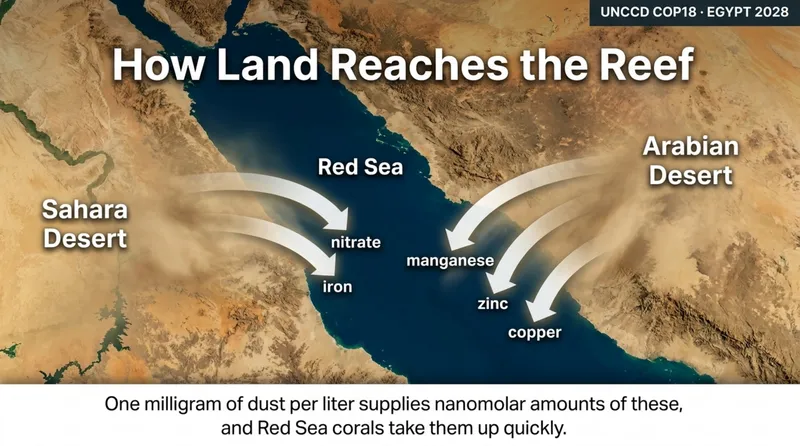
## Why a land summit reaches the reef
Dust is the link, and it is the part of the UNCCD's work that crosses the shoreline. The convention hosts the UN Coalition on Combating Sand and Dust Storms, and the General Assembly has declared 2025 to 2034 a decade dedicated to the problem.
The Red Sea sits between the Sahara and the Arabian deserts, and its water is nutrient-poor. Dust falling on it is therefore not inert. Work published in *Global Change Biology* in 2022 found that one milligram of desert dust per liter delivered nanomolar amounts of nitrate along with iron, manganese, zinc and copper, and that the [Hood Coral](/taxon/invertebrate/stinging/hard-corals/hood-coral) (*Stylophora pistillata*) took them up quickly.
A 2024 study in *Scientific Reports* went further and tested the Hood Coral and the [Yellow Scroll Coral](/taxon/invertebrate/stinging/hard-corals/yellow-scroll-coral) (*Turbinaria reniformis*) together under heat stress. Dust raised gross photosynthesis by up to twofold and net photosynthesis by up to tenfold, with chlorophyll up to 1.5 times higher and symbiont density up to 1.6 times higher. Iron on its own did nothing. It was the mixture of metals that mattered. The authors are careful about the limits: the work was done in tanks rather than on a reef, and the effect differed between the two species.
The choice of species is not incidental. The Hood Coral is a standard laboratory animal in coral biology, and the northern Red Sea is much of the reason. Colonies from the Gulf of Aqaba have been held several degrees above their summer maximum in tanks without bleaching, and through the marine heat wave of 2024 they sat at 32.6 degrees Celsius, about 3.4 degrees above the long-term average, still without bleaching. The explanation is a filter. After the last ice age the basin was recolonized from the south, and everything moving north had to cross the hot shallow strait at its mouth, so only heat-tolerant genotypes got through. Their descendants now live well below the temperature they can actually stand, which is why this sea is discussed as a refuge while reefs elsewhere die. The same research adds the reverse caution: these corals sit close to their cold-water bleaching threshold, so wider swings cut both ways.
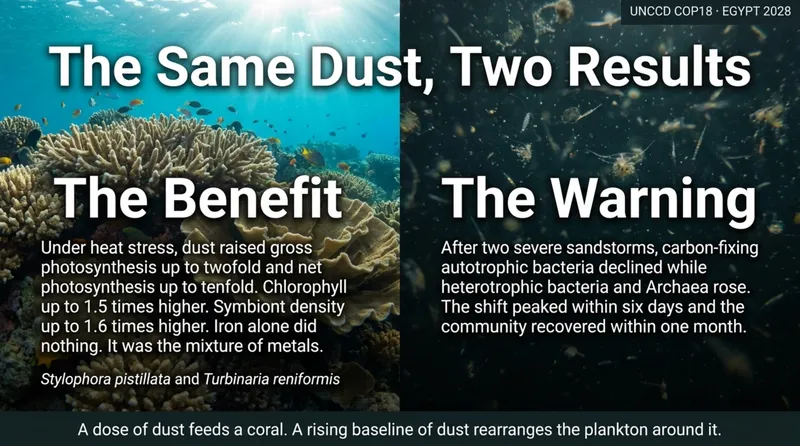
The opposite result exists as well, and it is also from the Red Sea. A 2022 paper in *BMC Genomics* tracked the water column through two severe sandstorms, one from the Nubian Desert in summer 2016 and one from the Libyan Desert in spring 2017. Both shifted the microbial community the same way: autotrophic bacteria, the ones that fix carbon, declined, while heterotrophic bacteria and Archaea increased. The shift peaked within six days and the community returned to its original composition within a month. The authors read that as a warning rather than a benefit, since expanding desertification means more dust, and a sea that receives more dust may run a more heterotrophic food web.
Both findings can hold at once. A dose of dust feeds a coral; a rising baseline of dust rearranges the plankton it lives among. What neither study supports is the comfortable version in which more dust is simply good for the reef.
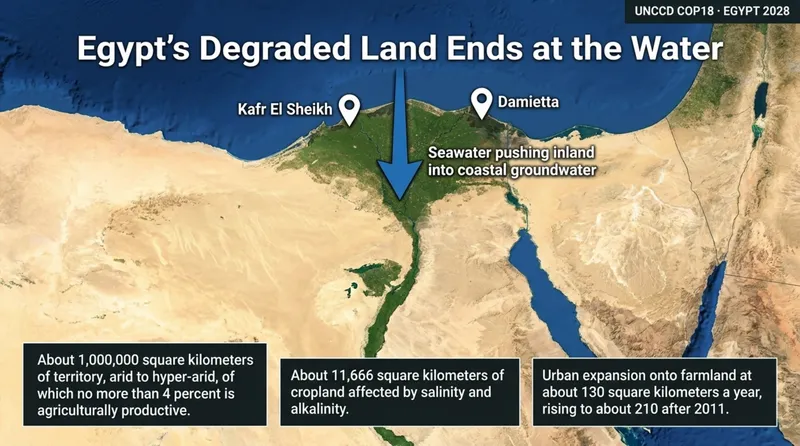
## Egypt's land problem stops at the waterline
Egypt's own report to the convention describes a country of about one million square kilometers under arid to hyper-arid conditions, of which no more than 4 percent is agriculturally productive. Around 11,666 square kilometers of cropland, 2.8 million feddan in the local measure, suffer from salinity and alkalinity, and the report names that its top priority.
The cause of much of it is the sea itself. Groundwater extraction in coastal areas has drawn saline seawater into aquifers, and waterlogging and salinity in the northern Nile Delta pull seawater into the subsoil. Urban expansion onto farmland ran at about 130 square kilometers a year and rose to about 210 after 2011. Two of the degradation hotspots the report identifies, Kafr El Sheikh and Damietta, sit on the coast.
This is the part that makes a desertification conference in Egypt a coastal event whether or not it is billed as one. The boundary between degraded land and the sea is where both problems are worst, and Egypt has that boundary on two seas.
## What has not been announced
The host country is settled. The city is not. Several outlets have named Sharm El Sheikh, which hosted both of Egypt's previous COPs, but no announcement from the UNCCD or from the Egyptian government confirms a venue, and the convention's own site does not yet carry COP18 details. Dates have not been published either.
Until they are, the useful thing to watch is the drought protocol. Egypt has asked for it to be binding, the parties could not agree on a weaker version, and the argument now has a two-year runway and a host with a declared position.
---
*Published on September 4, 2026*
*Author: Yevgen “Scorp” Sukharenko*
*Source: [Red Sea Creatures](https://redseacreatures.com)*
---
---
title: Marine Symbiosis in the Red Sea: Five Partnerships and How They Work
description: Discover the ocean's most surprising partnerships, where species like a burrow-digging shrimp and its fish lookout depend on each other without trust. From a nearly blind shrimp guiding itself by a goby's tail to cleaner shrimp tending to giant predators, these remarkable symbiotic relationships are driven by specific, intricate mechanisms rather than simple goodwill.
author: Yevgen “Scorp” Sukharenko
published: 2026-09-04T06:30:00.000Z
updated: 2026-09-04T06:30:57.643Z
tags: Marine Science
url: https://redseacreatures.com/blog/2026/09/04/marine-symbiosis-red-sea-five-partnerships
---
# Marine Symbiosis in the Red Sea: Five Partnerships and How They Work
A shrimp that can barely see digs a burrow it cannot guard, and rents it to a fish that cannot dig. The shrimp keeps one antenna resting on the goby's tail the whole time it works. When the goby flicks that tail, the shrimp is underground before the threat has closed the distance.
That arrangement is not unusual on a reef. It is one of several in which two species that have no reason to trust each other end up depending on one another anyway, and each of them runs on a specific mechanism rather than on goodwill.
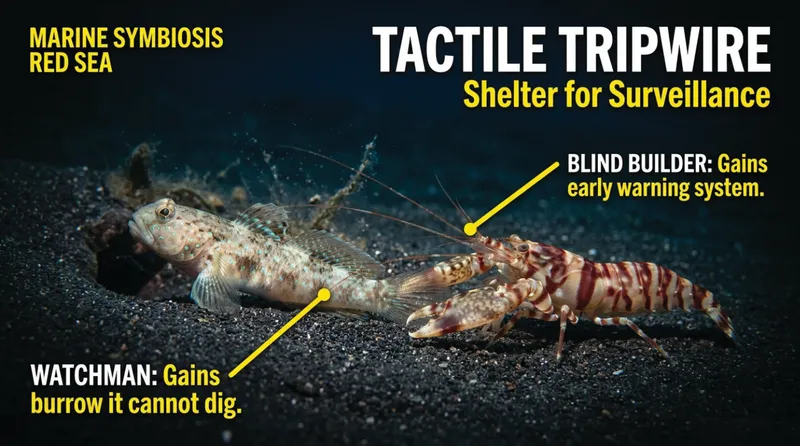
## The burrow and the lookout
On open sand there is nowhere to hide, so the shelter has to be dug. Snapping shrimp of the genus *Alpheus*, including the [Tiger Pistol Shrimp](/taxon/invertebrate/crustaceans/shrimps/tiger-pistol-shrimp) (*Alpheus bellulus*), excavate and constantly repair a burrow, pushing spoil out with the front of the body. Digging leaves them exposed, and their eyesight is poor.
The shrimpgoby supplies what the shrimp lacks. Species such as the [Steinitz Shrimpgoby](/taxon/fishes/bony-fishes/gobies/steinitz-shrimpgoby) (*Amblyeleotris steinitzi*) and the [Red Sea Shrimpgoby](/taxon/fishes/bony-fishes/gobies/red-sea-shrimpgoby) (*Cryptocentrus caeruleopunctatus*) sit at the burrow entrance and watch. The signal between them is touch, not sight: the shrimp maintains antennal contact with the goby's tail while it works, and a flick of that tail sends both animals into the hole. The goby gets a shelter it could never build; the shrimp gets an early warning system it could never see for itself.
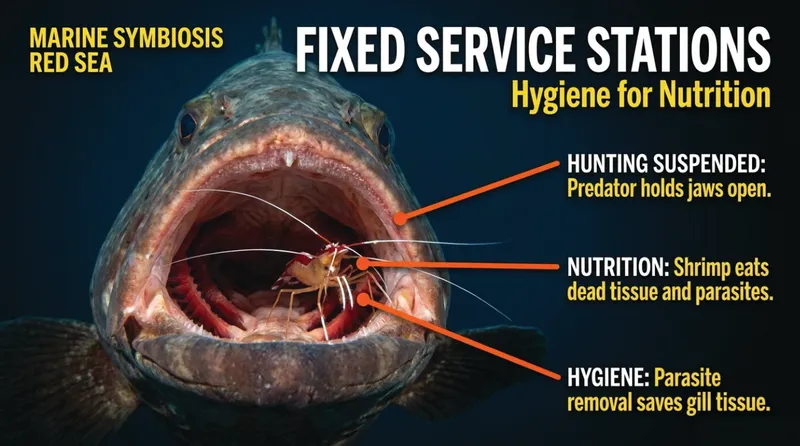
## The cleaning stations
Certain patches of reef work as fixed service points. Cleaner shrimp, including the [Banded Cleaner Shrimp](/taxon/invertebrate/crustaceans/shrimps/banded-cleaner-shrimp) (*Stenopus hispidus*) and the [Scarlet Cleaner Shrimp](/taxon/invertebrate/crustaceans/shrimps/scarlet-cleaner-shrimp) (*Lysmata amboinensis*), hold a station and advertise it by waving their long white antennae.
What makes the arrangement remarkable is what the client does. Fish large enough to eat the shrimp several times over queue up, hold still, and open their mouths and gill covers so the shrimp can work inside. Parasitic isopods and copepods, dead tissue and damaged scales are removed and eaten. The predator's hunting response is suspended for the duration, and the shrimp works in a mouth that is otherwise lethal.
The economics are straightforward on both sides. The shrimp gets a reliable food supply delivered to a fixed address. The fish gets its parasite load reduced, which is not cosmetic: heavy infestations damage gill tissue and cost the host condition.
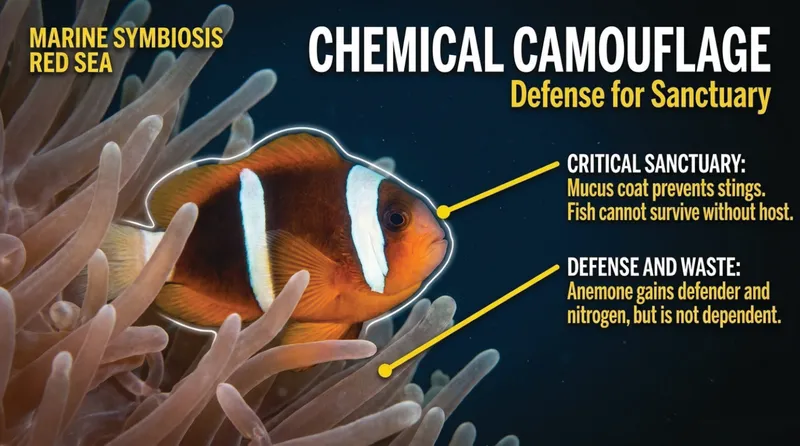
## The anemone and the fish that ignores its stings
An anemone's tentacles are covered in nematocysts, stinging capsules that fire on chemical and mechanical contact and kill most small fish outright. The [Red Sea Clownfish](/taxon/fishes/bony-fishes/clownfishes/red-sea-clownfish) (*Amphiprion bicinctus*) lives inside them.
The mechanism is a mucus coat on the fish's skin that does not carry the chemical cues a nematocyst reads as prey. Part of that coat appears to be acquired from the anemone itself, which is why a clownfish introduced to an unfamiliar anemone will touch it repeatedly and briefly before settling in, rather than diving straight home.
What each side gets is worth stating precisely, because it is often overstated. The clownfish gets a shelter no predator will enter, and it needs one: it is bound to anemones and does not survive long without one. The anemone gets a defender that drives off butterflyfish, which specialize in biting tentacles, plus water movement from the fish's fanning and nitrogen from its waste. Those are real benefits, but the anemone is not dependent in the way the fish is. The relationship is mutual and it is not symmetrical.
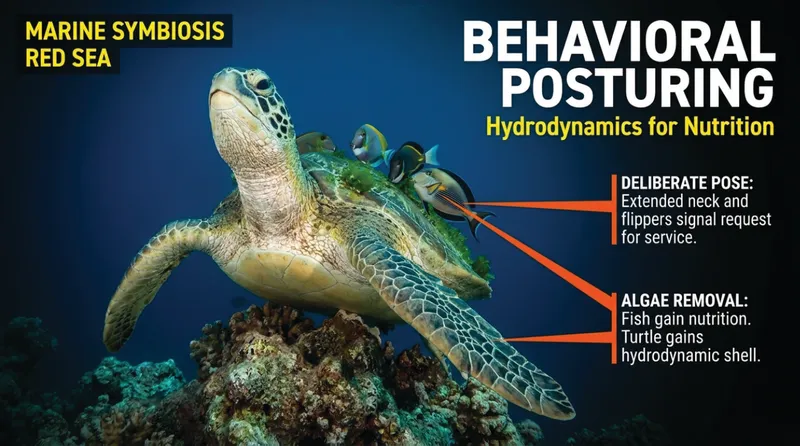
## The turtle that queues for a service
[Green Sea Turtles](/taxon/reptiles/sea-turtles/green-sea-turtle) (*Chelonia mydas*) carry a growing load on their shells: algae, and barnacles such as the [Turtle Barnacle](/taxon/invertebrate/crustaceans/barnacles/turtle-barnacle) (*Chelonibia testudinaria*), which settle on the carapace and stay. Both add drag to an animal that migrates over long distances, and neither can be reached by a flipper.
So the turtle goes to the reef and waits. At a cleaning station it settles onto a coral head and holds a posture with the neck extended and flippers spread, which is the signal that it is there to be worked on rather than to feed. Surgeonfishes move in and graze the shell.
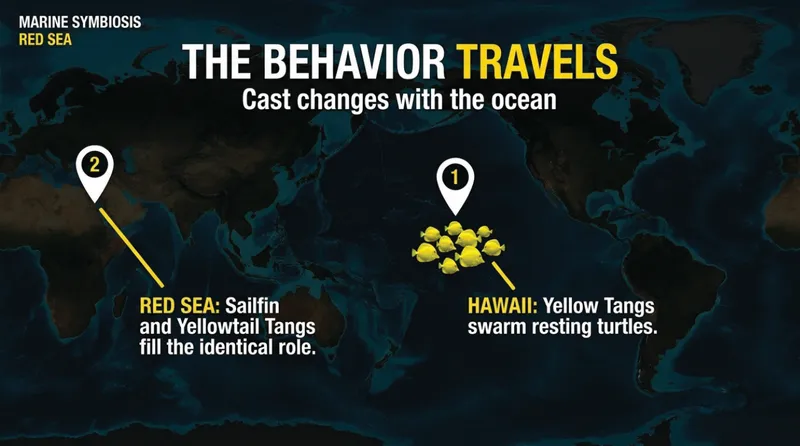
The footage most people have seen of this was shot in Hawaii, where Yellow Tangs (*Zebrasoma flavescens*) swarm a resting green turtle in dozens, a wall of bright yellow against the dark carapace. That species is Pacific and does not reach the Red Sea. The same work here is done by [Desjardin's Sailfin Tang](/taxon/fishes/bony-fishes/surgeonfishes/desjardins-sailfin-tang) (*Zebrasoma desjardinii*), the [Yellowtail Tang](/taxon/fishes/bony-fishes/surgeonfishes/yellowtail-tang) (*Zebrasoma xanthurum*) and several *Acanthurus* surgeonfishes. The behavior travels; the cast changes with the ocean.
The fish get a dense mat of algae in one place. The turtle gets a shell that is clean, lighter and more hydrodynamic.
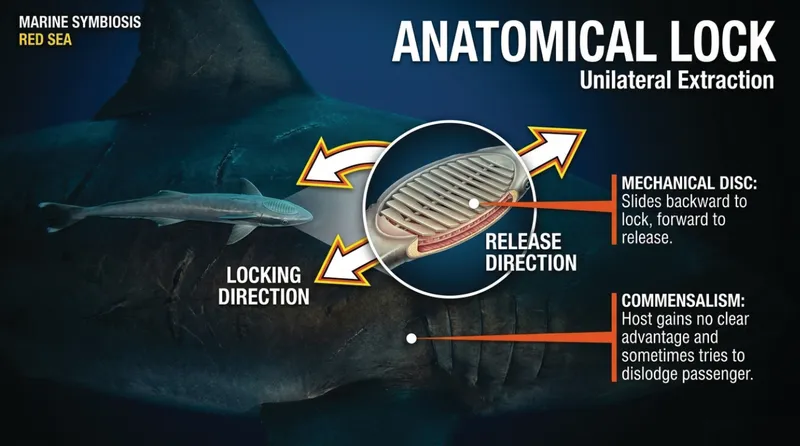
## The passenger that gives nothing back
The last of these arrangements is the one usually described wrongly. The [Live Sharksucker](/taxon/fishes/bony-fishes/remoras/live-sharksucker-remora) (*Echeneis naucrates*) and the [Common Remora](/taxon/fishes/bony-fishes/remoras/common-remora) (*Remora remora*) travel attached to sharks, rays, turtles and large fish. The attachment is a modified first dorsal fin, flattened into an oval disc of movable slats on top of the head. The remora slides backward to lock the slats and forward to release, so holding on costs it almost nothing while the host swims.
The benefits to the remora are obvious: transport, protection inside a large animal's personal space, and scraps from its kills. What is much less clear is what the host gets. Remoras are often credited with removing parasites, and this is sometimes observed, but the bulk of the diet is scraps, host waste and sloughed skin. Hosts show no obvious advantage and sometimes attempt to dislodge their passengers.
That makes the remora a commensal rather than a mutualist: one side gains, the other is largely unaffected. It belongs in this list precisely because it is the exception. Living in close contact with another species is common on a reef; the arrangement being good for both parties is a separate claim, and it has to be checked case by case rather than assumed.
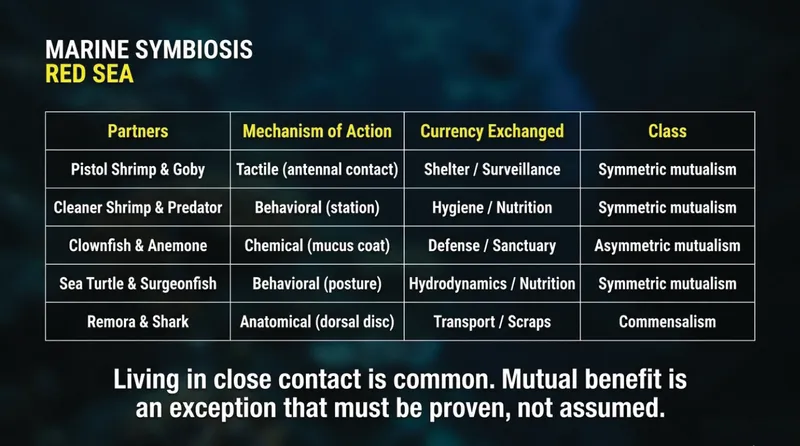
---
*Published on September 4, 2026*
*Author: Yevgen “Scorp” Sukharenko*
*Source: [Red Sea Creatures](https://redseacreatures.com)*
---
---
title: Why “Blue” Doesn't Actually Exist in the Deep Blue Sea
description: Discover the "Great Cerulean Deception": the vibrant blue of our oceans and many animals isn't due to paint or pigment, but a fascinating trick of physics. Water absorbs most light, scattering only blue back to our eyes, while creatures utilize intricate structures to precisely reflect blue wavelengths. This structural color means blue is often a property of light itself, not a built-in hue.
author: Yevgen “Scorp” Sukharenko
published: 2026-08-22T17:00:00.000Z
updated: 2026-09-01T08:59:36.528Z
tags: Marine Science
url: https://redseacreatures.com/blog/2026/08/22/why-blue-doesnt-actually-exist-in-the-deep-blue-sea
---
# Why “Blue” Doesn't Actually Exist in the Deep Blue Sea
Imagine dipping a glass into the sapphire sea only to find it filled with clear, colorless liquid. The ocean is the bluest thing on Earth, yet it is made of a substance that possesses no color at all. This is the Great Cerulean Deception - a world-scale illusion built on physics rather than paint.
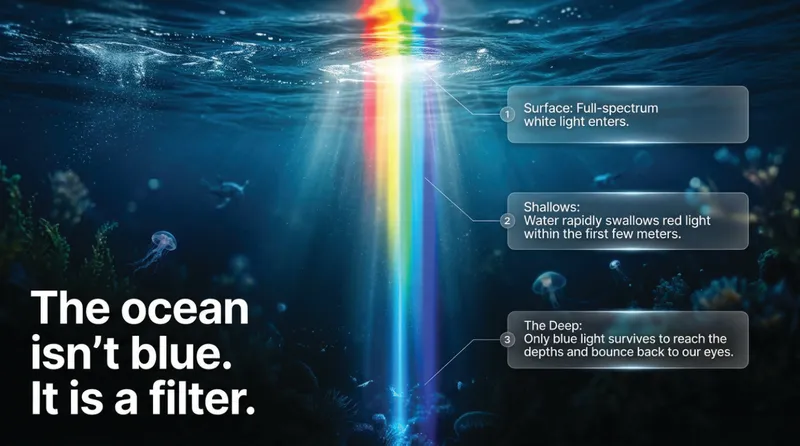
The water itself is not a blue liquid; it is a master of light absorption. As sunlight hits the surface, the water begins to "swallow" the spectrum, starting with the long wavelengths of red light. Within just a few meters, those warm tones are extinguished, leaving only the most persistent rays to carry on.
Blue light is the ultimate survivor of this process. It is the only part of the spectrum that travels deep enough to be scattered and reflected back to our eyes. When we look at the sea, we aren't seeing a pigment; we are seeing the last remnant of light that the water couldn't consume.
In the natural world, blue is a ghost. While green leaves rely on chlorophyll and red feathers on carotenoids, blue is almost never the result of biological chemistry. Instead, it is a triumph of physics over the limitations of pigment.
> "The color is in the light, not in the animal."
This distinction is fascinating because it means that what we perceive as a blue animal is actually a structural trick. If you were to remove the light, the blue would effectively cease to exist because there is no "paint" on the skin. The animal is, in a sense, a mirror that only reflects one specific secret.
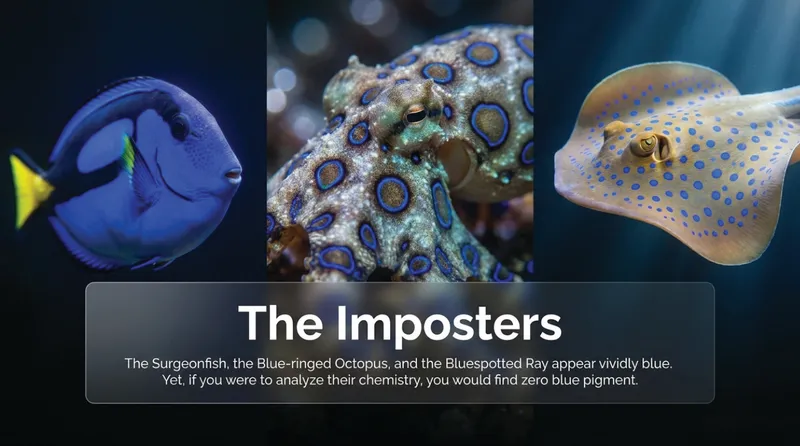
Many of the most vibrant creatures in the reef, such as the Surgeonfish and the Blue-ringed Octopus, are actually colorless. They wield a clever trick of physics known as "structural color." Within their skin, they house tiny layers of crystals arranged with mathematical precision.
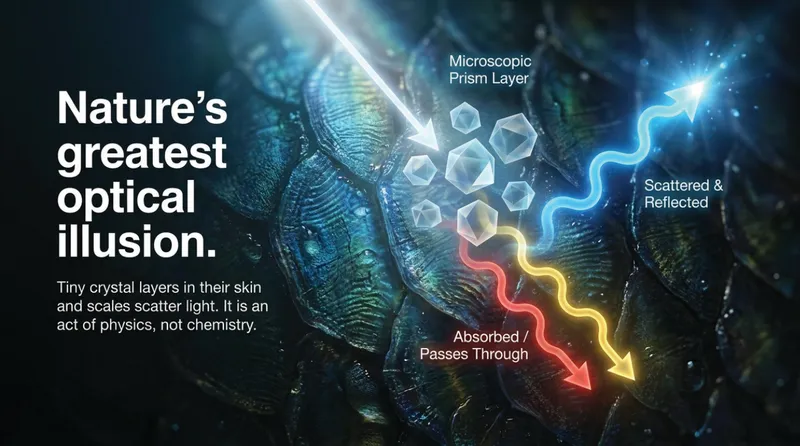
These crystal layers are designed to scatter incoming light so that only the blue wavelengths are thrown back at the observer. The Blue-spotted Stingray uses this to a stunning effect, making its markings appear to "glow" against its skin. This isn't a chemical trait; it is a magical feat of evolution.
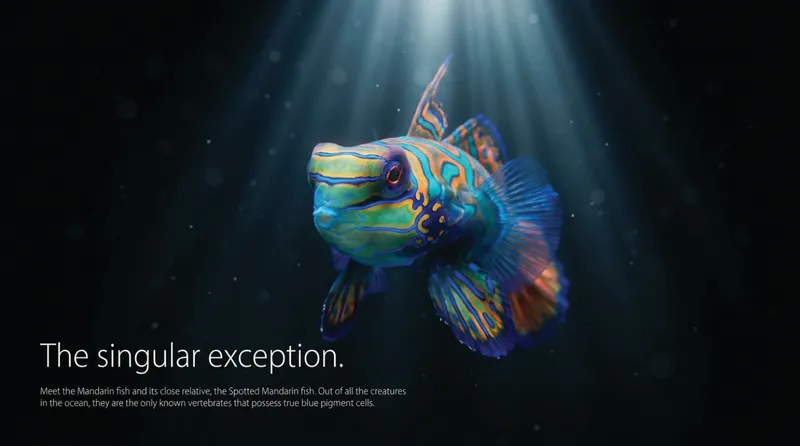
Amidst this sea of illusions, two biological rebels have managed to invent a way to cheat the system. The Mandarin fish and its close relative, the Spotted Mandarin fish, are the only known vertebrates to possess "true" blue pigment cells.
These tiny, vibrant fish didn't settle for structural tricks; they developed a unique biological chemistry that the rest of evolution seemingly forgot. They are the ultimate outliers, possessing a true blue that remains even when the angle of light shifts.

The beauty of the horizon is not found in a static bucket of blue paint, but in a shifting interplay of light and structure. That sapphire horizon is a ghost - a reflection of the light that the water simply couldn't swallow.
This knowledge transforms the ocean from a simple body of water into a complex masterpiece of physics. It reminds us that nature doesn't always provide what it promises at first glance.
How does it change your perspective to know that the sea’s most famous color is actually its greatest secret? The next time you look at a bright blue fish, ask yourself: are you seeing a color, or are you witnessing a brilliant trick of the light?
---
*Published on August 22, 2026*
*Author: Yevgen “Scorp” Sukharenko*
*Source: [Red Sea Creatures](https://redseacreatures.com)*
---
---
title: Boxing Gloves and a Night Demon: How Sea Creatures Get Their Latin Names
description: A crab named after a Roman boxing glove, an anemone named after a night demon, an urchin whose name simply says "of the red sea". Scientific names look arbitrary until you learn that nobody approves them: a name is staked like a mining claim, anchored to one specimen in a museum jar, and settled by whoever published first. Here is how the system works, and why the name you learned keeps changing.
author: Yevgen “Scorp” Sukharenko
published: 2026-08-10T11:00:00.000Z
updated: 2026-08-10T11:05:25.970Z
tags: Marine Science
url: https://redseacreatures.com/blog/2026/08/10/boxing-gloves-and-a-night-demon-how-sea-creatures-get-their-latin-names
---
# Boxing Gloves and a Night Demon: How Sea Creatures Get Their Latin Names
Somewhere in this catalogue sits a small anemone called *Arachnanthus lilith*, named after a night demon out of Mesopotamian folklore. A crab that walks around holding live anemones in its claws is *Lybia caestifera*, from *caestus*, the leather glove a Roman boxer strapped on before a fight. A sea urchin whose spines can end a dive holiday is *Asthenosoma marisrubri*. Sooner or later everyone asks the same thing: who lets people do this?
Nobody. That is the whole surprise. There is no committee that approves scientific names, no office that stamps them, no authority you appeal to when one is silly. A name works more like a mining claim than a patent: you stake it, you record it properly, and from then on it is yours by date. The rules govern the paperwork, not the taste.
### Two Words, and What Each One Does
The first word is the genus, a group of close relatives. The second is the species epithet, and it only has meaning inside that genus. *Miles*, "soldier", is attached to a whole list of unrelated animals; only the pair *Pterois miles* points at the lionfish.
We owe the format to Linnaeus, who standardised it in 1758. Before him a species was identified by a descriptive Latin sentence, something along the lines of "sea urchin with long hollow spines and a venom sac at the tip", and every author trimmed that sentence differently. The two-word tag replaced a paragraph with a label, which is why it stuck.
Written form carries information too. The genus is capitalised, the epithet never is, and both go in italics. *Asthenosoma marisrubri* is correct; Asthenosoma Marisrubri is not.
### Where the First Word Comes From
The genus is a noun, and unlike the epithet it has to be unique across the whole animal kingdom. Nobody else may use it, ever, for anything. With roughly two million described animals that shelf is crowded, which is most of the reason genus names read like someone was inventing words. Someone was.
The common route is a Greek or Latin compound describing what the animal looks like:
* *Pterois*, the lionfish, from *pterus*, fin, for the high dorsal and long pectoral fins that anyone who has met one will remember.
* *Asthenosoma*, from *asthenes* and *soma*, weak body. These urchins have a flexible shell that gives slightly under a finger, which is unusual for a sea urchin and clearly struck the author.
* *Arachnanthus*, spider flower, for a tube anemone whose long thin tentacles spread out of the sand like legs.
The second route explains the names that look like typos. When a genus turns out to hold animals that are not close relatives, part of them is moved into a new one, and the new one is very often built out of the old one with a prefix. That is where our catalogue gets *Pycnochromis* (compact *Chromis*), *Neoliomera* (new *Liomera*) and *Pseudamiops* (false *Amiops*). Read that way the name is not gibberish, it is a footnote about the animal's taxonomic history: this one was split off from that one.
Mythology supplies the rest. The boxer crab's genus, *Lybia*, is a figure out of Greek genealogy, and nothing about the crab is being described at all. That is allowed. A genus name is required to be unique and pronounceable as Latin, not to be meaningful.
One practical consequence: because the genus is a noun with a grammatical gender, it quietly governs the ending of the epithet attached to it. That is worth remembering for what happens further down.
### The Name Comes With an Address
Behind most names you will find a person and a year:
* *Cymo melanodactylus* Dana, 1852
* *Pterois miles* (Bennett, 1828)
That is not decoration. It is a pointer to the publication where the species was described for the first time, so anyone can go back and check what the author actually had in front of them.
The brackets in the second line are the interesting part. They mean the species has moved house. Bennett described the lionfish in 1828, but he put it in *Scorpaena*, the scorpionfishes. Later work concluded it belonged with the lionfishes, so the animal became *Pterois miles* and Bennett's name went into brackets. The convention is strict and useful: brackets always mean the genus changed, and the epithet came along with the animal.
### Where the Second Word Comes From
Once you know the sources, most names stop being random noise and start being descriptions:
* **The place.** *Asthenosoma marisrubri*: "of the red sea", literally. Described in 1998 by Weinberg and de Ridder.
* **A visible feature.** *Cymo melanodactylus*: black-fingered, and the tips of its claws really are dipped in black.
* **An object.** *Lybia caestifera*: glove-bearer. The animal holds an anemone in each claw and punches with them.
* **A colleague.** *Neoliomera nobilii*, after Giuseppe Nobili, who spent his career on crustaceans.
* **Mythology.** *Arachnanthus lilith*, described in 2018, for an anemone that comes out of the sand only after dark.
The author who publishes the description chooses the word. It has to be latinised and it must not already be taken inside that genus, and that is essentially the entire constraint. Naming a species after yourself is not forbidden by the code, it is simply not done, which is why the honour names always point at someone else.
\[CID:1133\]
### No Approval, But Real Rules
What replaces the missing committee is the International Code of Zoological Nomenclature[\[1\]](#footnote-1), a rulebook the community agrees to follow. A name counts as valid when a few conditions are met. It has to be published in a form that libraries can hold and cite. It has to come with a description that separates this animal from its neighbours. And it has to be anchored to a **type specimen**: one physical individual, in a museum, with a catalogue number.
That last requirement does more work than it looks. The name is attached to the jar, not to the idea. If someone later shows that two different animals have been going under one name, the specimen in the jar decides which of them keeps it, and the other needs a new name.
When two names compete, the tie-breaker is **priority**: the older publication wins. It applies even when the older name is inconvenient, misspelled or plainly wrong about the animal. A shrimp named for a colour it does not have keeps that name, because the alternative would be a system where names could be relitigated forever.
### Why the Name You Learned Keeps Changing
Here is a case from this year's catalogue work. The little chromis that hangs over reef tops used to be *Chromis dimidiata*. It is now *Pycnochromis dimidiatus*[\[2\]](#footnote-2).
Nobody renamed the fish. Genetic work showed that *Chromis*, as it stood, lumped together damselfishes that are not each other's closest relatives, so part of them was moved into *Pycnochromis*. The species is the same, the epithet is the same word, and Klunzinger, who described it in 1871 while working at Al-Qusayr, a few hours down the coast from Hurghada, still holds the authorship.
Look closely at the ending, though: *dimidiata* became *dimidiatus*. The epithet is an adjective, and Latin adjectives agree in gender with the noun they attach to. *Chromis* is feminine, *Pycnochromis* is masculine, so the adjective changes its ending on arrival. The boxer crab did the same thing in reverse: it started life as *Melia caestifer* and became *Lybia caestifera*.
This is why searching for one spelling is a poor way to look a species up. The same animal can sit in the literature under half a dozen forms, and every one of those is a **synonym**: not an error, but a name that used to be current.
### How to Read a Card on This Site
Every creature page here carries the currently accepted name, the author and year, and the synonyms underneath. Those fields are not typed by hand. We sync them against the World Register of Marine Species[\[3\]](#footnote-3), the registry that tracks which name is accepted today and which have been retired, so a card reflects the current state of the literature rather than the state of a field guide printed in 1990.
It also changes how we work. When a species from an older book cannot be found, the first assumption is not that it is absent from these waters. The first assumption is that it moved.
\[CID:1145\]
### You Can Now See This on the Cards
Writing this post is what pushed us to put the answer where the question actually comes up. Every species page in the catalogue now shows what its name means, on two lines: what the genus says, and what the epithet says. *Chaetodon auriga* is bristle-tooth, then coachman. *Pterois miles* is fin, then soldier. *Acanthurus gahhm* is thorn-tail, and then it stops being Latin altogether: *gahhm* is simply the Arabic name for the fish along this coast.
Two honest limits. It is there where a citable source covers the name, which today means most fishes and very few invertebrates: 260 genera and 521 species out of the catalogue's 1,123. And when the source only tells a story rather than breaking the word down, we show nothing at all rather than a confident guess. So a page with no name line is not an oversight; it is us declining to invent one.
### Staked, Not Granted
So the honest answer to "who allowed this" is: a person did, once, in a publication, and after that the system's whole job was to make the decision permanent. A name is not a description that must stay accurate, and it is not an award that can be withdrawn. It is a claim with a date on it.
Which is how a small anemone off a sandy slope ends up carrying the name of a demon, and keeps it.
---
*Published on August 10, 2026*
*Author: Yevgen “Scorp” Sukharenko*
*Source: [Red Sea Creatures](https://redseacreatures.com)*
---
---
title: Historic Footage: Drone Captures First-Ever Humpback Whale Birth
description: High above the New South Wales coast, drone pilot Alexander Forrest witnessed a truly extraordinary event: the birth of a humpback whale. This marks only the fourth time a humpback birth has ever been filmed, and significantly, the first captured by a drone. This technological milestone provided an intimate, undisturbed view of a multi-tonne giant in her most vulnerable state.
author: Yevgen “Scorp” Sukharenko
published: 2026-08-01T13:30:00.000Z
updated: 2026-08-08T13:20:22.247Z
tags: Creatures
url: https://redseacreatures.com/blog/2026/08/01/historic-footage-drone-captures-first-ever-humpback-whale-birth
---
# Historic Footage: Drone Captures First-Ever Humpback Whale Birth
### A Moment of High-Stakes Curiosity
High above the New South Wales coastline, the rhythmic hum of a drone provided the only soundtrack to a scene of deceptive tranquility. Alexander Forrest, a seasoned pilot and volunteer for the Organisation for the Rescue and Research of Cetaceans in Australia (ORRCA), was tracking a female humpback whose behavior had taken on an enigmatic quality. She was drifting slowly northbound, hugging the shoreline with a lethargy that felt uncharacteristic for a migrating giant. To the untrained eye, she was merely resting in the gentle swell of the Pacific; to Forrest, her strange, consistent pacing felt like a prelude. This was not a moment of stasis, but one of high-stakes biological transition, unfolding in the quiet, cerulean expanse of the Australian surf.
### A "First" for Modern Technology
What Forrest was about to witness is a statistical miracle in marine biology. While humpback whales have been studied for decades, their birth remains one of the most private acts in the natural world. This event marks only the fourth time a humpback birth has ever been captured on film, and - more importantly - it is the first time the world has seen it through the lens of a drone. This technological milestone is transformative; by using a remote aerial platform, researchers can eliminate the "observer effect." Unlike a traditional research vessel, whose engine noise and physical presence might disrupt a laboring mother, the drone is a silent ghost in the machine, allowing for an intimate, undistorted view of a multi-tonne giant in her most vulnerable state.
> "My adrenaline was through the roof," says Forrest. "After thousands of hours filming whales from the air, I've never witnessed anything comparable."
### The Misleading Calm of Labor
In the hour leading up to the birth, the ocean held a heavy, misleading calm. Forrest observed a "slow and consistent" northbound drift that he initially mistook for sleep. This observation is a fascinating counter-point to the human perception of labor as a period of frantic, high-energy exertion. In the wild, birth begins with a deceptive stillness - a period of strategic energy conservation. For the pilot, this created a period of agonizing suspense; the female’s steady movement masked the intense internal labor required to bring a new life into the open sea. It was a masterclass in biological patience, as the whale utilized the currents to maintain her heading even as her body prepared for the visceral shock of delivery.
### The "Plume of Blood" and the First Breath
The transition from stillness to spectacular life was instantaneous. The serene blue of the water was suddenly pierced by a vivid, spreading plume of blood - the raw, crimson signature of a successful delivery. Moments later, the tiny, pale calf emerged from the cloud, its movements instinctive and urgent as it broke the surface to fill its lungs for the very first time. The visual contrast was stunning: the deep red of the birth against the sapphire Pacific, and the immediate shift from a solitary traveler to a protective mother-calf pair.
> "Within moments, everything changed," Forrest describes. "A plume of blood appeared beneath her and a tiny calf rose to the surface for its very first breath. I realised I was witnessing something incredibly rare."
### Why This Footage is a Scientific Goldmine
For Annie Post, ORRCA’s head of research, this footage represents a paradigm shift in how we study cetacean reproduction. Previous accounts of whale births have been fragmented - fleeting glimpses from the decks of ships or accidental sightings. Because Forrest’s drone was already on-station during the early stages of labor, science now has a continuous record of the behavioral markers that precede birth. This allows for an unprecedented analysis of maternal behavior and the immediate postnatal bond.
> "Being able to document this event in such detail makes it an incredibly important scientific observation," says Post. "It is an extraordinary contribution to our understanding of humpback whale reproduction and maternal behaviour."
### The Learning Curve: Life After the First Hour
The drama did not end with the first breath. In the hours following the birth, the newborn calf began the steep learning curve of existence, rejoining its mother to navigate the currents and understand the mechanics of the deep. This critical bonding period was documented through a collaborative effort, as Forrest was joined by fellow ORRCA drone operator Tanya Snowden and Dominic Cotter-Dephoff. Watching these massive marine giants begin their lives in the vast, unforgiving environment of the open ocean serves as a powerful testament to the immediate resilience required of the species. Within an hour, the calf was no longer a passenger of the current, but a participant in it.
### The Deepening Mystery of the Ocean
As ORRCA scientists begin the meticulous process of analyzing every frame of Forrest’s footage, the data will undoubtedly refine our protocols for monitoring whale populations and protecting calving grounds. Yet, beyond the scientific metrics, the event leaves us with a sense of profound wonder. Despite our satellites, sensors, and global connectivity, the ocean still manages to guard its most fundamental secrets, holding them close until we happen to be looking at exactly the right patch of blue at exactly the right time. It forces us to ask: what other breathtaking milestones are unfolding right now in the lightless depths, simply waiting for the right lens to find them?
---
*Published on August 1, 2026*
*Author: Yevgen “Scorp” Sukharenko*
*Source: [Red Sea Creatures](https://redseacreatures.com)*
---
---
title: The Octopus Countdown: One Brilliant Life, One Ultimate Chance
description: Imagine a creature smart enough to solve puzzles and recognize faces, yet whose entire existence unfolds in less time than it takes to pick a movie. This is the octopus: an animal whose every move, from open ocean drifts to hidden den sanctuaries, is a finely tuned race towards one single, unrepeatable reproductive moment - a life of profound intelligence lived on an extraordinary deadline.
author: Yevgen “Scorp” Sukharenko
published: 2026-07-20T14:15:00.000Z
updated: 2026-08-08T13:20:22.230Z
tags: Creatures
url: https://redseacreatures.com/blog/2026/07/20/the-octopus-countdown-one-brilliant-life-one-ultimate-chance
---
# The Octopus Countdown: One Brilliant Life, One Ultimate Chance
There's a creature down in the reef that can crack open shells, squeeze through gaps smaller than its own eyeball, and recognize the face of a diver who's visited it before. And yet, from the moment it hatches to the moment it dies, its whole life fits into less time than most of us spend picking a Netflix show. The octopus isn't just smart - it's smart on a deadline. Everything it does, from its first days drifting in open water to its final weeks on the reef, is aimed at one single, unrepeatable moment. This is the story of that countdown.
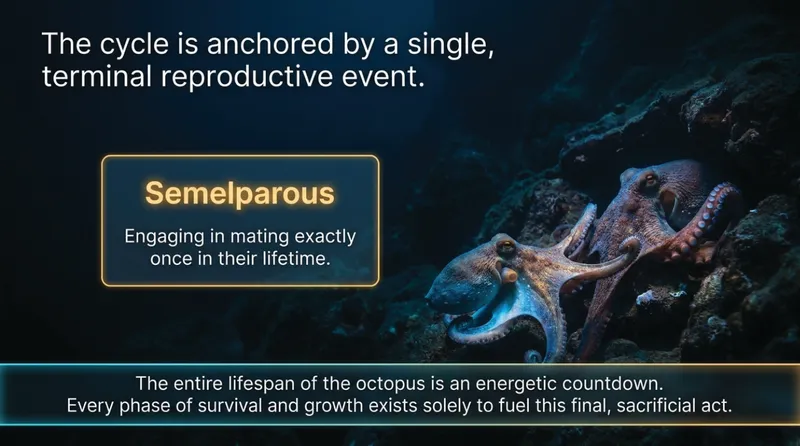
One Chance, No Do-Overs
Octopuses are what biologists call semelparous - they mate exactly once in their entire life. Not once a season, not once a year. Once, full stop. After mating, the female retreats into a den, lays her eggs, and spends the rest of her life guarding them. She doesn't hunt. She doesn't feed. She simply protects, until her body gives out entirely.
It sounds bleak, but it's actually a brutally efficient strategy. Every scrap of energy she has left goes straight into giving her eggs the best possible shot at survival, rather than being spent keeping herself alive. It's a trade she makes without ever seeing the payoff.
**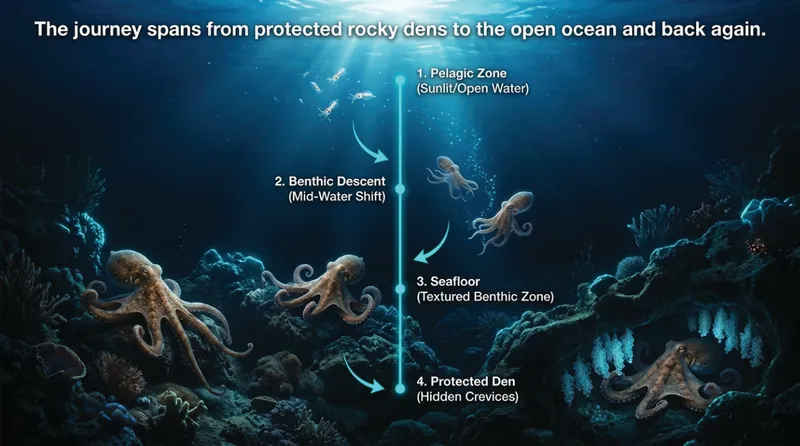**
### A Journey Through Every Layer of the Sea
Zoom out, and an octopus's life looks like a loop through the entire water column. It starts out near the surface, drifting in sunlit open water. From there it sinks slowly through the mid-water zone, eventually landing on the textured seafloor it will call home. And when the time comes to reproduce, it retreats one layer deeper still, into a hidden crevice or den.
Surface to seafloor to sanctuary - the whole life cycle is basically a one-way trip downward, with each stop demanding something different from the animal making it.
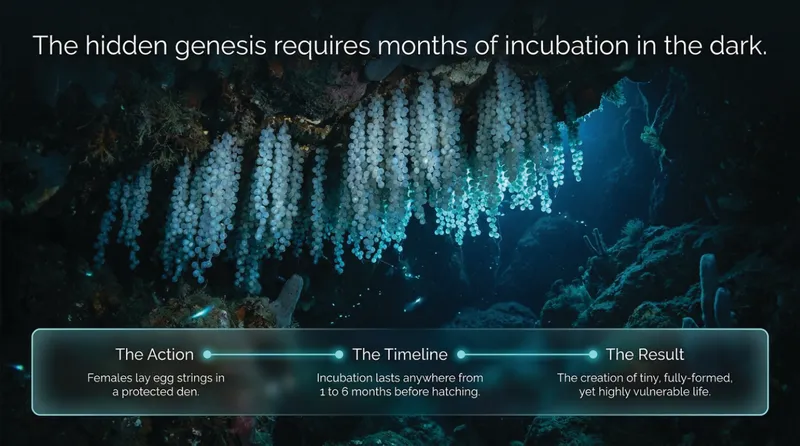
Life Begins in the Dark
Before any of that drifting or growing happens, there's a much quieter phase: the wait inside the egg. A female lays her eggs in strings, sometimes thousands of them, hanging them like delicate curtains inside her den. Then she waits - and guards.
Incubation isn't quick. Depending on the species and water conditions, it can take anywhere from one to six months before the eggs are ready to hatch. For that entire stretch, the future of the species hangs quite literally in the dark, protected by a mother who won't live to see it emerge.
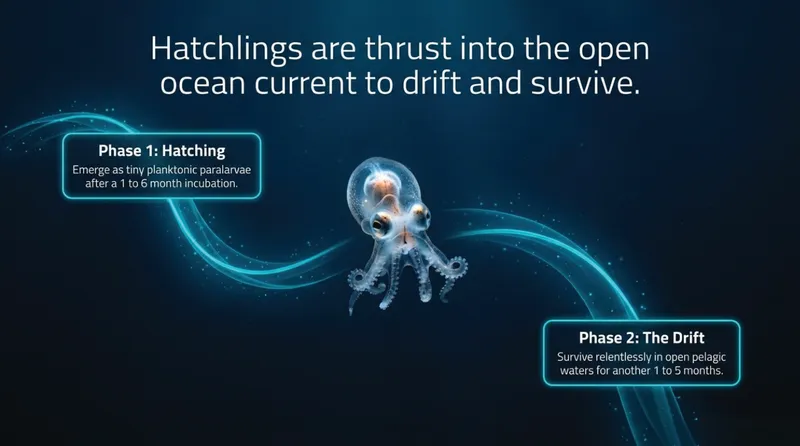
### Cast Into the Current
When they finally hatch, baby octopuses look nothing like the animal they'll become. They emerge as tiny, almost transparent paralarvae - barely more than a speck with eyes. And immediately, they're on their own.
There's no gentle transition here. The hatchlings are swept straight into open water, where they'll drift with the currents for another one to five months. They can't choose where they go. They can only survive whatever the ocean throws at them along the way.
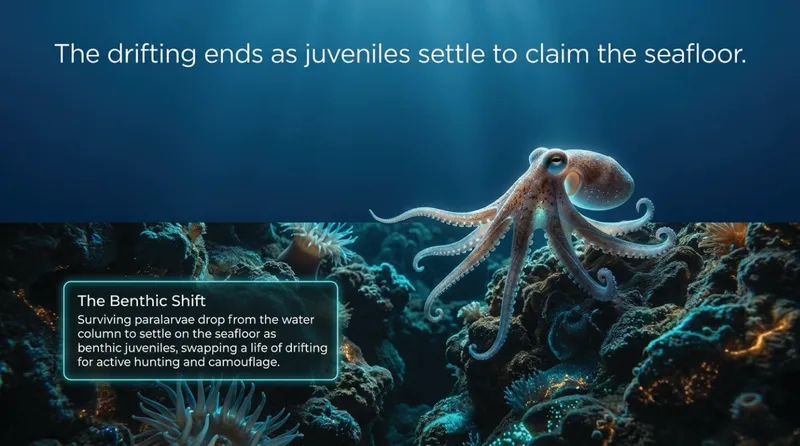
### Touching Down on the Reef
Eventually, the drifting has to end somewhere. The paralarvae that make it through - and plenty don't - drop out of the water column and settle onto the seafloor as benthic juveniles.
This is arguably the biggest turning point in the entire life cycle. Up until now, the animal has been a passenger, carried by tides it has no control over. The moment it settles on the reef, it becomes an active participant in its own survival - a hunter, a shape-shifter, a creature that finally gets to choose where it goes next.
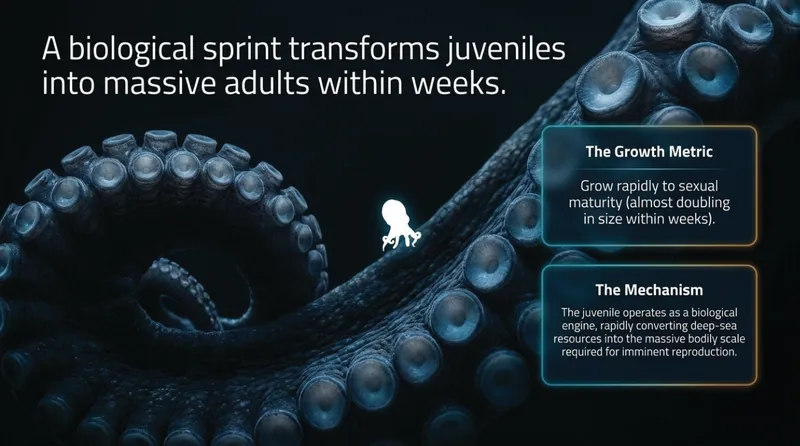
### Growing Up Fast
Once settled, the growth rate goes into overdrive. Juvenile octopuses can nearly double in size within just a few weeks as they race toward sexual maturity. That kind of growth doesn't happen by accident - it takes a huge, constant intake of food and a body built to convert it into mass almost immediately.
Think of the juvenile stage as a biological engine running flat out, turning everything the reef can offer into the size and strength needed for what's coming next.
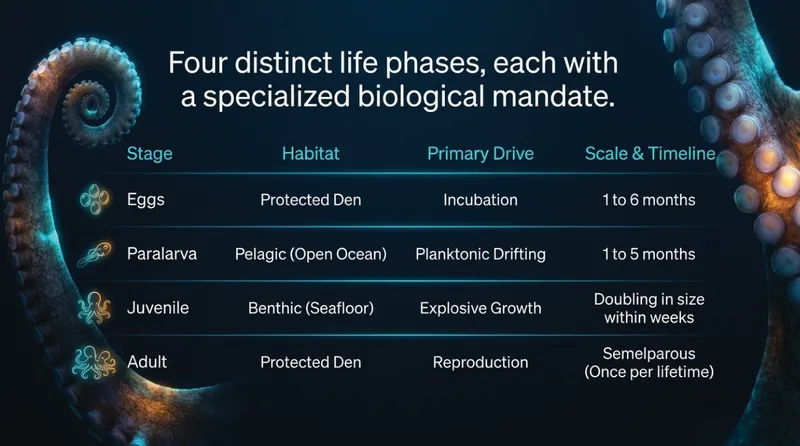
The Whole Story in Four Stages
Laid out side by side, the octopus life cycle breaks down into four clear chapters, each with its own job to do:
* **Eggs** - tucked in a protected den, focused entirely on incubation, for one to six months
* **Paralarva** - adrift in the open ocean, surviving on luck and current, for one to five months
* **Juvenile** - settled on the seafloor, growing explosively, often doubling in size within weeks
* **Adult** - back in a protected den, focused on a single reproductive act, never to be repeated
No stage overlaps with the next. Each one exists purely to set up the one that follows.
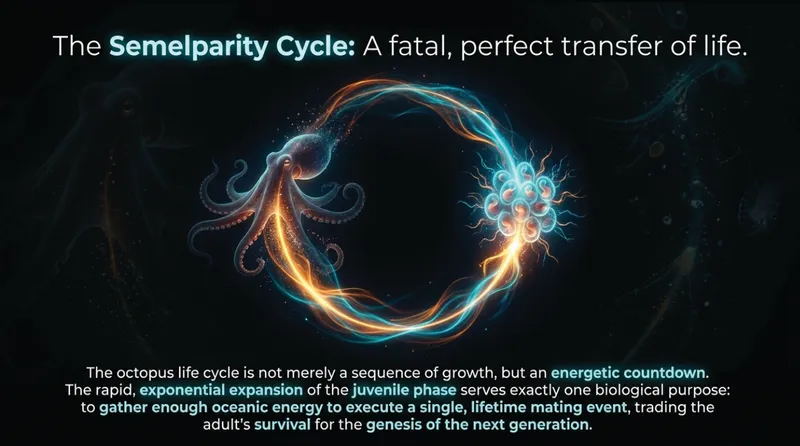
### A Circle That Closes Once
Put it all together and the octopus life cycle isn't really a story of survival - it's a story of transfer. Every month spent drifting, every week spent growing, exists for one reason only: to gather enough energy to make a single generation possible, even at the cost of the parent's own life.
It's worth sitting with that the next time you watch an octopus solve a puzzle or squeeze through an impossibly small gap. That intelligence, that ingenuity - it's all playing out on a clock far shorter than ours, aimed at a finish line the animal itself will never cross.
---
*Published on July 20, 2026*
*Author: Yevgen “Scorp” Sukharenko*
*Source: [Red Sea Creatures](https://redseacreatures.com)*
---
---
title: Forget Jaws: Shark Awareness Day Reveals the Ocean's Essential Architects
description: Decades of sensationalism have misrepresented sharks as mindless killers, overshadowing their critical role in ocean health. These ancient apex predators are vital architects of the food web, maintaining ecological balance and proving overwhelmingly harmless to humans. Shark Awareness Day pushes back against the myth, inviting us to see these magnificent creatures not as villains, but as essential guardians of the deep.
author: Yevgen “Scorp” Sukharenko
published: 2026-07-14T12:00:00.000Z
updated: 2026-08-08T13:20:22.202Z
tags: Sharks
url: https://redseacreatures.com/blog/2026/07/14/forget-jaws-shark-awareness-day-reveals-the-oceans-essential-architects
---
# Forget Jaws: Shark Awareness Day Reveals the Ocean's Essential Architects
For nearly fifty years, the shadow of a dorsal fin has been enough to trigger a very specific kind of panic - the "Jaws" effect. Decades of Hollywood sensationalism painted sharks as mindless killing machines, and that image stuck so hard it blinded most of us to a far scarier possibility: an ocean *without* sharks. Every July 14, the world marks Shark Awareness Day to push back against that myth, shifting the story from fear to fascination, and reminding us that these predators aren't the villain of the ocean - they're one of its main pillars.
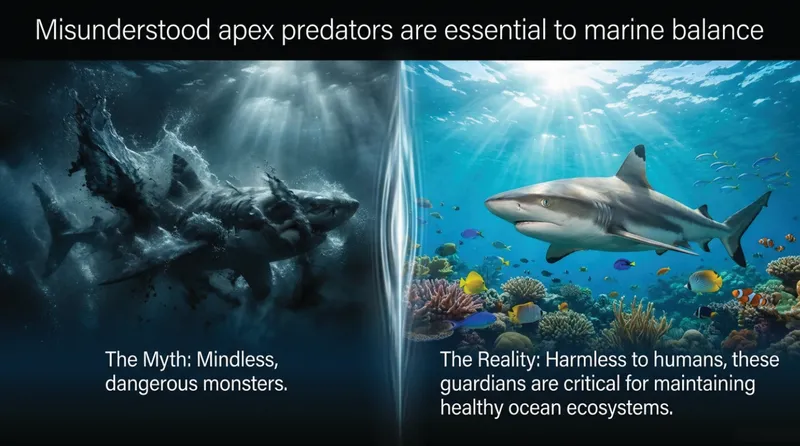
## Misunderstood Guardians of the Deep
The gap between shark's reputation and shark reality couldn't be wider. On one side sits the myth: a mindless, dangerous monster lurking just beneath the surface. On the other sits the truth - animals that are overwhelmingly harmless to humans and absolutely essential to keeping ocean ecosystems in balance. Most encounters we imagine simply don't happen the way movies suggest, and the species that do occasionally interact with people are a tiny fraction of the roughly 500 shark species swimming the world's oceans.
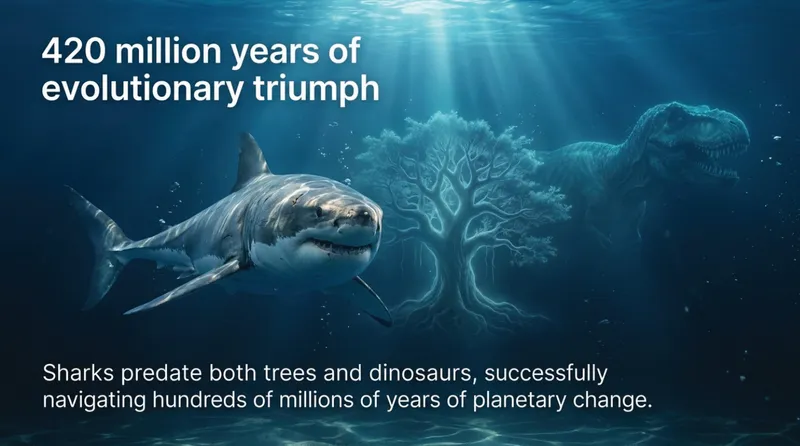
## Older Than Trees, Older Than Dinosaurs
Sharks aren't just old - they're ancient in a way that's hard to wrap your head around. They've patrolled the oceans for more than 420 million years, meaning they were here before dinosaurs existed, and before trees had even evolved on land. Their basic body plan has proven so effective that it's carried them through five separate mass extinction events, largely unchanged. That's not survival by luck - that's one of evolution's most successful designs, still swimming today.
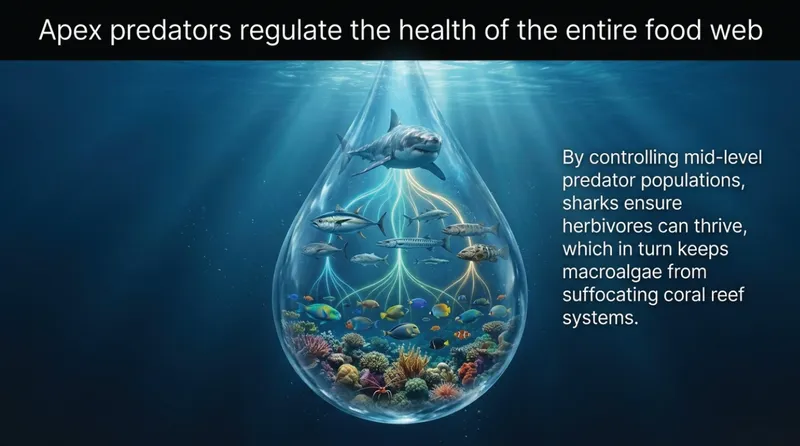
## The Architects of a Balanced Food Web
Calling sharks "predators" undersells the job they actually do. As apex predators, they act more like architects, quietly regulating everything beneath them. By keeping mid-level predator populations in check, sharks allow herbivorous fish to thrive - and those herbivores, in turn, keep macroalgae from smothering coral reefs. Pull the shark out of that equation, and the whole structure starts to wobble: reefs degrade, fish populations destabilize, and the ripple effects reach all the way to human food security.
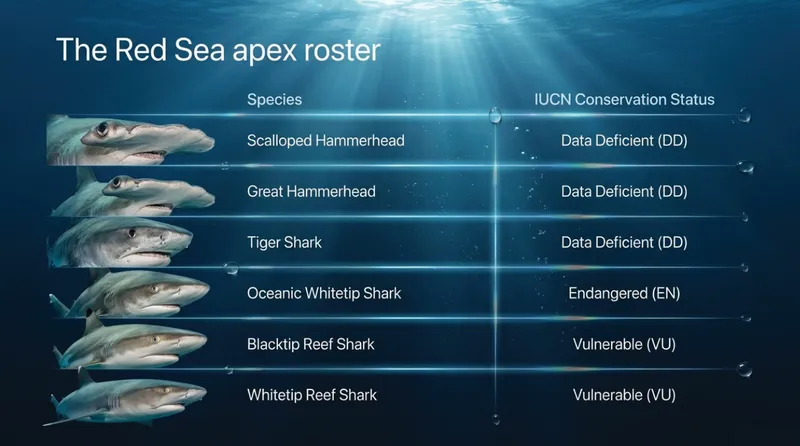
## The Red Sea's Apex Roster
Right here in the Red Sea, several shark species sit at the top of that food web - and their conservation status tells its own story:
* **[Scalloped Hammerhead](https://redseacreatures.com/taxon/fishes/sharks/hammerhead-sharks/scalloped-hammerhead)** - Data Deficient
* **[Great Hammerhead](https://redseacreatures.com/taxon/fishes/sharks/hammerhead-sharks/great-hammerhead)** - Data Deficient
* **[Tiger Shark](https://redseacreatures.com/taxon/fishes/sharks/requiem-shark/tiger-shark)** - Data Deficient
* **[Oceanic Whitetip Shark](https://redseacreatures.com/taxon/fishes/sharks/requiem-shark/oceanic-whitetip-shark)** - Endangered
* **[Blacktip Reef Shark](https://redseacreatures.com/taxon/fishes/sharks/requiem-shark/blacktip-reef-shark)** - Vulnerable
* **[Whitetip Reef Shark](https://redseacreatures.com/taxon/fishes/sharks/requiem-shark/whitetip-reef-shark)** - Vulnerable
Even the "Data Deficient" label is a warning sign in itself - it means we don't yet have enough information to know how close to the edge these animals really are.
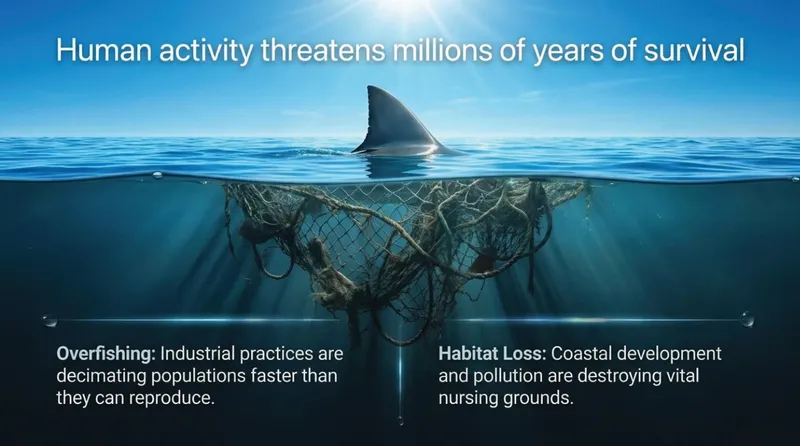
## A Species Under Siege
Despite a 420-million-year winning streak, sharks are now facing a crisis unlike anything in their evolutionary history. Two forces are doing most of the damage. Industrial-scale overfishing is removing sharks from the water faster than they can reproduce - and sharks, which grow slowly and have few offspring, simply can't keep pace. At the same time, coastal development and pollution are destroying the nursing grounds young sharks depend on before they've even had a chance to grow up.
## A Global Movement to Shift Perception
July 14 exists precisely to counter decades of negative imagery. Shark Awareness Day brings together conservation groups, researchers, and ordinary ocean-lovers around the world with one shared goal: replacing fear with facts, and turning bystanders into advocates for the animals that keep our oceans running.
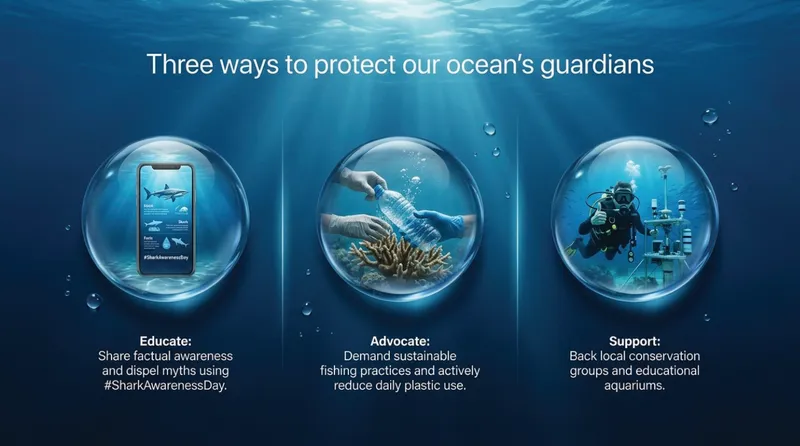
## Three Ways to Protect Our Ocean's Guardians
You don't need a marine biology degree to make a difference. Three simple actions go a long way:
* **Educate** - share factual, myth-busting content and use #SharkAwarenessDay to spread it further.
* **Advocate** - push for sustainable fishing practices and cut back on single-use plastic in your own daily habits.
* **Support** - back local conservation groups and educational aquariums that do the on-the-ground work.
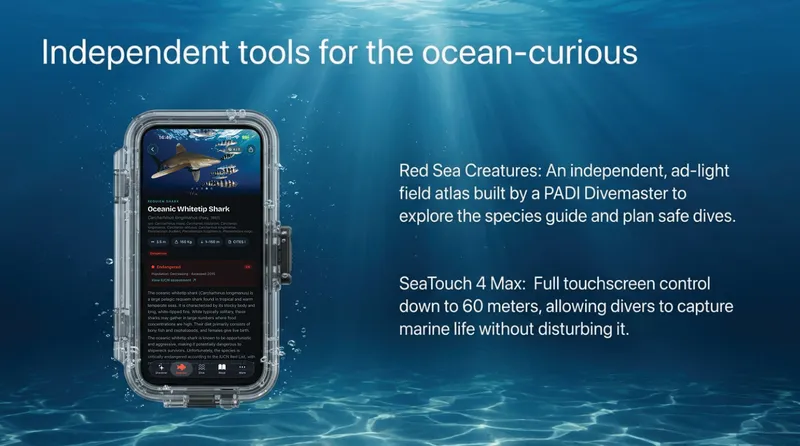
## Independent Tools for the Ocean-Curious
If you want to go deeper than a hashtag, a couple of tools make that easy. The [Red Sea Creatures app](https://redseacreatures.com/app) is an independent, ad-light field atlas built by a PADI Divemaster, designed to help you explore species profiles and plan safer, more informed dives. Pair that with something like the [Divevolk SeaTouch 4 Max](https://www.divevolkdiving.com/?sca_ref=7839913.TSO4bAHbFD), which gives full touchscreen control down to 60 meters - letting divers document marine life without ever having to disturb it.
## Ensuring Their Survival for Future Generations
Next time a headline or a movie trailer puts a shark front and center, it's worth asking yourself a simple question: are you looking at a monster, or at a 420-million-year-old guardian currently fighting for its life? The answer shapes more than just how we feel about sharks - it shapes what kind of ocean we leave behind.
**#SharkAwarenessDay**
---
*Published on July 14, 2026*
*Author: Yevgen “Scorp” Sukharenko*
*Source: [Red Sea Creatures](https://redseacreatures.com)*
---
---
title: The Language of the Deep
description: Your first boat dive comes with an alphabet soup of NDLs, SMBs and buddy checks that sounds like a secret code. It kind of is - every acronym is a small safety ritual packed into a few letters. Here are the nine that matter most, decoded in the order you meet them on a real dive.
author: Yevgen “Scorp” Sukharenko
published: 2026-07-04T16:00:00.000Z
updated: 2026-07-04T15:59:18.759Z
tags: Scuba Diving
url: https://redseacreatures.com/blog/2026/07/04/the-language-of-the-deep
---
# The Language of the Deep
### Nine essential scuba acronyms, decoded
Show up for your first boat dive and the surface world turns out to be anything but quiet. The captain starts calling out NDLs, SMBs and buddy checks - an alphabet soup that sounds like a secret code.
It kind of is. Every one of these acronyms is a small safety ritual, packed down into a few letters so it sticks when your heart's pounding and the current's pulling. Here are the nine that matter most, in the order you'll actually use them - from the moment you gear up to the moment you're back on the boat.
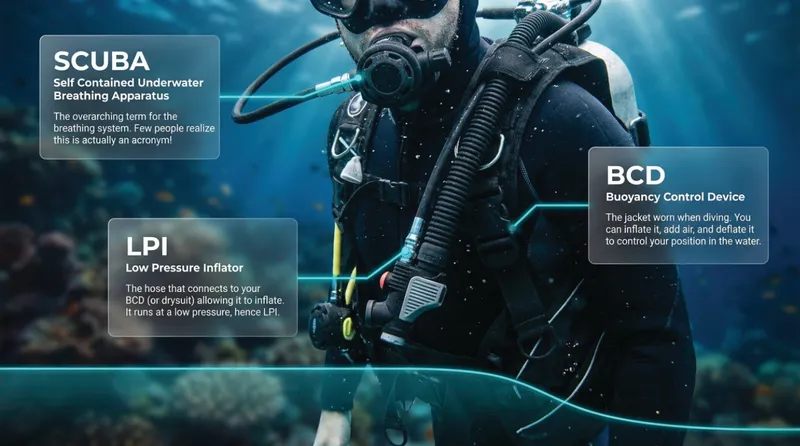
## Start with the gear: SCUBA, BCD, LPI
**SCUBA** gets thrown around as a plain word, but it's an acronym: *Self Contained Underwater Breathing Apparatus*. Before the 1940s, seeing a reef usually meant being tethered to a hose and a surface pump. SCUBA is the tech that cut the cord - a portable life-support system you carry on your back.
Two pieces of that kit have their own initials. Your **BCD** (Buoyancy Control Device) is the inflatable jacket that lets you hang weightless: add air to rise, dump it to sink. The hose that feeds it is the **LPI** (Low Pressure Inflator) - "low pressure" because it runs off gently reduced air, not the high-pressure line.
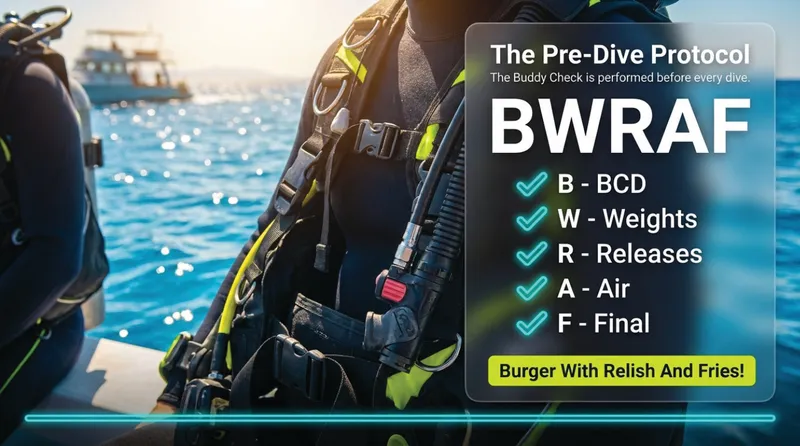
## The buddy check: BWRAF
Right before you drop in, you and your buddy check each other's gear. It's the single most important habit in the sport, and it's the easiest one to rush - so it comes with a mnemonic built for hungry divers: **Burger With Relish And Fries.**
* **B - BCD:** inflates, deflates, holds air.
* **W - Weights:** secure, and set for a quick right-hand release.
* **R - Releases:** every buckle and clip holding the rig together.
* **A - Air:** turned on, breathing sweet, and the SPG reads full.
* **F - Final:** one last sweep for loose hoses and forgotten fins.
Skip the burger and you're trusting luck. Don't.
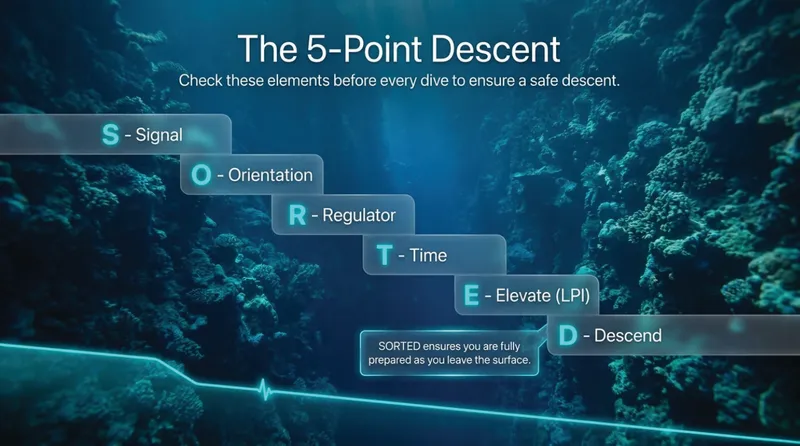
## Leaving the surface: SORTED
Dropping from air into water is a transition between two worlds, so it gets its own checklist. Before you go under, get **SORTED**:
* **S - Signal** your buddy (thumbs down).
* **O - Orientation:** pick a landmark or heading.
* **R - Regulator:** swap the snorkel for your reg.
* **T - Time:** note it on your computer or watch.
* **E - Elevate:** hold the LPI hose up and vent the air.
* **D - Descend,** slow and together.
*Yes, that's six steps for something the industry insists on calling a "five-point descent." Call it diver math and move on.*
*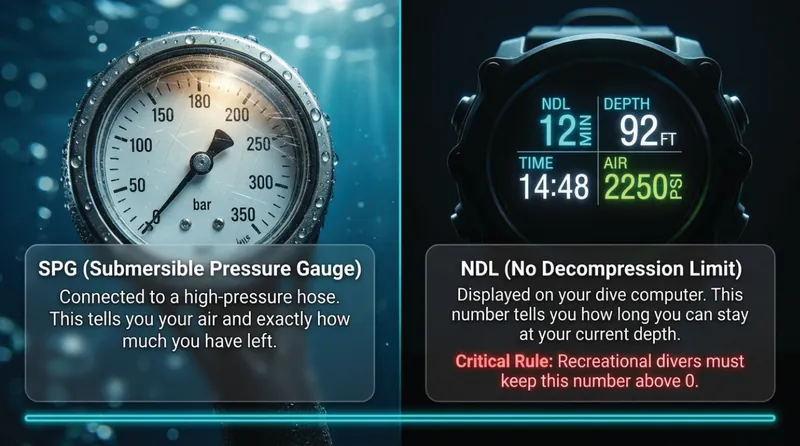*
## Your two clocks: SPG and NDL
New divers assume the tank is the only limit. There are actually two clocks running the whole dive.
The first is **air**. Your **SPG** (Submersible Pressure Gauge) sits on a high-pressure hose and tells you exactly how much you have left. Watch it early, watch it often.
The second is invisible: your **NDL** (No Decompression Limit), the number on your dive computer. The deeper you go, the more nitrogen your tissues soak up. Stay too long and surface too fast and that nitrogen can bubble out inside you - decompression sickness, "the bends." For recreational diving the rule is simple and non-negotiable: **keep the NDL above zero.**
**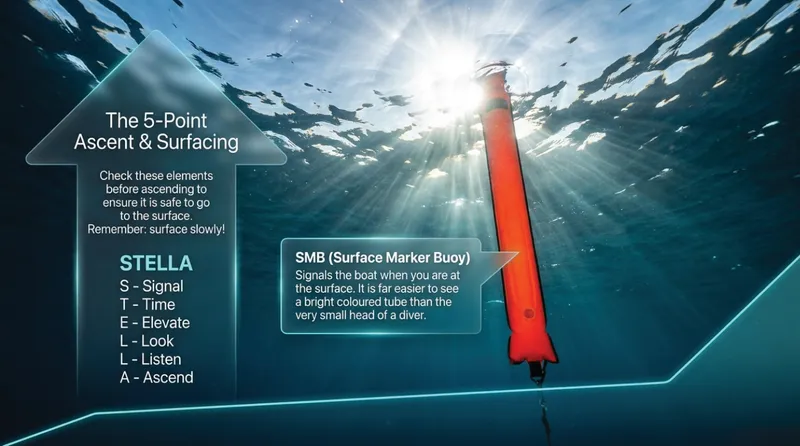**
## Heading back: STELLA and the SMB
When the dive's done, you run the ritual in reverse. Follow **STELLA**:
* **S - Signal** (thumbs up).
* **T - Time:** check it.
* **E - Elevate:** LPI hose up again.
* **L - Look** up for boats and obstacles.
* **L - Listen** for engines.
* **A - Ascend,** slowly - no faster than your own smallest bubbles.
Near the surface, send up your **SMB** (Surface Marker Buoy) - the tall orange tube. A captain scanning a glary, choppy sea will never spot the small head of a diver, but a six-foot neon marker is impossible to miss. It says one thing clearly: *I'm here, come get me.*
*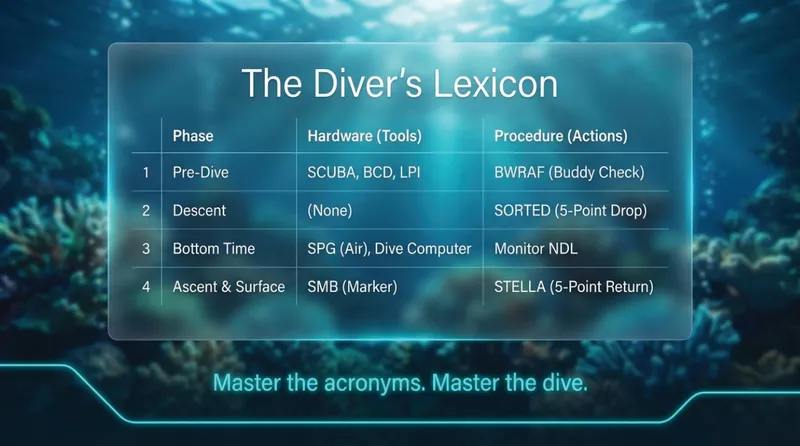*
## The whole dive, one table
That's the language, start to finish. Learn it once and the letters disappear - what's left is muscle memory, and the quiet.
The map is simple: **Pre-dive** (SCUBA / BCD / LPI, then BWRAF) → **Descent** (SORTED) → **Bottom time** (SPG + NDL) → **Ascent & surface** (SMB, then STELLA).
*Master the acronyms. Master the dive.*
---
*Published on July 4, 2026*
*Author: Yevgen “Scorp” Sukharenko*
*Source: [Red Sea Creatures](https://redseacreatures.com)*
---
---
title: Meet Red Sea Creatures - The Reef, in Your Pocket
description: A field guide, a dive planner, and a love letter to one of the richest seas on Earth - now an app. Here's everything it can do, and why I built it.
author: Yevgen “Scorp” Sukharenko
published: 2026-07-01T14:30:00.000Z
updated: 2026-07-01T14:34:19.004Z
tags: Announcements
url: https://redseacreatures.com/blog/2026/07/01/meet-red-sea-creatures-the-reef-in-your-pocket
---
# Meet Red Sea Creatures - The Reef, in Your Pocket
The Red Sea is one of the most extraordinary places on the planet. More than a thousand species of fish, hundreds of corals, and a remarkable number of creatures found absolutely nowhere else on Earth. Anyone who has dipped their head under its surface knows the feeling - that there's a whole living world down there, busy and brilliant and a little bit alien.
I wanted a companion worthy of it. So I built one.
**[Red Sea Creatures](https://apps.apple.com/us/app/red-sea-creatures/id6783286953)** is a free app: a field guide to the marine life of the Red Sea, and a companion for everyone who loves it - divers, snorkelers, and the merely curious. You don't need an account to explore. Just open it and dive in.
Here's what it does.
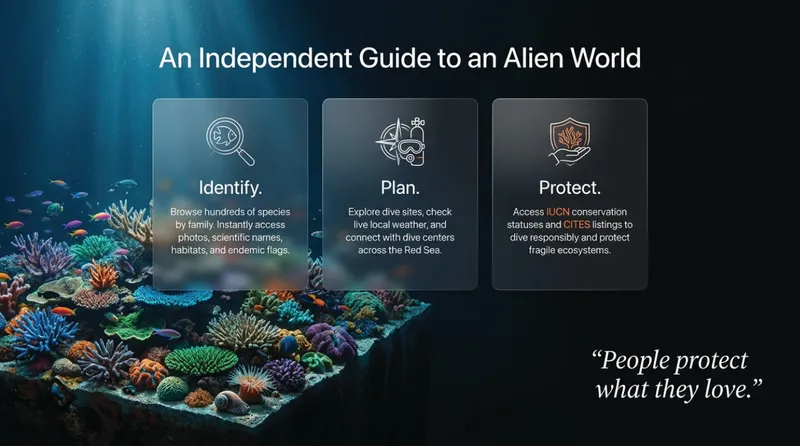
## Know what you're looking at
At the heart of the app is a catalog of hundreds of species - fish, sharks, rays, turtles, corals, nudibranchs and more - organized by family, so it actually makes sense.
Tap any creature and you get the full picture: photographs, common and scientific names, habitat, size, the depths it lives at, and clear flags for whether it's **dangerous, venomous, poisonous,** or a **Red Sea endemic**. You'll also find its **conservation status** - straight from the IUCN Red List and CITES - because knowing which species are vulnerable, and why, is part of diving responsibly.
## Plan your dive
The app isn't just for identifying what you saw - it helps you decide where to go next.
* **Dive sites** with maps, depth, conditions, dive plans, and the marine life you can expect to meet at each one.
* **Dive centers** across the Red Sea, so you know who to dive with. Filter sites and centers by city and country to find your spot in seconds.
* **Live dive weather** for your city - air and water temperature, wind, humidity - plus a **wetsuit recommendation** for the day. No more guessing at 6 a.m. what to pack.
## A glance is all you need
* **Widgets** bring the reef to your Home Screen: a different Red Sea creature every hour, and live dive weather, in three sizes. Add water temperature and today's wetsuit tip to your **Lock Screen** too.
* **Search** everything instantly.
* **Light and dark themes**, built for the bright deck of a boat and the dark of a night dive alike.
* **Notifications** when there's something genuinely new worth your time.
## Read, listen, learn
There's more to the sea than a checklist of species.
* A **blog** full of guides, species spotlights, and stories from the reef.
* A calendar of **marine awareness events** worth knowing.
* A **podcast** you can keep playing in the background while you browse.
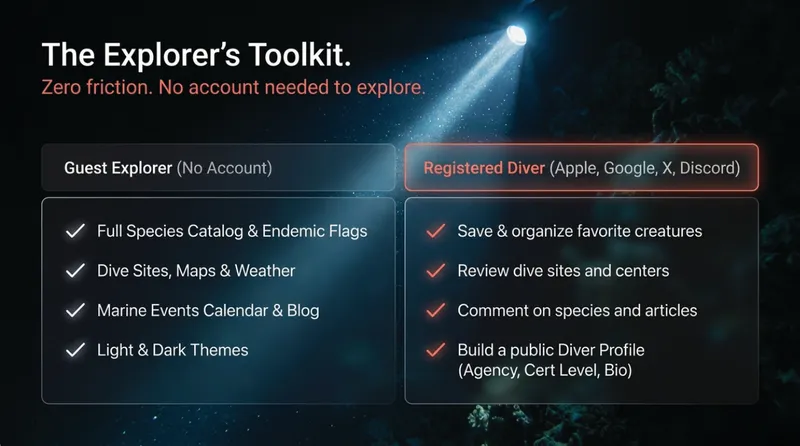
Make it yours
Create an account - with Apple, Google, Facebook, Discord, or X - and the app becomes personal:
* **Save your favourite creatures** and find them again anytime.
* **Review dive sites and centers**, and comment on creatures and articles.
* **Build a diver profile** with your bio, agency, certification level, and links - so the community knows who they're sharing the reef with.
And if you'd rather just look around, that's completely fine. Everything above is yours to explore, account or not.
## Why I made it
People protect what they love. The Red Sea is unique and fragile, and the more of us fall for it - really fall for it, species by species - the better its chances. That's why every creature carries its conservation status, and why the whole thing is free.
This app is a labour of love. I obsessed over the photography, the layouts, the way a fish fills the screen, the little details you'll never consciously notice but will quietly feel. And I'm only getting started.
So - [download](https://apps.apple.com/us/app/red-sea-creatures/id6783286953) it, open it, and meet the Red Sea, one creature at a time.
See you under the surface.
---
*Published on July 1, 2026*
*Author: Yevgen “Scorp” Sukharenko*
*Source: [Red Sea Creatures](https://redseacreatures.com)*
---
---
title: Meet the Shark That Prefers Walking to Swimming: The Discovery of Hemiscyllium dugeonae
description: While we often picture sharks as apex predators, a newly discovered species in Papua New Guinea challenges this notion by literally "walking" across the seabed on its fins. This unique shark, Hemiscyllium dugeonae, uses its fins like limbs and even boasts a "decoy eye" to fool predators, showcasing an unhurried and localized lifestyle far removed from the typical high-speed chase.
author: Yevgen “Scorp” Sukharenko
published: 2026-06-22T10:30:00.000Z
updated: 2026-06-22T10:33:58.937Z
tags: Sharks
url: https://redseacreatures.com/blog/2026/06/22/meet-the-shark-that-prefers-walking-to-swimming-the-discovery-of-hemiscyllium-dugeonae
---
# Meet the Shark That Prefers Walking to Swimming: The Discovery of Hemiscyllium dugeonae
When we picture sharks, we typically envision the apex athleticism of a Great White, a torpedo of muscle capable of hitting 25 miles per hour. But in the shallow tide pools and vibrant reefs of Papua New Guinea, evolution has taken a far more leisurely turn. Here, a newly discovered species has traded the high-speed chase for a stroll, literally "walking" across the seabed on its fins.
## Evolution Discards the "Swim" for a "Stroll"
The *Hemiscyllium* genus is defined by a group of reef dwellers that have mastered a curious, unhurried gait. Instead of pulsing through the water column, these sharks use their pectoral and pelvic fins like primitive limbs to paddle and "crutch" their way across the jagged seafloor. They are diminutive and accessible curiosities, generally maturing at a modest 70 to 80 centimeters. While one outlier was recorded at 107 centimeters, most remain small enough to navigate the cramped crevices of their coral homes.
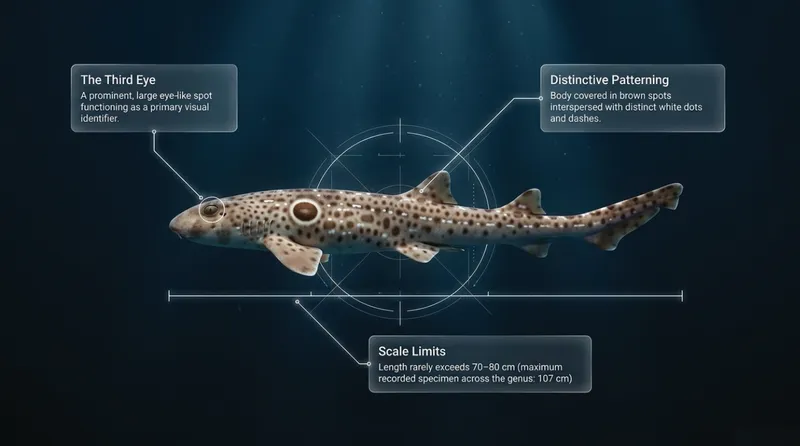
## The Shark with a "Third Eye"
The newly identified *Hemiscyllium dugeonae* is a master of visual deception, sporting a complex tapestry of brown spots, white dots, and stripes. Its most arresting feature is a massive, dark spot situated just behind the head that functions as a "decoy eye." This biological mimicry serves as a clever defense mechanism, intended to confuse predators into mistaking the shark’s shoulder for its head. For the scientists on the ground, the discovery was as personal as it was professional.
"The discovery of sharks does not happen often," notes Dr. Christine Dudgeon, for whom the species is named. "And this is the first time a species has been named in my honor."
## The Ultimate Ocean "Homebodies"
While many sharks are global nomads, these walking species are the ultimate homebodies of the marine world. Some individuals spend their entire lives within a territory as small as a few hundred square meters, rarely venturing into deeper water. This extreme sedentary lifestyle is largely a result of their reproductive biology; they are oviparous (egg-laying) creatures. Without mobile larvae or the urge to migrate, they remain tethered to the specific patches of reef where they were born.
## Shattering Previous Scientific Assumptions
Expeditions conducted between 2023 and 2025 in the Milne Bay province have delivered a major blow to old biological certainties. Scientists long assumed that distinct species required physical barriers, such as deep-sea rifts or massive river outflows, to evolve in isolation. However, in Eastern Papua New Guinea, researchers found that these "walking" territories actually overlap. These sharks remain genetically and behaviorally distinct despite sharing the same water, suggesting a much more sophisticated process of speciation than previously imagined.
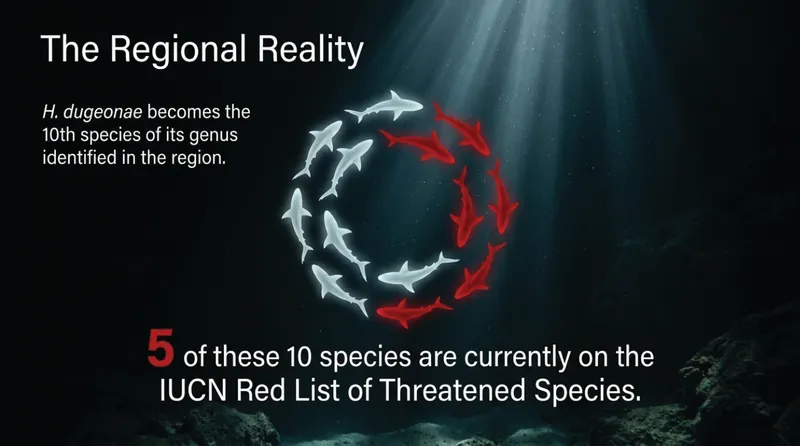
## A Race Against Extinction
Despite just entering the scientific record, *Hemiscyllium dugeonae* is already part of a genus under immense pressure. Of the ten known species of walking sharks, 50% are already listed on the IUCN Red List as threatened with extinction. This makes the upcoming expedition in October a critical mission for the team. They intend to gather more granular data to determine exactly how vulnerable the *Dugeonae* species is and what protections are needed to ensure its survival.
## A New Perspective on Marine Diversity
The discovery of *Hemiscyllium dugeonae* reminds us that the most profound biological secrets are often hidden in plain sight along our coastlines. It challenges our narrow definitions of what a "shark" should be and highlights the incredible specialized niches life can occupy. As we continue to explore the shallow fringes of our oceans, we have to wonder: how much of the "known" world still remains a mystery, specifically regarding the fragile, walking wonders of our coastlines?
---
*Published on June 22, 2026*
*Author: Yevgen “Scorp” Sukharenko*
*Source: [Red Sea Creatures](https://redseacreatures.com)*
---
---
title: World Sea Turtle Day - 150 Million Years of Survival, and Why Every Year Still Counts
description: Sea turtles have swum Earth's oceans for an incredible 150 million years, outlasting dinosaurs and every major global catastrophe. On World Sea Turtle Day, June 16th, we celebrate these ancient survivors but also face a harsh truth: human civilization now poses a unique threat they can't adapt to, with six of the seven species fighting for their lives.
author: Yevgen “Scorp” Sukharenko
published: 2026-06-16T09:00:00.000Z
updated: 2026-06-16T09:10:51.137Z
tags: Conservation
url: https://redseacreatures.com/blog/2026/06/16/world-sea-turtle-day-150-million-years-of-survival-and-why-every-year-still-counts
---
# World Sea Turtle Day - 150 Million Years of Survival, and Why Every Year Still Counts
June 16th is World Sea Turtle Day - and if you stop to think about what that number actually means, it reframes everything. One hundred and fifty million years. Sea turtles were already ancient when the first flowering plants appeared on Earth. They shared the ocean with mosasaurs and plesiosaurs, survived the asteroid that ended the dinosaurs, and kept swimming through every ice age and mass extinction since. Today, on the Red Sea coast, we sometimes cross paths with these living time capsules on a single dive. That alone feels like a privilege. World Sea Turtle Day - celebrated on June 16th - asks us to honor that privilege with action.
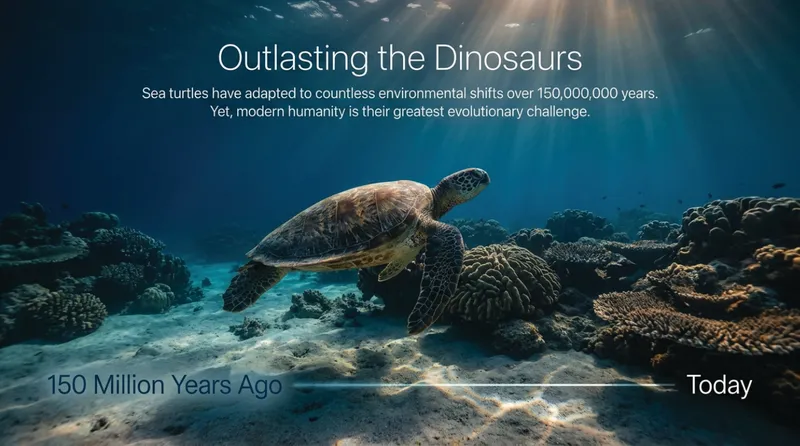
## They Outlasted the Dinosaurs. But Can They Outlast Us?
Across 150 million years, sea turtles adapted to continental drift, shifting ocean chemistry, and climate swings far more dramatic than anything in recorded human history. Every environmental disruption thrown at them, they navigated and survived. That track record is one of the most extraordinary in the animal kingdom. And yet the challenge they face today is categorically different from anything in their evolutionary past - not a geological event or a volcanic winter, but the sustained, accelerating pressure of modern human civilization. Habitat loss, pollution, overharvesting, and climate disruption are converging faster than natural adaptation can respond. For the first time in 150 million years, sea turtles need outside help just to survive.
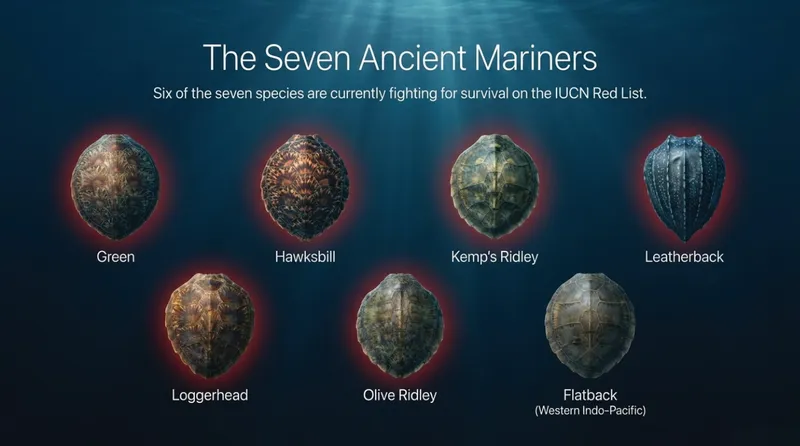
## Seven Species. Six of Them Fighting for Their Lives.
There are exactly seven species of sea turtle on Earth, and six of them currently appear on the IUCN Red List of Threatened Species. The full family reads like a roll call of ocean history: the **Green Turtle**, grazer of seagrass beds and coral reefs; the **Hawksbill**, architect of reef health through its sponge-feeding habits; the critically endangered **Kemp's Ridley**, the rarest of all; the deep-diving giant **Leatherback**, the only shell-less species; the powerful **Loggerhead**, built for crushing hard prey; the synchronized mass-nester **Olive Ridley**; and the **Flatback**, found only in the waters of the Western Indo-Pacific. Each species fills a distinct ecological role. Losing any one of them would send ripples through marine ecosystems that science is only beginning to fully understand.
## The Man Who Made Sea Turtle Science Matter: Dr. Archie Carr
World Sea Turtle Day falls on June 16th for a specific reason - it's the birthday of Dr. Archie Carr, born in 1909, who almost single-handedly transformed sea turtle biology from an obscure academic niche into the foundation of a global conservation movement. Before Carr, sea turtles were poorly understood, their migratory routes unknown, their nesting behavior largely undocumented. His decades of field research in the Caribbean, his writing, and his relentless advocacy built the scientific and public case for protecting these animals when almost no institutional support existed for doing so. The conservation tools and legal frameworks that protect sea turtles today trace a direct line back to his work. Celebrating June 16th is not just about the turtles - it's about recognizing that one person's commitment to science and advocacy can change the trajectory of an entire species.
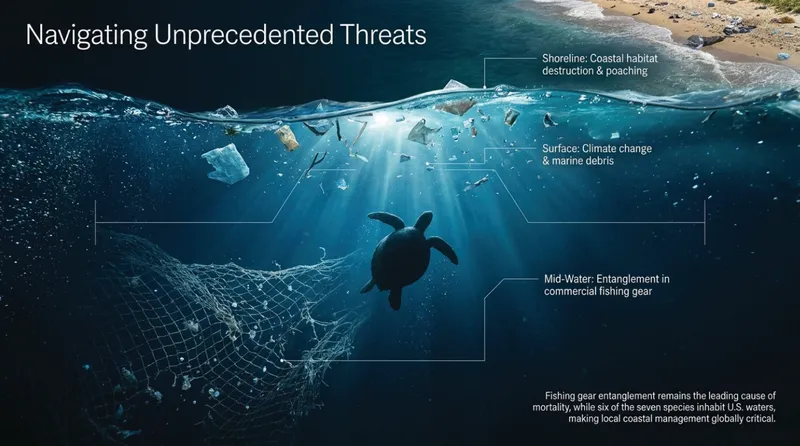
## A Gauntlet from Shore to Sea Floor
To understand the scale of the threat facing sea turtles, it helps to think about their entire environment - not just one layer of it. On the **shoreline**, coastal development destroys nesting beaches and poaching continues to remove eggs and adults from populations that can barely replace themselves. At the **surface**, floating marine debris - especially plastic - is ingested at every life stage, and climate change is warming the sands that determine the sex of unborn hatchlings. In **mid-water**, entanglement in commercial fishing gear remains the single leading cause of sea turtle mortality worldwide - an accidental killing on a massive, industrialized scale. Six of the seven species inhabit U.S. waters alone, which illustrates just how globally distributed this problem is and why local coastal management in every country with a coastline carries genuine conservation weight.
## Engineering a Way Out: The Tools That Are Actually Working
Conservation science hasn't stood still. Alongside legal protections and marine protected areas, specific technologies have made a measurable difference in sea turtle survival. **Turtle Excluder Devices (TEDs)** - escape hatches built into fishing trawl nets - have saved countless turtles from drowning as bycatch and are now mandated in many national fisheries. Legislation like the Endangered Species Act in the United States provided the framework that made coordinated protection and recovery programs legally enforceable, not just aspirational. And **coastal lighting regulations** - requiring beachfront buildings to use turtle-friendly amber lighting - address a surprisingly impactful threat: hatchlings navigate toward the sea using the natural brightness of the horizon, and artificial light from development causes them to crawl inland to their deaths. These solutions work. The challenge is deploying them consistently and globally.
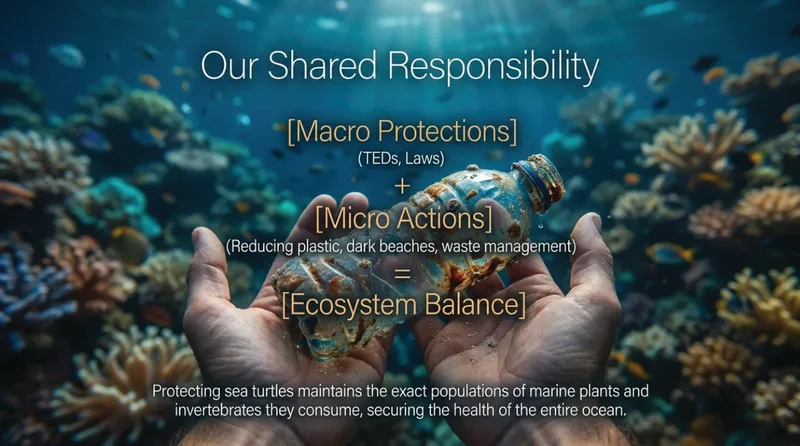
## The Equation Is Simpler Than It Looks
Protecting sea turtles ultimately comes down to a two-part equation. **Macro protections** - international treaties, national legislation, Turtle Excluder Devices, protected nesting beaches - create the structural conditions for recovery. **Micro actions** - reducing single-use plastic, supporting dark-beach initiatives, responsible waste management, choosing seafood from turtle-safe fisheries - address the diffuse, everyday pressures that policy alone can't fully reach. Together, they add up to something larger than the sum of their parts: **ecosystem balance**. Sea turtles aren't just charismatic megafauna worth saving for sentimental reasons. They are active regulators of seagrass density, coral reef health, and the population dynamics of the marine invertebrates they feed on. Protecting them protects the ocean system that every coastal community and every marine species depends on.

## Acknowledge the Debt. Secure the Future.
One hundred and fifty million years of survival - and the species that poses the greatest threat to their continued existence has been around for a fraction of a percent of that time. That's a debt worth acknowledging. On this World Sea Turtle Day, the ask is straightforward: support global sea turtle research, back local conservation programs wherever you live and dive, and keep the conversation alive beyond a single day on the calendar. If you've ever locked eyes with a sea turtle underwater - that ancient, unhurried gaze that seems to look straight through you - you already understand what's worth protecting. The rest is just deciding to act on it.
> *Share your sea turtle encounters and tag us - and use #WorldSeaTurtleDay to join the global conversation.* 🐢
---
*Published on June 16, 2026*
*Author: Yevgen “Scorp” Sukharenko*
*Source: [Red Sea Creatures](https://redseacreatures.com)*
---
---
title: Turning Your Next Dive Into Data: How Recreational Divers Are Saving the Oceans
description: Every dive you take, every photo you snap, can become a vital part of global ocean conservation. Turn your passion into purpose by contributing real-time data and observations - no PhD needed - to fill critical knowledge gaps and protect our seas.
author: Yevgen “Scorp” Sukharenko
published: 2026-06-14T08:00:00.000Z
updated: 2026-06-14T08:02:17.836Z
tags: Conservation
url: https://redseacreatures.com/blog/2026/06/14/turning-your-next-dive-into-data-how-recreational-divers-are-saving-the-oceans
---
# Turning Your Next Dive Into Data: How Recreational Divers Are Saving the Oceans
Every dive tells a story. The flash of a spotted moray tucked into a crevice. A school of barracuda spinning in slow hypnotic circles above the reef. You surface with a memory card full of moments - but what if those same images could feed a global intelligence network for ocean conservation?
Your weekend hobby is no longer just an escape. It might be one of the most powerful tools we have for understanding and protecting the sea in real time. Here's how.
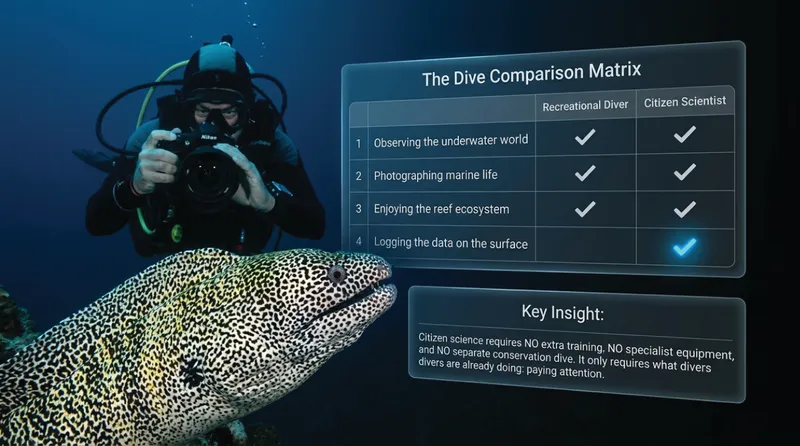
## You Don't Need a PhD to Be a Scientist
There's a persistent myth that marine research belongs exclusively to people in lab coats with advanced degrees and expensive equipment. The reality is far more democratic - and more exciting.
The most valuable asset in ocean science right now isn't a laboratory. It's physical presence. Divers have what researchers often don't: the ability to be on-site, year-round, in every corner of the globe. The skills required to contribute to citizen science are exactly the ones you've already mastered - buoyancy, observation, and documentation.
> *Citizen science requires no extra training, no specialist equipment, and no separate conservation dive. It only requires what divers are already doing: paying attention.*
The difference between a recreational diver and a citizen scientist is a single extra step - logging what you saw when you get back on the boat.

## Why We Need You
Marine researchers face a fundamental logistical problem: there are vast stretches of the ocean that simply never get studied. Scientists are a finite resource, tied to specific sites, limited budgets, and research windows. This creates dark zones in our data - places where ecosystems may be collapsing or recovering, and nobody is watching.
The global diving community is the only force capable of filling those gaps. Divers visit diverse locations across every season, in places no research vessel will ever reach on a regular basis. You are the eyes under the surface that institutional science cannot afford to maintain.
Researchers can't be everywhere at once. But divers can.
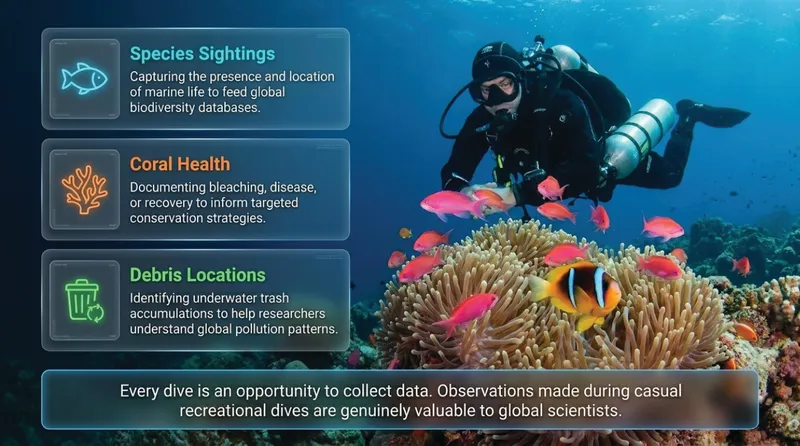
## What Your Photos Actually Measure
When you upload a sighting to a research database, you're not just sharing a nice shot - you're contributing a data point to a living scientific record. Every image of a reef, a fish, or a piece of debris carries three kinds of value:
* **Species Sightings** - capturing the presence and location of marine life to feed global biodiversity databases, tracking how populations shift across years and seasons
* **Coral Health** - documenting bleaching, disease, or recovery in real time, giving conservation teams the evidence they need to respond quickly
* **Debris Locations** - identifying underwater trash accumulations and helping researchers map global pollution patterns for policy intervention
Every dive is an opportunity to collect data. Observations made during completely casual recreational dives are genuinely valuable to global scientists.
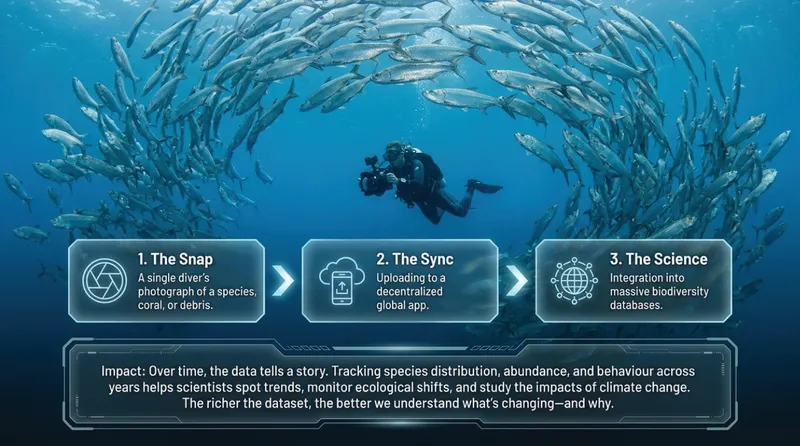
## The Long Game: Snap, Sync, Science
A single observation is a snapshot. A community of contributors over years becomes something far more powerful - a dataset rich enough to reveal trends that would otherwise be invisible.
The workflow couldn't be simpler:
* **The Snap** - photograph a species, coral formation, or debris during your normal dive
* **The Sync** - upload it to a decentralized global platform when you're back on the boat
* **The Science** - your image integrates into massive biodiversity databases used by researchers worldwide
Over time, this data tracks species distribution, abundance, and behavior across years. It helps scientists spot ecological shifts, monitor the impacts of climate change, and understand what's changing - and why. The richer the dataset, the clearer the picture.
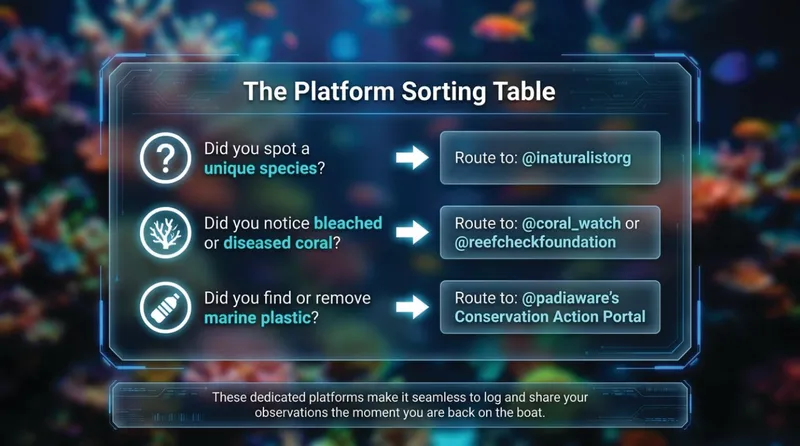
## Where to Send What You See
Not all data goes to the same place, and that's actually a feature. Different platforms specialize in different types of observations, making your contribution more useful rather than less:
* **Spotted a unique species?** → [@inaturalistorg](https://www.inaturalist.org/) - the premier platform for mapping global biodiversity
* **Noticed bleached or diseased coral?** → [@coral\_watch](https://coralwatch.org/) or [@reefcheckfoundation](https://www.reefcheck.org/) - dedicated to strategic reef health monitoring
* **Found or removed marine plastic?** → [PADI AWARE](https://www.padi.com/aware)'s Conservation Action Portal - built for reporting debris and coordinating cleanup
These platforms are designed to be used the moment you're back on the surface. The data enters the global system before you've even taken your wetsuit off.
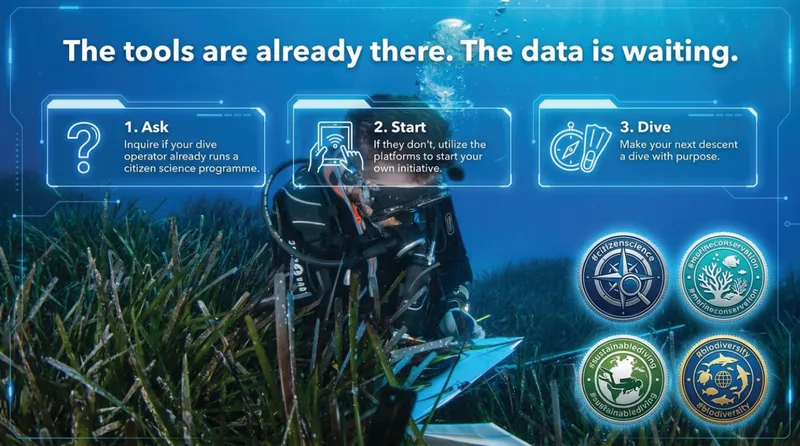
## The Tools Are There. The Data Is Waiting.
Getting started takes three steps - and none of them require anything you don't already have.
**Ask** - Check if your dive operator already runs a citizen science program. Many do, and you can simply plug in.
**Start** - If they don't, the platforms above are open to anyone. You can initiate a local monitoring initiative that feeds directly into global databases. Individual divers and dive businesses alike have the power to make this happen.
**Dive** - Make your next descent a dive with purpose.
The old motto was *take only pictures, leave only bubbles.* That was a good start. But for an ocean in crisis, it's no longer enough. The data needed to protect our marine heritage is already drifting past your mask on every dive - it's simply waiting to be collected.
What will your next dive say?
---
*Published on June 14, 2026*
*Author: Yevgen “Scorp” Sukharenko*
*Source: [Red Sea Creatures](https://redseacreatures.com)*
---
---
title: Jacques-Yves Cousteau: The Explorer Who Gave the Ocean Its Voice
description: Today marks the birthday of Jacques-Yves Cousteau, a visionary who revolutionized ocean exploration and changed how humanity sees the sea. Despite a career-ending accident, he gave the deep a voice, bringing its wonders into homes worldwide and making his pioneering work more relevant than ever.
author: Yevgen “Scorp” Sukharenko
published: 2026-06-11T07:00:00.000Z
updated: 2026-08-08T13:20:22.163Z
tags: Scuba Divers
url: https://redseacreatures.com/blog/2026/06/11/jacques-yves-cousteau-the-explorer-who-gave-the-ocean-its-voice
---
# Jacques-Yves Cousteau: The Explorer Who Gave the Ocean Its Voice
Today, June 11, marks the birthday of one of the most influential figures in the history of ocean exploration. Jacques-Yves Cousteau was born on this day in 1910 in Saint-André-de-Cubzac, France - and over the course of his 87 years, he fundamentally changed the way humanity sees, understands, and relates to the sea.
As the world quietly marks 115 years since his birth, his legacy feels anything but distant. The technologies he pioneered, the films he made, and the warnings he issued decades ago are more relevant today than ever. Cousteau didn't just explore the ocean - he gave it a voice. At a time when the deep sea was little more than a dark mystery to most of the world, this French naval officer turned inventor, filmmaker, and activist brought it alive in living rooms across the globe.
His journey - from a shattered career dream to becoming the most recognized ocean advocate in history - is one of the most remarkable stories of the 20th century. This is that story.
## A Shattered Dream Birthed a New Frontier
Born on June 11, 1910, in Saint-André-de-Cubzac, France, Cousteau was destined for the skies - not the sea. He trained as a naval aviator and was on track for a career in aviation until fate intervened in the most violent way possible.
At just 26 years old, a near-fatal car accident shattered both of his arms and permanently ended his aviation career. His doctors prescribed daily swimming in the Mediterranean Sea as physical therapy. It was during these long, painful sessions that Cousteau grew frustrated with the sting of saltwater in his eyes - and so he built his first pair of underwater goggles.
That small act of problem-solving changed everything. The sky's loss became the ocean's greatest gain.
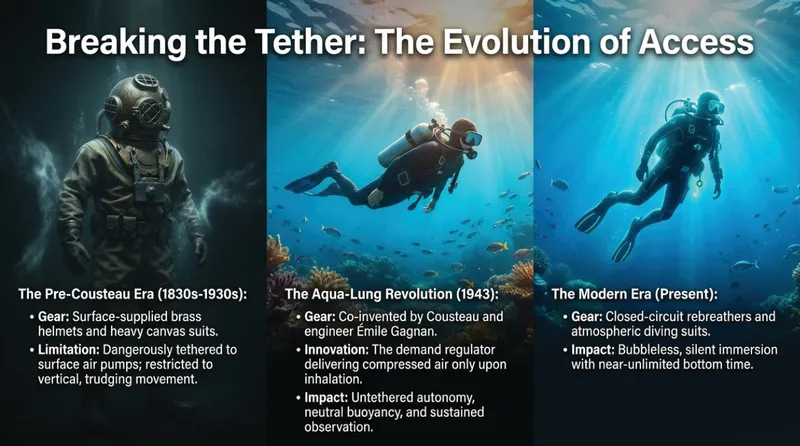
## Breaking the Tether: The Evolution of Access
Before Cousteau, getting underwater was an ordeal of brass helmets, heavy canvas suits, and surface air hoses that tethered divers like balloons on strings. Movement was limited, dangerous, and exhausting - exploration was barely possible.
In 1943, everything changed. Cousteau and engineer Émile Gagnan co-invented the Aqua-Lung, a device with a demand regulator that delivered compressed air only when the diver inhaled. The result was extraordinary:
* **Untethered autonomy** - divers could move freely in three dimensions
* **Neutral buoyancy** - hovering alongside marine life became possible
* **Sustained observation** - divers could stay down long enough to actually study what they saw
Today, modern closed-circuit rebreathers and atmospheric diving suits have taken this even further, enabling bubbleless, near-silent immersion with almost unlimited bottom time. But it all started with that first breath underwater in 1943.
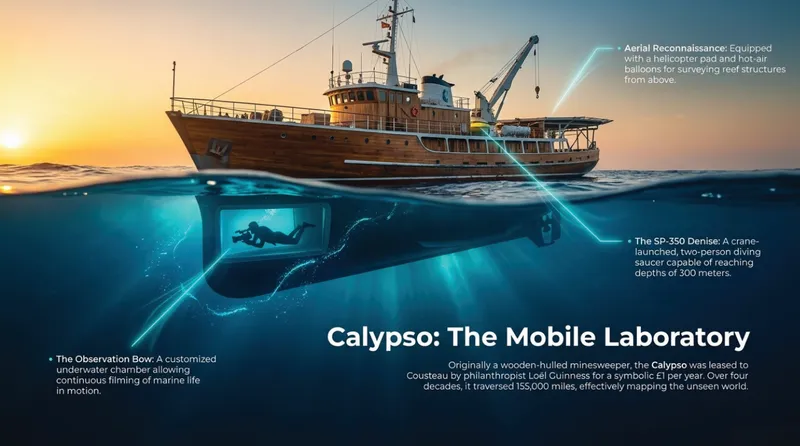
## Calypso: The Mobile Laboratory
Every great explorer needs a great vessel. For Cousteau, that was the *Calypso* - a wooden-hulled former minesweeper leased to him by philanthropist Loël Guinness for the symbolic sum of £1 per year.
What Cousteau did with that ship was nothing short of extraordinary. Over four decades, the *Calypso* traversed 155,000 miles, effectively mapping the unseen world. She was fitted with remarkable innovations for her time:
* **The Observation Bow** - a customized underwater chamber that allowed continuous filming of marine life in motion
* **The SP-350 Denise** - a crane-launched two-person diving saucer capable of reaching depths of 300 meters
* **Aerial Reconnaissance** - a helicopter pad and hot-air balloons for surveying reef structures from above
The *Calypso* was more than a ship. She was a floating scientific platform, and her voyages produced some of the most important marine research and documentary footage of the 20th century.
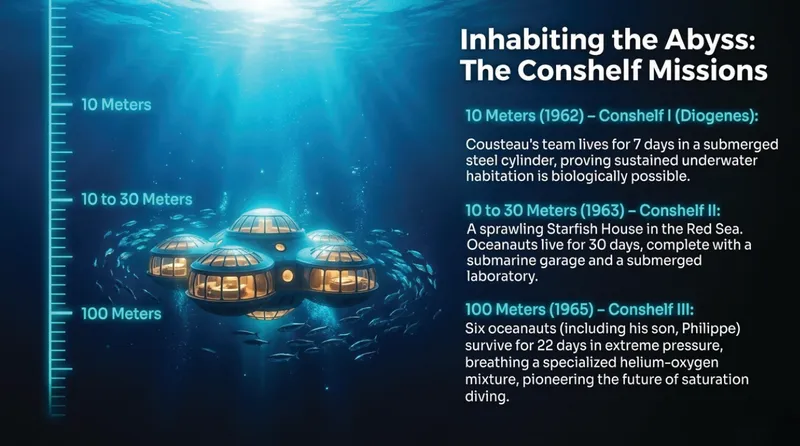
## Inhabiting the Abyss: The Conshelf Missions
Exploration from a boat wasn't enough for Cousteau. He wanted humans to actually *live* underwater - and he made it happen through the legendary Conshelf missions.
* **Conshelf I (1962, 10 meters)** - A team lived for 7 days inside a submerged steel cylinder called *Diogenes*, proving that sustained underwater habitation was biologically possible.
* **Conshelf II (1963, 10-30 meters)** - A sprawling *Starfish House* was deployed in the Red Sea. Oceanauts lived there for a full 30 days, complete with a submarine garage and a working submerged laboratory.
* **Conshelf III (1965, 100 meters)** - Six oceanauts, including Cousteau's own son Philippe, survived 22 days at extreme pressure while breathing a specialized helium-oxygen mixture, pioneering the future of saturation diving.
These missions weren't just scientific achievements - they were a bold statement that humanity's relationship with the ocean could be far more intimate than anyone had imagined.
## The Master Storyteller
Science without an audience changes nothing. Cousteau understood this better than almost anyone of his era.
Before him, the ocean was widely perceived as a dark, silent, and terrifying void. Through more than 120 films, he completely reframed it - showing the sea as a vibrant, colorful, deeply interconnected ecosystem full of personality and wonder.
His 1956 film *The Silent World*, shot over two years across the Mediterranean, Red Sea, and Indian Ocean, became a cultural landmark. It won the Palme d'Or at the Cannes Film Festival and an Academy Award for Best Documentary Feature - proving that the ocean could captivate mainstream global audiences on the grandest possible stage.
> *Before Cousteau, you couldn't love what you couldn't see. He made the invisible visible.*
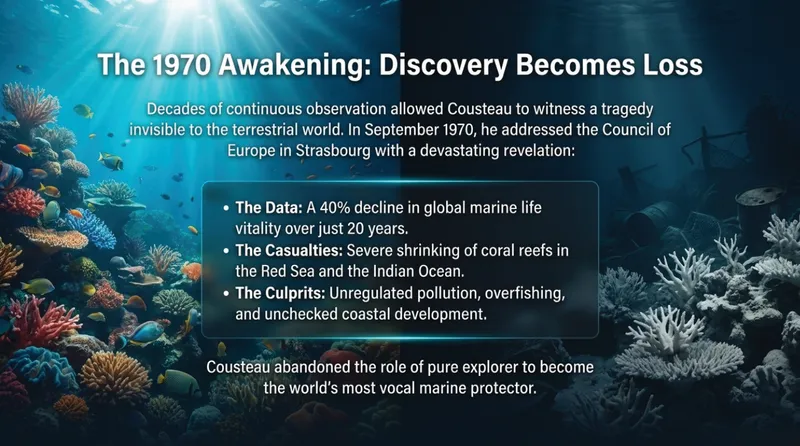
## The 1970 Awakening: Discovery Becomes Loss
For all the wonder Cousteau brought to the world, his decades of continuous observation also forced him to witness something devastating - and invisible to almost everyone else.
In September 1970, he stood before the Council of Europe in Strasbourg and delivered a revelation that shocked the room:
* **The Data:** A 40% decline in global marine life vitality over just 20 years
* **The Casualties:** Severe shrinking of coral reefs in the Red Sea and the Indian Ocean
* **The Culprits:** Unregulated pollution, overfishing, and unchecked coastal development
It was a turning point. Cousteau abandoned the role of pure explorer and became the world's most vocal marine protector. His films now carried an urgent message alongside their beauty: we are losing this.
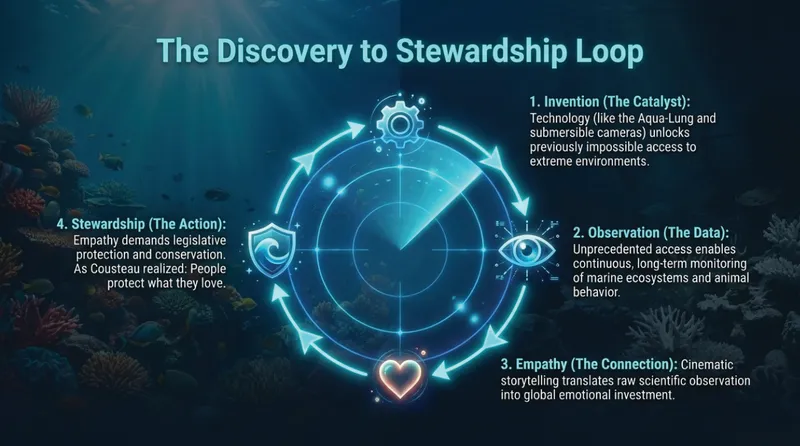
## The Discovery to Stewardship Loop
Looking back at Cousteau's life, a clear pattern emerges - one that he himself seemed to consciously follow and eventually articulate:
**Invention → Observation → Empathy → Stewardship**
1. **Invention (The Catalyst):** Technology like the Aqua-Lung and submersible cameras unlocked access to previously unreachable environments.
2. **Observation (The Data):** That access enabled long-term, continuous monitoring of marine ecosystems and animal behavior.
3. **Empathy (The Connection):** Cinematic storytelling translated raw scientific data into global emotional investment.
4. **Stewardship (The Action):** Empathy demands protection. As Cousteau realized - *people protect what they love.*
This loop is his greatest intellectual contribution. It's a model that environmental movements, conservation organizations, and ocean advocates still follow today.
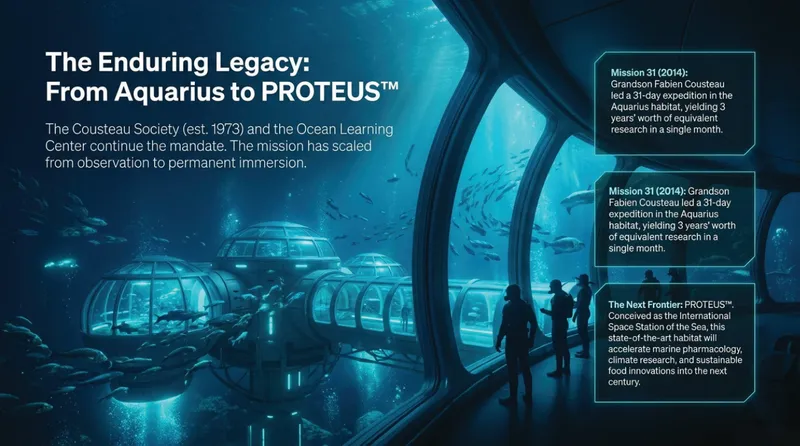
## The Enduring Legacy: From Aquarius to PROTEUS™
Cousteau passed away on June 25, 1997 - but the mission he started lives on, bigger than ever.
The Cousteau Society, established in 1973, and the Ocean Learning Center continue his mandate. His grandson Fabien Cousteau carried the torch dramatically in 2014 with **Mission 31** - a 31-day expedition living in the underwater Aquarius habitat that yielded the equivalent of three years' worth of scientific research in a single month.
And the next frontier is already being built. **PROTEUS™**, conceived as the International Space Station of the sea, will accelerate research in marine pharmacology, climate science, and sustainable food innovation into the next century. The mission has scaled from observation to permanent immersion.
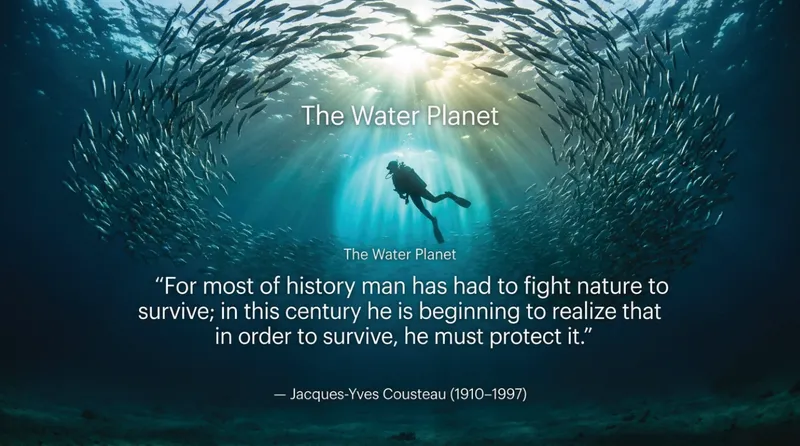
## The Water Planet
Jacques-Yves Cousteau lived 87 years, and spent the majority of them fighting for a world most people had never seen. He left us with technology we use every day, images that changed how we see our planet, and data that made the threat to our oceans undeniable.
But perhaps his most enduring gift was simpler than all of that. He gave us the capacity to love something we couldn't reach.
> *"For most of history man has had to fight nature to survive; in this century he is beginning to realize that in order to survive, he must protect it."* - Jacques-Yves Cousteau (1910-1997)
That sentence is as true today as the day he said it. Maybe more so.
---
*Published on June 11, 2026*
*Author: Yevgen “Scorp” Sukharenko*
*Source: [Red Sea Creatures](https://redseacreatures.com)*
---
---
title: Dolphins' Deeply Human Social Memory: How Females Protect Themselves
description: Imagine a world where your safety depends on remembering every past interaction with others. Female bottlenose dolphins navigate just such a complex social landscape, using sophisticated long-term memory to track the behavioral history of males and protect themselves in a way we're only beginning to understand.
author: Yevgen “Scorp” Sukharenko
published: 2026-06-10T13:00:00.000Z
updated: 2026-08-08T13:20:22.106Z
tags: Creatures
url: https://redseacreatures.com/blog/2026/06/10/dolphins-deeply-human-social-memory-how-females-protect-themselves
---
# Dolphins' Deeply Human Social Memory: How Females Protect Themselves
Imagine walking into a crowded room and instantly knowing - just by someone's voice - whether they're safe to be around. Not because of anything they're doing right now, but because of everything you remember about them from years past. That kind of social intelligence feels deeply human. As it turns out, it's also deeply dolphin.
Recent research[\[1\]](#footnote-1) published in the *Proceedings of the National Academy of Sciences* has revealed something remarkable: female bottlenose dolphins actively track the behavioral history of the males around them - and use that knowledge to protect themselves. They aren't simply reacting to their environment. They're navigating it, informed by years of accumulated social memory. What we're looking at isn't just animal behavior. It's a window into a form of intelligence we're only beginning to understand.
A Social Network Beneath the Surface
Bottlenose dolphins live in complex, fluid social groups where relationships shift constantly - alliances form, rivalries develop, and individuals come and go. To navigate all of this, dolphins need to know who's who. And more than that, they need to remember what each individual has done.
This is exactly what the research confirms. Female dolphins don't just recognize the individuals around them - they carry a detailed social record of each one's past behavior. That record shapes every interaction, every choice, every evasion. The ocean, for a female dolphin, is not an anonymous expanse. It is a landscape of known individuals and remembered histories.
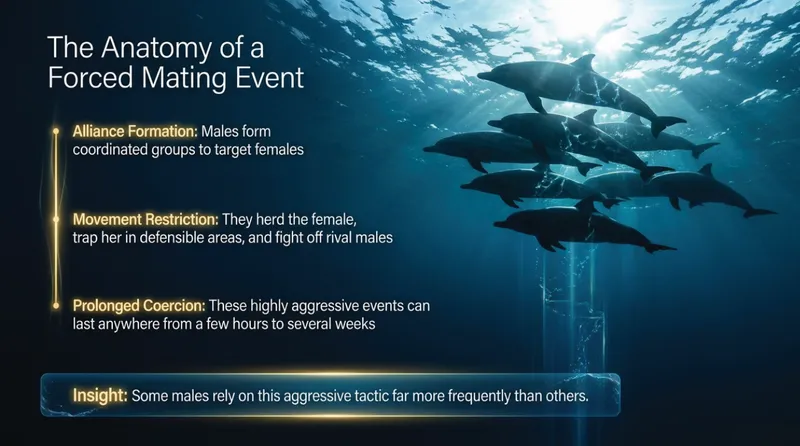
### When Mating Turns Dangerous
To understand why social memory matters so much, we need to look at what female dolphins are actually navigating during mating season. It isn't gentle courtship. Male bottlenose dolphins form coordinated alliances specifically designed to target females - and the process can be grueling.
Here's how it works:
* **Alliance formation:** Groups of males work together to single out and pursue a female.
* **Movement restriction:** They herd her, trap her in defensible areas, and fight off competing males to keep her there.
* **Prolonged coercion:** These events aren't quick. They can last anywhere from a few hours to several weeks.
The critical insight here is that not all males behave the same way. Some are far more aggressive than others - and the females notice. Remembering which males rely on this tactic most heavily isn't just useful. It's essential.
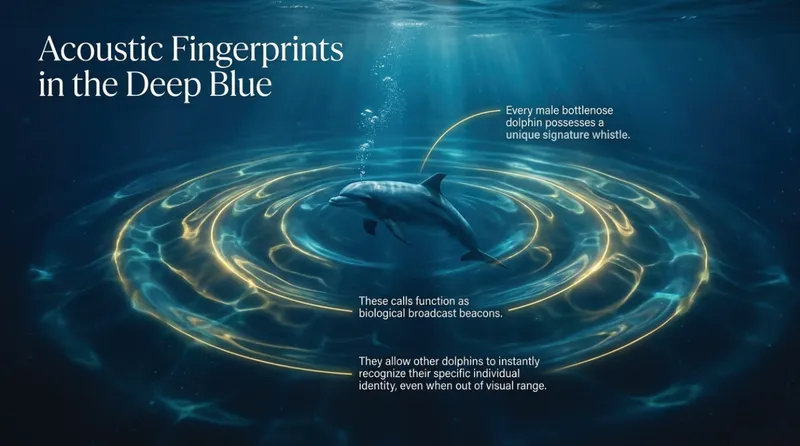
### Every Dolphin Has a Name
So how do females actually identify who they're dealing with - especially at a distance, or in murky water where visual recognition fails? The answer lies in sound.
Every bottlenose dolphin develops a unique vocalization known as a **signature whistle**. Think of it as a biological name tag - a call that broadcasts individual identity. These whistles function as acoustic beacons: constant, recognizable, and tied to a specific individual.
What makes this especially remarkable is that recognition works even without visual contact. A female can hear a male's whistle from a distance and know exactly who it belongs to - and more importantly, what kind of history she has with him. The whistle isn't just an identifier. It's a trigger for everything she remembers about that individual.
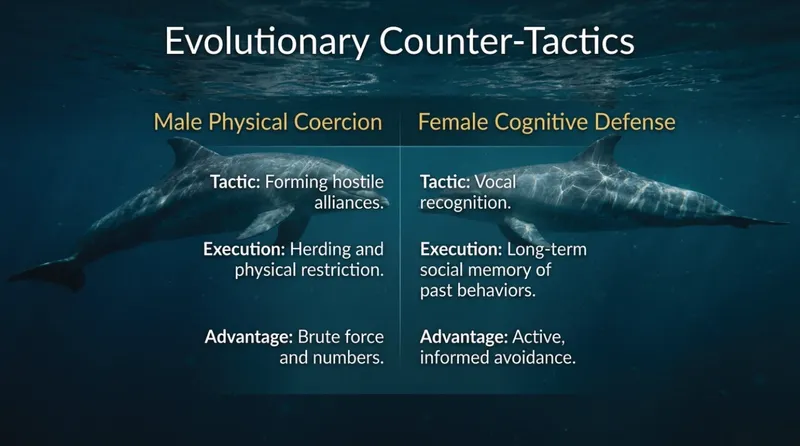
### Brute Force vs. Long Memory
This research reveals something beautiful about evolution: physical strength isn't the only card on the table. Males and females have developed entirely different - and competing - strategies.
**Male Strategy**
**Female Strategy**
**Tactic**
Forming hostile alliances
Vocal recognition
**Execution**
Herding and physical restriction
Long-term memory of past behaviors
**Advantage**
Brute force and numbers
Active, informed avoidance
Males use coordination and physical dominance. Females use intelligence and memory. It's a cognitive arms race - and it plays out silently, beneath the surface, every mating season.
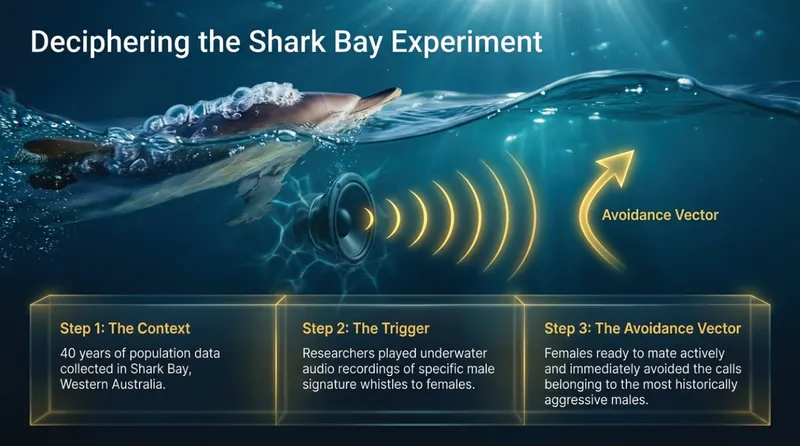
Forty Years of Proof
The research that confirmed all of this didn't happen overnight. It was built on four decades of continuous observation at Shark Bay, Western Australia - one of the longest-running wildlife studies in the world.
The experiment itself was elegantly simple:
* **Step 1 - The Context:** Researchers drew on 40 years of population data to identify which males had a history of high aggression.
* **Step 2 - The Trigger:** Underwater speakers played the signature whistles of specific males to females who were ready to mate.
* **Step 3 - The Result:** Females immediately and clearly avoided the calls of the most historically aggressive males.
The females weren't responding to something happening right now. They were responding to something they remembered. That distinction changes everything. It means their avoidance isn't instinct - it's a calculated decision grounded in years of social experience.
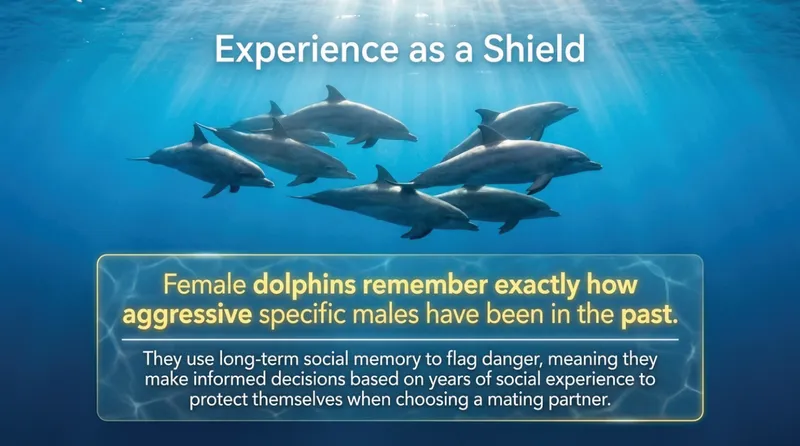
### Memory as a Survival Tool
What this study ultimately shows is that for female dolphins, experience is armor.
> **Female dolphins remember exactly how aggressive specific males have been in the past.** They use long-term social memory to flag danger - making informed decisions based on years of social experience to protect themselves when choosing a mating partner.
Being herded and restricted by an aggressive male alliance comes at a real physical cost. Energy is burned. Stress accumulates. The risks are tangible. By identifying and avoiding the most dangerous individuals before an encounter even begins, females preserve their own wellbeing and make smarter reproductive choices.
Social memory, in this context, isn't just impressive. It's life-saving.

### What Else Are They Remembering?
This discovery pushes us to ask a bigger question: if dolphins can track individual behavioral histories across decades, build cognitive profiles of the animals around them, and use that information to make complex decisions - what else is happening beneath the surface that we haven't found yet?
> *"Nature is full of survival intelligence we're only just beginning to understand, and it is wonderful that we are able to do so."*
We tend to think of intelligence as something we hold a monopoly on. Research like this gently corrects that assumption. The ocean is full of minds - minds that remember, calculate, and adapt. We're only now developing the tools and patience to truly listen.
And the answers, when we find them, may reshape everything we thought we knew about intelligence in the natural world.
---
*Published on June 10, 2026*
*Author: Yevgen “Scorp” Sukharenko*
*Source: [Red Sea Creatures](https://redseacreatures.com)*
---
---
title: Sea Turtle Week: Why Earth's Ancient Mariners Need Our Help Now
description: Every year from June 8-16, Sea Turtle Week calls on us to celebrate and act on behalf of these extraordinary ancient mariners. Having outlasted dinosaurs and ice ages, all seven species now face their greatest test, urgently needing our active protection from modern threats.
author: Yevgen “Scorp” Sukharenko
published: 2026-06-08T20:45:00.000Z
updated: 2026-06-08T20:50:25.860Z
tags: Conservation
url: https://redseacreatures.com/blog/2026/06/08/sea-turtle-week-why-earths-ancient-mariners-need-our-help-now
---
# Sea Turtle Week: Why Earth's Ancient Mariners Need Our Help Now
Every year, for nine days between World Ocean Day and World Sea Turtle Day, something remarkable happens across the globe: millions of people stop, look beneath the surface of the ocean, and remember who was here long before us. It's Sea Turtle Week - a time to celebrate, learn, and act on behalf of some of the most extraordinary animals that have ever lived on this planet. Here at Red Sea Creatures, we couldn't let this week pass without sharing why these ancient mariners matter so deeply - especially to those of us lucky enough to share the water with them.
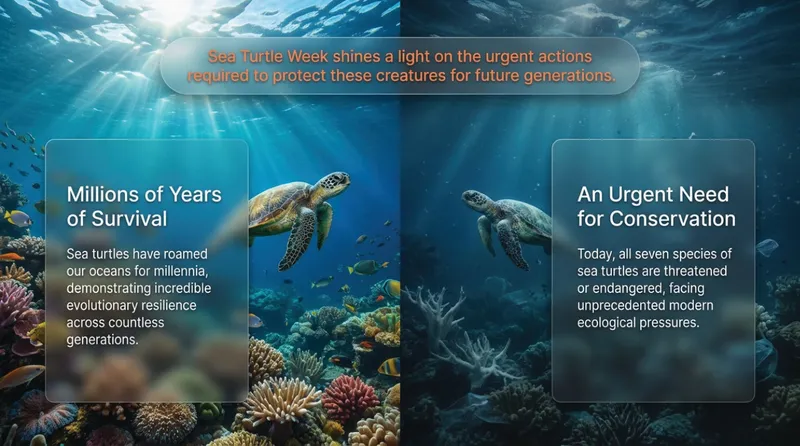
## Survivors of Deep Time, Now Facing Their Greatest Test
Sea turtles have been gliding through the world's oceans for an almost incomprehensible stretch of time - outlasting dinosaurs, ice ages, and mass extinctions. That track record of evolutionary resilience is nothing short of breathtaking. But today, the story has taken a troubling turn. All seven species of sea turtle are now classified as either threatened or endangered, facing a scale of ecological pressure unlike anything in their long history. Plastic in the water column, warming beaches, coastal development, fishing gear - the modern ocean is a minefield for creatures whose biology evolved over millions of years of relative stability. Sea Turtle Week exists precisely to shine a light on the urgency of the moment: these animals need active protection, and they need it now.
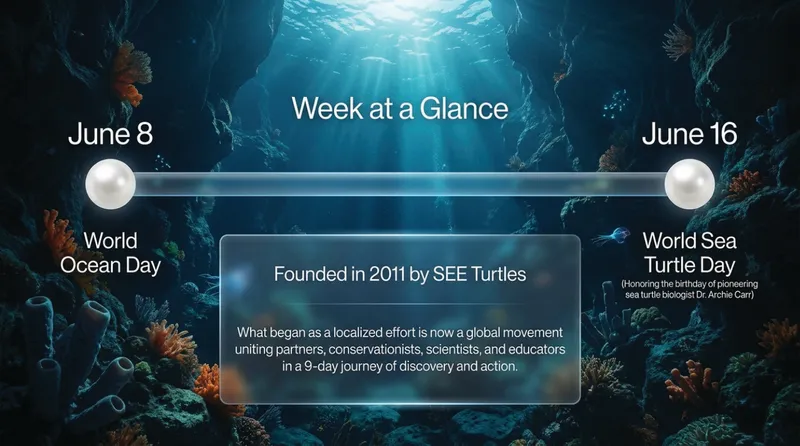
## Nine Days, One Global Mission
Sea Turtle Week runs from **June 8 - World Ocean Day** - through **June 16 - World Sea Turtle Day**, which honors the birthday of pioneering sea turtle biologist Dr. Archie Carr. Founded in 2011 by the organization SEE Turtles, what began as a localized awareness effort has grown into a worldwide movement uniting conservation partners, marine scientists, educators, and ocean enthusiasts in a nine-day journey of discovery and action. The timing is intentional: bookended by two major ocean celebrations, the week creates a powerful window to connect the fate of sea turtles with the broader health of our oceans.
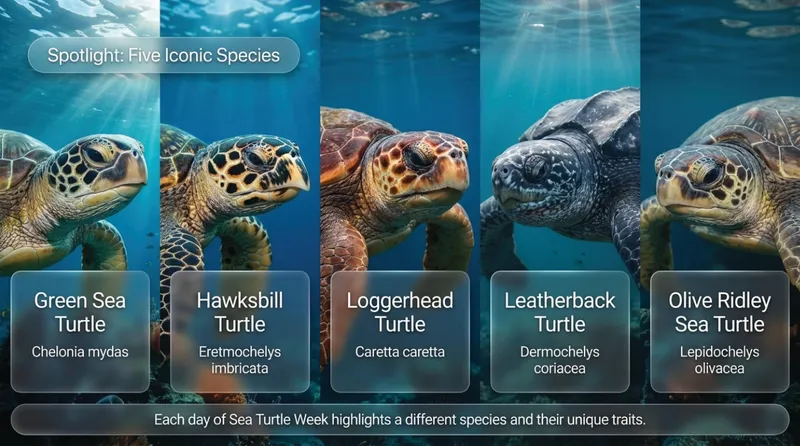
## Five Species in the Spotlight
One of the most beloved traditions of Sea Turtle Week is the daily species spotlight - each day dedicated to celebrating the unique biology and story of a different turtle. This year's featured five include some of the most iconic reptiles on Earth:
* **Green Sea Turtle** *(Chelonia mydas)* - the gentle grazer of seagrass meadows, a familiar face on Red Sea reefs
* **Hawksbill Turtle** *(Eretmochelys imbricata)* - with its distinctive narrow beak, an expert at extracting sponges from coral crevices
* **Loggerhead Turtle** *(Caretta caretta)* - named for its powerful, oversized head built for crushing hard-shelled prey
* **Leatherback Turtle** *(Dermochelys coriacea)* - the giant of the family, the only species without a hard shell, diving deeper than any other reptile
* **Olive Ridley Sea Turtle** *(Lepidochelys olivacea)* - known for the spectacular *arribada*, mass synchronized nesting events on certain beaches
Each species tells a different chapter of the same story: extraordinary adaptation, and extraordinary vulnerability.
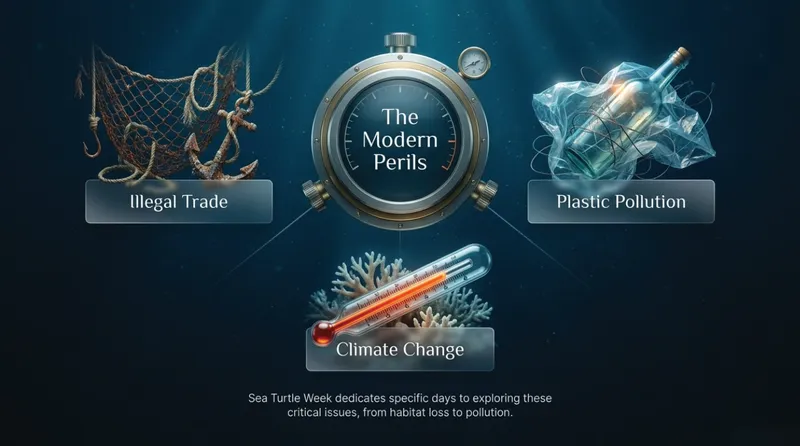
## The Modern Perils They Face
Understanding why sea turtles are in trouble means confronting three converging crises head-on. **Illegal trade** continues to threaten populations through poaching of eggs, shells, and meat - a black market that legal protections have not fully suppressed. **Plastic pollution** is perhaps the most visible crisis: sea turtles mistake plastic bags for jellyfish, ingest fishing line, and become entangled in debris at every stage of their lives. And then there is **climate change** - warming sand temperatures skew hatchling sex ratios (warmer nests produce more females), rising sea levels erode nesting beaches, and coral bleaching destroys the reef ecosystems that many species depend on for food and shelter. Sea Turtle Week dedicates specific days to each of these threats, turning awareness into understanding, and understanding into action.

## How You Can Make a Difference This Week
The good news: there is no shortage of ways to get involved, wherever you are in the world. If you're on the coast - or better yet, underwater like many of us in the Red Sea - you can join local beach cleanup events and community conservation efforts firsthand. At home, organizations worldwide are running virtual activities, photo contests, and art challenges designed for participants of all ages. And online, the simplest action carries real weight: share research, amplify conservation voices, and spread resources using **#SeaTurtleWeek**. The global conversation grows louder every year - and every voice in it matters.
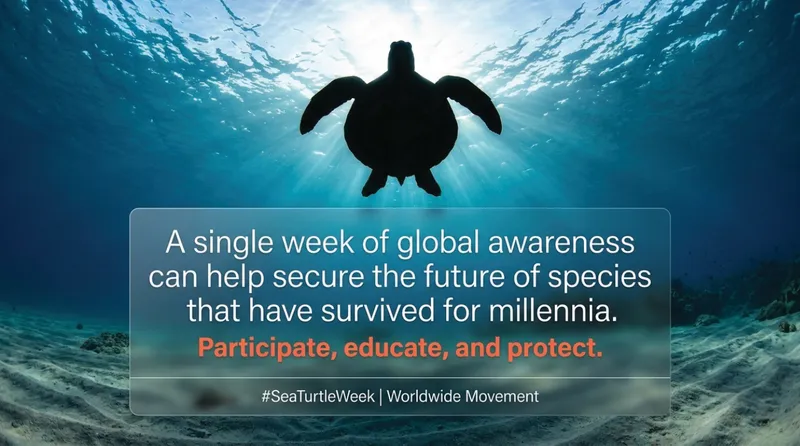
## One Week. A Future Worth Fighting For.
Sea turtles have survived everything this planet has thrown at them for millions of years. What they cannot survive alone is us - at least not the version of us that pollutes, overfishes, and ignores the warning signs. But Sea Turtle Week is proof that another version of us exists: one that shows up, pays attention, and chooses to act. A single week of focused global awareness can genuinely shift the trajectory for species that have earned their place in these oceans more than any other creature alive. So this week - participate, educate, and protect. 🐢
> *Follow along with #SeaTurtleWeek and share your own sea turtle encounters from the Red Sea in the comments below.*
---
*Published on June 8, 2026*
*Author: Yevgen “Scorp” Sukharenko*
*Source: [Red Sea Creatures](https://redseacreatures.com)*
---
---
title: World Oceans Day 2026: Reimagining Our Life-Support Ocean for a Thriving Future
description: The ocean is our planet's primary life-support system, generating over 70% of the oxygen we breathe and buffering our climate from excess heat and carbon. This World Oceans Day marks a crucial transition from passive inheritors to active guardians, urging us to reimagine our relationship with the sea to protect it from escalating threats like warming and acidification.
author: Yevgen “Scorp” Sukharenko
published: 2026-06-08T13:00:00.000Z
updated: 2026-06-09T13:52:18.918Z
tags: Conservation
url: https://redseacreatures.com/blog/2026/06/08/world-oceans-day-2026-reimagining-our-life-support-ocean-for-a-thriving-future
---
# World Oceans Day 2026: Reimagining Our Life-Support Ocean for a Thriving Future
The ocean is not just a body of water separating continents; it is our primary life-support system. On World Oceans Day 2026, we transition from passive inheritors to active guardians of the deep.
## Happy World Oceans Day!
Happy World Oceans Day to our global community of ocean lovers, divers, and marine advocates! This year, our focus goes beyond celebrating the breathtaking beauty of the underwater world. It is a collective call to action to close the distance between humanity and the sea. To protect our future, we must *reimagine* our relationship with the ocean - moving past old assumptions and stepping into a new era of active stewardship.
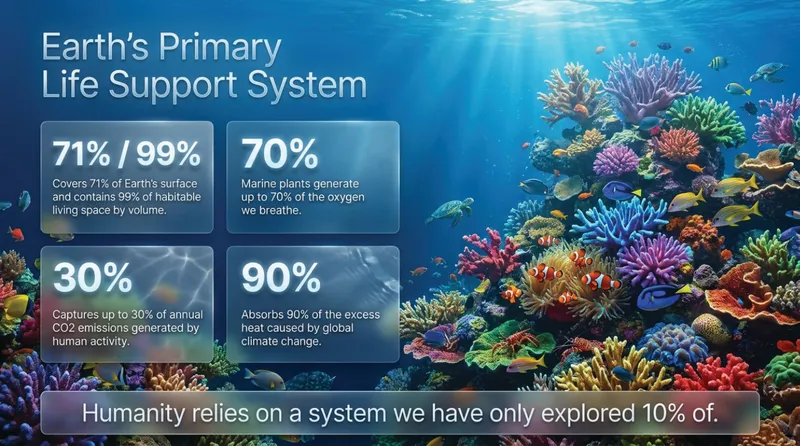
## The Core System That Keeps Us Alive
To understand why ocean conservation is non-negotiable, we must look at the numbers. The ocean covers 71% of our planet's surface and represents a staggering 99% of its living space by volume. Marine plants and phytoplankton generate over 70% of the oxygen we breathe, meaning every second breath you take comes from the sea. Furthermore, the ocean acts as our ultimate climate buffer, absorbing 30% of annual carbon dioxide emissions and soaking up 90% of the excess heat generated by climate change. Despite this absolute dependence, humanity has explored only about 10% of this vital system.
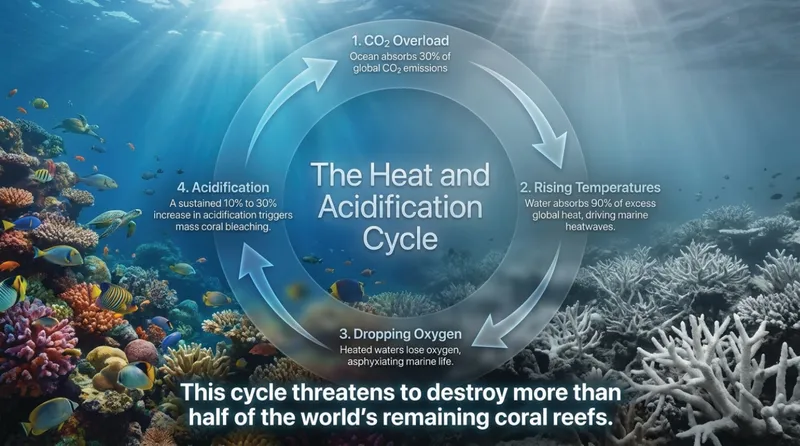
## The Toxic Cycle: Heat, Deoxygenation, and Acidification
Our massive greenhouse gas output is pushing marine chemistry to a breaking point. As the ocean absorbs excess CO2, it triggers a destructive chain reaction. Rising water temperatures lead to prolonged marine heatwaves. Warm water holds less dissolved gas, causing oxygen levels to plummet and suffocating marine life. Simultaneously, the chemical absorption of carbon has driven a 10% to 30% increase in ocean acidity. This rapid acidification strips corals and shellfish of the compounds they need to build their skeletons, resulting in the catastrophic, widespread coral bleaching events we witness globally today.
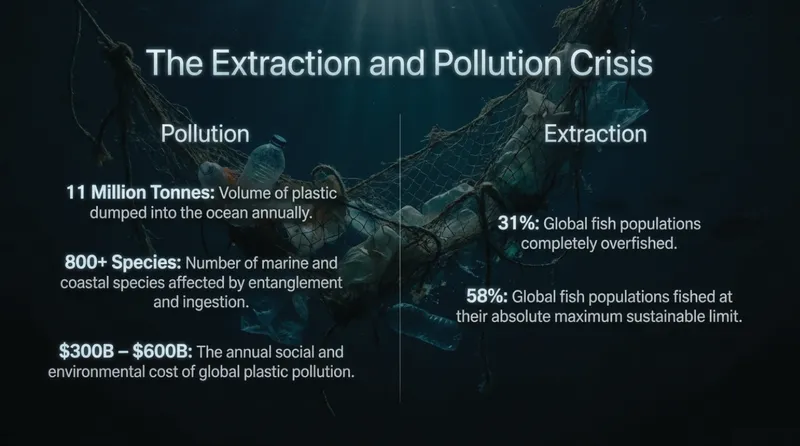
## The Twin Threats: Pollution and Over-Extraction
The crises facing our oceans are driven by what we throw in and what we force out. Every single year, an estimated 11 million tons of plastic waste flood into the marine environment, impacting over 800 species through entanglement and ingestion. The economic and social toll of this plastic pollution is valued at a staggering $300 to $600 billion annually. At the same time, commercial fishing practices have pushed marine populations to the brink. Currently, 31% of global fish stocks are entirely depleted due to overfishing, and another 58% are fished at their absolute maximum sustainable limit. We are simply taking more than the ocean can replenish.

## The Red Sea: A Global Beacon of Coral Resilience
While coral reefs worldwide are struggling to survive, the Red Sea stands out as a magnificent bastion of hope. Our local reefs possess a unique genetic resilience, demonstrating an extraordinary ability to withstand rising temperatures that prove fatal elsewhere. To safeguard this invaluable ecosystem, vital initiatives are expanding. Organizations like [HEPCA](https://www.hepca.org/) maintain over 1,400 mooring buoys to prevent destructive anchor damage. Under the Egyptian Red Sea Initiative (ERSI), conservation strategies are being scaled up, alongside the strategic creation of alternative dive sites and artificial reefs to alleviate tourist pressure on fragile, natural habitats.
## The Funding Gap in Ocean Climate Solutions
Nature-based solutions - such as restoring coral reefs, mangroves, and seagrass meadows - hold the potential to provide at least 30% of the entire global climate solution. Yet, a severe financial paradox exists: only a meager 2% of international climate finance is currently directed toward ocean conservation. We are chronically underfunding the exact system that possesses the greatest capacity to stabilize our biosphere.

## A New Paradigm: Shifting from Status Quo to Ocean Guardians
Protecting the ocean requires a fundamental shift in how human society operates. We must transition away from the outdated status quo and embrace a sustainable future:
* **Perception:** Stop viewing the ocean as a vast, separate entity. We must recognize that it flows directly through us via the air we breathe and the resources we consume.
* **Our Role:** Move away from being passive inheritors of natural wealth to becoming highly active, responsible guardians.
* **Governance:** Break down isolated national silos in favor of unified, collaborative global ocean governance.
* **Economics:** Stop treating marine environments as unpriced, exploitable resources. Instead, we must fully account for their invaluable worth within the global economic balance sheet.
Global Momentum: Policy, Economics, and Corporate Stewardship
The tide is beginning to turn as structural changes gain momentum on a global scale. The historic BBNJ Agreement (Biodiversity Beyond National Jurisdiction) is pushing toward ratification, establishing a legal framework to create massive marine protected areas in the high seas - the open ocean outside national boundaries. Financially, major milestones like the Bali Summit have seen investors shifting billions toward a sustainable "blue economy." Furthermore, corporate leaders, particularly in the offshore renewable energy sector, are actively embedding biodiversity monitoring and ecological protection directly into their marine infrastructure projects.
## Rethinking Our Seafood: Mass Exploitation vs. Sustainable Selection
Our choice of seafood dictates the fate of marine biodiversity. Industrial mass fishing acts as a destructive, wide funnel - dragging massive commercial nets through the water that catch everything indiscriminately, resulting in high levels of accidental "bycatch" where sharks, turtles, and marine mammals perish. In stark contrast, sustainable methods like "pole-and-line" fishing act as a precise, narrow funnel. By catching one fish at a time, fishermen eliminate bycatch and prevent structural damage to the seafloor, proving that we can harvest from the sea without destroying the ecosystem.
###
## Your Personal Action Matrix for the Ocean
True conservation starts with individual daily habits. You can become an active Ocean Guardian by focusing on four key lifestyle shifts:
1. **Educate Yourself:** Watch documentaries and read scientific insights to understand marine habitats. Knowledge is always the first step toward passionate defense.
2. **Participate in Cleanups:** Remember that the cleanliness of your local streets dictates the health of the sea. Plastic trash swept into storm drains invariably finds its way to the ocean.
3. **Eat Responsibly:** Be fiercely intentional about your seafood choices. Only purchase fish that is verified as caught via sustainable, low-impact methods like pole-and-line.
4. **Eliminate Single-Use Plastics:** Cut out disposable plastics entirely. Simple swaps, like switching from a plastic toothbrush to a bamboo one, collectively prevent millions of tons of waste from suffocating marine life.
## The Ocean is the Solution
The ocean should no longer be viewed merely as a victim of human negligence; it is our most powerful solution. Protecting marine ecosystems is the single most effective lever we have to stabilize our climate and secure global economic longevity. As UN Secretary - General António Guterres profoundly stated: *"Humanity can count on the ocean, but can the ocean count on us? Today and every day, let us put the ocean first."* Here at **[Red Sea Creatures](https://redseacreatures.com)**, we remain dedicated to exploring, loving, and actively preserving the underwater marvels of the Red Sea. Let us stand together to ensure our blue planet thrives for generations to come.
---
*Published on June 8, 2026*
*Author: Yevgen “Scorp” Sukharenko*
*Source: [Red Sea Creatures](https://redseacreatures.com)*
---
---
title: The Biological Chimera: Decoding the Evolutionary Plagiarism of the Seahorse
description: Beyond their whimsical charm, seahorses are nature's most audacious biological chimeras, defying traditional definitions of fish. They are living mosaics of evolutionary innovations, "plagiarizing" traits from across the animal kingdom, most notably with males undergoing a radical hormonal alchemy to carry and nurture their young in a unique brood pouch. This reveals profound rule-breaking and efficiency in nature's designs.
author: Yevgen “Scorp” Sukharenko
published: 2026-06-07T14:30:00.000Z
updated: 2026-06-07T14:30:55.105Z
tags: Creatures
url: https://redseacreatures.com/blog/2026/06/07/the-biological-chimera-decoding-the-evolutionary-plagiarism-of-the-seahorse
---
# The Biological Chimera: Decoding the Evolutionary Plagiarism of the Seahorse
We are prone to viewing the seahorse through a lens of whimsical charm - the bobbing, upright "horse of the sea" that populates children’s fables and quiet corners of public aquaria. Yet, if we strip away the fairytale aesthetic, we are left with a creature that is perhaps nature’s most audacious biological chimera. Recent genetic and anatomical excavations reveal that the seahorse is less a "fish" in the traditional sense and more a living mosaic, a collection of evolutionary innovations "plagiarized" from across the animal kingdom and rewired into a single, improbable frame.
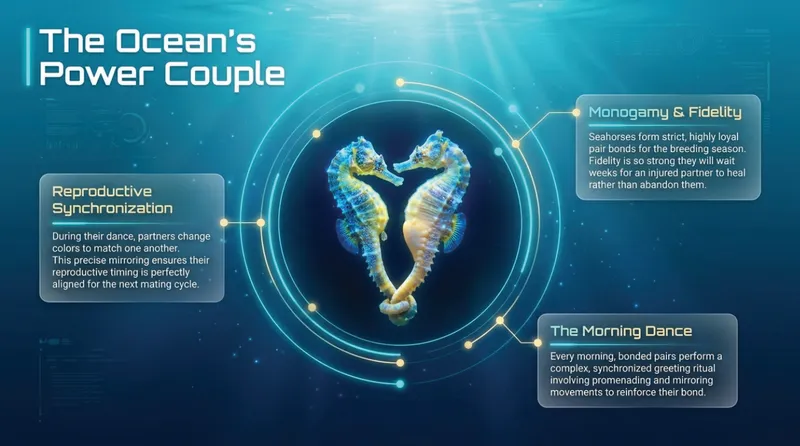
This is not merely a story of oddity; it is a masterclass in biological rule-breaking. As we decode their DNA, we find that seahorses have reached into the toolkits of mammals, reptiles, and insects to solve the problems of survival. They have flipped the script on parenthood, turned labor into a conscious performance, and abandoned the most basic vertebrate organs in favor of high-tech weaponry.
By looking closer at these "peculiar" creatures, we find a revelation of evolutionary efficiency. Nature, it seems, rarely creates from whole cloth when it can simply repurpose a brilliant design. Here are the most counter-intuitive secrets of the seahorse, where the weirdness is merely a symptom of profound innovation.

### The Alchemist’s Pouch: "Motherhood" Reimagined
In the hierarchy of the animal kingdom, seahorses are the undisputed winners of the "Best Dad" award. While many species provide parental care, seahorse males have undergone a radical hormonal alchemy. In most vertebrates, the script of pregnancy is written in estrogen and progesterone. In seahorses, however, "motherhood" is powered by androgens - male hormones like testosterone.
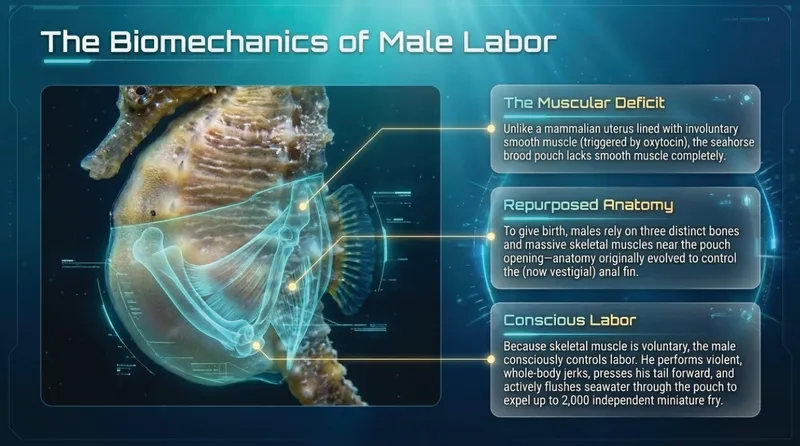
Researchers discovered that exposing female seahorses to testosterone could actually trigger the development of a brood pouch. This pouch is not a repurposed reproductive organ but a highly modified patch of the father's skin, rewired to function with the complexity of a mammalian placenta. It provides oxygen, nutrients, and waste removal for the developing fry. To bridge the gap even further, seahorse fathers utilize *isotocin -* the fish version of the "love hormone" oxytocin - to regulate their unique pregnancy.
Evolutionary geneticist Bill Cresko describes this genetic repurposing as a patchwork masterpiece:
> The evolution of the brooding pouch was not cut from whole cloth *de novo* but was built like a quilt with different patches of genes and cells that function the same way in different animals.
By utilizing existing genetic networks rather than inventing new ones, evolution found the most efficient path to one of the sea's most successful reproductive strategies.
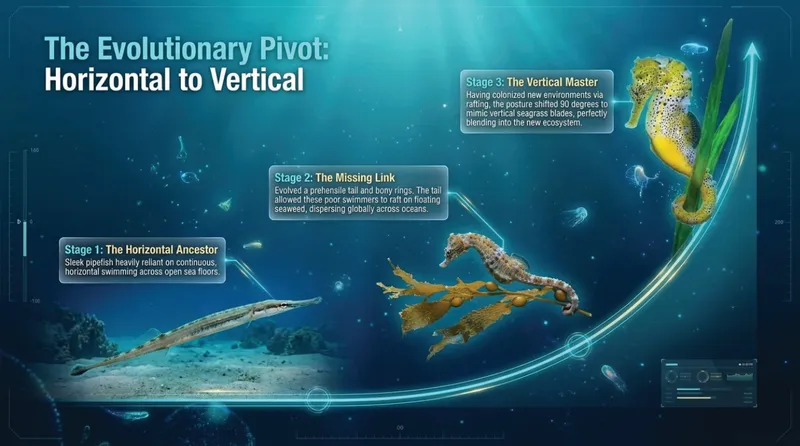
### Conscious Labor: Repurposing the Swimming Machine
For a human mother, labor is a grueling, involuntary process driven by smooth muscle contractions beyond her conscious control. The seahorse father has opted for a far more deliberate performance. His brood pouch contains surprisingly little smooth muscle; instead, he relies on skeletal muscles - the same "voluntary" muscles we use to flex a bicep or walk.
These muscles are anchored to three specialized bones near the pouch opening. In most fish, this skeletal architecture controls the anal fin. But because the seahorse’s anal fin is a minuscule, nearly useless appendage, evolution hijacked the entire system to create a mechanism for controlling the act of birth.
The result is a labor of "pressing," "jerking," and "gaping." By bending his body and contracting these skeletal muscles, the father consciously flushes seawater through the pouch and expels hundreds of babies in a flurry. There is a profound irony in this: a fish famously ridiculed as a "poor swimmer" has taken its swimming-related anatomy and turned it into the most sophisticated, consciously controlled labor room in the ocean.
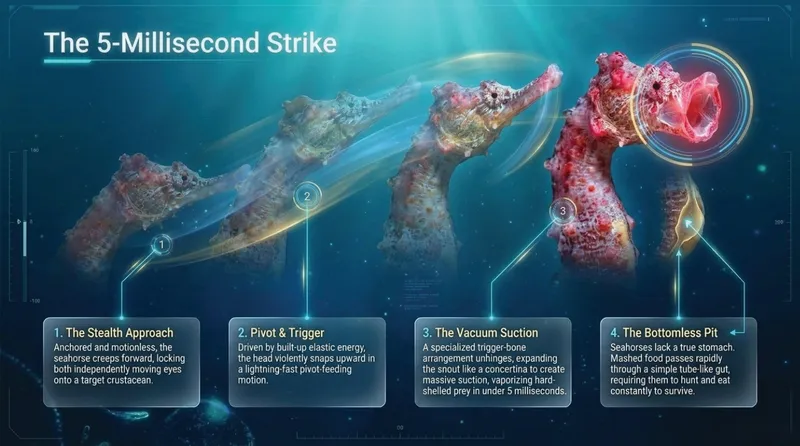
### The Stealth Predator’s High-Volume Conveyor Belt
If you were to design a perfect predator, you would include the seahorse's vacuum-like snout and its independent, 360-degree eyes. Yet, internally, the seahorse’s digestive system "leaves a lot of questions." In an astonishing evolutionary trade-off, these fish lack a true stomach.
The seahorse is an eating machine by necessity. Lacking teeth to chew, it uses its powerful snout to "liquidize" prey as it is sucked in at a speed that defies the eye. From there, the food enters a digestive tract that is essentially a simple, straight tube - a "conveyor belt" that never stops. This system is so startlingly inefficient that hard-shelled prey like shrimp have been observed emerging from the other end alive and simply swimming away.
To compensate for this low-tech gut, the seahorse must graze constantly. While adults are voracious, the true scale of this appetite is seen in newborn fry, which must consume up to 3,000 particles of plankton every 24 hours just to survive. It is a portrait of a specialist that has invested everything in the hunt and nothing in the storage, forced into a life of perpetual consumption.
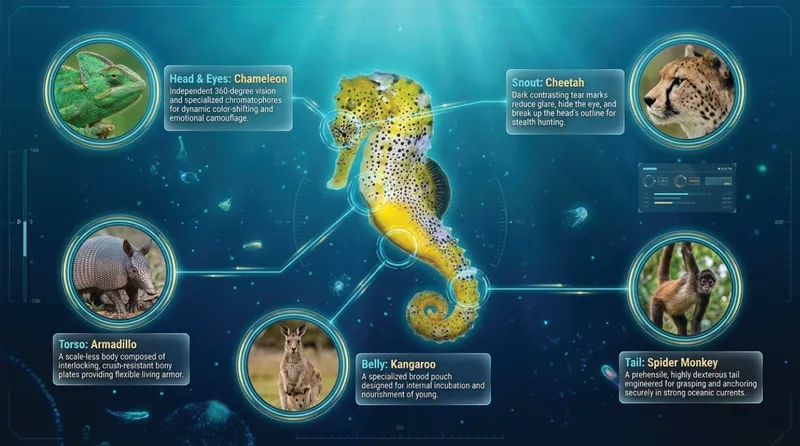
### A Mosaic of Parallels: The Art of Convergent Evolution
The seahorse is nature’s ultimate example of convergent evolution - the process where unrelated species develop identical solutions to the same environmental pressures. Its body is an echo of the entire animal kingdom:
* **Cheetahs:** Like the great cats of the savannah, certain seahorses, such as the Short Snouted Seahorse (*H. hippocampus*), possess dark facial patterns and eye stripes. These break up the outline of the head, hiding the eye from prey and potentially reducing glare in cluttered marine environments.
* **Monkeys:** Much like New World monkeys, seahorses possess a prehensile tail used as a "fifth limb." This allows them to anchor to seagrass so they aren't swept away by currents, freeing them to reach out and ambush passing prey.
* **Chameleons:** Seahorses share the chameleon’s ability to move each eye independently. This allows for a 360-degree scan for danger while simultaneously locking onto a meal.
* **Armadillos:** Lacking traditional scales, seahorses are encased in an exoskeleton of bony armor plating arranged in interlocking rings - a crush-resistant defense shared with armadillos and tortoises.
Crucially, the seahorse’s "true neck" - a rarity among fish - evolved in parallel with the prehensile tail. As the tail allowed for a vertical life among the seagrass, the seahorse needed a neck to eliminate the massive blind spots created by an upright posture. This allowed the head to face downward, completing the horse-like silhouette and providing the visual clarity needed for its high-precision lifestyle.
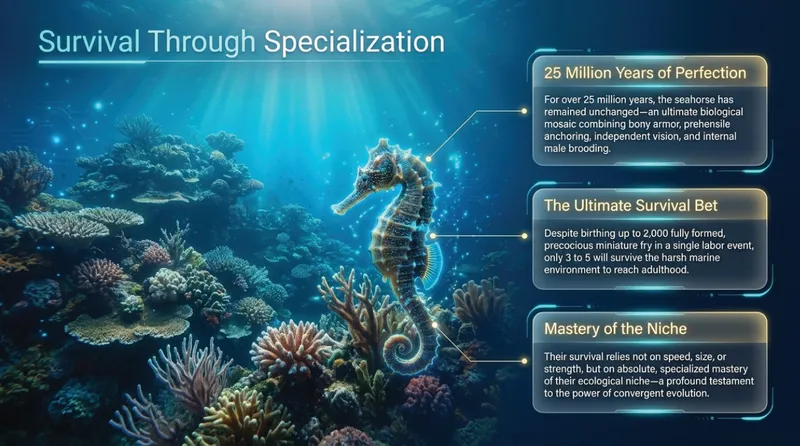
### The Dissection Table Discovery: The Hidden Giants of the Reef
Some of the most profound seahorse secrets remained hidden simply because they were too small to see. The Pygmy Seahorse - species like *H. bargibanti* and the world’s smallest, *H. satomiae -* remained invisible to science until 1969. Even then, the discovery was an accident; researcher Georges Bargibant only noticed the tiny creatures while examining a specimen of *Muricella* gorgonian coral on a laboratory dissection table.
These "invisible giants" of the Coral Triangle measure as little as 1.3 centimeters. They are masters of the "hidden life," possessing a single gill opening on the back of the head rather than the two found in their larger cousins. Their existence is a humbling reminder that the natural world is full of biological wonders waiting for us to look at the right "patch" of coral.
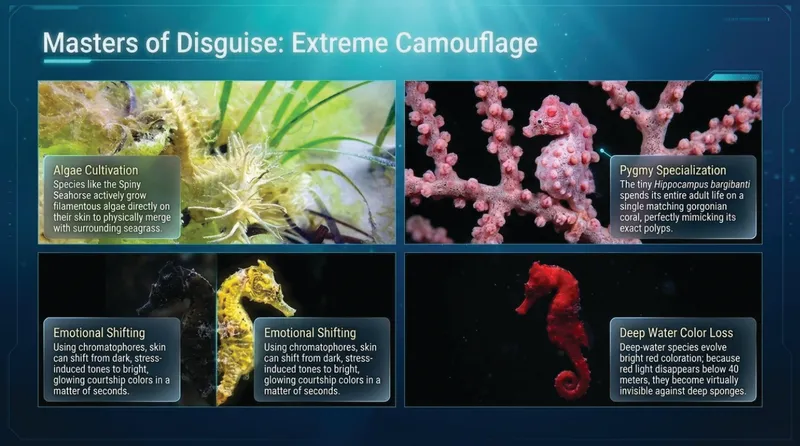
### Color as Conversation: The Mood-Driven Canvas
A common misconception is that a seahorse has a "natural" fixed color. In reality, their skin is a dynamic canvas controlled by chromatophores - pigment cells that expand and contract based on diet, lighting, and, most tellingly, emotion.
There is a stark difference between long-term camouflage and "emotional" color changes. Stress can turn an individual black in a heartbeat, while the "hormonal alchemy" of courtship can cause a male to "light up," turning from deep black to brilliant white or yellow. Take, for example, a famous *H. erectus* individual named "Jetlag" by his keepers; he was documented displaying a wide spectrum of colors, proving that for a seahorse, color is an expression of personality. Some species even grow harmless, filamentous algae on their skin to further blur the line between animal and environment.
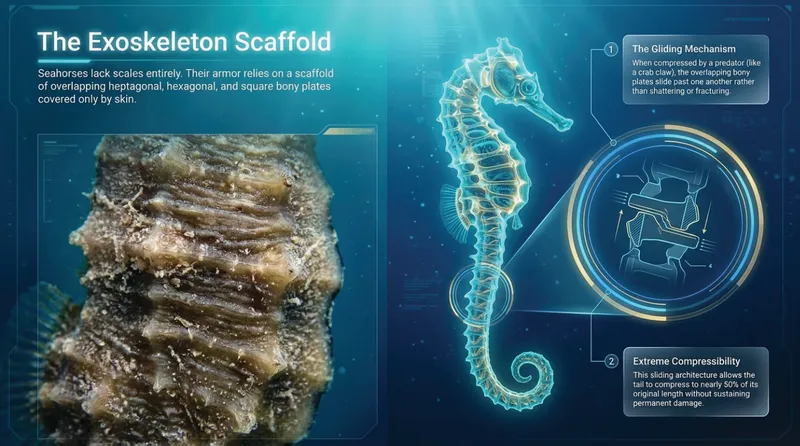
### The Future of the Mosaic
The seahorse is more than a curiosity; it is a living testament to the fact that evolution is opportunistic rather than linear. It is a creature that has "rewired" its very existence to thrive in the dense, predator-filled vegetation of the sea.
However, this biological masterpiece is under siege. The curio and traditional medicine trades claim over 150 million seahorses annually - a staggering figure that could lead to their extinction within the next 25 to 35 years. As we continue to decode the "quilt of genes" that makes these creatures possible, we must wonder how many other secrets of evolutionary rewiring are waiting in the depths, and whether we will have the chance to decode them before they vanish forever.
---
*Published on June 7, 2026*
*Author: Yevgen “Scorp” Sukharenko*
*Source: [Red Sea Creatures](https://redseacreatures.com)*
---
---
title: Red Sea Diving Rules 2026: New Egypt Regulations, Fees & Entry Changes
description: Egypt’s Red Sea diving scene is entering a new era in 2026, with stronger regulation, greater environmental focus, and a push for more transparent, professional dive operations. From Hurghada and Sharm El Sheikh to Dahab and Marsa Alam, divers can expect a better-protected reef experience as the industry shifts from volume-driven tourism to reef stewardship.
author: Yevgen “Scorp” Sukharenko
published: 2026-06-01T12:00:00.000Z
updated: 2026-06-01T12:09:19.615Z
tags: Marine News
url: https://redseacreatures.com/blog/2026/06/01/red-sea-diving-rules-2026-new-egypt-regulations-fees-entry-changes
---
# Red Sea Diving Rules 2026: New Egypt Regulations, Fees & Entry Changes
The Red Sea has long been a sanctuary for the global diving community, defined by its vibrant coral gardens and world-class blue water encounters. However, as we navigate through 2026, the experience of diving in Egypt - from the bustling hubs of Hurghada and Sharm El Sheikh to the laid-back shores of Dahab and Marsa Alam - is undergoing a profound modernization. While the reefs remain timeless, the framework surrounding them is shifting.
For the modern traveler, 2026 represents a pivotal moment. The region is moving away from a high-volume "service provider" model toward a more regulated, environmentally conscious industry where divers are viewed as environmental stakeholders. Whether you are returning for your tenth liveaboard or planning your first trip to the Deep South, understanding these five key takeaways is essential for navigating the Red Sea’s new era of ecological load management and price transparency.
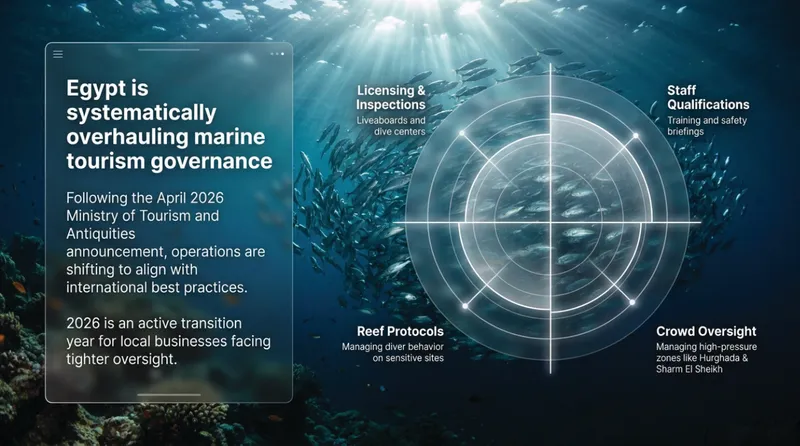
## The "Transition Year" Governance Overhaul
In April 2026, the Egyptian Ministry of Tourism and Antiquities, under Minister Sherif Fathy, announced a comprehensive modernization of the regulatory framework for all diving and marine tourism. The goal is to align Egypt’s oversight with international best practices, focusing on safety and environmental protection.
Industry specialists view 2026 as a "transition year" because, while the policy direction is firm, the ministry has not yet released a complete public list of new penalties or operational articles. This leaves operators in a state of adjustment, moving toward tighter governance and stricter reef-protection protocols.
**Analysis:** This shift toward tighter oversight is expected to improve the long-term quality of the dive experience. By treating dive centers as stakeholders rather than just vendors, the ministry is prioritizing the preservation of the very assets that draw tourists. For the diver, this means more rigorous safety briefings and a higher standard of professionalism across the board.
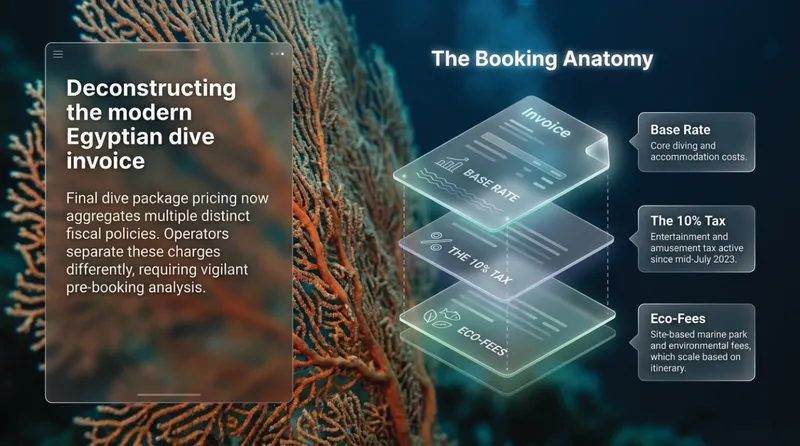
## The Hidden Math of the 10% “Entertainment Tax”
Since July 2023, a 10% “entertainment and amusement” tax has been applied to diving services in Egypt. In 2026, this tax remains a significant factor in final pricing. Because operators vary in how they bundle these costs, "base prices" are often misleading, making it difficult to compare packages at face value.
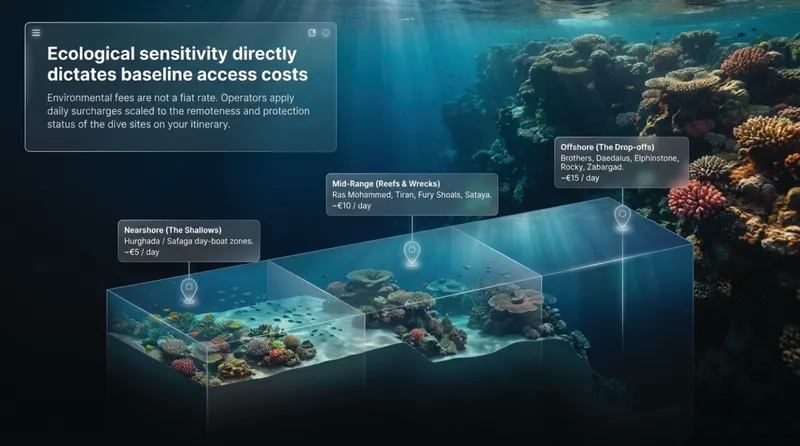
Divers should expect a tiered system of daily fees based on site sensitivity and location:
* **Local Areas (€5/day):** Standard day-boat zones in areas like Hurghada or Safaga.
* **Premium Sites (€10/day):** High-profile northern entries like Ras Mohammed, Tiran, or major wreck zones.
* **Southern Reefs (€10/day):** Remote systems such as Fury Shoals or Sataya.
* **Offshore Marine Parks (€15/day):** The "signature" destinations including the Brothers, Daedalus, Elphinstone, Rocky, and Zabargad.
**Before booking, you must ask two specific questions to ensure pricing transparency:**
1. Are marine park or environmental fees included in the quote, and if so, which ones?
2. Is the 10% entertainment tax already included in the advertised price, or will it be added to the final bill?
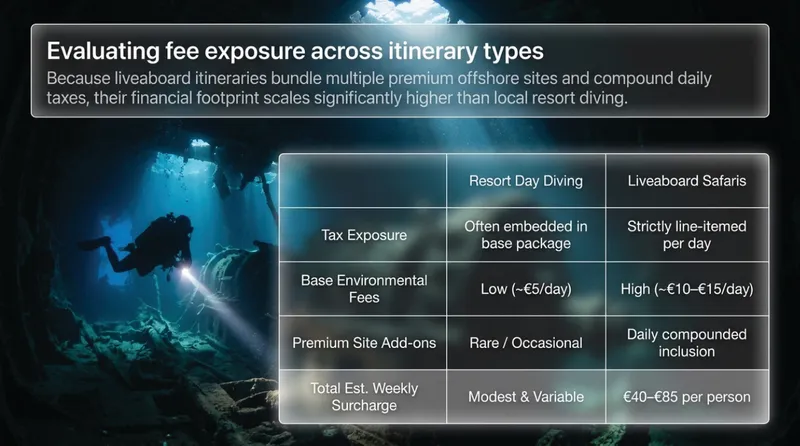
## The Liveaboard Pricing Reality Check
For those choosing liveaboards, the impact of these regulations and marina-based surcharges is significantly higher. Because a typical one-week itinerary often navigates multiple paid marine park areas and involves tax-loaded service pricing, the additional costs have become a major line item.
In 2026, it is standard to see **€40 to €85 per person per week** in combined park fees and taxes listed as distinct booking lines. While this transparency may initially cause "sticker shock," it is a vital move away from the surprise bills often encountered at the end of a trip. This distinct billing allows for more accurate budgeting and reflects the true cost of accessing Egypt’s most remote pelagic ecosystems.
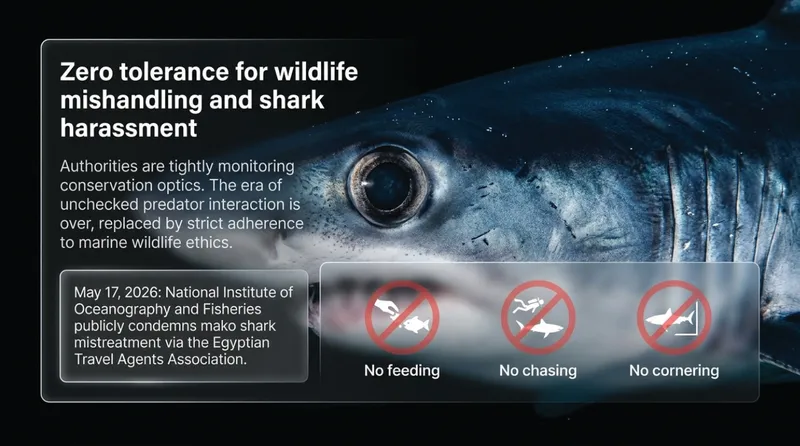
## A Decisive Shift in Shark Ethics
The Red Sea's reputation for world-class shark sightings is being matched in 2026 by a much stronger official stance on marine life protection. On May 17, 2026, the Egyptian Travel Agents Association (ETAA) news page highlighted a case where the National Institute of Oceanography and Fisheries (NIOF) publicly condemned the mistreatment of a mako shark.
This reflects a broader trend where authorities are now monitoring both swimmer safety and wildlife treatment with increased scrutiny. The official language has shifted to view charismatic predators as vital components of the pelagic ecosystem rather than just tourist attractions.
"Mishandling sharks is increasingly out of step with both conservation expectations and the public image Egypt wants for Red Sea tourism."
**Analysis:** This shift is vital for the long-term health of the Red Sea. For the diver, it means that "wildlife ethics" are being strictly enforced. Practices such as feeding, chasing, or cornering sharks are now actively discouraged by both the NIOF and local operators, ensuring these species remain a sustainable draw for the future.

## The Digital-to-Paper Airport Gap
Egypt has made significant strides in modernizing its airport entry systems. Following reports in January and March 2026, the country announced a transition away from traditional paper immigration cards toward a digital process linked to passport data.
However, travelers - particularly those arriving at high-volume hubs like **Hurghada** - continue to report a "paper reality" gap. The digital transition is underway, but it is not yet universal.
**Reflection:** Travelers should prepare for a "mixed digital-and-paper experience." While the official policy is moving toward a paperless arrival, do not be surprised if you are still handed a physical card upon landing. Staying patient and carrying a pen remains the best strategy for a smooth arrival during this modernization phase.
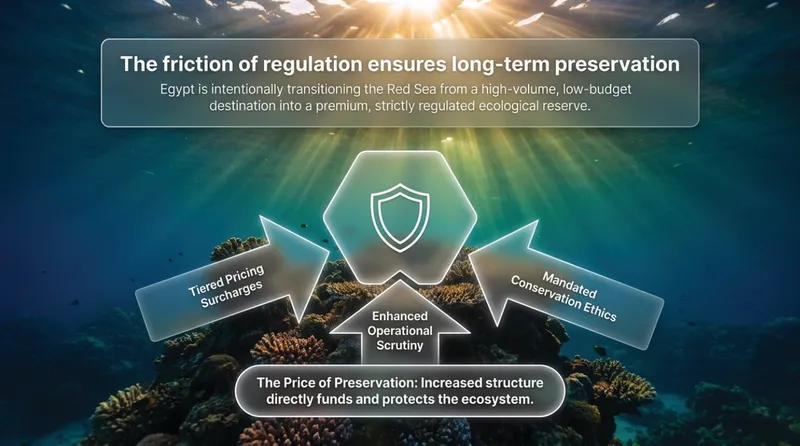
## More Structure, More Scrutiny, Better Diving?
The landscape of Red Sea diving in 2026 is undeniably more structured and fee-sensitive than in years past. However, this increased scrutiny serves a crucial purpose. The combination of modernized governance, pricing transparency, and a renewed focus on shark conservation suggests that Egypt is finally prioritizing the health of its underwater assets over sheer tourist volume.
While the "premium for protection" may increase the cost of your 2026 expedition, it is a necessary investment in the reefs' longevity. As we look to the future, a final question remains for the global diving community: Are you willing to pay a little more today to ensure these extraordinary pelagic ecosystems remain for the next generation?
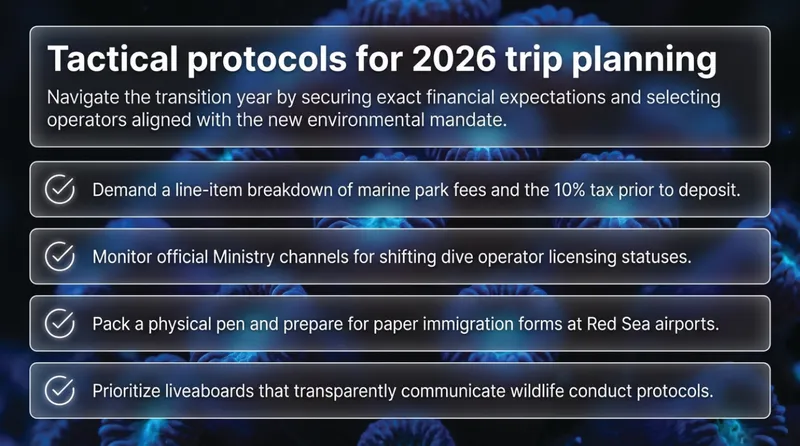
---
*Published on June 1, 2026*
*Author: Yevgen “Scorp” Sukharenko*
*Source: [Red Sea Creatures](https://redseacreatures.com)*
---
---
title: The Silent Tide: Why Hundreds of Sharks are Washing Up on Welsh Shores
description: Along the Welsh coast, a peaceful morning walk has turned into a disturbing discovery as dog walkers found hundreds of dead catsharks and fish washed ashore. The scale and concentration of the wash-up suggest something far more serious than a routine strandings, raising fears of an industrial fishing incident just offshore.
author: Yevgen “Scorp” Sukharenko
published: 2026-05-30T15:30:00.000Z
updated: 2026-05-30T16:12:10.849Z
tags: Sharks
url: https://redseacreatures.com/blog/2026/05/30/the-silent-tide-why-hundreds-of-sharks-are-washing-up-on-welsh-shores
---
# The Silent Tide: Why Hundreds of Sharks are Washing Up on Welsh Shores
A morning walk along the Welsh coastline is typically a restorative ritual - the rhythmic, percussive pulse of the Atlantic, the sharp sting of salt air, and the vast, shifting sands of beaches like Cefn Sidan or Saundersfoot. But for several dog walkers recently, this tranquility was shattered by a grim, olfactory-led discovery. Strewn across the tide line was not the usual driftwood or kelp, but a tangled, silver-grey mass of hundreds of dead sharks and fish.
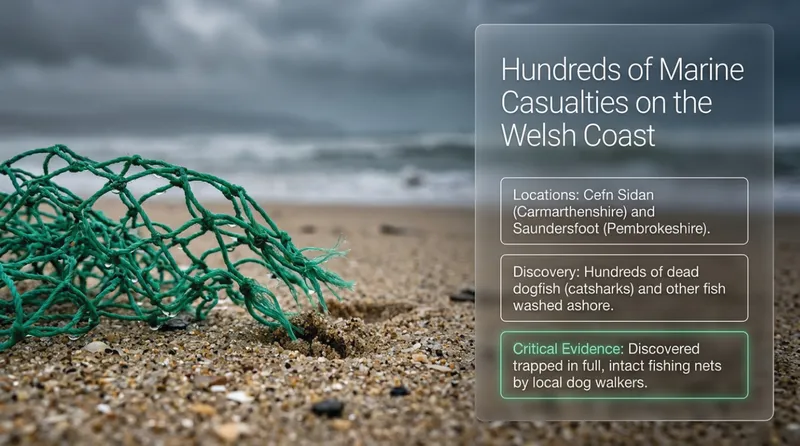
The sight of these small, slender sharks - scientifically known as *Scyliorhinus canicula*, but more commonly called dogfish or catsharks - cluttering the pristine Welsh shoreline raises a chilling question for those who frequent the coasts of Carmarthenshire and Pembrokeshire. Is this a bizarre natural mystery, or the visible debris of a man-made disaster occurring just beyond the horizon?
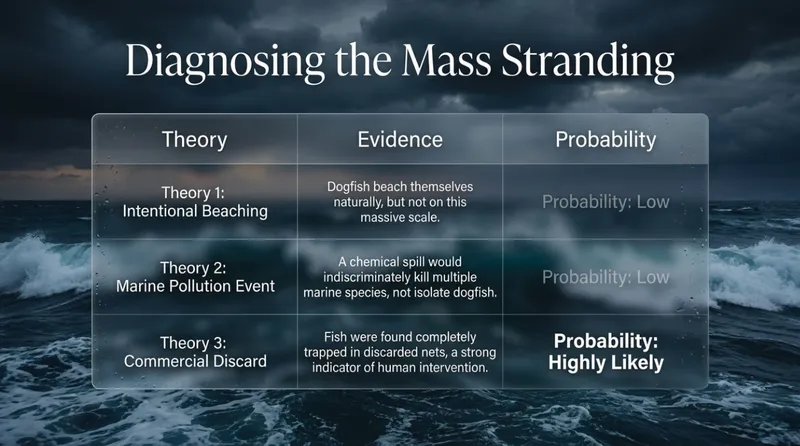
## This Isn’t Just a Few Strays - It’s Industrial Scale
The scale of these recent events has moved far beyond the occasional isolated carcass that typically follows a storm. At Cefn Sidan in Carmarthenshire, witnesses discovered an entire fishing net bulging with dead catsharks. This followed a nearly identical scene just days earlier on Saundersfoot beach in neighboring Pembrokeshire, where hundreds of dead sharks and fish lay scattered like discarded litter across the sand.
From a scientific perspective, seeing such a massive concentration of a single species is more alarming than a diverse wash-up. A variety of species might suggest a localized environmental failure or a toxic "red tide," but a mass of catsharks alone suggests a targeted, industrial event.
Cliff Benson, a veteran conservationist and founder of Sea Trust Wales, emphasized the sheer volume of these sightings to the *Western Telegraph*:
“We quite often see dogfish or catsharks seemingly intent on suicide and beaching themselves, though nobody seems to know why. However, this is on a different scale and looks like they might have been caught by some fishing boat that was hoping to catch more commercial species and thrown overboard dead.”
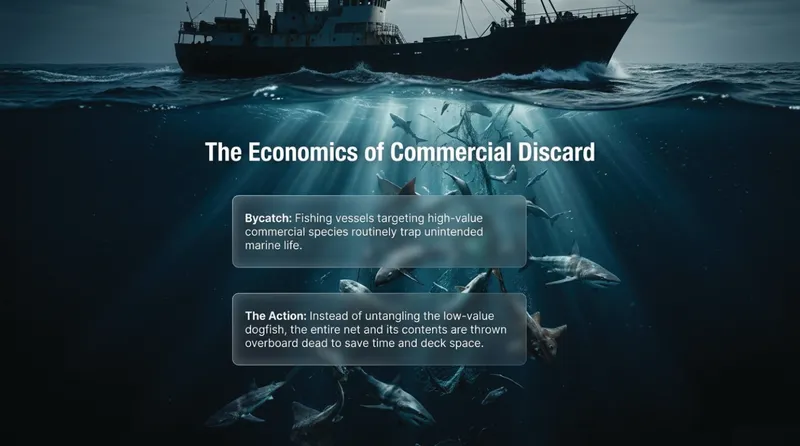
## The "Commercial Bycatch" Theory
The leading theory among experts is that these sharks are the collateral damage of the commercial fishing industry. In this scenario, the catsharks are caught incidentally as "bycatch" while vessels target more lucrative, "commercial" species like bass or cod. Because catsharks have negligible market value, they are often treated as inconvenient waste.
The process reveals a tragic irony in marine management: life is hauled up in indiscriminate nets, and the "wrong" kind of catch is simply shoveled back into the sea. By the time they hit the water, these creatures are often already dead from the pressure of the net or prolonged exposure on the deck. However, Benson notes that this is not the only potential culprit:
“Another possibility is it's a case of some marine pollution event, but you would expect several species to fall victim, not just dogfish.”
By distinguishing between these two theories, researchers can better narrow down the cause; if only catsharks are dying, the "human error" of the fishing industry becomes the far more likely suspect.

## The Lethal Legacy of "Ghost Nets"
While the tragedy at Cefn Sidan may appear to be a local mishap, it is a microscopic view of a global plague known as ghost gear. It is vital to distinguish between **active discard** - where a vessel currently fishing throws back unwanted catch - and **ghost nets**. Ghost nets are fishing gears that have been abandoned, lost, or discarded. Unattended and autonomous, they travel with the currents, trapping and killing marine life indefinitely in a cycle of "ghost fishing."
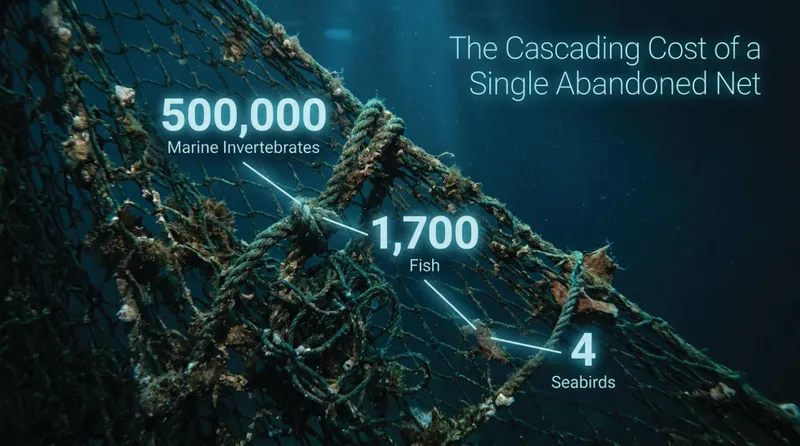
According to data from the World Wildlife Fund and the Ocean Conservancy, the impact of this "invisible" debris is staggering:
* **1 million tonnes:** The estimated amount of ghost gear entering the oceans every year.
* **500,000:** The number of marine invertebrates killed by a single abandoned net.
* **1,700 fish and 4 seabirds:** The average additional toll per net.
The Ocean Conservancy identifies ghost gear as the single most harmful form of marine debris. While the net found at Cefn Sidan was likely an active discard, the broader issue of ghost gear ensures that even when the boats go home, the killing continues beneath the waves.
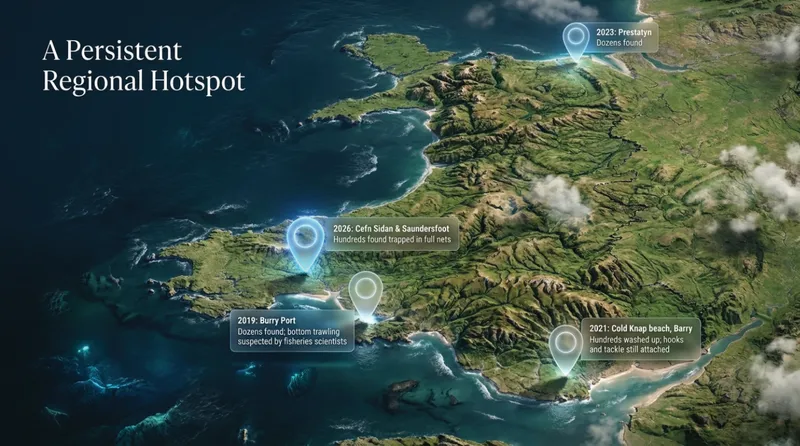
## A Recurring Pattern, Not an Isolated Incident
These recent findings are not an anomaly; they are part of a systemic, recurring pattern that has seen Welsh beaches transformed into shark graveyards multiple times over the last decade:
* **2019 (Burry Port):** Dozens of dogfish washed up, with fisheries scientists attributing the event to the destructive practice of bottom trawling.
* **2021 (Cold Knap, Barry):** Hundreds of sharks were found in a discovery that provided the "smoking gun" for human culpability: many specimens still had hooks and tackle embedded in their mouths.
* **2023 (Prestatyn):** A few dozen dogfish were discovered on the shoreline, continuing the trend.
The 2021 incident at Cold Knap is particularly damning. While theories of pollution or natural death are often floated, the presence of metal tackle and hooks is a physical indictment of human interference that cannot be easily explained away.
## The Mystery of "Shark Suicide"
While the evidence points toward industrial activity, science must also grapple with a strange, natural counter-narrative. Benson’s observation that catsharks appear “seemingly intent on suicide” points to a behavior that remains largely unmapped by marine biology. Why would a species evolved for the deep deliberately beach itself?
Using a loaded, anthropomorphic term like "suicide" highlights the frustration of researchers who still understand so little about these ancient elasmobranchs. This lack of knowledge makes the human-caused mortality even more tragic; we are decimating a species before we have even deciphered its most basic behaviors. While a single shark beaching itself might be a biological enigma, hundreds appearing in a net points firmly back to the surface.
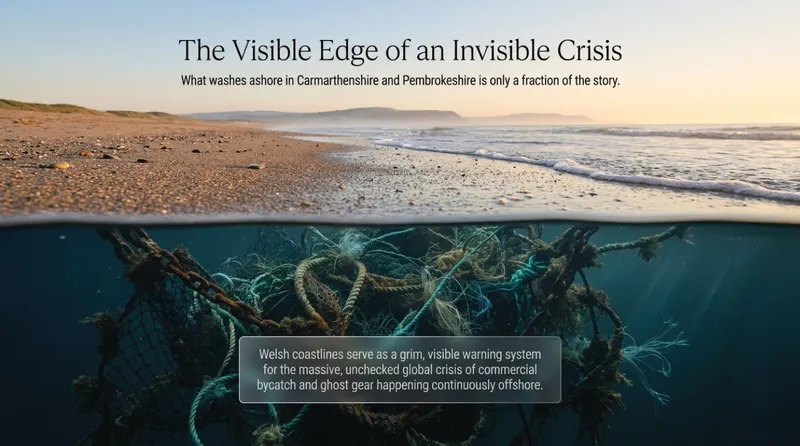
## A Question for the Shoreline
The grim scenes unfolding in Carmarthenshire and Pembrokeshire represent a mounting tension between the demands of the commercial fishing industry and the fragile health of our marine ecosystems. For too long, the ocean has acted as a vast, opaque shield, hiding the consequences of our industrial appetite.
Now, the "silent tide" is bringing those consequences directly to our feet. These "unseen" creatures of the deep - these catsharks that play vital roles in the marine food web - only seem to earn our attention when they begin to clutter our leisure spaces and spoil our morning walks. As the sea purges what we have discarded, we must ask ourselves: what is our collective responsibility for a world that we only choose to see when it is already dead?
---
*Published on May 30, 2026*
*Author: Yevgen “Scorp” Sukharenko*
*Source: [Red Sea Creatures](https://redseacreatures.com)*
---
---
title: The "Ghost Shark" Returns: Why a Rare Discovery in Borneo is Shaking Up Marine Science
description: A rare “ghost shark” has been rediscovered thriving in a remote Indonesian river, overturning assumptions that the Ganges shark was nearly gone. The finding of 43 specimens in North Kalimantan suggests the species may be far more resilient - and far more overlooked - than scientists once believed.
author: Yevgen “Scorp” Sukharenko
published: 2026-05-29T21:20:00.000Z
updated: 2026-05-30T06:40:03.276Z
tags: Sharks
url: https://redseacreatures.com/blog/2026/05/30/the-ghost-shark-returns-why-a-rare-discovery-in-borneo-is-shaking-up-marine-science
---
# The "Ghost Shark" Returns: Why a Rare Discovery in Borneo is Shaking Up Marine Science
On May 25, 2026, the Antara News Agency confirmed a discovery that has effectively remapped the strongholds of the deep. The Ganges shark (*Glyphis gangeticus*), a predator so elusive it has earned the moniker "ghost shark," was recently found thriving in the Sesayap River of North Kalimantan. This biological detective story has transformed a species nearly lost to history into a symbol of scientific hope.
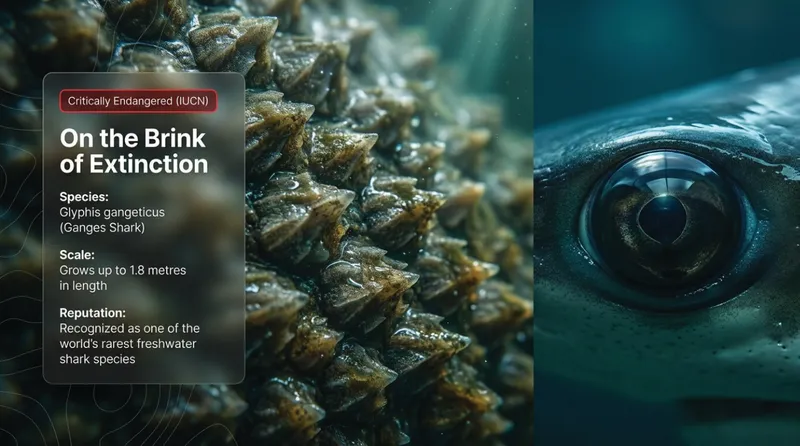
Defying the Odds of Extinction
The rarity of the Ganges shark is difficult to overstate, as it is one of the few sharks specifically adapted to murky freshwater environments. Since the year 2000, there have been fewer than 10 recorded sightings across its entire historical range, which stretches from Pakistan to Myanmar. This scarcity led the IUCN to classify the species as Critically Endangered, with many fearing it was on the brink of "cryptic extinction."
The fact that this 1.8-meter predator remained hidden for decades serves as a masterclass in scientific humility. It highlights that our global extinction metrics are often biased toward visible terrestrial species, leaving remote river systems as significant blind spots in conservation. This discovery proves that even in a heavily explored world, the most vulnerable giants can persist in specialized habitats if left undisturbed.
"This finding is not only about saving one rare species, but also about how we build a conservation model that is fair, collaborative, and acceptable to the community," said Prof. Rohani Ambo Rappe of Hasanuddin University.
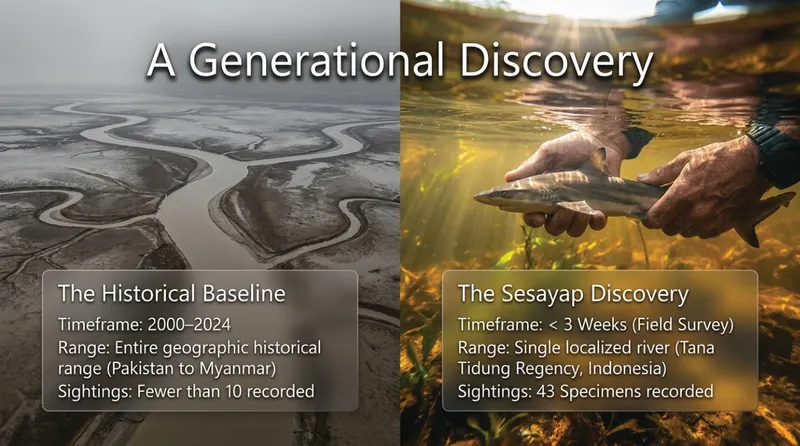
The "Power in Numbers" Surprise
The most staggering aspect of this announcement is the sheer density of the population found in North Kalimantan. After 26 years of near-total silence from this species globally, a collaborative research team recorded 43 specimens in less than three weeks. This wasn't just a lucky encounter; it was a total recalibration of what we thought the species' global population could be.
This data represents a seismic shift in marine biology, moving the Sesayap River from a point of geographical curiosity to the most significant known habitat for the species on Earth. To find dozens of individuals in such a tight window suggests that Borneo is not just a remnant habitat, but a thriving, primary stronghold. It challenges the "phantom" status of the shark and replaces it with a tangible, measurable population.
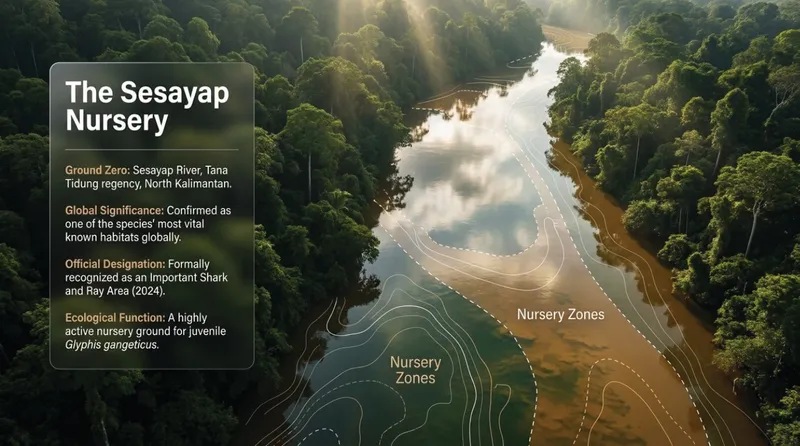
## A Secret Nursery in the Sesayap River
The international community recognized the ecological weight of this region in 2024, when the Sesayap River was designated an Important Shark and Ray Area (ISRA). This designation was a preemptive strike in conservation, identifying the river as a vital nursery ground for young sharks. Protecting these specific environments is widely considered the "highest ROI" (Return on Investment) for conservationists.
By focusing on nursery grounds rather than trying to police vast, adult territories, scientists can protect the species during its most vulnerable life-cycle stage. This strategy ensures the next generation reaches maturity, providing a sustainable path toward population recovery. The 2024 ISRA designation now stands as a prophetic move that has been validated by the 2026 census data.
"The Sesayap River was designated an Important Shark and Ray Area in 2024, underscoring its importance as a nursery ground for the rare river shark species," noted researcher Michael Grant from James Cook University.
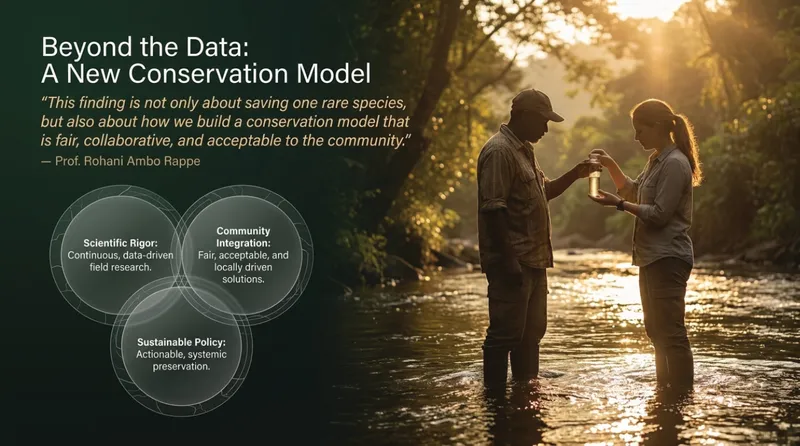
## A New Blueprint for "Fair" Conservation
This project, which began in 2022 as a partnership between Hasanuddin University and James Cook University, represents a shift in how science is conducted. Rather than employing "top-down" environmental policing, the researchers integrated the local communities of the Tana Tidung regency into the study. This "fair and collaborative" model ensures that those living alongside the river are part of the solution rather than seen as obstacles.
When local residents are engaged as primary guardians of their waterways, conservation becomes a community-led effort rather than an academic mandate. Involving the Tana Tidung community has proven far more effective than traditional enforcement. It creates a sustainable ecosystem where scientific progress and local livelihoods can coexist.

## The Call for a Kalimantan Research Consortium
The researchers, supported by Universitas Borneo Tarakan, are now calling for the formal establishment of a shark and ray research consortium in Kalimantan. The objective is to ensure this breakthrough doesn't simply result in a published paper, but instead drives national policy. Data-driven policy is the essential bridge between a "cool discovery" and the long-term survival of a species.
By creating a formalized research consortium, the team hopes to provide the Indonesian government with the scientific evidence needed to safeguard these waterways. This consortium would serve as a permanent watchdog and research hub, ensuring that the Ganges shark never fades back into the "ghost" status it held for so long.
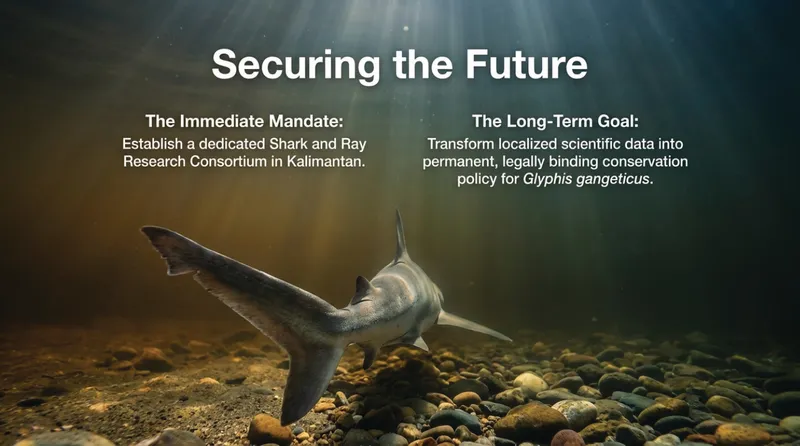
## A Provocative Look Ahead
The return of the Ganges shark to the global spotlight is a powerful reminder that our world still holds profound secrets. This discovery has turned North Kalimantan into a beacon of hope, proving that collaborative science can uncover wonders we once thought were lost forever.
It leaves us with a compelling question: if one of the world's rarest predators can thrive undetected in the river systems of Borneo, what other "extinct" wonders are still waiting to be found in the world's unexplored freshwater systems? The success in the Sesayap River shows that the next great discovery is likely hiding just beneath the surface of the next murky, unexplored delta.
---
*Published on May 29, 2026*
*Author: Yevgen “Scorp” Sukharenko*
*Source: [Red Sea Creatures](https://redseacreatures.com)*
---
---
title: Top 8 Shark Dive Destinations Around the World
description: Explore seven of the world’s most compelling shark dive destinations, where thrilling close encounters with apex predators are balanced by safety, conservation, and careful observation. From the iconic great white waters of Gansbaai and Guadalupe Island to diverse reef and open-ocean sites, each location offers a unique mix of adrenaline, ecology, and unforgettable underwater photography.
author: Yevgen “Scorp” Sukharenko
published: 2026-05-24T11:30:00.000Z
updated: 2026-05-24T11:29:21.350Z
tags: Sharks
url: https://redseacreatures.com/blog/2026/05/24/top-8-shark-dive-destinations-around-the-world
---
# Top 8 Shark Dive Destinations Around the World
Few underwater experiences match the adrenaline, awe, and humility of diving with sharks. For scuba divers, it is a chance to encounter apex predators in their natural habitat; for marine biologists, it offers a living laboratory of behavior, migration, and ecology; and for underwater photographers, it can produce some of the most dramatic images in the ocean. Below are seven of the world’s most compelling shark dive destinations, selected for species diversity, accessibility, and the sheer quality of the encounters. [](#footnote-1)[\[1\]](#footnote-1)[](#footnote-6)[](#footnote-7)
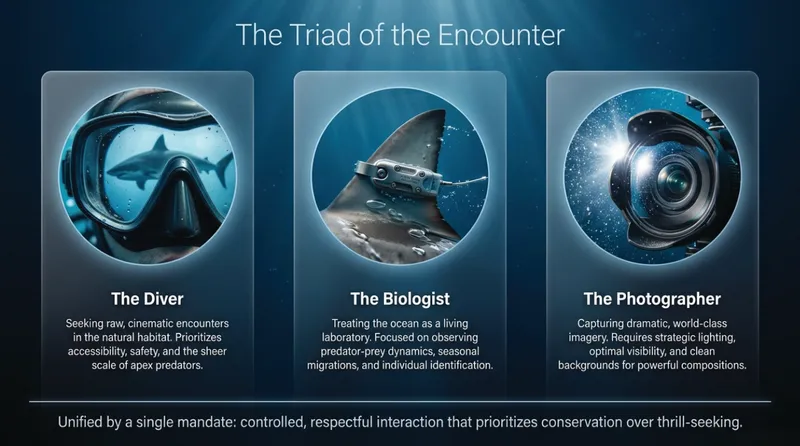
Shark diving is not about chasing danger. In the best locations, it is a controlled, respectful interaction that prioritizes safety, conservation, and observation. Conditions vary widely by region, from blue-water drift dives and open-ocean pelagic encounters to reef-based dives where sharks patrol cleaning stations and feeding grounds. [](#footnote-2)[\[2\]](#footnote-2)[](#footnote-4)[\[4\]](#footnote-4)[](#footnote-6)
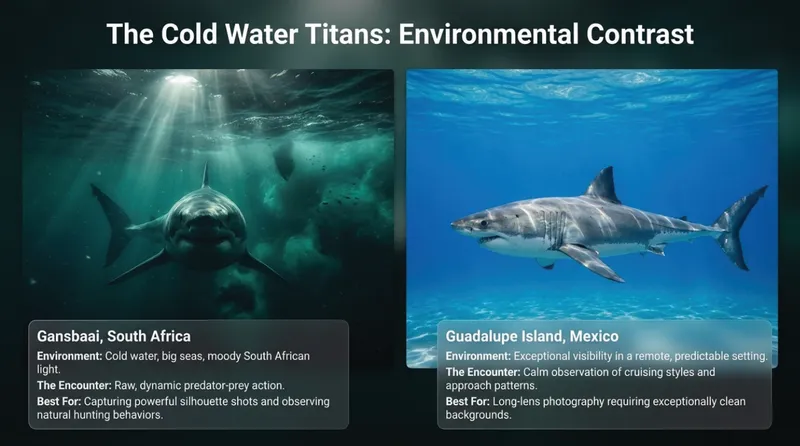
## 1\. Gansbaai, South Africa
Gansbaai is one of the most famous shark diving destinations in the world and is closely associated with great white shark encounters. Its reputation comes from the dramatic offshore geography and the abundance of marine life that supports these apex predators. [](#footnote-1)[\[1\]](#footnote-1)[](#footnote-6)[](#footnote-9)
For divers, the appeal lies in the raw, cinematic nature of the experience: cold water, big seas, and the possibility of seeing one of the ocean’s most iconic species up close. Marine biologists are drawn to Gansbaai because great white behavior here can provide insight into predator-prey dynamics, seasonal movements, and individual identification. Photographers, meanwhile, can capture powerful silhouette shots and striking surface-level compositions, especially in the moody South African light. [](#footnote-1)[\[1\]](#footnote-1)[](#footnote-6)
## 2\. Guadalupe Island, Mexico
Guadalupe Island is widely regarded as one of the premier places on Earth for great white shark diving. Divers travel there for exceptionally clear water and the chance to observe these sharks in a relatively predictable setting. [](#footnote-1)[\[1\]](#footnote-1)[](#footnote-6)[](#footnote-7)
This destination is especially attractive for underwater photographers because visibility can be superb, allowing longer lens work and cleaner backgrounds than many other great white sites. For scientists and serious naturalists, Guadalupe offers valuable opportunities to observe shark behavior, including approach patterns, cruising styles, and interactions with bait and cages used by regulated operators.[](#footnote-6)[](#footnote-7)
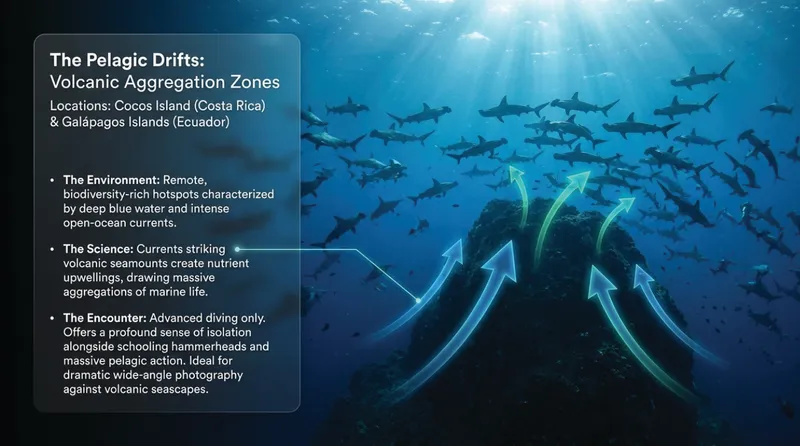
## 3\. Cocos Island, Costa Rica
Cocos Island is legendary among advanced divers, particularly for its abundance of hammerhead sharks and other large pelagics. It is often described as a remote, biodiversity-rich hotspot where shark encounters are part of a much larger offshore ecosystem. [](#footnote-2)[\[2\]](#footnote-2)[](#footnote-3)[\[3\]](#footnote-3)[](#footnote-6)
The diving here is typically for experienced scuba divers due to strong currents and open-ocean conditions, but the reward is extraordinary: schooling hammerheads, big pelagic action, and a sense of isolation that few dive sites can match. Marine biologists value Cocos for studying aggregation behavior, while photographers prize the chance to capture dense schools of sharks in blue water or against dramatic volcanic seascapes. [](#footnote-2)[\[2\]](#footnote-2)[](#footnote-6)
## 4\. Galápagos Islands, Ecuador
The Galápagos Islands are a dream destination for shark lovers, especially for those hoping to see hammerheads and other large marine species in a remote, biologically rich setting. The islands are repeatedly cited among the world’s top shark diving locations because of their strong currents, open-ocean conditions, and extraordinary marine biodiversity. [](http://localhost:8888/admin/posts/113#footnote-1)[\[1\]](http://localhost:8888/admin/posts/113#footnote-1)[](http://localhost:8888/admin/posts/113#footnote-2)[\[2\]](http://localhost:8888/admin/posts/113#footnote-2)[](http://localhost:8888/admin/posts/113#footnote-6)
This destination is best suited to experienced divers who are comfortable with cooler water, current-heavy dives, and deep blue-water environments. For marine biologists, the Galápagos is an ecological treasure, offering insights into shark aggregation, migration, and the influence of oceanic conditions on predator behavior. Photographers can expect dramatic wide-angle opportunities, particularly when schools of sharks move through the frame against volcanic island backdrops. [](http://localhost:8888/admin/posts/113#footnote-1)[\[1\]](http://localhost:8888/admin/posts/113#footnote-1)[](http://localhost:8888/admin/posts/113#footnote-2)[\[2\]](http://localhost:8888/admin/posts/113#footnote-2)
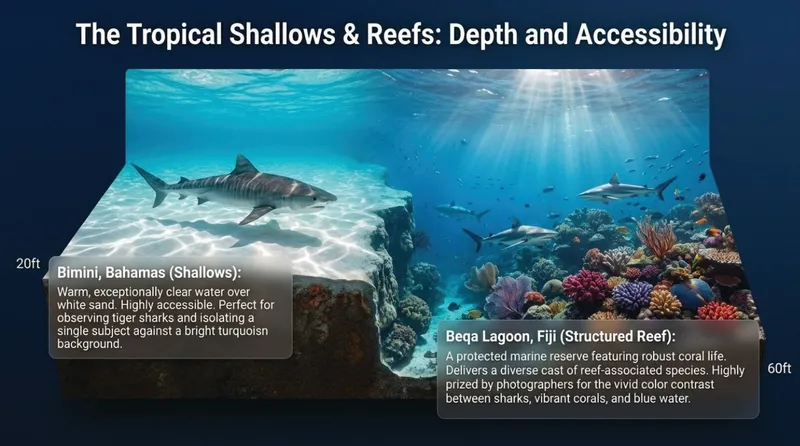
## 5\. Bimini, Bahamas
Bimini has become famous for close encounters with tiger sharks, alongside other shark species that frequent the warm waters of the Bahamas. Its shallow, clear environment and strong shark presence have made it one of the most accessible shark dive locations for a wide range of divers. [](#footnote-1)[\[1\]](#footnote-1)[](#footnote-2)[\[2\]](#footnote-2)[](#footnote-6)
For divers, Bimini offers a dramatic yet relatively approachable shark experience, often with excellent visibility and manageable conditions. For researchers, the Bahamas region is useful for observing seasonal shark presence, species interactions, and habitat use in nearshore tropical waters. Photographers often appreciate the clean water and the chance to isolate a single shark against bright turquoise backgrounds. [](#footnote-1)[\[1\]](#footnote-1)[](#footnote-6)
## 6\. Beqa Lagoon, Fiji
Beqa Lagoon is one of the best-known shark diving areas in the South Pacific, famous for its robust reef shark encounters and structured shark dives. Fiji’s marine reserves and vibrant reef systems support a healthy population of sharks, making the destination both exciting and ecologically meaningful. [](#footnote-1)[\[1\]](#footnote-1)[](#footnote-6)[](#footnote-7)
This is a rewarding site for divers who want a diverse shark cast, often including reef-associated species in a tropical environment rich in coral life. Marine biologists can study reef shark behavior in a managed but still dynamic habitat, while photographers benefit from the color contrast between sharks, coral, and blue water. [](#footnote-1)[\[1\]](#footnote-1)[](#footnote-6)
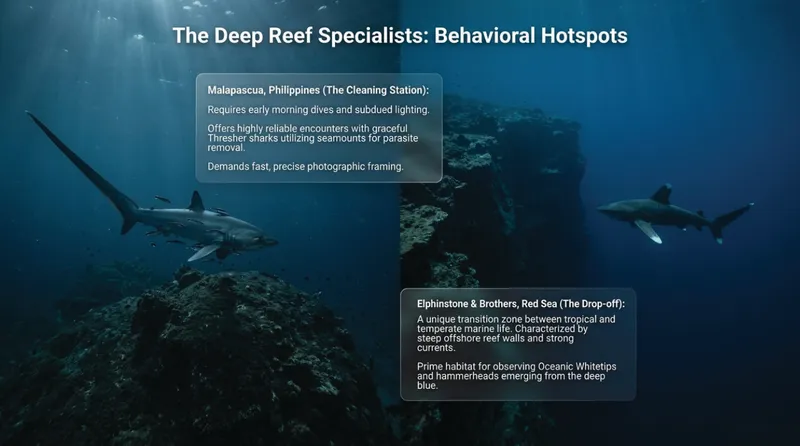
## 7\. Malapascua, Philippines
Malapascua is internationally known as one of the most reliable places in the world to see thresher sharks. The island’s underwater reputation is built on regular encounters at seamounts and cleaning stations, where divers may witness these elegant sharks early in the morning. [](#footnote-2)[\[2\]](#footnote-2)[](#footnote-5)[](#footnote-6)
For scuba divers, Malapascua is a bucket-list site because thresher sharks are so distinctive, with their long tail fins and graceful movement. For biologists, the site is important because repeated sightings can help inform studies of cleaning behavior, habitat use, and the ecology of pelagic sharks near reef systems. Photographers should plan for early dives, subdued lighting, and fast, precise framing to capture the threshers’ unforgettable profiles. [](#footnote-2)[\[2\]](#footnote-2)
## 8\. Elphinstone and Brothers Island, Red Sea, Egypt
The Red Sea in Egypt is another world-class region for shark diving, with Elphinstone and the Brothers Islands standing out as two of the most sought-after sites. Elphinstone is famous for its steep offshore reef walls and frequent oceanic whitetip and hammerhead sightings, while the Brothers Islands are known for strong currents, dramatic drop-offs, and a mix of pelagic sharks, including hammerheads and thresher sightings on the right day. [](#footnote-2)[\[2\]](#footnote-2)[](#footnote-3)[\[3\]](#footnote-3)[](#footnote-6)
These sites are best suited to experienced divers because of currents and open-water conditions, but the rewards can be exceptional: clear blue water, large pelagic encounters, and highly photogenic reef walls. For marine biologists, the Red Sea offers a valuable environment to observe shark movement, cleaning behavior, and habitat use in a unique transition zone between tropical and temperate marine life. Photographers can expect strong wide-angle opportunities, especially when sharks pass along the reef edge or emerge from the blue. [](#footnote-2)[\[2\]](#footnote-2)[](#footnote-4)[\[4\]](#footnote-4)[](#footnote-6)
## Tips for Divers, Biologists, and Photographers
* **Choose the right season:** Shark presence often depends on water temperature, currents, and breeding cycles, so timing can dramatically affect your chances of an encounter. [](#footnote-2)[\[2\]](#footnote-2)[](#footnote-6)
* **Prioritize safety and operator standards:** Use reputable operators with clear safety protocols and responsible wildlife practices. [](#footnote-2)[\[2\]](#footnote-2)[](#footnote-4)[\[4\]](#footnote-4)[](#footnote-6)
* **Respect the animals:** Shark diving should be observational, not invasive. Maintain buoyancy control, avoid sudden movements, and never attempt to touch or pursue sharks. [](#footnote-4)[\[4\]](#footnote-4)[](#footnote-6)
* **Bring the right camera setup:** Wide-angle lenses are ideal for most shark dives, especially in clear blue-water destinations where composition and context matter.[](#footnote-6)[](#footnote-7)
* **Think like a naturalist:** Note species, behavior, depth, current, and environmental conditions. Those details can enrich both personal logs and scientific observations. [](#footnote-2)[\[2\]](#footnote-2)[](#footnote-6)
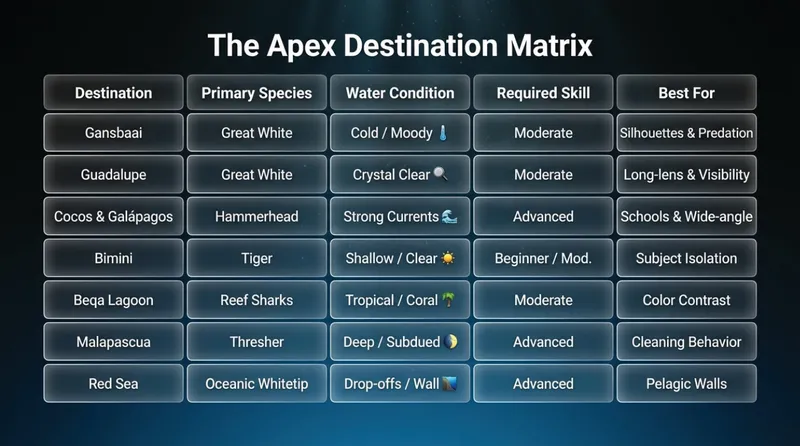
## Why These Seven Destinations Stand Out
There are many excellent shark dive locations around the world, but these seven stand out for a combination of species diversity, iconic encounters, and educational value. They represent different styles of shark diving: great white expeditions, pelagic blue-water adventures, reef shark interactions, and specialty encounters with species like threshers and hammerheads. [](#footnote-1)[\[1\]](#footnote-1)[](#footnote-2)[\[2\]](#footnote-2)[](#footnote-6)[](#footnote-7)
Whether you are a scuba diver seeking a true bucket-list adventure, a marine biologist interested in behavior and habitat, or a photographer hoping to capture the ocean’s most compelling predators, these destinations offer unforgettable opportunities. The key is to dive responsibly, prepare well, and approach every encounter with curiosity and respect. [](#footnote-4)[\[4\]](#footnote-4)[](#footnote-6)
Sharks are not just symbols of power; they are essential players in marine ecosystems. Seeing them in the wild is a privilege, and in the right destination, that privilege can become a profound and life-changing experience. [](#footnote-4)[\[4\]](#footnote-4)[](#footnote-6)
---
*Published on May 24, 2026*
*Author: Yevgen “Scorp” Sukharenko*
*Source: [Red Sea Creatures](https://redseacreatures.com)*
---
---
title: Maldives Diving Disaster: Search for Missing Italian Divers Ends in Tragedy as Soldier Dies in Rescue Mission
description: A search and rescue mission in Vaavu Atoll, Maldives, ended in tragedy after the recovery effort for five missing Italian divers led to one confirmed body being found and the death of MNDF Staff Sergeant Mohamed Mahdhee. The incident highlights the deadly risks of extreme-depth diving in harsh sea conditions and may rank among the worst diving accidents in Maldivian history.
author: Yevgen “Scorp” Sukharenko
published: 2026-05-16T19:25:00.000Z
updated: 2026-05-21T21:51:14.864Z
tags: Marine News
url: https://redseacreatures.com/blog/2026/05/16/maldives-diving-disaster-search-for-missing-italian-divers-ends-in-tragedy-as-soldier-dies-in-rescue-mission
---
# Maldives Diving Disaster: Search for Missing Italian Divers Ends in Tragedy as Soldier Dies in Rescue Mission
### Executive Summary of the Incident
The search and rescue mission that commenced in Vaavu Atoll on Thursday, May 14, 2026, concluded in a dual-tragedy on Saturday, May 16. What began as a high-stakes search for five missing Italian divers from the safari vessel *Duke of York* ended with the recovery of one body and the death of a national defender. Staff Sergeant Mohamed Mahdhee’s sacrifice highlights the lethal intersection of a massive recreational protocol breach and the extreme physical demands of maritime recovery. This incident, likely the deadliest diving accident in Maldivian history, underscores the fatal consequences of operating at the absolute limits of human physiology under adverse environmental conditions.
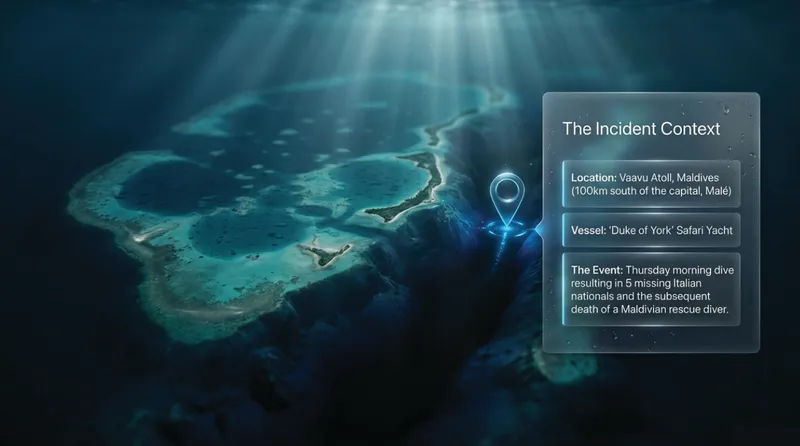
Incident Snapshot
Details
**Location**
Vaavu Atoll, Maldives (100km south of Malé)
**Primary Objective**
Recovery of four missing Italian tourists; secondary search
**Personnel Lost**
Staff Sergeant Mohamed Mahdhee, MNDF
**Nature of Risks**
Cave penetration at 60m, extreme depth, "Yellow Warning" sea conditions
While the initial crisis focused on the disappearance of the Italian group, the focus of the nation now rests on the elite soldier who perished while attempting to bring them home.

Profile of a Hero: Staff Sergeant Mohamed Mahdhee
Staff Sergeant Mohamed Mahdhee (known locally as Mahudhy) was a veteran of the Maldives National Defence Force (MNDF) Coast Guard. By Saturday, Mahdhee was operating under the strain of a multi-day deployment; following an unsuccessful initial search on Friday, he was one of eight specialized divers who descended for a more intensive operation. During this high-risk dive, his health deteriorated rapidly. While his colleagues surfaced, Mahdhee remained submerged. A rapid response team located him unconscious at depth; despite emergency transport to a hospital, he was pronounced dead. His final mission profile reveals a calculated acceptance of lethality - operating at double the legal depth limit under a state-issued weather warning.
His professional commitment is defined by three significant operational factors:
* **Sustained Operational Tempo:** Engaging in a "very high risk" second-phase search on Saturday after 48 hours of cumulative mission stress and previous search attempts.
* **Technical Cave Penetration:** Voluntarily entering a restricted cave system at a depth of 60 meters (197 feet), where the margin for error is non-existent.
* **Duty Under Advisory:** Executing a recovery profile while a "Yellow Warning" was active, requiring divers to manage surface surge and limited visibility that had already grounded local fishing and passenger vessels.
Mahdhee’s sacrifice was the direct result of the extraordinary technical demands and the extreme physiological toll required to navigate the 60-meter cave system where the victims were last seen.
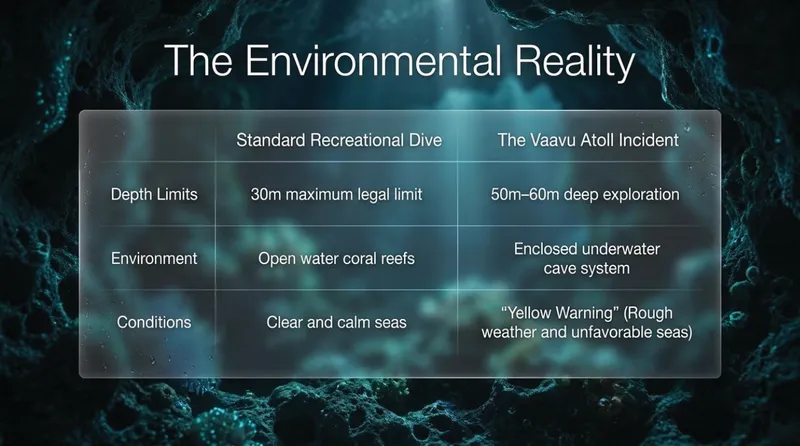
The Dangerous Depth: Risk and Protocol Analysis
From a military operations perspective, the mission was "very high risk" because it required divers to operate in a physiological dead zone. In the Maldives, recreational diving is strictly capped at 30 meters. The *Duke of York* divers were found to have reached 50-60 meters, a depth where nitrogen narcosis is profound and the risk of Decompression Sickness (DCS) or oxygen toxicity is exponential. It remains an investigative mystery why a recreational group bypassed established safety oversight to enter a 60m cave system. For the MNDF divers, the "Yellow Warning" added a secondary layer of danger; rough seas make safety decompression stops - essential when ascending from 60m - nearly impossible to maintain safely, likely contributing to Mahdhee’s "blackout" and rapid deterioration.
Feature
Standard Recreational Diving
The Vaavu Atoll Mission
**Depth Limit**
Maximum 30 meters
60 meters (Recovery depth)
**Environment**
Open water / Controlled reefs
Unmapped underwater caves
**Condition Constraints**
Calm seas preferred
Rough weather; "Yellow Warning" active
The transition from a standard search to a recovery operation targeting Prof. Montefalcone’s team at 60 meters explains why the MNDF had to deploy specialized equipment to manage the extreme physical strain on its personnel.
The Mission Context: The Missing Divers of the "Duke of York"
The incident began Thursday morning when five individuals from the *Duke of York* failed to resurface. While the body of the boat’s operations manager, Gianluca Benedetti, was eventually recovered at a depth of 60 meters, four others - primarily high-profile academics - remain missing and are presumed trapped within the cave's architecture. The recovery of Benedetti confirmed the extreme depths the group had reached, far exceeding their professional certifications.
The victims involved in this maritime tragedy are categorized as follows:
* **University of Genoa Academic Team:**
* **Monica Montefalcone:** Professor of Ecology and Marine Biology.
* **Muriel Oddenino:** Research Fellow.
* **Federico Gualtieri:** Marine Biology Graduate.
* **Associated Individuals:**
* **Giorgia Sommacal:** Daughter of Professor Montefalcone.
* **Gianluca Benedetti:** Diving instructor and boat manager (Body recovered at 60m).
The scale of the loss involving these prominent researchers bridged the tragedy from a local accident to a matter of international diplomatic concern.

A Nation in Mourning: Official Responses and Diplomatic Impact
The tragedy has resulted in a rare moment of shared grief between Malé and Rome. President Mohamed Muizzu’s personal visit to the Vaavu Atoll to oversee the recovery efforts signaled the gravity of the military loss. The Italian government has been vocal in its gratitude, acknowledging that a Maldivian soldier died specifically to provide closure to Italian families.
Italian Foreign Minister Antonio Tajani paid tribute to the fallen Staff Sergeant:
"These days of grief for Italy are compounded by the news that one of your brave soldiers... died while attempting to dive to reach the bodies of our fellow Italians. This tragedy unites Italy and the Maldives in grief and respect for the victims."
The legacy of Staff Sergeant Mohamed Mahdhee remains a testament to the profound risks of maritime search and rescue and the selfless dedication of those who serve in the face of nature’s most dangerous elements.
---
*Published on May 16, 2026*
*Author: Yevgen “Scorp” Sukharenko*
*Source: [Red Sea Creatures](https://redseacreatures.com)*
---
---
title: Hidden in Plain Sight: The Deadly New Resident of Singapore’s Waters
description: Scientists have identified a new and highly venomous box jellyfish species in Singapore’s waters, revealing a dangerous predator hiding in plain sight near one of the world’s busiest urban coastlines. Mistaken for a similar species for years, Chironex blakangmati is both a breakthrough in marine biology and a reminder that even heavily managed waters can still hold lethal surprises.
author: Yevgen “Scorp” Sukharenko
published: 2026-05-16T11:00:00.000Z
updated: 2026-08-08T13:20:22.069Z
tags: Marine News
url: https://redseacreatures.com/blog/2026/05/16/a-newly-identified-box-jellyfish-adds-to-singapores-marine-surprises
---
# Hidden in Plain Sight: The Deadly New Resident of Singapore’s Waters
### The Secrets of an Urban Coastline
Singapore is a marvel of urban planning, a hyper-modern city-state where skyscrapers glass the horizon and the ports never sleep. Yet, just beneath the surface of this highly managed coastline, a lethal mystery has been hiding. The recent discovery of a new species of box jellyfish in these waters is a brilliant scientific triumph, but it is also a sobering reminder that the ocean's most dangerous secrets can thrive right in our own backyard.
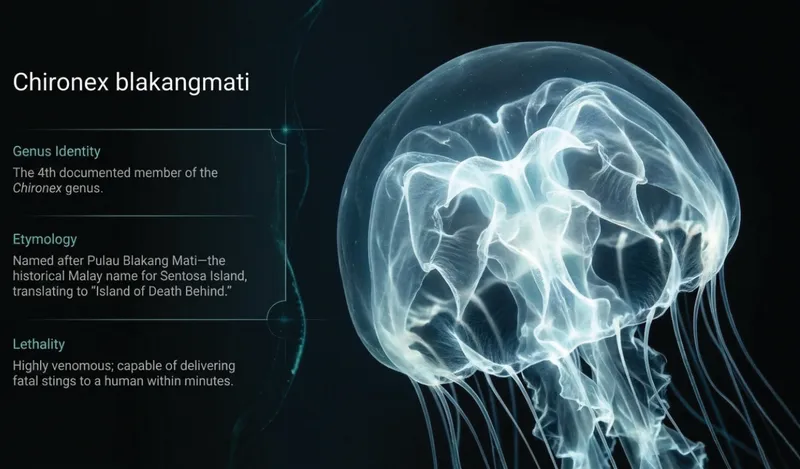
A Name Rooted in a Dark History
The new resident has been named *Chironex blakangmati*. This scientific name is a nod to its home near Sentosa Island, which was historically known in Malay as *Pulau Blakang Mati* - translated as the "Island of Death Behind."
The name is chillingly appropriate. This discovery adds a **fourth member to the** ***Chironex*** **genus**, a elite group of "sea wasps" known for possessing some of the most potent venom on the planet. These jellyfish are capable of delivering stings that can prove fatal to humans within mere minutes, making the historical name for Sentosa a fitting tribute to this predator's lethal biology.
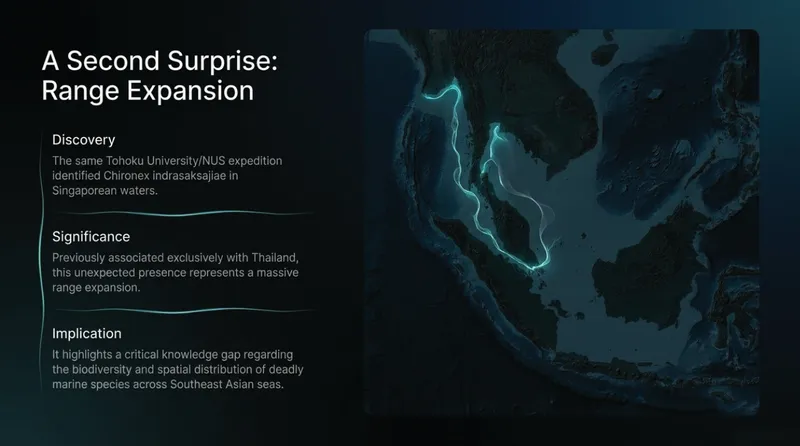
The Case of Mistaken Identity
For years, *C. blakangmati* was hidden in plain sight. Due to its appearance, it was frequently mistaken for *Chironex yamaguchii*, a species originally found in Okinawa. It took a collaborative effort between the **National University of Singapore (NUS)** and **Tohoku University** to solve this case of mistaken identity. Lead researcher Cheryl Ames performed a modern biological "cold case" investigation to prove the two were unique.
> C. blakangmati looks remarkably like Chironex yamaguchii - a jellyfish species I first discovered in Okinawa while doing my master's degree there... But we realised they were completely distinct. I actually went back to dust off an old sample of C. yamaguchii I still had in storage in Okinawa to help with the comparisons.
This research highlights a vital reality in marine biology: even in well-studied, high-traffic regions, biodiversity can remain invisible without rigorous genetic and morphological analysis.
### The "Smoking Gun" in the Anatomy
Identifying a new *Chironex* species requires looking past the standard cube-shaped bell. While these jellyfish are relatively small - with a bell height of approximately 5cm as shown in recent specimens - their most defining features are found in the **perradial lappets**. These are muscular flaps at the base of the bell that reinforce the jellyfish's ability to propel itself through the water.
In the other three known *Chironex* species, pointed canals extend from these lappets. In *C. blakangmati*, these canals are entirely absent. This minute structural difference is the **only morphological way** to distinguish the species from its relatives without the use of DNA sequencing. It is a "smoking gun" that proves how small structural details can redefine our understanding of a genus.
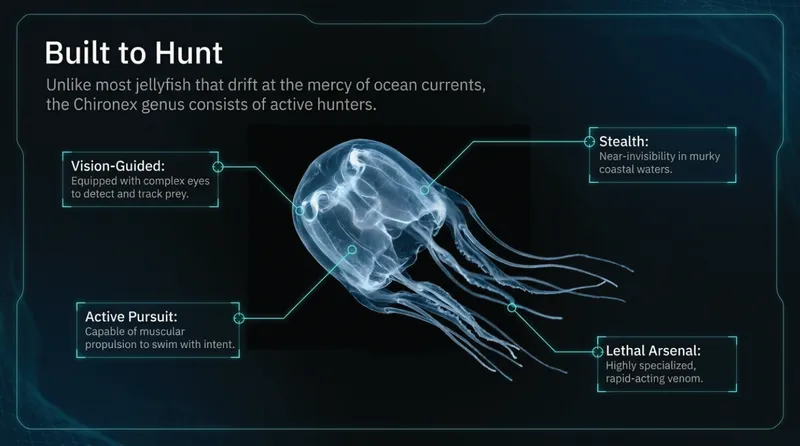
Hunters, Not Drifters
As a marine biologist, I find it essential to correct a common myth: not all jellyfish are passive drifters. Members of the *Chironex* genus are active, sophisticated hunters. They possess **rhopalia** - complex, image-forming eyes that allow them to navigate their environment with intent.
Combined with powerful muscular propulsion and near-invisibility in the water, these jellyfish are formidable predators. This mobility makes understanding their ecology a matter of **genuine public safety**, as they do not simply float with the tide but move with purpose through waters used by the public.

The Thai Connection: A Surprising Range Expansion
The research expedition yielded an additional surprise for the team: the first recording of *Chironex indrasaksajiae*, or the Thai sea wasp, in Singaporean waters. Previously, this species was thought to be restricted to the Gulf of Thailand.
"We were surprised to find C. indrasaksajiae so far away from Thailand. Recording range expansions like these is really important, as we currently know so little about the biodiversity and spatial distribution of box jellyfish."
Finding this species so far from its known habitat suggests that box jellyfish distributions across Southeast Asian seas are much broader than we realized, necessitating a regional approach to monitoring these venomous animals.
The Puzzle of the Deep
The discovery of *C. blakangmati*, recently published in the *Raffles Bulletin of Zoology*, was made possible through the support of **WPI-AIMEC** and the **Sasakawa Peace Foundation’s Ocean Shot Project**. It provides a vital new framework for identifying species within this deadly genus and underscores the importance of continued taxonomic research.
As we continue to develop our coastlines, we must ask: what other lethal mysteries are swimming alongside the world's busiest ports? This find proves that even in a city of millions, the "Island of Death Behind" still holds its breath, waiting for the next discovery to emerge from the shadows of the urban sea.
---
*Published on May 16, 2026*
*Author: Yevgen “Scorp” Sukharenko*
*Source: [Red Sea Creatures](https://redseacreatures.com)*
---
---
title: The Depths of Expertise: 5 Surprising Truths Behind the Maldives Diving Tragedy
description: A routine dive trip in the Maldives turned tragic in May 2026 when five Italian nationals, including a leading marine ecologist, vanished during a deep-sea cave exploration in Vaavu Atoll. As investigators search for answers, the case highlights how even highly experienced divers can be undone by the hidden dangers of complex underwater environments.
author: Yevgen “Scorp” Sukharenko
published: 2026-05-15T12:20:00.000Z
updated: 2026-08-08T13:20:22.039Z
tags: Marine News
url: https://redseacreatures.com/blog/2026/05/15/the-depths-of-expertise-5-surprising-truths-behind-the-maldives-diving-tragedy
---
# The Depths of Expertise: 5 Surprising Truths Behind the Maldives Diving Tragedy
The Maldives is globally revered as a turquoise sanctuary, a "scuba hotspot" where the risks of the abyss often feel secondary to the vibrant kaleidoscope of reef life. Yet, the events of May 2026 shattered this serene reputation, replacing leisure with a jarring, clinical reality. In what has emerged as a baffling tragedy, five Italian nationals - including a world-renowned marine ecologist - vanished during a deep-sea cave exploration in the Vaavu Atoll. For a sophisticated diving community, the accident raises a haunting question: how does a team of seasoned professionals, equipped with decades of collective experience, succumb to an environment designed for recreation?
Investigators are now scrutinizing the "why" behind the loss, looking past the surface-level beauty of the Alimathaa reefs to uncover the technical and psychological factors that led to this disaster.
### 1\. Expertise is No Shield Against Environmental Complexity
**Even the most seasoned professionals are vulnerable to "high-risk" underwater environments.**
The victims were not holidaymakers in over their heads; they were titans of their field. The group included **Professor Monica Montefalcone**, 51, a leading light in marine ecology at the University of Genoa and scientific director of the "Mare Caldo" project; her 20-year-old daughter **Giorgia Sommacal**; research fellow **Muriel Oddenino**; and expert diving instructors **Gianluca Benedetti** and **Federico Gualtieri**.
The University of Genoa, grappling with the loss, stated:
> "The University expresses its deepest condolences for the tragic death of Professor Monica Montefalcone... an internationally recognized marine ecology expert involved in multiple environmental projects."
Despite their stature, investigators emphasize that this exploratory cave dive was not an official university research project. This distinction points toward the "paradox of experience." High-level training can occasionally create a "mission focus" bias, where professional curiosity leads experts to push boundaries that exceed the margin of safety. Deep familiarity with the sea does not grant immunity; rather, it often places one in a position where a single technical or environmental shift becomes insurmountable.
### 2\. The "30-Meter Rule" and the Danger of the Deep
**The critical gap between recreational limits and the 60-meter abyss.**
In the Maldives, recreational diving is strictly capped at 30 meters (approximately 100 feet). This limit is a safety buffer against the physiological strains of pressure. However, the Italian group was exploring a cave system at depths of 50 to 60 meters (165-200 feet).
At these depths, the physics of diving changes radically. While some early reports speculated on the use of Nitrox (oxygen-enriched air) to "mitigate risks," a technical analysis suggests the opposite. Standard Nitrox blends are dangerous at 60 meters because the high partial pressure of oxygen becomes lethal. Technical divers at these depths typically require Trimix - a specialized blend of helium, oxygen, and nitrogen - to manage both narcosis and toxicity. The group was operating in a "gray zone" of exploration where the equipment and gas management protocols leave zero room for human error.
### 3\. The Physiological "Invisible Killer" - Oxygen Toxicity
**The hypotheses floated by experts: When gas mixtures become neurotoxins.**
The central mystery revolves around how five divers died simultaneously or in rapid succession. The primary hypothesis remains Central Nervous System (CNS) Oxygen Toxicity. When oxygen is breathed at high pressure - as is the case at the 60-meter mark - it can trigger sudden seizures, disorientation, or immediate loss of consciousness.
The group operated from the *Duke of York*, a luxury liveaboard known to provide Nitrox. If a gas mixture problem occurred - either through an incorrect blend or a diver descending too deep for their specific oxygen fraction - the result would be a "silent" physiological collapse.
> "Experts cited by local media pointed to possible problems involving oxygen mixtures in the tanks, strong underwater currents, sudden thermal changes or disorientation inside the cave network."
In the pressurized environment of a deep cave, a "sudden thermal change" or a spike in exertion can accelerate the onset of toxicity, turning a life-giving gas into an invisible killer.
### 4\. The Anatomy of a Coral "Trap"
**The deceptive architecture of the Vaavu Atoll cave system.**
The site near Alimathaa is not a network of inland karst tunnels, but a complex series of coral reef overhangs, swim-throughs, and tunnels. While these structures are a draw for their biodiversity, they function as a hydraulic trap. Vaavu Atoll is famous for "channel diving," where powerful tidal currents are funneled through narrow gaps in the reef.
These nutrient-rich waters create a "washing machine" effect. Evidence suggests that strong underwater currents may have pinned the divers or caused profound disorientation within the intricate architecture of the coral. The complexity of this "trap" was confirmed by the Maldivian National Defense Force (MNDF), which characterized the recovery of the bodies - discovered at approximately 60 meters - as a "high-risk" mission due to the deceptive nature of the cave’s interior.
### 5\. When Nature Overrules the Mission
**The role of external weather conditions in diving safety.**
Safety data points to a critical external factor: the "yellow weather alert" in effect at the time of the dive. With 30mph winds and rough seas, the surface conditions were unfavorable even before the divers submerged. These conditions hampered search and rescue efforts, preventing immediate intervention when the group failed to surface by midday.
The decision to proceed under a weather alert is a subject of intense scrutiny. It highlights the unpredictable nature of sudden thermal changes or current shifts common in the Vaavu Atoll. For an expert team, the drive to explore can sometimes mask the warning signs of a deteriorating environment. When nature overrules the mission, technical advancements and years of expertise are often rendered irrelevant by the sheer force of the sea.
### The Limits of Human Exploration
The loss of these five individuals marks the deadliest single diving accident in the history of the Maldives. It is a profound tragedy that Professor Monica Montefalcone, a woman who dedicated her life to the 'Mare Caldo' project to monitor and protect our warming oceans, was ultimately claimed by the very ecosystem she sought to save.
Her death serves as a somber reminder: in the quest to map the deep and understand our marine ecosystems, the environment remains an indomitable force. We are left to wonder - can our technical advancements ever truly mitigate the inherent risks of the deep, or will the ocean always reserve the right to remain unexplored?
---
*Published on May 15, 2026*
*Author: Yevgen “Scorp” Sukharenko*
*Source: [Red Sea Creatures](https://redseacreatures.com)*
---
---
title: Why the Ocean Has an Invisible Wall: The Science of the 40-Meter Limit
description: At 40 meters, the underwater world shifts dramatically: sunlight fades to bruised cobalt, and your regulator's metallic thrum echoes in the silence. This recreational diving limit isn't arbitrary - it's a biological boundary where compressed air turns "thick," five times denser than at the surface, burdening lungs and blood with an atmospheric soup. Nitrogen saturation accelerates like a sponge soaking under pressure, ticking down your safe bottom time before physics demands ascent.
author: Yevgen “Scorp” Sukharenko
published: 2026-05-11T07:30:00.000Z
updated: 2026-05-21T21:13:33.458Z
tags: Scuba Diving
url: https://redseacreatures.com/blog/2026/05/11/why-the-ocean-has-an-invisible-wall-the-science-of-the-40-meter-limit
---
# Why the Ocean Has an Invisible Wall: The Science of the 40-Meter Limit
There is a specific moment during a deep descent where the world changes. The sunlight from the surface fades into a deep, bruised cobalt, and the only sound is the rhythmic, metallic thrum of your regulator. For recreational divers, there is a line in the sand - or rather, a line in the water - at 40 meters (130 feet). To the uninitiated, this might seem like an arbitrary restriction imposed by over-cautious agencies. After all, the abyss drops for miles.
But as any veteran instructor will tell you while prepping gear on a salt-sprayed deck, that 40-meter mark isn't just a number; it’s a biological boundary. It is an invisible wall constructed from the very air we breathe, where the laws of physics and human physiology converge to dictate how long - and how deep - we are allowed to stay in the blue.

Breathing the "Thick" Air
To understand the limit, you have to understand the air in your tank. On the boat, you’re breathing a standard recreational mix: roughly 21% oxygen and 79% nitrogen. It feels weightless. But as you descend, the weight of the water column above you exerts immense pressure, compressing that gas. By the time you reach depth, the air isn't just under pressure; it has become "thick."
At 40 meters, you are breathing gas that is five times denser than at the surface. Every pull from your regulator delivers a massive surge of molecules compared to a breath on land. You aren't just breathing; you are processing an atmospheric soup. There is a strange, visceral paradox to this: air, the most effortless element of our existence, becomes a physical burden that your lungs must labor to move and your blood must struggle to transport.
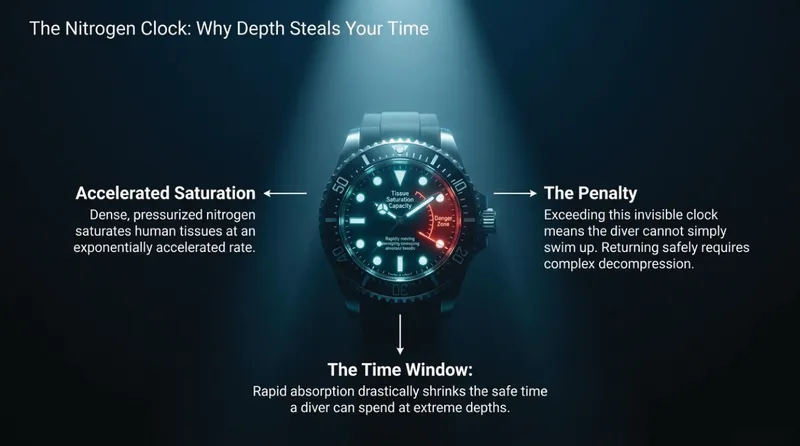
The Nitrogen Clock: Why Depth Steals Your Time
This increase in gas density triggers a phenomenon known as "Accelerated Tissue Saturation." Think of your body like a sponge. On the surface, the sponge is dry. As you descend and the air becomes denser, the "pressure gradient" - the force pushing nitrogen molecules into your blood and tissues - intensifies. Because every breath at 40 meters contains significantly more nitrogen molecules than at 10 meters, your "sponge" soaks up the gas at a staggering rate.
This drastically shrinks your window of opportunity. At shallower depths, you might have an hour to explore; at the 40-meter frontier, your safe "bottom time" evaporates in minutes. If you overstay this welcome, your body becomes so saturated with nitrogen that a direct ascent to the surface becomes impossible. You are then committed to complex decompression procedures to avoid the "bends." The 40-meter limit exists as the ultimate safety buffer, ensuring that our dives remain simple, fun, and easy to manage without the need for a floating laboratory on the dive boat.
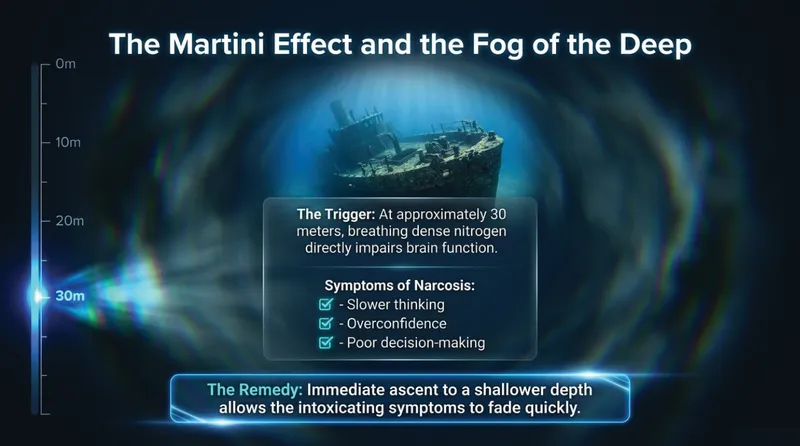
The Martini Effect and the Fog of the Deep
Even if we could ignore the ticking clock of nitrogen saturation, we would still have to face the "Martini Effect." Scientifically known as Nitrogen Narcosis, this intoxicating phenomenon typically begins to take hold around the 30-meter mark. Under pressure, nitrogen acts as a mild anesthetic, interfering with the way your neurons communicate.
It starts subtly - a slight lag in your mental processing, like a computer with too many tabs open. Then comes the overconfidence. You might feel invincible, ignoring your pressure gauge or losing track of your buddy. Your decision-making becomes sluggish and flawed. In an environment where precision is the only thing keeping you alive, a compromised ego is a liability. If the fog of narcosis rolls in, the only remedy is an immediate, controlled ascent to shallower water, where the pressure eases and the mind clears.

When Life-Giver Becomes Toxin
Perhaps the most counterintuitive danger of the deep is that oxygen itself has a dark side. While we need it to survive, oxygen becomes toxic to the human body when forced into our tissues at extreme pressures. For a diver breathing standard air, the concentration of oxygen reaches a critical, life-threatening threshold at approximately 56 meters.
If a diver pushes past the recreational buffer and approaches these depths, the results are violent and swift. Oxygen toxicity can trigger:
* Distorted or "tunneled" vision.
* Involuntary muscle twitching, often in the face.
* Sudden, life-threatening convulsions that can lead to drowning.
By capping recreational exploration at 40 meters, we maintain a vital margin of safety, stopping well short of the "hot" oxygen levels that turn our life-support gas into a poison.

Moving the Wall: The Path of the Technical Diver
For those who find the 40-meter wall too restrictive, the solution isn't to break the rules, but to change the science. This is the realm of "Technical Diving." It is a discipline of extreme discipline, moving away from standard air in favor of precise, specialized gas mixtures. By swapping some of that heavy nitrogen for helium or adjusting oxygen percentages, technical divers can counteract narcosis and delay the onset of toxicity.
But this freedom comes at a price. It requires advanced training and a move away from the "simple and manageable" philosophy of recreational diving toward a world of absolute precision and rigorous control. Technical divers don't ignore the invisible wall; they use chemistry and physics to move it.
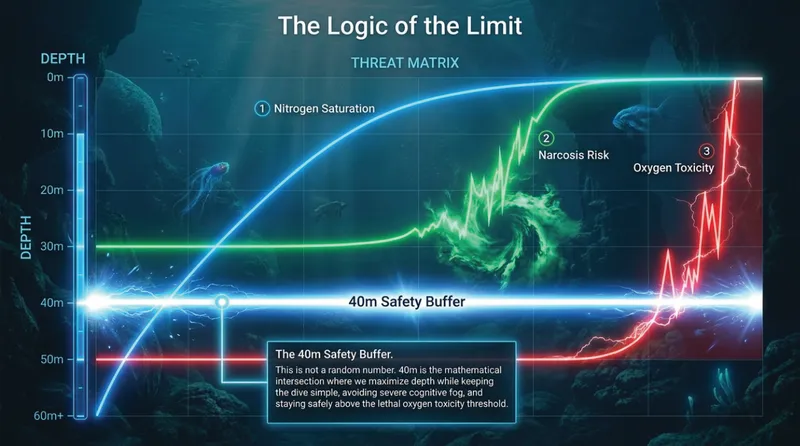
The Logic of the Limit
The 40-meter limit isn't a barrier to our curiosity; it is a testament to our mastery of human physiology. It represents the point where the beauty of the underwater world meets the hard reality of our biological evolution.
As humans, we are terrestrial creatures wearing technological masks to survive in a realm that was never meant for us. Understanding our limits isn't about fear - it’s about respect. By honoring the 40-meter frontier, we ensure that the ocean remains a place of wonder rather than a place of reckoning. The wall may be invisible, but staying on the right side of it is what allows us to keep coming back to the surface, breath after breath.
---
*Published on May 11, 2026*
*Author: Yevgen “Scorp” Sukharenko*
*Source: [Red Sea Creatures](https://redseacreatures.com)*
---
---
title: Witness to a Changing World: 5 Impactful Truths from David Attenborough’s Century on Earth
description: Sir David Attenborough's "A Life on Our Planet" opens not in vibrant rainforests, but amid Pripyat's radioactive ruins - a stark metaphor for humanity's self-inflicted ecological collapse, witnessed over his century on Earth. Nearly barred from BBC stardom in the 1950s for his "too big teeth," he evolved from black-and-white broadcaster to pioneer of 4K nature documentaries, bridging isolation to high-definition planetary peril. At 100, his legacy urges us to heed nature's decline before it's too late.
author: Yevgen “Scorp” Sukharenko
published: 2026-05-09T12:50:00.000Z
updated: 2026-05-21T20:32:35.705Z
tags: Marine Science
url: https://redseacreatures.com/blog/2026/05/09/witness-to-a-changing-world-5-impactful-truths-from-david-attenboroughs-century-on-earth
---
# Witness to a Changing World: 5 Impactful Truths from David Attenborough’s Century on Earth
Sir David Attenborough’s "witness statement," *A Life on Our Planet*, does not begin in the lush canopy of a rainforest or the vibrant depths of a coral reef. Instead, it opens amidst the skeletal remains of Pripyat, the ghost city abandoned after the Chernobyl disaster. For Attenborough, who celebrated his 100th birthday on May 8, 2026, this irradiated wasteland serves as a chillingly apt metaphor for the state of the Earth: a place where a single environmental catastrophe, authored by human error, led to the total collapse of an ecosystem. Having spent a literal century on this planet, Attenborough has observed the decline of the wild in what amounts to a geological heartbeat, moving from a narrator of nature’s wonders to a witness of its systemic ruin.

The "Too Big Teeth" Rejection: An Unlikely Start to a Legend
It is a profound irony that the man now celebrated as the "greatest broadcaster of our time" was nearly denied a career in television because of his physical appearance. When Attenborough joined the BBC in the early 1950s, he was a man who didn't even own a television set - having seen only one programme in his life before applying. Despite his obvious intellect, a senior executive named Mary Adams initially discouraged him from appearing on camera, famously decreeing that his teeth were "too big" for the medium.
This early rejection highlights the staggering span of Attenborough’s career, which has mirrored the evolution of human perception itself. He began in a studio-bound era of grainy, black-and-white broadcasts and ended by pioneering 4K and 3D technologies that bring the natural world into our living rooms with microscopic intimacy. His life’s work represents a technological bridge from an age of isolation to an age where we can see the planet’s destruction in high definition, making the "too big" teeth that Mary Adams once feared a central fixture in our collective global consciousness.
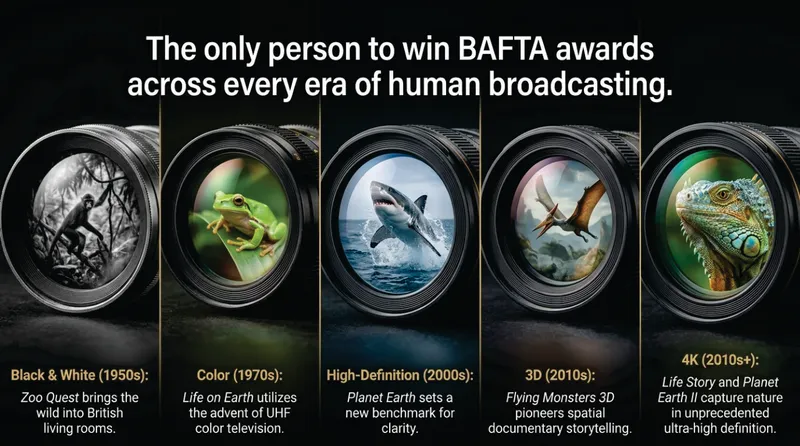
The BAFTA Spectrum: A Unique Technological Legacy
Attenborough’s commitment to innovation was never about mere gadgetry; it was a tireless effort to bridge the widening gap between urban humanity and the vanishing wild. This pursuit has granted him a record that is unlikely to be broken: he is the only person to win BAFTA Awards for programmes produced in black-and-white, color, high-definition, 3D, and 4K resolution.
His foresight often outpaced the very institution that employed him. In the mid-1950s, while filming *Zoo Quest*, Attenborough and cameraman Charles Lagus insisted on using 16mm color film stock. At the time, the BBC’s film unit preferred the unwieldy 35mm format, and the corporation would not even begin color broadcasting until 1967. This advanced film was eventually tucked away and forgotten until 2015, when archivists discovered that these early "black-and-white" expeditions were, in fact, captured in vibrant, hidden color. It serves as a reminder that Attenborough was always seeing a more vivid world than the one we were prepared to receive.
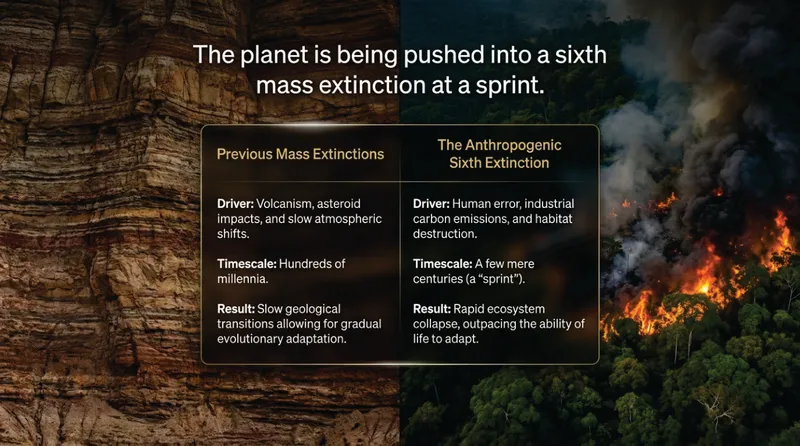
A "Sprint" Toward Extinction: The Anthropogenic Contrast
Perhaps the most haunting truth Attenborough has distilled is the sheer, unnatural speed of the current "sixth mass extinction." While the Earth has endured five previous collapses, those were the products of volcanic surges or asteroid strikes that unfolded over hundreds of millennia. The current crisis, by contrast, is "anthropogenic" - human-authored - and is occurring over a mere few centuries.
This is not a slow decline; it is an evolutionary blink of an eye. Attenborough emphasizes that this "sprint" toward extinction is counter-intuitive to the human experience, which struggles to grasp changes that occur faster than our cultural memory can record. Reflecting on his childhood in 1936, he notes that the very concept of human-driven ecological collapse was once considered a fantasy:
"The idea that mankind was endangering nature by recklessly despoiling and plundering its riches was unheard of at the time, but it is one that has remained part of David's own credo to this day."
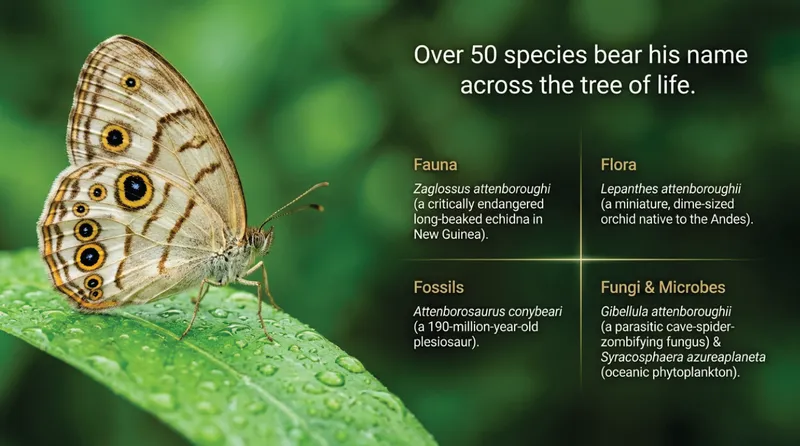
50 Species and Counting: The Living Taxonomy of a Narrator
Attenborough’s influence has reached so deeply into the scientific community that he has been "absorbed" into the natural world through nomenclature. Approximately 50 organisms, both living and extinct, now bear his name - a taxonomic tribute that effectively weaves his legacy into the tree of life. This includes the *Gibellula attenboroughii*, a zombifying fungus that forces spiders to "march" to cave entrances to disperse spores, and the ancient, predatory *Auroralumina attenboroughii*, believed to be one of the first animals to ever hunt prey.
There is a poetic irony in the fossil bird named in his honor, *Imparavis attenboroughi*. While Mary Adams once worried that Attenborough’s teeth were too large for the screen, this "strange bird" from the Cretaceous period is notable for having no teeth at all.
However, the most emotional chapter of this taxonomic story belongs to *Zaglossus attenboroughi*, or Attenborough’s long-beaked echidna. Long feared extinct and known only from a single specimen collected in 1961, the creature was miraculously rediscovered in 2023 in the "lost world" of the Cyclops Mountains. Upon hearing that his namesake still roamed the earth, Attenborough was reportedly moved to tears - a rare moment where the witness of decline was allowed to witness a resurrection.
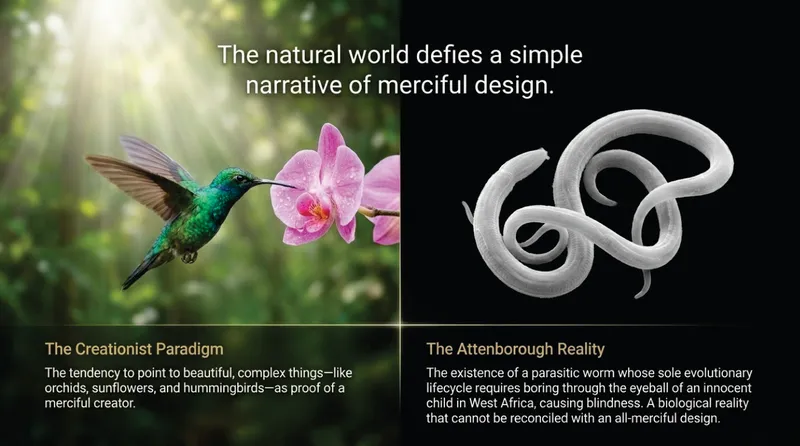
The Parasitic Worm Argument: A Counter-Intuitive View on Faith
Despite his reverence for nature’s complexity, Attenborough’s deep study of biology has led him to a resolute agnosticism. He famously rejects the "intelligent design" arguments of creationists, citing what he calls biological horrors as proof that nature is not the work of an all-merciful deity. He frequently points to the *Onchocerca volvulus*, a parasitic worm that lives inside a child’s eyeball, eventually boring through the tissue to cause permanent blindness.
Attenborough argues that it is impossible to reconcile a benevolent creator with a creature that can only survive by agonizingly destroying the sight of an innocent human. To him, evolution is not a "theory" in the colloquial sense but a "solid historical fact" evidenced in every fossil and DNA strand. He identifies as agnostic, stating he "lacks confidence" to claim the absolute certainty of an atheist, yet he remains in a state of perpetual wonder at the "organic evolution" that brought the diversity of life into existence without the need for a divine architect.

From "Terrible Decline" to "Wonderful Recovery"
David Attenborough’s century on Earth has been a journey from the ruins of the past to the threshold of an uncertain future. He has moved from the studio-bound days of the 1950s to the global stage of COP26, where he challenged world leaders to recognize our role as the "greatest problem solvers" in history. His proposed solutions - rewilding the planet, transitioning to renewable energy, and stabilizing the human population through the education and rights of women - are the cornerstones of his vision for a "wonderful recovery."
We return, finally, to the ruins of Pripyat. The desertion of that city was the result of a singular catastrophe, but it also allowed nature to slowly reclaim the concrete. Attenborough’s life serves as a warning that we are currently acting as a "plague on the Earth," but his legacy offers a final, haunting question: Can we transition from being the authors of the planet's decline to the architects of its restoration? If a man who has seen more of the Earth than any other human in history can remain "refreshingly optimistic," perhaps there is still time for the witness to see the recovery begin.
---
*Published on May 9, 2026*
*Author: Yevgen “Scorp” Sukharenko*
*Source: [Red Sea Creatures](https://redseacreatures.com)*
---
---
title: Why Your Survival Instincts Are Lying to You: The Surprising Statistics of Risk
description: Your survival instincts are lying to you, tricked by the "Jaws" effect that amplifies shark fears despite just 4-12 global deaths yearly, while ignoring true killers like mosquitoes. These tiny insects, spreading malaria, claimed around 610,000 lives in 2024 - over 50,000 times more than sharks - mostly young children in sub-Saharan Africa. availability heuristic and negativity bias make vivid threats loom large, blinding us to mundane dangers hiding in plain sight.
author: Yevgen “Scorp” Sukharenko
published: 2026-04-28T22:30:00.000Z
updated: 2026-08-08T13:20:22.003Z
tags: Sharks
url: https://redseacreatures.com/blog/2026/04/29/why-your-survival-instincts-are-lying-to-you-the-surprising-statistics-of-risk
---
# Why Your Survival Instincts Are Lying to You: The Surprising Statistics of Risk
### The "Jaws" Effect and the Reality of Fear
For fifty years, a single cinematic image has governed our collective relationship with the ocean: a jagged dorsal fin cutting through a glassy surface, accompanied by a two-note orchestral warning. This "Jaws" effect has done more than sell movie tickets; it has hardwired a disproportionate primal terror into our lizard brains.
But as a data journalist, I have to tell you: your survival instincts are lying to you.
According to the International Shark Attack File (ISAF), there are only 4-12 unprovoked shark-related deaths recorded globally per year. To put that in perspective, you are statistically more likely to die from almost any other activity you perform today. Our brains fail at this math because of the **Availability Heuristic** - a mental shortcut where we judge the probability of an event based on how easily we can recall examples. Because shark attacks are spectacular, bloody, and dominate news cycles, they are "available" in our memory. Meanwhile, our **Negativity Bias** causes us to hyper-focus on predatory threats while we ignore the mundane killers hiding in plain sight.
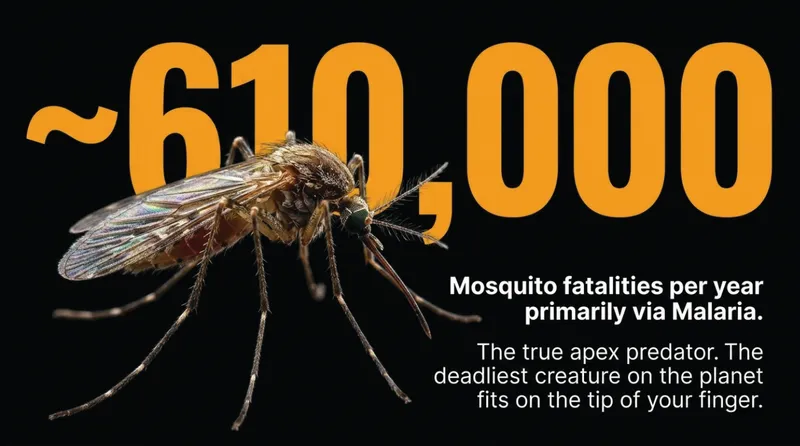
### The Deadliest Predator on Earth (It’s Not What You Think)
If we define "deadliness" by the sheer volume of human lives claimed, the Great White is a footnote. The true apex predator of our planet is an organism you can crush between two fingers: the mosquito.
While sharks struggle to reach double-digit fatalities annually, the mosquito - specifically as a vector for malaria - claims hundreds of thousands of lives. The scale of this discrepancy is staggering. For every one person killed by a shark, mosquitoes claim over 50,000 lives. It is a profound irony of evolution that we have spent decades vilifying the ocean’s most majestic hunter while a tiny insect causes orders of magnitude more devastation.
> 🦟 Mosquitoes (malaria): ~610,000 deaths/year (WHO, 2023-2024).

### The Hidden Danger in "Man's Best Friend"
The irrationality of human fear is best illustrated by the "Proximity vs. Predator" paradox. We spend billions of dollars on beach safety and "shark spotters," yet we willingly invite a far more prolific killer into our bedrooms.
Global data from the World Health Organization indicates that dogs are responsible for over 25,000 deaths per year, primarily through rabies transmission and fatal bites. This makes "man’s best friend" over 2,000 times more lethal than the "man-eater" in the deep. We fear the "unprovoked" encounter in the wild, yet we are statistically safer in a school of sharks than in a neighborhood with loose dogs.
Even the sky above is more dangerous than the water below. Lightning strikes claim between 3,800 and 24,000 lives annually. You are significantly more at risk from a passing summer storm than you are from a dip in the Atlantic.
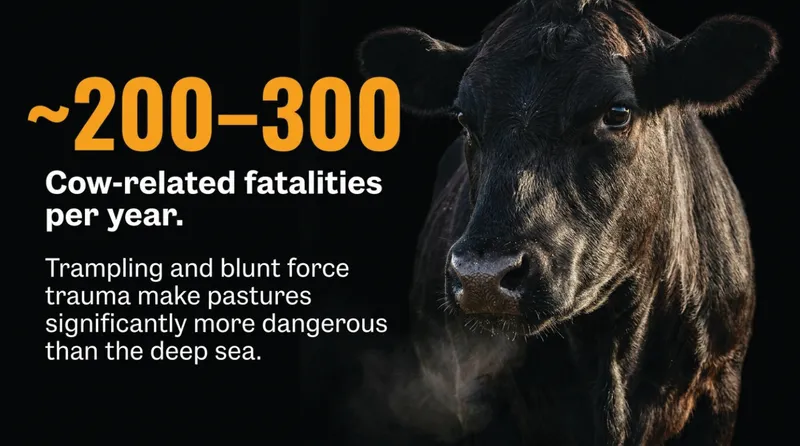
### The Absurdity of Risk: From Farm Animals to Party Favors
To truly understand how poorly we calibrate risk, we must look at the irony of the "mundane killer." If you want to fear something, stop looking at the horizon and start looking at your backyard - or your refrigerator.
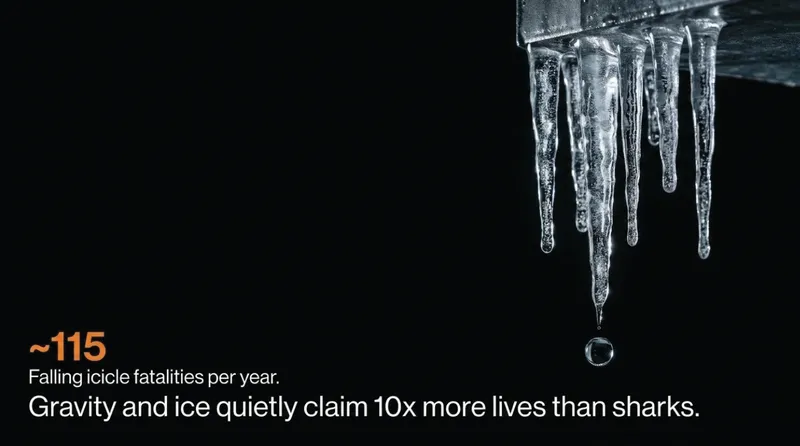
Consider the following comparisons:
* **Icicles:** Falling ice is responsible for roughly 115 deaths annually. You are nearly 10 times more likely to be killed by a frozen spike in Russia or the USA than by a shark.
* **Cows:** These "gentle" farm animals cause 200-300 deaths per year through trampling or kicks. A cow is roughly 25 times more dangerous than a shark.
* **Champagne corks:** Even a celebratory toast is twice as lethal as a shark encounter. Approximately 24 people die every year from champagne cork accidents.
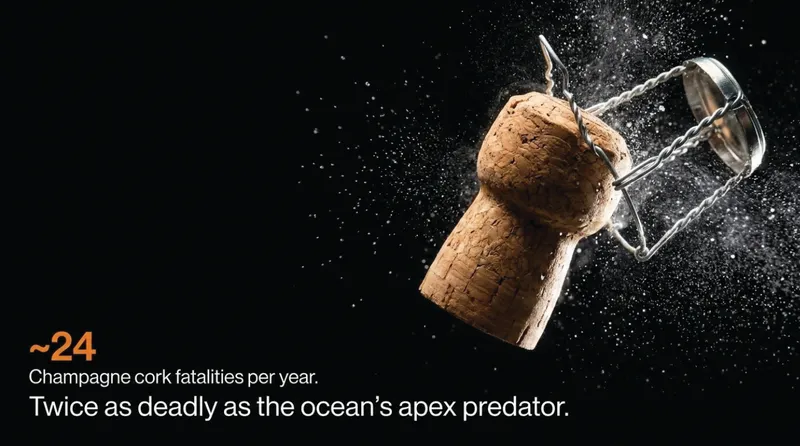
There is a dark humor in the data: you are statistically in more danger while popping a bottle of bubbly to celebrate your vacation than you are while swimming in the ocean once you get there.
> 🧊 Icicles: ~115 deaths/year (Russia ~100, USA ~15).
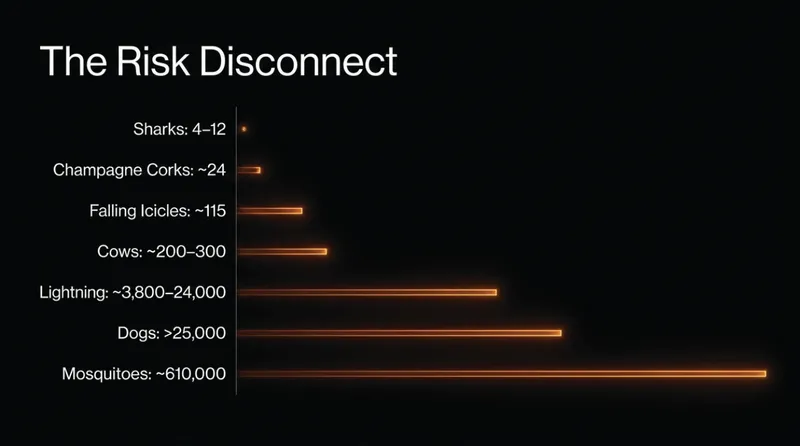
### The "Shark Scale" of Danger
To re-calibrate your perspective, look at the "Shark Scale" below. This list ranks threats that cause more deaths annually than the 4-12 attributed to sharks, ordered from the most lethal to the least:
* **Mosquitoes (Malaria):** ~610,000 deaths
* **Dogs (Rabies/Bites):** >25,000 deaths
* **Lightning strikes:** 3,800-24,000 deaths
* **Cows:** 200-300 deaths
* **Icicles:** ~115 deaths
* **Falling coconuts:** A statistical reality that claims dozens of lives annually - making a piece of fruit more dangerous than a Great White.
* **Champagne corks:** ~24 deaths
* **Sharks:** 4-12 deaths
Even "Falling coconuts," often dismissed as an urban legend, are a statistically relevant threat that dwarfs the shark's impact. If it's on the list, it's a higher priority for your survival instinct than a fin in the water.
### Conclusion: Re-calibrating Our Perspective
Understanding these statistics isn't just an exercise in trivia; it is a necessary step toward data-driven thinking. Our fear-based reactions have real-world consequences. This "shark paranoia" has led to unnecessary culling, overfishing, and a lack of support for the conservation of a species that is vital to the health of our oceans.
By dismantling the "Jaws" narrative with hard data, we can move past the vilification of wildlife. We must learn to respect the shark as a critical component of our ecosystem rather than a monster from a nightmare.
The next time you hesitate to step into the ocean, let the math settle your nerves. Ask yourself: are you actually afraid of the shark, or are you just ignoring the champagne cork in the room?
---
*Published on April 28, 2026*
*Author: Yevgen “Scorp” Sukharenko*
*Source: [Red Sea Creatures](https://redseacreatures.com)*
---
---
title: Beyond the Horizon: 5 Reasons the Tide is Turning for Our Oceans
description: Amid the gloom of warming seas and plastic-choked oceans, a resilient story emerges: for the first time, over 10% of the global ocean is now protected, surging from 8.6% in early 2024 toward the 30% target by 2030. This milestone signals accelerating international cooperation, proving marine ecosystems can rebound with deliberate action. From Antarctic "super groups" returning to thriving waters, these victories show the tide is turning through systemic effort, replacing doom with a roadmap for restoration.
author: Yevgen “Scorp” Sukharenko
published: 2026-04-25T16:00:00.000Z
updated: 2026-04-25T15:11:23.964Z
tags: Marine News
url: https://redseacreatures.com/blog/2026/04/25/beyond-the-horizon-5-reasons-the-tide-is-turning-for-our-oceans
---
# Beyond the Horizon: 5 Reasons the Tide is Turning for Our Oceans
It is easy to get lost in the relentless cycle of environmental decline. We are constantly met with headlines of warming seas, plastic-choked currents, and the precarious state of marine life. This steady drip of "climate doom" creates a narrative where the ocean’s health feels like a foregone conclusion - a tragedy already written.
However, beneath the surface of this familiar gloom, a more resilient story is unfolding. There is a surge of evidence-based progress - real, measurable triumphs - that rarely makes the front page. These victories suggest that our oceans are not just a victim of human activity, but a biological powerhouse capable of stunning recovery when we provide the right conditions.
While we are far from the finish line, the following five developments represent seismic shifts in how we protect our blue planet. They prove that the tide is not just turning; it is being turned by deliberate, systemic effort. The narrative of inevitable loss is finally being replaced by a map for restoration.
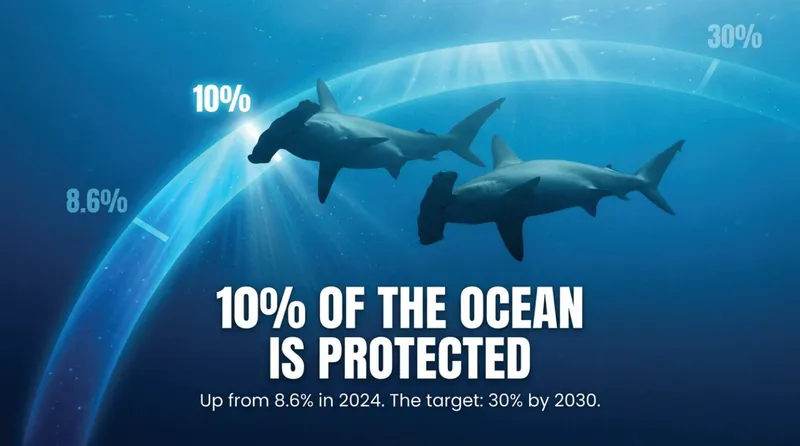
### 1\. Crossing the 10% Threshold
The global community recently crossed a psychological and ecological finish line. For the first time in history, **more than 10% of the global ocean is officially under protection**. This is not just a marginal gain; it is a rapid acceleration from the 8.6% figure recorded in early 2024.
Over 10% of the global ocean is now protected for the first time, up from 8.6% in 2024, moving toward a **target of 30% by 2030**.
This sudden jump reveals that we have finally hit the "steep part of the curve" in international cooperation. Reaching double digits indicates that the "30 by 30" target - the global commitment to protect 30% of the seas by 2030 - is no longer a lofty ideal, but a tangible trajectory. Nations are beginning to treat marine health as a core component of geopolitical stability rather than an afterthought.

### 2\. The Return of the "Super Groups"
In the inky, nutrient-rich waters of Antarctica, a phenomenon once thought lost to the era of industrial whaling has reappeared. Researchers are now documenting "**super groups**" - dense, churning pods of **over 100 whales feeding in unison**. To see 1,000 tons of biology moving through a single patch of ocean, with the cacophony of a hundred blows breaking the surface against a glacial backdrop, is to witness nature’s sheer scale restored.
This recovery did not happen by accident; it is the hard-won result of decades of ironclad protection and the cessation of commercial hunting. These massive congregations are the "interest" being paid on a long-term ecological investment. They remind us that nature requires a different timeline than our own, and when given the space of generations, the biological payoff is spectacular.
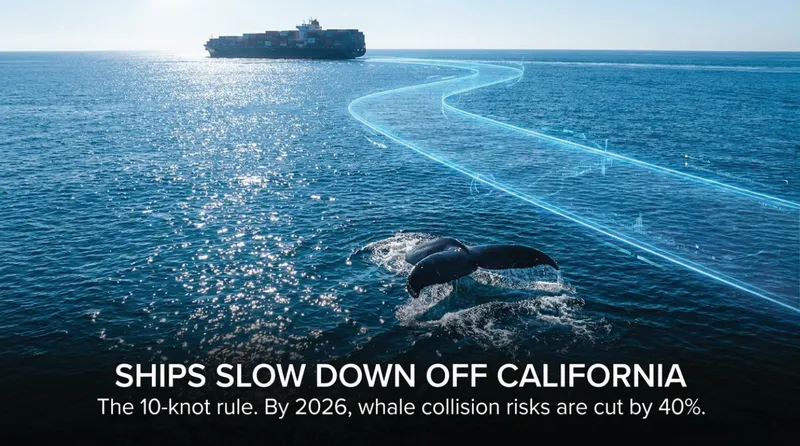
### 3\. A New Standard for the Giants
A pivotal shift in maritime logistics is about to make the California coast a sanctuary rather than a hazard. By 2026, vessels traversing most of the state’s coastline are being asked to adhere to a **10-knot speed limit**. By asking the titans of global commerce to slow their pace, we are effectively removing the primary threat to migrating whales: the lethal ship strike.
**Key Stat: Reducing ship speeds to 10 knots could cut the risk of whale collisions by up to 40%.**
This shift highlights how a relatively simple logistical adjustment can have a disproportionately large impact on biodiversity. It demonstrates that protecting the ocean doesn't always require futuristic technology. Often, it just requires the humility to adjust the "speed" of human industry to accommodate the natural rhythms of the creatures that were there first.

### 4\. MIT’s Microscopic Cleanup Crew
While we work on the surface, researchers at MIT are uncovering solutions hidden at the microscopic level. They have identified specific marine microbes that have evolved a remarkable "dual-action" capability to process plastic waste. This isn't just a passive occurrence; it is a complex biological sequence:
* **Degradation:** One strain of bacteria focuses on the physical and chemical breakdown of the plastic's structural integrity.
* **Consumption:** A second strain utilizes the resulting material as a source of energy, **metabolically "eating" the waste**.
This discovery reveals the surprising adaptability of life as it evolves to utilize human waste as a resource. It points toward a future where a technological-biological partnership could help us address deep-sea pollution that was once considered permanent. Life, it seems, is finding its own way to clean up our mess, provided we don't overwhelm it.

### 5\. The Legal Sea Change
The most counter-intuitive wins are often won in the courtroom rather than on the water. A new wave of climate litigation is fundamentally rewriting the "math" of fossil fuel development. Recent court decisions are now forcing governments to legally account for future carbon emissions before any new project can be approved.
This changes the financial reality for industrial expansion. When companies are forced to factor in the environmental costs and future emissions today, projects that once looked profitable suddenly look like "stranded assets" or high-risk liabilities. By embedding conservation directly into the legal framework of development, we are ensuring that the protection of our oceans is no longer a choice, but a requirement of the law.
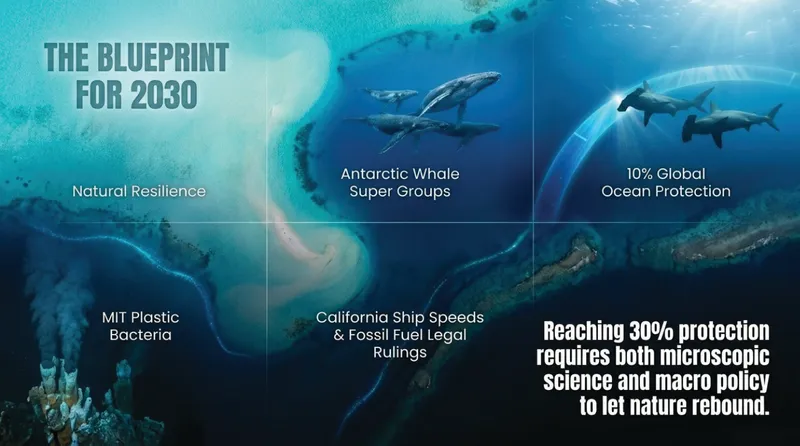
### The Ripple Effect
These "Tides of Progress" represent a fundamental shift in the global conservation strategy. We are moving away from reactive, piecemeal efforts and toward a systemic, legal, and biological restoration of our blue world. These victories prove that conservation is not a lost cause; it is a proven strategy that yields results when given time and legal backing.
The narrative is changing, and the momentum is building. As we look toward the ambitious goals of 2030, these unseen wins provide the fuel for the journey ahead.
The evidence is clear: the ocean is ready to heal if we are willing to let it. The only question that remains is whether you are ready to trade the comfort of "climate doom" for the difficult, rewarding work of restoration.
---
*Published on April 25, 2026*
*Author: Yevgen “Scorp” Sukharenko*
*Source: [Red Sea Creatures](https://redseacreatures.com)*
---
---
title: Beyond the Deep: 8 Surprising Things You Must Never Do After Scuba Diving
description: The dive doesn't end when you surface - it enters a hidden "invisible" phase where your body off-gasses nitrogen, and ignoring it can turn vacation fun into serious risks. Skip flying, mountain climbing, or ziplining right away, as high altitudes mimic plane cabin pressure drops that spark decompression sickness. Even a relaxing deep tissue massage is off-limits immediately after, potentially masking DCS symptoms like soreness or boosting bubble formation through intense pressure - wait at least 12-24 hours instead.
author: Yevgen “Scorp” Sukharenko
published: 2026-04-16T10:00:00.000Z
updated: 2026-04-16T10:07:37.258Z
tags: Scuba Diving
url: https://redseacreatures.com/blog/2026/04/16/beyond-the-deep-8-surprising-things-you-must-never-do-after-scuba-diving
---
# Beyond the Deep: 8 Surprising Things You Must Never Do After Scuba Diving
Safety doesn't stop at the shoreline; it demands a transition period that many divers overlook. The dive does not truly end when you break the surface or stow your fins. Instead, it enters an "invisible" phase where the body must adjust to being back on land.
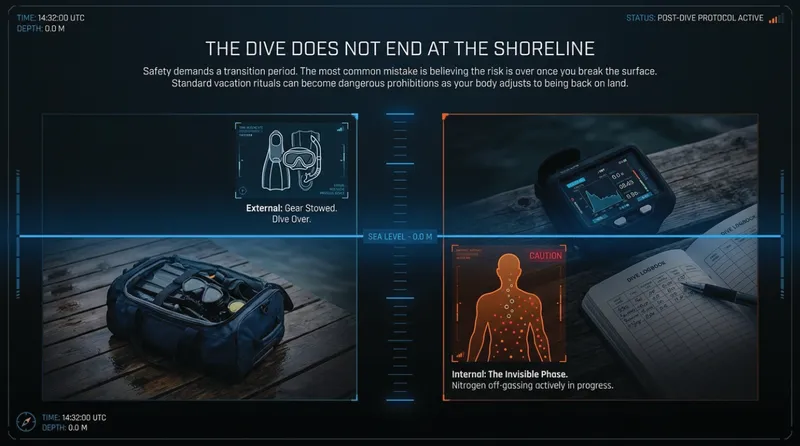
It is a common mistake to think the risk is over once the gear is rinsed, yet many standard vacation rituals - the very activities we use to unwind - can become dangerous prohibitions in the hours following a dive. As a diver, your ability to navigate this post-dive window is just as critical as your buoyancy control in the depths.

### The High-Altitude Hazard: Flying After Diving
For the traveling diver, the return journey requires careful timing. Flying immediately after a dive is strictly prohibited because the move from a dive environment to a high-altitude cabin creates a dangerous transition. This is the most critical rule for those on diving holidays; the shift to a lower-pressure environment in an aircraft can trigger severe physical complications that could have been avoided by staying at sea level.
> Things You Should Never Do Immediately After Diving: **Flying After Diving**
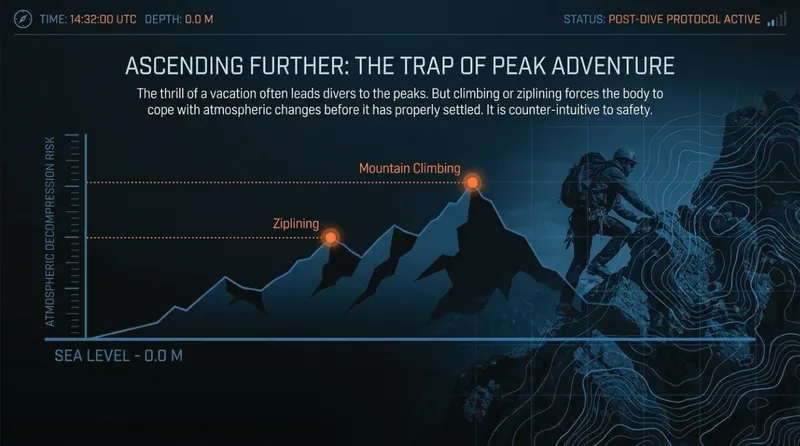
### Ascending Further: Mountain Climbing and Ziplining
The thrill of a vacation often leads divers to seek adventure in the peaks as soon as they leave the water. However, mountain climbing and ziplining are high-altitude activities that carry the same risks as boarding a plane. For an adventurer looking to maximize their day, these might feel like a natural progression, but they are counter-intuitive to safety. Moving to a higher elevation through climbing or a zipline course forces the body to cope with altitude changes before it has properly settled after a dive.

### The Danger of Relaxation: Deep Tissue Massage
While a deep tissue massage is a staple of relaxation, it is a hazardous choice following a dive. The intense physical manipulation and pressure applied to the body can interfere with how your system recovers. This level of physicality - normally used to work out knots and tension - is too aggressive for a body that needs a calm, undisturbed transition back to its normal state. Save the spa day for later in the week to ensure your recovery remains on track.
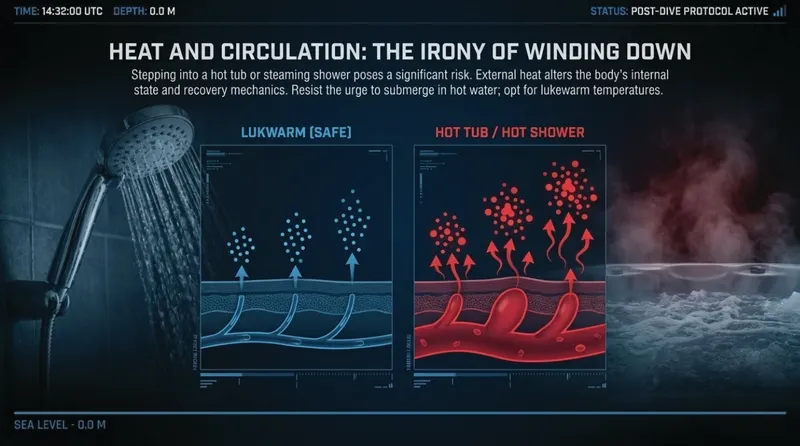
### Heat and Circulation: Relaxing in a Hot Tub or Shower
There is a striking irony in dive safety: the very activities we use to warm up and relax are often the most dangerous. Stepping into a hot tub or taking a steaming shower immediately after a dive poses a significant risk. The introduction of external heat changes how the body handles its recovery and alters its internal state. Divers must resist the urge to submerge in hot water, opting for lukewarm temperatures to avoid compromising their safety.
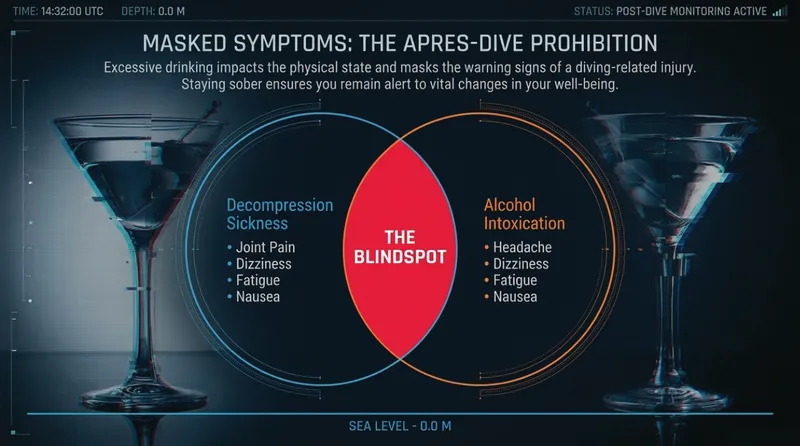
### Masked Symptoms: Excessive Drinking
The "apres-dive" culture often revolves around a celebratory drink, but excessive alcohol consumption is a major prohibition. Drinking creates a dangerous situation by impacting the body's physical state and, more critically, masking the warning signs of a diving-related injury. Because the effects of alcohol can mimic certain post-dive symptoms, it can prevent a diver from realizing they are in trouble. Staying sober ensures you remain alert to any changes in your physical well-being.
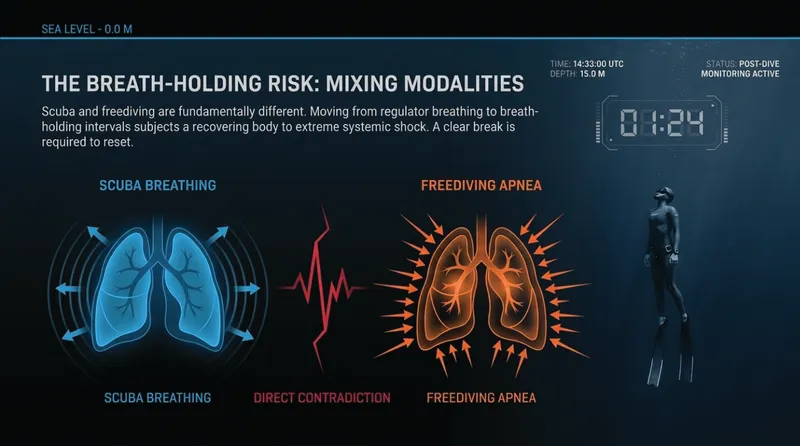
### The Breath-Holding Risk: Freediving After Scuba Diving
Though both activities happen in the water, scuba and freediving are fundamentally different and should never be mixed in the same afternoon. Moving from breathing through a regulator to a series of breath-holding intervals subjects the body to extreme stress. The physical demands of freediving are a direct contradiction to the rest required after a scuba session. A clear break is required between these two disciplines to allow the body to reset.

### Physical Exertion: Exercising After Diving
Hitting the gym or engaging in a strenuous workout after a dive is a strict "never-do." Intense physical activity increases your heart rate and puts unnecessary strain on your circulatory system at a time when your body needs to be at rest. This level of exertion interferes with the natural recovery process. To ensure you return to your baseline safely, prioritize quiet relaxation over the treadmill or heavy lifting.

### Conclusion: A Mindful Return to the Surface
Safety in the water is a deliberate process that must continue long after the logbook is signed. The transition from the depths back to your daily routine requires a mindful approach to how you treat your body. Before you plan your next post-dive excursion or celebration, look closely at your itinerary.
If your post-dive ritual involves any of these eight activities, are you truly back on solid ground, or are you still at risk?
**The dive is only truly successful when you have safely returned to your normal routine on land.**
---
*Published on April 16, 2026*
*Author: Yevgen “Scorp” Sukharenko*
*Source: [Red Sea Creatures](https://redseacreatures.com)*
---
---
title: Clear Vision Below: Your Guide to Scuba Diving with Contacts and Glasses
description: Worried about diving with vision impairment? You'll see the underwater world in breathtaking clarity, from neon nudibranchs to majestic manta rays - and your gauges too. Underwater refraction naturally magnifies objects by one-third, acting like a mild boost for minor prescriptions, while soft disposable contacts offer safe, versatile correction favored by pros for their comfort and low infection risk.
author: Yevgen “Scorp” Sukharenko
published: 2026-04-14T16:30:00.000Z
updated: 2026-04-14T16:28:31.460Z
tags: Scuba Diving
url: https://redseacreatures.com/blog/2026/04/14/clear-vision-below-your-guide-to-scuba-diving-with-contacts-and-glasses
---
# Clear Vision Below: Your Guide to Scuba Diving with Contacts and Glasses
One of the most common questions I hear on the dive boat is born from a flicker of anxiety: "Can I actually see the fish?" For those who live their lives through a lens, the fear of missing the kaleidoscope of a coral garden or the intricate, neon-tinged textures of a tiny nudibranch is real. You worry that a blurry world will keep you from the majesty of a passing manta ray or, more critically, from reading your life-support gauges.
As a professional diver and an explorer who has documented wonders from the Red Sea, I have a simple answer for you: Absolutely. With my own eyes at -2 and -2.25, I use glasses on the surface and single-use contact lenses underwater - vision impairment is not a barrier to the abyss. With the right setup, you won't just "get by" - you’ll see the underwater world with breathtaking clarity.
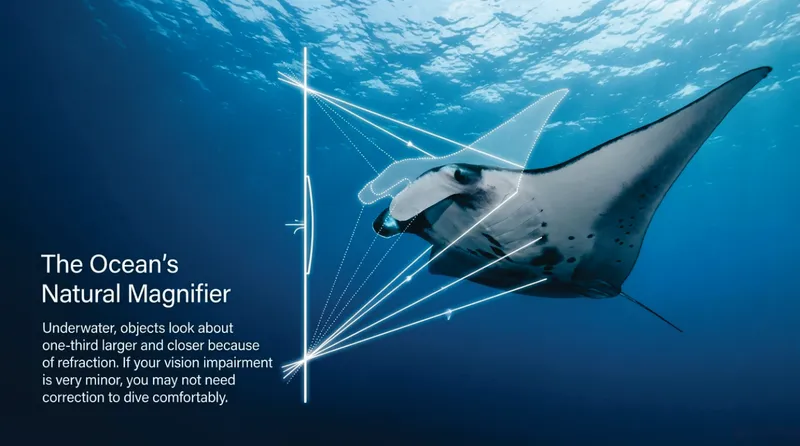
**Physics is Your Friend: The Refraction Factor**
Before you rush to order custom gear, it is worth understanding the "magic" of underwater optics. Because of refraction - the way light bends as it passes from the water through your mask’s glass and into the air pocket in front of your eyes - objects appear approximately one-third larger and closer than they actually are.
This quirk of physics is a surprising natural benefit for divers with minor impairments. If you are just starting to struggle with fine print, you might find that the water itself acts as a mild magnifying glass. This "boost" is particularly helpful for near-vision tasks, such as monitoring the digital display on your dive computer or checking your pressure gauge. For many adventurers with slight prescriptions, this natural magnification is enough to allow for a comfortable, safe, and vivid dive experience without any correction at all.
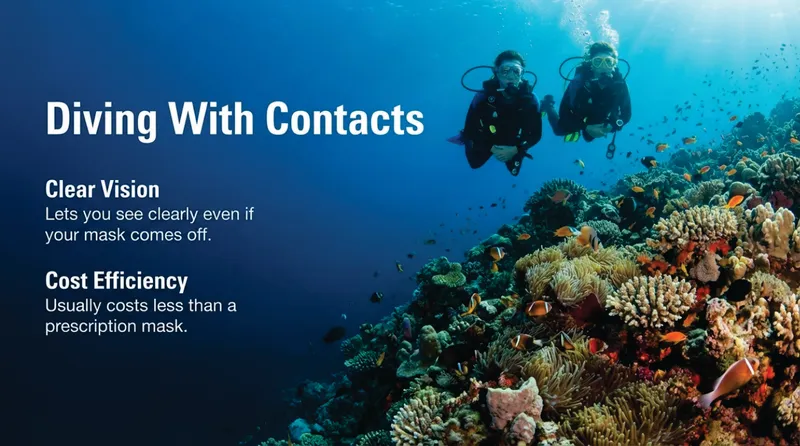
**The Case for Soft, Disposable Contacts**
For those who need a more definitive correction to keep the world in focus, soft, disposable contact lenses are the gold standard for versatility. They are a favorite among professionals for two primary reasons: safety and economics.
> "Contacts are often a popular option because they let you see clearly even if your mask comes off."
From an instructor's perspective, this is a massive safety win. If your mask is bumped or if you’re practicing mask-clearing skills, you don’t want to be plunged into a blur. Contacts allow you to maintain visual contact with your buddy and your surroundings regardless of what is happening with your mask.
Furthermore, as a journalist who spends days in the water, I always recommend the *disposable* variety. Salt water and pool chemicals can harbor bacteria or cause protein buildup on lenses; using daily disposables means you can simply toss them at the end of the dive day, drastically reducing the risk of eye infections and ensuring your "ocean eyes" stay healthy and bright.
**Leave Your Regular Frames at the Surface**
While your favorite frames are essential for spotting dolphins from the deck, they cannot join you on the descent. Standard glasses are incompatible with diving because the "temples" or arms of the frames break the silicone skirt's seal against your face. This creates a gap that leads to a slow, frustrating, and constant flood of water into your mask.
However, leaving your frames topside doesn't mean diving into a fog. The source context provides two professional-grade paths:
* **Prescription Masks:** These are high-quality dive masks where the glass is ground to your specific corrective needs.
* **Specialty Prescription Eyewear:** These are dedicated prescription inserts or specialized optics designed specifically to fit securely behind the glass of a standard mask.
While the upfront cost is higher than a box of contacts, these tools ensure that even those with complex prescriptions have a front-row seat to the underwater show.

**How to Choose Your Underwater View**
Deciding how to tackle your vision needs is a personal process. When you’re weighing your options, use this framework to decide what fits your diving style:
* **Honesty Regarding Safety:** Be realistic about your ability to read critical life-support gauges and recognize subtle hand signals from your buddy in low-light or silty conditions.
* **Personal Convenience:** Consider whether you are comfortable touching your eyes in a marine environment or if you prefer the "set it and forget it" simplicity of a prescription mask.
* **Dive Frequency:** If you’re a casual vacationer, disposables may be the most cost-effective. If you’re a dedicated bubble-blower planning a long-term diving career, a dedicated prescription mask is a worthy investment in your kit.
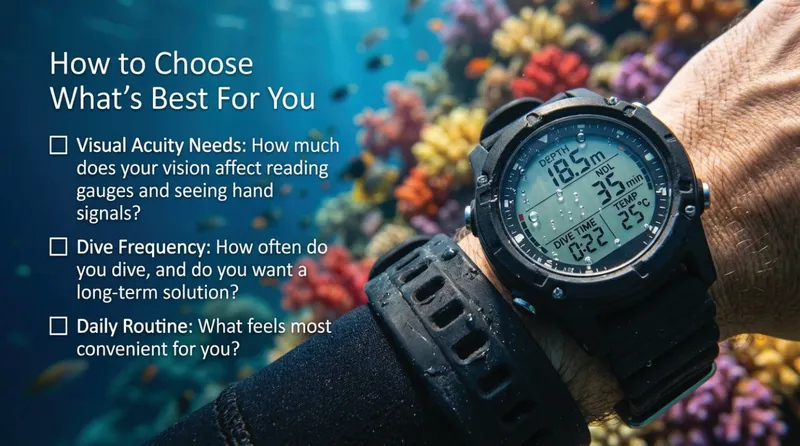
**The Bottom Line: Don't Let Blur Hold You Back**
The takeaway is simple: your prescription should never be the reason you stay on the boat. Whether you’re leaning on the natural magnification of refraction, the safety and hygiene of soft disposables, or the precision of a prescription mask, there is a solution that will make the ocean look as sharp as a high-definition photograph.
The abyss is calling, and now, you'll be able to look it right in the eye - what’s stopping you from taking the plunge?
---
*Published on April 14, 2026*
*Author: Yevgen “Scorp” Sukharenko*
*Source: [Red Sea Creatures](https://redseacreatures.com)*
---
---
title: The Crush of the Abyss: Three Scuba Records That Redefined Human Limits
description: For recreational divers, the ocean is a fleeting escape limited by air and no-decompression rules. But elite explorers like Ahmed Gabr shatter those bounds, plunging to 332 meters in Egypt's Red Sea in 2014 - descending in 15 minutes, only to endure a 14-hour ascent battling gas saturation and crushing pressure. Through precise trimix blends and endless 3-meter stops, they turn survival into a clinical triumph over the deep.
author: Yevgen “Scorp” Sukharenko
published: 2026-04-07T14:00:00.000Z
updated: 2026-04-07T14:03:34.518Z
tags: Scuba Diving
url: https://redseacreatures.com/blog/2026/04/07/the-crush-of-the-abyss-three-scuba-records-that-redefined-human-limits
---
# The Crush of the Abyss: Three Scuba Records That Redefined Human Limits
For the recreational diver, the underwater world is a temporary sanctuary experienced in 40- to 60-minute windows. We are bound by "bottom time" - a delicate calculation of air consumption and no-decompression limits. For most, the surface is always a shallow breath away. However, a elite group of explorers and technicians has looked at these biological boundaries and systematically dismantled them.
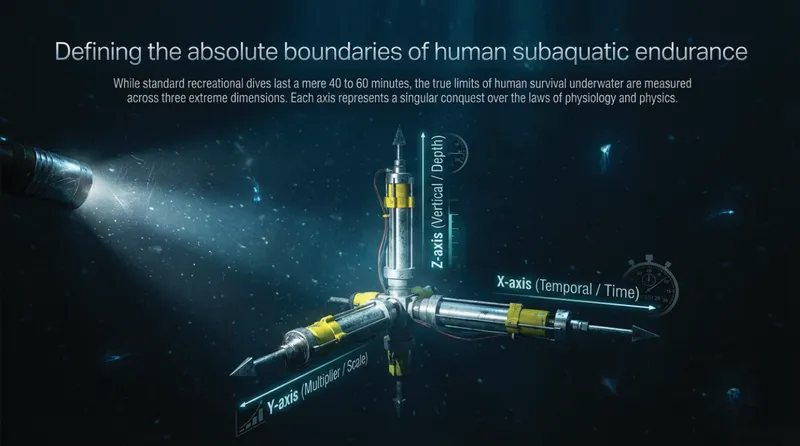
By manipulating gas partial pressures, enduring psychological isolation, and mastering complex logistical chains, these record-breakers have pushed into a realm where the water column becomes a physical weight and time is the ultimate enemy.

**The 14-Hour Journey Home: A 332-Meter Descent**
On September 18, 2014, Egyptian diving specialist Ahmed Gabr achieved the unthinkable in the Red Sea off Dahab. He plummeted to a staggering depth of 332.35 meters, effectively entering a world of crushing hydrostatic pressure and absolute darkness. While his descent was a rapid, 15-minute freefall, his return to the surface was a grueling 14-hour marathon of physiological survival.
This extreme asymmetry is dictated by the physics of gas solubility. As a diver descends, the high ambient pressure forces gases - specifically nitrogen - to dissolve into the body's tissues at an accelerated rate. While the body "saturates" quickly, it desaturates with agonizing slowness. Surfacing too fast would cause that dissolved nitrogen to erupt into bubbles within the bloodstream, causing catastrophic decompression sickness.

To manage this risk, Gabr’s team developed a rigorous decompression schedule involving specific trimix blends and 92 gas cylinders. He was forced to pause and off-gas at precise 3-meter intervals, hovering in the blue for hours as his body slowly equalized.
"At these extreme depths, the margin for error is non-existent. Surfacing is not a choice; it is a clinical process of pressure management. If you violate those 3-meter interval stops, you are inviting certain death from decompression."
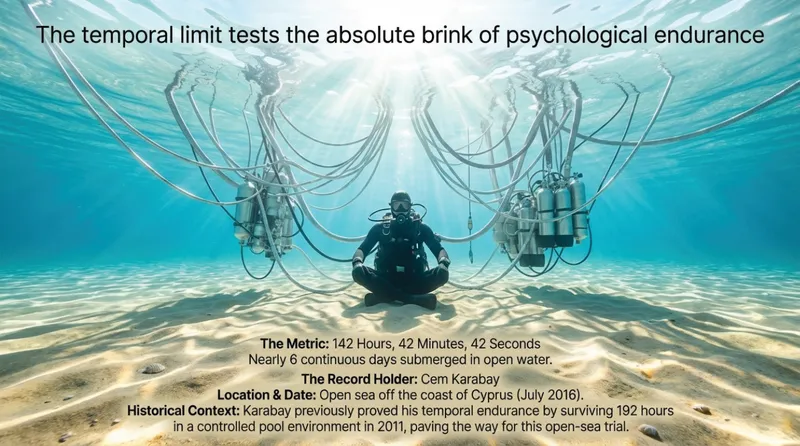
**Living Underwater: Six Days in the Open Sea**
While Gabr challenged the vertical limit, Turkish diver Cem Karabay sought the horizon of human endurance. In July 2016, submerged off the coast of Cyprus, Karabay set a breathtaking record by remaining in the open sea for 142 hours, 42 minutes, and 42 seconds. For nearly six days, he did not see the sun or breathe atmospheric air.
Surviving for a week underwater is a logistical and psychological nightmare. Karabay’s support team functioned as a deep-sea lifeline, delivering food, water, and fresh cylinders to his seafloor camp. Beyond the physical toll of thermoregulation and skin maceration, the mental strain of the "silent world" is profound. To maintain cognitive function and ward off the sensory deprivation of the Mediterranean, Karabay engaged in underwater chess and football. Far from a simple game, playing football while submerged is an exertion nightmare, requiring precise buoyancy control and stamina in a high-resistance environment.
This open-sea feat far surpassed his 2011 pool record of 192 hours. While the pool offered a controlled environment, the Cyprus record forced Karabay to contend with shifting currents, fluctuating temperatures, and the psychological weight of knowing he was an alien inhabitant of a vast, unpredictable ecosystem.

**The Underwater Army: 2,486 Divers in Unison**
If individual records test the soul, the Indonesian Navy’s 2009 achievement tested the limits of collective discipline. At Malalayang Beach, the Navy orchestrated a massive "underwater army," submerging 2,486 divers simultaneously.
This was not a chaotic assembly. The divers were organized into 50 distinct tactical groups, each descending to a depth of 15 meters in a synchronized display of coordination. This feat more than doubled the previous record held by the Maldives (958 divers), representing an exponential leap in risk. In a mass dive of this scale, the logistical complexity is staggering; a single panicked diver or a regulator failure can trigger a chain reaction.
The achievement was less about individual physical prowess and more about the technical precision of the Indonesian Navy’s command structure. Coordinating the air supply, buoyancy, and safety of nearly 2,500 people in a medium that is fundamentally hostile to human life is a testament to the power of maritime discipline and high-level logistical planning.

**Conclusion: The Receding Horizon**
These records - measured in atmospheres of pressure, days of isolation, and thousands of participants - reveal a fundamental truth: the "limit" is a moving target. We are terrestrial creatures, yet our technical ingenuity and restless curiosity drive us to colonize the deep, if only for a few days or a few hundred meters.
As we continue to refine hyperbaric medicine and life-support technology, we must ask: Are we nearing the final biological wall, or is the horizon of human endurance still receding further into the deep blue?

---
*Published on April 7, 2026*
*Author: Yevgen “Scorp” Sukharenko*
*Source: [Red Sea Creatures](https://redseacreatures.com)*
---
---
title: The Ocean’s Elegant Outlier: Why the Seahorse is Evolution’s Most Beautiful Rule-Breaker
description: Seahorses defy everything we know about fish, swimming upright like ethereal ghosts through seagrass with horse-like heads and bony armor, trading speed for stealthy precision in coral mazes. Unlike sleek speedsters, they flutter tiny dorsal fins to hover vertically, mastering cluttered reefs where others falter. And in a stunning role reversal, males carry the eggs in brood pouches, enduring labor to birth hundreds of tiny offspring - nature's ultimate paternal twist.
author: Yevgen “Scorp” Sukharenko
published: 2026-03-26T14:50:00.000Z
updated: 2026-08-08T13:20:21.964Z
tags: Creatures
url: https://redseacreatures.com/blog/2026/03/26/the-oceans-elegant-outlier-why-the-seahorse-is-evolutions-most-beautiful-rule-breaker
---
# The Ocean’s Elegant Outlier: Why the Seahorse is Evolution’s Most Beautiful Rule-Breaker
To look upon a seahorse is to witness a delightful visual dissonance. This horse-headed ghost of the seagrass beds doesn’t just look like a creature out of a fable; it functions like one, too. While we traditionally envision fish as sleek, horizontal bullets designed to pierce the water with speed, the seahorse stands in quiet defiance of these norms. Familiar as they may be from childhood aquariums, their biology is deeply counter-intuitive, hiding a suite of survival strategies that challenge our fundamental understanding of life beneath the waves.
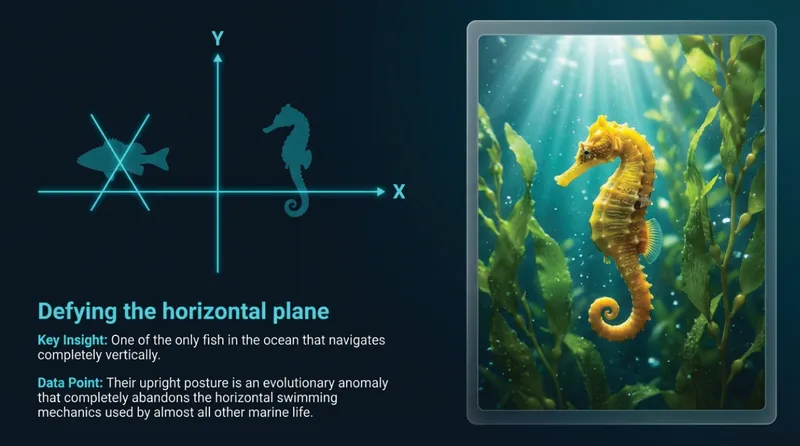
## The Only Fish That Stands Tall
In an environment defined by the "interstate highway" of horizontal currents, the seahorse has chosen a different path entirely. It is one of the only fish species on Earth that swims vertically. Utilizing a small dorsal fin to flutter through the water column, it navigates the world as if it were walking on air.
This vertical posture represents a profound shift in survival philosophy: it trades power for precision. By standing tall, the seahorse leaves the open-water sprints to the tuna and mackerel, choosing instead to master the "tight alleyways" of coral reefs and swaying grass. Its movement is calculated and deliberate, allowing it to navigate complex, cluttered environments with a degree of control that more "traditional" fish simply cannot match.
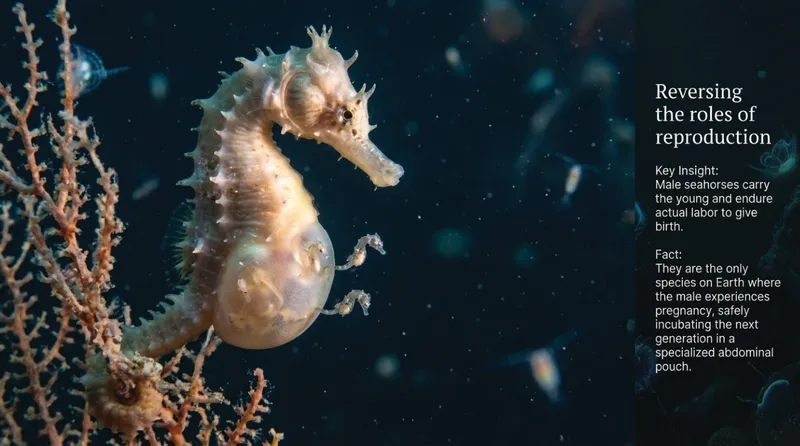
## The Ultimate Role Reversal: Male Labor
Evolution has rarely produced a more striking subversion of gender roles than the seahorse’s reproductive cycle. In this corner of the ocean, the biological burden of pregnancy is shifted, making the pair a unique "reproductive powerhouse." While the female produces the eggs, it is the male who takes on the heavy lifting of gestation.
> "Dads give birth - Male seahorses carry the babies and go through actual labor."
This is far more than simple protection; it is a full biological commitment. By carrying the brood to term and undergoing actual labor, the male allows the female to immediately begin producing the next clutch of eggs. This partnership challenges the standard "vulnerable parent" trope in the animal kingdom, proving that teamwork can be the ultimate evolutionary advantage.
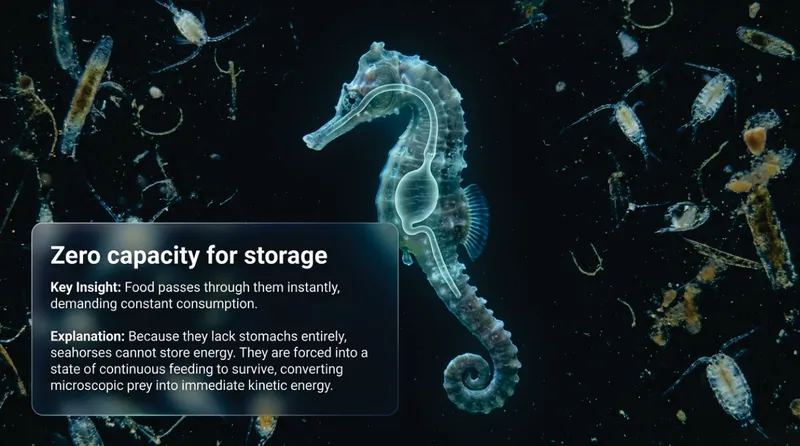
## The Bottomless Appetite: Life Without a Stomach
There is a frantic irony to the seahorse’s existence. While they appear to be the most sedentary and tranquil of creatures, they are actually locked in a life-or-death race against their own metabolism. This is because seahorses possess a startling anatomical quirk: they have no stomachs.
Because they lack a storage organ to hold and break down nutrients slowly, food passes through their digestive tracts with extreme speed. Consequently, they must eat constantly to survive. What looks like a lazy drift through the seagrass is actually a relentless hunt. The seahorse cannot afford the luxury of storing a meal for later; it must remain a perpetual predator, anchored to its environment by a prehensile tail while its eyes scan for the next essential calorie.
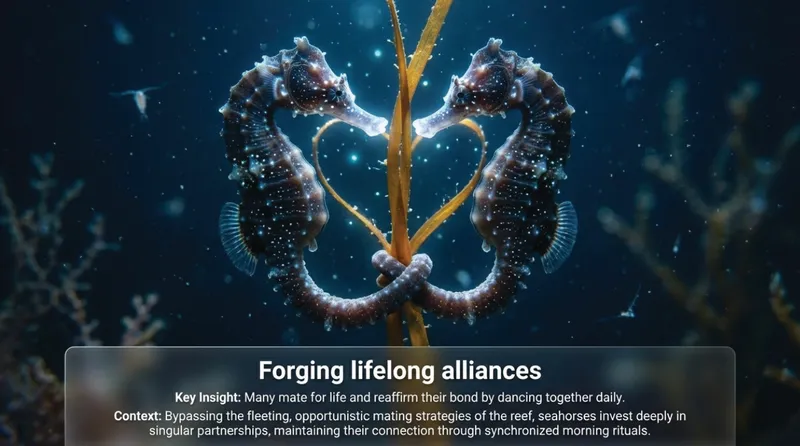
## Marine Romance: Daily Dances and Lifelong Bonds
Beyond the oddities of their anatomy, seahorses exhibit a level of social devotion that feels almost human. Many species mate for life, but they do not take their bond for granted. Every morning, partners reinforce their connection through a sophisticated "morning greeting" - a synchronized daily dance where they change color and swirl together through the water.
This ritual suggests a level of sentience and social complexity that is rare for such small creatures. For the seahorse, survival isn't just a solitary hunt; it is a shared experience. These daily dances ensure the pair remains perfectly in sync, maintaining a lifelong bond that provides stability in an often-chaotic marine environment.
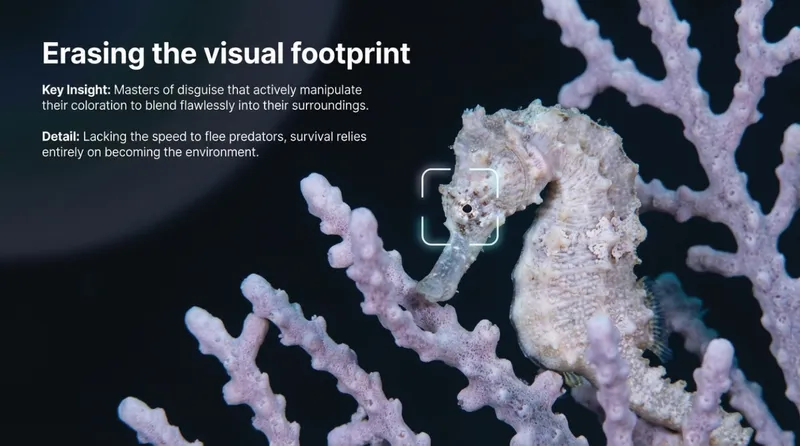
## Masters of Disguise: The Invisible Hunter
Because the seahorse is a slow-moving, vertical swimmer, it cannot outrun a predator. Instead, it has mastered the art of being a "living shadow." As masters of disguise, they can change their color and even their skin texture to blend seamlessly into their surroundings.
This camouflage is their primary defense and their greatest hunting tool. By becoming virtually invisible against the coral or kelp, they negate the need for speed. They are the ocean’s most patient snipers, relying on the fact that the best way to survive a dangerous neighborhood is to ensure that no one knows you are there in the first place.
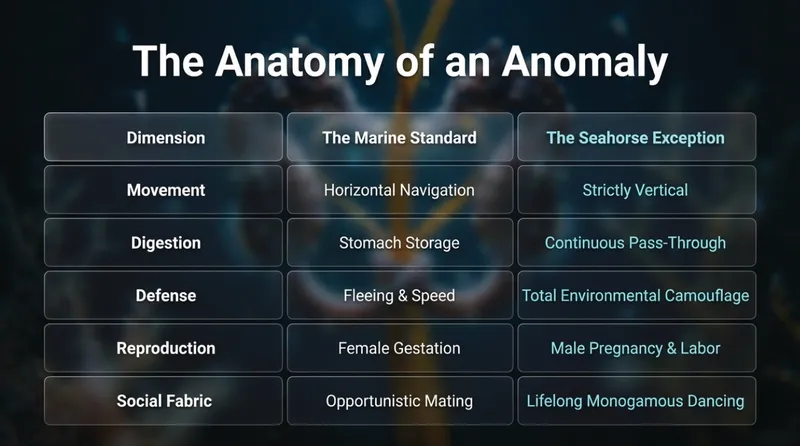
## Rethinking the Familiar
The seahorse is a powerful reminder that the ocean’s greatest mysteries are often hiding in plain sight. From the reversal of traditional birth roles to a metabolism that forbids them from ever truly resting, these creatures have carved out a niche that defies every rule of "standard" fish biology.
As we pull back the curtain on their sophisticated social rituals and anatomical wonders, we are forced to wonder: if a creature as familiar as the seahorse is this strange, what other secrets are the deep oceans still keeping? The more we look, the more we realize that the sea is not just a habitat, but a masterclass in the complexity and resilience of life.
---
*Published on March 26, 2026*
*Author: Yevgen “Scorp” Sukharenko*
*Source: [Red Sea Creatures](https://redseacreatures.com)*
---
---
title: The Tide is Turning: 5 Massive Wins Proving We Can Still Save Our Oceans
description: For too long, ocean news has drowned us in doom - warming waters, plastic chokeholds, and vanishing reefs. But a powerful sea change is surging: the High Seas Treaty now legally safeguards nearly two-thirds of the global ocean, enabling vast protected areas beyond borders for the first time. Chile leads with monumental ambition, shielding nearly 1 million km² of its waters, proving bold policy and cooperation are turning crisis into restoration right now.
author: Yevgen “Scorp” Sukharenko
published: 2026-03-25T14:30:00.000Z
updated: 2026-03-25T14:39:00.867Z
tags: Marine News
url: https://redseacreatures.com/blog/2026/03/25/the-tide-is-turning-5-massive-wins-proving-we-can-still-save-our-oceans
---
# The Tide is Turning: 5 Massive Wins Proving We Can Still Save Our Oceans
For too long, the story of our seas has been written in shades of grey - warming waters, plastic pollution, and fading reefs. It is easy to feel overwhelmed by the "doom and gloom" narrative that often dominates environmental news. However, look beneath the surface and you will see that a powerful sea change is underway.
The heartbeat of the ocean is growing stronger as nature reclaims its territory. We are witnessing a series of unprecedented "Ocean Wins" that prove the tide is finally turning. Through bold policy and global cooperation, we are moving from a state of crisis to a new era of restoration. These milestones are not just distant hopes; they are tangible victories happening right now.

## The Legal Blueprint for the Open Ocean
For decades, the high seas - the vast expanses of water beyond national borders - were essentially a "wild west." These areas account for nearly two-thirds of the ocean, yet they lacked a comprehensive legal framework to prevent over-exploitation. The arrival of the High Seas Treaty marks a historic shift in international law, transforming the open ocean from a lawless frontier into a protected sanctuary.
This treaty provides the first real blueprint for global cooperation in deep waters. It allows the international community to establish large-scale marine protected areas in the middle of the ocean for the first time in history. By creating these safeguards, we are finally recognizing that the health of the open sea is vital to the survival of the entire planet.
> The High Seas Treaty is now law, and for the first time, countries can protect the open ocean.
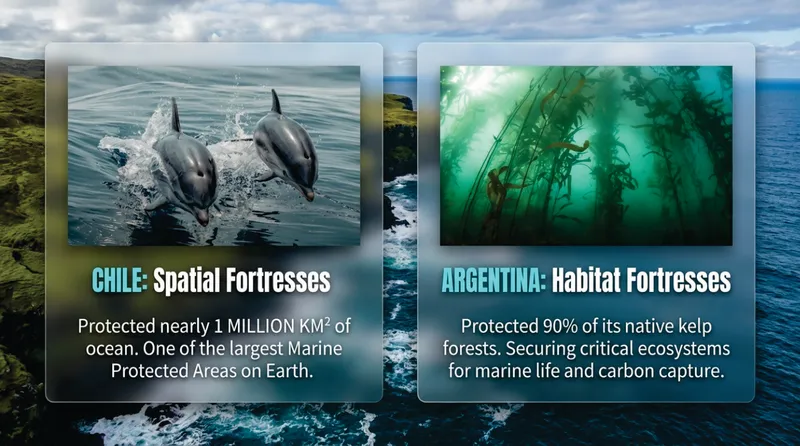
## Chile’s Massive Scale of Protection
While international treaties provide the framework, individual nations are demonstrating what true leadership looks like on a local level. Chile has recently set a gold standard for marine conservation by establishing protections on a truly monumental scale. By safeguarding nearly 1 million km² of its ocean territory, the nation has created one of the largest Marine Protected Areas (MPAs) on Earth.
This move creates a massive refuge for biodiversity, allowing entire ecosystems to flourish without the threat of industrial extraction. Chile’s commitment serves as a powerful signal to the rest of the world that protecting our blue assets is a matter of national priority. It positions the country as a primary architect in the global effort to safeguard the biodiversity of the Pacific.
> Chile just protected nearly 1 million km² of ocean, one of the largest Marine Protected Areas on Earth.
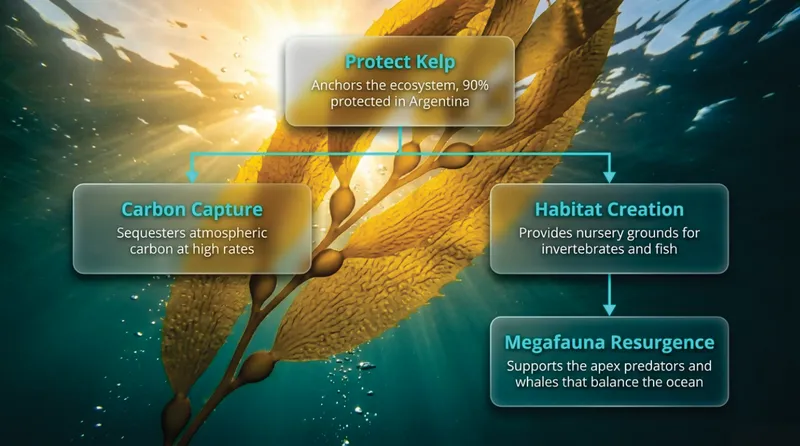
## Argentina’s Secret Weapon Against Climate Change
Argentina has unlocked a "secret weapon" in the fight against global warming by protecting 90% of its kelp forests. Often called the "rainforests of the sea," these kelp ecosystems are among the most productive on the planet. Kelp can grow up to two feet a day, allowing it to sequester carbon with a speed and efficiency that puts many terrestrial forests to shame.
Protecting 90% of this ecosystem is a staggering achievement because kelp forests provide the foundation for marine life and coastal resilience. When we safeguard these underwater groves, we aren't just protecting a habitat; we are securing a massive carbon sink. This conservation win proves that coastal nations hold the keys to natural climate solutions that are vital for our shared future.
> Argentina protected 90% of its kelp forests, some of the most important ecosystems for marine life and carbon capture.
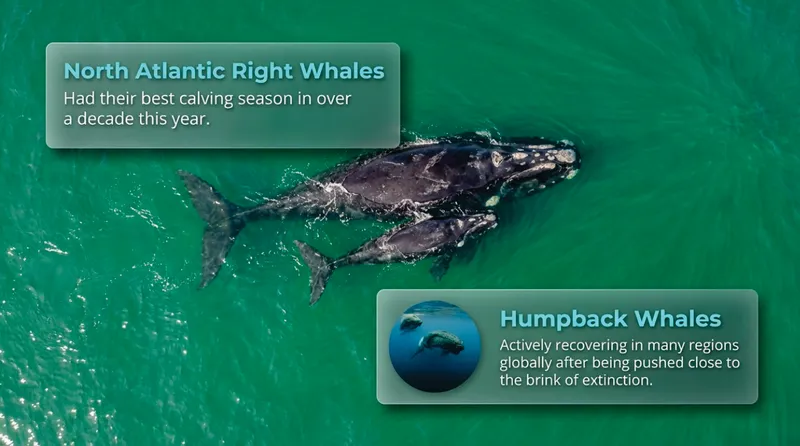
## A Modern Milestone for Whale Recovery
The resilience of the ocean’s giants is a living testament to what happens when we give nature a reprieve from human pressure. After centuries of industrial whaling pushed many species to the brink, we are finally seeing a mounting trend of recovery. This resurgence shows that when we stop the harm, nature is incredibly efficient at reclaiming its place in the world.
* **North Atlantic Right Whales:** This critically endangered species just experienced its most successful calving season in more than ten years, signaling a vital boost for their future survival.
* **Humpback Whales:** Populations are rebounding across multiple ocean basins, showing incredible resilience as they return to ancestral migratory routes.
> North Atlantic Right Whales had their best calving season in over a decade
> Humpback whales are recovering in many regions after being pushed close to extinction.
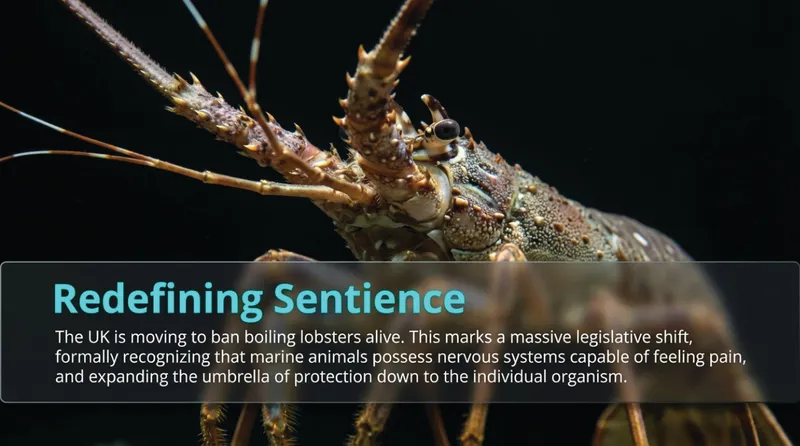
## Redefining Marine Sentience in the UK
Our relationship with the ocean is also undergoing a profound ethical evolution. The UK is currently leading a shift in how we perceive marine life, moving away from seeing animals as mere commodities or "resources." By advancing legislation to ban the practice of boiling lobsters alive, the government is officially recognizing that these complex creatures are capable of feeling pain.
This represents a fundamental change in our moral relationship with the sea. Acknowledging the sentience of marine invertebrates suggests a maturing of our environmental ethics. It forces us to reconsider how we interact with all marine life, moving toward a future defined by empathy and scientific understanding rather than exploitation.
> The UK is moving to ban boiling lobsters alive, recognizing that marine animals can feel pain.
## The Horizon of Hope
The collective victories of the past year - from the legal triumph of the High Seas Treaty to the record-breaking births of right whales - prove that conservation works. These are not isolated events, but part of a larger trend where policy, science, and public will are aligning to heal the blue heart of our planet. While the challenges ahead are significant, we now have the proof that restoration is possible.
These shifts reflect a deeper change in our human values and our understanding of our place in the natural world. As we look toward the horizon, we must ask ourselves: what will the next great "Ocean Win" be, and how can we collectively ensure that the heartbeat of our seas continues to grow louder?
---
*Published on March 25, 2026*
*Author: Yevgen “Scorp” Sukharenko*
*Source: [Red Sea Creatures](https://redseacreatures.com)*
---
---
title: The Pufferfish Paradox: Nature’s Ultimate Biological Dreadnought
description: Pufferfish are evolutionary rebels that have abandoned nearly every rule of typical fish anatomy to become biological fortresses. These remarkable creatures possess fused beak-like teeth, lack ribs and pelvic fins, and feature an extraordinarily elastic stomach that allows them to inflate to several times their original size in seconds as a defense mechanism. By shedding conventional fish features and redesigning their bodies as sophisticated hydraulic systems, pufferfish have transformed themselves from vulnerable swimmers into ocean predators' most formidable challenge, trading speed for near-absolute impenetrability through their specialized inflation ability and protective spines.
author: Yevgen “Scorp” Sukharenko
published: 2026-03-23T16:00:00.000Z
updated: 2026-03-23T16:01:02.248Z
tags: Creatures
url: https://redseacreatures.com/blog/2026/03/23/the-pufferfish-paradox-natures-ultimate-biological-dreadnought
---
# The Pufferfish Paradox: Nature’s Ultimate Biological Dreadnought
When we think of a pufferfish, we usually imagine a cute, slow-swimming fish that occasionally turns into a prickly ball. But from a biological perspective, the pufferfish is a radical rebel. It has broken almost every rule of fish anatomy to become a "biological dreadnought" - a living fortress that trades speed for absolute impenetrability. Let's take a look under the hood of this evolutionary marvel.
### An Anatomical Teardown
The pufferfish belongs to a family called *Tetraodontidae*. While most fish rely on being fast to escape predators, the pufferfish is built like a heavy-duty machine designed for a single purpose: volumetric expansion. It is a masterpiece of biomechanics where every part of the body has been redesigned to allow it to grow several times its original size in seconds.
This "teardown" reveals that the pufferfish isn't just a fish that gets big; it is a highly engineered hydraulic system. By looking at its osteology (bones) and specialized tissues, we can see how it transformed from a vulnerable swimmer into the ocean's most famous defender.
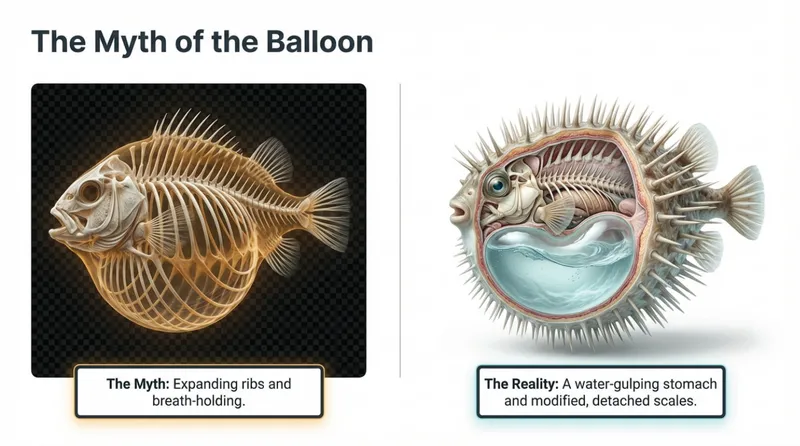
### The Myth of the Balloon
Many people believe that pufferfish fill themselves with air like a birthday balloon or hold their breath to stay inflated. This is actually a myth. In reality, a pufferfish is a master of hydraulics. It uses a "water-gulping" technique to fill its specialized stomach with seawater.
To make room for all that water, the fish has completely changed its outer armor. Instead of the hard, overlapping scales you see on many other fish, the pufferfish has modified, detached scales that stay tucked away until the moment of inflation. This allows the skin to be flexible and ready to stretch at a moment's notice.
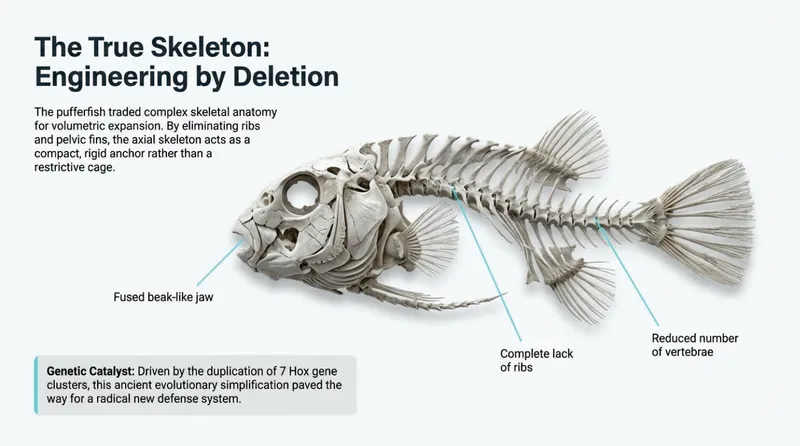
### Engineering by Deletion
To become the ultimate "balloon," the pufferfish had to get rid of some very important bones. Most fish have a rib cage to protect their organs, but a rib cage would act like a "restrictive cage," preventing the fish from expanding. Evolution solved this by simply deleting the ribs entirely.
By eliminating ribs and pelvic fins, the pufferfish created a "compact, rigid anchor" out of its spine. This was driven by a massive genetic change - the duplication of 7 *Hox* gene clusters. This simplification of the skeleton paved the way for a defense system that no other creature on Earth can replicate.
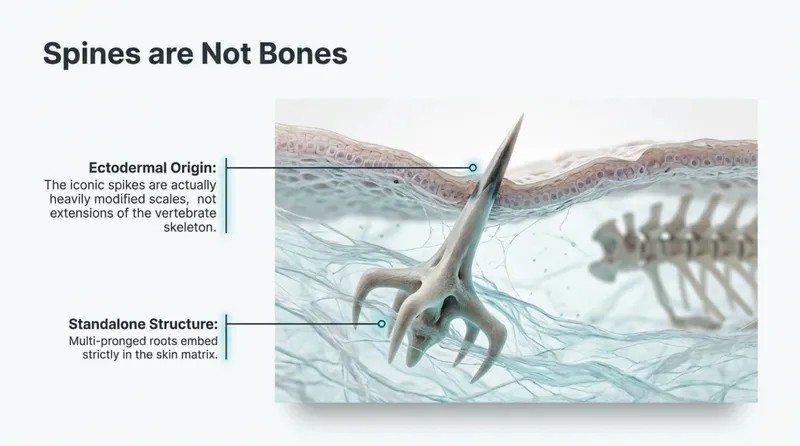
### Spines are Not Bones
If you look closely at a pufferfish’s spikes, you might think they are connected to its skeleton. They aren't! These iconic spines are actually heavily modified scales that come from the "ectoderm" (the same layer of cells that creates skin).
These spines are "standalone structures". They have multi-pronged roots that are embedded strictly in the skin matrix rather than being extensions of the vertebrate skeleton. This allows the spines to move and point outward as the skin stretches, without being held back by the internal skeleton.
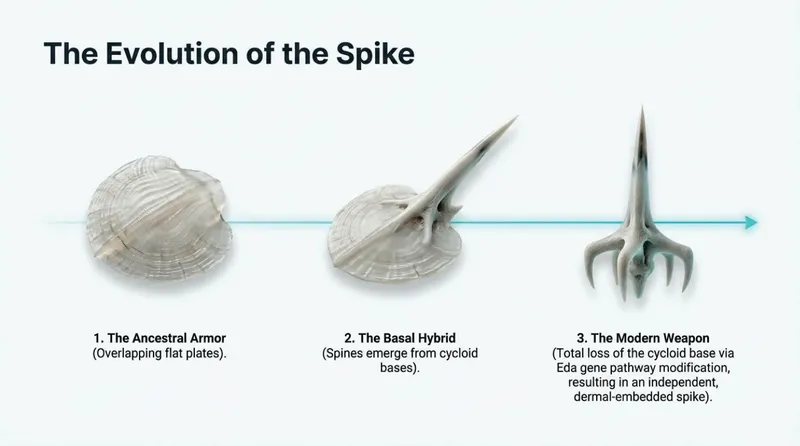
### The Evolution of the Spike
The pufferfish didn't always have these independent spikes. It started with "Ancestral Armor," which were flat, overlapping plates. Over millions of years, these evolved into "Basal Hybrids," where a small spine began to grow out of a flat, cycloid base.
In the modern version of the pufferfish, a specific genetic pathway (the *Eda* gene) modified the scales even further. It got rid of the cycloid base entirely, leaving behind the "Modern Weapon": an independent, dermal-embedded spike that sits deep in the skin.
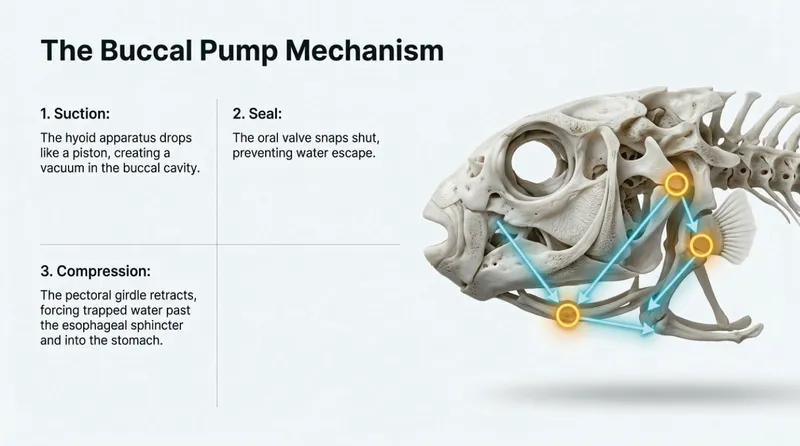
### The Buccal Pump Mechanism
How does the fish pump water so quickly? It uses a "Buccal Pump". First, a part of the throat called the hyoid apparatus drops down like a piston, creating a powerful vacuum that sucks water into the mouth.
Then, a special oral valve snaps shut to prevent water from escaping. Finally, the pectoral girdle retracts, forcing the trapped water past the esophageal sphincter and straight into the stomach. It’s like a high-speed manual water pump!
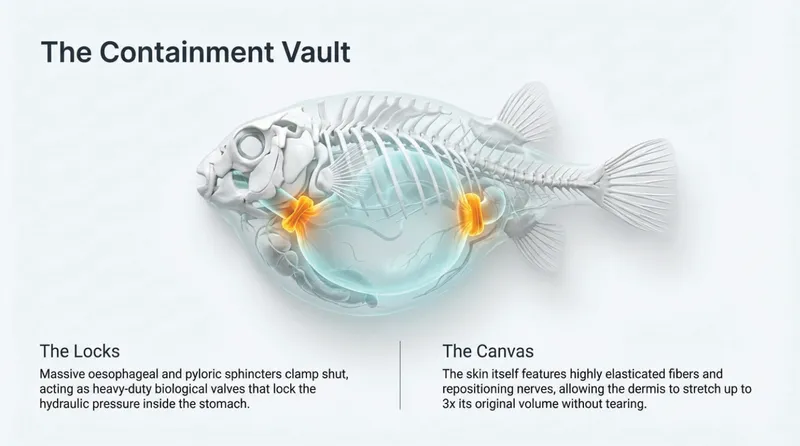
### The Containment Vault
Once the water is inside, the pufferfish needs to keep it there under high pressure. It uses massive esophageal and pyloric sphincters which act like heavy-duty biological valves to lock the hydraulic pressure inside the stomach. This creates a "containment vault" that keeps the fish round and hard.
The skin itself is just as impressive. It is made of highly elastic fibers and has repositioning nerves. This allows the skin (the "dermis") to stretch up to 3 times its original volume without tearing, protecting the fish even when it is under extreme tension.
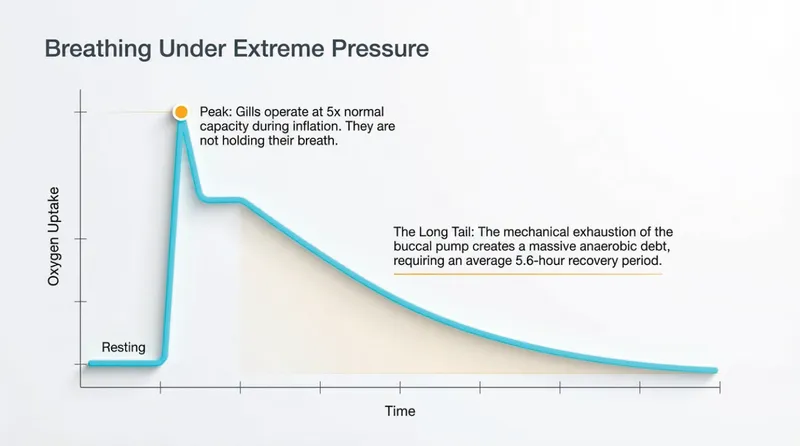
### Breathing Under Extreme Pressure
You might think that being a giant ball makes it hard to breathe, but pufferfish are actually "hyper-aerobic" during inflation. Their gills don't stop; in fact, they operate at 5x their normal capacity to keep the fish oxygenated while it works hard to stay inflated.
However, this incredible feat comes at a cost. The mechanical effort of pumping and holding all that water creates a massive anaerobic debt. After the fish deflates, it is completely exhausted and needs an average of 5.6 hours to fully recover and get its energy back.
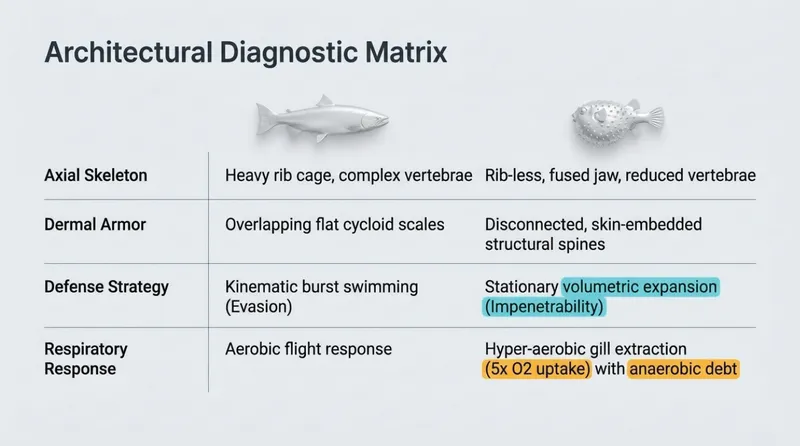
### Architectural Diagnostic Matrix
When we compare a "normal" fish to a pufferfish, the differences are staggering. While a normal fish uses a heavy rib cage and "burst swimming" to escape, the pufferfish uses "stationary volumetric expansion". It doesn't run away; it just becomes an impenetrable fortress.
The pufferfish traded complex skeletal anatomy for a rib-less, fused-jaw design that allows for maximum expansion. It moved from having overlapping scales to having skin-embedded spines. It is the difference between a fast, evasive swimmer and a heavily armored tank.
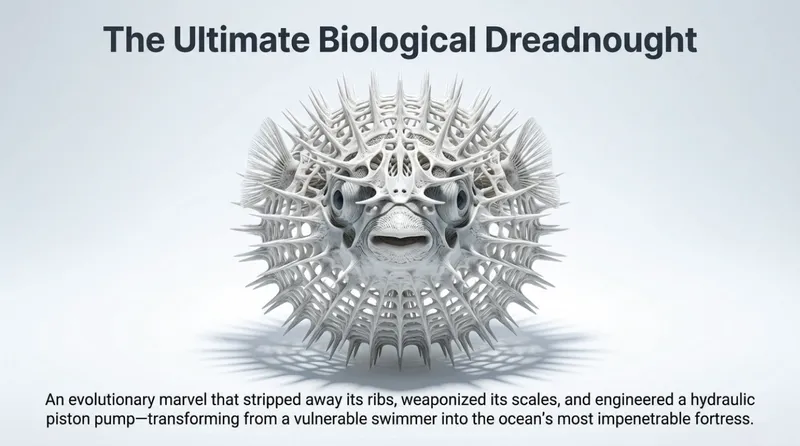
### The Ultimate Biological Dreadnought
In the end, the pufferfish is an evolutionary marvel. It stripped away its ribs, weaponized its scales, and engineered a hydraulic piston pump to survive in a world of predators. It is a reminder that in nature, sometimes the best way to move forward is to simplify.
By transforming from a vulnerable swimmer into the ocean's most impenetrable fortress, the pufferfish has earned its title as a biological dreadnought. Next time you see one, remember: you’re looking at one of the most advanced pieces of biological machinery in the ocean.
---
*Published on March 23, 2026*
*Author: Yevgen “Scorp” Sukharenko*
*Source: [Red Sea Creatures](https://redseacreatures.com)*
---
---
title: Inside the Sea Turtle Shell: Secrets of Ancient Ocean Survival Revealed
description: Sea turtles glide across vast oceans with timeless grace, their bodies a masterpiece of evolution perfectly tuned for survival - from flexible, high-tech shells that withstand deep-sea pressure to bones etched with growth rings revealing their hidden ages. Unlike humans, they show no wrinkles or gray hair, so scientists turn to "virtual dissections" and skeletochronology, examining humerus bones like tree rings to unlock these ancient voyagers' secret diaries. Dive beneath the shell to discover how resilient travelers dominate the seas.
author: Yevgen “Scorp” Sukharenko
published: 2026-03-03T00:20:00.000Z
updated: 2026-03-03T00:23:45.886Z
tags: Creatures
url: https://redseacreatures.com/blog/2026/03/03/inside-the-sea-turtle-shell-secrets-of-ancient-ocean-survival-revealed
---
# Inside the Sea Turtle Shell: Secrets of Ancient Ocean Survival Revealed
Sea turtles are among the most resilient travelers on Earth, navigating thousands of miles of open ocean with a grace that suggests they are timeless. But how do they survive, and how do we know how old they are? To find out, we have to look beneath the shell.
Sea turtles are a masterclass in functional morphology - which is just a fancy way of saying their bodies are perfectly built for their jobs. While they look like they haven’t changed in millions of years, every part of a sea turtle, from their heavy armor to the microscopic rings in their bones, is designed to help them dominate the ocean. To understand them, marine biologists perform "virtual dissections" to see how these ancient voyagers work from the inside out.
For scientists, these turtles are a bit of a mystery because they don't show their age on the outside. They don’t get grey hair or wrinkles like we do! To unlock their history, we have to look at their skeletons, which act like a secret diary of their lives spent at sea.
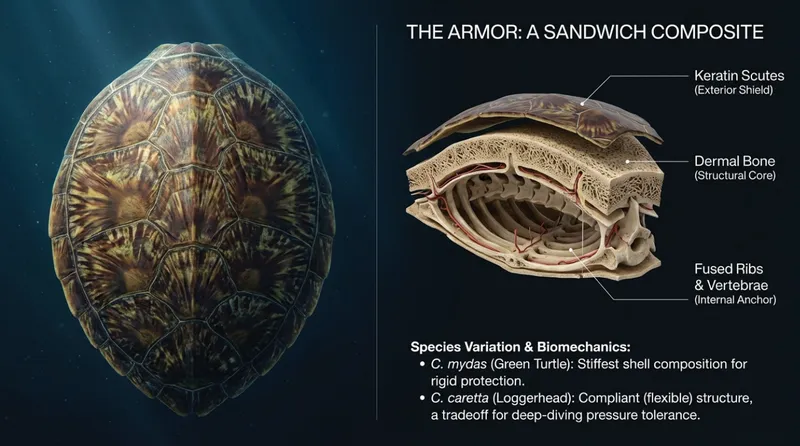
## The Armor: A Sandwich Composite
Think of a sea turtle's shell not as a single shield, but as a high-tech "sandwich." The top layer is made of keratin scutes (the same stuff as your fingernails), followed by a core of dermal bone, and finally an internal anchor where their ribs and spine are actually fused to the shell! This design is built for pressure. While a land turtle has a very stiff shell, sea turtles have "compliant" or slightly flexible shells. This allows them to dive deep without their armor cracking under the heavy weight of the ocean.
Different species have different "specs." For example, the Green Turtle has the stiffest, strongest shell for maximum protection - like a heavy tank. On the other hand, the Loggerhead has a more flexible shell, which is a clever trade-off that helps them handle the intense pressure of deep-sea diving.
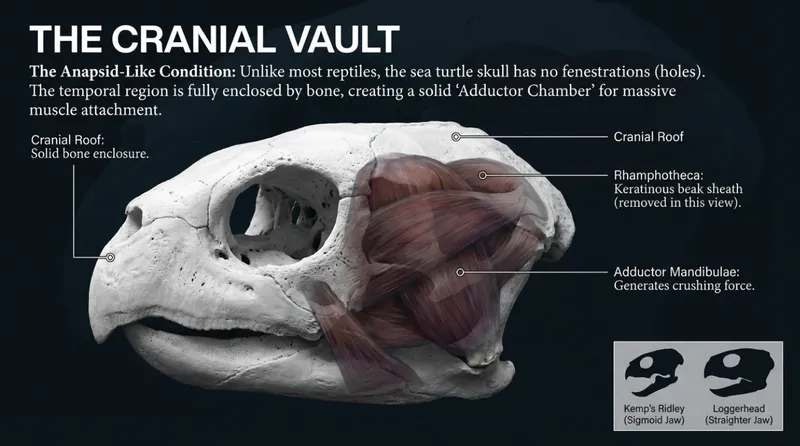
## The Cranial Vault: Built for Power
The skull of a sea turtle is very different from most reptiles. It is "Anapsid-like," meaning it has no extra holes or windows in the bone behind the eyes. This creates a solid "Adductor Chamber," which is essentially a giant room for massive jaw muscles. This solid bone enclosure protects the brain while allowing the turtle to generate enough crushing force to snap through tough seagrass or hard-shelled prey.
Even within this group, shapes vary. The Kemp’s Ridley has a "sigmoid" or curved jaw, while the Loggerhead has a much straighter, heavier jaw line. This "Cranial Vault" is their primary tool for feeding and defense, acting as a sturdy helmet for their most important sensory organs.
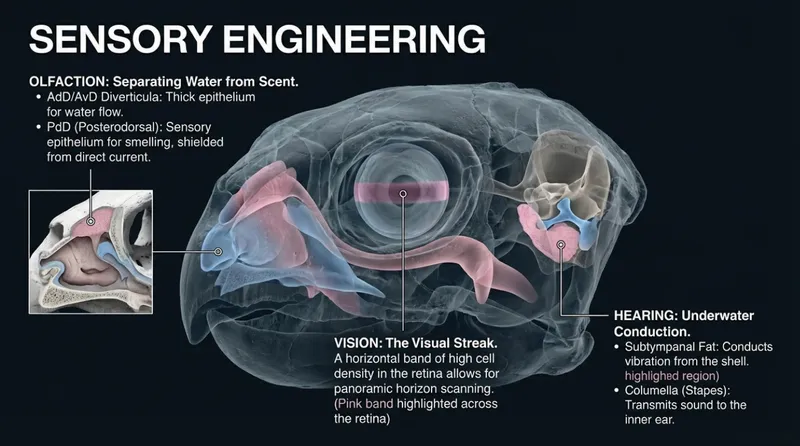
## Sensory Engineering: Underwater High-Tech
Sea turtles "see" and "smell" the world in incredible ways. Inside their nose, they have special diverticula that separate water from scent, allowing them to track food across vast distances. Their eyes feature a "Visual Streak" - a horizontal band of high cell density in the retina. This gives them a panoramic view of the horizon, perfect for scanning the open ocean for predators or mates.
Hearing is just as cool. Instead of external ears, they use "Subtympanal Fat." This special layer of fat conducts vibrations directly from their shell and the surrounding water to their inner ear. It’s like their whole body is a giant microphone, helping them hear the low-frequency rumbles of the ocean.
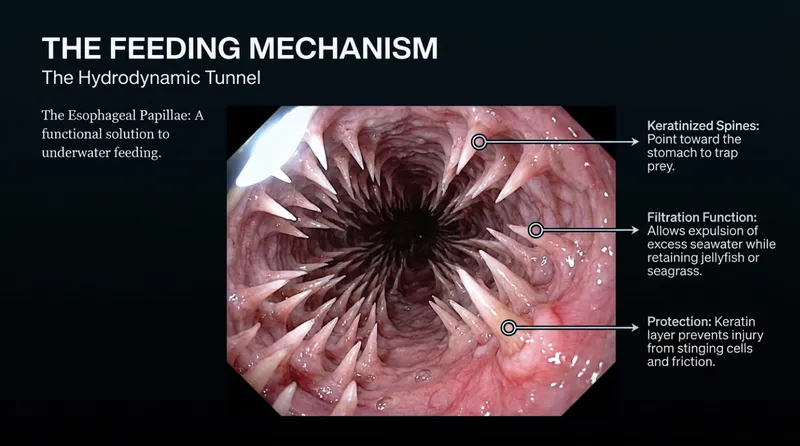
## The Feeding Mechanism: The Hydrodynamic Tunnel
If you looked inside a sea turtle's throat, you might be scared! It is lined with "Esophageal Papillae," which look like sharp, white spikes. These are actually made of keratin and point toward the stomach. When a turtle swallows a jellyfish and a gulp of seawater, these spikes trap the food while the turtle "spits out" the excess salt water.
These spikes also protect the turtle's throat from the stinging cells of jellyfish. This "Hydrodynamic Tunnel" is an elegant evolutionary solution to the problem of eating underwater without swallowing the entire ocean or getting stung from the inside!
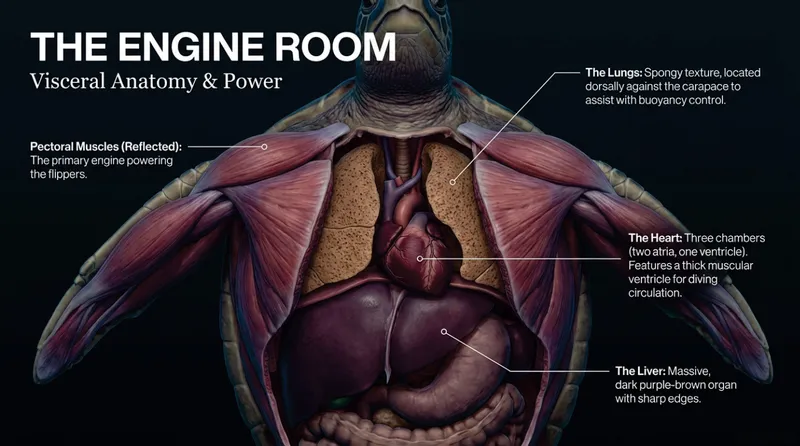
## The Engine Room: Visceral Anatomy
Under the shell lies the "Engine Room." The massive pectoral muscles are the primary engines powering those long, graceful flippers. Because they need to stay underwater for a long time, their lungs are located dorsally (on their back) right against the shell. This position helps them stay balanced and provides extra buoyancy control, acting like a built-in life jacket.
Their heart has three chambers - two atria and one very thick, muscular ventricle. This specialized heart allows them to redirect blood flow during deep dives, conserving oxygen so they can stay submerged for hours. It’s a high-efficiency system designed for a life on the move.
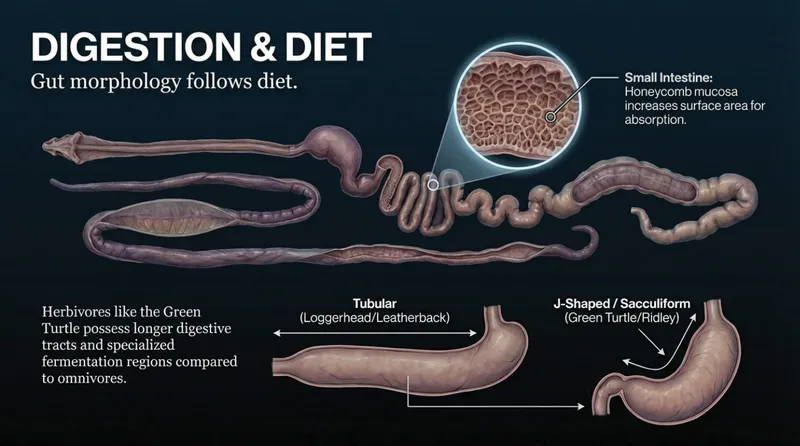
## Digestion and Diet: You Are What You Eat
A turtle's gut tells the story of its diet. Herbivores like the Green Turtle have much longer digestive tracts and specialized "fermentation regions" to help them break down tough seagrass. Their small intestines have a "honeycomb" texture to increase the surface area, ensuring they absorb every bit of nutrition from their leafy meals.
The shape of the stomach changes too! Some turtles have tubular stomachs, while others have "J-shaped" or sac-like stomachs. These variations allow different species to occupy different niches in the ocean - some eating sponges, some eating jellyfish, and others grazing on the underwater meadows of the Red Sea.
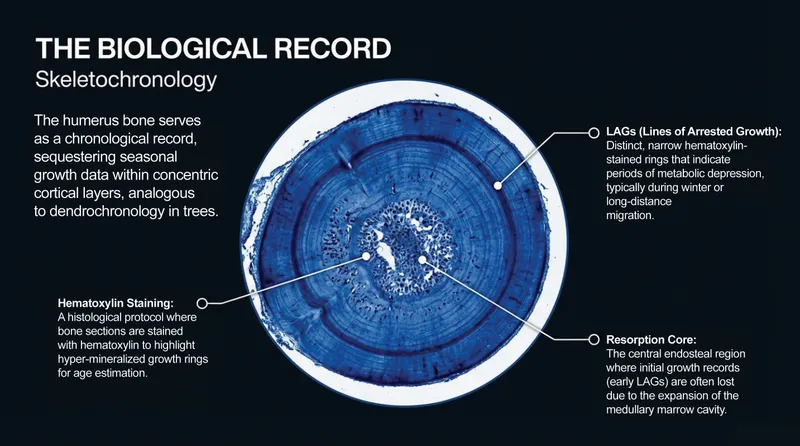
## The Biological Record: Turtles Have "Tree Rings"
Much like an ancient oak tree, a sea turtle’s life story is etched into its bones. This science is called **Skeletochronology**. By looking at a cross-section of the humerus (the flipper bone), scientists can see concentric rings. Each ring represents a year of growth. The dark, narrow rings are called LAGs (Lines of Arrested Growth), which happen during winter or long migrations when the turtle isn't growing much.
To see these "clocks," scientists have to "slow-cook" the bones to clean them, then treat them with a blue dye called hematoxylin. This makes the layers pop out under a microscope. While most turtles keep these records in their flippers, the Leatherback turtle is so unique that its flipper rings disappear! To find their age, scientists have to look at tiny bones inside their eyes called scleral ossicles.
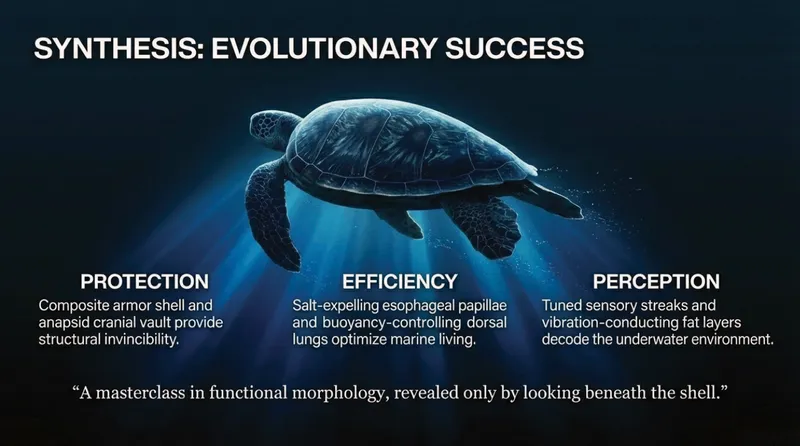
## Synthesis: Evolutionary Success
Everything we’ve seen - the sandwich-armor shell, the salt-expelling throat spikes, the vibration-conducting fat, and the secret bone clocks - comes together to create one of nature’s most successful designs. Sea turtles don't just survive in the ocean; they dominate it.
By studying these "masterclasses in functional morphology," we learn how to better protect them. Knowing how fast they grow and how long they live helps us predict if their populations are healthy. The next time you see a sea turtle gliding through the water, remember: there is a world of high-tech engineering hidden just beneath that beautiful shell!
---
*Published on March 3, 2026*
*Author: Yevgen “Scorp” Sukharenko*
*Source: [Red Sea Creatures](https://redseacreatures.com)*
---
---
title: 2025 Red Sea Shark Discovery: The Ultimate Field Guide to Egypt’s Apex Predators
description: Dive into the Egyptian Red Sea's thrilling shark encounters at vibrant sites like Brothers, Daedalus, and Elphinstone - the Golden Triangle where Oceanic Whitetips, Scalloped Hammerheads, and elusive Thrashers patrol deep drop-offs. Fresh 2025 field data reveals 29 cataloged Oceanic Whitetips, some bearing fishing hooks from human impacts, underscoring their Critically Endangered status and urgent conservation needs. This guide blends species insights, prime sighting zones, and satellite tracking efforts to inspire awe-filled dives with respect for these apex predators.
author: Yevgen “Scorp” Sukharenko
published: 2026-02-27T18:00:00.000Z
updated: 2026-02-27T18:12:46.525Z
tags: Creatures
url: https://redseacreatures.com/blog/2026/02/27/2025-red-sea-shark-discovery-the-ultimate-field-guide-to-egypts-apex-predators
---
# 2025 Red Sea Shark Discovery: The Ultimate Field Guide to Egypt’s Apex Predators
The Egyptian Red Sea remains one of the most vibrant and dynamic environments on the planet for shark encounters. Whether you are hovering over a deep drop-off or drifting along a remote seamount, diving with these apex predators is an experience that demands both awe and respect. Based on the latest 2025 field data, here is your comprehensive guide to the current shark populations, primary sighting zones, and the critical conservation efforts happening right now.
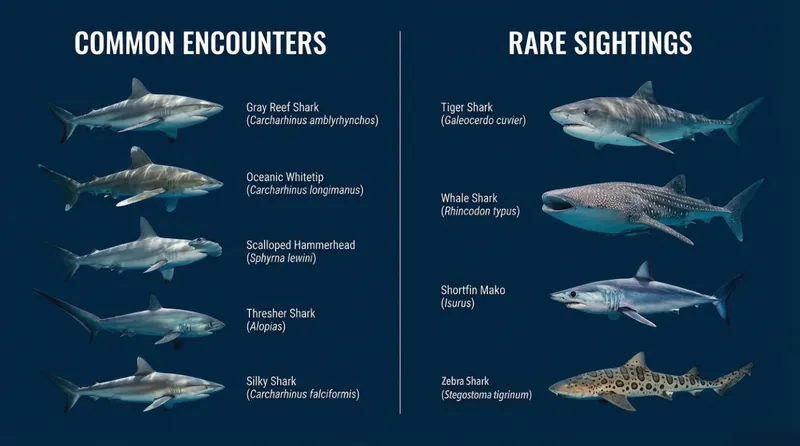
### Species Diversity: Who are we meeting?
The biodiversity of the Red Sea includes both resident reef dwellers and rare pelagic visitors. While Gray Reefs and Oceanic Whitetips are the "faces" of Egyptian diving, sightings of species like the Whale Shark or the Zebra Shark remain rare and precious rewards for researchers and lucky divers alike.
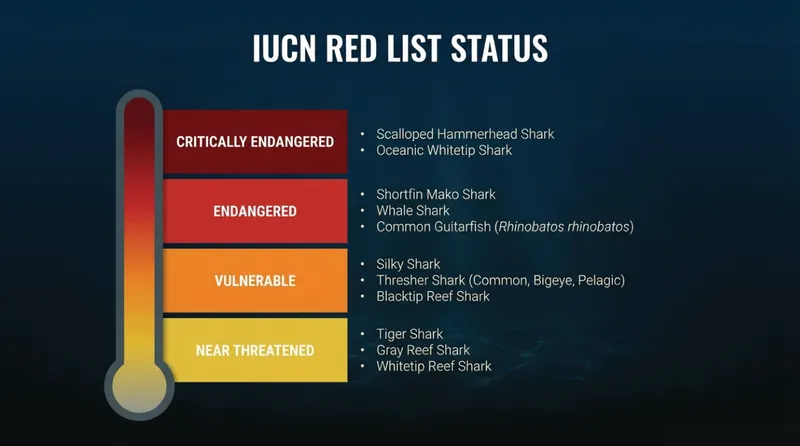
### IUCN Red List: A Fragile Balance
Understanding the conservation status of these animals is vital. Many of the Red Sea’s most iconic species, including Hammerheads and Oceanic Whitetips, are now listed as **Critically Endangered**. Our project monitors these local populations to highlight the urgent need for habitat protection against anthropogenic threats.
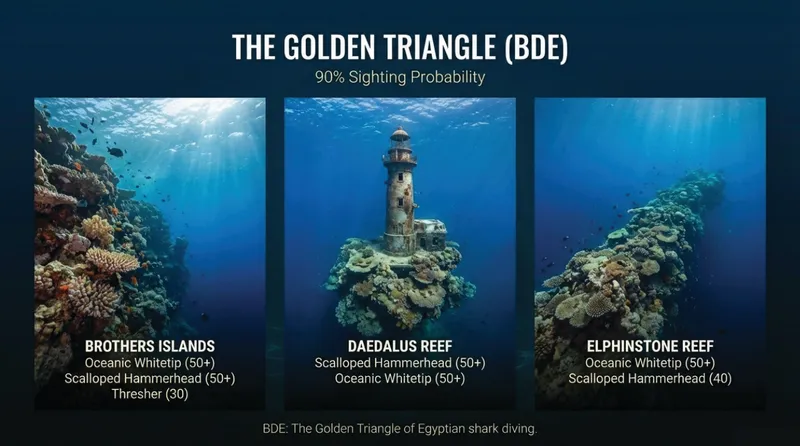
### The Golden Triangle (BDE): The Pelagic Highway
For those seeking high-probability encounters (90%+), the offshore reefs of **Brothers, Daedalus, and Elphinstone** are the undisputed crown jewels:
* **Brothers Islands:** A primary hub for the Oceanic Whitetip, Scalloped Hammerheads, and elusive Thresher sharks.
* **Daedalus Reef:** Famous for schooling Hammerheads and the epicenter of our 2025 Oceanic Manta Ray census.
* **Elphinstone Reef:** A breathtaking drop-off where Oceanic Whitetips patrol the shallows and Tiger Sharks occasionally cruise the deep blue.
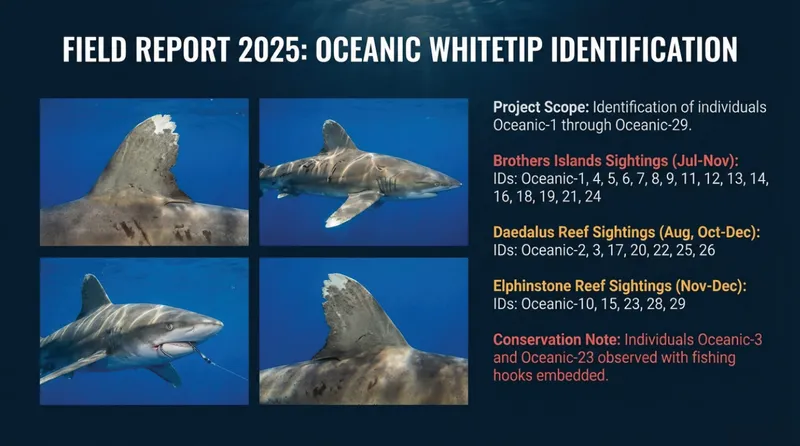
### Field Report 2025: Oceanic Whitetip Identification
Our latest fieldwork has cataloged 29 distinct individuals (IDs: Oceanic-1 through 29) across the BDE sector. Alarmingly, human impact is visible - individuals **#3 and #23** were observed with embedded fishing hooks, highlighting the critical need for continued marine protection and enforcement.
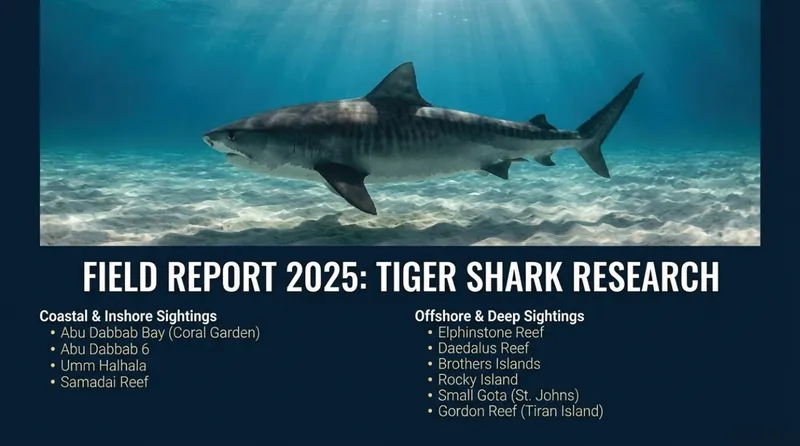
### Field Report 2025: Tiger Shark Research
Tiger Sharks (*Galeocerdo cuvier*) continue to be a focal point of our research. In 2025, we documented their presence across both coastal nurseries like Abu Dabbab and deep offshore walls, proving the importance of connected marine corridors for these wide-ranging predators.
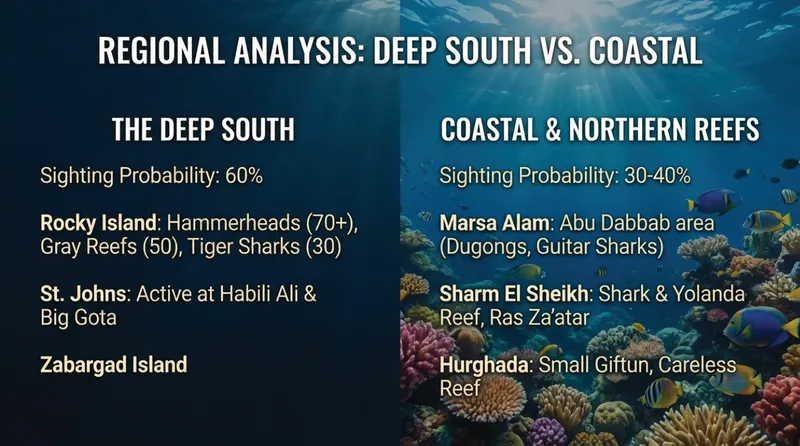
### Regional Analysis: Deep South vs. Coastal
If you are looking for untamed wilderness, the Deep South offers a 60% sighting probability amidst strong currents and exposed walls:
* **Rocky Island:** A magnet for massive Hammerhead schools (70+) and Gray Reef sharks.
* **St. Johns (Habili Ali):** Known for active reef shark populations and sleek Silky Sharks navigating the submerged plateau systems.
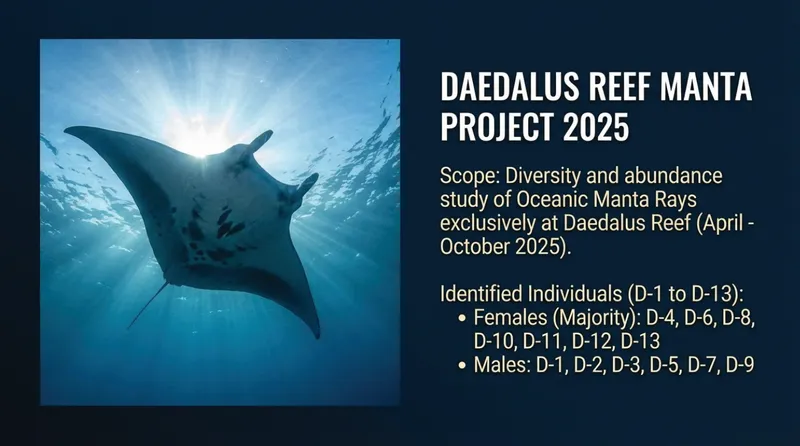
### Daedalus Reef Manta Project 2025
Between April and October, Daedalus Reef serves as a critical aggregation site for Oceanic Manta Rays. We have identified 13 unique individuals (D-1 through D-13). The majority are females, providing vital data on the reproductive health and migration patterns of these gentle giants.
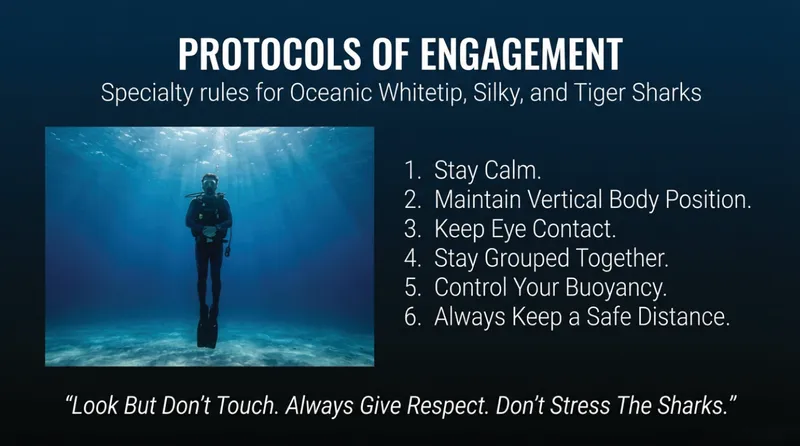
### Protocols of Engagement: Rules of the Water
Diving with apex predators is a privilege. To ensure both your safety and the well-being of the sharks, strictly follow these "Rules of the Water":
1. **Stay Calm:** Avoid erratic movements.
2. **Maintain Vertical Position:** Appear large and neutral in the water column.
3. **Keep Eye Contact:** Always track the animal; never turn your back.
4. **Stay Grouped:** Maintain close proximity to your dive buddies.
Our Mission: Replacing Fear with Understanding
The Red Sea is their home; we are just visitors. Our mission is to challenge misconceptions, inspire respect, and replace fear with understanding. Through research and education, we aim to turn indifference into action for the survival of these magnificent predators.
**Curated by [Michael Wafaa](https://michaelwafaa.com/)**, Founder of the Red Sea Sharks Discovery Project and PADI Shark Conservation Awareness Instructor.
https://www.instagram.com/michael\_wafaa/
---
*Published on February 27, 2026*
*Author: Yevgen “Scorp” Sukharenko*
*Source: [Red Sea Creatures](https://redseacreatures.com)*
---
---
title: The Mantis Shrimp: Nature’s Supersonic Boxer and Optical Genius
description: Don't be fooled by the mantis shrimp's vibrant colors and tiny size - lurking in Red Sea crevices is one of Earth's most ferocious predators, armed with a club that strikes at bullet speeds of 50 mph, accelerating at 10,400 g to shatter crab shells and aquarium glass. Its dactyl club, reinforced with hydroxyapatite crystals in a shock-absorbing herringbone pattern, survives the onslaught while creating cavitation bubbles that boil water and deliver a stunning double punch. Dive deeper to uncover the ocean's ultimate heavyweight champion.
author: Yevgen “Scorp” Sukharenko
published: 2026-02-25T16:30:00.000Z
updated: 2026-02-25T16:34:01.391Z
tags: Creatures
url: https://redseacreatures.com/blog/2026/02/25/the-mantis-shrimp-natures-supersonic-boxer-and-optical-genius
---
# The Mantis Shrimp: Nature’s Supersonic Boxer and Optical Genius
If you carefully scan the sandy rubble and coral crevices during a dive in the Red Sea, you might catch a glimpse of a brightly colored, lobster-like creature darting into a burrow. At just a few inches long, the Mantis Shrimp (*Stomatopoda*) looks like a harmless, beautiful aquarium pet.
Do not be fooled. You are looking at one of the most highly engineered, terrifyingly efficient predators on planet Earth.
Behind its colorful shell lies a biological weapon that breaks the laws of physics, paired with an optical system so advanced that human engineers are still trying to copy it. Let’s dive into the anatomy of the ocean's ultimate heavyweight champion.
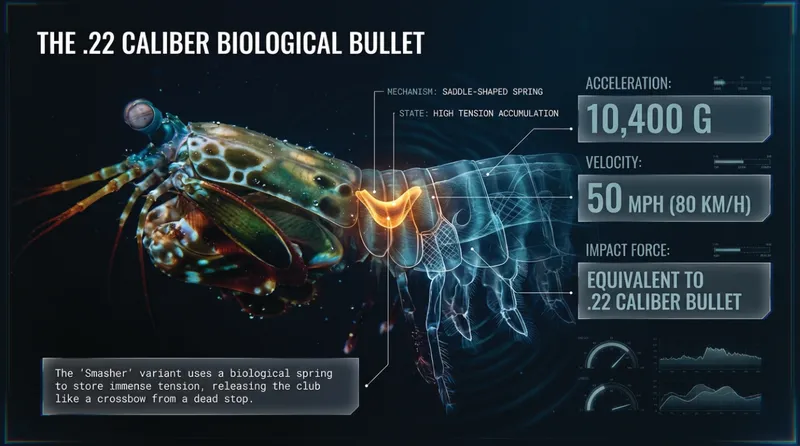
### The Weapon: A Biological .22 Caliber Bullet
Mantis shrimp are generally divided into two categories based on their hunting style: "spearers" (who impale soft prey) and "smashers" (who crush hard shells). The smashers are the ones that hold the ocean's most extreme records.
Their front appendages are modified into heavy, calcified "dactyl clubs." When a mantis shrimp spots a crab or a snail, it releases these clubs with mind-bending speed. A biological spring mechanism, shaped like a saddle, stores immense tension. When released, the club accelerates at 10,400 *g -* reaching speeds of 50 mph (80 km/h) from a dead stop. That is the exact acceleration of a .22 caliber bullet leaving a gun barrel.
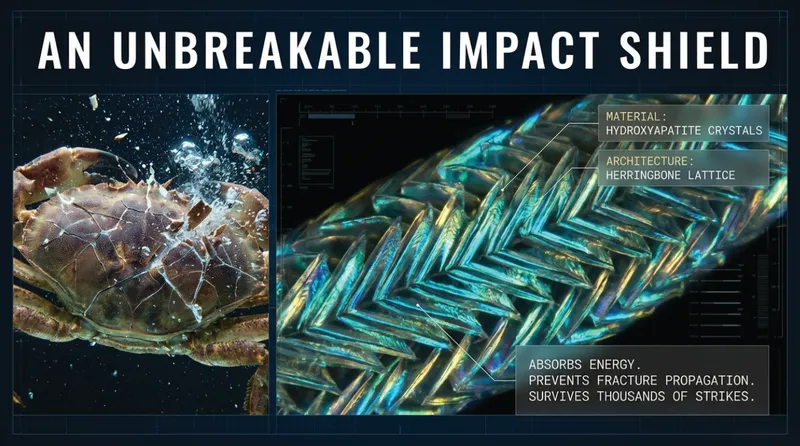
But how does their own arm survive an impact that easily cracks heavy clam shells and aquarium glass? Their clubs are coated in a specialized, shock-absorbing structure of hydroxyapatite crystals, arranged in a herringbone pattern that prevents micro-fractures from spreading.

### Cavitation: Boiling Water and Flashes of Light
The mantis shrimp strikes so fast that the laws of fluid dynamics break down. As the club punches through the water, it moves faster than the surrounding water can fill the space behind it. This literally tears the water apart, creating a boiling vacuum cavity known as a **cavitation bubble**.
When this vacuum bubble collapses a microsecond later, the implosion releases a massive underwater shockwave. The forces are so extreme that the implosion generates temperatures approaching 8,000°F (about 4,400°C) - nearly as hot as the surface of the sun! It also emits a tiny, brief flash of light, a phenomenon called *sonoluminescence*.
Because of this shockwave, the mantis shrimp doesn't even need to hit its target to kill it. If the physical club misses by a fraction of an inch, the resulting cavitation shockwave is powerful enough to stun or instantly kill the prey anyway.
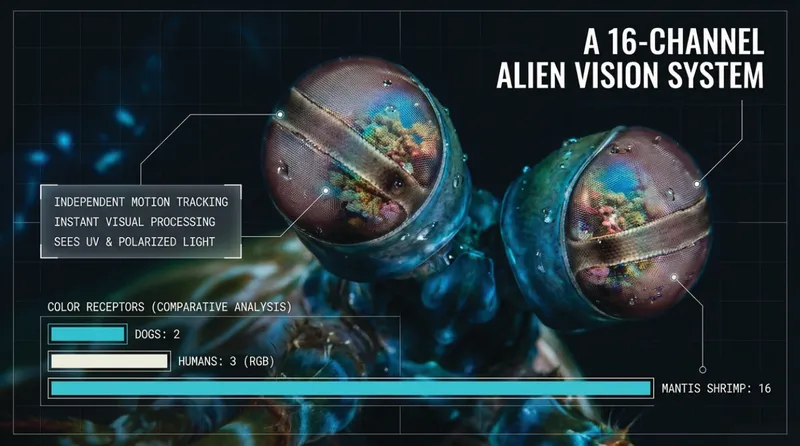
### The Eyes: A 16-Channel Alien Vision System
If you think their punch is impressive, look at their eyes. Mounted on mobile stalks, each eye can move completely independently, scanning the reef for danger and dinner.
Humans have a decent visual system. We have three types of color-receptive cones in our eyes (Red, Green, and Blue), which blend together to create every color we see. Dogs only have two.
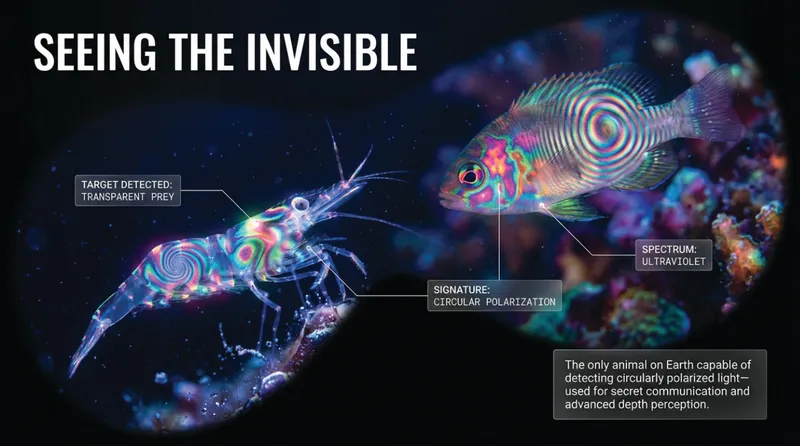
The mantis shrimp? It has up to **16 types of photoreceptor cells**. Not only do they see a rainbow of colors we cannot even begin to comprehend, but they can also see deep into the ultraviolet (UV) spectrum. Furthermore, they are the only animals on Earth known to detect **circularly polarized light** - a type of light wave that spirals as it travels. Researchers believe this unique vision allows them to see completely transparent prey, communicate with each other using secret light signals reflected off their shells, and process visual information instantly without wasting brain power.
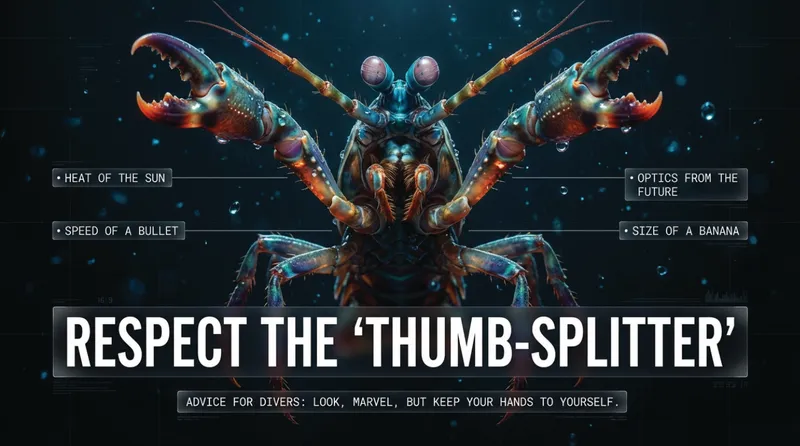
### Respect the "Thumb-Splitter"
The mantis shrimp is a masterclass in extreme evolution. It packs the heat of the sun, the speed of a bullet, and an optical system from the future into a body the size of a banana.
So, the next time you are hovering over a patch of rubble on a Red Sea reef, keep your eyes peeled for a pair of complex eyes watching you from a hole. Just remember the golden rule of local fishermen, who call this animal the "thumb-splitter": look, marvel, but keep your hands to yourself!
---
*Published on February 25, 2026*
*Author: Yevgen “Scorp” Sukharenko*
*Source: [Red Sea Creatures](https://redseacreatures.com)*
---
---
title: The Remora: The Ocean's Ultimate Hitchhiker and its Biological Suction Cup
description: Spot a whale shark or manta ray in the Red Sea, and you'll notice sleek remoras - nature's ultimate hitchhikers - clinging tightly to their bellies for a free ride across the ocean. Their secret weapon? A flattened dorsal fin transformed over 32 million years into a ribbed suction disc on their heads, complete with a blood-engorged lip for an airtight seal and friction spikes to withstand high-speed sprints. This biological marvel lets them feast on scraps and parasites while hitching effortlessly with giants.
author: Yevgen “Scorp” Sukharenko
published: 2026-02-24T14:30:00.000Z
updated: 2026-02-24T22:08:47.853Z
tags: Creatures
url: https://redseacreatures.com/blog/2026/02/24/the-remora-the-oceans-ultimate-hitchhiker-and-its-biological-suction-cup
---
# The Remora: The Ocean's Ultimate Hitchhiker and its Biological Suction Cup
When you spot a massive whale shark, manta ray, or sea turtle gliding through the Red Sea, look closely at their bellies. You will almost always see a few sleek, torpedo-shaped fish stuck tightly to them. These are Remoras (often called suckerfish), the marine world's most famous and brilliant hitchhikers.
Instead of swimming thousands of miles across the ocean, they simply attach themselves to the biggest, fastest predators and get a free ride. But how do they hold on so tightly to a fast-moving shark without slipping off? The secret lies in a masterpiece of biological engineering located right on top of their heads.
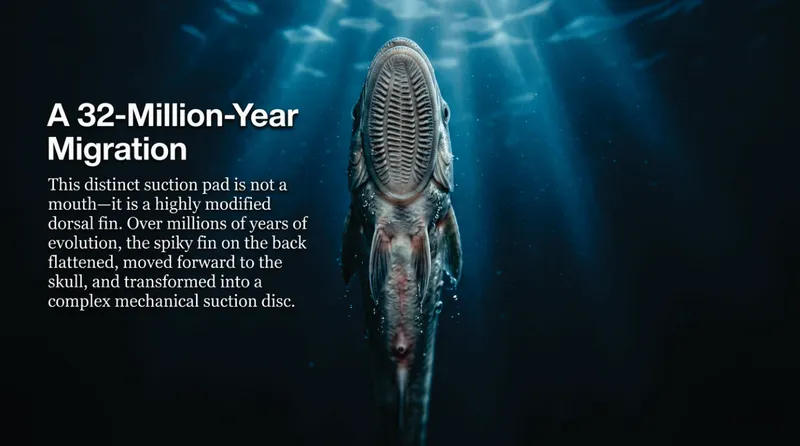
### The Migrating Fin
If you look at a remora from the top, its head looks bizarrely flat, almost like the rubber sole of a sneaker. This ribbed, oval-shaped suction pad isn't a mouth - it is actually a highly modified dorsal fin!
Over nearly 32 million years of evolution, the spiky fin on their back flattened out, moved forward to the top of their skull, and completely transformed into a complex mechanical suction disc.
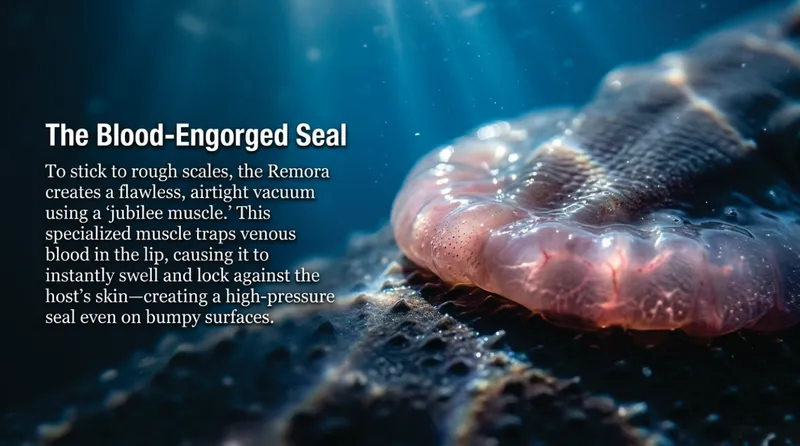
### The Blood-Engorged Seal
To stick securely to a host, the remora first needs a perfect, airtight vacuum seal. The outer edge of the suction disc features a thick, fleshy lip made of soft collagen and elastic fat. But it has a hidden, almost sci-fi trick.
When the remora finds a host, a specialized muscle (known by scientists as the "jubilee muscle") temporarily stops the venous blood from leaving this lip. The lip instantly swells up with blood, becoming incredibly tight and squishy. This creates a flawless, high-pressure vacuum seal against the host's skin - even if that skin is rough, bumpy, or covered in scales.
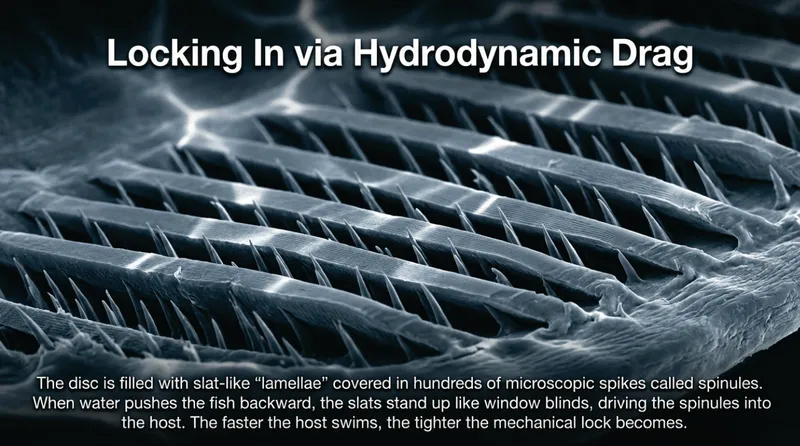
### The Friction Spikes
A vacuum seal alone isn't enough. When a host shark bursts into a high-speed sprint, the sheer force of the water should rip the remora right off. To prevent this, the inside of the suction disc is filled with rows of horizontal slats (called *lamellae*), which look much like the blinds on a window.
These slats are covered in hundreds of microscopic, tooth-like spikes called *spinules*. When the water pushes the remora backward, this backward motion automatically causes the slats to stand up. The tiny spinules dig into the host's skin, locking the fish in place. The faster the host swims, the tighter the remora's mechanical lock becomes! To detach, the remora simply swims slightly forward, the slats fold flat, and it releases in a fraction of a second.
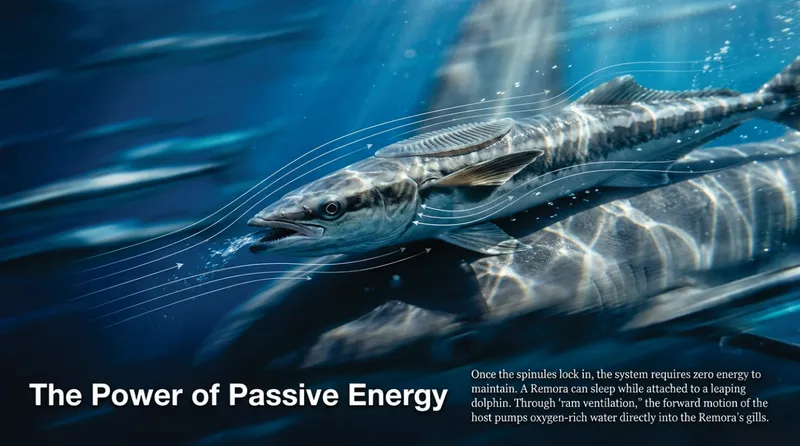
### The Power of Being Passive
The most mind-blowing part of this biological lock is that it requires absolutely zero energy to maintain. Once the remora is locked on, the system is completely passive. A remora can literally go to sleep while stuck to a leaping dolphin!
They even take their laziness one step further. Because the host is constantly moving forward, water is forced straight into the remora's mouth and over its gills. This is called "ram ventilation." It means the remora doesn't even have to use energy to breathe. They just open their mouths slightly and let the host pump oxygen into their bodies.
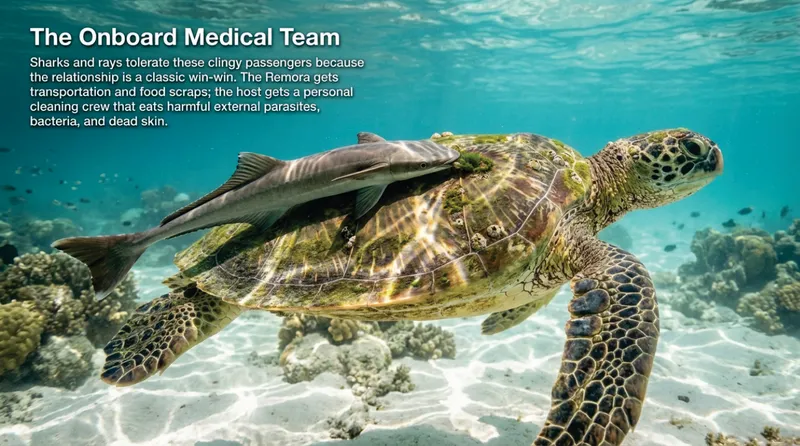
### The Ultimate Cleaning Crew
Why do sharks, turtles, and manta rays put up with these clingy passengers? It’s a classic win-win relationship. The remora gets free transportation, protection from other predators, and leftover food scraps from the host's meals.
In return, the remora acts as a personal, onboard medical team. It constantly scurries over the host's body, eating harmful external parasites, dead skin, and bacteria. By keeping these giant predators healthy and clean, the remora pays for its first-class ticket across the ocean.
---
*Published on February 24, 2026*
*Author: Yevgen “Scorp” Sukharenko*
*Source: [Red Sea Creatures](https://redseacreatures.com)*
---
---
title: From Sand to Seahores: How Parrotfish Poop Creates the World's Most Beautiful Beaches
description: That pristine white sand under your feet on Red Sea beaches? It's mostly parrotfish poop - finely ground coral excreted by these colorful reef dwellers. With unbreakable, fluorapatite beaks harder than gold, they crunch algae off solid coral, then grind it in their throat's pharyngeal mill before pooping out up to 1,000 pounds yearly per fish. Nature's ultimate sand factory at work!
author: Yevgen “Scorp” Sukharenko
published: 2026-02-23T14:45:00.000Z
updated: 2026-08-20T22:11:52.747Z
tags: Creatures
url: https://redseacreatures.com/blog/2026/02/23/from-sand-to-seahores-how-parrotfish-poop-creates-the-worlds-most-beautiful-beaches
---
# From Sand to Seahores: How Parrotfish Poop Creates the World's Most Beautiful Beaches
When you walk along the stunning white beaches of the Red Sea, you might think you are stepping on tiny crushed shells or ordinary rocks. But the truth is far more bizarre and wonderful. Most of that beautiful, soft white sand was actually manufactured inside the belly of one of the ocean's most colorful residents: the Parrotfish.
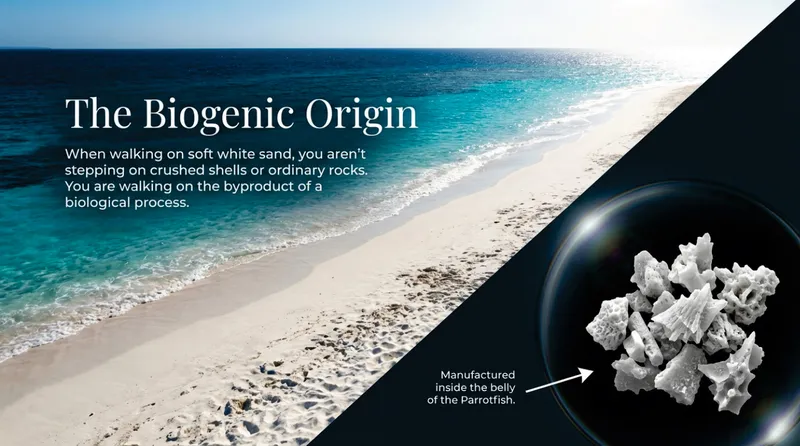
If you have ever snorkeled or scuba dived along a coral reef, you have probably seen them. They are brightly colored, rather chunky fish that constantly scrape away at the rocks. But there is a lot of hidden bio-engineering behind their everyday routine. Let's look at the superpowers of the reef's most important construction worker.
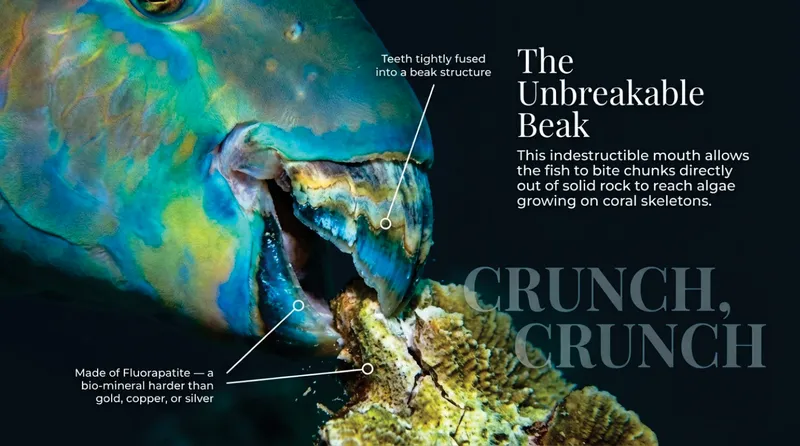
### The Unbreakable Beak
The first thing you notice about a parrotfish is its mouth. Instead of regular rows of teeth, their teeth are tightly fused together to form a shape that looks exactly like a parrot’s beak.
But this isn't just any beak. It is made of a bio-mineral called **fluorapatite**, which is one of the hardest substances found in any living animal - even harder than gold, copper, and silver! Why do they need such an indestructible mouth? Because their favorite food is the algae that grows directly on hard coral skeletons. To get a good meal, the parrotfish has to literally bite chunks out of solid rock. If you listen closely underwater, you can actually hear the loud *CRUNCH, CRUNCH, CRUNCH* as they chew on the reef!
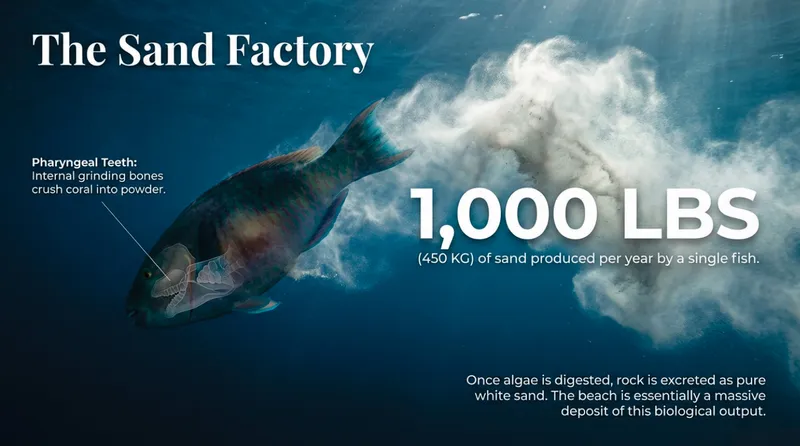
### The Ultimate Sand Factory
So, what happens when a fish swallows a mouthful of solid rock? Inside the parrotfish's throat is a special set of grinding bones called pharyngeal teeth. These internal teeth crush the hard coral into a fine powder so the fish can digest the nutritious algae hidden inside.
Once the algae is digested, the leftover crushed rock has to go somewhere. The parrotfish simply poops it out as pure, pristine white sand. And they do this *a lot*. A single large parrotfish can produce up to 1,000 pounds (about 450 kilograms) of sand every single year! So, the next time you are relaxing on a tropical sandy beach, you can thank a parrotfish for making it.
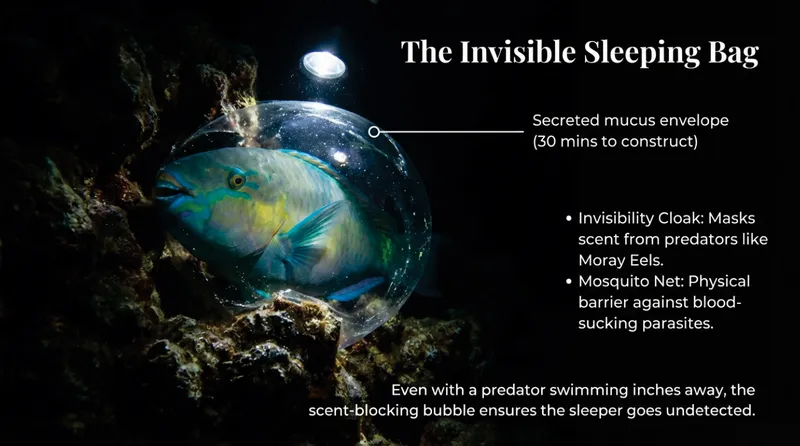
### The Invisible Sleeping Bag
Life on the reef gets dangerous when the sun goes down. Nighttime predators, like the moray eel, use their incredible sense of smell to hunt sleeping fish in the dark.
To survive the night, the parrotfish has evolved a brilliant defense mechanism. Before going to sleep in a rocky crevice, the fish secretes a special mucus from its mouth and wraps itself in a giant, transparent jelly bubble. This biological "sleeping bag" takes about 30 minutes to make and acts as a scent-blocking invisibility cloak. Moray eels can swim right past without ever smelling their dinner. As a bonus, this mucus bubble also acts like a mosquito net, keeping tiny, blood-sucking ocean parasites away while the fish sleeps.
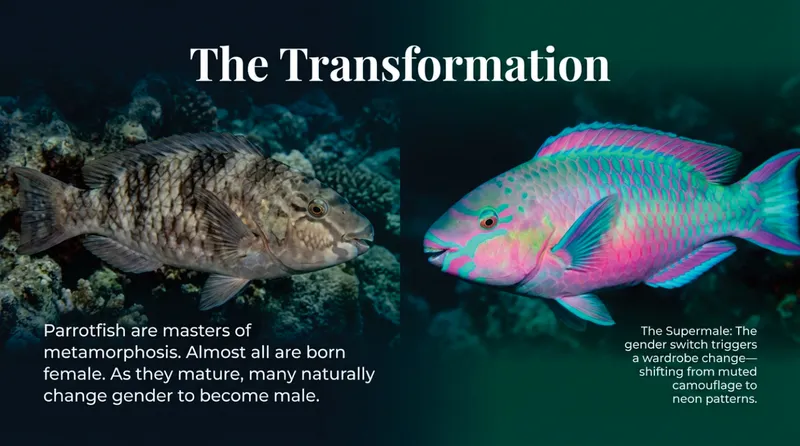
### A Wardrobe (and Gender) Change
Parrotfish don't just stick to one look; they are masters of transformation. Almost all parrotfish are born female. As they grow older and larger, many of them will naturally change their gender and become male.
When they make this change, their outfits change, too! They go from their muted, camouflaged childhood colors into a "supermale" phase, developing vibrant, neon-like patterns of bright pinks, greens, and blues.
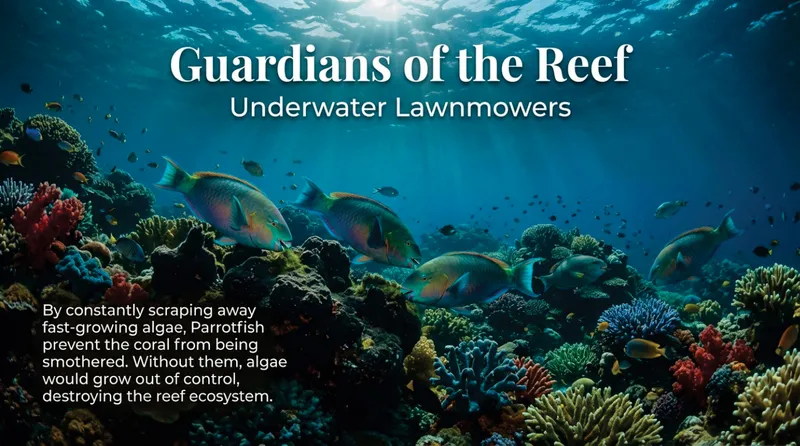
### Guardians of the Reef
Parrotfish aren't just fascinating; they are absolutely essential for the survival of the Red Sea's coral reefs. By constantly eating the fast-growing algae, they act like underwater lawnmowers. Without them, the algae would grow out of control and completely smother the slow-growing corals, destroying the reef ecosystem.
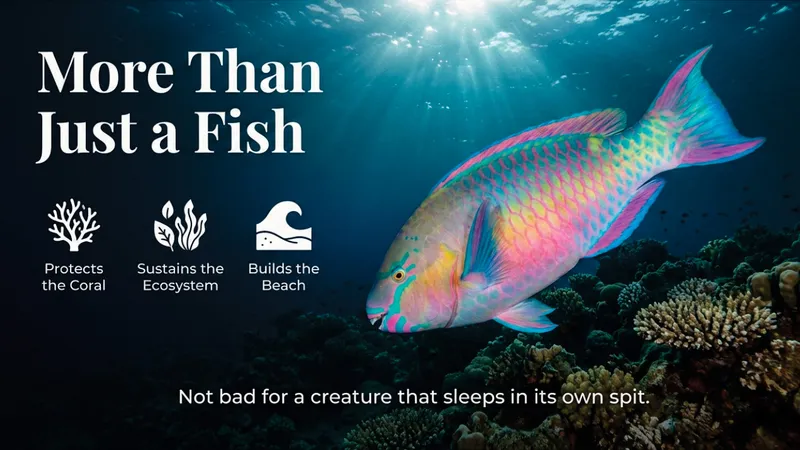
So, they protect the coral, keep the reef clean, and build our beautiful beaches. Not bad for a fish that sleeps in its own spit!
---
*Published on February 23, 2026*
*Author: Yevgen “Scorp” Sukharenko*
*Source: [Red Sea Creatures](https://redseacreatures.com)*
---
---
title: The Living Torpedo: Nature’s High-Voltage Predator
description: Meet the Torpedo Ray, aka the "Crampfish," a sluggish bottom-dweller that rules as an apex predator not with speed, but with shocking electric power from its name's Latin root meaning "numbness." Hidden in its pectoral disc are twin generators - massive organs of modified muscle forming a honeycomb of jelly-filled electroplate stacks - that unleash up to 220 volts to stun prey. This living battery evolved raw electricity over chase, proving power trumps pace in the deep.
author: Yevgen “Scorp” Sukharenko
published: 2026-02-22T12:00:00.000Z
updated: 2026-02-22T12:02:12.350Z
tags: Creatures
url: https://redseacreatures.com/blog/2026/02/22/the-living-torpedo-natures-high-voltage-predator
---
# The Living Torpedo: Nature’s High-Voltage Predator
Welcome to the world of the Torpedo Ray, an underwater marvel that proves you don't need speed to be an apex predator. Often referred to as the "Crampfish," this slow-moving bottom dweller belongs to the Torpedinidae family. The family name is actually derived from the Latin word *torpedus*, which literally translates to "numbness". While other marine predators rely on swift chases and agility to catch their meals, the Torpedo Ray took a completely different evolutionary path, trading physical speed for raw, electric power. Let's dive deep into the biology of this living battery.
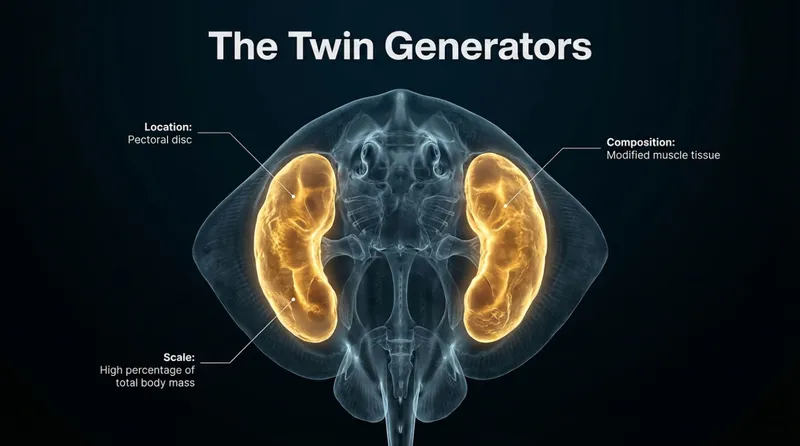
The Twin Generators
At first glance, the Torpedo Ray might look like an ordinary flat fish, but hidden within its pectoral disc are two massive power plants. These twin generators are not just small accessory organs; they are incredibly dense and take up a remarkably high percentage of the ray's total body mass.
Fascinatingly, these electric organs are made entirely of modified muscle tissue. Over millions of years of evolution, these specific muscles lost their ability to contract for movement, transforming instead into dedicated biological batteries capable of producing powerful electricity.
**
### The Honeycomb Matrix
If we were to look inside these organic generators, their structure closely resembles a complex honeycomb matrix. The organ is built from vertical tubes that feature tough, fibrous walls.
Each of the two electric organs is densely packed with 400 to 600 of these vertical columns. To help conduct the electricity as efficiently as possible, these tubes are filled with a specialized, highly conductive jelly matrix. This natural gel ensures that the electrical charge flows smoothly and quickly when the ray needs it most.
*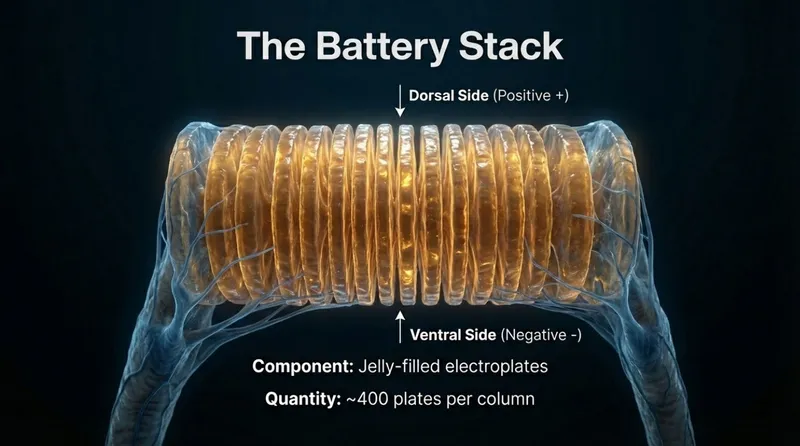*
### The Battery Stack
Inside every single vertical column is a biological "battery stack" made of tiny, jelly-filled discs known as electroplates. There are approximately 400 of these plates neatly stacked within each column.
Just like a standard battery you would put in a flashlight, the Torpedo Ray has defined electrical poles. The top (dorsal) side of the ray carries a positive (+) charge, while the belly (ventral) side carries a negative (-) charge. When all these microscopic plates fire at exactly the same time, they create a massive electrical wave.
**
### The Neural Trigger
How does the ray safely control this incredible power? The answer lies in its nervous system. The ray has complete voluntary control over its electric organs, using its brain as a direct biological switch to trigger the shock.
However, because this system relies entirely on nerve signals, the environment plays a crucial role in the ray's abilities. Cold water acts as a natural inhibitor; if the water temperature drops below 15°C, it significantly reduces the ray's nerve function and slows down its ability to fire its weapons.
**
### Wired for Maximum Output
The natural engineering of this biological battery is truly astonishing. The electroplates within each column are connected in a "series" circuit, which allows the animal to build up a high voltage. Meanwhile, the hundreds of separate columns are connected in "parallel," which builds up the amperage, or the actual flow and weight of the electric current.
This brilliant dual-wiring system allows the Torpedo Ray to generate an incredible 220 volts of electricity - equivalent to the standard electrical current flowing through the wall outlets in a house. This output is so powerful that a full discharge is sufficient to knock a human adult completely unconscious.
**
### The Strike Dynamics
When a Torpedo Ray hunts, it executes a precise, lightning-fast, and deadly sequence. The strike begins with "The Jump," a sudden upward physical thrust combined with a high-frequency electrical burst of 230 to 430 Hz. This shock is so sudden and intense that it causes a tetanic contraction, often breaking the prey's vertebral column instantly.
To maximize the efficiency of the shock, the ray uses a maneuver called "The Wrap." It actively curls its pectoral disc around the stunned fish, ensuring that the full force of the electrical current is directed straight through its target.
*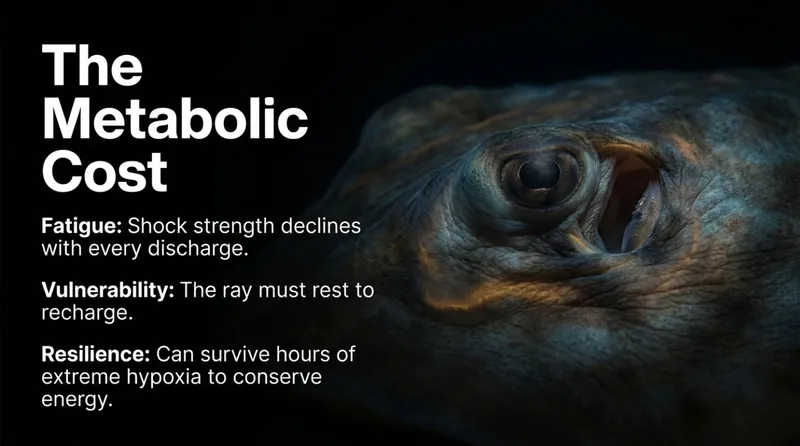*
### The Metabolic Cost
Producing such explosive, high-voltage power comes with a heavy metabolic cost to the animal. Generating electricity is exhausting, and the ray's shock strength noticeably declines with every successive discharge, leading to physical fatigue. After a hunt or defending itself from a predator, the ray becomes highly vulnerable and must rest quietly to recharge its internal batteries.
To survive these low-energy periods on the ocean floor, the ray has evolved incredible physical resilience. It can survive for hours in a state of extreme hypoxia (a severe lack of oxygen), slowing down its bodily functions to conserve energy while it recharges.
*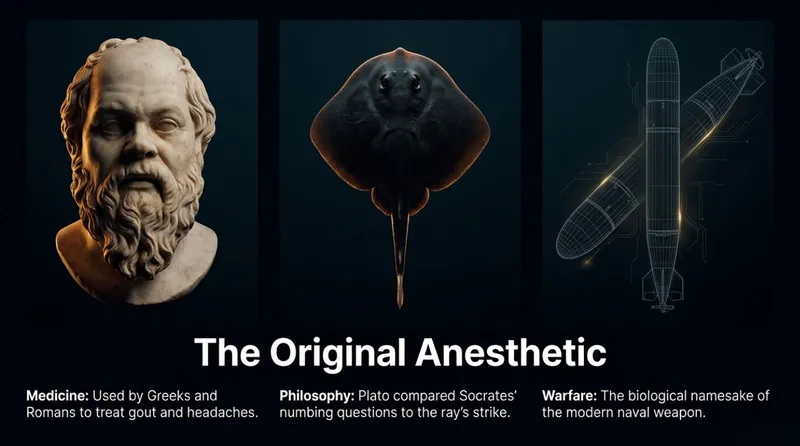*
### The Original Anesthetic
Long before the invention of modern medicine or electrical grids, ancient humans were well aware of the Torpedo Ray's unique power. The ancient Greeks and Romans actually used live rays as a primitive form of medicine, applying them to patients to deliver mild shocks to treat severe headaches and gout.
The ray even made its way into classical philosophy. The philosopher Plato famously compared his teacher, Socrates, to a Torpedo Ray, writing that Socrates' difficult and probing questions stung people into a state of numbness and mental confusion. Furthermore, humanity was so impressed by this creature that the modern naval weapon - the torpedo - was biologically named directly after this fish, not the other way around.
*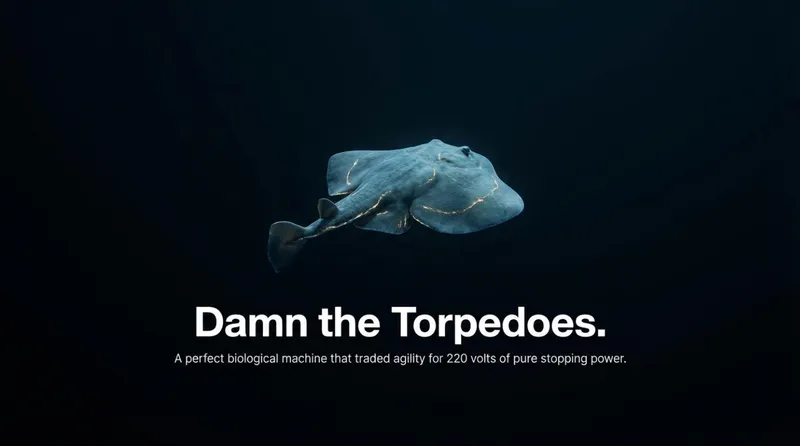*
### A Perfect Biological Machine
In the end, the Torpedo Ray is a perfect biological machine. It is a master of the deep that successfully traded physical agility for 220 volts of pure, unparalleled stopping power. So, the next time you hear the famous naval phrase, "Damn the torpedoes," you'll know exactly which shocking ocean creature inspired it all.
---
*Published on February 22, 2026*
*Author: Yevgen “Scorp” Sukharenko*
*Source: [Red Sea Creatures](https://redseacreatures.com)*
---
---
title: Unveiling the Octopus: Anatomy of a Soft-Bodied Evolutionary Masterpiece
description: Octopuses represent an evolutionary paradox - possessing remarkably complex intelligence within a boneless, soft body that relies on a hydrostatic skeleton for structure and movement. Their nervous system is extraordinarily distributed, with approximately two-thirds of their 500 million neurons located in their eight arms rather than their brain, enabling semi-autonomous arm control and allowing each sucker to function as both a sensory organ capable of taste and touch and a precision gripper. This unique neural architecture, combined with their advanced skin display system featuring chromatophores, iridophores, and texture-changing papillae, represents a masterpiece of biological engineering entirely distinct from vertebrate intelligence.
author: Yevgen “Scorp” Sukharenko
published: 2026-02-21T12:00:00.000Z
updated: 2026-02-21T12:23:34.656Z
tags: Creatures
url: https://redseacreatures.com/blog/2026/02/21/unveiling-the-octopus-anatomy-of-a-soft-bodied-evolutionary-masterpiece
---
# Unveiling the Octopus: Anatomy of a Soft-Bodied Evolutionary Masterpiece
Whether observing a common *Octopus vulgaris* or a day octopus (*Octopus cyanea*) gliding over a Red Sea reef, you are witnessing an evolutionary paradox. These creatures house incredibly complex intelligence within a soft body entirely lacking an internal skeleton. By deconstructing their anatomy, we can truly appreciate this masterpiece of biological engineering.
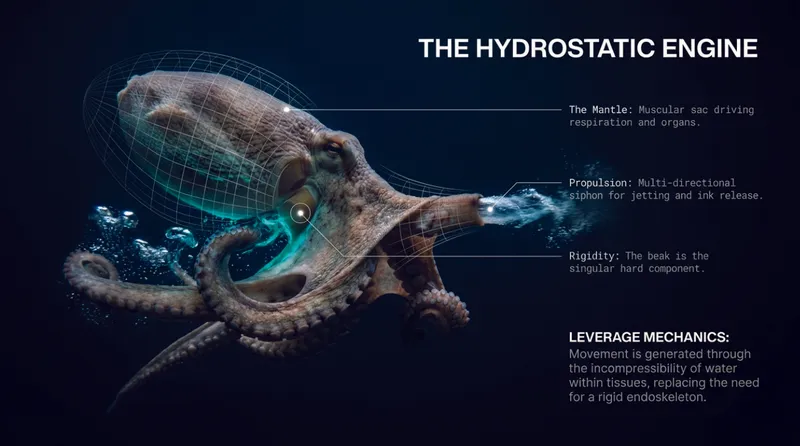
## Morphology and Movement
Lacking a rigid endoskeleton, the octopus relies entirely on a hydrostatic skeleton. Leverage is generated through the incompressibility of water within its tissues. The mantle - a muscular sac - houses the visceral organs and drives respiration, while a multi-directional siphon handles jet propulsion, waste expulsion, and ink release. To maximize flexibility, the only rigid component in the entire body is the beak.
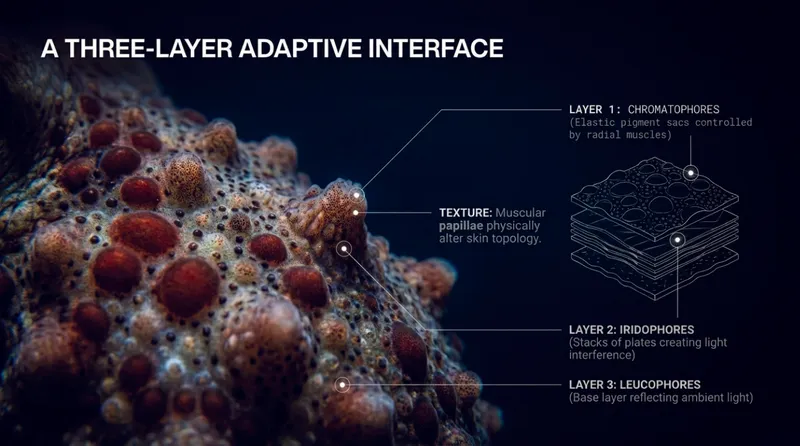
## The Adaptive Display Interface
The octopus skin is a highly advanced display interface featuring three distinct layers. Chromatophores are elastic pigment sacs controlled by radial muscles to flash black, brown, red, orange, or yellow. Beneath them, iridophores use stacks of plates to create iridescent blues and greens via light interference. Finally, a base layer of leucophores reflects ambient light to flawlessly match the background. Muscular projections called papillae can even physically alter the skin's texture from smooth to spiky.
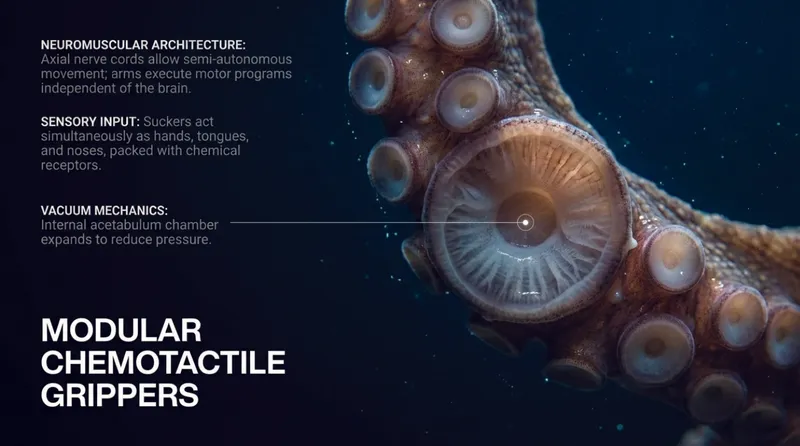
## Modular Arms and Chemotactile Grippers
The eight arms possess a modular neuromuscular architecture. The axial nerve cord is divided into segments by septa, resembling a corrugated pipe. Because nerves exit through these septa to control specific muscle regions, the arms are capable of semi-autonomous movement.
The suckers operate as highly precise chemotactile grippers. Using vacuum mechanics, muscles expand the internal acetabulum chamber to reduce pressure, forming a powerful seal. More than just hands, each sucker is packed with chemical receptors, acting simultaneously as a tongue and a nose. The nervous system even maintains a continuous topographical map of the suckers for spatial awareness.
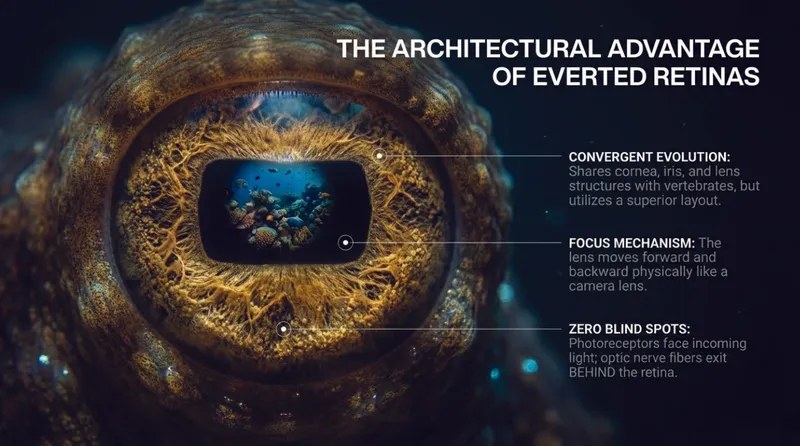
## Vision Without Blind Spots
The cephalopod eye evolved independently but shares the cornea, iris, and lens structures with the vertebrate eye through convergent evolution. However, it focuses by moving the lens forward and backward - like a camera - rather than warping its shape. Crucially, the retina has an "everted" design where photoreceptors face the incoming light, and optic nerve fibers exit *behind* the retina. This architectural advantage means octopuses have zero blind spots.

## A Distributed Intelligence Network
Of the octopus's 500 million neurons, the vast majority are located in the arm nerve cords rather than the central brain. These axial nerve cords can execute complex motor programs independently. A specialized nerve ring connects the arms directly to one another, allowing signals to completely bypass the central brain.
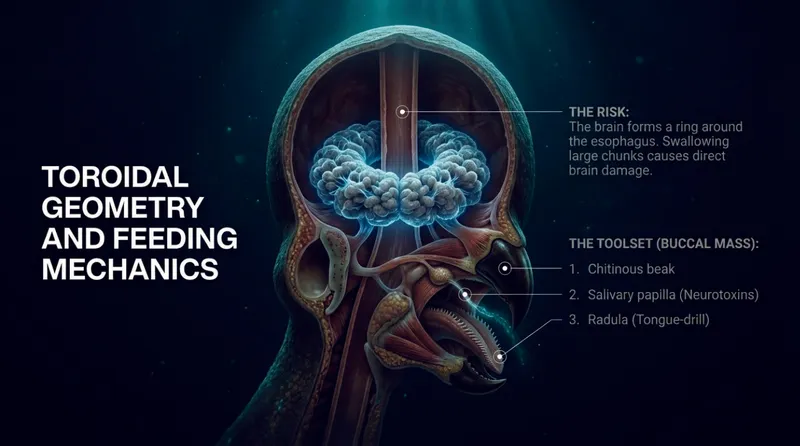
## Central Command and Feeding
The central brain features a toroidal geometry, literally forming a ring around the esophagus. This introduces a severe physiological risk: swallowing large, unchewed food can cause direct brain damage.
Feeding is handled by the buccal mass. The chitinous beak is operated by massive muscles, while a salivary papilla drills into prey to inject predigestive neurotoxins. A tongue-drill covered in denticles, called the radula, then rasps away the flesh. Food is stored in a crop for rapid ingestion before moving to the stomach and caecum for digestion.
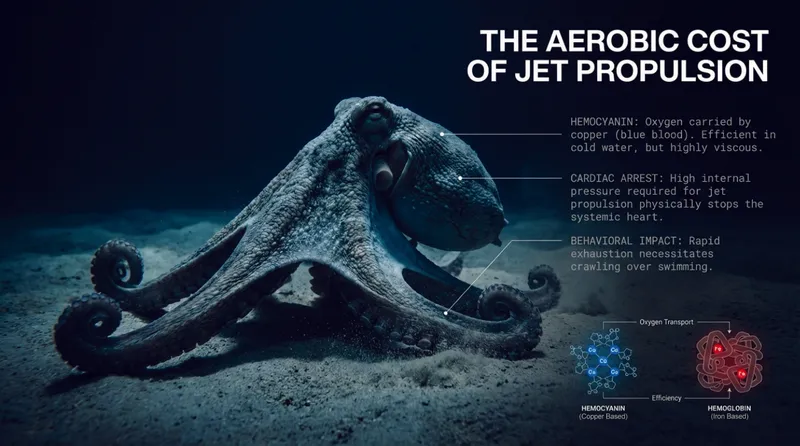
## Blue Blood and Cardiac Arrest
The octopus has a hemocyanin circulatory system. Because oxygen is carried by copper rather than iron, their blood is blue. This is highly efficient in cold, low-oxygen water, but it makes the blood very viscous. To manage this, two branchial hearts pump blood through the gills, and one systemic heart circulates it to the body.
While jet propulsion is a great escape mechanism, it carries a massive aerobic cost. The high internal pressure required to shoot water out of the siphon physically stops the systemic heart. Because this cardiac arrest leads to rapid exhaustion, octopuses strongly prefer crawling over swimming.
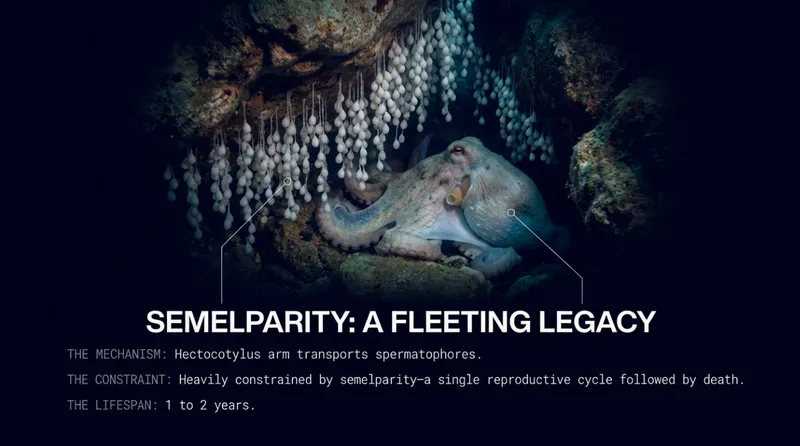
## A Fleeting Legacy
In males, the third right arm is modified into a reproductive organ called the hectocotylus. It uses a ciliated groove to transport spermatophores to the female.
The octopus is undoubtedly the ultimate invertebrate, combining distributed intelligence and adaptive camouflage. However, this unique lineage of complex intelligence is heavily constrained by semelparity. They have a very short lifespan of just 1 to 2 years and undergo only a single reproductive cycle before they die.
---
*Published on February 21, 2026*
*Author: Yevgen “Scorp” Sukharenko*
*Source: [Red Sea Creatures](https://redseacreatures.com)*
---
---
title: Sharks: Nature's Engineering Masterpiece - Why They're More Advanced Than You Think
description: Forget the myth of sharks as primitive "living fossils" - these ancient predators, evolving over 450 million years before dinosaurs roamed, have masterfully refined their biology for supremacy. Their lightweight cartilaginous skeletons, a clever evolutionary reversion from bony ancestors, slash weight by half while tesserae armor boosts strength for lightning-fast turns and speed. Far from relics, sharks are engineered marvels thriving from reefs to abyssal depths.
author: Yevgen “Scorp” Sukharenko
published: 2026-02-20T09:00:00.000Z
updated: 2026-08-08T13:20:21.915Z
tags: Creatures
url: https://redseacreatures.com/blog/2026/02/20/sharks-natures-engineering-masterpiece-why-theyre-more-advanced-than-you-think
---
# Sharks: Nature's Engineering Masterpiece - Why They're More Advanced Than You Think
It is a common misconception that sharks are "living fossils" - primitive relics that have remained frozen in time for hundreds of millions of years. In reality, sharks were perfecting their biological blueprints long before the first trees appeared on Earth, and they are older than many ancient lineages, including insects, mammals, and birds. Far from being evolutionary leftovers, these apex predators are some of the most sophisticated machines on the planet.
Their anatomy is a masterclass in efficiency, featuring counter-intuitive biological "hacks" that allow them to thrive in environments ranging from vibrant coral reefs to the crushing, pitch-black silence of the deep sea. By deconstructing their physiology through a modern lens, we discover that sharks have not just survived; they have engineered their way to the top of the food chain.
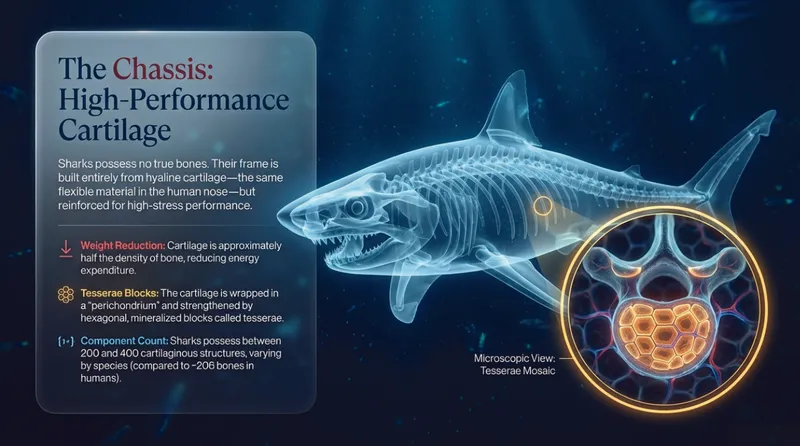
### The "Boneless" Evolutionary Reversion
While most vertebrates rely on a heavy, bony skeleton, sharks utilize a framework made of cartilage - the same resilient material found in your ears. Though often viewed as a "simpler" trait, evidence suggests this is a deliberate evolutionary reversion. Early shark ancestors likely possessed bony skeletons, but the lineage transitioned back to cartilage to prioritize a high-performance, high-speed lifestyle.
This cartilaginous endoskeleton is about half as dense as bone, providing a massive reduction in weight without sacrificing structural integrity. To solve the problem of strength, the skeleton is reinforced by **tesserae**: a layer of hexagonal, mineralized blocks that provide a protective "armor" over the hyaline cartilage. This unique engineering allows for incredible flexibility and tighter turns while pursuing prey.
> "We think early sharks developed a cartilaginous skeleton because it better suited their lifestyle. Being light and more flexible than bone, cartilage means sharks can typically swim faster than bony fish." - Emma Bernard, Fossil Fish Curator.
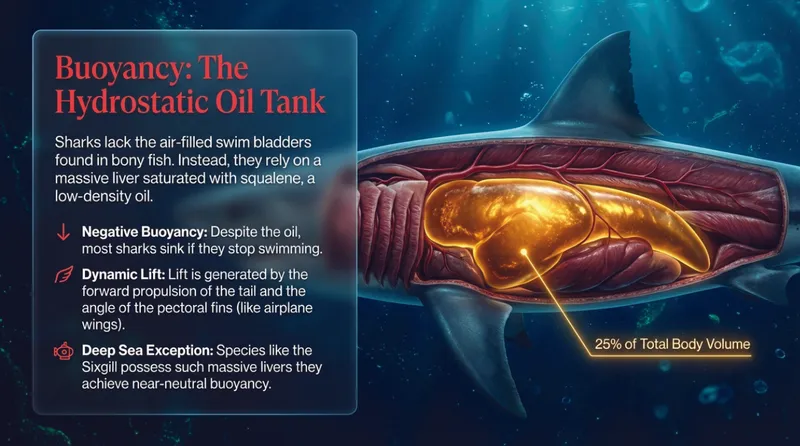
### The 25% Rule: A High-Octane Buoyancy Strategy
Unlike bony fish, which utilize a gas-filled swim bladder to maintain their position in the water column, sharks have opted for a massive, hydrocarbon-based buoyancy system. The cornerstone of this strategy is the liver - a hydrostatic organ that can account for up to 25% of a shark's total body weight.
This oversized organ is saturated with **squalene**, a low-density oil. Because squalene is significantly less dense than seawater, it provides the "lift" necessary to prevent the shark from sinking. Beyond buoyancy, these oily reserves act as a high-density energy store. This dual-purpose engineering allows sharks to navigate resource-scarce environments for weeks between meals, essentially carrying their own fuel tank and ballast system in a single organ.
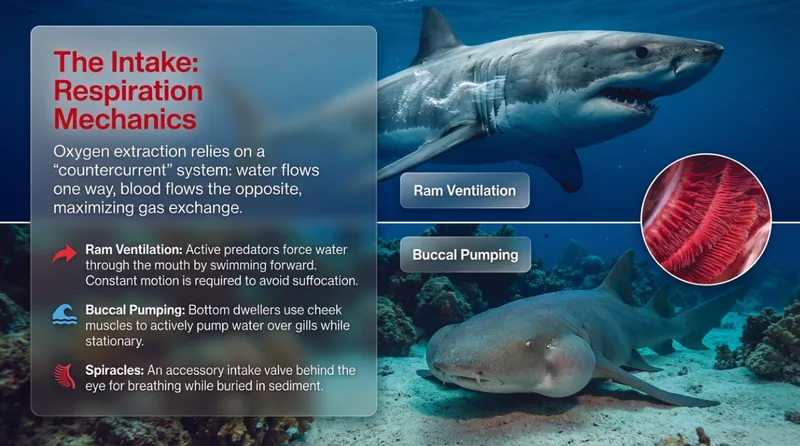
## How Sharks Breathe: Engineering Oxygen Extraction
Sharks extract oxygen from water through gills employing a highly efficient **countercurrent exchange system**, where water flows over the gill filaments in the opposite direction to blood flow, maximizing oxygen diffusion gradients for up to 80-90% extraction efficiency - far superior to the parallel flow in human lungs.
Fast-swimming species like great whites and makos rely on **ram ventilation**, forward propulsion forcing water through their gaping mouths and over the gills; this demands constant motion, as stillness risks suffocation, aligning perfectly with their high-speed predatory lifestyle. In contrast, bottom-dwelling sharks such as nurse or wobbegong sharks use **buccal pumping**, rhythmically contracting buccal cavity muscles to draw water over gills without swimming, enabling ambush predation from stationary positions.
Enhancing versatility, many sharks feature spiracles - small openings behind the eyes that pump water directly to the gills, crucial for respiration when mouth-closed or buried in sediment, ensuring survival in diverse habitats from reefs to abyssal plains.

### Nature’s Tesla Valve: Passive Intestinal Plumbing
One of the most profound technological parallels found in nature is the shark’s spiral intestine. Recent 3D reconstructions created from CT scans have revealed that this organ functions essentially as a biological "Tesla Valve." Much like the fixed-geometry valve patented by Nikola Tesla, the spiral intestine facilitates unidirectional flow without the need for mechanical parts or "flappers."
This design operates **passively**, without requiring muscular contractions to guide the movement of material. The complex, 3D folds - ranging from columnar to scroll-like structures - create a path of high resistance for backflow while slowing the transit of food. This maximizes the time available for nutrient absorption, ensuring the shark extracts every possible calorie from its diet with surgical efficiency.
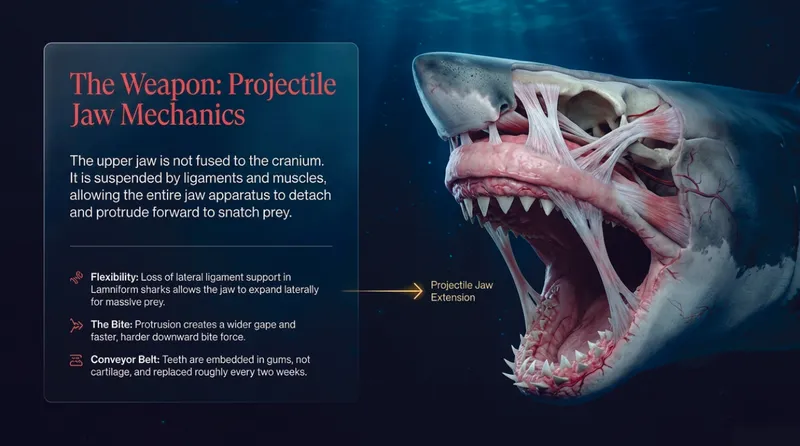
### The Slingshot Jaw: Independent Suspensions for Predators
The mechanics of a shark’s strike are fundamentally different from the fused anatomy of a human skull. In sharks, the upper jaw - known as the **palatoquadrate** - is not fused to the **cranium**. Instead, it is a "floating" structure held in place by a complex network of ligamentous support.
When a shark strikes, it utilizes the **preorbitalis muscle** and the **palatonasal ligament** to thrust the entire jaw forward and away from the head in a "protrusion mechanism." This creates a "slingshot" effect, allowing the shark to deliver a downward bite that is faster and more forceful than a fixed jaw would allow. This independent suspension enables the shark to open its mouth exceptionally wide and maintain lateral support during the high-energy struggle of subduing oversized prey.
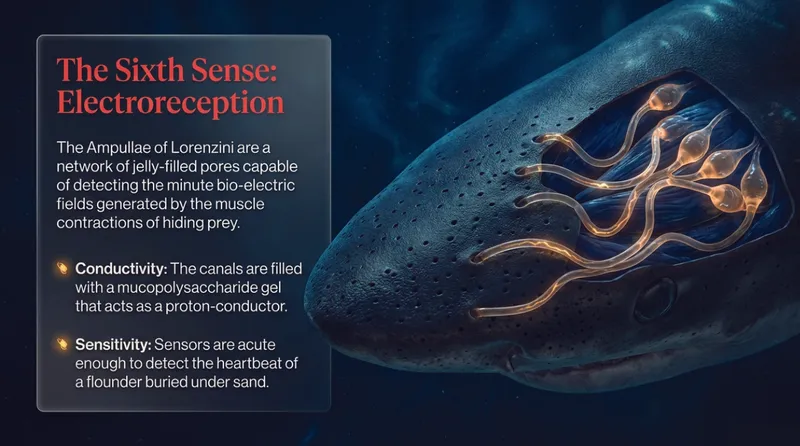
### The Sixth Sense: Navigating the Dark via Electroreception
In the light-limited reaches of the deep sea, traditional vision is often a secondary tool. Sharks possess a sophisticated "sixth sense" powered by the **Ampullae of Lorenzini** - a network of jelly-filled pores that act as biological semiconductors. These receptors detect the minute electromagnetic fields generated by the muscle contractions of other living organisms.
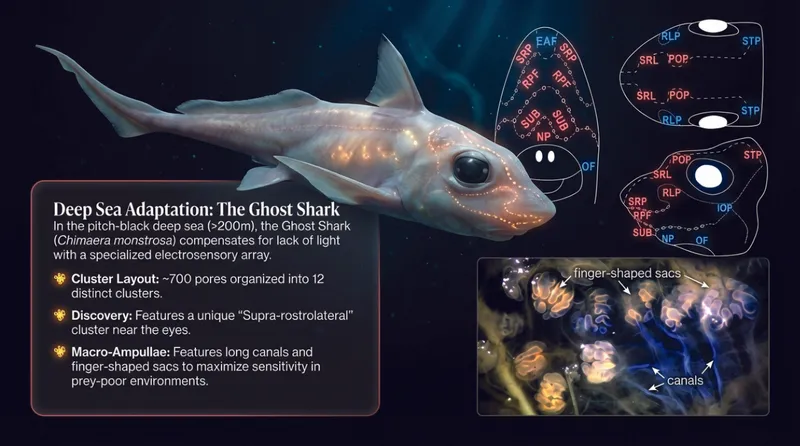
This system is so refined that it allows sharks to locate prey buried beneath the sand or navigate in total darkness. In ancient deep-sea species like the *Chimaera monstrosa* (Ghost Shark), this system is particularly specialized, featuring approximately **700 pores organized into 12 distinct clusters**. This sensory array allows the Ghost Shark to "see" a map of electrical heartbeats, ensuring it remains an effective hunter in the most extreme environmental niches on Earth.
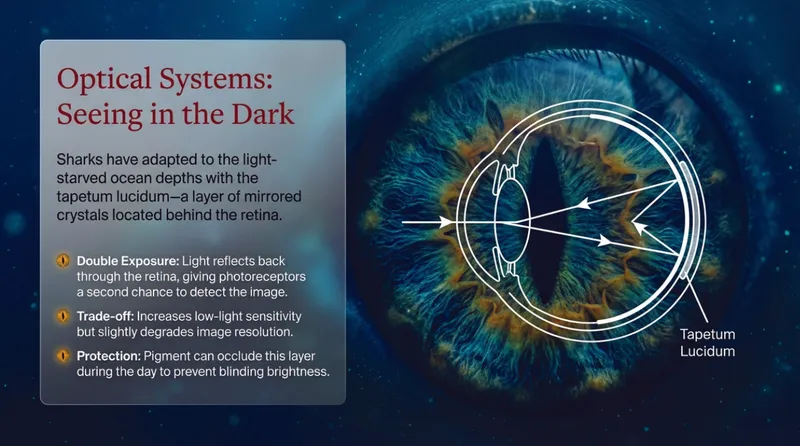
## Optical Systems: Seeing in the Dark
Sharks have adapted to the light-starved ocean depths with the **tapetum lucidum**, a reflective layer of mirrored crystals - guanine-based platelets - positioned behind the retina. This biological mirror functions through a "double exposure" mechanism: incoming light passes through the photoreceptors once, reflects off the tapetum, and passes through them again, dramatically boosting sensitivity in low-light conditions. This engineering marvel allows sharks to detect faint bioluminescence or moonlight scattered through water, essential for hunting in twilight zones or murky coastal waters where photons are scarce.
However, this high-gain optical system comes with calculated trade-offs. The reflective rebound slightly degrades image resolution due to scattered light, prioritizing detection over sharp detail - ideal for spotting movement in the gloom rather than fine print. For daytime protection, specialized pigments in the retinal epithelial cells migrate to occlude the tapetum, preventing overload from bright sunlight and avoiding "blinding" effects, much like an automatic camera shutter. This dynamic control showcases sharks' versatility across diel light cycles, from sunlit reefs to abyssal voids.
Complementing the tapetum, many sharks possess a high ratio of rod cells to cones in their retinas, further tuned for scotopic (low-light) vision, while species like the bull shark exhibit enhanced accommodation via a spherical lens for clearer focus. These optical innovations render sharks far from primitive; their eyes are precision instruments rivaling modern night-vision tech, enabling dominance in environments where light fails other predators.
![](https://images.redseacreatures.com/media/2026/02/1771504843877-380927678.we